EP4300488A2 - Stereoaudiocodierer und -decodierer - Google Patents
Stereoaudiocodierer und -decodierer Download PDFInfo
- Publication number
- EP4300488A2 EP4300488A2 EP23197482.5A EP23197482A EP4300488A2 EP 4300488 A2 EP4300488 A2 EP 4300488A2 EP 23197482 A EP23197482 A EP 23197482A EP 4300488 A2 EP4300488 A2 EP 4300488A2
- Authority
- EP
- European Patent Office
- Prior art keywords
- signal
- waveform
- high frequency
- cross
- coded
- Prior art date
- Legal status (The legal status is an assumption and is not a legal conclusion. Google has not performed a legal analysis and makes no representation as to the accuracy of the status listed.)
- Granted
Links
Images


Classifications
-
- G—PHYSICS
- G10—MUSICAL INSTRUMENTS; ACOUSTICS
- G10L—SPEECH ANALYSIS TECHNIQUES OR SPEECH SYNTHESIS; SPEECH RECOGNITION; SPEECH OR VOICE PROCESSING TECHNIQUES; SPEECH OR AUDIO CODING OR DECODING
- G10L19/00—Speech or audio signals analysis-synthesis techniques for redundancy reduction, e.g. in vocoders; Coding or decoding of speech or audio signals, using source filter models or psychoacoustic analysis
- G10L19/04—Speech or audio signals analysis-synthesis techniques for redundancy reduction, e.g. in vocoders; Coding or decoding of speech or audio signals, using source filter models or psychoacoustic analysis using predictive techniques
- G10L19/06—Determination or coding of the spectral characteristics, e.g. of the short-term prediction coefficients
-
- G—PHYSICS
- G10—MUSICAL INSTRUMENTS; ACOUSTICS
- G10L—SPEECH ANALYSIS TECHNIQUES OR SPEECH SYNTHESIS; SPEECH RECOGNITION; SPEECH OR VOICE PROCESSING TECHNIQUES; SPEECH OR AUDIO CODING OR DECODING
- G10L19/00—Speech or audio signals analysis-synthesis techniques for redundancy reduction, e.g. in vocoders; Coding or decoding of speech or audio signals, using source filter models or psychoacoustic analysis
- G10L19/008—Multichannel audio signal coding or decoding using interchannel correlation to reduce redundancy, e.g. joint-stereo, intensity-coding or matrixing
-
- G—PHYSICS
- G10—MUSICAL INSTRUMENTS; ACOUSTICS
- G10L—SPEECH ANALYSIS TECHNIQUES OR SPEECH SYNTHESIS; SPEECH RECOGNITION; SPEECH OR VOICE PROCESSING TECHNIQUES; SPEECH OR AUDIO CODING OR DECODING
- G10L19/00—Speech or audio signals analysis-synthesis techniques for redundancy reduction, e.g. in vocoders; Coding or decoding of speech or audio signals, using source filter models or psychoacoustic analysis
- G10L19/02—Speech or audio signals analysis-synthesis techniques for redundancy reduction, e.g. in vocoders; Coding or decoding of speech or audio signals, using source filter models or psychoacoustic analysis using spectral analysis, e.g. transform vocoders or subband vocoders
-
- G—PHYSICS
- G10—MUSICAL INSTRUMENTS; ACOUSTICS
- G10L—SPEECH ANALYSIS TECHNIQUES OR SPEECH SYNTHESIS; SPEECH RECOGNITION; SPEECH OR VOICE PROCESSING TECHNIQUES; SPEECH OR AUDIO CODING OR DECODING
- G10L19/00—Speech or audio signals analysis-synthesis techniques for redundancy reduction, e.g. in vocoders; Coding or decoding of speech or audio signals, using source filter models or psychoacoustic analysis
- G10L19/02—Speech or audio signals analysis-synthesis techniques for redundancy reduction, e.g. in vocoders; Coding or decoding of speech or audio signals, using source filter models or psychoacoustic analysis using spectral analysis, e.g. transform vocoders or subband vocoders
- G10L19/0204—Speech or audio signals analysis-synthesis techniques for redundancy reduction, e.g. in vocoders; Coding or decoding of speech or audio signals, using source filter models or psychoacoustic analysis using spectral analysis, e.g. transform vocoders or subband vocoders using subband decomposition
-
- G—PHYSICS
- G10—MUSICAL INSTRUMENTS; ACOUSTICS
- G10L—SPEECH ANALYSIS TECHNIQUES OR SPEECH SYNTHESIS; SPEECH RECOGNITION; SPEECH OR VOICE PROCESSING TECHNIQUES; SPEECH OR AUDIO CODING OR DECODING
- G10L19/00—Speech or audio signals analysis-synthesis techniques for redundancy reduction, e.g. in vocoders; Coding or decoding of speech or audio signals, using source filter models or psychoacoustic analysis
- G10L19/04—Speech or audio signals analysis-synthesis techniques for redundancy reduction, e.g. in vocoders; Coding or decoding of speech or audio signals, using source filter models or psychoacoustic analysis using predictive techniques
- G10L19/16—Vocoder architecture
- G10L19/167—Audio streaming, i.e. formatting and decoding of an encoded audio signal representation into a data stream for transmission or storage purposes
-
- G—PHYSICS
- G10—MUSICAL INSTRUMENTS; ACOUSTICS
- G10L—SPEECH ANALYSIS TECHNIQUES OR SPEECH SYNTHESIS; SPEECH RECOGNITION; SPEECH OR VOICE PROCESSING TECHNIQUES; SPEECH OR AUDIO CODING OR DECODING
- G10L25/00—Speech or voice analysis techniques not restricted to a single one of groups G10L15/00 - G10L21/00
- G10L25/03—Speech or voice analysis techniques not restricted to a single one of groups G10L15/00 - G10L21/00 characterised by the type of extracted parameters
- G10L25/06—Speech or voice analysis techniques not restricted to a single one of groups G10L15/00 - G10L21/00 characterised by the type of extracted parameters the extracted parameters being correlation coefficients
-
- H—ELECTRICITY
- H04—ELECTRIC COMMUNICATION TECHNIQUE
- H04S—STEREOPHONIC SYSTEMS
- H04S1/00—Two-channel systems
- H04S1/007—Two-channel systems in which the audio signals are in digital form
-
- G—PHYSICS
- G10—MUSICAL INSTRUMENTS; ACOUSTICS
- G10L—SPEECH ANALYSIS TECHNIQUES OR SPEECH SYNTHESIS; SPEECH RECOGNITION; SPEECH OR VOICE PROCESSING TECHNIQUES; SPEECH OR AUDIO CODING OR DECODING
- G10L19/00—Speech or audio signals analysis-synthesis techniques for redundancy reduction, e.g. in vocoders; Coding or decoding of speech or audio signals, using source filter models or psychoacoustic analysis
- G10L19/02—Speech or audio signals analysis-synthesis techniques for redundancy reduction, e.g. in vocoders; Coding or decoding of speech or audio signals, using source filter models or psychoacoustic analysis using spectral analysis, e.g. transform vocoders or subband vocoders
- G10L19/0212—Speech or audio signals analysis-synthesis techniques for redundancy reduction, e.g. in vocoders; Coding or decoding of speech or audio signals, using source filter models or psychoacoustic analysis using spectral analysis, e.g. transform vocoders or subband vocoders using orthogonal transformation
-
- G—PHYSICS
- G10—MUSICAL INSTRUMENTS; ACOUSTICS
- G10L—SPEECH ANALYSIS TECHNIQUES OR SPEECH SYNTHESIS; SPEECH RECOGNITION; SPEECH OR VOICE PROCESSING TECHNIQUES; SPEECH OR AUDIO CODING OR DECODING
- G10L19/00—Speech or audio signals analysis-synthesis techniques for redundancy reduction, e.g. in vocoders; Coding or decoding of speech or audio signals, using source filter models or psychoacoustic analysis
- G10L19/04—Speech or audio signals analysis-synthesis techniques for redundancy reduction, e.g. in vocoders; Coding or decoding of speech or audio signals, using source filter models or psychoacoustic analysis using predictive techniques
- G10L19/26—Pre-filtering or post-filtering
- G10L19/265—Pre-filtering, e.g. high frequency emphasis prior to encoding
-
- H—ELECTRICITY
- H04—ELECTRIC COMMUNICATION TECHNIQUE
- H04S—STEREOPHONIC SYSTEMS
- H04S2400/00—Details of stereophonic systems covered by H04S but not provided for in its groups
- H04S2400/03—Aspects of down-mixing multi-channel audio to configurations with lower numbers of playback channels, e.g. 7.1 -> 5.1
-
- H—ELECTRICITY
- H04—ELECTRIC COMMUNICATION TECHNIQUE
- H04S—STEREOPHONIC SYSTEMS
- H04S2420/00—Techniques used stereophonic systems covered by H04S but not provided for in its groups
- H04S2420/03—Application of parametric coding in stereophonic audio systems
Definitions
- the disclosure herein generally relates to stereo audio coding.
- a decoder and an encoder for hybrid coding comprising a downmix and discrete stereo coding.
- possible coding schemes include parametric stereo coding techniques which are used in low bitrate applications.
- L/R Left/Right
- M/S Mid/Side
- the existing distribution formats and the associated coding techniques may be improved from the point of view of their bandwidth efficiency, especially in applications with a bitrate in between the low bitrate and the intermediate bitrate.
- USAC Unified Speech and Audio Coding
- the USAC standard introduces a low bandwidth waveform-coding based stereo coding in combination with parametric stereo coding techniques.
- the solution proposed by USAC uses the parametric stereo parameters to guide the stereo coding in the modified discrete cosine transform (MDCT) domain in order to do something more efficient than plain M/S or L/R coding.
- MDCT modified discrete cosine transform
- the drawback with the solution is that it may be difficult to get the best out of the low bandwidth waveform based stereo coding in the MDCT domain based on parametric stereo parameters extracted and calculated in a Quadrature Mirror Filters (QMF) domain.
- QMF Quadrature Mirror Filters
- left-right coding or encoding means that the left (L) and right (R) stereo signals are coded without performing any transformation between the signals.
- sum-and difference coding or encoding means that the sum M of the left and right stereo signals are coded as one signal (sum) and the difference S between the left and right stereo signal are coded as one signal (difference).
- the sum-and-difference coding may also be called mid-side coding.
- downmix-complementary (dmx/comp) coding or encoding means subjecting the left and right stereo signal to a matrix multiplication depending on a weighting parameter a prior to coding.
- the dmx/comp coding may thus also be called dmx/comp/a coding.
- the downmix signal in the downmix-complementary representation is thus equivalent to the sum signal M of the sum-and-difference representation.
- an audio signal may be a pure audio signal, an audio part of an audiovisual signal or multimedia signal or any of these in combination with metadata.
- example embodiments propose methods, devices and computer program products, for decoding a stereo channel audio signal based on an input signal.
- the proposed methods, devices and computer program products may generally have the same features and advantages.
- a decoder for decoding two audio signals comprises a receiving stage configured to receive a first signal and a second signal corresponding to a time frame of the two audio signals, wherein the first signal comprises a first waveform-coded signal comprising spectral data corresponding to frequencies up to a first cross-over frequency and a waveform-coded downmix signal comprising spectral data corresponding to frequencies above the first cross-over frequency, and wherein the second signal comprises a second waveform-coded signal comprising spectral data corresponding to frequencies up to the first cross-over frequency;
- the decoder further comprises a mixing stage downstream of the receiving stage.
- the mixing stage is configured to check whether the first and the second signal waveform-coded signal are in a sum-and-difference form for all frequencies up to the first cross-over frequency, and if not, to transform the first and the second waveform-coded signal into a sum-and-difference form such that the first signal is a combination of a waveform-coded sum-signal comprising spectral data corresponding to frequencies up to the first cross-over frequency and the waveform-coded downmix signal comprising spectral data corresponding to frequencies above the first cross-over frequency, and the second signal comprises a waveform-coded difference-signal comprising spectral data corresponding to frequencies up to the first cross-over frequency.
- the decoder further comprises an upmixing stage downstream of the mixing stage configured to upmix the first and the second signal so as to generate a left and a right channel of a stereo signal, wherein for frequencies below the first cross-over frequency the upmixing stage is configured to perform an inverse sum-and-difference transformation of the first and the second signal, and for frequencies above the first cross-over frequency the upmixing stage is configured to perform parametric upmixing of the downmix signal of the first signal.
- An advantage of having the lower frequencies purely waveform-coded, i.e. a discrete representation of the stereo audio signal, may be that the human ear is more sensitive to the part of the audio having low frequencies. By coding this part with a better quality, the overall impression of the decoded audio may increase.
- An advantage of having a parametric stereo coded part of the first signal, i.e. the waveform-coded downmix signal, and the mentioned discrete representation of the stereo audio signal is that this may improve the quality of the decoded audio signal for certain bit rates compared to using a conventional parametric stereo approach.
- the parametric stereo model may saturate, i.e. the quality of the decoded audio signal is limited by the shortcomings of the parametric model and not by lack of bits for coding. Consequently, for bitrates from around 32 kbps, it may be more beneficial to use bits on waveform-coding lower frequencies.
- the hybrid approach of using both the parametric stereo coded part of the first signal and the discrete representation of the distributed stereo audio signal is that this may improve the quality of the decoded audio for certain bitrates, for example below 48 kbps, compared to using an approach where all bits are used on waveform-coding lower frequencies and using spectral band replication (SBR) for the remaining frequencies.
- SBR spectral band replication
- the transforming of the first and the second waveform-coded signal into a sum-and-difference form in the mixing stage is performed in an overlapping windowed transform domain.
- the overlapping windowed transform domain may for example be a Modified Discrete Cosine Transform (MDCT) domain.
- MDCT Modified Discrete Cosine Transform
- the signals may be encoded using different formats for at least a subset of the frequencies below the first cross-over frequency depending on the characteristics of the signal being encoded. This may allow for an improved coding quality and coding efficiency.
- the upmixing of the first and the second signal in the upmixing stage is performed in a Quadrature Mirror Filters, QMF, domain.
- the upmixing is performed so as to generate a left and a right stereo signal.
- the waveform-coded downmix signal comprises spectral data corresponding to frequencies between the first cross-over frequency and a second cross-over frequency.
- High frequency reconstruction (HFR) parameters are received by the decoder, for example at the receiving stage and then sent to a high frequency reconstruction stage for extending the downmix signal of the first signal to a frequency range above the second cross-over frequency by performing high frequency reconstruction using the high frequency reconstruction parameters.
- the high frequency reconstruction may for example comprise performing spectral band replication, SBR.
- An advantage of having a waveform-coded downmix signal that only comprises spectral data corresponding to frequencies between the first cross-over frequency and a second cross-over frequency is that the required bit transmission rate for the stereo system may be decreased.
- the bits saved by having a band pass filtered downmix signal are used on waveform-coding lower frequencies, for example the quantization for those frequencies may be finer or the first cross-over frequency may be increased.
- high frequencies such as the part of the audio signal having frequencies above the second cross-over frequency, may be recreated by high frequency reconstruction without reducing the perceived audio quality of the decoded audio signal.
- the downmix signal of the first signal is extended to a frequency range above the second cross-over frequency after transforming the first and the second waveform-coded signal into a sum-and-difference form.
- the high frequency reconstruction stage will have an input signal with spectral data corresponding to frequencies up to the second cross-over frequency represented in the same form, i.e. in the sum-form.
- the upmixing in the upmixing stage is done with use of upmix parameters.
- the upmix parameters are received by the decoder, for example at the receiving stage and sent to the upmixing stage.
- a decorrelated version of the downmix signal is generated and the downmix signal and the decorrelated version of the downmix signal are subjected to a matrix operation.
- the parameters of the matrix operation are given by the upmix parameters.
- the first and the second waveform coded signal, received at the receiving stage are waveform-coded in a left-right form, a sum-difference form and/or a downmix-complementary form wherein the complementary signal depends on a weighting parameter a being signal adaptive.
- the waveform-coded signals may thus be coded on different forms depending on the characteristics of the signals and still be decodable by the decoder. This may allow for an improved coding quality and thus an improved quality of the decoded audio stereo signal given a certain bitrate of the system.
- the weighting parameter a is real-valued. This may simplify the decoder since no extra stage approximating the imaginary part of the signal is needed.
- a further advantage is that the computational complexity of the decoder may be decreased which may also lead to a decreased decoding delay/latency of the decoder.
- the first and the second waveform coded signal, received at the receiving stage are waveform-coded in a sum-difference form.
- the first and the second signal can be coded using overlapping windowed transforms with independent windowing for the first and the second signal, respectively, and still be decodable by the decoder.
- This may allow for an improved coding quality and thus an improved quality of the decoded audio stereo signal given a certain bitrate of the system. For example, if a transient is detected in the sum signal but not in the difference signal, the waveform coder may code the sum signal with shorter windows while for the difference signal, the longer default windows may be kept. This may provide higher coding efficiency compared to if the side signal also was coded with the shorter window sequence.
- example embodiments propose methods, devices and computer program products for encoding a stereo channel audio signal based on an input signal.
- an encoder for encoding two audio signals comprises a receiving stage configured to receive a first signal and a second signal, corresponding to a time frame of the two signals, to be encoded.
- the encoder further comprises a transforming stage configured to receive the first and the second signal from the receiving stage and to transform them into a first transformed signal being a sum signal and a second transformed signal being a difference signal.
- the encoder further comprises a waveform-coding stage configured to receive the first and the second transformed signal from the transforming stage and to waveform-code them into a first and a second waveform-coded signal, respectively, wherein for frequencies above a first cross-over frequency the waveform-coding stage is configured to waveform-code the first transformed signal, and wherein for frequencies up to the first cross-over frequency the waveform-coding stage is configured to waveform-code the first and the second transformed signal.
- the encoder further comprises a parametric stereo encoding stage configured to receive the first and the second signal from the receiving stage and to subject the first and the second signal to parametric stereo encoding in order to extract parametric stereo parameters enabling reconstruction of spectral data of the first and the second signal for frequencies above the first cross-over frequency;
- the encoder further comprises a bitstream generating stage configured to receive the first and the second waveform-coded signal from the waveform-coding stage and the parametric stereo parameters from the parametric stereo encoding stage, and to generate a bit-stream comprising the first and the second waveform-coded signal and the parametric stereo parameters.
- the encoder may transform the first and the second waveform-coded signal into a downmix/complementary form by performing a matrix operation on the first and the second waveform-coded signals, the matrix operation depending on a weighting parameter a.
- the weighting parameter a may then be included in the bitstream in bitstream generating stage.
- waveform-coding the first and the second transformed signal in the transforming stage comprises waveform-coding the first transformed signal for frequencies between the first cross-over frequency and a second cross-over frequency and setting the first waveform-coded signal to zero above the second cross-over frequency.
- a downmix signal of the first signal and the second signal may then be subjected to a high frequency reconstruction encoding in a high frequency reconstruction stage in order to generate high frequency reconstruction parameters enabling high frequency reconstruction of the downmix signal.
- the high frequency reconstruction parameters may then be included in the bitstream in the bitstream generating stage.
- downmix signal is calculated based on the first and the second signal.
- subjecting the first and the second signal to parametric stereo encoding in the parametric stereo encoding stage is performed by first transforming the first and the second signal into a first transformed signal being a sum signal and a second transformed signal being a difference signal, and then subjecting the first and the second transformed signal to parametric stereo encoding, wherein the downmix signal being subject to high frequency reconstruction encoding is the first transformed signal.
- Figure 1 is a generalized block diagram of a decoding system 100 comprising three conceptual parts 200, 300, 400 that will be explained in greater detail in conjunction with fig 2-4 below.
- first conceptual part 200 a bit stream is received and decoded into a first and a second signal.
- the first signal comprises both a first waveform-coded signal comprising spectral data corresponding to frequencies up to a first cross-over frequency and a waveform-coded downmix signal comprising spectral data corresponding to frequencies above the first cross-over frequency.
- the second signal only comprises a second waveform-coded signal comprising spectral data corresponding to frequencies up to the first cross-over frequency.
- the waveform-coded parts of the first and second signal are transformed to the sum-and-difference form.
- the first and the second signal are transformed into the time domain and then into the Quadrature Mirror Filters, QMF, domain.
- the first signal is high frequency reconstructed (HFR). Both the first and the second signal is then upmixed to create a left and a right stereo signal output having spectral coefficients corresponding to the entire frequency band of the encoded signal being decoded by the decoding system 100.
- FIG 2 illustrates the first conceptual part 200 of the decoding system 100 in figure 1 .
- the decoding system 100 comprises a receiving stage 212.
- a bit stream frame 202 is decoded and dequantizing into a first signal 204a and a second signal 204b.
- the bit stream frame 202 corresponds to a time frame of the two audio signals being decoded.
- the first signal 204a comprises a first waveform-coded signal 208 comprising spectral data corresponding to frequencies up to a first cross-over frequency k y and a waveform-coded downmix signal 206 comprising spectral data corresponding to frequencies above the first cross-over frequency k y .
- the first cross-over frequency k y is 1.1 kHz.
- the waveform-coded downmix signal 206 comprises spectral data corresponding to frequencies between the first cross-over frequency k y and a second cross-over frequency k x .
- the second cross-over frequency k x lies within the range of is 5.6-8 kHz.
- the received first and second wave-form coded signals 208, 210 may be waveform-coded in a left-right form, a sum-difference form and/or a downmix-complementary form wherein the complementary signal depends on a weighting parameter a being signal adaptive.
- the waveform-coded downmix signal 206 corresponds to a downmix suitable for parametric stereo which, according to the above, corresponds to a sum form.
- the signal 204b has no content above the first cross-over frequency k y .
- Each of the signals 206, 208, 210 is represented in a modified discrete cosine transform (MDCT) domain.
- MDCT modified discrete cosine transform
- FIG 3 illustrates the second conceptual part 300 of the decoding system 100 in figure 1 .
- the decoding system 100 comprises a mixing stage 302.
- the design of the decoding system 100 requires that the input to the high frequency reconstruction stage, which will be described in greater detail below, needs to be in a sum-format. Consequently, the mixing stage is configured to check whether the first and the second signal waveform-coded signal 208, 210 are in a sum-and-difference form. If the first and the second signal waveform-coded signal 208, 210 are not in a sum-and-difference form for all frequencies up to the first cross-over frequency k y , the mixing stage 302 will transform the entire waveform-coded signal 208, 210 into a sum-and-difference form.
- the weighting parameter a is required as an input to the mixing stage 302. It may be noted that the input signals 208, 210 may comprise several subset of frequencies coded in a downmix-complementary form and that in that case each subset does not have to be coded with use of the same value of the weighting parameter a. In this case, several weighting parameters a are required as an input to the mixing stage 302.
- the mixing stage 302 always output a sum-and-difference representation of the input signals 204a-b.
- the windowing of the MDCT coded signals need to be the same. This implies that, in case the first and the second signal waveform-coded signal 208, 210 are in a L/R or downmix-complementary form, the windowing for the signal 204a and the windowing for the signal 204b cannot be independent
- the windowing for the signal 204a and the windowing for the signal 204b may be independent.
- the sum-and-difference signal is transformed into the time domain by applying an inverse modified discrete cosine transform (MDCT -1 ) 312.
- MDCT -1 inverse modified discrete cosine transform
- the two signals 304a-b are then analyzed with two QMF banks 314. Since the downmix signal 306 does not comprise the lower frequencies, there is no need of analyzing the signal with a Nyquist filterbank to increase frequency resolution. This may be compared to systems where the downmix signal comprises low frequencies, e.g. conventional parametric stereo decoding such as MPEG-4 parametric stereo. In those systems, the downmix signal needs to be analyzed with the Nyquist filterbank in order to increases the frequency resolution beyond what is achieved by a QMF bank and thus better match the frequency selectivity of the human auditory system, as e.g. represented by the Bark frequency scale.
- the output signal 304 from the QMF banks 314 comprises a first signal 304a which is a combination of a waveform-coded sum-signal 308 comprising spectral data corresponding to frequencies up to the first cross-over frequency k y and the waveform-coded downmix signal 306 comprising spectral data corresponding to frequencies between the first cross-over frequency k y and the second cross-over frequency k x .
- the output signal 304 further comprises a second signal 304b which comprises a waveform-coded difference-signal 310 comprising spectral data corresponding to frequencies up to the first cross-over frequency k y .
- the signal 304b has no content above the first cross-over frequency k y .
- a high frequency reconstruction stage 416 uses the lower frequencies, i.e. the first waveform-coded signal 308 and the waveform-coded downmix signal 306 from the output signal 304, for reconstructing the frequencies above the second cross-over frequency k x . It is advantageous that the signal on which the high frequency reconstruction stage 416 operates on is a signal of similar type across the lower frequencies.
- the mixing stage 302 to always output a sum-and-difference representation of the first and the second signal waveform-coded signal 208, 210 since this implies that the first waveform-coded signal 308 and the waveform-coded downmix signal 306 of the outputted first signal 304a are of similar character.
- FIG 4 illustrates the third conceptual part 400 of the decoding system 100 in figure 1 .
- the high frequency reconstruction (HRF) stage 416 is extending the downmix signal 306 of the first signal input signal 304a to a frequency range above the second cross-over frequency k x by performing high frequency reconstruction.
- HRF high frequency reconstruction
- the input to the HFR stage 416 is the entire signal 304a or the just the downmix signal 306.
- the high frequency reconstruction is done by using high frequency reconstruction parameters which may be received by high frequency reconstruction stage 416 in any suitable way.
- the performed high frequency reconstruction comprises performing spectral band replication, SBR.
- the output from the high frequency reconstruction stage 314 is a signal 404 comprising the downmix signal 406 with the SBR extension 412 applied.
- the high frequency reconstructed signal 404 and the signal 304b is then fed into an upmixing stage 420 so as to generate a left L and a right R stereo signal 412a-b.
- the upmixing comprises performing an inverse sum-and-difference transformation of the first and the second signal 408, 310. This simply means going from a mid-side representation to a left-right representation as outlined before.
- the first received signal 204a only comprises spectral data corresponding to frequencies up to the second cross-over frequency k x .
- the first received signal comprises spectral data corresponding to all frequencies of the encoded signal. According to this embodiment, high frequency reconstruction is not needed. The person skilled in the art understands how to adapt the exemplary encoder 100 in this case.
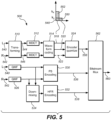
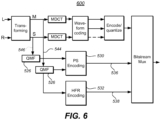
- Figure 5 shows by way of example a generalized block diagram of an encoding system 500 in accordance with an embodiment.
- the waveform-coding stage 514 is configured to waveform-code the first transformed signal 544 into a waveform-code signal 552 of the first waveform-coded signal 518.
- the waveform-coding stage 514 may be configured to set the second waveform-coded signal 520 to zero above the first cross-over frequency k y or to not encode theses frequencies at all
- the waveform-coding stage 514 is configured to waveform-code the first transformed signal 544 into a waveform-coded signal 552 of the first waveform-coded signal 518.
- different decisions can be made for different subsets of the waveform-coded signal 548, 550.
- the coding can either be Left/Right coding, Mid/Side coding, i.e. coding the sum and difference, or dmx/comp/a coding.
- An exemplary first cross-over frequency k y is 1.1 kHz, but this frequency may be varied depending on the bit transmission rate of the stereo audio system or depending on the characteristics of the audio to be encoded.
- At least two signals 518, 520 are thus outputted from the waveform-coding stage 514.
- this parameter is also outputted as a signal 522.
- each subset does not have to be coded with use of the same value of the weighting parameter a. In this case, several weighting parameters are outputted as the signal 522.
- the parametric stereo parameters 536 are reflecting the characteristics of the signal being parametric stereo encoded. They are thus frequency selective, i.e. each parameter of the parameters 536 may correspond to a subset of the frequencies of the left or the right input signal 540, 542.
- the PS encoding stage 530 calculates the parametric stereo parameters 536 and quantizes these either in a uniform or a non-uniform fashion.
- the parameters are as mentioned above calculated frequency selective, where the entire frequency range of the input signals 540, 542 is divided into e.g. 15 parameter bands. These may be spaced according to a model of the frequency resolution of the human auditory system, e.g. a bark scale.
- the encoder 500 further comprises a bitstream generating stage, i.e. bitstream multiplexer, 524.
- the bitstream generating stage is configured to receive the encoded and quantized signal 544, and the two parameters signals 536, 538. These are converted into a bitstream 560 by the bitstream generating stage 562, to further be distributed in the stereo audio system.
- the systems and methods disclosed hereinabove may be implemented as software, firmware, hardware or a combination thereof.
- the division of tasks between functional units referred to in the above description does not necessarily correspond to the division into physical units; to the contrary, one physical component may have multiple functionalities, and one task may be carried out by several physical components in cooperation.
- Certain components or all components may be implemented as software executed by a digital signal processor or microprocessor, or be implemented as hardware or as an application-specific integrated circuit.
- Such software may be distributed on computer readable media, which may comprise computer storage media (or non-transitory media) and communication media (or transitory media).
- Computer storage media includes both volatile and nonvolatile, removable and non-removable media implemented in any method or technology for storage of information such as computer readable instructions, data structures, program modules or other data.
- Computer storage media includes, but is not limited to, RAM, ROM, EEPROM, flash memory or other memory technology, CD-ROM, digital versatile disks (DVD) or other optical disk storage, magnetic cassettes, magnetic tape, magnetic disk storage or other magnetic storage devices, or any other medium which can be used to store the desired information and which can be accessed by a computer.
- communication media typically embodies computer readable instructions, data structures, program modules or other data in a modulated data signal such as a carrier wave or other transport mechanism and includes any information delivery media.
- EEEs enumerated example embodiments
Landscapes
- Engineering & Computer Science (AREA)
- Physics & Mathematics (AREA)
- Acoustics & Sound (AREA)
- Multimedia (AREA)
- Signal Processing (AREA)
- Computational Linguistics (AREA)
- Audiology, Speech & Language Pathology (AREA)
- Human Computer Interaction (AREA)
- Health & Medical Sciences (AREA)
- Spectroscopy & Molecular Physics (AREA)
- Mathematical Physics (AREA)
- Stereophonic System (AREA)
- Compression, Expansion, Code Conversion, And Decoders (AREA)
Applications Claiming Priority (4)
| Application Number | Priority Date | Filing Date | Title |
|---|---|---|---|
| US201361808684P | 2013-04-05 | 2013-04-05 | |
| PCT/EP2014/056854 WO2014161993A1 (en) | 2013-04-05 | 2014-04-04 | Stereo audio encoder and decoder |
| EP14716280.4A EP2981960B1 (de) | 2013-04-05 | 2014-04-04 | Stereoaudiocodierer und -decodierer |
| EP19161888.3A EP3528249A1 (de) | 2013-04-05 | 2014-04-04 | Stereoaudiocodierer und -decodierer |
Related Parent Applications (2)
| Application Number | Title | Priority Date | Filing Date |
|---|---|---|---|
| EP14716280.4A Division EP2981960B1 (de) | 2013-04-05 | 2014-04-04 | Stereoaudiocodierer und -decodierer |
| EP19161888.3A Division EP3528249A1 (de) | 2013-04-05 | 2014-04-04 | Stereoaudiocodierer und -decodierer |
Publications (3)
| Publication Number | Publication Date |
|---|---|
| EP4300488A2 true EP4300488A2 (de) | 2024-01-03 |
| EP4300488A3 EP4300488A3 (de) | 2024-02-28 |
| EP4300488B1 EP4300488B1 (de) | 2026-03-04 |
Family
ID=50473291
Family Applications (3)
| Application Number | Title | Priority Date | Filing Date |
|---|---|---|---|
| EP14716280.4A Active EP2981960B1 (de) | 2013-04-05 | 2014-04-04 | Stereoaudiocodierer und -decodierer |
| EP19161888.3A Ceased EP3528249A1 (de) | 2013-04-05 | 2014-04-04 | Stereoaudiocodierer und -decodierer |
| EP23197482.5A Active EP4300488B1 (de) | 2013-04-05 | 2014-04-04 | Stereoaudiocodierer und -decodierer |
Family Applications Before (2)
| Application Number | Title | Priority Date | Filing Date |
|---|---|---|---|
| EP14716280.4A Active EP2981960B1 (de) | 2013-04-05 | 2014-04-04 | Stereoaudiocodierer und -decodierer |
| EP19161888.3A Ceased EP3528249A1 (de) | 2013-04-05 | 2014-04-04 | Stereoaudiocodierer und -decodierer |
Country Status (8)
| Country | Link |
|---|---|
| US (6) | US9570083B2 (de) |
| EP (3) | EP2981960B1 (de) |
| JP (1) | JP6019266B2 (de) |
| KR (4) | KR20230020553A (de) |
| CN (6) | CN116741186A (de) |
| BR (4) | BR122017006701B1 (de) |
| RU (3) | RU2665214C1 (de) |
| WO (1) | WO2014161993A1 (de) |
Families Citing this family (24)
| Publication number | Priority date | Publication date | Assignee | Title |
|---|---|---|---|---|
| TWI546799B (zh) * | 2013-04-05 | 2016-08-21 | 杜比國際公司 | 音頻編碼器及解碼器 |
| BR112015029113B1 (pt) | 2013-05-24 | 2022-03-22 | Dolby International Ab | Método para a codificação de objetos de áudio como um fluxo de dados, método para a reconstrução de objetos de áudio com base em um fluxo de dados e decodificador para reconstruir objetos de áudio com base em um fluxo de dados |
| CN105229731B (zh) | 2013-05-24 | 2017-03-15 | 杜比国际公司 | 根据下混的音频场景的重构 |
| MY204539A (en) | 2013-05-24 | 2024-09-03 | Dolby Int Ab | Coding of audio scenes |
| RU2630754C2 (ru) | 2013-05-24 | 2017-09-12 | Долби Интернешнл Аб | Эффективное кодирование звуковых сцен, содержащих звуковые объекты |
| RU2639952C2 (ru) | 2013-08-28 | 2017-12-25 | Долби Лабораторис Лайсэнзин Корпорейшн | Гибридное усиление речи с кодированием формы сигнала и параметрическим кодированием |
| WO2015036350A1 (en) * | 2013-09-12 | 2015-03-19 | Dolby International Ab | Audio decoding system and audio encoding system |
| EP3293734B1 (de) | 2013-09-12 | 2019-05-15 | Dolby International AB | Decodierung von mehrkanal-audioinhalten |
| EP2922054A1 (de) | 2014-03-19 | 2015-09-23 | Fraunhofer-Gesellschaft zur Förderung der angewandten Forschung e.V. | Vorrichtung, Verfahren und zugehöriges Computerprogramm zur Erzeugung eines Fehlerverschleierungssignals unter Verwendung einer adaptiven Rauschschätzung |
| EP2922055A1 (de) * | 2014-03-19 | 2015-09-23 | Fraunhofer-Gesellschaft zur Förderung der angewandten Forschung e.V. | Vorrichtung, Verfahren und zugehöriges Computerprogramm zur Erzeugung eines Fehlerverschleierungssignals mit einzelnen Ersatz-LPC-Repräsentationen für individuelle Codebuchinformationen |
| EP2922056A1 (de) | 2014-03-19 | 2015-09-23 | Fraunhofer-Gesellschaft zur Förderung der angewandten Forschung e.V. | Vorrichtung, Verfahren und zugehöriges Computerprogramm zur Erzeugung eines Fehlerverschleierungssignals unter Verwendung von Leistungskompensation |
| WO2015150384A1 (en) | 2014-04-01 | 2015-10-08 | Dolby International Ab | Efficient coding of audio scenes comprising audio objects |
| KR102244612B1 (ko) * | 2014-04-21 | 2021-04-26 | 삼성전자주식회사 | 무선 통신 시스템에서 음성 데이터를 송신 및 수신하기 위한 장치 및 방법 |
| WO2016066743A1 (en) * | 2014-10-31 | 2016-05-06 | Dolby International Ab | Parametric encoding and decoding of multichannel audio signals |
| US10109284B2 (en) * | 2016-02-12 | 2018-10-23 | Qualcomm Incorporated | Inter-channel encoding and decoding of multiple high-band audio signals |
| EP3246923A1 (de) | 2016-05-20 | 2017-11-22 | Fraunhofer-Gesellschaft zur Förderung der angewandten Forschung e.V. | Vorrichtung und verfahren zur verarbeitung eines multikanal-audiosignals |
| US10249307B2 (en) * | 2016-06-27 | 2019-04-02 | Qualcomm Incorporated | Audio decoding using intermediate sampling rate |
| US10362423B2 (en) | 2016-10-13 | 2019-07-23 | Qualcomm Incorporated | Parametric audio decoding |
| TWI869186B (zh) | 2018-01-26 | 2025-01-01 | 瑞典商都比國際公司 | 用於執行一音訊信號之高頻重建之方法、音訊處理單元及非暫時性電腦可讀媒體 |
| JP7261807B2 (ja) * | 2018-02-01 | 2023-04-20 | フラウンホーファー-ゲゼルシャフト・ツール・フェルデルング・デル・アンゲヴァンテン・フォルシュング・アインゲトラーゲネル・フェライン | ハイブリッドエンコーダ/デコーダ空間解析を使用する音響シーンエンコーダ、音響シーンデコーダおよびその方法 |
| CN115917643B (zh) * | 2020-06-24 | 2025-05-02 | 日本电信电话株式会社 | 声音信号解码方法、声音信号解码装置、计算机程序产品以及记录介质 |
| KR102738908B1 (ko) | 2020-08-04 | 2024-12-06 | 삼성전자주식회사 | 전자 장치 및 그의 오디오 데이터를 출력하는 방법 |
| CN112951252B (zh) * | 2021-05-13 | 2021-08-03 | 北京百瑞互联技术有限公司 | 一种lc3音频码流的混音方法、装置、介质及设备 |
| KR20250114514A (ko) * | 2023-01-02 | 2025-07-29 | 엘지전자 주식회사 | 디스플레이 장치 및 그의 오디오 신호 처리 방법 |
Family Cites Families (44)
| Publication number | Priority date | Publication date | Assignee | Title |
|---|---|---|---|---|
| US5796844A (en) | 1996-07-19 | 1998-08-18 | Lexicon | Multichannel active matrix sound reproduction with maximum lateral separation |
| SE512719C2 (sv) * | 1997-06-10 | 2000-05-02 | Lars Gustaf Liljeryd | En metod och anordning för reduktion av dataflöde baserad på harmonisk bandbreddsexpansion |
| SE9903553D0 (sv) * | 1999-01-27 | 1999-10-01 | Lars Liljeryd | Enhancing percepptual performance of SBR and related coding methods by adaptive noise addition (ANA) and noise substitution limiting (NSL) |
| US6226616B1 (en) * | 1999-06-21 | 2001-05-01 | Digital Theater Systems, Inc. | Sound quality of established low bit-rate audio coding systems without loss of decoder compatibility |
| SE0004187D0 (sv) * | 2000-11-15 | 2000-11-15 | Coding Technologies Sweden Ab | Enhancing the performance of coding systems that use high frequency reconstruction methods |
| US7292901B2 (en) | 2002-06-24 | 2007-11-06 | Agere Systems Inc. | Hybrid multi-channel/cue coding/decoding of audio signals |
| US7583805B2 (en) | 2004-02-12 | 2009-09-01 | Agere Systems Inc. | Late reverberation-based synthesis of auditory scenes |
| US7644003B2 (en) | 2001-05-04 | 2010-01-05 | Agere Systems Inc. | Cue-based audio coding/decoding |
| US7006636B2 (en) | 2002-05-24 | 2006-02-28 | Agere Systems Inc. | Coherence-based audio coding and synthesis |
| SE0202159D0 (sv) * | 2001-07-10 | 2002-07-09 | Coding Technologies Sweden Ab | Efficientand scalable parametric stereo coding for low bitrate applications |
| EP1500084B1 (de) | 2002-04-22 | 2008-01-23 | Koninklijke Philips Electronics N.V. | Parametrische darstellung von raumklang |
| US7933415B2 (en) | 2002-04-22 | 2011-04-26 | Koninklijke Philips Electronics N.V. | Signal synthesizing |
| US7039204B2 (en) | 2002-06-24 | 2006-05-02 | Agere Systems Inc. | Equalization for audio mixing |
| US7555434B2 (en) * | 2002-07-19 | 2009-06-30 | Nec Corporation | Audio decoding device, decoding method, and program |
| DE10328777A1 (de) * | 2003-06-25 | 2005-01-27 | Coding Technologies Ab | Vorrichtung und Verfahren zum Codieren eines Audiosignals und Vorrichtung und Verfahren zum Decodieren eines codierten Audiosignals |
| ES2282899T3 (es) * | 2003-10-30 | 2007-10-16 | Koninklijke Philips Electronics N.V. | Codificacion o descodificacion de señales de audio. |
| ATE390683T1 (de) | 2004-03-01 | 2008-04-15 | Dolby Lab Licensing Corp | Mehrkanalige audiocodierung |
| CN1954362B (zh) | 2004-05-19 | 2011-02-02 | 松下电器产业株式会社 | 音频信号编码装置及音频信号解码装置 |
| ATE474310T1 (de) | 2004-05-28 | 2010-07-15 | Nokia Corp | Mehrkanalige audio-erweiterung |
| DE102004042819A1 (de) * | 2004-09-03 | 2006-03-23 | Fraunhofer-Gesellschaft zur Förderung der angewandten Forschung e.V. | Vorrichtung und Verfahren zum Erzeugen eines codierten Multikanalsignals und Vorrichtung und Verfahren zum Decodieren eines codierten Multikanalsignals |
| SE0402650D0 (sv) * | 2004-11-02 | 2004-11-02 | Coding Tech Ab | Improved parametric stereo compatible coding of spatial audio |
| ES2791001T3 (es) * | 2004-11-02 | 2020-10-30 | Koninklijke Philips Nv | Codificación y decodificación de señales de audio mediante el uso de bancos de filtros de valor complejo |
| MX2007005261A (es) | 2004-11-04 | 2007-07-09 | Koninkl Philips Electronics Nv | Codificacion y descodificacion de un conjunto de senales. |
| KR101315075B1 (ko) | 2005-02-10 | 2013-10-08 | 코닌클리케 필립스 일렉트로닉스 엔.브이. | 사운드 합성 |
| US7573912B2 (en) | 2005-02-22 | 2009-08-11 | Fraunhofer-Gesellschaft Zur Foerderung Der Angewandten Forschunng E.V. | Near-transparent or transparent multi-channel encoder/decoder scheme |
| US7831434B2 (en) * | 2006-01-20 | 2010-11-09 | Microsoft Corporation | Complex-transform channel coding with extended-band frequency coding |
| ATE532350T1 (de) * | 2006-03-24 | 2011-11-15 | Dolby Sweden Ab | Erzeugung räumlicher heruntermischungen aus parametrischen darstellungen mehrkanaliger signale |
| WO2008035949A1 (en) | 2006-09-22 | 2008-03-27 | Samsung Electronics Co., Ltd. | Method, medium, and system encoding and/or decoding audio signals by using bandwidth extension and stereo coding |
| KR101435893B1 (ko) * | 2006-09-22 | 2014-09-02 | 삼성전자주식회사 | 대역폭 확장 기법 및 스테레오 부호화 기법을 이용한오디오 신호의 부호화/복호화 방법 및 장치 |
| DE102006049154B4 (de) * | 2006-10-18 | 2009-07-09 | Fraunhofer-Gesellschaft zur Förderung der angewandten Forschung e.V. | Kodierung eines Informationssignals |
| US20080232601A1 (en) | 2007-03-21 | 2008-09-25 | Ville Pulkki | Method and apparatus for enhancement of audio reconstruction |
| US8290167B2 (en) | 2007-03-21 | 2012-10-16 | Fraunhofer-Gesellschaft Zur Foerderung Der Angewandten Forschung E.V. | Method and apparatus for conversion between multi-channel audio formats |
| WO2008132850A1 (ja) | 2007-04-25 | 2008-11-06 | Panasonic Corporation | ステレオ音声符号化装置、ステレオ音声復号装置、およびこれらの方法 |
| JP5133401B2 (ja) * | 2007-04-26 | 2013-01-30 | ドルビー・インターナショナル・アクチボラゲット | 出力信号の合成装置及び合成方法 |
| DK2571024T3 (en) * | 2007-08-27 | 2015-01-05 | Ericsson Telefon Ab L M | Adaptive transition frequency between the noise filling and bandwidth extension |
| WO2009067741A1 (en) * | 2007-11-27 | 2009-06-04 | Acouity Pty Ltd | Bandwidth compression of parametric soundfield representations for transmission and storage |
| ATE518224T1 (de) * | 2008-01-04 | 2011-08-15 | Dolby Int Ab | Audiokodierer und -dekodierer |
| EP2104096B1 (de) * | 2008-03-20 | 2020-05-06 | Fraunhofer-Gesellschaft zur Förderung der angewandten Forschung e.V. | Vorrichtung und verfahren zum umwandeln eines audiosignals in eine parametrisierende darstellung, vorrichtung und verfahren zum modifizieren einer parametrisierenden darstellung, vorrichtung und verfahren zur synchronisation eines audiosignals |
| CA2730198C (en) * | 2008-07-11 | 2014-09-16 | Frederik Nagel | Audio signal synthesizer and audio signal encoder |
| CN105225667B (zh) | 2009-03-17 | 2019-04-05 | 杜比国际公司 | 编码器系统、解码器系统、编码方法和解码方法 |
| PT2483887T (pt) * | 2009-09-29 | 2017-10-23 | Dolby Int Ab | Descodificador de sinal de áudio mpeg-saoc, método para fornecer uma representação de sinal de mistura ascendente usando descodificação mpeg-saoc e programa de comutador usando um valor comum de parâmetros de correlação inter-objetos dependente de tempo/frequência |
| MX2012006823A (es) * | 2009-12-16 | 2012-07-23 | Dolby Int Ab | Mezcla descendente de parametros de corriente de bits sbr. |
| KR101698439B1 (ko) * | 2010-04-09 | 2017-01-20 | 돌비 인터네셔널 에이비 | Mdct-기반의 복소수 예측 스테레오 코딩 |
| KR200466246Y1 (ko) | 2011-02-18 | 2013-04-05 | 오태준 | 전기면도기의 탈부착 수염유입가이드 |
-
2014
- 2014-04-04 EP EP14716280.4A patent/EP2981960B1/de active Active
- 2014-04-04 US US14/781,712 patent/US9570083B2/en active Active
- 2014-04-04 BR BR122017006701-0A patent/BR122017006701B1/pt active IP Right Grant
- 2014-04-04 KR KR1020237002590A patent/KR20230020553A/ko active Pending
- 2014-04-04 WO PCT/EP2014/056854 patent/WO2014161993A1/en not_active Ceased
- 2014-04-04 RU RU2017145579A patent/RU2665214C1/ru active
- 2014-04-04 CN CN202310862055.2A patent/CN116741186A/zh active Pending
- 2014-04-04 CN CN201480019354.9A patent/CN105103225B/zh active Active
- 2014-04-04 BR BR112015025080-7A patent/BR112015025080B1/pt active IP Right Grant
- 2014-04-04 BR BR122021009022-0A patent/BR122021009022B1/pt active IP Right Grant
- 2014-04-04 CN CN201910434427.5A patent/CN110010140B/zh active Active
- 2014-04-04 CN CN201910434435.XA patent/CN110047496B/zh active Active
- 2014-04-04 KR KR1020197034896A patent/KR20190134821A/ko not_active Ceased
- 2014-04-04 JP JP2016505842A patent/JP6019266B2/ja active Active
- 2014-04-04 KR KR1020157027442A patent/KR20150126651A/ko not_active Ceased
- 2014-04-04 CN CN202310863596.7A patent/CN116741187A/zh active Pending
- 2014-04-04 EP EP19161888.3A patent/EP3528249A1/de not_active Ceased
- 2014-04-04 EP EP23197482.5A patent/EP4300488B1/de active Active
- 2014-04-04 BR BR122021009025-4A patent/BR122021009025B1/pt active IP Right Grant
- 2014-04-04 CN CN202310871997.7A patent/CN116741188A/zh active Pending
- 2014-04-04 RU RU2015147181A patent/RU2645271C2/ru active
- 2014-04-04 KR KR1020167025114A patent/KR20160111042A/ko not_active Ceased
-
2017
- 2017-01-19 US US15/410,377 patent/US10163449B2/en active Active
-
2018
- 2018-07-27 RU RU2018127639A patent/RU2690885C1/ru active
- 2018-11-19 US US16/195,745 patent/US10600429B2/en active Active
-
2020
- 2020-03-23 US US16/827,414 patent/US11631417B2/en active Active
-
2023
- 2023-04-04 US US18/295,701 patent/US12080307B2/en active Active
-
2024
- 2024-08-19 US US18/808,460 patent/US20250054506A1/en active Pending
Also Published As
Similar Documents
| Publication | Publication Date | Title |
|---|---|---|
| US12080307B2 (en) | Stereo audio encoder and decoder | |
| EP3627506B1 (de) | Audiocodierer und audiodecodierer | |
| JP2021507316A (ja) | オーディオ信号の高周波再構成技術の後方互換性のある統合 | |
| HK40096552A (en) | Stereo audio encoder and decoder | |
| HK40006499A (en) | Stereo audio encoder and decoder | |
| RU2798009C2 (ru) | Стереофонический кодер и декодер аудиосигналов | |
| HK1214882B (en) | Stereo audio encoder and decoder | |
| HK40091167A (zh) | 立体声音频编码器和解码器 | |
| HK40093175A (zh) | 立体声音频编码器和解码器 | |
| HK40091166A (zh) | 立体声音频编码器和解码器 | |
| HK40010359A (en) | Stereo audio encoder and decoder | |
| HK40010359B (zh) | 立体声音频编码器和解码器 | |
| HK40026196B (en) | Audio encoder and decoder | |
| HK1213080B (en) | Audio encoder and decoder |
Legal Events
| Date | Code | Title | Description |
|---|---|---|---|
| PUAI | Public reference made under article 153(3) epc to a published international application that has entered the european phase |
Free format text: ORIGINAL CODE: 0009012 |
|
| STAA | Information on the status of an ep patent application or granted ep patent |
Free format text: STATUS: THE APPLICATION HAS BEEN PUBLISHED |
|
| AC | Divisional application: reference to earlier application |
Ref document number: 2981960 Country of ref document: EP Kind code of ref document: P Ref document number: 3528249 Country of ref document: EP Kind code of ref document: P |
|
| AK | Designated contracting states |
Kind code of ref document: A2 Designated state(s): AL AT BE BG CH CY CZ DE DK EE ES FI FR GB GR HR HU IE IS IT LI LT LU LV MC MK MT NL NO PL PT RO RS SE SI SK SM TR |
|
| REG | Reference to a national code |
Ref country code: DE Ref legal event code: R079 Ipc: G10L0019020000 Ref country code: DE Ref legal event code: R079 Ref document number: 602014092867 Country of ref document: DE Free format text: PREVIOUS MAIN CLASS: G10L0019008000 Ipc: G10L0019020000 |
|
| PUAL | Search report despatched |
Free format text: ORIGINAL CODE: 0009013 |
|
| P01 | Opt-out of the competence of the unified patent court (upc) registered |
Effective date: 20240112 |
|
| REG | Reference to a national code |
Ref country code: HK Ref legal event code: DE Ref document number: 40096552 Country of ref document: HK |
|
| AK | Designated contracting states |
Kind code of ref document: A3 Designated state(s): AL AT BE BG CH CY CZ DE DK EE ES FI FR GB GR HR HU IE IS IT LI LT LU LV MC MK MT NL NO PL PT RO RS SE SI SK SM TR |
|
| RIC1 | Information provided on ipc code assigned before grant |
Ipc: G10L 19/008 20130101ALI20240125BHEP Ipc: G10L 19/02 20130101AFI20240125BHEP |
|
| STAA | Information on the status of an ep patent application or granted ep patent |
Free format text: STATUS: REQUEST FOR EXAMINATION WAS MADE |
|
| 17P | Request for examination filed |
Effective date: 20240821 |
|
| RBV | Designated contracting states (corrected) |
Designated state(s): AL AT BE BG CH CY CZ DE DK EE ES FI FR GB GR HR HU IE IS IT LI LT LU LV MC MK MT NL NO PL PT RO RS SE SI SK SM TR |
|
| GRAP | Despatch of communication of intention to grant a patent |
Free format text: ORIGINAL CODE: EPIDOSNIGR1 |
|
| STAA | Information on the status of an ep patent application or granted ep patent |
Free format text: STATUS: GRANT OF PATENT IS INTENDED |
|
| INTG | Intention to grant announced |
Effective date: 20250605 |
|
| GRAJ | Information related to disapproval of communication of intention to grant by the applicant or resumption of examination proceedings by the epo deleted |
Free format text: ORIGINAL CODE: EPIDOSDIGR1 |
|
| STAA | Information on the status of an ep patent application or granted ep patent |
Free format text: STATUS: REQUEST FOR EXAMINATION WAS MADE |
|
| GRAP | Despatch of communication of intention to grant a patent |
Free format text: ORIGINAL CODE: EPIDOSNIGR1 |
|
| GRAJ | Information related to disapproval of communication of intention to grant by the applicant or resumption of examination proceedings by the epo deleted |
Free format text: ORIGINAL CODE: EPIDOSDIGR1 |
|
| GRAP | Despatch of communication of intention to grant a patent |
Free format text: ORIGINAL CODE: EPIDOSNIGR1 |
|
| STAA | Information on the status of an ep patent application or granted ep patent |
Free format text: STATUS: GRANT OF PATENT IS INTENDED |
|
| INTC | Intention to grant announced (deleted) | ||
| INTG | Intention to grant announced |
Effective date: 20251028 |
|
| GRAS | Grant fee paid |
Free format text: ORIGINAL CODE: EPIDOSNIGR3 |
|
| GRAA | (expected) grant |
Free format text: ORIGINAL CODE: 0009210 |
|
| STAA | Information on the status of an ep patent application or granted ep patent |
Free format text: STATUS: THE PATENT HAS BEEN GRANTED |
|
| AC | Divisional application: reference to earlier application |
Ref document number: 3528249 Country of ref document: EP Kind code of ref document: P Ref document number: 2981960 Country of ref document: EP Kind code of ref document: P |
|
| AK | Designated contracting states |
Kind code of ref document: B1 Designated state(s): AL AT BE BG CH CY CZ DE DK EE ES FI FR GB GR HR HU IE IS IT LI LT LU LV MC MK MT NL NO PL PT RO RS SE SI SK SM TR |
|
| REG | Reference to a national code |
Ref country code: CH Ref legal event code: F10 Free format text: ST27 STATUS EVENT CODE: U-0-0-F10-F00 (AS PROVIDED BY THE NATIONAL OFFICE) Effective date: 20260304 Ref country code: GB Ref legal event code: FG4D |
|
| REG | Reference to a national code |
Ref country code: DE Ref legal event code: R096 Ref document number: 602014092867 Country of ref document: DE |
|
| REG | Reference to a national code |
Ref country code: IE Ref legal event code: FG4D |
|
| REG | Reference to a national code |
Ref country code: NL Ref legal event code: FP |