EP4300771A1 - Processus et installation pour le transport mondial d'énergie sans fil - Google Patents
Processus et installation pour le transport mondial d'énergie sans fil Download PDFInfo
- Publication number
- EP4300771A1 EP4300771A1 EP22182133.3A EP22182133A EP4300771A1 EP 4300771 A1 EP4300771 A1 EP 4300771A1 EP 22182133 A EP22182133 A EP 22182133A EP 4300771 A1 EP4300771 A1 EP 4300771A1
- Authority
- EP
- European Patent Office
- Prior art keywords
- retransmission
- conexant
- meridian
- fwsg
- parallel
- Prior art date
- Legal status (The legal status is an assumption and is not a legal conclusion. Google has not performed a legal analysis and makes no representation as to the accuracy of the status listed.)
- Pending
Links
Images




Classifications
-
- G—PHYSICS
- G06—COMPUTING OR CALCULATING; COUNTING
- G06Q—INFORMATION AND COMMUNICATION TECHNOLOGY [ICT] SPECIALLY ADAPTED FOR ADMINISTRATIVE, COMMERCIAL, FINANCIAL, MANAGERIAL OR SUPERVISORY PURPOSES; SYSTEMS OR METHODS SPECIALLY ADAPTED FOR ADMINISTRATIVE, COMMERCIAL, FINANCIAL, MANAGERIAL OR SUPERVISORY PURPOSES, NOT OTHERWISE PROVIDED FOR
- G06Q50/00—Information and communication technology [ICT] specially adapted for implementation of business processes of specific business sectors, e.g. utilities or tourism
- G06Q50/06—Energy or water supply
Definitions
- the present invention concerns a process and a installation.
- the process is to be used in conjunction with the process and installation described in European Patent No. 2,692,701 .
- Radiant as it is an energy production concept that combines a Power Plant (PP) with a Waste Water Treatment Plant (WWTP).
- the present invention refers to a transport concept and we shall call it Conexant and it applies to a six train FWSG as described in EP 2,692,701 , or a population equivalent between 280-2,236.
- Conexant keeps the principle of the Radiant plant which is to use the energy produced in summer during the winter, but applies it to pairs of plants located at antipodes and therefore with seasons in opposition.
- Conexant may also transport other energy sources like nuclear, hydro and wind power, but the subsequent development strategy however will be for only two main sources of energy: biomass (Radiant) and photovoltaic energy (at consumer level). Those sources of energy are complementary in respect to availability: one is available all the time, and the other only in the daytime. The energy compensation has two main tipes: seasonal and diurnal. We shall present them both.
- the six points are retransmission centers.
- the energy in that area is received and passed on under the seasonal compensation schemes.
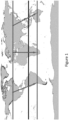
- the positioning of each of the 6 retransmission centers was established by an algorithm. Positioning accuracy is in the tens of thousands of degrees (approximately 10 meters). The algorithm will be presented below. The presentation of the 6 points and the geographical equator is made in Figure 3 .
- the numbering of the points is from 1 to 6 starting from the top left, ending in the bottom right in the up-down, left-right directions.
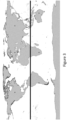
- the algorithm for establishing points 3-4 has three stages. The first of these was the one in which the meridian was determined, with the property that the intersections with the land areas have, in sum, the longest length. Also in the first stage, the maximum of the meridian + antimeridian intersections with the land was calculated. The result was identical to the first calculated maximum, namely the merdian 22.5565 (EPSG 4326). The second stage was to establish the parallel whose intersections with the land areas have, in sum, the longest length. The result was in North Africa, 30.4382 (EPSG 4326) and is called the main parallel. The first two steps are shown in Figure 4 .
- the algorithm for determining the western meridian or meridian 1-2 consisted of the following steps: establishing point 1, establishing point 2.
- Point 1 resulted from the intersection of a meridian with a parallel.
- the merdian was the one that intersects the maximum land between the false equator and the North Pole, on the North American continent.
- the parallel was the northern parallel.
- the resulting point is: -98.0063; 46.9991 (EPSG 4326).
- the same procedure was applied with point 2.
- the difference was that the meridian intersected the maximum land between the equator and the South Pole, on the South American continent, and the parallel was the southern one.
- the resulting point is: -69.4974; -26.2185.
- the determination of meridian 1-2 is shown in Figure 6 .
- the algorithm for establishing the eastern meridian or meridian 5-6 consisted of the following steps: establishing point 5, establishing point 6.
- Point 5 resulted from the intersection of a meridian with a parallel.
- the merdian was the one that intersects the maximum land between the false equator and the North Pole, on the Asian continent.
- the parallel was the northern parallel.
- the resulting point is: 103.7923; 46.9991 (EPSG 4326).
- the difference was that the meridian intersected the maximum land between the equator and the South Pole, on the Australian continent, and the parallel was the southern one.
- the resulting point is: 142.1776; -26.2185 (EPSG 4326).
- the determination of the meridian 5-6 is presented in Figure 7 .
- the daytime compensation scheme equals the differences between the photovoltaic energy produced during the day and that produced during the night.
- the diagonals were taken into account. Distances between points. including the diagonals are listed below. Seasonal are the distances 1-2, 3-4, 5-6, the rest beeing composite.
- Link Distance (m) Link Distance (m) Link Distance (m) Link Distance (m) Link Distance (m) 1-2 8,600,095 3-5 5,879,029 2-6 13,287,425 2-3 12,240,351 3-4 8,108,189 4-6 11,326,092 6-3 14,308,444 1-6 14,323,267 5-6 8,978,985 2-4 8,958,424 4-5 11,470,642 2-5 17,624,493 1-3 8,100,491 1-5 9,376,473 4-1 14,380,011
- the largest diagonal is 2-5. Its distance is the maximum distance for which the 6 retransmission centers are dimensioned. Alternatively a pair of new retransmission centers (with retransmission from other centers only) may be positioned in the Pacific Ocean.
- Figure 8 is the daytime compensation scheme for 12/21/2017 11:28 PM UTC.
- the (civil) night areas are the areas marked with transparent gray.
- Figure 9 is the daily compensation scheme for 21.06.2018 23:06 UTC.
- the retransmission center which is in the hot season and which releases energy during the night (3), is powered by the hydrogen reserve of the Radiant plant.
- Conexant has 3 levels of power supply:
- Figure 10 is the daytime compensation scheme for 21.03.2018 22:30 UTC (after the spring equinox). All six retransmission centers may be positioned within a 70 kilometers radius away from the points mentioned above. The coordinates precision is 10 meters for theoretical purposes only. The same observation goes for the starting/ending time of the warm seaseon which may be with an additional 0-40 days delay, depending on global wheather forcasts, according to an separate alghoritm that will be established. Also theoretical is the assumption of intersecting the maximum land surface. This assumtion is made with respect to a population that will be distributed evenly in villages that have an an average of 2.236 population equivalent, that is the maximum capacity of a Radiant FWSG.
- the first feature, presented in US 593,138 is the conical spiral coil.
- Tesla used for the prototype an undeground structure that used the deep aquifers with very deep shafts.
- level 1 which is used at a range of 0-5 km and with transmitters at every house hold, we intend to use close-to-surface waterflows, namely wastewater.
- the grounding will be something like a cross formed by two semi-elipses intersected and conected to a central conductor, like an inversed lightning-protector from Figure 5 US 1,266,175 (filled by Tesla in 06/01/1916 ).
- the wastewater pipe will be positioned.
- this design is electrical shock hazard free.
- the two curves describing the winding have all points in the surface of two Gabriel's horns or they are enveloping the surface of two rectangular hyperbolas rotated around their asymptotes.
- the bigger is the closeness factor k the greater is the number of spins of the windings that are on the same Gabriel's horn.
- the biggest number of spins of each winding is around the vertex of the hyperbola.
- Io can be used in the case of a homopolar generator (HPG) or a homopolar motor (HM), the space between the windings being the transfer surface which can also use new methods for transfer from a stationary to a rotating system.
- the rotor will also have a corresponding stator.
- the original idea for this HPG is mentioned in Nikola Tesla's article from " The Electrical Engineer", N.Y, Sept. 2, 1891 .
- the secondary conical coil presented in Figure 1 and Figure 2 of the patent US 593,138 will be replaced by G1 or G2, depending of the Earth's hemisphere.
- the curve of the secondary winding will be equally distanced from the hyperbola's vertex.
- the primary winding will be at the base of the secondary on a slightly bigger diameter corresponding to the vertex, and it will be calculated using a bigger scale factor.
- the second secondary coil presented in US Patent 1,119,732 will remain as it is.
- the frequncies will be: level 1- greater or equal to 7.83 Hz, level 2-greater than 7 kHz, level 3-greater than 2 Mhz and flywheels may be used at all levels for momentary storing the energy. For opening comunication channels phase-shifting will be used.
Landscapes
- Business, Economics & Management (AREA)
- Health & Medical Sciences (AREA)
- Engineering & Computer Science (AREA)
- Economics (AREA)
- Public Health (AREA)
- Water Supply & Treatment (AREA)
- General Health & Medical Sciences (AREA)
- Human Resources & Organizations (AREA)
- Marketing (AREA)
- Primary Health Care (AREA)
- Strategic Management (AREA)
- Tourism & Hospitality (AREA)
- Physics & Mathematics (AREA)
- General Business, Economics & Management (AREA)
- General Physics & Mathematics (AREA)
- Theoretical Computer Science (AREA)
- Supply And Distribution Of Alternating Current (AREA)
Priority Applications (1)
| Application Number | Priority Date | Filing Date | Title |
|---|---|---|---|
| EP22182133.3A EP4300771A1 (fr) | 2022-06-30 | 2022-06-30 | Processus et installation pour le transport mondial d'énergie sans fil |
Applications Claiming Priority (1)
| Application Number | Priority Date | Filing Date | Title |
|---|---|---|---|
| EP22182133.3A EP4300771A1 (fr) | 2022-06-30 | 2022-06-30 | Processus et installation pour le transport mondial d'énergie sans fil |
Publications (1)
| Publication Number | Publication Date |
|---|---|
| EP4300771A1 true EP4300771A1 (fr) | 2024-01-03 |
Family
ID=83193268
Family Applications (1)
| Application Number | Title | Priority Date | Filing Date |
|---|---|---|---|
| EP22182133.3A Pending EP4300771A1 (fr) | 2022-06-30 | 2022-06-30 | Processus et installation pour le transport mondial d'énergie sans fil |
Country Status (1)
| Country | Link |
|---|---|
| EP (1) | EP4300771A1 (fr) |
Citations (10)
| Publication number | Priority date | Publication date | Assignee | Title |
|---|---|---|---|---|
| US593138A (en) | 1897-11-02 | Nikola Tesla | Electrical Transformer | |
| US593198A (en) | 1897-11-09 | Apparatus for treating garbage | ||
| US645576A (en) | 1897-09-02 | 1900-03-20 | Nikola Tesla | System of transmission of electrical energy. |
| US787412A (en) | 1900-05-16 | 1905-04-18 | Nikola Tesla | Art of transmitting electrical energy through the natural mediums. |
| US1119732A (en) | 1907-05-04 | 1914-12-01 | Nikola Tesla | Apparatus for transmitting electrical energy. |
| US1266175A (en) | 1916-05-06 | 1918-05-14 | Nikola Tesla | Lightning-protector. |
| US20110156498A1 (en) * | 2004-07-20 | 2011-06-30 | Criswell David R | Power Generating and Distribution System and Method |
| US20110156494A1 (en) * | 2008-08-25 | 2011-06-30 | Governing Dynamics Llc | Wireless Energy Transfer System |
| EP2692701A1 (fr) | 2012-07-31 | 2014-02-05 | Gabriel Marius Rus | Procédé et installation pour traitement des eaux usées et production d'énergie |
| US20170341942A1 (en) * | 2016-05-24 | 2017-11-30 | Harper Biotech Llc D/B/A Simbuka Energy, Llc | Methods and systems for large scale carbon dioxide utilization from lake kivu via a co2 industrial utilization hub integrated with electric power production and optional cryo-energy storage |
-
2022
- 2022-06-30 EP EP22182133.3A patent/EP4300771A1/fr active Pending
Patent Citations (11)
| Publication number | Priority date | Publication date | Assignee | Title |
|---|---|---|---|---|
| US593138A (en) | 1897-11-02 | Nikola Tesla | Electrical Transformer | |
| US593198A (en) | 1897-11-09 | Apparatus for treating garbage | ||
| US645576A (en) | 1897-09-02 | 1900-03-20 | Nikola Tesla | System of transmission of electrical energy. |
| US649621A (en) | 1897-09-02 | 1900-05-15 | Nikola Tesla | Apparatus for transmission of electrical energy. |
| US787412A (en) | 1900-05-16 | 1905-04-18 | Nikola Tesla | Art of transmitting electrical energy through the natural mediums. |
| US1119732A (en) | 1907-05-04 | 1914-12-01 | Nikola Tesla | Apparatus for transmitting electrical energy. |
| US1266175A (en) | 1916-05-06 | 1918-05-14 | Nikola Tesla | Lightning-protector. |
| US20110156498A1 (en) * | 2004-07-20 | 2011-06-30 | Criswell David R | Power Generating and Distribution System and Method |
| US20110156494A1 (en) * | 2008-08-25 | 2011-06-30 | Governing Dynamics Llc | Wireless Energy Transfer System |
| EP2692701A1 (fr) | 2012-07-31 | 2014-02-05 | Gabriel Marius Rus | Procédé et installation pour traitement des eaux usées et production d'énergie |
| US20170341942A1 (en) * | 2016-05-24 | 2017-11-30 | Harper Biotech Llc D/B/A Simbuka Energy, Llc | Methods and systems for large scale carbon dioxide utilization from lake kivu via a co2 industrial utilization hub integrated with electric power production and optional cryo-energy storage |
Non-Patent Citations (1)
| Title |
|---|
| "The Electrical Engineer", NIKOLA TESLA'S, 2 September 1891 (1891-09-02) |
Similar Documents
| Publication | Publication Date | Title |
|---|---|---|
| Duman et al. | Techno-economic analysis of off-grid PV/wind/fuel cell hybrid system combinations with a comparison of regularly and seasonally occupied households | |
| Farley et al. | The prereversal enhancement of the zonal electric field in the equatorial ionosphere | |
| Haurwitz et al. | The diurnal and semidiurnal barometric oscillations global distribution and annual variation | |
| Watt | VLF Radio Engineering: International Series of Monographs in Electromagnetic Waves | |
| Forbes | The equatorial electrojet | |
| Balan et al. | Equinoctial asymmetries in the ionosphere and thermosphere observed by the MU radar | |
| Zhong et al. | Middle‐latitudinal band structure observed in the nighttime ionosphere | |
| Hafez | New cities between sustainability and real estate investment: A case study of New Cairo city | |
| Matrenin et al. | Overview of renewable energy sources in Mongolia | |
| Wolde-Ghiorgis | Wind energy survey in Ethiopia | |
| Barraclough | A comparison of satellite and observatory estimates of geomagnetic secular variation | |
| Karugarama | Mitiiation of blackout in kigali using a microgrid with advanced energy storage and solar photovoltaics | |
| Goel et al. | Solar energy: Made simple for a sustainable future | |
| Rama Rao et al. | Characteristics of VHF radiowave scintillations over a solar cycle (1983− 1993) at a low-latitude station: Waltair (17.7° N, 83.3° E) | |
| Archibald et al. | Islands in the sun: The solar power deployment initiative at the University of the Virgin Islands | |
| Sekiguchi et al. | Diurnal and seasonal variations in the Schumann resonance parameters at Moshiri, Japan | |
| Sharma et al. | Seasonal and longitudinal variations in the occurrence frequency of magnetospheric ionization ducts | |
| Gadhi et al. | A review of renewable energy activities in Yemen | |
| Rastogi et al. | Asymmetries in the equatorial electrojet around NE Brazil sector | |
| Ćavar et al. | Second homes in the Municipality of Neum: typological features of buildings, structural features of owners, and the process of internationalisation | |
| Karimi et al. | Geo-spatial site selection for solar power plants using Geographic Information System (GIS) in Kermanshah Province, Iran | |
| Karim et al. | Wind Energy Potential in Coastal Areas of Merauke City | |
| Jayachandran et al. | Short term variabilities of ionospheric electron content (IEC) and peak electron density (NP) during solar cycles 20 and 21 for a low latitude station | |
| Haurwitz | The physical state of the upper atmosphere | |
| CN1055996C (zh) | 日食效应的超长期天气预报方法 |
Legal Events
| Date | Code | Title | Description |
|---|---|---|---|
| PUAI | Public reference made under article 153(3) epc to a published international application that has entered the european phase |
Free format text: ORIGINAL CODE: 0009012 |
|
| STAA | Information on the status of an ep patent application or granted ep patent |
Free format text: STATUS: THE APPLICATION HAS BEEN PUBLISHED |
|
| AK | Designated contracting states |
Kind code of ref document: A1 Designated state(s): AL AT BE BG CH CY CZ DE DK EE ES FI FR GB GR HR HU IE IS IT LI LT LU LV MC MK MT NL NO PL PT RO RS SE SI SK SM TR |
|
| STAA | Information on the status of an ep patent application or granted ep patent |
Free format text: STATUS: REQUEST FOR EXAMINATION WAS MADE |
|
| 17P | Request for examination filed |
Effective date: 20240522 |
|
| RBV | Designated contracting states (corrected) |
Designated state(s): AL AT BE BG CH CY CZ DE DK EE ES FI FR GB GR HR HU IE IS IT LI LT LU LV MC MK MT NL NO PL PT RO RS SE SI SK SM TR |
|
| STAA | Information on the status of an ep patent application or granted ep patent |
Free format text: STATUS: EXAMINATION IS IN PROGRESS |
|
| 17Q | First examination report despatched |
Effective date: 20240813 |