EP4300943A1 - Procédé et appareil de rendu de sous-titres pour un espace de réalité virtuelle, dispositif et support - Google Patents
Procédé et appareil de rendu de sous-titres pour un espace de réalité virtuelle, dispositif et support Download PDFInfo
- Publication number
- EP4300943A1 EP4300943A1 EP22847111.6A EP22847111A EP4300943A1 EP 4300943 A1 EP4300943 A1 EP 4300943A1 EP 22847111 A EP22847111 A EP 22847111A EP 4300943 A1 EP4300943 A1 EP 4300943A1
- Authority
- EP
- European Patent Office
- Prior art keywords
- caption
- node
- content
- user
- spatial position
- Prior art date
- Legal status (The legal status is an assumption and is not a legal conclusion. Google has not performed a legal analysis and makes no representation as to the accuracy of the status listed.)
- Pending
Links
Images





Classifications
-
- H—ELECTRICITY
- H04—ELECTRIC COMMUNICATION TECHNIQUE
- H04N—PICTORIAL COMMUNICATION, e.g. TELEVISION
- H04N5/00—Details of television systems
- H04N5/222—Studio circuitry; Studio devices; Studio equipment
- H04N5/262—Studio circuits, e.g. for mixing, switching-over, change of character of image, other special effects ; Cameras specially adapted for the electronic generation of special effects
- H04N5/278—Subtitling
-
- H—ELECTRICITY
- H04—ELECTRIC COMMUNICATION TECHNIQUE
- H04N—PICTORIAL COMMUNICATION, e.g. TELEVISION
- H04N21/00—Selective content distribution, e.g. interactive television or video on demand [VOD]
- H04N21/40—Client devices specifically adapted for the reception of or interaction with content, e.g. set-top-box [STB]; Operations thereof
- H04N21/47—End-user applications
- H04N21/488—Data services, e.g. news ticker
- H04N21/4884—Data services, e.g. news ticker for displaying subtitles
-
- G—PHYSICS
- G06—COMPUTING OR CALCULATING; COUNTING
- G06F—ELECTRIC DIGITAL DATA PROCESSING
- G06F3/00—Input arrangements for transferring data to be processed into a form capable of being handled by the computer; Output arrangements for transferring data from processing unit to output unit, e.g. interface arrangements
- G06F3/01—Input arrangements or combined input and output arrangements for interaction between user and computer
- G06F3/011—Arrangements for interaction with the human body, e.g. for user immersion in virtual reality
-
- G—PHYSICS
- G06—COMPUTING OR CALCULATING; COUNTING
- G06F—ELECTRIC DIGITAL DATA PROCESSING
- G06F3/00—Input arrangements for transferring data to be processed into a form capable of being handled by the computer; Output arrangements for transferring data from processing unit to output unit, e.g. interface arrangements
- G06F3/01—Input arrangements or combined input and output arrangements for interaction between user and computer
- G06F3/011—Arrangements for interaction with the human body, e.g. for user immersion in virtual reality
- G06F3/012—Head tracking input arrangements
-
- G—PHYSICS
- G06—COMPUTING OR CALCULATING; COUNTING
- G06F—ELECTRIC DIGITAL DATA PROCESSING
- G06F3/00—Input arrangements for transferring data to be processed into a form capable of being handled by the computer; Output arrangements for transferring data from processing unit to output unit, e.g. interface arrangements
- G06F3/01—Input arrangements or combined input and output arrangements for interaction between user and computer
- G06F3/011—Arrangements for interaction with the human body, e.g. for user immersion in virtual reality
- G06F3/013—Eye tracking input arrangements
-
- G—PHYSICS
- G06—COMPUTING OR CALCULATING; COUNTING
- G06T—IMAGE DATA PROCESSING OR GENERATION, IN GENERAL
- G06T17/00—Three-dimensional [3D] modelling for computer graphics
-
- G—PHYSICS
- G06—COMPUTING OR CALCULATING; COUNTING
- G06T—IMAGE DATA PROCESSING OR GENERATION, IN GENERAL
- G06T19/00—Manipulating three-dimensional [3D] models or images for computer graphics
- G06T19/006—Mixed reality
-
- H—ELECTRICITY
- H04—ELECTRIC COMMUNICATION TECHNIQUE
- H04N—PICTORIAL COMMUNICATION, e.g. TELEVISION
- H04N13/00—Stereoscopic video systems; Multi-view video systems; Details thereof
- H04N13/10—Processing, recording or transmission of stereoscopic or multi-view image signals
- H04N13/106—Processing image signals
- H04N13/172—Processing image signals image signals comprising non-image signal components, e.g. headers or format information
- H04N13/183—On-screen display [OSD] information, e.g. subtitles or menus
-
- H—ELECTRICITY
- H04—ELECTRIC COMMUNICATION TECHNIQUE
- H04N—PICTORIAL COMMUNICATION, e.g. TELEVISION
- H04N21/00—Selective content distribution, e.g. interactive television or video on demand [VOD]
- H04N21/40—Client devices specifically adapted for the reception of or interaction with content, e.g. set-top-box [STB]; Operations thereof
- H04N21/43—Processing of content or additional data, e.g. demultiplexing additional data from a digital video stream; Elementary client operations, e.g. monitoring of home network or synchronising decoder's clock; Client middleware
- H04N21/431—Generation of visual interfaces for content selection or interaction; Content or additional data rendering
- H04N21/4312—Generation of visual interfaces for content selection or interaction; Content or additional data rendering involving specific graphical features, e.g. screen layout, special fonts or colors, blinking icons, highlights or animations
Definitions
- the present disclosure relates to the field of vision processing technology, in particular to a method, apparatus, device and medium for caption rendering in a virtual reality space.
- VR Virtual Reality
- computer electronic information and simulation technology
- VR is basically realized by computers simulating virtual environments to give people a sense of environmental immersion.
- VR applications it has become a common scene to display captions in a VR space in video display and other scenes. For example, movie captions are displayed for VR movies.
- captions are usually fixed on associated video pictures. For example, in movie scenes, captions are fixed on the movie pictures.
- An embodiment of the present disclosure provides a method for caption rendering in a virtual reality (VR) space, comprising: separating a caption content and a picture content on a currently displayed VR video frame, and mapping and rendering the picture content to a VR panoramic space; determining a target spatial position in the VR panoramic space according to a user's current LOS (line-of-sight) direction; rendering the caption content at the target spatial position to generate a spatial caption.
- VR virtual reality
- An embodiment of the present disclosure further provides an apparatus for caption rendering in a virtual reality (VR) space, comprising: a separation module for separating a caption content and a picture content on a currently displayed VR video frame; a mapping module for mapping and rendering the picture content to a VR panoramic space; a determination module for determining a target spatial position in the VR panoramic space according to a user's current LOS direction; a rendering module for rendering the caption content at the target spatial position to generate a spatial caption.
- VR virtual reality
- An embodiment of the present disclosure provides an electronic device, comprising: a processor; a memory for storing processor executable instructions; wherein the processor is used to read the executable instructions from the memory and execute the instructions to implement the method for caption rendering in a VR space provided in the embodiment of the present disclosure.
- An embodiment of the present disclosure further provides a non-transitory computer readable storage medium having stored thereon a computer program that is used to implement the method for caption rendering in a VR space provided in the embodiment of the present disclosure.
- An embodiment of the present disclosure further provides a computer program, comprising: instructions that, when executed by a processor, cause the processor to implement the method for caption rendering in a VR space provided in the embodiment of the present disclosure.
- An embodiment of the present disclosure further provides a computer product comprising instructions that, when executed by a processor, cause the processor to implement the method for caption rendering in a VR space provided in the embodiment of the present disclosure.
- captions are fixed on video pictures.
- a caption content fixed on a picture region may be visually distorted, thereby affecting the viewing effect.
- the present disclosure provides a method, apparatus, device and medium for caption rendering in a VR space, in which the position of a caption content rendered in a VR space is determined by tracking the user's LOS direction, and a caption is rendered at the corresponding position, thereby improving the user's visual viewing experience.
- the embodiment of the present disclosure provides a method for caption rendering in a VR space.
- the fixed position relationship between a picture content and a caption content is canceled, and the display position of a caption content can be adaptively adjusted according to the user's LOS direction, so as to avoid visual distortion of the caption content, and thereby the user's visual viewing experience can be improved.
- FIG. 2 is a schematic flowchart of a method for caption rendering in a VR space provided in some embodiments of the present disclosure.
- the method can be executed by an apparatus for caption rendering in a VR space, wherein the apparatus can be implemented by software and/or hardware, and can generally be integrated in an electronic device.
- this method comprises the following steps.
- Step 201 separating a caption content and a picture content on a currently displayed VR video frame, and mapping and rendering the picture content to a VR panoramic space.
- VR video frames usually contain multiple picture contents, and each picture content corresponds to a plane in the VR panoramic space.
- the VR panoramic space is a "box" cube space, as shown in FIG. 3 , the VR video frame comprises six picture regions, each picture region corresponding to a plane in the VR panoramic space. Therefore, when VR display is performed, a stereoscopic display effect can be achieved visually by displaying a corresponding picture content on each plane of the VR panoramic space.
- a caption content is separated from a picture content on a currently displayed VR video frame.
- the picture content is mapped and rendered to a VR panoramic space, wherein the mapping and rendering comprises rendering the picture content to a plane in the corresponding VR panoramic space as described above, and thus a display position of the caption content is further determined.
- Step 202 determining a target spatial position in the VR panoramic space according to a user's current LOS direction.
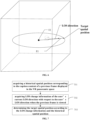
- the target spatial position is determined in the VR panoramic space according to the user's current LOS direction. That is, the target spatial position is coincident with the user's current LOS direction. For example, as shown in FIG. 4 , the target spatial position is located in the user's current LOS direction, thereby ensuring the target spatial position coincident with the LOS direction, and providing a further technical support for the content display effect.
- Step 203 rendering the caption content at the target spatial position to generate a spatial caption.
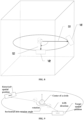
- the caption content is rendered at the target spatial position to generate a spatial caption. For example, referring to FIG. 4 , if the user's LOS direction changes horizontally, the spatial caption will follow the change of the LOS direction, and will be displayed at a spatial location in the LOS direction. Because the generated spatial caption is in the user's LOS direction, it ensures that the caption content can be presented to the user without distortion, thereby ensuring the visual display effect.
- the method for caption rendering in a VR space of the embodiments of the present disclosure separates caption content and picture content on a currently displayed VR video frame, maps and renders the picture content to a VR panoramic space, and then determines a target spatial position in the VR panoramic space according to the user's current LOS direction, and renders the caption content at the target spatial position to generate a spatial caption. Therefore, the position of the caption content rendered in the VR space is determined by tracking the user's LOS direction, and a caption is rendered at the corresponding position, thereby improving the user's visual viewing experience.
- the method of determining a target spatial position in the VR panoramic space according to the user's current LOS direction is different, some examples of which will be given below.
- determining a target spatial position in the VR panoramic space according to a user's current LOS direction comprises the following steps.
- Step 501 determining a center point position of the VR panoramic space and obtaining a preset radius distance.
- the center point position of the VR panoramic space is determined.
- the center point position is located at the center of the VR panoramic space, and is related to the shape of the VR panoramic space.
- a preset radius distance is obtained.
- the preset radius distance can be set according to the size of the VR panoramic space in advance. Usually, a length from the preset radius distance to the center point position will not exceed a length from the center point position of the VR panoramic space to the surfaces of the VR panoramic space.
- Step 502 starting from the center point position, taking a position extending to the preset radius distance in the user's current LOS direction as the target spatial position.
- the above embodiments can ensure that the target spatial position is inside the virtual space, thereby ensuring the display effect; on the other hand, the above embodiments can ensure a target spatial position coincident with the LOS direction, so that the caption content displayed at the target spatial position is coincident with the user's LOS direction, ensuring that the user can clearly view the caption content, thereby improving the viewing experience.
- the VR panoramic space is a "box" cube space
- the preset radius distance is R1
- the center point position of the VR panoramic space is O1.
- determining a target spatial position in the VR panoramic space according to a user's current LOS direction comprises the following steps.
- Step 701 acquiring a historical spatial position corresponding to the caption content of a previous frame displayed in the VR panoramic space.
- the historical spatial position corresponding to the caption content of a previous frame displayed in the VR panoramic space is acquired, wherein the historical spatial position is determined according to the user's LOS direction when the caption content of the previous frame is viewed.
- Step 702 acquiring LOS change information of the user's current LOS direction with respect to the user's LOS direction when the previous frame is viewed.
- the LOS change information is used to indicate a sight angle change between the user's current LOS direction and a LOS direction when the previous frame is viewed.
- the LOS change information can comprise a direction change and a changed angle between the user's current LOS direction and a LOS direction when the previous frame is viewed by the user.
- a horizontal axis rotation angle of a camera in a VR device worn by the user relative to the previous frame in the horizontal direction is acquired as the LOS change information of the user's current LOS direction with respect to a LOS direction when the previous frame is viewed by the user.
- the LOS change information comprises change information in a horizontal LOS direction, it can ensure that the target spatial position can follow the user's LOS direction for a user who rotates left or right for viewing, further ensuring that the caption content displayed at the target spatial position is coincident with the user's LOS direction.
- the current frame is a currently displayed VR video frame.
- Step 703 determining the target spatial position according to the LOS change information and the historical spatial position.
- a target spatial position can be determined according to the LOS change information and the historical spatial position.
- the historical spatial position can be moved according to the LOS change information to determine the target spatial position.
- the target spatial position is determined only based on the LOS change information of the user's current LOS direction with respect to a LOS direction of the user when watching the previous frame, without considering a change of the user's current position with respect to a position of the user when watching the previous frame in the virtual space. That is, regardless whether the user's current position in the VR space is closer to the surface of the virtual space or farther away from the surface of the virtual space than a position of the user when watching the previous frame, the determination of the target spatial position will not be affected.
- the target spatial position is only related to change information of the user's current LOS direction with respect to the LOS direction of the user when the previous frame is viewed. Therefore, the user will not virtually perceive that there is a fixed display distance between the displayed caption content and the user's human eyes, which may further ensure the user's visual effect.
- the VR panoramic space is a "box" cube space
- the historical spatial position corresponding to the caption content of the previous frame displayed in the VR panoramic space is W1.
- the LOS change information between the user's current LOS direction S2 and the LOS direction S1 when the previous frame is viewed is obtained as shown in the figure.
- the movement of the historical spatial position is controlled according to the LOS change information, and a position W2 after the movement is determined as the target spatial position.
- a center position of a circle preset in the VR panoramic space is acquired, wherein the center position, as a center of a circle, is usually set at the center of the VR space, to ensure that captions can be displayed within the VR space for captions surrounding and following the center of a circle.
- an initial position of a VR device in the VR panoramic space can be obtained, wherein the initial position is a center point position in the VR panoramic space.
- the VR panoramic space is built with the initial position as the center point position in the VR panoramic space.
- the center point position in the VR panoramic space is set as a center position of a circle.
- the initial position of the VR device in the VR panoramic space is taken as the center position
- the center point position is still taken as the center position, instead of taking the user's VR head mounted display device as the center position of a circle in the VR panoramic space.
- Visually separating parameters irrelevant to the LOS direction, such as a moving distance of the VR head mounted display device, from the display position of the caption content can improve the visual display effect, and avoid caption content that always moves along with the VR head mounted display device if the display position of the caption content is constantly associated with the moving distance of the VR head mounted display device, which may affect the user's visual experience.
- a historical spatial position of the caption content of the previous frame relative to the center position is determined, and then a target spatial position is determined according to the center position, the historical spatial position, and the center rotation angle.
- a center position of a circle preset in the VR panoramic space is obtained, and the horizontal axis rotation angle is used as a center rotation angle of a rotation root node.
- a historical spatial position of the caption content of the previous frame relative to the center position of a circle is determined.
- the caption content is rotated with the center position as a rotation center to a target spatial position coincident with the user's LOS direction from the historical spatial position, so as to ensure the display effect of caption content subsequently displayed at the target spatial position.
- a neural network model can be trained using sample data in advance.
- the center of a circle position, historical spatial position, and horizontal axis rotation angle can be input into the neural network model, to output a corresponding target spatial position in the VR panoramic space in a current LOS direction.
- a preset algorithm can be used to calculate the corresponding target spatial position in the VR panoramic space in the current LOS direction.
- the preset algorithm can be expressed by the following formula (1), wherein, in formula (1), x, y, z are coordinates of a historical spatial position on the three coordinate axes respectively, x1, y1, and z1 are coordinates of a target spatial position on the three coordinate axes, ⁇ is the center rotation angle, Tx, Ty and Tz are coordinates of the center position of a circle on the three coordinate axes.
- x 1 y 1 z 1 1 cos ⁇ 0 sin ⁇ Tx 0 1 0 Ty ⁇ sin ⁇ 0 cos ⁇ Tz 0 0 0 1 x y z 1
- a preset radius distance For the first frame's caption content to be currently displayed first, a preset radius distance can be obtained.
- An initial spatial position of the caption content of the initial frame relative to the center position of a circle can be determined according to the center position of a circle, radius distance, and the user's initial LOS direction, which will be used as the rendering position of the caption content of the first frame.
- caption rendering is performed based on an engine architecture for spatial caption rendering.
- the engine architecture comprises a camera node in the VR device worn by the user, a rotation root node that acts as a center of a circle to achieve caption surrounding and tracking the center of a circle, and an interface group node that displays captions.
- the rotation root node is the parent node of the interface group node, and the camera node and the rotation root node are nodes at the same level.
- the interface group node as a sub node of the rotation root node, makes a linked change according to the center position center of a circle of the rotation root node and/or a center angle.
- the above rotation root node is usually set at, as a center of a circle, the center position of the VR space to ensure that captions can be displayed in the VR space for captions surrounding and tracking the rotation root node as the center of a circle.
- an initial position of the user's VR head mounted display device in a VR panoramic space is obtained. That is, in a VR scene, an initial position of the user's VR head mounted display device in the VR panoramic space is used as the center point position of the camera node in the VR panoramic space to build the VR panoramic space, and then the center point position of the camera node in the VR panoramic space is set as the position of the rotation root node acting as the center of a circle.
- the camera node is invoked to obtain a horizontal axis rotation angle of the camera relative to a previous frame when frame switching occurs.
- the horizontal axis rotation angle is change information from the user' s horizontal LOS direction when the previous frame is viewed to the user's horizontal LOS direction when the currently displayed virtual reality video frame is viewed.
- a horizontal axis rotation angle of the camera node from the currently displayed VR video frame to the previous frame is obtained, wherein the horizontal axis rotation angle is the information about the change in the user's horizontal LOS direction when the previous frame is switched to the current frame, that is, a Y-axis rotation angle of the camera node, as well as a horizontal rotation direction, for the currently displayed VR video frame relative to the previous frame are obtained.
- the horizontal axis rotation angle is used as a center rotation angle relative to the previous frame when frame switching occurs.
- the rotation root node is invoked to obtain a real-time center position of a circle and a center rotation angle relative to the previous frame during frame switching.
- the center rotation angle reflects a rotation change of the camera node. Therefore, it can be ensured that the real-time position of the caption content of each frame relative to the center position obtained by invoking the interface group node is coincident with the LOS direction of each frame.
- the horizontal axis rotation angle is used as the center rotation angle of the rotation root node
- the interface group node is invoked to obtain a historical spatial position of the interface group node in the VR panoramic space when the previous frame is displayed. Since the rotation root node and the interface group node are parent-child nodes, based on the parent-child relationship between the rotation root node and the interface group node, a current target spatial position of the interface group node in the VR panoramic space is determined based on the center position, the center rotation angle and the historical spatial position.
- the rotation root node rotates according to the control of the center rotation angle and the historical spatial position. Because there is a parent-child relationship between the rotation root node and the interface group node, and for parent and child nodes, the child node will move with the movement of the parent node, in some embodiments, based on the parent-child relationship between the rotation root node and the interface group node, the rotation root node is controlled to rotate according to the center rotation angle, so as to drive the interface group node to rotate from the historical spatial position.
- the determination of the target spatial position can be realized through the rotation of the interface group node.
- the horizontal axis rotation angle is used as a center rotation angle of the rotation root node. Then, the rotation root node is controlled to rotate according to the center rotation angle to drive the interface group node to rotate from the historical space position to the target spatial position coincident with the user's LOS direction, so as to ensure the display effect of caption content subsequently displayed at the target spatial position.
- a distance between the rotation root node and the interface group node is set.
- the distance is a radius distance of the rotation root node that acts as the center of surround caption rendering.
- An initial position of the interface group node is determined according to the position and radius distance of the rotation root node acting as the center, and an initial orientation of the VR head mounted display device, wherein the initial orientation of the VR head mounted display device is an initial LOS direction.
- the center point position of the camera node in the VR panoramic space is still taken as the position of the rotation root not that acts as the center.
- Visually separating parameters irrelevant to the LOS direction, such as a moving distance of the VR head mounted display device, from the display position of the caption content can improve the visual display effect, and avoid caption content that always moves along with the VR head mounted display device if the display position of the caption content is constantly associated with the moving distance of the VR head mounted display device, which may affect the user's visual experience.
- the engine architecture further comprises: a caption content node and a caption background node, wherein the interface group node is the parent node of the caption content node and the caption background node, and the caption content node and the caption background node are nodes at the same level.
- the caption content node and the caption background node surround the rotation root node that acts as the center following the interface group node and facing the center through the parent-child relationship.
- the caption content node is used to render the displayed caption content
- the caption background node is used to render a background layer for the displayed caption content.
- the style of the background layer can be calibrated according to a specific scene, and may comprise, but is not limited to, color, transparency, shape, etc.
- the caption content node and the caption background node following the interface group node through the parent-child relationship and facing the center of a circle, surround the rotation root node that acts as the center of a circle, so that the caption content node and the caption background node can render following the target spatial position determined by the interface group node.
- the display effect of the caption background layer can also be adjusted adaptively according to the specific situation of the caption content.
- a background interface matching the caption content in response to a caption content input in real time in a corresponding area of the target spatial position, a background interface matching the caption content is synchronously displayed, wherein the background interface changes with the caption content input in real time.
- a change of the above background layer matching the caption content comprises an associated change in the size of the background interface according to the real-time input caption content.
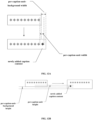
- a display width of the real-time background is determined in the caption background node according to the width of the real-time input caption based on a per-caption-unit width in the caption content node, and a per-caption-unit-background width.
- the maximum caption line width can be determined according to a scene. Generally, the maximum caption line width restricts the displayed caption content to the best viewing range of the user.
- a real-time background display width is determined in the caption background node according to the width of the real-time input caption. For example, each time a caption content is added and displayed in real time, the corresponding caption content is displayed according to a per-caption-unit width, and the caption background is expanded according to a per-caption-unit-background width.
- the per-caption-unit width is less than the per-caption-unit-background width to ensure that the caption content can be visually wrapped by the caption background.
- a caption background visually displayed following the displayed caption content is realized.
- a display height of the real-time background is determined in the caption background node according to a height of the real-time input caption, based on a preset per-caption-unit height in the caption content node, and a per-caption-unit-background height.
- a real-time background display height is determined in the caption background node according to the real-time input caption height. For example, if the real-time input caption width is greater than the preset maximum caption line width, each time a caption content is added and displayed in real time, the corresponding caption content is displayed according to a per-caption-unit height. At the same time, the display height of the caption background is expanded according to a per-caption-unit-background height. Generally, the per-caption-unit height is less than the per-caption-unit-background height to ensure that the caption content can be visually wrapped by the caption background. Thus, in the height direction, a caption background visually displayed following the displayed caption content is realized.
- the method for caption rendering in a VR space provided in the embodiment of the present disclosure can flexibly determine the target spatial position of the caption content rendered in the VR panoramic space according to the needs of the scene, ensuring a target spatial position tracking the user's current LOS direction, enabling the movement of the caption content following the user's current LOS direction, and ensuring the visual display effect of the caption content.
- the present disclosure further provides an apparatus for caption rendering in a VR space.
- FIG. 13 is a schematic structural diagram of an apparatus for caption rendering in a VR space according to an embodiment of the present disclosure.
- the apparatus can be implemented by software and/or hardware, and can generally be integrated into an electronic device for caption rendering in a VR space. As shown in FIG.
- the apparatus comprises: a separation module 1310, a mapping module 1320, a determination module 1330, and a rendering module 1340, wherein the separation module 1310 is used for separating a caption content and a picture content on a currently displayed VR video frame; the mapping module 1320 is used for mapping and rendering the picture content to a VR panoramic space; the determination module 1330 is used for determining a target spatial position in the VR panoramic space according to a user's current LOS direction; the rendering module 1340 is used for rendering the caption content at the target spatial position to generate a spatial caption.
- the apparatus for caption rendering in a VR space provided in this embodiment of the present disclosure can execute the method for caption rendering in a VR space provided in any embodiment of the present disclosure, and has corresponding functional modules to implement the method and achieve the beneficial effect of the present disclosure.
- the present application further provides a computer program product containing a computer program/instructions that, when executed by a processor, can implement the method for caption rendering in a VR space provided in any embodiment of the present disclosure.
- FIG. 14 is a schematic structural diagram of an electronic device provided in some embodiments of the present disclosure.
- FIG. 14 shows a schematic structural diagram of an electronic device 1400 suitable for implementing an embodiment of the present disclosure.
- the electronic device 1400 of the embodiment of the present disclosure may comprise, but not limited to, a mobile terminal such as a mobile phone, a notebook computer, a digital broadcast receiver, a PDA (Personal Digital Assistant), a PAD (tablet computer), a PMP (Portable Multimedia Player), an on-board terminal (such as an on-board navigation terminal), and a fixed terminal such as a digital TV, a desktop computer, and the like.
- a mobile terminal such as a mobile phone, a notebook computer, a digital broadcast receiver, a PDA (Personal Digital Assistant), a PAD (tablet computer), a PMP (Portable Multimedia Player), an on-board terminal (such as an on-board navigation terminal), and a fixed terminal such as a digital TV, a desktop computer, and the like.
- the electronic device shown in FIG. 14 is merely an example and should not impose any limitation on the function and
- the electronic device 1400 may comprise a processing device (e.g., a central processing unit, a graphics processor) 1401, which may perform various appropriate actions and processes according to a program stored in Read Only Memory (ROM) 1402 or a program loaded from storage device 1408 into Random Access Memory (RAM) 1403.
- ROM Read Only Memory
- RAM Random Access Memory
- various programs and data required for the operation of the electronic device 1400 are also stored.
- the processing device 1401, ROM 1402, and RAM 1403 are connected to each other through a bus 1404.
- An input/output (I/O) interface 1405 is also connected to the bus 1404.
- the following devices can be connected to the I/O interface 1405: input devices 1406 comprising, for example, a touch screen, a touch pad, a keyboard, a mouse, a camera, a microphone, an accelerometer, a gyroscope, etc; output devices 1407 comprising a liquid crystal display (LCD), a speaker, a vibrator, etc.; a storage device 1408 such as a magnetic tape, a hard disk, etc; and a communication device 1409.
- the communication device 1409 enables the electronic device 1400 to communicate wirelessly or wirelessly with other devices to exchange data.
- FIG. 14 shows the electronic device 1400 with various components, it should be understood that it is not required to implement or have all of these components. Alternatively, more or fewer components can be implemented or provided.
- an embodiment of the present disclosure comprises a computer program product, which comprises a computer program carried on a non-transitory computer readable medium, and containing program code for executing the method shown in the flowchart.
- the computer program may be downloaded and installed from the network through the communication device 1409, or installed from the storage device 1408, or from the ROM 1402.
- the processing device 1401 When the computer program is executed by the processing device 1401, the above functions defined in the method for caption rendering in a VR space of the embodiment of the present disclosure are performed.
- the computer-readable medium in the present disclosure may be a computer-readable signal medium or a computer-readable storage medium, or any combination of thereof.
- the computer readable storage medium can be, for example, but not limited to, an electronic, magnetic, optical, electromagnetic, infrared, or semiconductor system, apparatus, or device, or any combination of the above. More specific examples of the computer readable storage medium may comprise, but are not limited to: electrical connection with one or more wires, portable computer disk, hard disk, random access memory (RAM), read only memory (ROM), erasable programmable read only memory (EPROM or flash), fiber optics, portable compact disk Read only memory (CD-ROM), optical storage device, magnetic storage device, or any suitable combination of the foregoing.
- a computer readable storage medium can be any tangible medium that can contain or store a program, which can be used by or in connection with an instruction execution system, apparatus or device.
- a computer readable signal medium may comprise a data signal that is propagated in the baseband or as part of a carrier, carrying computer readable program code. Such propagated data signals can take a variety of forms comprising, but not limited to, electromagnetic signals, optical signals, or any suitable combination of the foregoing.
- the computer readable signal medium can also be any computer readable medium other than a computer readable storage medium, which can transmit, propagate, or transport a program for use by or in connection with the instruction execution system, apparatus, or device.
- Program code embodied on a computer readable medium can be transmitted by any suitable medium, comprising but not limited to wire, fiber optic cable, RF (radio frequency), etc., or any suitable combination of the foregoing.
- a client and a server can communicate using any currently known or future developed network protocol such as HTTP (HyperText Transfer Protocol), and can be interconnected by any form or medium of digital data communication, e.g., a communication network.
- HTTP HyperText Transfer Protocol
- Examples of communication networks comprise a local area network ("LAN”) and a wide area network (“WAN”), the Internet, and end-to-end networks (for example, ad hoc end-to-end networks), as well as any currently known or future developed networks.
- the above computer-readable medium may be comprised in the electronic device described above; or it may exist alone without being assembled into the electronic device.
- the computer-readable medium carries one or more programs that cause, when executed by the electronic device, the electronic device to perform the following steps: separating a caption content and a picture content on a currently displayed VR video frame, mapping and rendering the picture content to a VR panoramic space, and then determining a target spatial position in the VR panoramic space according to the user's current LOS direction, and rendering the caption content at the target spatial position to generate a spatial caption. Therefore, the position of the caption content rendered in the VR space is determined by tracking the user's LOS direction, and a caption is rendered at the corresponding position, thereby improving the user's visual viewing experience.
- the computer program code for executing operations of the present disclosure may be complied by any combination of one or more program design languages, the program design languages comprising object-oriented program design languages, such as Java, Smalltalk, C++, etc, as well as conventional procedural program design languages, such as "C" program design language or similar program design language.
- a program code may be completely or partly executed on a user computer, or executed as an independent software package, partly executed on the user computer and partly executed on a remote computer, or completely executed on a remote computer or server.
- the remote computer may be connected to the user computer through various kinds of networks, comprising local area network (LAN) or wide area network (WAN), or connected to external computer (for example using an internet service provider via Internet).
- LAN local area network
- WAN wide area network
- Internet for example using an internet service provider via Internet
- each block in the flowchart or block diagrams may represent a module, segment, or portion of code, which comprises one or more executable instructions for implementing the specified function or functions.
- the functions noted in the block may occur out of the order noted in the figures. For example, two blocks shown in succession may be executed substantially concurrently, or the blocks may sometimes be executed in the reverse order, depending upon the functionality involved.
- the units involved in the embodiments described in the present disclosure can be implemented in software or hardware. Wherein, the names of the units do not constitute a limitation on the units themselves under certain circumstances.
- exemplary types of hardware logic components comprise: Field Programmable Gate Array (FPGA), Application Specific Integrated Circuit (ASIC), Application Specific Standard Product (ASSP), System on Chip (SOC), Complex Programmable Logic Device (CPLD), etc.
- FPGA Field Programmable Gate Array
- ASIC Application Specific Integrated Circuit
- ASSP Application Specific Standard Product
- SOC System on Chip
- CPLD Complex Programmable Logic Device
- a machine-readable medium may be a tangible medium, which may contain or store a program for use by or in connection with an instruction execution system, apparatus, or device.
- the machine-readable medium may be a machine-readable signal medium or a machine-readable storage medium.
- the machine-readable medium may comprise, but is not limited to, an electronic, magnetic, optical, electromagnetic, infrared, or semiconductor system, apparatus, or device, or any suitable combination of thereof.
- machine-readable storage medium may comprise electrical connection with one or more wires, portable computer disk, hard disk, random access memory (RAM), read only memory (ROM), erasable programmable read only memory (EPROM or flash), fiber optics, portable compact disk Read only memory (CD-ROM), optical storage device, magnetic storage device, or any suitable combination of the foregoing.
- RAM random access memory
- ROM read only memory
- EPROM or flash erasable programmable read only memory
- CD-ROM compact disk Read only memory
- optical storage device magnetic storage device, or any suitable combination of the foregoing.
- the present disclosure provides an electronic device, comprising:
- the present disclosure provides a non-transitory computer-readable storage medium on which a computer program is stored, wherein the computer program is used to perform the method for caption rendering in a VR space provided in any embodiment of the present disclosure.
Landscapes
- Engineering & Computer Science (AREA)
- Theoretical Computer Science (AREA)
- General Engineering & Computer Science (AREA)
- Physics & Mathematics (AREA)
- General Physics & Mathematics (AREA)
- Signal Processing (AREA)
- Multimedia (AREA)
- Human Computer Interaction (AREA)
- Computer Graphics (AREA)
- Software Systems (AREA)
- Geometry (AREA)
- Computer Hardware Design (AREA)
- Processing Or Creating Images (AREA)
Applications Claiming Priority (2)
| Application Number | Priority Date | Filing Date | Title |
|---|---|---|---|
| CN202210556153.9A CN114900625A (zh) | 2022-05-20 | 2022-05-20 | 虚拟现实空间的字幕渲染方法、装置、设备及介质 |
| PCT/CN2022/129381 WO2023221409A1 (fr) | 2022-05-20 | 2022-11-03 | Procédé et appareil de rendu de sous-titres pour un espace de réalité virtuelle, dispositif et support |
Publications (2)
| Publication Number | Publication Date |
|---|---|
| EP4300943A1 true EP4300943A1 (fr) | 2024-01-03 |
| EP4300943A4 EP4300943A4 (fr) | 2024-03-27 |
Family
ID=82724242
Family Applications (1)
| Application Number | Title | Priority Date | Filing Date |
|---|---|---|---|
| EP22847111.6A Pending EP4300943A4 (fr) | 2022-05-20 | 2022-11-03 | Procédé et appareil de rendu de sous-titres pour un espace de réalité virtuelle, dispositif et support |
Country Status (4)
| Country | Link |
|---|---|
| US (1) | US20240276068A1 (fr) |
| EP (1) | EP4300943A4 (fr) |
| CN (1) | CN114900625A (fr) |
| WO (1) | WO2023221409A1 (fr) |
Families Citing this family (5)
| Publication number | Priority date | Publication date | Assignee | Title |
|---|---|---|---|---|
| CN114900625A (zh) * | 2022-05-20 | 2022-08-12 | 北京字跳网络技术有限公司 | 虚拟现实空间的字幕渲染方法、装置、设备及介质 |
| CN117710611A (zh) * | 2022-09-07 | 2024-03-15 | 北京字跳网络技术有限公司 | 基于虚拟现实空间的显示处理方法、装置、设备及介质 |
| CN115482325B (zh) * | 2022-09-29 | 2023-10-31 | 北京百度网讯科技有限公司 | 画面渲染方法、装置、系统、设备及介质 |
| CN115797604B (zh) * | 2022-11-03 | 2026-03-31 | 北京字跳网络技术有限公司 | 基于扩展现实的控制方法、装置、电子设备和存储介质 |
| CN115689931A (zh) * | 2022-11-04 | 2023-02-03 | 咪咕文化科技有限公司 | 字幕展示方法、装置、设备及计算机可读存储介质 |
Family Cites Families (14)
| Publication number | Priority date | Publication date | Assignee | Title |
|---|---|---|---|---|
| JP2012048597A (ja) * | 2010-08-30 | 2012-03-08 | Univ Of Tokyo | 複合現実感表示システム、画像提供画像提供サーバ、表示装置及び表示プログラム |
| JP6084728B1 (ja) * | 2016-04-08 | 2017-02-22 | 株式会社コロプラ | 表示制御方法及び当該表示制御方法をコンピュータに実行させるためのプログラム |
| CN106412718A (zh) * | 2016-09-18 | 2017-02-15 | 乐视控股(北京)有限公司 | 一种字幕在3d空间中的渲染方法及其装置 |
| CN106454480A (zh) * | 2016-09-30 | 2017-02-22 | 乐视控股(北京)有限公司 | 一种视频的播放控制方法和装置 |
| US20180095635A1 (en) * | 2016-10-04 | 2018-04-05 | Facebook, Inc. | Controls and Interfaces for User Interactions in Virtual Spaces |
| WO2018207045A1 (fr) * | 2017-05-10 | 2018-11-15 | Within Unlimited, Inc. | Placement et rendu dynamique d'informations de sous-titre dans une vidéo de réalité virtuelle |
| US10375375B2 (en) * | 2017-05-15 | 2019-08-06 | Lg Electronics Inc. | Method of providing fixed region information or offset region information for subtitle in virtual reality system and device for controlling the same |
| CN107613405B (zh) * | 2017-09-30 | 2019-12-27 | 福州瑞芯微电子股份有限公司 | 一种vr视频字幕显示方法和装置 |
| KR101965404B1 (ko) * | 2017-11-09 | 2019-04-03 | 부경대학교 산학협력단 | Vr 영상 콘텐츠를 위한 사용자 시점 중심의 자막 지원 장치 및 방법 |
| US10535190B2 (en) * | 2017-12-28 | 2020-01-14 | Rovi Guides, Inc. | Systems and methods for changing a users perspective in virtual reality based on a user-selected position |
| JP6794390B2 (ja) * | 2018-02-22 | 2020-12-02 | 株式会社バンダイナムコエンターテインメント | シミュレーションシステム及びプログラム |
| EP3719613B1 (fr) * | 2019-04-01 | 2026-05-06 | Nokia Technologies Oy | Rendu de légendes pour contenu multimédia |
| CN112532962A (zh) * | 2020-11-24 | 2021-03-19 | 聚好看科技股份有限公司 | 一种全景视频字幕显示方法及显示设备 |
| CN114900625A (zh) * | 2022-05-20 | 2022-08-12 | 北京字跳网络技术有限公司 | 虚拟现实空间的字幕渲染方法、装置、设备及介质 |
-
2022
- 2022-05-20 CN CN202210556153.9A patent/CN114900625A/zh active Pending
- 2022-11-03 WO PCT/CN2022/129381 patent/WO2023221409A1/fr not_active Ceased
- 2022-11-03 US US18/042,259 patent/US20240276068A1/en active Pending
- 2022-11-03 EP EP22847111.6A patent/EP4300943A4/fr active Pending
Also Published As
| Publication number | Publication date |
|---|---|
| CN114900625A (zh) | 2022-08-12 |
| EP4300943A4 (fr) | 2024-03-27 |
| WO2023221409A1 (fr) | 2023-11-23 |
| US20240276068A1 (en) | 2024-08-15 |
Similar Documents
| Publication | Publication Date | Title |
|---|---|---|
| EP4300943A1 (fr) | Procédé et appareil de rendu de sous-titres pour un espace de réalité virtuelle, dispositif et support | |
| US20250225620A1 (en) | Special effect image processing method and apparatus, electronic device, and storage medium | |
| EP4105766B1 (fr) | Procédé d'affichage d'image, et dispositif informatique et support de stockage | |
| US11506904B1 (en) | Presentation content update method, head-mounted display, and computer-readable medium | |
| US12450786B2 (en) | Augmented reality interactive display method and device | |
| US20250166213A1 (en) | Image display method and apparatus, electronic device, and storage medium | |
| WO2020125006A1 (fr) | Dispositif d'affichage à réalité augmentée et procédé d'interaction appliquant un dispositif d'affichage à réalité augmentée | |
| EP4086102B1 (fr) | Procédé et appareil de navigation, dispositif électronique, support de stockage lisible et produit de programme informatique | |
| US20240297974A1 (en) | Method, apparatus, electornic device, and storage medium for video image processing | |
| EP4543018A1 (fr) | Procédé et appareil d'affichage de sous-titre, dispositif et support | |
| EP4485357A2 (fr) | Procédé et appareil de traitement d'image, dispositif électronique et support d'enregistrement | |
| US11651529B2 (en) | Image processing method, apparatus, electronic device and computer readable storage medium | |
| CN118413745A (zh) | 一种播放全景视频的方法、装置、设备及存储介质 | |
| US20250175680A1 (en) | Information exchange method, electronic device and storage medium | |
| US20250097515A1 (en) | Information interaction method, device, electronic apparatus and storage medium | |
| US20240269553A1 (en) | Method, apparatus, electronic device and storage medium for extending reality display | |
| EP4679841A1 (fr) | Procédé et appareil de traitement d'image, et dispositif, support de stockage lisible par ordinateur et produit | |
| US20250029216A1 (en) | Method, apparatus, electronic devices, and storage medium of image processing | |
| US20250371666A1 (en) | Image processing method and apparatus, terminal and storage medium | |
| US20250118031A1 (en) | Display control method and apparatus, electronic device, and storage medium | |
| CN116193246A (zh) | 用于拍摄视频的提示方法、装置、电子设备和存储介质 | |
| CN118433467A (zh) | 视频显示方法、装置、电子设备和存储介质 | |
| CN117765207A (zh) | 虚拟界面的显示方法、装置、设备及介质 | |
| CN118034552A (zh) | 显示方法、装置和电子设备 | |
| CN118037766A (zh) | 图像处理方法和装置 |
Legal Events
| Date | Code | Title | Description |
|---|---|---|---|
| STAA | Information on the status of an ep patent application or granted ep patent |
Free format text: STATUS: UNKNOWN |
|
| STAA | Information on the status of an ep patent application or granted ep patent |
Free format text: STATUS: THE INTERNATIONAL PUBLICATION HAS BEEN MADE |
|
| PUAI | Public reference made under article 153(3) epc to a published international application that has entered the european phase |
Free format text: ORIGINAL CODE: 0009012 |
|
| STAA | Information on the status of an ep patent application or granted ep patent |
Free format text: STATUS: REQUEST FOR EXAMINATION WAS MADE |
|
| 17P | Request for examination filed |
Effective date: 20230131 |
|
| AK | Designated contracting states |
Kind code of ref document: A1 Designated state(s): AL AT BE BG CH CY CZ DE DK EE ES FI FR GB GR HR HU IE IS IT LI LT LU LV MC ME MK MT NL NO PL PT RO RS SE SI SK SM TR |
|
| A4 | Supplementary search report drawn up and despatched |
Effective date: 20240227 |
|
| RIC1 | Information provided on ipc code assigned before grant |
Ipc: H04N 13/366 20180101ALI20240221BHEP Ipc: H04N 13/183 20180101ALI20240221BHEP Ipc: G06F 3/01 20060101ALI20240221BHEP Ipc: H04N 21/488 20110101ALI20240221BHEP Ipc: G06T 19/00 20110101ALI20240221BHEP Ipc: H04N 5/278 20060101AFI20240221BHEP |
|
| DAV | Request for validation of the european patent (deleted) | ||
| DAX | Request for extension of the european patent (deleted) | ||
| GRAP | Despatch of communication of intention to grant a patent |
Free format text: ORIGINAL CODE: EPIDOSNIGR1 |
|
| STAA | Information on the status of an ep patent application or granted ep patent |
Free format text: STATUS: GRANT OF PATENT IS INTENDED |
|
| RIC1 | Information provided on ipc code assigned before grant |
Ipc: H04N 5/278 20060101AFI20251121BHEP Ipc: G06T 19/00 20110101ALI20251121BHEP Ipc: H04N 21/488 20110101ALI20251121BHEP Ipc: G06F 3/01 20060101ALI20251121BHEP Ipc: H04N 13/183 20180101ALI20251121BHEP Ipc: H04N 13/366 20180101ALI20251121BHEP |
|
| INTG | Intention to grant announced |
Effective date: 20251219 |
|
| GRAS | Grant fee paid |
Free format text: ORIGINAL CODE: EPIDOSNIGR3 |
|
| GRAA | (expected) grant |
Free format text: ORIGINAL CODE: 0009210 |
|
| STAA | Information on the status of an ep patent application or granted ep patent |
Free format text: STATUS: THE PATENT HAS BEEN GRANTED |