EP4300978A1 - Alignement automatique de flux vidéo - Google Patents
Alignement automatique de flux vidéo Download PDFInfo
- Publication number
- EP4300978A1 EP4300978A1 EP23183158.7A EP23183158A EP4300978A1 EP 4300978 A1 EP4300978 A1 EP 4300978A1 EP 23183158 A EP23183158 A EP 23183158A EP 4300978 A1 EP4300978 A1 EP 4300978A1
- Authority
- EP
- European Patent Office
- Prior art keywords
- video stream
- visually distinctive
- video
- depictions
- sporting event
- Prior art date
- Legal status (The legal status is an assumption and is not a legal conclusion. Google has not performed a legal analysis and makes no representation as to the accuracy of the status listed.)
- Pending
Links
Images





Classifications
-
- H—ELECTRICITY
- H04—ELECTRIC COMMUNICATION TECHNIQUE
- H04N—PICTORIAL COMMUNICATION, e.g. TELEVISION
- H04N21/00—Selective content distribution, e.g. interactive television or video on demand [VOD]
- H04N21/80—Generation or processing of content or additional data by content creator independently of the distribution process; Content per se
- H04N21/85—Assembly of content; Generation of multimedia applications
- H04N21/854—Content authoring
- H04N21/8547—Content authoring involving timestamps for synchronizing content
-
- H—ELECTRICITY
- H04—ELECTRIC COMMUNICATION TECHNIQUE
- H04N—PICTORIAL COMMUNICATION, e.g. TELEVISION
- H04N21/00—Selective content distribution, e.g. interactive television or video on demand [VOD]
- H04N21/40—Client devices specifically adapted for the reception of or interaction with content, e.g. set-top-box [STB]; Operations thereof
- H04N21/43—Processing of content or additional data, e.g. demultiplexing additional data from a digital video stream; Elementary client operations, e.g. monitoring of home network or synchronising decoder's clock; Client middleware
- H04N21/4302—Content synchronisation processes, e.g. decoder synchronisation
- H04N21/4307—Synchronising the rendering of multiple content streams or additional data on devices, e.g. synchronisation of audio on a mobile phone with the video output on the TV screen
- H04N21/43072—Synchronising the rendering of multiple content streams or additional data on devices, e.g. synchronisation of audio on a mobile phone with the video output on the TV screen of multiple content streams on the same device
-
- G—PHYSICS
- G06—COMPUTING OR CALCULATING; COUNTING
- G06V—IMAGE OR VIDEO RECOGNITION OR UNDERSTANDING
- G06V20/00—Scenes; Scene-specific elements
- G06V20/40—Scenes; Scene-specific elements in video content
- G06V20/41—Higher-level, semantic clustering, classification or understanding of video scenes, e.g. detection, labelling or Markovian modelling of sport events or news items
- G06V20/42—Higher-level, semantic clustering, classification or understanding of video scenes, e.g. detection, labelling or Markovian modelling of sport events or news items of sport video content
-
- G—PHYSICS
- G06—COMPUTING OR CALCULATING; COUNTING
- G06V—IMAGE OR VIDEO RECOGNITION OR UNDERSTANDING
- G06V20/00—Scenes; Scene-specific elements
- G06V20/40—Scenes; Scene-specific elements in video content
- G06V20/44—Event detection
-
- G—PHYSICS
- G06—COMPUTING OR CALCULATING; COUNTING
- G06V—IMAGE OR VIDEO RECOGNITION OR UNDERSTANDING
- G06V40/00—Recognition of biometric, human-related or animal-related patterns in image or video data
- G06V40/20—Movements or behaviour, e.g. gesture recognition
-
- H—ELECTRICITY
- H04—ELECTRIC COMMUNICATION TECHNIQUE
- H04N—PICTORIAL COMMUNICATION, e.g. TELEVISION
- H04N21/00—Selective content distribution, e.g. interactive television or video on demand [VOD]
- H04N21/20—Servers specifically adapted for the distribution of content, e.g. VOD servers; Operations thereof
- H04N21/21—Server components or server architectures
- H04N21/218—Source of audio or video content, e.g. local disk arrays
- H04N21/21805—Source of audio or video content, e.g. local disk arrays enabling multiple viewpoints, e.g. using a plurality of cameras
-
- H—ELECTRICITY
- H04—ELECTRIC COMMUNICATION TECHNIQUE
- H04N—PICTORIAL COMMUNICATION, e.g. TELEVISION
- H04N21/00—Selective content distribution, e.g. interactive television or video on demand [VOD]
- H04N21/20—Servers specifically adapted for the distribution of content, e.g. VOD servers; Operations thereof
- H04N21/21—Server components or server architectures
- H04N21/218—Source of audio or video content, e.g. local disk arrays
- H04N21/2187—Live feed
-
- H—ELECTRICITY
- H04—ELECTRIC COMMUNICATION TECHNIQUE
- H04N—PICTORIAL COMMUNICATION, e.g. TELEVISION
- H04N21/00—Selective content distribution, e.g. interactive television or video on demand [VOD]
- H04N21/20—Servers specifically adapted for the distribution of content, e.g. VOD servers; Operations thereof
- H04N21/23—Processing of content or additional data; Elementary server operations; Server middleware
- H04N21/234—Processing of video elementary streams, e.g. splicing of video streams or manipulating encoded video stream scene graphs
- H04N21/23418—Processing of video elementary streams, e.g. splicing of video streams or manipulating encoded video stream scene graphs involving operations for analysing video streams, e.g. detecting features or characteristics
-
- H—ELECTRICITY
- H04—ELECTRIC COMMUNICATION TECHNIQUE
- H04N—PICTORIAL COMMUNICATION, e.g. TELEVISION
- H04N21/00—Selective content distribution, e.g. interactive television or video on demand [VOD]
- H04N21/20—Servers specifically adapted for the distribution of content, e.g. VOD servers; Operations thereof
- H04N21/23—Processing of content or additional data; Elementary server operations; Server middleware
- H04N21/242—Synchronisation processes, e.g. processing of PCR [Programme Clock References]
Definitions
- the present invention relates to methods and systems for processing video, in particular for time-aligning video streams, i.e., for determining a time offset between video streams.
- the video streams depict live events, such as, in particular, sporting events.
- Live events such as sports events, especially at the college and professional levels, continue to grow in popularity and revenue as individual colleges and franchises reap billions in revenue each year.
- Understanding the time offset between video streams depicting a live event may be important (or even essential) for carrying out various kinds of processing of such video streams, such as processing the video streams to generate analytics of the event (e.g., in the case of a sports event, analytics regarding the game, the teams and/or the players) or processing the video streams to generate augmented video content of the event, e.g., a single video showing a highlight of a play from multiple angles.
- a video processing method comprising: identifying one or more depictions of a first kind of visually distinctive activity in a first video stream depicting a sporting event; identifying one or more depictions of the first kind of visually distinctive activity in a second video stream depicting the sporting event; and determining a time offset between the first video stream and the second video stream, wherein said determining of the time offset comprises comparing the one or more depictions of the first kind of visually distinctive activity in the first video stream with the one or more depictions of the first kind of visually distinctive activity in the second video stream.
- the method comprises processing at least one of the first and second video streams based on the time offset.
- the processing comprises carrying out spatiotemporal pattern recognition based on the first video stream, the second video stream, and the time offset therebetween. Additionally, or alternatively, the processing comprises generating video content (e.g. augmented video content) based on the first video stream, the second video stream, and the time offset therebetween.
- video content e.g. augmented video content
- the method comprises receiving the first video stream from a first portable device comprising a camera.
- the first portable device can, for example, be a smartphone.
- the method comprises receiving the second video stream from a second portable device comprising a camera.
- the second portable device can, for example, be a smartphone.
- a video processing system comprising: memory storing a plurality of computer-executable instructions; one or more processors that execute the computer-executable instructions, the computer-executable instructions causing the one or more processors to: identify one or more depictions of a first kind of visually distinctive activity in a first video stream depicting a sporting event; identify one or more depictions of the first kind of visually distinctive activity in a second video stream depicting the sporting event; and determine a time offset between the first video stream and the second video stream, wherein the system determines the time offset at least by comparing the one or more depictions of the first kind of visually distinctive activity in the first video stream with the one or more depictions of the first kind of visually distinctive activity in the second video stream.
- the system is configured to receive the first video stream from a first portable device comprising a camera.
- the first portable device can, for example, be a smartphone.
- the system is configured to receive the second video stream from a second portable device comprising a camera.
- the second portable device can, for example, be a smartphone.
- a non-transitory, computer-readable storage medium comprising a set of computer-readable instructions which, when executed by one or more processors, cause the one or more processors to: identify one or more depictions of a first kind of visually distinctive activity in a first video stream depicting a sporting event; identify one or more depictions of the first kind of visually distinctive activity in a second video stream depicting the sporting event; and determine a time offset between the first video stream and the second video stream, wherein the system determines the time offset at least by comparing the one or more depictions of the first kind of visually distinctive activity in the first video stream with the one or more depictions of the first kind of visually distinctive activity in the second video stream.
- the computer-executable instructions additionally cause the one or more processors to: process at least one of the first and second video streams based on the time offset.
- the processing comprises carrying out spatiotemporal pattern recognition based on the first video stream, the second video stream, and the time offset therebetween.
- the processing comprises generating video content (e.g. augmented video content) based on the first video stream, the second video stream, and the time offset therebetween.
- the computer-executable instructions cause the one or more processors to: identify one or more depictions of a second kind of visually distinctive activity in the first video stream; and identify one or more depictions of the second kind of visually distinctive activity in the second video stream, wherein the system determines the time offset at least by comparing the one or more depictions of the second kind of visually distinctive activity in the first video stream with the one or more depictions of the second kind of visually distinctive activity in the second video stream.
- the video streams depict a sporting event
- the event may be a non-sporting live event, such as a concert, a comedy show, or a play.
- Embodiments of this application relate to automatic alignment of video streams, in particular video streams that depict live events, such as sporting events.
- Figure 1 is a flow chart illustrating a video processing method 100 according to an illustrative embodiment.
- the method 100 comprises a step 101 of identifying one or more depictions of a first kind of visually distinctive activity in a first video stream.
- the first video stream depicts a sporting event, such as a soccer match, basketball match, tennis match, etc.; however, it is envisaged that the approaches described herein may equally be applied to video streams that depict non-sporting events.
- method 100 further comprises a step 102 of identifying one or more depictions of the same kind of visually distinctive activity in a second video stream that depicts the same sporting event.
- the method 100 of Figure 1 may make use of various kinds of visually distinctive activity to determine a time offset between two video streams.
- the kinds of visually distinctive activity described below with reference to Figures 2A-10B may, for example, be characterized as: being visible from multiple positions and orientations at the sporting event; having visible changes that can be temporally localized, for example because they change in appearance abruptly from one frame to the next frame in a video stream (e.g. because of changes in location, motion and/or or patterning); and/or changing in appearance regularly over the course of the sporting event.
- depictions of such visually distinctive activity can be readily and/or robustly identified within two (or more) video streams of the same sporting event.
- the video streams of the sporting event can be received from various sources.
- the method 100 of Figure 1 could be employed where the first and/or the second video streams are generated by portable devices that comprise cameras, such as smartphones or tablet devices. It is believed that solutions are lacking for alignment of video streams generated by such devices, as compared with video streams generated by conventional, broadcast cameras. Nevertheless, the method 100 of Figure 1 can be employed where the first and/or the second video streams are generated by conventional, broadcast cameras instead.
- method 100 further comprises a step 106 of determining a time offset between the first video stream and the second video stream. As indicated at block 108, this step 106 comprises comparing the depictions of the first kind of visually distinctive activity in the first video stream with the one or more depictions of the first kind of visually distinctive activity in the second video stream.
- this comparison might comprise comparing the intensity (e.g. the mean or median intensity) of some or all of the pixels that correspond to the depictions of the first kind of visually distinctive activity in the first video stream with the intensity (e.g. the mean or median intensity) of some or all of the pixels that correspond to the depictions of the first kind of visually distinctive activity in the second video stream.
- the intensity e.g. the mean or median intensity
- movements and/or locations of the depictions of the first kind of visually distinctive activity in the first video stream could be compared with movements and/or locations of the depictions of the first kind of visually distinctive activity in the second video stream, as is the case in the examples described with reference to Figures 7A-10B .
- the method 100 can optionally comprise an additional video processing step 110 that follows the step 106 of determining a time offset between the first video stream and the second video stream.
- the thus-determined time offset is utilized in the processing of one or both of the first and second video streams.
- the additional processing step 110 could, for example, comprise carrying out spatiotemporal pattern recognition based on the first video stream, the second video stream, and the time offset therebetween.
- step 110 could comprise generating video content (e.g. augmented video content) based on the first video stream, the second video stream, and the time offset therebetween.
- video content could be generated that simultaneously shows two views of the same highlight from the sporting event (the two views corresponding to the first and second video streams), with the video of the two views of the highlight being synchronized.
- Figures 2A-10B illustrate various kinds of visually distinctive activity that can be identified in steps 101 and 102 of the video processing method 100 of Figure 1 so as to determine a time offset between two video streams.
- a first illustrative example of a suitable type of visually distinctive activity is the changing of the time shown on a clock at the sporting event.
- the clock may be a game clock, i.e., a clock showing the time elapsed or remaining in a game, or a playing period thereof.
- FIGS 2A and 2B show video frames from two different video streams of a sporting event, which, in the particular example shown, is a basketball game.
- the game clock 200 is visible in both video streams, even though the video streams correspond to significantly different viewpoints of the game.
- a game clock is, by design, intended to be visible from multiple positions and orientations at the sporting event - the function of a game clock is to allow spectators to be aware of the current time in the game.
- a game clock can be characterized as changing abruptly in appearance from one frame to the next of a video stream, so that a change in the time on the game clock is indicative of a very narrow time window.
- a game clock by its nature, changes in appearance regularly over the course of the sporting event. For these reasons (and/or other reasons), using changes in the time shown on a clock at the sporting event as the first kind of visually distinctive activity in the method 100 of Figure 1 may provide robust and/or accurate alignment of video streams.
- depictions of the changing time on a clock can, for example, be identified by using an optical character recognition algorithm on frames of each video stream.
- the optical character recognition algorithm can be applied to a specific portion of each frame that is expected to contain the clock.
- the clock-containing portion of the frame can, for example, be determined using knowledge of the real-world shape, position and orientation of the clock in the venue, and knowledge of the position and orientation of the cameras providing the video streams (e.g., by calibrating the camera).
- the clock-containing portion of the frame could be determined using a segmentation algorithm that utilizes a suitably trained neural network, such as Mask R-CNN.
- comparing the depictions of the changing time on the clock in the first video stream with the depictions of the changing time on the clock in the second video stream could, for example, comprise comparing the frame number, for each video stream (or the time within each video stream), at which one or more game clock time transitions (e.g., from 12:00 to 12:01, or from 1:41 to 1:42) occur.
- performing such a comparison for multiple game clock transitions may yield a more accurate estimate of the time offset between the video streams.
- a further example of a suitable kind of visually distinctive activity is the occurrence of camera flashes during a sporting event.
- Camera flashes can be characterized as being visible from multiple positions and orientations at the sporting event, given the very high intensity of the light emitted by a camera flash unit. Additionally, camera flashes change in appearance abruptly from one frame to the next frame in a video stream, given the short duration of a camera flash (typically, less than the time between two frames of a video stream) and the rapid increase in brightness that a camera flash unit produces.
- camera flashes can be characterized as changing in appearance regularly over the course of the sporting event. For these reasons (and/or other reasons), using camera flashes as the first kind of visually distinctive activity in the method 100 of Figure 1 may provide robust and/or accurate alignment of video streams.
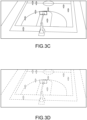
- Figures 3A-3D show two video frames from each of two video streams of a sporting event.
- the sporting event is a basketball game.
- camera flashes are particularly visible at indoor sporting events, such as basketball or ice hockey games.
- camera flashes may be a particularly suitable choice of a visually distinctive activity to be identified when time aligning video streams of indoor sports events using the method 100 of Figure 1 .
- Figures 3A and 3B show, respectively, a first frame, where no camera flashes are occurring, and a second frame, where one or more camera flashes are occurring; both the frames are from the same video stream and are therefore taken from the same viewpoint.
- Figures 3C and 3D similarly show first and second frames from a second video stream, where no camera flashes are occurring in the first frame ( Figure 3C ), but one or more camera flashes are occurring in the second frame ( Figure 3D ).
- the second video stream is taken from a different viewpoint to the first video stream (illustrated in Figures 3A and 3B ).
- depictions of camera flashes can, for example, be identified in a given video stream by analyzing the pixel intensity (e.g., the total or mean pixel intensity) for some or all of the frames in the video stream.
- the inventors have determined that frames that depict camera flashes will be significantly overexposed. Hence, frames with particularly high pixel intensity likely depict camera flashes.
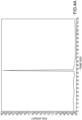
- Figures 4A and 4B are graphs of the pixel intensity with respect to time for, respectively, the video stream whose frames are shown in Figures 3A and 3B , and the video steam whose frames are shown in Figures 3C and 3D .
- each graph includes a peak of extremely short duration, with a pixel intensity that is substantially higher than the immediately preceding or succeeding frames. This peak in pixel intensity corresponds to the camera flash depicted in Figures 3B and 3D .
- comparing the depictions of the camera flashes in the first video stream with the depictions of the camera flashes in the second video stream could, for example, comprise comparing the frame number, for each video stream, at which particularly short duration and large magnitude peaks in pixel intensity occur.
- a simple approach which may be utilized in some examples, is to assume flashes are very short, as compared with the frame rate, so that each flash lands on only one frame (or zero frames, if the flash occurs during the "dead time" of the camera sensor, e.g., when the shutter is closed), and that each flash increases the mean image intensity very significantly for that frame only.
- Flashes have some unknown short duration, and so have the potential to straddle two or more consecutive frames.
- Such an approach can also take into account if the camera has a global or rolling shutter and can use camera specs/info to determine when the sensor is open or closed. From that, and from the average frame intensity (in the case of a global shutter) or per-line intensity (in the case of a rolling shutter) the model can estimate the most likely flash start/end times.
- a further example of a kind of visually distinctive activity that is suitable for aligning video streams is the change in images and/or patterns shown on one or more electronic displays at a sporting event.
- the electronic displays are advertising boards, but could also be "big screens" that show highlights or other video content to spectators at the sporting event.
- Electronic displays at sporting events are, by design, visible from multiple positions and orientations at the sporting event - they are intended to be viewable by most, if not all spectators. Additionally, electronic displays can be characterized as changing abruptly in appearance from one frame to the next of a video stream. Furthermore, electronic displays, by their nature, change in appearance regularly over the course of the sporting event. For these reasons (and/or other reasons), using changes in the images and/or patterns shown on one or more electronic displays at the sporting event as the first kind of visually distinctive activity in the method 100 of Figure 1 may provide robust and/or accurate alignment of video streams.
- depictions of electronic displays within a video stream may be identified using knowledge of the real-world shape, position and orientation of the electronic displays, and knowledge of the real-world position and orientation of the cameras providing the video streams.
- Electronic displays at sporting events are rarely moved, given their large size, and typically have simple, regular shapes (e.g. they are rectangular). Hence (or otherwise), knowledge of the shape, position and orientation of the electronic displays can be obtained and maintained relatively straightforwardly.
- Knowledge of the position and orientation of the cameras providing the video streams can be acquired by calibration of the intrinsic and extrinsic parameters of each camera. A wide range of approaches for camera calibration is available, including those disclosed in commonly assigned U.S. Patent No. 10,600,210 B1 .
- depictions of electronic displays within a video stream could be identified using alternative approaches, for example using a segmentation algorithm that utilizes a suitably trained neural network, such as Mask R-CNN.
- comparing the depictions of the electronic displays in the first video stream with the depictions of the electronic displays in the second video stream could, for example, comprise comparing the change, over time, in the pixel intensity for some or all of the pixels that have been identified in step 101 as depicting electronic display(s) in the first video stream, with the change, over time, in the pixel intensity for some/all of the pixels that have been identified in step 102 as depicting electronic display(s) in the second video stream.
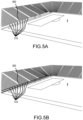
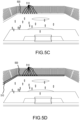
- Figures 5A-5D and Figure 6 show two video frames from each of two video streams of a sporting event.
- the sporting event is a soccer match.
- At the edge of the field are several advertising boards 150.
- the advertising boards 150 are visible within both the first video stream (shown in Figures 5A and 5B ) and in the second video stream (shown in Figures 5C and 5D ), even though the video streams correspond to significantly different viewpoints of the game.
- Figure 6 is a line graph of pixel intensity with respect to time for a subset 510 of the pixels that depict the advertising boards.
- the subset of pixels 510 for the first video stream correspond to the same real-world locations as the subset of pixels 510 for the second video stream (shown in Figures 5C and 5D ).
- This can be accomplished using knowledge of the real-world shape, position and orientation of the advertising boards 150, as discussed above, and/or using image feature matching. Such an approach may provide more robust and/or accurate determination of the time offset, as the same part of the display will be sampled from each video stream.
- a first line 610 shows pixel intensity for the video stream whose frames are shown in Figures 5A and 5B
- a second line 620 shows the pixel intensity with respect to time for the video steam whose frames are shown in Figures 5C and 5D .
- the two time series can be compared, for example using a cross-correlation function, in order to find a likely time offset between the two series.
- a further example of a kind of visually distinctive activity that is suitable for aligning video streams is movement in the ball, puck, or similar contested object that is in play at a sporting event.
- the ball (or other contested object) can be characterized as being: visible from multiple positions and orientations at the sporting event; changing abruptly in appearance from one frame to the next of a video stream (particularly when kicked, thrown, caught etc. by a player); and changing in appearance regularly over the course of the sporting event.
- using movement of the ball (or other contested object) as the first kind of visually distinctive activity in the method 100 of Figure 1 may provide robust and/or accurate alignment of video streams.
- depictions of the ball within a video stream may be identified using various approaches.
- various object detection algorithms can be utilized, including neural network algorithms, such as Faster R-CNN or YOLO, and non-neural network algorithms, such as SIFT.
- comparing the depictions of the movements of the ball in the first video stream with the depictions of the movements of the ball in the second video stream could, for example, comprise comparing changes in the movement of the ball, as depicted in the first video stream, with changes in the movement of the ball, as depicted in the second video stream.
- the movement of the ball can change abruptly, from frame-to-frame, within a video stream, as may be seen from Figures 7A and 7B , which show two video frames from a video stream of a sporting event.
- the sporting event is a soccer game.
- Figure 7A the soccer ball is moving towards a player; the player then kicks the ball, which results in the ball abruptly moving in the opposite direction, as shown in Figure 7B .
- Such abrupt changes in movement assist in time-alignment because they are associated with a very narrow time window and tend to be visually distinctive.
- comparing the depictions of the movements of the ball in the first video stream with the depictions of the movements of the ball in the second video stream could, for example, comprise comparing the horizontal or vertical movement of the ball in the first video stream with the corresponding movement of the ball in the second video stream.
- horizontal movement of the ball in the video stream means movement in the left-right direction within the frames of the video stream
- vertical movement means movement in the up-down direction within the frames of the video stream.
- a more general approach which does not require the video streams to have similar viewpoints, is to convert the movements of the ball, as depicted in the second video stream, into 3D movements, and to then determine the component of such 3D movements in the horizontal (or vertical) direction of the first video stream. In this way, a like-for-like comparison of the movements can be carried out. Converting the 2D movements depicted in a video stream into 3D movements can be achieved in various ways. In one example, the 3D movements can be determined by triangulation of the ball using the second video stream in combination with a third video stream, which is time-aligned with the second video stream (i.e. the time offset between the second and third video streams is known). Additionally, to assist in performing triangulation, the cameras producing the second and third video streams may be calibrated (so that their extrinsic and intrinsic parameters are known).
- Figures 8A and 8B illustrate an example where such an approach has been applied to the video stream whose frames are shown in Figures 7A and 7B .
- Figure 8A shows the changes in horizontal movement, from one frame to the next, for the video stream whose frames are shown in Figures 7A and 7B .
- 2D movements in a second video stream are converted into 3D movements, using triangulation with a third, synchronized video stream.
- the component of such 3D movements in the horizontal direction of the first video stream (illustrated in Figures 7A and 7B ) is then determined.
- the frame-to-frame changes in the thus-determined components of the 3D movements are shown in Figure 8B .
- both Figures 8A and 8B show peaks with very short duration.
- the two time series can be compared, for example using a cross-correlation function, in order to find a likely time offset between the two series.
- a further example of a kind of visually distinctive activity that is suitable for aligning video streams is changes in the positions of the heads of participants in a sporting event (e.g. changes in the positions of the heads of the players and/or referees of the sporting event).
- the participants' heads can be characterized as being: visible from multiple positions and orientations at the sporting event; and changing in appearance regularly over the course of the sporting event. For these reasons (and/or other reasons), using changes in the positions of the participants' heads as the first kind of visually distinctive activity in the method 100 of Figure 1 may provide robust and/or accurate alignment of video streams.
- depictions of participants' heads within a video stream may be identified using various approaches.
- various computer vision algorithms can be utilized, for example utilizing neural networks, such as Faster R-CNN, YOLO, or OpenPose, or utilizing feature detection algorithms such as SIFT or SURF.
- comparing the changes in the depictions of the positions of the heads of participants in the first video stream with the depictions of changes in the positions of the heads of participants second video stream could, for example, comprise converting the (2D) head positions, as depicted in several of the frames of the second video stream, into 3D head positions, then reprojecting these 3D positions into one of the frames of the first video stream. Converting 2D head positions into 3D head positions can be carried out in a similar manner to the approach described above for converting 2D ball movements to 3D ball movements in the "Alignment Using Ball Movements" section.
- Reprojecting the head positions from the second video stream allows for a like-for-like comparison of the head positions.
- the frame with the closest match between identified head positions 910 and reprojected head positions 920 indicates a possible time offset between the two video streams.
- FIGs 9A and 9B show the same frame from a first video stream of a soccer game, and thus the same identified head positions 910.
- each of Figures 9A and 9B shows reprojected head positions 920 that correspond to a different frame from the second video stream.
- the reprojected head positions 920 shown in Figure 9A are a much better match than the reprojected head positions 920 shown in Figure 9B .
- This process of converting the head positions to 3D and reprojecting to find a closet matching frame from the first video stream can be repeated for additional frames from the first video stream, so as to provide further estimates of the time offset, and thus a more accurate final determination of the time offset between the video streams.
- a still further example of a kind of visually distinctive activity that is suitable for aligning video streams is changes in the body poses of participants in a sporting event (e.g. changes in the positions and orientations of the heads, limbs and torsos of the players and/or referees of the sporting event).
- the participants' body poses can be characterized as being: visible from multiple positions and orientations at the sporting event; and changing in appearance regularly over the course of the sporting event.
- using changes in the body poses of participants as the first kind of visually distinctive activity in the method 100 of Figure 1 may provide robust and/or accurate alignment of video streams.
- depictions of participants' body poses may be identified within a video stream using various approaches.
- various computer vision algorithms can be utilized, for example utilizing neural networks, such as Mask R-CNN, OpenPose, AlphaPose.
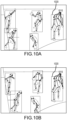
- Computer vision algorithms can, for example, be used to identify keypoints 1010 on the body of each participant, such as the head, shoulders, elbows, wrists, hips, knees and ankles of the participant in question 1020, as illustrated in Figures 10A and 10B .
- the set of locations for these keypoints characterizes the body pose of the participant.
- Step 106 of method 100 may, for example, comprise similar substeps to those described above in the "Alignment Using Head Positions" section. Specifically, 2D positions of body keypoints in several frames of the second video stream can be converted into 3D positions and then reprojected onto a frame from the first video stream to find a closest matching frame.
- method 100 includes an optional step 103 of identifying one or more depictions of a second, different kind of visually distinctive activity in the first video stream, and an optional step 104 of identifying one or more depictions of the second kind of visually distinctive activity in the second video stream.
- the determining 106 of the time offset between the first video stream and the second video stream optionally comprises comparing 109 the depictions of the second kind of visually distinctive activity in the first video stream with the depictions of the second kind of visually distinctive activity in the second video stream.
- the second kind of visually distinctive activity may, for instance, be any one of the examples illustrated above with reference to Figures 2A-10B .
- step 109 of comparing the depictions of the second kind of visually distinctive activity in the first video stream with the depictions of the second kind of visually distinctive activity in the second video stream may yield one estimate for the time offset
- step 108 of comparing the depictions of the first kind of visually distinctive activity in the first video stream with the one or more depictions of the first kind of visually distinctive activity in the second video stream may yield another estimate for the time offset.
- the time offset can be determined based on both of these estimates.
- steps 101 and 102 as occurring prior to optional steps 103 and 104
- steps 101 and 102 could occur after optional steps 103 and 104, or could occur simultaneously with steps 103 and 104.
- steps 101-104 may be carried out in any suitable order.
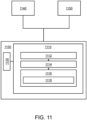
- FIG. 11 is a schematic diagram of a video processing system according to a further illustrative embodiment.
- the video processing system 1100 comprises a memory 1110 and a processor 1120.
- the memory 1110 stores a plurality of computer-executable instructions 1112-1118 that, when executed by the processor 1120 cause the processor to:
- the determining of the time offset comprises comparing 1118 the one or more depictions of the first kind of visually distinctive activity in the first video stream with the one or more depictions of the first kind of visually distinctive activity in the second video stream.
- any of the kinds of visually distinctive activities described above with reference to Figures 2A-10B can be utilized in the video processing system 1100.
- the approaches for identifying and comparing depictions of visually distinctive activity described above with reference to Figures 2A-10B can be implemented in video processing system 1100.
- the memory 1110 may of any suitable type, such as comprising one or more of: Random Access Memory (RAM), Read Only Memory (ROM), Electrically Erasable Programmable Read Only Memory (EEPROM), and flash memory.
- RAM Random Access Memory
- ROM Read Only Memory
- EEPROM Electrically Erasable Programmable Read Only Memory
- flash memory any suitable type, such as comprising one or more of: Random Access Memory (RAM), Read Only Memory (ROM), Electrically Erasable Programmable Read Only Memory (EEPROM), and flash memory.
- system 1100 could comprise multiple processors. Particularly (but not exclusively) where the system 1100 comprises multiple processors, the system 1100 may comprise a GPU and/or a neural network accelerator.
- the video streams of the sporting event can be received from various sources.
- the system 1100 of Figure 11 could be employed where the first and/or the second video streams are generated by portable devices 1140, 1150 that comprise cameras, such as smartphones or tablet devices.
- portable devices 1140, 1150 that comprise cameras, such as smartphones or tablet devices.
- the inventors consider that solutions are lacking for alignment of video streams generated by such devices, as compared with video streams generated by conventional, broadcast cameras. Nevertheless, the method 100 of Figure 1 can equally be employed where the first and/or the second video streams are generated by conventional, broadcast cameras.
- the video streams can be received via any suitable communication system.
- the video streams might be transmitted over the internet, over an intranet (e.g., which includes the video processing system 1100), via a cellular network (particularly, but not exclusively, where the video streams are generated by portable devices 1140, 1150), or via a bus of video processing system 1100.
- video streams in the embodiments described above with reference to Figures 1-11 depict a sporting event
- many embodiments, and particularly the method 100 described above with reference to Figure 1 and the system 1100 described above with reference to Figure 11 may be adapted to process video streams depicting other kinds of live events, such as, for example, concerts, comedy shows or plays.
Landscapes
- Engineering & Computer Science (AREA)
- Multimedia (AREA)
- Signal Processing (AREA)
- Physics & Mathematics (AREA)
- General Physics & Mathematics (AREA)
- Theoretical Computer Science (AREA)
- Databases & Information Systems (AREA)
- Software Systems (AREA)
- Computational Linguistics (AREA)
- Psychiatry (AREA)
- Social Psychology (AREA)
- Human Computer Interaction (AREA)
- General Health & Medical Sciences (AREA)
- Computer Vision & Pattern Recognition (AREA)
- Health & Medical Sciences (AREA)
- Computer Security & Cryptography (AREA)
- Image Analysis (AREA)
- Two-Way Televisions, Distribution Of Moving Picture Or The Like (AREA)
- Information Transfer Between Computers (AREA)
Applications Claiming Priority (1)
| Application Number | Priority Date | Filing Date | Title |
|---|---|---|---|
| US202263357979P | 2022-07-01 | 2022-07-01 |
Publications (1)
| Publication Number | Publication Date |
|---|---|
| EP4300978A1 true EP4300978A1 (fr) | 2024-01-03 |
Family
ID=87136534
Family Applications (1)
| Application Number | Title | Priority Date | Filing Date |
|---|---|---|---|
| EP23183158.7A Pending EP4300978A1 (fr) | 2022-07-01 | 2023-07-03 | Alignement automatique de flux vidéo |
Country Status (7)
| Country | Link |
|---|---|
| US (2) | US12363401B2 (fr) |
| EP (1) | EP4300978A1 (fr) |
| JP (1) | JP2025521947A (fr) |
| CN (1) | CN119631413A (fr) |
| AU (2) | AU2023298431B2 (fr) |
| GB (2) | GB2622466B (fr) |
| WO (1) | WO2024006579A1 (fr) |
Families Citing this family (1)
| Publication number | Priority date | Publication date | Assignee | Title |
|---|---|---|---|---|
| US12412428B1 (en) | 2025-04-03 | 2025-09-09 | Direct Technology Holdings, Inc. | AI-powered sports training system with enhanced motion synchronization and comparative analysis capabilities |
Citations (5)
| Publication number | Priority date | Publication date | Assignee | Title |
|---|---|---|---|---|
| WO2016202890A1 (fr) * | 2015-06-15 | 2016-12-22 | Piksel, Inc | Diffusion multimédia continu |
| US20170192621A1 (en) * | 2014-09-11 | 2017-07-06 | Lg Electronics Inc. | Mobile terminal and method for controlling same |
| CN107529064A (zh) * | 2017-09-04 | 2017-12-29 | 北京理工大学 | 一种基于vr终端反馈的自适应编码方法 |
| US20190354765A1 (en) * | 2014-02-28 | 2019-11-21 | Second Spectrum, Inc. | Methods, systems, and user interface navigation of video content based spatiotemporal pattern recognition |
| US10600210B1 (en) | 2019-07-25 | 2020-03-24 | Second Spectrum, Inc. | Data processing systems for real-time camera parameter estimation |
Family Cites Families (9)
| Publication number | Priority date | Publication date | Assignee | Title |
|---|---|---|---|---|
| US8228372B2 (en) * | 2006-01-06 | 2012-07-24 | Agile Sports Technologies, Inc. | Digital video editing system |
| US9031279B2 (en) * | 2008-07-09 | 2015-05-12 | Disney Enterprises, Inc. | Multiple-object tracking and team identification for game strategy analysis |
| US20130282804A1 (en) * | 2012-04-19 | 2013-10-24 | Nokia, Inc. | Methods and apparatus for multi-device time alignment and insertion of media |
| US9202526B2 (en) | 2012-05-14 | 2015-12-01 | Sstatzz Oy | System and method for viewing videos and statistics of sports events |
| US11861906B2 (en) * | 2014-02-28 | 2024-01-02 | Genius Sports Ss, Llc | Data processing systems and methods for enhanced augmentation of interactive video content |
| US10521671B2 (en) * | 2014-02-28 | 2019-12-31 | Second Spectrum, Inc. | Methods and systems of spatiotemporal pattern recognition for video content development |
| CN106715048B (zh) | 2014-09-30 | 2018-12-25 | 富士胶片株式会社 | 透镜制造方法、透镜及透镜保持装置 |
| WO2017221239A2 (fr) | 2016-06-20 | 2017-12-28 | Pixellot Ltd. | Procédé et système permettant de produire automatiquement les temps forts d'une vidéo |
| EP3576095A1 (fr) * | 2018-06-01 | 2019-12-04 | FRAUNHOFER-GESELLSCHAFT zur Förderung der angewandten Forschung e.V. | Système permettant de déterminer un scénario de jeu dans un jeu sportif |
-
2023
- 2023-07-03 CN CN202380051455.3A patent/CN119631413A/zh active Pending
- 2023-07-03 GB GB2310184.3A patent/GB2622466B/en active Active
- 2023-07-03 JP JP2025500371A patent/JP2025521947A/ja active Pending
- 2023-07-03 WO PCT/US2023/026832 patent/WO2024006579A1/fr not_active Ceased
- 2023-07-03 AU AU2023298431A patent/AU2023298431B2/en active Active
- 2023-07-03 EP EP23183158.7A patent/EP4300978A1/fr active Pending
- 2023-07-03 GB GB2417802.2A patent/GB2636496B/en active Active
- 2023-07-03 US US18/346,355 patent/US12363401B2/en active Active
-
2025
- 2025-06-20 US US19/244,764 patent/US20250317633A1/en active Pending
- 2025-11-17 AU AU2025267532A patent/AU2025267532B2/en active Active
Patent Citations (5)
| Publication number | Priority date | Publication date | Assignee | Title |
|---|---|---|---|---|
| US20190354765A1 (en) * | 2014-02-28 | 2019-11-21 | Second Spectrum, Inc. | Methods, systems, and user interface navigation of video content based spatiotemporal pattern recognition |
| US20170192621A1 (en) * | 2014-09-11 | 2017-07-06 | Lg Electronics Inc. | Mobile terminal and method for controlling same |
| WO2016202890A1 (fr) * | 2015-06-15 | 2016-12-22 | Piksel, Inc | Diffusion multimédia continu |
| CN107529064A (zh) * | 2017-09-04 | 2017-12-29 | 北京理工大学 | 一种基于vr终端反馈的自适应编码方法 |
| US10600210B1 (en) | 2019-07-25 | 2020-03-24 | Second Spectrum, Inc. | Data processing systems for real-time camera parameter estimation |
Also Published As
| Publication number | Publication date |
|---|---|
| CN119631413A (zh) | 2025-03-14 |
| US20250317633A1 (en) | 2025-10-09 |
| JP2025521947A (ja) | 2025-07-10 |
| GB2622466A (en) | 2024-03-20 |
| US12363401B2 (en) | 2025-07-15 |
| GB202310184D0 (en) | 2023-08-16 |
| GB2636496B (en) | 2026-01-14 |
| GB2622466B (en) | 2025-01-15 |
| AU2025267532B2 (en) | 2025-12-18 |
| US20240007723A1 (en) | 2024-01-04 |
| GB202417802D0 (en) | 2025-01-15 |
| WO2024006579A1 (fr) | 2024-01-04 |
| AU2023298431A1 (en) | 2025-01-09 |
| GB2636496A (en) | 2025-06-18 |
| AU2023298431B2 (en) | 2025-12-11 |
| AU2025267532A1 (en) | 2025-12-11 |
Similar Documents
| Publication | Publication Date | Title |
|---|---|---|
| US7042493B2 (en) | Automated stroboscoping of video sequences | |
| US8675021B2 (en) | Coordination and combination of video sequences with spatial and temporal normalization | |
| US8233721B2 (en) | Image processing apparatus and method | |
| US8805007B2 (en) | Integrated background and foreground tracking | |
| AU2025267532B2 (en) | Automatic alignment of video streams | |
| US9154710B2 (en) | Automatic camera identification from a multi-camera video stream | |
| US20240129599A1 (en) | Systems and methods for generating overlays for a broadcast | |
| RU2602792C2 (ru) | Сравнение движущихся объектов на основе вектора движения | |
| JP2009505553A (ja) | ビデオストリームへの視覚効果の挿入を管理するためのシステムおよび方法 | |
| CN119090972A (zh) | 针对隔网球类运动的技战术能力监测、分析系统和方法 | |
| CN115205959B (zh) | 一种物体运动轨迹视频拍摄方法及系统 | |
| KR101019824B1 (ko) | 오브젝트 운동 센싱장치 및 센싱방법과, 이를 이용한 가상 골프 시뮬레이션 장치 | |
| KR101231587B1 (ko) | 영상 비교 처리 장치 | |
| Kopf et al. | Analysis and retargeting of ball sports video | |
| Xie et al. | Object tracking method based on 3d cartoon animation in broadcast soccer videos | |
| CN118967793A (zh) | 用于检测隔网球类运动中球员的姿态的方法和设备 | |
| Liu et al. | Scene Composition in Augmented Virtual Presenter System | |
| Aksay et al. | Robust 3d tracking in tennis videos | |
| CN121147390A (zh) | 基于轨迹匹配的羽毛球三维运动轨迹重建方法 | |
| Rudoy et al. | Posing to the camera: automatic viewpoint selection for human actions |
Legal Events
| Date | Code | Title | Description |
|---|---|---|---|
| PUAI | Public reference made under article 153(3) epc to a published international application that has entered the european phase |
Free format text: ORIGINAL CODE: 0009012 |
|
| STAA | Information on the status of an ep patent application or granted ep patent |
Free format text: STATUS: THE APPLICATION HAS BEEN PUBLISHED |
|
| AK | Designated contracting states |
Kind code of ref document: A1 Designated state(s): AL AT BE BG CH CY CZ DE DK EE ES FI FR GB GR HR HU IE IS IT LI LT LU LV MC ME MK MT NL NO PL PT RO RS SE SI SK SM TR |
|
| STAA | Information on the status of an ep patent application or granted ep patent |
Free format text: STATUS: REQUEST FOR EXAMINATION WAS MADE |
|
| 17P | Request for examination filed |
Effective date: 20240703 |
|
| RBV | Designated contracting states (corrected) |
Designated state(s): AL AT BE BG CH CY CZ DE DK EE ES FI FR GB GR HR HU IE IS IT LI LT LU LV MC ME MK MT NL NO PL PT RO RS SE SI SK SM TR |
|
| STAA | Information on the status of an ep patent application or granted ep patent |
Free format text: STATUS: EXAMINATION IS IN PROGRESS |
|
| 17Q | First examination report despatched |
Effective date: 20250703 |