EP4301084A1 - Kommunikationsverfahren und kommunikationsvorrichtung - Google Patents
Kommunikationsverfahren und kommunikationsvorrichtung Download PDFInfo
- Publication number
- EP4301084A1 EP4301084A1 EP21927290.3A EP21927290A EP4301084A1 EP 4301084 A1 EP4301084 A1 EP 4301084A1 EP 21927290 A EP21927290 A EP 21927290A EP 4301084 A1 EP4301084 A1 EP 4301084A1
- Authority
- EP
- European Patent Office
- Prior art keywords
- resource unit
- qam
- type resource
- identifier
- size
- Prior art date
- Legal status (The legal status is an assumption and is not a legal conclusion. Google has not performed a legal analysis and makes no representation as to the accuracy of the status listed.)
- Granted
Links
Images
Classifications
-
- H—ELECTRICITY
- H04—ELECTRIC COMMUNICATION TECHNIQUE
- H04L—TRANSMISSION OF DIGITAL INFORMATION, e.g. TELEGRAPHIC COMMUNICATION
- H04L5/00—Arrangements affording multiple use of the transmission path
- H04L5/003—Arrangements for allocating sub-channels of the transmission path
- H04L5/0044—Allocation of payload; Allocation of data channels, e.g. PDSCH or PUSCH
-
- H—ELECTRICITY
- H04—ELECTRIC COMMUNICATION TECHNIQUE
- H04W—WIRELESS COMMUNICATION NETWORKS
- H04W72/00—Local resource management
- H04W72/50—Allocation or scheduling criteria for wireless resources
- H04W72/53—Allocation or scheduling criteria for wireless resources based on regulatory allocation policies
-
- H—ELECTRICITY
- H04—ELECTRIC COMMUNICATION TECHNIQUE
- H04W—WIRELESS COMMUNICATION NETWORKS
- H04W72/00—Local resource management
- H04W72/04—Wireless resource allocation
-
- H—ELECTRICITY
- H04—ELECTRIC COMMUNICATION TECHNIQUE
- H04L—TRANSMISSION OF DIGITAL INFORMATION, e.g. TELEGRAPHIC COMMUNICATION
- H04L27/00—Modulated-carrier systems
- H04L27/32—Carrier systems characterised by combinations of two or more of the types covered by groups H04L27/02, H04L27/10, H04L27/18 or H04L27/26
- H04L27/34—Amplitude- and phase-modulated carrier systems, e.g. quadrature-amplitude modulated carrier systems
-
- H—ELECTRICITY
- H04—ELECTRIC COMMUNICATION TECHNIQUE
- H04L—TRANSMISSION OF DIGITAL INFORMATION, e.g. TELEGRAPHIC COMMUNICATION
- H04L5/00—Arrangements affording multiple use of the transmission path
- H04L5/003—Arrangements for allocating sub-channels of the transmission path
- H04L5/0058—Allocation criteria
-
- H—ELECTRICITY
- H04—ELECTRIC COMMUNICATION TECHNIQUE
- H04L—TRANSMISSION OF DIGITAL INFORMATION, e.g. TELEGRAPHIC COMMUNICATION
- H04L5/00—Arrangements affording multiple use of the transmission path
- H04L5/0091—Signalling for the administration of the divided path, e.g. signalling of configuration information
- H04L5/0092—Indication of how the channel is divided
-
- H—ELECTRICITY
- H04—ELECTRIC COMMUNICATION TECHNIQUE
- H04W—WIRELESS COMMUNICATION NETWORKS
- H04W84/00—Network topologies
- H04W84/02—Hierarchically pre-organised networks, e.g. paging networks, cellular networks, WLAN [Wireless Local Area Network] or WLL [Wireless Local Loop]
- H04W84/10—Small scale networks; Flat hierarchical networks
- H04W84/12—WLAN [Wireless Local Area Networks]
-
- H—ELECTRICITY
- H04—ELECTRIC COMMUNICATION TECHNIQUE
- H04L—TRANSMISSION OF DIGITAL INFORMATION, e.g. TELEGRAPHIC COMMUNICATION
- H04L5/00—Arrangements affording multiple use of the transmission path
- H04L5/003—Arrangements for allocating sub-channels of the transmission path
- H04L5/0058—Allocation criteria
- H04L5/0064—Rate requirement of the data, e.g. scalable bandwidth, data priority
Definitions
- the disclosure relates to a field of communication technologies, in particular to a communication method and a communication apparatus in wireless communication.
- Wi-Fi Wireless Fidelity
- bandwidth transmission of 320MHz, and aggregation and coordination of multiple frequency bands. It is expected that the speed and throughput can be increased by at least four times compared with the existing standard. Its main application scenarios are video transmission, augmented reality (AR), virtual reality (VR), etc.
- AR augmented reality
- VR virtual reality
- the aggregation and coordination of multiple frequency bands mean that devices communicate with each other in frequency bands of 2.4GHz, 5.8GHz, and 6 to 7GHz at the same time.
- a new media access control (MAC) mechanism needs to be defined to manage it.
- low-latency transmission is expected to be supported in the aggregation and coordination of multiple frequency bands.
- a maximum bandwidth to be supported is 320MHz (160MHz+160MHz), and 240MHz (160MHz+80MHz) and other bandwidths may also be supported.
- Quadrature Amplitude Modulation e.g., 64 QAM, 256 QAM, 1k QAM, etc.
- modulation mode of 4k QAM can be used.
- a communication method includes: determining a first message frame, in which the first message frame includes first information, and the first information is configured to indicate one or more support capabilities of applying a single-type resource unit and/or a multi-type resource unit of a first size to a 4096-Quadrature Amplitude Modulation (QAM); and sending the first message frame.
- the first message frame includes first information, and the first information is configured to indicate one or more support capabilities of applying a single-type resource unit and/or a multi-type resource unit of a first size to a 4096-Quadrature Amplitude Modulation (QAM); and sending the first message frame.
- QAM 4096-Quadrature Amplitude Modulation
- a communication method includes: receiving a first message frame, in which the first message frame includes first information, and the first information is configured to indicate one or more support capabilities of applying a single-type resource unit and/or a multi-type resource unit of a first size to a 4096-Quadrature Amplitude Modulation (QAM); and performing a communication operation based on the first message frame.
- first information is configured to indicate one or more support capabilities of applying a single-type resource unit and/or a multi-type resource unit of a first size to a 4096-Quadrature Amplitude Modulation (QAM); and performing a communication operation based on the first message frame.
- QAM 4096-Quadrature Amplitude Modulation
- a communication apparatus includes: a processing module and a transceiver module.
- the processing module is configured to determine a first message frame, in which the first message frame includes first information, and the first information is configured to indicate one or more support capabilities of a single-type resource unit and/or a multi-type resource unit of a first size to a 4096-Quadrature Amplitude Modulation (QAM).
- the transceiver module is configured to send the first message frame.
- a communication device includes: a transceiver module and a processing module.
- the transceiver module is configured to receive a first message frame, in which the first message frame includes first information, and the first information is configured to indicate one or more support capabilities of applying a single-type resource unit and/or a multi-type resource unit of a first size to a 4096-Quadrature Amplitude Modulation (QAM).
- the processing module is configured to control the transceiver module to perform a communication operation based on the first message frame.
- an electronic device includes a memory, a processor and a computer program stored on the memory and executable by the processor.
- the computer program is executed by the processor, the above methods are performed.
- a computer-readable storage medium having a computer program stored thereon is provided.
- the computer program is executed by a processor, the above methods are performed.
- Example embodiments of the disclosure provide technical solutions capable of improving spectrum utilization.
- first and second may be used herein to describe various elements, these elements should not be limited by these terms. These terms are used only to distinguish one element from another. Therefore, without departing from the teachings of the example embodiments, the first element discussed below may be referred to as the second element.
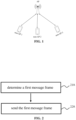
- FIG. 1 is an exemplary diagram illustrating a radio communication scenario.
- a basic service set may consist of multiple stations (STAs).
- the STA may include an access point (AP) device and one or more non-AP devices in communication with the AP device.
- a BSS can be connected to a distribution system (DS) through its AP device, and then connected to another BSS, to form an extended service set (ESS).
- DS distribution system
- the AP device is a wireless switch used for a wireless network, which is also a core of the wireless network.
- the AP device can be used as a wireless base station and is mainly used as a bridge to connect the wireless network to a wired network.
- the wired network and the wireless network can be integrated.
- the AP device may include software applications and/or circuits to enable other types of nodes in the wireless network to communicate with the outside and inside of the wireless network via the AP.
- the AP device may be a terminal device or network device equipped with a Wi-Fi chip.
- the non-AP device may include, but is not limited to: a cellular phone, a smart phone, a wearable device, a computer, a personal digital assistant (PDA), a personal communication system (PCS) device, a personal information manager (PIM), a personal navigation device (PND), a global positioning system, a multimedia device, and an Internet of Things (IoT) device.
- PDA personal digital assistant
- PCS personal communication system
- PIM personal information manager
- PND personal navigation device
- IoT Internet of Things
- an AP device is communicating with three non-AP devices (non-AP 1, non-AP 2, and non-AP 3), which is only an example and is not limited in the embodiments of the disclosure.
- the AP device and the non-AP device may be of any number and/or any type.
- the AP device and the non-AP devices may each be a multi-link device (MLD), and thus the AP device and the non-AP device may be represented as AP MLD and non-AP STA MLD respectively. That is, the AP MLD and the non-AP STA MLD(s) support the function of simultaneously transmitting and/or receiving under multiple links at the same moment. For example, there may be a plurality of links at different frequencies between the AP MLD and the non-AP STA MLD, such as links respectively under 2.4GHz, 5GHz and 6GHz, or links of the same or different bandwidths under 2.4GHz, 5GHz or 6GHz. In addition, a plurality of channels may exist on each link. Communication methods and communication apparatuses according to the embodiments of the disclosure may be applied to the communication between the AP MLD and the non-AP STA MLD, i.e., may be applied to a multi-link communication environment.
- MLD multi-link device
- a single-type resource unit also known as “Resource Unit” and represented by RU hereinafter
- a multi-type resource unit also known as “multiple resource unit” and represented by MRU hereinafter
- OFDMA Orthogonal Frequency Division Multiple Access
- the supported RUs when supporting a maximum of 1k QAM, can be: 26-tone, 52-tone, 106-tone, 242-tone, 484-tone, 996-tone, and 2*996-tone.
- the capability whether 1k QAM can be applied to a RU that is smaller than 242-tone e.g., 26-tone, 52-tone, 106-tone, 242-tone, 484-tone, 996-tone, or 2*996-tone
- a maximum of 4k QAM can be supported and both the RU and the MRU can be applied.
- the RU smaller than 242-tone can be: 26-tone, 52-tone, or 106-tone
- the MRU smaller than 242-tone can be: 52+26-tone or 106+26-tone.
- the capabilities whether 4k can be applied to the RU and the MRU smaller than 242-tone needs to be identified.
- the related art only identifies the cases of the 1k QAM and the RU, which needs to be improved.
- the embodiments of the disclosure mainly focus on describing examples about both the RU and the MRU smaller than 242-tone as well as the 1k QAM and the 4k QAM, which is not limited in the disclosure.
- the communication methods and the communication apparatuses according to the embodiments of the disclosure may also be applied to other types of RUs (e.g., 242-tone, 484-tone, 484+242-tone, 996-tone, 996+484-tone, 996+484+242-tone, 2*996-tone, 2*996+ 484-tone, 3*996-tone, 3*996+484-tone, 4*996-tone, etc.) and other types of QAMs.
- RUs e.g., 242-tone, 484-tone, 484+242-tone, 996-tone, 996+484-tone, 996+484+242-tone, 2*996-tone, 2*996+ 484-tone, 3*996-tone, 3*996+484-tone, 4*996-tone, etc.
- QAMs QAMs
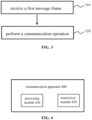
- FIG. 2 is a flowchart illustrating a communication method according to an example embodiment of the disclosure.
- the communication method illustrated in FIG. 2 may be a method performed by a transmitter.
- another communication method described with reference to FIG. 3 is a method performed by a recipient.
- the methods illustrated in the embodiments of FIGS. 2 and 3 may be applied to a multi-link communication, i.e., the transmitter may be any of the AP MLD and the non-AP STA MLD described above, and correspondingly, the other one of the AP MLD and the non-AP STA MLD is the recipient, which is not limited in the disclosure.
- the communication methods depicted in FIGS. 2 and 3 may also be used for communications other than multi-link communication.
- a first message frame is determined.
- the first message frame is determined on any one of the multiple links between the transmitter and the recipient.
- the transmitter may generate the first message frame based on at least one of a network condition, a load condition, a hardware capability of a sending/receiving device, a service type, or an agreement in a relevant protocol, which is not limited in the embodiments of the disclosure.
- the transmitter may obtain the first message frame from an external source, which is not limited in the embodiment of the disclosure.
- the first message frame may be a beacon frame, a probe response frame, an association response frame, or a Re-association response frame. If the transmitter is the non-AP STA MLD, the first message frame may be a probe request frame, an association request frame, or a Re-association request frame. It is understandable that the examples of the first message frame described herein are illustrative only and are not intended to limiting the disclosure. Other types of frames are included within the scope of the disclosure.
- the first message frame includes first information, and the first information is configured to indicate one or more support capabilities of applying a single-type resource unit and/or a multi-type resource unit of a first size to a first type of QAM.
- the first type of QAM is 4096-QAM. That is, the first information may indicate one or more support capabilities of applying the single-type resource unit and/or the multi-type resource unit of the first size to the 4096-QAM.
- the single-type resource unit and/or the multi-type resource unit of the first size may be a resource unit smaller than 242-tone.
- the multi-type resource unit may consist of single-type resource units.
- the multi-type resource unit may consist of two single-type resource units and are related to the bandwidth.
- the multi-type resource unit may at least include: a first single-type resource unit and a second single-type resource unit, the first single-type resource unit has a different number of tones than the second single-type resource unit. That is, the multi-type resource unit may include at least two different single-type resource unit.
- the single-type resource unit i.e., the RU
- the multi-type resource unit i.e., the MRU
- the numerical values of the RU and the MRU described herein are illustrative only and are not intended for limiting. Other feasible RUs and MRUs are included within the scope of this disclosure.
- the first message frame may include second information, and the second information may indicate one or more support capabilities of applying the single-type resource unit and/or the multi-type resource unit of the first size to a second type of QAM.
- the second type of QAM may be 1024-QAM. That is, the second information may indicate one or more support capabilities of applying the single-type resource unit and/or the multi-type resource unit of the first size to the 1024-QAM.
- the single-type resource unit (i.e., the RU) smaller than 242-tone may be 26-tone, 52-tone, or 106-tone
- the multi-type resource unit (i.e., the MRU) smaller than 242-tone may be 52+26-tone, or 106+26-tone.
- the first message frame may carry both the first information and the second information, or may carry either the first information or the second information.
- the first information is set to support applying the single-type resource unit and/or the multi-type resource unit of the first size to the 4096-QAM
- the second information may be set to support applying the single-type resource unit and/or the multi-type resource unit of the first size to the 1024-QAM.
- the second information (for the case of 1024-QAM) may or may not be omitted.
- the first information (for the case of 4096-QAM) and/or the second information (for the case of 1024-QAM) may be included in an extremely high throughput (EHT) physical layer (PHY) capability information element of the first message frame.
- EHT extremely high throughput
- PHY physical layer
- the first message frame may be a beacon frame, a probe response frame, an association response frame, or a re-association response frame.
- the EHT PHY capability information may be encapsulated in the aforementioned frame to be sent by the AP MLD.
- the first message frame is a beacon frame
- an order number of the EHT PHY capability information in a frame body of the beacon frame may be 90, which is only an example and is not limited in the disclosure.
- the first message frame may be a probe request frame, an association request frame, or a re-association request frame.
- the EHT PHY capability information may be encapsulated in the aforementioned frame to be sent by the non-AP STA MLD.
- the first information and/or the second information may be identified in the EHT PHY capability information element, which is only an example and is not limited in the disclosure.
- the first information and/or the second information may also be carried in other information elements.
- the first information and the second information will be described in detail later with reference to Tables 1 to 4.
- the first information may include a first identifier and a second identifier.
- the first identifier is configured to indicate support capabilities of applying the single-type resource unit and the multi-type resource unit of the first size to a reception of the 4096-QAM.
- the second identifier is configured to indicate support capabilities of applying the single-type resource unit and the multi-type resource unit to a transmission of the 4096-QAM.
- the first information can be as shown in Table 1 below. Table 1 Rx 4096-QAM ⁇ 242-tone support Tx 4096-QAM ⁇ 242-tone support
- Rx 4096-QAM ⁇ 242-tone support may correspond to a first identifier, to indicate the one or more support capabilities of applying the single-type resource unit and/or the multi-type resource unit of the first size to the reception of the 4096-QAM.
- the "Rx 4096-QAM ⁇ 242-tone support” may indicate the one or more support capabilities of applying the single-type resource unit smaller than 242-tone and/or the multi-type resource unit smaller than 242-tone to the reception of the 4096-QAM.
- the first identifier i.e., the "Rx 4096-QAM ⁇ 242-tone support”
- a first value e.g., "1”
- the first identifier i.e., the "Rx 4096-QAM ⁇ 242-tone support”
- a second value e.g., "0"
- Tx 4096-QAM ⁇ 242-tone support may correspond to a second identifier, to indicate the support capabilities of applying the single-type resource unit and the multi-type resource unit of the first size to the transmission of the 4096-QAM.
- the "Tx 4096-QAM ⁇ 242-tone support” may indicate the support capabilities of applying the single-type resource unit smaller than 242-tone and the multi-type resource unit smaller than 242-tone to the transmission of the 4096-QAM.
- the second identifier i.e., "Tx 4096-QAM ⁇ 242-tone support”
- a first value e.g., "1”
- the second identifier i.e., the "Tx 4096-QAM ⁇ 242-tone support”
- a second value e.g., "0"
- the second identifier i.e., the "Tx 4096-QAM ⁇ 242-tone support" may be reserved because the AP MLD supports full function by default, i.e., supports all functions.
- one bit may be used to identify the cases of both the RU and the MRU, i.e., both the first identifier and the second identifier in Table 1 may occupy one bit.
- "Rx 4096-QAM ⁇ 242-tone support” may be set to "0" to indicate that the reception of the 4096-QAM (4k QAM) on a subcarrier smaller than 242-tone (e.g., each of 26-tone, 52-tone, 52+26-tone, 106-tone,and 106+26 -tone) is not supported.
- Rx 4096-QAM ⁇ 242-tone support When “Rx 4096-QAM ⁇ 242-tone support” is set to “1", it indicates that the reception of the 4096-QAM (4k QAM) on the subcarrier smaller than 242-tone is supported.
- "Tx 4096-QAM ⁇ 242-tone support” may be set to "0" to indicate that the transmission of the 4096-QAM (4k QAM) on the subcarrier smaller than 242-tone (e.g., each of 26-tone, 52-tone, 52+26-tone, 106-tone, and 106+26-tone) is not supported, in which the "Tx 4096-QAM ⁇ 242-tone support” is reserved for the AP MLD side.
- the "Tx 4096-QAM ⁇ 242-tone support” When the "Tx 4096-QAM ⁇ 242-tone support” is set to "1", it indicates that the transmission of the 4096-QAM (4k QAM) on the subcarrier smaller than 242-tone is not supported.
- the first identifier e.g., "Rx 4096-QAM ⁇ 242-tone support” that occupies one bit
- the second identifier e.g., "Tx 4096-QAM ⁇ 242-tone support” that occupies one bit
- the first identifier and the second identifier that respectively occupy one bit are for illustrative purposes only and are not for limiting the disclosure.
- the first identifier and the second identifier may both occupy a plurality of bits to indicate which resource unit of the resource units smaller than 242-tone is supported for applying to the 4096-QAM.
- the plurality of bits may correspond to the single-type resource units smaller than 242-tone and the multi-type resource units smaller than 242-tone respectively.
- the first identifier e.g., the "Rx 4096-QAM ⁇ 242-tone support" may have three bits.
- the first identifier When the first identifier is set to a value of "001", it indicates that the 26-tone is used for the reception of the 4096-QAM. When the first identifier is set to a value of "011”, it indicates that 52-tone is used for the reception of the 4096-QAM. When the first identifier is set to a value of "010”, it indicates that 106-tone is used for the reception of the 4096-QAM. When the first identifier is set to a value of "100”, it indicates that 26-52-tone is used for the reception of the 4096-QAM. When the first identifier is set to a value of "101”, it indicates that 106-52-tone is used for the reception of the 4096-QAM.
- the above setting examples are only examples and are not limited in the disclosure.
- the first identifier when the first identifier is set to a value of " 111", it indicates that each of single-type resource units smaller than 242-tone and the multi-type resource units smaller than 242-tone may be applied to the reception of the 4096-QAM.
- the above setting examples of the first identifier may also be applied to the second identifier, and repeated descriptions are omitted herein for brevity.
- the first information may be included in the EHT PHY capability information, so that the first identifier (e.g., the "Rx 4096-QAM ⁇ 242-tone support") and the second identifier (e.g., "Tx 4096-QAM ⁇ 242-tone support”) shown in Table 1 may be identification bits in the EHT PHY capability information, and the EHT PHY capability information may be encapsulated in the first message frame as described above.
- the first identifier e.g., the "Rx 4096-QAM ⁇ 242-tone support”
- the second identifier e.g., "Tx 4096-QAM ⁇ 242-tone support”
- the first information may include a third identifier and a fourth identifier.
- the third identifier and the fourth identifier may each include a plurality of bits (e.g., at least two bits).
- at least one bit of the third identifier is configured to indicate a support capability of applying the single-type resource unit of the first size to the reception of the 4096-QAM
- at least one bit of the third identifier is configured to indicate a support capability of applying the multi-type resource unit of the first size to the reception of the 4096-QAM
- at least one bit of the fourth identifier is configured to indicate a support capability of applying the single-type resource unit of the first size to the transmission of the 4096-QAM
- at least one bit of the fourth identifier is configured to indicate a support capability of applying the multi-type resource unit of the first size to the transmission of the 4096-QAM.
- the first information can be as shown in Table 2 below.
- Table 2 Rx 4096-QAM ⁇ 242-tone RU support
- the third identifier of the first information may include the "Rx 4096-QAM ⁇ 242-tone RU support" and the "Rx 4096-QAM ⁇ 242-tone MRU support".
- the third identifier may be defined to occupy two bits, and these two bits may correspond to the "Rx 4096- QAM ⁇ 242-tone RU support” and the "Rx 4096-QAM ⁇ 242-tone MRU support” respectively, in Table 2.
- embodiments of the disclosure are not limited to this.
- the third identifier may occupy more than two bits.
- the "Rx 4096-QAM ⁇ 242-tone RU support" in the third identifier may occupy a plurality of bits to indicate which singlet-type resource unit in the single-type resource units smaller than 242-tone is supported for applying to the reception of the 4096-QAM.
- the "Rx 4096-QAM ⁇ 242-tone MRU support" in the third identifier may occupy a plurality of bits to indicate which multi-type resource unit in the multi-type resource units less than 242-tone is supported for applying to the reception of the 4096-QAM.
- At least one bit of the third identifier may indicate a support capability of applying a single-type resource unit smaller than 242-tone (e.g., 26-tone, 52-tone, or 106-tone) to the reception of the 4096-QAM. If the "Rx 4096-QAM ⁇ 242-tone RU support" is set to a third value (e.g., 1), it indicates that applying the single-type resource unit smaller than 242-tone to the reception of the 4096-QAM is supported. If the "Rx 4096-QAM ⁇ 242-tone RU support” is set to a fourth value (e.g., 0), it indicates that applying the single-type resource unit smaller than 242-tone to the reception of the 4096-QAM is not supported.
- a third value e.g. 1
- a fourth value e.g., 0
- At least one bit of the third identifier may indicate a support capability of applying a multi-type resource unit smaller than 242-tone (e.g., 52+26-tone or 106+26-tone) to the reception of the 4096-QAM. If the "Rx 4096-QAM ⁇ 242-tone MRU support" is set to a third value (e.g., 1), it indicates that applying the multi-type resource unit smaller than 242-tone to the reception of the 4096-QAM is supported. If the "Rx 4096-QAM ⁇ 242-tone MRU support” is set to a fourth value (e.g., 0), it indicates that applying the multi-type resource unit smaller than 242-tone to the reception of the 4096-QAM is not supported.
- a third value e.g., 1
- the third identifier may have a plurality of bits to separately identify the RU and the MRU.
- the fourth identifier of the first information may include the "Tx 4096-QAM ⁇ 242-tone RU support" and the "Tx 4096-QAM ⁇ 242-tone MRU support".
- the fourth identifier may be defined to occupy two bits, and these two bits may correspond to the "Tx 4096- QAM ⁇ 242-tone RU support” and the "Tx 4096-QAM ⁇ 242-tone MRU support” in Table 2 respectively.
- embodiments of the disclosure are not limited to this.
- the fourth identifier may have more than two bits.
- the "Tx 4096-QAM ⁇ 242-tone RU support" in the fourth identifier may occupy a plurality of bits to indicate which single-type resource unit in the single-type resource units smaller than 242-tone is supported for applying to the transmission of the 4096-QAM.
- the "Tx 4096-QAM ⁇ 242-tone MRU support" in the fourth identifier may have a plurality of bits to indicate which multi-type resource unit in the multi-type resource units smaller than 242-tone is supported for applying to the transmission of the 4096-QAM.
- At least one bit of the fourth identifier may indicate a support capability of applying the single-type resource unit smaller than 242-tone (e.g., 26-tone, 52-tone, or 106-tone) to the transmission of the 4096-QAM. If the "Tx 4096-QAM ⁇ 242-tone RU support' is set to a third value (e.g., 1), it indicates that applying the single-type resource unit smaller than 242-tone to the transmission of the 4096-QAM is supported. If the "Tx 4096-QAM ⁇ 242-tone RU support” is set to a fourth value (e.g., 0), it indicates that applying the single-type resource unit smaller than 242-toneto the transmission of the 4096-QAM is not supported.
- a third value e.g. 1
- At least one bit of the fourth identifier may indicate a support capability of applying a multi-type resource unit smaller than 242-tone (e.g., 52+26-tone or 106+26-tone) to the transmission of the 4096-QAM. If the "Tx 4096-QAM ⁇ 242-tone MRU support" is set to a third value (e.g., 1), it indicates that applying the multi-type resource unit smaller than 242-tone to the transmission of the 4096-QAM is supported. If the "Tx 4096-QAM ⁇ 242-tone MRU support” is set to a fourth value (e.g., 0), it indicates that applying the multi-type resource unit smaller than 242-tone to the transmission of the 4096-QAM is not supported.
- a third value e.g., 1
- the fourth identifier may occupy a plurality of bits to separately identify the RU and the MRU.
- the fourth identifier (the "Tx 4096-QAM ⁇ 242-tone RU support" and the "Tx 4096-QAM ⁇ 242-tone MRU support”) may be reserved.
- two bits may be used to identify the cases of the RU and the MRU respectively, which include: a subdomain setting of the "Rx 4096-QAM ⁇ 242-tone RU support", a subdomain setting of the "Rx 4096-QAM ⁇ 242-tone MRU support", a subdomain setting of the "Tx 4096-QAM ⁇ 242-tone RU support” and a subdomain setting of the "Tx 4096-QAM ⁇ 242-tone MRU support”.
- the examples of the third identifier and the fourth identifier both occupying two bits are for illustrative purpose only and are not limited in the disclosure.
- the first information may be included in the EHT PHY capability information.
- the third identifier (the "Rx 4096-QAM ⁇ 242-tone RU support” and the “Rx 4096-QAM ⁇ 242-tone MRU support") and the fourth identifier (the "Tx 4096-QAM ⁇ 242- tone RU support” and the "Tx 4096-QAM ⁇ 242-tone MRU support”) in Table 2 may be identification bits in the EHT PHY capability information, and the EHT PHY capability information may be encapsulated in the first message frame as described above.
- the second information may include a fifth identifier and a sixth identifier.
- the fifth identifier is configured to indicate support capabilities of applying the single-type resource unit and the multi-type resource unit of the first size to the reception of the 1024-QAM
- the sixth identifier is configured to indicate support capabilities of applying the single-type resource unit and the multi-type resource unit of the first size to the transmission of the 1024-QAM.
- the second information can be as shown in Table 3 below. Table 3 Rx 1024-QAM ⁇ 242-tone support Tx 1024-QAM ⁇ 242-tone support
- the "Rx 1024-QAM ⁇ 242-tone support” may correspond to the fifth identifier, to indicate the support capabilities of applying the single-type resource unit and the multi-type resource unit smaller than 242-tone to the reception of the 1024-QAM.
- the "Tx 1024-QAM ⁇ 242-tone support” may correspond to the sixth identifier, to indicate the support capabilities of applying the single-type resource unit and the multi-type resource unit smaller than 242-tone to the transmission of the1024-QAM.
- the values of the fifth identifier and the sixth identifier shown in Table 3 may be set in a manner similar to setting the values of the first identifier and the second identifier shown in Table 1 respectively, and repetitive descriptions are omitted herein for the sake of brevity.
- the transmitter is an AP (e.g., AP MLD)
- the sixth identifier (Tx 1024-QAM ⁇ 242-tone support) may be reserved, because the AP MLD supports full function by default, i.e., supports all functions.
- the fifth identifier e.g., the "Rx 1024-QAM ⁇ 242-tone support” having one bit
- the sixth identifier e.g., the "Tx 1024-QAM ⁇ 242-tone support” having one bit
- the sixth identifier may be utilized to indicate the support capabilities of applying the single-type resource unit smaller than 242-tone and the multi-type resource unit smaller than 242-tone.
- the examples of the fifth identifier and the sixth identifier each occupying one bit are for illustrative purpose only and are not used to limit the disclosure.
- the fifth identifier and the sixth identifier may each have a plurality of bits to indicate which resource unit in the resource units smaller than 242-tone is supported for applying to the 1024-QAM.
- the embodiments described above with reference to Table 1 in which the first identifier and the second identifier occupy a plurality of bits may be similarly applied to Table 3, and repetitive descriptions are omitted for the sake of brevity.
- the second information may be included in the EHT PHY capability information, so that the fifth identifier (e.g., the "Rx 1024-QAM ⁇ 242-tone support") and the sixth identifier (e.g., the "Tx 1024-QAM ⁇ 242-tone support”) shown in Table 3 may be identification bits in the EHT PHY capability information, and the EHT PHY capability information may be encapsulated in the first message frame as described above.
- the fifth identifier e.g., the "Rx 1024-QAM ⁇ 242-tone support”
- the sixth identifier e.g., the "Tx 1024-QAM ⁇ 242-tone support
- the second information may include a seventh identifier and an eighth identifier.
- the seventh identifier and the eighth identifier may each include a plurality of bits (e.g., at least two bits).
- at least one bit of the seventh identifier may indicate a support capability of applying the single-type resource unit of the first size to the reception of the 1024-QAM
- at least one bit of the seventh identifier may indicate a support capability of applying the multi-type resource unit of the first size to the reception of the 1024-QAM
- at least one bit of the eighth identifier may indicate a support capability of applying the single-type resource unit of the first size to the transmission of the 1024 -QAM
- at least one bit of the eighth identifier may indicate a support capability of applying the multi-type resource unit of the first size to the transmission of the 1024-QAM.
- the second information can be as shown in Table 4 below.
- Table 4 Rx 1024-QAM ⁇ 242-tone RU support Rx 1024-QAM ⁇ 242-tone MRU support Tx 1024-QAM ⁇ 242-tone RU support Tx 1024-QAM ⁇ 242-tone MRU support
- the "Rx 1024-QAM ⁇ 242-tone RU support” and the “Rx 1024-QAM ⁇ 242-tone MRU support” may correspond to the seventh identifier of the second information. That is, for the reception of the 1024-QAM, the seventh identifier may have a plurality of bits to identify the single-type resource unit and the multi-type resource unit respectively.
- the "Tx 1024-QAM ⁇ 242-tone RU support” and the "Tx 1024-QAM ⁇ 242-tone MRU support” may correspond to the eighth identifier of the second information. That is, for the transmission of the 1024-QAM, the eighth identifier may have a plurality of bits to identify the single-type resource unit and the multi-type resource unit respectively.
- each of the seventh identifier and the eighth identifier may be defined to occupy two bits, i.e., each subdomain shown in Table 4 may have 1 bit, which is not limited in the disclosure.
- the seventh identifier and the eighth identifier may each have more than two bits.
- the values of the seventh identifier and the eighth identifier shown in Table 4 may be set in a setting manner similar to that of the third identifier and the fourth identifier shown in Table 2, respectively, and repetitive descriptions are omitted herein for the sake of brevity.
- the eighth identifier e.g., the "Tx 1024-QAM ⁇ 242-tone RU support" and the "Tx 1024-QAM ⁇ 242-tone MRU support" may be reserved.
- two bits may be used to identify the cases of the single-type resource unit and the multi-type resource unit respectively, which include: a subdomain setting of the "Rx 1024-QAM ⁇ 242-tone RU support", a subdomain setting of the "Rx 1024-QAM ⁇ 242-tone MRU support", a subdomain setting of the "Tx 1024-QAM ⁇ 242-tone RU support", and a subdomain setting of the "Tx 1024-QAM ⁇ 242-tone MRU support”.
- the examples of the seventh identifier and the eighth identifier both occupying two bits in Table 4 are for illustrative purpose only and are not used to limit the disclosure.
- the "Rx 1024-QAM ⁇ 242-tone RU support" in the seventh identifier may have multiple bits to indicate which single-type resource unit in the single-type resource units smaller than 242-tone is supported for applying to the reception of the 1024-QAM.
- the "Rx 1024-QAM ⁇ 242-tone MRU support” in the seventh identifier may have multiple bits to indicate which multi-type resource unit in the multi-type resource units smaller than 242-tone is supported for applying to the reception of the 1024-QAM.
- the "Tx 1024-QAM ⁇ 242-tone RU support” and the "Tx 1024-QAM ⁇ 242-tone MRU support” in the eighth identifier may each have a plurality of bits.
- the second information may be included in the EHT PHY capability information, and the seventh identifier (e.g., the "Rx 1024-QAM ⁇ 242-tone RU support” and the "Rx 1024-QAM ⁇ 242-tone MRU support") and the eighth identifier (e.g., the "Tx 1024-QAM ⁇ 242- tone RU support” and the "Tx 1024-QAM ⁇ 242-tone MRU support”) may be identification bits in the EHT PHY capability information, and the EHT PHY capability information may be encapsulated in the first message frame as described above.
- the seventh identifier e.g., the "Rx 1024-QAM ⁇ 242-tone RU support” and the "Rx 1024-QAM ⁇ 242-tone MRU support
- the eighth identifier e.g., the "Tx 1024-QAM ⁇ 242- tone RU support” and the "Tx 1024-QAM ⁇ 242-tone MRU support
- the EHT PHY capability information may be encapsulated
- a highly effective (HE) PHY capability information element of the first message frame may be reused to indicate the "Rx 1024-QAM ⁇ 242-tone RU support" in the seventh identifier and the "1024-QAM ⁇ 242-tone RU support” in the eighth identifier. That is, a plurality of bits of the seventh identifier may be included in different capability information elements.
- the bit(s) corresponding to the "Rx 1024-QAM ⁇ 242-tone MRU support" in the seventh identifier may be included in the EHT PHY capability information, while the bit(s) corresponding to the "Rx 1024-QAM ⁇ 242-tone RU support" in the seventh identifier may be included in the HE PHY capability information.
- a plurality of bits of the eighth identifier may be included in different capability information elements, and repetitive descriptions are omitted herein for brevity.
- the second information shown in Tables 3 and 4 may be set to indicate to support applying the single-type resource unit and/or the multi-type resource unit of the first size to the 1024-QAM. That is, for the reception and the transmission of the 4096-QAM, the identifier for indicating support for the 4096-QAM may also indirectly indicate support for the 1024-QAM.
- the first information of the first message frame may indicate not only the support capabilities of applying the single-type resource unit and/or the multi-type resource unit of the first size to the 4096-QAM, but also the support capabilities of the single-type resource unit and/or the multi-type resource unit of the first size to the 1024-QAM.
- the first information shown in Table 1 may be changed to be that in Table 5, or the first information may include both included in Table 1 and Table 5.
- the information shown in Table 5 may be included in the EHT PHY capability information element of the first message frame.
- Table 5 Rx 4096-QAM& 1024-QAM ⁇ 242-tone support Tx 4096-QAM& 1024-QAM ⁇ 242-tone support
- the identifier corresponding to the "Rx 4096-QAM& 1024-QAM ⁇ 242-tone support” may indicate the support capabilities of applying the resource units (including the RU and the MRU) smaller than 242-tone to the reception of the 4096-QAM and the 1024-QAM. For example, if this identifier is set to 1, it indicates that all resource units smaller than 242-tone (including all RUs and MRUs smaller than 242-tone) are supported for applying to the 4096-QAM and the 1024-QAM. If this identifier is set to 0, it indicates that none of resource units smaller than 242-tone is supported for applying to the reception of the 4096-QAM and the 1024-QAM.
- the identifier corresponding to the "Tx 4096-QAM & 1024-QAM ⁇ 242-tone support” may indicate the support capabilities of applying resource units (including the RUs and the MRUs) smaller than 242-tone to the transmission of the 4096-QAM and the 1024-QAM. For example, if this identifier is set to 1, it indicates that all resource units smaller than 242-tone (including the RUs and the MRUs smaller than 242-tone) are supported for applying to the transmission of the 4096-QAM and the 1024-QAM. If this identifier is set to 0, it indicates that none of resource units smaller than 242-tone (including the RUs and the MRUs smaller than the 242-tone) is supported for applying to the transmission of the 4096-QAM and the 1024-QAM.
- one bit may be used to simultaneously identify the support capabilities of applying the resource units to both the 4096-QAM and the 1024-QAM, which is only an example and is not limited in the disclosure.
- both the "Tx 4096-QAM & 1024-QAM ⁇ 242-tone support" and the "Tx 4096-QAM & 1024-QAM ⁇ 242-tone support” described in Table 5 may each have a plurality of bits to indicate which single-type resource unit in the single-type resource units smaller than 242-tone is supported for applying to the 4096-QAM and the 1024-QAM.
- the identifiers shown in Table 5 may be combined or integrated with the embodiments described above with reference to Tables 1 to 4, and repetitive descriptions are omitted herein for the sake of brevity.
- each of the elements in Tables 1 to 4 of the disclosure is independent, and the elements are listed in the same table as an example, but that does not mean that all of the elements in the table must exist at the same time as shown in the table.
- the value of each of these elements is independent of any other element value in Tables 1 to 4. Therefore, it is understandable by those skilled in the art that the value of each element in Tables 1 to 4 of the disclosure is an independent embodiment.
- the first message frame is sent.
- the link used to send the first message frame may be the same as or different from the link used to determine the first message frame at block 210, which is not limited in the disclosure.
- the transmitter may notify the recipient of its capability information by sending the first message frame carrying the first information and/or the second information to the recipient, thereby enabling the transmitter and the recipient to communicate with each other according to the corresponding capabilities.
- FIG. 3 is a flowchart illustrating another communication method according to an example embodiment of the disclosure.
- the communication method in FIG. 3 may be a method performed by the recipient.
- the recipient may be one of the non-AP STA MLD and the AP MLD described above.
- a first message frame is received.
- the recipient may receive the first message frame on any of the multiple links.
- the first message frame may include first information, and the first information may indicate one or more support capabilities of applying a single-type resource unit and/or a multi-type resource unit of a first size to a 4096-QAM.
- the single-type resource unit and/or the multi-type resource unit of the first size may be a resource unit smaller than 242-tone.
- the first information may include a first identifier and a second identifier.
- the first identifier is configured to indicate one or more support capabilities of applying the single-type resource unit and/or the multi-type resource unit of the first size to the reception of the 4096-QAM
- the second identifier is configured to indicate one or more support capabilities of applying the single-type resource unit and/or the multi-type resource unit of the first size to the transmission of the 4096-QAM.
- the embodiment may be similar to the embodiment described above in Table 1, and repetitive descriptions are omitted herein for brevity.
- the first information may include a third identifier and a fourth identifier.
- Both the third identifier and the fourth identifier may have a plurality of bits.
- at least one bit of the third identifier is configured to indicate a support capability of applying the single-type resource unit of the first size to the reception of the 4096-QAM
- at least one bit of the third identifier is configured to indicate a support capability of applying the multi-type resource unit of the first size to the reception of the 4096-QAM
- at least one bit of the fourth identifier is configured to indicate a support capability of applying the single-type resource unit of the first size to the transmission of the 4096 -QAM
- at least one bit of the fourth identifier is configured to indicate a support capability of applying the multi-type resource unit of the first size to the transmission of the 4096-QAM.
- the embodiment may be similar to the embodiment described above in Table 2, and repetitive descriptions are omitted herein for brevity.
- the first message frame may also include second information.
- the second information may indicate one or more support capabilities of applying the single-type resource unit and/or the multi-type resource unit of the first size to the 1024-QAM.
- the second information includes a fifth identifier and a sixth identifier.
- the fifth identifier is configured to indicate support capabilities of applying the single-type resource unit and the multi-type resource unit of the first size to the reception of the 1024-QAM
- the sixth identifier is configured to indicate support capabilities of applying the single-type resource unit and the multi-type resource unit of the first size to the transmission of the 1024-QAM.
- the embodiment may be similar to the embodiment described above in Table 3, and repetitive descriptions are omitted herein for brevity.
- the second information may include a seventh identifier and an eighth identifier.
- the seventh identifier and the eighth identifier may each have a plurality of bits.
- at least one bit of the seventh identifier is configured to indicate a support capability of applying the single-type resource unit of the first size to the reception of the 1024-QAM
- at least one bit of the seventh identifier is configured to indicate a support capability of applying the multi-type resource unit of the first size to the reception of the 1024-QAM
- at least one bit of the eighth identifier is configured to indicate a support capability of applying the single-type resource unit of the first size to the transmission of the 1024 -QAM
- at least one bit of the eighth identifier is configured to indicate a support capability of applying the multi-type resource unit of the first size to the transmission of the 1024-QAM.
- the embodiment may be similar to the embodiment described above in Table 4, and repetitive descriptions are omitted herein for brevity.
- the second information is set to indicate to support applying the single-type resource unit and/or the multi-type resource unit of the first size to the 1024-QAM.
- the embodiment described above with reference to Table 5 may be applied herein, and repetitive descriptions are omitted herein for the sake of brevity.
- the recipient may be informed of the support capabilities of applying the resource units to both the 4096-QAM and the 1024-QAM by analyzing the first information.
- the first information and/or the second information is included in the EHT PHY capability information of the first message frame.
- a communication operation is performed based on the first message frame.
- the recipient may analyze or parse the first information and/or the second information carried in the first message frame to obtain the capability information of the transmitter, so as to select appropriate communication resources, modulation modes, and/or communication schemes to perform the communication operation.
- the communication method described with reference to FIGS. 2 and 3 may identify the support capabilities of applying the single-type resource unit and the multi-type resource unit to the 4096-QAM and 1024-QAM, thereby improving the spectrum utilization.
- FIG. 4 is a block diagram illustrating a communication apparatus according to an example embodiment of the disclosure.
- the communication apparatus illustrated in FIG. 4 may be applied to a MLD, such as an AP MLD or a non-AP STA MLD, which is only an example and is not used to limit the disclosure.
- a MLD such as an AP MLD or a non-AP STA MLD, which is only an example and is not used to limit the disclosure.
- the communication apparatus 400 may include a processing module 410 and a transceiver module 420.
- the communication apparatus illustrated in FIG. 4 may be applied to the transmitter to perform the method illustrated in FIG. 2 .
- the communication apparatus illustrated in FIG. 4 may be applied to the recipient to perform the method illustrated in FIG. 3 .
- the communication apparatus 400 illustrated in FIG. 4 may be applied to the transmitter.
- the processing module 410 is configured to: determine a first message frame.
- the first message frame includes first information, and the first information is configured to indicate one or more support capabilities of a single-type resource unit and/or a multi-type resource unit of a first size to the 4096-QAM.
- the transceiver module 420 is configured to: send the first message frame.
- the first message frame may include second information, and the second information is configured to indicate one or more support capabilities of applying the single-type resource unit and/or the multi-type resource unit of the first size to the 1024-QAM. That is, the communication apparatus 400 may perform the communication method described with reference to FIG.
- the first information and the second information may be similar to the embodiments described above with reference to Tables 1 and 4. Furthermore, the embodiment described with reference to Table 5 may also be applied to the embodiment of FIG. 4 , and repetitive descriptions are omitted herein for the sake of brevity.
- the communication apparatus 400 illustrated in FIG. 4 is applied to the recipient.
- the transceiver module 420 is configured to receive the first message frame.
- the first message frame may include first information, and the first information is configured to indicate one or more support capabilities of applying the single-type resource unit and/or the multi-type resource unit of the first size to the 4096-QAM.
- the processing module 410 may be configured to: perform a communication operation based on the first message frame.
- the processing module 410 may control the transceiver module 420 to perform a communication operation based on the first message frame.
- the processing module 410 may analyze or parse the first information and/or the second information carried in the first message frame to obtain the capability information of the transmitter, so as to select an appropriate communication resource, modulation mode, and/or communication scheme to perform the communication.
- the first message frame may also include second information, and the second information is configured to indicate one or more support capabilities of applying the single-type resource unit and/or the multi-type resource unit of the first size to the 1024-QAM.
- the communication apparatus 400 may perform the communication method described with reference to FIG. 3 , and the first information and the second information may be similar to the embodiments described above with reference to Tables 1 and 4.
- the embodiment described with reference to Table 5 may also be applied to the embodiment of FIG. 4 , and repetitive descriptions are omitted herein for the sake of brevity.
- the communication apparatus 400 illustrated in FIG. 4 is merely an example and is not limited in the embodiment of the disclosure.
- the communication apparatus 400 may include other modules, such as, for example, a memory module and the like.
- modules in the multi-link communication apparatus 400 may be combined into more complex modules or may be divided into more separate modules.
- the communication apparatus 400 of the embodiment of the disclosure may identify the support capabilities of applying the single-type resource unit and the multi-type resource unit to the 4096-QAM and the 1024-QAM, thereby improving the spectrum utilization.
- the embodiment of the disclosure also provides an electronic device including a processor and a memory.
- the memory stores machine-readable instructions (which may also be referred to as "computer program"), and the processor is configured to execute the machine-readable instructions to perform the method described with reference to FIGS. 2 and 3 .
- the embodiment of the disclosure also provide a computer-readable storage medium, having a computer program stored thereon.
- the computer program is executed by a processor, the method described with reference to FIGS. 2 and 3 is performed.
- the processor may be a logic box, a module or a circuit for implementing or executing various embodiments described in the disclosure, for example, a central processing unit (CPU), a general processor, a digital signal processor (DSP), an application specific integrated circuit (ASIC), a field programmable gate array (FPGA), or other programmable logic devices, transistor logic devices, hardware components or any combination thereof.
- the processor may also be a combination used to implement a computing function, for example, a combination consisting of one or more microprocessors, and a combination consisting of DSPs and microprocessors.
- the memory may be, for example, a read only memory (ROM), a random access memory (RAM), an electrically erasable programmable read only memory (EEPROM), a compact disc read only memory (CD-ROM) or other optical disc memories, optical disk memories (including compact disc, laser disc, CD-ROM, digital general disc, and Blu-ray disc), disk storage mediums or other magnetic storage devices, or any other medium that can be used to carry or store program codes in the form of instructions or data structures and can be accessed by a computer, which is not limited herein.
- steps in the flowchart of the accompanying drawings are shown in sequence as indicated by arrows, these steps are not necessarily executed in sequence as indicated by the arrows. Unless clearly indicated in the context otherwise, the sequence of execution of these steps is not strictly limited, and these steps can be executed in other sequence.
- at least part of the steps in the flowchart of the accompanying drawings may include a plurality of sub-steps or stages. These sub-steps or stages are not necessarily completed at the same moment, but can be executed at different moments, and these sub-steps or stages are not necessarily performed sequentially, but can be executed alternately or alternatively with other steps or at least part of sub-steps or stages of the other steps.
Landscapes
- Engineering & Computer Science (AREA)
- Signal Processing (AREA)
- Computer Networks & Wireless Communication (AREA)
- Mobile Radio Communication Systems (AREA)
Applications Claiming Priority (1)
| Application Number | Priority Date | Filing Date | Title |
|---|---|---|---|
| PCT/CN2021/078228 WO2022178854A1 (zh) | 2021-02-26 | 2021-02-26 | 通信方法和通信设备 |
Publications (3)
| Publication Number | Publication Date |
|---|---|
| EP4301084A1 true EP4301084A1 (de) | 2024-01-03 |
| EP4301084A4 EP4301084A4 (de) | 2024-04-17 |
| EP4301084B1 EP4301084B1 (de) | 2025-12-17 |
Family
ID=83047669
Family Applications (1)
| Application Number | Title | Priority Date | Filing Date |
|---|---|---|---|
| EP21927290.3A Active EP4301084B1 (de) | 2021-02-26 | 2021-02-26 | Kommunikationsverfahren und kommunikationsvorrichtung |
Country Status (8)
| Country | Link |
|---|---|
| US (1) | US12593316B2 (de) |
| EP (1) | EP4301084B1 (de) |
| JP (1) | JP7610022B2 (de) |
| KR (1) | KR20230146650A (de) |
| CN (1) | CN115336385B (de) |
| BR (1) | BR112023017066A2 (de) |
| ES (1) | ES3060131T3 (de) |
| WO (1) | WO2022178854A1 (de) |
Families Citing this family (2)
| Publication number | Priority date | Publication date | Assignee | Title |
|---|---|---|---|---|
| WO2025091260A1 (zh) * | 2023-10-31 | 2025-05-08 | 北京小米移动软件有限公司 | 通信方法、站点设备、接入点设备及通信系统 |
| CN121532967A (zh) * | 2024-04-26 | 2026-02-13 | 北京小米移动软件有限公司 | 信息标识方法、信息接收方法、通信设备及通信系统 |
Family Cites Families (27)
| Publication number | Priority date | Publication date | Assignee | Title |
|---|---|---|---|---|
| US9634878B1 (en) * | 2011-09-08 | 2017-04-25 | See Scan, Inc. | Systems and methods for data transfer using self-synchronizing quadrature amplitude modulation (QAM) |
| KR102091855B1 (ko) * | 2013-03-14 | 2020-03-20 | 삼성전자주식회사 | 다수 톤 주파수 직각 진폭 변조를 사용하는 무선 통신 시스템에서 심볼 매핑 방법 및 장치 |
| WO2014176255A1 (en) * | 2013-04-22 | 2014-10-30 | Huawei Technologies Co., Ltd. | Allocating orthogonal frequency-division multiple access (ofdma) resources in data over cable services interface specifications (docsis) networks |
| US10412744B2 (en) | 2014-08-21 | 2019-09-10 | Lg Electronics Inc. | Data transmission method in wireless communication system, and apparatus therefor |
| US10225041B2 (en) * | 2016-01-15 | 2019-03-05 | Qualcomm Incorporated | Methods and apparatus for higher modulation support in LTE |
| JP6583535B2 (ja) * | 2016-03-11 | 2019-10-02 | 日本電気株式会社 | 無線lanシステム、無線lan基地局、無線lan端末、通信方法 |
| EP3479642A4 (de) * | 2016-07-07 | 2020-01-08 | LG Electronics Inc. -1- | Verfahren und vorrichtung zur zuordnung zwischen einer station und einem zugangspunkt in einem drahtloskommunikationssystem |
| US10785706B2 (en) * | 2017-10-16 | 2020-09-22 | Qualcomm Incorporated | Bandwidth signaling for a basic service set (BSS) supporting 320 MHZ operating bandwidth |
| US11109278B2 (en) * | 2017-10-20 | 2021-08-31 | Qualcomm Incorporated | Multiplexing clients of different generations in trigger-based transmissions |
| CN108270715B (zh) * | 2017-12-21 | 2020-09-15 | 西安电子科技大学 | 适合高阶4096-qam的载波恢复系统和方法 |
| US10530441B2 (en) * | 2018-02-20 | 2020-01-07 | Intel Corporation | Transport block selection for 1024 quadrature amplitude modulation (QAM) |
| US11452098B2 (en) * | 2018-04-20 | 2022-09-20 | Qualcomm Incorporated | Dual band channel bonding and puncturing |
| US11272490B2 (en) * | 2018-06-01 | 2022-03-08 | Qualcomm Incorporated | Techniques for control signaling in extreme high throughput environments |
| US11160084B2 (en) * | 2018-07-05 | 2021-10-26 | Qualcomm Incorporated | Supporting 320 MHz operating BW |
| JP7397577B2 (ja) | 2019-02-28 | 2023-12-13 | キヤノン株式会社 | 通信装置、情報処理装置、通信方法、及び、プログラム |
| CN111669824B (zh) * | 2019-03-08 | 2024-12-03 | 华为技术有限公司 | 应用于无线通信系统的通信方法和通信装置 |
| US11343035B2 (en) * | 2019-03-11 | 2022-05-24 | Intel Corporation | Coding over multiple resource units (RU) in extremely high throughput (EHT) systems |
| CN111865847B (zh) * | 2019-04-30 | 2021-11-30 | 华为技术有限公司 | 数据传输方法及装置 |
| CN117880991B (zh) * | 2019-05-20 | 2025-02-18 | 华为技术有限公司 | 资源分配的指示方法及装置 |
| US12323345B2 (en) * | 2019-06-10 | 2025-06-03 | Mediatek Singapore Pte. Ltd. | Aggregated resource unit transmission scheme for single station allocation in WLAN |
| US11115163B2 (en) * | 2019-08-09 | 2021-09-07 | Newracom Inc. | Enhanced resource unit allocation in wireless local area network |
| US12284631B2 (en) * | 2019-12-05 | 2025-04-22 | Lg Electronics Inc. | Technique for allocating resource unit in wireless communication system |
| US11212777B2 (en) * | 2019-12-27 | 2021-12-28 | Intel Corporation | Dynamic resource unit allocation for wireless local-area networks (WLANs) |
| AU2020420882B2 (en) * | 2020-01-10 | 2024-03-28 | Huawei Technologies Co., Ltd. | Resource allocation signaling in a wireless local area network preamble |
| US11722354B2 (en) * | 2020-07-27 | 2023-08-08 | Nxp Usa, Inc. | EHT capability design for PPE threshold |
| JP7700215B2 (ja) * | 2020-09-03 | 2025-06-30 | エルジー エレクトロニクス インコーポレイティド | 無線LANシステムにおける20MHzでのみ操作するSTAに対してRU及びMRUを制限してリソースを割り当てる方法及び装置 |
| CN114143877A (zh) * | 2020-09-04 | 2022-03-04 | 华为技术有限公司 | 资源单元指示方法、接入点及站点 |
-
2021
- 2021-02-26 US US18/547,165 patent/US12593316B2/en active Active
- 2021-02-26 WO PCT/CN2021/078228 patent/WO2022178854A1/zh not_active Ceased
- 2021-02-26 EP EP21927290.3A patent/EP4301084B1/de active Active
- 2021-02-26 BR BR112023017066A patent/BR112023017066A2/pt unknown
- 2021-02-26 ES ES21927290T patent/ES3060131T3/es active Active
- 2021-02-26 KR KR1020237032421A patent/KR20230146650A/ko active Pending
- 2021-02-26 JP JP2023550545A patent/JP7610022B2/ja active Active
- 2021-02-26 CN CN202180000509.4A patent/CN115336385B/zh active Active
Also Published As
| Publication number | Publication date |
|---|---|
| CN115336385B (zh) | 2023-10-03 |
| JP2024507252A (ja) | 2024-02-16 |
| US20240323923A1 (en) | 2024-09-26 |
| WO2022178854A1 (zh) | 2022-09-01 |
| CN115336385A (zh) | 2022-11-11 |
| ES3060131T3 (en) | 2026-03-25 |
| US12593316B2 (en) | 2026-03-31 |
| EP4301084B1 (de) | 2025-12-17 |
| KR20230146650A (ko) | 2023-10-19 |
| EP4301084A4 (de) | 2024-04-17 |
| JP7610022B2 (ja) | 2025-01-07 |
| BR112023017066A2 (pt) | 2023-11-21 |
Similar Documents
| Publication | Publication Date | Title |
|---|---|---|
| JP2025128319A (ja) | ワイヤレスローカルエリアネットワークにおいてマルチリンクデバイスに適用される通信方法および装置 | |
| EP4258737A1 (de) | Kommunikationsverfahren und kommunikationsvorrichtung unter mehreren verbindungen | |
| EP4376541A1 (de) | Mehrverbindungskommunikationsverfahren und kommunikationsvorrichtung | |
| EP4170950A1 (de) | Kommunikationsverfahren und -vorrichtung, elektronische vorrichtung und computerlesbares speichermedium | |
| US12593316B2 (en) | Communication method and communication device | |
| EP4277435A1 (de) | Kommunikationsverfahren und kommunikationsvorrichtung | |
| EP4277358A1 (de) | Kommunikationsverfahren und kommunikationsvorrichtung | |
| EP4258713A1 (de) | Kommunikationsverfahren und kommunikationsvorrichtung unter mehreren verbindungen | |
| CN115119533A (zh) | 通信方法和通信设备 | |
| EP4243527A1 (de) | Kommunikationsverfahren und kommunikationsvorrichtung unter mehrfachverbindung | |
| US12520248B2 (en) | Communication method and electronic device | |
| CN115643820B (zh) | 通信方法和通信装置 | |
| US20240334484A1 (en) | Communication methods and communication apparatuses | |
| CN114830706B (zh) | 通信方法和通信设备 | |
| US20240251333A1 (en) | Signal processing method and apparatus, electronic device, and storage medium | |
| US20240098812A1 (en) | Method for communication under multiple links, electronic apparatus, and non-transitory computer-readable storage medium | |
| EP4325990A1 (de) | Kommunikationsverfahren und kommunikationsvorrichtung unter mehreren verbindungen | |
| RU2826695C1 (ru) | Способ связи и устройство связи | |
| JP2024500170A (ja) | マルチ接続における通信方法と通信機器 | |
| JP7656074B2 (ja) | 通信方法及び通信装置 | |
| RU2822504C1 (ru) | Способ и устройство связи с использованием множества линий связи | |
| CN115553014B (zh) | 多连接下的通信方法和通信装置 |
Legal Events
| Date | Code | Title | Description |
|---|---|---|---|
| STAA | Information on the status of an ep patent application or granted ep patent |
Free format text: STATUS: THE INTERNATIONAL PUBLICATION HAS BEEN MADE |
|
| PUAI | Public reference made under article 153(3) epc to a published international application that has entered the european phase |
Free format text: ORIGINAL CODE: 0009012 |
|
| STAA | Information on the status of an ep patent application or granted ep patent |
Free format text: STATUS: REQUEST FOR EXAMINATION WAS MADE |
|
| 17P | Request for examination filed |
Effective date: 20230925 |
|
| AK | Designated contracting states |
Kind code of ref document: A1 Designated state(s): AL AT BE BG CH CY CZ DE DK EE ES FI FR GB GR HR HU IE IS IT LI LT LU LV MC MK MT NL NO PL PT RO RS SE SI SK SM TR |
|
| REG | Reference to a national code |
Ref country code: DE Ipc: H04L0005000000 Ref country code: DE Ref legal event code: R079 Ref document number: 602021044792 Country of ref document: DE Free format text: PREVIOUS MAIN CLASS: H04W0084120000 Ipc: H04L0005000000 |
|
| A4 | Supplementary search report drawn up and despatched |
Effective date: 20240315 |
|
| RIC1 | Information provided on ipc code assigned before grant |
Ipc: H04L 27/34 20060101ALI20240311BHEP Ipc: H04W 72/04 20090101ALI20240311BHEP Ipc: H04W 84/12 20090101ALI20240311BHEP Ipc: H04L 5/00 20060101AFI20240311BHEP |
|
| DAV | Request for validation of the european patent (deleted) | ||
| DAX | Request for extension of the european patent (deleted) | ||
| GRAP | Despatch of communication of intention to grant a patent |
Free format text: ORIGINAL CODE: EPIDOSNIGR1 |
|
| STAA | Information on the status of an ep patent application or granted ep patent |
Free format text: STATUS: GRANT OF PATENT IS INTENDED |
|
| RIC1 | Information provided on ipc code assigned before grant |
Ipc: H04L 5/00 20060101AFI20250605BHEP Ipc: H04W 84/12 20090101ALI20250605BHEP Ipc: H04W 72/04 20230101ALI20250605BHEP Ipc: H04L 27/34 20060101ALI20250605BHEP |
|
| INTG | Intention to grant announced |
Effective date: 20250714 |
|
| P01 | Opt-out of the competence of the unified patent court (upc) registered |
Free format text: CASE NUMBER: UPC_APP_1471_4301084/2025 Effective date: 20250730 |
|
| GRAS | Grant fee paid |
Free format text: ORIGINAL CODE: EPIDOSNIGR3 |
|
| GRAA | (expected) grant |
Free format text: ORIGINAL CODE: 0009210 |
|
| STAA | Information on the status of an ep patent application or granted ep patent |
Free format text: STATUS: THE PATENT HAS BEEN GRANTED |
|
| AK | Designated contracting states |
Kind code of ref document: B1 Designated state(s): AL AT BE BG CH CY CZ DE DK EE ES FI FR GB GR HR HU IE IS IT LI LT LU LV MC MK MT NL NO PL PT RO RS SE SI SK SM TR |
|
| REG | Reference to a national code |
Ref country code: CH Ref legal event code: F10 Free format text: ST27 STATUS EVENT CODE: U-0-0-F10-F00 (AS PROVIDED BY THE NATIONAL OFFICE) Effective date: 20251217 Ref country code: GB Ref legal event code: FG4D |
|
| REG | Reference to a national code |
Ref country code: DE Ref legal event code: R096 Ref document number: 602021044792 Country of ref document: DE |
|
| PGFP | Annual fee paid to national office [announced via postgrant information from national office to epo] |
Ref country code: FR Payment date: 20251231 Year of fee payment: 6 |
|
| REG | Reference to a national code |
Ref country code: NL Ref legal event code: FP |
|
| PGFP | Annual fee paid to national office [announced via postgrant information from national office to epo] |
Ref country code: NL Payment date: 20260106 Year of fee payment: 6 |
|
| REG | Reference to a national code |
Ref country code: ES Ref legal event code: FG2A Ref document number: 3060131 Country of ref document: ES Kind code of ref document: T3 Effective date: 20260325 |
|
| PGFP | Annual fee paid to national office [announced via postgrant information from national office to epo] |
Ref country code: GB Payment date: 20260106 Year of fee payment: 6 |
|
| PGFP | Annual fee paid to national office [announced via postgrant information from national office to epo] |
Ref country code: ES Payment date: 20260310 Year of fee payment: 6 |
|
| REG | Reference to a national code |
Ref country code: LT Ref legal event code: MG9D |
|
| PG25 | Lapsed in a contracting state [announced via postgrant information from national office to epo] |
Ref country code: NO Free format text: LAPSE BECAUSE OF FAILURE TO SUBMIT A TRANSLATION OF THE DESCRIPTION OR TO PAY THE FEE WITHIN THE PRESCRIBED TIME-LIMIT Effective date: 20260317 |
|
| PGFP | Annual fee paid to national office [announced via postgrant information from national office to epo] |
Ref country code: DE Payment date: 20260102 Year of fee payment: 6 |
|
| PG25 | Lapsed in a contracting state [announced via postgrant information from national office to epo] |
Ref country code: FI Free format text: LAPSE BECAUSE OF FAILURE TO SUBMIT A TRANSLATION OF THE DESCRIPTION OR TO PAY THE FEE WITHIN THE PRESCRIBED TIME-LIMIT Effective date: 20251217 Ref country code: HR Free format text: LAPSE BECAUSE OF FAILURE TO SUBMIT A TRANSLATION OF THE DESCRIPTION OR TO PAY THE FEE WITHIN THE PRESCRIBED TIME-LIMIT Effective date: 20251217 |
|
| PGFP | Annual fee paid to national office [announced via postgrant information from national office to epo] |
Ref country code: IT Payment date: 20260211 Year of fee payment: 6 |
|
| PG25 | Lapsed in a contracting state [announced via postgrant information from national office to epo] |
Ref country code: RS Free format text: LAPSE BECAUSE OF FAILURE TO SUBMIT A TRANSLATION OF THE DESCRIPTION OR TO PAY THE FEE WITHIN THE PRESCRIBED TIME-LIMIT Effective date: 20260317 |
|
| PG25 | Lapsed in a contracting state [announced via postgrant information from national office to epo] |
Ref country code: LV Free format text: LAPSE BECAUSE OF FAILURE TO SUBMIT A TRANSLATION OF THE DESCRIPTION OR TO PAY THE FEE WITHIN THE PRESCRIBED TIME-LIMIT Effective date: 20251217 |