EP4304155A1 - Procédé et appareil de transmission de messages bluetooth, et réseau bluetooth - Google Patents
Procédé et appareil de transmission de messages bluetooth, et réseau bluetooth Download PDFInfo
- Publication number
- EP4304155A1 EP4304155A1 EP22778673.8A EP22778673A EP4304155A1 EP 4304155 A1 EP4304155 A1 EP 4304155A1 EP 22778673 A EP22778673 A EP 22778673A EP 4304155 A1 EP4304155 A1 EP 4304155A1
- Authority
- EP
- European Patent Office
- Prior art keywords
- bluetooth
- gateway
- message
- link
- attribute information
- Prior art date
- Legal status (The legal status is an assumption and is not a legal conclusion. Google has not performed a legal analysis and makes no representation as to the accuracy of the status listed.)
- Granted
Links
Images


Classifications
-
- H—ELECTRICITY
- H04—ELECTRIC COMMUNICATION TECHNIQUE
- H04L—TRANSMISSION OF DIGITAL INFORMATION, e.g. TELEGRAPHIC COMMUNICATION
- H04L69/00—Network arrangements, protocols or services independent of the application payload and not provided for in the other groups of this subclass
- H04L69/08—Protocols for interworking; Protocol conversion
-
- H—ELECTRICITY
- H04—ELECTRIC COMMUNICATION TECHNIQUE
- H04L—TRANSMISSION OF DIGITAL INFORMATION, e.g. TELEGRAPHIC COMMUNICATION
- H04L49/00—Packet switching elements
- H04L49/90—Buffering arrangements
- H04L49/9057—Arrangements for supporting packet reassembly or resequencing
-
- H—ELECTRICITY
- H04—ELECTRIC COMMUNICATION TECHNIQUE
- H04L—TRANSMISSION OF DIGITAL INFORMATION, e.g. TELEGRAPHIC COMMUNICATION
- H04L69/00—Network arrangements, protocols or services independent of the application payload and not provided for in the other groups of this subclass
- H04L69/30—Definitions, standards or architectural aspects of layered protocol stacks
- H04L69/32—Architecture of open systems interconnection [OSI] 7-layer type protocol stacks, e.g. the interfaces between the data link level and the physical level
- H04L69/321—Interlayer communication protocols or service data unit [SDU] definitions; Interfaces between layers
-
- H—ELECTRICITY
- H04—ELECTRIC COMMUNICATION TECHNIQUE
- H04W—WIRELESS COMMUNICATION NETWORKS
- H04W4/00—Services specially adapted for wireless communication networks; Facilities therefor
- H04W4/80—Services using short range communication, e.g. near-field communication [NFC], radio-frequency identification [RFID] or low energy communication
-
- H—ELECTRICITY
- H04—ELECTRIC COMMUNICATION TECHNIQUE
- H04W—WIRELESS COMMUNICATION NETWORKS
- H04W76/00—Connection management
- H04W76/20—Manipulation of established connections
-
- H—ELECTRICITY
- H04—ELECTRIC COMMUNICATION TECHNIQUE
- H04L—TRANSMISSION OF DIGITAL INFORMATION, e.g. TELEGRAPHIC COMMUNICATION
- H04L2212/00—Encapsulation of packets
-
- H—ELECTRICITY
- H04—ELECTRIC COMMUNICATION TECHNIQUE
- H04L—TRANSMISSION OF DIGITAL INFORMATION, e.g. TELEGRAPHIC COMMUNICATION
- H04L41/00—Arrangements for maintenance, administration or management of data switching networks, e.g. of packet switching networks
- H04L41/08—Configuration management of networks or network elements
- H04L41/0895—Configuration of virtualised networks or elements, e.g. virtualised network function or OpenFlow elements
Definitions
- This application relates to the communication field, and in particular, to a Bluetooth message transmission method and apparatus, and a Bluetooth network.
- Bluetooth is a low-cost short-range wireless communication technology, and can enable a device to communicate, with low power consumption, with another device.
- a maximum transmission distance of a Bluetooth message is short (generally about 10 meters)
- a distance between two devices that perform Bluetooth-based communication cannot exceed the maximum transmission distance, resulting in poor flexibility of transmission of the Bluetooth message.
- This application provides a Bluetooth message transmission method and apparatus, and a Bluetooth network, to resolve a technical problem of poor flexibility of transmission of a Bluetooth message.
- Technical solutions are as follows.
- a Bluetooth message transmission method is provided, and is applied to a first gateway.
- the method includes: receiving, on a first Bluetooth link with a first Bluetooth device, a first Bluetooth message sent by the first Bluetooth device; then encapsulating, by using a transport protocol adapted to a non-Bluetooth link between the first gateway and a second gateway, the first Bluetooth message to obtain a second Bluetooth message; and then sending the second Bluetooth message to the second gateway on the non-Bluetooth link.
- the second gateway decapsulates the second Bluetooth message by using the transport protocol, to obtain the first Bluetooth message, and sends the first Bluetooth message to a second Bluetooth device on a second Bluetooth link with the second Bluetooth device.
- the non-Bluetooth link is a wireless local area network link or a wired link.
- the first Bluetooth device may transmit a Bluetooth message to the second Bluetooth device on the non-Bluetooth link between the two gateways, a transmission distance of the Bluetooth message is effectively increased, and flexibility of transmission of the Bluetooth message is improved.
- the method may further include: selecting a first Bluetooth broadcast channel as a Bluetooth broadcast channel of the first gateway, selecting a first Bluetooth data channel as a Bluetooth data channel of the first gateway, and sending a Bluetooth channel allocation instruction to the second gateway on the non-Bluetooth link.
- the Bluetooth channel allocation instruction indicates the second gateway to select a second Bluetooth broadcast channel as a Bluetooth broadcast channel of the second gateway, and select a second Bluetooth data channel as a Bluetooth data channel of the second gateway.
- the first gateway may allocate different Bluetooth broadcast channels and different Bluetooth data channels to the first gateway and the second gateway, so that co-channel interference between gateways can be effectively avoided, and then transmission quality of a Bluetooth message can be effectively improved.
- the first Bluetooth message may include service data.
- the first Bluetooth message may be a message sent by the first Bluetooth device after a Bluetooth connection to the second Bluetooth device is established on the non-Bluetooth link.
- the first Bluetooth message carries the service data, so that the first Bluetooth device can exchange the service data with the second Bluetooth device on the non-Bluetooth link.
- the first Bluetooth message may include first attribute information, and the first attribute information indicates that the first Bluetooth device supports transmission of the Bluetooth message on the non-Bluetooth link.
- the first Bluetooth message carries the first attribute information, so that the first gateway can determine whether the first Bluetooth device supports the transmission of the Bluetooth message on the non-Bluetooth link, and then determine whether the first Bluetooth message needs to be transmitted on the non-Bluetooth link.
- the first Bluetooth message may be a message sent by the first Bluetooth device in a device discovery stage.
- the first Bluetooth message may be a broadcast message.
- the method may further include: sending a first request to the first Bluetooth device at each connection interval on the first Bluetooth link, and sending, to the second gateway at each connection interval on the non-Bluetooth link, a second request obtained through encapsulation by using the transport protocol.
- the first request indicates the first Bluetooth device to feed back a first response on the first Bluetooth link
- the second request is sent to the second Bluetooth device on the second Bluetooth link after been decapsulated by the second gateway, and indicates the second Bluetooth device to feed back a second response on the second Bluetooth link.
- the first gateway may send the first request and the second request to perform connection management on a Bluetooth connection between the gateway and a Bluetooth device, or a Bluetooth connection between two Bluetooth devices.
- the first Bluetooth message may further include second attribute information, and the second attribute information may indicate that the Bluetooth device supports performing connection management on a Bluetooth connection on the non-Bluetooth link.
- the first gateway may send, to the first Bluetooth device based on an indication of the second attribute information in the first Bluetooth message, the first request at each connection interval on the first Bluetooth link.
- the method may further include: receiving, on the non-Bluetooth link with the second gateway, a third Bluetooth message sent by the second gateway, where the third Bluetooth message is obtained by encapsulating, by the second gateway, by using the transport protocol, a fourth Bluetooth message received on the second Bluetooth link, and the fourth Bluetooth message includes the second attribute information; then decapsulating, by using the transport protocol, the third Bluetooth message to obtain the fourth Bluetooth message, and sending, to the second gateway based on the indication of the second attribute information in the fourth Bluetooth message, at each connection interval on the non-Bluetooth link, the second request obtained through encapsulation by using the transport protocol.
- the first gateway After determining, based on the second attribute information, that the Bluetooth device supports performing connection management on the Bluetooth connection on the non-Bluetooth link, the first gateway separately sends the first request and the second request to the two Bluetooth devices, to avoid a waste of transmission resources and processing resources caused by performing connection management on a Bluetooth device that does not have the foregoing capability.
- the method may further include: obtaining first Bluetooth signal strength between the first Bluetooth device and the first gateway and second Bluetooth signal strength between the first Bluetooth device and the second gateway on the first Bluetooth link after the Bluetooth connection to the first Bluetooth device is established; and sending a roaming instruction to the first Bluetooth device on the first Bluetooth link if the second Bluetooth signal strength is greater than the first Bluetooth signal strength.
- the roaming instruction indicates the first Bluetooth device to establish the Bluetooth connection to the second gateway.
- the first gateway controls, based on Bluetooth signal strength, roaming of the Bluetooth device, and it can be ensured that the Bluetooth device can establish the Bluetooth connection to a gateway having high Bluetooth signal strength, and then the transmission quality of the Bluetooth message is effectively ensured.
- the first Bluetooth message may further include third attribute information, and the third attribute information indicates that the first Bluetooth device supports roaming between different gateways.
- the first gateway may obtain, based on an indication of the third attribute information in the first Bluetooth message, the first Bluetooth signal strength between the first Bluetooth device and the first gateway and the second Bluetooth signal strength between the first Bluetooth device and the second gateway on the first Bluetooth link after the Bluetooth connection to the first Bluetooth device is established.
- the first gateway After determining that the Bluetooth device supports the roaming between the different gateways, the first gateway obtains Bluetooth signal strength between the Bluetooth device and each gateway, to avoid a waste of the transmission resources caused by obtaining Bluetooth signal strength of the Bluetooth device that does not have the foregoing capability.
- a Bluetooth message transmission method may be applied to a second gateway.
- the method includes: receiving, on a non-Bluetooth link with a first gateway, a second Bluetooth message sent by the first gateway, where the second Bluetooth message is obtained by encapsulating, by the first gateway, by using a transport protocol adapted to the non-Bluetooth link, a first Bluetooth message received on a first Bluetooth link with a first Bluetooth device, where the non-Bluetooth link is a wireless local area network link or a wired link; decapsulating, by using the transport protocol, the second Bluetooth message to obtain the first Bluetooth message; and sending the first Bluetooth message to a second Bluetooth device on a second Bluetooth link with the second Bluetooth device.
- the method may further include: receiving, on the non-Bluetooth link, a Bluetooth channel allocation instruction sent by the first gateway, and using a second Bluetooth broadcast channel and a second Bluetooth data channel that are indicated in the Bluetooth channel allocation instruction as a Bluetooth broadcast channel and a Bluetooth data channel of the second gateway respectively.
- the method may further include: receiving, on the second Bluetooth link, a fourth Bluetooth message sent by the second Bluetooth device; encapsulating, by using the transport protocol, the fourth Bluetooth message to obtain a third Bluetooth message; and sending the third Bluetooth message to the first gateway on the non-Bluetooth link.
- the first gateway decapsulates the third Bluetooth message by using the transport protocol, to obtain the fourth Bluetooth message, and sends the third Bluetooth message to the first Bluetooth device on the first Bluetooth link.
- a first gateway includes at least one functional module, and the at least one functional module may be configured to implement the Bluetooth message transmission method that is applied to the first gateway and that is provided in the foregoing aspects.
- a second gateway includes at least one functional module, and the at least one functional module may be configured to implement the Bluetooth message transmission method that is applied to the second gateway and that is provided in the foregoing aspects.
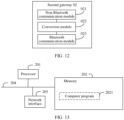
- a gateway includes a memory, a processor, and a computer program that is stored in the memory and that is capable of being run on the processor, and when executing the computer program, the processor implements the Bluetooth message transmission method that is applied to the first gateway or the second gateway and that is provided in the foregoing aspects.
- a computer-readable storage medium stores instructions, and the instructions may be executed by a processor to implement the Bluetooth message transmission method that is applied to the first gateway or the second gateway and that is provided in the foregoing aspects.
- a computer program product including instructions is provided, and when the computer program product runs on a computer, the computer is enabled to perform the Bluetooth message transmission method that is applied to the first gateway or the second gateway and that is provided in the foregoing aspects.
- a Bluetooth network includes a first Bluetooth device, the first gateway provided in the foregoing aspects, the second gateway provided in the foregoing aspects, and a second Bluetooth device.
- a first Bluetooth link exists between the first Bluetooth device and the first gateway, a second Bluetooth link exists between the second Bluetooth device and the second gateway, and a non-Bluetooth link exists between the first gateway and the second gateway.
- the non-Bluetooth link is a wireless local area network link or a wired link.
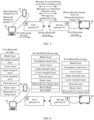
- FIG. 1 is a schematic diagram of a structure of a Bluetooth network according to an embodiment of this application.
- the Bluetooth network may include a first gateway 01, a second gateway 02, a first Bluetooth device 03, and a second Bluetooth device 04. Both the first gateway 01 and the second gateway 02 include a module (not shown in the figure) responsible for Bluetooth communication.
- a first Bluetooth link exists between the first Bluetooth device 03 and the first gateway 01
- a second Bluetooth link exists between the second Bluetooth device 04 and the second gateway 02
- a non-Bluetooth link exists between the first gateway 01 and the second gateway 02.
- the non-Bluetooth link is a wireless local area network (wireless local area network, WLAN) link or a wired link.
- the WLAN link may be a wireless fidelity (wireless fidelity, Wi-Fi) link
- the wired link may be a power line communication link, a network cable communication link, a coaxial cable communication link, or the like.
- the Bluetooth network may include one or more first Bluetooth devices 03, and may include one or more second Bluetooth devices 04.
- FIG. 1 shows two first Bluetooth devices 03 and two second Bluetooth devices 04.
- the first Bluetooth device 03 and the second Bluetooth device 04 may be a mobile phone, a computer, a camera, a wearable device, a smart home device, or the like.
- the wearable device may include a watch, a band, a headset, a virtual reality device (virtual reality, VR), and the like.
- the smart home device may include a sound box, a television, an air conditioner, a desk lamp, a socket, and the like.
- the Bluetooth network may be applied to Internet of Things (Internet of things, IoT).
- both the first Bluetooth device 03 and the second Bluetooth device 04 may be Bluetooth IoT devices.
- Each gateway in the first gateway 01 and the second gateway 02 may include two communication modules.
- One communication module is a Bluetooth communication module
- the other communication module is a non-Bluetooth communication module.
- the Bluetooth communication module is configured to communicate with a Bluetooth device on a Bluetooth link
- the non-Bluetooth communication module is configured to communicate with a non-Bluetooth communication module in another gateway on a non-Bluetooth link. That is, both the first gateway 01 and the second gateway 02 support Bluetooth communication and non-Bluetooth link-based communication.
- the Bluetooth network may also be referred to as a heterogeneous Bluetooth (heterogeneous Bluetooth) network.
- the Bluetooth communication module may be a Bluetooth low energy (low energy, LE) module, or the Bluetooth communication module may be a basic rate/enhanced data rate (basic rate/enhanced data rate, BR/EDR) Bluetooth communication module.
- the another communication module may be a Wi-Fi module that supports a WLAN.
- the first gateway 01 may be a device such as an optical network terminal (optical network terminal, ONT), a router, or a home terminal (for example, a Bluetooth speaker, a mobile phone, or a computer), and the first gateway 01 may be referred to as a master gateway.
- the second gateway 02 may be a device such as a wireless access point (access point, AP) or a home terminal, and the second gateway 02 may be referred to as a standby gateway.
- the AP may be a router or a switch.
- the first gateway 01 and the second gateway 02 may be two gateways independent of each other.
- the first gateway 01 and the second gateway 02 may be integrated into one device.
- a manner of setting the two gateways is not limited in embodiments of this application.
- the Bluetooth network may be a Bluetooth mesh (mesh) network.
- the Bluetooth mesh network implements many-to-many communication of the Bluetooth devices.
- the first gateway 01 may be a proxy (proxy) node in the Bluetooth mesh network
- the second gateway 02 may be a relay (relay) node in the Bluetooth mesh network.
- the proxy node can enable a Bluetooth device that does not have a Bluetooth mesh technology to communicate with a node in the Bluetooth mesh network.
- the relay node can transmit a message received by the relay node, that is, the relay node may be configured to forward the message.
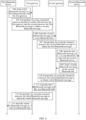
- FIG. 2 is a flowchart of a Bluetooth channel allocation method according to an embodiment of this application. The method may be applied to the Bluetooth network provided in the foregoing embodiment. Referring to FIG. 2 , the method may include the following steps.
- Step 101 A first gateway selects a first Bluetooth broadcast channel as a Bluetooth broadcast channel, and selects a first Bluetooth data channel as a Bluetooth data channel.
- the first gateway serves as a master gateway, and may select the first Bluetooth broadcast channel from a plurality of Bluetooth broadcast channels as the Bluetooth broadcast channel of the first gateway, and may select the first Bluetooth data channel from a plurality of Bluetooth data channels as the Bluetooth data channel of the first gateway.
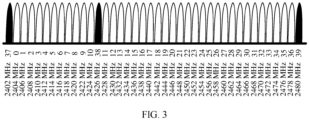
- FIG. 3 is a schematic diagram of channel division in a 2.4 GHz (GHz) frequency band.
- a frequency range of the 2.4 GHz frequency band is from 2402 megahertz (MHz) to 2480 MHz, and the 2.4 GHz frequency band may be divided into 40 Bluetooth channels.
- the 40 Bluetooth channels include three Bluetooth broadcast channels (also referred to as hybrid channels) and 37 Bluetooth data channels. Numbers of the Bluetooth broadcast channel are 37, 38, and 39, and the Bluetooth broadcast channel is used for scanning devices (scanning devices), initiating a connection (initiating a connection), and broadcasting data (broadcasting data).
- the first gateway may select one of the three Bluetooth broadcast channels as the Bluetooth broadcast channel of the first gateway, and may select one or more of the 37 Bluetooth data channels as the Bluetooth data channel of the first gateway.
- Step 102 The first gateway sends a Bluetooth channel allocation instruction to a second gateway on a non-Bluetooth link with the second gateway.
- the first gateway may allocate a Bluetooth broadcast channel different from that of the first gateway and a Bluetooth data channel different from that of the first gateway to the second gateway.
- the first gateway may sends the Bluetooth channel allocation instruction to the second gateway on the non-Bluetooth link with the second gateway.
- the non-Bluetooth link may be a Wi-Fi link, a power line communication link, a network cable communication link, a coaxial cable communication link, or the like.
- the Bluetooth channel allocation instruction is obtained through encapsulation by using a transport protocol adapted to the non-Bluetooth link.
- the Bluetooth channel allocation instruction indicates the second gateway to use a second Bluetooth broadcast channel from the plurality of Bluetooth broadcast channels as a Bluetooth broadcast channel of the second gateway, and use a second Bluetooth data channel from the plurality of Bluetooth data channels as a Bluetooth data channel of the second gateway. It may be understood that the second Bluetooth broadcast channel is different from the first Bluetooth broadcast channel, and the second Bluetooth data channel is different from the first Bluetooth data channel.
- Step 103 After receiving the Bluetooth channel allocation instruction, the second gateway uses the second Bluetooth broadcast channel and the second Bluetooth data channel that are indicated in the Bluetooth channel allocation instruction as the Bluetooth broadcast channel and the Bluetooth data channel of the second gateway respectively.
- the second gateway may select, based on an indication of the Bluetooth channel allocation instruction, the second Bluetooth broadcast channel as the Bluetooth broadcast channel of the second gateway, and select the second Bluetooth data channel as the Bluetooth data channel of the second gateway. Because both the Bluetooth broadcast channel and the Bluetooth data channel of the second gateway are different from those of the first gateway, co-channel interference between the two gateways can be effectively avoided.
- the Bluetooth channel allocation instruction may carry a number of the second Bluetooth broadcast channel and a number of the second Bluetooth data channel
- the second gateway may determine, based on the number of the Bluetooth channel carried in the Bluetooth channel allocation instruction, a Bluetooth channel that the second gateway needs to use.
- a number of the first Bluetooth broadcast channel allocated to a first gateway 01 may be 37, and a number range of the first Bluetooth data channel may be from 0 to 15.
- a number of the second Bluetooth broadcast channel allocated by the first gateway 01 to a second gateway 02 may be 38, and a number range of the second Bluetooth data channel may be from 16 to 36.
- the first gateway may select at least one first Bluetooth data channel as the Bluetooth data channel of the first gateway, and may indicate, according to the Bluetooth channel allocation instruction, the second gateway to select at least one second Bluetooth data channel as the Bluetooth data channel of the second gateway.
- the first gateway may broadcast a Bluetooth message through the first Bluetooth broadcast channel, and may negotiate, with a first Bluetooth device through the first Bluetooth broadcast channel, the first Bluetooth data channel that is used to transmit service data and that is from the at least one first Bluetooth data channel.
- the second gateway may broadcast a Bluetooth message through the second Bluetooth broadcast channel, and may negotiate, with a second Bluetooth device through the second Bluetooth broadcast channel, the second Bluetooth data channel that is used to transmit the service data and that is from the at least one second Bluetooth data channel.
- the first gateway may allocate a Bluetooth broadcast channel different from that of the first gateway and a Bluetooth data channel different from that of the first gateway to the second gateway. Therefore, co-channel interference between the two gateways can be effectively avoided.
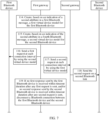
- FIG. 4 is a flowchart of a Bluetooth message transmission method according to an embodiment of this application. The method may be applied to the Bluetooth network provided in the foregoing embodiment. Referring to FIG. 4 , the method may include the following steps.
- Step 104 A first Bluetooth device sends a first Bluetooth message to a first gateway on a first Bluetooth link with the first gateway.
- the first Bluetooth link may exist between the first Bluetooth device and the Bluetooth communication module, and the first Bluetooth device may send the first Bluetooth message on the first Bluetooth link.
- the first Bluetooth link may be a Bluetooth radio-frequency link. It may be understood that the first Bluetooth message may be any type of a message defined in a Bluetooth protocol.
- the first Bluetooth message may be any one of the following messages: a broadcast message in an advertising event (advertising event), a scanning request message and a scanning response message in a scanning event (scanning event), a connection request message in a connection initiation event (connection initiation event), or a message in a connection event (connection event).
- the message in the connection event may include a Bluetooth message used to exchange service data, and may further include a Bluetooth message used to keep a Bluetooth connection (also referred to as keepalive).
- the Bluetooth message used for keepalive may not include the service data. Because the advertising event and the scanning event are used to discover a Bluetooth device, an execution process of the two events may also be referred to as a device discovery stage.
- the first Bluetooth device may discover another Bluetooth device on the non-Bluetooth link, establish the Bluetooth connection to the another Bluetooth device, and exchange the service data with the another Bluetooth device.
- Step 105 The first gateway encapsulates, by using a transport protocol adapted to the non-Bluetooth link between the first gateway and a second gateway, the first Bluetooth message to obtain a second Bluetooth message.
- the first gateway is connected to the second gateway on the non-Bluetooth link, and the non-Bluetooth link is different from a Bluetooth link. Therefore, the first gateway cannot directly transmit a Bluetooth message on the non-Bluetooth link. Therefore, in step 105, after receiving the first Bluetooth message on the first Bluetooth link, the first gateway may encapsulate, by using the transport protocol adapted to the non-Bluetooth link, the first Bluetooth message to obtain the second Bluetooth message.
- the Bluetooth network is a Bluetooth mesh network
- the non-Bluetooth link is a Wi-Fi link.
- the first Bluetooth message is obtained through encapsulation by using a Bluetooth mesh protocol
- a Bluetooth mesh protocol stack includes: a Bluetooth low energy (Bluetooth low energy) layer, a bearer layer (bearer layer), a network layer (network layer), a lower transport layer (lower transport layer), an upper transport layer (upper transport layer), an access layer (access layer), a foundation model layer (foundation model layer), and a model layer (model layer).
- a first gateway 01 may encapsulate, by using a transport protocol adapted to the Wi-Fi link, the first Bluetooth message to obtain the second Bluetooth message.
- the transport protocol adapted to the Wi-Fi link includes at least a media access control (media access control, MAC) layer protocol and a physical layer (physical, PHY) protocol of the Wi-Fi link.
- a Bluetooth message (for example, the broadcast message, the scanning request message, or the scanning response message) sent by a Bluetooth device and a gateway in the Bluetooth network in the device discovery stage may include first attribute information.
- the first attribute information may indicate that a device sending the Bluetooth message supports transmission of the Bluetooth message on the non-Bluetooth link.
- the first Bluetooth message may include the first attribute information.
- the first gateway may determine, based on the first attribute information, that the first Bluetooth device supports the transmission of the Bluetooth message on the non-Bluetooth link. In this way, the first gateway may encapsulate, by using the transport protocol adapted to the non-Bluetooth link, the first Bluetooth message to obtain the second Bluetooth message.
- the first gateway may determine that the Bluetooth device sending the Bluetooth message does not support the transmission of the Bluetooth message on the non-Bluetooth link, and then does not need to send the Bluetooth message to the second gateway on the non-Bluetooth link. That is, step 105 does not need to be performed.
- the Bluetooth device and the gateway in the Bluetooth network may include the first attribute information only in the Bluetooth message sent in the device discovery stage, and does not need to include the first attribute information in a message sent in a subsequent connection initiation event and a message sent in the connection event.
- the Bluetooth message sent by the Bluetooth device and the gateway in the Bluetooth network in the device discovery stage may alternatively not need to include the first attribute information.
- the first gateway may directly perform step 105. If the first Bluetooth message sent by the first Bluetooth device is a Bluetooth message of a type other than the broadcast message, the first gateway may determine a receiver of the first Bluetooth message based on an address field in the first Bluetooth message. If the receiver of the first Bluetooth message is a second Bluetooth device connected to the second gateway, the first gateway may determine that the first Bluetooth message needs to be transmitted on the non-Bluetooth link, and may further perform step 105.
- the first gateway also includes the Bluetooth communication module, in a scenario in which the first Bluetooth message is the broadcast message, the first gateway may further respond to the broadcast message on the first Bluetooth link (for example, may send the connection request message or the scanning request message to the first Bluetooth device), to establish the Bluetooth connection to the first Bluetooth device.
- Step 106 The first gateway sends the second Bluetooth message to the second gateway on the non-Bluetooth link.
- the first gateway may transmit the second Bluetooth message to the second gateway on the non-Bluetooth link. Because the first gateway can transmit the Bluetooth message on the non-Bluetooth link different from the Bluetooth link, a transmission distance of the Bluetooth message is effectively increased. For example, based on the method shown in step 104 to step 106, that the transmission distance of the Bluetooth message is far greater than 10 meters may be ensured.
- the non-Bluetooth link is the Wi-Fi link
- bandwidth of the Wi-Fi link is high
- a transmission rate of the Bluetooth message can be effectively increased, a throughput of the Bluetooth message can be improved, and transmission latency of the Bluetooth message can be reduced.
- Step 107 The second gateway decapsulates, by using the transport protocol, the second Bluetooth message to obtain the first Bluetooth message.
- the second gateway may decapsulate, by using the transport protocol adapted to the non-Bluetooth link, the second Bluetooth message to obtain the first Bluetooth message.
- a second gateway 02 may decapsulate, by using the transport protocol adapted to the Wi-Fi link, the second Bluetooth message to obtain the first Bluetooth message encapsulated based on the Bluetooth mesh protocol.
- Step 108 The second gateway sends the first Bluetooth message to the second Bluetooth device on a second Bluetooth link with the second Bluetooth device.
- the second gateway may directly send the first Bluetooth message to the second Bluetooth device on the second Bluetooth link.
- the first Bluetooth message may be the broadcast message, the scanning request message, the scanning response message, the connection request message, or the message in the connection event. The following describes operations performed by the second Bluetooth device when the first Bluetooth message is different types of messages.
- the second Bluetooth link may include a second Bluetooth broadcast channel and a second Bluetooth data channel.
- the second gateway may send the broadcast message, the scanning request message, the scanning response message, and the connection request message through the second Bluetooth broadcast channel.
- the second gateway may send the message in the connection event through the second Bluetooth data channel.
- the first Bluetooth device may transmit the first Bluetooth message to the second Bluetooth device on the non-Bluetooth link between the first gateway and the second gateway. This effectively increases a transmission distance of the first Bluetooth message, improves flexibility of transmitting the Bluetooth message by the first Bluetooth device to the second Bluetooth device, and further improves flexibility of Bluetooth network networking.
- the Bluetooth message transmission method may further include a process in which the second Bluetooth device transmits the second Bluetooth message to the first Bluetooth device. Still referring to FIG. 4 , the process may further include the following steps.
- Step 109 The second Bluetooth device sends a fourth Bluetooth message to the second gateway on the second Bluetooth link.
- the second Bluetooth link exists between the second Bluetooth device and the second gateway, and the second Bluetooth device may send the fourth Bluetooth message to the second gateway on the second Bluetooth link.
- the fourth Bluetooth message may be any one of the following messages: the broadcast message in the advertising event, the scanning request message and the scanning response message in the scanning event, the connection request message in the connection initiation event, and the message in the connection event.
- Step 110 The second gateway encapsulates, by using the transport protocol, the fourth Bluetooth message to obtain a third Bluetooth message.
- the second gateway may encapsulate, by using the transport protocol adapted to the non-Bluetooth link, the fourth Bluetooth message to obtain the third Bluetooth message.
- the transport protocol adapted to the non-Bluetooth link For an implementation process of step 110, refer to related descriptions of step 105. Details are not described herein again.
- Step 111 The second gateway sends the third Bluetooth message to the first gateway on the non-Bluetooth link.
- the second gateway may transmit the third Bluetooth message to the first gateway on the non-Bluetooth link.
- step 111 refer to related descriptions of step 106. Details are not described herein again.
- Step 112 The first gateway decapsulates, by using the transport protocol, the third Bluetooth message to obtain the fourth Bluetooth message.
- the first gateway may decapsulate, by using the transport protocol adapted to the non-Bluetooth link, the third Bluetooth message to obtain the fourth Bluetooth message.
- the transport protocol adapted to the non-Bluetooth link For an implementation process of step 112, refer to related descriptions of step 107. Details are not described herein again.
- Step 113 The first gateway sends the fourth Bluetooth message to the first Bluetooth device on the first Bluetooth link.
- the first gateway may send the fourth Bluetooth message to the first Bluetooth device on the first Bluetooth link.
- the first Bluetooth device may send the fourth Bluetooth message to the first Bluetooth device on the first Bluetooth link.
- step 104 to step 113 are described by using an example in which the Bluetooth message is forwarded through the first gateway and the second gateway.
- at least one another gateway may be further connected between the first gateway and the second gateway, and a non-Bluetooth link exists between two adjacent gateways.
- the first gateway may transmit the first Bluetooth message to the second gateway through the at least one another gateway
- the second gateway may also transmit the second Bluetooth message to the first gateway through the at least one another gateway. That is, a Bluetooth message sent by one Bluetooth device may be forwarded to another Bluetooth device through at least two gateways.
- the second Bluetooth device may transmit the third Bluetooth message to the first Bluetooth device on the non-Bluetooth link between the first gateway and the second gateway. This effectively increases a transmission distance of the third Bluetooth message, improves flexibility of transmitting the Bluetooth message by the second Bluetooth device to the first Bluetooth device, and further improves flexibility of Bluetooth network networking.
- the first gateway may further perform connection management on the Bluetooth connection.
- the connection management may include at least keepalive management and timeout management.
- FIG. 7 is a flowchart of a method for a first gateway to perform connection management on the Bluetooth connection according to an embodiment of this application. Referring to FIG. 7 , the method may include the following steps.
- Step 114 A first gateway creates, based on an indication of second attribute information in a first Bluetooth message, a first virtual device model for a first Bluetooth device.
- the first Bluetooth message may further include the second attribute information.
- the second attribute information in the first Bluetooth message may indicate that the first Bluetooth device supports performing connection management on a Bluetooth connection on a non-Bluetooth link.
- the first gateway may create, based on the indication of the second attribute information in the first Bluetooth message, the first virtual device model for the first Bluetooth device.
- the first virtual device model may be also referred to as a Bluetooth mirror of the first Bluetooth device, and the first gateway may simulate the first Bluetooth device by using the first virtual device model, to communicate with a second Bluetooth device.
- the first gateway may determine that the first Bluetooth device does not support performing connection management on the Bluetooth connection on the non-Bluetooth link. Therefore, a virtual device model does not need to be created for the first Bluetooth device. In this way, a waste of processing resources of the first gateway can be avoided.
- Step 115 The first gateway creates, based on the indication of the second attribute information in the fourth Bluetooth message, a second virtual device model for the second Bluetooth device.
- the fourth Bluetooth message may further include the second attribute information.
- the second attribute information in the fourth Bluetooth message may indicate that the second Bluetooth device supports performing connection management on the Bluetooth connection on the non-Bluetooth link.
- the first gateway may create, based on the indication of the second attribute information in the fourth Bluetooth message, the second virtual device model for the second Bluetooth device.
- the second virtual device model may also be referred to as a Bluetooth mirror of the second Bluetooth device, and the first gateway may simulate the second Bluetooth device by using the second virtual device model, to communicate with the first Bluetooth device.
- the first gateway may create the first virtual device model based on an obtained related parameter of the first Bluetooth device, and may create the second virtual device model based on an obtained related parameter of the second Bluetooth device.
- a related parameter of a Bluetooth device may include at least a device parameter of the Bluetooth device, and a Bluetooth profile (profile) of the Bluetooth device.
- the device parameter may include at least one of the following parameters: a device name, a device model, a device address, a device vendor, and the like.
- the virtual device model may also be referred to as a device model or a device object. This is not limited in this embodiment of this application.
- the Bluetooth message sent by the Bluetooth device in the device discovery stage may include first attribute information, but does not include the second attribute information.
- the first gateway may further create, based on an indication of the first attribute information, the virtual device model for the Bluetooth device.
- the Bluetooth message sent by each Bluetooth device in the Bluetooth network in the device discovery stage neither includes the first attribute information nor includes the second attribute information, and the first gateway may directly create a virtual device model for each Bluetooth device discovered by the first gateway.
- Step 116 The first gateway sends a first request to the first Bluetooth device at each connection interval by using the second virtual device model.
- the first gateway may send the first request (request) to the first Bluetooth device once at each connection interval (connection interval) by using the second virtual device model.
- the first request is sent on the first Bluetooth link between the first gateway and the first Bluetooth device, and the first request may indicate the first Bluetooth device to feed back a first response.
- a value range of the connection interval may be from 7.5 milliseconds to 4 seconds, and a value of the connection interval may be set by the first gateway based on a requirement of an application scenario.
- Step 117 The first gateway sends a second request to the second gateway at each connection interval by using the first virtual device model.
- the first gateway may further send, to the second gateway at each connection interval by using the first virtual device model, the second request obtained through encapsulation by using the transport protocol.
- the second request is sent on the non-Bluetooth link between the first gateway and the second gateway.
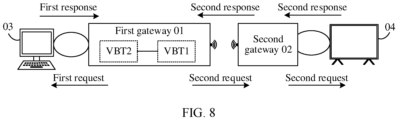
- the first virtual device model created by a first gateway 01 for the first Bluetooth device is VBT1
- the second virtual device model created for the second Bluetooth device is VBT2
- duration of the connection interval is T0.
- the first gateway 01 may send the first request to a first Bluetooth device 03 once at each interval of T0 by using VBT2, and may send the second request to a second Bluetooth device 04 once at each interval of T0 by using VBT1.
- Step 118 The second gateway forwards the second request to the second Bluetooth device on the second Bluetooth link.
- the second gateway may forward the second request to the second Bluetooth device on the second Bluetooth link.
- the second gateway may decapsulate, by using the transport protocol adapted to the non-Bluetooth link, the received second request, and then forward a decapsulated second request to the second Bluetooth device on the second Bluetooth link.
- the decapsulated second request indicates the second Bluetooth device to feed back a second response on the second Bluetooth link.
- Step 119 If no first response sent by the first Bluetooth device is received within timeout duration after any first request is sent, and/or no second response sent by the second Bluetooth device is received within timeout duration after any second request is sent, the first gateway disconnects the Bluetooth connection between the first Bluetooth device and the second Bluetooth device.
- the first gateway may periodically and separately send a request to the first Bluetooth device and the second Bluetooth device based on the connection interval.
- a Bluetooth device that receives the request may selectively respond (response) to the request.
- the first Bluetooth device may respond to the first request by sending the first response
- the second Bluetooth device may respond to the second request by sending the second response. It can be learned from FIG. 8 that the second response needs to be transmitted to the first gateway through the second gateway.
- a response that carries the service data may be directly sent to the first gateway. If the Bluetooth device that receives the request has no service data to send, the request may be ignored, and a quantity of requests continuously ignored by the Bluetooth device needs to be less than or equal to a quantity threshold N. In other words, if the Bluetooth device continuously ignores N requests, after the Bluetooth device receives an (N+1) th request, even if no service data needs to be sent, the Bluetooth device needs to feed back, to the first gateway, a connection response that does not carry the service data. In this way, power consumption of the Bluetooth device can be effectively reduced while reliable transmission of the service data is ensured.
- the first gateway may determine that the Bluetooth device cannot normally receive or send a message, and may further disconnect a Bluetooth connection of the Bluetooth device.
- the quantity threshold N may also be referred to as a slave latency (slave latency), and a value range of the quantity threshold N may be from 0 to 499.
- the first gateway may store timeout duration T1.
- the timeout duration T1 is greater than a connection interval T0, and the timeout duration T1 may meet: T1>T0 ⁇ (N+1). If the first gateway detects that no first response sent by the first Bluetooth device is received within the timeout duration after any first request is sent (that is, a quantity of requests continuously ignored by the first Bluetooth device is greater than N), and/or no second response sent by the second Bluetooth device is received within the timeout duration after any second request is sent (that is, a quantity of requests continuously ignored by the second Bluetooth device is greater than N), the first gateway may disconnect the Bluetooth connection between the first Bluetooth device and the second Bluetooth device.
- the first gateway may further flexibly adjust the quantity threshold N based on the requirement of the application scenario, that is, flexibly adjust the timeout duration T 1.
- a value range of the timeout duration T1 may be from 10 milliseconds to 32 seconds.
- the Bluetooth network may include a plurality of first Bluetooth devices and a plurality of second Bluetooth devices.
- the first gateway may be connected to a third gateway on the non-Bluetooth link, and the third gateway may be connected to at least one third Bluetooth device on the Bluetooth link.
- the first gateway serves as a master gateway, and may create, by using the method shown in step 114 or step 115, a virtual device model for each Bluetooth device discovered by the first gateway.
- the first gateway may create a global virtual device resource pool.
- the virtual device resource pool includes the virtual device model of each Bluetooth device in the Bluetooth network, and each virtual device model has a unique global identifier (identifier, ID).
- the first gateway may further manage and control the Bluetooth device.
- the first gateway may forward a Bluetooth message from the Bluetooth device on the non-Bluetooth link by using the global ID of the virtual device model of the Bluetooth device.
- the first Bluetooth device may establish the Bluetooth connection to the plurality of second Bluetooth devices on one Bluetooth link between the first Bluetooth device and the first gateway.
- the first Bluetooth device may exchange data with the plurality of second Bluetooth devices on one Bluetooth link. Therefore, flexibility of exchanging the Bluetooth message is effectively improved.
- the first Bluetooth device may exchange the data with more than three second Bluetooth devices on one Bluetooth link.
- the second Bluetooth device may also exchange the data with a plurality of first Bluetooth devices on one Bluetooth link between the second Bluetooth device and the second gateway.
- the virtual device resource pool of the first gateway includes the virtual device model of each Bluetooth device, the first gateway may perform connection management on a plurality of Bluetooth connections of the Bluetooth device by using the virtual device model.
- the first gateway may send the Bluetooth message from at least one first Bluetooth device to at least two second Bluetooth devices in parallel, and a sequence of sending the Bluetooth message to each second Bluetooth device is not limited.
- the first gateway supports one-to-many or many-to-many concurrent communication, that is, supports Bluetooth message transmission in an asynchronous multi-channel concurrent manner. Therefore, transmission efficiency of the Bluetooth message is effectively improved and transmission latency of the Bluetooth message is reduced.
- Step 114 to step 119 are described by using an example in which the first gateway performs connection management on the Bluetooth connection between the first Bluetooth device and the second Bluetooth device.
- the first gateway may further perform connection management on the Bluetooth connection between the first gateway and the first Bluetooth device by sending the first request.
- the first gateway may further perform connection management on the Bluetooth connection between the first gateway and the second Bluetooth device by sending the second request.
- the second gateway may alternatively perform connection management on the Bluetooth connection between the second gateway and the second Bluetooth device by sending a third request.
- the second request sent by the first gateway may come from the first Bluetooth device.
- the first Bluetooth device may send the second request to the second Bluetooth device through two gateways, to perform connection management on the Bluetooth connection between the first Bluetooth device and the second Bluetooth device.
- connection management on the Bluetooth connection between the first Bluetooth device and the second Bluetooth device.
- the Bluetooth device directly performs connection management on the Bluetooth connection, efficiency of connection management may be low.
- the first Bluetooth device is used as an example.
- the second request sent by the first Bluetooth device needs to pass through two gateways before being transmitted to the second Bluetooth device, and the second response sent by the second Bluetooth device also needs to pass through two gateways before being transmitted to the first Bluetooth device.
- a transmission path of the message in a connection management process is long and the transmission latency is long, resulting in low efficiency of connection management.
- connection management can be implemented in a heterogeneous Bluetooth network, the transmission path of the message in the connection management process is effectively shortened, and the efficiency of connection management is further effectively improved.
- the first gateway may further control, based on Bluetooth signal strength between the Bluetooth device and each gateway, the Bluetooth device to roam between different gateways.
- the roaming of the Bluetooth device between different gateways may be: The Bluetooth device switches a gateway that establishes the Bluetooth connection with the Bluetooth device.
- FIG. 9 is a flowchart of a method for a first gateway to control roaming of a Bluetooth device according to an embodiment of this application. Referring to FIG. 9 , the method may include the following steps.
- Step 120 A first gateway obtains first Bluetooth signal strength between a first Bluetooth device and the first gateway and second Bluetooth signal strength between the first Bluetooth device and a second gateway.
- the first gateway may obtain the first Bluetooth signal strength between the first Bluetooth device and the first gateway and the second Bluetooth signal strength between the first Bluetooth device and the second gateway on a first Bluetooth link after a Bluetooth connection to the first Bluetooth device is established.
- the first Bluetooth signal strength may be actively reported by the first Bluetooth device to the first gateway on the first Bluetooth link.
- the first gateway may send a signal strength obtaining request to the first Bluetooth device on the first Bluetooth link, and the first Bluetooth device may detect, based on the signal strength obtaining request, the second Bluetooth signal strength between the first Bluetooth device and the second gateway, and report the second Bluetooth signal strength to the first gateway on the first Bluetooth link.
- the first Bluetooth message may further include third attribute information.
- the third attribute information indicates that the first Bluetooth device supports roaming between different gateways.
- the first gateway may obtain, based on an indication of the third attribute information in the first Bluetooth message, the first Bluetooth signal strength between the first Bluetooth device and the first gateway and the second Bluetooth signal strength between the first Bluetooth device and the second gateway on the first Bluetooth link after the Bluetooth connection to the first Bluetooth device is established.
- the first gateway may determine that the first Bluetooth device does not support the roaming between the different gateways. Then the first gateway does not need to perform the foregoing step 120 after the Bluetooth connection to the first Bluetooth device is established.
- the first Bluetooth message sent by the first Bluetooth device in the device discovery stage may include first attribute information, but does not include the third attribute information.
- the first gateway may obtain, based on an indication of the first attribute information, the first Bluetooth signal strength and the second Bluetooth signal strength on the first Bluetooth link after the Bluetooth connection to the first Bluetooth device is established.
- the first Bluetooth message sent by the first Bluetooth device in the device discovery stage may not include the first attribute information or the third attribute information.
- the first gateway may obtain Bluetooth signal strength between a Bluetooth device and each gateway after the Bluetooth connection to any Bluetooth device in the Bluetooth network is established.
- Step 121 The first gateway sends a roaming instruction to the first Bluetooth device if the second Bluetooth signal strength is greater than the first Bluetooth signal strength.
- the first gateway may determine that transmission quality of a Bluetooth message between the first Bluetooth device and the second gateway is better if the first gateway detects that the second Bluetooth signal strength is greater than the first Bluetooth signal strength. Therefore, the first gateway may send the roaming instruction to the first Bluetooth device on the first Bluetooth link, to indicate the first Bluetooth device to establish the Bluetooth connection to the second gateway.
- the first gateway may determine that the first Bluetooth device does not need to roam if the second Bluetooth signal strength is not greater than the first Bluetooth signal strength, and then does not need to send the roaming instruction to the first Bluetooth device.
- Step 122 The first Bluetooth device establishes, based on the roaming instruction, the Bluetooth connection to the second gateway.
- the first Bluetooth device may disconnect the Bluetooth connection to the first gateway, and establish the Bluetooth connection to the second gateway. Because the Bluetooth signal strength between the first Bluetooth device and the second gateway is higher, it can be ensured that the transmission quality of the Bluetooth message is better after the Bluetooth connection to the second gateway is established.
- Step 123 The first gateway obtains third Bluetooth signal strength between a second Bluetooth device and the second gateway and fourth Bluetooth signal strength between the second Bluetooth device and a third gateway.
- the Bluetooth network may further include a third gateway 05, and a non-Bluetooth link further exists between the third gateway 05 and the first gateway 01.
- the third gateway 05 is also a slave gateway, and the third gateway 05 also includes a Bluetooth communication module.
- the first gateway 01 may further obtain third Bluetooth signal strength between a second Bluetooth device 04 and a second gateway 02 and fourth Bluetooth signal strength between the second Bluetooth device 04 and the third gateway 05 on the non-Bluetooth link after determining that the second gateway 02 establishes the Bluetooth connection to the second Bluetooth device.
- the second Bluetooth device may actively report the third Bluetooth signal strength to the second gateway after the second gateway establishes the Bluetooth connection to the second Bluetooth device, and the second gateway may report the third Bluetooth signal strength to the first gateway on the non-Bluetooth link.
- the first gateway may further send the signal strength obtaining request to the second gateway on the non-Bluetooth link, and the second gateway may forward the signal strength obtaining request to the second Bluetooth device on the second Bluetooth link.
- the second Bluetooth device may detect, based on the strength obtaining request, the fourth Bluetooth signal strength between the second Bluetooth device and the third gateway, and report the fourth Bluetooth signal strength to the second gateway on the second Bluetooth link.
- the second gateway may report the fourth Bluetooth signal strength to the first gateway on the non-Bluetooth link.
- both the strength obtaining request and the Bluetooth signal strength that are transmitted on the non-Bluetooth link are obtained through encapsulation by using a transport protocol adapted to the non-Bluetooth link.
- the Bluetooth message sent by the second Bluetooth device in the device discovery stage may carry at least one piece of attribute information of the first attribute information and the third attribute information.
- the first gateway may perform step 123 after determining, based on the at least one piece of attribute information, that the second Bluetooth device supports the roaming between the different gateways; otherwise, the first gateway does not need to perform step 123.
- the first gateway determines that a Bluetooth device does not support the roaming between the different gateways, the Bluetooth signal strength between the Bluetooth device and each gateway does not need to be obtained. Therefore, a waste of detection resources of the Bluetooth device caused by detection of Bluetooth signal strength by the Bluetooth device can be avoided, and a waste of transmission resources of the Bluetooth network caused by transmission of Bluetooth signal strength can be avoided.
- the Bluetooth message sent by the second Bluetooth device in the device discovery stage may not include the first attribute information, and may not include the third attribute information.
- the first gateway may obtain the Bluetooth signal strength between the Bluetooth device and each gateway.
- Step 124 The first gateway sends the roaming instruction to the second gateway if the fourth Bluetooth signal strength is greater than the third Bluetooth signal strength.
- the first gateway may determine that the transmission quality of the Bluetooth message between the second Bluetooth device and the third gateway is better if the first gateway detects that the fourth Bluetooth signal strength is greater than the third Bluetooth signal strength. Therefore, the first gateway may send, to the second gateway on the non-Bluetooth link, the roaming instruction obtained through encapsulation by using the transport protocol. The roaming instruction indicates the second Bluetooth device to roam to the third gateway.
- the first gateway may determine that the second Bluetooth device does not need to roam if the fourth Bluetooth signal strength is not greater than the third Bluetooth signal strength, and then does not need to send the roaming instruction to the second gateway.
- Step 125 The second gateway sends the roaming instruction to the second Bluetooth device.
- the second gateway may decapsulate, by using a transport protocol, the roaming instruction, and send a decapsulated roaming instruction to the second Bluetooth device on the second Bluetooth link.
- Step 126 The second Bluetooth device establishes, based on the roaming instruction, the Bluetooth connection to the third gateway.
- the second Bluetooth device may disconnect, based on the indication of the roaming instruction, the Bluetooth connection to the second gateway, and establish the Bluetooth connection to the third gateway. Because the Bluetooth signal strength between the second Bluetooth device and the third gateway is higher, it can be ensured that the transmission quality of the Bluetooth message is better after the Bluetooth connection to the third gateway is established.
- the first gateway may obtain the Bluetooth signal strength between the Bluetooth device and each gateway.
- the first gateway may further obtain Bluetooth signal strength between the first Bluetooth device and the third gateway.
- the first gateway may determine, from the gateways, a gateway having highest Bluetooth signal strength with the Bluetooth device. If the gateway having the highest Bluetooth signal strength is not a gateway that establishes the Bluetooth connection to the Bluetooth device, the first gateway may send the roaming instruction, to indicate the Bluetooth device to roam to the gateway having the highest Bluetooth signal strength.
- step 120 it can be learned from step 120 to step 126 that, because the first gateway may control, based on Bluetooth signal strength, roaming of the Bluetooth device, it can be ensured that the Bluetooth device can establish the Bluetooth connection to a gateway having high Bluetooth signal strength, and then the transmission quality of the Bluetooth message is effectively ensured.
- each gateway in the Bluetooth network includes the Bluetooth communication module, each gateway may also send the Bluetooth message.
- the Bluetooth message may be any one of the following messages: a broadcast message in an advertising event, a scanning request message and a scanning response message in a scanning event, a connection request message in a connection initiation event, or a message in a connection event.
- the Bluetooth message sent by each gateway in the device discovery stage may carry at least one of the first attribute information, the second attribute information, and the third attribute information.
- the first attribute information may be attribute information defined in an attribute (attribute, ATT) protocol.
- the attribute information defined in the ATT protocol may include: an attribute handle (attribute handle), an attribute type (attribute type), an attribute value (attribute value), and an attribute permission (attribute permission).
- a piece of attribute information that has been defined in the ATT protocol may be modified, to be used as the first attribute information.
- a piece of attribute information may be newly added to the ATT protocol as the first attribute information.
- the first attribute information may indicate that a device (the Bluetooth device or the gateway) in the Bluetooth network supports transmission of the Bluetooth message on the non-Bluetooth link. Because the Bluetooth network may also be referred to as a heterogeneous Bluetooth network, it may also be understood that the first attribute information indicates that the device has a capability (capability) of accessing the heterogeneous Bluetooth network. For a scenario in which the Bluetooth network is a Bluetooth mesh network, the first attribute information may indicate that a device has a capability (heterogeneous Bluetooth mesh capability) of accessing a heterogeneous Bluetooth mesh network.
- attribute information that has been defined in the ATT protocol and whose handle value is 42 may be modified.
- the attribute value is modified from 00:00 to EE:EE, to be used as the first attribute information.
- attribute information whose handle value is 43 may be newly added as the first attribute information.
- a value of the newly added first attribute type may be 0x2903 (0x represents a hexadecimal number), the permission is read and write (read and write), the attribute value is 11, and a length of the attribute value may be 1 byte (byte). It may be understood that, the value of the newly added first attribute handle may also be another value except 43, and the value of the type may also be another value except 0x2903.
- Table 1 Handle Type Permission Value 42 0x2902 read and read EE:EE 43 or others 0x2903 or others read and write 11
- both the second attribute information and the third attribute information may be the attribute information defined in the ATT protocol. Details are not described herein.
- the first attribute information may be GATT attribute information defined in a generic attribute (generic attribute, GATT) protocol.
- the GATT attribute information defined in the GATT protocol may also include: the attribute handle, the attribute type, and the attribute value.
- the attribute type may be represented by a universally unique identifier (universally unique identifier, UUID).
- UUID universally unique identifier
- a value range of the attribute handle is 0x0001 to 0xFFFF, and a value of different GATT attribute handle is different. That is, the value of each GATT attribute handle is unique in a service table. To facilitate management, the value of each GATT attribute handle of a same service (service) increases at an equal interval. Based on the value range of the attribute handle, a maximum of 65536 pieces of GATT attribute information can be defined in the GATT protocol.
- a piece of GATT attribute information may be newly added to the GATT protocol as the first attribute information.
- GATT attribute information whose value of the handle is 0x0215 may be newly added as the first attribute information.
- a UUID of the first attribute information may be 0x2903, and the attribute value may be 00.
- Table 2 Handle UUID Value 0x0215 0x2903 00 0x0216 0x2904 00 0x0217 0x2905 00 0x0218 0x2906 00
- two pieces of GATT attribute information may be further newly added to the GATT protocol as the second attribute information and the third attribute information respectively.
- GATT attribute information whose value of the handle is 0x0216 may be newly added as the second attribute information.
- a UUID of the second attribute information may be 0x2904, and the attribute value may be 00.
- GATT attribute information whose value of handle is 0x0217 may be newly added as the third attribute information.
- a UUID of the third attribute information may be 0x2905, and the attribute value may be 00.
- the second attribute information may indicate that the device has a capability of performing connection management on the Bluetooth connection in the heterogeneous Bluetooth mesh network, for example, has a capability (heterogeneous Bluetooth mesh keepalive capability) of implementing keepalive management in the heterogeneous Bluetooth mesh network.
- the third attribute information may indicate that the device has a capability (heterogeneous Bluetooth mesh roaming capability) of roaming in the heterogeneous Bluetooth mesh network.
- a message sent by the device in the Bluetooth network at the device discovery stage may further include fourth attribute information, and the fourth attribute information may indicate that the device supports establishing the Bluetooth connection to M Bluetooth devices on the non-Bluetooth link.
- M is an integer greater than 1.
- M may be greater than 3, to be specific, the fourth attribute information may indicate that the device can establish the Bluetooth connection to more than three Bluetooth devices on the non-Bluetooth link.
- the fourth attribute information may indicate that the device has a capability of establishing the Bluetooth connection to a plurality of Bluetooth devices in the heterogeneous Bluetooth mesh network.
- the message sent by the device in the Bluetooth network in the device discovery stage may include two pieces of first attribute information.
- One piece of first attribute information may be the attribute information defined in the ATT protocol, and the other piece of first attribute information may be the GATT attribute information.
- the second attribute information, the third attribute information, and the fourth attribute information each may include two pieces of attribute information.
- step 101 to step 103 may be deleted based on the situation.
- step 109 to step 113 may be deleted based on the situation, or may be performed before step 108.
- step 115 may be performed before step 114, and step 117 may be performed before step 116.
- step 123 to step 126 may be performed before step 122.
- step 114 and step 115 may be deleted based on the situation.
- the first gateway may not need to create a virtual device model for the Bluetooth device, but may directly send a first request and a second request.
- the first gateway may send, to the first Bluetooth device based on an indication of the second attribute information in the first Bluetooth message, the first request at each connection interval, and may send, to the second Bluetooth device based on the indication of the second attribute information in the fourth Bluetooth message, the second request at each connection interval.
- this embodiment of this application provides the Bluetooth message transmission method.
- the first gateway may encapsulate, by using the transport protocol adapted to the non-Bluetooth link, the first Bluetooth message sent by the first Bluetooth device, to obtain a second Bluetooth message, and may send the second Bluetooth message to the second gateway on the non-Bluetooth link.
- the second gateway may decapsulate the second Bluetooth message to obtain the first Bluetooth message and then send the first Bluetooth message to the second Bluetooth device.
- two Bluetooth devices may transmit the Bluetooth message on the non-Bluetooth link. This effectively increases a transmission distance of the Bluetooth message is, improves flexibility of transmission of the Bluetooth message, and further improves flexibility of Bluetooth network networking.
- the first gateway may further perform connection management on the Bluetooth connection between Bluetooth devices, efficiency of connection management can be effectively improved.
- the first gateway may control, based on Bluetooth signal strength, the roaming of the Bluetooth device, it can be ensured that the Bluetooth device can establish the Bluetooth connection to the gateway having the high Bluetooth signal strength, and then the transmission quality of the Bluetooth message is effectively ensured.
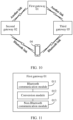
- FIG. 11 is a schematic diagram of a structure of a first gateway according to an embodiment of this application.
- the first gateway may be used in the Bluetooth network in FIG. 1 , and may be configured to implement the steps performed by the first gateway in the foregoing method embodiments.
- a first gateway 01 includes the following modules.
- a Bluetooth communication module 011 is configured to receive, on a first Bluetooth link with a first Bluetooth device, a first Bluetooth message sent by the first Bluetooth device.
- a function of the Bluetooth communication module 011 refer to related descriptions of step 104 in the foregoing method embodiment.
- a conversion module 012 is configured to encapsulate, by using a transport protocol adapted to a non-Bluetooth link between the first gateway and a second gateway, the first Bluetooth message to obtain a second Bluetooth message.
- a function of the Bluetooth conversion module 012 refer to related descriptions of step 105 in the foregoing method embodiment.
- a non-Bluetooth communication module 013 is configured to send the second Bluetooth message to the second gateway on the non-Bluetooth link.
- the second gateway decapsulates the second Bluetooth message by using the transport protocol, to obtain the first Bluetooth message, and sends the first Bluetooth message to a second Bluetooth device on a second Bluetooth link with the second Bluetooth device.
- the non-Bluetooth link is a wireless local area network link or a wired link.
- non-Bluetooth communication module 013 For implementation of a function of the non-Bluetooth communication module 013, refer to related descriptions of step 106 in the foregoing method embodiment.
- the Bluetooth communication module 011 may be further configured to: select a first Bluetooth broadcast channel as a Bluetooth broadcast channel of the first gateway, and select a first Bluetooth data channel as a Bluetooth data channel of the first gateway.
- the non-Bluetooth communication module 013 may be further configured to send a Bluetooth channel allocation instruction to the second gateway on the non-Bluetooth link.
- the Bluetooth channel allocation instruction indicates the second gateway to use a second Bluetooth broadcast channel as a Bluetooth broadcast channel of the second gateway, and use a second Bluetooth data channel as a Bluetooth data channel of the second gateway.
- a function of the non-Bluetooth communication module 013 further refer to related descriptions of step 102 in the foregoing method embodiment.
- the first Bluetooth message may include service data.
- the first Bluetooth message may include first attribute information, and the first attribute information indicates that the first Bluetooth device supports transmission of a Bluetooth message on the non-Bluetooth link.
- the Bluetooth communication module 011 may be further configured to send a first request to the first Bluetooth device at each connection interval on the first Bluetooth link.
- the first request indicates the first Bluetooth device to feed back a first response on the first Bluetooth link.
- the non-Bluetooth communication module 013 may be further configured to send, to the second gateway at each connection interval on the non-Bluetooth link, a second request obtained through encapsulation by using the transport protocol.
- the second request is sent to the second Bluetooth device on the second Bluetooth link after been decapsulated by the second gateway, and indicates the second Bluetooth device to feed back a second response on the second Bluetooth link.
- the first Bluetooth message includes second attribute information
- the second attribute information indicates that a Bluetooth device supports performing connection management on a Bluetooth connection on the non-Bluetooth link.
- the Bluetooth communication module 011 may be configured to send, to the first Bluetooth device based on an indication of the second attribute information in the first Bluetooth message, the first request at each connection interval on the first Bluetooth link.
- a function of the Bluetooth communication module 011 further refer to related descriptions of step 114 and step 116 in the foregoing method embodiment.
- the non-Bluetooth communication module 013 may be further configured to receive, on the non-Bluetooth link, a third Bluetooth message sent by the second gateway.
- the third Bluetooth message is obtained by encapsulating, by the second gateway by using the transport protocol, a fourth Bluetooth message received on the second Bluetooth link, and the fourth Bluetooth message includes the second attribute information.
- a function of the non-Bluetooth communication module 013 further refer to related descriptions of step 111 in the foregoing method embodiment.
- the conversion module 012 may be further configured to decapsulate, by using the transport protocol, the third Bluetooth message to obtain the fourth Bluetooth message.
- the conversion module 012 further refer to related descriptions of step 112 in the foregoing method embodiment.
- the non-Bluetooth communication module 013 may be configured to send, to the second gateway based on an indication of the second attribute information in the fourth Bluetooth message, the second request at each connection interval on the non-Bluetooth link.
- a function of the non-Bluetooth communication module 013 further refer to related descriptions of step 115 and step 117 in the foregoing method embodiment.
- the Bluetooth communication module 011 may be further configured to: obtain first Bluetooth signal strength between the first Bluetooth device and the first gateway and second Bluetooth signal strength between the first Bluetooth device and the second gateway on the first Bluetooth link after the Bluetooth connection to the first Bluetooth device is established, and send a roaming instruction to the first Bluetooth device on the first Bluetooth link if the second Bluetooth signal strength is greater than the first Bluetooth signal strength.
- the roaming instruction indicates the first Bluetooth device to establish the Bluetooth connection to the second gateway.
- Bluetooth communication module 011 For implementation of a function of the Bluetooth communication module 011, further refer to related descriptions of step 120 and step 121 in the foregoing method embodiment.
- the first Bluetooth message includes third attribute information
- the third attribute information indicates that the first Bluetooth device supports roaming between different gateways.
- the Bluetooth communication module 011 may be configured to: obtain, based on an indication of the third attribute information in the first Bluetooth message, the first Bluetooth signal strength between the first Bluetooth device and the first gateway and the second Bluetooth signal strength between the first Bluetooth device and the second gateway on the first Bluetooth link after the Bluetooth connection to the first Bluetooth device is established.
- this embodiment of this application provides the first gateway.
- the first gateway may encapsulate, by using a transport protocol adapted to the non-Bluetooth link, the first Bluetooth message sent by the first Bluetooth device to obtain the second Bluetooth message, and may send the second Bluetooth message to the second gateway on the non-Bluetooth link.
- the second gateway may decapsulate the second Bluetooth message to obtain the first Bluetooth message and then send the first Bluetooth message to the second Bluetooth device.
- two Bluetooth devices may transmit the Bluetooth message on the non-Bluetooth link. This effectively increases a transmission distance of the Bluetooth message, improves flexibility of transmission of the Bluetooth message, and further improves flexibility of Bluetooth network networking.
- FIG. 12 is a schematic diagram of a structure of a second gateway according to an embodiment of this application.
- the second gateway may be used in the Bluetooth network in FIG. 1 , and may be configured to implement the steps performed by the second gateway in the foregoing method embodiments.
- a second gateway 02 includes the following modules.
- a non-Bluetooth communication module 021 is configured to receive, on a non-Bluetooth link with a first gateway, a second Bluetooth message sent by the first gateway.
- the second Bluetooth message is obtained by encapsulating, by the first gateway by using a transport protocol adapted to the non-Bluetooth link, a first Bluetooth message received on a first Bluetooth link with a first Bluetooth device in the Bluetooth network.
- the non-Bluetooth link is a wireless local area network link or a wired link.
- non-Bluetooth communication module 021 For implementation of a function of the non-Bluetooth communication module 021, refer to related descriptions of step 106 in the foregoing method embodiment.
- a conversion module 022 is configured to decapsulate, by using the transport protocol, the second Bluetooth message to obtain the first Bluetooth message.
- a function of the Bluetooth conversion module 022 refer to related descriptions of step 107 in the foregoing method embodiment.
- a Bluetooth communication module 023 is configured to send the first Bluetooth message to a second Bluetooth device on a second Bluetooth link with the second Bluetooth device in the Bluetooth network.
- a function of the Bluetooth communication module 023 refer to related descriptions of step 108 in the foregoing method embodiment.
- the non-Bluetooth communication module 021 may be further configured to receive, on the non-Bluetooth link, a Bluetooth channel allocation instruction sent by the first gateway.
- a function of the non-Bluetooth communication module 021 further refer to related descriptions of step 102 in the foregoing method embodiment.
- the Bluetooth communication module 023 may be further configured to use a second Bluetooth broadcast channel and a second Bluetooth data channel that are indicated in the Bluetooth channel allocation instruction as a Bluetooth broadcast channel and a Bluetooth data channel of the second gateway respectively.
- the Bluetooth communication module 023 may be further configured to receive, on the second Bluetooth link, a fourth Bluetooth message sent by the second Bluetooth device.
- a function of the Bluetooth communication module 023 further refer to related descriptions of step 109 in the foregoing method embodiment.
- the conversion module 022 may be further configured to encapsulate, by using the transport protocol, the fourth Bluetooth message to obtain a third Bluetooth message.
- a function of the Bluetooth conversion module 022 refer to related descriptions of step 110 in the foregoing method embodiment.
- the non-Bluetooth communication module 021 is further configured to send the third Bluetooth message to the first gateway on the non-Bluetooth link.
- the third Bluetooth message is used by the first gateway to decapsulate, by using a transport protocol, the third Bluetooth message to obtain the fourth Bluetooth message; and send the third Bluetooth message to the first Bluetooth device on the first Bluetooth link.
- non-Bluetooth communication module 021 For implementation of a function of the non-Bluetooth communication module 021, further refer to related descriptions of step 111 in the foregoing method embodiment.
- this embodiment of this application provides the second gateway.
- the second gateway may decapsulate, by using the transport protocol adapted to the non-Bluetooth link, the second Bluetooth message sent by the first gateway to obtain the first Bluetooth message, and then may send the first Bluetooth message to a Bluetooth device on a Bluetooth link.
- two Bluetooth devices may transmit the Bluetooth message on the non-Bluetooth link. This effectively increases a transmission distance of the Bluetooth message, improves flexibility of transmission of the Bluetooth message, and further improves flexibility of Bluetooth network networking.
- both the first gateway and the second gateway may be implemented by using an application-specific integrated circuit (application-specific integrated circuit, ASIC) or a programmable logic device (programmable logic device, PLD).
- the PLD may be a complex programmable logic device (complex programmable logic device, CPLD), a field-programmable gate array (field-programmable gate array, FPGA), generic array logic (generic array logic, GAL), or any combination thereof.
- the Bluetooth message transmission method provided in the foregoing method embodiments may be implemented by using software.
- the modules in the first gateway and the second gateway may also be software modules.
- FIG. 13 is a schematic diagram of a structure of a gateway according to an embodiment of this application.
- the gateway may be the first gateway or the second gateway provided in the foregoing embodiments.
- the gateway may include a processor 201, a memory 202, a network interface 203, and a bus 204.
- the bus 204 is configured to connect the processor 201, the memory 202, and the network interface 203.
- a communication connection to another device may be implemented through the network interface 203 (which may be wired or wireless).
- the memory 202 stores a computer program 2021.
- the computer program 2021 is used to implement various application functions.
- the processor 201 may be a CPU, or the processor 201 may be another general-purpose processor, a digital signal processor (digital signal processor, DSP), an application-specific integrated circuit (application-specific integrated circuit, ASIC), a field-programmable gate array (field-programmable gate array, FPGA), a generic array logic (generic array logic, GAL) or another programmable logic device, a discrete gate or a transistor logic device, a discrete hardware component, or any combination of the foregoing processors.
- the general-purpose processor may be a microprocessor or any conventional processor.
- the memory 202 includes a volatile memory, a non-volatile memory, or a combination thereof.
- the non-volatile memory may be a read-only memory (read-only memory, ROM), a programmable read-only memory (programmable ROM, PROM), an erasable programmable read-only memory (erasable PROM, EPROM), an electrically erasable programmable read-only memory (electrically EPROM, EEPROM), a flash memory, or any combination thereof.
- the volatile memory may be a random access memory (random access memory, RAM), for example, a static random access memory (static RAM, SRAM), a dynamic random access memory (DRAM), a synchronous dynamic random access memory (synchronous DRAM, SDRAM), a double data rate synchronous dynamic random access memory (double data rate SDRAM, DDR SDRAM), an enhanced synchronous dynamic random access memory (enhanced SDRAM, ESDRAM), a synchlink dynamic random access memory (synchlink DRAM, SLDRAM), a direct rambus random access memory (direct rambus RAM, DR RAM), or any combination thereof.
- RAM random access memory
- RAM random access memory
- static random access memory static random access memory
- DRAM dynamic random access memory
- DRAM dynamic random access memory
- SDRAM synchronous dynamic random access memory
- double data rate SDRAM double data rate SDRAM
- DDR SDRAM double data rate SDRAM
- ESDRAM enhanced synchronous dynamic random access memory
- synchlink dynamic random access memory synchlink dynamic random access memory
- the bus 204 may further include a power bus, a control bus, a state signal bus, and the like. However, for clear description, various types of buses in the figure are marked as the bus 204.
- the processor 201 may be configured to execute computer programs stored in the memory 202.
- the processor 201 executes the computer programs 2021 to implement the steps performed by the first gateway in the foregoing method embodiments.
- the processor 201 executes the computer programs 2021 to implement the steps performed by the second gateway in the foregoing method embodiments.
- An embodiment of this application further provides a computer-readable storage medium.
- the computer-readable storage medium stores instructions, and the instructions are executed by a processor to implement the steps performed by the first gateway or the steps performed by the second gateway in the foregoing method embodiments.
- An embodiment of this application further provides a computer program product including instructions.
- the computer program product When the computer program product is run on a computer, the computer is enabled to perform the steps performed by the first gateway or the steps performed by the second gateway in the foregoing method embodiments.
- the Bluetooth network includes a first gateway 01, a second gateway 02, a first Bluetooth device 03, and a second Bluetooth device 04.
- the Bluetooth network may include a plurality of first Bluetooth devices 03 and a plurality of second Bluetooth devices 04.
- a structure of the first gateway 01 may be shown in FIG. 11 or FIG. 13
- a structure of the second gateway 02 may be shown in FIG. 12 or FIG. 13
- a first Bluetooth link exists between the first Bluetooth device 03 and the first gateway 01
- a second Bluetooth link exists between the second Bluetooth device 04 and the second gateway 02
- a non-Bluetooth link exists between the first gateway 01 and the second gateway 02.
- the non-Bluetooth link is a WLAN link or a wired link.
- the non-Bluetooth link may be a Wi-Fi link.
- the first gateway 01 and the second gateway 02 may be two gateways independent of each other.
- the first gateway 01 and the second gateway 02 may be configured in a same device.
- the Bluetooth network may further include at least one slave gateway other than the second gateway 02. Another link exists between each slave gateway and the first gateway 01, and each slave gateway may establish a Bluetooth link to a Bluetooth device by using a Bluetooth communication module.
- the Bluetooth network further includes a third gateway 05, another link exists between the third gateway 05 and the first gateway 01, and a Bluetooth link exists between the third gateway 05 and the second Bluetooth device 04.
- All or a part of the foregoing embodiments may be implemented by using software, hardware, firmware, or any combination thereof.
- the software is used to implement embodiments, all or a part of the foregoing embodiments may be implemented in a form of a computer program product.
- the computer program product includes one or more computer instructions.
- the computer may be a general-purpose computer, a dedicated computer, a computer network, or other programmable apparatuses.
- the computer instructions may be stored in a computer-readable storage medium or may be transmitted from a computer-readable storage medium to another computer-readable storage medium.
- the computer instructions may be transmitted from a website mobile terminal, computer, server, or data center to another website mobile terminal, computer, server, or data center in a wired (for example, a coaxial cable, an optical fiber, a twisted pair) or wireless (for example, infrared, microwave, or the like) manner.
- the computer-readable storage medium may be any medium accessible by a computer, or a data storage device, such as a server or a data center, including one or more medium collections.
- the medium may be a magnetic medium (for example, a floppy disk, a hard disk drive, or a magnetic tape), an optical medium (for example, an optical disc), or a semiconductor medium.
- the semiconductor medium may be a solid state drive (solid state drive, SSD).
Landscapes
- Engineering & Computer Science (AREA)
- Computer Networks & Wireless Communication (AREA)
- Signal Processing (AREA)
- Computer Security & Cryptography (AREA)
- Mobile Radio Communication Systems (AREA)
Applications Claiming Priority (2)
| Application Number | Priority Date | Filing Date | Title |
|---|---|---|---|
| CN202110351579.6A CN115150479A (zh) | 2021-03-31 | 2021-03-31 | 蓝牙消息的传输方法、装置及蓝牙网络 |
| PCT/CN2022/082276 WO2022206490A1 (fr) | 2021-03-31 | 2022-03-22 | Procédé et appareil de transmission de messages bluetooth, et réseau bluetooth |
Publications (3)
| Publication Number | Publication Date |
|---|---|
| EP4304155A1 true EP4304155A1 (fr) | 2024-01-10 |
| EP4304155A4 EP4304155A4 (fr) | 2024-10-02 |
| EP4304155B1 EP4304155B1 (fr) | 2025-10-22 |
Family
ID=83404638
Family Applications (1)
| Application Number | Title | Priority Date | Filing Date |
|---|---|---|---|
| EP22778673.8A Active EP4304155B1 (fr) | 2021-03-31 | 2022-03-22 | Procédé et appareil de transmission de messages bluetooth, et réseau bluetooth |
Country Status (5)
| Country | Link |
|---|---|
| US (1) | US20240031456A1 (fr) |
| EP (1) | EP4304155B1 (fr) |
| CN (1) | CN115150479A (fr) |
| PT (1) | PT4304155T (fr) |
| WO (1) | WO2022206490A1 (fr) |
Families Citing this family (5)
| Publication number | Priority date | Publication date | Assignee | Title |
|---|---|---|---|---|
| US20230239672A1 (en) * | 2022-01-07 | 2023-07-27 | Mediatek Inc. | Gatt service discovery procedure for two or more devices |
| CN116939556A (zh) * | 2022-03-29 | 2023-10-24 | 北京小米移动软件有限公司 | 数据传输方法、装置、网关、信号放大器、系统及介质 |
| CN116170896B (zh) * | 2022-12-27 | 2026-04-07 | 深圳云里物里科技股份有限公司 | 一种蓝牙网关调度方法、系统、装置及蓝牙网关 |
| CN118283841A (zh) * | 2022-12-30 | 2024-07-02 | 华为技术有限公司 | 蓝牙连接的方法和通信系统 |
| CN116471576B (zh) * | 2023-04-07 | 2025-08-22 | 支付宝(中国)网络技术有限公司 | 蓝牙设备的联网方法、装置以及设备 |
Family Cites Families (16)
| Publication number | Priority date | Publication date | Assignee | Title |
|---|---|---|---|---|
| US8135344B2 (en) * | 2008-02-13 | 2012-03-13 | Apple Inc. | Method for using bluetooth module to process non-bluetooth signals |
| US8036600B2 (en) * | 2009-04-27 | 2011-10-11 | Airbiquity, Inc. | Using a bluetooth capable mobile phone to access a remote network |
| US9729999B2 (en) * | 2014-03-11 | 2017-08-08 | Convida Wireless, Llc | Cross-layer context management |
| US10098164B2 (en) * | 2014-07-17 | 2018-10-09 | Benu Networks, Inc. | System and methods for providing virtualized cloud peering emulation services |
| US10917920B2 (en) * | 2015-05-14 | 2021-02-09 | Lg Electronics Inc. | Method and apparatus for connecting alternative communication means using bluetooth low energy (LE) |
| US10044674B2 (en) * | 2016-01-04 | 2018-08-07 | Afero, Inc. | System and method for automatic wireless network authentication in an internet of things (IOT) system |
| US9955291B2 (en) * | 2016-01-13 | 2018-04-24 | Lg Electronics Inc. | Method and device for controlling group device using bluetooth in wireless communication system |
| TWI596916B (zh) * | 2016-01-30 | 2017-08-21 | 亞旭電腦股份有限公司 | 藍牙擴展系統及藍牙擴展器 |
| CN106160757A (zh) * | 2016-07-25 | 2016-11-23 | 深圳博科智能科技有限公司 | 一种扩大蓝牙控制范围的方法及蓝牙中继网关 |
| US10433134B2 (en) * | 2017-01-24 | 2019-10-01 | Arris Enterprises Llc | Video gateway as an internet of things mesh enhancer apparatus and method |
| US10791560B2 (en) * | 2017-09-28 | 2020-09-29 | Intel Corporation | Distributed and adaptive heterogeneous wireless communication management |
| US10492204B2 (en) * | 2017-11-15 | 2019-11-26 | Charter Communications Operating, Llc | Methods and apparatus for utilization of quasi-licensed wireless spectrum for IoT (Internet-of-Things) services |
| CN111669419A (zh) * | 2019-03-07 | 2020-09-15 | 阿里巴巴集团控股有限公司 | 网关及数据通信系统 |
| US11564074B2 (en) * | 2020-06-30 | 2023-01-24 | Arris Enterprises Llc | GAP and GATT adaptation protocol over internet protocol |
| CN113873647B (zh) * | 2020-06-30 | 2024-09-27 | 京东方科技集团股份有限公司 | 基于物联网系统的网关信道分配方法及相关设备 |
| CN117459605A (zh) * | 2022-07-18 | 2024-01-26 | 华为技术有限公司 | 一种通信方法及装置 |
-
2021
- 2021-03-31 CN CN202110351579.6A patent/CN115150479A/zh active Pending
-
2022
- 2022-03-22 EP EP22778673.8A patent/EP4304155B1/fr active Active
- 2022-03-22 WO PCT/CN2022/082276 patent/WO2022206490A1/fr not_active Ceased
- 2022-03-22 PT PT227786738T patent/PT4304155T/pt unknown
-
2023
- 2023-09-28 US US18/476,942 patent/US20240031456A1/en active Pending
Also Published As
| Publication number | Publication date |
|---|---|
| WO2022206490A1 (fr) | 2022-10-06 |
| PT4304155T (pt) | 2025-12-18 |
| US20240031456A1 (en) | 2024-01-25 |
| CN115150479A (zh) | 2022-10-04 |
| EP4304155B1 (fr) | 2025-10-22 |
| EP4304155A4 (fr) | 2024-10-02 |
Similar Documents
| Publication | Publication Date | Title |
|---|---|---|
| EP4304155A1 (fr) | Procédé et appareil de transmission de messages bluetooth, et réseau bluetooth | |
| EP4156556A1 (fr) | Procédé et appareil de détection d'objet cible | |
| EP4362512B1 (fr) | Procédé et appareil de communication | |
| US11330420B2 (en) | Wireless local area network roaming method and communications apparatus | |
| US20230156833A1 (en) | Packet Forwarding Method, Apparatus, and System | |
| JP2023546847A (ja) | パラメータフィードバック、更新、関連方法、通信ノード、通信システムおよび媒体 | |
| EP4075866A1 (fr) | Procédé et appareil de communication | |
| EP4099760A1 (fr) | Procédé de commutation et appareil de communication | |
| CN113455026A (zh) | 接入方法及通信装置 | |
| US12238154B2 (en) | Multicast session establishment method and network device | |
| WO2019242525A1 (fr) | Procédé de transmission de données, dispositif et système associés | |
| EP4593495A1 (fr) | Procédé de transmission coopérative et appareil associé | |
| WO2023035845A1 (fr) | Procédé et appareil de transmission appliqués à une configuration de liaison directe tunnelisée | |
| CN107306456B (zh) | 一种终端关联ap的方法、装置及系统 | |
| US12610278B2 (en) | Communication method and communication apparatus | |
| CN116233953A (zh) | 数据传输方法、装置、设备及存储介质 | |
| EP4496355A1 (fr) | Procédé de communication et appareil associé | |
| US20230099930A1 (en) | Communications method and communications apparatus | |
| US11974363B2 (en) | Communication method, communication apparatus, and terminal device | |
| CN113132966A (zh) | 智能终端快连入网方法 | |
| EP4210368A1 (fr) | Procédé d'authentification et appareil associé | |
| WO2022160183A1 (fr) | Procédé et appareil d'accès à un réseau | |
| EP4418697B1 (fr) | Procédé de communication de diffusion/multidiffusion et appareil associé | |
| US20250126664A1 (en) | Relay communication method and apparatus | |
| US12278711B2 (en) | Information transmission method and apparatus, information processing method and apparatus, terminal, network element and storage medium |
Legal Events
| Date | Code | Title | Description |
|---|---|---|---|
| STAA | Information on the status of an ep patent application or granted ep patent |
Free format text: STATUS: THE INTERNATIONAL PUBLICATION HAS BEEN MADE |
|
| PUAI | Public reference made under article 153(3) epc to a published international application that has entered the european phase |
Free format text: ORIGINAL CODE: 0009012 |
|
| STAA | Information on the status of an ep patent application or granted ep patent |
Free format text: STATUS: REQUEST FOR EXAMINATION WAS MADE |
|
| 17P | Request for examination filed |
Effective date: 20231002 |
|
| AK | Designated contracting states |
Kind code of ref document: A1 Designated state(s): AL AT BE BG CH CY CZ DE DK EE ES FI FR GB GR HR HU IE IS IT LI LT LU LV MC MK MT NL NO PL PT RO RS SE SI SK SM TR |
|
| DAV | Request for validation of the european patent (deleted) | ||
| DAX | Request for extension of the european patent (deleted) | ||
| RIC1 | Information provided on ipc code assigned before grant |
Ipc: H04W 72/541 20230101ALI20240611BHEP Ipc: H04L 67/01 20220101AFI20240611BHEP |
|
| A4 | Supplementary search report drawn up and despatched |
Effective date: 20240904 |
|
| RIC1 | Information provided on ipc code assigned before grant |
Ipc: H04W 72/541 20230101ALI20240829BHEP Ipc: H04L 67/01 20220101AFI20240829BHEP |
|
| REG | Reference to a national code |
Ref country code: DE Ref legal event code: R079 Free format text: PREVIOUS MAIN CLASS: H04L0067010000 Ipc: H04L0069080000 Ref document number: 602022023546 Country of ref document: DE |
|
| GRAP | Despatch of communication of intention to grant a patent |
Free format text: ORIGINAL CODE: EPIDOSNIGR1 |
|
| STAA | Information on the status of an ep patent application or granted ep patent |
Free format text: STATUS: GRANT OF PATENT IS INTENDED |
|
| RIC1 | Information provided on ipc code assigned before grant |
Ipc: H04W 72/541 20230101ALI20250528BHEP Ipc: H04L 67/01 20220101ALI20250528BHEP Ipc: H04L 69/321 20220101ALI20250528BHEP Ipc: H04L 69/08 20220101AFI20250528BHEP |
|
| INTG | Intention to grant announced |
Effective date: 20250625 |
|
| GRAS | Grant fee paid |
Free format text: ORIGINAL CODE: EPIDOSNIGR3 |
|
| GRAA | (expected) grant |
Free format text: ORIGINAL CODE: 0009210 |
|
| STAA | Information on the status of an ep patent application or granted ep patent |
Free format text: STATUS: THE PATENT HAS BEEN GRANTED |
|
| AK | Designated contracting states |
Kind code of ref document: B1 Designated state(s): AL AT BE BG CH CY CZ DE DK EE ES FI FR GB GR HR HU IE IS IT LI LT LU LV MC MK MT NL NO PL PT RO RS SE SI SK SM TR |
|
| REG | Reference to a national code |
Ref country code: CH Ref legal event code: F10 Free format text: ST27 STATUS EVENT CODE: U-0-0-F10-F00 (AS PROVIDED BY THE NATIONAL OFFICE) Effective date: 20251022 Ref country code: GB Ref legal event code: FG4D |
|
| REG | Reference to a national code |
Ref country code: DE Ref legal event code: R096 Ref document number: 602022023546 Country of ref document: DE |
|
| REG | Reference to a national code |
Ref country code: IE Ref legal event code: FG4D |
|
| REG | Reference to a national code |
Ref country code: PT Ref legal event code: SC4A Ref document number: 4304155 Country of ref document: PT Date of ref document: 20251218 Kind code of ref document: T Free format text: AVAILABILITY OF NATIONAL TRANSLATION Effective date: 20251212 |
|
| REG | Reference to a national code |
Ref country code: NL Ref legal event code: MP Effective date: 20251022 |
|
| PG25 | Lapsed in a contracting state [announced via postgrant information from national office to epo] |
Ref country code: NL Free format text: LAPSE BECAUSE OF FAILURE TO SUBMIT A TRANSLATION OF THE DESCRIPTION OR TO PAY THE FEE WITHIN THE PRESCRIBED TIME-LIMIT Effective date: 20251022 |
|
| PG25 | Lapsed in a contracting state [announced via postgrant information from national office to epo] |
Ref country code: ES Free format text: LAPSE BECAUSE OF FAILURE TO SUBMIT A TRANSLATION OF THE DESCRIPTION OR TO PAY THE FEE WITHIN THE PRESCRIBED TIME-LIMIT Effective date: 20251022 |
|
| REG | Reference to a national code |
Ref country code: LT Ref legal event code: MG9D |
|
| PG25 | Lapsed in a contracting state [announced via postgrant information from national office to epo] |
Ref country code: NO Free format text: LAPSE BECAUSE OF FAILURE TO SUBMIT A TRANSLATION OF THE DESCRIPTION OR TO PAY THE FEE WITHIN THE PRESCRIBED TIME-LIMIT Effective date: 20260122 |
|
| PG25 | Lapsed in a contracting state [announced via postgrant information from national office to epo] |
Ref country code: HR Free format text: LAPSE BECAUSE OF FAILURE TO SUBMIT A TRANSLATION OF THE DESCRIPTION OR TO PAY THE FEE WITHIN THE PRESCRIBED TIME-LIMIT Effective date: 20251022 Ref country code: FI Free format text: LAPSE BECAUSE OF FAILURE TO SUBMIT A TRANSLATION OF THE DESCRIPTION OR TO PAY THE FEE WITHIN THE PRESCRIBED TIME-LIMIT Effective date: 20251022 Ref country code: AT Free format text: LAPSE BECAUSE OF FAILURE TO SUBMIT A TRANSLATION OF THE DESCRIPTION OR TO PAY THE FEE WITHIN THE PRESCRIBED TIME-LIMIT Effective date: 20251022 |
|
| PGFP | Annual fee paid to national office [announced via postgrant information from national office to epo] |
Ref country code: AT Payment date: 20260301 Year of fee payment: 5 |
|
| REG | Reference to a national code |
Ref country code: AT Ref legal event code: MK05 Ref document number: 1850272 Country of ref document: AT Kind code of ref document: T Effective date: 20251022 |
|
| PG25 | Lapsed in a contracting state [announced via postgrant information from national office to epo] |
Ref country code: RS Free format text: LAPSE BECAUSE OF FAILURE TO SUBMIT A TRANSLATION OF THE DESCRIPTION OR TO PAY THE FEE WITHIN THE PRESCRIBED TIME-LIMIT Effective date: 20260122 |
|
| PG25 | Lapsed in a contracting state [announced via postgrant information from national office to epo] |
Ref country code: IS Free format text: LAPSE BECAUSE OF FAILURE TO SUBMIT A TRANSLATION OF THE DESCRIPTION OR TO PAY THE FEE WITHIN THE PRESCRIBED TIME-LIMIT Effective date: 20260222 |
|
| PGFP | Annual fee paid to national office [announced via postgrant information from national office to epo] |
Ref country code: PT Payment date: 20260320 Year of fee payment: 5 |
|
| PG25 | Lapsed in a contracting state [announced via postgrant information from national office to epo] |
Ref country code: PL Free format text: LAPSE BECAUSE OF FAILURE TO SUBMIT A TRANSLATION OF THE DESCRIPTION OR TO PAY THE FEE WITHIN THE PRESCRIBED TIME-LIMIT Effective date: 20251022 |
|
| PG25 | Lapsed in a contracting state [announced via postgrant information from national office to epo] |
Ref country code: LV Free format text: LAPSE BECAUSE OF FAILURE TO SUBMIT A TRANSLATION OF THE DESCRIPTION OR TO PAY THE FEE WITHIN THE PRESCRIBED TIME-LIMIT Effective date: 20251022 |