EP4305014B1 - Procédé de récupération d'isoprénol - Google Patents
Procédé de récupération d'isoprénol Download PDFInfo
- Publication number
- EP4305014B1 EP4305014B1 EP22711081.4A EP22711081A EP4305014B1 EP 4305014 B1 EP4305014 B1 EP 4305014B1 EP 22711081 A EP22711081 A EP 22711081A EP 4305014 B1 EP4305014 B1 EP 4305014B1
- Authority
- EP
- European Patent Office
- Prior art keywords
- isoprenol
- stream
- low
- formaldehyde
- separation tower
- Prior art date
- Legal status (The legal status is an assumption and is not a legal conclusion. Google has not performed a legal analysis and makes no representation as to the accuracy of the status listed.)
- Active
Links
Images




Classifications
-
- C—CHEMISTRY; METALLURGY
- C07—ORGANIC CHEMISTRY
- C07C—ACYCLIC OR CARBOCYCLIC COMPOUNDS
- C07C29/00—Preparation of compounds having hydroxy or O-metal groups bound to a carbon atom not belonging to a six-membered aromatic ring
- C07C29/74—Separation; Purification; Use of additives, e.g. for stabilisation
- C07C29/76—Separation; Purification; Use of additives, e.g. for stabilisation by physical treatment
- C07C29/80—Separation; Purification; Use of additives, e.g. for stabilisation by physical treatment by distillation
-
- B—PERFORMING OPERATIONS; TRANSPORTING
- B01—PHYSICAL OR CHEMICAL PROCESSES OR APPARATUS IN GENERAL
- B01D—SEPARATION
- B01D3/00—Distillation or related exchange processes in which liquids are contacted with gaseous media, e.g. stripping
- B01D3/14—Fractional distillation or use of a fractionation or rectification column
- B01D3/143—Fractional distillation or use of a fractionation or rectification column by two or more of a fractionation, separation or rectification step
-
- C—CHEMISTRY; METALLURGY
- C07—ORGANIC CHEMISTRY
- C07C—ACYCLIC OR CARBOCYCLIC COMPOUNDS
- C07C33/00—Unsaturated compounds having hydroxy or O-metal groups bound to acyclic carbon atoms
- C07C33/02—Acyclic alcohols with carbon-to-carbon double bonds
- C07C33/025—Acyclic alcohols with carbon-to-carbon double bonds with only one double bond
Definitions
- the present invention relates to a process for recovering isoprenol essentially free of formaldehyde from a stream of crude isoprenol containing isoprenol, water and formaldehyde, and to a plant for recovering isoprenol.
- Isoprenol or 3-methyl-3-buten-1-ol (MBE) is an important intermediate for aroma compounds, such as citral, and vitamins, with a yearly global production of several thousand tons.
- Isoprenol is commercially synthesized by reacting formaldehyde with isobutylene (2-methylpropene). The process is described, e.g., in DE 100 64 751 A1 . The reaction is typically carried out in the absence of solvents and at high pressures and high temperatures, as described in, e.g., WO 2020/049111 A1 .
- DE 1279 014 B describes a process for the production of alk-3-en-1-ols at high pressures and high temperatures performed in the presence of a base.
- WO 2019/030386 A1 relates to a process for recovering isoprenol from a feed stream comprising isoprenol, one or more solvents, water and isobutene via a series of distillation steps.
- the present invention provides a process for recovering isoprenol essentially free of formaldehyde from a stream of crude isoprenol containing isoprenol, water and formaldehyde, the process comprising subjecting the stream of crude isoprenol or an isoprenol containing fraction thereof to distillation in a low-boiler separation tower operated at a pressure of 2.5 bara or higher to obtain a distillate stream containing aqueous formaldehyde and a bottoms stream containing isoprenol.
- the isoprenol containing fraction of the crude isoprenol is crude isoprenol from which an amount of water and low-boilers have been separated in a first low-boiler separation tower. Doing so allows to obtain concentrated aqueous formaldehyde fit for recycle into the isoprenol synthesis, by distillation in a second low-boiler separation tower.
- the process comprises
- a plant for recovering isoprenol essentially free of formaldehyde from a stream of crude isoprenol containing isoprenol, water and formaldehyde comprising
- the formaldehyde can be separated virtually completely from isoprenol and concentrated aqueous formaldehyde suitable for recycling into the isoprenol synthesis can be obtained in a distillation train involving a first distillation at a temperature at which the equilibrium is shifted towards the hemiformal of formaldehyde and isoprenol, so that essentially all formaldehyde remains in the bottoms of the distillation, and a second distillation at a temperature at which the hemiformal is cleaved to formaldehyde and isoprenol, so that the formaldehyde can be easily separated from the isoprenol.
- the invention envisages two low-boiler separation towers operated at different pressures in the second aspect.
- a first distillate containing water and low-boilers essentially free of formaldehyde is obtained.
- a virtually all formaldehyde is separated from the isoprenol. The process of the invention thus allows for obtaining isoprenol essentially free of formaldehyde.
- the term "essentially free of formaldehyde" is understood to indicate the absence of significant amounts of formaldehyde in the obtained pure isoprenol.
- the obtained pure isoprenol preferably comprises less than 0.5 wt.-%, more preferably less than 0.1 wt.-% of formaldehyde.
- the crude isoprenol stream comprises isoprenol, water and formaldehyde.
- the crude isoprenol stream comprises 50 to 75 wt.-% of isoprenol, more preferably 60 to 65 wt.-%.
- the crude isoprenol stream comprises 15 to 40 wt.-% of water, more preferably 22 to 35 wt.-%.
- the crude isoprenol stream comprises 1 to 5 wt.-% of formaldehyde, more preferably 2 to 3 wt.-%.
- the crude isoprenol stream is a liquid stream.
- the liquid stream can be a single-phase liquid stream or a two-phase liquid stream.
- the crude isoprenol stream is generally the product stream of an isoprenol production process from which unreacted isobutylene has been removed.
- the process comprises reacting formaldehyde with isobutylene to obtain a reaction mixture, and removing unreacted isobutylene from the reaction mixture in an isobutylene distillation tower to obtain the stream of crude isoprenol.
- Formaldehyde is preferably reacted with isobutylene under supercritical conditions. Such conditions exist when a substance or mixture of substances is subjected to temperature and pressure exceeding the thermodynamic critical point of the substance or mixture. It has been found that under supercritical conditions the reactivity of isobutylene towards formaldehyde is sufficiently high to allow for high conversion at high selectivity.
- formaldehyde and isobutylene are preferably reacted at a temperature of at least 220 °C, for example in the range of 220 to 290 °C, and an absolute pressure of at least 200 bar. All pressures cited herein are absolute pressures, unless noted otherwise. Further details regarding the reaction of formaldehyde with isobutylene under supercritical conditions may be found in WO 2020/049111 A1 .
- formaldehyde is reacted with isobutylene in the presence of a solvent and a heterogeneous catalyst.
- the process according to the invention has the advantage that the second distillate is fit for recycling to the reaction of formaldehyde.
- Unreacted isobutylene is removed from the reaction mixture in an isobutylene distillation tower, to obtain the stream of crude isoprenol.
- Isobutylene is obtained as an isobutylene distillate stream.
- the isobutylene distillate stream preferably comprises at least 70 wt.-% of isobutylene, more preferably at least 85 wt.-%.
- the isobutylene distillate stream is preferably recycled to the reaction of formaldehyde with isobutylene.
- Crude isoprenol is obtained as a bottoms stream from the isobutylene distillation column.
- the isobutylene distillation tower is suitably operated at a pressure of 4 to 15 bara, preferably 7 to 13 bara. All pressures of the towers and columns described herein are understood to relate to the absolute pressure at the top of the tower or column, unless mentioned otherwise.
- the isobutylene distillation tower may have from 5 to 40 theoretical plates, more preferably from 15 to 25 theoretical plates.
- the bottoms temperature of the isobutylene distillation tower is generally in the range of 140 to 200 °C, more preferably 160 to 180 °C.
- the temperature at the top of the isobutylene distillation tower is preferably in the range of 50 to 90 °C, more preferably 60 to 80 °C.
- the isobutylene distillation tower is operated at a pressure in the range of 7 to 13 bara, a bottoms temperature in the range of 160 to 180 °C and a temperature at the top in the range of 60 to 80 °C.
- the crude isoprenol stream obtained in the isobutylene distillation tower is in a superheated state. It is preferable that the crude isoprenol stream is directed to a decompression vessel prior to being directed to the first low-boiler separation vessel.
- the crude isoprenol stream is decompressed, preferably to the pressure of the first low-boiler separation tower.
- a vapor phase and a liquid phase are obtained, which are preferably directed to the first low-boiler separation tower via separate lines.
- the crude isoprenol is directed to a first low-boiler separation tower operated at a pressure of 1.5 bara or lower. Any higher pressure of the crude isoprenol stream is preferably released before the same is directed to the first low-boiler separation tower.
- the crude isoprenol stream is preferably fed to the first low-boiler separation tower as a side stream, defining a rectifying section above the location of the feed and a stripping section below the location of the feed.
- a first bottoms stream containing isoprenol and formaldehyde, and a first distillate stream containing water and low-boilers are obtained.
- low-boilers is understood to refer to organic compounds (other than formaldehyde) having a boiling point lower than that of isoprenol, hence a boiling point of lower than about 130 °C, at atmospheric pressure.
- the most common low-boilers are methanol and/or isoprenyl formate formed as by-products during the process.
- the first low-boiler separation tower is operated at a pressure of 1.2 bara or lower, preferably 0.5 bara or lower.
- the bottoms temperature of the first low-boiler separation tower is preferably in the range of 80 to 135 °C, more preferably 90 to 115 °C, most preferably 95 to 105 °C.
- the temperature at the top of the first low-boiler separation tower is preferably in the range of 45 to 105 °C, more preferably 55 to 80 °C.
- the first low-boiler separation tower is operated at a pressure in the range of 0.2 to 0.5 bara, a bottoms temperature in the range of 90 to 115 °C and a temperature at the top in the range of 55 to 80 °C.
- the first low-boiler separation tower preferably has from 15 to 65 theoretical plates, more preferably from 25 to 40 theoretical plates.
- the stripping section of the first low-boiler separation tower preferably has 10 to 25 theoretical plates.
- the rectifying section of the first low-boiler separation tower preferably has 5 to 40 theoretical plates.
- the first bottoms stream preferably comprises 75 to 95 wt.-% of isoprenol, more preferably 80 to 90 wt.-%.
- the first distillate is typically withdrawn at the top of the first low-boiler separation tower in gaseous form and condensed to obtain a liquid two-phase stream.
- the two-phase stream is preferably allowed to phase-separate in a separating vessel to obtain an aqueous phase and an organic phase.
- the aqueous phase is preferably passed to a wastewater stripping column described below.
- the organic phase is preferably partially returned to the top of the first low-boiler separation tower as a reflux stream. Another part of the organic phase is preferably discarded from the process to avoid the accumulation of water-insoluble low-boilers in the first low-boiler separation tower.
- At least part of the first distillate stream is directed to a wastewater stripping column to separate low-boilers and entrained isoprenol from water.
- the part of the first distillate stream directed to the wastewater stripping column is an aqueous phase obtained by condensation and phase separation of the first distillate stream, as discussed above.
- low-boilers are obtained as the low-boiler distillate stream, and wastewater is obtained as a bottoms stream. Both the low-boiler distillate stream and the wastewater bottoms stream are removed from the process, and each stream may be directed to further processing.
- isoprenol is preferably obtained as a side stream in the wastewater stripping column.
- the isoprenol side stream is typically a two-phase stream and preferably comprises 15 to 40 wt.-% of isoprenol, more preferably 25 to 35 wt.-%.
- the isoprenol side stream is preferably recycled to the first low-boiler separation tower.
- the low-boiler distillate stream preferably comprises 75 to 95 wt.-% of low-boilers, more preferably 80 to 85 wt.-%.
- the wastewater bottoms stream preferably comprises less than 1.2 wt.-% of organic matter, more preferably less than 0.6 wt.-%.
- the wastewater bottoms stream typically comprises formaldehyde in a concentration of 0.05 to 1.5 wt.-% of formaldehyde, such as 0.3 to 0.9 wt.-%.
- the wastewater stripping column is preferably operated at a pressure of 1.5 bara or lower, preferably 1.1 bara or lower.
- the bottoms temperature of the wastewater stripping column is preferably in the range of 95 to 110 °C, more preferably 97 to 103 °C.
- the temperature at the top of the wastewater stripping column is preferably in the range of 65 to 100 °C, more preferably 75 to 85 °C.
- the wastewater stripping column is operated at a pressure in the range of 0.95 to 1.1 bara, a bottoms temperature in the range of 97 to 103 °C and a temperature at the top in the range of 75 to 85 °C.
- the wastewater stripping column preferably has from 6 to 30 theoretical plates, more preferably from 10 to 20 theoretical plates.
- the first bottoms stream obtained in the first low-boiler separation tower is directed to a second low-boiler separation tower operated at a pressure of 2 bara or higher, preferably 2.5 bara or higher.
- the first bottoms stream is preferably fed to the second low-boiler separation tower as a side stream, defining a rectifying section above the location of the feed and a stripping section below the location of the feed.
- a second distillate stream containing or consisting essentially of aqueous formaldehyde, and a second bottoms stream containing isoprenol are obtained.
- the second bottom streams further comprises high-boilers.
- high-boilers is understood to refer to organic compounds having a boiling point higher than that of isoprenol, i.e. higher than about 130 °C, at atmospheric pressure. Most common high-boilers are diols and/or oligomers formed as by-products during the process.
- the second low-boiler separation tower is operated at a pressure of 2.5 bara or higher, preferably 2.8 bara or higher, most preferably 2.9 bara or higher.
- the bottoms temperature of the second low-boiler separation tower is preferably in the range of 160 to 200 °C, more preferably 170 to 185 °C, most preferably 175 to 180 °C.
- the temperature at the top of the second low-boiler separation tower is preferably in the range of 115 to 160 °C, more preferably 125 to 145 °C.
- the second low-boiler separation tower is operated at a pressure in the range of 2.9 to 3.5 bara, a bottoms temperature in the range of 175 to 180 °C and a temperature at the top in the range of 130 to 140 °C.
- the second low-boiler separation tower preferably has from 20 to 60, more preferably from 35 to 60 theoretical plates.
- the stripping section of the first low-boiler separation tower preferably has 25 to 45 theoretical plates.
- the rectifying section of the first low-boiler separation tower preferably has 7 to 20 theoretical plates.
- an offgas is typically obtained.
- the offgas primarily comprises nitrogen and may comprise traces of isoprenol, formic acid, water, formaldehyde and/or decomposition gases.
- the second bottoms stream preferably comprises 82 to 96 wt.-% of isoprenol, more preferably 87 to 91 wt.-%.
- the relatively high pressure of the second low-boiler separation tower allows for a high degree of separation of formaldehyde and isoprenol.
- the second bottoms stream preferably comprises at most 0.5 wt.-% of formaldehyde, more preferably at most 0.1 wt.-%.
- the second distillate stream is an aqueous stream, which preferably comprises 25 to 60 wt.-% of formaldehyde, more preferably 40 to 50 wt.-%, in particular 45 to 50 wt.-%.
- the second distillate stream preferably comprises at most 15 wt.-% of isoprenol, more preferably at most 5 wt.-%.
- a quench section is provided downstream, in vapor flow direction, of the rectifying section of the second low-boiler separation tower.
- vapor flow direction relates to the direction of the flow of gaseous components in the separation tower, i.e. upwards, towards the top of the tower.
- the quench section is preferably provided within the second low-boiler separation tower above the rectifying section.
- the direct condensation in a quench also mitigates fouling caused by various condensation and polymerization mechanisms of formaldehyde that may occur at spots of high local formaldehyde concentrations.
- the concentration of formaldehyde in the second distillate is preferably no higher than 60 wt.-%, more preferably no higher than 55 wt.-% and in particular no higher than 50 wt.-%.
- an aqueous liquid is collected.
- the aqueous liquid may be collected, e.g., at a collecting tray above the rectifying section and beneath of the quench section.
- the aqueous liquid is partially circulated into the quench section through a circulation line and partially withdrawn as the second distillate.
- the part of the aqueous liquid circulated into the quench section is circulated into the top of the quench section. Circulation of the aqueous liquid is typically achieved by use of a pump.
- the second distillate may optionally be at least partially recycled to a reaction of formaldehyde with isobutylene.
- the circulation of a part of the aqueous liquid into the quench section allows for cooling of vapors rising through the quench section, and absorption of formaldehyde from the vapors into the aqueous liquid.
- formaldehyde is quenched from the vapors rising through the quench section.
- aqueous liquid is partially returned to the rectifying section of the second low-boiler separation tower as a reflux stream. This may be accomplished by a reflux line, or aqueous liquid may be partially returned to the rectifying section as overflow from a collecting tray beneath the quench section.
- the mass flow ratio of the reflux stream to the second distillate is preferably in the range of 2:1 to 10:1, more preferably in the range of 3:1 to 7:1.
- the aqueous liquid is cooled before being circulated into the quench section.
- the part of the aqueous liquid withdrawn as the second distillate is a partial stream of the cooled aqueous liquid.
- the temperature of the aqueous liquid collected at the lower end of the quench section is preferably in the range of 80 to 140 °C, more preferably 125 to 135 °C.
- the temperature of the cooled aqueous liquid circulated into the quench section is preferably 10 to 80 °C below the temperature of the aqueous liquid collected at the lower end of the quench section. This allows for an energetically favorable process.
- the hot aqueous liquid withdrawn at the lower end of the quench section lends itself to heat-integration.
- it is heat-exchanged with the stream of crude isoprenol flowing into the first low-boiler separation tower before being circulated into the quench section.
- a scrubbing section is provided downstream, in vapor flow direction, of the quench section and water is introduced at the top of the scrubbing section.
- the scrubbing section is provided within the second low-boiler separation tower above the quench section. The scrubbing section allows for maintaining the formaldehyde concentration in the second distillate below the critical concentrations described above and thus to avoid paraformaldehyde deposition in, e.g., offgas lines.
- the mass flow ratio of the water introduced at the top of the scrubbing section to the first bottoms stream obtained in the first low-boiler separation tower is typically in the range of 0.01:1 to 0.06:1 more preferably in the range of 0.015:1 to 0.03:1.
- the second bottoms stream is directed to a finishing tower, in which pure isoprenol is obtained as a distillate stream. High-boilers are withdrawn via a bottoms stream.
- the second bottoms stream comprises essentially no formaldehyde
- the separation task of the finishing tower is significantly less complex than in cases where formaldehyde separation is less efficient in the low-boiler separation section.
- the pure isoprenol distillate stream preferably at least 97.0 wt.-% of isoprenol, more preferably 98.0 wt.-%, such as 98.1 to 99.5 wt.-%.
- the pure isoprenol distillate stream comprises less than 0.5 wt.-% of formaldehyde, such as less than 0.1 wt.-% or less than 0.01 wt.-%.
- the high-boiler bottoms stream preferably comprises 90 to 99.9 wt.-% of high-boilers, more preferably 99 to 99.8 wt.-%.
- the high-boiler bottoms stream comprises less than 0.2 wt.-% of formaldehyde, such as less than 0.05 wt.-% of formaldehyde.
- the finishing tower is operated at a pressure of 0.5 bara or lower, preferably 0.25 bara or lower.
- the bottoms temperature of the first low-boiler separation tower is preferably in the range of 130 to 190 °C, more preferably 150 to 170 °C.
- the temperature at the top of the finishing tower is preferably in the range of 60 to 90 °C, more preferably 65 to 85 °C.
- the finishing tower is operated at a pressure in the range of 0.05 to 0.2 bara, a bottoms temperature in the range of 150 to 170 °C and a temperature at the top in the range of 65 to 85 °C.
- the finishing tower preferably has from 6 to 40 theoretical plates, more preferably from 10 to 20 theoretical plates.
- the towers and columns used in the inventive process and plant may be conventional distillation columns.
- Suitable types of distillation columns include packed columns, such as columns with random packing or structured packing, plate columns (i.e., tray columns), and mixed columns comprising both packings and trays.
- Suitable plate columns may comprise internals over which the liquid phase flows.
- Suitable internals include sieve trays, bubble cap trays, valve trays, tunnel trays and Thormann ® trays, in particular bubble cap trays, valve trays tunnel trays and Thormann ® trays.
- Random packed columns may be filled with a variety of shaped bodies. Heat and mass transfer are improved by enlarging the surface area by means of shaped bodies, which usually have a size in the range of 25 to 80 mm. Suitable shaped bodies include Raschig rings (hollow cylinders), Lessing rings, Pall rings, Hiflow rings and Intalox saddles.
- the packing materials may be provided in the column in a regular or irregular manner (as bulk material, i.e. loosely filled). Suitable materials include glass, ceramics, metal and plastics.
- Structured packings are an advancement of regular packings and have a regularly shaped structure. This allows for the reduction of gas flow pressure loss.
- Suitable types of structured packings include fabric and metal sheet packings.
- top or head of the column refers to a region free of internals located above the topmost tray or above the topmost layer of packing. It is generally formed by a domed base (head, e.g., Klöpper head or Korbbogen head), which forms the terminating element of the distillation column.
- domed base e.g., Klöpper head or Korbbogen head
- bottom or “sump” of the column refers to a region free of internals located below the lowest tray or lowest layer of packing.
- the inventive process may be carried out continuously or batchwise. Preferably, the inventive process is carried out continuously.
- the present invention furthermore relates to a plant for recovering isoprenol essentially free of formaldehyde from a stream of crude isoprenol containing isoprenol, water and formaldehyde, the plant comprising
- the second low-boiler separation tower of the plant comprises
- the second low-boiler separation tower of the plant comprises an indirect heat exchanger designed to heat-exchange the aqueous liquid with a coolant stream before the aqueous liquid is circulated into the quench section.
- a suitable coolant stream intrinsic to the process is, e.g., the stream of crude isoprenol directed into the first low-boiler separation tower.
- bottoms liquid of the first low-boiler separation tower may be circulated through the indirect heat-exchanger. This reduces the heating duty of the evaporator of the first low-boiler separation tower.
- the plant comprises an isobutylene distillation tower, adapted to receive a fluid reaction mixture, and adapted to conduct a liquid stream of crude isoprenol to the first low-boiler separation tower.
- the plant comprises a reactor, adapted for a high-pressure reaction of formaldehyde with isobutylene to obtain the fluid reaction mixture, and adapted to conduct the fluid reaction mixture to the isobutylene distillation tower.
- the plant comprises a wastewater stripping column, adapted to receive the first distillate stream from the first low-boiler separation tower.
- a stream of crude isoprenol (101) containing isoprenol, water and formaldehyde is directed to a first low-boiler separation tower (102) operated at a pressure of 1.5 bara or lower.
- a first bottoms stream (103) containing isoprenol and formaldehyde, and a first distillate stream (104) containing water and low-boilers are obtained.
- the first bottoms stream (103) is directed to a second low-boiler separation tower (105) operated at a pressure of 2 bara or higher.
- a second distillate stream (106) containing aqueous formaldehyde, and a second bottoms stream (107) containing isoprenol are obtained.
- the second bottoms stream (107) is directed to a finishing tower (108). Pure isoprenol is obtained as a distillate stream (109). Moreover, a bottoms stream (110) containing high-boilers is obtained.
- a first bottoms stream is directed via a line (201) to a second low-boiler separation tower (202) operated at a pressure of 2 bara or higher.
- the location of the feed of stream (201) defines a rectifying section (203) above the location of the feed and a stripping section (204) below the location of the feed, indicated by the dashed line.
- a quench section (205) is provided downstream, in vapor flow direction, of the rectifying section of the second low-boiler separation tower (202), specifically within the second low-boiler separation tower above the rectifying section.
- a fitting (206), e.g., a plate, is located between the rectifying section (203) and the quench section (205).
- An aqueous liquid is collected at the lower end of the quench section (205) via a line (207).
- the aqueous liquid is partially circulated into the top of the quench section (205) through a circulation line (208) and partially withdrawn as the second distillate via a line (209).
- Another part of the aqueous liquid is returned to the rectifying section as a reflux stream via a reflux line (210).
- the part of the aqueous liquid circulated into the top of the quench section (205) is passed through a heat-exchanger (211), which is preferably adapted so that the aqueous liquid is heat-exchanged with the stream of crude isoprenol flowing into the first low-boiler separation tower (not shown in Fig. 2 ).
- a scrubbing section (212) is provided downstream, in vapor flow direction, of the quench section (205), and water is introduced at the top of the scrubbing section through a water inlet (213).
- an offgas is removed via a gas line (214).
- a second bottoms stream is withdrawn via a line (215).
- a stream of crude isoprenol (301) containing isoprenol, water and formaldehyde is directed to a low-boiler separation tower (302) operated at a pressure of 1.5 bara or lower.
- a distillate stream (304) containing water and low-boilers, and a bottoms stream (303) containing isoprenol and formaldehyde are obtained.
- the bottoms stream (304) is directed to a finishing tower (305). Isoprenol is obtained as a distillate stream (306). Moreover, a bottoms stream (307) containing high-boilers is obtained.
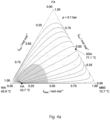
- the ternary plots indicate the molar ratios of isoprenol, formaldehyde and water.
- the molar ratio of formaldehyde to isoprenol (X FA ) is indicated.
- the curved lines are residue curves. Each residue curve represents a different feed composition with varying amounts of isoprenol, formaldehyde and water.
- the plot of the residue curves follows the liquid residue composition in a distillation column, i.e. from bottom (high temperature) to top (low temperature) of the column. In the shown ternary plots, i.e., following a residue curve to the higher temperature indicates the composition at the bottom of the column. Following the residue curve to the lower temperature indicates the composition at the top of the column.
- a water-isoprenol heteroazeotrope occurs, having a boiling point of 43.7 °C.
- a high-boiling azeotrope (SSA) comprising isoprenol and all of the formaldehyde occurs, having a boiling point of 77.1 °C.
- the water-isoprenol heteroazeotrope (HA) has a boiling point of 96.0 °C. Moreover, a water-formaldehyde low-boiling azeotrope (LSA) occurs (98.3 °C).
- a high-boiling azeotrope (SSA) of isoprenol and formaldehyde as observed in the ternary plot of Fig. 4a (0.1 bar) does not occur. Rather, isoprenol (130.3 °C) represents the high-boiling fraction.
- the water-isoprenol heteroazeotrope has a boiling point of 129.2 °C.
- the boiling point of the water-formaldehyde low-boiling azeotrope (LSA) is shifted to 128.0 °C and a higher formaldehyde concentration.
- isoprenol is found essentially free of formaldehyde (169.1 °C).
- Fig. 5 shows the relative volatility of formaldehyde in a mixture of isoprenol and formaldehyde fitted from experimental data.
- the term ⁇ FA indicates the mole fraction of formaldehyde in the gaseous phase.
- the term X FA indicates the mole fraction of formaldehyde (including the formaldehyde bounded as hemiformal) in the liquid phase. It is evident that the relative volatility of formaldehyde increases with higher temperatures, as indicated by the ratio of ⁇ FA to X FA .
- This example relates to the simulation of distillative formaldehyde removal from a liquid comprising 98 wt.-% of isoprenol and 2 wt.-% of formaldehyde (FA) in a low-boiler separation tower having 27 theoretical plates in the stripping section and 13 theoretical plates in the rectification section.
- the liquid was fed to the tower at 100 kg/h.
- a distillate comprising aqueous formaldehyde was obtained, 35 kg/h of which were returned to the top of the tower as a reflux stream.
- a stream of crude isoprenol (0.98 kg/h) containing isoprenol (66 wt.-%), water (22 wt.-%) and formaldehyde (1.7 wt.-%) was directed to a low-boiler separation tower.
- an isoprenol recycle stream (0.02 kg/h) from a wastewater stripping column (not shown in Fig. 3 ), containing isoprenol, water and formaldehyde was directed to the low-boiler separation tower.
- the low-boiler separation tower was operated at a pressure of 1 bara, a bottoms temperature of 130 °C, and a top temperature of 97 °C.
- a distillate stream (0.28 kg/h) containing water (83 wt.-%), isoprenol (7 wt.-%) and low-boilers (10 wt.-%), and a bottoms stream (0.72 kg/h) containing isoprenol (87 wt.-%), formaldehyde (2.4 wt.-%) and high-boilers (11 wt.-%) were obtained.
- the distillate stream was directed to the wastewater stripping column for further processing.
- the bottoms stream was directed to a finishing tower operated at 0.1 bara, a bottoms temperature of 154 °C, and a top temperature of 72 °C.
- a bottoms stream (0.07 kg/h) containing more than 99.5 wt.-% high-boilers (diols and oligomers) was obtained.
- the gaseous stream withdrawn from the top of the finishing tower was condensed in a condenser to obtain a condensate stream (1.60 kg/h). Part of the condensate (1.0 kg/h) was returned to the finishing tower as reflux. The remainder of the condensate (0.65 kg/h) was withdrawn as distillate. The distillate contained isoprenol and 2.7 wt.-% of formaldehyde.
- an isoprenol recycle stream was obtained as a side stream and was recycled to the low-boiler separation tower.
- a stream of crude isoprenol (1.07 kg/h) containing isoprenol (67 wt.-%), water (19 wt.-%) and formaldehyde (1.9 wt.-%) was directed to a first low-boiler separation tower.
- an isoprenol recycle stream from a wastewater stripping column (not shown in Fig. 1 ) was directed to the low-boiler separation tower.
- the process was simulated via CHEMASIM, as described with regard to Example 1.
- the first low-boiler separation tower was operated at a pressure of 0.3 bara, a bottoms temperature of 103 °C, and a top temperature of 67 °C.
- a distillate stream (0.24 kg/h) containing water (86 wt.-%), isoprenol (12 wt.-%) and low-boilers (2 wt.-%), and a bottoms stream (0.85 kg/h) containing isoprenol (83 wt.-%), formaldehyde (2.3 wt.-%) and high-boilers (14.4 wt.-%) were obtained.
- the first bottoms stream was directed to a second low-boiler separation tower as shown in Fig. 2 , which was operated at a pressure of 3 bara, a bottoms temperature of 173 °C, and a top temperature of 130 °C.
- a quench section was provided above the rectifying section.
- a collecting tray was located between the rectifying section and the quench section.
- a scrubbing section was provided above the quench section and water (0.02 kg/h) was introduced at the top of the scrubbing section through a water inlet.
- aqueous liquid (15 kg/h) was collected at the lower end of the quench section via the collecting tray.
- the aqueous liquid comprised formaldehyde (48 wt.-%), water (about 45 wt.-%) and isoprenol (about 7 wt.-%).
- the aqueous liquid was partially circulated into the top of the quench section through a circulation line (14.7 kg/h) and partially withdrawn as the second distillate (0.04 kg/h). Another part of the aqueous liquid was returned to the rectifying section as a reflux stream (0.23 kg/h) via a reflux line.
- the aqueous liquid circulated into the top of the quench section was passed through a heat-exchanger.
- the aqueous liquid was heat-exchanged with the feed stream to the evaporator of the first low-boiler distillation tower.
- the aqueous liquid was cooled from 125 °C to 111 °C.
- an offgas ( ⁇ 0.01 kg/h) was removed via a gas line.
- a second bottoms stream (0.83 kg/h) containing isoprenol (85.2 wt.-%), water (less than 0.1 wt.-%), high-boilers (14.7 wt.-%) and formaldehyde (less than 0.1 wt.-%) was withdrawn.
- the second bottoms stream was directed to a finishing tower operated at 0.1 bara, a bottoms temperature of 154 °C, and a top temperature of 72 °C.
- a bottoms stream (0.07 kg/h) containing high-boilers (comprising less than 0.4 wt.-% isoprenol) was obtained.
- a fluid stream (about 1.1 kg /h) was condensed in a condenser.
- the condensate contained isoprenol and less than 0.1 wt.-% of formaldehyde.
- Part of the condensate (about 0.4 kg/h) was returned to the finishing tower as reflux.
- the remainder of the condensate (0.72 kg/h) was withdrawn as second distillate.
- no additional offgas stream for purging formaldehyde was necessary.
Landscapes
- Chemical & Material Sciences (AREA)
- Organic Chemistry (AREA)
- Chemical Kinetics & Catalysis (AREA)
- Organic Low-Molecular-Weight Compounds And Preparation Thereof (AREA)
- Vaporization, Distillation, Condensation, Sublimation, And Cold Traps (AREA)
Claims (16)
- Procédé de récupération d'isoprénol essentiellement exempt de formaldéhyde à partir d'un flux d'isoprénol brut contenant de l'isoprénol, de l'eau et du formaldéhyde, le procédé comprenant la soumission du flux d'isoprénol brut ou d'une fraction de celui-ci contenant de l'isoprénol à une distillation dans une tour de séparation de composés à bas point d'ébullition fonctionnant à une pression de 2,5 bara ou plus pour obtenir un flux de distillat contenant du formaldéhyde aqueux et un flux de fond contenant de l'isoprénol.
- Procédé selon la revendication 1, comprenant la mise en réaction du formaldéhyde avec de l'isobutylène pour obtenir un mélange réactionnel, et l'élimination de l'isobutylène n'ayant pas réagi du mélange réactionnel dans une tour de distillation d'isobutylène pour obtenir le flux d'isoprénol brut.
- Procédé selon la revendication 2, dans lequel le second distillat est au moins partiellement recyclé dans la réaction du formaldéhyde avec l'isobutylène.
- Procédé selon l'une quelconque des revendications 1 à 3, comprenant(i) l'orientation du flux d'isoprénol brut vers une première tour de séparation de composés à bas point d'ébullition fonctionnant à une pression de 1,5 bara ou moins, pour obtenir un premier flux de fond contenant de l'isoprénol et du formaldéhyde, et un premier flux de distillat contenant de l'eau et des composés à bas point d' ébullition ;(ii) l'orientation du premier flux de fond vers une deuxième tour de séparation de composés à bas point d'ébullition fonctionnant à une pression de 2,5 bara ou plus, pour obtenir un deuxième flux de distillat contenant du formaldéhyde aqueux, et un deuxième flux de fond contenant de l'isoprénol ; et(iii) l'orientation du second flux de fond vers une tour de finition pour obtenir de l'isoprénol pur comme flux de distillat, et un flux de fond contenant des composés à haut point d'ébullition.
- Procédé selon la revendication 4, dans lequel une section de trempe est prévue en aval, dans le sens de l'écoulement de vapeurs, d'une section de rectification de la seconde tour de séparation de composés à bas point d'ébullition, et un liquide aqueux est recueilli à l'extrémité inférieure de la section de trempe, dans lequel le liquide aqueux est partiellement mis en circulation dans la section de trempe par une conduite de circulation et partiellement retiré en tant que second distillat.
- Procédé selon la revendication 5, dans lequel le liquide aqueux est refroidi avant d'être mis en circulation dans la section de trempe.
- Procédé selon la revendication 6, dans lequel le liquide aqueux est soumis à un échange thermique avec le flux d'isoprénol brut s'écoulant dans la première tour de séparation de composés à bas point d'ébullition avant d'être mis en circulation dans la section de trempe.
- Procédé selon l'une quelconque des revendications 5 à 7, dans lequel le liquide aqueux est partiellement renvoyé vers la section de rectification sous forme d'un flux de reflux.
- Procédé selon la revendication 8, dans lequel le rapport de débit massique du flux de reflux sur le second distillat est dans la plage de 2:1 à 10:1, de préférence de 3:1 à 7:1.
- Procédé selon l'une quelconque des revendications 5 à 9, dans lequel une section d'épuration est prévue en aval, dans le sens de l'écoulement de vapeurs, de la section de trempe et de l'eau est introduite au sommet de la section d'épuration.
- Procédé selon l'une quelconque des revendications 4 à 10, dans lequel le second distillat comprend 25 à 60 % en poids, préférablement 40 à 50 % en poids de formaldéhyde.
- Procédé selon l'une quelconque des revendications 4 à 11, dans lequel l'isoprénol pur obtenu comprend moins de 0,5 % en poids, de préférence moins de 0,1 % en poids de formaldéhyde.
- Procédé selon l'une quelconque des revendications 4 à 12, dans lequel la première tour de séparation de composés à bas point d'ébullition fonctionne à une pression de 1,2 bara ou moins, de préférence de 0,5 bara ou moins, et/ou dans lequel la seconde tour de séparation de composés à bas point d'ébullition fonctionne à une pression de 2,5 bara ou plus, de préférence de 2,8 bara ou plus.
- Procédé selon l'une quelconque des revendications 4 à 13, comprenant l'orientation d'au moins une partie du premier flux de distillat vers une colonne de strippage d'eaux usées pour séparer les composés à bas point d'ébullition de l'eau.
- Installation pour récupérer de l'isoprénol essentiellement exempt de formaldéhyde à partir d'un flux d'isoprénol brut contenant de l'isoprénol, de l'eau et du formaldéhyde, l'installation comprenant- une première tour de séparation de composés à bas point d'ébullition, conçue pour recevoir le flux d'isoprénol brut et pour séparer par distillation le flux d'isoprénol brut en un premier flux de fond contenant de l'isoprénol et du formaldéhyde, et un premier flux de distillat contenant de l'eau et des composés à bas point d'ébullition ;- une deuxième tour de séparation de composés à bas point d'ébullition, conçue pour recevoir un premier flux de fond provenant de la première tour de séparation de composés à bas point d'ébullition et pour séparer par distillation le premier flux de fond en un deuxième flux de distillat contenant du formaldéhyde aqueux et un deuxième flux de fond contenant de l'isoprénol ; et- une tour de finition, conçue pour recevoir un second flux de fond provenant de la seconde tour de séparation de composés à bas point d'ébullition et pour séparer par distillation le second flux de fond en isoprénol pur en tant que flux de distillat, et un flux de fond contenant des composés à haut point d'ébullition.
- Installation selon la revendication 15, dans laquelle la seconde tour de séparation de composés à bas point d'ébullition comprend- une section de trempe au-dessus d'une section de rectification de la deuxième tour de séparation de composés à bas point d'ébullition, dans laquelle la deuxième tour de séparation de composés à bas point d'ébullition est conçue pour recueillir un deuxième distillat au niveau de l'extrémité inférieure de la section de trempe et pour faire circuler partiellement le deuxième distillat dans la section de trempe par une ligne de circulation ; et- une section d'épuration au-dessus de la section de trempe et une entrée d'eau en haut de la section d'épuration.
Applications Claiming Priority (2)
| Application Number | Priority Date | Filing Date | Title |
|---|---|---|---|
| EP21162449 | 2021-03-12 | ||
| PCT/EP2022/056385 WO2022189652A1 (fr) | 2021-03-12 | 2022-03-11 | Procédé de récupération d'isoprénol |
Publications (2)
| Publication Number | Publication Date |
|---|---|
| EP4305014A1 EP4305014A1 (fr) | 2024-01-17 |
| EP4305014B1 true EP4305014B1 (fr) | 2025-04-09 |
Family
ID=74873670
Family Applications (1)
| Application Number | Title | Priority Date | Filing Date |
|---|---|---|---|
| EP22711081.4A Active EP4305014B1 (fr) | 2021-03-12 | 2022-03-11 | Procédé de récupération d'isoprénol |
Country Status (6)
| Country | Link |
|---|---|
| US (1) | US20240158325A1 (fr) |
| EP (1) | EP4305014B1 (fr) |
| JP (1) | JP2024510173A (fr) |
| CN (1) | CN117043131A (fr) |
| MX (1) | MX2023010665A (fr) |
| WO (1) | WO2022189652A1 (fr) |
Families Citing this family (7)
| Publication number | Priority date | Publication date | Assignee | Title |
|---|---|---|---|---|
| WO2023222895A1 (fr) | 2022-05-20 | 2023-11-23 | Basf Se | Purification d'un flux d'alcool éthyléniquement insaturé, préparation d'un aldéhyde éthyléniquement insaturé, en particulier prenal, et composés dérivés de celui-ci |
| EP4539976A1 (fr) | 2022-06-14 | 2025-04-23 | Basf Se | Réacteur d'échange de chaleur à tubes et calandre pour la mise en ouvre d'une réaction d'oxydation partielle en phase gazeuse catalytique et procédé pour la mise en ouvre d'une oxydation partielle en phase gazeuse catalytique |
| WO2024068852A1 (fr) | 2022-09-28 | 2024-04-04 | Basf Se | Procédé amélioré de préparation de 3,7-diméthyl-octa-2,6-diénal |
| CN118026816A (zh) * | 2022-11-03 | 2024-05-14 | 万华化学集团股份有限公司 | 一种分离pro和ispo的方法 |
| EP4720026A1 (fr) | 2023-06-02 | 2026-04-08 | Basf Se | Procédés de préparation de citral et produits interdépendants |
| WO2025078316A1 (fr) | 2023-10-13 | 2025-04-17 | Basf Se | Procédé de préparation de prénal et d'isovaléraldéhyde |
| WO2025108976A2 (fr) | 2023-11-20 | 2025-05-30 | Basf Se | Procédé d'isomérisation d'un alcool à insaturation éthylénique |
Family Cites Families (11)
| Publication number | Priority date | Publication date | Assignee | Title |
|---|---|---|---|---|
| DE1279014B (de) | 1967-02-25 | 1968-10-03 | Basf Ag | Verfahren zur Herstellung von Alkenolen |
| JPS493506B1 (fr) * | 1970-12-17 | 1974-01-26 | ||
| JPH11246453A (ja) * | 1998-03-04 | 1999-09-14 | Asahi Chem Ind Co Ltd | メタクロレイン及びメタノールの回収方法 |
| DE10064751A1 (de) | 2000-12-22 | 2002-06-27 | Bayer Ag | Verfahren zur Herstellung von Alk-3-en-1-olen |
| DE10361516A1 (de) * | 2003-12-23 | 2005-07-28 | Basf Ag | Verfahren zur Abtrennung von Trioxan aus einem Trioxan/Formaldehyd/Wasser-Gemisch mittels Druckwechsel-Rektifikation |
| US9868681B2 (en) * | 2014-06-02 | 2018-01-16 | Kuraray Co., Ltd. | Production method for γ,δ-unsaturated alcohols |
| GB201621985D0 (en) * | 2016-12-22 | 2017-02-08 | Johnson Matthey Davy Technologies Ltd | Process |
| US10919827B2 (en) * | 2017-08-11 | 2021-02-16 | Basf Se | Process for recovering 3-methylbut-3-en-1-ol |
| CN111971276A (zh) * | 2018-03-29 | 2020-11-20 | 塞拉尼斯销售德国有限公司 | 在非均相反应体系中生产环状缩醛的方法 |
| WO2020049111A1 (fr) | 2018-09-05 | 2020-03-12 | Basf Se | Procédé de production d'isoprénol |
| MX2021003239A (es) * | 2018-09-18 | 2021-05-12 | Basf Se | Metodo para recuperar 3-metil-but-3-en-1-ol de alta calidad. |
-
2022
- 2022-03-11 MX MX2023010665A patent/MX2023010665A/es unknown
- 2022-03-11 JP JP2023555162A patent/JP2024510173A/ja active Pending
- 2022-03-11 EP EP22711081.4A patent/EP4305014B1/fr active Active
- 2022-03-11 US US18/281,451 patent/US20240158325A1/en active Pending
- 2022-03-11 WO PCT/EP2022/056385 patent/WO2022189652A1/fr not_active Ceased
- 2022-03-11 CN CN202280020638.4A patent/CN117043131A/zh active Pending
Also Published As
| Publication number | Publication date |
|---|---|
| MX2023010665A (es) | 2023-09-21 |
| EP4305014A1 (fr) | 2024-01-17 |
| BR112023018085A2 (pt) | 2023-10-03 |
| CN117043131A (zh) | 2023-11-10 |
| US20240158325A1 (en) | 2024-05-16 |
| JP2024510173A (ja) | 2024-03-06 |
| WO2022189652A1 (fr) | 2022-09-15 |
Similar Documents
| Publication | Publication Date | Title |
|---|---|---|
| EP4305014B1 (fr) | Procédé de récupération d'isoprénol | |
| EP1300384B1 (fr) | Procédé de récupération de l'acroléine ou de la propionaldéhyde à partir des flux aqueux dilués | |
| EP2066613B1 (fr) | Procede de production d'acide acrylique | |
| KR100690034B1 (ko) | 아크릴산의 제조 방법 | |
| EP0695736A1 (fr) | Purification d'acide acrylique par distallation aréotropique | |
| JPS6251958B2 (fr) | ||
| KR100999428B1 (ko) | (메타)아크릴산의 제조 방법 | |
| KR20090110879A (ko) | 매우 순수한 1,4-부탄디올의 제조 방법 | |
| EP3406587A1 (fr) | Procédé de récupération d'acide (méth)acrylique | |
| US7071348B2 (en) | Process for the purification of olefinically unsaturated nitriles | |
| EP0643708B1 (fr) | Recuperation de 3,4-epoxy-1-butene contenu dans des effluents d'oxydation de 1,3-butadiene | |
| CN1257141C (zh) | 从反应混合物中分离三羟甲基丙烷的方法 | |
| US3174262A (en) | Chemical process and apparatus for recovery of ethylene oxide | |
| US6793776B2 (en) | Operation of heads column | |
| US3957880A (en) | Extractive distillation of a methacrolein effluent | |
| US20120271029A1 (en) | Process for preparing neopentyl glycol | |
| EP4255875B1 (fr) | Procédé de préparation d'alcoxydes métalliques par transalcoolisation | |
| US6265625B1 (en) | Isolation of glycols | |
| US20040127726A1 (en) | Method for purifying an organic solvent for the purposes of absorption of maleic acid anhydride | |
| EP4441020B1 (fr) | Procédé de préparation de l'isoprénal et/ou du prénal | |
| EP1636178B1 (fr) | Procede de preparation de caprolactame | |
| EP1419140B1 (fr) | Amelioration du fonctionnement de la colonne de tete de distillation dans la production d'acrylonitrile | |
| JPH0840966A (ja) | 高純度イソアルデヒドの製造方法 | |
| EP1636179B1 (fr) | Procede de fabrication de caprolactame a partir du 6-amino-capronitrile impur contenant de la tetrahydroazepine | |
| BR112023018085B1 (pt) | Processo e instalação para recuperar isoprenol essencialmente livre de formaldeído de uma corrente de isoprenol bruto contendo isoprenol, água e formaldeído |
Legal Events
| Date | Code | Title | Description |
|---|---|---|---|
| STAA | Information on the status of an ep patent application or granted ep patent |
Free format text: STATUS: UNKNOWN |
|
| STAA | Information on the status of an ep patent application or granted ep patent |
Free format text: STATUS: THE INTERNATIONAL PUBLICATION HAS BEEN MADE |
|
| PUAI | Public reference made under article 153(3) epc to a published international application that has entered the european phase |
Free format text: ORIGINAL CODE: 0009012 |
|
| STAA | Information on the status of an ep patent application or granted ep patent |
Free format text: STATUS: REQUEST FOR EXAMINATION WAS MADE |
|
| 17P | Request for examination filed |
Effective date: 20231012 |
|
| AK | Designated contracting states |
Kind code of ref document: A1 Designated state(s): AL AT BE BG CH CY CZ DE DK EE ES FI FR GB GR HR HU IE IS IT LI LT LU LV MC MK MT NL NO PL PT RO RS SE SI SK SM TR |
|
| DAV | Request for validation of the european patent (deleted) | ||
| DAX | Request for extension of the european patent (deleted) | ||
| GRAP | Despatch of communication of intention to grant a patent |
Free format text: ORIGINAL CODE: EPIDOSNIGR1 |
|
| STAA | Information on the status of an ep patent application or granted ep patent |
Free format text: STATUS: GRANT OF PATENT IS INTENDED |
|
| INTG | Intention to grant announced |
Effective date: 20241018 |
|
| GRAS | Grant fee paid |
Free format text: ORIGINAL CODE: EPIDOSNIGR3 |
|
| P01 | Opt-out of the competence of the unified patent court (upc) registered |
Free format text: CASE NUMBER: APP_4630/2025 Effective date: 20250128 |
|
| GRAA | (expected) grant |
Free format text: ORIGINAL CODE: 0009210 |
|
| STAA | Information on the status of an ep patent application or granted ep patent |
Free format text: STATUS: THE PATENT HAS BEEN GRANTED |
|
| AK | Designated contracting states |
Kind code of ref document: B1 Designated state(s): AL AT BE BG CH CY CZ DE DK EE ES FI FR GB GR HR HU IE IS IT LI LT LU LV MC MK MT NL NO PL PT RO RS SE SI SK SM TR |
|
| REG | Reference to a national code |
Ref country code: GB Ref legal event code: FG4D |
|
| REG | Reference to a national code |
Ref country code: CH Ref legal event code: EP |
|
| REG | Reference to a national code |
Ref country code: DE Ref legal event code: R096 Ref document number: 602022012926 Country of ref document: DE |
|
| REG | Reference to a national code |
Ref country code: IE Ref legal event code: FG4D |
|
| REG | Reference to a national code |
Ref country code: NL Ref legal event code: FP |
|
| REG | Reference to a national code |
Ref country code: AT Ref legal event code: MK05 Ref document number: 1783445 Country of ref document: AT Kind code of ref document: T Effective date: 20250409 |
|
| PG25 | Lapsed in a contracting state [announced via postgrant information from national office to epo] |
Ref country code: FI Free format text: LAPSE BECAUSE OF FAILURE TO SUBMIT A TRANSLATION OF THE DESCRIPTION OR TO PAY THE FEE WITHIN THE PRESCRIBED TIME-LIMIT Effective date: 20250409 Ref country code: PT Free format text: LAPSE BECAUSE OF FAILURE TO SUBMIT A TRANSLATION OF THE DESCRIPTION OR TO PAY THE FEE WITHIN THE PRESCRIBED TIME-LIMIT Effective date: 20250811 Ref country code: ES Free format text: LAPSE BECAUSE OF FAILURE TO SUBMIT A TRANSLATION OF THE DESCRIPTION OR TO PAY THE FEE WITHIN THE PRESCRIBED TIME-LIMIT Effective date: 20250409 |
|
| REG | Reference to a national code |
Ref country code: LT Ref legal event code: MG9D |
|
| PG25 | Lapsed in a contracting state [announced via postgrant information from national office to epo] |
Ref country code: NO Free format text: LAPSE BECAUSE OF FAILURE TO SUBMIT A TRANSLATION OF THE DESCRIPTION OR TO PAY THE FEE WITHIN THE PRESCRIBED TIME-LIMIT Effective date: 20250709 Ref country code: GR Free format text: LAPSE BECAUSE OF FAILURE TO SUBMIT A TRANSLATION OF THE DESCRIPTION OR TO PAY THE FEE WITHIN THE PRESCRIBED TIME-LIMIT Effective date: 20250710 |
|
| PG25 | Lapsed in a contracting state [announced via postgrant information from national office to epo] |
Ref country code: PL Free format text: LAPSE BECAUSE OF FAILURE TO SUBMIT A TRANSLATION OF THE DESCRIPTION OR TO PAY THE FEE WITHIN THE PRESCRIBED TIME-LIMIT Effective date: 20250409 |
|
| PG25 | Lapsed in a contracting state [announced via postgrant information from national office to epo] |
Ref country code: BG Free format text: LAPSE BECAUSE OF FAILURE TO SUBMIT A TRANSLATION OF THE DESCRIPTION OR TO PAY THE FEE WITHIN THE PRESCRIBED TIME-LIMIT Effective date: 20250409 |
|
| PG25 | Lapsed in a contracting state [announced via postgrant information from national office to epo] |
Ref country code: HR Free format text: LAPSE BECAUSE OF FAILURE TO SUBMIT A TRANSLATION OF THE DESCRIPTION OR TO PAY THE FEE WITHIN THE PRESCRIBED TIME-LIMIT Effective date: 20250409 |
|
| PG25 | Lapsed in a contracting state [announced via postgrant information from national office to epo] |
Ref country code: AT Free format text: LAPSE BECAUSE OF FAILURE TO SUBMIT A TRANSLATION OF THE DESCRIPTION OR TO PAY THE FEE WITHIN THE PRESCRIBED TIME-LIMIT Effective date: 20250409 |
|
| PG25 | Lapsed in a contracting state [announced via postgrant information from national office to epo] |
Ref country code: RS Free format text: LAPSE BECAUSE OF FAILURE TO SUBMIT A TRANSLATION OF THE DESCRIPTION OR TO PAY THE FEE WITHIN THE PRESCRIBED TIME-LIMIT Effective date: 20250709 |
|
| PG25 | Lapsed in a contracting state [announced via postgrant information from national office to epo] |
Ref country code: IS Free format text: LAPSE BECAUSE OF FAILURE TO SUBMIT A TRANSLATION OF THE DESCRIPTION OR TO PAY THE FEE WITHIN THE PRESCRIBED TIME-LIMIT Effective date: 20250809 |
|
| PG25 | Lapsed in a contracting state [announced via postgrant information from national office to epo] |
Ref country code: LV Free format text: LAPSE BECAUSE OF FAILURE TO SUBMIT A TRANSLATION OF THE DESCRIPTION OR TO PAY THE FEE WITHIN THE PRESCRIBED TIME-LIMIT Effective date: 20250409 |
|
| REG | Reference to a national code |
Ref country code: DE Ref legal event code: R097 Ref document number: 602022012926 Country of ref document: DE |
|
| PG25 | Lapsed in a contracting state [announced via postgrant information from national office to epo] |
Ref country code: DK Free format text: LAPSE BECAUSE OF FAILURE TO SUBMIT A TRANSLATION OF THE DESCRIPTION OR TO PAY THE FEE WITHIN THE PRESCRIBED TIME-LIMIT Effective date: 20250409 Ref country code: SM Free format text: LAPSE BECAUSE OF FAILURE TO SUBMIT A TRANSLATION OF THE DESCRIPTION OR TO PAY THE FEE WITHIN THE PRESCRIBED TIME-LIMIT Effective date: 20250409 |
|
| PG25 | Lapsed in a contracting state [announced via postgrant information from national office to epo] |
Ref country code: CZ Free format text: LAPSE BECAUSE OF FAILURE TO SUBMIT A TRANSLATION OF THE DESCRIPTION OR TO PAY THE FEE WITHIN THE PRESCRIBED TIME-LIMIT Effective date: 20250409 |
|
| PG25 | Lapsed in a contracting state [announced via postgrant information from national office to epo] |
Ref country code: EE Free format text: LAPSE BECAUSE OF FAILURE TO SUBMIT A TRANSLATION OF THE DESCRIPTION OR TO PAY THE FEE WITHIN THE PRESCRIBED TIME-LIMIT Effective date: 20250409 |
|
| PG25 | Lapsed in a contracting state [announced via postgrant information from national office to epo] |
Ref country code: SK Free format text: LAPSE BECAUSE OF FAILURE TO SUBMIT A TRANSLATION OF THE DESCRIPTION OR TO PAY THE FEE WITHIN THE PRESCRIBED TIME-LIMIT Effective date: 20250409 |
|
| PG25 | Lapsed in a contracting state [announced via postgrant information from national office to epo] |
Ref country code: IT Free format text: LAPSE BECAUSE OF FAILURE TO SUBMIT A TRANSLATION OF THE DESCRIPTION OR TO PAY THE FEE WITHIN THE PRESCRIBED TIME-LIMIT Effective date: 20250409 |
|
| PLBE | No opposition filed within time limit |
Free format text: ORIGINAL CODE: 0009261 |
|
| STAA | Information on the status of an ep patent application or granted ep patent |
Free format text: STATUS: NO OPPOSITION FILED WITHIN TIME LIMIT |
|
| REG | Reference to a national code |
Ref country code: CH Ref legal event code: L10 Free format text: ST27 STATUS EVENT CODE: U-0-0-L10-L00 (AS PROVIDED BY THE NATIONAL OFFICE) Effective date: 20260218 |
|
| 26N | No opposition filed |
Effective date: 20260112 |
|
| REG | Reference to a national code |
Ref country code: CH Ref legal event code: U11 Free format text: ST27 STATUS EVENT CODE: U-0-0-U10-U11 (AS PROVIDED BY THE NATIONAL OFFICE) Effective date: 20260401 |
|
| PGFP | Annual fee paid to national office [announced via postgrant information from national office to epo] |
Ref country code: GB Payment date: 20260319 Year of fee payment: 5 |
|
| PGFP | Annual fee paid to national office [announced via postgrant information from national office to epo] |
Ref country code: DE Payment date: 20260320 Year of fee payment: 5 |
|
| PGFP | Annual fee paid to national office [announced via postgrant information from national office to epo] |
Ref country code: BE Payment date: 20260323 Year of fee payment: 5 |
|
| PGFP | Annual fee paid to national office [announced via postgrant information from national office to epo] |
Ref country code: NL Payment date: 20260323 Year of fee payment: 5 |
|
| PGFP | Annual fee paid to national office [announced via postgrant information from national office to epo] |
Ref country code: FR Payment date: 20260323 Year of fee payment: 5 |