EP4307384A2 - Dispositif mosfet de puissance à structure de grille isolée améliorée et son procédé de fabrication - Google Patents
Dispositif mosfet de puissance à structure de grille isolée améliorée et son procédé de fabrication Download PDFInfo
- Publication number
- EP4307384A2 EP4307384A2 EP23181494.8A EP23181494A EP4307384A2 EP 4307384 A2 EP4307384 A2 EP 4307384A2 EP 23181494 A EP23181494 A EP 23181494A EP 4307384 A2 EP4307384 A2 EP 4307384A2
- Authority
- EP
- European Patent Office
- Prior art keywords
- region
- silicide
- gate
- phase
- layer
- Prior art date
- Legal status (The legal status is an assumption and is not a legal conclusion. Google has not performed a legal analysis and makes no representation as to the accuracy of the status listed.)
- Pending
Links
Images




Classifications
-
- H—ELECTRICITY
- H10—SEMICONDUCTOR DEVICES; ELECTRIC SOLID-STATE DEVICES NOT OTHERWISE PROVIDED FOR
- H10D—INORGANIC ELECTRIC SEMICONDUCTOR DEVICES
- H10D30/00—Field-effect transistors [FET]
- H10D30/60—Insulated-gate field-effect transistors [IGFET]
-
- H—ELECTRICITY
- H10—SEMICONDUCTOR DEVICES; ELECTRIC SOLID-STATE DEVICES NOT OTHERWISE PROVIDED FOR
- H10D—INORGANIC ELECTRIC SEMICONDUCTOR DEVICES
- H10D12/00—Bipolar devices controlled by the field effect, e.g. insulated-gate bipolar transistors [IGBT]
- H10D12/01—Manufacture or treatment
- H10D12/031—Manufacture or treatment of IGBTs
-
- H—ELECTRICITY
- H10—SEMICONDUCTOR DEVICES; ELECTRIC SOLID-STATE DEVICES NOT OTHERWISE PROVIDED FOR
- H10D—INORGANIC ELECTRIC SEMICONDUCTOR DEVICES
- H10D30/00—Field-effect transistors [FET]
- H10D30/01—Manufacture or treatment
- H10D30/021—Manufacture or treatment of FETs having insulated gates [IGFET]
-
- H—ELECTRICITY
- H10—SEMICONDUCTOR DEVICES; ELECTRIC SOLID-STATE DEVICES NOT OTHERWISE PROVIDED FOR
- H10D—INORGANIC ELECTRIC SEMICONDUCTOR DEVICES
- H10D30/00—Field-effect transistors [FET]
- H10D30/60—Insulated-gate field-effect transistors [IGFET]
- H10D30/64—Double-diffused metal-oxide semiconductor [DMOS] FETs
- H10D30/66—Vertical DMOS [VDMOS] FETs
-
- H—ELECTRICITY
- H10—SEMICONDUCTOR DEVICES; ELECTRIC SOLID-STATE DEVICES NOT OTHERWISE PROVIDED FOR
- H10D—INORGANIC ELECTRIC SEMICONDUCTOR DEVICES
- H10D62/00—Semiconductor bodies, or regions thereof, of devices having potential barriers
- H10D62/10—Shapes, relative sizes or dispositions of the regions of the semiconductor bodies; Shapes of the semiconductor bodies
- H10D62/124—Shapes, relative sizes or dispositions of the regions of semiconductor bodies or of junctions between the regions
- H10D62/126—Top-view geometrical layouts of the regions or the junctions
- H10D62/127—Top-view geometrical layouts of the regions or the junctions of cellular field-effect devices, e.g. multicellular DMOS transistors or IGBTs
-
- H—ELECTRICITY
- H10—SEMICONDUCTOR DEVICES; ELECTRIC SOLID-STATE DEVICES NOT OTHERWISE PROVIDED FOR
- H10D—INORGANIC ELECTRIC SEMICONDUCTOR DEVICES
- H10D62/00—Semiconductor bodies, or regions thereof, of devices having potential barriers
- H10D62/80—Semiconductor bodies, or regions thereof, of devices having potential barriers characterised by the materials
- H10D62/83—Semiconductor bodies, or regions thereof, of devices having potential barriers characterised by the materials being Group IV materials, e.g. B-doped Si or undoped Ge
- H10D62/832—Semiconductor bodies, or regions thereof, of devices having potential barriers characterised by the materials being Group IV materials, e.g. B-doped Si or undoped Ge being Group IV materials comprising two or more elements, e.g. SiGe
- H10D62/8325—Silicon carbide
-
- H—ELECTRICITY
- H10—SEMICONDUCTOR DEVICES; ELECTRIC SOLID-STATE DEVICES NOT OTHERWISE PROVIDED FOR
- H10D—INORGANIC ELECTRIC SEMICONDUCTOR DEVICES
- H10D64/00—Electrodes of devices having potential barriers
- H10D64/01—Manufacture or treatment
- H10D64/013—Manufacture or treatment of electrodes having a conductor capacitively coupled to a semiconductor by an insulator
- H10D64/01366—Manufacture or treatment of electrodes having a conductor capacitively coupled to a semiconductor by an insulator the semiconductor being silicon carbide
-
- H—ELECTRICITY
- H10—SEMICONDUCTOR DEVICES; ELECTRIC SOLID-STATE DEVICES NOT OTHERWISE PROVIDED FOR
- H10D—INORGANIC ELECTRIC SEMICONDUCTOR DEVICES
- H10D64/00—Electrodes of devices having potential barriers
- H10D64/20—Electrodes characterised by their shapes, relative sizes or dispositions
- H10D64/27—Electrodes not carrying the current to be rectified, amplified, oscillated or switched, e.g. gates
- H10D64/311—Gate electrodes for field-effect devices
- H10D64/411—Gate electrodes for field-effect devices for FETs
- H10D64/511—Gate electrodes for field-effect devices for FETs for IGFETs
- H10D64/512—Disposition of the gate electrodes, e.g. buried gates
-
- H—ELECTRICITY
- H10—SEMICONDUCTOR DEVICES; ELECTRIC SOLID-STATE DEVICES NOT OTHERWISE PROVIDED FOR
- H10D—INORGANIC ELECTRIC SEMICONDUCTOR DEVICES
- H10D64/00—Electrodes of devices having potential barriers
- H10D64/20—Electrodes characterised by their shapes, relative sizes or dispositions
- H10D64/27—Electrodes not carrying the current to be rectified, amplified, oscillated or switched, e.g. gates
- H10D64/311—Gate electrodes for field-effect devices
- H10D64/411—Gate electrodes for field-effect devices for FETs
- H10D64/511—Gate electrodes for field-effect devices for FETs for IGFETs
- H10D64/514—Gate electrodes for field-effect devices for FETs for IGFETs characterised by the insulating layers
-
- H—ELECTRICITY
- H10—SEMICONDUCTOR DEVICES; ELECTRIC SOLID-STATE DEVICES NOT OTHERWISE PROVIDED FOR
- H10D—INORGANIC ELECTRIC SEMICONDUCTOR DEVICES
- H10D64/00—Electrodes of devices having potential barriers
- H10D64/60—Electrodes characterised by their materials
- H10D64/66—Electrodes having a conductor capacitively coupled to a semiconductor by an insulator, e.g. MIS electrodes
- H10D64/661—Electrodes having a conductor capacitively coupled to a semiconductor by an insulator, e.g. MIS electrodes the conductor comprising a layer of silicon contacting the insulator, e.g. polysilicon having vertical doping variation
- H10D64/662—Electrodes having a conductor capacitively coupled to a semiconductor by an insulator, e.g. MIS electrodes the conductor comprising a layer of silicon contacting the insulator, e.g. polysilicon having vertical doping variation the conductor further comprising additional layers, e.g. multiple silicon layers having different crystal structures
- H10D64/663—Electrodes having a conductor capacitively coupled to a semiconductor by an insulator, e.g. MIS electrodes the conductor comprising a layer of silicon contacting the insulator, e.g. polysilicon having vertical doping variation the conductor further comprising additional layers, e.g. multiple silicon layers having different crystal structures the additional layers comprising a silicide layer contacting the layer of silicon, e.g. polycide gates
-
- H—ELECTRICITY
- H10—SEMICONDUCTOR DEVICES; ELECTRIC SOLID-STATE DEVICES NOT OTHERWISE PROVIDED FOR
- H10D—INORGANIC ELECTRIC SEMICONDUCTOR DEVICES
- H10D64/00—Electrodes of devices having potential barriers
- H10D64/60—Electrodes characterised by their materials
- H10D64/66—Electrodes having a conductor capacitively coupled to a semiconductor by an insulator, e.g. MIS electrodes
- H10D64/671—Electrodes having a conductor capacitively coupled to a semiconductor by an insulator, e.g. MIS electrodes the conductor having lateral variation in doping or structure
-
- H—ELECTRICITY
- H10—SEMICONDUCTOR DEVICES; ELECTRIC SOLID-STATE DEVICES NOT OTHERWISE PROVIDED FOR
- H10D—INORGANIC ELECTRIC SEMICONDUCTOR DEVICES
- H10D64/00—Electrodes of devices having potential barriers
- H10D64/20—Electrodes characterised by their shapes, relative sizes or dispositions
- H10D64/27—Electrodes not carrying the current to be rectified, amplified, oscillated or switched, e.g. gates
- H10D64/311—Gate electrodes for field-effect devices
- H10D64/411—Gate electrodes for field-effect devices for FETs
- H10D64/511—Gate electrodes for field-effect devices for FETs for IGFETs
- H10D64/517—Gate electrodes for field-effect devices for FETs for IGFETs characterised by the conducting layers
- H10D64/519—Gate electrodes for field-effect devices for FETs for IGFETs characterised by the conducting layers characterised by their top-view geometrical layouts
Definitions
- the present invention relates to a power MOSFET device with improved isolated-gate structure and to a manufacturing process thereof.
- the isolated-gate structure has a gate region buried in a gate-oxide layer, where the gate region comprises a gate layer of polysilicon and a plurality of silicide regions, which enable local modification of the electrical resistance of the gate region.
- power devices are electronic devices designed to work at high voltages and currents, for example with voltages that reach 1700 V in the inhibition state, and as much as several tens or hundreds of amps of current in the conduction state.
- semiconductor power devices are known based, for example, upon silicon, gallium nitride (GaN), silicon carbide (SiC), gallium arsenide (GaAs).
- GaN gallium nitride
- SiC silicon carbide
- GaAs gallium arsenide
- SiC may operate up to approximately 400°C and has the possibility of withstanding high powers (of even hundreds of watts) and may work at high the frequencies (of hundreds of megahertz).
- Power devices find use in multiple fields of application. For instance, they are commonly used as switched-mode power supplies (SMPS), audio amplifiers, engine controls, energy-conversion devices, devices in the automotive field for hybrid and electric vehicles.
- SMPS switched-mode power supplies
- audio amplifiers audio amplifiers
- engine controls energy-conversion devices
- devices in the automotive field for hybrid and electric vehicles are commonly used as switched-mode power supplies (SMPS), audio amplifiers, engine controls, energy-conversion devices, devices in the automotive field for hybrid and electric vehicles.
- SMPS switched-mode power supplies
- audio amplifiers audio amplifiers
- engine controls engine controls
- energy-conversion devices devices in the automotive field for hybrid and electric vehicles.
- power devices comprise power diodes, power transistors with finger-electrode structure, thyristors, MOSFETs (Metal-Oxide-Semiconductor Field-Effect Transistors), and SJ-MOSFETs (Super-Junction MOSFETs).
- MOSFETs Metal-Oxide-Semiconductor Field-Effect Transistors
- SJ-MOSFETs Super-Junction MOSFETs
- electrical control of power devices may present critical aspects, for example due to the wide extension of the active area of the power device or else to specific layouts of the power device that may generate delays in the propagation of the control signals (e.g., source voltage) and consequently delays in switching of the state of the power device (e.g., ON/OFF state).
- delays in the propagation of the control signals e.g., source voltage
- switching of the state of the power device e.g., ON/OFF state
- power devices may switch locally at different times (i.e., some regions of the power device switch on/off before others) and this leads to degraded electrical performance and to the risk of damage to the power device.
- switching of state of the power device does not occur in a uniform and simultaneous way within the entire power device but rather occurs in a localized way and at different times, it is possible for high current densities to be generated (in general, higher than expected and considered in the design stage) in specific and localized regions of the power device, and this may cause excessive heating of these regions, which may lead to damage to the power device by the Joule effect.
- Document EP 1 659 636 A1 relates to a power electronic device, such as a MOS device, of the type comprising a very high integration of elementary MOS transistors and used in multiple applications both at low and high supply voltage.
- the aim of the present invention is to provide a power MOSFET device with improved isolated-gate structure and a manufacturing process thereof that will overcome the drawbacks of the prior art.
- a power MOSFET device with improved isolated-gate structure and a manufacturing process thereof are provided, as defined in the annexed claims.
- Figure 1 shows a power device (in detail, of a power MOSFET type) 1, according to an embodiment described and provided by way of example.
- Figure 1 shows by way of example an elementary cell 1' of the power device 1; however, and in a way of itself known to the person skilled in the art, the power device 1 may comprise a plurality of elementary cells 1' electrically connected together, for example in parallel.
- the elementary cell 1' of the power device 1 has a direction of main extension parallel to the axis X, and Figure 1 shows a cross-sectional view of the elementary cell 1' in a plane YZ defined by the axes Y and Z, thus in a direction perpendicular to the aforesaid direction of main extension.
- the elementary cell 1' includes a semiconductor body 3 of semiconductor material, for example SiC or silicon, having a front surface (or first main surface) 3a and a rear surface (or second main surface) 3b.
- the semiconductor body 3, common to all the elementary cells 1', comprises a drain region 5, which has a first conductivity type (for example, of an N type) and a first conductivity value and extends in the semiconductor body 3 starting from the rear surface 3b towards the front surface 3a.
- a drain metallization 6 extends on the rear surface 3b, in direct electrical contact with the drain region 5 and forms an electrical drain terminal.
- a first body region 9a and a second body region 9b extend in the semiconductor body 3 starting from the front surface 3a towards the rear surface 3b, without reaching the latter, and are physically separated from one another (in a direction parallel to the axis Y) and from the rear surface 3b (in a direction parallel to the axis Z) via the drain region 5.
- Both the first body region 9a and the second body region 9b have a second conductivity type (here, of a P type) and a second conductivity value.
- a first source region 13a and a second source region 13b which have the first conductivity type (here, of an N type) and a third conductivity value higher than the first conductivity value, extend into the first body region 9a and the second body region 9b, respectively, starting from the front surface 3a.
- each source region 13a, 13b is physically separated (i.e., arranged at a distance) from the drain region 5 via a respective portion of the first body region 9a and of the second body region 9b, respectively, which form a first channel region 17a and a second channel region 17b, respectively (which thus have the second conductivity value).
- the elementary cell 1' may have: a channel length L ch of the body regions 9a, 9b (for instance, measured in a direction parallel to the axis Y), for example comprised between 150 nm and 1000 nm, in particular approximately 500 nm; the first doping value of the drain region 5 comprised between 1.10 15 ions/cm 3 and 5.10 17 ions/cm 3 , for example approximately 2.10 16 ions/cm 3 ; the second doping value for implantation of the body regions 9a, 9b comprised approximately between 1.10 13 ions/cm 2 and 5 ⁇ 10 15 ions/cm 2 ; and the third doping value for implantation of the source regions 13a, 13b comprised between 1.10 15 ions/cm 2 and 5 ⁇ 10 16 ions/cm 2 , for example approximately 1 ⁇ 10 16 ions/cm 2 .
- the power device 1 further comprises a gate structure (also referred to as "isolated-gate structure") 15, which, in the embodiment illustrated by way of example in Figure 1 , overlies, along the axis Z, the channel regions 17a, 17b of the body regions 9a, 9b and the portion of the drain region 5 arranged along the axis Y between the body regions 9a, 9b.
- a gate structure also referred to as "isolated-gate structure”
- the gate structure 15 comprises an oxide layer (or gate-oxide layer) 12, on the front surface 3a, and a gate region 24 buried in the oxide layer 12 so as to be isolated physically and electrically from the semiconductor body 3 (in particular, from the front surface 3a of the semiconductor body 3).
- the gate region 24 is electrically connected to a gate metallization (not shown), in a per se known manner to the person skilled in the art.
- the oxide layer 12 is made of insulating material such as oxide, for example silicon dioxide (SiO 2 ).
- the gate region 24 comprises a gate layer 14 of polysilicon, which, in the embodiment illustrated by way of example in Figure 1 , overlies, along the axis Z, the channel regions 17a, 17b of the body regions 9a, 9b and the portion of the drain region 5 arranged along the axis Y between the body regions 9a, 9b.
- the gate layer 14 is made of doped polysilicon and has, for example, the first electrical conductivity type (here, of an N type) and a fourth doping value that, purely by way of example, is comprised between approximately 5 ⁇ 10 18 ions/cm 2 and approximately 1 ⁇ 10 21 ions/cm 2 , for example approximately 5 ⁇ 10 19 ions/cm 2 .
- the gate region 24 further comprises a plurality of silicide regions (also called in the following electrical-modulation regions, or silicide islands) 25, of silicide such as TiSi 2 , CoSi 2 , NiSi, WSi 2 .
- silicide regions 25 are made of TiSi 2 , even though it is evident that other silicides (i.e., binary chemical compounds formed by metals or semimetals and silicon) may likewise be used.
- the electrical-modulation regions 25 are, for example, housed in the gate layer 14 and are fully described in what follows with reference to Figure 4 .
- a source metallization 16 (defining an electrical source terminal of conductive material, such as metal) extends on the oxide layer 12 and on the front surface 3a, where the latter is not covered by the oxide layer 12, and is in direct electrical contact with the source regions 13a, 13b and the body regions 9a, 9b, which are thus electrically coupled together.
- one or more passivation layers may extend on the source metallization 16.
- the drain metallization 6, the drain region 5, the first body region 9a, the first source region 13a, the gate layer 14, the oxide layer 12, and the source metallization 16 form a first device portion 1a
- the drain metallization 6, the drain region 5, the second body region 9b, the second source region 13b, the gate layer 14, the oxide layer 12, and the source metallization 16 form a second device portion 1b.
- Figure 2 shows the power device 1 in top plan view, parallel to a plane XY (also referred to as "first plane XY") defined by the axes X and Y, where for simplicity of representation the gate structure 15 and the source metallization 16 are not shown.
- plane XY also referred to as "first plane XY”
- the channel regions 17a, 17b of the device portions 1a, 1b have a width, in a direction parallel to the axis X, for example equal to one another and equal to a channel extension W ch (also referred to as channel length W ch ), for example comprised between approximately 100 nm and approximately 1 um.
- W ch also referred to as channel length W ch
- the elementary cell 1' extends within an active region 7 of the power device 1; in the case of a plurality of elementary cells 1', they likewise extend inside the active region 7 and share the gate structure 15.
- the semiconductor body 3 includes a field isolation region 11 (of insulating material, such as SiO 2 ) having a closed shape and delimiting the active region 7 of the power device 1.
- the isolation region 11 has the function of electrically insulating the active region 7 (and consequently the one or more elementary cells 1') from the remaining portion of semiconductor body 3.
- the active region 7 and the one or more elementary cells 1' included therein are thus galvanically insulated with respect to possible further devices comprised in the semiconductor body 3 but external to the active region 7.
- each of them shares the drain region 5, the drain metallization 6, and the source metallization 16. Furthermore, the elementary cells 1' share the gate layer 14, which is common to all the elementary cells 1'.
- Figure 3A shows an embodiment of the power device 1, in top plan view, where for simplicity of representation the source metallization 16 and the gate region 24 are not shown.
- the power device 1 comprises a number of elementary cells 1' electrically connected together.
- the elementary cells 1' may be aligned with one another along an axis of alignment 20 parallel to the axis X and to the direction of main extension of each elementary cell 1' so as to form an array of elementary cells 1'.
- the first and second source regions 13a and 13b of each elementary cell 1' are aligned with one another in a direction orthogonal to the axis of alignment 20.
- the gate structure 15 overlies each elementary cell 1' and has a respective direction of main extension 19 that is parallel to the axis of alignment 20.
- the gate structure 15 is here strip-shaped, with main extension in the direction of main extension.
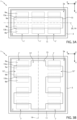
- Figure 3B shows a different embodiment of the power device 1, in top plan view where for simplicity of representation the source metallization 16 and the gate region 24 are not shown.
- the power device 1 comprises a number of elementary cells 1' electrically connected together.
- the gate structure 15 may have a main portion 15' having a direction of main extension 19 for example parallel to the axis Y, and a plurality of secondary portions 15", which extend from the main portion 15' in a way transverse to the latter.
- each secondary portion 15" has a respective main extension that is transverse to the direction of main extension 19 and here for example parallel to the axis X.
- the main portion 15' is here strip-shaped having the aforesaid direction of main extension 19, whereas the secondary portions 15" may extend two by two on sides of the main portion 15' that are opposite to one another along the axis X, and each pair of secondary portions 15" may have the respective secondary portions 15" coaxial (i.e., the respective main extensions are aligned with one another in a direction parallel to the axis X).
- Each secondary portion 15" may, for example, overlie, along the axis Z, a respective one of the elementary cells 1'. Consequently, each elementary cell 1' has the first and second source regions 13a and 13b that are, for example, aligned with one another in a direction parallel to the direction of main extension 19.
- Figure 4 shows a longitudinal sectional view of the power device 1, taken along a line of section IV-IV shown in Figure 1 and taken in an area corresponding to the gate layer 14 and the electrical-modulation regions 25.
- this view is in a plane XZ defined by the axes X and Z.
- Figure 4 does not show the source metallization 16 and the drain metallization 6.
- Figure 4 shows the electrical-modulation regions 25. Purely by way of non-limiting example, Figure 4 shows a first electrical-modulation region 25a, a second electrical-modulation region 25b, and a third electrical-modulation region 25c; however, the number of electrical-modulation regions 25 may vary and may for example be two or more than three.
- the gate layer 14 has a top surface 14a and a bottom surface 14b opposite to one another along the axis Z.
- the top surface 14a faces a top portion 12a of the oxide layer 12, arranged, along the axis Z, between the gate layer 14 and the source metallization 16, while the bottom surface 14b faces a bottom portion 12b of the oxide layer 12, arranged, along the axis Z, between the gate layer 14 and the drain region 5.
- the electrical-modulation regions 25 extend in the gate layer 14 at the top surface 14a of the gate layer 14 so as to face the top surface 14a and to be arranged alongside one another and spaced apart in the plane XY (i.e., to be arranged alongside one another).
- the electrical-modulation regions 25 are at a distance from one another in a direction parallel to the plane XY; for example, they are aligned with one another along the axis X and/or the axis Y to form an array and/or a matrix pattern; purely by way of example, Figure 4 shows the electrical-modulation regions 25a, 25b, 25c aligned along the axis X.
- the electrical-modulation regions 25 are arranged apart from one another in a direction parallel to the plane XY by the gate layer 14.
- the electrical-modulation regions 25 extend in the gate layer 14 from the top surface 14a to the bottom surface 14b.
- the electrical-modulation regions 25 may reach the bottom surface 14b or else extend at a distance, along the axis Z, from the bottom surface 14b.
- the electrical-modulation regions 25 may protrude outside of the gate layer 14 and extend partially in the top portion 12a of the oxide layer 12.
- the electrical-modulation regions 25 have, in a plane parallel to the plane XY, a shape (i.e., a cross section) that is a closed polygon, such as a square, a triangle, a rectangle, a hexagon, etc.
- a shape i.e., a cross section
- the electrical-modulation regions 25 are considered as having a square shape even though other shapes may likewise be considered.
- Each electrical-modulation region 25 has a thickness t silic measured along the axis Z (e.g., maximum thickness, for example measured between a top surface and a bottom surface of the electrical-modulation regions 25, opposite to one another, along the axis Z) and has an area of extension A silic measured in a plane parallel to the plane XY (e.g., area of maximum extension). Further, for more than two electrical-modulation regions 25, each pair of electrical-modulation regions 25 that are adjacent to one another in a direction parallel to the plane XY has a minimum distance D silic that is the minimum distance between said electrical-modulation regions 25, measured, for example, along the axis X or the axis Y.
- the shape of the electrical-modulation regions 25 in a plane parallel to the plane XY, the thickness t silic , the area of extension A silic , and the minimum distance D silic are also referred to in what follows as structural parameters of the electrical-modulation regions 25.
- the electrical-modulation regions 25 have structural parameters that may be different from one another.
- at least one of the electrical-modulation regions 25 may have at least one of the structural parameters (the shape, the thickness t silic , the area of extension A silic and the minimum distance D silic ) that is different from that of the other electrical-modulation regions 25.
- all the electrical-modulation regions 25 have the same structural parameters.
- the electrical-modulation regions 25a, 25b and 25c have the same shape, area of extension A silic , and minimum distance D silic , but have the thickness t silic that varies.
- the structural parameters of the electrical-modulation regions 25 are chosen heuristically in the stage of design of the power device 1 in order to achieve predefined and specific targets for the application in which the power device 1 will be used.
- silicides have an electrical resistivity that is generally much lower than that of the polysilicon of the gate layer 14, for example lower by approximately two orders of magnitude.
- the electrical resistivity of the polysilicon is comprised between approximately 1 ⁇ m and approximately 100 ⁇ m and the electrical resistivity of TiSi 2 is comprised between approximately 0.01 ⁇ m and approximately 1 ⁇ m.
- the presence of the electrical-modulation regions 25 reduces the overall electrical resistance of the gate region 24 as compared to the case where the electrical-modulation regions 25 are not present and above all enables local modulation of the electrical resistance of the gate region 24, enabling localized and selective variation of the electrical properties of the power device 1 (e.g., the rate of switching from the ON state to the OFF state and vice versa, in predefined regions of the power device 1).
- the gate region 24 may be useful to have one or more first portions of the gate region 24 at a lower electrical resistance and one or more second portions of the gate region 24 at a higher electrical resistance, arranged alongside (e.g., adjacent in a direction orthogonal to the axis Z) the one or more first portions of the gate region 24.
- the one or more first portions of the gate region 24 comprise the electrical-modulation regions 25 whereas the one or more second portions of the gate region 24 do not.
- one or more first sub-portions of the one or more first portions of the gate region 24 may present, relative to one or more second sub-portions of the one or more first portions of the gate region 24 (with a higher electrical resistance than the one or more first sub-portions and arranged alongside the one or more first sub-portions), at least one of the following: a greater number of electrical-modulation regions 25, a larger thickness t silic , a greater area of extension A silic , and a smaller minimum distance D silic .
- the gate structure 15 is strip-shaped and has the direction of main extension 19. Consequently, also the gate layer 14 has its main extension in the direction of main extension 19 and has a first end 14' and a second end 14" ( Figure 4 ) opposite to one another in the direction of main extension 19. For instance, it is required for the electrical resistance of the gate region 24 to increase proceeding from the first end 14' to the second end 14".
- the gate region 24 is designed in such a way that at least one of the following criteria applies: the number of electrical-modulation regions 25 decreases, the thickness t silic decreases, the area of extension A silic decreases, and the minimum distance D silic increases.
- Figure 4 shows the case where the electrical resistance of the gate region 24 increases proceeding from the first end 14' to the second end 14" via a reduction of the thickness t silic proceeding from the first end 14' to the second end 14".
- Figure 5 shows a top plan view of the gate structure 15 of Figure 4 .
- the electrical-modulation regions 25 have a square shape in a plane parallel to the plane XY, with side P (e.g., greater than approximately 0.2 um and for example equal to approximately 1 ⁇ m). Further, the electrical-modulation regions 25 are, for example, spaced at equal distances apart in the direction of main extension 19.
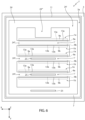
- Figure 6 is a schematic illustration, in top plan view, of a further example of the gate region 24, in particular of the arrangement of the electrical-modulation regions 25 in the gate layer 14.
- Figure 6 shows a top plan view of a further embodiment of the power device 1, where for simplicity of representation the source metallization 16 and the oxide layer 12 are not shown (more in general, what extends above the gate region 24 along the axis Z is not shown).
- the body regions 9a, 9b, the source regions 13a, 13b and the drain region 5 that underlie the gate region 24 are shown with the edges in solid lines where they are exposed along the axis Z by the gate region 24 and with the edges in dashed lines where they are covered along the axis Z by the gate region 24.
- the electrical-modulation regions 25 are also shown with edges in solid lines since they are at the upper surface of the gate region 24.
- the power device 1 comprises, by way of example, a number of elementary cells 1' electrically connected together.
- the gate region 24 may present a main portion 24' that for example is coupled (e.g., with continuity, i.e. in an integral way) to an electrical connection portion 24′′′ to which for example the gate metallization may be coupled.
- the main portion 24' has the shape of a polygonal frame, for example a square frame, and defines an inner region that extends inside the polygonal frame (i.e., is externally delimited thereby).
- each secondary portion 24" forming part of a respective elementary cell 1' (i.e., overlying, along the axis Z, a respective first device portion 1a and a respective second device portion 1b, as shown in Figure 1 ).
- Figure 1 shows in detail one of these secondary portions 24" of the gate region 24, in cross section.
- Each secondary portion 24" has respective ends (e.g., opposite to one another along the axis X) coupled to the main portion 24'.
- the secondary portions 24" extend between sides of the square frame opposite to one another along the axis X so as to be parallel to one another and to the axis X.
- the electrical-modulation regions 25 may extend in some of the secondary portions 24" and, optionally, also in part of the main portion 24'.
- the electrical-modulation regions 25 may extend in a first set of secondary portions 24" and do not extend in a second set of secondary portions 24".
- the first set extends on the opposite side of the gate region 24 with respect to the electrical connection region 24′′′, for example along the axis Y, whereas the second set extends between the electrical connection region 24′′′ and the first set. Consequently, the secondary portions 24" of the first set form the first portions of the gate region 24 with a lower electrical resistance, and the secondary portions 24" of the second set form the second portions of the gate region 24 with a higher electrical resistance.
- the electrical-modulation regions 25 may extend in central areas of the secondary portions 24" (as shown in Figure 6 ) or in end areas of the secondary portions 24".
- the central areas of the secondary portions 24" are regions of the secondary portions 24" that, along the axis X, are arranged at the centre and are arranged between the end areas of the secondary portions 24" (for example, they are arranged so as to be equidistant from the ends of the secondary portions 24" coupled to the main portion 24'); instead, the end areas of the secondary portions 24" are arranged alongside the central areas of the secondary portions 24" and define said ends of the secondary portions 24" that are coupled to the main portion 24'.
- the central area of the secondary portion 24" forms the first portion of the gate region 24 with a lower electrical resistance
- the end areas of the secondary portions 24" form the second portions of the gate region 24 with a higher electrical resistance
- the power device 1 is biased by applying a source voltage V S to the source metallization 16 (for example, a ground reference voltage GND), whereas a drain voltage V D (e.g., from 30 V to 1700 V) is applied to the drain metallization 6.
- a source voltage V S for example, a ground reference voltage GND
- a drain voltage V D e.g., from 30 V to 1700 V
- the gate region 24 is biased, via the gate metallization, to a gate voltage V G such as to generate respective flows of charge carriers (here electrons) 18a, 18b through the channel regions 17a, 17b, respectively (as shown in Figure 2 )
- the power device is in the conduction state (ON state); otherwise, the power device is in the inhibition state (OFF state).
- the overall conduction of the power device 1 is a function of both of the flows of electrons 18a, 18b (each corresponding to a respective device portion 1a, 1b).
- Figures 7A-7G show respective steps of a process for manufacturing the power device 1, in particular the embodiment of Figure 4 .
- the manufacturing process of Figures 7A-7G is illustrated by way of example with reference to the power device 1 of Figure 4 (e.g., with the electrical-modulation regions 25 by way of example equally spaced apart along the axis X and with different thicknesses t silic ), manufacture of the other embodiments of the power device 1 described previously is similar and obvious to the person skilled in the art on the basis of what will be described below. Consequently, it is not described any further.
- Figures 7A-7G do not show the drain region 5, the body regions 9a, 9b, or the source regions 13a, 13b.
- a substrate of semiconductor material which has, in the context of the present description, the first conductivity type, here, of an N type, and is, for example, of SiC) formed on which is a plurality of epitaxial layers (not shown).
- the result of the epitaxial growth on the substrate is the formation of the drain region 5.
- the isolation region 11 delimiting the active region 7 of the power device 1 is formed in the semiconductor body 3.
- formation of the body regions 9a, 9b is obtained via a first implantation of first dopants with the second conductivity type (here, of a P type, for example via ions of boron, indium, and aluminium) and a concentration equal to the second doping value referred to above (between approximately 1 ⁇ 10 12 ions/cm 2 and 1 ⁇ 10 13 ions/cm 2 ), followed by a step of thermal annealing, which enables redistribution and activation of the first dopants (e.g., conducted in protected environment, for example in a nitrogen or argon atmosphere, at a temperature comprised between 900°C and 1100°C for a time comprised between a few tens of seconds, in the case of rapid thermal annealing - RTA, and a few hours, in the case of an oven).
- the second conductivity type here, of a P type, for example via ions of boron, indium, and aluminium
- concentration equal to the second doping value referred to above between
- formation of the source regions 9a, 9b in the body regions 9a, 9b is obtained via a second implantation of second dopants having the first conductivity type (here, of an N type, for example via ions of arsenic, phosphorus, or antimony) and a concentration equal to the third doping value referred to above (between approximately 5 ⁇ 10 15 ions/cm 2 and 5 ⁇ 10 16 ions/cm 2 ), followed by a similar step of thermal annealing that enables redistribution and activation of the second dopants.
- the first conductivity type here, of an N type, for example via ions of arsenic, phosphorus, or antimony
- concentration equal to the third doping value referred to above between approximately 5 ⁇ 10 15 ions/cm 2 and 5 ⁇ 10 16 ions/cm 2
- the semiconductor body 3 is obtained, as shown in Figure 1 .
- a first oxide layer 50 is then formed on the front surface 3a of the semiconductor body 3.
- the first oxide layer 50 of insulating material such as oxide (e.g., silicon oxide), is to form the bottom portion 12b of the oxide layer 12.
- the first oxide layer 50 extends in a uniform way over the front surface 3a of the semiconductor body 3.
- the first oxide layer 50 is formed via techniques such as thermal oxidation, wet anodization, chemical vapour deposition (CVD), and plasma anodization.
- the first oxide layer 50 is formed by carrying out a thermal process in oxygen atmosphere so as to get the oxygen to react with the silicon of the semiconductor body 3 to create silicon oxide on the front surface 3a of the semiconductor body 3.
- the gate layer 14 is formed on the first oxide layer 50 (i.e., on a top surface of the first oxide layer 50, opposite to a bottom surface of the first oxide layer 50 facing the semiconductor body 3).
- the gate layer 14 extends in a uniform way on the first oxide layer 50.
- the gate layer 14 is made of polysilicon (in detail, doped polysilicon, here of an N type, and having the fourth doping value comprised, for example, between approximately 5 ⁇ 10 18 ions/cm 2 and approximately 1 ⁇ 10 21 ions/cm 2 ) and is formed via techniques such as chemical vapour deposition of doped polysilicon or else via chemical vapour deposition of polysilicon followed by doping of the polysilicon via ion implantation of dopant species.
- the gate layer 14 is formed via low-pressure chemical vapour deposition (LPCVD) in a per se known manner.
- LPCVD low-pressure chemical vapour deposition
- first mask layer 52 on the gate layer 14, i.e., on the top surface 14a of the gate layer 14, is then carried out.
- the first mask layer 52 exposes first-phase exposed regions 53' of the top surface 14a of the gate layer 14 and covers first-phase covered regions 53" of the top surface 14a of the gate layer 14.
- the first-phase exposed regions 53' are arranged alongside one another and separated (i.e., laterally arranged at a distance) from one another in the plane XY, for example along the axis X; in other words, the first-phase exposed regions 53' are staggered one another, in top plan view (i.e., parallel to the plane XY).
- the first-phase exposed regions 53' are equally spaced apart along the axis X.
- the first mask layer 52 has a plurality of first-phase openings 54, which extend through the first mask layer 52 so as to expose the first-phase exposed regions 53', the first-phase openings 54 being arranged alongside one another and arranged apart from one another in the plane XY and by way of example being equally spaced apart along the axis X.
- the first mask layer 52 is made of oxide, such as silicon oxide; however, other materials may likewise be used to produce the first mask layer 52, such as nitride or photoresist.
- the first oxide mask layer 52 is formed via deposition, carried out uniformly on the top surface 14a of the gate layer 14, of a first intermediate oxide layer (not shown and of oxide such as silicon oxide). Deposition of the first intermediate oxide layer is carried out like that of the first oxide layer 50 and is consequently not described again in detail. Deposition of the first intermediate oxide layer is followed by a first first-phase etch, which forms the first-phase openings 54 by removing corresponding portions of the first intermediate oxide layer to define the first mask layer 52.
- the first first-phase etch is a wet etch (e.g., HF-based) or else a plasma etch (e.g., via chlorine or fluorine compounds, such as XeF 2 or SF 6 ) and is performed through a first etching mask (not shown) that covers the first intermediate oxide layer leaving exposed the portions of the latter to be removed (i.e., the ones that will form the first-phase openings 54 overlying, along the axis Z, the first-phase exposed regions 53').
- a wet etch e.g., HF-based
- a plasma etch e.g., via chlorine or fluorine compounds, such as XeF 2 or SF 6
- a first etching mask not shown
- this is obtained by forming, via known lithographic techniques, the first etching mask on the first intermediate oxide layer carrying out the first first-phase etch through the first etching mask and then removing the first etching mask (e.g., via the use of an appropriate chemical solvent).
- a first metal layer 56 is formed on the first mask layer 52 and on the first-phase exposed regions 53' of the top surface 14a of the gate layer 14.
- the first metal layer 56 is formed also in the first-phase openings 54 in such a way as to cover the first-phase exposed regions 53'.
- the first metal layer 56 consists of metal or semimetal, which, by reacting with silicon, may form a silicide.
- the first metal layer 56 is made of Ti, Co, Ni, or W; considered by way of non-limiting example in what follows is the case where the first metal layer 56 is made of Ti.
- the first metal layer 56 is formed via cathode sputtering or else electroplating in a way of itself known.
- first-phase silicide sub-regions 58 are formed in the first-phase exposed regions 53'.
- the first-phase silicide sub-regions 58 are comprised in the respective electrical-modulation regions 25 and are made of silicide that is generated starting from the silicon present in the gate layer 14 and from the titanium present in the first metal layer 56.
- a first first-phase silicide sub-region 58a, a second first-phase silicide sub-region 58b, and a third first-phase silicide sub-region 58c are formed in areas corresponding to respective first-phase exposed regions 53' and respective first-phase openings 54; for example, the first, second, and third first-phase silicide sub-regions 58a, 58b, 58c are arranged in succession along the axis X (for example, proceeding from right to left in Figure 7D ), and the first first-phase silicide sub-region 58a forms the first electrical-modulation region 25a.
- formation of the first-phase silicide sub-regions 58 is carried out via one or more first thermal processes that enable mutual diffusion of silicon and titanium through the interface generated between the gate layer 14 and the first metal layer 56.
- the one or more first thermal processes are carried out in protected environment (e.g., in a nitrogen or argon atmosphere), at a temperature comprised between 300°C and 1100°C for a time interval comprised between 10 s and 300 s.
- the one or more first thermal processes enable diffusion of the silicon in the titanium and of the titanium in the silicon and lead to formation of the silicide via a progressive consumption of the portions of the gate layer 14 and of the first metal layer 56 that are in contact with one another at the first-phase openings 54.
- the first-phase silicide sub-regions 58 extend in part in the gate layer 14 (from the top surface 14a to the bottom surface 14b of the gate layer 14) and in part in the first metal layer 56 (from a bottom surface of the first metal layer 56, facing the gate layer 14, to a top surface of the first metal layer 56 opposite to the bottom surface, along the axis Z).
- the time interval in which the one or more first thermal processes are carried out increases, diffusion of the silicon and of the titanium at the interface increases and thus the thickness of the first-phase silicide sub-regions 58, measured along the axis Z, increases.
- the time interval of the one or more first thermal processes is defined in such a way that the thickness t silic of the first-phase silicide sub-regions 58 is equal to the thickness t silic of the first electrical-modulation region 25a.
- the second first-phase etch is an etch of a wet type with a base of hydrogen peroxide or solutions for etching of metals.
- the third first-phase etch is a wet etch (e.g., HF-based) or else a plasma etch (e.g., via chlorine or fluorine compounds, such as XeF 2 or SF 6 ).
- the steps described with reference to Figures 7B-7D may be repeated one or more times to form further silicide regions overlying part of the first-phase silicide sub-regions 58 (in detail, not overlying the first first-phase silicide sub-region 58a) so as to form electrical-modulation regions 25 with thicknesses t silic different from one another.
- an example of this is described in what follows with reference to Figures 7E-7G .
- a second mask layer 62 is formed on the gate layer 14, i.e., on the top surface 14a of the gate layer 14.
- the second mask layer 62 exposes second-phase exposed regions 63' of the top surface 14a of the gate layer 14 and covers second-phase covered regions 63" of the top surface 14a of the gate layer 14; in particular, the second mask layer 62 covers the first first-phase silicide sub-region 58a (i.e., the first electrical-modulation region 25a).
- the second-phase exposed regions 63' are arranged alongside one another and at a distance from one another in the plane XY, for example along the axis X, and overlie, along the axis Z, the first-phase silicide sub-regions 58 of which the thickness t silic is to be increased.
- the second-phase exposed regions 63' overlie, respectively, the second first-phase silicide sub-region 58b and the third first-phase silicide sub-region 58c, while the first first-phase silicide sub-region 58a is covered by the second mask layer 62.
- the second mask layer 62 has a plurality of second-phase openings 64 that extend through the second mask layer 62 so as to expose the second-phase exposed regions 63' (overlying, along the axis Z, part of the first-phase exposed regions 53').
- the second mask layer 62 is made of a material and is obtained in a way similar to what has been described previously with reference to the first mask layer 52.
- the second mask layer 62 is formed via deposition of a second intermediate oxide layer (similar to the first intermediate oxide layer), followed by a first second-phase etch (similar to the first first-phase etch) that forms the second-phase openings 64.
- a second metal layer 66 is formed on the second mask layer 62 and on the second first-phase silicide sub-region 58b and on the third first-phase silicide sub-region 58c (thus, in the second-phase openings 64 in such a way as to cover the second-phase exposed regions 63').
- the second metal layer 66 is made of a material and is obtained in a way similar to what has been described with reference to the first metal layer 56 and will not be described any further.
- second-phase silicide sub-regions 68 are formed in areas corresponding to the second-phase exposed regions 63'.
- the second-phase silicide sub-regions 68 are also themselves comprised in the respective electrical-modulation regions 25 and are made of the silicide that is generated starting from the silicon present in the gate layer 14 and the titanium present in the second metal layer 66.
- a first second-phase silicide sub-region 68b and a second second-phase silicide sub-region 68c are formed, which extend both above and beneath, along the axis Z, the second first-phase silicide sub-region 58b and the third first-phase silicide sub-region 58c, respectively.
- the first second-phase silicide sub-region 68b forms, together with the second first-phase silicide sub-region 58b, the second electrical-modulation region 25b.
- the second-phase silicide sub-regions 68 are made of a material and obtained in a way similar to what has been described previously with reference to the first-phase silicide sub-regions 58 (e.g., formation is carried out via one or more second thermal processes similar to the one or more first thermal processes, followed by a second second-phase etch similar to the second first-phase etch and carried out for selective removal of the second metal layer 66).
- the time interval of the one or more second thermal processes is defined in such a way that the sum of the thickness t silic of the second-phase silicide sub-regions 68 and of the thickness t silic of the first-phase silicide sub-regions 58 is equal to the thickness t silic of the second electrical-modulation region 25b.
- the steps of Figures 7E-7G may be repeated as described previously to form the third electrical-modulation region 25c (in particular, covering the first and second electrical-modulation regions 25a, 25b via a third mask layer and forming a first third-phase silicide sub-region overlying, along the axis Z, the second second-phase silicide sub-region 68c).
- This enables formation of the gate region 24 as shown in Figure 4 .
- the second oxide layer forms the top portion 12a of the oxide layer 12 and is formed so as to join up to the first oxide layer 50; in other words, the first oxide layer 50 and the second oxide layer surround and bury the gate region 24, thus forming the oxide layer 12, for electrically insulating the gate region 24.
- the second oxide layer is made of a material and Is obtained in a way similar to what has been described previously with reference to the first oxide layer 50.
- the electrical-modulation regions 25 enable local and selective modulation of the electrical resistance of the gate region 24.
- the electrical resistance of the gate region 24 is locally variable. This is obtained thanks to the presence of the electrical-modulation silicide regions 25 and, more in particular, by controlling in the design stage the number of the electrical-modulation regions 25 and the structural parameters (the shape, thickness t silic , area of extension A silic , and minimum distance D silic ) of each of them.
- the manufacturing process described with reference to Figures 7A-7G enables simple and low-cost production of the power device 1 and in particular makes it possible to obtain the electrical-modulation regions 25 with different thicknesses t silic , in a self-aligned way and via techniques compatible with the typical manufacturing processes of power MOSFET devices.
- the shapes of the gate structures 15 of Figures 3A and 3B may be combined with one another to have a number of elementary cells 1' aligned with one another along each secondary portion 15". Or else the secondary portions 15" may be staggered one another in a direction parallel to the axis X, or else they may all be on one and the same side of the main portion 15'.
- the electrical-modulation regions 25 that enable the gate region 24 it is possible to design the electrical-modulation regions 25 that enable the gate region 24 to have the required electrical properties. This is obtained by controlling, in the design stage, the number of the electrical-modulation regions 25 and the structural parameters (the shape, the thickness t silic , the area of extension A silic , and the minimum distance D silic ) of each of them, even in a way different from what has been described previously purely by way of example.
- electrical-modulation regions 25 it is possible to have a number greater than three of electrical-modulation regions 25, it is possible to have a number electrical-modulation regions 25 with one and the same thickness t silic , it is possible to have the electrical-modulation regions 25 with different minimum distances D silic (in this case, the first-phase openings 54 and the second-phase openings 64 are not equally spaced apart along the axis X), it is possible to have the electrical-modulation regions 25 with shapes different from the square shape described previously and with shapes different from one another, etc.
- the power device 1 may be of a type different from what has been described previously with reference to Figure 1 .
- the gate structure 15 may be of a trench-gate type and thus extend in a recess present in the semiconductor body 3 starting from the front surface 3a.
- the power device 1 may be of a DMOS type, an LDMOS type, a VMOS type, etc.
- the power device 1 of a MOSFET type comprises, for each elementary cell 1' present in the active area 7: the drain region 5 with the first electrical conductivity type; the first source region 13a with the first electrical conductivity type; the first body region 9a with the second electrical conductivity type, where the first body region 9a is adjacent to the drain region 5 and to the first source region 13a and defines the first channel region 17a arranged between the first source region 13a and the drain region 5; and the gate structure 15, which overlies, along the axis Z, the drain region 5 and the first channel region 17a and may be electrically biased to control the first flow of charge carriers 18a through the first channel region 17a, between the first source region 13a and the drain region 5, where the first source region 13a, the drain region 5, and the first body region 9a are comprised in the semiconductor body 3.
- the manufacturing process presents the following differences as compared to what has been described previously.
- the first mask layer 52 of photoresist is formed via photolithographic techniques in themselves known.
- the one or more first thermal processes are carried out after removing, via lift-off techniques in themselves known, the first mask layer 52 of photoresist and the parts of the first metal layer 56 overlying, along the axis Z, the first mask layer 52.
- these differences have been listed with reference to the steps of Figures 7B-7D , they likewise apply to the subsequent repetitions of these steps (e.g., the steps of Figures 7E-7G ).
Landscapes
- Insulated Gate Type Field-Effect Transistor (AREA)
- Electrodes Of Semiconductors (AREA)
Applications Claiming Priority (1)
| Application Number | Priority Date | Filing Date | Title |
|---|---|---|---|
| IT102022000014566A IT202200014566A1 (it) | 2022-07-11 | 2022-07-11 | Dispositivo mosfet di potenza con struttura di porta isolata migliorata e relativo processo di fabbricazione |
Publications (2)
| Publication Number | Publication Date |
|---|---|
| EP4307384A2 true EP4307384A2 (fr) | 2024-01-17 |
| EP4307384A3 EP4307384A3 (fr) | 2024-02-07 |
Family
ID=83271287
Family Applications (1)
| Application Number | Title | Priority Date | Filing Date |
|---|---|---|---|
| EP23181494.8A Pending EP4307384A3 (fr) | 2022-07-11 | 2023-06-26 | Dispositif mosfet de puissance à structure de grille isolée améliorée et son procédé de fabrication |
Country Status (5)
| Country | Link |
|---|---|
| US (1) | US20240014286A1 (fr) |
| EP (1) | EP4307384A3 (fr) |
| JP (1) | JP2024009766A (fr) |
| CN (2) | CN220934087U (fr) |
| IT (1) | IT202200014566A1 (fr) |
Families Citing this family (2)
| Publication number | Priority date | Publication date | Assignee | Title |
|---|---|---|---|---|
| IT202100003653A1 (it) * | 2021-02-17 | 2022-08-17 | St Microelectronics Srl | Dispositivo mosfet di carburo di silicio, a conduzione verticale, avente struttura di polarizzazione di porta perfezionata e relativo procedimento di fabbricazione |
| TWI900177B (zh) * | 2024-08-13 | 2025-10-01 | 即思創意股份有限公司 | 碳化矽半導體元件 |
Citations (1)
| Publication number | Priority date | Publication date | Assignee | Title |
|---|---|---|---|---|
| EP1659636A1 (fr) | 2004-11-19 | 2006-05-24 | STMicroelectronics S.r.l. | Dispositif semi-conducteur MOS de puissance |
Family Cites Families (3)
| Publication number | Priority date | Publication date | Assignee | Title |
|---|---|---|---|---|
| CN100359667C (zh) * | 2003-12-27 | 2008-01-02 | 上海华虹(集团)有限公司 | 在芯片电路的不同区域使用不同厚度的硅化物的工艺 |
| US7875936B2 (en) * | 2004-11-19 | 2011-01-25 | Stmicroelectronics, S.R.L. | Power MOS electronic device and corresponding realizing method |
| US8314462B2 (en) * | 2009-07-28 | 2012-11-20 | Cree, Inc. | Semiconductor devices including electrodes with integrated resistances |
-
2022
- 2022-07-11 IT IT102022000014566A patent/IT202200014566A1/it unknown
-
2023
- 2023-06-26 EP EP23181494.8A patent/EP4307384A3/fr active Pending
- 2023-06-26 JP JP2023104513A patent/JP2024009766A/ja active Pending
- 2023-06-30 US US18/345,767 patent/US20240014286A1/en active Pending
- 2023-07-10 CN CN202321799280.8U patent/CN220934087U/zh active Active
- 2023-07-10 CN CN202310840026.6A patent/CN117393600A/zh active Pending
Patent Citations (1)
| Publication number | Priority date | Publication date | Assignee | Title |
|---|---|---|---|---|
| EP1659636A1 (fr) | 2004-11-19 | 2006-05-24 | STMicroelectronics S.r.l. | Dispositif semi-conducteur MOS de puissance |
Non-Patent Citations (3)
| Title |
|---|
| IWAI H ET AL: "NiSi salicide technology for scaled CMOS", MICROELECTRONIC ENGINEERING, ELSEVIER PUBLISHERS BV., AMSTERDAM, NL, vol. 60, no. 1-2, January 2002 (2002-01-01), pages 157 - 169, XP004313060, ISSN: 0167-9317, DOI: 10.1016/S0167-9317(01)00684-0 * |
| IWAIA ET AL., MICROELECTRONIC ENGINEERING, vol. 60, 2002, pages 157 - 169 |
| SHENAI K ET AL.: "Selectively silicided vertical power double-diffused metal-oxide semiconductor field effect transistors for high-frequency power switching applications", JOURNAL OF VACUUM SCIENCE AND TECHNOLOGY, 6 November 1988 (1988-11-06) |
Also Published As
| Publication number | Publication date |
|---|---|
| JP2024009766A (ja) | 2024-01-23 |
| CN220934087U (zh) | 2024-05-10 |
| IT202200014566A1 (it) | 2024-01-11 |
| CN117393600A (zh) | 2024-01-12 |
| US20240014286A1 (en) | 2024-01-11 |
| EP4307384A3 (fr) | 2024-02-07 |
Similar Documents
| Publication | Publication Date | Title |
|---|---|---|
| US5897343A (en) | Method of making a power switching trench MOSFET having aligned source regions | |
| KR101729935B1 (ko) | 차폐 전극 구조를 가진 절연된 게이트 전계 효과 트랜지스터 디바이스를 형성하는 방법 | |
| EP1396030B1 (fr) | Dispositif semi-conducteur de puissance vertical et sa méthode de fabrication | |
| EP2362423B1 (fr) | Dispositif semi-conducteur vertical de puissance | |
| US7227225B2 (en) | Semiconductor device having a vertical MOS trench gate structure | |
| US20230420557A1 (en) | Power mosfet device having improved safe-operating area and on resistance, manufacturing process thereof and operating method thereof | |
| US7768078B2 (en) | Power semiconductor device having improved performance and method | |
| WO2002041402A2 (fr) | Dispositifs de puissance encapsules distincts pour applications radio frequence (rf) et leurs methodes de fabrication | |
| US20040137684A1 (en) | Semiconductor device processing | |
| US20220262947A1 (en) | Ldmos transistor and method for manufacturing the same | |
| EP4307384A2 (fr) | Dispositif mosfet de puissance à structure de grille isolée améliorée et son procédé de fabrication | |
| JP3344381B2 (ja) | 半導体装置及びその製造方法 | |
| CN118486722A (zh) | 具有自对准p屏蔽接触件的场效应晶体管 | |
| US20250113557A1 (en) | Semiconductor devices with orthogonal voltage blocking structures and methods of manufacturing semiconductor devices | |
| US20250246433A1 (en) | Method of forming a wide band gap semiconductor device | |
| US20250338550A1 (en) | SEMICONDUCTOR DEVICE INCLUDING A SiC SEMICONDUCTOR BODY | |
| US12520523B2 (en) | Field-effect transistors with a high-temperature hardmask and self-aligned p-shield | |
| TWI808856B (zh) | 帶有遮罩電極的底部源極溝槽mosfet | |
| US20250359142A1 (en) | Method for producing a semiconductor device and semiconductor device | |
| US20250176210A1 (en) | Semiconductor device and fabrication method thereof | |
| EP4593086A1 (fr) | Procédé de fabrication d'un dispositif semi-conducteur comprenant un corps semi-conducteur à large bande interdite | |
| CN117597786A (zh) | 自对准通道金属氧化物半导体(mos)器件及其制造方法 | |
| EP1883114A1 (fr) | Dispositif semi-conducteur à hétérojonction et son procédé de fabrication | |
| HK1157934B (en) | Method of forming an insulated gate field effect transistor device having a shield electrode structure |
Legal Events
| Date | Code | Title | Description |
|---|---|---|---|
| PUAI | Public reference made under article 153(3) epc to a published international application that has entered the european phase |
Free format text: ORIGINAL CODE: 0009012 |
|
| STAA | Information on the status of an ep patent application or granted ep patent |
Free format text: STATUS: THE APPLICATION HAS BEEN PUBLISHED |
|
| PUAL | Search report despatched |
Free format text: ORIGINAL CODE: 0009013 |
|
| AK | Designated contracting states |
Kind code of ref document: A2 Designated state(s): AL AT BE BG CH CY CZ DE DK EE ES FI FR GB GR HR HU IE IS IT LI LT LU LV MC ME MK MT NL NO PL PT RO RS SE SI SK SM TR |
|
| AK | Designated contracting states |
Kind code of ref document: A3 Designated state(s): AL AT BE BG CH CY CZ DE DK EE ES FI FR GB GR HR HU IE IS IT LI LT LU LV MC ME MK MT NL NO PL PT RO RS SE SI SK SM TR |
|
| RIC1 | Information provided on ipc code assigned before grant |
Ipc: H01L 29/423 20060101ALN20240103BHEP Ipc: H01L 29/78 20060101ALI20240103BHEP Ipc: H01L 29/49 20060101ALI20240103BHEP Ipc: H01L 29/06 20060101AFI20240103BHEP |
|
| STAA | Information on the status of an ep patent application or granted ep patent |
Free format text: STATUS: REQUEST FOR EXAMINATION WAS MADE |
|
| 17P | Request for examination filed |
Effective date: 20240802 |
|
| RBV | Designated contracting states (corrected) |
Designated state(s): AL AT BE BG CH CY CZ DE DK EE ES FI FR GB GR HR HU IE IS IT LI LT LU LV MC ME MK MT NL NO PL PT RO RS SE SI SK SM TR |
|
| STAA | Information on the status of an ep patent application or granted ep patent |
Free format text: STATUS: EXAMINATION IS IN PROGRESS |
|
| 17Q | First examination report despatched |
Effective date: 20251106 |