EP4307406A1 - Batterie secondaire au lithium - Google Patents
Batterie secondaire au lithium Download PDFInfo
- Publication number
- EP4307406A1 EP4307406A1 EP23770958.9A EP23770958A EP4307406A1 EP 4307406 A1 EP4307406 A1 EP 4307406A1 EP 23770958 A EP23770958 A EP 23770958A EP 4307406 A1 EP4307406 A1 EP 4307406A1
- Authority
- EP
- European Patent Office
- Prior art keywords
- group
- positive electrode
- secondary battery
- lithium
- lithium secondary
- Prior art date
- Legal status (The legal status is an assumption and is not a legal conclusion. Google has not performed a legal analysis and makes no representation as to the accuracy of the status listed.)
- Pending
Links
Images


Classifications
-
- H—ELECTRICITY
- H01—ELECTRIC ELEMENTS
- H01M—PROCESSES OR MEANS, e.g. BATTERIES, FOR THE DIRECT CONVERSION OF CHEMICAL ENERGY INTO ELECTRICAL ENERGY
- H01M10/00—Secondary cells; Manufacture thereof
- H01M10/05—Accumulators with non-aqueous electrolyte
- H01M10/056—Accumulators with non-aqueous electrolyte characterised by the materials used as electrolytes, e.g. mixed inorganic/organic electrolytes
- H01M10/0564—Accumulators with non-aqueous electrolyte characterised by the materials used as electrolytes, e.g. mixed inorganic/organic electrolytes the electrolyte being constituted of organic materials only
- H01M10/0566—Liquid materials
- H01M10/0567—Liquid materials characterised by the additives
-
- H—ELECTRICITY
- H01—ELECTRIC ELEMENTS
- H01M—PROCESSES OR MEANS, e.g. BATTERIES, FOR THE DIRECT CONVERSION OF CHEMICAL ENERGY INTO ELECTRICAL ENERGY
- H01M4/00—Electrodes
- H01M4/02—Electrodes composed of, or comprising, active material
- H01M4/04—Processes of manufacture in general
- H01M4/0438—Processes of manufacture in general by electrochemical processing
- H01M4/044—Activating, forming or electrochemical attack of the supporting material
- H01M4/0445—Forming after manufacture of the electrode, e.g. first charge, cycling
- H01M4/0447—Forming after manufacture of the electrode, e.g. first charge, cycling of complete cells or cells stacks
-
- H—ELECTRICITY
- H01—ELECTRIC ELEMENTS
- H01M—PROCESSES OR MEANS, e.g. BATTERIES, FOR THE DIRECT CONVERSION OF CHEMICAL ENERGY INTO ELECTRICAL ENERGY
- H01M10/00—Secondary cells; Manufacture thereof
- H01M10/05—Accumulators with non-aqueous electrolyte
- H01M10/052—Li-accumulators
-
- H—ELECTRICITY
- H01—ELECTRIC ELEMENTS
- H01M—PROCESSES OR MEANS, e.g. BATTERIES, FOR THE DIRECT CONVERSION OF CHEMICAL ENERGY INTO ELECTRICAL ENERGY
- H01M10/00—Secondary cells; Manufacture thereof
- H01M10/05—Accumulators with non-aqueous electrolyte
- H01M10/052—Li-accumulators
- H01M10/0525—Rocking-chair batteries, i.e. batteries with lithium insertion or intercalation in both electrodes; Lithium-ion batteries
-
- H—ELECTRICITY
- H01—ELECTRIC ELEMENTS
- H01M—PROCESSES OR MEANS, e.g. BATTERIES, FOR THE DIRECT CONVERSION OF CHEMICAL ENERGY INTO ELECTRICAL ENERGY
- H01M10/00—Secondary cells; Manufacture thereof
- H01M10/05—Accumulators with non-aqueous electrolyte
- H01M10/056—Accumulators with non-aqueous electrolyte characterised by the materials used as electrolytes, e.g. mixed inorganic/organic electrolytes
- H01M10/0564—Accumulators with non-aqueous electrolyte characterised by the materials used as electrolytes, e.g. mixed inorganic/organic electrolytes the electrolyte being constituted of organic materials only
- H01M10/0566—Liquid materials
- H01M10/0568—Liquid materials characterised by the solutes
-
- H—ELECTRICITY
- H01—ELECTRIC ELEMENTS
- H01M—PROCESSES OR MEANS, e.g. BATTERIES, FOR THE DIRECT CONVERSION OF CHEMICAL ENERGY INTO ELECTRICAL ENERGY
- H01M10/00—Secondary cells; Manufacture thereof
- H01M10/05—Accumulators with non-aqueous electrolyte
- H01M10/056—Accumulators with non-aqueous electrolyte characterised by the materials used as electrolytes, e.g. mixed inorganic/organic electrolytes
- H01M10/0564—Accumulators with non-aqueous electrolyte characterised by the materials used as electrolytes, e.g. mixed inorganic/organic electrolytes the electrolyte being constituted of organic materials only
- H01M10/0566—Liquid materials
- H01M10/0569—Liquid materials characterised by the solvents
-
- H—ELECTRICITY
- H01—ELECTRIC ELEMENTS
- H01M—PROCESSES OR MEANS, e.g. BATTERIES, FOR THE DIRECT CONVERSION OF CHEMICAL ENERGY INTO ELECTRICAL ENERGY
- H01M4/00—Electrodes
- H01M4/02—Electrodes composed of, or comprising, active material
- H01M4/04—Processes of manufacture in general
- H01M4/0402—Methods of deposition of the material
- H01M4/0404—Methods of deposition of the material by coating on electrode collectors
-
- H—ELECTRICITY
- H01—ELECTRIC ELEMENTS
- H01M—PROCESSES OR MEANS, e.g. BATTERIES, FOR THE DIRECT CONVERSION OF CHEMICAL ENERGY INTO ELECTRICAL ENERGY
- H01M4/00—Electrodes
- H01M4/02—Electrodes composed of, or comprising, active material
- H01M4/13—Electrodes for accumulators with non-aqueous electrolyte, e.g. for lithium-accumulators; Processes of manufacture thereof
- H01M4/131—Electrodes based on mixed oxides or hydroxides, or on mixtures of oxides or hydroxides, e.g. LiCoOx
-
- H—ELECTRICITY
- H01—ELECTRIC ELEMENTS
- H01M—PROCESSES OR MEANS, e.g. BATTERIES, FOR THE DIRECT CONVERSION OF CHEMICAL ENERGY INTO ELECTRICAL ENERGY
- H01M4/00—Electrodes
- H01M4/02—Electrodes composed of, or comprising, active material
- H01M4/36—Selection of substances as active materials, active masses, active liquids
- H01M4/362—Composites
- H01M4/364—Composites as mixtures
-
- H—ELECTRICITY
- H01—ELECTRIC ELEMENTS
- H01M—PROCESSES OR MEANS, e.g. BATTERIES, FOR THE DIRECT CONVERSION OF CHEMICAL ENERGY INTO ELECTRICAL ENERGY
- H01M4/00—Electrodes
- H01M4/02—Electrodes composed of, or comprising, active material
- H01M4/36—Selection of substances as active materials, active masses, active liquids
- H01M4/362—Composites
- H01M4/366—Composites as layered products
-
- H—ELECTRICITY
- H01—ELECTRIC ELEMENTS
- H01M—PROCESSES OR MEANS, e.g. BATTERIES, FOR THE DIRECT CONVERSION OF CHEMICAL ENERGY INTO ELECTRICAL ENERGY
- H01M4/00—Electrodes
- H01M4/02—Electrodes composed of, or comprising, active material
- H01M4/36—Selection of substances as active materials, active masses, active liquids
- H01M4/48—Selection of substances as active materials, active masses, active liquids of inorganic oxides or hydroxides
- H01M4/485—Selection of substances as active materials, active masses, active liquids of inorganic oxides or hydroxides of mixed oxides or hydroxides for inserting or intercalating light metals, e.g. LiTi2O4 or LiTi2OxFy
-
- H—ELECTRICITY
- H01—ELECTRIC ELEMENTS
- H01M—PROCESSES OR MEANS, e.g. BATTERIES, FOR THE DIRECT CONVERSION OF CHEMICAL ENERGY INTO ELECTRICAL ENERGY
- H01M4/00—Electrodes
- H01M4/02—Electrodes composed of, or comprising, active material
- H01M4/36—Selection of substances as active materials, active masses, active liquids
- H01M4/48—Selection of substances as active materials, active masses, active liquids of inorganic oxides or hydroxides
- H01M4/50—Selection of substances as active materials, active masses, active liquids of inorganic oxides or hydroxides of manganese
- H01M4/505—Selection of substances as active materials, active masses, active liquids of inorganic oxides or hydroxides of manganese of mixed oxides or hydroxides containing manganese for inserting or intercalating light metals, e.g. LiMn2O4 or LiMn2OxFy
-
- H—ELECTRICITY
- H01—ELECTRIC ELEMENTS
- H01M—PROCESSES OR MEANS, e.g. BATTERIES, FOR THE DIRECT CONVERSION OF CHEMICAL ENERGY INTO ELECTRICAL ENERGY
- H01M4/00—Electrodes
- H01M4/02—Electrodes composed of, or comprising, active material
- H01M4/36—Selection of substances as active materials, active masses, active liquids
- H01M4/48—Selection of substances as active materials, active masses, active liquids of inorganic oxides or hydroxides
- H01M4/52—Selection of substances as active materials, active masses, active liquids of inorganic oxides or hydroxides of nickel, cobalt or iron
- H01M4/525—Selection of substances as active materials, active masses, active liquids of inorganic oxides or hydroxides of nickel, cobalt or iron of mixed oxides or hydroxides containing iron, cobalt or nickel for inserting or intercalating light metals, e.g. LiNiO2, LiCoO2 or LiCoOxFy
-
- H—ELECTRICITY
- H01—ELECTRIC ELEMENTS
- H01M—PROCESSES OR MEANS, e.g. BATTERIES, FOR THE DIRECT CONVERSION OF CHEMICAL ENERGY INTO ELECTRICAL ENERGY
- H01M4/00—Electrodes
- H01M4/02—Electrodes composed of, or comprising, active material
- H01M4/36—Selection of substances as active materials, active masses, active liquids
- H01M4/58—Selection of substances as active materials, active masses, active liquids of inorganic compounds other than oxides or hydroxides, e.g. sulfides, selenides, tellurides, halogenides or LiCoFy; of polyanionic structures, e.g. phosphates, silicates or borates
- H01M4/583—Carbonaceous material, e.g. graphite-intercalation compounds or CFx
-
- H—ELECTRICITY
- H01—ELECTRIC ELEMENTS
- H01M—PROCESSES OR MEANS, e.g. BATTERIES, FOR THE DIRECT CONVERSION OF CHEMICAL ENERGY INTO ELECTRICAL ENERGY
- H01M4/00—Electrodes
- H01M4/02—Electrodes composed of, or comprising, active material
- H01M4/36—Selection of substances as active materials, active masses, active liquids
- H01M4/58—Selection of substances as active materials, active masses, active liquids of inorganic compounds other than oxides or hydroxides, e.g. sulfides, selenides, tellurides, halogenides or LiCoFy; of polyanionic structures, e.g. phosphates, silicates or borates
- H01M4/583—Carbonaceous material, e.g. graphite-intercalation compounds or CFx
- H01M4/587—Carbonaceous material, e.g. graphite-intercalation compounds or CFx for inserting or intercalating light metals
-
- H—ELECTRICITY
- H01—ELECTRIC ELEMENTS
- H01M—PROCESSES OR MEANS, e.g. BATTERIES, FOR THE DIRECT CONVERSION OF CHEMICAL ENERGY INTO ELECTRICAL ENERGY
- H01M4/00—Electrodes
- H01M4/02—Electrodes composed of, or comprising, active material
- H01M4/62—Selection of inactive substances as ingredients for active masses, e.g. binders, fillers
-
- H—ELECTRICITY
- H01—ELECTRIC ELEMENTS
- H01M—PROCESSES OR MEANS, e.g. BATTERIES, FOR THE DIRECT CONVERSION OF CHEMICAL ENERGY INTO ELECTRICAL ENERGY
- H01M50/00—Constructional details or processes of manufacture of the non-active parts of electrochemical cells other than fuel cells, e.g. hybrid cells
- H01M50/40—Separators; Membranes; Diaphragms; Spacing elements inside cells
- H01M50/46—Separators, membranes or diaphragms characterised by their combination with electrodes
-
- H—ELECTRICITY
- H01—ELECTRIC ELEMENTS
- H01M—PROCESSES OR MEANS, e.g. BATTERIES, FOR THE DIRECT CONVERSION OF CHEMICAL ENERGY INTO ELECTRICAL ENERGY
- H01M4/00—Electrodes
- H01M4/02—Electrodes composed of, or comprising, active material
- H01M2004/026—Electrodes composed of, or comprising, active material characterised by the polarity
- H01M2004/027—Negative electrodes
-
- H—ELECTRICITY
- H01—ELECTRIC ELEMENTS
- H01M—PROCESSES OR MEANS, e.g. BATTERIES, FOR THE DIRECT CONVERSION OF CHEMICAL ENERGY INTO ELECTRICAL ENERGY
- H01M4/00—Electrodes
- H01M4/02—Electrodes composed of, or comprising, active material
- H01M2004/026—Electrodes composed of, or comprising, active material characterised by the polarity
- H01M2004/028—Positive electrodes
-
- H—ELECTRICITY
- H01—ELECTRIC ELEMENTS
- H01M—PROCESSES OR MEANS, e.g. BATTERIES, FOR THE DIRECT CONVERSION OF CHEMICAL ENERGY INTO ELECTRICAL ENERGY
- H01M2300/00—Electrolytes
- H01M2300/0017—Non-aqueous electrolytes
- H01M2300/0025—Organic electrolyte
-
- H—ELECTRICITY
- H01—ELECTRIC ELEMENTS
- H01M—PROCESSES OR MEANS, e.g. BATTERIES, FOR THE DIRECT CONVERSION OF CHEMICAL ENERGY INTO ELECTRICAL ENERGY
- H01M4/00—Electrodes
- H01M4/02—Electrodes composed of, or comprising, active material
- H01M4/36—Selection of substances as active materials, active masses, active liquids
- H01M4/38—Selection of substances as active materials, active masses, active liquids of elements or alloys
- H01M4/386—Silicon or alloys based on silicon
-
- H—ELECTRICITY
- H01—ELECTRIC ELEMENTS
- H01M—PROCESSES OR MEANS, e.g. BATTERIES, FOR THE DIRECT CONVERSION OF CHEMICAL ENERGY INTO ELECTRICAL ENERGY
- H01M4/00—Electrodes
- H01M4/02—Electrodes composed of, or comprising, active material
- H01M4/36—Selection of substances as active materials, active masses, active liquids
- H01M4/48—Selection of substances as active materials, active masses, active liquids of inorganic oxides or hydroxides
- H01M4/483—Selection of substances as active materials, active masses, active liquids of inorganic oxides or hydroxides for non-aqueous cells
-
- Y—GENERAL TAGGING OF NEW TECHNOLOGICAL DEVELOPMENTS; GENERAL TAGGING OF CROSS-SECTIONAL TECHNOLOGIES SPANNING OVER SEVERAL SECTIONS OF THE IPC; TECHNICAL SUBJECTS COVERED BY FORMER USPC CROSS-REFERENCE ART COLLECTIONS [XRACs] AND DIGESTS
- Y02—TECHNOLOGIES OR APPLICATIONS FOR MITIGATION OR ADAPTATION AGAINST CLIMATE CHANGE
- Y02E—REDUCTION OF GREENHOUSE GAS [GHG] EMISSIONS, RELATED TO ENERGY GENERATION, TRANSMISSION OR DISTRIBUTION
- Y02E60/00—Enabling technologies; Technologies with a potential or indirect contribution to GHG emissions mitigation
- Y02E60/10—Energy storage using batteries
-
- Y—GENERAL TAGGING OF NEW TECHNOLOGICAL DEVELOPMENTS; GENERAL TAGGING OF CROSS-SECTIONAL TECHNOLOGIES SPANNING OVER SEVERAL SECTIONS OF THE IPC; TECHNICAL SUBJECTS COVERED BY FORMER USPC CROSS-REFERENCE ART COLLECTIONS [XRACs] AND DIGESTS
- Y02—TECHNOLOGIES OR APPLICATIONS FOR MITIGATION OR ADAPTATION AGAINST CLIMATE CHANGE
- Y02P—CLIMATE CHANGE MITIGATION TECHNOLOGIES IN THE PRODUCTION OR PROCESSING OF GOODS
- Y02P70/00—Climate change mitigation technologies in the production process for final industrial or consumer products
- Y02P70/50—Manufacturing or production processes characterised by the final manufactured product
Definitions
- the present invention relates to a lithium secondary battery, and more particularly, to a lithium secondary battery which includes a coating layer, which contains specific contents of a lithium element (Li), a sulfur element (S), and a nitrogen element (N), on a positive electrode mixture layer including a positive electrode active material, and thus has excellent high-rate discharge and low-temperature discharge performance.
- a lithium secondary battery which includes a coating layer, which contains specific contents of a lithium element (Li), a sulfur element (S), and a nitrogen element (N), on a positive electrode mixture layer including a positive electrode active material, and thus has excellent high-rate discharge and low-temperature discharge performance.
- Such secondary batteries include a nickel-cadmium battery, a nickel-metal hydride battery, a nickel-hydrogen battery, a lithium secondary battery, and the like.
- a lithium secondary battery which shows a 2-fold higher discharge voltage than batteries using the existing aqueous alkaline solution and also has a high energy density per unit weight and can be rapidly charged, has emerged.
- Lithium cobalt oxide has been used as a positive electrode active material of the lithium secondary battery, and lithium metal, a lithium alloy, crystalline or amorphous carbon, a carbon composite, or the like has been used as a negative electrode active material.
- the secondary battery is manufactured by coating a current collector with a composition including an electrode active material with appropriate thickness and length and drying the current collector or molding an electrode active material itself into a shape of a film to manufacture a positive electrode and a negative electrode, winding or stacking the positive electrode and the negative electrode with a separator serving as an insulator interposed therebetween to make an electrode assembly, putting the electrode assembly into a can or a similar container, and injecting an electrolyte into the can or similar container.
- the lithium secondary battery thus manufactured is charged and discharged by repeating a process of intercalating and deintercalating lithium ions from a positive electrode active material (for example, a lithium metal oxide) of a positive electrode to a negative electrode active material (for example, graphite) of a negative electrode.
- a positive electrode active material for example, a lithium metal oxide
- a negative electrode active material for example, graphite
- the intercalation and deintercalation of lithium ions into the positive electrode active material layer is reversible, but a larger amount of lithium ions than the theoretical capacity of the positive electrode active material is actually consumed, and only a part of it is recovered during discharging. Therefore, a smaller amount of lithium ions is deintercalated during charging after the second cycle, but most of the deintercalated lithium ions are intercalated during charging.
- a difference in capacity shown in the first charge/discharge reaction refers to a loss of irreversible capacity, and such a loss of irreversible capacity is mainly caused by an electrolyte decomposition reaction at a surface of the electrode active material layer.
- a cathode electrolyte interface (CEI) film (a positive electrode electrolyte film)
- a solid electrolyte interface (SEI) film (a solid electrolyte film) formed, respectively, on surfaces of active material layers of the positive and negative electrodes are obtained by an electrochemical reaction through the electrolyte decomposition.
- each of the electrolyte films formed on surfaces of the positive and negative electrodes serves as an ion tunnel while preventing a reaction of a carbon negative electrode or other materials with lithium ions during the repeated charge/discharge cycles for use in the battery, thereby allowing only lithium ions to flow through the ion tunnel.
- the ion tunnel serves to prevent the collapse of a structure of the carbon negative electrode because lithium ions are solvated so that an electrolyte having a high molecular weight is co-intercalated into the carbon negative electrode together with organic solvents.
- the additives used to constitute an electrolyte film formed on a surface of an electrode, and the thickness and/or uniformity of the manufactured electrolyte film, and the like have different effects on the battery, and thus the present inventors have tried to improve the performance of the secondary battery based on these results.
- this effort there is a problem in that it is difficult to improve the performance of the battery using an electrolyte film, particularly an electrolyte film positioned on a surface of the positive electrode.
- the uniformity of the electrolyte film formed on a surface of the positive electrode may be degraded, resulting in a slight effect of improving low-temperature output characteristics.
- a surface of the positive electrode may be decomposed due to the high-temperature exposure induced during the high-rate charge/discharge cycles, or an oxidation reaction may occur in the electrolyte, eventually resulting in degraded output characteristics.
- Patent Document 1 Korea Patent Publication No. 10-2018-0106973
- an aspect of the present invention provides a lithium secondary battery having improved battery performance, particularly, high-rate characteristics and low-temperature characteristics, using an electrolyte film formed on a surface of a positive electrode, and a method of manufacturing the same.
- a lithium secondary battery which includes:
- the coating layer provided on the positive electrode mixture layer is a layer that is formed during the activation of the lithium secondary battery, and may be formed through an electrochemical reaction of some and/or all of the electrolyte additive in the electrolyte composition.
- the coating layer may have a thickness of 5 nm to 100 nm.
- the electrolyte additive included in the electrolyte composition may include a compound represented by the following Formula 1: wherein:
- the electrolyte additive may be included at 0.01 to 5% by weight, based on a total weight of the electrolyte composition.
- the positive electrode mixture layer may include one or more positive electrode active materials selected from lithium metal oxides represented by the following Formulas 2 or 3: [Formula 2] Li x [Ni y Co z Mn w M 1 v ]O 2 [Formula 3] LiM 2 p Mn (2-p) O 4 wherein:
- the positive electrode active material may include one or more selected from LiNi 0.8 Co 0.1 Mn 0.1 O 2 , LiNi 0.6 Co 0.2 Mn 0.2 O 2 , LiNi 0.9 Co 0.05 Mn 0.05 O 2 , LiNi 0.6 Co 0.2 Mn 0.1 Al 0.1 O 2 , LiNi 0.6 Co 0.2 Mn 0.15 Al 0.05 O 2 , LiNi 0.7 Co 0.1 Mn 0.1 Al 0.1 O 2 , LiNi 0.7 Mn 1.3 O 4 , LiNi 0.5 Mn 1.5 O 4 , or LiNi 0.3 Mn 1.7 O 4 .
- the negative electrode may have a negative electrode mixture layer including a negative electrode active material on a negative electrode current collector, and the negative electrode active material may include one or more carbon materials selected from natural graphite, artificial graphite, expanded graphite, non-graphitizable carbon, carbon black, acetylene black, or ketjen black.
- the negative electrode active material may further include one or more silicon materials of silicon (Si), silicon carbide (SiC), or silicon oxide (SiO q : provided that 0.8 ⁇ q ⁇ 2.5) in addition to the carbon material.
- the silicon material may be included at 1 to 20% by weight, based on a total weight of the negative electrode active material.
- a method of manufacturing a lithium secondary battery which includes:
- the charging may be performed at 25 to 70°C and a C-rate of 0.1C to 2.0C.
- a lithium secondary battery according to the present invention has advantages of excellent high-rate discharge characteristics at room temperature as well as excellent discharge efficiency at low temperature when a coating layer containing specific contents of a lithium element, a sulfur element, and a nitrogen element is provided on a positive electrode mixture layer including a positive electrode active material.
- a part of a layer, film, region or plate when a part of a layer, film, region or plate is disposed "on” another part, this includes not only a case in which one part is disposed “directly on” another part, but a case in which a third part is interposed therebetween.
- a part of a layer, film, region or plate when a part of a layer, film, region or plate is disposed "under” another part, this includes not only a case in which one part is disposed "directly under” another part, but a case in which a third part is interposed therebetween.
- "on” may include not only a case of disposed on an upper part but also a case of disposed on a lower part.
- the expression “included as a main ingredient” may mean that a defined component is included at 50% by weight or more, 60% by weight or more, 70% by weight or more, 80% by weight or more, 90% by weight or more, or 95% by weight or more, based on the total weight.
- the expression “graphite is included as a main ingredient in a negative electrode active material” means that graphite is included at 50% by weight or more, 60% by weight or more, 70% by weight or more, 80% by weight or more, 90% by weight or more, or 95% by weight or more, based on the total weight of the negative electrode active material. In some cases, it means that a negative electrode active material totally consists of graphite, and thus graphite is included 100%.
- the expression "at%” means a percentage of one kind of atom relative to the total number of atoms.
- a lithium secondary battery which includes:
- the lithium secondary battery according to the present invention includes an electrode assembly in which a positive electrode, a separator, and a negative electrode are sequentially disposed; and an electrolyte composition having a form in which a lithium salt and an electrolyte additive are dissolved in a non-aqueous organic solvent, wherein the positive electrode provided in the electrode assembly has a coating layer formed on a surface of a positive electrode mixture layer including a positive electrode active material.
- the coating layer is a layer that is formed during the initial charging, that is, activation, of the lithium secondary battery, and may be the same as the positive electrode electrolyte film (a cathode electrolyte interface; CEI), or may be an additional layer besides the cathode electrolyte interface (CEI) in some cases.
- CEI cathode electrolyte interface
- the coating layer contains specific contents of a lithium element (Li), a sulfur element (S), and a nitrogen element (N).
- the coating layer may contain 5 to 15 at%, more specifically 7 to 13 at%, or 8 to 13 at%, of the lithium element (Li).
- the coating layer may contain 1 to 4 at%, more specifically 1.5 to 3.2 at%; 1.7 to 2.6 at%; or 2.0 to 2.6 at%, of the sulfur element (S).
- the coating layer may contain 0.5 to 3 at%, more specifically 0.7 to 2.2 at%; 0.7 to 1.6 at%; or 1.2 to 2.1 at%, of the nitrogen element (N).
- the coating layer may include the lithium element (Li), the sulfur element (S), and the nitrogen element (N) at 9.0 to 11.5 at%, 1.8 to 2.6 at%, and 1.2 to 2.0 at%, respectively.
- the contents of the lithium element (Li), the sulfur element (S), and the nitrogen element (N) included in the coating layer formed on a surface of the positive electrode are adjusted in the above content range, a coating layer having excellent physical properties such as acid resistance, high-temperature durability, and the like may be firmly formed, thereby enhancing the high-rate performance and low-temperature output performance of the lithium secondary battery.
- the coating layer may be formed on a surface of the positive electrode by an electrochemical reaction through the decomposition of the electrolyte composition during the activation of the lithium secondary battery. Therefore, the contents of the lithium element (Li), the sulfur element (S), and the nitrogen element (N) in the coating layer may be affected by the components constituting the electrolyte composition.
- the coating layer may be formed by the decomposition of the lithium salt, the electrolyte additive, and the like dissolved and/or dispersed in the non-aqueous organic solvent.
- the coating layer thus formed may contain a sulfur element (S) and a nitrogen element (N) derived from the electrolyte additive.
- the electrolyte additive may include a compound containing a sulfur element (S) and a nitrogen element (N).
- the electrolyte additive may include an ionic compound represented by the following Formula 1, which includes a saturated hydrocarbon chain at one side centered on a sulfonylimide group, or has a parent nucleus to which a (meth)acrylate group or an (meth)acrylamide group is linked through a functional group having a structure in which oxygen atoms are introduced into the saturated hydrocarbon chain: wherein:
- R 1 may be hydrogen or a methyl group
- the compound represented by Formula 1 may include any one or more compounds of the following ⁇ Structural Formula 1> to ⁇ Structural Formula 120>: Structural Formula 1 Structural Formula 2 Structural Formula 3 Structural Formula 4 Structural Formula 5 Structural Formula 6 Structural Formula 7 Structural Formula 8 Structural Formula 9 Structural Formula 10 Structural Formula 11 Structural Formula 12 Structural Formula 13 Structural Formula 14 Structural Formula 15 Structural Formula 16 Structural Formula 17 Structural Formula 18 Structural Formula 19 Structural Formula 20 Structural Formula 21 Structural Formula 22 Structural Formula 23 Structural Formula 24 Structural Formula 25 Structural Formula 26 Structural Formula 27 Structural Formula 28 Structural Formula 29 Structural Formula 30 Structural Formula 31 Structural Formula 32 Structural Formula 33 Structural Formula 34 Structural Formula 35 Structural Formula
- an organic/inorganic coating layer may be uniformly formed on a surface of the negative electrode as well as the positive electrode during the activation of a secondary battery including the electrolyte additive.
- the coating layer thus formed may contain a lithium element (Li), a sulfur element (S), and a nitrogen element (N) in a specific content range according to the present invention.
- the compound represented by Formula 1 has a precursor structure in which (meth) acrylate or (meth) acrylamide is bonded through a functional group with a structure containing a saturated hydrocarbon chain on one side or having an oxygen atom introduced into the saturated hydrocarbon chain based on a sulfonylimide group. Due to these structural characteristics, the electrolyte additive has an oxidation potential of 3.9V or higher, thereby being able to form an organic/inorganic coating layer on the surface of the positive electrode during the activation process of a secondary battery.
- the organic/inorganic coating layer formed on the surface of the positive electrode by the electrolyte additive can improve the room-temperature high-rate discharge performance and low-temperature discharge efficiency of the lithium secondary battery. Moreover, when the lithium secondary battery is exposed to a high temperature, it is possible to suppress the generation of gas by decomposition of the electrolyte and improve the open-circuit voltage (OCV) drop phenomenon and capacity reduction of the battery occurring at the positive electrode, and thus the performance and high temperature stability of the battery may be further improved.
- OCV open-circuit voltage
- the coating layer formed on a surface of the positive electrode may have a decreasing concentration of metal elements and an increasing concentration of non-metal elements (such as a carbon element (C), a sulfur element (S), a nitrogen element (N), and the like) as the coating layer progresses from a surface in contact with the positive electrode to a surface in contact with the separator.
- the coating layer may have a concentration gradient in which a concentration of a lithium element (Li) gradually decreases as the coating layer progresses from a surface in contact with the positive electrode to a surface in contact with the separator.
- the coating layer may have a constant average thickness.
- the coating layer may have an average thickness of 5 nm to 100 nm, more specifically an average thickness of 5 nm to 80 nm; 10 nm to 50 nm; or 10 nm to 30 nm.
- the average thickness of the coating layer is controlled in the above thickness range, it is possible to prevent a great loss of electrolyte caused by the excessive formation of the coating layer, and at the same time, an insufficient inhibition of side reactions between the positive electrode and the electrolyte composition during charging and discharging of the lithium secondary battery due to a remarkable thinness of the coating layer may be prevented.
- the positive electrode may have a positive electrode mixture layer prepared by coating a positive electrode current collector with a slurry including a positive electrode active material and drying and pressing the positive electrode current collector, and may optionally further include a conductive material, a binder, other additives, and the like, when necessary.
- the positive electrode active material is a material that may cause an electrochemical reaction at the positive electrode current collector, and may include one or more of lithium metal oxides represented by the following Formulas 2 or 3, which are capable of reversible intercalation and deintercalation of lithium ions: [Formula 2] Li x [Ni y Co z Mn w M 1 v ]O 2 [Formula 3] LiM 2 p Mn (2-p) O 4 wherein:
- Each of the lithium metal oxides represented by Formulas 2 and 3 is a material that contain high contents of nickel (Ni) and manganese (Mn), and has an advantage in that it may stably supply high-capacity and/or high-voltage electricity when it is used as the positive electrode active material.
- a charging potential of 4.0V or more is required to form a film on the surface of the positive electrode and/or the negative electrode during the activation of a secondary battery.
- the lithium metal oxides have a high charging potential of about 4.0V or more, so it is possible to easily form a film on the electrode.
- the lithium metal oxide represented by Formula 2 may include LiNi 0.8 Co 0.1 Mn 0.1 O 2 , LiNi 0.6 Co 0.2 Mn 0.2 O 2 , LiNi 0.9 Co 0.05 Mn 0.05 O 2 , LiNi 0.6 Co 0.2 Mn 0.1 Al 0.1 O 2 , LiNi 0.6 Co 0.2 Mn 0.15 Al 0.05 O 2 , LiNi 0.7 Co 0.1 Mn 0.1 Al 0.1 O 2 , and the like
- the lithium metal oxide represented by Formula 3 may include LiNi 0.7 Mn 1.3 O 4 ; LiNi 0.5 Mn 1.5 O 4 ; LiNi 0.3 Mn 1.7 O 4 , and the like, which may be used alone or in combination.
- the positive electrode current collector a material having high conductivity without causing a chemical change in the corresponding battery may be used as the positive electrode current collector.
- a material having high conductivity without causing a chemical change in the corresponding battery may be used as the positive electrode current collector.
- stainless steel, aluminum, nickel, titanium, calcined carbon, and the like may be used.
- aluminum or stainless steel those surface-treated with carbon, nickel, titanium, silver, and the like may also be used.
- the average thickness of the positive current collector may be properly adjusted in a range of 3 to 500 ⁇ m in consideration of the conductivity and total thickness of the manufactured positive electrode.
- the negative electrode has a negative electrode mixture layer prepared by coating a negative electrode current collector with a negative electrode active material and drying and pressing the negative electrode current collector, and may optionally further include a conductive material, a binder, other additives, and the like, when necessary.
- the negative electrode active material may include a carbon material.
- the carbon material refers to a material that includes carbon atoms as a main ingredient.
- such a carbon material may include one or more selected from natural graphite, artificial graphite, expanded graphite, non-graphitizable carbon, carbon black, acetylene black, or ketjen black.
- the negative electrode active material may further include a silicon material in addition to the carbon material.
- the silicon material refers to a material that includes silicon atoms as a main ingredient.
- silicon (Si), silicon carbide (SiC), silicon monoxide (SiO), or silicon dioxide (SiO 2 ) may be used alone or in combination.
- silicon monoxide (SiO) and silicon dioxide (SiO 2 ) are uniformly mixed and complexed as the silicon (Si)-containing material and included in the negative electrode mixture layer, it may be represented by a silicon oxide (SiO q : provided that 0.8 ⁇ q ⁇ 2.5).
- the silicon material may be included at 1 to 20% by weight, specifically 3 to 10% by weight; 8 to 15% by weight; 13 to 18% by weight; or 2 to 8% by weight, based on the total weight of the negative electrode active material.
- the energy density of the battery may be maximized.
- the negative electrode current collector is not particularly limited as long as it has high conductivity without causing a chemical change in the corresponding battery, and for example, as the negative electrode current collector, copper, stainless steel, aluminum, nickel, titanium, calcined carbon, and the like may be used, and in the case of aluminum or stainless steel, those surface-treated with carbon, nickel, titanium, silver, and the like may be used.
- the average thickness of the negative electrode current collector may be properly adjusted in a range of 1 to 500 ⁇ m in consideration of the conductivity and total thickness of the manufactured positive electrode.
- the separator interposed between the positive electrode and the negative electrode of each unit cell is an insulating thin film that has high ion permeability and mechanical strength, and separators widely used in the art can be used without particularly limitation.
- separators including one or more polymers selected from polypropylene; polyethylene; or a polyethylene-propylene copolymer, which have chemical resistance and hydrophobicity, may be used.
- the separator may have the form of a porous polymer substrate, such as a sheet or a non-woven fabric, which includes the above-mentioned polymer.
- the separator may have the form of a composite separator in which the porous polymer substrate is coated with organic or inorganic particles by means of an organic binder.
- the pores of the separator may have an average diameter of 0.01 to 10 ⁇ m and an average thickness of 5 to 300 ⁇ m.
- the electrolyte composition includes a non-aqueous organic solvent and a lithium salt in addition to the above-described electrolyte additive.
- the lithium salt may be applied without any particular limitation as long as it is used in the non-aqueous electrolyte in the art.
- the lithium salt may include one or more selected from LiCl, LiBr, LiI, LiClO 4 , LiBF 4 , LiB 10 Cl 10 , LiPF 6 , LiCF 3 SO 3 , LiCF 3 CO 2 , LiAsF 6 , LiSbF 6 , LiAlCl 4 , CH 3 SO 3 Li, (CF 3 SO 2 ) 2 NLi, or (FSO 2 ) 2 NLi.
- the concentration of the lithium salt is not particularly limited, but the lower limit of an appropriate concentration range is 0.5 mol/L or more, specifically 0.7 mol/L or more, and more specifically 0.9 mol/L or more, and the upper limit of the appropriate concentration range is 2.5 mol/L or less, specifically 2.0 mol/L or less, and more specifically 1.5 mol/L or less.
- concentration of the lithium salt is less than 0.5 mol/L, ion conductivity may be degraded, resulting in degraded cycle characteristics and output characteristics of a non-aqueous electrolyte battery.
- the concentration of the lithium salt is greater than 2.5 mol/L, an increase in viscosity of an electrolyte solution for a non-aqueous electrolyte battery may be caused, and thus ion conductivity may be degraded and cycle characteristics and output characteristics of the non-aqueous electrolyte battery may also be degraded.
- a liquid temperature may increase due to the heat of dissolution of the lithium salt.
- the temperature of the non-aqueous organic solvent remarkably increases due to the heat of dissolution of the lithium salt, decomposition of a fluorine-containing lithium salt may be promoted, resulting in the generation of hydrogen fluoride (HF).
- Hydrogen fluoride (HF) is undesirable because it causes the degradation of battery performance. Therefore, the temperature for dissolving the lithium salt in a non-aqueous organic solvent is not particularly limited, but may be adjusted in a range of -20 to 80°C, specifically in a range of 0 to 60°C.
- non-aqueous organic solvent used in the electrolyte composition may be applied without any particular limitation as long as it is used in the non-aqueous electrolyte in the art.
- aprotic organic solvents such as N-methyl-2-pyrrolidinone, ethylene carbonate (EC), propylene carbonate, butylene carbonate, dimethyl carbonate (DMC), diethyl carbonate (DEC), gamma-butyrolactone, 1,2-dimethoxy ethane (DME), tetrahydrofuran, 2-methyl tetrahydrofuran, dimethyl sulfoxide, 1,3-dioxolane, formamide, dimethylformamide, dioxolane, acetonitrile, nitromethane, methyl formate, methyl acetate, phosphate triester, trimethoxy methane, dioxolane derivative, sulfolane, methyl sulfolane, 1,3-dimethyl
- non-aqueous organic solvent used in the present invention may be used alone, or two or more types may be used after mixing in any ratio and combination according to a purpose.
- propylene carbonate, ethylene carbonate, fluoroethylene carbonate, diethyl carbonate, dimethyl carbonate, and ethyl methyl carbonate are particularly preferred in terms of the electrochemical stability in an oxidation/reduction reaction and the chemical stability against heat or a reaction with a solute.
- the electrolyte additive may be included at a specific content in the electrolyte composition.
- the electrolyte additive including the compound represented by Formula 1 may be included at 0.01 to 5% by weight, based on the total weight of the electrolyte composition. More specifically, the electrolyte additive may be included at 0.05 to 3% by weight or 1.0 to 2.5% by weight, based on the total weight of the electrolyte composition.
- the present invention it is possible to prevent the wettability of the electrode and the separator from being degraded due to an increase in viscosity of the electrolyte composition while preventing the degradation of battery performance due to degraded ion conductivity of the electrolyte composition caused by the electrolyte additive being used at an excessive amount that is outside the above content range.
- the additive effect may be prevented from being insignificantly realized when the electrolyte additive is used at a trace amount that is outside the above content range.
- the electrolyte composition may further include an additive in addition to the above-described basic components.
- an additive generally used in the non-aqueous electrolyte of the present invention may be added at any ratio.
- the additive may include compounds having an overcharge prevention effect, a negative electrode coating film-forming effect, and a positive electrode protection effect, such as cyclohexylbenzene, biphenyl, t-butylbenzene, carbonate, vinyl ethylene carbonate, difluoroanisole, fluoroethylene carbonate, propane sultone, succinonitrile, dimethyl vinylene carbonate, and the like.
- the lithium secondary battery according to the present invention is not particularly limited, but cylindrical, prismatic, pouch-type, or coin-type lithium secondary batteries may be widely applied according to a purpose of implementation.
- the lithium secondary battery according to one exemplary embodiment of the present invention may be a pouch-type secondary battery.
- the method of manufacturing a lithium secondary battery according to the present invention may be performed by injecting an electrolyte composition into a battery case having an electrode assembly inserted therein to assemble a secondary battery, and initially charging, that is, activating, the assembled secondary battery to form a coating layer on a surface of the positive electrode provided in the electrode assembly.
- the method of manufacturing a lithium secondary battery includes: injecting an electrolyte composition into a battery case having an electrode assembly inserted therein to assemble a secondary battery, wherein the electrode assembly includes a positive electrode, a negative electrode, and a separator interposed between the positive electrode and the negative electrode; and charging the assembled secondary battery to an SOC of 40% to 70% to form a coating layer on a positive electrode mixture layer including a positive electrode active material.
- the assembling of the secondary battery is a process including all of the following steps: manufacturing an electrode assembly, inserting the manufactured electrode assembly into a battery case, and injecting an electrolyte composition into the battery case, and a method commonly performed in the art may be applied.
- the electrolyte composition injected into the battery case may have a configuration including an electrolyte additive in addition to the non-aqueous organic solvent and the lithium salt as described above.
- the electrolyte additive may include a compound represented by the following Formula 1: wherein:
- an organic/inorganic coating layer may be uniformly formed on a surface of the negative electrode as well as the positive electrode during the activation of the secondary battery.
- the coating layer thus formed may contain a lithium element (Li), a sulfur element (S), and a nitrogen element (N) in a specific content range according to the present invention, thereby improving the room-temperature, high-rate discharge performance and low-temperature discharge efficiency of the lithium secondary battery.
- the lithium secondary battery when the lithium secondary battery is exposed to a high temperature, it is possible to suppress the generation of gas by decomposition of the electrolyte and improve the OCV drop phenomenon and capacity reduction of the battery occurring at the positive electrode, and thus the performance and high temperature stability of the battery may be further improved.
- the forming of the coating layer on the positive electrode mixture layer includes initially charging the assembled secondary battery to induce an electrochemical reaction of the electrolyte composition on the mixture layer, and eventually forming a coating layer on each of the positive electrode and the negative electrode.
- the initial charging may be performed until the lithium secondary battery is charged to an SOC of 40% to 70%, more specifically an SOC of 45% to 65%, in order to uniformly form an organic/inorganic coating layer on a surface of the electrode.
- the conditions for performing the initial charging are not particularly limited, but the initial charging may be performed at 25 to 70°C, a charge termination voltage of 3.0 to 4.2 V, and a C-rate of 0.1 to 2.0C, specifically at 45 to 60°C and a C-rate of 0.5 to 1.5C; 0.8 to 1.2C; 1.0 to 1.5C; 0.5 to 1.0C; 0.5 to 0.9C; or 0.7 to 1.3C, to form each coating layer in a state in which an electrode assembly is sufficiently wetted so that a volume of the electrode assembly increases to the maximum.
- a coating layer may be uniformly formed on a surface of each of the positive and negative electrodes.
- the contents of the lithium element (Li), the sulfur element (S), and the nitrogen element (N) in the coating layer formed on a surface of a positive electrode mixture layer of the positive electrode may be easily adjusted to 5 to 15 at%, 1.0 to 4.0 at%, and 0.5 to 3.0 at%, respectively.
- the method of manufacturing a lithium secondary battery according to the present invention has a configuration as described above, and thus may uniformly form an organic/inorganic coating layer on a surface of the electrode, and simultaneously may control the contents of the lithium element (Li), the sulfur element (S), and the nitrogen element (N) in the coating layer formed on a surface of the positive electrode within a certain content range.
- the lithium secondary battery thus manufactured may have high high-rate discharge performance and low-temperature discharge efficiency. When the lithium secondary battery is exposed to a high temperature, it is possible to suppress the generation of gas by decomposition of the electrolyte and improve the OCV drop phenomenon and capacity reduction of the battery occurring at the positive electrode, and thus the performance and high temperature stability of the battery may be further improved.
- LiPF 6 As a lithium salt, LiPF 6 was dissolved at a concentration of 1 M in a solvent obtained by mixing ethylene carbonate (EC) and ethyl methyl carbonate (EMC) at a volume ratio of 30:70. Thereafter, as shown in Table 1 below, electrolyte additives were weighed and dissolved based on the total weight of the electrolyte solution to prepare a non-aqueous electrolyte composition for a lithium secondary battery.
- Table 1 Types of non-aqueous electrolyte additives Content Preparation Example 1 2% by weight Preparation Example 2 2% by weight Preparation Example 3 2% by weight Preparation Example 4 2% by weight Preparation Example 5 2% by weight Preparation Example 6 2% by weight Comp.
- Preparation Example 1 Not added - Comp.
- Preparation Example 2 0.001% by weight Comp.
- Preparation Example 3 10% by weight Comp.
- Preparation Example 4 2% by weight Comp.
- Preparation Example 5 2% by weight Comp.
- Preparation Example 6 2% by weight Comp.
- Preparation Example 7 2% by weight
- a non-aqueous electrolyte composition for a lithium secondary battery was prepared in the same manner as in Preparation Example 1, except that an oligomer (weight average molecular weight: 2,500 to 5,000) obtained by polymerizing a compound represented by the following Structural Formula 61 was used as the electrolyte additive instead of the compound represented by Structural Formula 61.
- LiNi 0.7 Co 0.1 Mn 0.1 Al 0.1 O 2 having a particle size of 5 ⁇ m was prepared as a positive electrode active material, and a carbon-based conductive material and polyvinylidene fluoride as a binder were mixed in N-methyl pyrrolidone (NMP) at a weight ratio of 94:3:3 to form a slurry. Then, the slurry was cast on an aluminum thin plate, dried at 120°C in a vacuum oven, and then rolled to manufacture a positive electrode.
- NMP N-methyl pyrrolidone
- a negative electrode active material obtained by mixing natural graphite and artificial graphite at a weight ratio of 1:1 was prepared, and 97 parts by weight of the negative electrode active material and 3 parts by weight of a styrene-butadiene rubber (SBR) were mixed in water to form a slurry. Then, the slurry was cast on a copper thin plate, dried at 130°C in a vacuum oven, and then rolled to manufacture a negative electrode.
- SBR styrene-butadiene rubber
- a 18 ⁇ m-thick separator composed of polypropylene was interposed between the obtained positive and negative electrodes, and inserted into a case. Thereafter, as shown in Table 2 below, each of the electrolyte compositions prepared in Examples and Comparative Examples was injected to assemble a 2.1 Ah lithium secondary battery.
- each of the assembled lithium secondary batteries was initially charged. Specifically, each of the lithium secondary batteries was initially charged to a charge termination voltage of 4.2 V at 55 ⁇ 2°C under conditions as shown in Table 2 below to manufacture an activated lithium secondary battery.
- Table 2 Types of electrolyte compositions Initial charging conditions SOC C-rate Example 1 Composition of Preparation Example 1 60% 1.0C Example 2 Composition of Preparation Example 2 60% 1.0C Example 3 Composition of Preparation Example 3 60% 1.0C Example 4 Composition of Preparation Example 4 60% 1.0C Example 5 Composition of Preparation Example 5 60% 1.0C Example 6 Composition of Preparation Example 6 60% 1.0C Example 7 Composition of Preparation Example 1 60% 0.1C Example 8 Composition of Preparation Example 1 60% 2.0C Comp.
- Example 1 Composition of Comparative Preparation Example 1 60% 1.0C Comp.
- Example 2 Composition of Comparative Preparation Example 2 60% 1.0C Comp.
- Example 3 Composition of Comparative Preparation Example 3 60% 1.0C Comp.
- Example 4 Composition of Comparative Preparation Example 4 60% 1.0C Comp.
- Example 5 Composition of Comparative Preparation Example 5 60% 1.0C Comp.
- Example 6 Composition of Comparative Preparation Example 6 60% 1.0C Comp.
- Example 7 Composition of Comparative Preparation Example 7 60% 1.0C Comp.
- Example 8 Composition of Comparative Preparation Example 8 60% 1.0C Comp.
- Example 9 Composition of Comparative Preparation Example 1 10% 1.0C Comp.
- Example 10 Composition of Comparative Preparation Example 1 80% 1.0C
- each of the electrolyte compositions (Preparation Example 1 and Comparative Preparation Examples 1 and 8) used in Example 1 and Comparative Examples 1 and 8 was injected into batteries, each of which includes two platinum electrodes and a lithium metal electrode as a three-electrode system, to manufacture three-electrode batteries, and linear sweep voltammetric (LSV) analysis was performed on each of the manufactured batteries.
- LSV linear sweep voltammetric
- the electrolyte composition of Example 1 including the electrolyte additive represented by Formula 1 according to the present invention has an increased current near 3.9 ⁇ 0.05 V compared to lithium, as shown in FIG. 1 .
- electrolyte oxidation decomposition occurs at approximately 5.5 ⁇ 0.05 V compared to lithium, but the electrolyte composition used in Example 1 exhibits electrolyte oxidation decomposition at approximately 5.7 ⁇ 0.05 V compared to lithium.
- electrolyte additive represented by Formula 1 included in the electrolyte composition participated in the formation of the coating layer, and thus an oxidation potential window expands approximately 0.2 V compared to the electrolyte composition including no electrolyte additive.
- a half-cell battery was manufactured using lithium metal and graphite (artificial graphite and natural graphite mixed at a weight ratio of 9:1). Thereafter, each of the electrolyte compositions (Preparation Example 1 and Comparative Preparation Examples 1 and 8) used in Example 1 and Comparative Examples 1 and 8 was injected into the half-cell battery. Then, the half-cell batteries were charged to 0.05 V at 25°C and a C-rate of 3.5 ⁇ 0.5 V, and a potential value (V) and a capacity value (mAh) were measured, and a reduction potential value was determined by differentiating the capacity value with respect to the potential value (dQ/dV). The results are shown in FIG. 2 below.
- the electrolyte composition of Example 1 including the electrolyte additive represented by Formula 1 according to the present invention shows a descending peak at a voltage near 1.32 V compared to lithium.
- the descending peak indicates that a reduction reaction occurred at a surface of a graphite electrode, which is the negative electrode, and that the electrolyte additive represented by Formula 1 included in the electrolyte composition is converted into a film material through a reduction reaction at a surface of the negative electrode in the vicinity of 1.32 V compared to lithium.
- the coating layer formed on a surface of the positive electrode was subjected to X-ray photoelectron spectroscopy (XPS) to obtain a spectrum, and the types and contents of elements included in the coating layer were analyzed from the obtained spectrum.
- XPS X-ray photoelectron spectroscopy
- the XPS analysis was performed using Thermo Fisher Scientific ESCALAB250 (acceleration voltage : 15 kV, 150 W, energy resolution: 1.0 eV, area of analysis: diameter of 500 micrometers, Sputter rate: 0.1 nm/sec)). Also, the results of the contents of lithium element (Li), sulfur element (S), and nitrogen element (N) among the analyzed elements are shown in Table 3.
- each of the activated lithium secondary batteries was charged to 4.2 V at 25°C and a C-rate of 0.33C in a CC-CV mode, and discharged to 2.5 V at a C-rate of 0.33C in a CC mode.
- This procedure referred to one charge/discharge cycle was performed for three cycles.
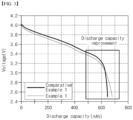
- each of the activated lithium secondary batteries was fully charged to 4.2 V at 25°C and a C-rate of 0.33C in a CC-CV mode and discharged to 2.5 V at a C-rate of 2.5C in a CC mode, and the high-rate discharge capacity at room temperature was measured.
- the results are shown in Table 3 and FIG. 3 below.
- each of the activated lithium secondary batteries was charged to a voltage of 4.2 V at 25°C and a C-rate of 0.33C in a CC-CV mode, and discharged to a voltage of 2.5 V at a C-rate of 0.33C in a CC mode.
- This procedure referred to one charge/discharge cycle was performed for three cycles.
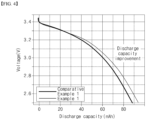
- each of the activated lithium secondary batteries was charged to 4.2 V at 25°C and a C-rate of 0.33C in a CC-CV mode and discharged to 2.5 V in a CC mode, and the capacity was maintained at an SOC of 10%. Then, each of the activated lithium secondary batteries was discharged to 2.5 V at -10°C and a C-rate of 0.04C in a CC mode, and the discharge capacity at low temperature was measured. The results are shown in Table 3 and FIG. 4 below.
- Example 3 Content of elements in coating layer High-rate discharge capacity [mAh] Low-temperature discharge capacity [mAh] Li S N
- Example 1 11.2 at% 2.5 at% 1.5 at% 679.8 96.7
- Example 2 11.1 at% 2.3 at% 2.0 at% 678.3 96.5
- Example 3 10.5 at% 2.2 at% 1.5 at% 677.5 94.6
- Example 4 11.0 at% 2.1 at% 1.3 at% 677.9 95.8
- Example 5 9.5 at% 1.9 at% 1.1 at% 674.2 94.2
- Example 6 9.0 at% 1.7 at% 0.8 at% 673.4 93.7
- Example 7 12.1 at% 3.0 at% 2.0 at% 680.8 97.3
- Example 8 9.0 at% 1.8 at% 1.3 at% 673.8 93.9
- Example 1 4.9 at% 0.1 at% 0.1 at% 645.0 88.2 Comp.
- Example 2 4.7 at% 0.1 at% 0.1 at% 651.2 89.2 Comp.
- Example 3 13.1 at% 5.8 at% 4.2 at% 648.5 88.6 Comp.
- Example 4 4.7 at% 0.1 at% 0.1 at% 643.7 86.1 Comp.
- Example 5 4.8 at% 0.1 at% 0.1 at% 644.6 88.1 Comp.
- Example 6 5.9 at% 0.5 at% 0.6 at% 658.9 89.0 Comp.
- Example 7 5.3 at% 0.3 at% 0.5 at% 652.7 88.7
- Example 8 4.8 at% 0.1 at% 0.1 at% 642.8 88.3 Comp.
- Example 9 2.0 at% 0.1 at% 0.1 at% 638.2 86.8 Comp.
- Example 10 5.2 at% 0.1 at% 0.1 at% 651.8 88.5
- the lithium secondary battery according to the present invention includes specific contents of lithium element (Li), sulfur element (S), and nitrogen element (N) on a surface of the positive electrode, and thus has excellent high-rate performance and low-temperature performance.
- a coating layer including lithium element (Li), sulfur element (S), and nitrogen element (N) at contents of 7 to 15 at%, 0.6 to 1.1 at%, and 1.8 to 3.1 at%, respectively, is formed on a surface of the positive electrode mixture layer of the positive electrode in all the lithium secondary batteries manufactured in Examples. Also, it was confirmed that the lithium secondary batteries of Examples including such a coating layer has a high room-temperature, high-rate discharge capacity of 670 mAh or more and a high low-temperature discharge capacity of 93 mAh or more.
- the lithium secondary battery according to the present invention has a coating layer including specific contents of lithium element (Li), sulfur element (S), and nitrogen element (N) on a surface of the positive electrode mixture layer of the positive electrode, and thus has excellent room-temperature, high-rate discharge performance and low-temperature discharge performance.
Landscapes
- Chemical & Material Sciences (AREA)
- Electrochemistry (AREA)
- General Chemical & Material Sciences (AREA)
- Chemical Kinetics & Catalysis (AREA)
- Inorganic Chemistry (AREA)
- Engineering & Computer Science (AREA)
- Manufacturing & Machinery (AREA)
- Physics & Mathematics (AREA)
- Condensed Matter Physics & Semiconductors (AREA)
- General Physics & Mathematics (AREA)
- Composite Materials (AREA)
- Materials Engineering (AREA)
- Secondary Cells (AREA)
- Battery Electrode And Active Subsutance (AREA)
Applications Claiming Priority (3)
| Application Number | Priority Date | Filing Date | Title |
|---|---|---|---|
| KR20220033398 | 2022-03-17 | ||
| KR1020230011695A KR102695943B1 (ko) | 2022-03-17 | 2023-01-30 | 리튬 이차전지 |
| PCT/KR2023/001392 WO2023177078A1 (fr) | 2022-03-17 | 2023-01-31 | Batterie secondaire au lithium |
Publications (2)
| Publication Number | Publication Date |
|---|---|
| EP4307406A1 true EP4307406A1 (fr) | 2024-01-17 |
| EP4307406A4 EP4307406A4 (fr) | 2025-06-25 |
Family
ID=88023660
Family Applications (1)
| Application Number | Title | Priority Date | Filing Date |
|---|---|---|---|
| EP23770958.9A Pending EP4307406A4 (fr) | 2022-03-17 | 2023-01-31 | Batterie secondaire au lithium |
Country Status (5)
| Country | Link |
|---|---|
| US (1) | US20230299352A1 (fr) |
| EP (1) | EP4307406A4 (fr) |
| JP (1) | JP7736385B2 (fr) |
| CA (1) | CA3216042A1 (fr) |
| WO (1) | WO2023177078A1 (fr) |
Cited By (1)
| Publication number | Priority date | Publication date | Assignee | Title |
|---|---|---|---|---|
| EP4421936A4 (fr) * | 2022-08-26 | 2025-10-01 | Lg Energy Solution Ltd | Composition d'électrolyte non aqueux et batterie secondaire au lithium la comprenant |
Family Cites Families (27)
| Publication number | Priority date | Publication date | Assignee | Title |
|---|---|---|---|---|
| JP2000082494A (ja) * | 1998-09-03 | 2000-03-21 | Sanyo Chem Ind Ltd | 難燃性非水電解液およびそれを用いた二次電池 |
| JP4799776B2 (ja) * | 2000-08-22 | 2011-10-26 | 富士フイルム株式会社 | 電解質組成物及びそれを用いた電気化学電池 |
| FR2979630B1 (fr) | 2011-09-05 | 2013-10-04 | Univ Provence Aix Marseille 1 | Copolymeres a blocs dont un polyanionique base sur un monomere anion de type tfsili comme electrolyte de batterie. |
| JP2013145732A (ja) | 2011-12-16 | 2013-07-25 | Nippon Shokubai Co Ltd | リチウム二次電池 |
| TWI552416B (zh) * | 2013-10-31 | 2016-10-01 | Lg化學股份有限公司 | 鋰二次電池 |
| JP6135929B2 (ja) * | 2013-11-11 | 2017-05-31 | トヨタ自動車株式会社 | 非水系二次電池の製造方法 |
| JP6080017B2 (ja) * | 2013-11-11 | 2017-02-15 | トヨタ自動車株式会社 | 非水系二次電池の製造方法 |
| KR20160081395A (ko) * | 2014-12-31 | 2016-07-08 | 주식회사 엘지화학 | 리튬 이차 전지용 전해액 및 이를 포함하는 리튬 이차 전지 |
| KR102270155B1 (ko) * | 2016-07-21 | 2021-06-28 | 삼성에스디아이 주식회사 | 리튬 이차 전지용 음극 활물질, 이의 제조 방법 및 이를 포함하는 리튬 이차 전지 |
| KR102290316B1 (ko) * | 2016-10-18 | 2021-08-18 | 삼성에스디아이 주식회사 | 리튬 이차 전지 |
| EP3514883B1 (fr) | 2017-03-17 | 2021-01-20 | LG Chem, Ltd. | Additif d'électrolyte et électrolyte de batterie secondaire au lithium le comprenant |
| KR102264733B1 (ko) * | 2017-08-24 | 2021-06-15 | 주식회사 엘지에너지솔루션 | 리튬 이차전지용 비수전해액 및 이를 포함하는 리튬 이차전지 |
| US20190089002A1 (en) * | 2017-09-20 | 2019-03-21 | Soulbrain Co., Ltd. | Electrolyte additive and lithium secondary battery comprising the same |
| JP6978947B2 (ja) * | 2018-01-12 | 2021-12-08 | 株式会社クレハ | 電池用負極材料及びその製造方法、二次電池用負極、並びに二次電池 |
| KR102301670B1 (ko) * | 2018-01-30 | 2021-09-14 | 주식회사 엘지에너지솔루션 | 고온 저장 특성이 향상된 리튬 이차전지 |
| CN108963187B (zh) * | 2018-07-19 | 2021-01-12 | 桑德新能源技术开发有限公司 | 硅碳负极、其制备方法、锂离子电池及电动车辆 |
| KR102427345B1 (ko) * | 2018-09-21 | 2022-08-01 | 주식회사 엘지에너지솔루션 | 겔 폴리머 전해질용 조성물 및 이로부터 형성된 겔 폴리머 전해질을 포함하는 리튬 이차전지 |
| KR102175578B1 (ko) * | 2018-11-14 | 2020-11-06 | 삼성에스디아이 주식회사 | 양극 활물질, 이의 제조방법 및 이를 포함하는 리튬 이차 전지 |
| TWI711208B (zh) * | 2018-11-16 | 2020-11-21 | 國家中山科學研究院 | 一種矽氧化物與非晶碳層包覆以多層石墨烯為載體之奈米矽的負極材料及其製備方法 |
| WO2020209685A1 (fr) * | 2019-04-10 | 2020-10-15 | 주식회사 엘지화학 | Matériau actif d'électrode positive pour batterie secondaire, son procédé de production et batterie secondaire au lithium le comprenant |
| KR102885867B1 (ko) * | 2019-10-31 | 2025-11-13 | 삼성전자주식회사 | 고체 이차전지용 양극 하이브리드 전해질, 이를 포함하는 양극, 그 제조방법 및 이를 포함하는 고체 이차전지 |
| KR102821892B1 (ko) * | 2019-11-19 | 2025-06-18 | 주식회사 엘지에너지솔루션 | 이차전지의 활성화 방법 |
| CN111653842B (zh) * | 2020-03-20 | 2021-08-13 | 万向一二三股份公司 | 一种低自放电率的锂离子电池化成方法及三元软包锂离子电池 |
| KR102894230B1 (ko) | 2020-09-09 | 2025-12-03 | 삼성전자 주식회사 | 데이터 클럭 경로 상의 딜레이를 조절하는 메모리 장치, 메모리 장치를 포함하는 메모리 시스템, 및 메모리 시스템의 동작 방법 |
| CN112952096B (zh) * | 2021-02-18 | 2022-09-02 | 广东佳纳能源科技有限公司 | 氮掺杂碳包覆的锂离子电池正极材料及其制备方法 |
| US20240120547A1 (en) * | 2021-03-30 | 2024-04-11 | Lg Energy Solution, Ltd. | Lithium secondary battery and method for manufacturing the same |
| KR20230011695A (ko) | 2021-07-14 | 2023-01-25 | 주식회사 디케이조명 | 회동출몰식 설치브라켓이 구비된 천장매입등 및 그 시공방법 |
-
2023
- 2023-01-31 CA CA3216042A patent/CA3216042A1/fr active Pending
- 2023-01-31 JP JP2023562289A patent/JP7736385B2/ja active Active
- 2023-01-31 WO PCT/KR2023/001392 patent/WO2023177078A1/fr not_active Ceased
- 2023-01-31 EP EP23770958.9A patent/EP4307406A4/fr active Pending
- 2023-02-27 US US18/114,678 patent/US20230299352A1/en active Pending
Cited By (1)
| Publication number | Priority date | Publication date | Assignee | Title |
|---|---|---|---|---|
| EP4421936A4 (fr) * | 2022-08-26 | 2025-10-01 | Lg Energy Solution Ltd | Composition d'électrolyte non aqueux et batterie secondaire au lithium la comprenant |
Also Published As
| Publication number | Publication date |
|---|---|
| CA3216042A1 (fr) | 2023-09-21 |
| US20230299352A1 (en) | 2023-09-21 |
| JP7736385B2 (ja) | 2025-09-09 |
| WO2023177078A1 (fr) | 2023-09-21 |
| JP2024516793A (ja) | 2024-04-17 |
| EP4307406A4 (fr) | 2025-06-25 |
Similar Documents
| Publication | Publication Date | Title |
|---|---|---|
| EP3793005B1 (fr) | Anode pour batterie secondaire au lithium et procédé de fabrication de batterie secondaire au lithium | |
| EP3910716A1 (fr) | Batterie secondaire au lithium | |
| EP3975305A1 (fr) | Procédé de fabrication de batterie secondaire | |
| EP4398361A1 (fr) | Batterie secondaire au lithium | |
| EP4243150B1 (fr) | Nouvel additif pour solution électrolytique non aqueuse et batterie secondaire au lithium le comprenant | |
| EP3605708A2 (fr) | Électrolyte non aqueux pour batterie rechargeable au lithium et batterie rechargeable au lithium le comprenant | |
| EP4210131A2 (fr) | Batterie secondaire au lithium | |
| EP3863086A1 (fr) | Procédé destiné à fabriquer une anode pour batterie secondaire | |
| EP4614649A1 (fr) | Solution électrolytique pour batteries secondaires au lithium-ion, et batterie secondaire au lithium-ion | |
| EP4084132A1 (fr) | Procédé de fabrication d'électrode négative | |
| EP4002546A1 (fr) | Système de batterie, son procédé d'utilisation, et bloc-batterie le comprenant | |
| EP4243149B1 (fr) | Nouvel additif pour électrolyte non aqueux, et batterie secondaire au lithium le comprenant | |
| EP4307406A1 (fr) | Batterie secondaire au lithium | |
| KR102695943B1 (ko) | 리튬 이차전지 | |
| EP4273992B1 (fr) | Batterie secondaire au lithium à sécurité élevée à haute température | |
| EP4372832A2 (fr) | Batterie secondaire au lithium | |
| CN117136444A (zh) | 锂二次电池 | |
| EP4191729A1 (fr) | Électrolyte non aqueux pour batterie secondaire au lithium, et batterie secondaire au lithium le comprenant | |
| EP4280306B1 (fr) | Batterie secondaire au lithium à sécurité améliorée | |
| EP4254585B1 (fr) | Batterie secondaire au lithium à sécurité renforcée | |
| EP4068455A1 (fr) | Solution électrolytique non aqueuse pour batterie secondaire au lithium et batterie secondaire au lithium la comprenant | |
| EP4708376A1 (fr) | Électrode positive, son procédé de fabrication et batterie rechargeable au lithium | |
| EP4700894A1 (fr) | Batterie secondaire au lithium | |
| EP4641682A1 (fr) | Électrode négative pour batterie rechargeable au lithium et son procédé de fabrication | |
| EP4648123A1 (fr) | Électrode négative pour batterie secondaire au lithium et son procédé de fabrication |
Legal Events
| Date | Code | Title | Description |
|---|---|---|---|
| STAA | Information on the status of an ep patent application or granted ep patent |
Free format text: STATUS: THE INTERNATIONAL PUBLICATION HAS BEEN MADE |
|
| PUAI | Public reference made under article 153(3) epc to a published international application that has entered the european phase |
Free format text: ORIGINAL CODE: 0009012 |
|
| STAA | Information on the status of an ep patent application or granted ep patent |
Free format text: STATUS: REQUEST FOR EXAMINATION WAS MADE |
|
| 17P | Request for examination filed |
Effective date: 20231010 |
|
| AK | Designated contracting states |
Kind code of ref document: A1 Designated state(s): AL AT BE BG CH CY CZ DE DK EE ES FI FR GB GR HR HU IE IS IT LI LT LU LV MC ME MK MT NL NO PL PT RO RS SE SI SK SM TR |
|
| REG | Reference to a national code |
Ref country code: DE Ref legal event code: R079 Free format text: PREVIOUS MAIN CLASS: H01M0004131000 Ipc: H01M0004040000 |
|
| A4 | Supplementary search report drawn up and despatched |
Effective date: 20250522 |
|
| DAV | Request for validation of the european patent (deleted) | ||
| DAX | Request for extension of the european patent (deleted) | ||
| RIC1 | Information provided on ipc code assigned before grant |
Ipc: H01M 4/48 20100101ALN20250516BHEP Ipc: H01M 4/38 20060101ALN20250516BHEP Ipc: H01M 4/02 20060101ALN20250516BHEP Ipc: H01M 10/0567 20100101ALI20250516BHEP Ipc: H01M 10/0525 20100101ALI20250516BHEP Ipc: H01M 4/62 20060101ALI20250516BHEP Ipc: H01M 4/587 20100101ALI20250516BHEP Ipc: H01M 4/525 20100101ALI20250516BHEP Ipc: H01M 4/505 20100101ALI20250516BHEP Ipc: H01M 4/36 20060101ALI20250516BHEP Ipc: H01M 4/131 20100101ALI20250516BHEP Ipc: H01M 4/04 20060101AFI20250516BHEP |
|
| GRAP | Despatch of communication of intention to grant a patent |
Free format text: ORIGINAL CODE: EPIDOSNIGR1 |
|
| STAA | Information on the status of an ep patent application or granted ep patent |
Free format text: STATUS: GRANT OF PATENT IS INTENDED |
|
| RIC1 | Information provided on ipc code assigned before grant |
Ipc: H01M 4/04 20060101AFI20260119BHEP Ipc: H01M 4/131 20100101ALI20260119BHEP Ipc: H01M 4/36 20060101ALI20260119BHEP Ipc: H01M 4/505 20100101ALI20260119BHEP Ipc: H01M 4/525 20100101ALI20260119BHEP Ipc: H01M 4/587 20100101ALI20260119BHEP Ipc: H01M 4/62 20060101ALI20260119BHEP Ipc: H01M 10/0525 20100101ALI20260119BHEP Ipc: H01M 10/0567 20100101ALI20260119BHEP Ipc: H01M 4/02 20060101ALN20260119BHEP Ipc: H01M 4/38 20060101ALN20260119BHEP Ipc: H01M 4/48 20100101ALN20260119BHEP |
|
| INTG | Intention to grant announced |
Effective date: 20260223 |