EP4307663A1 - Decodierungsverfahren/codierungsverfahren auf basis von punktwolkenattributvorhersage, decodierer und codierer - Google Patents
Decodierungsverfahren/codierungsverfahren auf basis von punktwolkenattributvorhersage, decodierer und codierer Download PDFInfo
- Publication number
- EP4307663A1 EP4307663A1 EP22766110.5A EP22766110A EP4307663A1 EP 4307663 A1 EP4307663 A1 EP 4307663A1 EP 22766110 A EP22766110 A EP 22766110A EP 4307663 A1 EP4307663 A1 EP 4307663A1
- Authority
- EP
- European Patent Office
- Prior art keywords
- points
- target point
- neighbor
- point
- candidate
- Prior art date
- Legal status (The legal status is an assumption and is not a legal conclusion. Google has not performed a legal analysis and makes no representation as to the accuracy of the status listed.)
- Pending
Links
Images



Classifications
-
- H—ELECTRICITY
- H04—ELECTRIC COMMUNICATION TECHNIQUE
- H04N—PICTORIAL COMMUNICATION, e.g. TELEVISION
- H04N19/00—Methods or arrangements for coding, decoding, compressing or decompressing digital video signals
- H04N19/10—Methods or arrangements for coding, decoding, compressing or decompressing digital video signals using adaptive coding
- H04N19/102—Methods or arrangements for coding, decoding, compressing or decompressing digital video signals using adaptive coding characterised by the element, parameter or selection affected or controlled by the adaptive coding
- H04N19/124—Quantisation
-
- G—PHYSICS
- G06—COMPUTING OR CALCULATING; COUNTING
- G06T—IMAGE DATA PROCESSING OR GENERATION, IN GENERAL
- G06T9/00—Image coding
- G06T9/001—Model-based coding, e.g. wire frame
-
- G—PHYSICS
- G06—COMPUTING OR CALCULATING; COUNTING
- G06T—IMAGE DATA PROCESSING OR GENERATION, IN GENERAL
- G06T9/00—Image coding
- G06T9/40—Tree coding, e.g. quadtree, octree
-
- G—PHYSICS
- G06—COMPUTING OR CALCULATING; COUNTING
- G06T—IMAGE DATA PROCESSING OR GENERATION, IN GENERAL
- G06T9/00—Image coding
- G06T9/004—Predictors, e.g. intraframe, interframe coding
-
- H—ELECTRICITY
- H04—ELECTRIC COMMUNICATION TECHNIQUE
- H04N—PICTORIAL COMMUNICATION, e.g. TELEVISION
- H04N19/00—Methods or arrangements for coding, decoding, compressing or decompressing digital video signals
- H04N19/10—Methods or arrangements for coding, decoding, compressing or decompressing digital video signals using adaptive coding
- H04N19/102—Methods or arrangements for coding, decoding, compressing or decompressing digital video signals using adaptive coding characterised by the element, parameter or selection affected or controlled by the adaptive coding
- H04N19/13—Adaptive entropy coding, e.g. adaptive variable length coding [AVLC] or context adaptive binary arithmetic coding [CABAC]
-
- H—ELECTRICITY
- H04—ELECTRIC COMMUNICATION TECHNIQUE
- H04N—PICTORIAL COMMUNICATION, e.g. TELEVISION
- H04N19/00—Methods or arrangements for coding, decoding, compressing or decompressing digital video signals
- H04N19/10—Methods or arrangements for coding, decoding, compressing or decompressing digital video signals using adaptive coding
- H04N19/169—Methods or arrangements for coding, decoding, compressing or decompressing digital video signals using adaptive coding characterised by the coding unit, i.e. the structural portion or semantic portion of the video signal being the object or the subject of the adaptive coding
- H04N19/17—Methods or arrangements for coding, decoding, compressing or decompressing digital video signals using adaptive coding characterised by the coding unit, i.e. the structural portion or semantic portion of the video signal being the object or the subject of the adaptive coding the unit being an image region, e.g. an object
- H04N19/176—Methods or arrangements for coding, decoding, compressing or decompressing digital video signals using adaptive coding characterised by the coding unit, i.e. the structural portion or semantic portion of the video signal being the object or the subject of the adaptive coding the unit being an image region, e.g. an object the region being a block, e.g. a macroblock
-
- H—ELECTRICITY
- H04—ELECTRIC COMMUNICATION TECHNIQUE
- H04N—PICTORIAL COMMUNICATION, e.g. TELEVISION
- H04N19/00—Methods or arrangements for coding, decoding, compressing or decompressing digital video signals
- H04N19/10—Methods or arrangements for coding, decoding, compressing or decompressing digital video signals using adaptive coding
- H04N19/169—Methods or arrangements for coding, decoding, compressing or decompressing digital video signals using adaptive coding characterised by the coding unit, i.e. the structural portion or semantic portion of the video signal being the object or the subject of the adaptive coding
- H04N19/186—Methods or arrangements for coding, decoding, compressing or decompressing digital video signals using adaptive coding characterised by the coding unit, i.e. the structural portion or semantic portion of the video signal being the object or the subject of the adaptive coding the unit being a colour or a chrominance component
-
- H—ELECTRICITY
- H04—ELECTRIC COMMUNICATION TECHNIQUE
- H04N—PICTORIAL COMMUNICATION, e.g. TELEVISION
- H04N19/00—Methods or arrangements for coding, decoding, compressing or decompressing digital video signals
- H04N19/50—Methods or arrangements for coding, decoding, compressing or decompressing digital video signals using predictive coding
-
- H—ELECTRICITY
- H04—ELECTRIC COMMUNICATION TECHNIQUE
- H04N—PICTORIAL COMMUNICATION, e.g. TELEVISION
- H04N19/00—Methods or arrangements for coding, decoding, compressing or decompressing digital video signals
- H04N19/90—Methods or arrangements for coding, decoding, compressing or decompressing digital video signals using coding techniques not provided for in groups H04N19/10-H04N19/85, e.g. fractals
- H04N19/96—Tree coding, e.g. quad-tree coding
-
- H—ELECTRICITY
- H04—ELECTRIC COMMUNICATION TECHNIQUE
- H04N—PICTORIAL COMMUNICATION, e.g. TELEVISION
- H04N21/00—Selective content distribution, e.g. interactive television or video on demand [VOD]
- H04N21/20—Servers specifically adapted for the distribution of content, e.g. VOD servers; Operations thereof
- H04N21/23—Processing of content or additional data; Elementary server operations; Server middleware
- H04N21/234—Processing of video elementary streams, e.g. splicing of video streams or manipulating encoded video stream scene graphs
- H04N21/2343—Processing of video elementary streams, e.g. splicing of video streams or manipulating encoded video stream scene graphs involving reformatting operations of video signals for distribution or compliance with end-user requests or end-user device requirements
-
- H—ELECTRICITY
- H04—ELECTRIC COMMUNICATION TECHNIQUE
- H04N—PICTORIAL COMMUNICATION, e.g. TELEVISION
- H04N21/00—Selective content distribution, e.g. interactive television or video on demand [VOD]
- H04N21/40—Client devices specifically adapted for the reception of or interaction with content, e.g. set-top-box [STB]; Operations thereof
- H04N21/43—Processing of content or additional data, e.g. demultiplexing additional data from a digital video stream; Elementary client operations, e.g. monitoring of home network or synchronising decoder's clock; Client middleware
- H04N21/44—Processing of video elementary streams, e.g. splicing a video clip retrieved from local storage with an incoming video stream or rendering scenes according to encoded video stream scene graphs
- H04N21/4402—Processing of video elementary streams, e.g. splicing a video clip retrieved from local storage with an incoming video stream or rendering scenes according to encoded video stream scene graphs involving reformatting operations of video signals for household redistribution, storage or real-time display
Definitions
- Embodiments of this application relate to the field of computer vision (image) technologies of artificial intelligence, in particular, to the field of point cloud encoding and decoding technologies, and more specifically, to a decoding method, an encoding method, a decoder, and an encoder based on point cloud attribute prediction.
- image computer vision
- Point clouds have begun to spread to various fields, such as virtual/augmented reality, robots, geographic information systems, and the medical field.
- a large quantity of point clouds on the surfaces of objects can be accurately acquired, and there may usually be hundreds of thousands of corresponding points in one scenario.
- Such a large quantity of points also brings challenges to the storage and transmission of computers. Therefore, compression for points has become a hot issue.
- octree encoding is performed on the position information of the point cloud first; and after points used for predicting a predicted value of attribute information of a current point are selected from encoded points according to the position information of the current point after the octree encoding, the attribute information of the current point is predicted based on the selected points, and then color information is encoded by making a difference with an original value of the attribute information, to realize the encoding of the point cloud.
- a decoding method an encoding method, a decoder, and an encoder based on point cloud attribute prediction are provided.
- this application provides a decoding method based on point cloud attribute prediction, including:
- this application provides an encoding method based on point cloud attribute prediction, including:
- this application provides a decoder based on point cloud attribute prediction, and configured to perform the decoding method based on point cloud attribute prediction according to the second aspect or implementations thereof.
- the decoder includes functional modules configured to perform the decoding method based on point cloud attribute prediction according to the second aspect or implementations thereof.
- the encoder includes:
- this application provides an encoder based on point cloud attribute prediction, and configured to perform the encoding method based on point cloud attribute prediction according to the first aspect or implementations thereof.
- the encoder includes functional modules configured to perform the encoding method based on point cloud attribute prediction according to the first aspect or implementations thereof.
- the encoder includes:
- this application provides a codec device, including:
- processors there is one or more processors, and there is one or more memories.
- the computer-readable storage medium may be integrated with the processor, or the computer-readable storage medium may be arranged separately from the processor.
- an embodiment of this application provides a computer-readable storage medium, storing computer instructions, the computer instructions, when read and executed by a processor of a computer device, causing the computer device to perform the encoding and decoding methods according to either of the first aspect and the second aspect or implementations thereof.
- N decoded points are selected from M decoded points in a point cloud as N candidate points of a target point
- k neighbor points are selected from the N candidate points based on reconstructed information of position information of the target point.
- N candidate points For a dense point cloud, an excessively large quantity of candidate points for selecting the k neighbor points can be avoided, thereby reducing the prediction complexity.
- a predicted value of attribute information of the target point is determined by using attribute values of the k neighbor points, which can ensure prediction accuracy for the attribute information of the target point. Therefore, the solution provided in this application can reduce the prediction complexity on the basis of ensuring the prediction effects.
- FIG. 1 is a schematic block diagram of an encoding framework 100 according to an embodiment of this application.
- the encoding framework 100 may acquire position information and attribute information of a point cloud from an acquisition device.
- Encoding of the point cloud includes position encoding and attribute encoding.
- the process of position encoding includes: performing preprocessing such as coordinate transformation and quantization and removal of repetition points on the original point cloud; and performing encoding after establishing an octree, to form a geometry code stream.
- the process of attribute encoding includes: by giving original values of the reconstructed information of the position information and the attribute information of the inputted point cloud, one of three prediction modes is selected for point cloud prediction, the predicted results are quantified, and arithmetic encoding is performed to form an attribute code stream.
- position encoding may be implemented by the following units: a coordinate transform unit 101, a repetition point quantization and removal unit 102, an octree analysis unit 103, a geometry reconstruction unit 104, and a first arithmetic encoding unit 105.
- the coordinate transform unit 101 may be configured to pre-process points in a point cloud, that is, may be configured for coordinate transformation and voxelization.
- the coordinate transformation may refer to transforming world coordinates of the points in the point cloud into relative coordinates.
- Data of points in a point cloud in the 3D space is transformed into an integer form through a zooming operation (where the minimum value of the coordinate axes x, y, and z is subtracted from geometric coordinates of the points respectively) and a translation operation, and the minimum geometry position thereof is moved to the coordinate origin.
- the zooming operation for the points is equivalent to a de-direct current operation, to transform the coordinates of the points in the point cloud from world coordinates to relative coordinates.
- the repetition point quantization and removal unit 102 can reduce the quantity of coordinates through geometry quantization.
- the fineness of quantization is usually determined by a quantization parameter (QP).
- QP quantization parameter
- a larger value of QP indicates that coefficients with a larger value range will be quantized into the same output, and consequently greater distortion and a lower bit rate are usually caused.
- a smaller value of QP indicates that coefficients with a smaller value range will be quantized into the same output, so that less distortion is caused, which corresponds to a higher bit rate.
- QP quantization parameter
- quantization is performed directly on the coordinate information of points.
- the same coordinates may be assigned to originally different points after quantization. Based on this, repetition points may be deleted through a deduplication operation. For example, a plurality of points with the same quantization position and different attribute information may be merged into one point through attribute transformation.
- the repetition point quantization and removal unit 102 may be used as an optional unit module.
- Geometry encoding includes two modes, that is, octree-based geometry encoding and triangular representation-based geometry encoding, which can be used under different conditions.
- the octree analysis unit 103 can encode position information of quantized points in an octree encoding manner.
- the octree is a tree-shaped data structure. In 3D space division, a preset bounding box is evenly divided, and each node has eight child nodes. By using T 1' and '0' to indicate whether each child node of the octree is occupied or not, occupancy code information is obtained as a code stream of geometry information of the point cloud.
- the point cloud is divided in the form of an octree, so that positions of the points may be in a one-to-one correspondence with the positions of the octree.
- geometry encoding is performed.
- the point cloud is divided into blocks of a certain size, intersections at the edges of the blocks on the surface of the point cloud are located and a triangle is constructed, and compression of geometry information is realized by encoding positions of the intersections.
- the first arithmetic encoding unit 105 may be configured for geometry entropy encoding, that is, performing statistical compression encoding for the occupancy code information of the octree, and finally outputting a binarized (0 or 1) compressed code stream.
- Statistical compression encoding is a lossless encoding manner that can effectively reduce the bit rate required to express the same signal.
- a commonly used statistical compression encoding manner may be content adaptive binary arithmetic coding (CABAC).
- arithmetic encoding is performed on the position information outputted by the octree analysis unit 103 in an entropy encoding manner, that is, a geometry code stream is generated in an arithmetic encoding manner by using the position information outputted by the octree analysis unit 103.
- the geometry code stream may also be referred to as geometry bitstream.
- the encoder side needs to decode and reconstruct the geometry information, that is, restore the coordinate information of each point in the 3D point cloud. For each point, reconstructed values of attribute information of one or more adjacent points corresponding to the point are searched for in the original point cloud, as a predicted value of attribute information of the point, and a residual value of the attribute information of the point is obtained based on the predicted value and an original value of the attribute information of the point.
- the encoder encodes the residual values of the attribute information of all points in the point cloud to obtain an attribute bitstream.
- the encoder can obtain a reconstructed value of the attribute information based on the predicted value and the original value of the attribute information.
- Attribute encoding may be implemented by the following units: a color space transform unit 110, an attribute transform unit 111, a region adaptive hierarchical transform (RAHT) unit 112, a predicting transform unit 113, a lifting transform unit 114, a quantization unit 115, and a second arithmetic encoding unit 116.
- RAHT region adaptive hierarchical transform
- the color space transform unit 110 may be configured to transform an RGB color space of the points in the point cloud into the YCbCr format or other formats.
- the attribute transform unit 111 may be configured to transform the attribute information of the points in the point cloud to minimize attribute distortion.
- the attribute transform unit 111 may be configured to obtain original values of the attribute information of the points.
- the attribute information may be color information of the points. After the original values of the attribute information of the points are obtained through transformation by the attribute transform unit 111, any prediction unit may be selected to predict the points in the point cloud.
- the units for performing predictive encoding on points in the point cloud may include at least one of: a region adaptive hierarchical transform (RAHT) unit 112, a predicting transform unit 113, and a lifting transform unit 114. That is, attribute transformation encoding includes three modes that can be used under different conditions.
- RAHT region adaptive hierarchical transform
- the predicting transform unit 113, and the lifting transform unit 114 may be configured to predict attribute information of a point in the point cloud to obtain a predicted value of the attribute information of the point, and then obtain a residual value of the attribute information of the point based on the predicted value of the attribute information of the point.
- the residual value of the attribute information of the point may be obtained by subtracting the predicted value of the attribute information of the point from the original value of the attribute information of the point.
- a signal is transformed into the transformation domain, which is referred to as a transform coefficient.
- the lifting transform unit 114 is used to perform predictive encoding, based on level of detail (LOD) adjacent level prediction, the weight update policy of neighborhood points is introduced, and finally a predicted value of attribute information of each point is obtained, and a corresponding residual value is then obtained.
- LOD level of detail
- the predicting transform unit 113 may further be configured to generate an LOD, sequentially predict attribute information of points in the LOD, and calculate a predicted residual for subsequent quantization encoding.
- LOD level
- a sub-point set is selected according to distances, and the point cloud is divided into a plurality of different levels (LOD), to realize point cloud representations from rough to fine.
- Bottom-top prediction can be implemented between adjacent levels. That is, the attribute information of the points introduced in the fine level is predicted from the adjacent points in the rough level, and a corresponding residual value is obtained. Points at the lowest level in the LOD are used as reference information for encoding.
- the quantization unit 115 may be configured for attribute information quantization, where the fineness of quantization is usually determined by the QP. In predicting transform encoding and lifting transform encoding, entropy encoding is performed after quantizing residual values; and in RAHT, entropy encoding is performed after quantizing transform coefficients. For example, if the quantization unit 115 is connected to the predicting transform unit 113, the quantization unit may be configured to quantize a residual value of attribute information of a point outputted by the predicting transform unit 113. For example, the residual value of the attribute information of the point outputted by the predicting transform unit 113 is quantized by using a quantization step, to improve the system performance.
- one or more points are selected as predicted values based on the adjacent relationship for the geometry information or attribute information, a weighted average is calculated to obtain a final predicted value of the attribute information, and a difference between the original value and the predicted value is encoded.
- An example in which the predicting transform unit 113 is used to perform predictive encoding is used. For each point in the LOD, three nearest neighbor points are found in the LOD in front of it, and then prediction is performed on a current point by using reconstructed values of the three neighbor points, to obtain a predicted value, where a Euclidean distance or a Manhattan distance may be used for distance calculation. Based on this, a residual value of the current point can be obtained based on the predicted value of the current point and an original value of the current point.
- Qstep is calculated based on the QP.
- the current point will serve as the nearest neighbor of subsequent points, and the reconstructed value of the current point is used to predict the attribute information of the subsequent points.
- Qstep is calculated based on the QP.
- the second arithmetic encoding unit 116 may be configured for attribute information entropy encoding, and final compression of the quantized residual value or transform coefficient of the attribute information may be implemented through run length coding and arithmetic coding.
- Corresponding encoding modes, the QP, and other information are also encoded by using an entropy encoder. Entropy encoding is performed on the residual values of the attribute information of the points, and an attribute code stream can be obtained.
- the attribute code stream may be bitstream information.
- the predicted value of the attribute information of the point in the point cloud may also be referred to as a predicted color value in the LOD mode.
- the predicted value of the attribute information of the point is subtracted from the original value of the attribute information of the point to obtain the residual value of the point.
- the residual value of the attribute information of the point may also be referred to as a residual color value in the LOD mode.
- the reconstructed value of the attribute information of the point can be generated by adding the predicted value of the attribute information of the point and the residual value of the attribute information of the point.
- the reconstructed value of the attribute information of the point may also be referred to as a reconstructed color value in the LOD mode.
- a decoder After obtaining a compressed code stream, a decoder first performs entropy decoding to obtain various mode information, and quantized geometry information and quantized attribute information. First, inverse quantization is performed on the geometry information to obtain reconstructed 3D point position information. On the other hand, inverse quantization is performed on the attribute information to obtain a residual value, and a reference signal is confirmed according to the adopted transformation mode, to obtain a predicted value of the attribute information, which has a one-to-one correspondence with the geometry information in sequence, and a reconstructed value of each point is generated and outputted, that is, reconstructed point cloud data is outputted.
- FIG. 2 is a schematic block diagram of a decoding framework 200 according to an embodiment of this application.
- the decoding framework 200 may acquire a code stream of a point cloud from an encoding device, and obtain position information and attribute information of the points in the point cloud by parsing the code stream of the point cloud.
- the decoding of the point cloud includes position decoding and attribute decoding.
- the process of position decoding includes: performing arithmetic decoding on the geometry code stream; performing combination after constructing an octree, and reconstructing the position information of the points, to obtain reconstructed information of the position information of the points; and performing coordinate transformation on the reconstructed information of the position information of the points to obtain the position information of the points.
- the position information of the points may also be referred to as geometry information of the points.
- the process of attribute decoding includes: parsing the attribute code stream to obtain residual values of the attribute information of the points in the point cloud; performing inverse quantization on the residual values of the attribute information of the points, to obtain residual values of the attribute information of the points after inverse quantization; selecting one of the three prediction modes to perform point cloud prediction based on the reconstructed information of the position information of the points obtained during position decoding, to obtain reconstructed values of the attribute information of the points; and performing color space inverse transformation on the reconstructed values of the attribute information of the points, to obtain the decoded point cloud.
- the position decoding may be implemented by the following units: a first arithmetic decoding unit 201, an octree analysis unit 202, a geometry reconstruction unit 203, and a coordinate inverse transform unit 204.
- Attribute encoding may be implemented by the following units: a second arithmetic decoding unit 210, an inverse quantization unit 211, a RAHT unit 212, a predicting transform unit 213, a lifting transform unit 214, and a color space inverse transform unit 215.
- Decompression is an inverse process of compression, and similarly, for the functions of each unit in the decoding framework 200, reference may be made to the functions of the corresponding unit in the encoding framework 100.
- the decoding framework 200 may divide the point cloud into a plurality of LODs according to the Euclidean distance between the points in the point cloud; and subsequently decode the attribute information of the points in the LOD in sequence, for example, calculate a quantity of zeros (zero_cnt) in the zero run length coding technology, to decode residuals based on the quantity of zeros.
- the decoding framework 200 may perform inverse quantization based on decoded residual values, and add the residual values after inverse quantization to the predicted value of the current point to obtain a reconstructed value of the point cloud, until all point clouds have been decoded.
- the current point will serve as the nearest neighbor of points in subsequent LODs, and the reconstructed value of the current point is used to predict the attribute information of the subsequent points.
- inverse transformation and inverse quantization scale/scaling
- orthogonal transformation if one matrix thereof is used for transformation, another matrix is used for inverse transformation.
- matrices used in the decoder may be referred to as "transform" matrices.
- the predictive encoding methods of attribute information may include a predictive encoding method for reflectivity attribute information, a predictive encoding method for color attribute information, and a method for adaptively selecting an attribute predicted value.
- the Morton code is a manner of representing coordinates of a point in multi-dimensional space with a one-dimensional value.
- the spatial relationship corresponding to points in the space can be approximately represented by using the adjacent relationship between values of Morton codes.
- a Morton order formed by a plurality of Morton codes based on Morton sorting can be formed. Sorting refers to changing positions of a group of data according to a specific rule (sorting algorithm), so that the data is arranged in order, which may be arranged in descending order, or arranged in ascending order.
- Morton sorting refers to the process of sorting based on the adjacent relationship between the values of the Morton codes.
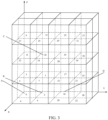
- FIG. 3 is a schematic diagram of a point cloud in an original Morton order according to an embodiment of this application.
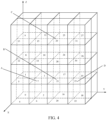
- FIG. 4 is a schematic diagram of a point cloud in an offset Morton order according to an embodiment of this application.
- the Morton code of the point D is 23, and the Morton code of a neighbor point B of the point D is 21, so that the point B can be found by searching two points forward from the point D at most.
- the Morton code of the point D is 16, and the Morton code of the neighbor point B of the point D is 2, so that the point B can be found by searching 14 points forward from the point D at most.
- the decoder performs decoding according to a Morton order to find the closest predicted point of the current point. Specifically, the first N points of the current point are selected in a Morton order 1 as candidate points, where N is greater than or equal to 1; and the first M points of the current point are selected in a Morton order 2 as candidate points Point, where M is greater than or equal to 1.
- a distance d from each candidate point to the current point is calculated, where the calculation may be performed by using a Euclidean distance or a Manhattan distance.
- the coordinates of the current point are (x, y, x)
- the coordinates of the candidate point are (x1, y1, z1)
- k decoded points with the shortest distance are selected from the N+M candidate points as prediction points of the current point.
- discrete Hilbert curves are used for calculation during Hilbert sorting.
- the Morton code is first used to search for spatial neighbor points of the current point, and then the attribute prediction is performed on the current point according to the found spatial neighbor points.
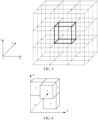
- FIG. 5 is a schematic structural diagram of a spatial relationship between neighbor points according to an embodiment of this application.
- FIG. 6 shows an example of a Morton code relationship between neighbor points coplanar with a to-be-encoded current point within a neighborhood range according to an embodiment of this application.
- FIG. 7 shows an example of a Morton code relationship between neighbor points collinear with a to-be-encoded current point within a neighborhood range according to an embodiment of this application.
- the to-be-encoded current point is a thick line marking block A
- the neighbor search range is a 3 ⁇ 3 ⁇ 3 neighborhood of the to-be-encoded current point.
- the Morton code of the current point is used to obtain the block with the smallest Morton code value in the neighborhood, and the block is used as a reference block.
- Encoded neighbor points that are coplanar and collinear with the to-be-encoded current point 7 are searched for by using the reference block.
- a to-be-encoded current point 7 is coplanar with a neighbor point 3, a neighbor point 5, and a neighbor point 6.
- a to-be-encoded current point 7 is collinear with a neighbor point 1, a neighbor point 2, and a neighbor point 4.
- the encoded points continue to be searched for neighbor points collinear with the to-be-encoded current point. If a collinear neighbor point is found in a decoded point set, a weight of the collinear neighbor point is assigned to 1. Finally, weighted averaging is performed by using the found neighbor points to perform attribute prediction on the to-be-encoded current point. If no encoded neighbor point coplanar and collinear with the to-be-encoded current point is found, a point corresponding to a previous Morton code of the to-be-encoded current point may be used to perform attribute prediction.
- neighbor points are used to perform weighted averaging to perform attribute prediction on the to-be-encoded current point
- the predicted value of attribute information is determined according to geometric position information.
- the prediction method for reflectivity attribute information and the prediction method for color attribute information may be referred to as a predicted value method based on geometry positions.
- the predicted value method based on geometry positions is usually suitable for relatively dense and relatively predictable point clouds, such as human point clouds, or suitable for situations with a relatively small predicted residual. If a residual generated by the predicted value method based on geometry positions is large, a predicted value method based on attribute values can usually reduce the predicted residual and improve the encoding efficiency.
- the predicted value method based on attribute values may be implemented through the following steps:
- coplanar points and collinear points in the encoded points are found as neighbor points of the current point, and different weights are set for the coplanar points and the collinear points for weighted calculation, and finally the predicted value of the attribute information of the corresponding point is obtained.
- the probability that no coplanar point or collinear point can be found is higher than 90%, the previous point will be used for prediction in AVS encoding.
- a point cloud in one scene may correspond to hundreds of thousands of points.
- Such a large quantity of points also brings challenges to the storage and transmission of computers: directly using the coplanar points and collinear points in the encoded points as the neighbor points of the current point require an excessively large amount of computation, resulting in excessively high prediction complexity.
- This application provides a color prediction-oriented neighbor point optimization method, which can reduce the prediction complexity on the basis of ensuring the prediction effects by better utilizing the spatial correlation of the adjacent points of the point cloud.
- N encoded points are selected from M encoded points as N candidate points, then a distance-first or geometric structure-first manner is designed to select k neighbor points from the N candidate points, and finally attribute prediction is performed based on the k selected neighbor points.
- the solution of selecting N candidate points from the M encoded points and the solution of selecting k neighbor points from the N candidate points may be implemented in various ways such as searching or mapping.
- a single selection method may be adopted, or a combination of a plurality of selection methods may be adopted to reduce the prediction complexity on the basis of ensuring the prediction effects.
- the point cloud attribute prediction-oriented neighbor point selection optimization method provided in this application may be applied to any 3D point cloud codec product.
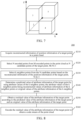
- FIG. 8 is a schematic flowchart of an encoding method based on point cloud attribute prediction 300 according to an embodiment of this application.
- the method 300 may be performed by an encoder or an encoder side, for example, the encoding framework 100 shown in FIG. 1 .
- the encoding method 300 may include:
- an encoder side when encoding attribute information of a target point, first selects N encoded points from M encoded points as N candidate points of the target point; then selects k neighbor points from the N candidate points; subsequently determines a predicted value of the attribute information of the target point by using attribute values of the k neighbor points; finally obtains obtain a residual value of the attribute information of the target point according to the predicted value of the attribute information of the target point and an original value of the attribute information of the target point; and encodes the residual value of the attribute information of the target point to obtain a code stream of the point cloud.
- N encoded points are selected from M encoded points in a point cloud as N candidate points of a target point
- k neighbor points are selected from the N candidate points based on reconstructed information of position information of the target point.
- N candidate points For a dense point cloud, an excessively large quantity of candidate points for selecting the k neighbor points can be avoided, thereby reducing the prediction complexity.
- a predicted value of attribute information of the target point is determined by using attribute values of the k neighbor points, which can ensure prediction accuracy for the attribute information of the target point. Therefore, the solution provided in this application can reduce the prediction complexity on the basis of ensuring the prediction effects.
- the quantity M of encoded points exceeds the quantity N of candidate points; and S320 may include: selecting the N encoded points from the M encoded points based on a first order of the M encoded points, the first order being an order obtained by performing Morton sorting or Hilbert sorting on the M encoded points and the target point in ascending order or in descending order, or the first order being an encoding order of the M encoded points and the target point; and using the N encoded points as the N candidate points.
- the encoder side sorts the points in the point cloud, for example, uses Morton codes or Hilbert codes to represent the coordinates of the points in the point cloud, and performs sorting in ascending order or in descending order; or skips performing sorting, and keeps the encoding order of the points.
- the encoding order of the points may also be referred to as an input order of the points.
- the Hilbert sorting is used as an example.
- a sequence number of the to-be-encoded current point is i
- the corresponding Hilbert code is m_i
- encoded points in the pre-order include i-1, i-2, ..., 1, 0, and the corresponding Hilbert codes are m_(i-1), m_(i-2), ..., m_1, m_0.
- N encoded points are selected from the encoded points with serial numbers i-1, i-2, ..., 1, 0, that is, N candidate points are selected for the current point as candidate points of neighbor points of the current point.
- Methods for selecting N encoded points include, but not limited to:
- S320 may specifically include: determining, in the first order, N points previous to and adjacent to the target point as the N encoded points; or determining, in the first order, N consecutive points previous to the target point as the N encoded points, the N consecutive points being adjacent to the target point or spaced apart from the target point by at least one encoded point.
- the achievable solutions include, but not limited to, at least one of the following methods:
- the N encoded points are directly selected from the M encoded points based on the first order of the M encoded points, which can effectively control the selection complexity of candidate points and improve the prediction efficiency.
- the encoder side may alternatively randomly select the N encoded points from the M encoded points, which is not specifically limited in this embodiment of this application.
- the first order may be an order formed by directly sorting the point cloud by the encoder side, or an order formed by merely sorting the M encoded points and the target point.
- the first order may be an order formed by merely sorting the M encoded points and the target point
- the point cloud is a sparse point cloud
- the first order may be an order formed by sorting all points in the point cloud, to reduce the workload and improve the prediction efficiency.
- all directions x, y, z
- one or more directions thereof may be processed, which is not specifically limited in this embodiment of this application.
- the encoder side may perform Morton sorting on the points in the point cloud (or merely perform Morton sorting on the M encoded points and the target point) according to the position information of the points, or perform Hilbert sorting on the points in the point cloud (or merely perform Hilbert sorting on the M encoded points and the target point) according to the position information of the points.
- the position information of the points may be three-dimensional position information of the points, or may be position information in one dimension or a plurality of dimensions.
- the encoder side may determine, according to an actual requirement, position information of how many dimensions are used to sort the points in the point cloud (or the M encoded points and the target point).
- neighbor points for predicting the attribute information of the target point may be selected from the N candidate points.
- the encoder side may calculate a distance between each of the N candidate points and the target point, and determine k neighbor points based on the distance between each candidate point and the target point; or locate the k-neighbor points meeting a condition through a geometric structure relationship of the points, for example, by using an octree structure formed based on the N candidate points and the target point; or sort the N candidate points and the target point and select k neighbor points from the sorted candidate points, for example, select k neighbor points based on an order formed by sorting the N candidate points and the target point, which is not specifically limited in this embodiment of this application.
- the measurement manners or specific implementations adopted for the distance involved in the calculation process are not limited in this application.
- the order formed by sorting the N candidate points and the target point may be an order formed by directly sorting the point cloud, or an order formed by merely sorting the N candidate points and the target point.
- the order formed by sorting the N candidate points and the target point may be an order formed by merely sorting the N candidate points and the target point
- the order formed by sorting the N candidate points and the target point may be an order formed by sorting all points in the point cloud, to reduce the workload and improve the prediction efficiency.
- all directions may be processed, or one or more directions thereof may be processed, which is not specifically limited in this embodiment of this application.
- the encoder side may perform Morton sorting on the points in the point cloud (or merely perform Morton sorting on the N candidate points and the target point) according to the position information of the points, or perform Hilbert sorting on the points in the point cloud (or merely perform Hilbert sorting on the N candidate points and the target point ) according to the position information of the points.
- the position information of the points may be three-dimensional position information of the points, or may be position information in one dimension or a plurality of dimensions.
- the encoder side may determine, according to an actual requirement, position information of how many dimensions are used to sort the points in the point cloud or the N candidate points.
- S330 may include: determining a geometric structure relationship between the N candidate points and the target point based on the reconstructed information of the position information of the target point and reconstructed information of position information of the N candidate points; and selecting the k neighbor points from the N candidate points based on the geometric structure relationship.
- the geometric structure relationship is represented by an octree structure; k nearest neighbor points of the target point are determined based on the octree structure; and the k nearest neighbor points are determined as the k neighbor points.
- the encoder side selects the k nearest neighbor points based on the octree structure as neighbor points, that is, selects the k points closest to the target point from the N candidate points.
- the encoder side may use the k-nearest neighbor (KNN) classification algorithm to calculate and obtain the k nearest neighbor points.
- KNN refers to the K nearest neighbors, which is equivalent to that each point can be represented by its nearest K adjacent points.
- p candidate points collinear and/or coplanar with the target point are selected from the N candidate points based on the geometric structure relationship; and the p candidate points are determined as the k neighbor points in a case that the quantity p of candidate points is greater than or equal to the quantity k of neighbor points; or k candidate points are selected from the p candidate points as the k neighbor points in a case that the quantity p of candidate points is greater than or equal to the quantity k of neighbor points.
- p candidate points collinear and/or coplanar with the target point are selected from the N candidate points based on the geometric structure relationship; distances between all of the N candidate points and the target point are determined based on the reconstructed information of the position information of the target point and the reconstructed information of the position information of the N candidate points in a case that the quantity p of candidate points is less than the quantity k of neighbor points or the quantity p of candidate points is equal to 0; and the k neighbor points are selected from the N candidate points based on the distances between all of the N candidate points and the target point, the distances between all of the N candidate points and the target point being Euclidean distances or Manhattan distances.
- p candidate points collinear and/or coplanar with the target point are selected from the N candidate points based on the geometric structure relationship; a second order is determined by using the reconstructed information of the position information of the target point and the reconstructed information of the position information of the N candidate points in a case that the quantity p of candidate points is less than the quantity k of neighbor points or the quantity p of candidate points is equal to 0; and the k neighbor points are selected from the N candidate points based on the second order, the second order being an order obtained by performing Morton sorting or Hilbert sorting on the N candidate points and the target point in ascending order or in descending order, or the second order being an order obtained after sorting in descending order or ascending order of distances between all of the N candidate points and the target point, the distances between all of the N candidate points and the target point being Euclidean distances or Manhattan distances.
- the encoder side may select candidate points collinear and/or coplanar with the target point from the N candidate points based on the geometric structure relationship. If the quantity of candidate points collinear and/or coplanar with the target point is less than k or no candidate point collinear and/or coplanar with the target point exists, the encoder side determines the k neighbor points based on the distances between all of the N candidate points and the target point or the second order, and if the quantity of candidate points collinear and/or coplanar with the target point is greater than or equal to k, the encoder side determines all the candidate points collinear and/or coplanar with the target point as the k neighbor points or select k points from all the candidate points collinear and/or coplanar with the target point as the k neighbor points.
- the encoder side determines points in the N candidate points with a distance to the target point less than a first threshold as the k neighbor points, or determines points in the N candidate points with a distance to the target point being a second threshold as the k neighbor points.
- methods for the encoder side to select the k neighbor points from the N candidate points specifically include, but not limited to, at least one of the following methods:
- the encoder side may select the k neighbor points from the N candidate points based on a sequence number of the target point in the second order.
- the achievable solutions include, but not limited to, at least one of the following methods:
- the encoder side may alternatively randomly select the k neighbor points from the N candidate points, which is not specifically limited in this embodiment of this application.
- S330 may include: determining distances between all of the N candidate points and the target point based on the reconstructed information of the position information of the target point and reconstructed information of position information of the N candidate points; and selecting the k neighbor points from the N candidate points based on the distances between all of the N candidate points and the target point, the distances between all of the N candidate points and the target point being Euclidean distances or Manhattan distances.
- the encoder side may preferentially select, based on the distances between all of the N candidate points and the target point, the k neighbor points that meet the preset conditions or attribute prediction conditions from the N candidate points.
- S330 may specifically include: determining first target candidate points in the N candidate points as the k neighbor points, the first target candidate point being a point in the N candidate points with a distance to the target point less than a first threshold; or determining second target candidate points in the N candidate points as the k neighbor points, the second target candidate point being a point in the N candidate points with a distance to the target point less than a second threshold.
- methods for the encoder side to select the k neighbor points from the N candidate points specifically include, but not limited to, at least one of the following methods:
- S330 may include: determining a second order by using the reconstructed information of the position information of the target point and reconstructed information of position information of the N candidate points; and selecting the k neighbor points from the N candidate points based on the second order, the second order being an order obtained by performing Morton sorting or Hilbert sorting on the N candidate points and the target point in ascending order or in descending order, or the second order being an order obtained after sorting in descending order or ascending order of distances between all of the N candidate points and the target point, the distances between all of the N candidate points and the target point being Euclidean distances or Manhattan distances.
- the encoder side may select the k neighbor points from the N candidate points based on the second order according to sequence numbers. For example, the encoder side selects some of the N candidate points as the k neighbor points based on the second order of the N candidate points. For example, k points previous to the target point and adjacent to the target point are determined in the second order as the k neighbor points; or k consecutive points previous to the target point are determined in the second order as the k neighbor points, the k consecutive points being adjacent to the target point or spaced apart from the target point by at least one candidate point.
- the achievable solutions include, but not limited to, at least one of the following methods:
- the encoder side may alternatively randomly select the k neighbor points from the N candidate points, which is not specifically limited in this embodiment of this application.
- S340 may include: using a reciprocal of a distance between each of the k neighbor points and the target point as a weight of the each neighbor point, performing weighted averaging calculation based on the attribute value and the weight of each of the k neighbor points to obtain a weighted average value of the attribute values of the k neighbor points, and determining the weighted average value of the attribute values of the k neighbor points as the predicted value of the attribute information of the target point; or setting the same or different initial weights for different neighbor points in the k neighbor points, performing weighted averaging calculation based on the attribute value and the initial weight of each of the k neighbor points to obtain a weighted average value of the attribute values of the k neighbor points, and determining the weighted average value of the attribute values of the k neighbor points as the predicted value of the attribute information of the target point, the initial weight of one of the k neighbor points decreasing as the distance between the neighbor point and the target point increases, and the code stream including the initial weight of each of the k
- the encoder side may use the obtained attribute values of the neighbor points to calculate the predicted value of the attribute information of the target point, and the specific calculation process includes, but not limited to, at least one of the following methods:
- S350 may include: discarding first neighbor points and second neighbor points in the k neighbor points to obtain remaining neighbor points in the k neighbor points, the first neighbor point being a neighbor point in the k neighbor points with a distance to a reference point greater than a first threshold, and the second neighbor point being a neighbor point in the k neighbor points with a distance to the reference point greater than or equal to a second threshold, the k neighbor points including the reference point; and determining the predicted value of the attribute information of the target point by using the attribute values of the remaining neighbor points in the k neighbor points.
- the encoder side may process the obtained neighbor points, and may eliminate points with relatively large differences to avoid introducing errors, which includes, but not limited to, at least one of the following methods:
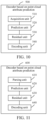
- FIG. 9 is a schematic flowchart of a decoding method based on point cloud attribute prediction 400 according to an embodiment of this application.
- the decoding method 400 may include:
- the quantity M of decoded points exceeds the quantity N of candidate points; and S420 may include: selecting the N decoded points from the M decoded points based on a first order of the M decoded points, the first order being an order obtained by performing Morton sorting or Hilbert sorting on the M decoded points and the target point in ascending order or in descending order, or the first order being a decoding order of the M decoded points and the target point; and determining the N decoded points as the N candidate points.
- N decoded points are selected from M decoded points in a point cloud as N candidate points of a target point
- k neighbor points are selected from the N candidate points based on reconstructed information of position information of the target point.
- N candidate points For a dense point cloud, an excessively large quantity of candidate points for selecting the k neighbor points can be avoided, thereby reducing the prediction complexity.
- a predicted value of attribute information of the target point is determined by using attribute values of the k neighbor points, which can ensure prediction accuracy for the attribute information of the target point. Therefore, the solution provided in this application can reduce the prediction complexity on the basis of ensuring the prediction effects.
- S420 may specifically include: determining, in the first order, N points previous to and adjacent to the target point as the N decoded points; or determining, in the first order, N consecutive points previous to the target point as the N decoded points, the N consecutive points being adjacent to the target point or spaced apart from the target point by at least one decoded point.
- S430 may include: determining a geometric structure relationship between the N candidate points and the target point based on the reconstructed information of the position information of the target point and reconstructed information of position information of the N candidate points; and selecting the k neighbor points from the N candidate points based on the geometric structure relationship.
- the geometric structure relationship is represented by an octree structure; and S430 may specifically include: determining k nearest neighbor points of the target point based on the octree structure; and determining the k nearest neighbor points as the k neighbor points.
- S430 may include:
- S430 may include:
- S430 may include:
- S430 may include: determining distances between all of the N candidate points and the target point based on the reconstructed information of the position information of the target point and reconstructed information of position information of the N candidate points; and selecting the k neighbor points from the N candidate points based on the distances between all of the N candidate points and the target point, the distances between all of the N candidate points and the target point being Euclidean distances or Manhattan distances.
- S430 may specifically include: determining first target candidate points in the N candidate points as the k neighbor points, the first target candidate point being a point in the N candidate points with a distance to the target point less than a first threshold; or determining second target candidate points in the N candidate points as the k neighbor points, the second target candidate point being a point in the N candidate points with a distance to the target point less than a second threshold.
- S430 may include:
- S440 may include: using a reciprocal of a distance between each of the k neighbor points and the target point as a weight of the each neighbor point, performing weighted averaging calculation based on the attribute value and the weight of each of the k neighbor points to obtain a weighted average value of the attribute values of the k neighbor points, and determining the weighted average value of the attribute values of the k neighbor points as the predicted value of the attribute information of the target point; or set the same or different initial weights for different neighbor points in the k neighbor points for weighted averaging calculation ,to obtain a weighted average value of the attribute values of the k neighbor points, and the calculated weighted average value of the attribute values of the k neighbor points is determined as the predicted value of the attribute information of the target point based on the attribute value and the initial weight of each of the k neighbor points,, the initial weight of each of the k neighbor points decreasing as the distance between the each neighbor point and the target point increases, and the code stream including the initial weight of each
- S440 may include: discarding first neighbor points and second neighbor points in the k neighbor points to obtain remaining neighbor points in the k neighbor points, the first neighbor point being a neighbor point in the k neighbor points with a distance to a reference point greater than a first threshold, and the second neighbor point being a neighbor point in the k neighbor points with a distance to the reference point greater than or equal to a second threshold, the k neighbor points including the reference point; and determining the predicted value of the attribute information of the target point by using the attribute values of the remaining neighbor points in the k neighbor points.
- decoding method 400 reference may be made to the relevant descriptions of encoding method 300, and to avoid repetition, details are not described herein again.
- FIG. 10 is a schematic block diagram of an encoder 500 according to an embodiment of this application.
- the encoder 500 may include:
- the quantity M of encoded points exceeds the quantity N of candidate points; and the prediction unit 520 is specifically configured to:
- the prediction unit 520 is specifically configured to:
- the prediction unit 520 is specifically configured to:
- the geometric structure relationship is represented by an octree structure; and the prediction unit 520 is specifically configured to:
- the prediction unit 520 is specifically configured to:
- the prediction unit 520 is specifically configured to:
- the prediction unit 520 is specifically configured to:
- the prediction unit 520 is specifically configured to:
- the prediction unit 520 is specifically configured to:
- the prediction unit 520 is specifically configured to:
- the prediction unit 520 is specifically configured to:
- the prediction unit 520 is specifically configured to: discard first neighbor points and second neighbor points in the k neighbor points to obtain remaining neighbor points in the k neighbor points, the first neighbor point being a neighbor point in the k neighbor points with a distance to a reference point greater than a first threshold, and the second neighbor point being a neighbor point in the k neighbor points with a distance to the reference point greater than or equal to a second threshold, the k neighbor points including the reference point; and
- the encoder 500 may also be combined to the encoding framework 100 shown in FIG. 1 . That is, the units in the encoder 500 may be replaced or combined with the relevant units in the encoding framework 100.
- the prediction unit 520 and the residual unit 530 may be configured to implement the relevant functions of the predicting transform unit 113 in the encoding framework 100, and may even be configured to implement the position encoding function and functions before prediction for attribute information.
- the encoding unit 540 may be configured to replace the second arithmetic encoding unit 116 in the encoding framework 100.
- FIG. 11 is a schematic block diagram of a decoder 600 according to an embodiment of this application.
- the decoder 600 may include:
- the quantity M of decoded points exceeds the quantity N of candidate points; and the prediction unit 620 is specifically configured to:
- the prediction unit 620 is specifically configured to:
- the prediction unit 620 is specifically configured to:
- the geometric structure relationship is represented by an octree structure; and the prediction unit 620 is specifically configured to:
- the prediction unit 620 is specifically configured to:
- the prediction unit 620 is specifically configured to:
- the prediction unit 620 is specifically configured to:
- the prediction unit 620 is specifically configured to:
- the prediction unit 620 is specifically configured to:
- the prediction unit 620 is specifically configured to:
- the prediction unit 620 is specifically configured to:
- the prediction unit 620 is specifically configured to: discard first neighbor points and second neighbor points in the k neighbor points to obtain remaining neighbor points in the k neighbor points, the first neighbor point being a neighbor point in the k neighbor points with a distance to a reference point greater than a first threshold, and the second neighbor point being a neighbor point in the k neighbor points with a distance to the reference point greater than or equal to a second threshold, the k neighbor points including the reference point.
- the decoder 600 may also be combined to the decoding framework 200 shown in FIG. 2 . That is, the units in the decoder 600 may be replaced or combined with the relevant units in the decoding framework 200.
- the parsing unit 610 may be configured to implement the related functions of the predicting transform unit 213 in the decoding framework 200, and may even be configured to implement the related functions of the inverse quantization unit 211 and the second arithmetic decoding unit 210.
- the prediction unit 620 and the residual unit 630 may be configured to implement the relevant functions of the predicting transform unit 213.
- the decoding unit 640 may be configured to implement the functions of the color space inverse transform unit 215 in the decoding framework 200.
- the apparatus embodiments and the method embodiments may correspond to each other, and for similar descriptions, reference may be made to the method embodiments. To avoid repetition, details are not described herein again.
- the encoder 500 may correspond to the corresponding subject for performing the method 300 in the embodiments of this application, and each unit in the encoder 500 is for implementing the correspond process in the method 300 respectively.
- the decoder 600 may correspond to the corresponding subject for performing the method 400 in the embodiments of this application, and each unit in the decoder 600 is for implementing the corresponding process in the method 400. For brevity, details are not described herein again.
- units of the encoder and the decoder involved in the embodiments of this application may be separately or wholly combined into one or several other units, or one (or more) of the units herein may further be divided into a plurality of units of smaller functions. In this way, same operations can be implemented, and implementation of the technical effects of the embodiments of this application is not affected.
- the foregoing units are divided based on logical functions. In an actual application, a function of one unit may also be implemented by a plurality of units, or functions of a plurality of units are implemented by one unit. In other embodiments of this application, the encoder and the decoder may also include other units.
- the functions may also be cooperatively implemented by other units and may be cooperatively implemented by a plurality of units.
- computer-readable instructions that can perform the steps in the corresponding method may be run on a general computing device, such as a computer, which includes processing elements and storage elements such as a central processing unit (CPU), a random access memory (RAM), and a read-only memory (ROM), to construct the encoder and the decoder related in the embodiments of this application and implement the encoding method and the decoding method based on point cloud attribute prediction in the embodiments of this application.
- CPU central processing unit
- RAM random access memory
- ROM read-only memory
- the computer-readable instructions may be recorded in, for example, a computer-readable storage medium, and may be loaded into any electronic device having a data processing capability by using the computer-readable storage medium, and run in the electronic device, to implement the corresponding method in the embodiments of this application.
- the units mentioned above may be implemented in the form of hardware, may be implemented by instructions in the form of software, or may be implemented in the form of a combination of software and hardware.
- the steps of the method embodiments in the embodiments of this application may be completed by a hardware integrated logical circuit in a processor, or by using instructions in a form of software.
- the steps of the methods disclosed with reference to the embodiments of this application may be directly performed and completed by using a hardware decoding processor, or may be performed and completed by using a combination of hardware and software in the decoding processor.
- the software may be located in a mature storage medium in the field, such as a random access memory, a flash memory, a read-only memory, a programmable read-only memory, an electrically-erasable programmable memory, or a register.
- the storage medium is located in the memory.
- the processor reads information in the memory and completes the steps of the foregoing method embodiments in combination with hardware thereof.
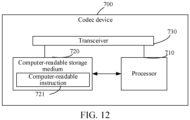
- FIG. 12 is a schematic structural diagram of a codec device 700 according to an embodiment of this application.
- the codec device 700 includes at least a processor 710 and a computer-readable storage medium 720.
- the processor 710 and the computer-readable storage medium 720 may be connected by a bus or in another manner.
- the computer-readable storage medium 720 is configured to store computer-readable instructions 721.
- the computer-readable instructions 721 includes computer instructions.
- the processor 710 is configured to execute the computer instructions stored in the computer-readable storage medium 720.
- the processor 710 is a computing core and a control core of the codec device 700, is suitable for implementing one or more computer instructions, and is specifically suitable for loading and executing the one or more computer instructions to implement a corresponding method procedure or a corresponding function.
- the processor 710 may also be referred to as a central processing unit (CPU).
- the processor 710 may include, but not limited to, a general purpose processor, a digital signal processor (DSP), an application-specific integrated circuit (ASIC), a field-programmable gate array (FPGA) or another programmable logic device, a discrete gate or a transistor logic device, or a discrete hardware component.
- DSP digital signal processor
- ASIC application-specific integrated circuit
- FPGA field-programmable gate array
- another programmable logic device a discrete gate or a transistor logic device, or a discrete hardware component.
- the computer-readable storage medium 720 may be a high-speed RAM or a non-volatile memory, for example, at least one magnetic disk memory.
- the computer-readable storage medium may further be at least one computer-readable storage medium located away from the foregoing processor 710.
- the computer-readable storage medium 720 includes, but not limited to, a volatile memory and/or a non-volatile memory.
- the non-volatile memory may be a read-only memory (ROM), a programmable ROM (PROM), an erasable programmable read-only memory (EPROM), an electrically EPROM (EEPROM), or a flash memory.
- the volatile memory may be a random access memory (RAM), and is used as an external cache.
- RAMs may be used, for example, a static random access memory (SRAM), a dynamic random access memory (DRAM), a synchronous dynamic random access memory (SDRAM), a double data rate synchronous dynamic random access memory (DDR SDRAM), an enhanced synchronous dynamic random access memory (ESDRAM), a synchlink dynamic random access memory (SLDRAM) and a direct rambus random access memory (DR RAM).
- SRAM static random access memory
- DRAM dynamic random access memory
- SDRAM synchronous dynamic random access memory
- DDR SDRAM double data rate synchronous dynamic random access memory
- ESDRAM enhanced synchronous dynamic random access memory
- SLDRAM synchlink dynamic random access memory
- DR RAM direct rambus random access memory
- the codec device 700 may be the encoding framework 100 shown in FIG. 1 or the encoder 500 shown in FIG. 10 .
- the computer-readable storage medium 720 stores first computer instructions; and the processor 710 loads and executes the first computer instructions stored in the computer-readable storage medium 720 to implement the corresponding steps in the method embodiment shown in FIG. 8 .
- the first computer instructions in the computer-readable storage medium 720 are loaded by the processor 710 to perform the corresponding steps. To avoid repetition, details are not described herein again.
- the codec device 700 may be the decoding framework 200 shown in FIG. 2 or the decoder 600 shown in FIG. 11 .
- the computer-readable storage medium 720 stores second computer instructions; and the processor 710 loads and executes the second computer instructions stored in the computer-readable storage medium 720 to implement the corresponding steps in the method embodiment shown in or FIG. 9 .
- the second computer instructions in the computer-readable storage medium 720 are loaded by the processor 710 to perform the corresponding steps. To avoid repetition, details are not described herein again.
- an embodiment of this application further provides a computer-readable storage medium
- the computer-readable storage medium is a memory device in a codec device 700 and is configured to store programs and data, for example, a computer-readable storage medium 720.
- the computer-readable storage medium 720 herein may include an internal storage medium of the codec device 700 and certainly may also include an extended storage medium supported by the codec device 700.
- the computer-readable storage medium provides storage space, and the storage space stores an operating system of the codec device 700.
- the storage space further stores one or more computer instructions suitable to be loaded and executed by the processor 710.
- the computer instructions may be one or more computer-readable instructions 721 (including program code). These computer instructions are configured for a computer to perform the encoding method and the decoding method based on point cloud attribute prediction provided in the various optional manners described above.
- a computer-readable instruction product or computer-readable instructions include computer instructions, and the computer instructions are stored in a computer-readable storage medium.
- the computer instructions may be computer-readable instructions 721.
- the codec device 700 may be a computer, the processor 710 reads the computer instructions from the computer-readable storage medium 720, and executes the computer instructions, to cause the computer to perform the encoding method and the decoding method based on point cloud attribute prediction provided in the various optional manners described above.
- the embodiments when software is used to implement the embodiments, the embodiments may be implemented completely or partially in a form of a computer-readable instruction product.
- the computer-readable instruction product includes one or more computer instructions.
- the computer may be a general-purpose computer, a special-purpose computer, a computer network, or another programmable apparatus.
- the computer instructions may be stored in a computer-readable storage medium, or transmitted from one computer-readable storage medium to another computer-readable storage medium.
- the computer instructions may be transmitted from one website, computer, server, or data center to another website, computer, server, or data center in a wired (for example, a coaxial cable, an optical fiber, or a digital subscriber line (DSL)) or wireless (for example, infrared, radio, or microwave) manner.
- a wired for example, a coaxial cable, an optical fiber, or a digital subscriber line (DSL)
- wireless for example, infrared, radio, or microwave
Landscapes
- Engineering & Computer Science (AREA)
- Multimedia (AREA)
- Signal Processing (AREA)
- Physics & Mathematics (AREA)
- General Physics & Mathematics (AREA)
- Theoretical Computer Science (AREA)
- Compression, Expansion, Code Conversion, And Decoders (AREA)
- Compression Or Coding Systems Of Tv Signals (AREA)
- Signal Processing For Digital Recording And Reproducing (AREA)
- Compression Of Band Width Or Redundancy In Fax (AREA)
Applications Claiming Priority (2)
| Application Number | Priority Date | Filing Date | Title |
|---|---|---|---|
| CN202110278568.XA CN115086660B (zh) | 2021-03-12 | 2021-03-12 | 基于点云属性预测的解码、编码方法、解码器及编码器 |
| PCT/CN2022/075560 WO2022188583A1 (zh) | 2021-03-12 | 2022-02-08 | 基于点云属性预测的解码、编码方法、解码器及编码器 |
Publications (2)
| Publication Number | Publication Date |
|---|---|
| EP4307663A1 true EP4307663A1 (de) | 2024-01-17 |
| EP4307663A4 EP4307663A4 (de) | 2024-04-17 |
Family
ID=83226313
Family Applications (1)
| Application Number | Title | Priority Date | Filing Date |
|---|---|---|---|
| EP22766110.5A Pending EP4307663A4 (de) | 2021-03-12 | 2022-02-08 | Decodierungsverfahren/codierungsverfahren auf basis von punktwolkenattributvorhersage, decodierer und codierer |
Country Status (5)
| Country | Link |
|---|---|
| US (1) | US20230086264A1 (de) |
| EP (1) | EP4307663A4 (de) |
| CN (2) | CN117097898A (de) |
| TW (1) | TWI815339B (de) |
| WO (1) | WO2022188583A1 (de) |
Families Citing this family (13)
| Publication number | Priority date | Publication date | Assignee | Title |
|---|---|---|---|---|
| CN117956184A (zh) * | 2022-10-19 | 2024-04-30 | 中兴通讯股份有限公司 | 点云属性预测方法、设备和存储介质 |
| CN115690508B (zh) * | 2022-11-08 | 2025-08-08 | 中国民用航空总局第二研究所 | 基于希尔伯特曲线编码的检测目标获取方法、介质及设备 |
| CN115688004B (zh) * | 2022-11-08 | 2023-09-29 | 中国民用航空总局第二研究所 | 一种基于希尔伯特编码的目标属性确定方法、介质及设备 |
| CN120693866A (zh) * | 2023-02-15 | 2025-09-23 | Oppo广东移动通信有限公司 | 解码方法、编码方法、解码器以及编码器 |
| WO2024207481A1 (zh) * | 2023-04-07 | 2024-10-10 | Oppo广东移动通信有限公司 | 编解码方法、编码器、解码器、码流以及存储介质 |
| CN120731593A (zh) * | 2023-04-11 | 2025-09-30 | Oppo广东移动通信有限公司 | 点云编解码方法、装置、设备及存储介质 |
| WO2024212228A1 (zh) * | 2023-04-14 | 2024-10-17 | Oppo广东移动通信有限公司 | 编码方法、编码器、电子设备以及存储介质 |
| CN116989694A (zh) * | 2023-08-04 | 2023-11-03 | 深圳市汇和通传感技术有限公司 | 基于3d轮廓扫描的尺寸定位检测系统 |
| CN117115212B (zh) * | 2023-09-07 | 2025-08-01 | 浙江省测绘科学技术研究院 | 一种自动化检测模型位姿异常及配准方法 |
| WO2025149067A1 (en) * | 2024-01-12 | 2025-07-17 | Douyin Vision (Beijing) Co., Ltd. | Method, apparatus, and medium for point cloud coding |
| CN118055254A (zh) * | 2024-03-04 | 2024-05-17 | 腾讯科技(深圳)有限公司 | 点云属性编解码方法、装置、设备 |
| CN119166158B (zh) * | 2024-11-19 | 2025-01-24 | 中国空气动力研究与发展中心计算空气动力研究所 | 一种三维分布式笛卡尔网格的Hilbert编码方法及装置 |
| CN119676446A (zh) * | 2024-12-20 | 2025-03-21 | 重庆邮电大学 | 一种基于图注意力网络的点云属性编码方法 |
Family Cites Families (10)
| Publication number | Priority date | Publication date | Assignee | Title |
|---|---|---|---|---|
| US10861196B2 (en) * | 2017-09-14 | 2020-12-08 | Apple Inc. | Point cloud compression |
| US10897269B2 (en) * | 2017-09-14 | 2021-01-19 | Apple Inc. | Hierarchical point cloud compression |
| US10904564B2 (en) * | 2018-07-10 | 2021-01-26 | Tencent America LLC | Method and apparatus for video coding |
| US10911787B2 (en) * | 2018-07-10 | 2021-02-02 | Apple Inc. | Hierarchical point cloud compression |
| US11010931B2 (en) * | 2018-10-02 | 2021-05-18 | Tencent America LLC | Method and apparatus for video coding |
| US12034979B2 (en) * | 2019-03-20 | 2024-07-09 | Lg Electronics Inc. | Point cloud data transmission device, point cloud data transmission method, point cloud data reception device and point cloud data reception method |
| US10979730B2 (en) * | 2019-03-20 | 2021-04-13 | Tencent America LLC | Techniques and apparatus for interframe point cloud attribute coding |
| CN111145090B (zh) * | 2019-11-29 | 2023-04-25 | 鹏城实验室 | 一种点云属性编码方法、解码方法、编码设备及解码设备 |
| CN111405281A (zh) * | 2020-03-30 | 2020-07-10 | 北京大学深圳研究生院 | 一种点云属性信息的编码方法、解码方法、存储介质及终端设备 |
| WO2021196029A1 (zh) * | 2020-03-31 | 2021-10-07 | 深圳市大疆创新科技有限公司 | 一种用于点云编码、解码的方法和设备 |
-
2021
- 2021-03-12 CN CN202311139933.4A patent/CN117097898A/zh active Pending
- 2021-03-12 CN CN202110278568.XA patent/CN115086660B/zh active Active
-
2022
- 2022-02-08 WO PCT/CN2022/075560 patent/WO2022188583A1/zh not_active Ceased
- 2022-02-08 EP EP22766110.5A patent/EP4307663A4/de active Pending
- 2022-03-08 TW TW111108454A patent/TWI815339B/zh active
- 2022-11-01 US US18/051,713 patent/US20230086264A1/en active Pending
Also Published As
| Publication number | Publication date |
|---|---|
| TWI815339B (zh) | 2023-09-11 |
| TW202236216A (zh) | 2022-09-16 |
| WO2022188583A1 (zh) | 2022-09-15 |
| CN115086660B (zh) | 2023-07-25 |
| CN117097898A (zh) | 2023-11-21 |
| CN115086660A (zh) | 2022-09-20 |
| EP4307663A4 (de) | 2024-04-17 |
| US20230086264A1 (en) | 2023-03-23 |
Similar Documents
| Publication | Publication Date | Title |
|---|---|---|
| EP4307663A1 (de) | Decodierungsverfahren/codierungsverfahren auf basis von punktwolkenattributvorhersage, decodierer und codierer | |
| US11699249B2 (en) | Trimming search space for nearest neighbor determinations in point cloud compression | |
| US11252441B2 (en) | Hierarchical point cloud compression | |
| CN113615181B (zh) | 用于点云编解码的方法、装置 | |
| US20210082152A1 (en) | Point Cloud Compression Using Fixed-Point Numbers | |
| US20250063178A1 (en) | Point cloud processing method and apparatus | |
| WO2019055772A1 (en) | COMPRESSION OF CLOUD OF POINTS | |
| WO2021000334A1 (zh) | 一种数据编码、数据解码方法、设备及存储介质 | |
| US12444090B2 (en) | Point cloud attribute prediction method and apparatus, and related device | |
| WO2023103564A1 (zh) | 点云解码方法、点云编码方法、装置、计算机设备、计算机可读存储介质及计算机程序产品 | |
| WO2024012381A1 (en) | Method, apparatus, and medium for point cloud coding | |
| EP4307687A1 (de) | Verfahren und vorrichtung zur auswahl eines nachbarpunktes in einer punktwolke und codec | |
| JP7765638B2 (ja) | 点群コーディングのための方法、装置及び媒体 | |
| CN115396668B (zh) | 点云数据的解码方法、编码方法、装置、存储介质及设备 | |
| WO2024221458A9 (zh) | 点云编解码方法、装置、设备及存储介质 | |
| WO2025185626A1 (zh) | 点云属性编解码方法、装置、设备、存储介质及程序产品 | |
| CN119278628A (zh) | 几何点云编码的系统及方法 | |
| CN120226355A (zh) | 编码方法及装置、编码器、码流、设备、存储介质 | |
| JP7689093B2 (ja) | 情報圧縮システム及び情報圧縮方法 | |
| HK40073969A (en) | Decoding, encoding method, decoder and encoder based on point cloud attribute prediction | |
| HK40073969B (zh) | 基於点云属性预测的解码、编码方法、解码器及编码器 | |
| EP4395321A1 (de) | Verfahren, vorrichtung und vorrichtung zur codierung/decodierung einer punktwolke und speichermedium | |
| HK40086883A (zh) | 点云解码方法、点云编码方法、装置、设备、介质及产品 | |
| CN119071486A (zh) | 点云处理方法、装置及计算机设备、存储介质 | |
| HK40088799A (zh) | 点云属性的编解码方法、装置、设备及存储介质 |
Legal Events
| Date | Code | Title | Description |
|---|---|---|---|
| STAA | Information on the status of an ep patent application or granted ep patent |
Free format text: STATUS: THE INTERNATIONAL PUBLICATION HAS BEEN MADE |
|
| PUAI | Public reference made under article 153(3) epc to a published international application that has entered the european phase |
Free format text: ORIGINAL CODE: 0009012 |
|
| STAA | Information on the status of an ep patent application or granted ep patent |
Free format text: STATUS: REQUEST FOR EXAMINATION WAS MADE |
|
| 17P | Request for examination filed |
Effective date: 20230627 |
|
| AK | Designated contracting states |
Kind code of ref document: A1 Designated state(s): AL AT BE BG CH CY CZ DE DK EE ES FI FR GB GR HR HU IE IS IT LI LT LU LV MC MK MT NL NO PL PT RO RS SE SI SK SM TR |
|
| A4 | Supplementary search report drawn up and despatched |
Effective date: 20240319 |
|
| RIC1 | Information provided on ipc code assigned before grant |
Ipc: G06T 9/40 20060101ALI20240313BHEP Ipc: G06T 9/00 20060101ALI20240313BHEP Ipc: H04N 19/96 20140101ALI20240313BHEP Ipc: H04N 19/13 20140101AFI20240313BHEP |
|
| DAV | Request for validation of the european patent (deleted) | ||
| DAX | Request for extension of the european patent (deleted) |