EP4307751A1 - Verfahren und vorrichtung zur drahtlosen kommunikation - Google Patents
Verfahren und vorrichtung zur drahtlosen kommunikation Download PDFInfo
- Publication number
- EP4307751A1 EP4307751A1 EP22783991.7A EP22783991A EP4307751A1 EP 4307751 A1 EP4307751 A1 EP 4307751A1 EP 22783991 A EP22783991 A EP 22783991A EP 4307751 A1 EP4307751 A1 EP 4307751A1
- Authority
- EP
- European Patent Office
- Prior art keywords
- geographical location
- information
- signal
- satellite
- terminal
- Prior art date
- Legal status (The legal status is an assumption and is not a legal conclusion. Google has not performed a legal analysis and makes no representation as to the accuracy of the status listed.)
- Pending
Links
- 230000006854 communication Effects 0.000 title claims abstract description 140
- 238000004891 communication Methods 0.000 title claims abstract description 139
- 238000000034 method Methods 0.000 title claims abstract description 94
- 238000010408 sweeping Methods 0.000 claims description 204
- 238000012545 processing Methods 0.000 claims description 47
- 238000004590 computer program Methods 0.000 claims description 18
- 230000011664 signaling Effects 0.000 description 33
- 230000006870 function Effects 0.000 description 26
- 238000010586 diagram Methods 0.000 description 15
- 238000013507 mapping Methods 0.000 description 13
- 238000010295 mobile communication Methods 0.000 description 11
- 238000012423 maintenance Methods 0.000 description 10
- 230000005540 biological transmission Effects 0.000 description 6
- 230000009286 beneficial effect Effects 0.000 description 4
- 238000005259 measurement Methods 0.000 description 4
- 238000013461 design Methods 0.000 description 3
- 230000008569 process Effects 0.000 description 3
- 230000003190 augmentative effect Effects 0.000 description 2
- 230000008878 coupling Effects 0.000 description 2
- 238000010168 coupling process Methods 0.000 description 2
- 238000005859 coupling reaction Methods 0.000 description 2
- 238000001514 detection method Methods 0.000 description 2
- 230000000977 initiatory effect Effects 0.000 description 2
- 230000007774 longterm Effects 0.000 description 2
- 238000011084 recovery Methods 0.000 description 2
- 230000001172 regenerating effect Effects 0.000 description 2
- 230000004044 response Effects 0.000 description 2
- 230000002776 aggregation Effects 0.000 description 1
- 238000004220 aggregation Methods 0.000 description 1
- 239000000969 carrier Substances 0.000 description 1
- 230000001413 cellular effect Effects 0.000 description 1
- 239000003795 chemical substances by application Substances 0.000 description 1
- 230000000295 complement effect Effects 0.000 description 1
- 239000012141 concentrate Substances 0.000 description 1
- 238000011161 development Methods 0.000 description 1
- 238000005516 engineering process Methods 0.000 description 1
- 238000012986 modification Methods 0.000 description 1
- 230000004048 modification Effects 0.000 description 1
- 230000000737 periodic effect Effects 0.000 description 1
- 230000005855 radiation Effects 0.000 description 1
- 230000001360 synchronised effect Effects 0.000 description 1
- 230000001960 triggered effect Effects 0.000 description 1
Images




Classifications
-
- H—ELECTRICITY
- H04—ELECTRIC COMMUNICATION TECHNIQUE
- H04B—TRANSMISSION
- H04B7/00—Radio transmission systems, i.e. using radiation field
- H04B7/14—Relay systems
- H04B7/15—Active relay systems
- H04B7/185—Space-based or airborne stations; Stations for satellite systems
- H04B7/1853—Satellite systems for providing telephony service to a mobile station, i.e. mobile satellite service
-
- H—ELECTRICITY
- H04—ELECTRIC COMMUNICATION TECHNIQUE
- H04B—TRANSMISSION
- H04B7/00—Radio transmission systems, i.e. using radiation field
- H04B7/14—Relay systems
- H04B7/15—Active relay systems
- H04B7/185—Space-based or airborne stations; Stations for satellite systems
- H04B7/1851—Systems using a satellite or space-based relay
- H04B7/18513—Transmission in a satellite or space-based system
-
- H—ELECTRICITY
- H04—ELECTRIC COMMUNICATION TECHNIQUE
- H04B—TRANSMISSION
- H04B7/00—Radio transmission systems, i.e. using radiation field
- H04B7/14—Relay systems
- H04B7/15—Active relay systems
- H04B7/185—Space-based or airborne stations; Stations for satellite systems
- H04B7/1851—Systems using a satellite or space-based relay
-
- H—ELECTRICITY
- H04—ELECTRIC COMMUNICATION TECHNIQUE
- H04B—TRANSMISSION
- H04B7/00—Radio transmission systems, i.e. using radiation field
- H04B7/14—Relay systems
- H04B7/15—Active relay systems
- H04B7/185—Space-based or airborne stations; Stations for satellite systems
- H04B7/1851—Systems using a satellite or space-based relay
- H04B7/18519—Operations control, administration or maintenance
-
- H—ELECTRICITY
- H04—ELECTRIC COMMUNICATION TECHNIQUE
- H04W—WIRELESS COMMUNICATION NETWORKS
- H04W16/00—Network planning, e.g. coverage or traffic planning tools; Network deployment, e.g. resource partitioning or cells structures
- H04W16/24—Cell structures
- H04W16/28—Cell structures using beam steering
-
- H—ELECTRICITY
- H04—ELECTRIC COMMUNICATION TECHNIQUE
- H04W—WIRELESS COMMUNICATION NETWORKS
- H04W74/00—Wireless channel access
- H04W74/08—Non-scheduled access, e.g. ALOHA
- H04W74/0833—Random access procedures, e.g. with 4-step access
-
- H—ELECTRICITY
- H04—ELECTRIC COMMUNICATION TECHNIQUE
- H04W—WIRELESS COMMUNICATION NETWORKS
- H04W84/00—Network topologies
- H04W84/02—Hierarchically pre-organised networks, e.g. paging networks, cellular networks, WLAN [Wireless Local Area Network] or WLL [Wireless Local Loop]
- H04W84/04—Large scale networks; Deep hierarchical networks
- H04W84/06—Airborne or Satellite Networks
Definitions
- This application relates to the communication field, and in particular, to a wireless communication method and apparatus.
- a beamforming technology is assigning a specific shape and direction to an antenna radiation pattern by adjusting phases and amplitudes of a plurality of antennas, and enables energy of a radio signal to concentrate on a narrower beam, to increase a coverage area and reduce interference.
- Beamforming may implement beam maintenance by adjusting a direction as a terminal moves. In an asynchronous orbit satellite access network, as a satellite moves, the terminal camps on different beams as time moves.
- a base station sends a plurality of beams in different directions as far as possible, to ensure continuous and seamless coverage of the beams, and ensure that any signal can be sent to a needed coverage area by using a narrow but high-gain beam.
- a non-terrestrial network such as the satellite plays an irreplaceable role in some important fields, such as space communication, aeronautical communication, maritime communication, and military communication.
- the satellite is used as an example. Satellite communication can implement wide-area or even global coverage by using high, medium, and low earth orbit satellites, and can provide an undifferentiated communication service for global users.
- the satellite communication and the terrestrial mobile communication network are combined to complement each other, to jointly constitute a sea-land-air-space integrated communication network with seamless global coverage, to meet a plurality of ubiquitous service requirements of users. This is an important development direction of future communication.
- the satellite communication and the terrestrial mobile communication network combine to give full play to their respective advantages and provide more comprehensive and high-quality services for the users. This is mainly reflected as follows: (1) In remote areas, on airplanes, or on ocean ships that cannot be covered by a network of the terrestrial mobile communication network, the satellite can provide an economical and reliable network service and extend the network to an area that cannot be reached by a terrestrial network. (2) The satellite can provide continuous network connections for Internet of Things devices and moving carriers such as airplanes, ships, trains, and cars. After the satellite communication and the terrestrial mobile communication network combines, a service capability of a terrestrial mobile communication network system in this aspect of (2) can be greatly enhanced. (3) The satellite has an excellent broadcast/multicast capability to provide an efficient data distribution service for a network edge and a user terminal.
- an excessive narrow beam is difficult to implement in an NTN system, and a delay between the terminal and an NTN network device and a delay between the terminal and a terrestrial station are large. Mobility of the NTN network device may result in a deviation of a preset beam direction. Consequently, beam maintenance is difficult.
- Embodiments of this application provide a wireless communication method and apparatus, to reduce difficulty in beam maintenance in an NTN system.
- an embodiment of this application provides a wireless communication method.
- the method is applied to a terminal side, and the method includes:
- the second beam is determined by using the information about the first geographical location, the beamwidth of the first beam, the ephemeris of the satellite, and the information about the geographical location of the terminal, to resolve a problem that beam maintenance is difficult due to satellite movement, and maintain good quality of communication.
- the at least one first signal carries a reference signal.
- the wireless communication method further includes: measuring quality of the reference signal.
- That determining a second beam from the at least one first beam based on the information about the first geographical location carried in each first signal, a beamwidth of each first beam, an ephemeris of the satellite, and information about a second geographical location includes:
- determining the second beam based on the coverage area of the third beam, the ephemeris of the satellite, and the information about the second geographical location includes: determining the second beam based on the ephemeris of the satellite and a distance between a center point of the coverage area of the third beam and the second geographical location.
- a target beam is determined based on a geographical location, to ensure that the target beam can provide a long service time.
- the wireless communication method further includes: receiving at least one third signal sent by the satellite by using the at least one first beam.
- the third signal carries information about a first sweeping cycle and/or information about the beamwidth of the at least one first beam, and the information about the first sweeping cycle is used to determine a moment for sending the random access request.
- the foregoing two pieces of information can be more flexibly indicated.
- the information about the first sweeping cycle is a value of the first sweeping cycle or an index of the first sweeping cycle.
- a radio resource control (Radio Resource Control, RRC) signaling directly indicates the value of the first sweeping cycle to the terminal.
- RRC signaling directly indicates a time interval t between every two first beams and a quantity N of first beams to the terminal.
- the terminal When the information about the first sweeping cycle is the index, a preset quantity of bits are used to represent the index, so that the terminal can learn of the value of the first sweeping cycle by querying a mapping relationship table pre-stored in the terminal. This reduces signaling overheads.
- the terminal may further receive the value of the first sweeping cycle or the time interval t between every two beams and the quantity N of beams that are broadcast by the satellite by using an SSB. The terminal can obtain the value of the first sweeping cycle without searching the table. Therefore, the implementation complexity is low.
- the terminal receives the index of the first sweeping cycle broadcast by the satellite, the preset quantity of bits are used to represent the index, and the terminal can learn of the value of the first sweeping cycle by querying the mapping relationship table pre-stored in the terminal. This reduces the signaling overheads.
- the information about the first geographical location is a first distance difference of the first geographical location relative to a terrestrial reference point.
- the terrestrial reference point is introduced, and an indicated first distance difference is a differential value of the first geographical location relative to the terrestrial reference point.
- the earth center is used as the reference point, and a coordinate value of the geographical location is an absolute value, which is usually large.
- the first distance difference is small relative to the absolute value. This reduces the signaling overheads.
- the information about the first geographical location is a second distance difference of the first geographical location relative to a geographical location of a center point of a fourth beam.
- the fourth beam is one of the at least one first beam.
- the second distance difference is a relative value, and computational complexity may be small.
- the method for determining the second distance difference is not limited to setting of the terrestrial reference point.
- the wireless communication method further includes:
- an embodiment of this application further provides a wireless communication method.
- the method is applied to a satellite side, and the method includes:
- the first beam sweeps and searches for a location of a terminal, to resolve a problem that a beam direction is inaccurate due to satellite movement, tilt of an antenna panel, or inaccurate ephemeris.
- the wireless communication method further includes: sending at least one third signal to the terminal by using the at least one first beam.
- the third signal carries information about a first sweeping cycle and/or information about a beamwidth of the at least one first beam, and the information about the first sweeping cycle indicates the terminal to determine a moment for sending the random access request.
- the satellite indicates the information about the first sweeping cycle to the terminal in different manners. This reduces signaling overheads.
- the information about the first sweeping cycle is a value of the first sweeping cycle or an index of the first sweeping cycle.
- the satellite directly indicates the value of the first sweeping cycle to the terminal by using RRC signaling.
- the satellite directly indicates a time interval t between every two first beams and a quantity N of first beams to the terminal by using the RRC signaling.
- the terminal can obtain the value of the first sweeping cycle without searching a table. Therefore, implementation complexity is low.
- the terminal When the information about the first sweeping cycle is the index, a preset quantity of bits are used to represent the index, so that the terminal can learn of the value of the first sweeping cycle by querying a mapping relationship table pre-stored in the terminal. This reduces signaling overheads.
- the satellite may broadcast the value of the first sweeping cycle or the time interval t between every two beams and the quantity N of beams to the terminal by using an SSB, so that the terminal can obtain the value of the first sweeping cycle without searching the table. Therefore, the implementation complexity is low.
- the satellite broadcasts the index of the first sweeping cycle to the terminal by using the SSB, and the preset quantity of bits are used to represent the index, so that the terminal can learn of the value of the first sweeping cycle by querying the mapping relationship table pre-stored in the terminal. This reduces the signaling overheads.
- the information about the first geographical location is a first distance difference of the first geographical location relative to a terrestrial reference point.
- the terrestrial reference point is introduced, and an indicated first distance difference is a differential value of the first geographical location relative to the terrestrial reference point.
- the earth center is used as the reference point, and a coordinate value of the geographical location is an absolute value, which is usually large.
- the first distance difference is small relative to the absolute value. This reduces the signaling overheads.
- the information about the first geographical location is a second distance difference of the first geographical location relative to a geographical location of a center point of a fourth beam.
- the fourth beam herein is one of the at least one first beam.
- the second distance difference is a relative value, and computational complexity may be small.
- the method for determining the second distance difference is not limited to setting of the terrestrial reference point.
- the wireless communication method further includes: receiving first information sent by the terminal.
- the first information indicates the satellite to perform sweeping based on a second sweeping cycle by using a fifth beam.
- the satellite starts to perform sweeping again by using the fifth beam based on the second sweeping cycle by using the geographical location of the center point of the second beam as a center or using a geographical location of the terminal as a center. This saves a sweeping time, and can implement beam maintenance more quickly.
- an embodiment of this application provides a communication apparatus.
- the apparatus includes: a transceiver unit, configured to receive at least one first signal sent by a satellite by using at least one first beam, where each first signal corresponds to one first beam, each first signal carries information about a first geographical location, and the first geographical location is a geographical location of a center point of the first beam corresponding to each first signal; and a processing unit, configured to determine a second beam from the at least one first beam based on the information about the first geographical location carried in each first signal, a beamwidth of each first beam, an ephemeris of the satellite, and information about a second geographical location, where the second geographical location is a geographical location of a terminal.
- the transceiver unit is further configured to send a random access request to the satellite.
- the random access request carries an identifier of the second beam.
- the at least one first signal carries a reference signal.
- the processing unit is further configured to measure quality of the reference signal.
- the processing unit includes a first processing module, a second processing module, and a third processing module.
- the first processing module is configured to determine a first beam corresponding to a second signal as a third beam.
- the second signal is a first signal having a reference signal whose quality is greater than a preset quality threshold.
- the second processing module is configured to determine a coverage area of the third beam based on a beamwidth of the third beam and information about a first geographical location of the second signal.
- the third processing module is configured to determine the second beam based on the coverage area of the third beam, the ephemeris of the satellite, and the information about the second geographical location.
- the third processing module is specifically configured to determine the second beam based on the ephemeris of the satellite and a distance between a center point of the coverage area of the third beam and the second geographical location.
- the transceiver unit is further configured to receive at least one third signal sent by the satellite by using the at least one first beam.
- the third signal carries information about a first sweeping cycle and/or information about the beamwidth of the at least one first beam, and the information about the first sweeping cycle is used to determine a moment for sending the random access request.
- the information about the first sweeping cycle is a value of the first sweeping cycle or an index of the first sweeping cycle.
- RRC signaling directly indicates the value of the first sweeping cycle to the terminal.
- the RRC signaling directly indicates a time interval t between every two first beams and a quantity N of first beams to the terminal.
- the terminal When the information about the first sweeping cycle is the index, a preset quantity of bits are used to represent the index, so that the terminal can learn of the value of the first sweeping cycle by querying a mapping relationship table pre-stored in the terminal. This reduces signaling overheads.
- the terminal may further receive the value of the first sweeping cycle or the time interval t between every two beams and the quantity N of beams that are broadcast by the satellite by using an SSB. The terminal can obtain the value of the first sweeping cycle without searching the table. Therefore, the implementation complexity is low.
- the terminal receives the index of the first sweeping cycle broadcast by the satellite, the preset quantity of bits are used to represent the index, and the terminal can learn of the value of the first sweeping cycle by querying the mapping relationship table pre-stored in the terminal. This reduces the signaling overheads.
- the information about the first geographical location is a first distance difference of the first geographical location relative to a terrestrial reference point; or the information about the first geographical location is a second distance difference of the first geographical location relative to a geographical location of a center point of a fourth beam.
- the fourth beam herein is one of the at least one first beam.
- the processing unit is further configured to determine a third distance difference between the second geographical location and an edge of the second beam.
- the transceiver unit is further configured to send first information to the satellite if the third distance difference is less than a preset distance threshold.
- the first information indicates the satellite to perform sweeping based on a second sweeping cycle by using a fifth beam.
- an embodiment of this application provides a communication apparatus.
- the apparatus includes: a processing unit, configured to determine at least one first signal; and a transceiver unit, configured to send the at least one first signal to a terminal by using at least one first beam.
- Each first signal carries information about a first geographical location, the first geographical location is a geographical location of a center point of a second beam, the second beam is one of the at least one first beam, and the information about the first geographical location is used to determine the second beam from the at least one first beam.
- the transceiver unit is further configured to receive a random access request sent by the terminal.
- the random access request carries an identifier of the second beam.
- the transceiver unit is further configured to send at least one third signal to the terminal by using the at least one first beam.
- the third signal carries information about a first sweeping cycle and/or information about a beamwidth of the at least one first beam, and the information about the first sweeping cycle indicates the terminal to determine a moment for sending the random access request.
- the information about the first sweeping cycle is a value of the first sweeping cycle or an index of the first sweeping cycle.
- the satellite directly indicates the value of the first sweeping cycle to the terminal by using RRC signaling.
- the satellite directly indicates a time interval t between every two first beams and a quantity N of first beams to the terminal by using the RRC signaling.
- the terminal can obtain the value of the first sweeping cycle without searching a table. Therefore, implementation complexity is low.
- the terminal When the information about the first sweeping cycle is the index, a preset quantity of bits are used to represent the index, so that the terminal can learn of the value of the first sweeping cycle by querying a mapping relationship table pre-stored in the terminal. This reduces signaling overheads.
- the satellite may broadcast the value of the first sweeping cycle or the time interval t between every two beams and the quantity N of beams to the terminal by using an SSB, so that the terminal can obtain the value of the first sweeping cycle without searching the table. Therefore, the implementation complexity is low.
- the satellite broadcasts the index of the first sweeping cycle to the terminal by using the SSB, and the preset quantity of bits are used to represent the index, so that the terminal can learn of the value of the first sweeping cycle by querying the mapping relationship table pre-stored in the terminal. This reduces the signaling overheads.
- the information about the first geographical location is a first distance difference of the first geographical location relative to a terrestrial reference point; or the information about the first geographical location is a second distance difference of the first geographical location relative to a geographical location of a center point of a fourth beam.
- the fourth beam herein is one of the at least one first beam.
- the transceiver unit is further configured to receive first information sent by the terminal.
- the first information indicates the satellite to perform sweeping based on a second sweeping cycle by using a fifth beam.
- an embodiment of this application provides a wireless communication apparatus, including at least one processor.
- the processor is configured to execute a program stored in a memory, and when the program is executed, the wireless communication apparatus is enabled to perform: the method in the first aspect and various possible implementations of the first aspect; or the method in the second aspect and various possible implementations.
- the communication apparatus further includes the foregoing memory.
- the processor and the memory may be integrated together.
- the memory is disposed outside the apparatus.
- an embodiment of this application provides a computer program product including instructions.
- the computer program product runs on a computer, the method in the first aspect and the possible implementations of the first aspect is performed by the computer, or the method in the second aspect and the possible implementations of the second aspect is performed by the computer.
- an embodiment of this application provides a computer-readable storage medium.
- the computer-readable storage medium stores a computer program, and when the computer program is executed by a processor, the method in the first aspect and the possible implementations of the first aspect is performed, or the method in the second aspect and the possible implementations of the second aspect is performed.
- an embodiment of this application provides a computer program.
- the computer program runs on a computer
- the method in the first aspect and the possible implementations of the first aspect is performed by the computer
- the method in the second aspect and the possible implementations of the second aspect is performed by the computer.
- an embodiment of this application provides a communication system, including the communication apparatus in the third aspect and the possible implementations of the third aspect, and the communication apparatus in the fourth aspect and the possible implementations of the fourth aspect.
- the term "and/or" in this specification describes only an association relationship for describing associated objects and represents that three relationships may exist.
- a and/or B may represent the following three cases: Only A exists, both A and B exist, and only B exists.
- the terms "first”, “second”, “third”, and so on are intended to distinguish between different objects but are not used to describe a particular order of the objects.
- a first signal, a second signal, a third signal, and the like are used to distinguish between different signals, but are not used to describe a particular order of a target object.
- the word “example”, “An example is as follows” or “for example” is used to represent giving an example, an illustration, or a description. Any embodiment or design solution described as an “example”, “An example is as follows” or “for example” in embodiments of this application should not be explained as having more advantages than another embodiment or design solution. To be precise, the word such as “example” or “for example” is intended to present a related concept in a specific manner. In the description of the embodiment of this application, unless otherwise stated, “multiple” means two or more than two.
- a terrestrial base station In a terrestrial communication system, to ensure continuous and seamless coverage of beams, a terrestrial base station needs to send a plurality of beams in different directions as far as possible, to ensure that any signal can be sent to a needed coverage area by using a narrow but high-gain beam.
- beam sweeping of new radio is divided into three stages: P1, P2, and P3.
- the P1 stage is a rough alignment process.
- the terrestrial base station periodically performs wide beam sweeping, and a swept beam is an area covered by a synchronization signal block (Synchronization Signal Block, SSB).
- SSB Synchronization Signal Block
- a terminal performs wide beam sweeping, and obtains an index of a target SSB by measuring quality of a reference signal in the SSB, to determine a wide beam range of the terrestrial base station and a wide beam range of the terminal.
- the terminal sends a physical random access channel (Physical Random Access Channel, PRACH) to perform random access to the terrestrial base station.
- Physical Random Access Channel Physical Random Access Channel
- the P2 phase is a fine-tuning process of the terrestrial base station.
- the terminal After a radio resource control (Radio Resource Control, RRC) connection is established, the terminal reports a quality measurement report of the reference signal in the target SSB by using a specific wide beam.
- the terrestrial base station performs narrow beam sweeping in coverage of the target SSB, to determine a narrow beam of the terrestrial base station.
- the P3 phase is a fine-tuning process of the terminal.
- the terrestrial base station fixes the narrow beam.
- the terminal performs narrow beam sweeping, to determine a narrow beam of the terminal.
- the index of the target SSB is selected in the foregoing measurement manner.
- the measurement manner is directly multiplexed in satellite communication, only a signal power condition (quality of the reference signal in the SSB) is considered, and a top-crossing time of the satellite is not considered. That the SSB with best signal quality but a short continuous coverage time is selected for camping may occur.
- the terminal needs to perform beam reselection soon, signaling overheads are increased.
- beam selection based on measurement of the quality of the reference signal in the SSB cannot meet requirements of different scenarios and different users.
- the satellite communication cannot implement wide-narrow beam switching sweeping.
- the terminal because the terminal is disconnected from the terrestrial base station due to the movement of the terminal or another event, beam failure recovery needs to be performed.
- the terminal always maintains a group of backup narrow beam pairs, and when it is detected, within duration of the failure detection timer, that channel quality is continuously lower than a threshold, beam failure is triggered.
- the SSB or a periodic channel state information-reference signal (Channel State Information-Reference Signal, CSI-RS) is configured for beam failure detection.
- CSI-RS Channel State Information-Reference Signal
- a beam failure recovery process is as follows: The terminal notifies the terrestrial base station of a number of the backup narrow beam pair through the PRACH, and switches the beam to the backup narrow beam to initiate a random access request.
- the terrestrial base station sends a random access response in a new downlink beam direction by using a dedicated search space, and the narrow beam pair is determined after a pairing succeeds.
- the terminal always maintains the group of backup narrow beam pairs.
- the terminal because there is an extremely large delay between the terminal and the satellite, and between the terminal and the terrestrial station, when quality of communication is reduced because a preset beam direction deviates due to satellite movement, coverage of the terminal may not be implemented by using the backup narrow beam pair, and consequently communication is interrupted.
- the terminal needs to re-initiate the random access request, and a continuous communication process cannot be ensured.
- the satellite communication cannot implement wide-narrow beam switching sweeping.
- Non-terrestrial network non-terrestrial network
- NTN non-terrestrial network
- a satellite communication system is used as an example.
- the satellite communication system may be integrated into an existing mobile communication system, for example, a 4th generation (4th generation, 4G) communication system such as a long term evolution (long term evolution, LTE) system, a 5th generation (5th generation, 5G) communication system such as a new radio (new radio, NR) system, and another future mobile communication system.
- 4th generation (4th generation, 4G) communication system such as a long term evolution (long term evolution, LTE) system
- 5th generation (5th generation, 5G) communication system such as a new radio (new radio, NR) system
- another future mobile communication system for example, a 4th generation (4th generation, 4G) communication system such as a long term evolution (long term evolution, LTE) system, a 5th generation (5th generation, 5G) communication system such as a new radio (new radio, NR) system.
- FIG. 1 is an example of a communication system to which an embodiment of this application is applicable.
- a satellite and a gateway are network devices, and are configured to provide a communication service for a terminal.
- the gateway may also be referred to as a terrestrial station, a gateway station, or the like.
- a link between the satellite and the terminal is referred to as a service link (service link), and a link between the satellite and the gateway is referred to as a feeder link (feeder link).
- service link service link
- feeder link feeder link
- the satellite When the satellite works in a transparent (transparent) mode, the satellite has a relay forwarding function.
- the gateway has a function of a base station or some functions of a base station.
- the gateway may be considered as a terrestrial base station; or a terrestrial base station and the gateway may be separately deployed.
- the satellite When the satellite works in a regenerative (regenerative) mode, the satellite has a data processing capability and the function of the base station or some functions of the base station.
- the satellite can be considered as the base station.
- the satellite mentioned in this embodiment of this application may be a satellite base station, or a network side device carried on the satellite.
- the satellite base station, the gateway, or the terrestrial base station is referred to as the network device.
- the network device in this application may be an evolved NodeB (evolutional Node B, eNB or eNodeB) in LTE, or a base station in a 5G network, a broadband network gateway (broadband network gateway, BNG), an aggregation switch, a non-3rd Generation Partnership Project (3rd generation partnership project, 3GPP) access device, or the like. This is not specifically limited in embodiment of this application.
- eNB evolved NodeB
- eNodeB evolved NodeB
- BNG broadband network gateway
- 3rd generation partnership project 3rd generation partnership project
- the base station in embodiments of this application may include base stations in various forms, for example, a macro base station, a micro base station (also referred to as a small cell), a relay station, an access point, a next-generation base station (gNodeB, gNB), a transmitting and receiving point (transmitting and receiving point, TRP), a transmitting point (transmitting point, TP), a mobile switching center, a device that provides a base station function in a device-to-device (Device-to-Device, D2D), vehicle-to-everything (vehicle-to-everything, V2X), machine-to-machine (machine-to-machine, M2M) communication, and Internet of things (Internet of Things) communication, and the like.
- a macro base station a micro base station (also referred to as a small cell), a relay station, an access point, a next-generation base station (gNodeB, gNB), a transmitting and receiving
- the network device may communicate and interact with a core network device, to provide a communication service for the terminal.
- the core network device is a device in a 5G network core network (core network, CN).
- the core network provides an interface to a data network for a bearer network, provides communication connection, authentication, management, and policy control, bears data services, and the like for the terminal.
- the CN may further include network elements such as an access and mobility management network element (Access and Mobility Management Function, AMF), a session management network element (Session Management Function, SMF), an authentication server network element (Authentication Server Function, AUSF), a policy control node (Policy control Function, PCF), and a user plane function (User Plane Function, UPF) network element.
- AMF Access and Mobility Management Function
- SMF Session Management Function
- SMF Session Management Function
- AUSF authentication Server Function
- PCF Policy control Function
- UPF User Plane Function
- the terminal mentioned in embodiments of this application may be an Internet of Things terminal, and may be specifically user equipment (user equipment, UE), an access terminal, a subscriber unit (subscriber unit), a subscriber station, a mobile station (mobile station), a remote station, a remote terminal, a mobile device, a user terminal (terminal equipment), a wireless communication device, a user agent, or a user apparatus.
- user equipment user equipment
- UE user equipment
- access terminal a subscriber unit (subscriber unit), a subscriber station, a mobile station (mobile station), a remote station, a remote terminal, a mobile device, a user terminal (terminal equipment), a wireless communication device, a user agent, or a user apparatus.
- a terminal device may be a satellite phone, a cellular phone, a smartphone, a wireless data card, a wireless modem, a machine type communication device, a cordless phone, a session initiation protocol (session initiation protocol, SIP) phone, a wireless local loop (wireless local loop, WLL) station, a personal digital processing (personal digital assistant, PDA), a handheld device with a wireless communication function, a computing device, another processing device connected to the wireless modem, a in-vehicle device, a communication device carried on a high altitude aircraft, a wearable device, a virtual reality (virtual reality, VR) terminal device, an augmented reality (augmented reality, AR) terminal device, a wireless terminal in industrial control (industrial control), a wireless terminal in self driving (self driving), a wireless terminal in remote medical (remote medical), a wireless terminal in a smart grid (smart grid), a wireless terminal in transportation security (transportation safety), a wireless terminal in a smart city (smart city),
- satellite communication systems can be classified into the following three types: a high earth orbit (Geostationary Earth Orbit, GEO) satellite communication system, also referred to as synchronous orbit satellite system, a medium earth orbit (Medium Earth Orbit, MEO) satellite communication system, and a low earth orbit (Low Earth Orbit, LEO) satellite communication system.
- GEO Globalstar Earth Orbit
- MEO medium earth orbit
- LEO Low Earth Orbit
- the GEO satellite also referred to as a geostationary orbit satellite and with an orbit height of 35,786 km, has main advantages of being stationary relative to the ground and providing a very large coverage area.
- the GEO satellite also has prominent disadvantages.
- the MEO satellite has an orbit height with 2,000 to 35,786 km, and can provide global coverage with a small quantity of satellites.
- a transmission delay of the MEO satellite is longer than a transmission delay of a LEO satellite. Therefore, the MEO satellite is mainly used for positioning and navigation.
- the low earth orbit (LEO) satellite has an orbit height with 300 to 2,000 km. Compared with the MEO satellite and the GEO satellite, the LEO satellite has a lower orbit height, a shorter data transmission delay, less power loss, and lower launch costs.
- FIG. 2 shows a schematic diagram of a satellite communication system to which an embodiment of this application is applicable.
- a terminal communicates with a 5G base station through a 5G new radio.
- 5G base stations are deployed on satellites and connected to the 5G core network on the ground on radio links.
- radio links between satellites to implement signaling exchange and user data transmission between 5G base stations.
- FIG. 3 shows a schematic flowchart of a wireless communication method according to an embodiment of this application.
- the schematic flowchart includes S302 to S314, to resolve a problem that beam maintenance is difficult due to satellite movement, and maintain good quality of communication.
- the wireless communication method may be applied to a terminal side and a satellite side.
- the wireless communication method provided in this embodiment of this application is implemented by using the following steps.
- a satellite determines at least one first signal.
- the satellite sends the at least one first signal to a terminal by using at least one beam.
- the beam may be referred to as a first beam.
- Each first signal corresponds to one first beam.
- Each first signal carries information about a geographical location of a center point of a first beam corresponding to the first signal, and the information is referred to as information about a first geographical location.
- the information about the first geographical location is used to determine a target beam, which is referred to as a second beam, from the at least one first beam.
- the first beam may be an SSB beam.
- the information about the first geographical location may be a coordinate of the first geographical location, an index of the first geographical location, a difference of the first geographical location relative to a location of a center point of another beam, a difference of the first geographical location relative to a terrestrial reference point, and the like. Details are described in step 308.
- the first signal may further indicate an ephemeris of the satellite.
- the satellite when sending the at least one first signal to the terminal by using the at least one first beam, may further send at least one third signal to the terminal by using the at least one first beam.
- the third signal carries information about a first sweeping cycle and/or information about a beamwidth of the at least one first beam.
- the first sweeping cycle is a sweeping cycle in which the satellite sweeps the terminal by using the at least one first beam.
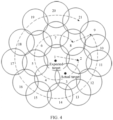
- FIG. 4 shows an example in which a satellite sweeps a terminal by using at least one beam.
- An actual target in FIG. 4 is a geographical location of the terminal in this embodiment of this application, and an expected target is an expected geographical location of the terminal.
- the terminal is actually located in a coverage area of a beam numbered 3.
- the satellite performs sweeping for a cycle by using the expected target as a center point, and a quantity of transmitted beams is 21. Refer to FIG. 4 . Circles numbered 1 to 21 represent 21 beams.
- the information about the first sweeping cycle is used to determine a moment at which the terminal sends a random access request to the satellite in S310.
- the information about the first sweeping cycle may be a value of the first sweeping cycle, or may be an index of the first sweeping cycle.
- the information about the first sweeping cycle carried in the third signal is the value of the first sweeping cycle or the information about the first sweeping cycle is the index of the first sweeping cycle.
- the satellite directly indicates the value of the first sweeping cycle to the terminal by using RRC signaling.
- every two beams are at an equal time interval.
- the value T of the first sweeping cycle may be determined based on a time interval t between every two beams and a quantity N of beams.
- the value T of the first sweeping cycle is equal to t * N.
- FIG. 5 is a schematic diagram of a time interval t between every two adjacent beams, that is, a service time of each beam.
- a time interval between a beam numbered 1 and a beam numbered 2 is t
- a time interval between the beam numbered 2 and a beam numbered 3 is t
- so on is t
- a time interval between a beam numbered 20 and a beam numbered 21 is also t.
- a preset quantity of bits may be used to represent the index, so that the terminal learns of the value of the first sweeping cycle by querying a mapping relationship table based on the index. This reduces signaling overheads.
- the satellite broadcasts the value of the first sweeping cycle, the time interval t between every two beams, and the quantity N of beams to the terminal by using the SSB, so that the terminal can obtain the value of the first sweeping cycle without searching the table. Therefore, the implementation complexity is low.
- the satellite broadcasts the index of the first sweeping cycle to the terminal by using the SSB, and the preset quantity of bits are used to represent the index, so that the terminal can learn of the value of the first sweeping cycle by querying the mapping relationship table pre-stored in the terminal. This reduces the signaling overheads.
- the value of the first sweeping cycle, the time interval t between every two beams, the quantity N of beams, or the index of the first sweeping cycle may be directly indicated by using RRC signaling.
- the RRC signaling is carried in the SSB.
- the value of the first sweeping cycle may be specified in a protocol, and does not need to be notified to the terminal by the satellite.
- Information about a beamwidth may also be indicated by using a specific value or index.
- For a specific indication manner refer to the foregoing indication manner of the first sweeping cycle.
- S306 The terminal receives the at least one first signal sent by the satellite by using the at least one beam in S304.
- the terminal when receiving the at least one first signal sent by the satellite by using the at least one beam in S304, the terminal may further receive the at least one third signal sent by the satellite by using the at least one beam.
- the information about the first sweeping cycle carried in the third signal may be the value of the first sweeping cycle, or may be the index of the first sweeping cycle.
- the third signal further carries the information about the beamwidth of the at least one first beam.
- the terminal determines the target beam, that is, a second beam, from the at least one beam based on the information about the first geographical location carried in each received first signal, the beamwidth of each first beam, the ephemeris of the satellite, and information about the geographical location of the terminal, and the geographical location of the terminal is referred to as a second geographical location.
- the first signal sent by the satellite in S304 carries a reference signal.
- the terminal measures quality of the reference signal carried in the first signal; determines a beam, which is referred to as a third beam, corresponding to a first signal having a reference signal whose quality is greater than a preset quality threshold.
- the beams corresponding to the first signal having a reference signal whose quality is greater than the preset quality threshold are beams numbered 1, 2, 3, and 4 in FIG. 4 .
- the first signal having a reference signal whose quality is greater than the preset quality threshold is referred to as a second signal.
- a coverage area of the third beam may be determined based on a beamwidth of the third beam and the information about the first geographical location of the second signal.
- the second beam is determined based on the ephemeris of the satellite and a distance between a center point of the coverage area of the third beam and the geographical location of the terminal. Specifically, a center point that is within a first preset distance from the geographical location of the terminal and that is of the coverage area of the third beam is determined.
- a third beam corresponding to a center point of a target coverage area, that is, the beam numbered 3 in FIG. 4 is selected as the second beam along a movement direction of the satellite in the ephemeris. It should be noted that the coordinate of the first geographical location may be learned of by using the following method.
- the information about the first geographical location may be the index of the first geographical location.
- the index may be an identifier of a beam.
- the identifier of the beam is preconfigured in a one-to-one correspondence with the coordinate of the first geographical location of the beam. For example, as shown in Table 1, the terminal may determine, by using the identifier of the beam, for example, 0, that the coordinate of the first geographical location corresponding to the identifier of the beam is (1, 1, 1). This reduces signaling overheads.
- Table 1 Identifier of a beam Coordinate of a first geographical location 0 (1, 1, 1) 1 (2, 2, 2) 2 (3, 3, 3)
- different earth surface location ranges may be planned in advance, for example, a longitude and latitude range and a corresponding terrestrial reference point location. Centers of different location ranges may be selected for a terrestrial reference point.
- the terrestrial reference point may be directly notified by the satellite to the terminal by using the RRC signaling.
- the satellite notifies the terminal of a first distance difference by using the terrestrial reference point as a reference and in a broadcast manner.
- the first distance difference is the information about the first geographical location.
- the terminal may obtain the coordinate of the first geographical location based on the terrestrial reference point and the first distance difference.
- the terrestrial reference point is introduced, and the indicated first distance difference is a differential value of the first geographical location relative to the terrestrial reference point.
- the earth center is used as the reference point, and a coordinate value of the geographical location is an absolute value, which is usually large.
- the first distance difference is small relative to the absolute value. This reduces the signaling overheads.
- the information about the first geographical location may alternatively be a second distance difference of the first geographical location relative to a geographical location of a center point of a fourth beam.
- the fourth beam is one of the at least one beam.
- the satellite may notify the terminal of a coordinate of the geographical location of the center point of the fourth beam and the second distance difference in the broadcast manner.
- the terminal may determine a coordinate of a geographical location of a center point of a remaining beam based on the coordinate of the geographical location of the center point of the fourth beam and the second distance difference.
- the terminal stores a mapping relationship table.
- the mapping relationship table (for example, as shown in Table 2) includes the second distance difference and an index of a corresponding first geographical location.
- a 1 st first geographical location (that is, the geographical location of the center point of the fourth beam) is used as the reference point, and the terminal may determine a coordinate of a remaining first geographical location based on the coordinate of the 1 st first geographical location and a second distance difference of the remaining first geographical location relative to the 1 st first geographical location. Refer to Table 2.
- 00 represents a 2 nd first geographical location
- a second distance difference corresponding to 00 is (1, 2, 3)
- 01 represents a 3 rd first geographical location
- a second distance difference corresponding to 01 is (1, 2, 4)
- 10 represents a 4 th first geographical location
- a second distance difference corresponding to 10 is (1, 2, 5)
- 11 represents a 5 th first geographical location
- a second distance difference corresponding to 11 is (1, 2, 6).
- the terminal learns, by querying Table 2, that the second distance difference of the 4 th first geographical location relative to the 1 st first geographical location is (1, 2, 5), to obtain a coordinate (2, 3, 6) of the 4 th first geographical location.
- Table 2 Index Sequence number of a first geographical location Second distance difference 00 II (1, 2, 3) 01 III (1, 2, 4) 10 IV (1, 2, 5) 11 V (1, 2, 6)
- a beamwidth may be learned of in the following manner.
- information about the beamwidth that is carried in the third signal and that is received by the terminal is a value of the beamwidth or an index of the beamwidth.
- the information about the first geographical location may further indicate the value of the beamwidth.
- the information about the first geographical location may be the index, and the index may be the identifier of the beam.
- the identifier of the beam is preconfigured in a one-to-one correspondence with the value of the beamwidth of the beam and the coordinate of the first geographical location.
- the terminal may determine, by using the identifier of the beam, for example, 0, that the beamwidth corresponding to the identifier is 400, and the coordinate of the first geographical location is (1, 1, 1). This reduces the signaling overheads.
- Table 3 Identifier of a beam Value of a beamwidth Coordinate of a first geographical location 0 400 (1, 1, 1) 1 400 (2, 2, 2) 2 400 (3, 3, 3)
- the beamwidth learned of through the foregoing possible implementation may be a fixed same beamwidth, or may be different beamwidths.
- the beamwidth of the at least one beam received by the terminal may be the same or may be different.
- Table 3 when the identifier of the beam is 0, a value of a corresponding beamwidth is 200; when the identifier of the beam is 1, the value of the corresponding beamwidth is 300; and when the identifier of the beam is 2, the value of the corresponding beamwidth is 400.
- whether the beamwidth is the same is not specifically limited.
- the terminal sends the random access request to the satellite.
- the random access request carries an identifier of the second beam.
- the terminal determines, based on the first sweeping cycle, a moment for sending the random access request to the satellite.
- the terminal receives the value of the first sweeping cycle that is directly sent or broadcast by the satellite by using the RRC signaling.
- the terminal receives the time interval t between every two beams and the quantity N of beams that are directly sent or broadcast by the satellite by using the RRC signaling.
- the terminal can learn of the value of the first sweeping cycle by querying the mapping relationship table (for example, Table 4, Table 5, Table 6, or Table 7) pre-stored in the terminal.
- the mapping relationship table for example, Table 4, Table 5, Table 6, or Table 7
- the index is in a one-to-one correspondence with the first sweeping cycle.
- the index refers to Table 4. Different satellite altitudes have different speeds, and correspond to different first sweeping cycles. A higher speed indicates a shorter first sweeping cycle.
- the index is 00, it indicates that the value of the first sweeping cycle is 20 ms; when the index is 01, it indicates that the value of the first sweeping cycle is 10 ms; and when the index is 10, it indicates that the value of the first sweeping cycle is 5 ms.
- an index corresponding to the time interval t between every two beams is an index 1 (for example, as shown in Table 5), and an index corresponding to the quantity N of beams is an index 2 (for example, as shown in Table 6).
- index 1 for example, as shown in Table 5
- index 2 for example, as shown in Table 6
- the time interval t between every two beams is in a one-to-one correspondence with the quantity N of beams, and the time interval t and the quantity N correspond to a same index (for example, as shown in Table 7).
- Table 7 For example, refer to Table 7.
- Table 4 Index First sweeping cycle Satellite system Altitude range 00 20 ms GEO 35,786 km 01 10 ms MEO 7,000 to 25,000 km 10 5 ms LEO 300 to 1,500 km Table 5 Index 1 Time interval t between every two beams 0 0.5 ms 1 1 ms Table 6 Index 2 Quantity N of beams 0 7 1 20 Table 7 Index Time interval t between every two beams Quantity N of beams 0 1 ms 7 1 0.5 ms 20
- Tables 1 to 7 are merely used as examples, and a form of the table is not specifically limited in this embodiment of this application.
- S312 The satellite receives the random access request sent by the terminal, and sends a random access response to the terminal. After random access succeeds, data communication may be performed between the satellite and the terminal.
- the terminal determines a third distance difference between the second geographical location and the edge of the second beam. If the third distance difference is less than a preset distance threshold, it indicates that the second geographical location is close to the edge of the second beam, and quality of communication between the terminal and the satellite is poor. As shown in FIG. 6 , a current beam is the second beam, and an actual user location is the second geographical location. In this case, the terminal sends first information to the satellite. The first information indicates the satellite to perform sweeping by using a fifth beam. Because random access does not need to be performed again, the fifth beam may be a non-SSB beam, for example, may be a CSI-RS beam. A sweeping cycle of the fifth beam may be a second sweeping cycle.
- the first information may further carry the identifier of the second beam and a sweeping identifier.
- the sweeping identifier indicates the satellite to perform re-sweeping, to prevent communication interruption and implement beam maintenance.
- the first information may carry the coordinate of the geographical location of the terminal and the sweeping identifier.
- the second sweeping cycle may reuse the previous first sweeping cycle, for example, 20 ms.
- the satellite because the terminal has randomly accessed the satellite, the satellite performs sweeping by using the fifth beam based on the second sweeping cycle to maintain better quality of communication. Therefore, the second sweeping cycle may be configured as a shorter cycle, for example, 5 ms, to avoid an excessively long sweeping time.
- the satellite may notify the terminal of a value of the second sweeping cycle by using the RRC signaling. In the foregoing solution, a new cycle is customized and configured for each terminal, so that different user requirements in different scenarios are met.
- the satellite starts to perform re-sweeping by using the fifth beam based on the second sweeping cycle by using the geographical location of the center point of the second beam as a center or using the geographical location of the terminal as a center. This saves a sweeping time, and can implement beam maintenance more quickly.
- the satellite performs re-sweeping by using the geographical location of the center point of the second beam as the center. Because the satellite already knows the center point during re-sweeping, a beam direction does not need to be re-adjusted. This reduces satellite processing complexity.
- a manner of determining the target beam is the same as the manner of determining the target beam in S308.
- a manner of determining the target beam is different from the manner of determining the target beam in S308, and the target beam is determined in the following manner.
- the satellite obtains the information about the geographical location of the terminal in the first information, and the satellite sends at least one fourth signal to the terminal by using the at least one fifth beam by using the geographical location of the terminal as a center. Then, the terminal measures quality of a reference signal in the received fourth signal, and determines, as the target beam, a fifth beam corresponding to a reference signal whose quality is greater than a preset threshold in the fourth signal, so that a beam serving the terminal is found more quickly, and a sweeping time is reduced.
- the terminal device and the network device may include a hardware structure and/or a software module, to implement the foregoing functions in a form of the hardware structure, the software module, or a combination of the hardware structure and the software module. Whether a function in the foregoing functions is performed by using the hardware structure, the software module, or the combination of the hardware structure and the software module depends on particular applications and design constraints of the technical solutions.
- FIG. 7 is a schematic diagram of a structure of a communication apparatus 700 according to an embodiment of this application.
- the apparatus is configured to implement the method described in the foregoing method embodiments.
- the communication apparatus may be an apparatus in a terminal device, or an apparatus that can be used in a matching manner with the terminal device.
- the communication apparatus may include modules or units that are in a one-to-one correspondence with the methods/operations/steps/actions performed by the terminal in the foregoing method embodiments.
- the units may be a hardware circuit, software, or a combination of a hardware circuit and software.
- the apparatus includes a transceiver unit 702 and a processing unit 704.
- the transceiver unit 702 is configured to receive at least one first signal sent by a satellite by using at least one first beam.
- Each first signal corresponds to one first beam, each first signal carries information about a first geographical location, and the first geographical location is a geographical location of a center point of the first beam corresponding to each first signal.
- the processing unit 704 is configured to determine a second beam from the at least one first beam based on the information about the first geographical location carried in each first signal, a beamwidth of each first beam, an ephemeris of the satellite, and information about a second geographical location.
- the second geographical location is a geographical location of a terminal.
- the transceiver unit 702 is further configured to send a random access request to the satellite.
- the random access request carries an identifier of the second beam.
- the at least one first signal carries a reference signal.
- the processing unit 704 is further configured to measure quality of a reference signal.
- the processing unit 704 includes a first processing module, a second processing module, and a third processing module.
- the first processing module is configured to determine a first beam corresponding to a second signal as a third beam.
- the second signal is a first signal having a reference signal whose quality is greater than a preset quality threshold.
- the second processing module is configured to determine a coverage area of the third beam based on a beamwidth of the third beam and information about a first geographical location of the second signal.
- the third processing module is configured to determine the second beam based on the coverage area of the third beam, the ephemeris of the satellite, and the information about the second geographical location.
- the third processing module is specifically configured to determine the second beam based on the ephemeris of the satellite and a distance between a center point of the coverage area of the third beam and the second geographical location.
- the transceiver unit 702 is further configured to receive at least one third signal sent by the satellite by using the at least one first beam.
- the third signal carries information about a first sweeping cycle and/or information about the beamwidth of the at least one first beam, and the information about the first sweeping cycle is used to determine a moment for sending the random access request.
- the information about the first sweeping cycle is a value of the first sweeping cycle or an index of the first sweeping cycle.
- the information about the first geographical location is a first distance difference of the first geographical location relative to a terrestrial reference point;
- the information about the first geographical location is a second distance difference of the first geographical location relative to a geographical location of a center point of a fourth beam.
- the fourth beam is one of the at least one first beam.
- the processing unit 704 is further configured to determine a third distance difference between the second geographical location and an edge of the second beam.
- the transceiver unit 702 is further configured to send first information to the satellite if the third distance difference is less than a preset distance threshold.
- the first information indicates the satellite to perform sweeping based on a second sweeping cycle by using a fifth beam.
- FIG. 8 is a schematic diagram of a structure of a communication apparatus 800 according to an embodiment of this application.
- the apparatus is configured to implement the method described in the foregoing method embodiments.
- the communication apparatus may be an apparatus in a network device or an apparatus that can be used in a matching manner with the network device.
- the communication apparatus may include modules or units that are in a one-to-one correspondence with the methods/operations/steps/actions performed by the network device (a satellite) in the foregoing method embodiments.
- the units may be a hardware circuit, software, or a combination of a hardware circuit and software.
- the apparatus in the schematic diagram of the structure includes a processing unit 802 and a transceiver unit 804.
- the processing unit 802 is configured to determine at least one first signal.
- the transceiver unit 804 is configured to send the at least one first signal to a terminal by using at least one first beam.
- Each first signal corresponds to one first beam, each first signal carries information about a first geographical location, the first geographical location is a geographical location of a center point of the first beam corresponding to each first signal, and the information about the first geographical location is used to determine a second beam from the at least one first beam.
- the transceiver unit 804 is further configured to receive a random access request sent by the terminal.
- the random access request herein carries an identifier of the second beam.
- the transceiver unit 804 is further configured to send at least one third signal to the terminal by using the at least one first beam.
- the third signal carries information about a first sweeping cycle and/or information about a beamwidth of the at least one first beam, and the information about the first sweeping cycle indicates the terminal to determine a moment for sending the random access request.
- the information about the first sweeping cycle is a value of the first sweeping cycle or an index of the first sweeping cycle.
- the information about the first geographical location is a first distance difference of the first geographical location relative to a terrestrial reference point; or the information about the first geographical location is a second distance difference of the first geographical location relative to a geographical location of a center point of a fourth beam.
- the fourth beam is one of the at least one first beam.
- the transceiver unit 804 is further configured to receive first information sent by the terminal.
- the first information indicates the satellite to perform sweeping based on a second sweeping cycle by using a fifth beam.
- An embodiment of this application further provides a communication apparatus 900, configured to implement functions of the terminal device and the network device in the foregoing methods.
- the communication apparatus may be a terminal or a network device, may be an apparatus in a terminal or a network device, or may be an apparatus that can be used in a matching manner with a terminal or a network device.
- the communication apparatus 900 may be a chip system. In this embodiment of this application, the chip system may include a chip, or may include a chip and another discrete component.
- the communication apparatus 900 includes at least one processor 910, configured to implement functions of the terminal and the network device in the method provided in embodiments of this application.
- the communication apparatus 900 may further include a communication interface 920.
- the communication interface may be a transceiver, a circuit, a bus, a module, or a communication interface of another type, and is configured to communicate with another device by using a transmission medium.
- the communication interface 920 is used by an apparatus in the communication apparatus 900 to communicate with another device.
- the processor 910 may perform the functions performed by the processing unit 704 in the communication apparatus 700.
- the communication interface 920 may be configured to perform the functions performed by the transceiver unit 702 in the communication apparatus 700.
- the communication interface 920 is configured to receive at least one first signal sent by a satellite by using at least one first beam. Each first signal corresponds to one first beam, each first signal carries information about a first geographical location, and the first geographical location is a geographical location of a center point of the first beam corresponding to each first signal.
- the processor 910 is configured to determine a second beam from the at least one first beam based on the information about the first geographical location carried in each first signal, a beamwidth of each first beam, an ephemeris of the satellite, and information about a second geographical location.
- the second geographical location is a geographical location of the apparatus 700.
- the communication interface 920 is further configured to send a random access request to the satellite. The random access request carries an identifier of the second beam.
- the processor 910 is configured to determine the at least one first signal; and the communication interface 920 is configured to send the at least one first signal to the terminal by using at least one first beam.
- Each first signal corresponds to one first beam, each first signal carries the information about the first geographical location, the first geographical location is the geographical location of the center point of the first beam corresponding to each first signal, and the information about the first geographical location is used to determine the second beam from the at least one first beam.
- the communication interface 920 is further configured to receive the random access request sent by the terminal. The random access request carries an identifier of the second beam.
- the communication interface 920 is further configured to perform other receiving or sending steps or operations performed by the terminal and the network device in the foregoing method embodiments.
- the processor 910 may be also configured to perform corresponding steps or operations, other than receiving and sending, performed by the terminal and the network device in the foregoing method embodiments. Details are not described herein again.
- the communication apparatus 900 may further include at least one memory 930, configured to store program instructions and/or data.
- the memory 930 is coupled to the processor 910.
- the coupling in this embodiment of this application may be an indirect coupling or a communication connection between apparatuses, units, or modules in an electrical form, a mechanical form, or another form, and is for information exchange between the apparatuses, the units, or the modules.
- the processor 910 may operate in collaboration with the memory 930.
- the processor 910 may execute the program instructions stored in the memory 930.
- at least one of the at least one memory may be integrated with the processor.
- the memory 930 is located outside the communication apparatus 900.
- This embodiment of this application does not limit a specific connection medium between the communication interface 920, the processor 910, and the memory 930.
- the memory 930, the processor 910, and the communication interface 920 are connected through a bus 940, and the bus is represented using a thick line in FIG. 9 .
- a connection manner between other components is merely an example for description, and imposes no limitation.
- the bus may be classified into an address bus, a data bus, a control bus, and the like. For ease of representation, only one thick line is for representing the bus in FIG. 9 , but this does not mean that there is only one bus or only one type of bus.
- the processor 910 may be one or more central processing units (Central Processing Units, CPUs).
- CPUs Central Processing Units
- the CPU may be a single-core CPU, or may be a multi-core CPU.
- the processor 910 may be a general-purpose processor, a digital signal processor, an application-specific integrated circuit, a field programmable gate array or another programmable logic device, a discrete gate or transistor logic device, or a discrete hardware component, and may implement or execute the methods, steps, and logical block diagrams disclosed in embodiments of this application.
- the general-purpose processor may be a microprocessor or any conventional processor or the like. The steps of the method disclosed with reference to embodiments of this application may be directly performed by a hardware processor, or may be performed by using a combination of hardware in the processor and a software module.
- the memory 930 may include but is not limited to a non-volatile memory such as a hard disk drive (hard disk drive, HDD) or a solid-state drive (solid-state drive, SSD), a random access memory (Random Access Memory, RAM), an erasable programmable read-only memory (Erasable Programmable ROM, EPROM), a read-only memory (Read-Only Memory, ROM), a portable read-only memory (Compact Disc Read-Only Memory, CD-ROM), or the like.
- the memory is any other medium that can carry or store expected program code in a form of instructions or a data structure and that can be accessed by a computer, but is not limited thereto.
- the memory in embodiments of this application may alternatively be a circuit or any other apparatus that can implement a storage function, and is configured to store the program instructions and/or the data.
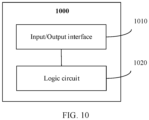
- An embodiment of this application further provides an apparatus 1000, configured to implement functions of the terminal and the network device in the foregoing method.
- the apparatus 1000 may be a communication apparatus or a chip in a communication apparatus.
- the communication apparatus includes: at least one input/output interface 1010 and a logic circuit 1020.
- the input/output interface 1010 may be an input/output circuit, or may be referred to as a communication interface.
- the logic circuit 1020 may be a signal processor, a chip, or another integrated circuit that can implement the method in this application.
- the at least one input/output interface 1010 is configured to input or output a signal or data.
- the input/output interface 1010 is configured to: receive at least one first signal sent by a satellite by using at least one first beam; or send a random access request to the satellite.
- the input/output interface 1010 is configured to: send the at least one first signal to the terminal by using the at least one first beam; or receive a random access request sent by the terminal.
- the logic circuit 1020 is configured to perform a part or all of the steps in any one of the methods provided in embodiments of this application.
- the logic circuit may implement functions implemented by the processing unit 704 in the apparatus 700, the processing unit 802 in the apparatus 800, and the processor 910 in the apparatus 900.
- the apparatus is configured to perform steps performed by the terminal (the communication apparatus 700) in various possible implementations of the foregoing method embodiments.
- the logic circuit 1020 is configured to determine a second beam from at least one first beam based on information about a first geographical location carried in each first signal, a beamwidth of each first beam, an ephemeris of the satellite, and information about a second geographical location.
- the second geographical location is a geographical location of the communication apparatus 700.
- the apparatus is configured to perform the steps performed by the network device (the communication apparatus 800) in the possible implementation methods of the foregoing method embodiments.
- the logic circuit 1020 is configured to determine the at least one first signal.
- the chip in the terminal implements functions of the terminal in the foregoing method embodiments.
- the chip in the terminal receives information from another module (for example, a radio frequency module or an antenna) in the terminal, where the information is sent by the network device to the terminal; or the chip in the terminal sends information to another module (for example, a radio frequency module or an antenna) in the terminal, where the information is sent by the terminal to the network device.
- another module for example, a radio frequency module or an antenna
- the chip in the network device implements functions of the network device in the foregoing method embodiments.
- the chip in the network device receives information from another module (for example, a radio frequency module or an antenna) in the network device, where the information is sent by the terminal to the network device; or the chip in the network device sends information to another module (for example, a radio frequency module or an antenna) in the network device, where the information is sent by the network device to the terminal.
- another module for example, a radio frequency module or an antenna
- An embodiment of this application provides a computer-readable storage medium.
- the computer-readable storage medium stores a computer program.
- steps of the wireless communication method in FIG. 3 are performed.
- an embodiment of this application further provides a computer program product including instructions.
- the computer program product runs on a computer, the computer is enabled to perform the steps of the wireless communication method in FIG. 3 .
- an embodiment of this application further provides a computer program.
- the computer program runs on a computer, the computer is enabled to perform the steps of the wireless communication method in FIG. 3 .
- An embodiment of this application further provides a communication system, including a communication apparatus 700 and a communication apparatus 800.
Landscapes
- Engineering & Computer Science (AREA)
- Computer Networks & Wireless Communication (AREA)
- Signal Processing (AREA)
- Physics & Mathematics (AREA)
- Astronomy & Astrophysics (AREA)
- Aviation & Aerospace Engineering (AREA)
- General Physics & Mathematics (AREA)
- Mobile Radio Communication Systems (AREA)
- Radio Relay Systems (AREA)
Applications Claiming Priority (2)
| Application Number | Priority Date | Filing Date | Title |
|---|---|---|---|
| CN202110367965.4A CN115173918A (zh) | 2021-04-06 | 2021-04-06 | 一种无线通信的方法及装置 |
| PCT/CN2022/085048 WO2022213925A1 (zh) | 2021-04-06 | 2022-04-02 | 一种无线通信的方法及装置 |
Publications (2)
| Publication Number | Publication Date |
|---|---|
| EP4307751A1 true EP4307751A1 (de) | 2024-01-17 |
| EP4307751A4 EP4307751A4 (de) | 2024-10-30 |
Family
ID=83476071
Family Applications (1)
| Application Number | Title | Priority Date | Filing Date |
|---|---|---|---|
| EP22783991.7A Pending EP4307751A4 (de) | 2021-04-06 | 2022-04-02 | Verfahren und vorrichtung zur drahtlosen kommunikation |
Country Status (4)
| Country | Link |
|---|---|
| US (1) | US20240031012A1 (de) |
| EP (1) | EP4307751A4 (de) |
| CN (1) | CN115173918A (de) |
| WO (1) | WO2022213925A1 (de) |
Families Citing this family (9)
| Publication number | Priority date | Publication date | Assignee | Title |
|---|---|---|---|---|
| US12309610B2 (en) * | 2021-09-15 | 2025-05-20 | Qualcomm Incorporated | Faster UE beam refinement in multi-cell scenario |
| US12342310B2 (en) * | 2022-04-04 | 2025-06-24 | Qualcomm Incorporated | Device region estimation for near-field operation |
| CN115484689B (zh) * | 2022-10-27 | 2025-05-13 | 中国星网网络应用有限公司 | 一种随机接入方法、装置、设备及存储介质 |
| CN116827408A (zh) * | 2023-05-25 | 2023-09-29 | 泰斗微电子科技有限公司 | 一种通信卫星波束捕获方法、接收机、终端及存储介质 |
| WO2025000424A1 (zh) * | 2023-06-30 | 2025-01-02 | 华为技术有限公司 | 一种接入ntn的方法和通信装置 |
| WO2025137871A1 (en) * | 2023-12-26 | 2025-07-03 | Mediatek Singapore Pte. Ltd. | Methods of ntn initial access |
| CN120417075A (zh) * | 2024-01-31 | 2025-08-01 | 华为技术有限公司 | 一种通信方法、装置及系统 |
| CN120583523A (zh) * | 2024-03-01 | 2025-09-02 | 华为技术有限公司 | 通信方法以及装置 |
| CN120603007A (zh) * | 2024-03-05 | 2025-09-05 | 华为技术有限公司 | 通信方法、装置及存储介质 |
Family Cites Families (29)
| Publication number | Priority date | Publication date | Assignee | Title |
|---|---|---|---|---|
| US7904020B2 (en) * | 2006-08-22 | 2011-03-08 | Viasat, Inc. | Downstream broad beam diversity with interference cancellation |
| CN101675606A (zh) * | 2007-03-08 | 2010-03-17 | 维尔塞特公司 | 卫星参考终端系统和方法 |
| US9435893B2 (en) * | 2007-05-21 | 2016-09-06 | Spatial Digital Systems, Inc. | Digital beam-forming apparatus and technique for a multi-beam global positioning system (GPS) receiver |
| US9100085B2 (en) * | 2011-09-21 | 2015-08-04 | Spatial Digital Systems, Inc. | High speed multi-mode fiber transmissions via orthogonal wavefronts |
| CN103220740A (zh) * | 2012-01-20 | 2013-07-24 | 电信科学技术研究院 | 一种小区切换方法及装置 |
| EP2958249B1 (de) * | 2014-06-18 | 2017-10-25 | European Space Agency | Gemeinsame Sendersignalverarbeitung in mehrstrahligen Satellitensystemen |
| CN113595620B (zh) * | 2015-04-10 | 2023-03-28 | 维尔塞特公司 | 端到端波束成形系统、卫星及其通信方法 |
| US10187141B2 (en) * | 2015-04-10 | 2019-01-22 | Viasat, Inc. | Cross-band system for end-to-end beamforming |
| US10425865B2 (en) * | 2016-02-11 | 2019-09-24 | Qualcomm Incorporated | Channel quality feedback in satellite communication systems |
| US11791882B2 (en) * | 2016-04-13 | 2023-10-17 | Qualcomm Incorporated | System and method for beam management |
| US10263690B2 (en) * | 2017-08-01 | 2019-04-16 | Viasat, Inc. | Handover based on predicted network conditions |
| US10624052B2 (en) * | 2018-05-11 | 2020-04-14 | Dish Network L.L.C. | Timing advance for satellite-based communications |
| CN108882245B (zh) * | 2018-07-03 | 2023-02-28 | 中国人民解放军陆军工程大学 | 一种geo与leo认知卫星网络及其动态频率分配方法 |
| CN110753388B (zh) * | 2018-07-23 | 2021-08-20 | 华为技术有限公司 | 一种波束管理方法和相关设备 |
| CN109347525B (zh) * | 2018-10-18 | 2021-05-11 | 南京邮电大学 | 毫米波高铁车地通信的自适应多波束成形与波束切换方法 |
| CN111182658B (zh) * | 2018-11-12 | 2023-04-07 | 华为技术有限公司 | 一种卫星通信的方法、装置及系统 |
| WO2020165675A1 (en) * | 2019-02-13 | 2020-08-20 | Telefonaktiebolaget Lm Ericsson (Publ) | Enhanced cell selection for non-terrestrial networks |
| CN111757411B (zh) * | 2019-03-28 | 2022-08-09 | 大唐移动通信设备有限公司 | 小区选择方法及设备 |
| US10932122B1 (en) * | 2019-06-07 | 2021-02-23 | Sprint Communications Company L.P. | User equipment beam effectiveness |
| CN114208331B (zh) * | 2019-08-09 | 2023-03-10 | 中兴通讯股份有限公司 | 传输资源切换 |
| ES2982425T3 (es) * | 2019-09-06 | 2024-10-16 | Vodafone Ip Licensing Ltd | Ajuste del ancho de banda de la portadora en una red de radio celular |
| CN112653499B (zh) * | 2019-10-11 | 2022-02-01 | 大唐移动通信设备有限公司 | 终端的网络接入方法、装置、电子设备及存储介质 |
| CN112996133A (zh) * | 2019-12-13 | 2021-06-18 | 联发科技(新加坡)私人有限公司 | 随机接入前导码传输与接收方法 |
| EP4085535A1 (de) * | 2020-01-07 | 2022-11-09 | Shanghai Langbo Communication Technology Company Limited | Verfahren und vorrichtung in einem knoten für die drahtlose kommunikation |
| US12401415B2 (en) * | 2020-02-03 | 2025-08-26 | Telefonaktiebolaget Lm Ericsson (Publ) | Power efficient non-terrestrial network connection establishment |
| US20230060101A1 (en) * | 2020-02-10 | 2023-02-23 | Telefonaktiebolaget Lm Ericsson (Publ) | Network Availability Timer for Non-Terrestrial Networks |
| CN120750397A (zh) * | 2020-10-23 | 2025-10-03 | 苹果公司 | 非陆地网络(ntn)的时间偏移维护 |
| EP4002719A1 (de) * | 2020-11-20 | 2022-05-25 | Mitsubishi Electric R&D Centre Europe B.V. | Unterstützung des rachverfahrens in nicht-terrestrischen netzwerken |
| US11750278B2 (en) * | 2020-12-23 | 2023-09-05 | Hughes Network Systems, Llc | Satellite terminal power back-off |
-
2021
- 2021-04-06 CN CN202110367965.4A patent/CN115173918A/zh active Pending
-
2022
- 2022-04-02 WO PCT/CN2022/085048 patent/WO2022213925A1/zh not_active Ceased
- 2022-04-02 EP EP22783991.7A patent/EP4307751A4/de active Pending
-
2023
- 2023-09-27 US US18/475,456 patent/US20240031012A1/en active Pending
Also Published As
| Publication number | Publication date |
|---|---|
| CN115173918A (zh) | 2022-10-11 |
| WO2022213925A1 (zh) | 2022-10-13 |
| US20240031012A1 (en) | 2024-01-25 |
| EP4307751A4 (de) | 2024-10-30 |
Similar Documents
| Publication | Publication Date | Title |
|---|---|---|
| EP4307751A1 (de) | Verfahren und vorrichtung zur drahtlosen kommunikation | |
| US12335801B2 (en) | Network resource configuration method and apparatus | |
| US12477438B2 (en) | Neighboring cell relationship configuration method and apparatus applicable to satellite network | |
| CN112787712B (zh) | 面向低轨道卫星基站-飞行器用户终端的通信连接建立方法 | |
| US12369046B2 (en) | Wireless communication method and apparatus | |
| EP4307767A1 (de) | Drahtloskommunikationsverfahren, -vorrichtung und -system | |
| EP4661492A1 (de) | Verfahren und vorrichtung zur drahtlosen kommunikation | |
| EP4044627B1 (de) | Netzzugangsverfahren und -vorrichtung für endgerät, elektronische vorrichtung und speichermedium | |
| US20240365200A1 (en) | Communication method and apparatus | |
| US20230361860A1 (en) | Wireless communication method and apparatus | |
| US20240340076A1 (en) | Communication method and apparatus | |
| CN118160331A (zh) | 无线通信方法和通信设备 | |
| US12587235B2 (en) | Wireless communication method and apparatus | |
| US20240073763A1 (en) | Method and apparatus for non-terrestrial network mobility in wireless communication system | |
| US20240381063A1 (en) | Method, user equipment, network node | |
| CN118435697A (zh) | 通信方法、终端设备以及网络设备 | |
| US20250338155A1 (en) | Synchronization signal block measurement method and apparatus | |
| US20260089588A1 (en) | Communication method and apparatus | |
| EP4727212A1 (de) | Übergabeverfahren und kommunikationsvorrichtung | |
| CN119789224A (zh) | 通信方法及装置 | |
| US12389365B2 (en) | Method for wireless communication, terminal device, and network device | |
| CN121942264A (zh) | 接入方法及通信装置 | |
| CN120226329A (zh) | 系统信息的发送方法、系统信息的接收方法以及相关装置 | |
| CN119997088A (zh) | 一种通信方法及装置 | |
| CN119946739A (zh) | 一种通信方法及相应装置 |
Legal Events
| Date | Code | Title | Description |
|---|---|---|---|
| STAA | Information on the status of an ep patent application or granted ep patent |
Free format text: STATUS: THE INTERNATIONAL PUBLICATION HAS BEEN MADE |
|
| PUAI | Public reference made under article 153(3) epc to a published international application that has entered the european phase |
Free format text: ORIGINAL CODE: 0009012 |
|
| STAA | Information on the status of an ep patent application or granted ep patent |
Free format text: STATUS: REQUEST FOR EXAMINATION WAS MADE |
|
| 17P | Request for examination filed |
Effective date: 20231010 |
|
| AK | Designated contracting states |
Kind code of ref document: A1 Designated state(s): AL AT BE BG CH CY CZ DE DK EE ES FI FR GB GR HR HU IE IS IT LI LT LU LV MC MK MT NL NO PL PT RO RS SE SI SK SM TR |
|
| DAV | Request for validation of the european patent (deleted) | ||
| DAX | Request for extension of the european patent (deleted) | ||
| REG | Reference to a national code |
Ref country code: DE Ref legal event code: R079 Free format text: PREVIOUS MAIN CLASS: H04W0016280000 Ipc: H04B0007185000 |
|
| A4 | Supplementary search report drawn up and despatched |
Effective date: 20240926 |
|
| RIC1 | Information provided on ipc code assigned before grant |
Ipc: H04W 74/08 20240101ALI20240920BHEP Ipc: H04W 84/06 20090101ALI20240920BHEP Ipc: H04W 16/28 20090101ALI20240920BHEP Ipc: H04B 7/185 20060101AFI20240920BHEP |