EP4309598A2 - Integrierter subkutaner sensor und infusionsvorrichtung, system und verfahren - Google Patents
Integrierter subkutaner sensor und infusionsvorrichtung, system und verfahren Download PDFInfo
- Publication number
- EP4309598A2 EP4309598A2 EP23180036.8A EP23180036A EP4309598A2 EP 4309598 A2 EP4309598 A2 EP 4309598A2 EP 23180036 A EP23180036 A EP 23180036A EP 4309598 A2 EP4309598 A2 EP 4309598A2
- Authority
- EP
- European Patent Office
- Prior art keywords
- infusion cannula
- infusion
- base
- cannula
- medical device
- Prior art date
- Legal status (The legal status is an assumption and is not a legal conclusion. Google has not performed a legal analysis and makes no representation as to the accuracy of the status listed.)
- Pending
Links
Images











Classifications
-
- A—HUMAN NECESSITIES
- A61—MEDICAL OR VETERINARY SCIENCE; HYGIENE
- A61B—DIAGNOSIS; SURGERY; IDENTIFICATION
- A61B5/00—Measuring for diagnostic purposes; Identification of persons
- A61B5/145—Measuring characteristics of blood in vivo, e.g. gas concentration or pH-value ; Measuring characteristics of body fluids or tissues, e.g. interstitial fluid or cerebral tissue
- A61B5/14532—Measuring characteristics of blood in vivo, e.g. gas concentration or pH-value ; Measuring characteristics of body fluids or tissues, e.g. interstitial fluid or cerebral tissue for measuring glucose, e.g. by tissue impedance measurement
-
- A—HUMAN NECESSITIES
- A61—MEDICAL OR VETERINARY SCIENCE; HYGIENE
- A61M—DEVICES FOR INTRODUCING MEDIA INTO, OR ONTO, THE BODY; DEVICES FOR TRANSDUCING BODY MEDIA OR FOR TAKING MEDIA FROM THE BODY; DEVICES FOR PRODUCING OR ENDING SLEEP OR STUPOR
- A61M5/00—Devices for bringing media into the body in a subcutaneous, intra-vascular or intramuscular way; Accessories therefor, e.g. filling or cleaning devices, arm-rests
- A61M5/14—Infusion devices, e.g. infusing by gravity; Blood infusion; Accessories therefor
- A61M5/158—Needles for infusions; Accessories therefor, e.g. for inserting infusion needles, or for holding them on the body
-
- A—HUMAN NECESSITIES
- A61—MEDICAL OR VETERINARY SCIENCE; HYGIENE
- A61B—DIAGNOSIS; SURGERY; IDENTIFICATION
- A61B5/00—Measuring for diagnostic purposes; Identification of persons
- A61B5/145—Measuring characteristics of blood in vivo, e.g. gas concentration or pH-value ; Measuring characteristics of body fluids or tissues, e.g. interstitial fluid or cerebral tissue
- A61B5/1468—Measuring characteristics of blood in vivo, e.g. gas concentration or pH-value ; Measuring characteristics of body fluids or tissues, e.g. interstitial fluid or cerebral tissue using chemical or electrochemical methods, e.g. by polarographic means
- A61B5/1486—Measuring characteristics of blood in vivo, e.g. gas concentration or pH-value ; Measuring characteristics of body fluids or tissues, e.g. interstitial fluid or cerebral tissue using chemical or electrochemical methods, e.g. by polarographic means using enzyme electrodes, e.g. with immobilised oxidase
- A61B5/14865—Measuring characteristics of blood in vivo, e.g. gas concentration or pH-value ; Measuring characteristics of body fluids or tissues, e.g. interstitial fluid or cerebral tissue using chemical or electrochemical methods, e.g. by polarographic means using enzyme electrodes, e.g. with immobilised oxidase invasive, e.g. introduced into the body by a catheter or needle or using implanted sensors
-
- A—HUMAN NECESSITIES
- A61—MEDICAL OR VETERINARY SCIENCE; HYGIENE
- A61B—DIAGNOSIS; SURGERY; IDENTIFICATION
- A61B5/00—Measuring for diagnostic purposes; Identification of persons
- A61B5/48—Other medical applications
- A61B5/4836—Diagnosis combined with treatment in closed-loop systems or methods
- A61B5/4839—Diagnosis combined with treatment in closed-loop systems or methods combined with drug delivery
-
- A—HUMAN NECESSITIES
- A61—MEDICAL OR VETERINARY SCIENCE; HYGIENE
- A61B—DIAGNOSIS; SURGERY; IDENTIFICATION
- A61B5/00—Measuring for diagnostic purposes; Identification of persons
- A61B5/68—Arrangements of detecting, measuring or recording means, e.g. sensors, in relation to patient
- A61B5/6846—Arrangements of detecting, measuring or recording means, e.g. sensors, in relation to patient specially adapted to be brought in contact with an internal body part, i.e. invasive
- A61B5/6847—Arrangements of detecting, measuring or recording means, e.g. sensors, in relation to patient specially adapted to be brought in contact with an internal body part, i.e. invasive mounted on an invasive device
- A61B5/6848—Needles
- A61B5/6849—Needles in combination with a needle set
-
- A—HUMAN NECESSITIES
- A61—MEDICAL OR VETERINARY SCIENCE; HYGIENE
- A61B—DIAGNOSIS; SURGERY; IDENTIFICATION
- A61B5/00—Measuring for diagnostic purposes; Identification of persons
- A61B5/68—Arrangements of detecting, measuring or recording means, e.g. sensors, in relation to patient
- A61B5/6801—Arrangements of detecting, measuring or recording means, e.g. sensors, in relation to patient specially adapted to be attached to or worn on the body surface
- A61B5/683—Means for maintaining contact with the body
- A61B5/6832—Means for maintaining contact with the body using adhesives
- A61B5/6833—Adhesive patches
-
- A—HUMAN NECESSITIES
- A61—MEDICAL OR VETERINARY SCIENCE; HYGIENE
- A61M—DEVICES FOR INTRODUCING MEDIA INTO, OR ONTO, THE BODY; DEVICES FOR TRANSDUCING BODY MEDIA OR FOR TAKING MEDIA FROM THE BODY; DEVICES FOR PRODUCING OR ENDING SLEEP OR STUPOR
- A61M5/00—Devices for bringing media into the body in a subcutaneous, intra-vascular or intramuscular way; Accessories therefor, e.g. filling or cleaning devices, arm-rests
- A61M5/14—Infusion devices, e.g. infusing by gravity; Blood infusion; Accessories therefor
- A61M5/158—Needles for infusions; Accessories therefor, e.g. for inserting infusion needles, or for holding them on the body
- A61M2005/1585—Needle inserters
-
- A—HUMAN NECESSITIES
- A61—MEDICAL OR VETERINARY SCIENCE; HYGIENE
- A61M—DEVICES FOR INTRODUCING MEDIA INTO, OR ONTO, THE BODY; DEVICES FOR TRANSDUCING BODY MEDIA OR FOR TAKING MEDIA FROM THE BODY; DEVICES FOR PRODUCING OR ENDING SLEEP OR STUPOR
- A61M5/00—Devices for bringing media into the body in a subcutaneous, intra-vascular or intramuscular way; Accessories therefor, e.g. filling or cleaning devices, arm-rests
- A61M5/14—Infusion devices, e.g. infusing by gravity; Blood infusion; Accessories therefor
- A61M5/158—Needles for infusions; Accessories therefor, e.g. for inserting infusion needles, or for holding them on the body
- A61M2005/1588—Needles for infusions; Accessories therefor, e.g. for inserting infusion needles, or for holding them on the body having means for monitoring, controlling or visual inspection, e.g. for patency check, avoiding extravasation
-
- A—HUMAN NECESSITIES
- A61—MEDICAL OR VETERINARY SCIENCE; HYGIENE
- A61M—DEVICES FOR INTRODUCING MEDIA INTO, OR ONTO, THE BODY; DEVICES FOR TRANSDUCING BODY MEDIA OR FOR TAKING MEDIA FROM THE BODY; DEVICES FOR PRODUCING OR ENDING SLEEP OR STUPOR
- A61M5/00—Devices for bringing media into the body in a subcutaneous, intra-vascular or intramuscular way; Accessories therefor, e.g. filling or cleaning devices, arm-rests
- A61M5/14—Infusion devices, e.g. infusing by gravity; Blood infusion; Accessories therefor
- A61M5/168—Means for controlling media flow to the body or for metering media to the body, e.g. drip meters, counters ; Monitoring media flow to the body
- A61M5/172—Means for controlling media flow to the body or for metering media to the body, e.g. drip meters, counters ; Monitoring media flow to the body electrical or electronic
- A61M5/1723—Means for controlling media flow to the body or for metering media to the body, e.g. drip meters, counters ; Monitoring media flow to the body electrical or electronic using feedback of body parameters, e.g. blood-sugar, pressure
- A61M2005/1726—Means for controlling media flow to the body or for metering media to the body, e.g. drip meters, counters ; Monitoring media flow to the body electrical or electronic using feedback of body parameters, e.g. blood-sugar, pressure the body parameters being measured at, or proximate to, the infusion site
-
- A—HUMAN NECESSITIES
- A61—MEDICAL OR VETERINARY SCIENCE; HYGIENE
- A61M—DEVICES FOR INTRODUCING MEDIA INTO, OR ONTO, THE BODY; DEVICES FOR TRANSDUCING BODY MEDIA OR FOR TAKING MEDIA FROM THE BODY; DEVICES FOR PRODUCING OR ENDING SLEEP OR STUPOR
- A61M39/00—Tubes, tube connectors, tube couplings, valves, access sites or the like, specially adapted for medical use
- A61M39/02—Access sites
- A61M39/0247—Semi-permanent or permanent transcutaneous or percutaneous access sites to the inside of the body
- A61M2039/0267—Semi-permanent or permanent transcutaneous or percutaneous access sites to the inside of the body comprising sensors or electrical contacts
-
- A—HUMAN NECESSITIES
- A61—MEDICAL OR VETERINARY SCIENCE; HYGIENE
- A61M—DEVICES FOR INTRODUCING MEDIA INTO, OR ONTO, THE BODY; DEVICES FOR TRANSDUCING BODY MEDIA OR FOR TAKING MEDIA FROM THE BODY; DEVICES FOR PRODUCING OR ENDING SLEEP OR STUPOR
- A61M5/00—Devices for bringing media into the body in a subcutaneous, intra-vascular or intramuscular way; Accessories therefor, e.g. filling or cleaning devices, arm-rests
- A61M5/14—Infusion devices, e.g. infusing by gravity; Blood infusion; Accessories therefor
- A61M5/142—Pressure infusion, e.g. using pumps
- A61M5/14244—Pressure infusion, e.g. using pumps adapted to be carried by the patient, e.g. portable on the body
Definitions
- the present disclosure relates, in general, to subcutaneous sensor and infusion devices and systems such as, but not limited to infusion sets, injection ports, patch pump devices or other medical devices and systems having at least one subcutaneous sensor interface, and also configured for subcutaneous delivery or communication of infusion media or other fluid. Further examples relate to methods of making and using such devices and systems.
- Certain biological conditions may be monitored or sensed, according to modern medical techniques, through one or more analyte sensors inserted subcutaneously from a medical device.
- blood glucose levels are commonly monitored with subcutaneous sensors, as part of a diabetes treatment.
- a continuous glucose monitor (CGM) can monitor a patient's blood glucose levels over a period of time.
- CGM continuous glucose monitor
- certain diseases or conditions may be treated by delivering a medication or other substance to the body of a patient, subcutaneously, through an infusion set, injection port or other medical device.
- diabetes is commonly treated by delivering defined amounts of insulin to the patient at appropriate times.
- Some patient's with a CGM may require multiple daily injections of insulin.
- Subcutaneous sensor devices can include one or more sensor probe, needle or cannula that is configured to be inserted, subcutaneously, through the skin of a patient, to sense or monitor one or more biological conditions.
- An infusion set or an injection port device can include one or more cannula configured to be inserted subcutaneously through a patient's skin, to facilitate subcutaneous infusion of a medication or other infusion media.
- cannula configured to be inserted subcutaneously through a patient's skin, to facilitate subcutaneous infusion of a medication or other infusion media.
- Some patients employ a sensor device for detecting or monitoring a biological condition or an analyte associated with the condition (such as, but not limited to a blood glucose level) and can also benefit from an infusion set device to deliver infusion media (such as, but not limited to insulin) for treating or responding to a detected or monitored biological condition or analyte.
- a sensor device for detecting or monitoring a biological condition or an analyte associated with the condition (such as, but not limited to a blood glucose level) and can also benefit from an infusion set device to deliver infusion media (such as, but not limited to insulin) for treating or responding to a detected or monitored biological condition or analyte.
- infusion media such as, but not limited to insulin
- certain example medical devices as described herein may include one or more sensors and one or more infusion cannula in a single medical device, configured to facilitate sensing or monitor one or more biological conditions or analytes, as well as subcutaneous infusion of a medication or other infusion media.
- each infusion cannula and each sensor is configured for subcutaneous insertion in adjacent, but spaced insertion locations at an insertion site.
- at least one sensor and at least one infusion cannula are configured for combined insertion through a single inserter needle in a single location at the insertion site.
- the overall footprint of the device that the patient is wearing can be reduced, and/or the number of needle insertions can be reduced.
- Those aspects can yield a reduction in foreign body response and/or can produce few sites with scarring in the hypodermis.
- the infusion media can be beneficial to reduce or minimize interference by the infusion media with the sensor operation.
- stabilizers in insulin can interfere with the sensor signal.
- the volume of insulin (or other infusion media) infused during a bolus may dilute the local tissue glucose (or other parameter), causing sensor signal decay.
- interference effects are referred to herein as interference effects.
- certain examples described herein are configured to provide improved separation or isolation of the sensor from the infusion cannula, to reduce or minimize interference effects and provide improved operation, while allowing the device to deliver an infusion media at or near the same insertion location as the sensor.
- Particular examples described herein provide additional advantages and overcome problems that would otherwise be encountered in arranging a sensor and an infusion cannula in the same device or inserting a sensor element and an infusion cannula in a single inserter needle.
- a medical device includes a base having a first surface configured to be secured to a patient's skin.
- a first insertable member is secured to the base and has a length portion extending from the first surface of the base to a distal end of the first insertable member, for insertion through the patient's skin at an insertion site when the first surface of the base is secured to the patient's skin.
- a second insertable member is configured to be secured to the base and having a length portion extending from the first surface of the base to a distal end of the second insertable member, for insertion through the patient's skin at the insertion site when the first surface of the base is secured to the patient's skin.
- the first insertable member includes a sensor member for sensing a biological analyte corresponding to a biological condition.
- the second insertable member includes an infusion cannula for infusing an infusion media.
- the distal end of the first insertable member and the distal end of the second insertable member are spaced apart by a first distance of at least 5 mm, for reducing interference of the infusion media from the infusion cannula with an operation of the sensor member.
- the first insertable member and the second insertable member are spaced apart from each other by a second distance of at least along a plane of the first surface of the base, for insertion in separate, spaced insertion locations, where the second distance is less than the first distance.
- the first insertable member and the second insertable member are arranged adjacent each other for insertion together in a single insertion location.
- the length portions of the first insertable member and the second insertable members are attached to each other.
- the senor member has a first length extending from the first surface of the base to the distal end of the sensor member
- the infusion cannula has a second length extending from the first surface of the base to the distal end of the infusion cannula, and wherein the first length is different than the second length
- the sensor member and the infusion cannula are spaced apart from each other along a plane of the first surface of the base by less than the first distance.
- the first length is greater than the second length
- the sensor member has a first surface that faces toward the infusion cannula and that is connected to the infusion cannula
- the sensor member has at least one electrode on the first surface of the sensor member for interfacing with biological fluid or tissue after the sensor member is inserted at the insertion site.
- the sensor member has a first surface that faces toward the infusion cannula and a second surface that faces in an opposite direction as the first surface of the sensor member, and the sensor member has at least one electrode on the second surface of the sensor member for interfacing with biological fluid or tissue after the sensor member is inserted at the insertion site.
- the infusion cannula has fluid flow lumen along an axial length dimension of the infusion cannula, and at least one side wall opening is in fluid flow communication with the lumen for expelling infusion media through a side wall of the infusion cannula.
- Each side wall opening is provided on a side of the infusion cannula that faces away from the sensor member.
- the length portion of at least one of the first and second insertable members extends from the first surface of the base at an oblique angle relative to the first surface of the base.
- each of the first and second insertable members extends from the first surface of the base at an oblique angle relative to the first surface of the base.
- the medical device include an inserter needle having a hollow channel along a lengthwise axial dimension of the inserter needle, wherein the sensor member and the infusion cannula are arranged adjacent each other in the hollow channel of the inserter needle, for insertion together at a single insertion location.
- the infusion cannula has a first side that has a reduced radius or flat surface facing the sensor member, and the infusion cannula is attached to the sensor member along at least a portion of the first side of the infusion cannula by one or more of an adhesive or heat staking.
- the inserter needle has a slot along its lengthwise axial dimension, and wherein a portion of the infusion cannula extends at least partially into the slot.
- the inserter needle is configured to slide in a direction of its lengthwise axial dimension relative to the sensor member and to the infusion cannula, for selectively withdrawing the inserter needle relative to the sensor member and the infusion cannula, and at least one of the inserter needle or the infusion cannula includes a coating or layer for reducing friction between the inserter needle and one or both of the infusion cannula and the sensor member.
- the base has a channel through which the inserter needle extends for insertion of the sensor member and the infusion cannula.
- the infusion cannula is connected in fluid flow communication with the channel in the base, and the base includes at least one septum located adjacent or within the channel in the base, through which the inserter needle extends for insertion of the sensor member and the infusion cannula.
- the at least one septum provides a port on the base for receiving a needle or rigid cannula of an infusion media source that provides infusion media to the infusion cannula.
- the biological analyte is at least one of glucose, ketone or lactose.
- a medical device which includes a base having a first surface to be secured to a patient's skin.
- a first insertable member has a length portion extending from the first surface of the base for insertion.
- a second insertable member has a length portion extending from the first surface of the base for insertion through the patient's skin.
- the first insertable member includes a sensor member for sensing a biological condition, and the second insertable member includes an infusion cannula for infusing an infusion media.
- the distal end of the first insertable member and the distal end of the second insertable member are spaced apart by a first distance of at least 5.0 mm, for reducing interference of the infusion media from the infusion cannula with an operation of the sensor member.
- the term “substantially,” “about,” and similar terms are used as terms of approximation and not as terms of degree, and are intended to account for the inherent variations in measured or calculated values that would be recognized by those of ordinary skill in the art. Further, the use of “may” when describing embodiments of the present invention refers to “one or more embodiments of the present invention.” As used herein, the terms “use,” “using,” and “used” may be considered synonymous with the terms “utilize,” “utilizing,” and “utilized,” respectively.
- Example embodiments relate to medical devices having one or more subcutaneous sensor probe, cannula or needle connected to sensor electronics, and one or more infusion cannula for delivery or communication of an infusion media or other fluid.
- the infusion media is an insulin or insulin formulation.
- the infusion media is another drug, medication, or other fluidic media.
- the sensor probe, cannula or needle and the sensor electronics are configured to sense or monitor blood glucose.
- the sensor probe, cannula or needle and the sensor electronics are configured to sense or monitor one or more other analytes (including but not limited to ketone or lactose) or biological conditions.
- the senor probe, cannula or needle (each referred to herein, as the sensor element) and the infusion cannula are arranged to extend from a base of the medical device, and may be located adjacent, but spaced from each other, to be inserted in separate, spaced insertion locations at an insertion site under the base.
- the sensor element and the infusion cannula are arranged on the base of the medical device, to be inserted, together, in a single insertion location.
- the senor element, or the infusion cannula may be configured to be relatively flexible, for example, to flex with movement of adjacent tissue when in an inserted state.
- a separate, rigid inserter needle may be used to facilitate inserting the flexible sensor element, or the flexible infusion cannula (or both) through the patient's skin, to a subcutaneous operating position.
- the sensor element and the infusion cannula may employ separate inserter needles.
- the sensor element and the infusion cannula may be inserted simultaneously, with a single inserter needle.
- Examples employing a single inserter needle for simultaneous insertion of the sensor element and an infusion cannula can provide advantages, including improved patient comfort and simplification of insertion procedures (by reducing the number of insertions needed to place the sensor element and the infusion cannula to a single insertion).
- the medical device is at least one of an infusion set, an injection port, a patch pump device or other medical device for delivery or communication of an infusion media or other fluid to (or from) the patient, and also has at least one subcutaneous sensor for detection or monitoring of an analyte or biological condition of the patient.
- the medical device comprises an infusion set may be configured to connect (or are connected) in a system, through one or more fluid flow tubing to an infusion media source (such as, but not limited to a reservoir containing an infusion media, a controlled infusion media pump, or the like), to provide individual, intermittent or continuous delivery of infusion media to the patient, through the infusion cannula.
- an infusion media source such as, but not limited to a reservoir containing an infusion media, a controlled infusion media pump, or the like
- Examples that comprise a patch pump may include a pump device and a reservoir supported on the same base from which the sensor element and the infusion cannula extend.
- Examples that comprise an injection port may include a port having a septum configured to be pierced by a needle of a syringe, smart pen or other external fluid injector, and to receive fluid injected from the syringe, smart pen or other injector, for delivery to the patient through the infusion cannula.
- the medical device may include a combination of an infusion set and an injection port, or a combination of a patch pump and an injection port.
- the medical device is configured to permit multiple sensor detections or continuous monitoring, as well as one or more (or multiple) injections of medication into a patient without the need to re-puncture the patient's skin.
- Other examples relate to methods of making and using such medical devices and medical systems.
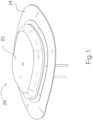
- FIG. 1 An example of a medical device 10 is shown in a top, perspective view in FIG. 1 .
- the medical device 10 includes first and second insertable members 30 and 40 that are spaced apart from each other (as shown with the broken line representation of a second insertable member in FIG. 1 ).
- the medical device includes first and second insertable members that are arranged together (not spaced apart) to be inserted in a single insertion location (where the broken line representation of the spaced-apart insertable member in FIG. 1 would be omitted).
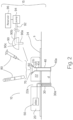
- One example configuration of the medical device 10 (and a system 15 that includes the medical device 10) is shown in a cross-section, schematic view in FIG. 2 , attached to an epidermal surface S of a patient.
- the medical device 10 includes a base 20 that has a bottom surface (the downward-facing or skin-facing surface in FIG. 2 ).
- the base 20 may include a disc-shaped body 22 (or a body of any other suitable shape) and a patch or flange 24 on the bottom surface of the body 22 for contacting and adhering to the epidermal surface S of a patient, during use.
- the flange 24 may be fixed to the body 22 of the base by any suitable connection mechanism, or may be formed integral with the body 22 of the base.
- the body 22 of the base 20 may be made of any generally rigid material such as, but not limited to plastic, metal, ceramic, composite material, or any combinations thereof.
- the flange 24 may be made of one or more of such generally rigid materials, or may be made of a more flexible material such as, but not limited to a silicon rubber or other elastic polymer, a natural or synthetic fabric, or the like.
- the flange 24 includes an adhesive material layer on its skin-facing side (the downward-facing side in FIGS. 1 and 2 ) that may be selectively exposed to adhere the base 20 to the epidermal surface S, at a desired insertion site.
- a backing or release material layer (not shown) is adhered to the adhesive material layer to cover and protect the adhesive material layer from exposure to dirt or other environmental contaminants before adhering the base 20 to a patient's skin.
- the release material layer is selectively removable from the adhesive material layer to expose the adhesive material for adhering the base 20 to the epidermal surface S.
- the adhesive material layer and the release material layer may be omitted.
- the base 20 may include other suitable mechanisms for securing the base 20 to a patient's skin including, but not limited to bands, straps, sutures, suture eyelets for receiving sutures, or combinations thereof.
- the medical device 10 further includes a first subcutaneously insertable member 30 and a second subcutaneously insertable member 40 secured to and supported by the base 20.
- the first insertable member 30 may include a sensor element (i.e., a probe, a needle, a cannula, or the like, of a sensor).
- the first insertable member 30 has a distal end 30a that is configured to be inserted through the epidermal surface S, to a subcutaneous depth location.
- the proximal end of the sensor element 30 is operably connected to sensor electronics 50 located in the base 20.
- the sensor electronics may be any suitable electronics that is configured to detect or monitor electrical parameters or electrical conditions of one or more electrodes located on the sensor probe, needle or cannula (where the electrical parameters or conditions are associated with one or more biological conditions or analytes being detected or monitored).
- the sensor electronics may be configured to obtain one or more samples of a biological fluid from the sensor needle or cannula and detect or monitor one or more biological conditions or analytes.
- the second insertable member 40 includes an infusion cannula composed of a tubing having a fluid flow channel along its length.
- the infusion cannula 40 is open on its distal end 40a (the end facing downward in FIG. 2 ), to allow fluid flowing through the fluid flow channel to exit the infusion cannula 40 at its distal end.
- the side wall of the infusion cannula 40 may have one or more openings to the fluid flow channel, to allow fluid flowing through the fluid flow channel to exit the infusion cannula 40, laterally through the side wall opening(s).
- the infusion cannula 40 may be sealed at its distal end to allow fluid flowing through the fluid flow channel to exit only through the side wall openings.
- the infusion cannula 40 may be open at its distal end and have one or more side wall openings, to allow fluid flowing through the fluid flow channel to exit both the distal end and the side wall opening(s) of the infusion cannula 40.
- the body 22 of the base 20 has a first channel 22a from which the first insertable member 30 (e.g., the sensor element) extends.
- the first channel 22a provides a passage through the base 20, through which an inserter needle may be passed to facilitate subcutaneous insertion of the first insertable member 30, and to withdraw or remove the inserter needle after insertion of the first insertable member 30.
- a hollow inserter needle may be employed, and the first insertable member 30 is located within the hollow needle before and during insertion. Once inserted, the inserter needle may be withdrawn from the first insertable member 30, through the first channel 22a, leaving the first insertable member 30 in an inserted state.
- a second channel 22b extends through the body 22.
- the infusion cannula 40 is secured to the second channel 22b by any suitable mechanism such as, but not limited to adhesives, heat staking, or other mechanical connection.
- a portion 40b of the cannula 40 extends into the second channel 22b and partially through the body 22 of the base 20.
- a proximal (or upper) portion of the second channel 22b is flared outward to form a cone-shaped recess 22c at the proximal opening of the channel 22b.
- the proximal end of the cannula 40 be flared outward as well.
- the cone-shaped recess 22c may be formed integral with the body 22 of the base 20.
- the cone-shaped recess 22c is formed by a cone-shaped guard member made of metal or other rigid material, attached to the body 22 of the base 20 at the proximal end of the channel 22b.
- the second channel 22b provides a passage through the base 20, through which an inserter needle may be passed to facilitate subcutaneous insertion of the cannula 40, and to remove the inserter needle after insertion of the cannula 40.
- the cone-shaped recess 22b can facilitate guiding of a needle toward the cannula 40.
- the inserter needle may extend through the cannula 40 and has a sharp tip extended out of the distal end of the cannula 40, before and during insertion of the cannula.
- a hollow inserter needle may be employed, and the cannula 40 is located within the hollow needle before and during insertion of the cannula. Once inserted, the inserter needle may be withdrawn from the cannula 40, through the second channel 22b, leaving the cannula 40 in an inserted state.
- a septum 60 is located within the cone-shaped recess 22c, to provide a fluid seal at the proximal end of the channel 22b.
- a similar septum (not shown) may be locate in or adjacent the channel 22a in the base 20.
- the septum 60 may be a pierceable member, made of a material that is configured to provide a fluid seal on or in the channel 22b, and to be selectively pierced by the inserter needle, a needle of an external infusion media source, or by a rigid cannula of a connector hub (or any combination thereof).
- the septum 60 is configured to provide a fluid seal around the needle or rigid cannula, and to reseal after removal of the needle or rigid cannula.
- the septum 60 may be made of any suitable material for such purposes, such as, but not limited to silicon rubber, polyurethane, or other elastic polymer, or the like.
- the septum 60 may be pre-pierced or formed with a slot or cut that is configured to self-seal around a needle or rigid cannula, and to self-seal after removal of the inserter needle or rigid cannula.
- the septum 60 and the proximal end of the channel 22b of the base 20 form a port 70, into which a needle or a rigid cannula may be selectively inserted as described below.
- the port 70 also provides a passage through which an inserter needle may be selectively inserted and withdrawn to facilitate insertion of the infusion cannula 40.
- a similar septum is located in or adjacent the channel 22a of the base 20, that septum and the channel 22a form a further port for a further inserter needle to facilitate insertion of the sensor member 30.
- the port 70 is an infusion port, configured to selectively receive a needle of a syringe, a needle of a smart pen injector, a needle of an IV bag delivery device, or a needle of another infusion media source (referred to as an external source of infusion media 80 in FIG. 2 ).
- an external source of infusion media 80 in FIG. 2 When the needle of the external source of infusion media is received in the port 70 (by piercing the needle through the septum 60), infusion media from the external source may be received in the proximal end of the infusion cannula 40, and may flow through the channel of the cannula 40 and be expelled into the patient, through one or more openings at the distal end 40a or in the side wall of the cannula 40.
- the port 70 may be configured as an infusion port, for receiving a needle of an external source of an infusion media, and administering a defined or desired volume of infusion media to the patient from the external source.
- the port 70 may be configured to receive a rigid cannula of a connector hub 90.
- the connector hub 90 may include a body made of a generally rigid material, such as, but not limited to a plastic, metal, ceramic, composite or combination thereof, and may have a generally rigid cannula or needle 90a extending from a distal side of the body of the hub 90 (the downward side in FIG. 2 ).
- the rigid cannula 90a is connected in fluid flow communication with a tubing port 90b, through a fluid flow channel 90c in the hub body 90.
- the tubing port 90b is selectively connectable in fluid flow communication, through a flexible tubing 92, to a pump 94 and a reservoir 96 of infusion media.
- the connector hub 90 is configured to connect to the port 70 on the base 20, by inserting the rigid cannula or needle 90a through the septum 60 in the port 70.
- a further connection mechanism may be provided to selectively couple the hub body 90 to the body 22 of the base 20 in one or more fixed positions, or in a rotatable position (rotatable about the longitudinal axis of the rigid cannula or needle 90a) relative to the base 20.
- the infusion cannula 40 When the connector hub 90 is connected to the port 70, the infusion cannula 40 is connected in fluid flow communication with the pump 94 and the reservoir 96, through the flexible tubing 92, to receive infusion media from the reservoir 96 at a rate controlled by the pump 94.
- the body 22 of the base 20 may contain a pump 94 and a reservoir 96 that connect in fluid flow communication to the channel 22b, to supply infusion media from the reservoir 96 to the proximal end of the cannula 40.
- the pump 94 and the reservoir 96 may be included within the base 20 or directly attached to and supported by the base 20, as a patch-pump device.
- the patch-pump device may also include the port 70 for selectively receiving a needle of an external infusion media source, as described above.
- the first and second insertable members 30 and 40 extend from the base 20 at approximately equal lengths from the base 20. Accordingly, when subcutaneously inserted in a patient, the first and second insertable members 30 and 40 will extend to approximately equal subcutaneous depths, as shown in FIG. 2 .
- the first insertable member 30 may have a longer length than the second insertable member 40, to extend to a deeper subcutaneous depth than the second insertable member 40, when inserted in the patient.
- the second insertable member 40 may have a longer length than the first insertable member 30, to extend to a deeper subcutaneous depth than the first insertable member 30, when inserted in the patient.
- the lengths of the first and the second insertable members 30 and 40 is measured from the bottom surface (skin-facing surface) of the base 20 to the distal ends 30a and 40a of the members 30 and 40 (i.e., the length extending from the base 20).
- the infusion cannula (or second insertable member) 40 is configured to receive an infusion media from an infusion media source and expel the infusion media from an open distal end or from one or more side wall openings (or both) of the infusion cannula, when the infusion cannula is in an inserted state as shown in FIG. 2 .
- the infusion media expelled from the infusion cannula can tend to form (at least temporarily) a depot or volume of high concentration of infusion media in the tissue at and around the subcutaneous opening(s) of the infusion cannula.
- a distance d between the first and second insertable members 30 and 40 may be selected to avoid or minimize interference (from infusion media expelled from the infusion cannula 40) with the accuracy or operation of the first insertable member 30 (e.g., the sensor element) or the accuracy of the sensor electronics to which the sensor element connects.
- the distance d is measured along the plane of the bottom surface of the base 20, or of the epidermal surface S.
- the distance d is selected, based, at least partially, on one or more of the following factors: the length (or subcutaneous depth) of the first insertable member 30, the length (or subcutaneous depth) of the second insertable member 40, the difference in lengths (or difference in subcutaneous depths) of the first and the second insertable members 30 and 40, the type and configuration of the sensor, the configuration of the infusion cannula, the type of infusion media to be expelled, the rate of flow of infusion media from the second insertable member 40, and the volume of infusion media expected to be expelled.
- the distance d between the first and second insertable members may be configured to be about 11 mm.
- that distance d may be configured to be greater than 11 mm.
- that distance d may be less than 11 mm, such as in contexts in which the interference of the infusion media with the sensor element is mitigated in other ways or is not significant.
- the length of the first insertable member 30 may be greater than 10 mm or less than 10 mm, or the length of the second insertable member 40 (the infusion cannula) may be greater than 10 mm or less than 10 mm.
- a medical device 100 may include a base 20 configured according to the examples described above with regard to the base 20 in FIG. 2 .
- the medical device 100 also includes first and second subcutaneous members 30 and 40 corresponding to those discussed above with regard to FIG. 2 .
- the length of the infusion cannula 40 is greater than the length of the insertable member of the sensor 30, such that a distance d' between the insertable member of the sensor 30 and the open distal end of the infusion cannula 40 is greater than the distance d.
- the distance d was selected to be about 11 mm
- that same distance of about 11 mm can be achieved for d' in FIG. 3 , while allowing the spacing d between the first and second subcutaneous members 30 and 40 to be much smaller than that of FIG. 2 .
- the base 20 in FIG. 3 it may be possible to configure the base 20 in FIG. 3 to have a distance d of as small as about 5 mm (or larger or smaller than 5 mm, depending upon the distance d').
- the distance d between the first and second subcutaneous members 30 and 40 can be reduced.
- the size or foot print of the base 20 may be reduced, as the distance d is reduced.
- a distance d' of 11 mm is used in the above examples, other examples may provide a distance d' of other suitable lengths, including, but not limited to a distance d' of at least 5.0 mm, or a distance d' in the range of about 2 mm to about 7 mm.
- first and second subcutaneous members 30 and 40 are shown as extending generally perpendicularly, relative to the plane of the distal (bottom) surface of the base 20, or the plane of the subcutaneous surface S.
- one or both of the first and second subcutaneous members 30 and 40 may extend at an oblique angle (non-parallel, non-perpendicular angle) relative to the plane of the bottom surface of the base 20, or the plane of the subcutaneous surface S, for angled insertion into the epidermal.
- oblique angle non-parallel, non-perpendicular angle
- an angled insertion direction may allow the second subcutaneous member (i.e., the infusion cannula) 40 to have a longer length, or a reduced insertion depth below the surface S (or both) and, thus, can increase the distance d' or can reduce discomfort to the patient (or both).
- a medical device 200 may include a base 20 configured according to any of the examples described above with regard to the base 20 in FIG. 2 or of FIG. 3 .
- the medical device 200 also includes first and second subcutaneous members 30 and 40 corresponding to those discussed above with regard to FIG. 2 .
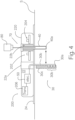
- the first subcutaneous member 30 is longer than the second subcutaneous member 40, and further details of a sensor member corresponding to the first subcutaneous member 30 are shown.
- the sensor member 30 has an electrode arrangement 30b on a substrate 30c.
- the sensor substrate 30c may be a flexible strip of supporting material, and has one or more electrical conductors along a portion of its length extending to the electrode arrangement 30b.
- the sensor substrate 30c may be made to have a relatively thin dimension, to minimize discomfort to the patient during or after insertion.
- the electrodes or a portion of the sensor substrate (or both) have a layer 30d of glucose oxidase, or other suitable material (chemistry layer).
- the electrode arrangement 30b may comprise one or more (or a plurality of) electrodes, such as, but not limited to the examples described below.
- the one or more electrodes are electrically coupled to the electronics 50 in the base 20.
- the electrode arrangement 30b includes at least one working electrode (WE), at least one reference electrode (RE) and at least one control electrode (CE).
- WE may be configured to provide a positive current response, when glycerin reaches that electrode.
- the electrode arrangement 30b may have other configurations of one or more electrodes.
- the one or more electrodes of the electrode arrangement 30b may be configured to be in electrical contact with biological fluid or tissue, when inserted in the patient, for detection or monitoring of a biological condition or analyte.
- the electrode arrangement is configured for detection or monitoring of the patient's blood glucose level.
- the electrode arrangement is configured for detection of one or more other biological conditions or analytes.
- the electrodes of the electrode arrangement 30b are provided on one side of the sensor substrate 30c.
- the electrodes are on the side of the sensor substrate 30c that faces away from (in the opposite direction of) the infusion cannula 40.
- the electrodes may be directed to face away from the infusion cannula 40, which can help increase the separation or isolation of the sensor electrode arrangement 30b from the infusion media outlet of the infusion cannula 40.
- the infusion cannula 40 has an axial length that is smaller than the axial length of the first subcutaneous member 30.
- the infusion cannula 40 in FIG. 4 may have an axial length equal to that of the first subcutaneous member 30 as described with regard to FIG. 2 , or may be provided with a longer axial length than the axial length of the first subcutaneous member 30 to increase the distance d' or to decrease the distance d as described above with regard to FIG. 3 .
- the example in FIG. 4 may be implemented with an angled insertion direction, for example, to allow for a greater separation or isolation distance or improved patient comfort (or both), as described above with regard to further embodiments of the example in FIG. 3 .
- the infusion cannula 40 may be configured with one or more openings through the side wall of the cannula, for expelling infusion media, as shown in FIG. 45.
- the one or more openings 40c are on the side of the infusion cannula 40 that faces away from (in the opposite direction of) the first subcutaneous member 30.
- the distal end of the infusion cannula 40 may be closed to allow the infusion media to be expelled only from the one or more side wall openings 40c, and not from the distal end of the cannula 40.
- the distal end 40a of the infusion cannula 40 may also have an opening, in addition to the one or more side wall openings 40c, to allow some, but not all of the infusion media to be delivered from the side wall openings and some, but not all of the infusion media to be delivered from the distal end.
- the distal end 40a may be tapered to a relatively small opening, to reduce the percentage of infusion media that flows out of the distal end 40a relative to the one or more side wall openings 40c.
- the opening(s) 40c may be directed to face away from the first subcutaneous member 30, such that infusion media is expelled entirely (or partially) in the direction away from the first subcutaneous member 30, to help increase the separation or isolation of the first subcutaneous member 30 from the infusion media outlet of the infusion cannula 40.
- any of examples described herein may include one or more detection mechanisms in or associated with the base 20.
- An example detection mechanism is shown in FIG. 4 as including an infra-red (IR) or other optical emitter 202 and a corresponding IR or other optical detector 204 arranged on opposite sides of the channel 22b, to detect the presence of a needle in the channel 22b (between the optical emitter and the optical detector).
- IR infra-red
- the base 20 may include a transparent or partially transparent wall or windows around the channel 22b, through which an optical beam from the optical emitter 202 can align with and be received by the optical detector 204.
- the base 20 may include other electronics coupled with the detection mechanism, such as, but not limited to a battery or other power source (not shown) for providing electrical power to the electronics, and a transmitter device (206) for transmitting a signal corresponding to the detection of a needle or rigid cannula in the channel 22b to an external processor system.
- the external processor system may be configured to confirm, track or verify full or proper needle insertions (or improper insertions), for monitoring or managing a treatment program. While the example in FIG. 4 shows a detection mechanism having an IR (or other optical) emitter and detector, other examples may include other detection mechanisms including, but not limited to magnetic detection, inductive detection, mechanical detection or other detection mechanisms.
- the medical device includes a base from which two subcutaneous members 30 and 40 extend adjacent, but spaced from each other, for insertion in two insertion locations at an insertion site under the base.
- two subcutaneous members e.g., the sensor member 30 and the infusion cannula 40
- a single insertion of the subcutaneous members 30 and 40, together, can be beneficial by reducing the number of insertions required, and by allowing the size or footprint of the medical device to be smaller, as compared to examples (as in FIGS.
- a separation distance d' between the distal ends of the subcutaneous members 30 and 40 (or between the sensor electrode arrangement on the sensor member 30 and the infusion media outlet of the infusion cannula 40) can be accomplished in various manners as described herein.
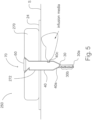
- a medical device 250 may include a base 270 configured according to any of the examples of the base 20 described above in FIGS. 2 , 3 or 4 , but has one channel 272 for accommodating a single inserter needle (not shown in FIG. 5 ).
- the medical device 250 also includes first and second subcutaneous members 30 and 40 corresponding to those discussed above with regard to FIG. 2 . However, in the example in FIG. 5 , the subcutaneous members 30 and 40 are arranged for insertion, together, with the single inserter needle.
- the single inserter needle may extend through the channel 272 before and during insertion of the first and second subcutaneous members 30 and 40 and, then, may be axially withdrawn from the first and second subcutaneous members 30 and 40, through the channel 272, leaving the first and second subcutaneous members 30 and 40 in an inserted state.
- the first and second subcutaneous members 30 and 40 may be secured to the base 270 in the same manner as described above with regard to securing the first and second subcutaneous members 30 and 40 to the base 20.
- the first and second subcutaneous members 30 and 40 extend from the same channel 272, such that both the first and second subcutaneous members 30 and 40 may be inserted, together, with a single insertion needle.
- the first and second subcutaneous members 30 and 40 are in contact (or close proximity) and are not spaced apart by the distance d, discussed above. Therefore, in particular examples, the first and second subcutaneous members 30 and 40 include one or more configurations as described herein, to reduce or minimize interference effects discussed above.
- the second subcutaneous member 40 includes an infusion cannula that has a side wall opening 40c, as described above with regard to FIG. 4 .
- the distal end 40a of the infusion cannula 40 is tapered or reduced in diameter, to reduce the outflow rate of infusion media from the opening at the distal end 40a, and increase the outflow rate of infusion media from the side wall opening 40c.
- the distal end 40a of the infusion cannula 40 in FIG. 5 may be open and not tapered or reduced in diameter relative to other portions of the infusion cannula 40.
- the side wall opening 40a in FIG. 5 may be omitted.
- the distal end 40a of the infusion cannula 40 in FIG. 5 may be closed, such that all of the infusion media is expelled through the side wall opening 40c.
- one manner of reducing or minimizing such interference effects includes configuring or selecting the length at which each the first and second subcutaneous members 30 and 40 extends from the base 20 or 270 to increase or maximize a separation distance d'.
- the drawing of Figs. 6-8 show certain further example configurations of subcutaneous members extending from the base 270 (a portion of which is shown in those drawings) of a medical device corresponding to the medical device 250 of FIG. 5 , and are further configured or selected to reduce or minimize interference effects discussed above.
- the first subcutaneous member 30 includes a sensor member having sensor electrodes 30b for contacting biological fluid or tissue, when the sensor member is in an inserted state.
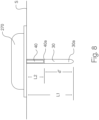
- the sensor member 30 has an axial length L 1 from the base 270 to the distal end 30a of the sensor member. In some examples, that axial length L 1 of the sensor member 30 is about 8.5 mm. In other examples, the axial length of the sensor member may be less than 8.5 mm, or may be greater than 8.5 mm.
- the second subcutaneous member 40 includes an infusion cannula having an axial length L 2 that is longer than the axial length L 1 of the sensor member.
- the infusion cannula 40 is arranged directly adjacent to (behind, in the view of Fig. 6 ) the sensor member 30.
- the infusion cannula 40 and the sensor member 30 in FIG. 6 are in contact with each other, or are attached to each other.
- the difference in length dimensions L 2 -L 1 defines a separation distance between the sensor electrodes and the infusion outlet.
- the length of the infusion cannula 40 or the length of the sensor member 30 (or both) are configured or selected to provide a desired separation distance between the electrodes on the sensor member 30 and the infusion media outlet of the infusion cannula 40, to reduce or avoid interference effects described above.
- the difference in length dimensions L 2 -L 1 beneficial to provide a desired separation distance d' may depend on (and be determined based on) one or more of the following factors: a desired length (or subcutaneous depth) of the first insertable member 30, a desired length (or subcutaneous depth) of the second insertable member 40, the type and configuration of the sensor, the configuration of the infusion cannula, the type of infusion media to be expelled, the rate of flow of infusion media from the second insertable member 40, and the volume of infusion media expected to be expelled.
- the axial length of the infusion cannula 40 may be selected to be about 14 mm, to provide a desired separation distance d' between the distal ends 30a and 40a of about 5.5 mm.
- a separation of about 5.5 mm can provide a suitable separation distance to reduce or avoid interference effects described above.
- the axial length of the infusion cannula 40 may be less than 14 mm, or may be greater than 14 mm, and the separation distance d' between distal ends 30a and 40a may be less than 5.5 mm or may be greater than 5.5 mm.
- the sensor electrodes 30b are arranged on the side of the substrate of the sensor member 30 that faces away from (opposite to) the infusion cannula 40.
- the cannula 40 is shown in the view of FIG. 6 as being behind the sensor member 30.
- the electrodes 30b are on the side of the sensor member 30 that faces outward from the sheet in FIG. 6 .
- the example in FIG. 7 is similar to the example in FIG. 6 , except that the sensor member 30 and the infusion cannula 40 are configured to be inserted at an oblique angle relative to the plane of the bottom surface of the base 270, or the plane of the subcutaneous surface S, for angled insertion into the epidermal.
- An angled insertion direction may allow the infusion cannula to have a relatively long length (as in the example of FIG. 6 ), but can reduce the depth of insertion below the surface S and, thus, can reduce discomfort to the patient.
- an angle A of insertion may be about 30 degrees (or 150 degrees) relative to the plane of the epidermal-facing surface of the base 270 (the bottom surface in FIG. 7 ) or to the plane of the epidermal surface S. In other examples, the angle A of insertion may be any suitable oblique angle.
- the example in FIG. 8 is similar to the example in FIG. 6 , except that the infusion cannula 40 has an axial length L 2 that is shorter than the axial length L 1 of the sensor member 30.
- the sensor member 30 is located behind the infusion cannula 40.
- the electrodes 30b (not in view in FIG. 8 ) are on the side of the sensor member 30 that faces into the sheet in FIG. 8 and, thus face away from (opposite to) the infusion cannula 40.
- the infusion cannula 40 may be significantly shorter than the example of the infusion cannula 40 in FIG. 6 .
- the sensor member 30 may be arranged such that the electrodes 30b are on the side of the sensor member 30 that faces toward the direction of the cannula 40 (i.e., faces out of the sheet in FIG. 8 ).
- the infusion cannula 40 may be configured to be sufficiently shorter than the sensor member 30, to space the infusion media outlet of the infusion cannula 40 from the electrodes on the sensor member 30 a sufficient distance to reduce or minimize interference effects described above.
- the axial length L 1 of the sensor member 30 may be about 8.5 mm, and the axial length of the infusion cannula 40 may be selected to be about 2.5 mm, to provide a desired separation distance d' between 30a and 40a of about 6 mm.
- a separation of about 6 mm can provide a suitable separation distance to reduce or avoid interference effects described above.
- the axial length of the infusion cannula 40 may be less than 2.5 mm, or may be greater than 2.5 mm, and the separation distance d' between distal ends 30a and 40a may be less than 6 mm or may be greater than 6 mm.
- particular examples include other separation distances suitable for reducing or avoiding interference effects.
- FIG. 8 shows an example having a perpendicular angle of insertion
- other examples of the configuration in FIG. 8 may be configured to be inserted at an oblique angle relative to the plane of the bottom surface of the base 270, or the plane of the subcutaneous surface S, for angled insertion into the epidermal.
- certain examples described herein include an infusion cannula 40 that is longer than the sensor member 30, while other examples described herein include an infusion cannula 40 that is shorter than the sensor member 30.
- the difference in length between the infusion cannula 40 and the sensor member 30 may be selected to provide a desired separation distance between one or more of the sensor electrodes on the sensor member and the outlet of the infusion cannula.
- the arrangement of the sensor electrodes may be configured to enhance the separation (or provide a desired separation) between a working electrode (WE) on the sensor member and the outlet of the infusion cannula.
- WE working electrode
- the diagram in FIG. 9 shows relative lengths of example infusion cannulas and sensor members, including an infusion cannula 140 having a length that is shorter than the length of the sensor member 130, an infusion cannula 240 having a length that is greater than the length of the sensor member 130.
- FIG. 9 shows relative lengths of example infusion cannulas and sensor members, including an infusion cannula 140 having a length that is shorter than the length of the sensor member 130, an infusion cannula 240 having a length that is greater than the length of the sensor member 130.
- each sensor member has an electrode arrangement including a working electrode (WE), a reference electrode (RE) and a control electrode (CE), as described herein.
- WE working electrode
- RE reference electrode
- CE control electrode
- the lengths of the infusion cannulas and the sensor probes are represented in FIG. 9 , as the length from the epidermal surface S to the distal ends of the cannulas and probes, when in an inserted state.
- Each infusion cannula 140 and 240 may correspond to an example of the infusion cannulas 40 discussed herein.
- Each sensor member 130, 230 and 330 may correspond to an example of the sensor member 30 discussed herein.
- a sensor member 130 or a sensor member 230 in which the working electrode (WE) is located closer to the distal end 130a than one or both of the other electrodes can be employed with an infusion cannula 140 that is shorter than the length of the sensor member.
- a sensor member 330 in which the working electrode (WE) is located furthest from the distal end 330a than the other electrodes can be employed with an infusion cannula 240 that is longer than the length of the sensor member.
- first and second subcutaneous members 30 and 40 are generally flexible along their respective lengths, for example, to flex with movement of adj acent tissue when in an inserted state.
- separate, rigid inserter needles may be used to facilitate inserting the first and the second subcutaneous member 30 and 40 (or 130, 140, 230, 240 and 330) through the patient's skin, to a subcutaneous operating position.
- the inserter needles may be withdrawn from the patient, leaving the first and second subcutaneous members in the inserted state.
- certain examples include first and the second subcutaneous members 30 and 40 arranged adjacent, but spaced from each other by a distance d and may employ two separate inserter needles that may be extended through the channels 22a and 22b in the base 20, to facilitate insertion of the first and the second subcutaneous member 30 and 40, respectively.
- the first and the second subcutaneous members 30 and 40 (or 130, 140, 230, 240 or 330) are arranged to be inserted together, in a single insertion location, such that the first and the second subcutaneous members may be arranged on or within the same inserter needle.
- the first and the second subcutaneous members 30 and 40 are arranged within a channel of a single hollow inserter needle, before and during insertion.
- the first and the second subcutaneous members 30 and 40 may be retained in the needle channel during subcutaneous insertion of the inserter needle.
- the inserter needle may be axially withdrawn relative to the first and the second subcutaneous members 30 and 40, by sliding the inserter needle along the axial length of the first and the second subcutaneous members, leaving the first and the second subcutaneous members in an inserted state.
- the hollow inserter needle may have a slot along its longitudinal dimension, opening to the hollow channel. In other examples, the hollow inserter needle need not include a slot. Examples of various configurations of first and the second subcutaneous members 30 and 40 configured to be disposed within the channel of a slotted, hollow inserter needle are shown in FIGS. 10-15 . In those examples, the first and the second subcutaneous members 30 and 40 may correspond to any of the examples of those components shown in Figs. 5-8 , or any of the examples 130, 140, 230, 240 or 330 in FIG. 9 .
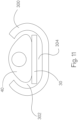
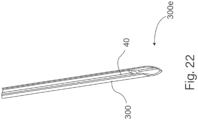
- an inserter needle 300 is shown in cross-section view (along a cross-section plane that is perpendicular to the longitudinal or axial dimension of the needle).
- the needle 300 includes a needle shaft (shown in cross-section) made of a generally rigid material such as, but not limited to stainless steel or another metal, ceramic, plastic, composite material, or combinations thereof.
- the needle shaft is sufficiently rigid along its length dimension to retain its shape without bending or collapsing during insertion of the needle through an epidermal surface S.
- the shaft of the inserter needle 300 has a hollow interior or channel 302 extending along the axial length dimension of the inserter needle 300.
- the first and the second subcutaneous members 30 and 40 are configured to be located within the channel 302 and extend along at least a portion of the axial length of the needle shaft.
- a distal end portion of the length of the needle shaft may extend beyond the distal ends of the first and the second subcutaneous members 30 and 40, and may include a sharp or tapered tip, to reduce discomfort during insertion of the inserter needle 300.
- the proximal end of the needle shaft may be connected to a hub or handle, or to a retraction mechanism (not shown) to facilitate retraction and removal of the inserter needle 300 from the first and the second subcutaneous members 30 and 40, after insertion of the inserter needle 300 (with the first and the second subcutaneous members 30 and 40 in the channel 302) to a suitable subcutaneous insertion depth.
- the inserter needle 300 may be used to insert and place the first and the second subcutaneous members 30 and 40, subcutaneously, with a single needle insertion.
- the shaft of the inserter needle 300 has a cross-section shape that is not perfectly round. Instead, the shape resembles a rounded-tubular shape that is squashed or flattened to some extent, to form a relatively flattened (increased radius) curvature or flat side 300a (shown on the bottom side of the inserter needle 300 in FIG. 10 ), between two sharper (reduced radius) curved sides 300b and 300c.
- the curvature of the sides 300b and 300c may increase or flatten out towards a slot 300d (shown as a gap in the cross-section view of FIG. 10 ).
- the slot 300d extends along the axial length dimension of the inserter needle 300 and is open to the hollow interior channel of the inserter needle 300.
- the relatively flattened peripheral shape of the inserter needle 300 can provide a channel having a similar shape, and a cross-section shape and size suitable for accommodating the first and the second subcutaneous members 30 and 40, simultaneously.
- the relatively flattened shape can be beneficial for examples in which the first subcutaneous member 30 includes a sensor substrate (or other sensor element) having a generally flat, ribbon-like shape (and a generally rectangular cross-section shape in a plane perpendicular to the longitudinal axis of the needle 300).
- the sensor substrate (or other sensor element) of the first subcutaneous member 30 may be arranged on the side of the second subcutaneous member 40 that faces the relatively flattened (increased radius) curvature or flat side 300a of the inserter needle 300. As shown in FIG.
- the relatively flattened (increased radius) curvature or flat side 300a of the inserter needle 300 provides a relatively wide portion of the channel 302 (near the bottom of the channel 302 in FIG. 10 ) that can accommodate the generally flat, ribbon-like shape of the sensor element.
- the second subcutaneous member 40 is an infusion cannula that has a longitudinal axial dimension extending along at least a portion of the length dimension of the channel 302, and a cross-section shape that resembles a "D" shape or a triangle with rounded corners and either flat or curved sides.
- FIG. 11 another example of an infusion cannula 40 having a cross-section shape that resembles a "D" shape or a triangle with rounded corners is shown.
- One side of the infusion cannula 40 e.g., the downward-facing side in FIG.
- the infusion cannula 40 may have other suitable cross-section shapes.
- the infusion cannula 40 and the sensor element 30 are arranged adjacent each other and are adhered to each other by one or more suitable mechanisms such as, but not limited to an epoxy or other adhesive material layer 306 located between the infusion cannula 40 and the sensor element 30, heat staking, other mechanical connection or the like.
- the infusion cannula 40 may include a flange or extension 40d for facilitating heat staking, where the flange or extension 40d may be heat staked to a surface of the sensor element, such as, but not limited to, the surface of the sensor element facing opposite to the surface on which the sensor electrodes are located.
- the flattened (increased radius or flat) surface side of the infusion cannula 40 can provide an increased surface area for adhering to the sensor element 30, to facilitate or improve the adherence of the infusion cannula 40 and the sensor element 30.
- the infusion cannula 40 and the sensor element 30 are arranged adjacent each other, but are not adhered to each other.
- the cross-section shape of the infusion cannula 40 may have a width in all dimensions that is greater than the width of the gap defined by the slot 300d in the needle 300. Accordingly, once placed in the channel 302 of inserter needle 300, the infusion cannula 40 (or the combined infusion cannula 40 and the sensor element 30) cannot exit the channel 302, through the slot 300d and, thus, may be retained in the channel 302, until the needle 300 is axially withdrawn relative to the infusion cannula 40.
- the infusion cannula 40 in each of FIGS. 10 and 11 has a fluid flow lumen 40e, through which infusion media may flow, after the infusion cannula 40 is subcutaneously inserted in a patient.
- a portion of the infusion cannula 40 e.g., the apex of the generally triangular cross-section of the infusion cannula 40
- the cross-section size of the infusion cannula 40 can be increased and, thus, the cross-section size or diameter of the fluid flow lumen 40e may be increased (as compared to an infusion cannula that does not extend into that gap). Accordingly, the slotted needle 300 can accommodate an infusion cannula 40 having a relatively large fluid flow lumen 40e, for an increased or improved infusion delivery rate.
- the combined infusion cannula 40 and the sensor element 30 in FIGS. 10 and 11 may have a cross-section shape and size that is smaller than the cross-section shape and size of the channel 302, such that the combined infusion cannula 40 and the sensor element 30 may be arranged in the channel 302 without contacting one, two or all side surfaces of the channel.
- the combined infusion cannula 40 and the sensor element 30 may be arranged such that the sensor element 30 may be spaced from the inner surface of the shaft of the needle 300 (along the relatively flattened or increased radius side 300a) by a gap 304.
- the likelihood of the sensor element 30 adhering to the needle shaft can be reduced, e.g., during withdrawal of the needle shaft from the combined sensor element 30 and infusion cannula 40.
- the example in FIG. 13 includes an inserter needle 300, a sensor element 30 and an infusion cannula 40, corresponding to those described above with regard to the example in FIG. 10 .
- the infusion cannula 40 in FIG. 13 has a fluid flow lumen 40e' that is larger in diameter than the fluid flow lumen 40e in FIG. 10 , for allowing a higher flow rate of infusion media relative to the infusion cannula 40 in FIG. 10 .
- the generally triangular cross-section shape of the infusion cannula 40 can slide within the channel 302 of the relatively flattened peripheral shape of the inserter needle 300, and may also accommodate a flow lumen 40e, 40e' or a flow channel of any other suitable diameter, based on a desired flow rate or other parameter.
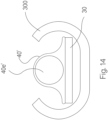
- an infusion cannula 40' may have another suitable shape that can be retained and slide within the channel 302 of the inserter needle 300 without exiting through the gap formed by the slot 300d in the shaft of the inserter needle 300.
- the inserter needle 300, the sensor member 30 and the infusion cannula 40' correspond to the inserter needle 300, the sensor member 30 and the infusion cannula 40 of any of FIGS. 10-13 , except that the outer peripheral shape of the infusion cannula 40' is different than the outer peripheral shape of the infusion cannula 40. Similar to the examples in FIGS.
- the cross-section shape of the infusion cannula 40' includes a region or area in which a fluid flow channel 40e' is located. Also similar to the examples in FIGS. 10 -123, the cross-section shape of the infusion cannula 40' includes a generally flat or reduced radius surface side (the side facing downward in FIG. 14 ) for contacting or adhering to the sensor member 30.
- the example in FIG. 14 differs from the D-shaped or triangular cross-section examples of FIGS. 10-13 , in that the outer peripheral shape of the infusion cannula 40' defines curves on each of two sides of the apex, that are directed opposite to the direction of the curve of the apex.
- the cross-section shape of the infusion cannula 40' in FIG. 14 thus, can be said to resemble a grandfather clock shape.
- an infusion cannula 40" may have yet another suitable shape that can be retained and slide within the channel 302 of the inserter needle 300, where the fluid flow lumen 40e" of the infusion cannula 40" is located inside of the needle channel 302, while the sensor element is held within a sensor lumen 40f outside of the needle channel 302.
- FIG. 16 a cross-section view showing a sensor member 30 and an infusion cannula 40 as described above, inside of a slotted inserter needle 300' is shown in FIG. 16 , where the slotted inserter needle 300' has a generally circular outer peripheral shape.
- An axial slot in the needle 300' defines a gap 300a' in the cross-section view.
- the subcutaneous member 40 is an infusion cannula as described and shown in FIG. 10 and has a lengthwise dimension extending into and out of the plane of the page (along a z axis).
- the flattened (or increased radius or flat) surface of the infusion cannula 40 (the downward-facing surface in FIG.
- the infusion cannula 40 may be received within the slotted inserter needle 300 or other rigid inserter needle, and may be inserted through a patient's skin as described with regard to the slotted inserter needle 300 in FIG. 10 .
- the D-shaped or generally triangular shaped outer cross-section of the infusion cannula 40 can provide advantages described above with regard to providing a flattened or reduced radius surface to abut against (or affix to) a sensor member 30.
- the D-shaped or generally triangular shaped outer cross-section of the infusion cannula 40 can provide other advantages, as well, including but not limited to a resistance to kinking or crimping.
- Infusion cannulas can be prone to bending in a patient's subcutaneous tissue, during or after insertion, which can cause kinking or crimping of the cannula lumen and obstruction of fluid flow through the cannula lumen.
- a cannula 40 having a D-shaped or generally triangular shaped outer cross-section configuration can inhibit or reduce kinking of the cannula and avoid or reduce obstruction of fluid flow, when the cannula is bent (particularly along the longest flattened (increased radius or flat) surface, e.g., the downward-facing surface in FIG. 17 .
- the D-shape or generally triangular shape of the cross-section of the cannula 40 strengthens the resistance to kinking and increases the buckling strength of the cannula 40, relative to a round cross-section cannula with the same inner diameter.
- the cannula 40 having a D-shaped or generally triangular shaped outer cross-section configuration has a smaller critical kinking radius and, thus, can bend further without kinking, relative to a round cross-section cannula with the same inner diameter, when evaluated via the Brazier effect.
- the cannula 40 having a D-shaped or generally triangular shaped outer cross-section exhibits greater resistance to bending in the y-axis direction than in the y-axis direction of FIG.
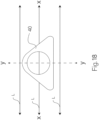
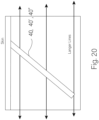
- the cannula 40 may be configured to be inserted in a patient, with the longest flattened (increased radius or flat) surface, e.g., the downward-facing surface in FIG. 17 oriented generally parallel to the Langer lines L of skin tension of the patient, as represented in FIGS. 18 and 19 .
- the Langer lines L also called cleavage lines
- the Langer lines L are parallel to the natural orientation of collagen fibers in the dermis, and underlying muscle fibers of the patient.
- the cannula 40 may be included in a medical device 10, 100, 200, or 300, having a base 20, 220, or 270 from which the cannula extends, as described herein.
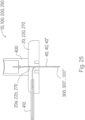
- an insertion needle 300 or 300' may be held by a needle hub 400 and extended from a surface (the downward facing surface in FIG. 25 ) of the needle hub 400.
- the needle hub 400 may be configured to engage with the base 20, 220 or 270, with the insertion needle 300, 300' or 300" extended through the base, by passing the insertion needle 300, 300' or 300" into a needle port and through the channel 22a, 22b or 272.
- a portion of the insertion needle 300, 300' or 300" extends out from one surface of the base (the downward facing surface in FIG. 25 ).
- the cannula 40, 40' or 40" has one end connected to an infusion media supply tubing 410 and extends through the slot in the insertion needle 300 or 300' and into the channel of the insertion needle 300 or 300'.
- the cannula 40, 40' or 40" extends along a portion of the length of insertion needle 300 or 300' that is external to the base 20, 220, or 270, as shown in FIG. 25 .
- the insertion needle 300 or 300' may assist with the insertion of the cannula 40, 40' or 40" through a patient's skin.
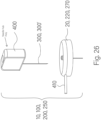
- the needle hub (and the insertion needle) may be withdrawn from the base 20, 220, or 270, (as shown in FIG. 26 ), leaving the cannula in an inserted state.
- the cannula 40 (or 40' or 40") may be arranged in a predefined orientation relative to the base 20, 220 or 270 of the medical device 10, 100, 200, 300, such that the user may be instructed to orient the medical device housing in a particular orientation relative to the patient's body (such as shown in FIG. 19 ) to automatically align the longest flattened (increased radius or flat) surface of the infusion cannula parallel with the Langer lines of the patient.
- the base of the medical device 10, 100, 200, 300 may be configured to be placed on (or adhered to) a patient's skin, and may have a shape or indicia markings (or both) to assist the user with orienting the medical device base in a desired orientation, to result in proper alignment of the cannula 40, 40', 40" relative to the patient's Langer lines.
- the cannula 40, 40', 40" may be inserted generally parallel to the Langer lines and at an oblique angle relative to the plane of a patient's skin or of the base of a medical device adhered to the patient's skin, as shown in FIG. 20 .
- the oblique angle may be, but is not limited to, an angle in the range greater than or equal to 30 degrees and less than 90 degrees.
- the cannula 40, 40', 40" may be inserted at a 90 degree angle relative to the plane of a patient's skin or of the base of a medical device adhered to the patient's skin.
- the infusion cannula 40, 40', 40" may be provided with a tapered or sharpened tip on its distal end 40a, as shown in FIG. 21 .
- the taper defines an angle relative to the cross-section plane that is perpendicular to the lengthwise axis of the cannula 40, 40', 40".
- the longest flattened (increased radius or flat) surface e.g., the downward-facing surface in FIGS. 17 and 21 , defines the tip of the tapered distal end 40a.
- a slotted inserter needle 300 may be provided with a tapered or sharpened tip on its distal end 300e, as shown in FIG. 22 .
- the taper defines an angle relative to the cross-section plane that is perpendicular to the lengthwise axis of the inserter needle 300, 300'.
- the side surface 300a e.g., the downward-facing surface in FIGS. 17 and 22 , defines the tip of the tapered distal end 300e.
- the tapered or sharpened infusion cannula 40 or inserter needle 300, 300' can reduce insertion trauma and simplify the process of inserting the inserter needle 300 through a patient's skin.
- an insertion needle 300" may be configured to be received within the lumen of the infusion cannula 40, 40', 40" during insertion, as shown in FIG. 23 .
- the insertion needle 300" in FIG. 23 may be a hollow needle as discussed with regard to insertion needles 300 and 300', or may be a solid (not hollow) insertion needle.
- a distal end portion 40g of the infusion cannula 40, 40', 40" may be tapered to a smaller outer diameter toward its distal end 40a, towards the smaller outer diameter of the insertion needle 300". Accordingly, the tapered distal end portion 40g may be configured to create a gradual transition between the outer diameter of the insertion needle 300" and the outer diameter of the infusion cannula 40, 40', 40".
- An infusion cannula 40, 40', 40" having a tapered distal end portion 40g is shown in FIG. 24 , without the insertion needle 300".
- the inserter needle 300 (or 300' or 300"), or other inserter needles for the sensor element 30 described herein, may include a coating or layer of lubricious material to inhibit or reduce sticking of the sensor member 30 (or the infusion cannula 40) to an inner channel surface of the inserter needle.
- the lubricious material may inhibit sticking and facilitate withdrawing of the inserter needle after insertion of the sensor element, without pulling out the sensor element (or the infusion cannula) with the inserter needle.
- the inserter needle is dip coated in a 1% Silicone in Hexane solution.
- the inserter needle Before coating with silicone, the inserter needle is placed in a 0 2 plasma chamber, and the silicone is cured at 25 degrees Celsius and 60% relative humidity after dipping.
- other suitable materials and processes may be used for lubricious coatings or layers including, but are not limited to Teflon, or the like.
- the infusion cannula 40, 40', 40" may include a coating or layer of material to facilitate adhesion of the sensor element 30 to the infusion cannula.
- the adhesion of the sensor element 30 to the infusion cannula can help inhibit the sensor element 30 from being pulled out of an inserted state, as the inserter needle (e.g., 300 or 300') is withdrawn.
- the material to facilitate adhesion may include, but is not limited to a silicon-based polymer, polyurethane, polyethylene, or the like.
- the sensor element 30 may be connected for electrical communication with sensor electronics 50 as discussed above.
- the sensor electronics and the sensor element 30 may be configured or calibrated (or both) to reduce or minimize interference effects described above.
- the sensor electronics may be configured with one or more processors that operate under an algorithm configured to cancel or counter-act electrical effects of infusion media on the sensor element.
- Medical devices 10, 100, 200, 250 as described herein may be made according to any suitable manufacturing methods including, but not limited to methods as described herein.
- the base 20, 220, 270 having one or more channels may be made by molding, machining, or assembly of parts to provide a base structure as described herein.
- the sensor element 30 may be secured to the base by adhesive material, molding, heat staking, or other mechanical connection.
- Electronics 50 may be secured to or in the base and electrically connected to the sensor element 30.
- the septum 60 may be secured to each channel in the base by adhesive material, molding, heat staking, or other mechanical connection.
- the infusion cannula 40, 40' or 40" may be made by any suitable process including, but not limited to extrusion, machining, molding, micro-molding, or the like.
- the infusion cannula 40, 40' or 40" may be secured to the base, in fluid flow communication with the channel having the septum 60, by adhesive material, molding, heat staking, or other mechanical connection.
- An inserter needle 300, 300' is inserted through the septum 60 and through the channel in the base, and out from the bottom side of the base.
- the inserter needle 300, 300' has an inner channel 302 in which the infusion cannula and the sensor element are received, when the inserter needle 300, 300' is inserted through the base.
- the infusion cannula 40, 40' or 40" may extend through the channel in the base and is connected to the septum 60 and, thus, to the base.
- the base may include a further septum (not shown) through which the infusion cannula 40, 40', 40" and the sensor element 30 extend, for coupling the infusion cannula 40, 40', 40" to the body of the base, and through which the inserter needle 300, 300' extends before and during insertion of the infusion cannula and is withdrawn after insertion.
- the medical device 10, 100, 200, 300 may be readied for installation on a patient.
- a backing or release material layer (not shown) may be peeled off of the adhesive material layer on the base 20, 220, 270, to expose the adhesive material on base.
- the base may be placed against the patient's skin at a desired infusion site, such that the inserter needle punctures the patient's skin and is inserted (with the sensor element and the infusion cannula) to an insertion depth, where the adhesive material on the base is in contact with the patient's skin, and adheres the base to the patient.
- Placement of the base on the patient's skin may be carried out manually, or with an inserter tool.
- the inserter needle may be withdrawn from the base, through a channel in the base.
- the inserter needle may be withdrawn manually, or with the aid of an inserter tool.
- a connector hub 90 FIG. 2
- other external infusion media source may be connected in fluid flow communication with the infusion cannula.
Landscapes
- Health & Medical Sciences (AREA)
- Life Sciences & Earth Sciences (AREA)
- Engineering & Computer Science (AREA)
- General Health & Medical Sciences (AREA)
- Biomedical Technology (AREA)
- Heart & Thoracic Surgery (AREA)
- Animal Behavior & Ethology (AREA)
- Public Health (AREA)
- Veterinary Medicine (AREA)
- Physics & Mathematics (AREA)
- Molecular Biology (AREA)
- Surgery (AREA)
- Medical Informatics (AREA)
- Pathology (AREA)
- Biophysics (AREA)
- Hematology (AREA)
- Anesthesiology (AREA)
- Vascular Medicine (AREA)
- Optics & Photonics (AREA)
- Chemical & Material Sciences (AREA)
- General Chemical & Material Sciences (AREA)
- Chemical Kinetics & Catalysis (AREA)
- Emergency Medicine (AREA)
- Bioinformatics & Cheminformatics (AREA)
- Medicinal Chemistry (AREA)
- Pharmacology & Pharmacy (AREA)
- Infusion, Injection, And Reservoir Apparatuses (AREA)
Applications Claiming Priority (2)
| Application Number | Priority Date | Filing Date | Title |
|---|---|---|---|
| US202263355274P | 2022-06-24 | 2022-06-24 | |
| US18/303,496 US20230414866A1 (en) | 2022-06-24 | 2023-04-19 | Integrated subcutaneous sensor and infusion device, system and method |
Publications (2)
| Publication Number | Publication Date |
|---|---|
| EP4309598A2 true EP4309598A2 (de) | 2024-01-24 |
| EP4309598A3 EP4309598A3 (de) | 2024-06-05 |
Family
ID=86899408
Family Applications (1)
| Application Number | Title | Priority Date | Filing Date |
|---|---|---|---|
| EP23180036.8A Pending EP4309598A3 (de) | 2022-06-24 | 2023-06-19 | Integrierter subkutaner sensor und infusionsvorrichtung, system und verfahren |
Country Status (2)
| Country | Link |
|---|---|
| US (1) | US20230414866A1 (de) |
| EP (1) | EP4309598A3 (de) |
Families Citing this family (1)
| Publication number | Priority date | Publication date | Assignee | Title |
|---|---|---|---|---|
| US20250339614A1 (en) * | 2024-05-03 | 2025-11-06 | Medtronic Minimed, Inc. | Backflow mitigation for subcutaneous infusion devices |
Citations (2)
| Publication number | Priority date | Publication date | Assignee | Title |
|---|---|---|---|---|
| US20180318550A1 (en) | 2017-05-08 | 2018-11-08 | Medtronic Minimed, Inc. | Flexible cannula insertion device, system and process |
| US20200384187A1 (en) | 2019-06-10 | 2020-12-10 | Medtronic Minimed, Inc. | Flexible cannula and process |
Family Cites Families (5)
| Publication number | Priority date | Publication date | Assignee | Title |
|---|---|---|---|---|
| US6059760A (en) * | 1997-08-14 | 2000-05-09 | Medtronic, Inc. | Cannula having reverse flow tip |
| US7918817B2 (en) * | 2002-10-31 | 2011-04-05 | Medical Components, Inc. | Splittable multiple catheter assembly |
| US7318822B2 (en) * | 2004-09-03 | 2008-01-15 | Diros Technology Inc. | Hybrid cannula/electrode medical device and method |
| US20120046533A1 (en) * | 2007-08-29 | 2012-02-23 | Medtronic Minimed, Inc. | Combined sensor and infusion sets |
| EP3474729B1 (de) * | 2016-06-22 | 2023-04-19 | Roche Diabetes Care GmbH | Medizinische vorrichtung zum transkutanen einsetzen eines einsetzbaren elements in ein körpergewebe |
-
2023
- 2023-04-19 US US18/303,496 patent/US20230414866A1/en active Pending
- 2023-06-19 EP EP23180036.8A patent/EP4309598A3/de active Pending
Patent Citations (2)
| Publication number | Priority date | Publication date | Assignee | Title |
|---|---|---|---|---|
| US20180318550A1 (en) | 2017-05-08 | 2018-11-08 | Medtronic Minimed, Inc. | Flexible cannula insertion device, system and process |
| US20200384187A1 (en) | 2019-06-10 | 2020-12-10 | Medtronic Minimed, Inc. | Flexible cannula and process |
Also Published As
| Publication number | Publication date |
|---|---|
| US20230414866A1 (en) | 2023-12-28 |
| EP4309598A3 (de) | 2024-06-05 |
Similar Documents
| Publication | Publication Date | Title |
|---|---|---|
| US11833325B2 (en) | Sprinkler cannula | |
| EP2461853B1 (de) | Verabreichungsrvorrichtung mit Sensor und einer oder mehreren Kanülen | |
| US12527912B2 (en) | Subcutaneous access hub with multiple cannula ports | |
| US20060253085A1 (en) | Dual insertion set | |
| US5586553A (en) | Transcutaneous sensor insertion set | |
| CN104302333B (zh) | 皮下针插入机构 | |
| EP2836254B1 (de) | Durch manuellen druck aktivierter anwendungsmechanismus | |
| AU2020291016B2 (en) | Infusion device for continuous glucose monitoring | |
| EP0239244A1 (de) | Subkutanes Injektionsbesteck | |
| WO2009049823A1 (en) | Catheter and methods of operating and manufacturing the same | |
| EP2694135B1 (de) | An der haut befestigte vorrichtung für intravenösen zugang | |
| EP4309598A2 (de) | Integrierter subkutaner sensor und infusionsvorrichtung, system und verfahren | |
| CN211560120U (zh) | 一种用于将器械输送到导管组件中的输送装置 | |
| CN117281510A (zh) | 集成皮下传感器和输液装置、系统和方法 | |
| US20240408304A1 (en) | Device for delivering medicament with integrated infusion catheter and continous glucose monitor sensor assembly | |
| US20240173472A1 (en) | Devices for inserting transcutaneous cannulas for patch pumps | |
| EP4173649A1 (de) | Subkutane vorrichtung mit leckschutz | |
| CA3232846A1 (en) | Glucose monitor injection port | |
| HK1176027B (en) | Analyte monitoring and fluid dispensing system | |
| HK1176027A1 (en) | Analyte monitoring and fluid dispensing system |
Legal Events
| Date | Code | Title | Description |
|---|---|---|---|
| PUAI | Public reference made under article 153(3) epc to a published international application that has entered the european phase |
Free format text: ORIGINAL CODE: 0009012 |
|
| STAA | Information on the status of an ep patent application or granted ep patent |
Free format text: STATUS: REQUEST FOR EXAMINATION WAS MADE |
|
| 17P | Request for examination filed |
Effective date: 20230619 |
|
| AK | Designated contracting states |
Kind code of ref document: A2 Designated state(s): AL AT BE BG CH CY CZ DE DK EE ES FI FR GB GR HR HU IE IS IT LI LT LU LV MC ME MK MT NL NO PL PT RO RS SE SI SK SM TR |
|
| PUAL | Search report despatched |
Free format text: ORIGINAL CODE: 0009013 |
|
| AK | Designated contracting states |
Kind code of ref document: A3 Designated state(s): AL AT BE BG CH CY CZ DE DK EE ES FI FR GB GR HR HU IE IS IT LI LT LU LV MC ME MK MT NL NO PL PT RO RS SE SI SK SM TR |
|
| RIC1 | Information provided on ipc code assigned before grant |
Ipc: A61M 39/02 20060101ALI20240502BHEP Ipc: A61M 5/172 20060101ALI20240502BHEP Ipc: A61M 5/142 20060101ALI20240502BHEP Ipc: A61M 5/158 20060101ALI20240502BHEP Ipc: A61B 5/00 20060101ALI20240502BHEP Ipc: A61B 5/1486 20060101ALI20240502BHEP Ipc: A61B 5/145 20060101ALI20240502BHEP Ipc: A61B 17/34 20060101AFI20240502BHEP |
|
| RIC1 | Information provided on ipc code assigned before grant |
Ipc: A61M 39/02 20060101ALI20240503BHEP Ipc: A61M 5/172 20060101ALI20240503BHEP Ipc: A61M 5/142 20060101ALI20240503BHEP Ipc: A61M 5/158 20060101ALI20240503BHEP Ipc: A61B 5/00 20060101ALI20240503BHEP Ipc: A61B 5/1486 20060101ALI20240503BHEP Ipc: A61B 5/145 20060101ALI20240503BHEP Ipc: A61B 17/34 20060101AFI20240503BHEP |
|
| STAA | Information on the status of an ep patent application or granted ep patent |
Free format text: STATUS: EXAMINATION IS IN PROGRESS |
|
| 17Q | First examination report despatched |
Effective date: 20251017 |