EP4309722A2 - Dispositif ingérable pour l'administration d'un agent thérapeutique au tractus gastro-intestinal - Google Patents
Dispositif ingérable pour l'administration d'un agent thérapeutique au tractus gastro-intestinal Download PDFInfo
- Publication number
- EP4309722A2 EP4309722A2 EP23214437.8A EP23214437A EP4309722A2 EP 4309722 A2 EP4309722 A2 EP 4309722A2 EP 23214437 A EP23214437 A EP 23214437A EP 4309722 A2 EP4309722 A2 EP 4309722A2
- Authority
- EP
- European Patent Office
- Prior art keywords
- ingestible device
- psig
- dispensable substance
- delivery
- housing
- Prior art date
- Legal status (The legal status is an assumption and is not a legal conclusion. Google has not performed a legal analysis and makes no representation as to the accuracy of the status listed.)
- Pending
Links
Images













Classifications
-
- A—HUMAN NECESSITIES
- A61—MEDICAL OR VETERINARY SCIENCE; HYGIENE
- A61M—DEVICES FOR INTRODUCING MEDIA INTO, OR ONTO, THE BODY; DEVICES FOR TRANSDUCING BODY MEDIA OR FOR TAKING MEDIA FROM THE BODY; DEVICES FOR PRODUCING OR ENDING SLEEP OR STUPOR
- A61M31/00—Devices for introducing or retaining media, e.g. remedies, in cavities of the body
- A61M31/002—Devices for releasing a drug at a continuous and controlled rate for a prolonged period of time
-
- A—HUMAN NECESSITIES
- A61—MEDICAL OR VETERINARY SCIENCE; HYGIENE
- A61K—PREPARATIONS FOR MEDICAL, DENTAL OR TOILETRY PURPOSES
- A61K9/00—Medicinal preparations characterised by special physical form
- A61K9/48—Preparations in capsules, e.g. of gelatin, of chocolate
- A61K9/4808—Preparations in capsules, e.g. of gelatin, of chocolate characterised by the form of the capsule or the structure of the filling; Capsules containing small tablets; Capsules with outer layer for immediate drug release
-
- A—HUMAN NECESSITIES
- A61—MEDICAL OR VETERINARY SCIENCE; HYGIENE
- A61M—DEVICES FOR INTRODUCING MEDIA INTO, OR ONTO, THE BODY; DEVICES FOR TRANSDUCING BODY MEDIA OR FOR TAKING MEDIA FROM THE BODY; DEVICES FOR PRODUCING OR ENDING SLEEP OR STUPOR
- A61M37/00—Other apparatus for introducing media into the body; Percutany, i.e. introducing medicines into the body by diffusion through the skin
- A61M37/0015—Other apparatus for introducing media into the body; Percutany, i.e. introducing medicines into the body by diffusion through the skin by using microneedles
-
- A—HUMAN NECESSITIES
- A61—MEDICAL OR VETERINARY SCIENCE; HYGIENE
- A61M—DEVICES FOR INTRODUCING MEDIA INTO, OR ONTO, THE BODY; DEVICES FOR TRANSDUCING BODY MEDIA OR FOR TAKING MEDIA FROM THE BODY; DEVICES FOR PRODUCING OR ENDING SLEEP OR STUPOR
- A61M37/00—Other apparatus for introducing media into the body; Percutany, i.e. introducing medicines into the body by diffusion through the skin
- A61M37/0015—Other apparatus for introducing media into the body; Percutany, i.e. introducing medicines into the body by diffusion through the skin by using microneedles
- A61M2037/0061—Methods for using microneedles
-
- A—HUMAN NECESSITIES
- A61—MEDICAL OR VETERINARY SCIENCE; HYGIENE
- A61M—DEVICES FOR INTRODUCING MEDIA INTO, OR ONTO, THE BODY; DEVICES FOR TRANSDUCING BODY MEDIA OR FOR TAKING MEDIA FROM THE BODY; DEVICES FOR PRODUCING OR ENDING SLEEP OR STUPOR
- A61M2210/00—Anatomical parts of the body
- A61M2210/10—Trunk
- A61M2210/1042—Alimentary tract
Definitions
- the disclosure generally relates to ingestible devices capable of delivering a dispensable substance, such as a therapeutic agent, as well as related components, systems and methods.
- the gastrointestinal (GI) tract generally provides a therapeutic medium for an individual's body. At times, it is desirable to dispense therapeutic agents to the GI tract to treat a medical condition.
- the disclosure provides ingestible devices that can directly deliver therapeutic agents to desired tissue(s) of the GI tract of a subject, such as the submucosa, the mucosa, and/or the mucus layer of the GI tract, and methods of using the same.
- the ingestible devices can deliver therapeutic agents in a safe, effective, and reliable manner.
- the disclosure also provides pharmaceutical compositions for use in methods of treating a disease or condition in a subject in need thereof.
- Ingestible devices of the present disclosure are configured to provide at least three different modes of direct delivery of therapeutic agents to the GI tract of a subject, referred to herein as trans-epithelial, epithelial, and topical delivery.
- Direct delivery refers to a force-driven delivery mechanism.
- this disclosure relates to trans-epithelial delivery of a therapeutic agent to the GI tract of a subject.
- the disclosure provides an ingestible device that can directly deliver a therapeutic agent past the epithelial cell layer of the mucosa of the GI tract of a subject to yield systemic exposure of the therapeutic agent to the subject.
- the ingestible device is configured to directly deliver the therapeutic agent past the epithelial cell layer of the mucosa and into the submucosa and/or into a region of the mucosa beneath the epithelial layer (e.g., into the lamina limba) of the GI tract, where it is available for systemic uptake.
- systemic exposure of the therapeutic agent is achieved by trans-epithelial delivery of the therapeutic agent into the submucosa and/or into a region of the mucosa beneath the epithelial layer (e.g., into the lamina basement) of the small intestine, for example, in the duodenum, the jejunum, and/or the ileum.
- the trans-epithelial delivery directly delivers the therapeutic agent into the submucosa submucosa and/or into a region of the mucosa beneath the epithelial layer (e.g., into the lamina basement) of the GI tract such that the percent systemic uptake of the trans-epithelial delivery relative to intravenous or subcutaneous administration is at least about 10% (e.g., at least about 15%, at least about 20%, at least about 25% or more).
- trans-epithelial delivery to the submucosa and/or into a region of the mucosa beneath the epithelial layer (e.g., into the lamina propria) of the GI tract is achieved by using an appropriate value for one or more performance parameters associated with the ingestible device configured for such use.
- Such performance parameters include, for example, internal pressure of the ingestible device, peak fluid pressure of the ingestible device, nozzle pressure of the ingestible device, peak jet power of the dispensable substance (e.g., a pharmaceutical formulation containing the therapeutic agent) delivered from the ingestible device, peak jet velocity of the dispensable substance (e.g., a pharmaceutical formulation containing the therapeutic agent) delivered from the ingestible device, peak jet pressure of the dispensable substance (e.g., a pharmaceutical formulation containing the therapeutic agent) delivered from the ingestible device, peak jet force of the dispensable substance (e.g., a pharmaceutical formulation containing the therapeutic agent) delivered from the ingestible device, peak jet stable length of the dispensable substance (e.g., a pharmaceutical formulation containing the therapeutic agent) delivered from the ingestible device, nozzle shape, nozzle length and nozzle diameter.
- this disclosure relates to epithelial delivery of a therapeutic agent to the GI tract of a subject.
- the disclosure provides an ingestible device configured to directly deliver the therapeutic agent into the mucus and/or onto the epithelial layer, but not past the epithelial layer of the mucosa, of the small or large intestine, from which it can act locally, and in some cases away from the site of direct delivery.
- the device is configured so that the therapeutic agent is delivered from the device with sufficient force to provide the epithelial delivery, the force being lower than that required for trans-epithelial delivery.
- this disclosure relates to topical delivery of a therapeutic agent to the GI tract of a subject.
- the disclosure provides an ingestible device configured to deliver the therapeutic agent into the lumen and/or onto the mucus or other surface of the GI tract facing the lumen of the small or large intestine, from which it can act locally, and in some cases away from the site of delivery.
- the device is configured so that the therapeutic agent is delivered from the device with sufficient force so that the therapeutic agent is delivered topically, the force being lower than that required for the epithelial or the trans-epithelial delivery.
- the ingestible device can have a streamlined and/or relatively simple mechanical design, be relatively small, and/or be inexpensive to manufacture.
- the device protects a dispensable substance (e.g., a therapeutic agent, or a pharmaceutical formulation comprising the therapeutic agent) until the device reaches a desired location of the subject.
- a dispensable substance e.g., a therapeutic agent, or a pharmaceutical formulation comprising the therapeutic agent
- the device can be designed to deliver dispensable substance to a desired location in the GI tract of a subject, and the device can be designed so that the dispensable substance is not subject to constituents of the GI tract (e.g., acids, enzymes) prior to reaching the desired location in the GI tract.
- the device can be designed to deliver dispensable substance such that the therapeutic properties of the dispensable substance are not altered during delivery (e.g., the dispensable substance is a therapeutic agent that binds its therapeutic target after delivery).
- the present disclosure provides ingestible devices that can directly deliver therapeutic agents to desired tissue(s) of the GI tract of a subject (such as the submucosa, the mucosa, and/or the mucus layer of the GI tract), e.g., to treat a particular class of disease, or a specific disease.
- desired tissue(s) of the GI tract of a subject such as the submucosa, the mucosa, and/or the mucus layer of the GI tract
- methods of using the device to deliver the therapeutic agents to desired tissue(s) of the GI tract e.g., to treat a particular class of disease, or a specific disease.
- disclosures also inherently provide disclosures of corresponding medical uses - that is, disclosures of the recited therapeutic agents for use in a method of treating the recited class of disease, or specific disease, by using the device to deliver the recited agents to desired tissue(s) of the GI tract of a subject.
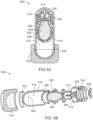
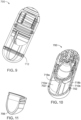
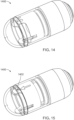
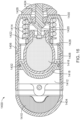
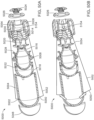
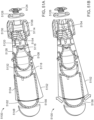
- the disclosure provides an ingestible device that includes: a housing comprising an interior and an opening; a gas cylinder in the interior of the housing, the gas cylinder having a breakable seal; a spring in the interior of the housing; a piston in the interior of the housing; a piercer in the interior of the housing; a retainer; and a trigger exposed to an environment external to the housing.
- the trigger holds the retainer in a first position; the retainer holds the piercer in a first position in which the piercer does not break the breakable seal of the gas cylinder; and the interior of the ingestible device is configured to contain a dispensable substance without the dispensable substance being delivered from the ingestible device via the opening in the housing.
- the trigger in a second state of the ingestible device: the trigger is at least partially dissolved, degraded and/or eroded so that the trigger is unable to hold the retainer in its first position; and the retainer is unable to hold piercer in its first position.
- the spring applies a force to the piercer to move the piercer so that the piercer breaks the breakable seal of the gas cylinder; a gas is released from the gas cylinder; the gas applies a force to the piston so that the piston applies a force to the dispensable substance; and the dispensable substance is delivered out of the ingestible device via the opening in the housing.
- the ingestible device can further include a seal between the piston and the housing, and/or a seal between the piercer and the housing.
- the disclosure provides an ingestible device that includes: a housing configured to contain a dispensable substance comprising a therapeutic agent in an interior of the housing; a gas cylinder in the interior of the housing; a spring in the interior of the housing; a piston in the interior of the housing; a seal between the piston and the housing; a piercer in the interior of the housing; a retainer; and a trigger exposed to an environment external to the housing.
- the disclosure provides an ingestible device that includes: a housing configured to contain a dispensable substance comprising a therapeutic agent in an interior of the housing; a gas cylinder in the interior of the housing; a spring in the interior of the housing; a piston in the interior of the housing; a piercer in the interior of the housing; a retainer; a seal between the retainer and the housing; and a trigger exposed to an environment external to the housing.
- the disclosure provides an ingestible device that includes: a housing configured to contain a dispensable substance comprising a therapeutic agent in an interior of the housing; a gas cylinder in the interior of the housing; a spring in the interior of the housing; a piston in the interior of the housing; a first seal between the piston and the housing; a piercer in the interior of the housing; a retainer; a second seal between the retainer and the housing; and a trigger exposed to an environment external to the housing.
- An ingestible device can be 00 sized device.
- the trigger can include an enteric material.
- the housing can include first and second housing parts, with the piston and the dispensable substance inside the first housing part, and the spring and the retainer inside the second housing part.
- the opening of an ingestible device can be a nozzle, e.g., having a diameter of from about 325 ⁇ m to 375 ⁇ m.
- the ingestible device is configured for trans-epithelial delivery of the dispensable subject to the GI tract of a subject; the ingestible device is configured for epithelial delivery of the dispensable subject to the GI tract of a subject; and the ingestible device is configured for topical delivery of the dispensable subject to the GI tract of a subject.
- An ingestible device can further include the dispensable substance.
- the dispensable substance is a solution or a suspension.
- the ingestible device is configured to deliver the dispensable substance to tissue of the GI tract of a subject as a jet with a peak jet power of from about one Watt to about three Watts; the ingestible device is configured to deliver the dispensable substance at a peak jet velocity of from about 25 meters per second to about 45 meters per second; the ingestible device is configured to deliver the dispensable substance to tissue of the GI tract of a subject at a peak jet pressure of from about 100 psig to about 250 psig; the ingestible device is configured to deliver the dispensable substance to tissue of the GI tract of a subject at a peak jet force of from about 0.09 N to about 0.15 N; the ingestible device is configured to deliver the dispensable substance as a jet having jet stable length of at least about 0.5 millimeter; the ingestible device is configured to provide an internal pressure of from about 225 psig to about 425 psig; and the ingestible device is
- At least one component of an ingestible device includes a cylic olefin polymer.
- the breakable seal is scored.
- the breakable seal has a varying thickness.
- the gas cylinder has a burst pressure of from about 2,800 psig to about 4,500 psig.
- the gas cylinder contains at least one gas selected from the group consisting of air, nitrogen, oxygen, carbon dioxide, hydrofluorocarbon gases and noble gases.
- an ingestible device further includes an element having a first state in which the element at least partially covers the opening in the housing and a second state in which the element does not cover the opening in the housing, wherein the ingestible device is configured so that, when the piston moves, the element moves from its first state to its second state.
- the element can move synchronously with the piston. When the piston moves a distance, the element can move the same distance.
- the ingestible device can further include a seal mechanically coupled with the piston and element. The seal can be configured to cause the movement of the piston to result in the movement of the element.
- the element can conform to an inner radius of the housing.
- the ingestible device further includes a covering over the opening in the housing.
- the covering can be removable from the ingestible device.
- the covering can be configured to be removed from the housing due to pressure applied by the dispensable substance.
- the covering can include an enteric material.
- the covering can be a film, a foil, a band, a plug, or a patch.
- the covering has a burst pressure of at most 420 psig.
- the ingestible device further includes a second piston configured so that, when the first piston applies the force on the dispensable substance, the dispensable substance applies a force on the second piston to slide the second piston to expose the openings and the dispensable substance is forced out of the ingestible device via the openings.
- the ingestible device further includes a removable cap affixed to the ingestible device and configured so that, when the piston moves to apply the force on the dispensable substance, the dispensable substance applies a force on the cap to slide the cap to expose the opening in the housing.
- the ingestible device further includes an inflated membrane volume covering the opening and configured so that, when the piston moves to apply force on the dispensable substance, the dispensable substance applies force on the inflated membrane volume and the inflated membrane volume is compressed to expose the opening in the housing.
- the disclosure provides a method that includes using an ingestible device according to the disclosure to deliver a dispensable substance to the GI tract of a subj ect.
- Ingestible as used herein in reference to the device, means that the device can be swallowed whole.
- Dispensable refers to any substance that may be released from an ingestible device as disclosed herein, or from a component of the device such as a reservoir.
- a dispensable substance may be a therapeutic agent as disclosed herein, and/or a formulation that includes a therapeutic agent as disclosed herein.
- a dispensable substance may be a fluid, such as a liquid, a suspension or a semi-solid.
- a dispensable substance can be a liquid in the form of a solution, such as an aqueous solution.
- a substance when disposed in an ingestible device, a substance is a non-fluid, such as a solid.
- the substance may be converted to a fluid prior to being delivered from the ingestible device.
- the therapeutic agent is a small molecule.
- the therapeutic agent is a large molecule, such as a biologic drug.
- biologic drugs include antibodies (including monoclonal antibodies), proteins (including fusion proteins), peptides (including cyclic peptides), cells (including stem cells), and nucleic acids (including inhibitory nucleic acids, antisense nucleic acids, siRNA, ribozymes).
- the dispensable substance is a pharmaceutical formulation comprising a therapeutic agent and a liquid carrier.
- the pharmaceutical formulation comprising the therapeutic agent and the liquid carrier is a solution formulation.
- the pharmaceutical formulation comprising the therapeutic agent and the liquid carrier is a suspension formulation, or an emulsion formulation.
- a dispensable substance delivered as described herein is particularly well-suited for treatment of diseases and conditions of the endoderm, for example, it may be more efficacious in gut-associated lymphoid tissue (GALT) or the hepatic system as compared to subcutaneous or intravenous administration.
- GALT gut-associated lymphoid tissue
- the viscosity of a dispensable substance can be selected as appropriate.
- the dispensable substance has a viscosity of at least about 0.5 centiPoise (cP) (e.g., at least about 0.8 cP, at least about 1 cP, at least about 2 cP, at least about 3 cP, at least about 4 cP, at least about 5 cP, at least about 10 cP, at least about 15 cP, at least about 25 cP, at least about 50 cP) and/or at most about 100 cP (e.g., at most about 75 cP, at most about 65 cP, at most about 50 cP, at most about 25 cP, at most about 20 cP, at most about 10 cP at most about 9 cP, at most about 8 cP, at most about 7cP).
- cP centiPoise
- the dispensable substance has a viscosity of from about 0.5 cP to about 10 cP (e.g., from about 0.8 cP to about 9 cP, from about 0.8 cP to about 8 cP).
- the dispensable substance has a viscosity of from abtou 0.5 cP to about 100 cP (e.g., from about 1 cP to about 100 cP, from about 1 cP to about 50 cP, from about 1 cP to about 25 cP, from about 1 cP to about 20 cP, from about 1 cP to about 15 cP, from about 1 cP to about 10 cP, from about 5 cP to about 100 cP, from about 10 cP to about 100 cP, from about 25 cP to about 100 cP, from about 25 cP to about 75 cP, from about 25 cP to about 50 cP).
- abtou 0.5 cP to about 100 cP e.g., from about 1 cP to about 100 cP, from about 1 cP to about 50 cP, from about 1 cP to about 25 cP, from about 1 cP to about 20 cP, from about 1
- enteric refers a material that permits transition to a desired location in the GI tract (e.g., through the stomach to the intestine) before being dissolved/degraded/eroded due to exposure of certain conditions (e.g., pH, temperature, enzymes) of the GI tract.
- An enteric material may prevent a drug from degradation by gastric fluid and enzymes.
- an enteric composition e.g., when formed as a coating on the housing of an ingestible device
- An enteric material can be an enteric polymer.
- an enteric polymer can remain insoluble in the stomach, but dissolve at the higher pH of the intestine (e.g., small intestine or large intestine), and are used to deliver drugs to the intestine.
- Examples include Colorcon's Opadry Enteric 91 series Polyvinyl Acetate Phthalate, Opadry Enteric 94 series Methacrylic Acid, Opadry Enteric 95 series Methacrylic Acid, Sureteric PVAP (Polyvinyl Acetate Phthalate), Nutrateric Ethylcellulose Evonik Acryl-EZE (Colorcon & Evonik collaboration - Eudragit L 100-55 Mixture Methacrylic copolymers); Evonik's Eudragit L 100-55 Methacrylic copolymers, Eudragit L 30 D-55 Methacrylic copolymers (30%), EudragitL 100 Methacrylic copolymers, EudragitL 12,5 Methacrylic copolymers (12.5%), Eudragit S 100 Methacrylic copo
- an enteric material dissolves in the small intestine and is suitable for small intestine release.
- enteric materials include, but are not limited to, cellulose derivatives, e.g., cellulose acetate phthalate, hydroxypropylmethylcellulose phthalate (HPMCP), hydroxypropylmethylcellulose acetate succinate (HPMCAS) and RL100 (e.g., HP-55), malic acid-propane 1,2-diol, polyvinyl acetate phthalate, anionic polymers of methacrylic acid and methyl methacrylate, hydroxypropylcellulose acetate phthalate, polyvinyl acetate phthalate, methacrylate-methacrylic acid copolymers, styrol, maleic acid copolymers, shellac, and others.
- cellulose derivatives e.g., cellulose acetate phthalate, hydroxypropylmethylcellulose phthalate (HPMCP), hydroxypropylmethylcellulose acetate succinate (H
- enteric material is a water emulsion of ethylacrylate methylacrylic acid copolymer, or hydroxypropyl methyl cellulose acetate succinate (HPMAS).
- HPMAS hydroxypropyl methyl cellulose acetate succinate
- an enteric material dissolves in the large intestine and is suitable for colonic release. Enteric materials suitable for large intestine (e.g., colonic) release are known to one of skill in the art.
- degradation of the coating is microbially triggered, e.g., the bacteria in the colon enzymatically trigger degradation of the coating (see, e.g., Archana et al., Int. J. Pharm.
- the coating is a pH-dependent polymer that is insoluble at low pH but becomes increasingly soluble as pH increases.
- the coating is a polymethacrylates with a pH-dependent dissolution threshold of about pH 6.0 to about 7.0.
- enteric materials include, but are not limited to, chitosan, alginates (e.g., as calcium salts), Eudragit ® L (e.g., Eudragit ® 100), Eudragit ® S (e.g., Eudragit ® S 100), Eudragit ® L (e.g., Eudragit ® L-30D), Eudragit ® FS (e.g., Eudragit ® FS 30D), hydroxypropylmethylcellulose phthalate 50, hydroxypropylmethylcellulose phthalate 55, and cellulose acetate trimellate.
- an enteric material is a material described in US 10,226,430 ; Sethi et al., Int. J. Pharm. Sci.
- the colon-specific degradation of an enteric material can be based on the presence of microorganisms that reside only in the colon, more particularly, biodegradable enzymes produced by these microorganisms.
- microorganisms are anaerobic bacteria, e.g., Bacteroides, Bifidobacteria, Enterobacteria, Eubacteria, Clostridia, Enterococci, and Ruminococcus, etc.
- micro floras fulfill their energy needs by fermenting various types of substrates that have been left undigested in the small intestine, e.g., polysaccharides, di- and tri-saccharides, etc. These polymers are stable in the environments of the stomach and small intestine. On reaching the colon, the polymers undergo degradation by the enzyme or break down of the polymer backbone leads to a subsequent reduction in their molecular weight and thereby loss of the mechanical strength.
- jet refers to a collimated stream of fluid, e.g., liquid or suspension, that is stable without breaking up into a spray.
- a jet may be formed by forcing the fluid, e.g., liquid or suspension, through an opening in an ingestible device.
- a jet maintains a stable form and is capable of achieving its intended purpose by maintaining appropriate properties (e.g., to penetrate a surface), such as its diameter and/or velocity.
- jet diameter is the cross-sectional diameter of a jet at a given location.
- average jet diameter refers to the average cross-sectional diameter of a jet between the location where the jet is formed (e.g., a nozzle opening through which the dispensable substance is delivered from the ingestible device) and the location where the jet impacts the GI tissue of the subject.
- Jet stable length refers to the distance from an opening (e.g., nozzle opening) of an ingestible device that a dispensable substance delivered through the opening remains in the form of a j et.
- Jet velocity is the average fluid velocity across the cross-section of a jet at a given point in time.
- peak jet velocity refers to the maximum jet velocity of a jet at the interface of the lumen and the surface of the GI tract facing the lumen. In general, the peak jet velocity is achieved at the time of initial delivery of the dispensable substance from the ingestible device.
- minimum jet velocity refers to the minimum velocity of a jet at the interface of the lumen and the surface of the GI tract facing the lumen. In general, the minimum jet velocity is achieved at the end of delivery of the dispensable substance from the ingestible device.
- Mean jet velocity and average jet velocity refer to the average velocity of a jet at the interface of the lumen and the surface of the GI tract facing the lumen as determined over the time that the ingestible device delivers the dispensable substance.
- peak jet power refers to the maximum power of a jet at the interface of the lumen and the surface of the GI tract facing the lumen. In general, the peak jet power is achieved at the time of initial delivery of the dispensable substance from the ingestible device.
- minimum jet power refers to the minimum power of a jet at the interface of the lumen and the surface of the GI tract facing the lumen. In general, the minimum jet power is achieved at the end of delivery of the dispensable substance from the ingestible device.
- Mean jet power and “average jet power,” as used herein, refer to the average power of a jet at the interface of the lumen and the surface of the GI tract facing the lumen as determined over the time that the ingestible device delivers the dispensable substance.
- Jet power during delivery refers to the power of a jet at the interface of the lumen and the mucosa of the GI tract of a subject.
- Jet pressure refers to the pressure of a jet at the interface of the lumen and the surface of the GI tract facing the lumen.
- the jet pressure can be the pressure by the jet measured at the intestinal wall.
- jet pressure is referred to herein as "impact pressure.”
- Peak jet pressure refers to the maximum pressure of a jet at the interface of the lumen and the surface of the GI tract facing the lumen. In general, the peak jet pressure is achieved at the time of initial delivery of the dispensable substance from the ingestible device.
- minimum jet pressure refers to the minimum pressure of a jet at the interface of the lumen and the surface of the GI tract facing the lumen. In general, the minimum jet pressure is achieved at the end of delivery of the dispensable substance from the ingestible device.
- Mean jet pressure and “average jet pressure,” as used herein, refer to the average pressure of a jet at the interface of the lumen and the surface of the GI tract facing the lumen as determined over the time that the ingestible device delivers the dispensable substance.
- Jet force refers to the force of a jet at the interface of the lumen and the surface of the GI tract facing the lumen. In some embodiments, jet force is referred to herein as "impact force.”
- Peak jet force refers to the maximum force of a jet at the interface of the lumen and the surface of the GI tract facing the lumen. In general, the peak jet force is achieved at the time of initial delivery of the dispensable substance from the ingestible device. In some embodiments, peak jet force is referred to herein as "impact force.”
- minimum jet force refers to the minimum force of a jet at the interface of the lumen and the mucosa of the GI tract of a subject. In general, the minimum jet force is achieved at the end of delivery of the dispensable substance from the ingestible device.
- Mean jet force and average jet force refer to the average pressure of a jet at the interface of the lumen and the surface of the GI tract facing the lumen as determined over the time that the ingestible device delivers the dispensable substance.
- fluid volume refers to the volume of the dispensable substance contained in the ingestible device.
- Initial fluid volume refers to the volume of the dispensable substance contained in the ingestible device just prior to delivery of the dispensable substance from the ingestible device.
- Fluid volume refers to the volume of the dispensable substance contained in the ingestible device just after delivery of the dispensable substance from the ingestible device has ended.
- delivered fluid volume refers to the volume of dispensable substance delivered from the ingestible device. In some embodiments, the delivered fluid volume is less than the fluid volume.
- End round is the radius on the curve at the end of the housing of the ingestible device.
- Fluid pressure refers to the pressure in the fluid volume.
- peak fluid pressure refers to maximum pressure generated in the fluid volume. Generally, the peak fluid pressure is achieved at initial delivery of the dispensable substance from the ingestible device. In some embodiments, peak fluid pressure is referred to herein as "internal pressure on the pharmaceutical formulation in the device, prior to release from the device.”
- minimum fluid pressure refers to minimum pressure generated in the fluid volume. Generally, the minimum fluid pressure is achieved at the end of delivery of the dispensable substance from the ingestible device.
- Fluid pressure during delivery refers to the pressure in the fluid volume as it decreases during the delivery process.
- nozzle refers to a channel between a fluid reservoir space and an external environment.
- pressure in the fluid volume generates a high speed flow of fluid through the nozzle to produce a fluid jet at the opening of the nozzle through which the dispensable substance leaves the ingestible device and enters an environment exterior to the ingestible device.
- Nozzle diameter refers to the diameter of the opening of the nozzle at the opening of the nozzle through which the dispensable substance leaves the ingestible device and enters an environment exterior to the ingestible device.
- nozzle length refers to the length of the opening of the nozzle.
- Nozzle stand-off distance refers to the distance between: 1) the opening of the nozzle through which the dispensable substance leaves the ingestible device and enters an environment exterior to the ingestible device; and 2) the interface of the lumen and the surface of the GI tract facing the lumen.
- the "internal pressure" of an ingestible device refers to the pressure applied to a dispensable substance, such as a therapeutic agent, or a formulation containing a therapeutic agent, contained in the ingestible device prior to delivery of the dispensable substance from the ingestible device.
- the internal pressure is provided by the drive force generator of the ingestible device.
- the internal pressure is greater than the fluid pressure. This may be due, for example, to friction, such as O-ring friction, acting on the drive coupling of the ingestible device. This friction is referred to herein as the "piston friction.”
- Nozzle pressure refers to the pressure of a dispensable substance at a nozzle opening as measured at the surface facing the interior of the nozzle as the dispensable substance is delivered from the ingestible device. In general, for a given ingestible device at a given point in time, the nozzle pressure is approximately the same as the fluid pressure.
- Topical delivery refers to a route of administration of a dispensable substance (for example, a therapeutic agent or a pharmaceutical formulation containing a therapeutic agent) where the dispensable substance is delivered to a localized area of the body or to the surface of a body part, regardless of the location of the effect; more particularly, the topical administration of the dispensable substance comprises releasing the dispensable substance to the lumen of the GI tract, a surface of the GI tract facing the lumen, a mucous membrane and/or a lining of the gastrointestinal tract of a subject, including, but not limited to, a surface, mucous membrane or lining containing one or more disease sites, such as gastrointestinal mucosal lesions.
- the effect of the topical delivery or topical administration of the dispensable substance may be local to, or away from (e.g., distal to), the site of the topical administration.
- Epithelial delivery or “epithelial administration,” as used herein, refers to a route of administration of a dispensable substance (for example, a therapeutic agent or a pharmaceutical formulation containing a therapeutic agent) where the dispensable substance is directly delivered into the mucus or onto the epithelium, but not past the epithelial layer, of the GI tract of a subject, such as the small or large intestine, from which the dispensable substance can act locally or peripherally.
- the therapeutic agent can move deeper into the GI tissue (i.e., past the epithelial layer) away from the site of direct delivery, such as, for example, via diffusion or active transport.
- Trans-epithelial delivery or “trans-epithelial administration,” as used herein, refers to a route of administration of a dispensable substance (for example, a therapeutic agent or a pharmaceutical formulation containing a therapeutic agent) where the dispensable substance is directly delivered through the epithelial layer of the mucosa of the GI tract to the submucosa of the GI tract of a subject; optionally, at least a portion of the dispensable substance is directly delivered past the epithelial layer to a region of the mucosa beneath the epithelial layer.
- a dispensable substance for example, a therapeutic agent or a pharmaceutical formulation containing a therapeutic agent
- trans-epithelial delivery in which a portion of the dispensable substance is directly delivered to a region of the mucosa beneath the epithelial layer, at least some (e.g., all) of the portion of the dispensable substance is directly delivered to the lamina propria.
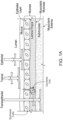
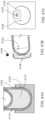
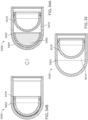
- FIG. 1A schematically describes the different regions of healthy intestinal tissue, presented in a cross section.
- the regions include the lumen of the GI tract, the mucus of the GI tissue, the mucosa of the GI tissue and the submucosa of the GI tissue.
- the mucosa of the GI tissue includes the epithelial layer and the lamina muscular.
- the muscularis mucosae separates the mucosa from the submucosa.
- the muscularis extrema is below the submucosa.
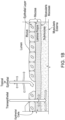
- FIG. 1B schematically describes corresponding regions of diseased intestinal tissue, presented in a cross section.
- An ingestible device described herein can deliver a therapeutic agent via topical delivery (without being directly delivered to the mucus, mucosa or submucosa), epithelial delivery (directly delivered to the mucus or epithelium without being directly delivered past the epithelial layer to the mucosa or submucosa) or trans-epithelial delivery (directly delivered to the submucosa and/or into a region of the mucosa beneath the epithelial layer, such as the lamina limbal, a, or trans-epithelial delivery (directly delivered to the submucosa and/or into a region of the mucosa beneath the epithelial layer, such as the lamina limbal, a, etc.
- topical delivery without being directly delivered to the mucus, mucosa or submucosa
- epithelial delivery directly delivered to the mucus or epithelium without being directly delivered past the epithelial layer to the muco
- the form of delivery may depend on the design of the ingestible device and parameters used with the device (e.g., internal pressure, fluid pressure, number of nozzles, design of nozzles). Holding other parameters constant, at relatively low fluid pressures and/or internal pressures, the therapeutic agent may be topically delivered, while higher fluid pressures and/or internal pressures may result in epithelial delivery, and still higher fluid pressures and/or internal pressure may result in trans-epithelial delivery.
- a bolus of the therapeutic agent initially contained in the dispensable substance may form within the submucosa and/or into a region of the mucosa beneath the epithelial layer, such as the lamina limbal, a a fibroblasts, a bolus of the therapeutic agent initially contained in the dispensable substance may form within the submucosa and/or into a region of the mucosa beneath the epithelial layer, such as the lamina limbal, a fibroblasts, a fibroblasts
- the ingestible device is designed to deliver a dispensable substance, for example, a therapeutic agent or a pharmaceutical formulation containing a therapeutic agent through the epithelial layer of the mucosa of the GI tract.
- the dispensable substance is a solution formulation; optionally, a suspension.
- the dispensable substance enters the submucosa and/or into a region of the mucosa beneath the epithelial layer, such as the lamina intestinal, of the small intestine, where it can be absorbed systemically. After the patient swallows the device, it passes through the GI tract and eventually reaches the small intestine.
- the device includes a restraining mechanism, an optionally a triggering mechanism (e.g., a degradable and/or erodible coating, such as an enteric coating, that partially or completely degrades and/or erodes when the device reaches the desired location in the GI tract).
- a triggering mechanism e.g., a degradable and/or erodible coating, such as an enteric coating, that partially or completely degrades and/or erodes when the device reaches the desired location in the GI tract.
- the desired location can be the small intestine or the large intestine.
- the preferred location can be the small intestine.
- a component With the restraining element is removed, relative movement between certain components (e.g., sliding of a component) occurs such that one or more openings in the ingestible device (e.g., in a compartment containing the dispensable substance, such as a reservoir, sometimes referred to herein as the "drug reservoir,” “storage reservoir” or “substance reservoir”) become aligned with one or more additional openings (e.g., one or more nozzles) in the ingestible device (e.g., in the housing).
- a compartment containing the dispensable substance such as a reservoir, sometimes referred to herein as the "drug reservoir,” “storage reservoir” or “substance reservoir”
- additional openings e.g., one or more nozzles
- a force forces the dispensable substance from the drug reservoir out of the device via the one or more openings (e.g., the one or more nozzles).
- the dispensable substance is delivered as a jet of fluid (e.g., liquid) through the epithelial layer of the mucosa and directly into the submucosa and/or into a region of the mucosa beneath the epithelial layer, such as the lamina intestinal, of the GI tract in the form of single or multiple boluses.
- the device After swallowing the device, the device travels through the GI tract (mouth, esophagus, stomach, duodenum, jejunum, ileum, cecum and colon), ultimately exiting the GI tract via the anus.
- the ingestible devices disclosed herein provide delivery of therapeutic agent to the GI tract of a subject.
- the disclosure relates to trans-epithelial delivery of a dispensable substance (e.g., a therapeutic agent or a formulation comprising a therapeutic agent) to the GI tract of a subject.
- a dispensable substance e.g., a therapeutic agent or a formulation comprising a therapeutic agent
- the disclosure provides an ingestible device that can directly deliver a dispensable substance (e.g., a therapeutic agent or a formulation comprising a therapeutic agent) to the submucosa and/or into a region of the mucosa beneath the epithelial layer, such as the lamina intestinal, of the GI tract of a subject, which may result in systemic exposure of the therapeutic agent to the subject.
- the ingestible device is configured to directly deliver the dispensable substance past the epithelial cell layer of the mucosa and into the submucosa and/or into a region of the mucosa beneath the epithelial layer, such as the lamina intestinal, of the GI tract, where the therapeutic agent so delivered is available for systemic uptake.
- systemic exposure of the therapeutic agent is achieved by trans-epithelial delivery of the dispensable substance into the submucosa and/or into a region of the mucosa beneath the epithelial layer, such as the lamina limbal, of the small intestine, for example, in the duodenum, the jejunum, and/or the ileum.
- the trans-epithelial delivery directly delivers the dispensable substance into the submucosa and/or into a region of the mucosa beneath the epithelial layer, such as the lamina intestinal, of the GI tract such that the percent systemic uptake of the therapeutic agent via the trans-epithelial delivery relative to intravenous or subcutaneous administration is at least about 10% (e.g., at least about 15%, at least about 20%, at least about 25% or more).
- the direct delivery of the therapeutic agent to the submucosa and/or into a region of the mucosa beneath the epithelial layer, such as the lamina basement, via trans-epithelial delivery may also or alternatively provide therapeutic effects locally and/or away from (e.g., distal to) the site of the direct delivery.
- the trans-epithelial delivery may directly deliver a first portion of the dispensable substance to the submucosa of the GI tract, and a second portion of the dispensable substance to the mucosa, all or a further portion of which may be directly delivered to the lamina intestinal.
- the second portion of the dispensable substance delivered to the mucosa, such as the lamina intestinal, of the GI tract via the trans-epithelial delivery may provide therapeutic effects locally and/or away from (e.g., distal to) the site of the direct delivery.
- the disclosure relates to epithelial delivery of a dispensable substance (e.g., a therapeutic agent or a formulation comprising a therapeutic agent) to the GI tract of a subject.
- a dispensable substance e.g., a therapeutic agent or a formulation comprising a therapeutic agent
- the disclosure provides an ingestible device configured to directly deliver a dispensable substance (e.g., a therapeutic agent or a formulation comprising a therapeutic agent) into the mucus, but not past the epithelial layer of the mucosa, of the small or large intestine, from which it may provide therapeutic effects locally and/or away from (e.g., distal to) the site of the direct delivery.
- the ingestible device directly delivers the dispensable substance such that it contacts the surface of the epithelial cell layer of the mucosa facing the lumen, but as previously noted, the epithelial delivery does not directly delivery the dispensable substance past the epithelial layer of the mucosa.
- the device is configured so that the dispensable substance is delivered from the device with sufficient force to provide the epithelial delivery, the force being lower than that required for trans-epithelial delivery to the GI tract.
- the epithelial delivery directly delivers the dispensable substance into the mucus of the GI tract such that the percent systemic uptake of the therapeutic agent via the epithelial delivery relative to intravenous or subcutaneous administration is greater than that for topical delivery, but less than for trans-epithelial delivery. In other embodiments, the epithelial delivery directly delivers the dispensable substance into the mucus of the GI tract such that the percent systemic uptake of the therapeutic agent via the epithelial delivery relative to intravenous or subcutaneous administration is about 0.5% to about 10% or more (e.g., about 0.5%, about 2%, about 3%, about 4%, about 5%, about 6%, about 7%, about 8%, about 9%, about 10%, or more).
- the therapeutic agent directly delivered into the mucus of the GI tract via the epithelial delivery may undergo active or passive transport or diffusion past the epithelial layer.
- the therapeutic agent may provide therapeutic effects locally and/or away from (e.g., distal to) the site of the direct delivery.
- the therapeutic agent binds to a therapeutic target present in the GI epithelial layer or elicits other pharmacodynamic effects locally or away from the site of delivery via immune cells or tissue in the GI tract (e.g., dendritic cells, lymphocytes, mucosa-associated lymphoid tissue).
- this disclosure relates to topical delivery of a dispensable substance (e.g., a therapeutic agent or a formulation comprising a therapeutic agent) to the GI tract of a subject.
- a dispensable substance e.g., a therapeutic agent or a formulation comprising a therapeutic agent
- the disclosure provides an ingestible device configured to deliver the dispensable substance (e.g., a therapeutic agent or a formulation comprising a therapeutic agent) into the lumen and/or onto the mucus or other surface (e.g., a diseased surface) of the GI tract facing the lumen of the small or large intestine, from which it may provide therapeutic effects locally and/or away from (e.g., distal to) the site of delivery.
- the device is configured so that the dispensable substance is delivered from the device with sufficient force so that the dispensable substance is delivered topically, the force being lower than that required for the epithelial or the trans-epithelial delivery to the GI tract.
- the topical delivery to the GI tract results in reduced systemic uptake of the therapeutic agent compared to trans-epithelial delivery to the GI tract, intravenous or subcutaneous delivery.
- topical delivery delivers the dispensable substance into the lumen and/or onto the mucus or the other surface facing the lumen of the GI tract such that the percent systemic uptake of the therapeutic agent via the topical delivery relative to intravenous or subcutaneous administration is less than about 20%, less than about 10%, less than about 5%, less than about 4%, less than about 3%, less than about 2% or less than about 1%.
- the topical delivery to the GI tract results in negligible or no systemic uptake of the therapeutic agent compared to trans-epithelial delivery to the GI tract, intravenous or subcutaneous delivery.
- the topically delivered dispensable substance may spread over the mucus or other surface facing the lumen of the GI tract, thereby coating the surface of the GI tract at or away from (e.g., distal to) the site of delivery.
- the therapeutic agent may undergo transport (e.g., diffusion) from the surface of the mucus into the mucus, and optionally, active or passive transport or diffusion past the epithelial layer of the mucosa.
- the mucus and/or epithelial layer of the mucosa may be disrupted or even absent, such as in a patient having a disease or condition of the GI tract.
- the topical delivery of the dispensable substance to the GI tract of the patient may provide direct delivery of the dispensable substance to the surface of the GI tract facing the lumen, such as mucosal tissue exposed by said disruption and/or absence (e.g., both the mucus layer and/or epithelial layer are completely or partially absent or compromised in portions of the GI tract due to a disease or condition).
- the topical delivery of the dispensable substance to the GI tract of the patient may provide topical delivery to one or more lesions of the GI tract.
- the disease or condition is an inflammatory bowel disease.
- the inflammatory bowel disease is ulcerative colitis.
- the inflammatory bowel disease is Crohn's disease.
- CMOS complementary metal-oxide-semiconductor
- SC subcutaneous
- IM intramuscular
- IV bolus intravenous
- SC subcutaneous
- IM intramuscular
- IV bolus intravenous
- the devices and methods described herein provide an alternative route of administration to current injectable medications, which can lead to greater convenience and compliance since they minimize or avoid the logistical challenges, patient compliance and adherence challenges, pain, and discomfort associated with traditional routes of administration.
- the devices and methods described herein are particularly well-suited for treatment of diseases and conditions of the endoderm, including the liver.
- the ingestible device is suitable for swallowing by a patient and for safely and effectively passing through the GI tract of the patient.
- the device can be in the shape of a capsule, a pill or any other swallowable form that may be orally consumed by the subject.
- the ingestible device can be swallowed voluntarily under medical supervision or in a home use environment with instruction provided ahead of subsequent ingestion.
- ingestible devices are intended for single subject, single use.
- the ingestible device can have a density high enough to cause the ingestible device to sink within human stomach fluid, e.g., the unfilled ingestible device can have a density of greater than 1.01 g/cm 3 .
- the ingestible device can have maximum dimensions that allow the ingestible device to pass through an average human GI tract.
- the ingestible device is configured to prevent tumbling in the small intestine of a human.
- the ingestible device is of sufficient length whereby it will not tumble in the small intestine of a human before, during, or after the dispensable substance is released.
- the ingestible device is configured to deliver a sufficient amount of therapeutic agent contained in the dispensable substance to be effective for its intended purpose.
- the ingestible device's patient-contacting portions (e.g., exterior surface) and dispensable substance-contacting portions are biocompatible.
- the device can withstand an indirect bite force without damaging the housing damage or resulting in leakage.
- the ingestible device when containing the dispensable substance, can withstand a bite force of at least about 60 Newtons (N).
- N the number of Newtons
- components of the ingestible device can withstand exposure to a pH range expected in the human GI tract without substantial loss of functionality, substantial structural damage, or substantial leakage.
- the ingestible device can withstand submersion in a pH 1.5 ⁇ 0.5 fluid environment for at least about 24 hours without substantial loss of functionality, substantial structural damage, or substantial leakage.
- the ingestible device can maintain an external fluid barrier between the inside of the ingestible device and the GI tract of the subject during transit therethrough.
- the ingestible device can withstand external fluid pressures to which it is exposed during use without substantial loss of functionality, substantial structural damage, or substantial leakage.
- the ingestible device undergoes no substantial loss of functionality, substantial structural damage, or substantial leakage when exposed to a sustained pressure of at least about 2 psig for at least about 24 hours and/or when exposed to a momentary pressure of at least about 5 psig momentary pressure for at least about 1 minute.
- an ingestible device disclosed herein includes the following features.
- the ingestible device comprises a housing configured to maintain its mechanical integrity during use of the ingestible device.
- the housing has a first portion and a second portion.
- the housing has a first actuation component on the housing, and a second actuation component within the housing.
- a storage reservoir is located within the housing, wherein the storage reservoir is configured to store a dispensable substance.
- the housing has an opening in fluid communication with the storage reservoir.
- the ingestible device employs an electrolytic mechanism for creating one or more openings in the ingestible device, wherein a substance can be dispensed through said opening as described in PCT Application Number PCT/US2019/021814 , which published as WO2019178071 , and which is incorporated by reference herein.
- the housing may comprise an external electrolytic circuit (electrolytically erodible surface being on the exterior of the device), whereby the surrounding gastric fluids are the electrolyte that completes an electrolytic circuit between anode and cathode.
- an ingestible device includes an enteric coating on the housing.
- the enteric coating covers only certain regions of the housing. The housing may be designed to withstand the chemical and mechanical environment of the GI tract (e.g., effects of muscle contractile forces and concentrated hydrochloric acid in the stomach).
- thermoplastics examples include, but are not limited to, thermoplastics, fluoropolymers, elastomers, stainless steel, and glass complying with ISO 10993 and USP Class VI specifications for biocompatibility; and any other suitable materials and combinations thereof.
- these materials may further include liquid silicone rubber material with a hardness level of 10 to 90 as determined using a durometer (e.g., MED-4942 TM manufactured by NuSil TM ), a soft biocompatible polymer material such as, but not limited to, polyvinyl chloride (PVC), polyethersulfone (PES), polyethylene (PE), polyurethane (PU) or polytetrafluoroethylene (PTFE), and a rigid polymer material coated with a biocompatible material that is soft or pliable (e.g., a poly(methyl methacrylate) (PMMA) material coated with silicone polymer).
- PVC polyvinyl chloride
- PES polyethersulfone
- PE polyethylene
- PU polyurethane
- PTFE polytetrafluoroethylene
- PMMA poly(methyl methacrylate)
- Teflon ® may be used as a material in the ingestible device for movable components in order to reduce friction between these components.
- Other example materials may include other materials commonly used in micro-fabrication, such as polydimethylsiloxane (PDMS), borosilicate glass, and/or silicon.
- PDMS polydimethylsiloxane
- borosilicate glass and/or silicon.
- specific materials may be referred to herein as being used to construct the device for illustrative purposes, the materials recited are not intended to be limiting, and one skilled in the art may easily adapt the device to use any number of different materials without affecting the overall operation or functionality of the device.
- the housing of the ingestible device may be manufactured from a type of plastic, such as a photosensitive acrylic polymer material or an inert polycarbonate material.
- the housing may also be formed using material that can be sterilized by chemicals.
- the wall of the housing may have a thickness of, for example, from about 0.5 millimeter to about 1 millimeter.
- the material from which the housing is made is non-ferric and non-magnetic. Such materials include various plastics (e.g., PVC, or polycarbonate).
- the housing can include a metal-based material, such as an alloy, stainless steel or a substantially pure metal. Such materials can be sterilized without affecting the mechanical workings of the ingestible device or the exterior surface of the ingestible device.
- the metal-based material is compatible with the dispensable substance over long duration of storage.
- the stainless steel grade is approved for use as a surgical implant material, such as ASTM grades F138, F1314, F1586, F2229, or F2581.
- the walls of the housing of the ingestible device generally are sufficiently thick to withstand internal and external pressures to which they are exposed without substantial loss of functionality, substantial structural damage, or substantial leakage. In general, the walls of the housing are desirably as thin as possible to enhance the volume available for containing dispensable substance.
- the walls are from about 0.05 mm to about 0.5 mm thick (e.g., if made of metal-based material, such as stainless steel) or from about 0.1 to about 1 mm thick (e.g., if made of plastic, such as polycarbonate).
- the housing is made of material with a thermal expansion coefficient low enough that the device does not substantially deform at temperatures encountered during shipping and storage, or within the GI tract.
- the walls of the housing are made of an electrolytically erodible surface as described in PCT/US2019/021814 , which published as WO2019178071 .
- the housing includes an electrolytically erodible valve coupled to a nozzle for exposing the liquid volume to its surrounding environment.
- the exposed metal anode material acting as valve can include a metal alloy or substantially pure metal that is acceptable for human ingestion from consideration of its biocompatibility in the amounts electrolyzed during opening of the valve.
- the metal portion of the drug container can be 0.025 mm thick across a diameter that matches or slightly exceeds the diameter of the coupled nozzle (e.g., 0.60 mm).
- the thickness of the metal in the valve area can be in the range 0.002 mm to 0.200 mm.
- the housing of an ingestible device is assembled from multiple modules.
- the housing is assembled from two modules.
- one of the modules can contain the dispensable substance ("drug module”), and the other module can contain the drive force generator and the drive coupling ("drive module”).
- the drug module includes a housing part of appropriate size, shape and material(s) as discussed herein.
- the housing part is sterilized, and dispensable substance is subsequently disposed within the housing under aseptic conditions.
- a sterile seal e.g., a sterile foil seal
- the components of the drug module e.g., a housing part, a drive force generator, a drive coupling
- the drug module and the drive module are subsequently combined to form the ingestible device.
- Representative examples of modules, their separate assembly, and their combination to form an ingestible device, are provide elsewhere herein.
- an ingestible device is sized and shaped for relatively safe and effective movement and intended use within the GI tract of the subject.
- an ingestible device is a capsule having an industry standard size.
- an ingestible device is configured as a 00 capsule or a 000 capsule.
- the housing of an ingestible device has a length of at least about 20 mm (e.g., at least about 21 mm, at least about 22 mm, at least about 23 mm) and/or at most about 28 mm (e.g., at most about 27 mm, at most about 26 mm).
- the housing of an ingestible device has a diameter of at least about 7 mm (e.g., at least about 7.5 mm, at least about 8 mm, at least about 8.5 mm, at least about 9 mm, at least about 9.5 mm) and/or at most about 12 mm (e.g., at most about 11.5 mm, at most about 11 mm, at most about 10.5 mm, at most about 10 mm, at most about 9.5 mm, at most about 9 mm).
- the housing of an ingestible device has an aspect ratio (ratio of length to width) of at least about 0.75 (e.g. at least about 1) and/or at most about 4 (e.g., at most about 3, at most about 2). In some embodiments, the housing of an ingestible device has an aspect ratio of from about 0.75 to 4 (e.g., from about 1 to about 3, from about 1 to about 2). For example, in some embodiments, the housing aspect ratio is abot 1.5:1 (length:diameter). In some other embodiments, the housing aspect ratio is about 2:1 (length: diameter).
- the housing of an ingestible device has a wall thickness of at least about 0.05 mm (e.g., at least about 0.5 mm, at least about 0.6 mm, at least about 0.7 mm) and/or at most about 1 mm (e.g., at most about 0.9 mm, at most about 0.8 mm).
- an ingestible device has a wall thickness of from about 0.05 mm to about 0.5 mm.
- an ingestible device has a wall thickness of from about 0.1 mm to about 1 mm.
- one region of the housing of an ingestible device may have a wall thickness that is different from that of a different region of the housing of the ingestible device.
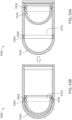
- the housing of an ingestible device has an end round that is spline-shaped or that is spherical.
- an ingestible device has an end round that is from about 1 mm to about 2 mm (e.g., about 1.5 mm).
- an ingestible device has an end round that is from about 4 mm to about 4.5 mm (e.g., about 4.25 mm).
- an ingestible device has an end round that is from about 4.9 to about 5 mm (e.g., about 4.95 mm).
- an ingestible device has an end round that is from about 5.4 mm to about 5.6 mm (e.g., about 5.5 mm).
- the housing of an ingestible device has an internal volume of at least about 700 ⁇ L (e.g., at least about 750 ⁇ L, at least about 800 ⁇ L, at least about 850 ⁇ L) and/or most about 1700 ⁇ L (e.g., at most about 1650 ⁇ L, at most about 1600 ⁇ L, at most about 1500 ⁇ L, at most about 1400 ⁇ L, at most about 1300 ⁇ L, at most about 1200 ⁇ L).
- the housing of an ingestible device has a diameter of about 11 mm, a length of about 26 mm, a wall thickness of about 0.8 mm, an end round of about 1.5 mm, and an internal volume of about 1685 ⁇ L.
- the housing of an ingestible device has a diameter of about 11 mm, a length of about 26 mm, a wall thickness of about 0.8 mm, an end round of about 5.5 mm (spherical), and an internal volume of about 1475 ⁇ L.
- the housing of an ingestible device has a diameter of about 9.9 mm, a length of about 26 mm, a wall thickness of about 0.8 mm, an end round of about 1.5 mm, and an internal volume of about 1315 ⁇ L.
- the housing of an ingestible device has a diameter of about 9.9 mm, a length of about 26 mm, a wall thickness of about 0.8 mm, an end round of about 4.95 mm (spherical), and an internal volume of about 1177 ⁇ L.
- the housing of an ingestible device has a diameter of about 8.5 mm, a length of about 23.3 mm, a wall thickness of about 0.7 mm, an end round of about 1.5 mm, and an internal volume of about 861 ⁇ L.
- the housing of an ingestible device has a diameter of about 8.5 mm, a length of about 23.3 mm, a wall thickness of about 0.7 mm, an end round of about 4.25 mm (spherical), and an internal volume of about 773 ⁇ L.
- the housing of an ingestible device has a diameter of about 8.5 mm, a length of about 23.3 mm, a wall thickness of about 0.7 mm, an end round that is spline-shaped, and an internal volume of about 820 ⁇ L.
- the ingestible device includes a fluid volume to contain a dispensable substance (e.g., a liquid, a suspension).
- a dispensable substance e.g., a liquid, a suspension
- the fluid volume is completely disposed within the housing.
- the fluid volume can be defined by a storage reservoir.
- a storage reservoir can be a component that can be prepared separately from the housing.
- the dispensable substance can be disposed in the storage reservoir before the storage reservoir is associated with the ingestible device.
- the device may include one or more dispensable substances, with each dispensable substance including one or more therapeutic agents and/or one or more pharmaceutical formulations including one or more therapeutic agents.
- an ingestible device includes one or more nozzles in fluid communication with the one or more openings in the ingestible device.
- the nozzle(s) is(are) configured so that the dispensable substance through the nozzle(s) when the dispensable substance is delivered from the ingestible device.
- a nozzle can have any desired size and shape appropriate for the desired type of delivery of a dispensable substance from the ingestible device.
- a nozzle has a shape and/or size appropriate for trans-epithelial delivery, epithelial delivery or topical delivery.
- an ingestible device includes more than one nozzle.
- an ingestible device can include, for example, up to 50 nozzles (e.g., up to 40 nozzles, up to 35 nozzles, up to 30 nozzles, up to 25 nozzles, up to 20 nozzles, up to 15 nozzles, 10 nozzles).
- an ingestible device includes from 2 nozzles to 50 nozzles.
- an ingestible device includes 2 nozzles, three nozzles, four nozzles, five nozzles, six nozzles, seven nozzles, eight nozzles, 10 nozzles, 20 nozzles, 30 nozzles, 36 nozzles, 40 nozzles, 50 nozzles).
- the nozzles are arranged at even intervals (optionally pair-wise if an even number of nozzles are used) around the circumference of the device.
- the ingestible device comprises a restraining mechanism.
- a restraining mechanism has a first state in which it is configured to prevent the dispensable substance from exiting the ingestible device via the opening(s), and a second state in which it is configured so that it does not prevent the dispensable substance from exiting the ingestible device via the opening(s).
- the restraining mechanism can be configured to transition from its first state to its second state when it is exposed to a triggering condition.
- the restraining mechanism may be provided by one or more restraining elements.
- the restraining elements can have a first state in which they are configured to prevent the dispensable substance from exiting the ingestible device via the openings, and a second state in which they are configured to allow the dispensable substance to exit the ingestible device via the openings.
- the restraining elements can be configured to transition from the first state to the second state when the restraining elements are exposed to a triggering condition.
- the restraining elements comprise a first type of restraining element and a second type of restraining element different from the first type of restraining element.
- the first type of restraining element can be configured to transition to its second state before the second type of restraining element transitions to its second state.
- a restraining elements comprises a lid, a pin, a band, a plug, a dowel, a clasp, a clamp, a flange, a rivet, an annulus, a torus, a ring, a wafer, a cylinder, an asymmetric shape such as a partial annulus, a partial torus, a partial ring, a partial wafer, a partial cylinder, or any combination thereof (e.g., two partial tori).
- a restraining element can have a filled interior (e.g., no hole).
- a restraining element can have a varying thickness (e.g., a center region that is thinner than the edges).
- the restraining elements comprise a plasticizer such as triethyl citrate (TEC).
- the restraining elements comprise a degradable and/or erodible material, such as, for example, an enteric material.
- the enteric material may be degradable and/or erodible in the small intestine of the GI tract, or may be degradable and/or erodible in the large intestine of the GI tract, for example, the colon.
- a restraining mechanism can be a mechanism that prevents the dispensable substance from being delivered from the ingestible device even when the drive force generator (or optionally the drive coupling) applies an internal force.
- such a restraining can be an element (e.g., a pin, a band, a plug) in the opening (e.g., nozzle opening) through which the dispensable substance can be delivered from the ingestible device.
- a restraining element can be formed, for example, of a material that degrades and/or erodes as discussed above.
- a restraining mechanism includes a material that will lose a sufficient degree of its mechanical strength at the desired location to cause the ingestible device to deliver the dispensable substance.
- the material may undergo loss of mechanical strength to any appropriate mechanism or combination of mechanisms, including, for example, moisture ingress, solubility, swelling, leaching, eroding and/ or the like.
- a restraining mechanism includes a degradable and/or erodible material such as a water soluble material, optionally with one or more coatings of one or more enteric materials.
- the degradable and/or erodible material is designed to lose its mechanical strength in the presence of moisture (e.g., liquid present in the GI tract).
- an enteric material erodes after being swallowed, e.g., in the small intestine or in the large intestine.
- the degradable and/or erodible material is coated with an enteric material that limits the amount of moisture or fluid reaching the degradable and/or erodible material, whereby the degradable and/or erodible material is able to resist a trigger load, for example, for at least two hours at a pH of 1.1.
- the enteric material breaks down to release a trigger load after being exposed to a pH of 1.1 for two hours followed by exposure to a pH of 6.8 for 10, 20, 30, 40, 50, 60 or more minutes.
- An enteric material can be in the form of one or more coatings at varying coating weights (e.g., one or more spray coatings and/or one or more dip coatings) on a degradable and/or erodible material such as a water soluble material.
- the coating weight can be 5%, 10%, 15%, 20%, 25%, 30%, 35%, 40%, 45%, 50%, 55% or more.
- the coating weight can be selected as desired, e.g., based on the intended use of the ingestible device.
- the coating weight can be selected to select a desired location and/or time for the the degradable and/or erodible material to degrade and/or erode to a sufficient extent to trigger delivery of the dispendable substance from the ingestible device.
- the degradable and/or erodible material is sufficiently strong enough to resist the trigger load when dry, but also capable of sufficiently weakening to release the trigger load when the degradable and/or erodible material is exposed to an aqueous environment for a desired period of time, such as, for example, at least two minutes, e.g., at least 5, at least 10, at least 20, at least 30, at least 40, at least 50, at least 60, at least 70, at least 80, at least 90, at least 100, at least 110, at least 120, at least 130, at least 140, at least 150, or at least 160 minutes.
- a desired period of time such as, for example, at least two minutes, e.g., at least 5, at least 10, at least 20, at least 30, at least 40, at least 50, at least 60, at least 70, at least 80, at least 90, at least 100, at least 110, at least 120, at least 130, at least 140, at least 150, or at least 160 minutes.
- a triggering mechanism has a density of from about one g/cm 3 to about 3 grams/cm 3 (e.g., from about 1.3 g/cm 3 to about 2 g/cm 3 ).
- a triggering mechanism is from about 1 mm to about 5 mm thick (e.g., from about 1 mm to about 2 mm thick).
- a coating of enteric material has a density of from about 0.5 mg/cm 2 to 20 mg/cm 2 (e.g., from about 2 mg/cm 2 to about 6 mg/cm 2 ).
- a degradable and/or erodible material examples include polyethylene glycol (PEG) and Isolmalt.
- a degradable and/or erodible material includes one or more diluents/fillers, one or more binders, and/or or more disintegrants.
- diluents/fillers include lactose, starch, mannitol, microcrystalline cellulose, carboxymethyl cellulose, and dicalcium phosphate.
- binders include povidone, hypromellose, hydroxypropyl cellulose, copovidone, and microcrystalline cellulose.
- a degradable and/or erodible material can include a lubricant, such as, for example, magnesium stearate.
- a degradable and/or erodible material includes starch (e.g., StarTab grade from Colorcon, Starch 1500 grad from Colorcon), microcrystalline cellulose (e.g., Vivapur 102 grade from JRS Pharma), croscarmellose sodium (e.g., Ac-di-sol SD-711 grade from FMC Biopolymer),and magnesium stearate (e.g., Ligamed MF-2-V grade from Giusto Faravelli), and optionally further includes talc (e.g., PSD ⁇ 75 ⁇ m grade from Acros), enteric methacrylate polymer (e.g., FL30 D-55 grade from Evonik), and HPMC polymer sub coat (e.g,.
- starch e.g., StarTab grade from Colorcon, Starch 1500 grad from Colorcon
- microcrystalline cellulose e.g., Vivapur 102 grade from JRS Pharma
- croscarmellose sodium e.g., Ac-di
- a degradable and/or erodible material can include Starch 1500 (e.g., 49.6% w/w), microcrystalline cellulose 102 Starch (e.g., 49.6% w/w); and croscarmellose sodium SD-711 (e.g., 0.5% w/w); and magnesium stearate (e.g., 0.26% w/w).
- a degradable and/or erodible material can include Startab (e.g., 49.6% w/w), microcrystalline cellulose 102 Starch (e.g., 49.6% w/w); and croscarmellose sodium SD-711 (e.g., 0.5% w/w); and magnesium stearate (e.g., 0.26% w/w).
- Startab e.g., 49.6% w/w
- microcrystalline cellulose 102 Starch e.g., 49.6% w/w
- croscarmellose sodium SD-711 e.g., 0.5% w/w
- magnesium stearate e.g., 0.26% w/w
- a degradable and/or erodible material can include Starch 1500 (e.g., 48.9% w/w), microcrystalline cellulose 102 Starch (e.g., 48.9% w/w); croscarmellose sodium SD-711 (e.g., 2% w/w); and magnesium stearate (e.g., 0.26% w/w).
- Starch 1500 e.g., 48.9% w/w
- microcrystalline cellulose 102 Starch e.g., 48.9% w/w
- croscarmellose sodium SD-711 e.g., 2% w/w
- magnesium stearate e.g., 0.26% w/w
- a degradable and/or erodible material can include Startab (e.g., 49.6 % w/w), microcrystalline cellulose 102 Starch (e.g., 49.6% w/w); croscarmellose sodium SD-711 (e.g., 2% w/w); and magnesium stearate (e.g., 0.26% w/w).
- Startab e.g., 49.6 % w/w
- microcrystalline cellulose 102 Starch e.g., 49.6% w/w
- croscarmellose sodium SD-711 e.g., 2% w/w
- magnesium stearate e.g., 0.26% w/w.
- a degradable and/or erodible material can include dicalcium phosphate (e.g., 48.9% w/w), microcrystalline cellulose 102 Starch (e.g., 48.9% w/w); croscarmellose sodium SD-711 (e.g., 2% w/w); and magnesium stearate (e.g., 0.25% w/w).
- dicalcium phosphate e.g., 48.9% w/w
- microcrystalline cellulose 102 Starch e.g., 48.9% w/w
- croscarmellose sodium SD-711 e.g., 2% w/w
- magnesium stearate e.g., 0.25% w/w
- a degradable and/or erodible material can include dicalcium phosphate (e.g., 33.25% w/w), microcrystalline cellulose 102 Starch (e.g., 33.25% w/w); mannitol (e.g., 33.25% w/w); and magnesium stearate (e.g., 0.25% w/w).
- dicalcium phosphate e.g., 33.25% w/w
- microcrystalline cellulose 102 Starch e.g., 33.25% w/w
- mannitol e.g., 33.25% w/w
- magnesium stearate e.g., 0.25% w/w
- enteric materials coated on a degradable and/or erodible material include: spray coated Eudragit FL 30 D-55 (e.g., 12mg/cm 2 direct spray coated Eudragit FL 30 D-55 on a water soluble material); dip coated Eudragit L 100 D-55 (e.g., 4 mg/cm 2 Eudragit L 100 D-55 dip coated onto an HPMC capsule cap); and spray coated Eudragit FL 30 D-55 (e.g., 9 mg/cm 2 Eudragit FL 30 D-55 direct spray coated on a water soluble material; 6mg/cm 2 Eudragit FL 30 D-55 direct spray coated on a water soluble material).
- spray coated Eudragit FL 30 D-55 e.g., 12mg/cm 2 direct spray coated Eudragit FL 30 D-55 on a water soluble material
- dip coated Eudragit L 100 D-55 e.g., 4 mg/cm 2 Eudragit L 100 D-55 dip coated onto an HPMC capsule cap
- the ingestible device comprises a triggering mechanism.
- a triggering mechanism is configured to cause the dispensable substance within the fluid volume to be released under one or more triggering conditions.
- a triggering mechanism initiates a drive force generator.
- a triggering mechanism incorporates a mechanical feature like a restraining mechanism. As an example, one or more restraining elements degrade and/or erode in the presence of certain GI tract conditions (e.g., pH greater than 5), thereby triggering a drive force generator, such as a compressed spring.
- a spring may have a piercing element that pierces a cylinder with compressed gas, whereby the released gas acts as a force applied to a dispensable substance.
- a triggering mechanism incorporates an electrical feature.
- an enteric coating degrades and/or erodes in the presence of certain GI tract conditions (e.g., pH greater than 5), thereby exposing conductors to intestinal fluid, which acts as a liquid conductor to triggering the drive force generator.
- a triggering condition relates to a condition of the GI tract.
- the condition of the GI tract comprises at least one condition selected from the group consisting of temperature, pH, presence of one or more enzymes, and time.
- condition of the GI tract is a pH of greater than 5.
- the triggering mechanism is configured so that the release mechanism is autonomously triggered (e.g., due to degradation, dissolution and/or erosion of the restraining mechanism due to conditions in the GI tract).
- a restraining element can include one or more small molecule therapeutic agents, e.g., one or more small molecule therapeutic agents as disclosed herein.
- a small molecule therapeutic agent contained in the restraining mechanism can be the same as a therapeutic agent contained in the dispensable substance.
- a small molecule therapeutic agent contained in the restraining mechanism can different from a therapeutic agent contained in the dispensable substance.
- the restraining mechanism includes multiple small molecule therapeutic agents, and the dispensable substance contains the same therapeutic agents.
- the restraining mechanism includes multiple small molecule therapeutic agents, and the dispensable substance contains one or more different therapeutic agents.
- the dispensable substance includes a therapeutic agent that is capable of treating a certain condition, and a small molecule therapeutic agent included in the restraining element is capable of treating the same condition. In some embodiments, the dispensable substance includes a therapeutic agent that is capable of treating a certain condition, and a small molecule therapeutic agent included in the restraining element is capable of treating a different condition. In certain embodiments, the dispensable substance includes a therapeutic agent that is capable of treating a certain condition, and the small molecule therapeutic agent included in the restraining element is capable of treating the same condition and at least one different condition. In some embodiments, a small molecule therapeutic agent included in the restraining element is capable of treating a certain condition, and the dispensable substance includes a therapeutic agent that is capable of treating at least one different condition. Other combinations are possible.
- the initial gas pressure within the gas cylinder (gas pressure before the gas cylinder is implemented as a force generator) is appropriate to provide the desired internal pressure.
- the initial gas pressure in the cylinder is at least about 500 psig (e.g., at least about 600 psig, at least about 700 psig, at least about 750 psig, at least about 800 psig, at least about 850 psig, at least about 900 psig) and/or at most about 1,200 psig (e.g., at most about 1,100 psig, at most about 1,000 psig, at most about 950 psig, at most about 900 psig).
- the initial gas pressure within the gas cylinder is from about 500 psig to about 1,200 psig (e.g., from about 600 psig to about 1,100 psig, from about 700 psig to about 1,000 psig, from about 750 psig to about 950 psig, from about 800 psig to about 950 psig, from about 850 psig to about 950 psig).
- the burst pressure of the gas cylinder (the minimum pressure at which the gas cylinder bursts) is usually based on the desired initial gas pressure within the gas cylinder.
- the burst pressure of the gas cylinder can be at least about 2,800 psig (e.g., at least about 2,900 psig, at least about 3,000 psig, at least about 3,100 psig, at least about 3,200 psig, at least about 3,300 psig, at least about 3,400 psig, at least about 3,500 psig, at least about 3,600 psig) and/or at most about 4,500 psig (e.g., at most about 4,400 psig, at most about 4,300 psig, at most about 4,200 psig, at most about 4,100 psig, at most about 4,000 psig, at most about 3,900 psig, at most about 3,800 psig).
- the burst pressure of the gas cylinder is from about 2,800 psig to about 4,500 psig (e.g., from about 2,900 psig to about 4,400 psig, from about 3,000 psig to about 4,300 psig, from about 3,100 psig to about 4,200 psig, from about 3,200 psig to about 4,100 psig, from about 3,100 psig to about 4,000 psig, from about 3,200 psig to about 3,900 psig, from about 3,300 psig to about 3,800 psig, from about 3,400 psig to about 3,800 psig, from about 3,500 psig to about 3,800 psig, from about 3,600 psig to about 3,800 psig, from about 3,700 psig to about 3,800 psig).
- psig e.g., from about 2,900 psig to about 4,400 psig, from about 3,000 psig to about 4,300 psig, from about 3,100 psig to about 4,200 psig, from about
- the gas within the gas cylinder can be a single gas or a mixture of two or more gases.
- gases include air, nitrogen, oxygen, carbon dioxide, hydrofluorocarbon gases, and noble gases (e.g., helium, neon, argon, krypton, xenon).
- the gas within the gas cylinder is a mixture of gases that include helium (e.g., nitrogen/helium mixture, argon/helium mixture).
- such gas mixtures include at most about 5% helium.
- the presence of helium in a gas mixture can allow for leak checking the gas cylinder based on the presence of helium gas adjacent the exterior of the gas cylinder.
- the gas cylinder may be made of any appropriate and/or desired material. Examples include metal, plastic, and/or composite materials.
- the gas cylinder is made of stainless steel or galvanized steel.
- the gas cylinder may be made from a material which is itself prepared by a process that includes drawing, stamping, machining, casting, molding, and/or the like (e.g., deep drawing from sheet metal).
- the gas cylinder may be made of a ceramic, an alloy, aluminum and/or titanium.
- the gas cylinder includes a breakable seal (e.g., a membrane) which is broken via an element (e.g., a piercer) when the gas cylinder is being used as a force generator, as described in more detail below.
- the breakable seal is part of an end cap of the gas cylinder.
- the end cap and/or the breakable seal can be formed of one or more of the materials noted in the preceding paragraph. Breaking the breakable seal may involve, for example, tearing a portion of the breakable seal and/or puncturing a portion of the breakable seal. More generally, breaking the breakable seal means to modify the seal in a manner such that the breakable seal is no longer able to confine the gas within the gas cylinder.
- the breakable seal is made of a material that has at least a region that is relatively thin and/or that is configured (e.g., scored) to break.
- the entire barrier is relatively thin.
- the barrier may have a relatively thin perimeter with a relatively thick portion within the perimeter (e.g., central portion) so that, when the element (e.g., piercer) applies an appropriate force, the relatively thin portion of the breakable seal breaks.
- the barrier may have an inner (e.g., central) portion surrounded by a portion that is scored so that, when the element (e.g., piercer) applies an appropriate force, the scored portion of the breakable seal breaks.
- the breakable seal has a substantial constant thickness and has a portion that is configured (e.g., scored) to break when the element (e.g., piercer) applies an appropriate force.
- scoring can be configured as desired.
- scoring can be configured as a series of parallel lines.
- scoring can be configured as a grid (cross-hatched).
- scoring can be configured as a plurality of dots (e.g., equally spaced dots).
- the element e.g., piercer
- the contact point is concentrated in a relatively small local area.
- the piercer may be a needle or a thin rod element that is cut at an angle to initially generate a single point contact.
- the point of initial contact may be on-center or off-center. Having the point of initial contact off-center relative to the breakable seal can result in a reduced force applied by the element (e.g., piercer).
- placing the element (e.g., piercer) off-center means that the contact point is closer to the modified (e.g., thinner scored region) of the breakable seal at the contact point of the element (e.g., piercer) with the breakable seal.
- the modified (e.g., scored) region of the breakable seal is a circle
- the element (e.g., piercer) can be configures to that its contact point with the breakable seal is near one point on the circle.
- the modified (e.g., score) portion of the breakable seal desirably fails over substantially most of the modified region, e.g., the diameter of the circle when the modified region is a scored region shaped as a circle.
- the contact point can be move inwards to get fast release properties.
- a wider footprint for the initial contact of the element e.g., piercer
- the contact point can be a sector of an arc placed near a circular score of the breakable seal. This can encourage failure of the breakable seal over a larger sector of the score region, which can yield faster gas escape.
- the element e.g., piercer
- the element before the gas cylinder is used as a force generator, the element (e.g., piercer) is not in contact with the breakable seal. In certain embodiments, before the gas cylinder is used as a force generator, the element (e.g., piercer) may be in contact with the breakable seal such that the element (e.g., piercer) applies a relatively low pressure to the breakable seal.
- This pressure may be, for example, at least about one Newton (e.g., at least about two Newtons, at least about three Newtons, at least about four Newtons, at least about five Newtons) and/or at most about 15 Newtons (e.g., at most about 14 Newtons, at most about 13 Newtons, at most about 12 Newtons, at most about 11 Newtons, at most about 10 Newtons). In some embodiments, this pressure is from about one Newton to about 15 Newtons.
- the element e.g., piercer
- This relatively high pressure may be, for example, at least about five Newtons (e.g., at least eight Newtons, at least about 10 Newtons, at least about 15 Newtons) and/or at most about 40 Newtons (e.g., at most about 35 Newtons, at most about 30 Newtons, at most about 25 Newtons). In some embodiments, the relatively high pressure may be from about five Newtons about 35 Newtons.
- gas cylinders including those with an end cap and/or breakable seal, are disclosed, for example, in US 2017/0258583 , the entire disclosure of which is incorporated by reference herein.
- the element e.g., the piercer
- the actuator assembly has a total length of less than about 10 mm (e.g., less than about 9 mm, less than about 8 mm, less than about 7 mm, less than about 6 mm, less than about 5 mm, less than about 4 mm, less than about 3 mm, less than about 2 mm).
- the actuator is a spring (e.g., a wave spring).
- the spring has a compressed length of less than about 5 mm, less than about 4 mm, less than about 3.5 mm, less than about 3 mm, less than about 2.5 mm).
- the spring has a stroke length of less than about 0.8 mm (e.g., less than about 0.7 mm, less than about 0.6 mm, less than about 0.5 mm, less than about 0.4 mm, less than about 0.3 mm).
- the element e.g., the piercer
- the element is moved relatively quickly when applying the relatively high force to the breakable seal.
- the element e.g., the piercer
- the element is moved relatively slowly when applying the relatively high force to the breakable seal.
- to break the breakable seal using a lower speed for moving the element (e.g., piercer) allows for use of a lower force compared to the force used to break the breakable seal when the element (e.g., piercer) moves at a higher speed.
- the element moves relative to the gas cylinder.
- the gas cylinder moves relative to the element (e.g., piercer).
- the gas cylinder can be coupled to an actuator which causes the gas cylinder to move.
- the releasing of the therapeutic is triggered by one or more of: a pH in the jejunum of about 6.1 to about 7.2, a pH in the mid small bowel of about 7.0 to about 7.8, a pH in the ileum of about 7.0 to about 8.0, a pH in the right colon of about 5.7 to about 7.0, a pH in the mid colon of about 5.7 to about 7.4, or a pH in the left colon of about 6.3 to about 7.7, such as about 7.0.
- the drive force generator is configured to provide the requisite force to the dispensable substance such that, when the restraining mechanism is removed, the dispensable substance is delivered from the ingestible device as desired.
- the drive force generator can apply force using different mechanisms, including, for example, a compressed gas, a gas generated by chemical reaction, a spring, a liquid-gas mixture, an impact ram, a sudden expansion caused by a controlled exothermic reaction, or the like.
- the spring can have one or more of the following properties: the outer diameter of the spring is smaller than the inner diameter of the ingestible device; the compressed length of the spring is minimized to leave more space for dispensable substance; the spring is of a conical shape, potentially with a reduction in the solid length of the spring; the free length of the spring is maximized and larger than the free length of the inner cavity of the ingestible device to ensure an acceptable driving pressure is provided throughout the entire time step of delivery; and the spring rate is large enough to provide acceptable pressure from the beginning until the end of delivery of the dispensable substance.
- springs include parallel springs, wave springs and conical springs.
- Examples of chemical reactants include an airbag inflator, a hydrogen cell (e.g., a Varta hydrogen cell), sodium bicarbonate and acid (e.g., alka seltzer and water on board the ingestible device, alka seltzer and GI tract fluid).
- Examples of compressed gas include a gas charged within the ingestible device, and a container (e.g., cylinder) of compressed gas.
- the compressed gas is a gas cylinder from Picocyl.
- Exemplary gas cylinders are disclosed, for example, in US 2017-0258583 , which is incorporated by reference herein.
- An example of a liquid-gas mixture is liquid nitrogen/HFA (hexafluoroacetone)/propane.
- An example of an impact ram is a two-phase spring/ram.
- Other examples of drive force generators include a wax actuator, heat generated by electric power (Peltier effect-based mechanism), and a mechanical puncture of tissue followed by delivery.
- the drive force coupling transfers a force from the drive force generator to the dispensable substance.
- a drive coupling include a piston and a membrane.
- membranes include balloons and elastomeric materials.
- An example of a piston is an O-ring sealed piston.
- a piston is provided by a gas cylinder, e.g., with added O-rings or a custom housing.
- a drive coupling is a vein, such as a rotating vein.
- a drive coupling is a double piston configured to counteract cap impact.
- a drive coupling is a collapsing bag, such as a collapsing foil bag.
- a drive coupling is a collapsing bellows.
- an ingestible device includes a storage reservoir configured to store a dispensable substance.
- the storage reservoir stores the dispensible substance.
- the storage reservoir is completely disposed within the housing.
- FIG. 2 is a schematic representation of an ingestible device 200 which includes a housing 202, a fluid volume 204 containing a dispensable substance, a nozzle 206 with a nozzle opening 208, a restraining mechanism 210, a triggering mechanism 212, a drive force generator 214 and drive coupling 216.
- ingestible device 200 is swallowed by a subject and traverses the GI tract.
- the triggering mechanism 212 is triggered, allowing the drive force generator to apply pressure to the drive coupling 216, which then applies pressure to the fluid volume such that at least some of the dispensable substance is delivered out of fluid volume 204, through the nozzle 206, and out of the device 200 via the nozzle opening 208.
- the internal pressure is applied, even before the triggering mechanism 212 is triggered.
- the triggering mechanism 212 is triggered, allowing the drive coupling 216 to apply pressure to the fluid volume 204. In certain embodiments, the internal pressure is not applied until the triggering mechanism 212 is triggered.
- trans-epithelial delivery can be achieved at any desired location within the GI tract of a subject.
- trans-epithelial delivery is achieved in the small intestine of the subject, such as, for example, in the duodenum, the jejunum and/or the ileum.
- trans-epithelial delivery is achieved in the large intestine of the subject, such as, for example, the cecum or the colon.
- an ingestible device for trans-epithelial delivery is configured to deliver a jet of the dispensable substance having a peak jet power of from at least about 1 Watt (e.g., at least about 1.1 Watts, at least about 1.2 Watts, at least about 1.3 Watts, at least about 1.4 Watts, at least about 1.5 Watts, at least about 1.6 Watts, at least about 1.7 Watts, at least about 1.8 Watts) and/or at most about 3 Watts (e.g., at most about 2.9 Watts, at most about 2.8 Watts, at most about 2.7 Watts, at most about 2.6 Watts, at most about 2.5 Watts, at most about 2.4 Watts, at most about 2.3 Watts, at most about 2.2 Watts, at most about 2.1 Watts).
- a peak jet power of from at least about 1 Watt (e.g., at least about 1.1 Watts, at least about 1.2 Watts, at least about 1.3 Watts, at least about 1.4 Watts, at least about 1.5 Watts,
- an ingestible device for trans-epithelial delivery is configured to deliver a jet of the dispensable substance having a peak jet power of from about 1 Watt to about 3 Watts (e.g., of from about 1.3 Watts to about 2.8 Watts, of from about 1.5 Watts to about 2.5 Watts).
- an ingestible device for trans-epithelial delivery is configured to deliver a jet of the dispensable substance having a minimum jet power of at least about 0.1 W (e.g., at least about 0.2 W, at least about 0.3 W) and/or at most about 0.6 W (e.g., at most about 0.5 W, at most about 0.4 W).
- a device for trans-epithelial delivery is configured to deliver a jet of the dispensable substance having a minimum jet power of from about 0.1 W to about 0.6 W (e.g., from about 0.2 W to about 0.5 W, from about 0.3 W to about 0.4 W).
- an ingestible device for trans-epithelial delivery is configured to deliver a jet of the dispensable substance having an average jet power of at least about 0.5 W (e.g., about 0.8 W, about 1 W) and/or at most about 2 W (e.g., at most about 1.7 W, at most about 1.5 W).
- a device for trans-epithelial delivery is configured to deliver a jet of the dispensable substance having an average jet power of from about 0.5 W to about 2 W (e.g., from about 0.8 W to about 1.7 W, from about 1 W to about 1.5 W).
- an ingestible device for trans-epithelial delivery is configured to deliver a jet of the dispensable substance having a peak jet pressure of at least about 100 psig (e.g., at least about 110 psig, at least about 120 psig, at least about 130 psig, at least about 140 psig, at least about 150 psig, at least about 160 psig, at least about 170 psig, at least about 180 psig, at least about 190 psig) and/or at most about 250 psig (e.g., at most about 240 psig, at most about 230 psig, at most about 220 psig, at most about 210 psig).
- an ingestible device for trans-epithelial delivery is configured to deliver a jet of the dispensable substance having a peak jet pressure of from about 100 psig to about 250 psig (e.g., from about 140 psig to about 225 psig, from about 180 psig to about 205 psig).
- an ingestible device for trans-epithelial delivery is configured to deliver a jet of the dispensable substance having a minimum jet pressure of at least about 30 psig (e.g., at least about 40 psig, at least about 50 psig) and/or at most about 80 psig (e.g., at most about 70 psig, at most about 60 psig.
- an ingestible device for trans-epithelial delivery is configured to deliver a jet of the dispensable substance having a minimum jet pressure of from about 30 psig to about 80 psig (e.g., from about 40 psig to about 70 psig, from about 50 psig to about 60 psig).
- an ingestible device for trans-epithelial delivery is configured to deliver a jet of the dispensable substance having an average jet pressure of 60 psig (e.g., at least about 80 psig, at least about 100 psig) and/or at most about 160 psig (e.g., at most about 140 psig, at most about 120 psig).
- an ingestible device for trans-epithelial delivery is configured to deliver a jet of the dispensable substance having an average jet pressure of from about 60 psig to about 160 psig (e.g., from about 80 psig to about 140 psig, from about 100 psig to about 120 psig).
- an ingestible device for trans-epithelial delivery is configured to deliver a jet of the dispensable substance having a peak jet force of at least about 0.09 Newton (N) (e.g., at least about 0.1 N, at least about 0.11 N, at least about 0.12 N, at least about 0.13N) and/or at most about 0.15 N (e.g., at most about 0.14 N).
- N 0.09 Newton
- an ingestible device for trans-epithelial delivery is configured to deliver a jet of the dispensable substance having a peak jet force of from about 0.09 N to about 0.15 N (e.g., from about 0.1 N to about 0.14 N, from about 0.11 N to about 0.14 N).
- an ingestible device for trans-epithelial delivery is configured to deliver a jet of the dispensable substance having a minimum jet force of at least about 0.01 N (e.g., at least about 0.02 N, at least about 0.03 N) and/or at most about 0.06 N (e.g., at most about 0.05 N at most about 0.04 N).
- an ingestible device for trans-epithelial delivery is configured to deliver a jet of the dispensable substance having a minimum jet force of from about 0.01 N to about 0.06 N (e.g., from about 0.02 N to about 0.05 N, from about 0.03 N to about 0.04 N).
- an ingestible device for trans-epithelial delivery is configured to deliver a jet of the dispensable substance having an average jet force of at least about 0.05 N (e.g., at least about 0.06 N, at least about 0.07 N) and/or at most about 0.1 N ( e.g., at most about 0.09 N, at most about 0.08 N).
- an ingestible device for trans-epithelial delivery is configured to deliver a jet of the dispensable substance having an average jet force of from about 0.05 N to about 0.1 N (e.g., from about 0.06 N to about 0.09 N, from about 0.07 N to about 0.08 N).
- an ingestible device for trans-epithelial delivery is configured to deliver a jet of the dispensable substance having a peak jet velocity of at least about 25 meters per second (m/s) (e.g., at least about 26 m/s, at least about 27 m/s, at least about 28 m/s, at least about 29 m/s, at least about 30 m/s, at least about 31 m/s, at least about 32 m/s, at least about 34 m/s, at least about 35 m/s, at least about 36 m/s) and/or at most about 45 m/s (e.g., at most about 44 m/s, at most about 43 m/s, at most about 42 m/s, at most about 41 m/s, at most about 40 m/s, at most about 39 m/s, at most about 38 m/s, at most about 37 m/s).
- m/s e.g., at least about 26 m/s, at least
- an ingestible device for trans-epithelial delivery is configured to deliver a jet of the dispensable substance having a peak jet velocity of from about 25 m/s to about 45 m/s (e.g., from about 30 m/s to about 42 m/s, from about 34 m/s to about 39 m/s, about 36.5 m/s).
- an ingestible device for trans-epithelial delivery is configured to deliver a jet of the dispensable substance having a minimum jet velocity of at least about 15 m/s (e.g., at least about 16 m/s, at leat about 17 m/s) and/or at most about 22 m/s (e.g., at most about 21 m/s, at most about 20 m/s).
- an ingestible device for trans-epithelial delivery is configured to deliver a jet of the dispensable substance having a minimum jet velocity of from about 15 m/s to about 22 m/s (e.g., from about 16 m/s to about 21 m/s, from about 17 m/s to about 20 m/s).
- an ingestible device for trans-epithelial delivery is configured to deliver a jet of the dispensable substance having an average jet velocity of at least about 20 m/s (e.g., at least about 25 m/s) and/or at most about 35 m/s (e.g., at most about 30 m/s).
- an ingestible device for trans-epithelial delivery is configured to deliver a jet of dispensable substance having an average jet velocity of from about 20 m/s to about 30 m/s (e.g., about 20 m/s, about 21 m/s, about 22 m/s, about 23 m/s, about 24 m/s, about 25 m/s, about 26 m/s, about 27 m/s, about 28 m/s about 29 m/s, about 30 m/s).
- an ingestible device for trans-epithelial delivery is configured to deliver a jet of dispensable substance having an average jet velocity of from about 25 m/s to about 35 m/s (e.g., about 25 m/s, about 26 m/s, about 27 m/s, about 28 m/s, about 29 m/s, about 30 m/s, about 31 m/s, about 32 m/s, about 33 m/s about 34 m/s, about 35 m/s).
- an ingestible device for trans-epithelial delivery is configured to deliver a jet of a dispensable substance having a jet stable length of at least about 0.5 millimeter (mm) (e.g., at least about 1 mm, at least about 1.5 mm, at least about 2 mm, at least about 2.5 mm, at least about 3 mm, at least about 3.5 mm, at least about 4 mm, at least about 4.5 mm, at least about 5 mm) and/or at most about 20 mm (e.g., at most about 15 mm, at most about 10 mm).
- mm millimeter
- an ingestible device for trans-epithelial delivery is configured to deliver a jet of a dispensable substance having a jet stable length of from about 0.5 mm to about 20 mm (e.g., from about 2 mm to about 20 mm, from about 5 mm to about 20 mm).
- an ingestible device for trans-epithelial delivery is configured to deliver a jet of a dispensable substance having a jet diameter of at least about 0.1 mm (e.g., at least about 0.2 mm, at least about 0.3 mm, at least about 0.4 mm) and/or at most about 2 mm (e.g., at most about 1.5 mm, at most about 1 mm, at most about 0.9 mm, at most about 0.8 mm, at most 0.7 mm, at most about 0.6 mm, at most about 0.5 mm).
- such an ingestible device for trans-epithelial delivery is configured to deliver a jet of a dispensable substance having a jet diameter of from about 0.1 mm to about 2 mm (e.g., from about 0.2 mm to about 0.5 mm, from about 0.3 mm to about 0.4 mm, from about 0.3 mm to about 0.5 mm, about 0.35 mm).
- an ingestible device for trans-epithelial delivery is configured to provide an internal pressure of at least about 225 psig (e.g., at least about 235 psig, at least about 245 psig, at least about 255 psig, at least about 265 psig, at least about 275 psig, at least about 285 psig, at least about 295 psig, at least about 305 psig, at least about 315 psig) and/or at most about 425 psig (e.g., at most about 400 psig, at most about 390 psig, at most about 380 psig, at most about 375 psig, at most about 370 psig, at most about 360 psig, at most about 350 psig, at most about 340 psig, at most about 330 psig).
- at most about 225 psig e.g., at least about 235 psig, at least about 245 psig, at least about 255 psig
- an ingestible device for trans-epithelial delivery is configured to provide an internal pressure of from about 225 psig to about 400 psig (e.g., from about 250 psig to about 375 psig, from about 300 psig to about 340 psig).
- an ingestible device for trans-epithelial delivery is configured to have a nozzle pressure at least about 150 psig (e.g., at least about 175 psig, at least about 200 psig, at least about 210 psig, at least about 220 psig, at least about 225 psig, at least about 230 psig, at least about 240 psig, at least about 250 psig, at least about 260 psig, at least about 270 psig, at least about 275 psig, at least about 280 psig, at least about 290 psig, at least about 300 psig, at least about 325 psig) and/or at most about 400 psig (e.g., at most about 375 psig, at most about 365 psig, at most about 355 psig, at most about 350 psig, at most about 345 psig, at most about 335 psig, at most about 325 psig, at most about 315 psig
- an ingestible device for trans-epithelial delivery is configured to have a nozzle pressure encompassed by any of the endponints noted in the preceding sentence (e.g., of from about 150 psig to about 400 psig).
- an ingestible device for trans-epithelial delivery is configured to contain a dispensable substance at a peak fluid pressure of at least about 150 psig (e.g., at least about 175 psig, at least about 200 psig, at least about 210 psig, at least about 220 psig, at least about 225 psig, at least about 230 psig, at least about 240 psig, at least about 250 psig, at least about 260 psig, at least about 270 psig, at least about 275 psig, at least about 280 psig, at least about 290 psig, at least about 300 psig, at least about 325 psig) and/or at most about 400 psig (e.g., at most about 375 psig, at most about 365 psig, at most about 355 psig, at most about 350 psig, at most about 345 psig, at most about 335 psig, at most about 325 psig
- an ingestible device for trans-epithelial delivery is configured to contain a dispensable substance at a peak fluid pressure having any of the endpoints noted in the preceding sentence (e.g., from about 150 psig to about 400 psig).
- an ingestible device for trans-epithelial delivery is configured to contain a dispensable substance at a minimum fluid pressure of at least about 50 psig (e.g., at least about 60 psig, at least about 70 psig) and/or at most about 100 psig (e.g., at most about 90 psig, at most about 80 psig).
- an ingestible device for trans-epithelial delivery is configured to contain a dispensable substance at a minimum fluid pressure from about 50 psig to about 100 psig (e.g., from about 60 psig to about 90 psig, from about 70 psig to about 80 psig).
- an ingestible device for trans-epithelial delivery is configured to have a piston friction of at least about 1 N (e.g., at least about 2 N, at least about 3 N) and/or at most about 20 N (e.g., at most about 15 N, at most about 12 N).
- an ingestible device for trans-epithelial delivery is configured to have a piston friction of from 1 N to 20 N (e.g., from 2 N to 15 N, from about 3N to about 12N).
- an ingestible device for trans-epithelial delivery contains the dispensable substance at an initial fluid volume of at least about 50 microliters ( ⁇ L) (e.g., at least about 100 ⁇ L, at least about 150 ⁇ L, at least about 200 ⁇ L, at least about 250 ⁇ L) and/or at most about 800 ⁇ L (e.g., at most about 700 ⁇ L, at most about 600 ⁇ L, at most about 500 ⁇ L, at most about 400 ⁇ L).
- ⁇ L microliters
- an ingestible device for trans-epithelial delivery contains the dispensable substance at an initial fluid volume of from about 50 ⁇ L to about 800 ⁇ L (e.g., from about 100 ⁇ L to about 600 ⁇ L, from about 200 ⁇ L to about 400 ⁇ L).
- an ingestible device for trans-epithelial delivery is configured to provide a delivered fluid volume of dispensable substance of at least about 50 microliters ( ⁇ L) (e.g., at least about 100 ⁇ L, at least about 150 ⁇ L, at least about 200 ⁇ L, at least about 250 ⁇ L) and/or at most about 800 ⁇ L (e.g., at most about 700 ⁇ L, at most about 600 ⁇ L, at most about 500 ⁇ L, at most about 400 ⁇ L).
- ⁇ L microliters
- an ingestible device for trans-epithelial delivery has a fluid volume of dispensable substance of from about 50 ⁇ L to about 800 ⁇ L (e.g., from about 50 ⁇ L to about 500 ⁇ L, from about 100 ⁇ L to about 450 ⁇ L, from about 100 ⁇ L to about 600 ⁇ L, from about 200 ⁇ L to about 400 ⁇ L, from about 250 ⁇ L to about 400 ⁇ L, from about 300 ⁇ L to about 400 ⁇ L).
- an ingestible device for trans-epithelial delivery contains the dispensable substance at a final fluid volume of at most about 100 microliters ( ⁇ L) (e.g., at least about 90 ⁇ L, at least about 80 ⁇ L, at least about 70 ⁇ L, at least about 60 ⁇ L) and/or at most least 5 ⁇ L (e.g., at most about 10 ⁇ L, at most about 20 ⁇ L, at most about 30 ⁇ L, at most about 40 ⁇ L).
- ⁇ L microliters
- an ingestible device for trans-epithelial delivery contains the dispensable substance at a fluid volume of from about 30 ⁇ L to about 70 ⁇ L (e.g., from about 40 ⁇ L to about 60 ⁇ L, from about 45 ⁇ L to about 55 ⁇ L).
- an ingestible device for trans-epithelial delivery is configured to directly deliver at least about 50% (e.g., at least about 60%, at least about 70%, at least about 80%, at least about 90%, at least about 95%, at least about 97%) of the dispensable substance from the ingestible device to the submucosa and/or the mucosa (e.g., into the lamina limbal).
- an ingestible device for trans-epithelial delivery has at least 1 opening for delivery of dispensable substance (e.g. at least 2 openings for delivery of dispensable substance, at least 3 openings for delivery of dispensable substance, at least 4 openings for delivery of dispensable substance) and/or most about 8 openings for delivery of dispensable substance (e.g., at most 7 openings for delivery of dispensable substance, at most 6 openings for delivery of dispensable substance, at most 5 openings for delivery of dispensable substance, at most 4 openings for delivery of dispensable substance).
- dispensable substance e.g. at least 2 openings for delivery of dispensable substance, at least 3 openings for delivery of dispensable substance, at least 4 openings for delivery of dispensable substance
- most about 8 openings for delivery of dispensable substance e.g., at most 7 openings for delivery of dispensable substance, at most 6 openings for delivery of dispensable substance, at most 5 openings for delivery of dispensable substance, at most 4
- an ingestible device for trans-epithelial delivery has from 1 to 8 openings for delivery of dispensable substance (e.g., from 2 to 4 openings for delivery of dispensable substance, 2 opening for delivery of dispensable substance). In some embodiments, an ingestible device for trans-epithelial delivery has one or more nozzles, with each nozzle having a nozzle opening for delivering dispensable substance.
- the ingestible device can have at least 1 nozzle (e.g., at least 2 nozzles, at least 3 nozzles, at least 4 nozzles) and/or at most 8 nozzles (e.g., at most 7 nozzles, at most 6 nozzles, at most 5 nozzles, at most 4 nozzles).
- the ingestible device can have from 1 to 8 nozzles (e.g., from 1 to 5 nozzles, from 2 to 4 nozzles, 2 nozzles).
- each nozzle can have a nozzle length of at least about 0.2 mm (e.g., at least about 0.5 mm, at least about 0.7 mm, at least about 1 mm, at least about 2 mm, at least about 3 mm) and/or at most about 5 mm (e.g., at most about 4 mm). In some embodiments, each nozzle can have a nozzle length of from about 0.2 mm to about 5 mm.
- each nozzle can have a nozzle diameter of at least about 0.1 mm (e.g., at least about 0.2 mm, at least about 0.3 mm) and/or at most about 2 mm (e.g., at most about 1 mm, at most about 0.8 mm, at most bout 0.5 mm, at most about 0.4 mm).
- each nozzle can have a nozzle diameter of from about 0.1 mm to about 2 mm (e.g., from about 0.1 mm to about 1 mm, from about 0.15 mm to about 0.5 mm, from about 0.2 mm to about 0.8 mm, from about 0.25 mm to about 0.45 mm, from about 0.3 mm to about 0.4 mm, from about 0.3 mm to about 0.5 mm, from about 0.34 mm to about 0.36 mm, about 0.35 mm).
- a nozzle diameter of from about 0.1 mm to about 2 mm (e.g., from about 0.1 mm to about 1 mm, from about 0.15 mm to about 0.5 mm, from about 0.2 mm to about 0.8 mm, from about 0.25 mm to about 0.45 mm, from about 0.3 mm to about 0.4 mm, from about 0.3 mm to about 0.5 mm, from about 0.34 mm to about 0.36 mm, about 0.35 mm).
- an ingestible device for trans-epithelial delivery is configured to provide a delivered fluid volume per opening for delivery of dispensable substance (e.g., per nozzle) of at least about 20 microliters ( ⁇ L) (e.g., at least about 25 ⁇ L, at least about ⁇ L, at least about 50 ⁇ L, at least about 75 ⁇ L, at least about 100 ⁇ L) and/or at most about 800 ⁇ L (e.g., at most about 700 ⁇ L, at most about 600 ⁇ L, at most about 500 ⁇ L, at most about 400 ⁇ L, at most about 300 ⁇ L).
- ⁇ L microliters
- 800 ⁇ L e.g., at most about 700 ⁇ L, at most about 600 ⁇ L, at most about 500 ⁇ L, at most about 400 ⁇ L, at most about 300 ⁇ L.
- an ingestible device for trans-epithelial delivery is configured to provide a delivered fluid volume per opening for delivery of dispensable substance (e.g., per nozzle) of from about 25 ⁇ L to about 400 ⁇ L (e.g., from about 25 ⁇ L to about 300 ⁇ L, from about 100 ⁇ L to about 300 ⁇ L).
- an ingestible device with a nozzle having a nozzle diameter of 0.35 mm diameter and containing a dispensable substance at a peak fluid pressure of 150 psig can deliver a jet of the dispensable substance at an average jet velocity of about 20 m/s and at an average jet impact pressure of about 29 psig.
- an ingestible device having a nozzle pressure of 300 psig can deliver a dispensable substance at an average jet velocity of about 27 m/s and an average jet impact pressure of about 58 psig. In some embodiments, such an arrangement results in piercing of the intestinal wall.
- an ingestible device having a nozzle with a nozzle diameter of 0.35 mm diameter and containing a dispensable substance at a peak fluid pressure of 320 psig can deliver a jet of the dispensable substance having an average jet velocity of about 28 m/s and an average jet impact pressure of about 62.4 psig.
- FIG. 3 shows cross sectional views of a representative ingestible device 400 for trans-epithelial delivery, schematically illustrating certain parameters and components of action for the device 400.
- These include a drive force generator 42 which applies a force (resulting in an internal pressure) to a drive coupling 44.
- the drive coupling 44 transfers force from the force generator 42 to a fluid volume 46 containing a dispensable substance (e.g., a liquid, a suspension).
- the force applied to the fluid volume 46 by the drive coupling 44 generates pressure in the fluid volume 46 (fluid pressure).
- the pressure in the fluid volume 46 generates high-speed flow through an open nozzle 48 to produce a jet 50 of fluid at the nozzle outlet 52 that has a nozzle diameter 72 and the nozzle has a nozzle length 74.
- the fluid jet 50 has a jet stable length 54 that is sufficient for the fluid jet 50 to travel across a nozzle stand-off distance 56 to reach the interface of the lumen of the GI tract and the surface of the GI tract facing the lumen.
- the fluid e.g., liquid, suspension
- the mucosal layer of the GI tract e.g., the epithelial layer and any mucus that may be present on the epithelial layer
- the jet 50 has a jet diameter 76 that can vary in the manner discussed above with respect to the average jet diameter.
- the fluid volume 46 experiences a peak fluid pressure 60 that generates the fluid jet 50 that exits the device 40 with a peak jet velocity, and impacts the interface of the lumen of the GI tract and the surface of the GI tract facing the lumen with a peak jet power, peak jet pressure and peak jet force.
- the pressure in the fluid volume 46 decreases during delivery so that the fluid pressure during delivery 70 varies, as does the jet power, jet force, and jet pressure.
- the fluid pressure during delivery 70 maintains the fluid jet 50 at sufficient jet impact force during delivery to continue fluid (dispensable substance including one or more therapeutic agents) delivery from the fluid volume 46 into the submucosal and/or mucosal tissue 58.
- the surrounding tissue can then absorb the delivered therapeutic agents for systemic delivery of the therapeutic agent.
- the drive coupling 44 transmits force from the force generator 42 to the fluid volume 46.
- the drive coupling 44 is prevented from moving by a restraining mechanism 80 (e.g., a pin or plug that selectively degrades and/or selectively erodes) until movement of the drive coupling is triggered by a triggering mechanism, and/or an opening becomes open.
- a restraining mechanism 80 e.g., a pin or plug that selectively degrades and/or selectively erodes
- FIG. 4 shows an exemplary process flow chart 400 for use of an ingestible device in which pressure is not applied to the dispensable substance before the subject swallows the ingestible device.
- the process beings at step 402, when the patient swallows the ingestible device.
- a triggering condition e.g., pH, change in pH, presence of certain enzyme, concentration of certain enzyme
- the drive force mechanism applies pressure to the dispensable substance, resulting delivery of a jet of the dispensable substance from the ingestible device for each opening.
- the jet has a sufficient jet stable length for the jet to impact the GI tissue of the subject.
- step 410 the peak jet power of the jet is sufficient to achieve trans-epithelial delivery of the therapeutic agent contained in the dispensable substance.
- step 412 the fluid pressure of the dispensable substance decreases during delivery but is sufficiently so that the peak jet power continues to be sufficient to achieve trans-epithelial delivery of the therapeutic agent contained in the dispensable substance.
- FIGs. 5A-5C show, respectively, a view of an ingestible device 500 as assembled, an exploded of the ingestible device, and aspects of a process of assembly for the ingestible device.
- Ingestible device 500 includes, a nozzle 502, gas cylinder 504, piston 506, seal 508, pierce pin 510, and piercer 512.
- a removable cap 514 can be secured over a portion of the ingestible device 500 and removed prior to swallowing.
- the ingestible device 500 may be used for trans-epithelial delivery.
- the ingestible device 500 is configured so that a dispensable substance 516 retained within the device that is not under pressure when the subject swallows the ingestible device 500.
- the ingestible device has two housing parts, a primary container 518 and a secondary container 520.
- the primary container 518 which includes a fluid volume containing the dispensable substance, can be formed of a cyclic olefin copolymer (COC), such as a molded COC.
- the primary container 518 includes nozzles 502 with nozzle openings.
- the nozzle lengths are about equal to the primary container wall thickness.
- Exemplary nozzle lengths include about 0.2 mm, about 0.3 mm, about 0.4 mm, about 0.5 mm, about 0.6 mm, about 0.7 mm, about 0.8 mm, about 0.9 mm, and about 1.0 mm. In some embodiments, the nozzle lengths are about 0.7 mm.
- the ingestible device also includes coverings 522 over the nozzle openings, a spring 524, a gas cylinder 504 having a breakable seal, a piston 506 (e.g., made of a COC), a piercer 512, and an O-ring 526.
- Nozzle covering 522 can be an integral nozzle cover for gastric protection and can be softened after the ingestible device 500 is ingested, e.g., by gastric fluids, such that the coverings 522 dissolve/degrade and expose the nozzles 502.
- O-ring 526 may be lubricated.
- any O-ring disclosed elsewhere herein can optionally be lubricated.
- the ingestible device 500 also includes a collar-shaped trigger element 528 which is the triggering mechanism.
- FIG. 5B depicts the trigger element 528 as being collar-shaped, other shapes may be used.
- the trigger element 528 can have any appropriate shape. Examples of shapes for the trigger element include a complete annulus, an annulus partitioned into two pieces.
- the trigger element includes two or more sectors of an annulus with gaps between the sectors. In some embodiments, such a design can increase surface exposure to the environment (e.g., water environment) to promote degradation.
- FIG. 5C shows a split two-piece collar, e.g., separate assembly modules 530 and 532 which are assembled to form ingestible device 500.
- FIGs. 6A-6C respectively, show view of an ingestible device 600 as assembled, an exploded of the ingestible device 600, and aspects of a process of assembly for the ingestible device 600.
- the ingestible device 600 may be used for trans-epithelial delivery or for other forms of delivery as appropriate as discussed elsewhere herein.
- Ingestible device 600 includes, a nozzle 602, gas cylinder 604, piston 606, seal 608, pierce pin 610, and piercer 612.
- a removable cap 614 can be secured over a portion of the ingestible device 600 and removed prior to swallowing.
- the ingestible device is configured so that the dispensable substance 616 in the device is not under pressure when the subject swallows the ingestible device.
- the ingestible device has two housing parts, a primary container 618 and a secondary container 620.
- the primary container 618 which includes a fluid volume containing the dispensable substance, can be formed of a cyclic olefin copolymer (COC), such as a molded COC, or any other appropriate material as disclosed elsewhere herein.
- the primary container 618 includes nozzles 602 with nozzle openings. In some embodiments, the nozzle lengths are about equal to the primary container wall thickness. Exemplary nozzle lengths include about 0.3 mm, about 0.4 mm, about 0.5 mm, about 0.6 mm, about 0.7 mm, about 0.8 mm, about 0.9 mm, and about 1.0 mm.
- the ingestible device 600 also includes coverings 622 over the nozzle openings, a spring 624, a gas cylinder 604 having a breakable seal 608, a piston 606 (e.g., made of a COC, or another appropriate material), a two-part piercer, and an O-ring 626.
- the ingestible device also includes a collar-shaped trigger element 628 which is the triggering mechanism, which can be made of any appropriate material as discussed elsewhere herein. Although FIGs. 6A-6C depict the trigger element 628 as being collar-shaped, other shapes may be used, as disclosed elsewhere herein.
- the device shown in FIGs. 6A-6C has an enhanced piston stabilization length 634 (e.g., about 2 millimeters).
- the device shown in FIGs. 6A-6C has a metal spring slider 636, which can enhance space efficiency.
- the device shown in FIGs. 6A-6C has a piercer slider 638 (e.g., a metal piercer slider) that bottoms out on the spring housing during assembly. This can enhance space efficiency.
- the two part piercer reduces (e.g., removes) tolerances when manufacturing the trigger element from the piercer clearance with the gas cylinder.
- the piercer seal 640 (e.g., O-ring) has a relatively small diameter, which can enhance stability and/or reduce resistive pressure build up along its stroke length.
- the spring 624 has a tapered end coil 642, which can enhance the maximum force potential.
- a wave spring may be used.
- FIGs. 6A-6C shows a gas tight seal 644 (e.g., an ultranonic weld).
- FIGs. 6A-6C also shows a gas cylinder retention feature 646.
- the ingestible device includes a removable cap 614 which is removed (e.g., by the user) before the ingestible device is swallowed.
- the trigger element 628 prevents the dispensable substance 616 in the fluid volume from being under pressure by holding the spring 624 and the piercer 612 in place.
- the trigger element 628 at least partially erodes, degrades and/or dissolves (e.g., due to pH, change in pH, presence of certain enzyme, and/or concentration of certain enzyme), and the trigger element 628 is no longer sufficient to hold back the pressure from the spring 624.
- the trigger element 628 at least partially erodes, degrades and/or dissolves in the presence of water.
- the trigger element may include a covering of a thin film of material that preferentially degrades due to, for example, a change in pH and/or presence of enzyme.
- the spring 624 forces the pierce pin 610 of piercer 612 into the breakable seal 608, causing the breakable seal to break. This causes gas at elevated pressure to leave the cylinder 604, causing an elevated pressure to bear against the piston 606 and apply pressure to the fluid volume 616.
- the coverings 622 of the nozzle openings which are made of a relatively low mechanical strength material (e.g., a foil or a film), to break so that the dispensable substance is delivered out of the nozzle openings in the form of a jet.
- the covering 622 of the nozzle openings are made of a material that erodes, degrades and/or dissolves in the presence of, for example water or elevated pH (e.g., an enteric band or band of water soluble polymer material).
- the coverings may be partially or completely displaced from the capsule at the time the trigger element actuates. This results in in trans-epithelial delivery of the therapeutic agent contained in the dispensable substance.
- FIG. 6C shows aspects of a process for the assembly of the ingestible device, e.g., separate assembly modules 630 and 632 which are assembled to form ingestible device 600.
- FIG. 6C depicts that the primary container, combined with the cap and nozzle coverings, has the dispensable substance added thereto, followed by adding the piston. This may be done in aseptic environment or other environment appropriate for drug filling and separate from the environment where the mechanical drive assembly is constructed.
- the other housing part and its components are assembled in a clean environment with the piercer held in place by the trigger element.
- the gas cylinder 604 is held in place by components of this assembly, including the assembly housing which includes features for locating the gas cylinder in its proper position in the assembled ingestible device. Locating and mounting of the gas cylinder may be aided by the formation of a mounting feature integral to the gas cylinder component such as a flange.
- FIGS. 7-13 show various views of an ingestible device 700 and/or aspects of the ingestible device 700.
- the delivery mechanism of the ingestible device 700 is shown as having a design substantially similar to the device shown in FIG. 5 , although, more generally, the ingestible device 700 depicted in FIGS. 7-13 can have a delivery mechanism as described elsewhere herein.
- Ingestible device 700 includes a gas cylinder 716, a union ring 708, an o-ring 732, an enteric trigger 726, a piercer 720, a spring 724, a spring retention cup 722, a retention element 728, a drug housing 704, a drive housing 706, and a piercer retainer 724.
- the ingestible device 700 has two chambers 710a, 710b, each containing a dispensable substance.
- the chambers are separated by a separator 705, such as a rib, which prevents the dispensable substance in one chamber from entering another chamber, e.g., from 710a to 710b and vice versa.
- the ingestible device 700 includes a face seal 707 that seals the separator.
- the ingestible device also has two pistons 718a, 718b, one for each chamber.
- Each chamber 710a, 710b has at least nozzle 702 for delivering the dispensable substance from the chamber to an exterior of the ingestible device 700.
- the di spensable substance in one chamber can be the same as or different from the dispensable substance in the other chamber, e.g., chamber 710b. While shown as having two chambers 710a, 710b, the disclosure is not limited in this sense. More generally, the ingestible device 700 can have as many chambers as desired (e.g., two chambers, three chambers, four chambers, five chambers, six chambers, seven chambers, eight chambers, nine chambers, 10 chambers, more than 10 chambers). In general, each chamber 710a, 710b will have a corresponding piston 718a, 718b, and there will be a separator 705 between adjacent chambers. In some embodiments, each chamber has the same internal volume. In certain embodiments, different chambers can have different volumes. Combinations of such embodiments are also possible.
- the disclosure provides an ingestible device that includes an element 712 (e.g., covering) having a first state in which the element 712 at least partially covers the nozzle opening of nozzle 702 in the housing 704 and a second state in which the element 712 does not cover the nozzle opening in the housing 704, where the ingestible device 700 is configured so that, when the drive force coupling (e.g., piston 718a, 718b) moves, the element 712 moves from its first state to its second state.
- the element 712 conforms to an inner radius of the housing 704, is flexible and/or includes a cylindrical portion.
- the element 712 is removable from the ingestible device 700 (e.g., when the element 712 is in its second state, the element 712 is removed from the ingestible device).
- a removable element 712 can be, for example, a cap.
- the element 712 moves can move synchronously with the drive force coupling, e.g., pistons 718a, 718b.
- the drive force coupling moves a distance
- the element 712 moves the same distance.
- the ingestible device can include a seal 718 (e.g., an O-ring) that mechanically coupled (e.g., sealed) with the drive force coupling and element 712. With this arrangement, the seal 718 can be configured to cause the movement of the drive force coupling to result in the movement of the element 712.
- FIGs. 14-18 show an ingestible device 1400 which contains a dispensable substance that is not under pressure when the subject swallows the ingestible device.
- the jet opening 1402 is depicted is covered, and in FIG. 15 the jet opening 1402 is uncovered.
- FIGs. 16 and 17 show the ingestible device 1400 in more detail.
- the ingestible device 1400 has housing parts 1404 and 1406 connected by a union ring 1408 and with a fluid volume 1410 containing a dispensable substance, opening 1402, and a jet covering 1412, e.g., a cylindrical sleeve made of a flexible material which is able to conform to an inside radius of the housing 1406 which slides to open or seal the opening 1402, a spring 1414, a gas cylinder 1416, a piston 1418, a piercer 1420, and an O-ring 1432.
- Gas cylinder 1416 is retained by retention element 1428.
- a seal 1430 forms a gas seal between the piercer 1420 and the housing 1404.
- a spring retention cup 1422 retains the spring-loaded piercer 1420.
- a piercer retainer 1424 holds the piercer 1420 in place with an enteric trigger 1426 that retains the piercer retainer in place until it dissolves and used as the triggering mechanism.
- the enteric trigger 1426 prevents the dispensable substance in fluid volume 1410 from being under pressure by holding the spring 1414 and the piercer 1420 in place.
- the enteric trigger 1426 degrades and/or dissolves (e.g., due to pH, change in pH, presence of certain enzyme, and/or concentration of certain enzyme) that the pierce pin retainer 1424 is no longer sufficient to hold back the pressure from the spring 1414.
- the spring 1414 forces the piercer 1420 into the gas cylinder 1416, puncturing the gas cylinder 1416 and causing gas at elevated pressure to leave the cylinder 1416. This causes the gas cylinder 1416 to press against the piston 1418 and apply pressure to the fluid volume 1410.
- the piston provides friction to slide the jet covering 1412 open exposing the jet openings 1402 such that the dispensable substance is delivered out of the jet opening 1402 in the form of a jet. This results in trans-epithelial delivery of the therapeutic agent contained in the dispensable substance.
- FIG. 17 shows the embodiment of the ingestible device 1400 in which the jet covering 1412 is slide open to expose the jet openings 1402.
- the ingestible device 1400 is used in trans-epithelial delivery.
- the ingestible device 1400 may be used for either epithelial delivery or topical delivery. Appropriate parameters for the different types of delivery are provided elsewhere herein.
- the housing of the ingestible device 1400 has a diameter from about 9.5 mm to about 10.5 mm (e.g., from about 9.8 mm to about 10 mm), a length from about 23 mm to about 26.5 mm (e.g., from about 23.3 mm to about 26.1 mm), a wall thickness from about 0.4 mm to about 0.6 mm (e.g., about 0.5 mm), a fluid volume from about 425 ⁇ L to about 600 ⁇ L (e.g., from about 450 ⁇ L to about 585 ⁇ L), and/or a gas volume in the gas cylinder 1416 from about 150 ⁇ L to about 175 ⁇ L (e.g., about 160 ⁇ L).
- FIG. 18 shows the ingestible device 1400 where the jet covering 1412 conforms along a radius of the ingestible device 1400.
- FIGs. 19 and 20 show an ingestible device 1900 in its closed and open states, respectively.
- the ingestible device 1900 contains a dispensable substance that is not under pressure when the subject swallows the ingestible device.
- the ingestible device 1900 has housing parts 1904 and 1906 connected by a union ring 1908 and with a fluid volume 1910 containing a dispensable substance, a spring 1914, a gas cylinder 1916, a piston 1918, a piercer 1920, and an O-ring 1932.
- Gas cylinder 1916 is retained by retention element 1928.
- a seal 1930 forms a gas seal between the piercer 1920 and the housing 1906.
- a spring retention cup 1922 retains the spring-loaded piercer 1920.
- a piercer retainer 1924 holds the piercer 1920 in place with an enteric trigger 1926 that retains the piercer retainer in place until it dissolves and used as the triggering mechanism.
- the enteric trigger 1926 prevents the dispensable substance in fluid volume 1910 from being under pressure by holding the spring 1914 and the piercer 1920 in place.
- the enteric trigger 1926 degrades and/or dissolves (e.g., due to pH, change in pH, presence of certain enzyme, and/or concentration of certain enzyme) that the piercer retainer 1924 is no longer sufficient to hold back the pressure from the spring 1914.
- the spring 1914 forces the piercer 1920 into the gas cylinder 1916, puncturing the gas cylinder 1916 and causing gas at elevated pressure to leave the cylinder 1916. This causes the gas cylinder 1916 to press against the piston 1918 and apply pressure to the fluid volume 1910. The piston provides friction to cause the cap 1934 to open/deploy such that the dispensable substance is delivered out of the volume 1910. This results in release of the therapeutic agent into the GI tract of the subj ect.
- the housing of the ingestible device 1900 has a diameter from about 10 mm to about 12 mm (e.g., from about 11.3 mm to about 11.5 mm), a length from about 23 mm to about 26.5 mm (e.g., from about 23.3 mm to about 26.3 mm), a wall thickness from about 0.4 mm to about 0.6 mm (e.g., about 0.5 mm), a fluid volume from about 565 ⁇ L to about 630 ⁇ L (e.g., from about 574 ⁇ L to about 623 ⁇ L), and/or a gas volume in the gas cylinder 1916 from about 150 ⁇ L to about 175 ⁇ L (e.g., about 160 ⁇ L).
- a diameter from about 10 mm to about 12 mm (e.g., from about 11.3 mm to about 11.5 mm), a length from about 23 mm to about 26.5 mm (e.g., from about 23.3 mm to about 26.3 mm), a wall thickness from about
- the ingestible device 1900 is used in topical delivery.
- FIGs. 21 and 22 show an ingestible device 2100 in its closed and open states, respectively.
- the ingestible device 2100 contains a dispensable substance that is not under pressure when the subject swallows the ingestible device.
- the ingestible device 2100 has housing parts 2104 and 2106 connected by a union ring 2108 and with a fluid volume 2110 containing a dispensable substance, a spring 2114, a gas cylinder 2116, a piston 2118, a piercer 2120, and an O-ring 2132.
- Gas cylinder 2116 is retained by retention element 2128.
- a seal 2130 forms a gas seal between the piercer 2120 and the housing 2106.
- a spring retention cup 2122 retains the spring-loaded piercer 2120.
- a piercer retainer 2124 holds the piercer 2120 in place with an enteric trigger 2126 that retains the piercer retainer in place until it dissolves and used as the triggering mechanism.
- the enteric trigger 2126 prevents the dispensable substance in fluid volume 2110 from being under pressure by holding the spring 2114 and the piercer 2120 in place.
- the enteric trigger 2126 degrades and/or dissolves (e.g., due to pH, change in pH, presence of certain enzyme, and/or concentration of certain enzyme) that the piercer retainer 2124 is no longer sufficient to hold back the pressure from the spring 2114.
- the spring 2114 forces the piercer 2120 into the gas cylinder 2116, puncturing the gas cylinder 2116 and causing gas at elevated pressure to leave the cylinder 2116. This causes the gas cylinder 2116 to press against the piston 2118 and apply pressure to the fluid volume 2110. The piston provides friction to cause the cap 2134 to open/deploy such that the dispensable substance is delivered out of the volume 2110. This results in delivery (e.g., topical delivery) of the therapeutic agent contained in the dispensable substance.
- the housing of the ingestible device 2100 has a diameter from about 10 mm to about 12 mm (e.g., from about 11.3 mm to about 11.5 mm), a length from about 23 mm to about 26.5 mm (e.g., from about 23.3 mm to about 26.3 mm), a wall thickness from about 0.4 mm to about 0.6 mm (e.g., about 0.5 mm), a fluid volume from about 565 ⁇ L to about 630 ⁇ L (e.g., from about 574 ⁇ L to about 623 ⁇ L), and/or a gas volume in the gas cylinder 2116 from about 150 ⁇ L to about 175 ⁇ L (e.g., about 160 ⁇ L).
- a diameter from about 10 mm to about 12 mm (e.g., from about 11.3 mm to about 11.5 mm), a length from about 23 mm to about 26.5 mm (e.g., from about 23.3 mm to about 26.3 mm), a wall thickness
- FIG. 23 and 24 show an ingestible device 2300 in its closed and open states, respectively.
- the ingestible device 2300 contains a dispensable substance that is not under pressure when the subject swallows the ingestible device.
- the ingestible device 2300 has housing parts 2304 and 2306 connected by a union ring 2308 and with a fluid volume 2310 containing a dispensable substance, a spring 2314, a gas cylinder 2316, a piston 2318, a piercer 2320, and an O-ring 2332.
- Gas cylinder 2316 is retained by retention element 2328.
- a seal 2330 forms a gas seal between the piercer 2320 and the housing 2306.
- a spring retention cup 2322 retains the spring-loaded piercer 2320.
- a piercer retainer 2324 holds the piercer 2320 in place with an enteric trigger 2326 that retains the piercer retainer in place until it dissolves and used as the triggering mechanism.
- the enteric trigger 2326 prevents the dispensable substance in fluid volume 2310 from being under pressure by holding the spring 2314 and the piercer 2320 in place.
- the enteric trigger 2326 degrades and/or dissolves (e.g., due to pH, change in pH, presence of certain enzyme, and/or concentration of certain enzyme) that the piercer retainer 2324 is no longer sufficient to hold back the pressure from the spring 2314.
- the spring 2314 forces the piercer 2320 into the gas cylinder 2316, puncturing the gas cylinder 2316 and causing gas at elevated pressure to leave the cylinder 2316. This causes the gas cylinder 2316 to press against the piston 2318 and apply pressure to the fluid volume 2310. The piston provides friction to cause the cap 2334 to open/deploy such that the dispensable substance is delivered out of the volume 2310. This results in delivery (e.g., topical delivery) of the therapeutic agent contained in the dispensable substance.
- the housing of the ingestible device 2300 has a diameter from about 8 mm to about 11 mm (e.g., from about 9.8 mm to about 10 mm), a length from about 23 mm to about 26.5 mm (e.g., from about 23.3 mm to about 26.3 mm), a wall thickness from about 0.4 mm to about 0.6 mm (e.g., about 0.5 mm), a fluid volume from about 230 ⁇ L to about 355 ⁇ L (e.g., from about 235 ⁇ L to about 349 ⁇ L), and/or a gas volume in the gas cylinder 2316 from about 150 ⁇ L to about 175 ⁇ L (e.g., about 160 ⁇ L).
- a diameter from about 8 mm to about 11 mm (e.g., from about 9.8 mm to about 10 mm), a length from about 23 mm to about 26.5 mm (e.g., from about 23.3 mm to about 26.3 mm), a wall thickness from about
- FIG. 25 shows an embodiment of an ingestible device 2500, which contains a dispensable substance that is not under pressure when the subject swallows the ingestible device.
- the ingestible device 2500 has housing parts 2504 and 2506 connected by a union ring 2508 and with a fluid volume 2510 containing a dispensable substance, a spring 2514, a piston 2518, a spring retention pin 2536, and an O-ring 2532.
- a dispensable substance-containing cap 2538 seals in the dispensable substance (e.g., drug-containing liquid) after the housing part 2504 is filled with the dispensable substance (e.g., drug-containing liquid).
- a seal 2530 forms a gas seal between the spring retention pin 2536 and the housing part 2506.
- a spring retention cup 2522 retains the spring retention pin 2536.
- a pin retainer 2540 holds the spring retention pin 2536 in place with an enteric trigger 2526 that retains the pin retainer in place until it dissolves and used as the triggering mechanism.
- the enteric trigger 2526 prevents the dispensable substance in fluid volume 2510 from being under pressure by holding the spring 2514 and the spring retention pin 2536 in place.
- the enteric trigger 2526 degrades and/or dissolves (e.g., due to pH, change in pH, presence of certain enzyme, and/or concentration of certain enzyme) that the pin retainer 2540 is no longer sufficient to hold back the spring retention pin 2536, releasing spring 2514.
- the spring 2514 pushes against the piston 2518 such that the piston 2518 applies pressure to the fluid volume 2510.
- the piston provides friction to cause the cap 2534 to open/deploy such that the dispensable substance is delivered out of the volume 2510. This results in delivery (e.g., topical delivery) of the therapeutic agent out of the dispensable substance.
- the housing of the ingestible device 2500 has a diameter from about 8 mm to about 11 mm (e.g., from about 9.8 mm to about 10 mm), a length from about 23 mm to about 26.5 mm (e.g., from about 23.3 mm to about 26.1 mm), a wall thickness from about 0.4 mm to about 0.6 mm (e.g., about 0.5 mm), a fluid volume from about 395 ⁇ L to about 570 ⁇ L (e.g., from about 403 ⁇ L to about 559 ⁇ L).
- FIGS. 26 and 27 show an ingestible device 2600 in its closed and open states, respectively.
- the ingestible device 2600 is configured similarly to ingestible device 2500 and having housing components 2604 and 2606 with a smaller profile than the housing component of ingestible device 2500.
- Fluid volume 2610 of ingestible device 2600 can have a smaller capacity than fluid volume 2510 of ingestible device 2500.
- the housing of the ingestible device 2600 has a diameter from about 8 mm to about 11 mm (e.g., from about 9.8 mm to about 10 mm), a length from about 23 mm to about 26.5 mm (e.g., from about 23.3 mm to about 26.1 mm), a wall thickness from about 0.4 mm to about 0.6 mm (e.g., about 0.5 mm), a fluid volume from about 395 ⁇ L to about 570 ⁇ L (e.g., from about 403 ⁇ L to about 559 ⁇ L).
- FIG. 28 shows an embodiment of an ingestible device 2800, which contains a dispensable substance that is not under pressure when the subject swallows the ingestible device.
- the ingestible device 2800 has housing parts 2804 and 2806 connected by a union ring 2808 and with a fluid volume 2810 containing a dispensable substance, a spring 2814, a piston 2818, a spring retention pin 2836, and an O-ring 2832.
- a dispensable substance-containing cap 2838 seals in the dispensable substance (e.g., drug-containing liquid) after the housing part 2804 is filled with the dispensable substance (e.g., drug-containing liquid).
- a seal 2830 forms a gas seal between the spring retention pin 2836 and the housing 2806.
- a spring retention cup 2822 retains the spring retention pin 2836.
- a pin retainer 2840 holds the spring retention pin 2836 in place with an enteric trigger 2826 that retains the pin retainer in place until it dissolves and used as the triggering mechanism.
- the enteric trigger 2826 prevents the dispensable substance in fluid volume 2810 from being under pressure by holding the spring 2814 and the spring retention pin 2836 in place.
- the enteric trigger 2826 degrades and/or dissolves (e.g., due to pH, change in pH, presence of certain enzyme, and/or concentration of certain enzyme) that the pin retainer 2840 is no longer sufficient to hold back the spring retention pin 2836, releasing spring 2814.
- the spring 2814 pushes against the piston 2818 such that the piston 2818 applies pressure to the fluid volume 2810.
- the piston provides friction to cause the cap 2834 to open/deploy such that the dispensable substance is delivered out of the volume 2810. This results in delivery (e.g., topical delivery) of the therapeutic agent contained in the dispensable substance.
- the housing of the ingestible device 2800 has a diameter from about 10 mm to about 12 mm (e.g., from about 11.3 mm to about 11.5 mm), a length from about 23 mm to about 26.5 mm (e.g., from about 25.2 mm to about 26.2 mm), a wall thickness from about 0.4 mm to about 0.6 mm (e.g., about 0.5 mm), a fluid volume from about 790 ⁇ L to about 870 ⁇ L (e.g., from about 802 ⁇ L to about 855 ⁇ L).
- FIG. 29A shows an outer view of the embodiment of ingestible device 2800
- FIG. 29B shows and an outer view of the housing component 2804 that retains a fluid volume 2810.
- FIG. 30 shows the embodiment of the ingestible device 2800 in which the cap 2834 is opened/deployed.
- FIG. 31 shows an embodiment of an ingestible device 3100, which contains a dispensable substance that is not under pressure when the subject swallows the ingestible device.
- the ingestible device 3100 has housing parts 3104 and 3106 and a fluid volume 3110 containing a dispensable substance, a piston 3118, a wave spring 3142, and an O-ring 3132.
- a dispensable substance-containing cap 3138 seals in the dispensable substance (e.g., drug-containing liquid) after the housing part 3104 is filled with the dispensable substance (e.g., the drug-containing liquid).
- a seal 3130 forms a gas seal between the switch 3146 and the housing 3106.
- a spring retention cup 3122 retains the wave spring 3142.
- a pin retainer 3140 holds the switch 3146 in place with an enteric trigger 3126 that retains the pin retainer in place until it dissolves and is used as the triggering mechanism.
- the enteric trigger 3126 prevents the dispensable substance in fluid volume 3110 from being under pressure by holding the wave spring 3142 and the switch 3146 in place.
- the enteric trigger 3126 degrades and/or dissolves (e.g., due to pH, change in pH, presence of certain enzyme, and/or concentration of certain enzyme) that the pin retainer 3140 is no longer sufficient to hold back the wave spring 3142 and releasing switch3146.
- the switch 3146 completes a circuit with the gas cell 3144, which begins gas production.
- piston 3118 slides along a trace and closes the circuit via a conductive O-ring 3132.
- the circuit opens when the trace ends at a defined travel distance to halt gas production by the gas cell 3144.
- the piston 3118 applies pressure to the fluid volume 3110 and provides friction to cause the cap 3134 to open/deploy such that the dispensable substance is delivered out of the volume 3110. This results in delivery (e.g., topical delivery) of the therapeutic agent contained in the dispensable substance.
- the housing of the ingestible device 3100 has a diameter from about 10 mm to about 12 mm (e.g., from about 11 mm to about 11.5 mm), a length from about 23 mm to about 26.5 mm (e.g., from about 25.2 mm to about 26.2 mm), a wall thickness from about 0.4 mm to about 0.6 mm (e.g., about 0.5 mm), a fluid volume from about 880 ⁇ L to about 940 ⁇ L (e.g., from about 890 ⁇ L to about 930 ⁇ L).
- FIG. 32A shows an outer view of the embodiment of ingestible device 3100
- FIG. 32B shows an outer view of the housing component 3104 that retains a fluid volume 3110.
- FIG. 33 shows another view of the embodiment of the ingestible device 3100.
- FIG. 34 shows the embodiment of the ingestible device 3100 in which the cap 3134 is opened/deployed.
- a length of an ingestible device can be reduced to achieve a modified 00 standardized length, e.g., approximately 23.3 mm in length, while maintaining a same diameter as a standard size 000.
- a reduced length of the ingestible device may result in a reduced volume available for the dispensable substance.
- Adjusting one or more dimensions of a gas cylinder within the ingestible device and/or altering a position of a piston may be utilized to increase an available volume for the dispensable substance, while maintaining a threshold dispensable substance volume and/or pressure provided by the gas cylinder for the ingestible device. Example embodiments are described with reference to FIGS. 35-40 herein.
- FIG. 35 shows an embodiment of an ingestible device 3500 for epithelial delivery in which a length of the ingestible device is reduced to achieve a modified size 00 submucosal device, and which contains a dispensable substance that is not under pressure when the subject swallows the ingestible device.
- the ingestible device 3500 has housing parts 3504 and 3506 connected by a union ring 3508 and with a fluid volume 3510 containing a dispensable substance, a spring 3514, a gas cylinder 3516, a piston 3518, a piercer 3520, and an O-ring 3532. Gas cylinder 3516 is retained by retention element 3528.
- a seal 3530 forms a gas seal between the piercer 3520 and the housing 3506.
- a spring retention cup 3522 retains the spring-loaded piercer 3520.
- a piercer retainer 3524 holds the piercer 3520 in place with an enteric trigger 3526 that retains the piercer retainer in place until it dissolves and used as the triggering mechanism.
- the enteric trigger 3526 prevents the dispensable substance in fluid volume 3510 from being under pressure by holding the spring 3514 and the piercer 3520 in place.
- the enteric trigger 3526 degrades and/or dissolves (e.g., due to pH, change in pH, presence of certain enzyme, and/or concentration of certain enzyme) that the piercer retainer 3524 is no longer sufficient to hold back the pressure from the spring 3514.
- the spring 3514 forces the piercer 3520 into the gas cylinder 3516, puncturing the gas cylinder 3516 and causing gas at elevated pressure to 3534 leave the cylinder 3516.
- This causes the gas cylinder 3516 to press against the piston 3518 and apply pressure to the fluid volume 3510.
- the piston provides friction to cause the cap 3534 to open/deploy such that the dispensable substance is delivered out of the volume 3510. This results in epithelial delivery of the therapeutic agent contained in the dispensable substance.
- the ingestible device 3500 can retain a dispensable substance volume from about 250 ⁇ L to about 350 ⁇ L (e.g., about 267 ⁇ L), can have an expansion volume from about 230 ⁇ L to about 260 ⁇ L (e.g., about 243 ⁇ L), and can have a gas cylinder fill volume from about 140 ⁇ L to about 150 ⁇ L (e.g., about 160 ⁇ L).
- one or more adjustments to a piston length and/or gas cylinder dimensions can be modified for the ingestible device, e.g., ingestible device 3500.
- FIGS. 36-40 depict various modifications to piston length and/or gas cylinder dimensions of the ingestible device structure described with reference to FIG. 35 .
- FIG. 36 shows an embodiment of an ingestible device 3600 in which a length of the ingestible device is reduced to achieve a modified size 00 submucosal device and a piston length is reduced.
- ingestible device 3600 includes a piston 3618, a gas cylinder 3616, and a fluid volume 3610.
- the ingestible device 3600 can retain a dispensable substance volume from 300 ⁇ L to about 350 ⁇ L (e.g., about 322 ⁇ L), can have an expansion volume from about 350 ⁇ L to about 380 ⁇ L (e.g., about 372 ⁇ L), and can have a gas cylinder fill volume from about 35 ⁇ L to about 45 ⁇ L (e.g., about 40 ⁇ L).
- a 280 PSIG fill pressure of the gas cylinder corresponds to a drive pressure volume from about 70-80 ⁇ L (e.g., about 75 ⁇ L).
- a 240 PSIG fill pressure of the gas cylinder corresponds to a drive pressure volume from about 90-100 ⁇ L (e.g., about 95 ⁇ L).
- FIG. 37 shows an embodiment of an ingestible device 3700 in which a length of the ingestible device is reduced to achieve a modified size 00 submucosal device and a piston length is reduced.
- ingestible device 3700 includes a piston 3718, a gas cylinder 3716, and a fluid volume 3710.
- the ingestible device 3700 can retain a dispensable substance volume from 300 ⁇ L to about 350 ⁇ L (e.g., about 332 ⁇ L), can have an expansion volume from about 320 ⁇ L to about 380 ⁇ L (e.g., about 336 ⁇ L), and can have a gas cylinder fill volume from about 65 ⁇ L to about 85 ⁇ L (e.g., about 75 ⁇ L).
- a 280 PSIG fill pressure of the gas cylinder corresponds to a drive pressure volume from about 140-150 ⁇ L (e.g., about 145 ⁇ L).
- a 240 PSIG fill pressure of the gas cylinder corresponds to a drive pressure volume from about 170-190 ⁇ L (e.g., about 180 ⁇ L).
- FIG. 38 shows an embodiment of an ingestible device 3800 in which a length of the ingestible device is reduced to achieve a modified size 00 submucosal device and a piston length is reduced.
- ingestible device 3800 includes a piston 3818, a gas cylinder 3816, and a fluid volume 3810.
- the ingestible device 3800 can retain a dispensable substance volume from 300 ⁇ L to about 350 ⁇ L (e.g., about 335 ⁇ L), can have an expansion volume from about 300 ⁇ L to about 320 ⁇ L (e.g., about 306 ⁇ L), and can have a gas cylinder fill volume from about 35 ⁇ L to about 45 ⁇ L (e.g., about 40 ⁇ L).
- Piston shape of piston 3818 may result in residual dispensable substance volume of about 80 ⁇ L (of a total of 335 ⁇ L delivered) within the dispensable substance housing after delivery.
- FIG. 39 shows an embodiment of an ingestible device 3900 in which a length of the ingestible device is reduced to achieve a modified size 00 submucosal device and a gas cylinder diameter is modified.
- ingestible device 3900 includes a piston 3918, a gas cylinder 3916, and a fluid volume 3910.
- the ingestible device 3900 can retain a dispensable substance volume from 300 ⁇ L to about 350 ⁇ L (e.g., about 335 ⁇ L), can have an expansion volume from about 250 ⁇ L to about 290 ⁇ L (e.g., about 271 ⁇ L), and can have a gas cylinder fill volume from about 70 ⁇ L to about 80 ⁇ L (e.g., about 75 ⁇ L).
- Piston shape of piston 19166 may result in residual dispensable substance volume from about 70-90 ⁇ L (e.g., about 80 ⁇ L) of a total amount of dispensable substance volume delivered within the housing after delivery.
- FIG. 40 shows an embodiment of an ingestible device 4000 in which a length of the ingestible device is reduced to achieve a modified size 00 submucosal device and a gas cylinder diameter is modified.
- ingestible device 4000 includes a piston 4018, a gas cylinder 4016, and a fluid volume 4010.
- the ingestible device 4000 can retain a dispensable substance volume from 300 ⁇ L to about 350 ⁇ L (e.g., about 332 ⁇ L), can have an expansion volume from about 220 ⁇ L to about 270 ⁇ L (e.g., about 240 ⁇ L), and can have a gas cylinder fill volume from about 125 ⁇ L to about 145 ⁇ L (e.g., about 138 ⁇ L).
- a 240 PSIG drive pressure of the gas cylinder corresponds to a fill pressure from about 780-800 PSIG (e.g., 792.7 PSIG).
- 280 PSIG fill pressure of the gas cylinder corresponds to a drive pressure from about 910-930 PSIG (e.g., about 925 PSIG). In some embodiments, a 320 PSIG drive pressure of the gas cylinder corresponds to a fill pressure from about 1040-1060 PSIG (e.g., 1057 PSIG).
- a puncture force required to puncture a gas cylinder can be reduced such that a shorter/lower force spring can be utilized and/or a shorter/stiffer spring can be utilized.
- a nozzle opening 4102 can be covered by a covering including a member, e.g., a patch 4104, that forms a barrier between a dispensable substance 4112 retained within the housing 4110 and an environment external to the ingestible device.
- a patch 4104 can be formed of a materials that is a degradable material, an erodible material and a dissolvable material.
- a patch can be a barrier film composed of various materials, for example, polyethylene (PE), polypropylene, cyclic olefin copolymer (COC), cyclo-olefin-polymer (COP), polycarbonate, polyvinyl chloride (PVC), polyurethane, or the like.
- a patch may be a mutli-layer film, e.g., two or more layers of a same or different material, for enhanced barrier properties.
- Multi-layer construction of a patch 4104 can include, for example, PE/ethylene-vinyl alcohol copolymer (EVOH), ethylene-vinyl acetate (EVA)/EVOH/EVA, EVA/polyvinylidene chloride (PVDC)/EV, or the like.
- EVOH PE/ethylene-vinyl alcohol copolymer
- EVA ethylene-vinyl acetate
- PVDC polyvinylidene chloride
- multi-layer construction of a patch can include a metal layer.
- a patch 4104 can have various shape profiles, for example, circular, rectangular, polygonal, or asymmetric profile.
- a patch may be affixed off-center 4106 over the nozzle opening 4102 on an outside surface of the ingestible device such that a force of a jet expelled through the nozzle opening 4102, e.g., by pressurized release of the dispensable substance, may preferentially move the patch away from a direction of the formed jet.
- a patch 4104 may be affixed loosely over a nozzle opening, e.g., using adhesive or another pressure sensitive method, or using static attraction. Adhesive to affix the patch may be utilized on a surface surrounding the nozzle but not directly on the nozzle.
- a film, a coating, a foil, a band, or the like may be placed over the patch that is affixed over the nozzle opening, and may be composed on a dissolvable material, e.g., enteric material, such that the film, coating, foil, or band holds the patch in place over the nozzle opening during handling, storage, and ingestion of the ingestible device.
- a band 4108 is composed of a material that can dissolve upon entry into a body.
- the film or band may be composed of a material that is water soluble, e.g., hydroxypropyl methyl cellulose (HPMC), hydroxypropylmethylcellulose acetate succinate (HPMCAS), or gelatin.
- the film or band 4108 may be composed of a material that includes a pH-dependent solubility, e.g., composed of or including polymethacrylate, such that the material is more stable under acidic conditions, e.g., pH 1-4, and where a rate of dissolution increases when the material is exposed to higher pH, e.g., pH 5-7.
- a pH-dependent solubility e.g., composed of or including polymethacrylate
- a band covering a nozzle opening can be composed of a heat shrink material that is heat shrunk to the housing such that it provides a nozzle covering.
- a heat shrink material is polyethylene terephthalate (PET).
- Additional examples of heat shrink materials include polyolefin, polyethylene, LDPE, PTFE, FEP and COC. In general, such a heat shrink material does not operate by being dissolved. Instead, it is broken (e.g., punctured) by the pressure of the dispensable material applied to the heat shrink material.
- Such a heat shrunk band can have a thickness of, for example, from about 5 ⁇ m to about 100 ⁇ m (e.g., from about 5 ⁇ m to about 50 ⁇ m, about 10 ⁇ m, about 12 ⁇ m, about 15 ⁇ m, about 50 ⁇ m).
- Specific examples include heat shrunk PET (e.g., medical film) having a thickness of about 12 ⁇ m, heat shrunk polylefin (e.g., transit packing film) having a thickness of about 15 ⁇ m, and heat shrunk polyetheylen (e.g., transit packing film) having a thickness of about 50 ⁇ m.
- a covering (e.g., a film, a coating, a foil, a band) of a nozzle opening can be scored, e.g., to make it easier for the seal to be broken when desired.
- scoring can be configured as desired.
- scoring can be configured as a series of parallel lines.
- scoring can be configured as a grid (crosshatched).
- scoring can be configured as a plurality of dots (e.g., equally spaced dots).
- the seal is composed of LDPE, for example of having a thickness of from 20 ⁇ m to 75 ⁇ m (e.g., 25 ⁇ m, 50 ⁇ m).
- a seal composed of LDPE can be scored with stripes or a grid or a plurality of dots, with the LDPE having a thickness of 25 ⁇ m or 50 ⁇ m.
- covering e.g., a coating, a film, a band, or a patch has a minimal burst pressure.
- the minimal burst pressure is less than 420 psig, 410 psig, 400 psig, 390 psig, 380 psig, 370 psig, 360 psig, 350 psig, 340 psig, 330 psig, 320 psig, 310 psig, 300 psig, 290 psig, 280 psig, 270 psig, 260 psig, 250 psig, 240 psig, 230 psig, 220 psig, 210 psig, 200 psig, 190 psig, 180 psig, 170 psig, 160 psig, 150 psig, 140 psig, 130 psig, 120 psig, 110 psig, 100 psig, 90 psig, 80 psig, 70 psig, 60
- the minimal burst pressure is more than 5 psig (e.g., more than 10 psig, more than 25 psig, more than 50 psig more than 80 psig).
- the burst pressure can be in a range of from 5 psig to any one of the minimal burst pressures noted earlier in this paragraph.
- a coating or film can be applied over a nozzle opening 4102 that may dissolve/degrade or otherwise become unstable after the ingestion of the ingestible device.
- the coating or film is hydrophobic.
- the coating or film can be structurally weakened by drilling/scoring, e.g., using laser drilling, and/or can be composed of a material that weakens based on an environment surrounding the material, e.g., an enteric material within the body.
- laser microtoming can be utilized to thin a coating or film, e.g., a sanding/polishing process, to reduce the coating or film thickness.
- a coating or film of an enteric material can be applied over a nozzle opening 4102 and a portion of an outer surface of the ingestible device.
- a machining/polishing processes can be utilized to control a final thickness of the applied coating or film, e.g., centerless lapping or grinding.
- the coating or film can be further processed using a laser to drill, score, and/or perforate a portion of the coating or film to mechanically weaken the coating or film.
- FIGS. 42A-47C depict embodiments of a patch, coating, film, foil and/or band that can be affixed to or in contact with the nozzle opening. While such embodiments are depicted in these figures, the disclosure is not limited in this sense. In some embodiments, a combination of more than one (e.g., more than two, more than three) such approaches to covering a nozzle opening may be used in a given ingestible device. Further, variations on the approaches disclosed herein are available so long as they generally comport with the relevant function(s), such as, for example, providing a barrier between a dispensable substance (e.g., drug-containing liquid) retained within the drug housing and an environment external to the ingestible device.
- a dispensable substance e.g., drug-containing liquid
- a nozzle opening 4202 can be covered by a covering including a member 4248, e.g., a patch, film, foil, band, or the like, that forms a barrier between a fluid volume 4210 including a dispensable substance (e.g., drug-containing liquid) retained within the housing and an environment external to the ingestible device.
- a nozzle covering member 4202 formed of a film, foil, patch, band, or the like are discussed, for example, with reference to FIGS. 17 , 18 , 19A-N of U.S.S.N. 62/932,459 , and optionally applicable to FIGs.42A and 42B .
- the covering member 4248 can be composed of various materials, e.g., PE, PP, PVC, cellulose acetate, hot blocking film, and the like.
- the covering member can be composed of material that is intended to be insoluble in gastric media but may break down in the small intestine based on pH (e.g., enteric materials) or one or more enzymes, such as, for example, one or more pancreatic enzymes (e.g., lipid-based materials).
- the covering member 4248 can be composed of material that can hydrate and/or soften when exposed to gastric media without substantially dissolving.
- the covering member 4248 in this embodiment and others described herein can be composed on a gas-permeable membrane, e.g., which may help with de-gassing during a process of filing the ingestible device.
- the covering member can be applied, for example, in a post-molding operation, e.g., from a reel.
- the covering member 4248 can be a thin shrink-fit film or adhesive label component applied to an external surface of the ingestible device to cover the nozzle openings.
- the thin film or adhesive label can be a thin barrier, e.g., having a thickness from 20 ⁇ m to 40 ⁇ m (e.g., from 25 ⁇ m to 35 ⁇ m, 30 ⁇ m).
- the covering member 4248 can be an external band that is applied to cover the nozzle openings 4202.
- the band can be, for example, from 100 ⁇ m to 200 ⁇ m (e.g., from 125 ⁇ m to 175 ⁇ m, e.g., 150 ⁇ m) thick.
- the band can be composed of materials such as gelatin, HPMC, or other materials that are soluble in gastric media, or can be composed of enteric material.
- the covering member 4248 can be a partial film or covering, e.g., an external cap, that is applied to an outside of the ingestible device to cover the nozzle openings 4202.
- the cap can be, for example, from 100 ⁇ m to 200 ⁇ m (e.g., from 125 ⁇ m to 175 ⁇ m, e.g., 150 ⁇ m) thick and/or cover less than the full exterior of the ingestible device.
- a covering member 4348 e.g., patch, film, foil, band, coating, or the like, that forms a barrier between a fluid volume 4310 including a dispensable substance (e.g., a drug-containing liquid) retained within the housing 4304 and an environment external to the ingestible device can be applied and/or affixed to an interior surface 4364 of the ingestible device.
- the covering member 4348 is a thin film that is applied to an internal surface of a primary container 4304 of the ingestible device, e.g., during a molding process, to cover the nozzle openings 4302.
- the covering member 4348 can be composed of various materials, e.g., COC-based films such as COC + LLDPE laminate, and the like.
- the covering member 4348 can be composed of material that is intended to be insoluble in gastric media but may break down in the small intestine based on pH (e.g., enteric materials) and/or or one or more enzymes, such as, for example, one or more pancreatic enzymes (e.g., lipid-based materials).
- the covering member 4348 can be composed of material that can hydrate and/or soften when exposed to gastric media without substantially dissolving.
- the covering member 4348 in this embodiment and others described herein can be composed on a gas-permeable membrane, e.g., which may help with de-gassing during a process of filing the ingestible device.
- the covering member 4348 can be applied, for example, using a molding process, e.g., based on an in-molded label or blow molded onto an interior surface 4364 of the ingestible device.
- the covering member can be, for example, from 20 ⁇ m to 40 ⁇ m (e.g., from 25 ⁇ m to 35 ⁇ m, 30 ⁇ m) thick.
- the covering member can be applied/affixed without an adhesive, e.g., molded bond.
- a covering member can be a feature, such as, for example, a molded feature 4466 formed on (or adjacent to) an interior end of a nozzle opening 4402 and which forms a barrier between a fluid volume 4410 including a dispensable substance (e.g., drug-containing liquid) retained within the housing 4404 and an environment external to the ingestible device.
- a dispensable substance e.g., drug-containing liquid
- Internal pressure from a pressurized dispensable substance e.g., during pressurized dispensable substance release, can cause the dispensable substance to puncture the covering member 4466 fully or partially peel/detach the covering member from the outer surface of the ingestible device to allow dispensable substance-containing jets 4464 to form.
- the covering member can be composed of various materials, e.g., COC-based films such as COC + LLDPE laminate, and the like.
- the covering member 4466 can be composed of material that is intended to be insoluble in gastric media but may break down in the small intestine based on pH (e.g., enteric materials) and/or one or more enzymes, such as, for example, one or more pancreatic enzymes (e.g., lipid-based materials).
- the covering member 4466 can be composed of material that can hydrate and/or soften when exposed to gastric media without substantially dissolving.
- a covering member 4548 can be a covering member that is tethered 4568 to the ingestible device, e.g., tethered to an outer portion of the housing 4504.
- the covering member 4548 can be formed of a flexible material, e.g., an elastomer material. Internal pressure from a pressurized dispensable substance, e.g., during pressurized dispensable substance release, can cause the dispensable substance to detach/displace a portion or all of the covering member from the nozzle opening 4502 of the ingestible device to allow dispensable substance-containing jets 4562 to form.
- a covering member can be a plug 4650, e.g., an elastomer plug, that can block the nozzle opening 4602 from an outside surface of the ingestible device.
- the plug can be tethered to a housing component 4604 of the ingestible device to prevent dispersion of the released plug into the body.
- the plug 4650 can be formed of biodegradable materials such that the plug can be processed by the body.
- Internal pressure from a pressurized dispensable substance can cause the dispensable substance to detach/displace the plug 4650 from the nozzle opening of the ingestible device to allow dispensable substance-containing jets 4662 to form.
- a nozzle opening 4702 can be blocked by a plug 4750 that is formed by applying a liquid-fil gel from an outside apparatus 4770 of the ingestible device, e.g., via a nozzle or rotating mandrel.
- the liquid-fill gel can harden before a dispensable substance filling process to provide a plug 4750.
- the gel can be composed of a material that is substantially insoluble in gastric media/ dispensable substance, but can break down in small intestine-based pH (e.g., an enteric material) and/or one or more enzymes, such as for example, one or more pancreatic enzymes (e.g., lipid-based material).
- Internal pressure from a pressurized dispensable substance can cause the dispensable substance to displace the gel from the nozzle opening 4702 of the ingestible device to allow dispensable substance-containing jets 4762 to form.
- FIGS. 48 and 49 depict an embodiment of an ingestible device 4800 utilizing an internal piston.
- Ingestible device 4800 contains a dispensable substance that is not under pressure when the subject swallows the ingestible device.
- the nozzles 4802 are depicted as covered, and in FIG. 49 the nozzles 4802 are uncovered.
- the ingestible device 4800 has housing parts 4804 and 4806 connected by a union ring 4808 and with a fluid volume 4810 containing a dispensable substance, a spring 4814, a gas cylinder 4816, a first piston 4818a and a second piston 4818b, a piercer 4820, and an O-ring 4832.
- the piercer 4820 is held in place with an enteric trigger 4826 that dissolves and used as the triggering mechanism.
- the enteric trigger 4826 prevents the dispensable substance in fluid volume 4810 from being under pressure by holding the spring 4814 and the piercer 4820 in place.
- the enteric trigger 4826 degrades and/or dissolves (e.g., due to pH, change in pH, presence of certain enzyme, and/or concentration of certain enzyme) such that the spring 4814 forces the piercer 4820 into the gas cylinder 4816, puncturing the gas cylinder 4816 and causing gas at elevated pressure to leave the cylinder 4816.
- the pressurized fluid volume 4810 applies pressure to the second piston 4818b cause the second piston 4818b to slide and expose the nozzles 4802 such that the dispensable substance is delivered out of the nozzles 4802 in the form of a jet. This can result in trans-epithelial and/or epithelial delivery of the therapeutic agent contained in the dispensable substance.
- a plug/cover can be affixed over a nozzle opening, where the plug/cover is further connected to a piercer component of the ingestible device via connectors and a ring component.
- Ingestible device 5000 includes nozzle opening(s) 5002, a drug container 5004, a drive housing 5006, an o-ring 5032, a retention element 5028, a piercer 5020, a gas seal 5030, a trigger element 5026, a trigger support 5024, a spring 5014, a gas cylinder 5016, a union ring 5008, and a piston 5018.
- the ingestible device 5000 optionally includes a nozzle cover 5048.
- a plug/cover assembly can be a single formed piece, e.g., composed of a plastic material, and fitted externally to the ingestible device such that the plug(s) 5050 cover the nozzle opening(s) 5002 on the ingestible device 5000.
- the plug/cover assembly can further include connectors 5052 that connect the plug/cover assembly to a ring 5054 component that can be attached to a top of the piercer 5020 and external to a trigger element 5026, such that the ring component 5054 is pulled down by the piercer 5020 when the piercer is released, e.g., after the trigger element 5026 dissolves/degrades, and the plug/cover 5050 are pulled away from the nozzle opening 5002 by the movement of the ring 5054.
- the plug/cover 5050 are pulled away from the nozzle opening 5002 by the movement of the ring 5054 in a direction parallel to a length of the ingestible device 5000, e.g., along the outer surface of the ingestible device. In some embodiments, the plug/cover 5050 are pulled away from the nozzle opening 5002 by the movement of the ring 5054 in a direction outwards, e.g., normal, or angled-away, from an outer surface of the ingestible device 5000.
- a band can be affixed over one or more nozzle openings, where the band is further connected to a piercer component of the ingestible device via connectors and a ring component.
- FIGs. 51A and 51B depicts an embodiment of an ingestible device 5100 including a band assembly.
- Ingestible device 5100 includes nozzle opening(s) 5102, a drug container 5104, a drive housing 5106, an o-ring 5132, a retention element 5128, a piercer 5120, a gas seal 5130, a trigger element 5126, a trigger support 5124, a spring 5114, a gas cylinder 5116, a union ring 5108, and a piston 5118.
- the ingestible device 5100 optionally includes a nozzle cover 5148.
- a band assembly can be a single formed piece, e.g., composed of a plastic material, including a band 5156, connectors 5152, and a ring component 5154.
- a band assembly can be instead multi-piece assembly composed of a band 5156 that is placed around the ingestible device 5100 during a filling process and a connector/ring assembly that are affixed to the band 5156 and piercer component 5120.
- the band assembly can be connected to the piercer 5120 by a ring component 5154 that can be attached to a top of the piercer component and external to a trigger element 5126, such that the ring component 5154 is pulled down by the piercer 5120 when the piercer is released, e.g., after the trigger element 5126 dissolves/degrades, and the band 5156 is pulled away from the nozzle opening(s) 5102, e.g., along a length of the ingestible device 5100, to expose the nozzle opening(s) 5102 by the movement of the ring 5154 prior or simultaneously to the delivery of the dispensable substance via the nozzle openings 5102.
- an ingestible device 5200 includes a sliding cover 5248.
- the sliding cover 5248 can be a single formed piece, e.g., a sleeve composed of a plastic material, and fitted externally to the ingestible device 5200 such that a portion of the sliding cover covers the nozzle opening(s) 5202 on the ingestible device 5200.
- the sliding cover 5248 can be attached to a top of the piercer component 5220 and external to a trigger element 5226, such that the sliding cover 5248 is pulled down by the piercer 5220 when the piercer is released, e.g., after the trigger element 5226 dissolves/degrades, and the sliding cover 5248 is pulled away from the nozzle opening 5202 by the movement of the piercer 5220.
- the sliding cover 5248 can be pulled away from the nozzle openings 5202 by the movement of the sliding cover in a direction parallel to a length of the ingestible device 5200, e.g., along the outer surface of the ingestible device, prior or simultaneously to the delivery of the dispensable substance within fluid volume 5210 via the nozzle openings 5202.
- ingestible device 5300 includes a cap 5334 affixed over one end of an ingestible device 5300 and partially enclosing a volume 5310.
- a seal 5358 e.g., an over-molded elastomer based seal, can be utilized to seal a dispensable substance within the volume 5310 and prevent the dispensing of the dispensable substance while the cap 5334 is affixed over the end of the ingestible device 5300.
- the seal 5358 can additionally prevent movement of the cap 5334 prior to a delivery of the dispensable substance.
- the enteric trigger prevents the dispensable substance in the fluid volume from being under pressure by holding the spring and the piercer in place.
- the enteric trigger degrades and/or dissolves (e.g., due to pH, change in pH, presence of certain enzyme, and/or concentration of certain enzyme) such that the spring forces the piercer into the gas cylinder, puncturing the gas cylinder and causing gas at elevated pressure to leave the cylinder. This causes the gas cylinder to press against the piston and apply pressure to the fluid volume.
- the pressurized fluid volume applies pressure to the cap and causes the cap to slide open and expose the nozzles such that the dispensable substance is delivered out of the nozzles in the form of a jet. This can result in trans-epithelial and/or epithelial delivery of the therapeutic agent contained in the dispensable substance.
- an ingestible device 5400 includes an inflated membrane volume 5460, e.g., a gas balloon or similar, located within the volume 5410 including a dispensable substance and arranged to seal the nozzle openings 5402 while the inflated volume 5460 is inflated.
- the inflated membrane volume 5460 may conform to one or more contours, e.g., an inner curvature, of the ingestible device housing 5404.
- the inflated membrane volume 5460 can be composed of a balloon and/or soft material, e.g., a low durometer elastomer.
- the enteric trigger prevents the dispensable substance in the fluid volume from being under pressure by holding the spring and the piercer in place.
- the enteric trigger degrades and/or dissolves (e.g., due to pH, change in pH, presence of certain enzyme, and/or concentration of certain enzyme) such that the spring forces the piercer into the gas cylinder, puncturing the gas cylinder and causing gas at elevated pressure to leave the cylinder. This causes the gas cylinder to press against the piston and apply pressure to the fluid volume.
- the pressurized fluid volume applies pressure to the inflated membrane volume 5460 and causes the inflated membrane volume to deflate or otherwise reposition to expose the nozzles openings 5402 such that the dispensable substance is delivered out of the nozzles in the form of a jet. This can result in trans-epithelial and/or epithelial delivery of the therapeutic agent contained in the dispensable substance.
- the ingestible device 5500 does not include a covering member.
- the nozzle openings 5502 may be exposed such that when the ingestible device 5500 is swallowed/inserted, an air gap in the nozzle openings 5502 and/or surface tension effects may prevent or deter gastric media from damaging the internal components or dispensable substance (e.g., drug-containing liquid) within the ingestible device.
- a differential force may be generated by the movement of the ingestible device within the gastric region between external intestinal forces/pressure and internal forces of the dispensable substance within the volume of the ingestible device.
- a surface tension of the dispensable substance within a volume 5510 of the ingestible device can be higher than a surrounding environment, e.g., external intestinal forces/pressure within a gastric region in the body, such that a substantial percentage of the dispensable substance is retained within the volume of the ingestible device until a point of delivery of the dispensable substance, e.g., until piston 5518 applies pressure to the volume 5510 to force the dispensable substance retained within the volume 5510 out of the nozzle opening(s) 5502.
- a surrounding environment e.g., external intestinal forces/pressure within a gastric region in the body
- At least 75% of the dispensable substance (e.g., at least 85%, at least 95% of the dispensable substance) is retained within the volume of the ingestible device until a point of delivery of the dispensable substance within a gastric region in the body.
- epithelial delivery can be achieved at any desired location within the GI tract of a subject.
- epithelial delivery is achieved in the small intestine of the subject, such as, for example, in the duodenum, the jejunum and/or the ileum.
- epithelial delivery is achieved in the large intestine of the subject, such as, for example, the cecum or the colon.
- epithelial delivery can be achieved using any one of the ingestible devices described above with respect to epithelial delivery.
- the relevant parameters are usually modified accordingly.
- this modification involves modifying the values for the relevant parameters. Examples are provided in the following paragraphs.
- an ingestible device for epithelial delivery is configured to deliver a jet of the dispensable substance having a peak jet power of at least about 1 mW (e.g., at least about 1.5 mW, at least about 2 mW, at least about 2.5 mW) and/or at most about 4 mW (e.g., at most about 3.5 mW, at most about 3mW).
- an ingestible device for epithelial delivery is configured to deliver a jet of the dispensable substance having a peak jet power of from about 1 mW to about 4 mW (e.g., from about 1 mW to about 3.5 mW, from about 2 mW to about 3 mW).
- an ingestible device for epithelial delivery is configured to deliver a jet of the dispensable substance having a peak jet pressure of about 2 psig (e.g., about 2.5 psig, about 3 psig, about 3.5 psig, about 4 psig) and/or at most about 10 psig (e.g., at most about 8 psig, at most about 6 psig, at most about 5 psig).
- an ingestible device for epithelial delivery is configured to deliver a jet of the dispensable substance having a peak jet pressure of from about 2 psig to about 10 psig (e.g., from about 2.5 psig to about 8 psig, from about 3 psig to about 6 psig, from about 3.5 psig to about 5 psig, from about 4 psig to about 5 psig).
- an ingestible device for epithelial delivery is configured to deliver a jet of the dispensable substance having a peak jet force of at least about 0.5 mN (e.g., at least about 0.6 mN, at least about 0.7 mN, at least about 0.8 mN, at least about 0.9 mN) and/or at most about 2 mN (e.g., at most about 1.8 mN, at most about 1.6 mN, at most about 1.4 mN, at most about 1.2 mN).
- 0.5 mN e.g., at least about 0.6 mN, at least about 0.7 mN, at least about 0.8 mN, at least about 0.9 mN
- 2 mN e.g., at most about 1.8 mN, at most about 1.6 mN, at most about 1.4 mN, at most about 1.2 mN.
- an ingestible device for epithelial delivery is configured to deliver a jet of the dispensable substance having a peak jet force of from about 0.5 mN to about 2 mN (e.g., from about 0.6 mN to about 1.8 mN, from about 0.7 mN to about 1.6 mN, from about 0.8 mN to about 1.4 mN, from about 0.9 mN to about 1.2 mN).
- an ingestible device for epithelial delivery is configured to deliver a jet of the dispensable substance having a minimum jet velocity of from at least about 2 m/s (e.g., at least about 3 m/s, at least about 4 m/s, at least about 5 m/s) and/or at most about 20 m/s (e.g., at most about 15 m/s, at most about 10 m/s, at most about 8 m/s).
- an ingestible device for epithelial delivery is configured to deliver a jet of the dispensable substance having a peak jet velocity of from about 2 m/s to about 20 m/s (e.g., from about 3 m/s to about 15 m/s, from about 4 m/s to about 10 m/s, from about 5 m/s to about 8 m/s).
- an ingestible device for epithelial delivery is configured to provide an internal pressure of from about 3.62 psig to about 21.76 psig (e.g., from about 3.62 psig to about 18.13 psig, from about 3.62 psig to about 14.50 psig, from about 3.62 psig to about 10.88 psig, from about 3.62 psig to about 7.25 psig, from about 4.35 psig to about 7.25 psig, about 4.35 psig).
- an ingestible device for epithelial delivery is configured to provide a nozzle pressure of from about 3.62 psig to about 21.76 psig (e.g., from about 3.62 psig to about 18.13 psig, from about 3.62 psig to about 14.50 psig, from about 3.62 psig to about 10.88 psig, from about 3.62 psig to about 7.25 psig, from about 4.35 psig to about 7.25 psig, about 4.35 psig).
- an ingestible device for epithelial delivery is configured to contain a dispensable substance at a peak fluid pressure from 3.62 psig to about 21.76 psig (e.g., from about 3.62 psig to about 18.13 psig, from about 3.62 psig to about 14.50 psig, from about 3.62 psig to about 10.88 psig, from about 3.62 psig to about 7.25 psig, from about 4.35 psig to about 7.25 psig, about 4.35 psig).
- a peak fluid pressure from 3.62 psig to about 21.76 psig (e.g., from about 3.62 psig to about 18.13 psig, from about 3.62 psig to about 14.50 psig, from about 3.62 psig to about 10.88 psig, from about 3.62 psig to about 7.25 psig, from about 4.35 psig to about 7.25 psig, about 4.35 psig).
- an ingestible device for epithelial delivery contains the dispensable substance at an initial fluid volume of at least about 50 microliters ( ⁇ L) (e.g., at least about 100 ⁇ L, at least about 150 ⁇ L, at least about 200 ⁇ L, at least about 250 ⁇ L) and/or at most about 800 ⁇ L (e.g., at most about 700 ⁇ L, at most about 600 ⁇ L, at most about 500 ⁇ L, at most about 400 ⁇ L).
- ⁇ L microliters
- an ingestible device for epithelial delivery contains the dispensable substance at an initial fluid volume of from about 50 ⁇ L to about 800 ⁇ L (e.g., from about 100 ⁇ L to about 600 ⁇ L, from about 200 ⁇ L to about 400 ⁇ L).
- an ingestible device for epithelial delivery is configured to provide a delivered fluid volume of dispensable substance of at least about 50 microliters ( ⁇ L) (e.g., at least about 100 ⁇ L, at least about 150 ⁇ L, at least about 200 ⁇ L, at least about 250 ⁇ L) and/or at most about 800 ⁇ L (e.g., at most about 700 ⁇ L, at most about 600 ⁇ L, at most about 500 ⁇ L, at most about 400 ⁇ L).
- ⁇ L microliters
- an ingestible device for epithelial delivery has a fluid volume of dispensable substance of from about 50 ⁇ L to about 800 ⁇ L (e.g., from about 100 ⁇ L to about 600 ⁇ L, from about 200 ⁇ L to about 400 ⁇ L).
- an ingestible device for epithelial delivery contains the dispensable substance at a final fluid volume of at most about 100 microliters ( ⁇ L) (e.g., at least about 90 ⁇ L, at least about 80 ⁇ L, at least about 70 ⁇ L, at least about 60 ⁇ L) and/or at most least 5 ⁇ L (e.g., at most about 10 ⁇ L, at most about 20 ⁇ L, at most about 30 ⁇ L, at most about 40 ⁇ L).
- ⁇ L microliters
- an ingestible device for epithelial delivery contains the dispensable substance at a fluid volume of from about 30 ⁇ L to about 70 ⁇ L (e.g., from about 40 ⁇ L to about 60 ⁇ L, from about 45 ⁇ L to about 55 ⁇ L).
- an ingestible device for epithelial delivery is configured to directly deliver at least about 50% (e.g., at least about 60%, at least about 70%, at least about 80%, at least about 90%, at least about 95%, at least about 97%) of the dispensable substance from the ingestible device to the mucus.
- an ingestible device for epithelial delivery is configured to provide a delivered fluid volume per opening for delivery of dispensable substance (e.g., per nozzle) of at least about 20 microliters ( ⁇ L) (e.g., at least about 25 ⁇ L, at least about ⁇ L, at least about 50 ⁇ L, at least about 75 ⁇ L, at least about 100 ⁇ L) and/or at most about 800 ⁇ L (e.g., at most about 700 ⁇ L, at most about 600 ⁇ L, at most about 500 ⁇ L, at most about 400 ⁇ L, at most about 300 ⁇ L).
- ⁇ L microliters
- 800 ⁇ L e.g., at most about 700 ⁇ L, at most about 600 ⁇ L, at most about 500 ⁇ L, at most about 400 ⁇ L, at most about 300 ⁇ L.
- an ingestible device for epithelial delivery is configured to provide a delivered fluid volume per opening for delivery of dispensable substance (e.g., per nozzle) of from about 25 ⁇ L to about 400 ⁇ L (e.g., from about 25 ⁇ L to about 300 ⁇ L, from about 100 ⁇ L to about 300 ⁇ L).
- an ingestible device for epithelial delivery is configured as disclosed in the above-discussion regarding trans-epithelial delivery, but with a relatively large number of nozzles and a relatively large nozzle diameter such that performance properties for epithelial delivery (discussed above) can be achieved.
- an ingestible device for epithelial delivery has at least 25 nozzles (e.g., at least 30 nozzles, at least 40 nozzles, 50 nozzles).
- such an ingestible device for epithelial delivery has 30 nozzles, 31 nozzles, 32 nozzles, 33 nozzles, 34 nozzles, 35 nozzles, 36 nozzles, 37 nozzles, 38 nozzles or 40 nozzles.
- Each nozzle can have a diameter, for example, of at least about 1 mm (e.g., at least about 1.5 mm, at least about 2 mm) and/or at most about 3 mm (e.g., at most about 2.5 mm).
- each nozzle can have a diameter of from about 1 mm to about 3 mm (e.g., from about 1 mm to about 2.5 mm, from about 2 to about 2.5 mm).
- topical delivery can be achieved at any desired location within the GI tract of a subject.
- topical delivery is achieved in the small intestine of the subject, such as, for example, in the duodenum, the jejunum and/or the ileum.
- topical delivery is achieved in the large intestine of the subject, such as, for example, the cecum or the colon.
- an ingestible device for topical delivery is configured to provide an internal pressure of at least about 5 psig (e.g., at least about 8 psig, at least about 10 psig) and/or at most about 50 psig (e.g., at most about 40 psig, at most about 30 psig, at most about 20 psig, at most about 15 psig).
- an ingestible device for topical delivery is configured to provide an internal pressure of from about 5 psig to about 50 psig (e.g., from about 5 psig to about 30 psig, from about 5 psig to about 20 psig, from about 8 psig to about 20 psig, from about 10 psig to about 15 psig).
- an ingestible device for topical delivery is configured to contain a dispensable substance at a peak fluid pressure of at least about 5 psig (e.g., at least about 8 psig, at least about 10 psig) and/or at most about 50 psig (e.g., at most about 40 psig, at most about 30 psig, at most about 20 psig, at most about 15 psig).
- a peak fluid pressure of at least about 5 psig (e.g., at least about 8 psig, at least about 10 psig) and/or at most about 50 psig (e.g., at most about 40 psig, at most about 30 psig, at most about 20 psig, at most about 15 psig).
- an ingestible device for topical delivery is configured to deliver a jet of the dispensable substance having a peak fluid pressure of from about 5 psig to about 50 psig (e.g., from about 5 psig to about 30 psig, from about 5 psig to about 20 psig, from about 8 psig to about 20 psig, from about 10 psig to about 15 psig).
- an ingestible device for topical delivery is configured to deliver at least about 50% (e.g., at least about 60%, at least about 70%, at least about 80%, at least about 90%, at least about 95%, at least about 97%) of the dispensable substance from the ingestible device into the lumen of the GI tract.
- an ingestible device for topical delivery contains the dispensable substance at an initial fluid volume of at least about 50 microliters ( ⁇ L) (e.g., at least about 100 ⁇ L, at least about 150 ⁇ L, at least about 200 ⁇ L, at least about 250 ⁇ L) and/or at most about 800 ⁇ L (e.g., at most about 700 ⁇ L, at most about 600 ⁇ L, at most about 500 ⁇ L, at most about 400 ⁇ L).
- ⁇ L microliters
- an ingestible device for topical delivery contains the dispensable substance at an initial fluid volume of from about 50 ⁇ L to about 800 ⁇ L (e.g., from about 100 ⁇ L to about 600 ⁇ L, from about 200 ⁇ L to about 400 ⁇ L).
- an ingestible device for topical delivery contains the dispensable substance at a final fluid volume of at most about 100 microliters ( ⁇ L) (e.g., at least about 90 ⁇ L, at least about 80 ⁇ L, at least about 70 ⁇ L, at least about 60 ⁇ L) and/or at most least 5 ⁇ L (e.g., at most about 10 ⁇ L, at most about 20 ⁇ L, at most about 30 ⁇ L, at most about 40 ⁇ L).
- ⁇ L microliters
- an ingestible device for topical delivery contains the dispensable substance at a fluid volume of from about 30 ⁇ L to about 70 ⁇ L (e.g., from about 40 ⁇ L to about 60 ⁇ L, from about 45 ⁇ L to about 55 ⁇ L).
- an ingestible device for topical delivery is configured as disclosed in the above-discussion regarding trans-epithelial delivery, but with a relatively large number of nozzles and a relatively large nozzle diameter such that performance properties for topical delivery (discussed above) can be achieved.
- an ingestible device for topical delivery has at least 25 nozzles (e.g., at least 30 nozzles, at least 40 nozzles, 50 nozzles).
- such an ingestible device for topical delivery has 30 nozzles, 31 nozzles, 32 nozzles, 33 nozzles, 34 nozzles, 35 nozzles, 36 nozzles, 37 nozzles, 38 nozzles or 40 nozzles.
- Each nozzle can have a diameter, for example, of at least about 1 mm (e.g., at least about 1.5 mm, at least about 2 mm) and/or at most about 3 mm (e.g., at most about 2.5 mm).
- each nozzle can have a diameter of from about 1 mm to about 3 mm (e.g., from about 1 mm to about 2.5 mm, from about 2 to 2.5 mm).
- ingestible devices and methods that deliver therapeutic agents into the intestinal lumen, mucus, mucosa and/or submucosa by topical, epithelial or trans-epithelial administration to the GI tract of a subject.
- Current methods of administration for most large molecule therapeutic agents or small molecule therapeutic agents with poor oral bioavailability are subcutaneous (SC), intramuscular (IM), or bolus intravenous (IV) injection targeting the systemic circulation.
- SC subcutaneous
- IM intramuscular
- IV bolus intravenous
- the devices and methods described herein provide an alternative route of administration to current injectable medications, which can lead to greater convenience and compliance since they minimize or avoid the logistical challenges, patient compliance and adherence challenges, pain, and discomfort associated with traditional routes of administration.
- the therapeutic is released at a location in the small intestine of the subject. In some embodiments of any of the devices or methods described herein, the location is in the proximal portion of the small intestine (e.g., duodenum or jejunum). In some embodiments of any of the devices or methods described herein, the location is in the distal portion of the small intestine (e.g., jejunum or ileum). In some embodiments of the devices or methods described herein, the therapeutic is released at a location in the large intestine of the subject.
- the location is in the proximal portion of the large intestine (e.g., cecum, ascending colon, or transverse colon). In some embodiments of any of the devices or methods described herein, the location is in the distal portion of the large intestine (e.g., transverse colon or descending colon).
- the devices and methods described herein are particularly well-suited for treatment of diseases and conditions of the endoderm, including the liver.
- the releasing of the therapeutic is triggered by one or more of: a pH in the jejunum of about 6.1 to about 7.2, a pH in the mid small bowel of about 7.0 to about 7.8, a pH in the ileum of about 7.0 to about 8.0, a pH in the right colon of about 5.7 to about 7.0, a pH in the mid colon of about 5.7 to about 7.4, or a pH in the left colon of about 6.3 to about 7.7, such as about 7.0.
- the releasing of the therapeutic is triggered by degradation of a release component located in the device. In some embodiments of any of the devices or methods described herein, the releasing of the therapeutic is dependent on enzymatic activity at or in the vicinity of the location. In some embodiments of any of the devices or methods described herein, the composition includes a plurality of electrodes including a coating, and releasing the therapeutic is triggered by an electric signal by the electrodes resulting from the interaction of the coating with an intended site of release of the therapeutic. In some embodiments of any of the devices or methods described herein, the release of the therapeutic is triggered by a remote electromagnetic signal.
- the release of the therapeutic is triggered by generation in the composition of a gas in an amount sufficient to expel the therapeutic. In some embodiments of any of the devices or methods described herein, the release of the therapeutic is triggered by an electromagnetic signal generated within the device according to a pre-determined drug release profile.
- Therapeutics suitable for use with the devices and methods described herein include both small molecules and large molecules.
- the therapeutic agent is a large molecule.
- large molecules include, but are not limited to, biologic drugs, proteins including fusion proteins, peptides including cyclic peptides, protein-drug conjugates, cells including stem cells, and nucleic acids such as inhibitory nucleic acids, antisense nucleic acids, siRNA, ribozymes, and the like.
- the therapeutic agent is a large molecule with a molecular weight of at least about 60 kilodaltons (kDa), or about 60 kDa to about 200 kDa, about 60 kDa to about 175 kDa, or about 60 kDa to about 150 kDa.
- kDa kilodaltons
- the therapeutic agent has a molecular weight of at least about 20 kDa, at least about 30 kDa, at least about 40 kDa, or at least about 50 kDa, or from about 20 kDa to about 200 kDa, about 20 kDa to about 175 kDa or about 20 kDa to about 150 kDa.
- the therapeutic agent is a molecule, e.g., a protein or peptide, with a molecular weight of greater than about 1.5 kDa and less than about 20 kDa, less than about 30 kDa, less than about 40 kDa, less than about 50 kDa or less than about 60 kDa. In some other embodiments, the therapeutic agent has a molecular weight of from about 5 kDa to about 10 kDa, 20 kDa, 30 kDa, 40 kDa or 50 kDa. In some embodiments, the therapeutic agent is a molecule with a molecular weight of about 5 kDa to about 10 kDa, such as about 6 kDa. In some embodiments, the therapeutic agent is a protein or peptide. In some embodiments, the therapeutic agent is a protein-drug conjugate. In some embodiments, the therapeutic agent is insulin.
- the therapeutic agent is a small molecule.
- a "small molecule,” as used herein, is a compound, typically an organic compound, having a molecular weight of about 50 Da to about 1500 Da, about 60 Da to about 1500 Da, about 500 Da to about 1000 Da, or no more than about 1500 Da, such as about 1000 Da, about 750 Da, or about 500 Da.
- the therapeutic agent is a small molecule with a molecular weight of about 50 Da to about 1500 Da.
- the therapeutic agent is a small molecule with a molecular weight of about 150 Da to about 1500 Da.
- the therapeutic agent is a non-small molecule.
- exemplary non-small molecule therapeutic agents for use in the devices and methods provided herein include, but are not limited to, abatacept, teriparatide, eculizumab, emicizumab, pegfilgrastim, semaglutide, dulaglutide, sargramostim, ustekinumab, secukinumab, tocilizumab, vedolizumab, natalizumab, interferon beta-1a, denosumab, alirocumab, evolocumab, adalimumab, etanercept, golimumab, trastuzumab, pembrolizumab, pertuzumab, ARO-HBV, glatiramer acetate Copaxone ® , LY-3321367, cetuximab (Erbitux ® ), ipilimumab (Yer
- Additional exemplary drugs for delivery using any of the devices or methods described herein include those listed in Table 2.
- Table 2 Brand Name (Drug) Potential Dose Drug concentration Drug Volume and # capsules needed per equivalent dose a Storage temperature Humira ® (adalimumab) 40, 80, 160 mg ⁇ 40 mg/0.4 mL 0.8-3.2 mL 2-8 Capsules 2-8 °C 25 °C for up to 14 days Remicade ® (infliximab) 400 mg Diluted to ⁇ 4 mg/mL NA 2-8 °C 30 °C for up to 12 months
- the therapeutic agent is a small molecule.
- Exemplary small molecule therapeutic agents for use in the devices and methods provided herein include, but are not limited to, glasdegib maleate, ibuprofen + paracetamol combination, PF-06873600, LY-3200882, PF-06952229, PF-06821497, LY-3405105, LY-3372689, LY-3023414, enzastaurin, SY-008, taladegib, crenigacestat, merestinib, LY-3214996, ralimetinib, galunisertib, TBA-7371, LY-3381916, LY-2874455, erdafitinib, pimodivir, aprocitentan, JNJ-56136379, BMS-986177, lazertinib, JNJ-64619178, JNJ-55308942, AL-034, JNJ-67670187, JNJ
- the therapeutic agent is a monoclonal antibody (mAb).
- the mAb is an anti-interleukin-17A (anti-IL-17A) mAb.
- the mAb is an anti-interleukin-17A (anti-IL-17A) mAb that can be used to treat inflammatory conditions and/or autoimmune diseases, including, but not limited to, rheumatoid arthritis, plaque psoriasis, active psoriatic arthritis, and ankylosing spondylitis.
- An exemplary anti-IL-17A mAb is ixekizumab (Taltz ® ).
- the mAb is a selective mAb against antiopoietin 2 (Ang2).
- Ang2 antiopoietin 2
- An exemplary mAb selective against Ang2 is LY3127804.
- the therapeutic suitable for use with the devices and methods described herein is a therapeutic for treating a growth disorder.
- the growth disorder is a growth hormone deficiency or disorder (GHD).
- the GHD is acquired, congenital or idiopathic; or a combination thereof.
- the GHD is a result of trauma, infection, radiation therapy or tumor growth.
- the GHD is adult-onset GHD.
- Exemplary therapeutics for treating growth disorders include, but are not limited to, growth hormones, including, but not limited to, somatropin, lonapegsomatropin, YPEG-somatropin, efpegsomatropin, a human growth hormone (HGH), a recombinant HGH (rHGH), a PEGylated rHGH, somapacitan, somatrogon, genotropin, humatrope, norditropin, nutropin, omnitrope, serostim, TJ-101, ALT-P1, and JR-142; and biosimilars and follow-on biologics thereof.
- the growth hormone is an rHGH.
- rHGHs include, but are not limited to, recombinant somatropin, e.g., genotropin, humatrope, norditropin, nutropin, omnitrope, serostim, Zomacton ® , and Saizen ® .
- the therapeutic suitable use with the devices and methods described herein for treating a growth disorder is somatropin or biosimilar or follow-on biologic thereof.
- the therapeutic suitable use with the devices and methods described herein for treating a growth disorder is somapacitan or biosimilar or follow-on biologic thereof.
- the therapeutic suitable for use with the devices and methods described herein is a therapeutic for treating fibrosis.
- the therapeutic is a biological therapeutic.
- the therapeutic is a small molecule.
- the therapeutic is a non-oral therapeutic.
- the fibrosis is idiopathic pulmonary fibrosis. In some embodiments, the fibrosis is cystic fibrosis.
- Exemplary therapeutics for treating fibrosis for delivery using any of the devices or methods described herein include those listed in Table 3.
- Table 3 Therapeutics adaptable for delivery via ingestible device for the treatment of fibrosis Drug Name / Class Existing Formulation Technologies, Methods of Administration
- Exemplary Patent Literature Rituximab / Biological therapeutic Chimeric monoclonal antibody; Recombinant protein Infusion; Intravenous; Subcutaneous CN-101041907 ; CN-108676875 ; WO-08804936 ; WO-09411026 Abatacept (Orencia) / Biological therapeutic; Antibody fragment Formulation powder; Freeze drying; Infusion; Intravenous; Solution; Subcutaneous WO-09300431 Tocilizumab (Actemra) / Biological therapeutic; Monoclonal antibody humanized; Protein recombinant Immunoglobulin-G; Infusion; Intravenous; Solution WO-09219759 Rilonacept (Arcalyst)
- the therapeutic suitable for use with the devices and methods described herein is a drug for treating asthma.
- Asthma is a chornic inflammatory condition of the airways of the lungs that results in difficulty in breathing.
- the drug for treating asthma is a small molecule.
- the small molecule drug or drug combination used to treat asthma is selected from RG-6151, mometasone + indacaterol, indacaterol + glycopyrronium bromide + mometasone furoate, and fevipiprant.
- the drug for treating asthma is an antibody or a fragment thereof.
- the antibody drug used to treat asthma is selected from omalizumab, tezepelumab, benralizumab, afasevikumab, RG-6149, dectrekumab + VAK-694, NOV-14, CSJ-117, or a biosimilar thereof.
- the drug for treating asthma is a combination of small molecules and/or antibodies or fragments thereof.
- the therapeutic agent suitable for use with the devices and methods described herein is a drug for treating a neurological or psychiatric disorder or condition.
- neurological or psychiatric diseases or conditions include, but are not limited to, Alzheimer's disease, anxiety disorder, Parkinson's disease, multiple sclerosis, panic disorder, schizophrenia, chronic pain, neuropathic pain, migraine, Amyotrophic Lateral Sclerosis (ALS), epilepsy, seizures, cerebral aneurysm, muscular dystrophy, obsessive-compulsive disorders, eating disorders, bipolar disorders, depression, narcolepsy, and insomnia.
- ALS Amyotrophic Lateral Sclerosis
- the drug for treating a neurological or psychiatric disorder and associated symptoms is an antibody and biosimilars thereof. In some embodiments, the drug for treating a neurological or psychiatric disorder and associated symptoms is an antibody-drug conjugate. In some embodiments, the drug for treating a neurological or psychiatric disorder and associated symptoms is a small molecule. In some embodiments, the drug for treating a neurological or psychiatric disorder and associated symptoms is an inhibitory nucleic acid such as an antisense nucleic acid. In some embodiments, the therapeutic suitable for use with the devices and methods described herein is an imaging agent for diagnosing a neurological or psychiatric disorder. In some embodiments, the imaging agent is a radiolabeled protein or peptide. In some embodiments, the imaging agent is a radiolabeled small molecule.
- the neurological disorder is Alzheimer's disease.
- the drug for treating Alzheimer's disease is selected from solanezumab, donanemab, LY-3303560, LY-3372993, liraglutide, MEDI-1814, MC-1, LY-3002815, LY-3154207, ACI-35, JNJ-63733657, BAN-2401, gosuranemab, IONIS-MAPTRx, BIIB-076, elenbecestat, RG-6100, crenezumab, amilomotide, and umibecestat.
- the neurological disorder is Parkinson's disease.
- the drug for treating Parkinson's disease is selected from PF-06412562, LY-3154207 and MEDI-1341.
- the neurological disorder is pain.
- the pain is chronic pain.
- the pain is neuropathic pain.
- the pain is migraine.
- the drug used to treat pain is selected from fentanyl, PACAP38 mAb, BIIB-095, vixotrigine, lasmiditan, and olodanrigan.
- the psychiatric disorder is schizophrenia.
- the drug for treating schizophrenia is selected from paliperidone palmitate, TAK-831, BIIB-104, TAK-041 and erteberel.
- the psychiatric disorder is depression.
- the drug for treating depression includes aticaprant, esketamine, PF-04995274, JNJ-39393406, TAK-653, seltorexant, NR2B negative allosteric modulator, and MIJ-821.
- therapeutic and imaging agents for the treatment or diagnosis of a neurological or psychiatric disorder suitable for use with the devices and methods described herein include, but are not limited to, glibenclamide, IONIS-C9Rx, [18F]MNI-968, 11C-PF-06809247, opicinumab,18F-JNJ-64511070, PF-3463275, ADX-71149, JNJ-18038683, GDC-0134, tau-protein PET tracer (18F-JNJ-067), diroximel fumarate, 18F-GTP1 (RO-6880276), tofersen sodium, florbetapir (18F) (18F-MNI-798), JNJ-61393215, JNJ-54175446, siponimod, branaplam, LML-134, mavoglurant, JNJ-48816274, SAF-312, JNJ-55375515, 18F-MNI-792, TAK-935, and
- the therapeutic suitable for use with the devices and methods described herein is a therapeutic for treating a metabolic or endocrine disease or condition.
- metabolic or endocrine diseases or conditions include, but are not limited to, diabetes, insulin resistance, hyperglycemia, hyperlipidemia, obesity, hepatic steatosis, hyperinsulinemia, obstructive sleep apnea, non-alcoholic fatty liver disease (NAFLD), non-alcoholic steatohepatitis (NASH), liver fibrosis, liver cirrhosis, hypertension, cardiovascular disease (CVD), pulmonary artery hypertension, primary sclerosing cholangitis, high blood triglycerides, hypertriglyceridemia, dyslipidemia, lipid disorder, hyperlipoproteinemia type I, familial hypercholesterolemia, hypercholesterolemia, lipodystrophy, acromegaly, myocardial infarction, and thromboembolism; and combinations thereof.
- Therapeutics suitable for treating a metabolic or endocrine disease or condition include, but are not limited to, abatacept, aldesleukin, allogeneic human islets of langerhans, alogliptin, alpha-1 antitrypsin, anagliptin, atorvastatin, benaglutide, berberine, bermekimab, bimagrumab, cibinetide, cotadutide, diabecell, diamyd, dutogliptin ebenatide, efpeglenatide, evogliptin, fluvastatin, FSI-965, gemigliptin, glutazumab, gosogliptin, hinsbet, iscalimab, LAI-287, linagliptin, lovastatin, mecasermin, omarigliptin, osilodrostat, otelixizumab, pegapamodutide, PEG-lox
- the therapeutic suitable for treating a metabolic or endocrine disease or condition is STT-5058 (also called ARGX-116), an antibody-based inhibitor of apolipoprotein C III (apoC-III), which regulates blood triglyceride levels.
- STT-5058 also called ARGX-116
- apoC-III an antibody-based inhibitor of apolipoprotein C III
- Antibody-based inhibitors of apolipoprotein C III (apoC-III) are described in WO 2004/081046 , WO 2014/131008 , WO 2018/193427 , WO 2019/087115 , and WO 2020/070678 , which are each hereby incorporated by reference.
- the therapeutic suitable for treating a metabolic or endocrine disease or condition is selected from bortezomib, fulvestrant, bendamustine, itolizumab, golimumab, canakinumab, trichuris suis ova, NNC-0385-0434, NGM-282, BMS-986036, DACRA-089, RG-7992, cetilistat, and remestemcel-L; and biosimilars thereof.
- the therapeutic suitable for treating a metabolic or endocrine disease or condition is a bile acid sequestrant.
- Bile acid sequestrants are a group of hypolipidemic agents used to bind certain components of bile in the GI tract, thereby disrupting the reabsorpotion of bile acids from the gut and resulting in the overall reduction of LDL cholesterol (LDL-c) in blood.
- the bile acid sequestrant is colesevelam.
- the bile acid sequestrant is cholestyramine.
- the bile acid sequestrant is colestipol.
- the therapeutic suitable for treating a metabolic or endocrine disease or condition is a proprotein convertase subtilisin/kexin type 9 (PCSK9) inhibitor.
- the PCSK9 inhibitor is alirocumab or evolocumab.
- Other exemplary PCSK9 inhibitors for treating a metabolic or endocrine disease or disorder include those listed in Table 10.
- the metabolic or endocrine disease or condition is diabetes.
- the diabetes is type I or type II diabetes.
- the diabetes is an insulin dependent diabetes.
- the diabetes is a non-insulin dependent diabetes.
- the diabetes is gestational diabetes.
- the metabolic or endocrine disease or condition is diabetes in combination with another disease or condition, including, but not limited to, diabetes with Alzheimer's disease, diabetes with dementia, diabetes with Alzheimer's disease and dementia, diabetes with obesity, diabetes with NAFLD, diabetes with NASH, diabetes with NAFLD and NASH, and diabetes with a cardiovascular disease.
- the diabetes is diabetes with obesity.
- Therapeutics suitable for treating a metabolic or endocrine disease or condition include, but are not limited to, an insulin, a glucagon receptor agonist or a glucagon-like peptide-1 (GLP-1) receptor agonist, a dipeptidyl peptidase 4 (DPP-4) inhibitor, a biguanide, a sodium-glucose cotransporter-2 (SGLT-2) inhibitors, a sulfonylurea, an ⁇ -glucosidase inhibitor, a maglitinides, a thiazolidinedione, a dopamine-2-agonist, a bile-acid sequestrant, a peptide YY ligand, and an amylin analog.
- the therapeutic suitable for use with the devices and methods described herein is a peptide YY ligand.
- the gut hormone peptide YY also known as peptide tyrosine tyrosine, is a 36-amino acid peptide that is synthesized and released from specialized enteroendocrine cells called L-cells found predominantly within the distal GI tract (see, e.g., Karra et al., J. Physiol. 587(Pt 1): 19-25 (2009 )).
- the peptide YY ligand is NN-9747, NN-9748, NN-9775 or any peptide YY ligand disclosed in WO 2016/198682 , which is incorporated by reference herein in its entirety.
- the peptide YY ligand is NN-9747 (PYY 1562, NNC0165-1562, NN-9748), an analogue of the appetite-regulating hormone, PYY, which can be used for mono- or combination treatment with the GLP-1 analogue semaglutide.
- NN-9747 or NN-9748 is administered subcutaneously qd.
- NN-9747 is indicated for obesity.
- NN-9748 is indicated for diabetes.
- the peptide YY ligand is NN-9775 (NNC0165-1875), a peptide tyrosine 1875 analog (PYY 1875 analog), for the potential sc treatment of obesity and overweight.
- NN-9748 is an analogue of the appetite-regulating hormone, PYY, intended for mono- or combination treatment with the GLP-1 analogue semaglutide.
- NN-9747 is the same drug substance as NN-9748.
- the therapeutic suitable for use with the devices and methods described herein is an amylin analog.
- the amylin analog is AM-833.
- the metabolic or endocrine disease or condition is obesity or diabetes with obesity.
- the therapeutic is NNC0247-0829.
- the metabolic or endocrine disease or condition is obesity or diabetes with obesity.
- the therapeutic suitable for use with the devices and methods described herein is a glucagon receptor agonist or a glucagon-like peptide-1 (GLP-1) receptor agonist.
- the glucagon receptor agonist or the GLP-1 receptor agonist is glucagon.
- the glucagon receptor agonist or the GLP-1 receptor agonist is NN-9277 (see, e.g., Brandt et al., J. Endocrinol. 283(2):R109-R119 (2018 )).
- the glucagon receptor agonist or the GLP-1 receptor agonist is NN-9423, a triple agonist of the human glucagon-like peptide 1 (GLP-1), gastric inhibitory peptide (GIP) and glucagon receptor (GCG).
- GLP-1 human glucagon-like peptide 1
- GIP gastric inhibitory peptide
- GCG glucagon receptor
- the glucagon receptor agonist or the GLP-1 receptor agonist is semaglutide; or a biosimilar thereof, or a reformulation thereof such as Rybelsus ® .
- the glucagon receptor agonist or the GLP-1 receptor agonist is dulaglutide; or a biosimilar thereof.
- the glucagon receptor agonist or the GLP-1 receptor agonist is albiglutide; or a biosimilar thereof.
- the glucagon receptor agonist or the GLP-1 receptor agonist is exenatide; or a biosimilar thereof. In some embodiments, the glucagon receptor agonist or the GLP-1 receptor agonist is liraglutide; or a biosimilar thereof. In some embodiments, the glucagon receptor agonist or the GLP-1 receptor agonist is lixisenatide; or a biosimilar thereof. In some embodiments, the glucagon receptor agonist or the GLP-1 receptor agonist is NNC-0090-2746.
- the therapeutic suitable for use with the devices and methods described herein is a dual GIP and GLP-1 receptor agonist.
- the dual GIP and GLP-1 receptor agonist is LY3298176, a fatty acid modified peptide with dual GIP and GLP-1 receptor agonist activity that can be used for the treatment of type 2 diabetes mellitus. See, e.g., Coskun et al., Mol. Metab., 18:3-14 (2018 ).
- the therapeutic suitable for use with the devices and methods described herein is a therapeutic for treating diabetes.
- the therapeutic for treating diabetes that is suitable for use with the devices and methods described herein is an insulin.
- the insulin is selected from human insulin, insulin aspart, ultra-fast acting insulin aspart, insulin degludec, insulin detemir, insulin glargine, insulin glulisine, insulin lispro, and insulin tregopil.
- the therapeutic for treating diabetes that is suitable for use with the devices and methods described herein is a dipeptidyl peptidase-4 inhibitor (DPP-4).
- DPP-4 inhibitors are oral hypoglycemics which can be used to treat diabetes mellitus type-2.
- DPP-4 inhibitors include, but are not limited to, sitagliptin, vildagliptin, saxagliptin, linagliptin, gemigliptin, anagliptin, teneligliptin, alogliptin, trelagliptin, omarigliptin, evogliptin, gosogliptin, dutogliptin, and berberine.
- the therapeutic for treating diabetes that is suitable for use with the devices and methods described herein is an SGLT-2 inhibitor.
- SGLT-2 inhibitors are oral hypoglycemics that inhibit the reabsorption of glucose in the kidney and can be used to treat diabetes mellitus type-2.
- Examples of SGLT-2 inhibitors include, but are not limited to, canagliflorzin, dapagliflozin, empagliflozin, ertugliflozin, ipragliflozin, luseogliflozin, remogliflozin etabonate, sergliflozin etabonate, sotagliflozin, and tofogliflozin.
- the therapeutic for treating diabetes that is suitable for use with the devices and methods described herein is an ⁇ -glucosidase inhibitor.
- ⁇ -Glucosidase inhibitors are oral hypoglycemics that can inhibit the digestion of carbohydrates into monosaccharides by ⁇ -glucosidase in the intestine, thereby reducing the blood glucose levels.
- ⁇ -glucosidase inhibitors include, but are not limited to, acarbose, miglitol, and voglibose.
- Exemplary therapeutics for treating diabetes for delivery using any of the devices or methods described herein include those listed in Table 4, and any combination thereof.
- Table 4 Therapeutics adaptable for delivery via ingestible device for the treatment of diabetes
- Drug Name / Company Existing Formulation Technologies, Methods of Administration
- Exemplary Patent Literature Dulaglutide Biological therapeutic Immunoglobulin-G; Protein fusion; Solution; Subcutaneous WO2004110472 Semaglutide / Novo Nordisk Biological therapeutic; Peptide; Subcutaneous; Oral sustained release; Tablet WO2006097537 ; WO2012080471 Exenatide /Astrazeneca; Intarcia/ Servier; Peptron Biological therapeutic; Intravenous Subcutaneous, Injectable controlled release; Suspension; Sustained release; Subcutaneous drug implant; Drug combination WO09830231 US05424286 ; WO2004035754 ; WO00066629 ; WO2006083761 ; WO2008133908 ; WO2017200943 ;
- the disease or condition is NASH and/or NAFLD.
- the therapeutic suitable for use with the devices and methods described herein is a therapeutic for treating non-alcoholic steatohepatitis (NASH) and/or non-alcoholic fatty liver disease (NAFLD).
- NASH non-alcoholic steatohepatitis
- NAFLD non-alcoholic fatty liver disease
- the therapeutic suitable for use with the devices and methods described herein is selected from the therapeutic agent is selected from the group consisting of selonsertib, cenicriviroc, elafibinor, ocaliva, tropifexor, firocostat and cilofexor. These represent several biological mechanisms. A combination of multiple drugs may be required. In some embodiments, the drug is selected from selonsertib, cenicriviroc, elafibinor, ocaliva, tropifexor, firocostat and cilofexor.
- Exemplary therapeutics for treating NASH and/or NAFLD for delivery using any of the devices or methods described herein include those listed in Table 5.
- Table 5 Therapeutics adaptable for delivery via ingestible device for the treatment of NASH/NAFLD Drug Name Existing Formulation Technologies and Methods of Administration
- Exemplary Patent Literature NGM282 (aldafermin) Biological therapeutic; Protein recombinant; Subcutaneous WO-2013006486 IONIS-ANGPTL3-LRx Biological therapeutic; Oligonucleotide antisense; Subcutaneous WO-2015100394 Insulin / Oramed Biological therapeutic; Capsule; Oral; Protein recombinant WO-2007029238 BMS-986036 (pegbelfermin) Biological therapeutic; PEGylated formulation; Protein recombinant; Subcutaneous WO-2008121563 IMM-124E Antibody polyclonal; Biological therapeutic; Powder; Immunoglobulin-G; Oral WO-2010125565 Semaglutide
- the therapeutic suitable for use with the devices and methods described herein is a therapeutic for treating rheumatoid arthritis.
- exemplary therapeutics for treating rheumatoid arthritis for delivery using any of the devices or methods described herein include those listed in Table 6.
- the therapeutic suitable for use with the devices and methods described herein is a therapeutic for treating inflammatory bowel disease (IBD).
- IBD inflammatory bowel disease
- Exemplary therapeutics for treating IBD for delivery using any of the devices or methods described herein include those listed in Table 7.
- Table 7 Therapeutics adaptable for delivery via ingestible device for the treatment of IBD Drug Name / Company Existing Formulation Technologies and Methods of Administration
- Exemplary Patent Literature Certolizumab pegol Biological therapeutic; Powder; Freeze drying; Monoclonal antibody humanized; PEGylated formulation; Protein conjugated; Protein recombinant; Solution; Subcutaneous WO-00194585 Ustekinumab Biological therapeutic; Cell culture; Immunoglobulin-G; Infusion; Intravenous; Monoclonal antibody human; Subcutaneous WO-00212500 Adalimumab / Actavis/ Amgen/ Daiichi Sankyo/ Orion; Samsung Bioepis; Sandoz; Fujifilm Kyowa Kirin Biologics
- Short bowel syndrome is a malabsorption disorder caused by a lack of functional small intestine.
- the primary symptom is diarrhea, which can result in dehydration, malnutrition, and weight loss.
- An exemplary therapeutic for treating SBS for delivery using any of the devices or methods described herein includes teduglutide, which is a GLP-2 receptor agonist. Teduglutide is described in the US Patent Nos. 5,789,379 and 7,056,886 , both of which are hereby incorporated by reference.
- the therapeutic suitable for use with the devices and methods described herein is a therapeutic for treating blood disorders.
- the blood disorder is anemia.
- the therapeutic for treating anemia is a recombinant human erythropoietin.
- the therapeutic for treating anemia is a human erythropoietin analog.
- the therapeutic for treating anemia is selected from darbepoetin alpha / alfa and epoetin alfa; and biosimilars thereof.
- Ziltivekimab (COR-001), a human IgG1k anti-inflammatory IL-6 monoclonal antibody, is being developed for the potential treatment of anemia, chronic kidney disease, and/or cardiovascular disease.
- Ziltivekimab is an exemplary therapeutic for treating any one or more of these conditions via delivery using any of the devices or methods described herein.
- Ziltivekimab is described is PCT Publication No. WO-2019136312 , which is hereby incorporated by reference.
- the blood disorder is a sickle cell disease. In some embodiments, the blood disorder is thalassemia. In some embodiments, the therapeutic for treating sickle cell disease or thalassemia is selected from PF-04447943, crizanlizumab, EPI-01 and rivipansel sodium.
- the blood disorder is hemophilia.
- the hemophilia is hemophilia A, hemophilia B, or Von Willebrand disease.
- the therapeutic for treating hemophilia is an alternative coagulation promotor (ACP).
- the ACP is an anti-tissue factor pathway inhibitor (anti-TFPI).
- anti-TFPIs include, but are not limited to, concizumab, MG-1113A (GC Pharma, Gyeonggi-do, South Korea), marstacimab (PF-6741086) or BAY-1093884; or biosimilars thereof.
- the anti-TFPI is concizumab or a biosimilar thereof.
- the therapeutic for treating hemophilia is a factor VIII mimetic.
- the factor VIII mimetic is emicizumab or a biosimilar thereof.
- the factor VIII mimetic is a bi-specific antibody such as NNC0365-3769 A (Mim8) described in WO 2019/096874 , which is herein incorporated by reference in its entirety.
- the therapeutic for treating hemophilia is selected from albutrepenonacog alfa, AMT-061, beroctocog alpha, betafact, BIVV-001, BS027125, by clot, catridecacog, clotnine, dalcinonacog alfa, damoctocog alfa pegol, DTX-201, eftrenonacog alfa, eptacog alfa, Factor VIII, Factor IX, Factor X, fidanacogene elaparvovec, fitusiran, FLT-180a, hemoleven, lonoctocog alfa, LR-769, marzeptacog alfa, monofix, moroctocog alfa, NIBX-2101, nonacog alfa, nonacog beta pegol, octocog alfa, OPK-88005, recolyl, recombinate, ruri
- the therapeutic for treating hemophilia is a recombinant factor Vila.
- Exemplary recombinant factor VIIa include OPK-88005 (OPKO Health, Miami, FL) and LR-769 (see, e.g., Chevreux et al., Haemophilia 23(4):e324-e334 (2017)). Additional exemplary therapeutics for treating hemophilia for delivery using any of the devices or methods described herein include those listed in Table 8.
- Table 8 Therapeutics adaptable for delivery via ingestible device for the treatment of hemophilia Drug Name/ Class/Company Existing Formulation Technologies and Methods of Administration
- the therapeutic suitable for use with the devices and methods described herein is a hepatocellular carcinoma drug.
- Hepatocellular carcinoma is the most common type of primary liver cancer and the most common cause of death in people with cirrhosis.
- Drugs to treat hepatocellular carcinoma include but are not limited to nivolumab, lenvatinib, sorafenib, regorafenib, PF-04518600, emibetuzumab, and carbozantinib.
- the therapeutic suitable for use with the devices and methods described herein is a glucagon-like peptide 1 (GLP-1) receptor agonist.
- the GLP-1 pathway has been indicated in the treatment of type 2 diabetes mellitus (T2DM).
- the GLP-1 receptor agonist is a peptide.
- the GLP-1 receptor agonist is a small molecule.
- the GLP-1 receptor agonist is formulated with a carrier, or delivery agent.
- the carrier or delivery agent is a salt of a medium chain fatty acid derivative.
- the carrier or delivery agent is the sodium salt of N-[8-(2-hydroxybenzoyl)amino]caprylate (SNAC).
- the carrier or delivery agent is biotin.
- the GLP-1 receptor agonist is exanatide (synthetic exendin-4), a 39-residue peptide which shares 53% sequence identity with GLP-1, having the sequence: HGEGTFTSDLSKQMEEEAVRLFIEWLKNGGPSSGAPPPS-NH 2 (SEQ ID NO:1).
- the GLP-1 receptor agonist is a compound with a structure selected from: or any pharmaceutically acceptable salt thereof.
- the GLP-1 receptor agonist is liraglutide (compound 3) or a pharmaceutically acceptable salt thereof.
- the GLP-1 receptor agonist is semaglutide (compound 4) or a pharmaceutically acceptable salt thereof.
- the GLP-1 receptor agonist is a compound having the structure: or a pharmaceutically acceptable salt thereof.
- the GLP-1 receptor agonist is an 11-mer GLP-1 receptor agonist.
- Exemplary 11-mer GLP-1 receptor agonists are represented by the structures and the table below.
- Cpd R 1 R 2 R 3 R 4 R 5 R 6 hGLP-1R cAMP EC 50 (nM) 8 H Me H Bn BIP BIP 545 9 H Me H Bn BIP(2'-Et,4'-OMe) BIP(2'-Me) 7.0 10 Me Me Me 2-F-Bn BIP(2'-Et,4'-OMe) BIP(2'-Me) 0.087
- the GLP-1 receptor agonist is a compound having the structure: or a pharmaceutically acceptable salt thereof.
- the GLP-1 receptor agonist is a compound with a structure selected from: or a pharmaceutically acceptable salt thereof. In some embodiments, the GLP-1 receptor agonist is Boc5 (compound 12) or a pharmaceutically acceptable salt thereof.
- the GLP-1 receptor agonist is a compound with a structure selected from: or pharmaceutically acceptable salts thereof.
- the GLP-1 receptor agonist is TTP-054 or a pharmaceutically acceptable salt thereof, such as described in Edmonds et al., Annu. Rep. Med. Chem. (2013) 48:119-130 , which is herein incorporated by reference in its entirety.
- the GLP-1 receptor agonist is TTP273 or a pharmaceutically acceptable salt thereof, such as described in Freeman et al., Diabetol. Conf. 53rd Annu. Meet. Eur. Assoc. study diabetes, EASD 2017. Port. Vol. 60. No. 1 Supplement 1. 2017 , which is herein incorporated by reference in its entirety.
- the GLP-1 receptor agonist is OWL883, such as described in Kawai et al., Diabetes (2016) 67(Supplement 1):1118-P , which is herein incorporated by reference in its entirety.
- the GLP-1 receptor agonist is a compound described in Edmonds and Price, "Chapter Nine: Oral GLP-1 Modulators for the Treatment of Diabetes," Ann. Rep. Med. Chem. (2013) 48:119-130 , which is herein incorporated by reference in its entirety.
- GLP-1 receptor agonists for delivery using any of the devices or methods described herein include those listed in Table 9.
- Table 9 GLP-1 receptor agonists adaptable for delivery via ingestible device for the treatment of the listed diseases and conditions
- Dulaglutide (Eli Lilly) Tralicity 0.75 mg/dose (0.024 ⁇ mol); up to 1.5 mg/dose; Once weekly, subcutaneus injection GLP-1(7-37) covalently linked to an Fc fragment of human IgG4.
- MWt --63 kDa Exenatide (Astra Zeneca) Byetta 5 ⁇ g/dose (1.2 nmol); up to 10 ⁇ g/dose; Twice daily, subcutaneus injection Synthetic form of exendin-4, a peptide isolated from H . suspectum venom MWt ⁇ 4 KDa Bydureon, Bydureon Bcise 2 mg/dose (0.48 ⁇ mole), Once weekly, subcutaneus injection Extended release microsphere formulations.
- Semaglutide Novo Nordisk
- Ozempic 0.25 mg/dose (0.061 ⁇ mol); up to 1 mg/dose; Once weekly, subcutaneus injection GLP-1-like peptide-1 analog.
- MWt ⁇ 4 KDa Longer acting alternative to liraglutide.
- Semaglutide Novo Nordisk
- Rybelsus 3 mg oral tablet once daily for first 30 days; followed by 7 mg oral tablet once a day GLP-1-like peptide-1 analog; oral formulation with Emisphere Technologies' Eligen SNAC Carrier Technology
- the therapeutic suitable for use with the devices and methods described herein is a proprotein convertase subtilisin/kexin type 9 (PCSK9) inhibitor.
- the PCSK9 inhibitor treats one or more of endocrine and/or metabolic diseases or conditions, cardiovascular diseases, and infection.
- the endocrine and/or metabolic disease or condition is familial hypercholesterolemia, hypercholesterolemia, or hyperlipidemia.
- the PCSK9 inhibitor is alirocumab. In some embodiments, the PCSK9 inhibitor is evolocumab.
- Other exemplary PCSK9 inhibitors for delivery using any of the devices or methods described herein include those listed in Table 10. Table 10: PCSK9 inhibitors adaptable for delivery via ingestible device for the treatment of the listed diseases and conditions Drug Name Existing Formulation Technologies and Methods of Administration Therapy Area Active Indications Exemplary Patent Literature & Other alirocumab Biological therapeutic; Cell culture technique; Immunoglobulin -G; Monoclonal antibody human: Solution; Subcutaneous formulation Endocrine/Metaboli c; Cardiovascular; Infection Atherosclerosis; Familial hypercholesterolemia Hypercholesterolemi a; Lipid metabolism disorder; Sepsis; Septic shock WO2010077854 Tavori, Hagai, Michelle Melone, and Shirya Rashid.
- bococizumab Biological therapeutic; Humanized monoclonal antibody Endocrine/Metaboli c Hypercholesterolemi a; Hyperlipidemia Ridker, Paul M., et al. "Cardiovascular efficacy and safety of bococizumab in high-risk patients.” New England Journal of Medicine 376.16 (2017): 1527-1539. frovocimab Biological therapeutic; humanized immunoglobulin G4 (IgG4) monoclonal antibody Endocrine/Metaboli c Hypercholesterolemi a; Hyperlipidemia Kastelein, John JP, et al.
- IgG4 immunoglobulin G4
- evinacumab Biological therapeutic; a fully human monoclonal antibody to ANGPTL3 Endocrine/Metaboli c Hypercholesterolemi a; Hyperlipidemia US9018356 Gaudet, Daniel, et al. "Safety and efficacy of evinacumab, a monoclonal antibody to ANGPTL3, in patients with homozygous familial hypercholesterolemi a: A single-arm, open-label, proof-of-concept study.” Atherosclerosis 263 (2017):e9.
- the therapeutic suitable for use with the devices and methods described herein is a TNF ⁇ inhibitor.
- TNF ⁇ inhibitor or “TNF-alpha inhibitor” refer to an agent which directly or indirectly inhibits, impairs, reduces, down-regulates, or blocks TNF ⁇ activity and/or expression.
- a TNF ⁇ inhibitor is an inhibitory nucleic acid, an antibody or an antigen-binding fragment thereof, a fusion protein, a soluble TNF ⁇ receptor (a soluble TNFR1 or a soluble TNFR2), or a small molecule TNF ⁇ antagonist.
- the inhibitory nucleic acid is a ribozyme, small hairpin RNA, a small interfering RNA, an antisense nucleic acid, or an aptamer.
- such indirect TNF ⁇ inhibitors can be a small molecule inhibitor of a signaling component downstream of a TNF ⁇ receptor (e.g., any of the signaling components downstream of a TNF ⁇ receptor described herein or known in the art), a small molecule inhibitor of a protein encoded by a TNF ⁇ -induced gene (e.g., any protein encoded by a TNF ⁇ -induced gene known in the art), and a small molecule inhibitor of a transcription factor selected from the group of NF- ⁇ B, c-Jun, and ATF2.
- a signaling component downstream of a TNF ⁇ receptor e.g., any of the signaling components downstream of a TNF ⁇ receptor described herein or known in the art
- a small molecule inhibitor of a protein encoded by a TNF ⁇ -induced gene e.g., any protein encoded by a TNF ⁇ -induced gene known in the art
- Exemplary TNF ⁇ inhibitors that are inhibitory nucleic acids targeting TNF ⁇ include, e.g., antisense DNA (e.g., Myers et al., J Pharmacol Exp Ther. 304(1):411-424, 2003 ; Wasmuth et al., Invest. Opthalmol. Vis. Sci, 2003 ; Dong et al., J. Orthop. Res. 26(8): 1114-1120, 2008 ; U.S. Patent Application Serial Nos. 2003/0083275 , 2003/0022848 , and 2004/0770970 ; ISIS 104838; U.S. Patent Nos.
- antisense DNA e.g., Myers et al., J Pharmacol Exp Ther. 304(1):411-424, 2003 ; Wasmuth et al., Invest. Opthalmol. Vis. Sci, 2003 ; Dong et al., J. Orthop. Res. 26(8): 1114-1120, 2008 ; U.S. Patent
- the inhibitory nucleic acid blocks pre-mRNA splicing of TNF ⁇ (e.g., Chiu et al., Mol. Pharmacol. 71(6): 1640-1645, 2007 ).
- the inhibitory nucleic acid e.g., an aptamer (e.g., Orava et al., ACS Chem Biol. 2013; 8(1): 170-178, 2013 ), can block the binding of a TNF ⁇ protein with its receptor (TNFR1 and/or TNFR2).
- an aptamer e.g., Orava et al., ACS Chem Biol. 2013; 8(1): 170-178, 2013
- TNFR1 and/or TNFR2 can block the binding of a TNF ⁇ protein with its receptor (TNFR1 and/or TNFR2).
- the inhibitory nucleic acid can down-regulate the expression of a TNF ⁇ -induced downstream mediator (e.g., TRADD, TRAF2, MEKK1/4, MEKK4/7, JNK, AP-1, ASK1, RIP, MEKK 3/6, MAPK, NIK, IKK, NF- ⁇ B, p38, JNK, I ⁇ B- ⁇ , or CCL2).
- a TNF ⁇ -induced downstream mediator e.g., TRADD, TRAF2, MEKK1/4, MEKK4/7, JNK, AP-1, ASK1, RIP, MEKK 3/6, MAPK, NIK, IKK, NF- ⁇ B, p38, JNK, I ⁇ B- ⁇ , or CCL2
- TNF ⁇ -induced downstream mediator e.g., TRADD, TRAF2, MEKK1/4, MEKK4/7, JNK, AP-1, ASK1, RIP, MEKK 3/6, MAPK, NIK, IKK, NF- ⁇ B, p38, JNK, I ⁇ B
- inhibitory nucleic acids Additional aspects of inhibitory nucleic acids are described in Aagaard et al., Adv. Drug Delivery Rev. 59(2):75-86, 2007 , and Burnett et al., Biotechnol. J. 6(9):113 0-1146, 2011 .
- the TNF ⁇ inhibitor is an antibody or an antigen-binding fragment thereof (e.g., a Fab or a scFv).
- an antibody or antigen-binding fragment described herein binds specifically to any one of TNF ⁇ , TNFR1, or TNFR2.
- an antibody or antigen-binding fragment of an antibody described herein can bind specifically to TNF ⁇ .
- an antibody or antigen-binding fragment of an antibody described herein can bind specifically to an TNF ⁇ receptor (TNFR1 or TNFR2).
- TNF inhibitors that are antibodies that specifically bind to TNF ⁇ are described in Elliott et al., Lancet 1994; 344: 1125-1127, 1994 ; Rankin et al., Br. J. Rheumatol. 2:334-342, 1995 ; Butler et al., Eur. Cytokine Network 6(4):225-230, 1994 ; Lorenz et al., J. Immunol.
- the TNF ⁇ inhibitor can include or is infliximab (Remicade TM ), CDP571, CDP 870, golimumab (golimumab TM ), adalimumab (Humira TM ), or certolizumab pegol (Cimzia TM ).
- the TNF ⁇ inhibitor can be a TNF ⁇ inhibitor biosimilar.
- TNF ⁇ inhibitor biosimilars examples include, but are not limited to, infliximab biosimilars such as Remsima TM and Inflectra ® (CT-P13) from Celltrion/Pfizer, GS071 from Aprogen, Flixabi TM (SB2) from Samsung Bioepis, PF-06438179 from Pfizer/Sandoz, NI-071 from Nichi-Iko Pharmaceutical Co., and ABP 710 from Amgen; adalimumab biosimilars such as Exemptia TM (ZRC3197) from Zydus Cadila, India, Solymbic ® and Amgevita ® (ABP 501) from Amgen, Imraldi (SBS) from Samsung Bioepis, GP-2017 from Sandoz, Switzerland, ONS-3010 from Oncobiologics/Viropro, U.S.A., M923 from Momenta Pharmaceuticals/Baxalta (Baxter spinoff USA),
- the TNF ⁇ inhibitor can be SAR252067 (e.g., a monoclonal antibody that specifically binds to TNFSF14, described in U.S. Patent Application Publication No. 2013/0315913 ) or MDGN-002 (described in U.S. Patent Application Publication No. 2015/0337046 ).
- the TNF ⁇ inhibitor can be PF-06480605, which binds specifically to TNFSF 15 (e.g., described in U.S. Patent Application Publication No. 2015/0132311 ).
- Additional examples of TNF ⁇ inhibitors include DLCX105 (described in Tsianakas et al., Exp. Dermatol.
- TNF ⁇ inhibitors that are antibodies or antigen-binding antibody fragments are described in, e.g., WO 17/158097 , EP 3219727 , WO 16/156465 , and WO 17/167997 .
- the TNF ⁇ inhibitor is DLX-105, e.g., the gel formulation.
- the TNF ⁇ inhibitor is adalimumab.
- Adalimumab is a recombinant human IgG1 monoclonal antibody specific for human tumor necrosis factor and is indicated for the treatment of various inflammatory diseases such as rheumatoid arthritis, Crohn's disease, and ulcerative colitis.
- Adalimumab is currently delivered as an SC injection of 40 mg in 0.4-0.8 mL once every 1-2 weeks. It is sold in prefilled pen injectors for self-administration. The bioavailability is approximately 64% by SC injection, the half life is approximately 2 weeks, and intracellular catabolism is the primary mode of elimination. Adalimumab must be refrigerated but can be temporarily stored at room temperature before use.
- Adalimumab is a suitable therapeutic for delivery via ingestible device as described herein. It is currently available as a liquid, administered by self-injection, and, because adverse injection site reactions are not uncommon, patients may readily adopt an alternative dosage form. Lastly, the probability of acute reactions to overdose is low which, theoretically, could allow an increase in dose to compensate for lower bioavailability than SC injection.
- the TNF ⁇ inhibitory agent is a fusion protein (e.g., an extracellular domain of a TNFR fused to a partner peptide, e.g., an Fc region of an immunoglobulin, e.g., human IgG) (see, e.g., Peppel et al., J. Exp. Med. 174(6): 1483-1489, 1991 ; Deeg et al., Leukemia 16(2): 162, 2002 ) or a soluble TNFR (e.g., TNFR1 or TNFR2) that binds specifically to TNF ⁇ .
- a fusion protein e.g., an extracellular domain of a TNFR fused to a partner peptide, e.g., an Fc region of an immunoglobulin, e.g., human IgG
- a partner peptide e.g., an Fc region of an immunoglobulin, e.g., human IgG
- the TNF ⁇ inhibitor includes or is etanercept (Enbrel TM ) (see, e.g., WO 91/03553 and WO 09/406,476 , incorporated by reference herein).
- the TNF ⁇ inhibitor includes or is r-TBP-I (e.g., Gradstein et al., J. Acquir. Immune Defic. Syndr. 26(2): 111-117, 2001 ).
- the TNF ⁇ inhibitor includes or is a soluble TNF ⁇ receptor (e.g., Watt et al., J Leukoc Biol. 66(6): 1005-1013, 1999 ; Tsao et al., Eur Respir J.
- the TNF ⁇ inhibitor is tulinercept.
- the TNF ⁇ inhibitor is a small molecule.
- the TNF ⁇ inhibitor is C87 ( Ma et al., J. Biol. Chem. 289(18):12457-66, 2014 ).
- the small molecule is LMP-420 (e.g., Haraguchi et al., AIDS Res. Ther. 3:8, 2006 ).
- the small molecule is a tumor necrosis factor-converting enzyme (TACE) inhibitor (e.g., Moss et al., Nature Clinical Practice Rheumatology 4: 300-309, 2008 ).
- TACE inhibitor is TMI-005 and BMS-561392. Additional examples of small molecule inhibitors are described in, e.g., He et al., Science 310(5750):1022-1025, 2005 .
- the TNF ⁇ inhibitor is a small molecule that inhibits the activity of one of TRADD, TRAF2, MEKK1/4, MEKK4/7, JNK, AP-1, ASK1, RIP, MEKK 3/6, MAPK, NIK, IKK, and NF- ⁇ B, in a mammalian cell.
- the TNF ⁇ inhibitor is a small molecule that inhibits the activity of one of CD14, MyD88 (see, e.g., Olson et al., Scientific Reports 5:14246, 2015 ), IRAK ( Chaudhary et al., J. Med. Chem. 58(1):96-110, 2015 ), lipopolysaccharide binding protein (LBP) (see, e.g., U.S. Patent No.
- TRAF6 e.g., 3-[(2,5-Dimethylphenyl)amino]-1-phenyl-2-propen-1-one
- ras e.g., Baker et al., Nature 497:577-578, 2013
- raf e.g., vemurafenib (PLX4032, RG7204), sorafenib tosylate, PLX-4720, dabrafenib (GSK2118436), GDC-0879, RAF265 (CHIR-265), AZ 628, NVP-BHG712, SB590885, ZM 336372, sorafenib, GW5074, TAK-632, CEP-32496, encorafenib (LGX818), CCT196969, LY3009120, RO5126766 ( CH5126766 ), PLX7904, and MLN2480), MEK1/2 (e.g., MEK1/2
- ERK1/2 e.g., Mandal et al., Oncogene 35:2547-2561, 2016
- NIK e.g., Mortier et al., Bioorg. Med. Chem. Lett. 20:4515-4520, 2010
- IKK e.g., Reilly et al., Nature Med. 19:313-321, 2013
- I ⁇ B e.g., Suzuki et al., Expert. Opin. Invest. Drugs 20:395-405, 2011
- NF- ⁇ B e.g., Gupta et al., Biochim. Biophys.
- rac e.g., U.S. Patent No. 9,278,956
- MEK4/7 JNK (e.g., AEG 3482, BI 78D3, CEP 1347, c-JUN peptide, IQ 1S, JIP-1 (153-163), SP600125, SU 3327, and TCS JNK6o), c-jun (e.g., AEG 3482, BI 78D3, CEP 1347, c-JUN peptide, IQ 1S, JIP-1 (153-163), SP600125, SU 3327, and TCS JNK6o), MEK3/6 (e.g., Akinleye et al., J.
- JNK e.g., AEG 3482, BI 78D3, CEP 1347, c-JUN peptide, IQ 1S, JIP-1 (153-163), SP600125, SU 3327, and TCS JNK6o
- MEK3/6 e.g., Akin
- p38 e.g., AL 8697, AMG 548, BIRB 796, CMPD-1, DBM 1285 dihydrochloride, EO 1428, JX 401, ML 3403, Org 48762-0, PH 797804, RWJ 67657, SB 202190, SB 203580, SB 239063, SB 706504, SCIO 469, SKF 86002, SX 011, TA 01, TA 02, TAK 715, VX 702, and VX 745), PKR (e.g., 2-aminopurine or CAS 608512-97-6 ), TTP (e.g., CAS 329907-28-0 ), and MK2 (PF 3644022 and PHA 767491).
- PKR e.g., 2-aminopurine or CAS 608512-97-6
- TTP e.g., CAS 329907-28-0
- MK2 PF 3644022 and PHA 7674
- the therapeutic suitable for use with the devices and methods described herein is an IL-1 inhibitor.
- IL-1 inhibitor refers to an agent that decreases the expression of an IL-1 cytokine or an IL-1 receptor and/or decreases the ability of an IL-1 cytokine to bind specifically to an IL-1 receptor.
- Non-limiting examples of IL-1 cytokines include IL-1 ⁇ , IL-1 ⁇ , IL-18, IL-36 ⁇ , IL-36 ⁇ , IL-36 ⁇ , IL-38, and IL-33.
- an IL-1 cytokine is IL-1 ⁇ .
- an IL-1 cytokine is IL-1 ⁇ .
- an IL-1 inhibitory agent is an inhibitory nucleic acid, an antibody or fragment thereof, or a fusion protein.
- the inhibitory nucleic acid is an antisense nucleic acid, a ribozyme, or a small interfering RNA.
- modified nucleotides which can be used to generate an antisense nucleic acid include 5-fluorouracil, 5-bromouracil, 5-chlorouracil, 5-iodouracil, hypoxanthine, xanthine, 4-acetylcytosine, 5-(carboxyhydroxylmethyl) uracil, 5-carboxymethylaminomethyl-2-thiouridine, 5-carboxymethylaminomethyluracil, dihydrouracil, beta-D-galactosylqueosine, inosine, N6-isopentenyladenine, 1-methylguanine, 1-methylinosine, 2,2-dimethylguanine, 2-methyladenine, 2-methylguanine, 3-methylcytosine, 5-methylcytosine, N6-adenine, 7-methylguanine, 5-methylaminomethyluracil, 5-methoxyaminomethyl-2-thiouracil, beta-D-mannosylqueosine, 5'-methoxycar
- the antisense nucleic acid can be produced biologically using an expression vector into which a nucleic acid has been subcloned in an antisense orientation (i.e., RNAtranscribed from the inserted nucleic acid will be of an antisense orientation to a target nucleic acid of interest).
- Inhibitory nucleic acids preferentially bind (e.g., hybridize) to a nucleic acid encoding IL-1 ⁇ , IL-1 ⁇ , IL-18, IL-36 ⁇ , IL-36 ⁇ , IL-36 ⁇ , IL-38, IL-33, IL-1R1, IL1RAP, IL-18R ⁇ , IL-1RL2, or IL1RL1 protein to treat allergic diseases (e.g., asthma ( Corren et al., N. Engl. J. Med. 365: 1088-1098, 2011 )), radiation lung injury ( Chung et al., Sci. Rep. 6: 39714, 2016 ), ulcerative colitis ( Hua et al., Br. J. Clin. Pharmacol.
- allergic diseases e.g., asthma ( Corren et al., N. Engl. J. Med. 365: 1088-1098, 2011 )
- radiation lung injury Chung et al., Sci. Rep. 6: 39714, 2016
- IL-1 inhibitors that are antisense nucleic acids are described in Yilmaz- Elis et al., Mol. Ther. Nucleic Acids 2(1): e66, 2013 ; Lu et al., J. Immunol. 190(12): 6570-6578, 2013 ), small interfering RNA (siRNA) (e.g., Ma et al., Ann. Hepatol. 15(2): 260-270, 2016 ), or combinations thereof.
- siRNA small interfering RNA
- a therapeutically effective amount of an inhibitory nucleic acid targeting a nucleic acid encoding IL-1 ⁇ , IL-1 ⁇ , IL-18, IL-36 ⁇ , IL-36 ⁇ , IL-36 ⁇ , IL-38, IL-33, IL-1R1, IL1RAP, IL-18R ⁇ , IL-1RL2, or IL1RL1 protein can be administered to a subject (e.g., a human subject) in need thereof.
- the IL-1 inhibitor is an antibody or an antigen-binding fragment thereof (e.g., a Fab or a scFv).
- the IL-1 inhibitor is canakinumab (ACZ885, Ilaris ® ( Dhimolea, MAbs 2(1): 3-13, 2010 ; Yokota et al., Clin. Exp. Rheumatol. 2016 ; Torene et al., Ann. Rheum. Dis. 76(1):303-309, 2017 ; Gram, Curr. Opin. Chem. Biol. 32:1-9, 2016 ; Kontzias et al., Semin. Arthritis Rheum 42(2):201-205, 2012 ).
- the IL-1 inhibitor is anakinra (Kineret ® ; Beynon et al., J. Clin. Rheumatol. 23(3):181-183, 2017 ; Stanam et al., Oncotarget 7(46):76087-76100, 2016 ; Nayki et al., J. Obstet Gynaecol. Res. 42(11):1525-1533, 2016 ; Greenhalgh et al., Dis. Model Mech. 5(6):823-833, 2012 ), or a variant thereof.
- the IL-1 inhibitor is gevokizumab (XOMA 052; Knicklebein et al., Am. J.
- IL-1 inhibitors that are antibodies or antigen-binding fragments thereof are described in U.S. Patent Nos. 5,075,222 ; 7,446,175 ; 7,531,166 ; 7,744,865 ; 7,829,093 ; and 8,273,350 ; US 2016/0326243 ; US 2016/0194392 , and US 2009/019167 , each of which is incorporated by reference in its entirety.
- the IL-1 inhibitor is a fusion protein or a soluble receptor.
- a fusion can include an extracellular domain of any one of II,-1R1, IL1RAP, IL-18R ⁇ , IL-1RL2, and IL1RL1 fused to a partner amino acid sequence (e.g., a stabilizing domain, e.g., an IgG Fc region, e.g., a human IgG Fc region).
- the IL-1 inhibitor is a soluble version of one or both of IL-1RL1 and IL1RAP.
- the IL-1 inhibitor is a soluble version of IL-18R ⁇ .
- the IL-1 inhibitor is a soluble version of one or both of IL-1RL2 and IL-1RAP.
- the IL-1 inhibitor is a fusion protein comprising or consisting of rilonacept (IL-1 Trap, Arcalyst ® ) (see, e.g., Kapur & Bonk, P.T. 34(3):138-141, 2009 ; Church et al., Biologies 2(4):733-742, 2008 ; McDermott, Drugs Today (Barc) 45(6):423-430, 2009 ).
- the IL-1 inhibitor is a fusion protein that is chimeric (e.g., EBI-005 (Isunakinra ® ) ( Furfine et al., Invest. Ophthalmol. Vis. Sci. 53(14):2340-2340, 2012 ; Goldstein et al., Eye Contact Lens 41(3):145-155, 2015 ; Goldstein et al., Eye Contact Lens, 2016 )).
- the IL-1 inhibitor is a soluble receptor that comprises or consists of sIL-1RI and/or sIL-1RII ( Svenson et al., Eur. J. Immunol. 25(10): 2842-2850, 1995 ).
- the IL-1 inhibitor can be an endogenous ligand or an active fragment thereof, e.g., II,-1Ra or IL-36Ra.
- II,-1Ra is an endogenous soluble protein that decreases the ability of IL-1 ⁇ and IL-1 ⁇ to bind to their receptor (e.g., a complex of IL-1R1 and IL1RAP proteins).
- IL-36Ra is an endogenous soluble protein that decreases the ability of IL-36 ⁇ , IL-36 ⁇ , and IL-36 ⁇ to bind to their receptor (e.g., a complex of II,-1RL2 and IL-1RAP proteins). Exemplary sequences for II,-1Ra and IL-36Ra are shown below.
- the IL-1 inhibitor is K(D)PT.
- the therapeutic suitable for use with the devices and methods described herein is an IL-6 receptor inhibitor.
- the term "IL-6 receptor inhibitor" refers to an agent which decreases IL-6 receptor expression and/or the ability of IL-6 to bind to an IL-6 receptor.
- the IL-6 receptor inhibitor targets the IL-6 receptor ⁇ -subunit, glycoprotein 130 (sIL6gp130).
- the IL-6 receptor inhibitor targets the IL-6 receptor subunit (IL6R).
- the IL-6 receptor inhibitor targets the complex consisting of both the IL-6 receptor subunit (IL6R) and the IL-6 receptor ⁇ -subunit, glycoprotein 130 (sIL6gp130).
- the IL-6 receptor inhibitor targets IL-6.
- an IL-6 receptor inhibitor is an inhibitory nucleic acid, an antibody or an antigen-binding fragment thereof, a fusion protein, a IL-6 receptor antagonist, or a small molecule.
- the inhibitory nucleic acid is a small interfering RNA, an antisense nucleic acid, an aptamer, or a microRNA. Exemplary IL-6 receptor inhibitors are described herein. Additional examples of IL-6 receptor inhibitors are known in the art.
- An antisense nucleic acid molecule can be complementary to all or part of a non-coding region of the coding strand of a nucleotide sequence encoding an IL6R, sII,6gp 130, or IL-6 protein.
- Non-coding regions (5' and 3' untranslated regions) are the 5' and 3' sequences that flank the coding region in a gene and are not translated into amino acids.
- antisense nucleic acids that are IL-6 receptor inhibitors are described in Keller et al., J. Immunol. 154(8):4091-4098, 1995 ; and Jiang et al., Anticancer Res. 31(9): 2899-2906, 2011 .
- Non-limiting examples of short interfering RNA (siRNA) that are IL-6 receptor inhibitors are described in Yi et al., Int. J. Oncol. 41(1):310-316, 2012 ; and Shinriki et al., Clin. Can. Res. 15(17):5426-5434, 2009 ).
- Non-limiting examples of microRNAs that are IL-6 receptor inhibitors are described in miR34a ( Li et al., Int. J. Clin. Exp. Pathol. 8(2):1364-1373, 2015 ) and miR-451 ( Liu et al., Cancer Epidemiol. 38(1):85-92, 2014 ).
- Non-limiting examples of aptamers that are IL-6 receptor inhibitors are described in Meyer et al., RNA Biol. 11(1):57-65, 2014 ; Meyer et al., RNA Biol. 9(1):67-80, 2012 ; and Mittelberger et al., RNA Biol. 12(9):1043-1053, 2015 . Additional examples of inhibitory nucleic acids that are IL-6 receptor inhibitors are described in, e.g., WO 96/040157 .
- the IL-6 receptor inhibitor is an antibody or an antigen-binding fragment thereof (e.g., a Fab or a scFv). In some embodiments, an antibody or antigen-binding fragment described herein binds specifically to IL-6. In some embodiments, an antibody or antigen-binding fragment described herein binds specifically to IL-6 receptor (e.g., one or both of IL6R and sIL6gp130).
- the antibody comprises or consists of an antigen-binding fragment or portion of tocilizumab (artlizumab, Actemra ® ; Sebba, Am. J. Health Syst. Pharm. 65(15):1413-1418, 2008 ; Tanaka et al., FEBS Letters 585(23):3699-3709, 2011 ; Nishimoto et al., Arthritis Rheum. 50:1761-1769, 2004 ; Yokota et al., Lancet 371(9617):998-1006, 2008 ; Emery et al., Ann. Rheum. Dis.
- the antibody is a nanobody (e.g., ALX-0061 ( Van Roy et al., Arthritis Res. Ther.
- the antibody is NRI or a variant thereof ( Adachi et al., Mol. Ther. 11(1):5262-263, 2005 ; Hoshino et al., Can. Res. 67(3): 871-875, 2007 ). In some embodiments, the antibody is PF-04236921 (Pfizer) ( Wallace et al., Ann. Rheum. Dis. 76(3):534-542, 2017 ).
- the IL-6 receptor inhibitor is olokizumab (CDP-6038).
- the IL-6 receptor inhibitor is a fusion protein, a soluble receptor, or a peptide (see e.g., U.S. Patent No. 5,591,827 ).
- the IL-6 receptor fusion protein comprises or consists of soluble gp130 ( Jostock et al., Eur. J. Biochem. 268(1):160-167, 2001 ; Richards et al., Arthritis Rheum. 54(5):1662-1672, 2006 ; Rose-John et al., Exp. Opin. Ther. Targets 11(5):613-624, 2007 ).
- the IL-6 receptor fusion protein comprises or consists of FE999301 ( Jostock et al., Eur. J. Biochem. 268(1):160-167, 2001 ) or sgp130Fc protein ( Jones et al., J. Clin. Invest. 121(9):3375-3383, 2011 ).
- the IL-6 receptor inhibitor is a peptide (e.g., S7 ( Su et al., Cancer Res. 65(11):4827-4835, 2005 ).
- the IL-6 receptor inhibitor is a triterpenoid saponin (e.g., chikusetsuaponin IVa butyl ester (CS-Iva-Be) ( Yang et al., Mol. Cancer. Ther. 15(6):1190-200, 2016 ).
- CS-Iva-Be chikusetsuaponin IVa butyl ester
- the IL-6 receptor inhibitor is a small molecule (see, e.g., U.S. Patent No. 9,409,990 ).
- the small molecule is LMT-28 ( Hong et al., J. Immunol. 195(1): 237-245, 2015 ); ERBA ( Enomoto et al., Biochem. Biophys. Res. Commun. 323:1096-1102, 2004 ; Boos et al., J. Nat. Prod. 75(4):661-668, 2012 ), ERBF (TB-2-081) ( Hayashi et al., J. Pharmacol. Exp. Ther.
- the IL-6 receptor inhibitor is YSII,6.
- the therapeutic suitable for use with the devices and methods described herein is an IL-10 receptor agonist.
- IL-10 receptor agonist is any molecule that binds to and activates a receptor for IL-10 expressed on a mammalian cell or a nucleic acid that encodes any such molecule.
- a receptor for IL-10 can include, e.g., a complex of two IL-10 receptor-1 (IL-10R1) proteins and two IL-10 receptor 2 (IL-10R2) proteins.
- an IL-10 receptor agonist is an antibody or an antigen-binding antibody fragment that specifically binds to and activates a receptor for IL-10 (e.g., a human receptor for IL-10).
- an IL-10 receptor agonist is a recombinant IL-10 (e.g., human recombinant IL-10).
- an IL-10 receptor agonist is a pegylated recombinant IL-10 (e.g., pegylated recombinant human IL-10).
- an IL-10 receptor agonist is a fusion protein.
- an IL-10 receptor agonist is an IL-10 peptide mimetic.
- an IL-10 receptor agonist can be a nucleic acid (e.g., a vector) that includes a sequence encoding an IL-10 receptor agonist (e.g., any of the IL-10 proteins described herein).
- a composition including a nucleic acid that encodes an IL-10 receptor agonist is XT-150 (Xalud Therapeutics).
- the IL-10 receptor agonist is an antibody or an antigen-binding antibody fragment that binds to and activates an IL-10 receptor (e.g., a human IL-10 receptor).
- the antibody or antigen-binding antibody fragment that specifically binds to an epitope on IL-10R-1 protein e.g., human IL-10R-1 protein
- the antibody or antigen-binding antibody fragment that specifically binds to an epitope on IL-10R-2 protein e.g., a human IL-10R-2 protein
- the antibody or the antigen-binding antibody fragment that specifically binds to an epitope on IL-10R-1 and IL-10R-2 proteins e.g., human IL-10R-1 and human IL-10R-2 proteins.
- the IL-10 receptor agonist is an antibody, e.g., F8-IL10 (also known as DEKAVII,) or a variant thereof (see, e.g., Schwager et al., Arthritis Res. Ther. 11(5):R142, 2009 ; Franz et al., Int. J. Cardiol. 195:311-322, 2015 ; Galeazzi et al., Isr. Med. Assoc. J. 16(10):666, 2014 ).
- F8-IL10 also known as DEKAVII
- a variant thereof see, e.g., Schwager et al., Arthritis Res. Ther. 11(5):R142, 2009 ; Franz et al., Int. J. Cardiol. 195:311-322, 2015 ; Galeazzi et al., Isr. Med. Assoc. J. 16(10):666, 2014 ).
- the IL-10 receptor agonist is a fusion protein.
- the fusion protein comprises the amino acid sequence of an IL-10 protein (or a functional fragment thereof) and a fusion partner (e.g., an Fc region (e.g., human IgG Fc) or human serum albumin).
- the fusion partner can be an antibody or an antigen-binding antibody fragment (e.g., an scFv) that targets IL-10 receptor agonist to an inflamed tissue.
- the antibody or antigen-binding fragment that is a fusion partner can bind specifically, or preferentially, to inflamed gastrointestinal cells by, e.g., CD69.
- an IL-10 receptor agonist that is a fusion protein can be, e.g., F8-IL-10, such as Dekavil (Philogen).
- the fusion protein is a L19-IL-10 fusion protein, a HyHEL10-IL-10 fusion protein, or a variant thereof. See, e.g., Trachsel et al., Arthritis Res. Ther. 9(1):R9, 2007 , and Walmsley et al., Arthritis Rheum. 39: 495-503, 1996 .
- the IL-10 receptor agonist is RG-7880.
- the IL-10 receptor agonist is an IL-10 peptide mimetic.
- a non-limiting example of an IL-10 peptide mimetic is IT 9302 or a variant thereof ( Osman et al., Surgery 124(3):584-92, 1998 ; Lopez et al., Immunobiology 216(10):1117-1126, 2011 ). Additional examples of IL-10 peptide mimetics are described in DeWitt, Nature Biotech. 17:214, 1999 , and Reineke et al., Nature Biotech. 17:271-275, 1999 .
- an IL-10 receptor agonist is a recombinant IL-10 protein.
- a recombinant human IL-10 protein can be Tenovil TM (Schering Corporation).
- a recombinant IL-10 protein is a functional fragment of human IL-10 protein.
- the IL-10 receptor agonist is rhuIL-10 (Tenovil) or a variant thereof. See, e.g., McHutchison et al., J. Interferon Cytokine Res. 1:1265-1270, 1999 ; Rosenblum et al., Regul. Toxicol. Pharmacol. 35:56-71, 2002 ; Schreiber et al., Gastroenterology 119(6):1461-1472, 2000 ; Maini et al., Arthritis Rheum. 40(Suppl):224, 1997 .
- Exemplary methods of making a recombinant human IL-10 are described in Pajkrt et al., J. Immunol. 158:3971-3977, 1997 ). Additional exemplary methods of making recombinant IL-10 are described herein and are known in the art.
- a recombinant IL-10 is a pegylated recombinant IL-10 (e.g., pegylated recombinant human IL-10) (e.g., a 5 kDa N-terminally PEGylated form of IL-10; AM0010) ( Infante et al., ASCO Meeting Abstracts 33(15_suppl):3017, 2015 ; Chan et al., PLoS One 11(6):e0156229, 2016 ; Mumm et al., Cancer Cell20(6):781-796, 2011 ; Teng et al., Cancer Cell 20(6):691-693, 2011 ; U.S. Patent Nos.
- a recombinant IL-10 is a stabilized isoform of a recombinant IL-10.
- the stabilized isoform of a recombinant IL-10 is a viral IL-10 protein (e.g., a human cytomegalovirus IL10 (e.g., cmv-IL10, LA-cmv-IL-10 (e.g., Lin et al., Virus Res. 131(2):213-223, 2008 ; Jenkins et al., J. Virol. 78(3):1440-1447, 2004 ; Kotenko et al., Proc. Natl. Acad. Sci. U.S.A.
- a viral IL-10 protein e.g., a human cytomegalovirus IL10 (e.g., cmv-IL10, LA-cmv-IL-10 (e.g., Lin et al., Virus Res. 131(2):213-223, 2008 ; Jenkins et al
- the recombinant IL-10 is a mammalian IL-10 homolog (see, e.g., WO 00/073457 ).
- a mammalian IL-10 homolog is BCRF1, an EBV homolog of human IL-10, also known as viral IL-10, or a variant thereof ( Liu et al., J. Immunol. 158(2):604-613, 1997 ).
- any of the devices or compositions described herein can include a recombinant cell (e.g., a recombinant mammalian cell) that secretes a recombinant IL-10 (e.g., any of the recombinant IL-10 proteins described herein).
- a recombinant cell e.g., a recombinant mammalian cell
- IL-10 e.g., any of the recombinant IL-10 proteins described herein
- any of the devices or compositions described herein can include a cell (e.g., a mammalian cell) that secretes IL-10 (e.g., human IL-10).
- the mammalian cell can be a mammalian cell obtained from the subject, and after introduction of a nucleic acid encoding the recombinant IL-10 (e.g., any of the recombinant IL-10 proteins described herein) into the cell obtained from the subject, the cell is incorporated into any of the compositions or devices described herein.
- a nucleic acid encoding the recombinant IL-10 e.g., any of the recombinant IL-10 proteins described herein
- Non-limiting examples of methods that can be used to introduce a vector or a nucleic acid into a cell include lipofection, transfection, electroporation, microinjection, calcium phosphate transfection, dendrimer-based transfection, cationic polymer transfection, cell squeezing, sonoporation, optical transfection, impalection, hydrodynamic delivery, magnetofection, viral transduction (e.g., adenoviral and lentiviral transduction), and nanoparticle transfection.
- lipofection transfection, electroporation, microinjection, calcium phosphate transfection, dendrimer-based transfection, cationic polymer transfection, cell squeezing, sonoporation, optical transfection, impalection, hydrodynamic delivery, magnetofection, viral transduction (e.g., adenoviral and lentiviral transduction), and nanoparticle transfection.
- the recombinant mammalian cell can be a Chinese Hamster Ovary (CHO) cell, a B cell, a CD8 + T cell, a dendritic cell, a keratinocyte or an epithelial cell.
- CHO Chinese Hamster Ovary
- B cell a B cell
- CD8 + T cell a dendritic cell
- keratinocyte a keratinocyte or an epithelial cell.
- the recombinant mammalian cell can be a mesenchymal stem cell (e.g., Gupte et al., Biomed. J. 40(1):49-54, 2017 ).
- the recombinant cell is a recombinant Gram-positive bacterial cell (e.g., a genetically modified Lactococcus lactis (LL-Thy12) (see, e.g., Steidler et al., Science 289:1352-1355, 2000 ; Braat et al., Clin. Gastroenterol. Heptal. 4:754-759, 2006 ).
- LL-Thy12 a genetically modified Lactococcus lactis
- the recombinant cell is a recombinant Gram-negative bacterial cell (e.g., a Shigella flexneri cell) that secretes an IL-10 receptor agonist (e.g., a recombinant IL-10 protein) ( Chamekh et al., J. Immunol. 180(6): 4292-4298, 2008 ).
- an IL-10 receptor agonist e.g., a recombinant IL-10 protein
- the IL-10 receptor agonist is a cell (e.g., a Clostridium butyricum cell) that induces IL-10 production and secretion by a different cell (e.g., a macrophage) (e.g., Hayashi et al., Cell Host Microbe 13:711-722, 2013 ).
- a cell e.g., a Clostridium butyricum cell
- a different cell e.g., a macrophage
- the IL-10 receptor agonist is a recombinant bacterial cell (e.g., a Lactobacillus acidophilus cell) that is deficient in lipoteichoic acid and induces IL-10 production and secretion by a different cell (e.g., a dendritic cell) (e.g., Mohamadzadeh et al., Proc. Natl. Acad. Sci. U.S.A. 108(suppl 1):4623-4630, 2011 ; Konstantinov et al., Proc. Natl. Acad. Sci. U.S.A. 105(49):19474-9, 2008 ).
- a dendritic cell e.g., Mohamadzadeh et al., Proc. Natl. Acad. Sci. U.S.A. 108(suppl 1):4623-4630, 2011 ; Konstantinov et al., Proc. Natl. Acad.
- the IL-10 receptor agonist is a bacterial cell or a fragment of a bacterial cell that is maintained in the supernatant that induces IL-10 secretion in a different cell (e.g., an immune cell) (e.g., a Faecalibacterium prausnitzii cell or a Faecalibacterium prausnitzii supernatant) (see, e.g., Sokol et al., Proc. Natl. Acad. Sci. U.S.A. 105(43):16731-16736, 2008 ).
- an immune cell e.g., a Faecalibacterium prausnitzii cell or a Faecalibacterium prausnitzii supernatant
- IL-10 receptor agonists are described in, e.g., U.S. Patent No. 6,936,586 ; WO 96/01318 ; WO 91/00349 ; and WO 13/130913 ; each of which is incorporated by reference in its entirety herein.
- the therapeutic suitable for use with the devices and methods described herein is an IL-12/IL-23 inhibitor.
- IL-12/IL-23 inhibitor refers to an agent which decreases IL-12 or IL-23 expression and/or the ability of IL-12 to bind to an IL-12 receptor or the ability of IL-23 to bind to an IL-23 receptor.
- the IL-12/IL-23 inhibitory agent targets IL-12B (p40) subunit.
- the IL-12/IL-23 inhibitory agent targets IL-12A (p35).
- the IL-12/IL-23 inhibitory agent targets IL-23 (p19).
- the IL-12/IL-23 inhibitory agent targets the receptor for IL-12 (one or both of IL-12R ⁇ 1 or IL-12R ⁇ 2). In some embodiments, the IL-12/IL-23 inhibitory agent targets the receptor for IL-23 (one or both ofIL-12R ⁇ 1 and IL-23R).
- an IL-12/IL-23 inhibitor can be an inhibitory nucleic acid.
- the inhibitory nucleic acid can be an antisense nucleic acid, a ribozyme, and a small interfering RNA (siRNA).
- Non-limiting examples of siRNAs targeting IL-12A (p35), IL-12B (p40), IL-23 (p19), IL-12R ⁇ 1, IL-12R ⁇ 2, or IL-23R are described in Tan et al., J. Alzheimers Dis. 38(3): 633-646, 2014 ; Niimi et al., J. Neuroimmunol. 254(1-2):39-45, 2013 .
- Non-limiting examples of short hairpin RNA (shRNA) targeting IL-12A (p35), IL-12B (p40), IL-23 (p19), IL-12R ⁇ 1, IL-12R ⁇ 2, or IL-23R are described in Bak et al., BMC Dermatol. 11:5, 2011 .
- Non-limiting examples of inhibitory nucleic acids are microRNAs (e.g., microRNA-29 ( Brain et al., Immunity 39(3):521-536, 2013 ), miR-10a ( Xue et al., J. Immunol. 187(11):5879-5886, 2011 ), microRNA-155 ( Podsiad et al., Am. J. Physiol. Lung Cell Mol. Physiol. 310(5):L465-75, 2016 ).
- microRNAs e.g., microRNA-29 ( Brain et al., Immunity 39(3):521-536, 2013 )
- miR-10a Xue et al., J. Immunol. 187(11):5879-5886, 2011
- microRNA-155 Podsiad et al., Am. J. Physiol. Lung Cell Mol. Physiol. 310(5):L465-75, 2016 ).
- the IL-12/IL-23 inhibitor is an antibody or an antigen-binding fragment thereof (e.g., a Fab or a scFv).
- an antibody or antigen-binding fragment described herein binds specifically to any one of IL-12A (p35), IL-12B (p40), IL-23 (p19), IL-12R ⁇ 1, IL-12R ⁇ 2, or IL-23R, or a combination thereof.
- the antibody is ustekinumab (CNTO 1275, Stelara ® ) or a variant thereof ( Krueger et al., N. Engl. J. Med. 356(6):580-592, 2007 ; Kauffman et al., J. Invest. Dermatol. 123(6):1037-1044, 2004 ; Gottlieb et al., Curr. Med. Res. Opin. 23(5):1081-1092, 2007 ; Leonardi et al., Lancet 371(9625):1665-1674, 2008 ; Papp et al., Lancet 371(9625):1675-1684, 2008 ).
- the antibody is briakinumab (ABT-874, J-695) or a variant thereof ( Gordon et al., J. Invest. Dermatol. 132(2):304-314, 2012 ; Kimball et al., Arch Dermatol. 144(2): 200-207, 2008 ).
- the antibody is guselkumab (CNTO-1959) ( Callis-Duffin et al., J. Am. Acad. Dermatol. 70(5 Suppl 1), 2014 ); AB162 ( Sofen et al., J. Allergy Clin. Immunol. 133: 1032-40, 2014 ); tildrakizumab (MK-3222, SCH900222) ( Papp et al. (2015) Br. J. Dermatol. 2015 ); Langley et al., Oral Presentation at: American Academy of Dermatology, March 21-25, Denver CO, 2014 ); AMG 139 (MEDI2070, brazikumab) ( Gomollon, Gastroenterol.
- CNTO-1959 Callis-Duffin et al., J. Am. Acad. Dermatol. 70(5 Suppl 1), 2014
- AB162 Sofen et al., J. Allergy Clin. Immunol. 133:
- IL-12/IL-23 antibodies and antigen-binding fragments thereof are described in U.S. Patent Nos. 6,902,734 ; 7,247,711 ; 7,252,971 ; and 7,491,391 ; US 2012/0288494 ; and US 2013/0302343 , each of which is incorporated by reference in its entirety.
- the IL-12/IL-23 inhibitor is PTG-200, an IL-23R inhibitor currently in preclinical development by Protagonist Therapeutics.
- the IL-12/IL-23 inhibitor is Mirikizumab (LY 3074828), an IL-23R inhibitor currently in clinical development (Phase II) by Eli Lilly.
- the IL-12/IL-23 inhibitor is AK-101.
- the IL-12/IL-23 inhibitor is a bispecific antibody, e.g., IL-23/CGRP currently in clinical development (Phase I1) by Eli Lilly.
- the IL-12/IL-23 inhibitor is a fusion protein, a soluble antagonist, or an antimicrobial peptide.
- the fusion protein comprises a soluble fragment of a receptor of IL-12 or a soluble fragment of a receptor of IL-23.
- the fusion protein comprises an extracellular domain of a receptor of IL-12 or an extracellular domain of a receptor of IL-23.
- the fusion protein is adnectin or a variant thereof ( Tang et al., Immunology 135(2): 112-124, 2012 ).
- the soluble antagonist is a human IL-23Ra-chain mRNA transcript ( Raymond et al., J. Immunol. 185(12):7302-7308, 2010 ).
- the IL-12/IL-23 is an antimicrobial peptide (e.g., MP-196 ( Wenzel et al., PNAS 111(14):E1409-E1418, 2014 )).
- the IL-12/IL-23 inhibitor is a small molecule.
- the small molecule is STA-5326 (apilimod) or a variant thereof ( Keino et al., Arthritis Res. Ther. 10: R122, 2008 ; Wada et al., Blood 109(3): 1156-1164, 2007 ; Sands et al., Inflamm. Bowel Dis. 16(7): 1209-1218, 2010 ).
- the therapeutic suitable for use with the devices and methods described herein is an IL-13 inhibitor.
- IL-13 inhibitor refers to an agent which decreases IL-13 expression and/or decreases the binding of IL-13 to an IL-13 receptor.
- the IL-13 inhibitor decreases the ability of IL-13 to bind an IL-13 receptor (e.g., a complex including IL-4R ⁇ and IL-13R ⁇ 1, or a complex including IL-13R ⁇ 1 and IL-13R ⁇ 2).
- an IL-13 inhibitor is an inhibitory nucleic acid, an antibody or an antigen-binding fragment thereof, or a fusion protein.
- the inhibitory nucleic acid can be an antisense nucleic acid, a ribozyme, a small interfering RNA, a small hairpin RNA, or a microRNA. Examples of aspects of these different inhibitory nucleic acids are described below. Any of the examples of inhibitory nucleic acids that can decrease expression of an IL-13, IL-13R ⁇ 1, IL-13R ⁇ 2, or IL-4R ⁇ mRNAin a mammalian cell can be synthesized in vitro.
- Non-limiting examples of short interfering RNA (siRNA) that are IL-13 inhibitors are described in Lively et al., J. Allergy Clin. Immunol. 121(1):88-94, 2008 ).
- Non-limiting examples of short hairpin RNA (shRNA) that are IL-13 inhibitors are described in Lee et al., Hum Gene Ther. 22(5):577-586, 2011 , and Shilovskiy et al., Eur. Resp. J. 42:P523, 2013 ).
- an inhibitory nucleic acid can be a microRNA.
- microRNAs that are IL-13 inhibitors are let-7 ( Kumar et al., J. Allergy Clin. Immunol. 128(5):1077-1085, 2011 ).
- the IL-13 inhibitor is an antibody or an antigen-binding fragment thereof (e.g., a Fab or a scFv).
- an antibody or antigen-binding fragment described herein binds specifically to any one of IL-13, IL-13R ⁇ 1, IL-13R ⁇ 2, or IL-4R ⁇ , or a combination thereof.
- an antibody or antigen-binding fragment of an antibody described herein can bind specifically to IL-13.
- an antibody or antigen-binding fragment of an antibody described herein can bind specifically to an IL-13 receptor (e.g., a complex including IL-4R ⁇ and IL-13R ⁇ 1, or a complex including IL-13R ⁇ 1 and IL-13R ⁇ 2).
- an IL-13 receptor e.g., a complex including IL-4R ⁇ and IL-13R ⁇ 1, or a complex including IL-13R ⁇ 1 and IL-13R ⁇ 2.
- the IL-13 inhibitor is a monoclonal antibody ( Bagnasco et al., Int. Arch. Allergy Immunol. 170:122-131, 2016 ).
- the IL-13 inhibitor is QAX576 (Novartis) or an antigen-binding fragment thereof (see, e.g., Kariyawasam et al., B92 New Treatment Approaches for Asthma and Allergy San Diego, 2009 ; Rothenberg et al., J. Allergy Clin. Immunol. 135:500-507, 2015 ).
- the IL-13 inhibitor is ABT-308 (Abbott) or an antigen-binding fragment thereof (see, e.g., Ying et al., American Thoracic Society 2010 International Conference, May 14-19, 2010, New La; Abstract A6644 ).
- the IL-13 inhibitor is CNTO-5825 (Centrocore) or an antigen-binding fragment thereof (see, e.g., van Hartingsveldt et al., British J. Clin. Pharmacol. 75:1289-1298, 2013 ).
- the IL-13 inhibitor is dupilumab (REGN668/SAR231893) or an antigen-binding fragment thereof (see, e.g., Simpson et al., N. Eng. J. Med. 375:2335-2348, 2016 ; Thaci et al., Lancet 387:40-52, 2016 ).
- the IL-13 inhibitor is AMG317 (Amgen) or an antigen-binding fragment thereof ( Polosa et al., Drug Discovery Today 17:591-599, 2012 ; Holgate, British J. Clinical Pharmacol. 76:277-291, 2013 ).
- the IL-13 inhibitor is an antibody that specifically binds to IL-13R ⁇ 1 (see, e.g., U.S. Patent No. 7,807,158 ; WO 96/29417 ; WO 97/15663 ; and WO 03/080675 ).
- the IL-13 inhibitor is a humanized monoclonal antibody (e.g., lebrikizumab (TNX-650) ( Thomson et al., Biologics 6:329-335, 2012 ; and Hanania et al., Thorax 70(8):748-756, 2015 ).
- the IL-13 inhibitor is an anti-IL-13 antibody, e.g., GSK679586 or a variant thereof ( Hodsman et al., Br. J. Clin. Pharmacol. 75(1):118-128, 2013 ; and De Boever et al., J. Allergy Clin. Immunol. 133(4):989-996, 2014 ).
- the IL-13 inhibitor is tralokinumab (CAT-354) or a variant thereof ( Brightling et al., Lancet 3(9): 692-701, 2015 ; Walsh et al. (2010) Curr. Opin. Investig. Drugs 11(11):1305-1312, 2010 ; Piper et al., Euro. Resp. J. 41:330-338, 2013 ; May et al., Br. J. Pharmacol. 166(1): 177-193, 2012 ; Singh et al., BMC Pulm Med. 10:3, 2010 ; Blanchard et al., Clin. Exp. Allergy 35(8): 1096-1103, 2005 ).
- CAT-354 tralokinumab
- the Il-13 inhibitor is anrukinzumab (IMA-638) ( Hua et al., Br. J. Clin. Pharmacol. 80: 101-109, 2015 ; Reinisch et al., Gut 64(6): 894-900, 2015 ; Gacoau et al., Am. J. Respir. Crit. Care Med. 183(8):1007-1014, 2011 ; Bree et al., J. Allergy Clin. Immunol. 119(5):1251-1257, 2007 ). Further teachings of IL-13 inhibitors that are antibodies or antigen-binding fragments thereof are described in U.S. Patent Nos.
- the IL-13 inhibitor is a fusion protein or a soluble antagonist.
- the fusion protein comprises a soluble fragment of a receptor of IL-13 (e.g., a soluble fragment of a complex including IL-13R ⁇ 1 and IL-4R ⁇ , a soluble fragment of a complex including IL-13R ⁇ 1 and IL-13R ⁇ 2, a soluble fragment of IL-13R ⁇ 1, a soluble fragment of IL-13R ⁇ 2, or soluble fragment of IL-4R ⁇ ).
- the fusion protein comprises an extracellular domain of a receptor of IL-13 (e.g., a fusion protein including an extracellular domain of both IL-13R ⁇ 1 and IL-4R ⁇ , a fusion protein including an extracellular domain of both IL-13R ⁇ 1 and IL-13R ⁇ 2, a fusion protein including an extracellular domain of IL-13R ⁇ 1, a fusion protein including an extracellular domain of IL-13R ⁇ 2, or a fusion protein including an extracellular domain of IL-4R ⁇ ).
- a receptor of IL-13 e.g., a fusion protein including an extracellular domain of both IL-13R ⁇ 1 and IL-4R ⁇ , a fusion protein including an extracellular domain of both IL-13R ⁇ 1 and IL-13R ⁇ 2, a fusion protein including an extracellular domain of IL-13R ⁇ 1, a fusion protein including an extracellular domain of IL-13R ⁇ 2, or a fusion protein including an extracellular domain of IL-4R ⁇ .
- the fusion protein comprises or consists of sIL-13R ⁇ 2-Fc (see, e.g., Chiaramonte et al., J. Clin. Invest. 104(6):777-785, 1999 ; Kasaian et al., Am. J.Respir. Cell. Mol. Biol. 36(3):368-376, 2007 ; Miyahara et al., J. Allergy Clin. Immunol. 118(5):1110-1116, 2006 ; Rahaman et al., Cancer Res. 62(4):1103-1109, 2002 ; incorporated by reference herein).
- the fusion protein comprises or consists of an IL-13 fusion cytotoxin (e.g., IL-13/diphtheria toxin fusion protein ( Li et al., Protein Eng. 15(5):419-427, 2002 ), IL-13-PE38QQR (IL-13-PE) ( Blease et al. (2001) J. Immunol. 167(11):6583-6592, 2001 ; and Husain et al., J. Neuro-Oncol. 65(1):37-48, 2003 )).
- an IL-13 fusion cytotoxin e.g., IL-13/diphtheria toxin fusion protein ( Li et al., Protein Eng. 15(5):419-427, 2002 ), IL-13-PE38QQR (IL-13-PE) ( Blease et al. (2001) J. Immunol. 167(11):6583-6592, 2001 ; and Husain et al., J
- the therapeutic suitable for use with the devices and methods described herein is a CD3 inhibitor.
- CD3 inhibitor refers to an agent which decreases the ability of one or more of CD3 ⁇ , CD3 ⁇ , CD3 ⁇ , and CD3 ⁇ to associate with one or more of TCR- ⁇ , TCR- ⁇ , TCR- ⁇ , and TCR-y.
- the CD3 inhibitor can decrease the association between one or more of CD3 ⁇ , CD3 ⁇ , CD3 ⁇ , and CD3 ⁇ and one or more of TCR- ⁇ , TCR- ⁇ , TCR- ⁇ , and TCR-y by blocking the ability of one or more of CD3 ⁇ , CD3 ⁇ , CD3 ⁇ , and CD3 ⁇ to interact with one or more of TCR- ⁇ , TCR- ⁇ , TCR- ⁇ , and TCR-y.
- the CD3 inhibitor is an antibody or an antigen-binding fragment thereof, a fusion protein, or a small molecule. Exemplary CD3 inhibitors are described herein. Additional examples of CD3 inhibitors are known in the art.
- the CD3 inhibitor is an antibody or an antigen-binding fragment thereof (e.g., a Fab or a scFv). In some embodiments, the CD3 inhibitor is an antibody or antigen-binding fragment that binds specifically to CD3 ⁇ . In some embodiments, the CD3 inhibitor is an antibody or antigen-binding fragment that binds specifically to CD3 ⁇ . In some embodiments, the CD3 inhibitor is an antibody or antigen-binding fragment that binds specifically to CD3 ⁇ . In some embodiments, the CD3 inhibitor is an antibody or antigen-binding fragment that binds specifically to CD3 ⁇ . In some embodiments, the CD3 inhibitor is an antibody or an antigen-binding fragment that can bind to two or more (e.g., two, three, or four) of CD3 ⁇ , CD3 ⁇ , CD3 ⁇ , and CD3 ⁇ .
- the CD3 inhibitor is an antibody or an antigen-binding fragment that can bind to two or more (e.g., two, three, or four) of CD3 ⁇ , CD
- the antibody comprises or consists of an antigen-binding fragment or portion of visiluzumab (Nuvion; HuM-291; M291; SMART anti-CD3 antibody) ( Carpenter et al., Biol. Blood Marrow Transplant 11(6): 465-471, 2005 ; Trajkovic Curr. Opin. Investig. Drugs 3(3): 411-414, 2002 ; Malviya et al., J. Nucl. Med. 50(10): 1683-1691, 2009 ); muromonab-CD3 (orthoclone OKT3) ( Hori et al., Surg. Today 41(4): 585-590, 2011 ; Norman Ther. Drug Monit.
- visiluzumab Nuvion; HuM-291; M291; SMART anti-CD3 antibody
- CD3 inhibitors that are antibodies or antibody fragments are described in, e.g., U.S. Patent Application Publication Nos. 2017/0204194 , 2017/0137519 , 2016/0368988 , 2016/0333095 , 2016/0194399 , 2016/0168247 , 2015/0166661 , 2015/0118252 , 2014/0193399 , 2014/0099318 , 2014/0088295 , 2014/0080147 , 2013/0115213 , 2013/0078238 , 2012/0269826 , 2011/0217790 , 2010/0209437 , 2010/0183554 , 2008/0025975 , 2007/0190045 , 2007/0190052 , 2007/0154477 , 2007/0134241 , 2007/0065437 , 2006/0275292 , 2006/0269547 , 2006/0233787 , 2006/0177896 , 2006/01
- CD3 inhibitors that are antibodies or antigen-binding antibody fragments are described in, e.g., Smith et al., J. Exp. Med. 185(8):1413-1422, 1997 ; Chatenaud et al., Nature 7:622-632, 2007 .
- the CD3 inhibitor comprises or consists of a bispecific antibody (e.g., JNJ-63709178) ( Gaudet et al., Blood 128(22): 2824, 2016 ); JNJ-64007957 ( Girgis et al., Blood 128: 5668, 2016 ); MGD009 ( Tolcher et al., J. Clin. Oncol. 34:15, 2016 ); ERY974 ( Ishiguro et al., Sci. Transl. Med. 9(410): pii.eaal4291, 2017 ); AMV564 ( Hoseini and Cheung Blood Cancer J.
- JNJ-63709178 Gaudet et al., Blood 128(22): 2824, 2016
- JNJ-64007957 Girgis et al., Blood 128: 5668, 2016
- MGD009 Tolcher et al., J. Clin. Oncol. 34:15, 2016
- ERY974 Ishiguro e
- the CD3 inhibitor comprises or consists of a trispecific antibody (e.g., ertumaxomab ( Kiewe and Thiel, Expert Opin. Investig. Drugs 17(10): 1553-1558, 2008 ; and Haense et al., BMC Cancer 16:420, 2016 ); or FBTA05 (Bi20; Lymphomun) ( Buhmann et al., J. Transl. Med. 11:160, 2013 ; and Schuster et al., Br. J. Haematol. 169(1): 90-102, 2015 )).
- a trispecific antibody e.g., ertumaxomab ( Kiewe and Thiel, Expert Opin. Investig. Drugs 17(10): 1553-1558, 2008 ; and Haense et al., BMC Cancer 16:420, 2016
- FBTA05 Bi20; Lymphomun
- the CD3 inhibitor is a fusion protein, a truncated protein (e.g., a soluble receptor), or a peptide.
- the CD3 inhibitor can be a fusion protein (see, e.g., Lee et al., Oncol. Rep. 15(5): 1211-1216, 2006 ).
- the CD3 inhibitor comprises or consists of a bispecific small molecule-antibody conjugate (see, e.g., Kim et al., PNAS 110(44): 17796-17801, 2013 ; Viola et al., Eur. J. Immunol. 27(11):3080-3083, 1997 ).
- the therapeutic suitable for use with the devices and methods described herein is a CD14 inhibitor.
- CD14 inhibitors refers to an agent which decreases the ability of CD14 to bind to lipopolysaccharide (LPS).
- LPS lipopolysaccharide
- CD14 acts as a co-receptor with Toll-like receptor 4 (TLR4) that binds LPS in the presence of lipopolysaccharide-binding protein (LBP).
- TLR4 Toll-like receptor 4
- the CD14 inhibitor can decrease the binding between CD14 and LPS by blocking the ability of CD14 to interact with LPS.
- the CD14 inhibitor is an antibody or an antigen-binding fragment thereof. In some embodiments, the CD14 inhibitor is a small molecule. Exemplary CD14 inhibitors are described herein. Additional examples of CD14 inhibitors are known in the art.
- the CD14 inhibitor is an antibody or an antigen-binding fragment thereof (e.g., a Fab or a scFv). In some embodiments, the CD14 inhibitor is an antibody or antigen-binding fragment that binds specifically to CD14.
- the antibody comprises or consists of an antigen-binding fragment or portion of IC14 ( Axtelle and Pribble, J. Endotoxin Res. 7(4): 310-314, 2001 ; Reinhart et al., Crit. Care Med. 32(5): 1100-1108, 2004 ; Spek et al., J. Clin. Immunol. 23(2): 132-140, 2003 ). Additional examples of anti-CD14 antibodies and CD14 inhibitors can be found, e.g., in WO 2015/140591 and WO 2014/122660 , incorporated in its entirety herein.
- CD14 inhibitors that are antibodies or antibody fragments are described in, e.g., U.S. Patent Application Serial No. 2017/0107294 , 2014/0050727 , 2012/0227412 , 2009/0203052 , 2009/0029396 , 2008/0286290 , 2007/0106067 , 2006/0257411 , 2006/0073145 , 2006/0068445 , 2004/0092712 , 2004/0091478 , and 2002/0150882 , each of which is herein incorporated by reference (e.g., the sections that describe CD14 inhibitors).
- the CD14 inhibitor is a small molecule.
- CD14 inhibitors that are small molecules are described in, e.g., methyl 6-deoxy-6-N-dimethyl-N-cyclopentylammonium-2, 3-di-O-tetradecyl- ⁇ -D-glucopyranoside iodide (IAXO-101); methyl 6-Deoxy-6-amino-2,3-di-O-tetradecyl- ⁇ -D-glucopyranoside (IAXO-102); N-(3,4-bis-tetradecyloxy-benzyl)-N-cyclopentyl-N,N-dimethylammonium iodide (IAXO-103); and IMO-9200.
- the therapeutic suitable for use with the devices and methods described herein is a CD20 inhibitor.
- CD20 inhibitors refers to an agent that binds specifically to CD20 expressed on the surface of a mammalian cell.
- the CD20 inhibitor is an antibody or an antigen-binding fragment thereof, or a fusion protein or peptide.
- Exemplary CD20 inhibitors are described herein. Additional examples of CD20 inhibitors are known in the art.
- the CD20 inhibitor is an antibody or an antigen-binding fragment thereof (e.g., a Fab or a scFv).
- the antibody comprises or consists of an antigen-binding fragment or portion of rituximab (Rituxan ® , MabThera ® , MK-8808) ( Ji et al., Indian J. Hematol. Blood Transfus. 33(4):525-533, 2017 ; and Calderon-Gomez and Panes Gastroenterology 142(1):1741-76, 2012 ); ocrelizumab (Ocrevus TM ) ( Sharp N. Engl. J. Med. 376(17): 1692, 2017 ); ofatumumab (Arzerra ® ; HuMax-CD20) ( AlDallal Ther. Clin. Risk Manag.
- rituximab Rost al., Indian J. Hematol. Blood Transfus. 33(4):525-533, 2017 ; and Calderon-Gomez and Panes Gastroenterology 142(1):1741-76, 2012
- ocaratuzumab (AME-133v; LY2469298) ( Cheney et al., Mabs 6(3):749-755, 2014 ; and Tobinai et al., Cancer Sci. 102(2):432-8, 2011 ); GP2013 ( Jurczak et al., Lancet Haenatol. 4(8): e350-e361, 2017 ); IBI301; HLX01; veltuzumab (hA20) ( Kalaycio et al., Leuk. Lymphoma 57(4):803-811, 2016 ; and Ellebrecht et al., JAMA Dermatol.
- LFB-R603 Esteves et al., Blood 118:1660, 2011 ; and Baritaki et al., Int. J. Oncol. 38(6):1683-1694, 2011 ); or HSK-III-001 from Haisco Pharmaceutical Group, or tositumomab (Bexxar) ( Buchegger et al., J. Nucl. Med. 52(6):896-900, 2011 ; and William and Bierman Expert Opin. Biol. Ther. 10(8): 1271-1278, 2010 ). Additional examples of CD20 antibodies are known in the art (see, e.g., WO 2008/156713 ).
- the antibody comprises or consists of an antigen-binding fragment or portion of a bispecific antibody (e.g., XmAb13676; REGN1979 ( Bannerji et al., Blood 128:621, 2016 ; and Smith et al., Sci. Rep. 5:17943, 2015 ); PRO131921 ( Casulo et al., Clin. Immnol. 154(1):37-46, 2014 ; and Robak and Robak BioDrugs 25(1):13-25, 2011 ); or Acellbia).
- a bispecific antibody e.g., XmAb13676; REGN1979 ( Bannerji et al., Blood 128:621, 2016 ; and Smith et al., Sci. Rep. 5:17943, 2015 ); PRO131921 ( Casulo et al., Clin. Immnol. 154(1):37-46, 2014 ; and Robak and Robak BioDrugs 25(1):13-25, 2011 ); or Acellbia
- the CD20 inhibitor comprises or consists of a trispecific antibody (e.g., FBTA05 (Bi20; Lymphomun) ( Buhmann et al., J. Transl. Med. 11:160, 2013 ; and Schuster et al., Br. J. Haematol. 169(1):90-102, 2015 )).
- FBTA05 Bi20; Lymphomun
- CD20 inhibitors that are antibodies or antigen-binding fragments are described in, e.g., U.S. Patent Application Publication Nos. 2017/0304441 , 2017/0128587 , 2017/0088625 , 2017/0037139 , 2017/0002084 , 2016/0362472 , 2016/0347852 , 2016/0333106 , 2016/0271249 , 2016/0243226 , 2016/0115238 , 2016/0108126 , 2016/0017050 , 2016/0017047 , 2016/0000912 , 2016/0000911 , 2015/0344585 , 2015/0290317 , 2015/0274834 , 2015/0265703 , 2015/0259428 , 2015/0218280 , 2015/0125446 , 2015/0093376 , 2015/0079073 , 2015/0071911 , 2015/0056186 , 2015/0010540 , 2014/036
- the CD20 inhibitor is an immunotoxin (e.g., MT-3724 ( Hamlin Blood 128: 4200, 2016 ).
- the CD20 inhibitor is a fusion protein (e.g., TRU-015 ( Rubbert-Roth Curr. Opin. Mol. Ther. 12(1): 115-123, 2010 ). Additional examples of CD20 inhibitors that are fusion proteins are described in, e.g., U.S. Patent Application Publication Nos. 2012/0195895 , 2012/0034185 , 2009/0155253 , 2007/0020259 , and 2003/0219433 , each of which are herein incorporated by reference in their entirety (e.g., sections describing CD20 inhibitors).
- TRU-015 Rubbert-Roth Curr. Opin. Mol. Ther. 12(1): 115-123, 2010 .
- Additional examples of CD20 inhibitors that are fusion proteins are described in, e.g., U.S. Patent Application Publication Nos. 2012/0195895 , 2012/0034185 , 2009/0155253 , 2007/0020259 , and 2003/0219433
- the therapeutic suitable for use with the devices and methods described herein is a CD25 inhibitor.
- CD25 inhibitors refers to an agent which decreases the ability of CD25 (also called interleukin-2 receptor alpha chain) to bind to interleukin-2.
- CD25 forms a complex with interleukin-2 receptor beta chain and interleukin-2 common gamma chain.
- the CD25 inhibitor is an antibody or an antigen-binding fragment thereof, or a fusion protein.
- Exemplary CD25 inhibitors are described herein. Additional examples of CD25 inhibitors are known in the art.
- the CD25 inhibitor is an antibody or an antigen-binding fragment thereof (e.g., a Fab or a scFv). In some embodiments, a CD25 inhibitor is an antibody or an antigen-binding fragment thereof that specifically binds to CD25. In some embodiments, a CD25 inhibitor is an antibody that specifically binds to IL-2.
- the antibody comprises or consists of an antigen-binding fragment or portion of basiliximab (Simulect TM ) ( Wang et al., Clin. Exp. Immunol. 155(3): 496-503, 2009 ; and Kircher et al., Clin. Exp. Immunol. 134(3): 426-430, 2003 ); daclizumab (Zenapax; Zinbryta ® ) ( Berkowitz et al., Clin. Immunol. 155(2): 176-187, 2014 ; and Bielekova et al., Arch Neurol. 66(4): 483-489, 2009 ); or IMTOX-25.
- Simulect TM basiliximab
- the CD25 inhibitor is an antibody-drug-conjugate (e.g., ADCT-301 ( Flynn et al., Blood 124: 4491, 2014 )).
- ADCT-301 Flynn et al., Blood 124: 4491, 2014
- the CD25 inhibitor is a PEG IL-2 conjugate (e.g., NKTR-358).
- CD25 inhibitors that are antibodies are known in the art (see, e.g., WO 2004/045512 ). Additional examples of CD25 inhibitors that are antibodies or antigen-binding fragments are described in, e.g., U.S. Patent Application Publication Nos.
- 2017/0240640 2017/0233481 , 2015/0259424 , 2015/0010539 , 2015/0010538 , 2012/0244069 , 2009/0081219 , 2009/0041775 , 2008/0286281 , 2008/0171017 , 2004/0170626 , 2001/0041179 , and 2010/0055098 , each of which is incorporated herein by reference (e.g., sections that describe CD25 inhibitors).
- the CD25 inhibitor is a fusion protein. See, e.g., Zhang et al., PNAS 100(4): 1891-1895, 2003 .
- the therapeutic suitable for use with the devices and methods described herein is a CD28 inhibitor.
- CD28 inhibitors refers to an agent which decreases the ability of CD28 to bind to one or both of CD80 and CD86.
- CD28 is a receptor that binds to its ligands, CD80 (also called B7.1) and CD86 (called B7.2).
- the CD28 inhibitor can decrease the binding between CD28 and CD80 by blocking the ability of CD28 to interact with CD80. In some embodiments, the CD28 inhibitor can decrease the binding between CD28 and CD86 by blocking the ability of CD28 to interact with CD86. In some embodiments, the CD28 inhibitor can decrease the binding of CD28 to each of CD80 and CD86.
- the CD28 inhibitor is an antibody or an antigen-binding fragment thereof, a fusion protein, or peptide.
- Exemplary CD28 inhibitors are described herein. Additional examples of CD28 inhibitors are known in the art.
- the CD28 inhibitor is an antibody or an antigen-binding fragment thereof (e.g., a Fab or a scFv).
- the CD28 inhibitor is a monovalent Fab' antibody (e.g., CFR104) ( Poirier et al., Am. J. Transplant 15(1): 88-100, 2015 ).
- CD28 inhibitors that are antibodies or antigen-binding fragments are described in, e.g., U.S. Patent Application Publication Nos. 2017/0240636 , 2017/0114136 , 2016/0017039 , 2015/0376278 , 2015/0299321 , 2015/0232558 , 2015/0150968 , 2015/0071916 , 2013/0266577 , 2013/0230540 , 2013/0109846 , 2013/0078257 , 2013/0078236 , 2013/0058933 , 2012/0201814 , 2011/0097339 , 2011/0059071 , 2011/0009602 , 2010/0266605 , 2010/0028354 , 2009/0246204 , 2009/0117135 , 2009/0117108 , 2008/0095774 , 2008/0038273 , 2007/0154468 , 2007/0134240 , 2007/0122410 , 2006
- the CD28 inhibitor is a fusion protein (see, e.g., US 5,521,288 ; and US 2002/0018783 ).
- the CD28 inhibitor is abatacept (Orencia ® ) ( Herrero-Beaumont et al., Rheumatol. Clin. 8:78-83, 2012 ; and Korhonen and Moilanen Basic Clin. Pharmacol. Toxicol. 104(4):276-284, 2009 ).
- the CD28 inhibitor is a peptide mimetic (e.g., AB103) (see, e.g., Bulger et al., JAMA Surg. 149(6):528-536, 2014 ), or a synthetic peptoid (see, e.g.., Li et al., Cell Mol. Immunol. 7(2): 133-142, 2010 ).
- the therapeutic suitable for use with the devices and methods described herein is a CD40/CD40L inhibitor.
- CD40/CD40L inhibitors refers to an agent which decreases CD40 or CD40L (CD 154) expression and/or the ability of CD40 to bind to CD40L (CD154).
- CD40 is a costimulatory receptor that binds to its ligand, CD40L (CD154).
- the CD40/CD40L inhibitor can decrease the binding between CD40 and CD40L by blocking the ability of CD40 to interact with CD40L. In some embodiments, the CD40/CD40L inhibitor can decrease the binding between CD40 and CD40L by blocking the ability of CD40L to interact with CD40. In some embodiments, the CD40/CD40L inhibitor decreases the expression of CD40 or CD40L. In some embodiments, the CD40/CD40L inhibitor decreases the expression of CD40. In some embodiments, the CD40/CD40L inhibitor decreases the expression of CD40L.
- the CD40/CD40L inhibitor is an inhibitory nucleic acid, an antibody or an antigen-binding fragment thereof, a fusion protein, or a small molecule.
- the inhibitory nucleic acid is a small interfering RNA, an antisense nucleic acid, an aptamer, or a microRNA. Exemplary CD40/CD40L inhibitors are described herein. Additional examples of CD40/CD40L inhibitors are known in the art.
- Some exemplary antisense nucleic acids that are CD40 or CD40L inhibitors are described, e.g., in U.S. Patent Nos. 6,197,584 and 7,745,609 ; Gao et al., Gut 54(1):70-77, 2005 ; Arranz et al., J. Control Release 165(3): 163-172, 2012 ; Donner et al., Mol. Ther. Nucleic Acids 4:e265, 2015 .
- Non-limiting examples of short interfering RNA (siRNA) that are CD40/CD40L inhibitors are described in, e.g., Pluvinet et al., Blood 104:3642-3646, 2004 ; Karimi et al., Cell Immunol. 259(1):74-81, 2009 ; and Zheng et al., Arthritis Res. Ther. 12(1):R13, 2010 .
- Non-limiting examples of short hairpin RNA (shRNA) targeting CD40/CD40L are described in Zhang et al., Gene Therapy 21:709-714, 2014 .
- Non-limiting examples of microRNAs that are CD40/CD40L inhibitors include, for example, miR146a ( Chen et al., FEBS Letters 585(3):567-573, 2011 ), miR-424, and miR-503 ( Lee et al., Sci. Rep. 7:2528, 2017 ).
- Non-limiting examples of aptamers that are CD40/CD40L inhibitors are described in Soldevilla et al., Biomaterials 67:274-285, 2015 .
- the antibody comprises or consists of an antigen-binding fragment or portion of PG102 (Pangenetics) ( Bankert et al., J. Immunol. 194(9):4319-4327, 2015 ); 2C10 ( Lowe et al., Am. J. Transplant 12(8):2079-2087, 2012 ); ASKP1240 (Bleselumab) ( Watanabe et al., Am. J.
- CHIR12.12 HCD122
- CDP7657 Shock et al., Arthritis Res. Ther. 17(1):234, 2015
- BMS-986004 domain antibody dAb
- dacetuzumab (SGN-40) ( Lewis et al., Leukemia 25(6):1007-1016, 2011 ; and Khubchandani et al., Curr. Opin. Investig. Drugs 10(6):579-587, 2009 ); lucatumumab (HCD122) ( Bensinger et al., Br. J. Haematol. 159: 58-66, 2012 ; and Byrd et al., Leuk. Lymphoma 53(11): 10.3109/10428194.2012.681655, 2012 ); PG102 (FFP104) ( Bankert et al., J. Immunol.
- CD40/CD40L antibodies and antigen-binding fragments thereof are described in, for example, U.S. Patent Nos. 5,874,082 ; 7,169,389 ; 7,271,152 ; 7,288,252 ; 7,445,780 ; 7,537,763 , 8,277,810 ; 8,293,237 , 8,551,485 ; 8,591,900 ; 8,647,625 ; 8,784,823 ; 8,852,597 ; 8,961,976 ; 9,023,360 , 9,028,826 ; 9,090,696 , 9,221,913 ; US2014/0093497 ; and US2015/0017155 each of which is incorporated by reference in its entirety.
- the CD40/CD40L inhibitor is a fusion protein, a truncated protein (e.g., a soluble receptor) or a peptide.
- the CD40/CD40L inhibitor is a truncated protein as disclosed in, for example, WO 01/096397 .
- the CD40/CD40L inhibitor is a peptide, such as a cyclic peptide (see, e.g., U.S. Patent No. 8,802,634 ; Bianco et al., Org. Biomol. Chem. 4:1461-1463, 2006 ; Deambrosis et al., J. Mol. Med.
- the CD40/CD40L inhibitor is a CD40 ligand binder, for example, a Tumor Necrosis Factor Receptor-associated Factor (TRAF): TRAF2, TRAF3, TRAF6, TRAF5 and TTRAP, or E3 ubiquitin-protein ligase RNF128.
- TRAF2 Tumor Necrosis Factor Receptor-associated Factor
- TRAF3 Tumor Necrosis Factor Receptor-associated Factor
- E3 ubiquitin-protein ligase RNF128 E3 ubiquitin-protein ligase RNF128.
- the CD40/CD40L inhibitor is a small molecule (see, e.g., U.S. Patent No. 7,173,046 , U.S. Patent Application No. 2011/0065675 ).
- the small molecule is Bio8898 ( Silvian et al., ACS Chem. Biol. 6(6):636-647, 2011 ); Suramin ( Margolles-Clark et al., Biochem. Pharmacol. 77(7):1236-1245, 2009 ); a small-molecule organic dye ( Margolles-Clark et al., J. Mol. Med. 87(11):1133-1143, 2009 ; Buchwald et al., J. Mol. Recognit.
- the therapeutic suitable for use with the devices and methods described herein is a CD49 inhibitor.
- CD49 inhibitors refers to an agent which decreases the ability of CD49 to bind to one of its ligands (e.g., MMP1)..
- the CD49 inhibitor is an antibody or an antigen-binding fragment thereof. Exemplary CD49 inhibitors are described herein. Additional examples of CD49 inhibitors are known in the art.
- the CD49 inhibitor is an antibody or an antigen-binding fragment thereof (e.g., a Fab or a scFv).
- the antibody comprises or consists of an antigen-binding fragment or portion of natalizumab (Tysabri ® ; Antegren ® ) (see, e.g., Pagnini et al., Expert Opin. Biol. Ther. 17(11): 1433-1438, 2017 ; and Chataway and Miller Neurotherapeutics 10(1): 19-28, 2013 ; or vatelizumab (ELND-004)).
- natalizumab Tysabri ® ; Antegren ®
- the therapeutic suitable for use with the devices and methods described herein is a CD89 inhibitor.
- CD89 inhibitors refers to an agent which decreases the ability of CD89 to bind to IgA.
- CD89 is a transmembrane glycoprotein that binds to the heavy-chain constant region of IgA.
- the CD89 inhibitor can decrease the binding between CD89 and IgA by blocking the ability of CD89 to interact with IgA.
- the CD89 inhibitor is an antibody or an antigen-binding fragment thereof. Exemplary CD89 inhibitors are described herein. Additional examples of CD89 inhibitors are known in the art.
- the CD89 inhibitor is an antibody or an antigen-binding fragment thereof (e.g., a Fab or a scFv).
- the antibody comprises or consists of an antigen-binding fragment or portion of HF-1020.
- CD89 antibodies are known in the art (see, e.g., WO 2002/064634 ).
- the therapeutic suitable for use with the devices and methods described herein is an integrin inhibitor.
- integrin inhibitor refers to an agent which decreases the expression of one or more integrins and/or decreases the binding of an integrin ligand to one or more integrins that play a role in the recruitment, extravasation, and/or activation of a leukocyte.
- the integrin inhibitor specifically binds to at least a portion of a ligand binding site on a target integrin.
- the integrin inhibitor specifically binds to a target integrin at the same site as an endogenous ligand.
- the integrin inhibitor decreases the level of expression of the target integrin in a mammalian cell.
- the integrin inhibitor specifically binds to an integrin ligand.
- Non-limiting examples of integrins that can be targeted by any of the integrin inhibitors described herein include: ⁇ 2 ⁇ 1 integrin, ⁇ 1 ⁇ 1 integrin, ⁇ 4 ⁇ 7 integrin, integrin ⁇ 4 ⁇ 1 (VLA-4), E-selectin, ICAM-1, ⁇ 5 ⁇ 1 integrin, ⁇ 4 ⁇ 1 integrin, VLA-4, ⁇ 2 ⁇ 1 integrin, ⁇ 5 ⁇ 3 integrin, ⁇ 5 ⁇ 5 integrin, ⁇ II ⁇ 3 integrin, and MAdCAM-1.
- a non-limiting example of integrin inhibitor that can decrease the expression and/or activity of ⁇ 4 ⁇ 7 integrin is FTY720.
- a non-limiting example of an integrin inhibitor that specifically targets MAdCAM is PF-547659 (Pfizer).
- Non-limiting examples of an integrin inhibitor that specifically targets ⁇ 4 ⁇ 7 is AJM300 (Ajinomoto), etrolizumab (Genentech), and vedolizumab (Millenium/Takeda).
- the integrin inhibitor is an ⁇ IIb ⁇ 3 integrin inhibitor.
- the ⁇ IIb ⁇ 3 integrin inhibitor is abciximab (ReoPro ® , c7E3; Kononczuk et al., Curr. Drug Targets 16(13):1429-1437, 2015 ; Jiang et al., Appl. Microbiol. Biotechnol. 98(1):105-114, 2014 ), eptifibatide (Integrilin ® ; Scarborough et al., J. Biol. Chem.
- the integrin inhibitor is an ⁇ L-selective integrin inhibitor. In some embodiments, the integrin inhibitor is a ⁇ 2 integrin inhibitor.
- the integrin inhibitor is an ⁇ 4 integrin (e.g., an ⁇ 4 ⁇ 1 integrin (e.g., Very Late Antigen-4 (VLA-4), CD49d, or CD29)) inhibitor, an ⁇ 4 ⁇ 7 integrin inhibitor.
- an ⁇ 4 integrin e.g., an ⁇ 4 ⁇ 1 integrin (e.g., Very Late Antigen-4 (VLA-4), CD49d, or CD29)
- VLA-4 Very Late Antigen-4
- CD49d CD49d
- CD29 CD29
- the integrin inhibitor targets endothelial VCAM1, fibronectin, mucosal addressin cellular adhesion molecule-1 (MAdCAM-1), vitronectin, tenascin-C, osteopontin (OPN), nephronectin, agiostatin, tissue-type transglutaminase, factor XIII, Von Willebrand factor (VWF), an ADAM protein, an ICAM protein, collagen, e-cadherin, laminin, fibulin-5, or TGF ⁇ .
- the ⁇ 4 integrin inhibitor is natalizumab (Tysabri ® ; Targan et al., Gastroenterology 132(5):1672-1683, 2007 ; Sandborn et al., N. Engl. J. Med. 353(18):1912-1925, 2005 ; Nakamura et al., Intern. Med. 56(2):211-214, 2017 ; and Singh et al., J. Pediatr. Gastroenterol. Nutr. 62(6):863-866, 2016 ).
- the integrin inhibitor is an endogenous integrin inhibitor (e.g., SHARPIN ( Rantala et al., Nat. Cell. Biol. 13(11):1315-1324, 2011 ).
- the integrin inhibitor is an ⁇ v integrin (e.g., an ⁇ 5 ⁇ 1 integrin, an ⁇ 5 ⁇ 3 integrin, an ⁇ 5 ⁇ 5 integrin inhibitor, and/or an ⁇ 5 ⁇ 6 integrin) inhibitor.
- an ⁇ v integrin e.g., an ⁇ 5 ⁇ 1 integrin, an ⁇ 5 ⁇ 3 integrin, an ⁇ 5 ⁇ 5 integrin inhibitor, and/or an ⁇ 5 ⁇ 6 integrin
- the integrin inhibitor is an ⁇ 5 ⁇ 1 integrin inhibitor.
- an integrin inhibitor is an inhibitory nucleic acid, an antibody or antigen-binding fragment thereof, a fusion protein, an integrin antagonist, a cyclic peptide, a disintegrin, a peptidomimetic, or a small molecule.
- the inhibitory nucleic acid is a small hairpin RNA, a small interfering RNA, an antisense, an aptamer, or a microRNA.
- the inhibitory nucleic acid can be an antisense nucleic acid, a ribozyme, a small interfering RNA, a small hairpin RNA, or a microRNA. Examples of aspects of these different inhibitory nucleic acids are described below.
- Exemplary integrin inhibitors that are antisense nucleic acids include ATL1102 (e.g., Limmroth et al., Neurology 83(20):1780-1788, 2014 ; Li et al., Dig. Liver Dis. 39(6):557-565, 2007 ; Goto et al., Inflamm. Bowel Dis. 12(8):758-765, 2006 ).
- ATL1102 e.g., Limmroth et al., Neurology 83(20):1780-1788, 2014 ; Li et al., Dig. Liver Dis. 39(6):557-565, 2007 ; Goto et al., Inflamm. Bowel Dis. 12(8):758-765, 2006 ).
- integrin inhibitors that are short interfering RNAs (siRNAs) are described in Wang et al., Cancer Cell Int. 16:90, 2016 ).
- the integrin inhibitor is a short hairpin RNA (shRNA).
- Non-limiting examples of integrin inhibitors that are microRNA include miR-124 ( Cai et al., Sci. Rep. 7:40733, 2017 ), miR-134 ( Qin et al., Oncol. Rep. 37(2):823-830, 2017 ), miR-92b ( Ma et al., Oncotarget 8(4):6681-6690, 2007 ), miR-17 ( Gong et al., Oncol. Rep. 36(4), 2016 ), miR-338 ( Chen et al., Oncol. Rep. 36(3): 1467-74, 2016 ), and miR-30a-5p ( Li et al., Int. J. Oncol. 48(3):1155-1164, 2016 ).
- the integrin inhibitor can include modified bases/locked nucleic acids (LNAs).
- the integrin inhibitor is an aptamer (e.g., Berg et al., Mol. Ther. Nucl. Acids 5:e294, 2016 ; and Hussain et al., Nucleic Acid Ther. 23(3):203-212, 2013 ). Additional examples of integrin inhibitors that are inhibitory nucleic acids are described in Juliano et al., Theranostics 1:211-219, 2011 ; Millard et al., Theranostics 1:154-188, 2011 ; and Teoh et al., Curr. Mol. Med. 15:714-734, 2015 .
- the integrin inhibitor is an antisense nucleic acid, e.g., alicaforsen ( Yacyshyn et al., Clin. Gastroenterol. Hepatol. 5(2):215-220, 2007 ).
- the antibody is a pan- ⁇ 1 antibody (e.g., OS2966 ( Carbonell et al., Cancer Res. 73(10):3145-3154, 2013 ).
- the integrin antibody is a monoclonal antibody (e.g., 17E6 ( Castel et al., Eur. J. Cell. Biol. 79(7):502-512, 2000 ); Mitjans et al., Int. J. Cancer 87(5):716-723, 2000 )).
- the monoclonal antibody is vedolizumab (e.g., Entyvio ® ) or a variant thereof ( Feagan et al., N. Engl. J.
- the monoclonal antibody is VPI-2690B or a variant thereof.
- the antibody can be a Fab fragment of a monoclonal chimeric mouse-human antibody (e.g., abciximab (ReoPro, c7E3), Kononczuk et al., Curr. Drug Targets 16(13):1429-1437, 2015 ; Jiang et al., Appl. Microbiol. Biotechnol. 98(1):105-114, 2014 ), or a variant thereof.
- the integrin antibody is a humanized monoclonal antibody.
- the humanized monoclonal antibody is natalizumab (Tysabri ® ) ( Targan et al., Gastroenterology 132(5):1672-1683, 2007 ; Sandborn et al., N. Engl. J. Med. 353(18): 1912-1925, 2005 ; Nakamura et al., Intern Med. 56(2):211-214, 2017 ; Singh et al., J. Pediatr. Gastroenterol. Nutr. 62(6):863-866, 2016 ).
- the humanized monoclonal antibody is vitaxin (MEDI-523) or a variant thereof ( Huveneers et al., Int. J. Radiat.
- the humanized monoclonal antibody is etaracizumab (Abegrin ® , MEDI-522, LM609) or a variant thereof ( Hersey et al., Cancer 116(6):1526-1534, 2010 ; Delbaldo et al., Invest New Drugs 26(1):35-43, 2008 ).
- the humanized monoclonal antibody is CNTO95 (Intetumumab ® ) or a variant thereof ( Jia et al., Anticancer Drugs 24(3):237-250, 2013 ; Heidenreich et al., Ann. Oncol. 24(2):329-336, 2013 ; Wu et al., J. Neurooncol. 110(1):27-36, 2012 ).
- the humanized monoclonal antibody is efalizumab (Raptiva ® ) or a variant thereof ( Krueger et al., J. Invest. Dermatol.
- the humanized monoclonal antibody is STX-100 (Stromedix ® ) or a variant thereof ( van Aarsen et al., Cancer Res. 68:561-570, 2008 ; Lo et al., Am. J. Transplant. 13(12):3085-3093, 2013 ).
- the humanized monoclonal antibody is 264RAD or a variant thereof ( Eberlein et al., Oncogene 32(37):4406-4417, 2013 ).
- the humanized monoclonal antibody is rovelizumab or a variant thereof ( Goodman et al., Trends Pharmacol. Sci 33:405-412, 2012 ). In some embodiments, the humanized monoclonal antibody is Cytolin ® or a variant thereof ( Rychert et al., Virology J. 10:120, 2013 ).
- the humanized monoclonal antibody is etrolizumab or a variant thereof ( Vermeire et al., Lancet 384:309-318, 2014 ; Rutgeerts et al., Gut 62:1122-1130, 2013 ; Lin et al., Gastroenterology 146:307-309, 2014 ; Ludviksson et al., J. Immunol. 162(8):4975-4982, 1999 ; Stefanich et al., Br. J. Pharmacol. 162(8):1855-1870, 2011 ).
- the humanized monoclonal antibody is abrilumab (AMG 181; MEDI-7183) or a variant thereof ( Pan et al., Br. J. Pharmacol. 169(1):51-68, 2013 ; Pan et al., Br. J. Clin. Pharmacol. 78(6):1315-1333, 2014 ).
- the humanized monoclonal antibody is PF-00547659 (SHP647) or a variant thereof ( Vermeire et al., Gut 60(8):1068-1075, 2011 ; Sandborn et al., Gastroenterology 1448(4):S-162, 2015 ).
- the humanized monoclonal antibody is SAN-300 (hAQC2) or a variant thereof ( Karpusas et al., J. Mol. Biol. 327:1031-1041, 2003 ). In some embodiments, the humanized monoclonal antibody is DI176E6 (EMD 5257) or a variant thereof ( Goodman et al., Trends Pharmacol. Sci 33:405-412, 2012 ; and Sheridan et al., Nat. Biotech. 32:205-207, 2014 ).
- the integrin antibody is a chimeric monoclonal antibody.
- the chimeric monoclonal antibody is volociximab or a variant thereof ( Kuwada et al., Curr. Opin. Mol. Ther. 9(1):92-98, 2007 ; Jamaicart et al., Clin. Cancer Res. 14(23):7924-7929, 2008 ; Ramakrishnan et al., J. Exp. Ther. Oncol. 5(4):273-86, 2006 ; Bell-McGuinn et al., Gynecol. Oncol. 121:273-279, 2011 ; Almokadem et al., Exp. Opin. Biol. Ther. 12:251-7, 2012 ).
- the antibody specifically binds one or more (e.g., 1, 2, 3, 4, or 5) integrin. In some embodiments, the antibody specifically binds an integrin dimer (e.g., MLN-00002, MLN02 ( Feagan et al., Clin. Gastroenterol. Hepatol. 6(12):1370-1377, 2008 ; Feagan et al., N. Engl. J. Med. 352(24):2499-2507, 2005 ). In certain embodiments, the antibody comprises or consists of an antigen-binding fragment of abciximab (Reopro TM ) ( Straub et al., Eur. J. Cardiothorac Surg.
- abciximab Reopro TM
- the integrin inhibitor is an antibody-drug conjugate (e.g., IMGN388 ( Bendell et al., EJC Suppl 8(7):152, 2010 ).
- the integrin inhibitor is a fusion protein (e.g., an Fc fusion protein of an extracellular domain of an integrin or an integrin receptor), a soluble receptor (e.g., the extracellular domain of an integrin or an integrin receptor), or a recombinant integrin binding protein (e.g., an integrin ligand).
- a fusion protein e.g., an Fc fusion protein of an extracellular domain of an integrin or an integrin receptor
- a soluble receptor e.g., the extracellular domain of an integrin or an integrin receptor
- a recombinant integrin binding protein e.g., an integrin ligand
- the integrin inhibitor is a small molecule.
- the small molecule is a non-peptide small molecule.
- the non-peptide small molecule is a RGD (ArgGlyAsp)-mimetic antagonist (e.g., tirofiban (Aggrastat ® ); Pierro et al., Eur. J. Ophthalmol. 26(4):e74-76, 2016 ; Guan et al., Eur. J. Pharmacol 761:144-152, 2015 .
- the small molecule is ⁇ 4 antagonist (e.g., firategrast ( Miller et al., Lancet Neurol.
- the small molecule is ⁇ 4 ⁇ 1 antagonist (e.g., IVL745 ( Norris et al., J. Allergy Clin. Immunol. 116(4):761-767, 2005 ; Cox et al., Nat. Rev. Drug Discov.
- ⁇ 4 ⁇ 1 antagonist e.g., IVL745 ( Norris et al., J. Allergy Clin. Immunol. 116(4):761-767, 2005 ; Cox et al., Nat. Rev. Drug Discov.
- BIO-1211 Abraham et al., Am. J. Respir. Crit. Care Med. 162:603-611, 2000 ; Ramroodi et al., Immunol. Invest. 44(7):694-712, 2015 ; Lin et al., J. Med. Chem. 42(5):920-934, 1999 ), HMR 1031 ( Diamant et al., Clin. Exp. Allergy 35(8):1080-1087, 2005 ); valategrast (R411) ( Cox et al., Nat. Rev. Drug Discov.
- the small molecule is ⁇ v ⁇ 3 antagonist (e.g., L0000845704, SB273005).
- the small molecule is ⁇ 5 ⁇ 1 antagonist (e.g., JSM6427).
- the small molecule is GLPG0974 ( Vermeire et al., J.
- the small molecule is MK-0429 ( Pickarksi et al., Oncol. Rep. 33(6):2737-45, 2015 ; Rosenthal et al., Asia Pac J. Clin. Oncol. 6:42-8, 2010 ).
- the small molecule is JSM-6427 or a variant thereof ( Zahn et al., Arch. Ophthalmol. 127(10):1329-1335, 2009 ; Stragies et al., J. Med. Chem. 50:3786-94, 2007 ).
- the small molecule integrin inhibitor can be PTG-100, which is described in, e.g., Shames et al., "Pharmakokinetics and Pharmacodynamics of the Novel Oral Peptide Therapeutic PTG-100 ( ⁇ 4 ⁇ 7 Integrin Antagonist) in Normal Healthy Volunteers," 24th United European Gastroentrology Week, October 15-19, Vienna, Austria, 2016 .
- the small molecule targets a ⁇ 2 integrin.
- the small molecule is SAR-118 (SAR1118) or a variant thereof ( Zhong et al., ACSMed. Chem. Lett. 3(3):203-206, 2012 ; Suchard et al., J. Immunol. 184:3917-3926, 2010 ; Yandrapu et al., J. Ocul. Pharmacol. Ther. 29(2):236-248, 2013 ; Semba et al., Am. J. Ophthalmol. 153:1050-60, 2012 ).
- the small molecule is BMS-587101 or a variant thereof ( Suchard et al., J. Immunol.
- exemplary integrin inhibitors include the following: SMART anti-L-selectin Mab from PDL BioPharma Inc., which is L-Selectin antagonist, and described in WO-09706822 , and Co MS, et al. "Properties and pharmacokinetics of two humanized antibodies specific for L-selectin”; Immunotechnology; 1999 4 253 - 266 ; both of which are hereby incorporated by reference; SEL-K2, an anti-PSGL-1 antibody, from Tetherex Pharmaceuticals Inc, which is described in Barbara Muz, et al.
- the integrin inhibitor is a cyclic peptide.
- the synthetic cyclic peptide is eptifabitide (Integrilin TM ), or a variant thereof.
- the cyclic peptide comprises a heterocyclic nucleic (e.g., a benzodiazepinone, a piperazine, a benzoazepinone, a nitroaryl, an isoxazoline, an indazole, or a phenol; Spalluto et al., Curr. Med. Chem. 12:51-70, 2005 ).
- the cyclic peptide is a macrocycle (see, e.g., Halland et al., ACSMed. Chem. Lett. 5(2):193-198, 2014 ).
- the peptide is ALG-1001 or a variant thereof ( Mathis et al., Retin. Phys. 9:70, 2012 ).
- the cyclic peptide is an imidazolone-phenylalanine derivative, a heteroaryl, heterocycle, and aryl derivative, a bicyclic-aromatic amino acid derivative, a cyclohexane-carboxylic acid derivative, a di-aryl substituted urea derivative, a multimeric L-alanine derivative, a L-alanine derivative, or a pyrimidyl-sulfonamide derivative (see, e.g., U.S. Patent Nos.
- the integrin inhibitor is a peptidomimetic.
- the peptidomimetic has an integrin-ligand recognition motif (e.g., RGD, KTS, or MLD). See, e.g., Carron et al., Cancer Research 58:1930-1935, 1998 ; Fanelli et al., Vascular Cell 6:11, 2014 ; and De Marco et al., Curr. Top. Med. Chem. 16(3):343-359, 2016 .
- the peptidomimetic is an RGD(ArgGlyAsp)-based peptide ( US Patent No. 8,809,338 , incorporated by reference in its entirety herein).
- the RGD-based peptide can be cilengitide or a variant thereof (EMD 12974) ( Mas-Moruno et al., Anticancer Agents Med. Chem. 10:753-768, 2010 ; Reardon et al., Future Oncol. 7(3):339-354, 2011 ; Beekman et al., Clin. Genitourin Cancer 4(4):299-302, 2006 ; SC56631 (e.g., Engleman et al., Am Soc. Clin.
- the peptidomimetic can be a Lys-Gly-Asp (KGD)-based peptide.
- the peptidomimetic can be vipegitide or a variant thereof ( Momic et al., Drug Design Devel. Therapy 9:291-304, 2015 ).
- the peptidomimetic can be a peptide conjugated with an antimicrobial synthetic peptide. (e.g., ACDCRGDCFC conjugated with (KLAKLAK) 2 ( Ellerby et al., Nat. Med. 5(9):1032-1038, 1999 ). See, e.g., U.S. Patent No. 8,636,977 .
- the integrin inhibitor can be a disintegrin.
- disintegrin refers to a low molecular weight peptide integrin inhibitor derived from a snake venom (e.g., pit viper venom).
- the disintegrin is a RGD(ArgGlyAsp)-, a KTS- or an MLD-based disintegrin.
- Non-limiting examples of disintegrins include accutin, accurhagin-C, albolabrin, alternagin-c, barbourin, basilicin, bitisgabonin-1, bitisgabonin-2, bitistatin, cerastin, cereberin, cumanastatin 1, contortrostatin, cotiarin, crotatroxin, dendroaspin, disba-01, durissin, echistatin, EC3, elegantin, eristicophin, eristostatin, EMS11, EO4, EO5, flavoridin, flavostatin, insularin, jarastatin, jerdonin, jerdostatin, lachesin, lebein (e.g., lebein-1, lebein-2), leberagin-C, lebestatin, lutosin, molossin, obtustatin, ocellatusin, rhodocetin, rho
- the therapeutic suitable for use with the devices and methods described herein is a CXCL10 (IP-10) inhibitor.
- CXCL10 CXCL10
- IP-10 interferon gamma-induced protein 10
- CXCL10 binds to the CXCR3 receptor (e.g., CXCR3-A or CXCR3-B).
- CXCL10 inhibitor refers to an agent which decreases the ability of CXCL10 to bind to a CXCR3 receptor (e.g., CXCR3-A and/or CXCR3-B).
- the CXCL10 inhibitor is an antibody or an antigen-binding fragment thereof (e.g., a Fab or a scFv).
- an antibody or antigen-binding fragment described herein binds specifically to CXCL10 or a CXCR3 receptor (e.g., CXCR3-A and/or CXCR3-B), or both a CXCL10 and a CXCR3 receptor (e.g., CXCR3-A and/or CXCR3-B).
- a CXCL10 inhibitor can bind to both CXCR3-A and CXCR3-B.
- the CXCL10 inhibitor is a monoclonal antibody (mAb) (see, e.g., WO 05/58815 ).
- the CXCL10 inhibitor can be Eldelumab ® (MDX-1100 or BMS-936557), BMS-986184 (Bristol-Meyers Squibb), or NI-0801 (NovImmune). See, e.g., Kuhne et al., J. Immunol. 178(1):S241, 2007 ; Sandborn et al., J. Crohns Colitis 11(7):811-819, 2017 ; and Danese et al., Gastroenterology 147(5):981-989, 2014 .
- CXCL10 inhibitors that are antibodies are described in U.S. Patent Application Publication Nos. 2017/0158757 , 2017/0081413 , 2016/0009808 , 2015/0266951 , 2015/0104866 , 2014/0127229 , 2014/0065164 , 2013/0216549 , 2010/0330094 , 2010/0322941 , 2010/0077497 , 2010/0021463 , 2009/0285835 , 2009/0169561 , 2008/0063646 , 2005/0191293 , 2005/0112119 , 2003/0158392 , 2003/0031645 , and 2002/0018776 ; and WO 98/11218 , each of which is incorporated by reference in its entirety (e.g., the description of CXCL10 inhibitors).
- the CXCL10 inhibitor is a small molecule.
- the CXCL10 inhibitor can be ganodermycin (see, e.g., Jung et al., J. Antibiotics 64:683-686, 2011 ). Additional exemplary small molecule CXCL10 inhibitors are described in: U.S. Patent Application Publication No. 2005/0075333 ; U.S. Patent Application Publication No. 2004/0242498 ; U.S. Patent Application Publication No. 2003/0069234 ; U.S. Patent Application Publication No. 2003/0055054 ; U.S. Patent Application Publication No.
- the CXCL10 inhibitor is a peptide antagonist of a CXCR3 receptor (e.g., as described in U.S. Patent Application Publication No. 2007/0116669 , 2006/0204498 , and WO 98/09642 ).
- the CXCL10 inhibitor is a chemokine mutant or analogue, e.g., those described in U.S. Patent No. 5,739,103 , WO 96/38559 , and WO 98/06751 . Additional examples of CXCL10 inhibitors that are small molecules or peptides are known in the art.
- the therapeutic suitable for use with the devices and methods described herein is a CCL1 1 inhibitor.
- CCL11 inhibitor refers to an agent which decreases the ability of CCL11 to bind to one or more of CCR2, CCR3, and CCR5.
- a CCL11 inhibitor is an antibody or an antigen-binding fragment thereof.
- the CCL11 inhibitor is an antibody or an antigen-binding fragment thereof (e.g., a Fab or a scFv).
- an antibody or antigen-binding fragment described herein binds specifically to CCL11, CCR2, CCR3, or CCR5, or can specifically bind to two or more of CCL11, CCR2, CCR3, and CCR5.
- a CCL11 inhibitor can bind to two or more of CCR2, CCR3, and CCR5.
- the chemokine/chemokine receptor inhibitor is bertilimumab (Immune Pharmaceuticals), an anti-eotaxin-1 monoclonal antibody that targets CCL11, and is currently in a Phase II clinical study for ulcerative colitis. Additional examples of CCL11 inhibitors are described in U.S. Patent Application Publication Nos.
- 2016/0289329 2015/0086546 , 2014/0342450 , 2014/0178367 , 2013/0344070 , 2013/0071381 , 2011/0274696 , 2011/0038871 , 2010/0074886 , 2009/0297502 , 2009/021162 , 2009/0169541 , 2009/0142339 , 2008/0268536 , 2008/0241923 , 2008/0241136 , 2005/0260139 , 2005/0048052 , 2004/0265303 , 2004/0132980 , 2004/0126851 , 2003/0165494 , 2002/0150576 , 2002/0150570 , 2002/0051782 , 2002/0051781 , 2002/0037285 , 2002/0028436 , 2002/0015700 , 2002/0012664 , 2017/0131282 , 2016/0368979 , 2016/0208011 , 2011
- the therapeutic suitable for use with the devices and methods described herein is a CCR2 inhibitor.
- CCR2 CCR2
- CCL8 CCR16 each individually bind to CCR2.
- CCR2 inhibitor refers to an agent which decreases the ability of CCR2 to bind to one or more (e.g., two, or three) of CCL2, CCL8, and CCL16.
- the CCR2 inhibitor is a small molecule. In some instances, the CCR2 inhibitor is an antibody or an antigen-binding antibody fragment. In some instances, the CCR2 inhibitor is a peptide.
- the CCR2 inhibitor is an antibody or an antigen-binding fragment thereof (e.g., a Fab or a scFv). In some embodiments, an antibody or antigen-binding fragment described herein binds specifically to CCR2. In some embodiments, an antibody or antigen-binding fragment described herein binds specifically to CCL2. In some embodiments, an antibody or antigen-binding fragment described herein binds specifically to CCL8. In some embodiments, an antibody or antigen-binding fragment described herein binds specifically to CCL16. In some embodiments, an antibody or antigen-binding fragment described herein binds specifically to CCR2 and one or more of (e.g., one, two, or three) of CCL2, CCL8, and CCL16.
- an antibody or antigen-binding fragment described herein binds specifically to CCR2 and one or more of (e.g., one, two, or three) of CCL2, CCL8, and CCL16.
- the CCR2 inhibitor is a monoclonal antibody.
- the CCR2 inhibitor can be MLN1202 (Millennium Pharmaceuticals), C775, STI-B0201, STI-B0211, STI-B0221, STI-B0232, carlumab (CNTO 888; Centocor, Inc.), or STI-B0234, or an antigen-binding fragment thereof. See also, e.g., Vergunst et al., Arthritis Rheum. 58(7):1931-1939, 2008 . Additional examples of CCR2 inhibitors that are antibodies or antigen-binding antibody fragments are described in, e.g., U.S. Patent Application Publication Nos.
- Patent Nos. 6,312,689 , 6,084,075 , 6,406,694, 6,406,865 , 6,696,550 , 6,727,349 , 7,442,775, 7,858,318 , 5,859,205 , 5,693,762 , and 6,075,181 each of which is incorporated by reference (e.g., the description of the CCR2 inhibitors). Additional examples of CCR2 inhibitors are described in, e.g., WO 00/05265 . Additional examples of CCR2 inhibitors that are antibodies or antigen-binding antibodies fragments are described in, e.g., Loberg et al., Cancer Res. 67(19):9417, 2007 .
- the CCR2 inhibitor is a small molecule.
- the CCR2 inhibitor can be elubrixin, PF-04634817, BMS-741672, or CCX872. See, e.g., US. Patent No. 9,434,766 ; U.S. Patent Application Publication No. 20070021466 ; Deerberg et al., Org. Process Rev. Dev. 20(11):1949-1966, 2016 ; and Morganti et al., J. Neurosci. 35(2):748-760, 2015 .
- CCR2 inhibitors that are small molecules include, e.g., the phenylamino substituted quaternary salt compounds described in U.S. Patent Application Publication No. 2009/0112004 ; the biaryl derivatives described in U.S. Patent Application Publication No. 2009/0048238 ; the pyrazol derivatives described in U.S. Patent Application Publication No. 2009/0029963 ; the heterocyclic compounds described in U.S. Patent Application Publication No. 2009/0023713 ; the imidazole derivatives described in U.S. Patent Application Publication No. 2009/0012063 ; the aminopyrrolidines described in U.S. Patent Application Publication No.
- CCR2 inhibitors include: N-((1R,3S)-3-isopropyl-3- ⁇ [3-(trifluoromethyl)-7,8-dihydro-1,6-naph-thyri-din-6(5H)-yl]carbonyl ⁇ cyclopentyl)-N-[(3S,4S)-3-methoxytetrahydro-2H-pyran-4-yl]amine; 3 [(3 S,4R)-1-((1R,3 S)-3-isopropyl-2-oxo-3- ⁇ [6-(trifluoromethyl)-2H-1,3-ben-z-oxazin-3(4H)-yl]methyl ⁇ cyclopentyl)-3-methylpiperidin-4-yl]benzoic acid; (3S,48)-N-((1R,3S)-3-isopropyl-3- ⁇ [7-(trifluoromethyl)-3,4-dihydrois
- CCR2 inhibitors include: bindarit (2-((1-benzyl-1H-indazol-3-yl)methoxy)-2-methylpropionic acid); AZD2423 (AstraZeneca); the indole describes described in U.S. Patent Nos. 7,297,696 , 6,962,926 , 6,737,435 , and 6,569,888 ; the bicyclic pyrrole derivatives described in 6,441,004 and 6,479,527 ; the CCR2 inhibitors described in U.S. Patent Application Publications Nos. 2005/0054668 , 2005/0026975 , 2004/0198719 , and 2004/0047860 , and Howard et al., Expert Opin. Ther. Patents 11(7): 1147-1151 (2001 ).
- CCR2 inhibitors that are small molecules are described in, e.g., WO 97/24325 ; WO 98/38167 ; WO 97/44329 ; WO 98/04554 ; WO 98/27815 ; WO 98/25604 ; WO 98/25605 ; WO 98/25617 ; WO 98/31364 ; Hesselgesser et al., J. Biol. Chem. 273(25):15687-15692, 1998 ; and Howard et al., J. Med. Chem. 41(13):2184-2193, 1998 .
- the CCR2 inhibitor is a small nucleic acid, e.g., NOX-E36 (a 40-nucleotide L-RNA oligonucleotide that is linked to a 40-kDa PEG; NOXXON Pharma AG).
- NOX-E36 a 40-nucleotide L-RNA oligonucleotide that is linked to a 40-kDa PEG; NOXXON Pharma AG.
- the CCR2 inhibitor is a peptide, e.g., a dominant negative peptide described in, e.g., Kiyota et al., Mol. Ther. 17(5):803-809, 2009 , and U.S. Patent Application Publication No. 20070004906 , or an antagonistic peptide, e.g., the antagonistic peptides described in WO 05/037305 and Jiang-Hong Gong, et al., J. Exp. Med. 186:131, 1997 . Additional examples of CCR2 inhibitors that are peptides are described in, e.g., U.S. Patent No.
- a CCR2 inhibitor is a CCR2 mutein (e.g., U.S. Patent Application Publication No. 2004/0185450 ).
- CCR2 inhibitors that are small molecules and peptides are known in the art.
- the therapeutic suitable for use with the devices and methods described herein is a CCR9 inhibitor.
- CCR9 or "CC chemokine receptor 9” can be used interchangeably.
- CCR9 specifically binds to CCL25.
- CCR9 inhibitor refers to an agent which decreases the ability of CCR9 to bind to CCL25.
- the CCR9 inhibitor is an antibody or an antigen-binding fragment thereof (e.g., a Fab or a scFv). In some embodiments, an antibody or antigen-binding fragment described herein binds specifically to CCR9. In some embodiments, an antibody or antigen-binding fragment described herein binds specifically to CCL25. In some embodiments, an antibody or antigen-binding fragment described herein binds specifically to both CCR9 and CCL25.
- an antibody or antigen-binding fragment described herein binds specifically to both CCR9 and CCL25.
- the CCR9 inhibitor is a monoclonal antibody.
- the CCR9 antibody can be 91R, see, e.g., Chamorro et al., MAbs 6(4): 1000-1012, 2014 .
- Additional non-limiting examples of CCR9 inhibitors are described in, e.g., U.S. Patent Application Publication Nos. 2012/0100554 , 2012/0100154 , 2011/0123603 , 2009/0028866 , and 2005/0181501 .
- the CCR9 inhibitor is a small molecule.
- the CCR9 inhibitor can be Traficet-EN ® (also called Vercimon, CCX282, and GSK1605786) or Tu1652 CCX507. See, e.g., Eksteen et al., IDrugs 13(7):472-481, 2010 ; and Walters et al., Gastroenterology 144(5):S-815, 2013 . Additional examples of CCR9 inhibitors that are small molecules are known in the art.
- the therapeutic suitable for use with the devices and methods described herein is an ELR chemokine inhibitor.
- ELR chemokines are CXC chemokines that have a glutamic acid-leucine-arginine (ELR) motif. See, e.g., Strieter et al., J. Biol. Chem. 270:27348-27357, 1995 .
- ELR chemokine inhibitor refers to an agent which decreases the ability of CXCR1 and/or CXCR2 to bind to one or more (e.g., two, three, four, five, six, seven, or eight) of CXCL1, CXCL2, CXCL3, CXCL4, CXCL5, CXCL6, CXCL7, and CXCL8.
- the ELR chemokine inhibitor is a small molecule. In some instances, the ELR chemokine inhibitor is an antibody or an antigen-binding antibody fragment.
- the ELR chemokine inhibitor is an antibody or an antigen-binding fragment thereof (e.g., a Fab or a scFv).
- an antibody or antigen-binding fragment binds specifically to CXCR1 and/or CXCR2.
- an antibody or antigen-binding fragment described herein binds specifically to one or more (e.g., two, three, four, five, six, seven, or eight) of: CXCL1, CXCL2, CXCL3, CXCL4, CXCL5, CXCL6, CXCL7, and CXCL8 (IL-8).
- An ELR chemokine inhibitor can be, e.g., a monoclonal antibody.
- a non-limiting example of an ELR inhibitor is TAB-099MZ. Additional examples of ELR chemokine inhibitors that are antibodies or antigen-binding antibody fragments are described in, e.g., U.S. Patent No. 9,290,570 ; and U.S. Patent Application Publication Nos.
- the ELR chemokine inhibitor is, e.g., a small molecule.
- the ELR chemokine inhibitor can be, e.g., LY-3041658 or repertaxin (Reparixin; DF 1681Y). Additional non-limiting examples of ELR chemokine inhibitors that are small molecules are described in, e.g., U.S. Patent Application Publication Nos.
- the ELR chemokine inhibitor is a peptide, e.g., any of the peptides described in U.S. Patent Application Publication Nos. 2009/0270318 , 2009/0118469 , and 2007/0160574 , 2007/0021593 , 2003/0077705 , and 2007/0181987 , each of which is incorporated by reference (e.g., the portions describing the ELR chemokine inhibitors).
- the therapeutic suitable for use with the devices and methods described herein is a PDE4 inhibitor.
- PDE4 inhibitor refers to an agent which decreases PDE4 activity in vitro or in a mammalian cell, e.g., as compared to the level of PDE4 activity in the absence of the agent; and/or decreases the level of a PDE4 protein in a mammalian cell contacted with the agent, e.g., as compared to the same mammalian cell not contacted with the agent.
- a non-limiting example of PDE4 activity is the degradation of cAMP.
- a PDE4 inhibitor can be a small molecule (e.g., an organic, an inorganic, or bioinorganic molecule) having a molecule weight of less than 900 Daltons (e.g., less than 500 Daltons).
- a PDE4 inhibitor can be an inhibitory nucleic acid.
- a PDE4 inhibitor can be an inhibitory nucleic acid.
- the inhibitory nucleic acid can be an antisense nucleic acid, a ribozyme, and a small interfering RNA (siRNA).
- modified nucleotides which can be used to generate an antisense nucleic acid include 5-fluorouracil, 5-bromouracil, 5-chlorouracil, 5-iodouracil, hypoxanthine, xanthine, 4-acetylcytosine, 5-(carboxyhydroxylmethyl) uracil, 5-carboxymethylaminomethyl-2-thiouridine, 5-carboxymethylaminomethyluracil, dihydrouracil, beta-D-galactosylqueosine, inosine, N6-isopentenyladenine, 1-methylguanine, 1-methylinosine, 2,2-dimethylguanine, 2-methyladenine, 2-methylguanine, 3-methylcytosine, 5-methylcytosine, N6-adenine, 7-methylguanine, 5-methylaminomethyluracil, 5-methoxyaminomethyl-2-thiouracil, beta-D-mannosylqueosine, 5'-methoxycar
- the antisense nucleic acid can be produced biologically using an expression vector into which a nucleic acid has been subcloned in an antisense orientation (i.e., RNAtranscribed from the inserted nucleic acid will be of an antisense orientation to a target nucleic acid of interest).
- an inhibitory nucleic acid is a ribozyme that has specificity for a nucleic acid encoding a PDE4 protein (e.g., specificity for a PDE4 mRNA).
- Ribozymes are catalytic RNA molecules with ribonuclease activity that are capable of cleaving a single-stranded nucleic acid, such as an mRNA, to which they have a complementary region.
- ribozymes e.g., hammerhead ribozymes (described in Haselhoff and Gerlach, Nature 334:585-591, 1988 )
- ribozymes can be used to catalytically cleave mRNA transcripts to thereby inhibit translation of the protein encoded by the mRNA.
- a ribozyme having specificity for a PDE4 mRNA can be designed based upon the nucleotide sequence of any of the PDE4 mRNA sequences disclosed herein.
- a derivative of a Tetrahymena L-19 IVS RNA can be constructed in which the nucleotide sequence of the active site is complementary to the nucleotide sequence to be cleaved in a PDE4 mRNA (see, e.g., U.S. Patent. Nos. 4,987,071 and 5,116,742 ).
- a PDE4 mRNA can be used to select a catalytic RNA having a specific ribonuclease activity from a pool of RNA molecules. See, e.g., Bartel et al., Science 261:1411-1418, 1993 .
- An inhibitor nucleic acid can also be a nucleic acid molecule that forms triple helical structures.
- expression of a PDE4 polypeptide can be inhibited by targeting nucleotide sequences complementary to the regulatory region of the gene encoding the PDE4 polypeptide (e.g., the promoter and/or enhancer, e.g., a sequence that is at least 1 kb, 2 kb, 3 kb, 4 kb, or 5 kb upstream of the transcription initiation start state) to form triple helical structures that prevent transcription of the gene in target cells.
- the promoter and/or enhancer e.g., a sequence that is at least 1 kb, 2 kb, 3 kb, 4 kb, or 5 kb upstream of the transcription initiation start state
- Non-limiting examples of siRNAs targeting PDE4 are described in Takakura et al., PLosOne 10(12):e0142981, 2015 ; Watanabe et al., Cell Signal 27(7):1517-1524, 2015 ; Suzuki et al., PLos One 11(7):e0158967, 2016 ; Kai et al., Mol. Ther. Nucl. Acids 6:163-172, 2017 . See, e.g., Cheng et al., Exp Ther Med 12(4):2257-2264, 2016 ; Peter et al., J. Immunol. 178(8):4820-4831, 2007 ; and Lynch et al., J Biol. Chem. 280:33178-33189, 2005 . Additional examples of PDE4 inhibitory nucleic acids are described in U.S. Patent Application Publication Nos. 2010/0216703 and 2014/0171487 , which are incorporated by reference in its entirety.
- a PDE4 inhibitor is a small molecule.
- small molecules that are PDE4 inhibitors include: Apremilast (CC-10004; CC-110004; CDC-104; Otezla ® ; lead selCID (2); selCID); CC-1088 (CC-1088; CC-5048; CC-801; CDC-801; lead SelCID (1)); Tetomilast (OPC-6535); KF-19514; PF-06266047; SKF-107806; PDB-093; Tolafentrine (BY-4070); TAK-648; CH-928; CH-673; CH-422; ABI-4 (18F-PF-06445974; Fluorine-18-PF-06445974); roflumilast; Roflumilast N-oxide (APTA-2217; B9302-107; BY-217; BYK-20860; Daliresp ® ; Dalveza; Daxas
- the therapeutic agent suitable for use with the devices and methods described herein is selected from a non-oral small molecule therapeutic, a heparin, a JAK inhibitor (e.g., PF-06700841, PF-06651600, abrocitinib); live biotherapeutics (e.g., Neuregulin 4, NN8555, darvadstrocel), an immune modulator (e.g., KHK-4083, GSK2618960, Toralizumab), a chemokine (e.g., GSK3050002 (previously known as KANAb071), E-6011, HGS-1025), a CHST15 inhibitor (e.g., SB-012), a TLR agonist (e.g., BL-7040; EN-101; Monarsen), and combinations thereof.
- a non-oral small molecule therapeutic e.g., PF-06700841, PF-06651600, abrocitinib
- live biotherapeutics e.
- the therapeutic suitable for use with the devices and methods described herein is a non-oral small molecule.
- the therapeutic suitable for use with the devices and methods described herein is a non-oral antibiotic.
- Antibiotics which are not given orally include: amikacin, ampicillin sulbactam, azlocillin, aztreonam, cefazolin, cefeprime, cefoperazone, cefotaxime, cefotetan, cefoxitin, ceftaroline, ceftazidime, ceftizoxime, ceftobiprole, ceftriaxone, cephalothin, colistin, daptomycin, doripenem, ertapenem, gentamicin, imipenem, kanamycin, meropenem, mezlocillin, mupirocin, nafcillin, ofloxicin, oritovacin, piperacillin, piperacillin tazobactam, polymyxin B, quinupristin dalfopristin, spectinomycin, str
- Non-oral small molecules for delivery using any of the devices or methods described herein include, but are not limited to, those listed in Table 11.
- Table 11 Non-oral small molecule therapeutics adaptable for delivery via ingestible device for the treatment of the listed diseases and conditions
- Exemplary Patent Literature Therapeutic Area (Exemplary Indications) [Target-based Action] Enoxaparin sodium Intravenous; Subcutaneous EP-00040144 ; US-04486420 ; WO-08102737 Hematologic; Cardiovascular (Myocardial infarction; Thromboembolism) [Low molecular weight heparin] Hydroxypro gesterone caproate Intramuscular; Solution; Subcutaneous ; Sustained release WO-00009186 Genitourinary/sexual function (Premature labor; long-acting, preterm birth prevention) [Progesterone receptor agonist] Plerixafor Infusion; Intravenous; Solution; Subcutaneous EP-004343
- the therapeutic suitable for use with the devices and methods described herein is a heparin.
- the heparin is a low molecular weight heparin.
- heparin is dalteparin.
- Dalteparin is a low molecular weight heparin. Like other low molecular weight heparins, dalteparin is used for prophylaxis or treatment of deep vein thrombosis, pulmonary embolism, venous thromboembolism, unstable angina, and non-Q-wave myocardial infarction.
- Dalteparin is delivered as an SC injection of 2500-18000 units once or twice daily, depending on the reason for treatment. It is available in single-dose vials, multi-dose vials, and pre-filled syringes for self-administration by the patient. The maximum concentration in currently available formulations is 25,000 units/mL, and many formulations contain only water and HCl/NaOH for pH adjustment. The bioavailability is approximately 87% by SC injection, the half-life is approximately 3-5 hours, and it is primarily eliminated by the kidneys. Dalteparin is stable at room temperature and studies have demonstrated 30 days stability in commercial off-the-shelf syringes.
- dalteparin overdose The primary risk of dalteparin overdose is uncontrolled hemorrhage at the site of injection. There are few cases of dalteparin overdose in the literature but, in most cases, the patients were discharged after observation without any intervention. One case describes self-administration of 360,000 units of dalteparin that was successfully managed with medical observation followed by discharge from the hospital with no notable sequelae. In the case of overdose, the action of dalteparin may be partially reversed by the administration of protamine sulfate.
- Dalteparin is a suitable therapeutic for delivery via ingestible device as described herein. It is currently available as a liquid, administered by self-injection, and, because adverse injection site reactions are not uncommon, patients may readily adopt an alternative dosage form. The primary method of elimination is renal, so first-pass through the liver should not present an obstacle to using the drug delivery system. Lastly, the probability of acute reactions to overdose is low which, theoretically, could allow an increase in dose to compensate for lower bioavailability than SC injection. Dalteparin dose is normally specified as a single value based on the condition being treated and the weight range of the patient. Each weight range can span 10-15 kg, suggesting that precise dosing is not critical to achieving therapeutic effect.
- the therapeutic suitable for use with the devices and methods described herein is an immune modulator.
- an “immune modulator” or “immune modulatory agent” is an agent that stimulates or suppresses the immune system and can help the body fight cancer, infection, or other diseases.
- the immune modulator can be a therapeutic agent that decreases the activation of an immune cell (e.g., a T cell, e.g., memory T cell), decreases the secretion or expression of a pro-inflammatory cytokine, decreases the recruitment or migration of T-lymphocytes (e.g., memory T lymphocytes), and/or increases the secretion or expression of an anti-inflammatory cytokine.
- an immune modulator is an antibody or antigen-binding fragment, a nucleic acid (e.g., inhibitory nucleic acid), a small molecule, a cancer vaccine, or a live biotherapeutic, such as a probiotic.
- the immune modulator is a therapeutic agent used for the treatment of inflammatory bowel disease (IBD), for example, Crohn's Disease or Ulcerative Colitis (UC).
- IBD inflammatory bowel disease
- Non-limiting immune modulators that are useful for treating or preventing inflammatory bowel disease include substances that suppress cytokine production, down-regulate or suppress self-antigen expression, or mask MHC antigens.
- immune modulators include, without limitation: CHST15 inhibitors (e.g., STNM01); IL-6 receptor inhibitors (e.g., tocilizumab); IL-12/IL-23 inhibitors (e.g., PTG-200, ustekinumab and brazikumab); integrin inhibitors (e.g., vedolizumab and natalizumab); JAK inhibitors (e.g., tofacitinib); SMAD7 inhibitors (e.g., Mongersen); IL-13 inhibitors; IL-1 receptor inhibitors; TLR agonists (e.g., Kappaproct); stem cells (e.g., Cx601); 2-amino-6-aryl-5-substituted pyrimidines (see U.S.
- CHST15 inhibitors e.g., STNM01
- IL-6 receptor inhibitors e.g., tocilizumab
- IL-12/IL-23 inhibitors e.g
- Patent No. 4,665,077 nonsteroidal anti-inflammatory drugs (NSAIDs); ganciclovir; tacrolimus; glucocorticoids such as Cortisol or aldosterone; anti-inflammatory agents such as a cyclooxygenase inhibitor; a 5-lipoxygenase inhibitor; or a leukotriene receptor antagonist; purine antagonists such as azathioprine or mycophenolate mofetil (MMF); NN-9499; alkylating agents such as cyclophosphamide; bromocryptine; danazol; dapsone; glutaraldehyde (which masks the MHC antigens, as described in U.S. Patent No.
- NSAIDs nonsteroidal anti-inflammatory drugs
- ganciclovir tacrolimus
- glucocorticoids such as Cortisol or aldosterone
- anti-inflammatory agents such as a cyclooxygenase inhibitor; a 5-lipoxygenase inhibitor
- anti-idiotypic antibodies for MHC antigens and MHC fragments include cyclosporine; 6-mercaptopurine; steroids such as corticosteroids or glucocorticosteroids or glucocorticoid analogs, e.g., prednisone, methylprednisolone, including SOLU-MEDROL ® , methylprednisolone sodium succinate, and dexamethasone; dihydrofolate reductase inhibitors such as methotrexate (oral or subcutaneous); anti-malarial agents such as chloroquine and hydroxychloroquine; sulfasalazine; leflunomide; cytokine or cytokine receptor antibodies or antagonists including anti-interferon-alpha, -beta, or -gamma antibodies, anti-tumor necrosis factor (TNF)-alpha antibodies (infliximab (REMICADE ® ) or ad
- streptokinase transforming growth factor-beta (TGF-beta); streptodomase; RNA or DNA from the host; FK506; RS-61443; chlorambucil; deoxyspergualin; rapamycin; T-cell receptor ( Cohen et al., U.S. Patent No.
- T-cell receptor fragments Offner et al., Science, 251:430-432 (1991 ); WO 90/11294 ; Ianeway, Nature, 341:482 (1989 ); and WO 91/01133 ); BAFF antagonists such as BAFF or BR3 antibodies or immunoadhesins and zTNF4 antagonists (for review, see Mackay and Mackay, Trends Immunol., 23:113-5 (2002 )); biologic agents that interfere with T cell helper signals, such as anti-CD40 receptor or anti-CD40 ligand (CD 154), including blocking antibodies to CD40-CD40 ligand (e.g., Durie et al., Science, 261:1328-30 (1993 ); Mohan et al., J.
- CD40-CD40 ligand e.g., Durie et al., Science, 261:1328-30 (1993 ); Mohan et al., J.
- Non-limiting examples of agents also include the following: budesonide; epidermal growth factor; aminosalicylates; metronidazole; mesalamine; olsalazine; balsalazide; antioxidants; thromboxane inhibitors; IL-1 receptor antagonists; anti-IL-1 monoclonal antibodies; growth factors; elastase inhibitors; pyridinylimidazole compounds; TNF antagonists; IL-4, IL-10, IL-13 and/or TGF ⁇ cytokines or agonists thereof (e.g., agonist antibodies); IL-11; glucuronide- or dextran-conjugated prodrugs of prednisolone, dexamethasone or budesonide; ICAM-I antisense phosphorothioate oligodeoxynucleotides (ISIS 2302; Isis Pharmaceuticals, Inc.); soluble complement receptor 1 (TPlO; T Cell Sciences, Inc.); slow-release
- Non-limiting examples of immune modulators that are useful for treating ulcerative colitis include sulfasalazine and related salicylate-containing drugs for mild cases and corticosteroid drugs for severe cases.
- Non-limiting examples of immune modulators that are useful for treating a liver disease or disorder include: elafibranor (GFT 505; Genfit Corp.), obeticholic acid (OCA; Intercept Pharmaceuticals, Inc.), cenicriviroc (CVC; Allergan plc), selonsertib (formerly GS-4997; Gilead Sciences, Inc.), an anti-LOXL2 antibody (simtuzumab (formerly GS 6624; Gilead Sciences, Inc.)), GS-9450 (Gilead Sciences, Inc.), GS-9674 (Gilead Sciences, Inc.), GS-0976 (formerly NDI-010976; Gilead Sciences, Inc.), Emricasan (Con
- an anti-TGF- ⁇ antibody e.g., fresolimumab; see also U.S. Patent Nos. 7,527,791 and 8,383,780 , incorporated herein by reference; NIS-793 (Novartis)), pirfenidone (Esbriet ® , Genentech USA Inc.), an anti-integrin ⁇ v ⁇ 6 antibody, an anti-connective tissue growth factor (CTGF) antibody (e.g., pamrevlumab; FibroGen Inc.), pentoxifylline, vascular endothelial growth factor (VEGF), a renin angiotensin aldosterone system (RAAS) inhibitor (e.g., a rennin inhibitor (e.g.
- pepstatin CGP2928, aliskiren
- an ACE inhibitor e.g., captopril, zofenopril, enalapril, ramipril, quinapril, perindopril, lisinopril, benazepril, imidapril, fosinopril, and trandolapril
- thrombospondin a statin, bardoxolone, a PDE5 inhibitor (e.g., sidenafil, vardenafil, and tadalafil), a NADPH oxidase-1 (NOX1) inhibitor
- a PDE5 inhibitor e.g., sidenafil, vardenafil, and tadalafil
- NOX1 NADPH oxidase-1
- NADPH oxidase-4 (NOX4) inhibitor see, e.g., U.S. Publication No. 2014/0323500 , incorporated herein by reference
- an ETA antagonist e.g., sitaxentan, ambrisentan, atrasentan, BQ-123, and zibotentan
- nintedanib Boehringer Ingelheim
- INT-767 Intercept Pharmaceuticals, Inc.
- VBY-376 Virobay Inc.
- PF-04634817(Pfizer) EXC 001 (Pfizer), GM-CT-01 (Galectin Therapeutics), GCS-100 (La Jolla Pharmaceuticals), hepatocyte growth factor mimetic (Refanalin ® ; Angion Biomedica), SAR156597 (Sanofi), tralokinumab (AstraZeneca), pomalidomide (Celgene), STX-100 (Biogen
- caspase inhibitor VX-166 caspase inhibitor Z-VAD-fmk
- fasudil belnacasan
- pralnacasan VX-740
- the immune modulator is an anti-inflammatory agent.
- anti-inflammatory agents include, but are not limited to, IL-12/IL-23 inhibitors, TNF ⁇ inhibitors, IL-6 receptor inhibitors, immune modulatory agents (e.g., CD40/CD40L inhibitors), IL-1 inhibitors, IL-13 inhibitors, IL-10 receptor agonists, chemokine/chemokine receptor inhibitors, integrin inhibitors, and S1P modulators.
- the immune modulator is an integrin inhibitor.
- integrin inhibitors include, but are not limited to, ⁇ 7 (beta-7) integrin inhibitors, such as ⁇ 4 ⁇ 7 (alpha4beta7) integrin inhibitors.
- the immune modulator is a PDE4 inhibitor.
- the immune modulator is a cancer vaccine.
- the cancer vaccine is an adenoviral cancer vaccine.
- the cancer vaccine is an mRNA-based cancer vaccine.
- the cancer vaccine is a vaccine for prostate cancer. Examples of cancer vaccines include, but are not limited to, PF-06936308, PF-06753512, and RG-6180.
- the therapeutic is an immune modulator.
- the immune modulator is an IL-12/IL-23 inhibitor, a TNF ⁇ inhibitor, a CD40/CD40L inhibitor, an anti-integrin, or an IL-1 inhibitor.
- the therapeutic is an immune modulator for use in a method of treating an inflammatory disease or condition that arises in a tissue originating from the endoderm in a subject, where the method includes orally administering to the subject an ingestible device loaded with the immune modulator, wherein the immune modulator is released by the device into the submucosa and/or the mucosa (e.g., into the lamina intestinal) of the gastrointestinal tract of the subject.
- ATMPs Advanced Therapeutic Medicinal Products
- Regenerative Medicine Regenerative Medicine
- the therapeutic is a glycoprotein, enzyme, gene therapy, nude DNA, mRNA, viral vector, a somatic/stem cell therapy, an allogeneic or autologous stem cell therapeutic, or a medium conditioned by stem cells.
- the therapeutic comprises a DNA or mRNA vaccine alone or with adjuvant therapy and may employ replication incompetent viruses for insertion.
- the therapeutic includes regulatory T cells (Treg cells).
- Treg cells regulatory T cells
- autologous Treg cells e.g., ova-specific T cells
- PBMCs peripheral blood mononuclear cells
- ova-specific T cells e.g., ovalbumin using Drosophila derived artificial antigen presenting cells transfected with specific stimulatory molecules. See, e.g., Brun, et al., Int Immunopharmacol., 2009, 9(5):609-13 .
- T cells can be cloned and Ova-Treg clones can be selected based on an ovalbumin-specific IL-10 production.
- a phase 1/2a study in 20 patients showed that a single injection of antigen-specific (ovalbumin) Treg cells was safe in CD and about 40% of the patients show a clinical response after treatment. See, e.g., Neurath, 2014, supra; and Desreumaux, et al., Gastroenterology, 2012, 143:1207 1217 .
- stem cells are delivered using the devise and methods described herein.
- the delivery of stem cells can offer measurable therapeutic benefit as the stem cells have the ability to differentiate into numerous different cell types, and rejuvenate the surrounding area.
- a population of cells is delivered that includes at least about 50% stem cells (at least about 55%, at least about 60%, at least about 65%, at least about 70%, at least about 75%, at least about 80%, at least about 85%, at least about 90%, at least about 95%, at least about 96%, at least about 97%, at least about 98%, or at least about 99% stem cells).
- stem cell is used herein to refer to a cell that is capable of differentiating into a two or more different cell types.
- the term “a stem cell” may refer to one or more stem cells.
- the stem cells can be hematopoietic stem cells (HSC) capable of differentiating into different types of blood cells, including myeloid and lymphoid lineages of blood cells.
- HSC can be obtained from bone marrow, cord blood, or peripheral blood, and are commonly used for bone marrow transfusions in combination with chemotherapy to restart the immune system.
- HSC are CD34+ cells.
- Cell-surface markers can be identified by any suitable conventional technique, including, for example, positive selection using monoclonal antibodies against cell-surface markers.
- the HSC used in the methods described herein can be, with respect to the subject, autologous or allogenic. HSC may have a high immunogenicity. As a result, if autologous HSC are not used, the HLA receptors of the donor and receiver must be matched. HSC can be harvested by mobilizing stem cells from the subject (autologous) or an HLA-matched donor (allogeneic) using granulocyte colony stimulating factor (GCSF) to promote the creation of HSC and their migration into the bloodstream.
- GCSF granulocyte colony stimulating factor
- CD34+ cells can be collected from the peripheral blood or BM of the subject or donor, and then the cells can be cryopreserved until infusion or can be placed in a medium such as an alginate hydrogel.
- stem cells When stored for five days in an alginate-hydrogel in ambient temperature in an air-tight environment, stem cells showed a survival rate of 74-80%.
- HSC therapy is preceded by chemotherapy, which removes the majority of the T-cells causing the inflammation, followed by administration of the HSC in the ingestible device.
- the stem cells used in the methods described herein are capable of differentiating into two or more different cell types other than blood cells.
- the stem cells are capable of differentiating into cells of each of the three embryonic germ layers (i.e., endoderm, ectoderm, and mesoderm).
- endoderm i.e., endoderm, ectoderm, and mesoderm.
- mesoderm embryonic germ layers
- "capable of differentiating” means that a given cell, or its progeny, can proceed to a differentiated phenotype under the appropriate culture conditions. The capacity of the cells to differentiate into at least two cell types can be assayed by methods known in the art.
- Non-limiting examples of stem cells include embryonic stem cells or adult stem cells such as mesenchymal stem cells (MSC) (also can be referred to as mesenchymal stromal cells) or other multipotent stem cells; endothelial progenitor cells; stem cells from a particular tissue or organ such as intestinal stem cells, adipose stem cells, or testes stem cells; or induced pluripotent stem cells (iPSC).
- MSC mesenchymal stem cells
- iPSC induced pluripotent stem cells
- stem cells from a particular tissue also can be classified as MSC.
- the stem cells are MSC, which can differentiate into bone, muscle, cartilage, or adipose type cells.
- MSC can down-regulate inflammation and have a strong immunoregulatory potential.
- MSC can be obtained from various tissues, including from, for example, bone marrow, placenta, amniotic fluid, Wharton's jelly, amniotic membrane, chorionic villi, umbilical cord, umbilical cord blood, adipose tissue, dental pulp, synovial membrane, or peripheral blood.
- the MSC can express a variety of different markers, including, for example, one or more of CD105, CD73, CD90, CD13, CD29, CD44, CD10, Stro-1, CD271, SSEA-4, CD146, CD49f, CD349, GD2, 3G5, SSEA-3, SISD2, Stro-4, MSCA-1, CD56, CD200, PODXl, Sox11, or TM4SF1 (e.g., 2 or more, 3 or more, 4 or more, 5 or more, 6 or more, 7 or more, 8 or more , 9 or more, or 10 or more of such markers), and lack expression of one or more of CD45, CD34, CD14, CD19, and HLA-DR (e.g., lack expression of two or more, three or more, four or more, or five or more such markers).
- markers including, for example, one or more of CD105, CD73, CD90, CD13, CD29, CD44, CD10, Stro-1, CD271, SSEA-4, CD146,
- MSC can express CD105, CD73, and CD90. In some embodiments, MSC can express CD105, CD73, CD90, CD13, CD29, CD44, and CD10. In some embodiments, MSC can express CD105, CD73, and CD90 and one or more sternness markers such as Stro-1, CD271, SSEA-4, CD146, CD49f, CD349, GD2, 3G5, SSEA-3. SISD2, Stro-4, MSCA-1, CD56, CD200, PODXl, Sox11, or TM4SF1.
- sternness markers such as Stro-1, CD271, SSEA-4, CD146, CD49f, CD349, GD2, 3G5, SSEA-3.
- MSC can express CD105, CD73, CD90, CD13, CD29, CD44, and CD10 and one or more sternness markers such as Stro-1, CD271, SSEA-4, CD146, CD49f, CD349, GD2, 3G5, SSEA-3. SISD2, Stro-4, MSCA-1, CD56, CD200, PODXl, Sox11, or TM4SF1. See, e.g., Lv, et al., Stem Cells, 2014, 32: 1408-1419 .
- the MSC used in the methods described herein can be, with respect to the subject, autologous or allogenic.
- MSC have low immunogenicity due to a dearth of HLA receptors on their surface.
- allogenic MSC therapy is a far more viable option for patients.
- MSC are able to downregulate the immune system, which can modulate the inflammation caused in many autoimmune disorders.
- MSC are commercially available. See, e.g. Prochymal ® from Osiris Therapeutics.
- MSC can be harvested from bone marrow by ex vivo culture of the adherent cell fraction of bone marrow aspirates.
- the solid surface to which the MSC adhere can be a plastic material such as a polystyrene plate, optionally coated with poly-D-Lysine, laminin, or other reagent.
Landscapes
- Health & Medical Sciences (AREA)
- Engineering & Computer Science (AREA)
- Life Sciences & Earth Sciences (AREA)
- Veterinary Medicine (AREA)
- Public Health (AREA)
- General Health & Medical Sciences (AREA)
- Animal Behavior & Ethology (AREA)
- Biomedical Technology (AREA)
- Chemical & Material Sciences (AREA)
- Heart & Thoracic Surgery (AREA)
- Anesthesiology (AREA)
- Hematology (AREA)
- Medicinal Chemistry (AREA)
- Bioinformatics & Cheminformatics (AREA)
- Medical Informatics (AREA)
- Dermatology (AREA)
- Pharmacology & Pharmacy (AREA)
- Epidemiology (AREA)
- Medicinal Preparation (AREA)
- Infusion, Injection, And Reservoir Apparatuses (AREA)
- Medical Preparation Storing Or Oral Administration Devices (AREA)
Applications Claiming Priority (5)
| Application Number | Priority Date | Filing Date | Title |
|---|---|---|---|
| US201962948082P | 2019-12-13 | 2019-12-13 | |
| US202063027427P | 2020-05-20 | 2020-05-20 | |
| US202063086630P | 2020-10-02 | 2020-10-02 | |
| EP20834101.6A EP3870261B1 (fr) | 2019-12-13 | 2020-12-11 | Dispositif ingestible pour la livraison d'un agent thérapeutique au système gastro-intestinal |
| PCT/US2020/064590 WO2021119482A1 (fr) | 2019-12-13 | 2020-12-11 | Dispositif ingérable pour administrer un agent thérapeutique dans le tractus gastro-intestinal |
Related Parent Applications (2)
| Application Number | Title | Priority Date | Filing Date |
|---|---|---|---|
| EP20834101.6A Division-Into EP3870261B1 (fr) | 2019-12-13 | 2020-12-11 | Dispositif ingestible pour la livraison d'un agent thérapeutique au système gastro-intestinal |
| EP20834101.6A Division EP3870261B1 (fr) | 2019-12-13 | 2020-12-11 | Dispositif ingestible pour la livraison d'un agent thérapeutique au système gastro-intestinal |
Publications (2)
| Publication Number | Publication Date |
|---|---|
| EP4309722A2 true EP4309722A2 (fr) | 2024-01-24 |
| EP4309722A3 EP4309722A3 (fr) | 2024-08-07 |
Family
ID=74106208
Family Applications (2)
| Application Number | Title | Priority Date | Filing Date |
|---|---|---|---|
| EP23214437.8A Pending EP4309722A3 (fr) | 2019-12-13 | 2020-12-11 | Dispositif ingérable pour l'administration d'un agent thérapeutique au tractus gastro-intestinal |
| EP20834101.6A Active EP3870261B1 (fr) | 2019-12-13 | 2020-12-11 | Dispositif ingestible pour la livraison d'un agent thérapeutique au système gastro-intestinal |
Family Applications After (1)
| Application Number | Title | Priority Date | Filing Date |
|---|---|---|---|
| EP20834101.6A Active EP3870261B1 (fr) | 2019-12-13 | 2020-12-11 | Dispositif ingestible pour la livraison d'un agent thérapeutique au système gastro-intestinal |
Country Status (4)
| Country | Link |
|---|---|
| US (3) | US11707610B2 (fr) |
| EP (2) | EP4309722A3 (fr) |
| CN (2) | CN121197633A (fr) |
| WO (1) | WO2021119482A1 (fr) |
Families Citing this family (7)
| Publication number | Priority date | Publication date | Assignee | Title |
|---|---|---|---|---|
| CN121197633A (zh) | 2019-12-13 | 2025-12-26 | 比特比德科有限责任公司 | 用于将治疗剂递送至胃肠道的可摄取装置 |
| IL299531A (en) * | 2020-08-10 | 2023-02-01 | Massachusetts Inst Technology | Ingestible drug delivery device |
| US20220241521A1 (en) * | 2021-02-02 | 2022-08-04 | Freedom Corp. | Device for fibrin-biopolymer-forming substance application |
| US20220241152A1 (en) * | 2021-02-02 | 2022-08-04 | Freedom Corp. | Fibrin biopolymer formation and application device |
| EP4472735A2 (fr) * | 2022-02-04 | 2024-12-11 | University of Pittsburgh - of the Commonwealth System of Higher Education | Méthodes de détection et de traitement d'anévrismes cérébraux |
| CN119173296A (zh) * | 2022-03-18 | 2024-12-20 | 比奥拉治疗股份有限公司 | 用于将治疗剂递送至胃肠道的可摄取装置 |
| CN121752327A (zh) * | 2023-09-01 | 2026-03-27 | 比奥拉治疗股份有限公司 | 可摄入药物递送装置 |
Citations (433)
| Publication number | Priority date | Publication date | Assignee | Title |
|---|---|---|---|---|
| US4120649A (en) | 1975-04-10 | 1978-10-17 | Israel Schechter | Transplants |
| US4665077A (en) | 1979-03-19 | 1987-05-12 | The Upjohn Company | Method for treating rejection of organ or skin grafts with 6-aryl pyrimidine compounds |
| EP0340109A2 (fr) | 1988-04-28 | 1989-11-02 | The Board Of Trustees Of The Leland Stanford Junior University | Anti- Déterminants du récepteur de la céllule T pour le traitement des maladies autoimmunes |
| WO1990008187A1 (fr) | 1989-01-19 | 1990-07-26 | Dana Farber Cancer Institute | Proteine cd2 soluble a deux domaines |
| WO1990011294A1 (fr) | 1989-03-21 | 1990-10-04 | The Immune Response Corporation | Vaccination et procedes contre des maladies resultant des reponses pathogeniques par des populations de cellules t specifiques |
| WO1991000349A1 (fr) | 1989-06-28 | 1991-01-10 | Schering Corporation | Facteur inhibiteur de la synthese de cytokines, ses antagonistes, ainsi que ses procedes d'utilisation |
| US4987071A (en) | 1986-12-03 | 1991-01-22 | University Patents, Inc. | RNA ribozyme polymerases, dephosphorylases, restriction endoribonucleases and methods |
| WO1991001133A1 (fr) | 1989-07-19 | 1991-02-07 | Arthur Allen Vandenbark | Peptides recepteurs de cellules t constituant une therapie contre des maladies autoimmunes et malignes |
| WO1991003553A1 (fr) | 1989-09-05 | 1991-03-21 | Immunex Corporation | RECEPTEURS DES FACTEURS NECROSE TUMORALE α et $g(b) |
| US5075222A (en) | 1988-05-27 | 1991-12-24 | Synergen, Inc. | Interleukin-1 inhibitors |
| US5114721A (en) | 1988-03-15 | 1992-05-19 | Yeda Research And Development Co. Ltd. | Preparation of t-cell and t-cell membrane for use in prevention and treatment of autoimmune diseases |
| US5116742A (en) | 1986-12-03 | 1992-05-26 | University Patents, Inc. | RNA ribozyme restriction endoribonucleases and methods |
| WO1996001318A1 (fr) | 1994-07-05 | 1996-01-18 | Steeno Research Group A/S | Immunomodulateurs |
| US5521288A (en) | 1990-03-26 | 1996-05-28 | Bristol-Myers Squibb Company | CD28IG fusion protein |
| WO1996029417A1 (fr) | 1995-03-15 | 1996-09-26 | The Government Of The United States Of America, Represented By The Secretary, Department Of Health And Human Services | Proteines chimeres specifiques du recepteur il-13 et utilisation de ces dernieres |
| WO1996038559A1 (fr) | 1995-05-31 | 1996-12-05 | Dana Farber Cancer Institute | Mutations de deletion de l'extremite n de chemokine |
| WO1996040157A1 (fr) | 1995-06-07 | 1996-12-19 | Gen-Probe Incorporated | UTILISATION D'OLIGONUCLEOTIDES ANTISENS COMPLEMENTAIRES DE L'ARNm DU RECEPTEUR DE L'INTERLEUKINE-6 POUR INHIBER LA PROLIFERATION CELLULAIRE |
| US5591827A (en) | 1992-10-20 | 1997-01-07 | Cetus Oncology Corporation | Interleukin-6 receptor antagonists |
| US5591433A (en) | 1991-06-21 | 1997-01-07 | University Of Cincinnati | Oral administration of immunologically active biomolecules and other therapeutic proteins |
| WO1997015663A1 (fr) | 1995-10-23 | 1997-05-01 | Amrad Operations Pty. Ltd. | Nouveau recepteur d'hematopoietine et sequences genetiques le codant |
| WO1997024325A1 (fr) | 1995-12-28 | 1997-07-10 | Takeda Chemical Industries, Ltd. | DERIVES DE DIPHENYLMETHANE UTILISES COMME ANTAGONISTES DU RECEPTEUR MIP-1α/RANTES |
| WO1997044329A1 (fr) | 1996-05-20 | 1997-11-27 | Teijin Limited | Derives de diamine cyclique de diarylaklyle utilises en tant qu'antagonistes des recepteurs de chimiokines |
| US5693762A (en) | 1988-12-28 | 1997-12-02 | Protein Design Labs, Inc. | Humanized immunoglobulins |
| US5705398A (en) | 1994-03-02 | 1998-01-06 | The Scripps Research Institute | Methods for identifying inhibitors of LPS-mediated LBP binding |
| WO1998004554A1 (fr) | 1996-07-29 | 1998-02-05 | Banyu Pharmaceutical Co., Ltd. | Antagonistes de recepteurs de chemokines |
| WO1998006751A1 (fr) | 1996-08-16 | 1998-02-19 | Research Corporation Technologies, Inc. | Antagonistes des recepteurs de mcp-3, rantes et mip-1alpha |
| WO1998009642A2 (fr) | 1996-09-06 | 1998-03-12 | The United States Of America, Represented By The Secretary, Department Of Health And Human Services | Antagonistes de chemokines therapeutiques |
| WO1998011218A1 (fr) | 1996-09-10 | 1998-03-19 | Theodor-Kocher Institute | Recepteurs de la chemokine cxcr3, anticorps, acides nucleiques et leurs procedes d'utilisation |
| WO1998025617A1 (fr) | 1996-12-13 | 1998-06-18 | Merck & Co., Inc. | Arylpiperazines substituees utilisees comme modulateurs de l'activite du recepteur de la chemokine |
| WO1998025605A1 (fr) | 1996-12-13 | 1998-06-18 | Merck & Co., Inc. | Azacycles spiro-substitues utilises comme modulateurs de l'activite des recepteurs de la chemokine |
| WO1998025604A1 (fr) | 1996-12-13 | 1998-06-18 | Merck & Co., Inc. | Azacycles a spiro-substitution utilises en tant que modulateurs de l'activite du recepteur de la chimiokine |
| WO1998027815A1 (fr) | 1996-12-20 | 1998-07-02 | Merck & Co., Inc. | Aminoquinoleines substituees utilisees comme modulateurs de l'activite des recepteurs de la chemokine |
| WO1998031364A1 (fr) | 1997-01-21 | 1998-07-23 | Merck & Co., Inc. | Piperidines 3,3-disubstituees utilisees comme modulateurs de l'activite de recepteurs de chemokines |
| US5789379A (en) | 1995-04-14 | 1998-08-04 | Allelix Biopharmaceutical Inc. | Glucagon-like peptide-2 analogs |
| WO1998038167A1 (fr) | 1997-02-26 | 1998-09-03 | Pfizer Inc. | Derives amines de l'acide heteroaryle-hexanoique, leur preparation, et leur utilisation comme inhibiteurs selectifs du mip-1 alpha par fixation a son recepteur ccr1 |
| US5859205A (en) | 1989-12-21 | 1999-01-12 | Celltech Limited | Humanised antibodies |
| US5874082A (en) | 1992-07-09 | 1999-02-23 | Chiron Corporation | Humanized anti-CD40 monoclonal antibodies and fragments capable of blocking B cell proliferation |
| US5919792A (en) | 1996-10-30 | 1999-07-06 | Merck & Co., Inc. | Integrin antagonists |
| WO2000005265A2 (fr) | 1998-07-23 | 2000-02-03 | Millennium Pharmaceuticals, Inc. | Anticorps anti-ccr2 et procedes d'utilisation correspondants |
| US6075181A (en) | 1990-01-12 | 2000-06-13 | Abgenix, Inc. | Human antibodies derived from immunized xenomice |
| US6080580A (en) | 1998-10-05 | 2000-06-27 | Isis Pharmaceuticals Inc. | Antisense oligonucleotide modulation of tumor necrosis factor-α (TNF-α) expression |
| US6084075A (en) | 1996-03-01 | 2000-07-04 | Pharmacia & Upjohn Ab | Agonist and antagonist antibodies to the chemokine receptor-2 (CCR2) |
| US6090382A (en) | 1996-02-09 | 2000-07-18 | Basf Aktiengesellschaft | Human antibodies that bind human TNFα |
| WO2000073457A1 (fr) | 1999-05-27 | 2000-12-07 | Schering-Corporation | Homologues mammaliens d'interleukine-10:il-d110 et il-d210 |
| US6180403B1 (en) | 1999-10-28 | 2001-01-30 | Isis Pharmaceuticals Inc. | Antisense inhibition of tumor necrosis factor alpha converting enzyme (TACE) expression |
| US6197584B1 (en) | 1998-05-01 | 2001-03-06 | Isis Pharmaceuticals, Inc. | Antisense modulation of CD40 expression |
| US6214834B1 (en) | 1997-03-28 | 2001-04-10 | Dupont Pharmaceuticals Company | Integrin inhibitor prodrugs |
| US20010000241A1 (en) | 1995-06-06 | 2001-04-12 | Yi Li | Antibodies to human G-protein chemokine receptor HDGNR10 (CCR5 receptor) |
| US6228642B1 (en) | 1998-10-05 | 2001-05-08 | Isis Pharmaceuticals, Inc. | Antisense oligonucleotide modulation of tumor necrosis factor-(α) (TNF-α) expression |
| US20010006637A1 (en) | 1996-04-19 | 2001-07-05 | Tohru Akahoshi | Rheumatoid arthritis remedy containing anti-il-8 antibody as active ingredient |
| US6258562B1 (en) | 1996-02-09 | 2001-07-10 | Basf Aktiengesellschaft | Human antibodies that bind human TNFα |
| US20010018041A1 (en) | 1999-11-08 | 2001-08-30 | Idec Pharmaceuticals Corporation | Treatment of B cell malignancies using anti-CD40L antibodies in combination with anti-CD20 antibodies and/or chemotherapeutics and radiotherapy |
| WO2001068586A2 (fr) | 2000-03-14 | 2001-09-20 | Novartis Ag | INHIBITEURS D'INTEGRINES α4β1 ET α4β¿7? |
| US20010041179A1 (en) | 1998-11-23 | 2001-11-15 | Gilles Feutren | CD25 binding molecules for use in the treatment of manifestations of rejection in transplantation |
| WO2001096397A2 (fr) | 2000-06-09 | 2001-12-20 | Biogen, Inc. | Variants cd154 |
| US20020006403A1 (en) | 1999-12-14 | 2002-01-17 | Xue-Zhong Yu | CD28-specific antibody compositions for use in methods of immunosuppression |
| US20020012665A1 (en) | 2000-03-31 | 2002-01-31 | Nabil Hanna | Combined use of anti-cytokine antibodies or antagonists and anti-CD20 for treatment of B cell lymphoma |
| US20020019345A1 (en) | 2000-04-14 | 2002-02-14 | Millennium Pharmaceuticals, Inc. | Method of treating graft rejection using inhibitors of CCR5 function |
| US20020018776A1 (en) | 2000-04-14 | 2002-02-14 | Millennium Pharmaceuticals, Inc. | Method of treating graft rejection using inhibitors of CXCR3 function |
| US20020018783A1 (en) | 1997-03-20 | 2002-02-14 | Michel Sadelain | Fusion proteins of a single chain antibody and cd28 and uses thereof |
| US20020028842A1 (en) | 2000-03-16 | 2002-03-07 | Lauener Ronald W. | Benzylated PDE4 inhibitors |
| US20020039557A1 (en) | 2000-06-20 | 2002-04-04 | Christine White | Treatment of B-cell associated diseases such as malignances and autoimmune diseases using a cold anti-CD20 antibody/radiolabeled anti-CD22 antibody combination |
| US20020042370A1 (en) | 2000-04-14 | 2002-04-11 | Millennium Pharmaceuticals, Inc. | Method of treating graft rejection using inhibitors of CCR2 function |
| US20020058687A1 (en) | 1997-11-04 | 2002-05-16 | Anthony Marfat | Therapeutically active compounds based on indazole bioisostere replacement of catechol in pde4 inhibitors |
| US20020082396A1 (en) | 1994-07-13 | 2002-06-27 | Kouji Matsushima | Reshaped human antibody to human interleukin-8 |
| WO2002064634A2 (fr) | 2001-02-12 | 2002-08-22 | Medarex, Inc. | Anticorps monoclonaux humains de l'alphabloquant fc (cd89) |
| US6441004B1 (en) | 1997-08-07 | 2002-08-27 | Zeneca Limited | Monocyte chemoattractant protein-1 inhibitor compounds |
| US20020150882A1 (en) | 2001-04-16 | 2002-10-17 | Andrew Devitt | Antibody specific to CD14 and uses thereof |
| US20020150576A1 (en) | 1998-07-23 | 2002-10-17 | Larosa Gregory J. | Humanized anti-CCR2 antibodies and methods of use therefor |
| US6479527B1 (en) | 1998-02-17 | 2002-11-12 | Astrazeneca Uk Limited | Bicyclic pyrrole derivatives as MCP-1 inhibitors |
| US20020169159A1 (en) | 2000-12-11 | 2002-11-14 | Tularik Inc. | CXCR3 antagonists |
| US20030003440A1 (en) | 2001-03-14 | 2003-01-02 | Lucia Lopalco | Novel CCR5 epitope and antibodies against it |
| US20030021790A1 (en) | 1998-01-22 | 2003-01-30 | Genentech, Inc. | Antibody fragment-polymer conjugates and humanized anti-IL-8 monoclonal antibodies |
| US20030026804A1 (en) | 1998-08-11 | 2003-02-06 | Idec Pharmaceuticals Corporation | Combination therapies for B-cell lymphomas comprising administration of anti-CD20 antibody |
| US20030031645A1 (en) | 1995-06-06 | 2003-02-13 | The Regents Of The University Of Michigan | Treatment of idiopathic pulmonary fibrosis using IP-10 |
| US20030050329A1 (en) | 1999-05-04 | 2003-03-13 | Byk Gulden Lomberg Chemische Fabrik Gmbh | Synergistic combination comprising roflumilast and a PDE-3 inhibitor |
| US20030069234A1 (en) | 2001-06-06 | 2003-04-10 | Medina Julio C. | CXCR3 antagonists |
| US20030069260A1 (en) | 2001-08-13 | 2003-04-10 | Bernard Guadilliere | 1-alkyl or 1-cycloalkyltriazolo[4,3-a]quinazolin-5-ones as phosphodiesterase inhibitors |
| US20030077705A1 (en) | 2001-03-01 | 2003-04-24 | Gordon John R. | High-affinity antagonists of ELR-CXC chemokines |
| US20030083275A1 (en) | 1997-10-22 | 2003-05-01 | Christopher Power | Antisense oligodeoxynucleotides regulating expression of tnf alpha |
| US20030086932A1 (en) | 2000-04-12 | 2003-05-08 | Jeffrey A. Bluestone | Surface-bound antigen binding portions of antibodies that bind to CTLA-4 and CD28 and uses therefor |
| US20030097004A1 (en) | 2001-02-02 | 2003-05-22 | Schering Corporation | 3,4-Di-substituted cyclobutene-1,2-diones as CXC chemokine receptor antagonists |
| US6569888B1 (en) | 1999-02-05 | 2003-05-27 | Astrazeneca Ab | Anti-inflammatory indole derivatives |
| US20030158392A1 (en) | 1996-09-10 | 2003-08-21 | Millennium Pharmaceuticals, Inc. | IP-10/Mig receptor designated CXCR3, antibodies, nucleic acids, and methods of use therefor |
| US20030166870A1 (en) | 1996-10-28 | 2003-09-04 | Millennium Pharmaceuticals, Inc. | Anti-CCR5 antibodies and methods of use therefor |
| US20030170232A1 (en) | 2001-02-16 | 2003-09-11 | Genetics Institute, Inc. | Agents that specifically block CD28-mediated signaling and uses therefor |
| US20030180290A1 (en) | 1995-06-07 | 2003-09-25 | Idec Pharmaceuticals Corporation | Anti-CD80 antibody having ADCC activity for ADCC mediated killing of B cell lymphoma cells alone or in combination with other therapies |
| US20030180292A1 (en) | 2002-03-14 | 2003-09-25 | Idec Pharmaceuticals | Treatment of B cell malignancies using anti-CD40L antibodies in combination with anti-CD20 antibodies and/or chemotherapeutics and radiotherapy |
| WO2003080675A2 (fr) | 2002-03-22 | 2003-10-02 | Amrad Operations Pty Ltd | Anticorps monoclonal contre le recepteur alpha1 de l'interleukine 13 (il-13ra1) |
| US6630492B1 (en) | 1997-08-28 | 2003-10-07 | Novartis Ag | Lymphocyte function antigen-1 antagonists |
| US20030204085A1 (en) | 2001-02-02 | 2003-10-30 | Taveras Arthur G. | 3, 4-Di-substituted cyclobutene-1,2-diones as CXC-chemokine receptor antagonists |
| US20030211105A1 (en) | 2001-05-18 | 2003-11-13 | Murphy William J | Methods for reducing tumor growth and metastasis by inhibiting mcp-1 activity |
| US20030212112A1 (en) | 1999-10-29 | 2003-11-13 | Smithkline Beecham Corporation | Method for administering a phosphodiesterase 4 inhibitor |
| US20030219433A1 (en) | 2002-02-14 | 2003-11-27 | Immunomedics, Inc. | Anti-CD20 antibodies and fusion proteins thereof and methods of use |
| US20030228306A1 (en) | 2002-02-22 | 2003-12-11 | Olson William C. | Anti-CCR5 antibody |
| US20030229134A1 (en) | 2000-11-02 | 2003-12-11 | Filbin Marie T. | Methods for stimulating nervous system regeneration and repair by inhibiting phosphodiesterase type 4 |
| US20040018192A1 (en) | 2000-02-03 | 2004-01-29 | Toshiaki Wakabayashi | Integrin expression inhibitors |
| US20040034229A1 (en) | 2001-10-12 | 2004-02-19 | Schering Corporation | 3,4-Di-substituted maleimide compounds as CXC chemokine receptor antagonists |
| US20040047860A1 (en) | 2000-06-30 | 2004-03-11 | Peter Hiestand | Antibodies to human mcp-1 |
| US20040063709A1 (en) | 2002-01-04 | 2004-04-01 | Schering Corporation | 3,4-di-substituted pyridazinediones as CXC chemokine receptor antagonists |
| US6727349B1 (en) | 1998-07-23 | 2004-04-27 | Millennium Pharmaceuticals, Inc. | Recombinant anti-CCR2 antibodies and methods of use therefor |
| US20040092712A1 (en) | 2000-03-31 | 2004-05-13 | Shoji Furusako | Tlr/cd14 binding inhibitor |
| US20040091478A1 (en) | 2000-11-22 | 2004-05-13 | Shoji Furusako | Anti-cd14 monoclonal antibody having effect of inhibiting cd14/tlr binding |
| US20040093621A1 (en) | 2001-12-25 | 2004-05-13 | Kyowa Hakko Kogyo Co., Ltd | Antibody composition which specifically binds to CD20 |
| US20040092718A1 (en) | 2002-03-13 | 2004-05-13 | Thomas Hunig | Use of a CD28 binding substance for making a pharmaceutical composition |
| US6737435B1 (en) | 1999-02-05 | 2004-05-18 | Astrazeneca Ab | Indole derivatives and their use as MCP-1 antagonist |
| WO2004045512A2 (fr) | 2002-11-15 | 2004-06-03 | Genmab A/S | Anticorps monoclonaux humains contre cd25 |
| WO2004050024A2 (fr) | 2002-11-27 | 2004-06-17 | Incyte Corporation | Derives de la 3-aminopyrrolidine modulateurs des recepteurs de la chemoquine |
| US20040116675A1 (en) | 2001-12-14 | 2004-06-17 | Tso J. Jun | Silenced anti-cd28 antibodies and use thereof |
| US20040167319A1 (en) | 2002-10-17 | 2004-08-26 | Jessica Teeling | Human monoclonal antibodies against CD20 |
| US20040170628A1 (en) | 2002-11-15 | 2004-09-02 | Lillard James W. | Anti-chemokine and associated receptors antibodies for inhibition of growth of neoplasms |
| US6794506B2 (en) | 2000-07-21 | 2004-09-21 | Elan Pharmaceuticals, Inc. | 3-(heteroaryl) alanine derivatives-inhibitors of leukocyte adhesion mediated by VLA-4 |
| US20040185450A1 (en) | 2003-03-21 | 2004-09-23 | Heavner George A. | MCP-1 mutant proteins, antibodies, compositions, methods and uses |
| US20040186142A1 (en) | 2002-10-09 | 2004-09-23 | Schering Corporation Pharmacopeia, Inc. | Thiadiazoledioxides and thiadiazoleoxides as CXC- and CC- chemokine receptor ligands |
| WO2004081046A2 (fr) | 2003-03-13 | 2004-09-23 | Glaxosmithkline Biologicals S.A. | Nouvelle composition |
| US20040198719A1 (en) | 2001-01-31 | 2004-10-07 | Edgardo Laborde | Antagonist of MCP-1 function, and compositions and methods of use thereof |
| US20040208873A1 (en) | 2002-12-16 | 2004-10-21 | Medarex, Inc. | Human monoclonal antibodies against interleukin 8 (IL-8) |
| US20040213784A1 (en) | 1998-11-09 | 2004-10-28 | Idec Pharmaceuticals Corporation | Use of chimeric anti-CD20 antibody as in vitro or in vivo purging agent in patients receiving BMT or PBSC transplant |
| US20040219644A1 (en) | 1994-01-13 | 2004-11-04 | The Regents Of The University Of California | MCP-1 receptor antibodies |
| US20040242498A1 (en) | 2003-02-27 | 2004-12-02 | Collins Tassie L. | CXCR3 antagonists |
| US6833373B1 (en) | 1998-12-23 | 2004-12-21 | G.D. Searle & Co. | Method of using an integrin antagonist and one or more antineoplastic agents as a combination therapy in the treatment of neoplasia |
| US20050026975A1 (en) | 1999-02-05 | 2005-02-03 | Astrazeneca Ab | Anti-inflammatory indole derivatives |
| US20050025764A1 (en) | 2003-05-20 | 2005-02-03 | Watkins Jeffry D. | CD20 binding molecules |
| US20050033521A1 (en) | 2002-12-12 | 2005-02-10 | Michelson Seth Gary | Method for predicting responses to PDE4 inhibitors using biomarkers |
| US20050054668A1 (en) | 2001-03-01 | 2005-03-10 | Edgardo Laborde | Antagonists of MCP-1 function and methods of use thereof |
| US20050058639A1 (en) | 2002-08-19 | 2005-03-17 | Gudas Jean M. | Antibodies directed to monocyte chemo-attractant protein-1 (MCP-1) and uses thereof |
| US20050069545A1 (en) | 2003-08-14 | 2005-03-31 | Carr Francis Joseph | CD20-Binding polypeptide compositions and methods |
| WO2005037305A1 (fr) | 2003-10-16 | 2005-04-28 | Applied Research Systems Ars Holding N.V. | Usages therapeutiques de variants de chemokine |
| US20050112119A1 (en) | 2003-09-24 | 2005-05-26 | Millennium Pharmaceuticals, Inc. | Antibodies which bind human CXCR3 |
| US6902734B2 (en) | 2000-08-07 | 2005-06-07 | Centocor, Inc. | Anti-IL-12 antibodies and compositions thereof |
| WO2005058815A2 (fr) | 2003-12-10 | 2005-06-30 | Medarex, Inc. | Anticorps ip-10 et leurs utilisations |
| US20050180972A1 (en) | 2002-07-31 | 2005-08-18 | Wahl Alan F. | Anti-CD20 antibody-drug conjugates for the treatment of cancer and immune disorders |
| US20050181501A1 (en) | 1999-03-11 | 2005-08-18 | Millennium Pharmaceuticals, Inc. | Anti-TECK antibodies and methods of use therefor |
| US6936586B1 (en) | 1996-01-18 | 2005-08-30 | Steeno Research Group A/S | Synthetic IL-10 analogues |
| US20050227935A1 (en) | 2001-05-18 | 2005-10-13 | Sirna Therapeutics, Inc. | RNA interference mediated inhibition of TNF and TNF receptor gene expression using short interfering nucleic acid (siNA) |
| US20050234238A1 (en) | 2002-06-25 | 2005-10-20 | Daniel Dube | 8-(Biaryl)quinoline pde4 inhibitors |
| US20050232923A1 (en) | 2003-11-05 | 2005-10-20 | Li Yan | Methods and compositions for treating MCP-1 related pathologies |
| US20050260139A1 (en) | 2004-03-30 | 2005-11-24 | Boehringer Ingelheim International Gmbh | Pharmaceutical compositions based on anticholinergics and CCR2 receptor antagonists |
| US20050267135A1 (en) | 2004-05-31 | 2005-12-01 | Escardo Jordi G | Combinations comprising antimuscarinic agents and PDE4 inhibitors |
| WO2005117940A2 (fr) | 2004-04-23 | 2005-12-15 | University Of Pittsburgh Of The Commonwealth System Of Higher Education | Modulation de la mort cellulaire au moyen d'antagonistes de l'activation des fasl et fas |
| US20060008457A1 (en) | 2003-11-11 | 2006-01-12 | Thomas Hanke | Use of an active substance binding to CD28 for producing a pharmaceutical composition for the treatment of B-CLL |
| US20060009382A1 (en) | 2003-09-22 | 2006-01-12 | Thomas Hanke | Use of a CD28 binding pharmaceutical substance for making a pharmaceutical composition with dose-dependent effect |
| US20060014794A1 (en) | 2004-05-12 | 2006-01-19 | Schering Corporation | CXCR1 and CXCR2 chemokine antagonists |
| US20060025453A1 (en) | 2003-12-22 | 2006-02-02 | Schering Corporation And Pharmacopeia Drug Discovery, Inc. | Isothiazole dioxides as CXC- and CC-chemokine receptor ligands |
| US20060039913A1 (en) | 2004-06-30 | 2006-02-23 | Anuk Das | Anti-MCP-1 antibodies, compositions, methods and uses |
| US20060039909A1 (en) | 1997-05-28 | 2006-02-23 | Thomas Hunig | Human CD28 specific monoclonal antibodies for antigen-non-specific activation of T-lymphocytes |
| US20060068445A1 (en) | 2002-11-12 | 2006-03-30 | Mochida Pharmaceutical Co., Ltd. | Novel soluble CD14 antigen |
| US20060074121A1 (en) | 2004-03-03 | 2006-04-06 | Chemocentryx, Inc. | Bicyclic and bridged nitrogen heterocycles |
| US20060073145A1 (en) | 1993-05-28 | 2006-04-06 | The Scripps Research Institute | Methods and compositions for inhibiting CD14 mediated cell activation |
| US20060079540A1 (en) | 2002-11-27 | 2006-04-13 | Altana Pharma Ag | Pde4 and pde3/4 inhibitors for use in the treatment of cachexia |
| US20060094723A1 (en) | 2003-05-22 | 2006-05-04 | Torsten Dunkern | Composition comprising a pde4 inhibitor and a pde5 inhibitor |
| US7049306B2 (en) | 1999-01-22 | 2006-05-23 | Elan Pharmaceuticals, Inc. | Heteroaryl, heterocyclic and aryl compounds which inhibit leukocyte adhesion mediated by VLA-4. |
| US7056886B2 (en) | 1999-12-30 | 2006-06-06 | Nps Allelix, Corp. | GLP-2 formulations |
| US20060121032A1 (en) | 2003-03-03 | 2006-06-08 | Xencor, Inc. | Optimized anti-CD20 monoclonal antibodies having Fc variants |
| US7074408B2 (en) | 2000-02-25 | 2006-07-11 | Immunex Corporation | Use of integrin antagonists to inhibit angiogenesis |
| US20060165690A1 (en) | 2002-12-11 | 2006-07-27 | Andrew Heath | Vaccine comprising an antigen conjugated to low valency anti-cd40 or anti-cd28 antibodies |
| US20060183764A1 (en) | 2003-04-04 | 2006-08-17 | Castro Pineiro Jose L | Combination of gh secret agogues and pde4 inhibitors for the treatment of alzheimers disease |
| US20060204498A1 (en) | 2002-06-12 | 2006-09-14 | Amanda Proudfoot | Novel antagonists of cxcr3-binding cxc chemokines |
| US20060229336A1 (en) | 2002-12-13 | 2006-10-12 | Kazmierski Wieslaw M | Ccr5 antagonists as therapeutic agents |
| US20060246069A1 (en) | 2002-09-12 | 2006-11-02 | Kazuhisa Sugimura | Human anti-human mcp-1 antibody and fragment of said antibody |
| US20060257411A1 (en) | 2005-05-06 | 2006-11-16 | Bruce Beutler | Compositions and methods for modulating cells via CD14 and toll-like receptor 4 signaling pathway |
| US7138417B2 (en) | 2002-02-06 | 2006-11-21 | Merck Patent Gmbh | Inhibitors of integrin αvβ6 |
| US20060269600A1 (en) | 2002-02-20 | 2006-11-30 | Altana Pharma Ag | Oral dosage form containing a PDE 4 inhibitor as an active ingredient and polyvinylpyrrolidon as excipient |
| US20070004906A1 (en) | 2002-04-10 | 2007-01-04 | Amanda Proudfoot | Novel antagonists of mcp proteins |
| US20070014785A1 (en) | 1999-06-11 | 2007-01-18 | Consiglio Nazionale Delle Richerche | Use of antibodies against CD20 for the treatment of the graft versus host disease |
| US20070014720A1 (en) | 2005-06-02 | 2007-01-18 | Gadi Gazit-Bornstein | Antibodies directed to CD20 and uses thereof |
| US20070021466A1 (en) | 2002-11-18 | 2007-01-25 | Solomon Ungashe | CCR2 inhibitors and methods of use thereof |
| US7169389B2 (en) | 2000-03-16 | 2007-01-30 | Novartis Ag | Human CD154 binding molecules and treatment methods |
| US7173046B2 (en) | 2000-09-01 | 2007-02-06 | Biogen, Inc. | CD40:CD154 binding interrupter compounds and use thereof to treat immunological complications |
| US20070036796A1 (en) | 2005-04-01 | 2007-02-15 | Roche Palo Alto Llc | Antibodies against CCR5 and uses thereof |
| US20070059306A1 (en) | 2005-07-25 | 2007-03-15 | Trubion Pharmaceuticals, Inc. | B-cell reduction using CD37-specific and CD20-specific binding molecules |
| US20070065436A1 (en) | 2001-01-31 | 2007-03-22 | Biogen Idec Inc. | Anti-cd80 antibody having adcc activity for adcc mediated killing of b cell lymphoma cells alone or in combination with other therapies |
| US7205276B2 (en) | 2001-03-23 | 2007-04-17 | Sanofi-Aventis Deutschland Gmb | Zinc-free and low-zinc insulin preparations having improved stability |
| US20070106067A1 (en) | 2002-11-12 | 2007-05-10 | Shoji Furusako | Assay kit and antibody for human low molecular weight cd14 |
| US20070111259A1 (en) | 1999-10-02 | 2007-05-17 | Medarex, Inc. | Human antibodies |
| US20070117849A1 (en) | 2003-10-01 | 2007-05-24 | Simon Goodman | Alfavbeta3 and alfavbet6 integrin antagonists as antifibrotic agents |
| US20070116669A1 (en) | 2002-09-13 | 2007-05-24 | Chemokine Therapeutics Corporation | Interferon-inducible protein-10 (IP-10 or CXCL10) chemokine analogs for the treatment of human diseases |
| US20070148162A1 (en) | 2003-02-27 | 2007-06-28 | Ranjit Bhardwaj | Molecule which binds cd80 and cd86 |
| US20070154468A1 (en) | 1999-08-13 | 2007-07-05 | Thomas Huenig | Use of CD28-specific monoclonal antibodies for producing a pharmaceutical composition for treating virus infections |
| US20070160574A1 (en) | 2000-04-12 | 2007-07-12 | Ahmed Merzouk | Design of CXC chemokine analogs for the treatment of human diseases |
| US7247711B2 (en) | 2003-05-09 | 2007-07-24 | Centocor, Inc. | IL-23p40 specific antibody |
| US7252971B2 (en) | 2004-09-24 | 2007-08-07 | Centocor, Inc. | IL-23p40 specific immunoglobulin derived proteins |
| US20070181987A1 (en) | 2004-03-09 | 2007-08-09 | Sam-Hyo Hong | Highly reliable, cost effective and thermally enhanced AuSn die-attach technology |
| US20070190055A1 (en) | 2006-02-16 | 2007-08-16 | Jayakrishna Ambati | CCR3 inhibition for ocular angiogenesis and macular degeneration |
| US7271152B2 (en) | 2001-05-03 | 2007-09-18 | Cbr Institute For Biomedical Research | Compounds and methods for the modulation of CD154 |
| US20070224189A1 (en) | 2002-03-01 | 2007-09-27 | Xencor, Inc. | CD20 OPTIMIZED Fc VARIANTS AND METHODS FOR THEIR GENERATION |
| US20070231327A1 (en) | 1998-12-16 | 2007-10-04 | Progenics Pharmaceuticals, Inc. | Anti-CCR5 antibodies |
| US20070231324A1 (en) | 2004-09-08 | 2007-10-04 | Genentech, Inc. | Methods of using death receptor ligands and CD20 antibodies |
| US7288252B2 (en) | 2000-10-02 | 2007-10-30 | Novartis Vaccines And Diagnostics, Inc. | Methods of therapy for B-cell malignancies using antagonist anti-CD40 antibodies |
| US20070280882A1 (en) | 2006-05-11 | 2007-12-06 | Wu Anna M | Engineered anti-cd20 antibody fragments for in vivo targeting and therapeutics |
| US20080015348A1 (en) | 1998-12-16 | 2008-01-17 | Progenics Pharmaceuticals, Inc. | Nucleic acids encoding polypeptides of anti-CCR5 antibodies |
| US20080038273A1 (en) | 2000-12-26 | 2008-02-14 | Institut National De La Sante Et De La Recherche Medicale (Inserm) | Anti-Cd28 Antibody |
| US20080044421A1 (en) | 2004-09-08 | 2008-02-21 | Genentech, Inc. | Methods of using death receptor ligands and CD20 antibodies |
| US20080063646A1 (en) | 2003-12-04 | 2008-03-13 | Balaji Balasa | Treatment Of Inflammatory Bowel Diseases With Anti-Ip-10 Antibodies |
| US20080081031A1 (en) | 2006-09-28 | 2008-04-03 | Schering Corporation | Use of Pegylated IL-10 to Treat Cancer |
| US20080081803A1 (en) | 2003-04-17 | 2008-04-03 | Gabor Butora | Heterocyclic cyclopentyl tetrahydroisoquinoline and tetrahydropyridopyridine modulators of chemokine receptor activity |
| US20080089885A1 (en) | 2006-10-10 | 2008-04-17 | Vaccinex, Inc. | Anti-cd20 antibodies and methods of use |
| US20080097091A1 (en) | 2002-11-14 | 2008-04-24 | Dharmacon, Inc. | siRNA targeting TNFalpha |
| US20080095774A1 (en) | 2001-02-16 | 2008-04-24 | Wyeth | Agents and Methods for Specifically Blocking CD28-Mediated Signaling |
| US20080107647A1 (en) | 2003-12-11 | 2008-05-08 | Bing Ma | Methods and Compositions Relating to Ccr5 Antagonist, Inf-Y and Il-13 Induced Inflammation |
| US7371854B2 (en) | 2003-02-12 | 2008-05-13 | Merck Patent Gmbh | Method for the production of bicyclic aromatic amino acids and intermediate products thereof |
| US20080171017A1 (en) | 2005-04-15 | 2008-07-17 | Andreas Katopodis | Use Of Cd25 Antibodies In Immunotherapy |
| US20080176883A1 (en) | 2006-11-17 | 2008-07-24 | George Dawn M | Aminopyrrolidines as chemokine receptor antagonists |
| US20080213273A1 (en) | 2005-07-25 | 2008-09-04 | Trubion Pharmaceuticals Inc. | Single dose use of CD20-specific binding molecules |
| US20080221111A1 (en) | 2005-05-11 | 2008-09-11 | Nycomed Gmbh | Combination of a Pd4 Inhibitor and a Tetrahydrobiopterin Derivative |
| US20080242710A1 (en) | 2005-10-06 | 2008-10-02 | Karl Baumann | Pharmaceutically Active Tetrahydro-Pyrrolo[1,2-B]Isothiazole 1,1-Dioxides |
| US20080255209A1 (en) | 2001-09-19 | 2008-10-16 | Nycomed Gmbh | Combination of a NSAID and a PDE-4 inhibitor |
| US20080255186A1 (en) | 2005-09-29 | 2008-10-16 | Siegfried Benjamin Christensen | Pyrazolo[3,4-B]Pyridine Compound, and Its Use as a Pde4 Inhibitor |
| US20080260641A1 (en) | 2004-04-20 | 2008-10-23 | Jessica Teeling | Human Monoclonal Antibodies Against Cd20 |
| US7446175B2 (en) | 2000-08-22 | 2008-11-04 | Novartis Ag | Antibodies to human IL-1β |
| US20080286290A1 (en) | 2005-06-03 | 2008-11-20 | Shoji Furusako | Anti-Cd14 Antibody Fusion Protein |
| US20080300237A1 (en) | 2005-04-19 | 2008-12-04 | Berndt Oberhauser | Pharmaceutically Active Diazepanes |
| US7465449B2 (en) | 2002-03-13 | 2008-12-16 | Biogen Idec Ma Inc. | Anti-αvβ6 antibodies |
| WO2008156713A2 (fr) | 2007-06-12 | 2008-12-24 | Wyeth | Compositions thérapeutiques anti-cd20 et procédés correspondants |
| US20090012063A1 (en) | 2007-07-02 | 2009-01-08 | Johannes Aebi | Novel imidazole derivatives |
| US20090019167A1 (en) | 2007-07-11 | 2009-01-15 | Pouya Taaghol | Generic bootstrapping protocol (gbp) |
| WO2009009740A1 (fr) | 2007-07-12 | 2009-01-15 | Chemocentryx, Inc. | Hétéroaryl-pyridyl- et phényl-benzènesulfonamides condensés en tant que modulateurs du ccr2 pour le traitement de l'inflammation |
| US20090021162A1 (en) | 2007-07-18 | 2009-01-22 | Cope Richard C | Emissive Movie Theater Display |
| US20090021165A1 (en) | 2007-07-19 | 2009-01-22 | Tae-Jung Chang | Plasma display panel and method of manufacturing the same |
| US20090023713A1 (en) | 2007-07-19 | 2009-01-22 | Johannes Aebi | Heterocyclic compounds |
| US20090029963A1 (en) | 2007-07-26 | 2009-01-29 | Johannes Aebi | Pyrazol derivatives |
| US20090028866A1 (en) | 2007-07-27 | 2009-01-29 | John Wayne Cancer Institute | USE OF CCR9, CCL25/TECK, AND NITEGRIN alpha4 IN DIAGNOSIS AND TREATMENT OF MELANOMA METASTASIS IN THE SMALL INTESTINE |
| US20090028881A1 (en) | 2006-08-17 | 2009-01-29 | Michael Brandt | Conjugate of an antibody against CCR5 and an antifusogenic peptide |
| US20090035322A1 (en) | 2007-07-31 | 2009-02-05 | Regeneron Pharmaceuticals, Inc. | Human Antibodies to Human CD20 and Method of Using Thereof |
| US20090041775A1 (en) | 2000-03-30 | 2009-02-12 | Hansjorg Adam | Use of CD25 binding molecules in the treatment of inflammatory diseases of the gastro-intestinal tract |
| US7491391B2 (en) | 2005-06-30 | 2009-02-17 | Centocor, Inc. | Anti-IL-23 antibodies, compositions, methods and uses |
| US20090047735A1 (en) | 2001-12-21 | 2009-02-19 | Viktor Roschke | Antibodies Against Human G-Protein Chemokine Receptor (CCR5) HDGNR10 |
| US20090048238A1 (en) | 2007-01-20 | 2009-02-19 | Johannes Aebi | Novel biaryl derivatives |
| US20090060913A1 (en) | 2007-09-05 | 2009-03-05 | Thomas Friess | Combination therapy with type i and type ii anti-cd20 antibodies |
| US20090068109A1 (en) | 2005-05-19 | 2009-03-12 | Anuk Das | Anti-mcp-1 antibodies, compositions, methods and uses |
| US20090098118A1 (en) | 2007-10-15 | 2009-04-16 | Thomas Friess | Combination therapy of a type ii anti-cd20 antibody with an anti-bcl-2 active agent |
| US20090110686A1 (en) | 2006-09-29 | 2009-04-30 | Johannes Auer | Antibodies against CCR5 and uses thereof |
| US20090110688A1 (en) | 2007-10-24 | 2009-04-30 | Georg Fertig | Combination therapy of type ii anti-cd20 antibody with a proteasome inhibitor |
| US20090112004A1 (en) | 2007-10-26 | 2009-04-30 | Palmer David C | Synthesis of quaternary salt compounds |
| US7527791B2 (en) | 2004-03-31 | 2009-05-05 | Genentech, Inc. | Humanized anti-TGF-beta antibodies |
| US20090117108A1 (en) | 2004-04-01 | 2009-05-07 | Xiangbin Wang | Gene Engineering Recombinant Anti-CEA, Anti-CD3, And Anti-CD28 Single-Chain Tri-Specific Antibody |
| US7531166B2 (en) | 2005-06-21 | 2009-05-12 | Xoma Technology, Ltd. | IL-1β binding antibodies and fragments thereof |
| US20090123375A1 (en) | 2007-10-09 | 2009-05-14 | University Of Kentucky Research Foundation | CCR3 Inhibition for Ocular Angiogenesis and Macular Degeneration |
| US20090130110A1 (en) | 2005-04-20 | 2009-05-21 | John Babcook | High affinity fully human monoclonal antibodies to interleukin-8 and epitopes for such antibodies |
| US7537763B2 (en) | 2000-04-28 | 2009-05-26 | Kyowa Hakko Kirin Co., Ltd. | Anti-CD40 monoclonal antibody |
| US20090136516A1 (en) | 2003-05-09 | 2009-05-28 | Tedder Thomas F | Cd-20 specific antibodies and methods of employing same |
| US20090169561A1 (en) | 2007-02-28 | 2009-07-02 | Novimmune S.A. | Anti-IP-10 antibodies and methods of use thereof |
| US20090180951A1 (en) | 2007-12-12 | 2009-07-16 | Molecular Insight Pharmaceuticals, Inc. | Inhibitors of integrin vla-4 |
| US20090197330A1 (en) | 2005-03-31 | 2009-08-06 | Masanori Numazaki | Anti-cd20 monoclonal antibody |
| US20090196879A1 (en) | 2008-01-02 | 2009-08-06 | Olav Mella | B-cell depleting agents, like anti-CD20 antibodies or fragments thereof for the treatment of chronic fatigue syndrome |
| US20090203886A1 (en) | 2006-03-07 | 2009-08-13 | Osaka University | Humanized anti cd20 monoclonal antibody |
| US20090226434A1 (en) | 2008-01-15 | 2009-09-10 | Roche Palo Alto Llc | Afucosylated antibodies against CCR5 and their use for the treatment of inflammatory conditions |
| US20090270318A1 (en) | 2006-05-16 | 2009-10-29 | Gordon John R | High-affinity antagonists of elr-cxc chemokines |
| US20090285795A1 (en) | 2005-05-24 | 2009-11-19 | Villoo Morawala Patell | Method for the Production of a Monoclonal Antibody to CD20 for the Treatment of B-Cell Lymphoma |
| US20090297502A1 (en) | 2006-06-15 | 2009-12-03 | Li Li | Ccr2 antagonists for chronic organ transplantation rejection |
| US20090306356A1 (en) | 2002-11-14 | 2009-12-10 | Dharmacon,Inc. | siRNA Targeting TNFalpha |
| US20100021463A1 (en) | 2006-10-13 | 2010-01-28 | Seoul National University Industry Foundation | Antibodies to ip-10 for treating bone diseases with bone destruction |
| US7655624B2 (en) | 2000-08-17 | 2010-02-02 | Biomet Deutschland Gmbh | Peptide and peptide mimetic conjugates with integrin-inhibitor properties |
| US20100028354A1 (en) | 2008-07-18 | 2010-02-04 | Bristol-Myers Squibb Company | Compositions monovalent for cd28 binding and methods of use |
| US7659374B2 (en) | 2004-08-16 | 2010-02-09 | Medimmune, Llc | Eph receptor Fc variants with enhanced antibody dependent cell-mediated cytotoxicity activity |
| US20100056509A1 (en) | 2005-01-14 | 2010-03-04 | Chemocentryx, Inc. | Heteroaryl sulfonamides and ccr2 |
| US20100055098A1 (en) | 2008-08-28 | 2010-03-04 | Facet Biotech Corporation | Method for treating multiple sclerosis patients with anti-il2r antibodies |
| US20100069392A1 (en) | 2006-07-05 | 2010-03-18 | Nycomed Gmbh | Combination of HMG-COA Reductase Inhibitors with Phosphodiesterase 4 Inhibitors for the Treatment of Inflammatory Pulmonary Disease |
| US20100074886A1 (en) | 2006-10-05 | 2010-03-25 | Anuk Das | Ccr2 antagonists for treatment of fibrosis |
| US20100080769A1 (en) | 1998-11-09 | 2010-04-01 | Biogen Idec Inc. | Treatment of Chronic Lymphocytic Leukemia using Anti-CD20 Antibodies |
| WO2010052556A1 (fr) | 2008-11-06 | 2010-05-14 | Glenmark Pharmaceuticals S.A. | Traitement utilisant des anticorps anti-intégrine alpha 2 |
| WO2010055366A2 (fr) | 2007-12-07 | 2010-05-20 | Zymogenetics, Inc. | Anticorps monoclonaux anti-il-21 humain |
| US20100129363A1 (en) | 2002-05-17 | 2010-05-27 | Zeldis Jerome B | Methods and compositions using pde4 inhibitors for the treatment and management of cancers |
| US20100136031A1 (en) | 2008-11-11 | 2010-06-03 | The Regents Of The University Of Michigan | Anti-cxcr1 compositions and methods |
| US20100152186A1 (en) | 2006-07-14 | 2010-06-17 | Chemocentryx, Inc. | Triazolyl pyridyl benzenesulfonamides |
| US7745609B2 (en) | 1998-04-13 | 2010-06-29 | Isis Pharmaceuticals, Inc. | Antisense modulation of CD40 expression |
| US7759387B2 (en) | 2003-10-08 | 2010-07-20 | Piramal Life Sciences Limited | Fibrinogen receptor antagonists and their use |
| US20100183601A1 (en) | 2008-12-22 | 2010-07-22 | Millennium Pharmaceuticals, Inc. | Combination of Aurora Kinase Inhibitors and Anti-CD20 Antibodies |
| WO2010095031A2 (fr) | 2009-02-23 | 2010-08-26 | Glenmark Pharmaceuticals S.A. | Anticorps humanisés qui se fixent au cd19 et leurs utilisations |
| US20100216703A1 (en) | 2006-08-14 | 2010-08-26 | The Regents Of The University Of California | Inhibitors of PDE4 and Methods of Use |
| US7807158B2 (en) | 2005-01-03 | 2010-10-05 | Roche Palo Alto Llc | Antibodies against IL-13 receptor alpha1 and uses thereof |
| US20100254941A1 (en) | 1997-08-14 | 2010-10-07 | Yeda Research Institute And Development Ltd. | Interleukin-18 binding proteins, their preparation and use for the treatment of sepsis |
| US7820687B2 (en) | 2006-02-27 | 2010-10-26 | Elan Pharmaceuticals, Inc. | Pyrimidinyl sulfonamide compounds which inhibit leukocyte adhesion mediated by VLA-4 |
| US20100303808A1 (en) | 2009-02-16 | 2010-12-02 | Williams David G | Humanized anti-cd20 antibodies and methods of use |
| US20100310581A1 (en) | 2008-03-25 | 2010-12-09 | Hoffman-La Roche. Inc. | Combination therapy of a type ii anti-cd20 antibody with increased antibody dependent cellular cytotoxicity (adcc) |
| US7858318B2 (en) | 2003-09-23 | 2010-12-28 | The University Of North Carolina At Chapel Hill | Methods and compositions for vitamin K epoxide reductase |
| US20110020322A1 (en) | 2007-12-21 | 2011-01-27 | Genentech, Inc. | Crystallization of anti-cd20 antibodies |
| US20110038871A1 (en) | 2009-08-11 | 2011-02-17 | Veena Viswanth | Ccr2 inhibitors for treating conditions of the eye |
| US20110059107A1 (en) | 2009-08-28 | 2011-03-10 | Vlst Corporation | Antikine antibodies that bind to multiple cc chemokines |
| US20110065675A1 (en) | 2008-05-05 | 2011-03-17 | University Of Miami | Azo dye related small molecule modulators of protein-protein interactions |
| US7910708B2 (en) | 2005-10-21 | 2011-03-22 | Novartis Ag | Anti-IL13 human antibodies |
| US7928113B2 (en) | 2005-11-14 | 2011-04-19 | University Of Southern California | Integrin-binding small molecules |
| US20110097339A1 (en) | 2008-07-18 | 2011-04-28 | Domantis Limited | Compositions monovalent for CD28 binding and methods of use |
| US7943660B2 (en) | 2005-04-15 | 2011-05-17 | Dominion Pharmakine S.L. | Inhibitors of the LFA-1/ICAM-1 interaction and uses thereof |
| US20110165151A1 (en) | 2009-08-14 | 2011-07-07 | Frank Herting | Combination therapy of an afucosylated cd20 antibody with bendamustine |
| US20110165152A1 (en) | 2009-08-14 | 2011-07-07 | Martin Dreyling | Combination therapy of an afucosylated cd20 antibody with fludarabine and/or mitoxantrone |
| US20110178082A1 (en) | 2008-09-23 | 2011-07-21 | Genkyotex Sa | Pyrazolo pyridine derivatives as nadph oxidase inhibitors |
| US20110195021A1 (en) | 2010-02-10 | 2011-08-11 | Immunogen Inc. | Cd20 antibodies and uses thereof |
| US20110195022A1 (en) | 2010-02-10 | 2011-08-11 | Immunogen Inc. | Cd20 antibodies and uses thereof |
| WO2011104604A2 (fr) | 2010-02-23 | 2011-09-01 | Glenmark Pharmaceuticals S.A. | Anticorps anti-intégrine alpha-2 et leurs utilisations |
| US20110217298A1 (en) | 2010-03-04 | 2011-09-08 | Genevieve Hansen | Monoclonal antibodies directed to cd20 |
| US8030328B2 (en) | 2005-05-20 | 2011-10-04 | Elan Pharmaceuticals, Inc. | Imidazolone phenylalanine derivatives |
| US20110243928A1 (en) | 2004-07-01 | 2011-10-06 | Claire Ashman | Chimeric and humanised monoclonal antibodies against interleukin-13 |
| US20110250163A1 (en) | 2008-12-17 | 2011-10-13 | Schering Corporation | Mono- and di-peg il-10 production; and uses |
| US20110263825A1 (en) | 2007-09-06 | 2011-10-27 | Osaka University | Anti-cd20 monoclonal antibodies |
| WO2011137418A1 (fr) | 2010-04-30 | 2011-11-03 | Elan Pharmaceuticals, Inc. | Inhibiteurs sélectifs d'une intégrine |
| US20110274696A1 (en) | 2008-08-18 | 2011-11-10 | Amgen Fremont Inc. | Antibodies to ccr2 |
| US8067199B2 (en) | 2003-12-23 | 2011-11-29 | Genentech, Inc. | Anti-IL13 antibodies and uses thereof |
| US20120020930A1 (en) | 2008-12-03 | 2012-01-26 | Cellerix, S.A. | Methods for the preparation of adipose derived stem cells and utilizing said cells in the treatment of diseases |
| US20120028932A1 (en) | 2009-02-27 | 2012-02-02 | Boehringer Ingelheim International Gmbh | Drug combinations containing pde4 inhibitors and nsaids |
| US20120035143A1 (en) | 2009-02-27 | 2012-02-09 | Boehringer Ingelheim International Gmbh | Drug combinations containing pde4 inhibitors and nsaids |
| US8129366B2 (en) | 2005-12-13 | 2012-03-06 | Daiichi Sankyo Company, Limited | VLA-4 inhibitory drug |
| US20120100139A1 (en) | 2008-10-02 | 2012-04-26 | Emergent Product Development Seattle, Llc | CD86 Antagonist Multi-Target Binding Proteins |
| US20120100133A1 (en) | 2008-12-30 | 2012-04-26 | Lfb Biotechnologies | Use of anti-cd20 antibody for treating primary intraocular lymphoma |
| US20120100554A1 (en) | 2002-11-15 | 2012-04-26 | Morehouse School Of Medicine | Detecting cancer with anti-ccl25 and anti-ccr9 antibodies |
| US20120100154A1 (en) | 2002-11-15 | 2012-04-26 | Morehouse School Of Medicine | Anti-ccl25 and anti-ccr9 antibodies for the prevention and treatment of cancer and cancer cell migration |
| US8221752B2 (en) | 2004-06-09 | 2012-07-17 | Wyeth Llc | Antibodies against human interleukin-13 and uses therefor |
| WO2012098113A1 (fr) | 2011-01-17 | 2012-07-26 | Novo Nordisk A/S | Ligands il-21 |
| US20120195895A1 (en) | 2009-07-28 | 2012-08-02 | Chunzheng Yang | Fusion Protein of an Anti-CD20 Antibody Fab Fragment and Lidamycin, a Method for Preparing the Same, and the Use Thereof |
| US20120227412A1 (en) | 2009-10-20 | 2012-09-13 | Barve Vinayak V | method of operating a multi-fuel combustion system |
| US8277810B2 (en) | 2003-11-04 | 2012-10-02 | Novartis Vaccines & Diagnostics, Inc. | Antagonist anti-CD40 antibodies |
| US8293237B2 (en) | 2007-03-22 | 2012-10-23 | Ucb Pharma, S.A. | Binding proteins, including antibodies, antibody derivatives and antibody fragments, that specifically bind CD154 and uses thereof |
| US20120288494A1 (en) | 1999-03-25 | 2012-11-15 | Abbott Laboratories | Anti-IL-12/IL-23 antibodies and uses thereof |
| US20130004480A1 (en) | 2006-07-04 | 2013-01-03 | Paul Parren | CD20 Binding Molecules for the Treatment of Copd |
| US8350010B2 (en) | 2006-03-21 | 2013-01-08 | Genentech, Inc. | Anti-alpha5/beta1 antibody |
| US8383780B2 (en) | 2005-02-08 | 2013-02-26 | Genzyme Corporation | Antibodies to TGFβ |
| US8388965B2 (en) | 2007-10-15 | 2013-03-05 | Sanofi | Antibodies that bind IL-4 and/or IL-13 and their uses |
| US20130058933A1 (en) | 2009-10-09 | 2013-03-07 | Institut National de la Recherche Medicale(Inserm) | Monovalent ligands of the human cd28 receptor |
| US8399630B2 (en) | 2008-08-20 | 2013-03-19 | Centocor Ortho Biotech Inc. | Engineered anti-IL-13 antibodies, compositions, methods and uses |
| US8398975B2 (en) | 2006-08-03 | 2013-03-19 | Medimmune Limited | Antibodies directed to αVβ6 and uses thereof |
| US20130078236A1 (en) | 2010-02-18 | 2013-03-28 | Caroline Mary | Anti-CD28 humanized Antibodies |
| US20130089540A1 (en) | 2010-03-17 | 2013-04-11 | Bioex Therapeutics, Inc. | New Humanized Anti-CD20 Monoclonal Antibody |
| US20130183290A1 (en) | 2010-08-17 | 2013-07-18 | Frank Herting | Combination therapy of an afucosylated cd20 antibody with an anti-vegf antibody |
| US20130197202A1 (en) | 2006-01-24 | 2013-08-01 | Bristol-Myers Squibb Company | Anti-cd80 antibody |
| US20130225609A1 (en) | 2010-04-08 | 2013-08-29 | Boehringer Ingelheim International Gmbh | Combinations of medicaments, containing pde4-inhibitors and ep4-receptor-antagonists |
| WO2013130913A1 (fr) | 2012-02-29 | 2013-09-06 | Ambrx, Inc. | Conjugués polypeptidiques d'interleukin-10 et leurs utilisations |
| US20130237527A1 (en) | 2010-04-08 | 2013-09-12 | Boehringer Ingelheim International Gmbh | Combinations of medicaments, containing pde4-inhibitors and ep4-receptor-antagonists |
| US20130251706A1 (en) | 2010-08-20 | 2013-09-26 | University Of Southampton | Combined use of fc gamma riib (cd32b) and cd20 - specific antibodies |
| US8551485B2 (en) | 2008-01-23 | 2013-10-08 | Xencor, Inc. | Anti-CD40 antibodies and methods of inhibiting proliferation of CD40 expressing cells |
| US8562986B2 (en) | 2007-07-17 | 2013-10-22 | Merck Patent Gmbh | Engineered anti-alpha V-integrin hybrid antibodies |
| US20130280243A1 (en) | 2010-04-27 | 2013-10-24 | Roche Glycart Ag | COMBINATION THERAPY OF AN AFUCOSYLATED CD20 ANTIBODY WITH A mTOR INHIBITOR |
| US20130302343A1 (en) | 2011-01-04 | 2013-11-14 | Charité Universitätsmedizin Berlin | Modulators of il-12 and/or il-23 for the prevention or treatment of alzheimer's disease |
| US8591900B2 (en) | 2010-03-31 | 2013-11-26 | Boehringer Ingelheim International Gmbh | Anti-CD40 antibodies |
| US20130315913A1 (en) | 2012-03-26 | 2013-11-28 | Sanofi | Anti-light antibody therapy for inflammatory bowel disease |
| US20130344070A1 (en) | 2012-06-22 | 2013-12-26 | Sorrento Therapeutics Inc. | Antigen Binding Proteins that Bind CCR2 |
| US20140004037A1 (en) | 2012-01-19 | 2014-01-02 | Therapeutic Proteins, Inc. | Stabilization of the anti-cd20 antibody rituximab |
| US8636977B2 (en) | 2005-03-03 | 2014-01-28 | Bracco Imaging S.P.A. | Integrin targeted synthetic ligands for diagnostic and therapeutic applications |
| US8647625B2 (en) | 2004-07-26 | 2014-02-11 | Biogen Idec Ma Inc. | Anti-CD154 antibodies |
| US20140065164A1 (en) | 2011-04-29 | 2014-03-06 | Bristol-Myers Squibb Company | Ip-10 antibody dosage escalation regimens |
| US20140093497A1 (en) | 2011-03-11 | 2014-04-03 | Emory University | Anti-cd40 antibodies and uses thereof |
| US20140121221A1 (en) | 2012-10-25 | 2014-05-01 | University Of Miami | Selective pde4 b inhibition and improvement in cognition in subjects with brain injury |
| US20140171487A1 (en) | 2005-12-28 | 2014-06-19 | Alcon Research, Ltd. | RNAi-MEDIATED INHIBITION OF PHOSPHODIESTERASE TYPE 4 FOR TREATMENT OF cAMP-RELATED OCULAR DISORDERS |
| US20140178367A1 (en) | 2011-04-07 | 2014-06-26 | The Brigham And Women's Hospital, Inc. | Methods of Treating Inflammatory Diseases by Targeting the Chemoattractant Cytokine Receptor 2 (CCR2) or Chemokine (C-C motif) Ligand 2 (CCL2) |
| US8802634B2 (en) | 2008-07-11 | 2014-08-12 | Phylogica Limited | CD40-L Inhibitory Peptides |
| US20140227223A1 (en) | 2000-09-29 | 2014-08-14 | Merck Sharp & Dohme Corp. | Pegylated Interleukin-10 |
| WO2014122660A1 (fr) | 2013-02-11 | 2014-08-14 | Mor Research Applications Ltd. | Inhibiteurs de cd14 en tant que traitement efficace pour l'infection par vhc |
| US8809338B2 (en) | 2010-02-12 | 2014-08-19 | Universita' Degli Studi Di Firenze | 1,2,3-triazole-based peptidomimetic integrin inhibitors for the diagnosis and therapy of tumors |
| US20140234298A1 (en) | 2011-07-06 | 2014-08-21 | Morphosys Ag | Therapeutic combinations of anti-cd20 and anti-gm-csf antibodies and uses thereof |
| WO2014131008A1 (fr) | 2013-02-25 | 2014-08-28 | Intrinsic Metabio Solutions, Llc | Antagonistes d'apolipoprotéine c3 (apociii) et leurs procédés d'utilisation pour lever l'inhibition d'apociii de la lipoprotéine lipase (lpl) |
| US20140248262A1 (en) | 2012-09-07 | 2014-09-04 | Genentech, Inc. | Combination therapy of a type ii anti-cd20 antibody with a selective bcl-2 inhibitor |
| US20140271647A1 (en) | 2013-03-15 | 2014-09-18 | Eli Lilly And Company | Pan-ELR+ CXC CHEMOKINE ANTIBODIES |
| US8852597B2 (en) | 2011-04-04 | 2014-10-07 | The Trustees Of Dartmouth College | Anti-CD154 antibodies having impaired FcR binding and/or complement binding properties |
| US8853149B2 (en) | 2010-03-19 | 2014-10-07 | H. Lee Moffitt Cancer Center And Research Institute, Inc. | Integrin interaction inhibitors for the treatment of cancer |
| WO2014168264A1 (fr) | 2013-04-12 | 2014-10-16 | 国立大学法人京都大学 | Procédé pour l'induction de cellules progénitrices d'épithélium alvéolaire |
| US20140323500A1 (en) | 2011-11-11 | 2014-10-30 | Genkyotex Sa | Nadph oxidase 4 inhibitors and use thereof |
| US20140328843A1 (en) | 2006-06-26 | 2014-11-06 | Macrogenics, Inc. | Combination of FcgammaRIIB-Specific Antibodies and CD20-Specific Antibodies and Methods of Use Thereof |
| US20140341913A1 (en) | 2011-07-13 | 2014-11-20 | Abbvie Inc. | Methods and compositions for treating asthma using anti-il-13 antibodies |
| US20140349944A1 (en) | 2013-05-23 | 2014-11-27 | Musc Foundation For Research Development | Chaperone-based integrin inhibitors for the treatment of cancer and inflammatory diseases |
| US20140356352A1 (en) | 2013-05-02 | 2014-12-04 | Genentech, Inc. | COMBINATION THERAPY OF AN AFUCOSYLATED CD20 ANTIBODY WITH A CD79b ANTIBODY-DRUG CONJUGATE |
| US20150010540A1 (en) | 2013-05-02 | 2015-01-08 | Genentech, Inc. | Combination therapy of an afucosylated cd20 antibody with a cd22 antibody-drug conjugate |
| US20150010538A1 (en) | 2013-03-15 | 2015-01-08 | Abbvie Biotherapeutics Inc. | Anti-cd25 antibodies and their uses |
| US20150010539A1 (en) | 2013-03-15 | 2015-01-08 | Abbvie Biotherapeutics Inc. | Anti-cd25 antibodies and their uses |
| US20150017155A1 (en) | 2003-06-13 | 2015-01-15 | Biogen Idec Ma Inc. | Aglycosyl anti-cd154 (cd40 ligand) antibodies and uses thereof |
| US20150051254A1 (en) | 2013-08-16 | 2015-02-19 | Takeda Gmbh | Treatment of Cognitive Impairment With PDE4 Inhibitor |
| WO2015026249A1 (fr) | 2013-08-23 | 2015-02-26 | Instytut Biochemii I Biofizyki Pan | Utilisation d'une molécule mir172 pour diminuer l'inflammation |
| US9023360B2 (en) | 2003-12-25 | 2015-05-05 | Kyowa Hakko Kirin Co., Ltd. | Methods of treating autoimmune disease with anti-CD40 antibodies |
| US20150125446A1 (en) | 2013-11-07 | 2015-05-07 | Ono Pharmaceutical Co., Ltd. | Combination therapy of an anti cd20 antibody with a btk inhibitor |
| US9028826B2 (en) | 2011-04-04 | 2015-05-12 | The Trustees Of Dartmouth College | Methods of immune therapy with anti-CD154 antibodies having impaired FcR binding and/or complement binding properties |
| US20150132311A1 (en) | 2013-11-13 | 2015-05-14 | Pfizer Inc. | Tumor necrosis factor-like ligand 1a specific antibodies and compositions and uses thereof |
| US20150218280A1 (en) | 2012-08-10 | 2015-08-06 | University Of Southern California | CD20 scFv-ELPs METHODS AND THERAPEUTICS |
| US20150224190A1 (en) | 2012-07-06 | 2015-08-13 | Mohamed Bentires-Alj | Combination of a phosphoinositide 3-kinase inhibitor and an inhibitor of the IL-8/CXCR interaction |
| US20150232558A1 (en) | 2012-10-30 | 2015-08-20 | Emory University | Stimulating bone formation by inhibition of cd28 co-stimulation |
| US20150259428A1 (en) | 2014-03-11 | 2015-09-17 | Molecular Templates, Inc. | Cd20-binding proteins comprising shiga toxin a subunit effector regions for inducing cellular internalization and methods using same |
| WO2015140591A1 (fr) | 2014-03-21 | 2015-09-24 | Nordlandssykehuset Hf | Anticorps anti-cd14 et leurs utilisations |
| US20150266951A1 (en) | 2012-09-17 | 2015-09-24 | Snu R&Db Foundation | Novel epitope of ip-10 and antibody to same |
| US20150272936A1 (en) | 2012-11-08 | 2015-10-01 | Rhizen Pharmaceuticals Sa | Pharmaceutical compositions containing a pde4 inhibitor and a pi3 delta or dual pi3 delta-gamma kinase inhibitor |
| US20150290317A1 (en) | 2012-11-02 | 2015-10-15 | Tg Therapeutics, Inc. | Combination of Anti-CD20 Antibody and PI3 Kinase Selective Inhibitor |
| US20150328187A1 (en) | 2014-05-15 | 2015-11-19 | Celgene Corporation | Use of pde4 inhibitors and combinations thereof for the treatment of cystic fibrosis |
| US20150337046A1 (en) | 2006-08-28 | 2015-11-26 | Kyowa Hakko Kirin Co., Limited | Antagonistic human light-specific human monoclonal antibodies |
| US20150344585A1 (en) | 2014-05-27 | 2015-12-03 | Academia Sinica | Anti-cd20 glycoantibodies and uses thereof |
| WO2015183920A2 (fr) | 2014-05-28 | 2015-12-03 | Children's Hospital Medical Center | Procédés et systèmes de conversion de cellules précurseurs en tissus gastriques par différenciation dirigée |
| US20150361167A1 (en) | 2008-08-20 | 2015-12-17 | Probiodrug Ag | Antibodies directed against pyroglutamate monocyte chemoattractant protein-1 (mcp-1 n1pe) |
| US9216174B2 (en) | 2003-11-05 | 2015-12-22 | Sarcode Bioscience Inc. | Modulators of cellular adhesion |
| US9221913B2 (en) | 2010-11-15 | 2015-12-29 | Novartis Ag | Silent Fc variants of anti-CD40 antibodies |
| US20160017047A1 (en) | 2013-03-12 | 2016-01-21 | Molecular Templates, Inc. | Cd20-binding immunotoxins for inducing cellular internalization and methods using same |
| US20160031402A1 (en) | 2014-08-01 | 2016-02-04 | Toyota Jidosha Kabushiki Kaisha | Vehicle curtain airbag device |
| US20160060347A1 (en) | 2013-04-17 | 2016-03-03 | Morphosys Ag | Antibodies targeting specifically human cxcr2 |
| US9278956B1 (en) | 2012-09-18 | 2016-03-08 | University Of Puerto Rico | Small-molecule inhibitors of Rac1 in metastatic cancer cells |
| US20160075777A1 (en) | 2013-04-29 | 2016-03-17 | Sanofi | Anti-il-4/anti-il-13 bispecific antibody formulations |
| US20160083482A1 (en) | 2013-05-23 | 2016-03-24 | Shire Human Genetic Therapies Inc. | Anti-ccl2 and anti-loxl2 combination therapy for treatment of scleroderma |
| US20160108117A1 (en) | 2013-05-17 | 2016-04-21 | Universite De Nice Sophia Antipolis | Anti-CXCL1, CXCL7 and CXCL8 Antibodies and their Applications |
| US20160130339A1 (en) | 2009-10-20 | 2016-05-12 | Abbvie Inc. | Isolation and Purification of Anti-IL-13 Antibodies Using Protein A Affinity Chromatography |
| US9345793B2 (en) | 2011-08-17 | 2016-05-24 | Piramal Imaging Sa | Compounds for binding to the platelet specific glycoprotein IIB/IIIA and their use for imaging of thrombi |
| US20160194392A1 (en) | 2012-12-17 | 2016-07-07 | Delenex Therapeutics Ag | Antibodies against il-1 beta |
| US20160208011A1 (en) | 2010-01-28 | 2016-07-21 | The Board Of Trustees Of The Leland Stanford Junior University | Ccr3 modulation in the treatment of aging-associated impairments, and compositions for practicing the same |
| US20160213642A1 (en) | 2013-09-27 | 2016-07-28 | Justin SHER | Nutraceutical composition for pde4 inhibition, enhanced dopamine metabolism and long term potentiation |
| US9409990B2 (en) | 2011-11-10 | 2016-08-09 | Regeneron Pharmaceuticals, Inc. | Methods of inhibiting tumor growth by antagonizing IL-6 receptor |
| US20160243226A1 (en) | 2005-04-06 | 2016-08-25 | Ibc Pharmaceuticals, Inc. | Combination Therapy With Anti-CD74 and Anti-CD20 Antibodies Provides Enhanced Toxicity to B-Cell Diseases |
| US9434766B2 (en) | 2011-06-27 | 2016-09-06 | Universite Pierre Et Marie Curie (Paris 6) | CCR2 antagonist peptides |
| US20160272702A1 (en) | 2015-03-18 | 2016-09-22 | University Of South Carolina | Anti-ccl8 therapy for breast cancer |
| WO2016156465A1 (fr) | 2015-03-31 | 2016-10-06 | Vhsquared Limited | Polypeptides |
| US20160287670A1 (en) | 2013-11-07 | 2016-10-06 | Memorial Sloan-Kettering Cancer Center | Methods of use for il-22 in the treatment of gastrointestinal graft vs. host disease |
| WO2016172380A1 (fr) | 2015-04-21 | 2016-10-27 | Epibiome, Inc. | Compositions et procédés permettant d'augmenter la sensibilité des bactéries aux antibiotiques |
| US20160326243A1 (en) | 2012-11-16 | 2016-11-10 | Novartis Ag | Use of il-1 beta binding antibodies for treating peripheral arterial disease |
| US20160347852A1 (en) | 2015-05-26 | 2016-12-01 | Hoffmann-La Roche Inc. | Combination therapy of an anti-CD20 antibody with a Bcl-2 inhibitor and a MDM2 inhibitor |
| US20160362472A1 (en) | 2015-04-08 | 2016-12-15 | Hans Bitter | Cd20 therapies, cd22 therapies, and combination therapies with a cd19 chimeric antigen receptor (car)- expressing cell |
| WO2016198682A1 (fr) | 2015-06-12 | 2016-12-15 | Novo Nordisk A/S | Composés pyy sélectifs et leurs utilisations |
| US20160368979A1 (en) | 2014-03-04 | 2016-12-22 | Chemomab Ltd. | Anti eotaxin-2 antibodies that recognize additional ccr3-binding chemokines |
| US20160375101A1 (en) | 2014-01-15 | 2016-12-29 | Armo Biosciences, Inc. | Methods of Using Interleukin-10 for Treating Diseases and Disorders |
| WO2017009399A1 (fr) | 2015-07-13 | 2017-01-19 | Institut Pasteur | Amélioration des agents antimicrobiens spécifiques à une séquence par le blocage de la réparation de l'adn |
| US9558899B2 (en) | 2014-04-02 | 2017-01-31 | Schaltbau Gmbh | Direct-current contactor with additional switching capability for AC loads and a polarity against the preferential current direction |
| US20170037139A1 (en) | 1999-08-11 | 2017-02-09 | Biogen Inc. | Treatment of diffuse large-cell lymphoma with anti-cd20 antibody |
| US20170049884A1 (en) | 2014-02-18 | 2017-02-23 | Cytodyn Inc. | Use of anti-ccr5 antibodies in graft versus host disease |
| US20170131282A1 (en) | 2014-06-16 | 2017-05-11 | Universite Paul Sabatier (Toulouse Iii) | Inhibition of Chemokine CCL7 or Receptor CCR3 of Same for the Treatment and Diagnosis of Prostate Cancer |
| US20170128474A1 (en) | 2013-08-02 | 2017-05-11 | Syntrix Biosystems Inc. | Method for treating cancer using chemokine antagonists |
| US20170128587A1 (en) | 2012-10-01 | 2017-05-11 | Mayo Foundation For Medical Education And Research | Nanoparticle complexes of anti-cd20 antibodies, albumin and paclitaxel |
| US20170144996A1 (en) | 2015-11-19 | 2017-05-25 | Chemocentryx, Inc. | Inhibitors of cxcr2 |
| US20170158757A1 (en) | 2015-11-30 | 2017-06-08 | Bristol-Myers Squibb Company | Ip-10 antibodies and their uses |
| US20170190681A1 (en) | 2014-05-29 | 2017-07-06 | Glaxosmithline Intellectual Property Development Limited | 1-(cyclopent-2-en-1-yl)-3-(2-hydroxy-3-(arylsulfonyl)phenyl)urea derivatives as cxcr2 inhibitors |
| US20170204194A1 (en) | 2013-12-17 | 2017-07-20 | Genentech, Inc. | Anti-cd3 antibodies and methods of use |
| US20170224679A1 (en) | 2014-07-31 | 2017-08-10 | Glaxosmithkline Intellectual Property Development Limited | Use of CXCR2 Antagonists For The Prevention and/or Treatment of Chemotherapy Induced Peripheral Neuropathy (CIPN) |
| US20170240636A1 (en) | 2014-09-30 | 2017-08-24 | Bristol-Myers Squibb Company | Methods of treating systemic lupus erythematosus using a domain antibody directed against cd28 |
| US20170258583A1 (en) | 2016-03-08 | 2017-09-14 | Altaviz, Llc | Gas canisters and methods for making them |
| EP3219727A1 (fr) | 2016-03-17 | 2017-09-20 | Tillotts Pharma AG | Anticorps anti-tnf alpha et fragments fonctionnels de ceux-ci |
| WO2017167997A1 (fr) | 2016-03-31 | 2017-10-05 | Vhsquared Limited | Compositions |
| US20170348311A1 (en) | 2016-06-07 | 2017-12-07 | Dermavant Sciences GmbH | Topical formulations of pde-4 inhibitors and their methods of use |
| WO2018193427A1 (fr) | 2017-04-21 | 2018-10-25 | Staten Biotechnology B.V. | Anticorps anti-apoc3 et leurs méthodes d'utilisation |
| US10226430B2 (en) | 2012-04-30 | 2019-03-12 | Tillotts Pharma Ag | Delayed release drug formulation |
| WO2019087115A1 (fr) | 2017-10-31 | 2019-05-09 | Staten Biotechnology B.V. | Anticorps anti-apoc3 et leurs procédés d'utilisation |
| WO2019096874A1 (fr) | 2017-11-15 | 2019-05-23 | Novo Nordisk A/S | Liants de facteur x renforçant l'activation fx |
| WO2019136312A1 (fr) | 2018-01-05 | 2019-07-11 | Corvidia Therapeutics, Inc. | Méthodes de traitement d'une inflammation médiée par il-6 sans immunosuppression |
| WO2019178071A1 (fr) | 2018-03-13 | 2019-09-19 | Progenity, Inc. | Dispositif ingérable à volume de charge utile relativement important |
| WO2020070678A2 (fr) | 2018-10-03 | 2020-04-09 | Staten Biotechnology B.V. | Anticorps spécifiques à l'apoc3 humaine et du cynomolgus et procédés pour leur utilisation |
Family Cites Families (118)
| Publication number | Priority date | Publication date | Assignee | Title |
|---|---|---|---|---|
| CH337989A (fr) | 1957-04-09 | 1959-04-30 | Perrenoud Jean Pierre Dr | Capsule |
| US3057344A (en) | 1957-05-21 | 1962-10-09 | Abella Carlos Alberto | Capsule for the study of the digestive tract and method of using the same |
| US3315660A (en) | 1963-08-08 | 1967-04-25 | Carlos A Abella | Capsule for insertion in the digestive track |
| US3485235A (en) | 1967-12-04 | 1969-12-23 | Ronald Felson | Capsule for the study and treatment of the digestive tract |
| US4036214A (en) | 1975-04-14 | 1977-07-19 | Louis Bucalo | Fluid-collecting and microorganism-detecting devices |
| US4172446A (en) | 1974-12-20 | 1979-10-30 | Louis Bucalo | Apparatus for collecting body fluids |
| US4239040A (en) | 1976-10-19 | 1980-12-16 | Kabushiki Kaisha Daini Seikosha | Capsule for medical use |
| US4481952A (en) | 1978-03-22 | 1984-11-13 | Jerzy Pawelec | Device for the study of the alimentary canal |
| DE2928477C3 (de) | 1979-07-14 | 1982-04-15 | Battelle-Institut E.V., 6000 Frankfurt | Vorrichtung zur Freisetzung von Substanzen an definierten Orten des Verdauungstraktes |
| JPS57163309A (en) | 1981-04-01 | 1982-10-07 | Olympus Optical Co Ltd | Capsule apparatus for medical use |
| US4522625A (en) | 1982-09-29 | 1985-06-11 | Alza Corporation | Drug dispenser comprising wall formed of semipermeable member and enteric member |
| US5167626A (en) | 1990-10-02 | 1992-12-01 | Glaxo Inc. | Medical capsule device actuated by radio-frequency (RF) signal |
| US5170801A (en) | 1990-10-02 | 1992-12-15 | Glaxo Inc. | Medical capsule device actuated by radio-frequency (rf) signal |
| US5217449A (en) * | 1990-12-11 | 1993-06-08 | Miyarisan Kabushiki Kaisha | Medical capsule and apparatus for activating the same |
| US5395366A (en) | 1991-05-30 | 1995-03-07 | The State University Of New York | Sampling capsule and process |
| US5279607A (en) * | 1991-05-30 | 1994-01-18 | The State University Of New York | Telemetry capsule and process |
| GB9206422D0 (en) | 1992-03-24 | 1992-05-06 | Bolt Sarah L | Antibody preparation |
| US7381803B1 (en) | 1992-03-27 | 2008-06-03 | Pdl Biopharma, Inc. | Humanized antibodies against CD3 |
| US5318557A (en) | 1992-07-13 | 1994-06-07 | Elan Medical Technologies Limited | Medication administering device |
| US5316015A (en) | 1992-07-30 | 1994-05-31 | Sinaiko Robert J | Externally controlled intestinal content sampler |
| IL108352A (en) | 1994-01-17 | 2000-02-29 | Given Imaging Ltd | In vivo video camera system |
| WO1997006822A1 (fr) | 1995-08-17 | 1997-02-27 | Protein Design Labs, Inc. | Anticorps anti-selectine servant a prevenir des defaillances organiques multiples et des lesions organiques aigues |
| ZA9610374B (en) | 1995-12-11 | 1997-06-23 | Elan Med Tech | Cartridge-based drug delivery device |
| US5738110A (en) | 1996-05-29 | 1998-04-14 | Beal; Charles B. | Device for the diagnosis of certain gastrointestinal pathogens |
| US5971942A (en) | 1996-12-03 | 1999-10-26 | Gu; Howard H. | Intestinal fluid sampler |
| US5951538A (en) | 1997-08-07 | 1999-09-14 | Ceramatec, Inc. | Gas generating device for delivering beneficial agents to a body cavity |
| DE19801573A1 (de) | 1998-01-19 | 1999-07-22 | Suchatzki Bernd Ulrich Dr | Sammler für lokale Probeflüssigkeiten und Verwendung eines solchen Sammlers im menschlichen oder tierischen Verdauugssystem |
| IL126727A (en) | 1998-10-22 | 2006-12-31 | Given Imaging Ltd | A method of bringing a device to the goal |
| US20020142000A1 (en) | 1999-01-15 | 2002-10-03 | Digan Mary Ellen | Anti-CD3 immunotoxins and therapeutic uses therefor |
| GB9930001D0 (en) | 1999-12-21 | 2000-02-09 | Phaeton Research Ltd | An ingestible device |
| GB9930000D0 (en) | 1999-12-21 | 2000-02-09 | Phaeton Research Ltd | An ingestible device |
| CN100469308C (zh) | 2001-03-14 | 2009-03-18 | 吉温成象有限公司 | 检测活体内色度异常的可吞咽胶囊和系统 |
| ATE324830T1 (de) | 2001-05-17 | 2006-06-15 | Faergklaemman Ab | Probenentnahmevorrichtung und verfahren zur entnahme von proben von körpersubstanzen sowie verfahren zur herstellung einer probenentnahmevorrichtung |
| US7160258B2 (en) | 2001-06-26 | 2007-01-09 | Entrack, Inc. | Capsule and method for treating or diagnosing the intestinal tract |
| US20030216551A1 (en) | 2002-03-08 | 2003-11-20 | Diabetogen Biosciences Inc. | Fully human anti-CD3 monoclonal antibodies |
| ES2559763T3 (es) | 2002-09-10 | 2016-02-15 | Affimed Gmbh | Anticuerpo humano específico de CD3 con propiedades inmunosupresoras |
| US7662093B2 (en) | 2002-09-30 | 2010-02-16 | Given Imaging, Ltd. | Reduced size imaging device |
| TWI250312B (en) | 2002-10-11 | 2006-03-01 | Delta Electronics Inc | Illumination system with multiple lamps |
| KR20050091713A (ko) | 2002-12-05 | 2005-09-15 | 프로테인 디자인 랩스 인코포레이티드 | 항-시디3 항체를 이용한 궤양성 대장염의 치료 방법 |
| AU2003285756A1 (en) | 2002-12-16 | 2004-07-09 | Given Imaging Ltd. | Device, system and method for selective activation of in vivo sensors |
| EP1587407B1 (fr) | 2002-12-26 | 2012-03-07 | Given Imaging Ltd. | Capteur immobilisable in vivo |
| CA2514392A1 (fr) * | 2003-01-29 | 2004-08-12 | E-Pill Pharma Ltd. | Apport de medicament actif dans le tube digestif |
| JP4149838B2 (ja) | 2003-03-04 | 2008-09-17 | オリンパス株式会社 | カプセル型医療装置 |
| US20040199054A1 (en) | 2003-04-03 | 2004-10-07 | Wakefield Glenn Mark | Magnetically propelled capsule endoscopy |
| US7611480B2 (en) | 2003-04-24 | 2009-11-03 | Levy Mark M | Gastrointestinal bioreactor |
| JP4445732B2 (ja) | 2003-08-29 | 2010-04-07 | オリンパス株式会社 | 被検体内導入装置および無線型被検体内情報取得システム |
| JP4520126B2 (ja) | 2003-09-29 | 2010-08-04 | オリンパス株式会社 | カプセル型医療装置システム |
| US20050124875A1 (en) * | 2003-10-01 | 2005-06-09 | Olympus Corporation | Vivo observation device |
| JP4733918B2 (ja) | 2003-10-01 | 2011-07-27 | オリンパス株式会社 | カプセル投薬システム |
| EP1530950A1 (fr) | 2003-11-12 | 2005-05-18 | Färgklämman AB | Dispositif d'échantillonnage et procédé de production correspondant |
| JP2007520566A (ja) | 2004-02-04 | 2007-07-26 | ザ トラスティーズ オブ コロンビア ユニヴァーシティ イン ザ シティ オブ ニューヨーク | 自己免疫治療のための抗cd3及び抗原特異的免疫療法 |
| MXPA06014075A (es) | 2004-06-03 | 2007-03-15 | Novimmune Sa | Anticuerpos anti-cd3 y metodos de uso de los mismos. |
| DK176145B1 (da) | 2004-09-23 | 2006-10-02 | Guldmann V As | Kobling |
| US20070043320A1 (en) | 2005-02-09 | 2007-02-22 | Kenany Saad A | Microstream injector |
| US20060240096A1 (en) | 2005-04-22 | 2006-10-26 | Kugler Chad J | Devices and methods for treating the gastrointestinal system |
| CA2616010C (fr) | 2005-07-20 | 2013-11-05 | Neil R. Euliano | Systeme d'observance therapeutique et procedes associes |
| AR057807A1 (es) | 2005-09-12 | 2007-12-19 | Novimmune Sa | Formulaciones de anticuerpo anti-cd3 |
| EP1937309A4 (fr) | 2005-09-14 | 2010-01-20 | Univ Columbia | Lymphocytes t cd8+ régulateurs induits par des anticorps anti-cd3 |
| CN101282677B (zh) | 2005-10-05 | 2010-07-28 | 奥林巴斯医疗株式会社 | 胶囊式医疗装置、其引导系统和引导方法、及被检体内插入装置 |
| JP4716922B2 (ja) | 2006-05-23 | 2011-07-06 | オリンパスメディカルシステムズ株式会社 | カプセル型医療装置およびこれを用いた薬剤導入システム |
| WO2007148238A1 (fr) | 2006-06-20 | 2007-12-27 | Koninklijke Philips Electronics, N.V. | Capsule électronique pour traiter une maladie gastro-intestinale |
| US20080027415A1 (en) | 2006-07-28 | 2008-01-31 | Becton, Dickinson And Company | Vascular access device volume displacement |
| WO2008038199A1 (fr) | 2006-09-25 | 2008-04-03 | Koninklijke Philips Electronics, N.V. | Appareil d'administration de médicament |
| WO2008053396A2 (fr) | 2006-10-31 | 2008-05-08 | Koninklijke Philips Electronics N.V. | Dispositif de dosage ingérable à buses multiples pour administration de médicaments dans le tractus gastro-intestinal |
| GB0722704D0 (en) * | 2007-11-20 | 2007-12-27 | Cadbury Schweppes Plc | Confectionery product |
| CN101945613B (zh) | 2008-02-18 | 2014-08-13 | 皇家飞利浦电子股份有限公司 | 为患者用药 |
| US8845535B2 (en) | 2008-02-22 | 2014-09-30 | Herbert Michael Pinedo | Device for detecting a medical condition or disease |
| JP5670326B2 (ja) | 2008-06-25 | 2015-02-18 | メディメトリクス ペルソナリズド ドルグ デリヴェリー ベー ヴェ | 複数の薬剤リザーバを有する電子ピル |
| CN107049928A (zh) | 2008-07-07 | 2017-08-18 | 皇家飞利浦电子股份有限公司 | 包括储药器的电子药丸 |
| EP2313122B1 (fr) * | 2008-07-17 | 2019-03-06 | Micell Technologies, Inc. | Dispositif médical d administration de médicament |
| EP2201938A1 (fr) | 2008-12-18 | 2010-06-30 | Koninklijke Philips Electronics N.V. | Capsule d'administration de médicaments contrôlable |
| CA2761033A1 (fr) | 2009-03-31 | 2010-10-14 | The Smartpill Corporation | Procede de determination de la sortie du corps d'une gelule ingeree |
| US20120136209A1 (en) | 2009-08-05 | 2012-05-31 | Tel Hashomer Medical Research Infrastructure And Services, Ltd. | Methods and devices for providing information useful in the diagnosis of abnormalities of the gastrointestinal tract |
| JP5497176B2 (ja) | 2009-08-12 | 2014-05-21 | コーニンクレッカ フィリップス エヌ ヴェ | 圧縮可能な薬品貯槽を備える薬品送出装置 |
| JP2013508392A (ja) | 2009-10-20 | 2013-03-07 | グラクソ グループ リミテッド | 自己免疫疾患における抗cd3抗体の投薬 |
| CN105999526B (zh) | 2009-12-24 | 2019-07-05 | 拉尼医疗有限公司 | 可吞咽式药剂递送装置和药剂递送方法 |
| US8569450B2 (en) | 2010-03-03 | 2013-10-29 | Health Research Inc. | CD3 epsilon immunogens and antibodies |
| KR20130066626A (ko) | 2010-04-29 | 2013-06-20 | 나스벡스 엘티디. | 항cd3 면역 분자 요법을 사용하여 간염을 치료하는 방법 및 이를 위한 조성물 |
| CN103209632B (zh) | 2010-11-16 | 2017-03-15 | 基文影像公司 | 用于执行光谱分析的体内成像装置和方法 |
| US8809271B2 (en) | 2010-12-23 | 2014-08-19 | Rani Therapeutics, Llc | Therapeutic agent preparations comprising liraglutide for delivery into a lumen of the intestinal tract using a swallowable drug delivery device |
| US8734429B2 (en) | 2010-12-23 | 2014-05-27 | Rani Therapeutics, Llc | Device, system and methods for the oral delivery of therapeutic compounds |
| US8969293B2 (en) | 2010-12-23 | 2015-03-03 | Rani Therapeutics, Llc | Therapeutic agent preparations comprising exenatide for delivery into a lumen of the intestinal tract using a swallowable drug delivery device |
| US9587021B2 (en) | 2011-05-21 | 2017-03-07 | Macrogenics, Inc. | CD3-binding molecules capable of binding to human and non-human CD3 |
| JP6029664B2 (ja) | 2011-06-29 | 2016-11-24 | ラニ セラピューティクス, エルエルシー | 嚥下可能な薬物送達デバイスを用いる腸管の内腔へ送達するための治療剤製剤 |
| EP3725234A1 (fr) | 2012-02-17 | 2020-10-21 | Progenity, Inc. | Dispositif médical ingérable |
| WO2013145855A1 (fr) | 2012-03-27 | 2013-10-03 | ソニー株式会社 | Dispositif médical de type capsule et système médical |
| US20150065926A1 (en) | 2012-04-12 | 2015-03-05 | Sony Corporation | Capsule-type medical device and system |
| EP2895203A4 (fr) | 2012-06-15 | 2016-09-28 | Imaginab Inc | Constructions de liaison à l'antigène pour cd3 |
| JOP20200236A1 (ar) | 2012-09-21 | 2017-06-16 | Regeneron Pharma | الأجسام المضادة لمضاد cd3 وجزيئات ربط الأنتيجين ثنائية التحديد التي تربط cd3 وcd20 واستخداماتها |
| DE102012025143A1 (de) | 2012-11-07 | 2014-05-08 | Heraeus Medical Gmbh | Verfahren zur Wirkstofffreisetzung und Wirkstofffreisetzungssysteme |
| US8926526B2 (en) | 2012-11-30 | 2015-01-06 | L. Zane Shuck | Patient in vivo gut diagnostic and treatment tool |
| KR102363220B1 (ko) | 2013-07-05 | 2022-02-15 | 젠맵 에이/에스 | 인간화 또는 키메라 cd3 항체 |
| CN105916541A (zh) | 2013-09-26 | 2016-08-31 | 医学量度个性化药物输送有限公司 | 具有阈值释放装置的传送胶囊 |
| ITMI20131658A1 (it) | 2013-10-08 | 2015-04-09 | Getters Spa | Combinazione di materiali per dispositivi di rilascio di mercurio e dispositivi contenenti detta combinazione di materiali |
| RU2766335C2 (ru) | 2014-06-11 | 2022-03-15 | Массачусетс Инститьют Оф Текнолоджи | Удерживаемые структуры и связанные способы |
| WO2016014974A2 (fr) | 2014-07-25 | 2016-01-28 | Cytomx Therapeutics, Inc. | Anticorps anti-cd3, anticorps anti-cd3 activables, anticorps anti-cd3 multispécifiques, anticorps anti-cd3 activables multispécifiques et procédés d'utilisation de ces anticorps |
| EP3799776B1 (fr) | 2014-09-25 | 2025-11-26 | BT Bidco, Inc. | Dispositif de pilules électromécaniques avec capacités de localisation |
| WO2016054015A1 (fr) | 2014-09-30 | 2016-04-07 | The Regents Of The University Of California | Dispositifs d'administration d'agent actif et leurs procédés d'utilisation |
| CN105877685B (zh) | 2015-01-26 | 2019-03-15 | 香港中文大学 | 内窥镜胶囊和内窥镜系统 |
| CN107683107B (zh) | 2015-06-02 | 2021-06-04 | 基文影像公司 | 用于体内免疫测定的装置、系统和方法 |
| US20180193621A1 (en) | 2015-06-30 | 2018-07-12 | Entrega Inc. | Device for oral delivery of active agents |
| AU2016293942B2 (en) | 2015-07-10 | 2022-06-16 | Merus B.V. | Human CD3 binding antibody |
| CA3034263A1 (fr) | 2016-08-18 | 2018-02-22 | Mitchell Lawrence Jones | Systemes d'echantillonnage et materiaux et procedes associes |
| EP4467182A3 (fr) | 2016-09-09 | 2025-01-15 | Biora Therapeutics, Inc. | Dispositif électromécanique ingérable pour l'administration d'une substance distribuable |
| WO2018111326A1 (fr) * | 2016-12-14 | 2018-06-21 | Progenity Inc. | Procédés et dispositifs ingérables pour la libération régio-spécifique d'immunosuppresseurs au niveau du site d'une maladie du tractus gastro-intestinal |
| WO2018111324A1 (fr) * | 2016-12-14 | 2018-06-21 | Progenity Inc. | Procédés et dispositifs ingérables pour la libération régio-spécifique d'agonistes de tlr au niveau du site d'une maladie du tractus gastro-intestinal |
| KR20190095936A (ko) * | 2016-12-14 | 2019-08-16 | 프로제너티, 인크. | 인테그린 저해제로의 위장관 질환의 치료 |
| WO2018111322A1 (fr) * | 2016-12-14 | 2018-06-21 | Progenity Inc. | Procédés et dispositifs ingérables pour la libération régio-spécifique d'inhibiteurs d'intégrine au niveau du site de maladie du tractus gastro-intestinal |
| AU2017100274A4 (en) | 2017-03-08 | 2017-04-27 | Helimods Pty Ltd | The Powered Aero Loader lifts, at a press of a button, Stryker Power Pro XT and Stryker Performance Pro (with adaption) stretchers and allows these stretchers to be secured into the aircraft. The Powered Aero Loaders aircraft interface specifically distributes loads generated by the stretcher systems during loading, unloading and inflight to allow for safe carriage in aircraft. |
| CA3054159A1 (fr) | 2017-03-30 | 2018-10-04 | Progenity, Inc. | Traitement d'une maladie du tractus gastro-intestinal avec un inhibiteur de chst15 |
| IL268900B2 (en) | 2017-03-31 | 2023-11-01 | Biora Therapeutics Inc | Localization systems and methods for an ingestible device |
| CA3063711A1 (fr) | 2017-05-17 | 2018-11-22 | Massachusetts Institute Of Technology | Systemes a redressement automatique, procedes et composants associes |
| CN108784634B (zh) * | 2018-06-15 | 2023-08-04 | 安翰科技(武汉)股份有限公司 | 可自动密封的采样胶囊内窥镜 |
| WO2020041774A1 (fr) | 2018-08-23 | 2020-02-27 | Baywind Bioventures | Dispositif de capsule pour administrer un principe actif au tube digestif |
| WO2020106757A1 (fr) * | 2018-11-19 | 2020-05-28 | Progenity, Inc. | Dispositif ingérable pour administrer un agent thérapeutique au tube digestif |
| CN113329777B (zh) | 2019-02-01 | 2024-01-09 | 诺和诺德股份有限公司 | 具有致动机构的医疗装置 |
| WO2020160399A1 (fr) | 2019-02-01 | 2020-08-06 | Massachusetts Institute Of Technology | Systèmes et procédés pour injection de liquide |
| CN121197633A (zh) | 2019-12-13 | 2025-12-26 | 比特比德科有限责任公司 | 用于将治疗剂递送至胃肠道的可摄取装置 |
-
2020
- 2020-12-11 CN CN202511275769.9A patent/CN121197633A/zh active Pending
- 2020-12-11 US US17/784,453 patent/US11707610B2/en active Active
- 2020-12-11 EP EP23214437.8A patent/EP4309722A3/fr active Pending
- 2020-12-11 WO PCT/US2020/064590 patent/WO2021119482A1/fr not_active Ceased
- 2020-12-11 CN CN202080096177.XA patent/CN115666704B/zh active Active
- 2020-12-11 EP EP20834101.6A patent/EP3870261B1/fr active Active
-
2022
- 2022-09-15 US US17/945,890 patent/US11938295B2/en active Active
-
2024
- 2024-01-22 US US18/419,135 patent/US12569659B2/en active Active
Patent Citations (624)
| Publication number | Priority date | Publication date | Assignee | Title |
|---|---|---|---|---|
| US4120649A (en) | 1975-04-10 | 1978-10-17 | Israel Schechter | Transplants |
| US4665077A (en) | 1979-03-19 | 1987-05-12 | The Upjohn Company | Method for treating rejection of organ or skin grafts with 6-aryl pyrimidine compounds |
| US4987071A (en) | 1986-12-03 | 1991-01-22 | University Patents, Inc. | RNA ribozyme polymerases, dephosphorylases, restriction endoribonucleases and methods |
| US5116742A (en) | 1986-12-03 | 1992-05-26 | University Patents, Inc. | RNA ribozyme restriction endoribonucleases and methods |
| US5114721A (en) | 1988-03-15 | 1992-05-19 | Yeda Research And Development Co. Ltd. | Preparation of t-cell and t-cell membrane for use in prevention and treatment of autoimmune diseases |
| EP0340109A2 (fr) | 1988-04-28 | 1989-11-02 | The Board Of Trustees Of The Leland Stanford Junior University | Anti- Déterminants du récepteur de la céllule T pour le traitement des maladies autoimmunes |
| US5075222A (en) | 1988-05-27 | 1991-12-24 | Synergen, Inc. | Interleukin-1 inhibitors |
| US5693762A (en) | 1988-12-28 | 1997-12-02 | Protein Design Labs, Inc. | Humanized immunoglobulins |
| WO1990008187A1 (fr) | 1989-01-19 | 1990-07-26 | Dana Farber Cancer Institute | Proteine cd2 soluble a deux domaines |
| WO1990011294A1 (fr) | 1989-03-21 | 1990-10-04 | The Immune Response Corporation | Vaccination et procedes contre des maladies resultant des reponses pathogeniques par des populations de cellules t specifiques |
| WO1991000349A1 (fr) | 1989-06-28 | 1991-01-10 | Schering Corporation | Facteur inhibiteur de la synthese de cytokines, ses antagonistes, ainsi que ses procedes d'utilisation |
| WO1991001133A1 (fr) | 1989-07-19 | 1991-02-07 | Arthur Allen Vandenbark | Peptides recepteurs de cellules t constituant une therapie contre des maladies autoimmunes et malignes |
| WO1991003553A1 (fr) | 1989-09-05 | 1991-03-21 | Immunex Corporation | RECEPTEURS DES FACTEURS NECROSE TUMORALE α et $g(b) |
| US5859205A (en) | 1989-12-21 | 1999-01-12 | Celltech Limited | Humanised antibodies |
| US6075181A (en) | 1990-01-12 | 2000-06-13 | Abgenix, Inc. | Human antibodies derived from immunized xenomice |
| US5521288A (en) | 1990-03-26 | 1996-05-28 | Bristol-Myers Squibb Company | CD28IG fusion protein |
| US5591433A (en) | 1991-06-21 | 1997-01-07 | University Of Cincinnati | Oral administration of immunologically active biomolecules and other therapeutic proteins |
| US5874082A (en) | 1992-07-09 | 1999-02-23 | Chiron Corporation | Humanized anti-CD40 monoclonal antibodies and fragments capable of blocking B cell proliferation |
| US5591827A (en) | 1992-10-20 | 1997-01-07 | Cetus Oncology Corporation | Interleukin-6 receptor antagonists |
| US20060073145A1 (en) | 1993-05-28 | 2006-04-06 | The Scripps Research Institute | Methods and compositions for inhibiting CD14 mediated cell activation |
| US5739103A (en) | 1993-11-12 | 1998-04-14 | Dana-Farber Cancer Institute | Chemokine N-terminal deletion mutations |
| US20040219644A1 (en) | 1994-01-13 | 2004-11-04 | The Regents Of The University Of California | MCP-1 receptor antibodies |
| US5705398A (en) | 1994-03-02 | 1998-01-06 | The Scripps Research Institute | Methods for identifying inhibitors of LPS-mediated LBP binding |
| WO1996001318A1 (fr) | 1994-07-05 | 1996-01-18 | Steeno Research Group A/S | Immunomodulateurs |
| US20020082396A1 (en) | 1994-07-13 | 2002-06-27 | Kouji Matsushima | Reshaped human antibody to human interleukin-8 |
| WO1996029417A1 (fr) | 1995-03-15 | 1996-09-26 | The Government Of The United States Of America, Represented By The Secretary, Department Of Health And Human Services | Proteines chimeres specifiques du recepteur il-13 et utilisation de ces dernieres |
| US5789379A (en) | 1995-04-14 | 1998-08-04 | Allelix Biopharmaceutical Inc. | Glucagon-like peptide-2 analogs |
| WO1996038559A1 (fr) | 1995-05-31 | 1996-12-05 | Dana Farber Cancer Institute | Mutations de deletion de l'extremite n de chemokine |
| US20010000241A1 (en) | 1995-06-06 | 2001-04-12 | Yi Li | Antibodies to human G-protein chemokine receptor HDGNR10 (CCR5 receptor) |
| US20030031645A1 (en) | 1995-06-06 | 2003-02-13 | The Regents Of The University Of Michigan | Treatment of idiopathic pulmonary fibrosis using IP-10 |
| US20030180290A1 (en) | 1995-06-07 | 2003-09-25 | Idec Pharmaceuticals Corporation | Anti-CD80 antibody having ADCC activity for ADCC mediated killing of B cell lymphoma cells alone or in combination with other therapies |
| WO1996040157A1 (fr) | 1995-06-07 | 1996-12-19 | Gen-Probe Incorporated | UTILISATION D'OLIGONUCLEOTIDES ANTISENS COMPLEMENTAIRES DE L'ARNm DU RECEPTEUR DE L'INTERLEUKINE-6 POUR INHIBER LA PROLIFERATION CELLULAIRE |
| WO1997015663A1 (fr) | 1995-10-23 | 1997-05-01 | Amrad Operations Pty. Ltd. | Nouveau recepteur d'hematopoietine et sequences genetiques le codant |
| WO1997024325A1 (fr) | 1995-12-28 | 1997-07-10 | Takeda Chemical Industries, Ltd. | DERIVES DE DIPHENYLMETHANE UTILISES COMME ANTAGONISTES DU RECEPTEUR MIP-1α/RANTES |
| US6936586B1 (en) | 1996-01-18 | 2005-08-30 | Steeno Research Group A/S | Synthetic IL-10 analogues |
| US6258562B1 (en) | 1996-02-09 | 2001-07-10 | Basf Aktiengesellschaft | Human antibodies that bind human TNFα |
| US6090382A (en) | 1996-02-09 | 2000-07-18 | Basf Aktiengesellschaft | Human antibodies that bind human TNFα |
| US6509015B1 (en) | 1996-02-09 | 2003-01-21 | Basf Aktiengesellschaft | Human antibodies that bind human TNFa |
| US6084075A (en) | 1996-03-01 | 2000-07-04 | Pharmacia & Upjohn Ab | Agonist and antagonist antibodies to the chemokine receptor-2 (CCR2) |
| US20010006637A1 (en) | 1996-04-19 | 2001-07-05 | Tohru Akahoshi | Rheumatoid arthritis remedy containing anti-il-8 antibody as active ingredient |
| WO1997044329A1 (fr) | 1996-05-20 | 1997-11-27 | Teijin Limited | Derives de diamine cyclique de diarylaklyle utilises en tant qu'antagonistes des recepteurs de chimiokines |
| WO1998004554A1 (fr) | 1996-07-29 | 1998-02-05 | Banyu Pharmaceutical Co., Ltd. | Antagonistes de recepteurs de chemokines |
| WO1998006751A1 (fr) | 1996-08-16 | 1998-02-19 | Research Corporation Technologies, Inc. | Antagonistes des recepteurs de mcp-3, rantes et mip-1alpha |
| WO1998009642A2 (fr) | 1996-09-06 | 1998-03-12 | The United States Of America, Represented By The Secretary, Department Of Health And Human Services | Antagonistes de chemokines therapeutiques |
| WO1998011218A1 (fr) | 1996-09-10 | 1998-03-19 | Theodor-Kocher Institute | Recepteurs de la chemokine cxcr3, anticorps, acides nucleiques et leurs procedes d'utilisation |
| US20030158392A1 (en) | 1996-09-10 | 2003-08-21 | Millennium Pharmaceuticals, Inc. | IP-10/Mig receptor designated CXCR3, antibodies, nucleic acids, and methods of use therefor |
| US20030166870A1 (en) | 1996-10-28 | 2003-09-04 | Millennium Pharmaceuticals, Inc. | Anti-CCR5 antibodies and methods of use therefor |
| US5919792A (en) | 1996-10-30 | 1999-07-06 | Merck & Co., Inc. | Integrin antagonists |
| WO1998025604A1 (fr) | 1996-12-13 | 1998-06-18 | Merck & Co., Inc. | Azacycles a spiro-substitution utilises en tant que modulateurs de l'activite du recepteur de la chimiokine |
| WO1998025605A1 (fr) | 1996-12-13 | 1998-06-18 | Merck & Co., Inc. | Azacycles spiro-substitues utilises comme modulateurs de l'activite des recepteurs de la chemokine |
| WO1998025617A1 (fr) | 1996-12-13 | 1998-06-18 | Merck & Co., Inc. | Arylpiperazines substituees utilisees comme modulateurs de l'activite du recepteur de la chemokine |
| WO1998027815A1 (fr) | 1996-12-20 | 1998-07-02 | Merck & Co., Inc. | Aminoquinoleines substituees utilisees comme modulateurs de l'activite des recepteurs de la chemokine |
| WO1998031364A1 (fr) | 1997-01-21 | 1998-07-23 | Merck & Co., Inc. | Piperidines 3,3-disubstituees utilisees comme modulateurs de l'activite de recepteurs de chemokines |
| WO1998038167A1 (fr) | 1997-02-26 | 1998-09-03 | Pfizer Inc. | Derives amines de l'acide heteroaryle-hexanoique, leur preparation, et leur utilisation comme inhibiteurs selectifs du mip-1 alpha par fixation a son recepteur ccr1 |
| US20020018783A1 (en) | 1997-03-20 | 2002-02-14 | Michel Sadelain | Fusion proteins of a single chain antibody and cd28 and uses thereof |
| US6214834B1 (en) | 1997-03-28 | 2001-04-10 | Dupont Pharmaceuticals Company | Integrin inhibitor prodrugs |
| US20110009602A1 (en) | 1997-05-28 | 2011-01-13 | Thomas Hunig | Human cd28 specific monoclonal antibodies for antigen-nonspecific activation of t-lymphocytes |
| US20060039909A1 (en) | 1997-05-28 | 2006-02-23 | Thomas Hunig | Human CD28 specific monoclonal antibodies for antigen-non-specific activation of T-lymphocytes |
| US6441004B1 (en) | 1997-08-07 | 2002-08-27 | Zeneca Limited | Monocyte chemoattractant protein-1 inhibitor compounds |
| US20100254941A1 (en) | 1997-08-14 | 2010-10-07 | Yeda Research Institute And Development Ltd. | Interleukin-18 binding proteins, their preparation and use for the treatment of sepsis |
| US6630492B1 (en) | 1997-08-28 | 2003-10-07 | Novartis Ag | Lymphocyte function antigen-1 antagonists |
| US20030083275A1 (en) | 1997-10-22 | 2003-05-01 | Christopher Power | Antisense oligodeoxynucleotides regulating expression of tnf alpha |
| US20020058687A1 (en) | 1997-11-04 | 2002-05-16 | Anthony Marfat | Therapeutically active compounds based on indazole bioisostere replacement of catechol in pde4 inhibitors |
| US20030158189A1 (en) | 1997-11-04 | 2003-08-21 | Anthony Marfat | Therapeutically active compounds based on indazole bioisostere replacement of catechol in PDE4 inhibitors |
| US20030021790A1 (en) | 1998-01-22 | 2003-01-30 | Genentech, Inc. | Antibody fragment-polymer conjugates and humanized anti-IL-8 monoclonal antibodies |
| US6479527B1 (en) | 1998-02-17 | 2002-11-12 | Astrazeneca Uk Limited | Bicyclic pyrrole derivatives as MCP-1 inhibitors |
| US7745609B2 (en) | 1998-04-13 | 2010-06-29 | Isis Pharmaceuticals, Inc. | Antisense modulation of CD40 expression |
| US6197584B1 (en) | 1998-05-01 | 2001-03-06 | Isis Pharmaceuticals, Inc. | Antisense modulation of CD40 expression |
| US6696550B2 (en) | 1998-07-23 | 2004-02-24 | Millennium Pharmaceuticals, Inc. | Humanized anti-CCR2 antibodies and methods of use therefor |
| US20020015700A1 (en) | 1998-07-23 | 2002-02-07 | Millennium Pharmaceuticals, Inc. | Anti-CCR2 antibodies and methods of use therefor |
| US20020051782A1 (en) | 1998-07-23 | 2002-05-02 | Millennium Pharamaceuticals, Inc. | Anti-CCR2 antibodies and methods of use therefor |
| US6312689B1 (en) | 1998-07-23 | 2001-11-06 | Millennium Pharmaceuticals, Inc. | Anti-CCR2 antibodies and methods of use therefor |
| US6406694B1 (en) | 1998-07-23 | 2002-06-18 | Millennium Pharmaceuticals, Inc. | Anti-CCR2 antibodies |
| US6406865B2 (en) | 1998-07-23 | 2002-06-18 | Millennium Pharmaceuticals, Inc. | Method of inhibiting interaction of cells bearing CCR2 by Anti-CCR2 amino-terminal domain antibodies |
| US20040132980A1 (en) | 1998-07-23 | 2004-07-08 | Millennium Pharmaceuticals, Inc. | Humanized anti-CCR2 antibodies and methods of use therefor |
| US20080241923A1 (en) | 1998-07-23 | 2008-10-02 | Millennium Pharmaceuticals, Inc. | Humanized Anti-CCR2 Antibodies and Methods of Use Therefor |
| US20040126851A1 (en) | 1998-07-23 | 2004-07-01 | Millennium Pharmaceuticals, Inc. | Humanized anti-CCR2 antibodies and methods of use therefor |
| US20080241136A1 (en) | 1998-07-23 | 2008-10-02 | Millennium Pharmaceuticals, Inc. | Humanized Anti-CCR2 Antibodies and Methods of Use Therefor |
| US20020150570A1 (en) | 1998-07-23 | 2002-10-17 | Millennium Pharmaceuticals, Inc. | Anti-CCR2 antibodies and methods of use therefor |
| US20020150576A1 (en) | 1998-07-23 | 2002-10-17 | Larosa Gregory J. | Humanized anti-CCR2 antibodies and methods of use therefor |
| US20020037285A1 (en) | 1998-07-23 | 2002-03-28 | Larosa Gregory J. | Anti-CCR2 antibodies and methods of use therefor |
| US20040265303A1 (en) | 1998-07-23 | 2004-12-30 | Millennium Pharmaceuticals, Inc., A Delaware Corporation | Anti-CCR2 antibodies and methods of use therefor |
| US7442775B2 (en) | 1998-07-23 | 2008-10-28 | Millennium Pharmaceuticals, Inc. | Humanized anti-CCR2 antibodies and methods of use therefor |
| US20130071381A1 (en) | 1998-07-23 | 2013-03-21 | Gregory J. LaRosa | Humanized anti-ccr2 antibodies and methods of use therefor |
| US20050048052A1 (en) | 1998-07-23 | 2005-03-03 | Millennium Pharmaceuticals, Inc. | Anti-CCR2 antibodies and methods of use therefor |
| US20020028436A1 (en) | 1998-07-23 | 2002-03-07 | Millennium Pharmaceuticals, Inc. | Anti-CCR2 antibodies and methods of use therefor |
| US20020051781A1 (en) | 1998-07-23 | 2002-05-02 | Larosa Gregory J. | Anti-CCR2 antibodies and methods of use therefor |
| US6727349B1 (en) | 1998-07-23 | 2004-04-27 | Millennium Pharmaceuticals, Inc. | Recombinant anti-CCR2 antibodies and methods of use therefor |
| WO2000005265A2 (fr) | 1998-07-23 | 2000-02-03 | Millennium Pharmaceuticals, Inc. | Anticorps anti-ccr2 et procedes d'utilisation correspondants |
| US20080268536A1 (en) | 1998-07-23 | 2008-10-30 | Millennium Pharmaceuticals, Inc. | Humanized Anti-CCR2 Antibodies and Methods of Use Therefor |
| US20090169541A1 (en) | 1998-07-23 | 2009-07-02 | Millennium Pharmaceuticals, Inc. | Humanized Anti-CCR2 Antibodies and Methods of Use Therefor |
| US20090142339A1 (en) | 1998-07-23 | 2009-06-04 | Millennium Pharmaceuticals, Inc. | Humanized Anti-CCR2 Antibodies and Methods of Use Therefor |
| US20150086546A1 (en) | 1998-07-23 | 2015-03-26 | Millennium Pharmaceuticals, Inc. | Humanized anti-ccr2 antibodies and methods of use therefor |
| US20020012664A1 (en) | 1998-07-23 | 2002-01-31 | Millennium Pharmaceuticals, Inc. | Anti-CCR2 antibodies and methods of use therefor |
| US20030165494A1 (en) | 1998-07-23 | 2003-09-04 | Millennium Pharmaceuticals, Inc. | Anti-CCR2 antibodies and methods of use therefor |
| US20030026804A1 (en) | 1998-08-11 | 2003-02-06 | Idec Pharmaceuticals Corporation | Combination therapies for B-cell lymphomas comprising administration of anti-CD20 antibody |
| US20030206903A1 (en) | 1998-08-11 | 2003-11-06 | Idec Pharmaceuticals Corporation | Combination therapies for B-cell lynphomas comprising administration of anti-CD20 antibody |
| US20080038261A1 (en) | 1998-08-11 | 2008-02-14 | Biogen Idec Inc. | Combination therapies for b-cell lymphomas comprising administration of anti-cd20 antibody |
| US20120258102A1 (en) | 1998-08-11 | 2012-10-11 | Grillo-Lopez Antonio J | Combination therapies for b-cell lymphomas comprising administration of anti-cd20 antibodies |
| US20120258101A1 (en) | 1998-08-11 | 2012-10-11 | Grillo-Lopez Antonio J | Combination therapies for b-cell lymphomas comprising administration of anti-cd20 antibody |
| US20120251534A1 (en) | 1998-08-11 | 2012-10-04 | Grillo-Lopez Antonio J | Combination therapies for b-cell lymphomas comprising administration of anti-cd20 antibody |
| US20160333106A1 (en) | 1998-08-11 | 2016-11-17 | Genentech, Inc. | Combination therapies for b-cell lymphomas comprising administration of anti-cd20 antibody |
| US20030022848A1 (en) | 1998-10-05 | 2003-01-30 | Baker Brenda F. | Antisense oligonucleotide modulation of tumor necrosis factor-alpha (TNF-alpha) expression |
| US6228642B1 (en) | 1998-10-05 | 2001-05-08 | Isis Pharmaceuticals, Inc. | Antisense oligonucleotide modulation of tumor necrosis factor-(α) (TNF-α) expression |
| US6080580A (en) | 1998-10-05 | 2000-06-27 | Isis Pharmaceuticals Inc. | Antisense oligonucleotide modulation of tumor necrosis factor-α (TNF-α) expression |
| US20090074760A1 (en) | 1998-11-09 | 2009-03-19 | Grillo-Lopez Antonio J | Use of chimeric anti-cd20 antibody as in vitro or in vivo purging agent in patients receiving bmt or pbsc transplant |
| US20130273041A1 (en) | 1998-11-09 | 2013-10-17 | Biogen Idec, Inc. | Use of chimeric anti-cd20 antibody as in vitro or in vivo purging agent in patients receiving bmt or pbsc transplant |
| US20140363424A1 (en) | 1998-11-09 | 2014-12-11 | Biogen Idec Inc. | Use of chimeric anti-cd20 antibody as in vitro or in vivo purging agent in patients receiving bmt or pbsc transplant |
| US20110165159A1 (en) | 1998-11-09 | 2011-07-07 | Biogen Idec Inc. | Use of chimeric anti-cd20 antibody as in vitro or in vivo purging agent in patients receiving bmt or pbsc transplant |
| US20040213784A1 (en) | 1998-11-09 | 2004-10-28 | Idec Pharmaceuticals Corporation | Use of chimeric anti-CD20 antibody as in vitro or in vivo purging agent in patients receiving BMT or PBSC transplant |
| US20100080769A1 (en) | 1998-11-09 | 2010-04-01 | Biogen Idec Inc. | Treatment of Chronic Lymphocytic Leukemia using Anti-CD20 Antibodies |
| US20010041179A1 (en) | 1998-11-23 | 2001-11-15 | Gilles Feutren | CD25 binding molecules for use in the treatment of manifestations of rejection in transplantation |
| US20080286281A1 (en) | 1998-11-23 | 2008-11-20 | Gilles Feutren | Cd25 binding molecules for the use in the treatment of manifestations of rejection in transplantation |
| US20080015348A1 (en) | 1998-12-16 | 2008-01-17 | Progenics Pharmaceuticals, Inc. | Nucleic acids encoding polypeptides of anti-CCR5 antibodies |
| US20070231327A1 (en) | 1998-12-16 | 2007-10-04 | Progenics Pharmaceuticals, Inc. | Anti-CCR5 antibodies |
| US20070274986A1 (en) | 1998-12-16 | 2007-11-29 | Progenics Pharmaceuticals, Inc. | Compositions comprising anti-CCR5 antibody |
| US6833373B1 (en) | 1998-12-23 | 2004-12-21 | G.D. Searle & Co. | Method of using an integrin antagonist and one or more antineoplastic agents as a combination therapy in the treatment of neoplasia |
| US7049306B2 (en) | 1999-01-22 | 2006-05-23 | Elan Pharmaceuticals, Inc. | Heteroaryl, heterocyclic and aryl compounds which inhibit leukocyte adhesion mediated by VLA-4. |
| US20050026975A1 (en) | 1999-02-05 | 2005-02-03 | Astrazeneca Ab | Anti-inflammatory indole derivatives |
| US6737435B1 (en) | 1999-02-05 | 2004-05-18 | Astrazeneca Ab | Indole derivatives and their use as MCP-1 antagonist |
| US6569888B1 (en) | 1999-02-05 | 2003-05-27 | Astrazeneca Ab | Anti-inflammatory indole derivatives |
| US20050181501A1 (en) | 1999-03-11 | 2005-08-18 | Millennium Pharmaceuticals, Inc. | Anti-TECK antibodies and methods of use therefor |
| US20120288494A1 (en) | 1999-03-25 | 2012-11-15 | Abbott Laboratories | Anti-IL-12/IL-23 antibodies and uses thereof |
| US20030050329A1 (en) | 1999-05-04 | 2003-03-13 | Byk Gulden Lomberg Chemische Fabrik Gmbh | Synergistic combination comprising roflumilast and a PDE-3 inhibitor |
| WO2000073457A1 (fr) | 1999-05-27 | 2000-12-07 | Schering-Corporation | Homologues mammaliens d'interleukine-10:il-d110 et il-d210 |
| US20070014785A1 (en) | 1999-06-11 | 2007-01-18 | Consiglio Nazionale Delle Richerche | Use of antibodies against CD20 for the treatment of the graft versus host disease |
| US20170037139A1 (en) | 1999-08-11 | 2017-02-09 | Biogen Inc. | Treatment of diffuse large-cell lymphoma with anti-cd20 antibody |
| US20070154468A1 (en) | 1999-08-13 | 2007-07-05 | Thomas Huenig | Use of CD28-specific monoclonal antibodies for producing a pharmaceutical composition for treating virus infections |
| US20110059071A1 (en) | 1999-08-13 | 2011-03-10 | Thomas Huenig | Use of cd28-specific monoclonal antibodies for producing a pharmaceutical composition for treating virus infections |
| US20150150968A1 (en) | 1999-08-13 | 2015-06-04 | Theramab Llc | Use of cd28-specific monoclonal antibodies for producing a pharmaceutical composition for treating virus infections |
| US20070111259A1 (en) | 1999-10-02 | 2007-05-17 | Medarex, Inc. | Human antibodies |
| US6180403B1 (en) | 1999-10-28 | 2001-01-30 | Isis Pharmaceuticals Inc. | Antisense inhibition of tumor necrosis factor alpha converting enzyme (TACE) expression |
| US20030212112A1 (en) | 1999-10-29 | 2003-11-13 | Smithkline Beecham Corporation | Method for administering a phosphodiesterase 4 inhibitor |
| US20010018041A1 (en) | 1999-11-08 | 2001-08-30 | Idec Pharmaceuticals Corporation | Treatment of B cell malignancies using anti-CD40L antibodies in combination with anti-CD20 antibodies and/or chemotherapeutics and radiotherapy |
| US20020006403A1 (en) | 1999-12-14 | 2002-01-17 | Xue-Zhong Yu | CD28-specific antibody compositions for use in methods of immunosuppression |
| US7056886B2 (en) | 1999-12-30 | 2006-06-06 | Nps Allelix, Corp. | GLP-2 formulations |
| US20040018192A1 (en) | 2000-02-03 | 2004-01-29 | Toshiaki Wakabayashi | Integrin expression inhibitors |
| US7074408B2 (en) | 2000-02-25 | 2006-07-11 | Immunex Corporation | Use of integrin antagonists to inhibit angiogenesis |
| WO2001068586A2 (fr) | 2000-03-14 | 2001-09-20 | Novartis Ag | INHIBITEURS D'INTEGRINES α4β1 ET α4β¿7? |
| US20030220352A1 (en) | 2000-03-16 | 2003-11-27 | Inflazyme Pharmaceuticals Ltd. | Benzylated PDE4 inhibitors |
| US20070208181A1 (en) | 2000-03-16 | 2007-09-06 | Inflazyme Pharmaceuticals Ltd. | Benzylated pde4 inhibitors |
| US20080287522A1 (en) | 2000-03-16 | 2008-11-20 | Biolipox Ab | Benzylated pde4 inhibitors |
| US7169389B2 (en) | 2000-03-16 | 2007-01-30 | Novartis Ag | Human CD154 binding molecules and treatment methods |
| US20020028842A1 (en) | 2000-03-16 | 2002-03-07 | Lauener Ronald W. | Benzylated PDE4 inhibitors |
| US20090041775A1 (en) | 2000-03-30 | 2009-02-12 | Hansjorg Adam | Use of CD25 binding molecules in the treatment of inflammatory diseases of the gastro-intestinal tract |
| US20040092712A1 (en) | 2000-03-31 | 2004-05-13 | Shoji Furusako | Tlr/cd14 binding inhibitor |
| US20020012665A1 (en) | 2000-03-31 | 2002-01-31 | Nabil Hanna | Combined use of anti-cytokine antibodies or antagonists and anti-CD20 for treatment of B cell lymphoma |
| US20030086932A1 (en) | 2000-04-12 | 2003-05-08 | Jeffrey A. Bluestone | Surface-bound antigen binding portions of antibodies that bind to CTLA-4 and CD28 and uses therefor |
| US20070160574A1 (en) | 2000-04-12 | 2007-07-12 | Ahmed Merzouk | Design of CXC chemokine analogs for the treatment of human diseases |
| US20020042370A1 (en) | 2000-04-14 | 2002-04-11 | Millennium Pharmaceuticals, Inc. | Method of treating graft rejection using inhibitors of CCR2 function |
| US20020019345A1 (en) | 2000-04-14 | 2002-02-14 | Millennium Pharmaceuticals, Inc. | Method of treating graft rejection using inhibitors of CCR5 function |
| US20020018776A1 (en) | 2000-04-14 | 2002-02-14 | Millennium Pharmaceuticals, Inc. | Method of treating graft rejection using inhibitors of CXCR3 function |
| US7537763B2 (en) | 2000-04-28 | 2009-05-26 | Kyowa Hakko Kirin Co., Ltd. | Anti-CD40 monoclonal antibody |
| WO2001096397A2 (fr) | 2000-06-09 | 2001-12-20 | Biogen, Inc. | Variants cd154 |
| US20020039557A1 (en) | 2000-06-20 | 2002-04-04 | Christine White | Treatment of B-cell associated diseases such as malignances and autoimmune diseases using a cold anti-CD20 antibody/radiolabeled anti-CD22 antibody combination |
| US20050112060A1 (en) | 2000-06-20 | 2005-05-26 | Idec Pharmaceuticals Corporation | Treatment of B-cell associated diseases such as malignancies and autoimmune diseases using a cold anti-CD20 antibody/radiolabeled anti-CD22 antibody combination |
| US20040047860A1 (en) | 2000-06-30 | 2004-03-11 | Peter Hiestand | Antibodies to human mcp-1 |
| US6794506B2 (en) | 2000-07-21 | 2004-09-21 | Elan Pharmaceuticals, Inc. | 3-(heteroaryl) alanine derivatives-inhibitors of leukocyte adhesion mediated by VLA-4 |
| US6902734B2 (en) | 2000-08-07 | 2005-06-07 | Centocor, Inc. | Anti-IL-12 antibodies and compositions thereof |
| US7655624B2 (en) | 2000-08-17 | 2010-02-02 | Biomet Deutschland Gmbh | Peptide and peptide mimetic conjugates with integrin-inhibitor properties |
| US7446175B2 (en) | 2000-08-22 | 2008-11-04 | Novartis Ag | Antibodies to human IL-1β |
| US8273350B2 (en) | 2000-08-22 | 2012-09-25 | Novartis Ag | Antibodies to human IL-1β |
| US7173046B2 (en) | 2000-09-01 | 2007-02-06 | Biogen, Inc. | CD40:CD154 binding interrupter compounds and use thereof to treat immunological complications |
| US20160166647A1 (en) | 2000-09-29 | 2016-06-16 | Merck Sharp & Dohme Corp. | Pegylated Interleukin-10 |
| US20140227223A1 (en) | 2000-09-29 | 2014-08-14 | Merck Sharp & Dohme Corp. | Pegylated Interleukin-10 |
| US7288252B2 (en) | 2000-10-02 | 2007-10-30 | Novartis Vaccines And Diagnostics, Inc. | Methods of therapy for B-cell malignancies using antagonist anti-CD40 antibodies |
| US7445780B2 (en) | 2000-10-02 | 2008-11-04 | Novartis Vaccines And Diagnostics, Inc. | Antagonistic anti-CD40 antibodies |
| US20030229134A1 (en) | 2000-11-02 | 2003-12-11 | Filbin Marie T. | Methods for stimulating nervous system regeneration and repair by inhibiting phosphodiesterase type 4 |
| US20100056604A1 (en) | 2000-11-02 | 2010-03-04 | Research Foundation Of The City University Of New York | Methods for stimulating nervous system regeneration and repair by inhibiting phosphodiesterase type iv |
| US20040091478A1 (en) | 2000-11-22 | 2004-05-13 | Shoji Furusako | Anti-cd14 monoclonal antibody having effect of inhibiting cd14/tlr binding |
| US20030055054A1 (en) | 2000-12-11 | 2003-03-20 | Tularik, Inc. | CXCR3 antagonists |
| US20020169159A1 (en) | 2000-12-11 | 2002-11-14 | Tularik Inc. | CXCR3 antagonists |
| US20080038273A1 (en) | 2000-12-26 | 2008-02-14 | Institut National De La Sante Et De La Recherche Medicale (Inserm) | Anti-Cd28 Antibody |
| US6962926B2 (en) | 2001-01-31 | 2005-11-08 | Telik, Inc. | Antagonist of MCP-1 function, and compositions and methods of use thereof |
| US20070065436A1 (en) | 2001-01-31 | 2007-03-22 | Biogen Idec Inc. | Anti-cd80 antibody having adcc activity for adcc mediated killing of b cell lymphoma cells alone or in combination with other therapies |
| US20040198719A1 (en) | 2001-01-31 | 2004-10-07 | Edgardo Laborde | Antagonist of MCP-1 function, and compositions and methods of use thereof |
| US20040235908A1 (en) | 2001-02-02 | 2004-11-25 | Schering Corporation | 3,4-Di-substituted cyclobutene-1,2-diones as CXC-chemokine receptor antagonists |
| US20030204085A1 (en) | 2001-02-02 | 2003-10-30 | Taveras Arthur G. | 3, 4-Di-substituted cyclobutene-1,2-diones as CXC-chemokine receptor antagonists |
| US20030097004A1 (en) | 2001-02-02 | 2003-05-22 | Schering Corporation | 3,4-Di-substituted cyclobutene-1,2-diones as CXC chemokine receptor antagonists |
| WO2002064634A2 (fr) | 2001-02-12 | 2002-08-22 | Medarex, Inc. | Anticorps monoclonaux humains de l'alphabloquant fc (cd89) |
| US20080095774A1 (en) | 2001-02-16 | 2008-04-24 | Wyeth | Agents and Methods for Specifically Blocking CD28-Mediated Signaling |
| US20030170232A1 (en) | 2001-02-16 | 2003-09-11 | Genetics Institute, Inc. | Agents that specifically block CD28-mediated signaling and uses therefor |
| US20050054668A1 (en) | 2001-03-01 | 2005-03-10 | Edgardo Laborde | Antagonists of MCP-1 function and methods of use thereof |
| US20070021593A1 (en) | 2001-03-01 | 2007-01-25 | Gordon John R | High-affinity antagonists of ELR-CXC chemokines |
| US20030077705A1 (en) | 2001-03-01 | 2003-04-24 | Gordon John R. | High-affinity antagonists of ELR-CXC chemokines |
| US20090118469A1 (en) | 2001-03-01 | 2009-05-07 | Gordon John R | High-Affinity Antagonists of ELR-CXC Chemokines |
| US7297696B2 (en) | 2001-03-01 | 2007-11-20 | Telik, Inc. | Antagonists of MCP-1 function and methods of use thereof |
| US20030003440A1 (en) | 2001-03-14 | 2003-01-02 | Lucia Lopalco | Novel CCR5 epitope and antibodies against it |
| US7205276B2 (en) | 2001-03-23 | 2007-04-17 | Sanofi-Aventis Deutschland Gmb | Zinc-free and low-zinc insulin preparations having improved stability |
| US20020150882A1 (en) | 2001-04-16 | 2002-10-17 | Andrew Devitt | Antibody specific to CD14 and uses thereof |
| US7271152B2 (en) | 2001-05-03 | 2007-09-18 | Cbr Institute For Biomedical Research | Compounds and methods for the modulation of CD154 |
| US20030211105A1 (en) | 2001-05-18 | 2003-11-13 | Murphy William J | Methods for reducing tumor growth and metastasis by inhibiting mcp-1 activity |
| US20050227935A1 (en) | 2001-05-18 | 2005-10-13 | Sirna Therapeutics, Inc. | RNA interference mediated inhibition of TNF and TNF receptor gene expression using short interfering nucleic acid (siNA) |
| US20030069234A1 (en) | 2001-06-06 | 2003-04-10 | Medina Julio C. | CXCR3 antagonists |
| US20050075333A1 (en) | 2001-06-06 | 2005-04-07 | Tularik Inc. | CXCR3 antagonists |
| US20030069260A1 (en) | 2001-08-13 | 2003-04-10 | Bernard Guadilliere | 1-alkyl or 1-cycloalkyltriazolo[4,3-a]quinazolin-5-ones as phosphodiesterase inhibitors |
| US20080255209A1 (en) | 2001-09-19 | 2008-10-16 | Nycomed Gmbh | Combination of a NSAID and a PDE-4 inhibitor |
| US20040034229A1 (en) | 2001-10-12 | 2004-02-19 | Schering Corporation | 3,4-Di-substituted maleimide compounds as CXC chemokine receptor antagonists |
| US20040116675A1 (en) | 2001-12-14 | 2004-06-17 | Tso J. Jun | Silenced anti-cd28 antibodies and use thereof |
| US20090047735A1 (en) | 2001-12-21 | 2009-02-19 | Viktor Roschke | Antibodies Against Human G-Protein Chemokine Receptor (CCR5) HDGNR10 |
| US20040093621A1 (en) | 2001-12-25 | 2004-05-13 | Kyowa Hakko Kogyo Co., Ltd | Antibody composition which specifically binds to CD20 |
| US20040063709A1 (en) | 2002-01-04 | 2004-04-01 | Schering Corporation | 3,4-di-substituted pyridazinediones as CXC chemokine receptor antagonists |
| US7138417B2 (en) | 2002-02-06 | 2006-11-21 | Merck Patent Gmbh | Inhibitors of integrin αvβ6 |
| US20070020259A1 (en) | 2002-02-14 | 2007-01-25 | Immunomedics, Inc. | Anti-cd20 antibodies and fusion proteins thereof and methods of use |
| US20030219433A1 (en) | 2002-02-14 | 2003-11-27 | Immunomedics, Inc. | Anti-CD20 antibodies and fusion proteins thereof and methods of use |
| US20090155253A1 (en) | 2002-02-14 | 2009-06-18 | Immunomedics, Inc. | Anti-cd20 antibodies and fusion proteins therof and methods of use |
| US20120034185A1 (en) | 2002-02-14 | 2012-02-09 | Immunomedics, Inc. | Anti-cd20 antibodies and fusion proteins therof and methods of use |
| US20060269600A1 (en) | 2002-02-20 | 2006-11-30 | Altana Pharma Ag | Oral dosage form containing a PDE 4 inhibitor as an active ingredient and polyvinylpyrrolidon as excipient |
| US20080107595A1 (en) | 2002-02-22 | 2008-05-08 | Olson William C | Anti-CCR5 antibody |
| US20030228306A1 (en) | 2002-02-22 | 2003-12-11 | Olson William C. | Anti-CCR5 antibody |
| US20070031408A1 (en) | 2002-02-22 | 2007-02-08 | Progenics Pharmaceuticals Inc. | Anti-CCR5 antibody |
| US20070224189A1 (en) | 2002-03-01 | 2007-09-27 | Xencor, Inc. | CD20 OPTIMIZED Fc VARIANTS AND METHODS FOR THEIR GENERATION |
| US20040092718A1 (en) | 2002-03-13 | 2004-05-13 | Thomas Hunig | Use of a CD28 binding substance for making a pharmaceutical composition |
| US20070134240A1 (en) | 2002-03-13 | 2007-06-14 | Thomas Hunig | Use of a CD28 binding substance for making a pharmaceutical composition |
| US20090246204A1 (en) | 2002-03-13 | 2009-10-01 | Tegenero Ag | Use of a cd28 binding substance for making a pharmaceutical composition |
| US20130266577A1 (en) | 2002-03-13 | 2013-10-10 | Theramab Llc | Use of a cd28 binding substance for making a pharmaceutical composition |
| US7465449B2 (en) | 2002-03-13 | 2008-12-16 | Biogen Idec Ma Inc. | Anti-αvβ6 antibodies |
| US20060188493A1 (en) | 2002-03-13 | 2006-08-24 | Tegenero Ag | Use of an active substance that binds to cd28 for producing a pharmaceutical composition |
| US20030180292A1 (en) | 2002-03-14 | 2003-09-25 | Idec Pharmaceuticals | Treatment of B cell malignancies using anti-CD40L antibodies in combination with anti-CD20 antibodies and/or chemotherapeutics and radiotherapy |
| WO2003080675A2 (fr) | 2002-03-22 | 2003-10-02 | Amrad Operations Pty Ltd | Anticorps monoclonal contre le recepteur alpha1 de l'interleukine 13 (il-13ra1) |
| US20070004906A1 (en) | 2002-04-10 | 2007-01-04 | Amanda Proudfoot | Novel antagonists of mcp proteins |
| US20100129363A1 (en) | 2002-05-17 | 2010-05-27 | Zeldis Jerome B | Methods and compositions using pde4 inhibitors for the treatment and management of cancers |
| US20060204498A1 (en) | 2002-06-12 | 2006-09-14 | Amanda Proudfoot | Novel antagonists of cxcr3-binding cxc chemokines |
| US20050234238A1 (en) | 2002-06-25 | 2005-10-20 | Daniel Dube | 8-(Biaryl)quinoline pde4 inhibitors |
| US20050180972A1 (en) | 2002-07-31 | 2005-08-18 | Wahl Alan F. | Anti-CD20 antibody-drug conjugates for the treatment of cancer and immune disorders |
| US20050058639A1 (en) | 2002-08-19 | 2005-03-17 | Gudas Jean M. | Antibodies directed to monocyte chemo-attractant protein-1 (MCP-1) and uses thereof |
| US20070116708A1 (en) | 2002-08-19 | 2007-05-24 | Gudas Jean M | Antibodies directed to monocyte chemo-attractant protein-1 (MCP-1) and uses thereof |
| US20070128112A1 (en) | 2002-08-19 | 2007-06-07 | Gudas Jean M | Antibodies directed to monocyte chemo-attractant protein-1 (MCP-1) and uses thereof |
| US20060246069A1 (en) | 2002-09-12 | 2006-11-02 | Kazuhisa Sugimura | Human anti-human mcp-1 antibody and fragment of said antibody |
| US20070116669A1 (en) | 2002-09-13 | 2007-05-24 | Chemokine Therapeutics Corporation | Interferon-inducible protein-10 (IP-10 or CXCL10) chemokine analogs for the treatment of human diseases |
| US20040186142A1 (en) | 2002-10-09 | 2004-09-23 | Schering Corporation Pharmacopeia, Inc. | Thiadiazoledioxides and thiadiazoleoxides as CXC- and CC- chemokine receptor ligands |
| US20140093454A1 (en) | 2002-10-17 | 2014-04-03 | Genmab A/S | Human Monoclonal Antibodies Against CD20 |
| US20040167319A1 (en) | 2002-10-17 | 2004-08-26 | Jessica Teeling | Human monoclonal antibodies against CD20 |
| US20070106067A1 (en) | 2002-11-12 | 2007-05-10 | Shoji Furusako | Assay kit and antibody for human low molecular weight cd14 |
| US20090029396A1 (en) | 2002-11-12 | 2009-01-29 | Shoji Furusako | Assay kit and antibody for human low molecular weight CD14 |
| US20090203052A1 (en) | 2002-11-12 | 2009-08-13 | Shoji Furusako | Novel soluble cd14 antigen |
| US20060068445A1 (en) | 2002-11-12 | 2006-03-30 | Mochida Pharmaceutical Co., Ltd. | Novel soluble CD14 antigen |
| US20080097091A1 (en) | 2002-11-14 | 2008-04-24 | Dharmacon, Inc. | siRNA targeting TNFalpha |
| US20090306356A1 (en) | 2002-11-14 | 2009-12-10 | Dharmacon,Inc. | siRNA Targeting TNFalpha |
| US20040170626A1 (en) | 2002-11-15 | 2004-09-02 | Genmab, Inc. | Human monoclonal antibodies against CD25 |
| US20120244069A1 (en) | 2002-11-15 | 2012-09-27 | Genmab A/S | Human monoclonal antibodies against cd25 |
| WO2004045512A2 (fr) | 2002-11-15 | 2004-06-03 | Genmab A/S | Anticorps monoclonaux humains contre cd25 |
| US20110123603A1 (en) | 2002-11-15 | 2011-05-26 | Morehouse School Of Medicine | Anti-chemokine and associated receptors antibodies for inhibition of growth of neoplasms |
| US20170240640A1 (en) | 2002-11-15 | 2017-08-24 | Genmab A/S | Human monoclonal antibodies against cd25 |
| US20090081219A1 (en) | 2002-11-15 | 2009-03-26 | Genmab A/S | Human monoclonal antibodies against CD25 |
| US20150259424A1 (en) | 2002-11-15 | 2015-09-17 | Genmab A/S | Human monoclonal antibodies against cd25 |
| US20120100554A1 (en) | 2002-11-15 | 2012-04-26 | Morehouse School Of Medicine | Detecting cancer with anti-ccl25 and anti-ccr9 antibodies |
| US20120100154A1 (en) | 2002-11-15 | 2012-04-26 | Morehouse School Of Medicine | Anti-ccl25 and anti-ccr9 antibodies for the prevention and treatment of cancer and cancer cell migration |
| US20040170628A1 (en) | 2002-11-15 | 2004-09-02 | Lillard James W. | Anti-chemokine and associated receptors antibodies for inhibition of growth of neoplasms |
| US20070021466A1 (en) | 2002-11-18 | 2007-01-25 | Solomon Ungashe | CCR2 inhibitors and methods of use thereof |
| WO2004050024A2 (fr) | 2002-11-27 | 2004-06-17 | Incyte Corporation | Derives de la 3-aminopyrrolidine modulateurs des recepteurs de la chemoquine |
| US20060079540A1 (en) | 2002-11-27 | 2006-04-13 | Altana Pharma Ag | Pde4 and pde3/4 inhibitors for use in the treatment of cachexia |
| US20090117135A1 (en) | 2002-12-11 | 2009-05-07 | Andrew Heath | Vaccine comprising an antigen conjugated to low valency anti-cd40 or anti-cd28 antibodies |
| US20060165690A1 (en) | 2002-12-11 | 2006-07-27 | Andrew Heath | Vaccine comprising an antigen conjugated to low valency anti-cd40 or anti-cd28 antibodies |
| US20050033521A1 (en) | 2002-12-12 | 2005-02-10 | Michelson Seth Gary | Method for predicting responses to PDE4 inhibitors using biomarkers |
| US20060229336A1 (en) | 2002-12-13 | 2006-10-12 | Kazmierski Wieslaw M | Ccr5 antagonists as therapeutic agents |
| US20080118517A1 (en) | 2002-12-16 | 2008-05-22 | Medarex, Inc. | Human monoclonal antibodies against interleukin 8 (IL-8) |
| US20120164143A1 (en) | 2002-12-16 | 2012-06-28 | Genmab A/S | Human monoclonal antibodies against interleukin 8 (il-8) |
| US20040208873A1 (en) | 2002-12-16 | 2004-10-21 | Medarex, Inc. | Human monoclonal antibodies against interleukin 8 (IL-8) |
| US20140170156A1 (en) | 2002-12-16 | 2014-06-19 | Genmab A/S | Human monoclonal antibodies against interleukin 8 (il-8) |
| US7371854B2 (en) | 2003-02-12 | 2008-05-13 | Merck Patent Gmbh | Method for the production of bicyclic aromatic amino acids and intermediate products thereof |
| US20040242498A1 (en) | 2003-02-27 | 2004-12-02 | Collins Tassie L. | CXCR3 antagonists |
| US20070148162A1 (en) | 2003-02-27 | 2007-06-28 | Ranjit Bhardwaj | Molecule which binds cd80 and cd86 |
| US20060121032A1 (en) | 2003-03-03 | 2006-06-08 | Xencor, Inc. | Optimized anti-CD20 monoclonal antibodies having Fc variants |
| WO2004081046A2 (fr) | 2003-03-13 | 2004-09-23 | Glaxosmithkline Biologicals S.A. | Nouvelle composition |
| US20040185450A1 (en) | 2003-03-21 | 2004-09-23 | Heavner George A. | MCP-1 mutant proteins, antibodies, compositions, methods and uses |
| US20060183764A1 (en) | 2003-04-04 | 2006-08-17 | Castro Pineiro Jose L | Combination of gh secret agogues and pde4 inhibitors for the treatment of alzheimers disease |
| US20080081803A1 (en) | 2003-04-17 | 2008-04-03 | Gabor Butora | Heterocyclic cyclopentyl tetrahydroisoquinoline and tetrahydropyridopyridine modulators of chemokine receptor activity |
| US20170088625A1 (en) | 2003-05-09 | 2017-03-30 | Duke University | Cd-20-specific antibodies and methods of employing same |
| US7247711B2 (en) | 2003-05-09 | 2007-07-24 | Centocor, Inc. | IL-23p40 specific antibody |
| US20090136516A1 (en) | 2003-05-09 | 2009-05-28 | Tedder Thomas F | Cd-20 specific antibodies and methods of employing same |
| US20050025764A1 (en) | 2003-05-20 | 2005-02-03 | Watkins Jeffry D. | CD20 binding molecules |
| US20100234382A1 (en) | 2003-05-22 | 2010-09-16 | Nycomed Gmbh | Composition comprising a pde4 inhibitor and a pde5 inhibitor |
| US20120196867A1 (en) | 2003-05-22 | 2012-08-02 | Nycomed Gmbh | Composition comprising a pde4 inhibitor and a pde5 inhibitor |
| US20060094723A1 (en) | 2003-05-22 | 2006-05-04 | Torsten Dunkern | Composition comprising a pde4 inhibitor and a pde5 inhibitor |
| US20150017155A1 (en) | 2003-06-13 | 2015-01-15 | Biogen Idec Ma Inc. | Aglycosyl anti-cd154 (cd40 ligand) antibodies and uses thereof |
| US20050069545A1 (en) | 2003-08-14 | 2005-03-31 | Carr Francis Joseph | CD20-Binding polypeptide compositions and methods |
| US20120183545A1 (en) | 2003-08-14 | 2012-07-19 | Merck Patent Gmbh | CD20-Binding Polypeptide Compositions and Methods |
| US20100266605A1 (en) | 2003-09-22 | 2010-10-21 | Tegenero Ag | Use of a cd28 binding pharmaceutical substance for making a pharmaceutical composition with dose-dependent effect |
| US20150376278A1 (en) | 2003-09-22 | 2015-12-31 | Theramab Llc | Use of a cd28 binding pharmaceutical substance for making a pharmaceutical composition with dose-dependent effect |
| US20060009382A1 (en) | 2003-09-22 | 2006-01-12 | Thomas Hanke | Use of a CD28 binding pharmaceutical substance for making a pharmaceutical composition with dose-dependent effect |
| US7858318B2 (en) | 2003-09-23 | 2010-12-28 | The University Of North Carolina At Chapel Hill | Methods and compositions for vitamin K epoxide reductase |
| US20170081413A1 (en) | 2003-09-24 | 2017-03-23 | Millennium Pharmaceuticals, Inc. | Antibodies which bind human cxcr3 |
| US20090285835A1 (en) | 2003-09-24 | 2009-11-19 | Millennium Pharmaceuticals, Inc. | Antibodies which bind human CXCR3 |
| US20160009808A1 (en) | 2003-09-24 | 2016-01-14 | Millennium Pharmaceuticals, Inc. | Antibodies which bind human cxcr3 |
| US20050112119A1 (en) | 2003-09-24 | 2005-05-26 | Millennium Pharmaceuticals, Inc. | Antibodies which bind human CXCR3 |
| US20070117849A1 (en) | 2003-10-01 | 2007-05-24 | Simon Goodman | Alfavbeta3 and alfavbet6 integrin antagonists as antifibrotic agents |
| US7759387B2 (en) | 2003-10-08 | 2010-07-20 | Piramal Life Sciences Limited | Fibrinogen receptor antagonists and their use |
| WO2005037305A1 (fr) | 2003-10-16 | 2005-04-28 | Applied Research Systems Ars Holding N.V. | Usages therapeutiques de variants de chemokine |
| US8277810B2 (en) | 2003-11-04 | 2012-10-02 | Novartis Vaccines & Diagnostics, Inc. | Antagonist anti-CD40 antibodies |
| US9216174B2 (en) | 2003-11-05 | 2015-12-22 | Sarcode Bioscience Inc. | Modulators of cellular adhesion |
| US20050232923A1 (en) | 2003-11-05 | 2005-10-20 | Li Yan | Methods and compositions for treating MCP-1 related pathologies |
| US20060008457A1 (en) | 2003-11-11 | 2006-01-12 | Thomas Hanke | Use of an active substance binding to CD28 for producing a pharmaceutical composition for the treatment of B-CLL |
| US20160017039A1 (en) | 2003-11-11 | 2016-01-21 | Theramab Llc | Use of an active substance binding to cd28 for producing a pharmaceutical composition for the treatment of b-cll |
| US20070122410A1 (en) | 2003-11-11 | 2007-05-31 | Thomas Hanke | Use of an active substance binding to CD28 for producing a pharmaceutical composition for the treatment of B-CLL |
| US20130078257A1 (en) | 2003-11-11 | 2013-03-28 | Theramab Gmbh | Use of an active substance binding to cd28 for producing a pharmaceutical composition for the treatment of b-cll |
| US20080063646A1 (en) | 2003-12-04 | 2008-03-13 | Balaji Balasa | Treatment Of Inflammatory Bowel Diseases With Anti-Ip-10 Antibodies |
| WO2005058815A2 (fr) | 2003-12-10 | 2005-06-30 | Medarex, Inc. | Anticorps ip-10 et leurs utilisations |
| US20100077497A1 (en) | 2003-12-10 | 2010-03-25 | Medarex, Inc. | Ip-10 antibodies and their uses |
| US20150104866A1 (en) | 2003-12-10 | 2015-04-16 | Medarex, L.L.C. | Ip-10 antibodies and their uses |
| US20050191293A1 (en) | 2003-12-10 | 2005-09-01 | Shrikant Deshpande | IP-10 antibodies and their uses |
| US20080107647A1 (en) | 2003-12-11 | 2008-05-08 | Bing Ma | Methods and Compositions Relating to Ccr5 Antagonist, Inf-Y and Il-13 Induced Inflammation |
| US20060025453A1 (en) | 2003-12-22 | 2006-02-02 | Schering Corporation And Pharmacopeia Drug Discovery, Inc. | Isothiazole dioxides as CXC- and CC-chemokine receptor ligands |
| US8067199B2 (en) | 2003-12-23 | 2011-11-29 | Genentech, Inc. | Anti-IL13 antibodies and uses thereof |
| US20140105897A1 (en) | 2003-12-23 | 2014-04-17 | Genentech, Inc. | Novel Anti-IL13 Antibodies and Uses Thereof |
| US8734801B2 (en) | 2003-12-23 | 2014-05-27 | Genentech, Inc. | Anti-IL13 antibodies and uses thereof |
| US9023360B2 (en) | 2003-12-25 | 2015-05-05 | Kyowa Hakko Kirin Co., Ltd. | Methods of treating autoimmune disease with anti-CD40 antibodies |
| US20060074121A1 (en) | 2004-03-03 | 2006-04-06 | Chemocentryx, Inc. | Bicyclic and bridged nitrogen heterocycles |
| US20070181987A1 (en) | 2004-03-09 | 2007-08-09 | Sam-Hyo Hong | Highly reliable, cost effective and thermally enhanced AuSn die-attach technology |
| US20050260139A1 (en) | 2004-03-30 | 2005-11-24 | Boehringer Ingelheim International Gmbh | Pharmaceutical compositions based on anticholinergics and CCR2 receptor antagonists |
| US7527791B2 (en) | 2004-03-31 | 2009-05-05 | Genentech, Inc. | Humanized anti-TGF-beta antibodies |
| US20090117108A1 (en) | 2004-04-01 | 2009-05-07 | Xiangbin Wang | Gene Engineering Recombinant Anti-CEA, Anti-CD3, And Anti-CD28 Single-Chain Tri-Specific Antibody |
| US20080260641A1 (en) | 2004-04-20 | 2008-10-23 | Jessica Teeling | Human Monoclonal Antibodies Against Cd20 |
| WO2005117940A2 (fr) | 2004-04-23 | 2005-12-15 | University Of Pittsburgh Of The Commonwealth System Of Higher Education | Modulation de la mort cellulaire au moyen d'antagonistes de l'activation des fasl et fas |
| US20070248594A1 (en) | 2004-05-12 | 2007-10-25 | Schering Corporation | Cxcr1 and cxcr2 chemokine antagonists |
| US20060014794A1 (en) | 2004-05-12 | 2006-01-19 | Schering Corporation | CXCR1 and CXCR2 chemokine antagonists |
| US20100048615A1 (en) | 2004-05-31 | 2010-02-25 | Jordi Gras Escardo | Combinations comprising antimuscarinic agents and pde4 inhibitors |
| US20130252928A1 (en) | 2004-05-31 | 2013-09-26 | Jordi Gras Escardo | Combinations comprising antimuscarinic agents and pde4 inhibitors |
| US20150306079A1 (en) | 2004-05-31 | 2015-10-29 | Jordi Gras Escardo | Combinations comprising antimuscarinic agents and pde4 inhibitors |
| US20150080359A1 (en) | 2004-05-31 | 2015-03-19 | Jordi Gras Escardo | Combinations comprising antimuscarinic agents and pde4 inhibitors |
| US20090099148A1 (en) | 2004-05-31 | 2009-04-16 | Jordi Gras Escardo | Combinations comprising antimuscarinic agents and pde4 inhibitors |
| US20110021478A1 (en) | 2004-05-31 | 2011-01-27 | Jordi Gras Escardo | Combinations comprising antimuscarinic agents and pde4 inhibitors |
| US20070232637A1 (en) | 2004-05-31 | 2007-10-04 | Jordi Gras Escardo | Combinations Comprising Antimuscarinic Agents and Pde4 Inhibitors |
| US20120309726A1 (en) | 2004-05-31 | 2012-12-06 | Jordi Gras Escardo | Combinations comprising antimuscarinic agents and pde4 inhibitors |
| US20110021476A1 (en) | 2004-05-31 | 2011-01-27 | Jordi Gras Escardo | Combinations comprising antimuscarinic agents and pde4 inhibitors |
| US20100048616A1 (en) | 2004-05-31 | 2010-02-25 | Jordi Gras Escardo | Combinations comprising antimuscarinic agents and pde4 inhibitors |
| US20120088743A1 (en) | 2004-05-31 | 2012-04-12 | Jordi Gras Escardo | Combinations comprising antimuscarinic agents and pde4 inhibitors |
| US20140148420A1 (en) | 2004-05-31 | 2014-05-29 | Jordi Gras Escardo | Combinations comprising antimuscarinic agents and pde4 inhibitors |
| US20070167489A1 (en) | 2004-05-31 | 2007-07-19 | Jordi Gras Escardo | Combination comprising antimuscarinic agents and PDE4 inhibitors |
| US20120059031A1 (en) | 2004-05-31 | 2012-03-08 | Jordi Gras Escardo | Combinations comprising antimuscarinic agents and pde4 inhibitors |
| US20050267135A1 (en) | 2004-05-31 | 2005-12-01 | Escardo Jordi G | Combinations comprising antimuscarinic agents and PDE4 inhibitors |
| US20060154934A1 (en) | 2004-05-31 | 2006-07-13 | Escardo Jordi G | Combinations comprising antimuscarinic agents and PDE4 inhibitors |
| US20090093503A1 (en) | 2004-05-31 | 2009-04-09 | Laboratorios Almirall, S.A. | Combinations comprising antimuscarinic agents and pde4 inhibitors |
| US8221752B2 (en) | 2004-06-09 | 2012-07-17 | Wyeth Llc | Antibodies against human interleukin-13 and uses therefor |
| US20060039913A1 (en) | 2004-06-30 | 2006-02-23 | Anuk Das | Anti-MCP-1 antibodies, compositions, methods and uses |
| US20110243928A1 (en) | 2004-07-01 | 2011-10-06 | Claire Ashman | Chimeric and humanised monoclonal antibodies against interleukin-13 |
| US8961976B2 (en) | 2004-07-26 | 2015-02-24 | Biogen Idec Ma Inc. | Anti-CD154 antibodies |
| US8647625B2 (en) | 2004-07-26 | 2014-02-11 | Biogen Idec Ma Inc. | Anti-CD154 antibodies |
| US7659374B2 (en) | 2004-08-16 | 2010-02-09 | Medimmune, Llc | Eph receptor Fc variants with enhanced antibody dependent cell-mediated cytotoxicity activity |
| US20090175854A1 (en) | 2004-09-08 | 2009-07-09 | Genentech, Inc. | Methods of using death receptor ligands and CD20 antibodies |
| US20080044421A1 (en) | 2004-09-08 | 2008-02-21 | Genentech, Inc. | Methods of using death receptor ligands and CD20 antibodies |
| US20070231324A1 (en) | 2004-09-08 | 2007-10-04 | Genentech, Inc. | Methods of using death receptor ligands and CD20 antibodies |
| US7252971B2 (en) | 2004-09-24 | 2007-08-07 | Centocor, Inc. | IL-23p40 specific immunoglobulin derived proteins |
| US7807158B2 (en) | 2005-01-03 | 2010-10-05 | Roche Palo Alto Llc | Antibodies against IL-13 receptor alpha1 and uses thereof |
| US20100056509A1 (en) | 2005-01-14 | 2010-03-04 | Chemocentryx, Inc. | Heteroaryl sulfonamides and ccr2 |
| US8383780B2 (en) | 2005-02-08 | 2013-02-26 | Genzyme Corporation | Antibodies to TGFβ |
| US8636977B2 (en) | 2005-03-03 | 2014-01-28 | Bracco Imaging S.P.A. | Integrin targeted synthetic ligands for diagnostic and therapeutic applications |
| US20090197330A1 (en) | 2005-03-31 | 2009-08-06 | Masanori Numazaki | Anti-cd20 monoclonal antibody |
| US20070036796A1 (en) | 2005-04-01 | 2007-02-15 | Roche Palo Alto Llc | Antibodies against CCR5 and uses thereof |
| US20160243226A1 (en) | 2005-04-06 | 2016-08-25 | Ibc Pharmaceuticals, Inc. | Combination Therapy With Anti-CD74 and Anti-CD20 Antibodies Provides Enhanced Toxicity to B-Cell Diseases |
| US7943660B2 (en) | 2005-04-15 | 2011-05-17 | Dominion Pharmakine S.L. | Inhibitors of the LFA-1/ICAM-1 interaction and uses thereof |
| US20080171017A1 (en) | 2005-04-15 | 2008-07-17 | Andreas Katopodis | Use Of Cd25 Antibodies In Immunotherapy |
| US20080300237A1 (en) | 2005-04-19 | 2008-12-04 | Berndt Oberhauser | Pharmaceutically Active Diazepanes |
| US20090130110A1 (en) | 2005-04-20 | 2009-05-21 | John Babcook | High affinity fully human monoclonal antibodies to interleukin-8 and epitopes for such antibodies |
| US20060257411A1 (en) | 2005-05-06 | 2006-11-16 | Bruce Beutler | Compositions and methods for modulating cells via CD14 and toll-like receptor 4 signaling pathway |
| US20080221111A1 (en) | 2005-05-11 | 2008-09-11 | Nycomed Gmbh | Combination of a Pd4 Inhibitor and a Tetrahydrobiopterin Derivative |
| US20090068109A1 (en) | 2005-05-19 | 2009-03-12 | Anuk Das | Anti-mcp-1 antibodies, compositions, methods and uses |
| US8030328B2 (en) | 2005-05-20 | 2011-10-04 | Elan Pharmaceuticals, Inc. | Imidazolone phenylalanine derivatives |
| US20090285795A1 (en) | 2005-05-24 | 2009-11-19 | Villoo Morawala Patell | Method for the Production of a Monoclonal Antibody to CD20 for the Treatment of B-Cell Lymphoma |
| US20110129412A1 (en) | 2005-06-02 | 2011-06-02 | Astrazeneca Ab | Antibodies Directed to CD20 and Uses Thereof |
| US20070014720A1 (en) | 2005-06-02 | 2007-01-18 | Gadi Gazit-Bornstein | Antibodies directed to CD20 and uses thereof |
| US20080286290A1 (en) | 2005-06-03 | 2008-11-20 | Shoji Furusako | Anti-Cd14 Antibody Fusion Protein |
| US20140050727A1 (en) | 2005-06-03 | 2014-02-20 | Mochida Pharmaceutical Co., Ltd. | Anti-cd14 antibody fusion protein |
| US7531166B2 (en) | 2005-06-21 | 2009-05-12 | Xoma Technology, Ltd. | IL-1β binding antibodies and fragments thereof |
| US7829093B2 (en) | 2005-06-21 | 2010-11-09 | Xoma Technology Ltd. | Method of treating an IL-1 related autoimmune disease or condition |
| US7744865B2 (en) | 2005-06-21 | 2010-06-29 | Xoma Technology Ltd. | IL1-β Binding antibodies and fragments thereof |
| US7491391B2 (en) | 2005-06-30 | 2009-02-17 | Centocor, Inc. | Anti-IL-23 antibodies, compositions, methods and uses |
| US20080213273A1 (en) | 2005-07-25 | 2008-09-04 | Trubion Pharmaceuticals Inc. | Single dose use of CD20-specific binding molecules |
| US20070059306A1 (en) | 2005-07-25 | 2007-03-15 | Trubion Pharmaceuticals, Inc. | B-cell reduction using CD37-specific and CD20-specific binding molecules |
| US20080255186A1 (en) | 2005-09-29 | 2008-10-16 | Siegfried Benjamin Christensen | Pyrazolo[3,4-B]Pyridine Compound, and Its Use as a Pde4 Inhibitor |
| US20080242710A1 (en) | 2005-10-06 | 2008-10-02 | Karl Baumann | Pharmaceutically Active Tetrahydro-Pyrrolo[1,2-B]Isothiazole 1,1-Dioxides |
| US20150259411A1 (en) | 2005-10-21 | 2015-09-17 | Novartis Ag | Methods of Using Anti-IL13 Human Antibodies |
| US7910708B2 (en) | 2005-10-21 | 2011-03-22 | Novartis Ag | Anti-IL13 human antibodies |
| US7928113B2 (en) | 2005-11-14 | 2011-04-19 | University Of Southern California | Integrin-binding small molecules |
| US8129366B2 (en) | 2005-12-13 | 2012-03-06 | Daiichi Sankyo Company, Limited | VLA-4 inhibitory drug |
| US20140171487A1 (en) | 2005-12-28 | 2014-06-19 | Alcon Research, Ltd. | RNAi-MEDIATED INHIBITION OF PHOSPHODIESTERASE TYPE 4 FOR TREATMENT OF cAMP-RELATED OCULAR DISORDERS |
| US20130197202A1 (en) | 2006-01-24 | 2013-08-01 | Bristol-Myers Squibb Company | Anti-cd80 antibody |
| US20070190055A1 (en) | 2006-02-16 | 2007-08-16 | Jayakrishna Ambati | CCR3 inhibition for ocular angiogenesis and macular degeneration |
| US7820687B2 (en) | 2006-02-27 | 2010-10-26 | Elan Pharmaceuticals, Inc. | Pyrimidinyl sulfonamide compounds which inhibit leukocyte adhesion mediated by VLA-4 |
| US20090203886A1 (en) | 2006-03-07 | 2009-08-13 | Osaka University | Humanized anti cd20 monoclonal antibody |
| US8350010B2 (en) | 2006-03-21 | 2013-01-08 | Genentech, Inc. | Anti-alpha5/beta1 antibody |
| US20070280882A1 (en) | 2006-05-11 | 2007-12-06 | Wu Anna M | Engineered anti-cd20 antibody fragments for in vivo targeting and therapeutics |
| US20090270318A1 (en) | 2006-05-16 | 2009-10-29 | Gordon John R | High-affinity antagonists of elr-cxc chemokines |
| US20090297502A1 (en) | 2006-06-15 | 2009-12-03 | Li Li | Ccr2 antagonists for chronic organ transplantation rejection |
| US20140328843A1 (en) | 2006-06-26 | 2014-11-06 | Macrogenics, Inc. | Combination of FcgammaRIIB-Specific Antibodies and CD20-Specific Antibodies and Methods of Use Thereof |
| US20130004480A1 (en) | 2006-07-04 | 2013-01-03 | Paul Parren | CD20 Binding Molecules for the Treatment of Copd |
| US20100069392A1 (en) | 2006-07-05 | 2010-03-18 | Nycomed Gmbh | Combination of HMG-COA Reductase Inhibitors with Phosphodiesterase 4 Inhibitors for the Treatment of Inflammatory Pulmonary Disease |
| US20150272949A1 (en) | 2006-07-05 | 2015-10-01 | Takeda Gmbh | Combination of hmg-coa reductase inhibitors with phosphodiesterase 4 inhibitors for the treatment of inflammatory pulmonary diseases |
| US20100152186A1 (en) | 2006-07-14 | 2010-06-17 | Chemocentryx, Inc. | Triazolyl pyridyl benzenesulfonamides |
| US8398975B2 (en) | 2006-08-03 | 2013-03-19 | Medimmune Limited | Antibodies directed to αVβ6 and uses thereof |
| US20100216703A1 (en) | 2006-08-14 | 2010-08-26 | The Regents Of The University Of California | Inhibitors of PDE4 and Methods of Use |
| US20090028881A1 (en) | 2006-08-17 | 2009-01-29 | Michael Brandt | Conjugate of an antibody against CCR5 and an antifusogenic peptide |
| US20110165182A1 (en) | 2006-08-17 | 2011-07-07 | Michael Brandt | Conjugate of an antibody against ccr5 and an antifusogenic peptide |
| US20150337046A1 (en) | 2006-08-28 | 2015-11-26 | Kyowa Hakko Kirin Co., Limited | Antagonistic human light-specific human monoclonal antibodies |
| US20150079031A1 (en) | 2006-09-28 | 2015-03-19 | Merck Sharp & Dohme Corp. | Use of Pegylated IL-10 to Treat Cancer |
| US8865652B2 (en) | 2006-09-28 | 2014-10-21 | Merck Sharp & Dohme Corp. | Method of treating solid cancers with pegylated IL-10 |
| US20080081031A1 (en) | 2006-09-28 | 2008-04-03 | Schering Corporation | Use of Pegylated IL-10 to Treat Cancer |
| US20090214471A1 (en) | 2006-09-28 | 2009-08-27 | Schering Corporation | Use of pegylated il-10 to treat cancer |
| US20110091419A1 (en) | 2006-09-28 | 2011-04-21 | Schering Corporation | Use of Pegylated IL-10 to Treat Cancer |
| US9364517B2 (en) | 2006-09-28 | 2016-06-14 | Merck Sharp & Dohme Corp. | Method of treatment of lymphoma with pegylated IL-10 |
| US20160367689A1 (en) | 2006-09-28 | 2016-12-22 | Merck Sharp & Dohme Corp. | Use of Pegylated IL-10 to Treat Cancer |
| US20090110686A1 (en) | 2006-09-29 | 2009-04-30 | Johannes Auer | Antibodies against CCR5 and uses thereof |
| US20100074886A1 (en) | 2006-10-05 | 2010-03-25 | Anuk Das | Ccr2 antagonists for treatment of fibrosis |
| US20080089885A1 (en) | 2006-10-10 | 2008-04-17 | Vaccinex, Inc. | Anti-cd20 antibodies and methods of use |
| US20090130089A9 (en) | 2006-10-10 | 2009-05-21 | Vaccinex, Inc. | Anti-cd20 antibodies and methods of use |
| US20100021463A1 (en) | 2006-10-13 | 2010-01-28 | Seoul National University Industry Foundation | Antibodies to ip-10 for treating bone diseases with bone destruction |
| US20080176883A1 (en) | 2006-11-17 | 2008-07-24 | George Dawn M | Aminopyrrolidines as chemokine receptor antagonists |
| US20090048238A1 (en) | 2007-01-20 | 2009-02-19 | Johannes Aebi | Novel biaryl derivatives |
| US20090169561A1 (en) | 2007-02-28 | 2009-07-02 | Novimmune S.A. | Anti-IP-10 antibodies and methods of use thereof |
| US20130216549A1 (en) | 2007-02-28 | 2013-08-22 | Nicolas Fischer | Anti-IP-10 Antibodies and Uses Thereof |
| US20100322941A1 (en) | 2007-02-28 | 2010-12-23 | Novlmmune S.A. | Human Anti-IP-10 Antibodies Uses Thereof |
| US20100330094A1 (en) | 2007-02-28 | 2010-12-30 | Nicolas Fischer | Anti-IP-10 Antibodies and Methods of Use Thereof |
| US8784823B2 (en) | 2007-03-22 | 2014-07-22 | Biogen Idec Ma Inc. | Binding proteins, including antibodies, antibody derivatives and antibody fragments, that specifically bind CD154 and uses thereof |
| US8293237B2 (en) | 2007-03-22 | 2012-10-23 | Ucb Pharma, S.A. | Binding proteins, including antibodies, antibody derivatives and antibody fragments, that specifically bind CD154 and uses thereof |
| WO2008156713A2 (fr) | 2007-06-12 | 2008-12-24 | Wyeth | Compositions thérapeutiques anti-cd20 et procédés correspondants |
| US20100330089A1 (en) | 2007-06-12 | 2010-12-30 | Wyeth | Anti-cd20 therapeutic compositions and methods |
| US20090012063A1 (en) | 2007-07-02 | 2009-01-08 | Johannes Aebi | Novel imidazole derivatives |
| US20090019167A1 (en) | 2007-07-11 | 2009-01-15 | Pouya Taaghol | Generic bootstrapping protocol (gbp) |
| WO2009009740A1 (fr) | 2007-07-12 | 2009-01-15 | Chemocentryx, Inc. | Hétéroaryl-pyridyl- et phényl-benzènesulfonamides condensés en tant que modulateurs du ccr2 pour le traitement de l'inflammation |
| US8562986B2 (en) | 2007-07-17 | 2013-10-22 | Merck Patent Gmbh | Engineered anti-alpha V-integrin hybrid antibodies |
| US20090021162A1 (en) | 2007-07-18 | 2009-01-22 | Cope Richard C | Emissive Movie Theater Display |
| US20090021165A1 (en) | 2007-07-19 | 2009-01-22 | Tae-Jung Chang | Plasma display panel and method of manufacturing the same |
| US20090023713A1 (en) | 2007-07-19 | 2009-01-22 | Johannes Aebi | Heterocyclic compounds |
| US20090029963A1 (en) | 2007-07-26 | 2009-01-29 | Johannes Aebi | Pyrazol derivatives |
| US20090028866A1 (en) | 2007-07-27 | 2009-01-29 | John Wayne Cancer Institute | USE OF CCR9, CCL25/TECK, AND NITEGRIN alpha4 IN DIAGNOSIS AND TREATMENT OF MELANOMA METASTASIS IN THE SMALL INTESTINE |
| US20090035322A1 (en) | 2007-07-31 | 2009-02-05 | Regeneron Pharmaceuticals, Inc. | Human Antibodies to Human CD20 and Method of Using Thereof |
| US20110081681A1 (en) | 2007-07-31 | 2011-04-07 | Regeneron Pharmaceuticals, Inc. | Human antibodies to human cd20 and method of using thereof |
| US20110243931A1 (en) | 2007-09-02 | 2011-10-06 | Thomas Friess | Combination therapy with type i and type ii anti-cd20 antibodies |
| US20140294807A1 (en) | 2007-09-05 | 2014-10-02 | Roche Glycart Ag | Combination therapy with type i and type ii anti-cd20 antibodies |
| US20090060913A1 (en) | 2007-09-05 | 2009-03-05 | Thomas Friess | Combination therapy with type i and type ii anti-cd20 antibodies |
| US20130195846A1 (en) | 2007-09-05 | 2013-08-01 | Roche Glycart | Combination therapy with type i and type ii anti-cd20 antibodies |
| US20110263825A1 (en) | 2007-09-06 | 2011-10-27 | Osaka University | Anti-cd20 monoclonal antibodies |
| US20110268723A1 (en) | 2007-10-09 | 2011-11-03 | University Of Kentucky Research Foundation | CCR3 Inhibition for Ocular Angiogenesis and Macular Degeneration |
| US20090123375A1 (en) | 2007-10-09 | 2009-05-14 | University Of Kentucky Research Foundation | CCR3 Inhibition for Ocular Angiogenesis and Macular Degeneration |
| US8388965B2 (en) | 2007-10-15 | 2013-03-05 | Sanofi | Antibodies that bind IL-4 and/or IL-13 and their uses |
| US20110086025A1 (en) | 2007-10-15 | 2011-04-14 | Hoffman-La Roche. Inc. | Combination Therapy of a Type II Anti-CD20 Antibody with an Anti-BCL-2 Active Agent |
| US20120276085A1 (en) | 2007-10-15 | 2012-11-01 | Hoffman-La Roche. Inc. | Combination therapy of a type ii anti-cd20 antibody with an anti-bcl-2 active agent |
| US20090098118A1 (en) | 2007-10-15 | 2009-04-16 | Thomas Friess | Combination therapy of a type ii anti-cd20 antibody with an anti-bcl-2 active agent |
| US20140004104A1 (en) | 2007-10-15 | 2014-01-02 | Hoffmann-La Roche Inc. | Combination therapy of a type ii anti-cd20 antibody with an anti-bcl-2 active agent |
| US20110287006A1 (en) | 2007-10-15 | 2011-11-24 | Hoffman-La Roche. Inc. | Combination therapy of a type ii anti-cd20 antibody with an anti-bcl-2 active agent |
| US20150056186A1 (en) | 2007-10-15 | 2015-02-26 | Hoffmann-La Roche Inc. | Combination therapy of a type ii anti-cd20 antibody with an anti-bcl-2 active agent |
| US20090110688A1 (en) | 2007-10-24 | 2009-04-30 | Georg Fertig | Combination therapy of type ii anti-cd20 antibody with a proteasome inhibitor |
| US20110200598A1 (en) | 2007-10-24 | 2011-08-18 | Hoffman-La Roche, Inc. | Combination therapy of a type ii anti-cd20 antibody with a proteasome inhibitor |
| US20120219549A1 (en) | 2007-10-24 | 2012-08-30 | Hoffman-La Roche. Inc. | Combination therapy of a type II anti-CD20 antibody with a proteasome inhibitor |
| US20160000912A1 (en) | 2007-10-24 | 2016-01-07 | Roche Glycart Ag | Combination therapy of a type ii anti-cd20 antibody with a proteasome inhibitor |
| US20090112004A1 (en) | 2007-10-26 | 2009-04-30 | Palmer David C | Synthesis of quaternary salt compounds |
| WO2010055366A2 (fr) | 2007-12-07 | 2010-05-20 | Zymogenetics, Inc. | Anticorps monoclonaux anti-il-21 humain |
| US20090180951A1 (en) | 2007-12-12 | 2009-07-16 | Molecular Insight Pharmaceuticals, Inc. | Inhibitors of integrin vla-4 |
| US20110020322A1 (en) | 2007-12-21 | 2011-01-27 | Genentech, Inc. | Crystallization of anti-cd20 antibodies |
| US20090196879A1 (en) | 2008-01-02 | 2009-08-06 | Olav Mella | B-cell depleting agents, like anti-CD20 antibodies or fragments thereof for the treatment of chronic fatigue syndrome |
| US20090226434A1 (en) | 2008-01-15 | 2009-09-10 | Roche Palo Alto Llc | Afucosylated antibodies against CCR5 and their use for the treatment of inflammatory conditions |
| US8551485B2 (en) | 2008-01-23 | 2013-10-08 | Xencor, Inc. | Anti-CD40 antibodies and methods of inhibiting proliferation of CD40 expressing cells |
| US20140065134A1 (en) | 2008-03-25 | 2014-03-06 | Roche Glycart Ag | Combination therapy of a type ii anti-cd20 antibody with increased antibody dependent cellular cytotoxity (adcc) |
| US20110177067A1 (en) | 2008-03-25 | 2011-07-21 | Hoffman-La Roche, Inc. | Combination therapy of a type ii anti-cd20 antibody with increased antibody dependent cellular cytotoxicity (adcc) |
| US20100310581A1 (en) | 2008-03-25 | 2010-12-09 | Hoffman-La Roche. Inc. | Combination therapy of a type ii anti-cd20 antibody with increased antibody dependent cellular cytotoxicity (adcc) |
| US20120301459A1 (en) | 2008-03-25 | 2012-11-29 | Hoffman-La Roche. Inc. | Combination therapy of a type ii anti-cd20 antibody with increased antibody dependent cellular cytotoxicity (adcc) |
| US20160000911A1 (en) | 2008-03-25 | 2016-01-07 | Roche Glycart Ag | Combination therapy of a type ii anti-cd20 antibody with increased antibody dependent cellular cytotoxity (adcc) |
| US20110065675A1 (en) | 2008-05-05 | 2011-03-17 | University Of Miami | Azo dye related small molecule modulators of protein-protein interactions |
| US8802634B2 (en) | 2008-07-11 | 2014-08-12 | Phylogica Limited | CD40-L Inhibitory Peptides |
| US20150299321A1 (en) | 2008-07-18 | 2015-10-22 | Bristol-Myers Squibb Company | Compositions monovalent for cd28 binding and methods of use |
| US20110097339A1 (en) | 2008-07-18 | 2011-04-28 | Domantis Limited | Compositions monovalent for CD28 binding and methods of use |
| US20100028354A1 (en) | 2008-07-18 | 2010-02-04 | Bristol-Myers Squibb Company | Compositions monovalent for cd28 binding and methods of use |
| US20130109846A1 (en) | 2008-07-18 | 2013-05-02 | Domantis Ltd. | Compositions monovalent for cd28 binding and methods of use |
| US20130230540A1 (en) | 2008-07-18 | 2013-09-05 | Domantis Limited | Compositions monovalent for cd28 binding and methods of use |
| US20120201814A1 (en) | 2008-07-18 | 2012-08-09 | Domantis Ltd. | Compositions monovalent for cd28 binding and methods of use |
| US20140342450A1 (en) | 2008-08-18 | 2014-11-20 | Amgen Fremont Inc. | Antibodies to ccr2 |
| US20110274696A1 (en) | 2008-08-18 | 2011-11-10 | Amgen Fremont Inc. | Antibodies to ccr2 |
| US20150361167A1 (en) | 2008-08-20 | 2015-12-17 | Probiodrug Ag | Antibodies directed against pyroglutamate monocyte chemoattractant protein-1 (mcp-1 n1pe) |
| US8399630B2 (en) | 2008-08-20 | 2013-03-19 | Centocor Ortho Biotech Inc. | Engineered anti-IL-13 antibodies, compositions, methods and uses |
| US20100055098A1 (en) | 2008-08-28 | 2010-03-04 | Facet Biotech Corporation | Method for treating multiple sclerosis patients with anti-il2r antibodies |
| US20110178082A1 (en) | 2008-09-23 | 2011-07-21 | Genkyotex Sa | Pyrazolo pyridine derivatives as nadph oxidase inhibitors |
| US20170015747A1 (en) | 2008-10-02 | 2017-01-19 | Aptevo Research And Development Llc | Cd86 antagonist multi-target binding proteins |
| US20120100139A1 (en) | 2008-10-02 | 2012-04-26 | Emergent Product Development Seattle, Llc | CD86 Antagonist Multi-Target Binding Proteins |
| WO2010052556A1 (fr) | 2008-11-06 | 2010-05-14 | Glenmark Pharmaceuticals S.A. | Traitement utilisant des anticorps anti-intégrine alpha 2 |
| US20150160227A1 (en) | 2008-11-11 | 2015-06-11 | The Regents Of The University Of Michigan | Anti-cxcr1 compositions and methods |
| US20100136031A1 (en) | 2008-11-11 | 2010-06-03 | The Regents Of The University Of Michigan | Anti-cxcr1 compositions and methods |
| US20120020930A1 (en) | 2008-12-03 | 2012-01-26 | Cellerix, S.A. | Methods for the preparation of adipose derived stem cells and utilizing said cells in the treatment of diseases |
| US20110250163A1 (en) | 2008-12-17 | 2011-10-13 | Schering Corporation | Mono- and di-peg il-10 production; and uses |
| US9259478B2 (en) | 2008-12-17 | 2016-02-16 | Merck Sharp & Dohme Corporation | Mono- and di-PEG IL-10 production; and uses |
| US20150086505A1 (en) | 2008-12-17 | 2015-03-26 | Merck Sharp & Dohme Corporation | Mono- and Di-Peg IL-10 Production; and Uses |
| US8691205B2 (en) | 2008-12-17 | 2014-04-08 | Merck Sharp & Dohme Corporation | Mono- and di-PEG IL-10 production; and uses |
| US20100183601A1 (en) | 2008-12-22 | 2010-07-22 | Millennium Pharmaceuticals, Inc. | Combination of Aurora Kinase Inhibitors and Anti-CD20 Antibodies |
| US20160271249A1 (en) | 2008-12-22 | 2016-09-22 | Millennium Pharmaceuticals, Inc. | Combination of aurora kinase inhibitors and anti-cd20 antibodies |
| US20120100133A1 (en) | 2008-12-30 | 2012-04-26 | Lfb Biotechnologies | Use of anti-cd20 antibody for treating primary intraocular lymphoma |
| US20100303808A1 (en) | 2009-02-16 | 2010-12-02 | Williams David G | Humanized anti-cd20 antibodies and methods of use |
| WO2010095031A2 (fr) | 2009-02-23 | 2010-08-26 | Glenmark Pharmaceuticals S.A. | Anticorps humanisés qui se fixent au cd19 et leurs utilisations |
| US20120028932A1 (en) | 2009-02-27 | 2012-02-02 | Boehringer Ingelheim International Gmbh | Drug combinations containing pde4 inhibitors and nsaids |
| US20120035143A1 (en) | 2009-02-27 | 2012-02-09 | Boehringer Ingelheim International Gmbh | Drug combinations containing pde4 inhibitors and nsaids |
| US20120195895A1 (en) | 2009-07-28 | 2012-08-02 | Chunzheng Yang | Fusion Protein of an Anti-CD20 Antibody Fab Fragment and Lidamycin, a Method for Preparing the Same, and the Use Thereof |
| US20110038871A1 (en) | 2009-08-11 | 2011-02-17 | Veena Viswanth | Ccr2 inhibitors for treating conditions of the eye |
| US20120315268A1 (en) | 2009-08-14 | 2012-12-13 | Frank Herting | Combination therapy of an afucosylated cd20 antibody with bendamustine |
| US20150093376A1 (en) | 2009-08-14 | 2015-04-02 | Roche Glycart Ag | Combination therapy of an afucosylated cd20 antibody with bendamustine |
| US20140044705A1 (en) | 2009-08-14 | 2014-02-13 | Roche Glycart Ag | Combination therapy of an afucosylated cd20 antibody with bendamustine |
| US20110165151A1 (en) | 2009-08-14 | 2011-07-07 | Frank Herting | Combination therapy of an afucosylated cd20 antibody with bendamustine |
| US20150274834A1 (en) | 2009-08-14 | 2015-10-01 | Roche Glycart Ag | Combination therapy of an afucosylated cd20 antibody with fludarabine and/or mitoxantrone |
| US20150079073A1 (en) | 2009-08-14 | 2015-03-19 | Roche Glycart Ag | Combination therapy of an afucosylated cd20 antibody with fludarabine and/or mitoxantrone |
| US20120263713A1 (en) | 2009-08-14 | 2012-10-18 | Martin Dreyling | Combination therapy of an afucosylated CD20 antibody with fludarabine and/or mitoxantrone |
| US20110165152A1 (en) | 2009-08-14 | 2011-07-07 | Martin Dreyling | Combination therapy of an afucosylated cd20 antibody with fludarabine and/or mitoxantrone |
| US20110059107A1 (en) | 2009-08-28 | 2011-03-10 | Vlst Corporation | Antikine antibodies that bind to multiple cc chemokines |
| US20130058933A1 (en) | 2009-10-09 | 2013-03-07 | Institut National de la Recherche Medicale(Inserm) | Monovalent ligands of the human cd28 receptor |
| US20120227412A1 (en) | 2009-10-20 | 2012-09-13 | Barve Vinayak V | method of operating a multi-fuel combustion system |
| US20160130339A1 (en) | 2009-10-20 | 2016-05-12 | Abbvie Inc. | Isolation and Purification of Anti-IL-13 Antibodies Using Protein A Affinity Chromatography |
| US20160208011A1 (en) | 2010-01-28 | 2016-07-21 | The Board Of Trustees Of The Leland Stanford Junior University | Ccr3 modulation in the treatment of aging-associated impairments, and compositions for practicing the same |
| US20160115238A1 (en) | 2010-02-10 | 2016-04-28 | Immunogen, Inc. | CD20 Antibodies and Uses Thereof |
| US20110195021A1 (en) | 2010-02-10 | 2011-08-11 | Immunogen Inc. | Cd20 antibodies and uses thereof |
| US20110195022A1 (en) | 2010-02-10 | 2011-08-11 | Immunogen Inc. | Cd20 antibodies and uses thereof |
| US20160108126A1 (en) | 2010-02-10 | 2016-04-21 | Immunogen, Inc. | CD20 Antibodies and Uses Thereof |
| US8809338B2 (en) | 2010-02-12 | 2014-08-19 | Universita' Degli Studi Di Firenze | 1,2,3-triazole-based peptidomimetic integrin inhibitors for the diagnosis and therapy of tumors |
| US20170114136A1 (en) | 2010-02-18 | 2017-04-27 | Ose Immunotherapeutics | Anti-CD28 Humanized Antibodies |
| US20150071916A1 (en) | 2010-02-18 | 2015-03-12 | Effimune | Anti-CD28 Humanized Antibodies |
| US20130078236A1 (en) | 2010-02-18 | 2013-03-28 | Caroline Mary | Anti-CD28 humanized Antibodies |
| WO2011104604A2 (fr) | 2010-02-23 | 2011-09-01 | Glenmark Pharmaceuticals S.A. | Anticorps anti-intégrine alpha-2 et leurs utilisations |
| US20110217298A1 (en) | 2010-03-04 | 2011-09-08 | Genevieve Hansen | Monoclonal antibodies directed to cd20 |
| US20170002084A1 (en) | 2010-03-04 | 2017-01-05 | Genevieve Hansen | Monoclonal antibodies directed to cd20 |
| US20130089540A1 (en) | 2010-03-17 | 2013-04-11 | Bioex Therapeutics, Inc. | New Humanized Anti-CD20 Monoclonal Antibody |
| US8853149B2 (en) | 2010-03-19 | 2014-10-07 | H. Lee Moffitt Cancer Center And Research Institute, Inc. | Integrin interaction inhibitors for the treatment of cancer |
| US9090696B2 (en) | 2010-03-31 | 2015-07-28 | Boehringer Ingelheim International Gmbh | Polynucleotides encoding anti-CD40 antibodies |
| US8591900B2 (en) | 2010-03-31 | 2013-11-26 | Boehringer Ingelheim International Gmbh | Anti-CD40 antibodies |
| US20130225609A1 (en) | 2010-04-08 | 2013-08-29 | Boehringer Ingelheim International Gmbh | Combinations of medicaments, containing pde4-inhibitors and ep4-receptor-antagonists |
| US20130237527A1 (en) | 2010-04-08 | 2013-09-12 | Boehringer Ingelheim International Gmbh | Combinations of medicaments, containing pde4-inhibitors and ep4-receptor-antagonists |
| US20140350035A1 (en) | 2010-04-08 | 2014-11-27 | Boehringer Ingelheim International Gmbh | Combinations of medicaments, containing pde4-inhibitors and ep4-receptor- antagonists |
| US20130280243A1 (en) | 2010-04-27 | 2013-10-24 | Roche Glycart Ag | COMBINATION THERAPY OF AN AFUCOSYLATED CD20 ANTIBODY WITH A mTOR INHIBITOR |
| US20150071911A1 (en) | 2010-04-27 | 2015-03-12 | Roche Glycart Ag | COMBINATION THERAPY OF AN AFUCOSYLATED CD20 ANTIBODY WITH A mTOR INHIBITOR |
| US20150265703A1 (en) | 2010-04-27 | 2015-09-24 | Roche Glycart Ag | COMBINATION THERAPY OF AN AFUCOSYLATED CD20 ANTIBODY WITH A mTOR INHIBITOR |
| WO2011137418A1 (fr) | 2010-04-30 | 2011-11-03 | Elan Pharmaceuticals, Inc. | Inhibiteurs sélectifs d'une intégrine |
| US20140322200A1 (en) | 2010-08-17 | 2014-10-30 | Roche Glycart Ag | Combination therapy of an afucosylated cd20 antibody with an anti-vegf antibody |
| US20160017050A1 (en) | 2010-08-17 | 2016-01-21 | Roche Glycart Ag | Combination therapy of an afucosylated cd20 antibody with an anti-vegf |
| US20130183290A1 (en) | 2010-08-17 | 2013-07-18 | Frank Herting | Combination therapy of an afucosylated cd20 antibody with an anti-vegf antibody |
| US20130251706A1 (en) | 2010-08-20 | 2013-09-26 | University Of Southampton | Combined use of fc gamma riib (cd32b) and cd20 - specific antibodies |
| US9221913B2 (en) | 2010-11-15 | 2015-12-29 | Novartis Ag | Silent Fc variants of anti-CD40 antibodies |
| US20130302343A1 (en) | 2011-01-04 | 2013-11-14 | Charité Universitätsmedizin Berlin | Modulators of il-12 and/or il-23 for the prevention or treatment of alzheimer's disease |
| WO2012098113A1 (fr) | 2011-01-17 | 2012-07-26 | Novo Nordisk A/S | Ligands il-21 |
| US20140093497A1 (en) | 2011-03-11 | 2014-04-03 | Emory University | Anti-cd40 antibodies and uses thereof |
| US8852597B2 (en) | 2011-04-04 | 2014-10-07 | The Trustees Of Dartmouth College | Anti-CD154 antibodies having impaired FcR binding and/or complement binding properties |
| US9028826B2 (en) | 2011-04-04 | 2015-05-12 | The Trustees Of Dartmouth College | Methods of immune therapy with anti-CD154 antibodies having impaired FcR binding and/or complement binding properties |
| US20140178367A1 (en) | 2011-04-07 | 2014-06-26 | The Brigham And Women's Hospital, Inc. | Methods of Treating Inflammatory Diseases by Targeting the Chemoattractant Cytokine Receptor 2 (CCR2) or Chemokine (C-C motif) Ligand 2 (CCL2) |
| US20140127229A1 (en) | 2011-04-29 | 2014-05-08 | Bristol-Myers Squibb Company | Ip-10 antibody dosage escalation regimens |
| US20140065164A1 (en) | 2011-04-29 | 2014-03-06 | Bristol-Myers Squibb Company | Ip-10 antibody dosage escalation regimens |
| US9434766B2 (en) | 2011-06-27 | 2016-09-06 | Universite Pierre Et Marie Curie (Paris 6) | CCR2 antagonist peptides |
| US20140234298A1 (en) | 2011-07-06 | 2014-08-21 | Morphosys Ag | Therapeutic combinations of anti-cd20 and anti-gm-csf antibodies and uses thereof |
| US20140341913A1 (en) | 2011-07-13 | 2014-11-20 | Abbvie Inc. | Methods and compositions for treating asthma using anti-il-13 antibodies |
| US9345793B2 (en) | 2011-08-17 | 2016-05-24 | Piramal Imaging Sa | Compounds for binding to the platelet specific glycoprotein IIB/IIIA and their use for imaging of thrombi |
| US9409990B2 (en) | 2011-11-10 | 2016-08-09 | Regeneron Pharmaceuticals, Inc. | Methods of inhibiting tumor growth by antagonizing IL-6 receptor |
| US20140323500A1 (en) | 2011-11-11 | 2014-10-30 | Genkyotex Sa | Nadph oxidase 4 inhibitors and use thereof |
| US20140004037A1 (en) | 2012-01-19 | 2014-01-02 | Therapeutic Proteins, Inc. | Stabilization of the anti-cd20 antibody rituximab |
| WO2013130913A1 (fr) | 2012-02-29 | 2013-09-06 | Ambrx, Inc. | Conjugués polypeptidiques d'interleukin-10 et leurs utilisations |
| US20130315913A1 (en) | 2012-03-26 | 2013-11-28 | Sanofi | Anti-light antibody therapy for inflammatory bowel disease |
| US10226430B2 (en) | 2012-04-30 | 2019-03-12 | Tillotts Pharma Ag | Delayed release drug formulation |
| US20130344070A1 (en) | 2012-06-22 | 2013-12-26 | Sorrento Therapeutics Inc. | Antigen Binding Proteins that Bind CCR2 |
| US20160289329A1 (en) | 2012-06-22 | 2016-10-06 | Sorrento Therapeutics, Inc. | Antigen Binding Proteins that Bind CCR2 |
| US20150224190A1 (en) | 2012-07-06 | 2015-08-13 | Mohamed Bentires-Alj | Combination of a phosphoinositide 3-kinase inhibitor and an inhibitor of the IL-8/CXCR interaction |
| US20150218280A1 (en) | 2012-08-10 | 2015-08-06 | University Of Southern California | CD20 scFv-ELPs METHODS AND THERAPEUTICS |
| US20140248262A1 (en) | 2012-09-07 | 2014-09-04 | Genentech, Inc. | Combination therapy of a type ii anti-cd20 antibody with a selective bcl-2 inhibitor |
| US20150266951A1 (en) | 2012-09-17 | 2015-09-24 | Snu R&Db Foundation | Novel epitope of ip-10 and antibody to same |
| US9278956B1 (en) | 2012-09-18 | 2016-03-08 | University Of Puerto Rico | Small-molecule inhibitors of Rac1 in metastatic cancer cells |
| US20170128587A1 (en) | 2012-10-01 | 2017-05-11 | Mayo Foundation For Medical Education And Research | Nanoparticle complexes of anti-cd20 antibodies, albumin and paclitaxel |
| US20140121221A1 (en) | 2012-10-25 | 2014-05-01 | University Of Miami | Selective pde4 b inhibition and improvement in cognition in subjects with brain injury |
| US20150232558A1 (en) | 2012-10-30 | 2015-08-20 | Emory University | Stimulating bone formation by inhibition of cd28 co-stimulation |
| US20170304441A1 (en) | 2012-11-02 | 2017-10-26 | Tg Therapeutics, Inc. | Combination of Anti-CD20 Antibody and PI3 Kinase Selective Inhibitor |
| US20150290317A1 (en) | 2012-11-02 | 2015-10-15 | Tg Therapeutics, Inc. | Combination of Anti-CD20 Antibody and PI3 Kinase Selective Inhibitor |
| US20150272936A1 (en) | 2012-11-08 | 2015-10-01 | Rhizen Pharmaceuticals Sa | Pharmaceutical compositions containing a pde4 inhibitor and a pi3 delta or dual pi3 delta-gamma kinase inhibitor |
| US20170319558A1 (en) | 2012-11-08 | 2017-11-09 | Rhizen Pharmaceuticals Sa | Pharmaceutical compositions containing a pde4 inhibitor and a pi3 delta or dual pi3 delta-gamma kinase inhibitor |
| US20160326243A1 (en) | 2012-11-16 | 2016-11-10 | Novartis Ag | Use of il-1 beta binding antibodies for treating peripheral arterial disease |
| US20160194392A1 (en) | 2012-12-17 | 2016-07-07 | Delenex Therapeutics Ag | Antibodies against il-1 beta |
| WO2014122660A1 (fr) | 2013-02-11 | 2014-08-14 | Mor Research Applications Ltd. | Inhibiteurs de cd14 en tant que traitement efficace pour l'infection par vhc |
| WO2014131008A1 (fr) | 2013-02-25 | 2014-08-28 | Intrinsic Metabio Solutions, Llc | Antagonistes d'apolipoprotéine c3 (apociii) et leurs procédés d'utilisation pour lever l'inhibition d'apociii de la lipoprotéine lipase (lpl) |
| US20160017047A1 (en) | 2013-03-12 | 2016-01-21 | Molecular Templates, Inc. | Cd20-binding immunotoxins for inducing cellular internalization and methods using same |
| US20140271647A1 (en) | 2013-03-15 | 2014-09-18 | Eli Lilly And Company | Pan-ELR+ CXC CHEMOKINE ANTIBODIES |
| US20150010538A1 (en) | 2013-03-15 | 2015-01-08 | Abbvie Biotherapeutics Inc. | Anti-cd25 antibodies and their uses |
| US20150010539A1 (en) | 2013-03-15 | 2015-01-08 | Abbvie Biotherapeutics Inc. | Anti-cd25 antibodies and their uses |
| US20170233481A1 (en) | 2013-03-15 | 2017-08-17 | Abbvie Biotherapeutics Inc. | Anti-cd25 antibodies and their uses |
| US20160152699A1 (en) | 2013-03-15 | 2016-06-02 | Eli Lilly And Company | Pan-elr+ cxc chemokine antibodies |
| US9290570B2 (en) | 2013-03-15 | 2016-03-22 | Eli Lilly And Company | Pan-ELR+ CXC Chemokine Antibodies |
| WO2014168264A1 (fr) | 2013-04-12 | 2014-10-16 | 国立大学法人京都大学 | Procédé pour l'induction de cellules progénitrices d'épithélium alvéolaire |
| US20160060347A1 (en) | 2013-04-17 | 2016-03-03 | Morphosys Ag | Antibodies targeting specifically human cxcr2 |
| US20160075777A1 (en) | 2013-04-29 | 2016-03-17 | Sanofi | Anti-il-4/anti-il-13 bispecific antibody formulations |
| US20150010540A1 (en) | 2013-05-02 | 2015-01-08 | Genentech, Inc. | Combination therapy of an afucosylated cd20 antibody with a cd22 antibody-drug conjugate |
| US20140356352A1 (en) | 2013-05-02 | 2014-12-04 | Genentech, Inc. | COMBINATION THERAPY OF AN AFUCOSYLATED CD20 ANTIBODY WITH A CD79b ANTIBODY-DRUG CONJUGATE |
| US20160108117A1 (en) | 2013-05-17 | 2016-04-21 | Universite De Nice Sophia Antipolis | Anti-CXCL1, CXCL7 and CXCL8 Antibodies and their Applications |
| US20160083482A1 (en) | 2013-05-23 | 2016-03-24 | Shire Human Genetic Therapies Inc. | Anti-ccl2 and anti-loxl2 combination therapy for treatment of scleroderma |
| US20140349944A1 (en) | 2013-05-23 | 2014-11-27 | Musc Foundation For Research Development | Chaperone-based integrin inhibitors for the treatment of cancer and inflammatory diseases |
| US20170128474A1 (en) | 2013-08-02 | 2017-05-11 | Syntrix Biosystems Inc. | Method for treating cancer using chemokine antagonists |
| US20150051254A1 (en) | 2013-08-16 | 2015-02-19 | Takeda Gmbh | Treatment of Cognitive Impairment With PDE4 Inhibitor |
| WO2015026249A1 (fr) | 2013-08-23 | 2015-02-26 | Instytut Biochemii I Biofizyki Pan | Utilisation d'une molécule mir172 pour diminuer l'inflammation |
| US20160213642A1 (en) | 2013-09-27 | 2016-07-28 | Justin SHER | Nutraceutical composition for pde4 inhibition, enhanced dopamine metabolism and long term potentiation |
| US20150125446A1 (en) | 2013-11-07 | 2015-05-07 | Ono Pharmaceutical Co., Ltd. | Combination therapy of an anti cd20 antibody with a btk inhibitor |
| US20160287670A1 (en) | 2013-11-07 | 2016-10-06 | Memorial Sloan-Kettering Cancer Center | Methods of use for il-22 in the treatment of gastrointestinal graft vs. host disease |
| US20150132311A1 (en) | 2013-11-13 | 2015-05-14 | Pfizer Inc. | Tumor necrosis factor-like ligand 1a specific antibodies and compositions and uses thereof |
| US20170204194A1 (en) | 2013-12-17 | 2017-07-20 | Genentech, Inc. | Anti-cd3 antibodies and methods of use |
| US20160375101A1 (en) | 2014-01-15 | 2016-12-29 | Armo Biosciences, Inc. | Methods of Using Interleukin-10 for Treating Diseases and Disorders |
| US20170049884A1 (en) | 2014-02-18 | 2017-02-23 | Cytodyn Inc. | Use of anti-ccr5 antibodies in graft versus host disease |
| US20160368979A1 (en) | 2014-03-04 | 2016-12-22 | Chemomab Ltd. | Anti eotaxin-2 antibodies that recognize additional ccr3-binding chemokines |
| US20150259428A1 (en) | 2014-03-11 | 2015-09-17 | Molecular Templates, Inc. | Cd20-binding proteins comprising shiga toxin a subunit effector regions for inducing cellular internalization and methods using same |
| US20170107294A1 (en) | 2014-03-21 | 2017-04-20 | Nordlandssykehuset Hf | Anti-cd14 antibodies and uses thereof |
| WO2015140591A1 (fr) | 2014-03-21 | 2015-09-24 | Nordlandssykehuset Hf | Anticorps anti-cd14 et leurs utilisations |
| US9558899B2 (en) | 2014-04-02 | 2017-01-31 | Schaltbau Gmbh | Direct-current contactor with additional switching capability for AC loads and a polarity against the preferential current direction |
| US20150328187A1 (en) | 2014-05-15 | 2015-11-19 | Celgene Corporation | Use of pde4 inhibitors and combinations thereof for the treatment of cystic fibrosis |
| US20150344585A1 (en) | 2014-05-27 | 2015-12-03 | Academia Sinica | Anti-cd20 glycoantibodies and uses thereof |
| WO2015183920A2 (fr) | 2014-05-28 | 2015-12-03 | Children's Hospital Medical Center | Procédés et systèmes de conversion de cellules précurseurs en tissus gastriques par différenciation dirigée |
| US20170190681A1 (en) | 2014-05-29 | 2017-07-06 | Glaxosmithline Intellectual Property Development Limited | 1-(cyclopent-2-en-1-yl)-3-(2-hydroxy-3-(arylsulfonyl)phenyl)urea derivatives as cxcr2 inhibitors |
| US20170131282A1 (en) | 2014-06-16 | 2017-05-11 | Universite Paul Sabatier (Toulouse Iii) | Inhibition of Chemokine CCL7 or Receptor CCR3 of Same for the Treatment and Diagnosis of Prostate Cancer |
| US20170224679A1 (en) | 2014-07-31 | 2017-08-10 | Glaxosmithkline Intellectual Property Development Limited | Use of CXCR2 Antagonists For The Prevention and/or Treatment of Chemotherapy Induced Peripheral Neuropathy (CIPN) |
| US20160031402A1 (en) | 2014-08-01 | 2016-02-04 | Toyota Jidosha Kabushiki Kaisha | Vehicle curtain airbag device |
| US20170240636A1 (en) | 2014-09-30 | 2017-08-24 | Bristol-Myers Squibb Company | Methods of treating systemic lupus erythematosus using a domain antibody directed against cd28 |
| US20160272702A1 (en) | 2015-03-18 | 2016-09-22 | University Of South Carolina | Anti-ccl8 therapy for breast cancer |
| WO2016156465A1 (fr) | 2015-03-31 | 2016-10-06 | Vhsquared Limited | Polypeptides |
| US20160362472A1 (en) | 2015-04-08 | 2016-12-15 | Hans Bitter | Cd20 therapies, cd22 therapies, and combination therapies with a cd19 chimeric antigen receptor (car)- expressing cell |
| WO2016172380A1 (fr) | 2015-04-21 | 2016-10-27 | Epibiome, Inc. | Compositions et procédés permettant d'augmenter la sensibilité des bactéries aux antibiotiques |
| US20160347852A1 (en) | 2015-05-26 | 2016-12-01 | Hoffmann-La Roche Inc. | Combination therapy of an anti-CD20 antibody with a Bcl-2 inhibitor and a MDM2 inhibitor |
| WO2016198682A1 (fr) | 2015-06-12 | 2016-12-15 | Novo Nordisk A/S | Composés pyy sélectifs et leurs utilisations |
| WO2017009399A1 (fr) | 2015-07-13 | 2017-01-19 | Institut Pasteur | Amélioration des agents antimicrobiens spécifiques à une séquence par le blocage de la réparation de l'adn |
| US20170144996A1 (en) | 2015-11-19 | 2017-05-25 | Chemocentryx, Inc. | Inhibitors of cxcr2 |
| US20170158757A1 (en) | 2015-11-30 | 2017-06-08 | Bristol-Myers Squibb Company | Ip-10 antibodies and their uses |
| US20170258583A1 (en) | 2016-03-08 | 2017-09-14 | Altaviz, Llc | Gas canisters and methods for making them |
| WO2017158097A1 (fr) | 2016-03-17 | 2017-09-21 | Tillotts Pharma Ag | Anticorps anti-tnfalpha et leurs fragments fonctionnels |
| EP3219727A1 (fr) | 2016-03-17 | 2017-09-20 | Tillotts Pharma AG | Anticorps anti-tnf alpha et fragments fonctionnels de ceux-ci |
| WO2017167997A1 (fr) | 2016-03-31 | 2017-10-05 | Vhsquared Limited | Compositions |
| US20170348311A1 (en) | 2016-06-07 | 2017-12-07 | Dermavant Sciences GmbH | Topical formulations of pde-4 inhibitors and their methods of use |
| WO2018193427A1 (fr) | 2017-04-21 | 2018-10-25 | Staten Biotechnology B.V. | Anticorps anti-apoc3 et leurs méthodes d'utilisation |
| WO2019087115A1 (fr) | 2017-10-31 | 2019-05-09 | Staten Biotechnology B.V. | Anticorps anti-apoc3 et leurs procédés d'utilisation |
| WO2019096874A1 (fr) | 2017-11-15 | 2019-05-23 | Novo Nordisk A/S | Liants de facteur x renforçant l'activation fx |
| WO2019136312A1 (fr) | 2018-01-05 | 2019-07-11 | Corvidia Therapeutics, Inc. | Méthodes de traitement d'une inflammation médiée par il-6 sans immunosuppression |
| WO2019178071A1 (fr) | 2018-03-13 | 2019-09-19 | Progenity, Inc. | Dispositif ingérable à volume de charge utile relativement important |
| WO2020070678A2 (fr) | 2018-10-03 | 2020-04-09 | Staten Biotechnology B.V. | Anticorps spécifiques à l'apoc3 humaine et du cynomolgus et procédés pour leur utilisation |
Non-Patent Citations (558)
| Title |
|---|
| "Clinical Trials identifier: NCT02568306", NOVO NORDISK ANNUAL REPORT, 2018 |
| "clinical trials identifier: NCT03707990", NOVO NORDISK ANNUAL REPORT, 2018 |
| AAGAARD ET AL., ADV. DRUG DELIVERY REV., vol. 59, no. 2, 2007, pages 75 - 86 |
| ABRAHAM ET AL., AM. J. RESPIR. CRIT. CARE MED., vol. 162, 2000, pages 603 - 611 |
| ADACHI ET AL., MOL. THER., vol. 11, no. 1, 2005, pages 262 - 263 |
| AGOPIAN ET AL., J GASTROINTEST SURG, vol. 13, no. 5, 2009, pages 971 - 82 |
| AKINLEYE ET AL., J. HEMATOL. ONCOL., vol. 6, 2013, pages 27 |
| ALDALLAL, THER. CLIN. RISK MANAG., vol. 13, 2017, pages 905 - 907 |
| ALDAWSARI ET AL., CURRENT PHARMACEUTICAL DESIGN, vol. 21, no. 31, 2015, pages 4594 - 4605 |
| ALDAYEL ET AL., MOLECULAR THERAPY. NUCLEIC ACIDS, vol. 5, no. 7, 2016, pages e340 |
| ALMOKADEM ET AL., EXP. OPIN. BIOL. THER., vol. 12, 2012, pages 251 - 7 |
| ARCHANA ET AL., INT. J. PHARM. SCI. RES., vol. 1, no. 5, 2016, pages 40 - 47 |
| ARRANZ ET AL., J. CONTROL RELEASE, vol. 165, no. 3, 2012, pages 163 - 172 |
| ARRUDA MACEDO ET AL., CURR. PROTEIN. PEPT. SCI., vol. 16, no. 6, 2015, pages 532 - 548 |
| ATZENI ET AL., AUTOIMMUNITY REVIEWS, vol. 12, no. 7, 2013, pages 703 - 708 |
| AXTELLEPRIBBLE, J. ENDOTOXIN RES., vol. 7, no. 4, 2001, pages 310 - 314 |
| AZIZEH-MITRA ET AL., STEM CELLS INT, 2016, pages 6180487 |
| BABICKOVAGARDLIK, WORLD J. GASTROENTROL., vol. 21, no. 40, 2015, pages 11321 - 11330 |
| BAGNASCO ET AL., INT. ARCH. ALLERGY IMMUNOL., vol. 170, 2016, pages 122 - 131 |
| BAI ET AL., CURRENT DRUG TARGETS, vol. 16, 2015, pages 1531 - 1539 |
| BAK ET AL., BMC DERMATOL, vol. 11, 2011, pages 5 |
| BAKER ET AL., NATURE, vol. 497, 2013, pages 577 - 578 |
| BANKERT ET AL., J. IMMUNOL., vol. 194, no. 9, 2015, pages 4319 - 4327 |
| BANNERJI ET AL., BLOOD, vol. 128, no. 22, 2016, pages 4200 |
| BARBARA MUZ ET AL.: "Inhibition of P-Selectin and PSGL-1 Using Humanized Monoclonal Antibodies Increases the Sensitivity of Multiple Myeloma Cells to Proteasome Inhibitors", AMERICAN SOCIETY OF HEMATOLOGY ANNUAL MEETING AND EXPOSITION, 8 December 2014 (2014-12-08) |
| BARITAKI ET AL., INT. J. ONCOL., vol. 38, no. 6, 2011, pages 1683 - 1694 |
| BARTEL ET AL., SCIENCE, vol. 261, 1993, pages 1328 - 1418 |
| BAZAN-SOCHA ET AL., BIOCHEMISTRY, vol. 43, 2004, pages 1639 - 1647 |
| BEEKMAN ET AL., CLIN. GENITOURIN CANCER, vol. 4, no. 4, 2006, pages 299 - 302 |
| BELCHIOR ET AL., SEMIN PEDIATR SURG, vol. 23, 2014, pages 141 - 149 |
| BELL-MCGUINN ET AL., GYNECOL. ONCOL., vol. 121, 2011, pages 273 - 279 |
| BENDELL ET AL., EJC SUPPL, vol. 8, no. 7, 2010, pages 152 |
| BEN-HORIN ET AL., AUTOIMMUNITY REV, vol. 13, no. 1, 2014, pages 24 - 30 |
| BENSINGER ET AL., BR. J. HAEMATOL., vol. 159, 2012, pages 58 - 66 |
| BERG ET AL., MOL. THER. NUCL. ACIDS, vol. 5, 2016, pages e294 |
| BERKOWITZ ET AL., CLIN. IMMUNOL., vol. 155, no. 2, 2014, pages 176 - 187 |
| BEYNON ET AL., J. CLIN. RHEUMATOL., vol. 23, no. 3, 2017, pages 181 - 183 |
| BIANCO ET AL., ORG. BIOMOL. CHEM., vol. 4, 2006, pages 1461 - 1463 |
| BICKSTON ET AL., EXPERT OPINION INVEST DRUGS, vol. 21, no. 12, 2012, pages 1845 - 1849 |
| BIELEKOVA ET AL., ARCH NEUROL, vol. 66, no. 4, 2009, pages 483 - 489 |
| BIHOREL ET AL., AAPS J, vol. 16, no. 5, 2014, pages 1009 - 1117 |
| BILGRAMI ET AL., J. MOL. BIOL., vol. 341, 2004, pages 829 - 837 |
| BJORNBERG ET AL., LYMPHOKINE CYTOKINE RES, vol. 13, no. 3, 1994, pages 203 - 211 |
| BLANCHARD ET AL., CLIN. EXP. ALLERGY, vol. 35, no. 8, 2005, pages 1080 - 1087 |
| BLEASE ET AL., J. IMMUNOL., vol. 167, no. 11, 2001, pages 6583 - 6592 |
| BOKEMEYER ET AL., GASTRIC CANCER, vol. 18, no. 4, 2015, pages 833 - 842 |
| BONGARTZ ET AL., JAMA, vol. 295, no. 19, 2006, pages 2275 - 2285 |
| BOON ET AL., TOXICOLOGY, vol. 174, no. 1, 2002, pages 53 - 65 |
| BOOS ET AL., J. NAT. PROD., vol. 75, no. 4, 2012, pages 661 - 668 |
| BRAAT ET AL., CLIN. GASTROENTEROL. HEPTAL., vol. 4, 2006, pages 754 - 759 |
| BRADDOCK ET AL., DRUG DISCOV, vol. 3, 2004, pages 330 - 339 |
| BRAIN ET AL., IMMUNITY, vol. 39, no. 3, 2013, pages 521 - 536 |
| BRANDT ET AL., J. ENDOCRINOL., vol. 283, no. 2, 2018, pages R109 - R119 |
| BRANDTZAEG, CURR. TOP. MICROBIOL. IMMUNOL., vol. 146, 1989, pages 13 - 25 |
| BREE ET AL., J. ALLERGY CLIN. IMMUNOL., vol. 119, no. 5, 2007, pages 1251 - 1257 |
| BRIGHTLING ET AL., LANCET, vol. 3, no. 9, 2015, pages 692 - 701 |
| BRUN ET AL., INT IMMUNOPHARMACOL., vol. 9, no. 5, 2009, pages 609 - 13 |
| BUCHEGGER ET AL., J. NUCL. MED., vol. 52, no. 6, 2011, pages 896 - 900 |
| BUCHWALD ET AL., J. MOL. RECOGNIT., vol. 23, no. 1, 2010, pages 65 - 73 |
| BUHMANN ET AL., J. TRANSL. MED., vol. 11, 2013, pages 160 |
| BULGER ET AL., JAMA SURG, vol. 149, no. 6, 2014, pages 528 - 536 |
| BURNETT ET AL., BIOTECHNOL. J., vol. 6, no. 9, 2011, pages 1130 - 1146 |
| BUTLER ET AL., EUR. CYTOKINE NETWORK, vol. 6, no. 4, 1994, pages 225 - 230 |
| BYRD ET AL., LEUK. LYMPHOMA, no. 11, 2012, pages 53 |
| CAI ET AL., SCI. REP., vol. 7, 2017, pages 40733 |
| CALDERON-GOMEZPANES, GASTROENTEROLOGY, vol. 143, no. 5, 2012, pages 1207 - 1217 |
| CALLIS-DUFFIN ET AL., J. AM. ACAD. DERMATOL., vol. 70, 2014 |
| CALVETE ET AL., BIOCHEM. J., vol. 372, 2003, pages 725 - 734 |
| CALVETE ET AL., J. PROTEOME RES., vol. 6, 2007, pages 326 - 336 |
| CARBONELL ET AL., CANCER RES, vol. 73, no. 10, 2013, pages 3145 - 3154 |
| CARPENTER ET AL., BIOL. BLOOD MARROW TRANSPLANT, vol. 11, no. 6, 2005, pages 465 - 471 |
| CASTEL ET AL., EUR. J. CELL. BIOL., vol. 79, no. 7, 2000, pages 502 - 512 |
| CASULO ET AL., CLIN. IMMNOL., vol. 154, no. 1, 2014, pages 37 - 46 |
| CHAMEKH ET AL., J. IMMUNOL., vol. 180, no. 6, 2008, pages 4292 - 4298 |
| CHAMORRO ET AL., MABS, vol. 6, no. 4, 2014, pages 1000 - 1012 |
| CHAN ET AL., PLOS ONE, vol. 11, no. 6, 2016, pages e0156229 |
| CHATAWAYMILLER, NEUROTHERAPEUTICS, vol. 10, no. 1, 2013, pages 19 - 28 |
| CHATENAUD ET AL., NATURE, vol. 7, 2007, pages 622 - 632 |
| CHAUDHARY ET AL., J. MED. CHEM., vol. 58, no. 1, 2015, pages 96 - 110 |
| CHEN ET AL., ONCOL. REP., vol. 36, no. 3, 2016, pages 1467 - 74 |
| CHENEY ET AL., MABS, vol. 6, no. 3, 2014, pages 749 - 755 |
| CHENG ET AL., EXP THER MED, vol. 12, no. 4, 2016, pages 2257 - 2264 |
| CHEVREUX ET AL., HAEMOPHILIA, vol. 23, no. 4, 2017, pages e324 - e334 |
| CHIARAMONTE ET AL., J. CLIN. INVEST., vol. 104, no. 6, 1999, pages 777 - 785 |
| CHIU ET AL., MOL. PHARMACOL., vol. 71, no. 6, 2007, pages 1640 - 1645 |
| CHOI ET AL., J. DERMATOL. SCI., vol. 52, 2008, pages 87 - 97 |
| CHUNG ET AL., SCI. REP., vol. 6, 2016, pages 23387 |
| CHURCH ET AL., BIOLOGICS, vol. 2, no. 4, 2008, pages 733 - 742 |
| CITORIK ET AL., NAT BIOTECHNOL, vol. 32, no. 11, 2014, pages 1141 - 1145 |
| CO MS ET AL.: "Properties and pharmacokinetics of two humanized antibodies specific for L-selectin", IMMUNOTECHNOLOGY, vol. 4, 1999, pages 253 - 266, XP004163552, DOI: 10.1016/S1380-2933(98)00024-4 |
| COHEN ET AL., CANADIAN J. GASTROENTEROL. HEPATOL., vol. 15, no. 6, 2001, pages 376 - 384 |
| COLEMAN ET AL., CIRC. RES., vol. 84, no. 11, 1999, pages 1268 - 1276 |
| COOPER, IMMUNOTHERAPY, vol. 8, no. 3, 2016, pages 249 - 250 |
| CORREN ET AL., N. ENGL. J. MED., vol. 365, no. 329907-28-0, 2011, pages 1088 - 1098 |
| CORTIJO ET AL., BR. J. PHARMACOL., vol. 147, no. 6, 2006, pages 661 - 670 |
| COSKUN ET AL., MOL. METAB., vol. 18, 2018, pages 3 - 14 |
| COSKUN ET AL., TRENDS PHARMACOL. SCI., vol. 38, no. 2, 2017, pages 127 - 142 |
| COX ET AL., NAT. REV. DRUG DISCOV., vol. 9, no. 10, 2010, pages 804 - 820 |
| DA SILVA ET AL., TROMB. RES., vol. 123, 2009, pages 731 - 739 |
| D'AMORE ET AL., INT. J. IMMUNOPATHOLOGY PHARMACOL., vol. 21, 2008, pages 1045 - 1047 |
| DANEN ET AL., EXP. CELL. RES., vol. 238, 1998, pages 188 - 196 |
| DE BOEVER ET AL., J. ALLERGY CLIN. IMMUNOL., vol. 133, no. 4, 2014, pages 1032 - 996 |
| DEEG ET AL., LEUKEMIA, vol. 16, no. 2, 2002, pages 162 |
| DEERBERG ET AL., ORG. PROCESS REV. DEV., vol. 20, no. 11, 2016, pages 1949 - 1966 |
| DELBALDO ET AL., INVEST NEW DRUGS, vol. 26, no. 1, 2008, pages 35 - 43 |
| DELLA-CASA ET AL., TOXICON, vol. 57, 2011, pages 125 - 133 |
| DELLON, EVAN S. ET AL.: "Anti-Siglec-8 Antibody for Eosinophilic Gastritis and Duodenitis", NEW ENGLAND JOURNAL OF MEDICINE, vol. 383, no. 17, 2020, pages 1624 - 1634, XP055819373, DOI: 10.1056/NEJMoa2012047 |
| DHIMOLEA, MABS, vol. 2, no. 1, 2010, pages 3 - 13 |
| DI PASQUALE ET AL., VACCINES, vol. 3, 2015, pages 320 - 343 |
| DINARELLO ET AL., NAT. REV. DRUG DISCOV., vol. 11, no. 8, 2012, pages 633 - 652 |
| DING ET AL., BONE JOINT, vol. 94-6, 2014, pages 44 |
| DONG ET AL., J. ORTHOP. RES., vol. 26, no. 8, 2008, pages 1114 - 1120 |
| DONG ET AL., J. ORTHOPAEDIC RES., vol. 26, no. 8, 2008, pages 1114 - 1120 |
| DONG ET AL., PHARM. RES., vol. 28, no. 6, 2011, pages 1349 - 1356 |
| DONNER ET AL., MOL. THER. NUCLEIC ACIDS, vol. 4, 2015, pages e265 |
| DONNER T. INSULIN ET AL.: "Endotext", 2000, MDTEXT.COM, INC., article "Pharmacology, Therapeutic Regimens And Principles Of Intensive Insulin Therapy" |
| EBERLEIN ET AL., ONCOGENE, vol. 32, no. 37, 2013, pages 4406 - 4417 |
| EBLE ET AL., J. BIOL. CHEM., vol. 278, 2003, pages 26488 - 26496 |
| EDMONDS ET AL., ANNU. REP. MED. CHEM., vol. 48, 2013, pages 119 - 130 |
| EDMONDSPRICE: "Ann. Rep. Med. Chem.", vol. 48, 2013, article "Oral GLP-1 Modulators for the Treatment of Diabetes", pages: 119 - 130 |
| EKSTEEN ET AL., IDRUGS, vol. 13, no. 7, 2010, pages 472 - 481 |
| ELBE ET AL., MATRIX BIOL, vol. 21, 2002, pages 547 - 558 |
| ELLEBRECHT ET AL., JAMA DERMATOL, vol. 150, no. 12, 2014, pages 1331 - 1335 |
| ELLERBY ET AL., NAT. MED., vol. 5, no. 9, 1999, pages 1032 - 1038 |
| ELLIOTT ET AL., LANCET, vol. 344, 1994, pages 1125 - 1127 |
| EMERY ET AL., ANN. RHEUM. DIS., vol. 67, no. 11, 2008, pages 1516 - 1523 |
| ENGLEMAN ET AL., AM SOC. CLIN. INVEST., vol. 99, no. 9, 1997, pages 2284 - 2292 |
| ENOMOTO ET AL., BIOCHEM. BIOPHYS. RES. COMMUN., vol. 323, 2004, pages 1096 - 1102 |
| ESTEVES ET AL., BLOOD, vol. 118, 2011, pages 1660 |
| FACCIORUSSO ET AL., EXPERT REVIEW GASTROENTROL. HEPATOL., vol. 9, 2015, pages 993 - 1003 |
| FEAGAN ET AL., CLIN. GASTROENTEROL. HEPATOL., vol. 6, no. 12, 2008, pages 1370 - 1377 |
| FEAGAN ET AL., N. ENGL. J. MED, vol. 369, 2013, pages 699 - 710 |
| FELDMAN, NATURE REVIEWS IMMUNOL, vol. 2, no. 5, 2002, pages 364 - 371 |
| FELDMANN ET AL., ANN. REV. IMMUNOL., vol. 19, no. 1, 2001, pages 163 - 196 |
| FELLOWS ET AL., FRONT GENET, vol. 7, 2016, pages 213 |
| FILLATREAU ET AL., NAT. REV. IMMUNOL., vol. 8, 2008, pages 391 - 397 |
| FINCK ET AL., SCIENCE, vol. 265, 1994, pages 1225 - 7 |
| FRANZ ET AL., INT. J. CARDIOL., vol. 195, 2015, pages 311 - 322 |
| FREEMAN ET AL.: "Diabetol. Conf. 53rd Annu. Meet. Eur. Assoc. study diabetes", EASD 2017. PORT., vol. 60, no. 1, 2017 |
| FUJITA ET AL., BIOCHIM. BIOPHYS. ACTA, vol. 10, 2014, pages 3170 - 80 |
| FURFINE ET AL., INVEST. OPHTHALMOL. VIS. SCI., vol. 53, no. 14, 2012, pages 2340 - 2340 |
| FURMAN ET AL., LANCET HAEMATOL, vol. 4, no. 1, 2017, pages e24 - e34 |
| GAFFEN ET AL., NAT. REV. IMMUNOL., vol. 14, 2014, pages 585 - 600 |
| GALEAZZI ET AL., ISR. MED. ASSOC. J., vol. 16, no. 10, 2014, pages 666 |
| GAN ET AL., J. BIOL. CHEM., vol. 263, 1988, pages 19827 - 19832 |
| GAO ET AL., GUT, vol. 54, no. 1, 2005, pages 70 - 77 |
| GARCES ET AL., ANNALS RHEUMATIC DIS, vol. 72, no. 12, 2013, pages 1947 - 1955 |
| GAUVREAU ET AL., AM. J. RESPIR. CRIT. CARE MED., vol. 183, no. 8, 2011, pages 1007 - 1014 |
| GEILER ET AL., CURR. OPIN. MOL. THER., vol. 12, no. 1, 2010, pages 115 - 123 |
| GENOVESE ET AL., ARTHRITIS & RHEUMATOLOGY, vol. 66, no. 7, 2014, pages 1693 - 1704 |
| GERRITSEN ME ET AL.: "Activation-dependent isolation and culture of murine pulmonary microvascular endothelium", MICROCIRCULATION, vol. 2, 1995, pages 151 - 163 |
| GOLDSTEIN ET AL., EYE CONTACT LENS, 2016 |
| GOLDSTEIN ET AL., EYE CONTACT LENS, vol. 41, no. 3, 2015, pages 145 - 155 |
| GOMOLLON, GASTROENTEROL. HEPATOL., vol. 38, 2015, pages 13 - 19 |
| GOODMAN ET AL., TRENDS PHARMACOL. SCI, vol. 33, 2012, pages 405 - 412 |
| GORDON ET AL., J. INVEST. DERMATOL., vol. 132, no. 2, 2012, pages 304 - 314 |
| GOTO ET AL., INFLAMM. BOWEL DIS., vol. 12, no. 8, 2006, pages 758 - 765 |
| GOTTLIEB ET AL., CURR. MED. RES. OPIN., vol. 23, no. 5, 2007, pages 1081 - 1092 |
| GRADSTEIN ET AL., J. ACQUIR. IMMUNE DEFIC. SYNDR., vol. 26, no. 2, 2001, pages 111 - 117 |
| GRAM, CURR. OPIN. CHEM. BIOL., vol. 32, 2016, pages 1 - 9 |
| GRAMATZKI ET AL., LEUKEMIA, vol. 25, no. 6, 2011, pages 1007 - 1016 |
| GRAY ET AL., PROC. NATL. ACAD. SCI. U.S.A., vol. 87, no. 19, 1990, pages 7380 - 7384 |
| GREENHALGH ET AL., DIS. MODEL MECH., vol. 5, no. 6, 2012, pages 823 - 833 |
| GUAN ET AL., EUR. J. PHARMACOL, vol. 761, 2015, pages 144 - 152 |
| GUI ET AL., CHIN. J. CANCER RES., vol. 28, no. 2, pages 197 - 208 |
| GUPTA ET AL., BIOCHIM. BIOPHYS. ACTA, vol. 1799, no. 10-12, 2010, pages 775 - 787 |
| GUPTE ET AL., BIOMED. J., vol. 40, no. 1, 2017, pages 49 - 54 |
| GUTTMAN-YASSKY ET AL., EXP. OPIN. BIOL. THER., vol. 13, no. 4, 2013, pages 1517 |
| HALLAND ET AL., ACSMED. CHEM. LETT., vol. 5, no. 2, 2014, pages 193 - 198 |
| HANANIA ET AL., THORAX, vol. 70, no. 8, 2015, pages 748 - 756 |
| HANDA ET AL., OBESITY, vol. 21, no. 2, 2013, pages 306 - 309 |
| HARAGUCHI ET AL., AIDS RES. THER., vol. 3, 2006, pages 8 |
| HARTMAN ET AL., J. MED. CHEM., vol. 35, 1992, pages 4640 - 4642 |
| HARTMAN ET AL., PLOSONE, vol. 11, no. 12, 2016, pages e0167195 |
| HASELHOFFGERLACH, NATURE, vol. 334, 1988, pages 585 - 591 |
| HAYASHI ET AL., CELL HOST MICROBE, vol. 13, 2013, pages 711 - 722 |
| HAYASHI ET AL., J. PHARMACOL. EXP. THER., vol. 303, 2002, pages 104 - 109 |
| HE ET AL., SCIENCE, vol. 310, no. 5750, 2005, pages 1022 - 1025 |
| HEIDENREICH ET AL., ANN. ONCOL., vol. 24, no. 2, 2013, pages 329 - 336 |
| HELENE, ANN. N.Y. ACAD. SCI., vol. 660, 1992, pages 27 - 36 |
| HELENE, ANTICANCER DRUG DES, vol. 6, no. 6, 1991, pages 569 - 84 |
| HERNANDEZ-ALEJANDRO ET AL., J. SURGICAL RES., vol. 176, no. 2, 2012, pages 614 - 620 |
| HERRERO-BEAUMONT ET AL., RHEUMATOL. CLIN., vol. 8, 2012, pages 78 - 83 |
| HERSEY ET AL., CANCER, vol. 116, no. 6, 2010, pages 1526 - 1534 |
| HESSELGESSER ET AL., J. BIOL. CHEM., vol. 273, no. 25, 1998, pages 15687 - 15692 |
| HICKISH ET AL., LANCEY ONCOL, vol. 18, no. 2, 2017, pages 192 - 201 |
| HINSHAW ET AL., CIRCULATORY SHOCK, vol. 30, no. 3, 1990, pages 279 - 292 |
| HODSMAN ET AL., BR. J. CLIN. PHARMACOL., vol. 75, no. 1, 2013, pages 118 - 128 |
| HOLGATE, BRITISH J. CLINICAL PHARMACOL., vol. 76, 2013, pages 277 - 291 |
| HORI ET AL., SURG. TODAY, vol. 41, no. 4, 2011, pages 585 - 590 |
| HOSEINICHEUNG, BLOOD CANCER J, vol. 7, 2017, pages e522 |
| HOSHINO ET AL., CAN. RES., vol. 67, no. 3, 2007, pages 871 - 875 |
| HOWARD ET AL., EXPERT OPIN. THER., vol. 11, no. 7, 2001, pages 1147 - 1151 |
| HOWARD ET AL., J. MED. CHEM., vol. 41, no. 13, 1998, pages 2184 - 2193 |
| HUA ET AL., BR. J. CLIN. PHARMACOL., vol. 80, 2015, pages 101 - 109 |
| HUANG ET AL., EXP. HEMATOL., vol. 36, 2008, pages 1704 - 1713 |
| HUIZINGA ET AL., ANN. RHEUM. DIS., vol. 74, no. 6, 2014, pages 1051 - 1057 |
| HUSAIN ET AL., J. NEURO-ONCOL., vol. 65, no. 1, 2003, pages 37 - 48 |
| HUSSAIN ET AL., NUCLEIC ACID THER, vol. 23, no. 3, 2013, pages 203 - 212 |
| HUVENEERS ET AL., INT. J. RADIAT. BIOL., vol. 81, no. 11-12, 2007, pages 743 - 751 |
| I.A. ANTONIJEVIC ET AL., SAFETY, TOLERABILITY AND PHARMACODYNAMIC CHARACTERIZATION OF VATELIZUMAB, A MONOCLONAL ANTIBODY TARGETING VERY-LATE-ANTIGEN (VLA)-2: A RANDOMIZED, DOUBLE-BLIND, PLACEBO-CONTROLLED PHASE 1 STUDY, 23 September 2015 (2015-09-23) |
| IANEWAY, NATURE, vol. 341, 1989, pages 482 |
| IMAI ET AL., TRANSPLANTATION, vol. 84, no. 8, 2007, pages 1020 - 1028 |
| INFANTE ET AL., ASCO MEETING ABSTRACTS, vol. 33, 2015, pages 3017 |
| ISHIGURO ET AL., SCI. TRANSL. MED., vol. 9, no. 410, 2017, pages eaal4291 |
| ISSAFRAS ET AL., J. PHARMACOL. EXP. THER., vol. 348, no. 1, 2014, pages 202 - 215 |
| JAKOBSEN ET AL., MOL. THER., vol. 17, no. 10, 2009, pages 1743 - 1753 |
| JENKINS ET AL., J. VIROL., vol. 78, no. 3, 2004, pages 1440 - 1447 |
| JI ET AL., INDIAN J. HEMATOL. BLOOD TRANSFUS., vol. 33, no. 4, 2017, pages 525 - 533 |
| JIA ET AL., ANTICANCER DRUGS, vol. 24, no. 3, 2013, pages 237 - 250 |
| JIANG ET AL., ANTICANCER RES, vol. 31, no. 9, 2011, pages 2899 - 2906 |
| JIANG ET AL., APPL. MICROBIOL. BIOTECHNOL., vol. 98, no. 1, 2014, pages 105 - 114 |
| JIANG-HONG GONG ET AL., J. EXP. MED., vol. 186, no. 8, 1997, pages 1413 - 1422 |
| JOHNSON ET AL., J. CLIN. ONCOL., vol. 28, 2019, pages 2507 |
| JONES ET AL., J. CLIN. INVEST., vol. 121, no. 9, 2011, pages 3375 - 3383 |
| JONES ET AL., PROC. NATL. ACAD. SCI. U.S.A., vol. 99, no. 14, 2002, pages 9404 - 9409 |
| JOSTOCK ET AL., EUR. J. BIOCHEM., vol. 268, no. 1, 2001, pages 160 - 167 |
| JUAREZ ET AL., TOXICON, vol. 56, 2010, pages 1052 - 1058 |
| JUNG ET AL., J. ANTIBIOTICS, vol. 64, 2011, pages 683 - 686 |
| JURCZAK ET AL., LANCET HAENATOL, vol. 4, no. 8, 2017, pages e350 - e361 |
| KAI ET AL., MOL. THER. NUCL. ACIDS, vol. 6, 2017, pages 163 - 172 |
| KALAYCIO ET AL., LEUK. LYMPHOMA, vol. 57, no. 4, 2016, pages 803 - 811 |
| KAPURBONK, P.T., vol. 34, no. 3, 2009, pages 138 - 141 |
| KARIMI ET AL., CELL IMMUNOL, vol. 259, no. 1, 2009, pages 74 - 81 |
| KARIYAWASAM ET AL., B92 NEW TREATMENT APPROACHES FOR ASTHMA AND ALLERGY SAN DIEGO, 2009 |
| KARPUSAS ET AL., J. MOL. BIOL., vol. 332, 2003, pages 1031 - 1041 |
| KARRA ET AL., J. PHYSIOL., vol. 587, 2009, pages 19 - 25 |
| KASAIAN ET AL., AM. J.RESPIR. CELL. MOL. BIOL., vol. 36, no. 3, 2007, pages 368 - 376 |
| KASRAN ET AL., ALIMENT. PHARMACOL. THER., vol. 22, no. 2, 2005, pages 111 - 122 |
| KAUFFMAN ET AL., J. INVEST. DERMATOL., vol. 123, no. 6, 2004, pages 1037 - 1044 |
| KAWAI ET AL., DIABETES, vol. 67, 2018, pages 1118 |
| KEINO ET AL., ARTHRITIS RES. THER., vol. 10, 2008, pages R122 |
| KELE ET AL., CURR. PROTEIN PEPT. SCI., vol. 6, 2015, pages 532 - 548 |
| KELLER ET AL., J. IMMUNOL., vol. 154, no. 8, 1995, pages 1470 - 4098 |
| KESHAVARZIAN ET AL., EXPERT OPINION INVEST DRUGS, vol. 16, no. 9, 2007, pages 1489 - 1506 |
| KHOURY ET AL., CURRENT OPIN. MOL. THERAPEUTICS, vol. 9, no. 5, 2007, pages 483 - 489 |
| KHUBCHANDANI ET AL., CURR. OPIN. INVESTIG. DRUGS, vol. 10, no. 6, 2009, pages 579 - 587 |
| KIEWETHIEL, EXPERT OPIN. INVESTIG. DRUGS, vol. 17, no. 10, 2008, pages 1553 - 1558 |
| KIM ET AL., AM. J. TRANSPLANT., vol. 17, no. 5, 2017, pages 1182 - 1192 |
| KIM ET AL., ARCH. PHARM. RES., vol. 38, no. 5, 2015, pages 575 - 584 |
| KIM ET AL., KOREAN J. INTERN. MED., vol. 19, no. 4, 2004, pages 220 - 229 |
| KIM ET AL., PNAS, vol. 110, no. 44, 2013, pages 17796 - 17801 |
| KIMBALL ET AL., ARCH DERMATOL, vol. 144, no. 2, 2008, pages 200 - 207 |
| KIRCHER ET AL., CLIN. EXP. IMMUNOL., vol. 134, no. 3, 2003, pages 426 - 430 |
| KISIEL ET AL., FEBSLETT, vol. 577, 2004, pages 478 - 482 |
| KNICKLEBEIN ET AL., AM. J. OPHTHALMOL., vol. 172, 2016, pages 104 - 110 |
| KNIGHT ET AL., MOLECULAR IMMUNOL, vol. 30, no. 16, 1993, pages 1443 - 1453 |
| KO ET AL., MOL THER, vol. 18, no. 7, 2010, pages 1365 - 1372 |
| KOBZIK ET AL.: "Manual of Antisense Methodology", vol. 4, 1999, KLUWER ACADEMIC PUBLISHERS, article "Inhibition of TNF Synthesis by Antisense Oligonucleotides", pages: 107 - 123 |
| KOCK ET AL., BR. J. PHARMACOL., vol. 172, no. 1, 2015, pages 159 - 172 |
| KONONCZUK ET AL., CURR. DRUG TARGETS, vol. 16, no. 13, 2015, pages 1429 - 1437 |
| KONSTANTINOV ET AL., PROC. NATL. ACAD. SCI. U.S.A., vol. 105, no. 43, 2008, pages 16731 - 16736 |
| KONTZIAS ET AL., SEMIN. ARTHRITIS RHEUM, vol. 42, no. 2, 2012, pages 201 - 205 |
| KORHONENMOILANEN, BASIC CLIN. PHARMACOL. TOXICOL., vol. 104, no. 4, 2009, pages 276 - 284 |
| KOTENKO ET AL., PROC. NATL. ACAD. SCI. U.S.A., vol. 97, no. 4, 2000, pages 1695 - 1700 |
| KOZAK ET AL., AM. J. PHYSIOL. REG. INTEGRATIVE COMPARATIVE PHYSIOL., 1995, pages R23 - R29 |
| KRUEGER ET AL., J. INVEST. DERMATOL., vol. 128, no. 11, 2008, pages 2615 - 2624 |
| KRUEGER ET AL., N. ENGL. J. MED., vol. 356, no. 6, 2007, pages 580 - 592 |
| KUMAR ET AL., J. ALLERGY CLIN. IMMUNOL., vol. 128, no. 5, 2011, pages 1077 - 1085 |
| KURATNIKGIARDINA, BIOCHEM PHARMACOL, vol. 85, 2013, pages 1721 - 1726 |
| KUWADA ET AL., CURR. OPIN. MOL. THER., vol. 9, no. 1, 2007, pages 92 - 98 |
| KWON ET AL., PLOS ONE, vol. 8, 2013, pages e81165 |
| LACROIX ET AL., J. BIOL. CHEM., vol. 290, no. 45, 2015, pages 26943 - 26953 |
| LANGLEY ET AL., ORAL PRESENTATION AT: AMERICAN ACADEMY OF DERMATOLOGY, MARCH 21-25, DENVER CO, 2014 |
| LAROUI ET AL., J. CONTROLLED RELEASE, vol. 186, 2014, pages 41 - 53 |
| LECHANTEUR ET AL., J TRANSL MED, vol. 14, 2016, pages 145 |
| LEE ET AL., HUM GENE THER, vol. 22, no. 5, 2011, pages 577 - 586 |
| LEE ET AL., ONCOL. REP., vol. 15, no. 5, 2006, pages 1211 - 1216 |
| LEONARDI ET AL., LANCET, vol. 371, no. 9625, 2008, pages 1675 - 1684 |
| LI ET AL., CELL MOL. IMMUNOL., vol. 7, no. 2, 2010, pages 133 - 142 |
| LI ET AL., DIG. LIVER DIS., vol. 39, no. 6, 2007, pages 557 - 565 |
| LI ET AL., INT. J. CLIN. EXP. PATHOL., vol. 8, no. 2, 2015, pages 1364 - 1373 |
| LI ET AL., INT. J. ONCOL., vol. 48, no. 3, 2016, pages 1155 - 1164 |
| LI ET AL., PNAS, vol. 106, no. 11, 2009, pages 4349 - 4354 |
| LI ET AL., PROTEIN ENG, vol. 15, no. 5, 2002, pages 419 - 427 |
| LIMAM ET AL., MATRIX BIOL, vol. 29, 2010, pages 117 - 126 |
| LIMMROTH ET AL., NEUROLOGY, vol. 83, no. 20, 2014, pages 1780 - 1788 |
| LIN ET AL., J. MED. CHEM., vol. 42, no. 5, 1999, pages 920 - 934 |
| LIN ET AL., VIRUS RES, vol. 131, no. 2, 2008, pages 213 - 223 |
| LINKE ET AL., MABS, vol. 2, no. 2, 2010, pages 129 - 136 |
| LIU ET AL., CANCER EPIDEMIOL, vol. 38, no. 1, 2014, pages 85 - 92 |
| LIU ET AL., EXPERT OPIN. BIOL. THER., vol. 16, 2016, pages 591 - 593 |
| LIVELY ET AL., J. ALLERGY CLIN. IMMUNOL., vol. 121, no. 1, 2008, pages 88 - 94 |
| LO ET AL., AM. J. TRANSPLANT., vol. 13, no. 12, 2013, pages 3085 - 3093 |
| LOBERG ET AL., CANCER RES, vol. 67, no. 19, 2007, pages 9417 |
| LODE ET AL., PNAS, vol. 96, no. 4, 1999, pages 1591 - 1596 |
| LOH ET AL., BLOOD, vol. 113, 2009, pages 5476 - 5479 |
| LOPEZ ET AL., IMMUNOBIOLOGY, vol. 216, no. 10, 2011, pages 1117 - 1126 |
| LORENZ ET AL., J. IMMUNOL., vol. 156, no. 4, 1996, pages 1646 - 1653 |
| LOSSOS ET AL., LEUK. LYMPHOMA, vol. 56, no. 6, 2015, pages 1750 - 1755 |
| LOWE ET AL., AM. J. TRANSPLANT, vol. 12, no. 8, 2012, pages 2079 - 2087 |
| LU ET AL., J. IMMUNOL., vol. 190, no. 12, 2013, pages 6570 - 6578 |
| LU ET AL., RNA INTERFERENCE TECHNOLOGY FROM BASIC SCIENCE TO DRUG DEVELOPMENT, vol. 303, 2005 |
| LUDVIKSSON ET AL., J. IMMUNOL., vol. 162, no. 8, 1999, pages 4975 - 4982 |
| LV ET AL., STEM CELLS, vol. 32, 2014, pages 1408 - 1419 |
| LYNCH ET AL., J BIOL. CHEM., vol. 280, 2005, pages 33178 - 33189 |
| MA ET AL., ANN. HEPATOL., vol. 15, no. 2, 2016, pages 260 - 270 |
| MA ET AL., J. BIOL. CHEM., vol. 289, no. 18, 2014, pages 12457 - 66 |
| MA ET AL., ONCOTARGET, vol. 8, no. 4, 2007, pages 6681 - 6690 |
| MA ET AL., THROMB. HAEMOST., vol. 105, no. 6, 2011, pages 1032 - 1045 |
| MA ET AL., TRANSPLANTATION, vol. 97, no. 4, 2014, pages 397 - 404 |
| MACKAYMACKAY, TRENDS IMMUNOL, vol. 23, 2002, pages 113 - 5 |
| MAHER, BIOASSAYS, vol. 14, no. 12, 1992, pages 807 - 15 |
| MAINI ET AL., ARTHRITIS RHEUM, vol. 40, 1997, pages 224 |
| MAINI ET AL., IMMUNOL. REV., vol. 144, no. 1, 1995, pages 195 - 223 |
| MALVIYA ET AL., J. NUCL. MED., vol. 50, no. 10, 2009, pages 1683 - 1691 |
| MANDAL ET AL., ONCOGENE, vol. 35, 2016, pages 2547 - 2561 |
| MARCINKIEWICZ ET AL., BIOCHEMISTRY, vol. 38, no. 40, 1999, pages 13302 - 13309 |
| MARCINKIEWICZ ET AL., J. BIOL. CHEM., vol. 274, 1999, pages 12468 - 12473 |
| MARCUS ET AL., N. ENGL. J. MED., vol. 377, no. 14, 2017, pages 1331 - 1344 |
| MARGOLLES-CLARK ET AL., BIOCHEM. PHARMACOL., vol. 77, no. 7, 2009, pages 1236 - 1245 |
| MARGOLLES-CLARK ET AL., CHEM. BIOL. DRUG DES., vol. 76, no. 4, 2010, pages 305 - 313 |
| MARGOLLES-CLARK ET AL., J. MOL. MED., vol. 87, no. 11, 2009, pages 1133 - 1143 |
| MARTIN ET AL., CYTOTHERAPY, vol. 18, no. 5, 2016, pages 613 - 620 |
| MAS-MORUNO ET AL., ANTICANCER AGENTS MED. CHEM., vol. 10, 2010, pages 753 - 768 |
| MATHIS ET AL., RETIN. PHYS., vol. 9, 2012, pages 70 |
| MAY ET AL., BR. J. PHARMACOL., vol. 166, no. 1, 2012, pages 177 - 193 |
| MAYNE ET AL., STROKE, vol. 32, 2001, pages 240 - 248 |
| MCCARTHY ET AL., J. CONTROLLED RELEASE, vol. 168, 2013, pages 28 - 34 |
| MCDERMOTT, DRUGS TODAY (BARE, vol. 45, no. 6, 2009, pages 423 - 430 |
| MCHUTCHISON ET AL., J. INTERFERON CYTOKINE RES., vol. 1, 1999, pages 1265 - 1270 |
| MCLANE ET AL., BIOCHEM. J., vol. 301, 1994, pages 429 - 436 |
| MEYER ET AL., RNA BIOL, vol. 11, no. 1, 2014, pages 57 - 65 |
| MEYER ET AL., RNA BIOL, vol. 9, no. 1, 2012, pages 67 - 80 |
| MILCH ET AL., NEUROIMMUNOL, vol. 264, 2013, pages 123 - 126 |
| MILLARD ET AL., THERANOSTICS, vol. 1, 2011, pages 154 - 188 |
| MILLER ET AL., LANCET NEUROL, vol. 11, no. 2, 2012, pages 131 - 139 |
| MINEA ET AL., TOXICON, vol. 59, no. 4, 2012, pages 472 - 486 |
| MITJANS ET AL., INT. J. CANCER, vol. 87, no. 5, 2000, pages 716 - 723 |
| MITTELBERGER ET AL., RNA BIOL, vol. 12, no. 9, 2015, pages 1043 - 1053 |
| MIYAHARA ET AL., J. ALLERGY CLIN. IMMUNOL., vol. 118, no. 5, 2006, pages 1110 - 1116 |
| MOCHIZUKI ET AL., J. CONTROLLED RELEASE, vol. 151, no. 2, 2011, pages 155 - 161 |
| MOHAMADZADEH ET AL., PROC. NATL. ACAD. SCI. U.S.A., vol. 108, 2011, pages 4623 - 4630 |
| MOHAMED ET AL., CYTOTECHNOLOGY, vol. 67, no. 2, 2015, pages 177 - 189 |
| MOHLER ET AL., J. IMMUNOL., vol. 151, no. 3, 1993, pages 1548 - 1561 |
| MOMIC ET AL., DRUG DESIGN DEVEL. THERAPY, vol. 9, 2015, pages 291 - 304 |
| MOORE ET AL., ANNU. REV. IMMUNOL., vol. 19, 2001, pages 683 - 765 |
| MORGANTI ET AL., J. NEUROSCI., vol. 35, no. 2, 2015, pages 748 - 760 |
| MORI ET AL., N ENGL. J. MED., vol. 376, no. 23, 2017, pages e49 |
| MORTIER ET AL., BIOORG. MED. CHEM. LETT., vol. 20, 2010, pages 4515 - 4520 |
| MOSS ET AL., NATURE CLINICAL PRACTICE RHEUMATOLOGY, vol. 4, 2008, pages 300 - 309 |
| MOSSER ET AL., IMMUNOL. REV., vol. 226, 2009, pages 205 - 218 |
| MYERS ET AL., J PHARMACOL EXP THER, vol. 304, no. 1, 2003, pages 411 - 424 |
| NAKAHARA ET AL., ARTHRITIS RHEUM, vol. 48, no. 6, 2003, pages 1521 - 1529 |
| NAKAMURA ET AL., INTERN MED, vol. 56, no. 2, 2017, pages 211 - 214 |
| NAKAMURA ET AL., INTERN. MED., vol. 56, no. 2, 2017, pages 211 - 214 |
| NAYKI ET AL., J. OBSTET GYNAECOL. RES., vol. 42, no. 11, 2016, pages 1525 - 1533 |
| NIIMI ET AL., J. NEUROIMMUNOL., vol. 254, no. 1-2, 2013, pages 39 - 45 |
| NISHIMOTO ET AL., ARTHRITIS RHEUM, vol. 50, 2004, pages 1761 - 1769 |
| NISHIMOTO ET AL., BLOOD, vol. 106, 2005, pages 2627 - 2632 |
| NISHIMOTO ET AL., BLOOD, vol. 95, 2000, pages 56 - 61 |
| NOGUCHI-SASAKI ET AL., BMC CANCER, vol. 16, 2016, pages 420 |
| NOPHAR ET AL., EMBO J, vol. 9, no. 10, 1990, pages 3269 |
| NORMAN, THER. DRUGMONIT., vol. 17, no. 6, 1995, pages 615 - 620 |
| NORRIS ET AL., J. ALLERGY CLIN. IMMUNOL., vol. 116, no. 4, 2005, pages 761 - 767 |
| OFFNER ET AL., SCIENCE, vol. 251, 1991, pages 430 - 432 |
| OGAWA ET AL., PLOS ONE, vol. 9, no. 3, 2014, pages e92073 |
| OKAZAKI ET AL., IMMUNOL. LETT., vol. 84, no. 3, 2002, pages 231 - 40 |
| OKIMURA ET AL., AM. J. TRANSPLANT., vol. 14, no. 6, 2014, pages 1290 - 1299 |
| OKITA ET AL., NAT METHODS, vol. 204, no. 5, 2011, pages 409 - 192 |
| OKITA ET AL., STEM CELLS, vol. 31, no. 3, 2013, pages 458 - 466 |
| OLFA ET AL., LAB. INVEST., vol. 85, 2005, pages 1507 - 1516 |
| OLIVA ET AL., TOXICON, vol. 50, 2007, pages 1053 - 1063 |
| OLSON ET AL., SCIENTIFIC REPORTS, vol. 5, 2015, pages 14246 |
| ORAVA ET AL., ACS CHEM BIOL, vol. 8, no. 1, 2013, pages 170 - 178 |
| ORDAS ET AL., CLIN. PHARMACOL. THERAPEUTICS, vol. 91, no. 4, 2012, pages 635 - 646 |
| OSMAN ET AL., SURGERY, vol. 124, no. 3, 1998, pages 584 - 92 |
| PAGNINI ET AL., EXPERT OPIN. BIOL. THER., vol. 17, no. 11, 2017, pages 1433 - 1438 |
| PAJKRT ET AL., J. IMMUNOL., vol. 158, no. 2, 1997, pages 3971 - 3977 |
| PALLADINO ET AL., NATURE REV. DRUG DISCOVERY, vol. 2, no. 9, 2003, pages 736 - 746 |
| PAMPFER ET AL., BIOL. REPRODUCTION, vol. 52, no. 6, 1995, pages 1316 - 1326 |
| PAN ET AL., BR. J. CLIN. PHARMACOL., vol. 78, no. 6, 2014, pages 1315 - 1333 |
| PAN ET AL., BR. J. PHARMACOL., vol. 169, no. 1, 2013, pages 51 - 68 |
| PANES ET AL., LANCET, vol. 388, 2016, pages 1281 - 90 |
| PAPP ET AL., BR. J. DERMATOL., 2015 |
| PECHTNER ET AL., PRIM. HEALTH CARE, vol. 7, 2017, pages 1 - 5 |
| PENG ET AL., CHINESE J. SURGERY, vol. 47, no. 5, 2009, pages 377 - 380 |
| PENG ET AL., NATURE CHEM BIOL, vol. 2, 2006, pages 381 - 389 |
| PEPPEL ET AL., J. EXP. MED., vol. 174, no. 6, 1991, pages 1483 - 1489 |
| PETER ET AL., J. IMMUNOL., vol. 178, no. 8, 2007, pages 4820 - 4831 |
| PHILIPPE ET AL., BONE MARROW TRANSPLANT, vol. 51, no. 8, 2016, pages 1140 - 1142 |
| PICKARKSI ET AL., ONCOL. REP., vol. 33, no. 6, 2015, pages 2737 - 45 |
| PIERRO ET AL., EUR. J. OPHTHALMOL., vol. 26, no. 4, 2016, pages e74 - 76 |
| PIGUET ET AL., EUR. RESPIRATORY J., vol. 7, no. 3, 1994, pages 515 - 518 |
| PIPER ET AL., EURO. RESP. J., vol. 41, 2013, pages 330 - 338 |
| PLUVINET ET AL., BLOOD, vol. 104, no. 11, 2004, pages 3279 - 3646 |
| PODSIAD ET AL., AM. J. PHYSIOL. LUNG CELL MOL. PHYSIOL., vol. 310, no. 5, 2016, pages L465 - 75 |
| POIRIER ET AL., AM. J. TRANSPLANT, vol. 15, no. 1, 2015, pages 88 - 100 |
| POLOSA ET AL., DRUG DISCOVERY TODAY, vol. 17, 2012, pages 591 - 599 |
| POOLE ET AL., J. VIROL., vol. 88, no. 24, 2014, pages 13947 - 13955 |
| POTIN ET AL., J. MED. CHEM., vol. 49, 2006, pages 6946 - 6949 |
| PRESUMEY ET AL., EUR. J. PHARM. BIOPHARM., vol. 82, no. 3, 2012, pages 457 - 467 |
| QIN ET AL., ARTIFICIAL ORGANS, vol. 35, 2011, pages 706 - 714 |
| QIN ET AL., ONCOL. REP., vol. 37, no. 2, 2017, pages 823 - 830 |
| RAHAMAN ET AL., CANCER RES., vol. 62, no. 4, 2002, pages 1103 - 1109 |
| RAMAKRISHNAN ET AL., J. EXP. THER. ONCOL., vol. 5, no. 4, 2006, pages 273 - 86 |
| RAMROODI ET AL., IMMUNOL. INVEST., vol. 44, no. 7, 2015, pages 694 - 712 |
| RANKIN ET AL., BR. J. RHEUMATOL., vol. 2, 1995, pages 334 - 342 |
| RANTALA ET AL., NAT. CELL. BIOL., vol. 13, no. 11, 2011, pages 1315 - 1324 |
| RAVENSBERG ET AL., ALLERGY, vol. 61, no. 9, 2006, pages 1097 - 1103 |
| REARDON ET AL., FUTURE ONCOL, vol. 7, no. 3, 2011, pages 339 - 354 |
| REDDY ET AL., RHEUMATOLOGY, vol. 56, no. 7, 2017, pages 1227 - 1237 |
| REILLY ET AL., NATURE MED, vol. 19, 2013, pages 313 - 321 |
| REINEKE ET AL., NATURE BIOTECH, vol. 17, 1999, pages 271 - 275 |
| REINHART ET AL., CRIT. CARE MED., vol. 32, no. 5, 2004, pages 1100 - 1108 |
| REINISCH ET AL., GUT, vol. 64, no. 6, 2015, pages 894 - 900 |
| REUSCH ET AL., MABS, vol. 7, no. 3, 2015, pages 584 - 604 |
| RIBERA, EXPERT REV. HEMATOL., vol. 1, 2017, pages 1 - 11 |
| RICART ET AL., CLIN. CANCER RES., vol. 14, no. 23, 2008, pages 7924 - 7929 |
| RICHARDS ET AL., ARTHRITIS RHEUM, vol. 54, no. 5, 2006, pages 1662 - 1672 |
| RICHARDS, DRUG DISCOV. TODAY TECHNOL., vol. 30, 2018, pages 35 - 46 |
| ROBAKROBAK, BIODRUGS, vol. 25, no. 1, 2011, pages 13 - 25 |
| ROLL ET AL., ARTHRITIS RHEUM, vol. 63, no. 5, 2011, pages 1255 - 1264 |
| ROSE-JOHN ET AL., EXP. OPIN. THER. TARGETS, vol. 11, no. 5, 2007, pages 613 - 624 |
| ROSENBLUM ET AL., REGUL. TOXICOL. PHARMACOL., vol. 35, 2002, pages 56 - 71 |
| ROSENTHAL ET AL., ASIA PAC J. CLIN. ONCOL., vol. 6, 2010, pages 42 - 8 |
| ROTHENBERG ET AL., J. ALLERGY CLIN. IMMUNOL., vol. 135, no. 1, 2015, pages 500 - 507 |
| ROUBILLE ET AL., ATHEROSCLEROSIS, vol. 236, no. 2, 2014, pages 277 - 285 |
| RUTGEERTS ET AL., GUT, vol. 62, 2013, pages 1122 - 1130 |
| RYAN ET AL., CRIT. REV. IMMUNOL., vol. 27, 2007, pages 15 - 32 |
| RYCHERT ET AL., VIROLOGY J, vol. 10, 2013, pages 120 |
| SANDBORN ET AL., INFLAMMATORY BOWEL DISEASES, vol. 5, no. 2, 1999, pages 119 - 133 |
| SANDBORN ET AL., J. CROHNS COLITIS, vol. 11, no. 7, 2017, pages 811 - 819 |
| SANDBORN ET AL., N. ENGL. J. MED., vol. 352, no. 24, 2005, pages 2499 - 2507 |
| SANDBORN ET AL., N. ENGL. J. MED., vol. 369, 2013, pages 711 - 721 |
| SANDS, GASTROENTEROL. HEPATOL., vol. 12, no. 12, 2016, pages 784 - 786 |
| SAWAS ET AL., BR. J. HAEMATOL., vol. 177, no. 2, 2017, pages 243 - 253 |
| SCARBOROUGH ET AL., J. BIOL. CHEM., vol. 268, 1993, pages 1058 - 1065 |
| SCHAFTER, CELLULAR SIGNALING, vol. 26, no. 9, 2014, pages 2016 - 2029 |
| SCHMIDT ET AL., ELEVEN BIOTHERAPEUTICS POSTER #B0200, 2014 |
| SCHREIBER ET AL., GASTROENTEROLOGY, vol. 119, no. 6, 2000, pages 1461 - 1472 |
| SCHUSTER ET AL., BR. J. HAEMATOL., vol. 169, no. 1, 2015, pages 90 - 102 |
| SCHWAGER ET AL., ARTHRITIS RES. THER., vol. 11, no. 5, 2009, pages R142 |
| SCHWAMBORN ET AL., BMC GENOMICS, vol. 4, 2003, pages 46 |
| SCIBELLI ET AL., FEMSMICROBIOL. LETT., vol. 247, 2005, pages 51 - 57 |
| SEBBA, AM. J. HEALTH SYST. PHARM., vol. 65, no. 15, 2008, pages 1413 - 1418 |
| SEMBA ET AL., AM. J. OPHTHALMOL., vol. 153, 2012, pages 1050 - 60 |
| SETHI ET AL., INT. J. PHARM. SCI. RES., vol. 3, no. 9, 2012, pages 2989 - 3000 |
| SHAMES ET AL.: "Pharmakokinetics and Pharmacodynamics of the Novel Oral Peptide Therapeutic PTG-100 (α4β7 Integrin Antagonist) in Normal Healthy Volunteers", 24TH UNITED EUROPEAN GASTROENTROLOGY WEEK, 15 October 2016 (2016-10-15) |
| SHARMAN ET AL., BLOOD, vol. 124, 2014, pages 4491 |
| SHEBUSKI ET AL., J. BIOL. CHEM., vol. 264, 1989, pages 21550 - 21556 |
| SHERIDAN ET AL., NAT. BIOTECH., vol. 32, 2014, pages 205 - 207 |
| SHEU ET AL., BIOCHIM. BIOPHYS. ACTA, vol. 1336, 1997, pages 445 - 454 |
| SHIH ET AL., MATRIX BIOL, vol. 32, 2013, pages 152 - 159 |
| SHILOVSKIY ET AL., EUR. RESP. J., vol. 42, 2013, pages 523 |
| SHIMAOKA ET AL., IMMUNITY, vol. 19, no. 3, 2003, pages 391 - 402 |
| SHINRIKI ET AL., CLIN. CAN. RES., vol. 15, no. 17, 2009, pages 5426 - 5434 |
| SILVIAN ET AL., ACS CHEM. BIOL., vol. 6, no. 6, 2011, pages 636 - 647 |
| SIMPSON ET AL., N. ENG. J. MED., vol. 375, 2016, pages 2335 - 2348 |
| SINGH ET AL., BMC PULM MED., vol. 10, 2010, pages 3 |
| SINGH ET AL., J. PEDIATR. GASTROENTEROL. NUTR., vol. 62, no. 6, 2016, pages 863 - 866 |
| SIRCAR ET AL., BIOORG. MED. CHEM., vol. 10, no. 6, 2002, pages 2051 - 2066 |
| SKELLEY ET AL., ANN. PHARMACOTHER., vol. 46, no. 10, 2012, pages 1405 - 1412 |
| SLOAN-LANCASTER ET AL., DIABETES CARE, vol. 36, no. 8, 2013, pages 2239 - 2246 |
| SMITH ET AL., FEBS LETT., vol. 512, 2002, pages 111 - 115 |
| SMITH ET AL., SCI. REP., vol. 5, 2015, pages 17943 |
| SOLDEVILLA ET AL., BIOMATERIALS, vol. 67, 2015, pages 274 - 285 |
| SORIANO, ANTONIO ET AL.: "VCAM-1, but not ICAM-1 or MAdCAM-1, immunoblockade ameliorates DSS-induced colitis in mice", LABORATORY INVESTIGATION, vol. 80, no. 10, 2000, pages 1541, XP009132544 |
| SOUZA ET AL., ARCH. BIOCHEM. BIOPHYS., vol. 384, 2000, pages 341 - 350 |
| SPADACCINI ET AL., INTL J MOL SCIENCES, vol. 18, 2017, pages 1276 |
| SPALLUTO ET AL., CURR. MED. CHEM., vol. 12, 2005, pages 51 - 70 |
| SPEK ET AL., J. CLIN. IMMUNOL., vol. 23, no. 2, 2003, pages 132 - 140 |
| STANAM ET AL., ONCOTARGET, vol. 7, no. 46, 2016, pages 76087 - 76100 |
| STEFANICH ET AL., BR. J. PHARMACOL., vol. 162, no. 8, 2011, pages 1855 - 1870 |
| STEIDLER ET AL., SCIENCE, vol. 289, 2000, pages 1352 - 1355 |
| STEPHENS ET AL., CELL ADHESION COMM, vol. 7, 2000, pages 377 - 390 |
| STRAGIES ET AL., J. MED. CHEM., vol. 50, 2007, pages 3786 - 94 |
| STRAUB ET AL., EUR. J. CARDIOTHORAC SURG., vol. 27, no. 4, 2005, pages 617 - 621 |
| STRIETER ET AL., J. BIOL. CHEM., vol. 270, 1995, pages 27348 - 27357 |
| SUCHARD ET AL., J. IMMUNOL., vol. 184, no. 12, 2010, pages 3917 - 3926 |
| SUGIMOTO ET AL., NATURE MEDICINE, vol. 18, 2012, pages 396 - 404 |
| SUGIURA ET AL., J. CROHNS COLITIS, vol. 7, no. 11, 2013, pages e533 - 542 |
| SUZUKI ET AL., EXPERT. OPIN. INVEST. DRUGS, vol. 20, 2011, pages 395 - 405 |
| SUZUKI ET AL., PLOS ONE, vol. 11, no. 7, 2016, pages e0158967 |
| SVENSON ET AL., EUR. J. IMMUNOL., vol. 25, no. 10, 1995, pages 2842 - 2850 |
| SWENSON ET AL., PATHOPHYSIOL. HAEMOST. THROMB., vol. 34, 2005, pages 169 - 176 |
| TAI ET AL., CANCER RES, vol. 65, no. 13, 2005, pages 5898 - 5906 |
| TAISHI ET AL., BRAIN RESEARCH, vol. 1156, 2007, pages 125 - 132 |
| TAKAKURA ET AL., PLOSONE, vol. 10, no. 12, 2015, pages e0142981 |
| TAKAZOE ET AL., GASTROENTEROLOGY, vol. 136, no. 5, 2009, pages A-181 |
| TAN ET AL., J. ALZHEIMERS DIS., vol. 38, no. 3, 2014, pages 633 - 646 |
| TANAKA ET AL., FEBS LETTERS, vol. 585, no. 23, 2011, pages 3699 - 3709 |
| TANG ET AL., IMMUNOLOGY, vol. 135, no. 2, 2012, pages 112 - 124 |
| TARGAN ET AL., GASTROENTEROLOGY, vol. 132, no. 5, 2007, pages 1672 - 1683 |
| TAYLOR ET AL., ANTISENSE NUCLEIC ACID DRUG DEVELOP, vol. 8, no. 3, 1998, pages 199 - 205 |
| TAYLOR ET AL., NATURE REVIEWS RHEUMATOL, vol. 5, no. 10, 2009, pages 578 - 582 |
| TCHENG ET AL., CIRCULATION, vol. 91, 1995, pages 2151 - 2157 |
| TENG ET AL., CANCER CELL, vol. 20, no. 6, 2011, pages 691 - 693 |
| TEOH ET AL., CURR. MOL. MED., vol. 15, 2015, pages 714 - 734 |
| THIBAULT ET AL., MOL. PHARMACOL., vol. 58, 2000, pages 1137 - 1145 |
| THOMSON ET AL., BIOLOGICS, vol. 6, 2012, pages 329 - 335 |
| TIMPER ET AL., J. DIABETES COMPLICATIONS, vol. 29, no. 7, 2015, pages 955 - 960 |
| TOBINAI ET AL., CANCER SCI, vol. 102, no. 2, 2011, pages 432 - 8 |
| TOLCHER ET AL., J. CLIN. ONCOL., vol. 34, 2016, pages 15 |
| TRACHSEL ET AL., ARTHRITIS RES. THER., vol. 9, no. 1, 2007, pages R9 |
| TRAJKOVIC, CURR. OPIN. INVESTIG. DRUGS, vol. 3, no. 3, 2002, pages 411 - 414 |
| TSAO ET AL., EUR RESPIR J, vol. 14, no. 3, 1999, pages 490 - 495 |
| TSELEPIS ET AL., J. BIOL. CHEM., vol. 272, 1997, pages 21341 - 21348 |
| TSIANAKAS ET AL., EXP. DERMATOL., vol. 25, 2016, pages 428 - 433 |
| UEDA ET AL., SCI. REP., vol. 3, 2013, pages 1196 |
| VAITAITIS ET AL., DIABETOLOGIA, vol. 57, no. 11, 2014, pages 2366 - 2373 |
| VAN AARSEN ET AL., CANCER RES, vol. 68, 2008, pages 561 - 570 |
| VAN DER WOUDE ET AL., INFLAMM. BOWEL DIS., vol. 16, no. 7, 2010, pages 1708 - 1716 |
| VAN HARTINGSVELDT ET AL., BRITISH J. CLIN. PHARMACOL., vol. 75, 2013, pages 1289 - 1298 |
| VAN ROY ET AL., ARTHRITIS RES. THER., vol. 17, no. 1, 2015, pages 234 |
| VARDANYAN ET AL., PAIN, vol. 151, no. 2, 2010, pages 257 - 265 |
| VERGUNST ET AL., ARTHRITIS RHEUM, vol. 58, no. 7, 2008, pages 1931 - 1939 |
| VERMEIRE ET AL., GUT, vol. 60, no. 8, 2011, pages 1068 - 1075 |
| VERMEIRE ET AL., J. CROHNS COLITIS, 2015, pages S39 |
| VERMEIRE ET AL., LANCET, vol. 384, 2014, pages 309 - 318 |
| VIOLA ET AL., EUR. J. IMMUNOL., vol. 27, no. 11, 1997, pages 3080 - 3083 |
| VISVANATHAN ET AL., AMERICAN COLLEGE OF RHEUMATOLOGY ANNUAL MEETING, 28 September 2016 (2016-09-28) |
| VOSSENKAMPER ET AL., GASTROENTEROLOGY, vol. 147, no. 5, 2014, pages 981 - 989 |
| WADA ET AL., BLOOD, vol. 109, no. 3, 2007, pages 1156 - 1164 |
| WALDRON-LYNCH ET AL., SCI. TRANSL. MED., vol. 4, no. 118, 2012, pages 118 - 12 |
| WALLACE ET AL., ANN. RHEUM. DIS., vol. 76, no. 3, 2017, pages 534 - 542 |
| WALMSLEY ET AL., ARTHRITIS RHEUM, vol. 39, 1996, pages 495 - 503 |
| WALSH ET AL., CURR. OPIN. INVESTIG DRUGS., vol. 11, no. 11, 2010, pages 1305 - 1312 |
| WALSH ET AL., CURR. OPIN. INVESTIG. DRUGS, vol. 11, no. 11, 2010, pages 1305 - 1312 |
| WALTERS ET AL., GASTROENTEROLOGY, vol. 144, no. 5, 2013, pages S-815 |
| WANG ET AL., BR. J. PHARMACOL., vol. 160, 2010, pages 1338 - 1351 |
| WANG ET AL., CANCER CELL INT, vol. 16, 2016, pages 90 |
| WANG ET AL., CLIN. EXP. IMMUNOL., vol. 155, no. 3, 2009, pages 496 - 503 |
| WANG ET AL., INFLAMM BOWEL DIS, vol. 21, no. 6, 2015, pages 1419 - 1427 |
| WANNER ET AL., SHOCK, vol. 11, no. 6, 1999, pages 391 - 395 |
| WASMUTH ET AL., INVEST. OPTHALMOL. VIS. SCI, 2003 |
| WATANABE ET AL., AM. J. TRANSPLANT, vol. 13, no. 8, 2013, pages 1976 - 1988 |
| WATANABE ET AL., CELL SIGNAL, vol. 27, no. 7, 2015, pages 1517 - 1524 |
| WATT ET AL., J LEUKOC BIOL, vol. 66, no. 6, 1999, pages 1005 - 1013 |
| WEINBLATT, MICHAEL E. ET AL.: "The Efficacy and Safety of Subcutaneous Clazakizumab in Patients With Moderate-to-Severe Rheumatoid Arthritis and an Inadequate Response to Methotrexate: Results From a Multinational, Phase IIb, Randomized, Double-Blind, Placebo/Active-Controlled, Dose-Ranging Study", ARTHRITIS & RHEUMATOLOGY, vol. 67, no. 10, 2015, pages 2591 - 2600 |
| WENZEL ET AL., PNAS, vol. 111, no. 14, 2014, pages E1409 - E1418 |
| WICZLING ET AL., J. CLIN. PHARMACOL., vol. 50, no. 5, 2010, pages 494 - 506 |
| WILLIAMBIERMAN, EXPERT OPIN. BIOL. THER., vol. 10, no. 8, 2010, pages 1271 - 1278 |
| WILLIAMS ET AL., BR. J. CLIN. PHARMACOL., vol. 82, no. 1, 2016, pages 1568 - 1579 |
| WOOLACOTT ET AL., HEALTH TECHNOL. ASSESS, vol. 10, 2006, pages 1 - 233 |
| WU ET AL., J. NEUROONCOL., vol. 110, no. 1, 2012, pages 27 - 36 |
| WYANT ET AL., J. CROHNS COLITIS, vol. 10, no. 12, 2016, pages 1437 - 1444 |
| XIE ET AL., J. IMMUNOL., vol. 192, no. 9, 2014, pages 4083 - 4092 |
| XIE ET AL., PHARMAGENOMICS, vol. 4, no. 6, 2004, pages 28 - 34 |
| XUE ET AL., J. IMMUNOL., vol. 187, no. 11, 2011, pages 5879 - 5886 |
| YACYSHYN ET AL., CLIN. GASTROENTEROL. HEPATOL., vol. 5, no. 2, 2007, pages 215 - 220 |
| YANDRAPU ET AL., J. OCUL. PHARMACOL. THER., vol. 29, no. 2, 2013, pages 236 - 248 |
| YANG ET AL., MOL. CANCER. THER., vol. 15, no. 6, 2016, pages 1190 - 200 |
| YANG ET AL., TOXICON, vol. 45, 2005, pages 661 - 669 |
| YEH ET AL., BIOCHIM. BIOPHYS. ACTA, vol. 1425, 1998, pages 493 - 504 |
| YI ET AL., INT. J. ONCOL., vol. 41, no. 1, 2012, pages 310 - 316 |
| YILMAZ-ELIS ET AL., MOL. THER. NUCLEIC ACIDS, vol. 2, no. 1, 2013, pages e66 |
| YING ET AL., AMERICAN THORACIC SOCIETY 2010 INTERNATIONAL CONFERENCE, MAY 14-19, 2010, NEW ORLEANS, 14 May 2010 (2010-05-14) |
| YOKOTA ET AL., CLIN. EXP. RHEUMATOL., 2016 |
| YOSHIMURA ET AL., GASTROENTEROLOGY, vol. 1448, no. 7, 2015, pages S-162 - 1783 |
| ZAHN ET AL., ARCH. OPHTHALMOL., vol. 127, no. 10, 2009, pages 1329 - 1335 |
| ZHANG ET AL., GENE THERAPY, vol. 21, 2014, pages 709 - 714 |
| ZHANG ET AL., PNAS, vol. 100, no. 4, 2003, pages 1891 - 1895 |
| ZHENG ET AL., ARCH. MED. SCI., vol. 11, 2015, pages 1296 - 1302 |
| ZHENG ET AL., ARTHRITIS RES. THER., vol. 12, no. 1, 2010, pages R13 |
| ZHONG ET AL., ACSMED. CHEM. LETT., vol. 3, no. 3, 2012, pages 203 - 206 |
| ZHOU ET AL., ONCOGENE, vol. 22, 2003, pages 2034 - 2044 |
| ZHOU ET AL., TOXICON, vol. 43, 2004, pages 69 - 75 |
Also Published As
| Publication number | Publication date |
|---|---|
| US11938295B2 (en) | 2024-03-26 |
| CN115666704A (zh) | 2023-01-31 |
| CN121197633A (zh) | 2025-12-26 |
| US20230017603A1 (en) | 2023-01-19 |
| US20240277986A1 (en) | 2024-08-22 |
| WO2021119482A1 (fr) | 2021-06-17 |
| EP3870261B1 (fr) | 2024-01-31 |
| US11707610B2 (en) | 2023-07-25 |
| CN115666704B (zh) | 2025-09-26 |
| EP3870261A1 (fr) | 2021-09-01 |
| EP4309722A3 (fr) | 2024-08-07 |
| US12569659B2 (en) | 2026-03-10 |
| EP3870261C0 (fr) | 2024-01-31 |
| US20230149315A1 (en) | 2023-05-18 |
Similar Documents
| Publication | Publication Date | Title |
|---|---|---|
| US11439802B2 (en) | Ingestible device for delivery of therapeutic agent to the gastrointestinal tract | |
| EP3870261B1 (fr) | Dispositif ingestible pour la livraison d'un agent thérapeutique au système gastro-intestinal | |
| US12338230B2 (en) | Aryl, heteroaryl, and heterocyclic compounds for treatment of immune and inflammatory disorders | |
| BR112020010405A2 (pt) | compostos conjugado conectado à cadeia lateral e de conexão de cadeia lateral, cadeias laterais q1 e q2, d (estrutura de tubulisina), w, l1, l2, v1 e v2, agente/molécula de ligação de célula, célula de tumor, composição farmacêutica, e, agentes quimioterapêutico e sinergísticos | |
| WO2016168769A1 (fr) | Commutateurs de lymphocytes t récepteurs chimériques pour her2 | |
| CN106075466A (zh) | 多功能两性离子聚合物共轭物 | |
| CN108883187A (zh) | 用于癌症治疗的smc联合疗法 | |
| CA3225172A1 (fr) | Polytherapie pour le traitement de maladies hepatiques | |
| JP2023551877A5 (fr) | ||
| Zhang et al. | Current immunotherapy strategies for rheumatoid arthritis: The immunoengineering and delivery systems | |
| JP2016510766A (ja) | 1型糖尿病の処置及び/又は予防のための方法及び組成物 | |
| Yuan | Development of macromolecular prodrugs for improved treatment of lupus nephritis |
Legal Events
| Date | Code | Title | Description |
|---|---|---|---|
| PUAI | Public reference made under article 153(3) epc to a published international application that has entered the european phase |
Free format text: ORIGINAL CODE: 0009012 |
|
| STAA | Information on the status of an ep patent application or granted ep patent |
Free format text: STATUS: THE APPLICATION HAS BEEN PUBLISHED |
|
| AC | Divisional application: reference to earlier application |
Ref document number: 3870261 Country of ref document: EP Kind code of ref document: P |
|
| AK | Designated contracting states |
Kind code of ref document: A2 Designated state(s): AL AT BE BG CH CY CZ DE DK EE ES FI FR GB GR HR HU IE IS IT LI LT LU LV MC MK MT NL NO PL PT RO RS SE SI SK SM TR |
|
| 111Z | Information provided on other rights and legal means of execution |
Free format text: AL AT BE BG CH CY CZ DE DK EE ES FI FR GB GR HR HU IE IS IT LT LU LV MC MK MT NL NO PL PT RO RS SE SI SK SM TR Effective date: 20240319 |
|
| PUAL | Search report despatched |
Free format text: ORIGINAL CODE: 0009013 |
|
| AK | Designated contracting states |
Kind code of ref document: A3 Designated state(s): AL AT BE BG CH CY CZ DE DK EE ES FI FR GB GR HR HU IE IS IT LI LT LU LV MC MK MT NL NO PL PT RO RS SE SI SK SM TR |
|
| RIC1 | Information provided on ipc code assigned before grant |
Ipc: A61M 31/00 20060101AFI20240628BHEP |
|
| STAA | Information on the status of an ep patent application or granted ep patent |
Free format text: STATUS: REQUEST FOR EXAMINATION WAS MADE |
|
| 17P | Request for examination filed |
Effective date: 20250424 |
|
| RAP1 | Party data changed (applicant data changed or rights of an application transferred) |
Owner name: JONES, RYAN ELLIOTT Owner name: BT BIDCO, INC. Owner name: SHIMIZU, JEFFREY A. Owner name: JONES, MITCHELL LAWRENCE Owner name: DRLIK, MARK SASHA Owner name: NIKNIA, IMAN Owner name: MULLER, NATHAN JOHN Owner name: NGUYEN, TUYEN Owner name: WAHL, CHRISTOPHER LOREN Owner name: MUDGE, EDWARD Owner name: SALT, NICHOLAS MARK Owner name: STEVENS, NIA ELERI Owner name: ABERCOMBIE, STUART ROBERT Owner name: BUNCE, CHRISTOPHER IAN |
|
| D11X | Information provided on other rights and legal means of execution (deleted) | ||
| STAA | Information on the status of an ep patent application or granted ep patent |
Free format text: STATUS: EXAMINATION IS IN PROGRESS |
|
| 17Q | First examination report despatched |
Effective date: 20260311 |