EP4310019A1 - Matériau d'emballage et récipient - Google Patents
Matériau d'emballage et récipient Download PDFInfo
- Publication number
- EP4310019A1 EP4310019A1 EP22833183.1A EP22833183A EP4310019A1 EP 4310019 A1 EP4310019 A1 EP 4310019A1 EP 22833183 A EP22833183 A EP 22833183A EP 4310019 A1 EP4310019 A1 EP 4310019A1
- Authority
- EP
- European Patent Office
- Prior art keywords
- layer
- packaging material
- container
- gas barrier
- ethylene
- Prior art date
- Legal status (The legal status is an assumption and is not a legal conclusion. Google has not performed a legal analysis and makes no representation as to the accuracy of the status listed.)
- Pending
Links
Images


Classifications
-
- B—PERFORMING OPERATIONS; TRANSPORTING
- B65—CONVEYING; PACKING; STORING; HANDLING THIN OR FILAMENTARY MATERIAL
- B65D—CONTAINERS FOR STORAGE OR TRANSPORT OF ARTICLES OR MATERIALS, e.g. BAGS, BARRELS, BOTTLES, BOXES, CANS, CARTONS, CRATES, DRUMS, JARS, TANKS, HOPPERS, FORWARDING CONTAINERS; ACCESSORIES, CLOSURES, OR FITTINGS THEREFOR; PACKAGING ELEMENTS; PACKAGES
- B65D5/00—Rigid or semi-rigid containers of polygonal cross-section, e.g. boxes, cartons or trays, formed by folding or erecting one or more blanks made of paper
- B65D5/40—Rigid or semi-rigid containers of polygonal cross-section, e.g. boxes, cartons or trays, formed by folding or erecting one or more blanks made of paper specially constructed to contain liquids
-
- B—PERFORMING OPERATIONS; TRANSPORTING
- B32—LAYERED PRODUCTS
- B32B—LAYERED PRODUCTS, i.e. PRODUCTS BUILT-UP OF STRATA OF FLAT OR NON-FLAT, e.g. CELLULAR OR HONEYCOMB, FORM
- B32B15/00—Layered products comprising a layer of metal
- B32B15/04—Layered products comprising a layer of metal comprising metal as the main or only constituent of a layer, which is next to another layer of the same or of a different material
- B32B15/08—Layered products comprising a layer of metal comprising metal as the main or only constituent of a layer, which is next to another layer of the same or of a different material of synthetic resin
- B32B15/085—Layered products comprising a layer of metal comprising metal as the main or only constituent of a layer, which is next to another layer of the same or of a different material of synthetic resin comprising polyolefins
-
- B—PERFORMING OPERATIONS; TRANSPORTING
- B32—LAYERED PRODUCTS
- B32B—LAYERED PRODUCTS, i.e. PRODUCTS BUILT-UP OF STRATA OF FLAT OR NON-FLAT, e.g. CELLULAR OR HONEYCOMB, FORM
- B32B15/00—Layered products comprising a layer of metal
- B32B15/20—Layered products comprising a layer of metal comprising aluminium or copper
-
- B—PERFORMING OPERATIONS; TRANSPORTING
- B32—LAYERED PRODUCTS
- B32B—LAYERED PRODUCTS, i.e. PRODUCTS BUILT-UP OF STRATA OF FLAT OR NON-FLAT, e.g. CELLULAR OR HONEYCOMB, FORM
- B32B27/00—Layered products comprising a layer of synthetic resin
- B32B27/06—Layered products comprising a layer of synthetic resin as the main or only constituent of a layer, which is next to another layer of the same or of a different material
- B32B27/08—Layered products comprising a layer of synthetic resin as the main or only constituent of a layer, which is next to another layer of the same or of a different material of synthetic resin
-
- B—PERFORMING OPERATIONS; TRANSPORTING
- B32—LAYERED PRODUCTS
- B32B—LAYERED PRODUCTS, i.e. PRODUCTS BUILT-UP OF STRATA OF FLAT OR NON-FLAT, e.g. CELLULAR OR HONEYCOMB, FORM
- B32B27/00—Layered products comprising a layer of synthetic resin
- B32B27/06—Layered products comprising a layer of synthetic resin as the main or only constituent of a layer, which is next to another layer of the same or of a different material
- B32B27/10—Layered products comprising a layer of synthetic resin as the main or only constituent of a layer, which is next to another layer of the same or of a different material of paper or cardboard
-
- B—PERFORMING OPERATIONS; TRANSPORTING
- B32—LAYERED PRODUCTS
- B32B—LAYERED PRODUCTS, i.e. PRODUCTS BUILT-UP OF STRATA OF FLAT OR NON-FLAT, e.g. CELLULAR OR HONEYCOMB, FORM
- B32B27/00—Layered products comprising a layer of synthetic resin
- B32B27/28—Layered products comprising a layer of synthetic resin comprising synthetic resins not wholly covered by any one of the sub-groups B32B27/30 - B32B27/42
- B32B27/283—Layered products comprising a layer of synthetic resin comprising synthetic resins not wholly covered by any one of the sub-groups B32B27/30 - B32B27/42 comprising polysiloxanes
-
- B—PERFORMING OPERATIONS; TRANSPORTING
- B32—LAYERED PRODUCTS
- B32B—LAYERED PRODUCTS, i.e. PRODUCTS BUILT-UP OF STRATA OF FLAT OR NON-FLAT, e.g. CELLULAR OR HONEYCOMB, FORM
- B32B27/00—Layered products comprising a layer of synthetic resin
- B32B27/30—Layered products comprising a layer of synthetic resin comprising vinyl (co)polymers; comprising acrylic (co)polymers
- B32B27/306—Layered products comprising a layer of synthetic resin comprising vinyl (co)polymers; comprising acrylic (co)polymers comprising vinyl acetate or vinyl alcohol (co)polymers
-
- B—PERFORMING OPERATIONS; TRANSPORTING
- B32—LAYERED PRODUCTS
- B32B—LAYERED PRODUCTS, i.e. PRODUCTS BUILT-UP OF STRATA OF FLAT OR NON-FLAT, e.g. CELLULAR OR HONEYCOMB, FORM
- B32B27/00—Layered products comprising a layer of synthetic resin
- B32B27/30—Layered products comprising a layer of synthetic resin comprising vinyl (co)polymers; comprising acrylic (co)polymers
- B32B27/308—Layered products comprising a layer of synthetic resin comprising vinyl (co)polymers; comprising acrylic (co)polymers comprising acrylic (co)polymers
-
- B—PERFORMING OPERATIONS; TRANSPORTING
- B32—LAYERED PRODUCTS
- B32B—LAYERED PRODUCTS, i.e. PRODUCTS BUILT-UP OF STRATA OF FLAT OR NON-FLAT, e.g. CELLULAR OR HONEYCOMB, FORM
- B32B27/00—Layered products comprising a layer of synthetic resin
- B32B27/32—Layered products comprising a layer of synthetic resin comprising polyolefins
-
- B—PERFORMING OPERATIONS; TRANSPORTING
- B32—LAYERED PRODUCTS
- B32B—LAYERED PRODUCTS, i.e. PRODUCTS BUILT-UP OF STRATA OF FLAT OR NON-FLAT, e.g. CELLULAR OR HONEYCOMB, FORM
- B32B27/00—Layered products comprising a layer of synthetic resin
- B32B27/34—Layered products comprising a layer of synthetic resin comprising polyamides
-
- B—PERFORMING OPERATIONS; TRANSPORTING
- B32—LAYERED PRODUCTS
- B32B—LAYERED PRODUCTS, i.e. PRODUCTS BUILT-UP OF STRATA OF FLAT OR NON-FLAT, e.g. CELLULAR OR HONEYCOMB, FORM
- B32B27/00—Layered products comprising a layer of synthetic resin
- B32B27/36—Layered products comprising a layer of synthetic resin comprising polyesters
-
- B—PERFORMING OPERATIONS; TRANSPORTING
- B32—LAYERED PRODUCTS
- B32B—LAYERED PRODUCTS, i.e. PRODUCTS BUILT-UP OF STRATA OF FLAT OR NON-FLAT, e.g. CELLULAR OR HONEYCOMB, FORM
- B32B29/00—Layered products comprising a layer of paper or cardboard
-
- B—PERFORMING OPERATIONS; TRANSPORTING
- B32—LAYERED PRODUCTS
- B32B—LAYERED PRODUCTS, i.e. PRODUCTS BUILT-UP OF STRATA OF FLAT OR NON-FLAT, e.g. CELLULAR OR HONEYCOMB, FORM
- B32B7/00—Layered products characterised by the relation between layers; Layered products characterised by the relative orientation of features between layers, or by the relative values of a measurable parameter between layers, i.e. products comprising layers having different physical, chemical or physicochemical properties; Layered products characterised by the interconnection of layers
- B32B7/04—Interconnection of layers
- B32B7/12—Interconnection of layers using interposed adhesives or interposed materials with bonding properties
-
- B—PERFORMING OPERATIONS; TRANSPORTING
- B32—LAYERED PRODUCTS
- B32B—LAYERED PRODUCTS, i.e. PRODUCTS BUILT-UP OF STRATA OF FLAT OR NON-FLAT, e.g. CELLULAR OR HONEYCOMB, FORM
- B32B2255/00—Coating on the layer surface
- B32B2255/10—Coating on the layer surface on synthetic resin layer or on natural or synthetic rubber layer
-
- B—PERFORMING OPERATIONS; TRANSPORTING
- B32—LAYERED PRODUCTS
- B32B—LAYERED PRODUCTS, i.e. PRODUCTS BUILT-UP OF STRATA OF FLAT OR NON-FLAT, e.g. CELLULAR OR HONEYCOMB, FORM
- B32B2255/00—Coating on the layer surface
- B32B2255/20—Inorganic coating
-
- B—PERFORMING OPERATIONS; TRANSPORTING
- B32—LAYERED PRODUCTS
- B32B—LAYERED PRODUCTS, i.e. PRODUCTS BUILT-UP OF STRATA OF FLAT OR NON-FLAT, e.g. CELLULAR OR HONEYCOMB, FORM
- B32B2270/00—Resin or rubber layer containing a blend of at least two different polymers
-
- B—PERFORMING OPERATIONS; TRANSPORTING
- B32—LAYERED PRODUCTS
- B32B—LAYERED PRODUCTS, i.e. PRODUCTS BUILT-UP OF STRATA OF FLAT OR NON-FLAT, e.g. CELLULAR OR HONEYCOMB, FORM
- B32B2307/00—Properties of the layers or laminate
- B32B2307/30—Properties of the layers or laminate having particular thermal properties
- B32B2307/31—Heat sealable
-
- B—PERFORMING OPERATIONS; TRANSPORTING
- B32—LAYERED PRODUCTS
- B32B—LAYERED PRODUCTS, i.e. PRODUCTS BUILT-UP OF STRATA OF FLAT OR NON-FLAT, e.g. CELLULAR OR HONEYCOMB, FORM
- B32B2307/00—Properties of the layers or laminate
- B32B2307/50—Properties of the layers or laminate having particular mechanical properties
- B32B2307/536—Hardness
-
- B—PERFORMING OPERATIONS; TRANSPORTING
- B32—LAYERED PRODUCTS
- B32B—LAYERED PRODUCTS, i.e. PRODUCTS BUILT-UP OF STRATA OF FLAT OR NON-FLAT, e.g. CELLULAR OR HONEYCOMB, FORM
- B32B2307/00—Properties of the layers or laminate
- B32B2307/50—Properties of the layers or laminate having particular mechanical properties
- B32B2307/54—Yield strength; Tensile strength
-
- B—PERFORMING OPERATIONS; TRANSPORTING
- B32—LAYERED PRODUCTS
- B32B—LAYERED PRODUCTS, i.e. PRODUCTS BUILT-UP OF STRATA OF FLAT OR NON-FLAT, e.g. CELLULAR OR HONEYCOMB, FORM
- B32B2307/00—Properties of the layers or laminate
- B32B2307/70—Other properties
- B32B2307/724—Permeability to gases, adsorption
- B32B2307/7242—Non-permeable
- B32B2307/7244—Oxygen barrier
-
- B—PERFORMING OPERATIONS; TRANSPORTING
- B32—LAYERED PRODUCTS
- B32B—LAYERED PRODUCTS, i.e. PRODUCTS BUILT-UP OF STRATA OF FLAT OR NON-FLAT, e.g. CELLULAR OR HONEYCOMB, FORM
- B32B2439/00—Containers; Receptacles
- B32B2439/70—Food packaging
Definitions
- the present disclosure relates to a packaging material and a container.
- Patent Literature 1 discloses a liquid paper container formed of a packaging material including a paper base material, a specific barrier layer (a gas barrier layer), an adhesive resin layer with a specific thickness and a heat-sealable resin layer (a sealant layer).
- Patent Literature 1 Japanese Unexamined Patent Publication No. 2001-171649
- Such a container generally includes a container main body having a top portion, side surfaces and a bottom portion made of a packaging material.
- the container main body has a rectangular tube shape
- the container can be obtained by forming ruled lines on packaging material in advance, bending the packaging material along the ruled lines and heating and adhering the packaging material.
- the container main body has a cylindrical shape
- the container can be obtained by heating separate members constituting a top portion, a side surface, and a bottom portion, respectively, and then adhering them together. Such members can be obtained by bending the packaging material while the packaging material is heated to obtain a desired shape.
- heat sealing is required at a high temperature of 200°C or higher, or 250°C or higher according to a thickness of the paper base material.
- the heat sealing at a high temperature causes thermal shrinkage of the gas barrier layer, which causes cracks and deteriorates the gas barrier properties.
- water in the paper which is the main material may evaporate to generate water vapor.
- the generated water vapor may penetrate into an interface between the paper and the adhesive resin layer and may form voids, which is a so-called foaming phenomenon.
- voids are formed due to the foaming phenomenon, and the packaging material is subsequently heated, heat during heating is less likely to be transferred to the paper in portions in which the voids are formed.
- excessive heat is accumulated in the gas barrier layer, cracks and pinholes are generated, and gas barrier properties are lowered.
- the foaming phenomenon also leads to leakage of contents.
- the member is obtained by bending the packaging material while heating, and thus the heat causes the thermal shrinkage and the foaming phenomenon in the gas barrier layer.
- the packaging material is obtained by heating and laminating materials constituting the packaging material, but the heating causes thermal shrinkage of the gas barrier layer, which causes cracks and deteriorates the gas barrier properties.
- the container main body is formed by bending the packaging material as described above, there is a problem that cracks and pinholes are likely to occur in a bent portion and the gas barrier property is likely to deteriorate.
- the present disclosure provides a packaging material capable of curbing leakage of contents and obtaining a container having excellent gas barrier properties, and a container obtained using the packaging material.
- a packaging material includes a laminated structure including a paper base material, an adhesive resin layer, a gas barrier layer, and a sealant layer in this order, wherein the sealant layer includes an ethylene-methacrylic acid copolymer, and the sealant layer has a melt flow rate of 3.0 g/10 minutes or more and 40 g/10 minutes or less measured under conditions of a temperature of 190° C and a load of 2.16 kg.
- the packaging material according to the present disclosure it is possible to obtain a container that curbs leakage of contents and has excellent gas barrier properties.
- Such an effect is presumed to be produced by the following mechanism. That is, since the ethylene-methacrylic acid copolymer contained in the sealant layer has a low melting point, it is possible to perform lamination of the materials constituting the packaging material at a low temperature. Therefore, thermal shrinkage of the gas barrier layer due to heating can be curbed. Similarly, since heating at the time of bending and bonding of the packaging material can be performed at a low temperature, it is possible to curb occurrence of thermal shrinkage and a foaming phenomenon of the gas barrier layer due to heating.
- the ethylene-methacrylic acid copolymer exhibits high strength due to a strong intermolecular bonding force caused by hydrogen bonding between carboxyl groups, and also exhibits moderate flexibility due to a structure derived from ethylene. Further, since the melt flow rate of the ethylene-methacrylic acid copolymer is within the above range, unevenness in a thickness of the sealant layer is curbed and adhesion between the sealant layers is improved. Therefore, leakage of the contents in an obtained container is curbed, and the obtained container has excellent gas barrier properties.
- the gas barrier layer may have a film base material and a deposition layer because in this case the container has excellent water resistance and recyclability, the film base material may include a polypropylene film, and the deposition layer may contain an inorganic oxide. Since the vapor deposition layer has superior gas barrier properties, it may be disposed between the film base material and the adhesive resin layer.
- the adhesive resin layer may contain an ethylene-methacrylic acid copolymer because in this case the container has better gas barrier properties, and the adhesive resin layer may have a melt flow rate of 3.0 g/10 minutes or more and 40 g/10 minutes or less measured under conditions of a temperature of 190°C and a load of 2.16 kg.
- a resin contained in the sealant layer may have a melting point of 105°C or less because the container is more excellent in gas barrier properties, and also a Vicat softening point thereof may be 95°C or less. From the same viewpoint, the resin contained in the sealant layer may have a durometer hardness of 45 or more at 23°C with a type D durometer.
- a container according to another aspect of the present disclosure is made of the packaging material. This container maintains excellent gas barrier properties even when tension is applied or bending is performed in a manufacturing process (a box-forming process).
- a packaging material capable of curbing leakage of contents and obtaining a container having excellent gas barrier properties, and a container obtained using the same are provided.
- FIG. 1 is a cross-sectional view schematically showing a packaging material according to a first embodiment.
- the packaging material 10 according to this embodiment has a laminated structure including a paper base material 1, an adhesive resin layer 2, a gas barrier layer 3, and a sealant layer 4 in this order.
- a protective layer 5 is disposed on a surface of the paper base material 1 opposite to a surface in contact with the adhesive resin layer 2.
- Each component of the packaging material 10 will be described below.
- the paper base material 1 for example, paper having shapeability, bending resistance, rigidity, stiffness, strength, and the like can be used.
- paper for example, strong sizing bleached or unbleached paper, pure white roll paper, kraft paper, cardboard and processed paper can be used.
- a basis weight of the paper base material 1 is preferably 80 to 600 g/m 2 and more preferably 200 to 450 g/m 2 , because an obtained container has better gas barrier properties.
- Desired printed patterns such as characters, figures, patterns and symbols can be arbitrarily formed on the paper base material 1 by a normal printing method.
- the adhesive resin layer 2 contains an ethylene-methacrylic acid copolymer.
- the ethylene-methacrylic acid copolymer contained in the adhesive resin layer 2 may be the same as or different from an ethylene-methacrylic acid copolymer contained in the sealant layer 4.
- a melt flow rate of the adhesive resin layer 2 measured under conditions of a temperature of 190 °C and a load of 2.16 kg is 3.0 g/10 minutes or more and 40 g/10 minutes or less.
- the melt flow rate of the adhesive resin layer 2 may not fall within the above range.
- a method and a preferred numerical range for measuring the melt flow rate are the same as those for the sealant layer 4.
- a measuring method and a preferred numerical range of a melting point, a Vicat softening point and a durometer hardness of the ethylene-methacrylic acid copolymer contained in the adhesive resin layer 2 are the same as those of the ethylene-methacrylic acid copolymer contained in the sealant layer 4.
- a thickness of the adhesive resin layer 2 is preferably 1 to 40 ⁇ m, more preferably 10 to 40 ⁇ m, and even more preferably 15 to 25 ⁇ m, because an obtained container has more excellent gas barrier properties.
- the material of the adhesive resin layer 2 is not limited to the ethylene-methacrylic acid copolymer. Such materials include, for example, low density polyethylene, linear low density polyethylene, polypropylene, and copolymers of polyethylene and polyvinyl acetate.
- a melting point, a Vicat softening point and a durometer hardness of such a resin may be similar to those of the ethylene-methacrylic acid copolymer.
- the adhesive resin layer 2 contains two or more resins as a composition, the melting point, Vicat softening point and durometer hardness are values for the resin composition as a whole.
- the content of the ethylene-methacrylic acid copolymer in the adhesive resin layer 2 may be 80% by mass or more, 90% by mass or more, or 95% by mass or more based on the total amount of the adhesive resin layer.
- the gas barrier layer 3 is a polypropylene film.
- a thickness of the gas barrier layer 3 is preferably 15 to 30 ⁇ m, and more preferably 18 to 20 ⁇ m from the viewpoint of ease of processing such as laminating processing.
- Materials other than the polypropylene film can be used for the gas barrier layer 3. Such materials include, for example, a polyethylene film, a polyethylene terephthalate film and a nylon film.
- the film material used as the gas barrier layer 3 may be a monoaxially stretched film or a biaxially stretched film.
- the sealant layer 4 contains an ethylene-methacrylic acid copolymer.
- the melt flow rate of the sealant layer 4 measured under conditions of a temperature of 190°C and a load of 2.16 kg is 3.0 g/10 minutes or more and 40 g/10 minutes or less.
- the melt flow rate is preferably 10 g/10 minutes or more, more preferably 20 g/10 minutes or more, and still more preferably 30 g/10 minutes or more, because an obtained container has even better gas barrier properties.
- the melt flow rate is measured according to JIS K7210-1.
- the melting point of the ethylene-methacrylic acid copolymer is preferably 105°C or lower because lamination at low temperatures is allowed and the obtained container has even better gas barrier properties.
- the melting point of the ethylene-methacrylic acid copolymer can be measured using a differential scanning calorimeter (DSC).
- the Vicat softening point of the ethylene-methacrylic acid copolymer is preferably 95°C or less, and more preferably 85°C or less, because the obtained container has even better gas barrier properties.
- the Vicat softening point is measured according to JIS K7206:1999.
- the durometer hardness of the ethylene-methacrylic acid copolymer at 23°C with a type D durometer is preferably 45 or more, and may be 60 or less, because the packaging material has sufficient elongation and elasticity, and the obtained container has further excellent gas barrier properties.
- the durometer hardness is a value measured at 23°C according to JIS K7215:1986.
- the thickness of the sealant layer 4 is preferably from 30 to 150 ⁇ m, and more preferably from 50 to 80 ⁇ m, because the obtained container has more excellent gas barrier properties.
- the sealant layer 4 may further contain a resin other than the ethylene-methacrylic acid copolymer.
- a resin include low-density polyethylene, linear low-density polyethylene, polypropylene, and copolymers of polyethylene and polyvinyl acetate.
- the melting point, Vicat softening point and durometer hardness of the resin are values for a resin composition as a whole including the resin.
- the content of the ethylene-methacrylic acid copolymer in the sealant layer 4 may be 80% by mass or more, 90% by mass or more, or 95% by mass or more based on the total amount of the sealant layer.
- a material of the protective layer 5 may be a polyethylene resin, for example.
- the polyethylene resin is preferably medium-density polyethylene and high-density polyethylene, because it has high physical strength and the obtained container has even more excellent gas barrier properties.
- a thickness of the protective layer 5 is preferably from 10 to 30 ⁇ m, and more preferably from 15 to 20 ⁇ m, because the obtained container has more excellent gas barrier properties.
- the packaging material 10 is obtained by laminating each of the layers.
- a method for laminating each of the layers include, for example, an extrusion lamination method, a T-die extrusion method, a co-extrusion lamination method, an inflation method, and a co-extrusion inflation method.
- a major surface of each of the layers may be subjected to, for example, corona treatment, plasma treatment and ozone treatment prior to the lamination.
- the packaging material 10 configured as described above, the following effects are achieved. That is, since the polypropylene film is inferior in heat resistance to the polyethylene terephthalate film, it shrinks greatly due to heat during lamination. However, since the ethylene-methacrylic acid copolymer contained in the sealant layer 4 and the adhesive resin layer 2 has a low melting point, the materials constituting the packaging material can be laminated at a low temperature. Therefore, thermal shrinkage of the polypropylene film due to heating can be curbed. Similarly, since the packaging material can be bent and heated at a low temperature during adhering, it is possible to curb the occurrence of thermal shrinkage and foaming phenomenon in the polypropylene film due to heating.
- the gas barrier layer is a polypropylene film
- the rigidity of the packaging material is higher than when it is a polyethylene terephthalate film. Therefore, a larger force is applied to a bent portion of the packaging material.
- the ethylene-methacrylic acid copolymer contained in the sealant layer 4 and the adhesive resin layer 2 exhibits high strength due to a strong intermolecular bonding force caused by hydrogen bonding between carboxyl groups, and also exhibits moderate flexibility due to a structure derived from ethylene.
- the melt flow rate of the ethylene-methacrylic acid copolymer is within a specific range, unevenness in the thickness of the sealant layer 4 is curbed, and adhesion between the sealant layers is improved. Therefore, even when the gas barrier layer 3 is a polypropylene film, leakage of the contents in the obtained container is curbed, and the obtained container has excellent gas barrier properties. In addition, since the same olefinic resin is used in the sealant layer 4, the gas barrier layer 3 and the adhesive resin layer 2, the obtained container has excellent recyclability.
- the packaging material 10 tends to be excellent in terms of foreign matter bite sealing properties and the like.
- a packaging material according to a second embodiment will be described below. Points not described below are the same as those of the packaging material according to the first embodiment, unless inconsistency occurs.
- FIG. 2 is a cross-sectional view schematically showing the packaging material according to the second embodiment.
- the packaging material 20 according to this embodiment has a laminated structure including a gas barrier layer 3 configured of a protective layer 5, a paper base material 1, an adhesive resin layer 2, a primer layer 11, a deposition layer 3a and a film base material 3b, and a sealant layer 4 in this order.
- the deposition layer 3a is disposed between the film base material 3b and the adhesive resin layer 2. Since the deposition layer 3a which is the hardest among the three layers is disposed between the film base material 3b and the adhesive resin layer 2, bending of the packaging material 20 tends to be curbed. Therefore, the obtained packaging material 20 has even better gas barrier properties. In addition, in the packaging material 20, the laminating order of the film base material 3b and the deposition layer 3a may be changed.
- the deposition layer 3a is a layer deposited with silicon oxide (SiO x ). Therefore, the packaging material 20 has excellent water resistance.
- a thickness of the deposition layer 3a may be appropriately set according to intended use, and is preferably 1 to 300 nm, more preferably 10 to 300 nm, and still more preferably 30 to 100 nm. When the thickness of the deposition layer 3a is set to 1 nm or more, the continuity of the deposition layer 3a can be easily made sufficient, and when it is set to 300 nm or less, occurrence of curling and cracking can be sufficiently curbed, and thus it is easy to achieve sufficient gas barrier performance and flexibility.
- the deposition layer 3a may be a layer deposited with an inorganic compound or a metal other than silicon oxide (SiO x ).
- the deposition layer may be obtained by, for example, depositing aluminum, or may contain aluminum oxide (AlO x ).
- the deposition layer 3a is preferably formed by a vacuum film formation means.
- the film formation means includes known methods such as a vacuum deposition method, a sputtering method, and a chemical vapor deposition method (CVD method), but the vacuum deposition method is preferred because of high film formation speed and high productivity thereof.
- a film formation means using electron beam heating is effective because film formation speed can be easily controlled by an irradiation area, an electron beam current, and the like, and heating and cooling of a deposition material can be performed in a short time.
- the film base material 3b is a polypropylene film. A thickness and a material of the film base material 3b may be the same as those of the gas barrier layer 3 in the packaging material 10 according to the above embodiment.
- the primer layer 11 improves adhesion between the adhesive resin layer 2 and the deposition layer 3a.
- Materials for the primer layer 11 include, for example, anchor coating agents and lamination adhesives.
- the anchor coating agents include isocyanate-based resins, urethane-based resins, polyethyleneimine-based resins, polybutadiene-based resins, and organic titanium compounds.
- the lamination adhesives include polyurethane resins, polyacrylic resins, polyester-based resins, epoxy-based resins, polyvinyl acetate-based resins, and cellulose-based resins.
- the primer layer 11 is formed through a process of applying a coating liquid onto a surface of the deposition layer 3a.
- a coating method conventionally known methods such as a casting method, a dipping method, a roll coating method, a gravure coating method, a screen printing method, a reverse coating method, a spray coating method, a kit coating method, a die coating method, a metering bar coating method, a chamber doctor combined coating method, and a curtain coating method which are commonly used can be used.
- the primer layer 11 is formed by heating and drying a coating film formed by applying a coating liquid.
- a thickness of the primer layer 11 is, for example, approximately 0.01 to 10 ⁇ m.
- a container (a paper container) according to a first embodiment will be described below.
- a container 50 shown in FIG. 3 is manufactured using the packaging material 10.
- the container 50 may be made using the packaging material 20.
- the container 50 can fill and package various foods and drinks, chemicals such as adhesives and pressure-sensitive adhesives, cosmetics, sundries such as medicines, and various other articles. Since the container 50 has excellent gas barrier properties, it is particularly suitably used as a packaging container for filling and packaging alcoholic beverages, milk, juices such as fruit juice beverages, mineral water, liquid seasonings such as soy sauce and sauces, and liquid foods and beverages such as curry, stew and soup.
- the container 50 is a gable top type container.
- the container 50 includes a rectangular tubular container main body 52 having an upper portion 52a having an opening 51, a side surface 52b and a bottom portion 52c, and a cap 55 closing the opening 51.
- the container main body 52 has the protective layer 5 of the packaging material 10 as the outermost layer and the sealant layer 4 as the innermost layer.
- the container main body 52 has portions (folded portions B1 and B2) in which the packaging material 10 is folded.
- the folded portion B1 is a portion in which the packaging material 10 is valley-folded when seen from the innermost layer side
- the folded portion B2 is a portion in which the packaging material 10 is mountain-folded when seen from the innermost layer side.
- the container 50 is configured of the packaging material 10 that can maintain sufficient gas barrier properties even after tension is applied and that can curb leakage of the contents after heat sealing. Therefore, deterioration and leakage of the contents can be sufficiently curbed for a long period of time.
- a container (a paper container) according to a second embodiment will be described. Points not described below are the same as those of the container according to the first embodiment, unless inconsistency occurs.
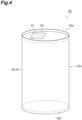
- a container 60 shown in FIG. 4 is manufactured using the packaging material 10. The container 60 may be manufactured using the packaging material 20.
- the container 60 includes a cylindrical container main body 62 having an upper portion 62a having an opening 61, a side surface 62b and a bottom portion 62c, and a seal portion 65 closing the opening 61.
- the container main body 62 has the protective layer 5 of the packaging material 10 as the outermost layer and the sealant layer 4 as the innermost layer.
- the side surface 62b is configured of the packaging material 10 that is bent while being heated.
- the packaging material 10 can be bent at a low temperature, can maintain sufficient gas barrier properties even after tension is applied by bending, and can curb leakage of the contents after heat sealing. Therefore, deterioration and leakage of the contents can be sufficiently curbed for a long period of time.
- the packaging material 20 may not include the primer layer 11.
- the container 50 has the opening 51 in the upper portion 52a, the opening 51 may not be provided.
- the shape of the container is not limited to the shapes of the containers 50 and 60, and may be, for example, a brick type or a triangular pyramid shape.
- the following materials were prepared for the adhesive resin layer and the sealant layer.
- the melt flow rate is a value measured according to JIS K7210-1 under conditions of a temperature of 190°C and a load of 2.16 kg.
- the melting point is a value measured using a differential scanning calorimeter.
- the Vicat softening point is a value measured according to JIS K7206-1999.
- the durometer hardness is a value measured at 23°C according to JIS K7215:1986.
- a packaging material according to this example was obtained through the following steps. That is, a gas barrier film was prepared by forming a deposition layer (a silica deposition layer, thickness: 50 nm) containing silica as a main component on one surface of a film base material (material: polypropylene resin, thickness: 18 ⁇ m). Two marks were made on the polypropylene film at an interval of 100 mm in an MD direction in the subsequent extrusion lamination for the evaluation of stretchability described below.
- a sealant layer material: ethylene-methacrylic acid copolymer A, thickness: 30 ⁇ m
- Table 1 were used as lamination temperature.
- a protective layer material: polyethylene, thickness: 15 ⁇ m
- a paper base material base weight: 260 g/m 2
- the laminates 1 and 2 were adhered together with the ethylene-methacrylic acid copolymer A (the adhesive resin layer) by extrusion lamination so that the deposition layer of the laminate 1 and the paper base material of the laminate 2 faced each other.
- a thickness of the adhesive resin layer was 15 ⁇ m.
- a temperature during the extrusion lamination was a value shown in Table 1.
- the obtained packaging material was formed into a gable top type container.
- the temperature for heat sealing was a temperature shown in Table 1.
- the temperatures listed in Table 1 are the lowest possible temperatures within a temperature range that does not cause leakage of the contents.
- the leakage of the contents was confirmed by injecting an ageless seal check liquid (trade name, manufactured by Mitsubishi Gas Chemical Company, Inc.).
- a packaging material and a container were manufactured in the same manner as in Example 1, except that the ethylene-methacrylic acid copolymer B was used instead of the ethylene-methacrylic acid copolymer A as the sealant layer and the adhesive resin layer.
- a packaging material and a container were manufactured in the same manner as in Example 1, except that the ethylene-methacrylic acid copolymer C was used instead of the ethylene-methacrylic acid copolymer A as the sealant layer and the adhesive resin layer.
- a packaging material and a container were manufactured in the same manner as in Example 1, except that a low-density polyethylene resin was used instead of the ethylene-methacrylic acid copolymer A as the sealant layer and the adhesive resin layer.
- a packaging material and a container were manufactured in the same manner as in Example 1, except that a low-density polyethylene resin was used instead of the ethylene-methacrylic acid copolymer A as the sealant layer.
- a packaging material was manufactured in the same manner as in Example 1, except that the ethylene-methacrylic acid copolymer D was used instead of the ethylene-methacrylic acid copolymer A as the sealant layer. An attempt was made to form the obtained packaging material into a gable top type container, but the sealing filling of the sealant layer was poor, and the leakage of the contents occurred.
- Measurement was performed under the conditions of a temperature of 30°C and a relative humidity of 70% using an oxygen permeability measuring device (manufactured by Mocon, trade name: "OX-TRAN 2/22"). The measurement was performed on the container immediately after box forming. Table 1 shows the results. The measured value was expressed as [(cc/pkg ⁇ day)].
- the gist of the present disclosure resides in the following [1] to [7].
Landscapes
- Engineering & Computer Science (AREA)
- Mechanical Engineering (AREA)
- Laminated Bodies (AREA)
- Wrappers (AREA)
Applications Claiming Priority (2)
| Application Number | Priority Date | Filing Date | Title |
|---|---|---|---|
| JP2021108673 | 2021-06-30 | ||
| PCT/JP2022/025832 WO2023277037A1 (fr) | 2021-06-30 | 2022-06-28 | Matériau d'emballage et récipient |
Publications (2)
| Publication Number | Publication Date |
|---|---|
| EP4310019A1 true EP4310019A1 (fr) | 2024-01-24 |
| EP4310019A4 EP4310019A4 (fr) | 2024-09-25 |
Family
ID=84690817
Family Applications (1)
| Application Number | Title | Priority Date | Filing Date |
|---|---|---|---|
| EP22833183.1A Pending EP4310019A4 (fr) | 2021-06-30 | 2022-06-28 | Matériau d'emballage et récipient |
Country Status (4)
| Country | Link |
|---|---|
| EP (1) | EP4310019A4 (fr) |
| JP (1) | JPWO2023277037A1 (fr) |
| CN (1) | CN117222582B (fr) |
| WO (1) | WO2023277037A1 (fr) |
Family Cites Families (7)
| Publication number | Priority date | Publication date | Assignee | Title |
|---|---|---|---|---|
| JP4727782B2 (ja) | 1999-12-13 | 2011-07-20 | 大日本印刷株式会社 | 液体紙容器 |
| JP4261242B2 (ja) * | 2002-04-19 | 2009-04-30 | 株式会社イシダ | 食品包装用袋 |
| JP6136270B2 (ja) * | 2013-01-08 | 2017-05-31 | 凸版印刷株式会社 | 液体用紙容器 |
| JP2015112831A (ja) * | 2013-12-13 | 2015-06-22 | 凸版印刷株式会社 | 包材及び容器 |
| JP2020158154A (ja) * | 2019-03-26 | 2020-10-01 | 大日本印刷株式会社 | 包装材料及び包装製品 |
| US12240217B2 (en) * | 2019-07-09 | 2025-03-04 | Dow-Mitsui Polychemicals Co., Ltd. | Laminated product for flexible packaging, flexible packaging material, and flexible package |
| JP7540146B2 (ja) * | 2019-11-18 | 2024-08-27 | Toppanホールディングス株式会社 | 紙容器用積層シート、及び紙容器 |
-
2022
- 2022-06-28 CN CN202280031042.4A patent/CN117222582B/zh active Active
- 2022-06-28 EP EP22833183.1A patent/EP4310019A4/fr active Pending
- 2022-06-28 WO PCT/JP2022/025832 patent/WO2023277037A1/fr not_active Ceased
- 2022-06-28 JP JP2023531995A patent/JPWO2023277037A1/ja active Pending
Also Published As
| Publication number | Publication date |
|---|---|
| JPWO2023277037A1 (fr) | 2023-01-05 |
| CN117222582A (zh) | 2023-12-12 |
| CN117222582B (zh) | 2026-01-30 |
| WO2023277037A1 (fr) | 2023-01-05 |
| EP4310019A4 (fr) | 2024-09-25 |
Similar Documents
| Publication | Publication Date | Title |
|---|---|---|
| EP4101639A1 (fr) | Stratifié de barrière contre les gaz et sac d'emballage | |
| EP3305682B1 (fr) | Film disposé en couches, et sac d'emballage | |
| EP3218187B1 (fr) | Film barrière résistant aux produits chimiques | |
| EP4209343A1 (fr) | Corps multicouche barrière aux gaz et sac de conditionnement | |
| WO2016021682A1 (fr) | Film multicouche, film stratifié pour matériau d'emballage, sac d'emballage, et sachet à maintien vertical | |
| KR102286459B1 (ko) | 용이한 개봉성을 갖는 무연신 필름 및 이를 포함하는 식품 포장재 | |
| EP4442451A1 (fr) | Stratifié formant barrière aux gaz, son procédé de fabrication et sac d'emballage | |
| JP2023111750A (ja) | 包装袋 | |
| EP4310019A1 (fr) | Matériau d'emballage et récipient | |
| JP2026048694A (ja) | 小袋 | |
| JP7207604B2 (ja) | アルコール透過抑制フィルム、及びアルコール透過抑制フィルムを用いた包装材並びに包装体 | |
| JP2016222277A (ja) | 包装袋 | |
| EP4144521A1 (fr) | Stratifié de barrière contre les gaz et sac d'emballage | |
| EP4310018A1 (fr) | Matériau d'emballage et récipient | |
| JP2021017046A (ja) | 高耐性包材用積層体 | |
| JP2024177010A (ja) | 延伸基材、バリア性基材、積層体および包装容器 | |
| JP2025021847A (ja) | 2軸延伸ポリエチレンフィルム | |
| JP2023063170A (ja) | バリア性基材、バリア性積層体及び包装容器 | |
| ES2200020T3 (es) | Procedimiento para imprimir y/o laminar una pelicula de polipropileno metalizada, y la pelicula asi obtenida. | |
| EP4368390B1 (fr) | Stratifié de barrière contre les gaz et contenant | |
| JP2023023646A (ja) | バリア性積層体、蓋材及び包装容器 | |
| JP2016074223A (ja) | 可撓性包装材料および容器詰水素ガス含有飲料 | |
| JP7746730B2 (ja) | ガスバリア積層体及びその製造方法、容器、並びに原反 | |
| JP2020185711A (ja) | 積層シートおよび紙容器 | |
| JP3044703B2 (ja) | 積層包装材料の製造方法 |
Legal Events
| Date | Code | Title | Description |
|---|---|---|---|
| STAA | Information on the status of an ep patent application or granted ep patent |
Free format text: STATUS: THE INTERNATIONAL PUBLICATION HAS BEEN MADE |
|
| PUAI | Public reference made under article 153(3) epc to a published international application that has entered the european phase |
Free format text: ORIGINAL CODE: 0009012 |
|
| STAA | Information on the status of an ep patent application or granted ep patent |
Free format text: STATUS: REQUEST FOR EXAMINATION WAS MADE |
|
| 17P | Request for examination filed |
Effective date: 20231019 |
|
| AK | Designated contracting states |
Kind code of ref document: A1 Designated state(s): AL AT BE BG CH CY CZ DE DK EE ES FI FR GB GR HR HU IE IS IT LI LT LU LV MC MK MT NL NO PL PT RO RS SE SI SK SM TR |
|
| A4 | Supplementary search report drawn up and despatched |
Effective date: 20240827 |
|
| RIC1 | Information provided on ipc code assigned before grant |
Ipc: B32B 29/00 20060101ALI20240821BHEP Ipc: B32B 27/36 20060101ALI20240821BHEP Ipc: B32B 27/34 20060101ALI20240821BHEP Ipc: B32B 27/30 20060101ALI20240821BHEP Ipc: B32B 27/28 20060101ALI20240821BHEP Ipc: B32B 27/08 20060101ALI20240821BHEP Ipc: B32B 15/20 20060101ALI20240821BHEP Ipc: B32B 15/085 20060101ALI20240821BHEP Ipc: B65D 5/74 20060101ALI20240821BHEP Ipc: B65D 5/40 20060101ALI20240821BHEP Ipc: B65D 65/40 20060101AFI20240821BHEP |
|
| DAV | Request for validation of the european patent (deleted) | ||
| DAX | Request for extension of the european patent (deleted) |