EP4310065A1 - Substrat composite - Google Patents
Substrat composite Download PDFInfo
- Publication number
- EP4310065A1 EP4310065A1 EP22774941.3A EP22774941A EP4310065A1 EP 4310065 A1 EP4310065 A1 EP 4310065A1 EP 22774941 A EP22774941 A EP 22774941A EP 4310065 A1 EP4310065 A1 EP 4310065A1
- Authority
- EP
- European Patent Office
- Prior art keywords
- ceramic plate
- mass
- composite substrate
- brazing material
- parts
- Prior art date
- Legal status (The legal status is an assumption and is not a legal conclusion. Google has not performed a legal analysis and makes no representation as to the accuracy of the status listed.)
- Withdrawn
Links
Images

Classifications
-
- C—CHEMISTRY; METALLURGY
- C04—CEMENTS; CONCRETE; ARTIFICIAL STONE; CERAMICS; REFRACTORIES
- C04B—LIME, MAGNESIA; SLAG; CEMENTS; COMPOSITIONS THEREOF, e.g. MORTARS, CONCRETE OR LIKE BUILDING MATERIALS; ARTIFICIAL STONE; CERAMICS; REFRACTORIES; TREATMENT OF NATURAL STONE
- C04B37/00—Joining burned ceramic articles with other burned ceramic articles or other articles by heating
- C04B37/02—Joining burned ceramic articles with other burned ceramic articles or other articles by heating with metallic articles
- C04B37/023—Joining burned ceramic articles with other burned ceramic articles or other articles by heating with metallic articles characterised by the interlayer used
- C04B37/026—Joining burned ceramic articles with other burned ceramic articles or other articles by heating with metallic articles characterised by the interlayer used consisting of metals or metal salts
-
- H—ELECTRICITY
- H05—ELECTRIC TECHNIQUES NOT OTHERWISE PROVIDED FOR
- H05K—PRINTED CIRCUITS; CASINGS OR CONSTRUCTIONAL DETAILS OF ELECTRIC APPARATUS; MANUFACTURE OF ASSEMBLAGES OF ELECTRICAL COMPONENTS
- H05K1/00—Printed circuits
- H05K1/02—Details
- H05K1/03—Use of materials for the substrate
-
- H—ELECTRICITY
- H05—ELECTRIC TECHNIQUES NOT OTHERWISE PROVIDED FOR
- H05K—PRINTED CIRCUITS; CASINGS OR CONSTRUCTIONAL DETAILS OF ELECTRIC APPARATUS; MANUFACTURE OF ASSEMBLAGES OF ELECTRICAL COMPONENTS
- H05K1/00—Printed circuits
- H05K1/02—Details
- H05K1/03—Use of materials for the substrate
- H05K1/0306—Inorganic insulating substrates, e.g. ceramic, glass
-
- H—ELECTRICITY
- H05—ELECTRIC TECHNIQUES NOT OTHERWISE PROVIDED FOR
- H05K—PRINTED CIRCUITS; CASINGS OR CONSTRUCTIONAL DETAILS OF ELECTRIC APPARATUS; MANUFACTURE OF ASSEMBLAGES OF ELECTRICAL COMPONENTS
- H05K3/00—Apparatus or processes for manufacturing printed circuits
- H05K3/38—Improvement of the adhesion between the insulating substrate and the metal
-
- C—CHEMISTRY; METALLURGY
- C04—CEMENTS; CONCRETE; ARTIFICIAL STONE; CERAMICS; REFRACTORIES
- C04B—LIME, MAGNESIA; SLAG; CEMENTS; COMPOSITIONS THEREOF, e.g. MORTARS, CONCRETE OR LIKE BUILDING MATERIALS; ARTIFICIAL STONE; CERAMICS; REFRACTORIES; TREATMENT OF NATURAL STONE
- C04B2235/00—Aspects relating to ceramic starting mixtures or sintered ceramic products
- C04B2235/65—Aspects relating to heat treatments of ceramic bodies such as green ceramics or pre-sintered ceramics, e.g. burning, sintering or melting processes
- C04B2235/658—Atmosphere during thermal treatment
- C04B2235/6581—Total pressure below 1 atmosphere, e.g. vacuum
-
- C—CHEMISTRY; METALLURGY
- C04—CEMENTS; CONCRETE; ARTIFICIAL STONE; CERAMICS; REFRACTORIES
- C04B—LIME, MAGNESIA; SLAG; CEMENTS; COMPOSITIONS THEREOF, e.g. MORTARS, CONCRETE OR LIKE BUILDING MATERIALS; ARTIFICIAL STONE; CERAMICS; REFRACTORIES; TREATMENT OF NATURAL STONE
- C04B2235/00—Aspects relating to ceramic starting mixtures or sintered ceramic products
- C04B2235/70—Aspects relating to sintered or melt-casted ceramic products
- C04B2235/96—Properties of ceramic products, e.g. mechanical properties such as strength, toughness, wear resistance
-
- C—CHEMISTRY; METALLURGY
- C04—CEMENTS; CONCRETE; ARTIFICIAL STONE; CERAMICS; REFRACTORIES
- C04B—LIME, MAGNESIA; SLAG; CEMENTS; COMPOSITIONS THEREOF, e.g. MORTARS, CONCRETE OR LIKE BUILDING MATERIALS; ARTIFICIAL STONE; CERAMICS; REFRACTORIES; TREATMENT OF NATURAL STONE
- C04B2237/00—Aspects relating to ceramic laminates or to joining of ceramic articles with other articles by heating
- C04B2237/02—Aspects relating to interlayers, e.g. used to join ceramic articles with other articles by heating
- C04B2237/12—Metallic interlayers
-
- C—CHEMISTRY; METALLURGY
- C04—CEMENTS; CONCRETE; ARTIFICIAL STONE; CERAMICS; REFRACTORIES
- C04B—LIME, MAGNESIA; SLAG; CEMENTS; COMPOSITIONS THEREOF, e.g. MORTARS, CONCRETE OR LIKE BUILDING MATERIALS; ARTIFICIAL STONE; CERAMICS; REFRACTORIES; TREATMENT OF NATURAL STONE
- C04B2237/00—Aspects relating to ceramic laminates or to joining of ceramic articles with other articles by heating
- C04B2237/02—Aspects relating to interlayers, e.g. used to join ceramic articles with other articles by heating
- C04B2237/12—Metallic interlayers
- C04B2237/122—Metallic interlayers based on refractory metals
-
- C—CHEMISTRY; METALLURGY
- C04—CEMENTS; CONCRETE; ARTIFICIAL STONE; CERAMICS; REFRACTORIES
- C04B—LIME, MAGNESIA; SLAG; CEMENTS; COMPOSITIONS THEREOF, e.g. MORTARS, CONCRETE OR LIKE BUILDING MATERIALS; ARTIFICIAL STONE; CERAMICS; REFRACTORIES; TREATMENT OF NATURAL STONE
- C04B2237/00—Aspects relating to ceramic laminates or to joining of ceramic articles with other articles by heating
- C04B2237/02—Aspects relating to interlayers, e.g. used to join ceramic articles with other articles by heating
- C04B2237/12—Metallic interlayers
- C04B2237/125—Metallic interlayers based on noble metals, e.g. silver
-
- C—CHEMISTRY; METALLURGY
- C04—CEMENTS; CONCRETE; ARTIFICIAL STONE; CERAMICS; REFRACTORIES
- C04B—LIME, MAGNESIA; SLAG; CEMENTS; COMPOSITIONS THEREOF, e.g. MORTARS, CONCRETE OR LIKE BUILDING MATERIALS; ARTIFICIAL STONE; CERAMICS; REFRACTORIES; TREATMENT OF NATURAL STONE
- C04B2237/00—Aspects relating to ceramic laminates or to joining of ceramic articles with other articles by heating
- C04B2237/02—Aspects relating to interlayers, e.g. used to join ceramic articles with other articles by heating
- C04B2237/12—Metallic interlayers
- C04B2237/126—Metallic interlayers wherein the active component for bonding is not the largest fraction of the interlayer
- C04B2237/127—The active component for bonding being a refractory metal
-
- C—CHEMISTRY; METALLURGY
- C04—CEMENTS; CONCRETE; ARTIFICIAL STONE; CERAMICS; REFRACTORIES
- C04B—LIME, MAGNESIA; SLAG; CEMENTS; COMPOSITIONS THEREOF, e.g. MORTARS, CONCRETE OR LIKE BUILDING MATERIALS; ARTIFICIAL STONE; CERAMICS; REFRACTORIES; TREATMENT OF NATURAL STONE
- C04B2237/00—Aspects relating to ceramic laminates or to joining of ceramic articles with other articles by heating
- C04B2237/30—Composition of layers of ceramic laminates or of ceramic or metallic articles to be joined by heating, e.g. Si substrates
- C04B2237/32—Ceramic
-
- C—CHEMISTRY; METALLURGY
- C04—CEMENTS; CONCRETE; ARTIFICIAL STONE; CERAMICS; REFRACTORIES
- C04B—LIME, MAGNESIA; SLAG; CEMENTS; COMPOSITIONS THEREOF, e.g. MORTARS, CONCRETE OR LIKE BUILDING MATERIALS; ARTIFICIAL STONE; CERAMICS; REFRACTORIES; TREATMENT OF NATURAL STONE
- C04B2237/00—Aspects relating to ceramic laminates or to joining of ceramic articles with other articles by heating
- C04B2237/30—Composition of layers of ceramic laminates or of ceramic or metallic articles to be joined by heating, e.g. Si substrates
- C04B2237/32—Ceramic
- C04B2237/36—Non-oxidic
- C04B2237/366—Aluminium nitride
-
- C—CHEMISTRY; METALLURGY
- C04—CEMENTS; CONCRETE; ARTIFICIAL STONE; CERAMICS; REFRACTORIES
- C04B—LIME, MAGNESIA; SLAG; CEMENTS; COMPOSITIONS THEREOF, e.g. MORTARS, CONCRETE OR LIKE BUILDING MATERIALS; ARTIFICIAL STONE; CERAMICS; REFRACTORIES; TREATMENT OF NATURAL STONE
- C04B2237/00—Aspects relating to ceramic laminates or to joining of ceramic articles with other articles by heating
- C04B2237/30—Composition of layers of ceramic laminates or of ceramic or metallic articles to be joined by heating, e.g. Si substrates
- C04B2237/32—Ceramic
- C04B2237/36—Non-oxidic
- C04B2237/368—Silicon nitride
-
- C—CHEMISTRY; METALLURGY
- C04—CEMENTS; CONCRETE; ARTIFICIAL STONE; CERAMICS; REFRACTORIES
- C04B—LIME, MAGNESIA; SLAG; CEMENTS; COMPOSITIONS THEREOF, e.g. MORTARS, CONCRETE OR LIKE BUILDING MATERIALS; ARTIFICIAL STONE; CERAMICS; REFRACTORIES; TREATMENT OF NATURAL STONE
- C04B2237/00—Aspects relating to ceramic laminates or to joining of ceramic articles with other articles by heating
- C04B2237/30—Composition of layers of ceramic laminates or of ceramic or metallic articles to be joined by heating, e.g. Si substrates
- C04B2237/40—Metallic
- C04B2237/407—Copper
-
- C—CHEMISTRY; METALLURGY
- C04—CEMENTS; CONCRETE; ARTIFICIAL STONE; CERAMICS; REFRACTORIES
- C04B—LIME, MAGNESIA; SLAG; CEMENTS; COMPOSITIONS THEREOF, e.g. MORTARS, CONCRETE OR LIKE BUILDING MATERIALS; ARTIFICIAL STONE; CERAMICS; REFRACTORIES; TREATMENT OF NATURAL STONE
- C04B2237/00—Aspects relating to ceramic laminates or to joining of ceramic articles with other articles by heating
- C04B2237/50—Processing aspects relating to ceramic laminates or to the joining of ceramic articles with other articles by heating
- C04B2237/70—Forming laminates or joined articles comprising layers of a specific, unusual thickness
-
- C—CHEMISTRY; METALLURGY
- C04—CEMENTS; CONCRETE; ARTIFICIAL STONE; CERAMICS; REFRACTORIES
- C04B—LIME, MAGNESIA; SLAG; CEMENTS; COMPOSITIONS THEREOF, e.g. MORTARS, CONCRETE OR LIKE BUILDING MATERIALS; ARTIFICIAL STONE; CERAMICS; REFRACTORIES; TREATMENT OF NATURAL STONE
- C04B2237/00—Aspects relating to ceramic laminates or to joining of ceramic articles with other articles by heating
- C04B2237/50—Processing aspects relating to ceramic laminates or to the joining of ceramic articles with other articles by heating
- C04B2237/74—Forming laminates or joined articles comprising at least two different interlayers separated by a substrate
-
- C—CHEMISTRY; METALLURGY
- C04—CEMENTS; CONCRETE; ARTIFICIAL STONE; CERAMICS; REFRACTORIES
- C04B—LIME, MAGNESIA; SLAG; CEMENTS; COMPOSITIONS THEREOF, e.g. MORTARS, CONCRETE OR LIKE BUILDING MATERIALS; ARTIFICIAL STONE; CERAMICS; REFRACTORIES; TREATMENT OF NATURAL STONE
- C04B2237/00—Aspects relating to ceramic laminates or to joining of ceramic articles with other articles by heating
- C04B2237/50—Processing aspects relating to ceramic laminates or to the joining of ceramic articles with other articles by heating
- C04B2237/86—Joining of two substrates at their largest surfaces, one surface being complete joined and covered, the other surface not, e.g. a small plate joined at it's largest surface on top of a larger plate
Definitions
- the present disclosure relates to a composite substrate.
- a circuit substrate including a ceramic plate having good heat conduction is used. Thermal stress is generated in such a circuit substrate due to heating and cooling steps when joining a ceramic plate and a metal plate via a brazing material and heat cycles during use. This thermal stress may cause cracks in the ceramic substrate or peeling off of the metal plate.
- Patent Literature 1 describes a ceramic circuit substrate in which heat cycle characteristics are improved by making the coefficient of thermal expansion of a brazing material close to that of the ceramic substrate.
- Patent Literature 1 Japanese Unexamined Patent Publication No. 2014-118310
- a circuit substrate is required to have sufficiently high reliability depending on the application in which the circuit substrate is used.
- joining at a high temperature increases the hardness in the vicinity of the brazing material layer, which tends to make it difficult to relieve the thermal stress generated during the heat cycle. It is useful when there is a composite substrate that can achieve both joining strength and heat cycle characteristics.
- An object of the present disclosure is to provide a composite substrate having excellent heat cycle characteristics and joining strength between a ceramic plate and a metal base material.
- a composite substrate including a ceramic plate and a metal base material joined onto the ceramic plate via a brazing material layer containing silver and an active metal, in which X is 70 to 110 HV and a ratio of Y to X is 0.92 or less, where a Vickers hardness at a position of 20 ⁇ m from the ceramic plate toward the metal base material is X and a Vickers hardness at a position of 70 ⁇ m from the ceramic plate toward the metal base material is Y
- the composite substrate has a Vickers hardness such that X is within a predetermined range, and thus the joining is sufficiently fixed in the range of 20 ⁇ m or less from the ceramic plate toward the metal base material, and excellent joining strength between the ceramic plate and the metal base material can be exhibited. Further, the fact that the ratio of Y to X (the value of Y/X) is within the above range means that the Vickers hardness is excellent in the vicinity of the interface between the ceramic plate and the brazing material layer, and further, a large increase in Vickers hardness in the metal base material is suppressed by the wide diffusion of the brazing material component into the metal base material, and the thermal stress caused by the heat cycle can be relieved. Therefore, in the composite substrate, the peeling off of the metal base material from the ceramic plate due to the heat cycle is sufficiently suppressed. That is, the composite substrate can have excellent heat cycle characteristics and joining strength between the ceramic plate and the metal base material.
- the ratio of Yto X may be 0.50 or more.
- the joining strength between the ceramic plate and the metal base material can be further improved, and both the joining strength and heat cycle characteristics can be achieved at a higher level.
- the active metal may contain at least one selected from a group consisting of titanium, zirconium, hafnium, vanadium, niobium, and tantalum. As the brazing material layer contains the active metal, the adhesiveness between the ceramic plate and the metal base material can be further improved.
- the ceramic plate may contain silicon nitride.
- a thickness of the brazing material layer may be 20 ⁇ m or less.
- a composite substrate having excellent heat cycle characteristics and joining strength between a ceramic plate and a metal base material can be provided.
- each component in the composition means the total amount of the plurality of substances present in the composition unless otherwise specified when there are the plurality of substances corresponding to each component in the composition.
- One embodiment of the composite substrate includes a ceramic plate and a metal base material joined onto the ceramic plate via a brazing material layer containing an active metal. The joining may be performed by an active metal method.
- a composite substrate may have one or more metal base materials.
- FIG. 1 is a schematic sectional view showing an example of a composite substrate, and shows a cross section of the composite substrate orthogonal to a joining surface which will be described later.
- a composite substrate 100 includes a ceramic plate 10, a circuit board 40 and a heat sink 50.
- the circuit board 40 is configured to be joined to a front surface 10A of the ceramic plate 10 at a joining surface 40a, and a metal base material 30 is configured to be joined to the ceramic plate 10 via a brazing material layer 20.
- the heat sink 50 is configured to be joined to a back surface 10B of the ceramic plate 10 at a joining surface 50a, and a metal base material 32 is configured to be joined to the ceramic plate 10 via a brazing material layer 22.
- FIG. 1 is a schematic sectional view showing an example of a composite substrate, and shows a cross section of the composite substrate orthogonal to a joining surface which will be described later.
- a composite substrate 100 includes a ceramic plate 10, a circuit board 40 and a heat sink 50.
- circuit boards 40 are joined to the front surface 10A of the ceramic plate 10
- the heat sink 50 is joined to the back surface 10B of the ceramic plate 10.
- the number of circuit boards 40 and the number of heat sinks 50 may be changed as appropriate depending on the case.
- the circuit board 40 may have a function of transmitting electrical signals, while the heat sink 50 may have a function of transmitting heat. Note that the heat sink 50 may further have a function of transmitting electrical signals.
- the circuit board 40 and the heat sink 50 may be made of the same material, or may be made of different materials. From the viewpoint of improving conductivity and heat dissipation, the metal base materials 30 and 32 may contain copper as a main component, for example. In this case, the circuit board 40 and the heat sink 50 may be composed of a brazing material layer and a copper plate.
- X is 70 to 110 HV, where the Vickers hardness at a position of 20 ⁇ m from the ceramic plate 10 toward the metal base material 30 is X, and the Vickers hardness at a position of 70 ⁇ m from the ceramic plate 10 toward the metal base material 30 is Y
- the above X may be, for example, 72 to 97 HV, or 73 to 95 HV
- the ratio of Y to X (the value of Y/X) is 0.92 or less.
- the upper limit value of the ratio may be, for example, 0.90 or less, or 0.88 or less.
- the lower limit value of the above ratio may be, for example, 0.50 or more, 0.52 or more, or 0.53 or more.
- the active metal can be appropriately diffused into the metal base material at the interface between the brazing material layer and the metal base material, and the joining strength can be further improved.
- the ratio may be adjusted within the ranges mentioned above, and may be, for example, 0.50 to 0.92, or 0.53 to 0.90.
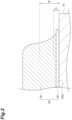
- FIG. 2 is an enlarged sectional view of the vicinity of the joining surface of the composite substrate, and shows a cross section orthogonal to the joining surface between the ceramic plate and the metal base material. Using the joining surface between the ceramic plate 10 and the metal base material 30 as a reference position, the position is determined by performing measurement from the reference position in the direction perpendicular to the joining surface and in the direction of the brazing material layer 20 and the metal base material 30.
- Vickers hardness is measured at a point separated by a distance A (for example, 20 ⁇ m) and a point separated by a distance B (for example, 70 ⁇ m) in FIG. 2 .
- a distance A for example, 20 ⁇ m
- a distance B for example, 70 ⁇ m
- FIG. 2 an enlarged view of the joining surface 40a on the front surface 10A of the ceramic plate 10 is shown for explanation, but also on the joining surface 50a on the back surface 10B of the ceramic plate 10, the measurement is performed in a similar manner.
- the Vickers hardness in a cross-sectional surface of the composite substrate 100 including the part where the ceramic plate and the metal base material are joined via the brazing material, on each of the joining surfaces (in the case of the composite substrate 100 in FIG.
- the ceramic plate 10 may be composed of either silicon nitride or aluminum nitride, and preferably includes silicon nitride.
- the ceramic plate may be, for example, an aluminum nitride sintered body or a silicon nitride sintered body.
- the brazing material layers 20 and 22 are layers obtained by heat-treating a brazing material.
- the brazing material contains silver as a main component and active metals as subcomponents.
- the content of silver may be, for example, 85% by mass or more, 87% by mass or more, or 90% by mass or more based on the total amount of the brazing material layer.
- the content of silver may be, for example, 98% by mass or less, or 99% by mass or less based on the total amount of the brazing material layer.
- the active metal may contain, for example, at least one selected from the group consisting of titanium, zirconium, hafnium, vanadium, niobium, and tantalum, and may contain silver as a main component.
- the brazing material layers 20 and 22 may contain, for example, carbon in addition to the active metal.
- the brazing material layer 20 may contain metals such as copper (Cu), tin (Sn), and indium (In) for the purpose of lowering the melting point.
- the content of the active metal in the brazing material layer may be adjusted based on the silver content being 100 parts by mass.
- the content of copper in the brazing material layers 20 and 22 may be, for example, 17 parts by mass or less, 15 parts by mass or less, 14 parts by mass or less, 13 parts by mass or less, or 12 parts by mass or less with respect to 100 parts by mass of the content of silver.
- the content of copper in the brazing material layers 20 and 22 may be, for example, 2 parts by mass or more, 4 parts by mass or more, 6 parts by mass or more, 8 parts by mass or more, or 10 parts by mass or more with respect to 100 parts by mass of the content of silver.
- the content of copper in the brazing material layers 20 and 22 may be adjusted within the range described above, and may be, for example, 2 to 17 parts by mass with respect to 100 parts by mass of the content of silver.
- the content of tin in the brazing material layers 20 and 22 is, for example, 6.0 parts by mass or less, 5.5 parts by mass or less, 5.0 parts by mass or less, 3.0 parts by mass or less, or 1.0 part by mass or less with respect to 100 parts by mass of the content of silver.
- the content of tin in the brazing material layers 20 and 22 may be, for example, 0.5 parts by mass or more, 0.8 parts by mass or more, or 0.9 parts by mass or more with respect to 100 parts by mass of the content of silver.
- the content of tin in the brazing material layers 20 and 22 may be adjusted within the range described above, and may be, for example, 0.5 to 6.0 parts by mass with respect to 100 parts by mass of the content of silver.
- the upper limit value of the content of titanium in the brazing material layers 20 and 22 may be, for example, 7.0 parts by mass or less, 6.0 parts by mass or less, 5.0 parts by mass or less, or 4.0 parts by mass or less with respect to 100 parts by mass of the content of silver.
- the lower limit value of the content of titanium in the brazing material layers 20 and 22 is, for example, 0.6 parts by mass or more, 0.8 parts by mass or more, or 1.0 part by mass or more with respect to 100 parts by mass of the content of silver.
- the content of titanium in the brazing material layers 20 and 22 may be adjusted within the range described above, and may be, for example, 1.0 to 5.0 parts by mass with respect to 100 parts by mass of the content of silver.
- the brazing material layers 20 and 22 may contain components other than metals, such as silver and active metals, as long as the effects of the present invention are not impaired. Impurities are also included in other components.
- the content of other components may be, for example, 15.0% by mass or less, 14.0% by mass or less, 12.0% by mass or less, 10.0% by mass or less, 5.0% by mass or less, 3.0% by mass or less, 1.0% by mass or less, or 0.5% by mass or less based on the total amount of the brazing material layer.
- the upper limit value of the thickness of the brazing material layers 20 and 22 may be, for example, 20 ⁇ m or less, 18 ⁇ m or less, or 15 ⁇ m or less. When the upper limit value of the thickness is within the above range, the heat cycle characteristics can be made more sufficient, and even after use in a high heat dissipation environment, the occurrence of peeling or the like of the brazing material layers 20 and 22 caused by thermal stress can be more sufficiently suppressed.
- the lower limit value of the thickness of the brazing material layers 20 and 22 may be, for example, 3 ⁇ m or more, 5 ⁇ m or more, or 8 ⁇ m or more.
- the thickness of the brazing material layer may be adjusted within the above range, and may be, for example, 3 to 20 ⁇ m.
- the thickness of the brazing material layer in this specification means a value measured in an electron microscope image of a cross section orthogonal to the joining surface between the ceramic plate and the metal base material in the composite substrate.
- the thickness of the brazing material layer in a cross-sectional surface of the composite substrate 100 including the part where the ceramic plate and the metal base material are joined via the brazing material, on each of the joining surfaces (in the case of the composite substrate 100 in FIG.
- the maximum thickness of the brazing material layer is measured, and the arithmetic mean value is adopted.
- the composite substrate 100 has excellent joining strength between the ceramic plate 10 and the metal base materials 30 and 32.
- the joining strength between the ceramic plate 10 and the metal base materials 30 and 32 can be, for example, 80 N/cm or more, 100 N/cm or more, 120 N/cm or more, or 140 N/cm or more.
- the joining strength means the value obtained by dividing the maximum peeling load (unit: N) when part of the metal base material is peeled off at 90° (perpendicular direction) by the width of the metal base material (unit: cm). Specifically, the measurement is performed by the method described in Examples below.
- the composite substrate 100 can exhibit excellent heat cycle characteristics. Heat cycle characteristics can be evaluated by performing the temperature change test according to the method described in JIS C 60068-2-14:2011 "Environmental testing -Part 2-14: Tests-Test N: Change of temperature”.
- the composite substrate 100 described above can be manufactured, for example, by the following method.
- One embodiment of the method for manufacturing a composite substrate includes a step of forming a slurry containing an inorganic compound powder, a sintering aid, a binder resin, and a solvent to obtain a green sheet (green sheet preparation step); a step of heat-treating the green sheet to obtain a ceramic plate (ceramic plate preparation step); a step of pasting a metal base material onto a ceramic plate via a brazing material containing silver and active metal to obtain a laminate (lamination step); and a step of heat-treating the laminate to obtain a composite substrate (heat treatment step).
- a slurry containing components that serve as raw materials for the ceramic plate is prepared and formed into a sheet to prepare a green sheet.
- the slurry forming method may be, for example, a doctor blade method, an extrusion forming method, or the like.
- Examples of inorganic compounds include silicon nitride (Si 3 N 4 ), aluminum nitride (AIN), silicon carbide, and aluminum oxide.
- Examples of sintering aids include metal oxides, fluorides, chlorides, nitrates, and sulfates of rare earth elements; and metal oxides, fluorides, chlorides, nitrates, and sulfates of alkaline earth metals. These may be used alone or in combination of two or more.
- the sintering aid may include oxides of alkaline earth metals, such as magnesium oxide.
- binder resins examples include methyl cellulose, ethyl cellulose, polyvinyl alcohol, polyvinyl butyral, and (meth)acrylic resins.
- binder resins include methyl cellulose, ethyl cellulose, polyvinyl alcohol, polyvinyl butyral, and (meth)acrylic resins.
- solvents include organic solvents such as ethanol and toluene. The viscosity of the slurry can be easily adjusted by using the binder resin and solvent.
- the slurry may contain other components in addition to the inorganic compound powder, sintering aid, binder resin, and solvent.
- other components include plasticizers and dispersants.
- plasticizers include purified glycerin, glycerin trioleate, diethylene glycol, phthalic acid plasticizers such as di-n-butyl phthalate, and dibasic acid plasticizers such as di-2-ethylhexyl sebacate.
- dispersants include poly(meth)acrylates and (meth)acrylic acid-maleate copolymers.
- the ceramic plate preparation step is a step of heat-treating the green sheet obtained by forming to obtain a ceramic plate.
- the heat treatment of the green sheet is performed by a plural times of heat treatments, and may include, for example, a degreasing step in which heat treatment is performed at a heating temperature of 800°C or lower, and a sintering step in which heat treatment is performed at a higher temperature than the heating temperature in the degreasing step.
- the degreasing step the green sheet is degreased mainly by burning the binder resin or the like.
- the raw material containing the inorganic compound and the sintering aid is sintered to obtain a ceramic plate.
- the heating temperature in the degreasing step may be, for example, 750 to 800°C, 760 to 790°C, or 780 to 790°C.
- the heating time in the degreasing step may be, for example, 0.5 to 20 hours.
- the heating temperature in the sintering step is higher than the heating temperature in the degreasing step.
- the heating temperature in the sintering step may be, for example, 1,600 to 1,950°C, 1,700 to 1,950°C, or 1,800 to 1,900°C.
- the heating time in the sintering step may be, for example, 5 to 15 hours.
- the sintering step may be performed under a non-oxidizing gas atmosphere such as nitrogen, argon, ammonia, and hydrogen.
- the method for manufacturing a composite substrate according to the present embodiment has been described as a method including the step of preparing a ceramic plate, but instead of the green sheet preparation step and the ceramic plate preparation step, a ceramic plate prepared in advance (for example, a commercially available ceramic plate) may be used.
- the ceramic plate and the metal base material are laminated using a brazing material containing active metal to obtain a laminate.
- a brazing material is applied to the front surface of a ceramic plate to form a coating film, and a metal base material is attached onto the coating film.
- the metal base material is pasted to both the front and back surfaces of the ceramic plate by the same operation.
- the shape of the metal base material may be, for example, a flat plate shape.
- a circuit may be formed in advance on the metal base material.
- the coating film containing the brazing material can be applied to the front surface of the ceramic plate by, for example, a roll coater method, a screen printing method, a transfer method, or the like.
- the brazing material contains silver (Ag) as a main component and active metals as subcomponents.
- the active metal include titanium (Ti), zirconium (Zr), hafnium (Hf), vanadium (V), niobium (Nb), and tantalum (Ta).
- the brazing material may contain metals such as copper (Cu), tin (Sn), and indium (In) for the purpose of lowering the melting point.
- the content of the active metal in the brazing material layer may be adjusted based on the silver content being 100 parts by mass.
- the content of copper in the brazing materials may be, for example, 17 parts by mass or less, 15 parts by mass or less, 14 parts by mass or less, 13 parts by mass or less, or 12 parts by mass or less with respect to 100 parts by mass of the content of silver.
- the content of copper in the brazing materials may be, for example, 2 parts by mass or more, 4 parts by mass or more, 6 parts by mass or more, 8 parts by mass or more, or 10 parts by mass or more with respect to 100 parts by mass of the content of silver.
- the content of copper in the brazing materials may be adjusted within the range described above, and may be, for example, 2 to 16 parts by mass with respect to 100 parts by mass of the content of silver.
- the brazing material contains tin, it is possible to lower the melting point of the brazing material and reduce the influence of the heat treatment on the constituent members in the vicinity of the joining surface, and accordingly, the reliability of the obtained composite substrate can be further improved.
- the content of tin in the brazing materials is, for example, 6.0 parts by mass or less, 5.5 parts by mass or less, 5.0 parts by mass or less, 3.0 parts by mass or less, or 1.0 part by mass or less with respect to 100 parts by mass of the content of silver.
- the content of tin in the brazing materials may be, for example, 0.5 parts by mass or more with respect to 100 parts by mass of the content of silver.
- the content of tin in the brazing materials may be adjusted within the range described above, and may be, for example, 0.5 to 6.0 parts by mass with respect to 100 parts by mass of the content of silver.
- the upper limit value of the content of titanium in the brazing material may be, for example, 7.0 parts by mass or less, 6.0 parts by mass or less, 5.0 parts by mass or less, or 4.0 parts by mass or less with respect to 100 parts by mass of the content of silver.
- the lower limit value of the content of titanium in the brazing materials is, for example, 0.6 parts by mass or more, 0.8 parts by mass or more, or 1.0 part by mass or more with respect to 100 parts by mass of the content of silver.
- the content of titanium in the brazing materials may be adjusted within the range described above, and may be, for example, 1.0 to 5.0 parts by mass with respect to 100 parts by mass of the content of silver.
- the viscosity of the brazing material at 25°C may be, for example, 5 to 40 Pa ⁇ s.
- the viscosity of the brazing material is within the above range, it is possible to form a more uniform coating film on the ceramic plate, the melt viscosity during heat treatment for joining becomes appropriate, and the brazing material can be spread sufficiently between the ceramic plate and the metal base material.
- the joining strength can be further improved, and the reliability of the composite substrate can be enhanced.
- the brazing material may contain, for example, an organic solvent, a binder, and the like.
- the content of organic solvent in the brazing material may be, for example, 5 to 25% by mass.
- the content of binder in the brazing material may be, for example, 2 to 15% by mass.
- the laminate is heated in a heating furnace, and the ceramic plate is made sufficiently join to the metal base material to obtain a composite substrate.
- the heat treatment is performed by dividing the temperature pattern into a plurality of times.
- the heat treatment step may include, for example, a first heat treatment step of heat-treating the laminate at a temperature of lower than 600°C, and a second heat treatment step of heat-treating the laminate at a temperature higher than the heating temperature in the first heat treatment step.
- the upper limit value of the heating temperature in the first heat treatment step may be, for example, lower than 600°C, 590°C or lower, 585°C or lower, 500°C or lower, 450°C or lower, or 410°C or lower.
- the upper limit value of the heating temperature in the first heat treatment step may be, for example, 350°C or higher, 360°C or higher, 380°C or higher, or 400°C or higher.
- the heating temperature in the first heat treatment step may be adjusted within the above range, and may be, for example, 350°C or higher and lower than 600°C, or 400 to 410°C.
- the upper limit value of the heating temperature in the second heat treatment step may be, for example, lower than 850°C, 845°C or lower, or 840°C or lower. By setting the upper limit value of the heating temperature within the above range, it is possible to suppress the diffusion of the components in the brazing material into the metal base material.
- the lower limit value of the heating temperature in the first heat treatment step may be, for example, 770°C or higher, 780°C or higher, 790°C or higher, or 800°C or higher. By setting the lower limit value of the heating temperature within the above range, it is possible to suppress defective joining due to unmelted brazing material.
- the heating temperature in the second heat treatment step may be adjusted within the above range, and may be, for example, 770°C or higher and lower than 850°C, or 800 to 840°C.
- the heating time in the second heat treatment step is relatively short. By shortening the heating time, it is possible to suppress excessive diffusion of the components in the brazing material among the ceramic plate, the brazing material, and the metal base material which are in a heated state, and make the active metal sufficiently contribute to joining between the ceramic plate and the metal base material.
- the heating time in the second heat treatment step may be, for example, 90 minutes or less, 80 minutes or less, or 70 minutes or less.
- the heating time in the second heat treatment step may be, for example, 5 minutes or more, 10 minutes or more, or 15 minutes or more.
- the heating time in the second heat treatment step may be adjusted within the above range, and may be, for example, 5 to 90 minutes.
- the heating time in this specification means the time for maintaining the temperature after the temperature in the heating furnace reaches a predetermined temperature.
- the atmosphere in the furnace may be an inert gas such as nitrogen.
- the pressure inside the furnace may be, for example, a reduced pressure lower than the atmospheric pressure, or may be a vacuum.
- the first heat treatment step and the second heat treatment step may be performed while pressing the laminate in the lamination direction.
- the heating furnace may be of a continuous type that continuously manufactures a plurality of joints, or may be of a batch type that manufactures one or a plurality of joints.
- a circuit may be formed by removing part of the metal base material in the composite substrate. This step may be performed, for example, by etching or the like. Specifically, first, a photosensitive resist is printed on the front surface of the composite substrate. Then, using an exposure device, a resist pattern having a predetermined shape is formed. The resist may be a negative type or a positive type. Uncured resist is removed, for example, by cleaning.
- etching is performed to remove the part of the metal base material that is not covered with the resist pattern.
- the metal base material has the same shape and size as the ceramic plate, the above operation can expose part of the front surface and/or the back surface of the ceramic plate at the part. After that, by removing the resist pattern, a composite substrate having a circuit can be obtained.
- Table 1 shows the compositions of the brazing materials a to c used in the following examples and comparative examples. In addition, the numbers in Table 1 indicate parts by mass of each component.
- Active metal type [parts by mass] Ag Cu Sn Ti Brazing material a 90 10 5 3 Brazing material b 90 10 5 2 Brazing material c 90 10 5 5
- a ceramic plate made of silicon nitride with a thickness of 0.32 mm, a first copper plate with a thickness of 0.3 mm, and a second copper plate with a thickness of 0.25 mm were prepared.
- the brazing material a was applied to predetermined locations on both sides of the ceramic plate.
- the first copper plate, the ceramic plate, and the second copper plate were attached in this order via the brazing material a, and heat-treated in a heating furnace at 400°C for 120 minutes in a vacuum (first heat treatment step), and then the temperature was raised to 800°C, and heat treatment was performed at that temperature for 60 minutes (second heat treatment step). In this manner, the first and second copper plates were joined to the ceramic plate.
- etching was performed using an aqueous solution of copper chloride and then a mixture of hydrogen peroxide and ammonium fluoride to remove the part that is not covered with the resist pattern. After that, the resist pattern was removed with an alkali peeling solution.
- electroless plating was performed using a Ni-P plating solution (phosphorus concentration: 8 to 12% by mass) to form a circuit board having a plating film on the ceramic plate. In this manner, a composite substrate was produced.
- a composite substrate was produced in the same manner as in Example 1, except that the heating temperature in the second heat treatment step was changed to 840°C.
- a composite substrate was produced in the same manner as in Example 1, except that the brazing material b was used as the brazing material and the heating temperature in the second heat treatment step was changed to 800°C.
- a composite substrate was produced in the same manner as in Example 1, except that the brazing material c was used as the brazing material and the heating temperature in the second heat treatment step was changed to 800°C.
- a composite substrate was produced in the same manner as in Example 1, except that the heating temperature in the second heat treatment step was changed to 800°C and the heating time was changed to 5 minutes.
- a composite substrate was produced in the same manner as in Example 1, except that the heating temperature in the second heat treatment step was changed to 800°C and the heating time was changed to 90 minutes.
- a composite substrate was produced in the same manner as in Example 1, except that the heating temperature in the second heat treatment step was changed to 860°C.
- a composite substrate was produced in the same manner as in Example 1, except that the heating temperature in the second heat treatment step was changed to 750°C.
- a composite substrate was produced in the same manner as in Example 1, except that the heating temperature in the second heat treatment step was changed to 800°C and the heating time was changed to 180 minutes.
- the Vickers hardness at a predetermined position was measured to determine the Vickers hardness X and Y, and the value of Y/X. Specifically, after cutting the composite substrate, the composite substrate was embedded in a resin, and the cross section was polished to produce a measurement sample. A diamond indenter was pressed into the front surface of the metal plate in this measurement sample, and after the test force was released, the diagonal length of the depression remaining on the front surface was measured, and the Vickers hardness of the measurement target was calculated. The results are shown in Tables 2 and 3.
- the peeling strength was measured to evaluate the joining strength. Specifically, the end of a 5 mm wide pattern, which was part of the copper circuit pattern joined to the composite substrate, was peeled off with pliers. The composite substrate was fixed to the table of a tensile tester, and the end of the pattern was attached to the chuck of the pull tester. At this time, the front surface of the ceramic plate was set such that the angle between the peeled copper circuit pattern and the front surface of the ceramic plate was 90° (perpendicular direction). Thereafter, the tensile tester was operated to pull upward and move the pattern peeled off via the chuck, and the maximum peeling load at that time was measured. The peeling strength was calculated by dividing the maximum peeling load by the width (0.5 cm). After the test, the peeled surface was visually observed, and the joining strength was evaluated according to the following criteria. The results are shown in Tables 2 and 3.
- the heat cycle characteristics were evaluated according to the method described in JIS C 60068-2-14:2011 "Environmental testing -Part 2-14: Tests-Test N: Change of temperature ". Specifically, the heat cycle test was performed 2000 times, with one cycle consisting of maintaining at -40°C for 15 minutes and then maintaining at 150°C for 15 minutes.
- the copper plate and the brazing material layer were peeled off using copper chloride solution and ammonium fluoride/hydrogen peroxide etching, and cracks on the front surface of the ceramic plate were binarized (threshold value 140) using image analysis software GIMP2, and after calculating the crack area, the crack rate was determined by calculating the value of the crack areal circuit pattern area.
- the results are shown in Tables 2 and 3.
- a composite substrate having excellent heat cycle characteristics and joining strength between a ceramic substrate and a metal base material can be provided.
Landscapes
- Engineering & Computer Science (AREA)
- Chemical & Material Sciences (AREA)
- Ceramic Engineering (AREA)
- Microelectronics & Electronic Packaging (AREA)
- Materials Engineering (AREA)
- Structural Engineering (AREA)
- Organic Chemistry (AREA)
- Manufacturing & Machinery (AREA)
- Inorganic Chemistry (AREA)
- Ceramic Products (AREA)
- Manufacturing Of Printed Wiring (AREA)
Applications Claiming Priority (2)
| Application Number | Priority Date | Filing Date | Title |
|---|---|---|---|
| JP2021049936 | 2021-03-24 | ||
| PCT/JP2022/008564 WO2022202144A1 (fr) | 2021-03-24 | 2022-03-01 | Substrat composite |
Publications (2)
| Publication Number | Publication Date |
|---|---|
| EP4310065A1 true EP4310065A1 (fr) | 2024-01-24 |
| EP4310065A4 EP4310065A4 (fr) | 2024-10-02 |
Family
ID=83395549
Family Applications (1)
| Application Number | Title | Priority Date | Filing Date |
|---|---|---|---|
| EP22774941.3A Withdrawn EP4310065A4 (fr) | 2021-03-24 | 2022-03-01 | Substrat composite |
Country Status (4)
| Country | Link |
|---|---|
| EP (1) | EP4310065A4 (fr) |
| JP (1) | JP7330382B2 (fr) |
| CN (1) | CN116964022A (fr) |
| WO (1) | WO2022202144A1 (fr) |
Family Cites Families (10)
| Publication number | Priority date | Publication date | Assignee | Title |
|---|---|---|---|---|
| JPH09162325A (ja) * | 1995-12-07 | 1997-06-20 | Denki Kagaku Kogyo Kk | 窒化珪素回路基板及びその製造方法 |
| JP2000327443A (ja) | 1999-05-21 | 2000-11-28 | Ngk Spark Plug Co Ltd | 金属−セラミック接合体及びそれを用いたタペット |
| JP4544964B2 (ja) * | 2004-10-27 | 2010-09-15 | 京セラ株式会社 | 放熱基板 |
| JP4915011B2 (ja) * | 2005-03-31 | 2012-04-11 | Dowaメタルテック株式会社 | 金属−セラミックス接合基板 |
| JP5266508B2 (ja) | 2011-06-17 | 2013-08-21 | Dowaメタルテック株式会社 | 金属−セラミックス接合基板 |
| JP2014118310A (ja) | 2012-12-14 | 2014-06-30 | Denki Kagaku Kogyo Kk | セラミックス回路基板 |
| JP6742073B2 (ja) * | 2015-03-11 | 2020-08-19 | デンカ株式会社 | セラミックス回路基板 |
| KR102516917B1 (ko) * | 2017-04-25 | 2023-03-31 | 덴카 주식회사 | 세라믹스 회로 기판 및 그 제조 방법과 그것을 사용한 모듈 |
| US11570890B2 (en) * | 2017-05-30 | 2023-01-31 | Denka Company Limited | Ceramic circuit board and module using same |
| WO2019022133A1 (fr) * | 2017-07-25 | 2019-01-31 | デンカ株式会社 | Carte de circuit imprimé en céramique et son procédé de production |
-
2022
- 2022-03-01 CN CN202280020393.5A patent/CN116964022A/zh active Pending
- 2022-03-01 WO PCT/JP2022/008564 patent/WO2022202144A1/fr not_active Ceased
- 2022-03-01 EP EP22774941.3A patent/EP4310065A4/fr not_active Withdrawn
- 2022-03-01 JP JP2022533204A patent/JP7330382B2/ja active Active
Also Published As
| Publication number | Publication date |
|---|---|
| EP4310065A4 (fr) | 2024-10-02 |
| WO2022202144A1 (fr) | 2022-09-29 |
| JP7330382B2 (ja) | 2023-08-21 |
| JPWO2022202144A1 (fr) | 2022-09-29 |
| CN116964022A (zh) | 2023-10-27 |
Similar Documents
| Publication | Publication Date | Title |
|---|---|---|
| EP3632879B1 (fr) | Carte de circuit imprimé en céramique et son procede de fabrication | |
| EP1701381B1 (fr) | Panneau circuit en céramique | |
| EP4079712B1 (fr) | Carte de circuit imprimé, corps assemblé et leurs procédés de production | |
| JP7212700B2 (ja) | セラミックス-銅複合体、セラミックス回路基板、パワーモジュール及びセラミックス-銅複合体の製造方法 | |
| EP4310066A1 (fr) | Substrat composite | |
| EP4310065A1 (fr) | Substrat composite | |
| JP4819516B2 (ja) | 導電性ペースト及びその導電性ペーストを用いたセラミック多層回路基板 | |
| JP3454331B2 (ja) | 回路基板及びその製造方法 | |
| EP4033524A1 (fr) | Carte de circuit imprimé et module la comprenant | |
| JP3729637B2 (ja) | 電子部品 | |
| JP2008108957A (ja) | 接合体の製造方法 | |
| JPH0836914A (ja) | セラミック電子部品用焼付型導電性ペースト及びセラミック電子部品 | |
| JP7708622B2 (ja) | セラミック複合基板 | |
| JP3460167B2 (ja) | 金属回路を有する窒化アルミニウム回路基板の製造方法 | |
| JP3560357B2 (ja) | 窒化アルミニウム焼結体の製造方法 | |
| JP7431387B1 (ja) | セラミック複合基板、及びセラミック複合基板の製造方法 | |
| JP7431388B1 (ja) | セラミック複合基板、及びセラミック複合基板の製造方法 | |
| JPH10145039A (ja) | 回路基板及びその評価方法と製造方法 | |
| JP2024132437A (ja) | 銅-セラミックス回路基板およびその製造方法 | |
| JP2025141619A (ja) | 金属-セラミックス接合基板の製造方法 | |
| JP2025115648A (ja) | セラミック基板及びその製造方法、セラミック板、集合回路基板、並びに回路基板 | |
| CN1665377A (zh) | 陶瓷多层基板的制造方法 | |
| WO2023190253A1 (fr) | Carte de circuit imprimé et son procédé de fabrication, et module de puissance | |
| JP4653272B2 (ja) | 窒化アルミニウム基板の製造方法 | |
| JP2004200338A (ja) | セラミック多層積層体の製造方法 |
Legal Events
| Date | Code | Title | Description |
|---|---|---|---|
| STAA | Information on the status of an ep patent application or granted ep patent |
Free format text: STATUS: THE INTERNATIONAL PUBLICATION HAS BEEN MADE |
|
| PUAI | Public reference made under article 153(3) epc to a published international application that has entered the european phase |
Free format text: ORIGINAL CODE: 0009012 |
|
| STAA | Information on the status of an ep patent application or granted ep patent |
Free format text: STATUS: REQUEST FOR EXAMINATION WAS MADE |
|
| 17P | Request for examination filed |
Effective date: 20231018 |
|
| AK | Designated contracting states |
Kind code of ref document: A1 Designated state(s): AL AT BE BG CH CY CZ DE DK EE ES FI FR GB GR HR HU IE IS IT LI LT LU LV MC MK MT NL NO PL PT RO RS SE SI SK SM TR |
|
| DAV | Request for validation of the european patent (deleted) | ||
| DAX | Request for extension of the european patent (deleted) | ||
| A4 | Supplementary search report drawn up and despatched |
Effective date: 20240904 |
|
| RIC1 | Information provided on ipc code assigned before grant |
Ipc: C04B 41/00 20060101ALI20240829BHEP Ipc: H05K 3/38 20060101ALI20240829BHEP Ipc: H05K 1/03 20060101ALI20240829BHEP Ipc: C04B 37/02 20060101AFI20240829BHEP |
|
| STAA | Information on the status of an ep patent application or granted ep patent |
Free format text: STATUS: EXAMINATION IS IN PROGRESS |
|
| 17Q | First examination report despatched |
Effective date: 20250408 |
|
| STAA | Information on the status of an ep patent application or granted ep patent |
Free format text: STATUS: THE APPLICATION HAS BEEN WITHDRAWN |
|
| 18W | Application withdrawn |
Effective date: 20250616 |