EP4310100A1 - Monoklonaler antikörper, der spezifisch an eine zuckerkette bindet, in der ein terminaler sialinsäurerest an galaktose mit ? gebunden ist2,6 verknüpfung und verfahren zur messung der zuckerkette mit an galaktose gebundenem terminalem sialinsäurerest mit ?2,6 verbindung - Google Patents
Monoklonaler antikörper, der spezifisch an eine zuckerkette bindet, in der ein terminaler sialinsäurerest an galaktose mit ? gebunden ist2,6 verknüpfung und verfahren zur messung der zuckerkette mit an galaktose gebundenem terminalem sialinsäurerest mit ?2,6 verbindung Download PDFInfo
- Publication number
- EP4310100A1 EP4310100A1 EP21931548.8A EP21931548A EP4310100A1 EP 4310100 A1 EP4310100 A1 EP 4310100A1 EP 21931548 A EP21931548 A EP 21931548A EP 4310100 A1 EP4310100 A1 EP 4310100A1
- Authority
- EP
- European Patent Office
- Prior art keywords
- amino acid
- acid sequence
- sugar chain
- antibody
- bound
- Prior art date
- Legal status (The legal status is an assumption and is not a legal conclusion. Google has not performed a legal analysis and makes no representation as to the accuracy of the status listed.)
- Withdrawn
Links
Images


Classifications
-
- C—CHEMISTRY; METALLURGY
- C07—ORGANIC CHEMISTRY
- C07K—PEPTIDES
- C07K16/00—Immunoglobulins [IG], e.g. monoclonal or polyclonal antibodies
- C07K16/44—Immunoglobulins [IG], e.g. monoclonal or polyclonal antibodies against material not provided for elsewhere, e.g. haptens, metals, DNA, RNA, amino acids
-
- G—PHYSICS
- G01—MEASURING; TESTING
- G01N—INVESTIGATING OR ANALYSING MATERIALS BY DETERMINING THEIR CHEMICAL OR PHYSICAL PROPERTIES
- G01N33/00—Investigating or analysing materials by specific methods not covered by groups G01N1/00 - G01N31/00
- G01N33/48—Biological material, e.g. blood, urine; Haemocytometers
- G01N33/50—Chemical analysis of biological material, e.g. blood, urine; Testing involving biospecific ligand binding methods; Immunological testing
- G01N33/53—Immunoassay; Biospecific binding assay; Materials therefor
- G01N33/575—Immunoassay; Biospecific binding assay; Materials therefor for cancer
-
- C—CHEMISTRY; METALLURGY
- C07—ORGANIC CHEMISTRY
- C07K—PEPTIDES
- C07K16/00—Immunoglobulins [IG], e.g. monoclonal or polyclonal antibodies
- C07K16/18—Immunoglobulins [IG], e.g. monoclonal or polyclonal antibodies against material from animals or humans
- C07K16/28—Immunoglobulins [IG], e.g. monoclonal or polyclonal antibodies against material from animals or humans against receptors, cell surface antigens or cell surface determinants
- C07K16/30—Immunoglobulins [IG], e.g. monoclonal or polyclonal antibodies against material from animals or humans against receptors, cell surface antigens or cell surface determinants from tumour cells
- C07K16/3069—Reproductive system, e.g. ovaria, uterus, testes, prostate
-
- G—PHYSICS
- G01—MEASURING; TESTING
- G01N—INVESTIGATING OR ANALYSING MATERIALS BY DETERMINING THEIR CHEMICAL OR PHYSICAL PROPERTIES
- G01N33/00—Investigating or analysing materials by specific methods not covered by groups G01N1/00 - G01N31/00
- G01N33/48—Biological material, e.g. blood, urine; Haemocytometers
- G01N33/50—Chemical analysis of biological material, e.g. blood, urine; Testing involving biospecific ligand binding methods; Immunological testing
- G01N33/53—Immunoassay; Biospecific binding assay; Materials therefor
- G01N33/575—Immunoassay; Biospecific binding assay; Materials therefor for cancer
- G01N33/57555—Immunoassay; Biospecific binding assay; Materials therefor for cancer of the prostate
-
- G—PHYSICS
- G01—MEASURING; TESTING
- G01N—INVESTIGATING OR ANALYSING MATERIALS BY DETERMINING THEIR CHEMICAL OR PHYSICAL PROPERTIES
- G01N33/00—Investigating or analysing materials by specific methods not covered by groups G01N1/00 - G01N31/00
- G01N33/48—Biological material, e.g. blood, urine; Haemocytometers
- G01N33/50—Chemical analysis of biological material, e.g. blood, urine; Testing involving biospecific ligand binding methods; Immunological testing
- G01N33/53—Immunoassay; Biospecific binding assay; Materials therefor
- G01N33/575—Immunoassay; Biospecific binding assay; Materials therefor for cancer
- G01N33/5756—Immunoassay; Biospecific binding assay; Materials therefor for cancer involving tumour-associated glycolinkage [TAG]
-
- C—CHEMISTRY; METALLURGY
- C07—ORGANIC CHEMISTRY
- C07K—PEPTIDES
- C07K2317/00—Immunoglobulins specific features
- C07K2317/50—Immunoglobulins specific features characterized by immunoglobulin fragments
- C07K2317/56—Immunoglobulins specific features characterized by immunoglobulin fragments variable (Fv) region, i.e. VH and/or VL
- C07K2317/565—Complementarity determining region [CDR]
-
- C—CHEMISTRY; METALLURGY
- C07—ORGANIC CHEMISTRY
- C07K—PEPTIDES
- C07K2317/00—Immunoglobulins specific features
- C07K2317/90—Immunoglobulins specific features characterized by (pharmaco)kinetic aspects or by stability of the immunoglobulin
- C07K2317/92—Affinity (KD), association rate (Ka), dissociation rate (Kd) or EC50 value
-
- G—PHYSICS
- G01—MEASURING; TESTING
- G01N—INVESTIGATING OR ANALYSING MATERIALS BY DETERMINING THEIR CHEMICAL OR PHYSICAL PROPERTIES
- G01N2400/00—Assays, e.g. immunoassays or enzyme assays, involving carbohydrates
- G01N2400/02—Assays, e.g. immunoassays or enzyme assays, involving carbohydrates involving antibodies to sugar part of glycoproteins
Definitions
- the present invention relates to a monoclonal antibody specifically binding to a sugar chain in which a terminal sialic acid residue is bound to galactose with ⁇ 2,6 linkage, and a method for measuring a sugar chain in which a terminal sialic acid residue is bound to galactose with ⁇ 2,6 linkage.
- Non-Patent Document 1 a sugar chain of prostate specific antigen (PSA), which is known as a marker for prostate cancer, it is known that a double-stranded N-type sugar chain in which sialic acid is bound to galactose with ⁇ 2,6 linkage at the terminal and an N-type sugar chain in which sialic acid at the terminal is bound to galactose with ⁇ 2,3 linkage are present, and that the number of sugar chains that are bound to galactose with ⁇ 2,3 linkage increases as compared with a case of ⁇ 2,6 linkage, in association with canceration (Non-Patent Document 1).
- the detection of the sugar chain in which the terminal sialic acid residue is bound to galactose with ⁇ 2,3 linkage and the concurrent detection of the sugar chain in which the terminal sialic acid residue is bound to galactose with ⁇ 2,6 linkage are useful for detecting canceration of PSA.
- Sambucus nigra lectin is known as a probe capable of detecting a sugar chain in which a terminal sialic acid residue is bound to galactose with ⁇ 2,6 linkage, and it is used as a probe for detecting a sugar chain containing sialic acid (Patent Document 1).
- a mouse monoclonal antibody that recognizes a sugar chain in which a terminal sialic acid residue is bound to galactose with ⁇ 2,6 linkage has been reported where a glycolipid having a sugar chain in which a terminal sialic acid residue is bound to galactose with ⁇ 2,6 linkage is used as an immunogen (Patent Document 2).
- Sambucus nigra lectin is a natural product derived from a plant as a raw material and the bindability thereof changes depending on the product lot, the clinical application of a tumor biomarker using this as a probe is difficult. Although the development of recombinant lectins is underway, they have not yet been put into practical use.
- an antibody that recognizes, with higher sensitivity, a sugar chain in which a terminal sialic acid residue is bound to galactose with ⁇ 2,6 linkage is required for the detection of canceration of PSA.
- the present invention has been made in consideration of the above problems, and an object thereof is to provide a monoclonal antibody having high bindability to a sugar chain in which a terminal sialic acid residue is bound to galactose with ⁇ 2,6 linkage, and a method for measuring a sugar chain in which a terminal sialic acid residue is bound to galactose with ⁇ 2,6 linkage.
- the inventors of the present invention found that a monoclonal antibody obtained by immunizing a rabbit with Sia ⁇ 2-6Gal ⁇ 1-4GlcNAc-BSA as an immunogen, isolating an obtained positive rabbit B cell, acquiring an antibody gene by single-cell PCR, and introducing the antibody gene into a host cell binds, with high bindability, to a sugar chain in which a terminal sialic acid residue is bound to galactose with ⁇ 2,6 linkage, thereby completing the present invention.
- the present invention includes the following aspects.
- a monoclonal antibody having high bindability to a sugar chain (hereinafter, also referred to as an ⁇ 2,6 sugar chain) in which a terminal sialic acid residue is bound to galactose with ⁇ 2,6 linkage, and a method for measuring an ⁇ 2,6 sugar chain.
- antibody refers to a full-length immunoglobulin molecule that exists in nature or is produced by genetic recombination technology
- antibody fragment refers to an antigen-binding fragment of such an immunoglobulin molecule.
- Such an antibody and antibody fragment can be prepared using a conventional technology.
- the antibody fragment include F(ab') 2 , F(ab) 2 , Fab', Fab, Fv, scFv, variants thereof, a fusion protein or peptide including an antibody portion, and a modified structure other than an immunoglobulin molecule including an ⁇ 2,3 sugar chain-binding site.
- an antibody “specifically binds” means that the antibody substantially does not bind to a sugar chain that is different from the sugar chain in which the terminal sialic acid residue is bound to galactose with ⁇ 2,6 linkage but binds to an ⁇ 2,6 sugar chain.
- the " ⁇ 2,6 sugar chain” is also referred to as "Sia ⁇ 2-6Gl ⁇ 1-4GlcNAc”.
- monoclonal antibody means an antibody obtained from a substantially homogeneous population, and an individual antibody contained in the population is identical except for a possible natural mutant that may be present.
- the monoclonal antibody is an antibody exhibiting one binding specificity and affinity for a specific epitope of an antigen.
- the modifier "monoclonal” indicates the properties of the antibody obtained from a substantially homogeneous antibody population, and it is not to be construed as being limited by requiring production of the antibody to a specific method.
- the “heavy chain” of an antibody used in the present specification refers to a larger one of the two types of polypeptide chains present in all antibody molecules in the conformation present in nature.
- the “light chain” of an antibody used in the present specification refers to a smaller one of the two types of polypeptide chains present in all antibody molecules in the conformation present in nature.
- the complementarity determining region is composed of a heavy chain complementarity determining region and a light chain complementarity determining region.
- Each of the variable regions of the heavy chain and the light chain consists of three CDRs and four framework regions (FRs) connected by the CDRs.
- the CDRs in each chain are held in the vicinity by the FRs, and contribute to the formation of an antigen-binding site of the antibody, together with the CDRs in other chains.
- Technologies for determining CDRs include, but are not limited to, (1) an approach based on heterologous sequence variability (for example, Kabat et al. Sequences of Proteins of Immunological interest, 5th ed., 1991, National Institutes of Health, Bethesda MD ); and (2) an approach based on crystallographic studies of the antigen-antibody complex ( Al-lazikani et al., J. Molec. Biol. 273, 927-948, 1997 ), for example. These approaches and other approaches may be used in combination.
- the monoclonal antibody or the antibody fragment thereof according to the present invention is a monoclonal antibody or an antibody fragment thereof which specifically binds to an ⁇ 2,6 sugar chain and does not bind to a sugar chain to which galactose having no sialic acid bound to a terminal is bound.
- the monoclonal antibody according to the present invention is also referred to as an anti- ⁇ 2,6 sugar chain monoclonal antibody.
- the anti- ⁇ 2,6 sugar chain monoclonal antibody according to the present invention may be a human antibody or may be a non-human animal antibody.
- the non-human animal include a mouse, a rat, a hamster, a rabbit, a goat, a sheep, and a chicken, where a rabbit monoclonal antibody is preferable since it has high bindability to an antigen.
- the anti- ⁇ 2,6 sugar chain monoclonal antibody or an antibody fragment thereof according to the present invention is a monoclonal antibody or an antibody fragment thereof which does not bind to a galactose-bound sugar chain.
- the bindability of the anti- ⁇ 2,6 sugar chain monoclonal antibody or an antibody fragment thereof according to the present invention to the ⁇ 2,6 sugar chain is preferably higher than the bindability to the ⁇ 2,3 sugar chain.
- the bindability to the ⁇ 2,6 sugar chain is 20 times or more, preferably 30 times or more, more preferably 40 times or more, still more preferably 50 times or more, and particularly preferably 80 times or more, with respect to the bindability to the ⁇ 2,3 sugar chain.
- the bindability of the anti- ⁇ 2,6 sugar chain monoclonal antibody or an antibody fragment thereof according to the present invention to an antigen such as an ⁇ 2,6 sugar chain can be indicated by a dissociation constant (a KD value).
- the unit of KD is M, and the higher the bindability, the lower the KD value.
- the KD value of the anti- ⁇ 2,6 sugar chain monoclonal antibody or an antibody fragment thereof according to the present invention with respect to the ⁇ 2,6 sugar chain is preferably 1.0 ⁇ 10 -8 or less, more preferably 5.0 ⁇ 10 -9 or less, still more preferably 1.0 ⁇ 10 -9 or less, and particularly preferably 5.0 ⁇ 10 -10 or less.
- it may be 8.5 ⁇ 10 -9 or less, 8.0 ⁇ 10 -9 or less, 7.0 ⁇ 10 -9 or less, 6.0 ⁇ 10 -9 or less, 4.0 ⁇ 10 -9 or less, 3.0 ⁇ 10 -9 or less, 2.0 ⁇ 10 -9 or less, 9.0 ⁇ 10 -10 or less, 8.0 ⁇ 10 -10 or less, 7.0 ⁇ 10 -10 or less, 6.0 ⁇ 10 -10 or less, 4.0 ⁇ 10 -10 or less, or 3.0 ⁇ 10 -10 or less.
- the KD value can be calculated using, for example, a biosensor on which a sugar chain serving as an antigen is immobilized. Specifically, a sugar chain serving as an antigen is immobilized on a biosensor and immersed in an antibody solution to allow the antibody to bind to the antigen immobilized on the biosensor. Then, the biosensor is immersed in a buffer solution such as phosphate-buffered saline (PBS), a change in the wavelength shift ⁇ caused by the change in the number of antibodies bound to the biosensor or the number of antibodies dissociated from the biosensor is measured, and then the KD value can be calculated from the sensorgram obtained when the concentration of the antibody is changed.
- PBS phosphate-buffered saline
- the anti- ⁇ 2,6 sugar chain monoclonal antibody or an antibody fragment thereof according to the present invention can be produced by using a known method. Specifically, first, a conjugate of an ⁇ 2,6 sugar chain and a carrier protein is used as an immunogen to immunize a non-human animal, the bindability to an antigen is checked by ELISA for lymphocytes of the immunized non-human animal, and then a lymphocyte having high bindability to the ⁇ 2,6 sugar chain is selected.
- the non-human animal to be immunized include a mouse, a rat, a hamster, a rabbit, a goat, sheep, and a chicken.
- the antibody gene is obtained from the selected lymphocyte by the single-cell PCR method and amplified by the PCR method.
- the bindability to the antigen is confirmed by ELISA.
- a PCR amplification product having high bindability to the ⁇ 2,6 sugar chain is transfected into cells such as human embryonic kidney cells 293, the culture supernatant containing the secreted antibody is recovered, and the bindability of the recovered sample to the antigen is confirmed by ELISA, thereby obtaining a clone having high bindability to the ⁇ 2,6 sugar chain.
- the antibody gene is obtained from the obtained clone and inserted into a vector to obtain an antibody-producing cell.
- the obtained antibody-producing cell is cultured to generate and accumulate the anti- ⁇ 2,6 sugar chain monoclonal antibody or an antibody fragment thereof according to the present invention, and the anti- ⁇ 2,6 sugar chain monoclonal antibody or an antibody fragment thereof according to the present invention can be produced from the culture.
- Examples of the anti- ⁇ 2,6 sugar chain monoclonal antibody or an antibody fragment thereof according to the present invention include an anti- ⁇ 2,6 sugar chain monoclonal antibody 8A2 (hereinafter, also referred to as an 8A2 antibody) or an antibody fragment thereof which includes an amino acid sequence of CDR1 of VH includes an amino acid sequence set forth in SEQ ID NO: 1, an amino acid sequence of CDR2 of the VH includes an amino acid sequence set forth in SEQ ID NO: 2, an amino acid sequence of CDR3 of VH includes an amino acid sequence set forth in SEQ ID NO: 3, an amino acid sequence of CDR1 of VL includes an amino acid sequence set forth in SEQ ID NO: 4, an amino acid sequence of CDR2 of VL includes an amino acid sequence set forth in SEQ ID NO: 5, and an amino acid sequence of CDR3 of VL includes an amino acid sequence set forth in SEQ ID NO: 6.
- the antibody 8A2 includes VH including an amino acid sequence represented by SEQ ID NO: 13 and VL including an amino acid sequence represented by SEQ ID NO: 14.
- examples of the anti- ⁇ 2,6 sugar chain monoclonal antibody or an antibody fragment thereof according to the present invention include an anti- ⁇ 2,6 sugar chain monoclonal antibody 8B9 (hereinafter, also referred to as an 8B9 antibody) or an antibody fragment thereof which includes an amino acid sequence of CDR1 of VH includes an amino acid sequence set forth in SEQ ID NO: 7, an amino acid sequence of CDR2 of the VH includes an amino acid sequence set forth in SEQ ID NO: 8, an amino acid sequence of CDR3 of VH includes an amino acid sequence set forth in SEQ ID NO: 9, an amino acid sequence of CDR1 of VL includes an amino acid sequence set forth in SEQ ID NO: 10, an amino acid sequence of CDR2 of VL includes an amino acid sequence set forth in SEQ ID NO: 11, and an amino acid sequence of CDR3 of VL includes an amino acid sequence set forth in SEQ ID NO: 12.
- an anti- ⁇ 2,6 sugar chain monoclonal antibody 8B9 hereinafter, also referred to as an 8B9 antibody
- the antibody 8B9 includes VH including an amino acid sequence represented by SEQ ID NO: 15 and VL including an amino acid sequence represented by SEQ ID NO: 16.
- SEQ ID NO: 1 to SEQ ID NO: 12 are shown in Table 1.
- Table 1 Antibody No. SEQ ID NO Variable region CDR Amino acid sequence 8A2 1 VH 1 ASGFSFSN 2 VH 2 CIVTRDSN 3 VH 3 CARWNGSFRL 4 VL 1 QSVYNKNW 5 VL 2 AAS 6 VL 3 QGDFSGNIHS 8B9 7 VH 1 ASGFSFSG 8 VH 2 CFWFSSG 9 VH 3 CARRGDNTYGL 10 VL 1 QSISSY 11 VL 2 YAS 12 VL 3 QNTARSSNNGDP
- amino acid sequences set forth in SEQ ID NO: 13 to SEQ ID NO: 16 are shown in Table 2. [Table 2] Antibody No. SEQ ID NO Variable region Amino acid sequence 8A2 13 VH 14 VL 8B9 15 VH 16 VL
- the anti- ⁇ 2,6 sugar chain monoclonal antibody according to the present invention or an antibody fragment thereof which includes CDR1 to CDR3 of VH and CDR1 to CDR3 of VL can be produced by using a known genetic recombination technology. Specifically, it is possible to produce this antibody or the antibody fragment thereof by incorporating each of the genes encoding CDR1 to CDR3 of VH and CDR1 to CDR3 of VL into a vector including the genes encoding each of the FR of the antibody and the constant region of the antibody, introducing this into a host cell, and transforming the host cell to obtain a cell expressing the antibody, and culturing the cell.
- the cell used in the preparation, the kind of vector, the kind of cell, the culture conditions, and the like are within the technical range of those skilled in the art, and appropriate conditions can be appropriately set.
- the monoclonal antibody or the antibody fragment thereof according to the present invention also includes a monoclonal antibody or an antibody fragment thereof in which in the amino acid sequences of CDR1 to 3 of VH and VL, one or more amino acids are deleted, added, substituted, or inserted and which has the same specificity as the monoclonal antibody or the antibody fragment thereof according to the present invention.
- the number of amino acids to be deleted, substituted, inserted, and/or added is one or more, although the number thereof is not particularly limited; however, it is such a number that deletion, substitution, or addition can be carried out by a well-known technique such as a site-specific mutagenesis method [ Molecular Cloning 2nd Edition, Cold Spring Harbor Laboratory Press (1989 ), Current Protocols in Molecular Biology, John Wiley & Sons (1987-1997 ), Nucleic Acids Research 10, 6487 (1982 ), Proc. Natl. Acad. Sci. USA, 79, 6409 (1982 ), Gene, 34, 315 (1985 ), Nucleic Acids Research, 13, 4431 (1985 ), Proc. Natl. Acad. Sci. USA, 82, 488 (1985 )].
- it is preferably 1 to several tens of amino acids, more preferably 1 to 20 amino acids, still more preferably 1 to 10 amino acids, and particularly preferably 1 to 5 amino acids.
- the method for measuring an ⁇ 2,6 sugar chain according to the present invention is a method for measuring an ⁇ 2,6 sugar chain using the anti- ⁇ 2,6 sugar chain monoclonal antibody or an antibody fragment thereof according to the present invention.
- Examples of the method for measuring an ⁇ 2,6 sugar chain using the anti- ⁇ 2,6 sugar chain monoclonal antibody or an antibody fragment thereof according to the present invention include an immunological measuring method for an ⁇ 2,6 sugar chain in a specimen in which an ⁇ 2,6 sugar chain in a specimen is reacted with the anti- ⁇ 2,6 sugar chain monoclonal antibody or an antibody fragment thereof according to the present invention, a labeled antibody or a labeled antibody fragment having a label bound to the anti- ⁇ 2,6 sugar chain monoclonal antibody or an antibody fragment thereof is subsequently added to generate an immune complex consisting of the ⁇ 2,6 sugar chain, the anti- ⁇ 2,6 sugar chain monoclonal antibody or an antibody fragment thereof, and the labeled antibody or the labeled antibody fragment, and the amount of the label in the generated immune
- examples of the specimen include blood such as serum, plasma or whole blood, lymphatic fluid, tissue fluid, cerebrospinal fluid, body cavity fluid, digestive juice, nasal secretions, tears, sweat, and urine of animals including humans.
- the specimen may be the specimen itself collected from a subject or a product obtained by subjecting the collected specimen to usual treatments such as dilution and concentration.
- the specimen may be a specimen collected or prepared at the time of carrying out the measuring method or may be a specimen collected or prepared in advance and stored.
- the immunological measuring method can be classified into an enzyme immunoassay (EIA or ELISA), a radioimmunoassay (RIA), a fluorescence immunoassay (FIA), a fluorescence polarization immunoassay (FPIA), a chemiluminescence immunoassay (CLIA), an electrochemiluminescence immunoassay or the like depending on the label of the labeled detection antibody, and any one of these can be used as the measuring method according to the present invention.
- EIA or ELISA enzyme immunoassay
- RIA radioimmunoassay
- FIA fluorescence immunoassay
- FPIA fluorescence polarization immunoassay
- CLIA chemiluminescence immunoassay
- electrochemiluminescence immunoassay electrochemiluminescence immunoassay or the like depending on the label of the labeled detection antibody
- the ⁇ 2,6 sugar chain in the specimen can be measured by washing the immune complex and then measuring the label in the immune complex.
- the ⁇ 2,6 sugar chain in the specimen can be measured by reacting an enzyme, which is a label, with a substrate of the enzyme and measuring the absorbance of a colored product (a sandwich method).
- the ⁇ 2,6 sugar chain in the specimen can also be measured by reacting the anti- ⁇ 2,6 sugar chain monoclonal antibody or an antibody fragment thereof according to the present invention immobilized on a solid support with the ⁇ 2,6 sugar chain in the specimen, subsequently adding an unlabeled anti- ⁇ 2,6 sugar chain monoclonal antibody or an antibody fragment thereof (a primary antibody), further adding a labeled secondary antibody obtained by enzymatic labeling of an antibody (a secondary antibody) against this unlabeled antibody or the antibody fragment thereof with enzyme, and measuring the label of the secondary antibody.
- the ⁇ 2,6 sugar chain in the specimen can be measured by labeling the secondary antibody with biotin, allowing avidin or streptavidin labeled with an enzyme or the like to bind to biotin, labeling the secondary antibody with an enzyme and the like, and measuring the label of the secondary antibody.
- the ⁇ 2,6 sugar chain in the specimen can also be measured by adding an unlabeled anti- ⁇ 2,6 sugar chain monoclonal antibody or an antibody fragment thereof (a primary antibody) to an ⁇ 2,6 sugar chain or a conjugate of an ⁇ 2,6 sugar chain and a protein such as BSA immobilized on a solid support to generate an immune complex consisting of the ⁇ 2,6 sugar chain and the primary antibody on the solid support, adding the specimen, further adding a secondary antibody obtained by labeling an antibody (a secondary antibody) against this unlabeled antibody, and measuring the label of the labeled secondary antibody (a competitive method).
- an unlabeled anti- ⁇ 2,6 sugar chain monoclonal antibody or an antibody fragment thereof (a primary antibody) to an ⁇ 2,6 sugar chain or a conjugate of an ⁇ 2,6 sugar chain and a protein such as BSA immobilized on a solid support to generate an immune complex consisting of the ⁇ 2,6 sugar chain and the primary antibody on the solid support
- adding the specimen further adding a secondary antibody obtained by labeling an
- the solid support is not particularly limited as long as it can reliably hold an antibody or an antibody fragment.
- the preferred material of the solid support include polymer materials such as polystyrene, polycarbonate, polyvinyl toluene, polypropylene, polyethylene, polyvinyl chloride, nylon, polymethacrylate, gelatin, agarose, cellulose, nitrocellulose, cellulose acetate, acetyl cellulose, and polyethylene terephthalate, glass, ceramics, magnetic particles, metal.
- the preferred shape of the solid support include fine particles such as a tube, a bead, a plate, and latex, sticks.
- an enzyme such as peroxidase and alkaline phosphatase in ELISA, a radioactive substance such as 125 I, 131 I, 35 S, and 3 H in the RIA method, and a fluorescent substance such as fluorescein isothiocyanate, rhodamine, dansyl chloride, phycoerythrin, tetramethyl rhodamine isothiocyanate, and a nearinfrared fluorescent material in the FPIA method, an enzyme such as luciferase and ⁇ -galactosidase and a luminescent substrate that is converted into a luminescent substance by each enzyme, and a luminescent substance such as luciferin and aequorin in the CLIA method.
- nanoparticles such as colloidal gold and quantum dots can be used as labels.
- ELISA as the substrate of the enzyme which serves as a label, in a case where the enzyme is peroxidase, 3,3'-diaminobenzidine (DAB), 3,3',5,5'-tetramethylbenzidine (TMB), O-phenylenediamine (OPD), and the like can be used, and in a case where the enzyme is alkaline phosphatase, p-nitrophenyl phosphate (pNPP) and the like can be used.
- DAB 3,3'-diaminobenzidine
- TMB 3,3',5,5'-tetramethylbenzidine
- O-phenylenediamine O-phenylenediamine
- pNPP p-nitrophenyl phosphate
- a rabbit (slc: JW/CSK, 13 weeks old) was immunized using Sia ⁇ 2-6Gal ⁇ 1-4GlcNAc-BSA as an immunogen, and for the obtained rabbit B cells, a test of binding the cell (a single cell) to Sia ⁇ 2-6Ga ⁇ 1-4GlcNAc was carried out by an ELISA method, and 27 positive clones were selected. Antibody genes were obtained from the selected positive clones by single-cell PCR.
- Each of the obtained antibody gene sequences was transfected into human embryonic kidney cells 293, and the recombinant rabbit antibody secreted into the culture supernatant was subjected to the following ELISA method to check the bindability to the ⁇ 2,6 sugar chain and the ⁇ 2,3 sugar chain, thereby obtaining five antibodies (8A2, 8A4, 8B5, 8B9, and 8B19) having high bindability to the ⁇ 2,6 sugar chain and a low bindability to the ⁇ 2,3 sugar chain.
- FIG. 1 shows the results of the ELISA test of these five antibodies.
- BSA-MBS-peptide conjugate (BSA-MBS-sialic acid ⁇ (2,6) ⁇ 1,4GlcNAc) was added to a 96-well plate at 1 ⁇ l/ml ( ⁇ 2,500) and incubated at 37°C for 1 hour to immobilize the antigen on the well of the plate. After washing 3 times with phosphate-buffered saline (PBS) containing 0.05% Tween 20 (PBST), 100 ⁇ l of 1% BSA/PBS was added thereto, and shaking was carried out overnight at 4°C to carry out blocking.
- PBS phosphate-buffered saline
- PBST 0.05% Tween 20
- the KD values of the 8A2 antibody and the 8B9 antibody were calculated as follows.
- An amino reactive biosensor (AR2G; manufactured by FORTEBIO Inc.) was subjected to hydrophilization with ultrapure water and immersed in a 20 ⁇ g/mL BSA-MBS-sialic acid ⁇ (2,3) ⁇ 1,4GlcNAc antigen solution or a BSA-MBS-sialic acid ⁇ (2,6) ⁇ 1,4GlcNAc antigen solution for 10 minutes to immobilize each antigen on the sensor.
- the sensor was immersed in an EDC-/sNHS solution (composition: mixture of 1-ethyl-3-(3-dimethylaminopropyl)carbodiimide (manufactured by FORTEBIO Inc.) and sulfo-N-hydroxysuccinimide (manufactured by FORTEBIO Inc.) in a ratio of 1:1) to carry out blocking.
- EDC-/sNHS solution composition: mixture of 1-ethyl-3-(3-dimethylaminopropyl)carbodiimide (manufactured by FORTEBIO Inc.) and sulfo-N-hydroxysuccinimide (manufactured by FORTEBIO Inc.) in a ratio of 1:1) to carry out blocking.
- a BSA-MBS- ⁇ 1,4GlcNAc antigen immobilized biosensor was prepared by immersing the sensor in a sialidase solution (composition: 3 ⁇ L of ⁇ (2 ⁇ 3,6,8,9)
- KD values were calculated from the sensorgrams of binding and dissociation obtained in antibody solutions at concentrations of 3.75 nM to 60 nM. The calculated KD values are shown in Table 3.
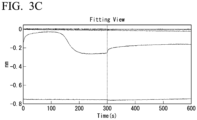
- the results of the above sensorgrams of the 8A2 antibody and the 8B9 antibody are each shown in FIG. 2A to FIG. 2C and FIG. 3A to FIG. 3C .
- the KD value of the 8A2 antibody with respect to the ⁇ 2,6 sugar chain was 2.9 ⁇ 10 -10 ⁇ 1.7 ⁇ 10 -24
- the dissociation constant KD value with respect to the ⁇ 2,3 sugar chain was 1.3 ⁇ 10 -9 ⁇ 1.6 ⁇ 10 -24 . That is, the bindability of the 8A2 antibody to the ⁇ 2,6 sugar chain was as high as 22.3 times the bindability to the ⁇ 2,3 sugar chain.
- FIG. 2C no binding to the galactose-bound sugar chain was observed. From these results, it was revealed that the 8A2 antibody is an antibody that has high bindability to the ⁇ 2,6 sugar chain as compared with the bindability to the ⁇ 2,3 sugar chain and does not bind to the galactose-bound sugar chain.
- the KD value of the 8B9 antibody with respect to the ⁇ 2,6 sugar chain was 8.5 ⁇ 10 -9 ⁇ 2.7 ⁇ 10 -24
- the KD value with respect to the ⁇ 2,3 sugar chain was 9.6 ⁇ 10 -7 ⁇ 00. That is, the bindability of the 8B9 antibody to the ⁇ 2,6 sugar chain was as high as 88.5 times the bindability to the ⁇ 2,3 sugar chain.
- FIG. 3C no binding to the galactose-bound sugar chain was observed. From these results, it was revealed that the 8B9 antibody is an antibody that has high bindability to the ⁇ 2,6 sugar chain as compared with the bindability to the ⁇ 2,3 sugar chain and does not bind to the galactose-bound sugar chain.
- a monoclonal antibody or an antibody fragment thereof having high bindability to an ⁇ 2,6 sugar chain and a method for measuring an ⁇ 2,6 sugar chain are provided.
Landscapes
- Health & Medical Sciences (AREA)
- Life Sciences & Earth Sciences (AREA)
- Chemical & Material Sciences (AREA)
- Immunology (AREA)
- Molecular Biology (AREA)
- Engineering & Computer Science (AREA)
- Organic Chemistry (AREA)
- Biochemistry (AREA)
- General Health & Medical Sciences (AREA)
- Medicinal Chemistry (AREA)
- Hematology (AREA)
- Biomedical Technology (AREA)
- Urology & Nephrology (AREA)
- Cell Biology (AREA)
- Genetics & Genomics (AREA)
- Biophysics (AREA)
- Proteomics, Peptides & Aminoacids (AREA)
- Biotechnology (AREA)
- General Physics & Mathematics (AREA)
- Pathology (AREA)
- Food Science & Technology (AREA)
- Microbiology (AREA)
- Physics & Mathematics (AREA)
- Analytical Chemistry (AREA)
- Gynecology & Obstetrics (AREA)
- Pregnancy & Childbirth (AREA)
- Reproductive Health (AREA)
- Peptides Or Proteins (AREA)
- Preparation Of Compounds By Using Micro-Organisms (AREA)
- Hospice & Palliative Care (AREA)
- Oncology (AREA)
Applications Claiming Priority (1)
| Application Number | Priority Date | Filing Date | Title |
|---|---|---|---|
| PCT/JP2021/011037 WO2022195797A1 (ja) | 2021-03-18 | 2021-03-18 | 末端シアル酸残基がα2,6結合でガラクトースに結合した糖鎖に特異的に結合するモノクローナル抗体、及び、末端シアル酸残基がα2,6結合でガラクトースに結合した糖鎖の測定方法 |
Publications (2)
| Publication Number | Publication Date |
|---|---|
| EP4310100A1 true EP4310100A1 (de) | 2024-01-24 |
| EP4310100A4 EP4310100A4 (de) | 2025-05-14 |
Family
ID=83321993
Family Applications (1)
| Application Number | Title | Priority Date | Filing Date |
|---|---|---|---|
| EP21931548.8A Withdrawn EP4310100A4 (de) | 2021-03-18 | 2021-03-18 | Monoklonaler antikörper, der spezifisch an eine zuckerkette bindet, in der ein terminaler sialinsäurerest an galaktose mit ? gebunden ist2,6 verknüpfung und verfahren zur messung der zuckerkette mit an galaktose gebundenem terminalem sialinsäurerest mit ?2,6 verbindung |
Country Status (4)
| Country | Link |
|---|---|
| US (1) | US20240151724A1 (de) |
| EP (1) | EP4310100A4 (de) |
| JP (1) | JP7246603B2 (de) |
| WO (1) | WO2022195797A1 (de) |
Family Cites Families (6)
| Publication number | Priority date | Publication date | Assignee | Title |
|---|---|---|---|---|
| JPH07101996A (ja) * | 1993-10-05 | 1995-04-18 | Mect Corp | シアル酸を検出するモノクローナル抗体 |
| US20110129849A1 (en) | 2008-07-25 | 2011-06-02 | The Johns Hopkins University | Detection of prostate cancer using psa glycosylation patterns |
| WO2014057983A1 (ja) | 2012-10-12 | 2014-04-17 | 国立大学法人弘前大学 | 前立腺癌と前立腺肥大を識別するための方法およびキット |
| US9796785B2 (en) | 2013-05-02 | 2017-10-24 | National Institute Of Advanced Industrial Science And Technology | Monoclonal antibody recognizing sialylated sugar chains |
| JP6444136B2 (ja) * | 2014-11-05 | 2018-12-26 | 公立大学法人会津大学 | 前立腺癌の検出に有用な単クローン抗体およびその抗体をコードする遺伝子 |
| PT110526B (pt) * | 2018-01-26 | 2021-02-04 | Univ Nova De Lisboa | Anticorpo, fragmento funcional ou sonda do mesmo contra antigénios tumorais |
-
2021
- 2021-03-18 WO PCT/JP2021/011037 patent/WO2022195797A1/ja not_active Ceased
- 2021-03-18 US US18/281,484 patent/US20240151724A1/en active Pending
- 2021-03-18 EP EP21931548.8A patent/EP4310100A4/de not_active Withdrawn
- 2021-03-18 JP JP2022539160A patent/JP7246603B2/ja active Active
Also Published As
| Publication number | Publication date |
|---|---|
| EP4310100A4 (de) | 2025-05-14 |
| WO2022195797A1 (ja) | 2022-09-22 |
| JPWO2022195797A1 (de) | 2022-09-22 |
| US20240151724A1 (en) | 2024-05-09 |
| JP7246603B2 (ja) | 2023-03-28 |
Similar Documents
| Publication | Publication Date | Title |
|---|---|---|
| US11372001B2 (en) | Anti-human IgG4 monoclonal antibody and methods of making and using same | |
| EP4047017B1 (de) | Monoklonaler antikörper, messreagens für cytokeratin-18-fragment, reagenzienkit und messverfahren | |
| CN117143234B (zh) | 抗大鼠白细胞介素-4蛋白的单克隆抗体及其用途 | |
| AU2018294758B2 (en) | Method for measuring serum amyloid A of various animals and reagent for measurement thereof | |
| JP7424718B2 (ja) | 抗原の処理方法。 | |
| EP4459281A1 (de) | Nachweisverfahren und nachweisreagens | |
| CN107973855A (zh) | 与糖肽反应的单克隆抗体及其用途 | |
| RU2607588C2 (ru) | Способ получения агента, связывающегося с препро-вазопрессином или с его фрагментами | |
| EP4119576B1 (de) | Monoklonaler antikörper, der speziell an die zuckerkette bindet, in der terminales sialsäurerest durch alpha2,3-bindung an galactose gebunden ist, und verfahren zur messung der zuckerkette, in der terminales sialsäurerest durch alpha2,3-bindung an galactose gebunden ist | |
| EP4310100A1 (de) | Monoklonaler antikörper, der spezifisch an eine zuckerkette bindet, in der ein terminaler sialinsäurerest an galaktose mit ? gebunden ist2,6 verknüpfung und verfahren zur messung der zuckerkette mit an galaktose gebundenem terminalem sialinsäurerest mit ?2,6 verbindung | |
| CN113388034A (zh) | 脂蛋白(a)的抗原肽、其抗体及用途 | |
| EP3252073B1 (de) | Mit glycopeptid reagierender, monoklonaler antikörper und verwendung davon | |
| AU2019365391A1 (en) | Antibodies specific for glycosylated ApoJ and uses thereof | |
| US11327078B2 (en) | Monoclonal antibody against APOA4, immunological measurement method, and kit for measurement | |
| EP4130740A1 (de) | Messverfahren für fragment mit 7s-domäne von humanem typ-iv-kollagen und kit zur verwendung dafür | |
| EP4623995A1 (de) | Monoklonaler antikörper, reagenz zur messung von crtac1b, reagenzkit und verfahren zur messung von crtac1b | |
| US12510542B1 (en) | Capture antibody and detection antibody binding MMP9 protein | |
| JP7147997B2 (ja) | 抗8-ヒドロキシ-2’-デオキシグアノシン抗体又はその抗体断片、製造方法、キット、測定方法、及び測定用装置 | |
| CN121991217A (zh) | 检测胶质纤维酸性蛋白的抗体及抗体对、试剂和方法 | |
| CN121991218A (zh) | 一种检测β-淀粉样蛋白的抗体及其应用 | |
| EP2495564B1 (de) | Immunoassay-verfahren mit 5,9-kda-peptid | |
| CN117561445A (zh) | Ⅰ型胶原c末端肽的免疫学分析方法 | |
| JP2020162572A (ja) | 抗原の処理方法。 |
Legal Events
| Date | Code | Title | Description |
|---|---|---|---|
| STAA | Information on the status of an ep patent application or granted ep patent |
Free format text: STATUS: THE INTERNATIONAL PUBLICATION HAS BEEN MADE |
|
| PUAI | Public reference made under article 153(3) epc to a published international application that has entered the european phase |
Free format text: ORIGINAL CODE: 0009012 |
|
| STAA | Information on the status of an ep patent application or granted ep patent |
Free format text: STATUS: REQUEST FOR EXAMINATION WAS MADE |
|
| 17P | Request for examination filed |
Effective date: 20230919 |
|
| AK | Designated contracting states |
Kind code of ref document: A1 Designated state(s): AL AT BE BG CH CY CZ DE DK EE ES FI FR GB GR HR HU IE IS IT LI LT LU LV MC MK MT NL NO PL PT RO RS SE SI SK SM TR |
|
| DAV | Request for validation of the european patent (deleted) | ||
| DAX | Request for extension of the european patent (deleted) | ||
| A4 | Supplementary search report drawn up and despatched |
Effective date: 20250415 |
|
| RIC1 | Information provided on ipc code assigned before grant |
Ipc: G01N 33/574 20060101ALI20250409BHEP Ipc: C12N 15/13 20060101ALI20250409BHEP Ipc: C07K 16/18 20060101AFI20250409BHEP |
|
| STAA | Information on the status of an ep patent application or granted ep patent |
Free format text: STATUS: THE APPLICATION HAS BEEN WITHDRAWN |
|
| 18W | Application withdrawn |
Effective date: 20260210 |