EP4310595A1 - Puce électroluminescente comprenant une pluralité de parties électroluminescentes, et appareil de formation d'image - Google Patents
Puce électroluminescente comprenant une pluralité de parties électroluminescentes, et appareil de formation d'image Download PDFInfo
- Publication number
- EP4310595A1 EP4310595A1 EP23186093.3A EP23186093A EP4310595A1 EP 4310595 A1 EP4310595 A1 EP 4310595A1 EP 23186093 A EP23186093 A EP 23186093A EP 4310595 A1 EP4310595 A1 EP 4310595A1
- Authority
- EP
- European Patent Office
- Prior art keywords
- image
- light
- transferring means
- data
- data transferring
- Prior art date
- Legal status (The legal status is an assumption and is not a legal conclusion. Google has not performed a legal analysis and makes no representation as to the accuracy of the status listed.)
- Granted
Links
Images






Classifications
-
- G—PHYSICS
- G03—PHOTOGRAPHY; CINEMATOGRAPHY; ANALOGOUS TECHNIQUES USING WAVES OTHER THAN OPTICAL WAVES; ELECTROGRAPHY; HOLOGRAPHY
- G03G—ELECTROGRAPHY; ELECTROPHOTOGRAPHY; MAGNETOGRAPHY
- G03G15/00—Apparatus for electrographic processes using a charge pattern
- G03G15/04—Apparatus for electrographic processes using a charge pattern for exposing, i.e. imagewise exposure by optically projecting the original image on a photoconductive recording material
- G03G15/04036—Details of illuminating systems, e.g. lamps, reflectors
- G03G15/04045—Details of illuminating systems, e.g. lamps, reflectors for exposing image information provided otherwise than by directly projecting the original image onto the photoconductive recording material, e.g. digital copiers
- G03G15/04063—Details of illuminating systems, e.g. lamps, reflectors for exposing image information provided otherwise than by directly projecting the original image onto the photoconductive recording material, e.g. digital copiers by EL-bars
-
- G—PHYSICS
- G03—PHOTOGRAPHY; CINEMATOGRAPHY; ANALOGOUS TECHNIQUES USING WAVES OTHER THAN OPTICAL WAVES; ELECTROGRAPHY; HOLOGRAPHY
- G03G—ELECTROGRAPHY; ELECTROPHOTOGRAPHY; MAGNETOGRAPHY
- G03G15/00—Apparatus for electrographic processes using a charge pattern
- G03G15/04—Apparatus for electrographic processes using a charge pattern for exposing, i.e. imagewise exposure by optically projecting the original image on a photoconductive recording material
- G03G15/04036—Details of illuminating systems, e.g. lamps, reflectors
-
- G—PHYSICS
- G03—PHOTOGRAPHY; CINEMATOGRAPHY; ANALOGOUS TECHNIQUES USING WAVES OTHER THAN OPTICAL WAVES; ELECTROGRAPHY; HOLOGRAPHY
- G03G—ELECTROGRAPHY; ELECTROPHOTOGRAPHY; MAGNETOGRAPHY
- G03G15/00—Apparatus for electrographic processes using a charge pattern
- G03G15/04—Apparatus for electrographic processes using a charge pattern for exposing, i.e. imagewise exposure by optically projecting the original image on a photoconductive recording material
- G03G15/04036—Details of illuminating systems, e.g. lamps, reflectors
- G03G15/04045—Details of illuminating systems, e.g. lamps, reflectors for exposing image information provided otherwise than by directly projecting the original image onto the photoconductive recording material, e.g. digital copiers
- G03G15/04054—Details of illuminating systems, e.g. lamps, reflectors for exposing image information provided otherwise than by directly projecting the original image onto the photoconductive recording material, e.g. digital copiers by LED arrays
-
- G—PHYSICS
- G03—PHOTOGRAPHY; CINEMATOGRAPHY; ANALOGOUS TECHNIQUES USING WAVES OTHER THAN OPTICAL WAVES; ELECTROGRAPHY; HOLOGRAPHY
- G03G—ELECTROGRAPHY; ELECTROPHOTOGRAPHY; MAGNETOGRAPHY
- G03G15/00—Apparatus for electrographic processes using a charge pattern
- G03G15/04—Apparatus for electrographic processes using a charge pattern for exposing, i.e. imagewise exposure by optically projecting the original image on a photoconductive recording material
- G03G15/043—Apparatus for electrographic processes using a charge pattern for exposing, i.e. imagewise exposure by optically projecting the original image on a photoconductive recording material with means for controlling illumination or exposure
-
- G—PHYSICS
- G03—PHOTOGRAPHY; CINEMATOGRAPHY; ANALOGOUS TECHNIQUES USING WAVES OTHER THAN OPTICAL WAVES; ELECTROGRAPHY; HOLOGRAPHY
- G03G—ELECTROGRAPHY; ELECTROPHOTOGRAPHY; MAGNETOGRAPHY
- G03G21/00—Arrangements not provided for by groups G03G13/00 - G03G19/00, e.g. cleaning, elimination of residual charge
- G03G21/14—Electronic sequencing control
-
- G—PHYSICS
- G06—COMPUTING OR CALCULATING; COUNTING
- G06K—GRAPHICAL DATA READING; PRESENTATION OF DATA; RECORD CARRIERS; HANDLING RECORD CARRIERS
- G06K15/00—Arrangements for producing a permanent visual presentation of the output data, e.g. computer output printers
- G06K15/02—Arrangements for producing a permanent visual presentation of the output data, e.g. computer output printers using printers
- G06K15/12—Arrangements for producing a permanent visual presentation of the output data, e.g. computer output printers using printers by photographic printing, e.g. by laser printers
- G06K15/1228—Arrangements for producing a permanent visual presentation of the output data, e.g. computer output printers using printers by photographic printing, e.g. by laser printers involving the fast moving of a light beam in two directions
-
- G—PHYSICS
- G06—COMPUTING OR CALCULATING; COUNTING
- G06K—GRAPHICAL DATA READING; PRESENTATION OF DATA; RECORD CARRIERS; HANDLING RECORD CARRIERS
- G06K15/00—Arrangements for producing a permanent visual presentation of the output data, e.g. computer output printers
- G06K15/02—Arrangements for producing a permanent visual presentation of the output data, e.g. computer output printers using printers
- G06K15/12—Arrangements for producing a permanent visual presentation of the output data, e.g. computer output printers using printers by photographic printing, e.g. by laser printers
- G06K15/1238—Arrangements for producing a permanent visual presentation of the output data, e.g. computer output printers using printers by photographic printing, e.g. by laser printers simultaneously exposing more than one point
- G06K15/1242—Arrangements for producing a permanent visual presentation of the output data, e.g. computer output printers using printers by photographic printing, e.g. by laser printers simultaneously exposing more than one point on one main scanning line
- G06K15/1247—Arrangements for producing a permanent visual presentation of the output data, e.g. computer output printers using printers by photographic printing, e.g. by laser printers simultaneously exposing more than one point on one main scanning line using an array of light sources, e.g. a linear array
-
- G—PHYSICS
- G06—COMPUTING OR CALCULATING; COUNTING
- G06K—GRAPHICAL DATA READING; PRESENTATION OF DATA; RECORD CARRIERS; HANDLING RECORD CARRIERS
- G06K15/00—Arrangements for producing a permanent visual presentation of the output data, e.g. computer output printers
- G06K15/02—Arrangements for producing a permanent visual presentation of the output data, e.g. computer output printers using printers
- G06K15/12—Arrangements for producing a permanent visual presentation of the output data, e.g. computer output printers using printers by photographic printing, e.g. by laser printers
- G06K15/1238—Arrangements for producing a permanent visual presentation of the output data, e.g. computer output printers using printers by photographic printing, e.g. by laser printers simultaneously exposing more than one point
- G06K15/1257—Arrangements for producing a permanent visual presentation of the output data, e.g. computer output printers using printers by photographic printing, e.g. by laser printers simultaneously exposing more than one point on more than one main scanning line
- G06K15/1261—Arrangements for producing a permanent visual presentation of the output data, e.g. computer output printers using printers by photographic printing, e.g. by laser printers simultaneously exposing more than one point on more than one main scanning line using an array of light sources
-
- G—PHYSICS
- G06—COMPUTING OR CALCULATING; COUNTING
- G06K—GRAPHICAL DATA READING; PRESENTATION OF DATA; RECORD CARRIERS; HANDLING RECORD CARRIERS
- G06K15/00—Arrangements for producing a permanent visual presentation of the output data, e.g. computer output printers
- G06K15/02—Arrangements for producing a permanent visual presentation of the output data, e.g. computer output printers using printers
- G06K15/18—Conditioning data for presenting it to the physical printing elements
- G06K15/1894—Outputting the image data to the printing elements
- G06K15/1898—Outputting the image data to the printing elements while adapting the order of the data to the printing elements' arrangement, e.g. row-to-column conversion
-
- G—PHYSICS
- G03—PHOTOGRAPHY; CINEMATOGRAPHY; ANALOGOUS TECHNIQUES USING WAVES OTHER THAN OPTICAL WAVES; ELECTROGRAPHY; HOLOGRAPHY
- G03G—ELECTROGRAPHY; ELECTROPHOTOGRAPHY; MAGNETOGRAPHY
- G03G2215/00—Apparatus for electrophotographic processes
- G03G2215/04—Arrangements for exposing and producing an image
- G03G2215/0402—Exposure devices
- G03G2215/0407—Light-emitting array or panel
- G03G2215/0409—Light-emitting diodes, i.e. LED-array
Definitions
- the present invention relates to a light-emitting chip including a plurality of light-emitting portions, and an image-forming apparatus including the light-emitting chip.
- An electrophotographic image-forming apparatus forms an electrostatic latent image on a rotatingly-driven photosensitive member by exposing the photosensitive member, and forms an image by developing the electrostatic latent image with toner.
- a direction that is parallel with the rotation axis of a photosensitive member will be referred to as a main scanning direction.
- US-2022-0146959 discloses an image-forming apparatus that performs exposure of one line in the main scanning direction using an exposure apparatus in which a plurality of light-emitting elements are arranged along the main scanning direction.
- US-2022-0146959 discloses an exposure apparatus including a circuit board that has mounted thereon light-emitting chips in which electrodes, an organic electro-luminescence (EL) film, and a circuit portion for causing the organic EL film to emit light are formed on a silicon wafer.
- a metal pad is formed on the silicon wafer, and the pad is connected via a wire (signal line) to a metal pad formed on the circuit board on which the silicon wafer is mounted.
- the circuit portion causes the organic EL film to emit light by applying voltages to the electrodes based on image data transmitted via the wire from a controller of the image-forming apparatus.
- the higher the image-forming speed of the image-forming apparatus the greater the amount of image data that needs to be transmitted to the circuit portion per unit time.
- a configuration of transmitting image data in parallel using two signal lines is conceivable.
- the circuit portion is configured so that each of a plurality of light-emitting elements is driven based on one of two parallely received pieces of image data.
- the plurality of light-emitting elements each drive based on image data transmitted via one of two signal lines, it may be impossible to drive all of the light-emitting elements if image data is transmitted via one signal line.
- the present invention provides a light-emitting chip that allows image forming to be performed at different image-forming speeds.
- the present invention in its first aspect provides a light-emitting chip as specified in claims 1 to 5.
- the present invention in its second aspect provides an image-forming apparatus as specified in claims 6 to 8.
- the present invention in its third aspect provides a light-emitting chip as specified in claim 9.
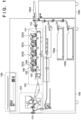
- FIG. 1 is a schematic configuration diagram of an image-forming apparatus according to the present embodiment.
- a reading unit 100 optically reads a document placed on a document table and generates image data indicating the result of the reading.
- An imaging unit 103 forms an image on a sheet based on image data generated by the reading unit 100 or image data received from an external device via a network, for example.
- the imaging unit 103 includes image-forming units 101a, 101b, 101c, and 101d.
- the image-forming units 101a, 101b, 101c, and 101d respectively form black, yellow, magenta, and cyan toner images.
- the image-forming units 101a, 101b, 101c, and 101d have similar configurations, and are also collectively referred to as image forming units 101 in the following.
- a photosensitive member 102 of an image forming unit 101 is driven to rotate in the clockwise direction in the drawing during image forming.
- a charger 107 charges the photosensitive member 102.
- An exposure head 106 which is an exposure apparatus, exposes the photosensitive member 102 in accordance with image data, and forms an electrostatic latent image on the photosensitive member 102.
- a developer 108 develops the electrostatic latent image on the photosensitive member 102 with toner.
- the toner image on the photosensitive member 102 is transferred to a sheet conveyed on a transfer belt 111.
- Colors other than black, yellow, magenta, and cyan can be reproduced by transferring toner images on the respective photosensitive members 102 to a sheet so as to be overlaid on one another.
- a conveyance unit 105 controls the feeding and conveyance of sheets. Specifically, the conveyance unit 105 feeds a sheet onto a conveyance path in the image-forming apparatus from a designated unit among internal storage units 109a and 109b, an external storage unit 109c, and a hand feeding unit 109d.
- the fed sheet is conveyed to registration rollers 110.
- the registration rollers 110 convey the sheet onto the transfer belt 111 at a predetermined timing so that toner images on the respective photosensitive members 102 are transferred to the sheet.
- the toner images are transferred to the sheet while the sheet is being conveyed on the transfer belt 111.
- a fixing unit 104 fixes the toner images onto the sheet by applying heat and pressure to the sheet having the toner images transferred thereon. After the toner images are fixed, the sheet is discharged to the outside of the image-forming apparatus by discharge rollers 112.
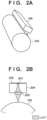
- FIGS. 2A and 2B illustrate the photosensitive member 102 and the exposure head 106.
- the exposure head 106 includes a light-emitting-point group 201, a printed circuit board 202 on which the light-emitting-point group 201 is mounted, a rod lens array 203, and a housing 204 that holds the rod lens array 203 and the printed circuit board 202.
- the rod lens array 203 condenses light emitted from the light-emitting-point group 201 onto the photosensitive member 102, and forms imaging spots of a predetermined size on the photosensitive member 102.
- FIGS. 3A and 3B illustrate the printed circuit board 202.
- FIG. 3A illustrates a surface on which a connector 305 is mounted
- FIG. 3B illustrates a surface on which the light-emitting-point group 201 is mounted (the opposite surface from the surface on which the connector 305 is mounted).
- the light-emitting-point group 201 includes twenty light-emitting chips, namely light-emitting chips 400-1 to 400-20.
- the light-emitting chips 400-1 to 400-20 are arranged in a staggered arrangement in two rows along the main scanning direction.
- the light-emitting chips 400-1 to 400-20 are also collectively referred to as light-emitting chips 400.
- the light-emitting chips 400 may also be referred to as light-emitting units. Each light-emitting chip 400 includes a plurality of light-emitting points (light-emitting elements). Each light-emitting chip 400 on the printed circuit board 202 is connected to an image controller 700 ( FIG. 7 ), which is a control unit, via the connector 305.
- image controller 700 FIG. 7
- FIG. 4 illustrates light-emitting chips 400 and the arrangement of light-emitting points 602 provided in the light-emitting chips 400.
- Each light-emitting chip 400 includes a plurality of sets of 748 light-emitting points 602 arranged along the main scanning direction. Note that the plurality of sets are arranged along a sub-scanning direction that is orthogonal to the main scanning direction. Note that, in the following description, the number of sets is four, as one example. That is, in the following exemplary embodiments, the light-emitting chips 400 include four sets of 748 light-emitting points 602 arranged along the main scanning direction, i.e., a total of 2992 light-emitting points 602.
- the pitch between light-emitting points 602 adjacent in the main scanning direction is approximately 21.16 ⁇ m, which corresponds to a resolution of 1200 dpi. Accordingly, the length in the main scanning direction of the 748 light-emitting points 602 in one set is approximately 15.8 mm.
- the pitch (length P in FIG. 4 ) between light-emitting points 602 adjacent in the sub-scanning direction is also approximately 21.16 ⁇ m, which corresponds to a resolution of 1200 dpi.
- the pitch (length L in FIG. 4 ) between light-emitting points 602 of two light-emitting chips 400 adjacent in the main scanning direction is also approximately 21.16 ⁇ m, which corresponds to a resolution of 1200 dpi.
- FIG. 5 is a plan view of a light-emitting chip 400.
- the plurality of light-emitting points 602 in the light-emitting chip 400 are formed on a light-emitting substrate 402, which is a silicon substrate.
- a circuit portion 406 for controlling the plurality of light-emitting points 602 is provided in the light-emitting substrate 402.
- Signal lines for communication with the image controller 700, power lines for connection to a power source, and ground lines for connection to the ground are connected to pads 408-1 to 408-10.
- the signal lines, power lines, and ground lines are wires made from gold.
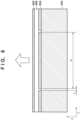
- FIG. 6 illustrates a part of a cross-section taken along line A-A in FIG. 5 .
- a plurality of lower electrodes 504 are formed on the light-emitting substrate 402.
- a gap having a length d is provided between two lower electrodes 504 that are adjacent to one another.
- a light-emitting layer 506 is provided on the lower electrodes 504, and an upper electrode 508 is provided on the light-emitting layer 506.
- the upper electrode 508 is a single common electrode shared by the plurality of lower electrodes 504. When a predetermined voltage is applied between a lower electrode 504 and the upper electrode 508, the light-emitting layer 506 emits light as a result of a current flowing from the lower electrode 504 to the upper electrode 508.
- a region of the light-emitting layer 506 corresponding to the region of one lower electrode 504 corresponds to one light-emitting point 602. That is, the light-emitting substrate 402 includes a plurality of light-emitting points in the present embodiment. Note that the light-emitting points may be referred to as light-emitting portions.
- an organic EL film may be used as the light-emitting layer 506.
- an inorganic EL film may be used as the light-emitting layer 506.
- the upper electrode 508 is formed from a transparent electrode made from indium tin oxide (ITO) or the like so that the upper electrode 508 transmits the light-emission wavelengths of the light-emitting layer 506. Note that, while the entire upper electrode 508 transmits the light-emission wavelengths of the light-emitting layer 506 in the present embodiment, it is not necessary for the entire upper electrode 508 to transmit the light-emission wavelengths of the light-emitting layer 506. Specifically, it suffices as long as regions from which light from the light-emitting points 602 is to be emitted transmit the light-emission wavelengths.
- the light-emitting layer 506 is shared by all of the lower electrodes 504 provided in the light-emitting chip 400 in the present embodiment, this is not necessarily the case.
- a configuration may be adopted in which first lower electrodes 504 among the plurality of lower electrodes 504 provided in the light-emitting chip 400 are covered by a first light-emitting layer 506, and second lower electrodes 504 among the plurality of lower electrodes 504 provided in the light-emitting chip 400 are covered by a second light-emitting layer 506.
- a region of a light-emitting layer 506 corresponding to the region of one lower electrode 504 corresponds to one light-emitting point 602 in such a configuration as well.
- a light-emitting layer 506 may be individually provided for each of the plurality of lower electrodes 504 provided in the light-emitting chip 400.
- a region of a light-emitting layer 506 corresponding to the region of one lower electrode 504 corresponds to one light-emitting point 602 in such a configuration as well.
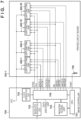
- FIG. 7 illustrates a printed circuit board 202-1 (first printed circuit board) on which the light-emitting chips 400-1 to 400-20 are provided.
- the printed circuit board 202-1 is used in a type of exposure head 106 that supports a slower image-forming speed compared to that supported by the type of exposure head 106 in which the later-described printed circuit board 202-2 (second printed circuit board) is used.
- the printed circuit board 202-1 is a printed circuit board for an exposure head 106 of an image-forming apparatus having a 200-mm/s image-forming speed.
- the printed circuit board 202-2 is a printed circuit board for an exposure head 106 of an image-forming apparatus having a 400-mm/s image-forming speed.
- the image-forming speed corresponds to the circumferential speed of the photosensitive member 102.
- the sub-scanning-direction resolution is 1200 dpi (approximately 21.16 ⁇ m).
- a data switching unit 705 and each light-emitting chip 400 are connected via a plurality of signal lines (wires). Specifically, the data switching unit 705 and a light-emitting chip 400-n (n being an integer of 1 to 20) are connected via a signal line DATAn-1 and a signal line WRITEn.
- the signal line DATAn-1 is used by the data switching unit 705 to transmit image data to the light-emitting chip 400-n.
- the signal line WRITEn is used by the data switching unit 705 to write control data to a register of the light-emitting chip 400-n.
- the signal line WRITEn may also be referred to as a control line because control data is transmitted via the signal line WRITEn.
- the data switching unit 705 and all light-emitting chips 400 are connected via one signal line CLK, one signal line SYNC, and one signal line EN.
- the signal line CLK is used to transmit a clock signal during the transmission of data via the signal lines DATAn-1 and WRITEn.
- the data switching unit 705 outputs, to the signal line CLK, a clock signal generated based on a reference clock signal from a clock generation unit 702. The signals transmitted to the signal line SYNC and the signal line EN will be described later.
- a CPU 701 controls the entire image-forming apparatus.
- An image-data generation unit 703 generates image data for controlling the on/off of light-emission of the light-emitting points 602 of each light-emitting chip 400 by performing various types of image processing such as half-toning processing on image data received from the reading unit 100 or an external device.
- the image-data generation unit 703 transmits the generated image data to the data switching unit 705.
- a register access unit 704 receives, from the CPU 701, control data to be written to the register in each light-emitting chip 400, and transmits the control data to the data switching unit 705. Note that, as illustrated in FIG. 7 , the printed circuit board 202-1 is provided with a pull-down resistor 706.
- One end of the pull-down resistor 706 is connected to the CPU 701 via a control line PORT.
- the other end of the pull-down resistor 706 is connected to a predetermined potential, which is the ground potential in the present example.
- the CPU 701 can determine that the exposure head 106 mounted in the image-forming apparatus is that of a first type including the printed circuit board 202-1.
- FIG. 8 illustrates signals of signal lines in a case in which control data is written to the register of a light-emitting chip 400.
- An enable signal that switches to high level during communication to indicate that communication is in progress is output to the signal line EN.
- the data switching unit 705 transmits a start bit to the signal line WRITEn. Subsequently, the data switching unit 705 transmits a WRITE identification bit indicating a write operation, and then transmits the address (4 bits in the present example) of the register to which control data is to be written, and the control data (8 bits in the present example).
- the data switching unit 705 sets the frequency of the clock signal transmitted to the signal line CLK to 3 MHz, for example.
- FIG. 9 illustrates signals of signal lines in a case in which image data is transmitted to each light-emitting chip 400 on the printed circuit board 202-1.
- a line synchronization signal indicating an exposure timing of one line of the photosensitive member 102 is output to the signal line SYNC.
- the line synchronization signal is output at intervals of approximately 105.8 ⁇ s because the image-forming speed of the printed circuit board 202-1 is 200 mm/s, and the sub-scanning-direction resolution of the printed circuit board 202-1 is 1200 dpi (approximately 21.16 ⁇ m).
- the data switching unit 705 transmits image data to the signal line DATAn-1 in synchronization with the rise of the line synchronization signal.
- each light-emitting chip 400 includes 2992 light-emitting points 602
- image data indicating whether or not light is to be emitted by each of the total of 2992 light-emitting points 602 needs to be transmitted within a period of approximately 105.8 ⁇ s.
- the data switching unit 705 sets the frequency of the clock signal transmitted to the signal line CLK to 30 MHz upon transmitting image data, as illustrated in FIG. 9 .
- FIG. 10 illustrates a printed circuit board 202-2 (second printed circuit board) on which the light-emitting chips 400-1 to 400-20 are provided.
- the image-forming speed of the printed circuit board 202-2 is 400 mm/s.
- the light-emitting chips 400 are the same as those used for the printed circuit board 202-1. In the following, the differences from the printed circuit board 202-1 illustrated in FIG. 7 will be described.
- Each light-emitting chip 400 on the printed circuit board 202-2 receives image data via both signal lines DATAn-1 and DATAn-2.
- the data switching unit 705 and a light-emitting chip 400-n are also connected via the signal line DATAn-2.
- FIG. 10 illustrates a printed circuit board 202-2 (second printed circuit board) on which the light-emitting chips 400-1 to 400-20 are provided.
- the image-forming speed of the printed circuit board 202-2 is 400 mm/s.
- the light-emitting chips 400 are the same as those used for the printed circuit board 202-1.
- the printed circuit board 202-2 is provided with a pull-up resistor 707 in place of the pull-down resistor 706 of the printed circuit board 202-1.
- One end of the pull-up resistor 707 is connected to the CPU 701 via the control line PORT.
- the other end of the pull-up resistor 707 is connected to a predetermined potential that is different from the ground potential. Based on the potential of the control line PORT, the CPU 701 can determine that the exposure head 106 mounted in the image-forming apparatus is that of a second type including the printed circuit board 202-2.
- FIG. 11 illustrates signals of signal lines in a case in which image data is transmitted to each light-emitting chip 400 on the printed circuit board 202-2.
- a line synchronization signal indicating an exposure timing of one line of the photosensitive member 102 is output to the signal line SYNC.
- the line synchronization signal is output at intervals of approximately 52.8 ⁇ s because the image-forming speed of the printed circuit board 202-2 is 400 mm/s, and the sub-scanning-direction resolution of the printed circuit board 202-2 is 1200 dpi (approximately 21.16 ⁇ m).
- the data switching unit 705 transmits image data to the signal lines DATAn-1 and DATAn-2 in synchronization with the rise of the line synchronization signal.
- the data switching unit 705 needs to set the frequency of the clock signal transmitted to the signal line CLK to 60 MHz in order to achieve the 400-mm/s image-forming speed.
- the amount of image data that can be transmitted per unit time can be doubled while keeping the frequency of the clock signal at 30 MHz, which is the same as that in the case of the printed circuit board 202-1. Due to this configuration, the amount of image data that the light-emitting chips 400 can receive per unit time can be doubled without excessively increasing the frequency of the clock signal, or in other words, the transmission speed of image data.
- the processing for accessing the register is similar to that of the printed circuit board 202-1, which is illustrated in FIG. 8 .
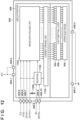
- FIG. 12 is a functional block diagram of one light-emitting chip 400-n mounted on the printed circuit boards 202-1 and 202-2.
- the light-emitting chip 400 includes the ten pads 408-1 to 408-10.
- the pads 408-1 and 408-2 are connected to a power-source voltage VCC via power lines. Power based on this power-source voltage VCC is supplied to each circuit in the circuit portion 406 of the light-emitting chip 400.
- the pads 408-3 and 408-4 are connected to the ground via ground lines.
- the upper electrode 508 and each circuit in the circuit portion 406 are connected to the ground via the pads 408-3 and 408-4.
- the signal lines CLK, SYNC, DATAn-1, and DATAn-2 are connected to an image-data holding unit 1103 via the pads 408-5 to 408-8. Note that the image-data holding unit 1103 and the pads 408-5 to 408-8 are connected via signal lines corresponding to the signal lines CLK, SYNC, DATAn-1, and DATAn-2, respectively.
- the signal lines EN and WRITEn are connected to a register 1102 via the pads 408-9 and 408-10. Note that the signal line CLK is also input to the register 1102. Note that the register 1102 and the pads 408-9 and 408-10 are connected via signal lines corresponding to the signal lines EN and WRITEn, respectively.
- a pull-down resistor 1205 is provided on the signal line inside the circuit portion 406 that connects the image-data holding unit 1103 and the pad 408-8.
- the pull-down resistor 1205 is provided in order to fix the potential of the signal line inside the circuit portion 406 that is connected to the pad 408-8 to a predetermined value, e.g., the ground potential, even if the signal line DATAn-2 connecting the data switching unit 705 and the pad 408-8 of the light-emitting chip 400-n is not provided in the case of the printed circuit board 202-1.
- the printed circuit board 202-1 is provided with pads for signal lines DATAn-2, but is not provided with signal lines DATAn-2 connecting the pads and the pads 408-8.
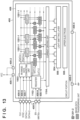
- FIG. 13 illustrates a functional block diagram of the image-data holding unit 1103.
- the image-data holding unit 1103 includes an image-data converting unit 1003 that receives image data transmitted via the signal lines DATAn-1 and DATAn-2. With the line synchronization signal from the signal line SYNC as the starting point, the image-data converting unit 1003 receives image data each indicating whether or not light is to be emitted by a light-emitting point 602 in the order of D1, D2, D3, D4, ... in synchronization with the clock signal.
- the image-data converting unit 1003 receives image data received via DATAn-1 in the order of D1-1, D2-1, D3-1, D4-1, ..., and receives image data received via DATAn-2 in the order of D1-2, D2-2, D3-2, D4-2, ....
- the image-data holding unit 1103 includes image-data transferring units 1004 that hold image data transmitted by the image-data converting unit 1003. While described in detail later, an image-data transferring unit 1004 is provided for each of the lower electrodes 504 of the light-emitting points 602 arranged in the main scanning direction. That is, in a case in which 748 light-emitting points 602 are arranged in the main scanning direction as in the present example, the image-data transferring units 1004 include image-data transferring units 1004-1 to 1004-748.
- image-data transferring units 1004 corresponding to the number of light-emitting points 602 in the main scanning direction are provided in the present example, there is no limitation to this, and a configuration may be adopted in which one image-data transferring unit 1004 is provided per a plurality of light-emitting points 602.
- the image-data converting unit 1003 outputs received image data to PDATA1 and PDATA2.
- the image-data converting unit 1003 outputs image data received via DATAn-1 to PDATA1, and outputs image data received via DATAn-2 to PDATA2.
- PDATA1 is connected to the image-data transferring units 1004-1 to 1004-748, and transfers image data output by the image-data converting unit 1003 to the image-data transferring units 1004-1 to 1004-748.
- PDATA2 is connected to the even-numbered image-data transferring units 1004 illustrated as image-data transferring units 1004-2, 1004-4, 1004-6, ..., 1004-748. As illustrated in FIG.
- each of the even-numbered image-data transferring units 1004 includes a switch 1201-1 on signal lines between PDATA1 and PDATA2 and itself, and can choose whether to receive image data from PDATA1 or PDATA2.
- the switches 1201-1 are switched based on register data stored in the register 1102. If the image-data converting unit 1003 receives image data via only DATAn-1, the switches 1201-1 are controlled so that the even-numbered image-data transferring units 1004 receive image data from PDATA1. Furthermore, if the image-data converting unit 1003 receives image data via the two signal lines DATAn-1 and DATAn-2, the switches 1201-1 are controlled so that the even-numbered image-data transferring units 1004 receive image data from PDATA2. That is, the switches 1201-1 correspond to the second switch circuit.
- the image-data converting unit 1003 outputs a latch signal LAT1-1 to the image-data transferring unit 1004-1 at the timing when the image-data converting unit 1003 outputs image data D1-1, and outputs a latch signal LAT1-2 to the image-data transferring unit 1004-2 at the timing when the image-data converting unit 1003 outputs image data D1-2.
- a switch 1201-2 is provided between an odd-numbered image-data transferring unit 1004 and an even-numbered image-data transferring unit 1004 that are adjacent to one another, such as the image-data transferring unit 1004-1 and the image-data transferring unit 1004-2.
- the switches 1201-2 control image data transferred to the image-data transferring units 1004 based on the register data stored in the register 1102.
- the image-data transferring unit 1004-1 outputs a latch signal LAT2-1 at the timing when the image-data converting unit 1003 outputs image data D2-1. That is, the switches 1201-2 correspond to the second switch circuit.
- the switches 1201-2 are controlled so that the latch signal LAT2-1 output by the image-data transferring unit 1004-1 is received by the image-data transferring unit 1004-2. Having received the latch signal LAT2-1, the image-data transferring unit 1004-2 outputs a latch signal LAT3-1 at the timing when the image-data converting unit 1003 outputs image data D3-1, and latch signals are output in order up to the image-data transferring unit 1004-748 as a result of similar operations being performed following this point. That is, the latch signals correspond to the start signals.
- the switches 1201-2 are controlled so that the latch signal LAT2-1 output by the image-data transferring unit 1004-1 is received by the image-data transferring unit 1004-3. Furthermore, the switches 1201-2 are controlled so that a latch signal LAT2-2 output by the image-data transferring unit 1004-2 is received by the image-data transferring unit 1004-4. Having received the latch signal LAT2-1, the image-data transferring unit 1004-3 outputs a latch signal LAT3-1 at the timing when the image-data converting unit 1003 outputs image data D3-1, and latch signals are output in order as a result of similar operations being performed following this point.
- Each of the image-data transferring units 1004 continues to latch received image data from when a latch signal is received to when the next latch signal is received. Furthermore, each of the image-data transferring units 1004 continues to output, to a current driving unit 1104, a drive signal based on latched image data from when a latch signal is received to when the next latch signal is received. That is, each of the image-data transferring units 1004 continues to output a drive signal based on image data from when a line synchronization signal is received to when the next latch signal is received.
- FIG. 14 illustrates a configuration of the current driving unit 1104. Note that FIG. 14 only illustrates a circuit portion corresponding to one light-emitting point 602.
- the light-emitting chips 400 according to the present embodiment include a total of 2992 light-emitting points 602, and thus include 2992 of the circuit portions illustrated in FIG. 14 .
- a DAC 1501 outputs an analog voltage corresponding to a digital value indicated by control data stored in the register 1102.
- An FET 1502 is a Pch-MOSFET, and the source terminal and drain terminal of the FET 1502 are respectively connected to the power-source voltage VCC and the source terminal of an FET 1503. The analog voltage output by the DAC 1501 is applied to the gate terminal of the FET 1502.
- the FET 1503 is also a Pch-MOSFET, and the drain terminal of the FET 1503 is connected to a lower electrode 504.
- a drive signal output from the image-data holding unit 1103 is input to the gate terminal of the FET 1503.
- the drive signal is a binary signal that is either high level or low level, and the FET 1503 is on while the drive signal is high level, whereas the FET 1503 is off while the drive signal is low level.
- the light-emitting point 602 While the FET 1503 is on, the light-emitting point 602 emits light as a result of a current flowing from the power-source voltage VCC to the light-emitting layer 506 via the FET 1502 and the FET 1503.
- the light-emission intensity of the light-emitting point 602 changes in accordance with the current flowing through the light-emitting layer 506, and the value of the current is controlled by the analog voltage output by the DAC 1501. That is, the light-emitting intensity of each light-emitting point 602 is controlled by the control data stored in the register 1102.
- the control data may individually indicate digital values for the DACs 1501 corresponding to the light-emitting points 602, or may indicate one digital value per each group of a plurality of light-emitting points 602.
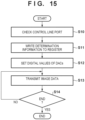
- FIG. 15 is a flowchart of processing executed by the image controller 700 when a print request is made from a user.
- the image controller 700 determines the type of printed circuit board 202, i.e., whether the printed circuit board 202 is the printed circuit board 202-1 or the printed circuit board 202-2, by determining the potential of the control line PORT. Note that, when the printed circuit board 202 is of a different type, the exposure head 106 is of a different type.
- the image controller 700 writes determination information to the register 1102 of each light-emitting chip 400. The determination information is information for determining the signal line(s) used to transmit image data.
- one signal line DATAn-1 is used to transmit image data in the case of the printed circuit board 202-1
- the two signal lines DATAn-1 and DATAn-2 are used to transmit image data in the case of the printed circuit board 202-2.
- step S12 the image controller 700 sets, to the register 1102, the digital values to be set to the DACs 1501 corresponding to the light-emitting points 602. Note that step S11 and step S12 may be performed in the reverse order.
- the image controller 700 transmits image data in step S13 and starts to expose the photosensitive member 102.
- the image controller 700 determines whether image forming is complete, and repeats processing from step S13 if image forming is not complete. On the other hand, if image forming is complete, the image controller 700 terminates the processing in FIG. 15 .
- the image controller 700 determines the type of printed circuit board 202, or in other words determines the type of exposure head 106, and determines one or more signal lines to be used to transmit image data to the exposure head 106 based on the type. Furthermore, the image controller 700 stores, in the register 1102 of each light-emitting chip 400, determination information for allowing the light-emitting chip 400 to determine the one or more signal lines used to transmit image data. The image-data holding unit 1103 of each light-emitting chip 400 determines the one or more signal lines to be used to receive image data based on the determination information stored in the register 1102 of the same light-emitting chip 400.
- the amount of image data that each light-emitting chip 400 can receive per unit time can be changed. Accordingly, while using the same light-emitting chips 400 for exposure heads 106 of multiple types having different image-forming speeds, an increase in image-forming apparatus cost can be suppressed.
- one resistor (pull-down resistor 706, pull-up resistor 707) is used to determine the type of printed circuit board 202 because the number of types of printed circuit boards 202, or in other words, the number of types of exposure heads 106 is two.
- the number of types of exposure heads 106 may be set to any number that is three or more. For example, if there are three or four types of exposure heads 106, the type of exposure head 106 can be determined by providing the printed circuit board 202 with two resistors.
- a configuration may be adopted in which, in order to determine the type of exposure head 106, a non-volatile memory device storing information indicating the type of exposure head 106 is provided instead of using a circuit including a resistor. In this case, the image controller 700 determines the type of exposure head 106 based on the information stored in the non-volatile memory device in the printed circuit board 202.
- the number of signal lines is set to one or two depending on the type of exposure head 106.
- the number of signal lines to be used to transmit image data is not limited to one or two.
- a configuration may be adopted in which the number of signal lines to be used to transmit image data is set to a first number for an exposure head 106 of the first type, and the number of signal lines to be used to transmit image data is set to a second number that is different from the first number for an exposure head 106 of the second type.
- each of the first and second numbers is any number that is 1 or greater. This similarly applies to the case in which there are three or more types of exposure heads 106.
- the image controller 700 After determining the type of exposure head 106, the image controller 700 writes, to the register 1102 of each light-emitting chip 400, determination information for allowing the image-data holding unit 1103 to determine the one or more signal lines used to transmit image data (step S11 in FIG. 15 ). In the present embodiment, before transmitting image data, the image controller 700 notifies each light-emitting chip 400 of the one or more signal lines to be used to transmit image data by transmitting identification bits indicating determination information for determining the one or more signal lines used to transmit image data.
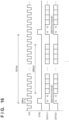
- FIG. 16 illustrates signals of signal lines in a case in which image data is transmitted to the printed circuit board 202-1.
- the data switching unit 705 first transmits identification bits to the signal line DATAn-1 in synchronization with the rise of the line synchronization signal.
- the identification bits consist of two bits, and a state in which both the identification bits are high level indicates that the signal line DATAn-1 is the signal line used to transmit image data.
- the data switching unit 705 transmits image data corresponding to the total of 2992 light-emitting points 602 using each of the signal line DATAn-1.
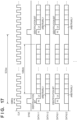
- FIG. 17 illustrates signals of signal lines in a case in which image data is transmitted to the printed circuit board 202-2.
- the data switching unit 705 first transmits identification bits to the signal line DATAn-1 in synchronization with the rise of the line synchronization signal.
- the data values to be transmitted to the signal line DATAn-2 while the identification bits are being transmitted can be defined arbitrarily.
- a state in which the first of the identification bits is high level and the second is low level indicates that the signal lines DATAn-1 and DATAn-2 are the signal lines used to transmit image data.
- the data switching unit 705 transmits image data corresponding to the total of 2992 light-emitting points 602 using the signal lines DATAn-1 and DATAn-2.
- the signal line via which the identification bits are transmitted is set in advance. Furthermore, a configuration can be adopted such that the signal line DATAn-1, which is used to transmit the identification bits, is always used to transmit image data. This may similarly apply also to cases in which three or more signal lines are used to transmit image data.
- FIG. 18 is a functional block diagram of one light-emitting chip 400-n mounted on the printed circuit boards 202-1 and 202-2 according to the present embodiment.
- the signal lines CLK, SYNC, DATAn-1, and DATAn-2 are connected to a data identifying unit 1801.
- the data identifying unit 1801 and the image-data holding unit 1103 are connected via signal lines corresponding to the signal lines CLK, SYNC, DATAn-1, and DATAn-2.
- the data identifying unit 1801 outputs, to the image-data holding unit 1103, the clock signal and the line synchronization signal respectively received via the signal lines CLK and SYNC.
- the data identifying unit 1801 determines the one or more signal lines used to transmit image data based on the identification bits received in synchronization with the line synchronization signal. If the signal line DATAn-1 is the only signal line used to transmit image data, the data identifying unit 1801 outputs image data received via the signal line DATAn-1 to the image-data holding unit 1103. On the other hand, if the signal lines DATAn-1 and DATAn-2 are the signal lines used to transmit image data, the data identifying unit 1801 outputs image data received via the signal lines DATAn-1 and DATAn-2 to the image-data holding unit 1103. In such a manner, the data identifying unit 1801 and the image-data holding unit 1103 correspond to a receiving unit that receives image data.
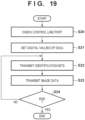
- FIG. 19 is a flowchart of processing executed by the image controller 700 when a print request is made from a user.
- the image controller 700 determines the type of printed circuit board 202, i.e., whether the printed circuit board 202 is the printed circuit board 202-1 or the printed circuit board 202-2, by determining the potential of the control line PORT. Note that, when the printed circuit board 202 is of a different type, the exposure head 106 is of a different type.
- the image controller 700 sets, to the register 1102, the digital values to be set to the DACs 1501 corresponding to the light-emitting points 602.
- the image controller 700 transmits identification bits to the signal line DATAn-1 in step S22, and then transmits image data corresponding to one line in step S23.
- the one or more signal lines via which image data is to be transmitted are determined in accordance with the type of exposure head 106 determined in step S20.
- the image controller 700 determines whether image forming is complete, and repeats processing from step S22 if image forming is not complete. On the other hand, if image forming is complete, the image controller 700 terminates the processing in FIG. 19 .
- the amount of image data that each light-emitting chip 400 can receive per unit time can be changed. Accordingly, the same light-emitting chips 400 can be used for exposure heads 106 of multiple types having different image-forming speeds. Furthermore, according to the present embodiment, the time it takes for image forming can be reduced because there is no need to write determination information to the register 1102 of each light-emitting chip 400 when image forming is started.
- the light-emitting chips 400 determine one or more signal lines to be used to receive image data based on determination information, and acquires the determination information from the image-forming apparatus. Specifically, in the first embodiment, the light-emitting chips 400 acquire the determination information as a result of the image controller 700 of the image-forming apparatus writing the determination information to the register 1102 of the light-emitting chips 400. Furthermore, in the second embodiment, the light-emitting chips 400 receive, or in other words, acquire the determination information via a signal line before receiving image data.
- the image controller 700 of the image-forming apparatus generates the determination information by determining the one or more signal lines to be used to transmit image data based on a circuit provided to the printed circuit board 202, i.e., a pull-up or pull-down resistor, or information stored in a non-volatile memory device.
- a configuration may be adopted in which, instead of acquiring the determination information from the image-forming apparatus, the light-emitting chips 400 determine the one or more signal lines to be used to receive image data based on a circuit such as a pull-up or pull-down resistor provided to the printed circuit board 202, or information stored in a non-volatile memory device.
- the image controller 700 determines the one or more signal lines to be used to transmit image data based on a circuit provided to the printed circuit board 202 or information stored in a non-volatile memory device, the image controller 700 need not notify the light-emitting chips 400 of the determination information.
- the number of light-emitting chips 400 provided on one printed circuit board 202 is not limited to 20, and may be set to any number that is one or more.
- the number of light-emitting points 602 included in each light-emitting chip 400 is not limited to 2992 either, and may be another number.
- one light-emitting chip 400 includes four sets of 748 light-emitting points arranged along the main scanning direction in the present embodiment, the number of sets may be set to any number that is 1 or greater.
- light-emitting points 602 are arranged in the main scanning direction at a pitch of approximately 21.16 ⁇ m, which corresponds to a resolution of 1200 dpi, another value may also be set to the interval at which the light-emitting points 602 are arranged.
- the image-forming apparatus transfers toner images formed on the respective photosensitive members 102 to a sheet conveyed on the transfer belt 111.
- the image-forming apparatus may transfer toner images on the respective photosensitive members 102 to a sheet via an intermediate transfer member.
- the image-forming apparatus may be a color image-forming apparatus that forms an image using toners of a plurality of colors, or a monochrome image-forming apparatus that forms an image using toner of a single color.
- Embodiment(s) of the present invention can also be realized by a computer of a system or apparatus that reads out and executes computer executable instructions (e.g., one or more programs) recorded on a storage medium (which may also be referred to more fully as a 'non-transitory computer-readable storage medium') to perform the functions of one or more of the above-described embodiment(s) and/or that includes one or more circuits (e.g., application specific integrated circuit (ASIC)) for performing the functions of one or more of the above-described embodiment(s), and by a method performed by the computer of the system or apparatus by, for example, reading out and executing the computer executable instructions from the storage medium to perform the functions of one or more of the above-described embodiment(s) and/or controlling the one or more circuits to perform the functions of one or more of the above-described embodiment(s).
- computer executable instructions e.g., one or more programs
- a storage medium which may also be referred to more fully as
- the computer may comprise one or more processors (e.g., central processing unit (CPU), micro processing unit (MPU)) and may include a network of separate computers or separate processors to read out and execute the computer executable instructions.
- the computer executable instructions may be provided to the computer, for example, from a network or the storage medium.
- the storage medium may include, for example, one or more of a hard disk, a random-access memory (RAM), a read only memory (ROM), a storage of distributed computing systems, an optical disk (such as a compact disc (CD), digital versatile disc (DVD), or Blu-ray Disc (BD) TM ), a flash memory device, a memory card, and the like.
- a light-emitting chip includes: a plurality of light-emitting portions and a drive circuit.
- the drive circuit includes: first to fourth transferring unit, a first switch configured to switch between a first state in which start signals output by the fourth and third transferring units are output to the second and first transferring unit, respectively, and a second state in which the start signal output by the fourth and the third transferring units are output to the third and second transferring unit, respectively, and a second switch configured to switch between a third state in which the first and third transferring units and the first signal line are connected, and a fourth state in which the first and third transferring units and a second signal line are connected.
Landscapes
- Physics & Mathematics (AREA)
- General Physics & Mathematics (AREA)
- Engineering & Computer Science (AREA)
- General Engineering & Computer Science (AREA)
- Theoretical Computer Science (AREA)
- Optics & Photonics (AREA)
- Printers Or Recording Devices Using Electromagnetic And Radiation Means (AREA)
- Facsimile Heads (AREA)
- Exposure Or Original Feeding In Electrophotography (AREA)
Applications Claiming Priority (1)
| Application Number | Priority Date | Filing Date | Title |
|---|---|---|---|
| JP2022117429A JP7770267B2 (ja) | 2022-07-22 | 2022-07-22 | 露光装置及び画像形成装置 |
Publications (2)
| Publication Number | Publication Date |
|---|---|
| EP4310595A1 true EP4310595A1 (fr) | 2024-01-24 |
| EP4310595B1 EP4310595B1 (fr) | 2026-04-01 |
Family
ID=87419031
Family Applications (1)
| Application Number | Title | Priority Date | Filing Date |
|---|---|---|---|
| EP23186093.3A Active EP4310595B1 (fr) | 2022-07-22 | 2023-07-18 | Puce électroluminescente comprenant une pluralité de parties électroluminescentes, et appareil de formation d'image |
Country Status (4)
| Country | Link |
|---|---|
| US (2) | US12242208B2 (fr) |
| EP (1) | EP4310595B1 (fr) |
| JP (1) | JP7770267B2 (fr) |
| CN (1) | CN117434806A (fr) |
Families Citing this family (2)
| Publication number | Priority date | Publication date | Assignee | Title |
|---|---|---|---|---|
| JP7483978B2 (ja) * | 2022-05-27 | 2024-05-15 | キヤノン株式会社 | 画像形成装置 |
| JP7690512B2 (ja) | 2022-05-27 | 2025-06-10 | キヤノン株式会社 | 光プリントヘッド及び光プリントヘッドを備える画像形成装置 |
Citations (5)
| Publication number | Priority date | Publication date | Assignee | Title |
|---|---|---|---|---|
| US5892532A (en) * | 1994-07-08 | 1999-04-06 | Oki Electric Industry Co., Ltd. | Non-impact printer and a print head thereof |
| US20150212448A1 (en) * | 2014-01-29 | 2015-07-30 | Samsung Electronics Co., Ltd. | Light-emitting element array module and method of controlling light-emitting element array chips |
| US20150212447A1 (en) * | 2014-01-27 | 2015-07-30 | Fuji Xerox Co., Ltd. | Optical scanning head, image processing apparatus, and non-transitory computer readable recording medium storing light intensity correction control program |
| US20210055669A1 (en) * | 2019-08-23 | 2021-02-25 | Canon Kabushiki Kaisha | Image exposure head and image forming apparatus |
| US20220146959A1 (en) | 2019-08-23 | 2022-05-12 | Canon Kabushiki Kaisha | Light emitting device and image forming apparatus including light emitting device |
Family Cites Families (11)
| Publication number | Priority date | Publication date | Assignee | Title |
|---|---|---|---|---|
| JPH04197671A (ja) * | 1990-11-28 | 1992-07-17 | Minolta Camera Co Ltd | プリンタ |
| US5502478A (en) * | 1993-02-26 | 1996-03-26 | Sunx Limited | LED electrophotographic printer having LED array and coordinated parallel drive of LED subarrays |
| JP2001088345A (ja) * | 1999-09-20 | 2001-04-03 | Sanyo Electric Co Ltd | 光プリントヘッド |
| JP2002096967A (ja) | 2000-09-22 | 2002-04-02 | Katsu Yoneyama | ウェブの腰折り装置 |
| JP2004223760A (ja) | 2003-01-20 | 2004-08-12 | Kyocera Mita Corp | 画像形成装置 |
| JP4767634B2 (ja) * | 2005-09-13 | 2011-09-07 | 株式会社沖データ | 発光集積回路、光学ヘッド、及びそれを用いた画像形成装置 |
| JP5366511B2 (ja) * | 2008-11-14 | 2013-12-11 | 株式会社沖データ | 駆動回路、光プリントヘッド及び画像形成装置 |
| JP4683157B1 (ja) | 2010-03-23 | 2011-05-11 | 富士ゼロックス株式会社 | 発光装置、発光装置の駆動方法、プリントヘッドおよび画像形成装置 |
| JP6477264B2 (ja) | 2015-06-01 | 2019-03-06 | 株式会社リコー | 画像形成装置、画像形成方法、及び画像形成プログラム |
| JP7143108B2 (ja) | 2018-04-24 | 2022-09-28 | キヤノン株式会社 | フラットケーブル及び電子装置 |
| JP7695073B2 (ja) | 2020-12-18 | 2025-06-18 | キヤノン株式会社 | 露光ヘッド及び画像形成装置 |
-
2022
- 2022-07-22 JP JP2022117429A patent/JP7770267B2/ja active Active
-
2023
- 2023-07-13 US US18/351,721 patent/US12242208B2/en active Active
- 2023-07-18 EP EP23186093.3A patent/EP4310595B1/fr active Active
- 2023-07-21 CN CN202310897387.4A patent/CN117434806A/zh active Pending
-
2025
- 2025-01-29 US US19/040,314 patent/US20250172887A1/en active Pending
Patent Citations (5)
| Publication number | Priority date | Publication date | Assignee | Title |
|---|---|---|---|---|
| US5892532A (en) * | 1994-07-08 | 1999-04-06 | Oki Electric Industry Co., Ltd. | Non-impact printer and a print head thereof |
| US20150212447A1 (en) * | 2014-01-27 | 2015-07-30 | Fuji Xerox Co., Ltd. | Optical scanning head, image processing apparatus, and non-transitory computer readable recording medium storing light intensity correction control program |
| US20150212448A1 (en) * | 2014-01-29 | 2015-07-30 | Samsung Electronics Co., Ltd. | Light-emitting element array module and method of controlling light-emitting element array chips |
| US20210055669A1 (en) * | 2019-08-23 | 2021-02-25 | Canon Kabushiki Kaisha | Image exposure head and image forming apparatus |
| US20220146959A1 (en) | 2019-08-23 | 2022-05-12 | Canon Kabushiki Kaisha | Light emitting device and image forming apparatus including light emitting device |
Also Published As
| Publication number | Publication date |
|---|---|
| US20240027932A1 (en) | 2024-01-25 |
| US12242208B2 (en) | 2025-03-04 |
| US20250172887A1 (en) | 2025-05-29 |
| JP7770267B2 (ja) | 2025-11-14 |
| EP4310595B1 (fr) | 2026-04-01 |
| JP2024014528A (ja) | 2024-02-01 |
| CN117434806A (zh) | 2024-01-23 |
Similar Documents
| Publication | Publication Date | Title |
|---|---|---|
| US20250172887A1 (en) | Light-emitting chip including plurality of light-emitting portions, and image-forming apparatus | |
| US20250278036A1 (en) | Light emitting chip including a plurality of light emitting units and image forming apparatus | |
| US20250116951A1 (en) | Image forming apparatus | |
| US20240393712A1 (en) | Light-emitting device and image forming apparatus | |
| US20250237970A1 (en) | Image forming apparatus for forming image using plurality of exposure heads | |
| JP5874190B2 (ja) | 発光装置、プリントヘッドおよび画像形成装置 | |
| KR100235148B1 (ko) | 착탈가능한 기록 헤드를 사용하는 기록 장치 | |
| US20250348020A1 (en) | Optical print head and image forming apparatus equipped with optical print head | |
| US20250251676A1 (en) | Exposure apparatus and image-forming apparatus | |
| US12496836B2 (en) | Exposure-controlling apparatus and image-forming apparatus | |
| US20250258460A1 (en) | Communication system and image-forming apparatus | |
| US20250036038A1 (en) | Exposure apparatus, image-forming apparatus and manufacturing method | |
| JP2025012161A (ja) | 光プリントヘッド及び光プリントヘッドを備える画像形成装置 | |
| JP2025180409A (ja) | 画像形成装置 | |
| CN117130243A (zh) | 发光设备和图像形成装置 | |
| JP2008055751A (ja) | 画像形成装置および画像形成方法 | |
| JP2004262107A (ja) | 画像形成装置及び画像形成装置の制御方法 |
Legal Events
| Date | Code | Title | Description |
|---|---|---|---|
| PUAI | Public reference made under article 153(3) epc to a published international application that has entered the european phase |
Free format text: ORIGINAL CODE: 0009012 |
|
| STAA | Information on the status of an ep patent application or granted ep patent |
Free format text: STATUS: THE APPLICATION HAS BEEN PUBLISHED |
|
| AK | Designated contracting states |
Kind code of ref document: A1 Designated state(s): AL AT BE BG CH CY CZ DE DK EE ES FI FR GB GR HR HU IE IS IT LI LT LU LV MC ME MK MT NL NO PL PT RO RS SE SI SK SM TR |
|
| STAA | Information on the status of an ep patent application or granted ep patent |
Free format text: STATUS: REQUEST FOR EXAMINATION WAS MADE |
|
| 17P | Request for examination filed |
Effective date: 20240724 |
|
| RBV | Designated contracting states (corrected) |
Designated state(s): AL AT BE BG CH CY CZ DE DK EE ES FI FR GB GR HR HU IE IS IT LI LT LU LV MC ME MK MT NL NO PL PT RO RS SE SI SK SM TR |
|
| GRAP | Despatch of communication of intention to grant a patent |
Free format text: ORIGINAL CODE: EPIDOSNIGR1 |
|
| STAA | Information on the status of an ep patent application or granted ep patent |
Free format text: STATUS: GRANT OF PATENT IS INTENDED |
|
| INTG | Intention to grant announced |
Effective date: 20251022 |
|
| GRAS | Grant fee paid |
Free format text: ORIGINAL CODE: EPIDOSNIGR3 |
|
| GRAA | (expected) grant |
Free format text: ORIGINAL CODE: 0009210 |
|
| STAA | Information on the status of an ep patent application or granted ep patent |
Free format text: STATUS: THE PATENT HAS BEEN GRANTED |
|
| AK | Designated contracting states |
Kind code of ref document: B1 Designated state(s): AL AT BE BG CH CY CZ DE DK EE ES FI FR GB GR HR HU IE IS IT LI LT LU LV MC ME MK MT NL NO PL PT RO RS SE SI SK SM TR |
|
| REG | Reference to a national code |
Ref country code: CH Ref legal event code: F10 Free format text: ST27 STATUS EVENT CODE: U-0-0-F10-F00 (AS PROVIDED BY THE NATIONAL OFFICE) Effective date: 20260401 Ref country code: GB Ref legal event code: FG4D |
|
| REG | Reference to a national code |
Ref country code: DE Ref legal event code: R096 Ref document number: 602023014347 Country of ref document: DE |
|
| REG | Reference to a national code |
Ref country code: IE Ref legal event code: FG4D |