EP4311145A1 - Appareil et procédé de rétroaction d'ack harq, terminal et support de stockage - Google Patents
Appareil et procédé de rétroaction d'ack harq, terminal et support de stockage Download PDFInfo
- Publication number
- EP4311145A1 EP4311145A1 EP22770602.5A EP22770602A EP4311145A1 EP 4311145 A1 EP4311145 A1 EP 4311145A1 EP 22770602 A EP22770602 A EP 22770602A EP 4311145 A1 EP4311145 A1 EP 4311145A1
- Authority
- EP
- European Patent Office
- Prior art keywords
- slot
- harq ack
- ack feedback
- codebook
- sliv
- Prior art date
- Legal status (The legal status is an assumption and is not a legal conclusion. Google has not performed a legal analysis and makes no representation as to the accuracy of the status listed.)
- Granted
Links
Images


Classifications
-
- H—ELECTRICITY
- H04—ELECTRIC COMMUNICATION TECHNIQUE
- H04L—TRANSMISSION OF DIGITAL INFORMATION, e.g. TELEGRAPHIC COMMUNICATION
- H04L1/00—Arrangements for detecting or preventing errors in the information received
- H04L1/12—Arrangements for detecting or preventing errors in the information received by using return channel
- H04L1/16—Arrangements for detecting or preventing errors in the information received by using return channel in which the return channel carries supervisory signals, e.g. repetition request signals
- H04L1/18—Automatic repetition systems, e.g. Van Duuren systems
- H04L1/1829—Arrangements specially adapted for the receiver end
- H04L1/1861—Physical mapping arrangements
-
- H—ELECTRICITY
- H04—ELECTRIC COMMUNICATION TECHNIQUE
- H04W—WIRELESS COMMUNICATION NETWORKS
- H04W72/00—Local resource management
- H04W72/12—Wireless traffic scheduling
- H04W72/1263—Mapping of traffic onto schedule, e.g. scheduled allocation or multiplexing of flows
- H04W72/1273—Mapping of traffic onto schedule, e.g. scheduled allocation or multiplexing of flows of downlink data flows
-
- H—ELECTRICITY
- H04—ELECTRIC COMMUNICATION TECHNIQUE
- H04L—TRANSMISSION OF DIGITAL INFORMATION, e.g. TELEGRAPHIC COMMUNICATION
- H04L1/00—Arrangements for detecting or preventing errors in the information received
- H04L1/12—Arrangements for detecting or preventing errors in the information received by using return channel
- H04L1/16—Arrangements for detecting or preventing errors in the information received by using return channel in which the return channel carries supervisory signals, e.g. repetition request signals
- H04L1/18—Automatic repetition systems, e.g. Van Duuren systems
- H04L1/1812—Hybrid protocols; Hybrid automatic repeat request [HARQ]
-
- H—ELECTRICITY
- H04—ELECTRIC COMMUNICATION TECHNIQUE
- H04L—TRANSMISSION OF DIGITAL INFORMATION, e.g. TELEGRAPHIC COMMUNICATION
- H04L1/00—Arrangements for detecting or preventing errors in the information received
- H04L1/0001—Systems modifying transmission characteristics according to link quality, e.g. power backoff
- H04L1/0023—Systems modifying transmission characteristics according to link quality, e.g. power backoff characterised by the signalling
- H04L1/0027—Scheduling of signalling, e.g. occurrence thereof
-
- H—ELECTRICITY
- H04—ELECTRIC COMMUNICATION TECHNIQUE
- H04L—TRANSMISSION OF DIGITAL INFORMATION, e.g. TELEGRAPHIC COMMUNICATION
- H04L1/00—Arrangements for detecting or preventing errors in the information received
- H04L1/12—Arrangements for detecting or preventing errors in the information received by using return channel
- H04L1/16—Arrangements for detecting or preventing errors in the information received by using return channel in which the return channel carries supervisory signals, e.g. repetition request signals
- H04L1/1607—Details of the supervisory signal
- H04L1/1614—Details of the supervisory signal using bitmaps
-
- H—ELECTRICITY
- H04—ELECTRIC COMMUNICATION TECHNIQUE
- H04L—TRANSMISSION OF DIGITAL INFORMATION, e.g. TELEGRAPHIC COMMUNICATION
- H04L1/00—Arrangements for detecting or preventing errors in the information received
- H04L1/12—Arrangements for detecting or preventing errors in the information received by using return channel
- H04L1/16—Arrangements for detecting or preventing errors in the information received by using return channel in which the return channel carries supervisory signals, e.g. repetition request signals
- H04L1/18—Automatic repetition systems, e.g. Van Duuren systems
- H04L1/1829—Arrangements specially adapted for the receiver end
- H04L1/1854—Scheduling and prioritising arrangements
-
- H—ELECTRICITY
- H04—ELECTRIC COMMUNICATION TECHNIQUE
- H04L—TRANSMISSION OF DIGITAL INFORMATION, e.g. TELEGRAPHIC COMMUNICATION
- H04L1/00—Arrangements for detecting or preventing errors in the information received
- H04L1/12—Arrangements for detecting or preventing errors in the information received by using return channel
- H04L1/16—Arrangements for detecting or preventing errors in the information received by using return channel in which the return channel carries supervisory signals, e.g. repetition request signals
- H04L1/18—Automatic repetition systems, e.g. Van Duuren systems
- H04L1/1867—Arrangements specially adapted for the transmitter end
- H04L1/1896—ARQ related signaling
-
- H—ELECTRICITY
- H04—ELECTRIC COMMUNICATION TECHNIQUE
- H04L—TRANSMISSION OF DIGITAL INFORMATION, e.g. TELEGRAPHIC COMMUNICATION
- H04L5/00—Arrangements affording multiple use of the transmission path
-
- H—ELECTRICITY
- H04—ELECTRIC COMMUNICATION TECHNIQUE
- H04L—TRANSMISSION OF DIGITAL INFORMATION, e.g. TELEGRAPHIC COMMUNICATION
- H04L5/00—Arrangements affording multiple use of the transmission path
- H04L5/003—Arrangements for allocating sub-channels of the transmission path
- H04L5/0053—Allocation of signalling, i.e. of overhead other than pilot signals
- H04L5/0055—Physical resource allocation for ACK/NACK
-
- H—ELECTRICITY
- H04—ELECTRIC COMMUNICATION TECHNIQUE
- H04W—WIRELESS COMMUNICATION NETWORKS
- H04W72/00—Local resource management
- H04W72/04—Wireless resource allocation
- H04W72/044—Wireless resource allocation based on the type of the allocated resource
- H04W72/0446—Resources in time domain, e.g. slots or frames
Definitions
- This application pertains to the field of communications technologies, and specifically, relates to a HARQ ACK feedback method and apparatus, a terminal, and a storage medium.
- Hybrid Automatic Repeat reQuest Physical Uplink control channel (Physical Uplink Control Channel, PUCCH) or a physical uplink shared channel (Physical Uplink Shared Channel, PUCCH) is entirely called HARQ-ACK codebook.
- DCI Downlink Control Information
- PDSCH Physical Downlink Share Channel
- Embodiments of this application provide a HARQ ACK feedback method and apparatus, a terminal, and a storage medium, which can solve the problems of loss of feedbacks for some PDSCHs and excessive overheads due to a large number of codebook bits.
- a first aspect provides a HARQ ACK feedback method, and the method includes:
- a second aspect provides a HARQ ACK feedback apparatus, and the apparatus includes:
- a third aspect provides a terminal.
- the terminal includes a processor, a memory, and a program or instructions stored in the memory and capable of running on the processor.
- the program or instructions are executed by the processor, the steps of the HARQ ACK feedback method according to the first aspect are implemented.
- a fourth aspect provides a readable storage medium.
- the readable storage medium stores a program or instructions, and when the program or instructions are executed by a processor, the steps of the HARQ ACK feedback method according to the first aspect are implemented.
- a fifth aspect provides a chip.
- the chip includes a processor and a communication interface, the communication interface is coupled to the processor, and the processor is configured to run a program or instructions to implement the steps of the HARQ ACK feedback method according to the first aspect.
- a sixth aspect provides a computer program/program product.
- the computer program/program product is stored in a non-volatile storage medium, and the program/program product is executed by at least one processor to implement the steps of the HARQ ACK feedback method according to the first aspect.
- a candidate physical downlink shared channel PDSCH reception occasion set is determined based on at least two consecutive slot units corresponding to each element in a slot timing set. That is, one slot timing set can correspond to as many feedback slot units as possible to carry feedbacks on one PUCCH, ensuring that feedbacks are provided for all scheduled PDSCHs and HARQ-ACKs for the scheduled PDSCHs are fed back on as few PUCCHs as possible. This reduces the number of semi-static codebook feedback bits, reduces overheads, and avoids that a feedback cannot be provided for a PDSCH in a case that one DCI schedules multiple PDSCHs at a time, thereby improving flexibility of base station scheduling.
- first, second, and the like in this specification and claims of this application are used to distinguish between similar objects rather than to describe a specific order or sequence. It should be understood that the terms used in this way is interchangeable in appropriate circumstances so that the embodiments of this application can be implemented in other orders than the order illustrated or described herein, and “first” and “second” are usually for distinguishing same-type objects but not limiting the number of objects, for example, a first object may be one or multiple.
- “and/or” in this specification and claims indicates at least one of connected objects, and the symbol “/” generally indicates that the associated objects are in an "or” relationship.
- LTE Long Term Evolution
- LTE-Advanced LTE-Advanced
- LTE-A Long Term Evolution-Advanced
- CDMA code division multiple access
- time division multiple access Time Division Multiple Access
- FDMA frequency division multiple access
- OFDMA Orthogonal Frequency Division Multiple Access
- SC-FDMA single-carrier Frequency-Division Multiple Access
- system and “network” in the embodiments of this application are usually used interchangeably. Techniques described herein may be used in the aforementioned systems and radio technologies, and may also be used in other systems and radio technologies.
- New Radio New Radio
- NR New Radio
- NR terms are used in most of the following descriptions, although these technologies may also be applied to other applications than an NR system application, for example, the 6th generation (6th Generation, 6G) communications system.
- FIG. 1 is a block diagram of a wireless communications system to which embodiments of this application are applicable.
- the wireless communications system includes a terminal 11 and a network-side device 12.
- the terminal 11 may also be referred to as a terminal device or user equipment (User Equipment, UE), and the terminal 11 may be a terminal-side device, such as a mobile phone, a tablet personal computer (Tablet Personal Computer), a laptop computer (Laptop Computer) or a notebook computer, a personal digital assistant (Personal Digital Assistant, PDA), a palmtop computer, a netbook, an ultra-mobile personal computer (ultra-mobile personal computer, UMPC), a mobile Internet device (Mobile Internet Device, MID), an augmented reality (augmented reality, AR)/virtual reality (virtual reality, VR) device, a robot, a wearable device (Wearable Device), vehicle user equipment (VUE), or pedestrian user equipment (PUE), a smart appliance (a home appliance with a wireless communication function, for example, a refrigerator, a
- the wearable device includes a smart watch, a smart band, a smart earphone, smart glasses, smart jewelry (a smart bangle, a smart bracelet, a smart ring, a smart necklace, a smart ankle bangle, a smart anklet, or the like), a smart wristband, smart clothing, or the like.
- the network-side device 12 may include an access network device or a core network device, where the access network device 12 may also be referred to as a radio access network device, a radio access network (Radio Access Network, RAN), a radio access network function, or a radio access network unit.
- RAN Radio Access Network
- the access network device 12 may include a base station, a WLAN access point, a Wi-Fi node, or the like.
- the base station may be referred to as a NodeB, an evolved NodeB, an access point, a base transceiver station (Base Transceiver Station, BTS), a radio base station, a radio transceiver, a basic service set (Basic Service Set, BSS), an extended service set (Extended Service Set, ESS), a NodeB, an evolved NodeB (eNB), a home NodeB, a home evolved NodeB, a WLAN access point, a Wi-Fi node, a transmission and reception point (Transmitting Receiving Point, TRP), or another appropriate term in the art.
- the base station is not limited to a specific technical term. It should be noted that in the embodiments of this application, the base station in the NR system is merely used as an example, and a specific type of the base station is not limited.
- the core network device may include, but is not limited to, at least one of the following: a core network node, a core network function, a mobility management entity (Mobility Management Entity, MME), an access and mobility management function (Access and Mobility Management Function, AMF), a session management function (Session Management Function, SMF), a user plane function (User Plane Function, UPF), a policy control function (Policy Control Function, PCF), a policy and charging rules function (Policy and Charging Rules Function, PCRF) unit, an edge application server discovery function (Edge Application Server Discovery Function, EASDF), unified data management (Unified Data Management, UDM), a unified data repository (Unified Data Repository, UDR), a home subscriber server (Home Subscriber Server, HSS), centralized network configuration (Centralized network configuration, CNC), a network repository function (Network Repository Function, NRF), a network exposure function (Network Exposure Function, NEF), a local NEF (local NEF or L-NEF),
- HARQ-ACK information fed back by a UE on a HARQ feedback resource is entirely called as a HARQ-ACK codebook.
- a timing parameter K1 identifies a slot or subslot offset between a PDSCH and a corresponding feedback resource (PUCCH/PUSCH).
- a possible set is specified or predefined by radio resource control (Radio Resource Control, RRC), and then a value is indicated by a field in scheduling DCI information of the PDSCH. If the DCI does not have such field, the value is indicated by RRC.
- RRC Radio Resource Control
- the size of the HARQ-ACK semi-static codebook is irrelevant to an actual scheduling situation, and is determined by a parameter configured or predefined by RRC.
- the set K1 is ⁇ 1, 2, 3, 4, 5, 6, 7, 8 ⁇ .
- the set K1 is provided by a higher-layer parameter dl-DataToLTL-ACK.
- the table for set 1 is a default TDRA table or a TDRA table defined by pdsch-ConfigCommon in a higher-layer time domain allocation parameter pdsch-TimeDomainAllocationList associated with the downlink BWP, or a joint indication of set 1 and set 2.
- the set 2 is indicated by pdsch-Config in the higher-layer time domain allocation parameter pdsch-TimeDomainAllocationList.
- the TDRA table contains K0, a start symbol and length of consecutive symbols (startSymbolAndLength, SLIV), and a PDSCH mapping type.
- this step further depends on whether the UE can receive multiple PDSCHs in one slot. In a case that the LTE cannot receive multiple PDSCHs, each slot has only one candidate PDSCH reception occasion. Otherwise, it is determined by specific rules according to the TDRA table.
- Subcarrier spacing subcarrier spacing, SCS ratio of uplink and downlink BWPs.
- the candidate slot position for a PDSCH can be obtained based on the slot timing set K1 associated with the uplink BWP and the actual HARQ ACK feedback unit.
- TDD Time Division Duplexing
- a PDSCH SLIV overlapping with an uplink symbol in the TDD configuration is removed.
- the candidate PDSCH reception occasion set may be obtained through combination/grouping based on TDRA associated with the downlink BWP.
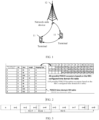
- FIG. 2 is a schematic diagram of a TDRA table according to an embodiment of this application. It is assumed that the set K1 configured by RRC is ⁇ 5, 6, 7 ⁇ , and the TDRA table for PDSCH is shown in FIG. 2.
- FIG. 3 is a schematic diagram of a HARQ-ACK feedback window determined based on a set K1 according to an embodiment of this application.
- FIG. 4 illustrates a first method for determining an overlapping candidate PDSCH reception occasion according to an embodiment of this application.
- FIG. 5 illustrates a second method for determining an overlapping candidate PDSCH reception occasion according to an embodiment of this application.
- the process of determining a semi-static codebook is as follows.
- Step 1 Determine a HARQ-ACK feedback window based on a set K1, as shown in FIG. 3 .
- Step 2 Determine a candidate PDSCH reception occasion set in each slot for each value of K1.
- Step 2-1 Remove a candidate PDSCH reception occasion overlapping with an uplink symbol that is in the TDRA table and that is indicated by RRC configuration parameters TDD-UL-DL-Configuration Common and TDD-UL-DL-Config Dedicated.
- Step 2-2 Generate only one HARQ-ACK bit for an overlapping candidate PDSCH reception occasion.
- the UE feeds back a NACK in a case that no PDSCH reception is scheduled in a determined candidate PDSCH reception occasion.
- the UE feeds back a NACK in a case that a PDSCH reception requiring feedback in a current slot is not indicated for a determined candidate PDSCH reception occasion.
- feedback is provided in a position indicated by DCI format 1-0 or DCI format 1-1, and a NACK feedback is provided in another feedback window.
- a HARQ-ACK codebook is determined jointly based on candidate PDSCH sets of cells obtained in step 1 and the number of cells configured by RRC, a HARQ space binding parameter, a code block group (Code block group, CBG) configuration parameter, and a parameter indicating longest codewords (codeword) supported by cells.
- the NR system at the 52.6 GHz-71 GHz band allows multiple PDSCHs to be scheduled by one DCI but does not provide further specification on indication of PDSCH time domain and frequency domain, K1 indication, codebook generation and feedback, or the like.
- PDSCH time domain configuration may be that multiple SLIVs are configured by RRC in one row of TDRA.
- FIG. 6 is a schematic flowchart of a HARQ ACK feedback method according to an embodiment of this application. As shown in FIG. 6 , the method includes the following steps.
- Step 600 A terminal determines a candidate physical downlink shared channel PDSCH reception occasion set based on a slot timing set corresponding to an actual HARQ ACK feedback unit, where in the slot timing set, each element corresponds to one first slot set and each element corresponds to a different first slot set, where the first slot set includes at least two consecutive slot units.
- Step 610 The terminal determines a HARQ ACK feedback codebook based on the candidate PDSCH reception occasion set.
- FIG. 7 is a first schematic diagram of HARQ-ACK feedback for a PDSCH according to an embodiment of this application, where one DCI schedules multiple PDSCHs, and HARQ-ACKs for all PDSCHs are fed back on one PUCCH.
- FIG. 8 is a second schematic diagram of HARQ-ACK feedback for a PDSCH according to an embodiment of this application, where one DCI schedules multiple PDSCHs, and HARQ-ACK groups for all PDSCHs are fed back on one PUCCH. As shown in FIG. 7 and FIG.
- the set K1 is configured to be ⁇ 5, 6, 7 ⁇ by RRC through dl-DataToLTL-ACK
- the PDSCH-to-HARQ feedback timing indicator field of DCI 1-1 indicates that the value of K1 is 7
- the LTE is configured to perform detection for DCI format 1-1 in the serving cell c.
- K1 in the DCI is indicated to be a large value in the set, it is possible that feedbacks for PDSCHs in one group cannot be carried on one PUCCH.
- HARQ-ACK bits corresponding to some PDSCHs scheduled by the DCI may not be present in the HARQ-ACK codebook carried on the PUCCH, and implementation of the base station is also limited to some extent.
- each element in the slot timing set corresponds to the at least two consecutive slot units, thereby ensuring that feeding back can be implemented for all PDSCHs in a case that multiple PDSCHs are scheduled by one DCI, and reducing codebook overheads and terminal power consumption.
- the terminal can determine a candidate physical downlink shared channel PDSCH reception occasion set based on a slot timing set corresponding to an actual HARQ ACK feedback unit; and determine a HARQ ACK feedback codebook based on the candidate PDSCH reception occasion set.
- a base station may configure a slot timing set indicating slot units for all PDSCHs scheduled by one DCI. This ensures that HARQ ACK feedbacks for the PDSCHs are all in corresponding slot units, avoiding that the slot timing set cannot allow feedbacks for PDSCHs in one group to be fed back on one PUCCH. Furthermore, this can also avoid that HARQ-ACK bits corresponding to some PDSCHs scheduled by the DCI may not be present in the HARQ-ACK codebook carried on the PUCCH.
- a slot unit may be a slot or a subslot.
- the slot timing set corresponding to the actual HARQ ACK feedback unit may be a slot timing set associated with the uplink BWP of the actual HARQ ACK feedback unit (slot/subslot n).
- the slot timing set corresponding to the actual HARQ ACK feedback unit may be a slot timing set K1 associated with the uplink BWP of the actual HARQ ACK feedback unit (slot/subslot n).
- the terminal determines the candidate physical downlink shared channel PDSCH reception occasion set based on the slot timing set corresponding to the actual HARQ ACK feedback unit
- the actual HARQ ACK feedback unit is a slot n and that elements of the slot timing set include the value of K1.
- a feedback window namely, a slot unit for a PDSCH feedback may be determined based on the value of element K1 and the slot unit n.
- n-K1 can be used to determine a target slot unit in the first slot set.
- the first slot set includes the target slot unit and at least one slot unit adjacent or contiguous to the target slot unit.
- the first slot set may be ⁇ n-K1, n-K1-1, n-K1-2 ⁇ .
- each K1 value in the slot timing set K1 associated with the uplink BWP of the actual HARQ ACK feedback unit corresponds to consecutive M slots or subslots. That is, K1 values correspond to the first slot set of ⁇ n-K1, n-K1-1, n-K1-2, n-K1-M+1 ⁇ .
- the candidate PDSCH reception occasion set can be further determined.
- the HARQ ACK feedback codebook can be determined based on the candidate PDSCH reception occasion set.
- a slot refers to a slot and/or subslot.
- the candidate physical downlink shared channel PDSCH reception occasion set is determined based on the at least two consecutive slot units corresponding to each element in the slot timing set. That is, one slot timing set can correspond to as many feedback slot units as possible to carry feedbacks on one PUCCH, ensuring that feedbacks are provided for all scheduled PDSCHs and HARQ-ACKs for the scheduled PDSCHs are fed back on as few PUCCHs as possible.
- the determining a candidate physical downlink shared channel PDSCH reception occasion set based on a slot timing set corresponding to an actual HARQ ACK feedback unit includes:
- each element in the slot timing set may correspond to at least two consecutive slot units and it is highly likely that values of the elements in the slot timing set are consecutive. Therefore, target slot units corresponding to all elements may be adjacent or proximate. In the case of obtaining a slot unit adjacent or contiguous to a target slot unit, a target slot unit corresponding to another element or a slot unit adjacent to such target slot unit may be obtained. Therefore, the first slot sets corresponding to the elements in the slot timing set may include repetitive slot units. Thus, a union of the first slot sets corresponding to the elements in the slot timing set can be obtained.
- a union of the first slot sets corresponding to the slot timing set associated with the uplink BWP is obtained to obtain a second slot set.
- the second slot set is a candidate PDSCH reception occasion set.
- elements in the second slot set may include all elements in all first slot sets, and all elements in the second slot set are non-repetitive.
- the second slot set includes all slot units in all first slot sets, and all slot units in the second slot set are non-repetitive.
- the determining a candidate physical downlink shared channel PDSCH reception occasion set based on a slot timing set corresponding to an actual HARQ ACK feedback unit includes:
- grouping may be performed on the target SLIV set in the time domain resource allocation TDRA table to obtain the at least one first target group.
- Each first target group may correspond to one candidate PDSCH reception occasion, that is, only one ACK or NACK is fed back.
- a method similar to an overlapped grouping method may be used to perform grouping on the target SLIV set, which is not limited in the embodiments of this application.
- P bits may be fed back for each candidate PDSCH reception occasion in the candidate PDSCH occasion set.
- P is jointly determined by a HARQ space binding parameter, a CBG configuration parameter, and a parameter indicating the longest codeword (codeword) supported by cells.
- the UE feeds back a NACK in a case that no PDSCH reception is scheduled for the determined candidate PDSCH reception occasion set.
- the UE feeds back a NACK in a case that PDSCH reception requiring feedback in a current slot is not indicated for the determined candidate PDSCH reception occasion set.
- a SLIV for the scheduled PDSCH is present in the candidate PDSCH reception occasion set, a corresponding HARQ ACK value is fed back, and other SLIVs that overlap with the SLIV in time domain are removed.
- other rows that overlap with a SLIV in a row and have overlap in time domain within a SLIV subset are removed.
- the target SLIV set includes a set formed by all SLIVs in the TDRA table.
- the target SLIV set may include a set formed by all SLIVs in the TDRA table.
- SLIV sets formed by all SLIVs in all rows of the TDRA are grouped. That is, all SLIVs in the TDRA table are grouped.
- the overlapped grouping method may be used to group into X SLIV subsets, namely X first target groups.
- each of the slot units in the second slot set corresponds to at least one candidate PDSCH reception occasion.
- X first target groups are X SLIV subsets and no CBG transmission is configured and a single codeword is used, or two codewords+spatial multiplexing is used.
- Each slot in the second slot set includes X SLIV subsets, and each candidate PDSCH reception occasion corresponds to one SLIV subset.
- each slot includes X candidate PDSCH reception occasions, that is, X NACKs or ACKs are provided.
- the second slot set includes M slot units
- a total of X ⁇ M candidate PDSCH reception occasions are provided. That is, X ⁇ M bits are required for feedback.
- RRC-configured TDRA contains two rows, which are (0-13) and (2-7)+(8-13)+(0-10), the set K1 configured by RRC is ⁇ 5, 6 ⁇ , and no CBG transmission is configured and a single codeword is used, or two codewords+spatial multiplexing is used.
- M is 2, and a current slot n is used for HARQ ACK feedback.
- K1 corresponds to first slot sets ⁇ n-5, n-6 ⁇ and ⁇ n-6, n-7 ⁇ , and the second slot set is ⁇ n-5, n-6, n-7 ⁇ after obtaining a union thereof.
- the SLIV sets formed by all rows are ⁇ (2 ⁇ 7), (8-13), (0-10), (0-13) ⁇ , and after grouping by using the overlapped grouping method, the SLIV sets may be ⁇ (2-7), (0-10), (0-13) ⁇ , and ⁇ (8-13) ⁇ .
- the determining a HARQ ACK feedback codebook based on the candidate PDSCH reception occasion set includes: for each first target group, feeding back an ACK or NACK for only at most one SLIV in the first target group.
- an ACK or NACK feedback for at most one SLIV is provided.
- the method before the performing grouping on a target SLIV set in a TDRA table, the method further includes: removing, from the second slot set, an SLIV configured for uplink in a TDD frame structure.
- grouping can be performed after removing, from the second slot set corresponding to the set K1, an SLIV having a symbol configured for uplink in a TDD frame structure.
- grouping can be performed after removing, from the second slot set corresponding to the set K1, an SLIV having a symbol configured for uplink in a TDD frame structure.
- an SLIV having a symbol configured for uplink in a TDD frame structure may be removed from the second slot set corresponding to the set K1. Then the remaining SLIVs may be grouped.
- the target SLIV set includes an SLIV set formed by SLIVs in predetermined positions in all rows of the TDRA table.
- the target SLIV set may include an SLIV set formed by SLIVs in predetermined positions in all rows of the TDRA table.
- the predetermined position may be the last SLIV, which is not limited in the embodiments of this application.
- a SLIV set formed by SLIVs of all rows (for example, the last ones) in the TDRA may be determined and subjected to grouping.
- the overlapped grouping method may be used to group into Y SLIV subsets, namely, Y first target groups.
- RRC-configured TDRA contains three rows, which are (0-8) and (2-7)+(8-13)+(0-10), and (11-13), the set K1 configured by RRC is ⁇ 5, 6 ⁇ , and no CBG transmission is configured and a single codeword is used, or two codewords+spatial multiplexing are used.
- M may be 2, and a current slot n is used for HARQ ACK feedback.
- K1 corresponds to first slot sets ⁇ n-5, n-6 ⁇ and ⁇ n-6, n-7 ⁇ , and the second slot set is ⁇ n-5, n-6, n-7 ⁇ after obtaining a union.
- the SLIV set formed by the last SLIV of each row may be ⁇ (0-10), (0-8), (11-13) ⁇ .
- each first slot set corresponds to at least one candidate PDSCH reception occasion.
- Y first target groups are Y SLIV subsets and no CBG transmission is configured and a single codeword is used, or two codewords+spatial multiplexing are used.
- Each first slot set has Y SLIV subsets, and each SLIV subset includes Z PDSCH reception occasion sets.
- Z is the number of SLIVs in a row containing the maximum number of SLIVs in that SLIV subset, or the number of SLIVs in a row containing the maximum number of SLIVs among all rows in the TDRA.
- the determining a HARQ ACK feedback codebook based on the candidate PDSCH reception occasion set includes:
- an ACK or NACK feedback for the at most one SLIV-containing row in the first target group is provided.
- the number P of ACKs or NACKs for the at most one SLIV-containing row may be determined based on the number of SLIVs in a row containing the maximum number of SLIVs (P SLIVs) among all SLIV-containing rows.
- the number P of ACKs or NACKs for the at most one SLIV-containing row may be determined based on the number of SLIVs in a row containing the maximum number of SLIVs (P SLIVs) in the TDRA table.
- the method before the performing grouping on a target SLIV set in a TDRA table, the method further includes: removing, from the first slot set, all SLIVs in a row containing an SLIV configured for uplink in a TDD frame structure.
- all SLIVs in a row containing an SLIV configured for uplink in a TDD frame structure may be removed from the first slot set.
- all SLIVs in a row containing an SLIV configured for uplink in a TDD frame structure may be first removed from the first slot set. Then, SLIV sets formed by SLIVs of all rows (for example, the last ones) in the TDRA are determined and grouped.
- the determining a HARQ ACK feedback codebook based on the candidate PDSCH reception occasion set includes:
- the candidate PDSCH reception occasions can be grouped to obtain at least one second target group, and AND calculation is performed on ACKs or NACKs for candidate PDSCH reception occasions in each second target group.
- feedbacks for the candidate PDSCH reception occasions in second target group a are all ACKs
- bits in a codebook corresponding to second target group a are ACK.
- bits in a codebook corresponding to second target group b are NACK.
- the determining a HARQ ACK feedback codebook based on the candidate PDSCH reception occasion set includes:
- the slot units in the second slot set can be grouped to obtain at least one second target group, and AND calculation is performed on ACKs or NACKs of candidate PDSCH reception occasions of the slot units in each second target group.
- feedbacks for the candidate PDSCH reception occasions of the slot units in second target group a are all ACKs
- bits in a codebook corresponding to second target group a are ACK.
- bits in a codebook corresponding to second target group b are NACK.
- the HARQ ACK feedback codebook includes a first codebook, where each second target group corresponds to one bit in the first codebook.
- the candidate PDSCH reception occasions or slot units in the second slot set may be grouped.
- one group of ACK/NACK values namely, the first codebook, may be fed back every K candidate slots/subslots slot or candidate PDSCH reception occasions. That is, every K candidate slots slot or candidate PDSCH reception occasions are one second target group.
- this group of HARQ ACKs occupies two bits; otherwise, a single bit is occupied.
- the value of K which is the number of slot units in the second target group or the number of candidate PDSCH reception occasions may be configured by a higher layer, or predefined, or fixed.
- higher-layer configuration or predefining may be that: the value of K is associated with an SCS of a downlink BWP/uplink BWP in which the actual HARQ ACK feedback unit (slot/subslot n) is.
- the second codebook is HARQ-ACK bitmap information of candidate PDSCH reception occasions contained in K slots.
- the bitmap length is determined based on the number of candidate PDSCH reception occasions in each group after grouping.
- [M2/K1] first codebooks of ACK/NACKs are fed back in total.
- the second codebook is bitmap information with the length being K1.
- the HARQ ACK feedback codebook includes a second codebook, where bits in the second codebook contain an ACK or NACK of each candidate PDSCH reception occasion in the second target group corresponding to the NACK in the first codebook.
- an ACK/NACK of each candidate PDSCH reception occasion may not be additionally indicated.
- an ACK/NACK for each candidate PDSCH reception occasion in a group corresponding to the NACK or candidate PDSCH reception occasions of each slot unit may be fed back in the second codebook.
- the first codebook may be followed by the second codebook, and the corresponding second codebook is arranged in a corresponding candidate PDSCH reception occasion order of the first codebook.
- the first codebook and the second codebook are carried on different PUCCH resources.
- the first codebook and the second codebook may be carried on different PUCCH resources.
- the different PUCCH resources may be reused through time division/frequency division multiplexing or by other means.
- the slot timing set includes at least one slot timing value K1, and positions of the at least two consecutive slot units are determined based on the at least one slot timing value K1 and the number of the at least two consecutive slot units; or the slot timing set includes at least one slot timing value K1 and at least one slot timing offset, and positions of the at least two consecutive slot units are determined based on the at least one slot timing value K1 and the at least one slot timing offset; where the number of the at least two consecutive slot units is preconfigured, or predefined by a protocol, or a fixed value.
- the slot timing set may include at least one slot timing value K1, and positions of the at least two consecutive slot units are determined based on the at least one slot timing value K1 and the number of the at least two consecutive slot units.
- the actual HARQ ACK feedback unit is a slot/subslot n and that elements in the slot timing set include K1.
- a feedback window namely, a slot unit for the PDSCH requiring a feedback may be determined by the element K1 and the slot unit n.
- n-K1 can be used to determine a target slot unit in the first slot set.
- the first slot set includes the target slot unit and at least one slot unit adjacent or contiguous to the target slot unit.
- the first slot set may be ⁇ n-K1, n-K1-1, n-K1-2 ⁇ , or ⁇ n-K1, n-K1-1, n-K1-2 ⁇ , or ⁇ n-K1, n-K1-1, n-K1-2, n-K1-3 ⁇ . That is, it can be considered that one value of K1 corresponds to the first slot set of ⁇ n-K1, n-K1-1, n-K1-2, n-K1-M+1 ⁇ .
- the slot timing set may include at least one slot timing value K1 and at least one slot timing offset, and positions of the at least two consecutive slot units are determined based on the at least one slot timing value K1 and the at least one slot timing offset such as ⁇ offset1, offset2...offset n ⁇ . That is, it can be considered that one element in one slot timing set corresponds to the first slot set of ⁇ n-K1-offset1, n-K1-offset2...n-K1-offsetn ⁇ .
- the number M of the at least two consecutive slot units may be preconfigured, or predefined by a protocol, or a fixed value.
- the slot timing offset may be from the slot timing offset set ⁇ offset1, offset2...offset n ⁇ .
- This set may be configured by a higher layer or predefined by a protocol.
- the number of the at least two consecutive slot units is preconfigured or predefined by a protocol
- the number of the at least two consecutive slot units is associated with a first SCS and the first SCS is an SCS of a BWP in which the actual HARQ ACK feedback unit is.
- the number M of the at least two consecutive slot units may be fixed, configured by a higher layer, or predefined.
- M may be associated with an SCS of a downlink BWP/uplink BWP in which the actual HARQ ACK feedback unit (slot/subslot n) is.
- the number M of the at least two consecutive slot units can be inferred from the TDRA.
- the number of spanned LTL slots or subslots can be determined based on the SLIV set in each row of the TDRA, and M is the maximum number of spanned UL slots or subslots in all rows of the table.
- the HARQ ACK feedback codebooks corresponding to multiple PDSCHs scheduled by one DCI are fed back on same or different PUCCHs or PUSCHs.
- the HARQ ACK feedback codebooks corresponding to multiple PDSCHs scheduled by one DCI may be fed back on one PUCCH or PUSCH.
- the HARQ ACK feedback codebooks corresponding to multiple PDSCHs scheduled by one DCI may be fed back on multiple PUCCHs or PUSCHs.
- the method further includes:
- the number of groups N may be associated with an SCS.
- RRC-configured TDRA contains two rows, which are (0-13) and (2-7)+(8-13)+(0-10), the set K1 configured by RRC is ⁇ 5, 6 ⁇ , and no CBG transmission is configured and a single codeword is used, or two codewords+spatial multiplexing is used.
- M is 2, and a current slot n is used for HARQ ACK feedback.
- K1 corresponds to first slot sets ⁇ n-5, n-6 ⁇ and ⁇ n-6, n-7 ⁇ , and the second slot set is ⁇ n-5, n-6, n-7 ⁇ after obtaining a union.
- the SLIV sets formed by all rows are ⁇ (2-7), (8-13), (0-10), (0-13) ⁇ , and after grouping by using the overlapped grouping method, the SLIV subsets may be ⁇ (2-7), (0-10), (0-13) ⁇ , and ⁇ (8-13) ⁇ .
- TDD is configured to be DDU (all symbols in slots n-7 and n-6 are for downlink, and all symbols in slot n-5 are for uplink).
- One PDSCH bit is fed back for each candidate PDSCH reception occasion.
- SLIVs of PDSCHs actually scheduled for slot n-7 are (2-7) and (8-13)
- corresponding HARQ ACK bits are fed back, for example, ACK ACK.
- an SLIV of PDSCHs actually scheduled for slot n-6 is (0-10)
- a corresponding HARQ bit is provided, for example, ACK.
- a NACK is fed back for the PDSCH candidate occasions of the second subset ⁇ (8-13) ⁇ . Then, the HARQ ACK feedback corresponding to the PDSCH candidate occasion set is ACK ACK ACK NACK.
- the first codebook is ACK NACK.
- the second codebook is ACK NACK.
- the first codebook and the second codebook may be carried on different PUCCH resources.
- RRC-configured TDRA contains three rows, which are (0-8) and (2-7)+(8-13)+(0-10), and (11-13), the set K1 configured by RRC is ⁇ 5, 6 ⁇ , and no CBG transmission is configured and a single codeword is used, or two codewords+spatial multiplexing is used.
- M may be 2, and a current slot n is used for HARQ ACK feedback.
- K1 corresponds to first slot sets ⁇ n-5, n-6 ⁇ and ⁇ n-6, n-7 ⁇ , and the second slot set is ⁇ n-5, n-6, n-7 ⁇ after obtaining a union.
- the SLIV set formed by the last SLIV of each row may be ⁇ (0-10), (0-8), (11-13) ⁇ .
- TDD is configured to be DDU (all symbols in slots n-7 and n-6 are for downlink, and all symbols in slot n-5 are for uplink). Therefore, the first slot set is ⁇ n-5, n-6 ⁇ .
- SLIV subsets are ⁇ (0-8) ⁇ and ⁇ (11-13) ⁇ , with a total of two candidate PDSCH reception occasions are available. Each subset corresponds to one bit, with a total of two bits of HARQ ACK.
- SLIV subsets are ⁇ (0-10), (0-8) ⁇ and ⁇ (11-13) ⁇ , with a total of two candidate PDSCH reception occasions, a total of three bits of HARQ ACK, a total of four candidate PDSCH reception occasion sets, and five bits (assuming that one bit of feedback is provided for each PDSCH).
- the maximum number of SLIVs contained in a row among all rows in each subset is used as the number of PDSCH feedbacks.
- SLIVs of PDSCHs actually scheduled for slot n-7 are (2-7) and (8-13) and that an SLIV of PDSCHs actually scheduled for slot n-6 are (0-10)
- a NACK is fed back for the first subset
- a NACK is fed back for the second subset.
- corresponding HARQ bits are fed back for the first subset, for example, NACK ACK.
- a NACK is fed back for the PDSCH candidate occasions of the second subset ⁇ (11-13) ⁇ .
- the HARQ ACK feedback corresponding to the PDSCH candidate occasion set is NACK NACK [NACK ACK] NACK ([ ] indicates that the feedbacks are for a same candidate PDSCH reception occasion.)
- the first codebook is NACK NACK.
- the second codebook is NACK NACK [ACK ACK] NACK.
- the first codebook and the second codebook may be carried on different PUCCH resources.
- the candidate physical downlink shared channel PDSCH reception occasion set is determined based on the at least two consecutive slot units corresponding to each element in the slot timing set. That is, one slot timing set can correspond to as many feedback slot units as possible to carry feedbacks on one PUCCH, ensuring that feedbacks are provided for all scheduled PDSCHs and HARQ-ACKs for the scheduled PDSCHs are fed back on as few PUCCHs as possible. This reduces the number of semi-static codebook feedback bits, reduces overheads, and avoids that a feedback cannot be provided for a PDSCH in a case that one DCI schedules multiple PDSCHs at a time, thereby improving flexibility of base station scheduling.
- the HARQ ACK feedback method in this embodiment of this application may be performed by a HARQ ACK feedback apparatus or a control module for performing the HARQ ACK feedback method in the HARQ ACK feedback apparatus.
- the HARQ ACK feedback apparatus provided in the embodiments of this application is described by using an example in which the HARQ ACK feedback method is performed by a HARQ ACK feedback apparatus.
- FIG. 9 is a schematic diagram of a structure of a HARQ ACK feedback apparatus according to this application. As shown in FIG. 9 , the apparatus includes a first determining module 910 and a second determining module 920.
- the first determining module 910 is configured to determine a candidate physical downlink shared channel PDSCH reception occasion set based on a slot timing set corresponding to an actual HARQ ACK feedback unit, where in the slot timing set, each element corresponds to one first slot set and each element corresponds to a different first slot set, where the first slot set includes at least two consecutive slot units.
- the second determining module 920 is configured to determine a HARQ ACK feedback codebook based on the candidate PDSCH reception occasion set.
- the first determining module 910 can be used to determine the candidate physical downlink shared channel PDSCH reception occasion set based on the slot timing set corresponding to the actual HARQ ACK feedback unit, where in the slot timing set, each element corresponds to one first slot set and each element corresponds to a different first slot set, where the first slot set includes at least two consecutive slot units; and then the second determining module 920 can be used to determine the HARQ ACK feedback codebook based on the candidate PDSCH reception occasion set.
- the candidate physical downlink shared channel PDSCH reception occasion set is determined based on the at least two consecutive slot units corresponding to each element in the slot timing set. That is, one slot timing set can correspond to as many feedback slot units as possible to carry feedbacks on one PUCCH, ensuring that feedbacks are provided for all scheduled PDSCHs and HARQ-ACKs for the scheduled PDSCHs are fed back on as few PUCCHs as possible. This reduces the number of semi-static codebook feedback bits, reduces overheads, and avoids that a feedback cannot be provided for a PDSCH in a case that one DCI schedules multiple PDSCHs at a time, thereby improving flexibility of base station scheduling.
- the first determining module is further configured to:
- the first determining module is configured to: perform grouping on a target SLIV set in a time domain resource allocation TDRA table to obtain at least one first target group.
- the second determining module is configured to:
- the target SLIV set includes a set formed by all SLIVs in the TDRA table.
- each of the slot units in the second slot set corresponds to at least one candidate PDSCH reception occasion.
- the second determining module is further configured to: for each first target group, feed back an ACK or NACK for only at most one SLIV in the first target group.
- the apparatus further includes: a first removing module configured to remove, from the second slot set, an SLIV configured for uplink in a TDD frame structure before grouping is performed on the target SLIV set in the TDRA table.
- a first removing module configured to remove, from the second slot set, an SLIV configured for uplink in a TDD frame structure before grouping is performed on the target SLIV set in the TDRA table.
- the target SLIV set includes an SLIV set formed by SLIVs in predetermined positions in all rows of the TDRA table.
- each first slot set corresponds to at least one candidate PDSCH reception occasion.
- the second determining module is further configured to: for each first target group, feed back an ACK or NACK for only at most one SLIV-containing row in the first target group.
- the number of ACKs or NACKs for the at most one SLIV-containing row is determined based on the number of SLIVs in a row containing the maximum number of SLIVs among all SLIV-containing rows or determined based on the number of SLIVs in a row containing the maximum number of SLIVs in the TDRA table.
- a second removing module is configured to remove, from the first slot set, all SLIVs in a row containing an SLIV configured for uplink in a TDD frame structure before grouping is performed on the target SLIV set in the TDRA table.
- the second determining module is further configured to:
- the second determining module is further configured to:
- the HARQ ACK feedback codebook includes a first codebook, where each second target group corresponds to one bit in the first codebook.
- the HARQ ACK feedback codebook includes a second codebook, where bits in the second codebook contain an ACK or NACK of each candidate PDSCH reception occasion in the second target group corresponding to the NACK in the first codebook.
- the first codebook and the second codebook are carried on different PUCCH resources.
- the slot timing set includes at least one slot timing value K1, and positions of the at least two consecutive slot units are determined based on the at least one slot timing value K1 and the number of the at least two consecutive slot units; or the slot timing set includes at least one slot timing value K1 and at least one slot timing offset, and positions of the at least two consecutive slot units are determined based on the at least one slot timing value K1 and the at least one slot timing offset; where the number of the at least two consecutive slot units is preconfigured, or predefined by a protocol, or a fixed value.
- the number of the at least two consecutive slot units is preconfigured or predefined by a protocol
- the number of the at least two consecutive slot units is associated with a first SCS and the first SCS is an SCS of a BWP in which the actual HARQ ACK feedback unit is.
- HARQ ACK feedback codebooks corresponding to multiple PDSCHs scheduled by one DCI are fed back on same or different PUCCHs or PUSCHs.
- the apparatus further includes:
- the candidate physical downlink shared channel PDSCH reception occasion set is determined based on the at least two consecutive slot units corresponding to each element in the slot timing set. That is, one slot timing set can correspond to as many feedback slot units as possible to carry feedbacks on one PUCCH, ensuring that feedbacks are provided for all scheduled PDSCHs and HARQ-ACKs for the scheduled PDSCHs are fed back on as few PUCCHs as possible. This reduces the number of semi-static codebook feedback bits, reduces overheads, and avoids that a feedback cannot be provided for a PDSCH in a case that one DCI schedules multiple PDSCHs at a time, thereby improving flexibility of base station scheduling.
- the HARQ ACK feedback apparatus in this embodiment of this application may be an apparatus or an apparatus or electronic device with an operating system, or may be a component, an integrated circuit, or a chip of a terminal.
- the apparatus or electronic device may be a mobile terminal or a non-mobile terminal.
- the mobile terminal may include but is not limited to a type of the foregoing terminal 11, and the non-mobile terminal may be a server, a network attached storage (Network Attached Storage, NAS), a personal computer (personal computer, PC), a television (television, TV), a teller machine, a self-service machine, or the like. This is not specifically limited in the embodiments of this application.
- the HARQ ACK feedback apparatus in this embodiment of this application may be an apparatus with an operating system.
- the operating system may be an Android (Android) operating system, an iOS operating system, or another possible operating system. This is not specifically limited in the embodiments of this application.
- the HARQ ACK feedback apparatus provided in this embodiment of this application can implement the processes implemented by the method embodiment illustrated in FIG. 1 to FIG. 7 , with the same technical effects achieved. To avoid repetition, details are not described herein again.
- FIG. 10 is a schematic diagram of a structure of a communications device according to an embodiment of this application.
- an embodiment of this application further provides a communications device 1000 including a processor 1001, a memory 1002, and a program or instructions stored in the memory 1002 and capable of running on the processor 1001.
- the communications device 1000 is a terminal, when the program or instructions are executed by the processor 1001, all processes in the foregoing embodiments of the HARQ ACK feedback method are implemented, with the same technical effects achieved.
- the communications device 1000 is a network-side device
- the program or instructions are executed by the processor 1001
- all processes in the foregoing embodiments of the HARQ ACK feedback method are implemented, with the same technical effects achieved. To avoid repetition, details are not described herein again.
- An embodiment of this application further provides a terminal including a processor and a communication interface.
- the processor is configured to:
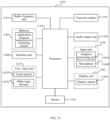
- FIG. 11 is a schematic diagram of a hardware structure of a terminal implementing the embodiments of this application.
- a terminal 1100 includes but is not limited to at least some components of a radio frequency unit 1101, a network module 1102, an audio output unit 1103, an input unit 1104, a sensor 1105, a display unit 1106, a user input unit 1107, an interface unit 1108, a memory 1109, and a processor 1110.
- the terminal 1100 may further include a power source (for example, a battery) for supplying power to the components.
- the power source may be logically connected to the processor 1110 through a power management system. In this way, functions such as charge management, discharge management, and power consumption management are implemented by using the power management system.
- the structure of the terminal shown in FIG. 11 does not constitute a limitation on the terminal.
- the terminal may include more or fewer components than illustrated in the figure, or combine some components, or have a different component arrangement. Details are not described herein.
- the input unit 1104 may include a graphics processing unit (Graphics Processing Unit, GPU) 11041 and a microphone 11042.
- the graphics processing unit 11041 processes image data of a static picture or a video that is obtained by an image capture apparatus (for example, a camera) in a video capture mode or an image capture mode.
- the display unit 1106 may include a display panel 11061.
- the display panel 11061 may be configured in a form of a liquid crystal display, an organic light-emitting diode, or the like.
- the user input unit 1107 includes a touch panel 11071 and other input devices 11072.
- the touch panel 11071 is also referred to as a touch screen.
- the touch panel 11071 may include two parts: a touch detection apparatus and a touch controller.
- the other input devices 11072 may include but are not limited to a physical keyboard, a functional button (such as a volume control button or a power on/off button), a trackball, a mouse, and a joystick. Details are not described herein.
- the radio frequency circuit 1101 receives downlink data from the network-side device for processing by the processor 1110, and sends uplink data to the network-side device.
- the radio frequency unit 1101 includes but is not limited to an antenna, at least one amplifier, a transceiver, a coupler, a low noise amplifier, a duplexer, and the like.
- the memory 1109 may be configured to store software programs or instructions, and various data.
- the memory 1109 may mainly include a program or instruction storage area and a data storage area.
- the program or instruction storage area may store an operating system, an application program or instructions required by at least one function (for example, an audio playing function and an image playing function), and the like.
- the memory 1109 may include a high-speed random access memory, and may further include a non-volatile memory.
- the non-volatile memory may be a read-only memory (Read-Only Memory, ROM), a programmable read-only memory (Programmable ROM, PROM), an erasable programmable read-only memory (Erasable PROM, EPROM), an electrically erasable programmable read-only memory (Electrically EPROM, EEPROM), or a flash memory, for example, at least one magnetic disk storage device, a flash storage device, or another volatile solid-state storage device.
- ROM Read-Only Memory
- PROM programmable read-only memory
- Erasable PROM Erasable PROM
- EPROM electrically erasable programmable read-only memory
- EEPROM electrically erasable programmable read-only memory
- flash memory for example, at least one magnetic disk storage device, a flash storage device, or another volatile solid-state storage device.
- the processor 1110 may include one or more processing units.
- the processor 1110 may integrate an application processor and a modem processor.
- the application processor mainly processes an operating system, a user interface, an application program or instructions, and the like.
- the modem processor mainly processes wireless communication, for example, a baseband processor. It should be understood that alternatively, the modem processor may not be integrated into the processor 1110.
- the processor 1110 is configured to:
- the candidate physical downlink shared channel PDSCH reception occasion set is determined based on the at least two consecutive slot units corresponding to each element in the slot timing set. That is, one slot timing set can correspond to as many feedback slot units as possible to carry feedbacks on one PUCCH, ensuring that feedbacks are provided for all scheduled PDSCHs and HARQ-ACKs for the scheduled PDSCHs are fed back on as few PUCCHs as possible. This reduces the number of semi-static codebook feedback bits, reduces overheads, and avoids that a feedback cannot be provided for a PDSCH in a case that one DCI schedules multiple PDSCHs at a time, thereby improving flexibility of base station scheduling.
- the processor 1110 is configured to:
- the processor 1110 is configured to:
- the target SLIV set includes a set formed by all SLIVs in the TDRA table.
- each of the slot units in the second slot set corresponds to at least one candidate PDSCH reception occasion.
- the processor 1110 is configured to: for each first target group, feed back an ACK or NACK for only at most one SLIV in the first target group.
- the processor 1110 is configured to: remove, from the second slot set, an SLIV configured for uplink in a TDD frame structure before grouping is performed on the target SLIV set in the TDRA table.
- the target SLIV set includes an SLIV set formed by SLIVs in predetermined positions in all rows of the TDRA table.
- each first slot set corresponds to at least one candidate PDSCH reception occasion.
- the processor 1110 is configured to: for each first target group, feed back an ACK or NACK for only at most one SLIV-containing row in the first target group.
- the number of ACKs or NACKs for the at most one SLIV-containing row is determined based on the number of SLIVs in a row containing the maximum number of SLIVs among all SLIV-containing rows or determined based on the number of SLIVs in a row containing the maximum number of SLIVs in the TDRA table.
- the processor 1110 is configured to: remove, from the first slot set, all SLIVs in a row containing an SLIV configured for uplink in a TDD frame structure before grouping is performed on the target SLIV set in the TDRA table.
- the processor 1110 is configured to:
- the processor 1110 is configured to:
- the HARQ ACK feedback codebook includes a first codebook, where each second target group corresponds to one bit in the first codebook.
- the HARQ ACK feedback codebook includes a second codebook, where bits in the second codebook contain an ACK or NACK of each candidate PDSCH reception occasion in the second target group corresponding to the NACK in the first codebook.
- the first codebook and the second codebook are carried on different PUCCH resources.
- the slot timing set includes at least one slot timing value K1, and positions of the at least two consecutive slot units are determined based on the at least one slot timing value K1 and the number of the at least two consecutive slot units; or the slot timing set includes at least one slot timing value K1 and at least one slot timing offset, and positions of the at least two consecutive slot units are determined based on the at least one slot timing value K1 and the at least one slot timing offset; where the number of the at least two consecutive slot units is preconfigured, or predefined by a protocol, or a fixed value.
- the number of the at least two consecutive slot units is preconfigured or predefined by a protocol
- the number of the at least two consecutive slot units is associated with a first SCS and the first SCS is an SCS of a BWP in which the actual HARQ ACK feedback unit is.
- HARQ ACK feedback codebooks corresponding to multiple PDSCHs scheduled by one DCI are fed back on same or different PUCCHs or PUSCHs.
- the processor 1110 is further configured to:
- the candidate physical downlink shared channel PDSCH reception occasion set is determined based on the at least two consecutive slot units corresponding to each element in the slot timing set. That is, one slot timing set can correspond to as many feedback slot units as possible to carry feedbacks on one PUCCH, ensuring that feedbacks are provided for all scheduled PDSCHs and HARQ-ACKs for the scheduled PDSCHs are fed back on as few PUCCHs as possible. This reduces the number of semi-static codebook feedback bits, reduces overheads, and avoids that a feedback cannot be provided for a PDSCH in a case that one DCI schedules multiple PDSCHs at a time, thereby improving flexibility of base station scheduling.
- An embodiment of this application further provides a readable storage medium, where the readable storage medium stores a program or instructions, and when the program or instructions are executed by a processor, the processes of the foregoing embodiments of the HARQ ACK feedback method are implemented, with the same technical effects achieved. To avoid repetition, details are not described herein again.
- the processor is the processor in the terminal in the foregoing embodiments.
- the readable storage medium includes a computer-readable storage medium, for example, a computer read-only memory (Read-Only Memory, ROM), a random access memory (Random Access Memory, RAM), a magnetic disk, or an optical disc.
- An embodiment of this application further provides a chip, where the chip includes a processor and a communication interface, the communication interface is coupled to the processor, and the processor is configured to run a program or instructions to implement the processes of the foregoing embodiments of the HARQ ACK feedback method, with the same technical effects achieved. To avoid repetition, details are not described herein again.
- the chip mentioned in this embodiment of this application may also be referred to as a system-level chip, a system chip, a chip system, a system-on-chip, or the like.
- the software product is stored in a storage medium (for example, a ROM/RAM, a magnetic disk, or an optical disc), and includes several instructions for instructing a terminal (which may be a mobile phone, a computer, a server, an air conditioner, a network device, or the like) to perform the method described in the embodiments of this application.
- a storage medium for example, a ROM/RAM, a magnetic disk, or an optical disc
- a terminal which may be a mobile phone, a computer, a server, an air conditioner, a network device, or the like
Landscapes
- Engineering & Computer Science (AREA)
- Signal Processing (AREA)
- Computer Networks & Wireless Communication (AREA)
- Quality & Reliability (AREA)
- Mobile Radio Communication Systems (AREA)
Applications Claiming Priority (2)
| Application Number | Priority Date | Filing Date | Title |
|---|---|---|---|
| CN202110297345.8A CN115118395B (zh) | 2021-03-19 | 2021-03-19 | Harq ack反馈方法、装置、终端及存储介质 |
| PCT/CN2022/081461 WO2022194249A1 (fr) | 2021-03-19 | 2022-03-17 | Appareil et procédé de rétroaction d'ack harq, terminal et support de stockage |
Publications (4)
| Publication Number | Publication Date |
|---|---|
| EP4311145A1 true EP4311145A1 (fr) | 2024-01-24 |
| EP4311145A4 EP4311145A4 (fr) | 2024-06-05 |
| EP4311145B1 EP4311145B1 (fr) | 2025-07-16 |
| EP4311145C0 EP4311145C0 (fr) | 2025-07-16 |
Family
ID=83321887
Family Applications (1)
| Application Number | Title | Priority Date | Filing Date |
|---|---|---|---|
| EP22770602.5A Active EP4311145B1 (fr) | 2021-03-19 | 2022-03-17 | Appareil et procédé de rétroaction d'ack harq, terminal et support de stockage |
Country Status (6)
| Country | Link |
|---|---|
| US (1) | US20240008038A1 (fr) |
| EP (1) | EP4311145B1 (fr) |
| JP (1) | JP7587718B2 (fr) |
| CN (1) | CN115118395B (fr) |
| ES (1) | ES3037758T3 (fr) |
| WO (1) | WO2022194249A1 (fr) |
Cited By (1)
| Publication number | Priority date | Publication date | Assignee | Title |
|---|---|---|---|---|
| EP4319004A4 (fr) * | 2021-03-31 | 2024-06-05 | Wilus Institute of Standards and Technology Inc. | Procédé, appareil, et système de transmission d'un livre de codes harq-ack dans un système de communication sans fil |
Families Citing this family (3)
| Publication number | Priority date | Publication date | Assignee | Title |
|---|---|---|---|---|
| CN114175542B (zh) * | 2019-08-16 | 2023-09-26 | 华为技术有限公司 | 通信方法以及通信装置 |
| CN117652103A (zh) * | 2021-08-05 | 2024-03-05 | 苹果公司 | 用于多pdsch传输的csi反馈 |
| EP4573715A4 (fr) * | 2022-11-07 | 2026-01-14 | Lenovo Beijing Ltd | Procédé et appareil de détermination de livre de codes harq-ack de type 1 |
Family Cites Families (11)
| Publication number | Priority date | Publication date | Assignee | Title |
|---|---|---|---|---|
| DE112018000238T5 (de) * | 2017-02-06 | 2019-10-24 | Intel IP Corporation | Hybride automatische-wiederholungsanfrage-bestätigungsbundling fürkommunikationssysteme |
| US11019612B2 (en) * | 2018-05-11 | 2021-05-25 | Qualcomm Incorporated | HARQ-ACK reporting for downlink communications included in multiple downlink association sets |
| WO2020063301A1 (fr) * | 2018-09-28 | 2020-04-02 | 华为技术有限公司 | Procédé et appareil de communication, et dispositif |
| US11705993B2 (en) * | 2019-03-29 | 2023-07-18 | Qualcomm Incorporated | Semi-static HARQ-ACK codebook enhancements for NR-U |
| CN111770572B (zh) * | 2019-03-30 | 2023-08-04 | 华为技术有限公司 | 确定反馈信息的方法和通信装置 |
| US12206622B2 (en) * | 2019-08-01 | 2025-01-21 | Lenovo (Beijing) Limited | Apparatus and method of harq-ack feedback |
| WO2021030947A1 (fr) * | 2019-08-16 | 2021-02-25 | Qualcomm Incorporated | Détermination de groupage et de chronologie pour de multiples blocs de transport planifiés par un message d'informations de commande de liaison descendante unique |
| CN111800230B (zh) * | 2019-08-23 | 2021-12-03 | 维沃移动通信有限公司 | 一种反馈混合自动重传请求确认的方法和终端设备 |
| EP4147511A4 (fr) * | 2020-05-06 | 2024-02-28 | QUALCOMM Incorporated | Opportunités de communication multiples pour une occasion de planification semi-persistante |
| EP4179821A1 (fr) * | 2020-07-31 | 2023-05-17 | Google LLC | Ordonnancement de multiples canaux de communication par l'intermédiaire d'un seul élément de commande |
| JP7389922B2 (ja) * | 2020-10-15 | 2023-11-30 | エルジー エレクトロニクス インコーポレイティド | 無線通信システムにおける信号の送受信方法および装置 |
-
2021
- 2021-03-19 CN CN202110297345.8A patent/CN115118395B/zh active Active
-
2022
- 2022-03-17 ES ES22770602T patent/ES3037758T3/es active Active
- 2022-03-17 EP EP22770602.5A patent/EP4311145B1/fr active Active
- 2022-03-17 JP JP2023555383A patent/JP7587718B2/ja active Active
- 2022-03-17 WO PCT/CN2022/081461 patent/WO2022194249A1/fr not_active Ceased
-
2023
- 2023-09-15 US US18/468,402 patent/US20240008038A1/en active Pending
Cited By (4)
| Publication number | Priority date | Publication date | Assignee | Title |
|---|---|---|---|---|
| EP4319004A4 (fr) * | 2021-03-31 | 2024-06-05 | Wilus Institute of Standards and Technology Inc. | Procédé, appareil, et système de transmission d'un livre de codes harq-ack dans un système de communication sans fil |
| US12081348B2 (en) | 2021-03-31 | 2024-09-03 | Wilus Institute Of Standards And Technology Inc. | Method, apparatus, and system for transmitting HARQ-ACK codebook in wireless communication system |
| US12375224B2 (en) | 2021-03-31 | 2025-07-29 | Wilus Institute Of Standards And Technology Inc. | Method, apparatus, and system for transmitting HARQ-ACK codebook in wireless communication system |
| US12381665B2 (en) | 2021-03-31 | 2025-08-05 | Wilus Institute Of Standards And Technology Inc. | Method, apparatus, and system for transmitting HARQ-ACK codebook in wireless communication system |
Also Published As
| Publication number | Publication date |
|---|---|
| US20240008038A1 (en) | 2024-01-04 |
| EP4311145B1 (fr) | 2025-07-16 |
| EP4311145A4 (fr) | 2024-06-05 |
| CN115118395B (zh) | 2024-09-20 |
| EP4311145C0 (fr) | 2025-07-16 |
| ES3037758T3 (en) | 2025-10-06 |
| CN115118395A (zh) | 2022-09-27 |
| JP7587718B2 (ja) | 2024-11-20 |
| JP2024509292A (ja) | 2024-02-29 |
| WO2022194249A1 (fr) | 2022-09-22 |
Similar Documents
| Publication | Publication Date | Title |
|---|---|---|
| EP4311145A1 (fr) | Appareil et procédé de rétroaction d'ack harq, terminal et support de stockage | |
| EP4518547A1 (fr) | Procédé et appareil de fonctionnement de terminal, terminal et dispositif côté réseau | |
| EP4307589A1 (fr) | Procédé et terminal de génération de livre de codes harq-ack semi-statique | |
| EP4456633A1 (fr) | Procédé et appareil de détermination de transmission, terminal, dispositif côté réseau et support de stockage | |
| JP7660267B2 (ja) | Pdcchの監視方法、装置、端末及び可読記憶媒体 | |
| EP4510744A1 (fr) | Procédé et appareil de réception d'informations, procédé et appareil d'envoi d'informations, et dispositif | |
| US20230254873A1 (en) | Feedback Information Transmission Method, Terminal and Network Device | |
| US20240357664A1 (en) | Communication operation execution method and apparatus, terminal, and storage medium | |
| US20240023108A1 (en) | Method and apparatus for determining pucch resource, and terminal | |
| EP4181439A1 (fr) | Procédé et dispositif de rétroaction harq-ack | |
| US20250023690A1 (en) | Resource processing method and apparatus, and terminal | |
| US20240357593A1 (en) | Method and apparatus for determining processing time, ue, and storage medium | |
| EP4661536A1 (fr) | Procédé de détermination de bwp, procédé de transmission, appareil, terminal et dispositif côté réseau | |
| EP4503672A1 (fr) | Procédé et appareil de détermination de ressource, terminal, et support de stockage | |
| EP4510485A1 (fr) | Procédé de rétroaction d'accusé de réception de requête automatique de répétition hybride, terminal et dispositif côté réseau | |
| JP2024503349A (ja) | Pdcchブラインド検出の制限方法、端末及びネットワーク側機器 | |
| EP4478636A1 (fr) | Procédé, appareil, et terminal de rétroaction de réponse | |
| US20240163879A1 (en) | Uplink transmission method and apparatus, and terminal | |
| EP4615130A1 (fr) | Procédé et appareil de retour d'informations d'accusé de réception de requête automatique de répétition hybride (harq-ack), et produit associé | |
| EP4661545A1 (fr) | Procédé de détermination de taille de dci, procédé d'envoi de dci, appareil et dispositif associé | |
| EP4319023A1 (fr) | Procédé et appareil d'émission de pdsch, procédé et appareil de réception de pdsch, et dispositif de communication | |
| US20240284464A1 (en) | Information determining method and apparatus, terminal, and readable storage medium | |
| EP4383889A1 (fr) | Procédé de détermination de temps d'application de faisceau, terminal, et dispositif côté réseau | |
| EP4478818A1 (fr) | Procédé et appareil de détermination d'état de tci de liaison montante, terminal et dispositif côté réseau | |
| EP4456464A1 (fr) | Procédé et appareil de traitement d'accusé de réception de demande de répétition automatique hybride, et équipement utilisateur |
Legal Events
| Date | Code | Title | Description |
|---|---|---|---|
| STAA | Information on the status of an ep patent application or granted ep patent |
Free format text: STATUS: THE INTERNATIONAL PUBLICATION HAS BEEN MADE |
|
| PUAI | Public reference made under article 153(3) epc to a published international application that has entered the european phase |
Free format text: ORIGINAL CODE: 0009012 |
|
| STAA | Information on the status of an ep patent application or granted ep patent |
Free format text: STATUS: REQUEST FOR EXAMINATION WAS MADE |
|
| 17P | Request for examination filed |
Effective date: 20230912 |
|
| AK | Designated contracting states |
Kind code of ref document: A1 Designated state(s): AL AT BE BG CH CY CZ DE DK EE ES FI FR GB GR HR HU IE IS IT LI LT LU LV MC MK MT NL NO PL PT RO RS SE SI SK SM TR |
|
| REG | Reference to a national code |
Ref country code: DE Ref legal event code: R079 Free format text: PREVIOUS MAIN CLASS: H04L0001180000 Ipc: H04L0001160700 Ref document number: 602022017761 Country of ref document: DE |
|
| A4 | Supplementary search report drawn up and despatched |
Effective date: 20240503 |
|
| RIC1 | Information provided on ipc code assigned before grant |
Ipc: H04W 72/04 20090101ALI20240427BHEP Ipc: H04L 5/00 20060101ALI20240427BHEP Ipc: H04L 1/1867 20230101ALI20240427BHEP Ipc: H04L 1/1829 20230101ALI20240427BHEP Ipc: H04L 1/18 20060101ALI20240427BHEP Ipc: H04L 1/1607 20230101AFI20240427BHEP |
|
| DAV | Request for validation of the european patent (deleted) | ||
| DAX | Request for extension of the european patent (deleted) | ||
| GRAP | Despatch of communication of intention to grant a patent |
Free format text: ORIGINAL CODE: EPIDOSNIGR1 |
|
| STAA | Information on the status of an ep patent application or granted ep patent |
Free format text: STATUS: GRANT OF PATENT IS INTENDED |
|
| INTG | Intention to grant announced |
Effective date: 20250221 |
|
| GRAS | Grant fee paid |
Free format text: ORIGINAL CODE: EPIDOSNIGR3 |
|
| GRAA | (expected) grant |
Free format text: ORIGINAL CODE: 0009210 |
|
| STAA | Information on the status of an ep patent application or granted ep patent |
Free format text: STATUS: THE PATENT HAS BEEN GRANTED |
|
| AK | Designated contracting states |
Kind code of ref document: B1 Designated state(s): AL AT BE BG CH CY CZ DE DK EE ES FI FR GB GR HR HU IE IS IT LI LT LU LV MC MK MT NL NO PL PT RO RS SE SI SK SM TR |
|
| REG | Reference to a national code |
Ref country code: GB Ref legal event code: FG4D |
|
| REG | Reference to a national code |
Ref country code: CH Ref legal event code: EP Ref country code: DE Ref legal event code: R096 Ref document number: 602022017761 Country of ref document: DE |
|
| REG | Reference to a national code |
Ref country code: IE Ref legal event code: FG4D |
|
| U01 | Request for unitary effect filed |
Effective date: 20250806 |
|
| U07 | Unitary effect registered |
Designated state(s): AT BE BG DE DK EE FI FR IT LT LU LV MT NL PT RO SE SI Effective date: 20250818 |
|
| REG | Reference to a national code |
Ref country code: ES Ref legal event code: FG2A Ref document number: 3037758 Country of ref document: ES Kind code of ref document: T3 Effective date: 20251006 |
|
| PG25 | Lapsed in a contracting state [announced via postgrant information from national office to epo] |
Ref country code: IS Free format text: LAPSE BECAUSE OF FAILURE TO SUBMIT A TRANSLATION OF THE DESCRIPTION OR TO PAY THE FEE WITHIN THE PRESCRIBED TIME-LIMIT Effective date: 20251116 |
|
| PG25 | Lapsed in a contracting state [announced via postgrant information from national office to epo] |
Ref country code: NO Free format text: LAPSE BECAUSE OF FAILURE TO SUBMIT A TRANSLATION OF THE DESCRIPTION OR TO PAY THE FEE WITHIN THE PRESCRIBED TIME-LIMIT Effective date: 20251016 |
|
| PG25 | Lapsed in a contracting state [announced via postgrant information from national office to epo] |
Ref country code: HR Free format text: LAPSE BECAUSE OF FAILURE TO SUBMIT A TRANSLATION OF THE DESCRIPTION OR TO PAY THE FEE WITHIN THE PRESCRIBED TIME-LIMIT Effective date: 20250716 |
|
| PG25 | Lapsed in a contracting state [announced via postgrant information from national office to epo] |
Ref country code: GR Free format text: LAPSE BECAUSE OF FAILURE TO SUBMIT A TRANSLATION OF THE DESCRIPTION OR TO PAY THE FEE WITHIN THE PRESCRIBED TIME-LIMIT Effective date: 20251017 |
|
| PG25 | Lapsed in a contracting state [announced via postgrant information from national office to epo] |
Ref country code: PL Free format text: LAPSE BECAUSE OF FAILURE TO SUBMIT A TRANSLATION OF THE DESCRIPTION OR TO PAY THE FEE WITHIN THE PRESCRIBED TIME-LIMIT Effective date: 20250716 |
|
| PG25 | Lapsed in a contracting state [announced via postgrant information from national office to epo] |
Ref country code: RS Free format text: LAPSE BECAUSE OF FAILURE TO SUBMIT A TRANSLATION OF THE DESCRIPTION OR TO PAY THE FEE WITHIN THE PRESCRIBED TIME-LIMIT Effective date: 20251016 |
|
| U20 | Renewal fee for the european patent with unitary effect paid |
Year of fee payment: 5 Effective date: 20260209 |
|
| PG25 | Lapsed in a contracting state [announced via postgrant information from national office to epo] |
Ref country code: SM Free format text: LAPSE BECAUSE OF FAILURE TO SUBMIT A TRANSLATION OF THE DESCRIPTION OR TO PAY THE FEE WITHIN THE PRESCRIBED TIME-LIMIT Effective date: 20250716 |
|
| PGFP | Annual fee paid to national office [announced via postgrant information from national office to epo] |
Ref country code: GB Payment date: 20260202 Year of fee payment: 5 |
|
| PG25 | Lapsed in a contracting state [announced via postgrant information from national office to epo] |
Ref country code: CZ Free format text: LAPSE BECAUSE OF FAILURE TO SUBMIT A TRANSLATION OF THE DESCRIPTION OR TO PAY THE FEE WITHIN THE PRESCRIBED TIME-LIMIT Effective date: 20250716 |
|
| PG25 | Lapsed in a contracting state [announced via postgrant information from national office to epo] |
Ref country code: SK Free format text: LAPSE BECAUSE OF FAILURE TO SUBMIT A TRANSLATION OF THE DESCRIPTION OR TO PAY THE FEE WITHIN THE PRESCRIBED TIME-LIMIT Effective date: 20250716 |
|
| U1N | Appointed representative for the unitary patent procedure changed after the registration of the unitary effect |
Representative=s name: MARKS & CLERK LLP; GB |