EP4311690B1 - Composition de caoutchouc pour pneu de camion - Google Patents
Composition de caoutchouc pour pneu de camion Download PDFInfo
- Publication number
- EP4311690B1 EP4311690B1 EP23188202.8A EP23188202A EP4311690B1 EP 4311690 B1 EP4311690 B1 EP 4311690B1 EP 23188202 A EP23188202 A EP 23188202A EP 4311690 B1 EP4311690 B1 EP 4311690B1
- Authority
- EP
- European Patent Office
- Prior art keywords
- phr
- rubber composition
- rubber
- silica
- tire
- Prior art date
- Legal status (The legal status is an assumption and is not a legal conclusion. Google has not performed a legal analysis and makes no representation as to the accuracy of the status listed.)
- Active
Links
Images
Classifications
-
- C—CHEMISTRY; METALLURGY
- C08—ORGANIC MACROMOLECULAR COMPOUNDS; THEIR PREPARATION OR CHEMICAL WORKING-UP; COMPOSITIONS BASED THEREON
- C08F—MACROMOLECULAR COMPOUNDS OBTAINED BY REACTIONS ONLY INVOLVING CARBON-TO-CARBON UNSATURATED BONDS
- C08F136/00—Homopolymers of compounds having one or more unsaturated aliphatic radicals, at least one having two or more carbon-to-carbon double bonds
- C08F136/02—Homopolymers of compounds having one or more unsaturated aliphatic radicals, at least one having two or more carbon-to-carbon double bonds the radical having only two carbon-to-carbon double bonds
- C08F136/04—Homopolymers of compounds having one or more unsaturated aliphatic radicals, at least one having two or more carbon-to-carbon double bonds the radical having only two carbon-to-carbon double bonds conjugated
- C08F136/08—Isoprene
-
- B—PERFORMING OPERATIONS; TRANSPORTING
- B60—VEHICLES IN GENERAL
- B60C—VEHICLE TYRES; TYRE INFLATION; TYRE CHANGING; CONNECTING VALVES TO INFLATABLE ELASTIC BODIES IN GENERAL; DEVICES OR ARRANGEMENTS RELATED TO TYRES
- B60C1/00—Tyres characterised by the chemical composition or the physical arrangement or mixture of the composition
-
- B—PERFORMING OPERATIONS; TRANSPORTING
- B60—VEHICLES IN GENERAL
- B60C—VEHICLE TYRES; TYRE INFLATION; TYRE CHANGING; CONNECTING VALVES TO INFLATABLE ELASTIC BODIES IN GENERAL; DEVICES OR ARRANGEMENTS RELATED TO TYRES
- B60C1/00—Tyres characterised by the chemical composition or the physical arrangement or mixture of the composition
- B60C1/0016—Compositions of the tread
-
- C—CHEMISTRY; METALLURGY
- C08—ORGANIC MACROMOLECULAR COMPOUNDS; THEIR PREPARATION OR CHEMICAL WORKING-UP; COMPOSITIONS BASED THEREON
- C08C—TREATMENT OR CHEMICAL MODIFICATION OF RUBBERS
- C08C19/00—Chemical modification of rubber
- C08C19/22—Incorporating nitrogen atoms into the molecule
-
- C—CHEMISTRY; METALLURGY
- C08—ORGANIC MACROMOLECULAR COMPOUNDS; THEIR PREPARATION OR CHEMICAL WORKING-UP; COMPOSITIONS BASED THEREON
- C08C—TREATMENT OR CHEMICAL MODIFICATION OF RUBBERS
- C08C19/00—Chemical modification of rubber
- C08C19/25—Incorporating silicon atoms into the molecule
-
- C—CHEMISTRY; METALLURGY
- C08—ORGANIC MACROMOLECULAR COMPOUNDS; THEIR PREPARATION OR CHEMICAL WORKING-UP; COMPOSITIONS BASED THEREON
- C08F—MACROMOLECULAR COMPOUNDS OBTAINED BY REACTIONS ONLY INVOLVING CARBON-TO-CARBON UNSATURATED BONDS
- C08F212/00—Copolymers of compounds having one or more unsaturated aliphatic radicals, each having only one carbon-to-carbon double bond, and at least one being terminated by an aromatic carbocyclic ring
- C08F212/02—Monomers containing only one unsaturated aliphatic radical
- C08F212/04—Monomers containing only one unsaturated aliphatic radical containing one ring
- C08F212/06—Hydrocarbons
- C08F212/08—Styrene
-
- C—CHEMISTRY; METALLURGY
- C08—ORGANIC MACROMOLECULAR COMPOUNDS; THEIR PREPARATION OR CHEMICAL WORKING-UP; COMPOSITIONS BASED THEREON
- C08F—MACROMOLECULAR COMPOUNDS OBTAINED BY REACTIONS ONLY INVOLVING CARBON-TO-CARBON UNSATURATED BONDS
- C08F36/00—Homopolymers and copolymers of compounds having one or more unsaturated aliphatic radicals, at least one having two or more carbon-to-carbon double bonds
- C08F36/02—Homopolymers and copolymers of compounds having one or more unsaturated aliphatic radicals, at least one having two or more carbon-to-carbon double bonds the radical having only two carbon-to-carbon double bonds
- C08F36/04—Homopolymers and copolymers of compounds having one or more unsaturated aliphatic radicals, at least one having two or more carbon-to-carbon double bonds the radical having only two carbon-to-carbon double bonds conjugated
- C08F36/06—Butadiene
-
- C—CHEMISTRY; METALLURGY
- C08—ORGANIC MACROMOLECULAR COMPOUNDS; THEIR PREPARATION OR CHEMICAL WORKING-UP; COMPOSITIONS BASED THEREON
- C08K—Use of inorganic or non-macromolecular organic substances as compounding ingredients
- C08K3/00—Use of inorganic substances as compounding ingredients
- C08K3/02—Elements
- C08K3/04—Carbon
-
- C—CHEMISTRY; METALLURGY
- C08—ORGANIC MACROMOLECULAR COMPOUNDS; THEIR PREPARATION OR CHEMICAL WORKING-UP; COMPOSITIONS BASED THEREON
- C08K—Use of inorganic or non-macromolecular organic substances as compounding ingredients
- C08K3/00—Use of inorganic substances as compounding ingredients
- C08K3/34—Silicon-containing compounds
- C08K3/36—Silica
-
- C—CHEMISTRY; METALLURGY
- C08—ORGANIC MACROMOLECULAR COMPOUNDS; THEIR PREPARATION OR CHEMICAL WORKING-UP; COMPOSITIONS BASED THEREON
- C08K—Use of inorganic or non-macromolecular organic substances as compounding ingredients
- C08K5/00—Use of organic ingredients
- C08K5/54—Silicon-containing compounds
- C08K5/548—Silicon-containing compounds containing sulfur
-
- C—CHEMISTRY; METALLURGY
- C08—ORGANIC MACROMOLECULAR COMPOUNDS; THEIR PREPARATION OR CHEMICAL WORKING-UP; COMPOSITIONS BASED THEREON
- C08L—COMPOSITIONS OF MACROMOLECULAR COMPOUNDS
- C08L47/00—Compositions of homopolymers or copolymers of compounds having one or more unsaturated aliphatic radicals, at least one having two or more carbon-to-carbon double bonds; Compositions of derivatives of such polymers
-
- C—CHEMISTRY; METALLURGY
- C08—ORGANIC MACROMOLECULAR COMPOUNDS; THEIR PREPARATION OR CHEMICAL WORKING-UP; COMPOSITIONS BASED THEREON
- C08L—COMPOSITIONS OF MACROMOLECULAR COMPOUNDS
- C08L7/00—Compositions of natural rubber
-
- C—CHEMISTRY; METALLURGY
- C08—ORGANIC MACROMOLECULAR COMPOUNDS; THEIR PREPARATION OR CHEMICAL WORKING-UP; COMPOSITIONS BASED THEREON
- C08L—COMPOSITIONS OF MACROMOLECULAR COMPOUNDS
- C08L9/00—Compositions of homopolymers or copolymers of conjugated diene hydrocarbons
-
- B—PERFORMING OPERATIONS; TRANSPORTING
- B60—VEHICLES IN GENERAL
- B60C—VEHICLE TYRES; TYRE INFLATION; TYRE CHANGING; CONNECTING VALVES TO INFLATABLE ELASTIC BODIES IN GENERAL; DEVICES OR ARRANGEMENTS RELATED TO TYRES
- B60C2200/00—Tyres specially adapted for particular applications
- B60C2200/06—Tyres specially adapted for particular applications for heavy duty vehicles
-
- C—CHEMISTRY; METALLURGY
- C08—ORGANIC MACROMOLECULAR COMPOUNDS; THEIR PREPARATION OR CHEMICAL WORKING-UP; COMPOSITIONS BASED THEREON
- C08K—Use of inorganic or non-macromolecular organic substances as compounding ingredients
- C08K2201/00—Specific properties of additives
- C08K2201/002—Physical properties
- C08K2201/006—Additives being defined by their surface area
Definitions
- the present invention is directed to a rubber composition, in particular for a tire, such as a truck tire. Furthermore, the present invention is directed to a tire comprising such a rubber composition. Moreover, the present invention is directed to a truck, in particular to a semi-trailer truck having a truck and a semi-trailer, wherein the truck comprises a tire with said rubber composition, preferably in its tread.
- the invention relates to a rubber composition in accordance with claim 1, to a tire in accordance with claim 12 and to semi-trailer truck in accordance with claim 15.
- One object of the present invention is to provide a rubber composition, in particular for a truck tire which has superior rolling resistance properties.
- Another object of the present invention is to provide a rubber composition having good rolling resistance properties at limited abrasion.
- Yet another object of the present invention is to provide a rubber composition for a truck tire with good rolling resistance and wet grip properties.
- Another object of the present invention is to provide a rubber composition for a truck tire meeting a combination of the above mentioned objects.
- the present invention is directed to a rubber composition, preferably for a truck tire, the rubber composition comprising 70 phr to 95 phr, preferably 75 phr to 95 phr, of polyisoprene, and 5 phr to 30 phr, preferably 5 phr to 25 phr, of a solution polymerized styrene butadiene rubber having a glass transition temperature of less than -40°C which is functionalized for the coupling to silica.
- the rubber composition comprises 40 phr to 80 phr of a filler comprising predominantly silica.
- the rubber composition comprises from 45 phr to 75 phr of silica.
- silica lower and higher silica amounts are preferably avoided.
- lower filler amounts may impact the stiffness of the tire and higher silica amounts may impair for instance elongation at break or tensile strength.
- the rubber composition comprises more than 55 phr of silica and less than 70 phr of silica.
- said silica has a BET surface area of at least 190 m 2 /g, preferably of at least 200 m 2 /g, and/or of at most 350 m 2 /g, or even more preferably of less than 300 m 2 /g.
- the rubber composition comprises less than than 10 phr of carbon black.
- the amount of carbon black in the present composition is low.
- the rubber composition comprises from 0, preferably from 0.1 phr to 6 phr, preferably 4 phr of carbon black.
- One task of the carbon black is to provide the tire with a black color.
- the solution polymerized styrene butadiene rubber is functionalized with one or more groups selected from i) at least one amino silane group, ii) at least one amino siloxane group, and iii) at least one amino silanol group.
- groups selected from i) at least one amino silane group, ii) at least one amino siloxane group, and iii) at least one amino silanol group.
- the functional groups could be in-chain, pendant or provided at one or more chain ends.
- the solution polymerized styrene butadiene rubber is end-chain functionalized with one or more of these groups.
- the solution polymerized styrene butadiene rubber has a weight average molecular weight Mw within a range of 200k g/mol and 800k g/mol, preferably 300k g/mol and 700k g/mol.
- the solution polymerized styrene butadiene rubber has a styrene content ranging from 5% to 20% and/or a vinyl content ranging from 20% to 50%, preferably 30% to 45% (RHC).
- the solution polymerized styrene butadiene rubber has a glass transition temperature within a range of -51°C to -68°C.
- the solution polymerized styrene butadiene rubber is neither a high Tg rubber nor a very low Tg rubber, which is amongst others intended to obtain a moderate compound Tg in combination with the polyisoprene of the present rubber composition.
- the rubber composition comprises one or more of from 80 phr or from 85 phr to 95 phr or to 92 phr of polyisoprene, and from 5 phr or from 8 phr to 30 phr, preferably to 25 phr or even more preferably to 20 phr or to 15 phr, of the solution polymerized styrene butadiene rubber. These ranges have been found to be particularly preferable.
- polyisoprene is predominantly natural rubber or even consisting of natural rubber.
- the use of natural rubber is typically preferred herein.
- the rubber composition comprises a silane within a range of 6 phr to 10 phr.
- the silane is one or more of: i) a sulfur containing silane (the silane molecules comprising one or more sulfur atoms); ii) a sulfur donor, wherein, e.g., the silane may provide one or more sulfur atoms per silane molecule for cross linking polymer chains of the rubber, such as of the polyisoprene and/or diene based rubber); and iii) one or more of at least one tetrasulfide silane and at least one mercapto silane.
- Said mercapto silane may be an unblocked or blocked mercapto silane.
- tetrasulfide silane is bis-triethoxysilylpropyl tetrasulfide.
- Example mercapto silanes include trialkoxymercaptoalkyl-silane (which is unblocked) and 3-Octanoylthio-1-propyltriethoxysilane (which is blocked).
- the rubber composition is a sulfur curable or sulfur cured rubber composition.
- the rubber composition comprises less than 4 phr of a polybutadiene rubber.
- the present invention preferably comprises essentially polyisoprene and the functionalized, solution polymerized styrene butadiene rubber.
- the rubber composition comprises less than 10 phr of resin. Depending on the resin type, this feature can further reduce the environmental impact and improve sustainability.
- the rubber composition comprises less than 10 phr of oil.
- this feature can further reduce the environmental impact and improve sustainability.
- stiffness is also positively influenced, in particular increased.
- the rubber composition may include at least one additional diene-based rubber.
- Representative synthetic polymers may be the homopolymerization products of butadiene and its homologues and derivatives, for example, methylbutadiene, dimethylbutadiene and pentadiene as well as copolymers such as those formed from butadiene or its homologues or derivatives with other unsaturated monomers. Additional examples of rubbers which may be used include alkoxy-silyl end functionalized solution polymerized polymers (SBR, PBR, IBR and SIBR), silicon-coupled and tin-coupled star-branched polymers. Preferred rubber or elastomers may be in general natural rubber, synthetic polyisoprene, polybutadiene and SBR including SSBR.
- the composition may comprise at least two diene-based rubbers.
- a combination of two or more rubbers is preferred such as cis 1,4-polyisoprene rubber (natural or synthetic, although natural is preferred), 3,4-polyisoprene rubber, styrene/isoprene/butadiene rubber, emulsion and solution polymerization derived styrene/butadiene rubbers, cis 1,4-polybutadiene rubbers, and emulsion polymerization prepared butadiene/acrylonitrile copolymers.
- an emulsion polymerization derived styrene/butadiene might be used having a styrene content of 20 to 28 percent bound styrene or, for some applications, an ESBR having a medium to relatively high bound styrene content, namely, a bound styrene content of 30 to 45 percent. In many cases the ESBR will have a bound styrene content which is within the range of 26 to 31 percent.
- emulsion polymerization prepared ESBR it may be meant that styrene and 1,3-butadiene are copolymerized as an aqueous emulsion. Such are well known to those skilled in such art.
- the bound styrene content can vary, for example, from 5 to 50 percent.
- the ESBR may also contain acrylonitrile to form a terpolymer rubber, as ESBAR, in amounts, for example, of 2 to 30 weight percent bound acrylonitrile in the terpolymer.
- ESBAR acrylonitrile to form a terpolymer rubber
- Emulsion polymerization prepared styrene/butadiene/acrylonitrile copolymer rubbers containing 2 to 40 weight percent bound acrylonitrile in the copolymer may also be contemplated as diene-based rubbers.
- Solution polymerization prepared (or solution polymerized) SBR may for instance have a bound styrene content in a range of 5 to 50 percent, preferably 9 to 36, percent, and most preferably 26 to 31 percent.
- the SSBR can be conveniently prepared, for example, by anionic polymerization in an inert organic solvent. More specifically, the SSBR can be synthesized by copolymerizing styrene and 1,3-butadiene monomer in a hydrocarbon solvent utilizing an organo lithium compound as the initiator.
- the solution styrene butadiene rubber is a tin-coupled polymer.
- the SBR or SSBR is functionalized for the coupling to silica, in particular as mentioned herein above.
- a synthetic or natural polyisoprene rubber may be used.
- the cis 1,4-microstructure content may be at least 90% and is typically at least 95% or even higher.
- cis-1,4-polybutadiene rubber (BR or PBD) is additionally used.
- Suitable polybutadiene rubbers may be prepared, for example, by organic solution polymerization of 1,3-butadiene.
- the BR may be conveniently characterized, for example, by having at least a 90 percent cis-1,4-microstructure content ("high cis” content) and a glass transition temperature (Tg) in a range of from -95 °C to -110°C.
- Suitable polybutadiene rubbers are available commercially, such as Budene ® 1207, Budene ® 1208, Budene ® 1223, or Budene ® 1280 from The Goodyear Tire & Rubber Company.
- These high cis-1,4-polybutadiene rubbers can for instance be synthesized utilizing nickel catalyst systems which include a mixture of (1) an organonickel compound, (2) an organoaluminum compound, and (3) a fluorine containing compound as described in United States Patent 5,698,643 and United States Patent 5,451,646 .
- a glass transition temperature, or Tg, of an elastomer represents the glass transition temperature of the respective elastomer in its uncured state.
- a glass transition temperature of an elastomer composition represents the glass transition temperature of the elastomer composition in its cured state.
- a Tg is determined as a peak midpoint by a differential scanning calorimeter (DSC) at a temperature rate of increase of 20° C per minute, according to ASTM D3418 or equivalent.
- phr refers to "parts by weight of a respective material per 100 parts by weight of rubber, or elastomer".
- a rubber composition is comprised of 100 parts by weight of rubber/elastomer.
- the claimed composition may comprise other rubbers/elastomers than explicitly mentioned in the claims, provided that the phr value of the claimed rubbers/elastomers is in accordance with claimed phr ranges and the amount of all rubbers/elastomers in the composition results in total in 100 parts of rubber.
- the composition may further comprise from 1 phr to 10 phr, optionally from 1 phr to 5 phr, of one or more additional diene-based rubbers, such as SBR, SSBR, ESBR, PBD/BR.
- the composition may include less than 5 phr, preferably less than 3, phr of an additional diene-based rubber or be also essentially free of such an additional diene-based rubber.
- compound and “composition” and “formulation” may be used herein interchangeably, unless indicated otherwise.
- the terms “rubber” and “elastomer” may also be used herein interchangeably.
- Molecular weights of elastomers/rubbers/resins are determined herein using gel permeation chromatography (GPC) according to ASTM 5296-11 using polystyrene calibration standards, or equivalent.
- the rubber composition includes a resin, preferably having a glass transition temperature Tg greater than 20° C.
- Tg for resins is determined as a peak midpoint by a differential scanning calorimeter (DSC) at a temperature rate of increase of 10°C per minute, according to ASTM D6604 or equivalent.
- the resin has a softening point above 70°C as determined by ASTM E28 which might sometimes be referred to as a ring and ball softening point.
- the resin is selected from the group consisting of coumarone-indene resin, petroleum hydrocarbon resin, terpene polymers/resins, styrene/alphamethylstyrene resins, terpene phenol resin, rosin derived resins and copolymers and/or mixtures thereof.
- a coumarone-indene resin preferably contains coumarone and indene as monomer components making up the resin skeleton (main chain).
- Monomer ingredients other than coumarone and indene which may be incorporated into the skeleton are, for example, methyl coumarone, styrene, alphamethylstyrene, methylindene, vinyltoluene, dicyclopentadiene, cyclopentadiene, and diolefins such as isoprene and piperlyene.
- Coumarone-indene resins have preferably softening points ranging from 10° C to 160° C (as measured by the ball-and-ring method). Even more preferably, the softening point ranges from 30° C to 100° C.
- Suitable petroleum resins include both aromatic and nonaromatic types. Several types of petroleum resins are available. Some resins have a low degree of unsaturation and high aromatic content, whereas some are highly unsaturated and yet some contain no aromatic structure at all. Differences in the resins are largely due to the olefins in the feedstock from which the resins are derived.
- Conventional derivatives in such resins include any C5 species (olefins and diolefines containing an average of five carbon atoms) such as cyclopentadiene, dicyclopentadiene, diolefins such as isoprene and piperylene, and any C9 species (olefins and diolefins containing an average of 9 carbon atoms) such as vinyltoluene, alphamethylstyrene and indene.
- Such resins are made by any mixture formed from C5 and C9 species mentioned above and are known as C5/C9 copolymer resins. Petroleum resins are typically available with softening points ranging from 10° C. to 120° C. Preferably, the softening point ranges from 30°C to 100°C.
- C5 resins are aliphatic resins made from one or more of the following monomers: 1,3-pentadiene (e.g., cis or trans), 2-methyl-2-butene, cyclopentene, cyclopentadiene, and dicyclopentadiene.
- a C9 resin is a resin made from one or more aromatic monomers, preferably chosen from the group of indene, methylindene, vinyl toluene, styrene and methylstyrene (such as alpha-methylstyrene).
- a C9 modified resin is a resin (such as a C5 resin) which has been modified or functionalized with one or more aromatic monomers, preferably chosen from the group of indene, methylindene, vinyl toluene, styrene and methylstyrene (such as alpha methylstyrene).
- Terpene resins are preferably comprised of polymers of at least one of limonene, alpha pinene, beta pinene and delta-3-carene.
- Terpene-phenol resins may be derived by copolymerization of phenolic monomers with terpenes such as limonenes, pinenes and delta-3-carene.
- resins derived from rosins and derivatives thereof are, for example, gum rosin, wood rosin and tall oil rosin. Gum rosin, wood rosin and tall oil rosin have similar compositions, although the amount of components of the rosins may vary. Such resins may be dimerized, polymerized or disproportionated. Such resins may be in the form of esters of rosin acids and polyols such as pentaerythritol or glycol.
- a styrene/alphamethylstyrene resin is considered herein to be a (preferably relatively short chain) copolymer of styrene and alphamethylstyrene with a styrene/alphamethylstyrene molar ratio in a range of 0.05 to 1.50.
- a resin can be suitably prepared, for example, by cationic copolymerization of styrene and alphamethylstyrene in a hydrocarbon solvent.
- the contemplated styrene/alphamethylstyrene resin can be characterized, for example, by its chemical structure, namely its styrene and alphamethylstyrene contents and by its glass transition temperature, molecular weight and molecular weight distribution.
- said resin is partially or fully hydrogenated.
- the rubber composition is essentially resin free or free of resin.
- the rubber composition comprises less than 15 phr, preferably less than 9 phr or even more preferably less than 4 phr of resin.
- the rubber composition comprises oil, such as processing oil.
- Oil may be included in the rubber composition as extending oil typically used to extend elastomers. Oil may also be included in the rubber composition by addition of the oil directly during rubber compounding. Oil used may include both extending oil present in the elastomers, and (process) oil added during compounding.
- Suitable oils may include various oils as are known in the art, including aromatic, paraffinic, naphthenic, vegetable oils, and low PCA oils, such as MES, TDAE, SRAE and heavy naphthenic oils.
- Suitable low PCA oils may include those having a polycyclic aromatic content of less than 3 percent by weight as determined by the IP346 method. Procedures for the IP346 method may be found in Standard Methods for Analysis & Testing of Petroleum and Related Products and British Standard 2000 Parts, 2003, 62nd edition, published by the Institute of Petroleum, United Kingdom .
- a rubber composition may also include up to 30 phr of processing oil, preferably less than 10 phr oil, or even more preferably less than 5 phr.
- Glass transition temperatures Tg for oils are determined as a peak midpoint by a differential scanning calorimeter (DSC) at a temperature rate of increase of 10°C per minute, according to ASTM E1356, or equivalent.
- DSC differential scanning calorimeter
- the rubber composition comprises silica.
- Silica may be for instance pyrogenic/fumed or precipitated silica. In preferred embodiments, precipitated silica is used.
- Silicas might be characterized, for example, by having a BET surface area, as measured using nitrogen gas. The BET surface area is determined according to ASTM D6556 or equivalent and is described in the Journal of the American Chemical Society, Volume 60, Page 304 (1930 ).
- the filler comprises more than 90% of silica, by weight.
- the rubber composition may comprise pre-silanized and/or hydrophobated silica
- the pre-hydrophobated silica may be pre-treated with a silica coupling agent comprised of, for example, an alkoxyorganomercaptoalkoxysilane or combination of alkoxysilane and organomercaptoalkoxysilane prior to blending the pre-treated silica with the rubber instead of reacting the silica with the silica coupling agent in situ within the rubber.
- a silica coupling agent comprised of, for example, an alkoxyorganomercaptoalkoxysilane or combination of alkoxysilane and organomercaptoalkoxysilane
- said pre-silanized silica is silica pre-reacted with a silica coupler comprised of bis(3-triethoxysilylpropyl)polysulfide containing an average of from 1 to 5 connecting sulfur atoms (preferably 2 to 4) in its polysulfidic bridge or an alkoxyorganomercaptosilane.
- the mercaptosilane with its SH groups may improve compatibility with the rubber material or rubber matrix and/or support the curing process.
- the amount mercapto groups on the surface of the silica may be in the range of between 0.1 and 1 weight percent, alternatively 0.4 to 1 weight percent or 0.4 to 0.6 weight percent.
- the silica can comprise a compatibilizer which is typically a (hydro-)carbon chain material having multiple carbon atoms (for instance at least 4 carbon atoms) along its chain.
- a compatibilizer may facilitate the mixing of the composition.
- the weight % of carbon surface load / functionalization is between 2 and 10, or alternatively between 3 and 8.
- the rubber composition may include carbon black.
- carbon blacks include N110, N121, N134, N220, N231, N234, N242, N293, N299, N315, N326, N330, N332, N339, N343, N347, N351, N358, N375, N539, N550, N582, N630, N642, N650, N683, N754, N762, N765, N774, N787, N907, N908, N990 and N991 grades.
- These carbon blacks have iodine absorptions ranging from 9 g/kg to 145 g/kg and a DBP number ranging from 34 cm 3 /100 g to 150 cm 3 /100 g. Iodine absorption values are determined according to ASTM D1510 or equivalent.
- the content of carbon black is at most 10 phr, preferably less than 8 phr or less than 4 phr.
- the carbon black content is at least 0.1 phr.
- other fillers may be used in the rubber composition including, but not limited to, particulate fillers including ultra-high molecular weight polyethylene (UHMWPE), crosslinked particulate polymer gels including but not limited to those disclosed in United States Patent 6,242,534 ; United States Patent 6,207,757 , United States Patent 6,133,364 , United States Patent 6,372,857 , United States Patent 5,395,891 , or United States Patent 6,127,488 , and a plasticized starch composite filler including but not limited to that disclosed in United States Patent 5,672,639 .
- UHMWPE ultra-high molecular weight polyethylene
- the rubber composition may contain sulfur containing organosilicon compounds or silanes.
- sulfur containing organosilicon compounds are of the formula: Z-Alk-Sn-Alk-Z I in which Z is selected from the group consisting of where R 1 is an alkyl group of 1 to 4 carbon atoms, cyclohexyl or phenyl; R 2 is an alkoxy of 1 to 8 carbon atoms, or cycloalkoxy of 5 to 8 carbon atoms; Alk is a divalent hydrocarbon of 1 to 18 carbon atoms and n is an integer of 2 to 8.
- the sulfur containing organosilicon compounds are the 3,3'-bis(trimethoxy or triethoxy silylpropyl) polysulfides. In one embodiment, the sulfur containing organosilicon compounds are 3,3'-bis(triethoxysilylpropyl) disulfide and/or 3,3'-bis(triethoxysilylpropyl) tetrasulfide. Therefore, as to formula I, Z may be where R 2 is an alkoxy of 2 to 4 carbon atoms, alternatively 2 carbon atoms; Alk is a divalent hydrocarbon of 2 to 4 carbon atoms, alternatively with 3 carbon atoms; and n is an integer of from 2 to 5, alternatively 2 or 4.
- suitable sulfur containing organosilicon compounds include compounds disclosed in United States Patent 6,608,125 .
- suitable sulfur containing organosilicon compounds include those disclosed in United States Patent Application Publication No. 2003/0130535 .
- the sulfur containing organosilicon compound is Si-363 from Degussa. The amount of the sulfur containing organosilicon compound in a rubber composition may vary depending on the level of other additives that are used.
- the rubber composition may be compounded by methods generally known in the rubber compounding art, such as mixing the various sulfur-vulcanizable constituent rubbers with various commonly used additive materials such as, for example, sulfur donors, curing aids, such as activators and retarders and processing additives, such as oils, resins including tackifying resins and plasticizers, fillers, pigments, fatty acid, zinc oxide, waxes, antioxidants and antiozonants and peptizing agents.
- additives mentioned above are selected and commonly used in conventional amounts.
- sulfur donors include elemental sulfur (free sulfur), an amine disulfide, polymeric polysulfide and sulfur olefin adducts.
- the sulfur-vulcanizing agent is elemental sulfur.
- the sulfur-vulcanizing agent may for instance be used in an amount ranging from 0.5 phr to 8 phr, alternatively within a range of 1.5 phr to 6 phr.
- Typical amounts of tackifier resins, if used, comprise for example 0.5 phr to 10 phr, usually 1 phr to 5 phr.
- processing aids if used, comprise for example 1 phr to 50 phr (this may comprise in particular oil).
- Typical amounts of antioxidants may for example comprise 1 phr to 5 phr.
- Representative antioxidants may be, for example, diphenyl-p-phenylenediamine and others, such as, for example, those disclosed in The Vanderbilt Rubber Handbook (1978), Pages 344 through 346.
- Typical amounts of antiozonants, if used may for instance comprise 1 phr to 5 phr.
- Typical amounts of fatty acids, if used, which can include stearic acid may for instance comprise 0.5 phr to 3 phr.
- Typical amounts of waxes if used, may for example comprise 1 phr to 5 phr. Often microcrystalline waxes are used.
- Typical amounts of peptizers may for instance comprise 0.1 phr to 1 phr.
- Typical peptizers may be, for example, pentachlorothiophenol and dibenzamidodiphenyl disulfide.
- Accelerators may be preferably but not necessarily used to control the time and/or temperature required for vulcanization and to improve the properties of the vulcanizate.
- a single accelerator system may be used, i.e., primary accelerator.
- the primary accelerator(s) may be used in total amounts ranging from 0.5 phr to 4 phr, alternatively 0.8 phr to 1.5 phr.
- combinations of a primary and a secondary accelerator might be used with the secondary accelerator being used in smaller amounts, such as from 0.05 phr to 3 phr, in order to activate and to improve the properties of the vulcanizate.
- accelerators might be expected to produce a synergistic effect on the final properties and are somewhat better than those produced by use of either accelerator alone.
- delayed action accelerators may be used which are not affected by normal processing temperatures but produce a satisfactory cure at ordinary vulcanization temperatures.
- Vulcanization retarders might also be used.
- Suitable types of accelerators that may be used in the present invention are for instance amines, disulfides, guanidines, thioureas, thiazoles, thiurams, sulfenamides, dithiocarbamates and xanthates.
- the primary accelerator is a sulfenamide.
- the secondary accelerator may be for instance a guanidine, dithiocarbamate or thiuram compound.
- Suitable guanidines include dipheynylguanidine and the like.
- Suitable thiurams include tetramethylthiuram disulfide, tetraethylthiuram disulfide, and tetrabenzylthiuram disulfide.
- the mixing of the rubber composition can be accomplished by methods known to those having skill in the rubber mixing art.
- the ingredients may be typically mixed in at least two stages, namely, at least one nonproductive stage followed by a productive mix stage.
- the final curatives including sulfur-vulcanizing agents may be typically mixed in the final stage which is conventionally called the "productive" mix stage in which the mixing typically occurs at a temperature, or ultimate temperature, lower than the mix temperature(s) of the preceding nonproductive mix stage(s).
- the rubber composition may be subjected to a thermomechanical mixing step.
- the thermomechanical mixing step generally comprises a mechanical working in a mixer or extruder for a period of time, for example suitable to produce a rubber temperature between 140°C and 190°C.
- the appropriate duration of the thermomechanical working varies as a function of the operating conditions, and the volume and nature of the components.
- the thermomechanical working may be from 1 to 20 minutes.
- the rubber composition may be incorporated in a variety of rubber components of the tire (or in other words tire components).
- the rubber component may be a tread (including tread cap and/or tread base), sidewall, apex, chafer, sidewall insert, wirecoat or innerliner.
- tread including tread cap and/or tread base
- sidewall including tread cap and/or tread base
- apex including tread cap and/or tread base
- chafer including sidewall insert
- wirecoat or innerliner The preferred application is in this case a tread.
- the present invention is directed to a tire, in particular a tire for a truck or a truck tire, wherein the tire comprises the rubber composition in accordance with the first aspect or one or more of its embodiments.
- the tire has a tread, the tread and/or a radially outermost portion of the tread comprises the rubber composition in accordance with the invention.
- the tire is a 22.5 inch (truck) tire.
- the tire has at least three belts (or for instance four belts) which are optionally reinforced by a plurality of metal cords, such as steel cords.
- the tire comprises a steel cord reinforced carcass ply.
- the tire of the present invention may for example be a pneumatic tire or nonpneumatic tire.
- the tire may also be a radial or bias tire.
- Vulcanization of the pneumatic tire of the present invention may for instance be carried out at conventional temperatures ranging from 100°C to 200°C. In one embodiment, the vulcanization is conducted at temperatures which are within a range of 110°C to 180°C. Any of the usual vulcanization processes may be used such as heating in a press or mold, heating with superheated steam or hot air. Such tires can be built, shaped, molded and cured by various methods which are known and will be readily apparent to those having skill in such art.
- the present invention is directed to a truck and/or a truck trailer comprising at least one tire according to the second aspect of the invention or one of its embodiments.
- the truck is a semi-trailer truck comprising a truck and a semi-trailer, wherein the semitrailer truck comprises the at least one tire.
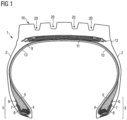
- FIG. 1 is a cross-sectional view of a truck tire perpendicular to the equatorial plane of the tire, in accordance with an embodiment of the invention.
- Each axial end portion 6 of the carcass ply 9 may be turned up and around the respective bead 4 to a position to anchor each axial end portion 6.
- the turned-up portions 6 of the carcass ply 9 may engage the axially outer surfaces of two flippers 8 and axially inner surfaces of two chippers 7 which are also considered as tire components.
- the example tread 10 may have circumferential grooves 20, each groove 20 essentially defining a U-shaped opening in the tread 10.
- the main portion of the tread 10 may be formed of one or more tread rubber compounds.
- FIG. 1 suggests a plurality of tire components including for instance apexes 5, chippers 7, flippers 8 and overlay 12, such and further components are not mandatory for the invention.
- the turned-up end of the carcass ply 9 is not necessary for the invention or may pass on the opposite side of the bead area 3 and end on the axially inner side of the bead 4 instead of the axially outer side of the bead 4.
- the tire could also have for instance a different number of grooves 20, e.g. less than four grooves.
- the rubber composition is used in the tread or tread layer contacting the ground or road.
- the tread 10 of the tire 1 comprises a rubber composition according to the Inventive Example as identified in Table 1 below.
- Table 1 shows the comparison of a rubber composition according to the Inventive Example with a Comparative Example (which is not in accordance with the present invention).
- a main difference of the Inventive Example in view of the Comparative Example is the use of a solution polymerized styrene butadiene rubber which is functionalized for the coupling to silica.
- the filler of the Comparative Example and of the non-limiting Inventive Example is essentially consisting of silica. Both Examples may have minor amounts of carbon black which are not explicitly listed herein and which are typically less than 4 phr, preferably less than 1 phr.
- tires having the rubber composition in accordance with the Inventive Example have a considerably improved / reduced rolling resistance.
- wet grip properties have also been significantly improved. Remarkably, this is achieved without the use of a traction resin. Treadwear remains well-balanced and flat over treadwear of the Comparative Example.
Landscapes
- Chemical & Material Sciences (AREA)
- Health & Medical Sciences (AREA)
- Chemical Kinetics & Catalysis (AREA)
- Medicinal Chemistry (AREA)
- Polymers & Plastics (AREA)
- Organic Chemistry (AREA)
- Engineering & Computer Science (AREA)
- Mechanical Engineering (AREA)
- General Chemical & Material Sciences (AREA)
- Compositions Of Macromolecular Compounds (AREA)
Claims (15)
- Composition de caoutchouc destinée à un bandage pneumatique pour camion, dans laquelle la composition de caoutchouc comprend :de 70 phr à 95 phr de polyisoprène ;de 5 phr à 30 phr d'un caoutchouc de styrène butadiène qui a été polymérisé en solution, qui possède une température de transition vitreuse qui est inférieure à -40 °C, qui est fonctionnalisé pour son couplage à de la silice ; etde 40 phr à 80 phr d'une matière de charge qui comprend, de manière prédominante, de la silice.
- Composition de caoutchouc selon la revendication 1, qui comprend de 45 phr à 75 phr de silice, ou qui comprend une quantité supérieure à 55 phr de silice et une quantité inférieure à 70 phr de silice.
- Composition de caoutchouc selon la revendication 1 ou 2, dans laquelle ladite silice possède une aire de surface BET qui s'élève à au moins 190 m2/g.
- Composition de caoutchouc selon au moins une des revendications précédentes, qui comprend une quantité inférieure à 10 phr de noir de carbone ou qui comprend de 0,1 phr à 4 phr de noir de carbone.
- Composition de caoutchouc selon au moins une des revendications précédentes, dans laquelle le caoutchouc de styrène butadiène qui a été polymérisé en solution est fonctionnalisé avec un ou plusieurs groupes qui sont choisis parmi :i) au moins un groupe amino silane ;ii) au moins un groupe amino siloxane ; etiii) au moins un groupe amino silanol.
- Composition de caoutchouc selon au moins une des revendications précédentes, dans laquelle le caoutchouc de styrène butadiène qui a été polymérisé en solution possède une température de transition vitreuse qui se situe dans une plage allant de -51 °C à -68 °C.
- Composition de caoutchouc selon au moins une des revendications précédentes, dans laquelle la composition de caoutchouc comprend un ou plusieurs éléments qui sont choisis parmi :de 80 phr à 95 phr de polyisoprène ;de 5 phr à 20 phr du caoutchouc de styrène butadiène qui a été polymérisé en solution .
- Composition de caoutchouc selon au moins une des revendications précédentes, dans laquelle le polyisoprène représente, de manière prédominante, du caoutchouc naturel ou est constitué de caoutchouc naturel.
- Composition de caoutchouc selon au moins une des revendications précédentes, qui comprend en outre un silane en une teneur qui se situe au sein d'une plage allant de 6 phr à 10 phr, dans laquelle le silane est choisi de manière préférentielle parmi un ou plusieurs éléments qui sont constitués par : i) un silane contenant du soufre, et ii) un élément cédant du soufre ; ou bien le silane est choisi de manière préférentielle parmi un ou plusieurs éléments qui sont constitués par au moins un tétrasulfure silane et au moins un mercapto silane.
- Composition de caoutchouc selon au moins une des revendications précédentes, dans laquelle la composition comprend une quantité inférieure à 4 phr d'un caoutchouc de polybutadiène.
- Composition de caoutchouc selon au moins une des revendications précédentes, dans laquelle la composition comprend une quantité inférieure à 10 phr d'une résine et/ou dans laquelle la composition de caoutchouc comprend une quantité inférieure à 10 phr d'une huile.
- Bandage pneumatique pour camion, qui comprend la composition de caoutchouc en conformité avec au moins une des revendications précédentes.
- Bandage pneumatique pour camion selon la revendication 12, qui possède une bande de roulement (10) ; dans lequel au moins une portion, la plus externe dans la direction radiale, de la bande de roulement (10), comprend la composition de caoutchouc en conformité avec au moins une des revendications 1 à 12.
- Bandage pneumatique pour camion selon la revendication 12 ou 13, dans lequel le bandage pneumatique pour camion (1) est un bandage pneumatique pour camion, qui mesure 22,5 pouces.
- Camion semi-remorque qui comprend un camion et un semi-remorque, dans lequel le camion semi-remorque comprend au moins un bandage pneumatique pour camion (1) en conformité avec la revendication 12, 13 ou 14.
Applications Claiming Priority (1)
| Application Number | Priority Date | Filing Date | Title |
|---|---|---|---|
| US17/815,587 US12264209B2 (en) | 2022-07-28 | 2022-07-28 | Rubber composition and truck tire |
Publications (2)
| Publication Number | Publication Date |
|---|---|
| EP4311690A1 EP4311690A1 (fr) | 2024-01-31 |
| EP4311690B1 true EP4311690B1 (fr) | 2025-05-21 |
Family
ID=87517247
Family Applications (1)
| Application Number | Title | Priority Date | Filing Date |
|---|---|---|---|
| EP23188202.8A Active EP4311690B1 (fr) | 2022-07-28 | 2023-07-27 | Composition de caoutchouc pour pneu de camion |
Country Status (4)
| Country | Link |
|---|---|
| US (1) | US12264209B2 (fr) |
| EP (1) | EP4311690B1 (fr) |
| CN (1) | CN117467202A (fr) |
| BR (1) | BR102023015125A2 (fr) |
Families Citing this family (2)
| Publication number | Priority date | Publication date | Assignee | Title |
|---|---|---|---|---|
| JP2025103506A (ja) * | 2023-12-27 | 2025-07-09 | 住友ゴム工業株式会社 | タイヤ用ゴム組成物及びタイヤ |
| DE102024203747A1 (de) * | 2024-04-22 | 2025-10-23 | Continental Reifen Deutschland Gmbh | Schwefelvernetzbare Kautschukmischung, Vulkanisat der Kautschukmischung und Fahrzeugreifen |
Citations (24)
| Publication number | Priority date | Publication date | Assignee | Title |
|---|---|---|---|---|
| EP0997490A1 (fr) | 1998-10-27 | 2000-05-03 | Sumitomo Rubber Industries Limited | Composition de caoutchouc pour bande de roulement |
| US20100204372A1 (en) | 2007-10-17 | 2010-08-12 | Sumitomo Rubber Industries, Ltd. | Rubber composition for tread and tire having tread comprising thereof |
| US20130109800A1 (en) | 2010-07-07 | 2013-05-02 | Continental Reifen Deutschland Gmbh | Rubber Blend |
| DE102013100009A1 (de) | 2013-01-02 | 2014-07-03 | Continental Reifen Deutschland Gmbh | Kautschukmischung |
| US20140228495A1 (en) | 2011-11-08 | 2014-08-14 | Sumitomo Rubber Industries, Ltd. | Rubber composition for tire cord coating, breaker edge strip, breaker cushion or cord-adjoining strip, and pneumatic tire |
| US20160159157A1 (en) | 2014-12-09 | 2016-06-09 | The Goodyear Tire & Rubber Company | Pneumatic tire |
| EP3075773A1 (fr) | 2013-11-27 | 2016-10-05 | Bridgestone Corporation | Composition de caoutchouc et pneu |
| EP3372629A1 (fr) | 2015-11-05 | 2018-09-12 | Bridgestone Corporation | Procédé de fabrication de composition de caoutchouc, et pneumatique |
| EP3372639A1 (fr) | 2015-11-05 | 2018-09-12 | Bridgestone Corporation | Composition de caoutchouc, et pneumatique |
| WO2018191187A1 (fr) | 2017-04-10 | 2018-10-18 | Continental Reifen Deutschland Gmbh | Résine fonctionnalisée à lieur polaire |
| EP3450494A1 (fr) | 2017-08-31 | 2019-03-06 | The Goodyear Tire & Rubber Company | Pneu pneumatique |
| US20190077887A1 (en) | 2015-10-08 | 2019-03-14 | Compagnie Generale Des Etablissements Michelin | Diene elastomer having a function in the middle of the chain and rubber composition containing the same |
| EP3450207B1 (fr) | 2017-08-30 | 2020-05-27 | The Goodyear Tire & Rubber Company | Composition de caoutchouc et pneumatique |
| EP3677438A1 (fr) | 2017-08-31 | 2020-07-08 | Bridgestone Corporation | Bandage pneumatique |
| WO2020214178A1 (fr) | 2019-04-18 | 2020-10-22 | Compagnie Generale Des Etablissements Michelin | Bande de roulement de pneumatique présentant une résistance au roulement et une usure améliorées |
| US20200399448A1 (en) | 2019-06-21 | 2020-12-24 | The Goodyear Tire & Rubber Company | Wire coat rubber composition for a tire and a tire comprising a wire coat rubber composition |
| WO2021124640A1 (fr) | 2019-12-19 | 2021-06-24 | 株式会社ブリヂストン | Pneu |
| EP3960494A1 (fr) | 2020-08-27 | 2022-03-02 | Sumitomo Rubber Industries, Ltd. | Pneu poids lourd |
| JP2022041312A (ja) | 2020-08-31 | 2022-03-11 | 株式会社リコー | 情報処理装置、プログラム及び情報処理システム |
| WO2022124340A1 (fr) | 2020-12-10 | 2022-06-16 | 株式会社ブリヂストン | Composition de caoutchouc et pneumatique |
| WO2022249636A1 (fr) | 2021-05-28 | 2022-12-01 | 株式会社ブリヂストン | Composition de caoutchouc pour pneumatique, gomme de bande de roulement, et pneumatique |
| EP4119358A1 (fr) | 2021-07-14 | 2023-01-18 | Sumitomo Rubber Industries, Ltd. | Pneu |
| EP4245566A1 (fr) | 2022-03-16 | 2023-09-20 | Sumitomo Rubber Industries, Ltd. | Pneumatique |
| DE102015218745B4 (de) | 2015-09-29 | 2024-09-12 | Continental Reifen Deutschland Gmbh | Kautschukmischung und Fahrzeugreifen |
Family Cites Families (29)
| Publication number | Priority date | Publication date | Assignee | Title |
|---|---|---|---|---|
| CA1236648A (fr) | 1982-04-26 | 1988-05-10 | Ken W. Donbar | Regulation de la masse moleculaire du polybutadiene |
| DE4220563A1 (de) | 1992-06-24 | 1994-01-13 | Bayer Ag | Kautschukmischungen enthaltend Polybutadien-Gel |
| CA2104529A1 (fr) | 1993-06-18 | 1994-12-19 | Paul Harry Sandstrom | Pneu avec semelle renforcee au silice |
| US5451646A (en) | 1994-12-05 | 1995-09-19 | The Goodyear Tire & Rubber Company | Technique for reducing the molecular weight and improving the processability of cis-1,4-polybutadiene |
| US5672639A (en) | 1996-03-12 | 1997-09-30 | The Goodyear Tire & Rubber Company | Starch composite reinforced rubber composition and tire with at least one component thereof |
| DE19653938A1 (de) * | 1996-12-21 | 1998-06-25 | Continental Ag | Kautschukmischung für Laufstreifen von Fahrzeugreifen |
| DE19701488A1 (de) | 1997-01-17 | 1998-07-23 | Bayer Ag | SBR-Kautschukgele enthaltende Kautschukmischungen |
| ATE239737T1 (de) | 1997-08-21 | 2003-05-15 | Crompton Corp | Blockierte merkaptosilane als kupplungsmittel für gefüllte kautschukzusammensetzung |
| DE19834803A1 (de) | 1998-08-01 | 2000-02-03 | Continental Ag | Kautschukmischung |
| DE19834802A1 (de) | 1998-08-01 | 2000-02-03 | Continental Ag | Kautschukmischung |
| DE19834804A1 (de) | 1998-08-01 | 2000-02-03 | Continental Ag | Kautschukmischung |
| DE19844607A1 (de) * | 1998-09-29 | 2000-03-30 | Degussa | Sulfanylsilane |
| DE19942620A1 (de) | 1999-09-07 | 2001-03-08 | Bayer Ag | Mikrogelhaltige Kautschukmischungen mit verkappten bifunktionellen Mercaptanen und hieraus hergestellte Vulkanisate |
| US20030004262A1 (en) | 2001-05-04 | 2003-01-02 | Drvol Charles Edward | Tire with tread of rubber composition containing carbon black with silicon domains on its surface |
| ATE314381T1 (de) | 2001-08-06 | 2006-01-15 | Degussa | Organosiliciumverbindungen |
| US7001946B2 (en) | 2003-02-17 | 2006-02-21 | The Goodyear Tire & Rubber Company | Tire with tread of natural rubber-rich rubber composition |
| US7214731B2 (en) | 2003-03-17 | 2007-05-08 | The Goodyear Tire & Rubber Company | Tire with low hydrocarbon emission rubber combination of tread and sidewall components with compositional limitations |
| US7714041B2 (en) * | 2004-12-30 | 2010-05-11 | The Goodyear Tire & Rubber Company | Method of increasing plasticity of tread composition |
| US7247669B2 (en) | 2005-08-11 | 2007-07-24 | The Goodyear Tire & Rubber Company | Rubber prepared with precipitated silica and carbon black pellet composites of controlled hardness and tire with component derived therefrom |
| DE102007060859A1 (de) * | 2007-12-18 | 2009-06-25 | Continental Aktiengesellschaft | Kautschukmischung, insbesondere für Fahrzeugreifen |
| US8957149B2 (en) * | 2010-08-25 | 2015-02-17 | The Goodyear Tire & Rubber Company | Preparation and use of silica reinforced rubber composition for truck tire tread |
| FR2978939B1 (fr) * | 2011-08-12 | 2013-08-02 | Michelin Soc Tech | Pneumatique comportant une armature sommet |
| US8695662B2 (en) | 2011-12-20 | 2014-04-15 | The Goodyear Tire & Rubber Company | Truck tire with rubber tread |
| EP2853558B1 (fr) * | 2013-09-27 | 2016-11-09 | Continental Reifen Deutschland GmbH | Composition de caoutchouc réticulable au soufre |
| KR102014521B1 (ko) * | 2016-04-25 | 2019-10-21 | 주식회사 엘지화학 | 변성 공액디엔계 중합체 및 이의 제조방법 |
| JP2019026773A (ja) | 2017-08-01 | 2019-02-21 | 横浜ゴム株式会社 | タイヤ用ゴム組成物 |
| PT3677638T (pt) * | 2017-09-01 | 2022-03-24 | Kuraray Co | Composição de borracha para pneu de pesados e pneu |
| US20200070579A1 (en) * | 2018-09-04 | 2020-03-05 | The Goodyear Tire & Rubber Company | Pneumatic tire |
| CN112867608B (zh) | 2018-11-30 | 2022-05-17 | 横滨橡胶株式会社 | 轮胎用橡胶组合物 |
-
2022
- 2022-07-28 US US17/815,587 patent/US12264209B2/en active Active
-
2023
- 2023-07-24 CN CN202310918601.XA patent/CN117467202A/zh active Pending
- 2023-07-27 EP EP23188202.8A patent/EP4311690B1/fr active Active
- 2023-07-27 BR BR102023015125-6A patent/BR102023015125A2/pt active Search and Examination
Patent Citations (27)
| Publication number | Priority date | Publication date | Assignee | Title |
|---|---|---|---|---|
| EP0997490A1 (fr) | 1998-10-27 | 2000-05-03 | Sumitomo Rubber Industries Limited | Composition de caoutchouc pour bande de roulement |
| US20100204372A1 (en) | 2007-10-17 | 2010-08-12 | Sumitomo Rubber Industries, Ltd. | Rubber composition for tread and tire having tread comprising thereof |
| US20130109800A1 (en) | 2010-07-07 | 2013-05-02 | Continental Reifen Deutschland Gmbh | Rubber Blend |
| US20140228495A1 (en) | 2011-11-08 | 2014-08-14 | Sumitomo Rubber Industries, Ltd. | Rubber composition for tire cord coating, breaker edge strip, breaker cushion or cord-adjoining strip, and pneumatic tire |
| DE102013100009A1 (de) | 2013-01-02 | 2014-07-03 | Continental Reifen Deutschland Gmbh | Kautschukmischung |
| EP3075773A1 (fr) | 2013-11-27 | 2016-10-05 | Bridgestone Corporation | Composition de caoutchouc et pneu |
| US20160159157A1 (en) | 2014-12-09 | 2016-06-09 | The Goodyear Tire & Rubber Company | Pneumatic tire |
| DE102015218745B4 (de) | 2015-09-29 | 2024-09-12 | Continental Reifen Deutschland Gmbh | Kautschukmischung und Fahrzeugreifen |
| US20190077887A1 (en) | 2015-10-08 | 2019-03-14 | Compagnie Generale Des Etablissements Michelin | Diene elastomer having a function in the middle of the chain and rubber composition containing the same |
| EP3372629A1 (fr) | 2015-11-05 | 2018-09-12 | Bridgestone Corporation | Procédé de fabrication de composition de caoutchouc, et pneumatique |
| EP3372639A1 (fr) | 2015-11-05 | 2018-09-12 | Bridgestone Corporation | Composition de caoutchouc, et pneumatique |
| WO2018191187A1 (fr) | 2017-04-10 | 2018-10-18 | Continental Reifen Deutschland Gmbh | Résine fonctionnalisée à lieur polaire |
| EP3450207B1 (fr) | 2017-08-30 | 2020-05-27 | The Goodyear Tire & Rubber Company | Composition de caoutchouc et pneumatique |
| EP3450494A1 (fr) | 2017-08-31 | 2019-03-06 | The Goodyear Tire & Rubber Company | Pneu pneumatique |
| EP3677438A1 (fr) | 2017-08-31 | 2020-07-08 | Bridgestone Corporation | Bandage pneumatique |
| WO2020214178A1 (fr) | 2019-04-18 | 2020-10-22 | Compagnie Generale Des Etablissements Michelin | Bande de roulement de pneumatique présentant une résistance au roulement et une usure améliorées |
| US20200399448A1 (en) | 2019-06-21 | 2020-12-24 | The Goodyear Tire & Rubber Company | Wire coat rubber composition for a tire and a tire comprising a wire coat rubber composition |
| WO2021124640A1 (fr) | 2019-12-19 | 2021-06-24 | 株式会社ブリヂストン | Pneu |
| EP4079803A1 (fr) | 2019-12-19 | 2022-10-26 | Bridgestone Corporation | Pneu |
| EP3960494A1 (fr) | 2020-08-27 | 2022-03-02 | Sumitomo Rubber Industries, Ltd. | Pneu poids lourd |
| JP2022041312A (ja) | 2020-08-31 | 2022-03-11 | 株式会社リコー | 情報処理装置、プログラム及び情報処理システム |
| WO2022124340A1 (fr) | 2020-12-10 | 2022-06-16 | 株式会社ブリヂストン | Composition de caoutchouc et pneumatique |
| US20230383101A1 (en) | 2020-12-10 | 2023-11-30 | Bridgeston Corporation | Rubber composition and pneumatic tire |
| EP4349612A1 (fr) | 2021-05-28 | 2024-04-10 | Bridgestone Corporation | Composition de caoutchouc pour pneumatique, gomme de bande de roulement, et pneumatique |
| WO2022249636A1 (fr) | 2021-05-28 | 2022-12-01 | 株式会社ブリヂストン | Composition de caoutchouc pour pneumatique, gomme de bande de roulement, et pneumatique |
| EP4119358A1 (fr) | 2021-07-14 | 2023-01-18 | Sumitomo Rubber Industries, Ltd. | Pneu |
| EP4245566A1 (fr) | 2022-03-16 | 2023-09-20 | Sumitomo Rubber Industries, Ltd. | Pneumatique |
Non-Patent Citations (16)
| Title |
|---|
| ANONYMOUS: "2022 TRUCK TIRE DATA GUIDE commercial", GENERAL TIRE, 1 January 2022 (2022-01-01), XP093371989, Retrieved from the Internet <URL:https://generaltire.com/sites/default/files/tires/files/TT-GT-BK-DATA-reduced.pdf> |
| ANONYMOUS: "205/65R15 C 6PR,102/100T MIRAGE MR200, M S 6 PR, 102 / 100 T, TL, MR200, M S", KREISSLER24 KG, 1 January 2026 (2026-01-01), XP093371985, Retrieved from the Internet <URL:https://www.kreissler24.de/205-65r15-c-6pr-102-100t-mirage-mr200-m-s.html> |
| ANONYMOUS: "FICHE DE DONNÉES DE SÉCURITÉ - Si 75 (Version: 1.1)", EVONIK, 27 January 2026 (2026-01-27), XP093371957 |
| ANONYMOUS: "HOW INTELLIGENT TYRE DESIGN CAN OPTIMISE THE EFFICIENCY OF YOUR LONG HAUL FLEET", BRIDGESTONE, 14 May 2020 (2020-05-14), XP093371968, Retrieved from the Internet <URL:https://www.bridgestone-mea.com/en/stories/mobility/how-intelligent-tyre-design-can-optimise-the-efficiency-of-your-long-haul-fleet> |
| ANONYMOUS: "MICHELIN TRUCK TIRE DATA BOOK - TRUCK TIRES, RV TIRES, COMMERCIAL LIGHT TRUCK TIRES, and RETREADS (20th Edition)", MICHELIN, 1 January 2020 (2020-01-01), XP093371973, Retrieved from the Internet <URL:https://www.apmlq.com/upload/michelin_poids_lourds_-_data_book_2020.pdf> |
| ANONYMOUS: "Product information ULTRASIL 7005", EVONIK, 1 April 2021 (2021-04-01), XP093371950, Retrieved from the Internet <URL:https://products.evonik.com/assets/66/03/ULTRASIL_7005_EN_EN_Asset_366603.pdf> |
| ANONYMOUS: "Techno Polymer JSR HPR840", KNOWDE, 1 January 2026 (2026-01-01), XP093371981, Retrieved from the Internet <URL:https://www.knowde.com/stores/jsr-corporation/products/techno-polymer-jsr-hpr840> |
| D14A - RCHIVE.ORG FÜR HTTPS://GENERALTIRE.COM/TIRES/COMMERCIAL/COMMERCIAL- TRUCKTIRE-DATA-GUIDE, VOM 30. JUNI 2022, ABGERUFEN AM 17. FEBRUAR 2026 |
| D17 - ARCHIVE.ORG FÜR HTTPS://WWW.SOLVAY.COM/EN/BRANDS/ZEOSIL, VOM 27. JANUAR 2022, ABGERUFEN AM 17. FEBRUAR 2026 |
| D17a - Archive.org für https://www.solvay.com/en/brands/zeosil, vom 27. Januar 2022, abgerufen am 17. Februar 2026 |
| D2B - URSPRÜNGLICHE ANMELDUNGSUNTERLAGEN EP 4245566 A1 |
| D6A - URSPRÜNGLICHE ANMELDUNGSUNTERLAGEN EP 4119358 A1 |
| JANIN CLAUDE: "Matières premières du caoutchouc", TECHNIQUES DE L’INGÉNIEUR RÉF. : AM8010 V1, 10 December 2016 (2016-12-10), XP093300325 |
| MARTIN F. SHERIDAN: "Vanderbilt Rubber Handbook, 14th Edition", 1 January 2010, R.T. VANDERBILT COMPANY, INC, ISBN: 9788110038977, article MARTIN F. SHERIDAN: "The Structure and Properties of Rubber", pages: 2 - 9, XP009565532 |
| MAYUMI HAYASHI, ET AL: "Development and Foresight of Solution SBR for Energy-Saving Tires", R&D REPORT, "SUMITOMO KAGAKU", VOL. 2011-I, 1 January 2011 (2011-01-01), pages 1 - 10, XP055193194, Retrieved from the Internet <URL:http://www.sumitomo-chem.co.jp/english/rd/report/theses/docs/2011-1E_03.pdf> |
| U.S: DEPARTMENT OF TRANSPORTATION: "Federal Highway Administration Traffic Monitoring Guide", 1 September 2013, DEPARTMENT OF TRANSPORTATION, US, article ANONYMOUS: "Traffic Monitoring Guide", pages: 1 - 462, XP009565956 |
Also Published As
| Publication number | Publication date |
|---|---|
| BR102023015125A2 (pt) | 2024-02-20 |
| US20240043587A1 (en) | 2024-02-08 |
| EP4311690A1 (fr) | 2024-01-31 |
| CN117467202A (zh) | 2024-01-30 |
| US12264209B2 (en) | 2025-04-01 |
Similar Documents
| Publication | Publication Date | Title |
|---|---|---|
| EP2460670B1 (fr) | Pneu | |
| EP4056644B1 (fr) | Composition de caoutchouc et pneumatique | |
| EP4311690B1 (fr) | Composition de caoutchouc pour pneu de camion | |
| EP4282913B1 (fr) | Composition de caoutchouc et pneumatique comprenant une composition de caoutchouc | |
| EP4056640B1 (fr) | Composition de caoutchouc et pneumatique | |
| EP4141062B1 (fr) | Composition de caoutchouc et pneumatique | |
| EP4159808B1 (fr) | Composition de caoutchouc et pneumatique | |
| EP4056643A1 (fr) | Composition de caoutchouc et pneumatique | |
| EP4159478A1 (fr) | Composition de caoutchouc et pneumatique | |
| US12209183B2 (en) | Pneumatic tire having tread with three elastomers | |
| EP4253082A1 (fr) | Composition de caoutchouc pour pneu hivernal et pneu hivernal | |
| EP4311691A1 (fr) | Composition de caoutchouc et pneu de camion | |
| CN115725126A (zh) | 橡胶组合物和轮胎 | |
| US12503532B2 (en) | Rubber composition and truck tire | |
| EP4083076B1 (fr) | Élastomère à base de diène et composition de caoutchouc et procédé de fabrication d'un élastomère fonctionnalisé au benzoxazine | |
| EP4335659B1 (fr) | Pneumatique | |
| EP4438328A1 (fr) | Pneumatique comportant une bande de roulement |
Legal Events
| Date | Code | Title | Description |
|---|---|---|---|
| PUAI | Public reference made under article 153(3) epc to a published international application that has entered the european phase |
Free format text: ORIGINAL CODE: 0009012 |
|
| STAA | Information on the status of an ep patent application or granted ep patent |
Free format text: STATUS: THE APPLICATION HAS BEEN PUBLISHED |
|
| AK | Designated contracting states |
Kind code of ref document: A1 Designated state(s): AL AT BE BG CH CY CZ DE DK EE ES FI FR GB GR HR HU IE IS IT LI LT LU LV MC ME MK MT NL NO PL PT RO RS SE SI SK SM TR |
|
| STAA | Information on the status of an ep patent application or granted ep patent |
Free format text: STATUS: REQUEST FOR EXAMINATION WAS MADE |
|
| 17P | Request for examination filed |
Effective date: 20240731 |
|
| RBV | Designated contracting states (corrected) |
Designated state(s): AL AT BE BG CH CY CZ DE DK EE ES FI FR GB GR HR HU IE IS IT LI LT LU LV MC ME MK MT NL NO PL PT RO RS SE SI SK SM TR |
|
| GRAP | Despatch of communication of intention to grant a patent |
Free format text: ORIGINAL CODE: EPIDOSNIGR1 |
|
| STAA | Information on the status of an ep patent application or granted ep patent |
Free format text: STATUS: GRANT OF PATENT IS INTENDED |
|
| RIC1 | Information provided on ipc code assigned before grant |
Ipc: C08L 7/00 20060101ALI20241121BHEP Ipc: B60C 1/00 20060101AFI20241121BHEP |
|
| INTG | Intention to grant announced |
Effective date: 20241219 |
|
| GRAS | Grant fee paid |
Free format text: ORIGINAL CODE: EPIDOSNIGR3 |
|
| GRAA | (expected) grant |
Free format text: ORIGINAL CODE: 0009210 |
|
| STAA | Information on the status of an ep patent application or granted ep patent |
Free format text: STATUS: THE PATENT HAS BEEN GRANTED |
|
| AK | Designated contracting states |
Kind code of ref document: B1 Designated state(s): AL AT BE BG CH CY CZ DE DK EE ES FI FR GB GR HR HU IE IS IT LI LT LU LV MC ME MK MT NL NO PL PT RO RS SE SI SK SM TR |
|
| REG | Reference to a national code |
Ref country code: GB Ref legal event code: FG4D |
|
| REG | Reference to a national code |
Ref country code: CH Ref legal event code: EP |
|
| REG | Reference to a national code |
Ref country code: DE Ref legal event code: R096 Ref document number: 602023003585 Country of ref document: DE |
|
| REG | Reference to a national code |
Ref country code: IE Ref legal event code: FG4D |
|
| PGFP | Annual fee paid to national office [announced via postgrant information from national office to epo] |
Ref country code: FR Payment date: 20250620 Year of fee payment: 3 |
|
| REG | Reference to a national code |
Ref country code: NL Ref legal event code: MP Effective date: 20250521 |
|
| PG25 | Lapsed in a contracting state [announced via postgrant information from national office to epo] |
Ref country code: FI Free format text: LAPSE BECAUSE OF FAILURE TO SUBMIT A TRANSLATION OF THE DESCRIPTION OR TO PAY THE FEE WITHIN THE PRESCRIBED TIME-LIMIT Effective date: 20250521 Ref country code: PT Free format text: LAPSE BECAUSE OF FAILURE TO SUBMIT A TRANSLATION OF THE DESCRIPTION OR TO PAY THE FEE WITHIN THE PRESCRIBED TIME-LIMIT Effective date: 20250922 Ref country code: ES Free format text: LAPSE BECAUSE OF FAILURE TO SUBMIT A TRANSLATION OF THE DESCRIPTION OR TO PAY THE FEE WITHIN THE PRESCRIBED TIME-LIMIT Effective date: 20250521 |
|
| PGFP | Annual fee paid to national office [announced via postgrant information from national office to epo] |
Ref country code: DE Payment date: 20250620 Year of fee payment: 3 |
|
| REG | Reference to a national code |
Ref country code: LT Ref legal event code: MG9D |
|
| PG25 | Lapsed in a contracting state [announced via postgrant information from national office to epo] |
Ref country code: NO Free format text: LAPSE BECAUSE OF FAILURE TO SUBMIT A TRANSLATION OF THE DESCRIPTION OR TO PAY THE FEE WITHIN THE PRESCRIBED TIME-LIMIT Effective date: 20250821 Ref country code: GR Free format text: LAPSE BECAUSE OF FAILURE TO SUBMIT A TRANSLATION OF THE DESCRIPTION OR TO PAY THE FEE WITHIN THE PRESCRIBED TIME-LIMIT Effective date: 20250822 |
|
| PG25 | Lapsed in a contracting state [announced via postgrant information from national office to epo] |
Ref country code: NL Free format text: LAPSE BECAUSE OF FAILURE TO SUBMIT A TRANSLATION OF THE DESCRIPTION OR TO PAY THE FEE WITHIN THE PRESCRIBED TIME-LIMIT Effective date: 20250521 Ref country code: PL Free format text: LAPSE BECAUSE OF FAILURE TO SUBMIT A TRANSLATION OF THE DESCRIPTION OR TO PAY THE FEE WITHIN THE PRESCRIBED TIME-LIMIT Effective date: 20250521 |
|
| PGFP | Annual fee paid to national office [announced via postgrant information from national office to epo] |
Ref country code: TR Payment date: 20250821 Year of fee payment: 3 Ref country code: IT Payment date: 20250731 Year of fee payment: 3 |
|
| PG25 | Lapsed in a contracting state [announced via postgrant information from national office to epo] |
Ref country code: BG Free format text: LAPSE BECAUSE OF FAILURE TO SUBMIT A TRANSLATION OF THE DESCRIPTION OR TO PAY THE FEE WITHIN THE PRESCRIBED TIME-LIMIT Effective date: 20250521 |
|
| PG25 | Lapsed in a contracting state [announced via postgrant information from national office to epo] |
Ref country code: HR Free format text: LAPSE BECAUSE OF FAILURE TO SUBMIT A TRANSLATION OF THE DESCRIPTION OR TO PAY THE FEE WITHIN THE PRESCRIBED TIME-LIMIT Effective date: 20250521 |
|
| PG25 | Lapsed in a contracting state [announced via postgrant information from national office to epo] |
Ref country code: RS Free format text: LAPSE BECAUSE OF FAILURE TO SUBMIT A TRANSLATION OF THE DESCRIPTION OR TO PAY THE FEE WITHIN THE PRESCRIBED TIME-LIMIT Effective date: 20250821 |
|
| PG25 | Lapsed in a contracting state [announced via postgrant information from national office to epo] |
Ref country code: IS Free format text: LAPSE BECAUSE OF FAILURE TO SUBMIT A TRANSLATION OF THE DESCRIPTION OR TO PAY THE FEE WITHIN THE PRESCRIBED TIME-LIMIT Effective date: 20250921 |
|
| PG25 | Lapsed in a contracting state [announced via postgrant information from national office to epo] |
Ref country code: LV Free format text: LAPSE BECAUSE OF FAILURE TO SUBMIT A TRANSLATION OF THE DESCRIPTION OR TO PAY THE FEE WITHIN THE PRESCRIBED TIME-LIMIT Effective date: 20250521 |
|
| REG | Reference to a national code |
Ref country code: AT Ref legal event code: MK05 Ref document number: 1796464 Country of ref document: AT Kind code of ref document: T Effective date: 20250521 |
|
| PG25 | Lapsed in a contracting state [announced via postgrant information from national office to epo] |
Ref country code: DK Free format text: LAPSE BECAUSE OF FAILURE TO SUBMIT A TRANSLATION OF THE DESCRIPTION OR TO PAY THE FEE WITHIN THE PRESCRIBED TIME-LIMIT Effective date: 20250521 Ref country code: AT Free format text: LAPSE BECAUSE OF FAILURE TO SUBMIT A TRANSLATION OF THE DESCRIPTION OR TO PAY THE FEE WITHIN THE PRESCRIBED TIME-LIMIT Effective date: 20250521 Ref country code: SM Free format text: LAPSE BECAUSE OF FAILURE TO SUBMIT A TRANSLATION OF THE DESCRIPTION OR TO PAY THE FEE WITHIN THE PRESCRIBED TIME-LIMIT Effective date: 20250521 |
|
| PG25 | Lapsed in a contracting state [announced via postgrant information from national office to epo] |
Ref country code: CZ Free format text: LAPSE BECAUSE OF FAILURE TO SUBMIT A TRANSLATION OF THE DESCRIPTION OR TO PAY THE FEE WITHIN THE PRESCRIBED TIME-LIMIT Effective date: 20250521 |
|
| PG25 | Lapsed in a contracting state [announced via postgrant information from national office to epo] |
Ref country code: EE Free format text: LAPSE BECAUSE OF FAILURE TO SUBMIT A TRANSLATION OF THE DESCRIPTION OR TO PAY THE FEE WITHIN THE PRESCRIBED TIME-LIMIT Effective date: 20250521 |
|
| PG25 | Lapsed in a contracting state [announced via postgrant information from national office to epo] |
Ref country code: SK Free format text: LAPSE BECAUSE OF FAILURE TO SUBMIT A TRANSLATION OF THE DESCRIPTION OR TO PAY THE FEE WITHIN THE PRESCRIBED TIME-LIMIT Effective date: 20250521 |
|
| REG | Reference to a national code |
Ref country code: DE Ref legal event code: R026 Ref document number: 602023003585 Country of ref document: DE |
|
| PLBI | Opposition filed |
Free format text: ORIGINAL CODE: 0009260 |
|
| REG | Reference to a national code |
Ref country code: CH Ref legal event code: L11 Free format text: ST27 STATUS EVENT CODE: U-0-0-L10-L11 (AS PROVIDED BY THE NATIONAL OFFICE) Effective date: 20260225 |
|
| PLAB | Opposition data, opponent's data or that of the opponent's representative modified |
Free format text: ORIGINAL CODE: 0009299OPPO |
|
| PLBI | Opposition filed |
Free format text: ORIGINAL CODE: 0009260 |
|
| REG | Reference to a national code |
Ref country code: CH Ref legal event code: L10 Free format text: ST27 STATUS EVENT CODE: U-0-0-L10-L00 (AS PROVIDED BY THE NATIONAL OFFICE) Effective date: 20260304 |
|
| PG25 | Lapsed in a contracting state [announced via postgrant information from national office to epo] |
Ref country code: RO Free format text: LAPSE BECAUSE OF FAILURE TO SUBMIT A TRANSLATION OF THE DESCRIPTION OR TO PAY THE FEE WITHIN THE PRESCRIBED TIME-LIMIT Effective date: 20250521 |
|
| PLAB | Opposition data, opponent's data or that of the opponent's representative modified |
Free format text: ORIGINAL CODE: 0009299OPPO |
|
| PLAX | Notice of opposition and request to file observation + time limit sent |
Free format text: ORIGINAL CODE: EPIDOSNOBS2 |
|
| REG | Reference to a national code |
Ref country code: CH Ref legal event code: L10 Free format text: ST27 STATUS EVENT CODE: U-0-0-L10-L00 (AS PROVIDED BY THE NATIONAL OFFICE) Effective date: 20260311 |
|
| PG25 | Lapsed in a contracting state [announced via postgrant information from national office to epo] |
Ref country code: LU Free format text: LAPSE BECAUSE OF NON-PAYMENT OF DUE FEES Effective date: 20250727 |
|
| 26 | Opposition filed |
Opponent name: CONTINENTAL REIFEN DEUTSCHLAND GMBH Effective date: 20260219 |
|
| REG | Reference to a national code |
Ref country code: BE Ref legal event code: MM Effective date: 20250731 |
|
| 26 | Opposition filed |
Opponent name: THE GOODYEAR TIRE & RUBBER COMPANY Effective date: 20260223 |
|
| R26 | Opposition filed (corrected) |
Opponent name: CONTINENTAL REIFEN DEUTSCHLAND GMBH Effective date: 20260219 |
|
| R26 | Opposition filed (corrected) |
Opponent name: COMPAGNIE GENERALE DES ETABLISSEMENTS MICHELIN Effective date: 20260223 |
|
| PGFP | Annual fee paid to national office [announced via postgrant information from national office to epo] |
Ref country code: AT Payment date: 20260410 Year of fee payment: 3 |
|
| PG25 | Lapsed in a contracting state [announced via postgrant information from national office to epo] |
Ref country code: BE Free format text: LAPSE BECAUSE OF NON-PAYMENT OF DUE FEES Effective date: 20250731 |