EP4316331A1 - Lave-vaisselle ayant une fonction de démarrage automatique - Google Patents
Lave-vaisselle ayant une fonction de démarrage automatique Download PDFInfo
- Publication number
- EP4316331A1 EP4316331A1 EP22188278.0A EP22188278A EP4316331A1 EP 4316331 A1 EP4316331 A1 EP 4316331A1 EP 22188278 A EP22188278 A EP 22188278A EP 4316331 A1 EP4316331 A1 EP 4316331A1
- Authority
- EP
- European Patent Office
- Prior art keywords
- dishes
- designed
- control
- dishwasher
- depending
- Prior art date
- Legal status (The legal status is an assumption and is not a legal conclusion. Google has not performed a legal analysis and makes no representation as to the accuracy of the status listed.)
- Pending
Links
- 238000004140 cleaning Methods 0.000 claims description 21
- 230000000903 blocking effect Effects 0.000 claims description 10
- 230000005611 electricity Effects 0.000 claims description 10
- XLYOFNOQVPJJNP-UHFFFAOYSA-N water Substances O XLYOFNOQVPJJNP-UHFFFAOYSA-N 0.000 claims description 8
- 238000005457 optimization Methods 0.000 claims description 5
- 239000012459 cleaning agent Substances 0.000 claims description 4
- 238000010586 diagram Methods 0.000 description 13
- 239000007921 spray Substances 0.000 description 7
- 101150114468 TUB1 gene Proteins 0.000 description 5
- 238000000034 method Methods 0.000 description 5
- 230000003213 activating effect Effects 0.000 description 2
- 235000021152 breakfast Nutrition 0.000 description 2
- 239000013505 freshwater Substances 0.000 description 2
- 235000012054 meals Nutrition 0.000 description 2
- KJLPSBMDOIVXSN-UHFFFAOYSA-N 4-[4-[2-[4-(3,4-dicarboxyphenoxy)phenyl]propan-2-yl]phenoxy]phthalic acid Chemical compound C=1C=C(OC=2C=C(C(C(O)=O)=CC=2)C(O)=O)C=CC=1C(C)(C)C(C=C1)=CC=C1OC1=CC=C(C(O)=O)C(C(O)=O)=C1 KJLPSBMDOIVXSN-UHFFFAOYSA-N 0.000 description 1
- 230000004913 activation Effects 0.000 description 1
- 230000007423 decrease Effects 0.000 description 1
- 230000001419 dependent effect Effects 0.000 description 1
- 238000005265 energy consumption Methods 0.000 description 1
- 230000003203 everyday effect Effects 0.000 description 1
- 239000011521 glass Substances 0.000 description 1
- 238000010438 heat treatment Methods 0.000 description 1
- 230000002045 lasting effect Effects 0.000 description 1
- 230000005923 long-lasting effect Effects 0.000 description 1
- 235000011888 snacks Nutrition 0.000 description 1
- 230000000007 visual effect Effects 0.000 description 1
- 235000013618 yogurt Nutrition 0.000 description 1
Images

Classifications
-
- A—HUMAN NECESSITIES
- A47—FURNITURE; DOMESTIC ARTICLES OR APPLIANCES; COFFEE MILLS; SPICE MILLS; SUCTION CLEANERS IN GENERAL
- A47L—DOMESTIC WASHING OR CLEANING; SUCTION CLEANERS IN GENERAL
- A47L15/00—Washing or rinsing machines for crockery or tableware
- A47L15/0018—Controlling processes, i.e. processes to control the operation of the machine characterised by the purpose or target of the control
-
- A—HUMAN NECESSITIES
- A47—FURNITURE; DOMESTIC ARTICLES OR APPLIANCES; COFFEE MILLS; SPICE MILLS; SUCTION CLEANERS IN GENERAL
- A47L—DOMESTIC WASHING OR CLEANING; SUCTION CLEANERS IN GENERAL
- A47L2401/00—Automatic detection in controlling methods of washing or rinsing machines for crockery or tableware, e.g. information provided by sensors entered into controlling devices
- A47L2401/04—Crockery or tableware details, e.g. material, quantity, condition
-
- A—HUMAN NECESSITIES
- A47—FURNITURE; DOMESTIC ARTICLES OR APPLIANCES; COFFEE MILLS; SPICE MILLS; SUCTION CLEANERS IN GENERAL
- A47L—DOMESTIC WASHING OR CLEANING; SUCTION CLEANERS IN GENERAL
- A47L2401/00—Automatic detection in controlling methods of washing or rinsing machines for crockery or tableware, e.g. information provided by sensors entered into controlling devices
- A47L2401/20—Time, e.g. elapsed operating time
-
- A—HUMAN NECESSITIES
- A47—FURNITURE; DOMESTIC ARTICLES OR APPLIANCES; COFFEE MILLS; SPICE MILLS; SUCTION CLEANERS IN GENERAL
- A47L—DOMESTIC WASHING OR CLEANING; SUCTION CLEANERS IN GENERAL
- A47L2401/00—Automatic detection in controlling methods of washing or rinsing machines for crockery or tableware, e.g. information provided by sensors entered into controlling devices
- A47L2401/26—Loading door status, e.g. door latch opened or closed state
-
- A—HUMAN NECESSITIES
- A47—FURNITURE; DOMESTIC ARTICLES OR APPLIANCES; COFFEE MILLS; SPICE MILLS; SUCTION CLEANERS IN GENERAL
- A47L—DOMESTIC WASHING OR CLEANING; SUCTION CLEANERS IN GENERAL
- A47L2501/00—Output in controlling method of washing or rinsing machines for crockery or tableware, i.e. quantities or components controlled, or actions performed by the controlling device executing the controlling method
- A47L2501/26—Indication or alarm to the controlling device or to the user
-
- A—HUMAN NECESSITIES
- A47—FURNITURE; DOMESTIC ARTICLES OR APPLIANCES; COFFEE MILLS; SPICE MILLS; SUCTION CLEANERS IN GENERAL
- A47L—DOMESTIC WASHING OR CLEANING; SUCTION CLEANERS IN GENERAL
- A47L2501/00—Output in controlling method of washing or rinsing machines for crockery or tableware, i.e. quantities or components controlled, or actions performed by the controlling device executing the controlling method
- A47L2501/28—Machine starting, e.g. normal start, restart after electricity cut-off or start scheduling
Definitions
- the invention relates to a dishwasher, in particular a household dishwasher, with a tub which can be loaded with a quantity of dishes.
- the tub includes at least one dish rack for holding dishes.
- the dishwasher includes a data memory with a data set that defines at which loading times a certain amount of dishes is expected to be loaded into the tub.
- Known dishwashers include dish racks into which the user fills dirty dishes can. The user can start a cleaning program at any time and the dishes will be cleaned.
- the user can activate the cleaning program for various reasons. For example, the dish racks are full, so carrying capacity can be created again by carrying out a cleaning program.
- a dishwasher in particular a household dishwasher, comprises a tub which can be loaded with a quantity of dishes.
- the tub includes in particular at least one dish rack for holding the dishes.
- the dishwasher also includes a data memory with a data set.
- the data record defines at which loading times a certain amount of dishes is to be expected or can be expected to be loaded into the tub.
- the control is designed to activate a start release for carrying out a cleaning program at a specific release time depending on the data record, i.e.
- the forecast payload requirement is one of several possible criteria that influences the activation of the start release.
- the advantage of this solution is that it not only predicts when a further payload is expected, but also when and what quantity is expected. For example, in a first step after dinner, the user loads the dishwasher with a large amount of dishes, which does not leave sufficient loading capacity for the upcoming breakfast. The data set then predicts that the user will load an additional, but significantly smaller, amount of dishes late in the evening, for example a spoon, after eating yogurt before going to sleep. Because according to the data record, there was another, smaller payload late in the evening can be expected, the control does not start the cleaning program immediately after dinner. Because it is clear from the data set that late in the evening only a small amount of dishes are loaded, for which there is still loading capacity available.
- the time and dish quantity-resolved forecast enables the cleaning programs to be started automatically at optimal times or to be suggested to the user to start.
- Activating a start enable advantageously means that the control starts the cleaning program automatically, i.e. an autostart occurs.
- the user can simply be suggested to start the cleaning program. For example, a push message is sent to your mobile phone or an acoustic or visual signal is issued via an output device on the dishwasher.
- the loading times in the data set are time-resolved to be accurate or more precise to two hours, in particular to be accurate or more precise to a whole hour, in particular to be accurate or more precise to half an hour, in particular to be accurate or more precise to 15 minutes.
- the payload times are resolved over a whole hour, this means that the expected payload quantity is forecast for periods of a whole hour.
- Such a resolution has the advantage that it is possible to predict with relative precision what amount of payload is expected at what time of day.
- the data set advantageously defines different loading times and/or different expected loading quantities of dishes for different days of the week. For example, if the user is at work from Monday to Friday, no payload is expected at midday and only a small amount of payload is expected early in the morning and in the evening. If the user is regularly at home on the weekend, larger and more frequent loads are expected on Saturday and Sunday. The first load of the day is also expected at a later time because the user eats breakfast later than during the week.
- different loading times and/or loading quantities of dishes are provided for on public holidays or other specific days, i.e. the data record includes a calendar with holiday entries.
- different loading times and/or loading quantities of dishes are planned for different weeks, months or seasons within a calendar year. For example, the user will eat dinner later in summer months than in winter months.
- the dishwasher is advantageously connected to the user's personal calendar. For example, if the user has entered vacation, the data record defines a release time shortly before the start of the vacation. The planning of cleaning programs can thus be further optimized.
- the control of the dishwasher is designed not to activate a start release to carry out the cleaning program during blocking times or in blocking situations.
- Blocking times can in particular be defined by the user. For example, a cleaning program should not be run at a child's bedtime or while the user is watching the news.
- a blocking situation occurs, for example, if the dishwasher door is open and cleaning agent is missing There are no dishes in the tub at all, during user-defined time periods or when there is a lack of energy.
- a cleaning agent tank is advantageously provided. An energy shortage situation exists if renewable energy can only be made available under certain weather conditions.
- the dishwasher includes a measuring device with which a quantity of dishes loaded in the tub and/or the available load capacity of the tub can be determined.
- the available load capacity corresponds to the maximum load capacity of the tub minus the dishes already loaded. For example, if the tub is 40% loaded, the payload capacity is 60%.
- the control can define an optimal time for carrying out a cleaning program. For example, if the control determines that the maximum payload capacity will be exceeded with the expected load on the following day without there being time for a cleaning process between the expected loading times, the control activates the start release overnight on the following day, in particular the cleaning program, so that the user can do so on the following day The cleaned dishes can be cleared out and there is enough loading capacity again. It should be noted that a measuring device is not absolutely necessary. The control can also determine the release time based solely on the forecast loads.
- the measuring device comprises a camera to determine the amount of loaded dishes and/or the measuring device comprises a weight measuring device to determine the weight of the loaded dishes.
- the measuring device is designed to determine the available loading capacity for each of the at least one dish rack. If the upper basket almost reaches the maximum load capacity, the control activates the start release regardless of the available load capacity of the lower basket.
- the measuring device comprises a door opening detector.
- the control is designed to estimate the amount of dishes loaded in the tub and/or the available load capacity in the tub depending on the detected number of door openings and to activate the start release depending on this. The greater the number of door openings detected since the last cleaning program was completed, the lower the control determines the available payload capacity. If the available payload capacity falls below a certain value, a start release can be activated.
- the door opening detector advantageously detects how long the door is open for and/or at what opening angle the door is opened.
- the control is designed to activate the start release depending on detected durations of door openings and/or depending on the detected opening angles. For example, if the door is only opened to a small opening angle, it can be assumed that the user has only loaded cutlery or small dishes into the upper basket or into a cutlery drawer. If the door was opened for a longer period of time, it can be assumed that a larger amount of dishes was loaded.
- the control is designed to store the data record depending on the amount of dishes loaded in the tub and/or depending on the amount of dishes loaded in the tub, which is determined at several points in time to adapt to certain available payload capacity at several times.
- the control uses the measuring device to record at what times the user loads which quantities of dishes.
- This data can be used to adapt the data set and to predict the expected payload quantities better and more accurately, i.e. the data set is trained. For example, if the door is regularly opened several times at short intervals at a certain time of day, this indicates a high load requirement at that time of day.
- control is designed to record the times at which the user manually starts the cleaning program and to adapt the data record depending on these recordings.
- the control is advantageously designed to determine the release time so that no additional load is expected while the cleaning program is being carried out. This ensures that the user can always load the dirty dishes into the tub when loading is required and this is not impossible because the cleaning program is active.
- control is designed to determine the release time so that sufficient payload capacity is available for expected future payloads. This means that the control starts the cleaning program early so that the maximum payload capacity is not exceeded with the predicted payload quantities.
- Periods are advantageously defined in the data set during which the user does not want to empty the dishwasher.
- the control (9a) is designed to determine the release time in such a way that sufficient loading capacity is available for expected future loads and it is taken into account that the user will not empty the dishwasher during the defined periods.
- the control is advantageously designed to determine the release time in such a way that the number of cleaning programs to be carried out is minimized. This means that the release time is defined so that the maximum payload capacity is not exceeded, but is almost reached.
- control can also be designed to determine the release time in such a way that the overall energy costs are minimized. For example, if the electricity price is lower at night, a start release can be activated at night, even if there is still sufficient loading capacity for further loads. A start release can also be activated if there is existing loading capacity if warm water from a renewable energy system is available.
- the control is advantageously designed to select one of several available cleaning programs depending on. For example, if no load is forecast overnight, the control selects a resource-saving, long-lasting cleaning program. However, if a further load is expected within a few hours, the control selects a quick cleaning program, which consumes more resources.
- the control selects a cleaning program that is gentle on the dishes.
- the control can weight these influencing factors differently, i.e. the relevance for activating the start release can be different.
- the dishwasher advantageously comprises an input device by means of which the user can define an optimization criterion for determining release times, in particular where the optimization criterion is sufficient load capacity or energy-saving cleaning or cost-saving cleaning.
- Fig. 1 shows a household dishwasher with a tub 1.
- Three dish baskets are arranged within the tub 1, a lower basket 2a, an upper basket 2b and a cutlery drawer 2c.
- various spray means 3 are arranged in the tub 1, such as a lower spray means 3a and a middle spray means 3b in the form of spray arms and an upper spray means 3c in order to spray or apply process water to the dishes.
- a circulation pump 4 serves to convey the process water via a circulation line from a bottom area 5 of the tub 1 to the spray means 3.
- a heating device 6 is provided on the circulation line to heat the process water to a desired temperature.
- the device also has a drain pump 7, with which process water that is no longer required can be pumped out of the bottom area 5 of the tub 1, as well as a fresh water supply 8 to supply fresh water to the household dishwasher.
- the various actuators of the device are controlled by a controller 9a of the device.
- input and output means 10 are connected, via which the user can give commands to the dishwasher and take information from the dishwasher.
- the control 9 includes different cleaning programs to operate the dishwasher. It includes at least a normal program, a pre-rinse program and an eco program. In addition, the control can access data records from a data memory 9b.
- Fig. 2 shows the dishwasher in side view.
- a door 11 is arranged on its front, which can be opened and closed.
- the dishwasher has two different measuring devices.
- On the one hand there is a door opening detector 12, which detects whether and at what opening angle 13 the door 11 is open.
- the amount of dishes loaded in the dishwasher can be estimated based on both the number of door openings and the measured door opening angles 13.
- 11 cameras 14 are arranged in the door, which can each separately measure the amount of loaded dishes in the lower basket 2a, in the upper basket 2b and in the cutlery drawer 2c.
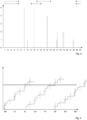
- the Fig. 3 shows a diagram with predicted dish loads during a day.
- the data shown in this diagram corresponds to the data set that defines at which loading times a certain amount of dishes can be expected to be loaded into the tub.
- the diagram defines expected payload quantities for the weekdays Monday to Friday and for the weekend days Saturday and Sunday.
- the payload quantities are stored time-resolved to one hour. For example, if different payload quantities were forecast for each individual day of the week or for different weeks of the year, the data set would be supplemented with additional data.
- the horizontal axis in Fig. 3 shows the time of a 24-hour day.
- the vertical axis shows the amount of payload expected in a specific hour.
- the payload is given in dimensionless numbers 1 to 5 and correlates, for example, with the weight and/or the volume of the dishes and/or the space required dish rack. The higher the number, the greater the expected payload.
- the vertical solid lines show the expected payload during the weekdays Monday to Friday.
- the vertical dashed lines show the expected payload during the weekend days Saturday and Sunday. For example, the diagram shows that on weekend mornings the user loads dishes into the dishwasher at a later time. Monday to Friday, payloads are expected between 7 a.m. and 8 a.m. On weekend days, additional loads are only expected from 10 a.m.
- the diagram suggests that the user eats three meals a day during weekdays Monday to Friday and only two meals a day on weekend days. Late in the evening at 10 p.m., only a small amount of payload is expected because, for example, the user has a small snack before going to sleep.
- Horizontal double arrows are arranged above the diagram. These indicate the periods during which no loads are expected and a cleaning program can be carried out. Throughout the week, cleaning programs can be carried out during the night from 11pm to 5am. In addition, cleaning programs can be carried out between 9:00 a.m. and 12:00 p.m. on weekdays, Monday to Friday. On weekend days, cleaning programs can be carried out between 11 a.m. and 3 p.m. If the control wants to start a cleaning program during the night, the longer, more energy-efficient eco program can be carried out because there is enough time available. For example, if the control wants to carry out a cleaning program during the day, this can be done shorter normal programs are carried out because less time is available.
- the Fig. 4 shows a diagram with the predicted load capacity in the dishwasher.
- the horizontal axis shows a time course over more than a week.
- the vertical axis shows the predicted load capacity of the dishwasher, which is shown with a solid line in the diagram.
- the vertical dashed lines mark times at which a cleaning program can be carried out, as no loads are expected for a certain period of time.
- the horizontal double line marks the maximum tolerable loading capacity. This can be the actual maximum load capacity of the dishwasher or, for example, 70% of the maximum load capacity of the dishwasher to maintain reserve for unforeseen loads.
- the dishwasher control expects that the maximum tolerable load capacity would be reached at 2:00 p.m. on Wednesday afternoon given the predicted load. For this reason, the control starts the normal program automatically on Wednesday morning at 9:00 a.m. The normal program will end at approximately 11:00 a.m. so that the user can then unload the dishwasher. Later in the week, the control expects that the maximum tolerable loading capacity would be reached on Saturday morning. The control starts a cleaning program on the night of Friday to Saturday. Since there is a longer period of time available for cleaning during the night, the control selects the longer lasting eco program.
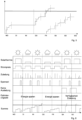
- the Fig. 5 shows a diagram like in Fig. 4 , whereby the amount of dishes loaded at certain points in time is also predicted.
- the difference to Fig. 4 is that the control measures data the measuring devices 12 and 14 are taken into account for the forecast.
- the diagram according to Fig. 5 shows a forecast on Wednesday evening at midnight. This point in time is in Fig. 5 marked with a dash-dotted line.
- the past period from Monday to Wednesday evening shows the actual load amount, which was recorded using the measuring devices 12 and 14.
- the user loaded the expected amount of dishes on Monday, but was then obviously absent on Tuesday and Wednesday, so no loading occurred.
- the control system now predicts that the maximum tolerable payload capacity would be reached on Friday afternoon.
- the Fig. 6 shows a diagram with various criteria that influence the determination of the release time.
- the entire chart is a forecast.
- the actual time is illustrated early on Monday morning.
- the forecast is illustrated until midnight the following Sunday.
- the vertical dashed lines separate the days from each other and are therefore arranged at midnight.
- a first influencing factor is solar thermal energy. Their availability is predicted based on the weather forecast. The availability of solar thermal energy greatly facilitates the implementation of a cleaning program, as energy is available for free. For example, if there is a lot of sunshine forecast, it might make sense to run a cleaning program even if the dishwasher is only partially loaded, if less sunshine is forecast in the following days.
- a second influencing factor is the price of electricity. In the present example, this is lower at night and on weekends from Saturday afternoon onwards, so that it is preferable to carry out a cleaning program during these times.
- the third influencing factor is the payload, broken down into payload times and payload quantities, as described in the Fig. 3 to 5 was illustrated.
- the fourth influencing factor is blocking phases during which the user does not want a cleaning program to be carried out. Cleaning leads to noise emissions, which the user wants to avoid during lockdown periods.
- the fifth influencing factor is time phases during which the user does not want to unload the dishwasher. This means that no cleaning program may be carried out shortly before these time phases. If the user would like to load dirty dishes during this time phase, there would be no loading capacity available, otherwise the dishwasher would be filled with cleaned dishes.
- the sixth influencing factor is an optimization goal that the user can select for different points in time. During the days Monday to Friday, it is important for the user to run the dishwasher with as little energy as possible. On the weekend, however, it is important to the user that there is always enough loading capacity available.
- the bottom curve shows the sum of the six influencing factors, although they are weighted differently. If the total exceeds the double line, a release or start of a cleaning program is predicted. The predicted total is as follows: On Monday morning the dishwasher is empty and the first load is carried out. The total increases relatively sharply because a large amount of solar thermal energy is expected during the day on Monday. However, the dishwasher is not yet loaded enough, which is why running a cleaning program would not make sense. On Monday evening at 6:00 p.m. the total drops sharply because there is a blackout period. At 9:00 p.m., after the end of the closing time, the sum no longer increases as much because solar thermal energy would no longer be available. The lower electricity price can compensate for this somewhat. Further loads are expected on Tuesday.
Landscapes
- Washing And Drying Of Tableware (AREA)
Priority Applications (1)
| Application Number | Priority Date | Filing Date | Title |
|---|---|---|---|
| EP22188278.0A EP4316331A1 (fr) | 2022-08-02 | 2022-08-02 | Lave-vaisselle ayant une fonction de démarrage automatique |
Applications Claiming Priority (1)
| Application Number | Priority Date | Filing Date | Title |
|---|---|---|---|
| EP22188278.0A EP4316331A1 (fr) | 2022-08-02 | 2022-08-02 | Lave-vaisselle ayant une fonction de démarrage automatique |
Publications (1)
| Publication Number | Publication Date |
|---|---|
| EP4316331A1 true EP4316331A1 (fr) | 2024-02-07 |
Family
ID=82786395
Family Applications (1)
| Application Number | Title | Priority Date | Filing Date |
|---|---|---|---|
| EP22188278.0A Pending EP4316331A1 (fr) | 2022-08-02 | 2022-08-02 | Lave-vaisselle ayant une fonction de démarrage automatique |
Country Status (1)
| Country | Link |
|---|---|
| EP (1) | EP4316331A1 (fr) |
Citations (4)
| Publication number | Priority date | Publication date | Assignee | Title |
|---|---|---|---|---|
| DE102010040297A1 (de) * | 2010-09-06 | 2012-03-08 | BSH Bosch und Siemens Hausgeräte GmbH | Verfahren und Vorrichtung zur Steuerung eines Hausgerätes bei intelligenter Stromzählung |
| CN106361238A (zh) * | 2016-09-13 | 2017-02-01 | 北京小米移动软件有限公司 | 餐具清洗装置及其控制方法 |
| EP3150099A1 (fr) * | 2015-10-01 | 2017-04-05 | Whirlpool EMEA S.p.A | Lave-vaisselle |
| EP3296442A1 (fr) * | 2016-09-16 | 2018-03-21 | Diehl AKO Stiftung & Co. KG | Appareil menager destine a nettoyer un chargement et procede de nettoyage d'un chargement dans un espace de traitement d'un appareil menager |
-
2022
- 2022-08-02 EP EP22188278.0A patent/EP4316331A1/fr active Pending
Patent Citations (4)
| Publication number | Priority date | Publication date | Assignee | Title |
|---|---|---|---|---|
| DE102010040297A1 (de) * | 2010-09-06 | 2012-03-08 | BSH Bosch und Siemens Hausgeräte GmbH | Verfahren und Vorrichtung zur Steuerung eines Hausgerätes bei intelligenter Stromzählung |
| EP3150099A1 (fr) * | 2015-10-01 | 2017-04-05 | Whirlpool EMEA S.p.A | Lave-vaisselle |
| CN106361238A (zh) * | 2016-09-13 | 2017-02-01 | 北京小米移动软件有限公司 | 餐具清洗装置及其控制方法 |
| EP3296442A1 (fr) * | 2016-09-16 | 2018-03-21 | Diehl AKO Stiftung & Co. KG | Appareil menager destine a nettoyer un chargement et procede de nettoyage d'un chargement dans un espace de traitement d'un appareil menager |
Similar Documents
| Publication | Publication Date | Title |
|---|---|---|
| EP0356609B1 (fr) | Générateur de valeur de consigne pour régulateur d'accumulateur d'eau chaude sanitaire | |
| CH670299A5 (fr) | ||
| AT509882B1 (de) | Verfahren zur steuerung einer wärmeversorgungsanlage | |
| CN105605791A (zh) | 热水器预运转的控制方法 | |
| DE102012202441A1 (de) | Stromversorgungssystem | |
| EP4316331A1 (fr) | Lave-vaisselle ayant une fonction de démarrage automatique | |
| DE19964012A1 (de) | Verfahren und Einrichtung zum Refresh des Speicherinhalts einer Speicherzelle eines Festwertspeichers | |
| DE2900946A1 (de) | Einrichtung zur energiemaessigen optimierung der temperatur-aenderung in gebaeuden waehrend deren belegungspausen | |
| EP1323984B1 (fr) | Procédé de contrôle pour une pompe de circulation de chauffage avec vitesse variable | |
| EP1220412A1 (fr) | Procédé et dispositif pour la commande et le contrôle de la consommation d'énergie électrique | |
| EP0444308B1 (fr) | Procédé pour introduire et changer des données de programme d'un régulateur de chauffage | |
| EP0308806A2 (fr) | Méthode auto-adaptif pour la régulation de la température d'au moins une enceinte d'immeuble. | |
| DE102008020338A1 (de) | Verfahren zur Betriebsarteinstellung einer Wärmepumpe | |
| EP3928668B1 (fr) | Machine à café | |
| EP0121164A2 (fr) | Appareil pour régler et/ou pour surveiller l'amenée de chaleur à un chauffe-eau et/ou à un générateur de chaleur ambiante | |
| DE19831147C2 (de) | Nachladesteuerung eines Solar-Warmwasserspeichers | |
| DE4337388C2 (de) | Verfahren zur außentemperaturgeführten Steuerung/Regelung eines Heizgerätes sowie Vorrichtung zur Durchführung des Verfahrens | |
| DE10312520A1 (de) | Verfahren zum Betrieb eines solargekoppelten Wärmeträgerkreislaufes | |
| DE3538934A1 (de) | Verfahren zur absenkung eines temperaturniveaus | |
| EP0887722A1 (fr) | Procédé et dispositif pour réguler la température d'un local | |
| DE102014009794A1 (de) | Verfahren zur Steuerung einer solarthermischen Heizungsanlage | |
| DE19734361A1 (de) | Vorrichtung zum Betreiben einer Heizungsanlage | |
| DE202008002131U1 (de) | Wärmepumpenanlage | |
| DE102020109140A1 (de) | Verfahren zum Betrieb eines Reinigungsgeräts | |
| DE102008059056A1 (de) | Warmwasserspeicher |
Legal Events
| Date | Code | Title | Description |
|---|---|---|---|
| PUAI | Public reference made under article 153(3) epc to a published international application that has entered the european phase |
Free format text: ORIGINAL CODE: 0009012 |
|
| STAA | Information on the status of an ep patent application or granted ep patent |
Free format text: STATUS: THE APPLICATION HAS BEEN PUBLISHED |
|
| AK | Designated contracting states |
Kind code of ref document: A1 Designated state(s): AL AT BE BG CH CY CZ DE DK EE ES FI FR GB GR HR HU IE IS IT LI LT LU LV MC MK MT NL NO PL PT RO RS SE SI SK SM TR |
|
| STAA | Information on the status of an ep patent application or granted ep patent |
Free format text: STATUS: REQUEST FOR EXAMINATION WAS MADE |
|
| 17P | Request for examination filed |
Effective date: 20240711 |
|
| RBV | Designated contracting states (corrected) |
Designated state(s): AL AT BE BG CH CY CZ DE DK EE ES FI FR GB GR HR HU IE IS IT LI LT LU LV MC MK MT NL NO PL PT RO RS SE SI SK SM TR |