EP4316366A1 - Schutzausrüstung mit integrierter testkomponente und verfahren zur verwendung der schutzausrüstung zur bestimmung des vorhandenseins eines infektiösen mittels - Google Patents
Schutzausrüstung mit integrierter testkomponente und verfahren zur verwendung der schutzausrüstung zur bestimmung des vorhandenseins eines infektiösen mittels Download PDFInfo
- Publication number
- EP4316366A1 EP4316366A1 EP22189145.0A EP22189145A EP4316366A1 EP 4316366 A1 EP4316366 A1 EP 4316366A1 EP 22189145 A EP22189145 A EP 22189145A EP 4316366 A1 EP4316366 A1 EP 4316366A1
- Authority
- EP
- European Patent Office
- Prior art keywords
- infectious agent
- protective gear
- sample collection
- test
- collection element
- Prior art date
- Legal status (The legal status is an assumption and is not a legal conclusion. Google has not performed a legal analysis and makes no representation as to the accuracy of the status listed.)
- Withdrawn
Links
- 239000012678 infectious agent Substances 0.000 title claims abstract description 55
- 230000001681 protective effect Effects 0.000 title claims abstract description 33
- 238000012360 testing method Methods 0.000 title claims description 45
- 238000000034 method Methods 0.000 title claims description 24
- 241000124008 Mammalia Species 0.000 claims description 15
- 238000012129 rapid antigen test Methods 0.000 claims description 13
- 238000003018 immunoassay Methods 0.000 claims description 8
- 208000015181 infectious disease Diseases 0.000 claims description 8
- 241001678559 COVID-19 virus Species 0.000 claims description 6
- 241000711573 Coronaviridae Species 0.000 claims description 6
- 239000000463 material Substances 0.000 claims description 6
- 239000003795 chemical substances by application Substances 0.000 claims description 5
- 238000010998 test method Methods 0.000 claims description 5
- 108091023037 Aptamer Proteins 0.000 claims description 4
- 241000712461 unidentified influenza virus Species 0.000 claims description 3
- 238000004458 analytical method Methods 0.000 abstract description 5
- 239000000523 sample Substances 0.000 description 36
- 239000000427 antigen Substances 0.000 description 28
- 108091007433 antigens Proteins 0.000 description 28
- 102000036639 antigens Human genes 0.000 description 28
- 208000025721 COVID-19 Diseases 0.000 description 19
- 238000012801 analytical assay Methods 0.000 description 7
- 238000001514 detection method Methods 0.000 description 7
- 210000002845 virion Anatomy 0.000 description 6
- 238000003556 assay Methods 0.000 description 4
- 238000002965 ELISA Methods 0.000 description 3
- 101001024637 Severe acute respiratory syndrome coronavirus 2 Nucleoprotein Proteins 0.000 description 3
- 230000029058 respiratory gaseous exchange Effects 0.000 description 3
- 239000000243 solution Substances 0.000 description 3
- 239000013638 trimer Substances 0.000 description 3
- 206010011224 Cough Diseases 0.000 description 2
- 230000001154 acute effect Effects 0.000 description 2
- LOKCTEFSRHRXRJ-UHFFFAOYSA-I dipotassium trisodium dihydrogen phosphate hydrogen phosphate dichloride Chemical compound P(=O)(O)(O)[O-].[K+].P(=O)(O)([O-])[O-].[Na+].[Na+].[Cl-].[K+].[Cl-].[Na+] LOKCTEFSRHRXRJ-UHFFFAOYSA-I 0.000 description 2
- 108020001507 fusion proteins Proteins 0.000 description 2
- 102000037865 fusion proteins Human genes 0.000 description 2
- 230000036541 health Effects 0.000 description 2
- 230000003993 interaction Effects 0.000 description 2
- 239000002953 phosphate buffered saline Substances 0.000 description 2
- 108090000765 processed proteins & peptides Proteins 0.000 description 2
- 102000004169 proteins and genes Human genes 0.000 description 2
- 108090000623 proteins and genes Proteins 0.000 description 2
- 230000005180 public health Effects 0.000 description 2
- 230000000241 respiratory effect Effects 0.000 description 2
- 230000009870 specific binding Effects 0.000 description 2
- 230000000007 visual effect Effects 0.000 description 2
- 108090001074 Nucleocapsid Proteins Proteins 0.000 description 1
- 229940096437 Protein S Drugs 0.000 description 1
- 201000003176 Severe Acute Respiratory Syndrome Diseases 0.000 description 1
- 101710198474 Spike protein Proteins 0.000 description 1
- 230000002745 absorbent Effects 0.000 description 1
- 239000002250 absorbent Substances 0.000 description 1
- 238000012863 analytical testing Methods 0.000 description 1
- 239000000872 buffer Substances 0.000 description 1
- 230000034994 death Effects 0.000 description 1
- 231100000517 death Toxicity 0.000 description 1
- 230000001419 dependent effect Effects 0.000 description 1
- 239000003599 detergent Substances 0.000 description 1
- 238000002405 diagnostic procedure Methods 0.000 description 1
- 239000012470 diluted sample Substances 0.000 description 1
- 239000006185 dispersion Substances 0.000 description 1
- 238000002474 experimental method Methods 0.000 description 1
- 238000013101 initial test Methods 0.000 description 1
- 239000004816 latex Substances 0.000 description 1
- 229920000126 latex Polymers 0.000 description 1
- 239000012528 membrane Substances 0.000 description 1
- 239000004005 microsphere Substances 0.000 description 1
- 230000008520 organization Effects 0.000 description 1
- 239000005871 repellent Substances 0.000 description 1
- 238000012956 testing procedure Methods 0.000 description 1
- 238000012546 transfer Methods 0.000 description 1
Images
Classifications
-
- A—HUMAN NECESSITIES
- A61—MEDICAL OR VETERINARY SCIENCE; HYGIENE
- A61B—DIAGNOSIS; SURGERY; IDENTIFICATION
- A61B5/00—Measuring for diagnostic purposes; Identification of persons
- A61B5/08—Measuring devices for evaluating the respiratory organs
- A61B5/082—Evaluation by breath analysis, e.g. determination of the chemical composition of exhaled breath
-
- A—HUMAN NECESSITIES
- A61—MEDICAL OR VETERINARY SCIENCE; HYGIENE
- A61B—DIAGNOSIS; SURGERY; IDENTIFICATION
- A61B5/00—Measuring for diagnostic purposes; Identification of persons
- A61B5/08—Measuring devices for evaluating the respiratory organs
- A61B5/097—Devices for facilitating collection of breath or for directing breath into or through measuring devices
-
- A—HUMAN NECESSITIES
- A61—MEDICAL OR VETERINARY SCIENCE; HYGIENE
- A61B—DIAGNOSIS; SURGERY; IDENTIFICATION
- A61B5/00—Measuring for diagnostic purposes; Identification of persons
- A61B5/68—Arrangements of detecting, measuring or recording means, e.g. sensors, in relation to patient
- A61B5/6801—Arrangements of detecting, measuring or recording means, e.g. sensors, in relation to patient specially adapted to be attached to or worn on the body surface
- A61B5/6813—Specially adapted to be attached to a specific body part
- A61B5/6814—Head
- A61B5/682—Mouth, e.g., oral cavity; tongue; Lips; Teeth
Definitions
- the invention is directed to a protective gear to protect against infectious agents and an analytical method of determining the presence of an infectious agent.
- the COVID-19 pandemic also known as the coronavirus pandemic, is an ongoing pandemic of coronavirus disease 2019 (COVID-19) caused by severe acute respiratory syndrome coronavirus 2 (SARS-CoV-2). It was first identified in December 2019 in Wuhan, China. The World Health Organization declared the outbreak a Public Health Emergency of International Concern in January 2020 and a pandemic in March 2020. As of July 2022, more than 547 million cases have been confirmed, with more than 6.34 million deaths attributed to COVID-19 with an average of 880000 new cases per day.
- SARS-CoV-2 severe acute respiratory syndrome coronavirus 2
- the nasopharyngeal swab sample collection step shows moreover the well-known specimen concentration issue due to the intrinsically low maximum collectable antigen amount. Weakly positive subjects in fact are often difficult to recognize. Also, false-positive tests represent one of the biggest issues related to the market available kits.
- Covid 19 Antigens and other similar antigens are generally detectable in upper respiratory specimens during the acute phase of infection. A breath emission rate of at least hundred thousand Covid 19 virions per hour is estimated to be present in positive subjects. This specimen concentration is perfectly inside a typical ELISA test useful concentration range.
- the current invention is directed to an Antigen Rapid Test coupled with a modified protective mask in order to have a new Antigen Rapid Test Mask and a method to determine the presence of an infectious agent using such integral protective mask.
- an embodiment of the invention is to have a Lateral Flow Immunoassay Test directly performed on the mask with a Minimum Total Test time of 30 minutes or less.
- a further embodiment is to put the sample well into the inner side of the mask, then breathe for a period of at least 15 minutes for the Exhaled breath Condensate collection, optionally including a final sneeze or cough into the mask.
- a rapid test method for determining exposure of a mammal to an infectious agent comprising;
- a protective gear against an infectious agent comprising a sample collection element.
- the sample collection element comprises a testing element which comprises a rapid antigen test for the infectious agent.
- Covid 19 Antigens and other similar antigens are generally detectable in upper respiratory specimens during the acute phase of infection. A breath emission rate of at least hundred thousand Covid 19 virions per hour is estimated to be present in positive subjects. This specimen concentration is perfectly inside a typical ELISA test useful concentration range.
- the current invention is directed to an Antigen Rapid Test coupled with a modified protective mask in order to have a new Antigen Rapid Test Mask and a method to determine the presence of an infectious agent using such integral protective mask.
- an embodiment of the invention is to have a Lateral Flow Immunoassay Test directly performed on the mask with a Minimum Total Test time of 30 minutes or less.
- a sample well is placed into the inner side of the mask, then the subject breathes for 15 minutes or more for the Exhaled breath Condensate collection, optionally including a final sneeze or cough into the mask.
- the inert strip is removed allowing the lateral flow immunoassay for another 15 minutes or more to migrate with the test results clearly visible on the window present on the mask surface with a total test time of 30 minutes or more.
- the mask inner side may alternatively include a hydro-repellent surface or absorbent gradient surface so as to have a mask exhaled breath condensate concentration in the area of the sample collection element within the mask.
- the breathing time increasing specimen concentration.
- Such increased sample breathing time could be for a period of 30 or 60 minutes.
- the sample collection time is based on an estimated breath emission rate of at least hundred thousand Covid19 virions or other such infections agents per hour.
- breath emission rate was estimated from exhaled breath condensate samples from coronavirus symptomatic patients.
- Covid 19 For Covid 19 an estimation of ten thousand Covid19 virions possibly exhaled in an hour is assumed.
- the spike protein trimers such as those that are targeted in the rapid antigen test, there are known to be 100 copies of spike trimers per virion. As such an estimated 2,5 million of trimers are theoretically exhaled in about 15 min in Covid19 positive subjects with a specimen concentration that is well within a typical ELISA useful concentration range.
- the Covid19 virions in specimen could be collected in the specimen well at the inner side of the mask after a definite breathing time.
- a test to determine the presence of an infectious agent such as Covid 19 using a protective gear in combination with a lateral flow immuno assay can be carried out in about 15 minutes, is accurate and is easy to use by the test subject.
- a rapid test method for determining exposure of a mammal to an infectious agent comprising;
- the collection sample element is present on the protective gear and includes a testing element, such as for example a laminar flow rapid antigen test.
- a testing element such as for example a laminar flow rapid antigen test.
- the results of the test are immediately visual on the protective gear with the integrated test method.
- the sample collection element is removed from the wearable device (protective gear) prior to an analytical assay to determine the presence of the infectious agent.
- the analytical assay includes any rapid assay which would allow for the detection of the presence of the infectious agent in the sample.
- the analytical assay is a rapid antigen test such as a lateral flow assay using a molecule recognizing one or more antigens present on the infectious agent.
- molecules can be any antibody, partial antibody, fusion protein including an antigen recognition moiety, single chain antibody but also include any other protein or peptide having a moiety that recognizes the antigen. Included in such molecules recognizing one or more antigens of the infectious agent are aptamers. Recognizes in the context of the present invention includes the specific binding or interaction between such molecule and the antigen.
- the method of the present invention is useful for the detection of any infectious agent, preferably the infectious agent is an airborne infectious agent.
- the infectious agent is an airborne infectious agent.
- airborne infectious agent as in the present invention is a corona virus, for example SARS CoV-2 (Covid 19), or an influenza virus
- the sample collection element in the method of the present invention is integral in a wearable device, preferably a protective gear.
- a protective gear includes for example a face mask (such as a surgical mask or a FFP2 mask) or a face shield.
- sample collection element preferably comprises a testing element.
- testing element comprises a rapid antigen test for the infectious agent.
- rapid antigen test There are a number of rapid antigen test that can be used in the present method and the selection of it depends on the infectious agent whose presence is to be determined or the specificity of the test or the level of detection or accuracy required.
- the rapid antigen test is selected from a lateral flow immuno- assay, an aptamer-based test, and a combination thereof.
- the method of the present invention includes the use of a wearble device by a mammal, preferably a human.
- the wearable device protection gear
- the predetermined amount of time is dependent on the analytical method and the level of detection obtainable by for example in the rapid antigen laminar flow test.
- the predetermined amount of time is at least 15 min, preferably 15 minutes to a day, preferably 15 min to 4 hours, preferably 15 min to 2 hours, preferably 15 min to 1 hour, preferably 15 min to 45 min.
- the predetermined period of time is at least 30 min, preferably 30 min to a day, preferably 30 min to 4 hours, preferably 30 min to 2 hours, preferably 30 min to 1 hour, preferably 30 min to 45 min.
- the predetermined period of time is at least 45 min, preferably 45 min to a day, preferably 45 min to 4 hours, preferably 45 min to 2 hours, preferably 45 min to 1 hour.
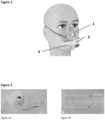
- the present invention is directed to a protective gear (1) against an infectious agent comprising a sample collection element (2).
- a protective gear includes for example a face mask (such as a surgical mask or a FFP2 mask) or a face shield.
- the protective gear integrates with the sample collection element a testing element (3).
- Such testing element (3) comprises for example a laminar flow rapid antigen test. The results of the test are immediately visual on the protective gear with the integrated test method.
- the sample collection element is removable from the protective gear prior to an analytical assay to determine the presence of the infectious agent in a separate analytical method, which may be the same analytical assay as integrated in the protective gear.
- the analytical assay integral in the sample collection element, includes any rapid assay which would allow for the detection of the presence of the infectious agent in the sample.
- the analytical assay is a rapid antigen test such as a lateral flow assay using a molecule recognizing one or more antigens present on the infectious agent.
- molecules can be any antibody, partial antibody, fusion protein including an antigen recognition moiety, single chain antibody but also include any other protein or peptide having a moiety that recognizes the antigen. Included in such molecules recognizing one or more antigens of the infectious agent are aptamers. Recognizes in the context of the present invention includes the specific binding or interaction between such molecule and the antigen.
- the method of the present invention is useful for the detection of any infectious agent, preferably the infectious agent is an airborne infectious agent.
- the infectious agent is an airborne infectious agent.
- airborne infectious agent as in the present invention is a corona virus, for example SARS CoV-2 (Covid 19), or an influenza virus.
- Example 1 A rapid antigen self-test (by lateral flow immunoassay technology solution) directly performed on a FFP2 face mask.
Landscapes
- Health & Medical Sciences (AREA)
- Life Sciences & Earth Sciences (AREA)
- Medical Informatics (AREA)
- Molecular Biology (AREA)
- Veterinary Medicine (AREA)
- Biophysics (AREA)
- Pathology (AREA)
- Engineering & Computer Science (AREA)
- Biomedical Technology (AREA)
- Heart & Thoracic Surgery (AREA)
- Public Health (AREA)
- Physics & Mathematics (AREA)
- Surgery (AREA)
- Animal Behavior & Ethology (AREA)
- General Health & Medical Sciences (AREA)
- Physiology (AREA)
- Pulmonology (AREA)
- Dentistry (AREA)
- Oral & Maxillofacial Surgery (AREA)
- Investigating Or Analysing Biological Materials (AREA)
Priority Applications (2)
| Application Number | Priority Date | Filing Date | Title |
|---|---|---|---|
| EP22189145.0A EP4316366A1 (de) | 2022-08-05 | 2022-08-05 | Schutzausrüstung mit integrierter testkomponente und verfahren zur verwendung der schutzausrüstung zur bestimmung des vorhandenseins eines infektiösen mittels |
| PCT/EP2023/071680 WO2024028484A1 (en) | 2022-08-05 | 2023-08-04 | Protective gear with integral testing component and method of using the protective gear to determine presence of infectious agent |
Applications Claiming Priority (1)
| Application Number | Priority Date | Filing Date | Title |
|---|---|---|---|
| EP22189145.0A EP4316366A1 (de) | 2022-08-05 | 2022-08-05 | Schutzausrüstung mit integrierter testkomponente und verfahren zur verwendung der schutzausrüstung zur bestimmung des vorhandenseins eines infektiösen mittels |
Publications (1)
| Publication Number | Publication Date |
|---|---|
| EP4316366A1 true EP4316366A1 (de) | 2024-02-07 |
Family
ID=83361063
Family Applications (1)
| Application Number | Title | Priority Date | Filing Date |
|---|---|---|---|
| EP22189145.0A Withdrawn EP4316366A1 (de) | 2022-08-05 | 2022-08-05 | Schutzausrüstung mit integrierter testkomponente und verfahren zur verwendung der schutzausrüstung zur bestimmung des vorhandenseins eines infektiösen mittels |
Country Status (2)
| Country | Link |
|---|---|
| EP (1) | EP4316366A1 (de) |
| WO (1) | WO2024028484A1 (de) |
Citations (1)
| Publication number | Priority date | Publication date | Assignee | Title |
|---|---|---|---|---|
| US20220125333A1 (en) * | 2020-10-26 | 2022-04-28 | Innovaprep Llc | Multi-function face masks |
-
2022
- 2022-08-05 EP EP22189145.0A patent/EP4316366A1/de not_active Withdrawn
-
2023
- 2023-08-04 WO PCT/EP2023/071680 patent/WO2024028484A1/en not_active Ceased
Patent Citations (1)
| Publication number | Priority date | Publication date | Assignee | Title |
|---|---|---|---|---|
| US20220125333A1 (en) * | 2020-10-26 | 2022-04-28 | Innovaprep Llc | Multi-function face masks |
Non-Patent Citations (2)
| Title |
|---|
| BISHNU SOHAM KANTI ET AL: "Diagnostic Mask For SARS-CoV-2 Detection Using Immunochromatography and Machine Learning", 2021 5TH INTERNATIONAL CONFERENCE ON ELECTRONICS, MATERIALS ENGINEERING & NANO-TECHNOLOGY (IEMENTECH), IEEE, 24 September 2021 (2021-09-24), pages 1 - 6, XP034033406, DOI: 10.1109/IEMENTECH53263.2021.9614726 * |
| FABIANI LAURA ET AL: "State of the Art on the SARS-CoV-2 Toolkit for Antigen Detection: One Year Later", BIOSENSORS, vol. 11, no. 9, 31 August 2021 (2021-08-31), pages 310, XP055971259, DOI: 10.3390/bios11090310 * |
Also Published As
| Publication number | Publication date |
|---|---|
| WO2024028484A1 (en) | 2024-02-08 |
Similar Documents
| Publication | Publication Date | Title |
|---|---|---|
| Drew et al. | Prevalence of resistance in patients receiving ganciclovir for serious cytomegalovirus infection | |
| Vitek et al. | Evidence against person-to-person transmission of hantavirus to health care workers | |
| Helfand et al. | Diagnosis of measles with an IgM capture EIA: the optimal timing of specimen collection after rash onset | |
| Phillips et al. | Clinical and subclinical Barmah Forest virus infection in Queensland | |
| Groot et al. | Neutralizing and haemagglutination-inhibiting antibodies to yellow fever 17 years after vaccination with 17D vaccine | |
| CN111912980A (zh) | 唾液中新型冠状病毒抗原和抗体的快速联合检测装置及其制备方法 | |
| Pattison et al. | Serological and epidemiological studies of hepatitis B in haemodialysis units | |
| Heinsohn et al. | Exposure to blood-containing aerosols in the operating room: a preliminary study | |
| Chen et al. | Detection of IgM antibodies from cerebrospinal fluid and sera of dengue fever patients | |
| Schmidt et al. | Comparison of direct immunofluorescence and direct immunoperoxidase procedures for detection of herpes simplex virus antigen in lesion specimens | |
| Fulton et al. | Comparison of immunofluorescence and isolation techniques in the diagnosis of respiratory viral infections of children | |
| LaRussa et al. | Determination of immunity to varicella-zoster virus by means of an intradermal skin test | |
| Savarit et al. | Risk of HIV infection from transfusion with blood negative for HIV antibody in a west African city. | |
| Cutts et al. | Field evaluation of measles vaccine efficacy in Mozambique | |
| EP4316366A1 (de) | Schutzausrüstung mit integrierter testkomponente und verfahren zur verwendung der schutzausrüstung zur bestimmung des vorhandenseins eines infektiösen mittels | |
| Welliver et al. | Respiratory syncytial virus-specific cell-mediated immune responses after vaccination with a purified fusion protein subunit vaccine | |
| Smaron et al. | Diagnosis of measles by fluorescent antibody and culture of nasopharyngeal secretions | |
| Ihongbe et al. | Detection of hepatitis B virus serological markers among adult HIV positive female patients on HAART in Ogun State, Nigeria | |
| Dayan et al. | Investigation of a rubella outbreak in Kyrgyzstan in 2001: implications for an integrated approach to measles elimination and prevention of congenital rubella syndrome | |
| Klint Johannesen et al. | Prevalence and duration of anti-SARS-CoV-2 antibodies in healthcare workers | |
| Chinprasatsak et al. | Evaluation of a newly developed dipstick test for the rapid diagnosis of scrub typhus in febrile patients | |
| CN114113587A (zh) | 一种新型冠状病毒抗体胶体金免疫层析检测卡及应用 | |
| US20240210391A1 (en) | Device to detect airborne pathogens | |
| Chen et al. | Application of aptamer-based rapid screening test piece integrated face mask for wearer infected with virus | |
| Seneviratne et al. | BNT162b2 mRNA Vaccine–Induced Immune Response in Oral Fluids and Serum |
Legal Events
| Date | Code | Title | Description |
|---|---|---|---|
| PUAI | Public reference made under article 153(3) epc to a published international application that has entered the european phase |
Free format text: ORIGINAL CODE: 0009012 |
|
| STAA | Information on the status of an ep patent application or granted ep patent |
Free format text: STATUS: THE APPLICATION HAS BEEN PUBLISHED |
|
| AK | Designated contracting states |
Kind code of ref document: A1 Designated state(s): AL AT BE BG CH CY CZ DE DK EE ES FI FR GB GR HR HU IE IS IT LI LT LU LV MC MK MT NL NO PL PT RO RS SE SI SK SM TR |
|
| STAA | Information on the status of an ep patent application or granted ep patent |
Free format text: STATUS: THE APPLICATION IS DEEMED TO BE WITHDRAWN |
|
| 18D | Application deemed to be withdrawn |
Effective date: 20240808 |