EP4316977A1 - Behandlungssystem für schiffsballastwasser - Google Patents
Behandlungssystem für schiffsballastwasser Download PDFInfo
- Publication number
- EP4316977A1 EP4316977A1 EP22846004.4A EP22846004A EP4316977A1 EP 4316977 A1 EP4316977 A1 EP 4316977A1 EP 22846004 A EP22846004 A EP 22846004A EP 4316977 A1 EP4316977 A1 EP 4316977A1
- Authority
- EP
- European Patent Office
- Prior art keywords
- anode
- unit
- cathode
- treatment system
- water
- Prior art date
- Legal status (The legal status is an assumption and is not a legal conclusion. Google has not performed a legal analysis and makes no representation as to the accuracy of the status listed.)
- Pending
Links
- XLYOFNOQVPJJNP-UHFFFAOYSA-N water Substances O XLYOFNOQVPJJNP-UHFFFAOYSA-N 0.000 title claims abstract description 217
- 238000005868 electrolysis reaction Methods 0.000 claims abstract description 99
- 239000002994 raw material Substances 0.000 claims abstract description 93
- 239000003795 chemical substances by application Substances 0.000 claims abstract description 68
- 238000006243 chemical reaction Methods 0.000 claims abstract description 42
- 239000007787 solid Substances 0.000 claims abstract description 18
- 238000002347 injection Methods 0.000 claims abstract description 17
- 239000007924 injection Substances 0.000 claims abstract description 17
- 150000001768 cations Chemical class 0.000 claims abstract description 16
- 239000000243 solution Substances 0.000 claims description 49
- 150000003839 salts Chemical class 0.000 claims description 41
- 239000012528 membrane Substances 0.000 claims description 40
- 229910052751 metal Inorganic materials 0.000 claims description 37
- 239000002184 metal Substances 0.000 claims description 37
- 239000000126 substance Substances 0.000 claims description 34
- 238000003860 storage Methods 0.000 claims description 29
- 229910000000 metal hydroxide Inorganic materials 0.000 claims description 24
- 150000004692 metal hydroxides Chemical class 0.000 claims description 24
- 229910021645 metal ion Inorganic materials 0.000 claims description 23
- 238000005341 cation exchange Methods 0.000 claims description 21
- 239000012266 salt solution Substances 0.000 claims description 20
- 239000012535 impurity Substances 0.000 claims description 18
- UFHFLCQGNIYNRP-UHFFFAOYSA-N Hydrogen Chemical compound [H][H] UFHFLCQGNIYNRP-UHFFFAOYSA-N 0.000 claims description 16
- 239000007789 gas Substances 0.000 claims description 8
- 239000002904 solvent Substances 0.000 claims description 4
- 238000007599 discharging Methods 0.000 claims description 3
- 239000007864 aqueous solution Substances 0.000 abstract description 5
- HEMHJVSKTPXQMS-UHFFFAOYSA-M Sodium hydroxide Chemical compound [OH-].[Na+] HEMHJVSKTPXQMS-UHFFFAOYSA-M 0.000 description 78
- 239000000047 product Substances 0.000 description 44
- -1 wastewater treatment Substances 0.000 description 36
- 239000005708 Sodium hypochlorite Substances 0.000 description 26
- SUKJFIGYRHOWBL-UHFFFAOYSA-N sodium hypochlorite Chemical compound [Na+].Cl[O-] SUKJFIGYRHOWBL-UHFFFAOYSA-N 0.000 description 26
- 239000013535 sea water Substances 0.000 description 23
- 229910001415 sodium ion Inorganic materials 0.000 description 15
- 229920006395 saturated elastomer Polymers 0.000 description 14
- KZBUYRJDOAKODT-UHFFFAOYSA-N Chlorine Chemical compound ClCl KZBUYRJDOAKODT-UHFFFAOYSA-N 0.000 description 12
- CDBYLPFSWZWCQE-UHFFFAOYSA-L Sodium Carbonate Chemical compound [Na+].[Na+].[O-]C([O-])=O CDBYLPFSWZWCQE-UHFFFAOYSA-L 0.000 description 12
- 238000004519 manufacturing process Methods 0.000 description 9
- 238000005342 ion exchange Methods 0.000 description 7
- 239000011148 porous material Substances 0.000 description 7
- CURLTUGMZLYLDI-UHFFFAOYSA-N Carbon dioxide Chemical compound O=C=O CURLTUGMZLYLDI-UHFFFAOYSA-N 0.000 description 6
- 239000008213 purified water Substances 0.000 description 6
- 229910000029 sodium carbonate Inorganic materials 0.000 description 6
- 239000008399 tap water Substances 0.000 description 6
- 235000020679 tap water Nutrition 0.000 description 6
- FKNQFGJONOIPTF-UHFFFAOYSA-N Sodium cation Chemical compound [Na+] FKNQFGJONOIPTF-UHFFFAOYSA-N 0.000 description 5
- 230000000694 effects Effects 0.000 description 5
- 125000000524 functional group Chemical group 0.000 description 5
- 238000012423 maintenance Methods 0.000 description 5
- VEXZGXHMUGYJMC-UHFFFAOYSA-N Hydrochloric acid Chemical compound Cl VEXZGXHMUGYJMC-UHFFFAOYSA-N 0.000 description 4
- UIIMBOGNXHQVGW-UHFFFAOYSA-M Sodium bicarbonate Chemical compound [Na+].OC([O-])=O UIIMBOGNXHQVGW-UHFFFAOYSA-M 0.000 description 4
- FAPWRFPIFSIZLT-UHFFFAOYSA-M Sodium chloride Chemical compound [Na+].[Cl-] FAPWRFPIFSIZLT-UHFFFAOYSA-M 0.000 description 4
- 229910002092 carbon dioxide Inorganic materials 0.000 description 4
- 239000000460 chlorine Substances 0.000 description 4
- 229910052801 chlorine Inorganic materials 0.000 description 4
- 239000000463 material Substances 0.000 description 4
- 239000000203 mixture Substances 0.000 description 4
- 239000000872 buffer Substances 0.000 description 3
- 238000001816 cooling Methods 0.000 description 3
- 239000003792 electrolyte Substances 0.000 description 3
- 238000005516 engineering process Methods 0.000 description 3
- 238000001914 filtration Methods 0.000 description 3
- 238000010438 heat treatment Methods 0.000 description 3
- QWPPOHNGKGFGJK-UHFFFAOYSA-N hypochlorous acid Chemical compound ClO QWPPOHNGKGFGJK-UHFFFAOYSA-N 0.000 description 3
- 239000007788 liquid Substances 0.000 description 3
- 238000000034 method Methods 0.000 description 3
- 229920006254 polymer film Polymers 0.000 description 3
- 238000001179 sorption measurement Methods 0.000 description 3
- OYPRJOBELJOOCE-UHFFFAOYSA-N Calcium Chemical compound [Ca] OYPRJOBELJOOCE-UHFFFAOYSA-N 0.000 description 2
- BHPQYMZQTOCNFJ-UHFFFAOYSA-N Calcium cation Chemical compound [Ca+2] BHPQYMZQTOCNFJ-UHFFFAOYSA-N 0.000 description 2
- BVKZGUZCCUSVTD-UHFFFAOYSA-L Carbonate Chemical compound [O-]C([O-])=O BVKZGUZCCUSVTD-UHFFFAOYSA-L 0.000 description 2
- MYMOFIZGZYHOMD-UHFFFAOYSA-N Dioxygen Chemical compound O=O MYMOFIZGZYHOMD-UHFFFAOYSA-N 0.000 description 2
- 244000126211 Hericium coralloides Species 0.000 description 2
- FYYHWMGAXLPEAU-UHFFFAOYSA-N Magnesium Chemical compound [Mg] FYYHWMGAXLPEAU-UHFFFAOYSA-N 0.000 description 2
- JLVVSXFLKOJNIY-UHFFFAOYSA-N Magnesium ion Chemical compound [Mg+2] JLVVSXFLKOJNIY-UHFFFAOYSA-N 0.000 description 2
- PMZURENOXWZQFD-UHFFFAOYSA-L Sodium Sulfate Chemical compound [Na+].[Na+].[O-]S([O-])(=O)=O PMZURENOXWZQFD-UHFFFAOYSA-L 0.000 description 2
- 238000010521 absorption reaction Methods 0.000 description 2
- 229910001422 barium ion Inorganic materials 0.000 description 2
- 230000004888 barrier function Effects 0.000 description 2
- 229910001423 beryllium ion Inorganic materials 0.000 description 2
- PWOSZCQLSAMRQW-UHFFFAOYSA-N beryllium(2+) Chemical compound [Be+2] PWOSZCQLSAMRQW-UHFFFAOYSA-N 0.000 description 2
- 239000006227 byproduct Substances 0.000 description 2
- 239000011575 calcium Substances 0.000 description 2
- 229910052791 calcium Inorganic materials 0.000 description 2
- 229910001424 calcium ion Inorganic materials 0.000 description 2
- 239000001569 carbon dioxide Substances 0.000 description 2
- 230000003197 catalytic effect Effects 0.000 description 2
- 230000007423 decrease Effects 0.000 description 2
- 238000009792 diffusion process Methods 0.000 description 2
- 229910001882 dioxygen Inorganic materials 0.000 description 2
- BNIILDVGGAEEIG-UHFFFAOYSA-L disodium hydrogen phosphate Chemical compound [Na+].[Na+].OP([O-])([O-])=O BNIILDVGGAEEIG-UHFFFAOYSA-L 0.000 description 2
- 150000004677 hydrates Chemical class 0.000 description 2
- 239000003014 ion exchange membrane Substances 0.000 description 2
- 150000002500 ions Chemical class 0.000 description 2
- 229910001416 lithium ion Inorganic materials 0.000 description 2
- 239000011777 magnesium Substances 0.000 description 2
- 229910052749 magnesium Inorganic materials 0.000 description 2
- 229910001425 magnesium ion Inorganic materials 0.000 description 2
- 238000012986 modification Methods 0.000 description 2
- 230000004048 modification Effects 0.000 description 2
- 230000002265 prevention Effects 0.000 description 2
- 229910001426 radium ion Inorganic materials 0.000 description 2
- 229910000030 sodium bicarbonate Inorganic materials 0.000 description 2
- 239000011780 sodium chloride Substances 0.000 description 2
- CHQMHPLRPQMAMX-UHFFFAOYSA-L sodium persulfate Substances [Na+].[Na+].[O-]S(=O)(=O)OOS([O-])(=O)=O CHQMHPLRPQMAMX-UHFFFAOYSA-L 0.000 description 2
- 159000000000 sodium salts Chemical class 0.000 description 2
- 229910052938 sodium sulfate Inorganic materials 0.000 description 2
- 229910001427 strontium ion Inorganic materials 0.000 description 2
- 239000013589 supplement Substances 0.000 description 2
- LCPVQAHEFVXVKT-UHFFFAOYSA-N 2-(2,4-difluorophenoxy)pyridin-3-amine Chemical compound NC1=CC=CN=C1OC1=CC=C(F)C=C1F LCPVQAHEFVXVKT-UHFFFAOYSA-N 0.000 description 1
- ZAMOUSCENKQFHK-UHFFFAOYSA-N Chlorine atom Chemical compound [Cl] ZAMOUSCENKQFHK-UHFFFAOYSA-N 0.000 description 1
- HBBGRARXTFLTSG-UHFFFAOYSA-N Lithium ion Chemical compound [Li+] HBBGRARXTFLTSG-UHFFFAOYSA-N 0.000 description 1
- 229910004882 Na2S2O8 Inorganic materials 0.000 description 1
- 239000007832 Na2SO4 Substances 0.000 description 1
- 229910019142 PO4 Inorganic materials 0.000 description 1
- NBIIXXVUZAFLBC-UHFFFAOYSA-L Phosphate ion(2-) Chemical compound OP([O-])([O-])=O NBIIXXVUZAFLBC-UHFFFAOYSA-L 0.000 description 1
- QAOWNCQODCNURD-UHFFFAOYSA-L Sulfate Chemical compound [O-]S([O-])(=O)=O QAOWNCQODCNURD-UHFFFAOYSA-L 0.000 description 1
- 229910001420 alkaline earth metal ion Inorganic materials 0.000 description 1
- 230000004075 alteration Effects 0.000 description 1
- 239000010425 asbestos Substances 0.000 description 1
- XDFCIPNJCBUZJN-UHFFFAOYSA-N barium(2+) Chemical compound [Ba+2] XDFCIPNJCBUZJN-UHFFFAOYSA-N 0.000 description 1
- 230000000903 blocking effect Effects 0.000 description 1
- 239000003054 catalyst Substances 0.000 description 1
- 239000000919 ceramic Substances 0.000 description 1
- 229910010293 ceramic material Inorganic materials 0.000 description 1
- 229920001429 chelating resin Polymers 0.000 description 1
- 238000011109 contamination Methods 0.000 description 1
- 239000000645 desinfectant Substances 0.000 description 1
- 229940061607 dibasic sodium phosphate Drugs 0.000 description 1
- 229910000397 disodium phosphate Inorganic materials 0.000 description 1
- 238000003487 electrochemical reaction Methods 0.000 description 1
- 235000012041 food component Nutrition 0.000 description 1
- 239000005417 food ingredient Substances 0.000 description 1
- 239000013505 freshwater Substances 0.000 description 1
- 239000000446 fuel Substances 0.000 description 1
- 230000020169 heat generation Effects 0.000 description 1
- 150000002431 hydrogen Chemical class 0.000 description 1
- 239000001257 hydrogen Substances 0.000 description 1
- 229910052739 hydrogen Inorganic materials 0.000 description 1
- 238000011065 in-situ storage Methods 0.000 description 1
- 229910010272 inorganic material Inorganic materials 0.000 description 1
- 239000011147 inorganic material Substances 0.000 description 1
- 238000007689 inspection Methods 0.000 description 1
- 239000011368 organic material Substances 0.000 description 1
- 230000003647 oxidation Effects 0.000 description 1
- 238000007254 oxidation reaction Methods 0.000 description 1
- NBIIXXVUZAFLBC-UHFFFAOYSA-K phosphate Chemical compound [O-]P([O-])([O-])=O NBIIXXVUZAFLBC-UHFFFAOYSA-K 0.000 description 1
- 229920000642 polymer Polymers 0.000 description 1
- 229910001414 potassium ion Inorganic materials 0.000 description 1
- 238000000746 purification Methods 0.000 description 1
- 239000000376 reactant Substances 0.000 description 1
- 239000003507 refrigerant Substances 0.000 description 1
- 229910052895 riebeckite Inorganic materials 0.000 description 1
- 239000010865 sewage Substances 0.000 description 1
- 235000017557 sodium bicarbonate Nutrition 0.000 description 1
- 235000011152 sodium sulphate Nutrition 0.000 description 1
- 238000004659 sterilization and disinfection Methods 0.000 description 1
- PWYYWQHXAPXYMF-UHFFFAOYSA-N strontium(2+) Chemical compound [Sr+2] PWYYWQHXAPXYMF-UHFFFAOYSA-N 0.000 description 1
- 231100000167 toxic agent Toxicity 0.000 description 1
- 239000003440 toxic substance Substances 0.000 description 1
- 229940001496 tribasic sodium phosphate Drugs 0.000 description 1
- RYFMWSXOAZQYPI-UHFFFAOYSA-K trisodium phosphate Chemical compound [Na+].[Na+].[Na+].[O-]P([O-])([O-])=O RYFMWSXOAZQYPI-UHFFFAOYSA-K 0.000 description 1
- 229910000406 trisodium phosphate Inorganic materials 0.000 description 1
- 238000004065 wastewater treatment Methods 0.000 description 1
- 238000003466 welding Methods 0.000 description 1
Images


Classifications
-
- C—CHEMISTRY; METALLURGY
- C02—TREATMENT OF WATER, WASTE WATER, SEWAGE, OR SLUDGE
- C02F—TREATMENT OF WATER, WASTE WATER, SEWAGE, OR SLUDGE
- C02F1/00—Treatment of water, waste water, or sewage
- C02F1/50—Treatment of water, waste water, or sewage by addition or application of a germicide or by oligodynamic treatment
-
- B—PERFORMING OPERATIONS; TRANSPORTING
- B63—SHIPS OR OTHER WATERBORNE VESSELS; RELATED EQUIPMENT
- B63J—AUXILIARIES ON VESSELS
- B63J4/00—Arrangements of installations for treating ballast water, waste water, sewage, sludge, or refuse, or for preventing environmental pollution not otherwise provided for
- B63J4/002—Arrangements of installations for treating ballast water, waste water, sewage, sludge, or refuse, or for preventing environmental pollution not otherwise provided for for treating ballast water
-
- B—PERFORMING OPERATIONS; TRANSPORTING
- B63—SHIPS OR OTHER WATERBORNE VESSELS; RELATED EQUIPMENT
- B63B—SHIPS OR OTHER WATERBORNE VESSELS; EQUIPMENT FOR SHIPPING
- B63B13/00—Conduits for emptying or ballasting; Self-bailing equipment; Scuppers
-
- C—CHEMISTRY; METALLURGY
- C02—TREATMENT OF WATER, WASTE WATER, SEWAGE, OR SLUDGE
- C02F—TREATMENT OF WATER, WASTE WATER, SEWAGE, OR SLUDGE
- C02F1/00—Treatment of water, waste water, or sewage
- C02F1/46—Treatment of water, waste water, or sewage by electrochemical methods
- C02F1/461—Treatment of water, waste water, or sewage by electrochemical methods by electrolysis
- C02F1/467—Treatment of water, waste water, or sewage by electrochemical methods by electrolysis by electrochemical disinfection; by electrooxydation or by electroreduction
- C02F1/4672—Treatment of water, waste water, or sewage by electrochemical methods by electrolysis by electrochemical disinfection; by electrooxydation or by electroreduction by electrooxydation
- C02F1/4674—Treatment of water, waste water, or sewage by electrochemical methods by electrolysis by electrochemical disinfection; by electrooxydation or by electroreduction by electrooxydation with halogen or compound of halogens, e.g. chlorine, bromine
-
- C—CHEMISTRY; METALLURGY
- C25—ELECTROLYTIC OR ELECTROPHORETIC PROCESSES; APPARATUS THEREFOR
- C25B—ELECTROLYTIC OR ELECTROPHORETIC PROCESSES FOR THE PRODUCTION OF COMPOUNDS OR NON-METALS; APPARATUS THEREFOR
- C25B1/00—Electrolytic production of inorganic compounds or non-metals
- C25B1/01—Products
- C25B1/14—Alkali metal compounds
-
- B—PERFORMING OPERATIONS; TRANSPORTING
- B63—SHIPS OR OTHER WATERBORNE VESSELS; RELATED EQUIPMENT
- B63J—AUXILIARIES ON VESSELS
- B63J4/00—Arrangements of installations for treating ballast water, waste water, sewage, sludge, or refuse, or for preventing environmental pollution not otherwise provided for
-
- C—CHEMISTRY; METALLURGY
- C02—TREATMENT OF WATER, WASTE WATER, SEWAGE, OR SLUDGE
- C02F—TREATMENT OF WATER, WASTE WATER, SEWAGE, OR SLUDGE
- C02F2103/00—Nature of the water, waste water, sewage or sludge to be treated
- C02F2103/008—Originating from marine vessels, ships and boats, e.g. bilge water or ballast water
-
- C—CHEMISTRY; METALLURGY
- C02—TREATMENT OF WATER, WASTE WATER, SEWAGE, OR SLUDGE
- C02F—TREATMENT OF WATER, WASTE WATER, SEWAGE, OR SLUDGE
- C02F2201/00—Apparatus for treatment of water, waste water or sewage
- C02F2201/001—Build in apparatus for autonomous on board water supply and wastewater treatment (e.g. for aircrafts, cruiseships, oil drilling platforms, railway trains, space stations)
-
- C—CHEMISTRY; METALLURGY
- C02—TREATMENT OF WATER, WASTE WATER, SEWAGE, OR SLUDGE
- C02F—TREATMENT OF WATER, WASTE WATER, SEWAGE, OR SLUDGE
- C02F2201/00—Apparatus for treatment of water, waste water or sewage
- C02F2201/46—Apparatus for electrochemical processes
- C02F2201/461—Electrolysis apparatus
- C02F2201/46105—Details relating to the electrolytic devices
- C02F2201/46115—Electrolytic cell with membranes or diaphragms
-
- C—CHEMISTRY; METALLURGY
- C02—TREATMENT OF WATER, WASTE WATER, SEWAGE, OR SLUDGE
- C02F—TREATMENT OF WATER, WASTE WATER, SEWAGE, OR SLUDGE
- C02F2201/00—Apparatus for treatment of water, waste water or sewage
- C02F2201/46—Apparatus for electrochemical processes
- C02F2201/461—Electrolysis apparatus
- C02F2201/46105—Details relating to the electrolytic devices
- C02F2201/46155—Heating or cooling
-
- C—CHEMISTRY; METALLURGY
- C02—TREATMENT OF WATER, WASTE WATER, SEWAGE, OR SLUDGE
- C02F—TREATMENT OF WATER, WASTE WATER, SEWAGE, OR SLUDGE
- C02F2201/00—Apparatus for treatment of water, waste water or sewage
- C02F2201/46—Apparatus for electrochemical processes
- C02F2201/461—Electrolysis apparatus
- C02F2201/46105—Details relating to the electrolytic devices
- C02F2201/4618—Supplying or removing reactants or electrolyte
-
- C—CHEMISTRY; METALLURGY
- C02—TREATMENT OF WATER, WASTE WATER, SEWAGE, OR SLUDGE
- C02F—TREATMENT OF WATER, WASTE WATER, SEWAGE, OR SLUDGE
- C02F2301/00—General aspects of water treatment
- C02F2301/08—Multistage treatments, e.g. repetition of the same process step under different conditions
-
- C—CHEMISTRY; METALLURGY
- C02—TREATMENT OF WATER, WASTE WATER, SEWAGE, OR SLUDGE
- C02F—TREATMENT OF WATER, WASTE WATER, SEWAGE, OR SLUDGE
- C02F2303/00—Specific treatment goals
- C02F2303/04—Disinfection
Definitions
- the present invention relates to a ballast water treatment system, and more particularly, to a ballast water treatment system that is installed inside a ship and can smoothly treat ballast water not only on an anchored vessel but also on a vessel in operation.
- NaOCI Sodium hypochlorite
- an on-site sodium hypochlorite production device suitable for small-scale water purification plants has been developed in consideration of stability, convenience of maintenance, and economic feasibility.
- Such an on-site sodium hypochlorite production device can produce sodium hypochlorite at a low concentration of 0.4 to 1.0% by electrolyzing salt water, but the on-site sodium hypochlorite production device has difficulty in removing by-products, has a low salt conversion rate and power efficiency, and has a limitation in its application to large-capacity facilities due to the low concentration of sodium hypochlorite.
- Korean Patent Registration No. 10-1226640 Korean Laid-open Patent Application No. 10-2012-0002074 , and the like, a device and/or method for producing high-concentration sodium hypochlorite using a diaphragm method is disclosed.
- the concentration of saturated salt water initially supplied to the anode chamber gradually decreases.
- the saturated salt water may be injected to maintain the concentration thereof in a required range, but an overflow phenomenon may occur as the capacity of anode water increases.
- an overflowed anode water is treated and recycled through a separate process, not only do the equipment, costs, and scale required for the separate process increase, but also human and material burdens increase due to the use of chemicals such as hydrochloric acid (HCl), sodium hydroxide (NaOH), a residual chlorine neutralizer, and the like.
- Korean Patent Registration No. 10-2074331 and the like a device for producing high-concentration sodium hypochlorite on site using seawater or artificial salt water is disclosed.
- a device for producing high-concentration sodium hypochlorite on site using seawater or artificial salt water is disclosed.
- the costs borne by the user of the facility or vessel may increase.
- a treatment agent is produced by supplying seawater as a raw material to an electrolysis tank installed inside a vessel, there is a problem in that impurities in the seawater may cause a large amount of scale to form in equipment such as an electrolysis tank, it is difficult to easily control the concentration of the treatment agent, and the produced disinfectant decomposes rapidly so that the concentration cannot be maintained constant.
- Korean Patent Registration No. 10-2025559 a technology in which seawater from which impurities or the like have been filtered out is mixed with an electrolyte and the mixture is used as a raw material for producing a treatment agent is disclosed.
- an expensive auxiliary device such as a filter or the like for filtering out impurities from seawater is required, and the auxiliary device causes an increase in the overall size of a treatment agent production device and becomes a factor that makes maintenance difficult.
- the concentration of the treatment agent produced using seawater as a raw material is limited to about 0.2 wt% or less, and such a low-concentration treatment agent is more likely to be arbitrarily changed or have its concentration lowered due to various components in the seawater compared to a high-concentration treatment agent, making it difficult to store the low-concentration treatment agent stably for a long period of time.
- hypochlorous acid HOCI
- sodium hydroxide NaOH
- the present invention is directed to solving the problems of the related art described above, and providing a ballast water treatment system that is installed inside a vessel, can smoothly treat ballast water not only on an anchored vessel but also on a vessel in operation, can improve maintainability, economic feasibility, efficiency, and the like by simplifying and miniaturizing the overall equipment, and can easily and smoothly respond to various variables and constraints, such as the nationality of the vessel, the laws of the country in which the vessel is anchored or is in operation, and international treaties.
- One aspect of the present invention provides a ballast water treatment system, which is installed inside a vessel, the treatment system including a first feed unit that includes a first tank in which a solid raw material is stored, a water supply device that supplies a first water stream to the first tank, and a first raw material supply device that mixes the solid raw material and the first water stream to generate an aqueous raw material solution, a first electrolysis unit that includes a first anode chamber in which a first anode product is obtained by reacting the aqueous raw material solution, a first cathode chamber in which a first cathode product is obtained by reacting water and cations provided from the first anode chamber, and a first diaphragm that separates the first anode chamber and the first cathode chamber, a reaction unit in which a treatment agent is obtained by reacting the first anode product and the first cathode product, and an injection unit that provides the treatment agent to ballast water.
- a first feed unit that includes a first tank
- the water may be at least a portion of the first water stream, which is a solvent of the aqueous raw material solution provided in the first anode chamber, provided from the first anode chamber to the first cathode chamber through the first diaphragm.
- the first diaphragm may be a water-permeable porous membrane.
- the first anode chamber may include two or more anode plates protruding at preset intervals
- the first cathode chamber may include two or more cathode plates protruding at preset intervals in spaces between the anode plates
- the first diaphragm may be located in a space between the anode plate and the cathode plate.
- the water may be at least a portion of a second water stream branching from the first water stream provided to the first cathode chamber.
- the first diaphragm may be a cation exchange membrane.
- the treatment system may further include a storage unit which is disposed between the reaction unit and the injection unit and in which the treatment agent is stored.
- the treatment system may further include a heat exchange unit that cools the first electrolysis unit using the treatment agent stored in the storage unit.
- a concentration of the treatment agent obtained in the reaction unit may range from 0.01 to 50 wt%.
- the first feed unit may further include an aqueous raw material solution treatment device that removes impurities contained in the aqueous raw material solution.
- the treatment system may further include a second feed unit that includes a second tank in which a metal salt containing two or more moles of metal ions in a molecule is stored, and a second raw material supply device that mixes the metal salt and a third water stream branching from the first water stream to provide an aqueous metal salt solution, a second electrolysis unit that includes a second anode chamber in which a second anode product is obtained by reacting the aqueous metal salt solution, a second cathode chamber in which a second cathode product is obtained by reacting a fourth water stream branching from at least one of the first to third water streams or provided from the second anode chamber, and metal ions provided from the second anode chamber, and a second diaphragm that separates the second anode chamber and the second cathode chamber, and a connection unit that combines the second cathode product and the first cathode product and provides a result of the combination to the reaction unit.
- a second feed unit that includes
- the second tank, a pipe through which the aqueous metal salt solution is supplied to the second anode chamber, the second anode chamber, and a pipe through which the second anode product is supplied to the second tank may constitute a closed loop.
- the closed loop may include an exhaust port for discharging a gas contained in a substance circulating along the closed loop.
- the metal salt may have a structure according to the following Formula. ⁇ Formula> M x A y
- M denotes a monovalent or divalent metal ion
- x denotes an integer greater than or equal to 2
- A denotes a negative ionic substance that can be combined with the metal ion M
- y denotes an integers that satisfies the above Formula.
- the second diaphragm may be a water-permeable porous membrane.
- the second diaphragm may be a cation exchange membrane.
- the first and second electrolysis units may be connected in parallel.
- the treatment system may further include a hydrogen gas treatment unit.
- a ballast water treatment system is installed inside a vessel, and includes a first feed unit that includes a first tank in which a solid raw material is stored, a water supply device that supplies a first water stream to the first tank, and a first raw material supply device that mixes the solid raw material and the first water stream to generate an aqueous raw material solution, a first electrolysis unit that includes a first anode chamber in which a first anode product is obtained by reacting the aqueous raw material solution, a first cathode chamber in which a first cathode product is obtained by reacting water and cations provided from the first anode chamber, and a first diaphragm that separates the first anode chamber and the first cathode chamber, a reaction unit in which a treatment agent is obtained by reacting the first anode product and the first cathode product, and an injection unit that provides the treatment agent to ballast water.
- a first feed unit that includes a first tank in which a solid raw material is stored, a
- ballast water not only on an anchored vessel but also on a vessel in operation, it is possible to improve maintainability, economic feasibility, efficiency, and the like by simplifying and miniaturizing the overall equipment, and it is possible to easily and smoothly respond to various variables and constraints, such as the nationality of the vessel, the laws of the country in which the vessel is anchored or is in operation, and international treaties.
- FIG. 1 illustrates a ballast water treatment system according to an embodiment of the present invention.
- the ballast water treatment system which is installed inside a vessel, may include a first feed unit 110 that includes a first tank 112 in which a solid raw material is stored, a water supply device 111 that supplies a first water stream to the first tank 112, and a first raw material supply device 113 that mixes the solid raw material and the first water stream to generate an aqueous raw material solution, a first electrolysis unit 210 that includes a first anode chamber 211 in which a first anode product is obtained by reacting the aqueous raw material solution, a first cathode chamber 212 in which a first cathode product is obtained by reacting water and cations provided from the first anode chamber 211, and a first diaphragm 213 that separates the first anode chamber 211 and the first cathode chamber 212, a reaction unit 300 in which a treatment agent is obtained by reacting the first anode product and the first cathode product
- seawater from which impurities or the like have been filtered out is mixed with an electrolyte and the mixture is used as a raw material for producing a treatment agent.
- an expensive auxiliary device such as a filter or the like for filtering out impurities from seawater is required, and the auxiliary device causes an increase in the overall size of a treatment agent production device and becomes a factor that makes maintenance difficult.
- the concentration of the treatment agent produced using seawater as a raw material is limited to about 0.2 wt% or less, and such a low-concentration treatment agent is more likely to be arbitrarily changed than a high-concentration treatment agent, making it difficult to store the low-concentration treatment agent stably for a long period of time.
- a filter should be used, but this is disadvantageous in terms of economic feasibility because the proportion of the cost spent on the filter among the total equipment is large.
- a diaphragm type electrolysis facility is required to produce a high-concentration treatment agent, but seawater cannot be used as it is, and complex equipment and excessive costs are required to pre-treat the seawater.
- the ballast water treatment system since the ballast water treatment system is installed inside the vessel, the ballast water treatment system can smoothly treat ballast water not only on an anchored vessel but also on a vessel in operation, and since the ballast water treatment system can treat the ballast water by continuously preparing, producing, and storing a high-concentration treatment agent using a solid raw material stored inside the vessel as necessary, auxiliary equipment such as a filter or the like is not required.
- the first feed unit 110 may include the first tank 112 in which a solid raw material, for example, salt, is stored, the water supply device 111 that provides a first water stream to the first tank 112, and the first raw material supply device 113 that mixes the solid raw material and the first water stream to generate an aqueous raw material solution.
- a solid raw material for example, salt
- the solid raw material supplied from the outside may be stored, and the first raw material supply device 113 may mix the solid raw material and the first water stream consisting of tap water, purified water (pure or higher), and/or seawater from which impurities have been filtered out, provided from the water supply device 111, generate an aqueous raw material solution of a preset concentration, preferably, salt water, and more preferably, saturated salt water, and provide the generated aqueous raw material solution to the first anode chamber 211 of the first electrolysis unit 210.
- a preset concentration preferably, salt water, and more preferably, saturated salt water
- the first water stream provided from the water supply device 111 may consist of tap water, purified water (pure or higher), and/or seawater from which impurities have been filtered out.
- the tap water, the purified water (pure or higher), and/or the seawater from which the impurities have been filtered out are treated (filtered, sterilized, etc.) in separate facilities located outside the vessel, may be stored in a water tank (not illustrated) provided at the front of the water supply device 111, and may be provided to the first tank 112 by the water supply device 111 as necessary.
- the water supply device 111 may not include any device for introducing seawater into the vessel and filtering and purifying the seawater, for example, an expensive auxiliary device such as a filter, and may directly provide pre-stored tap water, purified water (pure or higher), and/or seawater from which impurities have been filtered out to the first tank 112, the overall ballast water treatment system may be simplified and miniaturized, and thus maintainability, economic feasibility, efficiency, and the like may be improved.
- the first raw material supply device 113 may mix the first water stream consisting of the pre-stored tap water, purified water (pure or higher), and/or seawater from which the impurities have been filtered out and the solid raw material stored in the first tank 112 at a preset ratio to generate an aqueous raw material solution.
- the aqueous raw material solution generated and provided by the first raw material supply device 113 contains an electrolyte and water, which are raw materials for the treatment agent, but does not substantially contain impurities by being treated by an aqueous raw material solution treatment device (not illustrated) as necessary, and thus it is possible to effectively prevent unnecessary scale and the like generated in the ballast water treatment system due to the impurities, and it is possible to easily and precisely control the concentration of the aqueous treatment agent solution obtained through the first electrolysis unit 210 by adjusting the amount of aqueous raw material solution or an applied current.
- the first raw material supply device 113 may include an aqueous raw material solution treatment device (not illustrated).
- the aqueous raw material solution treatment device may remove residual impurities, such as calcium, magnesium, and the like, contained in the aqueous raw material solution generated in the first raw material supply device 113, for example, saturated salt water, and thus it is possible to prevent contamination of the first diaphragm 213 of the first electrolysis unit 210 to increase the efficiency of the electrolysis reaction, and it is possible to contribute to increasing the durability and lifetime of the first diaphragm 213.
- the aqueous raw material solution treatment device may include a heating unit in which a heater is provided in a water tank of a preset standard, a pH control unit, and a water softening device (not illustrated) in which a chelating resin that can adsorb and remove impurities in the aqueous raw material solution that has passed through the heating unit is provided.
- the heating unit may appropriately maintain the temperature and pH of the unpurified aqueous raw material solution, for example, saturated salt water, and thus the adsorption efficiency of the water softening device may be improved.
- the appropriate temperature of the saturated salt water may range from 50 to 80 °C, and the pH may be 9 or more, but the present invention is not limited thereto.
- the first electrolysis unit 210 may include the first anode chamber 211 in which a first anode product is obtained by reacting the aqueous raw material solution, the first cathode chamber 212 in which a first cathode product is obtained by reacting water and cations, preferably, metal ions, provided from the first anode chamber 211, and the first diaphragm 213 that separates the first anode chamber 211 and the first cathode chamber 212.
- the first anode chamber 211 may include a anode, and may support a first anode product including anode water generated by an electrolysis reaction at the anode and a gaseous substance.
- the first cathode chamber 212 may include a cathode, and may support a first cathode product including cathode water generated by an electrolysis reaction at the cathode and a gaseous substance.
- the aqueous raw material solution is salt water, and preferably, saturated salt water
- the following substances may be generated in the first anode chamber 211 and the first cathode chamber 212.
- saturated salt water having a preset concentration may be electrolyzed and sodium ions (Na + ), chlorine gas (Cl 2 ), and chlorine ions (Cl - ) may be generated, and in the first cathode chamber 212, the water may be electrolyzed and hydrogen gas (H 2 ) and hydroxide ions (OH - ) may be generated.
- the sodium ions generated in the first anode chamber 211 may move to the first cathode chamber 212 through the first diaphragm 213, and react with the hydroxide ions pre-generated in the first cathode chamber 212 to generate sodium hydroxide.
- the sodium hydroxide generated in the first cathode chamber 212 may be used alone and/or together with a metal hydroxide obtained in a second cathode chamber 222 of a metal hydroxide generation unit to be described below, as a raw material for producing a treatment agent and/or as a buffer for increasing storage stability by adjusting the pH of the produced treatment agent.
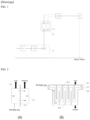
- FIG. 2 illustrates the first electrolysis unit 210 according to the embodiment of the present invention.
- the water in the first cathode chamber 212, may be at least a portion of the first water stream, which is a solvent of the aqueous raw material solution provided in the first anode chamber 211, provided from the first anode chamber 211 to the first cathode chamber 212 through the first diaphragm 213.
- the water supply device 111 in the feed unit provides the first water stream only to the first tank 112, and the aqueous raw material solution generated by the first raw material supply device 113 is provided to the first anode chamber 211.
- Cations, preferably, metal ions, required to generate the metal hydroxide in the first cathode chamber 212 may be provided from the first anode chamber 211 to the first cathode chamber 212 through the first diaphragm 213 chemically and/or physically, and hydroxide ions may be generated by an electrolysis reaction of the water provided from the first anode chamber 211 to the first cathode chamber 212 through the first diaphragm 213 chemically and/or physically.
- the term "chemical permeation” means that an ionic substance with predetermined charges passes through a diaphragm through a chemical operation such as an ion exchange reaction
- the term “physical permeation” means that a substance passes through a diaphragm by overcoming the physical and structural elements of the diaphragm, such as the size of pores provided in the diaphragm and the thickness of the diaphragm.
- substantially all the cations and the water, which are raw materials required to generate the metal hydroxide in the first cathode chamber 212, may move from the first anode chamber 211 to the first cathode chamber 212 through the first diaphragm 213.
- the feed unit and the first electrolysis unit 210 may be connected only by a pipe for connecting the feed unit and the first anode chamber 211 and providing an aqueous raw material solution of a preset concentration to the first anode chamber 211, and separate parts such as a pipe and the like for supplying water, which is a raw material for hydroxide ions, from the water supply device 111 to the first cathode chamber 212, may be omitted, the overall ballast water treatment system may be simplified and miniaturized, and thus maintainability, economic feasibility, efficiency, and the like may be improved.
- the first diaphragm 213 may be a water-permeable porous membrane.
- a water-permeable porous membrane made of a ceramic material such as asbestos may include a plurality of through-holes and/or pores, which are paths through which water passes and moves.
- negative ions such as chlorine ions generated in the first anode chamber 211 may move to the first cathode chamber 212 together with the water and the cations, and act as by-products that inhibit an electrolysis reaction in the first cathode chamber 212.
- the passage and movement of water through the through-holes and/or pores may occur in both directions rather than in only one direction, and accordingly, when the water and cations provided to the first cathode chamber 212 and the hydroxide ions generated in the first cathode chamber 212 flow back into the first anode chamber 211, since raw materials cannot be stably provided to the first cathode chamber 212, there is a problem in that metal hydroxides and a treatment agents, for example, sodium hydroxide and sodium hypochlorite, cannot be smoothly produced.
- a soft cation exchange membrane made of a polymer film may allow the cations generated in the first anode chamber 211 to pass through and move to the first cathode chamber 212 by an ion exchange reaction with a functional group provided in the cation exchange membrane, and in some cases, water molecules may form hydrates with cations and may pass through and move to the first cathode chamber 212 through the cation exchange membrane.
- liquid substances for example, water
- first cathode chamber 212 since the size of the pores provided in the membrane is very small, i.e., nanometers (nm), liquid substances, for example, water, cannot move smoothly from the first anode chamber 211 to the first cathode chamber 212, and thus separate parts such as a pipe and the like are required to provide sufficient water to the first cathode chamber 212.
- the first diaphragm 213 since the first diaphragm 213 is provided as a water-permeable porous membrane, the first diaphragm 213 may allow a sufficient amount of water to pass from the first anode chamber 211 to the first cathode chamber 212.
- the ion exchange ability may be imparted to the water-permeable porous membrane by chemically and/or physically treating the surface of the water-permeable porous membrane and/or the surface of the pores provided therein.
- the water-permeable porous membrane having ion exchange ability may selectively allow the cations generated in the first anode chamber 211 to pass therethrough to the first cathode chamber 212 due to the inherent electrochemical properties of the membrane.
- the first diaphragm 213 is a water-permeable porous membrane
- the water and cations provided to the first cathode chamber 212 due to the structural factors of the first electrolysis unit 210 such as the relative positions of the first anode chamber 211 and the first cathode chamber 212 separated by the first diaphragm 213, and the hydroxide ions generated in the first cathode chamber 212 may flow back into the first anode chamber 211, and accordingly, since raw materials cannot be stably provided to the first cathode chamber 212, there is a problem in that metal hydroxides and treatment agents, for example, sodium hydroxide and sodium hypochlorite, cannot be smoothly produced.
- the first anode chamber 211 may include two or more anode plates 211' protruding downward at preset intervals
- the first cathode chamber 212 may include two or more cathode plates 212' protruding upward at preset intervals in spaces between the anode plates 211'
- the first diaphragm 213 may be located in a space between the anode plate 211' and the cathode plate 212'.
- the first diaphragm 213 may separate the first anode chamber 211 and the first cathode chamber 212 so that the first anode chamber 211 and the first cathode chamber 212 are located at upper and lower portions of the first electrolysis unit 210, respectively.
- the anode plate 211' and the cathode plate 212' may be respectively located in the spaces between two adjacent cathode plates 212' and between two adjacent anode plates 211', and the anode plate 211' and the cathode plate 212' may be spaced apart from each other at a preset interval and may not be in contact with each other. That is, the anode plates 211' and the cathode plates 212' may form a non-contact crossed comb-tooth structure.
- the crossed comb-tooth structure consisting of the anode plates 211' and the cathode plates 212' may contribute to improving reaction efficiency and productivity by increasing the area of the electrode where an electrolysis reaction is performed.
- the first diaphragm 213 may be located in the space between the anode plates 211' and the cathode plates 212' to separate the first anode chamber 211 and the first cathode chamber 212 so that the first anode chamber 211 and the first cathode chamber 212 are located at the upper and lower portions of the first electrolysis unit 210, respectively.
- the substances within the first electrolysis unit 210 preferably move from the first anode chamber 211 to the first cathode chamber 212, and it is necessary to appropriately suppress a backflow phenomenon in which the substances move from the first cathode chamber 212 to the first anode chamber 211.
- the first diaphragm 213 may physically force a direction of movement of the substances within the first electrolysis unit 210 to be a direction from the first anode chamber 211 to the first cathode chamber 212.
- the aqueous raw material solution is salt water
- sodium ions (Na + ), chlorine gas (Cl 2 ), and chlorine ions (Cl - ) may be generated in the first anode chamber 211
- hydrogen gas (H 2 ) and hydroxide ions (OH - ) which are generated by electrolysis of water
- sodium hydroxide which are generated by a reaction of the sodium ions and the hydroxide ions provided from the first anode chamber 211, may be generated in the first cathode chamber 212.
- the first diaphragm 213, that is, the water-permeable porous membrane may include a hard material.
- the first diaphragm 213 may be made of an organic material such as a polymer, an inorganic material such as a metal, a ceramic, or a combination thereof.
- chlorine gas may move to the upper portion of the first anode chamber 211, and sodium ions may move to the lower portion of the first anode chamber 211, pass through the first diaphragm 213, and move to the first cathode chamber 212 in a dissolved state in water.
- sodium hydroxide may move to the lower portion of the first cathode chamber 212 in an aqueous solution state. Accordingly, chlorine gas and an aqueous sodium hydroxide solution, which are reactants for producing sodium hypochlorite, may be obtained in the upper portion of the first anode chamber 211 and the lower portion of the first cathode chamber 212, respectively.
- FIG. 3 illustrates a ballast water treatment system according to another embodiment of the present invention.
- the water in the first cathode chamber 212, may be at least a portion of a second water stream branching from the first water stream provided to the first cathode chamber 212.
- the amount of water provided from the first anode chamber 211 to the first cathode chamber 212 due to physical and structural factors may be insufficient to drive the first electrolysis unit to produce the required amount of treatment agent.
- the ballast water treatment system further includes separate parts, such as a pipe and the like for providing the second water stream, which is a raw material for hydroxide ions, from the water supply device 111 of the first feed unit 110 to the first cathode chamber 212 to supplement the amount of water provided to the first cathode chamber 212.
- separate parts such as a pipe and the like for providing the second water stream, which is a raw material for hydroxide ions, from the water supply device 111 of the first feed unit 110 to the first cathode chamber 212 to supplement the amount of water provided to the first cathode chamber 212.
- the first diaphragm 213 may be a cation exchange membrane.
- the cation exchange membrane may be a soft cation exchange membrane made of a polymer film.
- the cation exchange membrane may allow the cations generated in the first anode chamber 211, for example, sodium ions, to pass through and move to the first cathode chamber 212 by an ion exchange reaction with a functional group provided in the cation exchange membrane.
- the cation exchange membrane may prevent liquid substances, for example, water, from smoothly moving from the first anode chamber 211 to the first cathode chamber 212.
- the cation exchange membrane may include an additional layer and/or functional group that can prevent the hydroxide ions generated in the first cathode chamber 212 from passing through and moving to the first anode chamber 211.
- the reaction unit 300 may react the first anode product, for example, chlorine gas, generated in the first anode chamber 211 of the first electrolysis unit 210 with the first cathode product, for example, sodium hydroxide, generated in the first cathode chamber 212 to generate a treatment agent, for example, sodium hypochlorite.
- the reaction unit 300 may be an independent device or independent equipment connected to the first electrolysis unit 210 at the front end and the injection unit 400 at the rear end through a pipe or the like, and although not illustrated, the reaction unit 300 may be integrated with the first electrolysis unit 210 at the front without a separate pipe.
- a portion of the inside of the first electrolysis unit 210 may be provided as a space in which the first anode product and the first cathode product are collected, and the first anode product and the first cathode product may react in the space to generate a treatment agent.
- the reaction unit 300 and the first electrolysis unit 210 are provided integrally, since a device or equipment for respectively circulating at least some of anode products and/or cathode products that are essentially provided in the conventional diaphragm electrolysis unit to the anode chamber and/or the cathode chamber may be omitted, the overall ballast water treatment system may be simplified and miniaturized, and thus maintainability, economic feasibility, efficiency, and the like may be improved.
- the concentration of the treatment agent obtained in the reaction unit 300 may range from 0.01 to 50 wt%, preferably, 0.1 to 20 wt%, and more preferably, 0.2 to 15 wt%.
- FIGS. 4 and 5 illustrate ballast water treatment systems according to other embodiments of the present invention.
- the ballast water treatment system may further include a storage unit 500 which is disposed between the reaction unit 300 and the injection unit 400 and in which the treatment agent generated in the reaction unit 300 is stored.
- the overproduced treatment agent may be stably stored in the storage unit 500, and when the amount of treatment agent generated in the first electrolysis unit 210 is insufficient, when the first electrolysis unit 210 is broken, or when the operation of the first electrolysis unit 210 is stopped for maintenance, the storage unit 500 may provide the stored treatment agent to the ballast water through the injection unit 400, thereby enabling the ballast water to be continuously and smoothly treated while the vessel is in operation or anchored. Further, when the operation of the first electrolysis unit 210 is stopped for a long period of time, a treatment agent produced outside the vessel may be injected and stored in the storage unit 500, and may be used to treat the ballast water as necessary.
- the storage unit 500 may be a sealed device or sealed equipment in which one selected from the group consisting of temperature, humidity, pressure, concentration of treatment agent, and a combination of two or more thereof is controlled.
- the storage unit 500 may further include a temperature sensor, a temperature control device, a pressure sensor, a pressure control device, a humidity sensor, a humidity control device, a concentration sensor, a concentration control device, an external air blocking device, and a leak prevention device that ensure the stability of the treatment agent, an exhaust device that discharges gas generated during storage, etc.
- the leak prevention device may include, for example, a leak detector, a discharge barrier, a catalytic reactor and/or neutralizer for detoxifying leaked treatment agents, a device for preventing diffusion through absorption and/or adsorption, etc., but the present invention is not limited thereto.
- the storage unit 500 may be integrated with the injection unit 400, and the storage unit 500 may further include a device or equipment that can check and control an injection amount and state of the treatment agent.
- the ballast water treatment system may further include a heat exchange unit 600 that cools the first electrolysis unit 210 using the treatment agent stored in the storage unit 500.
- the heat exchange unit 600 may include a cooling jacket coupled to one surface of each of the first anode chamber 211 and the first cathode chamber 212 of the first electrolysis unit 210 by welding or the like, and a pipe that connects the cooling jacket to the storage unit 500.
- Some of the treatment agent, for example, an aqueous sodium hypochlorite solution, stored in the storage unit 500 may pass through the inside of the cooling jacket through the pipe and act as a refrigerant that absorbs heat generated by the reaction in the first electrolysis unit 210.
- FIG. 6 illustrates a ballast water treatment system according to another embodiment of the present invention.
- the ballast water treatment system may further include a metal hydroxide generation unit including a second feed unit 120 that includes a second tank 122 in which a metal salt containing two or more moles, of metal ions in a molecule is stored, and a second raw material supply device 123 that mixes the metal salt and a third water stream branching from the first water stream to provide an aqueous metal salt solution, a second electrolysis unit 220 that includes a second anode chamber 221 in which a second anode product is obtained by reacting the aqueous metal salt solution, a second cathode chamber 222 in which a second cathode product is obtained by reacting a fourth water stream branching from at least one of the first to third water streams or provided from the second anode chamber 221 and metal ions provided from the second anode chamber 221, and a second diaphragm 223 that separates the second anode chamber 221 and the second cathode chamber 222, and a connection unit 700 that
- a metal salt containing two or more moles of metal ions in a molecule may be stored in the second tank 122.
- the metal salt containing two or more moles of metal ions in the molecule may be dissolved in the third water stream branching from the first water stream provided by the water supply device 111 and may be provided in the form of an aqueous solution to the second anode chamber 221 of the second electrolysis unit 220.
- Solid metal salt may be stored in the second tank 122, and the second tank 122 may receive tap water, purified water (pure or higher), and/or seawater from which impurities have been filtered out from the water supply device 111, and generate an aqueous metal salt solution, preferably, a saturated aqueous metal salt solution, in the second raw material supply device 123 to provide the generated aqueous metal salt solution to the second anode chamber 221 of the second electrolysis unit 220.
- an aqueous metal salt solution preferably, a saturated aqueous metal salt solution
- the second tank 122 may include a metal salt supply unit (not illustrated) through which a solid metal salt is introduced from the outside, an inlet pipe through which the third water stream is provided from the water supply device 111, an inlet pipe through which the second anode product is provided from the second anode chamber 221, a saturated aqueous metal salt solution discharge pipe through which the saturated aqueous solution is discharged, and an exhaust pipe through which gas generated inside the second tank 122 is discharged.
- a metal salt supply unit (not illustrated) through which a solid metal salt is introduced from the outside
- an inlet pipe through which the third water stream is provided from the water supply device 111
- an inlet pipe through which the second anode product is provided from the second anode chamber 221
- a saturated aqueous metal salt solution discharge pipe through which the saturated aqueous solution is discharged
- an exhaust pipe through which gas generated inside the second tank 122 is discharged.
- the metal salt may have a structure according to the following Formula. ⁇ Formula> M x A y
- M denotes a monovalent or divalent metal ion
- x denotes an integer greater than or equal to 2
- A denotes a negative ionic substance that can be combined with the metal ion M
- y denotes an integer that satisfies Formula above.
- the metal ion may include alkaline metal ions such as sodium ions (Na + ), potassium ions (K + ), and lithium ions (Li + ), and/or alkaline earth metal ions such as beryllium ion (Be 2+ ), magnesium ions (Mg 2+ ), calcium ions (Ca 2+ ), strontium ions (Sr 2+ ), barium ions (Ba 2+ ), and radium ions (Ra 2+ ), preferably, alkaline metal ions, and more preferably, sodium ion, but the present invention is not limited thereto.
- the metal ion may be the same as the cations provided from the first anode chamber 211 to the first cathode chamber 212 through the first diaphragm 213, that is, of the same type.
- the negative ionic substance may be one selected from the group consisting of carbonate ions (CO 3 2- ), sulfate ions (SO 4 2- ), persulfate ions ((S 2 O 8 ) 2- )), phosphate ions (PO 4 3- ), hydrogen phosphate ions (HPO 4 2- ), and a combination of two or more thereof, and preferably, carbonate ions, but the present invention is not limited thereto.
- the sodium salt produced by combining the sodium ions and the negative ionic substance may be one selected from the group consisting of sodium carbonate (Na 2 CO 3 ), sodium bicarbonate (NaHCO 3 ), sodium sulfate (Na 2 SO 4 ), sodium persulfate (Na 2 S 2 O 8 ), tribasic sodium phosphate (Na 3 PO 4 ), dibasic sodium phosphate (Na 2 HPO 4 ), a combination of two or more thereof, and preferably, sodium carbonate, but the present invention is not limited thereto.
- the second electrolysis unit 220 may include the second anode chamber 221 in which a second anode product is obtained by reacting the aqueous metal salt solution, the second cathode chamber 222 in which a second cathode product is obtained by reacting a fourth water stream branching from at least one of the first to third water streams or provided from the second anode chamber 221 and metal ions provided from the second anode chamber 221, and the second diaphragm 223 that separates the second anode chamber 221 and the second cathode chamber 222.
- the fourth water stream branching from at least one of the first to third water streams may be appropriately omitted.
- the second anode chamber 221 may include a anode, and may support anode water containing a substance produced by an electrolysis reaction at the anode and a gaseous substance.
- the second cathode chamber 222 may include a cathode, and may support cathode water containing a substance produced by an electrolysis reaction at the cathode and a gaseous substance.
- the metal salt is sodium carbonate (Na 2 CO 3 )
- the following substances may be generated in the second anode chamber 221 and the second cathode chamber 222.
- an aqueous sodium salt solution may be electrolyzed and sodium ions (Na + ), carbon dioxide gas (CO 2 ), and oxygen gas (O 2 ) may be generated, and in the second cathode chamber 222, the fourth water stream may be electrolyzed and hydrogen gas (H 2 ) and hydroxide ions (OH - ) may be generated.
- the sodium ions generated in the second anode chamber 221 may move to the second cathode chamber 222 through the second diaphragm 223, and react with the hydroxide ions pre-generated in the second cathode chamber 222 to generate sodium hydroxide.
- the sodium hydroxide generated in the second cathode chamber 222 of the second electrolysis unit 220 and the sodium hydroxide generated in the first cathode chamber 212 of the first electrolysis unit 210 may move to the connection unit 700, and be combined with each other and provided as a raw material for producing sodium hypochlorite to the reaction unit 300, and as necessary, may be used as a buffer for adjusting the pH of the sodium hypochlorite generated in the reaction unit 300 and increasing storage stability.
- a storage unit in which the metal hydroxide generated in the second cathode chamber 222, preferably, sodium hydroxide, and more preferably, an aqueous sodium hydroxide solution, is stored may be further included between the second cathode chamber 222 of the second electrolysis unit 220 and the connection unit 700.
- the storage unit 500 in which the treatment agent generated in the reaction unit 300 is stored may be referred to as a first storage unit
- the storage unit (not illustrated) in which the aqueous sodium hydroxide solution is stored may be referred to as a second storage unit.
- the metal hydroxide may be directly injected into the reaction unit 300 from the outside of the vessel, or may be injected and stored in the second storage unit and then injected into the reaction unit 300 as necessary.
- the second tank 122, the pipe through which the aqueous metal salt solution is supplied to the second anode chamber 221, the second anode chamber 221, and the pipe through which the second anode product is supplied to the second tank 122 may constitute a closed loop.
- the term "closed loop" means that any substance is controlled to be introduced from the outside or discharged to the outside, in transfer and circulation of the substances through the second tank 122, the pipe through which the aqueous metal salt solution is supplied to the second anode chamber 221, the second anode chamber 221, and the pipe through which the second anode product is supplied to the second tank 122.
- the closed loop may include an exhaust port for discharging a gas, for example, carbon dioxide gas (CO 2 ) and/or oxygen gas (O 2 ), contained in a substance circulating along the closed loop.
- the pipe through which the aqueous metal salt solution generated in the second tank 122 is supplied to the second anode chamber 221 and the pipe through which the substances generated in the second anode chamber 221 is supplied to the second tank 122 may not include a channel through which any substance can be introduced from the outside or discharged to the outside.
- the required amount of metal salt may be replenished in the second tank 122 so that the aqueous metal salt solution may be continuously supplied to the second anode chamber 221 at the required concentration.
- the closed loop may ensure that the metal hydroxide, for example, sodium hydroxide, is continuously and stably generated in the second cathode chamber 222 of the second electrolysis unit 220, the generated metal hydroxide, for example, sodium hydroxide, may be used as a raw material for generating sodium hypochlorite, which is a treatment agent, together with the metal hydroxide, for example, sodium hydroxide, generated in the first cathode chamber 212 of the first electrolysis unit 210 for generating sodium hypochlorite, which is a treatment agent, and as necessary, may be used as a buffer for adjusting the pH of the generated sodium hypochlorite and increasing storage stability.
- the generated metal hydroxide for example, sodium hydroxide
- the ballast water treatment system does not separately inject the metal hydroxide from the outside, which is necessary for controlling the balance of the substances in the first electrolysis unit 210 and the reaction unit 300 and/or the stable storage of the generated treatment agent, and since the metal hydroxide obtained by the metal hydroxide generation unit is used substantially in-situ by including the metal hydroxide generation unit, separate parts (parts required for storage, injection, and the like for the metal hydroxide) for injecting the metal hydroxide from the outside into the reaction unit 300, which has been essentially provided in conventional devices or equipment for producing treatment agents, may be omitted, and accordingly, the burden of transportation, storage, handling, and use of the metal hydroxide may be significantly reduced.
- the second diaphragm 223 may be a water-permeable porous membrane, and the type and effect of the water-permeable porous membrane are the same as those described above for the first diaphragm 213.
- the second diaphragm 223 may be a cation exchange membrane.
- the cation exchange membrane may be a soft cation exchange membrane made of a polymer film.
- the cation exchange membrane may allow the metal ions generated in the second anode chamber 221 to pass through and move into the second cathode chamber 222 by an ion exchange reaction with the functional group provided in the cation exchange membrane, and in some cases, water molecules may form hydrates with the metal ions and may pass through and move into the second cathode chamber 222 through the cation exchange membrane.
- liquid substances for example, water
- the amount of water provided from the second anode chamber 221 to the second cathode chamber 222 due to physical and structural factors may be insufficient to drive the second electrolysis unit to produce the required amount of metal hydroxide.
- the ballast water treatment system further includes separate parts, such as a pipe and the like for providing the fourth water stream, which is a raw material for hydroxide ions, from the water supply device 111 of the first feed unit 110 to the second cathode chamber 222 to supplement the amount of water provided to the second cathode chamber 222.
- separate parts such as a pipe and the like for providing the fourth water stream, which is a raw material for hydroxide ions, from the water supply device 111 of the first feed unit 110 to the second cathode chamber 222 to supplement the amount of water provided to the second cathode chamber 222.
- the cation exchange membrane may include an additional layer and/or functional group that can prevent the hydroxide ions generated in the second cathode chamber 222 from passing through and moving to the second anode chamber 221.
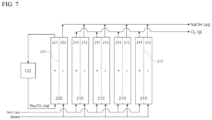
- FIG. 7 illustrates first and second electrolysis units according to an embodiment of the present invention.
- the first and second electrolysis units 210 and 220 are connected in parallel.
- the term "parallel connection" refers to a state in which substance movement and/or exchange, such as in the case in which the product of the first electrolysis unit 210 is injected into the second electrolysis unit 220 as a raw material, or conversely, in the case in which the product of the second electrolysis unit 220 is injected into the first electrolysis unit 210 as a raw material, does not occur between the first and second electrolysis units 210 and 220, and the first and second electrolysis units 220 are connected so that injection of raw materials and discharge of products are performed independently.
- the pipes for injection, discharge, and transfer of the same substances may be integrated into a single pipe.
- FIG. 7 illustrates an example of a state in which a single second electrolysis unit 220 and a plurality of first electrolysis units 210 are disposed sequentially and continuously, but the present invention is not limited thereto.
- a plurality of second electrolysis units 220 may be provided, the first and second electrolysis units 210 and 220 may be alternately provided, and/or second electrolysis units 220 may be disposed between a plurality of first electrolysis units 210 disposed continuously.
- a saturated aqueous metal salt solution may circulate in the second anode chamber 221 and the second tank 122, and in the second cathode chamber 222, water provided from the water supply device 111 may be converted into a metal hydroxide and discharged to the outside of the second electrolysis unit 220.
- an aqueous raw material solution for example, saturated salt water
- water provided from the water supply device 111 may be converted into a metal hydroxide, for example, sodium hydroxide and discharged to the outside of the first electrolysis unit 210.
- Each of pipes for supplying water to the first and second cathode chambers 212 and 222 and each of pipes for supplying the aqueous raw material solution, for example, saturated salt water, to the first anode chamber 211 may branch from a single pipe. Further, pipes for transferring a metal hydroxide, for example, sodium hydroxide, generated in the first and second cathode chamber 212 and 222 and chlorine gas generated in the plurality of first anode chambers 211 to the reaction unit 300 may be integrated into a single pipe.
- a metal hydroxide for example, sodium hydroxide
- At least one of the first and second electrolysis units 210 and 220 may be automatically controlled according to the pH of the treatment agent, for example, an aqueous sodium hypochlorite solution, generated in the reaction unit 300.
- the second electrolysis unit 220 may be further activated to generate an excess amount of sodium hydroxide compared to chlorine gas, and conversely, when the pH of the aqueous sodium hypochlorite solution obtained in the reaction unit 300 is higher than the preset range, a sodium hydroxide production amount may be reduced by delaying the reaction in the second electrolysis unit 220 or lowering reaction efficiency.
- the amount of sodium hydroxide produced according to the pH of the aqueous sodium hypochlorite solution obtained in the reaction unit 300 may be automatically controlled by sensors, controllers, valves, pumps, etc. that are electrically connected to each other.
- the ballast water treatment system may further include a hydrogen gas treatment unit (not illustrated).
- the hydrogen gas treatment unit may store hydrogen gas that is actually generated or can theoretically be generated in at least one of the first and second cathode chambers 212 and 222 and use the hydrogen gas as a raw material for driving a fuel cell, or may convert the hydrogen gas into water by bringing it into contact with a hydrogen oxidation catalyst, then circulate the hydrogen gas to the water supply device 111 or dilute the hydrogen gas appropriately, and discharge the hydrogen gas to the outside.
- the hydrogen gas treatment unit may be provided inside and/or around at least one of the first and second cathode chambers 212 and 222.
- the hydrogen gas treatment unit may include, for example, a leak detector, a discharge barrier, a catalytic reactor and/or neutralizer for detoxifying leaked hydrogen gas, a device for preventing diffusion through absorption and/or adsorption, etc., but the present invention is not limited thereto.
Landscapes
- Chemical & Material Sciences (AREA)
- Engineering & Computer Science (AREA)
- Environmental & Geological Engineering (AREA)
- Organic Chemistry (AREA)
- Chemical Kinetics & Catalysis (AREA)
- Electrochemistry (AREA)
- Life Sciences & Earth Sciences (AREA)
- Hydrology & Water Resources (AREA)
- Water Supply & Treatment (AREA)
- Ocean & Marine Engineering (AREA)
- Mechanical Engineering (AREA)
- Combustion & Propulsion (AREA)
- General Chemical & Material Sciences (AREA)
- Health & Medical Sciences (AREA)
- General Health & Medical Sciences (AREA)
- Public Health (AREA)
- Toxicology (AREA)
- Inorganic Chemistry (AREA)
- Materials Engineering (AREA)
- Metallurgy (AREA)
- Water Treatment By Electricity Or Magnetism (AREA)
- Electrolytic Production Of Non-Metals, Compounds, Apparatuses Therefor (AREA)
Applications Claiming Priority (2)
| Application Number | Priority Date | Filing Date | Title |
|---|---|---|---|
| KR1020210097036A KR102471866B1 (ko) | 2021-07-23 | 2021-07-23 | 선박평형수의 처리시스템 |
| PCT/KR2022/004780 WO2023003132A1 (ko) | 2021-07-23 | 2022-04-04 | 선박평형수의 처리시스템 |
Publications (2)
| Publication Number | Publication Date |
|---|---|
| EP4316977A1 true EP4316977A1 (de) | 2024-02-07 |
| EP4316977A4 EP4316977A4 (de) | 2024-12-04 |
Family
ID=84440728
Family Applications (1)
| Application Number | Title | Priority Date | Filing Date |
|---|---|---|---|
| EP22846004.4A Pending EP4316977A4 (de) | 2021-07-23 | 2022-04-04 | Behandlungssystem für schiffsballastwasser |
Country Status (6)
| Country | Link |
|---|---|
| US (1) | US20240043296A1 (de) |
| EP (1) | EP4316977A4 (de) |
| JP (1) | JP7681722B2 (de) |
| KR (2) | KR102471866B1 (de) |
| CN (1) | CN117242001A (de) |
| WO (1) | WO2023003132A1 (de) |
Family Cites Families (21)
| Publication number | Priority date | Publication date | Assignee | Title |
|---|---|---|---|---|
| JPS5911674B2 (ja) * | 1976-07-20 | 1984-03-16 | 株式会社トクヤマ | 電解方法および電解槽 |
| US4229277A (en) * | 1979-08-30 | 1980-10-21 | Olin Corporation | Glove-like diaphragm structure for electrolytic cells |
| US4448663A (en) * | 1982-07-06 | 1984-05-15 | The Dow Chemical Company | Double L-shaped electrode for brine electrolysis cell |
| JPS60110889A (ja) * | 1983-11-17 | 1985-06-17 | Toyo Soda Mfg Co Ltd | 連続袋状イオン交換膜の取付方法および取付具 |
| DE19908964C2 (de) * | 1998-02-27 | 2003-11-20 | Dinotec Gmbh Wassertechnologie | Verfahren zur Herstellung einer Natriumhypochloritlösung sowie Elektrolysegerät zur Durchführung dieses Verfahrens |
| JP3818619B2 (ja) | 1999-03-15 | 2006-09-06 | クロリンエンジニアズ株式会社 | 次亜塩素酸塩の製造装置および製造方法 |
| KR100542895B1 (ko) * | 2003-12-22 | 2006-01-11 | 재단법인 포항산업과학연구원 | 차아염소산나트륨을 이용한 전해식 밸러스트수 처리방법및 처리장치 |
| CN102933504B (zh) * | 2009-08-03 | 2014-08-20 | 新加坡海事及港务管理局 | 排放控制系统和方法 |
| KR20120002074A (ko) | 2010-06-30 | 2012-01-05 | 주식회사 욱영전해씨스템 | 고농도 차아염소산나트륨 수용액 제조장치 |
| JP2012152695A (ja) | 2011-01-26 | 2012-08-16 | Jws Tecnica Kk | 電気分解式塩水滅菌方法及び電気分解式塩水滅菌装置 |
| KR101079470B1 (ko) * | 2011-08-01 | 2011-11-03 | (주) 테크윈 | 차아염소산나트륨 발생장치 |
| KR101226640B1 (ko) | 2012-08-14 | 2013-01-25 | 주식회사 제이텍 | 고농도의 차아염소산나트륨 발생장치 |
| KR101296213B1 (ko) * | 2012-08-28 | 2013-08-13 | (주) 테크윈 | 수소 제거 수단을 구비한 전기분해 장치 |
| KR101564356B1 (ko) * | 2013-11-15 | 2015-10-30 | 삼성중공업 주식회사 | 살균제 저장탱크를 가지는 선박 평형수 처리 장치 및 처리 방법 |
| KR101600037B1 (ko) * | 2014-06-26 | 2016-03-07 | (주)테크윈 | 선박평형수 처리시스템 |
| CN105603455B (zh) * | 2016-02-26 | 2018-03-16 | 武汉大学 | 一种电解锰生产用电解槽 |
| KR102376270B1 (ko) * | 2017-11-20 | 2022-03-18 | 대우조선해양 주식회사 | 선박의 해수 처리 시스템 및 이를 이용한 해수 처리 방법 |
| KR102074331B1 (ko) | 2018-05-18 | 2020-02-06 | (주)하이클로 | 해수를 이용하여 고농도 차아염소산나트륨을 생성하는 현장제조염소생성장치 |
| WO2020078553A1 (de) * | 2018-10-18 | 2020-04-23 | Blue Safety Gmbh | Elektrochemisches system zur synthese von wässriger oxidationsmittel-lösung |
| KR102025559B1 (ko) * | 2018-12-20 | 2019-09-26 | (주) 테크로스 | 전기분해를 이용한 선박평형수 및 선박 배기 가스 처리 방법 |
| CN110902775A (zh) * | 2019-11-15 | 2020-03-24 | 沪东中华造船(集团)有限公司 | 一种压载水装置处理机舱海水管微生物的系统及船舶 |
-
2021
- 2021-07-23 KR KR1020210097036A patent/KR102471866B1/ko active Active
-
2022
- 2022-04-04 CN CN202280032398.XA patent/CN117242001A/zh active Pending
- 2022-04-04 EP EP22846004.4A patent/EP4316977A4/de active Pending
- 2022-04-04 WO PCT/KR2022/004780 patent/WO2023003132A1/ko not_active Ceased
- 2022-04-04 JP JP2023566430A patent/JP7681722B2/ja active Active
- 2022-11-23 KR KR1020220157949A patent/KR102540713B1/ko active Active
-
2023
- 2023-10-20 US US18/491,445 patent/US20240043296A1/en active Pending
Also Published As
| Publication number | Publication date |
|---|---|
| KR102540713B1 (ko) | 2023-06-07 |
| WO2023003132A1 (ko) | 2023-01-26 |
| KR20230015869A (ko) | 2023-01-31 |
| EP4316977A4 (de) | 2024-12-04 |
| JP2024518900A (ja) | 2024-05-08 |
| CN117242001A (zh) | 2023-12-15 |
| JP7681722B2 (ja) | 2025-05-22 |
| US20240043296A1 (en) | 2024-02-08 |
| KR102471866B1 (ko) | 2022-12-01 |
Similar Documents
| Publication | Publication Date | Title |
|---|---|---|
| KR101079470B1 (ko) | 차아염소산나트륨 발생장치 | |
| US4361471A (en) | Electrolytic swimming pool chlorination | |
| US20100252445A1 (en) | Electrolysis of Salt Water | |
| KR101373389B1 (ko) | 고농도 차아염소산나트륨 발생장치 | |
| KR20160001786A (ko) | 선박평형수 처리시스템 | |
| KR101612099B1 (ko) | 전기분해장치 | |
| KR20130110359A (ko) | 해수 전해 장치 | |
| US20230220564A1 (en) | Sodium hypochlorite producing system | |
| US20240043296A1 (en) | Treatment system for ship ballast water | |
| JP7763401B2 (ja) | 次亜塩素酸ナトリウム溶液の製造方法および製造装置 | |
| US20230227986A1 (en) | Sodium hydroxide production device and sodium hypochlorite production device including the same | |
| US20230055791A1 (en) | Method of treating ballast water | |
| HK40104188A (zh) | 压载水处理系统 | |
| JP2023534615A (ja) | 次亜塩素酸ナトリウム製造システム及びこれを用いた水処理方法 | |
| EP4729490A1 (de) | System zur herstellung von natriumhypochlorit und wasserstoffgas | |
| US20210169053A1 (en) | Method for Neutralizing and Removing Ammonia from an Aqueous Solution | |
| WO2025071496A1 (en) | An electrochemical approach for minerals recovery from brine water and co2 capture | |
| KR20230099318A (ko) | 차아염소산나트륨의 제조방법 및 차아염소산나트륨의 제조장치 | |
| WO2025105064A1 (ja) | 水処理装置 |
Legal Events
| Date | Code | Title | Description |
|---|---|---|---|
| STAA | Information on the status of an ep patent application or granted ep patent |
Free format text: STATUS: THE INTERNATIONAL PUBLICATION HAS BEEN MADE |
|
| PUAI | Public reference made under article 153(3) epc to a published international application that has entered the european phase |
Free format text: ORIGINAL CODE: 0009012 |
|
| STAA | Information on the status of an ep patent application or granted ep patent |
Free format text: STATUS: REQUEST FOR EXAMINATION WAS MADE |
|
| 17P | Request for examination filed |
Effective date: 20231026 |
|
| AK | Designated contracting states |
Kind code of ref document: A1 Designated state(s): AL AT BE BG CH CY CZ DE DK EE ES FI FR GB GR HR HU IE IS IT LI LT LU LV MC MK MT NL NO PL PT RO RS SE SI SK SM TR |
|
| DAV | Request for validation of the european patent (deleted) | ||
| DAX | Request for extension of the european patent (deleted) | ||
| A4 | Supplementary search report drawn up and despatched |
Effective date: 20241031 |
|
| RIC1 | Information provided on ipc code assigned before grant |
Ipc: C02F 103/00 20060101ALI20241025BHEP Ipc: C02F 1/467 20230101ALI20241025BHEP Ipc: B63B 13/00 20060101ALI20241025BHEP Ipc: B63J 4/00 20060101AFI20241025BHEP |