EP4317683B1 - Bestimmung eines zustandes einer windturbinenschaufel - Google Patents
Bestimmung eines zustandes einer windturbinenschaufel Download PDFInfo
- Publication number
- EP4317683B1 EP4317683B1 EP22382763.5A EP22382763A EP4317683B1 EP 4317683 B1 EP4317683 B1 EP 4317683B1 EP 22382763 A EP22382763 A EP 22382763A EP 4317683 B1 EP4317683 B1 EP 4317683B1
- Authority
- EP
- European Patent Office
- Prior art keywords
- wind turbine
- frequency
- energy
- blade
- load signals
- Prior art date
- Legal status (The legal status is an assumption and is not a legal conclusion. Google has not performed a legal analysis and makes no representation as to the accuracy of the status listed.)
- Active
Links
Images


Classifications
-
- F—MECHANICAL ENGINEERING; LIGHTING; HEATING; WEAPONS; BLASTING
- F03—MACHINES OR ENGINES FOR LIQUIDS; WIND, SPRING, OR WEIGHT MOTORS; PRODUCING MECHANICAL POWER OR A REACTIVE PROPULSIVE THRUST, NOT OTHERWISE PROVIDED FOR
- F03D—WIND MOTORS
- F03D17/00—Monitoring or testing of wind motors, e.g. diagnostics
-
- F—MECHANICAL ENGINEERING; LIGHTING; HEATING; WEAPONS; BLASTING
- F03—MACHINES OR ENGINES FOR LIQUIDS; WIND, SPRING, OR WEIGHT MOTORS; PRODUCING MECHANICAL POWER OR A REACTIVE PROPULSIVE THRUST, NOT OTHERWISE PROVIDED FOR
- F03D—WIND MOTORS
- F03D17/00—Monitoring or testing of wind motors, e.g. diagnostics
- F03D17/009—Monitoring or testing of wind motors, e.g. diagnostics characterised by the purpose
- F03D17/011—Monitoring or testing of wind motors, e.g. diagnostics characterised by the purpose for monitoring mechanical loads or assessing fatigue; for monitoring structural integrity
-
- F—MECHANICAL ENGINEERING; LIGHTING; HEATING; WEAPONS; BLASTING
- F03—MACHINES OR ENGINES FOR LIQUIDS; WIND, SPRING, OR WEIGHT MOTORS; PRODUCING MECHANICAL POWER OR A REACTIVE PROPULSIVE THRUST, NOT OTHERWISE PROVIDED FOR
- F03D—WIND MOTORS
- F03D17/00—Monitoring or testing of wind motors, e.g. diagnostics
- F03D17/009—Monitoring or testing of wind motors, e.g. diagnostics characterised by the purpose
- F03D17/015—Monitoring or testing of wind motors, e.g. diagnostics characterised by the purpose for monitoring vibrations
- F03D17/017—Natural frequencies or oscillations
-
- F—MECHANICAL ENGINEERING; LIGHTING; HEATING; WEAPONS; BLASTING
- F03—MACHINES OR ENGINES FOR LIQUIDS; WIND, SPRING, OR WEIGHT MOTORS; PRODUCING MECHANICAL POWER OR A REACTIVE PROPULSIVE THRUST, NOT OTHERWISE PROVIDED FOR
- F03D—WIND MOTORS
- F03D17/00—Monitoring or testing of wind motors, e.g. diagnostics
- F03D17/027—Monitoring or testing of wind motors, e.g. diagnostics characterised by the component being monitored or tested
- F03D17/028—Blades
-
- F—MECHANICAL ENGINEERING; LIGHTING; HEATING; WEAPONS; BLASTING
- F03—MACHINES OR ENGINES FOR LIQUIDS; WIND, SPRING, OR WEIGHT MOTORS; PRODUCING MECHANICAL POWER OR A REACTIVE PROPULSIVE THRUST, NOT OTHERWISE PROVIDED FOR
- F03D—WIND MOTORS
- F03D7/00—Controlling wind motors
- F03D7/02—Controlling wind motors the wind motors having rotation axis substantially parallel to the air flow entering the rotor
- F03D7/04—Automatic control; Regulation
- F03D7/042—Automatic control; Regulation by means of an electrical or electronic controller
-
- F—MECHANICAL ENGINEERING; LIGHTING; HEATING; WEAPONS; BLASTING
- F03—MACHINES OR ENGINES FOR LIQUIDS; WIND, SPRING, OR WEIGHT MOTORS; PRODUCING MECHANICAL POWER OR A REACTIVE PROPULSIVE THRUST, NOT OTHERWISE PROVIDED FOR
- F03D—WIND MOTORS
- F03D80/00—Details, components or accessories not provided for in groups F03D1/00 - F03D17/00
- F03D80/40—Ice detection; De-icing means
- F03D80/405—Ice detection
-
- F—MECHANICAL ENGINEERING; LIGHTING; HEATING; WEAPONS; BLASTING
- F05—INDEXING SCHEMES RELATING TO ENGINES OR PUMPS IN VARIOUS SUBCLASSES OF CLASSES F01-F04
- F05B—INDEXING SCHEME RELATING TO WIND, SPRING, WEIGHT, INERTIA OR LIKE MOTORS, TO MACHINES OR ENGINES FOR LIQUIDS COVERED BY SUBCLASSES F03B, F03D AND F03G
- F05B2270/00—Control
- F05B2270/30—Control parameters, e.g. input parameters
- F05B2270/331—Mechanical loads
-
- F—MECHANICAL ENGINEERING; LIGHTING; HEATING; WEAPONS; BLASTING
- F05—INDEXING SCHEMES RELATING TO ENGINES OR PUMPS IN VARIOUS SUBCLASSES OF CLASSES F01-F04
- F05B—INDEXING SCHEME RELATING TO WIND, SPRING, WEIGHT, INERTIA OR LIKE MOTORS, TO MACHINES OR ENGINES FOR LIQUIDS COVERED BY SUBCLASSES F03B, F03D AND F03G
- F05B2270/00—Control
- F05B2270/80—Devices generating input signals, e.g. transducers, sensors, cameras or strain gauges
- F05B2270/808—Strain gauges; Load cells
-
- Y—GENERAL TAGGING OF NEW TECHNOLOGICAL DEVELOPMENTS; GENERAL TAGGING OF CROSS-SECTIONAL TECHNOLOGIES SPANNING OVER SEVERAL SECTIONS OF THE IPC; TECHNICAL SUBJECTS COVERED BY FORMER USPC CROSS-REFERENCE ART COLLECTIONS [XRACs] AND DIGESTS
- Y02—TECHNOLOGIES OR APPLICATIONS FOR MITIGATION OR ADAPTATION AGAINST CLIMATE CHANGE
- Y02E—REDUCTION OF GREENHOUSE GAS [GHG] EMISSIONS, RELATED TO ENERGY GENERATION, TRANSMISSION OR DISTRIBUTION
- Y02E10/00—Energy generation through renewable energy sources
- Y02E10/70—Wind energy
- Y02E10/72—Wind turbines with rotation axis in wind direction
Definitions
- the present disclosure relates to wind turbines, and to methods for operating wind turbines.
- the present disclosure more particularly relates to methods and systems for detecting a state of a wind turbine blade, and more particularly a variation in the state of a wind turbine blade due to e.g. ice accumulation.
- Modern wind turbines have increasingly larger rotor diameters to capture more energy throughout their lifetime and reduce the cost of energy.
- the stiffness of the blades is not proportionally increased, leading to more flexible blades that are more sensitive to dynamic perturbations. Said dynamic perturbations may lead to edgewise and spanwise oscillations.
- Wind turbines that are installed in cold climates require additional consideration in terms of design and safety. Icing has been recognized as an obstacle in the optimal harvesting of wind resources in cold regions. At lower temperatures, ice accretion may occur on wind turbine components. In fact, ice accretion on wind turbine blades affects the aerodynamic efficiency of the blades and thus the power output and leads to higher loads and may be a hazard for the whole wind turbine. Ice formation affects the structural behavior and fatigue life of the blade(s) as well. Further, blade imbalance may occur as a result of ice growing on the blade: even if the root end of wind turbine blade may be free from ice, ice may accumulate at the tip end of the wind turbine blade.
- the accumulation of ice in wind turbine blades may also result in chunks of ice detaching from the wind turbine blades during operation (or during parked conditions). Falling chunks of ice may impact against other parts of the wind turbine structure and can pose a risk for operators working in the vicinity of the wind turbine.
- a method for detecting a state of a wind turbine blade comprises receiving one or more load signals from one or more sensors configured to measure loads on the wind turbine blade. Further, the method comprises determining an energy of the load signals at a first frequency, and determining an energy of the load signals at a second frequency, wherein the first frequency is a frequency substantially corresponding to a natural frequency of the blade in a default state. The method also comprises comparing the energy of the load signals at the first frequency to the energy of the load signals at the second frequency. Additionally, the method comprises generating a flag signal if the energy of the load signals at the first frequency is smaller than the energy of the load signals at the second frequency.
- a load signal should be understood as a signal that is at least partially representative of an acting load.
- a load signal may be, for example, a signal indicating a movement or deformation, a signal comprising acceleration values, a signal comprising force or stress readings or any other magnitude that may be used to estimate a load acting on said component or on another component mechanically connected to the former.
- an "energy” or “energy content” of a signal this is herein to be regarded as the determination (calculation or estimation) of any indicator known in the art to indicate energy, in particular including using the square of the signal magnitude, Root Mean Square (RMS) of a signal, the envelope of squared signal magnitude or the integral of squared signal magnitude.
- RMS Root Mean Square
- the energy or energy content of a signal can be calculated or estimated for a finite period of time. It is noted that signal energy is not necessarily actually a measure of "energy” as understood in physics.
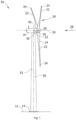
- Figure 1 is a perspective view of an example of a wind turbine 10.
- the wind turbine 10 is a horizontal-axis wind turbine.
- the wind turbine 10 may be a vertical-axis wind turbine.
- the wind turbine 10 includes a tower 15 that extends from a support system 14 on a ground 12, a nacelle 16 mounted on tower 15, and a rotor 18 that is coupled to nacelle 16.
- the rotor 18 includes a rotatable hub 20 and at least one rotor blade 22 coupled to and extending outward from the hub 20.
- the rotor 18 has three rotor blades 22.
- the rotor 18 includes more or less than three rotor blades 22.
- a yaw direction of the nacelle 16 may be rotated about a yaw axis 38 to position the rotor blades 22 with respect to wind direction 28.
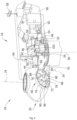
- a rotation of the main shaft 44 drives the gearbox 46 that subsequently drives the high-speed shaft 48 by translating the relatively slow rotational movement of the rotor 18 and of the main shaft 44 into a relatively fast rotational movement of the high-speed shaft 48.
- the latter is connected to the generator 42 for generating electrical energy with the help of a coupling 50.
- a transformer 90 and/or suitable electronics, switches, and/or inverters may be arranged in the nacelle 16 in order to transform electrical energy generated by the generator 42 having a voltage between 400V to 1000 V into electrical energy having medium voltage (10 - 35 KV). Said electrical energy is conducted via power cables from the nacelle 16 into the tower 15.
- the wind turbine may be a direct drive wind turbine without gearbox 46.
- Generator 42 operate at the same rotational speed as the rotor 18 in direct drive wind turbines. They therefore generally have a much larger diameter than generators used in wind turbines having a gearbox 46 for providing a similar amount of power than a wind turbine with a gearbox.
- the pitch assembly 66 includes at least one pitch bearing 72 coupled to hub 20 and to a respective rotor blade 22 (shown in figure 1 ) for rotating the respective rotor blade 22 about the pitch axis 34.
- the pitch drive system 68 includes a pitch drive motor 74, a pitch drive gearbox 76, and a pitch drive pinion 78.
- the pitch drive motor 74 is coupled to the pitch drive gearbox 76 such that the pitch drive motor 74 imparts mechanical force to the pitch drive gearbox 76.
- the pitch drive gearbox 76 is coupled to the pitch drive pinion 78 such that the pitch drive pinion 78 is rotated by the pitch drive gearbox 76.
- the pitch bearing 72 is coupled to pitch drive pinion 78 such that the rotation of the pitch drive pinion 78 causes a rotation of the pitch bearing 72.
- method 400 can detect the state of a wind turbine blade based on a shift or modulation of the energy of a load signal, i.e. from one frequency (band) to another frequency (band). Thus, method 400 can estimate in a precise and robust manner the state of a wind turbine blade from the load signals received. Further, method 400 allows determining the state of a wind turbine blade during wind turbine operation and without affecting the overall power output of the wind turbine. Additionally, method 400 can be performed by devices generally already included in a wind turbine, and therefore, does not require the installation of additional devices in the wind turbine. Further details regarding method 400 and further examples will be discussed in relation to figures 4 and 5 .
- the first and second frequencies may be chosen in accordance with the phenomenon to be detected.
- the default state of the blade may correspond to an ideal state of the blade, in which the blade is clean and has no external mass accumulation.
- the first frequency may be selected to correspond to a natural frequency of the blade in this default state, i.e. with any mass accumulation (through ice, dirt or otherwise).
- the second frequency in examples, may be chosen to substantially correspond to a natural frequency of the wind turbine blade with ice accumulation.
- the second frequency may be chosen to correspond to a natural frequency of the wind turbine blade with an accumulation of ice above a specified threshold.
- Figure 4 shows a flowchart of another example of method 400 for detecting a state of a wind turbine blade 22.
- the method 400 may comprise, before block 402, filtering 407 the signals 410 representative of loads acting on the wind turbine blade 22 with rotor rotational speed.
- the rotor frequency (associated with rotor rotational speed) should be understood as the frequency at which the rotor hub 20 rotates. This frequency is also referred in the art as 1P frequency.
- a band pass filter may be applied to determine the load signals at the first and second frequencies.
- a band-pass filter or bandpass filter may herein be regarded as a filter that passes frequencies within a certain range and rejects (attenuates) frequencies outside that range. Therefore the load signals at the first frequency and at the second frequency may not necessarily correspond exactly to the load signals at that frequency only, but instead may include a small (narrow) frequency band around the first frequency and a small frequency band around the second frequency. These small frequency bands may also be referred to as "passband".
- the natural frequency of the blade 22 at the first frequency 421 of sub step 405 may be the natural frequency of a first normal mode or of a second normal mode of the blade 22 in a default state.
- the second frequency 422 of sub step 406 may comprise a frequency mode of the wind turbine blade 22 with an accumulation of ice above an allowable threshold. Additionally, the second frequency 422 may be obtained through wind turbine blade simulations or through field data.
- the example method 400 may comprise at block 403 the comparison of the energy of the signals at the first and second frequencies. Depending on the result, a flag signal may or may not be generated at block 404.
- the method may comprise deactivating the flag signal or resuming operation as before the flag signal once it has been determined that the load signal at the first frequency has more energy than the load signal at the second frequency.
- Method 500 to detect the state of a wind turbine blade 22 is provided.
- Method 500 is schematically illustrated in figure 6 .
- the method 500 comprises, at block 501, receiving one or more edgewise load signals from one or more sensors 610 configured to measure edgewise loads on the wind turbine blade 22. Further, at block 502, the method 500 comprises filtering out the edgewise load signals with frequency substantially corresponding to a rotor rotational speed frequency (1P).
- the wind turbine 10 may further comprise a communication unit 620 configured to send the flag signal to a local wind turbine controller, to a SCADA system or to a Remote Operating Center.
- the control system 600 may form part of the local wind turbine controller.
Landscapes
- Engineering & Computer Science (AREA)
- Life Sciences & Earth Sciences (AREA)
- Sustainable Development (AREA)
- Sustainable Energy (AREA)
- Chemical & Material Sciences (AREA)
- Combustion & Propulsion (AREA)
- Mechanical Engineering (AREA)
- General Engineering & Computer Science (AREA)
- Wind Motors (AREA)
Claims (15)
- Verfahren (400; 500; 600) zum Erfassen eines Zustands eines Windturbinenblatts (22), wobei das Verfahren umfasst:Empfangen (401; 501) von einem oder mehreren Lastsignalen von einem oder mehreren Sensoren, die so konfiguriert sind, dass sie Lasten auf dem Windturbinenblatt (22) messen;Bestimmen (402; 503) einer Energie der Lastsignale mit einer ersten Frequenz und einer Energie der Lastsignale mit einer zweiten Frequenz, wobei die erste Frequenz im Wesentlichen einer Eigenfrequenz des Blattes in einem Standardzustand entspricht;Vergleichen (403; 504) der Energie der Lastsignale mit der ersten Frequenz mit der Energie der Lastsignale mit der zweiten Frequenz;Erzeugen eines Flag-Signals (404; 505), wenn die Energie der Lastsignale bei der ersten Frequenz kleiner ist als die Energie der Lastsignale bei der zweiten Frequenz.
- Verfahren nach Anspruch 1, wobei die Lastsignale repräsentativ für die auf das Windturbinenblatt (22) einwirkenden Schwenklasten sind.
- Verfahren nach Anspruch 1 oder 2, wobei die Eigenfrequenz des Blattes (22) die Eigenfrequenz einer ersten Normalform oder einer zweiten Normalform des Blattes im Standardzustand ist.
- Verfahren nach einem der Ansprüche 1 bis 3, wobei der Standardzustand des Blattes einem Idealzustand des Blattes entspricht.
- Verfahren nach einem der Ansprüche 1 bis 4, wobei die zweite Frequenz im Wesentlichen einer Eigenfrequenz des Windturbinenblattes (22) mit einer Eisansammlung oberhalb eines zulässigen Schwellenwertes entspricht.
- Verfahren nach einem der Ansprüche 1 bis 5, wobei das Verfahren ferner das Filtern (407) der Signale, die für die auf das Windturbinenblatt wirkenden Lasten mit der Rotordrehzahlfrequenz repräsentativ sind, aus den Lastsignalen vor der Bestimmung der Energie umfasst.
- Verfahren nach Anspruch 6, wobei das Filtern (407) die Verwendung eines Kerbfilters umfasst.
- Verfahren nach einem der Ansprüche 1 bis 7, wobei das Bestimmen (402; 503) der Energie der Lastsignale mit den ersten und zweiten Frequenzen das Bestimmen der Lastsignale mit den ersten und zweiten Frequenzen unter Verwendung von Bandpassfiltern umfasst.
- Verfahren nach Anspruch 8, wobei das Bestimmen (402; 503) der Energie der Lastsignale mit den ersten und zweiten Frequenzen das Berechnen eines mittleren quadratischen Mittelwerts der Lastsignale mit den ersten und zweiten Frequenzen umfasst.
- Verfahren nach Anspruch 1 bis 9, wobei das Verfahren ferner umfasst, vor der Bestimmung (402; 503) die Energie der Lastsignale:
Filterung der Hochfrequenzanteile aus den Signalen, die für die auf das Windradblatt einwirkenden Belastungen repräsentativ sind. - Verfahren nach Anspruch 10, wobei das Filtern des Hochfrequenzinhalts aus den Signalen die Verwendung eines Glättungsfilters umfasst.
- Verfahren nach einem der Ansprüche 1 bis 11, wobei das Flag-Signal (404; 505) einen Befehl zur Aktivierung eines Enteisungssystems umfasst.
- Steuersystem (600) für eine Windkraftanlage, wobei das Steuersystem einen Prozessor und einen nichtflüchtigen Speicher umfasst, wobei der nichtflüchtige Speicher Instruktionen umfasst, die, wenn sie vom Prozessor ausgeführt werden, das Steuersystem veranlassen, das Verfahren nach einem der Ansprüche 1 bis 12 auszuführen.
- Windturbine (10) mit einer Vielzahl von Blätter (22) und dem Steuerungssystem nach Anspruch 13.
- Windturbine nach Anspruch 14, die ferner Sensoren umfasst, die so konfiguriert sind, dass sie Lasten auf die Windturbinenblätter (22) messen, und wobei die Sensoren Dehnungsmessstreifen sind, die an den Blättern (22) angebracht sind, und wobei die Sensoren optional so konfiguriert sind, dass sie Signale liefern, die auf die auf die Blätter (22) wirkenden Schwenklasten hinweisen.
Priority Applications (7)
| Application Number | Priority Date | Filing Date | Title |
|---|---|---|---|
| PL22382763.5T PL4317683T3 (pl) | 2022-08-05 | 2022-08-05 | Określanie stanu łopaty turbiny wiatrowej |
| EP22382763.5A EP4317683B1 (de) | 2022-08-05 | 2022-08-05 | Bestimmung eines zustandes einer windturbinenschaufel |
| ES22382763T ES3034292T3 (en) | 2022-08-05 | 2022-08-05 | Determination of a state of a wind turbine blade |
| KR1020230092359A KR20240020185A (ko) | 2022-08-05 | 2023-07-17 | 풍력 터빈 블레이드의 상태 결정 |
| JP2023118731A JP2024022505A (ja) | 2022-08-05 | 2023-07-21 | 風力タービンブレードの状態判定 |
| US18/364,592 US12352238B2 (en) | 2022-08-05 | 2023-08-03 | Determination of a state of a wind turbine blade |
| CN202310975719.6A CN117514641A (zh) | 2022-08-05 | 2023-08-04 | 风力涡轮叶片的状态的确定 |
Applications Claiming Priority (1)
| Application Number | Priority Date | Filing Date | Title |
|---|---|---|---|
| EP22382763.5A EP4317683B1 (de) | 2022-08-05 | 2022-08-05 | Bestimmung eines zustandes einer windturbinenschaufel |
Publications (2)
| Publication Number | Publication Date |
|---|---|
| EP4317683A1 EP4317683A1 (de) | 2024-02-07 |
| EP4317683B1 true EP4317683B1 (de) | 2025-04-09 |
Family
ID=82846329
Family Applications (1)
| Application Number | Title | Priority Date | Filing Date |
|---|---|---|---|
| EP22382763.5A Active EP4317683B1 (de) | 2022-08-05 | 2022-08-05 | Bestimmung eines zustandes einer windturbinenschaufel |
Country Status (7)
| Country | Link |
|---|---|
| US (1) | US12352238B2 (de) |
| EP (1) | EP4317683B1 (de) |
| JP (1) | JP2024022505A (de) |
| KR (1) | KR20240020185A (de) |
| CN (1) | CN117514641A (de) |
| ES (1) | ES3034292T3 (de) |
| PL (1) | PL4317683T3 (de) |
Family Cites Families (35)
| Publication number | Priority date | Publication date | Assignee | Title |
|---|---|---|---|---|
| US6890152B1 (en) * | 2003-10-03 | 2005-05-10 | General Electric Company | Deicing device for wind turbine blades |
| US7086834B2 (en) * | 2004-06-10 | 2006-08-08 | General Electric Company | Methods and apparatus for rotor blade ice detection |
| DE102005017054B4 (de) * | 2004-07-28 | 2012-01-05 | Igus - Innovative Technische Systeme Gmbh | Verfahren und Vorrichtung zur Überwachung des Zustandes von Rotorblättern an Windkraftanlagen |
| US20090246019A1 (en) * | 2007-05-04 | 2009-10-01 | Mark Volanthen | Wind turbine monitoring |
| DK179081B1 (da) * | 2007-06-25 | 2017-10-16 | Siemens Wind Power As | Overvågning af en vindmølles vingefrekvenser |
| WO2009043352A2 (en) * | 2007-10-05 | 2009-04-09 | Vestas Wind Systems A/S | A method for de-icing a blade of a wind turbine, a wind turbine and use thereof |
| US8186950B2 (en) * | 2008-12-23 | 2012-05-29 | General Electric Company | Aerodynamic device for detection of wind turbine blade operation |
| SE535025C2 (sv) * | 2009-06-08 | 2012-03-20 | Ge Wind Energy Norway As | Vindkraftverk och en metod för att driva ett vindkraftverk |
| EP2476033B1 (de) * | 2009-09-08 | 2019-06-19 | Fraunhofer-Gesellschaft zur Förderung der angewandten Forschung e.V. | Modellbasiertes verfahren zur zustandsüberwachung von rotorblättern |
| EP2354538A1 (de) * | 2010-02-01 | 2011-08-10 | Lm Glasfiber A/S | Verfahren zur Kalibrierung von Lastsensoren einer Windturbinenschaufel |
| CA2795987C (en) * | 2010-04-12 | 2018-12-04 | Siemens Aktiengesellschaft | Method and system for determining a mass change at a rotating blade of a wind turbine |
| CA2803481C (en) * | 2010-06-30 | 2018-09-25 | Vestas Wind Systems A/S | Wind turbine system for detection of blade icing |
| DE102010032120A1 (de) * | 2010-07-24 | 2012-01-26 | Robert Bosch Gmbh | Verfahren und Vorrichtung zur Bestimmung eines Biegewinkels eines Rotorblattes einer Windkraftanlage |
| US8704390B2 (en) * | 2010-12-07 | 2014-04-22 | Vestas Wind Systems A/S | Dynamic adjustment of power plant output based on electrical grid characteristics |
| EP2472238A1 (de) * | 2010-12-29 | 2012-07-04 | Siemens Aktiengesellschaft | Bestimmung der Vibrationsfrequenz einer Windturbinenlaufschaufel mit einer auf einer Strukturkomponente positionierten Sensorvorrichtung, die einem Teil der Laufschaufel zugeordnet und/oder Teil davon ist |
| EP2530302B1 (de) * | 2011-06-03 | 2014-04-30 | Wilic S.Àr.L | Windturbine und Steuerverfahren zu ihrer Steuerung |
| EP2565444B1 (de) * | 2011-08-31 | 2019-02-27 | Wölfel Engineering GmbH + Co. KG | Verfahren und Vorrichtung zur Zustandsüberwachung von Rotorblättern |
| DE102011116961B4 (de) * | 2011-10-26 | 2024-06-27 | Weidmüller Monitoring Systems Gmbh | Verfahren zur Bestimmung einer mechanischen Beschädigung eines Rotorblatts einer Windenergieanlage |
| CA2859632C (en) * | 2011-12-20 | 2020-06-30 | Vestas Wind Systems A/S | Wind turbine and method for removing foreign matter from a wind turbine blade |
| EP3009673A1 (de) * | 2014-10-15 | 2016-04-20 | Siemens Aktiengesellschaft | BETRIEB EINER WINDTURBINE WÄHREND DES STILLSTANDS, EINSCHLIEßLICH INSBESONDERE DER AUFSPÜRUNG VON ROTORBLATTVEREISUNG |
| DE102014117915A1 (de) * | 2014-12-04 | 2016-06-09 | fos4X GmbH | Verfahren zur Überwachung einer Windkraftanlage, Verfahren zur Eiserkennung an einer Windkraftanlage, Beschleunigungssensor für ein Rotorblatt, Rotorblatt mit Beschleunigungssensor, und Profil für ein Rotorblatt |
| WO2016101961A1 (en) * | 2014-12-23 | 2016-06-30 | Vestas Wind Systems A/S | Method and system for determining the dynamic twist of a wind turbine blade |
| US20160356266A1 (en) * | 2015-06-03 | 2016-12-08 | General Electric Company | System and Method for Reducing Torsional Movement in a Wind Turbine Tower |
| EP3165766B1 (de) * | 2015-11-06 | 2021-06-30 | Nordex Energy Spain, S.A. | Wind turbine und verfahren zum enteisen in einer windturbine |
| DE102015122933A1 (de) * | 2015-12-29 | 2017-07-13 | fos4X GmbH | Verfahren zum Ermitteln eines Werts für eine Eisansatzmenge an mindestens einem Rotorblatt einer Windkraftanlage und dessen Verwendung |
| DE102015122932A1 (de) * | 2015-12-29 | 2017-06-29 | fos4X GmbH | Verfahren zum Prognostizieren der Anlagerung von Eis an einem Rotorblatt einer Windkraftanlage und dessen Verwendung |
| US9926912B2 (en) * | 2016-08-30 | 2018-03-27 | General Electric Company | System and method for estimating wind coherence and controlling wind turbine based on same |
| EP3728843B1 (de) * | 2017-12-22 | 2023-06-07 | Vestas Wind Systems A/S | Bestimmung des vereisungszustands unter verwendung eines mechanischen windsensors |
| US10876518B2 (en) * | 2019-04-12 | 2020-12-29 | General Electric Company | System and method for mitigating damage in a rotor blade of a wind turbine |
| WO2020239177A1 (en) * | 2019-05-28 | 2020-12-03 | Vestas Wind Systems A/S | Reduction of edgewise vibrations using blade load signal |
| US12392323B2 (en) * | 2020-04-09 | 2025-08-19 | GE Vernova Renovables Espana, S.L. | System and method for improved extreme load control for wind turbine rotor blades |
| DE102020118646A1 (de) * | 2020-07-15 | 2022-01-20 | Weidmüller Monitoring Systems Gmbh | Vorrichtung zum Erkennen eines Eisansatzes an Rotorblättern einer Windenergieanlage und Verfahren zum Anlernen einer derartigen Vorrichtung |
| WO2022242816A1 (en) * | 2021-05-17 | 2022-11-24 | Vestas Wind Systems A/S | Individual pitch control with unavailable blade load sensor |
| US11649804B2 (en) * | 2021-06-07 | 2023-05-16 | General Electric Renovables Espana, S.L. | Systems and methods for controlling a wind turbine |
| US12297811B2 (en) * | 2021-06-24 | 2025-05-13 | Board Of Regents, The University Of Texas System | System and method to maximize power production by wind turbines |
-
2022
- 2022-08-05 EP EP22382763.5A patent/EP4317683B1/de active Active
- 2022-08-05 ES ES22382763T patent/ES3034292T3/es active Active
- 2022-08-05 PL PL22382763.5T patent/PL4317683T3/pl unknown
-
2023
- 2023-07-17 KR KR1020230092359A patent/KR20240020185A/ko active Pending
- 2023-07-21 JP JP2023118731A patent/JP2024022505A/ja active Pending
- 2023-08-03 US US18/364,592 patent/US12352238B2/en active Active
- 2023-08-04 CN CN202310975719.6A patent/CN117514641A/zh active Pending
Also Published As
| Publication number | Publication date |
|---|---|
| PL4317683T3 (pl) | 2025-07-07 |
| US20240044314A1 (en) | 2024-02-08 |
| EP4317683A1 (de) | 2024-02-07 |
| KR20240020185A (ko) | 2024-02-14 |
| ES3034292T3 (en) | 2025-08-14 |
| US12352238B2 (en) | 2025-07-08 |
| CN117514641A (zh) | 2024-02-06 |
| JP2024022505A (ja) | 2024-02-16 |
Similar Documents
| Publication | Publication Date | Title |
|---|---|---|
| EP3440348B1 (de) | Verfahren und system zur steuerung einer windturbine zur handhabung von schmalseitigen schaufelschwingungen | |
| EP2860394B1 (de) | System und Verfahren zur Verhinderung von übermäßigem Laden auf einer Windturbine | |
| EP2678556B1 (de) | Sicherheitssystem für eine windturbine | |
| US12241452B2 (en) | System and method for monitoring rotor blade health of a wind turbine | |
| EP2588752B1 (de) | System zur bestimmung von vereisung eines rotorblatts einer windenergieanlage | |
| EP3502463B1 (de) | System und verfahren zum schutz von windturbinen bei windböen | |
| EP3643914B1 (de) | System und verfahren zum schutz von windturbinen vor extremen und ermüdungsbelastungen | |
| EP3470670A1 (de) | System und verfahren zum betreiben von windturbinen zur vermeidung von strömungsabrissen während der leistungsherabsetzung | |
| EP2754888B1 (de) | Verfahren und vorrichtung zum betreiben einer windturbine | |
| EP3892850B1 (de) | System und verfahren zur minderung der auf ein rotorblatt einer windturbine wirkenden lasten | |
| US12352238B2 (en) | Determination of a state of a wind turbine blade | |
| KR20250159651A (ko) | 풍력 터빈의 작동 | |
| EP4467805B1 (de) | Erkennung von rotorunwucht in einer windturbine | |
| EP4361434A1 (de) | Schutz von windturbinenkomponenten während des gierens | |
| EP4686828A1 (de) | Verfahren und system zur steuerung von windturbinenrotorschwingungen | |
| WO2025131318A1 (en) | Determining aerodynamic rotor imbalance in a wind turbine | |
| WO2026063916A1 (en) | System and method for continuous yawing of a wind turbine within a constrained yaw angle sweep upon detection of blade vibrations | |
| WO2026043490A1 (en) | System and method for yawing a wind turbine based on avoiding blade vibrations at specified wind speeds when yaw angle sweep is constrained | |
| WO2026043486A1 (en) | System and method for reverse flow yaw mode of a wind turbine when yaw angle sweep is constrained |
Legal Events
| Date | Code | Title | Description |
|---|---|---|---|
| PUAI | Public reference made under article 153(3) epc to a published international application that has entered the european phase |
Free format text: ORIGINAL CODE: 0009012 |
|
| STAA | Information on the status of an ep patent application or granted ep patent |
Free format text: STATUS: THE APPLICATION HAS BEEN PUBLISHED |
|
| AK | Designated contracting states |
Kind code of ref document: A1 Designated state(s): AL AT BE BG CH CY CZ DE DK EE ES FI FR GB GR HR HU IE IS IT LI LT LU LV MC MK MT NL NO PL PT RO RS SE SI SK SM TR |
|
| STAA | Information on the status of an ep patent application or granted ep patent |
Free format text: STATUS: REQUEST FOR EXAMINATION WAS MADE |
|
| 17P | Request for examination filed |
Effective date: 20240807 |
|
| RBV | Designated contracting states (corrected) |
Designated state(s): AL AT BE BG CH CY CZ DE DK EE ES FI FR GB GR HR HU IE IS IT LI LT LU LV MC MK MT NL NO PL PT RO RS SE SI SK SM TR |
|
| GRAP | Despatch of communication of intention to grant a patent |
Free format text: ORIGINAL CODE: EPIDOSNIGR1 |
|
| STAA | Information on the status of an ep patent application or granted ep patent |
Free format text: STATUS: GRANT OF PATENT IS INTENDED |
|
| RIC1 | Information provided on ipc code assigned before grant |
Ipc: F03D 80/40 20160101ALI20241125BHEP Ipc: F03D 17/00 20160101AFI20241125BHEP |
|
| RAP3 | Party data changed (applicant data changed or rights of an application transferred) |
Owner name: GENERAL ELECTRIC RENOVABLES ESPANA S.L. |
|
| INTG | Intention to grant announced |
Effective date: 20241211 |
|
| GRAS | Grant fee paid |
Free format text: ORIGINAL CODE: EPIDOSNIGR3 |
|
| GRAA | (expected) grant |
Free format text: ORIGINAL CODE: 0009210 |
|
| STAA | Information on the status of an ep patent application or granted ep patent |
Free format text: STATUS: THE PATENT HAS BEEN GRANTED |
|
| AK | Designated contracting states |
Kind code of ref document: B1 Designated state(s): AL AT BE BG CH CY CZ DE DK EE ES FI FR GB GR HR HU IE IS IT LI LT LU LV MC MK MT NL NO PL PT RO RS SE SI SK SM TR |
|
| REG | Reference to a national code |
Ref country code: GB Ref legal event code: FG4D |
|
| REG | Reference to a national code |
Ref country code: CH Ref legal event code: EP |
|
| REG | Reference to a national code |
Ref country code: DE Ref legal event code: R096 Ref document number: 602022012880 Country of ref document: DE |
|
| REG | Reference to a national code |
Ref country code: IE Ref legal event code: FG4D |
|
| P01 | Opt-out of the competence of the unified patent court (upc) registered |
Free format text: CASE NUMBER: APP_19460/2025 Effective date: 20250423 |
|
| REG | Reference to a national code |
Ref country code: NL Ref legal event code: FP |
|
| REG | Reference to a national code |
Ref country code: ES Ref legal event code: FG2A Ref document number: 3034292 Country of ref document: ES Kind code of ref document: T3 Effective date: 20250814 |
|
| PGFP | Annual fee paid to national office [announced via postgrant information from national office to epo] |
Ref country code: NL Payment date: 20250723 Year of fee payment: 4 |
|
| REG | Reference to a national code |
Ref country code: AT Ref legal event code: MK05 Ref document number: 1783710 Country of ref document: AT Kind code of ref document: T Effective date: 20250409 |
|
| PG25 | Lapsed in a contracting state [announced via postgrant information from national office to epo] |
Ref country code: FI Free format text: LAPSE BECAUSE OF FAILURE TO SUBMIT A TRANSLATION OF THE DESCRIPTION OR TO PAY THE FEE WITHIN THE PRESCRIBED TIME-LIMIT Effective date: 20250409 Ref country code: PT Free format text: LAPSE BECAUSE OF FAILURE TO SUBMIT A TRANSLATION OF THE DESCRIPTION OR TO PAY THE FEE WITHIN THE PRESCRIBED TIME-LIMIT Effective date: 20250811 |
|
| PGFP | Annual fee paid to national office [announced via postgrant information from national office to epo] |
Ref country code: ES Payment date: 20250901 Year of fee payment: 4 |
|
| PGFP | Annual fee paid to national office [announced via postgrant information from national office to epo] |
Ref country code: DE Payment date: 20250724 Year of fee payment: 4 |
|
| REG | Reference to a national code |
Ref country code: LT Ref legal event code: MG9D |
|
| PG25 | Lapsed in a contracting state [announced via postgrant information from national office to epo] |
Ref country code: GR Free format text: LAPSE BECAUSE OF FAILURE TO SUBMIT A TRANSLATION OF THE DESCRIPTION OR TO PAY THE FEE WITHIN THE PRESCRIBED TIME-LIMIT Effective date: 20250710 Ref country code: NO Free format text: LAPSE BECAUSE OF FAILURE TO SUBMIT A TRANSLATION OF THE DESCRIPTION OR TO PAY THE FEE WITHIN THE PRESCRIBED TIME-LIMIT Effective date: 20250709 |
|
| PGFP | Annual fee paid to national office [announced via postgrant information from national office to epo] |
Ref country code: PL Payment date: 20250724 Year of fee payment: 4 |
|
| PG25 | Lapsed in a contracting state [announced via postgrant information from national office to epo] |
Ref country code: BG Free format text: LAPSE BECAUSE OF FAILURE TO SUBMIT A TRANSLATION OF THE DESCRIPTION OR TO PAY THE FEE WITHIN THE PRESCRIBED TIME-LIMIT Effective date: 20250409 |
|
| PG25 | Lapsed in a contracting state [announced via postgrant information from national office to epo] |
Ref country code: HR Free format text: LAPSE BECAUSE OF FAILURE TO SUBMIT A TRANSLATION OF THE DESCRIPTION OR TO PAY THE FEE WITHIN THE PRESCRIBED TIME-LIMIT Effective date: 20250409 |
|
| PG25 | Lapsed in a contracting state [announced via postgrant information from national office to epo] |
Ref country code: AT Free format text: LAPSE BECAUSE OF FAILURE TO SUBMIT A TRANSLATION OF THE DESCRIPTION OR TO PAY THE FEE WITHIN THE PRESCRIBED TIME-LIMIT Effective date: 20250409 |
|
| PGFP | Annual fee paid to national office [announced via postgrant information from national office to epo] |
Ref country code: FR Payment date: 20250725 Year of fee payment: 4 |
|
| PG25 | Lapsed in a contracting state [announced via postgrant information from national office to epo] |
Ref country code: RS Free format text: LAPSE BECAUSE OF FAILURE TO SUBMIT A TRANSLATION OF THE DESCRIPTION OR TO PAY THE FEE WITHIN THE PRESCRIBED TIME-LIMIT Effective date: 20250709 |
|
| PGFP | Annual fee paid to national office [announced via postgrant information from national office to epo] |
Ref country code: IE Payment date: 20250725 Year of fee payment: 4 |
|
| PG25 | Lapsed in a contracting state [announced via postgrant information from national office to epo] |
Ref country code: IS Free format text: LAPSE BECAUSE OF FAILURE TO SUBMIT A TRANSLATION OF THE DESCRIPTION OR TO PAY THE FEE WITHIN THE PRESCRIBED TIME-LIMIT Effective date: 20250809 |
|
| PG25 | Lapsed in a contracting state [announced via postgrant information from national office to epo] |
Ref country code: LV Free format text: LAPSE BECAUSE OF FAILURE TO SUBMIT A TRANSLATION OF THE DESCRIPTION OR TO PAY THE FEE WITHIN THE PRESCRIBED TIME-LIMIT Effective date: 20250409 |
|
| REG | Reference to a national code |
Ref country code: DE Ref legal event code: R097 Ref document number: 602022012880 Country of ref document: DE |
|
| PG25 | Lapsed in a contracting state [announced via postgrant information from national office to epo] |
Ref country code: SM Free format text: LAPSE BECAUSE OF FAILURE TO SUBMIT A TRANSLATION OF THE DESCRIPTION OR TO PAY THE FEE WITHIN THE PRESCRIBED TIME-LIMIT Effective date: 20250409 Ref country code: DK Free format text: LAPSE BECAUSE OF FAILURE TO SUBMIT A TRANSLATION OF THE DESCRIPTION OR TO PAY THE FEE WITHIN THE PRESCRIBED TIME-LIMIT Effective date: 20250409 |
|
| PG25 | Lapsed in a contracting state [announced via postgrant information from national office to epo] |
Ref country code: CZ Free format text: LAPSE BECAUSE OF FAILURE TO SUBMIT A TRANSLATION OF THE DESCRIPTION OR TO PAY THE FEE WITHIN THE PRESCRIBED TIME-LIMIT Effective date: 20250409 |
|
| PG25 | Lapsed in a contracting state [announced via postgrant information from national office to epo] |
Ref country code: EE Free format text: LAPSE BECAUSE OF FAILURE TO SUBMIT A TRANSLATION OF THE DESCRIPTION OR TO PAY THE FEE WITHIN THE PRESCRIBED TIME-LIMIT Effective date: 20250409 |
|
| PG25 | Lapsed in a contracting state [announced via postgrant information from national office to epo] |
Ref country code: SK Free format text: LAPSE BECAUSE OF FAILURE TO SUBMIT A TRANSLATION OF THE DESCRIPTION OR TO PAY THE FEE WITHIN THE PRESCRIBED TIME-LIMIT Effective date: 20250409 |
|
| PG25 | Lapsed in a contracting state [announced via postgrant information from national office to epo] |
Ref country code: IT Free format text: LAPSE BECAUSE OF FAILURE TO SUBMIT A TRANSLATION OF THE DESCRIPTION OR TO PAY THE FEE WITHIN THE PRESCRIBED TIME-LIMIT Effective date: 20250409 |
|
| PLBE | No opposition filed within time limit |
Free format text: ORIGINAL CODE: 0009261 |
|
| STAA | Information on the status of an ep patent application or granted ep patent |
Free format text: STATUS: NO OPPOSITION FILED WITHIN TIME LIMIT |
|
| REG | Reference to a national code |
Ref country code: CH Ref legal event code: L10 Free format text: ST27 STATUS EVENT CODE: U-0-0-L10-L00 (AS PROVIDED BY THE NATIONAL OFFICE) Effective date: 20260218 Ref country code: CH Ref legal event code: W10 Free format text: ST27 STATUS EVENT CODE: U-0-0-W10-W00 (AS PROVIDED BY THE NATIONAL OFFICE) Effective date: 20260218 |
|
| PG25 | Lapsed in a contracting state [announced via postgrant information from national office to epo] |
Ref country code: RO Free format text: LAPSE BECAUSE OF FAILURE TO SUBMIT A TRANSLATION OF THE DESCRIPTION OR TO PAY THE FEE WITHIN THE PRESCRIBED TIME-LIMIT Effective date: 20250409 |
|
| 26N | No opposition filed |
Effective date: 20260112 |
|
| RAP4 | Party data changed (patent owner data changed or rights of a patent transferred) |
Owner name: GE VERNOVA RENOVABLES ESPANA, S.L. |
|
| REG | Reference to a national code |
Ref country code: CH Ref legal event code: H13 Free format text: ST27 STATUS EVENT CODE: U-0-0-H10-H13 (AS PROVIDED BY THE NATIONAL OFFICE) Effective date: 20260324 |
|
| PG25 | Lapsed in a contracting state [announced via postgrant information from national office to epo] |
Ref country code: MC Free format text: LAPSE BECAUSE OF FAILURE TO SUBMIT A TRANSLATION OF THE DESCRIPTION OR TO PAY THE FEE WITHIN THE PRESCRIBED TIME-LIMIT Effective date: 20250409 |
|
| PG25 | Lapsed in a contracting state [announced via postgrant information from national office to epo] |
Ref country code: LU Free format text: LAPSE BECAUSE OF NON-PAYMENT OF DUE FEES Effective date: 20250805 |
|
| PG25 | Lapsed in a contracting state [announced via postgrant information from national office to epo] |
Ref country code: CH Free format text: LAPSE BECAUSE OF NON-PAYMENT OF DUE FEES Effective date: 20250831 |