EP4319055A1 - Procédé et appareil de transmission de message - Google Patents
Procédé et appareil de transmission de message Download PDFInfo
- Publication number
- EP4319055A1 EP4319055A1 EP21949688.2A EP21949688A EP4319055A1 EP 4319055 A1 EP4319055 A1 EP 4319055A1 EP 21949688 A EP21949688 A EP 21949688A EP 4319055 A1 EP4319055 A1 EP 4319055A1
- Authority
- EP
- European Patent Office
- Prior art keywords
- network device
- packet
- mapping rule
- target
- path
- Prior art date
- Legal status (The legal status is an assumption and is not a legal conclusion. Google has not performed a legal analysis and makes no representation as to the accuracy of the status listed.)
- Pending
Links
Images



Classifications
-
- H—ELECTRICITY
- H04—ELECTRIC COMMUNICATION TECHNIQUE
- H04L—TRANSMISSION OF DIGITAL INFORMATION, e.g. TELEGRAPHIC COMMUNICATION
- H04L47/00—Traffic control in data switching networks
- H04L47/10—Flow control; Congestion control
- H04L47/24—Traffic characterised by specific attributes, e.g. priority or QoS
-
- H—ELECTRICITY
- H04—ELECTRIC COMMUNICATION TECHNIQUE
- H04L—TRANSMISSION OF DIGITAL INFORMATION, e.g. TELEGRAPHIC COMMUNICATION
- H04L67/00—Network arrangements or protocols for supporting network services or applications
- H04L67/50—Network services
- H04L67/56—Provisioning of proxy services
- H04L67/565—Conversion or adaptation of application format or content
-
- H—ELECTRICITY
- H04—ELECTRIC COMMUNICATION TECHNIQUE
- H04L—TRANSMISSION OF DIGITAL INFORMATION, e.g. TELEGRAPHIC COMMUNICATION
- H04L47/00—Traffic control in data switching networks
- H04L47/50—Queue scheduling
- H04L47/56—Queue scheduling implementing delay-aware scheduling
- H04L47/562—Attaching a time tag to queues
-
- H—ELECTRICITY
- H04—ELECTRIC COMMUNICATION TECHNIQUE
- H04L—TRANSMISSION OF DIGITAL INFORMATION, e.g. TELEGRAPHIC COMMUNICATION
- H04L47/00—Traffic control in data switching networks
- H04L47/10—Flow control; Congestion control
- H04L47/24—Traffic characterised by specific attributes, e.g. priority or QoS
- H04L47/2483—Traffic characterised by specific attributes, e.g. priority or QoS involving identification of individual flows
-
- H—ELECTRICITY
- H04—ELECTRIC COMMUNICATION TECHNIQUE
- H04L—TRANSMISSION OF DIGITAL INFORMATION, e.g. TELEGRAPHIC COMMUNICATION
- H04L47/00—Traffic control in data switching networks
- H04L47/10—Flow control; Congestion control
- H04L47/28—Flow control; Congestion control in relation to timing considerations
-
- H—ELECTRICITY
- H04—ELECTRIC COMMUNICATION TECHNIQUE
- H04L—TRANSMISSION OF DIGITAL INFORMATION, e.g. TELEGRAPHIC COMMUNICATION
- H04L47/00—Traffic control in data switching networks
- H04L47/10—Flow control; Congestion control
- H04L47/32—Flow control; Congestion control by discarding or delaying data units, e.g. packets or frames
-
- H—ELECTRICITY
- H04—ELECTRIC COMMUNICATION TECHNIQUE
- H04L—TRANSMISSION OF DIGITAL INFORMATION, e.g. TELEGRAPHIC COMMUNICATION
- H04L47/00—Traffic control in data switching networks
- H04L47/10—Flow control; Congestion control
- H04L47/34—Flow control; Congestion control ensuring sequence integrity, e.g. using sequence numbers
-
- H—ELECTRICITY
- H04—ELECTRIC COMMUNICATION TECHNIQUE
- H04L—TRANSMISSION OF DIGITAL INFORMATION, e.g. TELEGRAPHIC COMMUNICATION
- H04L47/00—Traffic control in data switching networks
- H04L47/50—Queue scheduling
- H04L47/62—Queue scheduling characterised by scheduling criteria
- H04L47/621—Individual queue per connection or flow, e.g. per VC
-
- H—ELECTRICITY
- H04—ELECTRIC COMMUNICATION TECHNIQUE
- H04L—TRANSMISSION OF DIGITAL INFORMATION, e.g. TELEGRAPHIC COMMUNICATION
- H04L67/00—Network arrangements or protocols for supporting network services or applications
- H04L67/50—Network services
- H04L67/56—Provisioning of proxy services
- H04L67/568—Storing data temporarily at an intermediate stage, e.g. caching
-
- H—ELECTRICITY
- H04—ELECTRIC COMMUNICATION TECHNIQUE
- H04L—TRANSMISSION OF DIGITAL INFORMATION, e.g. TELEGRAPHIC COMMUNICATION
- H04L43/00—Arrangements for monitoring or testing data switching networks
- H04L43/08—Monitoring or testing based on specific metrics, e.g. QoS, energy consumption or environmental parameters
- H04L43/0823—Errors, e.g. transmission errors
- H04L43/0829—Packet loss
-
- H—ELECTRICITY
- H04—ELECTRIC COMMUNICATION TECHNIQUE
- H04L—TRANSMISSION OF DIGITAL INFORMATION, e.g. TELEGRAPHIC COMMUNICATION
- H04L43/00—Arrangements for monitoring or testing data switching networks
- H04L43/08—Monitoring or testing based on specific metrics, e.g. QoS, energy consumption or environmental parameters
- H04L43/0852—Delays
- H04L43/0864—Round trip delays
-
- H—ELECTRICITY
- H04—ELECTRIC COMMUNICATION TECHNIQUE
- H04L—TRANSMISSION OF DIGITAL INFORMATION, e.g. TELEGRAPHIC COMMUNICATION
- H04L43/00—Arrangements for monitoring or testing data switching networks
- H04L43/08—Monitoring or testing based on specific metrics, e.g. QoS, energy consumption or environmental parameters
- H04L43/0852—Delays
- H04L43/087—Jitter
-
- H—ELECTRICITY
- H04—ELECTRIC COMMUNICATION TECHNIQUE
- H04L—TRANSMISSION OF DIGITAL INFORMATION, e.g. TELEGRAPHIC COMMUNICATION
- H04L43/00—Arrangements for monitoring or testing data switching networks
- H04L43/10—Active monitoring, e.g. heartbeat, ping or trace-route
- H04L43/106—Active monitoring, e.g. heartbeat, ping or trace-route using time related information in packets, e.g. by adding timestamps
-
- H—ELECTRICITY
- H04—ELECTRIC COMMUNICATION TECHNIQUE
- H04L—TRANSMISSION OF DIGITAL INFORMATION, e.g. TELEGRAPHIC COMMUNICATION
- H04L47/00—Traffic control in data switching networks
- H04L47/10—Flow control; Congestion control
- H04L47/31—Flow control; Congestion control by tagging of packets, e.g. using discard eligibility [DE] bits
-
- H—ELECTRICITY
- H04—ELECTRIC COMMUNICATION TECHNIQUE
- H04L—TRANSMISSION OF DIGITAL INFORMATION, e.g. TELEGRAPHIC COMMUNICATION
- H04L67/00—Network arrangements or protocols for supporting network services or applications
- H04L67/01—Protocols
- H04L67/12—Protocols specially adapted for proprietary or special-purpose networking environments, e.g. medical networks, sensor networks, networks in vehicles or remote metering networks
- H04L67/125—Protocols specially adapted for proprietary or special-purpose networking environments, e.g. medical networks, sensor networks, networks in vehicles or remote metering networks involving control of end-device applications over a network
Definitions
- the present disclosure relates to the field of network technology, in particular to a packet transmission method and apparatus.
- deterministic transmission packets are needed to realize definite time delay and jitter.
- the current deterministic transmission requires higher device on the packet transmission path. Therefore, the current deterministic transmission has poor adaptability to a complex wide area network (WAN).
- WAN wide area network
- an example of the present disclosure provides a packet transmission method applied to a first network device.
- the method includes:
- the method further includes: reorganizing received packets such that, after reorganization, packets belonging to a same flow are arranged in order.
- the reorganizing the received packets includes: reorganizing, according to a first mapping rule, the received packets.
- the first mapping rule includes a scheduling queue; the scheduling queue is to buffer packets belonging to a same flow.
- the first mapping rule includes a scheduling cycle; the scheduling cycle is to indicate a time period for packet forwarding; the forwarding, after buffering the received packet for a preset time duration, the received packet includes: forwarding, after the scheduling cycle of the received packet expires and after buffering the received packet for a preset time duration, the received packet.
- a time difference between a scheduling cycle of the first network device and a scheduling cycle of the second network device is greater than or equal to a target time delay, and the target time delay is a time delay between the first network device and the second network device.
- the first mapping rule includes the preset time duration.
- the first mapping rule is carried in a header of the packet.
- a quintuple is carried in a header of the packet, and the quintuple is to determine a flow to which the packet belongs; or, a target flow identity is carried in the header of the packet, and the flow identity is to determine a flow to which the target packet belongs.
- the first network device and the second network device have a same scheduling frequency, and the scheduling frequency is a frequency with which scheduling cycles are divided.
- the method further includes:
- the quality of service includes time delay and jitter; a tail of the telemetry packet carries timestamp of each network device in the path.
- an example of the present disclosure provides a packet transmission method, which is applied to a controller.
- the method includes: sending a first mapping rule to a first network device; the first mapping rule is to indicate the first network device to buffer a packet sent by a second network device for a preset time duration, and then forward the received packet.
- the method further includes:
- the method further includes:
- the quality of service includes time delay and jitter; the tail of the telemetry packet carries the timestamp of each network device of the path.
- the method before sending the first mapping rule to the first network device, the method further includes:
- an example of the present disclosure provides a packet transmission apparatus applied to a first network device.
- the apparatus includes:
- an example of the present disclosure provides a packet transmission apparatus, which is applied to a controller.
- the apparatus includes: a first sending unit, to send a first mapping rule to a first network device; the first mapping rule is to indicate the first network device to buffer a packet sent by a second network device for a preset time duration, and then forward the received packet.
- an example of the present disclosure provides a network device, including a processor and a machine-readable storage medium, where the machine-readable storage medium stores machine-executable instructions that can be executed by the processor, and the processor is caused by the machine executable instructions to implement any of the packet transmission methods provided in the first aspect.
- an example of the present disclosure provides a controller, including a processor and a machine-readable storage medium, where the machine-readable storage medium stores machine-executable instructions that can be executed by the processor, and the processor is caused by the machine executable instructions to implement any of the packet transmission methods provided in the second aspect.
- an example of the present disclosure provides a computer-readable storage medium having computer programs stored thereon which, when executed by a processor, cause the processor to implement any of the packet transmission methods provided in the first aspect or the second aspect.
- an example of the present disclosure also provide a computer program that, when running on a computer, causes the computer to implement any of the packet transmission methods provided in the first aspect or the second aspect.
- the first network device buffers the received packet for a preset time duration, within the preset time duration, the first network device may receive other packets that belong to the same flow as the received packet.
- the deterministic transmission may be realized by buffering the packet by the network device on a receiving packet side.
- the deterministic transmission method has no requirements for other network devices on the transmission path. This enables the technical solution provided by the examples of the present disclosure to better adapt to complex WAN, and improves the adaptability of the deterministic transmission to the WAN.
- Time sensitive network a group of Ethernet standards, which realize the low time delay flow service of time synchronization through core technologies such as accurate time synchronization and timing scheduling, and provide low time delay isochronous standard data for each unit in the system, so as to provide a basis for the integration of control, measurement, configuration, user interface (UI) and file exchange infrastructure, etc.
- Time slot time is divided into time slots by equal division, which is the smallest scheduling unit in TSN.
- Deterministic network refers to the network that ensures the deterministic bandwidth, time delay, jitter and packet loss rate of services; deterministic network technology is a new quality of service (QoS) guarantee technology.
- QoS quality of service
- deterministic transmission packets are needed to realize definite time delay and jitter. At this time, these networks may be called deterministic networks.
- the demand for deterministic networks mainly comes from two aspects:
- the SP algorithm is scheduled strictly according to the order of the priority of the queue. Only after all the packets in a high-priority queue are scheduled, a low-priority queue may be scheduled.
- the WRR algorithm will give each queue a weight, and forward it in turn according to a ratio of the weight, so as to avoid low-priority traffic waiting for a long time.
- Congestion control when the traffic is too much and a buffer space of a buffer queue is insufficient, congestion and packet loss will occur in the network, which requires congestion control.
- congestion may be detected by using the congestion control methods, such as explicit congestion notification (ECN) or data center transmission control protocol (DCTCP) based on explicit congestion marking or Timely, Swift, etc. based on round-trip time delay (RTT), so that the upstream nodes until a sending end reduce the rate of sending packets.
- ECN explicit congestion notification
- DCTCP data center transmission control protocol
- RTT round-trip time delay
- TDM time division multiplexing
- one is a master-slave mode, where the most accurate clock is selected as a master clock, and the other slave clocks are synchronized with the master clock; the other is a voting mode, for example, there are 9 devices in a domain, the current clock of 5 devices is 1:00 and the clock of 4 devices is 1:01. According to the principle that the minority obeys the majority, all 9 devices are adjusted to 1:00.
- Time slot planning generally refers to the transmission resources of time dimension of the egress port of the switch.
- the transmission of this packet will occupy a certain period of 12 microseconds ( ⁇ s) time slot resources of the egress port, and which section of time slot resource occupied is determined by the start time of the transmission of the packet.
- the start time of sending packets by the terminal may be controlled, so that each packet is "triggered” to be sent only at the time calculated in advance through a global time slot planning (that is, time division multiplexing), to ensure that the time slots occupied by the egress port of each hop do not conflict with each other, thereby avoiding the occurrence of multicast and burst traffic, and achieving "on time and accurate" transmission.
- a global time slot planning that is, time division multiplexing
- the related technology also introduces a cyclic specific queuing and forwarding (CSQF) mechanism based on segment routing.
- CQF cyclic specific queuing and forwarding
- the controller assigns a segmented identification (SID) to each network device, and specifies the egress port and forwarding cycle corresponding to the SID.
- SID segmented identification
- the network device parses a packet header to obtain the SID carried in the packet, and then determines the specific egress port and forwarding cycle, and forwards the packet through the determined egress port according to the determined forwarding cycle.
- the above-mentioned packet transmission method based on the CSQF mechanism may solve the small network span, but it still has the following disadvantages: network devices along the way must support the CSQF mechanism.
- the actual network is very complicated, a source terminal and a destination terminal span across a WAN. There are many network devices between the source terminal and the destination terminal, and it is difficult for these network devices to support the CSQF mechanism. This makes deterministic transmission less adaptable to WAN in related technologies.
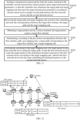
- an example of the present disclosure provides a packet transmission method, which may be applied to the WAN as shown in FIG. 1 .
- the WAN includes a controller and network devices R1-R9, only 9 network devices are used as an example for description in FIG. 1 , which is not limited.
- the network device may be a router or a switch.
- the controller may be a software defined network (SDN) controller, or a collector, etc., which is not limited.
- SDN software defined network
- the controller is to manage the network device of the entire WAN, performing path planning of deterministic transmission, and performing bandwidth reservation of deterministic transmission.
- the terminal A is connected to the network device R1, and the terminal B is connected to the network device R9, and the terminal A and the terminal B need to span across the WAN.
- the terminal A needs to perform end-to-end deterministic transmission with the terminal B
- the terminal A is a source terminal
- the terminal B is a destination terminal
- the network device R1 connected to the terminal A and the network device R9 connected to the terminal B may be understood as gateway devices
- the network device R1 and the network device R9 are key nodes for end-to-end deterministic transmission
- the network device R1 and the network device R9 have the same frequency for scheduling and forwarding.
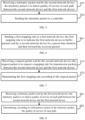
- an example of the present disclosure provides a packet transmission method. As shown in FIG. 2 , the method is applied to a first network device. Wherein, the first network device may be any network device in the WAN.
- the above-mentioned packet transmission method includes the following blocks:
- the first network device buffers the received packet for a preset time duration, during the preset time duration, the first network device may receive other packets that belong to the same flow as the received packet. In this way, when the received packet is buffered for a preset time duration, when the first network device forwards the received packet, the jitter caused by the packet forwarding of the same flow may be reduced, and deterministic transmission may be realized. It may be seen that, in the technical solution provided by the examples of the present disclosure, the deterministic transmission may be realized by buffering the packet by the network device on a receiving packet side. The deterministic transmission method has no requirements for other network devices on the transmission path. This enables the technical solution provided by the examples of the present disclosure to better adapt to complex WAN, and improves the adaptability of the deterministic transmission to WAN.
- the second network device may be any network device in the WAN.
- the second network device sends a packet to another network device.
- the packet may be sent by a terminal to the second network device, or may be generated by the second network device itself.
- the first network device after receiving the packet, the first network device buffers the received packet, and after buffering the received packet for a preset time duration, the first network device forwards the received packet.
- the preset time duration may be set according to actual needs.
- the preset time duration may be 10 microseconds ( ⁇ s), 20 ⁇ s, 30 ⁇ s, etc.
- an example of the present disclosure in order to reduce the jitter of packet forwarding of the same flow, an example of the present disclosure further provides a packet transmission method, as shown in FIG. 3 , the method may further include block S220.
- Block S220 reorganizing received packets such that, after reorganization, packets belonging to a same flow are arranged in order.
- the flow may be a data flow or a control flow.
- a quintuple may be carried in a header of the packet, and the quintuple is to determine a flow to which the packet belongs.
- a flow identity may be carried in a header of the packet, and the flow identity is to determine a flow to which the packet belongs.
- the first network device receives the packets, recognizes the received packets; arranges, after reorganization, the packets belonging to a same flow in order, that is, out-of-order recovery is realized.
- FIG. 4 a schematic diagram of the received packets as shown in FIG. 4 .
- rectangular boxes represent packets, and packets with the same number are the packets of the same flow.
- the first network device does not receive the packets sequentially. As shown on the left side of FIG. 4 , the first network device first receives one packet of flow 1, and then after it receives one packet of flow 2 and one packet of flow 3, one packet of flow 1 is then received. The first network device reorganizes the received packets, so that the packets of the same flow are arranged in order, as shown on the right side of FIG. 4 .
- the first network device receives the packets, recognizes the received packets; arranges, after reorganization, the packets belonging to a same flow in order, which may further reduce jitter of packet forwarding of the same flow.
- the first network device may pre-store a first mapping rule, and reorganizing the received packets according to the first mapping rule.
- the first network device determines the first mapping rule corresponding to the flow to which the received packets belong, and then reorganizes the received packets according to the first mapping rule.
- the first mapping rule may include a scheduling queue; the scheduling queue is to buffer packets belonging to a same flow.
- the first network device may buffer the packets of the same flow to a same scheduling queue, thereby realizing out-of-order recovery.
- the first mapping rule may include a scheduling cycle; the scheduling cycle is to indicate a time period for packet forwarding.
- the above block S22 may be: forwarding, after the scheduling cycle of the received packet expires and after buffering the received packet for a preset time duration, the received packet.
- the preset time duration is 1 scheduling cycle
- the scheduling cycle of the packet is Xth scheduling cycle
- the packet is forwarded in Xth to X+1th scheduling cycle.
- the packet forwarding is controlled periodically, which facilitates the synchronization of packets and reduces jitter of packet transmission.
- the time difference between the scheduling cycle of the first network device and the scheduling cycle of the second network device may be greater than or equal to a target time delay, and the target time delay is a time delay between the first network device and the second network device. This may ensure that the first network device may process the packet faster after receiving the packet from the second network device, and reduce the time delay between the first network device and the second network device.
- the first mapping rule may include the preset time duration.
- the first mapping rule may be carried in the header of the packet sent by the second network device to the first network device.
- the first network device and the second network device have the same scheduling frequency, and scheduling frequency is a frequency with which scheduling cycles are divided. In this way, end-to-end jitter may be further ensured.
- a packet transmission method is also provided. As shown in FIG. 5 , the method may include the following blocks.
- Block S51 receiving a telemetry packet sent by the second network device; the telemetry packet is to detect quality of service of each path between the second network device and the first network device.
- the quality of service may include but is not limited to time delay and jitter.
- the telemetry packet may be an in-band network telemetry (INT) packet.
- a tail of the telemetry packet carries timestamp of each network device along the path.
- Block S52 sending the telemetry packet to a controller.
- the controller determines the maximum time delay of each path, specific encapsulation and processing operations, etc., to ensure that the deterministic transmission service is effective within QoS constraints.
- an example of the present disclosure also provides a packet transmission method.
- the method is applied to a controller and includes the following blocks: block S61, sending a first mapping rule to a first network device; the first mapping rule is to indicate the first network device to buffer the received packet sent by the second network device for a preset time duration, and then forward the received packet.
- the controller may monitor the WAN. In one example, when it is determined that the mapping rule on the first network device may not meet the packet transmission demands between the first network device and the second network device, the controller may determine a new mapping rule, that is, the first mapping rule, the first mapping rule is sent to the first network device.
- the controller may determine the first mapping rule in the following manners, as shown in FIG. 7 :
- the controller when the controller receives the request packet sent by the second network device, it determines the first mapping rule, and then executes block S61 to send the first mapping rule to the first network device, so as to realize deterministic transmission between the second network and the first network device.
- the controller may issue mapping rules according to implementation requirements by using the example of the present disclosure, which saves network resources.
- the above request packet carries target transmission parameters; according to the quality of service of each path between the first network device and the second network device, the path whose quality of service meets the target transmission parameters and the first mapping rule are determined. After that, the second network device forwards the packet to the first network device along the determined path according to the first mapping rule, which may realize deterministic transmission of user requirements.
- the target transmission parameters may be a bandwidth required for the packet transmission and time delay of the packet transmission, etc.
- a packet transmission method is also provided. As shown in FIG. 8 , the method may include the following blocks:
- the controller may determine the maximum time delay of each path, specific encapsulation and processing operations, etc., to ensure that the deterministic transmission service is effective within QoS constraints.
- the controller may also send the second mapping rule to the second network device.
- the first mapping rule and the second mapping rule include a scheduling cycle; the scheduling cycle is to indicate a time period for packet forwarding; for the same flow, the time difference between the scheduling cycle of the first network device and the scheduling cycle of the second network device is greater than or equal to a target time delay, and the target time delay is a time delay between the first network device and the second network device.
- the packet transmission method provided in the example of the present disclosure will be described below in conjunction with the WAN shown in FIG. 1 .
- the end-to-end deterministic transmission between terminal A and terminal B may include: The terminal A sends a packet 1 to the network device R1, and the packet 1 carries a flow identity (FlowID) 9.
- FlowID flow identity
- the network device R1 After receiving packet 1, the network device R1 determines path 1 corresponding to the flow identity 1 (the path indicated by the network devices R1 ⁇ R3 ⁇ R7 ⁇ R9 in FIG. 1 ) and mapping rule 1 according to the pre-stored correspondence between the flow identity, path, and mapping rule.
- SA represents source address
- DA represents destination address
- the dotted line with an arrow represents the transmission path of the packet.
- F9, Q7, and T3 in the packet represent mapping rules.
- mapping rule is a forwarding rule for indicating the packet.
- the mapping rules may be set according to actual needs.
- the mapping rule may include, but is not limited to, information such as scheduling queue, scheduling cycle, and the buffering time corresponding to the flow identity.
- the mapping rules include FX1, QX2, and TX3.
- FX1 is FlowID
- QX2 is scheduling queue identity, indicating the X2 queue, that is, the packet carrying FlowID X1 is mapped to the X2 queue
- TX3 is the scheduling cycle, indicating the X3 scheduling cycle, that is, the packet carrying FlowID X1 is forwarded in the X3 scheduling cycle.
- the mapping rule may also include buffering time (that is, the above-mentioned preset time duration), so as to realize the synchronization of the packet and reduce the jitter of the packet transmission.
- the buffering time is 1 scheduling cycle.
- the above-mentioned mapping rule represents that the packet carrying FlowID X1 is mapped to the X2 queue, and the packet buffered in the X2 queue is forwarded in the X3 to X3+1 scheduling cycle.
- mapping rule 1 includes F9, Q7, and T3, the buffering time is 1 scheduling cycle, and the path 1 is the path indicated by the network devices R1 ⁇ R3 ⁇ R7 ⁇ R9 in FIG. 1 .
- the network device R1 forwards packet 1 to network device R9 along path 1 according to mapping rule 1, that is, packet 1 carrying FlowID 9 is mapped to the 7th queue, and in the 3-4 scheduling cycle, it forwards the packet 1 buffered in the 7th queue to network device R9.
- the network device R1 may encapsulate the above-mentioned mapping rule 1 in the header of the packet 1, as shown in FIG. 1 , so that the network device R9 may accurately forward the packet 1 according to the mapping rule 1, and realize deterministic transmission.
- the header of the packet shown in FIG. 1 may also include information such as the SID of each network device on the path.
- the network device R1 may not encapsulate the above mapping rule 1 in the header of packet 1.
- WAN is as shown in FIG. 9
- SA represents source address
- DA represents destination address
- the dotted line with an arrow represents the transmission path of the packet.
- the R9 carried in the packet header represents SID of the network device R9
- the R7 carried in the packet header represents the SID of the network device R7
- the R3 carried in the packet header represents SID of the network device R3.
- the network device R9 determines the corresponding mapping rule 1 according to the correspondence between the locally stored flow identity and the mapping rule.
- FIG. 9 only uses packet forwarding based on the SRv6 technology as an example to illustrate the forwarding. If other technologies are used for packet forwarding, the SID may not be carried in the packet header.
- the network device R9 After receiving the packet 1, the network device R9 buffers the packet 1 for the preset time duration according to the mapping rule 1, and then sends the packet 1 to the terminal B, so as to realize deterministic transmission.
- FIG. 10 shows the seventh flow diagram of the packet transmission method according to the example of the present disclosure, which is applied to the second network device connected to the source terminal, and includes the following blocks: block S101, obtaining a target packet sent by a source terminal, the target packet carries a target flow identity.
- the source terminal sends a packet, that is, a target packet, to the second network device.
- the flow identity carried in the target packet is a target flow identity.
- Block S 102 determining, according to the pre-stored correspondence between the flow identity, path, and mapping rule, a target path corresponding to the target flow identity and a target mapping rule.
- the correspondence between the flow identity, path, and mapping rule is pre-stored in the second network device.
- the second network device After obtaining the target packet, the second network device searches for a correspondence including the target flow identity in the pre-stored correspondence between the flow identity, path, and mapping rule; after find the correspondence, the second network device uses the path included in the found correspondence as the target path corresponding to the target flow identity, and uses the mapping rule included in the found correspondence as the target mapping rule.
- Block S 103 forwarding, according to the target mapping rule, the target packet to the first network device along the target path, so that the first network device sends the target packet to the destination terminal connected to the first network device according to the target mapping rule, wherein the first network device has the same scheduling forwarding frequency as the second network device.
- the first network device and the second network device have the same packet scheduling forwarding frequency.
- the first network device and the second network device both support a CSQF mechanism, and the first network device and the second network device are divided into many scheduling cycles according to the same scheduling frequency. In this way, end-to-end network jitter may be ensured, and the time delay may be determined through bandwidth reservation and INT measurement.
- the second network device After obtaining the target path and the target mapping rule, the second network device forwards the target packet to the first network device along the target path according to the target mapping rule.
- the WAN may determine the path based on segment routing (SR).
- the controller may use the segment routing Internet Protocol Version 6 (SRv6) technology based on the sixth version of the Internet Protocol to separate set segment identifier(SID) for each network device, and complete end-to-end visibility, path planning, bandwidth reservation, etc. based on the SID of each network device.
- SID segment identifier
- Each network device uses SID to forward the received packet.
- the target path may also include one or more network devices. After the one or more network devices receive the target packet, they may be directly forward the target packet without determining a specific forwarding cycle of the target packet. After receiving the target packet, the first network device may send the target packet to the target terminal based on the CSQF mechanism and in accordance with the target mapping rule.
- the second network device connected to the source terminal and the first network device connected to the destination terminal there are only requirements for the second network device connected to the source terminal and the first network device connected to the destination terminal, that is, the first network device and the second network device should have the same scheduling and forwarding frequency, for example, only the first network device and the second network device need to support the CSQF mechanism, and there is no requirement for other network devices between the first network device and the second network device, and the deterministic delay and jitter may be realized, and deterministic transmission may be realized.
- This enables the technical solution provided by the examples of the present disclosure to better adapt to complex WAN, and improves the adaptability of the deterministic transmission to the WAN.
- a packet transmission method is also provided. As shown in FIG. 11 , the method may include the following blocks before block S101: Block S1010: sending a transmission request packet from the source terminal to the controller, and the transmission request packet carries target transmission parameters, so that the controller may determine target path and target mapping rule that meet the target transmission parameters according to the pre-stored service quality of each path between the first network device and the second network device stored.
- the source terminal when the source terminal needs to deterministically transmit a packet to the destination terminal, the source terminal sends a transmission request packet to the second network device, and the second network device sends the transmission request packet to the controller.
- the transmission request packet carries target transmission parameters, and the target transmission parameters may include, but are not limited to: FlowID, bandwidth required for packet transmission, and time delay of packet transmission, etc.
- the quality of service of each path between the first network device and the second network device is pre-stored in the controller.
- the quality of service of a path includes the remaining bandwidth of the path, the time delay of the path, and the queue resources of the path.
- the controller After receiving the transmission request packet, the controller obtains target transmission parameters from the transmission request packet; determines a target path whose quality of service meets the target transmission parameters according to the pre-stored quality of service of each path between the first network device and the second network device, and determines target mapping rule.
- Block S 1011 receiving the target path and target mapping rule issued by the controller, and store the correspondence between the target flow identity, the target path and the target mapping rule.
- the controller issues the target path and the target mapping rule to the second network device.
- the second network device receives the target path and target mapping rule issued by the controller, and then stores the correspondence between the target flow identity, the target path and the target mapping rule.
- the second network device forwards the packet carrying the target flow identity based on the stored correspondence between the target flow identity, the target path, and the target mapping rule.
- the controller collects the quality of service of multiple paths between the first network device and the second network device, and uniformly plans the paths, thereby realizing deterministic transmission.
- the controller issues the corresponding target mapping rule to the first network device.
- the first network device stores the correspondence between the target flow identity and the target mapping rule, so as to achieve accurate and deterministic transmission.
- target mapping rule stored by the first network device is different from target mapping rule stored by the second network device by a target time delay.
- the target time delay is a time delay between the first network device and the second network device.
- the second network device may periodically send the telemetry packet to the first network device along each path between the first network device and the second network device.
- the telemetry packet is to detect the quality of service of each path between the first network device and the second network device.
- the first network device sends the received telemetry packet to the controller. After receiving the telemetry packet sent by the first network device, the controller obtains the quality of service of each path between the first network device and the second network device, and then stores the quality of service of each path between the first network device and the second network device.
- the telemetry packet may be an in-band network telemetry (INT) packet.
- INT in-band network telemetry
- the network device along the path inserts device information of the network device in the INT packet, as well as the timestamp of receiving the INT packet and the timestamp by sending the INT packet by network device.
- the timestamp of receiving the INT packet and the timestamp of sending the INT packet by the network device are collectively called the timestamp.
- the timestamp is located at the end of the INT packet, and device information of the network device may be located in the header of the INT packet.
- SA represents the source address
- DA represents the destination address
- the dotted line with arrow represents the transmission path of the INT packet.
- network devices R1, R3, R7, and R9 support INT, and add a timestamp to the INT packet
- network devices R2 and R8 are also network devices that through the network, but network devices R2 and R8 do not support INT, therefore the timestamp is not added to the INT packet.
- the controller After the controller receives the INT packet sent by the network device R9, it analyzes the timestamp carried in the INT packet to determine the time delay and jitter of the path of the network devices R1 ⁇ R3 ⁇ R7 ⁇ R9, and thereby realizing end-to-end QoS detection. It is convenient for the controller to determine the maximum time delay of each path, specific encapsulation and processing operations, etc., to ensure that the deterministic transmission service is effective within QoS constraints.
- the network device in the path may send an INT packet to the controller while forwarding the network device to a next hop device.
- a network device in the path does not send an INT packet to the controller, it is determined that the network device is faulty. Based on this, the controller may issue an alarm in time to prompt the fault of the network device, and then repair the network device in time.
- an example of the present disclosure also provides a packet transmission method.
- the method is applied to a first network device connected to the destination terminal and includes the following blocks: block S131: receiving a target packet sent by a second network device, the target packet carries a target flow identity, and the target packet is: a packet of the source terminal connected to the second network device sent along the target path according to the target mapping rule corresponding to the target flow identity, wherein the second network device has the same scheduling and forwarding frequency as that of the first network device.
- Block S132 sending the target packet to the destination terminal according to the target mapping rule.
- the above block S 132 may specifically be: sending the target packet to the destination terminal according to the target mapping rule carried in the target packet.
- the above block S132 may specifically be: determining the target mapping rule corresponding to the target flow identity according to the pre-stored correspondence between the flow identity and the mapping rule; sending the target packet to the destination terminal according to the determined target mapping rule.
- the first network device receives the target mapping rule issued by the controller, and the target mapping rule is: after receiving the transmission request packet sent by the source terminal, the controller determines mapping rule that satisfies the target transmission parameters carried in the transmission request packet according to the pre-stored quality of service of each path between the second network device and the first network device; stores the correspondence between the target flow identity and the target mapping rule.
- the controller issues the target flow identity to the first network device while issuing the target mapping rule to the first network device.
- the first network device receives a telemetry packet from the second network device, and the telemetry packet is to detect the quality of service of each path between the second network device and the first network device; the telemetry packet is sent to the controller.
- the telemetry packet may be an INT packet or other type of telemetry packet.
- the second network device connected to the source terminal and the first network device connected to the destination terminal there are only requirements for the second network device connected to the source terminal and the first network device connected to the destination terminal, that is, the first network device and the second network device should have the same scheduling and forwarding frequency, for example, only the first network device and the second network device need to support the CSQF mechanism, and there is no requirement for other network devices between the first network device and the second network device, and the deterministic delay and jitter may be realized, and deterministic transmission may be realized.
- This enables the technical solution provided by the examples of the present disclosure to better adapt to complex WAN, and improves the adaptability of the deterministic transmission to the WAN.
- a packet transmission method is also provided. As shown in FIG. 14 , in the method, the block S 132 may be refined into blocks S1321 and S14322.
- Block S1321 rearranging the target packet according to the target flow identity, so that the target packet is adjacent to other packets corresponding to the target flow identity.
- Block S 1322 sending the rearranged target packet to the destination terminal according to the target mapping rule.
- the first network device uses the flow identity to rearrange the packets, that is, reorganize the packets to achieve out-of-order recovery, which ensure that packets belonging to the same data flow are sent in order, and jitter is reduced, thereby realizing end-to-end deterministic transmission.
- an example of the present disclosure also provides a packet transmission apparatus, as shown in FIG. 15 , which is applied to a first network device, and the method includes:
- the apparatus further comprises:
- the recombination unit is specifically to reorganize, according to a first mapping rule, the received packets.
- the first mapping rule includes a scheduling queue; the scheduling queue is to buffer packets belonging to a same flow.
- the first mapping rule includes a scheduling cycle; the scheduling cycle is to indicate a time period for packet forwarding; the forwarding unit is specifically to forward, after the scheduling cycle of the received packet expires and after buffering the received packet for a preset time duration, the received packet.
- the time difference between the scheduling cycle of the first network device and the scheduling cycle of the second network device is greater than or equal to a target time delay, and the target time delay is a time delay between the first network device and the second network device.
- the first mapping rule includes the preset time duration.
- the first mapping rule is carried in a header of the packet.
- a quintuple is carried in the header of the packet, and the quintuple is to determine a flow to which the packet belong; or, a target flow identity is carried in the header of the packet, and the flow identity is to determine a flow to which a target packet belong.
- the first network device and the second network device have the same scheduling frequency, and the scheduling frequency is a frequency with which scheduling cycles are divided.
- the apparatus further comprises:
- the quality of service includes time delay and jitter; a tail of the telemetry packet carries timestamp of each network device in the path.
- the first network device buffers the received packet for the preset time duration, within the preset time duration, the first network device may receive other packets that belong to the same flow as the received packet. In this way, when the received packet is buffered for a preset time duration, when the first network device forwards the received packet, the jitter caused by the packet forwarding of the same flow may be reduced, and deterministic transmission may be realized. It may be seen that, in the technical solution provided by the examples of the present disclosure, the deterministic transmission may be realized by buffering the packet by the network device on a receiving packet side. The deterministic transmission method has no requirements for other network devices on the transmission path. This enables the technical solution provided by the examples of the present disclosure to better adapt to complex WAN, and improves the adaptability of the deterministic transmission to the WAN.
- an example of the present disclosure also provides a packet transmission apparatus, as shown in FIG. 16 , which is applied to a controller, and the apparatus includes: a first sending unit 161, to send a first mapping rule to a first network device; the first mapping rule is to indicate the first network device to buffer the received packet sent by a second network device for a preset time duration, and then forward the received packet.
- the apparatus further comprises:
- the apparatus further comprises:
- the quality of service includes time delay and jitter; the tail of the telemetry packet carries the timestamp of each network device of the path.
- the apparatus further comprises:
- the request packet carries target transmission parameters; the second determining unit is specifically to determine, according to the quality of service of each path between the first network device and the second network device, that the quality of service satisfies the first mapping rule of the target transmission parameters.
- the first network device buffers the received packet for the preset time duration, within the preset time duration, the first network device may receive other packets that belong to the same flow as the received packet. In this way, when the received packet is buffered for a preset time duration, when the first network device forwards the received packet, the jitter caused by the packet forwarding of the same flow may be reduced, and deterministic transmission may be realized. It may be seen that, in the technical solution provided by the examples of the present disclosure, the deterministic transmission may be realized by buffering the packet by the network device on a receiving packet side. The deterministic transmission method has no requirements for other network devices on the transmission path. This enables the technical solution provided by the examples of the present disclosure to better adapt to complex WAN, and improves the adaptability of the deterministic transmission to the WAN.
- an example of the present disclosure also provides a network device, as shown in FIG. 17 , including a processor 171 and a machine-readable storage medium 172, where the machine-readable storage medium 172 stores machine-executable instructions that may be executed by the processor 171, and the processor 171 is caused by the machine executable instructions to implement any of the blocks of the packet transmission method applied to the first network device.
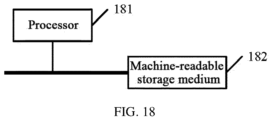
- an example of the present disclosure also provides a network device, as shown in FIG. 18 , including a processor 181 and a machine-readable storage medium 182, where the machine-readable storage medium 182 stores machine-executable instructions that may be executed by the processor 181, and the processor 181 is caused by the machine executable instructions to implement any of the blocks of the packet transmission method applied to the controller.
- the machine-readable storage medium may include a random access memory (RAM), or may include a non-volatile memory (NVM), for example at least one disk memory.
- the machine-readable storage medium may also be at least one storage device located away from the processor described above.
- the aforementioned processor may be a general-purpose processor, such as a central processing unit (CPU), a network processor (NP), or the like; it may also be a digital signal processor (DSP), an disclosure specific integrated circuit (ASIC), a field-programmable gate array (FPGA) or other programmable logic device, a discrete gate or transistor logic device, a discrete hardware component.
- CPU central processing unit
- NP network processor
- DSP digital signal processor
- ASIC disclosure specific integrated circuit
- FPGA field-programmable gate array
- a computer-readable storage medium stores a computer program, and the computer program implements any of the above-mentioned blocks of the packet transmission method applied to the first network device or any of the above-mentioned blocks of the packet transmission method applied to the controller when executed by a processor.
- a computer program which when running on a computer, causes the computer to implement any of the above-mentioned blocks of the packet transmission method applied to the first network device, or any of the above-mentioned blocks of the packet transmission method applied to the controller.
- the aforementioned examples it may be implemented in whole or in part by software, hardware, firmware, or any combination thereof.
- software it may be implemented in whole or in part in the form of a computer program product.
- the computer program product includes one or more computer instructions.
- the processes or functions described in accordance with the examples of the present invention is produced in whole or in part, when the computer program instructions are loaded and executed on a computer.
- the computer may be a general-purpose computer, a dedicated computer, a computer network, or other programmable device.
- the computer instructions may be stored in a computer-readable storage medium or may be transmitted from one computer-readable storage medium to another computer-readable storage medium, for example, the computer instructions may be transmitted from a web site, a computer, a server, or a data center to another web site, another computer, another server, or another data center via a cable (such as a coaxial cable, an optical fiber, a digital subscriber line (DSL)) or wireless (such as infrared, wireless, microwave, etc.).
- the computer-readable storage medium may be any available medium that may be accessed by a computer or a data storage device such as a server or a data center containing one or more available medium integrations.
- the available media may be magnetic media (such as floppy disks, hard disks, magnetic tapes), optical media (such as DVDs), or semiconductor media (such as solid state disk (SSD)), etc.
Landscapes
- Engineering & Computer Science (AREA)
- Computer Networks & Wireless Communication (AREA)
- Signal Processing (AREA)
- Computer Security & Cryptography (AREA)
- Data Exchanges In Wide-Area Networks (AREA)
Applications Claiming Priority (1)
| Application Number | Priority Date | Filing Date | Title |
|---|---|---|---|
| PCT/CN2021/106623 WO2023283902A1 (fr) | 2021-07-15 | 2021-07-15 | Procédé et appareil de transmission de message |
Publications (2)
| Publication Number | Publication Date |
|---|---|
| EP4319055A1 true EP4319055A1 (fr) | 2024-02-07 |
| EP4319055A4 EP4319055A4 (fr) | 2024-05-29 |
Family
ID=78647593
Family Applications (1)
| Application Number | Title | Priority Date | Filing Date |
|---|---|---|---|
| EP21949688.2A Pending EP4319055A4 (fr) | 2021-07-15 | 2021-07-15 | Procédé et appareil de transmission de message |
Country Status (6)
| Country | Link |
|---|---|
| US (1) | US12395449B2 (fr) |
| EP (1) | EP4319055A4 (fr) |
| JP (1) | JP7667879B2 (fr) |
| KR (1) | KR20230169378A (fr) |
| CN (1) | CN113711572B (fr) |
| WO (1) | WO2023283902A1 (fr) |
Cited By (1)
| Publication number | Priority date | Publication date | Assignee | Title |
|---|---|---|---|---|
| EP4425876A4 (fr) * | 2022-09-29 | 2025-01-15 | New H3C Technologies Co., Ltd. | Procédé et appareil de traitement de données, et dispositif de réseau et support d'enregistrement |
Families Citing this family (18)
| Publication number | Priority date | Publication date | Assignee | Title |
|---|---|---|---|---|
| US12526617B2 (en) | 2021-12-08 | 2026-01-13 | Palo Alto Networks, Inc. | Targeted PDU capture by a network device for roaming detection in wireless networks |
| US12432159B2 (en) | 2021-12-29 | 2025-09-30 | New H3C Technologies Co., Ltd. | Deterministic traffic transmission method and device |
| WO2023123105A1 (fr) * | 2021-12-29 | 2023-07-06 | 新华三技术有限公司 | Procédé et appareil de collecte de cycle de planification csqf appliqués à un réseau déterministe |
| JP7654835B2 (ja) * | 2021-12-29 | 2025-04-01 | 新華三技術有限公司 | パケット伝送方法及びネットワークデバイス |
| CN116647894A (zh) * | 2022-02-15 | 2023-08-25 | 大唐移动通信设备有限公司 | 数据调度方法、装置、设备及存储介质 |
| CN114844837B (zh) * | 2022-04-25 | 2023-09-26 | 西安交通大学 | 多服务队列环境中基于时延的拥塞控制方法和控制装置 |
| CN117014944A (zh) * | 2022-04-29 | 2023-11-07 | 上海华为技术有限公司 | 一种报文传输方法以及装置 |
| CN114978754B (zh) * | 2022-06-21 | 2023-09-19 | 奥特酷智能科技(南京)有限公司 | 一种tsn异常检测方法及系统 |
| EP4425896B1 (fr) * | 2022-07-19 | 2025-12-24 | New H3C Technologies Co., Ltd. | Procédé et système de transmission de flux déterministe, et dispositif électronique |
| WO2024016327A1 (fr) * | 2022-07-22 | 2024-01-25 | 新华三技术有限公司 | Transmission de paquets |
| EP4425871B1 (fr) * | 2022-12-30 | 2026-03-11 | New H3C Technologies Co., Ltd. | Procédé et appareil de transmission de domaine croisé de flux déterministe, et dispositif électronique |
| CN116915358A (zh) * | 2023-01-06 | 2023-10-20 | 中国移动通信有限公司研究院 | 数据传输方法、装置、设备及存储介质 |
| CN116232997B (zh) * | 2023-02-10 | 2024-04-09 | 中国联合网络通信集团有限公司 | 数据转发方法、装置及存储介质 |
| CN116545885B (zh) * | 2023-04-26 | 2025-09-19 | 新华三技术有限公司 | 一种指标测量方法、装置、电子设备及存储介质 |
| CN118945124A (zh) * | 2023-05-10 | 2024-11-12 | 中兴通讯股份有限公司 | 一种数据传输方法、装置及存储介质 |
| US20240422106A1 (en) * | 2023-06-19 | 2024-12-19 | Microsoft Technology Licensing, Llc | System and method for processing networking packets using a reorder queue |
| CN116545936B (zh) * | 2023-07-05 | 2023-11-03 | 苏州浪潮智能科技有限公司 | 拥塞控制方法、系统、装置、通信设备及存储介质 |
| CN118827577A (zh) * | 2023-09-27 | 2024-10-22 | 中国移动通信有限公司研究院 | 策略确定方法、装置、通信设备及可读存储介质 |
Family Cites Families (24)
| Publication number | Priority date | Publication date | Assignee | Title |
|---|---|---|---|---|
| US6934250B1 (en) * | 1999-10-14 | 2005-08-23 | Nokia, Inc. | Method and apparatus for an output packet organizer |
| JP4295792B2 (ja) * | 2002-01-09 | 2009-07-15 | パナソニック株式会社 | プロセッサ及びプログラム実行方法 |
| JP2004088390A (ja) * | 2002-08-27 | 2004-03-18 | Fujitsu I-Network Systems Ltd | ゆらぎ吸収方法及び装置、並びにコンピュータ読み取り可能な記録媒体 |
| US7724750B2 (en) * | 2004-04-01 | 2010-05-25 | Nokia Corporation | Expedited data transmission in packet based network |
| US7522528B2 (en) * | 2004-11-18 | 2009-04-21 | Qvidium Technologies, Inc. | Low-latency automatic repeat request packet recovery mechanism for media streams |
| WO2008126179A1 (fr) * | 2007-03-15 | 2008-10-23 | Fujitsu Limited | Système de vérification de réseau |
| CN101917472B (zh) * | 2010-08-12 | 2013-05-29 | 北京星网锐捷网络技术有限公司 | 一种多链路报文的重组方法、装置及设备 |
| JP6312414B2 (ja) * | 2013-12-10 | 2018-04-18 | 三菱電機株式会社 | 中継装置 |
| CN105449845B (zh) * | 2014-05-30 | 2017-12-12 | 华为技术有限公司 | 报文的处理方法、装置与系统 |
| CN106301973B (zh) * | 2015-05-14 | 2019-07-23 | 南宁富桂精密工业有限公司 | 网络检测方法与使用所述方法的控制器 |
| JP6569374B2 (ja) * | 2015-08-10 | 2019-09-04 | 富士通株式会社 | スイッチ装置及びスイッチ装置の制御方法 |
| CN106470126A (zh) * | 2015-08-14 | 2017-03-01 | 中兴通讯股份有限公司 | 端口队列堵塞的监控方法及系统 |
| US10237194B2 (en) * | 2016-01-06 | 2019-03-19 | Futurewei Technologies, Inc. | Maximize network capacity policy with heavy-tailed traffic |
| CN109565471A (zh) * | 2016-06-18 | 2019-04-02 | 科里维网络有限公司 | 使用多通道提高性能的智能自适应传输层 |
| CN107733813B (zh) * | 2016-08-12 | 2022-11-18 | 中兴通讯股份有限公司 | 报文转发方法及装置 |
| CN112202685A (zh) * | 2017-11-06 | 2021-01-08 | 华为技术有限公司 | 报文转发方法、转发设备和网络设备 |
| CN110166367B (zh) * | 2018-02-14 | 2021-01-29 | 华为技术有限公司 | 一种分组网络中控制流量的方法、装置及存储介质 |
| CN111817985B (zh) * | 2019-04-10 | 2024-02-02 | 华为技术有限公司 | 业务处理方法及装置 |
| US12149451B2 (en) * | 2019-05-29 | 2024-11-19 | Telefonaktiebolaget Lm Ericsson (Publ) | Avoiding jitter in a communication system |
| CN112583510B (zh) * | 2019-09-30 | 2025-01-10 | 华为技术有限公司 | 一种报文转发方法、设备及系统 |
| CN110752993B (zh) * | 2019-10-24 | 2022-02-25 | 新华三信息安全技术有限公司 | 一种报文转发方法及装置 |
| CN113037640A (zh) * | 2019-12-09 | 2021-06-25 | 华为技术有限公司 | 数据转发方法、数据缓存方法、装置和相关设备 |
| US11425014B2 (en) * | 2020-03-31 | 2022-08-23 | Lenovo Enterprise Solutions (Singapore) Pte. Ltd. | Scalable in-band telemetry metadata extraction |
| CN111770565B (zh) * | 2020-06-23 | 2021-08-20 | 中国科学院上海微系统与信息技术研究所 | 一种非地面网络的定时提前调整方法 |
-
2021
- 2021-07-15 CN CN202180001884.0A patent/CN113711572B/zh active Active
- 2021-07-15 EP EP21949688.2A patent/EP4319055A4/fr active Pending
- 2021-07-15 KR KR1020237040041A patent/KR20230169378A/ko active Pending
- 2021-07-15 WO PCT/CN2021/106623 patent/WO2023283902A1/fr not_active Ceased
- 2021-07-15 US US18/557,364 patent/US12395449B2/en active Active
- 2021-07-15 JP JP2023571943A patent/JP7667879B2/ja active Active
Cited By (1)
| Publication number | Priority date | Publication date | Assignee | Title |
|---|---|---|---|---|
| EP4425876A4 (fr) * | 2022-09-29 | 2025-01-15 | New H3C Technologies Co., Ltd. | Procédé et appareil de traitement de données, et dispositif de réseau et support d'enregistrement |
Also Published As
| Publication number | Publication date |
|---|---|
| US20240214323A1 (en) | 2024-06-27 |
| WO2023283902A1 (fr) | 2023-01-19 |
| KR20230169378A (ko) | 2023-12-15 |
| EP4319055A4 (fr) | 2024-05-29 |
| CN113711572B (zh) | 2024-11-26 |
| JP7667879B2 (ja) | 2025-04-23 |
| US12395449B2 (en) | 2025-08-19 |
| CN113711572A (zh) | 2021-11-26 |
| JP2024521725A (ja) | 2024-06-04 |
Similar Documents
| Publication | Publication Date | Title |
|---|---|---|
| US12395449B2 (en) | Packet transmission method and apparatus | |
| CN115242728B (zh) | 一种报文传输方法及装置 | |
| Imtiaz et al. | A performance study of Ethernet Audio Video Bridging (AVB) for Industrial real-time communication | |
| TWI756666B (zh) | 在封包交換網路中藉由通訊實體之電腦手段實施之方法、及其電腦程式及電腦可讀取之非暫時性記錄媒體、以及封包交換網路之通訊實體 | |
| CN115022182A (zh) | 一种基于qsilp算法的列车通信网络实时流调度优化方法 | |
| CN115643220B (zh) | 基于抖动时延的确定性业务传输方法和装置 | |
| KR20230173697A (ko) | 이더넷 프레임의 송신을 스케줄링하기 위해 패킷 교환 네트워크에서 실시되는 방법, 컴퓨터 프로그램 및 기기 | |
| CN117596200B (zh) | 一种时间敏感网络路由调度方法、电子设备、介质 | |
| Imtiaz et al. | Approaches to reduce the latency for high priority traffic in IEEE 802.1 AVB networks | |
| CN115883483B (zh) | 一种时间敏感业务缓存队列的调度系统和方法 | |
| WO2013078873A1 (fr) | Procédé et dispositif pour identifier un message de réponse | |
| Cavalieri | Modelling and analysing congestion in KNXnet/IP | |
| Nsaibi | Timing performance analysis of the deterministic Ethernet enhancements time-sensitive networking (TSN) for use in the industrial communication | |
| KR20220112478A (ko) | 시간 동기화 없는 결정론적 네트워크를 위한 지터 상한 보장 방법 | |
| Mifdaoui et al. | FactoRing: Asynchronous TSN-compliant Network with low bounded Jitters for Industry 4.0 | |
| EP4629589A1 (fr) | Procédé de transmission de paquets, appareil, dispositif de réseau et support de stockage | |
| CN114500163B (zh) | 一种通信调度方法、装置和存储介质 | |
| CN115208837A (zh) | 一种报文调度方法和系统 | |
| EP4425870A1 (fr) | Transmission de paquets | |
| Zuo et al. | Research on Real-time Data Communication of Industrial Ethernet | |
| Steiner | Deterministic Ethernet for real-time and critical applications | |
| EP4572289A1 (fr) | Procédé et appareil de planification de file d'attente | |
| Peng et al. | Implementation of a High-precision TIME-aware Shaper in TSN | |
| Suethanuwong et al. | Searching of best-effort messages in ttethemet switches during the timely blocking intervals | |
| CN106713176B (zh) | 控制平面时间同步队列的服务速率控制方法和装置 |
Legal Events
| Date | Code | Title | Description |
|---|---|---|---|
| STAA | Information on the status of an ep patent application or granted ep patent |
Free format text: STATUS: THE INTERNATIONAL PUBLICATION HAS BEEN MADE |
|
| PUAI | Public reference made under article 153(3) epc to a published international application that has entered the european phase |
Free format text: ORIGINAL CODE: 0009012 |
|
| STAA | Information on the status of an ep patent application or granted ep patent |
Free format text: STATUS: REQUEST FOR EXAMINATION WAS MADE |
|
| 17P | Request for examination filed |
Effective date: 20231023 |
|
| AK | Designated contracting states |
Kind code of ref document: A1 Designated state(s): AL AT BE BG CH CY CZ DE DK EE ES FI FR GB GR HR HU IE IS IT LI LT LU LV MC MK MT NL NO PL PT RO RS SE SI SK SM TR |
|
| REG | Reference to a national code |
Ref country code: DE Ref legal event code: R079 Free format text: PREVIOUS MAIN CLASS: H04L0012000000 Ipc: H04L0047280000 |
|
| A4 | Supplementary search report drawn up and despatched |
Effective date: 20240430 |
|
| RIC1 | Information provided on ipc code assigned before grant |
Ipc: H04L 43/106 20220101ALN20240424BHEP Ipc: H04L 47/32 20220101ALI20240424BHEP Ipc: H04L 47/24 20220101ALI20240424BHEP Ipc: H04L 47/34 20220101ALI20240424BHEP Ipc: H04L 47/62 20220101ALI20240424BHEP Ipc: H04L 47/28 20220101AFI20240424BHEP |
|
| DAV | Request for validation of the european patent (deleted) | ||
| DAX | Request for extension of the european patent (deleted) |