EP4322112A1 - Procédé et dispositif de représentation de scènes rendues - Google Patents
Procédé et dispositif de représentation de scènes rendues Download PDFInfo
- Publication number
- EP4322112A1 EP4322112A1 EP23164183.8A EP23164183A EP4322112A1 EP 4322112 A1 EP4322112 A1 EP 4322112A1 EP 23164183 A EP23164183 A EP 23164183A EP 4322112 A1 EP4322112 A1 EP 4322112A1
- Authority
- EP
- European Patent Office
- Prior art keywords
- volume
- neural network
- rendering
- obtaining
- distribution
- Prior art date
- Legal status (The legal status is an assumption and is not a legal conclusion. Google has not performed a legal analysis and makes no representation as to the accuracy of the status listed.)
- Pending
Links
Images





Classifications
-
- G—PHYSICS
- G06—COMPUTING OR CALCULATING; COUNTING
- G06T—IMAGE DATA PROCESSING OR GENERATION, IN GENERAL
- G06T15/00—Three-dimensional [3D] image rendering
- G06T15/08—Volume rendering
-
- G—PHYSICS
- G06—COMPUTING OR CALCULATING; COUNTING
- G06N—COMPUTING ARRANGEMENTS BASED ON SPECIFIC COMPUTATIONAL MODELS
- G06N3/00—Computing arrangements based on biological models
- G06N3/02—Neural networks
- G06N3/04—Architecture, e.g. interconnection topology
- G06N3/045—Combinations of networks
-
- G—PHYSICS
- G06—COMPUTING OR CALCULATING; COUNTING
- G06N—COMPUTING ARRANGEMENTS BASED ON SPECIFIC COMPUTATIONAL MODELS
- G06N3/00—Computing arrangements based on biological models
- G06N3/02—Neural networks
- G06N3/08—Learning methods
-
- G—PHYSICS
- G06—COMPUTING OR CALCULATING; COUNTING
- G06N—COMPUTING ARRANGEMENTS BASED ON SPECIFIC COMPUTATIONAL MODELS
- G06N3/00—Computing arrangements based on biological models
- G06N3/02—Neural networks
- G06N3/08—Learning methods
- G06N3/09—Supervised learning
-
- G—PHYSICS
- G06—COMPUTING OR CALCULATING; COUNTING
- G06T—IMAGE DATA PROCESSING OR GENERATION, IN GENERAL
- G06T15/00—Three-dimensional [3D] image rendering
- G06T15/005—General purpose rendering architectures
-
- G—PHYSICS
- G06—COMPUTING OR CALCULATING; COUNTING
- G06T—IMAGE DATA PROCESSING OR GENERATION, IN GENERAL
- G06T15/00—Three-dimensional [3D] image rendering
- G06T15/06—Ray-tracing
-
- G—PHYSICS
- G06—COMPUTING OR CALCULATING; COUNTING
- G06T—IMAGE DATA PROCESSING OR GENERATION, IN GENERAL
- G06T7/00—Image analysis
- G06T7/40—Analysis of texture
-
- G—PHYSICS
- G06—COMPUTING OR CALCULATING; COUNTING
- G06T—IMAGE DATA PROCESSING OR GENERATION, IN GENERAL
- G06T7/00—Image analysis
- G06T7/50—Depth or shape recovery
-
- G—PHYSICS
- G06—COMPUTING OR CALCULATING; COUNTING
- G06T—IMAGE DATA PROCESSING OR GENERATION, IN GENERAL
- G06T2200/00—Indexing scheme for image data processing or generation, in general
- G06T2200/04—Indexing scheme for image data processing or generation, in general involving 3D image data
-
- G—PHYSICS
- G06—COMPUTING OR CALCULATING; COUNTING
- G06T—IMAGE DATA PROCESSING OR GENERATION, IN GENERAL
- G06T2207/00—Indexing scheme for image analysis or image enhancement
- G06T2207/20—Special algorithmic details
- G06T2207/20081—Training; Learning
-
- G—PHYSICS
- G06—COMPUTING OR CALCULATING; COUNTING
- G06T—IMAGE DATA PROCESSING OR GENERATION, IN GENERAL
- G06T2207/00—Indexing scheme for image analysis or image enhancement
- G06T2207/20—Special algorithmic details
- G06T2207/20084—Artificial neural networks [ANN]
Definitions
- the following description relates to a method and device for representing rendered scenes, and more particularly, to a method of transforming volume rendering parameters to fit the parameters for a desired feature.
- Three-dimensional (3D) rendering is a field of computer graphics for rendering a 3D model.
- 3D rendering is used in various application fields, such as a 3D gaming, virtual reality, animation, movies/media, and the like.
- 3D rendering techniques include ray-tracing rendering, radiosity rendering, and rasterization rendering, in which the ray-tracing rendering renders a 3D model by tracing the path of light that is emitted from a light source and reflected from a surface, the radiosity rendering uses an indirect lighting effect caused by diffuse reflection or reflected light that is generated when direct light is reflected by an object other than a direct lighting effect, and the rasterization rendering renders a 3D model by converting vector data to a pixel-pattern image.
- a method of training a neural network model includes: obtaining spatial information of sampling data; obtaining one or more volume-rendering parameters by inputting the spatial information of the sampling data to the neural network model; obtaining a regularization term based on a distribution of the volume-rendering parameters; performing volume rendering based on the volume-rendering parameters; and training the neural network model to minimize a loss function determined based on the regularization term and based on a difference between a ground truth image and an image that is estimated according to the volume rendering.
- the training the neural network model may include training the neural network model such that the distribution of the volume-rendering parameters has a predetermined feature.
- the training the neural network model may include training the neural network model such that the distribution of the volume-rendering parameters is clustered on a surface of a scene.
- the obtaining the regularization term may include obtaining the regularization term based on a metric quantifying a feature of the distribution of the volume-rendering parameters.
- the obtaining the regularization term may include obtaining an entropy measure corresponding to the distribution of the volume-rendering parameters and obtaining an information potential corresponding to the volume-rendering parameters, based on the entropy measure.
- the training the neural network model may include training the neural network model may be performed such that the information potential is maximized.
- the loss function may be determined by adding a second loss function to a first loss function, in which the first loss function is determined based on the difference between the ground truth image and the image that is estimated through the volume rendering and the second loss function is determined based on the regularization term.
- the obtaining the regularization term may include obtaining the distribution of the volume-rendering parameters corresponding to sample point of sampling data included in a set of sample points in a predetermined area, obtaining a statistical value of the distribution of the volume-rendering parameters corresponding to of the sample points, and determining the statistical value to be the regularization term.
- the obtaining the spatial information of the sampling data may include obtaining spatial information of a ray and obtaining sampling information.
- a scene representation method includes obtaining spatial information of sampling data, the sampling data sampled from a three-dimensional (3D) model; and performing volume rendering of the 3D model by inputting the spatial information of the sampling data to a neural network model that generates one or more volume rendering parameters, in which the spatial information of the sampling data is determined based on a distribution of the one or more volume rendering parameters.
- the neural network model may be trained to transform the distribution of the one or more volume rendering parameters to perform the volume rendering.
- the spatial information of sampling data may include at least one of position information and information on the number of pieces of sampling data.
- the obtaining the spatial information of sampling data may further include obtaining a depth map corresponding to a scene of the 3D model.
- the obtaining the spatial information of sampling data may further include obtaining information on a surface of the 3D model.
- the obtaining the spatial information of the sampling data may include obtaining spatial information of a ray and obtaining sampling information.
- an electronic device includes: one or more processors; memory storing instructions configured to, when executed by the one or more processors, cause the one or more processors to: obtain spatial information of sampling data, obtain one or more volume-rendering parameters by inputting the spatial information of the sampling data to a neural network model, obtain a regularization term based on a distribution of the volume-rendering parameters, perform volume rendering based on the volume-rendering parameters, and train the neural network model to minimize a loss function determined based on the regularization term and based on a difference between a ground truth image and an image that is estimated according to the volume rendering.
- the instructions may be further configured to cause the one or more processors to train the neural network model such that the distribution of the volume-rendering parameters has a predetermined feature.
- the instructions may be further configured to cause the one or more processors to train the neural network model such that the distribution of the volume-rendering parameters is clustered on a surface of a scene.
- the instructions may be further configured to cause the one or more processors to obtain the regularization term based on a metric for quantifying a feature of the distribution of the volume-rendering parameters.
- an electronic device includes one or more processors configured to obtain spatial information of sampling data, the sampling data sampled from a three-dimensional (3D) model, and perform volume rendering of the 3D model by inputting the spatial information of the sampling data to an neural network model that generates one or more volume rendering parameters, wherein the spatial information of the sampling data is determined based on a distribution of the volume rendering parameters.
- processors configured to obtain spatial information of sampling data, the sampling data sampled from a three-dimensional (3D) model, and perform volume rendering of the 3D model by inputting the spatial information of the sampling data to an neural network model that generates one or more volume rendering parameters, wherein the spatial information of the sampling data is determined based on a distribution of the volume rendering parameters.
- first,” “second,” and “third”, or A, B, (a), (b), and the like may be used herein to describe various members, components, regions, layers, or sections, these members, components, regions, layers, or sections are not to be limited by these terms.
- Each of these terminologies is not used to define an essence, order, or sequence of corresponding members, components, regions, layers, or sections, for example, but used merely to distinguish the corresponding members, components, regions, layers, or sections from other members, components, regions, layers, or sections.
- a first member, component, region, layer, or section referred to in the examples described herein may also be referred to as a second member, component, region, layer, or section without departing from the teachings of the examples.
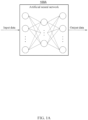
- FIG. 1A illustrates an example of a deep-learning operation using an artificial neural network, according to one or more embodiments.
- An artificial intelligence (AI) algorithm including a deep learning technique may input data to a neural network (NN), train the NN with output data through operations, such as convolution, and extract features by using the trained NN.
- NN neural network
- nodes are connected to each other and collectively operate to process the input data.
- Various types of NNs include, for example, a convolutional neural network (CNN), a recurrent neural network (RNN), a deep belief network (DBN), a restricted Boltzmann machine (RBM) model, and so forth, but examples are not limited thereto.
- CNN convolutional neural network
- RNN deep belief network
- RBM restricted Boltzmann machine
- neurons may have links to other neurons. Such links may extend through the neural network in one direction, for example, in a forward direction.
- FIG. 1A illustrates a structure of an NN 100A (e.g., a CNN) for receiving input data and outputting output data.
- the NN may be a deep neural network including two or more layers.
- FIG. 1B illustrates an example of an image restoration system.
- the image restoration system may include a training device 100 and an inference device 150.
- the training device 100 may be a computing device having various processing functions, such as generating a neural network, training or learning a neural network, or retraining a neural network.
- the training device 100 may be implemented as various devices, such as a PC, a server device, or a mobile device.
- the training device 100 may generate one or more trained neural networks 110 by repetitively training or learning a given initial neural network.
- the generating of the one or more trained neural networks 110 may involve determining (training) neural network parameters.
- the neural network parameters may include various types of data, such as input/output activations, weights, and biases that are input to and output from a neural network.
- the parameters of the neural network may be tuned to calculate a more accurate output for a given input.
- the training device 100 may transmit the one or more trained neural networks 110 to the inference device 150.
- the inference device 150 may be included in, for example, a mobile device or an embedded device.
- the inference device 150 may be a piece of hardware dedicated for driving a neural network and may be an electronic device including at least one of a processor, a memory, an input/output (I/O) interface, a display, a communication interface, or a sensor.
- the sensor may include one or more cameras or other imaging sensors to capture images of scenes.
- the inference device 150 may include all the digital devices that include a memory element and a microprocessor and have an operational capability, such as a tablet PC, a smartphone, a PC (e.g., a laptop computer), an AI speaker, a smart TV, a mobile phone, a navigation, a web pad, a personal digital assistant (PDA), and a workstation.
- the inference device 150 may be referred to as a scene representation device.
- the inference device 150 may drive the one or more trained neural networks 110 without any change or may drive a neural network 160 to which the one or more trained neural networks 110 are processed (e.g., quantized).
- the inference device 150 for driving the neural network 160 may be implemented in a separate device from the training device 100. However, examples are not limited thereto, and the inference device 150 may be implemented in the same device as the training device 100. In some embodiments, the training device 100 and the inference device 150 are the same device, and the different terms for the same device reflect the different functions (training and inferencing) that the device may perform.
- FIG. 2 illustrates an example 200 of a volume-rendering method.
- a scene may be trained through an NN model. More specifically, when the NN model may be trained by using images captured from discontinuous (discrete) views, and the NN model may learn the scene and the be capable of representing (inferring) a new random view for which it has not been directly trained (i.e., a view not included in the training dataset used to train the NN).
- a ray r may be defined for a pixel position of an image.
- the ray r is a straight line generated when viewing a 3D object from a certain viewpoint (e.g., a position of a virtual camera).
- Sampling data may be obtained by sampling points on the ray.
- the sampling data may include sampling points (e.g., 3D points).
- the sampled points on the ray may be sampled a predetermined number of times at a predetermined interval.
- the points on the ray may be sampled k times at a regular interval, and a total of K 3D positions from x1 to xK may be obtained.
- sampling may be irregular or attuned to local conditions.
- the NN model may receive spatial information of the sampling data.
- the spatial information of the sampling data may include spatial information of the ray and sampling information.
- the spatial information of the ray may include a 2D parameter ( ⁇ , ⁇ ) indicating a direction of the ray r.
- the sampling information may include 3D position information (x, y, z) of the sampling data.
- the spatial information of the sampling data may be represented by 5D coordinates (x, y, z, ⁇ , ⁇ ).
- the NN model may receive the spatial information of the sampling data and output, as a result value, a color value c and a volume density ⁇ of a position corresponding to the sampling data.
- the NN may generate rendering data for a voxel, for example, corresponding to the sampling data.
- a color value of a pixel position corresponding to the sampling data may be calculated according to Equation 1 below.
- Equation 1 To render a 2D red, green, and blue (RGB) image of a random (arbitrary) view, inference may be performed for rays of all the respective pixels of the view.
- a transmittance T k (opacity) may be calculated for a current position k, and a volume density of the current position k may be determined.
- a pixel color value may be, for example, a weighted sum performed along the ray, which is represented as Equation 2 below.
- a color value for a ray r may be determined based on a distribution of weights of the ray r.
- the quantity of operations increases as the number of pieces of sampling data increases per ray.
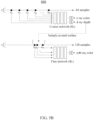
- a color value of a pixel may be mainly determined by sample points corresponding to a surface of a scene. Accordingly, when obtaining an image by sampling only the surface of the scene, the number of pieces of sampling data may decrease and the quantity of operations needed to obtain the image may thus decrease.
- volume-rendering parameters e.g., a weight of a ray or a volume density
- volume-rendering parameters e.g., a weight of a ray or a volume density
- Scene representation methods may transform a distribution of volume-rendering parameters to fit for a desired feature (e.g., focusing the distribution near the surface of the scene).
- FIG. 3 illustrates an example 300 of entropy.
- Shannon entropy may be used to quantify a probability density function (PDF) distribution.
- PDF probability density function
- the Shannon entropy is a metric that was first proposed in an information theory field, and entropy of a PDF distribution X may be defined as Equation 3 below.
- FIG. 3 is a diagram illustrating an example of a Shannon entropy.
- entropy may decrease the more tightly probabilities cluster around a certain bin.
- entropy in a graph 310 may be lower than entropy in a graph 320 and entropy in a graph 330 may be lower than entropy in a graph 340.
- Equation 4 A Rényi entropy is defined as Equation 4 below.
- the Rényi entropy changes the form based on a ⁇ value.
- the Rényi entropy may be the same as the Shannon entropy.
- the argument of the -log function may need to increase to decrease entropy value. Therefore, the argument of the -log function may be maximized to gather (concentrate) a PDF distribution in a certain bin.
- the argument in Equation 5 may be defined as an information potential (IP).
- FIG. 4 illustrates an example of a data processing method for training scene representation.
- operations 410 to 450 may be performed by the training device 200 described above with reference to FIG. 1B .
- operations 410 to 440 may be performed any suitable electronic device in any suitable system.
- the operations of FIG. 4 may be performed in the shown order and manner. However, the order of some operations may be changed or omitted without departing from the scope of the shown example.
- the operations illustrated in FIG. 4 may be performed in parallel or simultaneously.
- the training device 200 may obtain spatial information of sampling data.
- the spatial information of the sampling data may include spatial information of a ray and sampling information (e.g., sample points), which may be represented by 5D coordinates (x, y, z, ⁇ , ⁇ ) of respective sample points.
- the training device 200 may obtain/generate one or more volume-rendering parameters by inputting the spatial information of the sampling data to an NN model.
- the volume-rendering parameters may be used to perform volume rendering and may include, for example, a weight of a ray, a volume density, and/or a color value.
- the training device 200 may obtain a regularization term based on a distribution of the volume-rendering parameters.
- the regularization term may be used to force the distribution of the volume-rendering parameters to gather or cluster in a certain position.
- the training device 200 may obtain the regularization term based on a metric for quantifying a feature of the distribution of the volume-rendering parameters. For example, the training device 200 may obtain entropy corresponding to the distribution of the volume-rendering parameters and obtain an IP corresponding to the volume-rendering parameters, based on the entropy. Detailed methods of transforming the distribution of the volume-rendering parameters by using the regularization term are described below.
- the training device 200 may perform volume rendering based on the volume-rendering parameters.
- the performing of the volume rendering may be an operation of determining a pixel value corresponding to a ray, based on a volume density and a color value of sampling data sampled on the ray.
- the training device 200 may generate an estimated image corresponding to a view of a scene by performing volume rendering on all the pixels of the view.
- the training device 200 may train the NN model to minimize a loss function that is determined based on the regularization term and a difference between a ground truth (GT) image and the image estimated through the volume rendering.
- GT ground truth
- the training device 200 may train the NN model such that the distribution of the volume-rendering parameters has a predetermined feature.
- the training device 200 may train the NN model such that the distribution of the volume-rendering parameters is focused on a surface of a scene.
- the training device 200 may train the NN model to maximize an IP.
- FIGS. 5A and 5B each illustrate an example of training an NN model 500.
- the NN model 500 may include a first network and a second network.
- the first network may be referred to as a coarse network
- the second network may be referred to as a fine network.
- the training device 200 may obtain a color value by using the first network.
- the training device 200 may determine additional sampling data based on an output of the first network and perform volume rendering by inputting the additional sampling data to the second network.
- the training device 200 may train the NN model by using a loss function obtained by adding a second loss function to a first loss function.
- the first loss function may be referred to as a photometric loss, that is, a loss function determined based on a difference between a ground truth image and an image estimated through volume rendering.
- the second loss function may be a loss function determined based on a regularization term.
- the second loss function may be a loss function determined based on an entropy-based regularization term.
- L p ( ⁇ c , ⁇ f ) denotes the first loss function
- R( ⁇ c ) denotes the second loss function
- ⁇ c denotes a trained first network (e.g., a coarse network)
- ⁇ f denotes a trained second network (e.g., a fine network).
- ⁇ denotes a parameter for adjusting the contribution of the regularization term.
- the first loss function L p ( ⁇ c , ⁇ f ) may be defined as Equation 7 below.
- L p ⁇ c ⁇ f ⁇ r ⁇ R ⁇ C ⁇ r ⁇ c ⁇ C r ⁇ 2 2 + ⁇ C ⁇ r ⁇ f ⁇ C r ⁇ 2 2
- Equation 7 ⁇ denotes the image (e.g., an RGB value of the image) estimated through volume rendering and C denotes the ground truth image (e.g., an RGB value of the ground truth image).
- the training device 200 may output depth information together with a color value by using the first network.
- the training device 200 may determine a sampling section based on the depth information of the first network. For example, the training device 200 may determine a surface area of a scene, based on the depth information of the first network, and determine the surface area of the scene to be the sampling section.
- the training device 200 may perform sampling on the determined sampling section and perform volume rendering by inputting the sampling data (sampled for the section) to the second network.
- FIG. 6 illustrates an example of a scene representation method.
- operations 610 and 620 may be performed by the inference device 150 described above with reference to FIG. 1B .
- operations 610 and 620 may be performed by any suitable electronic device in any suitable system.
- FIG. 6 may be performed in the shown order and manner. However, the order of some operations may be changed or omitted without departing from the scope of the shown example. The operations illustrated in FIG. 6 may be performed in parallel or simultaneously.
- the inference device 150 may perform inference by using an NN trained to transform a distribution of volume-rendering parameters to a certain position (e.g., a surface of a scene). In other words, the inference device 150 may perform sampling for obtaining a decreased number of pieces of sampling data in a position corresponding to the transformed distribution of the volume-rendering parameters instead of sampling performed at a regular interval on an arbitrary ray. Accordingly, the inference device 150 may decrease the number of operations needed for volume rendering.
- the inference device 150 may obtain spatial information of sampling data.
- the spatial information of the sampling data may include spatial information of a ray and sampling information, which may be represented by 5D coordinates (x, y, z, ⁇ , ⁇ ).
- the sampling information may be determined based on a distribution of one or more parameters for volume rendering.
- the sampling information may include of position information and/or information on the number of pieces of sampling data.
- the inference device 150 may obtain a depth map corresponding to a scene. For example, the inference device 150 may obtain the depth map corresponding to the scene by using an NN for estimating a depth map.
- the inference device 150 may obtain surface information corresponding to the scene. For example, the inference device 150 may obtain the surface information corresponding to the scene based on the depth map.
- the inference device 150 may perform volume rendering by inputting the spatial information of the sampling data to an NN model.
- the inference device 150 may obtain a volume density and a color value corresponding to the spatial information of the sampling data and perform volume rendering based on the volume density and the color value.
- the NN model may be trained to transform the distribution of the one or more parameters to be used to perform the volume rendering.
- FIG. 7 illustrates an example 700 of an inference operation of an NN model.
- the ANN model may include a first network and a second network.
- the first network may be referred to as a coarse network
- the second network may be referred to as a fine network.
- the inference device 150 may obtain a color value by using the first network.
- the inference device 150 may obtain depth information by using the second network.
- the inference device 150 may estimate the position of a surface of a scene, based on the depth information, perform sampling based on an estimated surface, and perform volume rendering by inputting sampling data to the second network.
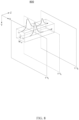
- FIG. 8 illustrates an example of determining a regularization term by considering a surrounding distribution of parameters.
- an ANN model may determine the regularization term by considering the surrounding distribution of parameters (e.g., a weight) together with a current pixel position, which is defined as Equation 8 below.
- W x denotes a set of sample positions that are within a certain area centered on a pixel position x.
- the certain area may be 2D or 3D.
- the certain area may be 3*3, 5*5, 3*3*3, or 5*5*5.
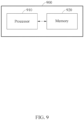
- FIG. 9 illustrates an example of a training device.
- a training device 900 may include one or more processors 910 and a memory 920.
- the memory 920 may store computer-readable instructions. When the computer-readable instructions stored in the memory 920 are executed by the processor 910, the processor 910 may process operations defined by the computer-readable instructions.
- the memory 920 may include, for example, random access memory (RAM), dynamic RAM (DRAM), static RAM (SRAM), or other types of non-volatile memory known in the art.
- the one or more processors 910 may control the overall operation of the training device 900.
- the processor 910 may be a hardware-implemented device having a circuit that is physically structured to execute desired operations.
- the desired operations may include instructions or code included in a program.
- the hardware-implemented device may include, for example, a microprocessor, a central processing unit (CPU), a graphics processing unit (GPU), a processor core, a multi-core processor, a multiprocessor, an application-specific integrated circuit (ASIC), a field-programmable gate array (FPGA), and a neural processing unit (NPU).
- CPU central processing unit
- GPU graphics processing unit
- ASIC application-specific integrated circuit
- FPGA field-programmable gate array
- NPU neural processing unit
- the processor 910 may control the training device 900 by executing instructions and functions to be executed by the training device 900.
- the training device 900 under control by the processor 910, may obtain spatial information of sampling data, obtain one or more volume-rendering parameters by inputting the spatial information of the sampling data to an ANN model, obtain a regularization term based on a distribution of the volume-rendering parameters, perform volume rendering based on the volume-rendering parameters, and train the ANN model to minimize a loss function determined based on the regularization term and a difference between a ground truth image and an image that is estimated through the volume rendering.
- FIG. 10 illustrates an example configuration of an inference device.
- an inference device 1000 may include one or more processors 1010 and a memory 1020.
- the memory 1020 may store computer-readable instructions. When the computer-readable instructions stored in the memory 1020 are executed by the processor 1010, the processor 1010 may process operations defined by the computer-readable instructions.
- the memory 1020 may include, for example, RAM, DRAM, SRAM, or other types of non-volatile memory known in the art.
- the memory 1020 may store a pre-trained ANN model.
- the one or more processors 1010 may control the overall operation of the inference device 1000.
- the processor 1010 may be a hardware-implemented device having a circuit that is physically structured to execute desired operations.
- the desired operations may include instructions or code included in a program.
- the hardware-implemented device may include, for example, a microprocessor, a CPU, a GPU, a processor core, a multi-core processor, a multiprocessor, an ASIC, an FPGA, and an NPU.
- the processor 1010 may control the inference device 1000 by executing instructions and functions to be executed by the inference device 1000.
- the inference device 1000 under control of the processor 1010, may obtain spatial information of sampling data and perform volume rendering by inputting the spatial information of the sampling data to an ANN model, in which the spatial information of the sampling data is determined based on a distribution of one or more parameters needed to perform the volume rendering.
- the computing apparatuses, the electronic devices, the processors, the memories, the image sensors, the displays, the information output system and hardware, the storage devices, and other apparatuses, devices, units, modules, and components described herein with respect to FIGS. 1-10 are implemented by or representative of hardware components.
- hardware components that may be used to perform the operations described in this application where appropriate include controllers, sensors, generators, drivers, memories, comparators, arithmetic logic units, adders, subtractors, multipliers, dividers, integrators, and any other electronic components configured to perform the operations described in this application.
- one or more of the hardware components that perform the operations described in this application are implemented by computing hardware, for example, by one or more processors or computers.
- a processor or computer may be implemented by one or more processing elements, such as an array of logic gates, a controller and an arithmetic logic unit, a digital signal processor, a microcomputer, a programmable logic controller, a field-programmable gate array, a programmable logic array, a microprocessor, or any other device or combination of devices that is configured to respond to and execute instructions in a defined manner to achieve a desired result.
- a processor or computer includes, or is connected to, one or more memories storing instructions or software that are executed by the processor or computer.
- Hardware components implemented by a processor or computer may execute instructions or software, such as an operating system (OS) and one or more software applications that run on the OS, to perform the operations described in this application.
- OS operating system
- the hardware components may also access, manipulate, process, create, and store data in response to execution of the instructions or software.
- processor or “computer” may be used in the description of the examples described in this application, but in other examples multiple processors or computers may be used, or a processor or computer may include multiple processing elements, or multiple types of processing elements, or both.
- a single hardware component or two or more hardware components may be implemented by a single processor, or two or more processors, or a processor and a controller.
- One or more hardware components may be implemented by one or more processors, or a processor and a controller, and one or more other hardware components may be implemented by one or more other processors, or another processor and another controller.
- One or more processors may implement a single hardware component, or two or more hardware components.
- a hardware component may have any one or more of different processing configurations, examples of which include a single processor, independent processors, parallel processors, single-instruction single-data (SISD) multiprocessing, single-instruction multiple-data (SIMD) multiprocessing, multiple-instruction single-data (MISD) multiprocessing, and multiple-instruction multiple-data (MIMD) multiprocessing.
- SISD single-instruction single-data
- SIMD single-instruction multiple-data
- MIMD multiple-instruction multiple-data
- FIGS. 1-10 that perform the operations described in this application are performed by computing hardware, for example, by one or more processors or computers, implemented as described above implementing instructions or software to perform the operations described in this application that are performed by the methods.
- a single operation or two or more operations may be performed by a single processor, or two or more processors, or a processor and a controller.
- One or more operations may be performed by one or more processors, or a processor and a controller, and one or more other operations may be performed by one or more other processors, or another processor and another controller.
- One or more processors, or a processor and a controller may perform a single operation, or two or more operations.
- Instructions or software to control computing hardware may be written as computer programs, code segments, instructions or any combination thereof, for individually or collectively instructing or configuring the one or more processors or computers to operate as a machine or special-purpose computer to perform the operations that are performed by the hardware components and the methods as described above.
- the instructions or software include machine code that is directly executed by the one or more processors or computers, such as machine code produced by a compiler.
- the instructions or software includes higher-level code that is executed by the one or more processors or computer using an interpreter.
- the instructions or software may be written using any programming language based on the block diagrams and the flow charts illustrated in the drawings and the corresponding descriptions herein, which disclose algorithms for performing the operations that are performed by the hardware components and the methods as described above.
- the instructions or software to control computing hardware for example, one or more processors or computers, to implement the hardware components and perform the methods as described above, and any associated data, data files, and data structures, may be recorded, stored, or fixed in or on one or more non-transitory computer-readable storage media.
- Examples of a non-transitory computer-readable storage medium include read-only memory (ROM), random-access programmable read only memory (PROM), electrically erasable programmable read-only memory (EEPROM), random-access memory (RAM), dynamic random access memory (DRAM), static random access memory (SRAM), flash memory, non-volatile memory, CD-ROMs, CD-Rs, CD+Rs, CD-RWs, CD+RWs, DVD-ROMs, DVD- Rs, DVD+Rs, DVD-RWs, DVD+RWs, DVD-RAMs, BD-ROMs, BD-Rs, BD-R LTHs, BD-REs, blue-ray or optical disk storage, hard disk drive (HDD), solid state drive (SSD), flash memory, a card type memory such as multimedia card micro or a card (for example, secure digital (SD) or extreme digital (XD)), magnetic tapes, floppy disks, magneto-optical data storage devices, optical data storage devices, hard disks, solid
- the instructions or software and any associated data, data files, and data structures are distributed over network-coupled computer systems so that the instructions and software and any associated data, data files, and data structures are stored, accessed, and executed in a distributed fashion by the one or more processors or computers.
Landscapes
- Engineering & Computer Science (AREA)
- Physics & Mathematics (AREA)
- Theoretical Computer Science (AREA)
- General Physics & Mathematics (AREA)
- Computer Graphics (AREA)
- Biophysics (AREA)
- Data Mining & Analysis (AREA)
- Life Sciences & Earth Sciences (AREA)
- Artificial Intelligence (AREA)
- Biomedical Technology (AREA)
- Software Systems (AREA)
- Computational Linguistics (AREA)
- Health & Medical Sciences (AREA)
- Evolutionary Computation (AREA)
- General Health & Medical Sciences (AREA)
- Molecular Biology (AREA)
- Computing Systems (AREA)
- General Engineering & Computer Science (AREA)
- Mathematical Physics (AREA)
- Computer Vision & Pattern Recognition (AREA)
- Image Analysis (AREA)
Applications Claiming Priority (1)
| Application Number | Priority Date | Filing Date | Title |
|---|---|---|---|
| KR1020220099247A KR20240020922A (ko) | 2022-08-09 | 2022-08-09 | 장면 표현 방법 및 장치 |
Publications (1)
| Publication Number | Publication Date |
|---|---|
| EP4322112A1 true EP4322112A1 (fr) | 2024-02-14 |
Family
ID=85772786
Family Applications (1)
| Application Number | Title | Priority Date | Filing Date |
|---|---|---|---|
| EP23164183.8A Pending EP4322112A1 (fr) | 2022-08-09 | 2023-03-24 | Procédé et dispositif de représentation de scènes rendues |
Country Status (4)
| Country | Link |
|---|---|
| US (1) | US12573129B2 (fr) |
| EP (1) | EP4322112A1 (fr) |
| KR (1) | KR20240020922A (fr) |
| CN (1) | CN117593431A (fr) |
Families Citing this family (1)
| Publication number | Priority date | Publication date | Assignee | Title |
|---|---|---|---|---|
| US12236517B2 (en) * | 2021-11-16 | 2025-02-25 | Disney Enterprises, Inc. | Techniques for multi-view neural object modeling |
Family Cites Families (3)
| Publication number | Priority date | Publication date | Assignee | Title |
|---|---|---|---|---|
| US8243071B2 (en) * | 2008-02-29 | 2012-08-14 | Microsoft Corporation | Modeling and rendering of heterogeneous translucent materials using the diffusion equation |
| KR20230044148A (ko) | 2020-07-31 | 2023-04-03 | 구글 엘엘씨 | 비제약 이미지 데이터에 강건한 뷰 합성 |
| CN113888689B (zh) | 2021-11-05 | 2025-07-25 | 上海壁仞科技股份有限公司 | 图像渲染模型训练、图像渲染方法及装置 |
-
2022
- 2022-08-09 KR KR1020220099247A patent/KR20240020922A/ko active Pending
-
2023
- 2023-01-13 US US18/096,972 patent/US12573129B2/en active Active
- 2023-03-09 CN CN202310257738.5A patent/CN117593431A/zh active Pending
- 2023-03-24 EP EP23164183.8A patent/EP4322112A1/fr active Pending
Non-Patent Citations (4)
| Title |
|---|
| ACU ANA-MARIA ET AL: "Information potential for some probability density functions", APPLIED MATHEMATICS AND COMPUTATION, ELSEVIER, US, vol. 389, 10 August 2020 (2020-08-10), XP086271399, ISSN: 0096-3003, [retrieved on 20200810], DOI: 10.1016/J.AMC.2020.125578 * |
| DI CHANG ET AL: "RC-MVSNet: Unsupervised Multi-View Stereo with Neural Rendering", ARXIV.ORG, CORNELL UNIVERSITY LIBRARY, 201 OLIN LIBRARY CORNELL UNIVERSITY ITHACA, NY 14853, 13 July 2022 (2022-07-13), XP091269627 * |
| MILDENHALL BEN ET AL: "NeRF: Representing Scenes as Neural Radiance Fields for View Synthesis", 2020, TOPICS IN CRYPTOLOGY - CT-RSA 2020 : THE CRYPTOGRAPHERS' TRACK AT THE RSA CONFERENCE 2020, SAN FRANCISCO, CA, USA, FEBRUARY 24-28, 2020, PAGE(S) 405 - 421, XP047569510 * |
| OECHSLE MICHAEL ET AL: "UNISURF: Unifying Neural Implicit Surfaces and Radiance Fields for Multi-View Reconstruction", 2021 IEEE/CVF INTERNATIONAL CONFERENCE ON COMPUTER VISION (ICCV), IEEE, 10 October 2021 (2021-10-10), pages 5569 - 5579, XP034092181, DOI: 10.1109/ICCV48922.2021.00554 * |
Also Published As
| Publication number | Publication date |
|---|---|
| US20240054716A1 (en) | 2024-02-15 |
| US12573129B2 (en) | 2026-03-10 |
| KR20240020922A (ko) | 2024-02-16 |
| CN117593431A (zh) | 2024-02-23 |
Similar Documents
| Publication | Publication Date | Title |
|---|---|---|
| US11900610B2 (en) | Image processing apparatus and method | |
| Chen et al. | Learning to predict 3d objects with an interpolation-based differentiable renderer | |
| US12183020B2 (en) | Method and apparatus to complement depth image | |
| US12602898B2 (en) | Neural semantic fields for generalizable semantic segmentation of 3D scenes | |
| Che et al. | Towards learning-based inverse subsurface scattering | |
| EP3945497B1 (fr) | Procédé et appareil d'estimation de profondeur d'image | |
| EP4100884B1 (fr) | Unité récurrente pour générer ou traiter une séquence d'images | |
| EP4350631A2 (fr) | Dispositif et procédé de reconstruction de scène bidimensionnelle pour espace tridimensionnel dynamique | |
| US20240290007A1 (en) | Method and device with image generation based on neural scene representation | |
| EP4350632A2 (fr) | Procédé et appareil avec rendu neuronal basé sur une augmentation de vue | |
| US20240144584A1 (en) | Method and device with model for 3d scene generation | |
| US20230196651A1 (en) | Method and apparatus with rendering | |
| US20250086953A1 (en) | Electronic device and method with birds-eye-view image processing | |
| US20240362894A1 (en) | Apparatus and method with image processing | |
| EP4446972A1 (fr) | Procédé et appareil avec super-échantillonnage | |
| EP4375943A1 (fr) | Dispositif et procédé d'estimation d'informations de composant de scène | |
| EP4350634B1 (fr) | Procédé et appareil avec données de représentation de scène neuronale | |
| US20240257503A1 (en) | Method and apparatus with neural network model for scene representation | |
| EP4322112A1 (fr) | Procédé et dispositif de représentation de scènes rendues | |
| EP4651096A1 (fr) | Procédé et appareil avec détection d'objet tridimensionnel | |
| US12614296B2 (en) | Method and apparatus with depth information estimation | |
| EP4369311A1 (fr) | Dispositif électronique et procédé de traitement d'image | |
| Nagano et al. | Massively parallel inverse rendering using Multi-objective Particle Swarm Optimization | |
| EP4191526A1 (fr) | Appareil et procédé d'estimation de posture d'objet | |
| US12541919B2 (en) | Method and device with synthetic image generation |
Legal Events
| Date | Code | Title | Description |
|---|---|---|---|
| PUAI | Public reference made under article 153(3) epc to a published international application that has entered the european phase |
Free format text: ORIGINAL CODE: 0009012 |
|
| STAA | Information on the status of an ep patent application or granted ep patent |
Free format text: STATUS: THE APPLICATION HAS BEEN PUBLISHED |
|
| AK | Designated contracting states |
Kind code of ref document: A1 Designated state(s): AL AT BE BG CH CY CZ DE DK EE ES FI FR GB GR HR HU IE IS IT LI LT LU LV MC ME MK MT NL NO PL PT RO RS SE SI SK SM TR |
|
| P01 | Opt-out of the competence of the unified patent court (upc) registered |
Effective date: 20240530 |
|
| STAA | Information on the status of an ep patent application or granted ep patent |
Free format text: STATUS: REQUEST FOR EXAMINATION WAS MADE |
|
| 17P | Request for examination filed |
Effective date: 20240814 |
|
| RBV | Designated contracting states (corrected) |
Designated state(s): AL AT BE BG CH CY CZ DE DK EE ES FI FR GB GR HR HU IE IS IT LI LT LU LV MC ME MK MT NL NO PL PT RO RS SE SI SK SM TR |
|
| STAA | Information on the status of an ep patent application or granted ep patent |
Free format text: STATUS: EXAMINATION IS IN PROGRESS |
|
| 17Q | First examination report despatched |
Effective date: 20251107 |