EP4322159A2 - Procédé et appareil pour commander un masquage de perte de trame audio - Google Patents
Procédé et appareil pour commander un masquage de perte de trame audio Download PDFInfo
- Publication number
- EP4322159A2 EP4322159A2 EP23202489.3A EP23202489A EP4322159A2 EP 4322159 A2 EP4322159 A2 EP 4322159A2 EP 23202489 A EP23202489 A EP 23202489A EP 4322159 A2 EP4322159 A2 EP 4322159A2
- Authority
- EP
- European Patent Office
- Prior art keywords
- frame
- spectrum
- signal
- phase
- frequency
- Prior art date
- Legal status (The legal status is an assumption and is not a legal conclusion. Google has not performed a legal analysis and makes no representation as to the accuracy of the status listed.)
- Granted
Links
Images


Classifications
-
- G—PHYSICS
- G10—MUSICAL INSTRUMENTS; ACOUSTICS
- G10L—SPEECH ANALYSIS TECHNIQUES OR SPEECH SYNTHESIS; SPEECH RECOGNITION; SPEECH OR VOICE PROCESSING TECHNIQUES; SPEECH OR AUDIO CODING OR DECODING
- G10L19/00—Speech or audio signals analysis-synthesis techniques for redundancy reduction, e.g. in vocoders; Coding or decoding of speech or audio signals, using source filter models or psychoacoustic analysis
- G10L19/005—Correction of errors induced by the transmission channel, if related to the coding algorithm
-
- G—PHYSICS
- G10—MUSICAL INSTRUMENTS; ACOUSTICS
- G10L—SPEECH ANALYSIS TECHNIQUES OR SPEECH SYNTHESIS; SPEECH RECOGNITION; SPEECH OR VOICE PROCESSING TECHNIQUES; SPEECH OR AUDIO CODING OR DECODING
- G10L19/00—Speech or audio signals analysis-synthesis techniques for redundancy reduction, e.g. in vocoders; Coding or decoding of speech or audio signals, using source filter models or psychoacoustic analysis
- G10L19/0017—Lossless audio signal coding; Perfect reconstruction of coded audio signal by transmission of coding error
-
- G—PHYSICS
- G10—MUSICAL INSTRUMENTS; ACOUSTICS
- G10L—SPEECH ANALYSIS TECHNIQUES OR SPEECH SYNTHESIS; SPEECH RECOGNITION; SPEECH OR VOICE PROCESSING TECHNIQUES; SPEECH OR AUDIO CODING OR DECODING
- G10L19/00—Speech or audio signals analysis-synthesis techniques for redundancy reduction, e.g. in vocoders; Coding or decoding of speech or audio signals, using source filter models or psychoacoustic analysis
- G10L19/02—Speech or audio signals analysis-synthesis techniques for redundancy reduction, e.g. in vocoders; Coding or decoding of speech or audio signals, using source filter models or psychoacoustic analysis using spectral analysis, e.g. transform vocoders or subband vocoders
-
- G—PHYSICS
- G10—MUSICAL INSTRUMENTS; ACOUSTICS
- G10L—SPEECH ANALYSIS TECHNIQUES OR SPEECH SYNTHESIS; SPEECH RECOGNITION; SPEECH OR VOICE PROCESSING TECHNIQUES; SPEECH OR AUDIO CODING OR DECODING
- G10L19/00—Speech or audio signals analysis-synthesis techniques for redundancy reduction, e.g. in vocoders; Coding or decoding of speech or audio signals, using source filter models or psychoacoustic analysis
- G10L19/02—Speech or audio signals analysis-synthesis techniques for redundancy reduction, e.g. in vocoders; Coding or decoding of speech or audio signals, using source filter models or psychoacoustic analysis using spectral analysis, e.g. transform vocoders or subband vocoders
- G10L19/0204—Speech or audio signals analysis-synthesis techniques for redundancy reduction, e.g. in vocoders; Coding or decoding of speech or audio signals, using source filter models or psychoacoustic analysis using spectral analysis, e.g. transform vocoders or subband vocoders using subband decomposition
-
- G—PHYSICS
- G10—MUSICAL INSTRUMENTS; ACOUSTICS
- G10L—SPEECH ANALYSIS TECHNIQUES OR SPEECH SYNTHESIS; SPEECH RECOGNITION; SPEECH OR VOICE PROCESSING TECHNIQUES; SPEECH OR AUDIO CODING OR DECODING
- G10L19/00—Speech or audio signals analysis-synthesis techniques for redundancy reduction, e.g. in vocoders; Coding or decoding of speech or audio signals, using source filter models or psychoacoustic analysis
- G10L19/02—Speech or audio signals analysis-synthesis techniques for redundancy reduction, e.g. in vocoders; Coding or decoding of speech or audio signals, using source filter models or psychoacoustic analysis using spectral analysis, e.g. transform vocoders or subband vocoders
- G10L19/022—Blocking, i.e. grouping of samples in time; Choice of analysis windows; Overlap factoring
- G10L19/025—Detection of transients or attacks for time/frequency resolution switching
-
- G—PHYSICS
- G10—MUSICAL INSTRUMENTS; ACOUSTICS
- G10L—SPEECH ANALYSIS TECHNIQUES OR SPEECH SYNTHESIS; SPEECH RECOGNITION; SPEECH OR VOICE PROCESSING TECHNIQUES; SPEECH OR AUDIO CODING OR DECODING
- G10L19/00—Speech or audio signals analysis-synthesis techniques for redundancy reduction, e.g. in vocoders; Coding or decoding of speech or audio signals, using source filter models or psychoacoustic analysis
- G10L19/04—Speech or audio signals analysis-synthesis techniques for redundancy reduction, e.g. in vocoders; Coding or decoding of speech or audio signals, using source filter models or psychoacoustic analysis using predictive techniques
- G10L19/06—Determination or coding of the spectral characteristics, e.g. of the short-term prediction coefficients
-
- G—PHYSICS
- G10—MUSICAL INSTRUMENTS; ACOUSTICS
- G10L—SPEECH ANALYSIS TECHNIQUES OR SPEECH SYNTHESIS; SPEECH RECOGNITION; SPEECH OR VOICE PROCESSING TECHNIQUES; SPEECH OR AUDIO CODING OR DECODING
- G10L25/00—Speech or voice analysis techniques not restricted to a single one of groups G10L15/00 - G10L21/00
- G10L25/45—Speech or voice analysis techniques not restricted to a single one of groups G10L15/00 - G10L21/00 characterised by the type of analysis window
-
- G—PHYSICS
- G10—MUSICAL INSTRUMENTS; ACOUSTICS
- G10L—SPEECH ANALYSIS TECHNIQUES OR SPEECH SYNTHESIS; SPEECH RECOGNITION; SPEECH OR VOICE PROCESSING TECHNIQUES; SPEECH OR AUDIO CODING OR DECODING
- G10L25/00—Speech or voice analysis techniques not restricted to a single one of groups G10L15/00 - G10L21/00
- G10L25/48—Speech or voice analysis techniques not restricted to a single one of groups G10L15/00 - G10L21/00 specially adapted for particular use
- G10L25/69—Speech or voice analysis techniques not restricted to a single one of groups G10L15/00 - G10L21/00 specially adapted for particular use for evaluating synthetic or decoded voice signals
Definitions
- the application relates to methods and apparatuses for controlling a concealment method for a lost audio frame of a received audio signal.
- Conventional audio communication systems transmit speech and audio signals in frames, meaning that the sending side first arranges the signal in short segments or frames of e.g. 20-40 ms which subsequently are encoded and transmitted as a logical unit in e.g. a transmission packet.
- the receiver decodes each of these units and reconstructs the corresponding signal frames, which in turn are finally output as continuous sequence of reconstructed signal samples.
- A/D analog to digital
- A/D analog to digital
- the receiving end there is typically a final D/A conversion step that converts the sequence of reconstructed digital signal samples into a time continuous analog signal for loudspeaker playback.
- the decoder has to generate a substitution signal for each of the erased, i.e. unavailable frames. This is done in the so-called frame loss or error concealment unit of the receiver-side signal decoder.
- the purpose of the frame loss concealment is to make the frame loss as inaudible as possible and hence to mitigate the impact of the frame loss on the reconstructed signal quality as much as possible.
- Conventional frame loss concealment methods may depend on the structure or architecture of the codec, e.g. by applying a form of repetition of previously received codec parameters. Such parameter repetition techniques are clearly dependent on the specific parameters of the used codec and hence not easily applicable for other codecs with a different structure.
- Current frame loss concealment methods may e.g. apply the concept of freezing and extrapolating parameters of a previously received frame in order to generate a substitution frame for the lost frame.
- US2004/122680 describes a system for frame error concealment which teaches to adjust the magnitude of the substitution frame according to the number of consecutive lost frames.
- EP 1 722 359 A1 describes a concealment method including transient detection.
- New schemes for frame loss concealment for speech and audio transmission systems are described.
- the new schemes improve the quality in case of frame loss over the quality achievable with prior-art frame loss concealment techniques.
- the objective of the present embodiments is to control a frame loss concealment scheme that preferably is of the type of the related new methods described such that the best possible sound quality of the reconstructed signal is achieved.
- the embodiments aim at optimizing this reconstruction quality both with respect to the properties of the signal and of the temporal distribution of the frame losses.
- Particularly problematic for the frame loss concealment to provide good quality are cases when the audio signal has strongly varying properties such as energy onsets or offsets or if it is spectrally very fluctuating. In that case the described concealment methods may repeat the onset, offset or spectral fluctuation leading to large deviations from the original signal and corresponding quality loss.
- a method for a frame loss concealment in audio decoding is disclosed.
- an apparatus for a frame loss concealment is disclosed.
- a computer program is disclosed.
- An advantage with an embodiment addresses the control of adaptations frame loss concealment methods allowing mitigating the audible impact of frame loss in the transmission of coded speech and audio signals even further over the quality achieved with only the described concealment methods.
- the general benefit of the embodiments is to provide a smooth and faithful evolution of the reconstructed signal even for lost frames.
- the audible impact of frame losses is greatly reduced in comparison to using state-of-the-art techniques.
- the new controlling scheme for the new frame loss concealment techniques described involve the following steps as shown in Figure 10 . It should be noted that the method can be implemented in a controller in a decoder.
- a first step of the frame loss concealment technique to which the new controlling technique may be applied involves a sinusoidal analysis of a part of the previously received signal.
- K is the number of sinusoids that the signal is assumed to consist of.
- a k is the amplitude
- f k is the frequency
- ⁇ k is the phase.
- the sampling frequency is denominated by f s and the time index of the time discrete signal samples s ( n ) by n.
- a preferred possibility for identifying the frequencies of the sinusoids f k is to make a frequency domain analysis of the analysis frame.
- the analysis frame is transformed into the frequency domain, e.g. by means of DFT or DCT or similar frequency domain transforms.
- DFT DFT of the analysis frame
- w(n) denotes the window function with which the analysis frame of length L is extracted and weighted.
- Other window functions that may be more suitable for spectral analysis are, e.g., Hamming window, Hanning window, Kaiser window or Blackman window.
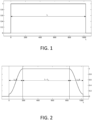
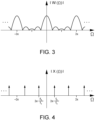
- a window function that is found to be particular useful is a combination of the Hamming window with the rectangular window.
- This window has a rising edge shape like the left half of a Hamming window of length L 1 and a falling edge shape like the right half of a Hamming window of length L 1 and between the rising and falling edges the window is equal to 1 for the length of L-L 1, as shown in Figure 2 .
- constitute an approximation of the required sinusoidal frequencies f k .
- the accuracy of this approximation is however limited by the frequency spacing of the DFT. With the DFT with block length L the accuracy is limited to ⁇ s 2 L .
- the spectrum of the windowed analysis frame is given by the convolution of the spectrum of the window function with the line spectrum of the sinusoidal model signal S ( ⁇ ), subsequently sampled at the grid points of the DFT:
- X m ⁇ 2 ⁇ ⁇ ⁇ ⁇ m ⁇ 2 ⁇ L ⁇ W ⁇ ⁇ S ⁇ ⁇ d ⁇ .
- m k be the DFT index (grid point) of the observed k th peak
- the true sinusoid frequency f k can be assumed to lie within the interval m k ⁇ 1 2 ⁇ ⁇ s L , m k + 1 2 ⁇ ⁇ s L .
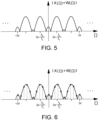
- Figure 3 displays an example of the magnitude spectrum of a window function.
- Figure 4 shows the magnitude spectrum (line spectrum) of an example sinusoidal signal with a single sinusoid of frequency.
- Figure 5 shows the magnitude spectrum of the windowed sinusoidal signal that replicates and superposes the frequency-shifted window spectra at the frequencies of the sinusoid.
- One preferred way to find better approximations of the frequencies f k of the sinusoids is to apply parabolic interpolation.
- One such approach is to fit parabolas through the grid points of the DFT magnitude spectrum that surround the peaks and to calculate the respective frequencies belonging to the parabola maxima.
- a suitable choice for the order of the parabolas is 2. In detail the following procedure can be applied:
- the transmitted signal is harmonic meaning that the signal consists of sine waves which frequencies are integer multiples of some fundamental frequency f 0 . This is the case when the signal is very periodic like for instance for voiced speech or the sustained tones of some musical instrument. This means that the frequencies of the sinusoidal model of the embodiments are not independent but rather have a harmonic relationship and stem from the same fundamental frequency. Taking this harmonic property into account can consequently improve the analysis of the sinusoidal component frequencies substantially.
- the vicinity of f j may be defined as the delta range around f j where delta corresponds to the frequency resolution of the DFT ⁇ s L , i.e. the interval j ⁇ ⁇ 0 ⁇ ⁇ s 2 ⁇ L , j ⁇ ⁇ 0 + ⁇ s 2 ⁇ L .
- f 0,p max can be assumed to be the fundamental frequency with which step 2 is then executed leading to enhanced sinusoidal frequencies ⁇ ⁇ ⁇ k .
- the initial set of candidate values ⁇ f 0,1 ... f 0,P ⁇ can be obtained from the frequencies of the DFT peaks or the estimated sinusoidal frequencies f ⁇ k .
- a further possibility to improve the accuracy of the estimated sinusoidal frequencies f ⁇ k is to consider their temporal evolution.
- the estimates of the sinusoidal frequencies from a multiple of analysis frames can be combined for instance by means of averaging or prediction.
- a peak tracking can be applied that connects the estimated spectral peaks to the respective same underlying sinusoids.
- the window function can be one of the window functions described above in the sinusoidal analysis.
- the frequency domain transformed frame should be identical with the one used during sinusoidal analysis.
- the sinusoidal model assumption is applied.
- the next step is to realize that the spectrum of the used window function has only a significant contribution in a frequency range close to zero.
- the magnitude spectrum of the window function is large for frequencies close to zero and small otherwise (within the normalized frequency range from - ⁇ to ⁇ , corresponding to half the sampling frequency).
- an approximation of the window function spectrum is used such that for each k the contributions of the shifted window spectra in the above expression are strictly non-overlapping.
- ⁇ is set to floor round f k + 1 f s ⁇ L ⁇ round f k f s ⁇ L 2 such that it is ensured that the intervals are not overlapping.
- the function floor ( ⁇ ) is the closest integer to the function argument that is smaller or equal to it.
- the next step according to the embodiment is to apply the sinusoidal model according to the above expression and to evolve its K sinusoids in time.
- a specific embodiment addresses phase randomization for DFT indices not belonging to any interval M k .
- the intervals should be larger if the signal is very tonal, i.e. when it has clear and distinct spectral peaks. This is the case for instance when the signal is harmonic with a clear periodicity. In other cases where the signal has less pronounced spectral structure with broader spectral maxima, it has been found that using small intervals leads to better quality. This finding leads to a further improvement according to which the interval size is adapted according to the properties of the signal.
- One realization is to use a tonality or a periodicity detector. If this detector identifies the signal as tonal, the ⁇ -parameter controlling the interval size is set to a relatively large value. Otherwise, the ⁇ -parameter is set to relatively smaller values.
- the audio frame loss concealment methods involve the following steps:
- the methods described above are based on the assumption that the properties of the audio signal do not change significantly during the short time duration from the previously received and reconstructed signal frame and a lost frame. In that case it is a very good choice to retain the magnitude spectrum of the previously reconstructed frame and to evolve the phases of the sinusoidal main components detected in the previously reconstructed signal. There are however cases where this assumption is wrong which are for instance transients with sudden energy changes or sudden spectral changes.
- a first embodiment of a transient detector according to the invention can consequently be based on energy variations within the previously reconstructed signal.
- This method illustrated in Figure 11 , calculates the energy in a left part and a right part of some analysis frame 113.
- the analysis frame may be identical to the frame used for sinusoidal analysis described above.
- a part (either left or right) of the analysis frame may be the first or respectively the last half of the analysis frame or e.g. the first or respectively the last quarter of the analysis frame, 110.
- y ( n ) denotes the analysis frame
- n left and n right denote the respective start indices of the partial frames that are both of size N part .
- a discontinuity with sudden energy decrease can be detected if the ratio R l / r exceeds some threshold (e.g. 10), 115.
- a discontinuity with sudden energy increase can be detected if the ratio R l / r is below some other threshold (e.g. 0.1), 117.
- the above defined energy ratio may in many cases be a too insensitive indicator.
- a tone at some frequency suddenly emerges while some other tone at some other frequency suddenly stops.
- Analyzing such a signal frame with the above-defined energy ratio would in any case lead to a wrong detection result for at least one of the tones since this indicator is insensitive to different frequencies.
- the transient detection is now done in the time frequency plane.
- the analysis frame is again partitioned into a left and a right partial frame, 110.
- these two partial frames are (after suitable windowing with e.g. a Hamming window, 111 ) transformed into the frequency domain, e.g. by means of a N part -point DFT, 112.
- Y left m DFT y n ⁇ n left N part
- the transient detection can be done frequency selectively for each DFT bin with index m.
- the lowest lower frequency band boundary m 0 can be set to 0 but may also be set to a DFT index corresponding to a larger frequency in order to mitigate estimation errors that grow with lower frequencies.
- the highest upper frequency band boundary m k can be set to N part 2 but is preferably chosen to correspond to some lower frequency in which a transient still has a significant audible effect.
- a suitable choice for these frequency band sizes or widths is either to make them equal size with e.g. a width of several 100 Hz.
- Another preferred way is to make the frequency band widths following the size of the human auditory critical bands, i.e. to relate them to the frequency resolution of the auditory system. This means approximately to make the frequency band widths equal for frequencies up to 1kHz and to increase them exponentially above 1 kHz. Exponential increase means for instance to double the frequency bandwidth when incrementing the band index k .
- any of the ratios related to band energies or DFT bin energies of two partial frames are compared to certain thresholds.
- a respective upper threshold for (frequency selective) offset detection 115 and a respective lower threshold for (frequency selective) onset detection 117 is used.
- a further audio signal dependent indicator that is suitable for an adaptation of the frame loss concealment method can be based on the codec parameters transmitted to the decoder.
- the codec may be a multi-mode codec like ITU-T G.718. Such codec may use particular codec modes for different signal types and a change of the codec mode in a frame shortly before the frame loss may be regarded as an indicator for a transient.
- voicing Another useful indicator for adaptation of the frame loss concealment is a codec parameter related to a voicing property and the transmitted signal.
- voicing relates to highly periodic speech that is generated by a periodic glottal excitation of the human vocal tract.
- a further preferred indicator is whether the signal content is estimated to be music or speech.
- Such an indicator can be obtained from a signal classifier that may typically be part of the codec.
- this parameter is preferably used as signal content indicator to be used for adapting the frame loss concealment method.
- burstiness of frame losses means that there occur several frame losses in a row, making it hard for the frame loss concealment method to use valid recently decoded signal portions for its operation.
- a state-of-the-art indicator is the number n burst of observed frame losses in a row. This counter is incremented with one upon each frame loss and reset to zero upon the reception of a valid frame. This indicator is also used in the context of the present example embodiments of the invention.
- the general objective with introducing magnitude adaptations is to avoid audible artifacts of the frame loss concealment method.
- Such artifacts may be musical or tonal sounds or strange sounds arising from repetitions of transient sounds. Such artifacts would in turn lead to quality degradations, which avoidance is the objective of the described adaptations.
- a suitable way to such adaptations is to modify the magnitude spectrum of the substitution frame to a suitable degree.
- Figure 12 illustrates an embodiment of concealment method modification.
- Att_per_frame a logarithmic parameter specifying a logarithmic increase in attenuation per frame
- the constant c is mere a scaling constant allowing to specify the parameter att_per_frame for instance in decibels (dB).
- An additional preferred adaptation is done in response to the indicator whether the signal is estimated to be music or speech.
- music content in comparison with speech content it is preferable to increase the threshold thr burst and to decrease the attenuation per frame. This is equivalent with performing the adaptation of the frame loss concealment method with a lower degree.
- the background of this kind of adaptation is that music is generally less sensitive to longer loss bursts than speech.
- the original, i.e. the unmodified frame loss concealment method is still preferable for this case, at least for a larger number of frame losses in a row.
- a further adaptation of the concealment method with regards to the magnitude attenuation factor is preferably done in case a transient has been detected based on that the indicator R l / r, band ( k ) or alternatively R l / r ( m ) or R l / r , have passed a threshold, 122.
- a suitable adaptation action, 125 is to modify the second magnitude attenuation factor ⁇ ( m ) such that the total attenuation is controlled by the product of the two factors ⁇ ( m ) ⁇ ⁇ ( m ) .
- ⁇ ( m ) is set in response to an indicated transient.
- the factor ⁇ ( m ) is preferably be chosen to reflect the energy decrease of the offset.
- the factor can be set to some fixed value of e.g. 1, meaning that there is no attenuation but not any amplification either.
- the magnitude attenuation factor is preferably applied frequency selectively, i.e. with individually calculated factors for each frequency band.
- the corresponding magnitude attenuation factors can still be obtained in an analogue way.
- ⁇ ( m ) can then be set individually for each DFT bin in case frequency selective transient detection is used on DFT bin level. Or, in case no frequency selective transient indication is used at all ⁇ ( m ) can be globally identical for all m.
- a further preferred adaptation of the magnitude attenuation factor is done in conjunction with a modification of the phase by means of the additional phase component ⁇ ( m ) 127.
- the attenuation factor ⁇ ( m ) is reduced even further.
- the degree of phase modification is taken into account. If the phase modification is only moderate, ⁇ ( m ) is only scaled down slightly, while if the phase modification is strong, ⁇ ( m ) is scaled down to a larger degree.
- phase adaptations The general objective with introducing phase adaptations is to avoid too strong tonality or signal periodicity in the generated substitution frames, which in turn would lead to quality degradations.
- a suitable way to such adaptations is to randomize or dither the phase to a suitable degree.
- the random value obtained by the function rand( ⁇ ) is for instance generated by some pseudo-random number generator. It is here assumed that it provides a random number within the interval [0, 2 ⁇ ].
- the scaling factor ⁇ ( m ) in the above equation control the degree by which the original phase ⁇ k is dithered.
- the following embodiments address the phase adaptation by means of controlling this scaling factor.
- the control of the scaling factor is done in an analogue way as the control of the magnitude modification factors described above.
- ⁇ ( m ) has to be limited to a maximum value of 1 for which full phase dithering is achieved.
- burst loss threshold value thr burst used for initiating phase dithering may be the same threshold as the one used for magnitude attenuation. However, better quality can be obtained by setting these thresholds to individually optimal values, which generally means that these thresholds may be different.
- An additional preferred adaptation is done in response to the indicator whether the signal is estimated to be music or speech.
- the background of this kind of adaptation is that music is generally less sensitive to longer loss bursts than speech.
- the original, i.e. unmodified frame loss concealment method is still preferable for this case, at least for a larger number of frame losses in a row.
- a further preferred embodiment is to adapt the phase dithering in response to a detected transient.
- a stronger degree of phase dithering can be used for the DFT bins m for which a transient is indicated either for that bin, the DFT bins of the corresponding frequency band or of the whole frame.
- FIG. 13 is a schematic block diagram of a decoder according to the embodiments.
- the decoder 130 comprises an input unit 132 configured to receive an encoded audio signal.
- the figure illustrates the frame loss concealment by a logical frame loss concealment-unit 134, which indicates that the decoder is configured to implement a concealment of a lost audio frame, according to the above-described embodiments.
- the decoder comprises a controller 136 for implementing the embodiments described above.
- the controller 136 is configured to detect conditions in the properties of the previously received and reconstructed audio signal or in the statistical properties of the observed frame losses for which the substitution of a lost frame according to the described methods provides relatively reduced quality.
- the detection can be performed by a detector unit 146 and modifying can be performed by a modifier unit 148 as illustrated in Figure 14 .
- the decoder with its including units could be implemented in hardware.
- circuitry elements that can be used and combined to achieve the functions of the units of the decoder. Such variants are encompassed by the embodiments.
- Particular examples of hardware implementation of the decoder is implementation in digital signal processor (DSP) hardware and integrated circuit technology, including both general-purpose electronic circuitry and application-specific circuitry.
- DSP digital signal processor
- the decoder 150 described herein could alternatively be implemented e.g. as illustrated in Figure 15 , i.e. by one or more of a processor 154 and adequate software 155 with suitable storage or memory 156 therefore, in order to reconstruct the audio signal, which includes performing audio frame loss concealment according to the embodiments described herein, as shown in Figure 13 .
- the incoming encoded audio signal is received by an input (IN) 152, to which the processor 154 and the memory 156 are connected.
- the decoded and reconstructed audio signal obtained from the software is outputted from the output (OUT) 158.
- the technology described above may be used e.g. in a receiver, which can be used in a mobile device (e.g. mobile phone, laptop) or a stationary device, such as a personal computer.
- a mobile device e.g. mobile phone, laptop
- a stationary device such as a personal computer.
- FIG. 1 can represent conceptual views of illustrative circuitry or other functional units embodying the principles of the technology, and/or various processes which may be substantially represented in computer readable medium and executed by a computer or processor, even though such computer or processor may not be explicitly shown in the figures.
Landscapes
- Engineering & Computer Science (AREA)
- Physics & Mathematics (AREA)
- Acoustics & Sound (AREA)
- Multimedia (AREA)
- Signal Processing (AREA)
- Health & Medical Sciences (AREA)
- Audiology, Speech & Language Pathology (AREA)
- Human Computer Interaction (AREA)
- Computational Linguistics (AREA)
- Spectroscopy & Molecular Physics (AREA)
- Compression, Expansion, Code Conversion, And Decoders (AREA)
- Transmission Systems Not Characterized By The Medium Used For Transmission (AREA)
- Stereophonic System (AREA)
- Time-Division Multiplex Systems (AREA)
- Auxiliary Devices For Music (AREA)
- Error Detection And Correction (AREA)
- Two-Way Televisions, Distribution Of Moving Picture Or The Like (AREA)
Applications Claiming Priority (8)
| Application Number | Priority Date | Filing Date | Title |
|---|---|---|---|
| US201361760822P | 2013-02-05 | 2013-02-05 | |
| US201361760814P | 2013-02-05 | 2013-02-05 | |
| US201361761051P | 2013-02-05 | 2013-02-05 | |
| EP19178384.4A EP3561808B1 (fr) | 2013-02-05 | 2014-01-22 | Procédé et appareil permettant de commander un masquage de perte de trame audio |
| PCT/SE2014/050068 WO2014123471A1 (fr) | 2013-02-05 | 2014-01-22 | Procédé et appareil de gestion de la dissimulation de perte de trame audio |
| EP14704935.7A EP2954518B1 (fr) | 2013-02-05 | 2014-01-22 | Procédé et appareil de gestion de la dissimulation de perte de trame audio |
| EP16183917.0A EP3125239B1 (fr) | 2013-02-05 | 2014-01-22 | Procédé et appareil permettant de commander un masquage de perte de trame audio |
| EP21162222.0A EP3855430B1 (fr) | 2013-02-05 | 2014-01-22 | Procédé et appareil permettant de commander un masquage de perte de trame audio |
Related Parent Applications (4)
| Application Number | Title | Priority Date | Filing Date |
|---|---|---|---|
| EP16183917.0A Division EP3125239B1 (fr) | 2013-02-05 | 2014-01-22 | Procédé et appareil permettant de commander un masquage de perte de trame audio |
| EP14704935.7A Division EP2954518B1 (fr) | 2013-02-05 | 2014-01-22 | Procédé et appareil de gestion de la dissimulation de perte de trame audio |
| EP21162222.0A Division EP3855430B1 (fr) | 2013-02-05 | 2014-01-22 | Procédé et appareil permettant de commander un masquage de perte de trame audio |
| EP19178384.4A Division EP3561808B1 (fr) | 2013-02-05 | 2014-01-22 | Procédé et appareil permettant de commander un masquage de perte de trame audio |
Publications (4)
| Publication Number | Publication Date |
|---|---|
| EP4322159A2 true EP4322159A2 (fr) | 2024-02-14 |
| EP4322159A3 EP4322159A3 (fr) | 2024-04-17 |
| EP4322159C0 EP4322159C0 (fr) | 2025-07-09 |
| EP4322159B1 EP4322159B1 (fr) | 2025-07-09 |
Family
ID=50114514
Family Applications (5)
| Application Number | Title | Priority Date | Filing Date |
|---|---|---|---|
| EP19178384.4A Active EP3561808B1 (fr) | 2013-02-05 | 2014-01-22 | Procédé et appareil permettant de commander un masquage de perte de trame audio |
| EP21162222.0A Active EP3855430B1 (fr) | 2013-02-05 | 2014-01-22 | Procédé et appareil permettant de commander un masquage de perte de trame audio |
| EP23202489.3A Active EP4322159B1 (fr) | 2013-02-05 | 2014-01-22 | Procédé et appareil pour commander un masquage de perte de trame audio |
| EP16183917.0A Active EP3125239B1 (fr) | 2013-02-05 | 2014-01-22 | Procédé et appareil permettant de commander un masquage de perte de trame audio |
| EP14704935.7A Active EP2954518B1 (fr) | 2013-02-05 | 2014-01-22 | Procédé et appareil de gestion de la dissimulation de perte de trame audio |
Family Applications Before (2)
| Application Number | Title | Priority Date | Filing Date |
|---|---|---|---|
| EP19178384.4A Active EP3561808B1 (fr) | 2013-02-05 | 2014-01-22 | Procédé et appareil permettant de commander un masquage de perte de trame audio |
| EP21162222.0A Active EP3855430B1 (fr) | 2013-02-05 | 2014-01-22 | Procédé et appareil permettant de commander un masquage de perte de trame audio |
Family Applications After (2)
| Application Number | Title | Priority Date | Filing Date |
|---|---|---|---|
| EP16183917.0A Active EP3125239B1 (fr) | 2013-02-05 | 2014-01-22 | Procédé et appareil permettant de commander un masquage de perte de trame audio |
| EP14704935.7A Active EP2954518B1 (fr) | 2013-02-05 | 2014-01-22 | Procédé et appareil de gestion de la dissimulation de perte de trame audio |
Country Status (20)
| Country | Link |
|---|---|
| US (6) | US9293144B2 (fr) |
| EP (5) | EP3561808B1 (fr) |
| JP (3) | JP6069526B2 (fr) |
| KR (4) | KR102349025B1 (fr) |
| CN (3) | CN104969290B (fr) |
| AU (5) | AU2014215734B2 (fr) |
| BR (1) | BR112015018316B1 (fr) |
| CA (2) | CA2978416C (fr) |
| DK (2) | DK3125239T3 (fr) |
| ES (5) | ES2964807T3 (fr) |
| MX (3) | MX2021000353A (fr) |
| MY (2) | MY198868A (fr) |
| NZ (2) | NZ739387A (fr) |
| PH (4) | PH12020500243A1 (fr) |
| PL (2) | PL3125239T3 (fr) |
| PT (2) | PT2954518T (fr) |
| RU (3) | RU2628144C2 (fr) |
| SG (3) | SG10201700846UA (fr) |
| WO (1) | WO2014123471A1 (fr) |
| ZA (1) | ZA201504881B (fr) |
Families Citing this family (28)
| Publication number | Priority date | Publication date | Assignee | Title |
|---|---|---|---|---|
| BR112015017222B1 (pt) | 2013-02-05 | 2021-04-06 | Telefonaktiebolaget Lm Ericsson (Publ) | Método e decodificador configurado para ocultar um quadro de áudio perdido de um sinal de áudio recebido, receptor, e, meio legível por computador |
| WO2014123469A1 (fr) | 2013-02-05 | 2014-08-14 | Telefonaktiebolaget L M Ericsson (Publ) | Dissimulation améliorée de perte de trame audio |
| NO2780522T3 (fr) | 2014-05-15 | 2018-06-09 | ||
| CN111312261B (zh) | 2014-06-13 | 2023-12-05 | 瑞典爱立信有限公司 | 突发帧错误处理 |
| US10373608B2 (en) | 2015-10-22 | 2019-08-06 | Texas Instruments Incorporated | Time-based frequency tuning of analog-to-information feature extraction |
| CA3016837C (fr) | 2016-03-07 | 2021-09-28 | Fraunhofer-Gesellschaft Zur Foerderung Der Angewandten Forschung E.V. | Procede de dissimulation hybride : combinaison de dissimulation de perte de paquet du domaine frequentiel et temporel dans des codecs audio |
| MX384925B (es) * | 2016-03-07 | 2025-03-11 | Fraunhofer Ges Forschung | Unidad de ocultamiento de error, decodificador de audio y método relacionado y programa de computadora que desaparece una trama de audio ocultada de acuerdo con factores de amortiguamiento diferentes para bandas de frecuencia diferentes. |
| MX386551B (es) | 2016-03-07 | 2025-03-19 | Fraunhofer Ges Forschung | Unidad de ocultamiento de error, decodificador de audio, y método relacionado y programa de computadora que usa características de una representación decodificada de una trama de audio decodificada apropiadamente. |
| CN108922551B (zh) * | 2017-05-16 | 2021-02-05 | 博通集成电路(上海)股份有限公司 | 用于补偿丢失帧的电路及方法 |
| US20190074805A1 (en) * | 2017-09-07 | 2019-03-07 | Cirrus Logic International Semiconductor Ltd. | Transient Detection for Speaker Distortion Reduction |
| EP3483886A1 (fr) | 2017-11-10 | 2019-05-15 | Fraunhofer-Gesellschaft zur Förderung der angewandten Forschung e.V. | Sélection de délai tonal |
| WO2019091576A1 (fr) | 2017-11-10 | 2019-05-16 | Fraunhofer-Gesellschaft zur Förderung der angewandten Forschung e.V. | Codeurs audio, décodeurs audio, procédés et programmes informatiques adaptant un codage et un décodage de bits les moins significatifs |
| EP3483880A1 (fr) | 2017-11-10 | 2019-05-15 | Fraunhofer-Gesellschaft zur Förderung der angewandten Forschung e.V. | Mise en forme de bruit temporel |
| EP3483878A1 (fr) * | 2017-11-10 | 2019-05-15 | Fraunhofer-Gesellschaft zur Förderung der angewandten Forschung e.V. | Décodeur audio supportant un ensemble de différents outils de dissimulation de pertes |
| EP3483882A1 (fr) | 2017-11-10 | 2019-05-15 | Fraunhofer-Gesellschaft zur Förderung der angewandten Forschung e.V. | Contrôle de la bande passante dans des codeurs et/ou des décodeurs |
| EP3483879A1 (fr) | 2017-11-10 | 2019-05-15 | Fraunhofer-Gesellschaft zur Förderung der angewandten Forschung e.V. | Fonction de fenêtrage d'analyse/de synthèse pour une transformation chevauchante modulée |
| EP3483884A1 (fr) | 2017-11-10 | 2019-05-15 | Fraunhofer-Gesellschaft zur Förderung der angewandten Forschung e.V. | Filtrage de signal |
| EP3483883A1 (fr) | 2017-11-10 | 2019-05-15 | Fraunhofer-Gesellschaft zur Förderung der angewandten Forschung e.V. | Codage et décodage de signaux audio avec postfiltrage séléctif |
| WO2020126120A1 (fr) | 2018-12-20 | 2020-06-25 | Telefonaktiebolaget Lm Ericsson (Publ) | Procédé et appareil de commande de dissimulation de perte de trame audio multicanal |
| CN111402904B (zh) * | 2018-12-28 | 2023-12-01 | 南京中感微电子有限公司 | 音频数据恢复方法、装置及蓝牙设备 |
| CN109887515B (zh) * | 2019-01-29 | 2021-07-09 | 北京市商汤科技开发有限公司 | 音频处理方法及装置、电子设备和存储介质 |
| ES3021337T3 (en) * | 2019-02-21 | 2025-05-26 | Ericsson Telefon Ab L M | Spectral shape estimation from mdct coefficients |
| US12437770B2 (en) | 2019-03-25 | 2025-10-07 | Razer (Asia-Pacific) Pte. Ltd. | Method and apparatus for using incremental search sequence in audio error concealment |
| ES3017157T3 (en) | 2019-06-13 | 2025-05-12 | Ericsson Telefon Ab L M | Time reversed audio subframe error concealment |
| CN111883173B (zh) * | 2020-03-20 | 2023-09-12 | 珠海市杰理科技股份有限公司 | 基于神经网络的音频丢包修复方法、设备和系统 |
| US12562174B2 (en) | 2020-11-26 | 2026-02-24 | Telefonaktiebolaget Lm Ericsson (Publ) | Noise suppression logic in error concealment unit using noise-to-signal ratio |
| US20240313886A1 (en) * | 2023-03-17 | 2024-09-19 | Mediatek Inc. | Signal loss compensation method |
| CN121263837A (zh) | 2023-06-08 | 2026-01-02 | 瑞典爱立信有限公司 | 用于分组丢失隐藏的正弦识别的方法和设备 |
Citations (2)
| Publication number | Priority date | Publication date | Assignee | Title |
|---|---|---|---|---|
| US20040122680A1 (en) | 2002-12-18 | 2004-06-24 | Mcgowan James William | Method and apparatus for providing coder independent packet replacement |
| EP1722359A1 (fr) | 2004-03-05 | 2006-11-15 | Matsushita Electric Industrial Co., Ltd. | Dispositif de dissimulation d'erreur et procede de dissimulation d'erreur |
Family Cites Families (58)
| Publication number | Priority date | Publication date | Assignee | Title |
|---|---|---|---|---|
| JPH06130999A (ja) * | 1992-10-22 | 1994-05-13 | Oki Electric Ind Co Ltd | コード励振線形予測復号化装置 |
| US5774837A (en) * | 1995-09-13 | 1998-06-30 | Voxware, Inc. | Speech coding system and method using voicing probability determination |
| WO1997019444A1 (fr) * | 1995-11-22 | 1997-05-29 | Philips Electronics N.V. | Procede et dispositif servant a synthetiser a nouveau un signal vocal |
| JP3617503B2 (ja) * | 1996-10-18 | 2005-02-09 | 三菱電機株式会社 | 音声復号化方法 |
| KR100361883B1 (ko) * | 1997-10-03 | 2003-01-24 | 마츠시타 덴끼 산교 가부시키가이샤 | 오디오신호압축방법,오디오신호압축장치,음성신호압축방법,음성신호압축장치,음성인식방법및음성인식장치 |
| GB9811019D0 (en) * | 1998-05-21 | 1998-07-22 | Univ Surrey | Speech coders |
| JP3567750B2 (ja) * | 1998-08-10 | 2004-09-22 | 株式会社日立製作所 | 圧縮音声再生方法及び圧縮音声再生装置 |
| US7272556B1 (en) * | 1998-09-23 | 2007-09-18 | Lucent Technologies Inc. | Scalable and embedded codec for speech and audio signals |
| US6988236B2 (en) * | 2000-04-07 | 2006-01-17 | Broadcom Corporation | Method for selecting frame encoding parameters in a frame-based communications network |
| US6996521B2 (en) * | 2000-10-04 | 2006-02-07 | The University Of Miami | Auxiliary channel masking in an audio signal |
| JP2002229593A (ja) * | 2001-02-06 | 2002-08-16 | Matsushita Electric Ind Co Ltd | 音声信号復号化処理方法 |
| US6996523B1 (en) * | 2001-02-13 | 2006-02-07 | Hughes Electronics Corporation | Prototype waveform magnitude quantization for a frequency domain interpolative speech codec system |
| JPWO2002071389A1 (ja) * | 2001-03-06 | 2004-07-02 | 株式会社エヌ・ティ・ティ・ドコモ | オーディオデータ補間装置および方法、オーディオデータ関連情報作成装置および方法、オーディオデータ補間情報送信装置および方法、ならびにそれらのプログラムおよび記録媒体 |
| US20040002856A1 (en) * | 2002-03-08 | 2004-01-01 | Udaya Bhaskar | Multi-rate frequency domain interpolative speech CODEC system |
| JP4215448B2 (ja) * | 2002-04-19 | 2009-01-28 | 日本電気株式会社 | 音声復号装置及び音声復号方法 |
| US6985856B2 (en) | 2002-12-31 | 2006-01-10 | Nokia Corporation | Method and device for compressed-domain packet loss concealment |
| EP1589330B1 (fr) | 2003-01-30 | 2009-04-22 | Fujitsu Limited | Dispositif de dissimulation de la disparition de paquets audio, procede de dissimulation de la disparition de paquets audio, terminal de reception et systeme de communication audio |
| US7394833B2 (en) * | 2003-02-11 | 2008-07-01 | Nokia Corporation | Method and apparatus for reducing synchronization delay in packet switched voice terminals using speech decoder modification |
| CN100576318C (zh) * | 2003-05-14 | 2009-12-30 | 冲电气工业株式会社 | 用于隐藏被擦除的周期信号数据的装置与方法 |
| CN100508030C (zh) * | 2003-06-30 | 2009-07-01 | 皇家飞利浦电子股份有限公司 | 一种编码/解码音频信号的方法及相应设备 |
| US7596488B2 (en) * | 2003-09-15 | 2009-09-29 | Microsoft Corporation | System and method for real-time jitter control and packet-loss concealment in an audio signal |
| US7337108B2 (en) * | 2003-09-10 | 2008-02-26 | Microsoft Corporation | System and method for providing high-quality stretching and compression of a digital audio signal |
| US7079251B2 (en) * | 2003-10-16 | 2006-07-18 | 4D Technology Corporation | Calibration and error correction in multi-channel imaging |
| US20050091041A1 (en) * | 2003-10-23 | 2005-04-28 | Nokia Corporation | Method and system for speech coding |
| US20050091044A1 (en) * | 2003-10-23 | 2005-04-28 | Nokia Corporation | Method and system for pitch contour quantization in audio coding |
| US7324937B2 (en) * | 2003-10-24 | 2008-01-29 | Broadcom Corporation | Method for packet loss and/or frame erasure concealment in a voice communication system |
| CA2457988A1 (fr) * | 2004-02-18 | 2005-08-18 | Voiceage Corporation | Methodes et dispositifs pour la compression audio basee sur le codage acelp/tcx et sur la quantification vectorielle a taux d'echantillonnage multiples |
| US8725501B2 (en) * | 2004-07-20 | 2014-05-13 | Panasonic Corporation | Audio decoding device and compensation frame generation method |
| US7930184B2 (en) | 2004-08-04 | 2011-04-19 | Dts, Inc. | Multi-channel audio coding/decoding of random access points and transients |
| US7734381B2 (en) * | 2004-12-13 | 2010-06-08 | Innovive, Inc. | Controller for regulating airflow in rodent containment system |
| EP1846921B1 (fr) * | 2005-01-31 | 2017-10-04 | Skype | Procede permettant la concatenation des trames dans un systeme de communication |
| US20070147518A1 (en) * | 2005-02-18 | 2007-06-28 | Bruno Bessette | Methods and devices for low-frequency emphasis during audio compression based on ACELP/TCX |
| WO2006128144A2 (fr) * | 2005-05-26 | 2006-11-30 | Groove Mobile, Inc. | Systemes et methodes pour une analyse de signal haute resolution et pour une compression chaotique de donnees |
| US8620644B2 (en) * | 2005-10-26 | 2013-12-31 | Qualcomm Incorporated | Encoder-assisted frame loss concealment techniques for audio coding |
| US7457746B2 (en) * | 2006-03-20 | 2008-11-25 | Mindspeed Technologies, Inc. | Pitch prediction for packet loss concealment |
| US8358704B2 (en) * | 2006-04-04 | 2013-01-22 | Qualcomm Incorporated | Frame level multimedia decoding with frame information table |
| DE102006017280A1 (de) * | 2006-04-12 | 2007-10-18 | Fraunhofer-Gesellschaft zur Förderung der angewandten Forschung e.V. | Vorrichtung und Verfahren zum Erzeugen eines Umgebungssignals |
| US8024192B2 (en) | 2006-08-15 | 2011-09-20 | Broadcom Corporation | Time-warping of decoded audio signal after packet loss |
| JP2008058667A (ja) | 2006-08-31 | 2008-03-13 | Sony Corp | 信号処理装置および方法、記録媒体、並びにプログラム |
| FR2907586A1 (fr) | 2006-10-20 | 2008-04-25 | France Telecom | Synthese de blocs perdus d'un signal audionumerique,avec correction de periode de pitch. |
| PL3848928T3 (pl) | 2006-10-25 | 2023-07-17 | Fraunhofer-Gesellschaft zur Förderung der angewandten Forschung e.V. | Urządzenie i sposób do generowania wartości podpasm audio o wartościach zespolonych |
| US7991612B2 (en) * | 2006-11-09 | 2011-08-02 | Sony Computer Entertainment Inc. | Low complexity no delay reconstruction of missing packets for LPC decoder |
| AU2007318506B2 (en) | 2006-11-10 | 2012-03-08 | Iii Holdings 12, Llc | Parameter decoding device, parameter encoding device, and parameter decoding method |
| RU2459283C2 (ru) * | 2007-03-02 | 2012-08-20 | Панасоник Корпорэйшн | Кодирующее устройство, декодирующее устройство и способ |
| US20090198500A1 (en) * | 2007-08-24 | 2009-08-06 | Qualcomm Incorporated | Temporal masking in audio coding based on spectral dynamics in frequency sub-bands |
| EP2037449B1 (fr) * | 2007-09-11 | 2017-11-01 | Deutsche Telekom AG | Procédé et système d'évaluation intégrale et de diagnostic de qualité d'écoute vocale |
| CN101207665B (zh) * | 2007-11-05 | 2010-12-08 | 华为技术有限公司 | 一种衰减因子的获取方法 |
| CN100550712C (zh) * | 2007-11-05 | 2009-10-14 | 华为技术有限公司 | 一种信号处理方法和处理装置 |
| CN101261833B (zh) * | 2008-01-24 | 2011-04-27 | 清华大学 | 一种使用正弦模型进行音频错误隐藏处理的方法 |
| CN101308660B (zh) * | 2008-07-07 | 2011-07-20 | 浙江大学 | 一种音频压缩流的解码端错误恢复方法 |
| CN102222505B (zh) | 2010-04-13 | 2012-12-19 | 中兴通讯股份有限公司 | 可分层音频编解码方法系统及瞬态信号可分层编解码方法 |
| US20150051452A1 (en) * | 2011-04-26 | 2015-02-19 | The Trustees Of Columbia University In The City Of New York | Apparatus, method and computer-accessible medium for transform analysis of biomedical data |
| WO2012158159A1 (fr) | 2011-05-16 | 2012-11-22 | Google Inc. | Dissimulation de perte de paquet pour un codec audio |
| US9053699B2 (en) * | 2012-07-10 | 2015-06-09 | Google Technology Holdings LLC | Apparatus and method for audio frame loss recovery |
| BR112015017222B1 (pt) * | 2013-02-05 | 2021-04-06 | Telefonaktiebolaget Lm Ericsson (Publ) | Método e decodificador configurado para ocultar um quadro de áudio perdido de um sinal de áudio recebido, receptor, e, meio legível por computador |
| CN111312261B (zh) * | 2014-06-13 | 2023-12-05 | 瑞典爱立信有限公司 | 突发帧错误处理 |
| US10943072B1 (en) * | 2019-11-27 | 2021-03-09 | ConverSight.ai, Inc. | Contextual and intent based natural language processing system and method |
| CN117059068A (zh) * | 2022-05-07 | 2023-11-14 | 腾讯科技(深圳)有限公司 | 语音处理方法、装置、存储介质及计算机设备 |
-
2014
- 2014-01-22 MY MYPI2019000562A patent/MY198868A/en unknown
- 2014-01-22 WO PCT/SE2014/050068 patent/WO2014123471A1/fr not_active Ceased
- 2014-01-22 DK DK16183917.0T patent/DK3125239T3/da active
- 2014-01-22 SG SG10201700846UA patent/SG10201700846UA/en unknown
- 2014-01-22 US US14/422,249 patent/US9293144B2/en not_active Expired - Fee Related
- 2014-01-22 PH PH1/2020/500243A patent/PH12020500243A1/en unknown
- 2014-01-22 KR KR1020217009851A patent/KR102349025B1/ko active Active
- 2014-01-22 BR BR112015018316-6A patent/BR112015018316B1/pt active IP Right Grant
- 2014-01-22 NZ NZ739387A patent/NZ739387A/en unknown
- 2014-01-22 EP EP19178384.4A patent/EP3561808B1/fr active Active
- 2014-01-22 CA CA2978416A patent/CA2978416C/fr active Active
- 2014-01-22 KR KR1020207013012A patent/KR102238376B1/ko active Active
- 2014-01-22 PL PL16183917T patent/PL3125239T3/pl unknown
- 2014-01-22 AU AU2014215734A patent/AU2014215734B2/en active Active
- 2014-01-22 CN CN201480007552.3A patent/CN104969290B/zh active Active
- 2014-01-22 NZ NZ710308A patent/NZ710308A/en unknown
- 2014-01-22 SG SG10202106262SA patent/SG10202106262SA/en unknown
- 2014-01-22 SG SG11201505231VA patent/SG11201505231VA/en unknown
- 2014-01-22 MX MX2021000353A patent/MX2021000353A/es unknown
- 2014-01-22 DK DK19178384.4T patent/DK3561808T3/da active
- 2014-01-22 RU RU2015137708A patent/RU2628144C2/ru active
- 2014-01-22 RU RU2017124644A patent/RU2728832C2/ru active
- 2014-01-22 ES ES21162222T patent/ES2964807T3/es active Active
- 2014-01-22 MX MX2020001307A patent/MX378911B/es unknown
- 2014-01-22 ES ES19178384T patent/ES2881510T3/es active Active
- 2014-01-22 ES ES23202489T patent/ES3036851T3/es active Active
- 2014-01-22 EP EP21162222.0A patent/EP3855430B1/fr active Active
- 2014-01-22 ES ES14704935.7T patent/ES2603827T3/es active Active
- 2014-01-22 KR KR1020157024184A patent/KR20150108937A/ko not_active Ceased
- 2014-01-22 CA CA2900354A patent/CA2900354C/fr active Active
- 2014-01-22 EP EP23202489.3A patent/EP4322159B1/fr active Active
- 2014-01-22 MY MYPI2015702413A patent/MY170368A/en unknown
- 2014-01-22 PL PL19178384T patent/PL3561808T3/pl unknown
- 2014-01-22 CN CN201810694625.0A patent/CN108831490B/zh active Active
- 2014-01-22 EP EP16183917.0A patent/EP3125239B1/fr active Active
- 2014-01-22 PT PT147049357T patent/PT2954518T/pt unknown
- 2014-01-22 ES ES16183917T patent/ES2750783T3/es active Active
- 2014-01-22 CN CN201810694623.1A patent/CN108899038B/zh active Active
- 2014-01-22 KR KR1020167009636A patent/KR102110212B1/ko active Active
- 2014-01-22 JP JP2015555964A patent/JP6069526B2/ja active Active
- 2014-01-22 EP EP14704935.7A patent/EP2954518B1/fr active Active
- 2014-01-22 MX MX2015009210A patent/MX344550B/es active IP Right Grant
- 2014-01-22 PT PT16183917T patent/PT3125239T/pt unknown
-
2015
- 2015-07-02 PH PH12015501507A patent/PH12015501507B1/en unknown
- 2015-07-07 ZA ZA2015/04881A patent/ZA201504881B/en unknown
-
2016
- 2016-02-03 US US15/014,563 patent/US9721574B2/en active Active
- 2016-09-07 AU AU2016225836A patent/AU2016225836B2/en active Active
- 2016-12-26 JP JP2016251224A patent/JP6440674B2/ja active Active
-
2017
- 2017-06-23 US US15/630,994 patent/US10332528B2/en active Active
-
2018
- 2018-01-09 PH PH12018500083A patent/PH12018500083B1/en unknown
- 2018-03-20 PH PH12018500600A patent/PH12018500600B1/en unknown
- 2018-05-16 AU AU2018203449A patent/AU2018203449B2/en active Active
- 2018-11-20 JP JP2018217479A patent/JP6698792B2/ja active Active
-
2019
- 2019-05-09 US US16/407,307 patent/US10559314B2/en active Active
- 2019-12-19 US US16/721,206 patent/US11437047B2/en active Active
-
2020
- 2020-01-28 AU AU2020200577A patent/AU2020200577B2/en active Active
- 2020-07-09 RU RU2020122689A patent/RU2020122689A/ru unknown
-
2021
- 2021-08-04 AU AU2021212049A patent/AU2021212049B2/en active Active
-
2022
- 2022-07-29 US US17/876,848 patent/US12579988B2/en active Active
Patent Citations (2)
| Publication number | Priority date | Publication date | Assignee | Title |
|---|---|---|---|---|
| US20040122680A1 (en) | 2002-12-18 | 2004-06-24 | Mcgowan James William | Method and apparatus for providing coder independent packet replacement |
| EP1722359A1 (fr) | 2004-03-05 | 2006-11-15 | Matsushita Electric Industrial Co., Ltd. | Dispositif de dissimulation d'erreur et procede de dissimulation d'erreur |
Also Published As
Similar Documents
| Publication | Publication Date | Title |
|---|---|---|
| US12579988B2 (en) | Method and apparatus for controlling audio frame loss concealment | |
| US20240135936A1 (en) | Spectral shape estimation from mdct coefficients | |
| OA17529A (en) | Method and apparatus for controlling audio frame loss concealment. | |
| HK1210315B (en) | Method and apparatus for controlling audio frame loss concealment |
Legal Events
| Date | Code | Title | Description |
|---|---|---|---|
| PUAI | Public reference made under article 153(3) epc to a published international application that has entered the european phase |
Free format text: ORIGINAL CODE: 0009012 |
|
| STAA | Information on the status of an ep patent application or granted ep patent |
Free format text: STATUS: THE APPLICATION HAS BEEN PUBLISHED |
|
| AC | Divisional application: reference to earlier application |
Ref document number: 2954518 Country of ref document: EP Kind code of ref document: P Ref document number: 3125239 Country of ref document: EP Kind code of ref document: P Ref document number: 3561808 Country of ref document: EP Kind code of ref document: P Ref document number: 3855430 Country of ref document: EP Kind code of ref document: P |
|
| AK | Designated contracting states |
Kind code of ref document: A2 Designated state(s): AL AT BE BG CH CY CZ DE DK EE ES FI FR GB GR HR HU IE IS IT LI LT LU LV MC MK MT NL NO PL PT RO RS SE SI SK SM TR |
|
| PUAL | Search report despatched |
Free format text: ORIGINAL CODE: 0009013 |
|
| AK | Designated contracting states |
Kind code of ref document: A3 Designated state(s): AL AT BE BG CH CY CZ DE DK EE ES FI FR GB GR HR HU IE IS IT LI LT LU LV MC MK MT NL NO PL PT RO RS SE SI SK SM TR |
|
| RIC1 | Information provided on ipc code assigned before grant |
Ipc: G10L 19/005 20130101AFI20240311BHEP |
|
| STAA | Information on the status of an ep patent application or granted ep patent |
Free format text: STATUS: REQUEST FOR EXAMINATION WAS MADE |
|
| 17P | Request for examination filed |
Effective date: 20241011 |
|
| RBV | Designated contracting states (corrected) |
Designated state(s): AL AT BE BG CH CY CZ DE DK EE ES FI FR GB GR HR HU IE IS IT LI LT LU LV MC MK MT NL NO PL PT RO RS SE SI SK SM TR |
|
| GRAP | Despatch of communication of intention to grant a patent |
Free format text: ORIGINAL CODE: EPIDOSNIGR1 |
|
| STAA | Information on the status of an ep patent application or granted ep patent |
Free format text: STATUS: GRANT OF PATENT IS INTENDED |
|
| INTG | Intention to grant announced |
Effective date: 20250207 |
|
| GRAS | Grant fee paid |
Free format text: ORIGINAL CODE: EPIDOSNIGR3 |
|
| GRAA | (expected) grant |
Free format text: ORIGINAL CODE: 0009210 |
|
| STAA | Information on the status of an ep patent application or granted ep patent |
Free format text: STATUS: THE PATENT HAS BEEN GRANTED |
|
| AC | Divisional application: reference to earlier application |
Ref document number: 2954518 Country of ref document: EP Kind code of ref document: P Ref document number: 3125239 Country of ref document: EP Kind code of ref document: P Ref document number: 3561808 Country of ref document: EP Kind code of ref document: P Ref document number: 3855430 Country of ref document: EP Kind code of ref document: P |
|
| AK | Designated contracting states |
Kind code of ref document: B1 Designated state(s): AL AT BE BG CH CY CZ DE DK EE ES FI FR GB GR HR HU IE IS IT LI LT LU LV MC MK MT NL NO PL PT RO RS SE SI SK SM TR |
|
| REG | Reference to a national code |
Ref country code: GB Ref legal event code: FG4D |
|
| REG | Reference to a national code |
Ref country code: CH Ref legal event code: EP |
|
| REG | Reference to a national code |
Ref country code: IE Ref legal event code: FG4D |
|
| U01 | Request for unitary effect filed |
Effective date: 20250709 |
|
| U07 | Unitary effect registered |
Designated state(s): AT BE BG DE DK EE FI FR IT LT LU LV MT NL PT RO SE SI Effective date: 20250715 |
|
| REG | Reference to a national code |
Ref country code: ES Ref legal event code: FG2A Ref document number: 3036851 Country of ref document: ES Kind code of ref document: T3 Effective date: 20250924 |
|
| PG25 | Lapsed in a contracting state [announced via postgrant information from national office to epo] |
Ref country code: IS Free format text: LAPSE BECAUSE OF FAILURE TO SUBMIT A TRANSLATION OF THE DESCRIPTION OR TO PAY THE FEE WITHIN THE PRESCRIBED TIME-LIMIT Effective date: 20251109 |
|
| PG25 | Lapsed in a contracting state [announced via postgrant information from national office to epo] |
Ref country code: NO Free format text: LAPSE BECAUSE OF FAILURE TO SUBMIT A TRANSLATION OF THE DESCRIPTION OR TO PAY THE FEE WITHIN THE PRESCRIBED TIME-LIMIT Effective date: 20251009 |
|
| PG25 | Lapsed in a contracting state [announced via postgrant information from national office to epo] |
Ref country code: HR Free format text: LAPSE BECAUSE OF FAILURE TO SUBMIT A TRANSLATION OF THE DESCRIPTION OR TO PAY THE FEE WITHIN THE PRESCRIBED TIME-LIMIT Effective date: 20250709 |
|
| PG25 | Lapsed in a contracting state [announced via postgrant information from national office to epo] |
Ref country code: GR Free format text: LAPSE BECAUSE OF FAILURE TO SUBMIT A TRANSLATION OF THE DESCRIPTION OR TO PAY THE FEE WITHIN THE PRESCRIBED TIME-LIMIT Effective date: 20251010 |
|
| PG25 | Lapsed in a contracting state [announced via postgrant information from national office to epo] |
Ref country code: PL Free format text: LAPSE BECAUSE OF FAILURE TO SUBMIT A TRANSLATION OF THE DESCRIPTION OR TO PAY THE FEE WITHIN THE PRESCRIBED TIME-LIMIT Effective date: 20250709 |
|
| PG25 | Lapsed in a contracting state [announced via postgrant information from national office to epo] |
Ref country code: RS Free format text: LAPSE BECAUSE OF FAILURE TO SUBMIT A TRANSLATION OF THE DESCRIPTION OR TO PAY THE FEE WITHIN THE PRESCRIBED TIME-LIMIT Effective date: 20251009 |
|
| REG | Reference to a national code |
Ref country code: CH Ref legal event code: U11 Free format text: ST27 STATUS EVENT CODE: U-0-0-U10-U11 (AS PROVIDED BY THE NATIONAL OFFICE) Effective date: 20260201 |
|
| U20 | Renewal fee for the european patent with unitary effect paid |
Year of fee payment: 13 Effective date: 20260127 |
|
| PG25 | Lapsed in a contracting state [announced via postgrant information from national office to epo] |
Ref country code: SM Free format text: LAPSE BECAUSE OF FAILURE TO SUBMIT A TRANSLATION OF THE DESCRIPTION OR TO PAY THE FEE WITHIN THE PRESCRIBED TIME-LIMIT Effective date: 20250709 |
|
| PGFP | Annual fee paid to national office [announced via postgrant information from national office to epo] |
Ref country code: GB Payment date: 20260127 Year of fee payment: 13 |
|
| PGFP | Annual fee paid to national office [announced via postgrant information from national office to epo] |
Ref country code: ES Payment date: 20260202 Year of fee payment: 13 |
|
| PG25 | Lapsed in a contracting state [announced via postgrant information from national office to epo] |
Ref country code: CZ Free format text: LAPSE BECAUSE OF FAILURE TO SUBMIT A TRANSLATION OF THE DESCRIPTION OR TO PAY THE FEE WITHIN THE PRESCRIBED TIME-LIMIT Effective date: 20250709 |
|
| PGFP | Annual fee paid to national office [announced via postgrant information from national office to epo] |
Ref country code: CH Payment date: 20260201 Year of fee payment: 13 |
|
| PG25 | Lapsed in a contracting state [announced via postgrant information from national office to epo] |
Ref country code: SK Free format text: LAPSE BECAUSE OF FAILURE TO SUBMIT A TRANSLATION OF THE DESCRIPTION OR TO PAY THE FEE WITHIN THE PRESCRIBED TIME-LIMIT Effective date: 20250709 |