EP4322613A1 - Maintenance de session mbs après transfert intercellulaire - Google Patents
Maintenance de session mbs après transfert intercellulaire Download PDFInfo
- Publication number
- EP4322613A1 EP4322613A1 EP23189236.5A EP23189236A EP4322613A1 EP 4322613 A1 EP4322613 A1 EP 4322613A1 EP 23189236 A EP23189236 A EP 23189236A EP 4322613 A1 EP4322613 A1 EP 4322613A1
- Authority
- EP
- European Patent Office
- Prior art keywords
- pdu session
- mbs
- session
- network
- pdu
- Prior art date
- Legal status (The legal status is an assumption and is not a legal conclusion. Google has not performed a legal analysis and makes no representation as to the accuracy of the status listed.)
- Pending
Links
Images


Classifications
-
- H—ELECTRICITY
- H04—ELECTRIC COMMUNICATION TECHNIQUE
- H04W—WIRELESS COMMUNICATION NETWORKS
- H04W36/00—Hand-off or reselection arrangements
- H04W36/0005—Control or signalling for completing the hand-off
- H04W36/0007—Control or signalling for completing the hand-off for multicast or broadcast services, e.g. MBMS
-
- H—ELECTRICITY
- H04—ELECTRIC COMMUNICATION TECHNIQUE
- H04W—WIRELESS COMMUNICATION NETWORKS
- H04W36/00—Hand-off or reselection arrangements
- H04W36/0005—Control or signalling for completing the hand-off
- H04W36/0011—Control or signalling for completing the hand-off for data sessions of end-to-end connection
- H04W36/0022—Control or signalling for completing the hand-off for data sessions of end-to-end connection for transferring data sessions between adjacent core network technologies
-
- H—ELECTRICITY
- H04—ELECTRIC COMMUNICATION TECHNIQUE
- H04W—WIRELESS COMMUNICATION NETWORKS
- H04W36/00—Hand-off or reselection arrangements
- H04W36/0005—Control or signalling for completing the hand-off
- H04W36/0011—Control or signalling for completing the hand-off for data sessions of end-to-end connection
- H04W36/0022—Control or signalling for completing the hand-off for data sessions of end-to-end connection for transferring data sessions between adjacent core network technologies
- H04W36/00222—Control or signalling for completing the hand-off for data sessions of end-to-end connection for transferring data sessions between adjacent core network technologies between different packet switched [PS] network technologies, e.g. transferring data sessions between LTE and WLAN or LTE and 5G
-
- H—ELECTRICITY
- H04—ELECTRIC COMMUNICATION TECHNIQUE
- H04W—WIRELESS COMMUNICATION NETWORKS
- H04W36/00—Hand-off or reselection arrangements
- H04W36/0005—Control or signalling for completing the hand-off
- H04W36/0011—Control or signalling for completing the hand-off for data sessions of end-to-end connection
- H04W36/0022—Control or signalling for completing the hand-off for data sessions of end-to-end connection for transferring data sessions between adjacent core network technologies
- H04W36/00224—Control or signalling for completing the hand-off for data sessions of end-to-end connection for transferring data sessions between adjacent core network technologies between packet switched [PS] and circuit switched [CS] network technologies, e.g. circuit switched fallback [CSFB]
- H04W36/00226—Control or signalling for completing the hand-off for data sessions of end-to-end connection for transferring data sessions between adjacent core network technologies between packet switched [PS] and circuit switched [CS] network technologies, e.g. circuit switched fallback [CSFB] wherein the core network technologies comprise IP multimedia system [IMS], e.g. single radio voice call continuity [SRVCC]
-
- H—ELECTRICITY
- H04—ELECTRIC COMMUNICATION TECHNIQUE
- H04W—WIRELESS COMMUNICATION NETWORKS
- H04W4/00—Services specially adapted for wireless communication networks; Facilities therefor
- H04W4/06—Selective distribution of broadcast services, e.g. multimedia broadcast multicast service [MBMS]; Services to user groups; One-way selective calling services
-
- H—ELECTRICITY
- H04—ELECTRIC COMMUNICATION TECHNIQUE
- H04W—WIRELESS COMMUNICATION NETWORKS
- H04W76/00—Connection management
- H04W76/40—Connection management for selective distribution or broadcast
-
- H—ELECTRICITY
- H04—ELECTRIC COMMUNICATION TECHNIQUE
- H04W—WIRELESS COMMUNICATION NETWORKS
- H04W76/00—Connection management
- H04W76/10—Connection setup
- H04W76/11—Allocation or use of connection identifiers
-
- H—ELECTRICITY
- H04—ELECTRIC COMMUNICATION TECHNIQUE
- H04W—WIRELESS COMMUNICATION NETWORKS
- H04W76/00—Connection management
- H04W76/30—Connection release
-
- H—ELECTRICITY
- H04—ELECTRIC COMMUNICATION TECHNIQUE
- H04W—WIRELESS COMMUNICATION NETWORKS
- H04W88/00—Devices specially adapted for wireless communication networks, e.g. terminals, base stations or access point devices
- H04W88/02—Terminal devices
- H04W88/06—Terminal devices adapted for operation in multiple networks or having at least two operational modes, e.g. multi-mode terminals
Definitions
- the disclosed embodiments relate generally to wireless communication, and, more particularly, to a method for Multicast Broadcast Services (MBS) session maintenance after handover.
- MMS Multicast Broadcast Services
- LTE long-term evolution
- 4G long-term evolution
- 3GPP 3 rd generation partner project
- NGMN next generation mobile network
- a protocol data unit (PDU) session defines the association between the UE and the data network that provides a PDU connectivity service.
- the PDU session establishment is a parallel procedure of PDN connection (bearer) procedure in 4G/LTE.
- Each PDU session is identified by a PDU session ID (PSI), and may include multiple QoS flows and QoS rules.
- PSI PDU session ID
- Each PDU session can be established via a 5G access network (e.g.,3GPP radio access network (RAN), or via a non-3GPP access network). Both the network and the UE can initiate different PDU session procedures, e.g., PDU session establishment procedure, PDU session modification procedure, and PDU session release procedure, for managing PDU sessions.
- 3GPP introduced Multi-Access (MA) PDU session in 5GS.
- a MA PDU session uses one 3GPP access network or one non-3GPP access network at a time, or simultaneously one 3GPP access network and one non-3GPP access network.
- Multimedia Broadcast and Multicast Service is a broadcasting service offered via existing GSM and UMTS cellular networks. Recently, evolved MBMS (E-MBMS) has been introduced in the LTE specification for broadcasting or multicasting TV, films, and other information such as overnight transmission of newspapers in a digital form.
- E-MBMS evolved MBMS
- MBS Multicast and Broadcast Services
- the design principle of 5G MBS is to minimize the implementation impact of the feature by reusing as much as possible 5G unicast architecture and functions.
- 5MBS (5G Multicast and Broadcast Services) should be used only when the associated PDU or MA PDU session is active.
- SMBS session is only available for 3GPP access in 5GS.
- 5G-SRVCC Single Radio Voice Call Continuity handover from NG-RAN to UTRAN
- all PDU sessions in 5GS will be released.
- the UE can also transfer an existing PDU session for 3GPP access to an ePDG connected to EPC connection.
- a method for maintaining MBS session when UE performs intersystem change is provided.
- UE maintains a PDU session in 5G network.
- UE then joins an MBS session for receiving MBS service over the associated PDU session.
- UE performs intersystem change from 5G to 2/3/4G.
- UE performs intersystem change from 5G to 2/3G, or handovers from NG-RAN to UTRAN for 5G-SRVCC.
- UE then locally releases the PDU session.
- UE transfers the PDU session from 3GPP access to an ePDG connection to EPC connection.
- UE determines that the released or transferred PDU session is associated with the MBS session, and therefore locally leaves the MBS session.
- NW determines that the released or transferred PDU session is associated with the MBS session, and therefore considers the UE is removed from the MBS session.
- the UE maintains a Packet Data Unit (PDU) session in a 5G network, wherein the PDU session has a PDU session ID (PSI).
- PDU Packet Data Unit
- PSI PDU session ID
- the UE joins one or more multicast broadcast services (MBS) sessions that are associated with the PDU session.
- MBS multicast broadcast services
- the UE performs an intersystem change from 5G to 2/3G by the UE and locally releases the PDU session, or transferring the PDU session in 5G to a Protocol Data Network (PDN) connection in 4G.
- PDN Protocol Data Network
- the UE locally leaves the one or more MBS sessions that are associated with the PDU session.
- the network entity maintains a Packet Data Unit (PDU) session for a User Equipment (UE) in a 5G network, wherein the PDU session has a PDU session ID (PSI), wherein the PDU session is associated with one or more multicast broadcast services (MBS) sessions for the UE.
- PDU Packet Data Unit
- PSI PDU session ID
- MBS multicast broadcast services
- the network entity determines that an intersystem change is performed from 5G to 2/3G, wherein the network entity locally releases the PDU session.
- the network entity determines the PDU session in 5G is transferred to a Protocol Data Network (PDN) connection in 4G.
- PDN Protocol Data Network
- FIG. 1 illustrates an exemplary 5G network 100 supporting Multicast Broadcast Services (MBS) and maintaining MBS session during intersystem change in accordance with one novel aspect.
- 5G new radio (NR) network 100 includes a user equipment (UE) 101 and a plurality of base stations gNB 102, gNB 103, and gNB 104.
- MBS service area 10 covers multiple MBS Single Frequency Network (MBSFN) areas (e.g., MBSFN area 1 and MBSFN area 2).
- MBSFN area comprises a group of cells within an MBSFN service area of a network that are coordinated to achieve MBSFN transmission.
- An MBSFN service area is defined as an area of network in which all base stations (gNBs) can be synchronized to perform MBSFN transmission.
- MBS service areas are capable of supporting one or more MBSFN areas.
- an eNB can only belong to one MBS service area.
- a cell Under the MBS service area, a cell can belong to one or more MBSFN areas and support MBS services for all the belonging MBSFN areas.
- gNB 102 belongs to MBSFN area 1 and serves cell 17 for MBS service over a component carrier (CC)
- gNB 103 belongs to both MBSFN area 1 and area 2 and serves cell 18 for MBS service over the CC
- gNB 104 belongs to MBSFN area 2 and serves cell 19 for MBS service over the CC.
- UE 101 registers to a PLMN, and subscribes to a specific MBS service in cell 17 served by gNB 102.
- EPS networks are packet-switched (PS) Internet Protocol (IP) networks.
- PS Internet Protocol
- IP Internet Protocol
- PDN Packet Data Network
- EPS Packet Data Network
- 4G EPS has defined a Default EPS Bearer to provide the IP Connectivity that is Always-On.
- a PDU session establishment procedure is a parallel procedure of a PDN connection procedure in 4G.
- a PDU session defines the association between the UE and the data network that provides a PDU connectivity service.
- Each PDU session is identified by a PDU session ID (PSI), and can be established over a 3GPP RAN, and/or over a non-3GPP access network for radio access.
- PSI PDU session ID
- 5G session management for PDU sessions over both 3GPP access and non-3GPP access are managed by AMF (Access management function) and SMF (Session management function) via NAS signaling.
- UE can request to join an MBS session by using PDU session establishment procedure or PDU session modification procedure with the Requested MBS container IE for the following MBS operations: Join MBS session and Leave MBS session.
- the network can also apply the PDU session establishment procedure or PDU session modification procedure with the Received MBS container IE for the following operations/decisions: MBS service area update, MBS join is accepted, MBS join is rejected, and Remove UE from the MBS session.
- 5MBS 5G MBS
- 5G MBS is a point-to-multipoint service that can improve the network efficiency and user experience when transmitting the same content to multiple users.
- the design principle of 5G MBS is to minimize the implementation impact of the feature by reusing as much as possible 5G unicast architecture and functions.
- 5MBS should be used only when the associated PDU or MA PDU session is active.
- 5MBS session is only available for 3GPP access in 5GS.
- 5G-SRVCC Single Radio Voice Call Continuity
- the UE can also transfer an existing PDU session for 3GPP access to an ePDG connected to EPC connection. It is undefined how network or UE maintains the MBS session after inter-system change from 5G to 2/3G, or after the 5G-SRVCC handover from NG-RAN to UTRAN, or when the UE transfer an existing PDU for 3GPP access to an ePDG connected to EPC connection.
- a method for maintaining MBS session when UE performs intersystem change is provided.
- UE 101 maintains a PDU session in 5G network 100.
- UE 101 then joins an MBS session for receiving MBS service over the associated PDU session.
- UE performs intersystem change from 5G to 2/3G or from 5G to 4G (110).
- UE 101 performs intersystem change from 5G to 2/3G, or handovers from NG-RAN to UTRAN for 5G-SRVCC.
- UE 101 then locally releases the PDU session.
- UE 101 transfers the PDU session from 3GPP access to an ePDG connection to EPC connection.
- UE 101 determines the that released or transferred PDU session is associated with the MBS session (121), and then locally leaves the MBS session (122). From NW perspective, AMF/SMF determines that the released or transferred PDU session is associated with the MBS session (131), and then considers UE 101 is removed from the MBS session (132).
- FIG. 2 illustrates simplified block diagrams of wireless devices, e.g., a UE 201 and a network entity 211 in accordance with embodiments of the current invention.
- Network entity 211 may be a base station and/or an AMF/SMF.
- Network entity 211 has an antenna 215, which transmits and receives radio signals.
- a radio frequency RF transceiver module 214 coupled with the antenna, receives RF signals from antenna 215, converts them to baseband signals and sends them to processor 213.
- RF transceiver 214 also converts received baseband signals from processor 213, converts them to RF signals, and sends out to antenna 215.
- Processor 213 processes the received baseband signals and invokes different functional modules to perform features in base station 211.
- Network entity 211 stores program instructions and data 220 to control the operations of base station 211.
- network entity 211 also includes protocol stack 280 and a set of control function modules and circuits 290.
- Protocol stacks 280 includes Non-Access-Stratum (NAS) layer to communicate with an AMF/SMF/MME entity connecting to the core network, Radio Resource Control (RRC) layer for high layer configuration and control, Packet Data Convergence Protocol/Radio Link Control (PDCP/RLC) layer, Media Access Control (MAC) layer, and Physical (PHY) layer.
- NAS Non-Access-Stratum
- RRC Radio Resource Control
- PDCP/RLC Packet Data Convergence Protocol/Radio Link Control
- MAC Media Access Control
- PHY Physical
- control function modules and circuits 290 includes PDU session handling circuit 291 that handles PDU establishment, modification, and release procedures, intersystem change and handover handling circuit 292 for performing intersystem change and handover, and configuration and control circuit 293 that provides different parameters to configure and control UE of related functionalities including PDU and MBS session management.
- UE 201 has memory 202, a processor 203, and radio frequency (RF) transceiver module 204.
- RF transceiver 204 is coupled with antenna 205, receives RF signals from antenna 205, converts them to baseband signals, and sends them to processor 203.
- RF transceiver 204 also converts received baseband signals from processor 203, converts them to RF signals, and sends out to antenna 205.
- Processor 203 processes the received baseband signals and invokes different functional modules and circuits to perform features in UE 201.
- Memory 202 stores data and program instructions 210 to be executed by the processor to control the operations of UE 201.
- Suitable processors include, by way of example, a special purpose processor, a digital signal processor (DSP), a plurality of micro-processors, one or more micro-processor associated with a DSP core, a controller, a microcontroller, application specific integrated circuits (ASICs), file programmable gate array (FPGA) circuits, and other type of integrated circuits (ICs), and/or state machines.
- DSP digital signal processor
- ASICs application specific integrated circuits
- FPGA file programmable gate array
- ICs integrated circuits
- Protocol stacks 260 includes NAS layer to communicate with an AMF/SMF/MME entity connecting to the core network, RRC layer for high layer configuration and control, PDCP/RLC layer, MAC layer, and PHY layer.
- Control function modules and circuits 270 may be implemented and configured by software, firmware, hardware, and/or combination thereof. The control function modules and circuits, when executed by the processors via program instructions contained in the memory, interwork with each other to allow UE 201 to perform embodiments and functional tasks and features in the network.
- control function modules and circuits 270 includes a PDU/MBS session handling circuit 271 that performs PDU session establishment, modification, and release procedures with the network, an intersystem change and handover handling circuit 272 that performs intersystem change and handover, and a config and control circuit 273 that handles configuration and control parameters for mobility management and session management.
- the 5GS MBS capable UE 201 joins an MBS session associated with a PDU session, and performs intersystem change or handover to 2/3/4G later on. If the PDU session is no longer available for 3GPP access, UE 201 locally leaves the MBS session, and the network considers the UE is removed from the MBS session.
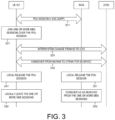
- FIG. 3 illustrates one embodiment of handling an MBS session after intersystem change from 5G to 2/3G or after 5G-SRVCC handover from NG-RAN to UTRAN in accordance with one novel aspect.
- UE 301 establishes a PDU session in 5GS.
- UE 301 joins one or more MBS sessions over the associated PDU session.
- UE 301 initiates a PDU session establishment procedure by sending a PDU session establishment request message to the network, e.g., the session management function (SMF).
- SMS session management function
- UE 301 performs an intersystem change procedure from 5G to 2/3G.
- UE 301 handovers the PDU session from NG-RAN to UTRAN for 5G-SRVCC.
- SRVCC stands for Single Radio Voice Call Continuity. It is a handover technology between "VoIP over IMS in LTE/NG-RAN" and Voice Call (CS) in a legacy system, e.g., WCDMA/UTRAN. It means it is for handover between a packet call in LTE/NG-RAN and a circuit call in a legacy system WCDMA/UTRAN, such that the voice call can be continued, and would not be interrupted upon handover from 5G to 2/3G.
- CS Voice Call
- step 341 UE 301 locally releases the PDU session.
- step 342 UE 301 locally leaves the MBS session. Since 5MBS should be used only when the associated PDU session is active, UE thus needs to leave the one or more MBS sessions once the associated PDU session is released. From the network perspective, in step 351, the network locally releases the PDU session. In step 352, the network considers UE 301 as removed from the associated one or more MBS sessions.
- FIG 4 illustrates one embodiment of handling an MBS session when UE transfers an existing PDU session from 3GPP access to an ePDG connected to EPC connection in accordance with one novel aspect.
- UE 401 joins one or more MBS sessions over the associated PDU session.
- UE 401 initiates a PDU session establishment procedure by sending a PDU session establishment request message to the network, e.g., the session management function (SMF).
- SMS session management function
- UE 401 performs transferring the PDU session.
- the UE set the PDU Session ID field of the N1_MODE_CAPABILITY Notify payload to the PDU session ID of the existing PDU session that is being transferred, and associate the PDU session ID with the PDN connection that is being established.
- the UE shall associate the S-NSSAI of the existing PDU session that is being transferred and the related PLMN ID with the PDN connection that is being established.
- UE 401 receives a handover response from the network.
- the PDU session/PDN connection remains active, however, only over the non-3GPP access.
- UE 401 locally leaves the MBS session, since 5MBS session is only available for 3GPP access in 5GS.
- UE 401 thus needs to leave the one or more MBS sessions once the associated PDU session over 3GPP access is transferred.
- step 451 the network considers the PDU session/PDN connection active, but only over the non-3GPP access.
- the network considers UE 401 as removed from the associated one or more MBS sessions.
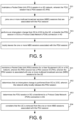
- FIG. 5 is a flow chart of a method of UE handling MBS session maintenance after intersystem change from 5G to 2/3/4G in accordance with one novel aspect of the present invention.
- a UE maintains a Packet Data Unit (PDU) session in a 5G network, wherein the PDU session has a PDU session ID (PSI).
- PDU session ID PSI
- the UE joins one or more multicast broadcast services (MBS) sessions that are associated with the PDU session.
- MMS multicast broadcast services
- the UE performs an intersystem change from 5G to 2/3G by the UE, or transfers the PDU session in 5G to a Protocol Data Network (PDN) connection in 4G.
- PDN Protocol Data Network
- the UE locally leaves the one or more MBS sessions that are associated with the PDU session.
- FIG. 6 is a flow chart of a method of network handling MBS session maintenance after intersystem change from 5G to 2/3/4G in accordance with one novel aspect of the present invention.
- a network entity maintains a Packet Data Unit (PDU) session for a User Equipment (UE) in a 5G network, wherein the PDU session has a PDU session ID (PSI), wherein the PDU session is associated with one or more multicast broadcast services (MBS) sessions for the UE.
- PDU Packet Data Unit
- PSI PDU session ID
- MBS multicast broadcast services
- the network entity determines the PDU session in 5G is transferred to a Protocol Data Network (PDN) connection in 4G.
- PDN Protocol Data Network
- the network entity considers that the UE is removed from the one or more MBS sessions associated with the PDU session.
Landscapes
- Engineering & Computer Science (AREA)
- Computer Networks & Wireless Communication (AREA)
- Signal Processing (AREA)
- Multimedia (AREA)
- Mobile Radio Communication Systems (AREA)
Applications Claiming Priority (2)
| Application Number | Priority Date | Filing Date | Title |
|---|---|---|---|
| US202263371115P | 2022-08-11 | 2022-08-11 | |
| US18/224,690 US20240056900A1 (en) | 2022-08-11 | 2023-07-21 | Mbs session maintenance after handover |
Publications (1)
| Publication Number | Publication Date |
|---|---|
| EP4322613A1 true EP4322613A1 (fr) | 2024-02-14 |
Family
ID=87554604
Family Applications (1)
| Application Number | Title | Priority Date | Filing Date |
|---|---|---|---|
| EP23189236.5A Pending EP4322613A1 (fr) | 2022-08-11 | 2023-08-02 | Maintenance de session mbs après transfert intercellulaire |
Country Status (3)
| Country | Link |
|---|---|
| US (1) | US20240056900A1 (fr) |
| EP (1) | EP4322613A1 (fr) |
| TW (1) | TW202410709A (fr) |
-
2023
- 2023-07-21 US US18/224,690 patent/US20240056900A1/en active Pending
- 2023-08-02 EP EP23189236.5A patent/EP4322613A1/fr active Pending
- 2023-08-09 TW TW112129966A patent/TW202410709A/zh unknown
Non-Patent Citations (3)
| Title |
|---|
| "3rd Generation Partnership Project; Technical Specification Group Core Network and Terminals; Non-Access-Stratum (NAS) protocol for 5G System (5GS); Stage 3; (Release 17)", vol. CT WG1, no. V17.7.1, 27 June 2022 (2022-06-27), pages 1 - 991, XP052183455, Retrieved from the Internet <URL:https://ftp.3gpp.org/Specs/archive/24_series/24.501/24501-h71.zip 24501-h71.docx> [retrieved on 20220627] * |
| "3rd Generation Partnership Project; Technical Specification Group Services and System Aspects; Architectural enhancements for 5G multicast-broadcast services; Stage 2 (Release 17)", no. V17.3.0, 15 June 2022 (2022-06-15), pages 1 - 110, XP052182866, Retrieved from the Internet <URL:https://ftp.3gpp.org/Specs/archive/23_series/23.247/23247-h30.zip 23247-h30.docx> [retrieved on 20220615] * |
| ERICSSON: "Update [6.8] Mobility from E-UTRAN/EPC to NR/5GC", vol. SA WG2, no. Electronic, Elbonia; 20210412 - 20210416, 6 April 2021 (2021-04-06), XP051993668, Retrieved from the Internet <URL:https://ftp.3gpp.org/tsg_sa/WG2_Arch/TSGS2_144E_Electronic/Docs/S2-2102284.zip S2-2102284_23247_6.8_InterwokingE-UTRAN_NR.doc> [retrieved on 20210406] * |
Also Published As
| Publication number | Publication date |
|---|---|
| US20240056900A1 (en) | 2024-02-15 |
| TW202410709A (zh) | 2024-03-01 |
Similar Documents
| Publication | Publication Date | Title |
|---|---|---|
| US11582656B2 (en) | 5GSM handling on invalid PDU session | |
| US11197216B2 (en) | Handling of collision between SR procedure and PDU session establishment procedure for PDU session handover | |
| WO2019196783A1 (fr) | Gestion d'un flux de qos sans support radio de données correspondant | |
| JP5548820B2 (ja) | ネットワーク支援なしで、mbms受信継続性をサポートする方法 | |
| US11553549B2 (en) | Multi-access PDU session state synchronization between UE and network | |
| US20210250409A1 (en) | Handling of Multi-Access PDU Session Upgrade | |
| CN106162565B (zh) | 传输组通信业务数据的方法、系统及装置 | |
| EP4207931A1 (fr) | Procédé et dispositif d'ajout de branche pdn 3gpp à une session pdu ma avec branche non 3gpp | |
| US20220104075A1 (en) | Pdu session establishment accept handling for ma pdu sessions | |
| US12598654B2 (en) | Handling of MBS session related back-off timer | |
| US12082065B2 (en) | Session continuity for 3GPP and non-3GPP interworking | |
| US12238790B2 (en) | MA PDU session and user plane resource establishment for data transmission | |
| US12550205B2 (en) | Method for adding non-3GPP leg to an MA PDU session with 3GPP PDN leg | |
| EP4322704A1 (fr) | Gestion d'ie d'état de session pdu pour mbs | |
| EP4322613A1 (fr) | Maintenance de session mbs après transfert intercellulaire | |
| US12568549B2 (en) | MA PDU reactivation requested handling | |
| US20240057217A1 (en) | Request to join mbs session during establishment procedure | |
| EP4210428A1 (fr) | Prise en charge d'une session pdu redondante après un changement inter-système | |
| CN117596554A (zh) | 使用者装置执行系统间变换时维持群播广播服务会话方法 | |
| CN117596552A (zh) | 经由pdu会话建立过程请求加入mbs会话的方法及用户设备 | |
| EP4312450B1 (fr) | Interfonctionnement sans prise en charge d'interface n26 ou non reçu dans un accès non 3gpp | |
| CN117596553A (zh) | 于多路广播服务的存取分组数据单元会话的处理方法以及装置 |
Legal Events
| Date | Code | Title | Description |
|---|---|---|---|
| PUAI | Public reference made under article 153(3) epc to a published international application that has entered the european phase |
Free format text: ORIGINAL CODE: 0009012 |
|
| STAA | Information on the status of an ep patent application or granted ep patent |
Free format text: STATUS: THE APPLICATION HAS BEEN PUBLISHED |
|
| AK | Designated contracting states |
Kind code of ref document: A1 Designated state(s): AL AT BE BG CH CY CZ DE DK EE ES FI FR GB GR HR HU IE IS IT LI LT LU LV MC ME MK MT NL NO PL PT RO RS SE SI SK SM TR |
|
| STAA | Information on the status of an ep patent application or granted ep patent |
Free format text: STATUS: REQUEST FOR EXAMINATION WAS MADE |
|
| 17P | Request for examination filed |
Effective date: 20240619 |
|
| RBV | Designated contracting states (corrected) |
Designated state(s): AL AT BE BG CH CY CZ DE DK EE ES FI FR GB GR HR HU IE IS IT LI LT LU LV MC ME MK MT NL NO PL PT RO RS SE SI SK SM TR |
|
| GRAP | Despatch of communication of intention to grant a patent |
Free format text: ORIGINAL CODE: EPIDOSNIGR1 |
|
| STAA | Information on the status of an ep patent application or granted ep patent |
Free format text: STATUS: GRANT OF PATENT IS INTENDED |
|
| RIC1 | Information provided on ipc code assigned before grant |
Ipc: H04W 36/00 20090101AFI20260126BHEP Ipc: H04W 4/06 20090101ALI20260126BHEP Ipc: H04W 76/40 20180101ALI20260126BHEP Ipc: H04W 76/11 20180101ALN20260126BHEP Ipc: H04W 76/30 20180101ALN20260126BHEP Ipc: H04W 88/06 20090101ALN20260126BHEP |
|
| INTG | Intention to grant announced |
Effective date: 20260212 |