EP4322660A1 - Procédé et appareil d'indication iab, dispositif, et support - Google Patents
Procédé et appareil d'indication iab, dispositif, et support Download PDFInfo
- Publication number
- EP4322660A1 EP4322660A1 EP22784051.9A EP22784051A EP4322660A1 EP 4322660 A1 EP4322660 A1 EP 4322660A1 EP 22784051 A EP22784051 A EP 22784051A EP 4322660 A1 EP4322660 A1 EP 4322660A1
- Authority
- EP
- European Patent Office
- Prior art keywords
- iab node
- target
- beam direction
- transmit beam
- parent
- Prior art date
- Legal status (The legal status is an assumption and is not a legal conclusion. Google has not performed a legal analysis and makes no representation as to the accuracy of the status listed.)
- Pending
Links
Images

Classifications
-
- H—ELECTRICITY
- H04—ELECTRIC COMMUNICATION TECHNIQUE
- H04B—TRANSMISSION
- H04B7/00—Radio transmission systems, i.e. using radiation field
- H04B7/02—Diversity systems; Multi-antenna system, i.e. transmission or reception using multiple antennas
- H04B7/04—Diversity systems; Multi-antenna system, i.e. transmission or reception using multiple antennas using two or more spaced independent antennas
- H04B7/06—Diversity systems; Multi-antenna system, i.e. transmission or reception using multiple antennas using two or more spaced independent antennas at the transmitting station
- H04B7/0686—Hybrid systems, i.e. switching and simultaneous transmission
- H04B7/0695—Hybrid systems, i.e. switching and simultaneous transmission using beam selection
- H04B7/06952—Selecting one or more beams from a plurality of beams, e.g. beam training, management or sweeping
-
- H—ELECTRICITY
- H04—ELECTRIC COMMUNICATION TECHNIQUE
- H04W—WIRELESS COMMUNICATION NETWORKS
- H04W72/00—Local resource management
- H04W72/04—Wireless resource allocation
- H04W72/044—Wireless resource allocation based on the type of the allocated resource
- H04W72/046—Wireless resource allocation based on the type of the allocated resource the resource being in the space domain, e.g. beams
-
- H—ELECTRICITY
- H04—ELECTRIC COMMUNICATION TECHNIQUE
- H04W—WIRELESS COMMUNICATION NETWORKS
- H04W72/00—Local resource management
- H04W72/50—Allocation or scheduling criteria for wireless resources
- H04W72/54—Allocation or scheduling criteria for wireless resources based on quality criteria
-
- H—ELECTRICITY
- H04—ELECTRIC COMMUNICATION TECHNIQUE
- H04B—TRANSMISSION
- H04B7/00—Radio transmission systems, i.e. using radiation field
- H04B7/14—Relay systems
- H04B7/15—Active relay systems
- H04B7/155—Ground-based stations
- H04B7/15528—Control of operation parameters of a relay station to exploit the physical medium
-
- H—ELECTRICITY
- H04—ELECTRIC COMMUNICATION TECHNIQUE
- H04L—TRANSMISSION OF DIGITAL INFORMATION, e.g. TELEGRAPHIC COMMUNICATION
- H04L5/00—Arrangements affording multiple use of the transmission path
- H04L5/0001—Arrangements for dividing the transmission path
- H04L5/0014—Three-dimensional division
- H04L5/0023—Time-frequency-space
-
- H—ELECTRICITY
- H04—ELECTRIC COMMUNICATION TECHNIQUE
- H04W—WIRELESS COMMUNICATION NETWORKS
- H04W72/00—Local resource management
- H04W72/50—Allocation or scheduling criteria for wireless resources
- H04W72/54—Allocation or scheduling criteria for wireless resources based on quality criteria
- H04W72/541—Allocation or scheduling criteria for wireless resources based on quality criteria using the level of interference
Definitions
- This application relates to the field of communication technologies, and in particular, to an IAB indication method, an IAB indication apparatus, a device and a medium.
- an integrated access backhaul (integrated access backhaul, IAB) node includes two functional portions, i.e., a distributed unit (distributed unit, DU) and a mobile termination (mobile termination, MT).
- a distributed unit distributed unit
- MT mobile termination
- Embodiments of this application provide an IAB indication method and apparatus, a device and a medium, that are capable of solving a problem of a low efficiency of uplink and downlink transmissions in a case of beam multiplexing between DU and MT.
- the IAB indication method includes: in a case of beam multiplexing between DU and MT, a first IAB node performing at least one of: reporting a first signaling to a parent IAB node, and obtaining target indication information.
- the first signaling includes at least one of: a first transmit beam direction and a second transmit beam direction.
- the first transmit beam direction is a downlink transmit beam direction of DU of the parent IAB node
- the second transmit beam direction is an uplink transmit beam direction of MT of the first IAB node.
- the first signaling is effective for at least one of: a target multiplexing mode, a target time, and a target frequency domain resource.
- the target multiplexing mode is a multiplexing mode corresponding to the DU of the parent IAB node and the MT of the first IAB node.
- the target indication information is used for indicating any one of: a first condition, an RS measurement being for the target multiplexing mode when resources for measuring reference signals RS are configured, and uplink or downlink beam information of the DU of the parent IAB node.
- the first condition is used for the first IAB node to control an interference to a reception of the MT of the first IAB node.
- the first condition includes at least one of: a first interference being less than or equal to a first preset threshold, an amount of interference variation being less than or equal to a preset offset threshold, and a communication channel quality satisfying a preset transmission condition.
- the first interference is an interference of uplink and downlink transmissions of DU of the first IAB node on the reception of the MT of the first IAB node.
- the amount of interference variation is an amount of interference variation of the uplink and downlink transmissions of the DU of the first IAB node on the reception of the MT of the first IAB node.
- the communication channel quality is a communication channel quality from the DU of the parent IAB node to the MT of the first IAB node during the uplink and downlink transmissions of the DU of the first IAB node.
- an IAB indication apparatus in a second aspect, includes a processing module.
- the processing module is used for performing at least one of: reporting a first signaling to a parent IAB node, and obtaining target indication information;
- the first signaling includes at least one of: a first transmit beam direction and a second transmit beam direction.
- the first transmit beam direction is a downlink transmit beam direction of DU of the parent IAB node
- the second transmit beam direction is an uplink transmit beam direction of MT of the first IAB node.
- the first signaling is effective for at least one of: a target multiplexing mode, a target time, and a target frequency domain resource.
- the target multiplexing mode is a multiplexing mode corresponding to the DU of the parent IAB node and the MT of the first IAB node.
- the target indication information is used for indicating any one of: a first condition, an RS measurement being for the target multiplexing mode when resources for measuring reference signals RS are configured, and uplink or downlink beam information of the DU of the parent IAB node.
- the first condition is used for the first IAB node to control an interference to a reception of the MT of the first IAB node.
- the first condition includes at least one of: a first interference being less than or equal to a first preset threshold, an amount of interference variation being less than or equal to a preset offset threshold, and a communication channel quality satisfying a preset transmission condition.
- the first interference is an interference of uplink and downlink transmissions of DU of the first IAB node on the reception of the MT of the first IAB node.
- the amount of interference variation is an amount of interference variation of the uplink and downlink transmissions of the DU of the first IAB node on the reception of the MT of the first IAB node.
- the communication channel quality is a communication channel quality from the DU of the parent IAB node to the MT of the first IAB node during the uplink and downlink transmissions of the DU of the first IAB node.
- an IAB node in a third aspect, includes a processor, a memory, and a program or an instruction stored in the memory and executable on the processor. When the program or the instruction is executed by the processor, the method in the first aspect is implemented.
- an IAB node in a fourth aspect, includes a processor and a communication interface.
- the communication interface is used for reporting a first signaling to a parent IAB node in a case of beam multiplexing between DU and MT;
- the first signaling includes at least one of: a first transmit beam direction and a second transmit beam direction;
- the first transmit beam direction is a downlink transmit beam direction of DU of the parent IAB node, and the second transmit beam direction is an uplink transmit beam direction of MT of the first IAB node;
- the first signaling is effective for at least one of: a target multiplexing mode, a target time, and a target frequency domain resource;
- the target multiplexing mode is a multiplexing mode corresponding to DU and MT;
- the processor is used for obtaining the target indication information in the case of the beam multiplexing between DU and MT;
- the target indication information is used for indicating any one of: a first condition, an RS measurement being for the target multiplexing
- the first condition is used for the first IAB node to control an interference to a reception of the MT of the first IAB node.
- the first condition includes at least one of: a first interference being less than or equal to a first preset threshold, an amount of interference variation being less than or equal to a preset offset threshold, and a communication channel quality satisfying a preset transmission condition.
- the first interference is an interference of uplink and downlink transmissions of DU of the first IAB node on the reception of the MT of the first IAB node.
- the amount of interference variation is an amount of interference variation of the uplink and downlink transmissions of the DU of the first IAB node on the reception of the MT of the first IAB node.
- the communication channel quality is a communication channel quality from the DU of the parent IAB node to the MT of the first IAB node during the uplink and downlink transmissions of the DU of the first IAB node.
- a readable storage medium stores a program or an instruction.
- the program or the instruction is executed by a processor, the method in the first aspect is implemented.
- a chip in a sixth aspect, includes a processor and a communication interface.
- the communication interface is coupled to the processor, and the processor is used for executing a program or an instruction to implement the method in the first aspect.
- a computer program/program product is provided.
- the computer program/program product is stored in a storage medium.
- the program/program product is executed by at least one processor, the IAB indication method in the first aspect is implemented.
- the first IAB node may report the first signaling to the parent IAB node and/or obtain the target indication information in the case of the beam multiplexing between DU and MT. Due to the beam multiplexing between DU and MT, the first IAB node may report the first transmit beam direction and/or the second transmit beam direction to the parent IAB node through the first signaling to lock the receive beam/transmit beam of IAB MT, so as to reserve receive beam resources/transmit beam resources for DU and improve the flexibility and the efficiency of the beam usage of DU and MT, thereby improving the efficiency of the uplink and downlink transmissions; and/or the first IAB node may obtain information such as the first condition, the RS measurement being for the target multiplexing mode, or the uplink or downlink beam information of the DU of the parent IAB node, so as to determine the beam information of the uplink and downlink transmissions of the DU based on such information for determining the beam information of the transmission of IAB MT, so that
- first and second are used for distinguishing similar objects, but are unnecessarily used for describing a specific sequence or order. It will be understood that terms used in this way may be exchangeable in a proper case, so that the embodiments of this application may be implemented in an order different from the orders shown or described herein.
- the objects distinguished by “first” and “second” are usually of the same type, and the number of the objects is not limited. For example, there may be one or more first objects.
- “and/or” in the description and the claims indicate at least one of connected objects, and the character “/" generally indicates an "or” relationship between associated objects.
- LTE long term evolution
- LTE-advanced LTE-advanced
- LTE-A long term evolution
- code division multiple access code division multiple access
- time division multiple access time division multiple access
- frequency division multiple access frequency division multiple access
- OFDMA orthogonal frequency division multiple access
- SC-FDMA single-carrier frequency-division multiple access
- system and “network” are often used interchangeably in the embodiments of this application, and the techniques described may be used for both the systems and radio techniques described above, as well as for other systems and radio techniques.
- a new radio (new radio, NR) system is described, and the NR term is used throughout most of the following description. However, these techniques may also be applied to applications except NR system applications, such as 6th generation (6th Generation, 6G) communication systems.
- 6G 6th generation
- FIG. 1 is a schematic architectural diagram of a wireless communication system to which embodiments of this application may be applied.
- a wireless communication system includes a user equipment (user equipment, UE) 11 and a network device 12.
- the UE 11 may also be referred to as a terminal device or a terminal.
- the UE 11 may be a cell phone, a tablet computer (tablet computer), a laptop computer (laptop computer) or notebook computer, a personal digital assistant (personal digital assistant, PDA), a handheld computer, a netbook, an ultra-mobile personal computer (ultra-mobile personal computer, UMPC), a mobile Internet device (mobile Internet device, MID), a wearable device (wearable device) or a vehicle-mounted device (VLTE), a pedestrian terminal (PUE), and other terminal-side device.
- the wearable devices include: smartwatches, bracelets, headphones, glasses, etc.
- a specific type of the UE11 is not limited in the embodiments of this application.
- the network device 12 may be a base station or a core network.
- the base station may be referred to as a node B, an evolved node B, an access point, a base transceiver station (base transceiver station, BTS), a radio base station, a radio transceiver, a basic service set (basic service set, BSS), an extended service set (extended service set, ESS), a B node, an evolved B node (eNB), a home B node, a home evolved B node, a WLAN access point, a WiFi node, a transmitting receiving point (transmitting receiving point, TRP), or some other suitable term in the described field.
- the base station is not limited to a specific technical vocabulary. Only a base station in the NR system is taken as an example in the embodiments of this application, but a specific type of the base station is not limited.
- FIG. 2 is a schematic architectural diagram of an IAB system.
- An IAB node includes a DU functional portion and an MT functional portion. Relying on the MT, an access point (i.e., IAB node) may find an upstream access point (i.e., parent IAB node), and establishes a wireless connection with a DU of the upstream access point. This wireless connection is referred to as a backhaul link (backhaul link). After the IAB node establishes the entire backhaul link, the IAB node turns on the DU function thereof, and the DU provides cell services. That is, the DU may provide an access service to the UE.
- An integrated access backhaul loop includes a donor (donor) IAB node, and the donor IAB node is directly connected to a wire transmission network.
- FIG. 3 is a schematic structural diagram of CUs and DUs of an IAB system.
- DUs of all the IAB nodes are connected to a central unit (central unit, CU) node, which configures the DUs through an F1-application protocol (F1-application protocol, F1-AP) signaling.
- the CU configures MTs through a radio resource control (radio resource control, RRC) signaling.
- RRC radio resource control
- the IAB system is introduced to resolve an inadequate deployment of the wire transmission network during dense deployment of access points. That is, when there is no wire transmission network, an access point may rely on a wireless backhaul.
- a resource multiplexing between DU and MT of IAB is time-division multiplexing (time-division multiplexing, TDM).
- TDM time-division multiplexing
- FDM frequency-division multiplexing
- SDM space division multiplexing
- DU is configured for DL (downlink), and MT is configured for UL (uplink); or DU performs DL transmission, and MT performs UL transmission.
- DU is configured for UL, and MT is configured for DL; or DU performs UL reception, and MT performs DL reception.
- DU is configured for DL, and MT is configured for DL; or DU performs DL transmission, and MT performs DL reception.
- DU is configured for UL, and MT is configured for UL; or DU performs UL reception, and MT performs UL transmission.
- the transmission of IAB-DU causes interference to the reception of IAB-MT, especially when IAB-DU and IAB-MT share time-frequency resources (i.e., FDM/SDM multiplexing).
- the transmission of IAB-MT causes interference to the reception of IAB-DU, especially when IAB-DU and IAB-MT share the time-frequency resources (i.e., FDM/SDM multiplexing).
- the beam alignment is roughly divided into two phases.
- a first phase is to initially train an initial transmit beam from the base station to the UE when the UE is connected to the network.
- a second phase is to train a fine transceiver beam pair from the base station to the UE after the UE establishes the connection.
- the beam training in the second phase is mainly accomplished by CSI measurement and feedback.
- the base station periodically transmits a synchronization signal block (synchronization signal block, SSB), and sends a group of SSBs in a beam scanning manner in each SSB transmission cycle.
- the UE measures reference signals respectively carried by the SSBs, and reports an index of an SSB with high reception energy, so that the base station determines its transmit beam.
- the UE reports an SSB index according to the rules specified in the protocol.
- Each SSB corresponds to a group of physical random access channel (physical random access channel, PRACH) resources.
- PRACH physical random access channel
- the base station performs a configuration of channel state information (channel state information, CSI) reporting parameters, and triggers a CSI reporting.
- the UE performs the CSI measurement and reporting according to the configuration information of the base station.
- the base station adjusts transmission parameters such as uplink and downlink beams according to the results of the UE.
- the reporting configuration of each CSI indicates a type reported by CSI (CSI quantity), which includes parameters indicating the beam, such as CRI and SSB index.
- the base station configures sounding reference signal (sounding reference signal, SRS) resources for the UE for the uplink beam training.
- SRS sounding reference signal
- the UE autonomously sends SRS on the corresponding SRS resources for the beam training.
- the base station/UE may select a training beam independently.
- the base station For uplink beam indication, the base station indicates a beam direction used by the UE on a UL scheduling resource, and the beam direction is indicated by a sounding reference signal resource indicator (SRS resource indicator, SRI).
- SRS resource indicator SRI
- the base station indicates a beam direction on a DL scheduling resource, so that the UE is able to determine its receive beam.
- the downlink beam direction is indicated by an associated transmission configuration indication (transmission configuration indication, TCI), and the TCI reflects information such as CRI and SSB index.
- transmission configuration indication transmission configuration indication
- beam directions of DU and MT are mutually constrained by the hardware resource sharing/multiplexing of DU/MT on one hand, and by interference conditions of DU/MT on another hand.
- DU/MT may use hardware resources for beam forming separately, and DU may adopt narrower beams.
- DU and MT perform transceiving synchronously (SDM/FDM)
- SDM/FDM transceiving synchronously
- DU and MT need to share the hardware resources for beam forming, and DU/MT adopts wider beams.
- the existing beam training/beam indication assumes that there is no mutual constraint between the beams of the DU/MT, and the beam training/beam indication of the DU/MT is independent of each other. If related methods in related art are followed, the available beams/hardware resources between IAB DUs/MTs need to be allocated statically in advance, which cannot ensure the use efficiency of hardware resources/beam forming.
- the interference to the reception of DU/MT is serious.
- An interference strength to the reception of MT is affected by the receive beam direction of MT/uplink and downlink beam directions of DU, and an interference strength to the reception of DU is affected by the receive beam direction of DU/uplink and downlink beam directions of MT. Therefore, from the interference point of view, the available beams of DU and MT are also mutually constrained.
- embodiments of this application provide an enhancement mechanism of a beam management mechanism/interference management mechanism.
- a beam determination method is provided to improve an efficiency of beam multiplexing/hardware resource multiplexing between IAB DUs/MTs.
- available beams/hardware resources e.g., available panels
- available beams/hardware resources e.g., available panels
- the beam management mechanism is enhanced to make the beam multiplexing between DUs/MTs more flexible under a principle that IAB DU/MT decides available beams/training beams independently.
- a beam determination method/a determination principle of transmission parameters (including beam and other parameters) is provided to mitigate the interference problem.
- the available beams of IAB DU and/or IAB MT are configured/indicated to achieve the purpose of interference suppression.
- the beam management mechanism is enhanced under the principle that IAB DU/MT decides the available beams/training beams independently to achieve the purpose of interference suppression.
- the interference management mechanism is enhanced to achieve the purpose of interference suppression. That is, demand conditions are set for the reception of IAB MT to control the interference to the reception of IAB MT, so as to assist downlink scheduling of the parent IAB.
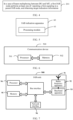
- FIG. 4 illustrates a flow diagram of an IAB indication method provided in the embodiments of this application.
- the IAB indication method provided in the embodiments of this application may include a following step 201.
- a first IAB node performs at least one of the following: reporting a first signaling to the parent IAB node, and obtaining target indication information.
- the above first signaling includes at least one of the following: a first transmit beam direction and a second transmit beam direction.
- the first transmit beam direction is a downlink transmit beam direction of DU of the parent IAB node
- the second transmit beam direction is an uplink transmit beam direction of MT of the first IAB node.
- the first signaling is effective for at least one of the following: a target multiplexing mode (multiplexing case), a target time, and a target frequency domain resource.
- the target multiplexing mode is a multiplexing mode corresponding to DU and MT.
- the above target indication information is used for indicating any one of the following: a first condition, an RS measurement being for the target multiplexing mode when resources for measuring reference signals (RS) are configured, and uplink or downlink beam information of the DU of the parent IAB node.
- the above first condition includes at least one of the following: a first interference being less than or equal to a first preset threshold, an amount of interference variation being less than or equal to a preset offset threshold, and a communication channel quality satisfying a preset transmission condition.
- the first interference is an interference of the uplink and downlink transmissions of the DU of the first IAB node on the reception of the MT.
- the amount of interference variation is an amount of interference variation of the uplink and downlink transmissions of the DU on the reception of the MT.
- the communication channel quality is a communication channel quality from the DU of the parent IAB node to the MT during the uplink and downlink transmissions of the DU.
- the first IAB node reports through beams. That is, the first IAB node may report a downlink transmit beam direction (i.e., first transmit beam direction, as indicated by the TCI/CRI/SSB index) of a desired/available parent DU (i.e., DU of the parent IAB node) to the parent IAB node, so that the parent IAB node may determine a downlink beam of IAB MT (i.e., MT of the first IAB node).
- a downlink transmit beam direction i.e., first transmit beam direction, as indicated by the TCI/CRI/SSB index
- a receive beam of IAB MT is locked to schedule an appropriate downlink beam for IAB MT, so as to reserve reception/transmit beam resources for DU and improve the flexibility of the multiplexing of the downlink beam of MT and the beam of DU.
- the first IAB node reports through beams. That is, the first IAB node may report a transmit beam direction (i.e., uplink beam/SRI of MT scheduled by parent DU, i.e., second transmit beam direction) of an uplink transmission of a desired/available IAB MT to the parent IAB node, so that the parent IAB node may lock a transmit beam of IAB MT to schedule an appropriate uplink beam for IAB MT, so as to reserve reception/transmit beam resources for DU and improve the flexibility of the multiplexing of the uplink beam of MT and the beam of DU.
- a transmit beam direction i.e., uplink beam/SRI of MT scheduled by parent DU, i.e., second transmit beam direction
- the parent IAB node may lock a transmit beam of IAB MT to schedule an appropriate uplink beam for IAB MT, so as to reserve reception/transmit beam resources for DU and improve the flexibility of the multiplexing of the uplink beam of MT and the beam
- the first IAB node after obtaining the first condition in advance, may adjust the transceiving beam direction of IAB DU and uplink and downlink powers, so that the uplink and downlink transmissions of the DU of the first IAB node satisfy the first condition, so as to achieve the purpose of controlling the interference to the reception of the MT of the first IAB node.
- the first IAB node may determine whether at least one of the corresponding interference, the amount of interference variation, and the communication channel quality satisfies the first condition during the uplink and downlink transmissions of DU, so as to control the interference to the reception of the MT of the first IAB node, so that the interference to the reception of IAB MT is ensured to be sufficiently small to improve the flexibility and efficiency of the beam usage of DU and MT, thereby improving the efficiency of the uplink and downlink transmissions.
- the first IAB node after obtaining in advance that the RS measurement is for the target multiplexing mode when the resources of the RS are configured, may determine beam information of the uplink and downlink transmissions of DU and MT to avoid the interference between DU and MT, so as to improve the flexibility and the efficiency of the beam usage of DU and MT, thereby improving the efficiency of the uplink and downlink transmissions.
- the first IAB node after obtaining the uplink or downlink beam information of the DU of the parent IAB node in advance, may determine the beam of IAB MT based on the uplink and downlink beam information of the DU, so as to avoid the interference between DU and MT and improve the flexibility and efficiency of the beam usage of DU and MT, thereby improve the efficiency of the uplink and downlink transmissions.
- the above target multiplexing mode includes at least one of the following:
- the above first signaling is specifically any one of the following: uplink control information (uplink control information, UCI) and media access control control element (media access control control element, MAC CE).
- uplink control information uplink control information, UCI
- media access control control element media access control control element, MAC CE
- the MAC CE is assigned an independent logical channel identification (logical channel ID, LCID).
- the first transmit beam direction is any one of the following, and/or the second transmit beam direction is any one of the following:
- step 201 "reporting the first signaling to the parent IAB node" in the above step 201 may be specifically realized by the following step 201a.
- the first IAB node reports the first signaling to the parent IAB node with respect to at least one of the target multiplexing mode, the target time and the target frequency domain resource.
- the first IAB node may report beam direction(s) (i.e., the first transmit beam direction and/or the second transmit beam direction) for at least one of a multiplexing mode, a time and a frequency domain resource (may also be referred to as a frequency range), so that the parent IAB node may determine that the beam direction(s) are used at the time and/or the frequency range.
- beam direction(s) i.e., the first transmit beam direction and/or the second transmit beam direction
- a multiplexing mode i.e., a time and a frequency domain resource (may also be referred to as a frequency range)
- the target time is associated with the target multiplexing mode
- the target frequency domain resource is associated with the target multiplexing mode
- a separate field in the above first signaling carries indication information of at least one of the target multiplexing mode, the target time and the target frequency domain resource.
- the indication information of at least one of the target multiplexing mode, the target time and the target frequency domain resource may be carried by increasing the quantity (quantity) and content of CSI.
- the reporting for the RS measurement is for the target multiplexing mode.
- the target information associated with the first transmit beam direction and/or the second transmit beam direction is reported for the target multiplexing mode.
- the target information includes at least one of the following: a precoding matrix indicator (precoding matrix indicator, PMI), a rank indication (rank indication, RI), a channel quality indicator (channel quality indicator, CQI), a layer 1 L1 control signaling, a reference signal receiving power (reference signal receiving power, RSRP), a signal to interference plus noise ratio (signal to interference plus noise ratio, SINR), and a codebook indication i1.
- the above target time may be explicitly indicated by the first signaling, for example, a time period, a time bitmap (bitmap) and other forms indicate a continuous/discrete time range.
- a time period for example, a time period, a time bitmap (bitmap) and other forms indicate a continuous/discrete time range.
- an SRS resource is indicated for at least one of the target multiplexing mode, the target time and the target frequency domain resource when the SRS resource of IAB MT is configured.
- configuration information of the SRS resource carries the indication information of at least one of the target multiplexing mode, the target time and the target frequency domain resource.
- Parent DU may train a beam direction for the target multiplexing mode on a corresponding SRS resource.
- the SRS resource is configured at a time corresponding to the target multiplexing mode
- the SRS resource is an SRS resource for the target multiplexing mode.
- the parent DU may train the beam direction for the target multiplexing mode on the corresponding SRS resource.
- the DU of the above parent IAB node trains the beam direction for the target multiplexing mode on the SRS resource.
- the above first IAB node supports the reporting of a beam-related power control related parameter.
- power control parameters i.e., an expected transmission power/an adjusted value of the expected transmission power, e.g., transmit energy per resource element (transmit energy per resource element, EPRE)/power spectral density (power spectral density, PSD)/signal strength
- transmit energy per resource element transmit energy per resource element, EPRE
- power spectral density power spectral density, PSD
- the above first IAB node supports that at least one downlink power control stream is used to report the power control parameters, and each downlink power control stream corresponds to one beam direction.
- the power control stream is associated with the beam, which may be used as an implementation of an IAB/parent IAB node, and only a plurality of power control streams are specified in an actual protocol.
- the first transmit beam direction and/or the second transmit beam direction to be scheduled by the DU of the above parent IAB node is notified by the parent IAB node to the first IAB node in advance.
- the first IAB node may obtain the uplink and downlink beam information of the parent DU in advance, so that the available beams of the IAB DU are determined.
- the first transmit beam direction (and/or the second transmit beam direction) in the embodiments of this application may be one or more transmit beam directions.
- the first transmit beam direction and/or the second transmit beam direction is a beam for at least one of the target multiplexing mode, the target time and the target frequency domain resource.
- the first transmit beam direction and/or the second transmit beam direction is notified to the first IAB node through a higher layer signaling, a physical layer signaling, RRC, MAC CE, or downlink control information (downlink control information, DCI) by the above parent IAB node.
- a higher layer signaling a physical layer signaling, RRC, MAC CE, or downlink control information (downlink control information, DCI) by the above parent IAB node.
- a target transmit beam direction indicated in a semi-static (semi-static)/dynamic (dynamic) grant is kept the same as/consistent with a target transmit beam direction to be scheduled/planned to be scheduled by the DU of the parent IAB node (or the target transmit beam direction indicated in the semi-static/dynamic grant may override the target transmit beam direction to be scheduled).
- the target transmit beam direction includes at least one of the following: the first transmit beam direction and the second transmit beam direction.
- the above target indication information is used for indicating uplink or downlink beam information of the DU of the parent IAB node.
- the above target indication information is obtained in advance by the first IAB node based on a time interval between a scheduling signaling and a scheduling resource.
- the above target indication information is specifically used for indicating a downlink transmit beam direction of the parent IAB node on the scheduling resource, or an uplink transmit beam direction of the MT of the first IAB node on the scheduling resource.
- an indication range of the time interval between the scheduling signaling and the scheduling resource is a preset indication range.
- the first IAB node may expand the time interval between the scheduling signaling (e.g., DL scheduling DCI) and the scheduling resource, so that the parent DU substantially schedules a transmission resource in advance by using the DCI.
- the scheduling signaling e.g., DL scheduling DCI
- the first IAB node before the parent IAB node sends the target indication information, the first IAB node reports a scheduling readiness time to the parent IAB node.
- the scheduling readiness time is determined by any one of the following: an agreement in a protocol, a configuration from a network device, and an indication from a CU.
- the first IAB node reports the scheduling readiness time to the parent IAB node, so that the parent IAB determines a scheduling lead time.
- the above preset transmission condition includes at least one of the following: the communication channel quality satisfying a minimum CQI requirement, the communication channel quality satisfying a minimum modulation and coding scheme (modulation and coding scheme, MCS) demodulation requirement, and the communication channel quality satisfying a minimum rate requirement.
- MCS modulation and coding scheme
- the uplink and downlink transmissions of IAB DU need to ensure that the interference to the reception of IAB MT is low enough, so as to ensure that the communication channel quality from the parent DU to the IAB MT meets the preset transmission condition (e.g., minimum CQI requirement/minimum MCS demodulation requirement/minimum rate requirement).
- the preset transmission condition e.g., minimum CQI requirement/minimum MCS demodulation requirement/minimum rate requirement.
- the above first preset threshold, the preset offset threshold, and the preset transmission condition are all determined by any one of the following: an agreement in a protocol, a configuration from a network device, and an indication from a parent IAB node.
- the CU/parent IAB indicates an upwardly adjusted value of the CQI reported by the IAB MT to indicate the minimum CQI requirement.
- the above first condition is specific to the target multiplexing mode and/or the target time.
- the above first condition is specifically configured based on a subframe, a slot and a symbol.
- the uplink and downlink transmissions of the DU of the first IAB node are not limited by the first condition in a case where the DU of the first IAB node determines that the MT does not perform data reception.
- the embodiments of this application provide the IAB indication method in which the first IAB node may report the first signaling to the parent IAB node and/or obtain the target indication information in the case of beam multiplexing between DU and MT. Due to the beam multiplexing between DU and MT, the first IAB node may report the first transmit beam direction and/or the second transmit beam direction to the parent IAB node through the first signaling to lock the receive beam/transmit beam of IAB MT, so as to reserve receive beam resources/transmit beam resources for DU and improve the flexibility and the efficiency of the beam usage of DU and MT, thereby improving the efficiency of the uplink and downlink transmissions; and/or the first IAB node may obtain information such as the first condition, the RS measurement being for the target multiplexing mode, or the uplink or downlink beam information of the DU of the parent IAB node, so as to determine the beam information of the uplink and downlink transmissions of the DU based on such information for determining the beam information of the transmission of I
- the embodiments of this application further have the effect of interference suppression, and a specific method is as follows.
- the first IAB node may report the expected CRI and other transmission parameters to assist the parent DU in scheduling an appropriate downlink beam, so that the interference to the reception of IAB MT is small.
- the first IAB node reports the CRI to the parent IAB based on the UL transmit beam of the DU thereof to ensure that the MT is able to use an appropriate beam for reception, so that the interference of the UL transmission on the MT is small.
- the first IAB node reports the CRI to the parent IAB based on the DL transmit beam of the DU thereof to ensure that the MT is able to use an appropriate beam for reception, so that the interference of the DL transmission on the MT is small.
- the first IAB node schedules appropriate transmission parameters such as TCI/SRI to control the interference to the reception of IAB MT.
- the first IAB node schedules an appropriate UL transmit beam to ensure a small interference to the reception of IAB MT.
- the first IAB node schedules an appropriate DL transmit beam to ensure a mall interference to the reception of IAB MT.
- the first IAB node reports the expected CRFSRI and other transmission parameters to assist the parent DU in scheduling an appropriate uplink and downlink beams, so as to control the interference to the reception of IAB DU.
- the first IAB node reports the expected CRI to the parent IAB to ensure that the parent DL transmission has a small interference to the reception of IAB DU.
- the first IAB node reports the expected SRI to the parent IAB, or uses an appropriate SRS transmission direction for UL beam training to ensure that the MT is able to use an appropriate beam for transmission, so that the UL transmission of the IAB MT has a small interference to the reception of IAB DU.
- the first IAB node schedules an appropriate SRI and other transmission parameters to ensure a small interference to the reception of IAB DU.
- the first IAB node schedules an appropriate UL transmit beam to ensure a small interference to the reception of IAB DU by the parent DL transmission.
- the first IAB node schedules an appropriate UL transmit beam to ensure a small interference to the reception of IAB DU by the parent UL transmission.
- an executive subject may be an IAB node, or an IAB indication apparatus, or a control module for performing the IAB indication method in the IAB indication apparatus.
- the IAB indication apparatus provided in the embodiments of this application will be described in an example where the IAB node (i.e., first IAB node) executes the IAB indication method in the embodiments of this application.
- FIG. 5 is a schematic possible structural diagram of an IAB indication apparatus involved in the embodiments of this application.
- the IAB indication apparatus 60 may include: a processing module 61.
- the processing module 61 is used for performing at least one of the following: reporting the first signaling to the parent IAB node, and obtaining the target indication information.
- the first signaling includes at least one of the following: the first transmit beam direction and the second transmit beam direction.
- the first transmit beam direction is the downlink transmit beam direction of the DU of the parent IAB node
- the second transmit beam direction is the uplink transmit beam direction of the MT of the first IAB node.
- the first signaling is effective for at least one of the following: the target multiplexing mode, the target time, and the target frequency domain resource.
- the target multiplexing mode is the multiplexing mode corresponding to the DU of the parent IAB node and the MT of the first IAB node.
- the target indication information is used for indicating any one of the following: the first condition, the RS measurement being for the target multiplexing mode when resources for measuring RS are configured, and uplink or downlink beam information of the DU of the parent IAB node.
- the first condition is used for the first IAB node to control the interference to the reception of the MT of the first IAB node.
- the first condition includes at least one of the following: the first interference being less than or equal to the first preset threshold, the amount of interference variation being less than or equal to the preset offset threshold, and the communication channel quality satisfying the preset transmission condition.
- the first interference is the interference of the uplink and downlink transmissions of the DU of the first IAB node on the reception of the MT of the first IAB node.
- the amount of interference variation is the amount of the interference variation of the uplink and downlink transmissions of the DU of the first IAB node on the reception of the MT of the first IAB node.
- the communication channel quality is the communication channel quality from the DU of the parent IAB node to the MT of the first IAB node during the uplink and downlink transmissions of the DU of the first IAB node.
- the above target multiplexing mode includes at least one of the following:
- the above processing module 61 is specifically used for reporting the first signaling to the parent IAB node with respect to at least one of the target multiplexing mode, the target time and the target frequency domain resource.
- a separate field in the above first signaling carries the indication information of at least one of the target multiplexing mode, the target time and the target frequency domain resource.
- the reporting for the RS measurement is for the target multiplexing mode.
- the target information associated with the first transmit beam direction and/or the second transmit beam direction is reported for the target multiplexing mode.
- the target information includes at least one of the following: the PMI, the RI, the CQI, the L1 control signaling, the RSRP, the SINR, and the codebook indication i1.
- the SRS resource is indicated for at least one of the target multiplexing mode, the target time and the target frequency domain resource when the SRS resource of IAB MT is configured.
- the configuration information of the SRS resource carries the indication information of at least one of the target multiplexing mode, the target time and the target frequency domain resource.
- the SRS resource is the SRS resource for the target multiplexing mode.
- the DU of the above parent IAB node trains the beam direction for the target multiplexing mode on the SRS resource.
- the above first signaling is specifically any one of the following: the UCI and the MAC CE.
- the first transmit beam direction is any one of the following, and/or the second transmit beam direction is any one of the following:
- the above first IAB node supports the reporting of a beam-related power control related parameter.
- the power control parameters for the first transmit beam direction are reported.
- the above first IAB node supports that at least one downlink power control stream is used to report the power control parameters, and each downlink power control stream corresponds to one beam direction.
- the first transmit beam direction and/or the second transmit beam direction to be scheduled by the DU of the above parent IAB node is notified by the parent IAB node to the first IAB node in advance.
- the first transmit beam direction and/or the second transmit beam direction is the beam for at least one of the target multiplexing mode, the target time and the target frequency domain resource.
- the first transmit beam direction and/or the second transmit beam direction is notified to the first IAB node through the higher layer signaling, the physical layer signaling, RRC, MAC CE, or the DCI by the above parent IAB node.
- the target transmit beam direction indicated in the semi-static/dynamic grant is kept the same as the target transmit beam direction to be scheduled by the DU of the parent IAB node.
- the target transmit beam direction includes at least one of the following: the first transmit beam direction and the second transmit beam direction.
- the above target indication information is used for indicating the uplink or downlink beam information of the DU of the parent IAB node.
- the above target indication information is obtained in advance by the first IAB node based on the time interval between the scheduling signaling and the scheduling resource.
- the above target indication information is specifically used for indicating the downlink transmit beam direction of the parent IAB node on the scheduling resource, or the uplink transmit beam direction of the MT of the first IAB node on the scheduling resource.
- the indication range of the time interval between the scheduling signaling and the scheduling resource is the preset indication range.
- the first IAB node reports the scheduling readiness time to the parent IAB node.
- the scheduling readiness time is determined by any one of the following: an agreement in a protocol, a configuration from a network device, and an indication from a CU.
- the above preset transmission condition includes at least one of the following: the communication channel quality satisfying the minimum CQI requirement, the communication channel quality satisfying the minimum MCS demodulation requirement, and the communication channel quality satisfying the minimum rate requirement.
- the above first preset threshold, the preset offset threshold, and the preset transmission condition are all determined by any one of the following: an agreement in a protocol, a configuration from a network device, and an indication from a parent IAB node.
- the above first condition is specific to the target multiplexing mode and/or the target time.
- the above first condition is specifically configured based on a subframe, a slot and a symbol.
- the uplink and downlink transmissions of the DU of the first IAB node are not limited by the first condition in the case where the DU of the first IAB node determines that the MT does not perform the data reception.
- the IAB indication apparatus may report through the beams (i.e., the reporting of the first transmit beam direction and/or the second transmit beam direction) to lock the receive beam/transmit beam of IAB MT, so as to reserve the receive beam resources/the transmit beam resources for DU and improve the flexibility and the efficiency of the beam usage of DU and MT, thereby improving the efficiency of the uplink and downlink transmissions; and/or the IAB indication apparatus may obtain information such as the first condition, the RS measurement being for the target multiplexing mode, or the uplink or downlink beam information of the DU of the parent IAB node, so as to determine the beam information of the uplink and downlink transmissions of the DU based on such information for determining the beam information of the transmission of IAB MT, so that the interference between DU and MT is avoided, and the flexibility and the efficiency of the beam usage of DU and MT are improved, thereby improving the efficiency of the
- the IAB indication apparatus in the embodiments of this application may be a apparatus, a device or IAB node with an operating system, or a component, an integrated circuit or a chip in an IAB node.
- the device or IAB node may be a network device (e.g., an access network device).
- the IAB indication apparatus provided in the embodiments of this application is capable of realizing the various processes realized by the above method embodiments and achieving the same technical effects, which will not be repeated herein to avoid repetition.
- embodiments of this application further provide a communication device 500 including a processor 501, a memory 502, and a program or an instruction stored in the memory 502 and executable on the processor 501.
- a communication device 500 including a processor 501, a memory 502, and a program or an instruction stored in the memory 502 and executable on the processor 501.
- the various processes of the above method embodiments are realized when the program or the instruction is executed by the processor 501, which achieves the same technical effects.
- Embodiments of this application further provide an IAB node including a processor and a communication interface.
- the communication interface is used for reporting the first signaling to the parent IAB node in the case of the beam multiplexing between DU and MT.
- the first signaling includes at least one of the following: the first transmit beam direction and the second transmit beam direction; the first transmit beam direction is the downlink transmit beam direction of the DU of the parent IAB node, and the second transmit beam direction is the uplink transmit beam direction of the MT of the first IAB node; the first signaling is effective for at least one of the following: the target multiplexing mode, the target time, and the target frequency domain resource; the target multiplexing mode is the multiplexing mode corresponding to DU and MT; and/or the processor is used for obtaining the target indication information in the case of the beam multiplexing between DU and MT.
- the target indication information is used for indicating any one of the following: the first condition, the RS measurement being for the target multiplexing mode when resources for measuring RS are configured, and uplink or downlink beam information of the DU of the parent IAB node.
- the first condition is used for the first IAB node to control the interference to the reception of the MT of the first IAB node.
- the first condition includes at least one of the following: the first interference being less than or equal to the first preset threshold, the amount of interference variation being less than or equal to the preset offset threshold, and the communication channel quality satisfying the preset transmission condition.
- the first interference is the interference of the uplink and downlink transmissions of the DU of the first IAB node on the reception of the MT of the first IAB node.
- the amount of interference variation is the amount of the interference variation of the uplink and downlink transmissions of the DU of the first IAB node on the reception of the MT of the first IAB node.
- the communication channel quality is the communication channel quality from the DU of the parent IAB node to the MT of the first IAB node during the uplink and downlink transmissions of the DU of the first IAB node.
- the embodiments of the IAB node are corresponding to the above method embodiments of the IAB node.
- the various implementation processes and implementations of the above method embodiments may all be applied to the embodiments of the IAB node, which are capable of achieving the same technical effects.
- FIG. 6 is a schematic hardware diagram of the IAB node in the embodiments of this application.
- the IAB node 900 includes an antenna 91, a radio frequency apparatus 92 and a baseband apparatus 93.
- the antenna 91 is connected to the radio frequency apparatus 92.
- the radio frequency apparatus 92 receives information through the antenna 91, and sends the received information to the baseband apparatus 93 for processing.
- the baseband apparatus 93 processes and sends the information to be sent to the radio frequency apparatus 92.
- the radio frequency apparatus 92 processes and sends the received information through the antenna 91.
- a band processing apparatus may be located in the baseband apparatus 93.
- the method executed by the IAB node in the above embodiments may be realized in the baseband apparatus 93.
- the baseband apparatus 93 includes a processor 94 and a memory 95.
- the baseband apparatus 93 may, for example, include at least one baseband board provided with a plurality of chips. As shown in FIG. 7 , one of the chips is, for example, the processor 94 connected to the memory 95, so as to call a program in the memory 95 to execute the operations of IAB node shown in the above method embodiments.
- the baseband apparatus 93 may further include a network interface 96 for interacting with the radio frequency apparatus 92, and this interface is, for example, a common public radio interface (common public radio interface, CPRI).
- a network interface 96 for interacting with the radio frequency apparatus 92, and this interface is, for example, a common public radio interface (common public radio interface, CPRI).
- CPRI common public radio interface
- the IAB node in the embodiments of the present disclosure further includes: an instruction or a program stored in the memory 95 and executable on the processor 94.
- the processor 94 invokes the instruction or the program in the memory 95 to execute the method performed by the modules shown in FIG. 6 , so as to achieve the same technical effects, which will not be repeated herein to avoid repetition.
- the IAB node provided in the embodiments of this application is capable of realizing the various processes realized in the above method embodiments and achieving the same technical effects, which will not be repeated herein to avoid repetition.
- Embodiments of this application further provide a readable storage medium.
- the readable storage medium stores a program or an instruction, and when the program or the instruction is executed by a processor, the various processes of the embodiments of the above IAB indication method are implemented, and the same technical effects can be achieved, which will not be repeated herein to avoid repetition.
- the processor is the processor in the IAB node in the above embodiments.
- the readable storage medium includes a computer readable storage medium such as a computer read-only memory (read-only memory, ROM), a random access memory (random access memory, RAM), a disk or an optical disk.
- Embodiments of this application additionally provide a chip.
- the chip includes a processor and a communication interface, and the communication interface is coupled to the processor.
- the processor is used for executing a program or an instruction for realizing the various processes in the embodiments of the IAB indication method, and is capable of achieving the same technical effects, which will not be repeated herein to avoid repetition.
- the chip described in the embodiments of this application may also be referred to as a system-level chip, a system chip, a chip system, or a system-on-chip.
- the method in the above embodiments may be realized with the aid of software plus the necessary general hardware platform, or of course by means of hardware, but in many cases, the former is a preferred implementation.
- the technical solution of this application may be embodied essentially or in part as a contribution to related art in the form of a computer software product.
- the computer software product is stored in a storage medium (e.g., ROM/RAM, disk, optical disk), which includes a number of instructions to cause a terminal (which may be a cell phone, a computer, a server, an air-conditioner, or a networked device) to execute the method in the various embodiments of this application.
Landscapes
- Engineering & Computer Science (AREA)
- Computer Networks & Wireless Communication (AREA)
- Signal Processing (AREA)
- Quality & Reliability (AREA)
- Mobile Radio Communication Systems (AREA)
Applications Claiming Priority (2)
| Application Number | Priority Date | Filing Date | Title |
|---|---|---|---|
| CN202110369448.0A CN115190618A (zh) | 2021-04-06 | 2021-04-06 | Iab指示方法、装置、设备及介质 |
| PCT/CN2022/085337 WO2022213985A1 (fr) | 2021-04-06 | 2022-04-06 | Procédé et appareil d'indication iab, dispositif, et support |
Publications (2)
| Publication Number | Publication Date |
|---|---|
| EP4322660A1 true EP4322660A1 (fr) | 2024-02-14 |
| EP4322660A4 EP4322660A4 (fr) | 2024-09-11 |
Family
ID=83511472
Family Applications (1)
| Application Number | Title | Priority Date | Filing Date |
|---|---|---|---|
| EP22784051.9A Pending EP4322660A4 (fr) | 2021-04-06 | 2022-04-06 | Procédé et appareil d'indication iab, dispositif, et support |
Country Status (4)
| Country | Link |
|---|---|
| US (1) | US20240032009A1 (fr) |
| EP (1) | EP4322660A4 (fr) |
| CN (1) | CN115190618A (fr) |
| WO (1) | WO2022213985A1 (fr) |
Family Cites Families (11)
| Publication number | Priority date | Publication date | Assignee | Title |
|---|---|---|---|---|
| US11082329B2 (en) * | 2018-05-31 | 2021-08-03 | At&T Intellectual Property I, L.P. | Lossless data delivery at route changes in wireless radio networks |
| KR102801808B1 (ko) * | 2018-11-01 | 2025-04-30 | 삼성전자 주식회사 | 무선 통신 시스템에서 iab 노드의 동적자원 할당을 위한 방법 및 장치 |
| CN111526543A (zh) * | 2019-02-02 | 2020-08-11 | 索尼公司 | 电子设备、通信方法和存储介质 |
| US11343737B2 (en) * | 2019-02-06 | 2022-05-24 | Ofinno, Llc | Base station backhaul link information |
| US10833984B1 (en) * | 2019-05-02 | 2020-11-10 | At&T Intellectual Property I, L.P. | Integrated access backhaul network metric exchange for 5G or other next generation network |
| WO2021007833A1 (fr) * | 2019-07-18 | 2021-01-21 | Qualcomm Incorporated | Détermination de formation de faisceaux pour système iab avec duplex intégral |
| MX2022001335A (es) * | 2019-08-02 | 2022-05-26 | Ericsson Telefon Ab L M | Sincronizacion de recursos de nodos de acceso y retroceso integrados. |
| CN112399585B (zh) * | 2019-08-16 | 2023-08-04 | 华为技术有限公司 | 一种资源复用方法及装置 |
| US12052204B2 (en) * | 2020-05-13 | 2024-07-30 | Qualcomm Incorporated | Requesting intended time division duplex configurations |
| CN111901003B (zh) * | 2020-06-02 | 2025-10-21 | 中兴通讯股份有限公司 | 复用方法、装置、设备及存储介质 |
| CN112512126A (zh) * | 2020-10-22 | 2021-03-16 | 中兴通讯股份有限公司 | 复用操作方法、装置、节点和存储介质 |
-
2021
- 2021-04-06 CN CN202110369448.0A patent/CN115190618A/zh active Pending
-
2022
- 2022-04-06 WO PCT/CN2022/085337 patent/WO2022213985A1/fr not_active Ceased
- 2022-04-06 EP EP22784051.9A patent/EP4322660A4/fr active Pending
-
2023
- 2023-09-30 US US18/375,465 patent/US20240032009A1/en active Pending
Also Published As
| Publication number | Publication date |
|---|---|
| US20240032009A1 (en) | 2024-01-25 |
| EP4322660A4 (fr) | 2024-09-11 |
| WO2022213985A1 (fr) | 2022-10-13 |
| CN115190618A (zh) | 2022-10-14 |
Similar Documents
| Publication | Publication Date | Title |
|---|---|---|
| JP7216633B2 (ja) | 動的ul/dl構成を備えたlte tddのためのチャネル状態情報の構成、測定、及びレポートのための方法及び装置 | |
| EP3906728B1 (fr) | Largeur de bande de srs adaptative pour la transmission d'un ensemble de ressources srs | |
| CN115956353B (zh) | 全双工定时提前增强 | |
| US11153774B2 (en) | Signal transmission method and device, and system | |
| US11916832B2 (en) | Method for transmitting and receiving sounding reference signal in wireless communication system, and apparatus therefor | |
| EP2875619B1 (fr) | Gestion du brouillage de la communication entre dispositifs dans un système de communication cellulaire | |
| US12308914B2 (en) | Channel reciprocity for a multi-panel base station | |
| CN114503763A (zh) | 用于多分量载波的路径损耗参考信号信息 | |
| KR102663751B1 (ko) | 무선 통신 시스템에서 mcs를 선택하기 위한 방법 및 장치 | |
| KR20230037590A (ko) | 상향 전송 파라미터의 결정 방법 및 단말 디바이스 | |
| WO2016106604A1 (fr) | Procédé et dispositif de transmission de signal | |
| CN104348570A (zh) | 一种上行控制信息传输方法和装置 | |
| US10880906B2 (en) | Apparatuses, methods and computer programs for implementing fairness and complexity-constrained a non-orthogonal multiple access (NOMA) scheme | |
| CN101977099A (zh) | 一种上行信道的发送方法、基站和用户设备 | |
| US10798660B1 (en) | Techniques for device-to-device frequency reuse in cellular networks | |
| US20230137907A1 (en) | Wireless communication method, terminal device, and network device | |
| CN114451022A (zh) | 功率调整方法及装置 | |
| US20240214150A1 (en) | Selection of sounding reference signal resources across different usages | |
| US20220303917A1 (en) | Network assisted environmental sensing | |
| CN116264497B (zh) | 传输调度方法、装置、网络设备及可读存储介质 | |
| US9313735B2 (en) | Method and apparatus for efficiently controlling uplink control signal of user equipment in wireless communication system | |
| WO2023039695A1 (fr) | Rapports d'informations d'état de canal liés à un domaine temporel pour une communication sans fil | |
| CN116939795A (zh) | 功率控制方法及装置 | |
| JP2023547897A (ja) | 伝送パラメータ管理方法、装置及び電子機器 | |
| US20240032009A1 (en) | Iab indication method, device, and medium |
Legal Events
| Date | Code | Title | Description |
|---|---|---|---|
| STAA | Information on the status of an ep patent application or granted ep patent |
Free format text: STATUS: THE INTERNATIONAL PUBLICATION HAS BEEN MADE |
|
| PUAI | Public reference made under article 153(3) epc to a published international application that has entered the european phase |
Free format text: ORIGINAL CODE: 0009012 |
|
| STAA | Information on the status of an ep patent application or granted ep patent |
Free format text: STATUS: REQUEST FOR EXAMINATION WAS MADE |
|
| 17P | Request for examination filed |
Effective date: 20231102 |
|
| AK | Designated contracting states |
Kind code of ref document: A1 Designated state(s): AL AT BE BG CH CY CZ DE DK EE ES FI FR GB GR HR HU IE IS IT LI LT LU LV MC MK MT NL NO PL PT RO RS SE SI SK SM TR |
|
| DAV | Request for validation of the european patent (deleted) | ||
| DAX | Request for extension of the european patent (deleted) | ||
| REG | Reference to a national code |
Ref country code: DE Ref legal event code: R079 Free format text: PREVIOUS MAIN CLASS: H04W0072040000 Ipc: H04B0007155000 |
|
| A4 | Supplementary search report drawn up and despatched |
Effective date: 20240812 |
|
| RIC1 | Information provided on ipc code assigned before grant |
Ipc: H04B 7/06 20060101ALI20240806BHEP Ipc: H04B 7/155 20060101AFI20240806BHEP |
|
| STAA | Information on the status of an ep patent application or granted ep patent |
Free format text: STATUS: EXAMINATION IS IN PROGRESS |
|
| 17Q | First examination report despatched |
Effective date: 20251111 |