EP4323018B1 - Préparation de produits radiopharmaceutiques pour différents temps d'application - Google Patents
Préparation de produits radiopharmaceutiques pour différents temps d'application Download PDFInfo
- Publication number
- EP4323018B1 EP4323018B1 EP22716372.2A EP22716372A EP4323018B1 EP 4323018 B1 EP4323018 B1 EP 4323018B1 EP 22716372 A EP22716372 A EP 22716372A EP 4323018 B1 EP4323018 B1 EP 4323018B1
- Authority
- EP
- European Patent Office
- Prior art keywords
- art
- time
- radionuclide
- application
- filling
- Prior art date
- Legal status (The legal status is an assumption and is not a legal conclusion. Google has not performed a legal analysis and makes no representation as to the accuracy of the status listed.)
- Active
Links
Images



Classifications
-
- A—HUMAN NECESSITIES
- A61—MEDICAL OR VETERINARY SCIENCE; HYGIENE
- A61K—PREPARATIONS FOR MEDICAL, DENTAL OR TOILETRY PURPOSES
- A61K51/00—Preparations containing radioactive substances for use in therapy or testing in vivo
- A61K51/02—Preparations containing radioactive substances for use in therapy or testing in vivo characterised by the carrier, i.e. characterised by the agent or material covalently linked or complexing the radioactive nucleus
- A61K51/04—Organic compounds
- A61K51/08—Peptides, e.g. proteins, carriers being peptides, polyamino acids, proteins
- A61K51/088—Peptides, e.g. proteins, carriers being peptides, polyamino acids, proteins conjugates with carriers being peptides, polyamino acids or proteins
-
- A—HUMAN NECESSITIES
- A61—MEDICAL OR VETERINARY SCIENCE; HYGIENE
- A61K—PREPARATIONS FOR MEDICAL, DENTAL OR TOILETRY PURPOSES
- A61K51/00—Preparations containing radioactive substances for use in therapy or testing in vivo
- A61K51/12—Preparations containing radioactive substances for use in therapy or testing in vivo characterised by a special physical form, e.g. emulsion, microcapsules, liposomes, characterized by a special physical form, e.g. emulsions, dispersions, microcapsules
- A61K51/121—Solutions, i.e. homogeneous liquid formulation
-
- B—PERFORMING OPERATIONS; TRANSPORTING
- B01—PHYSICAL OR CHEMICAL PROCESSES OR APPARATUS IN GENERAL
- B01J—CHEMICAL OR PHYSICAL PROCESSES, e.g. CATALYSIS OR COLLOID CHEMISTRY; THEIR RELEVANT APPARATUS
- B01J19/00—Chemical, physical or physico-chemical processes in general; Their relevant apparatus
- B01J19/24—Stationary reactors without moving elements inside
Definitions
- the present invention relates to a method for producing radionuclide-containing products with the same desired radioactivity at different application times, based on a given calibration time according to the preamble of claim 1, and to a device for carrying out the method according to claim 19.
- Radiopharmaceuticals are radioactive compounds used in nuclear medicine.
- diagnostic and therapeutic radiopharmaceuticals or so-called theranostics, which can be used both therapeutically and diagnostically.
- Such pharmaceuticals are very often produced directly on site, which appears necessary due to their short half-life or lifetime, particularly in the case of diagnostic compounds.
- complex therapeutic radiopharmaceuticals were often also produced locally in small quantities on a patient-oriented basis.
- radiopharmaceuticals which consist either of a single radionuclide or a simple radionuclide formulation, have until now been produced centrally and distributed to nuclear medicine users.
- Such drugs include, for example, [I-131]NaI, [Ra-223]RaCl 2 and [Sm-153]Sm-EDTMP.
- a preparative column chromatographic process for the production of such carrier-free, highly pure 177Lu compounds is disclosed therein.
- the 177Lu production process utilizes a cation exchanger and a suitable complexing agent. This process makes it possible for the first time to produce carrier-free, highly pure 177Lu compounds in milligram quantities for pharmaceutical and medical purposes in a highly pure form from 176Yb compounds irradiated with thermal neutrons, with the radionuclides 177Lu and 176Yb present for purification in a mass ratio of approximately 1:10 2 to 1:10 10 .
- Chelator components for radionuclides and target components are, for example, in EP 1 289 571 B1 described in detail and is therefore well known to those skilled in the art.
- the cited publication relates to prochelators and chelators of radiometal-labeled molecules in general.
- macrocyclic polyaza compounds for labelling with radioactive metals containing an N n system, where n stands for 4, 5 or 6, with different ring sizes, and where at least one of the N atoms is substituted by a free carboxyl group for coupling to an amino function in a biologically active effector molecule, where all N atoms carry a protected side chain for the synthesis of the final molecule.
- HEPPELER et al. (1999) describe somatostatin analogues derivatized with radiometal-labeled macrocyclic chelator components [ HEPPELER et al.: "Radiometal-labelled macrocyclic chelator-derivatized somatostatin analogue with superb tumor-targeting properties and potential for receptor-mediated internal radiotherapy", Chem.-Eur. J., 1999, 5(7), 1974-1981 ].
- EISENWIENER et al. disclose a synthesis and peptide coupling of a DOTA-based prochelator that forms neutral complexes with yttrium-90 and indium-111.
- Eisenwiener et al. "Synthesis and peptide coupling of a new DOTA based prochelator, forming neutral complexes with Yttrium-90 and Indium-111", Journal of Labeled Compounds and Radiopharmaceuticals, May 2001, Vol. 44, No. Supplement 1, pp. S694-S696 . PRINT. Meeting Info: 14th International symposium on Radiopharmaceutical chemistry Interlaken, Switzerland, June 10-15, 2001 ].
- ANDRÉ et al. describe 1,4,7-triazacyclononane-1-succinic acid-4,7-diacetic acid (NODASA) as a bifunctional chelator for radioactive gallium-labeled biomolecules [ André, J. et al.: "1,4,7-Triazacyclononane-1-succinic acid-4,7-diacetic acid (NODASA): a new bifunctional chelator for radio gallium-labeling of biomolecules", Chem. Commun., 1998, 12, 1301-1302 ].
- the specialist has access to a wide range of different radionuclides and suitable chelator components and target molecule components as well as labeling techniques and the use of the labeled molecules for medical purposes.
- An alternative concept based on the state of the art, is to produce a single large batch per week. This avoids the disadvantages mentioned above and would also result in more cost-effective production.
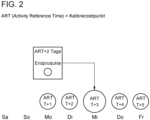
- the disadvantage of this procedure is that the user only receives the radiopharmaceutical at predefined times determined by the manufacturer, and the user must subordinate his entire planning to the manufacturer. This situation is particularly disadvantageous for the clinical user, which can lead to, and experience shows, lower acceptance of the corresponding radiopharmaceutical product.
- Such a production regime is schematically illustrated in Fig. 2 shown.
- Another alternative is the individualized production of radiopharmaceuticals at a defined time of use. Using decay calculations for the respective isotope used, a sufficiently small amount of solution can be withdrawn at a defined time before the time of use so that the activity corresponds to the activity at the target time.
- neither the radioactivity concentration nor the concentration of the chemical compounds contained therein are constant, and the amount of the target biomolecule also varies. This can lead to suboptimal absorption of the drug in the patient.
- the invention enables the production of the pharmaceutical preparation Solucin® (registered trademark of ITM Isotopen Technologien München AG) in a single batch for all possible ARTs in a small and compact facility, including filling. This significantly reduces the number of batches required compared to the current state of the art (see Figure 1). Fig. 5 ). This saves the manufacturer manufacturing, testing, and release costs without limiting the availability of the drug. Furthermore, additional capacity is gained at the Production facility for other products, which means increased productivity and efficiency. There is no theoretical limit for bulk batches. In contrast to Alternative 1, Alternative 2 according to the invention eliminates the need for a second filling unit, which in turn saves investment, maintenance, and qualification costs.
- Solucin® registered trademark of ITM Isotopen Technologien München AG
- ART+4 ART+4
- ART1-3 ART-in contrast to the above-mentioned individual dilution fillings in vials - the bulk mixture is diluted to Art+3 and then filled.
- ART+2 and ART+1 etc. follow.
- the advantage of the inventive concept lies in the significantly smaller plant. consists of only a single filling unit in the filling line. Furthermore, the individual fillings are made from a homogeneous bulk batch. This results in a significantly more homogeneous sample for quality control.
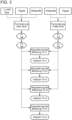
- a filling scheme of the method of the present invention according to alternative 2 is shown in Fig. 4 shown.
- the method according to the invention can be carried out particularly advantageously with all currently relevant radionuclides.
- radionuclides include, for example, those selected from the group consisting of: gallium-68, yttrium-90, molybdenum-99, indium-111, gadolinium-146, gadolinium-147, holmium-166, lutetium-177, tungsten-188, rhenium-188, bismuth-205, bismuth-206, and thorium-227.
- a product labeled with the radionuclide which contains at least one chelator component and at least one target molecule component, wherein the target molecule component is capable of binding to a specific target in or to a target cell, and wherein the chelator component and the target molecule component are covalently bonded to one another to form a chelator-target molecule unit, and the radionuclide is coordinately bound to the chelator component.
- a product is used in which a cyclic polyaza system with 4 to 8 nitrogen atoms is used as the chelator component.
- chelators have proven advantageous for a number of transition metals. They can also be easily reversibly protected with protective groups during the synthesis of the complex products to avoid undesirable side reactions.
- a preferred pharmaceutically acceptable chelator component is the commercially available 1,4,7,10-tetraazacyclododecane-1,4,7,10-tetraacetic acid [DOTA] or one of its ionic forms or pharmaceutically acceptable salts.
- DOTA 1,4,7,10-tetraazacyclododecane-1,4,7,10-tetraacetic acid
- the target molecule components used in the present invention are fundamentally based on the intended medical application.
- target molecule components selected from the group consisting of: peptides, in particular cyclic peptides with 4 to 20 amino acids, wherein at least one amino acid is a D-amino acid, in particular D-phenylalanine; and a protein, in particular a receptor protein, preferably PSMA.
- the replacement of L-amino acids with D-amino acid enantiomers in the target molecule components is designed to reduce the exposure of the coupled target peptides to in vivo attacks by proteases or peptidases, which typically degrade physiologically occurring L-amino acid peptides and proteins as natural substrates.
- proteases or peptidases typically degrade physiologically occurring L-amino acid peptides and proteins as natural substrates.
- the integration of D-amino acids into the target molecule component thus significantly extends the biological half-life because proteolytic degradation is significantly delayed.
- An octreotide or an octreotide analogue, in particular TOC, has been identified as a target molecule for the somatostatin analogue compound.
- a particularly preferred system is to use as chelator-target molecule moiety edotreotide (DOTATOC) or a pharmaceutically acceptable salt thereof. use.
- DOTATOC chelator-target molecule moiety edotreotide
- a pharmaceutically acceptable salt thereof edotreotide
- This product which can be produced using the method according to the invention, binds selectively to the tumor tissue of so-called GEP-NETs and destroys it by releasing cytotoxic, ionizing doses of radiation.
- Neuroendocrine tumors (NETs) of the gastroenteropancreatic system (GEP) [GEP-NETs] comprise a group of tumors with significant differences in their growth and hormonal behavior.
- the spectrum of clinical courses is equally broad: On the one hand, there are benign tumors that are diagnosed as incidental findings in imaging or histological processing of surgical
- the present invention is of particular clinical importance for this type of tumor.
- Solucin® The [nca Lu-177]Lu-DOTATOC provided by the method according to the invention is currently being tested by the applicant of the present invention in clinical phase III (as of February 2021) as Solucin® for the treatment of GEP-Nets in the so-called COMPETE study.
- the preparation Solucin® consists of two molecular components: the targeting molecule edotreotide (DOTATOC), a somatostatin analogue, and the EMA-approved beta emitter EndolucinBeta® (no-carrier-added lutetium-177, registered trademark of ITM Isotopen Technologien München AG).
- product-peptide combinations which can be used according to the invention include, for example, [Lu-177]Lu-PSMA for the treatment and diagnosis of prostate cancer.
- excipients such as general excipients and/or buffer systems are preferably used in the stock solution and the dilution solution.
- An ascorbic acid/ascorbate buffer can be used advantageously as a buffer system, which has proven itself many times in practice.
- a leak-free fluidic system under negative pressure is advantageously used because this allows radioactive contamination to be completely avoided.
- the conversion of the radionuclide to the labeled product takes place using precursors that are reacted with the radionuclide-containing concentrate in a temperature-controlled reactor integrated into the fluidic system.
- Temperature control allows for the implementation of different reaction conditions required for the respective chemical system. For example, a desired conversion can be carried out in the reactor at a temperature of 20°C to 100°C, depending on the product, and for a time of 5 minutes to several hours.
- each partial fill is passed through a sterile filter before being poured into a pharmaceutically acceptable vial.
- a sterile filter For this purpose, commercially available vented sterile filters with a pore diameter of 220 nm or a multilayer filter with a first layer pore diameter of 450 nm and a second layer pore diameter of 220 nm are advantageously used.
- a bypass line is provided on the non-sterile side of the sterile filter used, leading back into a bulk container. This prepares the next batch filling and/or partial filling and advantageously allows a substantially loss-free rinsing of a filling line and the sterile filter on its non-sterile side to be carried out between the individual batches via the bypass line, so that no radioactivity is carried over uncontrolled into the next filling and the calibration to the ART is also correct for the subsequent filling.
- the process according to the invention is preferably used to produce [Lutetium-177]Lu-DOTATOC (SOLUCIN ® ) as a radionuclide-containing product, using a concentrate which, based on the calibration time (ART), contains the following activity and components: - Lutetium-177 7.5 ⁇ 0.7 GBq - Edotreotide (DOTATOC) 150 ⁇ 15 ⁇ m - Ascorbic acid 20 ⁇ 2 mg - sodium ascorbate 80 ⁇ 8 mg - Ultrapure water 1.00 ⁇ 0.01 ml - 0.1 M Na-ascorbate dilution solution 18.0 ⁇ 2 ml.
- DOTATOC Edotreotide
- the present invention is described, without limitation, using the example of a process for the production of Solucin® (registered trademark of ITM Isotopen Technologien Ober AG).
- Solucin® registered trademark of ITM Isotopen Technologien München AG.
- the active ingredient of the pharmaceutical preparation Solucin® is [nca Lu-177]Lu-DOTATOC.
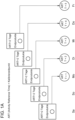
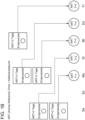
- Fig. 1 For clarification purposes, the provision of a radiopharmaceutical according to the state of the art at each application time within a working week by at least 5 drug batches by a manufacturer is shown schematically.
- Fig.1 A) shows the situation in daily production
- Fig. 1 B reflects the situation with pooled production.
- ART is the "Activity Reference Time,” i.e., the calibration time.
- Fig. 2 shows a schematic representation of the manufacturing situation when a radiopharmaceutical is only made available by the manufacturer at a specific time of use within a working week - here Wednesdays.
- the process according to the invention allows the consistent composition of the desired radionuclide-labeled pharmaceutical to be ensured at all times of use within the shelf life through a single manufacturing process (Table 1).
- Table 1 The filling scheme according to the present invention is shown in Fig. 4 shown and the supply situation of a radiopharmaceutical at several application times within a working week by a single synthesis approach according to the present invention is shown in Fig. 5 shown.
- the unique configuration of the process fluidics and the composition of the reagents used ensure a compact, easily scalable, and transferable synthesis. This reduces production to a single bulk batch and ensures the benefits of daily availability.
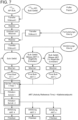
- FIG. 7 gives a schematic overview of the inventive manufacturing process of ART-specific fillings with a fluidic system according to Fig. 6 .
- composition of the dilution solution and the addition amounts for each ART can be easily calculated based on the radiopharmaceutical's specifications.
- Solucin® [nca 177 Lu]Lu-DOTATOC) in Table 1
- the data are shown in Tables 2 and 3: ⁇ b>Table 2: ⁇ /b> Composition of the final radiopharmaceutical and diluent solution.
- Salary Specified concentration at ART Concentration of the dilution solution Lutetium ( 177 Lu) 0.64 GBq/mL ⁇ 10% - Edotreotide max. 8.33 ⁇ g/mL max. 8.33 ⁇ g/mL Sodium ascorbate 0.1 M 0.1 M ART Activity at filling time Vol.
- Fig. 8 shows the circulation of the bulk solution and the rinsing process via the dashed-line lines.
- This rinsing process guarantees loss-free filling and a homogeneous filling solution after setting the specific ARTs.
- it can be achieved, in particular by the bypass line 13 upstream of the sterile filter 11 back into the bulk vessel 10, that the lines are also rinsed and filled with a homogeneous solution.
- the bypass line 13 is opened by a valve on the first valve bank 16 during rinsing and closed during filling. When the bypass line 13 is open, the natural resistance of the sterile filter 11 prevents liquid from escaping via the sterile filter 11 and directs the flow direction of the medium into the bulk vessel 10.
Landscapes
- Health & Medical Sciences (AREA)
- Life Sciences & Earth Sciences (AREA)
- Chemical & Material Sciences (AREA)
- Proteomics, Peptides & Aminoacids (AREA)
- Animal Behavior & Ethology (AREA)
- Physics & Mathematics (AREA)
- Medicinal Chemistry (AREA)
- Optics & Photonics (AREA)
- Pharmacology & Pharmacy (AREA)
- Veterinary Medicine (AREA)
- Epidemiology (AREA)
- Public Health (AREA)
- General Health & Medical Sciences (AREA)
- Dispersion Chemistry (AREA)
- Organic Chemistry (AREA)
- Chemical Kinetics & Catalysis (AREA)
- Medicines Containing Antibodies Or Antigens For Use As Internal Diagnostic Agents (AREA)
- Medicines That Contain Protein Lipid Enzymes And Other Medicines (AREA)
- Medicinal Preparation (AREA)
- Medicines Containing Material From Animals Or Micro-Organisms (AREA)
Claims (19)
- Procédé de préparation de produits contenant des radionucléides avec une même activité souhaitée de la radioactivité à différents moments d'application (ART+1, ART+2, ART+3, ART+4), par rapport à un moment d'étalonnage donné (ART),
caractérisé en ce que- un concentré contenant un radionucléide est transformé en un produit souhaité marqué avec le radionucléide et une solution mère est ainsi obtenue, laquelle contient, outre le produit marqué avec le radionucléide, tous les composants supplémentaires nécessaires pour l'application prévue, dans lequel- le radionucléide souhaité est contenu dans la solution mère dans une activité telle qu'une pluralité de lots souhaités avec respectivement un nombre défini de remplissages partiels à un moment de remplissage peut être obtenue à partir de la solution mère, dans lequel chaque lot de remplissages partiels à différents moments d'application (ART+1, ART+2, ART+3, ART+4) présente respectivement une même activité du radionucléide, par rapport au moment d'étalonnage (ART) ;- l'activité du produit marqué avec le radionucléide dans la solution mère est réglée à un moment d'application souhaité le plus tardif (ART+4) ;- un premier lot de remplissages partiels est prélevé de la solution mère contenant le produit marqué avec le radionucléide à un premier moment de remplissage antérieur au moment d'application, lequel présente une activité réglée au moment d'application le plus tardif (ART+4), lequel, à son moment d'application réel, correspond à l'activité au moment d'étalonnage (ART) ;- une solution de dilution, laquelle contient tous les autres constituants nécessaires à l'application prévue à l'exception du produit marqué avec le radionucléide, est fournie ;- la solution mère restante, réglée au moment d'application souhaité le plus tardif (ART+4), est diluée avec la solution de dilution de sorte qu'au moment de remplissage, une activité réduite souhaitée est réglée par rapport au moment d'application le plus tardif (ART+4), de sorte que pour l'utilisation au moment d'application précédent, un second lot de remplissages partiels est prélevé, lequel présente une activité réglée à un moment d'application antérieur (ART+3), lequel, à son moment d'application réel, correspond à l'activité au moment d'étalonnage (ART) ;- la solution mère restante, réglée au moment d'application antérieur (ART+3), est diluée progressivement avec la solution de dilution jusqu'à ce que le moment d'application corresponde au moment d'étalonnage (ART) ; et- respectivement des lots de remplissages partiels supplémentaires sont prélevés à chaque moment d'application supplémentaire (ART+2, ART+1), lesquels présentent une activité réglée au moment d'application respectif (ART+2, ART+1), dans lequel le dernier lot présente l'activité du moment d'étalonnage (ART). - Procédé selon la revendication 1, caractérisé en ce que le radionucléide est sélectionné à partir du groupe constitué par : Gallium-68, Yttrium-90, Molybdène-99, Indium-111, Gadolinium-146, Gadolinium 147, Holmium-166, Lutétium-177, Tungstène-188, Rhénium-188, Bismuth-205, Bismuth-206 et Thorium-227.
- Procédé selon la revendication 1 ou 2, caractérisé en ce qu'un produit marqué avec le radionucléide, qui contient au moins un composant chélateur et au moins un composant molécule cible, est utilisé, dans lequel le composant molécule cible est capable de se lier à une cible spécifique dans ou sur une cellule cible et dans lequel le composant chélateur et le composant molécule cible sont liés de manière covalente l'un à l'autre pour former une unité chélateur-molécule cible et le radionucléide est lié par coordination au composant chélateur.
- Procédé selon la revendication 3, caractérisé en ce qu'un produit est utilisé, dans lequel un système polyaza cyclique avec 4 à 8 atomes d'azote est utilisé en tant que composant chélateur.
- Procédé selon la revendication 4, caractérisé en ce qu'un acide 1,4,7,10-tétraazacyclododécane-1,4,7,10-tétraacétique [DOTA] ou une de ses formes ioniques est utilisé en tant que composant chélateur.
- Procédé selon l'une quelconque des revendications précédentes 1 à 5, caractérisé en ce que le composant molécule cible est sélectionné à partir du groupe constitué par :des peptides, en particulier des peptides cycliques avec 4 à 20 acides aminés, dans lequel au moins un acide aminé est un D-aminoacide, en particulier la D-phénylalanine ; et une protéine, en particulier une protéine réceptrice, de préférence la PSMA.
- Procédé selon la revendication 6, caractérisé en ce qu'un composé analogue à la somatostatine, en particulier un octréotide ou un analogue de l'octréotide, en particulier le TOC, est utilisé en tant que molécule cible.
- Procédé selon l'une quelconque des revendications 1 à 7 précédentes, caractérisé en ce que l'édotréotide (DOTATOC) ou un de ses sels pharmaceutiquement acceptables est utilisé en tant qu'unité chélateur-molécule cible.
- Procédé selon l'une quelconque des revendications précédentes 1 à 8, caractérisé en ce qu'un [Lu-177]Lu-DOTATOC ou un [Lu-177]Lu-PSMA est utilisé en tant que produit contenant un radionucléide.
- Procédé selon l'une quelconque des revendications 1 à 9 précédentes, caractérisé en ce que, outre les ingrédients pharmaceutiques actifs (API), des adjuvants tels que des excipients généraux et/ou des systèmes tampons sont utilisés dans la solution mère et la solution de dilution.
- Procédé selon la revendication 10, caractérisé en ce qu'un tampon acide ascorbique/ascorbate est utilisé en tant que système tampon.
- Procédé selon l'une quelconque des revendications 1 à 11 précédentes, caractérisé en ce qu'un système fluidique sans fuite sous pression est utilisé pour la mise en œuvre du procédé.
- Procédé selon la revendication 12, caractérisé en ce que, des précurseurs sont utilisés pour la conversion du radionucléide en produit marqué, qui sont convertis avec le concentré contenant le radionucléide au moyen d'un réacteur à température régulée (4) inséré dans le système fluidique.
- Procédé selon la revendication 13, caractérisé en ce que la conversion dans le réacteur (4) s'effectue de manière spécifique au produit à une température de 20 °C à 100 °C et pendant une durée de 5 min à plusieurs heures.
- Procédé selon l'une quelconque des revendications précédentes 1 à 14, caractérisé en ce que chaque remplissage partiel est guidé par l'intermédiaire d'un filtre stérile (11) avant l'entrée dans un flacon pharmaceutiquement acceptable (14).
- Procédé selon la revendication 15, caractérisé en ce qu'un filtre stérile aéré est utilisé en tant que filtre stérile (11) avec un diamètre de pores de 220 nm ou un filtre multicouche avec un diamètre de pores de 450 nm d'une première couche et un diamètre de pores d'une seconde couche de 220 nm.
- Procédé selon la revendication 16, caractérisé en ce qu'une conduite de dérivation (13) est utilisée sur le filtre stérile (11) sur son côté non stérile de retour dans un récipient en vrac (10) pour la préparation du remplissage de lot et/ou du remplissage partiel suivant.
- Procédé selon l'une quelconque des revendications précédentes 1 à 17, caractérisé en ce que des échantillons sont prélevés sur chaque lot pour un contrôle de qualité
- Dispositif pour la mise en œuvre du procédé selon au moins une quelconque des revendications 1 à 18, avec un système fluidique auquel les pièces suivantes sont raccordées :au moins un réacteur (4) ;un élément chauffant réglable (1), qui sert au chauffage du réacteur (4) ;une pompe à vide réglable (2) avec système pneumatique et vannes de purge ;un système pneumatique à gaz inerte réglable (3) ;un conteneur (5) pour une solution de formulation, lequel est connecté fluidiquement au réacteur (4) ;un conteneur (6) pour une solution de dilution ;un conteneur tampon de réaction (7) ;un conteneur de stockage (8) pour un précurseur radiochimique ;un appareil de dosage de remplissage (9) ;un récipient de stockage et de mélange en vrac (10) ;un filtre stérile ventilé (11) ;un filtre à air (12, 15) ;une conduite de dérivation (13) entre le côté non stérile du filtre stérile (11) et le récipient de stockage et de mélange en vrac (10) connecté à celui-ci par un robinet à trois voies ;un appareil de remplissage (14) ; ainsi queun premier banc de robinets (16) avec des vannes à voies multiples ; etun second banc de robinets (17) avec des vannes à voies multiples ;dans lequel le premier banc de robinets (16) est en communication fluidique avec le filtre à air (15), le récipient de stockage et de mélange en vrac (10), le système pneumatique à gaz inerte (3), le conteneur (6), le filtre stérile (11) ainsi que l'appareil de dosage de remplissage (9) ; etdans lequel le second banc de robinets (17) est en communication fluidique avec le réacteur (4), le conteneur de stockage (8), le conteneur tampon de réaction (7), la conduite de dérivation (13), le récipient de stockage et de mélange en vrac (10) et le filtre à air (12), dans lequel le récipient de stockage et de mélange en vrac (10) est en communication fluidique avec la pompe à vide (2).
Applications Claiming Priority (2)
| Application Number | Priority Date | Filing Date | Title |
|---|---|---|---|
| DE102021109246.9A DE102021109246B3 (de) | 2021-04-13 | 2021-04-13 | Radiopharmaka zu unterschiedlichen ARTs |
| PCT/EP2022/057040 WO2022218640A1 (fr) | 2021-04-13 | 2022-03-17 | Produits radiopharmaceutiques à différents temps de référence d'activité |
Publications (2)
| Publication Number | Publication Date |
|---|---|
| EP4323018A1 EP4323018A1 (fr) | 2024-02-21 |
| EP4323018B1 true EP4323018B1 (fr) | 2025-04-23 |
Family
ID=81308217
Family Applications (1)
| Application Number | Title | Priority Date | Filing Date |
|---|---|---|---|
| EP22716372.2A Active EP4323018B1 (fr) | 2021-04-13 | 2022-03-17 | Préparation de produits radiopharmaceutiques pour différents temps d'application |
Country Status (11)
| Country | Link |
|---|---|
| US (2) | US12491273B2 (fr) |
| EP (1) | EP4323018B1 (fr) |
| JP (1) | JP7773562B2 (fr) |
| CN (2) | CN117136078B (fr) |
| AU (1) | AU2022258486B2 (fr) |
| BR (1) | BR112023019392A2 (fr) |
| DE (1) | DE102021109246B3 (fr) |
| IL (1) | IL307173B2 (fr) |
| PL (1) | PL4323018T3 (fr) |
| WO (1) | WO2022218640A1 (fr) |
| ZA (1) | ZA202310400B (fr) |
Families Citing this family (1)
| Publication number | Priority date | Publication date | Assignee | Title |
|---|---|---|---|---|
| CN115433260A (zh) * | 2022-11-09 | 2022-12-06 | 南京硼高生物科技有限公司 | 一种靶向ALK融合蛋白的放射性多肽68Ga-DOTA-PG01及其制备方法与应用 |
Family Cites Families (5)
| Publication number | Priority date | Publication date | Assignee | Title |
|---|---|---|---|---|
| EP1289571B1 (fr) | 2000-05-12 | 2004-07-21 | University Hospital | Composes de prochelation pour la preparation de molecules marquees par un radiometal presentant de meilleures proprietes biologiques |
| DE10040771A1 (de) * | 2000-08-21 | 2002-03-14 | Altmann Therapie Gmbh & Co Kg | Neue, 224Ra enthaltende, radiotherapeutisch wirksame Formulierungen und Verfahren zu ihrer Herstellung |
| DE102011051868B4 (de) | 2011-07-15 | 2013-02-21 | ITM Isotopen Technologien München AG | Verfahren zur Herstellung trägerfreier hochreiner 177Lu-Verbindungen sowie trägerfreie 177Lu-Verbindungen |
| PL3343570T3 (pl) | 2016-12-27 | 2019-11-29 | Itm Isotopen Tech Muenchen Ag | Generator <sup>68</sup>Ge/<sup>68</sup>Ga |
| US20200030466A1 (en) | 2018-07-25 | 2020-01-30 | Advanced Accelerator Applications (Italy) Srl | Stable, concentrated radionuclide complex solutions |
-
2021
- 2021-04-13 DE DE102021109246.9A patent/DE102021109246B3/de active Active
-
2022
- 2022-03-17 AU AU2022258486A patent/AU2022258486B2/en active Active
- 2022-03-17 JP JP2023563179A patent/JP7773562B2/ja active Active
- 2022-03-17 CN CN202280025012.2A patent/CN117136078B/zh active Active
- 2022-03-17 PL PL22716372.2T patent/PL4323018T3/pl unknown
- 2022-03-17 WO PCT/EP2022/057040 patent/WO2022218640A1/fr not_active Ceased
- 2022-03-17 BR BR112023019392A patent/BR112023019392A2/pt unknown
- 2022-03-17 IL IL307173A patent/IL307173B2/en unknown
- 2022-03-17 CN CN202510858331.7A patent/CN120393063A/zh active Pending
- 2022-03-17 US US18/286,675 patent/US12491273B2/en active Active
- 2022-03-17 EP EP22716372.2A patent/EP4323018B1/fr active Active
-
2023
- 2023-11-08 ZA ZA2023/10400A patent/ZA202310400B/en unknown
-
2025
- 2025-10-31 US US19/376,029 patent/US20260053962A1/en active Pending
Also Published As
| Publication number | Publication date |
|---|---|
| CA3213588A1 (fr) | 2022-10-20 |
| US20240197929A1 (en) | 2024-06-20 |
| CN117136078A (zh) | 2023-11-28 |
| PL4323018T3 (pl) | 2025-07-28 |
| EP4323018A1 (fr) | 2024-02-21 |
| JP2024515950A (ja) | 2024-04-11 |
| IL307173B2 (en) | 2025-08-01 |
| US12491273B2 (en) | 2025-12-09 |
| CN117136078B (zh) | 2025-07-22 |
| CN120393063A (zh) | 2025-08-01 |
| DE102021109246B3 (de) | 2022-06-09 |
| AU2022258486B2 (en) | 2024-11-07 |
| IL307173B1 (en) | 2025-04-01 |
| ZA202310400B (en) | 2025-04-30 |
| WO2022218640A1 (fr) | 2022-10-20 |
| IL307173A (en) | 2023-11-01 |
| US20260053962A1 (en) | 2026-02-26 |
| JP7773562B2 (ja) | 2025-11-19 |
| AU2022258486A1 (en) | 2023-11-09 |
| BR112023019392A2 (pt) | 2023-11-07 |
Similar Documents
| Publication | Publication Date | Title |
|---|---|---|
| DE102011051868B4 (de) | Verfahren zur Herstellung trägerfreier hochreiner 177Lu-Verbindungen sowie trägerfreie 177Lu-Verbindungen | |
| EP2488268B1 (fr) | Procédé et dispositif pour obtenir un radionucléide | |
| DE102005031920B4 (de) | Vorrichtung und Verfahren zur Herstellung einer geringen Menge einer radioaktiven Substanzverbindung | |
| EP2160202B1 (fr) | Compositions comprenant des particules minérales qui émettent des positrons, et leur utilisation en médecine, en particulier pour des méthodes diagnostiques | |
| DE69914748T2 (de) | Radiojodierte phenole für brachytherapie | |
| US20260053962A1 (en) | Radiopharmaceuticals at Different Activity Reference Times | |
| DE602005006157T2 (de) | STABILISIERTE 99mTC ZUSAMMENSETZUNG | |
| WO2013171188A1 (fr) | Kit et procédé permettant de préparer un produit radiopharmaceutique | |
| JP5469794B2 (ja) | 放射線標識されたCu−ビス(チオセミカルバゾン)錯体を容易に調合して、医療現場における62Cuキット製剤の高濃度輸送をするための小型62Zn/62Cu生成装置 | |
| EP2007340B1 (fr) | Systeme de production, de qualite et de securite pharmaceutique integre | |
| DE19809960C2 (de) | Verfahren zur Herstellung von [·1··5·O]Butanol und Vorrichtung zur Durchführung des Verfahrens | |
| CA3213588C (fr) | Produits radiopharmaceutiques pour divers arts | |
| EP1276770B1 (fr) | Proteines presentant une forte immunoreactivite et leur procede de production | |
| DE69811680T2 (de) | Stabile radioaktive medikamente | |
| AT503011B1 (de) | Synthesebehälter, synthesevorrichtung und syntheseverfahren zur herstellung einer pharmazeutisch aktiven substanz aus einer geeigneten vorläufersubstanz | |
| DE69133514T2 (de) | Verfahren zur herstellung einer lösung eines radioaktiven rhenium-komplexes | |
| DE2327870C2 (de) | Verfahren zur Herstellung eines mit 99&uarr;m&uarr; Tc markierten Phosphat-Zinn-Komplexes zur Szintigraphie | |
| DE2645571A1 (de) | Stabiles, nicht-radioaktives traegermaterial, verfahren zu seiner herstellung und dieses traegermaterial enthaltende mittel | |
| DE202010017082U1 (de) | Vorrichtung zur Markierung von Molekülen mit Radionukliden und Verwendung derselben zur Herstellung einer radiopharmazeutischen Verbindung | |
| DE69623482T2 (de) | Ex-Corpore Verfahren zur Behändlung von Blut-Zellen | |
| DE10320552A1 (de) | Vorrichtung und Verfahren zum nucleophilen Fluorieren | |
| EP0335296A2 (fr) | Préparations pour scintigraphie osseuse contenant du Tc-99-m-w-alkylphospinic-1-hydroxyalcane-1,1 diphosphonate ainsi que leurs préparations | |
| DE2654298A1 (de) | Stabiles, nicht-radioaktives traegermaterial, verfahren zu seiner herstellung und dieses traegermaterial enthaltende mittel |
Legal Events
| Date | Code | Title | Description |
|---|---|---|---|
| STAA | Information on the status of an ep patent application or granted ep patent |
Free format text: STATUS: UNKNOWN |
|
| STAA | Information on the status of an ep patent application or granted ep patent |
Free format text: STATUS: THE INTERNATIONAL PUBLICATION HAS BEEN MADE |
|
| PUAI | Public reference made under article 153(3) epc to a published international application that has entered the european phase |
Free format text: ORIGINAL CODE: 0009012 |
|
| STAA | Information on the status of an ep patent application or granted ep patent |
Free format text: STATUS: REQUEST FOR EXAMINATION WAS MADE |
|
| 17P | Request for examination filed |
Effective date: 20231002 |
|
| AK | Designated contracting states |
Kind code of ref document: A1 Designated state(s): AL AT BE BG CH CY CZ DE DK EE ES FI FR GB GR HR HU IE IS IT LI LT LU LV MC MK MT NL NO PL PT RO RS SE SI SK SM TR |
|
| DAV | Request for validation of the european patent (deleted) | ||
| DAX | Request for extension of the european patent (deleted) | ||
| REG | Reference to a national code |
Ref country code: DE Ref legal event code: R079 Free format text: PREVIOUS MAIN CLASS: A61K0051120000 Ipc: A61K0051080000 Ref document number: 502022003677 Country of ref document: DE |
|
| GRAP | Despatch of communication of intention to grant a patent |
Free format text: ORIGINAL CODE: EPIDOSNIGR1 |
|
| STAA | Information on the status of an ep patent application or granted ep patent |
Free format text: STATUS: GRANT OF PATENT IS INTENDED |
|
| RIC1 | Information provided on ipc code assigned before grant |
Ipc: A61K 51/12 20060101ALI20241029BHEP Ipc: A61K 51/08 20060101AFI20241029BHEP |
|
| INTG | Intention to grant announced |
Effective date: 20241121 |
|
| GRAS | Grant fee paid |
Free format text: ORIGINAL CODE: EPIDOSNIGR3 |
|
| P01 | Opt-out of the competence of the unified patent court (upc) registered |
Free format text: CASE NUMBER: APP_2828/2025 Effective date: 20250117 |
|
| GRAA | (expected) grant |
Free format text: ORIGINAL CODE: 0009210 |
|
| STAA | Information on the status of an ep patent application or granted ep patent |
Free format text: STATUS: THE PATENT HAS BEEN GRANTED |
|
| AK | Designated contracting states |
Kind code of ref document: B1 Designated state(s): AL AT BE BG CH CY CZ DE DK EE ES FI FR GB GR HR HU IE IS IT LI LT LU LV MC MK MT NL NO PL PT RO RS SE SI SK SM TR |
|
| REG | Reference to a national code |
Ref country code: GB Ref legal event code: FG4D Free format text: NOT ENGLISH |
|
| REG | Reference to a national code |
Ref country code: CH Ref legal event code: EP |
|
| REG | Reference to a national code |
Ref country code: DE Ref legal event code: R096 Ref document number: 502022003677 Country of ref document: DE |
|
| REG | Reference to a national code |
Ref country code: IE Ref legal event code: FG4D Free format text: LANGUAGE OF EP DOCUMENT: GERMAN |
|
| REG | Reference to a national code |
Ref country code: NL Ref legal event code: FP |
|
| PG25 | Lapsed in a contracting state [announced via postgrant information from national office to epo] |
Ref country code: FI Free format text: LAPSE BECAUSE OF FAILURE TO SUBMIT A TRANSLATION OF THE DESCRIPTION OR TO PAY THE FEE WITHIN THE PRESCRIBED TIME-LIMIT Effective date: 20250423 Ref country code: PT Free format text: LAPSE BECAUSE OF FAILURE TO SUBMIT A TRANSLATION OF THE DESCRIPTION OR TO PAY THE FEE WITHIN THE PRESCRIBED TIME-LIMIT Effective date: 20250825 Ref country code: ES Free format text: LAPSE BECAUSE OF FAILURE TO SUBMIT A TRANSLATION OF THE DESCRIPTION OR TO PAY THE FEE WITHIN THE PRESCRIBED TIME-LIMIT Effective date: 20250423 |
|
| REG | Reference to a national code |
Ref country code: LT Ref legal event code: MG9D |
|
| PG25 | Lapsed in a contracting state [announced via postgrant information from national office to epo] |
Ref country code: GR Free format text: LAPSE BECAUSE OF FAILURE TO SUBMIT A TRANSLATION OF THE DESCRIPTION OR TO PAY THE FEE WITHIN THE PRESCRIBED TIME-LIMIT Effective date: 20250724 Ref country code: NO Free format text: LAPSE BECAUSE OF FAILURE TO SUBMIT A TRANSLATION OF THE DESCRIPTION OR TO PAY THE FEE WITHIN THE PRESCRIBED TIME-LIMIT Effective date: 20250723 |
|
| PG25 | Lapsed in a contracting state [announced via postgrant information from national office to epo] |
Ref country code: BG Free format text: LAPSE BECAUSE OF FAILURE TO SUBMIT A TRANSLATION OF THE DESCRIPTION OR TO PAY THE FEE WITHIN THE PRESCRIBED TIME-LIMIT Effective date: 20250423 |
|
| PG25 | Lapsed in a contracting state [announced via postgrant information from national office to epo] |
Ref country code: HR Free format text: LAPSE BECAUSE OF FAILURE TO SUBMIT A TRANSLATION OF THE DESCRIPTION OR TO PAY THE FEE WITHIN THE PRESCRIBED TIME-LIMIT Effective date: 20250423 |
|
| PG25 | Lapsed in a contracting state [announced via postgrant information from national office to epo] |
Ref country code: RS Free format text: LAPSE BECAUSE OF FAILURE TO SUBMIT A TRANSLATION OF THE DESCRIPTION OR TO PAY THE FEE WITHIN THE PRESCRIBED TIME-LIMIT Effective date: 20250723 |
|
| PG25 | Lapsed in a contracting state [announced via postgrant information from national office to epo] |
Ref country code: IS Free format text: LAPSE BECAUSE OF FAILURE TO SUBMIT A TRANSLATION OF THE DESCRIPTION OR TO PAY THE FEE WITHIN THE PRESCRIBED TIME-LIMIT Effective date: 20250823 |
|
| PG25 | Lapsed in a contracting state [announced via postgrant information from national office to epo] |
Ref country code: LV Free format text: LAPSE BECAUSE OF FAILURE TO SUBMIT A TRANSLATION OF THE DESCRIPTION OR TO PAY THE FEE WITHIN THE PRESCRIBED TIME-LIMIT Effective date: 20250423 |
|
| PG25 | Lapsed in a contracting state [announced via postgrant information from national office to epo] |
Ref country code: DK Free format text: LAPSE BECAUSE OF FAILURE TO SUBMIT A TRANSLATION OF THE DESCRIPTION OR TO PAY THE FEE WITHIN THE PRESCRIBED TIME-LIMIT Effective date: 20250423 Ref country code: SM Free format text: LAPSE BECAUSE OF FAILURE TO SUBMIT A TRANSLATION OF THE DESCRIPTION OR TO PAY THE FEE WITHIN THE PRESCRIBED TIME-LIMIT Effective date: 20250423 |
|
| PG25 | Lapsed in a contracting state [announced via postgrant information from national office to epo] |
Ref country code: CZ Free format text: LAPSE BECAUSE OF FAILURE TO SUBMIT A TRANSLATION OF THE DESCRIPTION OR TO PAY THE FEE WITHIN THE PRESCRIBED TIME-LIMIT Effective date: 20250423 |
|
| PG25 | Lapsed in a contracting state [announced via postgrant information from national office to epo] |
Ref country code: EE Free format text: LAPSE BECAUSE OF FAILURE TO SUBMIT A TRANSLATION OF THE DESCRIPTION OR TO PAY THE FEE WITHIN THE PRESCRIBED TIME-LIMIT Effective date: 20250423 |
|
| REG | Reference to a national code |
Ref country code: DE Ref legal event code: R097 Ref document number: 502022003677 Country of ref document: DE |
|
| PG25 | Lapsed in a contracting state [announced via postgrant information from national office to epo] |
Ref country code: SK Free format text: LAPSE BECAUSE OF FAILURE TO SUBMIT A TRANSLATION OF THE DESCRIPTION OR TO PAY THE FEE WITHIN THE PRESCRIBED TIME-LIMIT Effective date: 20250423 |
|
| PLBE | No opposition filed within time limit |
Free format text: ORIGINAL CODE: 0009261 |
|
| STAA | Information on the status of an ep patent application or granted ep patent |
Free format text: STATUS: NO OPPOSITION FILED WITHIN TIME LIMIT |
|
| REG | Reference to a national code |
Ref country code: CH Ref legal event code: L10 Free format text: ST27 STATUS EVENT CODE: U-0-0-L10-L00 (AS PROVIDED BY THE NATIONAL OFFICE) Effective date: 20260304 |
|
| 26N | No opposition filed |
Effective date: 20260126 |
|
| REG | Reference to a national code |
Ref country code: CH Ref legal event code: U11 Free format text: ST27 STATUS EVENT CODE: U-0-0-U10-U11 (AS PROVIDED BY THE NATIONAL OFFICE) Effective date: 20260401 |
|
| PGFP | Annual fee paid to national office [announced via postgrant information from national office to epo] |
Ref country code: GB Payment date: 20260324 Year of fee payment: 5 |
|
| PGFP | Annual fee paid to national office [announced via postgrant information from national office to epo] |
Ref country code: DE Payment date: 20260305 Year of fee payment: 5 |
|
| PGFP | Annual fee paid to national office [announced via postgrant information from national office to epo] |
Ref country code: AT Payment date: 20260301 Year of fee payment: 5 |
|
| PGFP | Annual fee paid to national office [announced via postgrant information from national office to epo] |
Ref country code: BE Payment date: 20260323 Year of fee payment: 5 |
|
| PGFP | Annual fee paid to national office [announced via postgrant information from national office to epo] |
Ref country code: NL Payment date: 20260323 Year of fee payment: 5 |
|
| PGFP | Annual fee paid to national office [announced via postgrant information from national office to epo] |
Ref country code: FR Payment date: 20260325 Year of fee payment: 5 |
|
| PGFP | Annual fee paid to national office [announced via postgrant information from national office to epo] |
Ref country code: TR Payment date: 20260309 Year of fee payment: 5 |
|
| PGFP | Annual fee paid to national office [announced via postgrant information from national office to epo] |
Ref country code: PL Payment date: 20260305 Year of fee payment: 5 |