EP4323191B1 - Sauerstoffbarrierebeschichtung als trennschicht - Google Patents
Sauerstoffbarrierebeschichtung als trennschicht Download PDFInfo
- Publication number
- EP4323191B1 EP4323191B1 EP22743616.9A EP22743616A EP4323191B1 EP 4323191 B1 EP4323191 B1 EP 4323191B1 EP 22743616 A EP22743616 A EP 22743616A EP 4323191 B1 EP4323191 B1 EP 4323191B1
- Authority
- EP
- European Patent Office
- Prior art keywords
- polymer
- separation layer
- hsp
- laminate
- layer coating
- Prior art date
- Legal status (The legal status is an assumption and is not a legal conclusion. Google has not performed a legal analysis and makes no representation as to the accuracy of the status listed.)
- Active
Links
Images


Classifications
-
- B—PERFORMING OPERATIONS; TRANSPORTING
- B32—LAYERED PRODUCTS
- B32B—LAYERED PRODUCTS, i.e. PRODUCTS BUILT-UP OF STRATA OF FLAT OR NON-FLAT, e.g. CELLULAR OR HONEYCOMB, FORM
- B32B27/00—Layered products comprising a layer of synthetic resin
- B32B27/06—Layered products comprising a layer of synthetic resin as the main or only constituent of a layer, which is next to another layer of the same or of a different material
- B32B27/08—Layered products comprising a layer of synthetic resin as the main or only constituent of a layer, which is next to another layer of the same or of a different material of synthetic resin
-
- B—PERFORMING OPERATIONS; TRANSPORTING
- B32—LAYERED PRODUCTS
- B32B—LAYERED PRODUCTS, i.e. PRODUCTS BUILT-UP OF STRATA OF FLAT OR NON-FLAT, e.g. CELLULAR OR HONEYCOMB, FORM
- B32B27/00—Layered products comprising a layer of synthetic resin
- B32B27/32—Layered products comprising a layer of synthetic resin comprising polyolefins
-
- B—PERFORMING OPERATIONS; TRANSPORTING
- B32—LAYERED PRODUCTS
- B32B—LAYERED PRODUCTS, i.e. PRODUCTS BUILT-UP OF STRATA OF FLAT OR NON-FLAT, e.g. CELLULAR OR HONEYCOMB, FORM
- B32B27/00—Layered products comprising a layer of synthetic resin
- B32B27/36—Layered products comprising a layer of synthetic resin comprising polyesters
-
- B—PERFORMING OPERATIONS; TRANSPORTING
- B32—LAYERED PRODUCTS
- B32B—LAYERED PRODUCTS, i.e. PRODUCTS BUILT-UP OF STRATA OF FLAT OR NON-FLAT, e.g. CELLULAR OR HONEYCOMB, FORM
- B32B37/00—Methods or apparatus for laminating, e.g. by curing or by ultrasonic bonding
- B32B37/12—Methods or apparatus for laminating, e.g. by curing or by ultrasonic bonding characterised by using adhesives
-
- B—PERFORMING OPERATIONS; TRANSPORTING
- B32—LAYERED PRODUCTS
- B32B—LAYERED PRODUCTS, i.e. PRODUCTS BUILT-UP OF STRATA OF FLAT OR NON-FLAT, e.g. CELLULAR OR HONEYCOMB, FORM
- B32B37/00—Methods or apparatus for laminating, e.g. by curing or by ultrasonic bonding
- B32B37/14—Methods or apparatus for laminating, e.g. by curing or by ultrasonic bonding characterised by the properties of the layers
- B32B37/24—Methods or apparatus for laminating, e.g. by curing or by ultrasonic bonding characterised by the properties of the layers with at least one layer not being coherent before laminating, e.g. made up from granular material sprinkled onto a substrate
-
- B—PERFORMING OPERATIONS; TRANSPORTING
- B65—CONVEYING; PACKING; STORING; HANDLING THIN OR FILAMENTARY MATERIAL
- B65D—CONTAINERS FOR STORAGE OR TRANSPORT OF ARTICLES OR MATERIALS, e.g. BAGS, BARRELS, BOTTLES, BOXES, CANS, CARTONS, CRATES, DRUMS, JARS, TANKS, HOPPERS, FORWARDING CONTAINERS; ACCESSORIES, CLOSURES, OR FITTINGS THEREFOR; PACKAGING ELEMENTS; PACKAGES
- B65D65/00—Wrappers or flexible covers; Packaging materials of special type or form
- B65D65/38—Packaging materials of special type or form
- B65D65/40—Applications of laminates for particular packaging purposes
-
- C—CHEMISTRY; METALLURGY
- C08—ORGANIC MACROMOLECULAR COMPOUNDS; THEIR PREPARATION OR CHEMICAL WORKING-UP; COMPOSITIONS BASED THEREON
- C08J—WORKING-UP; GENERAL PROCESSES OF COMPOUNDING; AFTER-TREATMENT NOT COVERED BY SUBCLASSES C08B, C08C, C08F, C08G or C08H
- C08J5/00—Manufacture of articles or shaped materials containing macromolecular substances
- C08J5/12—Bonding of a preformed macromolecular material to the same or other solid material such as metal, glass, leather, e.g. using adhesives
- C08J5/124—Bonding of a preformed macromolecular material to the same or other solid material such as metal, glass, leather, e.g. using adhesives using adhesives based on a macromolecular component
-
- C—CHEMISTRY; METALLURGY
- C08—ORGANIC MACROMOLECULAR COMPOUNDS; THEIR PREPARATION OR CHEMICAL WORKING-UP; COMPOSITIONS BASED THEREON
- C08J—WORKING-UP; GENERAL PROCESSES OF COMPOUNDING; AFTER-TREATMENT NOT COVERED BY SUBCLASSES C08B, C08C, C08F, C08G or C08H
- C08J7/00—Chemical treatment or coating of shaped articles made of macromolecular substances
- C08J7/04—Coating
- C08J7/0427—Coating with only one layer of a composition containing a polymer binder
-
- C—CHEMISTRY; METALLURGY
- C08—ORGANIC MACROMOLECULAR COMPOUNDS; THEIR PREPARATION OR CHEMICAL WORKING-UP; COMPOSITIONS BASED THEREON
- C08J—WORKING-UP; GENERAL PROCESSES OF COMPOUNDING; AFTER-TREATMENT NOT COVERED BY SUBCLASSES C08B, C08C, C08F, C08G or C08H
- C08J7/00—Chemical treatment or coating of shaped articles made of macromolecular substances
- C08J7/04—Coating
- C08J7/048—Forming gas barrier coatings
-
- B—PERFORMING OPERATIONS; TRANSPORTING
- B29—WORKING OF PLASTICS; WORKING OF SUBSTANCES IN A PLASTIC STATE IN GENERAL
- B29B—PREPARATION OR PRETREATMENT OF THE MATERIAL TO BE SHAPED; MAKING GRANULES OR PREFORMS; RECOVERY OF PLASTICS OR OTHER CONSTITUENTS OF WASTE MATERIAL CONTAINING PLASTICS
- B29B17/00—Recovery of plastics or other constituents of waste material containing plastics
- B29B17/02—Separating plastics from other materials
-
- B—PERFORMING OPERATIONS; TRANSPORTING
- B29—WORKING OF PLASTICS; WORKING OF SUBSTANCES IN A PLASTIC STATE IN GENERAL
- B29B—PREPARATION OR PRETREATMENT OF THE MATERIAL TO BE SHAPED; MAKING GRANULES OR PREFORMS; RECOVERY OF PLASTICS OR OTHER CONSTITUENTS OF WASTE MATERIAL CONTAINING PLASTICS
- B29B17/00—Recovery of plastics or other constituents of waste material containing plastics
- B29B17/04—Disintegrating plastics, e.g. by milling
- B29B17/0412—Disintegrating plastics, e.g. by milling to large particles, e.g. beads, granules, flakes, slices
-
- B—PERFORMING OPERATIONS; TRANSPORTING
- B29—WORKING OF PLASTICS; WORKING OF SUBSTANCES IN A PLASTIC STATE IN GENERAL
- B29B—PREPARATION OR PRETREATMENT OF THE MATERIAL TO BE SHAPED; MAKING GRANULES OR PREFORMS; RECOVERY OF PLASTICS OR OTHER CONSTITUENTS OF WASTE MATERIAL CONTAINING PLASTICS
- B29B17/00—Recovery of plastics or other constituents of waste material containing plastics
- B29B2017/001—Pretreating the materials before recovery
- B29B2017/0015—Washing, rinsing
-
- B—PERFORMING OPERATIONS; TRANSPORTING
- B29—WORKING OF PLASTICS; WORKING OF SUBSTANCES IN A PLASTIC STATE IN GENERAL
- B29B—PREPARATION OR PRETREATMENT OF THE MATERIAL TO BE SHAPED; MAKING GRANULES OR PREFORMS; RECOVERY OF PLASTICS OR OTHER CONSTITUENTS OF WASTE MATERIAL CONTAINING PLASTICS
- B29B17/00—Recovery of plastics or other constituents of waste material containing plastics
- B29B17/02—Separating plastics from other materials
- B29B2017/0213—Specific separating techniques
- B29B2017/0286—Cleaning means used for separation
- B29B2017/0289—Washing the materials in liquids
-
- B—PERFORMING OPERATIONS; TRANSPORTING
- B29—WORKING OF PLASTICS; WORKING OF SUBSTANCES IN A PLASTIC STATE IN GENERAL
- B29B—PREPARATION OR PRETREATMENT OF THE MATERIAL TO BE SHAPED; MAKING GRANULES OR PREFORMS; RECOVERY OF PLASTICS OR OTHER CONSTITUENTS OF WASTE MATERIAL CONTAINING PLASTICS
- B29B17/00—Recovery of plastics or other constituents of waste material containing plastics
- B29B17/04—Disintegrating plastics, e.g. by milling
- B29B2017/0424—Specific disintegrating techniques; devices therefor
- B29B2017/0476—Cutting or tearing members, e.g. spiked or toothed cylinders or intermeshing rollers
-
- B—PERFORMING OPERATIONS; TRANSPORTING
- B29—WORKING OF PLASTICS; WORKING OF SUBSTANCES IN A PLASTIC STATE IN GENERAL
- B29L—INDEXING SCHEME ASSOCIATED WITH SUBCLASS B29C, RELATING TO PARTICULAR ARTICLES
- B29L2009/00—Layered products
-
- B—PERFORMING OPERATIONS; TRANSPORTING
- B29—WORKING OF PLASTICS; WORKING OF SUBSTANCES IN A PLASTIC STATE IN GENERAL
- B29L—INDEXING SCHEME ASSOCIATED WITH SUBCLASS B29C, RELATING TO PARTICULAR ARTICLES
- B29L2031/00—Other particular articles
- B29L2031/712—Containers; Packaging elements or accessories, Packages
-
- B—PERFORMING OPERATIONS; TRANSPORTING
- B32—LAYERED PRODUCTS
- B32B—LAYERED PRODUCTS, i.e. PRODUCTS BUILT-UP OF STRATA OF FLAT OR NON-FLAT, e.g. CELLULAR OR HONEYCOMB, FORM
- B32B37/00—Methods or apparatus for laminating, e.g. by curing or by ultrasonic bonding
- B32B37/14—Methods or apparatus for laminating, e.g. by curing or by ultrasonic bonding characterised by the properties of the layers
- B32B37/24—Methods or apparatus for laminating, e.g. by curing or by ultrasonic bonding characterised by the properties of the layers with at least one layer not being coherent before laminating, e.g. made up from granular material sprinkled onto a substrate
- B32B2037/243—Coating
-
- B—PERFORMING OPERATIONS; TRANSPORTING
- B32—LAYERED PRODUCTS
- B32B—LAYERED PRODUCTS, i.e. PRODUCTS BUILT-UP OF STRATA OF FLAT OR NON-FLAT, e.g. CELLULAR OR HONEYCOMB, FORM
- B32B2255/00—Coating on the layer surface
- B32B2255/10—Coating on the layer surface on synthetic resin layer or on natural or synthetic rubber layer
-
- B—PERFORMING OPERATIONS; TRANSPORTING
- B32—LAYERED PRODUCTS
- B32B—LAYERED PRODUCTS, i.e. PRODUCTS BUILT-UP OF STRATA OF FLAT OR NON-FLAT, e.g. CELLULAR OR HONEYCOMB, FORM
- B32B2255/00—Coating on the layer surface
- B32B2255/20—Inorganic coating
- B32B2255/205—Metallic coating
-
- B—PERFORMING OPERATIONS; TRANSPORTING
- B32—LAYERED PRODUCTS
- B32B—LAYERED PRODUCTS, i.e. PRODUCTS BUILT-UP OF STRATA OF FLAT OR NON-FLAT, e.g. CELLULAR OR HONEYCOMB, FORM
- B32B2255/00—Coating on the layer surface
- B32B2255/26—Polymeric coating
-
- B—PERFORMING OPERATIONS; TRANSPORTING
- B32—LAYERED PRODUCTS
- B32B—LAYERED PRODUCTS, i.e. PRODUCTS BUILT-UP OF STRATA OF FLAT OR NON-FLAT, e.g. CELLULAR OR HONEYCOMB, FORM
- B32B2255/00—Coating on the layer surface
- B32B2255/28—Multiple coating on one surface
-
- B—PERFORMING OPERATIONS; TRANSPORTING
- B32—LAYERED PRODUCTS
- B32B—LAYERED PRODUCTS, i.e. PRODUCTS BUILT-UP OF STRATA OF FLAT OR NON-FLAT, e.g. CELLULAR OR HONEYCOMB, FORM
- B32B2307/00—Properties of the layers or laminate
- B32B2307/30—Properties of the layers or laminate having particular thermal properties
- B32B2307/31—Heat sealable
-
- B—PERFORMING OPERATIONS; TRANSPORTING
- B32—LAYERED PRODUCTS
- B32B—LAYERED PRODUCTS, i.e. PRODUCTS BUILT-UP OF STRATA OF FLAT OR NON-FLAT, e.g. CELLULAR OR HONEYCOMB, FORM
- B32B2307/00—Properties of the layers or laminate
- B32B2307/40—Properties of the layers or laminate having particular optical properties
- B32B2307/402—Coloured
- B32B2307/4023—Coloured on the layer surface, e.g. ink
-
- B—PERFORMING OPERATIONS; TRANSPORTING
- B32—LAYERED PRODUCTS
- B32B—LAYERED PRODUCTS, i.e. PRODUCTS BUILT-UP OF STRATA OF FLAT OR NON-FLAT, e.g. CELLULAR OR HONEYCOMB, FORM
- B32B2307/00—Properties of the layers or laminate
- B32B2307/40—Properties of the layers or laminate having particular optical properties
- B32B2307/412—Transparent
-
- B—PERFORMING OPERATIONS; TRANSPORTING
- B32—LAYERED PRODUCTS
- B32B—LAYERED PRODUCTS, i.e. PRODUCTS BUILT-UP OF STRATA OF FLAT OR NON-FLAT, e.g. CELLULAR OR HONEYCOMB, FORM
- B32B2307/00—Properties of the layers or laminate
- B32B2307/70—Other properties
- B32B2307/716—Degradable
- B32B2307/7166—Water-soluble, water-dispersible
-
- B—PERFORMING OPERATIONS; TRANSPORTING
- B32—LAYERED PRODUCTS
- B32B—LAYERED PRODUCTS, i.e. PRODUCTS BUILT-UP OF STRATA OF FLAT OR NON-FLAT, e.g. CELLULAR OR HONEYCOMB, FORM
- B32B2307/00—Properties of the layers or laminate
- B32B2307/70—Other properties
- B32B2307/724—Permeability to gases, adsorption
- B32B2307/7242—Non-permeable
- B32B2307/7244—Oxygen barrier
-
- B—PERFORMING OPERATIONS; TRANSPORTING
- B32—LAYERED PRODUCTS
- B32B—LAYERED PRODUCTS, i.e. PRODUCTS BUILT-UP OF STRATA OF FLAT OR NON-FLAT, e.g. CELLULAR OR HONEYCOMB, FORM
- B32B2307/00—Properties of the layers or laminate
- B32B2307/70—Other properties
- B32B2307/748—Releasability
-
- B—PERFORMING OPERATIONS; TRANSPORTING
- B32—LAYERED PRODUCTS
- B32B—LAYERED PRODUCTS, i.e. PRODUCTS BUILT-UP OF STRATA OF FLAT OR NON-FLAT, e.g. CELLULAR OR HONEYCOMB, FORM
- B32B2329/00—Polyvinylalcohols, polyvinylethers, polyvinylaldehydes, polyvinylketones or polyvinylketals
- B32B2329/04—Polyvinylalcohol
-
- B—PERFORMING OPERATIONS; TRANSPORTING
- B32—LAYERED PRODUCTS
- B32B—LAYERED PRODUCTS, i.e. PRODUCTS BUILT-UP OF STRATA OF FLAT OR NON-FLAT, e.g. CELLULAR OR HONEYCOMB, FORM
- B32B2439/00—Containers; Receptacles
-
- B—PERFORMING OPERATIONS; TRANSPORTING
- B32—LAYERED PRODUCTS
- B32B—LAYERED PRODUCTS, i.e. PRODUCTS BUILT-UP OF STRATA OF FLAT OR NON-FLAT, e.g. CELLULAR OR HONEYCOMB, FORM
- B32B2439/00—Containers; Receptacles
- B32B2439/40—Closed containers
-
- B—PERFORMING OPERATIONS; TRANSPORTING
- B32—LAYERED PRODUCTS
- B32B—LAYERED PRODUCTS, i.e. PRODUCTS BUILT-UP OF STRATA OF FLAT OR NON-FLAT, e.g. CELLULAR OR HONEYCOMB, FORM
- B32B2439/00—Containers; Receptacles
- B32B2439/70—Food packaging
-
- B—PERFORMING OPERATIONS; TRANSPORTING
- B65—CONVEYING; PACKING; STORING; HANDLING THIN OR FILAMENTARY MATERIAL
- B65D—CONTAINERS FOR STORAGE OR TRANSPORT OF ARTICLES OR MATERIALS, e.g. BAGS, BARRELS, BOTTLES, BOXES, CANS, CARTONS, CRATES, DRUMS, JARS, TANKS, HOPPERS, FORWARDING CONTAINERS; ACCESSORIES, CLOSURES, OR FITTINGS THEREFOR; PACKAGING ELEMENTS; PACKAGES
- B65D2565/00—Wrappers or flexible covers; Packaging materials of special type or form
- B65D2565/38—Packaging materials of special type or form
- B65D2565/381—Details of packaging materials of special type or form
- B65D2565/385—Details of packaging materials of special type or form especially suited for or with means facilitating recycling
-
- B—PERFORMING OPERATIONS; TRANSPORTING
- B65—CONVEYING; PACKING; STORING; HANDLING THIN OR FILAMENTARY MATERIAL
- B65D—CONTAINERS FOR STORAGE OR TRANSPORT OF ARTICLES OR MATERIALS, e.g. BAGS, BARRELS, BOTTLES, BOXES, CANS, CARTONS, CRATES, DRUMS, JARS, TANKS, HOPPERS, FORWARDING CONTAINERS; ACCESSORIES, CLOSURES, OR FITTINGS THEREFOR; PACKAGING ELEMENTS; PACKAGES
- B65D2565/00—Wrappers or flexible covers; Packaging materials of special type or form
- B65D2565/38—Packaging materials of special type or form
- B65D2565/381—Details of packaging materials of special type or form
- B65D2565/387—Materials used as gas barriers
-
- C—CHEMISTRY; METALLURGY
- C08—ORGANIC MACROMOLECULAR COMPOUNDS; THEIR PREPARATION OR CHEMICAL WORKING-UP; COMPOSITIONS BASED THEREON
- C08J—WORKING-UP; GENERAL PROCESSES OF COMPOUNDING; AFTER-TREATMENT NOT COVERED BY SUBCLASSES C08B, C08C, C08F, C08G or C08H
- C08J2323/00—Characterised by the use of homopolymers or copolymers of unsaturated aliphatic hydrocarbons having only one carbon-to-carbon double bond; Derivatives of such polymers
- C08J2323/02—Characterised by the use of homopolymers or copolymers of unsaturated aliphatic hydrocarbons having only one carbon-to-carbon double bond; Derivatives of such polymers not modified by chemical after treatment
- C08J2323/04—Homopolymers or copolymers of ethene
- C08J2323/06—Polyethene
-
- C—CHEMISTRY; METALLURGY
- C08—ORGANIC MACROMOLECULAR COMPOUNDS; THEIR PREPARATION OR CHEMICAL WORKING-UP; COMPOSITIONS BASED THEREON
- C08J—WORKING-UP; GENERAL PROCESSES OF COMPOUNDING; AFTER-TREATMENT NOT COVERED BY SUBCLASSES C08B, C08C, C08F, C08G or C08H
- C08J2323/00—Characterised by the use of homopolymers or copolymers of unsaturated aliphatic hydrocarbons having only one carbon-to-carbon double bond; Derivatives of such polymers
- C08J2323/02—Characterised by the use of homopolymers or copolymers of unsaturated aliphatic hydrocarbons having only one carbon-to-carbon double bond; Derivatives of such polymers not modified by chemical after treatment
- C08J2323/10—Homopolymers or copolymers of propene
- C08J2323/12—Polypropene
-
- C—CHEMISTRY; METALLURGY
- C08—ORGANIC MACROMOLECULAR COMPOUNDS; THEIR PREPARATION OR CHEMICAL WORKING-UP; COMPOSITIONS BASED THEREON
- C08J—WORKING-UP; GENERAL PROCESSES OF COMPOUNDING; AFTER-TREATMENT NOT COVERED BY SUBCLASSES C08B, C08C, C08F, C08G or C08H
- C08J2367/00—Characterised by the use of polyesters obtained by reactions forming a carboxylic ester link in the main chain; Derivatives of such polymers
- C08J2367/02—Polyesters derived from dicarboxylic acids and dihydroxy compounds
-
- C—CHEMISTRY; METALLURGY
- C08—ORGANIC MACROMOLECULAR COMPOUNDS; THEIR PREPARATION OR CHEMICAL WORKING-UP; COMPOSITIONS BASED THEREON
- C08J—WORKING-UP; GENERAL PROCESSES OF COMPOUNDING; AFTER-TREATMENT NOT COVERED BY SUBCLASSES C08B, C08C, C08F, C08G or C08H
- C08J2377/00—Characterised by the use of polyamides obtained by reactions forming a carboxylic amide link in the main chain; Derivatives of such polymers
-
- C—CHEMISTRY; METALLURGY
- C08—ORGANIC MACROMOLECULAR COMPOUNDS; THEIR PREPARATION OR CHEMICAL WORKING-UP; COMPOSITIONS BASED THEREON
- C08J—WORKING-UP; GENERAL PROCESSES OF COMPOUNDING; AFTER-TREATMENT NOT COVERED BY SUBCLASSES C08B, C08C, C08F, C08G or C08H
- C08J2429/00—Characterised by the use of homopolymers or copolymers of compounds having one or more unsaturated aliphatic radicals, each having only one carbon-to-carbon double bond, and at least one being terminated by an alcohol, ether, aldehydo, ketonic, acetal, or ketal radical; Hydrolysed polymers of esters of unsaturated alcohols with saturated carboxylic acids; Derivatives of such polymer
- C08J2429/02—Homopolymers or copolymers of unsaturated alcohols
- C08J2429/04—Polyvinyl alcohol; Partially hydrolysed homopolymers or copolymers of esters of unsaturated alcohols with saturated carboxylic acids
-
- C—CHEMISTRY; METALLURGY
- C08—ORGANIC MACROMOLECULAR COMPOUNDS; THEIR PREPARATION OR CHEMICAL WORKING-UP; COMPOSITIONS BASED THEREON
- C08J—WORKING-UP; GENERAL PROCESSES OF COMPOUNDING; AFTER-TREATMENT NOT COVERED BY SUBCLASSES C08B, C08C, C08F, C08G or C08H
- C08J2479/00—Characterised by the use of macromolecular compounds obtained by reactions forming in the main chain of the macromolecule a linkage containing nitrogen with or without oxygen, or carbon only, not provided for in groups C08J2461/00 - C08J2477/00
- C08J2479/02—Polyamines
Definitions
- the present invention is in the field of recyclable flexible packaging.
- the present invention provides a recyclable laminate film structure comprising a separation layer coating.
- the separation layer coating facilitates separation of a selected polymer film during the recycling processing by selecting the polymer of the separation layer coating composition to have particular Hansen Solubility Parameters, so that the laminate structure delaminates at the layer of the separation layer coating, leaving clean pieces of the selected polymer film.
- the separation layer coating may be a barrier coating, such as an oxygen barrier coating.
- Flexible packaging structures are varied. Different substrates offering different properties, which often means different chemistries, are available (see, for example, " The Science and Technology of Flexible Packaging” by Barry A. Morris (ed. Elsevier, 2017), in general). Appendix B (pages 697-709 ) illustrates the variety of packaging structures depending on the application, and some typical films used therein. Flexible packaging substrates may require additional coatings or layers to afford desired properties, such as adhesive layers, oxygen barrier layers, water vapor barrier layers, contaminant barrier layers, and the like.
- laminated polymer film structures used for packaging applications are composed of multiple polymer layers, such as polyester, polypropylene, polyethylene, polyamide, and other polymers or co-polymers.
- the laminate structures may also include one or more metallized layers, such as an aluminum (Al) foil, or a thin layer of a metal oxide applied on the side of the films.
- Al aluminum
- the films are selected to allow the structure to meet the end use requirements of the laminate in terms of properties such as appearance, heat resistance, modulus, burst strength, puncture resistance, barrier properties, and heat seal strength.
- properties such as appearance, heat resistance, modulus, burst strength, puncture resistance, barrier properties, and heat seal strength.
- laminate structures comprising chemically different and often chemically incompatible film materials are used.
- Such structures are not easily recyclable as they can be easily miss-sorted due to the multiple types of polymers, or the presence of a metal layer, and end up in landfill sites where they persist in the environment, or find their way to the oceans and contribute to plastic pollution.
- the presence of ink or adhesive may limit the reuse of the recyclate to heavily colored applications such as garbage bags or dark colored garden furniture.
- WO 2005/085381 is directed to a pressure sensitive adhesive for attaching polymeric film labels to reusable containers. They provide a label composite structure that comprises: a backing layer that is a polymeric film, to which is applied a pressure sensitive adhesive layer for bonding the label onto the container.
- the pressure sensitive adhesive layer has an inner surface which faces and adheres to the backing layer, and an outer surface for adhering to the surface of the article.
- the pressure sensitive adhesive is heat-sensitive, and the peel strength of the label to the container decreases when heat is applied during the washing step.
- the outer surface of the adhesive layer Prior to its application to the container, the outer surface of the adhesive layer is coated with an adhesive modifying agent.
- the adhesive modifying agent serves to reduce the adhesive strength of the adhesive layer in the region or regions at which the adhesive modifying agent is applied.
- the purpose of the adhesive modifying agent is to facilitate the lifting of the label edges in the washing bath, allowing the washing solution ot penetrate behind the label and effect the washing off of the label.
- the chemical removal of the label is effected by the adhesive coming into contact with the hot washing fluid, allowing chemical interactions to take place between the washing solution and additives in the adhesive, such as surfactants. It is preferred that when the label is removed from the article, the adhesive layer remains captive on the label, thereby minimizing physical pollutants remaining with the washing machine.
- Cole et al. discloses a chain scission model for scaling adhesion in polymeric composites in which the adhesion is entanglement-based.
- the polymer laminates are prepared by melt extruding or solvent method. The melted or solvated polymers mix across the interfacial region to produce entanglements.
- entanglements provide the adhesion through physical bonds ( Cole et al. (2003). Adhesion between immiscible polymers correlated with interfacial entanglements. Macromolecules, 36: 2808-2815 ).
- barrier coatings For barrier coatings, the existing literature focuses on teaching how to create barrier coatings with improved barrier performance, enhanced adhesion to certain substrates (such as polyolefins) or how the combination of excellent barrier properties and high lamination bond strength can be achieved. Some references focus on barrier coatings with improved performance at higher relative humidity or enable the package to resist boiling conditions. Yet no reference is made as to how the properties of the barriers coatings (such as sensitivity to hot water) may affect the recyclability of articles, such as containers and flexible packaging.
- the present invention provides a laminated polymer film structure comprising a separation layer coating, such as an oxygen barrier coating layer, which facilitates delamination of the structure during recycling to enable recovery of clean polymer film.
- a separation layer coating such as an oxygen barrier coating layer
- HSP Hansen Solubility Parameters
- the present invention provides a method of preparing a recyclable packaging laminate film structure, comprising:
- the present invention provides a method of forming a laminated package or container, comprising providing the laminate film as described above, and sealing the laminate film structure to itself or to a pre-formed rigid or flexible shape to create a package or a container.
- the present invention provides a method of obtaining clean pieces of the first polymeric substrate during recycling, comprising:
- the RED between the washing solution and all polymeric film substrates in the laminate structure should be as large as possible - but at least greater than 1 - so that the washing solution does not dissolve the polymeric film substrates.
- the washing solution is hot water or hot caustic solution (e.g. 1% to 3% NaOH in water), an organic solvent or blend of organic solvents, a blend of an aqueous solvent and an organic solvent, wherein each type of solvent optionally comprises a surfactant.
- the laminate film structure, or package or container comprising the laminate film structure is shredded prior to the washing step.
- the present invention provides a laminated polymer film structure comprising a separation layer coating as a separation layer coating, wherein the separation layer coating facilitates recycling by delaminating cleanly from the polymer substrate to which it is applied.
- the separation layer coating is formulated so that the polymer used as the resin in the coating is selected to have Hansen Solubility Parameters (HSP) within a specified distance of the HSP of the polymer of which the substrate is comprised.
- HSP Hansen Solubility Parameters
- the terms “comprises” and/or “comprising” specify the presence of the stated features, integers, steps, operations, elements, and/or components, but do not preclude the presence or addition of one or more other features, integers, steps, operations, elements, components, and/or groups thereof. Furthermore, to the extent that the terms “includes,” “having,” “has,” “with,” “composed,” “comprised” or variants thereof are used in either the detailed description or the claims, such terms are intended to be inclusive in a manner similar to the term “comprising.”
- ranges and amounts can be expressed as “about” a particular value or range. “About” is intended to also include the exact amount. Hence “about 5 percent” means “about 5 percent” and also “5 percent.” “About” means within typical experimental error for the application or purpose intended.
- substrate means any surface or object to which an ink or coating can be applied.
- Substrates include, but are not limited to, cellulose-based substrates, paper, paperboard, fabric (e.g. cotton), leather, textiles, felt, concrete, masonry, stone, plastic, plastic or polymer film, spunbond non-woven fabrics (e.g. consisting of polypropylene, polyester, and the like) glass, ceramic, metal, wood, composites, combinations thereof, and the like.
- Substrates may have one or more layers of metals or metal oxides, or other inorganic materials. Particularly preferred are polymeric film substrates.
- article means a substrate or product of manufacture.
- articles include, but are not limited to: substrates such as cellulose-based substrates, paper, paperboard, plastic, plastic or polymer film, glass, ceramic, metal, composites, and the like; and products of manufacture such as publications (e.g. brochures), labels, and packaging materials (e.g. cardboard sheet or corrugated board), containers (e.g. bottles, cans), a polyolefin (e.g. polyethylene or polypropylene), a polyester (e.g. polyethylene terephthalate), a metalized foil (e.g. laminated aluminum foil), metalized polyester, a metal container, and the like.
- substrates such as cellulose-based substrates, paper, paperboard, plastic, plastic or polymer film, glass, ceramic, metal, composites, and the like
- products of manufacture such as publications (e.g. brochures), labels, and packaging materials (e.g. cardboard sheet or corrugated board), containers (e.g. bottles, cans), a polyole
- laminate refers to film structures comprising at least a top film portion and a bottom film portion which are attached to each other either using an adhesive (water based, solvent based or solvent-free) or via extrusion lamination.
- the top film is generally referred to as the printing web or primary web and is reverse printed with coatings and inks before being laminated to the bottom substrate.
- the laminates could include more than two films in case of multi-ply structures.
- the bottom film is designed to impart excellent heat sealing properties and has typically a lower Tg than the top film.
- the films used in the structure could be of the same chemistry (homogenous structures) or be different (heterogenous structures).
- a PET (polyethylene terephthalate) film laminated to a LDPE (low density polyethylene) film is an example of heterogenous structure
- a MDO-PE (machine direction orientation polyethelene) laminated to a LDPE film, or a BOPP (bi-axially oriented polypropylene) laminated to CPP (cast polypropylene) film are examples of homogenous structures.
- separation layer coating refers to a coating that is applied to a first polymeric film substrate, wherein the first polymeric substrate is laminated to a second polymeric substrate with the separation coating layer sandwiched between the polymeric substrates.
- a laminate structure may contain two or more polymeric substrates.
- a separation layer coating may be applied to any or all of the polymeric substrates in a laminated structure.
- the separation layer coatings may be the same or different.
- the present invention is described in terms of an oxygen barrier coating, but it not so limited.
- a separation layer coating can be any type of coating.
- the separation layer coating is a delamination layer, facilitating recovery of the desired polymeric film substrate during recycling without contamination by other layers from the flexible packaging structure that are incompatible.
- the separation layer coating may also be referred to as "separation layer,” “delamination layer coating,” “delamination layer,” or simply “coating.”
- the present invention provides a new application for functional separation layer coatings, which may be oxygen barrier coatings, to improve the sustainability of multi-layer laminated film structures, and especially structures comprising films of different chemical nature.
- functional separation layer coatings which may be oxygen barrier coatings, to improve the sustainability of multi-layer laminated film structures, and especially structures comprising films of different chemical nature.
- the specially designed separation layer coatings enable the delamination during the recycling/reclaiming process (preferably in the hot water/hot caustic wash phase), thus allowing the films to be separated and directed towards compatible recycle streams to allow re-use.
- the separation layer coatings are oxygen barrier coatings, they also improve the oxygen barrier performance of the films.
- the separation layer coatings of the present invention are typically applied first down on a reverse printed web before the inks, and, therefore, will allow the separation of the clear primary web from the reverse printed ink layer in a multiply laminate structure.
- Structures based on the current invention employ a separation layer coating which can be applied during the printing converting steps of the structure, or, optionally, by the film supplier.
- the separation layer coating is an oxygen barrier coating
- the barrier coating layer not only reduces oxygen transmission through the package, but also enables the delamination of the structure when immersed in hot water and/or hot caustic solution.
- the separation layer coating can be applied to more than one surface to further help with the removal of reverse printed inks and/or adhesive layers present in the laminate to cleanly separate substrates which can then be recycled/re-used into a broader range of applications.
- the separation layer coating may be pattern applied in order to improve the resistance of the laminate structure to immersion into water during its useful shelf life.
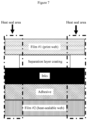
- the pattern would preferably be registered to the printed graphics, and leave a gap with no coating between the cut edge of the final package and the beginning of the heat seal area. Because the flexible packaging structure is typically shredded before being washed, the cut pieces would expose the separation layer coating to the hot water/caustic washing solution, or other type of washing solution, enabling delamination. Note that such exposure would not exist in the non-shredded structure because of the pattern printing. This option makes it possible to create more robust laminate structures with barrier properties while still enabling improved recyclability.
- the coating is applied by flexographic, gravure, roller-coater, screen, spray, rod or bar, curtain, or other industrial printing or coating method, to a substrate comprising a flexible film or a multi-layer film structure.
- the coating is evaporatively dried, preferably by means of a thermal dryer attached to the printing or coating equipment, and may optionally undergo additional chemical hardening or cross-linking to increase its durability.
- the coated layer of film is then laminated to one or more additional layers of film, either using a solvent-based or solvent-free adhesive or thermal extrusion lamination, to form a multilayer packaging structure composed of a combination of two or more layers of film.
- the structure may optionally comprise a metalized film or foil and/or printing ink.
- the separation layer coating of the present invention typically comprises a single or combination of water-soluble polymers or copolymers.
- Suitable polymers and copolymers include, but are not limited to, polyvinyl alcohol (PVOH), ethylene vinyl alcohol (EVOH), amorphous vinyl alcohol, polyacrylic acid, and/or polyurethane dispersions.
- PVOH polyvinyl alcohol
- EVOH ethylene vinyl alcohol
- amorphous vinyl alcohol polyacrylic acid
- polyurethane dispersions e.g., polyurethane
- inorganic additives and fillers such as mica, clays, and silicates, are dispersed in the coatings to enhance gas barrier properties.
- the barrier coatings of the present invention provide a 10 to 100 fold reduction in oxygen transmission rate (OTR), compared to uncoated film.
- OTR oxygen transmission rate
- the coating composition is prepared by dissolving the soluble polymers in aqueous solution at room temperature, or with the addition of heat to accelerate the rate of solutioning.
- the barrier coating composition optionally contains non-aqueous solvents, such as alcohols, to promote efficient and effective, printing, coating, and drying.
- the coating composition may also comprise surfactants, or performance additives, such as surface wetting or defoaming additives, to further aid manufacturing and/or effective printing and application of the coating on the intended substrate and equipment of choice.
- the coating compositions may optionally comprise adhesion promoters, such as polyaziridine, polyethyleneimine (PEI), polyurethane polyol dispersions, organo-silanes, amino-silanes, acid-functional monomers or polymers, titanates, zirconates, or other chelating agent.
- adhesion promoters such as polyaziridine, polyethyleneimine (PEI), polyurethane polyol dispersions, organo-silanes, amino-silanes, acid-functional monomers or polymers, titanates, zirconates, or other chelating agent.
- adhesion promoters promote adequate adhesion of the coating to the substrate film to produce the required bond strength in the laminated structure.
- PVOH, EVOH, and amorphous vinyl alcohol polymers include, but are not limited to, Exceval AQ-4104 (Kuraray Europe GmbH), Poval (Mowiol) 4-98 (Kuraray Europe GmbH), Aquaseal X2281 (Paramelt B.V., the Netherlands), and Nichigo G-Polymer (Mitsubishi Chemical Japan - distributed by Soarus L.L.C. USA).
- suitable modified PVOH copolymers include, but are not limited to, Gohsenx Z polymers, such as Z-100 and Z-200 acetoacetyl-modified PVOH (Mitsubishi Chemical), and amino-functional PVOH resins, e.g.
- polyvinylamine-co-polyvinylalcohol resins such as Ultiloc 5003 (Sekisui Japan).
- Ultiloc 5003 Ultiloc 5003 (Sekisui Japan).
- the polymers listed above are expected to have HSP values close to the literature values, with some experimental variations of ⁇ 3 units for each parameter.
- barrier resins may be used if the conditions include, for instance, hot caustic solution, and in particular hot caustic with a powerful surfactant, as often used in plastics recycling plants, or even sorting facilities, during the washing cycle.
- materials such as barrier polyurethane dispersions may be used.
- An example of such material is the Takelac WPB-342(A) from Mitsubishi Chemical.
- polyurethane barrier coatings generally do not have intrinsic oxygen barrier properties as good as PVOH or EVOH, they do offer better moisture vapor barrier properties, and, in general, better hydrolytic stability, which could be helpful in packaging structures.
- Suitable mica, clay, and silicates include, but are not limited to, Cloisite Na+ (BYK-Altana Germany), and MicroLite 963 (SPV-Dicalite Management Group USA).
- Additional components such as inorganic fillers, surfactants, catalysts, hardeners, or cross-linkers, may be combined in the coating formulation to produce a 1-pack "press-ready" coating, capable of being used on the printing or coating equipment without further modification.
- the additional components may be supplied separately as a "multi-part" coating consisting of one or more parts comprising the polymer solution or solutions, liquid dispersions of fillers and additives, and cross-linkers or catalysts, requiring the separate parts to be pre-mixed and blended together immediately prior to their use on the printing or coating equipment.
- the coating or coating parts when mixed prior to use are preferably designed with optimal viscosity and drying capabilities for the intended printing or coating equipment, and additional performance properties to meet the demands of laminating and packaging converting equipment.
- the laminated structure produced by incorporating the coating of the invention will preferably have sufficient lamination bond strengths to meet the requirements of the intended market application of the packaging, which may be different depending on the content, application, and end-use of the packaging.
- the coating compositions may be optimized to "tune" the delamination properties, depending on the delamination conditions and desired performance of the structure under those conditions.
- the composition may incorporate a cross-linker to improve cold or warm water immersion resistance of the structure, and only enable delamination when the water reaches at least 65°C, preferably 75°C, or more preferably 85°C.
- the composition may also be optimized to allow faster delamination under such conditions, for instance by adjusting the glass transition temperature (Tg) of the resin components, and degree of cross-linking of the formulation.
- Tg glass transition temperature
- Tg would allow faster delamination in hot water, while higher degree of cross-linking would make delamination more difficult and require more time or higher temperature, and may require the use of a surfactant and/or caustic in the washing solution to accelerate delamination. Note that higher temperature is generally helpful when the structure is based on materials which have different thermal expansion characteristics at that temperature, such as PET and PE films.
- the coating may be pattern-printed or pattern-coated in such a way that the coated area of the substrate film excludes at least the outer part of the intended heatseal areas around the edges of the packaging structure.
- the pattern printed coating is generally registered with the printed graphics (of the ink layers). This method is in contrast to the typical method used to apply barrier coatings, wherein barrier coatings are generally flood coated.
- the technology of this invention may be used in combination with washable inks and/or removable adhesives, to further help isolate the various films used in the structure, without contamination from inks or adhesives.
- the inks and/or adhesive would be dissolved or very finely dispersed in the wash solution to allow the separation of the film pieces without residue and, if possible, the removal of the ink and/or adhesive particles from the wash solution so that water (or caustic solution with or without detergent, or other washing solution or medium) could be re-used in the washing process.
- water or caustic solution with or without detergent, or other washing solution or medium
- the Solvawash TM line of washable inks from Sun Chemical is an example of such washable inks.
- the present invention may be used to improve the barrier properties and recyclability of many multi-layer packaging structures, including vertically or horizontally formed pouches, sachets, trays, bars, and flow wraps.
- the final structure may be a flexible packaging structure, or comprise a combination of flexible packaging and rigid packaging, such as a container with a lid.
- Examples of such hybrid containers with lids include, for instance, fruit and vegetable trays with film-based lids, thermoformed trays (or containers) with a lid, and injection molded containers with a lid.
- thermoformed or injection molded containers include yogurt or dessert pot, capsules, or tea and coffee pods.
- the rigid container represents generally the largest weight fraction and the most valuable part to recycle, and is typically based on polyethylene terephthalate (PET), polypropylene (PP), or polystyrene (PS).
- PET polyethylene terephthalate
- PP polypropylene
- PS polystyrene
- the lid is made with a non-compatible chemistry (e.g. hybrid polyester-polyolefin multilayer) and fails to be separated either by the consumer or during recycling, it could prevent the re-use of valuable thermoplastic resin.
- the use of the present technology would be beneficial to either entirely remove the lid from the container so that it can be separated from the rigid fraction, or, if applicable, separate the non-compatible layers as done for the flexible packaging structure.
- the technology of the present invention may be used to create duplex barrier structures which can delaminate.
- structures may include a vacuum metallization layer, such as Al, AlOx, or SiOx.
- the structures may be a triplex or more complex structure.
- the separation layer coating which enables delamination should be strategically placed to provide the most meaningful split of the structure, in order to create the highest recycling yield and/or value. To that effect, some triplex structures are commonly seen in flexible packaging or lidding, which require high barrier properties.
- a triplex structure is PET/ink/adhesive/VM-PET/adhesive/LDPE, wherein VM-PET indicates a PET film with a vacuum deposited layer of Al, AlOx, or SiOx, and LDPE is low density polyethylene film.
- the barrier coating could be placed on the LDPE side facing the adhesive to separate it from the PET-based layers, which could then be treated separately.
- Some other structures may be more complex, such as OPA/ink/adhesive/VM-PET/adhesive/LDPE, where all the films would need to be separated (“OPA" is oriented polyamide film).
- OPA is oriented polyamide film.
- a separation layer coating should be preferably applied on all the layers, or, at a minimum, on the LDPE to at least help recover the LDPE by floatation.
- PVdC polyvinylidene chloride
- OPP polyvinylidene chloride
- PVdC-coated OPP/ink/adhesive/VM-CPP oriented polypropylene
- VM-CPP vacuum deposited Al cast polypropylene film.
- the structure is a monomaterial structure because the film substrates are both based on polypropylene chemistry, it does not allow for easy recycling. In fact, the PVdC could contaminate the recyclate and create significant issues during recovery or re-use. The metallization also might be a problem in some instances.
- a printable barrier coating may be used to coat the primary OPP film, and help the separation from the ink layer, while imparting the necessary barrier properties to the structure.
- a second barrier coating may be applied on the CPP side facing the adhesive, so that ink and adhesive could be fully separated from OPP and VM-CPP, which would float while ink and adhesive would sink.
- An alternative approach might be to use a washable adhesive (such as a water-based compostable adhesive) in combination with the barrier coating of the present invention applied on the OPP side.
- a barrier coating as a vacuum metallization primer, to be applied on the CPP before the Al vacuum deposition. That way, the Al layer could also be removed, leaving a clear CPP and OPP film behind after delamination.
- the technology described in the present invention helps create more recyclable monoand multi-material structures. Some applications will be illustrated in the following examples. However, those skilled in the art would understand that the technology may be applied to a broader range of applications in food, household, or industrial packaging applications, where the delamination layer(s) may be applied by different methods and in different locations of the structure to help achieve the desired separation and help improve recycling.
- one or more additional layers of polymeric film substrate can be included in the laminate structure to form a "triplex" or “quadruplex” (etc.) structure.
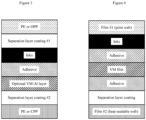
- Figures 3 to 6 illustrate potential examples of a triplex structure.
- toxic byproducts e.g. emission of dioxine from burning PVdC coated films, emission of NOx or HCN from burning nitrogen containing materials.
- Applicant notes that there are many ways to provide a lamination structure, and a package made therefrom, but the present invention provides a method to create more readily recyclable structures, which will help better separate the layers of a packaging structure into cleaner, and potentially higher value, recycling streams for future re-use as part of the circular economy.
- the method relies on the use of a strategically located thin separation layer coating enabling delamination in hot water and/or caustic solution, while maintaining the necessary end use performance requirements for the structure during its use, and, when the separation layer coating is a barrier coating, further boosting barrier properties.
- the separation layer coating is specially engineered to provide the right balance of properties during the useful life of the laminate/packaging structure, and optimize recyclability.
- the separation layer coating may be applied as a full solid continuous layer, or pattern printed.
- the method can be applied to multi-material (heterogenous) structures, or mono-material (homogenous) structures.
- the preferred separation layer coating will enable a complete delamination in less than 30 minutes in hot water (washing solution), preferably in less than 10 minutes, and most preferably in less than 5 minutes.
- the hot water washing solution is at a temperature between 65°C and 85°C.
- the washing solution may optionally contain a surfactant such as Triton X100, or other surfactant commonly used in recycling wash systems, and/or the washing solution may be a caustic solution, for example a 1% to 3% NaOH solution.
- the washing solution may include one or more organic solvents.
- the laminate film structure, or package or container comprising the laminate film structure is shredded prior to the washing step of a recycling process.
- the sealing step in the method of forming the laminate structure is selected from the group consisting of heat sealing, ultrasonic sealing, induction sealing, or adhesive sealing.
- a laminate adhesive is applied as a layer in the laminate film structure to form the laminate structure.
- the laminate adhesive is replaced by a thermal extrusion lamination process.
- the laminate structure further comprises one or more of the following:
- the separation layer coating is a barrier coating which provides an equal to or greater than 10-fold reduction in oxygen transmission rate (OTR) compared to uncoated film.
- OTR oxygen transmission rate
- the separation layer coating may be flood coated onto the substrate or pattern applied in registration with the inks / package design away from the outer edge of the laminate and heat seal areas.
- the present invention also provides a laminate film structure or package produced by the method disclosed herein.
- the laminate film structure or package structure is recyclable.
- the package of the present invention can be in the form of a pouch, sachet, thermoformed tray, lidded container, pot, capsule, or pod.
- the present invention also provides a polymeric article produced using the recycled polymer obtained using the methods disclosed herein.
- the basis of the present invention is adjusting the formulation of the separation layer coating so that the polymer of the separation layer coating will intermingle with the polymer of the substrate, but also be soluble in the washing solution, for example, hot water and/or hot caustic solution. This is described below in terms of the Hansen Solubility Parameters, and the Flory-Huggins parameter.
- Solubility is the degree to which two liquids, or a solid and a liquid, can produce a homogenous mixture.
- the core concept comes from the well-known idea of "like dissolves like,” which, in itself, goes back to the even more fundamental concept of "polar-polar” and “nonpolar-nonpolar” interactions in atoms and molecules. The latter further stems down to the cohesion energy between the molecules of materials.
- the square root of the density of cohesive energy is defined as the total solubility parameter ⁇ total .
- E total E total V
- E total is the total cohesive energy per mole or the total energy of vaporization per mole in J/mol and V is the molar volume in (m 3 /mol) and ⁇ total is in (MPa) 1 ⁇ 2 .
- HSP Hansen Solubility Parameters
- ⁇ D is the "dispersion” parameter, which correlates with the polarizability of a molecule, which in turn correlates with refractive index and van der Waals forces (see “Hansen Solubility Parameters (HSP)
- HSP Hydrophilility Parameters
- Molecules like methanol have few polarizable electrons, so ⁇ D is low, but aromatics like toluene have more polarizability, and ⁇ D is higher.
- chlorinated solvents have a high ⁇ D because of the polarizable halogen electrons.
- Ra is small, and mutual solubility/compatibility is high. If one or more values differ greatly, then the Distance is large, and mutual solubility is low.
- the HSP distance corresponding to compatible/soluble materials may vary depending on the material. Polymers have an extra significant solubility number, called “Solubility Radius” or “Radius of Interaction” designated by “R” or “Ro.”
- the radius of interaction of a polymer with HSP ( ⁇ D p , ⁇ P p , ⁇ H p ) defines a sphere in the solubility space, called the solubility sphere.
- the radius of the sphere of solubility is calculated as (MPa) 1/2 .
- the complete set of solubility parameters for a polymer consists of four parameters ( ⁇ D p , ⁇ P p , ⁇ H p , Ro) rather than three for a solvent or solvent blend.
- a polymer will be soluble in a solvent or solvent blend if the solvent or solvent blend's location in the 3D solubility falls within the solubility sphere of the polymer.
- the distance of the solvent/blend location and the center of the polymer's center (D (S-P) ) is determined and compared with the polymer radius of interaction.
- ⁇ D1, ⁇ P1 and ⁇ H1 can be the HSP of the hot water/caustic solution, and ⁇ D2, ⁇ P2, ⁇ H2 can be the HSP of the polymer, or vice versa (a squared value of a number is an absolute value whether the difference is positive or negative).
- RED is called "Relative Energy Difference.” A smaller RED indicates that the solvent/blend is more likely to dissolve the polymer. For example, if the ratio of the HSP distance Ra to Ro (RED) is less than 1, then the materials are likely to be soluble/compatible.
- the polymer used for the separation coating composition will typically be chosen so that hot water and/or a hot caustic solution falls within the solubility sphere of the polymer, because these washing solutions are the ones most commonly used during recycling.
- the washing solution is not so limited, and any appropriate washing solution can be used, depending on the circumstances.
- the polymer solubility is generally considered when assessing polymer blends.
- MVol is the molar volume and RT is the usual gas constant times temperature term.
- ⁇ parameter can be used to calculate the distance two polymers can reach across the interface, with a lower ⁇ value giving a greater possibility of intermingling.
- the HSP Distance Ra is a good guide to polymer intermingling even if they are a less good guide to polymer miscibility.
- the transformation of ⁇ from Distance uses a value of 50000 for MVol of the polymers.
- HSP Hansen Solubility Parameters
- HSP Hansen Solubility Parameters
- Prof Steven Abbott or the HSPiP database, or both.
- the materials in the online calculator are a subset of the HSPiP database, and are therefore from the same source.
- Assessing the distance of polymeric film substrates from each other serves multiple purposes. For example, if the distance between the polymeric substrates is close, then the compatibility of the polymers may facilitate recycling. Or, a laminate produced by extrusion (e.g. melt extrusion) will have a greater bond strength if the laminated polymer films have a close distance as calculated using HSP parameters.
- HSP parameters for the resins is in relation to mechanical recycling applications. In mechanical recycling, the recovered film(s) is (re-)extruded to make new products. Knowing the HSP values of the films used in the structure will help determine if the films tell you how important it is to separate the films to avoid compatibility issues during recycling. Inks and adhesive may represent a small fraction of the overall structure. Examples from the online calculator are listed below as "Resin name" ( ⁇ D; ⁇ P; ⁇ H) with the values expressed in MPa 1/2
- the Ra between the substrates polymers is about 3 to about 10, and they are compatible. Compatible substrates may be able to be recycled together, or formed into an extrusion laminate.
- the polymer substrates are heterogenous, and have a Ra of about 10 or greater between them.
- the density of the material is such that they can be separated gravimetrically during recycling.
- An example of that is the PET/LDPE example where the LDPE/adhesive/ink layer floats, and can be skimmed, while the clean PET film falls to the bottom of the recycling vessel.
- the present invention provides a method of preparing a recyclable packaging laminate structure intended for a recycling process involving a washing step with a solvent having certain HSP parameters, wherein the RED of the polymer of the separation layer coating and the washing solvent is less than 1 under recycling conditions.
- the film substrates of the laminate structure will be comprised of homogenous polymers.
- the Ra between homogenous polymers is less than 5, and preferably less than 4. In this case, when appropriate, the film substrates of the laminate structure may be recycled together.
- the film substrates of the laminate structure will be comprised of heterogenous polymers.
- the distance, Ra, between the polymers is large enough that they will not intermingle, or will only intermingle for a very short distance.
- the Ra between heterogenous polymers is greater than about 5, preferably greater than 10, and more preferably greater than 20.
- the polymers will not be soluble one in another, and the RED between the polymers will be much greater than 1.
- the density of the materials is such that they can be separated gravimetrically.
- An example of this type of laminate structure in where one film substrate is made of PET, and the other film substrate is made of LDPE. During recycling, after delamination, the LDPE/adhesive/ink layer floats, and can be easily skimmed, while the clean PET film falls to the bottom of the recycling container.
- washing solutions may be used. Generally, a hot water or hot caustic solution (e.g. 1% to 3% NaOH) is used, but in certain circumstances an organic solvent may be used. If an organic solvent is used, it must be carefully chosen to ensure that it does not dissolve the polymeric film substrate.
- the HSP parameters for representative hot water washing solutions are listed in Table 1.
- the HSP values for other solvents can be calculated using the HSPiP software. Values for water are from Table A.1 (pg. 482) of Charles M. Hansen, Hansen Solubility Parameters: A User's Handbook, 2nd Edition, 2007 .
- T is the temperature of the water
- ⁇ T is the change is temperature from 25°C
- ⁇ is the thermal expansion coefficient of water at temperature T (the thermal expansion coefficient of water is different at different temperatures).
- the value for ⁇ is set at 0.0007/K on the online calculator at the website HSP and Temperature listed above.
- the values in Table 1 are calculated using the calculator provided at the website HSP and Temperature listed above. If desired, more specific values for ⁇ can be found at the Engineering Toolbox website at https://www.engineeringtoolbox.com/water-density-specific-weight-d_595.html ):
- HSP parameters for some polymers are listed in Table 2. These values were obtained from the online calculator at Hansen Solubility Parameters (HSP)
- Table 1 is provided so that it is clear upon which values we base our calculations. Alternative tables may be used if obtained from trusted sources. If alternative sources are used, we recommend that in that case all calculations be completed with data from that reference, rather than mixing references, and preferably using values determined with similar experimental methods for consistency. Table 2.
- HSP of selected polymers Polymer Hansen solubility (MPa) 1/2 ⁇ D dispersion ⁇ P polar ⁇ H H-bonding Ro *Poly(vinylchloride), PVC 18.8 9.2 6.3 8.0 Polyethylene, PE 16.9 0.8 2.8 8.0 Polypropylene, PP 18.0 0 1.0 8.0 Nylon 66 (a polyamide) 17.4 9.9 14.6 8.0 Poly(ethylene terephthalate), PET 18.2 6.4 6.6 8.0 Poly(ethyl methacrylate), PEMA 17.6 9.7 4.0 8.0 Poly(methacrylic acid) (PMAA) 25.6 11.2 19.6 20.3 Poly(methyl methacrylate), PMMA 18.6 10.5 5.1 9.5 Poly(acrylonitrile), PAN 22.4 14.1 9.1 8.0 Polystyrene, PS 18.5 4.5 2.9 8.0 Polysulfone 16.0 6.0 6.6 8.0 Poly(vinyl alcohol), PVOH 15.0 17.2 17.8 10.2 Poly(vinyl acetate), PVA 17.
- Adhesion of a coating to a web substrate can be varied by choosing a polymer as a binder for preparation of the coating that is more likely to intermingle with the polymer of the web substrate.
- the Ra value between the two polymers indicates the compatibility, and therefore the intermingling, of the two polymers.
- PVOH and EVOH are closer to Nylon 66 (a polyamide), and is more likely to intermingle with polyamide substrates, increasing adhesion.
- PU is the closest to PET, and is likely to intermingle with PET substrates, increasing adhesion.
- Solubility of the separation layer coating polymer in hot water and hot caustic washing solutions can be estimated by calculating the relative energy difference (RED) between the polymer and the washing solution.
- the RED between the polymer of the separation layer coating and the washing solution is less than 1. If the RED is greater than 1, the washing solution can be adjusted, by, for example, adding a caustic (e.g. NaOH), adding an organic solvent, or adding a surfactant.
- RED between barrier polymers and the washing solution Some examples of the calculated RED between barrier polymers and the washing solution are shown in Table 4. Table 4. RED between barrier polymer and washing solution Washing solution RED PMMA PVOH #EVOH *EVOH Sol PU Water at 25°C 1.47 0.61 0.96 1.28 1.83 Water at 85°C 1.30 0.48 0.68 1.33 1.66 Water at 95°C 1.27 0.48 0.65 1.33 1.63 *all values from HSPiP database. # ⁇ D, ⁇ P, and ⁇ H from the online calculator, and Ro default value of 8.0.
- HSP values for small molecules change while HSP values for polymers generally do not.
- Increasing the temperature of small molecules generally decreases HSP values.
- the HSP-temperature effect can either increase or decrease solubility.
- washing solution is used as a typical example of a washing solution in the present description.
- the washing solution can be modified by adding other solvents, such as organic solvents, to create a solvent blend, or by adding other components.
- other components that might be added include sodium hydroxide (NaOH), or one or more surfactants.
- NaOH sodium hydroxide
- surfactants include sodium hydroxide (NaOH), or one or more surfactants.
- HSP parameters of the aqueous washing solution are more likely to change the HSP parameters of the aqueous washing solution. Note that it is common in recycling operations to add a surfactant in the water which could help lift the barrier coating away from the films even if the RED between coating and water is > 1.
- Surfactants can be construed as materials with 2 sides (lipophilic side and hydrophilic side) having different HSP values leading to an "average" HSP value. More details about HSP of surfactants are included here: https://pirika.com/ENG/HSP/E-Book?Chap21.html .
- the HSP parameters of washing solutions with different blends and components can be calculated using HSPiP software.
- the Ra between the web substrate and the polymer used in the separation layer coating composition should be less than 25, to enable intermingling, but greater than 3, to enable delamination. That is, the Ra should be such that the polymer of the first substrate and the polymer of the separation layer coating intermingle to obtain a high enough adhesion of the separation layer coating to the first polymeric substrate for the laminate structure to remain intact during the useful lifetime of the package, while at the same time providing low enough adhesion to allow for removal of the coating from the first polymeric substrate during a washing step of a recycling process.
- the Ra between the polymer of the substrate and the polymer of the separation layer coating is from about 3 to about 25; or about 3 to about 20; or about 3 to about 15; or about 3 to about 10; or about 3 to about 5; or about 5 to about 25; or about 5 to about 20; or about 5 to about 15; or about 5 to about 10; or about 10 to about 25; or about 10 to about 20; or about 10 to about 15.
- the solubility of the polymer in the separation layer coating in the washing solution should be adequate to enable removal of the separation layer coating from the selected web substrate in the washing step of recycling.
- a RED of less than 1 between the washing solution and the separation layer coating polymer (defined as the primary binder resin and/or blend of resins in the coating) is desired.
- the RED between the polymer of the polymeric film substrate and the washing solution be as large possible, and at least greater than 1, so that the polymeric film itself does not dissolve in the washing solution.
- the RED between the washing solution and the polymers of all of the polymeric film substrates in the lamination structure be as large as possible, and at least greater than 1.
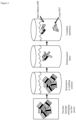
- Figure 1 shows a duplex laminate structure, where a laminate structure is formed using a polyester film (PET) first substrate, coated with a delamination barrier coating, inks, adhesive, and laminated to polyethylene (PE) sealant web (second substrate).
- PET polyester film
- PE polyethylene
- the barrier coating provides the delamination layer, allowing clean PET flake (first substrate) to be recovered during recycling.
- FIG 2 is a schematic showing the recovery of the PET of the first substrate in Figure 1 .
- the packaging structure made from the laminate is recycled by shredding the package, immersing the shreds in hot water or hot caustic solution to remove the PET from the other layers, and finally separating the clean PET.
- the PET recovered can be recycled, and be used for virtually any purpose where virgin PET is used (e.g. for making new polyester films, laminates, packages and containers, or as a resin or co-resin in various applications).
- Figure 3 shows a recyclable triplex structure using chemically compatible substrates in which clean PE, OPP, or CPP films can be separated from the ink, adhesive, and optional vacuummetalized aluminium layer.
- Separatation Layer Coatings #1 and #2 indicate a separation layer coating of this invention designed to also enable delamination in hot water / caustic.
- Figure 4 shows a recyclable triplex structure with high barrier properties in which clean heat-sealable web film (Film #2) can be separated from the print web film (Film #1), inks, adhesive, vacuum metalized film, and adhesive.
- Figure 5 shows a triplex structure with high barrier properties in which clean print-web film (Film #1) can be separated from inks, adhesive, vacuum metalized film, and heat-sealable web film (Film #2).
- Figure 6 shows a triplex structure with high barrier properties not according to the invenion in which clean heat-sealable web film (Film #2) can be separated from the print web film (Film #1), inks, adhesive, and vacuum metalized film.
- Figure 7 shows a recyclable structure with pattern printed delamination barrier coating in which the barrier coating of the invention is applied and registered to the printing ink graphic design so that it is absent from the edges of the heat-sealable structure and will not cause the structure to unintentionally delaminate prior to shredding and recycling, should the structure be exposed wet storage conditions.
- Example 1 Beef jerky snack food adhesive laminated pouch.
- a beef jerky snack food adhesive laminated pouch comprising a polyester (PET) primary printing web, and low-density polyethylene sealant web (LDPE) was prepared.
- a separation layer coating (which also acts as an oxygen barrier coating) comprising PVOH solution and nano-clay dispersion was applied at 0.3 g/m 2 to 0.5 g/m 2 dry-solids coat weight by flexographic or gravure printing to the clear PET film, then over-printed with snack food artwork (inks), and then adhesive laminated to LDPE, such that the coating, inks, and adhesive are all between the outer PET layer and the inner LDPE layer of film.
- the barrier coating provides an enhanced oxygen barrier in the structure, reducing the oxygen transmission rate (OTR) of PET from 140 cm 3 /m 2 /day (ref. Dupont Tejin Films Mylar 12-micron Polyester, 25°C, 45% relative humidity) to equal to or less than 1.0 cm 3 /m 2 /day.
- OTR oxygen transmission rate
- Example 2 Dry snack food duplex adhesive laminated pouch. (reference example, not according to the invention)
- a dry snack food duplex adhesive laminated pouch comprising a polyester (PET) primary printing web and low-density polyethylene (LDPE) sealant web is prepared.
- a separation layer coating comprising a PVOH solution and an adhesion promoter (polyethyleneimine (PEI)) is applied directly to the corona-treated LDPE at 0.3 g/m 2 to 0.7 g/m 2 dry-solids coat weight by flexographic or gravure printing, which is then adhesive laminated to the printed PET film. Coating, inks, and adhesive are all between the outer PET and inner LDPE films. The coating still provides an enhanced oxygen barrier.
- PEI polyethyleneimine
- the OTR of the structure may be below 20 cm 3 /m 2 /day, below 10 cm 3 /m 2 /day, or even as low as equal to or less than 2 cm 3 /m 2 /day.
- Lower OTR values may be possible by selecting a coating comprising nano-clay silicate particles.
- Example 3 Laminate structure to separate both web substrates.
- Examples 1 and 2 could be combined, whereby two separation layer coating layers would be applied, one on each layer which needs to be separated. This would not only provide significantly enhanced barrier properties (at or below 0.2 cm 3 /m 2 /day in the present example), but also help separate both the top primary web and the sealant web cleanly as clear films, which could then be recycled into more applications - including potentially food packaging applications.
- This laminate structure is illustrated in Figure 3 , where tie coating #1 and tie coating #2 are barrier coatings.
- Example 4 Dry cereal duplex adhesive laminated pouch.
- a dry cereal duplex adhesive laminated pouch comprising a biaxially-oriented polypropylene (BOPP) primary printing web and low-density polyethylene (LDPE) sealant web is prepared.
- a separation layer coating that is also a barrier coating, comprising PVOH solution, PEI adhesion promoter, and silicate clay dispersion, is applied at 0.3 g/m 2 to 0.5 g/m 2 dry-solids coat weight to corona-treated BOPP, then overprinted with ink, and adhesive laminated to LDPE, such that coating, inks, and adhesive are all between the outer BOPP layer and the inner LDPE layer of films.
- oxygen barrier is less of a requirement for dry cereal, oxygen barrier is still enhanced over 100-fold from greater than 2,000 cm 3 /m 2 /day to less than 10 cm 3 /m 2 /day, at 25°C, and 50% relative humidity (RH).
- RH relative humidity
- the BOPP/LDPE layers delaminate, leaving largely clean BOPP, and the remaining coating, ink, and adhesive attached to the LDPE film. This could be advantageous for any subsequent separation process capable of separating BOPP from LDPE, such as an enhanced triboelectric charging and free-fall separator process.
- Example 5 Alternative dry pouch laminate structure.
- the coating is applied to the opposing corona treated LDPE film surface, and when separated yields largely clean LDPE film, with the remaining coating, ink, and adhesive attached to the BOPP film.
- a food wrapper duplex adhesive laminated pouch comprising biaxially-oriented polyamide (BOPA) primary printing web, and cast polypropylene (CPP) sealant web is prepared.
- BOPA/LDPE layers delaminate, leaving largely clean BOPA, and the remaining coating ink, and adhesive attached to the CPP film.
- Contaminated CPP separates by floating (density 0.895 g/cm 3 ) to the surface, and clean BOPA sinks in the caustic solution tank due to its higher density (1.13 g/cm 3 ).
- Example 6 forms part of the invention when a separation layer acts as a primer for one or more inks that are printed over it.
- Example 7 Alternative food wrapper duplex.
- Example 7 forms part of the invention when a separation layer acts as a primer for one or more inks that are printed over it.
Landscapes
- Chemical & Material Sciences (AREA)
- Engineering & Computer Science (AREA)
- Polymers & Plastics (AREA)
- Organic Chemistry (AREA)
- Health & Medical Sciences (AREA)
- Chemical Kinetics & Catalysis (AREA)
- Medicinal Chemistry (AREA)
- Mechanical Engineering (AREA)
- Materials Engineering (AREA)
- Manufacturing & Machinery (AREA)
- Environmental & Geological Engineering (AREA)
- Laminated Bodies (AREA)
- Wrappers (AREA)
- Separation, Recovery Or Treatment Of Waste Materials Containing Plastics (AREA)
Claims (15)
- Verfahren zur Herstellung von recycelbarer Verpackungslaminatfolienstruktur, umfassend:(a) Bereitstellen eines ersten Polymersubstrats und eines zweiten Polymersubstrats, wobei das Polymer des ersten Substrats Hansen-Löslichkeitsparameter (HSP) von δDs1 (Dispersion), δPs1 (polar) und δHs1 (Wasserstoffbrückenbindung) aufweist;(b) Aufbringen und Härten einer Trennschicht-Beschichtungszusammensetzung auf das erste Polymersubstrat, wobei die Trennschicht-Beschichtungszusammensetzung ein Polymer umfasst, wobei das Polymer der Trennschicht-Beschichtungszusammensetzung HSP von δDc, δPc und δHc, und Roc (Radius des Löslichkeitsbereichs) aufweist;(c) wobei der Abstand zwischen dem Polymer des ersten Polymersubstrats und dem Polymer der Trennbeschichtungszusammensetzung Ra(s1,c) auf der Grundlage der HSP-Parameter jedes Polymers 5 bis 25 beträgt, berechnet gemäß der folgenden Gleichung (1):
 (d) Aufbringen einer Laminationsklebstoffschicht entweder auf die gleiche Seite wie die Trennschichtbeschichtung oder auf die Seite des zweiten Polymersubstrats; und(e) Bilden einer Laminatstruktur, wobei die Trennschichtbeschichtung und der Klebstoff sandwichartig zwischen dem ersten und dem zweiten Substrat angeordnet sind;wobei das gebildete Laminat zum Siegeln an sich selbst oder an eine vorgeformte starre oder flexible Form geeignet ist, um eine Verpackung oder einen Behälter zu erzeugen; undwobei das Laminat eine oder mehrere Tintenschichten innerhalb der Laminatstruktur umfasst und die Trennschicht als eine Grundierung für die eine oder die mehreren Tinten, die darüber gedruckt werden, wirkt.
 - Verfahren zur Herstellung einer/eines laminierten Verpackung oder Behälters, umfassend:(a) Bereitstellen der Laminatfolienstruktur nach Anspruch 1; und(b) Siegeln der Laminatfolienstruktur an sich selbst oder an eine vorgeformte starre oder flexible Form, um eine Verpackung oder einen Behälter zu erzeugen.
- Verfahren zum Erhalten sauberer Stücke des ersten Polymersubstrats nach einem der vorstehenden Ansprüche während des Recyclings, umfassend:(a) Waschen der Laminatfolienstruktur nach Anspruch 1 oder der Verpackung oder des Behälters, die/der die Laminatfolienstruktur nach Anspruch 2 umfasst, in einer Waschlösung, wobei die Waschlösung HSP von δDw, δPw und δHw aufweist;(b) wobei die relative Energiedifferenz (RED) zwischen dem Polymer der Trennschichtbeschichtung und der Waschlösung gemäß Gleichung (2) kleiner als oder gleich 1 ist:

 (c) wobei die RED zwischen dem Polymer des ersten Polymersubstrats und der Waschlösung gemäß Gleichung (4) größer als 1 ist:
 (d) Trennen des ersten Polymersubstrats von den verbleibenden Schichten der Verpackung oder des Behälters zum Recycling.
 - Verfahren nach Anspruch 3, wobei:(i) die RED zwischen der Waschlösung und den Polymeren aller Polymersubstrate in der Laminatstruktur größer als 1 ist; oder(ii) die Laminatfolienstruktur oder Verpackung oder der Behälter, die/der die Laminatfolienstruktur umfasst, vor dem Waschschritt zerkleinert wird.
- Verfahren nach Anspruch 3, wobei die Waschlösung heißes Wasser, heiße Ätzlauge, ein organisches Lösungsmittel oder Kombinationen davon ist;
wobei die Waschlösung gegebenenfalls ferner ein oder mehrere Tenside umfasst. - Verfahren nach Anspruch 2, wobei der Siegelungsschritt ausgewählt ist aus der Gruppe bestehend aus Heißsiegeln, Ultraschallsiegeln, Induktionssiegeln und Klebesiegeln.
- Verfahren nach einem der Ansprüche 1 oder 2, wobei der Laminatklebstoff durch ein thermisches Extrusionslaminationsverfahren ersetzt wird.
- Verfahren nach einem der vorstehenden Ansprüche, wobei das Laminat ferner eines oder mehrere der Folgenden umfasst:(a) eine oder mehrere zusätzliche Schichten von Trennschichtbeschichtung innerhalb der Laminatstruktur; und/oder(b) eine oder mehrere Metallisierungsschichten innerhalb der Laminatstruktur; und/oder(c) einen zusätzlichen Polymerfilm innerhalb der Laminatstruktur, um eine Triplex-Laminatstruktur zu bilden.
- Verfahren nach einem der vorstehenden Ansprüche, wobei die Trennschicht-Beschichtungszusammensetzung ein oder mehrere wasserlösliche oder wasserdispergierbare Polymere oder Copolymere und gegebenenfalls einen oder mehrere Füllstoffe oder Vernetzer umfasst.
- Verfahren nach Anspruch 9, wobei das eine oder die mehreren wasserlöslichen oder wasserdispergierbaren Polymere oder Copolymere ausgewählt sind aus der Gruppe bestehend aus Ethylenvinylalkohol (EVOH), Polyvinylalkohol (PVOH), amorphem Vinylalkohol, Polyacrylsäure und Polyurethandispersion.
- Verfahren nach einem der vorstehenden Ansprüche, wobei:(i) die Trennschicht-Beschichtungszusammensetzung einen oder mehrere Haftvermittler ausgewählt aus der Gruppe bestehend aus Polyaziridin, Polyethylenimin (PEI), Polyurethanpolyoldispersionen, Organosilanen, Aminosilanen, säurefunktionellen Monomeren oder Polymeren, Titanaten, Zirkonaten oder anderen Chelatbildnern umfasst; und/oder(ii) die Trennschichtbeschichtung eine Sauerstoffbarrierebeschichtung ist und eine gleich oder größer als 10-fache Verringerung der Sauerstoffdurchlässigkeitsrate (OTR) im Vergleich zu unbeschichtetem Film bereitstellt; und/oder(iii) die Außenkanten der Laminatstruktur Heißsiegelbereiche sind und die Trennschichtbeschichtung als eine Struktur aufgebracht wird, die relativ zu den gedruckten Grafiken gerichtet ist, um den Außenbereich der Heißsiegelbereiche auszuschließen.
- Verfahren nach einem der vorstehenden Ansprüche, wobei das erste Polymersubstrat und das zweite Polymersubstrat homogen sind, wobei:(a) das Polymer des ersten Substrats Hansen-Löslichkeitsparameter (HSP) von δDs1, δPs1 und δHs1 aufweist;(b) das Polymer des zweiten Substrats Hansen-Löslichkeitsparameter (HSP) von δDs2, δPs2 und δHs2 aufweist;(c) der Abstand zwischen dem Polymer des ersten Polymersubstrats und dem Polymer des zweiten Polymersubstrats Ra(s1,s2) auf der Grundlage der HSP-Parameter jedes Polymers kleiner als oder gleich 4 ist, berechnet gemäß der folgenden Gleichung (6):

- Verfahren nach einem der vorstehenden Ansprüche, wobei das erste Polymersubstrat und das zweite Polymersubstrat heterogen sind, wobei:(a) das Polymer des ersten Substrats Hansen-Löslichkeitsparameter (HSP) von δDs1, δPs1 und δHs1 aufweist;(b) das Polymer des zweiten Substrats Hansen-Löslichkeitsparameter (HSP) von δDs2, δPs2 und δHs2 aufweist;(c) der Abstand zwischen dem Polymer des ersten Polymersubstrats und dem Polymer des zweiten Polymersubstrats Ra(s1,s2) auf der Grundlage der HSP-Parameter jedes Polymers größer als oder gleich 10 ist, berechnet gemäß der folgenden Gleichung (6):

- Laminatfolienstruktur oder Verpackung, hergestellt durch das Verfahren nach Anspruch 1 oder Anspruch 2.
- Laminatfolienstruktur oder Verpackung nach Anspruch 14, wobei:(i) die Struktur recyclingfähig ist; oder(ii) die Verpackung in der Form eines/einer Beutels, Sachets, thermogeformten Schale, Deckelbehälters, Topfs, Kapsel oder Hülse vorliegt.
Applications Claiming Priority (2)
| Application Number | Priority Date | Filing Date | Title |
|---|---|---|---|
| US202163191045P | 2021-05-20 | 2021-05-20 | |
| PCT/US2022/030220 WO2022246173A1 (en) | 2021-05-20 | 2022-05-20 | Oxygen barrier coating as a separation layer coating |
Publications (3)
| Publication Number | Publication Date |
|---|---|
| EP4323191A1 EP4323191A1 (de) | 2024-02-21 |
| EP4323191C0 EP4323191C0 (de) | 2025-06-25 |
| EP4323191B1 true EP4323191B1 (de) | 2025-06-25 |
Family
ID=82594637
Family Applications (1)
| Application Number | Title | Priority Date | Filing Date |
|---|---|---|---|
| EP22743616.9A Active EP4323191B1 (de) | 2021-05-20 | 2022-05-20 | Sauerstoffbarrierebeschichtung als trennschicht |
Country Status (5)
| Country | Link |
|---|---|
| US (1) | US20240217221A1 (de) |
| EP (1) | EP4323191B1 (de) |
| JP (1) | JP2024522973A (de) |
| CN (1) | CN117769493A (de) |
| WO (1) | WO2022246173A1 (de) |
Families Citing this family (5)
| Publication number | Priority date | Publication date | Assignee | Title |
|---|---|---|---|---|
| JP2023128668A (ja) * | 2022-03-04 | 2023-09-14 | 藤森工業株式会社 | 積層体および包装体 |
| WO2024133242A1 (de) | 2022-12-19 | 2024-06-27 | Loparex Germany Gmbh & Co. Kg | Recyclingfähige kunststofffolie |
| WO2024133243A1 (de) | 2022-12-19 | 2024-06-27 | Loparex Germany Gmbh & Co. Kg | Recyclingfähige oberflächenbeschichtete kunststofffolie |
| IT202300004422A1 (it) * | 2023-03-09 | 2024-09-09 | Soc Azionaria Per L’Industria Chimica Italiana S A P I C I S P A | Processo per la preparazione di un materiale multistrato di imballaggio flessibile delaminabile per trattamento in acqua |
| JP7773162B1 (ja) * | 2025-05-12 | 2025-11-19 | 朝日エティック株式会社 | 剥離方法 |
Citations (10)
| Publication number | Priority date | Publication date | Assignee | Title |
|---|---|---|---|---|
| EP0569196A1 (de) * | 1992-05-04 | 1993-11-10 | Rohm And Haas Company | Koextrudierte Mehrschichtfolie mit hoher Gasundurchlässigkeit |
| DE4328016A1 (de) * | 1992-08-28 | 1994-03-03 | Alusuisse Lonza Services Ag | Delaminierbare Verbunde |
| EP1476252A1 (de) * | 2002-02-22 | 2004-11-17 | Kuraray Specialities Europe GmbH | Verfahren zum recycling von beschichteten kunststoff-formkörpern |
| US10005918B2 (en) | 2012-11-02 | 2018-06-26 | Michelman, Inc. | Primer coating for metallized gas barrier films |
| WO2020066652A1 (ja) | 2018-09-25 | 2020-04-02 | Dic株式会社 | 積層フィルムの分離回収方法 |
| US20200122439A1 (en) | 2017-05-05 | 2020-04-23 | Constantia Pirk Gmbh & Co. Kg | Recyclable, Easily Tearable Packaging Laminate Having A Good Barrier Effect And Method For Production Thereof |
| WO2020263219A1 (en) | 2019-06-24 | 2020-12-30 | Bemis Company, Inc. | Recyclable film and packaging |
| JP2021024112A (ja) | 2019-07-31 | 2021-02-22 | 大日本印刷株式会社 | 積層体および包装体 |
| WO2021090690A1 (ja) | 2019-11-06 | 2021-05-14 | Dic株式会社 | 積層フィルム及び積層フィルムの分離回収方法 |
| EP4237237A1 (de) | 2020-10-29 | 2023-09-06 | Fres-co System USA, Inc. | Mechanisch recycelbare sperrlaminate zur herstellung von flexiblen verpackungen und verfahren zur wiederverwendung von flexiblen verpackungen aus recycelbaren sperrlaminaten |
Family Cites Families (10)
| Publication number | Priority date | Publication date | Assignee | Title |
|---|---|---|---|---|
| JP4967194B2 (ja) * | 2000-01-11 | 2012-07-04 | 東レ株式会社 | 積層フィルム |
| US8119699B2 (en) * | 2003-11-21 | 2012-02-21 | Kureha Corporation | Method of recycling laminated molding |
| WO2005085381A1 (en) | 2004-03-09 | 2005-09-15 | Spear Group Holdings Limited | Pressure sensitive film labels for reusable containers |
| JP4841660B2 (ja) * | 2009-06-26 | 2011-12-21 | ユニチカ株式会社 | ポリアミド樹脂成形体用洗浄液およびそれを用いた洗浄方法 |
| JP5648396B2 (ja) * | 2010-09-28 | 2015-01-07 | 大日本印刷株式会社 | 包装袋 |
| JP2020115157A (ja) * | 2017-05-10 | 2020-07-30 | コニカミノルタ株式会社 | 光反射フィルム及び光反射フィルムの製造方法 |
| JP3219745U (ja) * | 2018-08-16 | 2019-01-24 | メロデア リミテッドMelodea Ltd. | 多層物 |
| JP6631964B1 (ja) * | 2019-05-29 | 2020-01-15 | 東洋インキScホールディングス株式会社 | 脱離能を有する有機溶剤系印刷インキ、印刷物および積層体 |
| JP7226060B2 (ja) * | 2019-04-22 | 2023-02-21 | 東洋インキScホールディングス株式会社 | リサイクル基材製造方法 |
| CN112793272B (zh) * | 2021-01-06 | 2023-06-06 | 上海紫江彩印包装有限公司 | 一种复合包装膜及其制备方法和应用 |
-
2022
- 2022-05-20 EP EP22743616.9A patent/EP4323191B1/de active Active
- 2022-05-20 CN CN202280036008.6A patent/CN117769493A/zh active Pending
- 2022-05-20 JP JP2023571195A patent/JP2024522973A/ja active Pending
- 2022-05-20 US US18/558,296 patent/US20240217221A1/en active Pending
- 2022-05-20 WO PCT/US2022/030220 patent/WO2022246173A1/en not_active Ceased
Patent Citations (10)
| Publication number | Priority date | Publication date | Assignee | Title |
|---|---|---|---|---|
| EP0569196A1 (de) * | 1992-05-04 | 1993-11-10 | Rohm And Haas Company | Koextrudierte Mehrschichtfolie mit hoher Gasundurchlässigkeit |
| DE4328016A1 (de) * | 1992-08-28 | 1994-03-03 | Alusuisse Lonza Services Ag | Delaminierbare Verbunde |
| EP1476252A1 (de) * | 2002-02-22 | 2004-11-17 | Kuraray Specialities Europe GmbH | Verfahren zum recycling von beschichteten kunststoff-formkörpern |
| US10005918B2 (en) | 2012-11-02 | 2018-06-26 | Michelman, Inc. | Primer coating for metallized gas barrier films |
| US20200122439A1 (en) | 2017-05-05 | 2020-04-23 | Constantia Pirk Gmbh & Co. Kg | Recyclable, Easily Tearable Packaging Laminate Having A Good Barrier Effect And Method For Production Thereof |
| WO2020066652A1 (ja) | 2018-09-25 | 2020-04-02 | Dic株式会社 | 積層フィルムの分離回収方法 |
| WO2020263219A1 (en) | 2019-06-24 | 2020-12-30 | Bemis Company, Inc. | Recyclable film and packaging |
| JP2021024112A (ja) | 2019-07-31 | 2021-02-22 | 大日本印刷株式会社 | 積層体および包装体 |
| WO2021090690A1 (ja) | 2019-11-06 | 2021-05-14 | Dic株式会社 | 積層フィルム及び積層フィルムの分離回収方法 |
| EP4237237A1 (de) | 2020-10-29 | 2023-09-06 | Fres-co System USA, Inc. | Mechanisch recycelbare sperrlaminate zur herstellung von flexiblen verpackungen und verfahren zur wiederverwendung von flexiblen verpackungen aus recycelbaren sperrlaminaten |
Non-Patent Citations (3)
| Title |
|---|
| AURAS, RAFAEL: "Poly(Lactic Acid)", 1 January 2010, HOBOKEN, NJ : WILEY , US , ISBN: 978-0-470-29366-9, article STEVEN ABBOTT: "Cjapter 7: Chemical Compatibility of Poly(Lactic Acid): A Practical Framework Using Hansen Solubility Parameters", pages: 83 - 95, XP009566100, DOI: 10.1002/9780470649848.ch7 |
| JOHN B. DURKEE II: "Cleaning with Solvents : Science and Technology", 1 January 2014, ELSEVIER, ISBN: 978-1-4557-3131-2, article JOHN B. DURKEE: "Appendix C10 - Hoy Solubility Parameters", pages: 653 - 674, XP009566101, DOI: 10.1016/B978-1-4557-3131-2.15020-3 |
| RAINER HÖFER; AVTAR SINGH MATHARU; ZHANRONG ZHANG: "Green Chemistry for Surface Coatings, Inks and Adhesives: Sustainable Applications", 26 June 2019, ROYAL SOCIETY OF CHEMISTRY, ISBN: 978-1-78262-994-8, article STEVEN ABBOTT; SEISHI SHIMIZU: "Chapter 2: Green Solubility for Coatings and Adhesives", pages: 18 - 48, XP009566099, DOI: 10.1039/9781788012997-00018 |
Also Published As
| Publication number | Publication date |
|---|---|
| US20240217221A1 (en) | 2024-07-04 |
| JP2024522973A (ja) | 2024-06-25 |
| CN117769493A (zh) | 2024-03-26 |
| EP4323191C0 (de) | 2025-06-25 |
| WO2022246173A1 (en) | 2022-11-24 |
| EP4323191A1 (de) | 2024-02-21 |
Similar Documents
| Publication | Publication Date | Title |
|---|---|---|
| US20240217221A1 (en) | Oxygen barrier coating as a separation layer coating | |
| CN111565913B (zh) | 可再循环膜和包装 | |
| CN113195209B (zh) | 可再循环膜 | |
| WO2020136674A1 (en) | Recyclable laminate | |
| WO2020236140A1 (en) | Recyclable film and packaging | |
| JP2018171785A (ja) | 積層体およびそれを備える包装袋 | |
| JP2018172150A (ja) | 電子レンジ用包装袋および積層体 | |
| JP2024052239A (ja) | バリア性基材、印刷基材、積層体および包装容器 | |
| CN114007854B (zh) | 可再循环膜和包装 | |
| JP2025000822A (ja) | パウチ | |
| JP6589292B2 (ja) | 農薬用包装材料 | |
| JP6349862B2 (ja) | 積層体 | |
| JP2024052534A (ja) | バリア性基材、積層体および包装容器 | |
| JP2023064753A (ja) | 積層体及び包装容器 | |
| JP7836146B2 (ja) | パウチ | |
| EP4031372A1 (de) | Wiederverwertbare, hochsperrende folie und schale | |
| EP4676742A1 (de) | Verfahren zur herstellung eines mehrschichtigen flexiblen, durch wasserbehandlung delaminierbaren verpackungsmaterials | |
| JP2025141868A (ja) | 積層体および包装容器 | |
| JP2024160819A (ja) | バリア性基材、積層体および包装容器 | |
| JP2024160830A (ja) | 積層体、チューブ容器本体およびチューブ容器 | |
| AU2024265439A1 (en) | Multilayer packaging film | |
| US20250018694A1 (en) | Film, laminated film, rigid article, package, and method of making film | |
| JP7001989B2 (ja) | 積層体 | |
| JP2024141339A (ja) | 積層体、包装袋、及び積層体の製造方法 | |
| WO2025192723A1 (ja) | 積層体および包装容器 |
Legal Events
| Date | Code | Title | Description |
|---|---|---|---|
| STAA | Information on the status of an ep patent application or granted ep patent |
Free format text: STATUS: UNKNOWN |
|
| STAA | Information on the status of an ep patent application or granted ep patent |
Free format text: STATUS: THE INTERNATIONAL PUBLICATION HAS BEEN MADE |
|
| PUAI | Public reference made under article 153(3) epc to a published international application that has entered the european phase |
Free format text: ORIGINAL CODE: 0009012 |
|
| STAA | Information on the status of an ep patent application or granted ep patent |
Free format text: STATUS: REQUEST FOR EXAMINATION WAS MADE |
|
| 17P | Request for examination filed |
Effective date: 20231113 |
|
| AK | Designated contracting states |
Kind code of ref document: A1 Designated state(s): AL AT BE BG CH CY CZ DE DK EE ES FI FR GB GR HR HU IE IS IT LI LT LU LV MC MK MT NL NO PL PT RO RS SE SI SK SM TR |
|
| DAV | Request for validation of the european patent (deleted) | ||
| DAX | Request for extension of the european patent (deleted) | ||
| GRAP | Despatch of communication of intention to grant a patent |
Free format text: ORIGINAL CODE: EPIDOSNIGR1 |
|
| STAA | Information on the status of an ep patent application or granted ep patent |
Free format text: STATUS: GRANT OF PATENT IS INTENDED |
|
| INTG | Intention to grant announced |
Effective date: 20241001 |
|
| GRAJ | Information related to disapproval of communication of intention to grant by the applicant or resumption of examination proceedings by the epo deleted |
Free format text: ORIGINAL CODE: EPIDOSDIGR1 |
|
| STAA | Information on the status of an ep patent application or granted ep patent |
Free format text: STATUS: REQUEST FOR EXAMINATION WAS MADE |
|
| GRAP | Despatch of communication of intention to grant a patent |
Free format text: ORIGINAL CODE: EPIDOSNIGR1 |
|
| STAA | Information on the status of an ep patent application or granted ep patent |
Free format text: STATUS: GRANT OF PATENT IS INTENDED |
|
| INTC | Intention to grant announced (deleted) | ||
| P01 | Opt-out of the competence of the unified patent court (upc) registered |
Free format text: CASE NUMBER: APP_64522/2024 Effective date: 20241205 |
|
| INTG | Intention to grant announced |
Effective date: 20250115 |
|
| GRAS | Grant fee paid |
Free format text: ORIGINAL CODE: EPIDOSNIGR3 |
|
| GRAA | (expected) grant |
Free format text: ORIGINAL CODE: 0009210 |
|
| STAA | Information on the status of an ep patent application or granted ep patent |
Free format text: STATUS: THE PATENT HAS BEEN GRANTED |
|
| AK | Designated contracting states |
Kind code of ref document: B1 Designated state(s): AL AT BE BG CH CY CZ DE DK EE ES FI FR GB GR HR HU IE IS IT LI LT LU LV MC MK MT NL NO PL PT RO RS SE SI SK SM TR |
|
| REG | Reference to a national code |
Ref country code: GB Ref legal event code: FG4D |
|
| REG | Reference to a national code |
Ref country code: CH Ref legal event code: EP |
|
| REG | Reference to a national code |
Ref country code: CH Ref legal event code: EP |
|
| REG | Reference to a national code |
Ref country code: IE Ref legal event code: FG4D |
|
| REG | Reference to a national code |
Ref country code: DE Ref legal event code: R096 Ref document number: 602022016515 Country of ref document: DE |
|
| U01 | Request for unitary effect filed |
Effective date: 20250721 |
|
| U07 | Unitary effect registered |
Designated state(s): AT BE BG DE DK EE FI FR IT LT LU LV MT NL PT RO SE SI Effective date: 20250725 |
|
| PG25 | Lapsed in a contracting state [announced via postgrant information from national office to epo] |
Ref country code: GR Free format text: LAPSE BECAUSE OF FAILURE TO SUBMIT A TRANSLATION OF THE DESCRIPTION OR TO PAY THE FEE WITHIN THE PRESCRIBED TIME-LIMIT Effective date: 20250926 Ref country code: NO Free format text: LAPSE BECAUSE OF FAILURE TO SUBMIT A TRANSLATION OF THE DESCRIPTION OR TO PAY THE FEE WITHIN THE PRESCRIBED TIME-LIMIT Effective date: 20250925 |
|
| PG25 | Lapsed in a contracting state [announced via postgrant information from national office to epo] |
Ref country code: HR Free format text: LAPSE BECAUSE OF FAILURE TO SUBMIT A TRANSLATION OF THE DESCRIPTION OR TO PAY THE FEE WITHIN THE PRESCRIBED TIME-LIMIT Effective date: 20250625 |
|
| PG25 | Lapsed in a contracting state [announced via postgrant information from national office to epo] |
Ref country code: RS Free format text: LAPSE BECAUSE OF FAILURE TO SUBMIT A TRANSLATION OF THE DESCRIPTION OR TO PAY THE FEE WITHIN THE PRESCRIBED TIME-LIMIT Effective date: 20250925 |
|
| PG25 | Lapsed in a contracting state [announced via postgrant information from national office to epo] |
Ref country code: IS Free format text: LAPSE BECAUSE OF FAILURE TO SUBMIT A TRANSLATION OF THE DESCRIPTION OR TO PAY THE FEE WITHIN THE PRESCRIBED TIME-LIMIT Effective date: 20251025 |
|
| PG25 | Lapsed in a contracting state [announced via postgrant information from national office to epo] |
Ref country code: SM Free format text: LAPSE BECAUSE OF FAILURE TO SUBMIT A TRANSLATION OF THE DESCRIPTION OR TO PAY THE FEE WITHIN THE PRESCRIBED TIME-LIMIT Effective date: 20250625 |
|
| PG25 | Lapsed in a contracting state [announced via postgrant information from national office to epo] |
Ref country code: CZ Free format text: LAPSE BECAUSE OF FAILURE TO SUBMIT A TRANSLATION OF THE DESCRIPTION OR TO PAY THE FEE WITHIN THE PRESCRIBED TIME-LIMIT Effective date: 20250625 |
|
| PG25 | Lapsed in a contracting state [announced via postgrant information from national office to epo] |
Ref country code: PL Free format text: LAPSE BECAUSE OF FAILURE TO SUBMIT A TRANSLATION OF THE DESCRIPTION OR TO PAY THE FEE WITHIN THE PRESCRIBED TIME-LIMIT Effective date: 20250625 |
|
| PG25 | Lapsed in a contracting state [announced via postgrant information from national office to epo] |
Ref country code: SK Free format text: LAPSE BECAUSE OF FAILURE TO SUBMIT A TRANSLATION OF THE DESCRIPTION OR TO PAY THE FEE WITHIN THE PRESCRIBED TIME-LIMIT Effective date: 20250625 |
|
| PG25 | Lapsed in a contracting state [announced via postgrant information from national office to epo] |
Ref country code: ES Free format text: LAPSE BECAUSE OF FAILURE TO SUBMIT A TRANSLATION OF THE DESCRIPTION OR TO PAY THE FEE WITHIN THE PRESCRIBED TIME-LIMIT Effective date: 20250625 |
|
| PLBI | Opposition filed |
Free format text: ORIGINAL CODE: 0009260 |
|
| REG | Reference to a national code |
Ref country code: CH Ref legal event code: L10 Free format text: ST27 STATUS EVENT CODE: U-0-0-L10-L00 (AS PROVIDED BY THE NATIONAL OFFICE) Effective date: 20260402 |
|
| PLAX | Notice of opposition and request to file observation + time limit sent |
Free format text: ORIGINAL CODE: EPIDOSNOBS2 |
|
| 26 | Opposition filed |
Opponent name: HENKEL AG & CO. KGAA Effective date: 20260324 |