EP4323584B1 - Neues substrat - Google Patents
Neues substrat Download PDFInfo
- Publication number
- EP4323584B1 EP4323584B1 EP22722738.6A EP22722738A EP4323584B1 EP 4323584 B1 EP4323584 B1 EP 4323584B1 EP 22722738 A EP22722738 A EP 22722738A EP 4323584 B1 EP4323584 B1 EP 4323584B1
- Authority
- EP
- European Patent Office
- Prior art keywords
- paper
- dry weight
- density paper
- density
- iso
- Prior art date
- Legal status (The legal status is an assumption and is not a legal conclusion. Google has not performed a legal analysis and makes no representation as to the accuracy of the status listed.)
- Active
Links
Images

Classifications
-
- D—TEXTILES; PAPER
- D21—PAPER-MAKING; PRODUCTION OF CELLULOSE
- D21H—PULP COMPOSITIONS; PREPARATION THEREOF NOT COVERED BY SUBCLASSES D21C OR D21D; IMPREGNATING OR COATING OF PAPER; TREATMENT OF FINISHED PAPER NOT COVERED BY CLASS B31 OR SUBCLASS D21G; PAPER NOT OTHERWISE PROVIDED FOR
- D21H17/00—Non-fibrous material added to the pulp, characterised by its constitution; Paper-impregnating material characterised by its constitution
- D21H17/20—Macromolecular organic compounds
- D21H17/21—Macromolecular organic compounds of natural origin; Derivatives thereof
- D21H17/24—Polysaccharides
- D21H17/25—Cellulose
-
- B—PERFORMING OPERATIONS; TRANSPORTING
- B65—CONVEYING; PACKING; STORING; HANDLING THIN OR FILAMENTARY MATERIAL
- B65D—CONTAINERS FOR STORAGE OR TRANSPORT OF ARTICLES OR MATERIALS, e.g. BAGS, BARRELS, BOTTLES, BOXES, CANS, CARTONS, CRATES, DRUMS, JARS, TANKS, HOPPERS, FORWARDING CONTAINERS; ACCESSORIES, CLOSURES, OR FITTINGS THEREFOR; PACKAGING ELEMENTS; PACKAGES
- B65D65/00—Wrappers or flexible covers; Packaging materials of special type or form
- B65D65/38—Packaging materials of special type or form
- B65D65/40—Applications of laminates for particular packaging purposes
-
- B—PERFORMING OPERATIONS; TRANSPORTING
- B65—CONVEYING; PACKING; STORING; HANDLING THIN OR FILAMENTARY MATERIAL
- B65D—CONTAINERS FOR STORAGE OR TRANSPORT OF ARTICLES OR MATERIALS, e.g. BAGS, BARRELS, BOTTLES, BOXES, CANS, CARTONS, CRATES, DRUMS, JARS, TANKS, HOPPERS, FORWARDING CONTAINERS; ACCESSORIES, CLOSURES, OR FITTINGS THEREFOR; PACKAGING ELEMENTS; PACKAGES
- B65D65/00—Wrappers or flexible covers; Packaging materials of special type or form
- B65D65/38—Packaging materials of special type or form
- B65D65/42—Applications of coated or impregnated materials
-
- D—TEXTILES; PAPER
- D21—PAPER-MAKING; PRODUCTION OF CELLULOSE
- D21H—PULP COMPOSITIONS; PREPARATION THEREOF NOT COVERED BY SUBCLASSES D21C OR D21D; IMPREGNATING OR COATING OF PAPER; TREATMENT OF FINISHED PAPER NOT COVERED BY CLASS B31 OR SUBCLASS D21G; PAPER NOT OTHERWISE PROVIDED FOR
- D21H11/00—Pulp or paper, comprising cellulose or lignocellulose fibres of natural origin only
- D21H11/02—Chemical or chemomechanical or chemothermomechanical pulp
- D21H11/04—Kraft or sulfate pulp
-
- D—TEXTILES; PAPER
- D21—PAPER-MAKING; PRODUCTION OF CELLULOSE
- D21H—PULP COMPOSITIONS; PREPARATION THEREOF NOT COVERED BY SUBCLASSES D21C OR D21D; IMPREGNATING OR COATING OF PAPER; TREATMENT OF FINISHED PAPER NOT COVERED BY CLASS B31 OR SUBCLASS D21G; PAPER NOT OTHERWISE PROVIDED FOR
- D21H17/00—Non-fibrous material added to the pulp, characterised by its constitution; Paper-impregnating material characterised by its constitution
- D21H17/20—Macromolecular organic compounds
- D21H17/21—Macromolecular organic compounds of natural origin; Derivatives thereof
- D21H17/24—Polysaccharides
- D21H17/25—Cellulose
- D21H17/26—Ethers thereof
-
- D—TEXTILES; PAPER
- D21—PAPER-MAKING; PRODUCTION OF CELLULOSE
- D21H—PULP COMPOSITIONS; PREPARATION THEREOF NOT COVERED BY SUBCLASSES D21C OR D21D; IMPREGNATING OR COATING OF PAPER; TREATMENT OF FINISHED PAPER NOT COVERED BY CLASS B31 OR SUBCLASS D21G; PAPER NOT OTHERWISE PROVIDED FOR
- D21H17/00—Non-fibrous material added to the pulp, characterised by its constitution; Paper-impregnating material characterised by its constitution
- D21H17/20—Macromolecular organic compounds
- D21H17/21—Macromolecular organic compounds of natural origin; Derivatives thereof
- D21H17/24—Polysaccharides
- D21H17/28—Starch
-
- D—TEXTILES; PAPER
- D21—PAPER-MAKING; PRODUCTION OF CELLULOSE
- D21H—PULP COMPOSITIONS; PREPARATION THEREOF NOT COVERED BY SUBCLASSES D21C OR D21D; IMPREGNATING OR COATING OF PAPER; TREATMENT OF FINISHED PAPER NOT COVERED BY CLASS B31 OR SUBCLASS D21G; PAPER NOT OTHERWISE PROVIDED FOR
- D21H17/00—Non-fibrous material added to the pulp, characterised by its constitution; Paper-impregnating material characterised by its constitution
- D21H17/20—Macromolecular organic compounds
- D21H17/33—Synthetic macromolecular compounds
- D21H17/34—Synthetic macromolecular compounds obtained by reactions only involving carbon-to-carbon unsaturated bonds
- D21H17/36—Polyalkenyalcohols; Polyalkenylethers; Polyalkenylesters
-
- D—TEXTILES; PAPER
- D21—PAPER-MAKING; PRODUCTION OF CELLULOSE
- D21H—PULP COMPOSITIONS; PREPARATION THEREOF NOT COVERED BY SUBCLASSES D21C OR D21D; IMPREGNATING OR COATING OF PAPER; TREATMENT OF FINISHED PAPER NOT COVERED BY CLASS B31 OR SUBCLASS D21G; PAPER NOT OTHERWISE PROVIDED FOR
- D21H19/00—Coated paper; Coating material
- D21H19/10—Coatings without pigments
- D21H19/12—Coatings without pigments applied as a solution using water as the only solvent, e.g. in the presence of acid or alkaline compounds
-
- D—TEXTILES; PAPER
- D21—PAPER-MAKING; PRODUCTION OF CELLULOSE
- D21H—PULP COMPOSITIONS; PREPARATION THEREOF NOT COVERED BY SUBCLASSES D21C OR D21D; IMPREGNATING OR COATING OF PAPER; TREATMENT OF FINISHED PAPER NOT COVERED BY CLASS B31 OR SUBCLASS D21G; PAPER NOT OTHERWISE PROVIDED FOR
- D21H23/00—Processes or apparatus for adding material to the pulp or to the paper
- D21H23/02—Processes or apparatus for adding material to the pulp or to the paper characterised by the manner in which substances are added
- D21H23/22—Addition to the formed paper
- D21H23/52—Addition to the formed paper by contacting paper with a device carrying the material
-
- D—TEXTILES; PAPER
- D21—PAPER-MAKING; PRODUCTION OF CELLULOSE
- D21H—PULP COMPOSITIONS; PREPARATION THEREOF NOT COVERED BY SUBCLASSES D21C OR D21D; IMPREGNATING OR COATING OF PAPER; TREATMENT OF FINISHED PAPER NOT COVERED BY CLASS B31 OR SUBCLASS D21G; PAPER NOT OTHERWISE PROVIDED FOR
- D21H23/00—Processes or apparatus for adding material to the pulp or to the paper
- D21H23/02—Processes or apparatus for adding material to the pulp or to the paper characterised by the manner in which substances are added
- D21H23/22—Addition to the formed paper
- D21H23/70—Multistep processes; Apparatus for adding one or several substances in portions or in various ways to the paper, not covered by another single group of this main group
- D21H23/72—Plural serial stages only
-
- D—TEXTILES; PAPER
- D21—PAPER-MAKING; PRODUCTION OF CELLULOSE
- D21H—PULP COMPOSITIONS; PREPARATION THEREOF NOT COVERED BY SUBCLASSES D21C OR D21D; IMPREGNATING OR COATING OF PAPER; TREATMENT OF FINISHED PAPER NOT COVERED BY CLASS B31 OR SUBCLASS D21G; PAPER NOT OTHERWISE PROVIDED FOR
- D21H27/00—Special paper not otherwise provided for, e.g. made by multi-step processes
- D21H27/10—Packing paper
-
- B—PERFORMING OPERATIONS; TRANSPORTING
- B65—CONVEYING; PACKING; STORING; HANDLING THIN OR FILAMENTARY MATERIAL
- B65D—CONTAINERS FOR STORAGE OR TRANSPORT OF ARTICLES OR MATERIALS, e.g. BAGS, BARRELS, BOTTLES, BOXES, CANS, CARTONS, CRATES, DRUMS, JARS, TANKS, HOPPERS, FORWARDING CONTAINERS; ACCESSORIES, CLOSURES, OR FITTINGS THEREFOR; PACKAGING ELEMENTS; PACKAGES
- B65D2565/00—Wrappers or flexible covers; Packaging materials of special type or form
- B65D2565/38—Packaging materials of special type or form
- B65D2565/381—Details of packaging materials of special type or form
- B65D2565/382—Details of packaging materials of special type or form made of special paper
-
- B—PERFORMING OPERATIONS; TRANSPORTING
- B65—CONVEYING; PACKING; STORING; HANDLING THIN OR FILAMENTARY MATERIAL
- B65D—CONTAINERS FOR STORAGE OR TRANSPORT OF ARTICLES OR MATERIALS, e.g. BAGS, BARRELS, BOTTLES, BOXES, CANS, CARTONS, CRATES, DRUMS, JARS, TANKS, HOPPERS, FORWARDING CONTAINERS; ACCESSORIES, CLOSURES, OR FITTINGS THEREFOR; PACKAGING ELEMENTS; PACKAGES
- B65D2565/00—Wrappers or flexible covers; Packaging materials of special type or form
- B65D2565/38—Packaging materials of special type or form
- B65D2565/381—Details of packaging materials of special type or form
- B65D2565/387—Materials used as gas barriers
Definitions
- the present disclosure relates to a paper substrate to be used in a multi-layered material for packing of oxygen-sensitive goods, such as foods.
- Paperboard-based packaging laminates for liquid food packaging typically include an aluminum foil to render the packaging container gas-tight, in particular oxygen tight.
- WO 2011/003565 discloses a packaging laminate in which the aluminum foil is replaced with a paper or cellulose-based material (a "substrate") that is precoated and then covered by a metal vapor deposited layer. It is stated that the basis weight (grammage) of the substrate preferably is from 20 to 100 g/m 2 .
- WO 2017/089508 discloses further details about such a substrate, namely that it is a compact-surface barrier paper having a density of 800 kg/m 3 or higher, a surface roughness value below 450 ml/min (Bendtsen, ISO 8791-2), a thickness of 60 ⁇ m or lower and a grammage of 60 g/m 2 or lower.
- a specific example of the compact-surface barrier paper is "Super Perga WS" (Nordic Paper) having a grammage of 32 g/m 2 and a surface roughness value of about 200 ml/min.
- An objective of the present disclosure is to provide a new cellulose-based substrate that improves the barrier properties of non-aluminum foil packaging. Another objective is to provide a new cellulose-based substrate that facilitates recycling of a packaging material comprising the substrate. A final, general objective is to reduce the environmental impact of packaging materials.
- a high-density paper as defined in present claim 1.
- Such a high density is preferably obtained by supercalendering. Accordingly, the high-density paper of the present disclosure is preferably supercalendered.
- the density is at least 1050 kg/m 3 , such as at least 1070 kg/m 3 .
- a typical upper limit for the density may be 1300 kg/m 3 .
- the high-density paper is impregnated on each side with 0.3-4.0 g/m 2 , such as 0.5-4.0 g/m 2 , such as 0.5-3.0 g/m 2 , of a polymer.
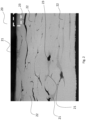
- "Impregnated" means that the polymer to a substantial degree has penetrated the fibre web. However, it does not necessarily mean that the fibre web, across its thickness direction, has been completely saturated with the polymer. Consequently, the high-density paper may comprise unfilled pores, especially in the middle. Here it is also referred to the discussion about figure 2 below. Hence, it may be determined by a SEM image of a cross section of the high-density paper that the polymer has penetrated the fiber web rather than formed a coating layer on the surface.
- the polymer is selected from the group consisting of polyvinyl alcohol (PVOH), ethylene vinyl alcohol (EVOH), carboxymethylated cellulose (CMC), nanocrystalline cellulose (NCC) and carboxy methyl starch (CMS). PVOH, EVOH and CMC are preferred examples of the polymer. In one embodiment, the polymer is PVOH or EVOH.
- the polymer is preferably water-soluble or water-dispersible.
- the most preferred polymer in the group is PVOH.
- the degree of hydrolysis of the PVOH may be 96%-100%, such as 97%-100%, such as 97%-99%.
- a PVOH having a high degree of hydrolysis is less sensitive to water and is preferred, both in production and in use.
- the weight average molecular weight (M w ) of the PVOH is preferably below 100,000 g/mol, such as 10,000-90,000 g/mol, such as 30,000-80,000 g/mol. Such a relatively low M w is preferred during impregnation since it has a relatively low viscosity at a relatively high concentration.
- a PVOH of low M w has a greater tendency to penetrate into the fiber web rather than staying of the surface of paper.
- the viscosity of the PVOH when measured according to DIN 53015 is preferably below 20 mPa*s, such as 5-16 mPa*s, such as 6-13 mPa*s.
- the degree of polymerization (DP) of the PVOH is preferably below 3000, such as 1000-2000.
- the DP can be determined from the viscosity-average degree of polymerization derived from the viscosity in water. In such case, viscosity is measured in a 4% aqueous solution at 20 °C and determined by Brookfield synchronized-motor rotary type viscometer.
- PVOH polyvinyl styrene resin
- Kuraray which has a viscosity of 10 mPa*s, a degree of hydrolysis of 98%, a DP of about 1400 and a M w of about 61,000 g/mol.
- Another example is Poval 6/98 from Kuraray, which has a viscosity of 6 mPa*s and a degree of hydrolysis of 98%.
- the PVOH or EVOH may comprise a cross-linker, such as glyoxal.
- the glyoxal to PVOH dry weight ratio may be between 3:100 and 12:100, preferably between 4:100 and 9:100, more preferably between 5:100 and 8:100.
- EVOH has high moisture resistance and excellent oxygen barrier properties.
- An example of an EVOH is Exceval ® AQ-4104 from Kuraray, which provides for low viscosity.
- the polymer may also be NCC, which is a form of nano-cellulose, but not the same as microfibrillar cellulose ("MFC”) or nanofibrillar cellulose (“NFC”).
- MFC microfibrillar cellulose
- NFC nanofibrillar cellulose
- MFC should denote nano scale cellulose particle fibers or fibrils or fibril aggregates with at least one dimension of less than 100 nm.
- MFC may thus contain longer particles, so-called “fibrils” having a width of 10-100 nm, and a length of at least 1 ⁇ m, such as up to 10 ⁇ m, such as longer than 10 ⁇ m.
- Both MFC and NFC have an aspect ratio of 50 or above, while NCC may defined to have an aspect ratio below 50, e.g. in accordance with the draft TAPPI norm WI3021.
- NCC is used for shorter particles and "rod-like" particles, having a width of 3-50 nm, and a length from 100 up towards 1000 nm, such as from 100 to 900 nm, such as from 100 to 500 nm, such as from 100 to 200 nm.
- the preferred dimensions of NCC for the purpose of impregnating and filling pores in a formed paper, meaning that the majority of the NCC particles in the composition should have this dimension, may be a length of 100-500 nm, such as 100-200 nm and a width of 3-50 nm.
- the high-density paper is formed from at least 50% by dry weight chemical pulp, such as at least 75% by dry weight chemical pulp, such as at least 85% by dry weight chemical pulp, such as at least 95% by dry weight chemical pulp.
- the chemical pulp is preferably kraft pulp, but it may also be sulfite pulp (i.e. pulp obtained by the sulfite pulping process).
- 20-65 % by dry weight, such as 30-60 % by dry weight, of the pulp used to form the high-density paper is hardwood pulp.
- 35-80 % by dry weight, such as 40-70 % by dry weight, of the pulp used to form the high-density paper is softwood pulp.
- a benefit of including hardwood pulp is that it collapses relatively easy during refining, while it still allows for efficient dewatering in the wire section of the paper machine.
- a benefit of including softwood pulp is improved runnability in the paper machine and beneficial strength/toughness properties in the resulting paper. The latter properties may be improved by subjecting the softwood pulp to high consistency (HC) refining.
- HC high consistency
- the high-density paper has a top ply and a bottom ply.
- the properties of the top ply may be tailored for receiving another barrier layer, while the bottom ply properties are tailored for strength/toughness.
- the top ply may be tailored for printing, while the bottom ply is coated with (a) further layer(s).
- the top ply is formed from at least 50% by dry weight hardwood pulp, such as at least 65% by dry weight hardwood pulp, such as at least 75% by dry weight hardwood pulp.
- Hardwood pulp may provide an improved surface for printing or another barrier layer.
- the bottom ply is formed from at least 50% by dry weight softwood pulp, such as at least 65% by dry weight softwood pulp, such as at least 75% by dry weight softwood pulp.
- softwood is associated with better runnability in the paper machine and provides beneficial strength/toughness properties in the resulting paper product.
- the bottom ply side is impregnated with a higher amount of polymer than the top ply.
- the grammage measured according to ISO 536:2012 is 35-65 g/m 2 .
- a relatively low grammage may be beneficial since it may require less polymer in a packaging application, e.g. in order to make tight and durable seals when transforming the laminated material into filled and sealed, cuboid-shaped packages.
- the use of less polymer facilitates recycling streams of high fiber content.
- package integrity improves when the paper substrate grammage is lower.
- the strength and toughness of the paper may be insufficient if the grammage is too low.
- At least one side of the high-density paper has a Bendtsen roughness measured according to SS-ISO 8791-2:2013 of 7-80 ml/min, such as 8-70 ml/min, such as 10-60 ml/min, such as 30-60 ml/min.
- both sides of the high-density paper has a Bendtsen roughness measured according to SS-ISO 8791-2:2013 of 7-80 ml/min, such as 8-70 ml/min, such as 10-60 ml/min.
- the beneficial barrier and recycling properties are obtained without sacrificing strength, such as tensile strength and tear strength.
- the tensile index measured in the MD according to ISO 1924-3:2005 is preferably above 100 Nm/g, such as 110-150 Nm/g.
- the tensile index measured in the CD according to ISO 1924-3:2005 is preferably above 50 Nm/g, such as 55-90 Nm/g, such as 65-90 Nm/g.
- the tear index measured in the machine direction (MD) according to ISO 1924-3:2005 is at least 4.1 mNm 2 /g, such as at least 4.4 mNm 2 /g and/or the tear index measured in the cross direction (CD) according to ISO 1924-3:2005 of at least 4.9 mNm 2 /g, such as at least 5.3 mNm 2 /g.
- Typical upper limits in MD and CD may be 6.5 mNm 2 /g and 7.5 mNm 2 /g, respectively.
- the high density is obtained without any substantial addition of inorganic filler to the furnish.
- Silica or bentonite used as retention agent typically in an amount of less than 1 kg per tonne dry pulp, is not considered to be inorganic filler.
- the ash content measured according to ISO 2144:2015 of the high-density paper is preferably less than 5% by dry weight, such as less than 3% by dry weight, such as less than 1% by dry weight.
- the high-density paper of the present disclosure may be obtained without extensive low consistency (LC) refining, which improves the speed of the papermaking process (and reduces its energy consumption) and facilitates recycling. Such a comparatively limited refining can be reflected by the drainability measured after repulping.
- the high-density paper exhibits a Schopper-Riegler (°SR) number measured according to ISO 5267-1:1999 of 33-50, such as 35-45, after repulping according to ISO 5263-1:2004.
- Another drainability value is Canadian Standard Freeness (CSF).
- the high-density paper exhibits a CSF measured according to ISO 5267-2:2001 of at least 200 ml, such as 200-450 ml, such as 200-350 ml, after repulping according to the Valmet repulping method carried out in a Valmet repulper of the type HD400.
- the Valmet repulping method is described below in the Examples section.
- the high-density paper has a fines content measured with a L&W Fibretester+ (ABB, Lorentzen & Wettre, Sweden) of less than 40%, such as less than 34%, such as less than 32%, after repulping according to ISO 5263-1:2004.
- L&W Fibretester+ ABB, Lorentzen & Wettre, Sweden
- Fines are defined as fibrous particles shorter than 0.2 mm.
- the L&W Fibretester+ operates according to ISO 16065-2:2014.
- a typical lower limit for the fines content is 15% or 20%.
- a high-density paper having a grammage measured according to ISO 536:2012 of 30-75 g/m 2 and a density measured according to ISO 534:2011 above 1000 kg/m 3 and wherein the high-density paper is impregnated on at least one side with a composition comprising polyvinyl alcohol (PVOH) and glyoxal.
- PVOH polyvinyl alcohol
- the glyoxal to PVOH dry weight ratio in the composition of the configuration may be between 3:100 and 12:100, preferably between 4:100 and 9:100, more preferably between 5:100 and 8:100.
- the high-density paper of the first aspect is not PECVD- or PVD-coated.
- the high-density paper of this embodiment may be intended for PECVD or PVD coating.
- PECVD means plasma-enhanced chemical vapor deposition.
- PVD means plasma vapor deposition.
- a method of forming a high-density paper having a grammage measured according to ISO 536:2012 of 30-75 g/m 2 comprising the steps of:
- the impregnating step comprises adding an aqueous composition comprising the polymer to each side of the paper substrate.
- the viscosity measured at 60°C of the aqueous composition may be 55-90 mPa*s. Such a relatively low viscosity facilitates penetration of the polymer into the fiber web.
- the concentration of the polymer in the aqueous composition is preferably 7.0%-13.0% (w/v), such as 8.0%-12.0% (w/v).
- the 60°C viscosity measurement is preferably carried out using a Brookfield rotational viscometer equipped with spindle no.3 at 100 rpm.
- the polymer is PVOH or EVOH and the aqueous composition further comprises a crosslinker, such as a glyoxal crosslinker.
- a crosslinker such as a glyoxal crosslinker.
- the dry weight ratio of PVOH or EVOH to glyoxal crosslinker in the aqueous composition may be from 100:3 to 100:8, such as from 100:4 to 100:7.
- the aqueous composition may further comprise inorganic particles, preferably in a low amount.
- the impregnated substrate entering the supercalendering step preferably has a relatively high moisture content, such as 11.0%-20.0%. More preferably, the moisture content is 12.0%-19.0%, such as 13.5%-18.0%.
- the impregnated substrate is dried after the impregnating step to a moisture content below 11%, such as below 10%, such as below 9%. Then, it is re-moisturized prior to the supercalendering step, e.g. to a moisture content in the range of 11.0%-20.0%, 12.0%-19.5% or 13.5%-18.0%.
- the impregnating step is preferably carried out by means of a size press or a film press.
- a film press is the most preferred equipment.
- the film press may be an OptiSizer Film (Valmet) or a SpeedSizer (Voith).
- the number of nips of the supercalendering step may be 7-19, preferably 11-17.
- the surface temperature of the thermo rolls of the supercalendering step may be 120-160 °C.
- the total nip impulse of the supercalendering step may be at least 600 kPa*s.
- the head box consistency or the head box consistencies in case of a multiply paper is/are in the range of 0.06%-0.60%, such as 0.10%-0.40%, such as 0.10%-0.30%.
- Such relatively low consistencies facilitate the production of a paper of low porosity, which means a high density.
- the paper substrate of the second aspect is formed from at least 50% by dry weight chemical pulp, such as at least 75% by dry weight chemical pulp, such as at least 85% by dry weight chemical pulp, such as at least 95% by dry weight chemical pulp.
- the chemical pulp is preferably kraft pulp, but may also be sulfite pulp.
- the paper substrate of the second aspect is formed from 20-65 % by dry weight hardwood pulp, such as 30-60 % by dry weight hardwood pulp and/or 35-80 % by dry weight softwood pulp, such as 40-70 % by dry weight softwood pulp.
- HC refining When softwood pulp is used, it may have been subjected to high consistency (HC) refining, i.e. refining at a consistency of 20%-40%, such as 25%-38%.
- the specific energy of the HC refining step may be at least 100 kWh/tonne, such as at least 150 kWh/tonne, such as 150-300 kWh/tonne.
- the "tonne" of the unit means tonne of dry fiber.
- the paper substrate of the second aspect has a first ply and a second ply.
- a first wire may be used to form a first web that becomes the top ply and a second wire may be used to form a second web that becomes the second ply, which first and second web are couched together.
- the first web may be formed from a first furnish comprising at least 50% by dry weight hardwood pulp, such as at least 65% by dry weight hardwood pulp, such as at least 75% by dry weight hardwood pulp.
- the head box consistency of the first furnish may be 0.12%-0.60%, such as 0.18%-0.35%.
- the Schopper-Riegler (°SR) number measured according to ISO 5267-1:1999 of the first furnish in the head box may be 33-45.
- Such a SR number may facilitate a sufficiently high density without causing dewatering and/or recycling problems and may be obtained by adjusting the degree of low consistency (LC) refining.
- the second web may be formed from a second furnish comprising at least 50% by dry weight softwood pulp, such as at least 65% by dry weight softwood pulp, such as at least 75% by dry weight softwood pulp.
- This softwood pulp preferably has been subjected to high consistency (HC) refining (suitable specific energies are discussed above).
- the head box consistency of the second furnish may be 0.06%-0.40%, such as 0.10%-0.25%.
- the head box consistency of the second furnish is lower than the head box consistency of the first furnish.
- the Schopper-Riegler (°SR) number measured according to ISO 5267-1:1999 of the second furnish in the head box may be 25-35.
- Such a SR number may facilitate sufficiently high density without causing dewatering and/or recycling problems and may be obtained by adjusting the degree of low consistency (LC) refining.
- the furnishes comprises less than less than 2% by weight inorganic filler, such as less than 1% by dry weight inorganic filler, such as substantially no inorganic filler.
- the second ply side is impregnated with a higher amount of polymer than the first ply.
- the high-density paper of the first aspect is an excellent substrate for a coating, in particular an oxygen-barrier coating.
- a coated paper comprising a high-density paper according to the first aspect, wherein a surface of the high density paper is provided with a barrier coating, e.g. comprising polyvinyl alcohol (PVOH), ethylene vinyl alcohol (EVOH), a starch or starch derivative, a nano or micro-fibrillar cellulose, polyvinylidene chloride (PVDC) or a polyamide.
- a preferred barrier coating comprises PVOH and/or EVOH, e.g. in an amount of 1-3 g/m 2 .
- the coated paper of the third aspect is not PECVD- or PVD-coated.
- the coated paper of the third aspect comprises several barrier layers, e.g. including one water vapor barrier layer.
- the coated paper of the third aspect may be used for packaging oxygen-sensitive products, such as dry and/or fatty foods.
- oxygen-sensitive products such as dry and/or fatty foods.
- fatty foods are cheese, butter and spreads.
- Such packaging may be flow-wrap packaging or form, fill, seal (FFS) packaging, e.g. in bags. It may also be packaging in a jar, tray, lidded spread container, collapsible tube, clam-shell package, sleeve, envelope or wrapper.
- Another application is use as a packaging window. In these applications, the packaging material typically undergoes folding or a similar type of stress (e.g. creasing, stretching), which make the packaging material based on the high-density paper of the present disclosure particularly suitable.
- a use of a multi-layered material for packaging of a food product or another oxygen-sensitive product wherein one layer of the multilayered material is a high-density paper according to the first aspect, provided that the food product is not a liquid, semi-liquid or viscous food product.
- liquid food includes water.
- the multi-layered material of the fourth aspect may comprise a coated paper according to the third aspect.
- the multi-layered material of the fourth aspect is not comprising a PECVD or PVD coating.
- Two pulps were provided: i) an ECF-bleached kraft pulp from softwood (i.e. a mixture of pine and spruce); and ii) an ECF-bleached kraft pulp from hardwood (i.e. birch).
- the softwood pulp was refined using high-consistency (HC) refiners at a specific energy of 225 kWh/tonne.
- HC high-consistency
- the HC-refined pulp was than mixed in a mixing chest with a broke pulp comprising a blend of bleached softwood and hardwood pulps (the majority of the broke was obtained from the same paper production).
- the share of broke in this softwood-based mixture was 30%.
- the softwood-based mixture was then refined by low-consistency (LC) refining at a specific energy of 75 kWh/tonne. This LC refining resulted in a Schopper-Riegler (°SR) according to ISO 5267-1:1999 of ⁇ 30 °SR.
- the hardwood pulp was separately mixed with the same type of broke and then refined by low consistency refining using a specific energy of 85 kWh/tonne.
- the share of broke in hardwood-based mixture was 20%.
- the LC-refined hardwood-based mixture obtained a Schopper-Riegler (°SR) value of ⁇ 38 °SR.
- papermaking chemicals were added (4 kg/tonne of cationic starch, 0.2 kg/tonne of silica and 0.4 kg/tonne of AKD).
- the softwood-based mixture was pumped to a bottom ply head box of a two-ply fourdrinier machine, while the hardwood-based mixture was pumped to the top ply head box of the same fourdrinier machine.
- the dry mass flow through each of the head boxes was the same and adjusted to reach a total grammage of 60 g/m 2 prior coating (i.e. 30 g/m 2 per ply).
- the vertical slice lip was 34 mm for the bottom ply head box and 16 mm for the top ply head box, which reflect relatively low head box consistencies (about 0.12% for the bottom ply and about 0.25% for the top ply).
- the wire speed was 600 m/min. In a paper machine specifically adapted for this product, the wire speed can be considerably higher.
- the two plies formed on the fourdrinier machine were couched together at a dryness of ⁇ 10% and further dewatered using vacuum foils boxes to ⁇ 20% dryness before being subjected to wet pressing in a press section having two single felted press nips, wherein the first press had the felt on the top side and the second press had the felt on the bottom side.
- the web was dried in a conventional multi-cylinder dryer to form a paper substrate having a moisture content of ⁇ 5%.
- the paper substrate Prior winding up, the paper substrate was calendered in a soft nip at a line load of 20 kN/m. Properties of the paper substrate are presented in table 1 below.
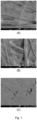
- FIG. 1A A SEM image of a surface portion of the paper substrate is shown in figure 1A .
- the paper substrate from 1A was off-line impregnated with an aqueous polyvinyl alcohol (PVOH) composition from both sides in a conventional film press.
- PVOH polyvinyl alcohol
- the type of PVOH was Poval 10/98 (Kuraray) and its concentration in the composition was 10% (in another trial, the concentration was instead 8%, which also worked).
- the composition further comprised glyoxal (Cartabond TSI) in an amount of 6 wt.% compared to the amount of PVOH.
- the glyoxal acted as a cross-linker.
- the viscosity of the composition was 74 mPa*s (measured at 60 °C).
- the applied amount of PVOH was 1 g/m 2 on the top side and 2 g/m 2 on the reverse/bottom side.
- the reason for using a higher amount of PVOH for the reverse/bottom side was that the pulp used for forming the bottom ply had a lower SR number (and hence that the reverse/bottom side had a less dense surface compared to the top side).
- the PVOH-impregnated paper substrate was dried using hot air to a moisture content of about 8%. Properties of the dried PVOH-impregnated paper substrate are presented in table 1 below.
- Figure 1B is a SEM image of a surface portion of the PVOH-impregnated paper substrate. As shown in figure 1B , the PVOH has not formed a film on the surface portion. Instead, it has penetrated into the fiber web.
- the applied amount of PVOH was 1.5 g/m 2 on each side instead of 1 g/m 2 on the top side and 2 g/m 2 on the reverse/bottom side.
- the impregnated paper substrate from 1B was re-moisturized to 15%.
- the re-moisturized paper was fed to an off-line multi-nip calender also referred to as a supercalender (the number of nips was 12).
- Supercalendering was carried using a surface temperature of 140 °C on the thermo rolls, which could be obtained by means of outside induction heaters, to obtain a high-density paper.
- the line load in each nip was 450 kN/m.
- the total supercalendering nip impulse was ⁇ 800 kPa ⁇ s [#nips ⁇ line load / web speed].
- the heating from the thermo rolls dried the high-density paper.
- FIG 1C A SEM image of a surface portion of the high-density paper is shown in figure 1C .
- figure 2 is SEM image of a cross section 20 of the high-density paper.
- the dark grey areas 21 are PVOH and light grey areas 22 are fibers.
- figure 2 shows that most of the PVOH is within the fiber web. Only minor portion of the PVOH is found on the surface.
- MG machine glazed
- Grammage was measured according to ISO 536:2012 and has the unit g/m 2 .
- Density was measured according to ISO 534:2011 and has the unit kg/m 3 .
- Roughness means Bendtsen roughness, was measured according to ISO 8791-2:2013 and has the unit ml/min.
- Tensile index was measured in the MD and the CD according to ISO 1924-3:2005 and has the unit Nm/g.
- Tear index was measured in the MD and the CD according to ISO 1974:2012 and has the unit mNm 2 /g.
- °SR was measured according to ISO 5267-1:1999 after repulping according to ISO 5263-1:2004.
- CSF Canadian Standard Freeness
- CSF Canadian Standard Freeness
- Fines content was measured with a L&W Fibretester+ (ABB, Lorentzen & Wettre, Sweden) after repulping according to ISO 5263-1:2004. Fines are defined as fibrous particles shorter than 0.2 mm.
- “Somerville residue” means residues retained in a Somerville shive and flake content analyzer having a slot plate width of 0.15 mm. The residue content was calculated as dry weight-% of originally introduced dry material (into the re-pulper).
- Oxygen Transmission Rate has the unit cm 3 /m 2 /24h, 0.2 atm (21%) oxygen. It was measured according to ASTM F1927-14 after lamination with 20 g/m 2 LDPE on the top side of the paper.
- Super Perga 1 and 2 are commercial greaseproof papers from Nordic Paper. Super Perga 1 was used as a paper substrate in WO 2017/089508 . Table 1. Paper substrate (1A) PVOH-impreg. paper substrate (1B) High-density paper (1C) Ref. SC paper (1D) Ref. SC MG paper (1E) Ref.
- Valmet repulping method Repulping was carried out in a Valmet repulper that is designed for stock preparation, i.e. fiber disintegration, of the type HD400. Agitation was done with an impeller with three radial and serrated blades with the dimensions 30 by 40 mm rotating at a speed of 3000 rpm. The material to be repulped was cut in 90 by 90 mm pieces. 0.5 kg of air-dried pieces was mixed with 10 liters of water, i.e. to a consistency of 5%, and repulped at 2.5 minutes at a temperature of 57 °C. Then 5 liters of water was added, providing a consistency of 3.3 %, and further repulping at another 17.5 minutes at a temperature of 57 °C was performed. Total repulping time was thus 20 minutes.
- Somerville method The Valmet repulping method described above was first carried out to obtain a pulp. Quantification of the proportion of Somerville residues, as retained in Somerville shive and flake content analyzer with slot plate width 0.15 mm, was made by diluting the pulp to less than 1 % consistency. The diluted pulp was then analyzed in the Somerville analyzer to obtain the proportion of flake residues as weight-% calculated on oven dry material (i.e. moisture content 0%), initially introduced into the repulping operation.
- oven dry material i.e. moisture content 0%
- the single-ply paper was made from a pulp mixture comprising Kraft softwood pulp, Kraft hardwood pulp and a smaller amount of CTMP pulp, in an approximate dry weight ratio of 45:45:10.
- the single-ply paper had been impregnated with PVOH from the top side and subsequently supercalendered to a density of about 1100 kg/m 3 .
- the grammage of the single-ply paper was 57 g/m 2 .
- the top-side surface had a smoothness of 15 ml/min Bendtsen.
- a non-impregnated reference paper was provided. It had a top side surface smoothness of about 20 ml/min Bendtsen, a grammage of 39 g/m 2 and a density of 978 kg/m 3 .
- the single-ply paper and the non-impregnated reference paper were coated twice with 1 g/m 2 of PVOH onto the top side of the paper substrate and dried after each coating operation. They were then laminated to packaging materials having the following layer structure: /LDPE 12 g/m 2 /paperboard (80 mN geometric bending resistance)/LDPE 20 g/m 2 /paper substrate with 2x PVOH á 1 g/m 2 /Adh EAA copolymer 6 g/m 2 /blend LDPE+m-LLDPE 19 g/m 2 /
- the oxygen barrier properties of a planar material may be investigated before and after having been folded and then unfolded.
- the folding angle was 165 degrees and the barrier layer was directed to be on the outside of the fold. Measured values are the average of five samples measured.
- FIG 3 shows that the unfolded laminated packaging material comprising the PVOH-coated (non-impregnated) reference paper substrate provides an oxygen barrier.
- This oxygen barrier is however lost after one round of folding and unfolding.
- the oxygen barrier provided by the laminated packaging material comprising the impregnated paper is much less affected by the folding-unfolding action.
- This "folding resistant” oxygen barrier is an important property since the laminate will be folded in the packaging process.
- the high-density paper obtained in Example 1C above was coated twice with intermediate and subsequent drying operations to provide a PVOH coat weight of 3 g/m 2 and then metalized to an optical density of about 2.
- a laminated packaging material was then produced according to the following layer structure: /LDPE 12 g/m 2 /paperboard (80 mN geometric bending resistance)/LDPE 20 g/m 2 / high-density paper+PVOH+met./Adhesive EAA copolymer 6 g/m 2 + 29 g/m 2 blend LDPE + mLLDPE /
- Packages were produced in a Tetra Pak ® E3/CompactFlex filling machine. This type of filling machine has the capacity to fill portion packages at a speed of 9000 packages/hour and a flexibility that allows for quick change between different package formats. Packages were in the format of Tetra Brik ® with a volume of 200 ml.
- Laminates comprising a PVOH-coated greaseproof paper from Nordic Paper, identified as "Super Perga ® WS Parchment” and having a grammage of 32 g/m 2 , were used as comparative examples:
- Oxygen transmission rate (OTR) of flat packaging material was measured using a coulometric detector according to the standard ASTM F1927-14.
- the relative humidity (RH) was either 50% or 80%.
- the unit was cm 3 /m 2 /24h, with the option of using 0.2 atm or 1 atm of oxygen pressure. To be able to compare OTR values measured at 1 atm with OTR values measured at 0.2 atm, the former values can be multiplied with 0.2.
- the oxygen transmission rate (OTR) of packages was measured according to ASTM F1307-14, at 0.2 atm (surrounding air containing 21 % oxygen). The unit is cm 3 /package/24h. The OTR testing was carried out 2-3 weeks after production of the filled and sealed packages.
- the package was mounted on a special holder; inside the package nitrogen was purged; the outside of the package is exposed to the environment surrounding the instrument.
- oxygen permeated through the package into the nitrogen carrier gas it was transported to the coulometric sensor.
- the sensor read how much oxygen that was leaked into the nitrogen gas inside the package.
- the filled 200 ml package made from the laminate comprising the impregnated high-density paper according to the present disclosure has a very low level of oxygen transmission (0.03 cm 3 /m2/day/0.2 atm at 23 °C and 50%RH). Furthermore, the oxygen barrier remained as effective in a more humid environment (23 °C and 80 % RH). In the reference laminate comprising the Super Perga paper substrate, the OTR value was 0.075 at 23°C and 50%RH, which means 2-3 times shorter shelf life for an oxygen sensitive product in a 200 ml package. It is thus shown that the impregnated high-density paper according to the present disclosure enables a higher fiber-based content in a packaging material for packaging of oxygen-sensitive products.
- the OTR of a laminate based on the impregnated high-density paper according to the present disclosure is at least as good as similar paper-based barrier laminates of the prior art. Most importantly, it does not exhibit the same level of loss of oxygen barrier properties when converted into a filled, formed and heat-sealed packaging container. It is thus shown above that the impregnated high-density paper according to the present disclosure provides a robustness against the stresses that a packaging material typically experiences during conversion and use.
- the proportion of coarse reject i.e. the non-fibrous recyclable part of the laminated materials (polymers, aluminum foil and some non-detachable fibers), was determined after re-pulping by a Valmet re-pulper.
- the re-pulping was carried out in the same way as described above in connection with CSF and Somerville measurements, except that the laminated packaging material to be re-pulped and analyzed was first cut into pieces of 30 by 90 mm.
- the coarse reject was screened (separated) using a plate with holes (diameter: 10 mm) and then dried to 0% moisture content.
- the proportion of coarse reject was then calculated as weight percent of dry (0% moisture) material introduced into the re-pulper.
- the coarse reject as determined by a contracted global industrial supplier of equipment for fiber processing and recycling was made in a similar way.
- 20 g of laminated material was mixed into 2 l of water and disintegration was carried out at a consistency of about 1% for time cycles of 18 minutes.
- the water temperature was kept at 57 °C also in this test.
- Table 3 Laminate Reference laminate comprising a 6.3 ⁇ m aluminum foil ⁇ Reference laminate comprising 38 g/m 2 Super Perga paper coated with 1 g/m 2 PVOH and metallized to OD 2.5 ⁇ Laminate comprising the HD paper of example 1C coated with 3 g/m 2 PVOH and metallized to OD ⁇ 2 ⁇ Coarse reject (wt-%) as repulped by Valmet re-pulper, 20 min 29 - 26 (18 after 50 minutes) Coarse reject (wt-%) as re-pulped by the alternative method 39.8 40.2 - ⁇ /LDPE 12 g/m 2 /paperboard (80 mN geometric bending resistance)/LDPE 20 g/m2/Al-foil 6.3 ⁇ m/Adhesive EAA copolymer 6 g/m 2 + 19 g/m 2 blend LDPE + mLLDPE/ ⁇ /LDPE 12 g/m 2 /paperboard (80 mN
Landscapes
- Engineering & Computer Science (AREA)
- Mechanical Engineering (AREA)
- Chemical & Material Sciences (AREA)
- Chemical Kinetics & Catalysis (AREA)
- General Chemical & Material Sciences (AREA)
- Paper (AREA)
- Laminated Bodies (AREA)
- Processing Of Meat And Fish (AREA)
Claims (15)
- Hochdichtes Papier mit einem Flächengewicht gemäß ISO 536:2012 von 30-75g/m2, einer Dichte gemäß ISO 534:2011 von über 1000 kg/m3 und einem Reißlängenindex in Maschinenlaufrichtung (MD) gemäß ISO 1924-3:2005 von mindestens 4,1mNm2/g, vorzugsweise mindestens 4,4mNm2/g, wobei das hochdichte Papier auf jeder Seite mit 0,3-4,0g/m2, vorzugsweise 0,5-3,0g/m2, eines Polymers imprägniert ist, ausgewählt aus der Gruppe bestehend aus Polyvinylalkohol (PVOH), Ethylen-Vinylalkohol (EVOH), Carboxymethylcellulose (CMC), nanokristalliner Cellulose (NCC) und Carboxymethylstärke (CMS).
- Hochdichtes Papier nach Anspruch 1, das aus mindestens 50Gew.-% Kraftholzstoff, beispielsweise mindestens 75Gew.-% Kraftholzstoff, beispielsweise mindestens 85Gew.-% Kraftholzstoff, beispielsweise mindestens 95Gew.-% Kraftholzstoff besteht.
- Hochdichtes Papier nach Anspruch 1 oder 2, wobei 20-65Gew.-%, vorzugsweise 30-60Gew.-%, des zur Papierherstellung verwendeten Holzstoffes aus Hartholzstoff besteht.
- Hochdichtes Papier nach einem der vorhergehenden Ansprüche, wobei 35-80 Gew.-%, beispielsweise 40-70Gew.-%, des zur Papierherstellung verwendeten Holzstoffes aus Weichholzstoff besteht, vorzugsweise aus Weichholz, das einer Hochkonsistenz-(HC)-Raffination unterzogen wurde.
- Hochdichtes Papier nach einem der vorhergehenden Ansprüche mit einer oberen und einer unteren Lage.
- Hochdichtes Papier nach einem der vorhergehenden Ansprüche, wobei das Flächengewicht gemäß ISO 536:2012 35-65g/m2 beträgt.
- Hochdichtes Papier nach einem der vorhergehenden Ansprüche mit einer Schopper-Riegler-Zahl (°SR) gemäß ISO 5267-1:1999 von 33-50, beispielsweise 35-45, nach Wiederaufschluss gemäß ISO 5263-1:2004.
- Hochdichtes Papier nach einem der vorhergehenden Ansprüche mit einem Feinanteil, gemessen mit einem L&W Fibretester+ (ABB, Lorentzen & Wettre, Schweden), von weniger als 40%, beispielsweise weniger als 34%, beispielsweise weniger als 32%, nach Wiederaufschluss gemäß ISO 5263-1:2004, wobei Feinanteile als faserige Partikel mit einer Länge unter 0,2mm definiert sind.
- Verfahren zur Herstellung eines hochdichten Papiers mit einem Flächengewicht gemäß ISO 536:2012 von 30-75g/m2, umfassend die Schritte:Imprägnieren beider Seiten eines Papiersubstrats mit 0,3-4,0g/m2, beispielsweise 0,5-3,0g/m2, eines Polymers ausgewählt aus der Gruppe bestehend aus Polyvinylalkohol (PVOH), Ethylen-Vinylalkohol (EVOH), Carboxymethylcellulose (CMC), nanokristalliner Cellulose (NCC) und Carboxymethylstärke (CMS), um ein imprägniertes Substrat zu erhalten; undSuperkalandrieren des imprägnierten Substrats zur Herstellung des hochdichten Papiers.
- Verfahren nach Anspruch 9, wobei das Polymer PVOH mit einem gewichtsgemittelten Molekulargewicht (Mw) von unter 100.000g/mol ist.
- Verfahren nach Anspruch 9 oder 10, wobei der Imprägnierungsschritt das Auftragen einer wässrigen Zusammensetzung, die das Polymer enthält, auf beide Seiten des Papierträgers umfasst, wobei die Viskosität der wässrigen Zusammensetzung bei 60 °C zwischen 55 und 90mPa·s liegt.
- Verfahren nach einem der Ansprüche 9-11, wobei das imprägnierte Substrat beim Eintritt in den Superkalandrierungsschritt einen Feuchtigkeitsgehalt von 11,0-20,0% aufweist, beispielsweise 12,0-19,0%, beispielsweise 13,5-18,0%.
- Verfahren nach einem der Ansprüche 9-12, wobei die Imprägnierung mittels eines Filmpressverfahrens erfolgt.
- Beschichtetes Papier, aufweisend ein hochdichtes Papier nach einem der Ansprüche 1-8, wobei eine Oberfläche des hochdichten Papiers mit einer Barrierebeschichtung versehen ist, die Polyvinylalkohol (PVOH), Ethylen-Vinylalkohol (EVOH), Stärke oder Stärke-Derivate, nano- oder mikrofibrilläre Cellulose, Polyvinylidenchlorid (PVDC) oder ein Polyamid aufweist.
- Verwendung eines mehrschichtigen Materials zur Verpackung eines Lebensmittels oder eines anderen sauerstoffempfindlichen Produkts, wobei eine Schicht des mehrschichtigen Materials ein hochdichtes Papier gemäß einem der Ansprüche 1-8 ist, wobei das Lebensmittel kein flüssiges, halbflüssiges oder viskoses Produkt ist.
Applications Claiming Priority (2)
| Application Number | Priority Date | Filing Date | Title |
|---|---|---|---|
| EP21168232.3A EP4074891B1 (de) | 2021-04-13 | 2021-04-13 | Neues substrat |
| PCT/EP2022/059874 WO2022219043A1 (en) | 2021-04-13 | 2022-04-13 | New substrate |
Publications (2)
| Publication Number | Publication Date |
|---|---|
| EP4323584A1 EP4323584A1 (de) | 2024-02-21 |
| EP4323584B1 true EP4323584B1 (de) | 2025-06-25 |
Family
ID=75529798
Family Applications (2)
| Application Number | Title | Priority Date | Filing Date |
|---|---|---|---|
| EP21168232.3A Active EP4074891B1 (de) | 2021-04-13 | 2021-04-13 | Neues substrat |
| EP22722738.6A Active EP4323584B1 (de) | 2021-04-13 | 2022-04-13 | Neues substrat |
Family Applications Before (1)
| Application Number | Title | Priority Date | Filing Date |
|---|---|---|---|
| EP21168232.3A Active EP4074891B1 (de) | 2021-04-13 | 2021-04-13 | Neues substrat |
Country Status (8)
| Country | Link |
|---|---|
| US (1) | US20240191433A1 (de) |
| EP (2) | EP4074891B1 (de) |
| CN (1) | CN117222793A (de) |
| BR (1) | BR112023020997A2 (de) |
| ES (2) | ES2975591T3 (de) |
| FI (2) | FI4074891T3 (de) |
| HU (1) | HUE065633T2 (de) |
| WO (1) | WO2022219043A1 (de) |
Families Citing this family (10)
| Publication number | Priority date | Publication date | Assignee | Title |
|---|---|---|---|---|
| SE543829C2 (en) * | 2019-12-19 | 2021-08-03 | Stora Enso Oyj | A light weight linerboard for corrugated board |
| HUE065633T2 (hu) | 2021-04-13 | 2024-06-28 | Billerud Ab Publ | Új szubsztrát |
| EP4385720A1 (de) * | 2022-12-15 | 2024-06-19 | SIG Services AG | Behältervorläufer eines formstabilen lebensmittel- oder getränkebehälters mit einer barriereschicht mit fasern und einem verhältnis von zugfestigkeiten |
| EP4385725A1 (de) * | 2022-12-15 | 2024-06-19 | SIG Services AG | Flächenförmiger verbundstoff für formstabile lebensmittel- oder getränkebehälter mit einer barriereschicht mit fasern und einem verhältnis von zugfestigkeiten |
| WO2024149939A1 (en) * | 2023-01-10 | 2024-07-18 | Upm-Kymmene Corporation | Oxygen barrier material |
| CN120604008A (zh) * | 2023-01-10 | 2025-09-05 | 芬欧汇川集团 | 氧阻隔材料 |
| AT526659B1 (de) * | 2023-04-06 | 2024-06-15 | Mondi Ag | Verfahren zur Herstellung eines Rohpapiers |
| SE547523C2 (en) * | 2023-12-19 | 2025-10-07 | Stora Enso Oyj | Barrier paper for use in a paper or paperboard based packaging laminate |
| SE547392C2 (en) * | 2023-12-20 | 2025-07-29 | Stora Enso Oyj | Microfibrillated cellulose suspension and film, and a method for producing a microfibrillated cellulose film |
| CN117779523B (zh) * | 2024-01-19 | 2025-09-02 | 江苏利特尔绿色包装股份有限公司 | 一种环保型超高阻隔包装纸及其制备方法 |
Citations (13)
| Publication number | Priority date | Publication date | Assignee | Title |
|---|---|---|---|---|
| GB1522854A (en) | 1974-09-09 | 1978-08-31 | Toray Industries | Transparent paper |
| US5198328A (en) | 1989-04-04 | 1993-03-30 | Fuji Photo Film Co., Ltd. | Silver halide color photographic light-sensitive material |
| JPH0941286A (ja) | 1995-07-31 | 1997-02-10 | Oji Paper Co Ltd | グラシン紙の製造方法、および剥離紙の製造方法 |
| WO2003100167A1 (en) | 2002-05-29 | 2003-12-04 | Upm-Kymmene Corporation | Method for manufacturing base paper for release paper |
| JP5272444B2 (ja) | 2008-02-26 | 2013-08-28 | 王子ホールディングス株式会社 | 光電管適性を有する剥離紙用原紙および剥離紙 |
| WO2014091071A1 (en) | 2012-12-12 | 2014-06-19 | Munksjö Oyj | A method of manufacturing of glassine paper |
| EP2940211A1 (de) | 2014-05-02 | 2015-11-04 | Munksjö Oyj | Dreheinschlagpapier |
| EP3059344A1 (de) | 2015-02-23 | 2016-08-24 | UPM-Kymmene Corporation | Verfahren zur herstellung von papier mit gebleichtem chemithermomechanischem, für eine trennschicht geeigneten zellstoff und produkte und verwendung davon |
| WO2017089508A1 (en) | 2015-11-27 | 2017-06-01 | Tetra Laval Holdings & Finance S.A. | Laminated packaging material, packaging containers manufactured therefrom |
| JP2018048426A (ja) | 2016-09-23 | 2018-03-29 | 日本製紙株式会社 | グラシン紙及び該グラシン紙の製造方法 |
| WO2019198040A1 (en) | 2018-04-12 | 2019-10-17 | Stora Enso Oyj | A method for the production of a coated paper, paperboard or film and a coated paper, paperboard or film |
| WO2020074766A1 (en) | 2018-10-09 | 2020-04-16 | Upm-Kymmene Corporation | A paper substrate comprising modified low molecular weight pva with functional vinyl groups |
| WO2021069696A1 (en) | 2019-10-10 | 2021-04-15 | Billerudkorsnäs Ab | Paper production |
Family Cites Families (7)
| Publication number | Priority date | Publication date | Assignee | Title |
|---|---|---|---|---|
| DE10232550C5 (de) * | 2002-07-18 | 2013-02-07 | Voith Patent Gmbh | Vorrichtung und Verfahren zum Imprägnieren einer Papier- oder Kartonbahn |
| SE532388C2 (sv) * | 2008-03-14 | 2010-01-12 | Tetra Laval Holdings & Finance | Förpackningslaminat och -behållare med två separata gasbarriärskikt samt metod för deras framställning |
| FI20085765A0 (fi) * | 2008-08-11 | 2008-08-11 | Upm Kymmene Corp | Menetelmä painopaperin valmistamiseksi |
| EP2451643B1 (de) | 2009-07-08 | 2017-08-23 | Tetra Laval Holdings & Finance S.A. | Folienfreies verpackungslaminat, verfahren zur herstellung des verpackungslaminats und verpackungsbehälter daraus |
| CA3073479A1 (en) * | 2019-03-13 | 2020-09-13 | Frosta Aktiengesellschaft | Compostable and environmentally friendly packaging for a frozen product |
| US20210040693A1 (en) * | 2019-08-08 | 2021-02-11 | The United States Of America, As Represented By The Secretary Of Agriculture | Methods of forming a continuous layer of an aqueous coating on the surface of a paper-based product and oil-resistant food packaging |
| HUE065633T2 (hu) | 2021-04-13 | 2024-06-28 | Billerud Ab Publ | Új szubsztrát |
-
2021
- 2021-04-13 HU HUE21168232A patent/HUE065633T2/hu unknown
- 2021-04-13 ES ES21168232T patent/ES2975591T3/es active Active
- 2021-04-13 EP EP21168232.3A patent/EP4074891B1/de active Active
- 2021-04-13 FI FIEP21168232.3T patent/FI4074891T3/fi active
-
2022
- 2022-04-13 WO PCT/EP2022/059874 patent/WO2022219043A1/en not_active Ceased
- 2022-04-13 EP EP22722738.6A patent/EP4323584B1/de active Active
- 2022-04-13 BR BR112023020997A patent/BR112023020997A2/pt unknown
- 2022-04-13 FI FIEP22722738.6T patent/FI4323584T3/fi active
- 2022-04-13 US US18/286,192 patent/US20240191433A1/en active Pending
- 2022-04-13 ES ES22722738T patent/ES3041925T3/es active Active
- 2022-04-13 CN CN202280024783.XA patent/CN117222793A/zh active Pending
Patent Citations (13)
| Publication number | Priority date | Publication date | Assignee | Title |
|---|---|---|---|---|
| GB1522854A (en) | 1974-09-09 | 1978-08-31 | Toray Industries | Transparent paper |
| US5198328A (en) | 1989-04-04 | 1993-03-30 | Fuji Photo Film Co., Ltd. | Silver halide color photographic light-sensitive material |
| JPH0941286A (ja) | 1995-07-31 | 1997-02-10 | Oji Paper Co Ltd | グラシン紙の製造方法、および剥離紙の製造方法 |
| WO2003100167A1 (en) | 2002-05-29 | 2003-12-04 | Upm-Kymmene Corporation | Method for manufacturing base paper for release paper |
| JP5272444B2 (ja) | 2008-02-26 | 2013-08-28 | 王子ホールディングス株式会社 | 光電管適性を有する剥離紙用原紙および剥離紙 |
| WO2014091071A1 (en) | 2012-12-12 | 2014-06-19 | Munksjö Oyj | A method of manufacturing of glassine paper |
| EP2940211A1 (de) | 2014-05-02 | 2015-11-04 | Munksjö Oyj | Dreheinschlagpapier |
| EP3059344A1 (de) | 2015-02-23 | 2016-08-24 | UPM-Kymmene Corporation | Verfahren zur herstellung von papier mit gebleichtem chemithermomechanischem, für eine trennschicht geeigneten zellstoff und produkte und verwendung davon |
| WO2017089508A1 (en) | 2015-11-27 | 2017-06-01 | Tetra Laval Holdings & Finance S.A. | Laminated packaging material, packaging containers manufactured therefrom |
| JP2018048426A (ja) | 2016-09-23 | 2018-03-29 | 日本製紙株式会社 | グラシン紙及び該グラシン紙の製造方法 |
| WO2019198040A1 (en) | 2018-04-12 | 2019-10-17 | Stora Enso Oyj | A method for the production of a coated paper, paperboard or film and a coated paper, paperboard or film |
| WO2020074766A1 (en) | 2018-10-09 | 2020-04-16 | Upm-Kymmene Corporation | A paper substrate comprising modified low molecular weight pva with functional vinyl groups |
| WO2021069696A1 (en) | 2019-10-10 | 2021-04-15 | Billerudkorsnäs Ab | Paper production |
Non-Patent Citations (31)
| Title |
|---|
| "Bachelor's Thesis", 1 May 2014, JAMK UNIVERSITY OF APPLIED SCIENCES, Finland, article KUUSISTO TOMMI: "IMPROVING SURFACE SIZING OPERATIONS FOR AN EDUCATIONAL PAPER MACHINE ", pages: 1 - 34, XP093213640 |
| "Handbook for pulp & paper technologists", 1 January 1989, JOINT TEXTBOOK COMMITTEE OF THE PAPER INDUSTRY, Canada, ISBN: 0-919893-00-7, article G.A. SMOOK: "18 Surface Treatments", pages: 262 - 272, XP009557723 |
| "Papermaking Science and Technology", 1 January 2008, FINNISH PAPER ENGINEERS, Jyväskylä, Finland, ISBN: 978-952-5216-28-8, article J. KUUSIPALO: "Chapter 7: Fibre-based packaging materials", pages: 210 - 241, XP009566222 |
| "Papermaking Science and technology, Papermaking part 3, Finishing, 2nd Edition", 1 January 2010, PAPER ENGINEERS' ASSOCIATION, Porvoo, Finland, ISBN: 978-952-5216-36-3, article JUHA EHROLA, ARI HERNESNNIEMI, HARRI KUOSA, MARKKU KYYTSONEN, PEKKA LINNONMAATAPLO MAENPAA, REIJO PIETIKINENROB BTAPELS, MIKKO TAN: "4. Calendering process application areas", pages: 67 - 84, XP009566221 |
| "Pigment Coating and Surface Sizing of Paper, Book 11", 1 January 2009, PAPER ENGINEERS' ASSOCIATION/PAPERI JA PUU OY, Helsinki, Finland, ISBN: 978-952-5216-27-1, article JOUNI PALTAKARI AND ESA LEHTINEN: "CHAPTER 9 Surface sizing chemicals", pages: 309 - 315, XP009565418 |
| "Pigment Coating and Surface Sizing of Paper, Book 11", vol. 11, 1 January 2009, PAPER ENGINEERS' ASSOCIATION/PAPERI JA PUU OY, Helsinki, Finland, ISBN: 978-952-5216-27-1, article ESA LEHTINEN: "Chapter 1 Introduction to pigment coating and surface sizing of paper and board", pages: 13 - 28, XP009552911 |
| ANONYMOUS: "Ahlstrom-Munksjö’s LamiBak enables the use of release liners in an entirely fiber-based container for food processing, cooking or serving", AHLSTROM - ARTICLES, AHLSTROM, 4 February 2020 (2020-02-04), pages 1 - 2, XP093383865, Retrieved from the Internet <URL:https://www.ahlstrom.com/Media/articles/lamibak-release-paper-solution/> |
| ANONYMOUS: "ISO 1924-3:2005 Paper and board — Determination of tensile properties Part 3: Constant rate of elongation method (100 mm/min)", ISO NORM, ISO, CH, 1 July 2005 (2005-07-01), CH, pages 1 - 33, XP093363876 |
| ANONYMOUS: "ISO 5263-1:2004 Pulps — Laboratory wet disintegration Part 1: Disintegration of chemical pulps", ISO NORM, ISO, CH, 1 September 2004 (2004-09-01), CH, pages 1 - 10, XP009566225 |
| ANONYMOUS: "Mowiol Polyvinyl Alcohol ", CLARIANT GMBH, 1 December 1999 (1999-12-01), pages 1 - 105, XP093262543, Retrieved from the Internet <URL:https://ia903101.us.archive.org/35/items/polyvinylalcoholmanufacturemanual/Mowiol%20manual.pdf> |
| ANONYMOUS: "OptiSizer Film sizing with film application", OPTISIZER FILM, VALMET, 31 March 2026 (2026-03-31), pages 1 - 15, XP093383832, Retrieved from the Internet <URL:https://www.valmet.com/board-and-paper/board-and-paper-machines/sizing/optisizer-film-application/> |
| ANONYMOUS: "Technical specifications: UPM Brilliant Duo", TECHNICAL SPECIFICATIONS, UPM, 11 February 2021 (2021-02-11), pages 1 - 2, XP093383792, Retrieved from the Internet <URL:https://web.archive.org/web/20210514103146/https://www.upmpaper.com/siteassets/images/products--services/paper-catalog/public/upm_brilliant_duo_en_231415.pdf> |
| BHARDWAJ SHUBHANG: "Surface sizing of paper with polyvinyl alcohol", IPPTA, INDIAN PULP AND PAPER TECHNICAL ASS., SAHARANPU,, IN, vol. 33, no. E1, 1 January 2021 (2021-01-01), IN , pages 55 - 67, XP093213636, ISSN: 0379-5462 |
| C.P. KLASS: "Trends and developments in size press technology", TAPPI JOURNAL, TECHNICAL ASSOCIATION OF THE PULP & PAPER INDUSTRY, ATLANTA US, vol. 73, no. 12, 1 December 1990 (1990-12-01), Atlanta US , pages 69 - 75, XP009566226, ISSN: 0734-1415 |
| CROWTHER-ALWYN LAURA: "sherpack Innovative barriers for flexible packaging", PTS COATING SYMPOSIUM 2019; 3-4 SEPTEMBER 2019, 3 September 2019 (2019-09-03) - 2019-09-04, pages 1 - 22, XP093383853 |
| D23 - Data excerpt from GMES and process diary |
| D24 - Certificate of analysis - order 7634953 |
| D24a - Certificate of analysis (signed) - order 7634953 |
| D25 - Certificate of analysis (signed) - order 7784308 |
| D26 - Affidavit by Tapani Ruikka (Operations Manager of PM5) |
| D27 - Certificate of analysis - order 7784308 |
| D30-D30o - public prior use documents |
| D6b - UPM Brilliant Duo brochure DE language version (26 May 2020) |
| D6c - UPM Brilliant Recycled brochure (9 Dec 2019) |
| D6d - Experimental study (2020) |
| D6e - UPM SolideTM Lucent brochure (3 Dec 2020) |
| D6f - UPM Golden 57 g/m2 brochure (12 Nov 2019) |
| D7 - Operating instructions for preparing UPM Brilliant Duo (4 Sept 2020) |
| FABET OY: "Paper and Board Grades, Book 18", 1 January 2000, FINNISH PAPER ENGINEERS' ASSOCIATION AND TAPPI, Helsinki, Finland, ISBN: 952-5216-18-7, article "Chapter 5.3 Specialty Grades", pages: 105 - 130, XP009566223 |
| GUNNAR GAVELIN: "PAPER MACHINE DESIGN AND OPERATION - descriptions and explanations -", 1 January 1998, ANGUS WILDE PUBLICATIONS INC., ISBN: 0-9694628-2-4, article GUNNAR GAVELIN: "Chapter 2 - HEADBOXES", pages: 13 - 39, XP009566224 |
| HUBBE MARTIN, PRUSZYNSKI PRZEM: "Greaseproof paper products: A review emphasizing ecofriendly approaches", BIORESOURCES, NORTH CAROLINA STATE UNIVERSITY * COLLEGE OF NATURAL RESOURCES, US, vol. 15, no. 1, 1 February 2020 (2020-02-01), US , pages 1978 - 2004, XP093383688, ISSN: 1930-2126, DOI: 10.15376/biores.15.1.1978-2004 |
Also Published As
| Publication number | Publication date |
|---|---|
| EP4074891A1 (de) | 2022-10-19 |
| EP4074891B1 (de) | 2023-12-20 |
| ES2975591T3 (es) | 2024-07-09 |
| US20240191433A1 (en) | 2024-06-13 |
| EP4323584A1 (de) | 2024-02-21 |
| FI4074891T3 (fi) | 2024-03-15 |
| WO2022219043A1 (en) | 2022-10-20 |
| CN117222793A (zh) | 2023-12-12 |
| HUE065633T2 (hu) | 2024-06-28 |
| BR112023020997A2 (pt) | 2023-12-12 |
| FI4323584T3 (fi) | 2025-09-25 |
| ES3041925T3 (en) | 2025-11-17 |
Similar Documents
| Publication | Publication Date | Title |
|---|---|---|
| EP4323584B1 (de) | Neues substrat | |
| EP4074892B1 (de) | Verwendung eines hochdichten papiersubstrats, das beschichtete hochdichte substrat und ein laminiertes verpackungsmaterial und verpackungsbehälter damit | |
| EP2094910B2 (de) | Verfahren zur herstellung eines papierprodukts | |
| EP4323432A1 (de) | Verfahren zur herstellung einer sperrfolie und sperrfolie | |
| EP4323431A1 (de) | Verfahren zur herstellung einer sperrfolie und sperrfolie | |
| EP4353902A1 (de) | Verwendung eines papiersubstrats, mit einer sperrschicht beschichtetes papiersubstrat, laminiertes verpackungsmaterial und verpackungsbehälter damit | |
| WO2024079266A1 (en) | Stretchable high-density paper | |
| Kjellgren | Barrier properties of greaseproof paper | |
| WO2024100565A1 (en) | Barrier film for packaging material | |
| EP4298279A1 (de) | Verfahren, pappprodukt und verwendung eines schaumbeschichters und einer nachfolgenden presse zur messung der grösse mit hoher konsistenz |
Legal Events
| Date | Code | Title | Description |
|---|---|---|---|
| STAA | Information on the status of an ep patent application or granted ep patent |
Free format text: STATUS: UNKNOWN |
|
| STAA | Information on the status of an ep patent application or granted ep patent |
Free format text: STATUS: THE INTERNATIONAL PUBLICATION HAS BEEN MADE |
|
| PUAI | Public reference made under article 153(3) epc to a published international application that has entered the european phase |
Free format text: ORIGINAL CODE: 0009012 |
|
| STAA | Information on the status of an ep patent application or granted ep patent |
Free format text: STATUS: REQUEST FOR EXAMINATION WAS MADE |
|
| 17P | Request for examination filed |
Effective date: 20231031 |
|
| AK | Designated contracting states |
Kind code of ref document: A1 Designated state(s): AL AT BE BG CH CY CZ DE DK EE ES FI FR GB GR HR HU IE IS IT LI LT LU LV MC MK MT NL NO PL PT RO RS SE SI SK SM TR |
|
| TPAC | Observations filed by third parties |
Free format text: ORIGINAL CODE: EPIDOSNTIPA |
|
| DAV | Request for validation of the european patent (deleted) | ||
| DAX | Request for extension of the european patent (deleted) | ||
| STAA | Information on the status of an ep patent application or granted ep patent |
Free format text: STATUS: EXAMINATION IS IN PROGRESS |
|
| 17Q | First examination report despatched |
Effective date: 20240717 |
|
| GRAP | Despatch of communication of intention to grant a patent |
Free format text: ORIGINAL CODE: EPIDOSNIGR1 |
|
| STAA | Information on the status of an ep patent application or granted ep patent |
Free format text: STATUS: GRANT OF PATENT IS INTENDED |
|
| INTG | Intention to grant announced |
Effective date: 20250221 |
|
| GRAS | Grant fee paid |
Free format text: ORIGINAL CODE: EPIDOSNIGR3 |
|
| GRAA | (expected) grant |
Free format text: ORIGINAL CODE: 0009210 |
|
| STAA | Information on the status of an ep patent application or granted ep patent |
Free format text: STATUS: THE PATENT HAS BEEN GRANTED |
|
| AK | Designated contracting states |
Kind code of ref document: B1 Designated state(s): AL AT BE BG CH CY CZ DE DK EE ES FI FR GB GR HR HU IE IS IT LI LT LU LV MC MK MT NL NO PL PT RO RS SE SI SK SM TR |
|
| REG | Reference to a national code |
Ref country code: GB Ref legal event code: FG4D |
|
| REG | Reference to a national code |
Ref country code: CH Ref legal event code: EP |
|
| REG | Reference to a national code |
Ref country code: CH Ref legal event code: EP |
|
| REG | Reference to a national code |
Ref country code: IE Ref legal event code: FG4D |
|
| REG | Reference to a national code |
Ref country code: DE Ref legal event code: R096 Ref document number: 602022016451 Country of ref document: DE |
|
| REG | Reference to a national code |
Ref country code: FI Ref legal event code: FGE |
|
| REG | Reference to a national code |
Ref country code: LT Ref legal event code: MG9D |
|
| PG25 | Lapsed in a contracting state [announced via postgrant information from national office to epo] |
Ref country code: GR Free format text: LAPSE BECAUSE OF FAILURE TO SUBMIT A TRANSLATION OF THE DESCRIPTION OR TO PAY THE FEE WITHIN THE PRESCRIBED TIME-LIMIT Effective date: 20250926 Ref country code: NO Free format text: LAPSE BECAUSE OF FAILURE TO SUBMIT A TRANSLATION OF THE DESCRIPTION OR TO PAY THE FEE WITHIN THE PRESCRIBED TIME-LIMIT Effective date: 20250925 |
|
| PG25 | Lapsed in a contracting state [announced via postgrant information from national office to epo] |
Ref country code: BG Free format text: LAPSE BECAUSE OF FAILURE TO SUBMIT A TRANSLATION OF THE DESCRIPTION OR TO PAY THE FEE WITHIN THE PRESCRIBED TIME-LIMIT Effective date: 20250625 |
|
| PG25 | Lapsed in a contracting state [announced via postgrant information from national office to epo] |
Ref country code: HR Free format text: LAPSE BECAUSE OF FAILURE TO SUBMIT A TRANSLATION OF THE DESCRIPTION OR TO PAY THE FEE WITHIN THE PRESCRIBED TIME-LIMIT Effective date: 20250625 |
|
| PG25 | Lapsed in a contracting state [announced via postgrant information from national office to epo] |
Ref country code: RS Free format text: LAPSE BECAUSE OF FAILURE TO SUBMIT A TRANSLATION OF THE DESCRIPTION OR TO PAY THE FEE WITHIN THE PRESCRIBED TIME-LIMIT Effective date: 20250925 |
|
| PG25 | Lapsed in a contracting state [announced via postgrant information from national office to epo] |
Ref country code: LV Free format text: LAPSE BECAUSE OF FAILURE TO SUBMIT A TRANSLATION OF THE DESCRIPTION OR TO PAY THE FEE WITHIN THE PRESCRIBED TIME-LIMIT Effective date: 20250625 |
|
| REG | Reference to a national code |
Ref country code: NL Ref legal event code: MP Effective date: 20250625 |
|
| PG25 | Lapsed in a contracting state [announced via postgrant information from national office to epo] |
Ref country code: NL Free format text: LAPSE BECAUSE OF FAILURE TO SUBMIT A TRANSLATION OF THE DESCRIPTION OR TO PAY THE FEE WITHIN THE PRESCRIBED TIME-LIMIT Effective date: 20250625 |
|
| REG | Reference to a national code |
Ref country code: ES Ref legal event code: FG2A Ref document number: 3041925 Country of ref document: ES Kind code of ref document: T3 Effective date: 20251117 |
|
| PG25 | Lapsed in a contracting state [announced via postgrant information from national office to epo] |
Ref country code: PT Free format text: LAPSE BECAUSE OF FAILURE TO SUBMIT A TRANSLATION OF THE DESCRIPTION OR TO PAY THE FEE WITHIN THE PRESCRIBED TIME-LIMIT Effective date: 20251027 |
|
| REG | Reference to a national code |
Ref country code: AT Ref legal event code: MK05 Ref document number: 1806542 Country of ref document: AT Kind code of ref document: T Effective date: 20250625 |
|
| PG25 | Lapsed in a contracting state [announced via postgrant information from national office to epo] |
Ref country code: IS Free format text: LAPSE BECAUSE OF FAILURE TO SUBMIT A TRANSLATION OF THE DESCRIPTION OR TO PAY THE FEE WITHIN THE PRESCRIBED TIME-LIMIT Effective date: 20251025 |
|
| PG25 | Lapsed in a contracting state [announced via postgrant information from national office to epo] |
Ref country code: AT Free format text: LAPSE BECAUSE OF FAILURE TO SUBMIT A TRANSLATION OF THE DESCRIPTION OR TO PAY THE FEE WITHIN THE PRESCRIBED TIME-LIMIT Effective date: 20250625 Ref country code: SM Free format text: LAPSE BECAUSE OF FAILURE TO SUBMIT A TRANSLATION OF THE DESCRIPTION OR TO PAY THE FEE WITHIN THE PRESCRIBED TIME-LIMIT Effective date: 20250625 |
|
| PG25 | Lapsed in a contracting state [announced via postgrant information from national office to epo] |
Ref country code: CZ Free format text: LAPSE BECAUSE OF FAILURE TO SUBMIT A TRANSLATION OF THE DESCRIPTION OR TO PAY THE FEE WITHIN THE PRESCRIBED TIME-LIMIT Effective date: 20250625 |
|
| PG25 | Lapsed in a contracting state [announced via postgrant information from national office to epo] |
Ref country code: PL Free format text: LAPSE BECAUSE OF FAILURE TO SUBMIT A TRANSLATION OF THE DESCRIPTION OR TO PAY THE FEE WITHIN THE PRESCRIBED TIME-LIMIT Effective date: 20250625 |
|
| PG25 | Lapsed in a contracting state [announced via postgrant information from national office to epo] |
Ref country code: EE Free format text: LAPSE BECAUSE OF FAILURE TO SUBMIT A TRANSLATION OF THE DESCRIPTION OR TO PAY THE FEE WITHIN THE PRESCRIBED TIME-LIMIT Effective date: 20250625 |
|
| PG25 | Lapsed in a contracting state [announced via postgrant information from national office to epo] |
Ref country code: SK Free format text: LAPSE BECAUSE OF FAILURE TO SUBMIT A TRANSLATION OF THE DESCRIPTION OR TO PAY THE FEE WITHIN THE PRESCRIBED TIME-LIMIT Effective date: 20250625 |
|
| REG | Reference to a national code |
Ref country code: DE Ref legal event code: R026 Ref document number: 602022016451 Country of ref document: DE |
|
| PLBI | Opposition filed |
Free format text: ORIGINAL CODE: 0009260 |
|
| REG | Reference to a national code |
Ref country code: CH Ref legal event code: L11 Free format text: ST27 STATUS EVENT CODE: U-0-0-L10-L11 (AS PROVIDED BY THE NATIONAL OFFICE) Effective date: 20260402 |
|
| PLAB | Opposition data, opponent's data or that of the opponent's representative modified |
Free format text: ORIGINAL CODE: 0009299OPPO |
|
| PGFP | Annual fee paid to national office [announced via postgrant information from national office to epo] |
Ref country code: GB Payment date: 20260325 Year of fee payment: 5 |
|
| REG | Reference to a national code |
Ref country code: CH Ref legal event code: L10 Free format text: ST27 STATUS EVENT CODE: U-0-0-L10-L00 (AS PROVIDED BY THE NATIONAL OFFICE) Effective date: 20260409 |
|
| PLAX | Notice of opposition and request to file observation + time limit sent |
Free format text: ORIGINAL CODE: EPIDOSNOBS2 |
|
| PG25 | Lapsed in a contracting state [announced via postgrant information from national office to epo] |
Ref country code: DK Free format text: LAPSE BECAUSE OF FAILURE TO SUBMIT A TRANSLATION OF THE DESCRIPTION OR TO PAY THE FEE WITHIN THE PRESCRIBED TIME-LIMIT Effective date: 20250625 |
|
| PG25 | Lapsed in a contracting state [announced via postgrant information from national office to epo] |
Ref country code: IT Free format text: LAPSE BECAUSE OF FAILURE TO SUBMIT A TRANSLATION OF THE DESCRIPTION OR TO PAY THE FEE WITHIN THE PRESCRIBED TIME-LIMIT Effective date: 20250625 |
|
| 26 | Opposition filed |
Opponent name: UPM SPECIALTY PAPERS OY Effective date: 20260325 Opponent name: AHLSTROM OYJ Effective date: 20260325 |