EP4324611A1 - Poudre destinée à être utilisée dans la fabrication additive et procédé de production d'un article en céramique utilisant ladite poudre - Google Patents
Poudre destinée à être utilisée dans la fabrication additive et procédé de production d'un article en céramique utilisant ladite poudre Download PDFInfo
- Publication number
- EP4324611A1 EP4324611A1 EP22788118.2A EP22788118A EP4324611A1 EP 4324611 A1 EP4324611 A1 EP 4324611A1 EP 22788118 A EP22788118 A EP 22788118A EP 4324611 A1 EP4324611 A1 EP 4324611A1
- Authority
- EP
- European Patent Office
- Prior art keywords
- sio
- powder
- particle
- sub
- ceramic article
- Prior art date
- Legal status (The legal status is an assumption and is not a legal conclusion. Google has not performed a legal analysis and makes no representation as to the accuracy of the status listed.)
- Pending
Links
Images


Classifications
-
- C—CHEMISTRY; METALLURGY
- C04—CEMENTS; CONCRETE; ARTIFICIAL STONE; CERAMICS; REFRACTORIES
- C04B—LIME, MAGNESIA; SLAG; CEMENTS; COMPOSITIONS THEREOF, e.g. MORTARS, CONCRETE OR LIKE BUILDING MATERIALS; ARTIFICIAL STONE; CERAMICS; REFRACTORIES; TREATMENT OF NATURAL STONE
- C04B35/00—Shaped ceramic products characterised by their composition; Ceramics compositions; Processing powders of inorganic compounds preparatory to the manufacturing of ceramic products
- C04B35/01—Shaped ceramic products characterised by their composition; Ceramics compositions; Processing powders of inorganic compounds preparatory to the manufacturing of ceramic products based on oxide ceramics
- C04B35/10—Shaped ceramic products characterised by their composition; Ceramics compositions; Processing powders of inorganic compounds preparatory to the manufacturing of ceramic products based on oxide ceramics based on aluminium oxide
- C04B35/111—Fine ceramics
- C04B35/117—Composites
-
- C—CHEMISTRY; METALLURGY
- C01—INORGANIC CHEMISTRY
- C01B—NON-METALLIC ELEMENTS; COMPOUNDS THEREOF; METALLOIDS OR COMPOUNDS THEREOF NOT COVERED BY SUBCLASS C01C
- C01B33/00—Silicon; Compounds thereof
- C01B33/113—Silicon oxides; Hydrates thereof
-
- B—PERFORMING OPERATIONS; TRANSPORTING
- B33—ADDITIVE MANUFACTURING TECHNOLOGY
- B33Y—ADDITIVE MANUFACTURING, i.e. MANUFACTURING OF THREE-DIMENSIONAL [3D] OBJECTS BY ADDITIVE DEPOSITION, ADDITIVE AGGLOMERATION OR ADDITIVE LAYERING, e.g. BY 3D PRINTING, STEREOLITHOGRAPHY OR SELECTIVE LASER SINTERING
- B33Y70/00—Materials specially adapted for additive manufacturing
-
- B—PERFORMING OPERATIONS; TRANSPORTING
- B33—ADDITIVE MANUFACTURING TECHNOLOGY
- B33Y—ADDITIVE MANUFACTURING, i.e. MANUFACTURING OF THREE-DIMENSIONAL [3D] OBJECTS BY ADDITIVE DEPOSITION, ADDITIVE AGGLOMERATION OR ADDITIVE LAYERING, e.g. BY 3D PRINTING, STEREOLITHOGRAPHY OR SELECTIVE LASER SINTERING
- B33Y70/00—Materials specially adapted for additive manufacturing
- B33Y70/10—Composites of different types of material, e.g. mixtures of ceramics and polymers or mixtures of metals and biomaterials
-
- C—CHEMISTRY; METALLURGY
- C01—INORGANIC CHEMISTRY
- C01B—NON-METALLIC ELEMENTS; COMPOUNDS THEREOF; METALLOIDS OR COMPOUNDS THEREOF NOT COVERED BY SUBCLASS C01C
- C01B33/00—Silicon; Compounds thereof
- C01B33/113—Silicon oxides; Hydrates thereof
- C01B33/12—Silica; Hydrates thereof, e.g. lepidoic silicic acid
-
- C—CHEMISTRY; METALLURGY
- C04—CEMENTS; CONCRETE; ARTIFICIAL STONE; CERAMICS; REFRACTORIES
- C04B—LIME, MAGNESIA; SLAG; CEMENTS; COMPOSITIONS THEREOF, e.g. MORTARS, CONCRETE OR LIKE BUILDING MATERIALS; ARTIFICIAL STONE; CERAMICS; REFRACTORIES; TREATMENT OF NATURAL STONE
- C04B35/00—Shaped ceramic products characterised by their composition; Ceramics compositions; Processing powders of inorganic compounds preparatory to the manufacturing of ceramic products
- C04B35/01—Shaped ceramic products characterised by their composition; Ceramics compositions; Processing powders of inorganic compounds preparatory to the manufacturing of ceramic products based on oxide ceramics
- C04B35/10—Shaped ceramic products characterised by their composition; Ceramics compositions; Processing powders of inorganic compounds preparatory to the manufacturing of ceramic products based on oxide ceramics based on aluminium oxide
- C04B35/111—Fine ceramics
-
- C—CHEMISTRY; METALLURGY
- C04—CEMENTS; CONCRETE; ARTIFICIAL STONE; CERAMICS; REFRACTORIES
- C04B—LIME, MAGNESIA; SLAG; CEMENTS; COMPOSITIONS THEREOF, e.g. MORTARS, CONCRETE OR LIKE BUILDING MATERIALS; ARTIFICIAL STONE; CERAMICS; REFRACTORIES; TREATMENT OF NATURAL STONE
- C04B35/00—Shaped ceramic products characterised by their composition; Ceramics compositions; Processing powders of inorganic compounds preparatory to the manufacturing of ceramic products
- C04B35/01—Shaped ceramic products characterised by their composition; Ceramics compositions; Processing powders of inorganic compounds preparatory to the manufacturing of ceramic products based on oxide ceramics
- C04B35/14—Shaped ceramic products characterised by their composition; Ceramics compositions; Processing powders of inorganic compounds preparatory to the manufacturing of ceramic products based on oxide ceramics based on silica
-
- C—CHEMISTRY; METALLURGY
- C04—CEMENTS; CONCRETE; ARTIFICIAL STONE; CERAMICS; REFRACTORIES
- C04B—LIME, MAGNESIA; SLAG; CEMENTS; COMPOSITIONS THEREOF, e.g. MORTARS, CONCRETE OR LIKE BUILDING MATERIALS; ARTIFICIAL STONE; CERAMICS; REFRACTORIES; TREATMENT OF NATURAL STONE
- C04B35/00—Shaped ceramic products characterised by their composition; Ceramics compositions; Processing powders of inorganic compounds preparatory to the manufacturing of ceramic products
- C04B35/622—Forming processes; Processing powders of inorganic compounds preparatory to the manufacturing of ceramic products
- C04B35/626—Preparing or treating the powders individually or as batches ; preparing or treating macroscopic reinforcing agents for ceramic products, e.g. fibres; mechanical aspects section B
- C04B35/62605—Treating the starting powders individually or as mixtures
- C04B35/62695—Granulation or pelletising
-
- C—CHEMISTRY; METALLURGY
- C04—CEMENTS; CONCRETE; ARTIFICIAL STONE; CERAMICS; REFRACTORIES
- C04B—LIME, MAGNESIA; SLAG; CEMENTS; COMPOSITIONS THEREOF, e.g. MORTARS, CONCRETE OR LIKE BUILDING MATERIALS; ARTIFICIAL STONE; CERAMICS; REFRACTORIES; TREATMENT OF NATURAL STONE
- C04B35/00—Shaped ceramic products characterised by their composition; Ceramics compositions; Processing powders of inorganic compounds preparatory to the manufacturing of ceramic products
- C04B35/622—Forming processes; Processing powders of inorganic compounds preparatory to the manufacturing of ceramic products
- C04B35/64—Burning or sintering processes
-
- B—PERFORMING OPERATIONS; TRANSPORTING
- B28—WORKING CEMENT, CLAY, OR STONE
- B28B—SHAPING CLAY OR OTHER CERAMIC COMPOSITIONS; SHAPING SLAG; SHAPING MIXTURES CONTAINING CEMENTITIOUS MATERIAL, e.g. PLASTER
- B28B1/00—Producing shaped prefabricated articles from the material
- B28B1/001—Rapid manufacturing of 3D objects by additive depositing, agglomerating or laminating of material
-
- B—PERFORMING OPERATIONS; TRANSPORTING
- B33—ADDITIVE MANUFACTURING TECHNOLOGY
- B33Y—ADDITIVE MANUFACTURING, i.e. MANUFACTURING OF THREE-DIMENSIONAL [3D] OBJECTS BY ADDITIVE DEPOSITION, ADDITIVE AGGLOMERATION OR ADDITIVE LAYERING, e.g. BY 3D PRINTING, STEREOLITHOGRAPHY OR SELECTIVE LASER SINTERING
- B33Y10/00—Processes of additive manufacturing
-
- C—CHEMISTRY; METALLURGY
- C01—INORGANIC CHEMISTRY
- C01P—INDEXING SCHEME RELATING TO STRUCTURAL AND PHYSICAL ASPECTS OF SOLID INORGANIC COMPOUNDS
- C01P2004/00—Particle morphology
- C01P2004/60—Particles characterised by their size
-
- C—CHEMISTRY; METALLURGY
- C04—CEMENTS; CONCRETE; ARTIFICIAL STONE; CERAMICS; REFRACTORIES
- C04B—LIME, MAGNESIA; SLAG; CEMENTS; COMPOSITIONS THEREOF, e.g. MORTARS, CONCRETE OR LIKE BUILDING MATERIALS; ARTIFICIAL STONE; CERAMICS; REFRACTORIES; TREATMENT OF NATURAL STONE
- C04B2235/00—Aspects relating to ceramic starting mixtures or sintered ceramic products
- C04B2235/02—Composition of constituents of the starting material or of secondary phases of the final product
- C04B2235/30—Constituents and secondary phases not being of a fibrous nature
- C04B2235/32—Metal oxides, mixed metal oxides, or oxide-forming salts thereof, e.g. carbonates, nitrates, (oxy)hydroxides, chlorides
- C04B2235/3217—Aluminum oxide or oxide forming salts thereof, e.g. bauxite, alpha-alumina
-
- C—CHEMISTRY; METALLURGY
- C04—CEMENTS; CONCRETE; ARTIFICIAL STONE; CERAMICS; REFRACTORIES
- C04B—LIME, MAGNESIA; SLAG; CEMENTS; COMPOSITIONS THEREOF, e.g. MORTARS, CONCRETE OR LIKE BUILDING MATERIALS; ARTIFICIAL STONE; CERAMICS; REFRACTORIES; TREATMENT OF NATURAL STONE
- C04B2235/00—Aspects relating to ceramic starting mixtures or sintered ceramic products
- C04B2235/02—Composition of constituents of the starting material or of secondary phases of the final product
- C04B2235/30—Constituents and secondary phases not being of a fibrous nature
- C04B2235/34—Non-metal oxides, non-metal mixed oxides, or salts thereof that form the non-metal oxides upon heating, e.g. carbonates, nitrates, (oxy)hydroxides, chlorides
- C04B2235/3418—Silicon oxide, silicic acids or oxide forming salts thereof, e.g. silica sol, fused silica, silica fume, cristobalite, quartz or flint
-
- C—CHEMISTRY; METALLURGY
- C04—CEMENTS; CONCRETE; ARTIFICIAL STONE; CERAMICS; REFRACTORIES
- C04B—LIME, MAGNESIA; SLAG; CEMENTS; COMPOSITIONS THEREOF, e.g. MORTARS, CONCRETE OR LIKE BUILDING MATERIALS; ARTIFICIAL STONE; CERAMICS; REFRACTORIES; TREATMENT OF NATURAL STONE
- C04B2235/00—Aspects relating to ceramic starting mixtures or sintered ceramic products
- C04B2235/02—Composition of constituents of the starting material or of secondary phases of the final product
- C04B2235/50—Constituents or additives of the starting mixture chosen for their shape or used because of their shape or their physical appearance
- C04B2235/54—Particle size related information
- C04B2235/5418—Particle size related information expressed by the size of the particles or aggregates thereof
- C04B2235/5436—Particle size related information expressed by the size of the particles or aggregates thereof micrometer sized, i.e. from 1 to 100 micron
-
- C—CHEMISTRY; METALLURGY
- C04—CEMENTS; CONCRETE; ARTIFICIAL STONE; CERAMICS; REFRACTORIES
- C04B—LIME, MAGNESIA; SLAG; CEMENTS; COMPOSITIONS THEREOF, e.g. MORTARS, CONCRETE OR LIKE BUILDING MATERIALS; ARTIFICIAL STONE; CERAMICS; REFRACTORIES; TREATMENT OF NATURAL STONE
- C04B2235/00—Aspects relating to ceramic starting mixtures or sintered ceramic products
- C04B2235/02—Composition of constituents of the starting material or of secondary phases of the final product
- C04B2235/50—Constituents or additives of the starting mixture chosen for their shape or used because of their shape or their physical appearance
- C04B2235/54—Particle size related information
- C04B2235/5418—Particle size related information expressed by the size of the particles or aggregates thereof
- C04B2235/5445—Particle size related information expressed by the size of the particles or aggregates thereof submicron sized, i.e. from 0,1 to 1 micron
-
- C—CHEMISTRY; METALLURGY
- C04—CEMENTS; CONCRETE; ARTIFICIAL STONE; CERAMICS; REFRACTORIES
- C04B—LIME, MAGNESIA; SLAG; CEMENTS; COMPOSITIONS THEREOF, e.g. MORTARS, CONCRETE OR LIKE BUILDING MATERIALS; ARTIFICIAL STONE; CERAMICS; REFRACTORIES; TREATMENT OF NATURAL STONE
- C04B2235/00—Aspects relating to ceramic starting mixtures or sintered ceramic products
- C04B2235/60—Aspects relating to the preparation, properties or mechanical treatment of green bodies or pre-forms
- C04B2235/602—Making the green bodies or pre-forms by moulding
- C04B2235/6026—Computer aided shaping, e.g. rapid prototyping
-
- C—CHEMISTRY; METALLURGY
- C04—CEMENTS; CONCRETE; ARTIFICIAL STONE; CERAMICS; REFRACTORIES
- C04B—LIME, MAGNESIA; SLAG; CEMENTS; COMPOSITIONS THEREOF, e.g. MORTARS, CONCRETE OR LIKE BUILDING MATERIALS; ARTIFICIAL STONE; CERAMICS; REFRACTORIES; TREATMENT OF NATURAL STONE
- C04B2235/00—Aspects relating to ceramic starting mixtures or sintered ceramic products
- C04B2235/65—Aspects relating to heat treatments of ceramic bodies such as green ceramics or pre-sintered ceramics, e.g. burning, sintering or melting processes
- C04B2235/66—Specific sintering techniques, e.g. centrifugal sintering
- C04B2235/665—Local sintering, e.g. laser sintering
-
- C—CHEMISTRY; METALLURGY
- C04—CEMENTS; CONCRETE; ARTIFICIAL STONE; CERAMICS; REFRACTORIES
- C04B—LIME, MAGNESIA; SLAG; CEMENTS; COMPOSITIONS THEREOF, e.g. MORTARS, CONCRETE OR LIKE BUILDING MATERIALS; ARTIFICIAL STONE; CERAMICS; REFRACTORIES; TREATMENT OF NATURAL STONE
- C04B2235/00—Aspects relating to ceramic starting mixtures or sintered ceramic products
- C04B2235/70—Aspects relating to sintered or melt-casted ceramic products
- C04B2235/74—Physical characteristics
- C04B2235/77—Density
-
- Y—GENERAL TAGGING OF NEW TECHNOLOGICAL DEVELOPMENTS; GENERAL TAGGING OF CROSS-SECTIONAL TECHNOLOGIES SPANNING OVER SEVERAL SECTIONS OF THE IPC; TECHNICAL SUBJECTS COVERED BY FORMER USPC CROSS-REFERENCE ART COLLECTIONS [XRACs] AND DIGESTS
- Y02—TECHNOLOGIES OR APPLICATIONS FOR MITIGATION OR ADAPTATION AGAINST CLIMATE CHANGE
- Y02P—CLIMATE CHANGE MITIGATION TECHNOLOGIES IN THE PRODUCTION OR PROCESSING OF GOODS
- Y02P10/00—Technologies related to metal processing
- Y02P10/25—Process efficiency
Definitions
- the present invention relates to a powder for use in producing a ceramic article by an additive manufacturing technique using laser.
- a powder having a low light absorption ability such as aluminum oxide or gallium oxide
- laser light is diffused in the powder, which leads to a failure in locally melting the powder. Consequently, it is difficult to achieve high manufacturing accuracy.
- Patent literature (PTL) 1 a rare earth oxide having a higher absorption ability than that of aluminum oxide (Al 2 O 3 ) with respect to light of a wavelength included in laser light is added as an absorber to a powder of the Al 2 O 3 , whereby the diffusion of light is prevented and excellent manufacturing accuracy is achieved.
- a powder that is used in an additive production method for manufacturing with application of laser light includes a silicon monoxide (SiO) particle, and at least one type of oxide particle other than SiO, wherein as the oxide particle other than the SiO, at least one type is selected from the group including an aluminum oxide (Al 2 O 3 ) particle, a silicon dioxide (SiO 2 ) particle, and a compound particle of Al 2 O 3 and SiO 2 , so that the powder except for the SiO particle includes silicon and aluminum as elements, and wherein in a case where components of the powder except for the SiO particle are converted into oxides represented by the Al 2 O 3 and the SiO 2 , x, y, and z representing mass fractions of the Al 2 O 3 , the SiO 2 , and the SiO, respectively, in an entirety of the powder satisfy the following relationships: 20 ⁇ x ⁇ 99.8 , 0 ⁇ y ⁇ 80 , and 0.2 ⁇ z ⁇ 50 .
- a powder according to the present invention is suitable as a raw material powder for use in producing a ceramic article containing a compound of aluminum oxide (Al 2 O 3 ) and silicon dioxide (SiO 2 ) excellent in heat resistance, using an additive manufacturing method.
- the powder includes a silicon monoxide (SiO) particle and one or more types of oxide particles other than SiO.
- the oxide particles other than the SiO at least one type is selected from the group including an Al 2 O 3 particle, an SiO 2 particle, and a compound particle of Al 2 O 3 and SiO 2 so that the powder except for the SiO particle includes silicon and aluminum as elements.
- Each of the SiO particle, the Al 2 O 3 particle, the SiO 2 particle, and the compound particle of the Al 2 O 3 and the SiO 2 may include 1000 ppm or less of impurities other than the described compound.
- a particle included in the powder refers to a so-called primary particle, and the state of the particle included in the powder may be in primary particle form or in secondary particle form obtained by sintering of a plurality of primary particles.
- the crystalline nature of the particle may be amorphous or crystalline.
- a case where the powder "includes a plurality of compounds" indicates a case where many types of primary particles each composed of one type of compound coexist, a case where one type or many types of secondary particles composed of a primary particle of a plurality of types of compounds coexist, and a case where these particles coexist.
- a primary particle composing the powder will be referred to simply as a "particle".
- each of the Al 2 O 3 particle and the SiO 2 particle is referred to as a "particle".
- the powder is composed of a secondary particle obtained by sintering of the SiO particle, the Al 2 O 3 particle, and the SiO 2 particle, each of the SiO particle, the Al 2 O 3 particle, and the SiO 2 particle composing the secondary particle is referred to as a "particle”.
- the powder is composed of individually independent particles
- the Al 2 O 3 particle is A
- the SiO 2 particle is B
- the compound particle of the Al 2 O 3 and the SiO 2 is C
- the SiO particle is D
- a plurality of combinations is possible. Specifically, combinations of A + D, A + B + D, A + C + D, A + B + C + D, B + C + D, and C + D can be selected.
- the powder in the unused state is mainly described below, a case where a particle other than the above described particles is included by using the powder in the additive manufacturing is not excluded.
- the powder is a mixture of the Al 2 O 3 particle, the SiO 2 particle, and the SiO particle in the unused state, but through manufacturing steps, the powder includes a composite oxide particle of the Al 2 O 3 and the SiO 2 in which the Al 2 O 3 particle and the SiO 2 particle are melted and integrated together.
- a particle composing the powder includes a plurality of primary particles
- a primary particle of the Al 2 O 3 is A
- a primary particle of the SiO 2 is B
- a primary particle of a composite oxide including aluminum and silicon is C
- a primary particle of the SiO is D
- a plurality of combinations is possible.
- a + B, A + C, A + D, A + B + C, A + B + D, A + C + D, A + B + C + D, B + C, B + C + D, C, and C + D can be selected.
- the representation of a compound, such as Al 2 O 3 , SiO 2 , or SiO is not limited by the composition of the represented stoichiometric ratio, and an error in the constituent element ratio within ⁇ 30% from the stoichiometric ratio standardized by a metal element is tolerated.
- the SiO has a brown color or a black color and has a relatively higher light absorption ability than the Al 2 O 3 and the SiO 2 included in the powder with respect to light of a wavelength applied in the manufacturing (laser light). If the SiO absorbs the laser light, silicon (Si) changes from bivalent to tetravalent, the SiO in a metastable state changes to the SiO 2 in a more stable state, and the light absorption ability with respect to the laser light decreases.
- the manufacturing is performed using the powder obtained by adding the SiO having such a property as an absorber to the aluminum oxide (Al 2 O 3 ) and the silicon dioxide (SiO 2 ), whereby it is possible to obtain the following action effects.
- a first action effect is that the SiO as the absorber efficiently absorbs the laser light used in the production and reaches a high temperature, whereby heat is conducted to another compound present in a region corresponding to the focal spot size of the laser light and causes a rise in temperature.
- a second action effect is that the SiO changes to the SiO 2 having a low light absorption ability due to the application of the laser light, and the light absorption of a portion where the powder is hardened (a hardened portion) by application of the laser light once is reduced. If the light absorption ability of the SiO decreases to five-sixths times that before the application of the laser light, and even if the laser light is applied to the hardened portion under the same condition as when the powder is hardened, the powder is not so influenced as to cause the deterioration of the manufacturing accuracy. That is, since the absorber is hardly present in the hardened portion, a rise in temperature as before the application of the laser light does not occur.
- the light absorption ability of the SiO alone before the application of the laser light should be different by 1.2 times or more from the light absorption ability of the absorber, the composition of which has been changed after the application of the laser light. It is further desirable that the light absorption ability of the SiO alone before the application of the laser light should be different by twice or more from the light absorption ability of the absorber, the composition of which has been changed after the application of the laser light.
- a third action effect is that after the application of the laser light, the SiO changes to the SiO 2 and is incorporated into a manufactured product, but the SiO 2 is composed of an element composing the compound of the Al 2 O 3 and the SiO 2 typified by mullite. Thus, the physicality of the manufactured product (an article) is not undermined.
- the above first to third action effects are obtained, and it is possible to manufacture a ceramic article including a compound of Al 2 O 3 and SiO 2 typified by mullite with high accuracy.
- SiO is distributed to the market as a negative electrode for a lithium-ion secondary battery and thus can be relatively inexpensively procured among possible compounds as absorbers.
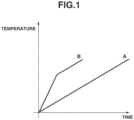
- Fig. 1 With reference to a conceptual diagram illustrated in Fig. 1 , these action effects are described in more detail.
- the horizontal axis represents the time of the application of the laser light
- the vertical axis represents the temperature of the region to which the laser light is applied.
- a line A indicates a rise in temperature of a powder that includes the Al 2 O 3 particle and the SiO 2 particle and does not include the SiO particle.
- a line B indicates the concept of the temperature rise characteristics of the powder according to the present exemplary embodiment including the Al 2 O 3 particle, the SiO 2 particle, and the SiO particle.
- Each powder contains the same mass fractions of the Al 2 O 3 and the SiO 2 .
- Fig. 1 is merely a diagram illustrating the concept, and a temperature rise process is not limited to the illustrated linear temperature rise process.
- the powder that does not include the SiO particle has a low light absorption ability, the applied laser light is scattered, and it is not possible to locally raise the temperature of the powder. Thus, the heating efficiency of the powder is poor.
- To raise the temperature of the powder in the region to which the laser light is applied to a temperature required to sinter or melt and coagulate the powder it is necessary to increase input energy per unit volume.
- the powder exhibits the temperature rise characteristics indicated by the line A. If the laser light is applied with high input energy to harden the powder, the scattered laser light raises the temperature of the powder in a neighborhood portion, which leads to an unclear temperature difference between the laser application region and the powder in the periphery of the laser application region. Consequently, a low-density sintered portion is formed near a region that should be hardened, and high manufacturing accuracy cannot be obtained.
- the expression "sintering or melting and coagulating” is not limited to a case where a powder is not melted as sintering, or a case where a powder does not remain unmelted as melting.
- the expression “sintering or melting and coagulating” includes a sintered state where powders are combined together, the state where an unsintered portion is partially included, a liquid phase sintering state where a melted product is present around a powder, and a melted state where a powder remaining partially unmelted is further present.
- “sintering or melting and coagulating” are collectively referred to as "hardening”.
- the SiO absorbs the laser light, and the temperature of the powder quickly rises as indicated by the line B in Fig. 1 .
- the heating efficiency of the powder is excellent, and it is possible to locally heat the powder.
- the temperature difference between the laser application region and a peripheral region can be sufficiently ensured, and the range of a sintered portion generated near a hardened portion is narrow.
- excellent manufacturing accuracy can be obtained.
- the SiO changes to the SiO 2 , and the light absorption ability decreases.
- the powder exhibits characteristics similar to those of the powder that does not include the absorber.
- the powder according to the present exemplary embodiment should satisfy 40 [sec/50 g] or less as a fluidity index.
- each particle should have a spherical shape.
- the shape of the particle is not limited to a spherical shape so long as the above fluidity index can be satisfied.
- the SiO particle that functions as the absorber should be in the state where the SiO particle is included independently of other components, regardless of in what states other compounds included in the powder are. It is possible to achieve a higher light absorption ability than in the state where a plurality of SiO particles composes a secondary particle or the SiO particle composes a secondary particle with another particle. Further, the laser light is likely to reach the absorber, and it is possible to efficiently use the light absorption ability of the absorber. Additionally, if the SiO particle is a particle independent of other components, it is possible to separately adjust the particle size of the SiO particle and the particle size of another particle. Thus, it is easy to control the fluidity of the powder, and it is also easy to control the amount of the absorber within the spot diameter of the laser light to be applied. This will be described in detail below.
- the average particle size of each of the oxide particles other than the SiO should be 5 micrometers ( ⁇ m) or more and greater than that of the SiO particle. It is more desirable that the average particle size of each of the oxide particles other than the SiO should be 5 ⁇ m or more and five times or more that of the SiO particle. It is even more desirable that the average particle size of each of the oxide particles other than the SiO should be 10 ⁇ m or more and five times or more that of the SiO particle.
- the average particle size of the particle should be 200 ⁇ m or less. It is more desirable that the average particle size of the particle should be 150 ⁇ m or less.
- the average particle size of the SiO particle should be 10 ⁇ m or less and one-fifth or less of the particle size of each of the oxide particles other than the SiO. If the SiO particle satisfies this condition, the probability that the SiO particle is dispersed and a plurality of SiO particles is present near the oxide particles other than the SiO increases. Thus, heat generated by the SiO absorbing the laser light is efficiently conducted to the oxide particles other than the SiO, and the powder in the laser light application portion is likely to be melted. If the dispersiveness of the SiO in the powder and the achievement of high filling density are taken into account, it is desirable that the average particle size of the SiO particle should be as small as possible.
- the average particle size of the SiO particle is 1 ⁇ m or more, the scattering of the SiO particle into an atmosphere due to the application of the laser light is prevented, and the SiO particle can maintain an amount required as the absorber in the powder.
- the average particle size of the SiO particle should be 1 ⁇ m or more and 10 ⁇ m or less. It is more desirable that the average particle size of the SiO particle should be 1 ⁇ m or more and less than 5 ⁇ m.
- the average particle size of the secondary particle in terms of the achievement of fluidity suitable for the additive manufacturing, it is desirable that the average particle size of the secondary particle should be 5 ⁇ m or more. It is more desirable that the average particle size should be 5 ⁇ m or more and five times or more the average diameter of the SiO particle. It is even more desirable that the average particle size should be 10 ⁇ m or more and five times or more the average diameter of the SiO particle. In terms of the achievement of high manufacturing accuracy and in terms of the ease of the sintering or the melting of the powder, it is desirable that the average particle size of the particle should be 200 ⁇ m or less. It is more desirable that the average particle size of the particle should be 150 m or less.
- the average particle size of a primary particle composing the secondary particle may be smaller than the average particle size of the SiO particle.
- the average particle size of the SiO particle included in the powder is obtained by observing the powder using a scanning electron microscope (SEM), identifying a region composed of the SiO by composition analysis using energy-dispersive X-ray spectroscopy (EDS) provided in the SEM, measuring the area of the identified region, and calculating the equivalent circle diameter of the area. A region composed of a plurality of (100 or more) SiO particles is measured, and the median of the plurality of SiO particles is determined as the average particle size.
- This calculation method can be used to calculate the average particle size, regardless of the type or the state of the particle.
- the average particle size of a secondary particle can also be calculated using a similar technique.
- the powder is observed using a scanning electron microscope (SEM), composition analysis is performed, and the region of the secondary particle where primary particles gather and the types of the primary particles composing the secondary particle are identified.
- SEM scanning electron microscope
- the equivalent circle diameter of the area of a region including a plurality of (100 or more) secondary particles is calculated, and the median of the plurality of secondary particles is determined as the average particle size.
- the particle size according to the present exemplary embodiment refers to the equivalent circle diameter (the Heywood diameter) of an individual particle.
- the average particle size of a particle composed of a particular composition included in the powder does not refer to the particle size of an individual particle, but is the median of a particle group having the same composition. This does not mean that a particle having a size other than that indicated as the average particle size is not included in the powder.
- the powder according to the present exemplary embodiment should not contain a resin binder. This is because the resin binder has a significantly lower melting point than those of other compounds included in the powder. Thus, the resin binder may explosively burn down due to the application of the laser light and make a hole or a defect internally present in a manufacturing region.
- the powder contains elemental carbon having sublimation properties, carbon and oxygen may be combined together and go out as gas, and the volume occupied by the elemental carbon may become a hole. Further, the elemental carbon may sublimate due to the application of the laser light, rapidly gasify, and adversely affect the manufacturing. Specifically, stress may be applied to a portion where the powder is melted or a hardened portion due to the rapid gasification, which results in a deformed manufactured product.
- the amount of the elemental carbon contained in the powder should be small. It is particularly desirable that the amount of the elemental carbon contained in the powder should be 1000 ppm or less in a molar ratio relative to metal elements of a plurality of compounds included in the powder.
- the powder according to the present exemplary embodiment may be in any of a crystalline state, an amorphous state, and a mixture state.
- the compositions of the powder and the manufactured ceramic article do not need to match each other.
- the powder and the manufactured ceramic article may have a difference such as an oxidized state or a nitrided state.
- the powder according to the present invention includes an SiO particle and one or more types of oxide particles other than SiO.
- oxide particles other than the SiO one or more types of particles are selected from the group including an Al 2 O 3 particle, an SiO 2 particle, and a compound particle of Al 2 O 3 and SiO 2 so that the powder includes silicon and aluminum as elements.
- the combinations of the compositions of the oxide particles other than the SiO composing the powder the following combinations are possible: SiO 2 -Al 2 O 3 , SiO 2 -Al 2 O 3 -(a compound or a mixture of the Al 2 O 3 and the SiO 2 ), SiO 2 -(the compound or the mixture of the Al 2 O 3 and the SiO 2 ), and Al 2 O 3 -(the compound or the mixture of the Al 2 O 3 and the SiO 2 ).
- SiO 2 -Al 2 O 3 , SiO 2 -Al 2 O 3 -(the compound of the Al 2 O 3 and the SiO 2 ), SiO 2 -(the compound of the Al 2 O 3 and the SiO 2 ), and Al 2 O 3 -(the compound or the mixture of the Al 2 O 3 and the SiO 2 ) are desirable.
- the powder according to the present invention it is possible to produce a ceramic article including a compound of Al 2 O 3 and SiO 2 typified by mullite, using an additive manufacturing technique.
- a ceramic including the compound of the Al 2 O 3 and the SiO 2 is characterized in being more excellent in thermal shock resistance and high-temperature creep than alumina.
- the Al 2 O 3 and the compound of the Al 2 O 3 and the SiO 2 have a higher thermal conductivity than that of the SiO 2 and have a lower viscosity in melting than that of the SiO 2 .
- x ⁇ 20 it is possible to efficiently conduct heat emitted from the SiO in the application of the laser to another particle via the Al 2 O 3 or the compound of the Al 2 O 3 and the SiO 2 and melt another particle.
- the melted Al 2 O 3 or the melted compound of the Al 2 O 3 and the SiO 2 can fuse with a particle in the neighborhood and form a dense manufactured product. It is more desirable that the powder should satisfy x ⁇ 30.
- the Al 2 O 3 since the Al 2 O 3 has a low viscosity in melting, the Al 2 O 3 is suitable for the manufacturing, but the following issue arises.
- the Al 2 O 3 is coagulated from a melted state, the Al 2 O 3 is likely to grow in a particular crystal axis direction. If a crystal randomly starts to grow at various positions in the melted Al 2 O 3 , gaps of crystal grains are not sufficiently filled, and blowholes are likely to be formed in a hardened portion. Accordingly, in the powder according to the present invention, it is desirable that the mass fraction of the Al 2 O 3 should be x ⁇ 99.8. It is more desirable that the mass fraction of the Al 2 O 3 should be x ⁇ 99.
- the SiO 2 is added. With the appropriately added amount of the SiO 2 , the compound of the Al 2 O 3 and the SiO 2 is generated when the Al 2 O 3 is coagulated, and a plurality of phases occurs. This makes the crystal composition of a hardened portion fine and prevents the occurrence of blowholes.
- the mass fraction of the SiO 2 should be 0 ⁇ y. It is more desirable that the mass fraction of the SiO 2 should be 1.0 ⁇ y. It is even more desirable that the mass fraction of the SiO 2 should be 3.0 ⁇ y.
- the SiO 2 has a high viscosity in melting. Thus, if the powder includes excessive SiO 2 , the SiO 2 is likely to form into a spherical shape in a melted state and be coagulated as it is, and a manufactured product to be formed is likely to be porous.
- y ⁇ 80 should be satisfied. It is more desirable that y ⁇ 50 should be satisfied.
- the mass fraction of the SiO 2 should be 1.0 ⁇ y ⁇ 50. It is more desirable that the mass fraction of the SiO 2 should be 3.0 ⁇ y ⁇ 50.
- the x, y, and z which are the mass fractions of the Al 2 O 3 , the SiO 2 , and the SiO, respectively, satisfy y ⁇ x + z, a dense manufactured product is likely to be obtained, which is desirable.
- the powder satisfying 90 ⁇ x + y + z should be used. It is more desirable that the powder should satisfy 95 ⁇ x + y + z.
- the mass fraction of the SiO included in the powder satisfies 0.2 ⁇ z ⁇ 50. If the mass fraction z of the SiO is smaller than 0.2, the amount of heat generated per unit time in the application of the laser to the powder is insufficient, and it is difficult to melt the powder. If the amount of input heat is increased by increasing the laser output or extending the application time to melt the powder, heat is conducted to the periphery of the laser application portion, and it is difficult to locally melt the powder, which results in deterioration of the manufacturing accuracy. To locally efficiently melt the powder, it is necessary to satisfy 0.2 ⁇ z, and it is more desirable to satisfy 0.5 ⁇ z. This condition holds true, regardless of whether a case where the SiO particle is a particle independent of the oxide particles other than the SiO or a case where the SiO particle composes a secondary particle with the oxide particles other than the SiO.
- the SiO acts as an absorber.
- the manufacturing accuracy tends to decrease. The reason is considered that a rise in temperature of a portion to which the laser light is applied is so rapid that a melted material is scattered around. Thus, to obtain excellent manufacturing accuracy, the amount of the SiO contained in the powder is z ⁇ 50.
- the SiO particle should be a particle independent of other particles (an independent particle) and have a small grain size. If, however, the powder includes many SiO particles having small diameters, the fluidity of the powder may decrease, and a fluidity index suitable for the additive manufacturing method may not be obtained. If the SiO particle is included as a particle independent of other particles in the powder, it is desirable that the amount of the contained SiO should be z ⁇ 20.
- the state where the region to which the laser light to be applied is applied includes at least one SiO particle is desirable.
- the state where the focal spot size of the laser light probabilistically includes two or more SiO particles is more desirable. It is desirable that the distance between SiO particles in the powder should be probabilistically 100 ⁇ m or less. It is more desirable that the distance between SiO particles in the powder should be 50 ⁇ m or less. Such a state is achieved by setting the mass fraction of the SiO in the powder to 0.2 or more.
- the state where the focal spot size of the laser light includes two or more SiO particles can also be achieved by adjusting the focal spot size of the laser light.
- the focal spot size of the laser light should be 100 ⁇ m or less, it is desirable that the average particle size of the SiO particle should be 1 ⁇ m or more and 10 ⁇ m or less.
- the focal spot size of the laser light to be applied may be determined according to desired manufacturing accuracy, and may be 100 ⁇ m or more, depending on the required manufacturing accuracy. In this case, if the focal spot size of the laser light includes two or more SiO particles, the average particle size of the SiO particle may be greater than 10 ⁇ m. The same applies to a case where the SiO particle composes a secondary particle with other particles.
- the light absorption ability of the SiO alone should be 10% or more. It is more desirable that the light absorption ability of the SiO alone should be 40% or more. It is even more desirable that the light absorption ability of the SiO alone should be 60% or more. Since the light absorption ability of the SiO changes according to the element ratio between Si and O, the desirable constituent element ratio deviates within ⁇ 20% from the stoichiometric ratio. If the ratio between the silicon and the oxygen is almost 1:1, the SiO exhibits a high absorption ability for versatile light of a wavelength of about 1 ⁇ m (Nd:YAG), which is particularly desirable. In terms of the obtaining of a high light absorption ability while the constituent ratio between the silicon and the oxygen in the SiO is maintained, it is more desirable that the SiO particle in the powder should be an independent particle.
- the constituent element ratio of a compound included in the powder according to the present exemplary embodiment can be identified using scanning electron microscope-energy-dispersive X-ray spectroscopy (SEM-EDX), transmission electron microscope-energy-dispersive X-ray spectroscopy (TEM-EDX), electron diffraction, or X-ray diffraction.
- SEM-EDX scanning electron microscope-energy-dispersive X-ray spectroscopy
- TEM-EDX transmission electron microscope-energy-dispersive X-ray spectroscopy
- electron diffraction or X-ray diffraction.
- the constituent element ratio of a compound included in the powder can also be identified by combining inductively coupled plasma atomic emission spectroscopy (ICP-AES), inductively coupled plasma mass spectrometry (ICP-MS), X-ray fluorescence spectrometry, or an inert gas fusion method.
- ICP-AES inductively coupled plasma atomic emission spectroscopy
- a general spectrometer can be used to measure the light absorption ability.
- Light of an assumed wavelength (the laser wavelength of the laser to be applied in the production process or a wavelength near the laser wavelength) is emitted to a measurement target powder filling a sample dish, and the reflection of the light is measured using an integrating sphere.
- the reflection in a case where a sample is not present the light absorption ability can be calculated based on the ratio between the measured reflection and the reference data.
- the absorber is a compound composing at least a part of a ceramic article.
- the assumed wavelength refers to the laser wavelength of the laser to be applied in the production process or a wavelength near the laser wavelength.
- the powder, the light absorption ability of which is measured, may be a compound equivalent to the ceramic article, and does not need to be a powder itself used to produce the ceramic article.
- the respiratory system may be damaged.
- the powder should include amorphous SiO 2 as the SiO 2 .
- the powder according to the present exemplary embodiment is suitably used in an additive production method in which laser light is applied to a powder according to slice data generated based on three-dimensional data of a ceramic article to be produced to manufacture the ceramic article.
- the powder according to the present exemplary embodiment is used in a production method using a powder bed fusion method or a cladding method.
- the ceramic article is produced by alternately performing the following steps (i) and (ii) multiple times.
- the steps (i) and (ii) are performed by leveling the powder according to the present exemplary embodiment at a predetermined thickness on a base material and then applying the laser light to the powder.
- the steps (i) and (ii) are performed by ejecting the powder according to the present exemplary embodiment to a predetermined portion and applying the laser light to the predetermined portion.
- the wavelength of the laser light used in the manufacturing is not limited, it is desirable to use laser light adjusted to a desired focal spot size such as a diameter of 10 ⁇ m to 2 mm in a lens or a fiber.
- the focal spot size is one of parameters influencing the manufacturing accuracy. To satisfy a manufacturing accuracy of 100 ⁇ m (0.1 mm), although depending on the situation, it is desirable that the linewidth should be comparable with the manufacturing accuracy. It is desirable that the focal spot size should be a diameter of 100 ⁇ m or less. It does not matter whether the application of the laser light is continuous or pulsed.
- the laser light laser having a wavelength near 1000 nm from, for example, an Nd:YAG laser and a Yb fiber laser can be suitably used. This is because the SiO component exhibits a particularly high absorption ability with respect to light of a wavelength of about 1 ⁇ m.
- Fig. 2 is a conceptual diagram of a three-dimensional manufacturing apparatus using the powder bed fusion method.
- the three-dimensional manufacturing apparatus includes a powder measure 11, a manufacturing unit 13, a recoater unit 15, a laser light source 16, and a scanner unit 17 that scans laser light generated by the laser light source 16.
- a powder 22 is pushed up by lifting a bottom portion 12 of the powder measure 11, and a stage 14 of the manufacturing unit 13 on which a base material 19 is set is lowered by a predetermined distance.
- the coater unit 15 supplies the powder 22 to the manufacturing unit 12, and a powder 20 is leveled at a predetermined thickness in a region wider than the assumed ceramic article.
- the scanner unit 14 scans laser light 18 generated by the laser light source 16, to directly perform drawing on the powder 20 leveled on the base material 19.
- the drawn region is sintered or melted and coagulated, and is hardened. This process is repeated, whereby a ceramic article 21 in which hardened portions are laminated is obtained.
- the cladding method is a technique in which powders are ejected from a plurality of powder supply holes 222 in a cladding nozzle 221, laser light 223 is applied to a region where the powders are focused, and a ceramic article is sequentially manufactured at a desired location.
- the cladding method is characterized by being capable of performing manufacturing on a curved surface.
- an atmosphere may be controlled.
- an atmosphere where a compound included in the powder is likely to reduce such as an inert atmosphere including nitrogen or other rare gas, an atmosphere containing hydrogen, or a depressurized atmosphere, or an oxygen atmosphere may be desirable.
- Such an atmosphere is controlled, whereby it is possible to use the powder including a compound in an oxidized or reduced state relative to the chemical controversial ratio in the production of a ceramic article.
- the powder according to the present exemplary embodiment is used, whereby it is possible to manufacture a ceramic article in a stabilized manner and manufacturing accuracy of the ceramic article is ensured.
- a ceramic article produced using the powder according to the present exemplary embodiment is not limited to an inorganic material in a crystalline state.
- a part or more than half of the ceramic article may be in an amorphous state so long as a desired physical property value can be obtained.
- a ceramic article including a region close to a metal state by reducing the powder may be produced by the above production process.
- the porosity of a ceramic article was evaluated by a method based on Japanese Industrial standards (JIS) R1634 for a method for a measurement of the sintered body density and the open porosity of a fine ceramic. Specifically, on three ceramic articles prepared using material similar to a sample used to measure mechanical strength, porosities of the ceramic articles were calculated using ⁇ (W3 - W1)/(W3 - W2) ⁇ ⁇ 100, where the dry mass of each ceramic article was W 1, the underwater mass of the ceramic article was W2, and the saturated mass of the ceramic article was W3, and the resultants were averaged.
- JIS Japanese Industrial standards
- composition of a powder or a manufactured product was measured by inductively coupled plasma atomic emission spectroscopy (ICP-AES).
- Ceramic articles were produced by the powder bed fusion method, using powders 1 to 21 including silicon monoxide (SiO), and aluminum oxide (Al 2 O 3 ) and silicon dioxide (SiO 2 ) in addition to the silicon monoxide, and the porosities of the ceramic articles were measured.
- SiO silicon monoxide
- Al 2 O 3 aluminum oxide
- SiO 2 silicon dioxide
- Each of the powders 1 to 15 and 18 to 22 was prepared by agitating the following powders weighed in quantities illustrated in table 1 for 2 hours using a rocking mixer.
- the Al 2 O 3 particle and the SiO 2 particle had approximately spherical shapes.
- Each of the powders 16 and 17 was prepared by the following procedure.
- a slurry was prepared by weighing and mixing the following powders so that the powders had a composition ratio illustrated in table 2, and dispersing the mixed powder in water.
- a granulated powder having an average particle size of 30 ⁇ m was prepared from the prepared slurry by a spray dryer method and then subjected to heat treatment at a temperature between 600°C and 800°C, whereby a granulated powder composed of a spherical secondary particle in which a single particle includes an Al 2 O 3 particle and an SiO 2 particle was prepared.
- the above described powder composed of the SiO particle was added to the obtained granulated powder so that the resulting powder had the composition ratio illustrated in table 2. Then, the resulting powder was agitated for 10 minutes by the rocking mixer.
- compositions of the prepared powders 1 to 22 were analyzed, a component except for the Al 2 O 3 , the SiO 2 , and the SiO in each powder was less than 1 weight percent (wt%).
- the ceramic article was prepared using DMP 200 of ProX (product name) series by 3D Systems, Inc., in which Yb fiber laser was provided.
- a cuboid having a length of 40 mm, a width of 6 mm, and a height of 5 mm was prepared as the ceramic article.
- the ceramic article was manufactured by setting the thickness per powder layer (a value for lowering the manufacturing stage unit 12) to 20 ⁇ m.
- Laser light having a focal spot size of 100 ⁇ m and a power of 270 W was applied to the powder at a scanning speed of 500 mm/sec.
- a region having a length of 40 mm and a width of 6 mm was drawn at pitches of 100 ⁇ m, and the drawn regions were laminated to a height of 5 mm. Since the thickness per layer is about 20 ⁇ m, the powder includes particles having a thickness greater than or equal to that of a single layer, but these particles are removed when the powder is leveled at an early stage of the lamination. The powder layers are melted due to the application of the laser light and shrink in the thickness direction. Thus, the apparent thickness of the powder layers gradually increases while the lamination is repeated, and eventually converges in the range from 67 to 133 ⁇ m. Thus, even if the average particle size of the powder to be used is greater than a powder layer of 20 ⁇ m, this is not an issue in use.
- the surface of the manufactured product was observed using an optical microscope. It was confirmed that the ceramic article prepared using each of the powders 1 to 15 was manufactured with high accuracy such that average roughness (Ra) of the surface of the ceramic article was less than 30 ⁇ m. It was confirmed that particularly, the ceramic article prepared using each of the powders 1 to 7, the powders 12 to 14, and the powders 16 and 17, in which the amount of the contained SiO was 20 wt% or less, was manufactured with excellent accuracy such that Ra of the surface of the ceramic article was 25 ⁇ m or less. In contrast, Ra of the ceramic article for comparison prepared using the powder 22 was 40 ⁇ m or more, and excellent manufacturing accuracy was not obtained. The reason is considered that since the powder 22 did not include the SiO particle, light was diffused in the powder in the application of the laser light, and thus, the powder was melted or sintered in a wide range.
- Tables 1 and 2 illustrate the evaluation results of the density.
- the porosity was measured, and the density was classified as the following four levels. If the porosity was 11% or less, the density was classified as A. If the porosity was greater than 11% and 14% or less, the density was classified as B. If the porosity was greater than 14% and 16% or less, the density was classified as C. If the porosity was greater than 16%, the density was classified as D.
- A indicates a manufactured product in the state of an extremely excellent dense body.
- B indicates a manufactured product in the state of an excellent dense body.
- C indicates a manufactured product in the state of a dense body.
- D indicates a manufactured product in the state of a porous body or the state where many cracks are included.
- the manufactured product prepared using each of the powders 1 to 17 was a dense body classified as the density of A to C. Particularly, the density of the manufactured product using each of the powders 1 to 8, the powders 10 to 13, and the powders 16 and 17, which satisfied z ⁇ 20 and y ⁇ x + z, was classified as A or B, and the density was extremely excellent or excellent. In contrast, the density of the manufactured product for comparison prepared using each of the powders 18 to 20, which satisfied x ⁇ 20, was classified as D, which indicates a porous body.
- the powder according to the present invention is not limited to this method.
- the powder according to the present invention can also be used in a manufacturing method in which a resin adhesive is added to the powder according to the present invention, and the resin adhesive is melted with heat emitted by the SiO particle absorbing the laser light and then cured to bond the particles with the resin adhesive.
- the resin adhesive may be added as a particle independent of other particles to the powder, or may be attached to the surface of the Al 2 O 3 particle, the SiO 2 particle, or the SiO particle.
- the powder according to the present invention enables the production of a dense ceramic article with high accuracy without, as an absorber, a rare earth component that is used in an additive production method for manufacturing with application of laser light.
- the powder according to the present invention enables the provision of an inexpensive ceramic article to a field that requires a complex shape.
Landscapes
- Chemical & Material Sciences (AREA)
- Engineering & Computer Science (AREA)
- Ceramic Engineering (AREA)
- Manufacturing & Machinery (AREA)
- Organic Chemistry (AREA)
- Materials Engineering (AREA)
- Structural Engineering (AREA)
- Inorganic Chemistry (AREA)
- Composite Materials (AREA)
- Civil Engineering (AREA)
- Mechanical Engineering (AREA)
- Compositions Of Oxide Ceramics (AREA)
Applications Claiming Priority (3)
| Application Number | Priority Date | Filing Date | Title |
|---|---|---|---|
| JP2021067069 | 2021-04-12 | ||
| JP2022061812A JP2022162538A (ja) | 2021-04-12 | 2022-04-01 | 付加製造法に用いられる粉末およびそれを用いたセラミックス物品の製造方法 |
| PCT/JP2022/017333 WO2022220193A1 (fr) | 2021-04-12 | 2022-04-08 | Poudre destinée à être utilisée dans la fabrication additive et procédé de production d'un article en céramique utilisant ladite poudre |
Publications (2)
| Publication Number | Publication Date |
|---|---|
| EP4324611A1 true EP4324611A1 (fr) | 2024-02-21 |
| EP4324611A4 EP4324611A4 (fr) | 2025-04-23 |
Family
ID=83640055
Family Applications (1)
| Application Number | Title | Priority Date | Filing Date |
|---|---|---|---|
| EP22788118.2A Pending EP4324611A4 (fr) | 2021-04-12 | 2022-04-08 | Poudre destinée à être utilisée dans la fabrication additive et procédé de production d'un article en céramique utilisant ladite poudre |
Country Status (3)
| Country | Link |
|---|---|
| US (1) | US20240034683A1 (fr) |
| EP (1) | EP4324611A4 (fr) |
| WO (1) | WO2022220193A1 (fr) |
Family Cites Families (8)
| Publication number | Priority date | Publication date | Assignee | Title |
|---|---|---|---|---|
| JP7011548B2 (ja) | 2017-07-14 | 2022-01-26 | キヤノン株式会社 | セラミックス造形用粉体、セラミックス造形物、およびその製造方法 |
| JP7614720B2 (ja) * | 2018-12-21 | 2025-01-16 | キヤノン株式会社 | 無機材料粉末、および構造体の製造方法 |
| JP7395840B2 (ja) * | 2019-04-09 | 2023-12-12 | セイコーエプソン株式会社 | 積層造形用粉末および積層造形体の製造方法 |
| CN117623782A (zh) * | 2019-10-23 | 2024-03-01 | 佳能株式会社 | 制造陶瓷制品的方法和陶瓷制品 |
| JP2021066177A (ja) * | 2019-10-23 | 2021-04-30 | キヤノン株式会社 | セラミックス物品の製造方法、およびセラミックス物品 |
| JP7281137B2 (ja) | 2019-10-23 | 2023-05-25 | 磯川産業株式会社 | 引き戸の制動装置 |
| JP7520678B2 (ja) | 2020-10-07 | 2024-07-23 | 株式会社メディカロイド | 手術器具 |
| JP2022066155A (ja) * | 2020-10-16 | 2022-04-28 | キヤノン株式会社 | セラミックス物品の製造方法、それに用いられる金属イオン含有液およびセラミックス物品製造用キット |
-
2022
- 2022-04-08 EP EP22788118.2A patent/EP4324611A4/fr active Pending
- 2022-04-08 WO PCT/JP2022/017333 patent/WO2022220193A1/fr not_active Ceased
-
2023
- 2023-10-09 US US18/483,148 patent/US20240034683A1/en active Pending
Also Published As
| Publication number | Publication date |
|---|---|
| WO2022220193A1 (fr) | 2022-10-20 |
| EP4324611A4 (fr) | 2025-04-23 |
| US20240034683A1 (en) | 2024-02-01 |
Similar Documents
| Publication | Publication Date | Title |
|---|---|---|
| JP7808080B2 (ja) | セラミックス造形用粉体、セラミックス造形物、およびその製造方法 | |
| US12479769B2 (en) | Inorganic material powder and method of manufacturing a structural body | |
| US11440850B2 (en) | Powder for additive modeling, structure, semiconductor production device component, and semiconductor production device | |
| EP2924506B1 (fr) | Élément en carbure de silicium fritté par réaction | |
| US9090513B2 (en) | Method of manufacturing transparent sesquioxide sintered body, and transparent sesquioxide sintered body manufactured by the method | |
| US12220837B2 (en) | Method for producing article containing silicon carbide as main constituent, and raw material powder used in the method | |
| CN113165207B (zh) | 陶瓷制品的制造方法及陶瓷制品 | |
| CN112166018A (zh) | 陶瓷产品制造方法和陶瓷产品 | |
| EP4112585A1 (fr) | Procédé de fabrication d'un corps fritté | |
| EP4324611A1 (fr) | Poudre destinée à être utilisée dans la fabrication additive et procédé de production d'un article en céramique utilisant ladite poudre | |
| Kutlu et al. | 3D Printing of Na1. 3Al0. 3Ti1. 7 (PO4) 3 Solid Electrolyte via Fused Filament Fabrication for All‐Solid‐State Sodium‐Ion Batteries | |
| JP2022162538A (ja) | 付加製造法に用いられる粉末およびそれを用いたセラミックス物品の製造方法 | |
| CN117120229A (zh) | 在增材制备方法中使用的粉末和使用其制备陶瓷制品的方法 | |
| US20240360042A1 (en) | Powder for ceramic shaping, method of manufacturing ceramic shaped object, ceramic shaped object, and device | |
| US20260116826A1 (en) | Powder for ceramic shaping, method of manufacturing ceramic shaped object, ceramic structural body, and equipment | |
| JP2024159508A (ja) | セラミックス造形用粉体、セラミックス造形物の製造方法、セラミックス造形物および機器 | |
| US20240181525A1 (en) | Powder material for additive manufacturing and method for manufacturing additive-manufactured product using powder material | |
| WO2023085385A1 (fr) | Structure de céramique et son procédé de fabrication | |
| WO2023022051A1 (fr) | Procédé de production d'un corps fritté en alumine | |
| Obeidat et al. | The Impact of the Printed Part Size on the Shrinkage and Density in Binder Jetting Additive Manufacturing of Ceramics Powder | |
| CN118234694A (zh) | 陶瓷结构体及其制造方法 |
Legal Events
| Date | Code | Title | Description |
|---|---|---|---|
| STAA | Information on the status of an ep patent application or granted ep patent |
Free format text: STATUS: THE INTERNATIONAL PUBLICATION HAS BEEN MADE |
|
| PUAI | Public reference made under article 153(3) epc to a published international application that has entered the european phase |
Free format text: ORIGINAL CODE: 0009012 |
|
| STAA | Information on the status of an ep patent application or granted ep patent |
Free format text: STATUS: REQUEST FOR EXAMINATION WAS MADE |
|
| 17P | Request for examination filed |
Effective date: 20231113 |
|
| AK | Designated contracting states |
Kind code of ref document: A1 Designated state(s): AL AT BE BG CH CY CZ DE DK EE ES FI FR GB GR HR HU IE IS IT LI LT LU LV MC MK MT NL NO PL PT RO RS SE SI SK SM TR |
|
| DAV | Request for validation of the european patent (deleted) | ||
| DAX | Request for extension of the european patent (deleted) | ||
| A4 | Supplementary search report drawn up and despatched |
Effective date: 20250326 |
|
| RIC1 | Information provided on ipc code assigned before grant |
Ipc: C04B 35/64 20060101ALI20250320BHEP Ipc: C01F 7/02 20220101ALI20250320BHEP Ipc: C01B 33/12 20060101ALI20250320BHEP Ipc: C01B 33/113 20060101ALI20250320BHEP Ipc: B33Y 70/10 20200101ALI20250320BHEP Ipc: B33Y 10/00 20150101ALI20250320BHEP Ipc: B28B 1/30 20060101AFI20250320BHEP |