EP4324965A1 - Alginatfaser und herstellungsverfahren dafür - Google Patents
Alginatfaser und herstellungsverfahren dafür Download PDFInfo
- Publication number
- EP4324965A1 EP4324965A1 EP22806685.8A EP22806685A EP4324965A1 EP 4324965 A1 EP4324965 A1 EP 4324965A1 EP 22806685 A EP22806685 A EP 22806685A EP 4324965 A1 EP4324965 A1 EP 4324965A1
- Authority
- EP
- European Patent Office
- Prior art keywords
- alginate
- alginate fiber
- quaternary ammonium
- ammonium salt
- membered cyclic
- Prior art date
- Legal status (The legal status is an assumption and is not a legal conclusion. Google has not performed a legal analysis and makes no representation as to the accuracy of the status listed.)
- Granted
Links
Images

Classifications
-
- D—TEXTILES; PAPER
- D01—NATURAL OR MAN-MADE THREADS OR FIBRES; SPINNING
- D01F—CHEMICAL FEATURES IN THE MANUFACTURE OF ARTIFICIAL FILAMENTS, THREADS, FIBRES, BRISTLES OR RIBBONS; APPARATUS SPECIALLY ADAPTED FOR THE MANUFACTURE OF CARBON FILAMENTS
- D01F9/00—Artificial filaments or the like of other substances; Manufacture thereof; Apparatus specially adapted for the manufacture of carbon filaments
- D01F9/04—Artificial filaments or the like of other substances; Manufacture thereof; Apparatus specially adapted for the manufacture of carbon filaments of alginates
-
- D—TEXTILES; PAPER
- D01—NATURAL OR MAN-MADE THREADS OR FIBRES; SPINNING
- D01D—MECHANICAL METHODS OR APPARATUS IN THE MANUFACTURE OF ARTIFICIAL FILAMENTS, THREADS, FIBRES, BRISTLES OR RIBBONS
- D01D10/00—Physical treatment of artificial filaments or the like during manufacture, i.e. during a continuous production process before the filaments have been collected
- D01D10/06—Washing or drying
-
- D—TEXTILES; PAPER
- D01—NATURAL OR MAN-MADE THREADS OR FIBRES; SPINNING
- D01D—MECHANICAL METHODS OR APPARATUS IN THE MANUFACTURE OF ARTIFICIAL FILAMENTS, THREADS, FIBRES, BRISTLES OR RIBBONS
- D01D5/00—Formation of filaments, threads, or the like
- D01D5/02—Starting the formation
-
- D—TEXTILES; PAPER
- D01—NATURAL OR MAN-MADE THREADS OR FIBRES; SPINNING
- D01D—MECHANICAL METHODS OR APPARATUS IN THE MANUFACTURE OF ARTIFICIAL FILAMENTS, THREADS, FIBRES, BRISTLES OR RIBBONS
- D01D5/00—Formation of filaments, threads, or the like
- D01D5/06—Wet spinning methods
-
- D—TEXTILES; PAPER
- D01—NATURAL OR MAN-MADE THREADS OR FIBRES; SPINNING
- D01F—CHEMICAL FEATURES IN THE MANUFACTURE OF ARTIFICIAL FILAMENTS, THREADS, FIBRES, BRISTLES OR RIBBONS; APPARATUS SPECIALLY ADAPTED FOR THE MANUFACTURE OF CARBON FILAMENTS
- D01F1/00—General methods for the manufacture of artificial filaments or the like
- D01F1/02—Addition of substances to the spinning solution or to the melt
- D01F1/10—Other agents for modifying properties
-
- D—TEXTILES; PAPER
- D01—NATURAL OR MAN-MADE THREADS OR FIBRES; SPINNING
- D01F—CHEMICAL FEATURES IN THE MANUFACTURE OF ARTIFICIAL FILAMENTS, THREADS, FIBRES, BRISTLES OR RIBBONS; APPARATUS SPECIALLY ADAPTED FOR THE MANUFACTURE OF CARBON FILAMENTS
- D01F11/00—Chemical after-treatment of artificial filaments or the like during manufacture
-
- D—TEXTILES; PAPER
- D01—NATURAL OR MAN-MADE THREADS OR FIBRES; SPINNING
- D01F—CHEMICAL FEATURES IN THE MANUFACTURE OF ARTIFICIAL FILAMENTS, THREADS, FIBRES, BRISTLES OR RIBBONS; APPARATUS SPECIALLY ADAPTED FOR THE MANUFACTURE OF CARBON FILAMENTS
- D01F11/00—Chemical after-treatment of artificial filaments or the like during manufacture
- D01F11/02—Chemical after-treatment of artificial filaments or the like during manufacture of cellulose, cellulose derivatives, or proteins
-
- D—TEXTILES; PAPER
- D06—TREATMENT OF TEXTILES OR THE LIKE; LAUNDERING; FLEXIBLE MATERIALS NOT OTHERWISE PROVIDED FOR
- D06M—TREATMENT, NOT PROVIDED FOR ELSEWHERE IN CLASS D06, OF FIBRES, THREADS, YARNS, FABRICS, FEATHERS OR FIBROUS GOODS MADE FROM SUCH MATERIALS
- D06M15/00—Treating fibres, threads, yarns, fabrics, or fibrous goods made from such materials, with macromolecular compounds; Such treatment combined with mechanical treatment
- D06M15/19—Treating fibres, threads, yarns, fabrics, or fibrous goods made from such materials, with macromolecular compounds; Such treatment combined with mechanical treatment with synthetic macromolecular compounds
- D06M15/37—Macromolecular compounds obtained otherwise than by reactions only involving carbon-to-carbon unsaturated bonds
-
- D—TEXTILES; PAPER
- D06—TREATMENT OF TEXTILES OR THE LIKE; LAUNDERING; FLEXIBLE MATERIALS NOT OTHERWISE PROVIDED FOR
- D06P—DYEING OR PRINTING TEXTILES; DYEING LEATHER, FURS OR SOLID MACROMOLECULAR SUBSTANCES IN ANY FORM
- D06P1/00—General processes of dyeing or printing textiles, or general processes of dyeing leather, furs, or solid macromolecular substances in any form, classified according to the dyes, pigments, or auxiliary substances employed
- D06P1/44—General processes of dyeing or printing textiles, or general processes of dyeing leather, furs, or solid macromolecular substances in any form, classified according to the dyes, pigments, or auxiliary substances employed using insoluble pigments or auxiliary substances, e.g. binders
- D06P1/52—General processes of dyeing or printing textiles, or general processes of dyeing leather, furs, or solid macromolecular substances in any form, classified according to the dyes, pigments, or auxiliary substances employed using insoluble pigments or auxiliary substances, e.g. binders using compositions containing synthetic macromolecular substances
- D06P1/5264—Macromolecular compounds obtained otherwise than by reactions involving only unsaturated carbon-to-carbon bonds
-
- D—TEXTILES; PAPER
- D06—TREATMENT OF TEXTILES OR THE LIKE; LAUNDERING; FLEXIBLE MATERIALS NOT OTHERWISE PROVIDED FOR
- D06M—TREATMENT, NOT PROVIDED FOR ELSEWHERE IN CLASS D06, OF FIBRES, THREADS, YARNS, FABRICS, FEATHERS OR FIBROUS GOODS MADE FROM SUCH MATERIALS
- D06M15/00—Treating fibres, threads, yarns, fabrics, or fibrous goods made from such materials, with macromolecular compounds; Such treatment combined with mechanical treatment
- D06M15/19—Treating fibres, threads, yarns, fabrics, or fibrous goods made from such materials, with macromolecular compounds; Such treatment combined with mechanical treatment with synthetic macromolecular compounds
- D06M15/21—Macromolecular compounds obtained by reactions only involving carbon-to-carbon unsaturated bonds
- D06M15/356—Macromolecular compounds obtained by reactions only involving carbon-to-carbon unsaturated bonds of other unsaturated compounds containing nitrogen, sulfur, silicon or phosphorus atoms
- D06M15/3562—Macromolecular compounds obtained by reactions only involving carbon-to-carbon unsaturated bonds of other unsaturated compounds containing nitrogen, sulfur, silicon or phosphorus atoms containing nitrogen
-
- D—TEXTILES; PAPER
- D06—TREATMENT OF TEXTILES OR THE LIKE; LAUNDERING; FLEXIBLE MATERIALS NOT OTHERWISE PROVIDED FOR
- D06M—TREATMENT, NOT PROVIDED FOR ELSEWHERE IN CLASS D06, OF FIBRES, THREADS, YARNS, FABRICS, FEATHERS OR FIBROUS GOODS MADE FROM SUCH MATERIALS
- D06M2101/00—Chemical constitution of the fibres, threads, yarns, fabrics or fibrous goods made from such materials, to be treated
- D06M2101/02—Natural fibres, other than mineral fibres
- D06M2101/04—Vegetal fibres
-
- D—TEXTILES; PAPER
- D10—INDEXING SCHEME ASSOCIATED WITH SUBLASSES OF SECTION D, RELATING TO TEXTILES
- D10B—INDEXING SCHEME ASSOCIATED WITH SUBLASSES OF SECTION D, RELATING TO TEXTILES
- D10B2201/00—Cellulose-based fibres, e.g. vegetable fibres
- D10B2201/01—Natural vegetable fibres
-
- D—TEXTILES; PAPER
- D10—INDEXING SCHEME ASSOCIATED WITH SUBLASSES OF SECTION D, RELATING TO TEXTILES
- D10B—INDEXING SCHEME ASSOCIATED WITH SUBLASSES OF SECTION D, RELATING TO TEXTILES
- D10B2201/00—Cellulose-based fibres, e.g. vegetable fibres
- D10B2201/20—Cellulose-derived artificial fibres
Definitions
- the present application belongs to the technical field of textile fabric dyeing, and specifically relates to an alginate fiber and a preparation method thereof.
- Alginate fibers are a novel class of eco-friendly biodegradable fibers prepared by a wet spinning process with sodium alginate extracted from a natural seaweed as a raw material. Alginate fibers are valued for their excellent hygroscopicity, film-forming and fiber-forming properties, biodegradability, and biocompatibility.
- Alginate fibers have been widely used in the field of medical dressings and also have great potential in superior-quality clothing, underwear fabrics, and decorative textiles.
- alginate fibers brings comfort to wearing but also difficulty to spinning. On the one hand, it is currently difficult to allow the preparation of a mono-fiber yarn from an alginate fiber alone by related technologies. On the other hand, because alginate fibers currently have a slightly high price, there are many alginate fiber-containing blended fabrics on the market.
- Alginate fibers are often blended with cotton or wool, and the resulting blended fibers can have excellent wearability, such as bacteriostatic activity and flame retardance, which makes the blended fibers have promising industrial application prospects in the fields of clothing and industrial textiles.
- alginate fibers have poor acid and alkali tolerance, and when encountering solutions of ammonium salts and Na + , K + , and H + ions, alginate fibers will swell or even be dissolved. As a result, it is extremely difficult to dye alginate fibers in the current dyeing system. The difficult dyeing of alginate fibers has become a bottleneck, limiting the large-scale application of alginate fibers in the textile field.
- CN101736440A discloses a fabrication method for a dyeable alginate fiber.
- a water-soluble dendritic macromolecule is added to an alginate fiber spinning solution, and with a wet spinning device and process, the resulting mixture is subjected to solidification, drawing, water-washing, and a post-treatment to obtain the dyeable alginate fiber.
- a key to this method is the addition of a polyamide (PA)-amine dendritic macromolecule to the spinning solution, which makes it fail to solve the strong electronegativity of alginate fibers; and during dyeing, a salt needs to be added to promote dyeing, which inevitably causes damage to alginate fibers.
- PA polyamide
- CN108914630A a pretreatment solution with a caustic soda concentration of 2 g/L to 6 g/L is adopted, and this process will make an alginate fiber substantially dissolved.
- cotton is modified with an adsorbent cationic modifier instead of caustic soda.
- an obvious linear quaternary ammonium salt macromolecule has a poor adsorption and crosslinking effect with alginate fibers, which will also cause the swelling and dissolution of alginate fibers, thereby affecting the service performance of alginate fibers.
- the present application is intended to provide an alginate fiber and a preparation method thereof to solve the technical problem of difficult dyeing of alginate fibers in the prior art.
- the present application provides a preparation method for an alginate fiber, including:
- a mass percentage content of the five-membered cyclic quaternary ammonium salt polymer in the alginate fiber is 0.1% to 10%.
- S10 specifically includes: S101: mixing sodium alginate with a five-membered cyclic quaternary ammonium salt polymer in water to obtain a spinning solution, where a mass ratio of the sodium alginate to the five-membered cyclic quaternary ammonium salt polymer is 100:(0.001-30).
- a mass percentage concentration of the sodium alginate in the spinning solution is 3% to 6%.
- S20 specifically includes:
- S40 specifically includes:
- a pH of the solidification bath is 4.5 to 6.5.
- the solidification bath is a calcium chloride aqueous solution with a mass percentage concentration of 1% to 6%.
- the preparation method further includes: S50: washing and oven-drying an alginate fiber obtained in S40.
- the present application also provides an alginate fiber prepared by the preparation method described in the above technical solution.
- An embodiment of the present application provides a preparation method for an alginate fiber, including:
- the alginate fiber obtained in the embodiment of the present application may be used to prepare an alginate fiber-containing blended fabric, and the alginate fiber-containing blended fabric is a blended fabric of the alginate fiber with one or more other fibers.
- the alginate fiber-containing blended fabric can be at least one of an alginate fiber/cotton blended fabric, an alginate fiber/rayon blended fabric, an alginate fiber/wool blended fabric, an alginate fiber/cashmere blended fabric, and an alginate fiber/silk blended fabric.
- the alginate fiber obtained in the embodiment of the present application can be easily dyed to have a bright color.
- One or more of a direct dye, an acidic dye, a reactive dye, a natural dye, and an indigo dye is/are selected for dyeing.
- making at least one or all of the raw material in S10, the solidification bath in S20, and the finishing agent in S30 include a five-membered cyclic quaternary ammonium salt polymer is intended to improve a dye uptake of the alginate fiber during dyeing, reduce a loss rate of the alginate fiber, and improve a soaping fastness of the alginate fiber.
- the alginate fiber-containing blended fabric obtained by the preparation method provided in the embodiment of the present application has a dye uptake of greater than or equal to 85% and a soaping fastness of greater than or equal to grade 4.
- Sodium alginate is a block linear polysaccharide obtained by linking two uronic acids with different structures through C-1,4 bonds, namely, ⁇ -D-mannuronic acid (referred to as unit M) and ⁇ -L-guluronic acid (referred to as unit G). These two structural units in a sodium alginate molecule are distributed in a molecular chain in the forms of polymannuronic acid (M)n and polyguluronic acid (G)n, and the two structural units are linked through alternative M and G or poly(MG)n and have chemical structures as follows:
- the sodium alginate-containing spinning solution When encountering a calcium chloride-containing solidification bath, the sodium alginate-containing spinning solution will be quickly transformed into a water-insoluble calcium alginate gel.
- This process is mainly characterized by the formation of an "egg-shell" structure by a GG chain segment and Ca 2+ to produce the alginate fiber.
- Many monovalent salts destroy the stability of the alginate fiber, that is, an "egg-shell" cross-linked structure of the alginate fiber is destroyed.
- At least one or all of the raw material in S10, the solidification bath in S20, and the finishing agent in S30 include(s) a five-membered cyclic quaternary ammonium salt polymer.
- the alginate fiber can be provided with quaternary ammonium-based chromophores.
- the five-membered cyclic quaternary ammonium salt polymer of the embodiment of the present application has a similar structure to the M unit of the alginate fiber, has excellent planarity, is easy to adsorb and cross-link with the M unit, and has a low probability of replacing Ca 2+ . Due to a high cation density, the five-membered cyclic quaternary ammonium salt polymer of the embodiment of the present application can adsorb different alginate fiber macromolecular chains and ultimately assist the "egg-shell" system to form a stable dyeable alginate fiber system, and can also ensure the stability and mechanical properties of the alginate fiber as much as possible.
- the alginate fiber of the embodiment of the present application has excellent dyeability, and can be subjected to salt-free dyeing with a commercial direct dye.
- the dyeable alginate fiber produced by adding the five-membered cyclic quaternary ammonium salt polymer during spinning in the embodiment of the present application can be dyed to have a bright color, with an excellent fastness.
- the alginate fiber can retain its original morphology, and undergoes no obvious dissolution and no significant mechanical performance degradation.
- a dendritic macromolecule is added to a spinning raw material to provide a chromophore, but the problem of electronegativity of the fiber cannot be solved.
- the five-membered cyclic quaternary ammonium salt polymer is added to solve the problems of stable chromophores and electronegativity of the dyeable alginate fiber.
- the five-membered cyclic quaternary ammonium salt polymer is where R 1 is CH 3 or CH 2 CH 3 or CH 2 (CH 2 ) 4 CH 3 or CH 2 (CH 2 ) 10 CH 3 or CH 2 (CH 2 ) 16 CH 3 or C 6 H 5 CH 2 , R 2 is CH 3 or CH 2 CH 3 or CH 2 (CH 2 ) 4 CH 3 or CH 2 (CH 2 ) 10 CH 3 or CH 2 (CH 2 ) 16 CH 3 or C 6 H 5 CH 2 , and a DP n ranges from 50 to 25,000.
- the five-membered cyclic quaternary ammonium salt polymer is a water-soluble five-membered cyclic quaternary ammonium salt polymer.
- a mass percentage content of the five-membered cyclic quaternary ammonium salt polymer in the alginate fiber is 0.1% to 10%.
- a mass percentage content of the five-membered cyclic quaternary ammonium salt polymer in the alginate fiber is 2% to 8%.
- a mass percentage content of the five-membered cyclic quaternary ammonium salt polymer in the alginate fiber is 4% to 6%. In some implementations of the embodiment of the present application, a mass percentage content of the five-membered cyclic quaternary ammonium salt polymer in the alginate fiber is 5%.
- the five-membered cyclic quaternary ammonium salt polymer is prepared by the following method: a five-membered cyclic quaternary ammonium salt monomer, an initiator, and ethylenediaminetetraacetic acid disodium (EDTA-Na 2 ) are mixed, and a resulting mixture is incubated at 60°C to 100°C for 1 h to 5 h to obtain the five-membered cyclic quaternary ammonium salt polymer.
- EDTA-Na 2 ethylenediaminetetraacetic acid disodium
- the five-membered cyclic quaternary ammonium salt polymer is prepared by the following method: a five-membered cyclic quaternary ammonium salt monomer, an initiator, and EDTA-Na 2 are mixed, and a resulting mixture is incubated at 70°C to 90°C for 2 h to 3 h to obtain the five-membered cyclic quaternary ammonium salt polymer.
- the five-membered cyclic quaternary ammonium salt polymer is prepared by the following method: a five-membered cyclic quaternary ammonium salt monomer, an initiator, and EDTA-Na 2 are mixed, and a resulting mixture is incubated at 80°C to 85°C for 2.5 h to obtain the five-membered cyclic quaternary ammonium salt polymer.
- a reactor equipped with a stirrer, a thermometer, and a nitrogen introduction device is used to prepare the five-membered cyclic quaternary ammonium salt polymer.
- a concentration of the five-membered cyclic quaternary ammonium salt monomer is 20% to 80%
- a concentration of the initiator is 0.1% to 2%
- a concentration of the EDTA-Na2 is 0.001% to 0.01%.
- a concentration of the five-membered cyclic quaternary ammonium salt monomer is 40% to 60%, a concentration of the initiator is 1% to 1.5%, and a concentration of the EDTA-Na2 is 0.004% to 0.006%.
- the initiator includes any one or more of potassium persulfate, sodium persulfate, ammonium persulfate, azodiisobutamidine hydrochloride, azodiisobutyronitrile, and azobisisoheptonitrile.
- a specific preparation method for the five-membered cyclic quaternary ammonium salt polymer is as follows: 20% to 80% of the five-membered cyclic quaternary ammonium salt monomer is added to the reactor equipped with a stirrer, a thermometer, and a nitrogen introduction device, and then 0.1% to 2% of the initiator and 0.001% to 0.01% of the EDTA-Na 2 are added successively; and nitrogen is then introduced for 20 min to 40 min, and a resulting mixture is heated to 60°C to 100°C and then kept at this temperature for 1 h to 5 h to obtain the five-membered cyclic quaternary ammonium salt polymer.
- S10 specifically includes: S101: sodium alginate is mixed with a five-membered cyclic quaternary ammonium salt polymer in water to obtain a spinning solution, where a mass ratio of the sodium alginate to the five-membered cyclic quaternary ammonium salt polymer is 100:(0.001-30).
- S10 specifically includes: S101: sodium alginate is mixed with a five-membered cyclic quaternary ammonium salt polymer in water to obtain a spinning solution, where a mass ratio of the sodium alginate to the five-membered cyclic quaternary ammonium salt polymer is 100:(10-20).
- S10 specifically includes: S101: sodium alginate is mixed with a five-membered cyclic quaternary ammonium salt polymer in water to obtain a spinning solution, where a mass ratio of the sodium alginate to the five-membered cyclic quaternary ammonium salt polymer is 100:(12-18).
- a mass percentage concentration of the sodium alginate in the spinning solution is 3% to 6%.
- a mass percentage concentration of the sodium alginate in the spinning solution is 4% to 5%.
- S20 specifically includes: S201: the spinning solution obtained in S10 is allowed to stand for deaeration, and then extruded into a solidification bath at 40°C to 70°C to allow solidification molding.
- S20 specifically includes: S201: the spinning solution obtained in S10 is allowed to stand for deaeration, and then extruded into a solidification bath at 50°C to 60°C to allow solidification molding.
- the solidification bath includes the five-membered cyclic quaternary ammonium salt polymer with a mass percentage concentration of 0.01% to 2%.
- the solidification bath includes the five-membered cyclic quaternary ammonium salt polymer with a mass percentage concentration of 0.5% to 1.5%.
- the solidification bath includes the five-membered cyclic quaternary ammonium salt polymer with a mass percentage concentration of 1%.
- S40 specifically includes: S401: the alginate fiber obtained in S30 is soaked in a finishing agent at 20°C to 70°C to allow a post-treatment for 5 min to 60 min.
- S40 specifically includes: S401: the alginate fiber obtained in S30 is soaked in a finishing agent at 40°C to 50°C to allow a post-treatment for 20 min to 40 min.
- the finishing agent includes the five-membered cyclic quaternary ammonium salt polymer, and a mass of the five-membered cyclic quaternary ammonium salt polymer is 0.5% to 10% of a mass of the alginate fiber obtained in S30.
- the finishing agent includes the five-membered cyclic quaternary ammonium salt polymer, and a mass of the five-membered cyclic quaternary ammonium salt polymer is 2% to 8% of a mass of the alginate fiber obtained in S30.
- the finishing agent includes the five-membered cyclic quaternary ammonium salt polymer, and a mass of the five-membered cyclic quaternary ammonium salt polymer is 4% to 6% of a mass of the alginate fiber obtained in S30.
- a pH of the solidification bath is 4.5 to 6.5.
- a pH of the solidification bath is 5.
- the solidification bath is a calcium chloride aqueous solution with a mass percentage concentration of 1% to 6%.
- the solidification bath is a calcium chloride aqueous solution with a mass percentage concentration of 2% to 4%.
- the preparation method further includes: S50: an alginate fiber obtained in S40 is washed and oven-dried.
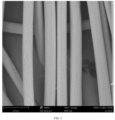
- FIG. 1 is an SEM image of the conventional alginate fiber and FIG. 2 is an SEM image of the dyeable alginate fiber.
- Dyeing properties of the ordinary alginate fiber and the dyeable alginate fibers obtained in Examples 1, 2, 3, and 4 were shown in Table 1.
- Table 1 Properties of the ordinary alginate fiber and the dyeable alginate fibers Sample Dye uptake (%) Breaking strength Direct scarlet 4BS Direct yellow RS Direct blue 3RL Ordinary alginate fiber 4.6 5.3 4.2 3.51
- Example 1 85.5 86.9 86.3 3.52
- a dyeing process for the alginate fibers in the examples of the present application was as follows: 0.2 g of a direct dye (direct scarlet 4BS, direct yellow RS, or direct blue 3RL) was weighed and added to 400 g of water, a resulting mixture was stirred for dissolution, then 10 g of an alginate fiber was added at room temperature, and a resulting system was heated at 2°C/min to 80°C to allow dyeing for 40 min; and then the alginate fiber was washed in a 5 g/L neutral detergent aqueous solution at 90°C for 10 min, then cooled, washed with water, and then oven-dried at 80°C or air-dried.
- a direct dye direct scarlet 4BS, direct yellow RS, or direct blue 3RL
- first and second used in the specification and claims of the present application may explicitly or implicitly include one or more corresponding features.
- a plurality of means two or more.
- and/or in the specification and claims indicates at least one of the connected objects, and the character “/” generally indicates an “or” relationship between associated objects.
Landscapes
- Engineering & Computer Science (AREA)
- Textile Engineering (AREA)
- Chemical & Material Sciences (AREA)
- Chemical Kinetics & Catalysis (AREA)
- General Chemical & Material Sciences (AREA)
- Mechanical Engineering (AREA)
- Manufacturing & Machinery (AREA)
- Artificial Filaments (AREA)
- Treatments For Attaching Organic Compounds To Fibrous Goods (AREA)
- Materials For Medical Uses (AREA)
Applications Claiming Priority (2)
| Application Number | Priority Date | Filing Date | Title |
|---|---|---|---|
| CN202110516532.0A CN113249823B (zh) | 2021-05-12 | 2021-05-12 | 海藻纤维及其制备方法 |
| PCT/CN2022/091698 WO2022237722A1 (zh) | 2021-05-12 | 2022-05-09 | 海藻纤维及其制备方法 |
Publications (4)
| Publication Number | Publication Date |
|---|---|
| EP4324965A1 true EP4324965A1 (de) | 2024-02-21 |
| EP4324965A4 EP4324965A4 (de) | 2024-09-25 |
| EP4324965C0 EP4324965C0 (de) | 2025-10-01 |
| EP4324965B1 EP4324965B1 (de) | 2025-10-01 |
Family
ID=77223068
Family Applications (1)
| Application Number | Title | Priority Date | Filing Date |
|---|---|---|---|
| EP22806685.8A Active EP4324965B1 (de) | 2021-05-12 | 2022-05-09 | Alginatfaser und herstellungsverfahren dafür |
Country Status (7)
| Country | Link |
|---|---|
| US (1) | US12366012B2 (de) |
| EP (1) | EP4324965B1 (de) |
| JP (1) | JP7832614B2 (de) |
| KR (1) | KR102706714B1 (de) |
| CN (1) | CN113249823B (de) |
| AU (1) | AU2022273103B2 (de) |
| WO (1) | WO2022237722A1 (de) |
Families Citing this family (2)
| Publication number | Priority date | Publication date | Assignee | Title |
|---|---|---|---|---|
| CN113249823B (zh) | 2021-05-12 | 2022-03-18 | 青岛大学 | 海藻纤维及其制备方法 |
| US20240254662A1 (en) * | 2023-01-30 | 2024-08-01 | Nano And Advanced Materials Institute Limited | Aerogel fiber |
Family Cites Families (23)
| Publication number | Priority date | Publication date | Assignee | Title |
|---|---|---|---|---|
| JP2627344B2 (ja) * | 1990-01-23 | 1997-07-02 | 工業技術院長 | 水溶性アルギン繊維及びその製造方法 |
| GB9213773D0 (en) * | 1992-06-29 | 1992-08-12 | Cv Lab Ltd | Dual release alginate fibre |
| GB9414305D0 (en) * | 1994-07-15 | 1994-09-07 | C V Lab Ltd | Alginate fibre, process for the preparation thereof and use |
| JPH09256226A (ja) * | 1996-03-22 | 1997-09-30 | Sakai Chem Ind Co Ltd | 抗菌性物質包含アルギン酸繊維およびその製造方法 |
| CN101081883B (zh) * | 2006-05-31 | 2012-05-23 | 南京理工大学 | 高相对分子质量聚二甲基二烯丙基氯化铵的制备方法 |
| CN101657530A (zh) * | 2007-04-02 | 2010-02-24 | 宝洁公司 | 织物护理组合物 |
| CN101070676B (zh) * | 2007-05-18 | 2013-03-20 | 广东德美精细化工股份有限公司 | 一种纤维材料改质的方法及其染色工艺 |
| CN101381907B (zh) * | 2008-10-06 | 2011-10-26 | 武汉科技学院 | 抗菌海藻酸钙纤维的制造方法 |
| KR101170363B1 (ko) * | 2008-11-26 | 2012-08-01 | 주식회사 파이버엔텍 | 엔도톡신함량이 낮은 알지네이트 섬유의 제조방법 |
| CN101736440B (zh) | 2010-01-08 | 2012-04-18 | 武汉科技学院 | 可染海藻酸盐纤维的制造方法 |
| US9090868B2 (en) * | 2010-07-12 | 2015-07-28 | President And Fellows Of Harvard College | Alginate hydrogel fibers and related materials |
| WO2013181769A1 (en) * | 2012-06-08 | 2013-12-12 | The Procter & Gamble Company | Laundry detergents |
| CN103981744B (zh) * | 2014-05-12 | 2016-03-02 | 武汉纺织大学 | 一种海藻酸钙纤维的无盐染色方法 |
| CN104846625B (zh) * | 2015-04-16 | 2017-01-18 | 青岛大学 | 一种耐盐、耐洗涤剂海藻纤维的制备方法 |
| CN106012103B (zh) * | 2016-07-04 | 2018-05-11 | 青岛大学 | 一种高强度海藻纤维的制备方法 |
| CN106498770B (zh) | 2016-10-19 | 2019-03-08 | 东华大学 | 一种阳离子聚合物改性的织物的无盐染色方法 |
| WO2019018997A1 (zh) * | 2017-07-25 | 2019-01-31 | 惠州华阳医疗器械有限公司 | 一种抗菌藻酸盐纤维、其敷料的制备方法及应用 |
| CN108914630B (zh) | 2018-05-07 | 2021-02-19 | 东莞德永佳纺织制衣有限公司 | 一种棉织物的无盐染色工艺 |
| CN109183447B (zh) * | 2018-09-19 | 2021-02-09 | 山东理工大学 | 海藻酸钙纤维的活性染料无盐染色方法 |
| KR20220016492A (ko) * | 2019-05-31 | 2022-02-09 | 베스트 파이버 테크놀로지스 인코포레이티드. | 개질된 셀룰로스계 섬유 |
| CN113249823B (zh) * | 2021-05-12 | 2022-03-18 | 青岛大学 | 海藻纤维及其制备方法 |
| CN113186739A (zh) * | 2021-05-12 | 2021-07-30 | 青岛大学 | 海藻纤维混纺织物及其染色方法 |
| CN113249986A (zh) * | 2021-05-12 | 2021-08-13 | 青岛大学 | 海藻纤维及其染色方法 |
-
2021
- 2021-05-12 CN CN202110516532.0A patent/CN113249823B/zh active Active
-
2022
- 2022-05-09 JP JP2023570149A patent/JP7832614B2/ja active Active
- 2022-05-09 US US18/289,896 patent/US12366012B2/en active Active
- 2022-05-09 AU AU2022273103A patent/AU2022273103B2/en active Active
- 2022-05-09 EP EP22806685.8A patent/EP4324965B1/de active Active
- 2022-05-09 WO PCT/CN2022/091698 patent/WO2022237722A1/zh not_active Ceased
- 2022-05-09 KR KR1020237038297A patent/KR102706714B1/ko active Active
Also Published As
| Publication number | Publication date |
|---|---|
| KR102706714B1 (ko) | 2024-09-13 |
| EP4324965C0 (de) | 2025-10-01 |
| AU2022273103B2 (en) | 2025-02-06 |
| US12366012B2 (en) | 2025-07-22 |
| KR20230160942A (ko) | 2023-11-24 |
| JP2024517339A (ja) | 2024-04-19 |
| EP4324965B1 (de) | 2025-10-01 |
| AU2022273103A1 (en) | 2023-11-23 |
| JP7832614B2 (ja) | 2026-03-18 |
| EP4324965A4 (de) | 2024-09-25 |
| CN113249823A (zh) | 2021-08-13 |
| CN113249823B (zh) | 2022-03-18 |
| WO2022237722A1 (zh) | 2022-11-17 |
| US20240328037A1 (en) | 2024-10-03 |
Similar Documents
| Publication | Publication Date | Title |
|---|---|---|
| EP4324965B1 (de) | Alginatfaser und herstellungsverfahren dafür | |
| US5529585A (en) | Rayon modified with polymeric amine compounds | |
| CN111826763B (zh) | 一种花灰效果纱线或面料及其制备方法和应用 | |
| CN113249986A (zh) | 海藻纤维及其染色方法 | |
| CN113186739A (zh) | 海藻纤维混纺织物及其染色方法 | |
| CN111172788A (zh) | 一种粘胶锦纶pbt混纺高弹纱线短流程染色工艺 | |
| CN113337916B (zh) | 活性染料易染氨纶及其制备方法 | |
| CN111826977A (zh) | 一种锦纶56与蛋白质纤维混纺织物的酸性印花方法 | |
| CN108342912B (zh) | 多羧酸型染料染色海藻纤维的方法 | |
| CN113463371B (zh) | 一种海岛丝的染色工艺 | |
| CN111041862A (zh) | 一种全棉织物的改性和染色方法 | |
| CN114517418B (zh) | 一种高染色度持久定型罗马布及其制备工艺 | |
| CN118007280B (zh) | 一种可染海藻纤维的制备方法 | |
| CN116136068B (zh) | 氨纶纺织品的活性染料染色方法 | |
| KR100329501B1 (ko) | 마직물의 질감을 갖는 레이욘-함유 직편물의 제조방법 | |
| CN118292290B (zh) | 一种含海藻纤维混纺织物的活性染料染色方法 | |
| CN111705386A (zh) | 一种花灰纱的制备方法 | |
| CN117702514A (zh) | 一种锦纶/氨纶混纺织物的染色工艺 | |
| CN114411423A (zh) | 改善原液着色面料起毛起球的连续加工工艺 | |
| CN109853244A (zh) | 一种高强型芳纶ⅱ的制备方法 | |
| CN110230200B (zh) | 一种提高氨纶长丝强力的方法 | |
| CN114457446A (zh) | 一种环保再生原液着色纤维及其制备方法 | |
| CN121700671A (zh) | 一种原色海藻纤维的制备及低温漂白方法 | |
| CN117702485A (zh) | 一种海藻纤维/棉混纺织物及其一浴染色方法 | |
| CN121065969A (zh) | 一种莱赛尔纤维防原纤化、染色和抗紫外一浴整理方法 |
Legal Events
| Date | Code | Title | Description |
|---|---|---|---|
| STAA | Information on the status of an ep patent application or granted ep patent |
Free format text: STATUS: THE INTERNATIONAL PUBLICATION HAS BEEN MADE |
|
| PUAI | Public reference made under article 153(3) epc to a published international application that has entered the european phase |
Free format text: ORIGINAL CODE: 0009012 |
|
| STAA | Information on the status of an ep patent application or granted ep patent |
Free format text: STATUS: REQUEST FOR EXAMINATION WAS MADE |
|
| 17P | Request for examination filed |
Effective date: 20231115 |
|
| AK | Designated contracting states |
Kind code of ref document: A1 Designated state(s): AL AT BE BG CH CY CZ DE DK EE ES FI FR GB GR HR HU IE IS IT LI LT LU LV MC MK MT NL NO PL PT RO RS SE SI SK SM TR |
|
| REG | Reference to a national code |
Free format text: PREVIOUS MAIN CLASS: D01F0009040000 Ipc: D01F0001100000 Ref country code: DE Ref legal event code: R079 Ref document number: 602022022407 Country of ref document: DE Free format text: PREVIOUS MAIN CLASS: D01F0009040000 Ipc: D01F0001100000 |
|
| DAV | Request for validation of the european patent (deleted) | ||
| DAX | Request for extension of the european patent (deleted) | ||
| A4 | Supplementary search report drawn up and despatched |
Effective date: 20240826 |
|
| RIC1 | Information provided on ipc code assigned before grant |
Ipc: D06M 15/356 20060101ALN20240820BHEP Ipc: D01F 11/00 20060101ALI20240820BHEP Ipc: D01D 5/06 20060101ALI20240820BHEP Ipc: D01F 9/04 20060101ALI20240820BHEP Ipc: D01F 1/10 20060101AFI20240820BHEP |
|
| GRAP | Despatch of communication of intention to grant a patent |
Free format text: ORIGINAL CODE: EPIDOSNIGR1 |
|
| STAA | Information on the status of an ep patent application or granted ep patent |
Free format text: STATUS: GRANT OF PATENT IS INTENDED |
|
| RIC1 | Information provided on ipc code assigned before grant |
Ipc: D06M 15/356 20060101ALN20250409BHEP Ipc: D01F 11/00 20060101ALI20250409BHEP Ipc: D01D 5/06 20060101ALI20250409BHEP Ipc: D01F 9/04 20060101ALI20250409BHEP Ipc: D01F 1/10 20060101AFI20250409BHEP |
|
| INTG | Intention to grant announced |
Effective date: 20250424 |
|
| GRAS | Grant fee paid |
Free format text: ORIGINAL CODE: EPIDOSNIGR3 |
|
| GRAA | (expected) grant |
Free format text: ORIGINAL CODE: 0009210 |
|
| STAA | Information on the status of an ep patent application or granted ep patent |
Free format text: STATUS: THE PATENT HAS BEEN GRANTED |
|
| AK | Designated contracting states |
Kind code of ref document: B1 Designated state(s): AL AT BE BG CH CY CZ DE DK EE ES FI FR GB GR HR HU IE IS IT LI LT LU LV MC MK MT NL NO PL PT RO RS SE SI SK SM TR |
|
| REG | Reference to a national code |
Ref country code: GB Ref legal event code: FG4D Ref country code: CH Ref legal event code: F10 Free format text: ST27 STATUS EVENT CODE: U-0-0-F10-F00 (AS PROVIDED BY THE NATIONAL OFFICE) Effective date: 20251001 |
|
| REG | Reference to a national code |
Ref country code: CH Ref legal event code: R17 Free format text: ST27 STATUS EVENT CODE: U-0-0-R10-R17 (AS PROVIDED BY THE NATIONAL OFFICE) Effective date: 20251014 |
|
| REG | Reference to a national code |
Ref country code: IE Ref legal event code: FG4D |
|
| REG | Reference to a national code |
Ref country code: DE Ref legal event code: R096 Ref document number: 602022022407 Country of ref document: DE |
|
| U01 | Request for unitary effect filed |
Effective date: 20251001 |
|
| U07 | Unitary effect registered |
Designated state(s): AT BE BG DE DK EE FI FR IT LT LU LV MT NL PT RO SE SI Effective date: 20251010 |
|
| PG25 | Lapsed in a contracting state [announced via postgrant information from national office to epo] |
Ref country code: ES Free format text: LAPSE BECAUSE OF FAILURE TO SUBMIT A TRANSLATION OF THE DESCRIPTION OR TO PAY THE FEE WITHIN THE PRESCRIBED TIME-LIMIT Effective date: 20251001 |
|
| PG25 | Lapsed in a contracting state [announced via postgrant information from national office to epo] |
Ref country code: NO Free format text: LAPSE BECAUSE OF FAILURE TO SUBMIT A TRANSLATION OF THE DESCRIPTION OR TO PAY THE FEE WITHIN THE PRESCRIBED TIME-LIMIT Effective date: 20260101 |
|
| PG25 | Lapsed in a contracting state [announced via postgrant information from national office to epo] |
Ref country code: HR Free format text: LAPSE BECAUSE OF FAILURE TO SUBMIT A TRANSLATION OF THE DESCRIPTION OR TO PAY THE FEE WITHIN THE PRESCRIBED TIME-LIMIT Effective date: 20251001 |
|
| PG25 | Lapsed in a contracting state [announced via postgrant information from national office to epo] |
Ref country code: RS Free format text: LAPSE BECAUSE OF FAILURE TO SUBMIT A TRANSLATION OF THE DESCRIPTION OR TO PAY THE FEE WITHIN THE PRESCRIBED TIME-LIMIT Effective date: 20260101 |
|
| PG25 | Lapsed in a contracting state [announced via postgrant information from national office to epo] |
Ref country code: IS Free format text: LAPSE BECAUSE OF FAILURE TO SUBMIT A TRANSLATION OF THE DESCRIPTION OR TO PAY THE FEE WITHIN THE PRESCRIBED TIME-LIMIT Effective date: 20260201 |
|
| PG25 | Lapsed in a contracting state [announced via postgrant information from national office to epo] |
Ref country code: CZ Free format text: LAPSE BECAUSE OF FAILURE TO SUBMIT A TRANSLATION OF THE DESCRIPTION OR TO PAY THE FEE WITHIN THE PRESCRIBED TIME-LIMIT Effective date: 20251001 |
|
| PG25 | Lapsed in a contracting state [announced via postgrant information from national office to epo] |
Ref country code: PL Free format text: LAPSE BECAUSE OF FAILURE TO SUBMIT A TRANSLATION OF THE DESCRIPTION OR TO PAY THE FEE WITHIN THE PRESCRIBED TIME-LIMIT Effective date: 20251001 |