EP4325614A1 - Procédé de préparation d'accumulateurs - Google Patents
Procédé de préparation d'accumulateurs Download PDFInfo
- Publication number
- EP4325614A1 EP4325614A1 EP23185715.2A EP23185715A EP4325614A1 EP 4325614 A1 EP4325614 A1 EP 4325614A1 EP 23185715 A EP23185715 A EP 23185715A EP 4325614 A1 EP4325614 A1 EP 4325614A1
- Authority
- EP
- European Patent Office
- Prior art keywords
- individual cells
- laser
- accumulator
- detached
- opened
- Prior art date
- Legal status (The legal status is an assumption and is not a legal conclusion. Google has not performed a legal analysis and makes no representation as to the accuracy of the status listed.)
- Pending
Links
Images
Classifications
-
- B—PERFORMING OPERATIONS; TRANSPORTING
- B23—MACHINE TOOLS; METAL-WORKING NOT OTHERWISE PROVIDED FOR
- B23K—SOLDERING OR UNSOLDERING; WELDING; CLADDING OR PLATING BY SOLDERING OR WELDING; CUTTING BY APPLYING HEAT LOCALLY, e.g. FLAME CUTTING; WORKING BY LASER BEAM
- B23K26/00—Working by laser beam, e.g. welding, cutting or boring
- B23K26/36—Removing material
-
- H—ELECTRICITY
- H01—ELECTRIC ELEMENTS
- H01M—PROCESSES OR MEANS, e.g. BATTERIES, FOR THE DIRECT CONVERSION OF CHEMICAL ENERGY INTO ELECTRICAL ENERGY
- H01M10/00—Secondary cells; Manufacture thereof
- H01M10/05—Accumulators with non-aqueous electrolyte
- H01M10/052—Li-accumulators
-
- H—ELECTRICITY
- H01—ELECTRIC ELEMENTS
- H01M—PROCESSES OR MEANS, e.g. BATTERIES, FOR THE DIRECT CONVERSION OF CHEMICAL ENERGY INTO ELECTRICAL ENERGY
- H01M10/00—Secondary cells; Manufacture thereof
- H01M10/54—Reclaiming serviceable parts of waste accumulators
-
- H—ELECTRICITY
- H01—ELECTRIC ELEMENTS
- H01M—PROCESSES OR MEANS, e.g. BATTERIES, FOR THE DIRECT CONVERSION OF CHEMICAL ENERGY INTO ELECTRICAL ENERGY
- H01M10/00—Secondary cells; Manufacture thereof
- H01M10/05—Accumulators with non-aqueous electrolyte
- H01M10/054—Accumulators with insertion or intercalation of metals other than lithium, e.g. with magnesium or aluminium
-
- H—ELECTRICITY
- H01—ELECTRIC ELEMENTS
- H01M—PROCESSES OR MEANS, e.g. BATTERIES, FOR THE DIRECT CONVERSION OF CHEMICAL ENERGY INTO ELECTRICAL ENERGY
- H01M10/00—Secondary cells; Manufacture thereof
- H01M10/05—Accumulators with non-aqueous electrolyte
- H01M10/058—Construction or manufacture
-
- Y—GENERAL TAGGING OF NEW TECHNOLOGICAL DEVELOPMENTS; GENERAL TAGGING OF CROSS-SECTIONAL TECHNOLOGIES SPANNING OVER SEVERAL SECTIONS OF THE IPC; TECHNICAL SUBJECTS COVERED BY FORMER USPC CROSS-REFERENCE ART COLLECTIONS [XRACs] AND DIGESTS
- Y02—TECHNOLOGIES OR APPLICATIONS FOR MITIGATION OR ADAPTATION AGAINST CLIMATE CHANGE
- Y02W—CLIMATE CHANGE MITIGATION TECHNOLOGIES RELATED TO WASTEWATER TREATMENT OR WASTE MANAGEMENT
- Y02W30/00—Technologies for solid waste management
- Y02W30/50—Reuse, recycling or recovery technologies
- Y02W30/84—Recycling of batteries or fuel cells
Definitions
- the invention relates to a method for processing accumulators.
- batteries in particular lithium-ion and lithium-polymer batteries
- a battery cell for example cobalt, nickel and copper. Due to the limited recycling of these batteries to date, many valuable resources are being lost.
- EU Battery Directive 2006/66/EC it is still unclear how the EU Battery Directive 2006/66/EC should be implemented.
- a recycling rate of at least 50% is required.
- Some processes for recycling batteries rely on pyrometallurgical and/or hydrometallurgical processes. As part of these processes, only selected valuable materials, such as cobalt or nickel, can be recovered. Other components of the batteries, such as aluminum, lithium, separator foils, graphite and existing plastics, are usually simply burned.
- a standard accumulator which can consist of 100 individual cells or more, can be dismantled down to the individual cell or module level.
- the mostly manual disassembly is time-consuming depending on the type of composition of the battery and the type of connection. According to the corresponding publication, depending on the cell type, an employee takes between 55 and 95 minutes to disassemble the corresponding batteries.
- so-called battery packs consisting of a large number of cells connected in series and/or in series, are laboriously disassembled into their individual parts in order to obtain reusable cells from them.
- the object of the invention described here is to provide a method for processing accumulators, which enables fast, resource-saving, cost-effective and sustainable reprocessing of an accumulator.
- it is a method for processing accumulators, which is characterized in that an accumulator is discharged, the discharged accumulator is opened, the opened accumulator is dismantled into its individual cells and the individual cells are then checked for their condition. Reusable individual cells can then be put together again to form a new accumulator or can be used to replace individual cells in accumulators that are no longer functional or damaged.
- a preliminary visual inspection is conceivable, in which the external condition of the accumulator is first checked in order to determine whether any external damage is already visible. This can be done in particular by an appropriate camera system or by a supervisor.
- the invention provides for the method in an advantageous embodiment that when checking the condition of the individual cells, the individual cells are sorted into reusable and non-recyclable individual cells depending on the remaining capacity and/or the state of health (SOH) of the individual cells.
- SOH state of health
- the remaining capacity indicates how many amps the accumulator can deliver in one hour, ie how much energy the accumulator can provide over time.
- the State of Health (SOH) represents the characteristic value of the aging condition of a battery in comparison to its nominal value. or new value. In other words: The SOH indicates how much capacity the accumulator still has available compared to its original capacity.
- the sorting of the individual cells particularly preferably takes place based on a defined threshold value of the remaining capacity and/or the SOH, with the threshold value of the SOH particularly preferably being over 50%.
- the last mentioned value is chosen because recycling does not make sense with an SOH below 50% due to the limited remaining service life and capacity. Rather, individual cells of the accumulator that fall below the specified threshold values are separated out and recycled in a separate way, i.e. broken down into their components.
- the invention provides in an advantageous embodiment of the method that the accumulator is opened by a flexible robot-assisted opening system.
- the use of robot arms known from the prior art is conceivable here.
- the cell levels of the opened accumulator are extracted from the flexible robot-assisted opening system. This is because not every accumulator has just one cell level, but rather several, each of which must be processed separately in the further steps.
- the accumulator After discharging and opening the accumulator, the accumulator is dismantled into its individual cells. According to an advantageous embodiment of the method according to the invention, this is done using a laser.
- the advantage of using a laser to disassemble the accumulator is that a laser has high precision, energy density and working speed, which has a positive effect on the process economy. Furthermore, the use of a laser enables process automation.
- the individual cells arranged in the accumulator are usually connected by a device connecting the individual cells, usually a busbar, connected to each other. Therefore, in a further advantageous embodiment, the method according to the invention provides that this device is detached from the individual cells by the laser. In a first alternative embodiment, the device connecting the individual cells is released by removing the welding spots using a laser.
- a laser beam is aligned with the welding points that connect the device, in particular a busbar, to the individual cells, and these are removed by the action of the laser beam.
- the welding spots are preferably removed using a continuous wavelength laser, in particular a fiber laser, the wavelength of which is preferably in the IR range, particularly preferably having a wavelength ⁇ of 1070 nm.
- the invention provides for the method in a further advantageous embodiment that the laser beam of the laser has a diameter of 30 ⁇ m to 110 ⁇ m, preferably of 80 ⁇ m. Furthermore, in a further advantageous embodiment, a laser beam with an energy density of >3 ⁇ 10 7 W/cm 2 is used.
- the laser power is preferably frequency modulated.
- the invention provides for the method that the device connecting the individual cells is detached from the individual cells by thermal cutting at the welding points using the laser. This has the advantage that only a small surface is treated during thermal cutting, namely only the circumference of the welding points.
- a continuous wavelength laser is preferably used, which also preferably has a wavelength in the IR range, but particularly preferably has a wavelength of ⁇ of 1070 nm, since this is optimally suitable for thermal cutting around the welding points.
- the invention provides for the method in a further advantageous embodiment that the laser beam of the laser has a diameter of 30 ⁇ m to 110 ⁇ m, preferably 80 ⁇ m. Furthermore, in a further advantageous embodiment, a laser beam with an energy density of >1 ⁇ 10 7 W/cm 2 is used.
- a pulsed nanosecond laser is used for thermal cutting at the welding points, which preferably has a wavelength of ⁇ of 1064 nm.
- the deswelding process can also be carried out with frequency-doubled or double-harmonized laser beams, which are generated by IR lasers at 1070 nm, 1064 nm into the visible range.
- the invention provides for the method in a further advantageous embodiment that after the device connecting the individual cells has been detached from the individual cells the surface of the individual cells can be processed using a laser.
- a laser This can be the same laser that was previously used for ablation or cutting.
- the invention provides for the method in a further advantageous embodiment that the laser is aligned using a laser scanner.
- the invention provides for the method in a further advantageous embodiment that after the device connecting the individual cells has been released, the surface is checked, preferably by an optical device, in particular by means of a camera system or a camera.
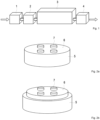
- Figure 1 shows the process of the method according to the invention in a sketchy diagram. The direction of the process is shown by the arrows on the left and right of the individual stations or process steps.
- the accumulator to be processed is discharged in discharge 1.
- the discharge 1 can be preceded by a visual inspection in order to detect and document possible externally visible damage.
- the accumulator is opened 2. Cell levels or the individual cells of the accumulator are exposed or extracted in the opening 2. This can be done automatically, for example, using a robot arm.
- the opening process step 2 the now discharged and opened accumulator enters the disassembly process step 3.
- the accumulator is disassembled into its individual cells. This is done by using a laser, which releases the busbar, i.e. the device for connecting the individual cells 5, from the individual cells 5 by thermal cutting, so that the busbar can be removed from the accumulator. After removing the connection device, i.e. the busbar, the individual cells 5 are checked for their condition, with the individual cells 5 being divided into reusable and non-reusable individual cells 5.
- the reusable individual cells 5 can be used both to create a new accumulator and to replace individual damaged or no longer functional individual cells in other accumulators.
- Figs. 2a and 2b show both the negative and positive poles of such an individual cell 5 that has been freed from the connection device, i.e. the busbar. Due to the thermal cutting using a laser, the welding points 7 that have connected the individual cell 5 to the connection device, i.e. the busbar, remain. left on the surface 6 of the plus and minus poles. These welding points 7 or residues can be removed from the surface 6 of the poles in a subsequent process step by further treatment with a laser.
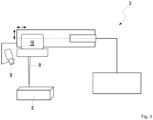
- FIG. 3 shows Figure 3 the process step of disassembly 3, in particular the removal of the device connecting the individual cells 5, i.e. the busbar, from the individual cells 5 by means of a laser 8.
- the exemplary embodiment shown is a continuous IR laser 8 with a wavelength of 1070 nm or 1064 nm.
- the laser beam of the laser 8 is aligned with the welding points 7 of the connecting device by means of a laser scanner 10, the welding points 7 being arranged on the laser 8 Camera system 9 can be detected.
- the laser scanner 10 directs them Laser beam of the IR laser 8 onto the welding points 7 and removes them by ablation or thermal cutting.
- the connection device thus detached from the individual cells 5 can then be removed from the accumulator in a downstream process step not shown here and the individual cells 5 can be extracted or sent for further use.
Landscapes
- Engineering & Computer Science (AREA)
- Chemical & Material Sciences (AREA)
- Manufacturing & Machinery (AREA)
- Chemical Kinetics & Catalysis (AREA)
- Electrochemistry (AREA)
- General Chemical & Material Sciences (AREA)
- Plasma & Fusion (AREA)
- Physics & Mathematics (AREA)
- Optics & Photonics (AREA)
- Mechanical Engineering (AREA)
- Materials Engineering (AREA)
- Laser Beam Processing (AREA)
- Secondary Cells (AREA)
- Connection Of Batteries Or Terminals (AREA)
Applications Claiming Priority (1)
| Application Number | Priority Date | Filing Date | Title |
|---|---|---|---|
| DE102022121095.2A DE102022121095A1 (de) | 2022-08-20 | 2022-08-20 | Verfahren zur Aufbereitung von Akkumulatoren |
Publications (1)
| Publication Number | Publication Date |
|---|---|
| EP4325614A1 true EP4325614A1 (fr) | 2024-02-21 |
Family
ID=87378134
Family Applications (1)
| Application Number | Title | Priority Date | Filing Date |
|---|---|---|---|
| EP23185715.2A Pending EP4325614A1 (fr) | 2022-08-20 | 2023-07-17 | Procédé de préparation d'accumulateurs |
Country Status (3)
| Country | Link |
|---|---|
| US (1) | US12420357B2 (fr) |
| EP (1) | EP4325614A1 (fr) |
| DE (1) | DE102022121095A1 (fr) |
Families Citing this family (2)
| Publication number | Priority date | Publication date | Assignee | Title |
|---|---|---|---|---|
| EP4570421A4 (fr) * | 2023-10-08 | 2025-06-18 | Contemporary Amperex Technology (Hong Kong) Limited | Procédé et système d'adressage de pré-soudage |
| US20250214238A1 (en) * | 2023-12-29 | 2025-07-03 | Universe Energy, Inc. | Automated battery disassembly |
Citations (2)
| Publication number | Priority date | Publication date | Assignee | Title |
|---|---|---|---|---|
| CN112570907A (zh) * | 2020-12-16 | 2021-03-30 | 深圳德龙激光智能有限公司 | 一种用于动力电池拆解的激光切割导流排装置 |
| CN216311882U (zh) * | 2021-10-28 | 2022-04-15 | 天津广通汽车有限公司 | 一种电池模组拆解装置 |
Family Cites Families (6)
| Publication number | Priority date | Publication date | Assignee | Title |
|---|---|---|---|---|
| US9257695B2 (en) * | 2012-03-29 | 2016-02-09 | Front Edge Technology, Inc. | Localized heat treatment of battery component films |
| CN103138019B (zh) * | 2013-01-28 | 2015-09-30 | 广东邦普循环科技有限公司 | 一种电动汽车用动力电池的余能梯次利用方法 |
| JP6198027B1 (ja) * | 2017-01-24 | 2017-09-20 | 三菱マテリアル株式会社 | 使用済みリチウムイオン電池からの有価物回収方法 |
| CN213351227U (zh) * | 2020-09-15 | 2021-06-04 | 中航锂电科技有限公司 | 分离设备 |
| CN112589276A (zh) * | 2020-12-16 | 2021-04-02 | 深圳德龙激光智能有限公司 | 一种用于动力电池拆解的激光烧蚀导流排装置 |
| KR102409527B1 (ko) * | 2022-01-25 | 2022-06-22 | (주)로파 | 라이더센서를 이용한 전기차 폐배터리의 해체로봇 자동화 분해시스템 |
-
2022
- 2022-08-20 DE DE102022121095.2A patent/DE102022121095A1/de active Pending
-
2023
- 2023-07-17 EP EP23185715.2A patent/EP4325614A1/fr active Pending
- 2023-08-16 US US18/234,554 patent/US12420357B2/en active Active
Patent Citations (2)
| Publication number | Priority date | Publication date | Assignee | Title |
|---|---|---|---|---|
| CN112570907A (zh) * | 2020-12-16 | 2021-03-30 | 深圳德龙激光智能有限公司 | 一种用于动力电池拆解的激光切割导流排装置 |
| CN216311882U (zh) * | 2021-10-28 | 2022-04-15 | 天津广通汽车有限公司 | 一种电池模组拆解装置 |
Also Published As
| Publication number | Publication date |
|---|---|
| US20240058897A1 (en) | 2024-02-22 |
| DE102022121095A1 (de) | 2024-02-22 |
| US12420357B2 (en) | 2025-09-23 |
Similar Documents
| Publication | Publication Date | Title |
|---|---|---|
| EP4325614A1 (fr) | Procédé de préparation d'accumulateurs | |
| WO2012072235A1 (fr) | Procédé et système pour découper des objets en forme de feuilles ou de plaques | |
| DE102013010314A1 (de) | Verfahren zum Austausch einer Einzelzelle einer elektrischen Batterie | |
| EP4164024B1 (fr) | Procédé de décharge d'une cellule de batterie ou d'un module de batterie doté d'une telle cellule de batterie et installation de décharge | |
| DE102022203761A1 (de) | Verfahren sowie Anlage zum Recycling von Batterie-Zellen oder Teilen hiervon | |
| DE102011115118A1 (de) | Verfahren und System zum Schneiden von blatt- oder plattenförmigen Objekten | |
| DE102015002147B3 (de) | Verfahren zum Fertigen einer Batterie, Batterie und Kraftfahrzeug | |
| EP4399779A1 (fr) | Procédé de charge pour un bloc-batterie d'un outil électrique portatif | |
| DE102016011237A1 (de) | Verfahren zur Demontage einer Einzelzelle aus einem Zellmodul eines elektrischen Energiespeichers und Vorrichtung zur Durchführung eines solchen Verfahrens | |
| DE102022205025A1 (de) | Elektrochemischer Energiespeicher und Verfahren zum Verwerten eines elektrochemischen Energiespeichers | |
| DE102010053341A1 (de) | Verfahren und System zum Schneiden von blatt- oder plattenförmigen Objekten | |
| DE102021004883A1 (de) | Schweißtrennvorrichtung | |
| WO2023174713A1 (fr) | Système de décharge et procédé de décharge d'au moins une unité de stockage électrique | |
| DE102013106206B4 (de) | Akkumulator und Verfahren zur Herstellung eines Akkumulators | |
| WO2022263095A1 (fr) | Électrode et cellule de stockage électrochimique | |
| EP4246759A1 (fr) | Système de décharge et procédé de décharge d'au moins une unité d'accumulation électrique | |
| DE102022201505A1 (de) | Verfahren zum (Tief-) Entladen von (Fahrzeug-) Batterieeinheiten | |
| EP4425619A2 (fr) | Procédé et dispositif de recyclage de batteries | |
| EP4471165A1 (fr) | Procédé de valorisation de déchets provenant de la fabrication d'accumulateurs lithium-ion | |
| DE102024127697A1 (de) | Verfahren und System zum Austausch von Batteriezellen in einem Batteriespeicher | |
| DE102024118884A1 (de) | Deaktivierungsanordnung und Verfahren zum elektrischen Deaktivieren einer Batterieeinheit | |
| EP4432380A1 (fr) | Procédé de marquage d'une feuille d'électrode lors de la fabrication d'électrodes pour un élément de batterie | |
| CH720179A2 (de) | Verfahren, Scan-Vorrichtung, Anlage und System zum Recyclieren von Lithium-Ionen-Batterien | |
| DE102024003991A1 (de) | Batteriezelle, Batteriemodul und Fahrzeug | |
| DE102022112964A1 (de) | Verfahren zum direkten Recyclen von Bestandteilen einer Batteriezelle oder eines Batteriezellenrohlings |
Legal Events
| Date | Code | Title | Description |
|---|---|---|---|
| PUAI | Public reference made under article 153(3) epc to a published international application that has entered the european phase |
Free format text: ORIGINAL CODE: 0009012 |
|
| STAA | Information on the status of an ep patent application or granted ep patent |
Free format text: STATUS: THE APPLICATION HAS BEEN PUBLISHED |
|
| AK | Designated contracting states |
Kind code of ref document: A1 Designated state(s): AL AT BE BG CH CY CZ DE DK EE ES FI FR GB GR HR HU IE IS IT LI LT LU LV MC ME MK MT NL NO PL PT RO RS SE SI SK SM TR |
|
| RAP3 | Party data changed (applicant data changed or rights of an application transferred) |
Owner name: CIRCU LI-ION S.A. |
|
| STAA | Information on the status of an ep patent application or granted ep patent |
Free format text: STATUS: REQUEST FOR EXAMINATION WAS MADE |
|
| 17P | Request for examination filed |
Effective date: 20240819 |
|
| RBV | Designated contracting states (corrected) |
Designated state(s): AL AT BE BG CH CY CZ DE DK EE ES FI FR GB GR HR HU IE IS IT LI LT LU LV MC ME MK MT NL NO PL PT RO RS SE SI SK SM TR |