EP4329112A2 - Diodengepumpter festkörperlaser zum laserglühen - Google Patents
Diodengepumpter festkörperlaser zum laserglühen Download PDFInfo
- Publication number
- EP4329112A2 EP4329112A2 EP23220760.5A EP23220760A EP4329112A2 EP 4329112 A2 EP4329112 A2 EP 4329112A2 EP 23220760 A EP23220760 A EP 23220760A EP 4329112 A2 EP4329112 A2 EP 4329112A2
- Authority
- EP
- European Patent Office
- Prior art keywords
- radiation
- harmonic
- fundamental
- nonlinear crystal
- resonator
- Prior art date
- Legal status (The legal status is an assumption and is not a legal conclusion. Google has not performed a legal analysis and makes no representation as to the accuracy of the status listed.)
- Granted
Links
Images





Classifications
-
- H—ELECTRICITY
- H01—ELECTRIC ELEMENTS
- H01S—DEVICES USING THE PROCESS OF LIGHT AMPLIFICATION BY STIMULATED EMISSION OF RADIATION [LASER] TO AMPLIFY OR GENERATE LIGHT; DEVICES USING STIMULATED EMISSION OF ELECTROMAGNETIC RADIATION IN WAVE RANGES OTHER THAN OPTICAL
- H01S3/00—Lasers, i.e. devices using stimulated emission of electromagnetic radiation in the infrared, visible or ultraviolet wave range
- H01S3/10—Controlling the intensity, frequency, phase, polarisation or direction of the emitted radiation, e.g. switching, gating, modulating or demodulating
- H01S3/106—Controlling the intensity, frequency, phase, polarisation or direction of the emitted radiation, e.g. switching, gating, modulating or demodulating by controlling devices placed within the cavity
- H01S3/108—Controlling the intensity, frequency, phase, polarisation or direction of the emitted radiation, e.g. switching, gating, modulating or demodulating by controlling devices placed within the cavity using non-linear optical devices, e.g. exhibiting Brillouin or Raman scattering
- H01S3/109—Frequency multiplication, e.g. harmonic generation
-
- B—PERFORMING OPERATIONS; TRANSPORTING
- B23—MACHINE TOOLS; METAL-WORKING NOT OTHERWISE PROVIDED FOR
- B23K—SOLDERING OR UNSOLDERING; WELDING; CLADDING OR PLATING BY SOLDERING OR WELDING; CUTTING BY APPLYING HEAT LOCALLY, e.g. FLAME CUTTING; WORKING BY LASER BEAM
- B23K26/00—Working by laser beam, e.g. welding, cutting or boring
- B23K26/0006—Working by laser beam, e.g. welding, cutting or boring taking account of the properties of the material involved
-
- B—PERFORMING OPERATIONS; TRANSPORTING
- B23—MACHINE TOOLS; METAL-WORKING NOT OTHERWISE PROVIDED FOR
- B23K—SOLDERING OR UNSOLDERING; WELDING; CLADDING OR PLATING BY SOLDERING OR WELDING; CUTTING BY APPLYING HEAT LOCALLY, e.g. FLAME CUTTING; WORKING BY LASER BEAM
- B23K26/00—Working by laser beam, e.g. welding, cutting or boring
- B23K26/02—Positioning or observing the workpiece, e.g. with respect to the point of impact; Aligning, aiming or focusing the laser beam
- B23K26/06—Shaping the laser beam, e.g. by masks or multi-focusing
- B23K26/062—Shaping the laser beam, e.g. by masks or multi-focusing by direct control of the laser beam
- B23K26/0622—Shaping the laser beam, e.g. by masks or multi-focusing by direct control of the laser beam by shaping pulses
-
- B—PERFORMING OPERATIONS; TRANSPORTING
- B23—MACHINE TOOLS; METAL-WORKING NOT OTHERWISE PROVIDED FOR
- B23K—SOLDERING OR UNSOLDERING; WELDING; CLADDING OR PLATING BY SOLDERING OR WELDING; CUTTING BY APPLYING HEAT LOCALLY, e.g. FLAME CUTTING; WORKING BY LASER BEAM
- B23K26/00—Working by laser beam, e.g. welding, cutting or boring
- B23K26/02—Positioning or observing the workpiece, e.g. with respect to the point of impact; Aligning, aiming or focusing the laser beam
- B23K26/06—Shaping the laser beam, e.g. by masks or multi-focusing
- B23K26/064—Shaping the laser beam, e.g. by masks or multi-focusing by means of optical elements, e.g. lenses, mirrors or prisms
-
- B—PERFORMING OPERATIONS; TRANSPORTING
- B23—MACHINE TOOLS; METAL-WORKING NOT OTHERWISE PROVIDED FOR
- B23K—SOLDERING OR UNSOLDERING; WELDING; CLADDING OR PLATING BY SOLDERING OR WELDING; CUTTING BY APPLYING HEAT LOCALLY, e.g. FLAME CUTTING; WORKING BY LASER BEAM
- B23K26/00—Working by laser beam, e.g. welding, cutting or boring
- B23K26/352—Working by laser beam, e.g. welding, cutting or boring for surface treatment
- B23K26/354—Working by laser beam, e.g. welding, cutting or boring for surface treatment by melting
-
- H—ELECTRICITY
- H01—ELECTRIC ELEMENTS
- H01S—DEVICES USING THE PROCESS OF LIGHT AMPLIFICATION BY STIMULATED EMISSION OF RADIATION [LASER] TO AMPLIFY OR GENERATE LIGHT; DEVICES USING STIMULATED EMISSION OF ELECTROMAGNETIC RADIATION IN WAVE RANGES OTHER THAN OPTICAL
- H01S3/00—Lasers, i.e. devices using stimulated emission of electromagnetic radiation in the infrared, visible or ultraviolet wave range
- H01S3/05—Construction or shape of optical resonators; Accommodation of active medium therein; Shape of active medium
- H01S3/06—Construction or shape of active medium
- H01S3/0602—Crystal lasers or glass lasers
- H01S3/0606—Crystal lasers or glass lasers with polygonal cross-section, e.g. slab, prism
-
- H—ELECTRICITY
- H01—ELECTRIC ELEMENTS
- H01S—DEVICES USING THE PROCESS OF LIGHT AMPLIFICATION BY STIMULATED EMISSION OF RADIATION [LASER] TO AMPLIFY OR GENERATE LIGHT; DEVICES USING STIMULATED EMISSION OF ELECTROMAGNETIC RADIATION IN WAVE RANGES OTHER THAN OPTICAL
- H01S3/00—Lasers, i.e. devices using stimulated emission of electromagnetic radiation in the infrared, visible or ultraviolet wave range
- H01S3/05—Construction or shape of optical resonators; Accommodation of active medium therein; Shape of active medium
- H01S3/08—Construction or shape of optical resonators or components thereof
-
- H—ELECTRICITY
- H01—ELECTRIC ELEMENTS
- H01S—DEVICES USING THE PROCESS OF LIGHT AMPLIFICATION BY STIMULATED EMISSION OF RADIATION [LASER] TO AMPLIFY OR GENERATE LIGHT; DEVICES USING STIMULATED EMISSION OF ELECTROMAGNETIC RADIATION IN WAVE RANGES OTHER THAN OPTICAL
- H01S3/00—Lasers, i.e. devices using stimulated emission of electromagnetic radiation in the infrared, visible or ultraviolet wave range
- H01S3/05—Construction or shape of optical resonators; Accommodation of active medium therein; Shape of active medium
- H01S3/08—Construction or shape of optical resonators or components thereof
- H01S3/08018—Mode suppression
- H01S3/0804—Transverse or lateral modes
-
- H—ELECTRICITY
- H01—ELECTRIC ELEMENTS
- H01S—DEVICES USING THE PROCESS OF LIGHT AMPLIFICATION BY STIMULATED EMISSION OF RADIATION [LASER] TO AMPLIFY OR GENERATE LIGHT; DEVICES USING STIMULATED EMISSION OF ELECTROMAGNETIC RADIATION IN WAVE RANGES OTHER THAN OPTICAL
- H01S3/00—Lasers, i.e. devices using stimulated emission of electromagnetic radiation in the infrared, visible or ultraviolet wave range
- H01S3/05—Construction or shape of optical resonators; Accommodation of active medium therein; Shape of active medium
- H01S3/08—Construction or shape of optical resonators or components thereof
- H01S3/08054—Passive cavity elements acting on the polarization, e.g. a polarizer for branching or walk-off compensation
-
- H—ELECTRICITY
- H01—ELECTRIC ELEMENTS
- H01S—DEVICES USING THE PROCESS OF LIGHT AMPLIFICATION BY STIMULATED EMISSION OF RADIATION [LASER] TO AMPLIFY OR GENERATE LIGHT; DEVICES USING STIMULATED EMISSION OF ELECTROMAGNETIC RADIATION IN WAVE RANGES OTHER THAN OPTICAL
- H01S3/00—Lasers, i.e. devices using stimulated emission of electromagnetic radiation in the infrared, visible or ultraviolet wave range
- H01S3/05—Construction or shape of optical resonators; Accommodation of active medium therein; Shape of active medium
- H01S3/08—Construction or shape of optical resonators or components thereof
- H01S3/08059—Constructional details of the reflector, e.g. shape
-
- H—ELECTRICITY
- H01—ELECTRIC ELEMENTS
- H01S—DEVICES USING THE PROCESS OF LIGHT AMPLIFICATION BY STIMULATED EMISSION OF RADIATION [LASER] TO AMPLIFY OR GENERATE LIGHT; DEVICES USING STIMULATED EMISSION OF ELECTROMAGNETIC RADIATION IN WAVE RANGES OTHER THAN OPTICAL
- H01S3/00—Lasers, i.e. devices using stimulated emission of electromagnetic radiation in the infrared, visible or ultraviolet wave range
- H01S3/05—Construction or shape of optical resonators; Accommodation of active medium therein; Shape of active medium
- H01S3/08—Construction or shape of optical resonators or components thereof
- H01S3/08072—Thermal lensing or thermally induced birefringence; Compensation thereof
-
- H—ELECTRICITY
- H01—ELECTRIC ELEMENTS
- H01S—DEVICES USING THE PROCESS OF LIGHT AMPLIFICATION BY STIMULATED EMISSION OF RADIATION [LASER] TO AMPLIFY OR GENERATE LIGHT; DEVICES USING STIMULATED EMISSION OF ELECTROMAGNETIC RADIATION IN WAVE RANGES OTHER THAN OPTICAL
- H01S3/00—Lasers, i.e. devices using stimulated emission of electromagnetic radiation in the infrared, visible or ultraviolet wave range
- H01S3/09—Processes or apparatus for excitation, e.g. pumping
- H01S3/091—Processes or apparatus for excitation, e.g. pumping using optical pumping
- H01S3/094—Processes or apparatus for excitation, e.g. pumping using optical pumping by coherent light
- H01S3/094076—Pulsed or modulated pumping
-
- H—ELECTRICITY
- H01—ELECTRIC ELEMENTS
- H01S—DEVICES USING THE PROCESS OF LIGHT AMPLIFICATION BY STIMULATED EMISSION OF RADIATION [LASER] TO AMPLIFY OR GENERATE LIGHT; DEVICES USING STIMULATED EMISSION OF ELECTROMAGNETIC RADIATION IN WAVE RANGES OTHER THAN OPTICAL
- H01S3/00—Lasers, i.e. devices using stimulated emission of electromagnetic radiation in the infrared, visible or ultraviolet wave range
- H01S3/09—Processes or apparatus for excitation, e.g. pumping
- H01S3/091—Processes or apparatus for excitation, e.g. pumping using optical pumping
- H01S3/094—Processes or apparatus for excitation, e.g. pumping using optical pumping by coherent light
- H01S3/0941—Processes or apparatus for excitation, e.g. pumping using optical pumping by coherent light of a laser diode
-
- H—ELECTRICITY
- H01—ELECTRIC ELEMENTS
- H01S—DEVICES USING THE PROCESS OF LIGHT AMPLIFICATION BY STIMULATED EMISSION OF RADIATION [LASER] TO AMPLIFY OR GENERATE LIGHT; DEVICES USING STIMULATED EMISSION OF ELECTROMAGNETIC RADIATION IN WAVE RANGES OTHER THAN OPTICAL
- H01S3/00—Lasers, i.e. devices using stimulated emission of electromagnetic radiation in the infrared, visible or ultraviolet wave range
- H01S3/09—Processes or apparatus for excitation, e.g. pumping
- H01S3/091—Processes or apparatus for excitation, e.g. pumping using optical pumping
- H01S3/094—Processes or apparatus for excitation, e.g. pumping using optical pumping by coherent light
- H01S3/0941—Processes or apparatus for excitation, e.g. pumping using optical pumping by coherent light of a laser diode
- H01S3/09415—Processes or apparatus for excitation, e.g. pumping using optical pumping by coherent light of a laser diode the pumping beam being parallel to the lasing mode of the pumped medium, e.g. end-pumping
-
- H—ELECTRICITY
- H01—ELECTRIC ELEMENTS
- H01S—DEVICES USING THE PROCESS OF LIGHT AMPLIFICATION BY STIMULATED EMISSION OF RADIATION [LASER] TO AMPLIFY OR GENERATE LIGHT; DEVICES USING STIMULATED EMISSION OF ELECTROMAGNETIC RADIATION IN WAVE RANGES OTHER THAN OPTICAL
- H01S3/00—Lasers, i.e. devices using stimulated emission of electromagnetic radiation in the infrared, visible or ultraviolet wave range
- H01S3/10—Controlling the intensity, frequency, phase, polarisation or direction of the emitted radiation, e.g. switching, gating, modulating or demodulating
- H01S3/11—Mode locking; Q-switching; Other giant-pulse techniques, e.g. cavity dumping
- H01S3/1106—Mode locking
- H01S3/1121—Harmonically mode locking lasers, e.g. modulation frequency equals multiple integers or a fraction of the resonator roundtrip time
-
- H—ELECTRICITY
- H01—ELECTRIC ELEMENTS
- H01S—DEVICES USING THE PROCESS OF LIGHT AMPLIFICATION BY STIMULATED EMISSION OF RADIATION [LASER] TO AMPLIFY OR GENERATE LIGHT; DEVICES USING STIMULATED EMISSION OF ELECTROMAGNETIC RADIATION IN WAVE RANGES OTHER THAN OPTICAL
- H01S3/00—Lasers, i.e. devices using stimulated emission of electromagnetic radiation in the infrared, visible or ultraviolet wave range
- H01S3/10—Controlling the intensity, frequency, phase, polarisation or direction of the emitted radiation, e.g. switching, gating, modulating or demodulating
- H01S3/11—Mode locking; Q-switching; Other giant-pulse techniques, e.g. cavity dumping
- H01S3/1123—Q-switching
- H01S3/115—Q-switching using intracavity electro-optic devices
-
- H—ELECTRICITY
- H01—ELECTRIC ELEMENTS
- H01S—DEVICES USING THE PROCESS OF LIGHT AMPLIFICATION BY STIMULATED EMISSION OF RADIATION [LASER] TO AMPLIFY OR GENERATE LIGHT; DEVICES USING STIMULATED EMISSION OF ELECTROMAGNETIC RADIATION IN WAVE RANGES OTHER THAN OPTICAL
- H01S3/00—Lasers, i.e. devices using stimulated emission of electromagnetic radiation in the infrared, visible or ultraviolet wave range
- H01S3/14—Lasers, i.e. devices using stimulated emission of electromagnetic radiation in the infrared, visible or ultraviolet wave range characterised by the material used as the active medium
- H01S3/16—Solid materials
- H01S3/1601—Solid materials characterised by an active (lasing) ion
- H01S3/1603—Solid materials characterised by an active (lasing) ion rare earth
- H01S3/1611—Solid materials characterised by an active (lasing) ion rare earth neodymium
-
- H—ELECTRICITY
- H01—ELECTRIC ELEMENTS
- H01S—DEVICES USING THE PROCESS OF LIGHT AMPLIFICATION BY STIMULATED EMISSION OF RADIATION [LASER] TO AMPLIFY OR GENERATE LIGHT; DEVICES USING STIMULATED EMISSION OF ELECTROMAGNETIC RADIATION IN WAVE RANGES OTHER THAN OPTICAL
- H01S3/00—Lasers, i.e. devices using stimulated emission of electromagnetic radiation in the infrared, visible or ultraviolet wave range
- H01S3/14—Lasers, i.e. devices using stimulated emission of electromagnetic radiation in the infrared, visible or ultraviolet wave range characterised by the material used as the active medium
- H01S3/16—Solid materials
- H01S3/163—Solid materials characterised by a crystal matrix
- H01S3/164—Solid materials characterised by a crystal matrix garnet
- H01S3/1643—YAG
-
- H—ELECTRICITY
- H01—ELECTRIC ELEMENTS
- H01S—DEVICES USING THE PROCESS OF LIGHT AMPLIFICATION BY STIMULATED EMISSION OF RADIATION [LASER] TO AMPLIFY OR GENERATE LIGHT; DEVICES USING STIMULATED EMISSION OF ELECTROMAGNETIC RADIATION IN WAVE RANGES OTHER THAN OPTICAL
- H01S3/00—Lasers, i.e. devices using stimulated emission of electromagnetic radiation in the infrared, visible or ultraviolet wave range
- H01S3/23—Arrangements of two or more lasers not provided for in groups H01S3/02 - H01S3/22, e.g. tandem arrangements of separate active media
- H01S3/2383—Parallel arrangements
-
- H—ELECTRICITY
- H01—ELECTRIC ELEMENTS
- H01S—DEVICES USING THE PROCESS OF LIGHT AMPLIFICATION BY STIMULATED EMISSION OF RADIATION [LASER] TO AMPLIFY OR GENERATE LIGHT; DEVICES USING STIMULATED EMISSION OF ELECTROMAGNETIC RADIATION IN WAVE RANGES OTHER THAN OPTICAL
- H01S3/00—Lasers, i.e. devices using stimulated emission of electromagnetic radiation in the infrared, visible or ultraviolet wave range
- H01S3/005—Optical devices external to the laser cavity, specially adapted for lasers, e.g. for homogenisation of the beam or for manipulating laser pulses, e.g. pulse shaping
-
- H—ELECTRICITY
- H01—ELECTRIC ELEMENTS
- H01S—DEVICES USING THE PROCESS OF LIGHT AMPLIFICATION BY STIMULATED EMISSION OF RADIATION [LASER] TO AMPLIFY OR GENERATE LIGHT; DEVICES USING STIMULATED EMISSION OF ELECTROMAGNETIC RADIATION IN WAVE RANGES OTHER THAN OPTICAL
- H01S3/00—Lasers, i.e. devices using stimulated emission of electromagnetic radiation in the infrared, visible or ultraviolet wave range
- H01S3/005—Optical devices external to the laser cavity, specially adapted for lasers, e.g. for homogenisation of the beam or for manipulating laser pulses, e.g. pulse shaping
- H01S3/0092—Nonlinear frequency conversion, e.g. second harmonic generation [SHG] or sum- or difference-frequency generation outside the laser cavity
Definitions
- the present invention relates in general to annealing of amorphous silicon layers using ultraviolet laser-radiation projected into a line-beam.
- the invention relates in particular to annealing wherein laser-radiation from a plurality of lasers is combined and projected into the line-beam.
- Laser annealing is used to produce large high-resolution LCD and OLED displays by melting a thin amorphous silicon layer on a substrate, onto which thin-film transistors (TFTs) are to be defined, followed by crystallization of the cooling silicon.
- the annealing process requires a stable pulsed ultraviolet laser, with low RMS pulse-energy noise of less than about 1%, at a wavelength in a range between 280 nanometers (nm) and 360 nm.
- the laser-beam generated by the ultraviolet laser is formed into a line-beam that is scanned across the silicon layer.
- the laser-beam must have very-low beam-quality in order to form a speckle-free homogenous line-beam. Beam-quality is measured by the unit-less beam-quality factor M 2 . Very-low beam-quality corresponds to a very-high value of M 2 .
- such laser-beams are provided by a high-power excimer laser or a combination of such excimer lasers.
- a xenon chloride (XeCl) excimer laser which generates laser-radiation having a wavelength of 308 nm.
- Excimer lasers can be generally characterized as super-atmospheric gas-discharge lasers.
- the laser-beams have an elongated cross-section, characterized by a long axis and a short axis, corresponding respectively to length and width dimensions of a line-beam.
- the line-beam has a uniform or "flat-top" intensity distribution along both the length and width dimensions.
- the M 2 values of a laser-beam from a XeCl excimer laser used for annealing are about 80 in the short axis and about 500 in the long axis, with 1 e 2 full-width beam dimensions of about 20 millimeters (mm) in the short axis and about 45 mm in the long axis.
- Laser-beams from several such excimer lasers are combined and projected into a line-beam having a width of about 0.4 mm and a length of between about 750 mm and about 1500 mm.
- the required ultraviolet power-per-millimeter-of-length is about 2.5 watts (W), at a pulse-repetition frequency of about 600 hertz (Hz) and a pulse duration of about 25 nanoseconds (ns).
- W watts
- Hz hertz
- ns nanoseconds
- kW kilowatts
- excimer lasers are a high capital cost, which is due, inter-alia, to a requirement for a complex gas tube that includes discharge electrodes and power supplies capable of delivering electrical pulses having peak voltages of greater than 30 kilovolts (kV) to these electrodes.
- Another disadvantage of excimer lasers is a high cost-of-operation, due to a limited gas-tube lifetime of less than one year and frequent replacement of gas-tube windows during that lifetime.
- the laser-annealing apparatus would be capable of providing pulse- energies and beam-parameters comparable to those provided by the excimer laser-annealing apparatus discussed above.
- optical apparatus for annealing a layer on a substrate in accordance with the present invention comprises a plurality of frequency-converted repetitively-pulsed solid-state lasers.
- Each laser delivers an output beam having a wavelength in the ultraviolet region of the electromagnetic spectrum, a cross-section characterized by mutually-orthogonal first and second transverse axes, a beam-quality factor M 2 in the first transverse axis of greater than about 50, and a beam-quality factor M 2 in the second transverse axis of greater than about 20.
- Laser pulses in each output beam have a pulse-energy greater than about 100 millijoules and a pulse-repetition frequency greater than about 100 hertz.
- the optical apparatus further includes a line-projector arranged to receive the output beams, form the output beams into a line-beam, and project the line-beam onto the layer.
- the line-beam has a length and a width on the layer.
- FIG. 1A schematically illustrates a preferred embodiment 10 of an externally-frequency-tripled repetitively-pulsed solid-state laser in accordance with the present invention.
- Laser 10 has a linear resonator 12 formed between a high-reflection resonator mirror 14 (HR mirror) and a partially-transmitting output-coupling resonator mirror 16 (OC mirror).
- HR mirror high-reflection resonator mirror 14
- OC mirror output-coupling resonator mirror
- Resonator 12 includes a gain-element 18 in the form of a slab that is located between resonator mirrors 14 and 16.
- Resonator 12 is depicted schematically in a perspective view in FIG. 1B .
- Gain-element 18 is energized by pump-radiation from two-dimensional diode-laser arrays 20A and 20B. The pump-radiation is indicated in FIG. 1A by arrowheads E. The pump-radiation is folded into the gain-element by dichroic mirrors 22A and 22B, respectively.
- the gain-element can be a neodymium (Nd 3+ ) doped or ytterbium (Yb 3+ ) doped yttrium aluminum garnet (YAG) or yttrium orthovanadate (YVO 4 ) crystal.
- These crystals provide optical gain at wavelengths between about 1020 nm and about 1080 nm, characteristic of the dopant ion and crystal material, in the near-infrared region of the electromagnetic spectrum.
- Energized gain-element 18 produces a beam of fundamental radiation, having a near-infrared wavelength, which circulates in resonator 12.
- This fundamental radiation is indicated by arrowheads F.
- the circulating fundamental-radiation is linearly polarized, having a polarization-orientation indicted by arrows P F .
- This polarization-orientation is established by a thin-film polarizer 24 located in the resonator.
- Q-switched pulsed operation of the resonator is effected cooperatively by a Pockels cell 26 and a quarter-waveplate 28 located in resonator 12.
- gain-element 18 may be side-pumped and that "cavity dumped" pulsed-operation may be utilized, without departing from the spirit and scope of the present invention.
- a beam of output fundamental-radiation from resonator 12 is transmitted through OC mirror 16 and focused by a lens 30 into an optically nonlinear crystal 32, which is arranged for type-1 frequency-doubling of the fundamental radiation.
- a half-waveplate 34 rotates the polarization-orientation of the fundamental radiation directed into nonlinear crystal 32 by 90°.
- a portion of the fundamental radiation is converted by nonlinear crystal 32 into a beam of second-harmonic radiation, having a wavelength in the visible region of the electromagnetic spectrum, leaving a residual beam of fundamental radiation. For example, up to about 50% of the fundamental radiation is converted.
- Second-harmonic radiation is indicated in the drawing by double arrowheads 2H.
- the second harmonic-radiation has a polarization-orientation orthogonal to that of the fundamental radiation, indicated by arrows P 2H .
- the second-harmonic radiation and the residual fundamental-radiation are both focused by a lens 36, through a selective waveplate 38, into an optically nonlinear crystal 40.
- Nonlinear crystal 40 is arranged for type-1 sum-frequency mixing of the second-harmonic radiation with the residual fundamental-radiation to generate a beam of third-harmonic radiation.
- Third-harmonic radiation is indicated in the drawing by triple arrowheads 3H.
- Suitable crystals for the second-harmonic generation and sum-frequency mixing include lithium triborate (LBO), beta barium borate (BBO), cesium borate (CB), and cesium lithium borate (CLBO). Frequency-tripling of the above-discussed wavelengths between 1020 nm and 1080 nm provides output wavelengths between about 340 nm and about 360 nm.
- Selective waveplate 38 is configured to provide no polarization rotation of the fundamental radiation and 90-degrees polarization rotation of the second-harmonic radiation, thereby aligning the polarization orientations for type-1 sum-frequency mixing.
- the third-harmonic radiation has a polarization-orientation orthogonal to the orientation of the fundamental radiation and second-harmonic radiation, indicated by arrows P 3H .
- the polarization-orientation of the output third-harmonic radiation can be rotated by another half-waveplate (not shown), if required for an application.
- the output third-harmonic radiation is collimated by a lens 42, forming a collimated ultraviolet output beam 44.
- the beam of output fundamental-radiation from resonator 12 and ultraviolet output beam 44 have a first transverse axis parallel to the x-axis, a second transverse axis parallel to the y-axis, and propagate along the z-axis, as depicted in FIGS 1A and 1B .
- the transverse x-axis and transverse y-axis are mutually orthogonal.
- HR mirror 14 and OC mirror 16 may be flat or may be cylindrical having catoptric power only in the second transverse axis.
- the first transverse axis is referred to hereinafter as the "horizontal axis” or “long axis”.
- the second transverse axis is referred to hereinafter as the “vertical axis” or “short axis”.
- the z-axis is referred to as the "propagation axis”. Terms such as “horizontal”, “vertical”, “long”, and “short” are used herein for convenience of description. "Horizontal” and “vertical” are not meant to limit the spatial orientation of the laser apparatus in use. Similarly, “long” and “short” are not meant to limit the aspect ratio of a beam, which is easily transformed by lenses and mirrors.
- FIG. 1C is a perspective view schematically illustrating the frequency-tripled pulsed solid-state laser of FIG. 1A in a housing 48 having a window 50, through which ultraviolet output beam 44 is delivered.
- Exemplary M 2 values and exemplary cross-sectional dimensions for the short and long axes of the ultraviolet output beam are indicated on the drawing.
- the exemplary M 2 values are respectively greater than 20 and greater than 200.
- the exemplary cross-sectional dimensions of ultraviolet output beam 44 are respectively about 5 mm and about 46 mm.
- Ultraviolet output beam 44 from inventive laser 10, having slab-shaped gain-element 18, may be rectangular or may be elliptical in cross-section.
- the cross-sectional shape depends, for example, on whether the gain-element is side-pumped or end-pumped.
- Inventive laser 10 is capable of delivering ultraviolet output pulses having a full-width at half maximum (FWHM) pulse-duration greater than about 10 ns and a pulse-energy greater than about 100 mJ-per-pulse at a pulse-repetition frequency greater than about 100 Hz.
- FWHM full-width at half maximum
- inventive laser 10 represent a radical departure from conventional solid-state laser design, in which efforts are directed to maximizing beam quality (minimizing M 2 ) for operations such as laser cutting and laser drilling. In these operations, precise focusing of laser radiation is required.
- Such conventional solid-state lasers typically deliver a laser beam with a nominally circular cross-section and an M 2 value less than about 1.5 in both transverse axes.
- Multimode solid-state lasers emitting ultraviolet radiation are also designed to have the lowest possible M 2 values for a given output power. Typically, these lasers produce ultraviolet output beams having M 2 values of less than 20 in both transverse axes.
- An objective in designing inventive laser 10 is to maximize M 2 to reach values greater than about 20 in the short axis and greater than about 200 in the long axis, with the long-axis M 2 value greater than the short-axis M 2 value.
- These large beam-quality factors are characteristic of the above-discussed excimer lasers that the inventive laser is intended to replace.
- Key to maximizing M 2 values is slab-shaped gain-element 18, cooperative with the above-discussed cylindrical resonator mirrors 14 and 16.
- Gain-element 18 has a horizontal width W, a vertical thickness T, and a length L, as depicted in FIG. 1B .
- the above-described end-pumping with elongated beams from two-dimensional diode-laser arrays 20A and 20B provides an elongated gain-volume, having a horizontal width w, a vertical height h, and a length L (the length of the gain-element).
- a cross-sectional gain-area 46 with dimensions width w by height h defines the cross-section of the beam of fundamental radiation within gain-element 18.
- Gain-area 46 acts as a soft aperture within resonator 12. Width w is significantly greater than height h, preferably at least three times greater.
- FIGS 2A and 2B graphically illustrate calculated beam-quality factor M 2 for the output fundamental radiation from resonator 12 in the vertical axis versus resonator length, in an example of inventive laser 10 of FIG. 1A .
- the resonator length is the distance between resonator mirrors 14 and 16.
- Resonator mirrors 14 and 16 are flat in the calculation of FIG. 2A .
- Resonator mirrors 14 and 16 are concave in the calculation of FIG. 2B , having a radius-of-curvature of 1 m.
- Gain-element 18 is located in the center of the resonator.
- M 2 values are depicted for different thermal lenses in the gain-element, from 1 diopter (D) to 5 D, in the vertical axis.
- fundamental radiation is generated having a wavelength of about 1064 nm.
- the dimensions width W, length L, and thickness T of gain-element 18 are assumed to be 50 mm, 50 mm, and 5.0 mm, respectively.
- Gain-area 46 has a width w of 40 mm and a height h of 3.0 mm.
- FIG. 2C graphically illustrates calculated beam-quality factor M 2 for the output fundamental radiation in the horizontal axis versus resonator length, in the resonator of FIG. 2A ., which has flat resonator mirrors.
- the thermal lens in gain-element 18 is approximately 0 D in the horizontal axis.
- intra-cavity focusing or defocusing can be introduced by adding cylindrical lenses having dioptric power in the horizontal axis.
- M 2 values are depicted for different pairs of cylindrical lenses, from 0.05 D to 0.25 D total dioptric power, that are symmetrically located adjacent to each end of the gain-element. Adding positive dioptric power to the resonator increases the M 2 values in the horizontal axis.
- FIG. 3 graphically illustrates calculated beam-quality factor M 2 for the output fundamental radiation in the vertical axis versus resonator length, in the resonator of FIG. 2A .
- the thermal lens in gain-element 18 is 2.75 D in the vertical axis.
- M 2 values are depicted for different radii-of-curvature of the resonator mirrors, from 0.2 m to 0.6 m, in the vertical axis.
- FIG. 2A shows that adding positive dioptric power to the resonator increases the M 2 values in the vertical axis.
- FIG. 3 shows that adding positive catoptric power to the resonator considerably increase the accessible M 2 values in the vertical axis.
- the examples demonstrate that a lasing resonator-mode is established having beam-quality factors that are determined by the resonator length, gain-area, intra-cavity lensing, and curvature of the resonator mirrors.
- Thermal-lensing is strongest in the vertical axis and negligible in the horizontal axis.
- the resulting M 2 values are still smaller in the vertical axis than in the horizontal axis due to the slab-shape of gain-element 18 and the elongation of gain-area 46.
- Dioptric or catoptric power in each of the transverse axes can be modified independently using intra-cavity lenses or curved resonator mirrors to achieve desired M 2 values for the output fundamental radiation.
- the vertical axis corresponds to the short axis and the horizontal axis to the long axis of the fundamental radiation.
- gain-element 18 is a Nd 3+ doped YAG crystal. If the gain-element is energized by 4.8 J-per-pulse of absorbed pump-radiation, the dioptric power of the slab-shaped gain-element is about 4.75 D in the short axis and about 0 D in the long axis. Under these conditions, resonator 12 can be configured to reliably produce M 2 values for the output fundamental radiation greater than 10 in the short axis and greater than 50 in the long axis. Preferably, resonator 12 would be configured to produce M 2 values greater than 20 in the short axis and greater than 200 in the long axis.
- FIG. 4 is a graph of calculated output fundamental-radiation power as a function of OC-mirror reflectivity, with the exemplary Nd 3+ : YAG resonator operated at different pulse-repetition frequencies, from 500 Hz to 900 Hz.
- the resonator length is 1 m and the resonator mirrors are flat.
- the other resonator parameters are the same as for FIG. 2A . It can be seen that at a pulse-repetition frequency of 600 Hz and for an OC-mirror reflectivity of about 60%, the output fundamental-radiation power peaks at about 1,100 W, which corresponds to a pulse-energy of about 1.86 Joules.
- FIG. 5 is a graph of FWHM pulse-duration as a function of OC-mirror reflectivity in the example of FIG. 4 . It can be seen that the optimal 60% OC-mirror reflectivity results in a pulse-duration of about 25 ns.
- FIG. 6 graphically illustrates calculated second-harmonic generation efficiency as a function of propagation distance a type-1 non-critically phase-matched LBO crystal.
- the conversion efficiency is expressed as a percentage.
- the beam waist of the fundamental radiation is located in the center of the LBO crystal.
- the cross-sectional dimensions of the beam waist are assumed to be 1 mm in the short axis and 10 mm in the long axis.
- Incident pulse energy is assumed to be 0.375 J and pulse duration is assumed to be 25 ns.
- T NCPM is the non-critical phase-matching temperature for a plane wave, which is typically calculated to be in a range between about 150 °C and about 160 °C. The precise temperature depends on the Sellmeier coefficients used in the calculation.
- T NCPM + 0.4 °C and T NCPM + 0.9 °C The optimum crystal temperature for the focused beams in the example is about T NCPM + 0.9 °C. This slight detuning from T NCPM partially compensates wave-front curvature of the fundamental radiation on both sides of the beam waist.
- FIG. 6 also illustrates calculated second-harmonic radiation beam-quality factor M 2 in the long axis as a function of propagation distance within the crystal. It is assumed that the incident beam of multimode fundamental-radiation has a wavelength of 1064 nm, an M 2 value of 10 in the short axis, and an M 2 value of 50 in the long axis.
- the calculations show that the M 2 value in the long axis more than doubles, from 50 for the incident beam of fundamental radiation to 108 for the beam of second-harmonic radiation emerging from the LBO crystal, at the optimum crystal temperature. Even for short propagation distances of a few millimeters within the LBO crystal, the M 2 value increases to about 67 for the beam of second-harmonic radiation.
- FIG. 7 is a graph of calculated beam-quality factor M 2 in the long axis for unconverted fundamental-radiation as a function of propagation distance in the non-critically phase-matched LBO crystal of FIG. 6 .
- FIG. 7 also illustrates calculated unconverted fundamental-radiation power as a function of propagation-distance within the LBO crystal. The unconverted power is expressed as a percentage of the incident fundamental-radiation power on the LBO crystal. Unconverted fundamental-radiation exiting the LBO crystal becomes the residual fundamental-radiation directed into nonlinear crystal 40. Calculations are shown for the same crystal temperatures as FIG. 6 .
- nonlinear crystal 40 generates third-harmonic radiation by sum-frequency mixing the beam of residual fundamental-radiation and the beam of second-harmonic radiation, each having a M 2 value of more than 100 in the long axis.
- FIGS 6 and 7 illustrate increases in the beam-quality factors M 2 of the generated second-harmonic beam and the residual fundamental beam that are beneficial for laser annealing. These increases arise from changes in wave-front curvature of the propagating beams coupled with the conversion of fundamental radiation to second harmonic radiation and back-conversion of second-harmonic radiation to fundamental radiation. In general, frequency doubling is most efficient when the fundamental beam and the second-harmonic beam have the same wave-front curvature. For multimode beams with a flat-top intensity distribution, precise matching of the wave-front curvatures occurs when the M 2 value of the second-harmonic beam is twice the M 2 value of the fundamental beam. Variations in the M 2 values as the beams propagate through the nonlinear crystal are produced by continuous conversion and back conversion between the various transverse modes.
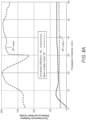
- FIGS 8A and 8B graphically illustrate calculated beam quality factor M 2 for third-harmonic radiation as a function of propagation distance through nonlinear crystal 40, which has the form of two separate LBO crystals, each having a length of 30 mm.
- the two LBO crystals are configured and arranged for walk-off compensation.
- FIG. 8A has a temperature in each crystal of 90 °C
- FIG. 8B has a temperature in each crystal of 100 °C.
- FIGS 8A and 8B also illustrate calculated third-harmonic conversion efficiency as a function of propagation distance within the two LBO crystals.
- the overall conversion of fundamental radiation to third-harmonic radiation is most efficient when the wave-front curvatures of all the beams are matched.
- Precise matching occurs when the M 2 value of the third-harmonic beam is three times that of the fundamental beam and the M 2 value of the second-harmonic beam is two times that of the fundamental beam.
- the incident beam of residual fundamental radiation directed into the first LBO crystal has an M 2 value of 10.5 in the short axis and 106 in the long axis.
- the incident beam of second harmonic-radiation directed into the first LBO crystal has an M 2 value of 17 in the short axis and 92 in the long axis.
- the cross-sectional dimensions of the beam waist in the center of each LBO crystal are assumed to be 0.5 mm in the short axis and 10 mm in the long axis.
- the incident pulse energies are assumed to be 0.206 J of residual fundamental-radiation and 0.169 J of second-harmonic radiation. That is, a ratio of 55% to 45% for pulse energy in the fundamental radiation to pulse energy in the second-harmonic radiation.
- the pulse duration is still assumed to be 25 ns.
- the model calculations indicate that, following second-harmonic generation in nonlinear crystal 32, fundamental radiation M 2 values of between about 15 and 25 in the short axis and between about 150 and 200 in the long axis can increase to between about 30 and 50 in the in the short axis and between about 300 and 400 in the long axis. That is, the beam-quality factor about doubles in value in each axis.
- the third-harmonic radiation M 2 values can further increase to between about 45 and 65 in the short axis and between about 450 and 600 in the long axis.
- the M 2 value in the long axis following sum-frequency mixing may be constrained by angular-acceptance limitations of the nonlinear crystals.
- the M 2 values of the output third-harmonic beam can be greater than about 60 in the short axis and greater than about 400 in the long axis. This compares with M 2 values of 80 in the short axis and 500 in the long axis for ultraviolet beams produced by excimer lasers currently used for laser annealing, which are discussed above.
- FIGS 8A and 8B demonstrate that having multiple nonlinear crystals arranged in series to generate third-harmonic radiation can provide sufficient propagation distance to achieve a desired beam-quality factor.
- FIG. 9A schematically illustrates another preferred embodiment 80 of an externally-frequency-tripled repetitively-pulsed solid-state laser in accordance with the present invention.
- Laser 80 is similar to laser 10 of FIG. 1 , but has two nonlinear crystals 40 and 82 to generate third-harmonic radiation by sum-frequency mixing.
- Nonlinear crystals 40 and 82 may have the same length or may have different lengths, which are selected to optimize overall conversion of fundamental radiation to third-harmonic radiation and to provide a desired beam-quality factor.
- the optical elements of embodiment 80 to the left of waveplate 34 are the same as in the FIG. 1 embodiment, and are omitted for convenience of illustration.
- a portion of the output fundamental radiation is converted by nonlinear crystal 32 into a beam of second-harmonic radiation.
- the second-harmonic radiation and the residual fundamental-radiation are both focused by a lens 92 into nonlinear crystal 40 to generate one beam of third-harmonic radiation by sum-frequency mixing.
- This third-harmonic beam is separated from the residual fundamental beam and residual second-harmonic beam by a mirror 84 and is directed by a mirror 86 through a half-waveplate 88 and onto a cube-prism polarizer 90.
- Mirror 84 is transmissive for fundamental radiation and second-harmonic radiation.
- Mirrors 84 and 86 are reflective for third-harmonic radiation.
- the copropagating residual fundamental beam and residual second-harmonic beam transmitted through mirror 84 are focused into nonlinear crystal 82 to generate another beam of third-harmonic radiation.
- This third-harmonic beam is separated from the remaining fundamental beam and the remaining second-harmonic beam by another mirror 84 and directed thereby onto polarizer 90.
- the two beams of third-harmonic radiation incident on polarizer 90 have orthogonal linear polarizations and are combined thereby to form output beam of ultraviolet radiation 44.
- Polarizer 90 has a polarization selective surface that is transmissive for one polarization and reflective for the orthogonal polarization.
- Ultraviolet output beam 44 therefore includes both linear polarizations.
- the various lenses focus the beams into the nonlinear crystals and collimate the beams as depicted. For example, lens 92.
- FIG. 9B schematically illustrates yet another preferred embodiment 100 of an externally-frequency-tripled repetitively-pulsed solid-state laser in accordance with the present invention.
- Laser 100 is similar to laser 80, but uses predominantly mirrors instead of lenses to focus and collimate the beams.
- a mirror 102 in laser 100 instead of lens 92 in laser 80.
- two third-harmonic beams are generated in separate nonlinear crystals.
- these third-harmonic beams are spatially combined by a mirror 104 that is reflective for third-harmonic radiation to form ultraviolet output beam 44.
- One advantage of laser 100 is that ultraviolet output beam 44 is linearly polarized.
- each laser has a resonator that produces a beam of output fundamental-radiation at 1064 nm having dimensions 2 mm x 40 mm and beam quality factors 25 x 100 in the short x long axes.
- One non-linear crystal made of LBO generates a beam of second-harmonic radiation at 532 nm by type-I frequency doubling.
- Two serially-arranged non-linear crystals made of LBO generate two beams of third-harmonic radiation by type-I sum-frequency mixing.
- the polarization-combined output beam of each laser has dimensions of 5 mm x 40 mm and beam quality factors of 70 x 225 in the short x long axes.
- FIG. 10 schematically illustrates a preferred embodiment 120 in accordance with the present invention to spatially combine the output beams of the two externally-frequency-tripled repetitively-pulsed solid-state lasers.
- Each laser has housing 48 and window 50, through which output beam 44 is delivered.
- One of the output beams is directed by a mirror 122 onto a mirror 124 that is precisely located to spatially combine the two output beams into one combined beam of unpolarized ultraviolet radiation 126.
- Combined beam 126 has dimensions of about 5 mm x 80 mm and beam quality factors of about 70 x 450 in the short x long axes.
- Combined beam 126 also has twice the power of each output beam 44.
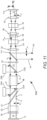
- FIG. 11 schematically illustrates a preferred embodiment 110 of an internally-frequency-tripled repetitively-pulsed solid-state laser in accordance with the present invention.
- Laser 110 is similar to laser 10, having resonator 12 formed between HR mirror 14 and another high-reflection resonator mirror 112, which is highly reflective for both the fundamental radiation and the second-harmonic radiation.
- nonlinear crystals 32 and 40 are located within resonator 12.
- the beam of fundamental radiation circulates in resonator 12.
- Output coupling is through partial conversion of fundamental radiation to harmonic radiation, rather than partial transmission of fundamental radiation through an output-coupling mirror.
- the beam of intracavity fundamental radiation passes through half-waveplate 34, nonlinear crystal 40, nonlinear crystal 32, and is reflected by an HR mirror 112.
- Half-waveplate 34 rotates the polarization-orientation of the fundamental radiation
- nonlinear crystal 32 partially converts the fundamental radiation to a beam of second-harmonic radiation, which is also reflected by HR mirror 112.
- the reflected fundamental radiation and second-harmonic radiation co-propagate from right to left through nonlinear crystal 32, selective waveplate 38, nonlinear crystal 40, and onto an output mirror 114.
- the reflected fundamental radiation is further converted into second-harmonic radiation by nonlinear crystal 32, increasing the power of the beam of second-harmonic radiation.
- Selective waveplate 38 rotates the polarization of the second-harmonic radiation only.
- Nonlinear crystal 40 partially converts the fundamental radiation and the second-harmonic radiation to a beam of third-harmonic radiation.
- Output mirror 114 is highly transmissive for fundamental radiation and reflective for second-harmonic and third-harmonic radiation.
- Collimated ultraviolet output beam 44 is directed out of resonator 12 by output mirror 114.
- the polarization of the output third-harmonic radiation is indicated by arrow P 3H .
- the three lenses focus the beams into the nonlinear crystals and collimate the beams as depicted.
- FIG. 12A, FIG. 12B, and FIG. 12C schematically illustrate a preferred embodiment 60 of a line-projector for combining and homogenizing the output of six frequency-tripled solid-state lasers of FIG. 1A .
- Line-projector 60 forms the combined output into a line-beam that is projected onto a silicon layer 62 to be annealed, which is supported on a substrate 64.
- the distribution of polarization orientations in the projected line-beam is selectable.
- the six lasers are designated as lasers 10 A , 10 B , 10 C , 10 D , 10 E , and 10 F .
- the six lasers are assumed to have nominally the same output characteristics.
- the ultraviolet radiation emitted by each of the lasers is linearly-polarized, here, S-polarized.
- Each laser directs a beam of radiation through one of six corresponding polarization rotators 66.
- the polarization rotators are adjusted such that radiation from lasers 10 A and 10 F is not polarization rotated and remains S-polarized.
- Radiation from lasers 10c and 10 D is polarization rotated by 90° and becomes P-polarized.
- Radiation from lasers 10 B and 10 E is polarization rotated by some angle between 0° and 90°, to an intermediate orientation (I-polarized) between the P and S polarizations. For example, rotated by an angle of 45°.
- the beams of radiation having various polarization orientations then traverse corresponding ones of six long-axis beam-homogenizers, each thereof including two cylindrical lens-arrays 68A and 68B.
- Output from all of the beam-homogenizers is collected by a spherical lens 70.
- Spherical lens 70 cooperative with a cylindrical lens 72, a spherical lens 74 and a cylindrical lens 76 combines the outputs of lasers 10 A-F into a line-beam on substrate 64.
- Spherical lenses 70 and 74 determine the length LL of the line-beam.
- Lenses 70, 72, 74 and 76 define the width LW of the line-beam, which is depicted in FIG. 12C .
- Each of the lasers delivers radiation to the entire length of the homogenized line-beam illuminating silicon layer 62.
- the line-projector of FIG. 12A is capable of combining and homogenizing beams from a plurality of lasers 10, here six, and forming a line-beam having a width LW of less than about 1.0 mm.
- FIG. 12B schematically illustrates how the polarization of radiation at any point on the length of the line-beam is angularly distributed.
- the polarization-orientation transforms from S-polarized at highest angles-of-incidence, through I polarized, to P-polarized at near normal angles-of-incidence.
- line-projector 60 is presented here for understanding principles of the present invention.
- a detailed description of a particular apparatus for polarizing, combining, homogenizing, and projecting outputs from a plurality of ultraviolet excimer lasers is provided in U.S. Patent Application Publication No. 2016/0259174 , assigned to the assignee of the present invention, the complete disclosure of which is hereby incorporated by reference.
- Those skilled in the art may use other beam combining and projecting apparatus without departing from the spirit and scope of the present invention.
- an inventive frequency-tripled solid-state laser producing an ultraviolet output beam having an average power, pulse energy, and beam-parameters comparable to those of excimer lasers.
- the frequency tripling can be internal or external.
- the design approach to the resonator of the inventive laser is radically different from that of conventional prior-art solid-state lasers, enabling production of a near-infrared beam having an elongated cross-section and M 2 values that are significantly greater than 10 in one transverse axis and 50 in an orthogonal transverse axis.
- This design approach provides that the M 2 values of the near-infrared beam are multiplied in the frequency-tripling process to values as high as 60 in the one transverse axis and 400 in the orthogonal transverse axis.
- Ultraviolet output beams of several of the inventive lasers can be combined in the manner used to combine the output beams of prior-art ultraviolet excimer lasers.
Landscapes
- Physics & Mathematics (AREA)
- Electromagnetism (AREA)
- Optics & Photonics (AREA)
- Engineering & Computer Science (AREA)
- Plasma & Fusion (AREA)
- Mechanical Engineering (AREA)
- Nonlinear Science (AREA)
- Chemical & Material Sciences (AREA)
- Crystallography & Structural Chemistry (AREA)
- Lasers (AREA)
- Optical Modulation, Optical Deflection, Nonlinear Optics, Optical Demodulation, Optical Logic Elements (AREA)
- Recrystallisation Techniques (AREA)
Applications Claiming Priority (4)
| Application Number | Priority Date | Filing Date | Title |
|---|---|---|---|
| US201962795341P | 2019-01-22 | 2019-01-22 | |
| US201962905252P | 2019-09-24 | 2019-09-24 | |
| EP20703919.9A EP3915174B1 (de) | 2019-01-22 | 2020-01-14 | Diodengepumpter festkörperlaser zum laserschweissen |
| PCT/US2020/013551 WO2020154136A1 (en) | 2019-01-22 | 2020-01-14 | Diode-pumped solid-state laser apparatus for laser annealing |
Related Parent Applications (2)
| Application Number | Title | Priority Date | Filing Date |
|---|---|---|---|
| EP20703919.9A Division EP3915174B1 (de) | 2019-01-22 | 2020-01-14 | Diodengepumpter festkörperlaser zum laserschweissen |
| EP20703919.9A Division-Into EP3915174B1 (de) | 2019-01-22 | 2020-01-14 | Diodengepumpter festkörperlaser zum laserschweissen |
Publications (4)
| Publication Number | Publication Date |
|---|---|
| EP4329112A2 true EP4329112A2 (de) | 2024-02-28 |
| EP4329112A3 EP4329112A3 (de) | 2024-05-15 |
| EP4329112B1 EP4329112B1 (de) | 2026-03-11 |
| EP4329112C0 EP4329112C0 (de) | 2026-03-11 |
Family
ID=69469254
Family Applications (2)
| Application Number | Title | Priority Date | Filing Date |
|---|---|---|---|
| EP23220760.5A Active EP4329112B1 (de) | 2019-01-22 | 2020-01-14 | Diodengepumpter festkörperlaser zum laserglühen |
| EP20703919.9A Active EP3915174B1 (de) | 2019-01-22 | 2020-01-14 | Diodengepumpter festkörperlaser zum laserschweissen |
Family Applications After (1)
| Application Number | Title | Priority Date | Filing Date |
|---|---|---|---|
| EP20703919.9A Active EP3915174B1 (de) | 2019-01-22 | 2020-01-14 | Diodengepumpter festkörperlaser zum laserschweissen |
Country Status (8)
| Country | Link |
|---|---|
| US (2) | US12294194B2 (de) |
| EP (2) | EP4329112B1 (de) |
| JP (2) | JP7481349B2 (de) |
| KR (2) | KR102705837B1 (de) |
| CN (2) | CN113330651B (de) |
| ES (1) | ES2993493T3 (de) |
| TW (1) | TWI866947B (de) |
| WO (1) | WO2020154136A1 (de) |
Families Citing this family (7)
| Publication number | Priority date | Publication date | Assignee | Title |
|---|---|---|---|---|
| US12294194B2 (en) * | 2019-01-22 | 2025-05-06 | Coherent, Inc. | Diode-pumped solid-state laser apparatus for laser annealing |
| US12148615B2 (en) * | 2021-05-06 | 2024-11-19 | Coherent Lasersystems Gmbh & Co. Kg | Method and apparatus for laser annealing |
| DE102021125623B3 (de) | 2021-10-04 | 2023-03-02 | Trumpf Laser- Und Systemtechnik Gmbh | Vorrichtung zum Erzeugen einer definierten Laserlinie auf einer Arbeitsebene |
| DE102021125621B3 (de) | 2021-10-04 | 2023-03-02 | Trumpf Laser- Und Systemtechnik Gmbh | Vorrichtung zum Erzeugen einer definierten Laserlinie auf einer Arbeitsebene |
| DE102021133903A1 (de) | 2021-12-20 | 2023-06-22 | Trumpf Laser- Und Systemtechnik Gmbh | Vorrichtung zum Erzeugen einer definierten Laserlinie auf einer Arbeitsebene |
| US20230404668A1 (en) * | 2022-06-15 | 2023-12-21 | Foreveryoung Technology Corporation | Apparatus for laser endo-vascular ablation |
| CN115864115B (zh) * | 2022-12-30 | 2026-04-07 | 深圳市杰普特光电股份有限公司 | 光纤激光器 |
Citations (1)
| Publication number | Priority date | Publication date | Assignee | Title |
|---|---|---|---|---|
| US20160259174A1 (en) | 2015-03-04 | 2016-09-08 | Coherent Lasersystems Gmbh & Co. Kg | Polarization-controlled laser line-projector |
Family Cites Families (31)
| Publication number | Priority date | Publication date | Assignee | Title |
|---|---|---|---|---|
| US6285702B1 (en) | 1999-03-05 | 2001-09-04 | Coherent, Inc. | High-power external-cavity optically-pumped semiconductor laser |
| US6418156B1 (en) * | 1998-11-12 | 2002-07-09 | Raytheon Company | Laser with gain medium configured to provide an integrated optical pump cavity |
| EP1303796B1 (de) | 2000-07-10 | 2005-04-27 | Corporation For Laser Optics Research | Vorrichtung und methode zur reduzierung von specklesmustern durch erhöhung der bandbreite |
| TW523791B (en) | 2000-09-01 | 2003-03-11 | Semiconductor Energy Lab | Method of processing beam, laser irradiation apparatus, and method of manufacturing semiconductor device |
| JP2005518658A (ja) * | 2002-02-25 | 2005-06-23 | オーボテック リミテッド | フラットパネルディスプレイ基板の製造方法 |
| JP4589606B2 (ja) | 2003-06-02 | 2010-12-01 | 住友重機械工業株式会社 | 半導体装置の製造方法 |
| JP4517698B2 (ja) | 2003-09-26 | 2010-08-04 | 三菱電機株式会社 | 波長変換レーザ装置 |
| US7463657B2 (en) | 2003-10-09 | 2008-12-09 | Coherent, Inc. | Intracavity frequency-tripled CW laser |
| CN100571959C (zh) | 2003-11-26 | 2009-12-23 | Tcz私营有限公司 | 激光薄膜多晶硅退火光学系统 |
| FR2871622B1 (fr) | 2004-06-14 | 2008-09-12 | Commissariat Energie Atomique | Dispositif de generation de lumiere dans l'extreme ultraviolet et application a une source de lithographie par rayonnement dans l'extreme ultraviolet |
| JP3998067B2 (ja) | 2004-11-29 | 2007-10-24 | オムロンレーザーフロント株式会社 | 固体レーザ発振器 |
| US7408714B2 (en) | 2005-02-11 | 2008-08-05 | Coherent, Inc. | Method and apparatus for coupling laser beams |
| DE102005015148A1 (de) * | 2005-03-31 | 2006-10-05 | Osram Opto Semiconductors Gmbh | Laservorrichtung |
| US7715459B2 (en) | 2005-11-01 | 2010-05-11 | Cymer, Inc. | Laser system |
| US7408971B2 (en) * | 2006-02-28 | 2008-08-05 | Quantronix Corporation | Longitudinally pumped solid state laser and methods of making and using |
| US7615722B2 (en) | 2006-07-17 | 2009-11-10 | Coherent, Inc. | Amorphous silicon crystallization using combined beams from optically pumped semiconductor lasers |
| JP5120685B2 (ja) | 2006-12-25 | 2013-01-16 | 株式会社Ihi | レーザアニール方法及びレーザアニール装置 |
| US7394841B1 (en) | 2007-01-18 | 2008-07-01 | Epicrystals Oy | Light emitting device for visual applications |
| US10307862B2 (en) | 2009-03-27 | 2019-06-04 | Electro Scientific Industries, Inc | Laser micromachining with tailored bursts of short laser pulses |
| US8204094B2 (en) * | 2009-04-21 | 2012-06-19 | Innova, Inc. | Scalable, efficient laser systems |
| US20100278200A1 (en) | 2009-05-04 | 2010-11-04 | Coherent, Inc. | External frequency-quadruped 1064 nm mode-locked laser |
| CN102801106B (zh) | 2012-07-30 | 2014-05-28 | 中国人民解放军国防科学技术大学 | 多链板条激光相干控制共孔径偏振合成方法 |
| CN104956466B (zh) | 2012-12-31 | 2018-03-02 | 恩耐公司 | 用于低温多晶硅结晶的短脉冲光纤激光器 |
| FR3023423B1 (fr) | 2014-07-03 | 2016-07-08 | Amplitude Systemes | Systeme laser uv-visible a impulsions ultra-courtes de forte puissance et/ou de forte energie |
| US9684125B2 (en) | 2015-05-14 | 2017-06-20 | Coherent, Inc. | Transport of polarized laser-radiation using a hollow-core fiber |
| US10175555B2 (en) | 2017-01-03 | 2019-01-08 | KLA—Tencor Corporation | 183 nm CW laser and inspection system |
| US10008821B1 (en) | 2017-02-01 | 2018-06-26 | Northrop Grumman Systems Corporation | Wavelength-switched multi-turret fiber laser system |
| US10234765B2 (en) | 2017-06-05 | 2019-03-19 | Coherent Lasersystems Gmbh & Co. Kg | Energy controller for excimer-laser silicon crystallization |
| CN208955408U (zh) | 2018-07-25 | 2019-06-07 | 王炜 | 一种高效稳定的抛物面镜离轴非稳腔 |
| CN109193342B (zh) | 2018-10-15 | 2019-11-15 | 中国科学院理化技术研究所 | 一种半导体激光器 |
| US12294194B2 (en) * | 2019-01-22 | 2025-05-06 | Coherent, Inc. | Diode-pumped solid-state laser apparatus for laser annealing |
-
2020
- 2020-01-13 US US16/741,486 patent/US12294194B2/en active Active
- 2020-01-14 CN CN202080010300.1A patent/CN113330651B/zh active Active
- 2020-01-14 ES ES20703919T patent/ES2993493T3/es active Active
- 2020-01-14 JP JP2021542140A patent/JP7481349B2/ja active Active
- 2020-01-14 WO PCT/US2020/013551 patent/WO2020154136A1/en not_active Ceased
- 2020-01-14 KR KR1020217020037A patent/KR102705837B1/ko active Active
- 2020-01-14 KR KR1020247030042A patent/KR102786318B1/ko active Active
- 2020-01-14 EP EP23220760.5A patent/EP4329112B1/de active Active
- 2020-01-14 EP EP20703919.9A patent/EP3915174B1/de active Active
- 2020-01-14 CN CN202411144319.1A patent/CN120033524A/zh active Pending
- 2020-01-21 TW TW109102302A patent/TWI866947B/zh active
-
2024
- 2024-02-01 JP JP2024014032A patent/JP2024032935A/ja not_active Withdrawn
-
2025
- 2025-03-03 US US19/068,657 patent/US20250233381A1/en active Pending
Patent Citations (1)
| Publication number | Priority date | Publication date | Assignee | Title |
|---|---|---|---|---|
| US20160259174A1 (en) | 2015-03-04 | 2016-09-08 | Coherent Lasersystems Gmbh & Co. Kg | Polarization-controlled laser line-projector |
Also Published As
| Publication number | Publication date |
|---|---|
| JP2024032935A (ja) | 2024-03-12 |
| KR102705837B1 (ko) | 2024-09-12 |
| EP4329112B1 (de) | 2026-03-11 |
| CN113330651B (zh) | 2024-09-13 |
| CN120033524A (zh) | 2025-05-23 |
| US20200235544A1 (en) | 2020-07-23 |
| US20250233381A1 (en) | 2025-07-17 |
| KR102786318B1 (ko) | 2025-03-26 |
| EP4329112C0 (de) | 2026-03-11 |
| KR20210114400A (ko) | 2021-09-23 |
| ES2993493T3 (en) | 2025-01-02 |
| EP3915174A1 (de) | 2021-12-01 |
| JP7481349B2 (ja) | 2024-05-10 |
| EP3915174C0 (de) | 2024-10-23 |
| CN113330651A (zh) | 2021-08-31 |
| US12294194B2 (en) | 2025-05-06 |
| TWI866947B (zh) | 2024-12-21 |
| JP2022518740A (ja) | 2022-03-16 |
| KR20240136475A (ko) | 2024-09-13 |
| EP3915174B1 (de) | 2024-10-23 |
| TW202100270A (zh) | 2021-01-01 |
| WO2020154136A1 (en) | 2020-07-30 |
| WO2020154136A9 (en) | 2021-07-01 |
| EP4329112A3 (de) | 2024-05-15 |
Similar Documents
| Publication | Publication Date | Title |
|---|---|---|
| US20250233381A1 (en) | Diode-pumped solid-state laser apparatus for laser annealing | |
| EP1810380B1 (de) | Mehrfachwellenlängen-Laser mit wählbarer Wellenlänge zur Ausstrahlung sichtbaren Lichts | |
| US6901084B2 (en) | Stable solid state raman laser and a method of operating same | |
| JP3199120B2 (ja) | ダイオード励起多軸モード空洞内周波数2倍型レーザ | |
| US5991317A (en) | Retinal photocoagulator including diode pumped, multi-axial mode intracavity doubled laser | |
| US20110058578A9 (en) | Laser and a method for operating the laser | |
| US7903701B2 (en) | Intracavity harmonic generation using a recycled intermediate harmonic | |
| EP1493213B1 (de) | Erzeugung der vierten harmonischen im resonator unter verwendung unbeschichteter brewster-oberflächen | |
| US6931037B2 (en) | Diode pumped, multi axial mode intracavity doubled laser | |
| US5764662A (en) | Solid state ultraviolet laser tunable from 223 NM to 243 NM |
Legal Events
| Date | Code | Title | Description |
|---|---|---|---|
| PUAI | Public reference made under article 153(3) epc to a published international application that has entered the european phase |
Free format text: ORIGINAL CODE: 0009012 |
|
| STAA | Information on the status of an ep patent application or granted ep patent |
Free format text: STATUS: THE APPLICATION HAS BEEN PUBLISHED |
|
| AC | Divisional application: reference to earlier application |
Ref document number: 3915174 Country of ref document: EP Kind code of ref document: P |
|
| AK | Designated contracting states |
Kind code of ref document: A2 Designated state(s): AL AT BE BG CH CY CZ DE DK EE ES FI FR GB GR HR HU IE IS IT LI LT LU LV MC MK MT NL NO PL PT RO RS SE SI SK SM TR |
|
| REG | Reference to a national code |
Ref country code: DE Ref legal event code: R079 Free format text: PREVIOUS MAIN CLASS: H01S0003000000 Ipc: H01S0003110000 Ref country code: DE Ref legal event code: R079 Ref document number: 602020068678 Country of ref document: DE Free format text: PREVIOUS MAIN CLASS: H01S0003000000 Ipc: H01S0003110000 |
|
| PUAL | Search report despatched |
Free format text: ORIGINAL CODE: 0009013 |
|
| AK | Designated contracting states |
Kind code of ref document: A3 Designated state(s): AL AT BE BG CH CY CZ DE DK EE ES FI FR GB GR HR HU IE IS IT LI LT LU LV MC MK MT NL NO PL PT RO RS SE SI SK SM TR |
|
| RIC1 | Information provided on ipc code assigned before grant |
Ipc: H01S 3/00 20060101ALI20240408BHEP Ipc: H01S 3/11 20230101AFI20240408BHEP |
|
| STAA | Information on the status of an ep patent application or granted ep patent |
Free format text: STATUS: REQUEST FOR EXAMINATION WAS MADE |
|
| 17P | Request for examination filed |
Effective date: 20240709 |
|
| RBV | Designated contracting states (corrected) |
Designated state(s): AL AT BE BG CH CY CZ DE DK EE ES FI FR GB GR HR HU IE IS IT LI LT LU LV MC MK MT NL NO PL PT RO RS SE SI SK SM TR |
|
| GRAP | Despatch of communication of intention to grant a patent |
Free format text: ORIGINAL CODE: EPIDOSNIGR1 |
|
| STAA | Information on the status of an ep patent application or granted ep patent |
Free format text: STATUS: GRANT OF PATENT IS INTENDED |
|
| INTG | Intention to grant announced |
Effective date: 20251010 |
|
| GRAS | Grant fee paid |
Free format text: ORIGINAL CODE: EPIDOSNIGR3 |
|
| GRAA | (expected) grant |
Free format text: ORIGINAL CODE: 0009210 |
|
| STAA | Information on the status of an ep patent application or granted ep patent |
Free format text: STATUS: THE PATENT HAS BEEN GRANTED |
|
| AC | Divisional application: reference to earlier application |
Ref document number: 3915174 Country of ref document: EP Kind code of ref document: P |
|
| AK | Designated contracting states |
Kind code of ref document: B1 Designated state(s): AL AT BE BG CH CY CZ DE DK EE ES FI FR GB GR HR HU IE IS IT LI LT LU LV MC MK MT NL NO PL PT RO RS SE SI SK SM TR |
|
| REG | Reference to a national code |
Ref country code: CH Ref legal event code: F10 Free format text: ST27 STATUS EVENT CODE: U-0-0-F10-F00 (AS PROVIDED BY THE NATIONAL OFFICE) Effective date: 20260311 Ref country code: GB Ref legal event code: FG4D |
|
| REG | Reference to a national code |
Ref country code: IE Ref legal event code: FG4D |
|
| U01 | Request for unitary effect filed |
Effective date: 20260311 |
|
| U07 | Unitary effect registered |
Designated state(s): AT BE BG DE DK EE FI FR IT LT LU LV MT NL PT RO SE SI Effective date: 20260317 |