EP4329351A2 - Vorrichtung und verfahren zur bereitstellung der zusammenarbeit von nssaaa-betreffenden netzwerk-slices in einem drahtlosen kommunikationssystem - Google Patents
Vorrichtung und verfahren zur bereitstellung der zusammenarbeit von nssaaa-betreffenden netzwerk-slices in einem drahtlosen kommunikationssystem Download PDFInfo
- Publication number
- EP4329351A2 EP4329351A2 EP24152180.6A EP24152180A EP4329351A2 EP 4329351 A2 EP4329351 A2 EP 4329351A2 EP 24152180 A EP24152180 A EP 24152180A EP 4329351 A2 EP4329351 A2 EP 4329351A2
- Authority
- EP
- European Patent Office
- Prior art keywords
- nssai
- terminal
- information
- subscribed
- network
- Prior art date
- Legal status (The legal status is an assumption and is not a legal conclusion. Google has not performed a legal analysis and makes no representation as to the accuracy of the status listed.)
- Pending
Links
Images



Classifications
-
- H—ELECTRICITY
- H04—ELECTRIC COMMUNICATION TECHNIQUE
- H04W—WIRELESS COMMUNICATION NETWORKS
- H04W76/00—Connection management
- H04W76/10—Connection setup
- H04W76/11—Allocation or use of connection identifiers
-
- H—ELECTRICITY
- H04—ELECTRIC COMMUNICATION TECHNIQUE
- H04W—WIRELESS COMMUNICATION NETWORKS
- H04W88/00—Devices specially adapted for wireless communication networks, e.g. terminals, base stations or access point devices
- H04W88/18—Service support devices; Network management devices
-
- H—ELECTRICITY
- H04—ELECTRIC COMMUNICATION TECHNIQUE
- H04W—WIRELESS COMMUNICATION NETWORKS
- H04W48/00—Access restriction; Network selection; Access point selection
- H04W48/18—Selecting a network or a communication service
-
- H—ELECTRICITY
- H04—ELECTRIC COMMUNICATION TECHNIQUE
- H04W—WIRELESS COMMUNICATION NETWORKS
- H04W76/00—Connection management
- H04W76/10—Connection setup
-
- H—ELECTRICITY
- H04—ELECTRIC COMMUNICATION TECHNIQUE
- H04W—WIRELESS COMMUNICATION NETWORKS
- H04W8/00—Network data management
- H04W8/18—Processing of user or subscriber data, e.g. subscribed services, user preferences or user profiles; Transfer of user or subscriber data
- H04W8/20—Transfer of user or subscriber data
-
- H—ELECTRICITY
- H04—ELECTRIC COMMUNICATION TECHNIQUE
- H04W—WIRELESS COMMUNICATION NETWORKS
- H04W80/00—Wireless network protocols or protocol adaptations to wireless operation
- H04W80/08—Upper layer protocols
- H04W80/10—Upper layer protocols adapted for application session management, e.g. SIP [Session Initiation Protocol]
-
- H—ELECTRICITY
- H04—ELECTRIC COMMUNICATION TECHNIQUE
- H04W—WIRELESS COMMUNICATION NETWORKS
- H04W92/00—Interfaces specially adapted for wireless communication networks
- H04W92/02—Inter-networking arrangements
-
- H—ELECTRICITY
- H04—ELECTRIC COMMUNICATION TECHNIQUE
- H04W—WIRELESS COMMUNICATION NETWORKS
- H04W12/00—Security arrangements; Authentication; Protecting privacy or anonymity
- H04W12/06—Authentication
-
- H—ELECTRICITY
- H04—ELECTRIC COMMUNICATION TECHNIQUE
- H04W—WIRELESS COMMUNICATION NETWORKS
- H04W12/00—Security arrangements; Authentication; Protecting privacy or anonymity
- H04W12/08—Access security
-
- H—ELECTRICITY
- H04—ELECTRIC COMMUNICATION TECHNIQUE
- H04W—WIRELESS COMMUNICATION NETWORKS
- H04W84/00—Network topologies
- H04W84/02—Hierarchically pre-organised networks, e.g. paging networks, cellular networks, WLAN [Wireless Local Area Network] or WLL [Wireless Local Loop]
- H04W84/10—Small scale networks; Flat hierarchical networks
- H04W84/12—WLAN [Wireless Local Area Networks]
Definitions
- the disclosure relates to a wireless communication system. More particularly, the disclosure relates to a method for providing network slicing in a wireless communication system.
- 5G communication systems are being developed to be implemented in a super-high frequency band (millimeter wave (mmWave)), e.g., a band of 60 GHz.
- mmWave millimeter wave
- FSK frequency-shift keying
- QAM quadrature amplitude modulation
- SWSC sliding window superposition coding
- ACM advanced coding modulation
- FBMC filter bank multi carrier
- NOMA non-orthogonal multiple access
- SCMA sparse code multiple access
- the Internet has evolved from a human-based connection network, where humans create and consume information, to the Internet of things (IoT), where distributed components, such as objects, exchange information with each other to process the information.
- Internet of Everything (IoE) technology is emerging, in which technology related to the IoT is combined with, for example, technology for processing big data through connection with a cloud server.
- various technological components are required, such as sensing technology, wired/wireless communication and network infrastructures, service interface technology, security technology, etc.
- technologies including a sensor network for connecting objects, machine to machine (M2M) communication, machine type communication (MTC), etc. have been studied.
- intelligent Internet technology (IT) services may be provided to collect and analyze data obtained from objects connected to each other to create new value in human life.
- IT information technology
- the IoT may be applied to various fields, such as smart homes, smart buildings, smart cities, smart cars or connected cars, smart grids, health care, smart home appliances, high-quality medical services, etc.
- 5G communication systems to the IoT network.
- technologies related to sensor networks, M2M communication, MTC, etc. are being implemented using 5G communication technology including beamforming, MIMO, array antennas, etc.
- the application of Cloud-RAN as a big data processing technology described above may be an example of the convergence of 5G communication technology and IoT technology.
- an aspect of the disclosure is to provide a method and apparatus for interworking between a 5 th Generation (5G) network system architecture providing a network slicing function and an evolved packet system (EPS) network.
- 5G 5 th Generation
- EPS evolved packet system
- a method of selecting, by a control entity, a network slice includes receiving a create session request message from a Serving Gateway (S-GW) in response to a Packet Data Network (PDN) connectivity request message transmitted by a terminal, transmitting, to a storage entity, a request message for subscriber information including identification information of the terminal, receiving, from the storage entity, subscription data of the terminal corresponding to the identification information of the terminal, selecting at least one network slice based on the subscription data of the terminal and slice information supportable by the control entity, and transmitting a create session response message including information of the selected at least one network slice, wherein the subscription data of the terminal includes information about a subscribed network slice of the terminal and information regarding whether the subscribed network slice of the terminal is supported in an Evolved Packet Core (EPC).
- EPC Evolved Packet Core
- the information regarding whether the subscribed network slice of the terminal is supported in an EPC may include information indicating whether the subscribed network slice of the terminal is subject to Network Slice-Specific Authentication and Authorization (NSSAA).
- NSSAA Network Slice-Specific Authentication and Authorization
- the selecting may include selecting, from among subscribed network slices of the terminal, a network slice that is not subject to NSSAA and is supportable by the control entity.
- the PDN connectivity request message may include information of an Access Point Name (APN) requested from the terminal, wherein the selecting includes selecting, from among subscribed network slices of the terminal, a network slice that is not subject to NSSAA, supports the APN, and is supportable by the control entity.
- APN Access Point Name
- the PDN connectivity request may be rejected.
- a case where there is no network slice selectable by the control entity may include a case where network slices that are supportable by the control entity from among subscribed network slices of the terminal are all subject to NSSAA.
- the control entity may be a combo-node of a Session Management Function (SMF) and a PDN Gateway control (PGW-C), and the storage entity may be a combo-node of a Home Subscriber Server (HSS) and a Unified Data Management (UDM).
- SMF Session Management Function
- PGW-C PDN Gateway control
- HSS Home Subscriber Server
- UDM Unified Data Management
- a method of supporting, by a storage entity, selection of a network slice includes receiving, from a control entity, a request message for subscriber information including identification information of a terminal, and transmitting, to the control entity, subscription data of a terminal corresponding to the identification information of the terminal, wherein the subscription data of the terminal includes information about a subscribed network slice of the terminal and information regarding whether the subscribed network slice of the terminal is supported in an EPC.
- the information regarding whether the subscribed network slice of the terminal is supported in an EPC may include information indicating whether the subscribed network slice of the terminal is subject to NSSAA.
- the control entity may be a combo-node of a SMF and a PGW-C
- the storage entity may be a combo-node of an HSS and a UDM.
- a control entity for selecting a network slice includes a transceiver, and a processor coupled with the transceiver and configured to: receive a create session request message from a S-GW in response to a PDN connectivity request message transmitted by a terminal, transmit, to a storage entity, a request message for subscriber information including identification information of the terminal, receive, from the storage entity, subscription data of a terminal corresponding to the identification information of the terminal, select at least network slice based on the subscription data of the terminal and slice information supportable by the control entity, and transmit a create session response message including information of the selected at least one network slice, wherein the subscription data of the terminal includes information about a subscribed network slice of the terminal and information regarding whether the subscribed network slice of the terminal is supported in an EPC.
- the information regarding whether the subscribed network slice of the terminal is supported in an EPC may include information indicating whether the subscribed network slice of the terminal is subject to NSSAA.
- the processor may be further configured to select, from among subscribed network slices of the terminal, a network slice that is not subject to NSSAA and is supportable by the control entity.
- the PDN connectivity request message may include information of an APN requested from the terminal, wherein the processor is further configured to select, from among the subscribed network slices of the terminal, a network slice that is not subject to NSSAA, supports the APN, and is supportable by the control entity.
- the processor may be further configured to reject the PDN connectivity request when there is no network slice selectable by the control entity.
- a case where there is no network slice selectable by the control entity may include a case where network slices that are supportable by the control entity from among subscribed network slices of the terminal are all subject to NSSAA.
- the control entity may be a combo-node of a SMF and a PGW-C
- the storage entity may be a combo-node of an HSS and a UDM.
- a storage entity for supporting selection of a network slice includes a transceiver, and a processor coupled with the transceiver and configured to: receive, from a control entity, a request message for subscriber information including identification information of the terminal, and transmit, to the control entity, subscription data of a terminal corresponding to the identification information of the terminal, wherein the subscription data of the terminal includes information about a subscribed network slice of the terminal and information regarding whether the subscribed network slice of the terminal is supported in an EPC.
- the information regarding whether the subscribed network slice of the terminal is supported in an EPC may include information indicating whether the subscribed network slice of the terminal is subject to NSSAA.
- the control entity may be a combo-node of a SMF and a PGW-C, a SMF or a PGW-C, and the storage entity may be a combo-node of an HSS and a UDM, a UDM or an HSS.
- each block of flowchart illustrations and combinations of blocks in the flowchart illustrations may be implemented by computer program instructions.
- These computer program instructions may be provided to a processor of a general-purpose computer, special purpose computer, or other programmable data processing equipment, such that the instructions, which are executed via the processor of the computer or other programmable data processing equipment, generate means for performing functions specified in the flowchart block(s).
- These computer program instructions may also be stored in a computer-executable or computer-readable memory that may direct a computer or other programmable data processing equipment to function in a particular manner, such that the instructions stored in the computer-executable or computer-readable memory produce a manufactured article including instruction means that perform the functions specified in the flowchart block(s).
- the computer program instructions may also be loaded onto a computer or other programmable data processing equipment to cause a series of operations to be performed on the computer or other programmable data processing equipment to produce a computer-executable process such that the instructions that are executed on the computer or other programmable data processing equipment provide operations for implementing the functions specified in the flowchart block or blocks.
- each block may represent a module, segment, or portion of code, which includes one or more executable instructions for implementing specified logical function(s).
- each block may also represent a module, segment, or portion of code, which includes one or more executable instructions for implementing specified logical function(s).
- the functions noted in the blocks may occur out of the presented order. For example, two blocks shown in succession may in fact be executed substantially concurrently or the blocks may sometimes be executed in the reverse order, according to the functionality involved.
- unit or ' ⁇ er(or)' used herein denotes a software element or a hardware element such as a field-programmable gate array (FPGA) or an application-specific integrated circuit (ASIC), and performs a certain function.
- FPGA field-programmable gate array
- ASIC application-specific integrated circuit
- the term 'unit' or ⁇ ⁇ er(or)' is not limited to software or hardware.
- the term 'unit' or ' ⁇ er(or)' may be configured to be included in an addressable storage medium or to reproduce one or more processors.
- the term 'unit' or ' ⁇ er(or)' may include, by way of example, object-oriented software components, class components, and task components, and processes, functions, attributes, procedures, subroutines, segments of a program code, drivers, firmware, a micro code, a circuit, data, a database, data structures, tables, arrays, and variables.
- Functions provided by components and 'units' or ' -ers(ors)' may be combined into a smaller number of components and 'units' or ' -ers(ors)' or may be further separated into additional components and 'units' or ' ⁇ ers(ors)'.
- the components and 'units' or' -ers(ors)' may be implemented to operate one or more central processing units (CPUs) in a device or a secure multimedia card.
- CPUs central processing units
- the expression "at least one of a, b or c" indicates only a, only b, only c, both a and b, both a and c, both b and c, all of a, b, and c, or variations thereof.
- Examples of a terminal may include a user equipment (UE), a mobile station (MS), a cellular phone, a smartphone, a computer, a multimedia system capable of performing a communication function, or the like.
- UE user equipment
- MS mobile station
- cellular phone a smartphone
- smartphone a computer
- multimedia system capable of performing a communication function, or the like.
- a controller may also be referred to as a processor.
- a layer (or a layer apparatus) may also be referred to as an entity.
- a base station is an entity that assigns resources of a terminal, and may be at least one of a node B (NB), a base station (BS), an evolved node B (eNB), a next generation node B (gNB), a wireless access unit, a base station controller, or a node on a network.
- NB node B
- BS base station
- eNB evolved node B
- gNB next generation node B
- a wireless access unit a base station controller, or a node on a network.
- identifying an access node the term referring to a network entity or a network function (NF), the term referring to messages, the term referring to an interface between network objects, the term referring to various identification information, and the like, are exemplified for convenience of description. However, the disclosure is not limited by the following terms, and other terms having equivalent technical meanings may be used.
- the disclosure relates to an apparatus and method for providing interworking of network slices in a wireless communication system. More specifically, the disclosure presents a description of a technique of interworking between a 5 th Generation (5G) network system architecture, which provides a network slicing function in a wireless communication system, and an Evolved Packet System (EPS) network system.
- 5G 5 th Generation
- EPS Evolved Packet System
- a term indicating a signal As used below, a term indicating a signal, a term indicating a channel, a term indicating control information, a term indicating network entities, a term indicating a component of an apparatus, etc., will be presented for convenience of description. However, the disclosure is not limited by the following terms, and other terms having equivalent technical meanings may be used.
- Mobile carriers may provide various services on a 5G network. To provide each service, mobile carriers need to meet different service requirements for each service (for example, delay time, communication range, data rate, bandwidth, reliability, etc.). To this end, a mobile carrier may configure network slices and assign network resources appropriate for a particular service for each network slice or each set of network slices.
- Network resources may refer to a network function (NF) or assignment of logic resources provided by the NF or assignment of radio resources of a base station, and are not limited to the above examples.
- NF network function
- a mobile carrier may configure a network slice A to provide a mobile broadband service, configure a network slice B to provide a vehicle communication service, and configure a network slice C to provide an IoT service. That is, in a 5G network, corresponding services may be respectively provided on network slices specially designed according to the characteristics of the services.
- Single-Network Slice Selection Assistance Information (S-NSSAI) defined in the 3GPP may be used as an identifier for identifying a network slice.
- S-NSSAI Single-Network Slice Selection Assistance Information
- a mobile carrier may operate a 5G network and an EPS (or Long-Term Evolution (LTE) or 4G) network together.
- a terminal may access a 5G network and move to an EPS network while using a service.
- the terminal may access the EPS network and move to the 5G network while using the service.
- EPS Long-Term Evolution
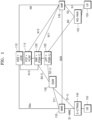
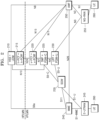
- FIGS. 1 , 2 , and 3 illustrate an interworking scheme of a 5G system (5GS) and an EPS.
- FIG. 1 is a diagram of an interworking scheme between a 5GS and an EPS under a non-roaming condition according to an embodiment of the disclosure.
- the 5GS may include a New Radio (NR) base station 150, an Access and Mobility Management Function (AMF) 145, a Session Management Function (SMF) 120, a User Plane Function (UPF) 125, a Policy Control Function (PCF) 115, and a Unified Data Management (UDM) 110.
- NR New Radio
- AMF Access and Mobility Management Function
- SMF Session Management Function
- UPF User Plane Function
- PCF Policy Control Function
- UDM Unified Data Management
- the AMF 145 may be a network function of managing access of a terminal to a wireless network and mobility of the terminal.
- the SMF 120 may be a network function of managing packet data network connection provided to a terminal.
- the UPF 125 may act as a gateway for transmitting packets transmitted or received by a terminal and may be controlled by the SMF 120.
- the PCF 115 may be a network function of applying service policies, billing policies and policies regarding a protocol data unit (PDU) session by a mobile carrier with respect to a terminal.
- the UDM 110 may be a network function of storing and managing information about subscribers.
- the configuration of the 5GS is not limited to the above example.
- an EPS may include an Evolved Universal Terrestrial Radio Access (E-UTRA) base station 140, a Mobility Management Entity (MME) 135, a Serving Gateway (S-GW) 130, a PDN Gateway-user plane (PGW-U) 125, a PDN Gateway-control plane (PGW-C) 120, a Policy and Charging Function (PCRF) 115, and a Home Subscribe Server (HSS) 110.
- E-UTRA Evolved Universal Terrestrial Radio Access
- MME Mobility Management Entity
- S-GW Serving Gateway
- PGW-U PDN Gateway-user plane
- PGW-C PDN Gateway-control plane
- PCRF Policy and Charging Function
- HSS Home Subscribe Server
- the MME 135 may be a network function of authenticating a terminal 155, manages a session such as a bearer, and manages a connectivity state of the terminal 155.
- the S-GW 130 may be a network function of forwarding data (or a data packet).
- the PGW-C 120 and the PGW-U 125 may be network functions of providing connectivity between a terminal and a Packet Data Network (PDN) which is an external network (not shown).
- PDN Packet Data Network
- the PCRF 115 may be a network function of determining a billing policy and a quality of service (QoS) policy to be applied to the terminal 155
- the HSS 110 may be a network function including information for authentication of the terminal 155.
- the S1-MME, S6a, S11, S1-U, S-5C, S5-U, S-8C, and S8-U are interfaces for the E-UTRAN connectivity and the N 1, N2, N3, N4, N8, N9, N10, N 11, N15, N16, N24 and N26 are interfaces for the NG-RAN connectivity as shown in FIGS 1 to 3 .
- the configuration of the EPS is not limited to the above example.
- the UDM 110 of the 5GS and the HSS 110 of the EPS may be configured as one combo-node.
- the SMF 120 of the 5GS and the PGW-C 120 of the EPS may be configured as one combo-node.
- the UDM 110 of the 5GS and the HSS 110 of the EPS may be configured as one combo-node, and the node of the UDM+HSS 110 may store subscriber information of a terminal.
- the UPF 125 of the 5GS and the PGW-U 125 of the EPS may be configured as one combo-node.
- the terminal 155 may use an EPS network service by accessing the MME 135 of the EPS via the E-UTRA base station 140.
- FIG. 2 is a diagram of an interworking scheme between a 5GS and an EPS under a local breakout roaming condition according to an embodiment of the disclosure.
- a terminal 260 may use an EPS network service by accessing an MME 240 of the EPS via an E-UTRA base station 245.
- the terminal 260 may use a 5GS network service by accessing an AMF 250 of the 5GS via an NR base station 255.
- a node of a SMF+PGW-C 225 may be located in a Visited Public Land Mobile Network (V-PLMN). Similar to FIG. 1 , FIG. 2 shows SGW node 235, HSS+UDM combo node 210, h-PCF+h-PCRF combo node 215, v-PCF+v-PCRF combo node 220 and UPF+PGW-U combo node 230.
- V-PLMN Visited Public Land Mobile Network
- FIG. 3 is a diagram of an interworking scheme between a 5GS and an EPS under a home-routed-roaming condition according to an embodiment of the disclosure.
- a terminal 370 may use an EPS network service by accessing an MME 335 of the EPS via an E-UTRA base station 340.
- the terminal 370 may use a 5GS network service by accessing an AMF 360 of the 5GS via an NR base station 365.
- a node of a SMF+PGW-C 320 may be located in a home PLMN. Similar to FIGS. 1 and 2 , FIG.
- FIG. 3 shows SGW node 330, HSS+UDM combo node 310, h-PCF+h-PCRF combo node 315, v-PCF node 345, v-SMF node 350 and UPF+PGW-U combo node.
- FIG. 4 illustrates a network slice-specific authentication and authorization (NSSAA) procedure in a terminal registration procedure according to an embodiment of the disclosure. That is, FIG. 4 illustrates a method of performing a NSSAA procedure in a terminal registration procedure.
- An AMF may store related information according to a result (success or failure) of NSSAA regarding S-NSSAI, in a UDM.
- a UE may generate a Registration Request message.
- Requested NSSAI that the UE is to use may be included in the Registration Request message.
- Requested NSSAI may include one or more S-NSSAIs.
- Requested NSSAI may include S-NSSAI A and S-NSSAI B.
- the UE may transmit a Registration Request message to the AMF via a base station (also referred to as RAN).
- the base station may receive the Registration Request message transmitted by the UE.
- the name of the message is not limited to the above example.
- the base station authenticates the received Registration Request message, and may select an AMF based on a UE ID (such as 5G-GUTI), Requested NSSAI, and the like.
- a UE ID such as 5G-GUTI
- Requested NSSAI Requested NSSAI
- the base station may transmit the Registration Request message to the selected AMF.
- the AMF may obtain UE subscription data from the UDM to process the Registration Request message.
- the UE subscription data may include at least one of subscribed slices (Subscribed S-NSSAIs) of the UE or information indicating whether a subscribed slice is subject to NSSAA (The Subscribed S-NSSAIs marked as subject to Network Slice-Specific Authentication and Authorization).
- the subscription of the UE may include S-NSSAI A and S-NSSAI B, and S-NSSAI A may be subject to NSSAA.
- the AMF may determine Allowed NSSAI based on the UE subscription data received from the UDM in operation 405.
- the Allowed NSSAI may include one or more S-NSSAIs available for the UE. For example, when S-NSSAI A and S-NSSAI B are included in Requested NSSAI requested by the UE, and both S-NSSAI A and S-NSSAI B are included in a subscribed slice, both S-NSSAI A and S-NSSAI B requested by the UE may be used. However, as S-NSSAI A is subject to NSSAA, the AMF may determine to include only S-NSSAI B in the Allowed NSSAI.
- the AMF may transmit a Registration Accept message to the UE.
- the Registration Accept message may include the Allowed NSSAI determined in operation 406.
- the Registration Accept message may include information indicating that S-NSSAI A is undergoing an NSSAA procedure (e.g., an indication, an indicator or a cause value).
- the Registration Accept message transmitted by the AMF may be transmitted to the UE through the base station.
- the name of the message is not limited to the above example.
- the base station may transmit the Registration Accept message to the UE.
- the UE may use S-NSSAI B included in the Allowed NSSAI included in the Registration Accept message.
- the UE may be aware that the S-NSSAI A requested in operation 402 is undergoing an NSSAA procedure.
- the AMF may store a UE context in the UDM.
- a UE Context Update message transmitted by the AMF to the UDM may be a Nudm_UECM_Registration message or a Nudm_UECM_Update message.
- the UE Context Update message may include the Allowed NSSAI of the UE determined by the AMF in operation 406.
- the UE Context Update message may include information indicating that S-NSSAI A is undergoing an NSSAA procedure.
- the UDM may store, as a UE context, allowed NSSAI and S-NSSAI information undergoing NSSAA. For example, in the UDM, a UE context in which the allowed NSSAI is S-NSSAI B and the S-NSSAI undergoing NSSAA is S-NSSAI A may be stored.
- the AMF may start a NSSAA procedure for S-NSSAI A.
- operation 409 may be performed after operation 406.
- the AMF may perform operation 409 before operation 407.
- the NSSAA procedure for S-NSSAI A started in operation 409, is completed.
- the NSSAA for S-NSSAI A succeeds (Extensible Authentication Protocol (EAP) Success)
- the AMF may add S-NSSAI A to the Allowed NSSAI.
- the AMF may transmit a new Allowed NSSAI to the UE.
- the message of operation 412 may be a UE Configuration Update command message.
- the name of the message is not limited to the above example.
- S-NSSAI A for which NSSAA has succeeded, may be added together with S-NSSAI B that was previously included in the previous Allowed NSSAI.
- the UE may use S-NSSAI A and S-NSSAI B included in the Allowed NSSAI.
- the AMF may include information indicating that the NSSAA for S-NSSAI A has failed (e.g., an indication, an indicator or a cause value, etc.) in the message of operation 412 and transmit the message to the UE.
- the message of operation 412 may be a UE Configuration Update command message. However, the name of the message is not limited to the above example.
- the UE continues to use S-NSSAI B included in the Allowed NSSAI received in operation 408, and may be aware that S-NSSAI A is not available.
- the AMF may store a UE context in the UDM.
- the UE Context Update message transmitted by the AMF to the UDM may be a Nudm_UECM_Registration message or a Nudm_UECM_Update message.
- the name of the message is not limited to the above example.
- the UE Context Update message may include information according to a result of the NSSAA (success or failure) of operation 411.
- the message transmitted by the AMF to the UDM in operation 413 may contain new Allowed NSSAI.
- the message transmitted by the AMF to the UDM in operation 413 may include information indicating that the NSSAA for S-NSSAI A was successful (e.g., an indicator indicating that the NSSAA for S-NSSAI A was successful).
- the message of operation 413 may include a valid time of the success of the NSSAA for S-NSSAI A.
- the UDM may store the information received from the AMF.
- NSSAA for S-NSSAI A when NSSAA for S-NSSAI A has failed, information indicating that NSSAA for S-NSSAI A has failed (for example, an indicator indicating that NSSAA for S-NSSAI A has failed) may be included in the message transmitted by the AMF to the UDM in operation 413.
- the UDM may store the information received from the AMF.
- FIG. 5 illustrates a procedure of determining S-NSSAI for a PDN connectivity according to an embodiment of the disclosure.
- a SMF+PGW-C may determine S-NSSAI for the PDN connectivity according to information received from a UDM+HSS.
- the terminal may transmit a PDN connectivity request to a MME to establish a PDN connectivity.
- the PDN connectivity request message may include access point name (APN) information requested by the terminal.
- the PDN connectivity request message may be transmitted to the MME via an E-UTRA base station.
- the name of the message is not limited to the above example.
- the MME that has received the PDN connectivity request message in operation 501 may transmit a create session request to an S-GW.
- the name of the message is not limited to the above example.
- the S-GW that has received a create session request message in operation 502 may transmit the create session request message to the SMF+PGW-C.
- the name of the message is not limited to the above example.
- the SMF+PGW-C that has received the create session request message in operation 503 may perform an Internet Protocol (IP)-Connectivity Access Network (CAN) session setup or correction procedure with a PCF+PCRF.
- IP Internet Protocol
- CAN Internet Connection Access Network
- the SMF+PGW-C that has received the create session request message in operation 503 may transmit a Nudm_SDM_Get request message to the UDM+HSS.
- the Nudm_SDM_Get request message may include a data type of requested subscriber information and key information via which the data type of the subscriber information is accessible.
- key information via which a data type of subscriber information is accessible may be included in "Subscription Permanent Identifier (SUPI)" which is a terminal ID.
- SUPI Subscribescription Permanent Identifier
- the name of the message is not limited to the above example.
- the UDM+HSS that has received the Nudm_SDM_Get request message in operation 505 may transmit UE subscription data of a terminal corresponding to the SUPI, to the SMF+PGW-C.
- the name of the message is not limited to the above example.
- the SMF+PGW-C may select S-NSSAI that is supportable by the SMF+PGW-C from among subscribed S-NSSAIs.
- the SMF+PGW-C may select S-NSSAI supportable by the SMF+PGW-C from among subscribed S-NSSAIs supporting an APN requested by the terminal.
- the SMF+PGW-C may select S-NSSAI supportable by the SMF+PGW-C from among S-NSSAIs that are not subject to NSSAA from among subscribed slices. This may be to prevent S-NSSAI that is subject to NSSAA from being selected, because a NSSAA procedure is not supported in an EPC.
- the SMF+PGW-C may select S-NSSAI supportable by the SMF+PGW-C from among subscribed slices.
- the SMF+PGW-C may include an indicator indicating that the S-NSSAI is subject to NSSAA, in a Create Session response message to be transmitted to the S-GW in operation 507 and transmit the Create Session response message.
- the indicator indicating that the S-NSSAI is subject to NSSAA may be transmitted to the terminal by passing operation 508, operation 509, and operation 510.
- the name of the message is not limited to the above example. This may be to allow, when S-NSSAI subject to NSSAA is selected, the terminal to move to a 5 th Generation Core (5GC) and perform an NSSAA procedure, because a NSSAA procedure is not supported in an EPC.
- 5GC 5 th Generation Core
- the SMF+PGW-C may select S-NSSAI supportable by the SMF+PGW-C from among S-NSSAI that are not subject to NSSAA from among subscribed S-NSSAIs supporting an APN requested by the terminal.
- the SMF+PGW-C may select S-NSSAI supportable by the SMF+PGW-C from among the rest of subscribed slices except for the S-NSSAI, for which NSSAA has failed, from among the subscribed slices.
- the SMF+PGW-C may select S-NSSAI supportable by the SMF+PGW-C from among the Allowed NSSAI. This may be to allow to select S-NSSAI that is approved to use in the 5GC, because a NSSAA procedure or a method of determining Allowed NSSAI is not supported in an EPC.
- the SMF+PGW-C may transmit an indicator indicating that S-NSSAI related to PDN connectivity (PDU session) is subject to NSSAA to the UDM+HSS.
- the UDM+HSS may store a PDN connectivity (PDU session) context received from the SMF+PGW-C. That is, by using the PDN connectivity (PDU session) context, the UDM+HSS may store the S-NSSAI selected by the SMF+PGW-C and an indicator indicating that the selected S-NSSAI is subject to NSSAA.
- the SMF+PGW-C may select a default slice (default S-NSSAI) or no S-NSSAI at all.
- the SMF+PGW-C may reject the request for PDN connectivity requested in operation 503.
- a PDN connectivity rejection message may be transmitted to the terminal by passing operation 507, operation 508, operation 509, and operation 510. Accordingly, the terminal may not establish a PDN connectivity.
- the name of the message is not limited to the above example.
- the SMF+PGW-C may accept a PDN connectivity without S-NSSAI.
- a PDN connectivity acceptance message may be transmitted to the terminal by passing operation 507, operation 508, operation 509, and operation 510.
- the PDN connectivity acceptance message may not include S-NSSAI.
- the SMF+PGW-C may transmit a Create Session response message to the S-GW.
- the S-NSSAI selected by the SMF+PGW-C in operation 506 may be included in the form of a protocol configuration option (PCO).
- PCO protocol configuration option
- no S-NSSAI may be included in the Create Session response message.
- the name of the message is not limited to the above example.
- the S-GW may transmit the Create session response message to the MME.
- the Create session response message may include slice information (S-NSSAI) received in operation 507.
- the MME may transmit a Bearer Setup request message or a "Downlink NAS transport with PDN Connectivity Accept” message to the E-UTRA base station.
- the Bearer Setup request message or the "Downlink NAS transport with PDN Connectivity Accept” message transmitted by the MME to the E-UTRA base station may include slice information (S-NSSAI) included in the Create Session response message received in operation 508.
- S-NSSAI slice information
- the E-UTRA base station may transmit, to the terminal, an RRC connection reconfiguration message or an RRC Direct Transfer message.
- the RRC connection reconfiguration message or the RRC Direct Transfer message may include slice information (S-NSSAI) included in the message received in operation 509.
- S-NSSAI slice information
- the terminal that has received the RRC connection reconfiguration message or the RRC Direct Transfer message may store the S-NSSAI, which is the slice information included in the RRC connection reconfiguration message or the RRC Direct Transfer message, and an PLMN ID using that S-NSSAI.
- the slice information may be included in a message in the form of PCO.
- a terminal may access an EPC to establish a PDN connectivity, and may receive S-NSSAI information related to the PDN connectivity from the SMF+PGW-C.
- the terminal may move from an EPC network to a 5GC network, and here, the terminal may provide information related to the PDN connectivity established on the EPC network, to the 5GC network.
- the terminal may move to the 5GC and include, in a Registration Request message to be transmitted to the AMF, at least one of the S-NSSAI received in Embodiment 2 or the indicator indicating that the S-NSSAI is subject to NSSAA, and transmit the Registration Request message.
- the terminal may include information about credentials for NSSAA related to S-NSSAI stored in the terminal (association between the S-NSSAI and corresponding credentials for the Network Slice-Specific Authentication and Authorization), in the Registration Request message, and transmit the same to the AMF.
- the terminal may include, in another message than the Registration Request message, credential information for NSSAA related to S-NSSAI, and transmit the same to the AMF.
- the terminal may move to the 5GC and include, in a Registration Request message to be transmitted to the AMF, at least one of a PDU Session ID related to the PDN connectivity established in the procedure of Embodiment 2, an indicator indicating that there is no S-NSSAI associated with the PDU Session, or an indicator indicating S-NSSAI associated with PDU session, as empty, and an indicator indicating that PDU Session is subject to NSSAA.
- the AMF that has received the Registration Request message may trigger an NSSAA procedure for S-NSSAI.
- the AMF may trigger an NSSAA procedure for S-NSSAI.
- the AMF may trigger an NSSAA for S-NSSAI.
- the AMF may trigger an NSSAA procedure for S-NSSAI.
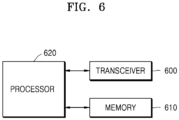
- FIG. 6 illustrates a configuration of a terminal according to an embodiment of the disclosure.
- the terminal may include a processor 620 controlling overall operations of the terminal, a transceiver 600 including a transmitter and a receiver, and a memory 610.
- the terminal is not limited to the above example, and may include more or fewer components than those illustrated in FIG. 6 .
- the transceiver 600 may transmit or receive a signal to or from network entities or other terminals.
- a signal transmitted to or from a network entity may include control information and data.
- the transceiver 600 may receive a signal via a radio channel and output the same to the processor 620, and transmit the signal output from the processor 620, via the radio channel.
- the processor 620 may control the terminal such that the terminal performs an operation of one of the above-described embodiments.
- the processor 620, the memory 610, and the transceiver 600 are not necessarily to be implemented as separate modules but may also be implemented as a single component, for example, in the form of a single chip.
- the processor 620 and the transceiver 600 may be electrically connected to each other.
- the processor 620 may be an application processor (AP), a communicator processor (CP), a circuit, an application-specific circuit, or at least one processor.
- AP application processor
- CP communicator processor
- the memory 610 may store data such as a basic program for operation of a terminal, an application program, setup information, or the like.
- the memory 610 provides stored data according to a request from the processor 620.
- the memory 610 may be configured in a storage medium, such as read-only memory (ROM), random access memory (RAM), a hard disk, compact disc-ROM (CD-ROM), or digital versatile disc (DVD), or a combination thereof.
- the memory 610 may be included by a plural number.
- the processor 620 may execute the above-described embodiments based on a program stored in the memory 610, the program being designed to perform the above-described embodiments of the disclosure.
- FIG. 7 illustrates a configuration of a network entity according to an embodiment of the disclosure.
- the network entity may include a processor 720 controlling overall operations of the network entity, a transceiver 700 including a transmitter and a receiver, and a memory 710.
- the network entity is not limited to the above example, and may include more or fewer components than those illustrated in FIG. 7 .
- the transceiver 700 may transmit or receive a signal to or from other network entities or at least one of terminals.
- the signal transmitted or received to or from the other network entities or at least one of the terminals may include control information and data.
- the processor 720 may control a network entity such that the network entity performs an operation of one of the above-described embodiments.
- the processor 720, the memory 710, and the transceiver 700 are not necessarily to be implemented as separate modules but may also be implemented as a single component, for example, in the form of a single chip.
- the processor 720 and the transceiver 700 may be electrically connected to each other.
- the processor 720 may be an AP, a CP, a circuit, an application-specific circuit, or at least one processor.
- the memory 710 may store data such as a basic program for operation of a network entity, an application program, setup information, or the like.
- the memory 710 provides stored data according to a request from the processor 720.
- the memory 710 may be configured in a storage medium, such as ROM, RAM, a hard disk, CD-ROM, or DVD, or a combination thereof.
- the memory 710 may be included by a plural number.
- the processor 720 may execute the above-described embodiments based on a program stored in the memory 710, the program being designed to perform the above-described embodiments of the disclosure.
- the operations of the base station or the terminal described above may be implemented by including a memory device storing relevant program codes, in an arbitrary element in the base station or the terminal device. That is, a controller of the base station or the terminal device may execute the above-described operations by reading the program codes stored in the memory device by using a processor or a central processing unit (CPU) and execute the same.
- a controller of the base station or the terminal device may execute the above-described operations by reading the program codes stored in the memory device by using a processor or a central processing unit (CPU) and execute the same.
- CPU central processing unit
- Various components and modules of an entity, a base station, or a terminal device described herein may also be operated using a hardware circuit, for example, a complementary metal oxide semiconductor-based logic circuit, firmware, or a combination of software and/or hardware or a combination of firmware and/or software embedded in a machine-readable medium.
- a hardware circuit for example, a complementary metal oxide semiconductor-based logic circuit, firmware, or a combination of software and/or hardware or a combination of firmware and/or software embedded in a machine-readable medium.
- various electrical structures and methods may be implemented using transistors, logic gates, and electrical circuits such as application-specific semiconductors.
- a computer-readable storage medium storing one or more programs (e.g., software modules) may be provided.
- the one or more programs stored in the computer-readable storage medium are configured to be executable by one or more processors in an electronic device.
- the one or more programs include instructions causing the electronic device to execute the methods according to embodiments of the disclosure as described the specification or in the following claims.
- the programs may be stored in RAM, non-volatile memory including flash memory, ROM, electrically erasable programmable read-only memory (EEPROM), a magnetic disc storage device, CD-ROM, a DVD, another type of optical storage device, or a magnetic cassette.
- the programs may be stored in a memory system including a combination of some or all of the above-mentioned memory devices.
- each memory device may be included by a plural number.
- the programs may also be stored in an attachable storage device which is accessible through a communication network such as the Internet, an intranet, a local area network (LAN), a wireless LAN (WLAN), or a storage area network (SAN), or a combination thereof.
- the storage device may be connected through an external port to an apparatus performing the embodiments of the disclosure.
- Another storage device on the communication network may also be connected to the apparatus performing the embodiments of the disclosure.
- a method of interworking between a 5G network system architecture providing a network slicing function and an EPS network system is provided, thereby efficiently providing a service in a mobile communication system.
Landscapes
- Engineering & Computer Science (AREA)
- Computer Networks & Wireless Communication (AREA)
- Signal Processing (AREA)
- Computer Security & Cryptography (AREA)
- Databases & Information Systems (AREA)
- Mobile Radio Communication Systems (AREA)
Applications Claiming Priority (2)
| Application Number | Priority Date | Filing Date | Title |
|---|---|---|---|
| KR1020190145983A KR20210058479A (ko) | 2019-11-14 | 2019-11-14 | 무선 통신 시스템에서 네트워크 슬라이스의 인터워킹을 제공하기 위한 장치 및 방법 |
| EP20207387.0A EP3826367B1 (de) | 2019-11-14 | 2020-11-13 | Vorrichtung und verfahren zur bereitstellung der zusammenarbeit von netzwerkscheiben gemäss nssaa in einem drahtlosen kommunikationssystem |
Related Parent Applications (2)
| Application Number | Title | Priority Date | Filing Date |
|---|---|---|---|
| EP20207387.0A Division-Into EP3826367B1 (de) | 2019-11-14 | 2020-11-13 | Vorrichtung und verfahren zur bereitstellung der zusammenarbeit von netzwerkscheiben gemäss nssaa in einem drahtlosen kommunikationssystem |
| EP20207387.0A Division EP3826367B1 (de) | 2019-11-14 | 2020-11-13 | Vorrichtung und verfahren zur bereitstellung der zusammenarbeit von netzwerkscheiben gemäss nssaa in einem drahtlosen kommunikationssystem |
Publications (2)
| Publication Number | Publication Date |
|---|---|
| EP4329351A2 true EP4329351A2 (de) | 2024-02-28 |
| EP4329351A3 EP4329351A3 (de) | 2024-06-12 |
Family
ID=73448836
Family Applications (2)
| Application Number | Title | Priority Date | Filing Date |
|---|---|---|---|
| EP24152180.6A Pending EP4329351A3 (de) | 2019-11-14 | 2020-11-13 | Vorrichtung und verfahren zur bereitstellung der zusammenarbeit von nssaaa-betreffenden netzwerk-slices in einem drahtlosen kommunikationssystem |
| EP20207387.0A Active EP3826367B1 (de) | 2019-11-14 | 2020-11-13 | Vorrichtung und verfahren zur bereitstellung der zusammenarbeit von netzwerkscheiben gemäss nssaa in einem drahtlosen kommunikationssystem |
Family Applications After (1)
| Application Number | Title | Priority Date | Filing Date |
|---|---|---|---|
| EP20207387.0A Active EP3826367B1 (de) | 2019-11-14 | 2020-11-13 | Vorrichtung und verfahren zur bereitstellung der zusammenarbeit von netzwerkscheiben gemäss nssaa in einem drahtlosen kommunikationssystem |
Country Status (5)
| Country | Link |
|---|---|
| US (2) | US11558910B2 (de) |
| EP (2) | EP4329351A3 (de) |
| KR (1) | KR20210058479A (de) |
| CN (1) | CN114731736B (de) |
| WO (1) | WO2021096222A1 (de) |
Families Citing this family (12)
| Publication number | Priority date | Publication date | Assignee | Title |
|---|---|---|---|---|
| WO2020153773A1 (en) * | 2019-01-22 | 2020-07-30 | Samsung Electronics Co., Ltd. | Device and method for providing network slice interworking in wireless communication system |
| KR20210058479A (ko) * | 2019-11-14 | 2021-05-24 | 삼성전자주식회사 | 무선 통신 시스템에서 네트워크 슬라이스의 인터워킹을 제공하기 위한 장치 및 방법 |
| US12317347B2 (en) * | 2020-04-27 | 2025-05-27 | Cisco Technology, Inc. | Optimized serving gateway node selection for interworking networks |
| WO2021261913A1 (en) * | 2020-06-23 | 2021-12-30 | Samsung Electronics Co., Ltd. | Apparatus and method for managing user plane function in wireless communication system |
| KR20220096499A (ko) | 2020-12-31 | 2022-07-07 | 삼성전자주식회사 | 무선 통신 시스템에서 시스템간 인터워킹 지원 방법 및 장치 |
| EP4072203B1 (de) * | 2021-02-16 | 2025-03-05 | Nokia Technologies Oy | Paketdaten-netzgateway (pgw) wiederauswahl für netzwerk slicing |
| US20240276350A1 (en) * | 2021-06-10 | 2024-08-15 | Telefonaktiebolaget Lm Ericsson (Publ) | Network slice admission control |
| MX2024000279A (es) * | 2021-06-30 | 2024-04-18 | Lenovo Singapore Pte Ltd | Aparatos, métodos y sistemas para el control de admisión de segmentos de red e interfuncionamiento 5gc-epc. |
| ES3034508T3 (en) * | 2022-05-13 | 2025-08-19 | Nokia Technologies Oy | Terminal device authorization for requesting analytics |
| WO2024147508A1 (ko) * | 2023-01-04 | 2024-07-11 | 삼성전자 주식회사 | 통신 네트워크에서 네트워크 슬라이스의 pdu 세션 수립을 지원하는 방법 및 장치 |
| WO2024234945A1 (en) * | 2023-05-15 | 2024-11-21 | Telefonaktiebolaget Lm Ericsson (Publ) | Method and apparatus for ue subscribed slice information exposure |
| WO2026035062A1 (ko) * | 2024-08-07 | 2026-02-12 | 삼성전자 주식회사 | 무선 통신 시스템에서 네트워크 슬라이스의 이용을 위한 통신 방법 및 장치 |
Family Cites Families (15)
| Publication number | Priority date | Publication date | Assignee | Title |
|---|---|---|---|---|
| WO2017218849A1 (en) * | 2016-06-15 | 2017-12-21 | Convida Wireless, Llc | Network slice discovery and selection |
| CN107580360A (zh) * | 2016-07-04 | 2018-01-12 | 中国移动通信有限公司研究院 | 一种网络切片选择的方法、设备及网络架构 |
| KR102184856B1 (ko) | 2016-08-22 | 2020-12-01 | 후아웨이 테크놀러지 컴퍼니 리미티드 | 네트워크 슬라이스 선택 방법 및 장치 |
| EP3544337B1 (de) * | 2016-11-18 | 2022-01-05 | LG Electronics Inc. | Auswahl eines amf, das eine netwerk-scheibe unterstützt, auf der basis der aktualisierten priorität der nssai |
| KR20210145318A (ko) * | 2017-03-20 | 2021-12-01 | 후아웨이 테크놀러지 컴퍼니 리미티드 | 베어러 식별자를 할당하기 위한 방법, 장치, 통신 시스템, 및 컴퓨터 판독가능 저장 매체 |
| EP3695649A4 (de) * | 2017-10-09 | 2020-10-14 | Telefonaktiebolaget LM Ericsson (publ) | Verfahren zur herstellung einer verbindung zur paketdatenübertragung einer drahtlosen kommunikationsvorrichtung |
| CN112312500A (zh) | 2017-10-16 | 2021-02-02 | 华为技术有限公司 | 会话建立方法、设备及系统 |
| US11026128B2 (en) * | 2017-10-19 | 2021-06-01 | Qualcomm Incorporated | Mechanism to enable interworking between network slicing and evolved packet core connectivity |
| US20190230556A1 (en) * | 2018-01-19 | 2019-07-25 | Electronics And Telecommunications Research Institute | Apparatus and method for network function profile management |
| WO2019145036A1 (en) * | 2018-01-25 | 2019-08-01 | Nokia Solutions And Networks Oy | Communication connection control procedure selecting a communication connection slice |
| CN113039825B (zh) * | 2018-11-16 | 2024-08-13 | 联想(新加坡)私人有限公司 | 用于无线通信的装置和方法 |
| WO2020104863A1 (en) * | 2018-11-19 | 2020-05-28 | Telefonaktiebolaget Lm Ericsson (Publ) | Selecting a network slice identifier |
| US10887806B2 (en) * | 2019-01-30 | 2021-01-05 | Verizon Patent And Licensing Inc. | System and method for supporting 5G user devices in a legacy wireless core network |
| US11032710B2 (en) * | 2019-02-15 | 2021-06-08 | Qualcomm Incorporated | Systems and methods of supporting device triggered re-authentication of slice-specific secondary authentication and authorization |
| KR20210058479A (ko) * | 2019-11-14 | 2021-05-24 | 삼성전자주식회사 | 무선 통신 시스템에서 네트워크 슬라이스의 인터워킹을 제공하기 위한 장치 및 방법 |
-
2019
- 2019-11-14 KR KR1020190145983A patent/KR20210058479A/ko active Pending
-
2020
- 2020-11-11 CN CN202080079303.0A patent/CN114731736B/zh active Active
- 2020-11-11 WO PCT/KR2020/015798 patent/WO2021096222A1/en not_active Ceased
- 2020-11-12 US US17/096,113 patent/US11558910B2/en active Active
- 2020-11-13 EP EP24152180.6A patent/EP4329351A3/de active Pending
- 2020-11-13 EP EP20207387.0A patent/EP3826367B1/de active Active
-
2023
- 2023-01-12 US US18/153,582 patent/US12114380B2/en active Active
Also Published As
| Publication number | Publication date |
|---|---|
| US20230145595A1 (en) | 2023-05-11 |
| KR20210058479A (ko) | 2021-05-24 |
| WO2021096222A1 (en) | 2021-05-20 |
| EP3826367B1 (de) | 2024-02-21 |
| US12114380B2 (en) | 2024-10-08 |
| US11558910B2 (en) | 2023-01-17 |
| EP3826367A1 (de) | 2021-05-26 |
| CN114731736B (zh) | 2025-02-18 |
| EP4329351A3 (de) | 2024-06-12 |
| CN114731736A (zh) | 2022-07-08 |
| US20210153268A1 (en) | 2021-05-20 |
Similar Documents
| Publication | Publication Date | Title |
|---|---|---|
| US12114380B2 (en) | Apparatus and method for providing interworking of network slices in wireless communication system | |
| US11818652B2 (en) | Method and apparatus for selecting network slices in wireless communication system | |
| US11844018B2 (en) | Method and apparatus for providing service in wireless communication system | |
| US12225491B2 (en) | Method and apparatus for registration and protocol data unit session establishment for onboarding of user equipment in mobile communication system | |
| EP4142377B1 (de) | Verfahren und vorrichtung zum abrufen und auswählen eines servers zur endgeräteauthentifizierung und teilnehmerdatenübertragung | |
| JP7720328B2 (ja) | ユーザサブスクリプションデータをプロビジョニングするための接続性を提供するネットワークを発見及び選択する方法及び装置 | |
| US20230135667A1 (en) | Method and apparatus for providing network slice in wireless communication system | |
| CN113728675B (zh) | 用于在无线通信系统中处理服务策略的设备和方法 | |
| EP4048001B1 (de) | Paging-verfahren und vorrichtung in einem drahtloskommunikationssystem | |
| US11582677B2 (en) | Method and apparatus for terminating cellular network connection of unauthenticated terminal | |
| CN115669081A (zh) | 发现和选择用于供应ue订户数据的网络的方法和装置 | |
| US11902837B2 (en) | Method and apparatus for providing voice service to user equipment in hybrid mobile communication system | |
| US20240373220A1 (en) | Method and apparatus for authenticating user equipment in wireless communication system | |
| KR102857556B1 (ko) | 무선 통신 시스템에서 네트워크 슬라이스의 인터워킹을 제공하기 위한 장치 및 방법 | |
| EP4132099B1 (de) | Verfahren und vorrichtung zur verbesserung der qualität eines mediendienstes | |
| KR20210054967A (ko) | 무선통신 시스템에서 네트워크 슬라이스를 관리하는 방법 및 장치 | |
| KR20250113303A (ko) | 무선 통신 시스템에서 동적인 네트워크 슬라이스 선택 방법 및 장치 | |
| KR20230073737A (ko) | 무선 통신 시스템에서 단말의 자격 증명 정보를 프로비저닝하는 방법 및 장치 |
Legal Events
| Date | Code | Title | Description |
|---|---|---|---|
| PUAI | Public reference made under article 153(3) epc to a published international application that has entered the european phase |
Free format text: ORIGINAL CODE: 0009012 |
|
| STAA | Information on the status of an ep patent application or granted ep patent |
Free format text: STATUS: THE APPLICATION HAS BEEN PUBLISHED |
|
| AC | Divisional application: reference to earlier application |
Ref document number: 3826367 Country of ref document: EP Kind code of ref document: P |
|
| AK | Designated contracting states |
Kind code of ref document: A2 Designated state(s): AL AT BE BG CH CY CZ DE DK EE ES FI FR GB GR HR HU IE IS IT LI LT LU LV MC MK MT NL NO PL PT RO RS SE SI SK SM TR |
|
| REG | Reference to a national code |
Ref country code: DE Ref legal event code: R079 Free format text: PREVIOUS MAIN CLASS: H04W0012080000 Ipc: H04W0048180000 |
|
| PUAL | Search report despatched |
Free format text: ORIGINAL CODE: 0009013 |
|
| AK | Designated contracting states |
Kind code of ref document: A3 Designated state(s): AL AT BE BG CH CY CZ DE DK EE ES FI FR GB GR HR HU IE IS IT LI LT LU LV MC MK MT NL NO PL PT RO RS SE SI SK SM TR |
|
| RIC1 | Information provided on ipc code assigned before grant |
Ipc: H04W 12/08 20210101ALN20240506BHEP Ipc: H04W 12/06 20210101ALN20240506BHEP Ipc: H04W 48/18 20090101AFI20240506BHEP |
|
| STAA | Information on the status of an ep patent application or granted ep patent |
Free format text: STATUS: REQUEST FOR EXAMINATION WAS MADE |
|
| 17P | Request for examination filed |
Effective date: 20241212 |
|
| STAA | Information on the status of an ep patent application or granted ep patent |
Free format text: STATUS: EXAMINATION IS IN PROGRESS |
|
| 17Q | First examination report despatched |
Effective date: 20260226 |