EP4330107B1 - Planification de mouvement - Google Patents
Planification de mouvement Download PDFInfo
- Publication number
- EP4330107B1 EP4330107B1 EP22726458.7A EP22726458A EP4330107B1 EP 4330107 B1 EP4330107 B1 EP 4330107B1 EP 22726458 A EP22726458 A EP 22726458A EP 4330107 B1 EP4330107 B1 EP 4330107B1
- Authority
- EP
- European Patent Office
- Prior art keywords
- ego
- agent
- action
- reward
- behaviours
- Prior art date
- Legal status (The legal status is an assumption and is not a legal conclusion. Google has not performed a legal analysis and makes no representation as to the accuracy of the status listed.)
- Active
Links
Images






Classifications
-
- B—PERFORMING OPERATIONS; TRANSPORTING
- B60—VEHICLES IN GENERAL
- B60W—CONJOINT CONTROL OF VEHICLE SUB-UNITS OF DIFFERENT TYPE OR DIFFERENT FUNCTION; CONTROL SYSTEMS SPECIALLY ADAPTED FOR HYBRID VEHICLES; ROAD VEHICLE DRIVE CONTROL SYSTEMS FOR PURPOSES NOT RELATED TO THE CONTROL OF A PARTICULAR SUB-UNIT
- B60W60/00—Drive control systems specially adapted for autonomous road vehicles
- B60W60/001—Planning or execution of driving tasks
- B60W60/0011—Planning or execution of driving tasks involving control alternatives for a single driving scenario, e.g. planning several paths to avoid obstacles
-
- G—PHYSICS
- G06—COMPUTING OR CALCULATING; COUNTING
- G06F—ELECTRIC DIGITAL DATA PROCESSING
- G06F30/00—Computer-aided design [CAD]
- G06F30/20—Design optimisation, verification or simulation
-
- B—PERFORMING OPERATIONS; TRANSPORTING
- B60—VEHICLES IN GENERAL
- B60W—CONJOINT CONTROL OF VEHICLE SUB-UNITS OF DIFFERENT TYPE OR DIFFERENT FUNCTION; CONTROL SYSTEMS SPECIALLY ADAPTED FOR HYBRID VEHICLES; ROAD VEHICLE DRIVE CONTROL SYSTEMS FOR PURPOSES NOT RELATED TO THE CONTROL OF A PARTICULAR SUB-UNIT
- B60W30/00—Purposes of road vehicle drive control systems not related to the control of a particular sub-unit, e.g. of systems using conjoint control of vehicle sub-units
- B60W30/18—Propelling the vehicle
- B60W30/18009—Propelling the vehicle related to particular drive situations
- B60W30/18163—Lane change; Overtaking manoeuvres
-
- B—PERFORMING OPERATIONS; TRANSPORTING
- B60—VEHICLES IN GENERAL
- B60W—CONJOINT CONTROL OF VEHICLE SUB-UNITS OF DIFFERENT TYPE OR DIFFERENT FUNCTION; CONTROL SYSTEMS SPECIALLY ADAPTED FOR HYBRID VEHICLES; ROAD VEHICLE DRIVE CONTROL SYSTEMS FOR PURPOSES NOT RELATED TO THE CONTROL OF A PARTICULAR SUB-UNIT
- B60W60/00—Drive control systems specially adapted for autonomous road vehicles
- B60W60/001—Planning or execution of driving tasks
- B60W60/0013—Planning or execution of driving tasks specially adapted for occupant comfort
-
- B—PERFORMING OPERATIONS; TRANSPORTING
- B60—VEHICLES IN GENERAL
- B60W—CONJOINT CONTROL OF VEHICLE SUB-UNITS OF DIFFERENT TYPE OR DIFFERENT FUNCTION; CONTROL SYSTEMS SPECIALLY ADAPTED FOR HYBRID VEHICLES; ROAD VEHICLE DRIVE CONTROL SYSTEMS FOR PURPOSES NOT RELATED TO THE CONTROL OF A PARTICULAR SUB-UNIT
- B60W60/00—Drive control systems specially adapted for autonomous road vehicles
- B60W60/001—Planning or execution of driving tasks
- B60W60/0015—Planning or execution of driving tasks specially adapted for safety
-
- B—PERFORMING OPERATIONS; TRANSPORTING
- B60—VEHICLES IN GENERAL
- B60W—CONJOINT CONTROL OF VEHICLE SUB-UNITS OF DIFFERENT TYPE OR DIFFERENT FUNCTION; CONTROL SYSTEMS SPECIALLY ADAPTED FOR HYBRID VEHICLES; ROAD VEHICLE DRIVE CONTROL SYSTEMS FOR PURPOSES NOT RELATED TO THE CONTROL OF A PARTICULAR SUB-UNIT
- B60W2554/00—Input parameters relating to objects
- B60W2554/40—Dynamic objects, e.g. animals, windblown objects
- B60W2554/404—Characteristics
- B60W2554/4046—Behavior, e.g. aggressive or erratic
-
- B—PERFORMING OPERATIONS; TRANSPORTING
- B60—VEHICLES IN GENERAL
- B60W—CONJOINT CONTROL OF VEHICLE SUB-UNITS OF DIFFERENT TYPE OR DIFFERENT FUNCTION; CONTROL SYSTEMS SPECIALLY ADAPTED FOR HYBRID VEHICLES; ROAD VEHICLE DRIVE CONTROL SYSTEMS FOR PURPOSES NOT RELATED TO THE CONTROL OF A PARTICULAR SUB-UNIT
- B60W2556/00—Input parameters relating to data
- B60W2556/45—External transmission of data to or from the vehicle
Definitions
- the present invention pertains to motion planning techniques suitable for mobile robots.
- AVs Autonomous vehicles
- AVs navigating roads in the presence of other road users have a requirement to plan actions so as to minimise the probability of catastrophic events such as collisions.
- an AV needs to predict the actions of other road users ('agents').
- One example method for predicting external agent behaviour uses goal recognition, which determines, based on an observed trajectory of an agent, a goal, which may be deterministic or alternatively sampled from a probabilistic goal distribution, for that agent, and predicts a trajectory for that agent towards the sampled goal. Selected actions of the AV can be assessed against the predictions by simulating the AV and external agent behaviours.
- UAV unmanned autonomous vehicle
- UAV unmanned autonomous vehicle
- the Monte Carlo Tree Search algorithm of Albrecht et al. first samples a current maneuver for the non-ego agents of the given scenario, and then samples possible goals of the agents of the scene from a set of possible goals, with the sampling based on a framework of rational inverse planning applied to the current state of the system and the current maneuver. For the sampled goal, a predicted trajectory for each agent is sampled from a distribution over possible agent trajectories (or behaviours).
- An action may be selected for the ego vehicle from a set of possible ego actions.
- 'Macro' actions comprising multiple maneuvers may be selected and simulated for the ego vehicle, with external agents following their sampled trajectories until the end of the macro action. Rewards are received for each selected action based on the outcome of the simulation.
- the method is also summarized in Brewitt et al. "Autonomous Driving with Interpretable Goal Recognition and Monte Carlo Tree Search" (XP002807268).
- the reward is based on trajectory execution time, longitudinal and lateral jerk, path curvature and safety distance to leading vehicle.
- An upper confidence bound exploration technique (UCB1) is used to select an ego macro action for each simulation. UCB1 biases the search towards ego trajectories with the highest reward, prioritizing regions of the search space that are most promising with respect to the aforementioned reward criteria.
- Forward-simulation of trajectories uses a combination of proportional control and adaptive cruise control to control a vehicle's acceleration and steering.
- Patent document DE112018005774 teaches to a prediction method for moving objects that uses two predictors, the first trained by supervised learning to predict a future behaviour of a moving object, and the second trained by reinforcement learning to predict rare behaviours.
- Patent document EP-A-3789920 notes, in the context of perception testing, that outlier perception outputs may cause or contribute to unsafe behaviour.
- the present invention pertains generally to the planning of ego actions, in the presence of at least one agent.
- certain existing motion planning methods use a probabilistic search method (e.g. Monte Carlo Tree Search) to explore different possible futures.
- an ego action is selected in each step and possible outcomes of that action are simulated to assess the suitability of that ego action (e.g. whether or not that ego action and that agent behaviour result in a collision).
- There is typically uncertainty in the future behaviour of the agent(s) which can be accommodated by sampling the possible agent behaviour from an appropriate distribution encoding that uncertainty.
- different possible ego actions are selected, and different possible agent behaviours are explored for each ego action in simulation, with the aim of selecting some optimal ego action once all steps have completed.
- each non-ego trajectory is sampled according to a probability distribution computed via goal-based prediction.
- a particular ego (macro-)action may be rewarded relatively highly overall, when assessed against the non-ego trajectories that happened to be sampled in those initial simulations.
- further simulations may result in the sampling of less likely non-ego trajectories that result in much less favourable outcomes for that ego action, and therefore a lower overall reward, eventually pushing the search towards other ego action(s).
- the risk is that, ultimately, a non-optimal ego action is selected.
- One way to reduce that risk would be to increase the number of simulations and the number of other agent behaviours are sampled, at the expense of increased computational resource requirements.
- An aim herein is to provide a given level of robustness to high risk but low probability agent behaviours, but with a reduced number of steps (and thus reduced computational resources) compared to existing methods.
- a first aspect of the invention provides a computer-implemented method of planning ego actions for a mobile robot in the presence of at least one dynamic agent, the method comprising:
- the search remains biased towards the most promising ego actions; however this is counterbalanced by the biasing of the agent behaviours towards the most 'pessimistic' outcomes. This reduces the number of possible other agent behaviours that need to be considered in order to achieve a minimum level of robustness.
- the described embodiments implement the method based on risk-aware sampling of probability distribution(s) defined over possible behaviours of one or more other agents.
- the selection of ego action and the selection of agent behaviours may be based on the same reward metric, or different reward metrics.
- the agent distribution may be based on rewards considering only collision risk while the ego actions may be selected based on rewards considering other factor(s) such as comfort and/or progress towards a defined goal.
- a combination of multiple metrics could be used.
- Each agent behaviour may be associated with an agent-ego risk score specific to the selected ego action, and the selection of the agent behaviour may be biased towards riskier behaviour(s) according to the agent-ego risk scores specific to the selected ego action, the agent-risk score for each agent behaviour and ego action being updated based on further selection and simulation of that agent behaviour and that ego action in the later search steps.
- the selection of the ego action may be biased towards higher reward ego action(s) based on an ego score, the ego score being updated based on further selection and simulation of that ego action in the later search steps.
- a lower confidence bound of the ego score may be used to bias the selection of ego actions towards those actions which were selected less often in previous search steps.
- An upper confidence bound of the agent-ego risk score may be used to bias the selection of agent behaviours towards those behaviours which were selected less often in previous search steps.
- the selection of the agent behaviour may comprise sampling a behaviour from an importance distribution over the set of possible agent behaviours, the importance distribution biased such that riskier behaviours are more likely to be sampled.
- the method may further comprise determining a prediction distribution over possible agent behaviours, wherein the importance distribution is based on the prediction distribution and the agent-ego risk scores for the set of possible agent behaviours.
- Different rewards may be assigned, in different search steps, to the same ego action for the same sampled agent behaviour, as a consequence of prediction uncertainty and/or perception uncertainty.
- the reward may additionally depend on a further ego action selected in the search step and/or a further agent behaviour sampled in the search step, whereby different rewards may be assigned, in different search steps, to the same ego action for the same sampled agent behaviour as a consequence of selecting different further ego actions and/or sampling different further agent behaviours.
- the reward may be assigned based on backpropagation.
- the selection of the ego action in the selection step may be biased towards ego actions observed more often in the search steps, by minimising an upper confidence bound of a risk score based on the computed reward(s) for that ego action.
- the method may further comprise providing the chosen ego action, to a controller and generating, by the controller, a control signal for implementing the chosen ego action, wherein the control signal is inputted to an actor system of a mobile robot or a vehicle dynamics model for modelling a response of a mobile robot to the control signal in simulation.
- the agent-ego risk score and the ego score may each be updated based on the same reward.
- the agent-ego risk score may be updated based on a first reward computed using a first reward metric and the ego score may be updated based on a second reward computed using a second reward metric.
- the first reward metric may measure at least collision risk
- the second reward metric may measure at least one additional factor such as comfort or progress towards a defined goal.
- Batch updates may be applied to the ego score, each batch update taking into account multiple search steps
- risk of agent behaviours may be assessed solely or partially on collision risk (risk of a collision outcome between the ego agent and the other agent).
- other factor(s) such as comfort or progress
- Those other factor(s) may or may not be considered when evaluating the riskiness of agent behaviours. For example, distributions over the behaviours of the other agent(s) may be affected by the collision risk posed to the ego agent.
- a second aspect of the invention provides a computer system comprising one or more computers configured to implement any of the methods disclosed herein.
- the computer system may be embodied in a mobile robot and coupled to a sensor system and actor system of the mobile robot.
- the one or more computers may be configured to implement:
- a second aspect of the invention provides a computer program for programming a computer system to implement any of the methods disclosed herein.
- a prediction component of an AV system may determine, as a prediction output, a probability distribution over a set of possible agent trajectories.
- ego actions may be assessed against probabilistic predictions by sampling this distribution over possible agent behaviours and evaluating the ego vehicle actions in simulations with the sampled agent behaviour to determine a 'best' action according to some predefined criteria.
- references to an ego 'action' may refer to ego planning at multiple levels of granularity. For example, an action may be chosen to follow a lane with a given acceleration value for a short period of time. Alternatively, an ego action may represent a full maneuver of the ego vehicle such as a lane change. In the following description, an ego action here refers to a decision point for an ego vehicle in the context of planning. The actions of the ego vehicle may be also referred to herein as 'decisions'. In the below description an 'agent behaviour' refers to a possible observed trajectory of the agent. In simulation, where the same agent behaviour may be selected over multiple iterations (search steps), the actual state of the agent which is evaluated against the given ego action may vary over these iterations due to uncertainty in perception.
- 'importance' refers to those behaviours which have the biggest effect on the scenario based on some reward metric.
- Rewards are typically defined to reward safe driving and penalise driving that results in adverse outcomes such as collisions, but rewards may also incorporate other factors such as progress and comfort.
- Rewards may be computed based on a variety of metrics that can be computed for a given scenario, including velocity, acceleration and/or jerk of an ego vehicle, as well as distances between an ego vehicle and other agents of the scenario. Given the requirement for AVs to comply with strict safety regulations, it is important that the planner is aware of potentially catastrophic outcomes before choosing an ego action.
- An important problem is to find a way of sampling predicted agent behaviours within a fixed planning budget such that those behaviours that are likely to lead to catastrophic events are more likely to be sampled, so that the planner is 'aware' of the dangerous outcomes of potential ego actions before making a planning decision.
- the ego planner may never encounter, for a given ego action, a predicted agent behaviour that leads to an adverse event. The expected reward for this action would therefore be high. This may cause the ego planner to choose this as a next action.
- agent behaviours that are rare according to the prediction distribution, but for which the given action may lead to a catastrophic event. The planner cannot take these rare events into consideration if they are not encountered during sampling, and thus the planner makes decisions without knowledge of many negative potential outcomes.
- the prediction distribution as computed by a prediction component may also be referred to herein as the 'natural' distribution over agent behaviours.
- an ego planner may simply characterise this action as a good one without exploring the outcomes of other actions.
- Exploration in this context refers to sampling a wide range of ego actions and agent behaviours and assessing each combination. While exploration enables the system to find a more optimal solution, undirected exploration of actions would lead to significant use of resources on ego actions that are known to lead to worse outcomes.
- Effective search strategies typically employ a combination of exploration and exploitation.
- the described embodiments provide a method of planning and prediction for autonomous vehicles that samples agent behaviours in a risk-aware way.
- an ego action is chosen to minimise an estimated risk resulting from that action, and a predicted behaviour for external agents is sampled from a 'risk-aware' distribution such that agent behaviours that contribute more to the expected risk of an action according to the given risk measure are more likely to be selected.
- the risk-aware distribution over agent behaviours is dependent on how often each given behaviour has been sampled before, where those behaviours which have been sampled less often are adjusted so that they are more likely to be sampled in future. This is to encourage the system more towards exploration of different outcomes.
- the method described below has the advantage that it makes the ego planner more robust to noise and uncertainty in perception and prediction, as errors due to uncertainty and noise in observations can be modelled and considered in planning decisions, while maintaining a budget on planning resources.
- Ego motion is planned based on probabilistic predictions of agent behaviours with an awareness of potential risk to the ego vehicle according to a defined risk measure.
- Figure 1 shows a schematic block diagram of components of an autonomous vehicle stack.
- the stack comprises one or more sensors 100, a perception module 102, a prediction module 104, a planner 106, and a controller 108.
- the perception module 102 receives sensor outputs from sensors 100 of the AV.
- the sensor system 100 can take different forms but generally comprises a variety of sensors such as image capture devices (cameras/optical sensors), LiDAR and/or RADAR unit(s), satellite-positioning sensor(s) (GPS etc.), motion sensor(s) (accelerometers, gyroscopes etc.) etc., which collectively provide rich sensor data from which it is possible to extract detailed information about the surrounding environment and the state of the AV and any external actors (vehicles, pedestrians, cyclists etc.) within that environment.
- image capture devices cameras/optical sensors
- LiDAR and/or RADAR unit(s) satellite-positioning sensor(s) (GPS etc.)
- GPS etc. satellite-positioning sensor(s)
- motion sensor(s) accelerelerometers, gyroscopes etc.
- the sensor outputs typically comprise sensor data of multiple sensor modalities such as stereo images from one or more stereo optical sensors, LiDAR, RADAR etc.
- the perception module 102 comprises multiple perception components, for example an object detection component 114 and localisation component 116, which co-operate to interpret the sensor outputs and thereby provide perception outputs to the prediction module 104.
- an object detection component 114 and localisation component 116 which co-operate to interpret the sensor outputs and thereby provide perception outputs to the prediction module 104.
- the perception outputs from the perception module 102 are used by the prediction module 104 to predict future behaviour of the non-ego agents of the scene.
- the prediction module 104 may, for example, compute a probability distribution over possible agent behaviours at a given time, given a set of perception outputs capturing the past behaviour of the agents. This probability distribution may take into account uncertainty in the perception output due to sensor errors or noise.
- Methods for determining a distribution over agent behaviours may consider agent goals based on scenario information. These will not be described in detail herein. Examples of such methods are described, for example, in Albrecht et al. 'Interpretable Goal-based Prediction and Planning for Autonomous Driving'.
- Predictions computed by the prediction module 104 are provided to the planner 106, which uses the predictions to make autonomous driving decisions to be executed by the AV in a way that takes into account the predicted behaviour of the external actors.
- the planner 106 comprises an action search component 120 which searches for a next ego action and a simulation component 110 which simulates the searched ego actions and samples a set of behaviours for other agents in the given scene from a distribution received from the prediction module 104, and evaluates the simulated ego actions at any given time against the sampled agent behaviours using one or more metrics to determine a best action 112.
- the simulation component continuously feeds back the evaluated risk metrics to the action search component 120 to guide the searches at subsequent iterations (search steps) towards exploring the most useful ego actions according to a given risk metric, described in more detail later.
- a route planner 122 provides a goal for the ego vehicle towards which its actions should be planned.
- the planner 106 aims to determine an ego action or sequence of ego actions to achieve a goal specified by the route planner 122 in a substantially optimal manner.
- a method of determining a 'best' ego action may consider metrics relating to progress towards the given goal as well as metrics relating to safety, comfort and/or other factors. Possible factors to be considered in determining a best ego action are discussed in more detail later.
- a controller module 108 which executes the decisions taken by the planner 106 by providing suitable control signals to on-board motors of the AV.
- the planner 106 plans actions to be taken by the AV and the controller 108 generates control signals in order to execute those actions.
- An actor system 118 receives the control signals from the controller 108 and maneuvers the vehicle to execute the actions selected by the planner.
- the actor system 118 may, for example, comprise drive-by-wire steering motors, and a throttle and brake control system.
- Figure 2 shows an example driving scenario in which an ego vehicle 200 is travelling along a road in one lane and an external agent 202 is driving behind the ego vehicle in a neighbouring lane.
- Figure 2 shows an example set of decisions that are possible for the ego vehicle at the current time step.
- One possible action for the ego vehicle is to maintain the same course, as shown by the straight arrow 212 ahead.
- a second possible action is to maneuver into the neighbouring lane, denoted by the arrow 214.
- the set of actions available to the ego vehicle at any given time may be determined by a trajectory generator which evaluates the layout of the scenario including the ego vehicle and other agents and assesses what actions are possible within the physical constraints of the scenario. This trajectory generator does not analyse possible actions or agent behaviours beyond physical feasibility.
- the planner 106 uses this set of agent behaviours and ego actions as the space to explore and evaluate in order to decide a next ego action.
- the ego planner 106 must also take into account safety considerations involving the agent 202.
- the agent is shown as having two possible behaviours as provided by the trajectory generator. According to one possibility, the agent continues along its current path at the same speed, as shown by the long arrow 216 indicating the distance covered within a fixed time period from the current time. According to a second possibility, the agent continues along its current path and decelerates, as shown by the shorter arrow 214 in Figure 2 .
- the prediction module 104 determines, based on perceived behaviours of the agent 202 up to the given time point, a prediction for the agent, which may be in the form of a probability distribution over the possible behaviours. In this simplified case, there are two possible behaviours of the agent, so a distribution over these two possibilities would assign a probability value to each behaviour.
- the planner may then use this probability distribution over predicted trajectories to assess each ego action, by sampling trajectories from the distribution and evaluating potential ego actions for each sampled trajectory using a reward function.
- the reward function may be based on one or more metrics which may be computed for the state of the ego vehicle and its environment for the chosen action, such as the distance of the vehicle to other agents, and/or metrics evaluating the ego vehicle's progress towards a goal. Rewards may be defined and computed in multiple ways, and possible reward functions will be discussed in more detail below.
- the reward for the same ego action and external agent behaviours may differ to account for uncertainty in perception and/or localisation, such that simulating the same ego action and agent behaviour multiple times yields different results.
- the methods described below may be applied to a variety of driving scenarios involving an ego vehicle and one or more external agents. These methods are particularly useful in cases where external agents have multiple distinct possible goals. These include, for example: roundabout merging, where agents on the roundabout have multiple possible exits, junction handling, in which agents have multiple roads they can take, and highway merging, where agents can switch lanes.
- a simulated ego action may be evaluated against a set of sampled agent behaviours from a prediction distribution, and it may be found to lead to positive outcomes according to some reward metric for those sampled behaviours, even if there are some unsampled agent behaviours for which that ego action is likely to lead to an adverse event such as a collision. Because the planner is 'unaware' of these agent behaviours, not having sampled them, the ego action may be chosen as the best possible action and the ego vehicle may begin a maneuver which is potentially dangerous. For safety, any risk of collision should be weighted heavily in planning decisions and therefore awareness of those actions which may lead to adverse outcomes is important. Under limited resources, this may be achieved by increasing the likelihood of sampling those agent behaviours that can lead to adverse outcomes.
- agent behaviours for evaluation by a planner 106 such that behaviours that are high-risk according to some risk measure are prioritised in sampling.
- the below description explains how agent behaviours may be sampled from an importance distribution which prioritises a given risk measure.
- the predicted agent behaviours determined by the prediction stack 104 may be based on a goal determined for the given agent.
- the agent goal may be sampled from an importance distribution. Therefore, either or both of agent goals and agent behaviours may be sampled from an importance distribution.
- risk is assessed from an ego agent's perspective, and relates to the concept of "rewards” in planning: the planner 106 aims to find a high reward ego action, and a "risky" agent behaviour is an agent behaviour more likely to result in a lower reward for a given ego action.
- risk does not necessarily imply a narrow consideration of collision risk, and can refer more generally to any undesired outcome (and can encompass other factors such as comfort and/or progress, in addition to or instead of collision risk).
- risk is assessed in respect of ego action-agent behaviour pairs, over the course of multiple search steps.
- an agent behaviour represents the behaviour of a single agent of a scene.
- an agent behaviour may define the behaviour of more than one agent, and various behaviours comprising combinations of agent actions for the multiple agents of the scene may be assessed for the given ego action.
- an ego action is generally denoted by index i whilst an agent behaviour is generally denoted by index j, with risk evaluated in respect of a given i , j pairing.
- an issue with the 'natural' predicted distribution over agent behaviours, determined by a prediction module 104 based on received perception outputs, is that within a limited sampling budget, rare agent behaviours that lead to adverse events may not be encountered during sampling, which may lead the planner to select an ego action that is potentially dangerous.
- the planner can instead sample from a different distribution, defined such that the more 'important' agent behaviours are more likely, where 'important' is defined herein to refer to behaviours which are 'riskier' according to a defined risk measure. This technique may be referred to generally as 'importance sampling'. Importance sampling will first be described for the example case of sampling agent behaviours for planning ego actions, to illustrate the concept as it applies to planning in an AV stack. More specific implementations of this concept in the context of the present invention are described later.
- Figure 3A shows a graph illustrating how an expected value for a function F, which may be, for example, a risk measure of the given agent behaviour for the ego action being evaluated.
- a function F which may be, for example, a risk measure of the given agent behaviour for the ego action being evaluated.
- an expected value of the risk is estimated by sampling from a distribution P over agent behaviours and computing the risk for each sampled behaviour.
- the function F is shown in dashed lines.
- Figure 3A shows that the function is very low across most of the behaviour distribution, and increases significantly towards a tail of the behaviour distribution. This indicates that a subset of behaviours that are unlikely according to the 'natural' behaviour distribution P contribute significantly to the expected value for the function F. If, for example, the function F represents some measure of the risk of adverse events, this leads to the problem pointed out above of sampling under a fixed budget.
- Figure 3B shows the principle of importance sampling, where a new distribution Q over behaviours is defined which is sampled from in order to estimate an expected value for the function F.
- This distribution Q shown in Figure 3B is chosen such that sampling from Q results in sampling more instances for which the function F takes large values.
- the expected value of a function F under the distribution Q is not equal to the expected value of the same risk function under the 'natural' distribution P, which in our example is a value characterising some risk measure of a given ego action. This is because riskier behaviours are over-represented in the distribution Q , leading to a biased estimation of the overall risk.
- the function F is described as a measure of risk of adverse events.
- the same principle applies to estimating a reward function for each ego action, where it is important to adequately sample from those behaviours that lead to minimal rewards.
- 'risk' refers to a measure of loss of reward, which can be derived from a reward function.
- Example planning methods described later use a distribution Q which is adapted according to the risk seen in sampled behaviours, rather than defining a static distribution Q for each ego action.
- the risk being estimated is not a deterministic function of behaviours which is known in advance. Instead, the function F is learned during planning and/or is non-deterministic.
- the risk function may be based on a reward computed from a simulation of possible vehicle behaviours in a scenario, with the simulation taking uncertainty in perception and/or localisation into account.
- the planner uses predicted agent behaviours to make ego decisions by assessing the future outcomes resulting from said actions against one or more metrics.
- the planner may predict multiple steps into the future, at each step evaluating possible ego actions against predicted agent behaviours. This multi-step exploration of possible ego actions and different predicted agent behaviours may be carried out using a Monte Carlo Tree Search algorithm. Predicting multiple 'steps' into the future may make the planner more efficient at reaching the ego goals by making more long-term decisions rather than making decisions that appear optimal in the short-term. Note that, as mentioned above, a single 'step' may represent actions having different levels of granularity.
- each step or node of a Monte Carlo tree may represent a 'macro' action of the ego vehicle representing a larger maneuver which comprises many smaller actions such as changes in direction, velocity and acceleration.
- the ego action and agent behaviour each represent some subsection of a trajectory, which can be of any size.
- the planning of a next ego action can occur at any time, and planning may, for example, be initiated at regular time intervals.
- Each instance at which the planner is called to carry out the steps described herein to plan a next ego action may be referred to herein as a 'planning step'.
- the planner may confine the search over future actions and behaviours to some fixed depth, computing a reward based on metrics computed for each possible ego action at a given timestep based on the predicted agent behaviours and future actions computed only for the fixed number of steps into the future.
- a planning scheme which considers only the immediate next action of the ego vehicle and the next behaviour of the external agents of the scenario in order to compute a reward may be formulated as a multi-armed bandit to allocate planning resources to explore the ego actions with the best outcomes as much as possible before making a decision.
- a simple version of the multi-armed bandit problem may be defined as follows.
- An agent has to choose from among a number of choices with the goal of maximising a reward, but the agent is not initially aware of the potential loss or reward of each choice.
- the agent has some limit on time or resources so that it cannot exhaustively test the rewards or losses received for each choice.
- Each choice or 'arm' has an associated distribution representing the rewards received by opting for that arm.
- a single arm is chosen, and a reward is collected from the distribution associated with that arm.
- the system may have no knowledge of the rewards available from each arm. As rewards are received at each arm, the system builds some knowledge of the rewards associated with each arm, and determine an estimated value for that arm.
- the goal of the multi-armed bandit problem is to maximise the total rewards collected for the given budget of iterations.
- the term 'agent' as used above in the context of the definition of a multi-armed bandit problem is a general term for a decision-making entity, and not to be confused with the external agents of a driving scenario described elsewhere herein.
- the above-described formulation may be applied to choosing ego actions by a planner to be evaluated against predicted agent behaviours. In this case, it is useful for the planner to assess ego actions that lead to high rewards, such that resources are not wasted evaluating ego actions that are risky.
- the reward for each action depends also on the behaviour of other agents of the scene.
- the planner needs to learn how to make the best choice of ego action in the context of the predicted behaviour of other agents of the scene.
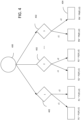
- Figure 4 shows an example graph showing a multi-armed bandit scheme for planning actions of an ego vehicle at a timestep t.
- a central node 400 at a top layer represents the current state of the scenario, with a number of branches or arms from this node representing possible ego actions as determined by a trajectory planner based on the physical constraints of the scenario in its current state.
- the planner may select an arm according to a policy that minimises a current estimate of a risk measure for that arm at each of multiple iterations while inside a planning budget. This policy and risk measure will be described in more detail later.
- the prediction of agent behaviours may be sampled, where ego behaviours 402 are shown as nodes in the second level of Figure 4 .
- agent behaviours may be sampled from a different distribution Q to the 'natural' distribution P obtained from the prediction module 104.
- Q may be chosen such that behaviours leading to an increased risk measure are more likely.
- a reward is then observed for the given ego action and sampled agent behaviour.
- the rewards are determined by simulating the selected ego action and agent behaviour, and may vary for the same agent and ego behaviours due to perception uncertainty. For example, the actual state of the agent is subject to errors in perception, so the same sampled agent behaviour can result in different agent trajectories in simulation, leading to different possible rewards. Sources of uncertainty affecting the observed rewards are described in more detail later.
- the rewards may be represented as an uncertainty distribution 404, as shown in the third level of Figure 4 . However, it is important to note that the underlying distribution over rewards is not known during planning.
- the received reward r i is used to update the estimated risk measure for the given ego action.
- a single reward value is observed for each simulation, and ego actions and agent behaviours are both selected based on the same risk measure.
- the risk measure used to select ego action i at each step may be different to the risk measure used to determine the distribution Q from which the agent behaviours are sampled.
- the rewards received at each iteration of the above planning algorithm may comprise a set of multiple reward metrics, and different risk measures may be defined based on these reward metrics.
- agent behaviours may be sampled in a way that is only concerned about collision risk to the ego vehicle, where ego actions may be selected such that other factors such as comfort or progress are also rewarded.
- Figures 6A and 6B are described in detail below.
- Figure 6A depicts a lane driving scenario, with two possible ego actions (i) at a particular point in time: a "follow lane” action 606 to stay in a current lane, and a "change lane” action 604 to move to an adjacent lane.
- Figure 6B assumes the change lane ego action 602 has been selected, and depicts two agent behaviours ( j ) relevant to the change lane action 602. The latter are behaviours of another agent 202 in the adjacent lane: a "follow lane and accelerate” behaviour 600 and a "follow lane at constant speed” behaviour 602.
- the agent behaviours 600, 602 can be thought of as behaviour "classes" that each accommodate a range of possible agent trajectories.
- a trajectory is a sequence of states (typically position and motion) over time, over which some probability distribution (the 'natural' distribution) is provided by the prediction system 104.
- This is depicted highly schematically in Figures 6A and 6B as a sequence of 'blobs' associated with each ego action, with each blob 612 being a region representing the distribution over the other agent's state at different time instants. These 'blobs' are also referred to herein as 'footprints'.
- Reference numerals 608 and 614 denote subsets of agent states - associated with the first and second agent behaviours 600, 602 respectively - that are "high risk" from the perspective of the ego agent 200 when performing the change lane ego action 604, i.e. states that would lead to low reward outcomes for the change lane ego action 604 (e.g. a resulting in a collision between the ego agent 200 and the other agent 204 in the extreme case).
- the first agent behaviour 600 is considered higher risk than the second agent behaviour 602, because the former is more likely to result in a high risk agent trajectory than the latter.
- the importance sampling techniques described below aim to identify higher risk agent behaviours in the initial iterations of the search method, and bias the sampling of agent behaviours towards higher risk behaviours in subsequent iterations, with the aim of exploring more pessimistic agent behaviours that are still realistic.
- the concept of risk is tied to the ego action under consideration; if, instead of the change lane action 604, the follow lane ego action 602 were selected, the risk associated with the agent behaviours 602, 604 is much lower from the perspective of the ego agent 200 (in this case, the behaviour of a forward agent 610 in the ego lane becomes much more relevant).
- the above algorithm samples a single agent behaviour from a distribution over agent behaviours.
- each agent may be treated separately, with a separate distribution over agent behaviour.
- a behaviour for each agent of the scene may be sampled from its own importance distribution in the above algorithm.
- a distribution over agent behaviour may be computed where each behaviour defines a combination of agent actions for all the agents (or at least multiple agents) of the scene at once. Pairwise evaluation may be preferable, as it keeps the space relatively small, and therefore ensures the required computations remain tractable.
- 'optimistically' is used to refer to an optimisation of a risk measure that is adjusted to favour those options which have been observed or sampled less often and thus for which the planner knows less about, to encourage exploration.
- 'conservatively' refers to an optimisation of the risk measure that is adjusted to disfavour those options which are less known by the planner. That is, in sampling, the planner is encouraged to explore even if the explored ego actions may lead to higher risk values, whereas in the final decision, the knowledge of the planner is given priority, such that ego actions which have a low risk value based on a large number of previously observed rewards (i.e.
- the importance distribution may be updated after every iteration.
- the distribution Q i ( Z ) over the set of agent behaviours Z for each possible ego action may be updated in 'batch', i.e. after simulating and evaluating that ego action some predetermined number of times.
- the above algorithm differs from existing algorithms, such as the MCTS algorithm in Albrecht et. al, described above, as both the ego actions and the agent behaviours are chosen in planning with an awareness of risk to allow more efficient evaluation of the most important scenarios. Furthermore, in the above algorithm, the ego action is selected before the agent behaviours are sampled, since the distribution Q i over agent behaviours is dependent on the ego action.
- Figures 5A and 5B illustrate the effect of upper and lower confidence bounds applied to a statistic computed on a set of values representing some underlying distribution.
- the statistic is a risk metric computed based on a set of received rewards for a given ego action.
- Figures 5A and 5B illustrate the concept of upper and lower confidence bounds for the mean of a set of values sampled from respective underlying distributions.
- FIG. 5A shows a simplified example two sets of values along an axis, each value sampled from an underlying distribution, and denoted by a cross.
- the set shown on the left comprises only two sampled values, with the mean of the set shown by a dashed line in between the two sampled values.
- a set of three points have been sampled. Their mean is shown by a second dashed line 500b.
- the lower confidence bound (LCB) on each mean is obtained by subtracting a term inversely proportional to the square root of the number of samples. This is a lower confidence bound for a mean, assuming the samples are normally distributed.
- This term may be adjusted by changing the value of a parameter c applied to scale the subtracted term, therefore controlling the degree of exploration or exploitation in the given search process. Since the right set has more samples, the confidence interval about the mean is narrower, and the lower confidence bound on the right, shown by the lower dashed line, is higher than the lower confidence bound for the left case, even though its mean is lower. Therefore, in the context of multi-armed bandits, evaluating the lower confidence bound of a statistic instead of the statistic itself has the effect of reducing the value of those options for which there is less information.
- FIG. 5B two sets of samples are shown in Figure 5B , with respective means 510a and 510b, where the left set has a lower mean than the right set.
- the upper confidence bound (UCB) of each mean is shown by dashed lines, 512a and 512 b.
- the confidence interval is narrower for sets with more samples, so the upper confidence bound 512b is lower relative to the mean for the right set than the upper confidence bound 512a for the left set.
- the term added to the mean may be adjusted by changing the value of a parameter c, therefore controlling the degree of exploration or exploitation in the given search process.
- these upper and lower confidence bounds may be applied to any appropriate risk statistic to enable the planner to prioritise either exploitation of prior knowledge or exploration of other options depending on the context.
- the choice of ego actions in the sampling phase is an 'optimistic minimisation' achieved by applying LCB to the risk measure to lower the risk of those options which have been sampled less often to allow the planner an opportunity to explore these options. Under this measure, the planner would choose the option corresponding to the left set of values in Figure 5A even though its mean is slightly higher.
- maximising risk in the prediction distribution Q an upper confidence bound is applied to encourage sampling of agent behaviours which have not been sampled often previously. For example, the distribution Q , if computed using upper confidence bounds, would assign a higher probability to the behaviours associated with the left set of values than the probability for the behaviour associated with the right set of values.
- the risk measure used both to choose the ego action and to define the distribution over agent behaviours may comprise a statistical measure computed based on the rewards received for those ego actions and agent behaviours. As described above, rewards may be defined based on many metrics which may be computed based on simulation of ego actions and agent behaviours and data received from the perception and prediction modules 102 and 104.
- An example statistical measure of risk that may be used by the planner to determine ego actions and agent behaviours is called 'conditional value at risk'. This is also known in some fields as 'expected shortfall', and is commonly used in the field of financial risk management.
- the conditional value at risk at 5% level is calculated for a given distribution of returns as the expected returns in the worst 5% of cases.
- CVaR This estimated conditional value at risk
- ⁇ is the level of CVaR, for example 0.05
- w is a likelihood ratio
- VaR i is the value at risk
- the sum is computed over n i reward observations seen for the given ego action i up to the current iteration.
- the value at risk is the threshold reward value, below which are the worst ⁇ % of cases. This value may be computed by determining the ⁇ th percentile of the rewards received so far. Methods for computing a percentile from a set of samples are known and will not be described in detail herein. CVaR i is therefore computed as a sum over the worst ⁇ % of rewards for the ego action i.
- the likelihood ratio w ( k ) is a ratio of the probability of the given agent behaviours sampled in the k th iteration under the natural distribution P(Z) received from the prediction module 104, and the 'risk-aware' importance distribution Q(Z) used for sampling, which is learned by the planner.
- This likelihood ratio weights the rewards to provide an unbiased estimate of the risk of ego actions under the natural distribution of agent behaviours, while agent behaviours are sampled from a distribution that maximises risk.
- the likelihood ratio is computed for each observed reward at each iteration of the above algorithm.
- CVaR i is one example of an "ego score" according to the present terminology. This is merely one example, and an ego score can be defined in other ways.
- the above formula for CVaR may be weighted by a normalisation factor 1 ⁇ , where ⁇ is the sum of the likelihood ratio w for all sampled behaviours for the given ego action i.
- the reward r i k is the reward received for arm i at iteration k. Note that only a single ego action is chosen at each iteration, and the reward for all other arms is zero for that iteration. Therefore the above sum for each ego arm is computed as a weighted sum of rewards received at that arm, under the ⁇ % value at risk. The above sum includes rewards received by the arm i given any sampled agent behaviours.
- a prediction of agent behaviours is sampled, and a reward is received.
- An updated estimate for that arm's CVaR may be computed by recomputing the above sum, now including the most recently received reward and the corresponding likelihood ratio computed for the sampled agent behaviours.
- the CVaR estimate for all other ego actions is not updated.
- the ego action at the next iteration is the one that directly minimises CVaR, or that 'optimistically' minimises CVaR by minimising an adjusted value of CVaR defined to encourage exploration of lesser-encountered options for which the system is not confident of their risk.
- An example adjustment of the CVaR is a lower confidence bound (LCB), described above. A term is subtracted from the CVaR value which is inversely related to the number of previous instances of that arm that have been encountered previously.
- Minimising this measure to choose the next ego action instead of directly minimising the CVaR value means that an arm which has only been evaluated a small number of times is adjusted to receive a lower risk value and encourage the planner to explore outcomes for this arm more in future by minimising this adjusted risk value.
- CVaR may also be used as the basis for the importance distribution Q(Z) from which agent behaviours are sampled.
- the distribution should be chosen such that riskier behaviours are sampled with higher probability than under the 'natural' prediction distribution P(Z).
- a sensible distribution may assign a probability to each agent behaviour that is correlated to a risk value computed for that behaviour, such as CVaR.
- This expression may also be normalised by a normalisation factor ⁇ ij , defined above, where in this case u ij is the sum of likelihood ratios w for the selected ego action i and sampled agent behaviour j. This computes an expected value of the worst ⁇ % of rewards for the given agent behaviour j and ego action i. As described above, the rewards are determined by simulating the selected ego action and agent behaviour, with different possible rewards for the same i , j due to uncertainty in perception of agent and/or ego states.
- the distribution of rewards for a given ( i , j ) pair is unknown during planning, and at each search step a single reward is computed from a deterministic function of the simulated ego and agent actions, where the simulation itself may include one or more sources of uncertainty, such as perception uncertainty in the state of the other agents, and uncertainty in the location of the ego vehicle itself.
- CVaR i,j is one example of an "agent-ego risk score" according to the present terminology. This is merely one example, and an agent-ego risk score can be defined in other ways.
- this reward distribution is a distribution over possible aggregated rewards from the given ego action and sampled agent behaviours by following different possible paths along lower branches of the tree. This is described in more detail later.
- the distribution Q may compute probabilities of each behaviour using an adapted form of CVaR using upper confidence bounds, i.e. where a term is added to the above expression which is larger for those behaviours that have not been sampled many times previously, and which are therefore more uncertain.
- CVaR ij CVaR ij + c log n i n ij , where c is a constant which determines the degree of exploration, n i is the number of iterations in which the ego action i has been selected and n ij is the number of iterations for which the ego action i and agent behaviour j has been selected.
- the distribution Q may also take into account the natural distribution P(Z) over agent behaviours, as received from the prediction module 104.
- Q i Softmax PUCB CVaR ij , P Z , where the softmax converts the 'raw' PUCB values for each possible agent behaviour j to a probability.
- PUCB increases the CVaR measure according to the confidence of each agent behaviour's risk value to encourage exploration, while also taking the natural distribution P(Z) over agent behaviours into account.
- the rewards may be different because the outcome is not deterministic (uncertainty in the outcome, and therefore uncertainty in the reward, can arise in various ways, for example as a consequence of perception and/or prediction uncertainty; in the multi-level examples below, further decision point(s) are considered and uncertainty can arise from the backpropagation of rewards from the further decision point(s) whose outcomes are non-deterministic).
- the computed CVaR may not provide an accurate measure of risk due to the small sample size of rewards encountered. However, as more rewards are observed, a representative measure of the worst 5% of rewards can be determined. It will be appreciated that the instant example is provided mainly for the sake of illustration in any event.
- the "batch update" implementation considered below ensures that a sufficient sample size is reached before the threshold is estimated.
- a predictor UCB is not the only choice of adjusted risk measure that may be used to compute the importance distribution Q.
- a simple UCB may instead be applied to the CVaR values to compute an importance distribution, without incorporating the 'natural' prediction distribution P(Z).
- CVaR is only one of a plurality of statistical measures of risk which may be used to select ego actions and/or to define the importance distribution over agent behaviours.
- Other risk measures may be used , for example based on the mean of received rewards instead of CVaR.
- the risk measures used for ego actions and agent behaviours may be different, for example the ego actions may be based on mean rewards, while the importance distribution may be based on CVaR or VaR.
- the importance distribution may be updated at each iteration to incorporate the most recent risk estimates. However, it may be inefficient to recompute the importance distribution for each small change to risk estimates for individual actions.
- a batch size may instead be defined, for example 100 iterations, after which a batch update is applied to the importance distributions for each ego action, based on the most recent risk measure estimations, described above for CVaR. As shown by the above pseudo code, the iterations continue, with ego actions and agent behaviours being simulated and evaluated until a planning budget is exhausted, at which point a final selection step is taken to decide the next ego action to be taken. When making the actual decision of which ego action to take, the risk measure of choice should be minimised conservatively, i.e.
- an upper confidence bound may be applied to add to the risk measure, such that those actions which were encountered less often in simulation are less likely to be selected in the final ego action selection. This achieves the opposite effect to applying a lower confidence bound to the value used to select ego actions for simulation and evaluation.
- a self-normalized variant of importance sampling may be used to reduce variance.
- a normalisation factor ⁇ may be computed based on the likelihood ratios w at each iteration, and applied to the CVaR estimate. This is useful to reduce variance, especially in the case that the importance distribution is updated at every iteration of the above algorithm.
- Self-normalised importance sampling is a known variation of importance sampling, and will not be described in detail herein.
- Batch updates are also helpful in estimating the reward thresholds for the fifth percentile, as it ensures a sample size from which a reasonably accurate estimate of the fifth percentile can be made.
- the planner chooses the ego action that minimises the upper confidence bound of the given risk measure. This has the opposite effect to that applied in the simulation phase. Instead of encouraging the planner to choose options for which there are fewer samples as in the simulation phase, using the upper confidence bound discourages choosing options that the planner is more uncertain about. This is used because when making real driving decisions, it is much more important that the planner is confident about avoiding risky outcomes. Taking the example of Figure 5B , if the two sets represent risk values for different ego actions, the planner would choose the action corresponding to the set on the right, since, despite having a mean risk value slightly higher than the other action, the planner is more confident about the risk of that action.
- Figures 6A and 6B show an ego vehicle 200 planning its actions in the presence of an agent 202 in a highway scenario, as described above.
- a possible action of the ego vehicle is to change lanes, which results in the ego vehicle 200 reaching the neighbouring lane within a particular time period, as shown by the trajectory 604.
- the possible decisions of the ego vehicle may be determined by a trajectory planner based on the physical constraints of the system as well as the goals of the ego vehicle, as determined by a goal generator. To evaluate this possible decision, the scenario is simulated for multiple sampled behaviours of the other agent 202.
- the other agent is assumed to have two possible behaviours, shown by the respective longer and shorter arrows extending from the location of the agent 202. These represent the simulated behaviour of the agent within the same time period in which the ego value completes the action being evaluated.
- the longer agent path 600 therefore represents the agent continuing along its lane at a high speed, such that it reaches the final position in front of the ego vehicle before the ego vehicle completes the lane change.
- the agent behaviour 602 of this simplified scenario the agent moves more slowly in its own lane, such that the ego vehicle changes lane in front of it.
- an agent behaviour defines the behaviour of an agent over a particular time period.
- the actual path taken by the agent in simulation is subject to uncertainty.
- a behaviour may define that the agent follows its current path with some acceleration a .
- this behaviour may fully define a trajectory for the agent.
- the state of the agent is sampled taking errors in perception into account, so that trajectories for the agent may be evaluated for the given agent behaviour where the agent's position is slightly different to where it is observed by the ego stack.
- the agent behaviour may therefore be represented by an uncertainty distribution over actual agent states. This is shown in the simplified example of Figure 6A by a set of 'footprints' of the agent along a trajectory representing the chosen behaviour. For each of the two possible behaviours, the actual state of the agent evaluated in simulation is selected from the footprints.
- Rewards may be calculated based on the relative position, velocity, or other parameters of the ego vehicle 200 and agent 202, so as to reward driving that maintains a safe distance from other vehicles. Rewards may also take other factors such as comfort or progress into account. As mentioned above, there are multiple ways that rewards may be generated. The full ego decision of changing lanes along the path shown in Figure 6 may be evaluated against each of the agent behaviours based only on the final position of the ego vehicle 200 and agent 202. Alternatively, the reward received for the ego action for the simulation of that action with each of the agent behaviours may be computed at multiple points along the simulation.
- the rewards received for each simulation are computed based on simulated ego and agent states.
- the agent states may be sampled from a distribution that considers errors or uncertainty in perception and prediction, as shown by the 'footprints' in Figure 6A .
- the size of the footprints increases as the simulated scenario progresses, as the uncertainty in the velocity of the agent leads to a wider range of possible locations of the agent by the end of the ego action.
- the state of the ego vehicle may also be subject to uncertainty in ego localisation.
- each blob (footprint) of the agent behaviour 600 contains a shaded area which indicates the agent states which lead to worse rewards by a given reward metric.
- the agent travelling slightly slower than perceived means that the position of the agent may be behind where it is observed by the ego vehicle, where this discrepancy may grow further down the path. If the simulated agent's position is in the shaded area of the footprints, this indicates that the ego vehicle and agent are not a safe distance apart. The rewards in this case will be lower to reflect the proximity of the vehicles being a safety risk.
- agent behaviour 600 in which the agent continues along its current path at a slower speed, only a very small area at the front of the footprint is shaded to indicate that if the agent is travelling faster than perceived, there is a possibility of driving too close to the ego vehicle as it changes into the agent's current lane.
- this agent behaviour has a much lower chance of adverse outcomes, and therefore is a lower-risk agent behaviour overall.
- the planner should evaluate the ego action 604 in order to decide whether to take this action. While only this ego action is shown in Figure 6A , in reality the planner chooses from among a plurality of possible ego actions at any given planning step.
- the agent behaviours to be evaluated in simulation may be sampled from a distribution over agent behaviours, i.e. each of the agent behaviours 600 and 602 are associated with a probability based on the output of the prediction stack 104. In the case that the behaviour 602 is far more likely than the behaviour 600, it is possible that the risky outcomes associated with the comparatively rare agent behaviour 600 are not encountered in simulation in order to determine a fair measure of the overall risk of taking the ego action 604.
- a planning method may be used which samples agent behaviours instead from an importance distribution, rather than the 'natural' distribution over agent behaviours, to ensure that rare but high-risk agent behaviours such as the behaviour 602 in Figure 6B are encountered in planning to the extent that ego decisions can be made with an awareness of most negative outcomes.
- the chances of sampling the agent behaviour 600 are increased during the planning steps, so that the ego action 604 is evaluated in a robust way against the riskiest possible agent behaviours. This method is described in more detail below, with reference to Figure 7 .
- the ego vehicle is evaluated against agent behaviours sampled from the set of possible agent behaviours and an optimal ego action is selected once a given planning budget has expired.
- the ego action 604 may be selected after evaluating this as the best ego action with respect to a chosen risk or reward metric.
- the planner may be called at regular intervals, to evaluate a new set of possible ego actions at any point during the execution of the given action. The ego planner can therefore make decisions based on the best simulated ego actions as it goes along.
- the points at which the planner plans and selects an ego decision may be referred to as planning steps.
- Figures 6A and 6B assumes the trajectory of the ego vehicle as it changes lane to represent a single ego action 604.
- a single ego action may alternatively be defined as a shorter portion of this example trajectory depending on the desired scope of the planner's simulation and evaluation.
- the planner may use a multi-armed bandit formulation which looks only at the next possible ego action, or a Monte Carlo Tree Search, which evaluates multiple possible branches, each comprising a sequence of ego actions and agent behaviours resulting from an immediate next action.
- the trajectory corresponding to a single ego action may vary in each case, for example, in Figure 6A , a Monte Carlo Tree Search may be applied to an immediate next action comprising only a small portion of the trajectory shown in Figures 6A and 6B , for example the action to move from the ego vehicle's current position to the position of the forward vehicle 610.
- Each branch of the Monte Carlo Tree being evaluated may comprise a sequence of such actions, where the full trajectory shown in Figures 6A and 6B may, for example, be represented by one branch of the Monte Carlo tree.
- the full trajectory shown in Figures 6A and 6B may represent a single ego action and the Monte Carlo Tree Search may evaluate the action based on evaluating the sampled sequences of actions which may occur following this trajectory.
- Figure 7 shows a flow chart diagram of the multi-armed bandit planning algorithm described above.
- the planner is instructed to plan the next ego action.
- the planner selects an ego action to simulate which minimises the lower confidence bound of the CVaR risk measure. Note that at the first iteration, before any ego actions have been assessed, their respective risks and rewards may be unknown by the planner.
- the planner samples a behaviour for the external agents present in the scenario. This is sampled from the importance distribution Q(Z). Again, at the first iteration, since the risk of each behaviour is unknown, this distribution may be unknown and instead initialised, for example, as the natural prediction distribution P(Z).
- the likelihood ratio w p z j q z j for the sampled behaviour z j is computed.
- a reward is received, based on the chosen ego action i and sampled agent behaviour z j . As mentioned above, the reward is computed based on simulated ego and agent states, where the simulation may include perception and localisation error. Rewards are discussed in more detail below.
- the above description describes a method for selecting a next action for an ego vehicle to take.
- this information is passed to a controller which controls the ego vehicle to begin the given action.
- the planner may plan a next ego action while the ego vehicle is still executing the current action.
- the planner may be instructed to plan a next action according to its current state at regular intervals in time. These intervals do not necessarily correspond with the execution of a full action.
- exhaustion of the planning budget as shown in Figure 7 may be defined by a fixed time period spent evaluating ego actions. This means that the ego vehicle may only partially complete a planned action before re-evaluating the available actions and selecting a new action.
- the frequency at which the planner is instructed to complete the steps shown in Figure 7 may be configurable according to the resources or requirements of the given system.
- the multi-armed bandit algorithm described above performs simulations for a next ego action and predicted agent behaviour.
- a reward is received based on simulation only of a next ego action and set of agent behaviours, where it is noted that the size of these actions can vary.
- the planner may make decisions on ego actions by simulating actions and agent behaviours for multiple steps into the future, where a 'step' corresponds to a single ego action.
- the set of possible ego actions are evaluated based on a risk value computed not only based on a reward received for this immediate action over a sampled subset of concurrent agent behaviours, but based on a reward that accounts for the possible ego actions and agent behaviour that can follow the next ego action.
- MCTS Monte Carlo tree search
- the algorithm of Albrecht et al. samples agent trajectories from a set of possible agent trajectories before selecting ego actions for simulation, since the sampling of agent trajectories has no dependence on ego actions.
- the planner may determine a best ego action by enumerating all possible paths within the tree.
- the number of possible paths within the tree may be very large, and increases with depth. Therefore, under limited resources, the planner must sample ego actions in a representative way using a sampling method such as Monte Carlo Tree Search.
- the planner may be called to evaluate next ego actions at regular time intervals. Each time the planner is called, the rewards computed previously are 'thrown out' as they are no longer relevant to the current state of the scenario. There is thus a trade-off in planning between considering the outcomes of events multiple steps into the future and ensuring that planning resources are used efficiently, where evaluating branches of actions far into the future requires considerably more resources than considering only the next action.
- the depth of the tree may be chosen , for example, based on the given resources.
- the ego actions described below are assumed to be 'open-loop' in that they do not receive or incorporate feedback from the environment to adjust the vehicle's behaviour.
- the given action fully defines the ego vehicle's behaviour, including velocity, acceleration, position, etc. for the duration of the action. This requires a greater number of possible ego actions to be considered at any given planning step. For example, multiple possible 'follow lane' actions may be defined and evaluated as distinct options, such as 'follow lane at constant speed', 'follow lane with constant deceleration', and 'follow lane with constant acceleration'.
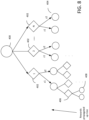
- Figure 8 shows how the multi-armed bandit structure described above may be extended to a tree structure.
- the current ego state is shown by the node 400, with multiple possible ego actions 402 branching off from the current state.
- Agent behaviours may be sampled from a distribution over agent behaviours.
- the planner instead of receiving a reward as in the multi-armed bandit of Figure 4 , the planner continues to simulate a subsequent ego action and predicted agent behaviour.
- the agent behaviours are sampled from an importance distribution Q for each ego action, ensuring that the planner encounters those agent behaviours that lead to the riskiest outcomes for the ego vehicle so that the planner decisions may avoid these outcomes and behaviours.
- a reward may be received which is computed from the state of the scenario for the immediate next step, as in the multi-armed bandit case.
- the selection of the ego action by the planner is based on a reward function which aggregates rewards based on sampling branches of the tree representing a sequence of possible future ego actions.
- ego actions continues down the nodes of the tree for a predetermined number of steps, up to a predetermined maximum search depth, or until a terminal ego state is reached, which may correspond to a goal of the ego vehicle provided by the goal generator, or a collision.
- agent behaviours may be sampled for that ego action so as to maximise a risk score as in the multi-armed bandit example described above.
- Ego states 406 and agent behaviours 408 are shown for the next level of the tree in Figure 8 .
- the agent behaviour may be sampled from an importance distribution at the root of the tree, with ego actions being selected at each node along a path of the tree. In this case, the importance distribution is based on a risk measure computed based on ego trajectories represented by a path of the tree.
- the present techniques can be implemented in an MCTS framework by traversing the whole tree before the behaviours of the other agents are sampled.
- the index i in CVaR ij would represent a path through the ego tree (sequence of ego actions) rather than a single ego action, and the number of reward observations becomes the number of times that ego action sequence i has been observed together with the agent behaviour j .
- the ego planning can be regarded as a tree but the prediction sampling is done as if it is a multi-armed bandit in this case, and prediction 104 need only be called once in the current real-world state (i.e. the root node of the tree) followed by passing the prediction output to planning 106 and fixing the prediction distribution(s) throughout the simulation phase of the planning.
- agent behaviours may be directly sampled from an importance distribution to be simulated with the selected ego action
- importance distributions may also be used to sample higher-level agent decision-making for external agents, for example higher-level agent goals or actions spanning a longer time period than the agent behaviours described herein, with the agent behaviour corresponding to the same time period as the selected ego action being determined based on the sampled agent goal or trajectory.
- an agent goal may be sampled from an importance distribution of the tree, with the actual behaviour of the agent simulated based on this goal.
- Ego actions may then be selected at multiple nodes of the tree representing future ego decisions, and rewards received based on the selected future actions, given the agent goal sampled at the root.
- the importance distribution over goals in this case is based on the rewards received for a given ego trajectory following a path of the tree.
- a reward is received for the final ego state.
- Rewards may be propagated back up the tree based on those paths sampled so far to determine a reward associated with each initial ego action based on the rewards from all paths originating from that action.
- Figure 8 only terminal rewards computed for a final state of the scenario are shown, with these rewards being propagated up to the next ego actions.
- each ego action may also be associated with reward values computed for the simulated state of the scenario after taking that action, as well as 'terminal' rewards received, for example, once an ego goal has been reached, a collision has occurred, or a maximum depth of the tree has been reached.
- the 'back-propagated' future rewards may be aggregated along with the immediate rewards of each ego action to obtain an overall reward for the selected ego action.
- the aggregated reward function may comprise immediate rewards, terminal rewards or a combination of rewards received along a path of the tree.
- a reward r i is received which is associated with the selected next ego action 402, and the estimated risk metrics, such as CVaR, may be generated for ego actions at the first level of the tree in the same way as described above. Note that this is only one of multiple possible ways to receive rewards in a tree. In other embodiments, rewards may only be associated with terminal nodes, and the risk associated with a next ego action 402 is based on an aggregation of the terminal rewards of all sampled branches arising from that ego action. The reward r i for each ego action may be used to update the importance distribution from which agent behaviours are sampled for that ego action.
- An autonomous vehicle also known as a self-driving vehicle, refers to a vehicle which has a sensor system for monitoring its external environment and a control system that is capable of making and implementing driving decisions automatically using those sensors. This includes in particular the ability to automatically adapt the vehicle's speed and direction of travel based on inputs from the sensor system.
- a fully autonomous or "driverless" vehicle has sufficient decision-making capability to operate without any input from a human driver.
- autonomous vehicle as used herein also applies to semi-autonomous vehicles, which have more limited autonomous decision-making capability and therefore still require a degree of oversight from a human driver. Whilst AVs are considered in the above examples, the present planning techniques can be applied to other form of mobile robot.
- the runtime stack 160 of Figure 1 is implemented by an on-board computer system of the AV (not shown).
- the on-board computer system comprises execution hardware which is configured to execute the method/algorithmic steps disclosed herein.
- execution hardware encompasses any form/combination of hardware configured to execute the relevant method/algorithmic steps.
- the execution hardware may take the form of one or more processors, which may be programmable or non-programmable, or a combination of programmable and non-programmable hardware may be used.
- suitable programmable processors include general purpose processors based on an instruction set architecture, such as CPUs, GPUs/accelerator processors etc.
- Such general-purpose processors typically execute computer readable instructions held in memory coupled to the processor and carry out the relevant steps in accordance with those instructions.
- Other forms of programmable processors include field programmable gate arrays (FPGAs) having a circuit configuration programmable though circuit description code.
- Examples of non-programmable processors include application specific integrated circuits (ASICs). Code, instructions etc. may be stored as appropriate on transitory or non-transitory media (examples of the latter including solid state, magnetic and optical storage device(s) and the like).
- the runtime stack 160 can also be implemented in an "off-board" computer system comprising similar processing hardware. For example, it may be applied to simulated inputs generated in a simulator for the purpose of safety and other performance testing.
- the planning techniques may or may not be performed in real time. For example, non-real time planning could be used to generate reference plans or trajectories, against which the performance of another real-time planner is assessed.
- the actor system 112 may be replaced with a suitable robot dynamics model that simulates a realistic response to a received control signal.
- FIG 9A shows a highly schematic overview of a testing paradigm for autonomous vehicles.
- An ADS (Autonomous Driving System) or ADAS (Advanced Driver Assist System) stack 160 e.g. of the kind depicted in Figure 1 , is subject to repeated testing and evaluation in simulation, by running multiple scenario instances in a simulator 202, and evaluating the performance of the stack 160 (and/or individual subs-stacks thereof) in a test oracle 252.
- the output of the test oracle 252 is informative to an expert 132 (team or individual), allowing them to identify issues in the stack 160 and modify the stack 160 to mitigate those issues (S124).
- the results also assist the expert 132 in selecting further scenarios for testing (S126), and the process continues, repeatedly modifying, testing and evaluating the performance of the stack 160 in simulation.
- the improved stack 160 is eventually incorporated (S125) in a real-world AV 101, equipped with a sensor system 100 and an actor system 118.
- the improved stack 160 typically includes program instructions (software) executed in one or more computer processors of an on-board computer system of the vehicle 101 (not shown).
- the software of the improved stack is uploaded to the AV 101 at step S125. Step 125 may also involve modifications to the underlying vehicle hardware.
- the improved stack 160 receives sensor data from the sensor system 100 and outputs control signals to the actor system 118.
- Real-world testing can be used in combination with simulation-based testing. For example, having reached an acceptable level of performance though the process of simulation testing and stack refinement, appropriate real-world scenarios may be selected (S130), and the performance of the AV 101 in those real scenarios may be captured and similarly evaluated in the test oracle 252.
- Scenarios can be obtained for the purpose of simulation in various ways, including manual encoding.
- the system is also capable of extracting scenarios for the purpose of simulation from real-world runs, allowing real-world situations and variations thereof to be re-created in the simulator 202.
- Figure 9B shows a highly schematic block diagram of a scenario extraction pipeline.
- Data 140 of a real-world run is passed to a 'ground-truthing' pipeline 142 for the purpose of generating scenario ground truth.
- the run data 140 could comprise, for example, sensor data and/or perception outputs captured/generated on board one or more vehicles (which could be autonomous, human-driven or a combination thereof), and/or data captured from other sources such external sensors (CCTV etc.).
- the run data is processed within the ground truthing pipeline 142, in order to generate appropriate ground truth 144 (trace(s) and contextual data) for the real-world run.
- the ground-truthing process could be based on manual annotation of the 'raw' run data 142, or the process could be entirely automated (e.g.
- a scenario extraction component 146 receives the scenario ground truth 144, and processes the scenario ground truth 144 to extract a more abstracted scenario description 148 that can be used for the purpose of simulation.
- the scenario description 148 is consumed by the simulator 202, allowing multiple simulated runs to be performed.
- the simulated runs are variations of the original real-world run, with the degree of possible variation determined by the extent of abstraction.
- Ground truth 150 is provided for each simulated run.
Landscapes
- Engineering & Computer Science (AREA)
- Automation & Control Theory (AREA)
- Transportation (AREA)
- Mechanical Engineering (AREA)
- Human Computer Interaction (AREA)
- Theoretical Computer Science (AREA)
- Physics & Mathematics (AREA)
- Computer Hardware Design (AREA)
- Geometry (AREA)
- General Engineering & Computer Science (AREA)
- General Physics & Mathematics (AREA)
- Evolutionary Computation (AREA)
- Management, Administration, Business Operations System, And Electronic Commerce (AREA)
Claims (15)
- Procédé mis en œuvre par ordinateur de planification d'ego-actions pour un robot mobile (200) en présence d'au moins un agent dynamique (202), le procédé consistant à :rechercher une ego-action (112) optimale parmi un ensemble d'ego-actions possibles à de multiples étapes de recherche, chaque étape de recherche consistant à :sélectionner une ego-action parmi l'ensemble d'ego-actions possibles,sélectionner un comportement d'agent parmi un ensemble de comportements d'agent possibles,exécuter une simulation en ligne sur la base de l'ego-action et du comportement d'agent sélectionnés, et déterminer ainsi un résultat possible du comportement d'agent et de l'ego-action sélectionnés, etattribuer au moins une récompense à l'ego-action sélectionnée, sur la base d'au moins une mesure de récompense appliquée au résultat déterminé, dans lequel la sélection de l'ego-action à des étapes de recherche ultérieures s'oriente, sur la base des résultats déterminés d'étapes de recherche antérieures, plus spécialement vers une ou plusieurs ego-actions à récompense plus élevée, mais la sélection du comportement d'agent aux étapes de recherche ultérieures s'oriente plus spécialement vers un ou plusieurs comportements d'agent plus risqués, un comportement d'agent risqué étant un comportement d'agent qui est, selon les étapes de recherche antérieures, plus susceptible de conduire à un résultat de récompense plus faible pour l'ego-action sélectionnée ; etchoisir une ego-action (112) parmi l'ensemble d'ego-actions possibles, sur la base des récompenses calculées aux étapes de recherche.
- Procédé selon la revendication 1, dans lequel chaque comportement d'agent est associé à un score de risque d'ego-agent qui est spécifique à l'ego-action sélectionnée, et la sélection du comportement d'agent s'oriente plus spécialement vers un ou plusieurs comportements plus risqués selon les scores de risque d'ego-agent qui sont spécifiques à l'ego-action sélectionnée, le score de risque d'ego-agent pour chaque comportement d'agent et chaque ego-action étant mis à jour sur la base d'une sélection et d'une simulation supplémentaires de ce comportement d'agent et de cette ego-action aux étapes de recherche ultérieures.
- Procédé selon la revendication 2, dans lequel la sélection de l'ego-action s'oriente plus spécialement vers une ou plusieurs ego-actions à récompense plus élevée sur la base d'un ego-score, l'ego-score étant mis à jour sur la base d'une sélection et d'une simulation supplémentaires de cette ego-action aux étapes de recherche ultérieures.
- Procédé selon la revendication 3, dans lequel une limite de confiance inférieure de l'ego-score est utilisée pour orienter la sélection d'ego-actions plus spécialement vers ces actions qui ont été le moins souvent sélectionnées à des étapes de recherche précédentes.
- Procédé selon l'une quelconque des revendications 2 à 4, dans lequel une limite de confiance supérieure du score de risque de l'ego-agent est utilisée pour orienter la sélection de comportements d'agent plus spécialement vers ces comportements qui ont été le moins souvent sélectionnés à des étapes de recherche précédentes.
- Procédé selon l'une quelconque des revendications 2 à 5, dans lequel la sélection du comportement d'agent consiste à échantillonner un comportement à partir d'une distribution d'importance sur l'ensemble de comportements d'agent possibles, la distribution d'importance s'orientant plus spécialement de telle sorte que des comportements plus risqués soient plus susceptibles d'être échantillonnés, le procédé consistant éventuellement à en outre déterminer une distribution de prédiction sur des comportements d'agent possibles, dans lequel la distribution d'importance est basée sur la distribution de prédiction et sur les scores de risque d'ego-agent pour l'ensemble de comportements d'agent possibles.
- Procédé selon l'une quelconque des revendications précédentes, dans lequel différentes récompenses sont attribuées, à différentes étapes de recherche, à la même ego-action pour le même comportement d'agent échantillonné, en conséquence de l'incertitude de prédiction et/ou de l'incertitude de perception.
- Procédé selon l'une quelconque des revendications précédentes, dans lequel la récompense dépend de surcroît d'une ego-action supplémentaire sélectionnée à l'étape de recherche et/ou d'un comportement d'agent supplémentaire échantillonné à l'étape de recherche, moyennant quoi différentes récompenses peuvent être attribuées, à différentes étapes de recherche, à la même ego-action pour le même comportement d'agent échantillonné, en conséquence de la sélection de différentes ego-actions supplémentaires et/ou de l'échantillonnage de différents comportements d'agent supplémentaires.
- Procédé selon la revendication 8, dans lequel la récompense est attribuée sur la base d'une rétropropagation, dans lequel la rétropropagation consiste à agréger des récompenses sur la base des ego-actions supplémentaires et/ou des comportements d'agent supplémentaires et à propager la récompense agrégée vers l'ego-action sélectionnée (112).
- Procédé selon l'une quelconque des revendications précédentes, dans lequel la sélection de l'ego-action à l'étape de sélection est orientée plus spécialement vers des ego-actions observées plus souvent aux étapes de recherche, en minimisant une limite de confiance supérieure d'un score de risque sur la base desdites une ou plusieurs récompenses calculées pour cette ego-action.
- Procédé selon l'une quelconque des revendications précédentes, consistant à :
fournir l'ego-action choisie (112) à un contrôleur et générer, par le biais du contrôleur, un signal de contrôle permettant de mettre en œuvre l'ego-action choisie (112), dans lequel le signal de contrôle est fourni en entrée à un système d'acteur d'un robot mobile (200) ou d'un modèle de la dynamique de véhicule pour permettre de modéliser une réponse d'un robot mobile (200) au signal de contrôle lors d'une simulation. - Procédé selon la revendication 3 ou selon toute revendication qui en dépend, dans lequel :
le score de risque de l'ego-agent et l'ego-score sont chacun mis à jour sur la base de la même récompense, ou le score de risque de l'ego-agent est mis à jour sur la base d'une première récompense calculée en utilisant une première mesure de récompense et l'ego-score est mis à jour sur la base d'une deuxième récompense calculée en utilisant une deuxième mesure de récompense, et éventuellement la première mesure de récompense mesure au moins un risque de collision et la deuxième mesure de récompense mesure au moins un facteur additionnel tel que le confort ou la progression vers un objectif défini. - Procédé selon la revendication 12 lorsqu'elle dépend de la revendication 6, dans lequel l'ego-score est mis à jour comme suit :
 où α est un percentile prédéterminé, VaRi est un seuil de récompense pour l'ego-score, w (k) est un rapport des probabilités des comportements d'agent échantillonnés à la k-ième étape de recherche sous une distribution naturelle et sous la distribution d'importance, respectivement,
 dans lequel le score de risque d'ego-agent est mis à jour sur la base de la somme suivante :
 où
où

- Système informatique comprenant un ou plusieurs ordinateurs configurés pour mettre en œuvre le procédé selon l'une quelconque des revendications précédentes.
- Programme informatique permettant de programmer un système informatique afin qu'il mette en œuvre le procédé selon l'une quelconque des revendications 1 à 13.
Applications Claiming Priority (2)
| Application Number | Priority Date | Filing Date | Title |
|---|---|---|---|
| GBGB2106238.5A GB202106238D0 (en) | 2021-04-30 | 2021-04-30 | Motion planning |
| PCT/EP2022/061514 WO2022229404A1 (fr) | 2021-04-30 | 2022-04-29 | Planification de mouvement |
Publications (2)
| Publication Number | Publication Date |
|---|---|
| EP4330107A1 EP4330107A1 (fr) | 2024-03-06 |
| EP4330107B1 true EP4330107B1 (fr) | 2025-04-02 |
Family
ID=76301060
Family Applications (1)
| Application Number | Title | Priority Date | Filing Date |
|---|---|---|---|
| EP22726458.7A Active EP4330107B1 (fr) | 2021-04-30 | 2022-04-29 | Planification de mouvement |
Country Status (4)
| Country | Link |
|---|---|
| US (1) | US12536351B2 (fr) |
| EP (1) | EP4330107B1 (fr) |
| GB (1) | GB202106238D0 (fr) |
| WO (1) | WO2022229404A1 (fr) |
Families Citing this family (6)
| Publication number | Priority date | Publication date | Assignee | Title |
|---|---|---|---|---|
| US20230174084A1 (en) * | 2021-12-06 | 2023-06-08 | The Regents Of The University Of Michigan | Monte Carlo Policy Tree Decision Making |
| US12441368B2 (en) * | 2022-04-06 | 2025-10-14 | Motional Ad Llc | Vehicle action selection based on simulated states |
| KR102490011B1 (ko) * | 2022-07-19 | 2023-01-19 | 주식회사 라이드플럭스 | 로드 유저 예측 기반 자율주행 차량의 주행 계획 결정방법, 장치 및 컴퓨터프로그램 |
| US20240051581A1 (en) * | 2022-08-15 | 2024-02-15 | Motional Ad Llc | Determination of an action for an autonomous vehicle in the presence of intelligent agents |
| CN117208012A (zh) * | 2023-09-20 | 2023-12-12 | 安徽蔚来智驾科技有限公司 | 车辆轨迹预测方法、控制装置、可读存储介质及车辆 |
| US12545290B2 (en) * | 2023-12-14 | 2026-02-10 | May Mobility, Inc | Method and system for predicting external agent behavior |
Family Cites Families (3)
| Publication number | Priority date | Publication date | Assignee | Title |
|---|---|---|---|---|
| JP6917878B2 (ja) | 2017-12-18 | 2021-08-11 | 日立Astemo株式会社 | 移動体挙動予測装置 |
| US11480972B2 (en) * | 2018-11-13 | 2022-10-25 | Qualcomm Incorporated | Hybrid reinforcement learning for autonomous driving |
| GB201912145D0 (en) | 2019-08-23 | 2019-10-09 | Five Ai Ltd | Performance testing for robotic systems |
-
2021
- 2021-04-30 GB GBGB2106238.5A patent/GB202106238D0/en not_active Ceased
-
2022
- 2022-04-29 US US18/288,354 patent/US12536351B2/en active Active
- 2022-04-29 WO PCT/EP2022/061514 patent/WO2022229404A1/fr not_active Ceased
- 2022-04-29 EP EP22726458.7A patent/EP4330107B1/fr active Active
Also Published As
| Publication number | Publication date |
|---|---|
| EP4330107A1 (fr) | 2024-03-06 |
| WO2022229404A1 (fr) | 2022-11-03 |
| US20240202393A1 (en) | 2024-06-20 |
| US12536351B2 (en) | 2026-01-27 |
| GB202106238D0 (en) | 2021-06-16 |
Similar Documents
| Publication | Publication Date | Title |
|---|---|---|
| EP4330107B1 (fr) | Planification de mouvement | |
| CN112888612B (zh) | 自动驾驶车辆规划 | |
| Cesari et al. | Scenario model predictive control for lane change assistance and autonomous driving on highways | |
| US10739773B2 (en) | Generative adversarial inverse trajectory optimization for probabilistic vehicle forecasting | |
| US11189171B2 (en) | Traffic prediction with reparameterized pushforward policy for autonomous vehicles | |
| WO2021073781A9 (fr) | Prédiction et planification pour robots mobiles | |
| US20250217553A1 (en) | Simulation-based testing for robotic systems | |
| US20250145179A1 (en) | Trajectory generation for mobile agents | |
| Sezer | Intelligent decision making for overtaking maneuver using mixed observable Markov decision process | |
| EP4178843B1 (fr) | Sprocédé récursif, en temps réel et sensible à l'interaction de mouvements de planification pour véhicules autonomes, système et produit de programme informatique correspondants | |
| WO2023242223A1 (fr) | Prédiction de mouvement des agents mobiles | |
| Chen et al. | Risk-anticipatory autonomous driving strategies considering vehicles’ weights based on hierarchical deep reinforcement learning | |
| Lee et al. | Automated driving control in mixed traffic flow using V2V communication | |
| US20250225051A1 (en) | Simulation-based testing for robotic systems | |
| Xu et al. | A Monte Carlo hyper-heuristic algorithm with low-level heuristics reward prediction for missile path planning: S. Xu et al. | |
| Huang | Safe intention-aware maneuvering of autonomous vehicles | |
| Sakthivel et al. | Intelligent systems context-aware adaptive reinforcement learning approach for autonomous vehicles | |
| Lucente | Integrating deep learning and dynamic game theory for trajectory planning | |
| Türkmen | A comparative study of nonlinear model predictive control and reinforcement learning for path tracking | |
| WO2025046092A1 (fr) | Planification de mouvement | |
| WO2024175684A1 (fr) | Suivi d'objet hors ligne | |
| Xie et al. | Generating Long-Term Vehicle-Vehicle Scenarios with High-Density Threatening Maneuvers in the Given Test Site | |
| Vitez | STOCHASTIC HYPERPARAMETER OPTIMIZATION FOR MODELPREDICTIVE CONTROL IN AUTONOMOUSRACING | |
| Beck | Motion Planning for Automated Vehicles in Uncertain Environments | |
| Alyassi | Risk-Aware Conditional Planning with Applications in Autonomous Vehicles |
Legal Events
| Date | Code | Title | Description |
|---|---|---|---|
| STAA | Information on the status of an ep patent application or granted ep patent |
Free format text: STATUS: UNKNOWN |
|
| STAA | Information on the status of an ep patent application or granted ep patent |
Free format text: STATUS: THE INTERNATIONAL PUBLICATION HAS BEEN MADE |
|
| PUAI | Public reference made under article 153(3) epc to a published international application that has entered the european phase |
Free format text: ORIGINAL CODE: 0009012 |
|
| STAA | Information on the status of an ep patent application or granted ep patent |
Free format text: STATUS: REQUEST FOR EXAMINATION WAS MADE |
|
| 17P | Request for examination filed |
Effective date: 20231122 |
|
| AK | Designated contracting states |
Kind code of ref document: A1 Designated state(s): AL AT BE BG CH CY CZ DE DK EE ES FI FR GB GR HR HU IE IS IT LI LT LU LV MC MK MT NL NO PL PT RO RS SE SI SK SM TR |
|
| DAV | Request for validation of the european patent (deleted) | ||
| DAX | Request for extension of the european patent (deleted) | ||
| GRAP | Despatch of communication of intention to grant a patent |
Free format text: ORIGINAL CODE: EPIDOSNIGR1 |
|
| STAA | Information on the status of an ep patent application or granted ep patent |
Free format text: STATUS: GRANT OF PATENT IS INTENDED |
|
| INTG | Intention to grant announced |
Effective date: 20241023 |
|
| GRAS | Grant fee paid |
Free format text: ORIGINAL CODE: EPIDOSNIGR3 |
|
| GRAA | (expected) grant |
Free format text: ORIGINAL CODE: 0009210 |
|
| STAA | Information on the status of an ep patent application or granted ep patent |
Free format text: STATUS: THE PATENT HAS BEEN GRANTED |
|
| AK | Designated contracting states |
Kind code of ref document: B1 Designated state(s): AL AT BE BG CH CY CZ DE DK EE ES FI FR GB GR HR HU IE IS IT LI LT LU LV MC MK MT NL NO PL PT RO RS SE SI SK SM TR |
|
| REG | Reference to a national code |
Ref country code: GB Ref legal event code: FG4D |
|
| REG | Reference to a national code |
Ref country code: CH Ref legal event code: EP |
|
| REG | Reference to a national code |
Ref country code: IE Ref legal event code: FG4D |
|
| REG | Reference to a national code |
Ref country code: DE Ref legal event code: R096 Ref document number: 602022012620 Country of ref document: DE |
|
| PGFP | Annual fee paid to national office [announced via postgrant information from national office to epo] |
Ref country code: DE Payment date: 20250625 Year of fee payment: 4 |
|
| PGFP | Annual fee paid to national office [announced via postgrant information from national office to epo] |
Ref country code: AT Payment date: 20250721 Year of fee payment: 4 |
|
| REG | Reference to a national code |
Ref country code: NL Ref legal event code: MP Effective date: 20250402 |
|
| PG25 | Lapsed in a contracting state [announced via postgrant information from national office to epo] |
Ref country code: NL Free format text: LAPSE BECAUSE OF FAILURE TO SUBMIT A TRANSLATION OF THE DESCRIPTION OR TO PAY THE FEE WITHIN THE PRESCRIBED TIME-LIMIT Effective date: 20250402 |
|
| REG | Reference to a national code |
Ref country code: AT Ref legal event code: MK05 Ref document number: 1781043 Country of ref document: AT Kind code of ref document: T Effective date: 20250402 |
|
| PG25 | Lapsed in a contracting state [announced via postgrant information from national office to epo] |
Ref country code: FI Free format text: LAPSE BECAUSE OF FAILURE TO SUBMIT A TRANSLATION OF THE DESCRIPTION OR TO PAY THE FEE WITHIN THE PRESCRIBED TIME-LIMIT Effective date: 20250402 Ref country code: PT Free format text: LAPSE BECAUSE OF FAILURE TO SUBMIT A TRANSLATION OF THE DESCRIPTION OR TO PAY THE FEE WITHIN THE PRESCRIBED TIME-LIMIT Effective date: 20250804 Ref country code: ES Free format text: LAPSE BECAUSE OF FAILURE TO SUBMIT A TRANSLATION OF THE DESCRIPTION OR TO PAY THE FEE WITHIN THE PRESCRIBED TIME-LIMIT Effective date: 20250402 |
|
| REG | Reference to a national code |
Ref country code: LT Ref legal event code: MG9D |
|
| PG25 | Lapsed in a contracting state [announced via postgrant information from national office to epo] |
Ref country code: GR Free format text: LAPSE BECAUSE OF FAILURE TO SUBMIT A TRANSLATION OF THE DESCRIPTION OR TO PAY THE FEE WITHIN THE PRESCRIBED TIME-LIMIT Effective date: 20250703 Ref country code: NO Free format text: LAPSE BECAUSE OF FAILURE TO SUBMIT A TRANSLATION OF THE DESCRIPTION OR TO PAY THE FEE WITHIN THE PRESCRIBED TIME-LIMIT Effective date: 20250702 |
|
| PG25 | Lapsed in a contracting state [announced via postgrant information from national office to epo] |
Ref country code: PL Free format text: LAPSE BECAUSE OF FAILURE TO SUBMIT A TRANSLATION OF THE DESCRIPTION OR TO PAY THE FEE WITHIN THE PRESCRIBED TIME-LIMIT Effective date: 20250402 |
|
| PG25 | Lapsed in a contracting state [announced via postgrant information from national office to epo] |
Ref country code: BG Free format text: LAPSE BECAUSE OF FAILURE TO SUBMIT A TRANSLATION OF THE DESCRIPTION OR TO PAY THE FEE WITHIN THE PRESCRIBED TIME-LIMIT Effective date: 20250402 |
|
| PG25 | Lapsed in a contracting state [announced via postgrant information from national office to epo] |
Ref country code: AT Free format text: LAPSE BECAUSE OF FAILURE TO SUBMIT A TRANSLATION OF THE DESCRIPTION OR TO PAY THE FEE WITHIN THE PRESCRIBED TIME-LIMIT Effective date: 20250402 Ref country code: HR Free format text: LAPSE BECAUSE OF FAILURE TO SUBMIT A TRANSLATION OF THE DESCRIPTION OR TO PAY THE FEE WITHIN THE PRESCRIBED TIME-LIMIT Effective date: 20250402 |
|
| PG25 | Lapsed in a contracting state [announced via postgrant information from national office to epo] |
Ref country code: RS Free format text: LAPSE BECAUSE OF FAILURE TO SUBMIT A TRANSLATION OF THE DESCRIPTION OR TO PAY THE FEE WITHIN THE PRESCRIBED TIME-LIMIT Effective date: 20250702 |
|
| PG25 | Lapsed in a contracting state [announced via postgrant information from national office to epo] |
Ref country code: IS Free format text: LAPSE BECAUSE OF FAILURE TO SUBMIT A TRANSLATION OF THE DESCRIPTION OR TO PAY THE FEE WITHIN THE PRESCRIBED TIME-LIMIT Effective date: 20250802 |
|
| PG25 | Lapsed in a contracting state [announced via postgrant information from national office to epo] |
Ref country code: LV Free format text: LAPSE BECAUSE OF FAILURE TO SUBMIT A TRANSLATION OF THE DESCRIPTION OR TO PAY THE FEE WITHIN THE PRESCRIBED TIME-LIMIT Effective date: 20250402 |
|
| REG | Reference to a national code |
Ref country code: CH Ref legal event code: H13 Free format text: ST27 STATUS EVENT CODE: U-0-0-H10-H13 (AS PROVIDED BY THE NATIONAL OFFICE) Effective date: 20251125 |
|
| PG25 | Lapsed in a contracting state [announced via postgrant information from national office to epo] |
Ref country code: LU Free format text: LAPSE BECAUSE OF NON-PAYMENT OF DUE FEES Effective date: 20250429 |
|
| REG | Reference to a national code |
Ref country code: DE Ref legal event code: R082 Ref document number: 602022012620 Country of ref document: DE Representative=s name: WESTPHAL, MUSSGNUG & PARTNER PATENTANWAELTE MI, DE |
|
| REG | Reference to a national code |
Ref country code: BE Ref legal event code: MM Effective date: 20250430 |
|
| REG | Reference to a national code |
Ref country code: DE Ref legal event code: R097 Ref document number: 602022012620 Country of ref document: DE |
|
| PG25 | Lapsed in a contracting state [announced via postgrant information from national office to epo] |
Ref country code: SM Free format text: LAPSE BECAUSE OF FAILURE TO SUBMIT A TRANSLATION OF THE DESCRIPTION OR TO PAY THE FEE WITHIN THE PRESCRIBED TIME-LIMIT Effective date: 20250402 Ref country code: DK Free format text: LAPSE BECAUSE OF FAILURE TO SUBMIT A TRANSLATION OF THE DESCRIPTION OR TO PAY THE FEE WITHIN THE PRESCRIBED TIME-LIMIT Effective date: 20250402 |
|
| PG25 | Lapsed in a contracting state [announced via postgrant information from national office to epo] |
Ref country code: BE Free format text: LAPSE BECAUSE OF NON-PAYMENT OF DUE FEES Effective date: 20250430 |
|
| PG25 | Lapsed in a contracting state [announced via postgrant information from national office to epo] |
Ref country code: CH Free format text: LAPSE BECAUSE OF NON-PAYMENT OF DUE FEES Effective date: 20250430 |
|
| PG25 | Lapsed in a contracting state [announced via postgrant information from national office to epo] |
Ref country code: CZ Free format text: LAPSE BECAUSE OF FAILURE TO SUBMIT A TRANSLATION OF THE DESCRIPTION OR TO PAY THE FEE WITHIN THE PRESCRIBED TIME-LIMIT Effective date: 20250402 |
|
| PG25 | Lapsed in a contracting state [announced via postgrant information from national office to epo] |
Ref country code: EE Free format text: LAPSE BECAUSE OF FAILURE TO SUBMIT A TRANSLATION OF THE DESCRIPTION OR TO PAY THE FEE WITHIN THE PRESCRIBED TIME-LIMIT Effective date: 20250402 |
|
| PG25 | Lapsed in a contracting state [announced via postgrant information from national office to epo] |
Ref country code: SK Free format text: LAPSE BECAUSE OF FAILURE TO SUBMIT A TRANSLATION OF THE DESCRIPTION OR TO PAY THE FEE WITHIN THE PRESCRIBED TIME-LIMIT Effective date: 20250402 |
|
| PG25 | Lapsed in a contracting state [announced via postgrant information from national office to epo] |
Ref country code: IT Free format text: LAPSE BECAUSE OF FAILURE TO SUBMIT A TRANSLATION OF THE DESCRIPTION OR TO PAY THE FEE WITHIN THE PRESCRIBED TIME-LIMIT Effective date: 20250402 |
|
| PG25 | Lapsed in a contracting state [announced via postgrant information from national office to epo] |
Ref country code: MC Free format text: LAPSE BECAUSE OF FAILURE TO SUBMIT A TRANSLATION OF THE DESCRIPTION OR TO PAY THE FEE WITHIN THE PRESCRIBED TIME-LIMIT Effective date: 20250402 |
|
| PLBE | No opposition filed within time limit |
Free format text: ORIGINAL CODE: 0009261 |
|
| STAA | Information on the status of an ep patent application or granted ep patent |
Free format text: STATUS: NO OPPOSITION FILED WITHIN TIME LIMIT |
|
| REG | Reference to a national code |
Ref country code: CH Ref legal event code: L10 Free format text: ST27 STATUS EVENT CODE: U-0-0-L10-L00 (AS PROVIDED BY THE NATIONAL OFFICE) Effective date: 20260211 |
|
| PG25 | Lapsed in a contracting state [announced via postgrant information from national office to epo] |
Ref country code: RO Free format text: LAPSE BECAUSE OF FAILURE TO SUBMIT A TRANSLATION OF THE DESCRIPTION OR TO PAY THE FEE WITHIN THE PRESCRIBED TIME-LIMIT Effective date: 20250402 |
|
| 26N | No opposition filed |
Effective date: 20260105 |
|
| PG25 | Lapsed in a contracting state [announced via postgrant information from national office to epo] |
Ref country code: IE Free format text: LAPSE BECAUSE OF NON-PAYMENT OF DUE FEES Effective date: 20250429 |
|
| PG25 | Lapsed in a contracting state [announced via postgrant information from national office to epo] |
Ref country code: FR Free format text: LAPSE BECAUSE OF NON-PAYMENT OF DUE FEES Effective date: 20250602 |