EP4331677A2 - Verfahren zur behandlung von infektionen mit dem katzen-coronavirus - Google Patents
Verfahren zur behandlung von infektionen mit dem katzen-coronavirus Download PDFInfo
- Publication number
- EP4331677A2 EP4331677A2 EP23195442.1A EP23195442A EP4331677A2 EP 4331677 A2 EP4331677 A2 EP 4331677A2 EP 23195442 A EP23195442 A EP 23195442A EP 4331677 A2 EP4331677 A2 EP 4331677A2
- Authority
- EP
- European Patent Office
- Prior art keywords
- compound
- pharmaceutical formulation
- feline
- administration
- coronavirus
- Prior art date
- Legal status (The legal status is an assumption and is not a legal conclusion. Google has not performed a legal analysis and makes no representation as to the accuracy of the status listed.)
- Withdrawn
Links
Images




Classifications
-
- A—HUMAN NECESSITIES
- A61—MEDICAL OR VETERINARY SCIENCE; HYGIENE
- A61K—PREPARATIONS FOR MEDICAL, DENTAL OR TOILETRY PURPOSES
- A61K31/00—Medicinal preparations containing organic active ingredients
- A61K31/70—Carbohydrates; Sugars; Derivatives thereof
- A61K31/7042—Compounds having saccharide radicals and heterocyclic rings
- A61K31/7052—Compounds having saccharide radicals and heterocyclic rings having nitrogen as a ring hetero atom, e.g. nucleosides, nucleotides
- A61K31/706—Compounds having saccharide radicals and heterocyclic rings having nitrogen as a ring hetero atom, e.g. nucleosides, nucleotides containing six-membered rings with nitrogen as a ring hetero atom
-
- A—HUMAN NECESSITIES
- A61—MEDICAL OR VETERINARY SCIENCE; HYGIENE
- A61P—SPECIFIC THERAPEUTIC ACTIVITY OF CHEMICAL COMPOUNDS OR MEDICINAL PREPARATIONS
- A61P31/00—Antiinfectives, i.e. antibiotics, antiseptics, chemotherapeutics
- A61P31/12—Antivirals
-
- A—HUMAN NECESSITIES
- A61—MEDICAL OR VETERINARY SCIENCE; HYGIENE
- A61P—SPECIFIC THERAPEUTIC ACTIVITY OF CHEMICAL COMPOUNDS OR MEDICINAL PREPARATIONS
- A61P31/00—Antiinfectives, i.e. antibiotics, antiseptics, chemotherapeutics
- A61P31/12—Antivirals
- A61P31/14—Antivirals for RNA viruses
Definitions
- the invention relates generally to methods and compounds for treating feline Coronavirus infections, particularly methods for treating feline infectious peritonitis virus (FIPV).
- feline Coronavirus infections particularly methods for treating feline infectious peritonitis virus (FIPV).
- FCoV Feline coronavirus
- FECV feline enteric coronavirus
- FIPV feline infectious peritoneal virus
- FECV infection is widespread in cats, with an estimated 40-80% of cats shedding the virus worldwide.
- FECV chronically infects the gastrointestinal epithelial cells in cats and is typically transmitted through the fecal-oral route.
- FECV infection in cats is largely asymptomatic, with some cats experiencing diarrhea, vomiting, loss of appetite, and fever.
- the FIPV biotype arises following a single nucleotide polymorphism or deletion that inactivates the viral 3c protease gene in FECV, although mutations within the viral spike protein has also been implicated. Inactivation of the 3c protease alters cell tropism enables the virus to replicate within macrophages, facilitating systemic dissemination of FIPV and the onset of feline infectious peritonitis (FIP).
- FIP is a progressive, immune related disease in cats.
- FIP disease can take the form of "wet” or “dry” FIP.
- Wet FIP is associated with an inflammation of the visceral serosa and omentum resulting in the exudation of fluids into the abdomen and/or chest cavities.
- Dry FIP is characterized by granulomatous involvement of paracnchymatous organs such as the liver, central nervous system or eyes. The development of either the wet or dry form of FIP is invariably fatal.
- FIP is a major problem in environments with large cat densities such as, multi-cat households, catteries, shelters, and cat rescue facilities. The disease is most prevalent in younger cats ( ⁇ 3 years old), and particularly kittens, due to the higher levels of replicating FECV, which increases the likelihood of mutation to the FIPV biotype, as well as reduced resistance to viruses harboring those mutations. FIP is a leading cause of death in cats under 2 years of age and is estimated to kill between 0.3 and 1% of cats worldwide.
- the present invention provides a method of treating a feline Coronavirus infection comprising administering a therapeutically effective amount of a compound: or or a pharmaceutically acceptable salt thereof.
- a method of treating a feline Coronavirus infection comprising administering a therapeutically effective amount of or a pharmaceutically acceptable salt thereof.
- treating means reversing, alleviating, inhibiting the progress of, or preventing the disorder or condition to which such term applies, or one or more symptoms of such disorder or condition.
- terapéuticaally effective amount is the amount of Compound 1, or a pharmaceutically acceptable salt thereof, present in a composition described herein that is needed to provide a desired level of drug in the secretions and tissues of the airways and lungs, or alternatively, in the bloodstream of a subject to be treated to give an anticipated physiological response or desired biological effect when such a composition is administered by the chosen route of administration.
- the precise amount will depend upon numerous factors, for example the specific activity of the composition, the delivery device employed, the physical characteristics of the composition, its intended use, as well as animal considerations such as severity of the disease state, veterianian cooperation, etc., and can readily be determined by one skilled in the art based upon the information provided herein.
- Reference to Compound 1, or Compounds 2 to 9, described herein may also includes a reference to a pharmaceutically acceptable salt thereof.
- pharmaceutically acceptable salts include salts derived from an appropriate base, such as an alkali metal or an alkaline earth (for example, Na + , Li + , K + , Ca +2 and Mg +2 ), ammonium and NR 4 + (wherein R is defined herein).
- salts of a nitrogen atom or an amino group include (a) acid addition salts formed with inorganic acids, for example, hydrochloric acid, hydrobromic acid, sulfuric acid, sulfamic acids, phosphoric acid, nitric acid and the like; (b) salts formed with organic acids such as, for example, acetic acid, oxalic acid, tartaric acid, succinic acid, maleic acid, fumaric acid, gluconic acid, citric acid, malic acid, ascorbic acid, benzoic acid, isethionic acid, lactobionic acid, tannic acid, palmitic acid, alginic acid, polyglutamic acid, naphthalenesulfonic acid, methanesulfonic acid, p-toluenesulfonic acid, benzenesulfonic acid, naphthalenedisulfonic acid, polygalacturonic acid, malonic acid, sulfosalicylic acid, glycolic acid,
- Compound 1, and Compounds 2 to 9, or a pharmaceutically acceptable salt thereof may exist as different polymorphs or pseudopolymorphs.
- crystalline polymorphism means the ability of a crystalline compound to exist in different crystal structures. The crystalline polymorphism may result from differences in crystal packing (packing polymorphism) or differences in packing between different conformers of the same molecule (conformational polymorphism).
- crystalline pseudopolymorphism means the ability of a hydrate or solvate of a compound to exist in different crystal structures.
- the pseudopolymorphs of the instant invention may exist due to differences in crystal packing (packing pseudopolymorphism) or due to differences in packing between different conformers of the same molecule (conformational pseudopolymorphism).
- the instant invention comprises all polymorphs and pseudopolymorphs of Compound 1 or pharmaceutically acceptable salts thereof.
- Compound 1, and Compounds 2 to 9, and pharmaceutically acceptable salts thereof may also exist as an amorphous solid.
- an amorphous solid is a solid in which there is no long-range order of the positions of the atoms in the solid. This definition applies as well when the crystal size is two nanometers or less.
- Additives, including solvents, may be used to create the amorphous forms of the instant invention.
- the invention comprises all amorphous forms of Compound 1 or pharmaceutically acceptable salts thereof.
- Compound 1, and Compounds 2 to 9, or a pharmaceutically acceptable salt thereof is also intended to represent unlabeled forms as well as isotopically labeled forms of the compounds.
- Isotopically labeled compounds have structures depicted by the formulas given herein except that one or more atoms are replaced by an atom having a selected atomic mass or mass number.
- isotopes that can be incorporated into compounds of the disclosure include isotopes of hydrogen, carbon, nitrogen, oxygen, phosphorous, fluorine and chlorine, such as, but not limited to 2 H (deuterium, D), 3 H (tritium), 11 C, 13 C, 14 C, 15 N, 18 F, 31 P, 32 P, 35 S, 36 Cl and 125 I.
- isotopically labeled compounds of the present disclosure for example those into which radioactive isotopes such as 3 H, 13 C and 14 C are incorporated.
- isotopically labelled compounds may be useful in metabolic studies, reaction kinetic studies, detection or imaging techniques, such as positron emission tomography (PET) or single-photon emission computed tomography (SPECT) including drug or substrate tissue distribution assays or in radioactive treatmentarean.
- PET positron emission tomography
- SPECT single-photon emission computed tomography
- the disclosure also includes Compound 1, and Compounds 2 to 9, in which from 1 to n hydrogens attached to a carbon atom is/are replaced by deuterium, in which n is the number of hydrogens in the molecule.
- Such compounds exhibit increased resistance to metabolism and are thus useful for increasing the half-life of Compound 1 when administered to a mammal. See, for example, Foster, "Deuterium Isotope Effects in Studies of Drug Metabolism", Trends Pharmacol. Sci. 5(12):524-527 (1984 ).
- Such compounds are synthesized by means well known in the art, for example by employing starting materials in which one or more hydrogens have been replaced by deuterium.
- Deuterium labeled or substituted therapeutic compounds of the disclosure may have improved DMPK (drug metabolism and pharmacokinetics) properties, relating to distribution, metabolism and excretion (ADME). Substitution with heavier isotopes such as deuterium may afford certain therapeutic advantages resulting from greater metabolic stability, for example increased in vivo half-life, reduced dosage requirements and/or an improvement in therapeutic index.
- An 18 F labeled compound may be useful for PET or SPECT studies.
- Isotopically labeled compounds of this disclosure and prodrugs thereof can generally be prepared by carrying out the procedures disclosed in the schemes or in the examples and preparations described below by substituting a readily available isotopically labeled reagent for a non-isotopically labeled reagent.
- the concentration of such a heavier isotope, specifically deuterium, may be defined by an isotopic enrichment factor.
- any atom not specifically designated as a particular isotope is meant to represent any stable isotope of that atom.
- a position is designated specifically as “H” or “hydrogen”, the position is understood to have hydrogen at its natural abundance isotopic composition.
- COMPOUND No. STRUCTURE NAME 1 (EV0984) (2R,3R,4S,5R)-2-(4-aminopyrrolo[2,1-f][1,2,4]triazin-7-yl)-3,4-dihydroxy-5-(hydroxymethyl)tetrahydrofuran-2-carbonitrile 2 (EV1102) ((((2R,3S,4R,5R)-5-(4-aminopyrrolo[2,1-f][1,2,4]triazin-7-yl)-5-cyano-3,4-dihydroxytetrahydrofuran-2-yl)methoxy) (S,S'-(((hydroxyphosphoryl) bis(oxy))bis(ethane-2,1-diyl)) bis(2,2-dimethylpropanethioate)) 3 (EV1081) 2-ethylbutyl ((((2R,3S,4R,5R)-5-
- the compound useful in the methods of the present invention is:
- the compound name provided above is named using ChemBioDraw Ultra and one skilled in the art understands that the compound structure may be named or identified using other commonly recognized nomenclature systems and symbols.
- the compound may be named or identified with common names, systematic or non-systematic names.
- the nomenclature systems and symbols that are commonly recognized in the art of chemistry including but not limited to Chemical Abstract Service (CAS) and International Union of Pure and Applied Chemistry (IUPAC).
- Compound 1 may be named or identified as (2R,3R,4S,5R)-2-(4-aminopyrrolo[2,1-f][1,2,4]triazin-7-yl)-3,4-dihydroxy-5-(hydroxymethyl)tetrahydrofuran-2-carbonitrile under ILTPAC.
- the compound useful in the methods of the present invention is Compound 2:
- Compound 2 may be named or identified as ((((2R,3S,4R,5R)-5-(4-aminopyrrolo[2,1-f][1,2,4]triazin-7-yl)-5-cyano-3,4-dihydroxytetrahydrofuran-2-yl)methoxy) (S,S'-(((hydroxyphosphoryl) bis(oxy))bis(ethane-2,1-diyl)) bis(2,2-dimethylpropanethioate)).
- the compound useful in the methods of the present invention is Compound 3:
- Compound 3 may be named or identified as 2-ethylbutyl ((((2R,3S,4R,5R)-5-(4-aminopyrrolo[2,1-f][1,2,4]triazin-7-yl)-5-cyano-3,4-dihydroxytetrahydrofuran-2-yl)methoxy)(phenoxy)phosphoryl)-L-alaninate under ILTPAC.
- the compound useful in the methods of the present invention is Compound 4:
- Compound 4 may be named or identified as (2R,3R,4R,5S)-5-(4-aminopyrrolo[2,1-f][1,2,4]triazin-7-yl)-4-fluoro-3-hydroxy-2-(hydroxymethyl)tetrahydrofuran-2-carbonitrile under IUPAC.
- the compound useful in the methods of the present invention is Compound 5:
- Compound 5 may be named or identified as (2R,3S,4R,5S)-5-(4-aminopyrrolo[2,1-f][1,2,4]triazin-7-yl)-3,4-dihydroxy-2-(hydroxymethyl)tetrahydrofuran-2-carbonitrile under IUPAC.
- the compound useful in the methods of the present invention is Compound 6:
- Compound 6 may be named or identified as ((((2R,3S,4R,5R)-5-(4-aminopyrrolo[2,1-f][1,2,4]triazin-7-yl)-2-cyano-3,4-dihydroxytetrahydrofuran-2-yl)methoxy)(S,S'-(((hydroxyphosphoryl)bis(oxy))bis(ethane-2,1-diyl)) bis(2,2-dimethylpropanethioate)).
- the compound useful in the methods of the present invention is Compound 7:
- Compound 7 may be named or identified as 2-ethylbutyl ((((2R,3S,4R,5S)-5-(4-aminopyrrolo[2,1-f][1,2,4]triazin-7-yl)-2-cyano-3,4-dihydroxytetrahydrofuran-2-yl)methoxy)(phenoxy)phosphoryl)-L-alaninate under ILTPAC.
- the compound useful in the methods of the present invention is Compound 8:
- Compound 8 may be named or identified as ((2R,3 S,4R,SR)-5-(4-aminopyrrolo[2,1-f][1,2,4]triazin-7-yl)-5-cyano-3,4-dihydroxytetrahydrofuran-2-yl)methyl phosphorodiamidate bis (2-ethylbutyl-L-alaninate).
- the compound useful in the methods of the present invention is Compound 9:
- Compound 9 may be named or identified as 2-ethylbutyl ((((2R,3S,4R,5R)-5-(4-aminopyrrolo[2,1-f][1,2,4]triazin-7-yl)-5-cyano-3,4-dihydroxytetrahydrofuran-2-yl)methoxy)(phenoxy)phosphoryl)-D-alaninate under IUPAC.
- the present invention provides a method of treating a feline Coronavirus infection comprising administering a therapeutically effective amount of a compound of Compound 1 to Compound 9, or a pharmaceutically acceptable salt thereof.
- the present invention provides a method of treating a feline Coronavirus infection comprising administering a therapeutically effective amount of a compound: or or a pharmaceutically acceptable salt thereof.
- a method of treating a feline Coronavirus infection comprising administering a therapeutically effective amount of or a pharmaceutically acceptable salt thereof.
- the Coronavirus is feline enteric coronavirus (FECV) or feline infectious peritonitis virus (FIPV).
- FECV feline enteric coronavirus
- FIPV feline infectious peritonitis virus
- a method of treating a feline Coronavirus infection comprising administering a therapeutically effective amount of or a pharmaceutically acceptable salt thereof.
- the Coronavirus is feline enteric coronavirus (FECV) or feline infectious peritonitis virus (FIPV).
- FECV feline enteric coronavirus
- FIPV feline infectious peritonitis virus
- the present invention provides a method of treating a feline enteric coronavirus (FECV) infection comprising administering a therapeutically effective amount of a compound: or or a pharmaceutically acceptable salt thereof.
- FECV feline enteric coronavirus
- a method of treating a feline enteric coronavirus (FECV) infection comprising administering a therapeutically effective amount of or a pharmaceutically acceptable salt thereof.
- FECV feline enteric coronavirus
- the present invention provides a method of treating an infectious peritonitis virus (FIPV) infection comprising administering a therapeutically effective amount of a compound: or or a pharmaceutically acceptable salt thereof.
- FIPV infectious peritonitis virus
- a method of treating an infectious peritonitis virus (FIPV) infection comprising administering a therapeutically effective amount of or a pharmaceutically acceptable salt thereof.
- FIPV infectious peritonitis virus
- the present invention provides a method of treating feline infectious peritonitis (FIP) comprising administering a therapeutically effective amount of a compound: or or a pharmaceutically acceptable salt thereof.
- feline infectious peritonitis FIP
- a method of treating feline infectious peritonitis comprising administering a therapeutically effective amount of or a pharmaceutically acceptable salt thereof.
- the compounds of the present invention can be prepared by methods known to one of skill in the art.
- the compounds of the present invention can be prepared according to the methods described in U.S. Patent Nos. 8,008,264 , and 7,973,013 , and PCT Publication Nos. WO2012/012776 and WO 2015/069939 .
- the compounds of this invention are formulated with conventional carriers and excipients, which will be selected in accord with ordinary practice.
- Tablets will contain excipients, glidants, fillers, binders and the like.
- Aqueous formulations are prepared in sterile form, and when intended for delivery by other than oral administration generally will be isotonic. All formulations will optionally contain excipients such as those set forth in the " Handbook of Pharmaceutical Excipients" (1986 ). Excipients include ascorbic acid and other antioxidants, chelating agents such as EDTA, carbohydrates such as dextran, hydroxyalkylcellulose, hydroxyalkylmethylcellulose, stearic acid and the like.
- the pH of the formulations ranges from about 3 to about 11, but is ordinarily about 7 to 10. In some embodiments, the pH of the formulations ranges from about 2 to about 5, but is ordinarily about 3 to 4.
- the formulations for veterinary may comprise at least one active ingredient, as above defined, together with one or more acceptable carriers therefor and optionally other therapeutic ingredients, particularly those additional therapeutic ingredients as discussed herein.
- the carrier(s) must be "acceptable” in the sense of being compatible with the other ingredients of the formulation and physiologically innocuous to the recipient thereof.
- the formulations include those suitable for the foregoing administration routes.
- the formulations may conveniently be presented in unit dosage form and may be prepared by any of the methods well known in the art of pharmacy. Techniques and formulations generally are found in Remington's Pharmaceutical Sciences (Mack Publishing Co., Easton, PA ). Such methods include the step of bringing into association the active ingredient with the carrier which constitutes one or more accessory ingredients.
- the formulations are prepared by uniformly and intimately bringing into association the active ingredient with liquid carriers or finely divided solid carriers or both, and then, if necessary, shaping the product.
- Formulations of the present invention suitable for oral administration may be presented as discrete units such as capsules, cachets or tablets each containing a predetermined amount of the active ingredient; as a powder or granules; as a solution or a suspension in an aqueous or non-aqueous liquid; or as an oil-in-water liquid emulsion or a water-in-oil liquid emulsion.
- the active ingredient may also be administered as a bolus, electuary or paste.
- a tablet is made by compression or molding, optionally with one or more accessory ingredients.
- Compressed tablets may be prepared by compressing in a suitable machine the active ingredient in a free-flowing form such as a powder or granules, optionally mixed with a binder, lubricant, inert diluent, preservative, surface active or dispersing agent.
- Molded tablets may be made by molding in a suitable machine a mixture of the powdered active ingredient moistened with an inert liquid diluent.
- the tablets may optionally be coated or scored and optionally are formulated so as to provide slow or controlled release of the active ingredient therefrom.
- the formulations are preferably applied as a topical ointment or cream containing the active ingredient(s) in an amount of, for example, 0.075 to 20% w/w (including active ingredient(s) in a range between 0.1% and 20% in increments of 0.1% w/w such as 0.6% w/w, 0.7% w/w, etc.), preferably 0.2 to 15% w/w and most preferably 0.5 to 10% w/w.
- the active ingredients may be employed with either a paraffinic or a water-miscible ointment base.
- the active ingredients may be formulated in a cream with an oil-in-water cream base.
- the aqueous phase of the cream base may include, for example, at least 30% w/w of a polyhydric alcohol, i.e. an alcohol having two or more hydroxyl groups such as propylene glycol, butane 1,3-diol, mannitol, sorbitol, glycerol and polyethylene glycol (including PEG 400) and mixtures thereof.
- the topical formulations may desirably include a compound which enhances absorption or penetration of the active ingredient through the skin or other affected areas. Examples of such dermal penetration enhancers include dimethyl sulphoxide and related analogs.
- the oily phase of the emulsions of this invention may be constituted from known ingredients in a known manner. While the phase may comprise merely an emulsifier (otherwise known as an emulgent), it desirably comprises a mixture of at least one emulsifier with a fat or an oil or with both a fat and an oil. Preferably, a hydrophilic emulsifier is included together with a lipophilic emulsifier which acts as a stabilizer. It is also preferred to include both an oil and a fat.
- the emulsifier(s) with or without stabilizer(s) make up the so-called emulsifying wax
- the wax together with the oil and fat make up the so-called emulsifying ointment base which forms the oily dispersed phase of the cream formulations.
- Emulgents and emulsion stabilizers suitable for use in the formulation of the invention include Tween ® 60, Span ® 80, cetostearyl alcohol, benzyl alcohol, myristyl alcohol, glyceryl mono-stearate and sodium lauryl sulfate. Further emulgents and emulsion stabilizers suitable for use in the formulation of the invention include Tween ® 80.
- the choice of suitable oils or fats for the formulation is based on achieving the desired cosmetic properties.
- the cream should preferably be a non-greasy, non-staining and washable product with suitable consistency to avoid leakage from tubes or other containers.
- Straight or branched chain, mono- or dibasic alkyl esters such as di-isoadipate, isocetyl stearate, propylene glycol diester of coconut fatty acids, isopropyl myristate, decyl oleate, isopropyl palmitate, butyl stearate, 2-ethylhexyl palmitate or a blend of branched chain esters known as Crodamol CAP may be used, the last three being preferred esters. These may be used alone or in combination depending on the properties required. Alternatively, high melting point lipids such as white soft paraffin and/or liquid paraffin or other mineral oils are used.
- compositions according to the present invention comprise a combination according to the invention together with one or more pharmaceutically acceptable carriers or excipients and optionally other therapeutic agents.
- Pharmaceutical formulations containing the active ingredient may be in any form suitable for the intended method of administration.
- tablets, troches, lozenges, aqueous or oil suspensions, dispersible powders or granules, emulsions, hard or soft capsules, syrups or elixirs may be prepared.
- Compositions intended for oral use may be prepared according to any method known to the art for the manufacture of pharmaceutical compositions and such compositions may contain one or more agents including sweetening agents, flavoring agents, coloring agents and preserving agents, in order to provide a palatable preparation.
- Tablets containing the active ingredient in admixture with non-toxic pharmaceutically acceptable excipient which are suitable for manufacture of tablets are acceptable.
- excipients may be, for example, inert diluents, such as calcium or sodium carbonate, lactose, calcium or sodium phosphate; granulating and disintegrating agents, such as maize starch, or alginic acid; binding agents, such as starch, gelatin or acacia; and lubricating agents, such as magnesium stearate, stearic acid or talc. Tablets may be uncoated or may be coated by known techniques including microencapsulation to delay disintegration and adsorption in the gastrointestinal tract and thereby provide a sustained action over a longer period. For example, a time delay material such as glyceryl monostearate or glyceryl distearate alone or with a wax may be employed.
- Formulations for oral use may be also presented as hard gelatin capsules where the active ingredient is mixed with an inert solid diluent, for example calcium phosphate or kaolin, or as soft gelatin capsules wherein the active ingredient is mixed with water or an oil medium, such as peanut oil, liquid paraffin or olive oil.
- an inert solid diluent for example calcium phosphate or kaolin
- an oil medium such as peanut oil, liquid paraffin or olive oil.
- Aqueous suspensions of the invention contain the active materials in admixture with excipients suitable for the manufacture of aqueous suspensions.
- excipients include a suspending agent, such as sodium carboxymethylcellulose, methylcellulose, hydroxypropyl methylcelluose, sodium alginate, polyvinylpyrrolidone, gum tragacanth and gum acacia, and dispersing or wetting agents such as a naturally-occurring phosphatide (e.g., lecithin), a condensation product of an alkylene oxide with a fatty acid (e.g., polyoxyethylene stearate), a condensation product of ethylene oxide with a long chain aliphatic alcohol (e.g., heptadecaethyleneoxycetanol), a condensation product of ethylene oxide with a partial ester derived from a fatty acid and a hexitol anhydride (e.g., polyoxyethylene sorbitan monooleate).
- the aqueous suspension may also contain one or more preservatives such as ethyl or n-propyl p-hydroxy-benzoate, one or more coloring agents, one or more flavoring agents and one or more sweetening agents, such as sucrose or saccharin.
- preservatives such as ethyl or n-propyl p-hydroxy-benzoate
- coloring agents such as ethyl or n-propyl p-hydroxy-benzoate
- flavoring agents such as sucrose or saccharin.
- sweetening agents such as sucrose or saccharin.
- Oil suspensions may be formulated by suspending the active ingredient in a vegetable oil, such as arachis oil, olive oil, sesame oil or coconut oil, or in a mineral oil such as liquid paraffin.
- the oral suspensions may contain a thickening agent, such as beeswax, hard paraffin or cetyl alcohol.
- Sweetening agents, such as those set forth above, and flavoring agents may be added to provide a palatable oral preparation.
- These compositions may be preserved by the addition of an antioxidant such as ascorbic acid.
- Dispersible powders and granules of the invention suitable for preparation of an aqueous suspension by the addition of water provide the active ingredient in admixture with a dispersing or wetting agent, a suspending agent, and one or more preservatives.
- a dispersing or wetting agent e.g., sodium tartrate
- suspending agent e.g., sodium EDTA
- preservatives e.g., sodium bicarbonate, sodium bicarbonate, sodium bicarbonate, sodium bicarbonate
- the pharmaceutical compositions of the invention may also be in the form of oil-in-water emulsions.
- the oily phase may be a vegetable oil, such as olive oil or arachis oil, a mineral oil, such as liquid paraffin, or a mixture of these.
- Suitable emulsifying agents include naturally-occurring gums, such as gum acacia and gum tragacanth, naturally-occurring phosphatides, such as soybean lecithin, esters or partial esters derived from fatty acids and hexitol anhydrides, such as sorbitan monooleate, and condensation products of these partial esters with ethylene oxide, such as polyoxyethylene sorbitan monooleate.
- the emulsion may also contain sweetening and flavoring agents.
- Syrups and elixirs may be formulated with sweetening agents, such as glycerol, sorbitol or sucrose. Such formulations may also contain a demulcent, a preservative, a flavoring or a coloring agent.
- sweetening agents such as glycerol, sorbitol or sucrose.
- Such formulations may also contain a demulcent, a preservative, a flavoring or a coloring agent.
- compositions of the invention may be in the form of a sterile injectable preparation, such as a sterile injectable aqueous or oleaginous suspension.
- a sterile injectable preparation such as a sterile injectable aqueous or oleaginous suspension.
- This suspension may be formulated according to the known art using those suitable dispersing or wetting agents and suspending agents which have been mentioned above.
- the sterile injectable preparation may also be a sterile injectable solution or suspension in a non-toxic parenterally acceptable diluent or solvent, such as a solution in 1,3-butane-diol or prepared as a lyophilized powder.
- the acceptable vehicles and solvents that may be employed are water, Ringer's solution and isotonic sodium chloride solution.
- sterile fixed oils may conventionally be employed as a solvent or suspending medium.
- any bland fixed oil may be employed including synthetic mono- or diglycerides.
- fatty acids such as oleic acid may likewise be used in the preparation of injectables.
- acceptable vehicles and solvents that may be employed are water, Ringer's solution isotonic sodium chloride solution, and hypertonic sodium chloride solution.
- a time-release formulation intended for oral administration to feline may contain approximately 1 to 1000 mg of active material compounded with an appropriate and convenient amount of carrier material which may vary from about 5 to about 95% of the total compositions (weight:weight).
- the pharmaceutical composition can be prepared to provide easily measurable amounts for administration.
- an aqueous solution intended for intravenous infusion may contain from about 3 to 500 ⁇ g of the active ingredient per milliliter of solution in order that infusion of a suitable volume at a rate of about 30 mL/hr can occur.
- Formulations suitable for topical administration to the eye also include eye drops wherein the active ingredient is dissolved or suspended in a suitable carrier, especially an aqueous solvent for the active ingredient.
- the active ingredient is preferably present in such formulations in a concentration of 0.5 to 20%, advantageously 0.5 to 10%, and particularly about 1.5% w/w.
- Formulations suitable for topical administration in the mouth include lozenges comprising the active ingredient in a flavored basis, usually sucrose and acacia or tragacanth; pastilles comprising the active ingredient in an inert basis such as gelatin and glycerin, or sucrose and acacia; and mouthwashes comprising the active ingredient in a suitable liquid carrier.
- Formulations for rectal administration may be presented as a suppository with a suitable base comprising for example cocoa butter or a salicylate.
- Formulations suitable for intrapulmonary or nasal administration have a particle size for example in the range of 0.1 to 500 microns, such as 0.5, 1, 30, 35 etc., which is administered by rapid inhalation through the nasal passage or by inhalation through the mouth so as to reach the alveolar sacs.
- Suitable formulations include aqueous or oily solutions of the active ingredient.
- Formulations suitable for aerosol or dry powder administration may be prepared according to conventional methods and may be delivered with other therapeutic agents such as compounds heretofore used in the treatment or prophylaxis of Coronavirus infections as described below.
- Formulations suitable for vaginal administration may be presented as pessaries, tampons, creams, gels, pastes, foams or spray formulations containing in addition to the active ingredient such carriers as are known in the art to be appropriate.
- Formulations suitable for parenteral administration include aqueous and non-aqueous sterile injection solutions which may contain anti-oxidants, buffers, bacteriostats and solutes which render the formulation isotonic with the blood of the intended recipient; and aqueous and non-aqueous sterile suspensions which may include suspending agents and thickening agents.
- the formulations are presented in unit-dose or multi-dose containers, for example sealed ampoules and vials, and may be stored in a freeze-dried (lyophilized) condition requiring only the addition of the sterile liquid carrier, for example water for injection, immediately prior to use.
- sterile liquid carrier for example water for injection
- Extemporaneous injection solutions and suspensions are prepared from sterile powders, granules and tablets of the kind previously described.
- Preferred unit dosage formulations are those containing a daily dose or unit daily sub-dose, as herein above recited, or an appropriate fraction thereof, of the active ingredient.
- formulations of this invention may include other agents conventional in the art having regard to the type of formulation in question, for example those suitable for oral administration may include flavoring agents.
- the invention further provides veterinary compositions comprising at least one active ingredient as above defined together with a veterinary carrier therefor.
- Veterinary carriers are materials useful for the purpose of administering the composition and may be solid, liquid or gaseous materials which are otherwise inert or acceptable in the veterinary art and are compatible with the active ingredient. These veterinary compositions may be administered orally, parenterally or by any other desired route.
- controlled release formulations in which the release of the active ingredient are controlled and regulated to allow less frequency dosing or to improve the pharmacokinetic or toxicity profile of a given active ingredient.
- One or more compounds of the invention are administered by any route appropriate to the condition to be treated. Suitable routes include oral, rectal, nasal, pulmonary, topical (including buccal and sublingual), vaginal and parenteral (including subcutaneous, intramuscular, intravenous, intradermal, intrathecal and epidural), and the like. It will be appreciated that the preferred route may vary with for example the condition of the recipient.
- the compounds of the present invention may be administered at any time to a feline who may come into contact with other felines suffering from Coronavirus infections or is already suffering from Coronavirus infection.
- the compounds of the present invention can be administered prophylactically to felines coming into contact with other felines suffering from Coronavirus infection.
- administration of the compounds of the present invention can be to felines testing positive for Coronavirus infection but not yet showing symptoms of Coronavirus infection.
- administration of the compounds of the present invention can be to felines upon commencement of symptoms of Coronavirus infection.
- Effective dose of active ingredient depends at least on the nature of the condition being treated, toxicity, whether the compound is being used prophylactically (lower doses) or against an active viral infection, the method of delivery, and the pharmaceutical formulation, and will be determined by the clinician using conventional dose escalation studies. It can be expected to be from about 0.0001 to about 100 mg/kg body weight per day; typically, from about 0.01 to about 10 mg/kg body weight per day; more typically, from about .01 to about 5 mg/kg body weight per day; most typically, from about .05 to about 0.5 mg/kg body weight per day.
- the effective dose of a compound of the present invention for treating the Coronavirus infection can depend on whether the dose is to be used prophylactically or to treat a feline already suffering from Coronavirus infection. Moreover, the dose can depend on whether the feline suffering from Coronavirus infection does not yet show symptoms or is already showing symptoms of Coronavirus infection. Larger doses may be necessary for treating felines testing positive for Coronavirus infection and for felines showing symptoms of Coronavirus infection as compared to felines receiving prophylactic treatment.
- administration can be for from 1 day to 100 days, including 2, 3, 4, 5, 6, 7, 8, 9, 10, 15, 20, 25, 30, 40, 50, 60, 70, 80, or 90 days.
- the administration can also be for from 1 week to 15 weeks, including 2, 3, 4, 5, 6, 7, 8, 9, 10, 11, 12, 13, or 14 weeks. Longer periods of administration are also contemplated.
- the time for administration can depend on whether the compound is being administered prophylactically or to treat a feline suffering from a Coronavirus infection.
- a prophylactic administration can be for a period of time while the feline is in regular contact with other felines suffering from a Coronavirus infection, and for a suitable period of time following the last contact with a feline suffering from a Coronavirus infection.
- the period of administration can be for any length of time necessary to treat the animal and a suitable period of time following a negative test for Coronavirus infection to ensure the Coronavirus infection does not return.
- Compound 1 was screened for activity against feline Coronaviruses in an in vitro assay. Serial dilutions of Compound 1 were mixed with 2.5 ⁇ 10 4 copies of feline coronavirus and added in sextuplicate to 96 well plates with pre-seeded CRFK cells. The plates were incubated for 72 hours followed by a staining of the cell culture monolayers with crystal violet. The level of virus-induced cytopathic effect was quantified visually and using a plate reader. Positive control wells comprised the virus without Compound 1. Negative control wells lacked both virus and Compound 1. The EC 50 was calculated by regression analysis. The EC 50 of Compound 1 is shown in Table 1. Table 1 EC 50 Compound 1 0.77 ⁇ M
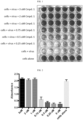
- Compound 1 was screened for cytotoxicity in uninfected CRFK cells using a commercially available CellTox Green Cytotoxicity Assay (Promega). The assayed was performed in a 96 well place formate using serial dilution of Compound 1 in sextuplicate. Compound concentration associated with 50% cytotoxicity (CC 50 ) following 72 hour incubation was calculated by regression analysis. The CC 50 of Compound 1 is shown in Table 2. See FIG. 1 . Table 2 CC 50 Compound 1 >100 ⁇ M
Landscapes
- Health & Medical Sciences (AREA)
- Life Sciences & Earth Sciences (AREA)
- General Health & Medical Sciences (AREA)
- Virology (AREA)
- Medicinal Chemistry (AREA)
- Pharmacology & Pharmacy (AREA)
- Chemical & Material Sciences (AREA)
- Animal Behavior & Ethology (AREA)
- Veterinary Medicine (AREA)
- Public Health (AREA)
- Molecular Biology (AREA)
- Communicable Diseases (AREA)
- Oncology (AREA)
- Chemical Kinetics & Catalysis (AREA)
- General Chemical & Material Sciences (AREA)
- Nuclear Medicine, Radiotherapy & Molecular Imaging (AREA)
- Organic Chemistry (AREA)
- Epidemiology (AREA)
- Pharmaceuticals Containing Other Organic And Inorganic Compounds (AREA)
Applications Claiming Priority (3)
| Application Number | Priority Date | Filing Date | Title |
|---|---|---|---|
| US201762470944P | 2017-03-14 | 2017-03-14 | |
| EP18715335.8A EP3595672B1 (de) | 2017-03-14 | 2018-03-13 | Verbindungen zur verwendung in verfahren zur behandlung von coronavirus-infektionen bei katzen |
| PCT/US2018/022166 WO2018169946A1 (en) | 2017-03-14 | 2018-03-13 | Methods of treating feline coronavirus infections |
Related Parent Applications (1)
| Application Number | Title | Priority Date | Filing Date |
|---|---|---|---|
| EP18715335.8A Division EP3595672B1 (de) | 2017-03-14 | 2018-03-13 | Verbindungen zur verwendung in verfahren zur behandlung von coronavirus-infektionen bei katzen |
Publications (2)
| Publication Number | Publication Date |
|---|---|
| EP4331677A2 true EP4331677A2 (de) | 2024-03-06 |
| EP4331677A3 EP4331677A3 (de) | 2024-05-29 |
Family
ID=61873933
Family Applications (2)
| Application Number | Title | Priority Date | Filing Date |
|---|---|---|---|
| EP23195442.1A Withdrawn EP4331677A3 (de) | 2017-03-14 | 2018-03-13 | Verfahren zur behandlung von infektionen mit dem katzen-coronavirus |
| EP18715335.8A Active EP3595672B1 (de) | 2017-03-14 | 2018-03-13 | Verbindungen zur verwendung in verfahren zur behandlung von coronavirus-infektionen bei katzen |
Family Applications After (1)
| Application Number | Title | Priority Date | Filing Date |
|---|---|---|---|
| EP18715335.8A Active EP3595672B1 (de) | 2017-03-14 | 2018-03-13 | Verbindungen zur verwendung in verfahren zur behandlung von coronavirus-infektionen bei katzen |
Country Status (10)
| Country | Link |
|---|---|
| US (2) | US10682368B2 (de) |
| EP (2) | EP4331677A3 (de) |
| JP (2) | JP6824434B2 (de) |
| KR (2) | KR102318320B1 (de) |
| CN (2) | CN110869028B (de) |
| AU (1) | AU2018235754B2 (de) |
| CA (1) | CA3056072C (de) |
| ES (1) | ES2961460T3 (de) |
| TW (1) | TW201836615A (de) |
| WO (1) | WO2018169946A1 (de) |
Families Citing this family (49)
| Publication number | Priority date | Publication date | Assignee | Title |
|---|---|---|---|---|
| PT2595980E (pt) | 2010-07-22 | 2014-11-27 | Gilead Sciences Inc | Métodos e compostos para tratar infeções pelo vírus da família paramyxoviridae |
| TWI698444B (zh) | 2014-10-29 | 2020-07-11 | 美商基利科學股份有限公司 | 製備核糖苷的方法 |
| DK3349758T3 (da) | 2015-09-16 | 2022-06-13 | Gilead Sciences Inc | Fremgangsmåder til behandling af arenaviridae-virusinfektioner |
| CN110869028B (zh) * | 2017-03-14 | 2023-01-20 | 吉利德科学公司 | 治疗猫冠状病毒感染的方法 |
| EP4219513A1 (de) | 2017-05-01 | 2023-08-02 | Gilead Sciences, Inc. | Kristalline form von (s)-2-ethylbutyl 2-((s)-(((2r,3s,4r,5r)-5-(4-aminopyrrolo[2,1-f) [1,2,4)triazin-7-yl)-5-cyano-3,4-dihydroxytetrahydrofuran2-yl)methoxy)oat |
| CN111093627B (zh) | 2017-07-11 | 2024-03-08 | 吉利德科学公司 | 用于治疗病毒感染的包含rna聚合酶抑制剂和环糊精的组合物 |
| CN110724174B (zh) * | 2019-09-10 | 2021-02-05 | 广州六顺生物科技股份有限公司 | 吡咯并三嗪类化合物、组合物及其应用 |
| CN110613726B (zh) * | 2019-09-25 | 2020-10-16 | 广州六顺生物科技股份有限公司 | 核苷化合物的应用 |
| KR20220132608A (ko) | 2020-01-27 | 2022-09-30 | 길리애드 사이언시즈, 인코포레이티드 | SARS CoV-2 감염증을 치료하기 위한 방법 |
| CA3170320A1 (en) * | 2020-02-11 | 2021-08-19 | Durect Corporation | Treatment of infectious diseases |
| TWI791193B (zh) * | 2020-02-18 | 2023-02-01 | 美商基利科學股份有限公司 | 抗病毒化合物 |
| TWI794742B (zh) * | 2020-02-18 | 2023-03-01 | 美商基利科學股份有限公司 | 抗病毒化合物 |
| KR20250133471A (ko) | 2020-02-18 | 2025-09-05 | 길리애드 사이언시즈, 인코포레이티드 | 항바이러스 화합물 |
| TWI775313B (zh) | 2020-02-18 | 2022-08-21 | 美商基利科學股份有限公司 | 抗病毒化合物 |
| CN113292565B (zh) * | 2020-02-24 | 2023-01-31 | 浙江森科建设有限公司 | 核苷类化合物及其制备方法和应用 |
| CN113368251A (zh) * | 2020-02-25 | 2021-09-10 | 上海和绎实业有限公司 | 一种组合溶剂及其制备方法和应用 |
| JP2021138619A (ja) * | 2020-03-02 | 2021-09-16 | フマキラー株式会社 | 抗コロナウイルス剤 |
| CN111135184A (zh) * | 2020-03-05 | 2020-05-12 | 华中农业大学 | GS-441524在制备新型冠状病毒SARS-CoV-2抑制剂中的应用 |
| CN111135166A (zh) * | 2020-03-05 | 2020-05-12 | 华中农业大学 | 一种由gc376与gs-441524组成的药物组合物及其抑制新冠病毒的用途 |
| TWI785528B (zh) | 2020-03-12 | 2022-12-01 | 美商基利科學股份有限公司 | 1’-氰基核苷之製備方法 |
| JP7482250B2 (ja) | 2020-04-06 | 2024-05-13 | ギリアード サイエンシーズ, インコーポレイテッド | 1’-シアノ置換カルバヌクレオシド類似体の吸入製剤 |
| KR102997589B1 (ko) | 2020-05-18 | 2026-07-29 | 포스트바이오(주) | 고양이 코로나바이러스에 대한 난황항체 제조방법 및 이에 의해 제조된 난황항체 |
| KR102392774B1 (ko) | 2020-05-18 | 2022-04-29 | 포스트바이오(주) | 고양이 코로나바이러스 검출을 위한 rt-pcr용 조성물 |
| EP4157272B1 (de) | 2020-05-29 | 2025-07-02 | Gilead Sciences, Inc. | Remdesivir zur behandlung von viralen infektionen |
| IL299202A (en) | 2020-06-24 | 2023-02-01 | Gilead Sciences Inc | 1'-cyano nucleoside analogs and uses thereof |
| KR20210158647A (ko) | 2020-06-24 | 2021-12-31 | 주식회사 지앤피바이오사이언스 | 고양이 코로나바이러스에 대한 항바이러스용 조성물 |
| JP7559223B2 (ja) | 2020-08-24 | 2024-10-01 | ギリアード サイエンシーズ, インコーポレイテッド | リン脂質化合物及びその使用 |
| US20240024347A1 (en) * | 2020-08-25 | 2024-01-25 | The Johns Hopkins University | Prodrugs of 6-mercaptopurine |
| US11926645B2 (en) | 2020-08-27 | 2024-03-12 | Gilead Sciences, Inc. | Compounds and methods for treatment of viral infections |
| EP4203937A1 (de) * | 2020-08-28 | 2023-07-05 | Sayvaa Pharmaceuticals Inc. | Formulierungen antiviraler verbindungen |
| US11077052B1 (en) | 2020-09-09 | 2021-08-03 | Malireddy S. Reddy | Selected multi-phase treatment for coronavirus respiratory infections |
| TWI925033B (zh) | 2020-10-16 | 2026-05-11 | 美商基利科學股份有限公司 | 磷脂化合物及其用途 |
| CN114588159A (zh) * | 2020-12-07 | 2022-06-07 | 成都傲科新技术有限责任公司 | 一种治疗猫冠状病毒感染的化合物及其应用 |
| CN114621229B (zh) * | 2020-12-11 | 2024-07-02 | 嘉兴金派特生物科技有限公司 | 治疗或预防猫传染性腹膜炎的化合物或组合物 |
| CN116370479B (zh) * | 2020-12-30 | 2024-02-13 | 南方科技大学 | 化合物atv014在制备用于治疗新冠病毒感染的产品中的用途 |
| AU2022256476B2 (en) | 2021-04-16 | 2025-06-05 | Gilead Sciences, Inc. | Methods of preparing carbanucleosides using amides |
| CN113185519A (zh) * | 2021-04-23 | 2021-07-30 | 苏州富德兆丰生化科技有限公司 | 一种核苷类化合物及其在治疗猫传染性腹膜炎中的应用 |
| CA3228162A1 (en) * | 2021-08-18 | 2023-02-23 | Gilead Sciences, Inc. | Phospholipid compounds and methods of making and using the same |
| CN113679716B (zh) * | 2021-10-13 | 2024-03-26 | 史大永 | 溴酚-吡唑啉化合物在治疗猫冠状病毒疾病中的应用 |
| KR20240154647A (ko) | 2022-03-02 | 2024-10-25 | 길리애드 사이언시즈, 인코포레이티드 | 바이러스성 감염 치료를 위한 화합물 및 방법 |
| KR102917091B1 (ko) | 2022-03-02 | 2026-01-23 | 유재혁 | 몰누피라비르의 국소 투여용 수의학적 조성물 및 그 이용 |
| US20230382940A1 (en) * | 2022-03-03 | 2023-11-30 | Gilead Sciences, Inc. | Antiviral compounds and methods of making and using the same |
| AU2023261450A1 (en) * | 2022-04-25 | 2024-11-14 | Miracure Biotechnology Limited | Nucleoside drug for treating or preventing coronavirus infection, and use thereof |
| JP2025523557A (ja) * | 2022-06-28 | 2025-07-23 | 蘇州旺山旺水生物医薬股▲ふん▼有限公司 | ネココロナ又はカリシウイルス感染を治療する方法 |
| EP4547665A1 (de) | 2022-06-30 | 2025-05-07 | Gilead Sciences, Inc. | Feste formen eines nukleosidanalogons und verwendungen davon |
| WO2024088184A1 (en) * | 2022-10-23 | 2024-05-02 | Shanghai Curegene Pharmaceutical Co., Ltd. | Anti-feline-coronavirus compounds and uses thereof |
| US12357577B1 (en) | 2024-02-02 | 2025-07-15 | Gilead Sciences, Inc. | Pharmaceutical formulations and uses thereof |
| WO2025168015A1 (zh) * | 2024-02-08 | 2025-08-14 | 联邦生物科技(珠海横琴)有限公司 | 抗病毒核苷类似物在制备治疗猫冠状病毒药物中的用途 |
| CN119954834B (zh) * | 2025-02-07 | 2025-08-05 | 湖南尚成生物科技有限公司 | 一种化合物或其药学上可接受的盐、水合物、溶剂化物或前药及其用途 |
Citations (4)
| Publication number | Priority date | Publication date | Assignee | Title |
|---|---|---|---|---|
| US7973013B2 (en) | 2009-09-21 | 2011-07-05 | Gilead Sciences, Inc. | 2'-fluoro substituted carba-nucleoside analogs for antiviral treatment |
| US8008264B2 (en) | 2008-04-23 | 2011-08-30 | Gilead Sciences, Inc. | 1′-substituted carba-nucleoside analogs for antiviral treatment |
| WO2012012776A1 (en) | 2010-07-22 | 2012-01-26 | Gilead Sciences, Inc. | Methods and compounds for treating paramyxoviridae virus infections |
| WO2015069939A1 (en) | 2013-11-11 | 2015-05-14 | Gilead Sciences, Inc. | Pyrrolo [1,2,f] [1,2,4] triazines useful for treating respiratory syncitial virus infections |
Family Cites Families (142)
| Publication number | Priority date | Publication date | Assignee | Title |
|---|---|---|---|---|
| US4816570A (en) | 1982-11-30 | 1989-03-28 | The Board Of Regents Of The University Of Texas System | Biologically reversible phosphate and phosphonate protective groups |
| US4968788A (en) | 1986-04-04 | 1990-11-06 | Board Of Regents, The University Of Texas System | Biologically reversible phosphate and phosphonate protective gruops |
| ES2083580T3 (es) | 1990-06-13 | 1996-04-16 | Arnold Glazier | Profarmacos de fosforo. |
| DK0481214T3 (da) | 1990-09-14 | 1999-02-22 | Acad Of Science Czech Republic | Prolægemidler af phosphonater |
| US6887707B2 (en) | 1996-10-28 | 2005-05-03 | University Of Washington | Induction of viral mutation by incorporation of miscoding ribonucleoside analogs into viral RNA |
| KR20010041533A (ko) | 1998-03-03 | 2001-05-25 | 한센 핀 베네드, 안네 제헤르, 웨이콥 마리안느 | (2e)-5-아미노-5-메틸헥스-2-엔오산n-메틸-n-((1r)-1-(n-메틸-n-((1r)-1-(메틸카르바모일)-2-페닐에틸)카르바모일)-2-(2-나프틸)에틸)아미드의신규한 염 형태 |
| US6312662B1 (en) | 1998-03-06 | 2001-11-06 | Metabasis Therapeutics, Inc. | Prodrugs phosphorus-containing compounds |
| US6475985B1 (en) | 1998-03-27 | 2002-11-05 | Regents Of The University Of Minnesota | Nucleosides with antiviral and anticancer activity |
| DE69936998T2 (de) | 1998-10-16 | 2008-05-21 | Merck Sharp & Dohme Ltd., Hoddesdon | Pyrazolotriazinderivate als gaba-rezeptorliganden |
| DE19912636A1 (de) | 1999-03-20 | 2000-09-21 | Aventis Cropscience Gmbh | Bicyclische Heterocyclen, Verfahren zu ihrer Herstellung und ihre Verwendung als Herbizide und pharmazeutische Mittel |
| WO2000075157A1 (en) | 1999-06-03 | 2000-12-14 | Abbott Laboratories | Oligonucleotide synthesis with lewis acids as activators |
| AUPQ105499A0 (en) | 1999-06-18 | 1999-07-08 | Biota Scientific Management Pty Ltd | Antiviral agents |
| WO2001019375A1 (en) | 1999-09-15 | 2001-03-22 | Biocryst Pharmaceuticals, Inc. | Inhibiting t-cell proliferation |
| CA2389745C (en) | 1999-11-04 | 2010-03-23 | Shire Biochem Inc. | Method for the treatment or prevention of flaviviridae viral infection using nucleoside analogues |
| JP4107629B2 (ja) | 2000-02-07 | 2008-06-25 | 株式会社オティックス | コモンレールの製造方法 |
| SK11922002A3 (sk) | 2000-02-18 | 2003-06-03 | Shire Biochem Inc. | Použitie analógov nukleozidov na liečenie alebo prevenciu infekcií spôsobených flavivírusom |
| MY164523A (en) | 2000-05-23 | 2017-12-29 | Univ Degli Studi Cagliari | Methods and compositions for treating hepatitis c virus |
| PL359169A1 (en) | 2000-05-26 | 2004-08-23 | Idenix (Cayman) Limited | Methods and compositions for treating flaviviruses and pestiviruses |
| HRP20030047B1 (hr) | 2000-07-21 | 2016-02-26 | Gilead Sciences, Inc. | Prolijekovi koji su fosfonatni analozi nukleotida i metode njihovog odabira te njihova priprava |
| US20030008841A1 (en) | 2000-08-30 | 2003-01-09 | Rene Devos | Anti-HCV nucleoside derivatives |
| KR20090089922A (ko) | 2000-10-18 | 2009-08-24 | 파마셋 인코포레이티드 | 바이러스 감염 및 비정상적인 세포 증식의 치료를 위한 변형된 뉴클레오시드 |
| AUPR213700A0 (en) | 2000-12-18 | 2001-01-25 | Biota Scientific Management Pty Ltd | Antiviral agents |
| MXPA03006514A (es) | 2001-01-22 | 2004-12-02 | Merck & Co Inc | Derivados de nucleosidos como inhibidores de polimerasa de acido ribonucleico viral dependiente de acido ribonucleico. |
| DE10145223A1 (de) | 2001-09-13 | 2003-04-03 | Basf Ag | Verfahren zur Herstellung von meso-Zeaxanthin |
| WO2003026675A1 (en) | 2001-09-28 | 2003-04-03 | Idenix (Cayman) Limited | Methods and compositions for treating flaviviruses and pestiviruses using 4'-modified nucleoside |
| AT410792B (de) | 2001-12-28 | 2003-07-25 | Dsm Fine Chem Austria Gmbh | Verfahren zur herstellung von geschützten, enantiomeren-angereicherten cyanhydrinen durch in-situ-derivatisierung |
| RU2004128943A (ru) | 2002-02-28 | 2005-04-20 | Байота, Инк. (Us) | Средства, имитирующие нуклеотиды, и их пролекарственные формы |
| WO2003073989A2 (en) | 2002-02-28 | 2003-09-12 | Biota, Inc. | Nucleoside 5'-monophosphate mimics and their prodrugs |
| US20040138170A1 (en) | 2002-03-06 | 2004-07-15 | Montgomery John A. | Nucleosides, preparation thereof and use as inhibitors of rna viral polymerases |
| GB0210127D0 (en) | 2002-05-02 | 2002-06-12 | Merck Sharp & Dohme | Therapeutic agents |
| GB0210124D0 (en) | 2002-05-02 | 2002-06-12 | Merck Sharp & Dohme | Therapeutic agents |
| BR0309581A (pt) | 2002-05-06 | 2005-03-29 | Genelabs Tech Inc | Derivados de nucleosìdeo para tratamento de infecção por vìrus de hepatite c |
| AU2003233667A1 (en) | 2002-05-23 | 2003-12-12 | Biocryst Pharmaceuticals, Inc. | Enhancing the efficacy of reverse transcriptase and dna polymerase inhibitors (nucleoside analogs) using pnp inhibitors and/or 2'-deoxyguanosine and/or prodrug thereof |
| AU2003298658A1 (en) | 2002-11-15 | 2004-06-15 | Idenix (Cayman) Limited | 2'-branched nucleosides and flaviviridae mutation |
| SG182849A1 (en) | 2003-04-25 | 2012-08-30 | Gilead Sciences Inc | Antiviral phosphonate analogs |
| EP1646371A4 (de) | 2003-06-26 | 2010-09-22 | Biotron Ltd | Antivirale verbindungen und verfahren |
| GB0317009D0 (en) | 2003-07-21 | 2003-08-27 | Univ Cardiff | Chemical compounds |
| ATE478886T1 (de) | 2003-07-25 | 2010-09-15 | Idenix Pharmaceuticals Inc | Purin nucleoside für die behandlung von durch flavividrae verursachten krankheiten, einschliesslich hepatitis c |
| WO2005021568A2 (en) | 2003-08-27 | 2005-03-10 | Biota, Inc. | Novel tricyclic nucleosides or nucleotides as therapeutic agents |
| EA011158B1 (ru) | 2004-03-16 | 2009-02-27 | Бёрингер Ингельхайм Интернациональ Гмбх | Замещённые глюкопиранозилом бензольные производные, содержащие эти соединения лекарственные средства, их применение и способ их получения |
| WO2005123087A2 (en) | 2004-06-15 | 2005-12-29 | Merck & Co., Inc. | C-purine nucleoside analogs as inhibitors of rna-dependent rna viral polymerase |
| US7560434B2 (en) | 2004-06-22 | 2009-07-14 | Biocryst Pharmaceuticals, Inc. | AZA nucleosides, preparation thereof and use as inhibitors of RNA viral polymerases |
| ES2725457T3 (es) | 2004-09-14 | 2019-09-24 | Gilead Pharmasset Llc | Preparación de ribofuranosil pirimidinas y purinas 2'fluoro-2'-alquil-sustituidas u otras opcionalmente sustituidas y sus derivados |
| AU2005317081A1 (en) | 2004-10-21 | 2006-06-22 | Merck & Co., Inc. | Fluorinated pyrrolo[2,3-d]pyrimidine nucleosides for the treatment of RNA-dependent RNA viral infection |
| AU2005302448B2 (en) | 2004-10-29 | 2012-07-19 | Biocryst Pharmaceuticals, Inc. | Therapeutic furopyrimidines and thienopyrimidines |
| JP2008524162A (ja) | 2004-12-16 | 2008-07-10 | ベーリンガー インゲルハイム インターナショナル ゲゼルシャフト ミット ベシュレンクテル ハフツング | グルコピラノシル置換ベンゼン誘導体、該化合物を含む薬物、その使用及びその製造方法 |
| AU2006222563A1 (en) | 2005-03-08 | 2006-09-14 | Biota Scientific Management Pty Ltd. | Bicyclic nucleosides and nucleotides as therapeutic agents |
| CA2602533A1 (en) | 2005-03-29 | 2006-10-05 | Biocryst Pharmaceuticals, Inc. | Use of c-nucleoside analogs for treatment of hepatitis c related viral infections |
| WO2006116557A1 (en) | 2005-04-25 | 2006-11-02 | Genelabs Technologies, Inc. | Nucleoside compounds for treating viral infections |
| WO2006121820A1 (en) | 2005-05-05 | 2006-11-16 | Valeant Research & Development | Phosphoramidate prodrugs for treatment of viral infection |
| WO2007027248A2 (en) | 2005-05-16 | 2007-03-08 | Valeant Research & Development | 3', 5' - cyclic nucleoside analogues for treatment of hcv |
| US8669280B2 (en) | 2005-06-24 | 2014-03-11 | Biotron Limited | Antiviral compounds and methods |
| ES2436404T3 (es) | 2005-10-03 | 2013-12-30 | University Health Network | Inhibidores ODCasa para el tratamiento de malaria |
| EP1945222B1 (de) | 2005-11-02 | 2012-12-26 | Bayer Pharma Aktiengesellschaft | Pyrrolo[2,1-f] [1,2,4] triazin-4-ylamine als igf-1r-kinasehemmer zur behandlung von krebs und anderen hyperproliferativen erkrankungen |
| SI1954264T1 (sl) | 2005-12-01 | 2010-01-29 | Basilea Pharmaceutica Ag | Postopek priprave intermediatov epoksibutanola |
| BRPI0619146A2 (pt) | 2005-12-02 | 2011-09-13 | Bayer Pharmaceuticals Corp | derivados de 4-amino-pirroltriazina substituìda úteis no tratamento de disordens e doenças hiperproliferativas associadas com angiogênesis |
| PE20070855A1 (es) | 2005-12-02 | 2007-10-14 | Bayer Pharmaceuticals Corp | Derivados de 4-amino-pirrolotriazina sustituida como inhibidores de quinasas |
| JP5112328B2 (ja) | 2005-12-09 | 2013-01-09 | バジリア ファルマスーチカ アーゲー | 重度の皮膚科障害の局所的処置のための4−オキソ(イソ)トレチノイン |
| BRPI0619563A2 (pt) | 2005-12-09 | 2011-10-04 | Pharmasset Inc | nucleosìdeos antivirais |
| WO2007097991A2 (en) | 2006-02-16 | 2007-08-30 | Pharmasset, Inc. | Methods and kits for dosing of antiviral agents |
| DE102006015378A1 (de) | 2006-04-03 | 2007-10-04 | Ludwig-Maximilians-Universität München | Verfahren zur Synthese von Organoelementverbindungen |
| CL2007001427A1 (es) | 2006-05-22 | 2008-05-16 | Novartis Ag | Sal de maleato de 5-amino-3-(2',3'-di-o-acetil-beta-d-ribofuranosil)-3h-tiazolo[4,5-d]pirimidin-2-ona; procedimiento de preparacion; composicion farmaceutica que comprende a dicho compuesto; y uso del compuesto para el tratamiento de una infeccion po |
| WO2008005542A2 (en) | 2006-07-07 | 2008-01-10 | Gilead Sciences, Inc., | Antiviral phosphinate compounds |
| US20080161324A1 (en) | 2006-09-14 | 2008-07-03 | Johansen Lisa M | Compositions and methods for treatment of viral diseases |
| AR063569A1 (es) | 2006-11-06 | 2009-02-04 | Boehringer Ingelheim Int | Derivados de benzil- benzonitrilo sustituidos con glucopiranosilo medicamentos que contienen a compuestos de este tipo su uso u procedimiento para su fabricacion |
| JP2010513484A (ja) | 2006-12-20 | 2010-04-30 | メルク・シャープ・エンド・ドーム・コーポレイション | Rna依存性rnaウイルス感染治療用ヌクレオシド環状ホスホロアミデート |
| US7951789B2 (en) | 2006-12-28 | 2011-05-31 | Idenix Pharmaceuticals, Inc. | Compounds and pharmaceutical compositions for the treatment of viral infections |
| AU2007342367B2 (en) | 2007-01-05 | 2012-12-06 | Istituto Di Ricerche Di Biologia Molecolare P. Angeletti S.P.A. | Nucleoside aryl phosphoramidates for the treatment of RNA-dependent RNA viral infection |
| NZ598927A (en) | 2007-01-12 | 2013-09-27 | Biocryst Pharm Inc | Antiviral nucleoside analogs |
| WO2008116064A2 (en) | 2007-03-21 | 2008-09-25 | Bristol-Myers Squibb Company | Fused heterocyclic compounds useful for the treatment of proliferative, allergic, autoimmune or inflammatory diseases |
| US7964580B2 (en) | 2007-03-30 | 2011-06-21 | Pharmasset, Inc. | Nucleoside phosphoramidate prodrugs |
| DK2155758T3 (da) | 2007-05-10 | 2012-11-05 | Biocryst Pharm Inc | Tetrahydrofuro[3,4-d]dioxolanforbindelser til anvendelse i behandlingen af virusinfektioner og cancer |
| CN100532388C (zh) | 2007-07-16 | 2009-08-26 | 郑州大学 | 2’-氟-4’-取代-核苷类似物、其制备方法及应用 |
| ES2614269T3 (es) | 2007-08-03 | 2017-05-30 | Biotron Limited | Procedimientos y composiciones antivíricas frente a la hepatitis C |
| TW200942243A (en) | 2008-03-05 | 2009-10-16 | Biocryst Pharm Inc | Antiviral therapeutic agents |
| US8227431B2 (en) | 2008-03-17 | 2012-07-24 | Hetero Drugs Limited | Nucleoside derivatives |
| US7863291B2 (en) | 2008-04-23 | 2011-01-04 | Bristol-Myers Squibb Company | Quinuclidine compounds as alpha-7 nicotinic acetylcholine receptor ligands |
| WO2010036407A2 (en) | 2008-05-15 | 2010-04-01 | Biocryst Pharmaceuticals, Inc. | Antiviral nucleoside analogs |
| EP2313102A2 (de) | 2008-07-03 | 2011-04-27 | Biota Scientific Management | Bicyclische nucleoside und nucleotide als therapeutische mittel |
| BRPI1013643A2 (pt) | 2009-02-10 | 2016-04-19 | Gilead Sciences Inc | análogos de carba-nucleosídeo para tratamento antiviral |
| AR075584A1 (es) | 2009-02-27 | 2011-04-20 | Intermune Inc | COMPOSICIONES TERAPEUTICAS QUE COMPRENDEN beta-D-2'-DESOXI-2'-FLUORO-2'-C-METILCITIDINA Y UN DERIVADO DE ACIDO ISOINDOL CARBOXILICO Y SUS USOS. COMPUESTO. |
| WO2010108140A1 (en) | 2009-03-20 | 2010-09-23 | Alios Biopharma, Inc. | Substituted nucleoside and nucleotide analogs |
| MX2011009928A (es) | 2009-03-24 | 2012-03-16 | Biocryst Pharm Inc | Sales farmaceuticas utiles de 7[(3r, 4r)-3-hidroxi-4-hidroximetil- pirrolidin-1-ilmetil]-3,5-dihidro-pirrol[3,2-d]pirimidin-4-ona. |
| TWI576352B (zh) | 2009-05-20 | 2017-04-01 | 基利法瑪席特有限責任公司 | 核苷磷醯胺 |
| KR20120051022A (ko) | 2009-07-21 | 2012-05-21 | 길리애드 사이언시즈, 인코포레이티드 | 플라비비리데 바이러스의억제제 |
| US8455451B2 (en) | 2009-09-21 | 2013-06-04 | Gilead Sciences, Inc. | 2'-fluoro substituted carba-nucleoside analogs for antiviral treatment |
| NZ599404A (en) | 2009-09-21 | 2014-02-28 | Gilead Sciences Inc | Processes and intermediates for the preparation of 1’-substituted carba-nucleoside analogs |
| DK2480552T3 (en) | 2009-09-21 | 2017-02-20 | Gilead Sciences Inc | 2 'FLUOROUS-SUBSTITUTED CARBA NUCLEOSIDE ANALYSIS FOR ANTIVIRAL TREATMENT |
| WO2011080568A2 (en) | 2009-12-28 | 2011-07-07 | Development Center For Biotechnology | Novel pyrimidine compounds as mtor and p13k inhibitors |
| TW201136945A (en) | 2010-03-31 | 2011-11-01 | Pharmasset Inc | Purine nucleoside phosphoramidate |
| AP2012006535A0 (en) | 2010-03-31 | 2012-10-31 | Gilead Pharmasset Llc | Stereoselective synthesis of phosphorous containing actives |
| TW201201815A (en) | 2010-05-28 | 2012-01-16 | Gilead Sciences Inc | 1'-substituted-carba-nucleoside prodrugs for antiviral treatment |
| EA025311B1 (ru) | 2010-07-19 | 2016-12-30 | Гайлид Сайэнсиз, Инк. | Способы получения диастереомерно чистых фосфорамидатных пролекарств |
| TW201305185A (zh) | 2010-09-13 | 2013-02-01 | 吉李德科學股份有限公司 | 用於抗病毒治療之2’-氟取代之碳-核苷類似物 |
| SG188223A1 (en) | 2010-09-20 | 2013-04-30 | Gilead Sciences Inc | 2' -fluoro substituted carba-nucleoside analogs for antiviral treatment |
| WO2012040127A1 (en) | 2010-09-22 | 2012-03-29 | Alios Biopharma, Inc. | Substituted nucleotide analogs |
| LT2898885T (lt) | 2010-10-15 | 2018-02-26 | Biocryst Pharmaceuticals, Inc. | Pirolopirimidino dariniai, skirti naudoti virusinių infekcijų gydymui |
| TW201306841A (zh) | 2010-12-20 | 2013-02-16 | Gilead Sciences Inc | 治療c型肝炎病毒(hcv)之方法 |
| EP2697241B1 (de) | 2011-04-13 | 2019-06-12 | Gilead Sciences, Inc. | 1'-substituierte pyrimidin-nukleosidanaloga für antivirale behandlung |
| ES2639122T3 (es) | 2011-05-13 | 2017-10-25 | Zoetis Services Llc | Composiciones inmunogénicas de glucoproteína G de virus Hendra y Nipah |
| HRP20180237T4 (hr) | 2011-09-16 | 2020-12-11 | Gilead Pharmasset Llc | Metode za liječenje hcv-a |
| US8889159B2 (en) | 2011-11-29 | 2014-11-18 | Gilead Pharmasset Llc | Compositions and methods for treating hepatitis C virus |
| US20130143835A1 (en) | 2011-12-05 | 2013-06-06 | Medivir Ab | HCV Polymerase Inhibitors |
| WO2013084165A1 (en) | 2011-12-05 | 2013-06-13 | Medivir Ab | Hcv polymerase inhibitors |
| EP2794630A4 (de) | 2011-12-22 | 2015-04-01 | Alios Biopharma Inc | Substituierte phosphorthioat-nukleotidanaloga |
| MD20140134A2 (ro) | 2012-05-22 | 2015-04-30 | Idenix Pharmaceuticals, Inc. | Compuşi ai D-aminoacizilor pentru tratamentul bolilor hepatice |
| US9556216B2 (en) | 2012-08-31 | 2017-01-31 | Novartis Ag | 2′-Ethynyl nucleoside derivatives for treatment of viral infections |
| CA2881322A1 (en) | 2012-09-10 | 2014-03-13 | F. Hoffmann-La Roche Ag | 6-amino acid heteroaryldihydropyrimidines for the treatment and prophylaxis of hepatitis b virus infection |
| WO2014042433A2 (en) | 2012-09-14 | 2014-03-20 | Kainos Medicine, Inc. | Compounds and compositions for modulating adenosine a3 receptor activity |
| MX2015005949A (es) | 2012-11-16 | 2015-09-08 | Biocryst Pharm Inc | Nucleosidos que contienen aza-azucar antiviral. |
| JP2016501200A (ja) | 2012-11-19 | 2016-01-18 | メルク・シャープ・アンド・ドーム・コーポレーションMerck Sharp & Dohme Corp. | ウイルス性疾患を処置するための2−アルキニル置換ヌクレオシド誘導体 |
| US9243022B2 (en) | 2012-12-21 | 2016-01-26 | Alios Biopharma, Inc. | Substituted nucleosides, nucleotides and analogs thereof |
| US9283242B2 (en) | 2013-01-22 | 2016-03-15 | Massachusetts Institute Of Technology | Uses of dihydro bases |
| US10034893B2 (en) | 2013-02-01 | 2018-07-31 | Enanta Pharmaceuticals, Inc. | 5, 6-D2 uridine nucleoside/tide derivatives |
| AU2014250762A1 (en) | 2013-04-12 | 2015-10-29 | Achillion Pharmaceuticals, Inc. | Highly active nucleoside derivative for the treatment of HCV |
| US9542154B2 (en) | 2013-06-25 | 2017-01-10 | Intel Corporation | Fused multiply add operations using bit masks |
| UA117375C2 (uk) | 2013-09-04 | 2018-07-25 | Медівір Аб | Інгібітори полімерази hcv |
| MX377523B (es) | 2013-09-11 | 2025-03-10 | Inst Nat Sante Rech Med | Metodos y composiciones farmaceuticas para el tratamiento de la infeccion por el virus de la hepatitis b. |
| PE20160686A1 (es) | 2014-01-30 | 2016-07-23 | Hoffmann La Roche | Nuevas dihidroquinolizinonas para el tratamiento y profilaxis de la infeccion por virus de la hepatitis b |
| PL3114128T3 (pl) | 2014-03-07 | 2019-06-28 | F. Hoffmann-La Roche Ag | Nowe skondensowane w pozycji 6 heteroarylodihydropirymidyny stosowane w leczeniu i profilaktyce zakażenia wirusem zapalenia wątroby typu B |
| CN106459032B (zh) | 2014-05-13 | 2019-04-05 | 豪夫迈·罗氏有限公司 | 治疗和预防乙型肝炎病毒感染的新的二氢喹嗪酮类 |
| US9504701B2 (en) | 2014-06-02 | 2016-11-29 | The Board Of Regents Of The University Of Texas System | Methods for treating viral infections using hydrogen sulfide donors |
| US9616076B2 (en) | 2014-06-02 | 2017-04-11 | The Board Of Regents Of The University Of Texas Systems | Methods for treating viral infections using hydrogen sulfide donors |
| WO2016012470A1 (en) | 2014-07-25 | 2016-01-28 | F. Hoffmann-La Roche Ag | New amorphous and crystalline forms of (3s)-4-[[(4r)-4-(2-chloro-4-fluoro-phenyl)-5-methoxycarbonyl-2-thiazol-2-yl-1, 4-dihydropyrimidin-6-yl]methyl]morpholine-3-carboxylic acid |
| JP6506836B2 (ja) | 2014-08-14 | 2019-04-24 | エフ.ホフマン−ラ ロシュ アーゲーF. Hoffmann−La Roche Aktiengesellschaft | B型肝炎ウイルス感染症の処置および予防のための新規ピリダゾンおよびトリアジノン |
| TWI698444B (zh) | 2014-10-29 | 2020-07-11 | 美商基利科學股份有限公司 | 製備核糖苷的方法 |
| US9637485B2 (en) | 2014-11-03 | 2017-05-02 | Hoffmann-La Roche Inc. | 6,7-dihydrobenzo[a]quinolizin-2-one derivatives for the treatment and prophylaxis of hepatitis B virus infection |
| US9676793B2 (en) | 2014-12-23 | 2017-06-13 | Hoffmann-Laroche Inc. | Co-crystals of 5-amino-2-oxothiazolo[4,5-d]pyrimidin-3(2H)-yl-5-hydroxymethyl tetrahydrofuran-3-yl acetate and methods for preparing and using the same |
| WO2016102438A1 (en) | 2014-12-23 | 2016-06-30 | F. Hoffmann-La Roche Ag | Process for the preparation of 4-phenyl-5-alkoxycarbonyl-2-thiazol-2-yl-1,4-dihydropyrimidine analogues |
| EP3240537B1 (de) | 2014-12-30 | 2020-09-09 | F. Hoffmann-La Roche AG | Neuartige tetrahydropyridopyrimidine und tetrahydropyridopyridine zur behandlung und prophylaxe von hepatitis-b-virus-infektion |
| CN107109497A (zh) | 2014-12-31 | 2017-08-29 | 豪夫迈·罗氏有限公司 | 通过实时PCR从细胞裂解物定量HBV cccDNA的高通量新方法 |
| MA41338B1 (fr) | 2015-01-16 | 2019-07-31 | Hoffmann La Roche | Composés de pyrazine pour le traitement de maladies infectieuses |
| EP3250685A1 (de) | 2015-01-27 | 2017-12-06 | F. Hoffmann-La Roche AG | Rekombinante hbv-cccdna, verfahren zur erzeugung davon und verwendung davon |
| JP6435054B2 (ja) | 2015-02-11 | 2018-12-05 | エフ.ホフマン−ラ ロシュ アーゲーF. Hoffmann−La Roche Aktiengesellschaft | B型肝炎ウイルス感染の治療及び予防のための新規2−オキソ−6,7−ジヒドロベンゾ[a]キノリジン−3−カルボン酸誘導体 |
| DK3349758T3 (da) | 2015-09-16 | 2022-06-13 | Gilead Sciences Inc | Fremgangsmåder til behandling af arenaviridae-virusinfektioner |
| WO2017184668A1 (en) | 2016-04-20 | 2017-10-26 | Gilead Sciences, Inc. | Methods for treating flaviviridae virus infections |
| BR112019016316A2 (pt) | 2017-02-08 | 2020-03-31 | Biotron Limited | Métodos para o tratamento da influenza |
| CN110869028B (zh) * | 2017-03-14 | 2023-01-20 | 吉利德科学公司 | 治疗猫冠状病毒感染的方法 |
| EP4219513A1 (de) | 2017-05-01 | 2023-08-02 | Gilead Sciences, Inc. | Kristalline form von (s)-2-ethylbutyl 2-((s)-(((2r,3s,4r,5r)-5-(4-aminopyrrolo[2,1-f) [1,2,4)triazin-7-yl)-5-cyano-3,4-dihydroxytetrahydrofuran2-yl)methoxy)oat |
| CN111093627B (zh) | 2017-07-11 | 2024-03-08 | 吉利德科学公司 | 用于治疗病毒感染的包含rna聚合酶抑制剂和环糊精的组合物 |
| CN111265532A (zh) | 2020-01-21 | 2020-06-12 | 中国人民解放军军事科学院军事医学研究院 | 取代氨基丙酸酯类化合物在治疗2019-nCoV感染中的应用 |
| KR20220132608A (ko) | 2020-01-27 | 2022-09-30 | 길리애드 사이언시즈, 인코포레이티드 | SARS CoV-2 감염증을 치료하기 위한 방법 |
-
2018
- 2018-03-13 CN CN201880018267.XA patent/CN110869028B/zh active Active
- 2018-03-13 EP EP23195442.1A patent/EP4331677A3/de not_active Withdrawn
- 2018-03-13 ES ES18715335T patent/ES2961460T3/es active Active
- 2018-03-13 CN CN202310076030.XA patent/CN116036112A/zh active Pending
- 2018-03-13 TW TW107108464A patent/TW201836615A/zh unknown
- 2018-03-13 AU AU2018235754A patent/AU2018235754B2/en active Active
- 2018-03-13 EP EP18715335.8A patent/EP3595672B1/de active Active
- 2018-03-13 CA CA3056072A patent/CA3056072C/en active Active
- 2018-03-13 WO PCT/US2018/022166 patent/WO2018169946A1/en not_active Ceased
- 2018-03-13 KR KR1020197029370A patent/KR102318320B1/ko active Active
- 2018-03-13 JP JP2019550757A patent/JP6824434B2/ja active Active
- 2018-03-13 US US15/919,750 patent/US10682368B2/en active Active
- 2018-03-13 KR KR1020217034144A patent/KR102460968B1/ko active Active
-
2020
- 2020-04-17 US US16/852,102 patent/US11260070B2/en active Active
-
2021
- 2021-01-12 JP JP2021002849A patent/JP2021054865A/ja active Pending
Patent Citations (4)
| Publication number | Priority date | Publication date | Assignee | Title |
|---|---|---|---|---|
| US8008264B2 (en) | 2008-04-23 | 2011-08-30 | Gilead Sciences, Inc. | 1′-substituted carba-nucleoside analogs for antiviral treatment |
| US7973013B2 (en) | 2009-09-21 | 2011-07-05 | Gilead Sciences, Inc. | 2'-fluoro substituted carba-nucleoside analogs for antiviral treatment |
| WO2012012776A1 (en) | 2010-07-22 | 2012-01-26 | Gilead Sciences, Inc. | Methods and compounds for treating paramyxoviridae virus infections |
| WO2015069939A1 (en) | 2013-11-11 | 2015-05-14 | Gilead Sciences, Inc. | Pyrrolo [1,2,f] [1,2,4] triazines useful for treating respiratory syncitial virus infections |
Non-Patent Citations (3)
| Title |
|---|
| "Remington's Pharmaceutical Sciences", MACK PUBLISHING CO. |
| FOSTER: "Deuterium Isotope Effects in Studies of Drug Metabolism", TRENDS PHARMACOL. SCI., vol. 5, no. 12, 1984, pages 524 - 527, XP025943358, DOI: 10.1016/0165-6147(84)90534-0 |
| VET CLIN SMALL ANIM, vol. 43, 2013, pages 1039 - 1054 |
Also Published As
| Publication number | Publication date |
|---|---|
| US10682368B2 (en) | 2020-06-16 |
| JP2021054865A (ja) | 2021-04-08 |
| CA3056072A1 (en) | 2018-09-20 |
| US20200376014A1 (en) | 2020-12-03 |
| CN116036112A (zh) | 2023-05-02 |
| AU2018235754B2 (en) | 2021-04-08 |
| AU2018235754A1 (en) | 2019-10-24 |
| EP3595672B1 (de) | 2023-09-06 |
| CA3056072C (en) | 2022-08-23 |
| KR102318320B1 (ko) | 2021-10-27 |
| TW201836615A (zh) | 2018-10-16 |
| WO2018169946A1 (en) | 2018-09-20 |
| KR102460968B1 (ko) | 2022-11-01 |
| EP3595672A1 (de) | 2020-01-22 |
| KR20210130267A (ko) | 2021-10-29 |
| CN110869028B (zh) | 2023-01-20 |
| US11260070B2 (en) | 2022-03-01 |
| US20180296584A1 (en) | 2018-10-18 |
| JP2020510070A (ja) | 2020-04-02 |
| CN110869028A (zh) | 2020-03-06 |
| JP6824434B2 (ja) | 2021-02-03 |
| EP3595672C0 (de) | 2023-09-06 |
| ES2961460T3 (es) | 2024-03-12 |
| CN110869028A8 (zh) | 2020-06-02 |
| KR20190122255A (ko) | 2019-10-29 |
| EP4331677A3 (de) | 2024-05-29 |
Similar Documents
| Publication | Publication Date | Title |
|---|---|---|
| US11260070B2 (en) | Methods of treating feline coronavirus infections | |
| AU2016229294A1 (en) | Method of treating cancer associated with a RAS mutation | |
| BR112015023747B1 (pt) | Uso de um composto antimicrobiano catiônico esteroide (csa) para a preparação de uma composição para tratar, reduzir, ou prevenir inflamação aguda ou crônica e/ou dor aguda ou crônica associada com uma doença ou um sintoma de doença | |
| WO2022158528A1 (ja) | 抗ウイルス剤 | |
| US20200093841A1 (en) | Broad Spectrum Antiviral and Methods of Use | |
| KR20220159474A (ko) | 항미생물 화합물, 조성물, 및 그의 용도 | |
| TW469132B (en) | Antiviral combinations | |
| WO2021195325A1 (en) | Anti-coronavirus compositions, assays, and methods related thereto | |
| HK40022385B (en) | Compounds for use in methods of treating feline coronavirus infections | |
| HK40022385A (en) | Compounds for use in methods of treating feline coronavirus infections | |
| KR20210137140A (ko) | 인플루엔자 및 합병증 위험 인자를 갖는 대상체에서 치환된 폴리사이클릭 피리돈 유도체 및 그의 전구약물을 사용한 인플루엔자 치료 | |
| HK40017275A (en) | Methods of treating feline coronavirus infections | |
| HK40017275B (en) | Methods of treating feline coronavirus infections | |
| ES2978336T3 (es) | Combinación de un inhibidor de Mcl-1 y midostaurina, usos y composiciones farmacéuticas de la misma | |
| US8940867B2 (en) | Pan-antiviral peptides | |
| JP2021155397A (ja) | ベータコロナウイルス感染を防止する組成物 | |
| HK40087943A (en) | Methods of treating feline coronavirus infections | |
| KR20210137101A (ko) | 필로시클로비르를 사용한 아데노바이러스의 억제 | |
| GB2504550A (en) | Diarylurea compound PQ401 for inhibiting the growth and/or proliferation of cancer stem cells | |
| US20230181516A1 (en) | Use of aminoacetonitrile compounds for the treatment of infection and disease | |
| KR102927713B1 (ko) | 항진균제 | |
| CN120939018A (zh) | 一种jak激酶抑制剂的药物组合物 | |
| CN115089582A (zh) | 阿昔替尼在制备抑制肠道病毒71型嗜神经性病毒药物中的应用 | |
| WO2022006137A1 (en) | Methods of treating, ameliorating, or preventing coronavirus infection and/or symptoms thereof | |
| HK40096334A (en) | Compounds and methods for treatment of viral infections |
Legal Events
| Date | Code | Title | Description |
|---|---|---|---|
| PUAI | Public reference made under article 153(3) epc to a published international application that has entered the european phase |
Free format text: ORIGINAL CODE: 0009012 |
|
| STAA | Information on the status of an ep patent application or granted ep patent |
Free format text: STATUS: THE APPLICATION HAS BEEN PUBLISHED |
|
| AC | Divisional application: reference to earlier application |
Ref document number: 3595672 Country of ref document: EP Kind code of ref document: P |
|
| AK | Designated contracting states |
Kind code of ref document: A2 Designated state(s): AL AT BE BG CH CY CZ DE DK EE ES FI FR GB GR HR HU IE IS IT LI LT LU LV MC MK MT NL NO PL PT RO RS SE SI SK SM TR |
|
| REG | Reference to a national code |
Ref country code: DE Ref legal event code: R079 Free format text: PREVIOUS MAIN CLASS: A61P0031140000 Ipc: A61K0031706000 |
|
| PUAL | Search report despatched |
Free format text: ORIGINAL CODE: 0009013 |
|
| AK | Designated contracting states |
Kind code of ref document: A3 Designated state(s): AL AT BE BG CH CY CZ DE DK EE ES FI FR GB GR HR HU IE IS IT LI LT LU LV MC MK MT NL NO PL PT RO RS SE SI SK SM TR |
|
| RIC1 | Information provided on ipc code assigned before grant |
Ipc: A61P 31/14 20060101ALI20240424BHEP Ipc: A61P 31/12 20060101ALI20240424BHEP Ipc: A61K 31/706 20060101AFI20240424BHEP |
|
| STAA | Information on the status of an ep patent application or granted ep patent |
Free format text: STATUS: THE APPLICATION IS DEEMED TO BE WITHDRAWN |
|
| 18D | Application deemed to be withdrawn |
Effective date: 20241001 |