EP4331824B1 - Verfahren zur herstellung einer sitzpolsterung und sitzpolsterung als solche - Google Patents
Verfahren zur herstellung einer sitzpolsterung und sitzpolsterung als solche Download PDFInfo
- Publication number
- EP4331824B1 EP4331824B1 EP23190397.2A EP23190397A EP4331824B1 EP 4331824 B1 EP4331824 B1 EP 4331824B1 EP 23190397 A EP23190397 A EP 23190397A EP 4331824 B1 EP4331824 B1 EP 4331824B1
- Authority
- EP
- European Patent Office
- Prior art keywords
- fibers
- entanglement
- cushion
- local area
- densified
- Prior art date
- Legal status (The legal status is an assumption and is not a legal conclusion. Google has not performed a legal analysis and makes no representation as to the accuracy of the status listed.)
- Active
Links
Images



Classifications
-
- B—PERFORMING OPERATIONS; TRANSPORTING
- B60—VEHICLES IN GENERAL
- B60N—SEATS SPECIALLY ADAPTED FOR VEHICLES; VEHICLE PASSENGER ACCOMMODATION NOT OTHERWISE PROVIDED FOR
- B60N2/00—Seats specially adapted for vehicles; Arrangement or mounting of seats in vehicles
- B60N2/70—Upholstery springs ; Upholstery
- B60N2/7017—Upholstery springs ; Upholstery characterised by the manufacturing process; manufacturing upholstery or upholstery springs not otherwise provided for
-
- B—PERFORMING OPERATIONS; TRANSPORTING
- B60—VEHICLES IN GENERAL
- B60N—SEATS SPECIALLY ADAPTED FOR VEHICLES; VEHICLE PASSENGER ACCOMMODATION NOT OTHERWISE PROVIDED FOR
- B60N2/00—Seats specially adapted for vehicles; Arrangement or mounting of seats in vehicles
- B60N2/62—Thigh-rests
-
- B—PERFORMING OPERATIONS; TRANSPORTING
- B29—WORKING OF PLASTICS; WORKING OF SUBSTANCES IN A PLASTIC STATE IN GENERAL
- B29D—PRODUCING PARTICULAR ARTICLES FROM PLASTICS OR FROM SUBSTANCES IN A PLASTIC STATE
- B29D99/00—Subject matter not provided for in other groups of this subclass
- B29D99/0092—Producing upholstery articles, e.g. cushions, seats
-
- B—PERFORMING OPERATIONS; TRANSPORTING
- B60—VEHICLES IN GENERAL
- B60N—SEATS SPECIALLY ADAPTED FOR VEHICLES; VEHICLE PASSENGER ACCOMMODATION NOT OTHERWISE PROVIDED FOR
- B60N2/00—Seats specially adapted for vehicles; Arrangement or mounting of seats in vehicles
- B60N2/58—Seat coverings
- B60N2/5816—Seat coverings attachments thereof
-
- B—PERFORMING OPERATIONS; TRANSPORTING
- B60—VEHICLES IN GENERAL
- B60N—SEATS SPECIALLY ADAPTED FOR VEHICLES; VEHICLE PASSENGER ACCOMMODATION NOT OTHERWISE PROVIDED FOR
- B60N2/00—Seats specially adapted for vehicles; Arrangement or mounting of seats in vehicles
- B60N2/58—Seat coverings
- B60N2/5816—Seat coverings attachments thereof
- B60N2/5825—Seat coverings attachments thereof by hooks, staples, clips, snap fasteners or the like
-
- B—PERFORMING OPERATIONS; TRANSPORTING
- B60—VEHICLES IN GENERAL
- B60N—SEATS SPECIALLY ADAPTED FOR VEHICLES; VEHICLE PASSENGER ACCOMMODATION NOT OTHERWISE PROVIDED FOR
- B60N2/00—Seats specially adapted for vehicles; Arrangement or mounting of seats in vehicles
- B60N2/64—Back-rests or cushions
-
- B—PERFORMING OPERATIONS; TRANSPORTING
- B60—VEHICLES IN GENERAL
- B60N—SEATS SPECIALLY ADAPTED FOR VEHICLES; VEHICLE PASSENGER ACCOMMODATION NOT OTHERWISE PROVIDED FOR
- B60N2/00—Seats specially adapted for vehicles; Arrangement or mounting of seats in vehicles
- B60N2/64—Back-rests or cushions
- B60N2/646—Back-rests or cushions shape of the cushion
-
- B—PERFORMING OPERATIONS; TRANSPORTING
- B60—VEHICLES IN GENERAL
- B60N—SEATS SPECIALLY ADAPTED FOR VEHICLES; VEHICLE PASSENGER ACCOMMODATION NOT OTHERWISE PROVIDED FOR
- B60N2/00—Seats specially adapted for vehicles; Arrangement or mounting of seats in vehicles
- B60N2/70—Upholstery springs ; Upholstery
- B60N2/7011—Upholstery springs ; Upholstery of substantially two-dimensional shape, e.g. hammock-like, plastic shells, fabrics
-
- B—PERFORMING OPERATIONS; TRANSPORTING
- B60—VEHICLES IN GENERAL
- B60N—SEATS SPECIALLY ADAPTED FOR VEHICLES; VEHICLE PASSENGER ACCOMMODATION NOT OTHERWISE PROVIDED FOR
- B60N2/00—Seats specially adapted for vehicles; Arrangement or mounting of seats in vehicles
- B60N2/70—Upholstery springs ; Upholstery
- B60N2/7094—Upholstery springs
-
- D—TEXTILES; PAPER
- D04—BRAIDING; LACE-MAKING; KNITTING; TRIMMINGS; NON-WOVEN FABRICS
- D04H—MAKING TEXTILE FABRICS, e.g. FROM FIBRES OR FILAMENTARY MATERIAL; FABRICS MADE BY SUCH PROCESSES OR APPARATUS, e.g. FELTS, NON-WOVEN FABRICS; COTTON-WOOL; WADDING ; NON-WOVEN FABRICS FROM STAPLE FIBRES, FILAMENTS OR YARNS, BONDED WITH AT LEAST ONE WEB-LIKE MATERIAL DURING THEIR CONSOLIDATION
- D04H3/00—Non-woven fabrics formed wholly or mainly of yarns or like filamentary material of substantial length
- D04H3/005—Synthetic yarns or filaments
- D04H3/009—Condensation or reaction polymers
- D04H3/011—Polyesters
-
- D—TEXTILES; PAPER
- D04—BRAIDING; LACE-MAKING; KNITTING; TRIMMINGS; NON-WOVEN FABRICS
- D04H—MAKING TEXTILE FABRICS, e.g. FROM FIBRES OR FILAMENTARY MATERIAL; FABRICS MADE BY SUCH PROCESSES OR APPARATUS, e.g. FELTS, NON-WOVEN FABRICS; COTTON-WOOL; WADDING ; NON-WOVEN FABRICS FROM STAPLE FIBRES, FILAMENTS OR YARNS, BONDED WITH AT LEAST ONE WEB-LIKE MATERIAL DURING THEIR CONSOLIDATION
- D04H3/00—Non-woven fabrics formed wholly or mainly of yarns or like filamentary material of substantial length
- D04H3/08—Non-woven fabrics formed wholly or mainly of yarns or like filamentary material of substantial length characterised by the method of strengthening or consolidating
- D04H3/16—Non-woven fabrics formed wholly or mainly of yarns or like filamentary material of substantial length characterised by the method of strengthening or consolidating with bonds between thermoplastic filaments produced in association with filament formation, e.g. immediately following extrusion
-
- B—PERFORMING OPERATIONS; TRANSPORTING
- B29—WORKING OF PLASTICS; WORKING OF SUBSTANCES IN A PLASTIC STATE IN GENERAL
- B29C—SHAPING OR JOINING OF PLASTICS; SHAPING OF MATERIAL IN A PLASTIC STATE, NOT OTHERWISE PROVIDED FOR; AFTER-TREATMENT OF THE SHAPED PRODUCTS, e.g. REPAIRING
- B29C51/00—Shaping by thermoforming, i.e. shaping sheets or sheet like preforms after heating, e.g. shaping sheets in matched moulds or by deep-drawing; Apparatus therefor
- B29C51/08—Deep drawing or matched-mould forming, i.e. using mechanical means only
-
- B—PERFORMING OPERATIONS; TRANSPORTING
- B29—WORKING OF PLASTICS; WORKING OF SUBSTANCES IN A PLASTIC STATE IN GENERAL
- B29L—INDEXING SCHEME ASSOCIATED WITH SUBCLASS B29C, RELATING TO PARTICULAR ARTICLES
- B29L2031/00—Other particular articles
- B29L2031/58—Upholstery or cushions, e.g. vehicle upholstery or interior padding
-
- B—PERFORMING OPERATIONS; TRANSPORTING
- B29—WORKING OF PLASTICS; WORKING OF SUBSTANCES IN A PLASTIC STATE IN GENERAL
- B29L—INDEXING SCHEME ASSOCIATED WITH SUBCLASS B29C, RELATING TO PARTICULAR ARTICLES
- B29L2031/00—Other particular articles
- B29L2031/751—Mattresses, cushions
-
- B—PERFORMING OPERATIONS; TRANSPORTING
- B29—WORKING OF PLASTICS; WORKING OF SUBSTANCES IN A PLASTIC STATE IN GENERAL
- B29L—INDEXING SCHEME ASSOCIATED WITH SUBCLASS B29C, RELATING TO PARTICULAR ARTICLES
- B29L2031/00—Other particular articles
- B29L2031/771—Seats
Definitions
- the present disclosure relates to a method for manufacturing a seat padding comprising a 3D tangle of continuous thermoplastic fibers arranged irregularly, typically randomly, forming loops welded together, notably presenting local reinforced and densified zones.
- the present disclosure also relates to padding as such capable of being obtained by the method according to the present disclosure, as well as a seat comprising such padding and a cover fixed to the padding in the densified and stiffened local area(s).
- the present disclosure relates to the field of motor vehicle seats which comprise a typically metallic structure, typically with a seat frame and a backrest frame.
- the structure is conventionally obtained by stamping techniques.
- the seats also comprise padding, including a layer of seat padding and a layer of backrest padding which provide the softness of the seat and backrest, and contribute to the comfort of the seat.
- These paddings are covered by caps covering the paddings and which can typically be fixed to fixing inserts, internal to the padding.
- the seat and back padding are typically made of urethane polymer foam and are molded into shape.
- the polyurethane padding is typically covered with a cover. Attachment inserts for attaching the cover are trapped in the foam by overmolding.
- Polyurethane foam padding is satisfactory, but can retain moisture in humid conditions.
- US 20130020016 A1 describes the formation of an edge, obtained by compression, forming a compressed zone and which serves as a fixing zone for fixing the padding to a chair base, via fixing members, which can be rivets, screws.
- US 2007/086612 describes the manufacture of a padding resulting from a 3D entanglement of continuous fibers and manufactured in a facility comprising an extrusion die; and calendered, submerged belts. Non-through cavities are formed by hot pressing to receive loudspeakers
- JP 2003 250 667 relates to the field of seat padding and has as its subject, a 3D structure resulting from the illustrated process, namely extrusion by a die of a curtain of continuous fibers falling by gravity, and taken up by a calendering device, with bands.
- the elastic structure is then cut into portions, at regular intervals, for example an interval between 30cm and 50cm.
- the padding thus obtained can be compressed in a mold.
- This document also describes a cover which covers the padding by being either fixed to a base on which the padding rests, or fixed by gluing to the padding.
- This disclosure improves the situation.
- the hot pressing in one or more local areas of the padding causes compression by a partial reduction in the thickness (EP) of the 3D entanglement in the local area, of at least 30% depending on the thickness, or even at least 40%, or even at least 50%, or even at least 60%, or even at least 70%, or even at least 80%, for example between 80% and 95% or even a total reduction in the entanglement depending on the thickness.
- EP thickness
- thermoforming step during which a first mold part and a second mold part transform the fibers of the tangle of the local area into a hooking element, such as a hooking bar, said hooking element extending transversely to the local area, being adjoining the 3D tangle of thermoplastic fibers by two ends of said hooking element.
- the seat comprises padding, comprising in the local zone(s) one or more attachment elements, said attachment element extending transversely to the local zone, being attached to the 3D interlocking by two ends of said attachment element and in which the cover is fixed by attachment to said attachment element.
- the seat has padding comprising a through slot along the thickness, from a first face of the padding, to a second, opposite face of the padding, and in which the cover is fixed by inserting a retaining plate through the padding from the first face to the second face, or vice versa, then by pivoting the retaining plate so that the plate comes to rest on the second face, on either side of a mouth of the slot.
- the seat has padding comprising hot-pressed local zones densifying the fibers of the entanglement of the local zone with preservation of the loops of the 3D entanglement welded together in the local zone and in which the cover is fixed by means of a gripping member, comprising for example a set of hooks, and/or one or more points provided with hooks which hook the loops of the densified and stiffened local zone(s).
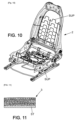
- the seat still has a CF cover (not shown in the Figure 1 ) covering the padding, typically being fixed to the padding.
- an XYZ reference frame is illustrated, the X direction oriented along the sliding direction of slide G between the seat structure 2 and a floor of the vehicle, the Y direction, oriented along a transverse direction of the seat, and the Z direction along the vertical.
- the structure 2 typically made of metal, comprises a seat frame 20 and a backrest frame 21, typically articulated around a transverse axis of rotation, typically by means of continuous-type joints.
- the backrest frame typically includes side uprights, extending in height, and an upper cross member connecting two upper ends of the uprights.
- the uprights and the upper crosspiece are typically shaped sheets, for example by stamping techniques.
- the padding 3 typically comprises a seat padding layer 3a which provides comfort to the seat and which is received on a seat interface 4a inserted between the seat frame 20 and the seat padding layer 3a and/or the padding 3 typically comprises a backrest padding layer 3b which provides comfort to the backrest and which is received on a backrest interface 4b which is inserted between the backrest frame 21 and the backrest padding layer 3b.
- the padding 3, in particular the seat padding layer 3a and/or the backrest padding layer 3b, comprises a three-dimensional (in “3D”) interlocking of continuous, thermoplastic fibers 5, arranged randomly, forming loops welded together between the fibers 5.
- 3D three-dimensional
- the fibers may be hollow fibers 5a and/or solid fibers 5b.
- the fibers may have a diameter of between 0.2 mm and 2 mm, preferably between 0.3 mm and 1.5 mm.
- the term "continuous" in “continuous fibers” means that the fibers are of a length much greater than the diameter of the fibers, and due to the method described below, typically at least by a ratio of 100, or even 500, or even 1000. Very often, and in particular as understood from the manufacturing method, the fibers typically extend from a first end on a first edge of the 3D entanglement and to a second end on a second edge of the AD entanglement, opposite the first edge.
- the voids between the fibers 5 of the 3D interlocking of fibers 5 of the padding 3 are left free.
- a very breathable padding is obtained, due to the numerous inter-spaces between the fibers which promote air circulation.
- the seat cushioning layer 3a extends lengthwise along a longitudinal direction Xa of the seat from a rear edge to a front edge of the seat, and in width along a transverse direction a of the seat from a first lateral edge to a second lateral edge, as well as in thickness along an orthogonal direction Za, which is orthogonal to the longitudinal direction and to the transverse direction of the seat.
- the thickness of the seat padding layer can be between 60mm and 100mm.
- the backrest padding layer 3b extends in length along a longitudinal direction Xb of the backrest from a lower edge to an upper edge of the backrest, and in width along a transverse direction Yb of the backrest from a first lateral edge to a second lateral edge, as well as in thickness along an orthogonal direction Zb which is orthogonal to the longitudinal direction and to the transverse direction of the backrest.
- the thickness of the backrest padding layer may be between 15 mm and 50 mm.
- the interface 4, in particular the seat interface 4a or the backrest interface 4b, may comprise a material made entirely or partially of plastic.
- said interface 4 is made of ABS (acrylonitrile butadiene styrene) and/or PC (Polycarbonate) and/or P/E (Polypropylene/Polyethylene Copolymer).
- the interface 4 in particular in particular the seat interface 4a or the backrest interface 4b, may comprise a shell.
- the shell may be a molded part or a thermoformed part.
- the upper travel control links 41s and/or the lower travel control links 41i are typically articulated links which may include connecting rods.
- the padding 3 can be associated with a support ST, typically pre-assembled to the padding, and which in particular allows assembly to a seat structure, in particular without interface or suspension.
- the extrusion nozzles 60 are preferably distributed regularly along the length direction X6 of the extrusion die, as well as in width along the width direction Y6.
- the thickness of the layer of padding formed by the entanglement can be adjusted by adjusting the center distance between the two guide members 7,8.
- the two guide members 7, 8 are rotated at a speed, typically lower than the falling speed of the fibers, ensuring an accumulation of the fibers at the origin of the formation of loops which heat-weld between fibers, generating the irregular, random, three-dimensional entanglement. Solidification in /A/ is obtained just after step /B/, the two guide members being able to be immersed halfway up, for this purpose.
- the temperature of the extrusion carried out in /A/ in the extrusion die is typically between 180°C and 240°C.
- the extrusion die is fed with thermoplastic polymer granules.
- the continuously scrolling 3D fiber entanglement layer is then guided out of the coolant tank to be dried, typically by shaking/vibration.
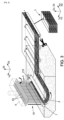
- the scrolling layer is then cut by cross-cuts, allowing different 3-layers to be obtained, and as seen in the Figure 3 .
- These paddings 3 extend in length, for example in length along the longitudinal direction Xa of the base padding layer (or in length along the longitudinal direction Xb of the back padding layer), typically following the direction transverse to the scrolling of the layer.
- the apparent density may be homogeneous along the length and width of the layer, and as illustrated in Figure 5 , at the top.
- the density of the number of extrusion nozzles is thus homogeneous along the length direction of the extrusion die.
- the padding obtained at the end of the process illustrated in Figure 3 generates a padding with a 3D interlocking of the padding 5 has an apparent density of between 20 kg/m 3 and 70 kg/m 3 , in particular between 45 kg/m 3 and 65 kg/m 3 , and in a substantially homogeneous manner.
- Such padding density is optimized to ensure comfort and support for the occupant.
- such padding has certain limitations: in particular, it is not possible to grip the loops of the 3D interlocking of the padding, for example, to attach a headdress due to the low tear resistance of the thermoplastic fibres of the 3D interlocking.
- the nozzles are controllable, configured so as to be able to change the shape of the curtain of fibers, and in which a logic processing unit is provided which comprises a control module comprising a microprocessor and a memory comprising instructions for, in /A/, controlling the nozzles so as to generate a curtain of molten fibers, of variable shape during the extrusion following the length direction and/or the width direction of the extrusion die.
- a logic processing unit which comprises a control module comprising a microprocessor and a memory comprising instructions for, in /A/, controlling the nozzles so as to generate a curtain of molten fibers, of variable shape during the extrusion following the length direction and/or the width direction of the extrusion die.
- Step /B/ of hot pressing the 3D entanglement of fibers into one or more local areas of the 3D entanglement makes it possible to obtain one or more local areas ZL of the densified and stiffened padding, which make it possible to remedy this problem, by avoiding such risks of tearing.
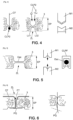
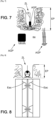
- THE figures 4 to 9 illustrate various embodiments allowing the obtaining of local zones ZL, densified and stiffened, and which can serve as fixing zones, advantageously without risk of tearing of the thermoplastic fibers from the tangle.
- hot pressing in one or more local areas of the padding can result in compression by a partial reduction of the thickness of the 3D entanglement in the local area, of at least 30% depending on the thickness of the padding, or even at least 40%, or even at least 50%, or even at least 60%, or even at least 70%, or even at least 80%, typically between 80% and 95%.
- a partial reduction is illustrated for example in figures 7 And 9 Hot pressing is typically obtained by working under pressure a first mold M1 and a second mold M2.
- Hot pressing can be achieved by heating the 3D entanglement, at least at the local area(s), to a temperature between 160°C and 190°C.
- the first lip Lv1 and the second lip Lv2 are oriented towards each other, forming a first clipping part configured for insertion of a second clipping part CLP2 in a slot delimited between the first and second distal ends belonging to the first lip Lv1 and to the second lip Lv2 of the first clipping part.
- the pressing generates a through slot FT following the thickness of the padding, from a first face of the padding, to a second opposite face
- the cover can be fixed by inserting a plate retaining plate PQ through the slot of the padding from the first face to the second face (or vice versa).
- the plate is inserted through the through slot FT by orienting the retaining plate parallel to the through slot FT.
- blocking can be obtained by pivoting the retaining plate PQ substantially 90°, then substantially perpendicular to the slot, so that the retaining plate comes to bear on the second face (or the first face) on either side of a mouth of the slot.
- the padding 3 may comprise in the local zone(s) one or more attachment elements Eac, said attachment element Eac extending transversely to the local zone, being attached to the 3D tangle by two ends of said attachment element and in which the cap is fixed by attachment of said attachment element Eac, for example by using a female clip CLPF and according to the figures 4 Or 8 .
- the padding 3 may comprise a through slot FT along the thickness, from a first face of the padding, to a second, opposite face of the padding.
- the cover is fixed by inserting a retaining plate PQ through the padding from the first face to the second face, or vice versa, then by pivoting the retaining plate PQ so that the plate comes to bear on the second face (or the first face), on either side of a mouth of the through slot FT, and as illustrated in Figure 6 .
- the padding may comprise hot-pressed local areas densifying the fibers of the entanglement of the local area while preserving the loops of the 3D entanglement welded together in the local area.
- the CF cap may be fixed by means of an AGP gripping member, comprising for example a set of hooks, and/or a point provided with hook(s) which hook the loops of the densified local area, and as illustrated in Figure 7 Or 9
- the hook(s) associated with the tip can be deployed to facilitate hooking, once the tip is inserted into the loops of the 3D tangle.
Landscapes
- Engineering & Computer Science (AREA)
- Mechanical Engineering (AREA)
- Aviation & Aerospace Engineering (AREA)
- Transportation (AREA)
- Textile Engineering (AREA)
- Chemical & Material Sciences (AREA)
- Chemical Kinetics & Catalysis (AREA)
- Manufacturing & Machinery (AREA)
- Nonwoven Fabrics (AREA)
- Lining Or Joining Of Plastics Or The Like (AREA)
- Mattresses And Other Support Structures For Chairs And Beds (AREA)
- Seats For Vehicles (AREA)
Claims (16)
- Verfahren zum Herstellen einer Fahrzeugsitzpolsterung (3), umfassend:- /A/ Bereitstellen einer Polsterung (3), die eine 3D-Verflechtung aus thermoplastischen Endlosfasern (5) umfasst, die unregelmäßig angeordnet sind und miteinander heißverschweißte Schlaufen bilden,- /B/ Heißpressen der 3D-Faserverflechtung zu einem oder mehreren lokalen 3D-Verflechtungsbereichen, um einen oder mehrere verdichtete, versteifte lokale Bereiche (ZL) der Polsterung zu erhalten, wobei der/die lokale(n) Bereich(e) konfiguriert ist/sind, um als Befestigungsbereich zu dienen,und wobei in /B/ das Pressen ein Thermoformungsschritt ist, bei dem ein erstes Formteil (M1) und ein zweites Formteil (M2) die Fasern der 3D-Verflechtung des lokalen Bereichs in zwei elastische Lippen umformen, einschließlich:- einer ersten Lippe (Lv1), die an dem lokalen Bereich mit einem ersten proximalen Ende an die Verflechtung angrenzt und ein erstes freies distales Ende aufweist und- einer zweiten Lippe (Lv2), die an dem lokalen Bereich mit einem zweiten proximalen Ende an die Verflechtung angrenzt und ein zweites freies distales Ende aufweist,und wobei die erste Lippe (Lv1) und die zweite Lippe (Lv2) zueinander ausgerichtet sind und ein erstes Schnappteil bilden, das konfiguriert ist, um ein zweites Schnappteil in einen Schlitz einzusetzen, der zwischen dem ersten und dem zweiten distalen Ende, die zu der ersten und der zweiten Lippe gehören, begrenzt ist.
- Verfahren zum Herstellen einer Polsterung nach Anspruch 1, wobei der Schritt des Bereitstellens von /A/ umfasst:- /A1/ Extrusion eines thermoplastischen Polymers in einem Extrusionswerkzeug (6), das Extrusionsdüsen (60) umfasst, die in einer Längsrichtung (X6) und entlang einer Breitenrichtung (Y6) des Extrusionswerkzeugs verteilt sind, wodurch ein Vorhang aus geschmolzenen Endlosfasern erzeugt wird, der durch Schwerkraft fällt,- /A2/ Aufnehmen des Vorhangs aus geschmolzenen Endlosfasern, der durch Schwerkraft fällt, auf einem oder mehreren Stützelementen (7, 8), wobei eine 3D-Faserverflechtung gemäß einer unregelmäßigen Verteilung mit Schlaufen erzeugt wird, die zwischen den Endlosfasern schmelzen,- /A3/ gegebenenfalls Verfestigen der 3D-Faserverflechtung mittels Eintauchen in eine Kühlflüssigkeit.
- Verfahren nach Anspruch 1 oder 2, wobei das Heißpressen in einem oder mehreren lokalen Bereichen der Polsterung zu einer Kompression durch teilweises Reduzieren der Dicke (EP) der 3D-Verflechtung zu dem lokalen Bereich führt, und zwar um mindestens 30 % gemäß der Dicke oder sogar um mindestens 40 % oder sogar um mindestens 50 % oder sogar um mindestens 60 % oder sogar um mindestens 70 % oder sogar um mindestens 80 %, oder sogar zu einer vollständigen Reduzierung der Verflechtung entlang der Dicke.
- Fahrzeugsitzpolsterung, die gemäß dem Verfahren nach einem der Ansprüche 1 bis 3 erhalten werden kann, umfassend eine 3D-Verflechtung aus thermoplastischen Endlosfasern (5), die unregelmäßig angeordnet sind, zwischen den Fasern heißversiegelte Schlaufen bilden, und wobei:- die Fasern Hohlfasern und/oder Vollfasern insbesondere mit einem Durchmesser zwischen 0,2 mm und 2 mm, vorzugsweise zwischen 0,3 mm und 1,5 mm, sind,- die Fasern (5) ein thermoplastisches Polymer umfassen, wobei die Zusammensetzung der Fasern zu mindestens 95 Gew.-% PET umfasst,wobei die Polsterung einen oder mehrere Bereiche umfasst, die durch Heißpressen der 3D-Verflechtung verdichtet und versteift wurden,und wobei die 3D-Verflechtung der Polsterung (5) eine scheinbare Dichte zwischen 20 kg/m3 und 70 kg/m3, insbesondere zwischen 45 kg/m3 und 65 kg/m3 außerhalb des/der verdichteten, versteiften Bereichs/Bereiche (ZL) aufweist,und wobei die Polsterung in dem/den lokalen Bereich(en) umfasst:- eine erste Lippe (Lv1), die an dem lokalen Bereich (ZL) mit einem ersten proximalen Ende an die Verflechtung angrenzt und ein erstes freies distales Ende aufweist und- eine zweite Lippe (Lv2), die an dem lokalen Bereich (ZL) mit einem zweiten proximalen Ende an die Verflechtung angrenzt und ein zweites freies distales Ende aufweist,und wobei die erste Lippe (Lv1) und die zweite Lippe (Lv2) zueinander ausgerichtet sind und ein erstes Schnappverschlussteil bilden.
- Fahrzeugsitz, umfassend:- eine Polsterung (3) nach Anspruch 4,- eine Kappe (CF), die die Polsterung abdeckt und in dem einen oder den mehreren verdichteten, versteiften lokalen Bereichen an der Polsterung angebracht ist,und wobei die Kappe durch ein zweites Schnappverschlussteil (CLP2) angebracht ist, das elastisch in einen zwischen der ersten Lippe (Lv1) und der zweiten Lippe (Lv2) begrenzten Schlitz eingesetzt ist.
- Verfahren zum Herstellen einer Fahrzeugsitzpolsterung (3), umfassend:- /A/ Bereitstellen einer Polsterung (3), die eine 3D-Verflechtung aus thermoplastischen Endlosfasern (5) umfasst, die unregelmäßig angeordnet sind und miteinander heißverschweißte Schlaufen bilden,- /B/ Heißpressen der 3D-Faserverflechtung zu einem oder mehreren lokalen 3D-Verflechtungsbereichen, um einen oder mehrere verdichtete, versteifte lokale Bereiche (ZL) der Polsterung zu erhalten, wobei der/die lokale(n) Bereich(e) konfiguriert ist/sind, um als Befestigungsbereich zu dienen,und wobei in /B/ das Pressen ein Thermoformungsschritt ist, bei dem ein erstes Formteil (M1) und ein zweites Formteil (M2) die Fasern der Verflechtung des lokalen Bereichs in ein Befestigungselement (Eac) umformen, das ein Zuganker ist, wobei sich das Befestigungselement quer zu dem lokalen Bereich erstreckt und mit zwei Enden des Befestigungselements (Eac) an die 3D-Verflechtung aus thermoplastischen Fasern angrenzt.
- Verfahren nach Anspruch 6, wobei der Schritt des Bereitstellens von /A/ umfasst:- /A1/ Extrusion eines thermoplastischen Polymers in einem Extrusionswerkzeug (6), das Extrusionsdüsen (60) umfasst, die in einer Längsrichtung (X6) und entlang einer Breitenrichtung (Y6) des Extrusionswerkzeugs verteilt sind, wodurch ein Vorhang aus geschmolzenen Endlosfasern erzeugt wird, der durch Schwerkraft fällt,- /A2/ Aufnehmen des Vorhangs aus geschmolzenen Endlosfasern, der durch Schwerkraft fällt, auf einem oder mehreren Stützelementen (7, 8), wobei eine 3D-Faserverflechtung gemäß einer unregelmäßigen Verteilung mit Schlaufen erzeugt wird, die zwischen den Endlosfasern schmelzen,- /A3/ gegebenenfalls Verfestigen der 3D-Faserverflechtung mittels Eintauchen in eine Kühlflüssigkeit.
- Verfahren nach Anspruch 6 oder 7, wobei das Heißpressen in einem oder mehreren lokalen Bereichen der Polsterung zu einer Kompression durch teilweises Reduzieren der Dicke (EP) der 3D-Verflechtung zu dem lokalen Bereich führt, und zwar um mindestens 30 % gemäß der Dicke, oder sogar um mindestens 40 %, oder sogar um mindestens 50 %, oder sogar um mindestens 60 %, oder sogar um mindestens 70 %, oder sogar um mindestens 80 %, oder sogar zu einer vollständigen Reduzierung der Verflechtung entlang der Dicke.
- Fahrzeugsitzpolsterung, die gemäß dem Verfahren nach einem der Ansprüche 6 bis 8 erhalten werden kann, umfassend eine 3D-Verflechtung aus thermoplastischen Endlosfasern (5), die unregelmäßig angeordnet sind, zwischen den Fasern heißversiegelte Schlaufen bilden, und wobei:- die Fasern Hohlfasern und/oder Vollfasern insbesondere mit einem Durchmesser zwischen 0,2 mm und 2 mm, vorzugsweise zwischen 0,3 mm und 1,5 mm, sind,- die Fasern (5) ein thermoplastisches Polymer umfassen, wobei die Zusammensetzung der Fasern zu mindestens 95 Gew.-% PET umfasst,wobei die Polsterung einen oder mehrere Bereiche umfasst, die durch Heißpressen der 3D-Verflechtung verdichtet und versteift wurden,und wobei die 3D-Verflechtung der Polsterung (5) eine scheinbare Dichte zwischen 20 kg/m3 und 70 kg/m3, insbesondere zwischen 45 kg/m3 und 65 kg/m3 außerhalb des/der verdichteten, versteiften Bereichs/Bereiche (ZL) aufweist,und wobei die Polsterung in dem/den lokalen Bereich(en) ein Befestigungselement (Eac) umfasst, bei dem es sich um einen Zuganker handelt, der sich quer zu dem lokalen Bereich erstreckt und mit zwei Enden des Zugankers an die 3D-Verflechtung der thermoplastischen Fasern angrenzt.
- Fahrzeugsitz, umfassend:- eine Polsterung (3) nach Anspruch 9,- eine Kappe (CF), die die Polsterung abdeckt und in dem einen oder den mehreren verdichteten, versteiften lokalen Bereichen an der Polsterung angebracht ist,und wobei die Kappe (CF) durch Befestigen des Befestigungselements (Eac) angebracht wird.
- Verfahren zum Herstellen einer Fahrzeugsitzpolsterung (3), umfassend:- /A/ Bereitstellen einer Polsterung (3), die eine 3D-Verflechtung aus thermoplastischen Endlosfasern (5) umfasst, die unregelmäßig angeordnet sind und miteinander heißverschweißte Schlaufen bilden,- /B/ Heißpressen der 3D-Faserverflechtung an einem oder mehreren lokalen 3D-Verflechtungsbereichen, um einen oder mehrere verdichtete, versteifte lokale Bereiche (ZL) der Polsterung zu erhalten, wobei der/die lokale(n) Bereich(e) konfiguriert ist/sind, um als Befestigungsbereich zu dienen,und wobei in /B/ das Pressen einen durch Thermoformen erhaltenen Durchgangsschlitz (FT) entlang der Dicke von einer der Polsterung zu einer gegenüberliegenden Fläche erzeugt.
- Verfahren zum Herstellen einer Polsterung nach Anspruch 11, wobei der Schritt des Bereitstellens von /A/ umfasst:- /A1/ Extrusion eines thermoplastischen Polymers in einem Extrusionswerkzeug (6), das Extrusionsdüsen (60) umfasst, die in einer Längsrichtung (X6) und entlang einer Breitenrichtung (Y6) des Extrusionswerkzeugs verteilt sind, wodurch ein Vorhang aus geschmolzenen Endlosfasern erzeugt wird, der durch Schwerkraft fällt,- /A2/ Aufnehmen des Vorhangs aus geschmolzenen Endlosfasern, der durch Schwerkraft fällt, auf einem oder mehreren Stützelementen (7, 8), wobei eine 3D-Faserverflechtung gemäß einer unregelmäßigen Verteilung mit Schlaufen erzeugt wird, die zwischen den Endlosfasern schmelzen,- /A3/ gegebenenfalls Verfestigen der 3D-Faserverflechtung mittels Eintauchen in eine Kühlflüssigkeit.
- Verfahren nach Anspruch 11 oder 12, wobei das Heißpressen in einem oder mehreren lokalen Bereichen der Polsterung zu einer Kompression durch teilweises Reduzieren der Dicke (EP) der 3D-Verflechtung zu dem lokalen Bereich führt, und zwar um mindestens 30 % gemäß der Dicke, oder sogar um mindestens 40 %, oder sogar um mindestens 50 %, oder sogar um mindestens 60 %, oder sogar um mindestens 70 %, oder sogar um mindestens 80 %, oder sogar zu einer vollständigen Reduzierung der Verflechtung entlang der Dicke.
- Fahrzeugsitzpolsterung, die gemäß dem Verfahren nach einem der Ansprüche 11 bis 13 erhalten werden kann, umfassend eine 3D-Verflechtung aus thermoplastischen Endlosfasern (5), die unregelmäßig angeordnet sind, zwischen den Fasern heißversiegelte Schlaufen bilden, und wobei:- die Fasern Hohlfasern und/oder Vollfasern insbesondere mit einem Durchmesser zwischen 0,2 mm und 2 mm, vorzugsweise zwischen 0,3 mm und 1,5 mm, sind,- die Fasern (5) ein thermoplastisches Polymer umfassen, wobei die Zusammensetzung der Fasern zu mindestens 95 Gew.-% PET umfasst,wobei die Polsterung einen oder mehrere Bereiche umfasst, die durch Heißpressen der 3D-Verflechtung verdichtet und versteift wurden,und wobei die 3D-Verflechtung der Polsterung (5) eine scheinbare Dichte zwischen 20 kg/m3 und 70 kg/m3, insbesondere zwischen 45 kg/m3 und 65 kg/m3 außerhalb des/der verdichteten, versteiften Bereichs/Bereiche (ZL) aufweist,und wobei die Polsterung einen Durchgangsschlitz (FT) entlang der Dicke von einer ersten Fläche der Polsterung zu einer zweiten gegenüberliegenden Fläche der Polsterung umfasst.
- Fahrzeugsitz, umfassend:- eine Polsterung (3) nach Anspruch 14,- eine Kappe (CF), die die Polsterung abdeckt und in dem einen oder den mehreren verdichteten, versteiften lokalen Bereichen an der Polsterung angebracht ist,und wobei die Kappe (CF) durch Einsetzen einer Rückhalteplatte (PQ) durch den Durchgangsschlitz (FT) der Polsterung von der ersten Fläche zur zweiten Fläche oder umgekehrt angebracht wird, dann die Rückhalteplatte (PG) geschwenkt wird, sodass die Platte auf der zweiten Fläche auf beiden Seiten einer Mündung des Schlitzes zum Anliegen kommt.
- Fahrzeugsitz, umfassend eine Polsterung (3), umfassend eine 3D-Verflechtung aus zufällig angeordneten thermoplastischen Endlosfasern (5), die zwischen den Fasern heißversiegelte Schlaufen bilden, und wobei:- die Fasern Hohlfasern und/oder Vollfasern insbesondere mit einem Durchmesser zwischen 0,2 mm und 2 mm, vorzugsweise zwischen 0,3 mm und 1,5 mm, sind,- die Fasern (5) ein thermoplastisches Polymer umfassen, wobei die Zusammensetzung der Fasern zu mindestens 95 Gew.-% PET umfasst,wobei die Polsterung einen oder mehrere Bereiche umfasst, die durch Heißpressen der 3D-Verflechtung verdichtet und versteift wurden,und wobei die 3D-Verflechtung der Polsterung (5) eine scheinbare Dichte zwischen 20 kg/m3 und 70 kg/m3, insbesondere zwischen 45 kg/m3 und 65 kg/m3 außerhalb des/der verdichteten, versteiften Bereichs/Bereiche (ZL) aufweist,wobei die Polsterung einen oder mehrere lokale Bereiche umfasst, die durch Heißpressen der 3D-Verflechtung verdichtet und versteift sind, und die gemäß einem Verfahren zum Herstellen einer Sitzpolsterung erhalten werden können, umfassend:- /A/ Bereitstellen einer Polsterung (3), die eine 3D-Verflechtung aus thermoplastischen Endlosfasern (5) umfasst, die unregelmäßig angeordnet sind und miteinander heißverschweißte Schlaufen bilden,- /B/ Heißpressen der 3D-Faserverflechtung an einem oder mehreren lokalen Bereichen der 3D-Verflechtung, um einen oder mehrere verdichtete, versteifte lokale Bereiche (ZL) der Polsterung zu erhalten, wobei der/die lokale(n) Bereich(e) konfiguriert ist/sind, um als Befestigungsbereich zu dienen, und wobei in /B/ das Pressen eine Thermoformschritt ist, der teilweise die Dicke der 3D-Verpflechtung durch Verdichten der Fasern der Verflechtung des lokalen Bereichs reduziert und gleichzeitig die Schlaufen der 3D-Verflechtung im lokalen Bereich (ZL) zusammen heißversiegelt hält,und wobei die Kappe (CF) mittels eines Greifelements (AGP) angebracht wird, das zum Beispiel einen Satz Haken und/oder einen oder mehrere mit Haken versehene Dorne umfasst, die die Schlaufen des/der verdichteten und versteiften lokalen Bereichs/Bereiche (ZL) erfassen.
Applications Claiming Priority (1)
| Application Number | Priority Date | Filing Date | Title |
|---|---|---|---|
| FR2208747A FR3139025B1 (fr) | 2022-08-31 | 2022-08-31 | Procédé de fabrication d’une matelassure de siège et matelassure de siège en tant que telle |
Publications (2)
| Publication Number | Publication Date |
|---|---|
| EP4331824A1 EP4331824A1 (de) | 2024-03-06 |
| EP4331824B1 true EP4331824B1 (de) | 2025-07-09 |
Family
ID=84359614
Family Applications (1)
| Application Number | Title | Priority Date | Filing Date |
|---|---|---|---|
| EP23190397.2A Active EP4331824B1 (de) | 2022-08-31 | 2023-08-08 | Verfahren zur herstellung einer sitzpolsterung und sitzpolsterung als solche |
Country Status (4)
| Country | Link |
|---|---|
| US (1) | US20240066824A1 (de) |
| EP (1) | EP4331824B1 (de) |
| CN (1) | CN117621513A (de) |
| FR (1) | FR3139025B1 (de) |
Families Citing this family (16)
| Publication number | Priority date | Publication date | Assignee | Title |
|---|---|---|---|---|
| US12479143B2 (en) | 2021-12-20 | 2025-11-25 | Lear Corporation | System and method of making a mesh cushion |
| USD1047761S1 (en) * | 2022-01-26 | 2024-10-22 | Gordon Murray Automotive Limited | Motor vehicle |
| US12454111B2 (en) | 2022-05-11 | 2025-10-28 | Lear Corporation | Tool to manufacture a cushion |
| US12509343B2 (en) | 2023-02-28 | 2025-12-30 | Lear Corporation | Automated trench manufacturing and assembly for attaching trim covers to a cushion assembly |
| JP1768237S (ja) * | 2023-03-30 | 2024-04-15 | 自動車用シート | |
| TWD232663S (zh) * | 2023-04-05 | 2024-08-01 | 瑞典商富豪車輛公司 (瑞典) | 車輛之後座 |
| FR3162689A1 (fr) | 2024-05-28 | 2025-12-05 | Faurecia Sièges d'Automobile | Système de matelassure et procédé de fabrication d’un tel système |
| FR3162690A1 (fr) | 2024-05-28 | 2025-12-05 | Faurecia Sièges d'Automobile | Système de matelassure |
| FR3162691A1 (fr) | 2024-05-28 | 2025-12-05 | Faurecia Sièges d'Automobile | Système de matelassure avec dispositif de fixation à blocage rotatif |
| FR3162663A1 (fr) | 2024-05-29 | 2025-12-05 | Faurecia Sièges d'Automobile | Procédé de fabrication d’une matelassure, et matelassure en tant que telle |
| FR3162665A1 (fr) | 2024-05-29 | 2025-12-05 | Faurecia Sièges d'Automobile | Ensemble de matelassure pour siège de véhicule et procédé pour réaliser un ensemble de matelassure |
| US20250368109A1 (en) * | 2024-05-30 | 2025-12-04 | Lear Corporation | Seat assembly and method of manufacture |
| GB2700726A (en) * | 2024-05-30 | 2026-03-04 | Lear Corp | Seat assembly and method of manufacture |
| FR3166587A1 (fr) | 2024-09-25 | 2026-03-27 | Faurecia Sièges d'Automobile | Élément de siège de véhicule, en particulier dossier d’un siège de véhicule, et procédé de fabrication de celui-ci |
| FR3166588A1 (fr) | 2024-09-25 | 2026-03-27 | Faurecia Sièges d'Automobile | Élément de siège, dossier de siège et assise de siège |
| WO2026068589A1 (en) * | 2024-09-25 | 2026-04-02 | Indorama Ventures Mobility Obernburg Gmbh | Process for thermoforming |
Family Cites Families (9)
| Publication number | Priority date | Publication date | Assignee | Title |
|---|---|---|---|---|
| DE69127162T2 (de) * | 1990-05-28 | 1998-02-12 | Teijin Ltd | Polsterungsmaterial und seine herstellung |
| JP2003250667A (ja) * | 2002-02-27 | 2003-09-09 | Ain Kk Sogo Kenkyusho | スプリング構造樹脂成形品から成るクッション材及びその製造方法 |
| TW200514531A (en) * | 2003-09-29 | 2005-05-01 | Ein Co Ltd Technical Ct | Cushion and acoustic system with the cushion |
| DE102010006668A1 (de) * | 2010-02-03 | 2011-08-04 | Bayerische Motoren Werke Aktiengesellschaft, 80809 | Polsterung und Verfahren zur Herstellung einer Polsterung |
| KR20130099810A (ko) * | 2010-09-01 | 2013-09-06 | 씨엔 컴퍼니 리미티드 | 쿠션의 성형방법 |
| JP2014057633A (ja) * | 2012-09-14 | 2014-04-03 | Toyota Boshoku Corp | 車両用シート |
| FR3139024B1 (fr) * | 2022-08-31 | 2024-10-04 | Faurecia Sieges Dautomobile | Procédé de fabrication d’une matelassure de siège, matelassure de siège en tant que telle, et siège en tant que tel |
| FR3140320A1 (fr) * | 2022-09-30 | 2024-04-05 | Faurecia Sièges d'Automobile | Procédé de fabrication d’un élément de siège de véhicule |
| FR3149257B1 (fr) * | 2023-05-30 | 2025-06-06 | Faurecia Sieges Dautomobile | Elément de siège de véhicule, notamment automobile |
-
2022
- 2022-08-31 FR FR2208747A patent/FR3139025B1/fr active Active
-
2023
- 2023-08-08 EP EP23190397.2A patent/EP4331824B1/de active Active
- 2023-08-17 CN CN202311042611.8A patent/CN117621513A/zh active Pending
- 2023-08-29 US US18/239,325 patent/US20240066824A1/en active Pending
Also Published As
| Publication number | Publication date |
|---|---|
| CN117621513A (zh) | 2024-03-01 |
| EP4331824A1 (de) | 2024-03-06 |
| FR3139025B1 (fr) | 2024-09-06 |
| FR3139025A1 (fr) | 2024-03-01 |
| US20240066824A1 (en) | 2024-02-29 |
Similar Documents
| Publication | Publication Date | Title |
|---|---|---|
| EP4331824B1 (de) | Verfahren zur herstellung einer sitzpolsterung und sitzpolsterung als solche | |
| EP4338933B1 (de) | Verfahren zur herstellung einer sitzpolsterung, sitzpolsterung als sitzpolster und sitz, der als solches verwendet wird | |
| DK182111B1 (en) | SEAT ASSEMBLY AND METHOD FOR MANUFACTURING SEAT ASSEMBLY | |
| EP4499907A1 (de) | Fahrzeugsitz mit polsterung aus einer zufälligen verflechtung von thermoplastischen endlosfasern | |
| FR3149257A1 (fr) | Elément de siège de véhicule, notamment automobile | |
| FR3139059A3 (fr) | Matelassure pour élément de siège de véhicule et procédé de réalisation d’une telle matelassure | |
| EP4644174A1 (de) | Sitzkissen und montageverfahren | |
| EP4477467A1 (de) | Sitzanordnung, klammer und herstellungsverfahren | |
| FR3139057A1 (fr) | Siège de véhicule comprenant une matelassure formée d’un enchevêtrement irrégulier des fibres continues thermoplastiques | |
| WO2024047304A1 (fr) | Procédé de fabrication d'une matelassure de siège et matelassure en tant que telle | |
| EP4431267A1 (de) | Aufnahmeanordnung für ein befestigungselement in einer filamentnetzstruktur | |
| KR20250081771A (ko) | 시트 조립체 및 조립 방법 | |
| FR3162689A1 (fr) | Système de matelassure et procédé de fabrication d’un tel système | |
| FR3139058A1 (fr) | Elément de siège pour siège véhicule et siège de véhicule comprenant l’élément de siège | |
| FR3140317A1 (fr) | Siège de véhicule comprenant une matelassure formée d’un enchevêtrement irrégulier des fibres continues thermoplastiques | |
| EP4631783A1 (de) | Polyestersitzgarnitur | |
| FR3159761A1 (fr) | Matelassure de siège, procédé de fabrication d’une telle matelassure et siège équipée d’une telle matelassure | |
| FR3166588A1 (fr) | Élément de siège, dossier de siège et assise de siège | |
| FR3161872A3 (fr) | Procédé de fabrication d’une matelassure | |
| WO2024068471A1 (fr) | Procédé de fabrication d'un élément de garniture de siège comprenant une matelassure, une coiffe recouvrant la matelassure et une feuille d'interface soudée | |
| DK182040B1 (en) | SEAT ASSEMBLY, CLAMP AND MANUFACTURING METHOD | |
| FR3140318A1 (fr) | Garniture pour élément de siège de véhicule et procédé de réalisation d’une telle garniture | |
| FR3166587A1 (fr) | Élément de siège de véhicule, en particulier dossier d’un siège de véhicule, et procédé de fabrication de celui-ci | |
| FR3162690A1 (fr) | Système de matelassure | |
| CN118665294A (zh) | 用于长丝网状结构中的紧固件的接纳器组件 |
Legal Events
| Date | Code | Title | Description |
|---|---|---|---|
| PUAI | Public reference made under article 153(3) epc to a published international application that has entered the european phase |
Free format text: ORIGINAL CODE: 0009012 |
|
| STAA | Information on the status of an ep patent application or granted ep patent |
Free format text: STATUS: THE APPLICATION HAS BEEN PUBLISHED |
|
| AK | Designated contracting states |
Kind code of ref document: A1 Designated state(s): AL AT BE BG CH CY CZ DE DK EE ES FI FR GB GR HR HU IE IS IT LI LT LU LV MC ME MK MT NL NO PL PT RO RS SE SI SK SM TR |
|
| STAA | Information on the status of an ep patent application or granted ep patent |
Free format text: STATUS: REQUEST FOR EXAMINATION WAS MADE |
|
| 17P | Request for examination filed |
Effective date: 20240819 |
|
| RBV | Designated contracting states (corrected) |
Designated state(s): AL AT BE BG CH CY CZ DE DK EE ES FI FR GB GR HR HU IE IS IT LI LT LU LV MC ME MK MT NL NO PL PT RO RS SE SI SK SM TR |
|
| GRAP | Despatch of communication of intention to grant a patent |
Free format text: ORIGINAL CODE: EPIDOSNIGR1 |
|
| STAA | Information on the status of an ep patent application or granted ep patent |
Free format text: STATUS: GRANT OF PATENT IS INTENDED |
|
| INTG | Intention to grant announced |
Effective date: 20250206 |
|
| RAP1 | Party data changed (applicant data changed or rights of an application transferred) |
Owner name: INDORAMA VENTURES MOBILITY OBERNBURG GMBH Owner name: FAURECIA SIEGES D'AUTOMOBILE |
|
| GRAS | Grant fee paid |
Free format text: ORIGINAL CODE: EPIDOSNIGR3 |
|
| GRAA | (expected) grant |
Free format text: ORIGINAL CODE: 0009210 |
|
| STAA | Information on the status of an ep patent application or granted ep patent |
Free format text: STATUS: THE PATENT HAS BEEN GRANTED |
|
| AK | Designated contracting states |
Kind code of ref document: B1 Designated state(s): AL AT BE BG CH CY CZ DE DK EE ES FI FR GB GR HR HU IE IS IT LI LT LU LV MC ME MK MT NL NO PL PT RO RS SE SI SK SM TR |
|
| REG | Reference to a national code |
Ref country code: GB Ref legal event code: FG4D Free format text: NOT ENGLISH |
|
| REG | Reference to a national code |
Ref country code: CH Ref legal event code: EP |
|
| REG | Reference to a national code |
Ref country code: IE Ref legal event code: FG4D Free format text: LANGUAGE OF EP DOCUMENT: FRENCH |
|
| REG | Reference to a national code |
Ref country code: DE Ref legal event code: R096 Ref document number: 602023004658 Country of ref document: DE |
|
| P01 | Opt-out of the competence of the unified patent court (upc) registered |
Free format text: CASE NUMBER: APP_31748/2025 Effective date: 20250701 |
|
| REG | Reference to a national code |
Ref country code: DE Ref legal event code: R081 Ref document number: 602023004658 Country of ref document: DE Owner name: FAURECIA SIEGES D'AUTOMOBILE, FR Free format text: FORMER OWNER: ANMELDERANGABEN UNKLAR / UNVOLLSTAENDIG, 80297 MUENCHEN, DE Ref country code: DE Ref legal event code: R081 Ref document number: 602023004658 Country of ref document: DE Owner name: INDORAMA VENTURES MOBILITY OBERNBURG GMBH, DE Free format text: FORMER OWNER: ANMELDERANGABEN UNKLAR / UNVOLLSTAENDIG, 80297 MUENCHEN, DE Ref country code: DE Ref legal event code: R081 Ref document number: 602023004658 Country of ref document: DE Owner name: FAURECIA SIEGES D'AUTOMOBILE, FR Free format text: FORMER OWNER: INDORAMA VENTURES MOBILITY OBERNBURG GMBH, 63784 OBERNBURG, DE Ref country code: DE Ref legal event code: R081 Ref document number: 602023004658 Country of ref document: DE Owner name: INDORAMA VENTURES MOBILITY OBERNBURG GMBH, DE Free format text: FORMER OWNER: INDORAMA VENTURES MOBILITY OBERNBURG GMBH, 63784 OBERNBURG, DE |
|
| PGFP | Annual fee paid to national office [announced via postgrant information from national office to epo] |
Ref country code: DE Payment date: 20250812 Year of fee payment: 3 |
|
| PGFP | Annual fee paid to national office [announced via postgrant information from national office to epo] |
Ref country code: FR Payment date: 20250717 Year of fee payment: 3 Ref country code: AT Payment date: 20251020 Year of fee payment: 3 |
|
| REG | Reference to a national code |
Ref country code: NL Ref legal event code: MP Effective date: 20250709 |
|
| PG25 | Lapsed in a contracting state [announced via postgrant information from national office to epo] |
Ref country code: PT Free format text: LAPSE BECAUSE OF FAILURE TO SUBMIT A TRANSLATION OF THE DESCRIPTION OR TO PAY THE FEE WITHIN THE PRESCRIBED TIME-LIMIT Effective date: 20251110 |
|
| PG25 | Lapsed in a contracting state [announced via postgrant information from national office to epo] |
Ref country code: NL Free format text: LAPSE BECAUSE OF FAILURE TO SUBMIT A TRANSLATION OF THE DESCRIPTION OR TO PAY THE FEE WITHIN THE PRESCRIBED TIME-LIMIT Effective date: 20250709 |
|
| REG | Reference to a national code |
Ref country code: AT Ref legal event code: MK05 Ref document number: 1811505 Country of ref document: AT Kind code of ref document: T Effective date: 20250709 |
|
| PG25 | Lapsed in a contracting state [announced via postgrant information from national office to epo] |
Ref country code: IS Free format text: LAPSE BECAUSE OF FAILURE TO SUBMIT A TRANSLATION OF THE DESCRIPTION OR TO PAY THE FEE WITHIN THE PRESCRIBED TIME-LIMIT Effective date: 20251109 |
|
| PG25 | Lapsed in a contracting state [announced via postgrant information from national office to epo] |
Ref country code: NO Free format text: LAPSE BECAUSE OF FAILURE TO SUBMIT A TRANSLATION OF THE DESCRIPTION OR TO PAY THE FEE WITHIN THE PRESCRIBED TIME-LIMIT Effective date: 20251009 |
|
| REG | Reference to a national code |
Ref country code: LT Ref legal event code: MG9D |
|
| PG25 | Lapsed in a contracting state [announced via postgrant information from national office to epo] |
Ref country code: AT Free format text: LAPSE BECAUSE OF FAILURE TO SUBMIT A TRANSLATION OF THE DESCRIPTION OR TO PAY THE FEE WITHIN THE PRESCRIBED TIME-LIMIT Effective date: 20250709 |
|
| PG25 | Lapsed in a contracting state [announced via postgrant information from national office to epo] |
Ref country code: FI Free format text: LAPSE BECAUSE OF FAILURE TO SUBMIT A TRANSLATION OF THE DESCRIPTION OR TO PAY THE FEE WITHIN THE PRESCRIBED TIME-LIMIT Effective date: 20250709 |
|
| PG25 | Lapsed in a contracting state [announced via postgrant information from national office to epo] |
Ref country code: HR Free format text: LAPSE BECAUSE OF FAILURE TO SUBMIT A TRANSLATION OF THE DESCRIPTION OR TO PAY THE FEE WITHIN THE PRESCRIBED TIME-LIMIT Effective date: 20250709 |
|
| PG25 | Lapsed in a contracting state [announced via postgrant information from national office to epo] |
Ref country code: GR Free format text: LAPSE BECAUSE OF FAILURE TO SUBMIT A TRANSLATION OF THE DESCRIPTION OR TO PAY THE FEE WITHIN THE PRESCRIBED TIME-LIMIT Effective date: 20251010 |
|
| PG25 | Lapsed in a contracting state [announced via postgrant information from national office to epo] |
Ref country code: SE Free format text: LAPSE BECAUSE OF FAILURE TO SUBMIT A TRANSLATION OF THE DESCRIPTION OR TO PAY THE FEE WITHIN THE PRESCRIBED TIME-LIMIT Effective date: 20250709 |
|
| PG25 | Lapsed in a contracting state [announced via postgrant information from national office to epo] |
Ref country code: LV Free format text: LAPSE BECAUSE OF FAILURE TO SUBMIT A TRANSLATION OF THE DESCRIPTION OR TO PAY THE FEE WITHIN THE PRESCRIBED TIME-LIMIT Effective date: 20250709 |
|
| PG25 | Lapsed in a contracting state [announced via postgrant information from national office to epo] |
Ref country code: BG Free format text: LAPSE BECAUSE OF FAILURE TO SUBMIT A TRANSLATION OF THE DESCRIPTION OR TO PAY THE FEE WITHIN THE PRESCRIBED TIME-LIMIT Effective date: 20250709 Ref country code: PL Free format text: LAPSE BECAUSE OF FAILURE TO SUBMIT A TRANSLATION OF THE DESCRIPTION OR TO PAY THE FEE WITHIN THE PRESCRIBED TIME-LIMIT Effective date: 20250709 |
|
| PG25 | Lapsed in a contracting state [announced via postgrant information from national office to epo] |
Ref country code: RS Free format text: LAPSE BECAUSE OF FAILURE TO SUBMIT A TRANSLATION OF THE DESCRIPTION OR TO PAY THE FEE WITHIN THE PRESCRIBED TIME-LIMIT Effective date: 20251009 |
|
| PG25 | Lapsed in a contracting state [announced via postgrant information from national office to epo] |
Ref country code: ES Free format text: LAPSE BECAUSE OF FAILURE TO SUBMIT A TRANSLATION OF THE DESCRIPTION OR TO PAY THE FEE WITHIN THE PRESCRIBED TIME-LIMIT Effective date: 20250709 |
|
| PG25 | Lapsed in a contracting state [announced via postgrant information from national office to epo] |
Ref country code: RO Free format text: LAPSE BECAUSE OF FAILURE TO SUBMIT A TRANSLATION OF THE DESCRIPTION OR TO PAY THE FEE WITHIN THE PRESCRIBED TIME-LIMIT Effective date: 20250709 |
|
| PG25 | Lapsed in a contracting state [announced via postgrant information from national office to epo] |
Ref country code: SM Free format text: LAPSE BECAUSE OF FAILURE TO SUBMIT A TRANSLATION OF THE DESCRIPTION OR TO PAY THE FEE WITHIN THE PRESCRIBED TIME-LIMIT Effective date: 20250709 |
|
| PG25 | Lapsed in a contracting state [announced via postgrant information from national office to epo] |
Ref country code: DK Free format text: LAPSE BECAUSE OF FAILURE TO SUBMIT A TRANSLATION OF THE DESCRIPTION OR TO PAY THE FEE WITHIN THE PRESCRIBED TIME-LIMIT Effective date: 20250709 |
|
| PG25 | Lapsed in a contracting state [announced via postgrant information from national office to epo] |
Ref country code: LU Free format text: LAPSE BECAUSE OF NON-PAYMENT OF DUE FEES Effective date: 20250808 Ref country code: IT Free format text: LAPSE BECAUSE OF FAILURE TO SUBMIT A TRANSLATION OF THE DESCRIPTION OR TO PAY THE FEE WITHIN THE PRESCRIBED TIME-LIMIT Effective date: 20250709 |
|
| PG25 | Lapsed in a contracting state [announced via postgrant information from national office to epo] |
Ref country code: CZ Free format text: LAPSE BECAUSE OF FAILURE TO SUBMIT A TRANSLATION OF THE DESCRIPTION OR TO PAY THE FEE WITHIN THE PRESCRIBED TIME-LIMIT Effective date: 20250709 |
|
| PG25 | Lapsed in a contracting state [announced via postgrant information from national office to epo] |
Ref country code: EE Free format text: LAPSE BECAUSE OF FAILURE TO SUBMIT A TRANSLATION OF THE DESCRIPTION OR TO PAY THE FEE WITHIN THE PRESCRIBED TIME-LIMIT Effective date: 20250709 Ref country code: SK Free format text: LAPSE BECAUSE OF FAILURE TO SUBMIT A TRANSLATION OF THE DESCRIPTION OR TO PAY THE FEE WITHIN THE PRESCRIBED TIME-LIMIT Effective date: 20250709 |