EP4332048A1 - Dispositif de commande, grue et procédé de commande de grue - Google Patents
Dispositif de commande, grue et procédé de commande de grue Download PDFInfo
- Publication number
- EP4332048A1 EP4332048A1 EP22795478.1A EP22795478A EP4332048A1 EP 4332048 A1 EP4332048 A1 EP 4332048A1 EP 22795478 A EP22795478 A EP 22795478A EP 4332048 A1 EP4332048 A1 EP 4332048A1
- Authority
- EP
- European Patent Office
- Prior art keywords
- trajectory
- boom
- movement
- load
- winch
- Prior art date
- Legal status (The legal status is an assumption and is not a legal conclusion. Google has not performed a legal analysis and makes no representation as to the accuracy of the status listed.)
- Pending
Links
Images








Classifications
-
- B—PERFORMING OPERATIONS; TRANSPORTING
- B66—HOISTING; LIFTING; HAULING
- B66C—CRANES; LOAD-ENGAGING ELEMENTS OR DEVICES FOR CRANES, CAPSTANS, WINCHES, OR TACKLES
- B66C13/00—Other constructional features or details
- B66C13/04—Auxiliary devices for controlling movements of suspended loads, or preventing cable slack
- B66C13/06—Auxiliary devices for controlling movements of suspended loads, or preventing cable slack for minimising or preventing longitudinal or transverse swinging of loads
- B66C13/063—Auxiliary devices for controlling movements of suspended loads, or preventing cable slack for minimising or preventing longitudinal or transverse swinging of loads electrical
-
- B—PERFORMING OPERATIONS; TRANSPORTING
- B66—HOISTING; LIFTING; HAULING
- B66C—CRANES; LOAD-ENGAGING ELEMENTS OR DEVICES FOR CRANES, CAPSTANS, WINCHES, OR TACKLES
- B66C23/00—Cranes comprising essentially a beam, boom, or triangular structure acting as a cantilever and mounted for translatory of swinging movements in vertical or horizontal planes or a combination of such movements, e.g. jib-cranes, derricks, tower cranes
- B66C23/58—Cranes comprising essentially a beam, boom, or triangular structure acting as a cantilever and mounted for translatory of swinging movements in vertical or horizontal planes or a combination of such movements, e.g. jib-cranes, derricks, tower cranes arranged to carry out a desired sequence of operations automatically, e.g. hoisting followed by luffing and slewing
-
- B—PERFORMING OPERATIONS; TRANSPORTING
- B66—HOISTING; LIFTING; HAULING
- B66C—CRANES; LOAD-ENGAGING ELEMENTS OR DEVICES FOR CRANES, CAPSTANS, WINCHES, OR TACKLES
- B66C13/00—Other constructional features or details
- B66C13/18—Control systems or devices
- B66C13/48—Automatic control of crane drives for producing a single or repeated working cycle; Program control
-
- B—PERFORMING OPERATIONS; TRANSPORTING
- B66—HOISTING; LIFTING; HAULING
- B66C—CRANES; LOAD-ENGAGING ELEMENTS OR DEVICES FOR CRANES, CAPSTANS, WINCHES, OR TACKLES
- B66C23/00—Cranes comprising essentially a beam, boom, or triangular structure acting as a cantilever and mounted for translatory of swinging movements in vertical or horizontal planes or a combination of such movements, e.g. jib-cranes, derricks, tower cranes
- B66C23/18—Cranes comprising essentially a beam, boom, or triangular structure acting as a cantilever and mounted for translatory of swinging movements in vertical or horizontal planes or a combination of such movements, e.g. jib-cranes, derricks, tower cranes specially adapted for use in particular purposes
- B66C23/36—Cranes comprising essentially a beam, boom, or triangular structure acting as a cantilever and mounted for translatory of swinging movements in vertical or horizontal planes or a combination of such movements, e.g. jib-cranes, derricks, tower cranes specially adapted for use in particular purposes mounted on road or rail vehicles; Manually-movable jib-cranes for use in workshops; Floating cranes
- B66C23/42—Cranes comprising essentially a beam, boom, or triangular structure acting as a cantilever and mounted for translatory of swinging movements in vertical or horizontal planes or a combination of such movements, e.g. jib-cranes, derricks, tower cranes specially adapted for use in particular purposes mounted on road or rail vehicles; Manually-movable jib-cranes for use in workshops; Floating cranes with jibs of adjustable configuration, e.g. foldable
-
- B—PERFORMING OPERATIONS; TRANSPORTING
- B66—HOISTING; LIFTING; HAULING
- B66C—CRANES; LOAD-ENGAGING ELEMENTS OR DEVICES FOR CRANES, CAPSTANS, WINCHES, OR TACKLES
- B66C2700/00—Cranes
- B66C2700/03—Cranes with arms or jibs; Multiple cranes
- B66C2700/0321—Travelling cranes
- B66C2700/0357—Cranes on road or off-road vehicles, on trailers or towed vehicles; Cranes on wheels or crane-trucks
- B66C2700/0364—Cranes on road or off-road vehicles, on trailers or towed vehicles; Cranes on wheels or crane-trucks with a slewing arm
- B66C2700/0371—Cranes on road or off-road vehicles, on trailers or towed vehicles; Cranes on wheels or crane-trucks with a slewing arm on a turntable
Definitions
- the present invention relates to a control device, a crane, and a method for controlling the crane.
- a crane is capable of transporting a load suspended by a hook.
- Patent Literature 1 There is a known method for controlling a crane that transports a load linearly in plan view (refer to Patent Literature 1). According to the method, a virtual derricking angular acceleration is calculated with a straight transformation transfer model such that the sway angular acceleration of a load is zero. Then, the slewing angular acceleration and derricking angular acceleration of a boom are calculated by input inverse transformation with the virtual derricking angular acceleration.
- the slewing movement and derricking movement of the boom are controlled to transport the load, with inhibition of swaying, to the position of an end point.
- the method does not include, as control targets, a change in the rope length of a wire rope and a change in the height of the load.
- a change in rope length during transport of the load causes a deterioration in the effect of inhibiting swaying at the position of the end point.
- Patent Literature 1 JP 4096473 B2
- An object of the present invention is to provide a crane and a method for controlling the crane that enable, based on a change in rope length and a change in the height of a load, inhibition of a load being transported from swaying at the position of an end point.
- control device for a crane that transports a load from a start point to an end point based on control of respective movements of a boom and a winch, the control device including:
- a crane that transports a load from a start point to an end point based on control of respective movements of a boom and a winch, the crane including the control device described above.
- a method for controlling a crane that transports a load from a start point to an end point based on respective movements of a boom and a winch the method to be performed by a computer with which the crane is equipped, the method including:
- a crane and a method for controlling the crane that enable, with a change in rope length and a change in the height of a load as control targets, inhibition of the load being transported linearly in plan view from swaying at the position of an end point.
- a crane 1 according to a first embodiment will be now described with Fig. 1 .
- the crane 1 will be described as a mobile crane.
- the present invention can be applied to another type of crane that transports a load suspended by a hook, based on control of the slewing movement and derricking movement of a boom and the rotational movement of a winch by a control device.
- another type of crane is a tower crane.
- the crane 1 includes, mainly, a vehicle body 2 and a swivel 3.
- the vehicle body 2 includes a lateral pair of front wheels 4 and a lateral pair of rear wheels 5.
- the vehicle body 2 further includes an outrigger 6 that comes in contact with the ground for stability at the time of transport work of a load B.
- the vehicle body 2 has an upper portion on which the swivel 3 is supported, and the swivel 3 is capable of slewing due to an actuator.
- the swivel 3 supports a boom 7.
- the boom 7 is capable of slewing based on the power of a hydraulic motor for slewing 51 as an actuator for slewing (refer to a double-headed arrow A1).
- the boom 7 is capable of telescopic movement based on the power of a hydraulic cylinder for telescopic movement 52 as an actuator for telescopic movement (refer to a double-headed arrow A2).
- the boom 7 is capable of derricking movement based on the power of a hydraulic cylinder for derricking movement 53 as an actuator for derricking movement (refer to a double-headed arrow A3).
- the boom 7 has a wire rope 8 stretched thereover.
- a hook 9 is attached to the wire rope 8 hanging down from the distal-end part 11 of the boom 7 (hereinafter, referred to as a "boom distal-end part 11").
- the boom 7 has a proximal end near which a winch 10 is provided.
- the winch 10 is integrated with a hydraulic motor for winding 54 as an actuator for winding, and reels in or out the wire rope 8, based on the power of the hydraulic motor for winding 54.
- the hook 9 is variable in level (refer to a double-headed arrow A4).
- the crane 1 includes a control device 20.
- the control device 20 serves as a computer with which the crane 1 is equipped, in which, for example, a CPU, a ROM, a RAM, and an HDD are connected through a bus in practice.
- the control device 20 may include, for example, a single LSI chip.
- the control device 20 has various types of manipulation tools (not illustrated) connected thereto.
- the control device 20 has various types of valves 31 to 34 connected thereto.
- control device 20 has various types of sensors 41 to 44, in addition to a suspended-load sensor 45, connected thereto.
- the suspended-load sensor 45 detects the weight of the load B.
- the control device 20 can recognize the weight of the load B.
- the control device 20 calculates the quantity of flexure in the longitudinal direction of the boom 7, based on the weight of the load B.
- the boom 7 is capable of slewing due to an actuator (refer to the double-headed arrow A1 in Fig. 1 ).
- the actuator is defined as the hydraulic motor for slewing 51 (refer to Fig. 1 ).
- the hydraulic motor for slewing 51 operates appropriately due to a valve for slewing 31 as a directional control valve. That is, the valve for slewing 31 makes a switch in the direction in which operating oil flows, so that the hydraulic motor for slewing 51 operates appropriately.
- valve for slewing 31 operates based on a slewing manipulation tool (not illustrated) manipulated by an operator.
- a slewing-angle sensor 41 detects the slewing angle of the boom 7.
- the control device 20 can recognize the slewing angle of the boom 7 (e.g., the clockwise angle of the boom 7 with respect to the forward direction of the vehicle body 2).
- the boom 7 is capable of telescopic movement due to an actuator (refer to the double-headed arrow A2 in Fig. 1 ).
- the actuator is defined as the hydraulic cylinder for telescopic movement 52 (refer to Fig. 1 ).
- the hydraulic cylinder for telescopic movement 52 operates appropriately due to a valve for telescopic movement 32 as a directional control valve. That is, the valve for telescopic movement 32 makes a switch in the direction in which operating oil flows, so that the hydraulic cylinder for telescopic movement 52 operates appropriately.
- valve for telescopic movement 32 operates based on a telescopic-movement manipulation tool (not illustrated) manipulated by the operator.
- a boom-length sensor 42 detects the boom length of the boom 7.
- the control device 20 can recognize the boom length of the boom 7.
- the boom 7 is capable of derricking movement due to an actuator (refer to the double-headed arrow A3 in Fig. 1 ).
- the actuator is defined as the hydraulic cylinder for derricking movement 53 (refer to Fig. 1 ).
- the hydraulic cylinder for derricking movement 53 operates appropriately due to a valve for derricking movement 33 as a directional control valve. That is, the valve for derricking movement 33 makes a switch in the direction in which operating oil flows, so that the hydraulic cylinder for derricking movement 53 operates appropriately.
- valve for derricking movement 33 operates based on a derricking-movement manipulation tool (not illustrated) manipulated by the operator.
- a derricking-angle sensor 43 detects the derricking angle of the boom 7.
- the control device 20 can recognize the derricking angle of the boom 7 (angle of the boom 7 with respect to the horizontal direction).
- the hook 9 is variable in level due to an actuator (refer to the double-headed arrow A4 in Fig. 1 ).
- the actuator is defined as the hydraulic motor for winding 54 (refer to Fig. 1 ).
- the hydraulic motor for winding 54 operates appropriately due to a valve for winding 34 as a directional control valve. That is, the valve for winding 34 makes a switch in the direction in which operating oil flows, so that the hydraulic motor for winding 54 operates appropriately.
- valve for winding 34 operates based on a winding manipulation tool (not illustrated) manipulated by the operator.
- a rope-length sensor 44 detects the length of the wire rope 8 reeled out (hereinafter, referred to as a "delivered length").
- the control device 20 can recognize the delivered length of the wire rope 8.
- the control device 20 can calculate a working radius as the distance in the horizontal direction between the slewing center of the swivel 3 and the boom distal-end part 11. Based on the boom length and the delivered length, the control device 20 can calculate a rope length as the length from the boom distal-end part 11 to the load B.
- control device 20 adds a previously determined constant corresponding to the length from the hook 9 to the center of gravity of the load B to the length from the boom distal-end part 11 to the hook 9 calculated based on the boom length and the delivered length, to calculate a rope length.
- control device 20 subtracts the rope length from the height from the ground to the boom distal-end part 11 calculated based on the boom length and the derricking angle, to calculate the height from the ground to the center of gravity of the load B.
- control device 20 has a manipulation unit 46 connected thereto.
- the manipulation unit 46 receives, from the operator, a manipulation for operating the crane 1.
- the manipulation unit 46 includes the slewing manipulation tool, the telescopic-movement manipulation tool, the derricking-movement manipulation tool, and the winding manipulation tool described above.
- the manipulation unit 46 further includes an interface for designating a position for the end point and a control start switch.
- the interface for designating a position for the end point is, for example, a touch-panel monitor or a remote manipulation terminal including a display unit.
- the control start switch allows the start of transport of the load B. Based on the manipulation received from the operator through the manipulation unit 46, the control device 20 operates the vehicle body 2 and the swivel 3.
- the method for controlling the crane 1 according to the first embodiment of the present invention includes a position acquisition step K1, a position trajectory creation step K2, a movement trajectory creation step K3, and a transport step K4.
- a main device that performs such steps is the control device 20.
- the control device 20 acquires the position of the start point for starting transport of the load B and the position of the end point for terminating the transport of the load B. That is, the control device 20 includes an acquisition unit 201 (refer to Fig. 2 ) that acquires position information pertaining to the start point for starting transport of the load B and position information pertaining to the end point for terminating the transport of the load B.
- the position of the start point is the position of the load B at the start of transport and is indicated, in the present application, with the slewing angle, working radius, and rope length at the start of transport.
- the position of the end point is the position of the load B at the end of transport and is indicated, in the present embodiment, with the slewing angle, working radius, and rope length at the end of transport.
- the control device 20 In acquiring the position of the start point, for example, the control device 20 acquires the slewing angle, boom length, derricking angle, and delivered length from the sensors 41 to 44, respectively. Then, based on the acquired boom length and derricking angle, the control device 20 calculates the working radius at the start of transport. Furthermore, based on the boom length and the delivered length, the control device 20 calculates the rope length.
- the control device 20 acquires, from the manipulation unit 46, the slewing angle, working radius, and rope length input by the operator.
- the control device 20 creates the trajectory of the boom distal-end part 11.
- the trajectory of the boom distal-end part 11 includes acceleration, constant-velocity, and deceleration sections in this order and extends linearly in plan view.
- the trajectory of the boom distal-end part 11 is a horizontal trajectory represented by the horizontal component of a straight line linking a start point P1 and an end point P2. From the start point P1 to the end point P2, the horizontal trajectory is segmented into the acceleration, constant-velocity, and deceleration sections in this order.
- control device 20 includes a horizontal trajectory generation unit 202 (refer to Fig. 2 ) that generates, with the optimal control theory in which the frequency weighting of swaying of the load is considered, the horizontal trajectory of the distal-end part of the boom represented by the horizontal component of the straight line linking the start point P1 and the end point P2.
- a horizontal trajectory generation unit 202 (refer to Fig. 2 ) that generates, with the optimal control theory in which the frequency weighting of swaying of the load is considered, the horizontal trajectory of the distal-end part of the boom represented by the horizontal component of the straight line linking the start point P1 and the end point P2.
- the control device 20 calculates ⁇ H as the difference in height between the start point P1 and the end point P2. Then, the control device 20 creates, with the optimal control theory in which the frequency weighting of swaying is considered, the trajectory of the boom distal-end part 11 in the XY direction such that the projection of the boom distal-end part 11 moves linearly on an O-XY plane.
- control device 20 uses the rope length at the start point P1 and the rope length at the end point P2, respectively, in the acceleration section and in the deceleration section.
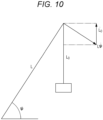
- the boom distal-end part 11 is treated as an overhead crane model.
- the equation of motion of the model is given by Mathematical Expression 1.
- s in Mathematical Expression 1 represents the displacement of the boom distal-end part 11.
- ⁇ si represents the sway angle of the load B.
- l i represents the rope length. Note that, referring to Fig. 5 , the position from which the boom distal-end part 11 starts to move is the origin O.
- the sway angle of the load B is the angle of the wire rope 8 with respect to the vertical direction.
- ⁇ si ⁇ s ⁇ l i
- ⁇ ni g l i
- v(t) is given by Mathematical Expression 4.
- s in Mathematical Expression 4 represents the Laplace operator.
- v t L ⁇ 1 V s
- V(j ⁇ ) is given by Mathematical Expression 5.
- the displacement S of the boom distal-end part 11 in Mathematical Expression 5 is a control input, and W(jw) represents a weight function.
- S(j ⁇ ) represents the Fourier transform of S(t).
- V j ⁇ W j ⁇ S j ⁇
- the weight function W(jw) is treated as a first-order filter type.
- the weight function W(jw) is given by Mathematical Expression 6.
- the weight function W(j ⁇ ) may be a second-order filter type, instead of being a first-order filter type.
- a second-order filter type of weight function W(j ⁇ ) enables, at the start of acceleration and at the end of acceleration, a further reduction in the acceleration of the boom distal-end part 11.
- W j ⁇ 1 + j ⁇ 1 + j ⁇
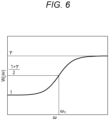
- Fig. 6 is a Bode plot of Mathematical Expressions 6 to 8 with the horizontal axis and the vertical axis, respectively, as frequency ⁇ and the weight function W(jw).
- Weight ⁇ is designed to be ⁇ c or more. Weighting a high-frequency domain enables inhibition of a high-frequency component from occurring in swaying.
- a temporal change in the constant-velocity section enables an adjustment in the distance of movement of the boom distal-end part 11.
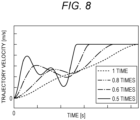
- Fig. 8 illustrates the velocity waveform of the boom distal-end part 11 calculated by Mathematical Expression 11 with the value of the cycle T of swaying multiplied by a constant.
- the cycle T of swaying is calculated by Mathematical Expression 2.
- the constant is 0.5, 0.6, 0.8, or 1.0.
- the boom distal-end part 11 moves at the velocity of the calculated velocity waveform, so that a state where no swaying is present can be made after the end of acceleration or after the end of deceleration. That is, shortening the acceleration section and the deceleration section enables a behavior with no swaying to be achieved in a shorter time.
- the equilibrium point of force in the constant-velocity section is located in the vertical direction of the boom distal-end part 11 (vertically below the boom distal-end part 11), so that a change can be freely made in the height of the load B with inhibition of swaying.
- the constant described above can be set in a range in which an actuator can make a response.
- a hydraulic actuator e.g., the hydraulic motor for slewing 51 or the hydraulic cylinder for derricking movement 53
- 0.5 or more can be set.
- the control device 20 creates, for transport of the boom distal-end part 11 along the created trajectory, the respective trajectories of slewing movement and derricking movement of the boom 7 and additionally creates, for transport of the load B to the position of the end point P2, the trajectory of rotational movement of the winch 10.
- control device 20 includes a movement trajectory generation unit 203 (refer to Fig. 2 ) that generates the trajectory of movement of the boom and the trajectory of rotational movement of the winch for transport of the load along the horizontal trajectory of the distal-end part of the boom generated by the horizontal trajectory generation unit 202.
- a movement trajectory generation unit 203 (refer to Fig. 2 ) that generates the trajectory of movement of the boom and the trajectory of rotational movement of the winch for transport of the load along the horizontal trajectory of the distal-end part of the boom generated by the horizontal trajectory generation unit 202.
- the projection of the boom distal-end part 11 on the O-XY plane moves on the line segment linking the start point P1( ⁇ 0 , 0) and the end point P2 ( ⁇ T cos ⁇ T , ⁇ T sin ⁇ T ).
- a point P3(X, Y) on the line segment is given by Mathematical Expression 14.
- ⁇ 0 represents the working radius at the start point P1.
- ⁇ T represents the working radius at the end point P2.
- ⁇ T represents the slewing angle between the start point P1 and the end point P2.
- the derricking angle ⁇ and slewing angle ⁇ of the boom 7 are given by Mathematical Expression 15, where L represents the boom length and E represents the horizontal length from the boom base fulcrum to the slewing center.
- the control device 20 creates the trajectories of slewing movement and derricking movement of the boom 7 such that the boom 7 carries out a slewing movement and a derricking movement based on the slewing angle ⁇ and the derricking angle ⁇ calculated by Mathematical Expression 15.
- ⁇ cos ⁇ 1 X 2 + Y 2 + E
- L ⁇ cos ⁇ 1 X X 2 + Y 2
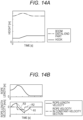
- the control device 20 calculates rope-length velocity that is identical to the velocity at which the boom distal-end part 11 moves in the height direction and is directed in a direction opposite to the direction in which the boom distal-end part 11 moves in the height direction such that the load B remains constant in height from the position of the start point P1 (winch velocity pattern) (refer to a solid line R1 in Fig. 14B ).
- the control device 20 calculates the rope-length velocity corresponding to ⁇ H in the constant-velocity section (trapezoidal velocity pattern) (refer to a dot-and-dash line R2 in Fig. 14B ). Then, the control device 20 adds the trapezoidal velocity pattern to the winch velocity pattern described above.
- the control device 20 creates the trajectory of rotational movement of the winch 10 such that the winch 10 carries out a rotational movement based on the winch velocity pattern resulting from the addition.
- the control device 20 transports, in the acceleration and deceleration sections, the load B remaining constant in height and transports, in the constant-velocity section, the load B in consideration of a change in height between the start point P1 and the end point P2 and a change in the position of the boom distal-end part 11, so that a state where no swaying is present at the position of the end point P2 can be made promptly.
- control device 20 moves the boom 7 along the trajectories of slewing movement and derricking movement of the boom 7 and additionally moves the winch 10 along the trajectory of rotational movement of the winch 10, to transport the load B.
- control device 20 includes a movement control unit 204 (refer to Fig. 2 ) that controls, based on the trajectory of movement of the boom and the trajectory of movement of the winch generated by the movement trajectory generation unit 203, the movements of the boom and the winch.
- a movement control unit 204 (refer to Fig. 2 ) that controls, based on the trajectory of movement of the boom and the trajectory of movement of the winch generated by the movement trajectory generation unit 203, the movements of the boom and the winch.
- control device 20 operates the valve for slewing 31 along the created trajectory of slewing movement of the boom 7.
- the control device 20 operates the valve for derricking movement 33 along the created trajectory of derricking movement of the boom 7.
- control device 20 operates the hydraulic motor for winding 54 along the created trajectory of rotational movement of the winch 10.
- the control device 20 calculates, with Mathematical Expression 11, the trajectories in the X, Y, and XY directions of the boom distal-end part 11 and further calculates, as illustrated in Figs. 12B and 12C , the trajectory velocities and trajectory accelerations in the X, Y, and XY directions of the boom distal-end part 11.
- the control device 20 calculates the slewing angle of the boom 7 with Mathematical Expression 15 and further calculates the slewing angular velocity and slewing angular acceleration of the boom 7.
- control device 20 creates the trajectory of slewing movement of the boom 7.
- the control device 20 calculates the derricking angle of the boom 7 with Mathematical Expression 15 and further calculates the derricking angular velocity and derricking angular acceleration of the boom 7.
- control device 20 creates the trajectory of derricking movement of the boom 7.
- the control device 20 calculates, with Mathematical Expression 17, the rope-length velocity such that the load B is constant in height in the acceleration, constant-velocity, and deceleration sections (winch velocity pattern) (refer to a dotted line R3).
- the control device 20 calculates the rope-length velocity corresponding to ⁇ H in the constant-velocity section (trapezoidal velocity pattern) (refer to the dot- and-dash line R2 in Fig. 14B , the direction of winding up is minus). Then, the control device 20 adds the trapezoidal velocity pattern to the winch velocity pattern described above to calculate the rope-length velocity (refer to the solid line R1 in Fig. 14B ). That is, the control device 20 creates the trajectory of rotational movement of the winch 10.
- the control device 20 moves the boom 7 along the trajectories of slewing movement and derricking movement of the boom 7 and additionally moves the winch 10 along the trajectory of rotational movement of the winch 10. As illustrated in Figs. 15A and 15B , the control device 20 can transport the load B with inhibition of swaying at the end of transport.
- the rotational movement of the winch 10 is controlled together with the slewing movement and derricking movement of the boom 7. Therefore, with a change in rope length and a change in the height of the load B as control targets, the load B being transported linearly in plan view can be inhibited from swaying at the position of the end point P2. Since the actuators operate along the created trajectories, no sensor that detects the sway angle of the load B is required.
- the load B is transported in the height direction to the position of the end point P2. Therefore, the load B can be transported more promptly, in comparison to a case where linear transport of the load B in plan view and transport of the load B in the height direction are separately carried out.
- the trajectory in plan view is directly calculated by the temporal function (Mathematical Expression 11), instead of repetitive calculation. Therefore, a reduction can be made in the load of calculation of the trajectory in plan view.
- a method for controlling a crane 1 according to a second embodiment will be described with Figs. 16A to 17B .
- constituents the same as those in the description for the method for controlling the crane 1 according to the first embodiment are given the same terms denoted with the same reference signs. Differences from the method for controlling the crane 1 according to the first embodiment will be mainly described.
- a control device 20 creates the trajectory of rotational movement of a winch 10 such that the winch 10 carries out no rotational movement in acceleration, constant-velocity, and deceleration sections. Note that the control device 20 uses, in an optimal control theory in the present embodiment, the rope length due to movement of the rope length at a start point P1 by ⁇ H, namely, the rope length at an end point P2.
- the control device 20 moves the winch 10 before the acceleration section such that a load B is transported by ⁇ H in the height direction.
- the control device 20 reels in a wire rope 8 by ⁇ H in a case where ⁇ H is positive and reels out the wire rope 8 by ⁇ H in a case where ⁇ H is negative. After that, with the rope length remaining constant, the control device 20 moves a boom 7 along the trajectories of slewing movement and derricking movement of the boom 7.
- the control device 20 creates a winch velocity pattern in which the winch 10 carries out no rotational movement.
- the control device 20 moves the boom 7 along the trajectories of slewing movement and derricking movement of the boom 7 and additionally moves the winch 10 along the trajectory of rotational movement of the winch 10. As illustrated in Figs. 17A and 17B , the control device 20 can transport the load B with inhibition of swaying at the end of transport, in comparison to a case where a change is made in rope length in the constant-velocity section.
- a similar method enables inhibition of swaying at the position of an end point, with linear movement of a boom distal-end part in plan view and prompt transport of a load and without a tangle of a wire rope from which the main hook is suspended and a wire rope from which the sub-hook is suspended.
- an operator can input the position of an end point while checking the ambient situation from the image captured by the load monitoring camera.
- the position of a start point and the position of an end point are set as a path for transporting materials designed by building information modeling (BIM), leading to automatic transport.
- BIM building information modeling
- boom flexure is considered in Mathematical Expression 17, taking account of a change in the velocity of delivered length based on the number of layers on the drum of the winch 10 enables transport of the load B of which the height is kept constant more accurately.
- the invention includes the crane 1 including the control device 20 that can perform the method for controlling the crane 1.
- the present crane 1 has an effect similar to the effect described above.
- the present invention can be applied to various cranes.
Landscapes
- Engineering & Computer Science (AREA)
- Mechanical Engineering (AREA)
- Automation & Control Theory (AREA)
- Jib Cranes (AREA)
- Control And Safety Of Cranes (AREA)
Applications Claiming Priority (2)
| Application Number | Priority Date | Filing Date | Title |
|---|---|---|---|
| JP2021075171 | 2021-04-27 | ||
| PCT/JP2022/015505 WO2022230562A1 (fr) | 2021-04-27 | 2022-03-29 | Dispositif de commande, grue et procédé de commande de grue |
Publications (2)
| Publication Number | Publication Date |
|---|---|
| EP4332048A1 true EP4332048A1 (fr) | 2024-03-06 |
| EP4332048A4 EP4332048A4 (fr) | 2024-11-13 |
Family
ID=83848005
Family Applications (1)
| Application Number | Title | Priority Date | Filing Date |
|---|---|---|---|
| EP22795478.1A Pending EP4332048A4 (fr) | 2021-04-27 | 2022-03-29 | Dispositif de commande, grue et procédé de commande de grue |
Country Status (4)
| Country | Link |
|---|---|
| US (1) | US12515926B2 (fr) |
| EP (1) | EP4332048A4 (fr) |
| JP (1) | JP7513999B2 (fr) |
| WO (1) | WO2022230562A1 (fr) |
Families Citing this family (2)
| Publication number | Priority date | Publication date | Assignee | Title |
|---|---|---|---|---|
| US12515926B2 (en) * | 2021-04-27 | 2026-01-06 | Tokyo Institute Of Technology | Control device, crane, and method for controlling crane |
| CN120887333B (zh) * | 2025-09-25 | 2025-12-09 | 杭州宇泛智能科技股份有限公司 | 基于自动路径规划的塔机智能吊物方法及系统 |
Family Cites Families (10)
| Publication number | Priority date | Publication date | Assignee | Title |
|---|---|---|---|---|
| JPH0873183A (ja) * | 1994-09-05 | 1996-03-19 | Komatsu Mec Corp | 移動式クレーンの吊荷直線移動制御装置 |
| US5961563A (en) * | 1997-01-22 | 1999-10-05 | Daniel H. Wagner Associates | Anti-sway control for rotating boom cranes |
| JP4096473B2 (ja) | 1999-11-04 | 2008-06-04 | 神鋼電機株式会社 | クレーン装置の駆動制御装置、クレーン装置の駆動制御方法および記録媒体 |
| JP2003155192A (ja) * | 2001-11-16 | 2003-05-27 | Mitsubishi Heavy Ind Ltd | クレーンの運転方法及び制御装置並びにこれを備えたクレーン |
| DE102014008094A1 (de) * | 2014-06-02 | 2015-12-03 | Liebherr-Werk Nenzing Gmbh | Verfahren zum Steuern der Ausrichtung einer Kranlast und Auslegekran |
| JP6453075B2 (ja) * | 2014-12-25 | 2019-01-16 | Ihi運搬機械株式会社 | トロリ式クレーンの振れ止め制御方法及び装置 |
| JP6719807B2 (ja) * | 2016-05-18 | 2020-07-08 | 新東工業株式会社 | 天井クレーンによる液体タンクの搬送制御システムおよび天井クレーンにより液体タンクを搬送する方法 |
| US11209836B1 (en) * | 2018-02-08 | 2021-12-28 | Vita Inclinata Technologies, Inc. | Long line loiter apparatus, system, and method |
| JP7207269B2 (ja) | 2019-11-11 | 2023-01-18 | トヨタ自動車株式会社 | ペダル反力制御装置 |
| US12515926B2 (en) * | 2021-04-27 | 2026-01-06 | Tokyo Institute Of Technology | Control device, crane, and method for controlling crane |
-
2022
- 2022-03-29 US US18/556,990 patent/US12515926B2/en active Active
- 2022-03-29 WO PCT/JP2022/015505 patent/WO2022230562A1/fr not_active Ceased
- 2022-03-29 JP JP2023517193A patent/JP7513999B2/ja active Active
- 2022-03-29 EP EP22795478.1A patent/EP4332048A4/fr active Pending
Also Published As
| Publication number | Publication date |
|---|---|
| US20240217784A1 (en) | 2024-07-04 |
| US12515926B2 (en) | 2026-01-06 |
| JPWO2022230562A1 (fr) | 2022-11-03 |
| JP7513999B2 (ja) | 2024-07-10 |
| EP4332048A4 (fr) | 2024-11-13 |
| WO2022230562A1 (fr) | 2022-11-03 |
Similar Documents
| Publication | Publication Date | Title |
|---|---|---|
| EP3915928B1 (fr) | Grue | |
| US9238570B2 (en) | Crane maneuvering assistance | |
| EP3279133B1 (fr) | Appareil d'affichage pour le déplacement de grues et appareil de synchronisation pour le déplacement de grues | |
| EP3822219B1 (fr) | Grue | |
| EP3822221B1 (fr) | Grue et procédé de commande de grue | |
| EP4332048A1 (fr) | Dispositif de commande, grue et procédé de commande de grue | |
| US11198596B2 (en) | Crane | |
| EP3272693B1 (fr) | Dispositif de pivotement | |
| EP4036044B1 (fr) | Système d'affichage d'informations de grue | |
| EP3868699B1 (fr) | Dispositif de grue | |
| EP3831765A1 (fr) | Grue | |
| EP4234472A1 (fr) | Grue, dispositif de détermination de changement de caractéristique de grue, et système de détermination de changement de caractéristique de grue | |
| JP2003155192A (ja) | クレーンの運転方法及び制御装置並びにこれを備えたクレーン | |
| EP3925919B1 (fr) | Dispositif de commande de levage et grue mobile | |
| EP4357290A1 (fr) | Grue | |
| KR102362585B1 (ko) | 크레인 및 그의 제어방법 |
Legal Events
| Date | Code | Title | Description |
|---|---|---|---|
| STAA | Information on the status of an ep patent application or granted ep patent |
Free format text: STATUS: THE INTERNATIONAL PUBLICATION HAS BEEN MADE |
|
| PUAI | Public reference made under article 153(3) epc to a published international application that has entered the european phase |
Free format text: ORIGINAL CODE: 0009012 |
|
| STAA | Information on the status of an ep patent application or granted ep patent |
Free format text: STATUS: REQUEST FOR EXAMINATION WAS MADE |
|
| 17P | Request for examination filed |
Effective date: 20231120 |
|
| AK | Designated contracting states |
Kind code of ref document: A1 Designated state(s): AL AT BE BG CH CY CZ DE DK EE ES FI FR GB GR HR HU IE IS IT LI LT LU LV MC MK MT NL NO PL PT RO RS SE SI SK SM TR |
|
| DAV | Request for validation of the european patent (deleted) | ||
| DAX | Request for extension of the european patent (deleted) | ||
| A4 | Supplementary search report drawn up and despatched |
Effective date: 20241010 |
|
| RIC1 | Information provided on ipc code assigned before grant |
Ipc: B66C 13/48 20060101ALI20241004BHEP Ipc: B66C 13/06 20060101ALI20241004BHEP Ipc: B66C 23/12 20060101ALI20241004BHEP Ipc: B66C 23/00 20060101AFI20241004BHEP |