EP4332127A1 - Vinylalkoholpolymer, pulver damit, verfahren zur herstellung davon, papierverarbeitungsmittel und dispergiermittel für emulsionspolymerisation - Google Patents
Vinylalkoholpolymer, pulver damit, verfahren zur herstellung davon, papierverarbeitungsmittel und dispergiermittel für emulsionspolymerisation Download PDFInfo
- Publication number
- EP4332127A1 EP4332127A1 EP22795741.2A EP22795741A EP4332127A1 EP 4332127 A1 EP4332127 A1 EP 4332127A1 EP 22795741 A EP22795741 A EP 22795741A EP 4332127 A1 EP4332127 A1 EP 4332127A1
- Authority
- EP
- European Patent Office
- Prior art keywords
- pva
- monomer
- vinyl alcohol
- mass
- alcohol polymer
- Prior art date
- Legal status (The legal status is an assumption and is not a legal conclusion. Google has not performed a legal analysis and makes no representation as to the accuracy of the status listed.)
- Pending
Links
Images

Classifications
-
- C—CHEMISTRY; METALLURGY
- C08—ORGANIC MACROMOLECULAR COMPOUNDS; THEIR PREPARATION OR CHEMICAL WORKING-UP; COMPOSITIONS BASED THEREON
- C08F—MACROMOLECULAR COMPOUNDS OBTAINED BY REACTIONS ONLY INVOLVING CARBON-TO-CARBON UNSATURATED BONDS
- C08F216/00—Copolymers of compounds having one or more unsaturated aliphatic radicals, each having only one carbon-to-carbon double bond, and at least one being terminated by an alcohol, ether, aldehydo, ketonic, acetal or ketal radical
- C08F216/02—Copolymers of compounds having one or more unsaturated aliphatic radicals, each having only one carbon-to-carbon double bond, and at least one being terminated by an alcohol, ether, aldehydo, ketonic, acetal or ketal radical by an alcohol radical
- C08F216/04—Acyclic compounds
- C08F216/06—Polyvinyl alcohol ; Vinyl alcohol
-
- C—CHEMISTRY; METALLURGY
- C08—ORGANIC MACROMOLECULAR COMPOUNDS; THEIR PREPARATION OR CHEMICAL WORKING-UP; COMPOSITIONS BASED THEREON
- C08F—MACROMOLECULAR COMPOUNDS OBTAINED BY REACTIONS ONLY INVOLVING CARBON-TO-CARBON UNSATURATED BONDS
- C08F16/00—Homopolymers and copolymers of compounds having one or more unsaturated aliphatic radicals, each having only one carbon-to-carbon double bond, and at least one being terminated by an alcohol, ether, aldehydo, ketonic, acetal or ketal radical
- C08F16/02—Homopolymers and copolymers of compounds having one or more unsaturated aliphatic radicals, each having only one carbon-to-carbon double bond, and at least one being terminated by an alcohol, ether, aldehydo, ketonic, acetal or ketal radical by an alcohol radical
- C08F16/04—Acyclic compounds
- C08F16/06—Polyvinyl alcohol ; Vinyl alcohol
-
- C—CHEMISTRY; METALLURGY
- C08—ORGANIC MACROMOLECULAR COMPOUNDS; THEIR PREPARATION OR CHEMICAL WORKING-UP; COMPOSITIONS BASED THEREON
- C08F—MACROMOLECULAR COMPOUNDS OBTAINED BY REACTIONS ONLY INVOLVING CARBON-TO-CARBON UNSATURATED BONDS
- C08F8/00—Chemical modification by after-treatment
- C08F8/12—Hydrolysis
-
- C—CHEMISTRY; METALLURGY
- C08—ORGANIC MACROMOLECULAR COMPOUNDS; THEIR PREPARATION OR CHEMICAL WORKING-UP; COMPOSITIONS BASED THEREON
- C08J—WORKING-UP; GENERAL PROCESSES OF COMPOUNDING; AFTER-TREATMENT NOT COVERED BY SUBCLASSES C08B, C08C, C08F, C08G or C08H
- C08J3/00—Processes of treating or compounding macromolecular substances
- C08J3/12—Powdering or granulating
-
- C—CHEMISTRY; METALLURGY
- C09—DYES; PAINTS; POLISHES; NATURAL RESINS; ADHESIVES; COMPOSITIONS NOT OTHERWISE PROVIDED FOR; APPLICATIONS OF MATERIALS NOT OTHERWISE PROVIDED FOR
- C09D—COATING COMPOSITIONS, e.g. PAINTS, VARNISHES OR LACQUERS; FILLING PASTES; CHEMICAL PAINT OR INK REMOVERS; INKS; CORRECTING FLUIDS; WOODSTAINS; PASTES OR SOLIDS FOR COLOURING OR PRINTING; USE OF MATERIALS THEREFOR
- C09D129/00—Coating compositions based on homopolymers or copolymers of compounds having one or more unsaturated aliphatic radicals, each having only one carbon-to-carbon double bond, and at least one being terminated by an alcohol, ether, aldehydo, ketonic, acetal, or ketal radical; Coating compositions based on hydrolysed polymers of esters of unsaturated alcohols with saturated carboxylic acids; Coating compositions based on derivatives of such polymers
- C09D129/02—Homopolymers or copolymers of unsaturated alcohols
- C09D129/04—Polyvinyl alcohol; Partially hydrolysed homopolymers or copolymers of esters of unsaturated alcohols with saturated carboxylic acids
-
- C—CHEMISTRY; METALLURGY
- C09—DYES; PAINTS; POLISHES; NATURAL RESINS; ADHESIVES; COMPOSITIONS NOT OTHERWISE PROVIDED FOR; APPLICATIONS OF MATERIALS NOT OTHERWISE PROVIDED FOR
- C09J—ADHESIVES; NON-MECHANICAL ASPECTS OF ADHESIVE PROCESSES IN GENERAL; ADHESIVE PROCESSES NOT PROVIDED FOR ELSEWHERE; USE OF MATERIALS AS ADHESIVES
- C09J129/00—Adhesives based on homopolymers or copolymers of compounds having one or more unsaturated aliphatic radicals, each having only one carbon-to-carbon double bond, and at least one being terminated by an alcohol, ether, aldehydo, ketonic, acetal, or ketal radical; Adhesives based on hydrolysed polymers of esters of unsaturated alcohols with saturated carboxylic acids; Adhesives based on derivatives of such polymers
- C09J129/02—Homopolymers or copolymers of unsaturated alcohols
- C09J129/04—Polyvinyl alcohol; Partially hydrolysed homopolymers or copolymers of esters of unsaturated alcohols with saturated carboxylic acids
-
- D—TEXTILES; PAPER
- D21—PAPER-MAKING; PRODUCTION OF CELLULOSE
- D21H—PULP COMPOSITIONS; PREPARATION THEREOF NOT COVERED BY SUBCLASSES D21C OR D21D; IMPREGNATING OR COATING OF PAPER; TREATMENT OF FINISHED PAPER NOT COVERED BY CLASS B31 OR SUBCLASS D21G; PAPER NOT OTHERWISE PROVIDED FOR
- D21H17/00—Non-fibrous material added to the pulp, characterised by its constitution; Paper-impregnating material characterised by its constitution
- D21H17/20—Macromolecular organic compounds
- D21H17/33—Synthetic macromolecular compounds
- D21H17/34—Synthetic macromolecular compounds obtained by reactions only involving carbon-to-carbon unsaturated bonds
- D21H17/36—Polyalkenyalcohols; Polyalkenylethers; Polyalkenylesters
-
- D—TEXTILES; PAPER
- D21—PAPER-MAKING; PRODUCTION OF CELLULOSE
- D21H—PULP COMPOSITIONS; PREPARATION THEREOF NOT COVERED BY SUBCLASSES D21C OR D21D; IMPREGNATING OR COATING OF PAPER; TREATMENT OF FINISHED PAPER NOT COVERED BY CLASS B31 OR SUBCLASS D21G; PAPER NOT OTHERWISE PROVIDED FOR
- D21H19/00—Coated paper; Coating material
- D21H19/10—Coatings without pigments
- D21H19/12—Coatings without pigments applied as a solution using water as the only solvent, e.g. in the presence of acid or alkaline compounds
-
- D—TEXTILES; PAPER
- D21—PAPER-MAKING; PRODUCTION OF CELLULOSE
- D21H—PULP COMPOSITIONS; PREPARATION THEREOF NOT COVERED BY SUBCLASSES D21C OR D21D; IMPREGNATING OR COATING OF PAPER; TREATMENT OF FINISHED PAPER NOT COVERED BY CLASS B31 OR SUBCLASS D21G; PAPER NOT OTHERWISE PROVIDED FOR
- D21H21/00—Non-fibrous material added to the pulp, characterised by its function, form or properties; Paper-impregnating or coating material, characterised by its function, form or properties
- D21H21/14—Non-fibrous material added to the pulp, characterised by its function, form or properties; Paper-impregnating or coating material, characterised by its function, form or properties characterised by function or properties in or on the paper
- D21H21/16—Sizing or water-repelling agents
-
- C—CHEMISTRY; METALLURGY
- C08—ORGANIC MACROMOLECULAR COMPOUNDS; THEIR PREPARATION OR CHEMICAL WORKING-UP; COMPOSITIONS BASED THEREON
- C08F—MACROMOLECULAR COMPOUNDS OBTAINED BY REACTIONS ONLY INVOLVING CARBON-TO-CARBON UNSATURATED BONDS
- C08F218/00—Copolymers of compounds having one or more unsaturated aliphatic radicals, each having only one carbon-to-carbon double bond, and at least one being terminated by an acyloxy radical of a saturated carboxylic acid, of carbonic acid or of a haloformic acid
- C08F218/02—Esters of monocarboxylic acids
- C08F218/04—Vinyl esters
- C08F218/08—Vinyl acetate
-
- C—CHEMISTRY; METALLURGY
- C08—ORGANIC MACROMOLECULAR COMPOUNDS; THEIR PREPARATION OR CHEMICAL WORKING-UP; COMPOSITIONS BASED THEREON
- C08J—WORKING-UP; GENERAL PROCESSES OF COMPOUNDING; AFTER-TREATMENT NOT COVERED BY SUBCLASSES C08B, C08C, C08F, C08G or C08H
- C08J2329/00—Characterised by the use of homopolymers or copolymers of compounds having one or more unsaturated aliphatic radicals, each having only one carbon-to-carbon double bond, and at least one being terminated by an alcohol, ether, aldehydo, ketonic, acetal, or ketal radical; Hydrolysed polymers of esters of unsaturated alcohols with saturated carboxylic acids; Derivatives of such polymer
- C08J2329/02—Homopolymers or copolymers of unsaturated alcohols
- C08J2329/04—Polyvinyl alcohol; Partially hydrolysed homopolymers or copolymers of esters of unsaturated alcohols with saturated carboxylic acids
Definitions
- the present invention relates to a vinyl alcohol polymer, a powder containing the same, methods for producing these, a paper processing agent, and a dispersant for emulsion polymerization.
- a vinyl alcohol polymer (hereinafter, may be referred to as "PVA”) is known as a water-soluble synthetic polymer, and used for a wide range of intended usages such as paper processing, fiber processing, adhesives, emulsion stabilizers for polymerization and suspension polymerization, binders for inorganic substances, and films.
- a PVA including a structural unit derived from a carboxylic acid or a derivative thereof has been known (see Patent Document 1). Taking advantage of reactivity and the like of the carboxylic acid, such a PVA has been used for: a sizing agent of acidic paper containing aluminum sulfate; a water-resistant coating film being combined with a crosslinking agent; an adhesive; and the like. In addition, due to water solubility being favorable, the PVA is useful also for water-soluble films for packaging of pesticides, laundry detergents, industrial chemicals, and the like, and thus has been widely utilized.
- Patent Document 1 PCT International Publication No. 2018/061272
- an aqueous PVA solution containing water as a solvent is typically used as a film-forming solution, taking into consideration an environmental aspect, economical efficiency, and the like. Furthermore, even in the case in which the PVA is used as a component of a coating agent and/or an adhesive, water is frequently used as a solvent.
- the aqueous PVA solution is preferably prepared using the PVA at a high concentration, in light of shortening of a drying time period, reduction of energy required for drying, and the like.
- the aqueous PVA solution may be prepared using the PVA at a high concentration.
- conventional aqueous PVA solutions are disadvantageous in that the viscosity prominently increases when prepared at a high concentration, thereby leading to deterioration of coating characteristics, and the like.
- the present invention was made for solving the aforementioned problems, and an object of the invention is to provide: a PVA prevented from an increase in viscosity when prepared into an aqueous solution of a high concentration; a powder containing such a PVA; methods for producing these; and a paper processing agent and a dispersant for emulsion polymerization each containing such a PVA.
- the present invention enables providing: a PVA prevented from an increase in viscosity when prepared into an aqueous solution of a high concentration; a powder containing such a PVA; methods for producing these; and a paper processing agent and a dispersant for emulsion polymerization each containing such a PVA.
- the PVA (vinyl alcohol polymer) of the present invention is a PVA including a structural unit derived from at least one selected from the group consisting of: a monomer having a carboxy group; and a derivative of the monomer, wherein the PVA has: a minimum degree of branching of 0.93 or less within a range of an absolute molecular weight being 200,000 or more and 800,000 or less; a viscosity-average degree of polymerization of 750 or less; and a degree of saponification of 65 mol% or more.
- the "at least one selected from the group consisting of: a monomer having a carboxy group; and a derivative of the monomer” may be referred to as "monomer (a)".
- the PVA of the present invention includes a vinyl alcohol unit and the structural unit derived from the monomer (a).
- the PVA is obtained, typically, by subjecting a vinyl ester polymer including the structural unit derived from the monomer (a) (a copolymer of the monomer (a) and a vinyl ester) to saponification.
- the derivative of the monomer having a carboxy group is exemplified by esters, anhydrides, etc., of the monomer having a carboxy group.
- the carboxy group (-COOH) may be present in a state of a salt (-COONa, etc.).
- the structural unit derived from the monomer (a) may form a cross-linked structure and bond to an other structural unit.
- the monomer (a) is exemplified by an ethylenic unsaturated monocarboxylic acid, an ethylenic unsaturated dicarboxylic acid, and derivatives of these.
- ethylenic unsaturated monocarboxylic acid and the derivative thereof examples include acrylic acid, methacrylic acid, methyl acrylate, ethyl acrylate, methyl methacrylate, ethyl methacrylate, and the like.
- the ethylenic unsaturated dicarboxylic acid and the derivative thereof are exemplified by ethylenic unsaturated dicarboxylic acids, a monoester thereof, a diester thereof, an anhydride thereof, and the like.
- examples of the ethylenic unsaturated dicarboxylic acid include maleic acid, fumaric acid, citraconic acid, mesaconic acid, itaconic acid, and the like.
- Examples of the monoester of the ethylenic unsaturated dicarboxylic acid include monoalkyl unsaturated dicarboxylic acid esters such as monomethyl maleate, monoethyl maleate, monomethyl fumarate, monoethyl fumarate, monomethyl citraconate, monoethyl citraconate, monomethyl mesaconate, monoethyl mesaconate, monomethyl itaconate, and monoethyl itaconate.
- Examples of the diester of the ethylenic unsaturated dicarboxylic acid include dialkyl unsaturated dicarboxylic acid esters such as dimethyl maleate, diethyl maleate, dimethyl fumarate, diethyl fumarate, dimethyl citraconate, diethyl citraconate, dimethyl mesaconate, diethyl mesaconate, dimethyl itaconate, and diethyl itaconate.
- Examples of the anhydride of the ethylenic unsaturated dicarboxylic acid include maleic anhydride, citraconic anhydride, and the like.
- the monomer (a) is preferably the ethylenic unsaturated dicarboxylic acid, and a monoester of the ethylenic unsaturated dicarboxylic acid, a diester of the ethylenic unsaturated dicarboxylic acid, and an anhydride of the ethylenic unsaturated dicarboxylic acid, more preferably maleic acid, a maleic acid monoalkyl ester, a maleic acid dialkyl ester, maleic anhydride, fumaric acid, a fumaric acid monoalkyl ester, and a fumaric acid dialkyl ester, and particularly preferably monomethyl maleate, dimethyl maleate, maleic anhydride, monomethyl fumarate, and dimethyl fumarate.
- One type, or two or more types of the monomer (a) may be used.
- the lower limit of a percentage content of (S) of the structural unit derived from the monomer (a) with respect to total structural units of the PVA of the present invention is preferably 0.1 mol%, more preferably 0.5 mol%, still more preferably 1.0 mol%, and particularly preferably 1.5 mol%.
- the upper limit of the percentage content of (S) is preferably 15 mol%, more preferably 10 mol%, and still more preferably 5 mol%, and may be even more preferably 3 mol%.
- the percentage content of (S) can be determined by a 1 H-NMR analysis of a vinyl ester polymer before saponification of the PVA of the present invention.
- the PVA of the present invention has the minimum degree of branching of 0.93 or less, within a range of an absolute molecular weight being 200,000 or more and 800,000 or less.
- the degree of branching as referred to herein means a marker representing an extent of a branched structure(s) of a polymer, and provided that the degree of branching of a linear polymer, i.e., a polymer not having a branched structure, is 1, a value closer to 0 indicates many branched structure(s) being included.
- the degree of branching for each absolute molecular weight in the range of the absolute molecular weight being 200,000 or more and 800,000 or less is determined.
- the smallest degree of branching in the above range is defined as the minimum degree of branching.
- the absolute molecular weight of a PVA does not distribute over the entire range of 200,000 or more and 800,000 or less, for example, also in a case of including only a PVA having an absolute molecular weight of 600,000 or less, or the like
- the smallest degree of branching in the range of the absolute molecular weight being 200,000 or more and 600,000 or less is defined as the minimum degree of branching.
- the PVA of the present invention consisting of a plurality of molecules includes molecules having an absolute molecular weight falling within the range of 200,000 or more and 800,000 or less, the absolute molecular weight may not be distributed over the entire range of 200,000 or more and 800,000 or less.
- the degree of branching g m in each absolute molecular weight of the PVA of the present invention is determined with the following equalities (1) and (2).
- g m ′ ⁇ branch / ⁇ linear
- g m g m ′ 1 / ⁇
- [ ⁇ ] branch represents an intrinsic viscosity of the PVA of the present invention with a branched structure (branched PVA), having an absolute molecular weight x (wherein x is 200,000 or more and 800,000 or less), and is a value calculated from a differential refractive index detector, a light scattering detector, and a viscosity detector.
- [ ⁇ ] linear is an intrinsic viscosity of the linear PVA having the above absolute molecular weight x, and is similarly a value calculated from a differential refractive index detector, a light scattering detector, and a viscosity detector.
- linear PVA an unmodified PVA (a saponification product of a homopolymer of vinyl acetate) is used, a viscosity of a 4% by mass aqueous solution of which accounts for within ⁇ 20% of the viscosity of a 4% by mass aqueous solution of the PVA of the present invention to be a subject of the measurement, and a degree of saponification of which accounts for within ⁇ 3 mol% of the PVA of the present invention.
- the intrinsic viscosity of the PVA of the present invention and the linear PVA having each absolute molecular weight can be measured specifically, by a method described in Examples.
- a relationship between the degree of branching g m and the ratio g m ' of the intrinsic viscosity represented by the above equality (1) is as represented by the above equality (2).
- ⁇ represents a structure factor, wherein ⁇ is 0.7.
- the minimum degree of branching is 0.93 or less, whereby a sufficient branched structure (crosslinking) has been formed.
- the upper limit of the minimum degree of branching is preferably 0.8 and more preferably 0.6, and may be still more preferably 0.4, 0.25 or 0.18.
- the lower limit of the minimum degree of branching may be, for example, 0.01 or 0.05, may be preferably 0.11, and may be still more preferably 0.20. Due to the minimum degree of branching being the aforementioned lower limit or more, insoluble matter generated through excessive forming of crosslinking and/or the like can decrease, whereby coating characteristics and the like can be improved when prepared into an aqueous solution.
- the branching in the PVA is presumed to be formed by a heat treatment through, for example formation of an ester bond between the hydroxy group and the carboxy group included in the PVA, and the like.
- the minimum degree of branching can be adjusted by: heat treatment conditions such as a heat treatment temperature and a heat treatment time period; the percentage content of the structural unit derived from the monomer (a); the degree of saponification; and the like.
- the PVA of the present invention includes the PVA having an absolute molecular weight within the range of 200,000 or more and 800,000 or less.
- the PVA of the present invention includes preferably the PVA having an absolute molecular weight being 200,000, and the having an absolute molecular weight being 800,000, and it is more preferred that the absolute molecular weight is distributed over the entire range of at least 200,000 or more and 800,000 or less.
- the upper limit of the viscosity-average degree of polymerization (P) of the PVA of the present invention is typically 750, preferably 700, more preferably 600, and still more preferably 500. In a case in which the viscosity-average degree of polymerization (P) exceeds 750, the effect that an increase in viscosity when prepared into an aqueous solution of a high concentration can be inhibited may not be exerted, and the viscosity tends to be higher than that of the unmodified PVA, to the contrary.
- the lower limit of the viscosity-average degree of polymerization (P) may be, for example, 100, or may be 150 or 200.
- the viscosity-average degree of polymerization (P) is a value measured in accordance with JIS K6726: 1994, and specifically, can be determined by a method described in EXAMPLES.
- the lower limit of a percentage content of the vinyl alcohol unit with respect to total structural units in the PVA of the present invention is preferably 65 mol% and more preferably 70 mol%, and may be still more preferably 80 mol% or 85 mol%.
- the upper limit of the percentage content of the vinyl alcohol unit is preferably 99.9 mol%, and more preferably 99 mol%.
- the lower limit of the degree of saponification of the PVA of the present invention is typically 65 mol%, preferably 80 mol%, and more preferably 85 mol%.
- the degree of saponification is the aforementioned lower limit or more, water solubility is enhanced and insoluble matter decreases, whereby a homogenous aqueous PVA solution having a high concentration can be more easily prepared.
- the upper limit of the degree of saponification may be 100 mol%, and is preferably 99.9 mol%, more preferably 99 mol%, and still more preferably 92 mol%. When the degree of saponification is the aforementioned upper limit or less, a sufficient branched structure tends to be more readily formed by the heat treatment.
- the degree of saponification is a value measured by a method described in JIS K6726: 1994.
- the PVA of the present invention preferably satisfies the following inequality (I). S ⁇ P > 250
- S represents a percentage content of (mol%) of the structural unit derived from the monomer (a) with respect to total structural units; and P represents the viscosity-average degree of polymerization.
- an extent of effects resulting from modification with the carboxylic acid formation of a branched structure, and the like
- an extent of effects resulting from the degree of polymerization may be balanced, whereby coating characteristics and the like may be further improved.
- coating unevenness upon applying may be further inhibited and strength of a coating film to be obtained tends to be enhanced.
- the lower limit of "S ⁇ P" is more preferably 300, and may be still more preferably 400, 500, 600 or 700.
- the upper limit of "S ⁇ P" is preferably 4,000, more preferably 3,000, and still more preferably 2,000.
- the PVA of the present invention preferably satisfies the following inequality (II). 1.0 ⁇ g A / g B ⁇ 9.0
- g A represents a degree of branching of the vinyl alcohol polymer having an absolute molecular weight of 200,000 (a degree of branching of PVA having an absolute molecular weight of 200,000, of the PVA of the present invention); and g B represents a degree of branching of the vinyl alcohol polymer having an absolute molecular weight of 800,000 (a degree of branching of PVA having an absolute molecular weight of 800,000, of the PVA of the present invention).
- crosslinking proceeds by way of a sufficient heat treatment, whereby PVA having a minimum degree of branching being small can be obtained.
- PVA in general, a component having a molecular weight being large
- crosslinking excessively occurs is likely to be insoluble in water, and affects water solubility of the PVA, coating characteristics of an aqueous solution of the PVA, and the like.
- the ratio g A /g B in the inequality (II) becomes greater. From this point of view, the ratio g A /g B is more preferably less than 7.0, still more preferably less than 6.0, and may be yet more preferably less than 5.0, less than 4.0, less than 3.5, or less than 3.0.
- An insoluble content of a mixture prepared by adding 4 parts by mass of the PVA of the present invention to 96 parts by mass of water followed by stirring at 60 °C for 1 hour is preferably 0.1 ppm or more and less than 2,000 ppm.
- the insoluble content may be more preferably less than 1,500 ppm, and may be still more preferably less than 1,000 ppm. When the insoluble content is thus low, coating characteristics of the aqueous solution of the PVA, and the like can be improved.
- the insoluble content may be 1 ppm or more, or may be 10 ppm or more or 100 ppm or more. It is to be noted that the "ppm" is on mass basis, and the insoluble content (ppm) indicates the proportion of the insoluble matter contained in the PVA.
- the insoluble content specifically, can be determined by a method described in Examples.
- the value of the ratio g A /g B , and the content of the insoluble matter tend to increase as a proportion of the PVA, in which excessive crosslinking has occurred through being excessively heated, increases.
- the ratio g A /g B and the proportion of the insoluble matter contained can be lowered by: upon subjecting the saponification product of the vinyl ester polymer (copolymer) to a heat treatment, fine powder which is likely to be excessively heated is eliminated beforehand; carrying out the heat treatment while eliminating the fine powder; eliminating the fine powder after the heat treatment; and/or the like.
- the PVA of the present invention may include other structural unit(s) aside from: the vinyl alcohol unit; a vinyl ester unit; and the structural unit derived from the monomer (a).
- monomers that give the other structural unit include: ⁇ -olefins such as ethylene, propylene, 1-butene, isobutene, and 1-hexene; acrylamide derivatives such as N-methylacrylamide, N-ethylacrylamide, and 2-acrylamide-2-methylpropane sulfonate; methacrylamide derivatives such as N-methylmethacrylamide and N-ethylmethacrylamide; vinyl ethers such as methyl vinyl ether, ethyl vinyl ether, n-propyl vinyl ether, isopropyl vinyl ether, and n-butyl vinyl ether; hydroxy group-containing vinyl ethers such as ethylene glycol vinyl ether, 1,3-propanediol vinyl ether, and 1,4-butanediol vinyl ether
- a percentage content of the other structural unit with respect to total structural units of the PVA of the present invention may be preferably 20 mol% or less, and may be still more preferably 10 mol% or less, or even more preferably 3 mol% or less, 1 mol% or less, or 0.1 mol% or less.
- the percentage content of the other structural unit may be, for example, 0.1 mol% or more, or may be 1 mol% or more.
- the PVA of the present invention may not have an aliphatic hydrocarbon group having 12 carbon atoms at an end thereof, or may not have an aliphatic hydrocarbon group having 6 or more and 18 or less carbon atoms at an end thereof.
- a terminal aliphatic hydrocarbon group can be introduced by, for example, a chain transfer agent having an aliphatic hydrocarbon group having 6 or more and 18 or less carbon atoms.
- the chain transfer agent is exemplified by an alkyl thiol having 6 or more and 18 or less carbon atoms such as n-dodecanethiol.
- the powder of the present invention is a powder containing the PVA of the present invention. Since the powder contains the PVA of the present invention, even in the case in which the PVA is dissolved in water such that a high concentration is attained, an increase in viscosity of the aqueous solution can be inhibited.
- the PVA of the present invention is typically contained as a principal component.
- the principal component as referred to herein means a component having the highest content on a mass basis.
- the lower limit of a content of the PVA of the present invention with respect to nonvolatile components of the powder of the present invention is preferably 50% by mass, more preferably 70% by mass, and still more preferably 90% by mass, and may be even more preferably 99% by mass.
- the upper limit of a content of the PVA of the present invention with respect to nonvolatile components of the powder of the present invention may be 100% by mass.
- the nonvolatile component(s) other than the PVA of the present invention which may be included in the powder of the present invention is/are exemplified by: a PVA other than the PVA of the present invention; a resin other than PVAs; an additive such as a surfactant and a plasticizer; each compound used in production; and the like.
- a content of volatile components in the powder of the present invention is typically 20% by mass or less, preferably 15% by mass or less, and more preferably 10% by mass or less.
- the volatile component(s) which may be included in the powder of the present invention is/are exemplified by an alcohol, water, and the like.
- the powder of the present invention may be the powder of the PVA of the present invention.
- the upper limit of a percentage content of the powder (fine powder) capable of passing through a sieve having a mesh opening size of 180 ⁇ m is preferably 12% by mass, and may be more preferably 10% by mass, 8% by mass, or 5% by mass.
- the fine powder is likely to be excessively heated by the heat treatment, leading to crosslinking proceeding too much, whereby insoluble matter is likely to be generated. Therefore, when the percentage content of the powder capable of passing through a sieve having a mesh opening size of 180 ⁇ m is the aforementioned upper limit or less, the insoluble matter decreases, whereby coating characteristics and the like in the case of being prepared as the aqueous solution may improve.
- the lower limit of a percentage content of the powder capable of passing through a sieve having a mesh opening size of 180 ⁇ m may be 0.1% by mass, or may be 1% by mass.
- the mesh opening size of the sieve conforms to nominal mesh opening size W in accordance with JIS Z 8801-1-2006 (the same applying to the following description).
- a percentage content of the powder capable of passing through a sieve having a mesh opening size of 1.00 mm is 97% by mass or more, and a percentage content of the powder capable of passing through a sieve having a mesh opening size of 500 ⁇ m is 40% by mass or more.
- the lower limit of the percentage content of the powder capable of passing through a sieve having a mesh opening size of 1.00 mm is more preferably 98% by mass, and still more preferably 99% by mass.
- the upper limit of the percentage content of the powder capable of passing through a sieve having a mesh opening size of 1.00 mm may be 100% by mass, or may be 99.9% by mass.
- the upper limit of the percentage content of the powder capable of passing through a sieve having a mesh opening size of 500 ⁇ m may be 70% by mass, or may be 60% by mass.
- water-soluble and coating characteristics in the case of being prepared as the aqueous solution, and the like may improve due to a lower amount of coarse powder, uniformity of the particle diameter being superior, and the like.
- Particle size distribution in the powder of the present invention can be adjusted by sieving during or after production, and the like.
- An insoluble content of a mixture prepared by adding 4 parts by mass of the powder of the present invention to 96 parts by mass of water followed by stirring at 60 °C for 1 hour is preferably 0.1 ppm or more and less than 2,000 ppm.
- the insoluble content may be more preferably less than 1,500 ppm, and may be still more preferably less than 1,000 ppm.
- the insoluble content may be 1 ppm or more, or may be 10 ppm or more or 100 ppm or more. Measurement of insoluble content of the powder can be conducted similarly to the measurement of the insoluble content of the PVA.
- the PVA and the powder of the present invention can be used for a variety of intended usages, which are similar to those of conventional PVAs and powders. These intended usages are exemplified below, but are not limited thereto.
- an aqueous solution including the PVA of the present invention, an adhesive including the PVA of the present invention, a film including the PVA of the present invention, a paper processing agent containing the PVA of the present invention, a dispersant for emulsion polymerization containing the PVA of the present invention, and the like also fall under suitable modes of the present invention.
- the content of the PVA of the present invention in the aqueous solution, the adhesive, the film-forming solution, and the like is, for example, 1% by mass or more and 30% by mass or less, may be 5% by mass or more and 20% by mass or less, or may be 10% by mass or more.
- the adhesive In the aqueous solution, the adhesive, the film-forming solution, and the like, other component(s) aside from the PVA of the present invention and water may be further contained.
- Such other component(s) is/are exemplified by each component which may be contained in conventionally well-known adhesives, film-forming solutions, and the like.
- the paper processing agent of the present invention contains the PVA of the present invention.
- the paper processing agent of the PVA of the present invention may be in the form of powder, or may be in the form of a liquid state such as an aqueous solution.
- the paper processing agent of the present invention may be a coating agent for paper.
- the paper processing agent may be similar to conventionally well-known paper processing agents except for the PVA of the present invention being used.
- the paper processing agent may further include other component(s) aside from the PVA of the present invention.
- the other component(s) is/are exemplified by a pigment, a dispersant, a plasticizer, a pH adjusting agent, a defoaming agent, a surfactant, a resin other than the PVA of the present invention, and the like.
- the dispersant for emulsion polymerization of the present invention contains the PVA of the present invention.
- the dispersant for emulsion polymerization of the present invention may be in the form of powder, or may be in the form of a liquid state such as an aqueous solution.
- the dispersant for emulsion polymerization may be similar to conventionally well-known dispersants for emulsion polymerization except for the PVA of the present invention being used.
- the dispersant for emulsion polymerization may further include other component(s) aside from the PVA of the present invention.
- the other component(s) is/are exemplified by a surfactant, a buffering agent, an agent for adjusting the degree of polymerization, a PVA other than the PVA of the present invention, and the like.
- the dispersant for emulsion polymerization is particularly suitably used as a dispersant for emulsion polymerization of an ethylenic unsaturated monomer.
- the method for producing the PVA or the powder of the present invention is not particularly limited, and the following method is preferred. More specifically, the method for producing the PVA or the powder of the present invention includes:
- a copolymer of a vinyl ester with the monomer (a) is obtained.
- the monomer (a) are as described above.
- the vinyl ester monomer include vinyl formate, vinyl acetate, vinyl propionate, vinyl valerate, vinyl caprate, vinyl laurate, vinyl stearate, vinyl benzoate, vinyl pivalate, vinyl versatate, and the like. Of these, vinyl acetate is preferred.
- the procedure of polymerization is exemplified by a well-known procedure such as a bulk polymerization procedure, a solution polymerization procedure, a suspension polymerization procedure, an emulsion polymerization procedure, and the like.
- a well-known procedure such as a bulk polymerization procedure, a solution polymerization procedure, a suspension polymerization procedure, an emulsion polymerization procedure, and the like.
- the bulk polymerization procedure performed without a solvent and the solution polymerization procedure performed with a solvent such as an alcohol or the like are preferred, and the solution polymerization procedure in which the polymerization is performed in the presence of a lower alcohol is more preferred.
- the lower alcohol is preferably an alcohol having 3 or fewer carbon atoms; more preferably methanol, ethanol, n-propanol, or isopropanol; and still more preferably methanol.
- An initiator to be used in the polymerization reaction is exemplified by well-known initiators, e.g., azo initiators such as 2,2'-azobisisobutyronitrile, 2,2'-azobis(2,4-dimethylvaleronitrile), and 2,2'-azobis(4-methoxy-2,4-dimethylvaleronitrile); organic peroxide initiators such as benzoyl peroxide and n-propyl peroxycarbonate; and the like.
- a polymerization temperature at a time of conducting the polymerization reaction is not particularly limited, and a range of 5 °C or higher and 200 °C or lower is appropriate.
- copolymerizable monomer(s) can be further copolymerized within a range not impairing the principles of the present invention.
- Specific examples of such other monomer(s) are as described above, in terms of the monomer that gives the other structural unit.
- a chain transfer agent may also be present for the purpose of adjusting the degree of polymerization of the resulting PVA, and the like.
- the chain transfer agent include: aldehydes such as acetaldehyde, propionaldehyde, butyraldehyde, and benzaldehyde; ketones such as acetone, methyl ethyl ketone, hexanone, and cyclohexanone; mercaptans such as 2-hydroxyethanethiol and 3-mercaptopropionic acid; thiocarboxylic acids such as thioacetic acid; halogenated hydrocarbons such as trichloroethylene and perchloroethylene; and the like.
- an amount of the chain transfer agent to be added is determined according to the chain transfer constant of the chain transfer agent to be added and the target degree of polymerization of the PVA. Typically, the amount is preferably 0.1 to 10% by mass with respect to the vinyl ester to be used.
- the copolymer (vinyl ester polymer) obtained in the step (1) is saponified in a solution using an alkali catalyst or an acid catalyst to give the saponification product.
- an alcoholysis or hydrolysis reaction using a conventionally well-known basic catalyst such as sodium hydroxide, potassium hydroxide, or sodium methoxide, or an acid catalyst such as p-toluenesulfonic acid can be adopted.
- Examples of the solvent to be used in the saponification reaction include: alcohols such as methanol and ethanol; esters such as methyl acetate and ethyl acetate; ketones such as acetone and methyl ethyl ketone; aromatic hydrocarbons such as benzene and toluene; and the like. These can be used alone, or in a combination of two or more types thereof. Of these, due to convenience, it is preferable to use methanol or a mixed solution of methanol and methyl acetate as the solvent, and to conduct the saponification reaction in the presence of sodium hydroxide, which serves as the basic catalyst.
- alcohols such as methanol and ethanol
- esters such as methyl acetate and ethyl acetate
- ketones such as acetone and methyl ethyl ketone
- aromatic hydrocarbons such as benzene and toluene
- the saponification reaction can be conducted using a belt type reactor, a kneader type reactor, a tower type reactor, or the like.
- a temperature at which saponification is conducted is not particularly limited, and is preferably 20 °C or more and 60 °C or less.
- the product is pulverized and the saponification is allowed to further proceed. Thereafter, a resultant solution is neutralized to terminate the saponification and washed, whereby a saponification product can be obtained.
- a procedure for the saponification is not limited to the procedure described above, and a well-known procedure can be employed.
- the saponification product obtained after the step (2) is subjected to a heat treatment.
- the heat treatment is preferably carried out in an air atmosphere or a nitrogen atmosphere.
- the heat treatment is preferably carried out on the saponification product of a solid form, and more preferably a powder form (particulate form).
- the saponification product may be preliminarily dried, and the saponification product from which a certain level of volatile matter has been removed may be subjected to the heat treatment.
- the heat treatment may be carried out while stirring the saponification product.
- the heat treatment can be carried out by using, for example, a cylindrical agitating dryer, or the like.
- the heat treatment is carried out with a heat treatment temperature of 110 °C or higher and a heat treatment time period of 1 hour or longer.
- a sufficient crosslinking reaction is caused, whereby the PVA having a minimum degree of branching of 0.93 or less can be efficiently obtained.
- the lower limit of the heat treatment temperature may be 115 °C, or may be 120 °C.
- the upper limit of the heat treatment temperature may be 150 °C, or may be 140 °C, 130 °C or 125 °C.
- the lower limit of the heat treatment time period is preferably 2 hrs, more preferably 3 hrs, still more preferably 4 hrs, and even more preferably 5 hrs.
- the upper limit of the heat treatment time period may be 24 hrs, may be 12 hrs, or may be 8 hrs.
- a percentage content of the powder capable of passing through a sieve having a mesh opening size of 180 ⁇ m is 12% by mass or less, in the saponification product upon completion of the step (3).
- the upper limit of the percentage content of the powder capable of passing through a sieve having a mesh opening size of 180 ⁇ m may be preferably 10% by mass, 8% by mass or 5% by mass.
- a procedure for adjusting the percentage content of the powder capable of passing through a sieve having a mesh opening size of 180 ⁇ m to be 12% by mass or less, in the saponification product upon completion of the step (3) is exemplified by: a procedure of screening the saponification product, followed by carrying out the heat treatment; a procedure of carrying out the heat treatment while eliminating the fine powder generated; and the like.
- the heat treatment may be carried out multiple times, and the fine powder may be eliminated by sieving between each heat treatment.
- the fine powder may be eliminated after the heat treatment.
- a step of pulverizing the saponification product to give a particulate form a step of screening the saponification product in the particulate form, and/or the like may be provided.
- the degree of saponification of each PVA was determined according to a method described in JIS K6726: 1994.
- the degree of modification of the PVA (a percentage content of the structural unit derived from the monomer (a) in the PVA) was determined according to a method employing 1 H-NMR, using a vinyl ester polymer that is a precursor of the PVA.
- the degree of modification may be determined according to the following procedure. More specifically, by using n-hexane/acetone as a solvent, the vinyl ester polymer that is the precursor of the PVA is reprecipitated and purified sufficiently at least three times, and thereafter the purified material thus obtained is dried at 70 °C for 1 day to produce a sample for analysis. The sample is dissolved in CDCl 3 , and the measurement is carried out with 1 H-NMR at room temperature.
- gel permeation chromatography (GPC) measurement was performed by using a differential refractive index detector, a light scattering detector, and a viscosity detector to determine intrinsic viscosity on each absolute molecular weight of 200,000 or more and 800,000 or less of: the PVA (branched PVA) as a subject of the measurement; and the linear PVA that serves as a corresponding standard.
- the linear PVA used was an unmodified PVA having a viscosity of a 4% by mass aqueous solution falling within ⁇ 20%, and a degree of saponification falling within ⁇ 3 mol%, of the PVA as the subject of the measurement.
- the degree of branching g m on each absolute molecular weight was determined according to the above equalities (1) and (2).
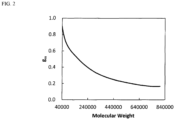
- the smallest degree of branching g m in the range of the absolute molecular weight of 200,000 or more and 800,000 or less was defined as the minimum degree of branching.
- the ratio g A /g B of the degree of branching of the vinyl alcohol polymer having an absolute molecular weight of 200,000 g A to the degree of branching of the vinyl alcohol polymer having an absolute molecular weight of 800,000 g B was determined.
- FIG. 1 is a graph (Mark-Houwink plot) in which the absolute molecular weight and the intrinsic viscosity ([ ⁇ ] branch or [ ⁇ ] linear ) of: PVA-1 as the subject of the measurement; and PVA-1' that is a corresponding linear PVA are plotted.
- PVA-1' is an unmodified PVA having a 4% aqueous solution viscosity of 9.2 mPa ⁇ s, and a degree of saponification of 88 mol%.
- FIG. 2 is a graph in which the degree of branching g m on each absolute molecular weight of PVA-1 determined according the above equalities (1) and (2), based on the results shown in FIG. 1 as described above is plotted.
- Particle size distribution of PVA powder was measured by a dry sieve procedure disclosed in JIS Z8815: 1994. Using each sieve having a mesh opening size of 1.00 mm, 500 ⁇ m, or 180 ⁇ m: a proportion of the mass (percentage content: % by mass) of the powder capable of passing through a sieve having a mesh opening size of 1.00 mm; a proportion of the mass (percentage content: % by mass) of the powder capable of passing through a sieve having a mesh opening size of 500 ⁇ m, and a proportion of the mass (percentage content: % by mass) of the powder capable of passing through a sieve having a mesh opening size of 180 ⁇ m, with respect to the mass of the PVA powder before being sieved were determined, respectively. It is to be noted that the mesh opening size conforms to nominal mesh opening size W in accordance with JIS Z8801-1-2006.
- the filter was sufficiently washed with warm water at 30 °C, and the solution attached to the filter was removed to leave only the undissolved particles on the filter. Thereafter, the filter was dried by a heating dryer at 120 °C for 1 hour. The mass of the filter after drying was compared with the mass of the filter before being used in filtration, whereby the mass of the undissolved particles was calculated. The mass of the undissolved particles with respect to the PVA powder (12 g) used was employed for the proportion (ppm) of the insoluble matter contained.
- aqueous PVA solution was prepared, and a viscosity (mPa ⁇ s) was measured by using a B-type viscometer (rotation speed of the rotor: 12 rpm, temperature: 20 °C).
- a procedure of preparing the aqueous PVA solution was as in the following. 90 parts by mass of water were added to 10 parts by mass of the PVA and the temperature of a resultant mixture was elevated to 90 °C with stirring, followed by cooling after 1 hour.
- an unmodified PVA being the same as the unmodified PVA used in GPC measurement for determining the degree of branching, was selected as an unmodified PVA that serves as a standard. The unmodified PVA was similarly subjected to the viscosity measurement.
- a viscosity ratio of these (the viscosity of the unmodified PVA serving as a standard/ the PVA of Example or Comparative Example) was calculated. In a case in which the viscosity ratio is more than 1.0, inhibition of an increase in viscosity was assessed, and in a case in which the viscosity ratio is more than 1.2, particularly sufficient inhibition of an increase in viscosity was assessed.
- PVA-2 to PVA-12 powder of Examples 2 to 7 and Comparative Examples 1 to 5 was obtained by a method similar to that in Example 1 except that: polymerization conditions such as the amount of vinyl acetate and methanol used, and the type and the amount of the monomer (a) used; saponification conditions such as the concentration of the vinyl ester polymer and the molar ratio of sodium hydroxide to the vinyl acetate unit in the saponification; and the heat treatment conditions were each changed as shown in Table 1. Physical properties and the results of the evaluations of these PVAs are shown in Table 2.
- each unmodified PVA (linear PVA), corresponding to each PVA (PVA-1 to PVA-13) produced, which serves as a standard for measurement of the degree of branching and for evaluation of the aqueous solution viscosity, was produced according to the method for production in Comparative Example 6 above. It should be noted that the unmodified PVA was not subjected to the heat treatment after preliminary drying.
- Example 1 Usage amount Rate of polymerization (%) Saponification conditions Heat treatment conditions vinyl acetate (parts by mass) methanol (parts by mass) monomer (a) AlBN (parts by mass) vinyl ester polymer concentration (%) NaOH molar ratio moisture content (%) temperature (°C) time period (hrs) type using amount (parts by mass)
- Example 1 PVA-1 700 1,050 monomethyl maleate 12.1 0.84 60 25 0.009 1 120 6
- Example 2 PVA-2 300 1,400 monomethyl maleate 12.6 0.50 50 30 0.010 1 120 4.5
- Example 3 PVA-3 700 1,050 monomethyl maleate 12.1 0.84 60 25 0.006 1 120 6
- Example 4 PVA-4 700 1,050 monomethyl maleate 12.1 0.84 60 25 0.020 1 120 6
- Example 5 PVA-5 700 1,050 monomethyl maleate 20.7 1.20 60 25 0.009 1 120 6
- Example 6 PVA-6 700 1,050 dimethyl maleate 12.1 0.84 60 25 0.009 1 120 6
- each PVA of Examples 1 to 7 revealed inhibition of an increase in viscosity in a case of preparing an aqueous solution of a high concentration.
- each PVA of Examples 1 and 7 was superior in not only a sufficient effect of inhibiting an increase in viscosity, but also in the insoluble matter being included in a small amount.
- each PVA of Comparative Examples 1 to 3 exhibited the degree of polymerization being high, and introduction of the branched structure resulted in further increased viscosity by contrast.
- the degree of saponification was low and the crosslinking more readily proceeded by heat; therefore, thermal crosslinking sites increased, whereby obtaining a homogenous aqueous solution failed.
- the PVA of Comparative Example 4 failed to give a 10% by mass (high concentration) aqueous solution, and thus achieving the object of inhibiting an increase in viscosity in a case of preparing an aqueous solution of a high concentration was considered be impossible.
- the PVA of the present invention can be used for various types of intended usages such as coating agents, adhesives, film materials, paper processing agents, and dispersants for emulsion polymerization.
Landscapes
- Chemical & Material Sciences (AREA)
- Organic Chemistry (AREA)
- Chemical Kinetics & Catalysis (AREA)
- Health & Medical Sciences (AREA)
- Medicinal Chemistry (AREA)
- Polymers & Plastics (AREA)
- General Chemical & Material Sciences (AREA)
- Life Sciences & Earth Sciences (AREA)
- Engineering & Computer Science (AREA)
- Materials Engineering (AREA)
- Wood Science & Technology (AREA)
- Addition Polymer Or Copolymer, Post-Treatments, Or Chemical Modifications (AREA)
- Paper (AREA)
Applications Claiming Priority (2)
| Application Number | Priority Date | Filing Date | Title |
|---|---|---|---|
| JP2021075378 | 2021-04-27 | ||
| PCT/JP2022/018783 WO2022230828A1 (ja) | 2021-04-27 | 2022-04-25 | ビニルアルコール系重合体、これを含む粉末、これらの製造方法、紙加工剤及び乳化重合用分散剤 |
Publications (2)
| Publication Number | Publication Date |
|---|---|
| EP4332127A1 true EP4332127A1 (de) | 2024-03-06 |
| EP4332127A4 EP4332127A4 (de) | 2025-05-14 |
Family
ID=83848085
Family Applications (1)
| Application Number | Title | Priority Date | Filing Date |
|---|---|---|---|
| EP22795741.2A Pending EP4332127A4 (de) | 2021-04-27 | 2022-04-25 | Vinylalkoholpolymer, pulver damit, verfahren zur herstellung davon, papierverarbeitungsmittel und dispergiermittel für emulsionspolymerisation |
Country Status (6)
| Country | Link |
|---|---|
| US (1) | US20240218097A1 (de) |
| EP (1) | EP4332127A4 (de) |
| JP (1) | JP7846680B2 (de) |
| CN (1) | CN117203247A (de) |
| TW (1) | TW202309111A (de) |
| WO (1) | WO2022230828A1 (de) |
Families Citing this family (1)
| Publication number | Priority date | Publication date | Assignee | Title |
|---|---|---|---|---|
| US20240209128A1 (en) * | 2021-04-27 | 2024-06-27 | Kuraray Co., Ltd. | Vinyl alcohol polymer, powder containing same, method for producing powder, coating agent, coated article, method for producing coated article, stabilizer for emulsion polymerization, aqueous emulsion, and adhesive |
Family Cites Families (13)
| Publication number | Priority date | Publication date | Assignee | Title |
|---|---|---|---|---|
| JP3805427B2 (ja) * | 1996-05-31 | 2006-08-02 | 株式会社クラレ | ポリビニルアルコール粉末 |
| ES2423833T3 (es) * | 2006-04-12 | 2013-09-24 | Kuraray Co., Ltd. | Estabilizador de dispersión |
| US20100184917A1 (en) * | 2007-07-13 | 2010-07-22 | Kuraray Co., Ltd. | Method for producing vinly resin |
| JP6163122B2 (ja) * | 2014-02-28 | 2017-07-12 | 株式会社クラレ | 乳化重合用安定剤及びその製造方法 |
| EP3521327B1 (de) | 2016-09-28 | 2021-09-08 | Kuraray Co., Ltd. | Modifiziertes vinylalkoholpolymerpulver mit reduziertem methanolgehalt und herstellungsverfahren dafür sowie wasserlöslicher film und verpackungsmaterial |
| JP2019038935A (ja) * | 2017-08-24 | 2019-03-14 | 株式会社クラレ | ポリビニルアルコール組成物及びその用途 |
| JP6945432B2 (ja) * | 2017-12-13 | 2021-10-06 | 株式会社クラレ | 繊維用糊剤 |
| JP7129174B2 (ja) * | 2018-02-26 | 2022-09-01 | 株式会社クラレ | 感光性樹脂組成物及びその製造方法、並びにその用途 |
| CN112218902B (zh) * | 2018-04-11 | 2023-05-09 | 株式会社可乐丽 | 聚乙烯醇组合物和其用途、以及乙烯基系树脂的制备方法 |
| JP7333777B2 (ja) * | 2018-04-11 | 2023-08-25 | 株式会社クラレ | ポリビニルアルコール組成物及びその用途、並びにビニル系樹脂の製造方法 |
| US11414507B2 (en) * | 2018-07-05 | 2022-08-16 | Kuraray Co., Ltd. | Modified vinyl alcohol polymer, method for producing same, dispersion stabilizer for suspension polymerization, and method for producing vinyl polymer |
| US20240209128A1 (en) * | 2021-04-27 | 2024-06-27 | Kuraray Co., Ltd. | Vinyl alcohol polymer, powder containing same, method for producing powder, coating agent, coated article, method for producing coated article, stabilizer for emulsion polymerization, aqueous emulsion, and adhesive |
| JPWO2023054707A1 (de) * | 2021-09-30 | 2023-04-06 |
-
2022
- 2022-04-25 EP EP22795741.2A patent/EP4332127A4/de active Pending
- 2022-04-25 US US18/557,186 patent/US20240218097A1/en active Pending
- 2022-04-25 JP JP2023517521A patent/JP7846680B2/ja active Active
- 2022-04-25 CN CN202280031233.0A patent/CN117203247A/zh active Pending
- 2022-04-25 WO PCT/JP2022/018783 patent/WO2022230828A1/ja not_active Ceased
- 2022-04-27 TW TW111115968A patent/TW202309111A/zh unknown
Also Published As
| Publication number | Publication date |
|---|---|
| WO2022230828A1 (ja) | 2022-11-03 |
| JPWO2022230828A1 (de) | 2022-11-03 |
| JP7846680B2 (ja) | 2026-04-15 |
| US20240218097A1 (en) | 2024-07-04 |
| CN117203247A (zh) | 2023-12-08 |
| TW202309111A (zh) | 2023-03-01 |
| EP4332127A4 (de) | 2025-05-14 |
Similar Documents
| Publication | Publication Date | Title |
|---|---|---|
| EP2216348B1 (de) | Wässrige emulsion und herstellungsverfahren dafür | |
| EP3699207B1 (de) | Ethylen-vinylalkohol-copolymerpartikel, verfahren zu ihrer herstellung ihre verwendung | |
| EP4411067A1 (de) | Kreppklebemittel, pulver für kreppklebemittel, verfahren zur herstellung von kreppklebemittel und toilettenpapier, tissuepapier, handtuchpapier, küchenpapier oder windelbasispapier | |
| US11155651B2 (en) | Modified vinyl alcohol polymer and method for producing same | |
| EP4332127A1 (de) | Vinylalkoholpolymer, pulver damit, verfahren zur herstellung davon, papierverarbeitungsmittel und dispergiermittel für emulsionspolymerisation | |
| EP4600301A1 (de) | Zusammensetzung, dispergiermittel für suspensionspolymerisation und verfahren zur herstellung von polymer auf vinylbasis | |
| US20240002565A1 (en) | Vinyl alcohol polymer, method for producing vinyl alcohol polymer, dispersant for suspension polymerization, dispersion aid for suspension polymerization, and method for producing vinyl polymer | |
| EP4332126A1 (de) | Vinylalkoholpolymer, pulver damit, pulverherstellungsverfahren, beschichtungsmittel, beschichtetes produkt | |
| EP0978538B1 (de) | Hochstabile wässrige lösung von teilverseiftem vinylesterharz | |
| EP2767560A1 (de) | Alkylmodifizierte vinylalkoholpolymerlösung | |
| EP4006082B1 (de) | Harzpulver und verfahren zur herstellung davon | |
| JP2023179809A (ja) | 変性ビニルアルコール系重合体 | |
| CN112062881B (zh) | 聚乙烯醇、其制备方法和其用途 | |
| Berber et al. | Synthesis and characterization of water-based poly (vinyl acetate-co-butyl acrylate) latexes containing oligomeric protective colloid | |
| CN111868103B (zh) | 悬浮聚合用分散稳定剂 | |
| WO2025187601A1 (ja) | 樹脂粉体 | |
| TWI895454B (zh) | 樹脂粉體 | |
| CN112708003A (zh) | 改性聚乙烯醇 | |
| US12492272B2 (en) | Modified vinyl alcohol polymer, aqueous solution, and method for producing modified vinyl alcohol polymer | |
| TW202603019A (zh) | 樹脂粉體之製造方法 | |
| WO2025009505A1 (ja) | 変性ポリビニルアルコール系重合体、水溶性フィルム、水溶性繊維、及びバリア性包装材料 | |
| US20050182190A1 (en) | Mixtures of alkylated and non-alkylated cellulose ethers and use thereof |
Legal Events
| Date | Code | Title | Description |
|---|---|---|---|
| STAA | Information on the status of an ep patent application or granted ep patent |
Free format text: STATUS: THE INTERNATIONAL PUBLICATION HAS BEEN MADE |
|
| PUAI | Public reference made under article 153(3) epc to a published international application that has entered the european phase |
Free format text: ORIGINAL CODE: 0009012 |
|
| STAA | Information on the status of an ep patent application or granted ep patent |
Free format text: STATUS: REQUEST FOR EXAMINATION WAS MADE |
|
| 17P | Request for examination filed |
Effective date: 20231116 |
|
| AK | Designated contracting states |
Kind code of ref document: A1 Designated state(s): AL AT BE BG CH CY CZ DE DK EE ES FI FR GB GR HR HU IE IS IT LI LT LU LV MC MK MT NL NO PL PT RO RS SE SI SK SM TR |
|
| DAV | Request for validation of the european patent (deleted) | ||
| DAX | Request for extension of the european patent (deleted) | ||
| A4 | Supplementary search report drawn up and despatched |
Effective date: 20250409 |
|
| RIC1 | Information provided on ipc code assigned before grant |
Ipc: C09D 129/04 20060101ALI20250404BHEP Ipc: C08F 216/06 20060101ALI20250404BHEP Ipc: C08F 16/06 20060101ALI20250404BHEP Ipc: C08F 8/12 20060101AFI20250404BHEP |
|
| STAA | Information on the status of an ep patent application or granted ep patent |
Free format text: STATUS: EXAMINATION IS IN PROGRESS |