EP4332666A1 - Lentille photochrome ayant une couche de film bifocal et procédé de préparation s'y rapportant - Google Patents
Lentille photochrome ayant une couche de film bifocal et procédé de préparation s'y rapportant Download PDFInfo
- Publication number
- EP4332666A1 EP4332666A1 EP21938147.2A EP21938147A EP4332666A1 EP 4332666 A1 EP4332666 A1 EP 4332666A1 EP 21938147 A EP21938147 A EP 21938147A EP 4332666 A1 EP4332666 A1 EP 4332666A1
- Authority
- EP
- European Patent Office
- Prior art keywords
- photochromic
- lens
- bifocal
- substrate
- gap
- Prior art date
- Legal status (The legal status is an assumption and is not a legal conclusion. Google has not performed a legal analysis and makes no representation as to the accuracy of the status listed.)
- Pending
Links
- 238000002360 preparation method Methods 0.000 title claims abstract description 26
- 239000000758 substrate Substances 0.000 claims abstract description 107
- 238000004528 spin coating Methods 0.000 claims abstract description 10
- 239000000463 material Substances 0.000 claims description 86
- -1 poly(ethylene glycol) Polymers 0.000 claims description 30
- IISBACLAFKSPIT-UHFFFAOYSA-N bisphenol A Chemical compound C=1C=C(O)C=CC=1C(C)(C)C1=CC=C(O)C=C1 IISBACLAFKSPIT-UHFFFAOYSA-N 0.000 claims description 26
- 239000002390 adhesive tape Substances 0.000 claims description 22
- NHGXDBSUJJNIRV-UHFFFAOYSA-M tetrabutylammonium chloride Chemical compound [Cl-].CCCC[N+](CCCC)(CCCC)CCCC NHGXDBSUJJNIRV-UHFFFAOYSA-M 0.000 claims description 18
- QUZSUMLPWDHKCJ-UHFFFAOYSA-N bisphenol A dimethacrylate Chemical compound C1=CC(OC(=O)C(=C)C)=CC=C1C(C)(C)C1=CC=C(OC(=O)C(C)=C)C=C1 QUZSUMLPWDHKCJ-UHFFFAOYSA-N 0.000 claims description 17
- 238000002347 injection Methods 0.000 claims description 17
- 239000007924 injection Substances 0.000 claims description 17
- 125000004386 diacrylate group Chemical group 0.000 claims description 15
- 229920001223 polyethylene glycol Polymers 0.000 claims description 15
- 239000004593 Epoxy Substances 0.000 claims description 14
- 239000004925 Acrylic resin Substances 0.000 claims description 11
- 229920000178 Acrylic resin Polymers 0.000 claims description 11
- ZFMQKOWCDKKBIF-UHFFFAOYSA-N bis(3,5-difluorophenyl)phosphane Chemical compound FC1=CC(F)=CC(PC=2C=C(F)C=C(F)C=2)=C1 ZFMQKOWCDKKBIF-UHFFFAOYSA-N 0.000 claims description 10
- NKSJNEHGWDZZQF-UHFFFAOYSA-N ethenyl(trimethoxy)silane Chemical compound CO[Si](OC)(OC)C=C NKSJNEHGWDZZQF-UHFFFAOYSA-N 0.000 claims description 10
- 241001270131 Agaricus moelleri Species 0.000 claims description 9
- NIXOWILDQLNWCW-UHFFFAOYSA-M Acrylate Chemical compound [O-]C(=O)C=C NIXOWILDQLNWCW-UHFFFAOYSA-M 0.000 claims description 4
- 239000000956 alloy Substances 0.000 claims description 4
- 229910045601 alloy Inorganic materials 0.000 claims description 4
- 229920003229 poly(methyl methacrylate) Polymers 0.000 claims description 4
- 229920000515 polycarbonate Polymers 0.000 claims description 4
- 239000004417 polycarbonate Substances 0.000 claims description 4
- 229920000642 polymer Polymers 0.000 claims description 4
- 239000002861 polymer material Substances 0.000 claims description 4
- 239000004926 polymethyl methacrylate Substances 0.000 claims description 4
- 239000000178 monomer Substances 0.000 claims description 3
- 238000000034 method Methods 0.000 abstract description 11
- 238000005516 engineering process Methods 0.000 abstract description 5
- 230000007547 defect Effects 0.000 abstract description 3
- 238000004519 manufacturing process Methods 0.000 abstract description 2
- 125000002572 propoxy group Chemical group [*]OC([H])([H])C(C([H])([H])[H])([H])[H] 0.000 description 11
- 230000000052 comparative effect Effects 0.000 description 10
- 125000001301 ethoxy group Chemical group [H]C([H])([H])C([H])([H])O* 0.000 description 10
- 238000002834 transmittance Methods 0.000 description 10
- 238000005562 fading Methods 0.000 description 7
- 239000011521 glass Substances 0.000 description 7
- 238000001723 curing Methods 0.000 description 6
- 238000001514 detection method Methods 0.000 description 5
- 230000000694 effects Effects 0.000 description 5
- 239000000243 solution Substances 0.000 description 5
- 239000000126 substance Substances 0.000 description 5
- PEDCQBHIVMGVHV-UHFFFAOYSA-N Glycerol Natural products OCC(O)CO PEDCQBHIVMGVHV-UHFFFAOYSA-N 0.000 description 4
- 238000010586 diagram Methods 0.000 description 4
- MYWOJODOMFBVCB-UHFFFAOYSA-N 1,2,6-trimethylphenanthrene Chemical compound CC1=CC=C2C3=CC(C)=CC=C3C=CC2=C1C MYWOJODOMFBVCB-UHFFFAOYSA-N 0.000 description 3
- ISWSIDIOOBJBQZ-UHFFFAOYSA-N Phenol Chemical compound OC1=CC=CC=C1 ISWSIDIOOBJBQZ-UHFFFAOYSA-N 0.000 description 3
- HVVWZTWDBSEWIH-UHFFFAOYSA-N [2-(hydroxymethyl)-3-prop-2-enoyloxy-2-(prop-2-enoyloxymethyl)propyl] prop-2-enoate Chemical compound C=CC(=O)OCC(CO)(COC(=O)C=C)COC(=O)C=C HVVWZTWDBSEWIH-UHFFFAOYSA-N 0.000 description 3
- MPIAGWXWVAHQBB-UHFFFAOYSA-N [3-prop-2-enoyloxy-2-[[3-prop-2-enoyloxy-2,2-bis(prop-2-enoyloxymethyl)propoxy]methyl]-2-(prop-2-enoyloxymethyl)propyl] prop-2-enoate Chemical compound C=CC(=O)OCC(COC(=O)C=C)(COC(=O)C=C)COCC(COC(=O)C=C)(COC(=O)C=C)COC(=O)C=C MPIAGWXWVAHQBB-UHFFFAOYSA-N 0.000 description 3
- 230000032683 aging Effects 0.000 description 3
- 238000010183 spectrum analysis Methods 0.000 description 3
- 230000005540 biological transmission Effects 0.000 description 2
- 239000003054 catalyst Substances 0.000 description 2
- 238000005336 cracking Methods 0.000 description 2
- 230000007613 environmental effect Effects 0.000 description 2
- 238000012986 modification Methods 0.000 description 2
- 230000004048 modification Effects 0.000 description 2
- 238000000016 photochemical curing Methods 0.000 description 2
- PUGOMSLRUSTQGV-UHFFFAOYSA-N 2,3-di(prop-2-enoyloxy)propyl prop-2-enoate Chemical compound C=CC(=O)OCC(OC(=O)C=C)COC(=O)C=C PUGOMSLRUSTQGV-UHFFFAOYSA-N 0.000 description 1
- ICFXCSLDPCMWJI-UHFFFAOYSA-N 2,3-dimethylbut-2-enoic acid;2-ethyl-2-(hydroxymethyl)propane-1,3-diol Chemical compound CC(C)=C(C)C(O)=O.CCC(CO)(CO)CO ICFXCSLDPCMWJI-UHFFFAOYSA-N 0.000 description 1
- 208000029091 Refraction disease Diseases 0.000 description 1
- 239000006087 Silane Coupling Agent Substances 0.000 description 1
- RTAQQCXQSZGOHL-UHFFFAOYSA-N Titanium Chemical compound [Ti] RTAQQCXQSZGOHL-UHFFFAOYSA-N 0.000 description 1
- 208000027418 Wounds and injury Diseases 0.000 description 1
- 230000004308 accommodation Effects 0.000 description 1
- 230000004430 ametropia Effects 0.000 description 1
- 238000004458 analytical method Methods 0.000 description 1
- 230000003712 anti-aging effect Effects 0.000 description 1
- 230000009286 beneficial effect Effects 0.000 description 1
- 238000005266 casting Methods 0.000 description 1
- 239000003153 chemical reaction reagent Substances 0.000 description 1
- 230000001886 ciliary effect Effects 0.000 description 1
- 239000011248 coating agent Substances 0.000 description 1
- 238000000576 coating method Methods 0.000 description 1
- 230000006378 damage Effects 0.000 description 1
- 230000032798 delamination Effects 0.000 description 1
- 238000001125 extrusion Methods 0.000 description 1
- 230000004438 eyesight Effects 0.000 description 1
- XUFQPHANEAPEMJ-UHFFFAOYSA-N famotidine Chemical compound NC(N)=NC1=NC(CSCCC(N)=NS(N)(=O)=O)=CS1 XUFQPHANEAPEMJ-UHFFFAOYSA-N 0.000 description 1
- 208000014674 injury Diseases 0.000 description 1
- 230000001678 irradiating effect Effects 0.000 description 1
- 239000007788 liquid Substances 0.000 description 1
- 210000003205 muscle Anatomy 0.000 description 1
- 230000004379 myopia Effects 0.000 description 1
- 208000001491 myopia Diseases 0.000 description 1
- 230000002035 prolonged effect Effects 0.000 description 1
- 150000003242 quaternary ammonium salts Chemical class 0.000 description 1
- 208000014733 refractive error Diseases 0.000 description 1
- 238000007665 sagging Methods 0.000 description 1
- 230000035945 sensitivity Effects 0.000 description 1
- 238000002791 soaking Methods 0.000 description 1
- 238000006467 substitution reaction Methods 0.000 description 1
Images


Classifications
-
- G—PHYSICS
- G02—OPTICS
- G02C—SPECTACLES; SUNGLASSES OR GOGGLES INSOFAR AS THEY HAVE THE SAME FEATURES AS SPECTACLES; CONTACT LENSES
- G02C7/00—Optical parts
- G02C7/10—Filters, e.g. for facilitating adaptation of the eyes to the dark; Sunglasses
- G02C7/102—Photochromic filters
-
- B—PERFORMING OPERATIONS; TRANSPORTING
- B29—WORKING OF PLASTICS; WORKING OF SUBSTANCES IN A PLASTIC STATE IN GENERAL
- B29D—PRODUCING PARTICULAR ARTICLES FROM PLASTICS OR FROM SUBSTANCES IN A PLASTIC STATE
- B29D11/00—Producing optical elements, e.g. lenses or prisms
- B29D11/00009—Production of simple or compound lenses
- B29D11/00028—Bifocal lenses; Multifocal lenses
-
- B—PERFORMING OPERATIONS; TRANSPORTING
- B29—WORKING OF PLASTICS; WORKING OF SUBSTANCES IN A PLASTIC STATE IN GENERAL
- B29D—PRODUCING PARTICULAR ARTICLES FROM PLASTICS OR FROM SUBSTANCES IN A PLASTIC STATE
- B29D11/00—Producing optical elements, e.g. lenses or prisms
- B29D11/00009—Production of simple or compound lenses
- B29D11/00413—Production of simple or compound lenses made by moulding between two mould parts which are not in direct contact with one another, e.g. comprising a seal between or on the edges
-
- B—PERFORMING OPERATIONS; TRANSPORTING
- B29—WORKING OF PLASTICS; WORKING OF SUBSTANCES IN A PLASTIC STATE IN GENERAL
- B29D—PRODUCING PARTICULAR ARTICLES FROM PLASTICS OR FROM SUBSTANCES IN A PLASTIC STATE
- B29D11/00—Producing optical elements, e.g. lenses or prisms
- B29D11/00634—Production of filters
- B29D11/00653—Production of filters photochromic
-
- B—PERFORMING OPERATIONS; TRANSPORTING
- B29—WORKING OF PLASTICS; WORKING OF SUBSTANCES IN A PLASTIC STATE IN GENERAL
- B29D—PRODUCING PARTICULAR ARTICLES FROM PLASTICS OR FROM SUBSTANCES IN A PLASTIC STATE
- B29D11/00—Producing optical elements, e.g. lenses or prisms
- B29D11/0073—Optical laminates
-
- B—PERFORMING OPERATIONS; TRANSPORTING
- B29—WORKING OF PLASTICS; WORKING OF SUBSTANCES IN A PLASTIC STATE IN GENERAL
- B29D—PRODUCING PARTICULAR ARTICLES FROM PLASTICS OR FROM SUBSTANCES IN A PLASTIC STATE
- B29D11/00—Producing optical elements, e.g. lenses or prisms
- B29D11/00865—Applying coatings; tinting; colouring
- B29D11/00884—Spin coating
-
- C—CHEMISTRY; METALLURGY
- C09—DYES; PAINTS; POLISHES; NATURAL RESINS; ADHESIVES; COMPOSITIONS NOT OTHERWISE PROVIDED FOR; APPLICATIONS OF MATERIALS NOT OTHERWISE PROVIDED FOR
- C09D—COATING COMPOSITIONS, e.g. PAINTS, VARNISHES OR LACQUERS; FILLING PASTES; CHEMICAL PAINT OR INK REMOVERS; INKS; CORRECTING FLUIDS; WOODSTAINS; PASTES OR SOLIDS FOR COLOURING OR PRINTING; USE OF MATERIALS THEREFOR
- C09D163/00—Coating compositions based on epoxy resins; Coating compositions based on derivatives of epoxy resins
- C09D163/10—Epoxy resins modified by unsaturated compounds
-
- C—CHEMISTRY; METALLURGY
- C09—DYES; PAINTS; POLISHES; NATURAL RESINS; ADHESIVES; COMPOSITIONS NOT OTHERWISE PROVIDED FOR; APPLICATIONS OF MATERIALS NOT OTHERWISE PROVIDED FOR
- C09D—COATING COMPOSITIONS, e.g. PAINTS, VARNISHES OR LACQUERS; FILLING PASTES; CHEMICAL PAINT OR INK REMOVERS; INKS; CORRECTING FLUIDS; WOODSTAINS; PASTES OR SOLIDS FOR COLOURING OR PRINTING; USE OF MATERIALS THEREFOR
- C09D171/00—Coating compositions based on polyethers obtained by reactions forming an ether link in the main chain; Coating compositions based on derivatives of such polymers
- C09D171/02—Polyalkylene oxides
-
- C—CHEMISTRY; METALLURGY
- C09—DYES; PAINTS; POLISHES; NATURAL RESINS; ADHESIVES; COMPOSITIONS NOT OTHERWISE PROVIDED FOR; APPLICATIONS OF MATERIALS NOT OTHERWISE PROVIDED FOR
- C09D—COATING COMPOSITIONS, e.g. PAINTS, VARNISHES OR LACQUERS; FILLING PASTES; CHEMICAL PAINT OR INK REMOVERS; INKS; CORRECTING FLUIDS; WOODSTAINS; PASTES OR SOLIDS FOR COLOURING OR PRINTING; USE OF MATERIALS THEREFOR
- C09D7/00—Features of coating compositions, not provided for in group C09D5/00; Processes for incorporating ingredients in coating compositions
- C09D7/40—Additives
- C09D7/60—Additives non-macromolecular
- C09D7/63—Additives non-macromolecular organic
-
- G—PHYSICS
- G02—OPTICS
- G02C—SPECTACLES; SUNGLASSES OR GOGGLES INSOFAR AS THEY HAVE THE SAME FEATURES AS SPECTACLES; CONTACT LENSES
- G02C7/00—Optical parts
- G02C7/02—Lenses; Lens systems ; Methods of designing lenses
- G02C7/06—Lenses; Lens systems ; Methods of designing lenses bifocal; multifocal ; progressive
Definitions
- the present disclosure relates to the technical field of lens manufacturing processes, and specifically relates to a photochromic lens with a bifocal film layer, and a preparation method for the photochromic lens.
- Bifocal lens is a lens that can effectively increase the ciliary muscle strength of myopia patients, expand the accommodation reserve, improve the vision of ametropia eyes and reduce refractive power, which is especially suitable for teenagers.
- the structure of the bifocal lens includes a main lens and a segment lens.
- the main lens is a distance portion
- the segment lens is a near portion.
- Photochromic lens which is originally a colorless and transparent lens, can be changed into tinted lens with low transmittance in a strong light environment, thus achieving the effects of reducing harmful light and protecting eyes from injury.
- the bifocal photochromic lens is integrally cast, which is deeper in photochromism and slower in fading in a near light area, and the photochromism is only at the refractive index of 1.56 and 1.60, affecting the wearing effect.
- the photochromic liquid is attached to the lenses by soaking or spin-coating.
- the method is easy to cause nonuniform coating thickness of the segment lens, and the accurate luminosity of the segment lens cannot be guaranteed, and it is easy to cause nonuniform photochromism, film layer peeling and other phenomena. Film-pasting and other forms cannot achieve desired photochromic performance.
- a bifocal lens is used as a lens substrate, and photochromic and bifocal technologies are combined to make a photochromic layer uniformly attached to a surface of the lens substrate.
- photochromic and bifocal technologies are combined to make a photochromic layer uniformly attached to a surface of the lens substrate.
- An objective of the present disclosure is to provide a preparation method for a photochromic lens with a bifocal film layer.
- a bifocal lens is used as a lens substrate, and photochromic and bifocal technologies are combined to make a photochromic layer uniformly attached to a surface of the lens substrate.
- photochromic and bifocal technologies are combined to make a photochromic layer uniformly attached to a surface of the lens substrate.
- a photochromic lens with a bifocal film layer provided by the present disclosure includes a substrate, a treatment layer and a photochromic layer from inside to outside.
- the photochromic layer is cured on a surface of the treatment layer by means of ultraviolet irradiation, and the substrate is an E-line bifocal lens or a flat-top bifocal lens.
- the substrate includes a main lens and a segment lens, the main lens is a distance-viewing structure, and the segment lens is a near-viewing part.
- a transparent polymer material for optics is any one of polycarbonate, polymethylmethacrylate, or polymer alloy.
- materials of the treatment layer include the following components in parts by weight: 50-80 parts of bisphenol A epoxy acrylic resin, 5-8 parts of dioctyl adipate, 2-5 parts of vinyl trimethoxy silane, and 1-3 parts of tetrabutylammonium chloride.
- the bisphenol A epoxy acrylic resin is a photocuring main body, and after photocuring, a cured film is formed on the surface of the substrate, which can be adhered to acrylate in the photochromic layer in an affinitive manner. Due to the lack of flexibility and brittleness of the cured film of mono-bisphenol A epoxy acrylic resin, the added dioctyl adipate is a compliant modification component, which makes the cured film have a certain ductility and toughness. Vinyl trimethoxy silane, as a silane coupling agent, can better adhere the cured film to the substrate.
- Tetrabutylammonium chloride is mainly used as quaternary ammonium salt catalyst, and other catalysts with the same property can also be used as equivalent substitutions.
- the purpose of providing the treatment layer between the photochromic layer and the lens substrate in the present disclosure is to improve the adhesion between the photochromic layer and the substrate, such that the photochromic layer is free of problems such as sagging in the curing process, and the uniformity of the photochromic layer is improved while the peeling resistance of the photochromic layer is improved.
- the photochromic layer includes the following components in mass fraction: 30%-70% of bisphenol A dimethacrylate, 10%-60% of poly(ethylene glycol) diacrylate, 10%-30% of polyfunctional acrylate monomer, and the rest of photoinitiator, with a total of 100%.
- a transparent polymer material for optics is any one of polycarbonate, polymethylmethacrylate, or polymer alloy.
- bisphenol A dimethacrylate is at least one of ethoxylated bisphenol A dimethacrylate containing 2-20 repeating units of ethoxy, propoxylated bisphenol A dimethacrylate containing 2-20 repeating units of propoxy, alkoxylated bisphenol A dimethacrylate containing 2-20 repeating units of epoxy and propoxy, and glycerylated bisphenol A dimethacrylate and bisphenol A glycerylated (1- glycerol/phenol) dimethacrylate.
- the polyfunctional acrylate monomer is at least one of dipentaerythritol hexaacrylate, dipentaerythritol hydroxy pentaacrylate, pentaerythritol tetraacrylate, pentaerythritol triacrylate, trimethylolpropane trimethylacrylate, propoxylated glycerol triacrylate, and trimethylolpropane ethoxy triacrylate.
- poly(ethylene glycol) diacrylate is poly(ethylene glycol) diacrylate containing 2-20 repeating units of ethoxy, or poly(ethylene glycol) diacrylate containing 2-20 repeating units of propoxy.
- the substrate is an E-line bifocal lens, or a flat-top bifocal lens.
- segment lens is a prism structure with an inward substrate.
- the external mold is a bifocal glass mold.
- a preparation method for the photochromic lens with a bifocal film layer specifically includes the following operation steps:
- the lens of bifocal photochromic glasses includes a main lens and a segment lens
- a spin-coating method when a spin-coating method is adopted, a height difference between the main lens and the segment lens causes nonuniformity of the bifocal photochromic layer, and when the light changes, the photochromism is nonuniform.
- the method of integral casting is adopted, photochromic materials with high photochromic sensitivity and wide photochromic range cannot be used, which leads to deep photochromism and slow photochromism in a near light area, and the photochromism only at the refractive index of 1.56 and 1.60, which affects the wearing of the glasses.
- the uniformity of the photochromic film can be guaranteed by injecting the photochromic material into the gap and then curing the photochromic material, and the color changes quickly and uniformly in the near light area.
- the width of the gap By adjusting the width of the gap, the thickness of a photochromic film can be controlled, so as to improve the wearing effect of the bifocal photochromic glasses.
- the preparation method provided by the present disclosure specifically includes the following operation steps:
- Step S3 an injection hole is punched in the adhesive tape, the photochromic material is injected into the gap through the injection hole with a syringe, and then the hole is sealed with the adhesive tape.
- Step S3 a vent hole is punched in the adhesive tape, and the vent hole is adjacent to the injection hole.
- the photochromic material overflows from the vent hole, it is determined that the gap has been filled with the photochromic material. Small fluidity of the photochromic material is not conducive for the photochromic material to enter the gap.
- the existence of the vent hole can maintain the air pressure balance between the gap and the outside, thus facilitating the injection of the photochromic material. It can be determined that the gap is filled with the photochromic material through the overflow of the photochromic material, which ensures that the gap can be filled with the photochromic material. Bubbles inside the photochromic material and bubbles introduced in the injection process are eliminated through the extrusion of the surface tension of the photochromic material, such that the uniformity of photochromic film and the wearing effect of lenses are improved.
- the preparation method provided by the present disclosure specifically includes the following operation steps:
- the photochromic material Due to large viscosity and low fluidity of the photochromic material, bubbles are easily introduced or nonuniform contact with a contact surface may occur during the injection process, resulting in the phenomenon that the photochromic film contains tiny bubbles or is nonuniformly cured.
- the gap is narrowed, causing a certain pressure on the photochromic material in the gap, such that a cambered surface of the lens is completely immersed in the photochromic material.
- the wettability of the treatment layer there is no slit between the photochromic material and the lens, and the remaining bubbles in the photochromic material are squeezed out by pressure.
- Step S1 the treatment layer is uniformly spin-coated on the surface of the substrate, and the substrate coated with the treatment layer is irradiated with an ultraviolet curing light source for 1 min. After irradiating for 1 min, the material of the treatment layer is in a semi-dry state, the adhesion between the treatment layer and the photochromic is improved while guaranteeing the adhesion between the treatment layer and the substrate.
- the present disclosure has the following beneficial effects: According to the preparation method for a photochromic lens having a bifocal film layer provided in the present disclosure, a bifocal lens is used as a lens substrate, and photochromic and bifocal technologies are combined to overcome the defect of non-uniformity of a bifocal film layer caused by a spin-coating method, such that a photochromic layer can be uniformly attached to a surface of the lens substrate. Thus, uniform photochromism and excellent performance are achieved, and it can be ensured that the surface shape luminosity of the bifocal lens substrate is not affected.
- the materials are from the following table: Material Manufacturer Propoxylated bisphenol A dimethacrylate containing 2-20 repeating units of propoxy BASF (Original Cognis) Poly(ethylene glycol) diacrylate containing 2-20 repeating units of propoxy BASF (Original Cognis) Pentaerythritol tetraacrylate BASF (Original Cognis) Photoinitiator CAC Nantong Chemical Bisphenol A epoxy acrylic resin BASF (Original Cognis) Dioctyl adipate Yuanli Chemical Vinyl trimethoxy silane Nanjing Capatue Chemical Tetrabutylammonium chloride Titan Science and technology (Reagent) Ethoxylated bisphenol A dimethacrylate containing 2-20 repeating units of ethoxy BASF (Original Cognis) Poly(ethylene glycol) diacrylate BASF (Original Cognis) Dipentaerythritol hydroxy pentaacrylate BASF (Original Cognis) Bisphenol
- the substrate is made of a transparent polymer material for optics with a refractive index of 1.50-1.74, which is any one of polycarbonate, polymethylmethacrylate or polymer alloy, and is commercially available.
- a photochromic lens with a bifocal film layer includes a substrate 1, a treatment layer 2 and a photochromic layer 3 from inside to outside.
- the photochromic layer 3 is cured on a surface of the treatment layer 2 by means of ultraviolet irradiation.
- the photochromic layer 3 includes the following components in mass fraction: 30% of propoxylated bisphenol A dimethacrylate containing 2-20 repeating units of propoxy, 60% of poly(ethylene glycol) diacrylate containing 2-20 repeating units of propoxy, 10% pentaerythritol tetraacrylate, and the rest of photoinitiator, with a total of 100%.
- the material of the treatment layer includes the following components in parts by weight: 50 parts of bisphenol A epoxy acrylic resin, 5 parts of dioctyl adipate, 2 parts of vinyl trimethoxy silane, and 1 part of tetrabutylammonium chloride.
- the substrate 1 is an E-line bifocal lens, including a main lens 11, and a segment lens 12.
- the main lens 11 is a distance-viewing structure
- the segment lens 12 is a near-viewing part.
- a preparation method for the photochromic lens with a bifocal film layer specifically includes the following operation steps:
- a photochromic lens with a bifocal film layer includes a substrate 1, a treatment layer 2 and a photochromic layer 3 from inside to outside.
- the photochromic layer 3 is cured on a surface of the treatment layer 2 by means of ultraviolet irradiation.
- the photochromic layer 3 includes the following components in mass fraction: 40% of ethoxylated bisphenol A dimethacrylate containing 2-20 repeating units of ethoxy, 45% of poly(ethylene glycol) diacrylate, 15% of dipentaerythritol hydroxyl pentaacrylate, and the rest of photoinitiator, with a total of 100%.
- the material of the treatment layer includes the following components in parts by weight: 60 parts of bisphenol A epoxy acrylic resin, 6 parts of dioctyl adipate, 4 parts of vinyl trimethoxy silane, and 2 parts of tetrabutylammonium chloride.
- the substrate 1 is a flat-top bifocal lens, including a main lens 11, and a segment lens 12.
- the main lens 11 is a distance-viewing structure
- the segment lens 12 is a near-viewing part.
- a preparation method for the photochromic lens with a bifocal film layer specifically includes the following operation steps:
- the substrate 1 includes a main lens 11 and a segment lens 12, the main lens 11 is a distance-viewing structure, and the segment lens 12 is a near-viewing part.
- the segment lens 11 is a prism structure with an inward substrate, and the external mold is a bifocal glass mold.
- a photochromic lens with a bifocal film layer includes a substrate 1, a treatment layer 2 and a photochromic layer 3 from inside to outside.
- the photochromic layer 3 is cured on a surface of the treatment layer 2 by means of ultraviolet irradiation.
- the photochromic layer 3 includes the following components in mass fraction: 55% of alkoxylated bisphenol A dimethacrylate containing 2-20 repeating units of epoxy and propoxy, 35% of poly(ethylene glycol) diacrylate containing 2-20 repeating units of ethoxy, 10% of dipentaerythritol hydroxyl pentaacrylate, and the rest of photoinitiator, with a total of 100%.
- the material of the treatment layer includes the following components in parts by weight: 75 parts of bisphenol A epoxy acrylic resin, 7 parts of dioctyl adipate, 4 parts of vinyl trimethoxy silane, and 2 parts of tetrabutylammonium chloride.
- the substrate 1 is a flat-top bifocal lens, including a main lens 11, and a segment lens 12.
- the main lens 11 is a distance-viewing structure
- the segment lens 12 is a near-viewing part.
- a preparation method for the photochromic lens with a bifocal film layer specifically includes the following operation steps:
- a photochromic lens with a bifocal film layer includes a substrate 1, a treatment layer 2 and a photochromic layer 3 from inside to outside.
- the photochromic layer 3 is cured on a surface of the treatment layer 2 by means of ultraviolet irradiation.
- the photochromic layer 3 includes the following components in mass fraction: 50% of glycerylated bisphenol A dimethacrylate and bisphenol A glycerylated (1-glycerol/phenol) dimethacrylate, 20% of poly(ethylene glycol) diacrylate containing 2-20 repeating units of propoxy, 30% of pentaerythritol triacrylate, and the rest of photoinitiator, with a total of 100%.
- the material of the treatment layer includes the following components in parts by weight: 65 parts of bisphenol A epoxy acrylic resin, 5 parts of dioctyl adipate, 5 parts of vinyl trimethoxy silane, and 1 part of tetrabutylammonium chloride.
- the substrate 1 is a flat-top bifocal lens, including a main lens 11, and a segment lens 12.
- the main lens 11 is a distance-viewing structure
- the segment lens 12 is a near-viewing part.
- a preparation method for the photochromic lens with a bifocal film layer specifically includes the following operation steps:
- the substrate 1 includes a main lens 11 and a segment lens 12, the main lens 11 is a distance-viewing structure, and the segment lens 12 is a near-viewing part.
- the segment lens 11 is a prism structure with an inward substrate, and the external mold is a bifocal glass mold.
- a photochromic lens with a bifocal film layer includes a substrate 1, a treatment layer 2 and a photochromic layer 3 from inside to outside.
- the photochromic layer 3 is cured on a surface of the treatment layer 2 by means of ultraviolet irradiation.
- the photochromic layer 3 includes the following components in mass fraction: 45% of ethoxylated bisphenol A dimethacrylate containing 2-20 repeating units of ethoxy, 40% of poly(ethylene glycol) diacrylate containing 2-20 repeating units of ethoxy, 15% of dipentaerythritol hexaacrylate, and the rest of photoinitiator, with a total of 100%.
- the material of the treatment layer includes the following components in parts by weight: 55 parts of bisphenol A epoxy acrylic resin, 5 parts of dioctyl adipate, 4 parts of vinyl trimethoxy silane, and 2 parts of tetrabutylammonium chloride.
- the substrate 1 is a flat-top bifocal lens, including a main lens 11, and a segment lens 12.
- the main lens 11 is a distance-viewing structure
- the segment lens 12 is a near-viewing part.
- a preparation method for the photochromic lens with a bifocal film layer specifically includes the following operation steps:
- the substrate 1 includes a main lens 11 and a segment lens 12, the main lens 11 is a distance-viewing structure, and the segment lens 12 is a near-viewing part.
- the segment lens 11 is a prism structure with an inward substrate, and the external mold is a bifocal glass mold.
- a photochromic lens with a bifocal film layer includes a substrate, a treatment layer and a photochromic layer from inside to outside.
- the photochromic layer includes the following components in mass fraction: 56% of ethoxylated bisphenol A dimethacrylate containing 2-20 repeating units of ethoxy, 32% of poly(ethylene glycol) diacrylate containing 2-20 repeating units of ethoxy, 12% of dipentaerythritol hydroxy pentaacrylate, and the rest of photoinitiator, with a total of 100%.
- the substrate is a flat-top bifocal lens.
- a preparation method for the flat-top bifocal lens is that a photochromic layer is uniformly coated on the substrate by means of a spin-coating method and then is cured.
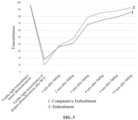
- Photochromic time transmittance of Embodiment 1 and Comparative Embodiment Detailed parameters of detection sample Serial numb er Sample name Photochromic time transmittance /% Before photochro mism 90 S at the deepest photochrom ism 1 min ute after fadi ng 2 minutes after fading 3 minut es after fading 4 min utes after fadi ng 5 minut es after fading 15 minut es after fadin g 1 Compara tive Embodi ment 1 96.8 18.5 36.2 41.5 68.3 74.7 78.7 85.8 2 Embodi ment 1 95.7 10.5 37.6 48.3 78.7 85.6 87.5 92.6
- the photochromism speed of the lens with a bifocal film obtained by the preparation method for the photochromic lens with a bifocal film layer provided by the present disclosure is faster.
- Anti-ageing cracking experimental results Setting condition Select the same substrate lens, add photochromic layer directly without treatment layer, and add photochromic layer after treatment layer, and then conduct ageing tolerance test Ageing environment Humidity 70% Temperature 80°C Total time 48h Observe one time per hour Result Without treatment layer After standing for one hour under ageing conditions, the lens cracked, and the substrate was separated from the photochromic layer. With treatment layer After standing for 48 hours under the same conditions, no cracking and delamination occurred. Conclusion It can be seen that the substrate and the photochromic layer do not have good adhesion, but after the treatment layer is applied, the adhesion effect between the substrate and the photochromic layer is greatly increased, and the service life is prolonged.
- the photochromism of the lens with a bifocal film layer obtained by the preparation method for the photochromic lens with the bifocal film layer is more uniform, and the transmittance of the lens at the center point is basically the same as that of the lens 25 mm away from the center, thus ensuring the uniformity of the photochromic film, and the color changes quickly and uniformly in the near light area, while in the Comparative embodiment, the transmittance of the lens at the center point has a certain difference from that of the lens 25 mm away from the center.
Landscapes
- Health & Medical Sciences (AREA)
- Ophthalmology & Optometry (AREA)
- Engineering & Computer Science (AREA)
- Physics & Mathematics (AREA)
- Chemical & Material Sciences (AREA)
- Optics & Photonics (AREA)
- General Health & Medical Sciences (AREA)
- General Physics & Mathematics (AREA)
- Wood Science & Technology (AREA)
- Life Sciences & Earth Sciences (AREA)
- Materials Engineering (AREA)
- Organic Chemistry (AREA)
- Mechanical Engineering (AREA)
- Manufacturing & Machinery (AREA)
- Chemical Kinetics & Catalysis (AREA)
- Optical Filters (AREA)
- Eyeglasses (AREA)
Applications Claiming Priority (2)
| Application Number | Priority Date | Filing Date | Title |
|---|---|---|---|
| CN202110478043.0A CN113514963B (zh) | 2021-04-30 | 2021-04-30 | 一种双光膜层变色镜片及其制备方法 |
| PCT/CN2021/097823 WO2022227224A1 (fr) | 2021-04-30 | 2021-06-02 | Lentille photochrome ayant une couche de film bifocal et procédé de préparation s'y rapportant |
Publications (2)
| Publication Number | Publication Date |
|---|---|
| EP4332666A1 true EP4332666A1 (fr) | 2024-03-06 |
| EP4332666A4 EP4332666A4 (fr) | 2025-04-23 |
Family
ID=78063640
Family Applications (1)
| Application Number | Title | Priority Date | Filing Date |
|---|---|---|---|
| EP21938147.2A Pending EP4332666A4 (fr) | 2021-04-30 | 2021-06-02 | Lentille photochrome ayant une couche de film bifocal et procédé de préparation s'y rapportant |
Country Status (4)
| Country | Link |
|---|---|
| US (1) | US20240201519A1 (fr) |
| EP (1) | EP4332666A4 (fr) |
| CN (1) | CN113514963B (fr) |
| WO (1) | WO2022227224A1 (fr) |
Families Citing this family (2)
| Publication number | Priority date | Publication date | Assignee | Title |
|---|---|---|---|---|
| CN114114712A (zh) * | 2021-11-29 | 2022-03-01 | 丹阳市正阳光学有限公司 | 一种变色均匀的复合镜片及其制备方法 |
| CN114609801B (zh) * | 2022-04-15 | 2022-10-14 | 江苏全真光学科技股份有限公司 | 一种无底色防蓝光膜变镜片及其制备方法 |
Family Cites Families (14)
| Publication number | Priority date | Publication date | Assignee | Title |
|---|---|---|---|---|
| US5531940A (en) * | 1993-12-10 | 1996-07-02 | Innotech, Inc. | Method for manufacturing photochromic lenses |
| US7906214B2 (en) * | 2007-01-26 | 2011-03-15 | Transitions Optical, Inc. | Optical elements comprising compatiblizing coatings and methods of making the same |
| EP2168757B1 (fr) * | 2007-07-25 | 2015-04-29 | Hoya Corporation | Procédé pour produire une lentille en matière plastique |
| KR20090120808A (ko) * | 2008-05-20 | 2009-11-25 | 조신권 | 이중 초첨을 가지는 편광렌즈 |
| CN105308074A (zh) * | 2013-07-09 | 2016-02-03 | 株式会社德山 | 光致变色固化性组合物 |
| CN204287629U (zh) * | 2014-12-19 | 2015-04-22 | 上海晟美光学科技有限公司 | 一种用于尼龙眼用镜片的模仁结构 |
| CN204719339U (zh) * | 2015-05-25 | 2015-10-21 | 江苏全真光学眼镜有限公司 | 1.60折射率光致变色镜片 |
| CN105259673A (zh) * | 2015-11-17 | 2016-01-20 | 江苏永信光学仪器有限公司 | 光学镜片 |
| CN105670602B (zh) * | 2016-03-24 | 2018-10-12 | 江苏全真光学科技股份有限公司 | 光固化光致变色材料及其制备方法 |
| EP3561576A1 (fr) * | 2018-04-24 | 2019-10-30 | Carl Zeiss Vision International GmbH | Verre de lunettes comprenant au moins un verre mince et son procédé de fabrication |
| CN109188717B (zh) * | 2018-08-13 | 2020-04-24 | 江苏硕延光学眼镜有限公司 | 一种抗蓝光的高分子树脂镜片及其制备方法 |
| JP7149892B2 (ja) * | 2019-03-29 | 2022-10-07 | ホヤ レンズ タイランド リミテッド | 光学物品用コーティング組成物、眼鏡レンズ、眼鏡および眼鏡レンズの製造方法、ならびに光学物品および光学物品の製造方法 |
| CN110596911B (zh) * | 2019-10-15 | 2024-10-29 | 上海康耐特光学有限公司 | 一种变色镜片及其制备方法和应用 |
| CN112649973B (zh) * | 2020-12-29 | 2022-10-18 | 江苏淘镜有限公司 | 一种变色树脂眼镜片及其制备方法 |
-
2021
- 2021-04-30 CN CN202110478043.0A patent/CN113514963B/zh active Active
- 2021-06-02 US US18/288,917 patent/US20240201519A1/en active Pending
- 2021-06-02 WO PCT/CN2021/097823 patent/WO2022227224A1/fr not_active Ceased
- 2021-06-02 EP EP21938147.2A patent/EP4332666A4/fr active Pending
Also Published As
| Publication number | Publication date |
|---|---|
| CN113514963B (zh) | 2022-02-22 |
| CN113514963A (zh) | 2021-10-19 |
| WO2022227224A1 (fr) | 2022-11-03 |
| EP4332666A4 (fr) | 2025-04-23 |
| US20240201519A1 (en) | 2024-06-20 |
Similar Documents
| Publication | Publication Date | Title |
|---|---|---|
| US5147585A (en) | Method for forming plastic optical quality spectacle lenses | |
| EP4332666A1 (fr) | Lentille photochrome ayant une couche de film bifocal et procédé de préparation s'y rapportant | |
| US4498919A (en) | Method for making colored photochromic prescription ophthalmic lenses | |
| AU657371B2 (en) | Method and apparatus for manufacturing lenses using thin coatings | |
| US5178800A (en) | Method for forming plastic optical quality spectacle lenses | |
| AU706936B2 (en) | Adhesive photochromic matrix layers for use in optical articles | |
| US5286419A (en) | Process for making a light polarizing spectacle lens | |
| CN110596911B (zh) | 一种变色镜片及其制备方法和应用 | |
| EP2168757B1 (fr) | Procédé pour produire une lentille en matière plastique | |
| EP2921274B1 (fr) | Procédé de fabrication de lentille de matière plastique polarisante | |
| US20150231839A1 (en) | Lenses with graded photochromic, molds and methods of making same | |
| EP3059619A1 (fr) | Lentille polarisante, lunettes et procédé de fabrication d'une lentille polarisante | |
| US12043570B2 (en) | Flexible cover window and method of manufacturing same | |
| EP0507785B1 (fr) | Methode de fabrication de verres de lunettes en plastique de qualite optique | |
| KR101480708B1 (ko) | 측면강화코팅된 정전용량 터치센서의 제조방법 | |
| US8029707B2 (en) | Surface casting onto a polycarbonate photochromic substrate | |
| CN210803892U (zh) | 一种变色板材结构 | |
| EP0457855A1 (fr) | Procede de formation de lentilles de lunettes de qualite optique en plastique | |
| US12416744B2 (en) | 1.74 refractive index polarized resin lens and preparation method thereof | |
| JP2007052210A (ja) | 偏光レンズとその製造方法 | |
| KR102773301B1 (ko) | 안티포그 렌즈의 제조방법. | |
| KR20190122062A (ko) | 광변색성 및 자외선 차단기능을 갖는 편광렌즈의 제조방법 | |
| JPH0843862A (ja) | エレクトロクロミック眼鏡レンズ | |
| WO2008055482A1 (fr) | Matériau de lentille de contact |
Legal Events
| Date | Code | Title | Description |
|---|---|---|---|
| STAA | Information on the status of an ep patent application or granted ep patent |
Free format text: STATUS: THE INTERNATIONAL PUBLICATION HAS BEEN MADE |
|
| PUAI | Public reference made under article 153(3) epc to a published international application that has entered the european phase |
Free format text: ORIGINAL CODE: 0009012 |
|
| STAA | Information on the status of an ep patent application or granted ep patent |
Free format text: STATUS: REQUEST FOR EXAMINATION WAS MADE |
|
| 17P | Request for examination filed |
Effective date: 20231129 |
|
| AK | Designated contracting states |
Kind code of ref document: A1 Designated state(s): AL AT BE BG CH CY CZ DE DK EE ES FI FR GB GR HR HU IE IS IT LI LT LU LV MC MK MT NL NO PL PT RO RS SE SI SK SM TR |
|
| DAV | Request for validation of the european patent (deleted) | ||
| DAX | Request for extension of the european patent (deleted) | ||
| REG | Reference to a national code |
Ref country code: DE Ref legal event code: R079 Free format text: PREVIOUS MAIN CLASS: G02C0007100000 Ipc: B29D0011000000 |
|
| A4 | Supplementary search report drawn up and despatched |
Effective date: 20250321 |
|
| RIC1 | Information provided on ipc code assigned before grant |
Ipc: G02B 1/10 20150101ALI20250317BHEP Ipc: C09D 171/02 20060101ALI20250317BHEP Ipc: C09D 7/63 20180101ALI20250317BHEP Ipc: C09D 163/10 20060101ALI20250317BHEP Ipc: G02C 7/06 20060101ALI20250317BHEP Ipc: G02C 7/10 20060101ALI20250317BHEP Ipc: B29D 11/00 20060101AFI20250317BHEP |