EP4332797A1 - Système de traitement d?informations, procédé de traitement d?informations et support d?enregistrement - Google Patents
Système de traitement d?informations, procédé de traitement d?informations et support d?enregistrement Download PDFInfo
- Publication number
- EP4332797A1 EP4332797A1 EP21939360.0A EP21939360A EP4332797A1 EP 4332797 A1 EP4332797 A1 EP 4332797A1 EP 21939360 A EP21939360 A EP 21939360A EP 4332797 A1 EP4332797 A1 EP 4332797A1
- Authority
- EP
- European Patent Office
- Prior art keywords
- information
- identification information
- face
- target user
- user
- Prior art date
- Legal status (The legal status is an assumption and is not a legal conclusion. Google has not performed a legal analysis and makes no representation as to the accuracy of the status listed.)
- Withdrawn
Links
Images





Classifications
-
- G—PHYSICS
- G06—COMPUTING OR CALCULATING; COUNTING
- G06V—IMAGE OR VIDEO RECOGNITION OR UNDERSTANDING
- G06V40/00—Recognition of biometric, human-related or animal-related patterns in image or video data
- G06V40/40—Spoof detection, e.g. liveness detection
-
- G—PHYSICS
- G06—COMPUTING OR CALCULATING; COUNTING
- G06F—ELECTRIC DIGITAL DATA PROCESSING
- G06F21/00—Security arrangements for protecting computers, components thereof, programs or data against unauthorised activity
- G06F21/30—Authentication, i.e. establishing the identity or authorisation of security principals
- G06F21/31—User authentication
- G06F21/32—User authentication using biometric data, e.g. fingerprints, iris scans or voiceprints
-
- G—PHYSICS
- G06—COMPUTING OR CALCULATING; COUNTING
- G06V—IMAGE OR VIDEO RECOGNITION OR UNDERSTANDING
- G06V20/00—Scenes; Scene-specific elements
- G06V20/50—Context or environment of the image
- G06V20/52—Surveillance or monitoring of activities, e.g. for recognising suspicious objects
-
- G—PHYSICS
- G06—COMPUTING OR CALCULATING; COUNTING
- G06V—IMAGE OR VIDEO RECOGNITION OR UNDERSTANDING
- G06V40/00—Recognition of biometric, human-related or animal-related patterns in image or video data
- G06V40/10—Human or animal bodies, e.g. vehicle occupants or pedestrians; Body parts, e.g. hands
- G06V40/16—Human faces, e.g. facial parts, sketches or expressions
- G06V40/172—Classification, e.g. identification
- G06V40/173—Classification, e.g. identification face re-identification, e.g. recognising unknown faces across different face tracks
-
- G—PHYSICS
- G06—COMPUTING OR CALCULATING; COUNTING
- G06V—IMAGE OR VIDEO RECOGNITION OR UNDERSTANDING
- G06V40/00—Recognition of biometric, human-related or animal-related patterns in image or video data
- G06V40/70—Multimodal biometrics, e.g. combining information from different biometric modalities
Definitions
- This disclosure relates to the technical field of an information processing system, an information processing method and a recording medium that processing information such as face information.
- Patent Literature 1 discloses that the face information used for face verification and identification information such as the ID of a person are registered in association with each other and used during verification.
- Patent Literature 2 discloses narrowing face images of target, that will be matched with a face image of an authentication target, by stepwise determining features other than a face before performing face authentication.
- Patent Literature 3 discloses performing a spoofing determination by detecting a human-like operation.
- Patent Literature 4 discloses detecting spoofing by recognizing that color or the like of clothes of a person has changed.
- This disclosure aims to improve the techniques disclosed in prior art literatures.
- One aspect of an information processing system of this disclosure comprises: a storage means for storing face information of a user and re-identification information used for re-identification of the user in association with each other; an acquiring means for acquiring the face information and the re-identification information of a target user; a determining means for performing determination whether or not the face information and the re-identification information of the target user are a pair stored in association with each other; and an output means for outputting according to a result of the determination.
- One aspect of an information processing method of this disclosure comprises: storing face information of user and re-identification information used for re-identification of the user in association with each other; acquiring the face information and the re-identification information of a target user; performing determination that whether or not the face information and the re-identification information of the target user are a pair stored in association with each other; and performing output according to a result of the determination.
- One aspect of a recording medium of this disclosure on which a computer program for causing a computer to execute an information processing method comprising: storing face information of user and re-identification information used for re-identification of the user in association with each other; acquiring the face information and the re-identification information of a target user; performing determination that whether or not the face information and the re-identification information of the target user are a pair stored in association with each other; and performing output according to a result of the determination is recorded.
- FIGS. 1 to 3 An information processing system according to a first embodiment will be described referring to FIGS. 1 to 3 .
- FIG. 1 is a block diagram showing the hardware configuration of the information processing system according to the first embodiment.
- the information processing system 10 includes a processor 11, a RAM (Random Access Memory) 12, a ROM (Read Only Memory) 13 and a storage device 14.
- the information processing system 10 may further include an input device 15, an output device 16 and a camera 20.
- the processor 11, the RAM 12, the ROM 13, the storage device 14, the input device 15, the output device 16 and the camera 20 are connected via a data bus 17.
- the processor 11 reads computer programs.
- the processor 11 is configured to read a computer program stored in at least one of the RAM 12, the ROM 13 and the storage device 14.
- the processor 11 may read a computer program stored in a computer-readable recording medium using a recording medium reading apparatus (not shown).
- the processor 11 may acquire (i.e., read) a computer program from an apparatus (not shown) located outside the information processing system 10 via a network interface.
- the processor 11 controls the RAM 12, the storage device 14, the input device 15 and the output device 16 by executing the read computer program.
- a function block for executing processing using the face information is implemented in the processor 11.
- the processor 11 may be configured as, for example, a CPU (Central Processing Unit), a GPU (Graphics Processing Unit), a FPGA (field-programmable gate array), a DSP (Demand-Side Platform) and a ASIC (Application Specific Integrated Circuit.
- the processor 11 may be configured in one of these, or may be configured to use a plurality in parallel.
- the RAM 12 temporarily stores computer programs executed by the processor 11.
- the RAM 12 temporarily stores data for use by the processor 11 when the processor 11 is executing a computer program.
- the RAM 12 may be, for example, D-RAM (Dynamic RAM).
- the ROM 13 stores computer programs executed by the processor 11.
- the ROM 13 may otherwise store fixed data.
- the ROM 13 may be, for example, P-ROM (Programmable ROM).
- the storage device 14 stores data that the information processing system 10 stores for a long period of time.
- the storage device 14 may operate as a temporary storage device of the processor 11.
- the storage device 14 may include, for example, at least one of a hard disk apparatus, a magneto-optical disk apparatus, an SSD (Solid State Drive), and a disk array apparatus.
- the input device 15 is a device that receives input instructions from a user of the information processing system 10.
- the input device 15 may include, for example, at least one of a keyboard, a mouse and a touch panel.
- the output device 16 is a device for outputting information relating to the information processing system 10 to the outside.
- the output device 16 may be a display apparatus (e.g., a display) capable of displaying information about the information processing system 10.
- the camera 20 is a camera installed in a position capable of capturing an image of a user (in particular, an image including a face of the user).
- the camera 20 may be a camera for capturing a still image or a camera for capturing a moving image.
- the camera 20 may be configured as a visible light camera or as a near infrared camera.
- the cameras 20 may be a plurality of installed cameras, each of which may be of different specifications. If multiple cameras 20 are installed, they may be arranged in different locations, respectively.
- FIG. 2 is a block diagram showing a functional configuration of the information processing system according to the first embodiment.
- the information processing system 10 includes a user information database 110, a target user information acquiring unit 120, a pair determining unit 130 and an output unit 140 as processing blocks for realizing the functions thereof.
- the user information database 110 may be configured to include, for example, the storage device 14 described above (see FIG. 1 ).
- the target user information acquiring unit 120, the pair determining unit 130 and the output unit 140 may be implemented by, for example, the above-described processor 11 (see FIG. 1 ).
- the output unit 140 may be configured to output the output by the output device 16 (see FIG. 1 ).
- the user information database 110 is configured to be capable of storing information about a plurality of users acquired in advance.
- the user information database 110 is configured to be able to store face information of a user and re-identification information used for re-identification of the user in association with each other (i.e., in a pair).
- face information and re-identification information of a user A may be stored as a pair of a face information A and a re-identification information A.
- face information and re-identification information of a user B may be stored as a pair of a face information B and a re-identification information B.
- Face information and re-identification information of a user C may be stored as a pair of a face information C and a re-identification information C.
- the "face information” here is information relating to a face of a user, and may be, for example, a face image itself, or may be a feature amount indicating a feature of a face extracted from a face image.
- the "re-identification information” is information that can determine whether or not the user is the same person, and is different from the face information (for example, information acquired from other than the face). Specific examples of the re-identification information will be described in detail in other embodiments described later.
- the target user information acquiring unit 120 is configured to acquire the face information and the re-identification information from the target user to be determined.
- the target user information acquiring unit 120 may be configured to acquire face information and re-identification information from an image of the target user captured by the camera 20, for example.
- the target user information acquiring unit 120 may have a function of extracting face information and re-identification information by performing various analysis processing on an image of the target user. Face information and re-identification information may be acquired from a common single image or may be acquired from separate images, respectively.
- the target user information acquiring unit 120 may be configured to acquire face information and re-identification information using means other than the camera 20.
- the pair determining unit 130 is configured to be able to determine whether or not face information and re-identification information of the target user are paired and stored in association with each other. Specifically, the pair determining unit 130 determines whether or not each of the face information and the re-identification information acquired by the target user information acquiring unit 120 matches the face information and the re-identification information in association with each other (i.e., the face information and the re-identification information of the pair) stored in the user information database 110. It may be determined that whether or not the face information and the re-identification information match each other by using, for example, a preset threshold value or the like.
- the pair determining unit 130 may determine that the degree of coincidence (similarity) of the face information and the re-identification information are matched when the degree of coincidence (similarity) exceeds the threshold value, and may determine that those are not matched when the degree of coincidence does not exceed the threshold value.
- the output unit 140 performs output according to the determination result of the pair determining unit 130.
- the output unit 140 may output the determination result of the pair determining unit 130 as it is, or may output the result of another processing to be executed in accordance with the determination result of the pair determining unit 130.
- the output mode of the output unit 140 is not particularly limited, the output unit 140 may perform image output using, for example, a display. Alternatively, the output unit 140 may perform audio output using a speaker.
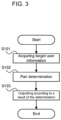
- FIG. 3 is a flowchart showing the flow of the operation of the information processing system according to the first embodiment.
- the target user information acquiring unit 120 acquires face information and re-identification information from the target user (step S101).
- the target user information acquiring unit 120 may acquire the re-identification information after acquiring the face information, or may acquire the face information after acquiring the re-identification information. Alternatively, the target user information acquiring unit 120 may simultaneously acquire face information and re-identification information in parallel.
- the pair determining unit 130 determines whether or not the face information and the re-identification information acquired by the target user information acquiring unit 120 are a pair (hereinafter, appropriately referred to as "correct pair") of face information and re-identification information in association with each other stored in the user information database 110 (step S102). Note that a specific flow of this determination processing will be described in detail in other embodiments described later. Thereafter, the output unit 140 performs output according to the determination result of the pair determining unit 130 (step S103).
- the information processing system 10 it is determined whether or not the face information and the re-identification information of the target user are a correct pair (i.e., a pair stored in advance), and an output corresponding to the determination result is performed. In this way, spoofing of the target user can be detected.
- a malicious user attempts to break through an authentication processing by spoofing, he/her should make a system recognize a face of other person in some way (e.g., by presenting a terminal displaying a face image, or by wearing a 3D mask).
- the face information of the target user changes before and after spoofing, but the re-identification information acquired from other than the face does not change. Therefore, the pair of face information and re-identification information stored before spoofing does not match the pair of face information and re-identification information after spoofing. Therefore, if the face information and the re-identification information of the target user are not the correct pair, it can be determined that there is a high probability that the target user is spoofing.
- FIG. 4 An information processing system 10 according to a second embodiment will be described referring to FIG. 4 .
- the second embodiment is only different from the first embodiment described above in a part of operation, and may be the same as the first embodiment in other portions. Therefore, the portions that differ from the first embodiment described above will be described in detail below, and the overlapping portions will not be appropriately explained.
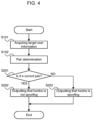
- FIG. 4 is a flowchart showing the flow of the operation of the information processing system according to the second embodiment.
- the same reference numerals are given to the same processing as shown in FIG. 3 .
- the target user information acquiring unit 120 acquires face information and re-identification information from the target user (step S101).
- the pair determining unit 130 determines whether or not the face information and the re-identification information acquired by the target user information acquiring unit 120 are a pair of face information and re-identification information in association with each other stored in the user information database 110 (step S102).
- step S201: YES when it is determined that face information and re-identification information of the target user are the correct pair, the pair determining unit 130 outputs the result when the target user has not spoofed (step S202). On the other hand, when it is determined that the face information and the re-identification information of the target user are not the correct pair (step S201: NO), the pair determining unit 130 outputs the result when the target user is spoofing (step S203).
- the output here may be output as an alert indicating that the target user is spoofing (that is, fraud has been performed). Specifically, an alarm display indicating the occurrence of spoofing may be performed, or an alarm sound may be output.
- the output of the output unit 140 is not output to the target user, it may be output only to the system manager or guard.
- the information processing system 10 when it is determined that the face information and the re-identification information of the target user are not the correct pair, information that notifies that the spoofing is performed is output. In this way, it is possible to appropriately determine the spoofing of the target user and promptly notify the target to be informed of the occurrence of spoofing.
- FIGS. 5 and 6 An information processing system 10 according to a third embodiment will be described referring to FIGS. 5 and 6 .
- the third embodiment is only different from the first and the second embodiments described above in a part of a configuration and operation, and may be the same as the first and the second embodiments in other portions. Therefore, the portions that differ from the embodiments described above will be described in detail below, and other overlapping portions will not be appropriately described.
- FIG. 5 is a block diagram showing the functional configuration of the information processing system according to the third embodiment. Incidentally, in FIG. 5 , it is denoted by the same reference numerals to the same elements as the components shown in FIG. 2 .
- the information processing system 10 is configured to include a user information database 110, a target user information acquiring unit 120, a pair determining unit 130, an output unit 140 and a face verification unit 150 as processing blocks for realizing the functions. That is, the information processing system 10 according to the third embodiment further includes the face verification unit 150 in addition to the configuration of the first embodiment (see FIG. 2 ).
- the face verification unit 150 is configured to be capable of performing face matching (in other words, face authentication) of the target user using the face information acquired by the target user information acquiring unit 120.
- face verification unit 150 according to the present embodiment is configured to perform face verification when it is determined that the face information and the re-identification information of the target user are the correct pair by the pair determining unit 130.
- the verification result of the face verification unit 150 is configured to be output by the output unit 140.
- the face verification described above may be performed for authenticating that whether or not the target user is a person, who is registered as a user.
- a user with successful face verification may be permitted to path through a gate, at which only a registered use can path through.
- the user with successful face verification may be permitted to execute a settlement processing using a settlement method associated with a registered user.
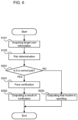
- FIG. 6 is a flowchart showing the flow of the operation of the information processing system according to the third embodiment.
- the same reference numerals are given to the same processing as shown in FIGS. 3 and 4 .
- the target user information acquiring unit 120 acquires face information and re-identification information from the target user (step S101).
- the pair determining unit 130 determines whether or not the face information and the re-identification information acquired by the target user information acquiring unit 120 are the stored correct pair in association with the user information database 110 (step S102).
- the pair determining unit 130 outputs the result when the target user is spoofing (step S203).
- the pair determining unit 130 executes face verification of the target user (Step S301).
- the output unit 140 outputs the result of face verification by the face verification unit 150 (step S302). In addition to the result of the face verification, the output unit 140 may output that the target user has not made impersonation (second embodiment: see FIG. 4 ).
- the information processing system 10 when it is determined that the face information and the re-identification information of the target user are the correct pair, face verification is performed and the result is output. In this way, when it can be determined that the target user is not spoofing, face verification is performed, so that face verification is not performed for the target user performing spoofing. Therefore, it is possible to prevent the targeted user performing the impersonation from fraudulently breaking the face matching.
- the fourth embodiment is an embodiment, which describes a specific example of re-identification information, and may be the same as the first to the tired embodiments in configurations and operations. Therefore, in the following, the portions overlapping with the embodiments already described are not described as appropriate.
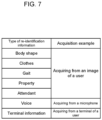
- FIG. 7 is a table showing a specific example of re-identification information used by the information processing system according to the fourth embodiment.
- the re-identification information used by the information processing system 10 may be a body shape, clothes, a gait, a property, an attendant and voice of a user, and terminal information (i.e., information obtained from a thing owned by the user).
- the re-identification information may include only one of these plurality of types of information, or may include a plurality.
- the re-identification information includes a body shape, clothes, a gait, a property or an attendant
- those information may be acquired, for example, from an image of a user.
- the method of acquiring information about the body shape, clothes, the gait, the property, or the attendant from the image of the user it is possible to appropriately adopt the existing technology.
- the information may be obtained from the microphone.
- the re-identification information is the terminal information
- the information may be acquired by wireless communication with a terminal or the like of the user. It is preferable that the terminal information is not such that it is acquired when the user holds the terminal at a predetermined position, but is such that it is automatically acquired without the user's operation.
- the information processing system 10 As described referring to FIG. 7 , in the information processing system 10 according to the fourth embodiment, at least one or more of the body shape, clothes, the gait, the property, the attendant and voice of the user, and information that can be obtained from a thing owned by the user is used as the re-identification information. In this way, it is possible to properly detect spoofing of the target user by determining whether or not the face information and the re-identification information are the correct pair.
- FIG. 8 An information processing system 10 according to a fifth embodiment will be described referring to FIG. 8 .
- the fifth embodiment is only different from the first to the fourth embodiment described above in a part of configuration, and may be the same as the first to fourth embodiments in the other portions. Therefore, the portions that differ from the embodiments described above will be described in detail below, and the other overlapping portions will not be described as appropriate.
- FIG. 8 is a block diagram showing the functional configuration of the information processing system according to the fifth embodiment. Incidentally, in FIG. 8 , it is denoted by the same reference numerals to the same elements as the components shown in FIG. 2 .
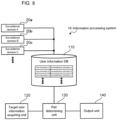
- the information processing system 10 is configured to include a user information database 110, a target user information acquiring unit 120, a pair determining unit 130 and an output unit 140 as processing blocks for realizing the functions.
- the user information database 110 in particular, from the image captured by the plurality of cameras 20 (monitoring cameras 20a, 20b, and 20c), and is configured to be capable of storing by acquiring the face information and the re-identification information of the user.
- the three monitoring cameras 20a, 20b, and 20c are illustrated here for convenience of explanation, more monitoring cameras may be used to acquire user face information and re-identification information
- Surveillance cameras 20a, 20b and 20c are cameras installed in different locations, respectively. Therefore, the user information database 110 can acquire and store the face information and the re-identification information at a plurality of locations. Further, the monitoring cameras 20a, 20b and 20c, it is possible to capture an image of the user from a separate angle, respectively. Therefore, if the monitoring cameras 20a, 20b, and 20c are used, the face information and the re-identification information can be obtained from the user image captured from an appropriate angle. Further, the monitoring cameras 20a, 20b and 20c, it is possible to capture an image of the user at different timings, respectively.
- the face information and the re-identification information can be obtained from the user image captured at an appropriate timing.
- the monitoring camera 20a, 20b and 20c may be performed periodically imaging at predetermined intervals, or when the angle of the face that can be acquired is changed, re-identification information may be performed imaging when the change.
- the timing at which the re-identification information changes for example, when the re-identification information is clothes, the timing at which the user desorbs the upper attachment on which the user has worn is cited.
- the timing at which the attendant changes by replacing, for example, a pair of the mother and child A, a pair of the father and child B, a pair of the mother and child B, and a pair of the father and child A, etc. can be cited.
- Each of the face information and the re-identification information acquired at a plurality of locations may be stored as separate information, respectively. That is, a pair of face information and re-identification information may be stored for a common user. Specifically, for a single user, for example, the re-identification information of the garment on which the jacket is worn and the pair of face information at that time, and the re-identification information of the garment on which the jacket is detached and the pair of face information at that time may be stored as separate patterns. Further, the common user may be stored so that the newly acquired face information and re-identification information may be overwritten. That is, each time the new information is acquired, the information may be updated.
- face information and re-identification information are acquired and stored at a plurality of locations (for example, cameras installed at a plurality of locations).
- a plurality of locations for example, cameras installed at a plurality of locations.
- face information and the re-identification information can be obtained at other locations.
- face information can be acquired at one location to acquire re-identification information elsewhere.
- the face information and the re-identification information obtained at one location are not appropriate (for example, if the face or body is hidden and the face information or the re-identification information to be acquired is insufficient), the face information and the re-identification information can be obtained again at another location.
- FIGS. 9 and 10 An information processing system 10 according to a sixth embodiment will be described referring to FIGS. 9 and 10 .
- the sixth embodiment is only different from the first to the fifth embodiments described above in a part of configuration and operation, and may be the same as the first to the fifth embodiment in other portions. Therefore, the portions that differ from the embodiments described above will be described in detail below, and the other overlapping portions will not be described as appropriate.
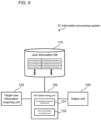
- FIG. 9 is a block diagram showing the functional configuration of the information processing system according to the sixth embodiment. Incidentally, in FIG. 9 , it is denoted by the same reference numerals to the same elements as the components shown in FIG. 2 .
- the information processing system 10 is configured to include a user information database 110, a target user information acquiring unit 120, a pair determining unit 130, and an output unit 140 as processing blocks for realizing the functions.
- the pair determining unit 130 according to the sixth embodiment includes a re-identification information comparing unit 131 and a face information comparing unit 132.
- the re-identification information comparing unit 131 compares the re-identification information of the target user acquired by the target user information acquiring unit 120 with the re-identification information of a plurality of users stored in the user information database 110, so that the re-identification information that matches the re-identification information of the target user can be extracted from the stored re-identification information.
- the re-identification information comparing unit 131 may be configured to extract only one re-identification information (for example, only the re-identification information having the highest coincidence degree) or may be configured to extract a plurality of re-identification information (for example, all re-identification information having the coincidence degree exceeding a predetermined threshold value).
- the face information comparing unit 132 is configured to be able to read out the face information stored in association with the re-identification information (that is, the re-identification information that matches the re-identification information of the target user) extracted by the re-identification information comparing unit 131 from the user information database 110. Further, the face information comparing unit is configured so as to be able to determine whether or not the face information of the target user matches the read face information by comparing the face information of the target user with the read face information.
- the face information determined by the face information comparing unit 132 is one in which the re-identification information is already determined to match by the re-identification information comparing unit 131, when it is determined that the face information matches, it can be determined that the face information and the re-identification information pair are correct pairs.
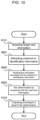
- FIG. 10 is a flowchart showing the flow of the operation of the information processing system according to the sixth embodiment.
- the same reference numerals are given to the same processing as shown in FIG. 3 .
- the target user information acquiring unit 120 acquires face information and re-identification information from the target user (step S101).
- the re-identification information comparing unit 131 extracts the re-identification information that matches the re-identification information of the target user from the re-identification information stored in the user information database 110 (step S601).
- Step S602 the face information comparing unit 132 reads out the face information that is stored in association with the re-identification information extracted by the re-identification information comparing unit 131. Then, the face information comparing unit 132 compares the face information of the target user with the read face information to determine whether or not the face information and the re-identification information pairs are the correct pair (step S603).
- the output unit 140 performs output according to the determination result of the pair determining unit 130 (that is, the re-identification information comparing unit 131 and the face information comparing unit 132) (step S103).
- the information processing system 10 first, it is determined whether or not the re-identification information matches, and thereafter, a match with the face information associated with the coincident re-identification information is determined. In this way, it is possible to appropriately determine whether or not the target user's face information and re-identification information are correct pairs.
- FIG. 11 An information processing system 10 according to a seventh embodiment will be described referring to FIG. 11 .
- the seventh embodiment is only different from the sixth embodiment in a part of operation, may be the same as the sixth embodiment in other portions. Therefore, the portions that differ from the embodiments described above will be described in detail below, and the other overlapping portions will not be described as appropriate.
- FIG. 11 is a flowchart showing the flow of the operation of the information processing system according to the seventh embodiment. Incidentally, in FIG. 11 , it is denoted by the same reference numerals to the same processing as shown in FIG. 10 .
- the target user information acquiring unit 120 acquires face information and re-identification information from the target user (step S101).
- the re-identification information comparing unit 131 extracts the re-identification information that matches the re-identification information of the target user from the re-identification information stored in the user information database 110 (step S601).
- the re-identification information comparing unit 131 will be described as extracting a plurality of re-identification information.
- Step S602 the face information comparing unit 132 reads out the face information that is stored in association with the re-identification information extracted by the re-identification information comparing unit 131. That is, a plurality of facial information stored associated with each of the extracted plurality of re-identification information is read. The face information comparing unit 132 determines whether or not the face information of the target user matches any of the plurality of face information read (step S701).
- the face information comparing unit 132 determines that the face information and the re-identification information of the target user are the correct pair (step S702).
- the face information comparing unit 132 determines that the face information of the target user and the re-identification information are not the correct pair (step S703).
- the output unit 140 performs output according to the determination result of the pair determining unit 130 (that is, the re-identification information comparing unit 131 and the face information comparing unit 132) (step S103). That is, the output unit 140 outputs the facial information of target person and whether or not the re-identification information is determined to be the correct pair.
- the information processing system 10 when there are a plurality of users with matched re-identification information, it is determined that face information and re-identification information are the correct pair if face information matches face information of any one of the plurality of users. In this way, even when there are multiple users with matching re-identification information (for example, when there are multiple users with similar re-identification information), it is possible to appropriately determine whether or not face information and re-identification information of the target user are the correct pair.
- FIG. 12 An information processing system 10 according to an eighth embodiment will be described referring to FIG. 12 .
- the information processing system 10 according to the eighth embodiment is only different from the sixth embodiment described above in a part of operation, and may be the same of the sixth embodiment in other portions. Therefore, the portions that differ from the embodiments described above will be described in detail below, and the other overlapping portions will not be described as appropriate.
- FIG. 12 is a flowchart showing the flow of the operation of the information processing system according to the eighth embodiment.
- the same reference numerals are denoted by the same processing as shown in FIG. 10 .
- the target user information acquiring unit 120 acquires face information and re-identification information from the target user (step S101).
- the re-identification information includes a plurality of types of information.
- the re-identification information may include two or more of the various information shown in the fourth embodiment (see FIG. 7 ).
- the re-identification information comparing unit 131 compares the re-identification information of the target user with the re-identification information stored in the user information database 110. Specifically, the re-identification information comparing unit 131 determines whether each of the plurality of types of information included in the re-identification information matches (step S801).
- the face information comparing unit 132 reads out face information related to the re-identification information in which the predetermined number or more of information matches as a result of the comparison in the re-identification information comparing unit 131.
- the "predetermined number” is the number that is set to determine whether the re-identification information is matched as a whole, and an appropriate value is set in advance. For example, when the predetermined number is set to three, it is determined that the re-identification information that matches three or more of the plurality of types of information matches the re-identification information of the target user, and the face information associated therewith is read out.
- the re-identification information that matches two or less of the plurality of types of information, it is determined that the re-identification information does not match the re-identification information of the target user, and the face information associated with the re-identification information is not read.
- the predetermined number may be a fixed value, but may be a value that varies depending on the type of information and the like. For example, set the priority for each type of information, a predetermined number may be varied according to the priority of the information matched. Specifically, it may be determined that the re-identification information matches two or more information having a high priority, three or more information having a medium priority, and four or more information having a low priority.
- the face information comparing unit 132 compares the face information of the target user with the read face information to determine whether or not the face information and the re-identification information pairs are correct pairs (step S603). Then, the output unit 140 performs output according to the determination result of the pair determining unit 130 (that is, the re-identification information comparing unit 131 and the face information comparing unit 132) (step S103).
- the information processing system 10 according to the eighth embodiment, among the plurality of types of information included in the re-identification information, when the information of a predetermined number or more matches, it is determined that the re-identification information matches. In this way, it is possible to appropriately determine whether or not face information and re-identification information of the target user are the correct pair even if there is another user with a part of the re-identification information that matches (for example, when there are multiple users with similar re-identification information).
- FIG. 13 is a conceptual diagram (part 1) showing a display example when acquiring the information of the target user.
- FIG. 14 is a conceptual diagram (part 2) showing a display example when acquiring the information of the target user.
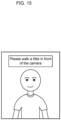
- FIG. 15 is a conceptual diagram (part 3) showing a display example when acquiring the information of the target user.
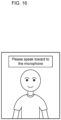
- FIG. 16 is a conceptual diagram (part 4) showing a display example when acquiring the information of the target user.
- a display may be performed to guide the target user's standing position such that the user's body type, clothing, gait, and property are included in the image.
- the target user is too close to the camera 20, the lower side than the shoulder of the target user is not imaged. Therefore, it is difficult to detect the body type, clothing, gait, and property of the coping user from the image. In such a case, a message such as "Please lower slightly behind" may be displayed to the target user.
- guiding the longitudinal direction with respect to the camera to the target user here, for example, it may be performed guidance of the lateral direction and the rotational direction.
- the re-identification information is a pierce attached to the right ear
- a message such as "face left” may be displayed so that the user's pierce is included in the image.
- the user's re-identification information and its location information may be stored in association with each other. For example, if the re-identification information is a property, it may be stored that the backpack is located on the back of the user. If the re-identification information is a garment, it may be remembered that a black down is located on the user's upper body and a blue jeans is located on the lower body.
- a display for aligning the clothing may be performed, for example, so that the user's clothing matches the one at the time when it is stored.
- the target user removes the upper and lower parts, the stored re-identification information (that is, the information on the first clothing acquired) and the current re-identification information (that is, the information on the current clothing) do not coincide with each other.
- a message such as "wear clothes worn at the entrance" may be displayed to the target user.
- a display may be performed to instruct the target user to walk, for example, to acquire the user's walk as re-identification information.
- the message "Step a few steps in front of the camera and walk" is displayed to the target user.
- the camera is installed near the gate of the walk-through (i.e., where the target user walks through)
- An example of a system with a walk-through gate includes, for example, a space for the user to walk in front of the camera, such as obtaining information from a user walking in that space.
- a display may be performed to instruct the target user to speak, for example, in order to acquire the voice of the user as re-identification information. For example, in the example shown in FIG. 16 , a message "Please speak something toward the microphone" is displayed to the target user. If the target user is already speaking (for example, when talking with the companion), the voice may be automatically acquired and such a display may be omitted.
- the display example described above is merely an example, in order to acquire more appropriately the information of the target user, may be performed other display according to the situation. Also, a similar notification by voice may be made in place of or in addition to such a display.
- a program for operating the configuration of the forms to realize the functions of the embodiments described above is recorded on a recording medium, a program recorded on the recording medium is read as a code, and a processing method that is executed in a computer is also included in the scope of the embodiments. That is, a computer-readable recording medium is also included in range of the respective embodiments. In addition, not only the recording medium on which the above-described program is recorded, but also the program itself is included in each embodiment.
- a floppy (registered trademark) disk for example, a hard disk, an optical disk, a magnetic-optical disk, a CD-ROM, a magnetic tape, a non-volatile memory card, or a ROM can be used as a recording medium.
- a program recorded on the recording medium itself is executed by processing, but also the program that operates on the operating system and executes processing in collaboration with other software and expansion board functions is included in the scope of the respective embodiments.
- An information processing system described in a supplementary note 1 is an information processing system comprising: a storage means for storing face information of a user and re-identification information used for re-identification of the user in association with each other; an acquiring means for acquiring the face information and the re-identification information of a target user; a determining means for performing determination whether or not the face information and the re-identification information of the target user are a pair stored in association with each other; and an output means for outputting according to a result of the determination.
- An information processing system described in a supplementary note 2 is the information processing system according to the supplementary note 1, wherein the output means outputs information indicating that the target user is performing spoofing when it is determined that the face information and the re-identification information of the target user are not the pair stored in association with each other.
- An information processing system described in a supplementary note 3 is the information processing system according to the supplementary note 1 or 2, wherein the information processing system further comprises a face verification means for performing face verification of the target user when it is determined that the face information and the re-identification information of the target user are the pair stored in association with each other, and the output means outputs a result of the face verification.
- An information processing system described in a supplementary note 4 is the information processing system according to any one of supplementary notes 1 to 3, wherein the re-identification information includes at least one or more of follows: a body shape, clothes, a gait, a property, an attendant and voice of the user, and information obtained from a thing owned by the user.
- An information processing system described in a supplementary note 5 is the information processing system according to any one of supplementary notes 1 to 4, wherein the information processing system comprises a plurality of the acquiring means, and the storage means acquires and stores the face information and the re-identification information from the acquiring means provided at a plurality of locations.
- An information processing system described in a supplementary note 6 is the information processing system according to any one of supplementary notes 1 to 5, wherein the determining means performs the determination by extracting re-identification information, which matches re-identification information of the target user, from the stored re-identification information, and by determining whether or not the face information associated with the extracted re-identification information matches face information of the target user.
- An information processing system described in a supplementary note 7 is the information processing system according to the supplementary note 6, wherein the determining means determines that the face information and the re-identification information are the pair stored in association with each other when the re-identification information of the target user matches the stored plurality of re-identification information, and when the face information of the target user matches any of the stored plurality of face information associated with the plurality of re-identification information.
- An information processing system described in a supplementary note 8 the information processing system according to the supplementary note 6 or 7, wherein the re-identification information includes a plurality of types of information, and the determining means extracts re-identification information in which a predetermined number or more of the plurality of types of information coincide as re-identification information, which matches the re-identification information of the target user.
- An information processing method described in a supplementary note 9 is an information processing method comprising: storing face information of user and re-identification information used for re-identification of the user in association with each other; acquiring the face information and the re-identification information of a target user; performing determination that whether or not the face information and the re-identification information of the target user are a pair stored in association with each other; and performing output according to a result of the determination.
- a recording medium a recording medium on which a computer program for causing a computer to execute an information processing method comprising: storing face information of user and re-identification information used for re-identification of the user in association with each other; acquiring the face information and the re-identification information of a target user; performing determination that whether or not the face information and the re-identification information of the target user are a pair stored in association with each other; and performing output according to a result of the determination is recorded.
- a computer program described in a supplementary note 11 is a computer program for causing a computer to execute an information processing method comprising: storing face information of user and re-identification information used for re-identification of the user in association with each other; acquiring the face information and the re-identification information of a target user; performing determination that whether or not the face information and the re-identification information of the target user are a pair stored in association with each other; and performing output according to a result of the determination.
Landscapes
- Engineering & Computer Science (AREA)
- Theoretical Computer Science (AREA)
- General Physics & Mathematics (AREA)
- Physics & Mathematics (AREA)
- Multimedia (AREA)
- Human Computer Interaction (AREA)
- Oral & Maxillofacial Surgery (AREA)
- Health & Medical Sciences (AREA)
- General Health & Medical Sciences (AREA)
- Computer Security & Cryptography (AREA)
- Computer Hardware Design (AREA)
- Software Systems (AREA)
- General Engineering & Computer Science (AREA)
- Collating Specific Patterns (AREA)
Applications Claiming Priority (1)
| Application Number | Priority Date | Filing Date | Title |
|---|---|---|---|
| PCT/JP2021/017296 WO2022230204A1 (fr) | 2021-04-30 | 2021-04-30 | Système de traitement d'informations, procédé de traitement d'informations et support d'enregistrement |
Publications (2)
| Publication Number | Publication Date |
|---|---|
| EP4332797A1 true EP4332797A1 (fr) | 2024-03-06 |
| EP4332797A4 EP4332797A4 (fr) | 2024-06-26 |
Family
ID=83846824
Family Applications (1)
| Application Number | Title | Priority Date | Filing Date |
|---|---|---|---|
| EP21939360.0A Withdrawn EP4332797A4 (fr) | 2021-04-30 | 2021-04-30 | Système de traitement d?informations, procédé de traitement d?informations et support d?enregistrement |
Country Status (4)
| Country | Link |
|---|---|
| US (2) | US12347237B2 (fr) |
| EP (1) | EP4332797A4 (fr) |
| JP (1) | JP7613566B2 (fr) |
| WO (1) | WO2022230204A1 (fr) |
Families Citing this family (1)
| Publication number | Priority date | Publication date | Assignee | Title |
|---|---|---|---|---|
| EP4099212A1 (fr) * | 2021-05-31 | 2022-12-07 | Grazper Technologies ApS | Concept pour un système de mise en correspondance entrée-sortie |
Family Cites Families (16)
| Publication number | Priority date | Publication date | Assignee | Title |
|---|---|---|---|---|
| JP2007140771A (ja) | 2005-11-16 | 2007-06-07 | Oki Electric Ind Co Ltd | 生体認証システム |
| JP2010044619A (ja) | 2008-08-13 | 2010-02-25 | Toshiba Corp | アクセス対象に対するアクセス制御システムおよびアクセス制御方法 |
| US8605959B2 (en) * | 2008-12-22 | 2013-12-10 | International Business Machines Corporation | Apparatus, system, and method for sequenced biometric authentication |
| JP4751442B2 (ja) | 2008-12-24 | 2011-08-17 | 株式会社東芝 | 映像監視システム |
| JP5618295B2 (ja) | 2010-10-13 | 2014-11-05 | 株式会社日立情報通信エンジニアリング | 認証システム及び認証の信頼度の判定方法 |
| US10567376B2 (en) * | 2012-08-24 | 2020-02-18 | Sensible Vision, Inc. | System and method for providing secure access to an electronic device using multifactor authentication |
| JP6311237B2 (ja) | 2013-08-23 | 2018-04-18 | 日本電気株式会社 | 照合装置及び照合方法、照合システム、並びにコンピュータ・プログラム |
| JP6418033B2 (ja) * | 2015-03-30 | 2018-11-07 | オムロン株式会社 | 個人識別装置、識別閾値設定方法、およびプログラム |
| US10346675B1 (en) | 2016-04-26 | 2019-07-09 | Massachusetts Mutual Life Insurance Company | Access control through multi-factor image authentication |
| CN110073407B (zh) | 2016-12-16 | 2023-05-12 | 松下知识产权经营株式会社 | 面部图像处理方法和面部图像处理装置 |
| US10606993B2 (en) * | 2017-08-09 | 2020-03-31 | Jumio Corporation | Authentication using facial image comparison |
| JP6730236B2 (ja) | 2017-09-08 | 2020-07-29 | 株式会社日立ビルシステム | 人識別システム及び人識別方法 |
| US20190311261A1 (en) * | 2018-04-10 | 2019-10-10 | Assured Information Security, Inc. | Behavioral biometric feature extraction and verification |
| JP7188446B2 (ja) * | 2018-09-28 | 2022-12-13 | 日本電気株式会社 | 認証装置、認証方法、認証プログラムおよび記録媒体 |
| JP6781413B2 (ja) | 2018-11-21 | 2020-11-04 | 日本電気株式会社 | 情報処理装置 |
| JP2020187543A (ja) | 2019-05-14 | 2020-11-19 | 富士通株式会社 | 認証処理プログラム、認証処理方法、及び認証処理装置 |
-
2021
- 2021-04-30 US US17/640,552 patent/US12347237B2/en active Active
- 2021-04-30 EP EP21939360.0A patent/EP4332797A4/fr not_active Withdrawn
- 2021-04-30 WO PCT/JP2021/017296 patent/WO2022230204A1/fr not_active Ceased
- 2021-04-30 JP JP2023517026A patent/JP7613566B2/ja active Active
-
2025
- 2025-05-29 US US19/222,044 patent/US20250292624A1/en active Pending
Also Published As
| Publication number | Publication date |
|---|---|
| EP4332797A4 (fr) | 2024-06-26 |
| US20240046707A1 (en) | 2024-02-08 |
| JP7613566B2 (ja) | 2025-01-15 |
| WO2022230204A1 (fr) | 2022-11-03 |
| US20250292624A1 (en) | 2025-09-18 |
| US12347237B2 (en) | 2025-07-01 |
| JPWO2022230204A1 (fr) | 2022-11-03 |
Similar Documents
| Publication | Publication Date | Title |
|---|---|---|
| CN111563480B (zh) | 冲突行为检测方法、装置、计算机设备和存储介质 | |
| EP3748520A1 (fr) | Dispositif, système et procédé d'authentification biométrique et support d'enregistrement | |
| US20250378686A1 (en) | Information processing apparatus, information processing method, and non-transitory recording medium | |
| JP6468725B2 (ja) | 画像処理装置、画像処理方法、及びコンピュータプログラム | |
| CN111553266A (zh) | 识别验证方法、装置及电子设备 | |
| US20250292624A1 (en) | Information processing system, information processing method and recording medium | |
| EP3859662A1 (fr) | Dispositif d'authentification, procédé d'authentification et support de stockage | |
| JP2015138449A (ja) | 個人認証装置、個人認証方法及びプログラム | |
| JP2022164659A (ja) | 情報処理装置、情報処理システム、及び、推定方法 | |
| EP3860116A1 (fr) | Système d'authentification, procédé d'authentification et support de stockage | |
| JP7248348B2 (ja) | 顔認証装置、顔認証方法、及びプログラム | |
| EP3859663A1 (fr) | Dispositif de reconnaissance d'iris, procédé de reconnaissance d'iris et support de stockage | |
| US20200311436A1 (en) | Processing apparatus, processing method, and non-transitory storage medium | |
| EP4123607A1 (fr) | Dispositif de porte, système d'authentification, procédé de commande de dispositif de porte, et support d'enregistrement | |
| CN113705428B (zh) | 活体检测方法及装置、电子设备及计算机可读存储介质 | |
| US20240104987A1 (en) | Information processing apparatus, information processing system, information processing method, and non-transitory computer-readable medium | |
| CN114647653A (zh) | 人脸库更新方法和相关产品 | |
| EP4057219A1 (fr) | Dispositif d'authentification, système d'authentification, procédé d'authentification et support d'enregistrement | |
| CN111783677B (zh) | 人脸识别方法、装置、服务器和计算机可读介质 | |
| JP7302539B2 (ja) | 処理装置、処理方法及びプログラム | |
| US20250291888A1 (en) | Information processing apparatus, information processing method, and non-tranisitory recording medium | |
| US20200234338A1 (en) | Content selection apparatus, content selection method, content selection system, and program | |
| EP4318372A1 (fr) | Système d'imagerie d'iris, procédé d'imagerie d'iris et programme informatique | |
| US12361753B2 (en) | Face authentication apparatus, face authentication method, and computer-readable recording medium | |
| JPWO2020079766A1 (ja) | 生体情報装置、分散型台帳本人確認システム、及びプログラム |
Legal Events
| Date | Code | Title | Description |
|---|---|---|---|
| STAA | Information on the status of an ep patent application or granted ep patent |
Free format text: STATUS: THE INTERNATIONAL PUBLICATION HAS BEEN MADE |
|
| PUAI | Public reference made under article 153(3) epc to a published international application that has entered the european phase |
Free format text: ORIGINAL CODE: 0009012 |
|
| STAA | Information on the status of an ep patent application or granted ep patent |
Free format text: STATUS: REQUEST FOR EXAMINATION WAS MADE |
|
| 17P | Request for examination filed |
Effective date: 20231027 |
|
| AK | Designated contracting states |
Kind code of ref document: A1 Designated state(s): AL AT BE BG CH CY CZ DE DK EE ES FI FR GB GR HR HU IE IS IT LI LT LU LV MC MK MT NL NO PL PT RO RS SE SI SK SM TR |
|
| A4 | Supplementary search report drawn up and despatched |
Effective date: 20240524 |
|
| RIC1 | Information provided on ipc code assigned before grant |
Ipc: G06V 40/70 20220101ALI20240517BHEP Ipc: G06V 40/40 20220101ALI20240517BHEP Ipc: G06V 20/52 20220101ALI20240517BHEP Ipc: G06V 40/16 20220101ALI20240517BHEP Ipc: G06F 21/32 20130101AFI20240517BHEP |
|
| DAV | Request for validation of the european patent (deleted) | ||
| DAX | Request for extension of the european patent (deleted) | ||
| STAA | Information on the status of an ep patent application or granted ep patent |
Free format text: STATUS: THE APPLICATION IS DEEMED TO BE WITHDRAWN |
|
| 18D | Application deemed to be withdrawn |
Effective date: 20241212 |