EP4332845A1 - Dispositif d'apprentissage, procédé d'apprentissage et programme d'apprentissage - Google Patents
Dispositif d'apprentissage, procédé d'apprentissage et programme d'apprentissage Download PDFInfo
- Publication number
- EP4332845A1 EP4332845A1 EP21939182.8A EP21939182A EP4332845A1 EP 4332845 A1 EP4332845 A1 EP 4332845A1 EP 21939182 A EP21939182 A EP 21939182A EP 4332845 A1 EP4332845 A1 EP 4332845A1
- Authority
- EP
- European Patent Office
- Prior art keywords
- log
- parameter
- likelihood
- lower limit
- updating
- Prior art date
- Legal status (The legal status is an assumption and is not a legal conclusion. Google has not performed a legal analysis and makes no representation as to the accuracy of the status listed.)
- Withdrawn
Links
Images



Classifications
-
- G—PHYSICS
- G06—COMPUTING OR CALCULATING; COUNTING
- G06N—COMPUTING ARRANGEMENTS BASED ON SPECIFIC COMPUTATIONAL MODELS
- G06N7/00—Computing arrangements based on specific mathematical models
- G06N7/01—Probabilistic graphical models, e.g. probabilistic networks
-
- G—PHYSICS
- G06—COMPUTING OR CALCULATING; COUNTING
- G06N—COMPUTING ARRANGEMENTS BASED ON SPECIFIC COMPUTATIONAL MODELS
- G06N3/00—Computing arrangements based on biological models
- G06N3/02—Neural networks
- G06N3/08—Learning methods
- G06N3/092—Reinforcement learning
-
- G—PHYSICS
- G06—COMPUTING OR CALCULATING; COUNTING
- G06N—COMPUTING ARRANGEMENTS BASED ON SPECIFIC COMPUTATIONAL MODELS
- G06N20/00—Machine learning
Definitions
- This invention relates to a learning device, a learning method, and a learning program that performs inverse reinforcement learning.
- Reinforcement Learning is known as one of the machine learning methods. Reinforcement learning is a method to learn an action that maximizes value through trial and error of various actions. In reinforcement learning, a reward function is set to evaluate this value, and the action that maximizes this reward function is explored. However, setting the reward function is generally difficult.
- Inverse reinforcement learning is known as a method to facilitate the setting of this reward function.
- the decision-making history data of an expert is used to generate a reward function that reflects the intention of the expert by repeating optimization using the reward function and updating the parameters of the reward function.
- Non patent literature 1 describes Maximum Entropy Inverse Reinforcement Learning (ME-IRL), which is a type of inverse reinforcement learning.
- ME-IRL Maximum Entropy Inverse Reinforcement Learning
- the maximum entropy principle is used to specify the distribution of trajectories and learn the reward function by approaching the true distribution (i.e., maximum likelihood estimation). This solves the indefiniteness of the existence of multiple reward functions that reproduce the trajectory (action history) of an expert.
- Non patent literature 2 also describes Guided Cost Learning (GCL), a method of inverse reinforcement learning that improves on maximum entropy inverse reinforcement learning.
- GCL Guided Cost Learning
- the method described in Non patent literature 2 uses weighted sampling to update the weights of the reward function.
- the GCL described in Non patent literature 2 calculates this value approximately by weighted sampling.
- weighted sampling when using weighted sampling with GCL, it is necessary to assume the distribution of the sampling itself.
- combinatorial optimization problems where it is not known how to set the sampling distribution, so the method described in Non patent literature 2 is not applicable to various mathematical optimization.
- a learning device includes: a function input means which accepts input of a reward function whose feature is set to satisfy Lipschitz continuity condition; an estimation means which estimates a trajectory that minimizes Wasserstein distance, which represents distance between a probability distribution of a trajectory of an expert and a probability distribution of a trajectory determined based on a parameter of the reward function; and an updating means which updates, based on the estimated trajectory, the parameter of the reward function to maximize the log-likelihood of Boltzmann distribution derived from a principle of a maximum entropy, wherein the updating means derives, as a lower limit of the log-likelihood, an expression for subtracting, from the Wasserstein distance, an entropy regularization term defined by an expression for the maximum reward value for the parameter minus the average value of reward for the parameter, and updates the parameter of the reward function to maximize the derived lower limit of the log-likelihood.
- a earning method includes: accepting input of a reward function whose feature is set to satisfy Lipschitz continuity condition; estimating a trajectory that minimizes Wasserstein distance, which represents distance between a probability distribution of a trajectory of an expert and a probability distribution of a trajectory determined based on a parameter of the reward function; and updating, based on the estimated trajectory, the parameter of the reward function to maximize the log-likelihood of Boltzmann distribution derived from a principle of a maximum entropy, wherein, when updating the parameter, the computer derives, as a lower limit of the log-likelihood, an expression for subtracting, from the Wasserstein distance, an entropy regularization term defined by an expression for the maximum reward value for the parameter minus the average value of reward for the parameter, and updates the parameter of the reward function to maximize the derived lower limit of the log-likelihood.
- a learning program causes a computer to execute: function input processing to accept input of a reward function whose feature is set to satisfy Lipschitz continuity condition; estimation input processing to estimate a trajectory that minimizes Wasserstein distance, which represents distance between a probability distribution of a trajectory of an expert and a probability distribution of a trajectory determined based on a parameter of the reward function; and updating processing to update, based on the estimated trajectory, the parameter of the reward function to maximize the log-likelihood of Boltzmann distribution derived from a principle of a maximum entropy, wherein in the updating processing, as a lower limit of the log-likelihood, an expression for subtracting, from the Wasserstein distance, an entropy regularization term defined by an expression for the maximum reward value for the parameter minus the average value of reward for the parameter is derived, and the parameter of the reward function to maximize the derived lower limit of the log-likelihood is updated.
- the present invention is capable of performing inverse reinforcement learning applicable to a mathematical optimization problem such as combinatorial optimization, while solving a problem of indefiniteness in inverse reinforcement learning.
- estimating ⁇ can reproduce the decision-making of an expert.
- a trajectory ⁇ is represented by Equation 1, illustrated below, and a probability model representing distribution of trajectories p ⁇ ( ⁇ ) is represented by Equation 2, illustrated below.
- ⁇ T f ⁇ in Equation 2 represents the reward function (see Equation 3).
- Z represents the sum of rewards for all trajectories (see Equation 4).
- Equation 5 The update law of the reward function weights by maximum likelihood estimation (specifically, the gradient ascent method) is then represented by Equations 5 and 6, which are illustrated below.
- ⁇ is step width
- L( ⁇ ) is distance measure between distributions used in ME-IRL.
- Equation 6 The second term in Equation 6 is the sum of rewards for all trajectories.
- ME-IRL assumes that the value of this second term can be calculated exactly. However, in reality, it is difficult to calculate the sum of rewards for all trajectories. The above is the problem setting, methodology, and issues of ME-IRL.
- FIG. 1 is a block diagram illustrating a configuration example of one embodiment of a learning device according to the present disclosure.
- the learning device 100 of this exemplary embodiment is a device that performs inverse reinforcement learning to estimate a reward function from the behavior of a subject (expert) through machine learning, and specifically performs information processing based on the behavioral characteristics of the expert.
- the learning device 100 includes a storage unit 10, an input unit 20, a feature setting unit 30, a weight initial value setting unit 40, a mathematical optimization execution unit 50, a weight updating unit 60, a convergence decision unit 70, and an output unit 80.
- the device including the mathematical optimization execution unit 50, the weight updating unit 60, and the convergence decision unit 70 can be called an inverse reinforcement learning device.
- the storage unit 10 stores information necessary for the learning device 100 to perform various processes.
- the storage unit 10 may store decision-making history data (trajectory) of an expert that is accepted by the input unit 20 described below.
- the storage unit 10 may also store candidate features of the reward function to be used for learning by the mathematical optimization execution unit 50 and the weight updating unit 60, which will be described later.
- the candidate feature need not necessarily be the feature used for the objective function.
- the storage unit 10 may also store a mathematical optimization solver to realize the mathematical optimization execution unit 50 described below.
- the content of the mathematical optimization solver is arbitrary and may be determined according to the environment or device in which it is to be executed.
- the input unit 20 accepts input of information necessary for the learning device 100 to perform various processes.
- the input unit 20 may accept input of the decision-making history data of an expert (specifically, state and action pairs) described above.
- the input unit 20 may also accept input of initial states and constraints used by the inverse reinforcement learning device to perform inverse reinforcement learning, as described below.
- the feature setting unit 30 sets features of the reward function from data including state and action. Specifically, in order for inverse reinforcement learning device described below to be able to use Wasserstein distance as a distance measure between distributions, the feature setting unit 30 sets the features of the reward function so that the gradient of the tangent line is finite for the entire function.
- the feature setting unit 30 may, for example, set the features of the reward function to satisfy the Lipschitz continuity condition.
- the feature setting unit 30 may set the features so that the reward function is a linear function.
- Equation 7 is an inappropriate reward function for this disclosure because the gradient becomes infinite at a 0 .
- Equation 7 illustrated below, is an inappropriate reward function for this disclosure because the gradient becomes infinite at a 0 .
- the feature setting unit 30 may, for example, determine the reward function with features set according to user instructions, or may retrieve a reward function that satisfies the Lipschitz continuity condition from the storage unit 10.
- the weight initial value setting unit 40 initializes the weights of the reward function. Specifically, the weight initial value setting unit 40 sets the weights of individual features included in the reward function.
- the method of initializing the weights is not particularly limited, and the weights may be initialized based on any predetermined method according to the user or other factors.
- the mathematical optimization execution unit 50 derives a trajectory ⁇ ⁇ (where ⁇ ⁇ is the superscript ⁇ of ⁇ ) that minimizes distance between the probability distribution of the expert's trajectory (action history) and the probability distribution of the trajectory determined based on the optimized (reward function) parameters. Specifically, the mathematical optimization execution unit 50 estimates the expert's trajectory ⁇ ⁇ by using the Wasserstein distance as the distance measure between the distributions and executing mathematical optimization to minimize the Wasserstein distance.
- the Wasserstein distance is defined by Equation 8, illustrated below.
- the Wasserstein distance represents the distance between the probability distribution of the expert's trajectories and the probability distribution of trajectories determined based on the parameters of the reward function.
- the reward function ⁇ T f ⁇ must be a function that satisfies the Lipschitz continuity condition.
- the mathematical optimization execution unit 50 is able to use the Wasserstein distance as illustrated below. [Math. 4]
- Equation 8 takes values less than or equal to zero, and increasing this value corresponds to bringing the distributions closer together.
- ⁇ ⁇ (n) represents the n-th trajectory optimized by the parameter ⁇ .
- Equation 8 is a term that can also be calculated in a combinatorial optimization problem. Therefore, by using the Wasserstein distance illustrated in Equation 8 as a distance measure between distributions, inverse reinforcement learning applicable to mathematical optimization problems such as the combinatorial optimization problems can be performed.
- the weight updating unit 60 updates the parameter ⁇ of the reward function to maximize the distance measure between distributions based on the estimated expert's trajectory ⁇ ⁇ .
- ME-IRL maximum entropy inverse reinforcement learning
- the trajectory ⁇ is assumed to follow a Boltzmann distribution by the maximum entropy principle. Therefore, as in ME-IRL, the weight updating unit 60 updates the parameter ⁇ of the reward function to maximize the log-likelihood of the Boltzmann distribution derived by the maximum entropy principle based on the estimated expert's trajectory ⁇ ⁇ as illustrated in Equations 5 and 6 above.
- the weight updater 60 in this exemplary embodiment derives the upper limit of the log sum exponential (hereinafter referred to as logSumExp) from the second term in Equation 6 (i.e., the sum of the rewards for all trajectories).
- the weight updating unit 60 derives the lower limit L_( ⁇ ) (L_ denotes the subscript underbar of L) in the distance measure between the distributions used in ME-IRL as in Equation 9 below.
- L_( ⁇ ) L_ denotes the subscript underbar of L
- the derived equation is sometimes hereafter referred to simply as the lower limit of the log-likelihood. [Math.
- Equation 9 which represents the lower bound of the log-likelihood, is the maximum reward value for the current parameter ⁇
- the third term is the log value (logarithmic value) of the number of trajectories (N ⁇ ) that can be taken.
- the weight updating unit 60 derives the lower bound of the log-likelihood, which is calculated by subtracting the maximum reward value for the current parameter ⁇ and the log value (logarithmic value) of the number of trajectories (N ⁇ ) that can be taken from the probability distribution of trajectories.
- the weight updating unit 60 transforms the equation for the lower bound of the derived ME-IRL log-likelihood into an equation that subtracts the entropy regularization term from the Wasserstein distance.
- An equation obtained by decomposing the expression for the lower bound of the log-likelihood of ME-IRI, into the Wasserstein distance and the entropy regularization term is expressed as Equation 10 illustrated below. [Math.
- the expression in the first parenthesis in Equation 10 represents the Wasserstein distance, as in Equation 8 above.
- the expression in the second parenthesis in Equation 10 represents the entropy regularization term that contributes to the increase in the log-likelihood of the Boltzmann distribution derived from the maximum entropy principle.
- the first term represents the maximum reward value for the current parameter ⁇
- the second term represents the average value of the reward for the current parameter ⁇ .
- this second term functions as an entropy regularization term.
- the value of the second term In order to maximize the lower bound of the log-likelihood of the ME-IRL, the value of the second term must be smaller, which corresponds to a smaller difference between the maximum reward value and the average value. A smaller difference between the maximum reward value and the average value indicates a smaller variation in the trajectory.
- a smaller difference between the maximum reward value and the average value means an increase in entropy, which means that entropy regularization works and contributes to entropy maximization. This contributes to maximizing the log-likelihood of the Boltzmann distribution, which in turn contributes to resolving indeterminacy in inverse reinforcement learning.
- the weight updating unit 60 updates the parameter ⁇ using the gradient ascent method, fixing, for example, the estimated trajectory ⁇ ⁇ based on Equation 10 illustrated above.
- the value may not converge with the usual gradient ascent method.
- the feature of the trajectory that takes the maximum reward value (f ⁇ max ) does not match the average value of the feature of the other trajectories (f ⁇ (n) ) (i.e., the difference between them is not zero). Therefore, the usual gradient ascent method is not stable because the log-likelihood oscillates and does not converge, making it difficult to make a proper convergence decision (see Equation 11 below).
- the weight updating unit 60 in this exemplary embodiment may update the parameter ⁇ so that the portion contributing to entropy regularization (i.e., the portion corresponding to the entropy regularization term) is gradually attenuated.
- the weight updating unit 60 defines an updating equation in which the portion contributing to entropy regularization has an attenuation factor ⁇ t that indicates the degree of attenuation.
- the weight updating unit 60 differentiates the above Equation 10 by ⁇ and defines Equation 12, illustrated below, in which the attenuation coefficient is set in the portion corresponding to the entropy regularization term among the portion corresponding to the term indicating the Wasserstein distance (i.e., the portion contributing to the process of increasing the Wasserstein distance) and the portion corresponding to the entropy regularization term.
- Equation 12 illustrated below, in which the attenuation coefficient is set in the portion corresponding to the entropy regularization term among the portion corresponding to the term indicating the Wasserstein distance (i.e., the portion contributing to the process of increasing the Wasserstein distance) and the portion corresponding to the entropy regularization term.
- the attenuation coefficients are predefined according to the method of attenuating the portion corresponding to the entropy regularization term.
- Equation 13 ⁇ 1 is set to 1 and ⁇ 2 is set to 0 or greater. Also, t indicates the number of iterations. This makes the attenuation coefficient ⁇ t act as a coefficient that decreases the portion corresponding to the entropy regularization term as the number of iterations t increases.
- the weight updating unit 60 may update the parameter ⁇ without attenuating the portion corresponding to the entropy regularization term in the initial stage of the update, and update the parameter ⁇ to reduce the effect of the portion corresponding to the entropy regularization term at the timing when the log-likelihood begins to oscillate.
- the weight updating unit 60 may determine that the log-likelihood has begun to oscillate when the moving average of the log-likelihood becomes constant. Specifically, the weight updating unit 60 may determine that the moving average has become constant when the change in the moving average in the time window (several points in the past from the current value) of the "lower bound of log-likelihood" is very small (e.g., less than 1e -3 ).
- the method for determining the timing at which the oscillations begin to occur is the same as the method described above.
- the weight updating unit 60 may change the updating method of the parameter ⁇ at the timing when the log-likelihood begins to oscillate further after the oscillation coefficient is changed as illustrated in Equation 13 above. Specifically, the weight updating unit 60 may update the parameter ⁇ using the momentum method as illustrated in Equation 14 below.
- trajectory estimation process by the mathematical optimization execution unit 50 and the updating process of the parameter ⁇ by the weight updating unit 60 are repeated until the lower bound of the log-likelihood is judged to have converged by the convergence decision unit 70 described below.
- the convergence decision unit 70 determines whether the distance measure between distributions has converged. Specifically, the convergence decision unit 70 determines whether the lower limit of the log-likelihood has converged.
- the determination method is arbitrary. For example, the convergence decision unit 70 may determine that the distance measure between distributions has converged when the absolute value of the lower limit of the log-likelihood becomes smaller than a predetermined threshold value.
- the convergence decision unit 70 determines that the distance measures between distributions have not converged, the convergence decision unit 70 continues the processing by the mathematical optimization execution unit 50 and the weight updating unit 60. On the other hand, when the convergence decision unit 70 determines that the distance measures between distributions have converged, the convergence decision unit 70 terminates the processing by the mathematical optimization execution unit 50 and the weight updating unit 60.
- the output unit 80 outputs the learned reward function.
- the input unit 20, the feature setting unit 30, the weight initial value setting unit 40, the mathematical optimization execution unit 50, the weight updating unit 60, the convergence decision unit 70, and the output unit 80 are realized by a processor (for example, CPU (Central Processing Unit)) of a computer that operates according to a program (learning program).
- a processor for example, CPU (Central Processing Unit) of a computer that operates according to a program (learning program).
- a program may be stored in a storage unit 10 provided by the learning device 100, and the processor may read the program and operate as the input unit 20, the feature setting unit 30, the weight initial value setting unit 40, the mathematical optimization execution unit 50, the weight updating unit 60, the convergence decision unit 70, and the output unit 80 according to the program.
- the functions of the learning device 100 may be provided in the form of SaaS (Software as a Service).
- the input unit 20, the feature setting unit 30, the weight initial value setting unit 40, the mathematical optimization execution unit 50, the weight updating unit 60, the convergence decision unit 70, and the output unit 80 may each be realized by dedicated hardware. Some or all of the components of each device may be realized by general-purpose or dedicated circuit, a processor, or combinations thereof. These may be configured by a single chip or by multiple chips connected through a bus. Some or all of the components of each device may be realized by a combination of the above-mentioned circuit, etc., and a program.
- the multiple information processing devices, circuits, etc. may be centrally located or distributed.
- the information processing devices, circuits, etc. may be realized as a client-server system, a cloud computing system, etc., each of which is connected through a communication network.
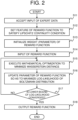
- FIG. 2 is a flowchart illustrating an operation example of the learning device 100.
- the input unit 20 accepts input of expert data (i.e., trajectory/decision-making history data of an expert) (step S11).
- the feature setting unit 30 sets features of a reward function from data including state and action to satisfy Lipschitz continuity condition (step S12).
- the weight initial value setting unit 40 initializes weights (parameters) of the reward function (step S13).
- the mathematical optimization execution unit 50 accepts input of the reward function whose feature is set to satisfy the Lipschitz continuity condition (step S14). Then, the mathematical optimization execution unit 50 executes mathematical optimization to minimize Wasserstein distance (step S15). Specifically, the mathematical optimization execution unit 50 estimates the trajectory that minimizes the Wasserstein distance, which represents the distance between a probability distribution of a trajectory of the expert and a probability distribution of a trajectory determined based on the parameter of the reward function.
- the weight updating unit 60 updates the parameter of the reward function so as to maximize the log-likelihood of Boltzmann distribution based on the estimated trajectory (step S16). In this case, the weight updating unit 60 derives a lower bound of the log-likelihood and updates the parameter of the reward function so as to maximize the derived lower bound of the log-likelihood.
- the convergence decision unit 70 determines whether the lower bound of the log-likelihood has converged or not (Step S17). If it is determined that the lower bound of the log-likelihood has not converged (No in step S17), the process from step S15 is repeated using the updated trajectory. On the other hand, if it is determined that the lower bound of the log-likelihood has converged (Yes in step S 17), the output unit 80 outputs the learned reward function (step S18).
- the mathematical optimization execution unit 50 accepts input of a reward function whose feature is set to satisfy Lipschitz continuity condition and estimates a trajectory that minimizes Wasserstein distance, which represents distance between a probability distribution of a trajectory of an expert and a probability distribution of a trajectory determined based on a parameter of the reward function. Then, the weight updating unit 60 updates the parameter of the reward function to maximize the log-likelihood of Boltzmann distribution based on the estimated trajectory. Specifically, the weight updating unit 60 derives an expression that subtracts the entropy regularization term from the Wasserstein distance as a lower bound of the log-likelihood, and updates the parameter of the reward function so that the derived lower bound of the log-likelihood is maximized.
- inverse reinforcement learning can be applied to mathematical optimization problems such as combinatorial optimization.
- the maximum entropy inverse reinforcement learning solves the indefiniteness of the existence of multiple reward functions, but only in situations where all trajectories can be calculated can adequate results be obtained.
- the method of sampling trajectories leaves the difficulty of having to set up a sampling distribution.
- Combinatorial optimization an optimization problem, takes discrete values (in other words, values that are not continuous), making it difficult to set up a probability distribution that returns the probability corresponding to a value when a certain value is input. This is because in a combinatorial optimization problem, if the value in the objective function changes even slightly, the result may also change significantly.
- the learning device 100 (weight updating unit 60) of this exemplary embodiment derives the lower bound of the log-likelihood for maximum entropy inverse reinforcement learning, which is decomposed into Wasserstein distance and entropy regularization terms.
- the learning device 100 then updates the parameters of the reward function to maximize the lower bound of the derived log-likelihood.
- the indefiniteness in inverse reinforcement learning can be resolved, and since the sampling distribution does not need to be set, it can be applied to various mathematical optimization, especially combinatorial optimization.
- typical examples of combinatorial optimization problems include routing problems, scheduling problems, cut-and-pack problems, and assignment and matching problems.
- the routing problem is, for example, the transportation routing problem or the traveling salesman problem
- the scheduling problem is, for example, the job store problem or the work schedule problem.
- the cut-and-pack problem is, for example, the knapsack problem or the bin packing problem
- the allocation and matching problem is, for example, the maximum matching problem or the generalized allocation problem.
- FIG. 3 is a block diagram illustrating a configuration example of one embodiment of a robot control system.
- the robot control system 2000 illustrated in FIG. 3 includes a learning device 100, a training data storage unit 2200, and a robot 2300.
- the learning device 100 illustrated in FIG. 3 is the same as the learning device 100 in the above exemplary embodiment.
- the learning device 100 stores the reward function created as a result of learning in the storage unit 2310 of the robot 2300 described below.
- the training data storage unit 2200 stores training data used by the learning device 100 for learning.
- the training data storage unit 2200 may, for example, store decision-making history data of an expert.
- the robot 2300 is a device that operates based on a reward function.
- the robot here is not limited to a device shaped to resemble a human or an animal, but also includes a device that performs automatic tasks (automatic operation, automatic control, etc.).
- the robot 2300 includes a storage unit 2310, an input unit 2320, and a control unit 2330.
- the memory unit 2310 stores the reward function learned by the learning device 100.
- the input unit 2320 accepts input of data indicating the state of the robot in operation.
- the control unit 2330 determines actions to be performed by the robot 2300 based on the received (state-indicating) data and the reward function stored in the storage unit 2310.
- the method in which the control unit 2330 determines the control action based on the reward function is widely known, and a detailed explanation is omitted here.
- a device such as the robot 2300, which performs automatic tasks, can be controlled based on a reward function that reflects the intention of an expert.
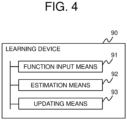
- FIG. 4 is a block diagram illustrating the outline of a learning device according to the present disclosure.
- the learning device 90 e.g., learning device 100
- the learning device 90 includes a function input means 91 (e.g., mathematical optimization execution unit 50) which accepts input of a reward function whose feature is set to satisfy Lipschitz continuity condition, an estimation means 92 (e.g., mathematical optimization execution unit 50) which estimates a trajectory that minimizes Wasserstein distance, which represents distance between a probability distribution of a trajectory of an expert and a probability distribution of a trajectory determined based on a parameter of the reward function, and an updating means 93 (e.g., weight updating unit 60) which updates, based on the estimated trajectory, the parameter of the reward function to maximize the log-likelihood of Boltzmann distribution derived from a principle of a maximum entropy.
- a function input means 91 e.g., mathematical optimization execution unit 50
- an estimation means 92 e.g., mathematical optimization execution unit 50
- the updating means 93 derives, as a lower limit of the log-likelihood, an expression for subtracting, from the Wasserstein distance, an entropy regularization term defined by an expression for the maximum reward value for the parameter minus the average value of reward for the parameter, and updates the parameter of the reward function to maximize the derived lower limit of the log-likelihood.
- Such a configuration allows inverse reinforcement learning to solve the problem of indefiniteness in inverse reinforcement learning while also being applicable to mathematical optimization problems such as combinatorial optimization.
- the updating means 93 may set, to the entropy regularization term, an attenuation coefficient (e.g., ⁇ t ) that attenuates degree to which the portion (e.g., the expression in the second parenthesis of Equation 12) corresponding to the entropy regularization term (e.g., the expression in the second parenthesis of Equation 10) contributes to maximizing the lower limit of the log-likelihood as the process of updating the parameter is repeated, and updates the parameter of the reward function to maximize the set lower limit of log-likelihood.
- an attenuation coefficient e.g., ⁇ t
- an attenuation coefficient e.g., ⁇ t
- the updating means 93 may change the attenuation coefficient when it is determined that the moving average of the log-likelihood has become constant (e.g., the change in the moving average is very small).
- the updating means 93 may derive the lower bound for the log-likelihood based on an upper bound of a log sum exponential.
- the function input means 91 may accept input of the reward function whose feature is set to be a linear function.
- FIG. 5 is a schematic block diagram illustrating a configuration of a computer according to at least one exemplary embodiment.
- a computer 1000 includes a processor 1001, a main storage device 1002, an auxiliary storage device 1003, and an interface 1004.
- the learning device 90 described above is implemented in the computer 1000. Then, the operation of each processing unit described above is stored in the auxiliary storage device 1003 in the form of a program (learning program).
- the processor 1001 reads the program from the auxiliary storage device 1003, develops the program in the main storage device 1002, and executes the above processing according to the program.
- the auxiliary storage device 1003 is an example of a non-transitory tangible medium.
- the non-transitory tangible medium include a magnetic disk, a magneto-optical disk, a compact disc read-only memory (CD-ROM), a digital versatile disk (DVD)-ROM, a semiconductor memory, and the like connected via the interface 1004.
- the computer 1000 that has received the program may develop the program in the main storage device 1002 and execute the above processing.
- the program may be for implementing some of the functions described above.
- the program may be a program that implements the above-described functions in combination with another program already stored in the auxiliary storage device 1003, a so-called difference file (difference program).
- a learning device comprising:
- a learning method for a computer comprising:
- a program storage medium which stores a learning program for causing a computer to execute:
Landscapes
- Engineering & Computer Science (AREA)
- Theoretical Computer Science (AREA)
- Physics & Mathematics (AREA)
- Software Systems (AREA)
- General Physics & Mathematics (AREA)
- Computing Systems (AREA)
- Artificial Intelligence (AREA)
- Mathematical Physics (AREA)
- Data Mining & Analysis (AREA)
- Evolutionary Computation (AREA)
- General Engineering & Computer Science (AREA)
- Biophysics (AREA)
- Molecular Biology (AREA)
- General Health & Medical Sciences (AREA)
- Computational Linguistics (AREA)
- Biomedical Technology (AREA)
- Life Sciences & Earth Sciences (AREA)
- Health & Medical Sciences (AREA)
- Computer Vision & Pattern Recognition (AREA)
- Medical Informatics (AREA)
- Probability & Statistics with Applications (AREA)
- Algebra (AREA)
- Computational Mathematics (AREA)
- Mathematical Analysis (AREA)
- Mathematical Optimization (AREA)
- Pure & Applied Mathematics (AREA)
- Management, Administration, Business Operations System, And Electronic Commerce (AREA)
Applications Claiming Priority (1)
| Application Number | Priority Date | Filing Date | Title |
|---|---|---|---|
| PCT/JP2021/016630 WO2022230019A1 (fr) | 2021-04-26 | 2021-04-26 | Dispositif d'apprentissage, procédé d'apprentissage et programme d'apprentissage |
Publications (2)
| Publication Number | Publication Date |
|---|---|
| EP4332845A1 true EP4332845A1 (fr) | 2024-03-06 |
| EP4332845A4 EP4332845A4 (fr) | 2024-06-12 |
Family
ID=83846792
Family Applications (1)
| Application Number | Title | Priority Date | Filing Date |
|---|---|---|---|
| EP21939182.8A Withdrawn EP4332845A4 (fr) | 2021-04-26 | 2021-04-26 | Dispositif d'apprentissage, procédé d'apprentissage et programme d'apprentissage |
Country Status (4)
| Country | Link |
|---|---|
| US (1) | US20240211767A1 (fr) |
| EP (1) | EP4332845A4 (fr) |
| JP (1) | JP7529144B2 (fr) |
| WO (1) | WO2022230019A1 (fr) |
Families Citing this family (2)
| Publication number | Priority date | Publication date | Assignee | Title |
|---|---|---|---|---|
| JP7815840B2 (ja) * | 2022-02-22 | 2026-02-18 | 富士通株式会社 | 関数生成プログラム、関数生成装置、制御装置、及び関数生成方法 |
| CN119045292A (zh) * | 2024-10-31 | 2024-11-29 | 浙江大学 | 一种基于多层感知机的逆向光刻方法 |
Family Cites Families (1)
| Publication number | Priority date | Publication date | Assignee | Title |
|---|---|---|---|---|
| JP7315007B2 (ja) * | 2019-08-29 | 2023-07-26 | 日本電気株式会社 | 学習装置、学習方法および学習プログラム |
-
2021
- 2021-04-26 US US18/287,546 patent/US20240211767A1/en active Pending
- 2021-04-26 EP EP21939182.8A patent/EP4332845A4/fr not_active Withdrawn
- 2021-04-26 JP JP2023516874A patent/JP7529144B2/ja active Active
- 2021-04-26 WO PCT/JP2021/016630 patent/WO2022230019A1/fr not_active Ceased
Also Published As
| Publication number | Publication date |
|---|---|
| JPWO2022230019A1 (fr) | 2022-11-03 |
| JP7529144B2 (ja) | 2024-08-06 |
| EP4332845A4 (fr) | 2024-06-12 |
| US20240211767A1 (en) | 2024-06-27 |
| WO2022230019A1 (fr) | 2022-11-03 |
Similar Documents
| Publication | Publication Date | Title |
|---|---|---|
| US11614978B2 (en) | Deep reinforcement learning for workflow optimization using provenance-based simulation | |
| Kintsakis et al. | Reinforcement learning based scheduling in a workflow management system | |
| JP7315007B2 (ja) | 学習装置、学習方法および学習プログラム | |
| EP3504666B1 (fr) | Apprentissage asynchrone d'un modèle d'apprentissage automatique | |
| Mlakar et al. | GP-DEMO: differential evolution for multiobjective optimization based on Gaussian process models | |
| Kouzoupis et al. | Towards proper assessment of QP algorithms for embedded model predictive control | |
| US11120333B2 (en) | Optimization of model generation in deep learning neural networks using smarter gradient descent calibration | |
| JP7378836B2 (ja) | 総和確率的勾配推定方法、装置、およびコンピュータプログラム | |
| Calderón et al. | Koopman operator-based model predictive control with recursive online update | |
| US20230039523A1 (en) | Model update device and method and process control system | |
| US20190303787A1 (en) | Adaptive learning rate schedule in distributed stochastic gradient descent | |
| US20240211767A1 (en) | Learning device, learning method, and learning program | |
| CN114675975A (zh) | 一种基于强化学习的作业调度方法、装置及设备 | |
| Langsari et al. | Optimizing effort parameter of COCOMO II using particle swarm optimization method | |
| CN114830137A (zh) | 用于生成预测模型的方法和系统 | |
| Chen et al. | Unified algorithms for RL with decision-estimation coefficients: PAC, reward-free, preference-based learning and beyond | |
| Chen et al. | Self‐triggered control for linear systems based on hierarchical reinforcement learning | |
| US8700686B1 (en) | Robust estimation of time varying parameters | |
| JP7670165B2 (ja) | 支援装置、支援方法、および支援プログラム | |
| JP7537517B2 (ja) | 学習装置、学習方法および学習プログラム | |
| Merlis et al. | On preemption and learning in stochastic scheduling | |
| JP7529145B2 (ja) | 学習装置、学習方法および学習プログラム | |
| US11790032B2 (en) | Generating strategy based on risk measures | |
| JP2020052703A (ja) | 学習方法、学習装置及びプログラム | |
| US20240362543A1 (en) | Learning device, learning method, and recording medium |
Legal Events
| Date | Code | Title | Description |
|---|---|---|---|
| STAA | Information on the status of an ep patent application or granted ep patent |
Free format text: STATUS: THE INTERNATIONAL PUBLICATION HAS BEEN MADE |
|
| PUAI | Public reference made under article 153(3) epc to a published international application that has entered the european phase |
Free format text: ORIGINAL CODE: 0009012 |
|
| STAA | Information on the status of an ep patent application or granted ep patent |
Free format text: STATUS: REQUEST FOR EXAMINATION WAS MADE |
|
| 17P | Request for examination filed |
Effective date: 20231019 |
|
| AK | Designated contracting states |
Kind code of ref document: A1 Designated state(s): AL AT BE BG CH CY CZ DE DK EE ES FI FR GB GR HR HU IE IS IT LI LT LU LV MC MK MT NL NO PL PT RO RS SE SI SK SM TR |
|
| A4 | Supplementary search report drawn up and despatched |
Effective date: 20240510 |
|
| RIC1 | Information provided on ipc code assigned before grant |
Ipc: G06N 7/00 20060101ALI20240503BHEP Ipc: G06N 20/00 20190101AFI20240503BHEP |
|
| STAA | Information on the status of an ep patent application or granted ep patent |
Free format text: STATUS: THE APPLICATION HAS BEEN WITHDRAWN |
|
| 18W | Application withdrawn |
Effective date: 20240625 |