EP4332892A1 - Estimation de volumes de liquide - Google Patents
Estimation de volumes de liquide Download PDFInfo
- Publication number
- EP4332892A1 EP4332892A1 EP22193455.7A EP22193455A EP4332892A1 EP 4332892 A1 EP4332892 A1 EP 4332892A1 EP 22193455 A EP22193455 A EP 22193455A EP 4332892 A1 EP4332892 A1 EP 4332892A1
- Authority
- EP
- European Patent Office
- Prior art keywords
- image
- background
- liquid
- input image
- partially transparent
- Prior art date
- Legal status (The legal status is an assumption and is not a legal conclusion. Google has not performed a legal analysis and makes no representation as to the accuracy of the status listed.)
- Withdrawn
Links
Images

Classifications
-
- G—PHYSICS
- G06—COMPUTING OR CALCULATING; COUNTING
- G06T—IMAGE DATA PROCESSING OR GENERATION, IN GENERAL
- G06T7/00—Image analysis
- G06T7/60—Analysis of geometric attributes
- G06T7/62—Analysis of geometric attributes of area, perimeter, diameter or volume
-
- G—PHYSICS
- G06—COMPUTING OR CALCULATING; COUNTING
- G06N—COMPUTING ARRANGEMENTS BASED ON SPECIFIC COMPUTATIONAL MODELS
- G06N3/00—Computing arrangements based on biological models
- G06N3/02—Neural networks
- G06N3/04—Architecture, e.g. interconnection topology
- G06N3/0464—Convolutional networks [CNN, ConvNet]
-
- G—PHYSICS
- G06—COMPUTING OR CALCULATING; COUNTING
- G06N—COMPUTING ARRANGEMENTS BASED ON SPECIFIC COMPUTATIONAL MODELS
- G06N3/00—Computing arrangements based on biological models
- G06N3/02—Neural networks
- G06N3/08—Learning methods
-
- G—PHYSICS
- G06—COMPUTING OR CALCULATING; COUNTING
- G06T—IMAGE DATA PROCESSING OR GENERATION, IN GENERAL
- G06T7/00—Image analysis
- G06T7/10—Segmentation; Edge detection
- G06T7/11—Region-based segmentation
-
- G—PHYSICS
- G06—COMPUTING OR CALCULATING; COUNTING
- G06T—IMAGE DATA PROCESSING OR GENERATION, IN GENERAL
- G06T7/00—Image analysis
- G06T7/10—Segmentation; Edge detection
- G06T7/194—Segmentation; Edge detection involving foreground-background segmentation
-
- G—PHYSICS
- G06—COMPUTING OR CALCULATING; COUNTING
- G06T—IMAGE DATA PROCESSING OR GENERATION, IN GENERAL
- G06T7/00—Image analysis
- G06T7/60—Analysis of geometric attributes
-
- G—PHYSICS
- G06—COMPUTING OR CALCULATING; COUNTING
- G06T—IMAGE DATA PROCESSING OR GENERATION, IN GENERAL
- G06T2207/00—Indexing scheme for image analysis or image enhancement
- G06T2207/20—Special algorithmic details
- G06T2207/20081—Training; Learning
-
- G—PHYSICS
- G06—COMPUTING OR CALCULATING; COUNTING
- G06T—IMAGE DATA PROCESSING OR GENERATION, IN GENERAL
- G06T2207/00—Indexing scheme for image analysis or image enhancement
- G06T2207/20—Special algorithmic details
- G06T2207/20084—Artificial neural networks [ANN]
Definitions
- This invention relates to the field of estimating volumes of liquid, and in particular to the field of estimating volumes of liquids in at least partially transparent containers.
- Estimating volumes of liquids in differently shaped containers, especially translucent ones, is a particularly difficult technical problem, the solution of which would be beneficial in a variety of fields.
- estimating the volume of liquids in translucent or transparent containers may be useful when estimating the volume of breast milk in milk bottles or breast pump containers. It may also be useful in laboratory and industrial environments.
- a method for estimating a volume of liquid in an at least partially transparent container is provided.
- the method comprises: processing an input image of an at least partially transparent container containing liquid with an image background removal algorithm to obtain a background-modified image, the background-modified image being a modified version of the input image wherein background image data has been removed or altered; and processing the background-modified image with a machine-learning algorithm to obtain a prediction of the volume of liquid in the at least partially transparent container.
- Proposed concepts thus aim to provide schemes, solutions, concept, designs, methods and systems pertaining to estimating a volume of liquid in an at least partially transparent container.
- embodiments aim to provide a method to derive a prediction or estimation of the volume of liquid in a transparent or translucent container from processing a single input image of the container.
- a single input image of an at least partially translucent container containing a volume of liquid may be analysed, in order to obtain a prediction of the volume of liquid in the container within the image.
- Such an input image may be obtained by use of a device that a user may commonly already have access to, such as a smartphone.
- embodiments may support estimation of volumes of liquid in at least partially transparent containers without any specialised hardware.
- An improved method for estimating volumes of liquid in transparent or translucent containers may therefore be provided by proposed concepts.
- a prediction of the volume of liquid in the container may be determined by processing the background-modified image with a machine-learning algorithm. It is proposed that prediction a volume of liquid in a container may be improved when a background of the image, i.e. any image data not containing information about the container, has been removed or altered in some way.
- the use of image data alone to derive a prediction of the volume of liquid in an at least partially transparent container may permit, for instance, a volume of milk expressed into a breast pump container to be automatically measured without the use of any special hardware, i.e. with only a smartphone.
- This invention may be of particular use in the case of measuring the volume of milk in a breast pump container or baby's bottle.
- These bottles are commonly at least translucent and are of varying shapes and sizes.
- a method capable of estimating a volume of liquid, i.e. milk, in a breast pump container or a baby's bottle that is shape/size agnostic and only requires a single image would therefore be of particular benefit.
- the liquid may comprise breast milk
- the container may be a breast pump container or a baby's bottle.
- an improved method for estimating a volume of liquid in at least partially transparent container may be supported by the proposed concept(s).
- processing the background-modified image with a machine-learning algorithm may be preceded by: converting the background-modified image to a heatmap, wherein the value of a pixel in the heatmap describes a pixel intensity value change of the pixel with respect to its neighbouring pixels.
- heatmaps may increase the accuracy of predicting a volume of liquid in an at least partially transparent container, by achieving increased distinction between liquid pixels and non-liquid pixels.
- the heatmap may be a colour heatmap, which gives the intensity of colour change in an image with respect to neighbouring pixels.
- the heatmap may also take into account the colour of the pixels themselves.
- Heatmaps may, however, also be applicable to greyscale/black and white images (e.g. through analysis of an intensity or greyscale value changes).
- processing the background-modified image with a machine-learning algorithm may be preceded by: enhancing the contrast of the background-modified image.
- Contrast enhancement may, for example, comprise contrast limited adaptive histogram equalization (CLAHE).
- processing the background-modified image with a machine learning algorithm may comprise: providing the background-modified image as an input to a convolutional neural network, CNN, the first CNN being trained to predict, for the background-modified image, the volume of liquid in the at least partially transparent container.
- CNNs have been proved to be particularly successful at analysing images, and being able to identify objects within images, with a much lower error rate than other types of neural network.
- the CNN may be trained using a training algorithm configured to receive an array of training inputs and respective known outputs, wherein a training input comprises an image of an at least partially transparent container containing liquid and respective known output comprises the volume of liquid in the at least partially transparent container.
- a training input comprises an image of an at least partially transparent container containing liquid
- respective known output comprises the volume of liquid in the at least partially transparent container.
- the CNN may be a pre-trained model further trained on images of an at least partially transparent container that have been manually annotated. This allows the CNN to become especially proficient at predicting the volume of liquid in an at least partially transparent container.
- processing the input image with an image background removal algorithm may comprise: providing the input image as an input to a neural network-based processing algorithm trained to predict, for the input image: a mask for identifying an object of interest in the input image; and removing or altering background image data of the input image based on the predicted mask, so as to generate the background-modified image.
- a neural network-based processing algorithm trained to predict, for the input image: a mask for identifying an object of interest in the input image; and removing or altering background image data of the input image based on the predicted mask, so as to generate the background-modified image.
- the neural network-based processing algorithm may comprise: a convolutional layer configured to generate a feature map for the input image; a region proposal network configured to determine a region of interest in the image based on the feature map; a first fully convolutional network configured to determine, based on the region of interest, a mask for identifying an object of interest in the input image; and a second fully convolutional network configured to determine, based on the region of interest, a box that bounds the at least partially transparent container in the input image.
- a convolutional layer configured to generate a feature map for the input image
- a region proposal network configured to determine a region of interest in the image based on the feature map
- a first fully convolutional network configured to determine, based on the region of interest, a mask for identifying an object of interest in the input image
- a second fully convolutional network configured to determine, based on the region of interest, a box that bounds the at least partially transparent container in the input image.
- the second fully convolutional network may be configured to determine, based on the region of interest, a classification of the object of interest.
- the object may be classified as an unrelated object, a container or, specifically, a breast pump container or a baby's bottle.
- removing or altering background image data of the input image may comprise: calculating a size of the box; and based on a comparison of the calculated size of the box with a predetermined threshold value, re-sizing the input image.
- an approximation of the size of the container in the image may be determined, which can be used to calculate a re-sizing of the input image in order that they may more closely match images used in training data so that the volume of liquid in the container may be more easily predicted.
- removing or altering background image data of the input image may comprise: providing the input image and the predicted mask as an input to a Mask R-CNN, the Mask R-CNN being trained to predict, for each pixel of input image, a pixel classification.
- Mask R-CNNs have been proved to be particularly successful at classifying pixels within images with a much lower error rate than other types of neural network.
- a computer program comprising code means for implementing any of the methods described above when said program is run on a processing system.
- a processor arrangement configured to: process the input image with an image background removal algorithm to obtain a background-modified image, the background-modified image being a modified version of the input image wherein background image data has been removed or altered; and process the background-modified image with a machine-learning algorithm to obtain a prediction of the volume of liquid in the at least partially transparent container.
- a system for estimating a volume of liquid in an at least partially transparent container comprising: an input interface configured to obtain an input image of an at least partially transparent container containing liquid; and an image processing unit configured to: process the input image with an image background removal algorithm to obtain a background-modified image, the background-modified image being a modified version of the input image wherein background image data has been removed or altered; and process the background-modified image with a machine-learning algorithm to obtain a prediction of the volume of liquid in the at least partially transparent container.
- system or processor arrangement described above may further comprise a user interface configured to receive, from the system or processor arrangement, and display the prediction of the volume of liquid in the at least partially transparent container.
- Implementations in accordance with the present disclosure relate to various techniques, methods, schemes and/or solutions pertaining to estimating a volume of liquid in an at least partially transparent container.
- a number of possible solutions may be implemented separately or jointly. That is, although these possible solutions may be described below separately, two or more of these possible solutions may be implemented in one combination or another.
- Embodiments of the invention aim to provide a method for estimating a volume of liquid in an at least partially transparent container. This can be achieved by automatically processing an input image of a transparent/translucent container containing liquid in order to obtain a background-modified image, wherein the background image data has been removed or altered (e.g. nullified or replaced with a single predetermined pixel value). A prediction of the volume of liquid in the container may then be determined by processing the background-modified image with a machine-learning algorithm.
- Proposed concepts thus aim to obtain a prediction of the volume of liquid in an at least partially transparent container by use of image data alone.
- This may permit, for instance, a volume of milk expressed into a breast pump container (or baby's feeding bottle) to be automatically measured without the use of any special hardware, e.g. with only a smartphone or camera-equipped tablet computer.
- the automatically measured volume of milk may also be automatically communicated to a user and/or stored in a memory, e.g. in a memory of the smartphone.
- Embodiments may therefore be of particular relevance to the case of measuring the volume of milk in a breast pump container or baby's bottle.
- Such containers/bottles are typically at least partially translucent and are of varying shapes and sizes.
- a method capable of estimating a volume of liquid, i.e. milk, in a breast pump container or a baby's bottle that is shape/size agnostic and only requires a single image would therefore be of great use.
- the liquid may be milk
- the container may be a breast pump container or a baby's bottle.
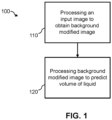
- FIG. 1 there is depicted a flow diagram of a method 100 for estimating a volume of liquid in an at least partially transparent container according to a proposed embodiment.
- the method begins with the step 110 of processing an input image of an at least partially transparent container containing liquid with an image background removal algorithm to obtain a background-modified image, the background-modified being a modified version of the input image wherein background image data has been removed or altered.
- the input image can be obtained using existing or conventional devices that include cameras already owned by a user.
- a conventional device may be one of: a smartphone, a tablet, a laptop, or any other suitable device. Details of this processing step will be more fully explained later.
- step 120 the background-modified image is processed with a machine-learning algorithm to obtain a prediction of the volume of liquid in the at least partially transparent container.
- processing the background-modified image with a machine learning algorithm may comprise: providing the background-modified image as an input to a convolutional neural network, CNN, the first CNN being trained to predict, for the background-modified image, the volume of liquid in the at least partially transparent container.
- CNNs have been proved to be particularly successful at analysing images, and being able to identify objects within images, and hence backgrounds, with a much lower error rate than other types of neural network.
- Neural networks are comprised of layers, each layer comprising a plurality of neurons.
- Each neuron comprises a mathematical operation.
- each neuron may comprise a different weighted combination of a single type of transformation (e.g. the same type of transformation, sigmoid etc. but with different weightings).
- the mathematical operation of each neuron is performed on the input data to produce a numerical output, and the outputs of each layer in the neural network are fed into the next layer sequentially. The final layer provides the output.
- CNNs convolutional neural networks
- RNNs recurrent neural networks
- This exemplary embodiment of the present invention employs CNN-based learning algorithms, becuase CNNs have proved to be particularly successful at analyzing images, and are able to identify objects within images with a much lower error rate than other types of neural network.
- CNNs typically contain several layers, including a convolutional layer, a pooling layer, and a fully connected layer.
- the convolutional layer consists of a set of learnable filters and extracts features from the input.
- the pooling layer is a form of non-linear down-sampling, reducing the data size by combining the outputs of a plurality of neurons in one layer into a single neuron in the next layer.
- the fully connected layer connects each neuron in one layer to all the neurons in the next layer.
- Methods of training a machine-learning algorithm are well known.
- such methods comprise obtaining a training dataset, comprising training input data entries and corresponding training output data entries.
- An initialized machine-learning algorithm is applied to each input data entry to generate predicted output data entries.
- An error between the predicted output data entries and corresponding training output data entries is used to modify the machine-learning algorithm. This process can be repeated until the error converges, and the predicted output data entries are sufficiently similar (e.g. ⁇ 1%) to the training output data entries. This is commonly known as a supervised learning technique.
- weightings of the mathematical operation of each neuron may be modified until the error converges.
- Known methods of modifying a neural network include gradient descent, backpropagation algorithms and so on.
- the training input data entries for the first CNN which may be used in step 120 correspond to example images of an at least partially transparent container containing liquid.
- the training output data entries correspond to the known volumes of liquid in the at least partially transparent containers.
- several pre-processing methods may be employed to improve the training samples.
- the first CNN may be trained using a training algorithm configured to receive an array of training inputs and respective known outputs, wherein a training input comprises an image of an at least partially transparent container containing liquid and a respective known output comprises the volume of liquid in the at least partially transparent container. In this way, the CNN may be trained to output a prediction of the volume of liquid in an at least partially transparent container when provided with an image of the at least partially transparent container containing liquid.
- the CNN may be a pre-trained model further trained on images of an at least partially transparent container that have been manually annotated. For example, due to the complex shapes of many containers, short videos may be taken of containers from all angles and all possible volume levels. Images may then be extracted from the videos in order to serve as training inputs with known volumes of liquid. This allows the CNN to become especially proficient at predicting the volume of liquid in an at least partially transparent container, regardless of the shape of the container.
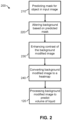
- a more in-depth flow diagram of a method 200 for estimating a volume of liquid in an at least partially transparent container begins with step 210 of providing the input image as an input to a neural network-based processing algorithm trained to predict, for the input image: a mask for identifying an object of interest in the input image.
- the background image data of the input image is then removed or altered based on the predicted mask, so as to generate the background-modified image, as part of the image background removal algorithm described in step 110.
- the background can more easily removed or altered.
- the input image can be segmented into background and foreground, wherein the foreground only contains the container. The background can then be subtracted from the input image leaving an image containing only the container.
- removing or altering the background image data of the input image comprises: providing the input image and the predicted mask as an input to a Mask R-CNN, the Mask R-CNN being trained to predict, for each pixel of input image, a pixel classification.
- Mask R-CNNs have been proved to be particularly successful at classifying pixels within images with a much lower error rate than other types of neural network.
- the Mask R-CNN may specifically utilise FBNET-C Mask-RCNN neural network architecture, and the model may be pretrained on the COCO dataset.
- the Mask R-CNN algorithm may define the multi-task loss function for each sampled region of interest (RoI), i.e. the translucent or transparent container, as:
- L cls is the classification error
- L box is the detection error
- L mask is the segmentation error.
- the Mask R-CNN algorithm may use the softmax function and the multitask function to obtain the classification value and the regression box parameter value.
- the sigmoid function may be used to output the mask value to realize pixel-level instance segmentation.
- the neural network's output can be treated as a binary classification, i.e. the pixel belongs to the object of interest (the container) or not.
- OOI denotes the object of interest and BG denotes the background.
- GT represents the ground truth.
- the contrast of the background-modified image is enhanced. It has been found that by enhancing the contrast of the background-modified image, the accuracy of predicting a volume of liquid in the container may be increased. Contrast enhancement may comprise contrast limited adaptive histogram equalization (CLAHE).
- CLAHE contrast limited adaptive histogram equalization
- the background-modified image may be converted to a heatmap, wherein the value of a pixel in the heatmap describes a pixel intensity value change of the pixel with respect to its neighbouring pixels.
- the heatmap may be a colour heatmap, which gives the intensity of colour change in an image with respect to neighbouring pixels.
- the heatmap may also take into account the colour of the pixels themselves.
- Heatmaps may also be possible with greyscale/black and white images.
- the technique amplifies subtle colour variations in an image, making it easier to estimate the volume in the at least translucent container by, for example, a CNN regression model, especially when the colour of the liquid and the container are similar.
- step 120 the background-modified image (or heatmap) is processed with a machine-learning algorithm to obtain a prediction of the volume of liquid in the at least partially transparent container.
- the machine-learning algorithm may be a CNN.
- a regression based CNN will map the features of an image to a numerical value.
- a CNN model may learn how a container looks when holding a particular volume of liquid.
- a RESNET-50 backbone CNN model may be used along with five convolutional layers with ReLU activation function.
- a 1cycle learning rate policy may be employed to determine the best learning rate for Stochastic Gradient Descent with momentum (SGDM) optimizer.
- SGDM Stochastic Gradient Descent with momentum
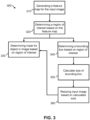
- FIG. 3 there is depicted a more in-depth flow diagram of a method 300 of processing the input image with an image background removal algorithm according to a proposed embodiment.
- a more in-depth description of step 210 in Fig. 2 there is depicted a more in-depth description of step 210 in Fig. 2 .
- a feature map is generated for the input image using a convolutional layer which comprises part of the neural network-based processing algorithm described in relation to step 210.
- a convolutional layer which comprises part of the neural network-based processing algorithm described in relation to step 210.
- a region of interest in the image is determined based on the feature map using a region proposal network which comprises part of the neural network-based processing algorithm described in relation to step 210.
- a region proposal network which comprises part of the neural network-based processing algorithm described in relation to step 210.
- the region of interest may be output as a set of coordinates in the form of X, Y, W, and H, wherein X and Y denote the top left corner of the region of interest, and W and H denote the width and height of the region of interest.
- a mask for identifying an object of interest in the input image is determined based on the determined region of interest using a first fully convolutional network which comprises part of the neural network-based processing algorithm described in relation to step 210.
- a box that bounds the at least partially transparent container in the input image is determined based on the determined region of interest using a second fully convolutional network which comprises part of the neural network-based processing algorithm described in relation to step 210.
- Fully convolutional networks are proficient at pixel wise segmentation of images in order to determine masks and bounding boxes.
- the bounding box may be output as a set of co-ordinates in the form of X, Y, W, and H, wherein X and Y denote the top left corner of the bounding box, and W and H denote the width and height of the box.
- the second fully convolutional network may also be configured to determine, based on the region of interest, a classification of the object of interest.
- the object may be classified as an unrelated object, a container or, specifically, a breast pump container or a baby's bottle.
- step 350 a size of the determined box that bounds the at least partially transparent container in the input image is calculated.
- step 360 the calculated size of the box is compared with a predetermined threshold value, and based on the comparison, the input image may be re-sized.
- an approximation of the size of the container in the image may be determined, which can be used to calculate a re-sizing of the input image so that it may more closely match images used in training data. This may allow the volume of liquid in the container to be more easily predicted.
- containers of the same size may appear different sizes in images. For example, an image of a container taken from further away will appear smaller than an image taken of the same container closer.
- a mask for identifying an object of interest in the input image i.e. the container, may then be determined, i.e. step 330, or the background may be altered and removed in accordance with the resized input image and corresponding mask, i.e. step 220.
- a computer program comprising code means for implementing any of the methods described above when said program is run on a processing system.
- FIG. 4 there is depicted a simplified block diagram of a system 400 for estimating a volume of liquid in an at least transparent container according a proposed embodiment.
- the system configured for estimating a volume of liquid in an at least transparent container comprises an input interface 410, and an image processing unit 420.
- the image processing unit 420 may also be referred to as a processor arrangement.
- the system 400 is configured to estimate a volume of liquid in an at least partially transparent container by processing an input image 415 of an at least partially transparent container containing liquid.
- An input image 415 of an at least partially transparent container containing liquid is obtained.
- the system outputs an output 430 comprising a prediction of the volume of liquid in the at least partially transparent container.
- the output 430 is predicted based on processing of the input image in order to obtain a background-modified image, and then processing of the background-modified image with a machine-learning algorithm in order to obtain a prediction of the volume of liquid.
- the input interface 410 receives an input image 415 of an at least partially transparent container containing liquid.
- the input interface 410 provides the input image 415 to an image processing unit 420 which is configured to process the input image 415 with an image background removal algorithm in order to obtain a background-modified image, which is then processed with a machine-learning algorithm to obtain an output 430 of a prediction of the volume of liquid in the at least partially transparent container.
- the background-modified image is a modified version of the input image 415 wherein background image data has been removed or altered.
- a user interface 440 may be configured to receive, from the system 400, the output 430 of the prediction of the volume of liquid in the at least partially transparent container and display it.
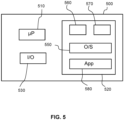
- Figure 5 illustrates an example of a computer 500 within which one or more parts of an embodiment may be employed.
- Various operations discussed above may utilize the capabilities of the computer 500.
- system functional blocks can run on a single computer or may be distributed over several computers and locations (e.g. connected via internet).
- the computer 500 includes, but is not limited to, PCs, workstations, laptops, PDAs, palm devices, servers, storages, and the like.
- the computer 500 may include one or more processors 510, memory 520 and one or more I/O devices 530 that are communicatively coupled via a local interface (not shown).
- the local interface can be, for example but not limited to, one or more buses or other wired or wireless connections, as is known in the art.
- the local interface may have additional elements, such as controllers, buffers (caches), drivers, repeaters, and receivers, to enable communications. Further, the local interface may include address, control, and/or data connections to enable appropriate communications among the aforementioned components.
- the processor 510 is a hardware device for executing software that can be stored in the memory 520.
- the processor 510 can be virtually any custom made or commercially available processor, a central processing unit (CPU), a digital signal processor (DSP), or an auxiliary processor among several processors associated with the computer 500, and the processor 510 may be a semiconductor based microprocessor (in the form of a microchip) or a microprocessor.
- the memory 520 can include any one or combination of volatile memory elements (e.g., random access memory (RAM), such as dynamic random access memory (DRAM), static random access memory (SRAM), etc.) and non-volatile memory elements (e.g., ROM, erasable programmable read only memory (EPROM), electronically erasable programmable read only memory (EEPROM), programmable read only memory (PROM), tape, compact disc read only memory (CD-ROM), disk, diskette, cartridge, cassette or the like, etc.).
- RAM random access memory
- DRAM dynamic random access memory
- SRAM static random access memory
- non-volatile memory elements e.g., ROM, erasable programmable read only memory (EPROM), electronically erasable programmable read only memory (EEPROM), programmable read only memory (PROM), tape, compact disc read only memory (CD-ROM), disk, diskette, cartridge, cassette or the like, etc.
- the memory 520 may incorporate electronic, magnetic, optical, and/or other types
- the software in the memory 520 may include one or more separate programs, each of which comprises an ordered listing of executable instructions for implementing logical functions.
- the software in the memory 520 includes a suitable operating system (O/S) 550, compiler 560, source code 570, and one or more applications 580 in accordance with exemplary embodiments.
- the application 580 comprises numerous functional components for implementing the features and operations of the exemplary embodiments.
- the application 580 of the computer 500 may represent various applications, computational units, logic, functional units, processes, operations, virtual entities, and/or modules in accordance with exemplary embodiments, but the application 580 is not meant to be a limitation.
- the operating system 550 controls the execution of other computer programs, and provides scheduling, input-output control, file and data management, memory management, and communication control and related services. It is contemplated by the inventors that the application 580 for implementing exemplary embodiments may be applicable on all commercially available operating systems.
- Application 580 may be a source program, executable program (object code), script, or any other entity comprising a set of instructions to be performed.
- a source program then the program is usually translated via a compiler (such as the compiler 560), assembler, interpreter, or the like, which may or may not be included within the memory 520, so as to operate properly in connection with the O/S 550.
- the application 580 can be written as an object oriented programming language, which has classes of data and methods, or a procedure programming language, which has routines, subroutines, and/or functions, for example but not limited to, C, C++, C#, Pascal, Python, BASIC, API calls, HTML, XHTML, XML, ASP scripts, JavaScript, FORTRAN, COBOL, Perl, Java, ADA, .NET, and the like.
- the I/O devices 530 may include input devices such as, for example but not limited to, a mouse, keyboard, scanner, microphone, camera, etc. Furthermore, the I/O devices 530 may also include output devices, for example but not limited to a printer, display, etc. Finally, the I/O devices 530 may further include devices that communicate both inputs and outputs, for instance but not limited to, a NIC or modulator/demodulator (for accessing remote devices, other files, devices, systems, or a network), a radio frequency (RF) or other transceiver, a telephonic interface, a bridge, a router, etc. The I/O devices 530 also include components for communicating over various networks, such as the Internet or intranet.
- a NIC or modulator/demodulator for accessing remote devices, other files, devices, systems, or a network
- RF radio frequency
- the I/O devices 530 also include components for communicating over various networks, such as the Internet or intranet.
- the software in the memory 520 may further include a basic input output system (BIOS) (omitted for simplicity).
- BIOS is a set of essential software routines that initialize and test hardware at start-up, start the O/S 550, and support the transfer of data among the hardware devices.
- the BIOS is stored in some type of read-only-memory, such as ROM, PROM, EPROM, EEPROM or the like, so that the BIOS can be executed when the computer 800 is activated.
- the processor 510 When the computer 500 is in operation, the processor 510 is configured to execute software stored within the memory 520, to communicate data to and from the memory 520, and to generally control operations of the computer 500 pursuant to the software.
- the application 580 and the O/S 550 are read, in whole or in part, by the processor 510, perhaps buffered within the processor 510, and then executed.
- a computer readable medium may be an electronic, magnetic, optical, or other physical device or means that can contain or store a computer program for use by or in connection with a computer related system or method.
- the application 580 can be embodied in any computer-readable medium for use by or in connection with an instruction execution system, apparatus, or device, such as a computer-based system, processor-containing system, or other system that can fetch the instructions from the instruction execution system, apparatus, or device and execute the instructions.
- a "computer-readable medium" can be any means that can store, communicate, propagate, or transport the program for use by or in connection with the instruction execution system, apparatus, or device.
- the computer readable medium can be, for example but not limited to, an electronic, magnetic, optical, electromagnetic, infrared, or semiconductor system, apparatus, device, or propagation medium.
- Figs. 1-3 may be implemented in hardware or software, or a mixture of both (for example, as firmware running on a hardware device).
- the functional steps illustrated in the process flowcharts may be performed by suitably programmed physical computing devices, such as one or more central processing units (CPUs) or graphics processing units (GPUs).
- CPUs central processing units
- GPUs graphics processing units
- Each process - and its individual component steps as illustrated in the flowcharts - may be performed by the same or different computing devices.
- a computer-readable storage medium stores a computer program comprising computer program code configured to cause one or more physical computing devices to carry out an encoding or decoding method as described above when the program is run on the one or more physical computing devices.
- Storage media may include volatile and non-volatile computer memory such as RAM, PROM, EPROM, and EEPROM, optical discs (like CD, DVD, BD), magnetic storage media (like hard discs and tapes).
- RAM random access memory
- PROM read-only memory
- EPROM erasable programmable read-only memory
- EEPROM electrically erasable programmable read-only memory
- optical discs like CD, DVD, BD
- magnetic storage media like hard discs and tapes.
- Various storage media may be fixed within a computing device or may be transportable, such that the one or more programs stored thereon can be loaded into a processor.
- the blocks shown in the block diagrams of Figure 4 may be separate physical components, or logical subdivisions of single physical components, or may be all implemented in an integrated manner in one physical component.
- the functions of one block shown in the drawings may be divided between multiple components in an implementation, or the functions of multiple blocks shown in the drawings may be combined in single components in an implementation.
- Hardware components suitable for use in embodiments of the present invention include, but are not limited to, conventional microprocessors, application specific integrated circuits (ASICs), and field-programmable gate arrays (FPGAs).
- ASICs application specific integrated circuits
- FPGAs field-programmable gate arrays
- One or more blocks may be implemented as a combination of dedicated hardware to perform some functions and one or more programmed microprocessors and associated circuitry to perform other functions.
- a computer program may be stored/distributed on a suitable medium, such as an optical storage medium or a solid-state medium supplied together with or as part of other hardware, but may also be distributed in other forms, such as via the Internet or other wired or wireless telecommunication systems.
- a suitable medium such as an optical storage medium or a solid-state medium supplied together with or as part of other hardware, but may also be distributed in other forms, such as via the Internet or other wired or wireless telecommunication systems.
- each block in the flowchart or block diagrams may represent a module, segment, or portion of instructions, which comprises one or more executable instructions for implementing the specified logical function(s).
- the functions noted in the block may occur out of the order noted in the figures.
- two blocks shown in succession may, in fact, be executed substantially concurrently, or the blocks may sometimes be executed in the reverse order, depending upon the functionality involved.
- each block of the block diagrams and/or flowchart illustration, and combinations of blocks in the block diagrams and/or flowchart illustration can be implemented by special purpose hardware-based systems that perform the specified functions or acts or carry out combinations of special purpose hardware and computer instructions.the architecture, functionality, and operation of possible implementations of systems, methods, and computer program products according to various embodiments of the present invention.
- each block in the flowchart or block diagrams may represent a module, segment, or portion of instructions, which comprises one or more executable instructions for implementing the specified logical function(s).
- the functions noted in the block may occur out of the order noted in the figures.
Landscapes
- Engineering & Computer Science (AREA)
- Physics & Mathematics (AREA)
- Theoretical Computer Science (AREA)
- General Physics & Mathematics (AREA)
- Computer Vision & Pattern Recognition (AREA)
- Geometry (AREA)
- Computational Linguistics (AREA)
- General Health & Medical Sciences (AREA)
- Biomedical Technology (AREA)
- Biophysics (AREA)
- Life Sciences & Earth Sciences (AREA)
- Data Mining & Analysis (AREA)
- Evolutionary Computation (AREA)
- Artificial Intelligence (AREA)
- Molecular Biology (AREA)
- Computing Systems (AREA)
- General Engineering & Computer Science (AREA)
- Mathematical Physics (AREA)
- Software Systems (AREA)
- Health & Medical Sciences (AREA)
- Image Analysis (AREA)
Priority Applications (4)
| Application Number | Priority Date | Filing Date | Title |
|---|---|---|---|
| EP22193455.7A EP4332892A1 (fr) | 2022-09-01 | 2022-09-01 | Estimation de volumes de liquide |
| PCT/EP2023/072968 WO2024046803A1 (fr) | 2022-09-01 | 2023-08-22 | Estimation de volumes de liquide |
| EP23755434.0A EP4581575B1 (fr) | 2022-09-01 | 2023-08-22 | Estimation de volumes de liquide |
| CN202311116315.8A CN117635693A (zh) | 2022-09-01 | 2023-08-31 | 估计液体的体积 |
Applications Claiming Priority (1)
| Application Number | Priority Date | Filing Date | Title |
|---|---|---|---|
| EP22193455.7A EP4332892A1 (fr) | 2022-09-01 | 2022-09-01 | Estimation de volumes de liquide |
Publications (1)
| Publication Number | Publication Date |
|---|---|
| EP4332892A1 true EP4332892A1 (fr) | 2024-03-06 |
Family
ID=83151877
Family Applications (2)
| Application Number | Title | Priority Date | Filing Date |
|---|---|---|---|
| EP22193455.7A Withdrawn EP4332892A1 (fr) | 2022-09-01 | 2022-09-01 | Estimation de volumes de liquide |
| EP23755434.0A Active EP4581575B1 (fr) | 2022-09-01 | 2023-08-22 | Estimation de volumes de liquide |
Family Applications After (1)
| Application Number | Title | Priority Date | Filing Date |
|---|---|---|---|
| EP23755434.0A Active EP4581575B1 (fr) | 2022-09-01 | 2023-08-22 | Estimation de volumes de liquide |
Country Status (3)
| Country | Link |
|---|---|
| EP (2) | EP4332892A1 (fr) |
| CN (1) | CN117635693A (fr) |
| WO (1) | WO2024046803A1 (fr) |
Citations (4)
| Publication number | Priority date | Publication date | Assignee | Title |
|---|---|---|---|---|
| US20160027173A1 (en) * | 2012-05-14 | 2016-01-28 | Gauss Surgical | System and method for estimating a quantity of a blood component in a fluid canister |
| WO2019023376A1 (fr) * | 2017-07-28 | 2019-01-31 | Siemens Healthcare Diagnostics Inc. | Procédés et appareil de quantification de volume d'apprentissage profond |
| US20190197466A1 (en) * | 2017-12-27 | 2019-06-27 | E-Commerce Exchange Solutions, Inc. | Inventory control for liquid containers |
| JP6923961B2 (ja) * | 2014-04-15 | 2021-08-25 | ガウス サージカル, インコーポレイテッドGauss Surgical, Inc. | 流体キャニスター内の血液成分の量を推定するための方法 |
Family Cites Families (2)
| Publication number | Priority date | Publication date | Assignee | Title |
|---|---|---|---|---|
| KR102032796B1 (ko) * | 2018-12-07 | 2019-11-08 | (주)제이엘케이인스펙션 | 영상 분석 장치 및 방법 |
| US11639868B2 (en) * | 2020-02-27 | 2023-05-02 | Beverage Metrics, Inc. | Method for determining remaining fluid level of open container |
-
2022
- 2022-09-01 EP EP22193455.7A patent/EP4332892A1/fr not_active Withdrawn
-
2023
- 2023-08-22 WO PCT/EP2023/072968 patent/WO2024046803A1/fr not_active Ceased
- 2023-08-22 EP EP23755434.0A patent/EP4581575B1/fr active Active
- 2023-08-31 CN CN202311116315.8A patent/CN117635693A/zh active Pending
Patent Citations (4)
| Publication number | Priority date | Publication date | Assignee | Title |
|---|---|---|---|---|
| US20160027173A1 (en) * | 2012-05-14 | 2016-01-28 | Gauss Surgical | System and method for estimating a quantity of a blood component in a fluid canister |
| JP6923961B2 (ja) * | 2014-04-15 | 2021-08-25 | ガウス サージカル, インコーポレイテッドGauss Surgical, Inc. | 流体キャニスター内の血液成分の量を推定するための方法 |
| WO2019023376A1 (fr) * | 2017-07-28 | 2019-01-31 | Siemens Healthcare Diagnostics Inc. | Procédés et appareil de quantification de volume d'apprentissage profond |
| US20190197466A1 (en) * | 2017-12-27 | 2019-06-27 | E-Commerce Exchange Solutions, Inc. | Inventory control for liquid containers |
Also Published As
| Publication number | Publication date |
|---|---|
| EP4581575C0 (fr) | 2025-12-31 |
| EP4581575B1 (fr) | 2025-12-31 |
| CN117635693A (zh) | 2024-03-01 |
| WO2024046803A1 (fr) | 2024-03-07 |
| EP4581575A1 (fr) | 2025-07-09 |
Similar Documents
| Publication | Publication Date | Title |
|---|---|---|
| CN109598231B (zh) | 一种视频水印的识别方法、装置、设备及存储介质 | |
| CN116894985B (zh) | 半监督图像分类方法及半监督图像分类系统 | |
| US20190164057A1 (en) | Mapping and quantification of influence of neural network features for explainable artificial intelligence | |
| US11164306B2 (en) | Visualization of inspection results | |
| US12475565B2 (en) | Amodal instance segmentation using diffusion models | |
| CN108304775A (zh) | 遥感图像识别方法、装置、存储介质以及电子设备 | |
| CN113284122B (zh) | 基于深度学习的卷纸包装缺陷检测方法、装置及存储介质 | |
| US20200257984A1 (en) | Systems and methods for domain adaptation | |
| CN111052128B (zh) | 用于检测和定位视频中的对象的描述符学习方法 | |
| CN110490304B (zh) | 一种数据处理方法及设备 | |
| Wang et al. | SERR‐U‐Net: Squeeze‐and‐Excitation Residual and Recurrent Block‐Based U‐Net for Automatic Vessel Segmentation in Retinal Image | |
| CN111444807A (zh) | 目标检测方法、装置、电子设备和计算机可读介质 | |
| US11688175B2 (en) | Methods and systems for the automated quality assurance of annotated images | |
| CN114841974B (zh) | 一种水果内部结构无损检测方法、系统、电子设备及介质 | |
| Du et al. | A video anomaly detection method based on percentile loss training and attention mechanism | |
| Chowdhury et al. | Nuclei segmentation and classification from histopathology images using federated learning for end-edge platform | |
| CN118570114A (zh) | 一种血管图像分割方法、装置、设备和介质 | |
| EP4009269A1 (fr) | Traitement d'images basé sur cnn | |
| EP4332892A1 (fr) | Estimation de volumes de liquide | |
| CN112489068B (zh) | 一种基于卷积神经网络的医学图像分割的方法 | |
| CN114418060B (zh) | 基于图表示学习的身份保持对抗训练方法、装置、介质 | |
| Al-Dmour | Ramifications of incorrect image segmentations; emphasizing on the potential effects on deep learning methods failure | |
| Dinesh et al. | FB-PNet: A Semantic Segmentation Model for Automated Plant Leaf and Disease Annotation: Automated Plant Leaf and Disease Annotation. | |
| US20250384651A1 (en) | Systems and techniques for segmenting image data | |
| CN119360393B (zh) | 文字识别方法、装置、设备及计算机介质 |
Legal Events
| Date | Code | Title | Description |
|---|---|---|---|
| PUAI | Public reference made under article 153(3) epc to a published international application that has entered the european phase |
Free format text: ORIGINAL CODE: 0009012 |
|
| STAA | Information on the status of an ep patent application or granted ep patent |
Free format text: STATUS: THE APPLICATION HAS BEEN PUBLISHED |
|
| AK | Designated contracting states |
Kind code of ref document: A1 Designated state(s): AL AT BE BG CH CY CZ DE DK EE ES FI FR GB GR HR HU IE IS IT LI LT LU LV MC MK MT NL NO PL PT RO RS SE SI SK SM TR |
|
| STAA | Information on the status of an ep patent application or granted ep patent |
Free format text: STATUS: THE APPLICATION IS DEEMED TO BE WITHDRAWN |
|
| 18D | Application deemed to be withdrawn |
Effective date: 20240907 |