EP4333021A2 - Appareil à faisceau d'ions focalisé - Google Patents
Appareil à faisceau d'ions focalisé Download PDFInfo
- Publication number
- EP4333021A2 EP4333021A2 EP23193877.0A EP23193877A EP4333021A2 EP 4333021 A2 EP4333021 A2 EP 4333021A2 EP 23193877 A EP23193877 A EP 23193877A EP 4333021 A2 EP4333021 A2 EP 4333021A2
- Authority
- EP
- European Patent Office
- Prior art keywords
- machining
- emission current
- ion beam
- region
- specimen
- Prior art date
- Legal status (The legal status is an assumption and is not a legal conclusion. Google has not performed a legal analysis and makes no representation as to the accuracy of the status listed.)
- Pending
Links
Images







Classifications
-
- H—ELECTRICITY
- H01—ELECTRIC ELEMENTS
- H01J—ELECTRIC DISCHARGE TUBES OR DISCHARGE LAMPS
- H01J37/00—Discharge tubes with provision for introducing objects or material to be exposed to the discharge, e.g. for the purpose of examination or processing thereof
- H01J37/30—Electron-beam or ion-beam tubes for localised treatment of objects
- H01J37/3002—Details
- H01J37/3007—Electron or ion-optical systems
-
- H—ELECTRICITY
- H01—ELECTRIC ELEMENTS
- H01J—ELECTRIC DISCHARGE TUBES OR DISCHARGE LAMPS
- H01J37/00—Discharge tubes with provision for introducing objects or material to be exposed to the discharge, e.g. for the purpose of examination or processing thereof
- H01J37/30—Electron-beam or ion-beam tubes for localised treatment of objects
- H01J37/302—Controlling tubes by external information, e.g. program control
-
- H—ELECTRICITY
- H01—ELECTRIC ELEMENTS
- H01J—ELECTRIC DISCHARGE TUBES OR DISCHARGE LAMPS
- H01J37/00—Discharge tubes with provision for introducing objects or material to be exposed to the discharge, e.g. for the purpose of examination or processing thereof
- H01J37/02—Details
- H01J37/20—Means for supporting or positioning the object or the material; Means for adjusting diaphragms or lenses associated with the support
-
- H—ELECTRICITY
- H01—ELECTRIC ELEMENTS
- H01J—ELECTRIC DISCHARGE TUBES OR DISCHARGE LAMPS
- H01J37/00—Discharge tubes with provision for introducing objects or material to be exposed to the discharge, e.g. for the purpose of examination or processing thereof
- H01J37/30—Electron-beam or ion-beam tubes for localised treatment of objects
- H01J37/305—Electron-beam or ion-beam tubes for localised treatment of objects for casting, melting, evaporating, or etching
- H01J37/3053—Electron-beam or ion-beam tubes for localised treatment of objects for casting, melting, evaporating, or etching for evaporating or etching
- H01J37/3056—Electron-beam or ion-beam tubes for localised treatment of objects for casting, melting, evaporating, or etching for evaporating or etching for microworking, e. g. etching of gratings or trimming of electrical components
-
- H—ELECTRICITY
- H01—ELECTRIC ELEMENTS
- H01J—ELECTRIC DISCHARGE TUBES OR DISCHARGE LAMPS
- H01J2237/00—Discharge tubes exposing object to beam, e.g. for analysis treatment, etching, imaging
- H01J2237/30—Electron or ion beam tubes for processing objects
- H01J2237/304—Controlling tubes
- H01J2237/30472—Controlling the beam
- H01J2237/30483—Scanning
-
- H—ELECTRICITY
- H01—ELECTRIC ELEMENTS
- H01J—ELECTRIC DISCHARGE TUBES OR DISCHARGE LAMPS
- H01J2237/00—Discharge tubes exposing object to beam, e.g. for analysis treatment, etching, imaging
- H01J2237/30—Electron or ion beam tubes for processing objects
- H01J2237/317—Processing objects on a microscale
- H01J2237/3174—Etching microareas
- H01J2237/31745—Etching microareas for preparing specimen to be viewed in microscopes or analyzed in microanalysers
-
- H—ELECTRICITY
- H01—ELECTRIC ELEMENTS
- H01J—ELECTRIC DISCHARGE TUBES OR DISCHARGE LAMPS
- H01J2237/00—Discharge tubes exposing object to beam, e.g. for analysis treatment, etching, imaging
- H01J2237/30—Electron or ion beam tubes for processing objects
- H01J2237/317—Processing objects on a microscale
- H01J2237/31749—Focused ion beam
Definitions
- the present invention relates to a focused ion beam apparatus.
- a focused ion beam apparatus is an apparatus for machining a specimen by scanning a specimen surface with a focused ion beam.
- the specimen is first roughly machined by setting an emission current of an ion beam to high, then receives finish machining, with the emission current of the ion beam being decreased. Thereby a clear cross section can be acquired in a short time. In this way, the focused ion beam apparatus continues machining while changing machining conditions such as emission current.
- JP-A-2006-313704 discloses a focused ion beam apparatus that automatically calculates machining conditions, such as a beam diameter, once the user inputs such data as the size of a machining region and finishing degree of machining.
- a focused ion beam apparatus that machines a cross section of a specimen by scanning the specimen with an ion beam
- the focused ion beam apparatus including:
- a focused ion beam apparatus that machines a cross section of a specimen by scanning the specimen with an ion beam
- the focused ion beam apparatus including:
- this focused ion beam apparatus In the case of this focused ion beam apparatus, a plurality of machining conditions can be set for one machining region. Therefore in this focused ion beam apparatus, the user need not set a machining region each time a machining condition is changed, and a plurality of machining conditions can be set easily.
- FIG. 1 illustrates a configuration of a focused ion beam apparatus 100 according to the first embodiment.
- the focused ion beam apparatus 100 includes an optical system 10, a specimen stage 20, a secondary electron detector 30, a gas gun 40, a processing unit 50, an operation unit 60, a display unit 62 and a storage unit 64.
- a specimen S can be machined (etched) by scanning the specimen S with a focused ion beam IB. Further, in the focused ion beam apparatus 100, a deposition film can be formed on the specimen S by emitting an ion beam IB while supplying gas near the surface of the specimen S using the gas gun 40. Furthermore, in the focused ion beam apparatus 100, a scanning ion microscope (SIM) image can be acquired by scanning the specimen S with the focused ion beam IB, and detecting, by the secondary electron detector 30, electrons emitted from the specimen S.
- SIM scanning ion microscope
- the optical system 10 scans the specimen S with the ion beam IB.
- the optical system 10 includes an ion source 11, an extraction electrode 12, an acceleration electrode 13, a focusing lens 14, a beam blanking electrode 15, a variable multi-aperture 16, a beam deflection electrode 17, and an objective lens 18.
- the ion source 11 generates ions.
- the extraction electrode 12 extracts ions from the ion source 11.
- the acceleration electrode 13 accelerates ions extracted from the ion source 11. Thereby ions can be accelerated at a predetermined acceleration voltage.
- the focusing lens 14 focuses the ion beam IB.
- the ion beam blanking electrode 15 controls the ON/OFF of emission of the ion beam IB onto the specimen S.
- the variable multi-aperture 16 selectively limits the emission current of the ion beam IB.
- the variable multi-aperture 16 has a plurality of aperture holes having different diameters. In the focused ion beam apparatus 100, the emission current of the ion beam IB can be controlled by selecting an aperture hole that is disposed on the path of the ion beam IB.
- the beam deflection electrode 17 deflects the ion beam IB.
- the specimen S can be two-dimensionally scanned with the ion beam IB.
- the objective lens 18 focuses the ion beam IB.
- the specimen stage 20 supports the specimen S.
- the specimen stage 20 can move the specimen S in the horizontal direction.
- the specimen stage 20 can also rotate or tile the specimen S.
- the secondary electron detector 30 detects secondary electrons generated in the specimen S when the specimen S is irradiated with the ion beam IB.
- a detection signal (intensity signal) of the secondary electrons detected by the secondary electron detector 30 is sent to the processing unit 50 as image data synchronizing with the scanning with the ion beam IB.
- the processing unit 50 generates a SIM image based on the image data, and causes the display unit 62 to display the SIM image.
- the gas gun 40 supplies a compound gas to the surface of the specimen S.
- the compound gas decomposes by the secondary electrons generated by the ion beam IB emitted to the specimen S.
- the decomposed compound gas is adsorbed and deposited on the specimen surface. Thereby a deposition film is formed.
- W(CO) 6 is used as the compound gas, a tungsten film is formed.
- the operation unit 60 acquires an operation signal in accordance with an operation performed by the user, and sends the operation signal to the processing unit 50.
- the operation unit 60 is such an input device as a button, key, touch panel type display, and microphone, for example.
- the user can set a machining region and machining condition using the operation unit 60.
- the display unit 62 displays an image generated by the processing unit 50.
- the display unit 62 can be implemented using such a display as a liquid crystal display (LCD).
- LCD liquid crystal display
- a graphical user interface (GUI) screen and a SIM image are displayed on the display unit 62, for example.
- GUI graphical user interface
- the storage unit 64 stores programs and data for the processing unit 50 to perform various computing processing and control processing.
- the storage unit 64 is also used as a work area of the processing unit 50.
- the storage unit 64 can be implemented by a random access memory (RAM), a read only memory (ROM), a hard disk, and the like.
- the functions of the processing unit 50 can be implemented by various processors (e.g., central processing unit (CPU)) executing programs. At least a part of the functions of the processing unit 50 may be implemented by a dedicated circuit, such as ASIC (e.g., gate array).
- the processing unit 50 includes a receiving unit 52 and a control unit 54.
- the receiving unit 52 receives the setting of a machining region and a setting of a plurality of machining conditions for one machining region.
- the control unit 54 controls the optical system 10, the specimen stage 20, the secondary electron detector 30, and the gas gun 40. Details on the processing of the receiving unit 52 and the control unit 54 will be described later.
- a machining region can be machined based on a plurality of machining conditions which are set for one machining region.
- a cross section machining method using the focused ion beam apparatus 100 will be described below.
- FIG. 2 is a flow chart illustrating an example of the cross section machining method using the focused ion beam apparatus 100.
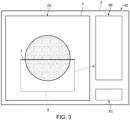
- FIG. 3 is a diagram schematically illustrating a GUI screen 2.
- the receiving unit 52 displays the GUI screen 2 on the display unit 62.
- a region 2A to set a machining region is displayed on the GUI screen 2.
- a SIM image 4 of a surface of a specimen S is displayed in the region 2A.
- the user can set the machining region by drawing a machining frame 6 on the SIM image 4.
- a region of the specimen S corresponding to the region on the SIM image 4 enclosed by the machining frame 6 is set as the machining region.
- the machining frame 6 is a square, for example, and the size and aspect ratio thereof can be changed.
- the user can set a position of a finish surface by specifying one side of the machining frame 6 on the SIM image 4.
- the finish surface is a final surface that is machined by the ion beam IB, and becomes the cross section (machining target) of the specimen S.
- the direction of scanning with the ion beam IB is determined by setting the position of the finish surface.
- a side 7 of the machining frame 6 is specified as the finish surface, and scanning with the ion beam IB is started from a side 8 on the opposite side of the side 7.
- the setting of the machining region and the setting of the finish surface are performed by the user via the operation unit 60.
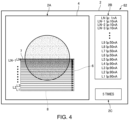
- FIG. 4 is a diagram schematically illustrating the GUI screen 2.
- An entry field 2B to set the machining conditions is displayed on the GUI screen 2.
- a plurality of machining conditions can be set for one machining region.
- the machining conditions can be set for each scanning line.
- an emission current Ip of the ion beam IB will be described.
- the emission current Ip can be set for each scanning line.
- a scanning line is drawn one-dimensionally, and the ion beam IB is moved in the direction perpendicular to the direction of the scanning line, then a next scanning line is drawn, and this process is repeated.
- a first scanning line L1 is drawn
- the ion beam IB is moved in a direction perpendicular to the first scanning line L1
- a second scanning line L2 is drawn parallel with the first scanning line L1.
- the scanning lines from a third scanning line L3 to an Nth scanning line LN are also drawn in the same manner, whereby the machining region can be etched.
- a number of scanning lines N is determined by the machining conditions (e.g., emission current (beam diameter)). It is also possible that after drawing the first scanning line L1 for a plurality of times at a same position, the ion beam IB is moved in a direction perpendicular to the first scanning line L1, then the second scanning line L2 is drawn for a plurality of times. In other words, a scanning line may be drawn for a plurality of times at a same position. Thereby the specimen S can be etched more deeply.
- emission current beam diameter
- the emission current Ip can be set for each scanning line.
- the emission current Ip when the first scanning line L1 is drawn, is set to 90 nA.
- the emission current Ip when the scanning lines from the second scanning line L2 to the fifth scanning line L5 are drawn, is set to 90 nA.
- the emission current Ip when the scanning lines from the sixth scanning line L6 to the ninth scanning line L9 are drawn, is set to 50 nA.
- the emission current Ip when the (N-3)th scanning line LN-3, the (N-2)th scanning line LN-2, and the (N-1)th scanning line LN-1 are drawn, is set to 10 nA. Furthermore, the emission current Ip, when the Nth scanning line LN is drawn, is set to 1 nA.
- the emission current Ip may be set for the block from the first scanning line L1 to the fifth scanning line L5 by inputting 90 nA as the emission current Ip for the block from the first scanning line L1 to the fifth scanning line L5. In this way, one emission current Ip value may be set for a plurality of scanning lines L at one time.
- the machining conditions are not limited to the emission current Ip.
- the items of the machining conditions include a machining pitch, a dwell time, machining time, acceleration voltage, machining position offset, and the like.
- the machining pitch is a distance between the scanning points of adjacent ion beams IB when the scanning lines are drawn.
- the dwell time is a dwell time of the ion beam IB at each scanning point.
- the machining time is a time required for one scanning line to scan, and if a time twice the time required for drawing one scanning line is set as the machining time, the scanning line is drawn twice at a same position. In other words, if a time twice the time required for drawing the first scanning line L1 is set as the machining time for the first scanning line L1, the first scanning line L1 is drawn twice.
- the acceleration voltage is a voltage to accelerate the ion beam IB.
- the machining position offset is for determining the edge position of the ion beam IB, and is expressed by a distance between the center of the ion beam IB and the edge of the ion beam IB. As the beam diameter decreases, the machining position offset also decreases.
- Each item of the machining conditions described above as well can be set for each scanning line L, in the same manner as the case of the emission current Ip.
- Each item of the machining conditions is set by inputting a value of each item for each scanning line in the entry field via the operation unit 60, in the same manner as the case of setting the emission current Ip.
- An entry field 2C for setting a number of times of repeating the machining is displayed on the GUI screen 2.
- the number of times of repeating the machining is set by using drawing of the first scanning line L1 to the Nth scanning line LN in the machining region as one machining unit. In other words, one time of machining is drawing the first scanning line L1 to the Nth scanning line LN.
- the repeat count can be set by the user inputting the repeat count in the entry field 2C via the operation unit 60. By repeating the machining, the machining region A can be machined more deeply.
- FIG. 5 is a diagram for explaining a cross section machining method using the focused ion beam apparatus 100.
- a deposition film is formed using the gas gun 40, so as to cover the entire machining region A. Thereby the deposition film formed on the specimen S can protect the specimen S.
- the focused ion beam apparatus 100 machines the machining region A of the specimen S set in the processing step S 100, based on the machining conditions set in the processing step S 102, and the repeat count set in the processing step S104.
- the machining region A is etched by the optical system 10 drawing the scanning lines in the machining region A, from the first scanning line L1 to the Nth scanning line LN.
- the optical system 10 operates based on the machining conditions set for the first scanning line L1.
- the optical system operates in accordance with the emission current Ip, the machining pitch, the dwell time, the machining time, the acceleration voltage, and the machining position offset, which were set for the first scanning line L1.
- 90 nA is set as the emission current Ip when drawing the first scanning line L1
- the optical system 10 operates in the same manner, in accordance with the machining conditions set for each scanning line.
- the optical system 10 repeats the machining to draw the scanning lines from the first scanning line L1 to the Nth scanning line LN for a number of times which was set in the processing step S104.
- the machining region A can be etched, and a target cross section can be acquired.
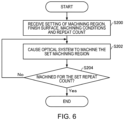
- FIG. 6 is a flow chart illustrating an example of the cross section machining processing by the processing unit 50 of the focused ion beam apparatus 100.
- the receiving unit 52 receives the setting of the machining region A, the finish surface F, the machining conditions and the repeat count, set by the user (S200).
- the receiving unit 52 stores the information on the machining region A, the information on the finish surface F, and the information on the machining conditions, set by the user, in the storage unit 64.
- the information on the machining conditions is set for each scanning line, and is stored in the storage unit 64 for each scanning line.
- control unit 54 causes the optical system 10 to machine the machining region A, based on the information on the machining region A, the finish surface F, and the machining conditions, received by the receiving unit 52 (S202).
- the control unit 54 reads optical conditions to draw the first scanning line L1 from the storage unit 64, and controls the optical system 10 based on the optical conditions. Thereby the first scanning line L1 is drawn on the specimen S. In the same manner, the control unit 54 reads the optical conditions to draw the second scanning line L2 from the storage unit 64, and controls the optical system 10 based on the optical conditions. Thereby the second scanning line L2 is drawn on the specimen S. The control unit 54 draws the scanning lines, from the first scanning line L1 to the Nth scanning line LN, in the same manner.
- the control unit 54 causes the optical system 10 to stop scanning with the ion beam IB after drawing the fifth scanning line L5 and before drawing the sixth scanning line L6, so as to switch the emission current Ip. Further, the control unit 54 adjusts the contrast and the brightness in order to correct the change of the contrast and the brightness caused by switching of the emission current Ip. Furthermore, the control unit 54 adjusts focus in order to correct the shift of focus caused by switching of the emission current Ip. Moreover, the control unit 54 corrects the shift of the machining position caused by switching of the emission current Ip.
- the control unit 54 causes the optical system 10 to draw the scanning lines from the first scanning line L1 to the Nth scanning line LN, then determines whether the machining region A has been machined for the set number of times (S204).
- control unit 54 If it is determined that the machining region A has not been machined for the set number of times (No in S204), the control unit 54 returns to the processing step S202, and causes the optical system 10 to machine the machining region A (S202). The control unit 54 repeats the processing step S202 until it is determined that the machining region A has been processed for the set number of times.
- control unit 54 ends the cross section machining processing.
- the receiving unit 52 sets the machining region A of the specimen S, and receives the setting of a plurality of machining conditions for one machining region A, and the control unit 54 causes the optical system 10 to scan the machining region A with the ion beam IB based on the plurality of machining conditions which are set for the one machining region A. Therefore in the focused ion beam apparatus 100, a plurality of machining conditions can be set for one machining region A. That is, the user need not set the machining region A every time the machining condition is changed, and can easily set a plurality of machining conditions.
- FIG. 7 is a diagram for explaining a case of setting one machining condition for one machining region.
- machining condition In the case where only one machining condition can be set for one machining region, the user must set a machining region each time a machining condition is changed, as illustrated in FIG. 7 .
- a plurality of machining conditions can be set for one machining region A, hence a plurality of machining conditions can be set easily compared with the case where only one machining condition can be set for one machining region.
- the next machining region and the next machining conditions can be set unless the previous machining ends, as illustrated in FIG. 7 .
- a plurality of machining conditions can be set for one machining region, hence such a problem does not occur.
- the machining region and the machining conditions need not be set until the machining ends.
- the receiving unit 52 receives the setting of the machining conditions for each scanning line L, and based on the machining conditions which are set for each scanning line, the control unit 54 causes the optical system 10 to scan the machining region A with the ion beam IB. Therefore in the focused ion beam apparatus 100, the machining conditions can be changed for each line when the specimen S is machined. This means that in the focused ion beam apparatus 100, the machining conditions can be changed consecutively.
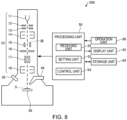
- FIG. 8 illustrates a configuration of the focused ion beam apparatus 200 according to the second embodiment.
- a composing member having a same function as a composing member of the focused ion beam apparatus 100 according to the first embodiment is denoted with the same reference sign, and detailed description thereof will be omitted.
- the user sets the emission current Ip of the ion beam IB.
- the processing unit 50 includes a setting unit 53 which sets the emission current Ip of the ion beam IB.
- FIG. 9 is a flow chart illustrating an example of the cross section machining processing by the processing unit 50 of the focused ion beam apparatus 200.
- FIG. 9 aspects different from the above mentioned processing steps of the processing unit 50 in FIG. 6 will be described, and description on aspect the same as the above mentioned processing steps of the processing unit 50 in FIG. 6 will be omitted.
- the receiving unit 52 When the user sets the machining region A, the finish surface F, the machining conditions (excluding the emission current Ip), and the repeat count via the operation unit 60, the receiving unit 52 receives the setting of the machining region A, the finish surface F, the machining conditions (excluding the emission current Ip), and the repeat count, set by the user (S300). The receiving unit 52 causes the storage unit 64 to store the received information on the machining region A, the finish surface F, the machining conditions (excluding the emission current Ip), and the repeat count.
- the setting unit 53 sets the emission current Ip for each scanning line (S302). The processing for setting the emission current Ip will be described later.
- the receiving unit 52 receives the setting of the emission current Ip performed by the setting unit 53 (S303).
- control unit 54 causes the optical system 10 to machine the machining region A, based on the information on the machining region A, the finish surface F, and the machining conditions (including the emission current Ip), received by the receiving unit 52 (S304).
- the control unit 54 reads the optical conditions to draw the first scanning line L1 from the storage unit 64, and controls the optical system 10 based on these optical conditions. Thereby the first scanning line L1 is drawn on the specimen S. In the same manner, the control unit 54 reads the optical conditions to draw the second scanning line L2, from the storage unit 64, and controls the optical system 10 based on these optical conditions. Thereby the second scanning line L2 is drawn on the specimen S.
- the control unit 54 repeats the same processing from the first scanning line L1 to the Nth scanning line LN.
- the control unit 54 causes the optical system 10 to draw the scanning lines from the first scanning line L1 to the Nth scanning line LN, then determines whether the machining region A has been machined for the set number of times (S306).
- control unit 54 If it is determined that the machining region A has not been machined for the set number of times (No in S306), the control unit 54 returns to the processing step S304, and causes the optical system 10 to machine the machining region A based on the information on the machining region A, the finish surface F, and the machining conditions (S304). The control unit 54 repeats the processing step S304 until it is determined that the machining region A has been machined for the set number of times.
- control unit 54 ends the cross section machining processing.
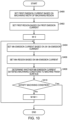
- FIG. 10 is a flow chart illustrating an example of the processing step S302 to set the emission current Ip.
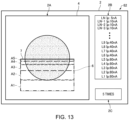
- FIGS. 11 to 13 are diagrams for explaining a method of setting the emission current Ip.
- First the setting unit 53 sets a first emission current Ip-1 based on the set machining region A, as illustrated in FIG. 11 (S400).
- the first emission current Ip-1 is the maximum emission current out of the emission currents Ip of the ion beam IB which are used to machine the machining region A.
- the setting unit 53 sets the first emission current Ip-1 based on a machining width W of the machining region A, for example.
- the machining width W is the size of the machining region A in the direction of drawing the scanning line L.
- the setting unit 53 sets the first emission current Ip-1 to a larger value as the machining width W becomes larger.
- the maximum emission current out of the emission currents that satisfy the following conditional expression (1) is set as the first emission current Ip-1. W/D > 100
- W is the machining width
- D is the beam diameter (diameter) of the ion beam IB.
- the beam diameter D of the ion beam IB corresponds to the emission current Ip.
- the beam diameter D is larger as the emission current Ip increases.
- the storage unit 64 stores a table associating the beam diameter and the emission current Ip.
- the setting unit 53 may use this table to determine the emission current Ip from the beam diameter that satisfies the above conditional expression (1).
- the storage unit 64 also stores a relational expression that associates the beam diameter and the emission current Ip, and the setting unit 53 may use this relational expression to determine the emission current Ip from the beam diameter that satisfies the above conditional expression (1).
- the method of determining the first emission current Ip-1 is not limited to the above examples, but the first emission current Ip-1 may be set based on the surface area of the set machining region A, for example. In other words, the first emission current Ip-1 may be set to be larger as the surface area of the machining region A becomes larger.
- the setting unit 53 may also determine the first emission current Ip-1 from the surface area of the machining region A, using the table or the relational expression which is stored in the storage unit 64 and associates the surface area of the machining region A and the first emission current Ip-1.
- the machining region A can be machined at a larger emission current as the surface area of the machining region A is larger, hence the machining region A can be machined efficiently in a short time. Further, a maximum emission current may be set based on the size of the set machining region A in the direction perpendicular to the direction of drawing the scanning lines L.
- the setting unit 53 sets a first region A1 to be machined with the first emission current Ip-1 (S402).
- the setting unit 53 Based on the first emission current Ip-1, the setting unit 53 sets the first region A1 to be machined with the first emission current Ip-1.
- the setting unit 53 sets the first region A1 such that a distance D1 to the finish surface F becomes larger as the first emission current Ip-1 is larger.
- the distance D1 is the shortest distance of the distances between the finish surface F and the first region A1 in the direction perpendicular to the direction of drawing the scanning line L.
- the storage unit 64 stores a table associating the emission current Ip and a distance at which the finish surface F is not damaged when this emission current Ip is used for machining.
- the setting unit 53 refers to this table to acquire information on the distance D1 from the first emission current Ip-1.
- the setting unit 53 sets the first region A1 based on the acquired information on the distance D1. In other words, the setting unit 53 sets a region that is distant from the finish surface F by at least the distance D 1, out of the machining region A, as the first region A1.
- the machining time can be decreased while reducing damage that the ion beam IB may cause on the finish surface F.
- the setting unit 53 sets a number of scanning lines L in the first region A1 based on the first emission current Ip-1 (beam diameter), and the size of the first region A1 in the direction perpendicular to the direction of drawing the scanning line L in the first region A1.
- a number of the scanning lines L in the first region A1 is 5, and 5 scanning lines, from the first scanning line L1 to the fifth scanning line L5, are drawn in the first region A1.
- the first emission current Ip-1 is set to 80 nA for each scanning line of the first scanning line L1 to the fifth scanning line L5.
- the emission current is used as a parameter to set the first region A1, but the parameter to set the first region A1 may be any value based on the beam diameter.
- the setting unit 53 sets a second emission current Ip-2 in a second region A2 which is machined after the first region A1 (S404), as illustrated in FIG. 12 .
- the setting unit 53 sets the second emission current Ip-2 based on the first emission current Ip-1.
- the setting unit 53 sets the second emission current Ip-2 to be a smaller current amount than the first emission current Ip-1.
- the setting unit 53 sets an emission current to acquire a beam diameter that is 1/2 of the beam diameter acquired with the first emission current Ip-1, as the second emission current Ip-2.
- the setting unit 53 may set the emission current to acquire a beam diameter that is 1/4 of the beam diameter acquired with the first emission current Ip-1, as the second emission current Ip-2.
- the setting unit 53 sets the second region A2 to be machined with the second emission current Ip-2 (S406).
- the setting unit 53 sets the second region A2 using the same method as the method of setting the first region A1. In other words, the setting unit 53 sets the second region A2 based on the second emission current Ip-2. The setting unit 53 sets the second region A2 such that a distance D2 to the finish surface F becomes larger as the second emission current Ip-2 is larger.
- the setting unit 53 sets a number of scanning lines L in the second region A2 based on the second emission current Ip-2 (beam diameter), and the size of the second region A2 in the direction perpendicular to the direction of the drawing the scanning line L in the second region A2.
- the setting unit 53 acquires the information on the distance D2 from the second emission current Ip-2, with reference to a table associating the emission current Ip and a distance at which the finish surface F is not damaged when this emission current Ip is used for machining.
- the setting unit 53 sets the second region A2 based on the acquired information on the distance D2. In other words, the setting unit 53 sets a region that is distant from the finish surface F by at least the distance D2, out of the machining region A, excluding the first region A1, as the second region A2.
- a number of scanning lines L in the second region A2 is 4, and the scanning lines, from the sixth scanning line L6 to the ninth scanning line L9, are drawn in the second region A2.
- the second emission current Ip-2 is set to 40 nA for each scanning line of the sixth scanning line L6 to the ninth scanning line L9.
- the setting unit 53 determines whether the second emission current Ip-2 satisfies the machining conditions for machining the finish surface F (S408).
- the setting unit 53 determines that the second emission current Ip-2 satisfies the machining conditions for machining the finish surface F if the following conditional expression (2) is satisfied. W/D > 2000
- the setting unit 53 determines that the emission current Ip becomes the emission current with which the finish surface F can be machined if the beam diameter D becomes sufficiently small with respect to the machining width W. In the above conditional expression (2), it is determined that the machining conditions for machining the finish surface F is satisfied if the beam diameter D becomes less than 1/2000 of the machining width W.
- the setting unit 53 returns to the processing step S404, and sets a third emission current Ip-3 based on the second emission current Ip-2 (S404).
- the third emission current Ip-3 is set to an emission current to acquire a beam diameter that is 1/2 of the beam diameter acquired with the second emission current Ip-2, in the same manner as the case of setting the second emission current Ip-2.
- the setting unit 53 sets a third region A3 to be machined with the third emission current Ip-3 based on the third emission current Ip-3 (S406).
- the third region A3 is set based on the third emission current Ip-3 (beam diameter acquired with the third emission current Ip-3), just like the case of setting the second region A2.
- the setting unit 53 determines whether the third emission current Ip-3 satisfies the machining conditions for machining the finish surface F (S408). In this way, the setting unit 53 repeats the processing steps S404, S406, S408 and S410 until the emission current Ip satisfies the machining conditions for machining the finish surface F.
- the setting unit 53 sets the Mth emission current Ip-M (M is an integer that is at least 2 and not more than N) to an emission current with which a beam diameter that is 1/2 of a beam diameter acquired with the (M-1)th emission current Ip-(M-1) (S404), and sets the Mth region AM based on the Mth emission current Ip-M (beam diameter acquired with the Mth emission current Ip-M) (S406).
- the setting unit 53 ends the processing to set the emission current.
- the emission current Ip can be set for each scanning line L.
- the upper limit of the beam diameter D is set, but both the upper limit and the lower limit of the beam diameter D may be set as well.
- the processing step S408 which determines whether the machining condition for machining the finish surface F is satisfied after setting the Mth emission current Ip-M, it may be determined that the machining condition for machining the finish surface F is satisfied if the following conditional expression (3) is satisfied. 2000 ⁇ W/D ⁇ 10000
- the setting unit 53 sets the Mth emission current Ip-M to a current amount with which the beam diameter D that satisfies the relational expression (3) can be acquired, and ends the processing to set the emission current Ip.
- the focused ion beam apparatus 200 includes the setting unit 53 to set the emission current Ip of the ion beam IB, and the setting unit 53 sets the first emission current Ip-1 which is the maximum emission current of the ion beam IB based on the set machining region A. Therefore in the focused ion beam apparatus 200, the step for the user to set the maximum emission current can be omitted.
- the first emission current Ip-1 is set based on the machining width W of the machining region A. Therefore in the focused ion beam apparatus 200, the step for the user to set the maximum emission current can be omitted.
- the first emission current Ip-1 may be set based on the surface area of the machining region A. Therefore in the focused ion beam apparatus 200, the step for the user to set the maximum emission current can be omitted.
- the setting unit 53 sets the first region A1 which is machined with the first emission current Ip-1 out of the machining region A, based on the first emission current Ip-1. Therefore in the focused ion beam apparatus 200, the step for the user to set the first region A1 which is machined with the maximum emission current can be omitted.
- the setting unit 53 sets the second emission current Ip-2 in the second region A2 which is machined after the first region A1, based on the first emission current Ip-1, and sets the second region A2 based on the second emission current Ip-2. Further, in the focused ion beam apparatus 200, the receiving unit 52 receives the setting of the position of the finish surface F which is the cross section of the specimen S that is a machining target. The setting unit 53 sets the second region A2 so that the distance D2 between the cross section of the specimen S which is a machining target and the second region A2 becomes smaller than the distance D1 between the finish surface F and the first region A1. Therefore in the focused ion beam apparatus 200, the step for the user to set the second region A2 to be machined with the second emission current Ip-2 can be omitted.
- the emission current Ip is automatically set, hence machining conditions appropriate for the desired cross section to be prepared can be set, even without having knowledge on the capability of the focused ion beam apparatus 200.
- the setting unit 53 sets the first emission current Ip-1 based on the machining width W of the machining region A (S400). However, the setting unit 53 also may set the first emission current Ip-1 by presenting a plurality of candidates of the first emission current Ip-1, and receiving a candidate selected by the user.
- the setting unit 53 presents a plurality of candidates out of the emission currents that satisfy the above conditional expression (1).
- the setting unit 53 presents the emission current with which the maximum beam diameter D can be acquired out of the beam diameters D that satisfy the conditional expression (1), as the first candidate of the first emission current Ip-1; the emission current which is less than the emission current of the first candidate at a predetermined ratio, as the second candidate thereof; and the emission current which is less than the emission current of the second candidate at a predetermined ratio, as the third candidate thereof.
- the first candidate, the second candidate and the third candidate are displayed on the display unit 62.
- the method of determining the candidates is not especially limited, and the emission current with which the maximum beam diameter D can be acquired out of the beam diameters D that satisfy the conditional expression (1), may be presented as the first candidate of the first emission current Ip-1; the emission current of which current amount is more than the first candidate at a predetermined ratio may be presented as the second candidate thereof; and the emission current of which current amount is less than the first candidate at a predetermined ratio, may be presented as the third candidate thereof.
- a number of candidates that are presented is not especially limited either, and the number of candidates may be 3 or more.
- the user selects one candidate from the plurality of candidates that are presented.
- the user can select one of the plurality of candidates via the operation unit 60.
- the setting unit 53 receives the selection of the candidate performed by the user via the operation unit 60. Thereby the first emission current Ip-1 is set.
- the first emission current Ip-1 can be set.
- the setting unit 53 may also present a plurality of candidates in the same manner for the processing step S404 to set the Mth emission current Ip-M (M is an integer that is at least 2 and not more than N), and set the Mth emission current Ip-M by receiving the selection of the candidate performed by the user.
- the setting unit 53 may present an emission current, to acquire a beam diameter that is 1/2 of the beam diameter acquired with the (M-1)th emission current Ip-(M-1), as the first candidate; present an emission current, to acquire a beam diameter that is 1/4 of the beam diameter acquired with the (M-1)th emission current Ip-(M-1), as the second candidate; and present an emission current, to acquire a beam diameter that is 1/8 of the beam diameter acquired with the (M-1)th emission current Ip-(M-1), as the third candidate.
- the setting unit 53 sets the emission current Ip, but the setting unit 53 may set an acceleration voltage instead.
- the acceleration voltage also corresponds to the beam diameter D, just like the case of the emission current Ip, hence the setting unit 53 may set a first acceleration voltage which is the maximum acceleration voltage, based on the machining region A, in the same manner as the case of setting the first emission current Ip-1. Further, the setting unit 53 may set a second acceleration voltage to machine the second region A2, based on the set first acceleration voltage.
- the setting unit 53 may set the acceleration voltage in the same manner as the case of setting the emission current Ip.
- the invention includes configurations that are substantially the same as the configurations described in the embodiments.
- Substantially same configurations mean configurations having the same functions or methods, for example.
- the invention also includes configurations obtained by replacing non-essential elements of the configurations described in the embodiments with other elements.
- the invention further includes configurations obtained by adding known art to the configurations described in the embodiments.
Landscapes
- Chemical & Material Sciences (AREA)
- Analytical Chemistry (AREA)
- Physics & Mathematics (AREA)
- Engineering & Computer Science (AREA)
- Plasma & Fusion (AREA)
- Drying Of Semiconductors (AREA)
- Welding Or Cutting Using Electron Beams (AREA)
- Sampling And Sample Adjustment (AREA)
Applications Claiming Priority (1)
| Application Number | Priority Date | Filing Date | Title |
|---|---|---|---|
| JP2022136135A JP7586866B2 (ja) | 2022-08-29 | 2022-08-29 | 集束イオンビーム装置 |
Publications (2)
| Publication Number | Publication Date |
|---|---|
| EP4333021A2 true EP4333021A2 (fr) | 2024-03-06 |
| EP4333021A3 EP4333021A3 (fr) | 2024-03-13 |
Family
ID=87863508
Family Applications (1)
| Application Number | Title | Priority Date | Filing Date |
|---|---|---|---|
| EP23193877.0A Pending EP4333021A3 (fr) | 2022-08-29 | 2023-08-29 | Appareil à faisceau d'ions focalisé |
Country Status (3)
| Country | Link |
|---|---|
| US (1) | US20240071718A1 (fr) |
| EP (1) | EP4333021A3 (fr) |
| JP (1) | JP7586866B2 (fr) |
Citations (1)
| Publication number | Priority date | Publication date | Assignee | Title |
|---|---|---|---|---|
| JP2006313704A (ja) | 2005-05-09 | 2006-11-16 | Jeol Ltd | 集束イオンビーム装置 |
Family Cites Families (4)
| Publication number | Priority date | Publication date | Assignee | Title |
|---|---|---|---|---|
| JP3060613B2 (ja) * | 1991-07-12 | 2000-07-10 | 株式会社日立製作所 | 集束イオンビーム装置、及び集束イオンビームを用いた断面加工方法 |
| JPH11260307A (ja) * | 1998-03-12 | 1999-09-24 | Jeol Ltd | 集束イオンビーム装置 |
| JP4253553B2 (ja) | 2003-09-29 | 2009-04-15 | 株式会社日立ハイテクノロジーズ | 荷電粒子線を用いた成膜方法と選択エッチング方法および荷電粒子線装置 |
| JP4660177B2 (ja) | 2004-12-08 | 2011-03-30 | 日本電子株式会社 | 試料加工方法及び試料加工装置 |
-
2022
- 2022-08-29 JP JP2022136135A patent/JP7586866B2/ja active Active
-
2023
- 2023-08-28 US US18/238,715 patent/US20240071718A1/en active Pending
- 2023-08-29 EP EP23193877.0A patent/EP4333021A3/fr active Pending
Patent Citations (1)
| Publication number | Priority date | Publication date | Assignee | Title |
|---|---|---|---|---|
| JP2006313704A (ja) | 2005-05-09 | 2006-11-16 | Jeol Ltd | 集束イオンビーム装置 |
Also Published As
| Publication number | Publication date |
|---|---|
| JP2024032464A (ja) | 2024-03-12 |
| EP4333021A3 (fr) | 2024-03-13 |
| US20240071718A1 (en) | 2024-02-29 |
| JP7586866B2 (ja) | 2024-11-19 |
Similar Documents
| Publication | Publication Date | Title |
|---|---|---|
| US4894541A (en) | Apparatus utilizing charged-particle beam | |
| JP4426871B2 (ja) | Fib/sem複合装置の画像ノイズ除去 | |
| EP0573891B1 (fr) | Appareil à faisceau de particules chargées et son procédé d'utilisation | |
| US10984981B2 (en) | Charged particle beam device having inspection scan direction based on scan with smaller dose | |
| US7705300B2 (en) | Charged particle beam adjusting method and charged particle beam apparatus | |
| US20040173749A1 (en) | Method and device for observing a specimen in a field of view of an electron microscope | |
| EP3985711A1 (fr) | Dispositif de faisceau par particules chargées | |
| US6118122A (en) | Ion beam working apparatus | |
| JP4194526B2 (ja) | 荷電粒子線の調整方法、及び荷電粒子線装置 | |
| US20180240641A1 (en) | Charged particle beam apparatus and alignment adjustment method of sample stage | |
| EP2940711A1 (fr) | Dispositif et procédé de calcul de quantité de dérive et système à faisceau de particules chargées | |
| EP4333021A2 (fr) | Appareil à faisceau d'ions focalisé | |
| JPH05290787A (ja) | 走査電子顕微鏡 | |
| EP4250330A1 (fr) | Appareil à faisceau de particules chargées | |
| JPH09259810A (ja) | 集束イオンビーム装置の被観察物解析方法 | |
| EP3401942A1 (fr) | Microscope électronique et procédé de commande | |
| US10662059B2 (en) | Micro-electro-mechanical-systems processing method, and micro-electro-mechanical-systems processing apparatus | |
| JP4431624B2 (ja) | 荷電粒子線調整方法、及び荷電粒子線装置 | |
| US11742176B2 (en) | Transmission electron microscope and method of adjusting optical system | |
| EP4266346A1 (fr) | Système à faisceau de particules chargées et son procédé de commande | |
| EP4415021B1 (fr) | Microscope électronique, procédé de correction d'aberration et procédé d'imagerie | |
| JP6995024B2 (ja) | 分析装置 | |
| US20160163507A1 (en) | Deposition Method and Focused Ion Beam System | |
| WO2024142368A1 (fr) | Dispositif à faisceau de particules chargées et procédé de réglage de dispositif à faisceau de particules chargées | |
| JP2023043500A (ja) | 荷電粒子線装置および画像取得方法 |
Legal Events
| Date | Code | Title | Description |
|---|---|---|---|
| PUAI | Public reference made under article 153(3) epc to a published international application that has entered the european phase |
Free format text: ORIGINAL CODE: 0009012 |
|
| STAA | Information on the status of an ep patent application or granted ep patent |
Free format text: STATUS: THE APPLICATION HAS BEEN PUBLISHED |
|
| PUAL | Search report despatched |
Free format text: ORIGINAL CODE: 0009013 |
|
| AK | Designated contracting states |
Kind code of ref document: A2 Designated state(s): AL AT BE BG CH CY CZ DE DK EE ES FI FR GB GR HR HU IE IS IT LI LT LU LV MC ME MK MT NL NO PL PT RO RS SE SI SK SM TR |
|
| AK | Designated contracting states |
Kind code of ref document: A3 Designated state(s): AL AT BE BG CH CY CZ DE DK EE ES FI FR GB GR HR HU IE IS IT LI LT LU LV MC ME MK MT NL NO PL PT RO RS SE SI SK SM TR |
|
| RIC1 | Information provided on ipc code assigned before grant |
Ipc: H01J 37/305 20060101ALI20240202BHEP Ipc: H01J 37/302 20060101AFI20240202BHEP |
|
| STAA | Information on the status of an ep patent application or granted ep patent |
Free format text: STATUS: REQUEST FOR EXAMINATION WAS MADE |
|
| 17P | Request for examination filed |
Effective date: 20240819 |
|
| RBV | Designated contracting states (corrected) |
Designated state(s): AL AT BE BG CH CY CZ DE DK EE ES FI FR GB GR HR HU IE IS IT LI LT LU LV MC ME MK MT NL NO PL PT RO RS SE SI SK SM TR |
|
| RAP3 | Party data changed (applicant data changed or rights of an application transferred) |
Owner name: JEOL LTD. |