EP4333431A1 - Contraintes de syntaxe dans la signalisation d'ensembles de paramètres de sous-images - Google Patents
Contraintes de syntaxe dans la signalisation d'ensembles de paramètres de sous-images Download PDFInfo
- Publication number
- EP4333431A1 EP4333431A1 EP23214125.9A EP23214125A EP4333431A1 EP 4333431 A1 EP4333431 A1 EP 4333431A1 EP 23214125 A EP23214125 A EP 23214125A EP 4333431 A1 EP4333431 A1 EP 4333431A1
- Authority
- EP
- European Patent Office
- Prior art keywords
- flag
- picture
- equal
- pic
- sub
- Prior art date
- Legal status (The legal status is an assumption and is not a legal conclusion. Google has not performed a legal analysis and makes no representation as to the accuracy of the status listed.)
- Pending
Links
Images







Classifications
-
- H—ELECTRICITY
- H04—ELECTRIC COMMUNICATION TECHNIQUE
- H04N—PICTORIAL COMMUNICATION, e.g. TELEVISION
- H04N19/00—Methods or arrangements for coding, decoding, compressing or decompressing digital video signals
- H04N19/10—Methods or arrangements for coding, decoding, compressing or decompressing digital video signals using adaptive coding
- H04N19/102—Methods or arrangements for coding, decoding, compressing or decompressing digital video signals using adaptive coding characterised by the element, parameter or selection affected or controlled by the adaptive coding
- H04N19/117—Filters, e.g. for pre-processing or post-processing
-
- H—ELECTRICITY
- H04—ELECTRIC COMMUNICATION TECHNIQUE
- H04N—PICTORIAL COMMUNICATION, e.g. TELEVISION
- H04N19/00—Methods or arrangements for coding, decoding, compressing or decompressing digital video signals
- H04N19/10—Methods or arrangements for coding, decoding, compressing or decompressing digital video signals using adaptive coding
- H04N19/102—Methods or arrangements for coding, decoding, compressing or decompressing digital video signals using adaptive coding characterised by the element, parameter or selection affected or controlled by the adaptive coding
- H04N19/119—Adaptive subdivision aspects, e.g. subdivision of a picture into rectangular or non-rectangular coding blocks
-
- H—ELECTRICITY
- H04—ELECTRIC COMMUNICATION TECHNIQUE
- H04N—PICTORIAL COMMUNICATION, e.g. TELEVISION
- H04N19/00—Methods or arrangements for coding, decoding, compressing or decompressing digital video signals
- H04N19/10—Methods or arrangements for coding, decoding, compressing or decompressing digital video signals using adaptive coding
- H04N19/102—Methods or arrangements for coding, decoding, compressing or decompressing digital video signals using adaptive coding characterised by the element, parameter or selection affected or controlled by the adaptive coding
- H04N19/132—Sampling, masking or truncation of coding units, e.g. adaptive resampling, frame skipping, frame interpolation or high-frequency transform coefficient masking
-
- H—ELECTRICITY
- H04—ELECTRIC COMMUNICATION TECHNIQUE
- H04N—PICTORIAL COMMUNICATION, e.g. TELEVISION
- H04N19/00—Methods or arrangements for coding, decoding, compressing or decompressing digital video signals
- H04N19/10—Methods or arrangements for coding, decoding, compressing or decompressing digital video signals using adaptive coding
- H04N19/169—Methods or arrangements for coding, decoding, compressing or decompressing digital video signals using adaptive coding characterised by the coding unit, i.e. the structural portion or semantic portion of the video signal being the object or the subject of the adaptive coding
- H04N19/17—Methods or arrangements for coding, decoding, compressing or decompressing digital video signals using adaptive coding characterised by the coding unit, i.e. the structural portion or semantic portion of the video signal being the object or the subject of the adaptive coding the unit being an image region, e.g. an object
- H04N19/174—Methods or arrangements for coding, decoding, compressing or decompressing digital video signals using adaptive coding characterised by the coding unit, i.e. the structural portion or semantic portion of the video signal being the object or the subject of the adaptive coding the unit being an image region, e.g. an object the region being a slice, e.g. a line of blocks or a group of blocks
-
- H—ELECTRICITY
- H04—ELECTRIC COMMUNICATION TECHNIQUE
- H04N—PICTORIAL COMMUNICATION, e.g. TELEVISION
- H04N19/00—Methods or arrangements for coding, decoding, compressing or decompressing digital video signals
- H04N19/10—Methods or arrangements for coding, decoding, compressing or decompressing digital video signals using adaptive coding
- H04N19/169—Methods or arrangements for coding, decoding, compressing or decompressing digital video signals using adaptive coding characterised by the coding unit, i.e. the structural portion or semantic portion of the video signal being the object or the subject of the adaptive coding
- H04N19/17—Methods or arrangements for coding, decoding, compressing or decompressing digital video signals using adaptive coding characterised by the coding unit, i.e. the structural portion or semantic portion of the video signal being the object or the subject of the adaptive coding the unit being an image region, e.g. an object
- H04N19/176—Methods or arrangements for coding, decoding, compressing or decompressing digital video signals using adaptive coding characterised by the coding unit, i.e. the structural portion or semantic portion of the video signal being the object or the subject of the adaptive coding the unit being an image region, e.g. an object the region being a block, e.g. a macroblock
-
- H—ELECTRICITY
- H04—ELECTRIC COMMUNICATION TECHNIQUE
- H04N—PICTORIAL COMMUNICATION, e.g. TELEVISION
- H04N19/00—Methods or arrangements for coding, decoding, compressing or decompressing digital video signals
- H04N19/10—Methods or arrangements for coding, decoding, compressing or decompressing digital video signals using adaptive coding
- H04N19/169—Methods or arrangements for coding, decoding, compressing or decompressing digital video signals using adaptive coding characterised by the coding unit, i.e. the structural portion or semantic portion of the video signal being the object or the subject of the adaptive coding
- H04N19/186—Methods or arrangements for coding, decoding, compressing or decompressing digital video signals using adaptive coding characterised by the coding unit, i.e. the structural portion or semantic portion of the video signal being the object or the subject of the adaptive coding the unit being a colour or a chrominance component
-
- H—ELECTRICITY
- H04—ELECTRIC COMMUNICATION TECHNIQUE
- H04N—PICTORIAL COMMUNICATION, e.g. TELEVISION
- H04N19/00—Methods or arrangements for coding, decoding, compressing or decompressing digital video signals
- H04N19/30—Methods or arrangements for coding, decoding, compressing or decompressing digital video signals using hierarchical techniques, e.g. scalability
- H04N19/33—Methods or arrangements for coding, decoding, compressing or decompressing digital video signals using hierarchical techniques, e.g. scalability in the spatial domain
-
- H—ELECTRICITY
- H04—ELECTRIC COMMUNICATION TECHNIQUE
- H04N—PICTORIAL COMMUNICATION, e.g. TELEVISION
- H04N19/00—Methods or arrangements for coding, decoding, compressing or decompressing digital video signals
- H04N19/46—Embedding additional information in the video signal during the compression process
-
- H—ELECTRICITY
- H04—ELECTRIC COMMUNICATION TECHNIQUE
- H04N—PICTORIAL COMMUNICATION, e.g. TELEVISION
- H04N19/00—Methods or arrangements for coding, decoding, compressing or decompressing digital video signals
- H04N19/50—Methods or arrangements for coding, decoding, compressing or decompressing digital video signals using predictive coding
- H04N19/503—Methods or arrangements for coding, decoding, compressing or decompressing digital video signals using predictive coding involving temporal prediction
- H04N19/51—Motion estimation or motion compensation
- H04N19/523—Motion estimation or motion compensation with sub-pixel accuracy
-
- H—ELECTRICITY
- H04—ELECTRIC COMMUNICATION TECHNIQUE
- H04N—PICTORIAL COMMUNICATION, e.g. TELEVISION
- H04N19/00—Methods or arrangements for coding, decoding, compressing or decompressing digital video signals
- H04N19/50—Methods or arrangements for coding, decoding, compressing or decompressing digital video signals using predictive coding
- H04N19/503—Methods or arrangements for coding, decoding, compressing or decompressing digital video signals using predictive coding involving temporal prediction
- H04N19/51—Motion estimation or motion compensation
- H04N19/53—Multi-resolution motion estimation; Hierarchical motion estimation
-
- H—ELECTRICITY
- H04—ELECTRIC COMMUNICATION TECHNIQUE
- H04N—PICTORIAL COMMUNICATION, e.g. TELEVISION
- H04N19/00—Methods or arrangements for coding, decoding, compressing or decompressing digital video signals
- H04N19/70—Methods or arrangements for coding, decoding, compressing or decompressing digital video signals characterised by syntax aspects related to video coding, e.g. related to compression standards
-
- H—ELECTRICITY
- H04—ELECTRIC COMMUNICATION TECHNIQUE
- H04N—PICTORIAL COMMUNICATION, e.g. TELEVISION
- H04N19/00—Methods or arrangements for coding, decoding, compressing or decompressing digital video signals
- H04N19/80—Details of filtering operations specially adapted for video compression, e.g. for pixel interpolation
- H04N19/82—Details of filtering operations specially adapted for video compression, e.g. for pixel interpolation involving filtering within a prediction loop
-
- H—ELECTRICITY
- H04—ELECTRIC COMMUNICATION TECHNIQUE
- H04N—PICTORIAL COMMUNICATION, e.g. TELEVISION
- H04N19/00—Methods or arrangements for coding, decoding, compressing or decompressing digital video signals
- H04N19/85—Methods or arrangements for coding, decoding, compressing or decompressing digital video signals using pre-processing or post-processing specially adapted for video compression
- H04N19/86—Methods or arrangements for coding, decoding, compressing or decompressing digital video signals using pre-processing or post-processing specially adapted for video compression involving reduction of coding artifacts, e.g. of blockiness
Definitions
- This document is related to video and image coding and decoding technologies.
- Digital video accounts for the largest bandwidth use on the internet and other digital communication networks. As the number of connected user devices capable of receiving and displaying video increases, it is expected that the bandwidth demand for digital video usage will continue to grow.
- the disclosed techniques may be used by video or image decoder or encoder embodiments for in which sub-picture based coding or decoding is performed.
- a method of video processing includes performing a conversion between a picture of a video and a bitstream representation of the video.
- the picture comprises one or more sub-pictures, and the bitstream representation conforms to a format rule that specifies that a length of a syntax element is equal to Ceil(Log2(SS)) bits.
- SS is greater than 0, and the syntax element indicating a horizontal or a vertical position of a top-left corner of a coding tree unit of a sub-picture of the picture.
- a method of video processing includes performing a conversion between a picture of a video and a bitstream representation of the video, wherein the picture comprises one or more sub-pictures.
- the bitstream representation conforms to a format rule that specifies that different sub-pictures have different identifiers.
- a method of video processing includes determining, for a video block in a first video region of a video, whether a position at which a temporal motion vector predictor is determined for a conversion between the video block and a bitstream representation of the current video block using an affine mode is within a second video region; and performing the conversion based on the determining.
- another method of video processing includes determining, for a video block in a first video region of a video, whether a position at which an integer sample in a reference picture is fetched for a conversion between the video block and a bitstream representation of the current video block is within a second video region, wherein the reference picture is not used in an interpolation process during the conversion; and performing the conversion based on the determining.
- another method of video processing includes determining, for a video block in a first video region of a video, whether a position at which a reconstructed luma sample value is fetched for a conversion between the video block and a bitstream representation of the current video block is within a second video region; and performing the conversion based on the determining.
- another method of video processing includes determining, for a video block in a first video region of a video, whether a position at which a check regarding splitting, depth derivation or split flag signaling for the video block is performed during a conversion between the video block and a bitstream representation of the current video block is within a second video region; and performing the conversion based on the determining.
- another method of video processing includes performing a conversion between a video comprising one or more video pictures comprising one or more video blocks, and a coded representation of the video, wherein the coded representation complies with a coding syntax requirement that the conversion is not to use sub-picture coding/decoding and a dynamic resolution conversion coding/decoding tool or a reference picture resampling tool within a video unit.
- another method of video processing includes performing a conversion between a video comprising one or more video pictures comprising one or more video blocks, and a coded representation of the video, wherein the coded representation complies with a coding syntax requirement that a first syntax element subpic_grid_idx[i][j] is not larger than a second syntax element max_subpics_minus1.
- the above-described method may be implemented by a video encoder apparatus that comprises a processor.
- the above-described method may be implemented by a video decoder apparatus that comprises a processor.
- these methods may be embodied in the form of processor-executable instructions and stored on a computer-readable program medium.
- the present document provides various techniques that can be used by a decoder of image or video bitstreams to improve the quality of decompressed or decoded digital video or images.
- video is used herein to include both a sequence of pictures (traditionally called video) and individual images.
- a video encoder may also implement these techniques during the process of encoding in order to reconstruct decoded frames used for further encoding.
- Section headings are used in the present document for ease of understanding and do not limit the embodiments and techniques to the corresponding sections. As such, embodiments from one section can be combined with embodiments from other sections.
- This document is related to video coding technologies. Specifically, it is related to palette coding with employing base colors based representation in video coding. It may be applied to the existing video coding standard like HEVC, or the standard (Versatile Video Coding) to be finalized. It may be also applicable to future video coding standards or video codec.
- Video coding standards have evolved primarily through the development of the well-known ITU-T and ISO/IEC standards.
- the ITU-T produced H.261 and H.263, ISO/IEC produced MPEG-1 and MPEG-4 Visual, and the two organizations jointly produced the H.262/MPEG-2 Video and H.264/MPEG-4 Advanced Video Coding (AVC) and H.265/HEVC standards [1,2].
- AVC H.264/MPEG-4 Advanced Video Coding
- H.265/HEVC H.265/HEVC standards [1,2].
- the video coding standards are based on the hybrid video coding structure wherein temporal prediction plus transform coding are utilized.
- Joint Video Exploration Team JVET was founded by VCEG and MPEG jointly in 2015.
- JVET Joint Exploration Model
- FIG. 1 illustrates example region constraint in TMVP and sub-block TMVP.
- TMVP and sub-block TMVP it is constrained that a temporal MV can only be fetched from the collocated CTU plus a column of 4 ⁇ 4 blocks as shown in FIG. 1 .
- sub-picture-based coding techniques based on flexible tiling approach can be implemented. Summary of the sub-picture-based coding techniques includes the following:
- the length of the syntax element is Ceil( Log2( pic_height_max_in_luma_samples / 4) ) bits.
- NumSubPicGridRows pic_height_max_in_luma_samples + subpic_grid_row_height_minus1 ⁇ 4 + 3 / subpic_grid_row_height_minus1 ⁇ 4 + 4 subpic_grid_idx[ i ] [ j ] specifies the sub-picture index of the grid position (i, j).
- the length of the syntax element is Ceil( Log2( max_subpics_minus1 + 1)) bits.
- SubPicWidth[ subpic_grid_idx [ i ][ j ] ], SubPicHeight[ subpic_grid idx[ i ][ j ] ], and NumSubPics are derived as follows:
- CtbToSubPicIdx[ ctbAddrRs ] for ctbAddrRs ranging from 0 to PicSizelnCtbsY - 1, inclusive, specifying the conversion from a CTB address in picture raster scan to a sub-picture index is derived as follows: num_bricks_in_slice_minus1, when present, specifies the number of bricks in the slice minus 1. The value of num_bricks_in_slice_minus1 shall be in the range of 0 to NumBricksInPic - 1, inclusive.
- SubPicIdx SubPicLeftBoundaryPos
- SubPicTopBoundaryPos SubPicRightBoundaryPos
- SubPicBotBoundaryPos are derived as follows:
- variable currCb specifies the current luma coding block at luma location ( xCb, yCb ).
- both components of mvLXCol are set equal to 0 and availableFlagLXCol is set equal to 0.
- Output of this process is a predicted luma sample value predSampleLX L
- variable picW is set equal to pic_width_in_luma_samples and the variable picH is set equal to pic_height_in_luma_samples.
- the luma interpolation filter coefficients fb L [ p ] for each 1/16 fractional sample position p equal to xFrac L or yFrac L are specified in Table 8-10.
- the availability flag availableFlagSbCol is derived as follows.
- variable currPic specifies the current picture.
- the location (xColCb, yColCb ) of the collocated block inside ColPic is derived as follows.
- Output of this process is a predicted luma sample value predSampleLX L
- the luma interpolation filter coefficients f L [ p ] for each 1/16 fractional sample position p equal to xFrac L or yFrac L are derived as follows:
- Output of this process is a predicted chroma sample value predSampleLX C
- chroma interpolation filter coefficients f C [ p ] for each 1/32 fractional sample position p equal to xFracc or yFrac C are specified in Table 8-13.
- variable xOffset is set equal to ( sps_ref_wraparound_offset_minus1 + 1) * MinCbSizeY) / SubWidthC.
- an encoder-only temporal filter can be implemented.
- the filtering is done at the encoder side as a pre-processing step.
- Source pictures before and after the selected picture to encode are read and a block based motion compensation method relative to the selected picture is applied on those source pictures.
- Samples in the selected picture are temporally filtered using sample values after motion compensation.
- the overall filter strength is set depending on the temporal sub layer of the selected picture as well as the QP. Only pictures at temporal sub layers 0 and 1 are filtered and pictures of layer 0 are filter by a stronger filter than pictures of layer 1.
- the per sample filter strength is adjusted depending on the difference between the sample value in the selected picture and the co-located samples in motion compensated pictures so that small differences between a motion compensated picture and the selected picture are filtered more strongly than larger differences.
- a temporal filter is introduced directly after reading picture and before encoding. Below are the steps described in more detail.
- n is the number of pictures read.
- Operation 3 Two pictures before and/or after the selected picture (referred to as original picture further down) are read. In the edge cases e.g. if is the first picture or close to the last picture, only the available pictures are read.
- Operation 4 Motion of the read pictures before and after, relative to the original picture is estimated per 8x8 picture block.
- a hierarchical motion estimation scheme is used and the layers L0, L1 and L2, are illustrated in FIG. 2 .
- Subsampled pictures are generated by averaging each 2x2 block for all read pictures and the original picture, e.g. L1 in FIG. 1 .
- L2 is derived from L1 using the same subsampling method.
- FIG. 2 shows examples of different layers of the hierarchical motion estimation.
- L0 is the original resolution.
- L1 is a subsampled version of L0.
- L2 is a subsampled version of L1.
- motion estimation is done for each 16x16 block in L2.
- the squared difference is calculated for each selected motion vector and the motion vector corresponding to the smallest difference is selected.
- the selected motion vector is then used as initial value when estimating the motion in L1.
- the same is done for estimating motion in L0.
- subpixel motion is estimated for each 8x8 block by using an interpolation filter on L0.
- the VTM 6-tap interpolation filter can used: 0: 0, 0, 64, 0, 0, 0 1: 1, -3, 64, 4, -2, 0 2: 1, -6, 62, 9, -3, 1 3: 2, -8, 60, 14, -5, 1 4: 2, -9, 57, 19, -7, 2 5: 3, -10, 53, 24, -8, 2 6: 3, -11, 50, 29, -9, 2 7: 3, -11, 44, 35, -10, 3 8: 1, -7, 38, 38, -7, 1 9: 3, -10, 35, 44, -11, 3 10: 2, -9, 29, 50, -11, 3 11: 2, -8, 24, 53, -10, 3 12: 2, -7, 19, 57, -9, 2 13: 1, -5, 14, 60, -8, 2 14: 1, -3, 9, 62, -6, 1 15: 0, -2, 4, 64, -3, 1
- Operation 5 Motion compensation is applied on the pictures before and after the original picture according to the best matching motion for each block, e.g., so that the sample coordinates of the original picture in each block have the best matching coordinates in the referenced pictures.
- Operation 6 The samples of the processed one by one for the luma and chroma channels as described in the following steps.
- the new sample value, I n is calculated using the following formula.
- I o is the sample value of the original sample
- I r (i) is the intensity of the corresponding sample of motion compensated picture i
- w r ( i, a ) is the weight of motion compensated picture i when the number of available motion compensated pictures is a .
- Operation 8 The filter is applied for the current sample.
- the resulting sample value is stored separately.
- Operation 9 The filtered picture is encoded.
- a picture is divided into one or more tile rows and one or more tile columns.
- a tile is a sequence of CTUs that covers a rectangular region of a picture.
- a tile is divided into one or more bricks, each of which consisting of a number of CTU rows within the tile.
- a tile that is not partitioned into multiple bricks is also referred to as a brick.
- a brick that is a true subset of a tile is not referred to as a tile.
- a slice either contains a number of tiles of a picture or a number of bricks of a tile.
- a sub-picture contains one or more slices that collectively cover a rectangular region of a picture.
- a slice contains a sequence of tiles in a tile raster scan of a picture.
- a slice contains a number of bricks of a picture that collectively form a rectangular region of the picture. The bricks within a rectangular slice are in the order of brick raster scan of the slice.
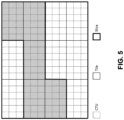
- FIG. 5 shows an example of raster-scan slice partitioning of a picture, where the picture is divided into 12 tiles and 3 raster-scan slices.
- FIG. 6 shows an example of rectangular slice partitioning of a picture, where the picture is divided into 24 tiles (6 tile columns and 4 tile rows) and 9 rectangular slices.
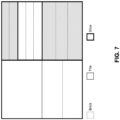
- FIG. 7 shows an example of a picture partitioned into tiles, bricks, and rectangular slices, where the picture is divided into 4 tiles (2 tile columns and 2 tile rows), 11 bricks (the top-left tile contains 1 brick, the top-right tile contains 5 bricks, the bottom-left tile contains 2 bricks, and the bottom-right tile contain 3 bricks), and 4 rectangular slices.
- slice_header( ) Descriptor slice_pic_parameter_set_id ue(v) if( rect_slice_flag ⁇ NumBricksInPic > 1) slice _ address u(v) if( !rect_slice_flag && !single_brick_per_slice_flag ) num_bricks_in_slice_minus1 ue(v) non_reference_picture_flag u(1) slice_type ue(v) ...
- NumTilesInPic is set equal to (num_tile_columns_minus1 + 1) * ( num_tile_rows_minus1 + 1 ).
- NumTilesInPic shall be greater than 1.
- a slice shall include either a number of complete tiles or only a consecutive sequence of complete bricks of one tile.
- the variable CuQpDeltaVal specifying the difference between a luma quantization parameter for the coding unit containing cu qp_delta abs and its prediction.
- the variables CuQpOffset Cb , CuQpOffsetcr, and CuQpOffset CbCr specifying values to be used when determining the respective values of the Qp' Cb , Qp'cr, and Qp' CbCr quantization parameters for the coding unit containing cu chroma qp_offset flag, are all set equal to 0.
- slice_pic_parameter_set_id specifies the value of pps_pic_parameter_set_id for the PPS in use.
- the value of slice_pic_parameter_set_id shall be in the range of 0 to 63, inclusive.
- slice_address specifies the slice address of the slice. When not present, the value of slice_address is inferred to be equal to 0.
- SubPicIdx SubPicLeftBoundaryPos
- SubPicTopBoundaryPos SubPicRightBoundaryPos
- SubPicBotBoundaryPos are derived as follows:
- pic_parameter_set_rbsp() Descriptor pps_pic_parameter_set_id ue(v) pps_seq_parameter_set_id u(4) pps_seq_parameter_set_id ue(v) pic_width_in_luma_samples ue(v) pic_height_in_luma_samples ue(v) conformance_window_flag u(1) if( conformance_window_flag ) ⁇ conf_win_left_offset ue(v) conf_win_right_offset ue(v) conf_win_top_offset ue(v) conf_win_bottom_offset ue(v) ⁇ scaling_window_flag u(1) if( scaling_window_flag ) ⁇ scaling_win_left_offset ue(v) scaling_win_right_offset ue(v)
- Temporalld of the picture header shall be greater than or equal to the value of Temporalld of the PPS that has pps_pic_parameter_set_id equal to ph_pic_parameter_set_id.
- ph_subpic_id[ i ] specifies that subpicture Id of the i-th subpicture.
- the length of the ph_subpic_id[ i ] syntax element is ph subpic_id_len_minus1 + 1 bits.
- the list SubpicIdList[ i ] is derived as follows:
- Inputs to this process are the reconstructed picture prior to deblocking, i.e., the array recPicture L and, when ChromaArrayType is not equal to 0, the arrays recPicture Cb and recPicture Cr .
- Outputs of this process are the modified reconstructed picture after deblocking, i.e., the array recPicture L and, when ChromaArrayType is not equal to 0, the arrays recPicture Cb and recPicture Cr .
- the vertical edges in a picture are filtered first. Then the horizontal edges in a picture are filtered with samples modified by the vertical edge filtering process as input.
- the vertical and horizontal edges in the CTBs of each CTU are processed separately on a coding unit basis.
- the vertical edges of the coding blocks in a coding unit are filtered starting with the edge on the left-hand side of the coding blocks proceeding through the edges towards the righthand side of the coding blocks in their geometrical order.
- the horizontal edges of the coding blocks in a coding unit are filtered starting with the edge on the top of the coding blocks proceeding through the edges towards the bottom of the coding blocks in their geometrical order.
- the deblocking filter process is applied to all coding subblock edges and transform block edges of a picture, except the following types of edges:
- edges are filtered by the following ordered steps:
- TPM triangular Prediction Mode
- HMVP History-based Motion vector Prediction
- VVC maintains a table of motion information to be used for motion vector prediction.
- the table is updated after decoding an inter-coded block, but it is not updated if the inter-coded block is TPM-coded.
- GEO geometric partition mode
- ALF Adaptive Loop-Filter
- Virtual Boundary (VB) is adopted in VVC to make ALF friendly to hardware design.
- VB Virtual Boundary
- ALF is conducted in an ALF processing unit bounded by two ALF virtual boundaries.
- CC-ALF cross-component ALF
- temporal filter is used to represent filters that require samples in other pictures.
- Max(x, y) returns the larger one of x and y.
- Min(x, y) returns the smaller one of x and y. 1.
- the position (named position RB) at which a temporal MV predictor is fetched in a picture to generate affine motion candidates e.g.
- a constructed affine merge candidate must be in a required sub-picture, assuming the top-left corner coordinate of the required sub-picture is (xTL, yTL) and bottom-right coordinate of the required sub-picture is (xBR, yBR).
- the newly added texts are bold italicized and the deleted texts are marked by "[[ ]]”.
- the fourth (collocated bottom-right) control point motion vector cpMvLXCorner[ 3 ], reference index refIdxLXComer[ 3 ], prediction list utilization flag predFlagLXCorner[ 3 ] and the availability flag availableFlagCorner[ 3 ] with X being 0 and 1 are derived as follows:
- the fourth (collocated bottom-right) control point motion vector cpMvLXCorner[ 3 ], reference index refIdxLXCorner[ 3 ], prediction list utilization flag predFlagLXCorner[ 3 ] and the availability flag availableFlagCorner[ 3 ] with X being 0 and 1 are derived as follows:
- Output of this process is a predicted luma sample value predSampleLX L
- variable shift is set equal to Max( 2, 14 - BitDepth Y ).
- variable picW is set equal to pic_width in luma samples and the variable picH is set equal to pic_height_in_luma_samples.
- predSampleLX L refPicLX L xInt yInt ⁇ shift 3
- variable sizeY is set equal to Min( CtbSizeY, 64 ).
- subpic_grid_col_width _width _minus1 plus 1 specifies the width of each element of the sub-picture identifier grid in units of ⁇ N samples.
- the length of the syntax element is Ceil( Log2( pic_width_max_in_luma_samples / 4-N ) ) ) bits.
- the variable NumSubPicGridCols is derived as follows: subpic_grid _ row_height_minus1 plus 1 specifies the height of each element of the sub-picture identifier grid in units of 4 samples.
- the length of the syntax element is Ceil( Log2( pic_height_max_in_luma_samples / 4-N ) ) bits.
- the variable NumSubPicGridRows is derived as follows:
- SubPicIdx SubPicLeftBoundaryPos
- SubPicTopBoundaryPos SubPicRightBoundaryPos
- SubPicBotBoundaryPos are derived as follows:
- pic_width_max_in_luma_samples specifies the maximum width, in units of luma samples, of each decoded picture referring to the SPS.
- pic_width_max_in_luma_samples shall not be equal to 0 and shall be an integer multiple of [[MinCbSizeY]] Max( 8, MinCbSizeY ).
- pic_height_max_in_luma_samples specifies the maximum height, in units of luma samples, of each decoded picture referring to the SPS.
- pic_height_max_in_luma_samples shall not be equal to 0 and shall be an integer multiple of [[MinCbSizeY]] Max(8, MinCbSizeY).
- variable allowBtSplit is derived as follows:
- variable allowTtSplit is derived as follows:
- SubPicRightBoundaryPos + 1 pic_width_in_luma_samples) && y1 ⁇ [[pic height in luma samples]] (subpic_treated_as_pic_flag[ SubPicIdx ] ?
- depthOffset + ( y0 + cbHeight > [[picheight_in_luma_samples]]] _ (subpic treated as pic flag[ SubPicIdx ] ? SubPicBotBoundaryPos + 1: pic heigh in luma samples) ) ?
- y1 y0 + ( cbHeight / 2 ) coding_tree( x0, y0, cbWidth, cbHeight / 2, qgOnY, qgOnC, cbSubdiv + 1, cqtDepth, mttDepth + 1, depthOffset, 0, treeType, modeType ) if( y1 ⁇ [[pic_height_in_luma_samples]] ( subpic treated as pic flag[ SubPicIdx ] ?
- SubPicRightBoundaryPos + 1 pic width in luma samples ) ) coding_tree( x1, y0, cbWidth / 2, cbHeight / 2, qgOnY, qgOnC, cbSubdiv + 2, cqtDepth + 1, 0, 0, 1, treeType, modeType ) if( y1 ⁇ [[pic_height_in_luma_samples]] ( subpic treated as pic flag[ SubPicIdx ] ?
- subpics present flag u (1) if( subpics present flag) ⁇ num subpics minus2 u(v) subpic_addr_x_length_minus1 ue(v) subpic_addr_y_length_minus1 ue(v) for( i 0; i ⁇ NumSubPics; i ++ ) ⁇ subpic ctb addr x[i] u(v) subpic ctb addr y[i] u(v) subpic ctb width minus1[i] u(v) subpic ctb height minus1[i] u(v) subpic treated as pic flag[ i ] u(1) loop filter across subpic enabled flag[ i ] u(1) ⁇ ...
- Inputs to this process are the reconstructed picture prior to deblocking, i.e., the array recPicture L and, when ChromaArrayType is not equal to 0, the arrays recPicture Cb and recPicture Cr .
- Outputs of this process are the modified reconstructed picture after deblocking, i.e., the array recPicture L and, when ChromaArrayType is not equal to 0, the arrays recPicture Cb and recPicture Cr .
- the vertical edges in a picture are filtered first. Then the horizontal edges in a picture are filtered with samples modified by the vertical edge filtering process as input.
- the vertical and horizontal edges in the CTBs of each CTU are processed separately on a coding unit basis.
- the vertical edges of the coding blocks in a coding unit are filtered starting with the edge on the left-hand side of the coding blocks proceeding through the edges towards the righthand side of the coding blocks in their geometrical order.
- the horizontal edges of the coding blocks in a coding unit are filtered starting with the edge on the top of the coding blocks proceeding through the edges towards the bottom of the coding blocks in their geometrical order.
- the deblocking filter process is applied to all coding subblock edges and transform block edges of a picture, except the following types of edges:
- the edges are filtered by the following ordered steps:
- nDp is set equal to 0 when nDp is greater than 0 and pred_mode_plt_flag of the coding unit that includes the coding block containing the sample p 0 is equal to 1, nDp is set equal to 0
- nDq is set equal to 0 when nDq is greater than 0 and pred_mode_plt_flag of the coding unit that includes the coding block containing the sample q 0 is equal to 1, nDq is set equal to 0
- nDp is set equal to 0, wherein subPicIdxP is the subpicture index of the subpicture containing the sample p 0 .
- nDq is set equal to 0, wherein subPicIdxQ is the subpicture index of the subpicture containing the sample q 0 .
- variable refMiddle is derived as follows:
- refP p maxFilterLengtP + p maxFilterLengthP ⁇ 1 + 1 ⁇ 1
- refQ q maxFilterLengtQ + q maxFilterLengthQ ⁇ 1 + 1 ⁇ 1
- p i ′ Clip 3 p i ⁇ t C ⁇ t C PD i ⁇ 1 , p i + t C ⁇ t C PD i ⁇ 1 , refMiddle ⁇ f i + refP ⁇ 64 ⁇ f i + 32 ) ⁇ 6
- q j ′ Clip 3 q j ⁇ t C ⁇ t C QD j ⁇ 1 , q j + t C ⁇ t C QD j ⁇ 1 , refMiddle ⁇ g j + refQ ⁇ 64 ⁇ g j + 32 ) ⁇ 6
- pred_mode_plt_flag of the coding unit that includes the coding block containing the sample p i is equal to 1
- pred_mode_plt_flag of the coding unit that includes the coding block containing the sample q i is equal to 1
- pred_mode_plt_flag of the coding unit that includes the coding block containing the sample p i is equal to 1
- pred_mode_plt_flag of the coding unit that includes the coding block containing the sample q i is equal to 1
- FIG. 3 is a block diagram of a video processing apparatus 300.
- the apparatus 300 may be used to implement one or more of the methods described herein.
- the apparatus 300 may be embodied in a smartphone, tablet, computer, Internet of Things (IoT) receiver, and so on.
- the apparatus 300 may include one or more processors 312, one or more memories 314 and video processing hardware 316.
- the processor(s) 312 may be configured to implement one or more methods described in the present document.
- the memory (memories) 314 may be used for storing data and code used for implementing the methods and techniques described herein.
- the video processing hardware 316 may be used to implement, in hardware circuitry, some techniques described in the present document.
- FIG. 4 is a flowchart for a method 400 of processing a video.
- the method 400 includes determining (402), for a video block in a first video region of a video, whether a position at which a temporal motion vector predictor is determined for a conversion between the video block and a bitstream representation of the current video block using an affine mode is within a second video region, and performing (404) the conversion based on the determining.
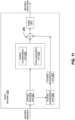
- FIG. 8 is a block diagram showing an example video processing system 800 in which various techniques disclosed herein may be implemented.
- the system 800 may include input 802 for receiving video content.
- the video content may be received in a raw or uncompressed format, e.g., 8 or 10 bit multi-component pixel values, or may be in a compressed or encoded format.
- the input 802 may represent a network interface, a peripheral bus interface, or a storage interface. Examples of network interface include wired interfaces such as Ethernet, passive optical network (PON), etc. and wireless interfaces such as Wi-Fi or cellular interfaces.
- the system 800 may include a coding component 804 that may implement the various coding or encoding methods described in the present document.
- the coding component 804 may reduce the average bitrate of video from the input 802 to the output of the coding component 804 to produce a coded representation of the video.
- the coding techniques are therefore sometimes called video compression or video transcoding techniques.
- the output of the coding component 804 may be either stored, or transmitted via a communication connected, as represented by the component 806.
- the stored or communicated bitstream (or coded) representation of the video received at the input 802 may be used by the component 808 for generating pixel values or displayable video that is sent to a display interface 810.
- the process of generating user-viewable video from the bitstream representation is sometimes called video decompression.
- certain video processing operations are referred to as "coding" operations or tools, it will be appreciated that the coding tools or operations are used at an encoder and corresponding decoding tools or operations that reverse the results of the coding will be performed by
- peripheral bus interface or a display interface may include universal serial bus (USB) or high definition multimedia interface (HDMI) or Displayport, and so on.
- storage interfaces include SATA (serial advanced technology attachment), PCI, IDE interface, and the like.
- FIG. 9 is a block diagram that illustrates an example video coding system 100 that may utilize the techniques of this disclosure.
- video coding system 100 may include a source device 110 and a destination device 120.
- Source device 110 generates encoded video data which may be referred to as a video encoding device.
- Destination device 120 may decode the encoded video data generated by source device 110 which may be referred to as a video decoding device.
- Source device 110 may include a video source 112, a video encoder 114, and an input/output (I/O) interface 116.
- Video source 112 may include a source such as a video capture device, an interface to receive video data from a video content provider, and/or a computer graphics system for generating video data, or a combination of such sources.
- the video data may comprise one or more pictures.
- Video encoder 114 encodes the video data from video source 112 to generate a bitstream.
- the bitstream may include a sequence of bits that form a coded representation of the video data.
- the bitstream may include coded pictures and associated data.
- the coded picture is a coded representation of a picture.
- the associated data may include sequence parameter sets, picture parameter sets, and other syntax structures.
- I/O interface 116 may include a modulator/demodulator (modem) and/or a transmitter.
- the encoded video data may be transmitted directly to destination device 120 via I/O interface 116 through network 130a.
- the encoded video data may also be stored onto a storage medium/server 130b for access by destination device 120.
- Destination device 120 may include an I/O interface 126, a video decoder 124, and a display device 122.
- I/O interface 126 may include a receiver and/or a modem. I/O interface 126 may acquire encoded video data from the source device 110 or the storage medium/ server 130b. Video decoder 124 may decode the encoded video data. Display device 122 may display the decoded video data to a user. Display device 122 may be integrated with the destination device 120, or may be external to destination device 120 which be configured to interface with an external display device.
- Video encoder 114 and video decoder 124 may operate according to a video compression standard, such as the High Efficiency Video Coding (HEVC) standard, Versatile Video Coding (VVC) standard and other current and/or further standards.
- HEVC High Efficiency Video Coding
- VVC Versatile Video Coding
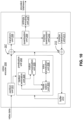
- FIG. 10 is a block diagram illustrating an example of video encoder 200, which may be video encoder 114 in the system 100 illustrated in FIG. 9 .
- Video encoder 200 may be configured to perform any or all of the techniques of this disclosure.
- video encoder 200 includes a plurality of functional components. The techniques described in this disclosure may be shared among the various components of video encoder 200.
- a processor may be configured to perform any or all of the techniques described in this disclosure.
- the functional components of video encoder 200 may include a partition unit 201, a predication unit 202 which may include a mode select unit 203, a motion estimation unit 204, a motion compensation unit 205 and an intra prediction unit 206, a residual generation unit 207, a transform unit 208, a quantization unit 209, an inverse quantization unit 210, an inverse transform unit 211, a reconstruction unit 212, a buffer 213, and an entropy encoding unit 214.
- a partition unit 201 may include a mode select unit 203, a motion estimation unit 204, a motion compensation unit 205 and an intra prediction unit 206, a residual generation unit 207, a transform unit 208, a quantization unit 209, an inverse quantization unit 210, an inverse transform unit 211, a reconstruction unit 212, a buffer 213, and an entropy encoding unit 214.
- video encoder 200 may include more, fewer, or different functional components.
- predication unit 202 may include an intra block copy (IBC) unit.
- the IBC unit may perform predication in an IBC mode in which at least one reference picture is a picture where the current video block is located.
- IBC intra block copy
- motion estimation unit 204 and motion compensation unit 205 may be highly integrated, but are represented in the example of FIG. 5 separately for purposes of explanation.
- Partition unit 201 may partition a picture into one or more video blocks.
- Video encoder 200 and video decoder 300 may support various video block sizes.
- Mode select unit 203 may select one of the coding modes, intra or inter, e.g., based on error results, and provide the resulting intra- or inter-coded block to a residual generation unit 207 to generate residual block data and to a reconstruction unit 212 to reconstruct the encoded block for use as a reference picture.
- Mode select unit 203 may select a combination of intra and inter predication (CIIP) mode in which the predication is based on an inter predication signal and an intra predication signal.
- CIIP intra and inter predication
- Mode select unit 203 may also select a resolution for a motion vector (e.g., a sub-pixel or integer pixel precision) for the block in the case of inter-predication.
- motion estimation unit 204 may generate motion information for the current video block by comparing one or more reference frames from buffer 213 to the current video block.
- Motion compensation unit 205 may determine a predicted video block for the current video block based on the motion information and decoded samples of pictures from buffer 213 other than the picture associated with the current video block.
- Motion estimation unit 204 and motion compensation unit 205 may perform different operations for a current video block, for example, depending on whether the current video block is in an I slice, a P slice, or a B slice.
- motion estimation unit 204 may perform uni-directional prediction for the current video block, and motion estimation unit 204 may search reference pictures of list 0 or list 1 for a reference video block for the current video block. Motion estimation unit 204 may then generate a reference index that indicates the reference picture in list 0 or list 1 that contains the reference video block and a motion vector that indicates a spatial displacement between the current video block and the reference video block. Motion estimation unit 204 may output the reference index, a prediction direction indicator, and the motion vector as the motion information of the current video block. Motion compensation unit 205 may generate the predicted video block of the current block based on the reference video block indicated by the motion information of the current video block.
- motion estimation unit 204 may perform bi-directional prediction for the current video block, motion estimation unit 204 may search the reference pictures in list 0 for a reference video block for the current video block and may also search the reference pictures in list 1 for another reference video block for the current video block. Motion estimation unit 204 may then generate reference indexes that indicate the reference pictures in list 0 and list 1 containing the reference video blocks and motion vectors that indicate spatial displacements between the reference video blocks and the current video block. Motion estimation unit 204 may output the reference indexes and the motion vectors of the current video block as the motion information of the current video block. Motion compensation unit 205 may generate the predicted video block of the current video block based on the reference video blocks indicated by the motion information of the current video block.
- motion estimation unit 204 may output a full set of motion information for decoding processing of a decoder.
- motion estimation unit 204 may do not output a full set of motion information for the current video. Rather, motion estimation unit 204 may signal the motion information of the current video block with reference to the motion information of another video block. For example, motion estimation unit 204 may determine that the motion information of the current video block is sufficiently similar to the motion information of a neighboring video block.
- motion estimation unit 204 may indicate, in a syntax structure associated with the current video block, a value that indicates to the video decoder 300 that the current video block has the same motion information as the another video block.
- motion estimation unit 204 may identify, in a syntax structure associated with the current video block, another video block and a motion vector difference (MVD).
- the motion vector difference indicates a difference between the motion vector of the current video block and the motion vector of the indicated video block.
- the video decoder 300 may use the motion vector of the indicated video block and the motion vector difference to determine the motion vector of the current video block.
- video encoder 200 may predictively signal the motion vector.
- Two examples of predictive signaling techniques that may be implemented by video encoder 200 include advanced motion vector predication (AMVP) and merge mode signaling.
- AMVP advanced motion vector predication
- merge mode signaling merge mode signaling
- Intra prediction unit 206 may perform intra prediction on the current video block. When intra prediction unit 206 performs intra prediction on the current video block, intra prediction unit 206 may generate prediction data for the current video block based on decoded samples of other video blocks in the same picture.
- the prediction data for the current video block may include a predicted video block and various syntax elements.
- Residual generation unit 207 may generate residual data for the current video block by subtracting (e.g., indicated by the minus sign) the predicted video block(s) of the current video block from the current video block.
- the residual data of the current video block may include residual video blocks that correspond to different sample components of the samples in the current video block.
- residual generation unit 207 may not perform the subtracting operation.
- Transform processing unit 208 may generate one or more transform coefficient video blocks for the current video block by applying one or more transforms to a residual video block associated with the current video block.
- quantization unit 209 may quantize the transform coefficient video block associated with the current video block based on one or more quantization parameter (QP) values associated with the current video block.
- QP quantization parameter
- Inverse quantization unit 210 and inverse transform unit 211 may apply inverse quantization and inverse transforms to the transform coefficient video block, respectively, to reconstruct a residual video block from the transform coefficient video block.
- Reconstruction unit 212 may add the reconstructed residual video block to corresponding samples from one or more predicted video blocks generated by the predication unit 202 to produce a reconstructed video block associated with the current block for storage in the buffer 213.
- loop filtering operation may be performed reduce video blocking artifacts in the video block.
- Entropy encoding unit 214 may receive data from other functional components of the video encoder 200. When entropy encoding unit 214 receives the data, entropy encoding unit 214 may perform one or more entropy encoding operations to generate entropy encoded data and output a bitstream that includes the entropy encoded data.
- FIG. 11 is a block diagram illustrating an example of video decoder 300 which may be video decoder 114 in the system 100 illustrated in FIG. 9 .
- the video decoder 300 may be configured to perform any or all of the techniques of this disclosure.
- the video decoder 300 includes a plurality of functional components.
- the techniques described in this disclosure may be shared among the various components of the video decoder 300.
- a processor may be configured to perform any or all of the techniques described in this disclosure.
- video decoder 300 includes an entropy decoding unit 301, a motion compensation unit 302, an intra prediction unit 303, an inverse quantization unit 304, an inverse transformation unit 305, and a reconstruction unit 306 and a buffer 307.
- Video decoder 300 may, in some examples, perform a decoding pass generally reciprocal to the encoding pass described with respect to video encoder 200 (e.g., FIG. 10 ).
- Entropy decoding unit 301 may retrieve an encoded bitstream.
- the encoded bitstream may include entropy coded video data (e.g., encoded blocks of video data).
- Entropy decoding unit 301 may decode the entropy coded video data, and from the entropy decoded video data, motion compensation unit 302 may determine motion information including motion vectors, motion vector precision, reference picture list indexes, and other motion information. Motion compensation unit 302 may, for example, determine such information by performing the AMVP and merge mode.
- Motion compensation unit 302 may produce motion compensated blocks, possibly performing interpolation based on interpolation filters. Identifiers for interpolation filters to be used with sub-pixel precision may be included in the syntax elements.
- Motion compensation unit 302 may use interpolation filters as used by video encoder 20 during encoding of the video block to calculate interpolated values for sub-integer pixels of a reference block. Motion compensation unit 302 may determine the interpolation filters used by video encoder 200 according to received syntax information and use the interpolation filters to produce predictive blocks.
- Motion compensation unit 302 may uses some of the syntax information to determine sizes of blocks used to encode frame(s) and/or slice(s) of the encoded video sequence, partition information that describes how each macroblock of a picture of the encoded video sequence is partitioned, modes indicating how each partition is encoded, one or more reference frames (and reference frame lists) for each inter-encoded block, and other information to decode the encoded video sequence.
- Intra prediction unit 303 may use intra prediction modes for example received in the bitstream to form a prediction block from spatially adjacent blocks.
- Inverse quantization unit 303 inverse quantizes, i.e., de-quantizes, the quantized video block coefficients provided in the bitstream and decoded by entropy decoding unit 301.
- Inverse transform unit 303 applies an inverse transform.
- Reconstruction unit 306 may sum the residual blocks with the corresponding prediction blocks generated by motion compensation unit 202 or intra-prediction unit 303 to form decoded blocks. If desired, a deblocking filter may also be applied to filter the decoded blocks in order to remove blockiness artifacts.
- the decoded video blocks are then stored in buffer 307, which provides reference blocks for subsequent motion compensation/intra predication and also produces decoded video for presentation on a display device.
- FIG. 12 is a flowchart representation of a method for video processing in accordance with the present technology.
- the method 1200 includes, at operation 1210, performing a conversion between a picture of a video and a bitstream representation of the video.
- the picture comprises one or more sub-pictures, and the bitstream representation conforms to a format rule that specifies that a length of a syntax element is equal to Ceil(Log2(SS)) bits.
- SS is greater than 0, and the syntax element indicating a horizontal or a vertical position of a top-left corner of a coding tree unit of a sub-picture of the picture.
- the format rule further specifies that a default value of a length of a second syntax element is equal to Ceil(Log2(SS)) - P, where SS is greater than 0.
- the second syntax element indicating a default width or a default height of a sub-picture of the picture.
- a maximum picture width in luma samples is represented as pic_width_max_in_luma_samples and a dimension of a coding tree block is represented as CtbSizeY.
- SS is equal to (pic_width_max_in_luma_samples + RR) / CtbSizeY in case the syntax element specifies the horizontal position of the top-left corner of the coding tree unit or the default width of the sub-picture, RR being a non-zero integer.
- a maximum picture height in luma samples is represented as pic_height_max_in_luma_samples and a dimension of a coding tree block is represented as CtbSizeY.
- SS is equal to (pic_height_max_in_luma_samples + RR) / CtbSizeY in case the syntax element specifies the vertical position of the top-left corner of the coding tree unit or the default height of the sub-picture, RR being a non-zero integer.
- RR CtbSizeY-1.
- FIG. 13 is a flowchart representation of a method for video processing in accordance with the present technology.
- the method 1300 includes, at operation 1310, performing a conversion between a picture of a video and a bitstream representation of the video, wherein the picture comprises one or more sub-pictures.
- the bitstream representation conforms to a format rule that specifies that different sub-pictures have different identifiers.
- the format rule specifies that identifiers of one or more sub-pictures are included at a video unit level, the video unit comprising a sequence parameter set, a picture parameter set, or a picture header.
- a first syntax flag at the sequence parameter set indicates whether signaling of the identifiers of the one or more sub-pictures is present at the sequence parameter set level
- a second syntax flag at the picture parameter set indicates whether signaling of the identifiers of the one or more sub-pictures is present at the picture parameter set level
- a third syntax flag at the picture header indicates whether signaling of the identifiers of the one or more sub-pictures is present at the picture header level.
- At least one of the first syntax flag, the second syntax flag, or the third syntax flag is equal to 1.
- signaling of the identifiers of the one or more sub-pictures is omitted at the picture header level in case the first syntax flag indicates that signaling of the identifiers of the one or more sub-pictures is present at the sequence parameter set level.
- the format rule specifies that identifiers of one or more sub-pictures are included in a list of sub-picture identifiers.
- the format rule specifies that a difference D[i] between SubpicIdList[i] and SubpicIdList[j] is indicated in the bitstream representation.
- P is equal to 1.
- D[i] is greater than 0.
- D[i]-1 is included in the bitstream representation.
- the list of sub-picture identifiers is determined based on an order that the sequence parameter set is considered first, the picture parameter set is considered next, and the picture header is considered last. In some embodiments, the list of sub-picture identifiers is determined based on an order that the picture head is considered first, the picture parameter set is considered next, and the sequence parameter set is considered last.
- the format rule specifies that, in case identifiers of one or more sub-pictures are omitted at one or more video unit levels, default values are assigned to the identifiers in a list of sub-picture identifiers.
- the one or more video units comprise at least a sequence parameter set, a picture parameter set, or a picture header.
- an identifier of a sub-picture in the list is denoted as SubpicIdList[i], and a default value for SubpicIdList[i] is i + P, P being an offset value.
- FIG. 14 is a flowchart representation of a method for video processing in accordance with the present technology.
- the method 1400 includes, at operation 1410, determining, for a conversion between a block of a first sub-picture of a video and a bitstream representation of the video, whether to apply a deblocking process across an edge between the block and a neighboring block of a second sub-picture based on whether a loop filtering process is allowed across subpicture boundaries.
- the method 1400 also includes, at operation 1420, performing the conversion based on the determining.
- a first syntax flag indicates whether the loop filtering process is allowed to access samples across boundaries for the first side of the edge and a second syntax flag indicates whether the loop filtering process is allowed to access samples across boundaries for the second side of the edge.
- the edge is not filtered in case at least one of the first syntax flag or the second syntax flag indicates that the loop filtering process is disallowed.
- the first syntax flag indicates that the loop filtering process is allowed to access samples across boundaries for the first side of the edge, and the edge is not filtered due to the second syntax flag indicating that the loop filtering process is disallowed to access samples across boundaries for the second side of the edge.
- the first side of the edge is filtered and whether the second side of the edge is filtered are determined separately from each other. In some embodiments, samples on the first side of the edge are filtered due to the first syntax flag being 1. In some embodiments, samples on the second side of the edge are filtered due to the second syntax flag being 1. In some embodiments, the first side of the edge is in the first sub-picture, and the second side of the edge is in the second sub-picture.
- FIG. 15 is a flowchart representation of a method for video processing in accordance with the present technology.
- the method 1500 includes, at operation 1510, performing a conversion between a video and a bitstream representation of the video.
- the bitstream representation conforms to a format rule that specifies a syntax element indicating a maximum block size used for a transform skip coding tool in a picture parameter set is signaled independently from any syntax flags in a sequence parameter set.
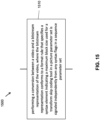
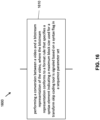
- FIG. 16 is a flowchart representation of a method for video processing in accordance with the present technology.
- the method 1600 includes, at operation 1610, performing a conversion between a video and a bitstream representation of the video.
- the bitstream representation conforms to a format rule that specifies a syntax element indicating a maximum block size used for a transform skip coding tool is signaled based on a syntax flag in a sequence parameter set.
- the syntax element is included in a sequence parameter set or a picture header.
- the syntax element comprises log2_transform_skip_max_size_minus2.
- the syntax flag in the sequence parameter set comprises sps_transform_skip_enabled_flag.
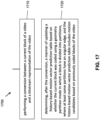
- FIG. 17 is a flowchart representation of a method for video processing in accordance with the present technology.
- the method 1700 includes, at operation 1710, performing a conversion between a current block of a video and a bitstream representation of the video.
- the method 1700 also includes, at operation 1720, determining, after the conversion, a manner of updating a history-based motion vector prediction table based on whether the current block was coded using a geometry partition mode in which a block is predicted by a weighted sum of at least two predictions. Weights for the weighted sum are generated for at least two partitions. At least some partitions have an angular edge, and wherein the history-based motion vector prediction table includes motion candidates based on previously coded blocks of the video.
- the history-based motion vector prediction table is not updated in case the current block is coded using the geometry partition mode. In some embodiments, the history-based motion vector prediction table is updated in case the current block is coded using the geometry partition mode. In some embodiments, the history-based motion vector prediction table is updated using motion information of one prediction of the current block. In some embodiments, the history-based motion vector prediction table is updated using motion information of multiple predictions of the current block.
- FIG. 18 is a flowchart representation of a method for video processing in accordance with the present technology.
- the method 1800 includes, at operation 1810, performing a conversion between a current processing unit of a video and a bitstream representation of the video using a cross-component adaptive loop filtering process in which chroma samples are filtered based on corresponding luma samples.
- the current processing unit comprises an adaptive loop filtering processing unit determined by two virtual boundaries. Luma samples that are located outside of the current processing unit are excluded for filtering chroma samples of the current processing unit.
- the luma samples that are located outside of the current processing unit are padded, and the padded luma samples are used for filtering the chroma samples of the current processing unit.
- FIG. 19 is a flowchart representation of a method for video processing in accordance with the present technology.
- the method 1900 includes, at operation 1910, performing a conversion between a current processing unit of a video and a bitstream representation of the video using a cross-component adaptive loop filtering process in which chroma samples are filtered based on corresponding luma samples.
- the current processing unit comprises an adaptive loop filtering process unit bounded by two virtual boundaries. Luma samples that are located outside of the current processing unit are used for filtering chroma samples of the current processing unit.
- the conversion generates the video from the bitstream representation. In some embodiments, the conversion generates the bitstream representation from the video.
- Some embodiments of the disclosed technology include making a decision or determination to enable a video processing tool or mode.
- the encoder when the video processing tool or mode is enabled, the encoder will use or implement the tool or mode in the processing of a block of video, but may not necessarily modify the resulting bitstream based on the usage of the tool or mode. That is, a conversion from the block of video to the bitstream representation of the video will use the video processing tool or mode when it is enabled based on the decision or determination.
- the decoder when the video processing tool or mode is enabled, the decoder will process the bitstream with the knowledge that the bitstream has been modified based on the video processing tool or mode. That is, a conversion from the bitstream representation of the video to the block of video will be performed using the video processing tool or mode that was enabled based on the decision or determination.
- Some embodiments of the disclosed technology include making a decision or determination to disable a video processing tool or mode.
- the encoder will not use the tool or mode in the conversion of the block of video to the bitstream representation of the video.
- the decoder will process the bitstream with the knowledge that the bitstream has not been modified using the video processing tool or mode that was enabled based on the decision or determination.
- the disclosed and other solutions, examples, embodiments, modules and the functional operations described in this document can be implemented in digital electronic circuitry, or in computer software, firmware, or hardware, including the structures disclosed in this document and their structural equivalents, or in combinations of one or more of them.
- the disclosed and other embodiments can be implemented as one or more computer program products, e.g., one or more modules of computer program instructions encoded on a computer readable medium for execution by, or to control the operation of, data processing apparatus.
- the computer readable medium can be a machine-readable storage device, a machine-readable storage substrate, a memory device, a composition of matter effecting a machine-readable propagated signal, or a combination of one or more them.
- data processing apparatus encompasses all apparatus, devices, and machines for processing data, including by way of example a programmable processor, a computer, or multiple processors or computers.
- the apparatus can include, in addition to hardware, code that creates an execution environment for the computer program in question, e.g., code that constitutes processor firmware, a protocol stack, a database management system, an operating system, or a combination of one or more of them.
- a propagated signal is an artificially generated signal, e.g., a machine-generated electrical, optical, or electromagnetic signal, that is generated to encode information for transmission to suitable receiver apparatus.
- a computer program (also known as a program, software, software application, script, or code) can be written in any form of programming language, including compiled or interpreted languages, and it can be deployed in any form, including as a stand-alone program or as a module, component, subroutine, or other unit suitable for use in a computing environment.
- a computer program does not necessarily correspond to a file in a file system.
- a program can be stored in a portion of a file that holds other programs or data (e.g., one or more scripts stored in a markup language document), in a single file dedicated to the program in question, or in multiple coordinated files (e.g., files that store one or more modules, sub programs, or portions of code).
- a computer program can be deployed to be executed on one computer or on multiple computers that are located at one site or distributed across multiple sites and interconnected by a communication network.
- the processes and logic flows described in this document can be performed by one or more programmable processors executing one or more computer programs to perform functions by operating on input data and generating output.
- the processes and logic flows can also be performed by, and apparatus can also be implemented as, special purpose logic circuitry, e.g., an FPGA (field programmable gate array) or an ASIC (application specific integrated circuit).
- processors suitable for the execution of a computer program include, by way of example, both general and special purpose microprocessors, and any one or more processors of any kind of digital computer.
- a processor will receive instructions and data from a read only memory or a random-access memory or both.
- the essential elements of a computer are a processor for performing instructions and one or more memory devices for storing instructions and data.
- a computer will also include, or be operatively coupled to receive data from or transfer data to, or both, one or more mass storage devices for storing data, e.g., magnetic, magneto optical disks, or optical disks.
- mass storage devices for storing data, e.g., magnetic, magneto optical disks, or optical disks.
- a computer need not have such devices.
- Computer readable media suitable for storing computer program instructions and data include all forms of non-volatile memory, media and memory devices, including by way of example semiconductor memory devices, e.g., EPROM, EEPROM, and flash memory devices; magnetic disks, e.g., internal hard disks or removable disks; magneto optical disks; and CD ROM and DVD-ROM disks.
- semiconductor memory devices e.g., EPROM, EEPROM, and flash memory devices
- magnetic disks e.g., internal hard disks or removable disks
- magneto optical disks e.g., CD ROM and DVD-ROM disks.
- the processor and the memory can be supplemented by, or incorporated in, special purpose logic circuitry.
Landscapes
- Engineering & Computer Science (AREA)
- Multimedia (AREA)
- Signal Processing (AREA)
- Compression Or Coding Systems Of Tv Signals (AREA)
Applications Claiming Priority (3)
| Application Number | Priority Date | Filing Date | Title |
|---|---|---|---|
| CN2019111807 | 2019-10-18 | ||
| PCT/CN2020/121767 WO2021073630A1 (fr) | 2019-10-18 | 2020-10-19 | Contraintes de syntaxe dans la signalisation d'ensembles de paramètres de sous-images |
| EP20876854.9A EP4032290A4 (fr) | 2019-10-18 | 2020-10-19 | Contraintes de syntaxe dans la signalisation d'ensembles de paramètres de sous-images |
Related Parent Applications (1)
| Application Number | Title | Priority Date | Filing Date |
|---|---|---|---|
| EP20876854.9A Division EP4032290A4 (fr) | 2019-10-18 | 2020-10-19 | Contraintes de syntaxe dans la signalisation d'ensembles de paramètres de sous-images |
Publications (1)
| Publication Number | Publication Date |
|---|---|
| EP4333431A1 true EP4333431A1 (fr) | 2024-03-06 |
Family
ID=75537710
Family Applications (2)
| Application Number | Title | Priority Date | Filing Date |
|---|---|---|---|
| EP23214125.9A Pending EP4333431A1 (fr) | 2019-10-18 | 2020-10-19 | Contraintes de syntaxe dans la signalisation d'ensembles de paramètres de sous-images |
| EP20876854.9A Pending EP4032290A4 (fr) | 2019-10-18 | 2020-10-19 | Contraintes de syntaxe dans la signalisation d'ensembles de paramètres de sous-images |
Family Applications After (1)
| Application Number | Title | Priority Date | Filing Date |
|---|---|---|---|
| EP20876854.9A Pending EP4032290A4 (fr) | 2019-10-18 | 2020-10-19 | Contraintes de syntaxe dans la signalisation d'ensembles de paramètres de sous-images |
Country Status (7)
| Country | Link |
|---|---|
| US (3) | US11956432B2 (fr) |
| EP (2) | EP4333431A1 (fr) |
| JP (3) | JP7482220B2 (fr) |
| KR (1) | KR102871115B1 (fr) |
| CN (3) | CN114631321B (fr) |
| MX (1) | MX2022004409A (fr) |
| WO (2) | WO2021073630A1 (fr) |
Families Citing this family (16)
| Publication number | Priority date | Publication date | Assignee | Title |
|---|---|---|---|---|
| PL4221213T3 (pl) * | 2019-01-09 | 2024-11-18 | Huawei Technologies Co., Ltd. | Koder wideo, dekoder wideo i stosowne sposoby |
| CN113796073B (zh) * | 2019-03-11 | 2025-05-02 | 瑞典爱立信有限公司 | 涉及基于gop的时间过滤的视频译码 |
| WO2020233660A1 (fr) | 2019-05-21 | 2020-11-26 | Beijing Bytedance Network Technology Co., Ltd. | Dérivation de candidat de mouvement basée sur la syntaxe dans un mode de fusion de sous-bloc |
| EP3997869A4 (fr) | 2019-08-10 | 2022-10-26 | Beijing Bytedance Network Technology Co., Ltd. | Signalisation dépendante de sous-images dans des flux de données vidéo |
| JP7322290B2 (ja) | 2019-10-02 | 2023-08-07 | 北京字節跳動網絡技術有限公司 | ビデオビットストリームにおけるサブピクチャシグナリングのための構文 |
| CN114631321B (zh) | 2019-10-18 | 2024-04-12 | 北京字节跳动网络技术有限公司 | 子图片与环路滤波之间的相互影响 |
| MX2022005385A (es) * | 2019-11-05 | 2022-07-11 | Lg Electronics Inc | Método y dispositivo para procesar información de imagen para la codificación de imágenes/video. |
| SI4044599T1 (sl) * | 2019-11-05 | 2024-05-31 | Lg Electronics Inc. | Metoda in naprava za kodiranje slik/videozapisov |
| FI4047933T3 (fi) * | 2019-11-18 | 2024-08-20 | Lg Electronics Inc | Suodatuspohjainen kuvankoodauslaite ja menetelmä |
| CN115280774B (zh) | 2019-12-02 | 2025-08-19 | 抖音视界有限公司 | 视觉媒体处理的方法、装置及非暂时性计算机可读存储介质 |
| EP4066387A4 (fr) * | 2019-12-27 | 2023-02-15 | ByteDance Inc. | Signalisation de sous-image dans des ensembles de paramètres |
| US12309406B2 (en) * | 2019-12-30 | 2025-05-20 | Sharp Kabushiki Kaisha | Systems and methods for signaling subpicture information in video coding |
| WO2021142370A1 (fr) | 2020-01-09 | 2021-07-15 | Bytedance Inc. | Contraintes sur des plages de valeurs dans des trains de bits vidéo |
| KR20220157950A (ko) | 2020-03-23 | 2022-11-29 | 베이징 바이트댄스 네트워크 테크놀로지 컴퍼니, 리미티드 | 어파인 머지 및 어파인 모션 벡터 예측 모드에 대한 예측 리파인먼트 |
| US11863786B2 (en) * | 2021-05-21 | 2024-01-02 | Varjo Technologies Oy | Method of transporting a framebuffer |
| CN115546065B (zh) * | 2022-10-29 | 2025-11-11 | 腾讯科技(深圳)有限公司 | 图像数据处理方法、装置、设备及存储介质 |
Family Cites Families (237)
| Publication number | Priority date | Publication date | Assignee | Title |
|---|---|---|---|---|
| US6047112A (en) | 1992-06-30 | 2000-04-04 | Discovision Associates | Technique for initiating processing of a data stream of encoded video information |
| GB2382940A (en) | 2001-11-27 | 2003-06-11 | Nokia Corp | Encoding objects and background blocks |
| FI114679B (fi) | 2002-04-29 | 2004-11-30 | Nokia Corp | Satunnaisaloituspisteet videokoodauksessa |
| US20040177383A1 (en) | 2003-01-24 | 2004-09-09 | Chyron Corporation | Embedded graphics metadata |
| JP3967691B2 (ja) | 2003-03-31 | 2007-08-29 | 株式会社東芝 | 情報記憶媒体と情報再生装置と情報記録再生装置 |
| KR100983268B1 (ko) | 2003-07-21 | 2010-09-24 | 엘지전자 주식회사 | 트릭 플레이시 서브픽쳐 표시 방법 |
| CN100502511C (zh) | 2004-09-14 | 2009-06-17 | 华为技术有限公司 | 用于分数像素精度运动预测的插值图像内存组织方法 |
| US7688333B2 (en) | 2007-02-28 | 2010-03-30 | Lsi Corporation | Method and/or apparatus for color space reduction for transcoding subpicture elements |
| JP5232854B2 (ja) | 2007-04-26 | 2013-07-10 | ポリコム,インク. | デブロッキング・フィルタ配列 |
| KR100891768B1 (ko) | 2007-05-02 | 2009-04-07 | 삼성전자주식회사 | 모션 벡터 탐색 방법 |
| CN101668219B (zh) | 2008-09-02 | 2012-05-23 | 华为终端有限公司 | 3d视频通信方法、发送设备和系统 |
| WO2010041857A2 (fr) | 2008-10-06 | 2010-04-15 | Lg Electronics Inc. | Procédé et appareil permettant de décoder un signal vidéo |
| US8699562B2 (en) | 2008-10-06 | 2014-04-15 | Lg Electronics Inc. | Method and an apparatus for processing a video signal with blocks in direct or skip mode |
| KR20150013776A (ko) | 2010-04-09 | 2015-02-05 | 미쓰비시덴키 가부시키가이샤 | 동화상 부호화 장치 및 동화상 복호 장치 |
| US8988531B2 (en) | 2010-07-08 | 2015-03-24 | Texas Instruments Incorporated | Method and apparatus for sub-picture based raster scanning coding order |
| US10327008B2 (en) | 2010-10-13 | 2019-06-18 | Qualcomm Incorporated | Adaptive motion vector resolution signaling for video coding |
| CN101990103B (zh) | 2010-11-10 | 2013-01-16 | 香港应用科技研究院有限公司 | 用于多视点视频编码的方法和装置 |
| US20120294353A1 (en) * | 2011-05-16 | 2012-11-22 | Mediatek Inc. | Apparatus and Method of Sample Adaptive Offset for Luma and Chroma Components |
| US9641866B2 (en) | 2011-08-18 | 2017-05-02 | Qualcomm Incorporated | Applying partition-based filters |
| CN107483928B (zh) | 2011-09-09 | 2020-05-12 | 株式会社Kt | 用于解码视频信号的方法 |
| US9699457B2 (en) | 2011-10-11 | 2017-07-04 | Qualcomm Incorporated | Most probable transform for intra prediction coding |
| US9807403B2 (en) * | 2011-10-21 | 2017-10-31 | Qualcomm Incorporated | Adaptive loop filtering for chroma components |
| US9584819B2 (en) * | 2011-10-24 | 2017-02-28 | Qualcomm Incorporated | Grouping of tiles for video coding |
| CN103891292B (zh) * | 2011-10-24 | 2018-02-02 | 寰发股份有限公司 | 视频数据环路滤波处理方法及其装置 |
| US9253481B2 (en) * | 2012-01-13 | 2016-02-02 | Qualcomm Incorporated | Determining contexts for coding transform coefficient data in video coding |
| US9451252B2 (en) | 2012-01-14 | 2016-09-20 | Qualcomm Incorporated | Coding parameter sets and NAL unit headers for video coding |
| US9332259B2 (en) * | 2012-01-18 | 2016-05-03 | Qualcomm Incorporated | Indication of use of wavefront parallel processing in video coding |
| US9538200B2 (en) | 2012-01-19 | 2017-01-03 | Qualcomm Incorporated | Signaling of deblocking filter parameters in video coding |
| US10244246B2 (en) * | 2012-02-02 | 2019-03-26 | Texas Instruments Incorporated | Sub-pictures for pixel rate balancing on multi-core platforms |
| US9967563B2 (en) * | 2012-02-03 | 2018-05-08 | Hfi Innovation Inc. | Method and apparatus for loop filtering cross tile or slice boundaries |
| US9525861B2 (en) | 2012-03-14 | 2016-12-20 | Qualcomm Incorporated | Disparity vector prediction in video coding |
| US10200709B2 (en) | 2012-03-16 | 2019-02-05 | Qualcomm Incorporated | High-level syntax extensions for high efficiency video coding |
| US9565431B2 (en) * | 2012-04-04 | 2017-02-07 | Qualcomm Incorporated | Low-delay video buffering in video coding |
| US20130294524A1 (en) | 2012-05-04 | 2013-11-07 | Qualcomm Incorporated | Transform skipping and lossless coding unification |
| US9762903B2 (en) | 2012-06-01 | 2017-09-12 | Qualcomm Incorporated | External pictures in video coding |
| US20130336406A1 (en) | 2012-06-14 | 2013-12-19 | Qualcomm Incorporated | Redundancy removal for merge/skip mode motion information candidate list construction |
| US9838685B2 (en) | 2012-06-15 | 2017-12-05 | Google Technology Holdings LLC | Method and apparatus for efficient slice header processing |
| US20140003504A1 (en) | 2012-07-02 | 2014-01-02 | Nokia Corporation | Apparatus, a Method and a Computer Program for Video Coding and Decoding |
| US9635369B2 (en) | 2012-07-02 | 2017-04-25 | Qualcomm Incorporated | Video parameter set including HRD parameters |
| US10110890B2 (en) | 2012-07-02 | 2018-10-23 | Sony Corporation | Video coding system with low delay and method of operation thereof |
| US10021394B2 (en) * | 2012-09-24 | 2018-07-10 | Qualcomm Incorporated | Hypothetical reference decoder parameters in video coding |
| US8989508B2 (en) * | 2012-09-28 | 2015-03-24 | Sharp Kabushiki Kaisha | Electronic device for signaling a sub-picture buffer parameter |
| US9491457B2 (en) | 2012-09-28 | 2016-11-08 | Qualcomm Incorporated | Signaling of regions of interest and gradual decoding refresh in video coding |
| CN104718760B (zh) | 2012-10-05 | 2019-04-05 | 寰发股份有限公司 | 用于三维和多视图视频编码的方法和装置 |
| US20150304678A1 (en) | 2012-12-26 | 2015-10-22 | Sony Corporation | Image processing device and method |
| US9674542B2 (en) | 2013-01-02 | 2017-06-06 | Qualcomm Incorporated | Motion vector prediction for video coding |
| CN116320392A (zh) | 2013-01-04 | 2023-06-23 | Ge视频压缩有限责任公司 | 高效可伸缩编码概念 |
| US20140218473A1 (en) | 2013-01-07 | 2014-08-07 | Nokia Corporation | Method and apparatus for video coding and decoding |
| KR101825575B1 (ko) | 2013-01-07 | 2018-02-05 | 노키아 테크놀로지스 오와이 | 비디오 코딩 및 디코딩 방법 및 장치 |
| US9445130B2 (en) | 2013-01-09 | 2016-09-13 | Qualcomm Incorporated | Blockiness metric for large HEVC block artifacts |
| WO2014107853A1 (fr) | 2013-01-09 | 2014-07-17 | Mediatek Singapore Pte. Ltd. | Procédés pour la dérivation d'un vecteur d'écart |
| WO2014128197A1 (fr) | 2013-02-20 | 2014-08-28 | Fraunhofer-Gesellschaft zur Förderung der angewandten Forschung e.V. | Appareil et procédé de codage ou de décodage d'un signal audio au moyen d'un chevauchement dépendant d'un emplacement de transitoire |
| US9467707B2 (en) | 2013-03-05 | 2016-10-11 | Qualcomm Incorporated | Parallel processing for video coding |
| JP6149151B2 (ja) | 2013-04-02 | 2017-06-14 | ヴィド スケール インコーポレイテッド | スケーラブルビデオコーディングのための拡張時間的動きベクトル予測 |
| US9591321B2 (en) | 2013-04-07 | 2017-03-07 | Dolby International Ab | Signaling change in output layer sets |
| US9565437B2 (en) * | 2013-04-08 | 2017-02-07 | Qualcomm Incorporated | Parameter set designs for video coding extensions |
| US10015515B2 (en) | 2013-06-21 | 2018-07-03 | Qualcomm Incorporated | Intra prediction from a predictive block |
| US9648326B2 (en) * | 2013-07-02 | 2017-05-09 | Qualcomm Incorporated | Optimizations on inter-layer prediction signalling for multi-layer video coding |
| JP2015015575A (ja) | 2013-07-04 | 2015-01-22 | シャープ株式会社 | 画像復号装置、画像符号化装置、画像復号方法、画像符号化方法、画像復号プログラムおよび画像符号化プログラム |
| EP3020186B1 (fr) | 2013-07-09 | 2022-12-07 | Nokia Technologies Oy | Procédé et appareil de codage vidéo impliquant une syntaxe pour signaler des informations de mouvement |
| US20160173887A1 (en) | 2013-07-10 | 2016-06-16 | Sharp Kabushiki Kaisha | Scaling list signaling and parameter sets activation |
| WO2015003383A1 (fr) | 2013-07-12 | 2015-01-15 | Mediatek Singapore Pte. Ltd. | Procédés de prédiction de mouvement inter-vues |
| CN105359525A (zh) | 2013-07-14 | 2016-02-24 | 夏普株式会社 | 瓦片对齐信令和一致性约束 |
| WO2015008479A1 (fr) | 2013-07-14 | 2015-01-22 | Sharp Kabushiki Kaisha | Signalisation d'indications et de contraintes |
| GB2516424A (en) | 2013-07-15 | 2015-01-28 | Nokia Corp | A method, an apparatus and a computer program product for video coding and decoding |
| WO2015006951A1 (fr) | 2013-07-18 | 2015-01-22 | Mediatek Singapore Pte. Ltd. | Procédés permettant une décision de codeur rapide |
| GB2516824A (en) | 2013-07-23 | 2015-02-11 | Nokia Corp | An apparatus, a method and a computer program for video coding and decoding |
| US20150078457A1 (en) | 2013-09-13 | 2015-03-19 | Qualcomm Incorporated | Representation format signaling in multi-layer video coding |
| CN105556975A (zh) | 2013-10-11 | 2016-05-04 | 夏普株式会社 | 信令告知用于编码的信息 |
| US20150103924A1 (en) * | 2013-10-13 | 2015-04-16 | Sharp Laboratories Of America, Inc. | On operation of decoded picture buffer for interlayer pictures |
| WO2015056941A1 (fr) | 2013-10-14 | 2015-04-23 | 한국전자통신연구원 | Procédé et appareil de codage/décodage d'images sur base multicouche |
| KR20150057591A (ko) | 2013-11-20 | 2015-05-28 | 주식회사 디오텍 | 동영상파일에 대한 자막데이터 생성방법 및 장치 |
| WO2015101716A1 (fr) * | 2014-01-03 | 2015-07-09 | Nokia Technologies Oy | Codage d'ensemble de paramètres |
| US10531116B2 (en) | 2014-01-09 | 2020-01-07 | Qualcomm Incorporated | Adaptive motion vector resolution signaling for video coding |
| US20150271515A1 (en) | 2014-01-10 | 2015-09-24 | Qualcomm Incorporated | Block vector coding for intra block copy in video coding |
| US20150215631A1 (en) | 2014-01-23 | 2015-07-30 | Broadcom Corporation | Parallel Coding with Overlapped Tiles |
| JP6280679B2 (ja) | 2014-02-24 | 2018-02-14 | 日本放送協会 | フレーム間引き装置、フレーム補間装置、映像符号化装置、映像復号装置、及びこれらのプログラム |
| KR102355224B1 (ko) * | 2014-03-16 | 2022-01-25 | 브이아이디 스케일, 인크. | 무손실 비디오 코딩의 시그널링을 위한 방법 및 장치 |
| EP3120553B1 (fr) | 2014-03-17 | 2022-02-23 | Nokia Technologies Oy | Appareil, procédé et programme d'ordinateur de codage et de décodage vidéo |
| CN108632629B9 (zh) | 2014-03-19 | 2021-06-15 | 株式会社Kt | 针对多视图视频信号生成合并候选列表的方法及解码装置 |
| US10390087B2 (en) | 2014-05-01 | 2019-08-20 | Qualcomm Incorporated | Hypothetical reference decoder parameters for partitioning schemes in video coding |
| US10750198B2 (en) | 2014-05-22 | 2020-08-18 | Qualcomm Incorporated | Maximum palette parameters in palette-based video coding |
| WO2016008157A1 (fr) | 2014-07-18 | 2016-01-21 | Mediatek Singapore Pte. Ltd. | Procédés de compensation de mouvement faisant appel au modèle de mouvement d'ordre élevé |
| WO2016048834A1 (fr) | 2014-09-26 | 2016-03-31 | Vid Scale, Inc. | Codage de copie intra-bloc avec prédiction de vecteur de bloc temporel |
| CA2961681C (fr) | 2014-09-30 | 2022-08-09 | Hfi Innovation Inc. | Procede de resolution adaptative de vecteur de mouvement pour codage video |
| US9800898B2 (en) | 2014-10-06 | 2017-10-24 | Microsoft Technology Licensing, Llc | Syntax structures indicating completion of coded regions |
| EP3206400A4 (fr) | 2014-10-06 | 2018-05-16 | Sony Corporation | Dispositif et procédé de traitement d'images |
| US9918105B2 (en) | 2014-10-07 | 2018-03-13 | Qualcomm Incorporated | Intra BC and inter unification |
| GB2564731B (en) * | 2014-10-14 | 2019-05-29 | Canon Kk | Description of image composition with HEVC still image file format |
| CN106797229B (zh) | 2014-11-20 | 2019-06-21 | 寰发股份有限公司 | 视频编码方法 |
| KR102150979B1 (ko) | 2014-12-19 | 2020-09-03 | 에이치에프아이 이노베이션 인크. | 비디오 및 이미지 코딩에서의 비-444 색채 포맷을 위한 팔레트 기반 예측의 방법 |
| US11477477B2 (en) | 2015-01-26 | 2022-10-18 | Qualcomm Incorporated | Sub-prediction unit based advanced temporal motion vector prediction |
| CN107211122B (zh) | 2015-01-29 | 2020-05-05 | 佳能株式会社 | 对自包含式编码结构进行编码或解码时的调色板预测结果初始化程序 |
| US20160234522A1 (en) | 2015-02-05 | 2016-08-11 | Microsoft Technology Licensing, Llc | Video Decoding |
| CN104702963B (zh) * | 2015-02-13 | 2017-11-24 | 北京大学 | 一种自适应环路滤波的边界处理方法及装置 |
| CN107534783B (zh) | 2015-02-13 | 2020-09-08 | 联发科技股份有限公司 | 图像中区块的调色板索引图编解码方法 |
| SG10201900582XA (en) | 2015-03-02 | 2019-02-27 | Hfi Innovation Inc | Method and apparatus for intrabc mode with fractional-pel block vector resolution in video coding |
| US11677967B2 (en) | 2015-04-21 | 2023-06-13 | Arris Enterprises Llc | Scalable video coding system with parameter signaling |
| US10200713B2 (en) | 2015-05-11 | 2019-02-05 | Qualcomm Incorporated | Search region determination for inter coding within a particular picture of video data |
| CN109005407B (zh) | 2015-05-15 | 2023-09-01 | 华为技术有限公司 | 视频图像编码和解码的方法、编码设备和解码设备 |
| JP2017017629A (ja) | 2015-07-03 | 2017-01-19 | 富士通株式会社 | 動画像符号化装置、動画像符号化方法、及びプログラム |
| CN107852490B (zh) | 2015-07-27 | 2021-01-26 | 联发科技股份有限公司 | 一种视频编解码方法及系统 |
| WO2017029400A1 (fr) | 2015-08-20 | 2017-02-23 | Koninklijke Kpn N.V. | Formation d'un ou plusieurs flux de pavés sur la base d'un ou plusieurs flux vidéo |
| US10375413B2 (en) | 2015-09-28 | 2019-08-06 | Qualcomm Incorporated | Bi-directional optical flow for video coding |
| CN109274974B (zh) | 2015-09-29 | 2022-02-11 | 华为技术有限公司 | 图像预测的方法及装置 |
| WO2017083784A1 (fr) | 2015-11-11 | 2017-05-18 | Apple Inc. | Techniques de sous-échantillonage adaptatif de la couleur et de conversion d'espace colorimétrique |
| US20190158870A1 (en) | 2016-01-07 | 2019-05-23 | Mediatek Inc. | Method and apparatus for affine merge mode prediction for video coding system |
| MY201069A (en) | 2016-02-05 | 2024-02-01 | Hfi Innovation Inc | Method and apparatus of motion compensation based on bi-directional optical flow techniques for video coding |
| TWI669946B (zh) | 2016-02-09 | 2019-08-21 | 弗勞恩霍夫爾協會 | 用於圖像/視訊資料串流而允許有效可縮減性或有效隨機存取之技術 |
| US10349067B2 (en) | 2016-02-17 | 2019-07-09 | Qualcomm Incorporated | Handling of end of bitstream NAL units in L-HEVC file format and improvements to HEVC and L-HEVC tile tracks |
| WO2017147765A1 (fr) | 2016-03-01 | 2017-09-08 | Mediatek Inc. | Procédés de compensation de mouvement affine |
| EP3414900B1 (fr) | 2016-03-15 | 2025-08-06 | HFI Innovation Inc. | Procédé et appareil de codage vidéo avec compensation de mouvement affine |
| US20170272758A1 (en) | 2016-03-16 | 2017-09-21 | Mediatek Inc. | Video encoding method and apparatus using independent partition coding and associated video decoding method and apparatus |
| US11095898B2 (en) | 2016-03-28 | 2021-08-17 | Lg Electronics Inc. | Inter-prediction mode based image processing method, and apparatus therefor |
| CN116170588A (zh) | 2016-03-30 | 2023-05-26 | 韩国电子通信研究院 | 使用画面划分信息对视频进行编码和解码的方法和设备 |
| US10834419B2 (en) | 2016-04-13 | 2020-11-10 | Qualcomm Incorporated | Conformance constraint for collocated reference index in video coding |
| KR102873107B1 (ko) | 2016-04-25 | 2025-10-17 | 엘지전자 주식회사 | 영상 코딩 시스템에서 인터 예측 방법 및 장치 |
| US10560718B2 (en) | 2016-05-13 | 2020-02-11 | Qualcomm Incorporated | Merge candidates for motion vector prediction for video coding |
| US10560712B2 (en) | 2016-05-16 | 2020-02-11 | Qualcomm Incorporated | Affine motion prediction for video coding |
| US10419755B2 (en) | 2016-05-16 | 2019-09-17 | Qualcomm Incorporated | Confusion of multiple filters in adaptive loop filtering in video coding |
| US11089323B2 (en) | 2016-05-28 | 2021-08-10 | Mediatek Inc. | Method and apparatus of current picture referencing for video coding |
| CN107566848B (zh) | 2016-06-30 | 2020-04-14 | 华为技术有限公司 | 编解码的方法及装置 |
| CN107801039B (zh) | 2016-08-30 | 2020-04-14 | 华为技术有限公司 | 运动补偿预测方法和装置 |
| US10419757B2 (en) * | 2016-08-31 | 2019-09-17 | Qualcomm Incorporated | Cross-component filter |
| US10462462B2 (en) | 2016-09-29 | 2019-10-29 | Qualcomm Incorporated | Motion vector difference coding technique for video coding |
| US20180098090A1 (en) | 2016-10-04 | 2018-04-05 | Mediatek Inc. | Method and Apparatus for Rearranging VR Video Format and Constrained Encoding Parameters |
| US10448010B2 (en) | 2016-10-05 | 2019-10-15 | Qualcomm Incorporated | Motion vector prediction for affine motion models in video coding |
| CN109983773A (zh) | 2016-11-29 | 2019-07-05 | 联发科技股份有限公司 | 用于合并模式推导的视频编解码方法和装置 |
| AU2016273973A1 (en) | 2016-12-16 | 2018-07-05 | Canon Kabushiki Kaisha | Transcode PCL delta-row compressed image to edges |
| WO2018113658A1 (fr) | 2016-12-22 | 2018-06-28 | Mediatek Inc. | Procédé et appareil d'affinement de mouvement pour codage vidéo |
| US10911761B2 (en) | 2016-12-27 | 2021-02-02 | Mediatek Inc. | Method and apparatus of bilateral template MV refinement for video coding |
| WO2018125972A1 (fr) | 2016-12-28 | 2018-07-05 | Arris Enterprises Llc | Prédiction planaire adaptative à poids inégaux |
| US10931969B2 (en) | 2017-01-04 | 2021-02-23 | Qualcomm Incorporated | Motion vector reconstructions for bi-directional optical flow (BIO) |
| US20180199057A1 (en) | 2017-01-12 | 2018-07-12 | Mediatek Inc. | Method and Apparatus of Candidate Skipping for Predictor Refinement in Video Coding |
| US10523964B2 (en) | 2017-03-13 | 2019-12-31 | Qualcomm Incorporated | Inter prediction refinement based on bi-directional optical flow (BIO) |
| US10701390B2 (en) | 2017-03-14 | 2020-06-30 | Qualcomm Incorporated | Affine motion information derivation |
| US20180310017A1 (en) | 2017-04-21 | 2018-10-25 | Mediatek Inc. | Sub-prediction unit temporal motion vector prediction (sub-pu tmvp) for video coding |
| KR102435881B1 (ko) | 2017-05-26 | 2022-08-24 | 에스케이텔레콤 주식회사 | 영상 부호화 또는 복호화하기 위한 장치 및 방법 |
| CN107277316B (zh) | 2017-06-12 | 2020-05-12 | 京东方科技集团股份有限公司 | 显示装置及其制造方法 |
| US10904565B2 (en) | 2017-06-23 | 2021-01-26 | Qualcomm Incorporated | Memory-bandwidth-efficient design for bi-directional optical flow (BIO) |
| EP3422724B1 (fr) | 2017-06-26 | 2024-05-01 | Nokia Technologies Oy | Appareil, procédé et programme informatique pour vidéo omnidirectionnelle |
| EP3649780B1 (fr) | 2017-07-03 | 2025-06-25 | InterDigital VC Holdings, Inc. | Prédiction de compensation de mouvement basée sur un flux optique bidirectionnel |
| WO2019008174A1 (fr) | 2017-07-06 | 2019-01-10 | Fraunhofer-Gesellschaft zur Förderung der angewandten Forschung e.V. | Concepts de diffusion en continu de vidéos découpées en parties |
| US10483493B2 (en) | 2017-08-01 | 2019-11-19 | Apple Inc. | Electronic device having display with thin-film encapsulation |
| US10856003B2 (en) | 2017-10-03 | 2020-12-01 | Qualcomm Incorporated | Coding affine prediction motion information for video coding |
| WO2019073112A1 (fr) | 2017-10-09 | 2019-04-18 | Nokia Technologies Oy | Appareil, procédé, et programme informatique pour un codage et un décodage vidéo |
| US11877001B2 (en) | 2017-10-10 | 2024-01-16 | Qualcomm Incorporated | Affine prediction in video coding |
| US20190116376A1 (en) | 2017-10-12 | 2019-04-18 | Qualcomm Incorporated | Motion vector predictors using affine motion model in video coding |
| JP2021016016A (ja) | 2017-10-20 | 2021-02-12 | シャープ株式会社 | 動画像符号化装置及び動画像復号装置 |
| US10776688B2 (en) | 2017-11-06 | 2020-09-15 | Nvidia Corporation | Multi-frame video interpolation using optical flow |
| US11889100B2 (en) | 2017-11-14 | 2024-01-30 | Qualcomm Incorporated | Affine motion vector prediction in video coding |
| WO2019132577A1 (fr) * | 2017-12-28 | 2019-07-04 | 한국전자통신연구원 | Procédé et dispositif d'encodage et de décodage d'image, et support d'enregistrement avec un train de bits stocké dedans |
| CN109996072B (zh) | 2018-01-03 | 2021-10-15 | 华为技术有限公司 | 视频图像的处理方法及装置 |
| WO2019136657A1 (fr) | 2018-01-11 | 2019-07-18 | Qualcomm Incorporated | Codage vidéo en utilisant une compensation d'éclairage local |
| US10757417B2 (en) | 2018-01-20 | 2020-08-25 | Qualcomm Incorporated | Affine motion compensation in video coding |
| KR102769888B1 (ko) * | 2018-01-25 | 2025-02-20 | 프라운호퍼 게젤샤프트 쭈르 푀르데룽 데어 안겐반텐 포르슝 에. 베. | 효율적인 서브 픽처 추출 |
| US11012715B2 (en) | 2018-02-08 | 2021-05-18 | Qualcomm Incorporated | Intra block copy for video coding |
| CA3092638A1 (fr) | 2018-03-01 | 2019-09-06 | Arris Enterprises Llc | Systeme et procede de stockage d'informations de mouvement pour codage video et signalisation |
| KR20250020687A (ko) | 2018-04-01 | 2025-02-11 | 광동 오포 모바일 텔레커뮤니케이션즈 코포레이션 리미티드 | 어파인 움직임 예측에 기반한 영상 코딩 방법 및 그 장치 |
| KR20190116101A (ko) | 2018-04-03 | 2019-10-14 | 인텔렉추얼디스커버리 주식회사 | 어파인 모델 기반의 영상 부호화/복호화 방법 및 장치 |
| JP2021520710A (ja) | 2018-04-06 | 2021-08-19 | ヴィド スケール インコーポレイテッド | 簡易化された勾配導出による双方向オプティカルフロー方法 |
| US11457233B2 (en) | 2018-04-12 | 2022-09-27 | Arris Enterprises Llc | Motion information storage for video coding and signaling |
| US10873748B2 (en) | 2018-05-12 | 2020-12-22 | Qualcomm Incorporated | Storage of high precision motion vectors in video coding |
| CN110636298B (zh) | 2018-06-21 | 2022-09-13 | 北京字节跳动网络技术有限公司 | 对于Merge仿射模式和非Merge仿射模式的统一约束 |
| WO2020005719A1 (fr) | 2018-06-27 | 2020-01-02 | Vid Scale, Inc. | Procédés et appareil de réduction de latence de codage d'un affinement de mouvement côté décodeur |
| CN110662037B (zh) | 2018-06-29 | 2022-06-28 | 北京字节跳动网络技术有限公司 | 运动信息共享的限制 |
| CN110662046B (zh) | 2018-06-29 | 2022-03-25 | 北京字节跳动网络技术有限公司 | 视频处理方法、装置和可读存储介质 |
| CA3105072A1 (fr) | 2018-06-29 | 2020-01-02 | Vid Scale, Inc. | Selection de point de commande adaptative pour un codage video base sur un modele de mouvement affine |
| CN110677679B (zh) | 2018-07-01 | 2022-07-26 | 北京字节跳动网络技术有限公司 | 依赖形状的帧内编码 |
| CN110677675B (zh) | 2018-07-01 | 2022-02-08 | 北京字节跳动网络技术有限公司 | 高效的仿射Merge运动矢量推导的方法、装置及存储介质 |
| CN110677669B (zh) | 2018-07-02 | 2021-12-07 | 北京字节跳动网络技术有限公司 | 具有lic的lut |
| KR102545728B1 (ko) | 2018-07-16 | 2023-06-20 | 엘지전자 주식회사 | 서브블록 단위의 시간적 움직임 정보 예측을 위한 인터 예측 방법 및 그 장치 |
| WO2020017892A1 (fr) | 2018-07-17 | 2020-01-23 | 엘지전자 주식회사 | Procédé de prédiction de vecteur de mouvement temporel à base de sous-blocs et appareil associé |
| GB2590228B (en) | 2018-08-04 | 2023-04-05 | Beijing Bytedance Network Tech Co Ltd | Clipping of updated MV or derived MV |
| JP7212150B2 (ja) | 2018-09-19 | 2023-01-24 | 北京字節跳動網絡技術有限公司 | 適応動きベクトル解像度によるアフィンモードへの構文の使用 |
| CN118474363A (zh) | 2018-09-20 | 2024-08-09 | 韩国电子通信研究院 | 图像编码/解码方法和装置及存储比特流的记录介质 |
| KR20210058947A (ko) | 2018-09-20 | 2021-05-24 | 샤프 가부시키가이샤 | 비디오 코딩에서 파라미터들을 시그널링하기 위한 시스템들 및 방법들 |
| GB2577318B (en) | 2018-09-21 | 2021-03-10 | Canon Kk | Video coding and decoding |
| WO2020058955A1 (fr) | 2018-09-23 | 2020-03-26 | Beijing Bytedance Network Technology Co., Ltd. | Mode affine à hypothèses multiples |
| WO2020058962A1 (fr) | 2018-09-23 | 2020-03-26 | Beijing Bytedance Network Technology Co., Ltd. | Signalisation d'indication de précision de vecteur de mouvement avec une résolution de vecteur de mouvement adaptative |
| WO2020058959A1 (fr) | 2018-09-23 | 2020-03-26 | Beijing Bytedance Network Technology Co., Ltd. | Dérivation de vecteur de mouvement pour sous-bloc en mode affine |
| TW202029755A (zh) | 2018-09-26 | 2020-08-01 | 美商Vid衡器股份有限公司 | 視訊編碼雙預測 |
| US10999589B2 (en) | 2018-10-04 | 2021-05-04 | Tencent America LLC | Method and apparatus for video coding |
| JP7230189B2 (ja) | 2018-10-08 | 2023-02-28 | エルジー エレクトロニクス インコーポレイティド | シンタックスデザイン方法及びシンタックスを用いてコーディングを行う装置 |
| CN111083489B (zh) | 2018-10-22 | 2024-05-14 | 北京字节跳动网络技术有限公司 | 多次迭代运动矢量细化 |
| WO2020084470A1 (fr) | 2018-10-22 | 2020-04-30 | Beijing Bytedance Network Technology Co., Ltd. | Stockage de paramètres de mouvement présentant un écrêtage destiné à un mode affine |
| WO2020084461A1 (fr) | 2018-10-22 | 2020-04-30 | Beijing Bytedance Network Technology Co., Ltd. | Restrictions sur une dérivation de vecteur de mouvement côté décodeur sur la base d'informations de codage |
| CN112913247B (zh) | 2018-10-23 | 2023-04-28 | 北京字节跳动网络技术有限公司 | 使用局部照明补偿的视频处理 |
| EP4300965A3 (fr) | 2018-11-05 | 2024-01-17 | Beijing Bytedance Network Technology Co., Ltd. | Interpolation pour inter-prédiction avec affinement |
| WO2020094057A1 (fr) | 2018-11-06 | 2020-05-14 | Beijing Bytedance Network Technology Co., Ltd. | Prédiction intra basée sur une position |
| CN109600611B (zh) * | 2018-11-09 | 2021-07-13 | 北京达佳互联信息技术有限公司 | 环路滤波方法、环路滤波装置、电子设备和可读介质 |
| WO2020098802A1 (fr) | 2018-11-15 | 2020-05-22 | Beijing Bytedance Network Technology Co., Ltd. | Fusion avec mvd pour affine |
| CN113170105B (zh) | 2018-11-16 | 2024-11-05 | 北京字节跳动网络技术有限公司 | 基于历史的仿射参数继承 |
| CN113039780B (zh) | 2018-11-17 | 2023-07-28 | 北京字节跳动网络技术有限公司 | 视频处理中用运动矢量差的Merge |
| WO2020103877A1 (fr) | 2018-11-20 | 2020-05-28 | Beijing Bytedance Network Technology Co., Ltd. | Codage et décodage de modes de codage vidéo |
| US11146810B2 (en) | 2018-11-27 | 2021-10-12 | Qualcomm Incorporated | Decoder-side motion vector refinement |
| CN113170181B (zh) | 2018-11-29 | 2023-12-08 | 北京字节跳动网络技术有限公司 | 块内拷贝模式中的仿射继承方法 |
| US11778171B2 (en) | 2019-01-02 | 2023-10-03 | Nokia Technologies Oy | Apparatus, a method and a computer program for video coding and decoding |
| US11627310B2 (en) | 2019-01-02 | 2023-04-11 | Lg Electronics Inc. | Affine motion prediction-based video decoding method and device using subblock-based temporal merge candidate in video coding system |
| WO2020140221A1 (fr) | 2019-01-02 | 2020-07-09 | 北京大学 | Procédé et dispositif de construction de liste de mv candidats |
| PL4221213T3 (pl) | 2019-01-09 | 2024-11-18 | Huawei Technologies Co., Ltd. | Koder wideo, dekoder wideo i stosowne sposoby |
| WO2020156576A1 (fr) | 2019-02-02 | 2020-08-06 | Beijing Bytedance Network Technology Co., Ltd. | Hmvp multiple pour affine |
| GB201902829D0 (en) * | 2019-03-01 | 2019-04-17 | Canon Kk | Method and apparatus for encoding and decoding a video bitsream for merging regions of interest |
| KR102825177B1 (ko) | 2019-03-11 | 2025-06-26 | 후아웨이 테크놀러지 컴퍼니 리미티드 | 인코더, 디코더, 및 대응하는 방법들 |
| US20200296405A1 (en) | 2019-03-14 | 2020-09-17 | Qualcomm Incorporated | Affine motion compensation refinement using optical flow |
| JP7669278B2 (ja) | 2019-03-17 | 2025-04-28 | 北京字節跳動網絡技術有限公司 | オプティカルフローベースの予測精緻化の計算 |
| SG11202109031TA (en) | 2019-03-18 | 2021-09-29 | Tencent America LLC | Method and apparatus for video coding |
| KR20230165888A (ko) | 2019-04-02 | 2023-12-05 | 베이징 바이트댄스 네트워크 테크놀로지 컴퍼니, 리미티드 | 양방향 광학 흐름 기반 비디오 코딩 및 디코딩 |
| JP7307192B2 (ja) | 2019-04-02 | 2023-07-11 | 北京字節跳動網絡技術有限公司 | デコーダ側の動きベクトルの導出 |
| CN113711608B (zh) | 2019-04-19 | 2023-09-01 | 北京字节跳动网络技术有限公司 | 利用光流的预测细化过程的适用性 |
| WO2020211867A1 (fr) | 2019-04-19 | 2020-10-22 | Beijing Bytedance Network Technology Co., Ltd. | Vecteur de mouvement delta dans un affinement de prédiction avec processus de flux optique |
| CN118540470A (zh) | 2019-04-19 | 2024-08-23 | 北京字节跳动网络技术有限公司 | 不同运动矢量细化中的基于区域的梯度计算 |
| CN120769050A (zh) | 2019-04-30 | 2025-10-10 | 韦勒斯标准与技术协会公司 | 一种使用自适应运动矢量分辨率处理视频信号的方法和装置 |
| US11523109B2 (en) | 2019-05-02 | 2022-12-06 | Tencent America LLC | Method and apparatus for improvements of affine prof |
| CN118101931B (zh) | 2019-05-15 | 2025-02-21 | 华为技术有限公司 | 视频译码中用于参考图像重采样的双向光流方法和设备 |
| WO2020233660A1 (fr) | 2019-05-21 | 2020-11-26 | Beijing Bytedance Network Technology Co., Ltd. | Dérivation de candidat de mouvement basée sur la syntaxe dans un mode de fusion de sous-bloc |
| US12483702B2 (en) * | 2019-06-03 | 2025-11-25 | Nokia Technologies Oy | Apparatus, a method and a computer program for video coding and decoding |
| US12143631B2 (en) | 2019-06-23 | 2024-11-12 | Sharp Kabushiki Kaisha | Systems and methods for performing an adaptive resolution change in video coding |
| EP3987813A4 (fr) | 2019-06-24 | 2023-03-08 | Sharp Kabushiki Kaisha | Systèmes et procédés permettant de réduire une erreur de reconstruction dans un codage vidéo sur la base d'une corrélation inter-composantes |
| EP3987771A4 (fr) | 2019-07-08 | 2022-08-24 | Huawei Technologies Co., Ltd. | Contraintes d'images d'unités nal mixtes dans un mécanisme de codage vidéo |
| US11641465B2 (en) * | 2019-07-25 | 2023-05-02 | Hfi Innovation Inc. | Method and apparatus of cross-component adaptive loop filtering with virtual boundary for video coding |
| BR112022002195A2 (pt) | 2019-08-06 | 2022-10-18 | Op Solutions Llc | Sinalização de gerenciamento de resolução adaptativa |
| US11363307B2 (en) | 2019-08-08 | 2022-06-14 | Hfi Innovation Inc. | Video coding with subpictures |
| EP3997869A4 (fr) | 2019-08-10 | 2022-10-26 | Beijing Bytedance Network Technology Co., Ltd. | Signalisation dépendante de sous-images dans des flux de données vidéo |
| GB2586484B (en) * | 2019-08-20 | 2023-03-08 | Canon Kk | A filter |
| WO2021049586A1 (fr) | 2019-09-13 | 2021-03-18 | パナソニック インテレクチュアル プロパティ コーポレーション オブ アメリカ | Dispositifs de codage et de décodage, procédés de codage et de décodage |
| US11202068B2 (en) | 2019-09-16 | 2021-12-14 | Mediatek Inc. | Method and apparatus of constrained cross-component adaptive loop filtering for video coding |
| US11451834B2 (en) * | 2019-09-16 | 2022-09-20 | Tencent America LLC | Method and apparatus for cross-component filtering |
| GB201913403D0 (en) | 2019-09-17 | 2019-10-30 | Canon Kk | Method and apparatus for encoding and decoding a video stream with subpictures |
| US11240507B2 (en) | 2019-09-24 | 2022-02-01 | Qualcomm Incorporated | Simplified palette predictor update for video coding |
| JP7322290B2 (ja) | 2019-10-02 | 2023-08-07 | 北京字節跳動網絡技術有限公司 | ビデオビットストリームにおけるサブピクチャシグナリングのための構文 |
| CN116016936B (zh) | 2019-10-10 | 2025-01-14 | 北京达佳互联信息技术有限公司 | 使用调色板模式的视频编解码的方法和装置 |
| CN114631321B (zh) | 2019-10-18 | 2024-04-12 | 北京字节跳动网络技术有限公司 | 子图片与环路滤波之间的相互影响 |
| CN121531144A (zh) | 2019-10-25 | 2026-02-13 | 夏普株式会社 | 用于在视频编码中发送信号通知图片信息的系统和方法 |
| US11539982B2 (en) | 2019-11-01 | 2022-12-27 | Qualcomm Incorporated | Merge estimation region for multi-type-tree block structure |
| CN115280774B (zh) | 2019-12-02 | 2025-08-19 | 抖音视界有限公司 | 视觉媒体处理的方法、装置及非暂时性计算机可读存储介质 |
| US11212523B2 (en) | 2020-01-12 | 2021-12-28 | Mediatek Inc. | Video processing methods and apparatuses of merge number signaling in video coding systems |
-
2020
- 2020-10-19 CN CN202080073104.9A patent/CN114631321B/zh active Active
- 2020-10-19 CN CN202080073106.8A patent/CN114631317B/zh active Active
- 2020-10-19 MX MX2022004409A patent/MX2022004409A/es unknown
- 2020-10-19 WO PCT/CN2020/121767 patent/WO2021073630A1/fr not_active Ceased
- 2020-10-19 KR KR1020227011664A patent/KR102871115B1/ko active Active
- 2020-10-19 CN CN202311518164.9A patent/CN117676135A/zh active Pending
- 2020-10-19 EP EP23214125.9A patent/EP4333431A1/fr active Pending
- 2020-10-19 EP EP20876854.9A patent/EP4032290A4/fr active Pending
- 2020-10-19 JP JP2022522764A patent/JP7482220B2/ja active Active
- 2020-10-19 WO PCT/CN2020/121768 patent/WO2021073631A1/fr not_active Ceased
-
2022
- 2022-04-18 US US17/723,175 patent/US11956432B2/en active Active
- 2022-04-18 US US17/723,089 patent/US11962771B2/en active Active
-
2023
- 2023-05-19 US US18/320,782 patent/US12192459B2/en active Active
- 2023-11-06 JP JP2023189118A patent/JP2024009018A/ja active Pending
-
2025
- 2025-08-27 JP JP2025141738A patent/JP2025172082A/ja active Pending
Non-Patent Citations (9)
| Title |
|---|
| "Test Model 6 of Versatile Video Coding (VTM 6)", no. n18693, 7 October 2019 (2019-10-07), XP030221926, Retrieved from the Internet <URL:http://phenix.int-evry.fr/mpeg/doc_end_user/documents/127_Gothenburg/wg11/w18693.zip w18693.docx> [retrieved on 20191007] * |
| BROSS B ET AL: "Versatile Video Coding (Draft 7)", no. JVET-P2001 ; m51515, 17 October 2019 (2019-10-17), XP030218455, Retrieved from the Internet <URL:http://phenix.int-evry.fr/jvet/doc_end_user/documents/16_Geneva/wg11/JVET-P2001-v9.zip JVET-P2001-v9.docx> [retrieved on 20191017] * |
| MISRA (SHARPLABS) K ET AL: "CE5-2.1, CE5-2.2: Cross Component Adaptive Loop Filter", no. JVET-P0080, 18 September 2019 (2019-09-18), XP030216188, Retrieved from the Internet <URL:http://phenix.int-evry.fr/jvet/doc_end_user/documents/16_Geneva/wg11/JVET-P0080-v1.zip JVET-P0080.docx> [retrieved on 20190918] * |
| MISRA (SHARPLABS) K ET AL: "CE5-related: On the design of CC-ALF", no. JVET-P1008 ; m51447, 9 October 2019 (2019-10-09), XP030218405, Retrieved from the Internet <URL:http://phenix.int-evry.fr/jvet/doc_end_user/documents/16_Geneva/wg11/JVET-P1008-v2.zip JVET-P1008-v2.docx> [retrieved on 20191009] * |
| NORKIN (NETFLIX) A ET AL: "BoG report on CE5-related loop filter proposals", no. JVET-P1033 ; m51498, 10 October 2019 (2019-10-10), XP030218440, Retrieved from the Internet <URL:http://phenix.int-evry.fr/jvet/doc_end_user/documents/16_Geneva/wg11/JVET-P1033-v1.zip JVET-P1033.docx> [retrieved on 20191010] * |
| SEGALL A ET AL: "BoG Report on CE5 Related Contributions", no. JVET-Q0780 ; m52793, 11 January 2020 (2020-01-11), XP030224179, Retrieved from the Internet <URL:http://phenix.int-evry.fr/jvet/doc_end_user/documents/17_Brussels/wg11/JVET-Q0780-v1.zip JVET-Q0780.docx> [retrieved on 20200111] * |
| WANG (BYTEDANCE) Y ET AL: "Non-CE5: On CC-ALF padding for ALF virtual boundaries", no. JVET-Q0311 ; m51906, 5 January 2020 (2020-01-05), XP030223131, Retrieved from the Internet <URL:http://phenix.int-evry.fr/jvet/doc_end_user/documents/17_Brussels/wg11/JVET-Q0311-v2.zip JVET-Q0311-r1.docx> [retrieved on 20200105] * |
| WANG (BYTEDANCE) Y ET AL: "Non-CE5: Suggested text for CC-ALF padding process with raster scan slices", no. JVET-Q0310 ; m51905, 31 December 2019 (2019-12-31), XP030223129, Retrieved from the Internet <URL:http://phenix.int-evry.fr/jvet/doc_end_user/documents/17_Brussels/wg11/JVET-Q0310-v1.zip JVET-Q0310.docx> [retrieved on 20191231] * |
| ZHOU (BROADCOM) M ET AL: "JVET AHG report: Implementation studies (AHG16)", no. JVET-P0016 ; m50660, 1 October 2019 (2019-10-01), XP030216023, Retrieved from the Internet <URL:http://phenix.int-evry.fr/jvet/doc_end_user/documents/16_Geneva/wg11/JVET-P0016-v1.zip JVET-P0016-v1.docx> [retrieved on 20191001] * |
Also Published As
| Publication number | Publication date |
|---|---|
| CN114631321A (zh) | 2022-06-14 |
| EP4032290A1 (fr) | 2022-07-27 |
| JP2022552537A (ja) | 2022-12-16 |
| CN114631317A (zh) | 2022-06-14 |
| US20220256146A1 (en) | 2022-08-11 |
| US12192459B2 (en) | 2025-01-07 |
| US20220256148A1 (en) | 2022-08-11 |
| CN114631317B (zh) | 2024-03-15 |
| US11962771B2 (en) | 2024-04-16 |
| JP2024009018A (ja) | 2024-01-19 |
| EP4032290A4 (fr) | 2022-11-30 |
| JP7482220B2 (ja) | 2024-05-13 |
| US11956432B2 (en) | 2024-04-09 |
| WO2021073630A1 (fr) | 2021-04-22 |
| US20240048699A1 (en) | 2024-02-08 |
| CN117676135A (zh) | 2024-03-08 |
| WO2021073631A1 (fr) | 2021-04-22 |
| JP2025172082A (ja) | 2025-11-20 |
| KR20220078600A (ko) | 2022-06-10 |
| KR102871115B1 (ko) | 2025-10-16 |
| MX2022004409A (es) | 2022-05-18 |
| CN114631321B (zh) | 2024-04-12 |
| BR112022007408A2 (pt) | 2022-09-27 |
Similar Documents
| Publication | Publication Date | Title |
|---|---|---|
| EP4333431A1 (fr) | Contraintes de syntaxe dans la signalisation d'ensembles de paramètres de sous-images | |
| US12047558B2 (en) | Subpicture dependent signaling in video bitstreams | |
| US11546593B2 (en) | Syntax for subpicture signaling in a video bitstream | |
| US20240107036A1 (en) | Constraints for video coding and decoding | |
| WO2021129805A1 (fr) | Signalisation de paramètres au niveau de la sous-image dans un flux binaire vidéo | |
| WO2021143698A1 (fr) | Filtrage de limite de sous-image dans un codage vidéo |
Legal Events
| Date | Code | Title | Description |
|---|---|---|---|
| PUAI | Public reference made under article 153(3) epc to a published international application that has entered the european phase |
Free format text: ORIGINAL CODE: 0009012 |
|
| STAA | Information on the status of an ep patent application or granted ep patent |
Free format text: STATUS: THE APPLICATION HAS BEEN PUBLISHED |
|
| AC | Divisional application: reference to earlier application |
Ref document number: 4032290 Country of ref document: EP Kind code of ref document: P |
|
| AK | Designated contracting states |
Kind code of ref document: A1 Designated state(s): AL AT BE BG CH CY CZ DE DK EE ES FI FR GB GR HR HU IE IS IT LI LT LU LV MC MK MT NL NO PL PT RO RS SE SI SK SM TR |
|
| STAA | Information on the status of an ep patent application or granted ep patent |
Free format text: STATUS: REQUEST FOR EXAMINATION WAS MADE |
|
| 17P | Request for examination filed |
Effective date: 20240905 |
|
| RBV | Designated contracting states (corrected) |
Designated state(s): AL AT BE BG CH CY CZ DE DK EE ES FI FR GB GR HR HU IE IS IT LI LT LU LV MC MK MT NL NO PL PT RO RS SE SI SK SM TR |