EP4333500A1 - Procédé et appareil de traitement de défaillance de liaison radio, et dispositif et support de stockage lisible - Google Patents
Procédé et appareil de traitement de défaillance de liaison radio, et dispositif et support de stockage lisible Download PDFInfo
- Publication number
- EP4333500A1 EP4333500A1 EP22794916.1A EP22794916A EP4333500A1 EP 4333500 A1 EP4333500 A1 EP 4333500A1 EP 22794916 A EP22794916 A EP 22794916A EP 4333500 A1 EP4333500 A1 EP 4333500A1
- Authority
- EP
- European Patent Office
- Prior art keywords
- devices
- information
- network
- rlf
- radio link
- Prior art date
- Legal status (The legal status is an assumption and is not a legal conclusion. Google has not performed a legal analysis and makes no representation as to the accuracy of the status listed.)
- Pending
Links
Images




Classifications
-
- H—ELECTRICITY
- H04—ELECTRIC COMMUNICATION TECHNIQUE
- H04W—WIRELESS COMMUNICATION NETWORKS
- H04W76/00—Connection management
- H04W76/10—Connection setup
- H04W76/19—Connection re-establishment
-
- H—ELECTRICITY
- H04—ELECTRIC COMMUNICATION TECHNIQUE
- H04W—WIRELESS COMMUNICATION NETWORKS
- H04W36/00—Hand-off or reselection arrangements
- H04W36/0005—Control or signalling for completing the hand-off
- H04W36/0011—Control or signalling for completing the hand-off for data sessions of end-to-end connection
-
- H—ELECTRICITY
- H04—ELECTRIC COMMUNICATION TECHNIQUE
- H04W—WIRELESS COMMUNICATION NETWORKS
- H04W36/00—Hand-off or reselection arrangements
- H04W36/0005—Control or signalling for completing the hand-off
- H04W36/0055—Transmission or use of information for re-establishing the radio link
-
- H—ELECTRICITY
- H04—ELECTRIC COMMUNICATION TECHNIQUE
- H04W—WIRELESS COMMUNICATION NETWORKS
- H04W36/00—Hand-off or reselection arrangements
- H04W36/24—Reselection being triggered by specific parameters
- H04W36/30—Reselection being triggered by specific parameters by measured or perceived connection quality data
-
- H—ELECTRICITY
- H04—ELECTRIC COMMUNICATION TECHNIQUE
- H04W—WIRELESS COMMUNICATION NETWORKS
- H04W36/00—Hand-off or reselection arrangements
- H04W36/24—Reselection being triggered by specific parameters
- H04W36/30—Reselection being triggered by specific parameters by measured or perceived connection quality data
- H04W36/305—Handover due to radio link failure
-
- H—ELECTRICITY
- H04—ELECTRIC COMMUNICATION TECHNIQUE
- H04W—WIRELESS COMMUNICATION NETWORKS
- H04W76/00—Connection management
- H04W76/20—Manipulation of established connections
- H04W76/25—Maintenance of established connections
-
- H—ELECTRICITY
- H04—ELECTRIC COMMUNICATION TECHNIQUE
- H04W—WIRELESS COMMUNICATION NETWORKS
- H04W88/00—Devices specially adapted for wireless communication networks, e.g. terminals, base stations or access point devices
- H04W88/02—Terminal devices
- H04W88/04—Terminal devices adapted for relaying to or from another terminal or user
-
- H—ELECTRICITY
- H04—ELECTRIC COMMUNICATION TECHNIQUE
- H04W—WIRELESS COMMUNICATION NETWORKS
- H04W92/00—Interfaces specially adapted for wireless communication networks
- H04W92/16—Interfaces between hierarchically similar devices
- H04W92/18—Interfaces between hierarchically similar devices between terminal devices
Definitions
- This application relates to the field of communication technologies, and in particular, to a method and an apparatus for processing a radio link failure, a device, and a readable storage medium.
- a terminal for example, a user equipment (User Equipment, UE)
- UE User Equipment
- a control plane connection and a user plane connection to a core network, for example, a protocol data unit (Protocol Data Unit, PDU) session (session).
- PDU Protocol Data Unit
- a network side transmits the control plane connection, the user plane connection, and a transmission status of the UE between the different network nodes, to ensure that service transmission of the UE can be constant without interruption, and can satisfy a lossless requirement.
- a core network/access network control plane connection for example, a non-access stratum (Non-Access-Stratum, NAS) connection (a core network control plane), a radio resource control (Radio Resource Control, RRC) connection (an access network control plane), a PDU session (a core network user plane), and a data radio bearer (Data Radio Bearer, DRB)/quality of service (Quality of Service, QoS) flow (an access network user plane).
- NAS non-access stratum
- RRC Radio Resource Control
- DRB data radio bearer
- QoS Quality of Service
- Radio Link Failure Radio Link Failure
- Embodiments of this application provides a method and apparatus for processing a radio link failure, a device, and a readable storage medium, which can resolve a problem of how to report an RLF when two or more devices jointly transmit a service.
- a method for processing an RLF including:
- a method for processing a radio link failure including:
- a method for processing a radio link failure including:
- an apparatus for processing an RLF including:
- an apparatus for processing an RLF including:
- an apparatus for processing an RLF including:
- a terminal including a processor, a memory, and a program stored in the memory and executable in the processor.
- the program when executed by the processor, implements the steps of the method in the first aspect or the second aspect.
- a terminal including a processor and a communication interface.
- the processor is configured to implement the steps of the method in the first aspect or the second aspect when executing a program.
- a network-side device including a processor, a memory, and a program stored in the memory and executable in the processor.
- the program when executed by the processor, implements the steps of the method in the third aspect.
- a network-side device including a processor and a communication interface.
- the processor is configured to implement the steps of the method in the third aspect when executing a program.
- a readable storage medium storing a program or instructions.
- the program or the instructions when executed by a processor, implement the steps of the method in the first aspect, the second aspect, or the third aspect.
- a computer program/program product is provided, which is stored in a non-volatile storage medium.
- the computer program/program product when executed by at least one processor, implements the steps of the processing method in the first aspect, the second aspect, or the third aspect.
- a chip including a processor and a communication interface.
- the communication interface is coupled to the processor.
- the processor is configured to execute a program or instructions to implement the processing method in the first aspect, the second aspect, or the third aspect.
- the devices when two or more devices jointly transmit a service, the devices may report the RLF to the network-side device collaboratively, which ensures reliability of data transmission and user experience.
- first, second, and the like in the description and the claims of this application are used for distinguishing between similar objects, rather than describing a specified sequence or order. It should be understood that the terms used in this case may be transposed where appropriate, so that the embodiments of this application may be implemented in a sequence other than those illustrated or described herein.
- objects distinguished by “first” and “second” are generally of the same class and do not limit a quantity of objects. For example, one or more first objects may be arranged.
- “and” in the description and the claims indicates at least one of the connected objects, and the character “/" generally indicates that the associated objects at front and rear are in an "or” relationship.
- the technology described in the embodiments of this application may be applied to a long term evolution (Long Term Evolution, LTE)/LTE-advanced (LTE-Advanced, LTE-A) system, and may be further applied to another wireless communication system, such as a code division multiple access (Code Division Multiple Access, CDMA) system, a time division multiple access (Time Division Multiple Access, TDMA) system, a frequency division multiple access (Frequency Division Multiple Access, FDMA) system, an orthogonal frequency division multiple access (Orthogonal Frequency Division Multiple Access, OFDMA) system, a single-carrier frequency-division multiple access (Single-carrier Frequency-Division Multiple Access, SC-FDMA) system, and another system.
- a code division multiple access Code Division Multiple Access, CDMA
- Time Division Multiple Access Time Division Multiple Access
- FDMA frequency division multiple access
- OFDMA Orthogonal Frequency Division Multiple Access
- SC-FDMA single-carrier Frequency-Division
- system and “network” in the embodiments of this application are usually interchangeably used, and the technology described may be used for both the systems and radio technologies mentioned above, as well as for another system and radio technology.
- Anew radio (New Radio, NR) system is described below for an illustrative purpose, and the term NR is used in most of the following descriptions, although these technologies may be applied to applications other than applications of the NR system, such as a 6 th Generation (6 th Generation, 6G) communication system.
- 6G 6 th Generation
- FIG. 1 is a block diagram of a wireless communication system to which embodiments of this application may be applied.
- the wireless communication system includes a terminal 11 and a network-side device 12.
- the terminal 11 may alternatively be referred to as a terminal device or a user terminal (User Equipment, UE).
- UE User Equipment
- the terminal 11 may be a terminal-side device such as a mobile phone, a tablet personal computer (Tablet Personal Computer), a laptop computer (Laptop Computer), which is alternatively referred to as a notebook computer, a personal digital assistant (Personal Digital Assistant, PDA), a handheld computer, a netbook, an ultra-mobile personal computer (ultra-mobile personal computer, UMPC), a mobile Internet device (Mobile Internet Device, MID), a wearable device (Wearable Device) or a vehicle-mounted device (VUE), or a pedestrian terminal (PUE).
- the wearable device includes a smartwatch, a bracelet, a headset, glasses, and the like. It should be noted that, a specific type of the terminal 11 and a quantity of terminals 11 are not defined in the embodiments of this application. For example, 2, 3, 4 or more than 4 terminals may be arranged.
- the network-side device 12 may be a base station or a core network.
- the base station may be referred to as a node B, an evolved node B, an access point, a base transceiver station (Base Transceiver Station, BTS), a radio base station, a radio transceiver, a basic service set (Basic Service Set, BSS), an extended service set (Extended Service Set, ESS), a NodeB, an evolving NodeB (eNB), a household NodeB, a household evolved NodeB, a wireless local area network (Wireless Local Area Networks, WLAN) access point, a wireless fidelity (Wireless Fidelity, Wi-Fi) node, a transmitting receiving point (Transmitting Receiving Point, TRP), a radio access network node, or another appropriate term in the art.
- the base station is not limited to the specified technical terms, as long as the same technical effects can be achieved. It should be noted that, in this embodiment of this application, only a base station in the NR system is used as an example, but the specific type of the base station is not limited.
- an embodiment of this application provides a method for processing an RLF. Specific steps include step 201.
- Step 201 A first device sends first information to a network-side device, where the first information indicates that an RLF occurs to one or more second devices.
- the first device and the one or more second devices jointly transmit a first service, for example, a streaming media service, but the first service is not limited thereto.
- the method further includes: receiving, by the first device, second information from the one or more second devices, where the second information indicates that the first device should report the occurrence of the RLF to the one or more second devices to the network-side device.
- the first device may also be referred to as a master device (for example, a master UE (master UE)), and the second device may also be referred to as a secondary device (for example, a secondary UE (secondary UE)).
- the first device may also be referred to as the secondary device, and the second device may also be referred to as the master device.
- the second information may implicitly or explicitly indicate that the first device should report the occurrence of the RLF to the one or more second devices to the network-side device.
- the second information does not have a field that explicitly indicates that the first device should report the occurrence of the RLF to the one or more second devices to the network-side device. Instead, after the first device receives the second information, the first device actively reports the occurrence of the RLF to the one or more second devices to the network-side device.
- the second information includes a specific field, and the specific field indicates that the occurrence of the RLF to the one or more second devices needs to be reported to the network-side device. If the first device detects the specific field in the second information, the first device reports the occurrence of the RLF to the one or more second devices to the network-side device. In this way, power consumption of the second device can be reduced.
- a mobile phone (equivalent to the first device) and a smartwatch (equivalent to the second device) jointly transmit streaming media.
- the smartwatch may send second information to the mobile phone, to reduce power consumption of the smartwatch. That is to say, the mobile phone is expected to report the RLF of the smartwatch to the network-side device.
- that the RLF occurs to the one or more second devices includes one of:
- the second information includes one or more of:
- the first information includes one or more of:
- the relevant information of the second devices may include one or more of:
- the devices may report the RLF to the network-side device collaboratively, which ensures reliability of data transmission and user experience.
- an embodiment of this application provides a method for processing an RLF. Specific steps include step 301.
- Step 301 A second device sends second information to a first device, where the second information indicates that the first device should report occurrence of an RLF to one or more second devices to a network-side device.
- the first device and the one or more second devices jointly transmit a first service.
- the method further includes:
- that the RLF occurs to the one or more second devices includes one of:
- the second information includes one or more of:
- an embodiment of this application provides a method for processing an RLF. Specific steps include step 401.
- Step 401 A network-side device receives first information from a first device, where the first information indicates that an RLF occurs to one or more second devices.
- the first device and the one or more second devices jointly transmit a first service.
- that the RLF occurs to the one or more second devices includes one of:
- the method further includes: determining, by the network-side device based on the first information, to perform one or more of the following operations:
- the method further includes: sending, by the network-side device, third information (or referred to as reestablishment information) to the second device in a case that the network-side device determines, based on the first information, that the second device needs to be reconfigured.
- third information or referred to as reestablishment information
- the third information indicates that the second device should initiate an RRC reestablishment process or an RRC reconnection process to the network-side device.
- the method further includes: determining, by the network-side device based on the first information, to stop data transmission with the one or more second devices.
- the first information includes one or more of:
- the relevant information of the second devices includes one or more of:
- a quantity of UEs that jointly transmit the first service is not limited in the embodiments of the application. That is to say, two UEs, three UEs, four UEs, or more than four UEs may be used.
- the two UEs include a UE 1 and a UE 2.
- the UE 1 may be referred to as a master UE (master UE), and the UE 2 may be referred to as a secondary UE (secondary UE).
- master UE master UE
- secondary UE secondary UE
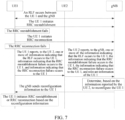
- RRC reestablishment when an RLF occurs between the UE 1 and a base station (gNB), the UE 1 initiates RRC reestablishment (RRC reestablishment).
- RRC reestablishment failure occurs to the UE 1 (equivalent to a second device)
- the UE 1 initiates RRC reconnection (RRC reconnection).
- the UE 1 may report, to the UE 2 (equivalent to a first device), one or more of:
- the UE 2 If the UE 2 receives one or more (second information) of the information indicating that the RLF occurs to the UE 1, the information indicating that the RRC reestablishment failure occurs to the UE 1, and the information indicating that the RRC reconnection failure occurs to the UE 1 reported by the UE 1, the UE 2 reports, to the gNB, one or more (first information) of the information indicating that the RLF occurs to the UE 1, the information indicating that the RRC reestablishment failure occurs to the UE 1, the information indicating that the RRC reconnection failure occurs to the UE 1, and relevant information of the UE 1.
- the relevant information of the UE 1 includes one or more of:
- the gNB may determine to reconfigure the UE 1.
- the UE 1 receives reconfiguration information from the gNB, and then the UE 1 initiates RRC reestablishment or RRC reconnection again and connects to the gNB.
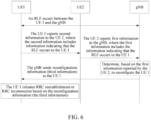
- an RLF occurs between the UE 1 (equivalent to a second device) and a gNB.
- the UE 1 reports, to the UE 2 (equivalent to a first device), information (first information) indicating that the RLF occurs to the UE 1.
- the UE 2 If the UE 2 receives the information indicating that the RLF occurs to the UE 1 reported by the UE 1, the UE 2 reports, to the gNB, one or more of the information indicating that the RLF occurs to the UE 1 and relevant information (second information) of the UE 1.
- the relevant information of the UE 1 includes one or more of:
- the gNB may determine to reconfigure the UE 1. Based on reconfiguration information received from the gNB, the UE 1 initiates RRC reestablishment or RRC reconnection again and connects to the gNB.
- a UE a master UE, for example, a UE 1
- a secondary UE for example, a UE 2
- the UE 1 when an RLF occurs to the UE 1 (equivalent to a second device), the UE 1 initiates RRC reestablishment.
- the UE 1 If an RRC reestablishment failure occurs to the UE 1, the UE 1 initiates RRC reconnection.
- the UE 1 reports first information to the UE 2 (equivalent to a first device).
- the first information indicates that the RLF occurs to the UE 1 and an RRC connection failure occurs to the UE 1.
- the UE 2 receives second information reported by the UE 1, the UE 2 initiates RRC connection to a gNB, and reports the first information to the gNB.
- the first information includes one or more of information indicating that the RLF occurs to the UE 1, information indicating that the RRC reestablishment failure occurs to the UE 1, information indicating that the RRC reconnection failure occurs to the UE 1, and relevant information of the UE 1.
- the relevant information of the UE 1 includes one or more of:
- the gNB may determine one or more of the following operations:
- the gNB may determine the UE 2 as the master UE and the UE 1 as the secondary UE.
- the gNB may determine the UE 1 as the master UE and the UE 2 as the secondary UE.
- a UE 1 (a first device) finds that an interruption of a link (for example, an Intx) occurs between the UE 1 and a UE 2 (a second device), the UE 1 attempts to recover connection and transmission of the Intx. If the Intx is not recovered successfully, the UE 1 reports a connection interruption (first information) between the UE 1 and the UE 2 to a gNB.
- an interruption of a link for example, an Intx
- the first information includes relevant information of the UE 2.
- the relevant information of the UE 2 includes one or more of:
- the gNB may determine to stop data transmission with the UE 2.
- Scheme 2 Only one UE (a master UE, for example, a UE 1) maintains a radio link status between the UE and a network
- a UE 2 when a UE 2 (a first device) finds that an interruption of a link (for example, an interface x (interface x, Intx)) between UE 1 and the UE 2 (a second device), the UE 2 attempts to recover connection and transmission of the Intx. If the Intx is not recovered successfully, the UE 2 may initiate connection to the network, and the UE 2 reports a connection interruption (first information) with the UE 1 to the network.
- a link for example, an interface x (interface x, Intx)
- an interface between the UE 1 and the UE 2 may be an existing interface such as PC5 or F1.
- the interface may alternatively be a new interface, which is abbreviated as Intx herein.
- the first information includes relevant information of the UE 1.
- the relevant information of the UE 1 includes one or more of:
- the gNB may determine to stop data transmission with the UE 2.
- an embodiment of this application provides an apparatus for processing an RLF.
- the apparatus 1000 is applied to a first device.
- the apparatus 1000 includes: a first sending module 1001, configured to send, by a first device, first information to a network-side device, where the first information indicates that a radio link failure RLF occurs to one or more second devices.
- the first device and the one or more second devices jointly transmit a first service.
- the apparatus 1000 further includes: a first receiving module, configured to receive second information from the one or more second devices, where the second information indicates that the first device should report the occurrence of the RLF to the one or more second devices to the network-side device.
- the first device and the one or more second devices jointly transmit a first service, for example, a streaming media service, but the first service is not limited thereto.
- the first device may also be referred to as a master UE, and the second device may also be referred to as a secondary UE.
- the first device may also be referred to as the secondary UE, and the second device may also be referred to as the master UE.
- that the RLF occurs to the one or more second devices includes one of:
- the second information includes one or more of:
- the first information includes one or more of:
- the relevant information of the second devices includes one or more of:
- the apparatus provided in this embodiment of this application can implement all processes implemented in the method embodiment of FIG. 2 , and achieve the same technical effects. In order to avoid repetition, details are not described herein.
- an embodiment of this application provides an apparatus for processing an RLF.
- the apparatus 1100 is applied to a second device.
- the apparatus 1100 includes: a second sending module 1101, configured to send second information to a first device, where the second information indicates that the first device should report occurrence of an RLF to one or more second devices to a network-side device.
- the first device and the one or more second devices jointly transmit a first service.
- the apparatus 1100 further includes:
- that the RLF occurs to the one or more second devices includes one of:
- the second information includes one or more of:
- the apparatus provided in this embodiment of this application can implement all processes implemented in the method embodiment of FIG. 3 , and achieve the same technical effects. In order to avoid repetition, details are not described herein.
- an embodiment of this application provides an apparatus for processing an RLF, which is applied to a network-side device.
- the apparatus 1200 includes: a third receiving module 1201, configured to receive first information from a first device, where the first information indicates that an RLF occurs to one or more second devices.
- the first device and the one or more second devices jointly transmit a first service.
- that the RLF occurs to the one or more second devices includes one of:
- the apparatus 1200 further includes: an execution module, configured to determine, based on the first information, to perform one or more of the following operations:
- the apparatus 1200 further includes: a first determination module, configured to send, by the network-side device, third information to the second device in a case that it is determined based on the first information that the second device needs to be reconfigured.
- the third information indicates that the second device should initiate an RRC reestablishment process or an RRC reconnection process to the network-side device.
- the apparatus 1200 further includes: a second determination module, configured to stop data transmission with the one or more second devices based on the first information.
- the first information includes one or more of:
- the relevant information of the second devices includes one or more of:
- the apparatus provided in this embodiment of this application can implement all processes implemented in the method embodiment of FIG. 4 , and achieve the same technical effects. In order to avoid repetition, details are not described herein.
- An embodiment of this application further provides a terminal, including a processor and a communication interface.
- the communication interface is configured to receive first information from one or more second devices, where the first information indicates that the first device should report occurrence of an RLF to the one or more second devices to the network-side device.
- the communication interface is configured to send first information to a first device, where the first information indicates that the first device should report the occurrence of the RLF to the one or more second devices to the network-side device.
- the terminal embodiment corresponds to the above terminal side method embodiment. The implementation processes and manners of the above method embodiment are applicable to the terminal embodiment, and can achieve the same technical effects.
- FIG. 13 is a schematic diagram of a hardware structure of a terminal for implementing an embodiment of this application.
- the terminal 1300 includes, but is not limited to, at least some of components such as a radio frequency unit 1301, a network module 1302, an audio output unit 1303, an input unit 1304, a sensor 1305, a display unit 1306, a user input unit 1307, an interface unit 1308, a memory 1309, and a processor 1310.
- the terminal 1300 may further include a power supply (such as a battery) that supplies power to various components.
- the power supply may be logically connected to the processor 1310 through a power management system, thereby implementing functions such as management of charging, discharging, and power consumption through the power management system.
- the terminal structure shown in FIG. 13 constitutes no limitation on the terminal, and the terminal may include more or fewer components than those shown in the figure, or a combination of some components, or different component arrangements. Details are not described herein.
- the input unit 1304 may include a graphics processing unit (Graphics Processing Unit, GPU) 13041 and a microphone 13042.
- the graphics processing unit 13041 processes image data of a static picture or a video obtained by an image capture apparatus (for example, a camera) in a video capture mode or an image capture mode.
- the display unit 1306 may include a display panel 13061.
- the display panel 13061 may be configured in a form such as a liquid crystal display or an organic light-emitting diode.
- the user input unit 1307 includes a touch panel 13071 and another input device 13072.
- the touch panel 13071 is also referred to as a touch screen.
- the touch panel 13071 may include two parts: a touch detection apparatus and a touch controller.
- the another input device 13072 may include but is not limited to a physical keyboard, a function button (such as a volume control button or a power button), a trackball, a mouse, and a joystick. Details are not described herein.
- the radio frequency unit 1301 receives downlink data from a network-side device and provides the data to the processor 1310 for processing. In addition, the radio frequency unit transmits uplink data to the network-side device.
- the radio frequency unit 1301 includes but is not limited to an antenna, at least one amplifier, a transceiver, a coupler, a low noise amplifier, and a duplexer.
- the memory 1309 may be configured to store software programs or instructions as well as various data.
- the memory 1309 may mainly include a program or instruction storage area and a data storage area.
- the program or instruction storage area may store an operating system, an application or an instruction required for at least one function (such as a sound playback function or an image playback function), and the like.
- the memory 1309 may include a high-speed random access memory, and may further include a non-volatile memory.
- the non-volatile memory may be a read-only memory (Read-Only Memory, ROM), a programmable read-only memory (Programmable ROM, PROM), an erasable programmable read-only memory (Erasable PROM, EPROM), an electrically erasable programmable read-only memory (Electrically EPROM, EEPROM), or a flash memory.
- the non-volatile memory may include at least one magnetic disk storage device, a flash memory device, or another non-volatile solid-state storage device.
- the processor 1310 may include one or more processing units.
- an application processor and a modem processor may be integrated into the processor 1310.
- the application processor mainly processes an operating system, a user interface, an application, an instruction, and the like.
- the modem processor mainly processes wireless communication, for example, may be a baseband processor. It may be understood that the modem processor may alternatively not be integrated in the processor 1310.
- the radio frequency unit 1301 is configured to send first information to a network-side device, where the first information indicates that a radio link failure RLF occurs to one or more second devices.
- the radio frequency unit 1301 is further configured to receive second information from the one or more second devices, where the second information indicates that the first device should report the occurrence of the RLF to the one or more second devices to the network-side device.
- the radio frequency unit 1301 is configured to send second information to a first device, where the second information indicates that the first device should report occurrence of an RLF to one or more second devices to a network-side device.
- the radio frequency unit 1301 is further configured to: receive third information from the network-side device; and initiate an RRC reestablishment process or an RRC reconnection process to the network-side device based on the third information.
- the terminal provided in this embodiment of this application can implement all processes implemented in the method embodiment of FIG. 2 or FIG. 3 , and achieve the same technical effects. In order to avoid repetition, details are not described herein.
- An embodiment of this application further provides a network-side device, including a processor and a communication interface.
- the communication interface is configured to receive second information from a first device, where the second information indicates that an RLF occurs to one or more second devices.
- the embodiment of the network-side device corresponds to the above method embodiment of the network-side device.
- the implementation processes and manners of the above method embodiment are applicable to the embodiment of the network-side device, and can achieve the same technical effects.
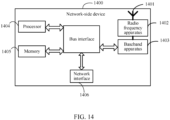
- a network-side device 1400 includes an antenna 1401, a radio frequency apparatus 1402, and a baseband apparatus 1403.
- the antenna 1401 is connected to the radio frequency apparatus 1402.
- the radio frequency apparatus 1402 receives information through the antenna 1401 and sends the received information to the baseband apparatus 1403 for processing.
- the baseband apparatus 1403 processes to-be-sent information and sends the to-be-sent information to the radio frequency apparatus 1402.
- the radio frequency apparatus 1402 processes the received information and then sends the information through the antenna 1401.
- the above frequency band processing apparatus may be located in the baseband apparatus 1403, and the method in the above embodiment performed by the network-side device may be implemented in the baseband apparatus 1403.
- the baseband apparatus 1403 includes a processor 1404 and a memory 1405.
- the baseband apparatus 1403 may include, for example, at least one baseband board.
- a plurality of chips are arranged on the baseband board, as shown in FIG. 14 .
- One of the chips is, for example, a processor 1404, and is connected to the memory 1405 to call a program in the memory 1405 to perform the operations of the network device shown in the above method embodiment.
- the baseband apparatus 1403 may further include a network interface 1406 configured to exchange information with the radio frequency apparatus 1402.
- the interface is, for example, a common public radio interface (common public radio interface, CPRI).
- the network-side device in this embodiment of this application further includes instructions or a program stored in the memory 1405 and executable in the processor 1404.
- the radio frequency apparatus 1402 is configured to receive first information from a first device, where the first information indicates that an RLF occurs to one or more second devices.
- the processor 1404 is configured to determine, based on the first information, to perform one or more of the following operations:
- the radio frequency apparatus 1402 is configured to send third information to the second device in a case that the network-side device determines, based on the first information, that the second device needs to be reconfigured.
- the processor 1404 is configured to determine, based on the first information, to stop data transmission with the one or more second devices.
- the processor 1404 calls the instructions or the program in the memory 1405 to perform the method performed by the modules shown in FIG. 12 , and achieves the same technical effects. In order to avoid repetition, details are not described herein.
- An embodiment of this application further provides a computer program/program product, which is stored in a non-volatile storage medium.
- the computer program/program product when executed by at least one processor, implements the steps of the processing method in FIG. 2, FIG. 3 , or FIG. 4 .
- An embodiment of this application further provides a readable storage medium.
- the readable storage medium stores a program or instructions.
- the program or instructions when executed by a processor, implement the processes of the method embodiment shown in FIG. 2, FIG. 3 , or FIG. 4 , and achieve the same technical effects. In order to avoid repetition, details are not described herein.
- the processor is a processor in the terminal described in the above embodiments.
- the readable storage medium includes a computer-readable storage medium, such as a computer read-only memory (Read-Only Memory, ROM), a random access memory (Random Access Memory, RAM), a magnetic disk, or an optical disk.
- An embodiment of this application further provides a chip.
- the chip includes a processor and a communication interface.
- the communication interface is coupled to the processor.
- the processor is configured to execute a program or instructions to implement the processes of the method embodiment shown in FIG. 2, FIG. 3 , or FIG. 4 , and achieve the same technical effects. In order to avoid repetition, details are not described herein.
- the chip in this embodiment of this application may also be referred to as a system level chip, a system chip, a chip system, a system on chip, or the like.
- a term “comprise”, “include”, or any other variant herein is intended to encompass non-exclusive inclusion, so that a process, a method, an article or an apparatus including a series of elements not only includes those elements, but also includes another element not listed explicitly or includes intrinsic elements for the process, the method, the article, or the apparatus. Without any further limitation, an element defined by the phrase “include one... " does not exclude existence of another same element in the process, the method, the article, or the apparatus that includes the elements.
- the scope of the method and the apparatus in the embodiments of this application is not limited to function execution in the order shown or discussed, and may further include function execution in a substantially simultaneous manner or in the opposite order based on the functions. For example, the described method may be performed in different order from the described order, and various steps may also be added, omitted, or combined.
- features described with reference to some examples may be combined in another example.
- the method in the above embodiments may be implemented by software using a necessary universal hardware platform, or may be implemented by hardware.
- software using a general hardware platform is an example implementation.
- the technical solution of this application in essence, or a part contributing to the related art may be embodied in a form of a computer software product.
- the software product is stored in a storage medium (such as a ROM/RAM, a disk, or a compact disc), including instructions for causing a terminal (such as a mobile phone, a computer, a server, or a network device) to perform the method in the embodiments of this application.
Landscapes
- Engineering & Computer Science (AREA)
- Computer Networks & Wireless Communication (AREA)
- Signal Processing (AREA)
- Mobile Radio Communication Systems (AREA)
Applications Claiming Priority (2)
| Application Number | Priority Date | Filing Date | Title |
|---|---|---|---|
| CN202110482566.2A CN115278788A (zh) | 2021-04-30 | 2021-04-30 | 无线链路失败的处理方法、装置、设备及可读存储介质 |
| PCT/CN2022/089389 WO2022228446A1 (fr) | 2021-04-30 | 2022-04-26 | Procédé et appareil de traitement de défaillance de liaison radio, et dispositif et support de stockage lisible |
Publications (2)
| Publication Number | Publication Date |
|---|---|
| EP4333500A1 true EP4333500A1 (fr) | 2024-03-06 |
| EP4333500A4 EP4333500A4 (fr) | 2024-11-06 |
Family
ID=83745878
Family Applications (1)
| Application Number | Title | Priority Date | Filing Date |
|---|---|---|---|
| EP22794916.1A Pending EP4333500A4 (fr) | 2021-04-30 | 2022-04-26 | Procédé et appareil de traitement de défaillance de liaison radio, et dispositif et support de stockage lisible |
Country Status (4)
| Country | Link |
|---|---|
| US (1) | US20240064844A1 (fr) |
| EP (1) | EP4333500A4 (fr) |
| CN (1) | CN115278788A (fr) |
| WO (1) | WO2022228446A1 (fr) |
Family Cites Families (8)
| Publication number | Priority date | Publication date | Assignee | Title |
|---|---|---|---|---|
| WO2014075242A1 (fr) * | 2012-11-14 | 2014-05-22 | 华为技术有限公司 | Procédé et appareil de traitement de défaillance de liaison sans fil |
| CN104469827B (zh) * | 2013-09-25 | 2018-09-14 | 电信科学技术研究院 | 一种无线链路失败的处理方法及装置 |
| US11477836B2 (en) * | 2017-03-30 | 2022-10-18 | Lg Electronics Inc. | Method for performing path reselection in wireless communication system and apparatus therefor |
| WO2020147046A1 (fr) * | 2019-01-16 | 2020-07-23 | Lenovo (Beijing) Limited | Procédés et appareils de gestion de défaillance de liaison radio |
| US12495318B2 (en) * | 2019-08-23 | 2025-12-09 | Telefonaktiebolaget Lm Ericsson (Publ) | Recovery over sidelink |
| US12328785B2 (en) * | 2019-08-29 | 2025-06-10 | Qualcomm Incorporated | Handling of sidelink radio link failure |
| WO2021108966A1 (fr) * | 2019-12-02 | 2021-06-10 | 北京小米移动软件有限公司 | Procédé et appareil pour le traitement d'une défaillance de liaison radio, et support d'enregistrement informatique |
| US11729694B2 (en) * | 2020-07-23 | 2023-08-15 | Lg Electronics Inc. | Method and apparatus for reselecting relay based on SL RLF |
-
2021
- 2021-04-30 CN CN202110482566.2A patent/CN115278788A/zh active Pending
-
2022
- 2022-04-26 WO PCT/CN2022/089389 patent/WO2022228446A1/fr not_active Ceased
- 2022-04-26 EP EP22794916.1A patent/EP4333500A4/fr active Pending
-
2023
- 2023-10-30 US US18/497,472 patent/US20240064844A1/en active Pending
Also Published As
| Publication number | Publication date |
|---|---|
| WO2022228446A1 (fr) | 2022-11-03 |
| CN115278788A (zh) | 2022-11-01 |
| US20240064844A1 (en) | 2024-02-22 |
| EP4333500A4 (fr) | 2024-11-06 |
Similar Documents
| Publication | Publication Date | Title |
|---|---|---|
| US20230354454A1 (en) | Re-Establishment of Component Carriers in a Wireless Communication System | |
| US20230300695A1 (en) | Sidelink transmission processing method and apparatus, terminal, and network device | |
| US12513590B2 (en) | Method for configuring and obtaining secondary cell group information, and communications device | |
| US20230164876A1 (en) | Discontinuous Reception Processing Method and Apparatus, Terminal, and Network-Side Device | |
| US20230171645A1 (en) | Method for splitting end-to-end qos requirement information, terminal, and network side device | |
| US20240098771A1 (en) | Request Information Sending Method Device and Non-Transitory Readable Storage Medium | |
| US20240314669A1 (en) | Communication path configuration method and apparatus, and terminal | |
| US12513770B2 (en) | Access procedure processing method based on matching between transmission data and first condition, apparatus and communication device | |
| CN115835315B (zh) | 资源重选方法、装置、通信设备、存储介质及系统 | |
| WO2022033549A1 (fr) | Procédé et appareil d'établissement de connexion de commande de ressources radioélectriques, terminal et dispositif du côté réseau | |
| US20240244423A1 (en) | Ue capability change method, terminal, and network-side device | |
| CN114080045B (zh) | 数据发送处理方法、资源配置方法及相关设备 | |
| WO2021244572A1 (fr) | Procédé de suspension de mcg, appareil, équipement utilisateur et dispositif réseau | |
| EP4216625A1 (fr) | Procédé et appareil de radiomessagerie, terminal, dispositif de réseau et support de stockage lisible | |
| US12414138B2 (en) | Mode switching method, terminal, and network-side device | |
| US20230336968A1 (en) | Method for controlling secondary cell group, terminal, and network-side device | |
| US20230262654A1 (en) | Paging message receiving method, paging configuration method, terminal, and network side device | |
| WO2022068813A1 (fr) | Procédé et appareil de commande de congestion, terminal et dispositif côté réseau | |
| WO2022028524A1 (fr) | Procédé et appareil de surveillance de canal physique de commande de liaison descendante et dispositif | |
| EP4195756A1 (fr) | Procédé de mesure, appareil de mesure, terminal et dispositif réseau | |
| US20240244650A1 (en) | Ue capability reporting method, joint scheduling method, scheduling method, and device | |
| EP4333500A1 (fr) | Procédé et appareil de traitement de défaillance de liaison radio, et dispositif et support de stockage lisible | |
| EP4568307A1 (fr) | Procédé et appareil de commande de capacité d'ue, et terminal et dispositif côté réseau | |
| EP4297526A1 (fr) | Procédé et appareil de transmission d'informations et dispositif de communication | |
| CN115278791B (zh) | 切换方法、装置、设备及可读存储介质 |
Legal Events
| Date | Code | Title | Description |
|---|---|---|---|
| STAA | Information on the status of an ep patent application or granted ep patent |
Free format text: STATUS: THE INTERNATIONAL PUBLICATION HAS BEEN MADE |
|
| PUAI | Public reference made under article 153(3) epc to a published international application that has entered the european phase |
Free format text: ORIGINAL CODE: 0009012 |
|
| STAA | Information on the status of an ep patent application or granted ep patent |
Free format text: STATUS: REQUEST FOR EXAMINATION WAS MADE |
|
| 17P | Request for examination filed |
Effective date: 20231114 |
|
| AK | Designated contracting states |
Kind code of ref document: A1 Designated state(s): AL AT BE BG CH CY CZ DE DK EE ES FI FR GB GR HR HU IE IS IT LI LT LU LV MC MK MT NL NO PL PT RO RS SE SI SK SM TR |
|
| DAV | Request for validation of the european patent (deleted) | ||
| DAX | Request for extension of the european patent (deleted) | ||
| A4 | Supplementary search report drawn up and despatched |
Effective date: 20241007 |
|
| RIC1 | Information provided on ipc code assigned before grant |
Ipc: H04W 76/14 20180101ALI20240930BHEP Ipc: H04W 76/19 20180101ALI20240930BHEP Ipc: H04W 36/00 20090101AFI20240930BHEP |