EP4333537A1 - Procédé de sélection d'un canal sans fil pour empêcher des interférences - Google Patents
Procédé de sélection d'un canal sans fil pour empêcher des interférences Download PDFInfo
- Publication number
- EP4333537A1 EP4333537A1 EP22193120.7A EP22193120A EP4333537A1 EP 4333537 A1 EP4333537 A1 EP 4333537A1 EP 22193120 A EP22193120 A EP 22193120A EP 4333537 A1 EP4333537 A1 EP 4333537A1
- Authority
- EP
- European Patent Office
- Prior art keywords
- channel
- station
- noise
- access point
- sta4
- Prior art date
- Legal status (The legal status is an assumption and is not a legal conclusion. Google has not performed a legal analysis and makes no representation as to the accuracy of the status listed.)
- Withdrawn
Links
- 238000000034 method Methods 0.000 title claims abstract description 36
- 238000004891 communication Methods 0.000 claims abstract description 16
- 230000005540 biological transmission Effects 0.000 claims abstract description 12
- 238000001228 spectrum Methods 0.000 claims abstract description 12
- 238000010187 selection method Methods 0.000 claims description 3
- 230000006870 function Effects 0.000 description 4
- 230000003044 adaptive effect Effects 0.000 description 2
- 230000008859 change Effects 0.000 description 2
- 230000002452 interceptive effect Effects 0.000 description 2
- 230000015654 memory Effects 0.000 description 2
- 238000012545 processing Methods 0.000 description 2
- 101100161473 Arabidopsis thaliana ABCB25 gene Proteins 0.000 description 1
- 101100395869 Escherichia coli sta3 gene Proteins 0.000 description 1
- 101100096893 Mus musculus Sult2a1 gene Proteins 0.000 description 1
- 101150081243 STA1 gene Proteins 0.000 description 1
- 230000009471 action Effects 0.000 description 1
- 230000008901 benefit Effects 0.000 description 1
- 238000001514 detection method Methods 0.000 description 1
- 238000007726 management method Methods 0.000 description 1
- 238000012986 modification Methods 0.000 description 1
- 230000004048 modification Effects 0.000 description 1
- 238000012544 monitoring process Methods 0.000 description 1
- 230000008569 process Effects 0.000 description 1
- 238000013442 quality metrics Methods 0.000 description 1
- 230000001360 synchronised effect Effects 0.000 description 1
Images

Classifications
-
- H—ELECTRICITY
- H04—ELECTRIC COMMUNICATION TECHNIQUE
- H04W—WIRELESS COMMUNICATION NETWORKS
- H04W48/00—Access restriction; Network selection; Access point selection
- H04W48/20—Selecting an access point
-
- H—ELECTRICITY
- H04—ELECTRIC COMMUNICATION TECHNIQUE
- H04W—WIRELESS COMMUNICATION NETWORKS
- H04W72/00—Local resource management
- H04W72/50—Allocation or scheduling criteria for wireless resources
- H04W72/54—Allocation or scheduling criteria for wireless resources based on quality criteria
- H04W72/542—Allocation or scheduling criteria for wireless resources based on quality criteria using measured or perceived quality
-
- H—ELECTRICITY
- H04—ELECTRIC COMMUNICATION TECHNIQUE
- H04B—TRANSMISSION
- H04B17/00—Monitoring; Testing
- H04B17/30—Monitoring; Testing of propagation channels
- H04B17/309—Measuring or estimating channel quality parameters
- H04B17/336—Signal-to-interference ratio [SIR] or carrier-to-interference ratio [CIR]
-
- H—ELECTRICITY
- H04—ELECTRIC COMMUNICATION TECHNIQUE
- H04W—WIRELESS COMMUNICATION NETWORKS
- H04W84/00—Network topologies
- H04W84/02—Hierarchically pre-organised networks, e.g. paging networks, cellular networks, WLAN [Wireless Local Area Network] or WLL [Wireless Local Loop]
- H04W84/10—Small scale networks; Flat hierarchical networks
- H04W84/12—WLAN [Wireless Local Area Networks]
Definitions
- the present invention relates to a method for selecting a wireless channel, the method adapted to prevent interferences.
- Typical wireless networks offer a plurality of channels for communicating between devices. For example, 5 GHz Wi-Fi network offers more than 20 channels for communication.
- an access point may use adaptive channel selection to determine an optimum quality channel via which it can communicate with a mobile station (STA).
- STA mobile station
- this type of adaptive channel selection is disclosed in US10154502B2 .
- the AP in addition to determining channel and spectrum availability by the AP, the AP is also using the STA to determine link quality metrics and QoS information from the established link.
- the AP cannot scan all the locations in the wireless ecosystem - some remote station may be affected by an interferer or noise source, which is not seen by the AP or by the currently transmitting station.
- the object of the invention is a method for selecting a wireless channel for communication between a station and an access point in a wireless ecosystem.
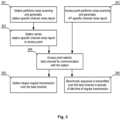
- the method comprises, prior to beginning regular transmission, scanning the wireless spectrum by the station to create a station-specific channel noise report that includes information on at least one channel and corresponding noise detected within that channel by the station; sending, by the station the station-specific channel noise report to the access point; scanning the wireless spectrum by the access point to create an accesspoint-specific channel noise report that includes information on at least one channel and corresponding noise detected within that channel by the access point; selecting by the access point the channel that provides the sufficient wireless link conditions for communication between the access point and the station, based on the station-specific channel noise report and the accesspoint-specific channel noise report; and starting regular transmission over the selected channel between the access point and the station.
- the station-specific channel noise report may contain one of: the least noisy channel and a corresponding noise indicator; a list of channels wherein the noise is below a predetermined threshold; a list of channels wherein the noise is above a predetermined threshold.
- the step of scanning wireless spectrum by the station can be performed periodically.
- the accesspoint-specific channel noise report may contain one of: the least noisy channel and a corresponding noise indicator; a list of channels wherein the noise is below a predetermined threshold; a list of channels wherein the noise is above a predetermined threshold; a list of all channels and corresponding noise level for each channel.
- the method may further comprise periodically performing the channel selection procedure.
- the wireless system can be a multiband system and the step of selecting by the access point the channel further comprises selecting a band of that channel.
- the method may further comprise, during idle times of regular communication between the access point and the station, transmitting a channel benchmarking traffic sequence over the selected channel to keep the selected channel occupied.
- the invention also relates to a station configured to operate according to the method as described herein.
- the invention also relates to an access point configured to operate according to the method as described herein.
- the invention also relates to a wireless system comprising an access point and at least one station configured to operate according to the method as described herein.
- the method is based on hardware function available in modern Wi-Fi chipsets of noise sensing in whole utilized frequency band (available in both AP and STA devices).
- the method according to the invention adds to the prior art the noise sensing feature which helps to find wireless channel that is free of interferers.
- the noise sensing is analyzing the whole Wi-Fi ecosystem area, by each of station device. It is also capable of avoiding channels that are affected by noise other than wireless transmission.
- the advantage of presented method over the prior art is that the prior methods are using link budget and interfering condition data in already established wireless link on particular channel. Then, if the better conditions are found, the channel is changed to optimal.
- the sensing of the environment is done before the wireless link is established, therefore the channel selected for establishing communication is one with optimal conditions for both the access point and the station, and in general for the whole system.
- these quantities take the form of electrical or magnetic signals capable of being stored, transferred, combined, compared, and otherwise manipulated in a computer system.
- these signals are referred to as bits, packets, messages, values, elements, symbols, characters, terms, numbers, or the like.
- a computer-readable (storage) medium typically may be non-transitory and/or comprise a non-transitory device.
- a non-transitory storage medium may include a device that may be tangible, meaning that the device has a concrete physical form, although the device may change its physical state.
- non-transitory refers to a device remaining tangible despite a change in state.
- Wi-Fi Wireless Fidelity
- Wi-Fi based Mesh systems can be applicable to other wireless transmission systems as well, such as Bluetooth Mesh, mobile networks or vehicle communication networks.
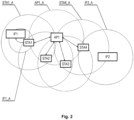
- the Wi-Fi ecosystem comprises an access point AP1 and a plurality of stations STA1-STA4 associated with the AP.
- Each of the devices has an associated a scanning area AP1_A, STA1_A-STA4_A within which the device can detect signals higher than a predetermined level.
- the range of the scanning area for each device corresponds substantially to its wireless communication range. Due to the different locations of the stations STA1-STA4, these stations may collectively scan for noise within a much wider area than the access point AP1 itself.
- Fig. 2 shows the ecosystem of Fig. 1 , wherein interferers IF1, IF2 have been introduced.
- the interferers are ecosystem elements that generate radio signals that occupy some of the available Wi-Fi channels.
- the first station STA1 is affected by the first interferer IF1, such as an HDMI TV set connected by a low-quality HDMI cable that generates interference within area IF1_A within the Wi-Fi frequency band.
- the fourth station STA4 is affected by the second interferer IF2, such as a Wi-Fi device that is not detectable by the access point AP1 (or at least at the edge of its detection capabilities). Thanks to the noise sensing feature of the stations STA1-STA4, each station may identify interferers individually, and the whole Wi-Fi transmission system may select the most optimum channel that meets performance criteria for all devices in the system at the same time.
- the station performs a noise sensing function to check the whole Wi-Fi spectrum within its scanning range and creates a station-specific channel noise report that includes information on at least one channel and corresponding noise detected within that channel.
- the station-specific channel noise report may contain:
- the noise scanning function is capable of finding not only external Wi-Fi transmitters, but also non-Wi-Fi noise sources (such as station self-noise, adjacent TV noise, HDMI cable noise that is affecting Wi-Fi band, SATA HDD etc.).
- non-Wi-Fi noise sources such as station self-noise, adjacent TV noise, HDMI cable noise that is affecting Wi-Fi band, SATA HDD etc.
- the station sends the station-specific channel noise report to the access point. This may be performed periodically so that the access point always contains up-to-date information about noise within the system or upon request for selection of channel of communication between that station and the access point.
- the access point performs its own noise sensing function to check the whole Wi-Fi spectrum within its scanning range and creates an accesspoint-specific channel noise report that includes information on at least one channel and corresponding noise detected within that channel.
- the accesspoint-specific channel noise report may contain:
- the access point selects the channel that provides sufficient wireless link conditions (e.g., sufficient for a type of regular communication requested by the station, or sufficient to meet desired quality conditions, or simply the least noisy available channel).
- the AP may assign number of stations to one band, and other stations to the other (assuming the AP is dual-band or tri-band concurrent).
- the station can start regular transmission on the selected channel, for example may start to wirelessly transmit video in a synchronized manner as defined in prior methods.
- the access point and all stations may periodically perform noise sensing to verify if the current channel is still best one, i.e., repeat steps 301-304.
- the access point or the station may transmit a channel benchmarking traffic sequence in step 306.
- the benchmarking traffic sequence can contain predetermined data or random data. It is used to keep the best channel permanently occupied to avoid a situation wherein another interfering device would occupy the channel.
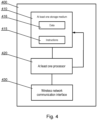
- Fig. 4 shows a general structure of a wireless device, namely the access point or the station.
- the device 400 includes at least one non-transitory processor-readable storage medium 410 that stores at least one of processor-executable instructions 415 or data 416; and at least one processor 420 communicably coupled to the at least one non-transitory processor-readable storage medium 410.
- the data 416 may include the channel noise reports.
- a wireless network communication interface 430 is used to communicate over the wireless system.
- the at least one processor 420 is configured to (by executing the instructions 415 and reading the data 416) to perform the steps of Fig. 3 .
Landscapes
- Engineering & Computer Science (AREA)
- Computer Networks & Wireless Communication (AREA)
- Signal Processing (AREA)
- Quality & Reliability (AREA)
- Computer Security & Cryptography (AREA)
- Physics & Mathematics (AREA)
- Electromagnetism (AREA)
- Mobile Radio Communication Systems (AREA)
Priority Applications (2)
| Application Number | Priority Date | Filing Date | Title |
|---|---|---|---|
| EP22193120.7A EP4333537A1 (fr) | 2022-08-31 | 2022-08-31 | Procédé de sélection d'un canal sans fil pour empêcher des interférences |
| US17/973,667 US20240073805A1 (en) | 2022-08-31 | 2022-10-26 | Method for selecting a wireless channel to prevent interferences |
Applications Claiming Priority (1)
| Application Number | Priority Date | Filing Date | Title |
|---|---|---|---|
| EP22193120.7A EP4333537A1 (fr) | 2022-08-31 | 2022-08-31 | Procédé de sélection d'un canal sans fil pour empêcher des interférences |
Publications (1)
| Publication Number | Publication Date |
|---|---|
| EP4333537A1 true EP4333537A1 (fr) | 2024-03-06 |
Family
ID=83400740
Family Applications (1)
| Application Number | Title | Priority Date | Filing Date |
|---|---|---|---|
| EP22193120.7A Withdrawn EP4333537A1 (fr) | 2022-08-31 | 2022-08-31 | Procédé de sélection d'un canal sans fil pour empêcher des interférences |
Country Status (2)
| Country | Link |
|---|---|
| US (1) | US20240073805A1 (fr) |
| EP (1) | EP4333537A1 (fr) |
Citations (4)
| Publication number | Priority date | Publication date | Assignee | Title |
|---|---|---|---|---|
| WO2002023819A2 (fr) * | 2000-09-15 | 2002-03-21 | Koninklijke Philips Electronics N.V. | Mecanisme de selection dynamique de canal pour reseaux locaux sans fil idee 802.11s |
| US20150305040A1 (en) * | 2014-04-18 | 2015-10-22 | Qualcomm Incorporated | Channel selection co-existence in shared spectrum |
| US20160345339A1 (en) * | 2014-01-07 | 2016-11-24 | Mitsubishi Electric Corporation | Base station, terminal station, and wireless communication system |
| US10154502B2 (en) | 2011-07-07 | 2018-12-11 | Celeno Communications Ltd. | Method for managing the spectrum of a multi-band wireless communication system |
-
2022
- 2022-08-31 EP EP22193120.7A patent/EP4333537A1/fr not_active Withdrawn
- 2022-10-26 US US17/973,667 patent/US20240073805A1/en not_active Abandoned
Patent Citations (4)
| Publication number | Priority date | Publication date | Assignee | Title |
|---|---|---|---|---|
| WO2002023819A2 (fr) * | 2000-09-15 | 2002-03-21 | Koninklijke Philips Electronics N.V. | Mecanisme de selection dynamique de canal pour reseaux locaux sans fil idee 802.11s |
| US10154502B2 (en) | 2011-07-07 | 2018-12-11 | Celeno Communications Ltd. | Method for managing the spectrum of a multi-band wireless communication system |
| US20160345339A1 (en) * | 2014-01-07 | 2016-11-24 | Mitsubishi Electric Corporation | Base station, terminal station, and wireless communication system |
| US20150305040A1 (en) * | 2014-04-18 | 2015-10-22 | Qualcomm Incorporated | Channel selection co-existence in shared spectrum |
Also Published As
| Publication number | Publication date |
|---|---|
| US20240073805A1 (en) | 2024-02-29 |
Similar Documents
| Publication | Publication Date | Title |
|---|---|---|
| US9743220B2 (en) | Adaptive frequency hopping (AFH) with channel inhibition (CI) for bluetooth | |
| US11985513B2 (en) | Radio communication device and radio communication method | |
| US7363008B2 (en) | Spectrum sharing in the unlicensed band | |
| US12132589B2 (en) | Data scrambling method and related device | |
| US20110223877A1 (en) | Radio White Space Sensing | |
| US8135424B2 (en) | Method to improve diversity gain in a cooperative spectrum sensing network | |
| US8538469B2 (en) | Method for initial scanning of frequencies, frequency scanning controller, and apparatus | |
| US10051650B2 (en) | Identifying radio access technology (RAT) coexistence conflicts using a priority-based mechanism | |
| CN103517284A (zh) | 对干扰信号进行干扰处理的方法和装置 | |
| KR20110122098A (ko) | 무선 통신 시스템에서 이용가능 스펙트럼을 감지하기 위한 방법 및 시스템 | |
| US20240163903A1 (en) | Methods and apparatuses for a resource conflict indicator transmission | |
| CN113455090B (zh) | 增加用于未授权频段中的随机接入的前导码传输时机 | |
| KR20080049596A (ko) | 랜덤액세스 방법 및 랜덤액세스 응답 방법 | |
| CN114731613B (zh) | 位置感知空间重用 | |
| US11811508B2 (en) | Method and device for transmitting reference signals | |
| KR100949796B1 (ko) | 전파잡음 환경에서의 적응형 주파수 호핑율에 의한전파간섭 완화 방법 및 그 장치 | |
| US8442133B2 (en) | Apparatus and method for transmitting coexistence beacon protocol packet in cognitive radio wireless communication system | |
| US8731591B2 (en) | Method and apparatus relating to secondary use of radio resources | |
| EP4333537A1 (fr) | Procédé de sélection d'un canal sans fil pour empêcher des interférences | |
| KR20200108877A (ko) | 비면허 무선 주파수 대역에 접속하기 위한 네트워크 노드, 무선 통신 디바이스 및 그 방법들 | |
| US10306497B2 (en) | Method for determining stability of a wireless signal and system thereof | |
| CN101222739A (zh) | 一种驻波检测的方法、装置和基站 | |
| US20150189536A1 (en) | Method and apparatus for agile wireless network signal adaptation | |
| EP3391590B1 (fr) | Détection de la dégradation du plancher de bruit pour des radios colocalisées | |
| KR101770912B1 (ko) | 부채널화를 통한 효율적인 부분 대역 재밍 회피 방법 및 이의 시스템 |
Legal Events
| Date | Code | Title | Description |
|---|---|---|---|
| PUAI | Public reference made under article 153(3) epc to a published international application that has entered the european phase |
Free format text: ORIGINAL CODE: 0009012 |
|
| STAA | Information on the status of an ep patent application or granted ep patent |
Free format text: STATUS: THE APPLICATION HAS BEEN PUBLISHED |
|
| AK | Designated contracting states |
Kind code of ref document: A1 Designated state(s): AL AT BE BG CH CY CZ DE DK EE ES FI FR GB GR HR HU IE IS IT LI LT LU LV MC MK MT NL NO PL PT RO RS SE SI SK SM TR |
|
| STAA | Information on the status of an ep patent application or granted ep patent |
Free format text: STATUS: THE APPLICATION IS DEEMED TO BE WITHDRAWN |
|
| 18D | Application deemed to be withdrawn |
Effective date: 20240907 |