EP4335430A1 - Prothèse dentaire vitrocéramique et son procédé de préparation, procédé de renforcement du verre ou de la vitrocéramique et pâte à renfort alcaline - Google Patents
Prothèse dentaire vitrocéramique et son procédé de préparation, procédé de renforcement du verre ou de la vitrocéramique et pâte à renfort alcaline Download PDFInfo
- Publication number
- EP4335430A1 EP4335430A1 EP23175437.5A EP23175437A EP4335430A1 EP 4335430 A1 EP4335430 A1 EP 4335430A1 EP 23175437 A EP23175437 A EP 23175437A EP 4335430 A1 EP4335430 A1 EP 4335430A1
- Authority
- EP
- European Patent Office
- Prior art keywords
- glass
- reinforcing
- ion
- metal ion
- ceramic
- Prior art date
- Legal status (The legal status is an assumption and is not a legal conclusion. Google has not performed a legal analysis and makes no representation as to the accuracy of the status listed.)
- Pending
Links
- 239000002241 glass-ceramic Substances 0.000 title claims abstract description 205
- 230000003014 reinforcing effect Effects 0.000 title claims abstract description 205
- 238000000034 method Methods 0.000 title claims abstract description 70
- 239000011521 glass Substances 0.000 title claims description 60
- 229910021645 metal ion Inorganic materials 0.000 claims abstract description 76
- 229910052751 metal Inorganic materials 0.000 claims abstract description 52
- 239000002184 metal Substances 0.000 claims abstract description 52
- 238000010438 heat treatment Methods 0.000 claims description 39
- FGIUAXJPYTZDNR-UHFFFAOYSA-N potassium nitrate Chemical compound [K+].[O-][N+]([O-])=O FGIUAXJPYTZDNR-UHFFFAOYSA-N 0.000 claims description 38
- BWHMMNNQKKPAPP-UHFFFAOYSA-L potassium carbonate Chemical compound [K+].[K+].[O-]C([O-])=O BWHMMNNQKKPAPP-UHFFFAOYSA-L 0.000 claims description 28
- XLYOFNOQVPJJNP-UHFFFAOYSA-N water Substances O XLYOFNOQVPJJNP-UHFFFAOYSA-N 0.000 claims description 28
- 150000001875 compounds Chemical class 0.000 claims description 27
- 239000003381 stabilizer Substances 0.000 claims description 23
- HEMHJVSKTPXQMS-UHFFFAOYSA-M Sodium hydroxide Chemical compound [OH-].[Na+] HEMHJVSKTPXQMS-UHFFFAOYSA-M 0.000 claims description 21
- 229910001414 potassium ion Inorganic materials 0.000 claims description 21
- 239000004323 potassium nitrate Substances 0.000 claims description 19
- 235000010333 potassium nitrate Nutrition 0.000 claims description 19
- KWYUFKZDYYNOTN-UHFFFAOYSA-M Potassium hydroxide Chemical compound [OH-].[K+] KWYUFKZDYYNOTN-UHFFFAOYSA-M 0.000 claims description 18
- 239000002270 dispersing agent Substances 0.000 claims description 18
- NPYPAHLBTDXSSS-UHFFFAOYSA-N Potassium ion Chemical compound [K+] NPYPAHLBTDXSSS-UHFFFAOYSA-N 0.000 claims description 17
- 239000011248 coating agent Substances 0.000 claims description 16
- 238000000576 coating method Methods 0.000 claims description 16
- PEDCQBHIVMGVHV-UHFFFAOYSA-N Glycerine Chemical compound OCC(O)CO PEDCQBHIVMGVHV-UHFFFAOYSA-N 0.000 claims description 14
- VYPSYNLAJGMNEJ-UHFFFAOYSA-N Silicium dioxide Chemical compound O=[Si]=O VYPSYNLAJGMNEJ-UHFFFAOYSA-N 0.000 claims description 14
- CDBYLPFSWZWCQE-UHFFFAOYSA-L Sodium Carbonate Chemical compound [Na+].[Na+].[O-]C([O-])=O CDBYLPFSWZWCQE-UHFFFAOYSA-L 0.000 claims description 14
- 229910000027 potassium carbonate Inorganic materials 0.000 claims description 14
- 235000011181 potassium carbonates Nutrition 0.000 claims description 14
- VWDWKYIASSYTQR-UHFFFAOYSA-N sodium nitrate Chemical compound [Na+].[O-][N+]([O-])=O VWDWKYIASSYTQR-UHFFFAOYSA-N 0.000 claims description 14
- PNEYBMLMFCGWSK-UHFFFAOYSA-N aluminium oxide Inorganic materials [O-2].[O-2].[O-2].[Al+3].[Al+3] PNEYBMLMFCGWSK-UHFFFAOYSA-N 0.000 claims description 13
- CDQSJQSWAWPGKG-UHFFFAOYSA-N butane-1,1-diol Chemical compound CCCC(O)O CDQSJQSWAWPGKG-UHFFFAOYSA-N 0.000 claims description 13
- -1 terpilenol Chemical compound 0.000 claims description 11
- WCUXLLCKKVVCTQ-UHFFFAOYSA-M Potassium chloride Chemical compound [Cl-].[K+] WCUXLLCKKVVCTQ-UHFFFAOYSA-M 0.000 claims description 10
- NLSCHDZTHVNDCP-UHFFFAOYSA-N caesium nitrate Chemical compound [Cs+].[O-][N+]([O-])=O NLSCHDZTHVNDCP-UHFFFAOYSA-N 0.000 claims description 10
- YIXJRHPUWRPCBB-UHFFFAOYSA-N magnesium nitrate Chemical compound [Mg+2].[O-][N+]([O-])=O.[O-][N+]([O-])=O YIXJRHPUWRPCBB-UHFFFAOYSA-N 0.000 claims description 10
- SCVFZCLFOSHCOH-UHFFFAOYSA-M potassium acetate Chemical compound [K+].CC([O-])=O SCVFZCLFOSHCOH-UHFFFAOYSA-M 0.000 claims description 10
- HBBGRARXTFLTSG-UHFFFAOYSA-N Lithium ion Chemical compound [Li+] HBBGRARXTFLTSG-UHFFFAOYSA-N 0.000 claims description 9
- 229910001416 lithium ion Inorganic materials 0.000 claims description 9
- OTYBMLCTZGSZBG-UHFFFAOYSA-L potassium sulfate Chemical compound [K+].[K+].[O-]S([O-])(=O)=O OTYBMLCTZGSZBG-UHFFFAOYSA-L 0.000 claims description 9
- 229910052939 potassium sulfate Inorganic materials 0.000 claims description 9
- 235000011151 potassium sulphates Nutrition 0.000 claims description 9
- 229910001415 sodium ion Inorganic materials 0.000 claims description 9
- FUZZWVXGSFPDMH-UHFFFAOYSA-N hexanoic acid Chemical compound CCCCCC(O)=O FUZZWVXGSFPDMH-UHFFFAOYSA-N 0.000 claims description 8
- BHPQYMZQTOCNFJ-UHFFFAOYSA-N Calcium cation Chemical compound [Ca+2] BHPQYMZQTOCNFJ-UHFFFAOYSA-N 0.000 claims description 7
- JLVVSXFLKOJNIY-UHFFFAOYSA-N Magnesium ion Chemical compound [Mg+2] JLVVSXFLKOJNIY-UHFFFAOYSA-N 0.000 claims description 7
- FKNQFGJONOIPTF-UHFFFAOYSA-N Sodium cation Chemical compound [Na+] FKNQFGJONOIPTF-UHFFFAOYSA-N 0.000 claims description 7
- NCMHKCKGHRPLCM-UHFFFAOYSA-N caesium(1+) Chemical compound [Cs+] NCMHKCKGHRPLCM-UHFFFAOYSA-N 0.000 claims description 7
- 229910001424 calcium ion Inorganic materials 0.000 claims description 7
- 229910001425 magnesium ion Inorganic materials 0.000 claims description 7
- 229910001419 rubidium ion Inorganic materials 0.000 claims description 7
- 229910000029 sodium carbonate Inorganic materials 0.000 claims description 7
- 235000017550 sodium carbonate Nutrition 0.000 claims description 7
- 235000011121 sodium hydroxide Nutrition 0.000 claims description 7
- 239000004317 sodium nitrate Substances 0.000 claims description 7
- 235000010344 sodium nitrate Nutrition 0.000 claims description 7
- 235000011118 potassium hydroxide Nutrition 0.000 claims description 6
- WRIDQFICGBMAFQ-UHFFFAOYSA-N (E)-8-Octadecenoic acid Natural products CCCCCCCCCC=CCCCCCCC(O)=O WRIDQFICGBMAFQ-UHFFFAOYSA-N 0.000 claims description 5
- LQJBNNIYVWPHFW-UHFFFAOYSA-N 20:1omega9c fatty acid Natural products CCCCCCCCCCC=CCCCCCCCC(O)=O LQJBNNIYVWPHFW-UHFFFAOYSA-N 0.000 claims description 5
- QSBYPNXLFMSGKH-UHFFFAOYSA-N 9-Heptadecensaeure Natural products CCCCCCCC=CCCCCCCCC(O)=O QSBYPNXLFMSGKH-UHFFFAOYSA-N 0.000 claims description 5
- 239000005642 Oleic acid Substances 0.000 claims description 5
- ZQPPMHVWECSIRJ-UHFFFAOYSA-N Oleic acid Natural products CCCCCCCCC=CCCCCCCCC(O)=O ZQPPMHVWECSIRJ-UHFFFAOYSA-N 0.000 claims description 5
- 239000004111 Potassium silicate Substances 0.000 claims description 5
- 239000004115 Sodium Silicate Substances 0.000 claims description 5
- VMHLLURERBWHNL-UHFFFAOYSA-M Sodium acetate Chemical compound [Na+].CC([O-])=O VMHLLURERBWHNL-UHFFFAOYSA-M 0.000 claims description 5
- UIIMBOGNXHQVGW-DEQYMQKBSA-M Sodium bicarbonate-14C Chemical compound [Na+].O[14C]([O-])=O UIIMBOGNXHQVGW-DEQYMQKBSA-M 0.000 claims description 5
- 229910001413 alkali metal ion Inorganic materials 0.000 claims description 5
- 229910052784 alkaline earth metal Inorganic materials 0.000 claims description 5
- QXJSBBXBKPUZAA-UHFFFAOYSA-N isooleic acid Natural products CCCCCCCC=CCCCCCCCCC(O)=O QXJSBBXBKPUZAA-UHFFFAOYSA-N 0.000 claims description 5
- ZQPPMHVWECSIRJ-KTKRTIGZSA-N oleic acid Chemical compound CCCCCCCC\C=C/CCCCCCCC(O)=O ZQPPMHVWECSIRJ-KTKRTIGZSA-N 0.000 claims description 5
- 239000003960 organic solvent Substances 0.000 claims description 5
- 235000011056 potassium acetate Nutrition 0.000 claims description 5
- 239000011736 potassium bicarbonate Substances 0.000 claims description 5
- 235000015497 potassium bicarbonate Nutrition 0.000 claims description 5
- 229910000028 potassium bicarbonate Inorganic materials 0.000 claims description 5
- 239000001103 potassium chloride Substances 0.000 claims description 5
- 235000011164 potassium chloride Nutrition 0.000 claims description 5
- TYJJADVDDVDEDZ-UHFFFAOYSA-M potassium hydrogencarbonate Chemical compound [K+].OC([O-])=O TYJJADVDDVDEDZ-UHFFFAOYSA-M 0.000 claims description 5
- NNHHDJVEYQHLHG-UHFFFAOYSA-N potassium silicate Chemical compound [K+].[K+].[O-][Si]([O-])=O NNHHDJVEYQHLHG-UHFFFAOYSA-N 0.000 claims description 5
- 235000019353 potassium silicate Nutrition 0.000 claims description 5
- 229910052913 potassium silicate Inorganic materials 0.000 claims description 5
- 239000000377 silicon dioxide Substances 0.000 claims description 5
- 239000001632 sodium acetate Substances 0.000 claims description 5
- 235000017281 sodium acetate Nutrition 0.000 claims description 5
- NTHWMYGWWRZVTN-UHFFFAOYSA-N sodium silicate Chemical compound [Na+].[Na+].[O-][Si]([O-])=O NTHWMYGWWRZVTN-UHFFFAOYSA-N 0.000 claims description 5
- 229910052911 sodium silicate Inorganic materials 0.000 claims description 5
- 235000019794 sodium silicate Nutrition 0.000 claims description 5
- 239000002202 Polyethylene glycol Substances 0.000 claims description 4
- 229910052581 Si3N4 Inorganic materials 0.000 claims description 4
- 229910052783 alkali metal Inorganic materials 0.000 claims description 4
- 150000001768 cations Chemical class 0.000 claims description 4
- 238000000354 decomposition reaction Methods 0.000 claims description 4
- PAZHGORSDKKUPI-UHFFFAOYSA-N lithium metasilicate Chemical compound [Li+].[Li+].[O-][Si]([O-])=O PAZHGORSDKKUPI-UHFFFAOYSA-N 0.000 claims description 4
- 229910052912 lithium silicate Inorganic materials 0.000 claims description 4
- 229920001223 polyethylene glycol Polymers 0.000 claims description 4
- 229910010271 silicon carbide Inorganic materials 0.000 claims description 4
- HBMJWWWQQXIZIP-UHFFFAOYSA-N silicon carbide Chemical compound [Si+]#[C-] HBMJWWWQQXIZIP-UHFFFAOYSA-N 0.000 claims description 4
- HQVNEWCFYHHQES-UHFFFAOYSA-N silicon nitride Chemical compound N12[Si]34N5[Si]62N3[Si]51N64 HQVNEWCFYHHQES-UHFFFAOYSA-N 0.000 claims description 4
- 229910001420 alkaline earth metal ion Inorganic materials 0.000 claims description 3
- 230000007423 decrease Effects 0.000 claims description 3
- 239000006017 silicate glass-ceramic Substances 0.000 claims description 3
- 150000003839 salts Chemical class 0.000 description 42
- 239000013078 crystal Substances 0.000 description 37
- 239000000203 mixture Substances 0.000 description 29
- 230000000052 comparative effect Effects 0.000 description 22
- 238000009472 formulation Methods 0.000 description 19
- 239000000126 substance Substances 0.000 description 18
- 230000002787 reinforcement Effects 0.000 description 17
- WVMPCBWWBLZKPD-UHFFFAOYSA-N dilithium oxido-[oxido(oxo)silyl]oxy-oxosilane Chemical compound [Li+].[Li+].[O-][Si](=O)O[Si]([O-])=O WVMPCBWWBLZKPD-UHFFFAOYSA-N 0.000 description 16
- 238000010586 diagram Methods 0.000 description 15
- 150000002500 ions Chemical class 0.000 description 13
- 230000008569 process Effects 0.000 description 13
- 239000000243 solution Substances 0.000 description 12
- 239000010410 layer Substances 0.000 description 11
- 238000005245 sintering Methods 0.000 description 10
- 238000012360 testing method Methods 0.000 description 10
- 229910007562 Li2SiO3 Inorganic materials 0.000 description 9
- 230000001681 protective effect Effects 0.000 description 9
- 239000006112 glass ceramic composition Substances 0.000 description 8
- 238000005266 casting Methods 0.000 description 7
- 238000007747 plating Methods 0.000 description 6
- 230000035882 stress Effects 0.000 description 6
- 238000005516 engineering process Methods 0.000 description 5
- 230000002708 enhancing effect Effects 0.000 description 5
- 239000007788 liquid Substances 0.000 description 5
- 239000011241 protective layer Substances 0.000 description 5
- KRHYYFGTRYWZRS-UHFFFAOYSA-N Fluorane Chemical compound F KRHYYFGTRYWZRS-UHFFFAOYSA-N 0.000 description 4
- RTAQQCXQSZGOHL-UHFFFAOYSA-N Titanium Chemical compound [Ti] RTAQQCXQSZGOHL-UHFFFAOYSA-N 0.000 description 4
- MCMNRKCIXSYSNV-UHFFFAOYSA-N Zirconium dioxide Chemical compound O=[Zr]=O MCMNRKCIXSYSNV-UHFFFAOYSA-N 0.000 description 4
- 239000005548 dental material Substances 0.000 description 4
- 230000000694 effects Effects 0.000 description 4
- 235000011187 glycerol Nutrition 0.000 description 4
- 238000005342 ion exchange Methods 0.000 description 4
- 238000004519 manufacturing process Methods 0.000 description 4
- 239000007787 solid Substances 0.000 description 4
- 229910001220 stainless steel Inorganic materials 0.000 description 4
- 239000010935 stainless steel Substances 0.000 description 4
- 238000005728 strengthening Methods 0.000 description 4
- 239000010936 titanium Substances 0.000 description 4
- 229910052719 titanium Inorganic materials 0.000 description 4
- PXHVJJICTQNCMI-UHFFFAOYSA-N Nickel Chemical compound [Ni] PXHVJJICTQNCMI-UHFFFAOYSA-N 0.000 description 3
- 230000001680 brushing effect Effects 0.000 description 3
- 239000000463 material Substances 0.000 description 3
- 238000002156 mixing Methods 0.000 description 3
- 238000000465 moulding Methods 0.000 description 3
- 238000005240 physical vapour deposition Methods 0.000 description 3
- 238000012545 processing Methods 0.000 description 3
- 239000000741 silica gel Substances 0.000 description 3
- 229910002027 silica gel Inorganic materials 0.000 description 3
- VEXZGXHMUGYJMC-UHFFFAOYSA-N Hydrochloric acid Chemical compound Cl VEXZGXHMUGYJMC-UHFFFAOYSA-N 0.000 description 2
- DGAQECJNVWCQMB-PUAWFVPOSA-M Ilexoside XXIX Chemical compound C[C@@H]1CC[C@@]2(CC[C@@]3(C(=CC[C@H]4[C@]3(CC[C@@H]5[C@@]4(CC[C@@H](C5(C)C)OS(=O)(=O)[O-])C)C)[C@@H]2[C@]1(C)O)C)C(=O)O[C@H]6[C@@H]([C@H]([C@@H]([C@H](O6)CO)O)O)O.[Na+] DGAQECJNVWCQMB-PUAWFVPOSA-M 0.000 description 2
- GWEVSGVZZGPLCZ-UHFFFAOYSA-N Titan oxide Chemical compound O=[Ti]=O GWEVSGVZZGPLCZ-UHFFFAOYSA-N 0.000 description 2
- 238000004458 analytical method Methods 0.000 description 2
- 238000013459 approach Methods 0.000 description 2
- 238000000498 ball milling Methods 0.000 description 2
- 229910052728 basic metal Inorganic materials 0.000 description 2
- 239000000919 ceramic Substances 0.000 description 2
- 229910010293 ceramic material Inorganic materials 0.000 description 2
- 230000008859 change Effects 0.000 description 2
- 238000007796 conventional method Methods 0.000 description 2
- 238000001816 cooling Methods 0.000 description 2
- 239000006059 cover glass Substances 0.000 description 2
- 239000003484 crystal nucleating agent Substances 0.000 description 2
- 238000011161 development Methods 0.000 description 2
- 230000018109 developmental process Effects 0.000 description 2
- 238000004453 electron probe microanalysis Methods 0.000 description 2
- 239000010433 feldspar Substances 0.000 description 2
- 239000000383 hazardous chemical Substances 0.000 description 2
- 150000008040 ionic compounds Chemical class 0.000 description 2
- 238000003754 machining Methods 0.000 description 2
- 238000001755 magnetron sputter deposition Methods 0.000 description 2
- 238000013001 point bending Methods 0.000 description 2
- 239000002243 precursor Substances 0.000 description 2
- 239000000047 product Substances 0.000 description 2
- 239000002994 raw material Substances 0.000 description 2
- 238000007788 roughening Methods 0.000 description 2
- 239000000523 sample Substances 0.000 description 2
- 239000004447 silicone coating Substances 0.000 description 2
- 239000011734 sodium Substances 0.000 description 2
- 239000002562 thickening agent Substances 0.000 description 2
- 239000002699 waste material Substances 0.000 description 2
- 235000019738 Limestone Nutrition 0.000 description 1
- 239000006004 Quartz sand Substances 0.000 description 1
- 241000779819 Syncarpia glomulifera Species 0.000 description 1
- 208000008312 Tooth Loss Diseases 0.000 description 1
- 239000000853 adhesive Substances 0.000 description 1
- 230000001070 adhesive effect Effects 0.000 description 1
- 230000032683 aging Effects 0.000 description 1
- 150000001340 alkali metals Chemical class 0.000 description 1
- 150000001342 alkaline earth metals Chemical class 0.000 description 1
- CNLWCVNCHLKFHK-UHFFFAOYSA-N aluminum;lithium;dioxido(oxo)silane Chemical compound [Li+].[Al+3].[O-][Si]([O-])=O.[O-][Si]([O-])=O CNLWCVNCHLKFHK-UHFFFAOYSA-N 0.000 description 1
- 239000007864 aqueous solution Substances 0.000 description 1
- TZCXTZWJZNENPQ-UHFFFAOYSA-L barium sulfate Chemical compound [Ba+2].[O-]S([O-])(=O)=O TZCXTZWJZNENPQ-UHFFFAOYSA-L 0.000 description 1
- AYJRCSIUFZENHW-DEQYMQKBSA-L barium(2+);oxomethanediolate Chemical compound [Ba+2].[O-][14C]([O-])=O AYJRCSIUFZENHW-DEQYMQKBSA-L 0.000 description 1
- 239000010428 baryte Substances 0.000 description 1
- 229910052601 baryte Inorganic materials 0.000 description 1
- 239000006121 base glass Substances 0.000 description 1
- 150000007514 bases Chemical class 0.000 description 1
- 229910021538 borax Inorganic materials 0.000 description 1
- KGBXLFKZBHKPEV-UHFFFAOYSA-N boric acid Chemical compound OB(O)O KGBXLFKZBHKPEV-UHFFFAOYSA-N 0.000 description 1
- 239000004327 boric acid Substances 0.000 description 1
- 230000015556 catabolic process Effects 0.000 description 1
- 238000006243 chemical reaction Methods 0.000 description 1
- 238000002425 crystallisation Methods 0.000 description 1
- 230000008025 crystallization Effects 0.000 description 1
- 230000003247 decreasing effect Effects 0.000 description 1
- 238000006731 degradation reaction Methods 0.000 description 1
- 208000002925 dental caries Diseases 0.000 description 1
- 230000037123 dental health Effects 0.000 description 1
- 238000004512 die casting Methods 0.000 description 1
- 230000003628 erosive effect Effects 0.000 description 1
- 229910052500 inorganic mineral Inorganic materials 0.000 description 1
- 230000001788 irregular Effects 0.000 description 1
- 239000006028 limestone Substances 0.000 description 1
- 238000002844 melting Methods 0.000 description 1
- 230000008018 melting Effects 0.000 description 1
- 239000007769 metal material Substances 0.000 description 1
- 150000001455 metallic ions Chemical class 0.000 description 1
- 229910052759 nickel Inorganic materials 0.000 description 1
- 239000002245 particle Substances 0.000 description 1
- 239000001739 pinus spp. Substances 0.000 description 1
- 239000000843 powder Substances 0.000 description 1
- 239000002244 precipitate Substances 0.000 description 1
- 238000002360 preparation method Methods 0.000 description 1
- 230000001737 promoting effect Effects 0.000 description 1
- 230000008439 repair process Effects 0.000 description 1
- 235000012239 silicon dioxide Nutrition 0.000 description 1
- 239000004328 sodium tetraborate Substances 0.000 description 1
- 235000010339 sodium tetraborate Nutrition 0.000 description 1
- 239000008247 solid mixture Substances 0.000 description 1
- 239000002904 solvent Substances 0.000 description 1
- 229910052642 spodumene Inorganic materials 0.000 description 1
- 238000004544 sputter deposition Methods 0.000 description 1
- 238000010998 test method Methods 0.000 description 1
- 239000004408 titanium dioxide Substances 0.000 description 1
- 229940036248 turpentine Drugs 0.000 description 1
Images




Classifications
-
- A—HUMAN NECESSITIES
- A61—MEDICAL OR VETERINARY SCIENCE; HYGIENE
- A61K—PREPARATIONS FOR MEDICAL, DENTAL OR TOILETRY PURPOSES
- A61K6/00—Preparations for dentistry
- A61K6/80—Preparations for artificial teeth, for filling teeth or for capping teeth
- A61K6/831—Preparations for artificial teeth, for filling teeth or for capping teeth comprising non-metallic elements or compounds thereof, e.g. carbon
- A61K6/833—Glass-ceramic composites
-
- A—HUMAN NECESSITIES
- A61—MEDICAL OR VETERINARY SCIENCE; HYGIENE
- A61C—DENTISTRY; APPARATUS OR METHODS FOR ORAL OR DENTAL HYGIENE
- A61C13/00—Dental prostheses; Making same
- A61C13/08—Artificial teeth; Making same
- A61C13/083—Porcelain or ceramic teeth
-
- A—HUMAN NECESSITIES
- A61—MEDICAL OR VETERINARY SCIENCE; HYGIENE
- A61K—PREPARATIONS FOR MEDICAL, DENTAL OR TOILETRY PURPOSES
- A61K6/00—Preparations for dentistry
- A61K6/20—Protective coatings for natural or artificial teeth, e.g. sealings, dye coatings or varnish
-
- C—CHEMISTRY; METALLURGY
- C03—GLASS; MINERAL OR SLAG WOOL
- C03C—CHEMICAL COMPOSITION OF GLASSES, GLAZES OR VITREOUS ENAMELS; SURFACE TREATMENT OF GLASS; SURFACE TREATMENT OF FIBRES OR FILAMENTS MADE FROM GLASS, MINERALS OR SLAGS; JOINING GLASS TO GLASS OR OTHER MATERIALS
- C03C10/00—Devitrified glass ceramics, i.e. glass ceramics having a crystalline phase dispersed in a glassy phase and constituting at least 50% by weight of the total composition
-
- C—CHEMISTRY; METALLURGY
- C03—GLASS; MINERAL OR SLAG WOOL
- C03C—CHEMICAL COMPOSITION OF GLASSES, GLAZES OR VITREOUS ENAMELS; SURFACE TREATMENT OF GLASS; SURFACE TREATMENT OF FIBRES OR FILAMENTS MADE FROM GLASS, MINERALS OR SLAGS; JOINING GLASS TO GLASS OR OTHER MATERIALS
- C03C10/00—Devitrified glass ceramics, i.e. glass ceramics having a crystalline phase dispersed in a glassy phase and constituting at least 50% by weight of the total composition
- C03C10/0009—Devitrified glass ceramics, i.e. glass ceramics having a crystalline phase dispersed in a glassy phase and constituting at least 50% by weight of the total composition containing silica as main constituent
-
- C—CHEMISTRY; METALLURGY
- C03—GLASS; MINERAL OR SLAG WOOL
- C03C—CHEMICAL COMPOSITION OF GLASSES, GLAZES OR VITREOUS ENAMELS; SURFACE TREATMENT OF GLASS; SURFACE TREATMENT OF FIBRES OR FILAMENTS MADE FROM GLASS, MINERALS OR SLAGS; JOINING GLASS TO GLASS OR OTHER MATERIALS
- C03C17/00—Surface treatment of glass, not in the form of fibres or filaments, by coating
- C03C17/02—Surface treatment of glass, not in the form of fibres or filaments, by coating with glass
-
- C—CHEMISTRY; METALLURGY
- C03—GLASS; MINERAL OR SLAG WOOL
- C03C—CHEMICAL COMPOSITION OF GLASSES, GLAZES OR VITREOUS ENAMELS; SURFACE TREATMENT OF GLASS; SURFACE TREATMENT OF FIBRES OR FILAMENTS MADE FROM GLASS, MINERALS OR SLAGS; JOINING GLASS TO GLASS OR OTHER MATERIALS
- C03C17/00—Surface treatment of glass, not in the form of fibres or filaments, by coating
- C03C17/02—Surface treatment of glass, not in the form of fibres or filaments, by coating with glass
- C03C17/04—Surface treatment of glass, not in the form of fibres or filaments, by coating with glass by fritting glass powder
-
- C—CHEMISTRY; METALLURGY
- C03—GLASS; MINERAL OR SLAG WOOL
- C03C—CHEMICAL COMPOSITION OF GLASSES, GLAZES OR VITREOUS ENAMELS; SURFACE TREATMENT OF GLASS; SURFACE TREATMENT OF FIBRES OR FILAMENTS MADE FROM GLASS, MINERALS OR SLAGS; JOINING GLASS TO GLASS OR OTHER MATERIALS
- C03C21/00—Treatment of glass, not in the form of fibres or filaments, by diffusing ions or metals in the surface
- C03C21/001—Treatment of glass, not in the form of fibres or filaments, by diffusing ions or metals in the surface in liquid phase, e.g. molten salts, solutions
- C03C21/002—Treatment of glass, not in the form of fibres or filaments, by diffusing ions or metals in the surface in liquid phase, e.g. molten salts, solutions to perform ion-exchange between alkali ions
-
- C—CHEMISTRY; METALLURGY
- C03—GLASS; MINERAL OR SLAG WOOL
- C03C—CHEMICAL COMPOSITION OF GLASSES, GLAZES OR VITREOUS ENAMELS; SURFACE TREATMENT OF GLASS; SURFACE TREATMENT OF FIBRES OR FILAMENTS MADE FROM GLASS, MINERALS OR SLAGS; JOINING GLASS TO GLASS OR OTHER MATERIALS
- C03C4/00—Compositions for glass with special properties
- C03C4/0007—Compositions for glass with special properties for biologically-compatible glass
- C03C4/0021—Compositions for glass with special properties for biologically-compatible glass for dental use
-
- A—HUMAN NECESSITIES
- A61—MEDICAL OR VETERINARY SCIENCE; HYGIENE
- A61C—DENTISTRY; APPARATUS OR METHODS FOR ORAL OR DENTAL HYGIENE
- A61C5/00—Filling or capping teeth
- A61C5/70—Tooth crowns; Making thereof
- A61C5/77—Methods or devices for making crowns
-
- C—CHEMISTRY; METALLURGY
- C03—GLASS; MINERAL OR SLAG WOOL
- C03C—CHEMICAL COMPOSITION OF GLASSES, GLAZES OR VITREOUS ENAMELS; SURFACE TREATMENT OF GLASS; SURFACE TREATMENT OF FIBRES OR FILAMENTS MADE FROM GLASS, MINERALS OR SLAGS; JOINING GLASS TO GLASS OR OTHER MATERIALS
- C03C2204/00—Glasses, glazes or enamels with special properties
-
- C—CHEMISTRY; METALLURGY
- C03—GLASS; MINERAL OR SLAG WOOL
- C03C—CHEMICAL COMPOSITION OF GLASSES, GLAZES OR VITREOUS ENAMELS; SURFACE TREATMENT OF GLASS; SURFACE TREATMENT OF FIBRES OR FILAMENTS MADE FROM GLASS, MINERALS OR SLAGS; JOINING GLASS TO GLASS OR OTHER MATERIALS
- C03C2218/00—Methods for coating glass
- C03C2218/30—Aspects of methods for coating glass not covered above
- C03C2218/32—After-treatment
-
- C—CHEMISTRY; METALLURGY
- C03—GLASS; MINERAL OR SLAG WOOL
- C03C—CHEMICAL COMPOSITION OF GLASSES, GLAZES OR VITREOUS ENAMELS; SURFACE TREATMENT OF GLASS; SURFACE TREATMENT OF FIBRES OR FILAMENTS MADE FROM GLASS, MINERALS OR SLAGS; JOINING GLASS TO GLASS OR OTHER MATERIALS
- C03C2218/00—Methods for coating glass
- C03C2218/30—Aspects of methods for coating glass not covered above
- C03C2218/32—After-treatment
- C03C2218/328—Partly or completely removing a coating
- C03C2218/33—Partly or completely removing a coating by etching
-
- C—CHEMISTRY; METALLURGY
- C03—GLASS; MINERAL OR SLAG WOOL
- C03C—CHEMICAL COMPOSITION OF GLASSES, GLAZES OR VITREOUS ENAMELS; SURFACE TREATMENT OF GLASS; SURFACE TREATMENT OF FIBRES OR FILAMENTS MADE FROM GLASS, MINERALS OR SLAGS; JOINING GLASS TO GLASS OR OTHER MATERIALS
- C03C2218/00—Methods for coating glass
- C03C2218/30—Aspects of methods for coating glass not covered above
- C03C2218/355—Temporary coating
-
- C—CHEMISTRY; METALLURGY
- C03—GLASS; MINERAL OR SLAG WOOL
- C03C—CHEMICAL COMPOSITION OF GLASSES, GLAZES OR VITREOUS ENAMELS; SURFACE TREATMENT OF GLASS; SURFACE TREATMENT OF FIBRES OR FILAMENTS MADE FROM GLASS, MINERALS OR SLAGS; JOINING GLASS TO GLASS OR OTHER MATERIALS
- C03C2218/00—Methods for coating glass
- C03C2218/30—Aspects of methods for coating glass not covered above
- C03C2218/365—Coating different sides of a glass substrate
Definitions
- the present disclosure relates to the technical field of glass-ceramics, in particular to a glass-ceramic dental prosthesis and a method for preparing the same, a method for reinforcing glass or glass-ceramics, and an alkaline reinforcing paste.
- Conventional dental materials mainly include glass-ceramic materials and zirconia ceramic materials.
- Glass-ceramic materials have advantages such as similarity to natural teeth in terms of the mechanical strength and semi-transparent looks, and easy mechanical processing and the like, and thus become more and more widely used.
- zirconia ceramic materials, with higher mechanical strength are often chosen even though aesthetic properties would be sacrificed to some degree in the application to multi-unit bridge inlay and prosthesis requiring higher strength. Therefore, enhancing the strength of dental glass-ceramic materials without sacrificing aesthetic properties has become a very realistic requirement.
- the conventional technical approaches for enhancing the strength of glass-ceramic materials mainly include physical reinforcement and chemical reinforcement.
- the physical reinforcement also known as thermal strengthening, is realized by rapid cooling to form compressive stress on a surface of glass. Because of its simple manufacturing process and good toughening effect, it is widely used in large-scale glass parts, for example in buildings and automobiles.
- due to the principle of physical reinforcement it is required to maintain a large temperature difference between the surface and the interior of the glass during the process, which requires the glass to have a certain thickness (usually more than 6 mm), so it is not very practical to -dental glass-ceramics which are thinner and smaller.
- Chemical reinforcement also known as ion strengthening is a technology that replaces smaller ions in glass materials (such as lithium ions) with larger ions (such as sodium or potassium ions) by high-temperature ion exchange process, to form a compressive stress on the surface, thereby enhancing the strength of glass.
- This technology can now be applied to thinner glass, such as display cover glass in electronic devices, and for reinforcing dental glass-ceramic materials in some studies.
- glazing temperature is about 700-820°C
- chemical reinforcement is only effective when processed at or below strain point, which of the dental glass-ceramic material is about 450-500°C. If chemical reinforcement is carried out before glazing, the compressive stress on the surface of the glass-ceramics dental prostheses obtained by chemical reinforcing will be relaxed rapidly, therefore erases the reinforcing effect. If chemical reinforcement is carried out after glazing, the surface of glazing supposed to be smooth and clean will become rougher due to the erosion by molten salt, greatly affecting the appearance of the glass-ceramic dental prostheses.
- the present disclosure provides a glass-ceramic dental prosthesis that can balance aesthetic and mechanical strength, a method for reinforcing glass or glass-ceramics, and an alkaline reinforcing paste.
- a first aspect of the present disclosure provides a glass-ceramic dental prosthesis having a metal ion-reinforced surface and an other surface region.
- An area of the metal ion-reinforced surface is smaller than an entire surface area of the glass-ceramic dental prosthesis.
- a concentration of a reinforcing metal ion on the metal ion-reinforced surface is C 1 %.
- a concentration of the reinforcing metal ion on the other surface region of the glass-ceramic dental prosthesis is C 2 %.
- C 1 is greater than C 2 .
- the reinforcing metal ion diffuses inwards into the glass-ceramic dental prosthesis from the metal ion-reinforced surface, and the concentration of the reinforcing metal ion decreases inwards gradually from the metal ion-reinforced surface.
- a difference between C 1 and C 2 is greater than or equal to 1.
- the difference between C 1 and C 2 is 1 to 5.
- a preform of the glass-ceramic dental prosthesis is made of a glass-ceramic containing lithium ion.
- the glass-ceramic containing lithium ion is a lithium silicate glass-ceramic.
- the reinforcing metal ion is one or more selected from the group consisting of an alkali metal ion and an alkaline earth metal ion.
- the reinforcing metal ion is one or more selected from the group consisting of potassium ion, sodium ion, calcium ion, magnesium ion, rubidium ion and cesium ion; further, the reinforcing metal ion is potassium ion.
- the other surface region is provided with a glazed layer.
- the present disclosure further provides a method for preparing the glass-ceramic dental prosthesis according to the first aspect, including:
- a second aspect of the present disclosure provides a method for reinforcing glass or glass-ceramics, including:
- the heat treatment is performed at a temperature of 400°C to 550°C.
- the heat treatment is performed for 10 min to 60 min.
- the stabilizer is one or more organic solvent having a decomposition temperature below 500°C.
- the stabilizer is one or more selected from the group consisting of butanediol, glycerol, polyethylene glycol, terpilenol, oleic acid and caproic acid.
- the metal ion in the metal ion compound is an alkaline or alkaline earth metal cation.
- the metal ion is one or more selected from the group consisting of potassium ion, sodium ion, calcium ion, magnesium ion, rubidium ion and cesium ion. Further optionally, the metal ion is potassium ion.
- the metal ion compound is one or more selected from the group consisting of potassium nitrate, potassium sulfate, potassium chloride, potassium carbonate, potassium bicarbonate, potassium acetate, potassium silicate, potassium hydroxide, sodium hydroxide, sodium carbonate, sodium bicarbonate, sodium acetate, sodium silicate, sodium nitrate, magnesium nitrate and cesium nitrate.
- the alkaline reinforcing paste includes the following components in mass percentage:
- the alkaline reinforcing paste satisfies the following conditions: a solution obtained by dissolving every 1 g of the alkaline reinforcing paste in 1,000 mL of water has a pH value greater than 8. Further, the pH value of the obtained solution is greater than 9.
- the alkaline reinforcing paste further includes a dispersant accounting for 0% to 15% by mass of the alkaline reinforcing paste.
- the dispersant is an inorganic non-metallic dispersant.
- the dispersant is one or more selected from the group consisting of silica, alumina, silicon carbide and silicon nitride.
- a third aspect of the present disclosure provides an alkaline reinforcing paste, mainly including a metal ion compound and a stabilizer.
- the stabilizer is one or more organic solvent having a decomposition temperature below 500°C.
- the stabilizer is one or more selected from the group consisting of butanediol, glycerol, polyethylene glycol, terpilenol, oleic acid and caproic acid.
- the metal ions in the metal ion compound is an alkali metal cation or an alkali earth metal cation.
- the metal ion is one or more selected from the group consisting of potassium ion, sodium ion, calcium ion, magnesium ion, rubidium ion and cesium ion. Further optionally, the metal ion is potassium ion.
- the metal ion compound is one or more selected from the group consisting of potassium nitrate, potassium sulfate, potassium chloride, potassium carbonate, potassium bicarbonate, potassium acetate, potassium silicate, potassium hydroxide, sodium hydroxide, sodium carbonate, sodium bicarbonate, sodium acetate, sodium silicate, sodium nitrate, magnesium nitrate and cesium nitrate.
- the alkaline reinforcing paste includes the following components in mass percentage:
- the alkaline reinforcing paste satisfies the following conditions: a solution obtained by dissolving every 1 g of the alkaline reinforcing paste with 1,000 mL of water has a pH value greater than 8. Further, the pH value of the obtained solution is greater than 9.
- the alkaline reinforcing paste further includes a dispersant accounting for 0% to 15% by mass of the alkaline reinforcing paste.
- the dispersant is an inorganic non-metallic dispersant.
- the dispersant is one or more selected from the group consisting of silica, alumina, silicon carbide and silicon nitride.
- a glass-ceramic dental prosthesis and a method for preparing the same of the present disclosure are described in further detail in combination with specific examples below.
- the present disclosure can be implemented in many different forms and is not limited to the embodiments described herein. Conversely, the purpose of providing these embodiments is to make the present disclosure more thorough and comprehensive.
- first aspect “second aspect,” and the like as used herein are for descriptive purposes only and cannot be understood as indicating or implying relative importance or quantity, nor as implying the importance or quantity of the technical features indicated. Moreover, the terms “first”, “second” and the like only serve the purpose of non-exhaustive enumeration and description. It should be understood that they do not constitute a closed limit on quantity.
- the technical features in open language include not only the closed technical scheme consisting of, but also the open technical scheme comprising, the listed features.
- a numerical range is regarded as a continuous range, and includes the minimum and maximum values of the range, as well as each of the values between such minimum and maximum values, unless otherwise specified. Further, the range, when referring to integers, includes each of the integers between the minimum and maximum values of the range. In addition, one or more ranges can be merged when they are provided to describe features or properties. In other words, all of the ranges disclosed herein should be considered to include any and all subranges contained therein unless otherwise specified.
- the percentage content herein refers to the mass percentage for a solid-liquid mixture and a solid-solid mixture, and to the volume percentage for a liquid-liquid mixture.
- metal ion concentration herein refers to the mass concentration.
- the percentage concentration herein refers to a final concentration.
- the final concentration refers to the proportion of a component in a system to which the component has been added.
- the temperature parameters herein can be treated as constant temperature or within a certain temperature range.
- the treatment at a constant temperature allows the temperature to fluctuate within the precision range controlled by the instrument.
- other surface areas refers to all surface regions of the glass-ceramic dental prosthesis other than the metallic ion reinforcing surface.
- preform of glass-ceramic dental prosthesis refers to a glass-ceramic that has not been subjected to chemical reinforcing or glazing treatment and chemical reinforcing, which has a corresponding shape to the glass-ceramic dental prosthesis.
- the inventors have found that the conventional chemical reinforcing method usually involves submerging the prosthesis completely in molten salt, which is believed to guarantee the strength of the prosthesis, however, resulting in a degradation of surface aesthetics, which has always been overlooked.
- the present disclosure is the first to try to conduct a reinforcing treatment on only part of a surface of the glass-ceramic dental prosthesis. It is found that, in combination with the reinforcing effect of metal ions, it can still effectively guarantee the strength of the prosthesis, while the other surface region of the glass-ceramic dental prosthesis is not eroded by molten salt, ensuring the appearance of the glass-ceramic dental prosthesis.
- the surface of glass or glass-ceramics eroded by molten salt has such a roughness that, when the surface is used as a bonding surface for glass-ceramic dental prosthesis, no additional hazardous chemicals such as hydrofluoric acid are required for roughening the surface during bonding operation, which simplifies the process and improves the safety for the operator.
- An example of the present disclosure provides a glass-ceramic dental prosthesis, the glass-ceramic dental prosthesis has a metal ion-reinforced surface and an other surface region.
- An area of the metal ion-reinforced surface is smaller than the entire surface area of the glass-ceramic dental prosthesis.
- a concentration of a reinforcing metal ion on the metal ion-reinforced surface is C 1 %
- a concentration of the reinforcing metal ion on the other surface region of the glass-ceramic dental prosthesis is C 2 %.
- C 1 is greater than C 2 .
- the reinforcing metal ion diffuses inwards into the glass-ceramic dental prosthesis from the metal ion-reinforced surface, and the concentration of the reinforcing metal ion decreases inwards gradually from the metal ion-reinforced surface.
- a difference between C 1 and C 2 is greater than or equal to 1.
- the difference between C 1 and C 2 is 1 to 5.
- the difference between C 1 and C 2 includes, but is not limited to, 1, 1.5, 2, 2.5, 3, 3.5, 4, 4.5, and 5.
- a metal ion that is the same as the reinforcing metal ion may or not be present on the other surface region.
- Such a metal ion is introduced through the preparation process of the preform of the glass-ceramic dental prosthesis since the metal ion reinforcing is not performed on the other surface region, that is, the metal ion is what the glass-ceramic dental prosthesis itself already has before the reinforcing treatment, which is not obtained through the reinforcing treatment. If the metal ion that is the same as the reinforcing metal ions is not present on the other surface region, the C 2 is zero.
- the preform of the glass-ceramic dental prosthesis is made of a glass-ceramic containing lithium ion. Exchanging the lithium ion with the reinforcing metal ion is more conducive to maintaining the strength of the glass while only one surface being reinforced. Further, the preform of the glass-ceramic dental prosthesis is made of a lithium silicate glass-ceramic. Further, the preform of the glass-ceramic dental prosthesis is made of a material containing lithium disilicate as main crystal phase.
- the reinforcing metal ion is one or more selected from the group consisting of an alkali metal ion and an alkaline earth metal ion. It can be understood that the alkali metal ion refers to an alkali metal ion other than lithium ion.
- the reinforcing metal ion is one or more selected from the group consisting of potassium ion, sodium ion, calcium ion, magnesium ion, rubidium ion, and cesium ion. Further, the reinforcing metal ion is potassium ion.
- the other surface region is provided with a glazed layer. It makes the appearance of the glass-ceramic dental prosthesis more aesthetic, and more similar to natural teeth, improving acceptance by patients.
- the present disclosure further provides a method for preparing the glass-ceramic dental prosthesis as described above, including: chemically reinforcing a preform of the glass-ceramic dental prosthesis to form a metal ion-reinforced surface.
- the "chemically reinforcing" here is performed on the surface on the preform of the glass-ceramic dental prosthesis that corresponds to the metal ion-reinforced surface, so the metal ion-reinforced surface can be formed.
- the method for preparing the glass-ceramic dental prosthesis includes the following steps:
- the glazing treatment occurs before chemical reinforcing.
- the glazing treatment can be performed according to the conventional method in the art, including but not limited to glaze coating and sintering.
- preparing the preform of the glass-ceramic dental prosthesis can be further included before the glazing treatment. Without limitation, preparing the preform of the glass-ceramic dental prosthesis can be carried out according to the conventional method in the art.
- a process for preparing the preform of the glass-ceramic dental prosthesis includes:
- methods of the molding treatment include but are not limited to hot die casting, machining (such as CAD/CAM machining), etc.
- the molding treatment can be performed according to a dental cast or a 3D model of the dental cast.
- a process for chemical reinforcing includes: immersing at least a surface of the preform prepared in step (1) that corresponds to the metal ion-reinforced surface in a molten salt bath for ion reinforcing to form the metal ion-reinforced surface.
- the salt bath is a salt including the reinforcing metal ion.
- a process for chemical reinforcing includes:
- the protective film formed by the plating treatment on the surface of the glazed layer has a protective effect on the glazed layer, such that the surface that corresponds to the metal ion-reinforced surface can be immersed in the molten salt bath to perform ion reinforcing, or the entire preform subjected to the plating treatment can be immersed in the molten salt bath to perform ion reinforcing.
- the salt bath is a salt including the reinforcing metal ion.
- the protective film is made of an inorganic plating film or a high-temperature resistant coating that is stable at a temperature below 800°C.
- the inorganic plating film can be made of, for example, silicon dioxide, titanium dioxide, titanium, nickel, or the like, and the high-temperature coating can be, for example, glass powder-doped silicone coating, ceramic-based coating, or the like.
- the processes of the plating treatment can be magnetron sputtering, physical vapor deposition, brushing, and the like.
- a thickness of the protective film may not be limited as long as it enables the protective effect during the process of ion reinforcing.
- the thickness of the protective film formed by magnetron sputtering, physical vapor deposition and other processes may be 1nm to 50nm, and the thickness of the protective film formed by brushing may be 0.05 mm to 1 mm.
- a process for chemical reinforcing includes: coating a metal reinforcing paste on the surface that corresponds to the metal ion-reinforced surface on the preform prepared in step (1), and sintering the coating to form the metal ion-reinforced surface.
- the metal reinforcing paste includes a salt of the reinforcing metal ions and a thickener. That is, the salt of the reinforcing metal ion is made into a paste for coating by mixing with the thickener.
- the dental glass containing Li (glass precursor) used in the example was produced by Fuzhou Rick Brown Biomaterials Co., Ltd. with model number HT-0M1.
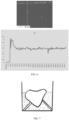
- This example was a glass-ceramic dental prosthesis as shown in FIG. 1 , having a metal ion-reinforced surface 101 and an other surface region 102.
- the glass-ceramic dental prosthesis was prepared as follows:
- This example was a glass-ceramic dental prosthesis, as shown in FIG. 1 , having a metal ion-reinforced surface 101 and an other surface region 102.
- the glass-ceramic dental prosthesis was prepared as follows:
- This example was a glass-ceramic dental prosthesis, as shown in FIG. 1 , having a metal ion-reinforced surface 101 and an other surface region 102.
- the glass-ceramic dental prosthesis was prepared as follows:
- This example was a glass-ceramic dental prosthesis as shown in FIG. 1 , having a metal ion-reinforced surface 101 and an other surface region 102.
- the glass-ceramic dental prosthesis was prepared as follows:
- This example was a glass-ceramic dental prosthesis, as shown in FIG. 1 , having a metal ion-reinforced surface 101 and an other surface region 102.
- the glass-ceramic dental prosthesis was prepared as follows:
- This example was a glass-ceramic dental prosthesis, as shown in FIG. 1 , having a metal ion-reinforced surface 101 and an other surface region 102.
- the glass-ceramic dental prosthesis was prepared as follows:
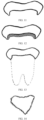
- This example was a glass-ceramic dental prosthesis, as shown in FIG. 10 , with a metal ion-reinforced surface 1001 and an other surface region 1002.
- the glass-ceramic dental prosthesis was prepared as follows:
- This comparative example was a glass-ceramic dental prosthesis which differed from Example 3 in the absence of metal ion-reinforced surface 101, as shown in FIG. 2 .
- the glass-ceramic dental prosthesis was prepared as follows:
- This comparative example was a glass-ceramic dental prosthesis, which differed from Example 6 in that all of the surfaces of the prosthesis were metal ion-reinforced surfaces, as shown in FIG. 14 .
- the glass-ceramic dental prosthesis was prepared as follows:
- the method of strength test is as follows: sample strips were prepared according to the three-point bending strength test in GB/T 30367-2013, subjected to the treatment according to Example 1 to 7 and Comparative Example 1 to 2, respectively, and then tested for strength.
- Table 1 No. Strength (MPa) Surface appearance
- Example 1 507 ⁇ 25 smooth
- Example 2 595 ⁇ 32 smooth
- Example 3 619 ⁇ 44 smooth
- Example 4 507 ⁇ 28 smooth
- Example 5 584 ⁇ 25 smooth
- Example 6 572 ⁇ 26 smooth
- Example 7 525 ⁇ 25 smooth Comparative Example 1 448 ⁇ 20 smooth Comparative Example 2 601 ⁇ 23 rough
- Glass which is an amorphous inorganic non-metallic material, generally made of a variety of inorganic minerals (such as quartz sand, borax, boric acid, barite, barium carbonate, limestone, feldspar, soda ash, etc.) as the main raw materials in combination with a small amount of auxiliary raw materials, is an amorphous solid with an irregular structure.
- a glass-ceramic refers to a multiphase complex with dense microcrystalline phase and glass phase, which is formed by using a base glass of a specific composition with a crystal nucleating agent (or without a crystal nucleating agent) and undergoing crystallization heat treatment under a certain temperature system to uniformly precipitate a large number of tiny crystals in the glass. Glass and glass-ceramics are widely used in areas such as electronics, vehicles, dentistry, architecture, etc.
- glass or glass-ceramics itself has a problem of low strength and often requires reinforcement in practical applications.
- the conventional technical approaches for enhancing the strength of glass-ceramic materials mainly include physical reinforcement and chemical reinforcement.
- the physical reinforcement also known as thermal strengthening, is realized by rapid cooling to form compressive stress on a surface of glass. Because of its simple manufacturing process and good toughening effect, it is widely used in large-scale glass parts, for example in buildings and automobiles.
- due to the principle of physical reinforcement it is required to maintain a large temperature difference between the surface and the interior of the glass during the process, which requires the glass to have a certain thickness (usually more than 6 mm), so it is not very practical to dental glass-ceramics which are thinner and smaller.
- Chemical reinforcement also known as ion strengthening is a technology that replaces smaller ions in glass materials (such as lithium ions) with larger ions (such as sodium or potassium ions) by high-temperature ion exchange process, to form a compressive stress on the surface, thereby enhancing the strength of glass.
- This technology can now be applied to thinner glass, such as display cover glass in electronic devices, and for reinforcing dental glass-ceramic materials in some studies. Nevertheless, conventional chemical reinforcing methods have obvious disadvantages in application, for example:
- the molten salt used in the conventional chemical reinforcing method is in the form of solid particles or masses at room temperature.
- the salt can be obtained in liquid form only after molten, and thus cannot be used for coating at room temperature. Therefore, the conventional chemical reinforcing method based on this is no more than completely immersing the glass or glass-ceramics in the solution or molten salt for ion exchange treatment, so as to improve the strength of the glass or glass-ceramics.
- problems that has not been fundamentally resolved such as inconvenient operation, high cost and poor reinforcing effect, impact on the appearance of other regions, hence sacrificing the aesthetics, and so on.
- the inventor upon a large number of experimental studies, provides a novel method for reinforcing glass or glass-ceramics, and have tried for the first time to apply a reinforcing metal salt by coating with an alkaline reinforcing paste in combination with heat treatment, in order to reinforce the glass or glass-ceramics in a predetermined region at will. It can be done with simple operation, reduced cost, improved reinforcing effect, and without affecting the properties of other regions. Such prepared glass or glass-ceramics can also balance the aesthetic and good mechanical strength, and meet the requirement for local reinforcement of glass or glass-ceramics products. It can be seen that the method for reinforcing glass or glass-ceramic has the following remarkable advantages:
- the present disclosure provides a method for reinforcing glass or glass-ceramics, including:
- region to be reinforced and coated with the alkaline reinforcing paste can be selected as needed. Either the entire surface of glass or glass-ceramics or part of the surface of glass or glass-ceramics can be selected.
- the heat treatment is performed at a temperature of 400°C to 550°C, specifically including, but not limited to, 400°C, 410°C, 420°C, 430°C, 440°C, 450°C, 460°C, 470°C, 480°C, 490°C, 500°C, 510°C, 520°C, 530°C, 540°C, and 550°C.
- the heat treatment is performed for 10 min to 60 min, specifically including, but not limited to, 10 min, 20 min, 25 min, 28 min, 30 min, 32 min, 35 min, 40 min, 43 min, 45 min, 47 min, 50 min, 55 min, 58 min, 60 min.
- the heat treatment is performed at a temperature of 400°C to 550°C for 10 min to 60 min.
- the metal ionic compound and the stabilizer is at a mass ratio of (35 to 80):(65 to 20), specifically including, but are not limited to, 35:65, 45:55, 55:45, 60:40, 70:30, and 80:20.
- the metal ion in the metal ion compound is an alkali metal cation or an alkali earth metal cation.
- the metal ion is one or more selected from the group consisting of potassium ion, sodium ion, calcium ion, magnesium ion, rubidium ion and cesium ion.
- the metal ion is potassium ion. A better reinforcing effect can be obtained by ion exchange using potassium ions.
- the metal ionic compound is one or more selected from the group consisting of potassium nitrate, potassium sulfate, potassium chloride, potassium carbonate, potassium bicarbonate, potassium acetate, potassium silicate, potassium hydroxide, sodium hydroxide, sodium carbonate, sodium bicarbonate, sodium acetate, sodium silicate, sodium nitrate, magnesium nitrate and cesium nitrate.
- the stabilizer is a mixture of one or more organic solvents having a decomposition temperature below 500°C.
- the stabilizer is one or more selected from the group consisting of butanediol, glycerol, polyethylene glycol, terpilenol, oleic acid and caproic acid.
- the alkaline reinforcing paste includes the following components in mass percentage.
- the mass percentage of metal ion compound includes, but is not limited to: 35%, 40%, 45%, 48%, 50%, 52%, 55%, 58%, 60%, 62%, 65%, 68%, 70%, 72%, 75%, or 80%.
- the mass percentage of the stabilizer includes, but is not limited to: 20%, 23%, 25%, 27%, 30%, 33%, 35%, 37%, 40%, 45%, 48%, 50%, 52%, 55%, 60%, or 65%.
- the mass percentage of water includes, but is not limited to: 0%, 3%, 5%, 6%, 7%, 8%, 9%, or 10%.
- the alkaline reinforcing paste is alkaline, that is, the pH value of its aqueous solution is greater than 7.
- the alkaline reinforcing paste can be made alkaline by an basic metal ion compound or by other basic compounds.
- the alkaline reinforcing paste is made alkaline by an alkaline metallic ion compound so that no additional compound may be introduced.
- a strong alkaline metal ion compound and/or a weak alkaline metal ion compound such as one or more of potassium hydroxide, sodium hydroxide, potassium carbonate, potassium bicarbonate, potassium acetate, potassium silicate, sodium carbonate, sodium bicarbonate, sodium acetate and sodium silicate, can be used.
- the strong alkaline metal ion compound and/or weak alkaline metal ion compound with potassium ion as cation is used.
- the strong alkaline metal ion compound and/or weak basic metal ion compound can also be used in combination with non-alkaline metal ion compounds, such as one or more selected from the group of potassium nitrate, potassium sulfate and potassium chloride, as long as the purpose of making the alkaline reinforcing paste alkaline can be achieved.
- the alkaline reinforcing paste satisfies the following conditions: a solution obtained by dissolving every 1 g of the alkaline reinforcing paste in 1,000 mL of water has a pH value greater than 8. Further, the pH value of the obtained solution is greater than 9. Specifically, the pH value of the obtained solution includes, but is not limited to: 8.1, 8.5, 9, 9.5, 10, 10.5, 11, 11.5, 12, 12.5, 13, 13.5, 14.
- the permeation of the reinforcing metal ions can be enhanced while realizing the shape of the paste, promoting the exchange of ions, which shortens the time duration of the reinforcing while ensures the effect of reinforcing.
- the surface of glass or glass-ceramics eroded by molten salt has such a roughness that, when the surface is used as a bonding surface for glass-ceramic dental prosthesis, no additional hazardous chemicals such as hydrofluoric acid are required for surface roughening during the bonding operation, which simplifies the process and improves the safety for the operator.
- the alkaline reinforcing paste further includes a dispersant.
- the dispersant is selected from inorganic non-metallic powder having a melting point above 600°C.
- the dispersant is one or more selected from the group consisting of silica, alumina, silicon carbide, and silicon nitride.
- a mass fraction of the dispersant is 0% to 15% by mass of the alkaline reinforcing paste. Further, the mass fraction of the dispersant is 0.01% to 15% by mass of the alkaline reinforcing paste. Specifically, the mass percentage of the dispersant includes, but is not limited to: 0%, 0.01%, 0.1%, 1%, 3%, 4%, 5%, 6%, 7%, 8%, 9%, 10%, 11%, 12%, 13%, 14%, 15%.
- the present disclosure also provides an alkaline reinforcing paste, mainly including metal ion compounds and stabilizers.
- the alkaline reinforcing paste here is the same as that described in the aforementioned reinforcing method, and will not be described repeatedly here.
- the present disclosure also provides a method for preparing the reinforcing paste, including the following steps: mixing components together and ball-milling the mixture.
- the mixture is ball-milled until forming a paste.
- glass-ceramic preforms containing Lithium disilicate as main crystal phase was used. Understandably, the reinforcing method also is applicable to glass or glass-ceramics containing other components of an alkali metal or an alkaline earth metal, such as sodium-aluminum-silica glass, lithium-aluminum-silica glass, glass-ceramics containing feldspar as main crystal phase, glass-ceramics containing spodumene as main crystal phase, and the like.
- an alkali metal or an alkaline earth metal such as sodium-aluminum-silica glass, lithium-aluminum-silica glass, glass-ceramics containing feldspar as main crystal phase, glass-ceramics containing spodumene as main crystal phase, and the like.
- This example shows a method for reinforcing glass-ceramics containing lithium disilicate as main crystal phase, including the following steps.
- a reinforcing paste is prepared with the formulation as follows (mass percentage): Potassium Carbonate 5% Potassium nitrate 60% Butanediol 25% Water 5% Alumina 5%.
- the above reinforcing paste is prepared by mixing the components together and ball-milling the mixture.
- a part of a surface of a glass-ceramic preform is coated evenly with the reinforcing paste using a soft brush, and then is subjected to the heat treatment at a temperature of 500°C for 30 min.
- the glass-ceramic preform was cooled in air, ultrasonic cleaned in clean water and dried.
- This example shows a method for reinforcing glass-ceramics containing lithium disilicate as main crystal phase.
- the procedure was the same as that in Example 8 except for the formulation of the reinforcing paste.
- the formulation of the reinforcing paste in this example was as follows (mass percentage): Potassium Carbonate 20% Potassium nitrate 40% Butanediol 30% Water 5% Alumina 5%;
- This example shows a method for reinforcing glass-ceramics containing lithium disilicate as main crystal phase.
- the procedure was the same as that in Example 8 except for the formulation of the reinforcing paste.
- the formulation of the reinforcing paste in this example was as follows (mass percentage): Sodium carbonate 5% Sodium hydroxide 5% Potassium sulfate 55% Glycerin 25% Water 10%.
- This example shows a method for reinforcing glass-ceramics containing lithium disilicate as main crystal phase.
- the procedure was the same as that in Example 8 except for the formulation of the reinforcing paste.
- the formulation of the reinforcing paste in this example is as follows (mass percentage): Sodium hydroxide 10% Potassium nitrate 40% Cesium nitrate 5% Butanediol 20% Pizoethanol 15% Alumina 10%;
- This example shows a method for reinforcing glass-ceramics containing lithium disilicate as main crystal phase.
- the procedure was the same as that in Example 8 except for the formulation of the reinforcing paste.
- the formulation of the reinforcing paste in this example was as follows (mass percentage): Potassium Carbonate 40% Potassium sulfate 6% Magnesium nitrate 2% Sodium nitrate 2% Turpentine 50%.
- This example shows a method for reinforcing glass-ceramics containing lithium disilicate as main crystal phase.
- the procedure was the same as that in Example 8 except for the formulation of the reinforcing paste.
- the formulation of the reinforcing paste in this example was as follows (mass percentage): Potassium hydroxide 10% Potassium nitrate 30% Potassium sulfate 30% Oleic acid 30%.
- This example shows a method for reinforcing glass-ceramics containing lithium disilicate as main crystal phase.
- the procedure was the same as that in Example 8 except for the process parameters of the heat treatment in step (2).
- the heat treatment was performed at a temperature of 400°C for 60 min.
- This example shows a method for reinforcing glass-ceramics containing lithium disilicate as main crystal phase.
- the procedure was the same as that in Example 8 except for the process parameters of the heat treatment in step (2).
- the heat treatment was performed at a temperature of 450°C for 45 min.
- This example shows a method for reinforcing glass-ceramics containing lithium disilicate as main crystal phase.
- the procedure was the same as that in Example 8 except for the process parameters of the heat treatment in step (2).
- the heat treatment was performed at a temperature of 550°C for 10 min.
- This comparative example shows a method for reinforcing glass-ceramics containing lithium disilicate as main crystal phase.
- the procedure was the same as that in Example 8 except for the formulation of the reinforcing paste.
- the formulation of the reinforcing paste in this example was as follows (mass percentage): Potassium Carbonate 1% Potassium nitrate 53% Butanediol 33% Water 7% Alumina 6%;
- the alkalinity of the reinforcing paste used in this example and the strength of the glass-ceramic were shown in Table 2.
- the reinforcing paste of this formulation had insufficient alkalinity, resulting in a poor reinforcing effect.
- This comparative example shows a method for reinforcing glass-ceramics containing lithium disilicate as main crystal phase.
- the procedure was the same as that in Example 8 except for the formulation of the reinforcing paste with 10% stabilizer added.
- the formulation of the reinforcing paste in this example was as follows (mass percentage): Potassium Carbonate 25% Potassium nitrate 55% Butanediol 10% Water 5% Alumina 5%.
- the solid content of the reinforcing paste of this formulation was too high to form a paste for the coating step, so the reinforcing treatment and strength effect test was not performed.
- This comparative example shows a method for reinforcing glass-ceramics containing lithium disilicate as main crystal phase.
- the method was the same as that in Example 8 except for the formulation of the paste salt with 70% stabilizer added.
- the formulation of the reinforcing paste in this example was as follows (mass percentage): Potassium Carbonate 10% Potassium nitrate 10% Butanediol 70% Water 5% Alumina 5%;
- the alkalinity of the reinforcing paste used in this example and the strength of the glass-ceramic were shown in Table 2.
- the solid content of the reinforcing paste of this formula was too low to cover all reinforcing surfaces after the volatilization of the solvent.
- the method of strength test is as follows: sample strips were prepared according to the three-point bending strength test in GB/T 30367-2013, and then tested for strength using a universal testing machine.
- the method of alkalinity test is as follows: every 1 g of the reinforcing paste was dissolved in 1,000 mL of water to obtain a solution, which was then tested using a pH tester.
- Example 2 No. Strength (MPa) Alkalinity
- Example 8 595 ⁇ 25 9.50
- Example 9 619 ⁇ 32 10.02
- Example 10 507 ⁇ 44 10.42
- Example 11 584 ⁇ 28 10.57
- Example 12 507 ⁇ 25 10.85
- Example 13 557 ⁇ 26 10.21
- Example 14 529 ⁇ 25 9.50
- Example 15 549 ⁇ 38 9.50
- Example 16 477 ⁇ 23 9.50
- Comparative Example 3 349 ⁇ 27 / Comparative Example 4 408 ⁇ 20 6.99 Comparative Example 5 / / Comparative Example 6 402 ⁇ 85 8.57
Landscapes
- Chemical & Material Sciences (AREA)
- Health & Medical Sciences (AREA)
- Engineering & Computer Science (AREA)
- Life Sciences & Earth Sciences (AREA)
- Chemical Kinetics & Catalysis (AREA)
- Organic Chemistry (AREA)
- Materials Engineering (AREA)
- Geochemistry & Mineralogy (AREA)
- General Chemical & Material Sciences (AREA)
- Oral & Maxillofacial Surgery (AREA)
- Ceramic Engineering (AREA)
- Public Health (AREA)
- Veterinary Medicine (AREA)
- General Health & Medical Sciences (AREA)
- Animal Behavior & Ethology (AREA)
- Epidemiology (AREA)
- Dentistry (AREA)
- Crystallography & Structural Chemistry (AREA)
- Dispersion Chemistry (AREA)
- Molecular Biology (AREA)
- Plastic & Reconstructive Surgery (AREA)
- Dental Preparations (AREA)
Applications Claiming Priority (2)
| Application Number | Priority Date | Filing Date | Title |
|---|---|---|---|
| CN202211105740.2A CN115594418B (zh) | 2022-09-09 | 2022-09-09 | 微晶玻璃齿科修复体及其制备方法 |
| CN202211105771.8A CN115650589A (zh) | 2022-09-09 | 2022-09-09 | 玻璃或微晶玻璃的强化方法以及碱性强化膏 |
Publications (1)
| Publication Number | Publication Date |
|---|---|
| EP4335430A1 true EP4335430A1 (fr) | 2024-03-13 |
Family
ID=86604890
Family Applications (1)
| Application Number | Title | Priority Date | Filing Date |
|---|---|---|---|
| EP23175437.5A Pending EP4335430A1 (fr) | 2022-09-09 | 2023-05-25 | Prothèse dentaire vitrocéramique et son procédé de préparation, procédé de renforcement du verre ou de la vitrocéramique et pâte à renfort alcaline |
Country Status (2)
| Country | Link |
|---|---|
| US (1) | US20240083810A1 (fr) |
| EP (1) | EP4335430A1 (fr) |
Citations (3)
| Publication number | Priority date | Publication date | Assignee | Title |
|---|---|---|---|---|
| US4546006A (en) * | 1984-01-26 | 1985-10-08 | G-C Dental Industrial Corp. | Method for strengthening porcelain tooth |
| EP3095433A1 (fr) * | 2015-05-22 | 2016-11-23 | Dentsply Sirona Inc. | Procédé pour augmenter la résistance d'un corps de coffrage de vitrocéramique à silicate de lithium |
| EP3095434A1 (fr) * | 2015-05-22 | 2016-11-23 | Dentsply Sirona Inc. | Procédé pour augmenter la résistance d'un corps de coffrage de vitrocéramique à silicate de lithium |
-
2023
- 2023-05-25 EP EP23175437.5A patent/EP4335430A1/fr active Pending
- 2023-06-02 US US18/205,066 patent/US20240083810A1/en active Pending
Patent Citations (3)
| Publication number | Priority date | Publication date | Assignee | Title |
|---|---|---|---|---|
| US4546006A (en) * | 1984-01-26 | 1985-10-08 | G-C Dental Industrial Corp. | Method for strengthening porcelain tooth |
| EP3095433A1 (fr) * | 2015-05-22 | 2016-11-23 | Dentsply Sirona Inc. | Procédé pour augmenter la résistance d'un corps de coffrage de vitrocéramique à silicate de lithium |
| EP3095434A1 (fr) * | 2015-05-22 | 2016-11-23 | Dentsply Sirona Inc. | Procédé pour augmenter la résistance d'un corps de coffrage de vitrocéramique à silicate de lithium |
Non-Patent Citations (2)
| Title |
|---|
| HORST FISCHER ET AL: "Chemical strengthening of a dental lithium disilicate glass-ceramic material", JOURNAL OF BIOMEDICAL MATERIALS RESEARCH PART A, vol. 87A, no. 3, 1 December 2008 (2008-12-01), pages 582 - 587, XP055083908, ISSN: 1549-3296, DOI: 10.1002/jbm.a.31798 * |
| ZHANG HUI-YING: "Phase Equilibrium of NaNO3/KNO3 in Glycerol + H2O Mixed Solvent System at 288.15 K and 298.15 K", KEMIJA U INDUSTRIJI, vol. 63, no. 9-10, 1 September 2014 (2014-09-01), HR, pages 345 - 354, XP093125411, ISSN: 0022-9830, Retrieved from the Internet <URL:https://hrcak.srce.hr/file/186785> DOI: 10.15255/KUI.2014.015 * |
Also Published As
| Publication number | Publication date |
|---|---|
| US20240083810A1 (en) | 2024-03-14 |
Similar Documents
| Publication | Publication Date | Title |
|---|---|---|
| KR101961684B1 (ko) | 치아 수복재, 이의 제조 방법 및 잉곳 | |
| US20200339470A1 (en) | Method to increase the strength of a form body of lithium silicate glass ceramic | |
| AU2015261432B2 (en) | Glass ceramic with SiO2 as the main crystalline phase | |
| CN104736126B (zh) | 包含氧化铯的硅酸锂玻璃陶瓷和硅酸锂玻璃 | |
| US20220281770A1 (en) | Method to increase the strength of a form body of a lithium silicate glass ceramic | |
| AU2016214608B2 (en) | Method for the production of a form body comprising or containing a lithium silicate glass ceramic as well as form bodies | |
| CN111087174A (zh) | 一种具有高弹性模量的玻璃陶瓷、强化玻璃陶瓷及其制备方法 | |
| CN107920961B (zh) | 增加硅酸锂陶瓷成型体的强度的方法 | |
| CN103395982A (zh) | 含有钇稳定二氧化锆的牙齿修复体用陶瓷贴面 | |
| EP4265573A1 (fr) | Vitrocéramique 3d, son procédé de préparation et son application | |
| US4546006A (en) | Method for strengthening porcelain tooth | |
| EP3095435B1 (fr) | Méthode pour produire une structure dentaire | |
| EP4335430A1 (fr) | Prothèse dentaire vitrocéramique et son procédé de préparation, procédé de renforcement du verre ou de la vitrocéramique et pâte à renfort alcaline | |
| CN117285255A (zh) | 一种3d打印二硅酸锂微晶玻璃及其制备方法、应用 | |
| EP3305240A1 (fr) | Matériau pour prothèse dentaire, corps de bloc pour produire une prothèse dentaire, et prothèse dentaire | |
| JPH0193439A (ja) | 歯科材料用結晶化ガラスの製造法及び埋没材 | |
| CN115594418B (zh) | 微晶玻璃齿科修复体及其制备方法 | |
| US4033775A (en) | Process for producing aluminous keatite ceramics | |
| CN114031311B (zh) | 一种用于增强齿科用二硅酸锂微晶玻璃力学性能的离子交换用熔盐及离子交换增强方法 | |
| CN116768479A (zh) | 玻璃或微晶玻璃的强化方法以及碱性强化膏 | |
| CN120229870A (zh) | 一种高耐碱高强度玻璃及其制备方法和应用 |
Legal Events
| Date | Code | Title | Description |
|---|---|---|---|
| PUAI | Public reference made under article 153(3) epc to a published international application that has entered the european phase |
Free format text: ORIGINAL CODE: 0009012 |
|
| STAA | Information on the status of an ep patent application or granted ep patent |
Free format text: STATUS: THE APPLICATION HAS BEEN PUBLISHED |
|
| STAA | Information on the status of an ep patent application or granted ep patent |
Free format text: STATUS: REQUEST FOR EXAMINATION WAS MADE |
|
| AK | Designated contracting states |
Kind code of ref document: A1 Designated state(s): AL AT BE BG CH CY CZ DE DK EE ES FI FR GB GR HR HU IE IS IT LI LT LU LV MC ME MK MT NL NO PL PT RO RS SE SI SK SM TR |
|
| 17P | Request for examination filed |
Effective date: 20240304 |
|
| RBV | Designated contracting states (corrected) |
Designated state(s): AL AT BE BG CH CY CZ DE DK EE ES FI FR GB GR HR HU IE IS IT LI LT LU LV MC ME MK MT NL NO PL PT RO RS SE SI SK SM TR |